Article

Designing Bio-Hybrid Sandwich Composites: Charpy Impact Performance of Polyester/Glass Systems Reinforced with Musa paradisiaca Fibres


by
Aldo Castillo-Chung
,
Luis Aguilar-Rodríguez
,
Ismael Purizaga-Fernández
and
Alexander Yushepy Vega Anticona
*
School of Materials Engineering, Faculty of Engineering, National University of Trujillo, Trujillo 13011, Peru
*
Author to whom correspondence should be addressed.
J. Compos. Sci. 2026, 10(2), 59; https://doi.org/10.3390/jcs10020059
Submission received: 19 December 2025 / Revised: 9 January 2026 / Accepted: 12 January 2026 / Published: 23 January 2026
(This article belongs to the Section Composites Manufacturing and Processing)

Abstract

This study investigates the design of bio-hybrid sandwich composites by combining polyester/glass skins with cores reinforced by continuous Musa paradisiaca fibres. The aim is to quantify how fibre weight fraction and alkaline surface treatment control the Charpy impact performance of these systems. Sandwich laminates were manufactured with three fibre loadings in the core (20, 25 and 30 wt.%), using fibres in the as-received condition and after alkaline treatment in NaOH solution. Charpy impact specimens were machined from the laminates and tested according to ISO 179-1. Fibre morphology and fracture surfaces were examined by scanning electron microscopy, while Fourier-transform infrared spectroscopy was used to monitor changes in surface chemistry after alkaline treatment. The combined effect of fibre content and treatment on absorbed energy was assessed through a two-way analysis of variance. Increasing Musa paradisiaca fibre content up to 30 wt.% enhanced the impact energy of the sandwich composites, and alkaline treatment further improved performance by strengthening fibre–matrix adhesion and promoting fibre pull-out, crack deflection and bridging mechanisms. The best Charpy impact response was obtained for cores containing 30 wt.% NaOH-treated fibres, demonstrating that surface modification and optimised fibre loading are effective design parameters for toughening polyester/glass bio-hybrid sandwich composites.

1. Introduction

Over the last decades, natural fibre-reinforced polymer composites have emerged as a strategic alternative to partially or fully replace synthetic reinforcements in structural and semi-structural applications, owing to their lower environmental footprint, reduced density and favourable specific mechanical properties [1,2,3,4,5,6]. Several recent reviews have demonstrated that lignocellulosic fibres can be incorporated into thermoplastic and thermosetting matrices to produce biocomposites with competitive properties compared with traditional composites, particularly when hybrid design strategies and appropriate surface treatments are employed [1,2,3,4,6]. In this context, biocomposites and hybrid systems that combine polymer matrices with natural fibres are now regarded as one of the most promising routes towards high-performance, lower-impact composite systems [2,3,5,6].
Among natural fibres, those derived from the banana plant have attracted increasing attention due to their abundance in tropical regions, low cost and specific mechanical properties comparable with sisal, jute or hemp fibres [7,8,9,10]. Recent literature highlights the particular potential of the pseudostem and core of Musa spp. as sources of fibres exhibiting adequate tensile strength and specific modulus, together with a microstructure that is favourable for mechanical interlocking within polymer matrices [7,8,9]. Reviews focused on banana fibres further emphasise that these agricultural residues are currently underutilised and that their valorisation as reinforcement or filler in biocomposites represents a clear opportunity for circular economy strategies in producing countries [7,8,9,10].
A number of studies have characterised in detail the morphology, chemical composition and mechanical behaviour of pseudostem and core fibres from Musa paradisiaca, analysing the effects of parameters such as extraction technique, drying temperature and surface treatments on cell wall structure and resulting properties [11,12,13,14]. It has been reported, for instance, that drying conditions can markedly modify fibre stiffness and strength, whilst surface activation or modification enables the adjustment of chemical compatibility with hydrophobic matrices [11,12,13,14]. These studies provide a sound basis for integrating Musa paradisiaca fibres as functional reinforcements in different composite architectures. In the field of polymer composites, epoxy, polyester and poly(lactic acid) matrices reinforced with banana fibres have been investigated in laminated, particulate and hybrid configurations [15,16,17,18,19]. The results indicate that fibre content, fibre length and distribution, as well as the quality of the fibre–matrix interface, exert a decisive influence on tensile and flexural strength, toughness and impact response [15,16,17]. Recent studies on polyester- and epoxy-based composites reinforced with Musa paradisiaca fibres have shown that it is possible to significantly increase stiffness and energy absorption capacity through optimisation of fibre weight fraction and microstructural design of the reinforcement [15,16,17,18]. Additionally, the incorporation of green fillers—such as eggshell powder or other agro-industrial residues—in combination with banana fibres has been shown to improve wear resistance, damping and dynamic load response without excessively increasing the overall density of the material [19,20,21,22,23].
However, the efficient exploitation of lignocellulosic fibres in polymer matrices is hindered by their hydrophilic nature and by the presence of hemicellulose, lignin, pectins, waxes and other extractives on the fibre surface, which reduce interfacial adhesion and promote moisture uptake. To mitigate these effects, alkaline treatments with NaOH solutions have been widely employed in order to remove surface impurities, partially delignify the cell wall, increase surface roughness and expose a larger number of functional groups capable of interacting with hydrophobic matrices [7,8,9,10,13,16,17,18]. In many systems, the combination of mercerisation with an appropriate selection of fibre weight fraction has been shown to produce appreciable improvements in fibre–matrix adhesion and, consequently, in impact resistance and overall composite toughness [2,3,4,6,16,17,18].
Nevertheless, several authors have also reported that high NaOH concentrations and prolonged immersion times can lead to over-attack of the cell wall, with the formation of longitudinal microcracks, partial collapse of lumens and an effective reduction in the load-bearing cross-section of the fibre. Under such conditions, the intrinsic mechanical properties of the fibres (strength and toughness) may degrade, giving rise to more brittle fracture modes and a reduced capacity for energy dissipation, particularly in non-hybrid laminates reinforced solely with natural fibres. The literature therefore suggests the existence of an “optimal” mercerisation window, in which a balance is achieved between interfacial enhancement and preservation of the mechanical integrity of the fibre; outside this range, the benefits of the treatment tend to be reversed.
Beyond these interfacial and mechanical aspects, advanced modelling approaches have begun to be explored in order to describe and predict the behaviour of biocomposites as a function of formulation, treatment and service variables. In particular, the combined use of artificial neural networks (ANN) and response surface methodology (RSM) has proved effective for capturing complex non-linear relationships between processing parameters and resulting properties [19], for example, developed ANN and RSM models to predict water uptake in a recycled high-density polyethylene biocomposite reinforced with treated palm waste fibres, demonstrating that these tools can be used to optimise simultaneously the reinforcement content, treatment conditions and moisture response. Although the present work focuses on the impact resistance of polyester/glass/Musa paradisiaca bio-hybrid sandwiches, such modelling approaches represent a promising route for future studies aimed at predicting and optimising, in an integrated manner, the toughness and durability of composites reinforced with vegetal fibres.
In parallel, the development of composite materials for building and enclosure elements has driven the use of natural fibres in particleboards, panels and fibre-reinforced mortars [20,21,22,23,24,25,26]. Panels and boards based on banana pseudostem particles combined with cementitious matrices or polymeric binders have been reported to exhibit good flexural strength and dimensional stability, provided that water uptake and biological degradation are adequately controlled [20,21,22]. In mortars and cement-based matrices reinforced with vegetable fibres, appreciable increases in toughness and energy absorption capacity under quasi-static and impact loading have been observed, as long as the fibre/matrix ratio is optimised and appropriate treatment and dosing strategies are adopted [23,24,25]. More recently, the use of banana pseudostem fibres in packaging and small-scale products has also been explored, reinforcing the idea that these agro-industrial residues can be integrated into a broad range of applications [26]. Despite the growing number of studies on banana fibre-based composites, bio-hybrid sandwich systems in which a Musa paradisiaca fibre-reinforced core is combined with synthetic composite skins such as polyester/glass laminates remain relatively underexplored [18,20,21,22]. In particular, there is a scarcity of works that systematically analyse the combined influence of fibre weight fraction and alkaline surface treatment on the low-velocity impact response of sandwich configurations. The information available on panels and boards reinforced with banana fibres [20,21,22,23] does not yet provide specific answers to key design questions in sandwich systems, such as the role of the bio-reinforced core in energy dissipation under Charpy impact loading and the correlation between interfacial microstructure and the fracture mechanisms observed.
Against this background, this study designs and assesses bio-hybrid sandwich composites combining polyester/E-glass skins with cores reinforced by continuous Musa paradisiaca fibres, and quantifies the coupled influence of three key variables: (i) vegetal fibre weight fraction in the core (20, 25 and 30 wt.%), (ii) fibre surface condition (untreated, UT; alkali-treated, CT; 5 M NaOH), and (iii) reinforcement architecture, by comparing bio-hybrid sandwich configurations with non-hybrid reference composites. The experimental approach integrates laminate manufacturing (Figure 1 and Figure 2), morphological and chemical characterisation of fibres and fracture surfaces (stereomicroscopy, FTIR and SEM), and the statistical analysis of absorbed impact energy via two-way ANOVA. In addition, single-fibre tensile behaviour is determined to benchmark the effect of alkaline treatment at the fibre scale and to support the mechanistic interpretation of the laminate response. The working hypothesis is that hybridisation combined with controlled mercerisation improves interfacial efficiency and activates tougher energy-absorption mechanisms—such as fibre pull-out, crack deflection and bridging—leading to a significant increase in specific Charpy impact resistance compared with configurations with lower fibre contents, non-hybrid architectures or without surface treatment.

2. Materials and Methods

2.1. Materials

The materials under study comprised a bio-hybrid sandwich composite system consisting of:
Polymer matrix: A general-purpose unsaturated polyester resin (SILIKAST-PRO, ANYPSA, Lima, Peru), catalysed with an organic peroxide according to the manufacturer’s recommendations.
Synthetic reinforcement: A powder-bonded E-glass chopped strand mat, type EMC450 (nominal areal weight 450 ± 7 g·m−2, size content 2.8 ± 0.5 wt.%, moisture content ≤ 0.2 wt.%, minimum tensile strength ≥ 150 N per 50 mm; CNBM International Corporation, Beijing, China). The mat is formed by randomly distributed chopped glass rovings bonded with a powder binder, and is specifically designed for hand lay-up, filament winding, compression moulding and continuous laminating processes in combination with unsaturated polyester and other thermoset resins. In all sandwich and reference laminates, this chopped-strand mat was used to form the external faces (skins) of the composite by impregnation with the polyester resin within the compression moulding sequence described in Section 2.4.
Natural reinforcement: Continuous Musa paradisiaca fibres obtained from the pseudostem of fresh plants, used as reinforcement for the sandwich core at different weight contents.
Chemical reagents: Sodium hydroxide (NaOH, analytical grade) for the alkaline (mercerisation) treatment of the fibres, acetic acid for neutralisation, and distilled water for washing.
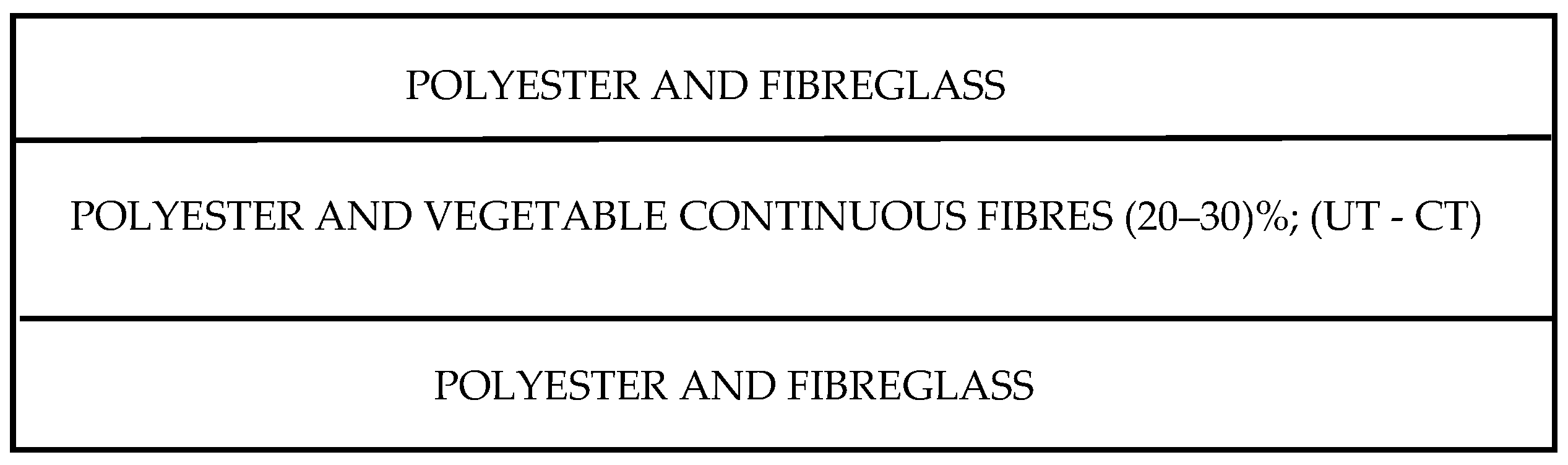
Three levels of Musa paradisiaca fibre weight content in the sandwich core were evaluated: 20, 25 and 30 wt.%, and two fibre surface conditions: untreated (UT) and chemically treated (CT, immersion in 5 M NaOH followed by neutralisation and washing). For each combination of wt.% and surface condition, four impact specimens (n = 4) were prepared, plus a reference group without natural fibre, achieving a total number of specimens in accordance with the experimental design of the thesis. The overall experimental matrix, including material configuration (R+FV, R+FN and R+FN+FV), fibre content and number of Charpy specimens per condition, is summarised in Table 1. The sandwich architecture and stacking sequence are depicted in Figure 1, and the overall experimental sequence is summarised in Figure 2.

2.2. Obtaining and Preparation of Musa paradisiaca Fibres

Musa paradisiaca plants were sourced from rural areas near the city of Trujillo (Uchumarca, Peru). Plants with an average height of approximately 2–3 m were selected, and the pseudostem was cleaned by removing the external leaves. The pseudostems were then cut into segments of about 100 cm in length and transported to the composites laboratory of the Universidad Nacional de Trujillo for fibre extraction.
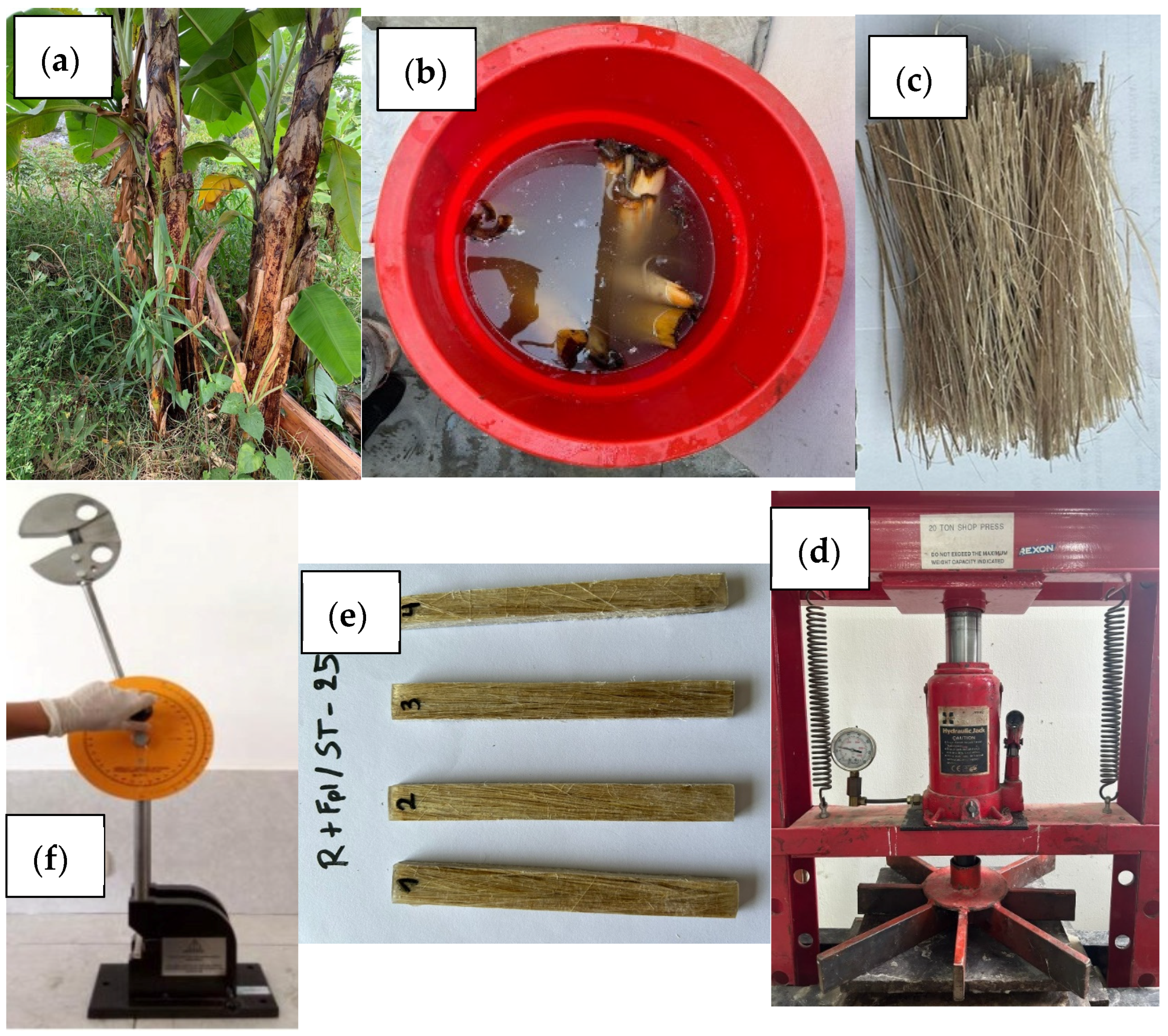
The pseudostem segments were placed in containers filled with tap water, using a water-to-plant ratio of approximately 1 L per kilogram of fresh material. The segments remained immersed for 14 days, which facilitated the separation of the fibrous bundles from the surrounding parenchymatous tissue. After this retting period, the fibres were removed manually, thoroughly rinsed with water to eliminate residual pith and impurities, and then air-dried at room temperature until a stable condition suitable for processing was achieved. The main stages of pseudostem selection, immersion/infusion and fibre extraction are illustrated in Figure 2a–c.
For the chemically treated condition (CT), the extracted continuous Musa paradisiaca fibres were subjected to an alkaline mercerisation treatment prior to laminate manufacture. Mercerisation was carried out using a 5 M NaOH aqueous solution, with a fibre/solution ratio of 50 g·L−1 and an immersion time of 1 h. After the alkaline treatment, the fibres were neutralised in an acetic acid solution and subsequently washed with distilled water until a pH in the range of 7–8 was reached. Finally, the fibres were air-dried at room temperature for 24 h.
Both untreated (UT) and alkali-treated (CT) fibres were then stored in dry laboratory conditions and later used as continuous reinforcement in the core of the sandwich laminates, with their bundles aligned along the main length direction of the plates in order to form the bio-hybrid configurations evaluated in this work.

2.3. Fibre Characterisation

2.3.1. Fibre Cross-Section and Diameter

To evaluate the cross-sectional geometry and effective diameter of the Musa paradisiaca fibres, representative fibres in good condition were selected. Along each fibre, cuts were made at three locations (end, middle section, and opposite end), generating cross-sections that were observed via stereoscopic inspection.
Observation was performed with a NexiusZoom NZ.1902-S zoom stereomicroscope (Euromex, Duiven, The Netherlands), equipped with:
  • 45° inclined binocular head,
  • Pair of HWF 10×/22 mm eyepieces with dioptric adjustment,
  • Continuous zoom system,
  • Coupled digital camera for micrograph capture.
Images were processed with image analysis software (ImageFocus 9.0, Euromex), measuring at least three effective diameters per section and calculating an average value and associated standard deviation, for both UT and CT fibres.

2.3.2. Fourier-Transform Infrared Spectroscopy (FTIR)

The surface chemical characterisation of the fibres was carried out by Fourier-transform infrared spectroscopy (FTIR) in transmission mode. A bench-top FTIR spectrometer (Nicolet iS10, Thermo Fisher Scientific, Madison, WI, USA) was used, operating in the range of 4000–400 cm−1, with a resolution of 4 cm−1 and averaging 32 scans per spectrum to improve the signal-to-noise ratio.
Samples of UT and CT fibres were prepared, conditioned according to the equipment protocol (mixed with KBr for the formation of pressed pellets). The obtained spectra allowed for the identification of characteristic bands associated with functional groups of cellulose, hemicellulose, and lignin, as well as a qualitative assessment of changes in the relative intensity of these bands after mercerisation.

2.3.3. Single-Fibre Tensile Testing

Single-fibre tensile tests were performed to quantify the intrinsic tensile response of Musa paradisiaca fibres in the untreated (UT) and alkali-treated (CT) conditions. Testing was carried out on a universal testing machine (UTM) (HSO–UT-5PC; Dongguan Hongjin Testing Instrument Co., Ltd., Dongguan, China; maximum capacity 5 kN) using a constant crosshead speed of 2 mm·min−1 and a gauge length of 30 mm (nominal strain rate ≈ 1.1 × 10⁻³ s−1).
The fibre ends were clamped directly between serrated wedge-type grips, without tabs, as illustrated in the tensile test set-up (Figure S1). Prior to loading, the fibre was aligned with the loading axis and lightly tensioned to remove slack. Force–displacement data were recorded until complete failure.
For each tested fibre, the effective diameter was determined from three stereomicroscope (NexiusZoom NZ.1902-S, Euromex, Duiven, The Netherlands; 10×) measurements taken along the gauge region (Section 2.3.1). The cross-sectional area was calculated assuming a circular section (A = πd2/4), and the tensile strength was obtained from the maximum force (σu = Fmax/A). An apparent tensile modulus was estimated from the slope of the initial linear region of the stress–strain curve, with strain computed from crosshead displacement divided by the gauge length (no extensometer was used; therefore, modulus values should be interpreted as apparent).
To ensure objective data quality, tests were retained as valid only when failure occurred within the gauge length and the force–displacement response did not exhibit a sustained load plateau or abrupt force drop indicative of grip slippage. The analysed dataset comprised 21 valid UT tests and 24 valid CT tests; the corresponding raw measurements and calculated properties are reported in Table S3.

2.4. Manufacture of Sandwich Panels

2.4.1. Mould Design and Conditioning

For the compression moulding of the plates, a mould was fabricated from A36 steel, with internal dimensions designed to obtain laminates of approximately 100 × 80 × 4 mm3. The mould included closing plates and alignment elements to control thickness and prevent misalignment during pressing.
The internal surfaces of the mould were previously conditioned with uniformly applied mould release wax to prevent adhesion of the composite material and facilitate subsequent demoulding.

2.4.2. Core Mixture Preparation (Resin + Musa paradisiaca Fibre)

The SILIKAST-PRO polyester resin was mixed with the catalyst (organic peroxide) in the proportion indicated by the manufacturer, typically adding 7–8 drops of catalyst per 100 g of resin. The mixture was stirred manually for approximately 2–3 min, aiming to achieve good homogeneity without introducing excessive air bubbles.
For the preparation of plates with cores reinforced with Musa paradisiaca fibres (R+FN and R+FN+FV configurations), the mass of fibres required to achieve the 20, 25 and 30 wt.% levels with respect to the resin mass destined for each plate was weighed. The UT or CT fibres were gradually added to the catalysed resin and distributed as homogeneously as possible via manual mixing with spatulas, breaking up visible agglomerates and ensuring adequate fibre wetting.

2.4.3. Lay-Up Sequence and Compression Moulding

Three types of plates were manufactured:
Reference polyester/glass plates (R+FV): only the E-glass chopped strand mat was placed in the mould and impregnated with the catalysed polyester resin to form a fully synthetic laminate of approximately 4 mm in thickness.
Polyester/Musa plates (R+FN): the resin + Musa paradisiaca fibre core mixture prepared in Section 2.4.2 was poured into the mould cavity and spread to obtain a uniform thickness across the entire useful area, without glass-fibre skins.
Bio-hybrid sandwich plates (R+FN+FV): the lay-up sequence within the mould was performed as follows:
  • Placement of a first layer of glass fibre impregnated with polyester resin, constituting the bottom skin.
  • Pouring and distribution of the resin + Musa paradisiaca fibre core over the first layer, ensuring the thickness was uniform across the entire useful area.
  • Placement of a second layer of glass fibre impregnated with polyester resin, constituting the top skin.
The sandwich architecture and stacking sequence (FV/FN/FV) are schematically shown in Figure 1. The main stages of the manufacturing route, from fibre extraction to compression moulding, are illustrated in Figure 2d.
After the lay-up was completed in each case, the mould was closed and placed in a hydraulic press (Hydraulic press PREH-20; code 17685; Truper, S.A. de C.V., Jilotepec de Molina Enríquez, Estado de México, Mexico). The assembly was subjected to a pressure of approximately 2000 psi, which was maintained for 24 h at ambient temperature to allow resin curing. After this time, the pressure was released, and the plates were demoulded. They were visually inspected to verify the absence of obvious voids, delaminations, or macroscopic defects, as well as a uniform distribution of fibres in the core for the R+FN and R+FN+FV configurations.

2.5. Specimen Preparation and Charpy Impact Test

Impact specimens were machined from the cured plates using suitable cutting tools (disc saw with a cutting guide). The specimens had nominal dimensions of 80 × 10 × 4 mm3, compatible with unnotched Charpy impact specimens for plastics and composites according to ISO 179-1:2010 [27]. Representative test specimens and the Charpy pendulum used for impact testing are shown in Figure 2e,f, respectively.
Edges were gently sanded to remove burrs generated during cutting. Each specimen was identified by a code indicating the material configuration (R+FV, R+FN or R+FN+FV), the fibre weight percentage, the UT or CT condition, and the replicate number.
Impact tests were performed on a Charpy pendulum impact machine model MT-3016-15 J (Time Group Inc., Beijing, China), located in the Composite Materials Laboratory of the Materials Engineering School at the Universidad Nacional de Trujillo. The support span and specimen mounting conditions were adjusted in accordance with ISO 179-1. For each specimen, the energy absorbed during fracture (E, in J) was recorded from the pendulum reading. The specific impact energy was obtained by normalising E by the cross-sectional area of the specimen, expressing it in units of kJ·m−2.

2.6. Microstructural Characterisation of the Specimens

2.6.1. Stereoscopic Inspection of Fracture Surfaces

Following the impact test, the fracture planes were examined by stereomicroscopy (NexiusZoom NZ.1902-S, Euromex, The Netherlands) to identify the dominant failure modes for each condition (fibre %, UT/CT). The fractured specimens were placed on the microscope stage and observed at different magnifications, recording digital micrographs of representative zones with the aid of the coupled camera and ImageFocus 9.0 software. Special attention was paid to the presence of:
  • Pull-out and bridging of Musa paradisiaca fibres,
  • Fracture of glass fibres,
  • Delamination between skins and core,
  • Matrix regions with brittle fracture or evidence of local plasticisation.

2.6.2. Scanning Electron Microscopy (SEM)

To analyse in greater detail the quality of the fibre–matrix interface and the fracture mechanisms at the microstructural scale, fragments of fractured specimens were selected and prepared for observation by scanning electron microscopy (SEM). The fragments were fixed onto metallic stubs using carbon tape and coated with a thin conductive layer of gold via sputtering. SEM observation was performed on an Axia ChemiSEM type instrument (Thermo Fisher Scientific, Waltham, MA, USA), operating in high vacuum mode, with an acceleration voltage in the range of 10–15 kV and a typical working distance of 10 mm. Micrographs were obtained at various magnifications, documenting:
  • The wetting of Musa paradisiaca fibres by the polyester matrix,
  • The presence of voids or areas of poor adhesion,
  • Traces of fibre pull-out and sliding,
  • Fracture of glass fibres and bridging mechanisms at the interface.
These observations were subsequently used to correlate the fracture mechanisms with the absorbed impact energy and the trends observed in the statistical analysis.

2.7. Statistical Analysis

The influence of the Musa paradisiaca fibre weight percentage (20, 25 and 30 wt.%) and the surface condition (UT, CT) on the absorbed impact energy was evaluated using a two-factor analysis of variance (ANOVA) with a significance level of α = 0.05. For each combination of factors, the impact energy values from the four replicates (n = 4) were used. The reference laminate without natural fibres (R+FV) was analysed descriptively for benchmarking but was not included in the 3 × 2 factorial ANOVA. The ANOVA allowed for the determination of the statistical significance of the main effects (fibre percentage and treatment) and their interaction. When necessary, post hoc multiple comparison tests were applied to identify significant differences between levels.

3. Results

3.1. Morphological and Chemical Characterisation of Musa paradisiaca Fibres

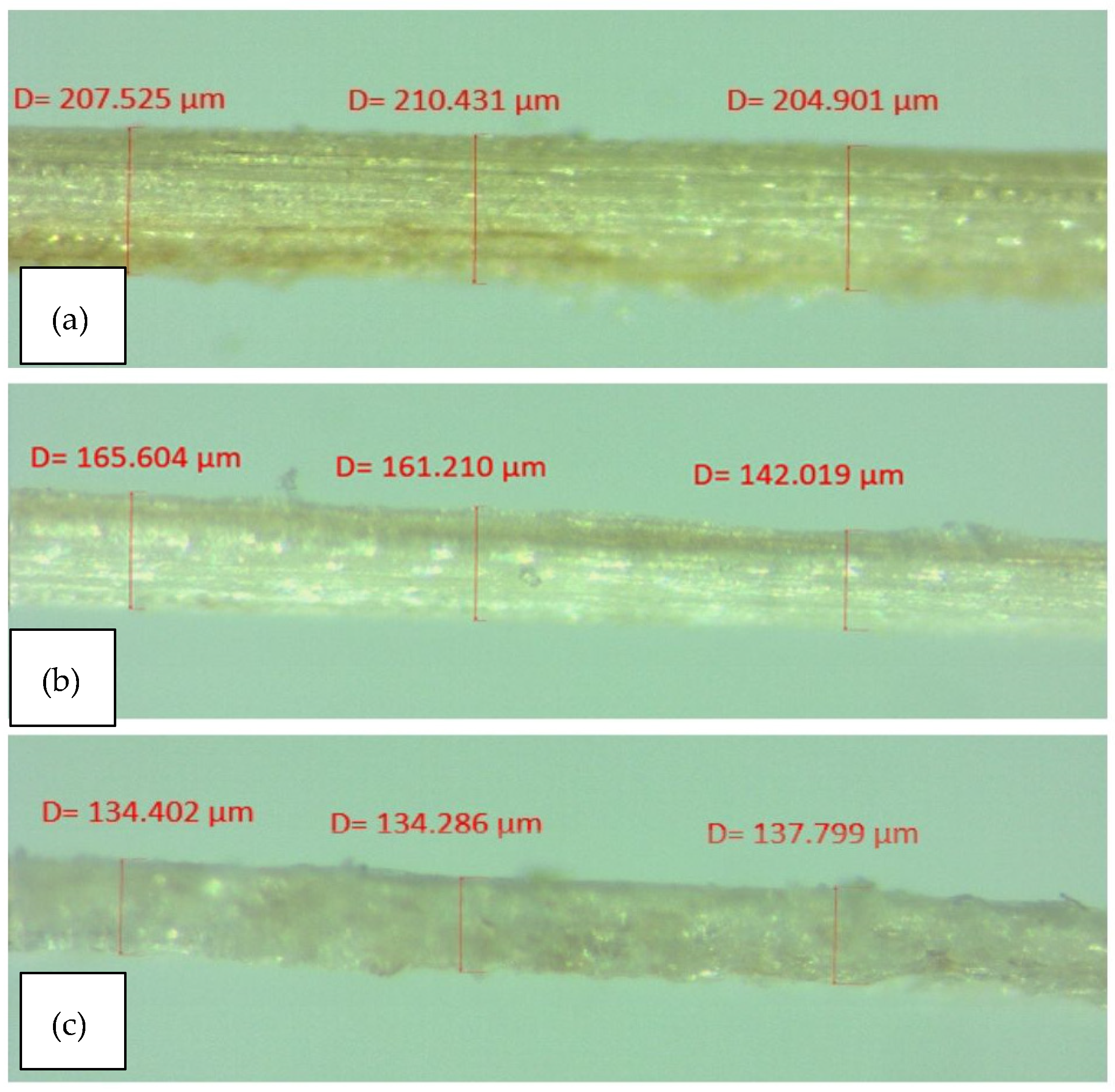
Stereoscopic images of transverse sections of Musa paradisiaca fibres reveal the typical morphology of lignocellulosic reinforcements, with non-circular cross-sections, a well-defined lumen and cell walls of non-uniform thickness. In the untreated condition (UT), fibre surfaces appear relatively smooth, with remnants of parenchymatous tissue and amorphous material adhering to the outer wall, associated with hemicellulose, lignin and surface extractives (Figure 3), as reported for banana pseudostem fibres in the literature [7,8,9,10,13].
After alkaline treatment in NaOH 5 M (CT), the fibre surface becomes noticeably rougher and more fibrillated, with partial removal of the outer layer and exposure of sub-surface microfibrils. This morphology is consistent with the partial removal of hemicellulose and extractives and with a certain degree of delignification, effects commonly observed for moderately mercerised Musa and related vegetable fibres [7,8,9,10,13,16,17,18]. In some regions, the transverse sections suggest local weakening and micro-damage in the cell wall, which is compatible with a reduction in intrinsic fibre toughness under severe alkaline conditions.
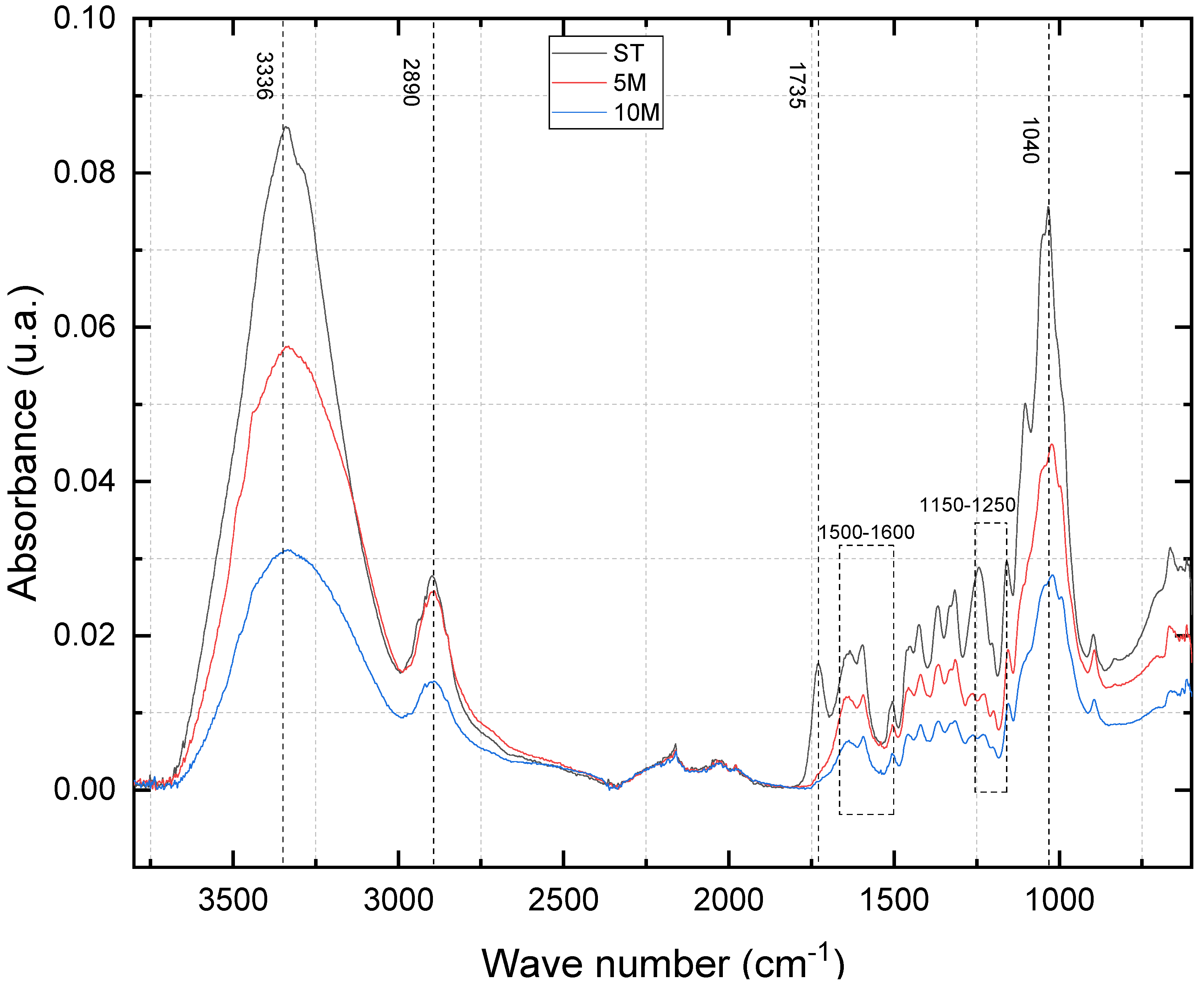
FTIR spectra for UT and CT fibres corroborate these morphological trends. For the UT condition, characteristic bands of cellulose, hemicellulose and lignin are observed: a broad O–H stretching band centred near 3330 cm−1, the aliphatic C–H stretching band around 2900 cm−1, the C=O stretching band of acetyl and uronic ester groups from hemicellulose at ≈1730 cm−1, and features at 1510–1600 and 1240 cm−1 attributed to aromatic rings and C–O bonds in lignin [7,8,9,10,13].
Following treatment with NaOH 5 M, the intensity of the 1730 cm−1 band and lignin-related bands at 1510–1600 and 1240 cm−1 decreases markedly, evidencing partial removal of hemicellulose and lignin. At the same time, a slight relative increase is observed in the O–H band and in the band near 1030 cm−1 (C–O–C in cellulose), in agreement with a surface richer in exposed cellulose [7,8,9,10,16,17,18]. Overall, the alkaline treatment clearly modifies the surface chemistry of the fibres, increasing polarity and roughness but also potentially affecting cell-wall integrity (Figure 4).

3.1.1. Single-Fibre Diameter and Tensile Properties

Table S3 summarises the single-fibre diameter and tensile properties for UT and CT Musa paradisiaca fibres. The UT fibres exhibited a mean diameter of 272.7 ± 72.6 μm (n = 21), whereas alkali treatment reduced the mean diameter to 168.3 ± 36.5 μm (n = 24), indicating a statistically significant reduction (Welch’s t-test, p = 2 × 10⁻⁶).
In terms of tensile response, the UT fibres reached an average ultimate tensile strength of 87.6 ± 55.7 MPa, while CT fibres exhibited a higher mean strength of 164.3 ± 91.2 MPa (p = 0.00137). Similarly, the apparent tensile modulus increased from 1.86 ± 1.02 GPa (UT) to 3.47 ± 2.04 GPa (CT) (p = 0.00167). The strain at break did not change significantly between UT and CT fibres (p = 0.272). These fibre-scale trends support the mechanistic interpretation of the laminate response discussed in Section 3.2 and Section 4.

3.1.2. Specific Impact Strength

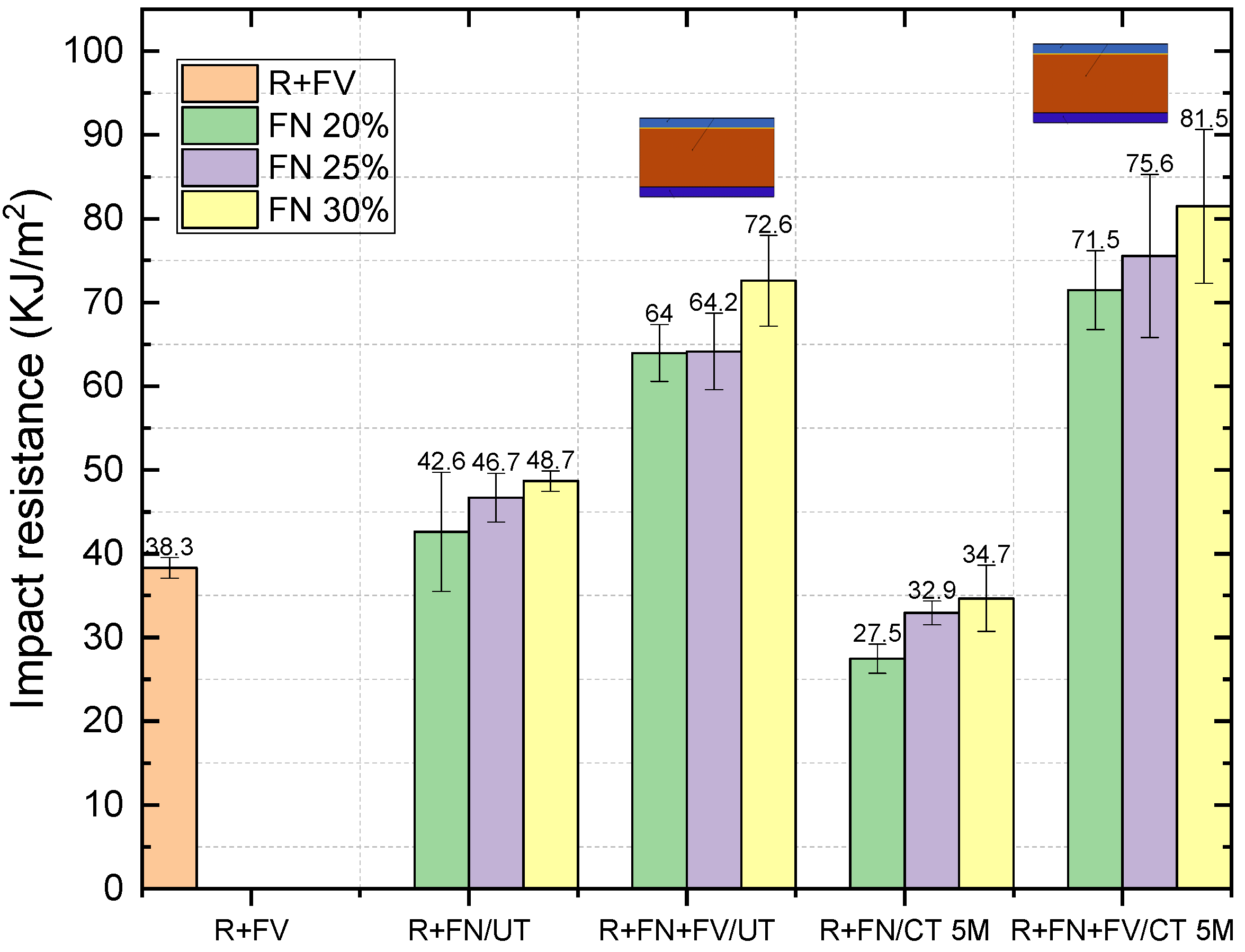
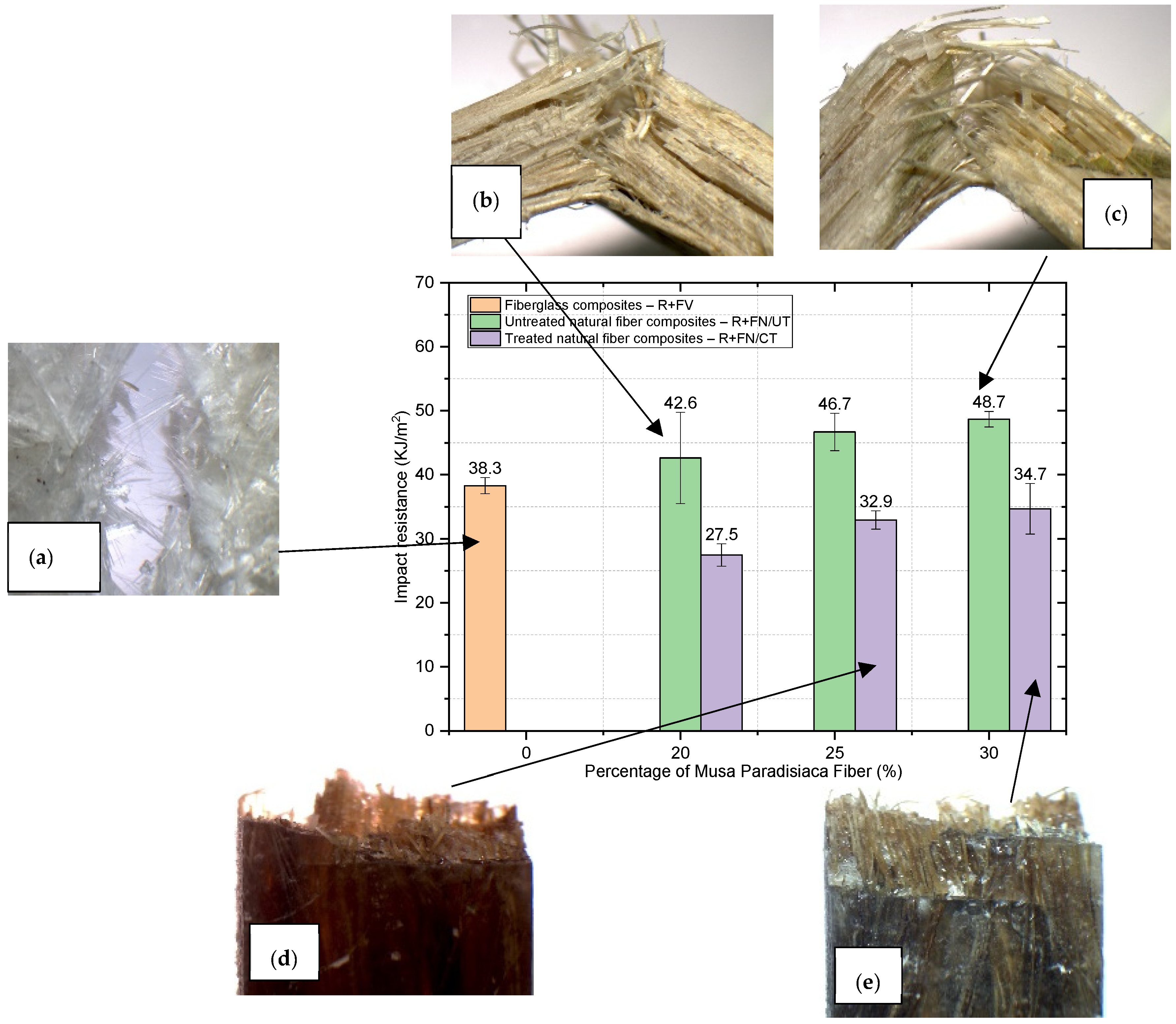
Figure 5 summarises the mean specific Charpy impact strength (kJ·m−2) for the reference glass-fibre laminate and for all bio-hybrid configurations, grouped according to (i) presence or absence of hybridisation with glass fibres and (ii) surface condition of the Musa paradisiaca fibres (UT or CT).
The non-hybrid reference laminate R+FV (polyester + glass fibres only) exhibits a specific impact strength of 38.3 kJ·m−2, which is taken as the baseline against which the effect of introducing Musa fibres and hybrid architectures is assessed.
The first group of bars corresponds to composites with only untreated Musa fibres in the reinforcement phase (R+FN/UT). For fibre contents of 20, 25 and 30 wt.%, the specific impact strength increases to approximately 42.6, 48.7 and 48.7 kJ·m−2, respectively. These values represent gains of about 11–27% compared with R+FV and show that replacing glass fibres by continuous untreated Musa fibres leads to a moderate but consistent improvement in impact energy absorption.
The second group represents the UNTREATED bio-hybrid sandwiches (R+FN+FV/UT), in which continuous Musa fibres and glass fibres coexist within the same polyester matrix. In this case, the impact response improves much more markedly; for 20, 25 and 30 wt.% Musa the specific impact strength reaches roughly 64.0, 64.2 and 72.6 kJ·m−2, respectively. This corresponds to increases of approximately 67–90% with respect to the non-hybrid R+FV laminate and to gains of 25–35 kJ·m−2 over the non-hybrid R+FN/UT composites at the same fibre contents, evidencing a clear synergistic effect of glass–Musa hybridisation on impact toughness.
The third group corresponds to composites with only chemically treated fibres (R+FN/CT 5M). Here, the specific impact strengths fall to about 27.5, 32.9 and 34.7 kJ·m−2 at 20, 25 and 30 wt.% Musa, i.e., below the value of the glass-only laminate and clearly lower than those of R+FN/UT. Thus, when the reinforcement is exclusively vegetable, the NaOH 5 M treatment is detrimental to impact behaviour in the range of fibre contents studied.
Finally, the fourth group collects the CHEMICALLY TREATED bio-hybrid sandwiches (R+FN+FV/CT 5M). Despite employing the same treated fibres as R+FN/CT 5M, these hybrids achieve the highest impact strengths of all configurations, with values around 71.5, 75.6 and 81.5 kJ·m−2 at 20, 25 and 30 wt.% Musa, respectively. In other words, when treated fibres are combined with glass-fibre skins in a hybrid architecture, the specific impact strength not only recovers but surpasses that of both the untreated and treated non-hybrid composites, as well as the reference glass laminate. Overall, Figure 5 shows that introducing untreated Musa fibres alone yields a modest increase in impact strength; hybridisation of glass and Musa fibres in the UT condition produces a substantial jump in energy absorption; alkaline treatment (CT) is harmful when the system relies solely on vegetable reinforcement; yet the same treatment becomes beneficial when integrated into a glass–Musa bio-hybrid sandwich, which exhibits the best Charpy impact performance among all materials tested.
In addition, Figure 6 provides a complementary, integrated view of this impact behaviour for UT and CT cores. The bar chart in Figure 6a reiterates the reduction in specific impact strength when moving from UT to CT at a given fibre content, while Figure 6b–e display representative stereoscopic images of the corresponding fracture surfaces. UT configurations, which exhibit higher impact strength, are associated with rough, highly tortuous fracture surfaces and extensive fibre pull-out, whereas CT configurations show more localised fracture and shorter pull-out lengths. This direct juxtaposition of mechanical data and fracture morphology in Figure 6 reinforces the microstructure–property correlations that are further analysed in Section 3.2 and Section 4.

3.1.3. Statistical Analysis of Impact Strength

To quantify the relative contributions of hybrid architecture and alkaline treatment to the impact response, a two-way ANOVA was carried out on the specific Charpy impact strength of all composites containing Musa paradisiaca fibres. The analysis considered factor A: reinforcement architecture (non-hybrid vs. bio-hybrid sandwich) and factor B: fibre surface condition (UT vs. CT). The glass-only laminate R+FV was used as an external reference but was not included in the factorial design. The corresponding F- and p-values are summarised in Table 2.
The results show that both main factors, architecture (A) and surface condition (B), have statistically significant effects on impact strength (p < 0.05). On average, moving from a non-hybrid configuration (R+FN/UT or R+FN/CT 5M) to a bio-hybrid sandwich (R+FN+FV/UT or R+FN+FV/CT 5M) produces a substantial increase in specific impact energy, confirming that hybridisation with glass-fibre skins is a dominant design variable. Likewise, the surface condition (UT vs. CT) modifies the impact response in a systematic way when all architectures are considered together.
More importantly, the ANOVA reveals a statistically significant A × B interaction, indicating that the effect of alkaline treatment depends strongly on whether the composite is non-hybrid or hybrid. In the non-hybrid group, CT composites (R+FN/CT 5M) exhibit significantly lower impact strength than their UT counterparts (R+FN/UT), showing that NaOH 5 M is detrimental when the reinforcement is exclusively vegetable. In the bio-hybrid group, however, CT sandwiches (R+FN+FV/CT 5M) reach significantly higher impact strengths than UT sandwiches (R+FN+FV/UT), demonstrating that the same treatment becomes beneficial when combined with glass-fibre skins in a sandwich architecture.
Post hoc comparisons (Tukey HSD) confirm that all bio-hybrid configurations are significantly tougher than the non-hybrid CT composites, and that the R+FN+FV/CT 5M sandwiches form the top-performing group, with impact strengths statistically higher than or at least comparable to all other Musa-containing configurations. This statistical picture is fully consistent with the provides a quantitative basis for the design decisions discussed in Section 4.

3.2. Fractography of Charpy Impact Specimens

3.2.1. Stereoscopic Observations

Stereoscopic inspection of the Charpy-fractured specimens provides a first qualitative indication of how reinforcement architecture and fibre surface condition influence the damage mechanisms. Representative images for the four main groups—non-hybrid UT (R+FN/UT), hybrid UT (R+FN+FV/UT), non-hybrid CT (R+FN/CT 5M) and hybrid CT (R+FN+FV/CT 5M)—are included in Figure 6.
In the non-hybrid UT composites (R+FN/UT), the fracture surfaces are relatively rough and heterogeneous. Large areas of the core show evidence of fibre bridging and partial fibre pull-out, with elongated cavities left by extracted Musa fibres and matrix ligaments stretched between opposite fracture faces. Crack paths are tortuous, deviating repeatedly around fibre bundles and along localised weak regions, in agreement with the moderate increase in specific impact strength observed for this group.
The UT bio-hybrid sandwiches (R+FN+FV/UT) exhibit an even more complex fracture morphology. The fracture surface is highly corrugated and composed of distinct regions associated with the skins and the core. Delamination between skins and core is limited, and the core reveals extensive fibre pull-out and crack branching. Visible fibre bridges connecting the upper and lower halves of the specimen are frequent, especially at higher Musa contents. This morphology is consistent with the large jump in impact energy recorded for the UT hybrids compared with both the glass-only laminate and the non-hybrid UT composites.
A markedly different picture is observed in the non-hybrid CT composites (R+FN/CT 5M). Here, the fracture surfaces appear less rough and more localised. The crack path through the core is comparatively straighter, and the extent of fibre bridging and pull-out is noticeably reduced. Large, relatively flat regions of matrix fracture can be seen, suggesting more brittle behaviour and a lower degree of distributed damage, in line with the reduced impact strength measured for this group.
In the CT bio-hybrid sandwiches (R+FN+FV/CT 5M), the overall fracture pattern remains complex, but the presence of the glass-fibre skins changes the way damage is accommodated. The skins show localised cracking and limited delamination, while the core displays a combination of shorter fibre pull-out events, localised cracking and finely subdivided fracture regions. Although individual pull-out lengths are shorter than in the UT hybrids, damage is more widely distributed across the core thickness, which is consistent with the high impact energies recorded for these specimens.

3.2.2. SEM Observations

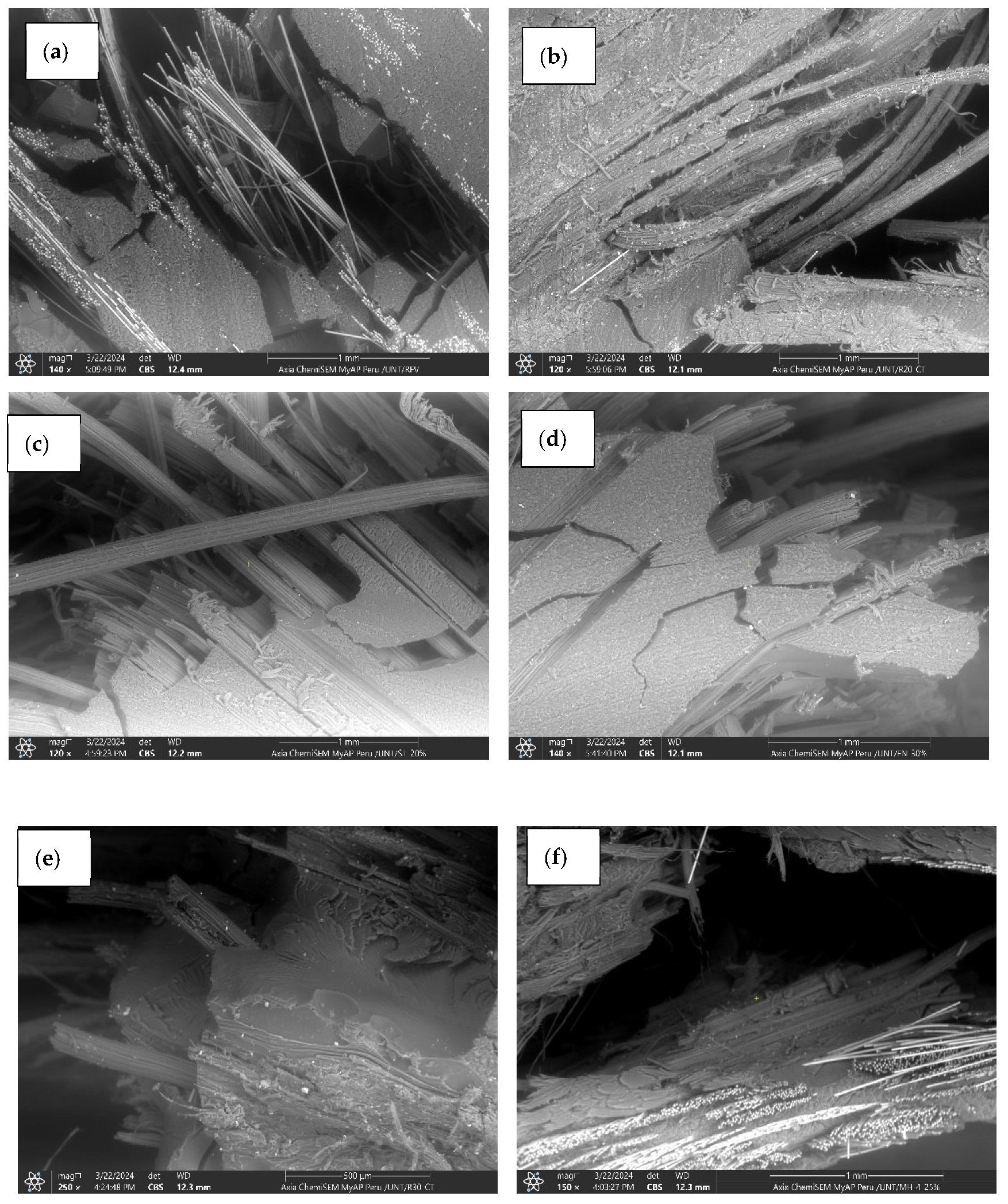
SEM analysis of the Charpy-fractured specimens provides further insight into the micromechanisms governing energy absorption in the different composite systems. Representative micrographs for the main configurations are shown in Figure 7a–f.
Figure 7a corresponds to the glass-fibre-reinforced polyester laminate (R+FV). The fracture surface is dominated by brittle matrix cracking combined with fibre-bundle fracture. Glass fibres appear largely broken rather than pulled out, and the surrounding matrix regions display relatively flat facets with limited evidence of plastic deformation. The crack path is comparatively straight at the microscale, which is consistent with the intermediate impact energy of this non-hybrid synthetic reference.
Figure 7b and Figure 7d show the fracture surfaces of composites containing only untreated Musa paradisiaca fibres at 20 and 30 wt.%, respectively (R+FN/UT–20 and R+FN/UT–30). In both cases, the fracture morphology is clearly more heterogeneous and rough than in the glass-only laminate. Elongated cavities left by pulled-out Musa fibres can be identified, together with partially debonded fibres that remain bridging the fracture plane. The matrix adjacent to the fibres exhibits localised microcracking and some degree of plastic deformation. The effect is more pronounced at 30 wt.% (Figure 7d), where the higher fibre content leads to a denser network of fibre–matrix interfaces and more frequent fibre pull-out events. This microstructural picture is in good agreement with the increased specific impact strengths measured for R+FN/UT composites compared with R+FV.
Figure 7c and Figure 7e correspond to the non-hybrid composites with chemically treated Musa fibres at 20 and 30 wt.%, respectively (R+FN/CT 5M–20 and R+FN/CT 5M–30). In sharp contrast with the UT condition, fibres in these CT systems often appear fractured close to the matrix surface, with noticeably shorter pull-out lengths and fewer extended cavities. In several regions, the matrix remains strongly attached to the fibre surface, and cracks are observed propagating very near the interface or directly through the fibre cross-section. Local brittle regions of matrix fracture with limited plastic deformation are also apparent. Overall, these CT morphologies indicate a more localised, less dissipative fracture process, which is consistent with the lower impact energies obtained for R+FN/CT 5M composites relative to both R+FV and R+FN/UT.
Finally, Figure 7f shows the fracture surface of a hybrid composite containing glass fibres and 20 wt.% chemically treated Musa fibres (R+FN+FV/CT 5M–20). In this case, glass fibres and Musa fibres coexist within the examined area. The fracture pattern is more complex than in either of the corresponding non-hybrid CT or glass-only composites. Cracks interact with both fibre families, producing mixed failure modes involving matrix cracking, interfacial debonding and fibre fracture. Although the individual pull-out lengths of Musa fibres remain shorter than in the UT condition, the damage is more finely distributed: microcracks branch and are arrested at fibres of different stiffness and orientation, and small delamination regions develop between local bundles. This multi-scale damage pattern helps to explain why CT bio-hybrid sandwiches achieve the highest Charpy impact strengths among all configurations, despite the inherently more brittle character of the treated vegetable fibres.
In summary, the SEM observations in Figure 7 corroborate the trends deduced from the impact data and the stereoscopic analysis:
  • Untreated Musa fibres (R+FN/UT) promote extensive fibre pull-out and crack deflection, enhancing energy dissipation compared with the glass-only laminate.
  • Chemically treated fibres in non-hybrid composites (R+FN/CT 5M) lead to more localised, brittle fracture with limited pull-out, which correlates with the reduced impact strength.
  • When treated fibres are used within a hybrid architecture (R+FN+FV/CT 5M), the presence of both glass and Musa fibres favours a more distributed pattern of microcracking and mixed failure, allowing the hybrid system to recover—and even exceed—the impact toughness of the UT non-hybrid composites.

4. Discussion

4.1. Combined Effect of Natural Fibre Addition, Hybridisation and Alkaline Treatment on Impact Strength

The grouped results in Figure 5 and the microstructure–property correlations in Figure 6 and Figure 7 allow the impact response of the system to be decomposed into four key configurations: (i) non-hybrid composites with only untreated Musa paradisiaca fibres (R+FN/UT), (ii) hybrid composites with untreated fibres (R+FN+FV/UT), (iii) non-hybrid composites with chemically treated fibres (R+FN/CT 5M) and (iv) hybrid composites with treated fibres (R+FN+FV/CT 5M).
The comparison between the glass-only laminate R+FV and the non-hybrid R+FN/UT composites shows that simply replacing part of the glass reinforcement with continuous untreated Musa fibres produces a moderate increase in specific impact strength. This behaviour is consistent with studies on polymer composites reinforced solely with banana fibres, where the introduction of lignocellulosic reinforcement led to improved impact and flexural properties relative to the neat matrix or fully synthetic reference, provided that fibre content and impregnation quality were adequate [1,15,16,17,19]. The gains of roughly 10–25% observed here for R+FN/UT with 20–30 wt.% fibres fall within the range reported for pseudostem-based composites in those works.
The second group, the UT bio-hybrid sandwiches R+FN+FV/UT, reveals the net effect of glass–Musa hybridisation. In this case, specific impact strength nearly doubles compared with the R+FV laminate and clearly exceeds that of the non-hybrid R+FN/UT composites at the same fibre contents (Figure 5). This behaviour points to a genuine synergy between the stiff glass-fibre skins and the more compliant, energy-absorbing Musa core. Similar synergistic effects have been reported in hybrid composites combining natural and synthetic fibres, where properly balanced architectures can simultaneously enhance stiffness, strength and toughness compared with monolithic systems [3,4,5,6,7,18]. In particular, banana/glass sandwich composites have shown superior flexural performance relative to single-fibre systems, attributed to the interaction between rigid skins and a more damage-tolerant core [18].
The third group, R+FN/CT 5M, behaves quite differently. For all fibre contents, the specific impact strengths are lower than those of both R+FV and R+FN/UT (Figure 5). This contrasts with studies where mild alkaline treatments (typically 1–3% NaOH) increased impact or flexural properties by cleaning the fibre surface, increasing roughness and enhancing adhesion [7,8,9,10,15,16,17,19]. However, it is consistent with reports indicating that higher NaOH concentrations or excessively long treatments can degrade the cell wall and reduce the intrinsic toughness of banana pseudostem fibres, leading to embrittlement [9,10,11,12,14]. The poor impact performance of R+FN/CT 5M suggests that the 5 M NaOH condition used here lies within such a “severe” regime when the reinforcement is exclusively vegetable.
The fourth group, R+FN+FV/CT 5M hybrids, adds an important nuance. Although they employ the same treated fibres that resulted in low impact strengths in R+FN/CT 5M, the presence of glass-fibre skins leads these hybrids to achieve the highest specific impact strengths of all configurations (Figure 5). In other words, the same alkaline treatment that is detrimental in non-hybrid Musa composites becomes beneficial when combined with the hybrid sandwich architecture. This conditional behaviour aligns with the view, emphasised in recent reviews, that chemical treatments for natural fibres must be optimised in the specific context of fibre–matrix combinations and laminate architectures, as the same treatment may improve properties in one system and degrade them in another [3,4,6,7].
The two-way ANOVA (Table 2) confirms these qualitative trends: both architecture (A) and surface condition (B) exert statistically significant main effects on impact strength, and the A × B interaction is also significant, indicating that the effect of alkaline treatment depends strongly on whether the composite is non-hybrid or hybrid. In the non-hybrid group, CT composites (R+FN/CT 5M) are significantly weaker in impact than their UT counterparts, whereas in the hybrid group the CT sandwiches (R+FN+FV/CT 5M) clearly outperform the UT ones (R+FN+FV/UT). Overall, the grouped analysis indicates that natural fibre addition alone provides a limited but positive increase in impact toughness; glass–Musa hybridisation is the dominant factor underlying the large improvements observed; and the effect of alkaline treatment is strongly architecture-dependent, being negative in non-hybrid composites and positive in hybrids.

4.2. Comparison with Banana Fibre Composites and Other Lignocellulosic Biocomposites

The impact strengths measured for the non-hybrid Musa composites R+FN/UT and R+FN/CT 5M fall within the broad range reported for polyester- or epoxy-based biocomposites reinforced with banana pseudostem fibres, where improvements over neat polymers are usually achieved but frequently remain below the values of optimised hybrid systems [1,7,8,9,10,15,16,17,18,19]. Kalangi et al. [15], for example, observed that the impact energy of polyester/banana composites increased with fibre content up to a threshold, beyond which porosity and fibre agglomeration limited further gains. Similar trends have been reported for boards and panels fabricated from banana trunk particles or pseudostem fibres [20,21,22].
The hybrid sandwiches developed in this work are better compared with recent high-performance biocomposites and hybrid structures rather than simple monolithic laminates. Studies on cement- and polymer-based panels reinforced with banana fibres and other vegetable fibres show that, when fibres are combined with stiffer matrices or additional reinforcements, the energy absorption capacity under mechanical or impact loading can be significantly increased [20,21,22,23,24,25,26]. In this sense, the impact strength levels attained by the R+FN+FV/UT and especially the R+FN+FV/CT 5M sandwiches lie at the upper end of what has been reported for banana fibre composites and are comparable to those of hybrid systems using other agro-residues or green fillers in combination with synthetic fibres [19,28,29,30,31].
The fact that R+FN+FV/CT 5M sandwiches reach the highest impact strengths, despite the inherently more brittle character of CT fibres, underscores the importance of multi-scale hybridisation as a design strategy. Similar observations have been made in hybrid systems that combine natural fibres with glass or carbon fibres, where the presence of a stiff, continuous synthetic network helps stabilise damage and allows the more compliant natural phase to dissipate energy effectively [3,4,6,7,18,19]. From a broader sustainability perspective, this aligns with the growing body of work suggesting that well-designed hybrid biocomposites can approach or match the mechanical performance of fully synthetic materials while reducing environmental footprint [2,5,6,21,25,26].

4.3. Energy-Dissipation Mechanisms in UT and CT Cores

The stereoscopic and SEM observations in Figure 6 and Figure 7 provide a coherent microstructural explanation for the impact results. In UT composites and sandwiches, fracture surfaces are rough and highly heterogeneous, with abundant fibre pull-out, fibre bridging, and crack deflection around Musa bundles. Cavities left by pulled-out fibres and partially debonded fibres bridging the crack are frequent, and the surrounding matrix shows local plastic deformation and microcracking. These features are characteristic of a highly dissipative fracture regime in which a significant fraction of the impact energy is consumed by interfacial debonding, frictional sliding and localised matrix yielding before final failure. Similar mechanisms have been identified as the primary source of toughness in banana pseudostem and other lignocellulosic fibre composites under impact and flexural loading [11,12,13,14,20,21,22].
The single-fibre tensile results (Section 3.1.1 and Table S3) indicate that mercerisation increases the intrinsic strength and stiffness of Musa paradisiaca fibres, whilst reducing their effective diameter. However, translating these fibre-scale gains into laminate-scale impact performance requires adequate bundle impregnation and a stable fibre–matrix interface. In non-hybrid cores, alkali-treated bundles may compact more densely and present a higher specific surface area; if resin wetting is incomplete, inter-bundle voids and local debonding can develop, thereby reducing the net energy absorbed under impact despite the higher fibre strength. By contrast, in the bio-hybrid sandwich architecture the glass skins constrain bending and delamination, promote progressive damage development, and enable treated fibres to act more effectively as crack-bridging and pull-out elements, so that the benefits of improved fibre stiffness/interfacial efficiency are expressed as higher specific impact resistance. Similar architecture-dependent outcomes have been reported for alkali-treated lignocellulosic reinforcements, where laminate performance remains governed by wetting and damage-mode partitioning [11,12,13,14,16,17,18].
In CT non-hybrid composites (R+FN/CT 5M), the fracture morphology is clearly less favourable. SEM micrographs reveal shorter pull-out lengths, more frequent fibre fracture near the interface and regions where the matrix remains strongly attached to the fibre surface (Figure 7c,e). Cracks often propagate very close to the interface or through the fibre wall, and the matrix exhibits larger areas of brittle fracture with limited plasticity. These observations are consistent with the idea that severe alkaline treatment (NaOH 5 M) induces microstructural damage in the cell wall and increases interface stiffness to the point where failure becomes more localised and less energy-dissipating, in agreement with recent characterisation studies on heavily mercerised banana fibres [9,10,12,14].
In the hybrid sandwiches, the interaction between damage mechanisms and architecture is more subtle. In R+FN+FV/UT, the Musa core retains its high pull-out capacity, while the glass skins confine and stabilise the development of damage, preventing catastrophic delamination and allowing extensive microcracking within the core. This combination explains the substantial increase in impact strength compared with both non-hybrid UT composites and the glass-only laminate. In R+FN+FV/CT 5M, although the pull-out lengths of individual Musa fibres remain shorter than in UT cores, the presence of both fibre families promotes a fine network of microcracks and mixed failure modes (matrix cracking, fibre fracture and interfacial debonding) that is widely distributed across the core thickness (Figure 7f). Numerous microcracks are arrested or deflected by fibres of different stiffness and orientation, and local delamination regions remain limited in size.
This finely subdivided damage pattern explains why CT bio-hybrid sandwiches can absorb large amounts of energy even though the treated fibres themselves are more brittle. Similar multi-scale damage distributions have been reported as key to achieving high toughness in hybrid laminates combining natural and synthetic reinforcements [3,4,6,7,18,19]. In summary, UT non-hybrid composites increased energy dissipation via pull-out and crack deflection but limited by the absence of stiff skins. UT hybrids had the same dissipative core mechanisms + structural support from glass skins → large toughness increase. CT non-hybrid composites demonstrated localised, brittle fracture with limited pull-out → low impact strength. CT hybrids showed multi-scale, distributed damage involving both fibre families → highest impact strengths among all configurations.

4.4. Design Implications for Bio-Hybrid Sandwich Structures

The present results have direct implications for the design of bio-hybrid sandwich structures for applications in building components, lightweight transport or structural packaging, where resistance to low-velocity impacts is critical. A number of works have demonstrated that banana fibres and other agricultural residues can be successfully incorporated into boards, panels and mortars to enhance toughness and sustainability [20,21,22,23,24,25,26], but most of these studies focus on monolithic or cementitious systems.
In a polyester matrix, this study shows that a sandwich architecture with a Musa paradisiaca core and glass-fibre skins can outperform a conventional glass laminate in terms of Charpy impact strength (Figure 5). The group-wise comparison confirms the following:
R+FN+FV/UT and, more notably, R+FN+FV/CT 5M provide specific impact strengths substantially higher than R+FV, placing them at the upper end of the range reported for banana-based and other lignocellulosic biocomposites [1,2,3,6,7,18,19].
The alkaline treatment must be selected specifically for the hybrid architecture; a condition such as NaOH 5 M may be unsuitable for non-hybrid composites but proves advantageous when treated fibres are integrated into a confined core between glass skins.
System optimisation requires simultaneous tuning of the vegetable core fraction, the distribution of glass and Musa fibres and the mercerisation parameters, following a performance-based design approach similar to that proposed for other polymer and thermoplastic biocomposites [19,28,29,30,31,32].
From a broader sustainability perspective, the hybrid sandwiches developed here are promising candidates for lightweight, impact-tolerant components where the objective is to reduce glass-fibre content and the associated environmental footprint without sacrificing mechanical performance. The use of Musa paradisiaca pseudostem—an abundant agricultural residue in many tropical regions—reinforces the potential of these systems within circular-economy strategies and agro-waste valorisation [2,8,21,25,26].
Beyond the experimental insights provided here, the present system is also a suitable candidate for advanced data-driven modelling. In particular, artificial neural networks (ANN) combined with response surface methodology (RSM) have proven effective in capturing non-linear relationships between formulation variables and performance indicators in green biocomposites, as recently demonstrated for moisture uptake prediction in recycled HDPE systems reinforced with treated palm fibres [19]. Adopting a similar ANN–RSM framework in future work would make it possible to map, in a unified way, the combined influence of fibre content, surface treatment and sandwich architecture on impact behaviour and durability, thereby complementing the experimental design and ANOVA-based analysis implemented in this study.

5. Conclusions

In this work, bio-hybrid sandwich composites based on polyester/glass skins and Musa paradisiaca fibre-reinforced cores were designed, manufactured and characterised under Charpy impact loading. The influence of three key variables—core fibre content (20, 25 and 30 wt.%), fibre surface condition (UT, CT in 5 M NaOH) and laminate architecture (R+FV, R+FN and R+FN+FV)—was assessed through a two-way ANOVA and correlated with stereoscopic and SEM observations. On the basis of the results obtained, the following main conclusions can be drawn:
Effect of core reinforcement and hybridisation:
Incorporating continuous Musa paradisiaca fibres into the polyester matrix (R+FN/UT) leads to a clear increase in specific Charpy impact strength with respect to the reference polyester/glass laminate (R+FV), indicating that the pseudostem fibres are effective energy absorbers when adequately dispersed in the core. When glass-fibre skins are added to form a bio-hybrid sandwich (R+FN+FV/UT), the impact performance is further enhanced, confirming the beneficial synergy between the vegetal core and the synthetic skins.
Dual role of alkaline treatment depending on laminate architecture:
Alkaline treatment with 5 M NaOH has a dual effect. In non-hybrid laminates reinforced solely with Musa fibres (R+FN/CT 5M), the treatment leads to a reduction in impact strength compared with R+FN/UT, which is consistent with a partial embrittlement of the fibres and a more localised damage pattern. In contrast, when treated fibres are placed within a glass-skinned sandwich (R+FN+FV/CT 5M), the specific impact strength surpasses that of both R+FN+FV/UT and the R+FV reference, indicating that the hybrid architecture can take advantage of the improved fibre–matrix bonding while constraining the more brittle fracture of the treated fibres.
Statistical significance of architecture, surface condition and their interaction:
The two-way ANOVA confirms that both the laminate architecture (R+FV, R+FN, R+FN+FV) and the fibre surface condition (UT, CT 5M) exert statistically significant effects on the specific impact strength at α = 0.05, and that their interaction is also significant. This reinforces the notion that the influence of alkaline treatment cannot be evaluated independently of the structural configuration; a given NaOH condition may be detrimental in non-hybrid composites but beneficial in confined sandwich cores.
Fracture mechanisms and microstructural correlations:
Stereoscopic and SEM observations reveal that the best-performing configurations are characterised by a combination of fibre pull-out, crack deflection and fibre bridging in the core, together with controlled delamination at the skin–core interface. Untreated Musa fibres tend to promote more extensive pull-out and multi-directional crack paths, whereas mercerised fibres exhibit rougher surfaces and stronger bonding to the polyester matrix. In non-hybrid R+FN/CT 5M laminates, this translates into more brittle fracture and less distributed damage, while in R+FN+FV/CT 5M sandwiches the strengthened core and the constraining effect of the glass skins favour a more efficient distribution of damage and higher energy absorption.
Design guidelines and perspectives for bio-hybrid sandwich structures:
From a design standpoint, the results highlight that optimising the impact behaviour of polyester/Musa/glass bio-hybrid sandwiches requires a concurrent selection of core fibre content, surface treatment and architecture. For the range studied, high Musa fibre fractions combined with an appropriate mercerisation condition and glass skins yield the most favourable balance between energy absorption and structural integrity, positioning the proposed sandwiches as promising candidates for lightweight, impact-tolerant components where a reduction in glass-fibre usage and environmental footprint is sought.
Beyond these conclusions, the hybrid system studied here also provides a suitable platform for advanced data-driven modelling in future work. In particular, artificial neural networks (ANN) combined with response surface methodology (RSM) could be employed to map the non-linear interaction between fibre content, surface treatment and sandwich architecture on impact behaviour and durability, thereby complementing the experimental design and ANOVA-based analysis implemented in this study.

Supplementary Materials

The following supporting information can be downloaded at: https://www.mdpi.com/article/10.3390/jcs10020059/s1, Figure S1: Single-fibre tensile test set-up and gripping configuration (Hongjin HSO–UT-5PC), showing direct clamping of the fibres. Table S1: Raw Charpy impact energy and calculated specific impact strength for all configurations (individual values for n = 4) used to compute mean ± SD. Table S2: Detailed two-way ANOVA for specific Charpy impact strength, including sums of squares, degrees of freedom, mean squares, F-values, p-values and effect sizes for the main factors (reinforcement architecture and fibre surface condition) and their interaction. Table S3: Single-fibre tensile dataset for UT and CT fibres, including effective diameter measurements (raw values and per-specimen mean ± SD) and derived tensile properties (F_max, σ_u, ε_b and apparent modulus with R2).

Author Contributions

Conceptualization, A.Y.V.A.; methodology and validation, A.C.-C., I.P.-F. and A.Y.V.A.; formal analysis, A.C.-C.; investigation, A.Y.V.A. and L.A.-R.; resources, A.C.-C. and L.A.-R.; data curation, writing—original draft preparation, I.P.-F. and A.Y.V.A.; writing—review and editing, A.Y.V.A.; project administration. All authors have read and agreed to the published version of the manuscript.

Funding

This research was funded by the National University of Trujillo, Canon Project 2022; Emblematic Project (PIC No. 02-2022)—Project Modality 1 (PIC No. 01-2022).

Data Availability Statement

The original contributions presented in this study are included in the article/Supplementary Materials. Further inquiries can be directed to the corresponding author.

Acknowledgments

To: “Alkaline activation of pastes and mortars from construction debris and calcareous organic remains for their reuse: a green alternative to the problem of construction waste pollution” and “Ecological reinforcement based on sansevieria trifasciata fibres for polyester matrices and alkaline cement mortars: an environmentally friendly and socially promoting alternative” financed the equipment necessary for the results of this research article. To: the Composite Materials Laboratory of the School of Materials Engineering at the National University of Trujillo.

Conflicts of Interest

The authors declare no conflicts of interest.

Abbreviations

The following abbreviations are used in this manuscript:
ANOVAAnalysis of variance
CTChemically treated Musa paradisiaca fibres (NaOH treatment)
CT 5MChemically treated condition in 5 M NaOH
FTIRFourier-transform infrared spectroscopy
ISOInternational Organization for Standardization
RISpecific Charpy impact strength
SEMScanning electron microscopy
SDStandard deviation
UTUntreated Musa paradisiaca fibres
R+FVPolyester composite reinforced only with glass fibres (reference laminate)
R+FN/UTPolyester composite reinforced only with untreated Musa paradisiaca fibres
R+FN+FV/UTPolyester/glass bio-hybrid composite with untreated Musa paradisiaca fibres
R+FN/CT 5MPolyester composite reinforced only with NaOH-treated Musa paradisiaca fibres (5 M)
R+FN+FV/CT 5MPolyester/glass bio-hybrid composite with NaOH-treated Musa paradisiaca fibres (5 M)

References

  1. Rao, B.L.; Makode, Y.; Tiwari, A.; Dubey, O.; Sharma, S.; Mishra, V. Review on properties of banana fibre reinforced polymer composites. Mater. Today Proc. 2021, 47, 2825–2829. [Google Scholar] [CrossRef]
  2. Balda, A.V.; Franco, M.; Sartori, T.; de Andrade, M.F. Banana fibre: A natural and sustainable bioresource for eco-friendly applications. Clean Technol. Environ. Policy 2021, 23, 1389–1401. [Google Scholar] [CrossRef]
  3. Ismail, S.O.; Akpan, E.; Dhakal, H.N. Review on natural plant fibres and their hybrid composites for structural applications: Recent trends and future perspectives. Compos. Part C Open Access 2022, 9, 100322. [Google Scholar] [CrossRef]
  4. Neto, J.; de Queiroz, H.; Aguiar, R.; Lima, R.; Cavalcanti, D.; Banea, M.D. A review of recent advances in hybrid natural fibre reinforced polymer composites. J. Renew. Mater. 2022, 10, 279–310. [Google Scholar] [CrossRef]
  5. Rajendran Royan, N.R.; Sapuan, S.M.; Abdan, K.; Zainudin, E.S. Current state and challenges of natural fibre-reinforced hybrid polymer composites and their applications. Polymers 2021, 13, 2289. [Google Scholar] [CrossRef] [PubMed]
  6. Mohammed, M.; Jawaid, M.; Islam, M.S.; Alothman, O.Y. A review on the advancement of renewable natural fibre hybrid composites. J. Renew. Mater. 2024, 12, 1237–1290. [Google Scholar] [CrossRef]
  7. Oyewo, T.A.T.; Oluwole, O.O.; Ajide, O.O.; Omoniyi, T.E. Banana pseudo stem fibre, hybrid composites and applications: A review. Hybrid Adv. 2023, 4, 100101. [Google Scholar] [CrossRef]
  8. Azriena, H.A.A.; Kaur, K.; Ilyas, R.A.; Kamaruddin, Z.H.; Neenu, K.V.; Dominic, C.D.M.; Wirawan, W.A.; Asrofi, M.; Dzulkifli, M.H.; Sulong, M.A.; et al. Recent developments in lignocellulosic banana (Musa spp.) fibre-based biocomposites and their potential industrial applications: A comprehensive review. Int. J. Biol. Macromol. 2025, 323, 147180. [Google Scholar] [CrossRef]
  9. Badanayak, B.; Pandey, A.; Sahoo, P.K.; Nayak, R.K. Banana pseudostem fibre: A critical review on fibre extraction, characterization, and surface modification. J. Nat. Fibres 2023, 20, 2168821. [Google Scholar] [CrossRef]
  10. Delly, J.; Manalu, J.; Numberi, J.J.; Safanpo, A. A review of banana fibre: Impact of treatment, filler materials, hybrid composite, and application. J. Innov. Technol. 2023, 2023, 1–12. [Google Scholar]
  11. Cecci, R.R.R.; Passos, A.A.; de Aguiar Neto, T.C.; Silva, L.A. Banana pseudostem fibres characterization and comparison with reported data on jute and sisal fibres. SN Appl. Sci. 2020, 2, 20. [Google Scholar] [CrossRef]
  12. Karuppuchamy, A.; Ramya, K.; Silva, R. Novel banana core stem fibre from agricultural biomass for lightweight textile applications. Ind. Crops Prod. 2024, 209, 117985. [Google Scholar] [CrossRef]
  13. Kumar, P.S.; Pushpavalli, S.; Keran, D.A.; ShupraJhaa, T.; Sivananth, C.; Renganathan, R.; Jayaraman, J.K.; Balakrishnan, P.; Uma, S. Deciphering functional characteristics and in-vitro bioactive properties of banana central core stem powder. Food Chem. 2022, 397, 133828. [Google Scholar] [CrossRef] [PubMed]
  14. Montoya-Berrio, J.; Negrete Martínez, J.; Altamiranda Suárez, J.; Ávila Díaz, C.; Rivero-Romero, O.; Unfried-Silgado, J. Influence of drying temperature on the properties of Colombian banana fibres for its potential use as reinforcement in composite materials. Sci. Rep. 2024, 14, 25180. [Google Scholar] [CrossRef] [PubMed]
  15. Kalangi, C.; Antony Prabu, D.; Sujin Jose, A.; Jani, S.P. Experimental characterization of banana fibre reinforced polyester composites. Mater. Today Proc. 2022, 60, 2236–2239. [Google Scholar] [CrossRef]
  16. Nguyen, T.A.; Nguyen, T.H. Banana fibre-reinforced epoxy composites: Mechanical properties and fire retardancy. Int. J. Chem. Eng. 2021, 2021, 1973644. [Google Scholar] [CrossRef]
  17. Durai Raj, I.; Vasantha Geethan, K.A.; John Rajan, A.; Vijay Ananth, S. Characterization of epoxy resin-based banana fibre reinforced composite with waste CD powder filler. Mater. Today Proc. 2023, 90, 19–23. [Google Scholar] [CrossRef]
  18. Chenrayan, V.; Gebremaryam, G.; Shahapurkar, K.; Mani, K.; Fouad, Y.; Kalam, M.A.; Mubarak, N.M.; Soudagar, M.E.M.; Abusahmin, B.S. Experimental and numerical assessment of the flexural response of banana fibre sandwich epoxy composite. Sci. Rep. 2023, 13, 18156. [Google Scholar] [CrossRef]
  19. Ladaci, N.; Saadia, A.; Belaadi, A.; Boumaaza, M.; Chai, B.X.; Abdullah, M.M.S.; Al-Khawlani, A.; Ghernaout, D. ANN and RSM Prediction of Water Uptake of Recycled HDPE Biocomposite Reinforced with Treated Palm Waste W. filifera. J. Nat. Fibres 2024, 21, 2356697. [Google Scholar] [CrossRef]
  20. Dos Santos da Silva, R.B.; Marcelino, P.R.C.; de Melo, E.C.R.; Lopes, F.P.D.; Candido, V.S.; Oliveira, M.P. Development and Characterization of Polyester Composite Reinforced with Continuous (Raw) Fibers from Agave angustifolia var. Marginata. J. Nat. Fibers 2025, 22, 2557468. [Google Scholar] [CrossRef]
  21. Echeverría-Maggi, E.E.; Flores-Alés, V.; Martin-del-Rio, J.J. Biocompuesto de fibra de bananeira, cáscara de amendoim y poliestireno expandido reciclado para paneles. Rev. Hábitat Sustentable 2024, 14, 112–121. [Google Scholar] [CrossRef]
  22. Nadhari, W.N.A.W.; Danish, M.; Nasir, M.S.R.M.; Geng, B.J. Mechanical properties and dimensional stability of particleboard fabricated from steam pre-treated banana trunk waste particles. J. Build. Eng. 2019, 26, 100848. [Google Scholar] [CrossRef]
  23. Nunes, L.; Cintura, E.; Parracha, J.L.; Fernandes, B.; Silva, V.; Faria, P. Cement-bonded particleboards with banana pseudostem waste: Physical performance and bio-susceptibility. Infrastructures 2021, 6, 86. [Google Scholar] [CrossRef]
  24. Lamichhane, N.; Lamichhane, A.; Gyawali, T.R. Enhancing mechanical properties of mortar with short and thin banana fibres: A sustainable alternative to synthetic fibres. Heliyon 2024, 10, e30652. [Google Scholar] [CrossRef]
  25. Kesikidou, F.; Stefanidou, M. Natural fibre-reinforced mortars. J. Build. Eng. 2019, 25, 100786. [Google Scholar] [CrossRef]
  26. Laverde, V.; Marín, A.; Benjumea, J.M.; Rincón-Ortiz, M. Use of vegetable fibres as reinforcements in cement-matrix composite materials: A review. Constr. Build. Mater. 2022, 340, 127729. [Google Scholar] [CrossRef]
  27. ISO 179-1:2010; Plastics—Determination of Charpy Impact Properties—Part 1: Non-Instrumented Impact Test. International Organization for Standardization: Geneva, Switzerland, 2010.
  28. Sangarote, S.A.; Soares, A.G.; Pacheco, E.B.A.V.; Freitas-Silva, O. Evaluation of banana pseudostem fibres for packaging material development. Packag. Technol. Sci. 2025; advance online publication. [Google Scholar] [CrossRef]
  29. Girimurugan, R.; Shilaja, C.; Pradeep, G.M.; Maheskumar, P.; Augastin Santhiyagu, I. An experimental study on compressive properties of high-density polyethylene–nano alumina–groundnut shell hybrid composites. Mater. Today Proc. 2022, 68, 2226–2232. [Google Scholar] [CrossRef]
  30. Ramu, S.; Senthilkumar, N.; Deepanraj, B. Experimental investigation on alkali-treated groundnut shell (Arachis hypogaea L.) and rice husk (Oryza sativa) particle epoxy hybrid composites. Mater. Today Proc. 2023; advance online publication. [Google Scholar] [CrossRef]
  31. Sunardi, S.; Ariawan, D.; Surojo, E.; Prabowo, A.R.; Akbar, H.I.; Cao, B.; Carvalho, H. Assessment of eggshell-based material as a green-composite filler: Project milestones and future potential as an engineering material. J. Mech. Behav. Mater. 2023; advance online publication. [Google Scholar] [CrossRef]
  32. Homavand, A.; Cree, D.E.; Wilson, L.D. Polylactic acid composites reinforced with eggshell/CaCO3 filler particles: A review. Waste 2024, 2, 169–185. [Google Scholar] [CrossRef]
Figure 1. Diagram of the sandwich and stacking sequence.
Jcs 10 00059 g001
Figure 2. Experimental sequence. (a) Pseudostem; (b) Pseudostem infusion; (c) Fibres obtained; (d) Compression moulding; (e) Test samples; (f) Impact pendulum.
Jcs 10 00059 g002
Figure 3. Representative cross-sectional stereomicrographs of UT and CT fibers of Musa paradisiaca, highlighting the lumen, wall thickness, and surface roughness. (a) Without alkaline treatment; (b) NaOH (5 M); (c) NaOH (10 M).
Jcs 10 00059 g003
Figure 4. FTIR spectra of UT and CT Musa paradisiaca fibres, highlighting changes in hemicellulose- and lignin-related bands.
Jcs 10 00059 g004
Figure 5. Specific Charpy impact strength of polyester-based composites: non-hybrid glass laminate (R+FV), non-hybrid Musa cores (R+FN/UT, R+FN/CT 5M) and glass–Musa bio-hybrid sandwiches (R+FN+FV/UT, R+FN+FV/CT 5M) for 20–30 wt.% fibre contents.
Jcs 10 00059 g005
Figure 6. Specific Charpy impact strength and fracture morphologies for UT and CT Musa paradisiaca fibre cores in polyester-based composites. (a) Fracture surface, fiberglass reinforcement; (b) Untreated reinforcement (20 wt.%); (c) Untreated reinforcement (30 wt.%); (d) Reinforcement with NaOH (5 M) treatment (25 wt.%); (e) Reinforcement with NaOH (5 M) treatment (30 wt.%).
Jcs 10 00059 g006
Figure 7. SEM fracture-surface micrographs after Charpy impact for polyester-based composites: (a) R+FV (glass-only): brittle cleavage in the matrix, glass bundle imprints, short fibre pull-out, river/hackle markings and limited matrix fibrillation. (b) R+FN/UT–20 (untreated Musa, 20 wt.%): interfacial debonding with perifibrillar gaps (around the lumen), long pull-out lengths, relatively smooth fibre surfaces (low wettability) and resin-starved areas. (c) R+FN/UT–30 (untreated Musa, 30 wt.%): higher bundle density and voids; long pull-out and crack paths following fibre bundles; evidence of poor wetting and local micro-delamination. (d) R+FN/CT 5M–20 (chemically treated, 20 wt.%): improved interfacial adhesion (matrix remnants on fibre), shorter pull-out, cohesive matrix tearing and micro-bridges indicative of higher energy dissipation. (e) R+FN/CT 5M–30 (chemically treated, 30 wt.%): mixed failure (fibre scission + limited pull-out), reduced interfacial gaps compared with UT, though occasional voids persist due to bundle packing; more tortuous crack topology. (f) R+FN+FV/CT 5M–20 (glass–Musa bio-hybrid): concurrent glass pull-out and Musa bridging; stepped delamination fronts, crack deflection across interfaces and multiple anchorage points, consistent with hybrid toughening. Scale bars and magnifications as indicated in each panel.
Jcs 10 00059 g007
Table 1. Experimental matrix: factors, levels and number of Charpy impact specimens per condition.
Group IDFactor A: Musa Fibre Content in Core (wt.%)Factor B: Fibre Surface ConditionSpecimen Code (Thesis Notation)Sandwich Architecture (Skins/Core)n (Charpy Specimens)
C00(no natural fibre)R+FVPolyester matrix + glass-fibre skins; no Musa paradisiaca fibres in core4
S120UT (as-received)R+FN+FV/UT–20%Polyester/glass skins + core with 20 wt.% untreated Musa paradisiaca fibre4
S225UT (as-received)R+FN+FV/UT–25%Polyester/glass skins + core with 25 wt.% untreated Musa paradisiaca fibre4
S330UT (as-received)R+FN+FV/UT–30%Polyester/glass skins + core with 30 wt.% untreated Musa paradisiaca fibre4
S420CT (NaOH 5 M treated)R+FN+FV/CT–20%Polyester/glass skins + core with 20 wt.% NaOH-treated Musa paradisiaca fibre4
S525CT (NaOH 5 M treated)R+FN+FV/CT–25%Polyester/glass skins + core with 25 wt.% NaOH-treated Musa paradisiaca fibre4
S630CT (NaOH 5 M treated)R+FN+FV/CT–30%Polyester/glass skins + core with 30 wt.% NaOH-treated Musa paradisiaca fibre4
Table 2. Compressive strength (MPa) at 7, 14 and 28 days—mean ± SD [95% CI]. Tukey letters (per column) indicate groups that do not differ at α = 0.05. n = 5 per series. Assumptions were met (Shapiro–Wilk p > 0.05 ; Levene p > 0.98 ). One-way ANOVA (between fibre contents): 7 d F ( 3 , 8 ) = 23.66 ,   p = 0.000248 ,   η 2 = 0.899 ; 14 d F ( 3 , 8 ) = 21.16 ,   p = 0.000368 ,   η 2 = 0.888 ; 28 d F ( 3 , 8 ) = 33.66 ,   p = 0.000069 ,   η 2 = 0.927 .
Fibre Content (wt.%)7 Days (MPa)14 Days (MPa)28 Days (MPa)
0.0%10.14 ± 0.35 [9.70–10.57] b10.50 ± 0.40 [10.00–11.00] b11.64 ± 0.39 [11.16–12.12] b
1.0%11.61 ± 0.52 [10.96–12.26] a12.11 ± 0.44 [11.56–12.66] a13.19 ± 0.50 [12.57–13.81] a
1.5%9.00 ± 0.38 [8.53–9.47] b10.47 ± 0.51 [9.84–11.10] b11.50 ± 0.49 [10.89–12.11] b
2.0%8.90 ± 0.53 [8.24–9.56] c9.21 ± 0.43 [8.68–9.74] c9.40 ± 0.47 [8.82–9.98] c
Disclaimer/Publisher’s Note: The statements, opinions and data contained in all publications are solely those of the individual author(s) and contributor(s) and not of MDPI and/or the editor(s). MDPI and/or the editor(s) disclaim responsibility for any injury to people or property resulting from any ideas, methods, instructions or products referred to in the content.