Article

Study of Microwave Characteristics and Compressive Strength of Mg0.5Zn0.5Fe2O4/Polystyrene/Activated Carbon Composites with Core-Shell Structure

by
Dauren B. Kadyrzhanov
1,
Rafael I. Shakirzyanov
1,2,*,
Kanat M. Makhanov
1,
Sofiya A. Maznykh
1,2 and
Dilnaz K. Zhamikhanova
1,2
1
Engineering Profile Laboratory, L.N. Gumilyov Eurasian National University, Satpayev St., Astana 010008, Kazakhstan
2
Laboratory of Solid State Physics, The Institute of Nuclear Physics, Almaty 050032, Kazakhstan
*
Author to whom correspondence should be addressed.
J. Compos. Sci. 2026, 10(5), 239; https://doi.org/10.3390/jcs10050239
Submission received: 16 March 2026 / Revised: 25 April 2026 / Accepted: 28 April 2026 / Published: 29 April 2026
(This article belongs to the Special Issue Feature Papers in Journal of Composites Science in 2026)

Abstract

Due to the widespread use of microwave electromagnetic radiation, this study examines the microwave electromagnetic properties and compressive strength of composites made from inexpensive components such as Mg0.5Zn0.5Fe2O4, polystyrene, and activated carbon. Experimental samples were fabricated using thermopressing. The formation of the dielectric core/shell structure for Mg-Zn/polystyrene composites (1:1) and composites with activated carbon additives at weight concentrations of 3, 6.6, and 9.0% was determined using SEM image analysis. Microwave properties were investigated by analyzing the frequency dependences of complex permittivity and magnetic permeability in the frequency range of 100 MHz–5 GHz. As shown by the simulation and experimental measurements of scattering parameters obtained, the compost shows improved microwave absorption properties in the frequency range of 1–5 GHz. Reflection loss spectra showed peaks with values of −17.8 and −18 dB in the frequency range of 2.5–5 GHz for samples with 4.8 wt. % and 6.6 wt. % carbon loading, respectively. The absorption bandwidths of −10 dB in the range of 1.7–2.13 GHz were observed in the best samples. Studies have shown that samples containing 9.0 wt. % of carbon material with thicknesses of 6–10 mm can be considered as an electromagnetic shielding material in the microwave range 1–5 GHz. It was shown that, despite a decrease in porosity from 15.59 to 7.17%, with an increase in the concentration of carbon material in the composites, the compressive strength also decreases from 62.05 to 36.45 MPa. The developed composites are potentially suitable as microwave absorbers for civil applications.

1. Introduction

Microwave-absorbing composites are being actively studied by researchers around the world for several reasons. Firstly, rapidly developing communication technologies require new materials with specified properties to ensure electromagnetic compatibility [1,2,3,4]. Secondly, there is a need to reduce the influence of electromagnetic fields in living areas and industrial zones. Particular concern is raised by the results of some studies on the effects of low-intensity microwave radiation on the reproductive system of living organisms [5]. Thirdly, continuing complex research of functional polymer composites’ properties is conducted by scientists to obtain new materials capable of solving various problems in technology and industry [6]. These three reasons (although this is not an exhaustive list) can be highlighted as the main drivers for conducting research on particulate composites in which magnetic particles and particles with high electrical conductivity serve as fillers [7,8]. Much attention is paid to experimental studies of polymer composites that use ferrite particles as inclusions [9]. Ferrites can be considered as compounds of iron oxides with oxides of other metals.
Among all magnetic materials, one of the main roles is occupied by soft magnetic spinel-ferrites MeO·Fe2O3, where the Me element can be Ni, Zn, Co, Mg, Mn, and their combinations [10]. Ferrite solid solutions, most widely used in radio engineering and electronics, include ZnFe2O4 as one component and NiFe2O4, CoFe2O4, and MnFe2O4 as the second. Ni-Zn and Mn-Zn ferrites have excellent magnetic properties, including low coercivity, moderate magnetization, moderate Curie temperatures, and high magnetic permeability in the freqeuncy range from tens of kHz to hundreds of MHz [11,12]. However, despite the excellent magnetic properties, spinel ferrites show poor microwave absorption characteristics compared to some hybrid polymer composites. To achieve high values of attenuation of electromagnetic radiation (EMR) over a wide frequency range in microwave-absorbing composites, a combination of both magnetic and conductive particles is required [13]. This is dictated by the mechanisms of EMR loss in materials. The above-mentioned properties make soft magnetic ferrites with a spinel structure excellent candidates as magnetic fillers in particulate microwave-absorbing composites.
Standard manufacturing of ferrites involves solid-state synthesis of ceramics or powders from oxides [14,15,16]. In the case of Ni-Zn, Co-Zn ferrites, NiO, and CoO oxides can be used as starting reagents. These oxides are expensive, which increases the cost of producing ferrite products, particularly microwave-absorbing composite sheets. In addition, the production of high-quality Mn-Zn ferrites requires special sintering and ferritization conditions. Due to the presence of multiple oxidation states of Mn ions in an oxidizing atmosphere, the formation of a manganese oxide phase is possible, which degrades the magnetic characteristics of the ferrite [17,18,19,20]. For this reason, to reduce the cost of producing magnetic materials, Mg-Zn ferrites can be used, for which cheaper magnesium oxide is needed [21].
The focus of many experimental studies on the microwave properties of ferrite-polymer composites is directed toward varying the concentration of components or varying the chemical composition of the ferrite [1,10,22,23,24,25,26]. Fionov et al. [1] show that Ni-Zn ferrites can be effective microwave-absorbing material in the range from 30 MHz to 1000 MHz, while Mn-Zn ferrites and BaFe12O19 can be effective only with carbon addition. Xie et al. [10] demonstrated that the absorption intensity in Rl specrta of pure CoFe2O4 cannot obtain values below −10 dB at 2–18 GHz, and an effective absorption bandwidth cannot be reached. In these cases, significant improvement of functional properties of the composite can be carried out using carbon materials such as graphene or reduced graphene oxide. Gama et al. [22] showed that the reflection loss coefficient significantly depends on the Mn-Zn ferrite concentration in rubber. By varying the volume fraction from 0.10 to 0.37, an optimal reflection loss of −37 dB at 11 GHz and absorber thickness of 3.0 mm were obtained.
Another common idea is to obtain core-shell structures in which a magnetic core is surrounded by a conducting shell. The idea of a core-shell structure of composites has long been present in the design of microwave-absorbing materials, and a large amount of experimental work has been carried out to study their electromagnetic characteristics [27]. In particular, ferrites with a spinel structure were used as a magnetic core [28,29,30,31]. By polymerizing aniline in suspension with ferrite, a conductive polymer layer was formed on the surface of the particles. By varying the concentration between polyaniline and ferrite, it is possible to change the microwave characteristics, as well as the microwave absorption properties. When modeling and measuring reflection loss, attenuation within 30–39 dB can be observed with an absorption band (less than 10 dB) of 3–4 GHz in the frequency range of 8–11.3 GHz. The shielding efficiency of such composites in the X-band microwave range at low concentrations can reach 32.8 dB. The authors of the studies also note the low density of such composites combined with high efficiency.
Composite absorbers of microwave radiation in the low-frequency region are also of interest in the scientific community [32]. Such microwave absorbers can be widely used in civil applications, for example, to reduce the level of EMR from Wi-Fi communications (2.4–5 GHz).
In this paper, the microwave characteristics of polystyrene/Mg-Zn ferrite/activated carbon composites with a dielectric core–magnetic shell structure are investigated. To obtain such a structure, polystyrene powder of a significantly larger size than the powders of the magnetic and conductive components was used. In addition to their non-standard microstructure, the composites under study are made from low-cost components, which will help reduce production costs. For this reason, soft magnetic ferrites may be most suitable for the microwave range of 300 MHz–5 GHz. The main objective of this work is to experimentally confirm the efficiency of the polystyrene/Mg-Zn ferrite/activated carbon composite in the microwave range of 1–5 GHz.

2. Materials and Methods

Ferrite powder of the composition Mg0.5Zn0.5Fe2O4 was synthesized from high-purity oxides (99% purity) ZnO, MgO, and Fe2O3 produced by Merck (KGaA, Darmstadt, Germany). The composition of Mg0.5Zn0.5Fe2O4 was chosen as the ferrite based on previous studies on Mg-Zn ferrite powders [33]. Low coercivity and high saturation magnetization were found for this composition. In microwave-absorbing materials, high magnetic permeability can be an important factor. Mg-Zn ferrites have low values of coercivity and an anisotropy constant due to the nature of their indirect exchange interaction.
The starting powders were mixed mechanically with the addition of ethanol in a Pulverisette 6 laboratory mill (Fritsch International, Idar-Oberstein, Germany) in a stainless steel jar with stainless steel balls in the desired stoichiometric ratio. The mixing time was 30 min, and the rotation speed was 250 rpm. Preliminary annealing (ferritization) was carried out in a Rusuniversal 1700 resistive heating furnace (Chelyabinsk, Russia) at a temperature of 900 °C for 2 h. After this, the powders were re-milled for 30 min at the same rotation speed. Final sintering after milling took place for 2 h at 1200 °C. The sintered agglomerates were broken up with a hammer and then ground in a Pulverisette 6 with hardened steel cups for 1 h at 300 rpm. Ferrite particles for use in composites as a magnetic filler were sieved in an Analysette 3 (Fritsch International, Idar-Oberstein, Germany) using a 45 μm sieve (size distribution is shown in Figure S1a,b). Activated carbon was ground into powder using an agate mortar.
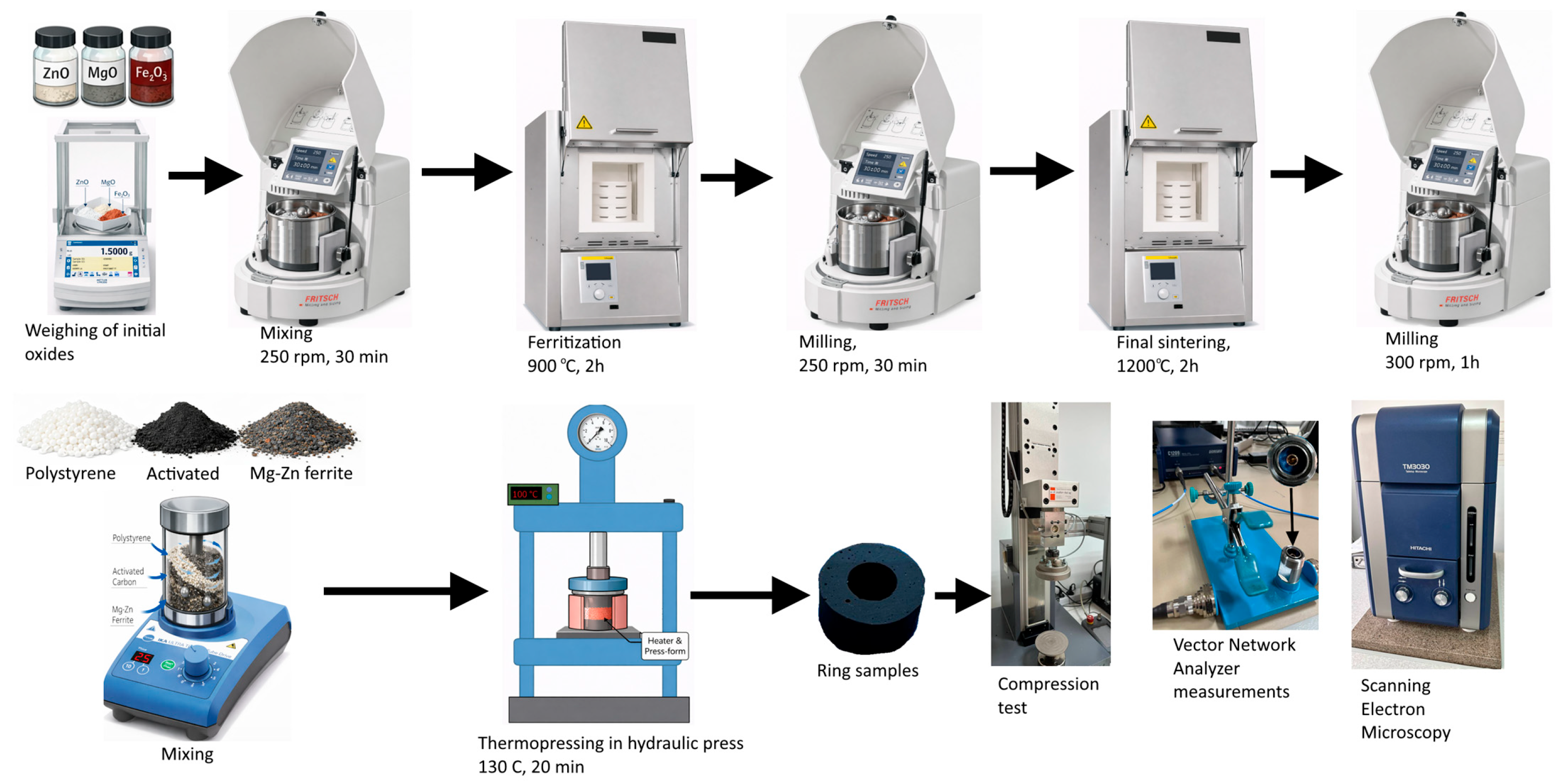
Polystyrene (Shijiazhuang Tuya Technology Co., Shijiazhuang, China) with an average granule size of 296 μm (size distribution is shown in Figure S2) was chosen as the matrix for the composite. The size of granules in the production of experimental samples ensured the structure of the composite of the dielectric core/magnetic shell type. Before obtaining the composites, the regimes for obtaining monolithic polystyrene rings were selected on an experimental setup consisting of a heater, a press mold, a hydraulic press, and cooling fans. The powder poured into the mold was first pressed without applying temperature at a pressure of ~200 MPa to reduce the number of air pores. Afterwards, the mold was heated at a pressure of ~10 MPa to a temperature of 130 °C and held for 20 min. The mold was cooled by blowing fans to room temperature. Composites for the study were manufactured under similar parameters. The composite components were mixed in an IKA tube mill for 5 min using a plastic cup and 5 mm diameter metal balls. The apparent density of the rings ρexp was estimated based on the mass and dimensions of the obtained rings. The rings had an internal diameter of d = 7.05 mm and an external diameter of D = 15.95 mm with a thickness in the range of h = 4.75–6.1 mm. The schematic illustration of the composite preparation process is given in Figure 1.
In the preparation of experimental samples, a mixture of Mg-Zn ferrite/polystyrene in a ratio of 1 to 1 was used as a basis. The mass concentration of activated carbon was introduced into this mixture at concentrations of 3.0, 4.8, 6.6, and 9.0 wt. %. Table 1 presents the concentrations of the components and the designation of the studied samples.
To estimate the porosity, the X-ray density of ferrite was obtained from the measured X-ray diffraction pattern (Figure S3), and the known densities of polystyrene and activated carbon were also taken. The theoretical effective apparent density of the composite was calculated using the weighted average law:
ρ e f f = C m f e r r · ρ X R D f e r r + C m P S · ρ t h e o P S + C m c a r b · ρ t h e o c a r b ,
where ρ X R D f e r r denotes XRD density of ferrite (4.975 g/cm3);
ρ t h e o P S denotes theoretical density of polystyrene (1.06 g/cm3);
ρ t h e o c a r b denotes theoretical density of activated carbon (1.7 g/cm3).
The porosity of the experimental samples was calculated using the formula
p = 1 ρ e x p ρ e f f · 100 % ,
The morphology of the composite crushed samples was studied using scanning electron microscopy (SEM) on a Hitachi TableTop 3030 TM microscope (Hitachi Ltd., Tokyo, Japan). An accelerating voltage of 15 kV and a backscattered electron detector were used to capture images. Before SEM examination, the samples were coated with gold using a magnetron coater. Measurements of the spectra of permittivity and permeability in the frequency range f = 100 MHz–5 GHz were performed on a PLANAR C1209 vector network analyzer (Planar, Chelyabinsk, Russia) with a coaxial cell for ring samples (inner conductor diameter of 7 mm, and outer conductor diameter of 16 mm). S-parameters were measured on a coaxial line calibrated using the TRL (Thru-Reflect-Line) method. After measuring the S-parameters and phase spectra, the spectra of complex permittivity ε* = ε′ + iε″ and the spectra of complex permeability μ* = μ′ + iμ″ were calculated in a special program provided by Planar. The evaluation of microwave absorption characteristics in the frequency range of 1–5 GHz was carried out using calculations of the reflection coefficient on a metal plate Rl (in dB) [34]:
Z i n = Z 0 μ * ε * 1 2 tanh i 2 π f h c ( μ * ε * ) 1 2 ,
R l = 20 l o g Z i n Z 0 Z i n + Z 0 ,
where Zin is the impedance at the air/material interface.
Z0 is the impedance of free space, 376.73 Ω.
c is the speed of light.
The calculation was carried out using previously obtained frequency dependencies of complex permittivity for thicknesses h in the range of 5–10 mm with a step of 0.5 mm.
In addition to the Rl values, the absorption efficiency of the obtained materials was also estimated by calculating the attenuation coefficient α using the formula [35]
α = 2 π f c μ ε μ ε + ( μ ε μ ε ) 2 + ( μ ε + μ ε ) 2 .
Using the values of the coefficients S11 and S12, which were measured by a vector analyzer on experimental samples, the shielding efficiency was calculated using the formula [36,37]
SE = S12 = SEr + SEa,
which consists of the shielding efficiency due to reflection (SEr) and the shielding efficiency due to absorption (SEa):
SEr = 10log(1 − R),
SEa = 10log(T/(1 − R)) = 8.686hα,
where R is the reflection coefficient (R = |S11|2) in relative units;
T is the transmission coefficient (T = |S12|2) in relative units.
The compressive strength was determined using a WalterBai LFM-L 10 kN (Walter+Bai, Löhningen, Switzerland) universal electromechanical testing machine. During mechanical tests, the load on the ring was oriented transversely, and the crosshead movement speed was 0.05 mm/s. After determining the maximum force F at which the sample fails, the specific strength was calculated using the formula
σ c o m p = F ( D e ) / h e 2 ,
where e = (D − d)/2.

3. Results

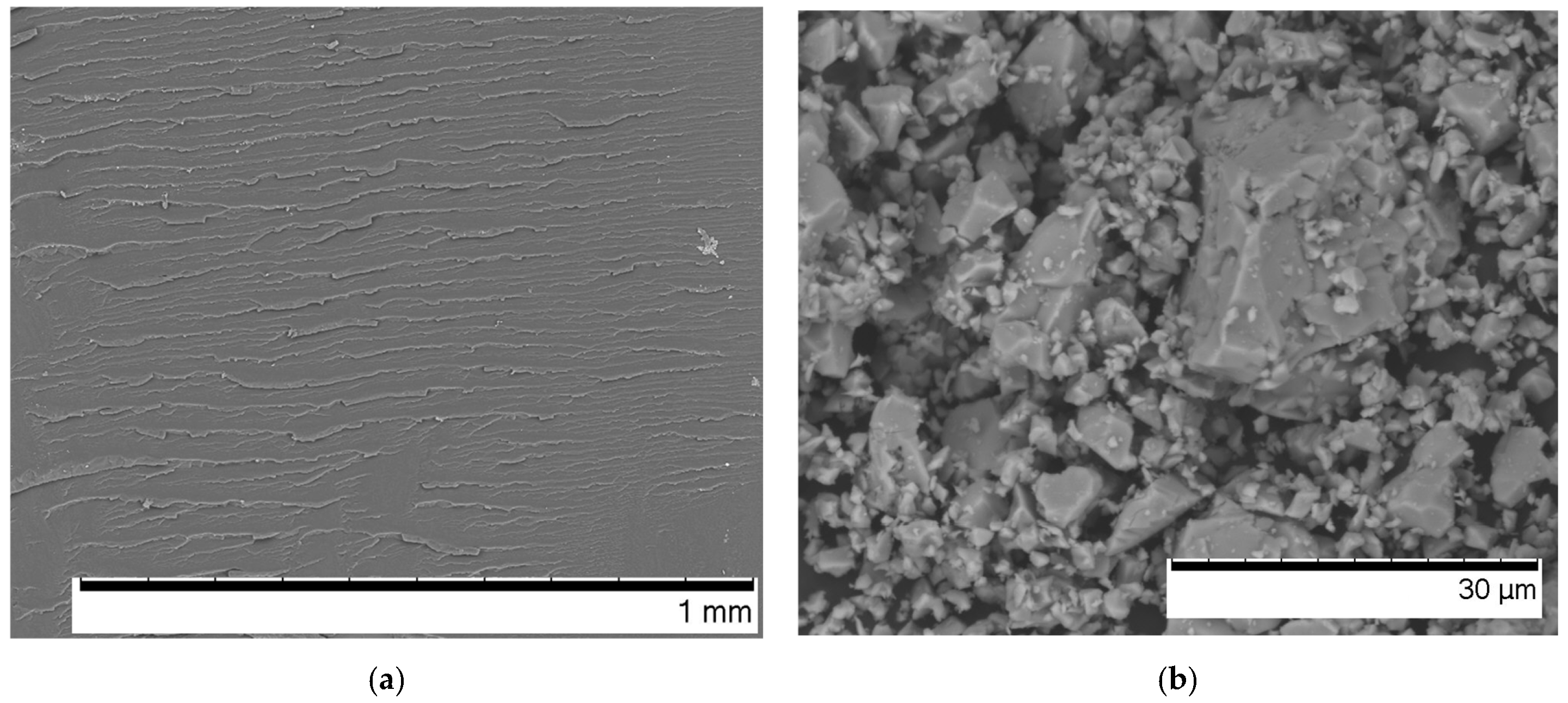
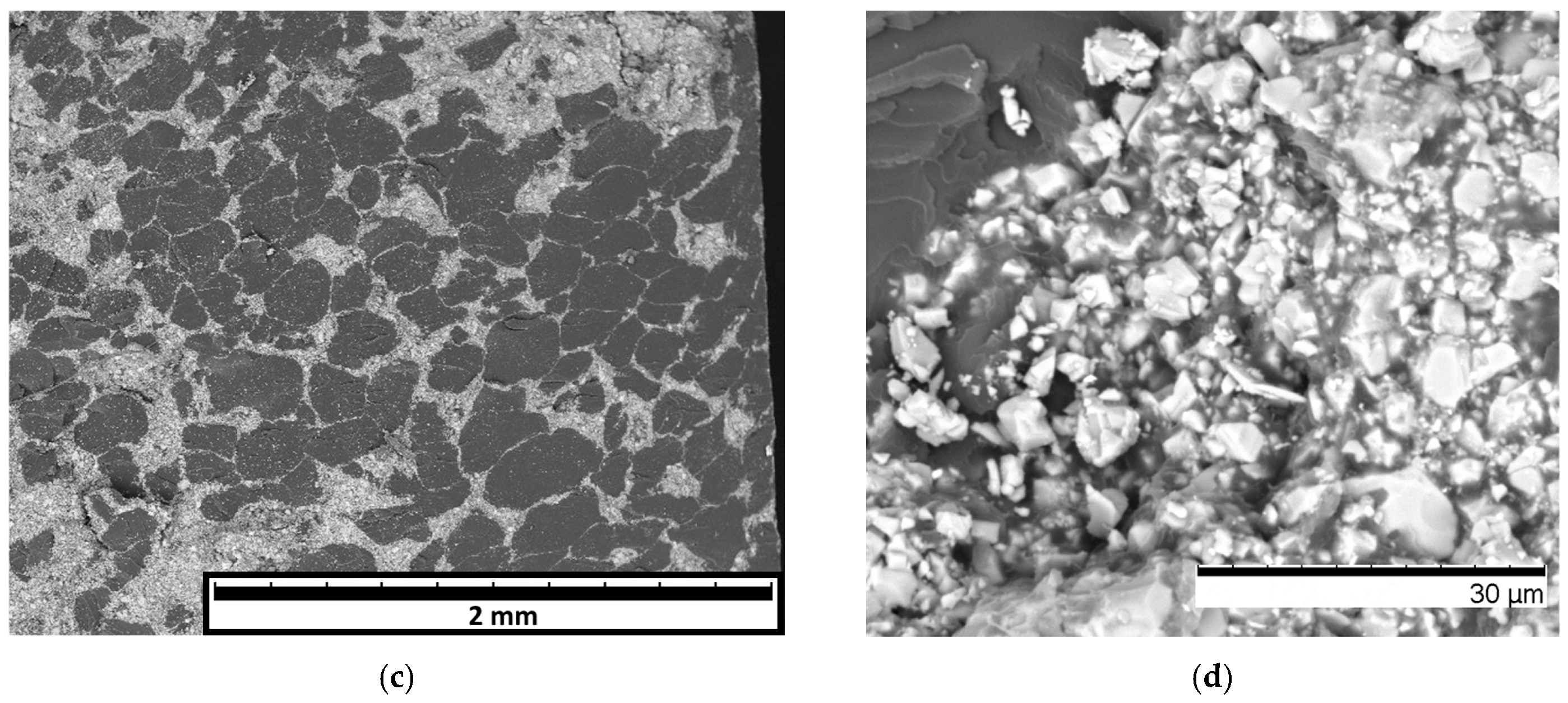
Figure 2 shows SEM images obtained for a cross-section of a pure polystyrene ring, the morphology of Mg-Zn ferrite particles, and the morphology of a cleavage of a polystyrene/Mg-Zn ferrite composite (sample C0). As can be seen from Figure 2a, under the selected thermo-pressing conditions, complete fusion of polystyrene particles into a single monolithic structure is observed. The wave-like elements of the microstructure are fracture sites that arise after testing the mechanical strength of the sample. After the thermos-pressing process, large pores were observed in the volume of the ring, which could be air or gas pores. In the observed areas of the cross-section, no such pores were detected. Moreover, the measured apparent density of the polystyrene rings was similar to the theoretical one, taking into account the measurement error.
The morphology of milled and sieved Mg-Zn ferrite powders is represented by particles of different shapes with different aspect ratios (Figure 2b). The SEM image shows that the Mg-Zn ferrite powder contains both elongated needle-shaped particles and large particles in the form of irregular polyhedra. It can also be noted that some particles have a complex microstructure. Apparently, large particles were able to retain their multigrain structure during the grinding process [38]. As the analysis of SEM images of ferrite particles shows, the lateral dimensions of the particles are less than 45 μm, which indicates a successful sifting process.
As can be seen from Figure 2c, the polystyrene/Mg-Zn ferrite (C0) composite exhibits a core/shell morphology, in which the core is made up of large polystyrene particles and the shell consists of small ferrite particles. This structure is similar to the magnetic core/conducting shell structure shown in [24], where large ferrite particles were surrounded by small particles of coal. The resulting rings had sufficient mechanical strength to carry out all the research methods used in this work. The high strength was achieved by the flow of viscous polystyrene between the ferrite particles under pressure and temperature (Figure 2d).
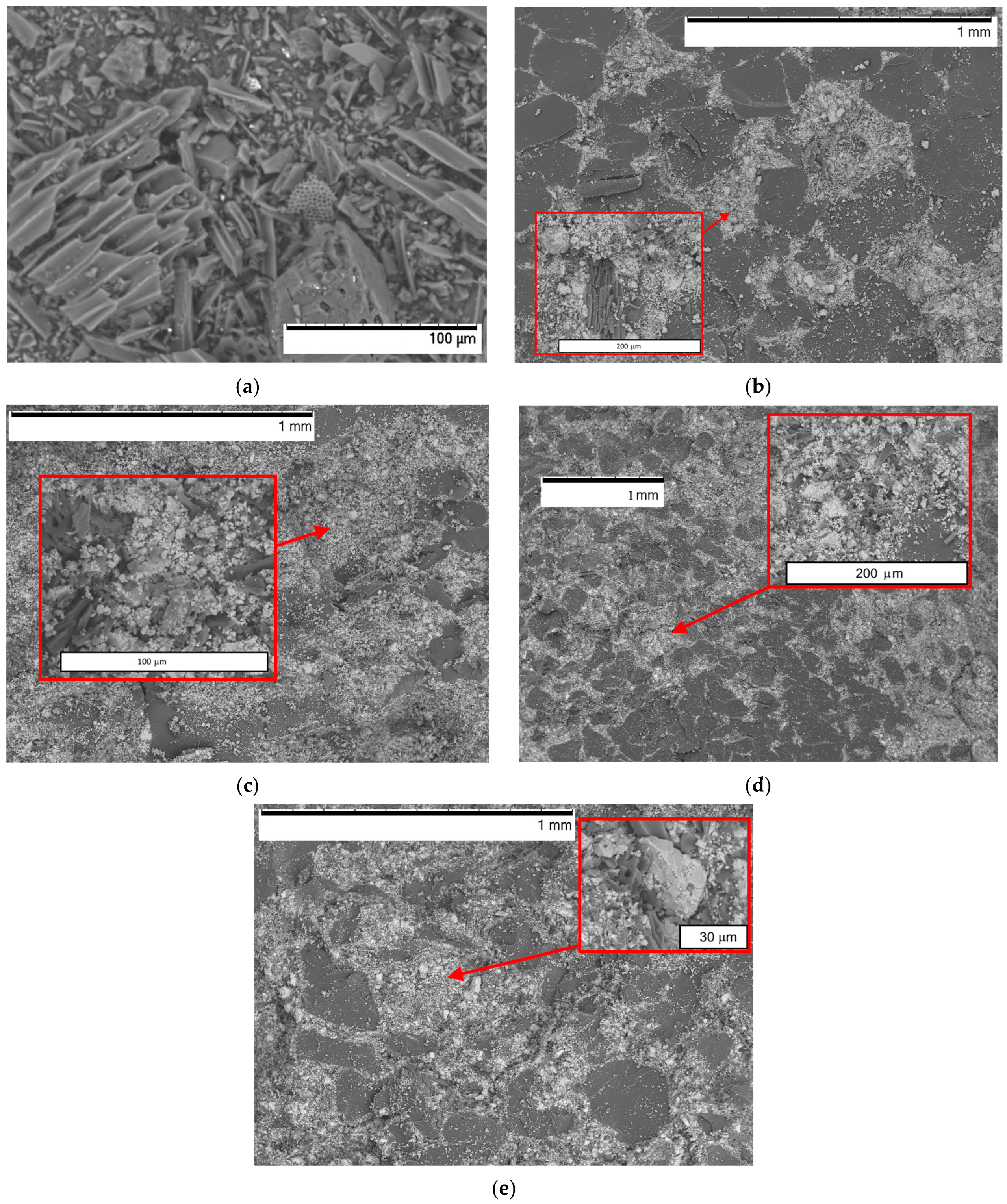
Figure 3a shows the SEM image of ground activated carbon particles. It can be seen that the particles have a complex shape, reminiscent of a honeycomb. After grinding, the resulting powder contains both needle-shaped particles and large particles that retain the original structure characteristic of activated carbon with a large number of pores. The distribution of randomly measured Feret diameters on crushed activated carbon particles is shown in Figure S1c. The obtained distribution indicates that the size of the carbon particles is smaller than the size of the polystyrene granules, which should also lead to the appearance of a dielectric core/shell structure.
Figure 3b–e show the images of chips of composites C3–C9, respectively. The general appearance of the cross-section morphology indicates that the core/shell structure is evident in composites C3, C6.6, and C9. The insets in Figure 3b–e show high-magnification images of the “shell”, showing that activated carbon particles are embedded between the ferrite particles. After analyzing the morphology of the composite’s cross-section, no penetration of activated carbon particles into polystyrene grains (cores) was detected. The presence of all three components in the composite was indirectly determined using Raman spectroscopy (Figure S4), which confirms the formation of the polystyrene/Mg-Zn ferrite/activated carbon composites.
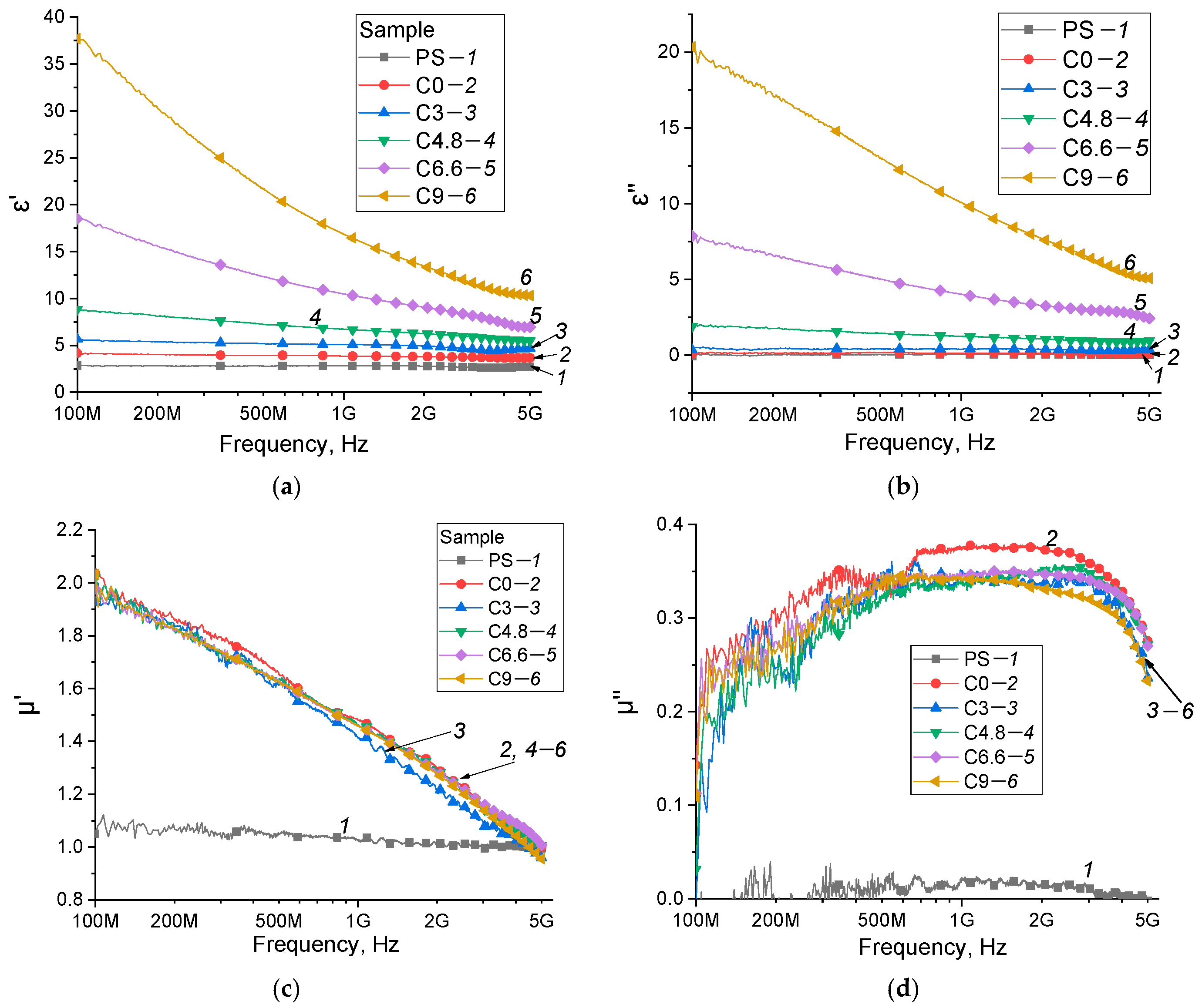
The frequency spectra of ε′, ε″ μ′, and μ″ in the frequency range of 100 MHz–5 GHz are shown in Figure 4. The relative accuracy of measurement was ±1%. For the complex permittivity spectra (Figure 4a,b) of composites C6.6 and C9.0, a pronounced dispersion can be observed, in which the ε′ values drop by ~50–60% at the highest frequencies. With the introduction of Mg-Zn ferrite into polystyrene at a mass concentration of 50%, the value of dielectric constant increases insignificantly, while with the introduction of 4.8% activated carbon, the value of permittivity increases more than 2 times. The results show that the introduction of carbon materials into the composite has a greater effect on increasing the dielectric constant values than the introduction of ferrite particles. The frequency dependences of μ′ and μ″ (Figure 4c,d) also show dispersion, but unlike the permittivity, the spectra of the imaginary part show a bell-shaped dependence. For a polystyrene ring, the value of magnetic permeability μ′ is almost equal to unity, which indicates its non-magnetic nature. With a change in the concentration of the carbon component in composites compared to the dielectric constant, the change in the μ′ values is less pronounced. In some parts of the spectrum, the values of the real part of the magnetic permeability are the same. However, for the μ″ spectra, the highest values in the entire frequency range are observed for the C0 composite.
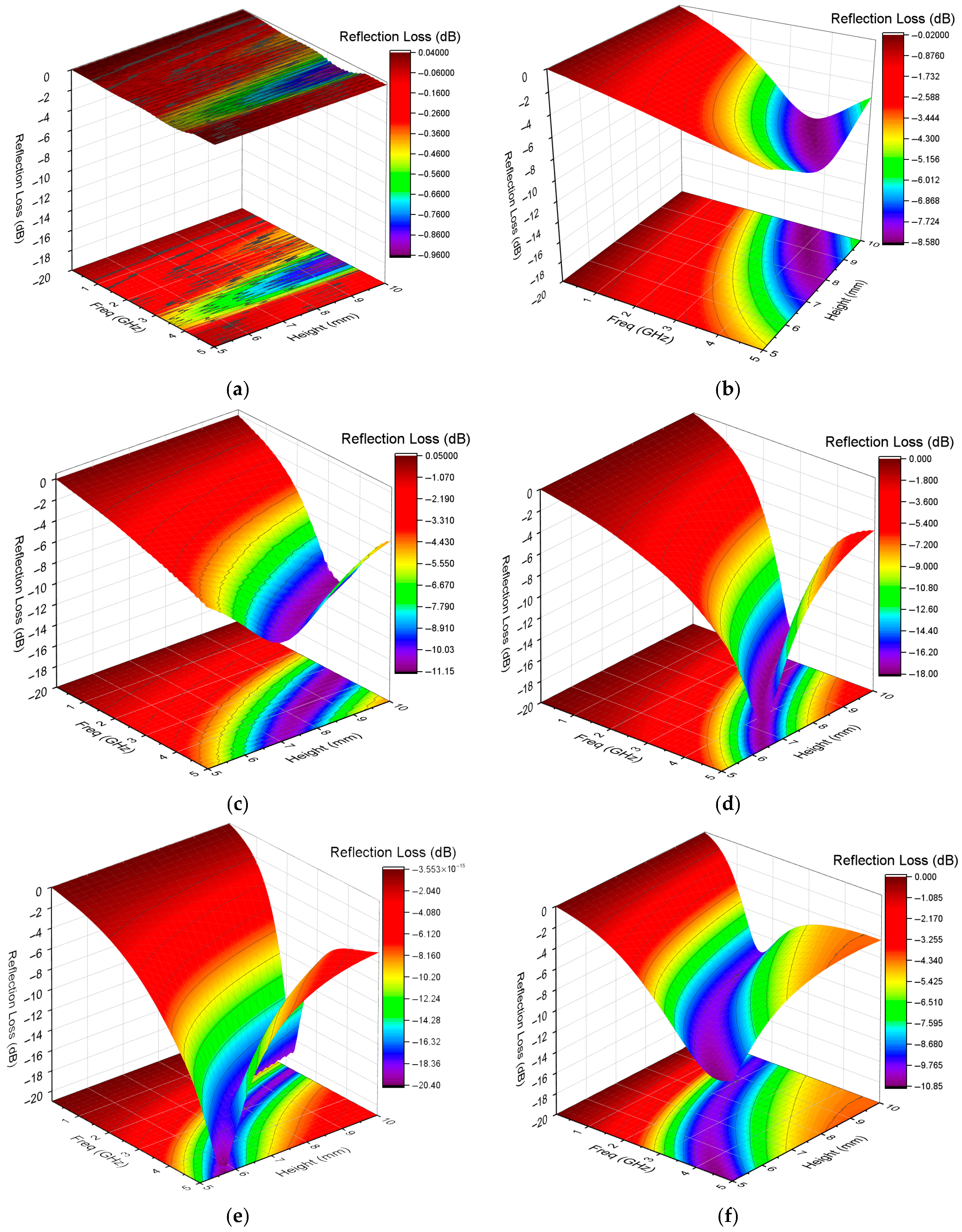
From the calculated reflection loss spectra, the surfaces in the coordinates Frequency-Rl-Thicnkess were constructed (Figure 5). The obtained surfaces are characterized by pronounced minima associated with the phenomenon of interference of electromagnetic waves. With an increase in the concentration of carbon material to 6.6%, the amplitude of Rl increases, and the position of the minimum shifts toward lower frequencies. It is accepted that a composite is considered an effective absorber if the attenuation is more than 10 dB. In general, it can be seen that in the geometry of a microwave absorber on an ideal reflector, the resulting composites are effective in the frequency range of 2.5–5 GHz with a maximum attenuation of ~18 dB and thicknesses of 6–10 mm. It is also worth noting some other characteristics of the calculated reflectivity spectra. For example, for a C6.6 composite with a thickness of 7 mm, the absorption band at the level of –10 dB is ~2.13 GHz with a minimum value of Rl = −18 dB. For the C4.8 composite with a thickness of 8 mm, the absorption band at the level of –10 dB is ~1.7 GHz with a minimum value of Rl = −17.8 dB. The polystyrene/Mg-Zn ferrite composite can be characterized as an ineffective microwave absorber. The increasing concentration of activated carbon to 9.0 wt. % also worsens the microwave-absorbing properties compared to less-concentrated composites.
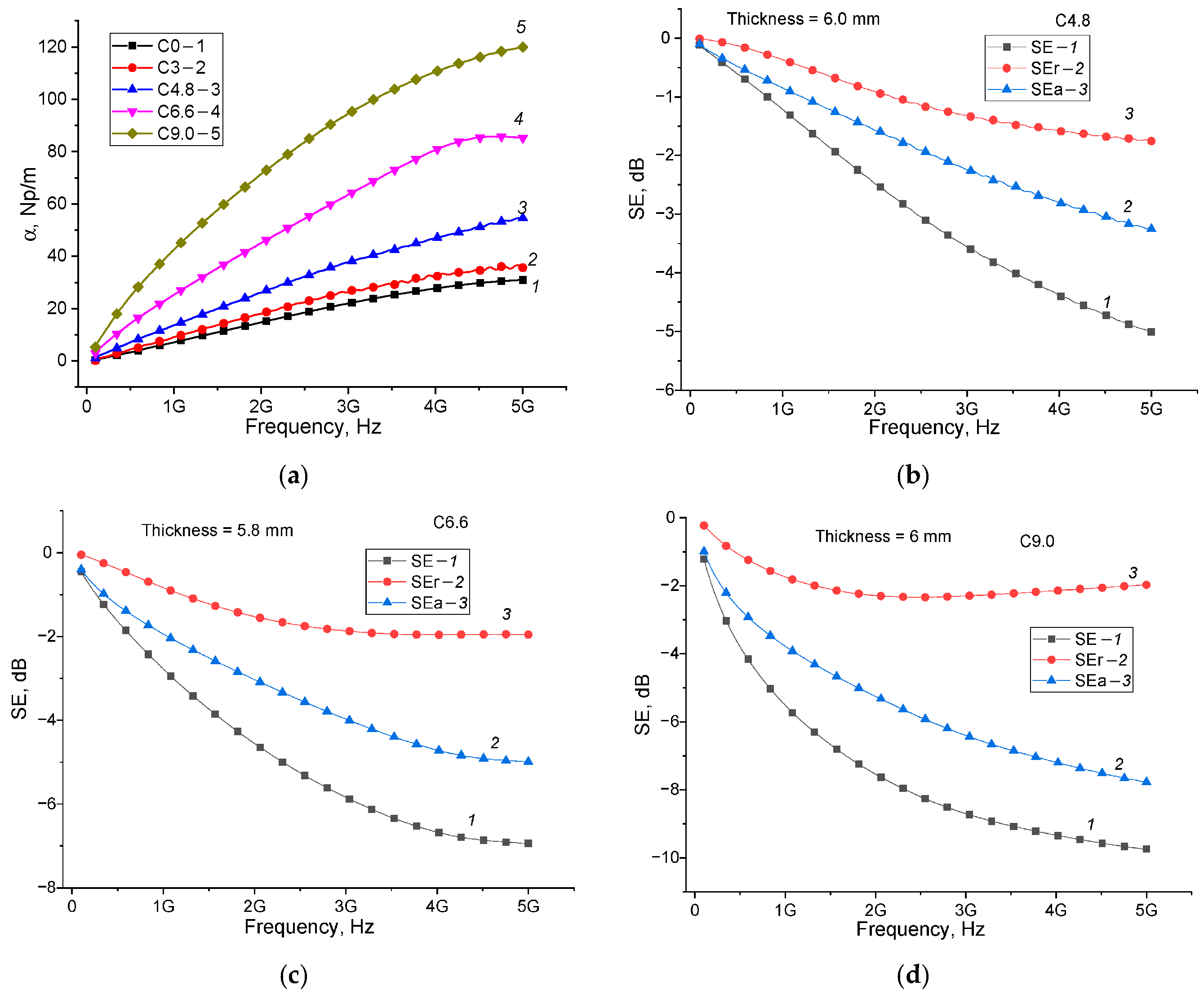
The calculation results of attenuation coefficient α are shown in Figure 6a. It is evident that the activated carbon concentration has a significant effect on the attenuation coefficient in the composites, and the frequency dependence is represented by a power function, increasing sharply in the frequency range of 1–5 GHz.
The calculated SE spectra are presented in Figure 6b–d. It can be seen that only the C9.0 composite can be considered an effective microwave shield at a thickness of approximately 6 mm. However, it is worth noting that the dominant shielding mechanism in the resulting composites is absorption shielding. This can be seen from the fact that in the 3–5 GHz frequency range, |SEa| values are higher than |SEr| values. Increasing the concentration of activated carbon did not result in a significant increase in SEr, indicating the potential of using this conductive component to increase the shielding efficiency in composites. If we pay attention to formula (8), it is easy to see that increasing the thickness of the absorber will increase the value of the shielding efficiency due to the absorption of SEa, which in turn will make the developed composite an effective shielding material without reflecting electromagnetic waves from the surface.
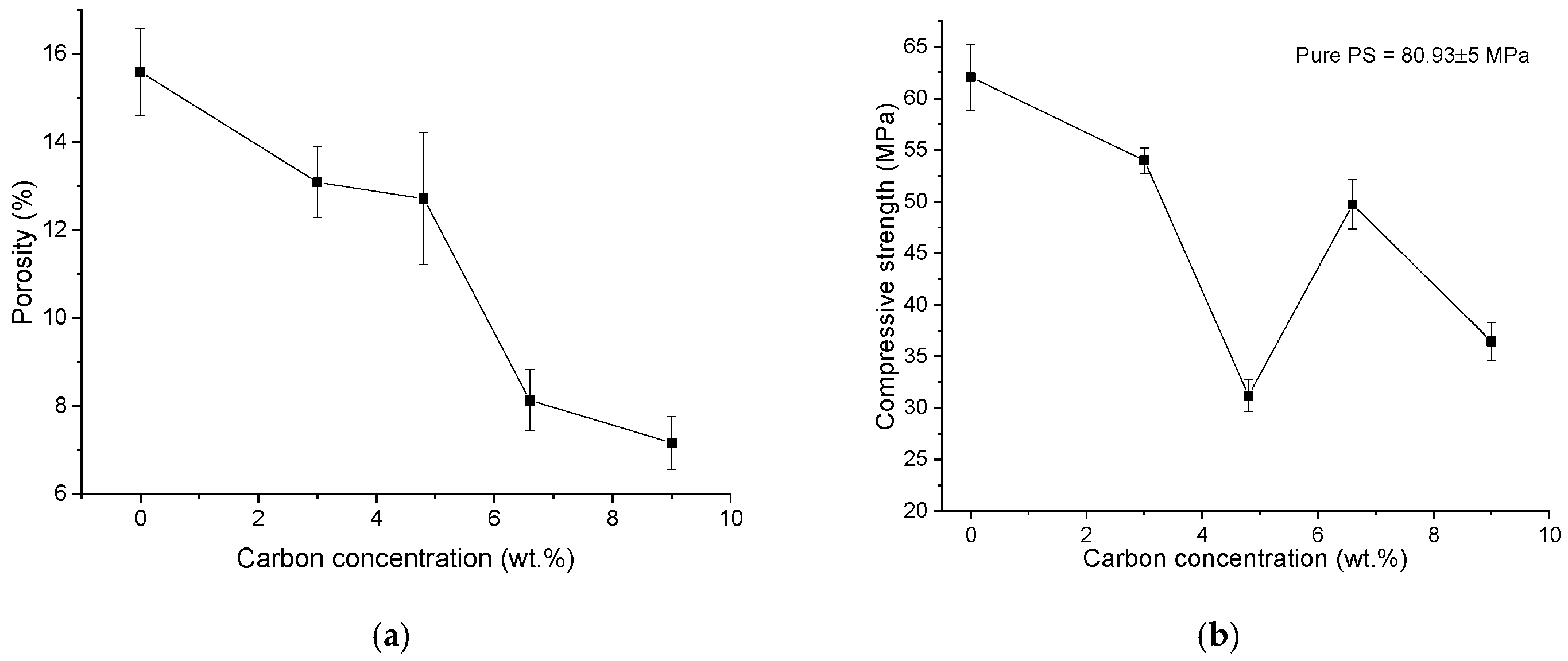
Figure 7a shows the dependence of composite porosity on activated carbon concentration. It is evident that with the increasing concentration, the calculated composite porosity decreases from 15.8 to 7%. Despite the decrease in porosity, compressive strength also decreases with increasing carbon concentration (Figure 7b). The polystyrene ring exhibits the highest compressive strength of 80.93 MPa.

4. Discussion

As can be seen from Figure 2c and Figure 3b,d,e (SEM morphology), for the C0, C3, C6.6, and C9.0 composites, the successful formation of the dielectric core/shell structure can be observed, since the polystyrene grain (core) and the shell consisting of a mixture of Mg-Zn ferrite with activated carbon are clearly visible. Using the example of composite C0 (Figure 2d), it can be seen that the viscous polystyrene flows between the filler particles and holds the entire composite together. Often, strength properties are inversely correlated with the porosity of samples; however, in the case of the composites obtained in this study, a direct correlation was observed [39]. When discussing a possible explanation for the obtained results, it is worth first noting that the decrease in porosity with increasing concentrations of activated carbon can be associated with the fact that the carbon material (a good electronic conductor) increases the effective thermal conductivity of the composite [40]. In this case, the heat from the mold is distributed more uniformly and allows more polystyrene grains to be converted into a viscous flow state than in the case of a composite containing only Mg-Zn ferrite. However, the addition of activated carbon particles with internal pores (see particle morphology in Figure 3a) can lower the strength of the polymer composite, since crack propagation can occur through the pores within the carbon filler. The highest strength value of the ring made of pure polystyrene, in which, as can be seen from Figure 2a, the morphology is characterized by homogeneity and monolithicity, also confirms the above conclusions. For sample C4.8, SEM revealed a structure with pronounced agglomeration of filler particles, which ultimately led to the lowest values of compressive strength.
While developing a composite material for microwave absorbers, structural properties must also be considered in addition to the important functional properties like reflection loss or shielding effectiveness. As can be seen from the obtained results, the mechanical properties deteriorate as the microwave absorption characteristics improve. This is due to a specific microstructure, in which the distribution of components within the resulting core/shell structure is non-uniform. Thermogravimetric and differential thermal analysis (TGA) were also conducted during the comprehensive studies (Figure S5). These analyses revealed that the addition of ferrite and carbon material adds an additional endothermic peak near the decomposition peak. This fact also indicates non-uniform component distribution within the composite and a possible earlier onset of the decomposition process. The appearance of the additional peak is detected at temperatures higher than 80–90 °C, indicating that the composite degradation occurs above the softening temperature. However, TGA and DTA showed that the composite and pure polystyrene have different degradation kinetics. When developing microwave absorbers or shields, this must also be taken into account to determine the limits of application.
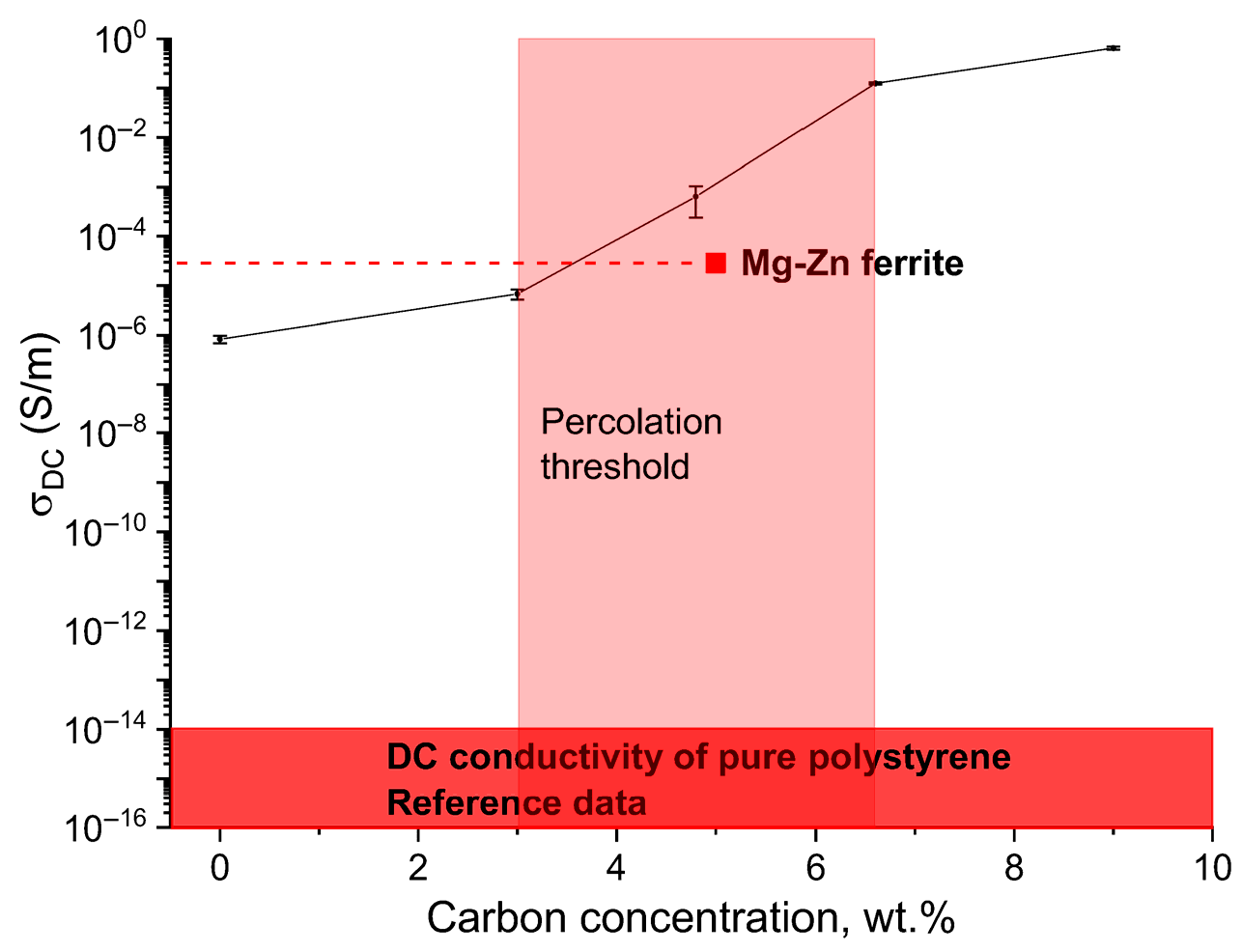
The increase in the dielectric constant values with increasing concentration of activated carbon is in good agreement with the general concepts of the dielectric constant of heterogeneous media [41,42,43]. Carbon materials may have their own electric dipoles, as well as free charge carriers [44]. Increasing the number of electric dipoles increases polarization and, consequently, permittivity. However, with an increase in concentration from 4.8 to 6.6%, pronounced dispersion and an explosive increase in permittivity values occur in the frequency spectrum of the ε′ and ε″ composites. Significant dispersion in the ε′ and ε″ spectra in samples C6.6 and C9 is associated with the emergence of percolation channels through the entire thickness of the sample [45]. The formation of electrical percolation channels can also be observed by measuring DC conductivity. These measurements were performed using a HIOKI IM3533 RLC-meter (Hioki E.E Corporation, Singapore) on slices of fractured rings after compressive strength testing. Silver paste was applied to the surfaces of the slices to make contacts [46,47]. The results of DC conductivity measurements are presented in Figure 8. As can be seen from the figure, an increase in the conductivity values by 5 orders of magnitude is observed in the concentration range of 4.8–6.6%.
In the percolation channels, particles of conductive activated carbon come into contact, creating pathways for high-frequency current flow and increasing the intensity of polarization processes. At low frequencies, current flow is driven by electron hopping between adjacent particles. During this process, charge carriers can travel long distances and generate Joule heating due to conduction losses. As the frequency increases, electrons are unable to travel long distances and accumulate at the polystyrene/activated carbon (ferrite/activated carbon) interfaces, and the ε′ value decreases. However, samples with a higher activated carbon content still show higher ε′ values at high frequencies, which can be explained by the presence of dipoles in the carbon material [48,49]. Activated carbon can be considered a material with a high ε* value due to its high electrical conductivity relative to many dielectric materials. High electrical conductivity and the presence of crystal lattice defects in carbon materials result in the presence of electrical dipoles (defect plus charge carrier), which can cause polarization in the material. In addition to the formation of percolation channels, a decrease in the porosity of the composite contributes to an increase in permittivity. An additional contribution to the losses of electromagnetic waves is also made by losses due to eddy currents that form in contacting carbon particles [50].
The permeability spectra show standard behavior for magnetic materials. The dispersion of permeability in ferrites in the microwave range is due to the phenomenon of domain wall resonance and natural ferromagnetic resonance [7]. The latter is dominant in the case of ferrite–polymer composites. The low value of magnetic permeability can be explained by the fact that the measured low-frequency magnetic permeability of the sintered Mg-Zn ferrite ring was 45 (measurement details are given in the supplementary materials). The measured small value of permeability of ferrite is due to intragranular porosity, which causes pinning of domain walls [51]. When small ferrite particles are introduced into the composite, the number of magnetic domain boundaries is significantly smaller than in ferrite, so the contribution to the total permeability from the movement of domain boundaries is small. The value of permeability over the entire measured frequency range for μ′ remains unchanged with increasing concentrations of activated carbon, although it was expected that the value would decrease due to a decrease in the concentration of the magnetic component in the composite. This can be explained by the reduction in porosity in composites. The magnetic flux in a polymer composite is significantly reduced by the presence of polymer interlayers, which reduces the magnetic induction and, consequently, the effective magnetic permeability [52]. Pores can also be an additional factor in reducing magnetic flux in composites. For these reasons, despite the decrease in the concentration of the magnetic component in the composite, the permeability can increase due to the decrease in porosity, which results in the permeability value remaining unchanged. It is also worth noting that the wide bell-shaped dependence of the imaginary part of the magnetic permeability in the frequency range of 100 MHz–5 GHz can be due to the wide distribution of the ferrite particle size (Figure S1a).
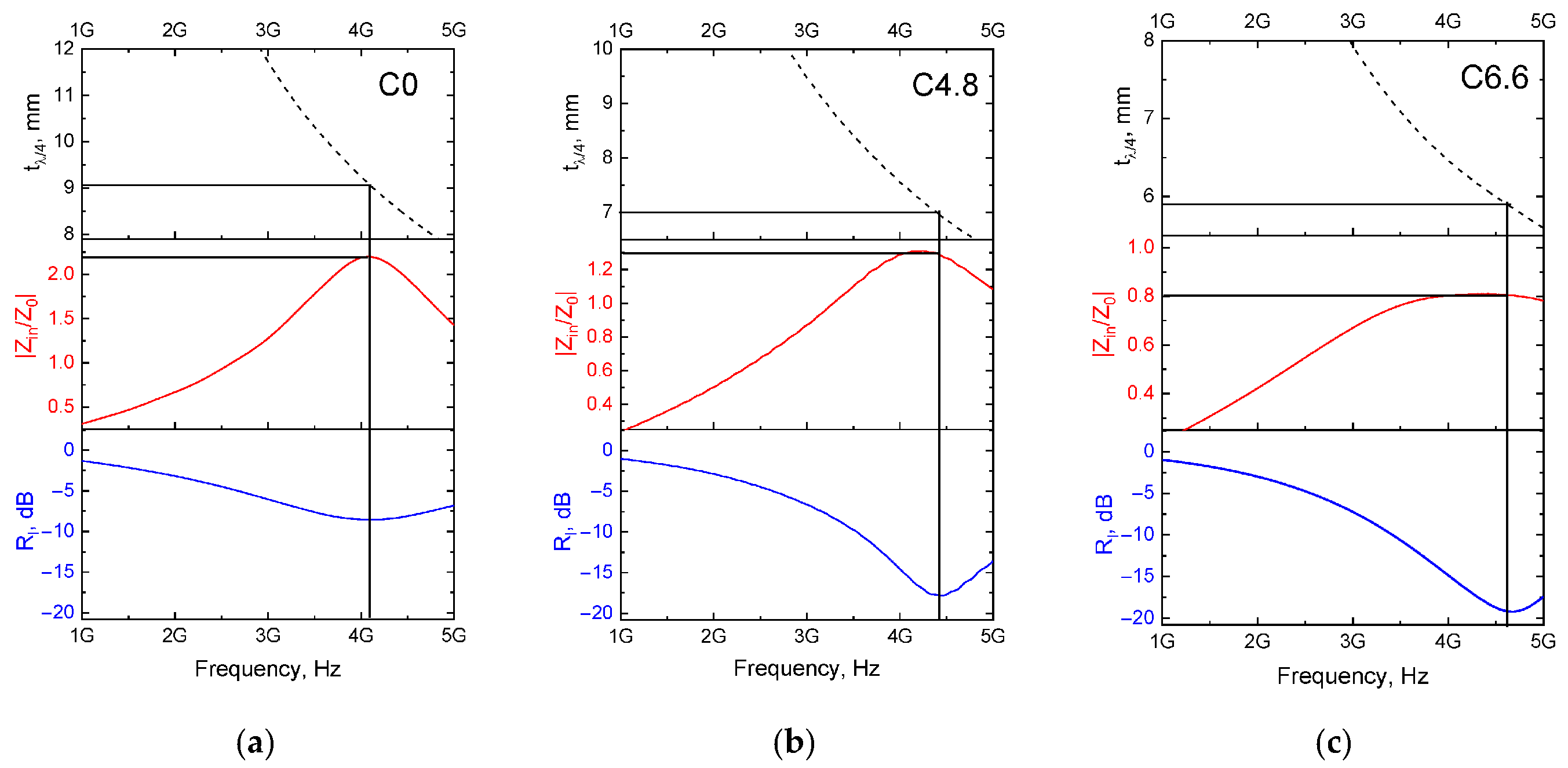
Microwave reflection loss spectra show that pure polystyrene is not a good absorber of electromagnetic waves. The introduction of Mg-Zn ferrite into polystyrene also does not lead to significant microwave absorption (more than 10 dB in absolute value), which can be explained by low magnetic and dielectric losses in the composite. The addition of activated carbon results in additional losses due to eddy currents and dipole polarization [50]. The sharp increase in absorption is particularly noticeable on the C4.8 composite, in which the ε″ value increases significantly, which is associated with dielectric losses [53]. With increasing concentration, high absorption of more than 10 dB in absolute value in the frequency range of 1–5 GHz can be obtained at smaller thicknesses due to the increase in the values of ε* and μ*. In order for the absorption peak Rl(f) to have the greatest value in modulus, the condition of ideal matching must be met, in which the impedance ratio |Zin/Z0| is approximately equal to unity at the interference frequency of electromagnetic waves [54,55,56]. To demonstrate the obtained reflection loss dependences for the obtained composites, the normalized impedance values |Zin/Z0| and the interference minimum thickness were calculated. The interference minimum thickness tλ/4 was calculated using the formula
t λ / 4 = n c / ( 4 f 0 | ε * μ * | ) ,
where n is an odd natural number—3;
f0 is the frequency of EMR;
c is light speed.
The interference thickness can be calculated using formula (10). In general, the frequency position of the interference minimum on the spectrum Rl(f) depends on the thickness of the sample and the values of the complex ε* and μ*. For the composites obtained in the work in the thickness range of 5–10 mm, the condition of ideal matching is not observed, which explains the attenuation of only —18 dB at the minimum on the frequency curves Rl(f). This can be seen in Figure 9 for some thicknesses of composites C0, C4.8, and C6.6. In the calculated graphs, the impedance ratio |Zin/Z0| is not equal to 1 at the frequency of the interference minimum, and the deviation is about 0.2. For the C0 composite, this deviation is greater than one, which results in a peak value of Rl less than 10 dB in absolute value. It is obvious that the deterioration of the absorption properties of the C9.0 composite is also associated with an increasing deviation of |Zin/Z0| towards the higher side due to the increase in the ε* values (Figure 4a,b).
If we consider the obtained composites as microwave-shielding materials, it should be said that the value of the attenuation coefficient increases significantly with increasing concentration of activated carbon, especially for concentrations of 6.6 and 9.0%. The attenuation coefficient values of 80–120 Np/m in the frequency range of 3–5 GHz for these composites are relatively low, which explains the low shielding efficiency even with a thickness of about 6 mm (Figure 6d). It can be assumed that the composite contains macropores that were not detected during SEM examination. If these pores are filled with air, electromagnetic waves easily pass through these pore clusters without being absorbed by the composite material. Calculated porosity values indicate that the minimum porosity is estimated at 7% for the C9.0 composite, and these pores are likely through-and-through.
The results showed that the 1–5 GHz frequency range is not the most efficient use of the dielectric core/conductive shell structure. It was assumed that the dielectric polystyrene core would transmit the electromagnetic wave, while the Mg-Zn ferrite and activated carbon shell would absorb or reflect it. Alternatively, the shell with the dielectric core could act as a trap for the electromagnetic wave. To assess the feasibility of this scenario, the wavelength λm in the composite medium was calculated. Using the permittivity and magnetic permeability values for the C9.0 composite (for which the ε′ and ε″ values are maximum), as well as the formula for the wavelength in the medium λ m = c f ε μ , we can obtain a wavelength in the composite for a frequency of 5 GHz of approximately 18.8 mm. This length is significantly greater than the characteristic size of a single dielectric core, as can be seen in Figure 3. Since the inhomogeneity of the medium is significantly smaller than the wavelength in the material, scattering of waves is more likely than reflection. Nevertheless, using formula (8), the shielding efficiency SEa can be calculated for a frequency of 5 GHz and a thickness of 10 mm for composites C6.6 and C9.0, which will yield values of −7.4 and −10.42 dB, respectively. Taking into account that the shielding efficiency due to reflection can be in the range of |2–3| dB, the overall shielding efficiency SEt will be |10–12| dB at a thickness of 1 cm for the above-mentioned composites.
It can be concluded that the conducted studies demonstrate the effectiveness of the developed composites as microwave absorbers in the 1–5 GHz frequency range. Comparing experimental data obtained in this study to some similar composite systems (Table 2), polystyrene/Mg-Zn ferrite/activated carbon composites showed good absorbing performance in the low frequency range. However, this is true for composites C4.8 and C6.6 when used in a geometry with a reflective plate (Rl coefficient) and thicknesses of 5.5–10 mm. Composite C9.0 exhibits acceptable shielding properties in the 3–5 GHz microwave range, but only for a ring thickness of 6–10 mm. This endows the obtained composites with poor shielding materials in the 1–5 GHz frequency range compared to other core-shell structures or MXene-containing polymer composites.

5. Conclusions

Composites with a dielectric core/shell structure were fabricated using inexpensive components (polystyrene, Mg-Zn ferrite, and activated carbon) via thermopressing. Microwave characterization studies of the composites revealed potential for use as absorbers in the 1–5 GHz frequency range. The formation of a dielectric core/magnetically conductive shell structure was confirmed using scanning electron microscopy. This structure was achieved using large polystyrene granules (approximately 500 μm) with magnetic and conductive fillers smaller than 50 μm. Analyses of the calculated reflection loss frequency spectra revealed that composites C4.8 and C6.6 exhibited the best performance, with attenuation down to –18 dB and an absorption band of ~1.7–2.13 GHz at a thickness of 7–8 mm. The C9.0 composite can be potentially considered as a microwave-shielding material for civil applications with a shielding efficiency (SEt) of up to −12 dB at thicknesses of 6–10 mm in the frequency range of 3–5 GHz. The primary shielding mechanism in obtained composites is the absorption of electromagnetic waves, rather than reflection from the surface. However, this shielding performance is not comparable to another similar composite system. This study demonstrated that improved microwave properties are accompanied by changes in strength characteristics, necessitating the search for optimal concentrations to ensure the required level of functional properties and strength.

Supplementary Materials

The following supporting information can be downloaded at https://www.mdpi.com/article/10.3390/jcs10050239/s1 [57,58,59,60]. Figure S1: Size distribution of Mg-Zn ferrite particles by volume (a), by number (b), and size distribution for activated carbon particles (c); Figure S2: Optical micrograph of polystyrene granules (a) and quantitative distribution of granule sizes in % (b); Figure S3: XRD pattern of Mg0.5Zn0.5Fe2O4 powder sintered at 1200 °C; Figure S4: Raman spectra of polystyrene ring (a) and composites C0 (b), C3 (c,d), C4.8 (e), C6.6 (f), and C9 (g); Figure S5: TGA and DTA thermograms of polystyrene (a) and composites: C0—(b); C3—(c); C4.8—(d); C6.6—(e); C9.0—(f).

Author Contributions

Conceptualization, D.B.K. and R.I.S.; methodology, R.I.S.; software, K.M.M.; validation, R.I.S., S.A.M., and D.K.Z.; formal analysis, R.I.S.; investigation, R.I.S., K.M.M., S.A.M., and D.K.Z.; resources, D.B.K.; data curation, R.I.S. and D.B.K.; writing—original draft preparation, R.I.S. and R.I.S.; writing—review and editing, R.I.S. and D.B.K.; visualization, R.I.S., S.A.M., and D.K.Z.; supervision, D.B.K.; project administration, D.B.K.; funding acquisition, D.B.K. All authors have read and agreed to the published version of this manuscript.

Funding

This research was funded by the Science Committee of the Ministry of Education and Science of the Republic of Kazakhstan (No. AP26103519).

Data Availability Statement

The raw data supporting the conclusions of this article will be made available by the authors upon request.

Conflicts of Interest

The authors declare no conflicts of interest.

References

  1. Fionov, A.; Kraev, I.; Yurkov, G.; Solodilov, V.; Zhukov, A.; Surgay, A.; Kuznetsova, I.; Kolesov, V. Radio-Absorbing Materials Based on Polymer Composites and Their Application to Solving the Problems of Electromagnetic Compatibility. Polymers 2022, 14, 3026. [Google Scholar] [CrossRef] [PubMed]
  2. Shao, C.; Liu, H.; Shi, Y.; Tian, N.; You, C.; Zhao, Z. Dielectric-Magnetic Synergy in Ferrite/Carbon Composites for Electromagnetic Microwave Absorption. Nano Res. 2025, 18, 94907815. [Google Scholar] [CrossRef]
  3. Houbi, A.; Aldashevich, Z.A.; Atassi, Y.; Bagasharova Telmanovna, Z.; Saule, M.; Kubanych, K. Microwave Absorbing Properties of Ferrites and Their Composites: A Review. J. Magn. Magn. Mater. 2021, 529, 167839. [Google Scholar] [CrossRef]
  4. Ma, Q.; Dong, K.; Li, F.; Wu, Y.; Tian, J.; Yu, M.; Xiong, Y. Recent Progress in Electromagnetic Microwave Absorption of Additively Manufactured Carbon Fiber-Reinforced Polymer Structures. Eng. Sci. Addit. Manuf. 2025, 1, 025160008. [Google Scholar] [CrossRef]
  5. Mumtaz, S.; Rana, J.N.; Choi, E.H.; Han, I. Microwave Radiation and the Brain: Mechanisms, Current Status, and Future Prospects. Int. J. Mol. Sci. 2022, 23, 9288. [Google Scholar] [CrossRef] [PubMed]
  6. Bukvić, M.; Milojević, S.; Gajević, S.; Đorđević, M.; Stojanović, B. Production Technologies and Application of Polymer Composites in Engineering: A Review. Polymers 2025, 17, 2187. [Google Scholar] [CrossRef]
  7. Isaev, I.M.; Kostishin, V.G.; Shakirzyanov, R.I.; Kayumova, A.R.; Olitsky, V.K.; Salogub, D.V. Radar Absorbing and Shielding Characteristics in Ferrite-Polymer Composites Mn-Zn Ferrite/P (TFE-VDF). Tech. Phys. 2023, 68, S552–S561. [Google Scholar] [CrossRef]
  8. Toto, E.; Lambertini, L.; Laurenzi, S.; Santonicola, M.G. Recent Advances and Challenges in Polymer-Based Materials for Space Radiation Shielding. Polymers 2024, 16, 382. [Google Scholar] [CrossRef] [PubMed]
  9. Kostishin, V.G.; Isaev, I.M.; Salogub, D.V. Radio-Absorbing Magnetic Polymer Composites Based on Spinel Ferrites: A Review. Polymers 2024, 16, 1003. [Google Scholar] [CrossRef]
  10. Xie, X.B.; Wang, B.; Wang, Y.; Ni, C.; Sun, X.; Du, W. Spinel Structured MFe2O4 (M = Fe, Co, Ni, Mn, Zn) and Their Composites for Microwave Absorption: A Review. Chem. Eng. J. 2022, 428, 131160. [Google Scholar] [CrossRef]
  11. Thakur, P.; Chahar, D.; Taneja, S.; Bhalla, N.; Thakur, A. A Review on MnZn Ferrites: Synthesis, Characterization and Applications. Ceram. Int. 2020, 46, 15740–15763. [Google Scholar] [CrossRef]
  12. Narang, S.B.; Pubby, K. Nickel Spinel Ferrites: A Review. J. Magn. Magn. Mater. 2021, 519, 167163. [Google Scholar] [CrossRef]
  13. Zhang, Y.; Yu, H.; Wang, L.; Jian, S.; Hu, H.; Zhu, Z.; Wang, Y.; Lu, Y.; Ouyang, C. Research Progress on Conductive Polymer-Based Microwave Absorption Materials: From Materials Design to Functionalities and Applications. Mater. Horiz. 2025, 12, 10029–10058. [Google Scholar] [CrossRef]
  14. Saha, P.; Shil, S.K.; Roy, P.; Auntu, R.S.; Khan, N.I.; Sikder, S.S. Exploring the Structural, Magnetic, Dielectric and Electrical Properties of Solid State Method Synthesized Mn3+ Substituted Co–Zn Ferrites. J. Mater. Sci. 2025, 60, 17051–17064. [Google Scholar] [CrossRef]
  15. Torabi, N.; Savabieh, H.R.; Elahi, A. Structural, Magnetic, and Mechanical Properties Enhancement in Mn-Zn Ferrites via Controlled Lithium Ion Doping. Phys. B Condens. Matter 2025, 713, 417393. [Google Scholar] [CrossRef]
  16. Chen, Z.; Li, T.; Wang, A.; Shi, M.; Han, B. The Latest Research Progress on MnZn Ferrite and Their Applications. Open Ceram. 2025, 21, 100732. [Google Scholar] [CrossRef]
  17. Morineau, R.; Paulus, M. Chart of PO2 versus Temperature and Oxidation Degree for Mn-Zn Ferrites in the Composition Range: 50 < Fe2O3 < 54; 20 < MnO < 35; 11 < ZnO < 30 (Mole %). IEEE Trans. Magn. 1975, 11, 1312–1314. [Google Scholar] [CrossRef]
  18. Kuzmin, R.; Khabirov, R.; Mass, A.; Lozhkina, E. Influence of the Powders Phase Composition and Sintering Atmosphere on the Structure and Magnetic Properties of Mn-Zn Ferrites. Chim. Techno Acta 2023, 10, 202310316. [Google Scholar] [CrossRef]
  19. Tanaka, T. Equilibrium Oxygen Pressures of Mn-Zn Ferrites. J. Am. Ceram. Soc. 1981, 64, 419–421. [Google Scholar] [CrossRef]
  20. Žnidaršič, A.; Drofenik, M. Influence of Oxygen Partial Pressure during Sintering on the Power Loss of MnZn Ferrites. IEEE Trans. Magn. 1996, 32, 1941–1945. [Google Scholar] [CrossRef]
  21. Gao, S.; Xiang, X.; Zhu, C.; Xiang, S.; Pan, G.; Jiao, F.; Mao, L.; Liu, T.; Zhang, Y. Manganese ferrite-modified coal gangue for C-band microwave absorption based on magnetic-dielectric synergistic optimization. Int. J. Miner. Metall. Mater. 2026. [Google Scholar] [CrossRef]
  22. Gama, A.M.; Rezende, M.C.; Dantas, C.C. Dependence of Microwave Absorption Properties on Ferrite Volume Fraction in MnZn Ferrite/Rubber Radar Absorbing Materials. J. Magn. Magn. Mater. 2011, 323, 2782–2785. [Google Scholar] [CrossRef]
  23. Das, S.; Nayak, G.C.; Sahu, S.K.; Routray, P.C.; Roy, A.K.; Baskey, H. Microwave Absorption Properties of Double-Layer Composites Using CoZn/NiZn/MnZn-Ferrite and Titanium Dioxide. J. Magn. Magn. Mater. 2015, 377, 111–116. [Google Scholar] [CrossRef]
  24. Bespyatykh, Y.I.; Kazantseva, N.E. Electromagnetic Properties of Hybrid Polymer Composites. J. Commun. Technol. Electron. 2008, 53, 143–154. [Google Scholar] [CrossRef]
  25. Aphesteguy, J.C.; Damiani, A.; DiGiovanni, D.; Jacobo, S.E. Microwave-Absorbing Characteristics of Epoxy Resin Composites Containing Nanoparticles of NiZn- and NiCuZn-Ferrites. Phys. B Condens. Matter 2009, 404, 2713–2716. [Google Scholar] [CrossRef]
  26. Saha, P.; Debnath, T.; Das, S.; Chatterjee, S.; Sutradhar, S. β-Phase Improved Mn-Zn-Cu-Ferrite-PVDF Nanocomposite Film: A Metamaterial for Enhanced Microwave Absorption. Mater. Sci. Eng. B 2019, 245, 17–29. [Google Scholar] [CrossRef]
  27. Bhattacharjee, Y.; Bose, S. Core–Shell Nanomaterials for Microwave Absorption and Electromagnetic Interference Shielding: A Review. ACS Appl. Nano Mater. 2021, 4, 949–972. [Google Scholar] [CrossRef]
  28. Ali, N.N.; Atassi, Y.; Salloum, A.; Charba, A.; Malki, A.; Jafarian, M. Comparative Study of Microwave Absorption Characteristics of (Polyaniline/NiZn Ferrite) Nanocomposites with Different Ferrite Percentages. Mater. Chem. Phys. 2018, 211, 79–87. [Google Scholar] [CrossRef]
  29. Ali, N.N.; Al-Qassar Bani Al-Marjeh, R.; Atassi, Y.; Salloum, A.; Malki, A.; Jafarian, M. Design of Lightweight Broadband Microwave Absorbers in the X-Band Based on (Polyaniline/MnNiZn Ferrite) Nanocomposites. J. Magn. Magn. Mater. 2018, 453, 53–61. [Google Scholar] [CrossRef]
  30. Jiao, Z.; Yao, Z.; Zhou, J.; Qian, K.; Lei, Y.; Wei, B.; Chen, W. Enhanced Microwave Absorption Properties of Nd-Doped NiZn Ferrite/Polyaniline Nanocomposites. Ceram. Int. 2020, 46, 25405–25414. [Google Scholar] [CrossRef]
  31. Saini, M.; Singh, S.K.; Shukla, R.; Kumar, A. Mg Doped Copper Ferrite with Polyaniline Matrix Core–Shell Ternary Nanocomposite for Electromagnetic Interference Shielding. J. Inorg. Organomet. Polym. Mater. 2018, 28, 2306–2315. [Google Scholar] [CrossRef]
  32. He, M.; Zhang, K.; Qiu, H.; Guo, H.; Li, X.; Guo, Y.; Zhang, Y.; Gu, J. Low-Frequency Microwave Absorption Composites. Adv. Sci. 2025, 12, e11580. [Google Scholar] [CrossRef] [PubMed]
  33. Choodamani, C.; Rudraswamy, B.; Chandrappa, G.T. Structural, Electrical, and Magnetic Properties of Zn Substituted Magnesium Ferrite. Ceram. Int. 2016, 42, 10565–10571. [Google Scholar] [CrossRef]
  34. Zhang, J.; Fan, Z.; Li, B.; Ren, D.; Xu, M. Study on Structure–Function Integrated Polymer-Based Microwave-Absorption Composites. Polymers 2024, 16, 2472. [Google Scholar] [CrossRef]
  35. Zheng, W.; Ye, W.; Yang, P.; Wang, D.; Xiong, Y.; Liu, Z.; Qi, J.; Zhang, Y. Recent Progress in Iron-Based Microwave Absorbing Composites: A Review and Prospective. Molecules 2022, 27, 4117. [Google Scholar] [CrossRef]
  36. More, C.V.; Alsayed, Z.; Badawi, M.S.; Thabet, A.A.; Pawar, P.P. Polymeric Composite Materials for Radiation Shielding: A Review. Environ. Chem. Lett. 2021, 19, 2057–2090. [Google Scholar] [CrossRef]
  37. Zhang, Y.R.; Wang, B.C.; Gao, S.L.; Qiu, L.P.; Zheng, Q.H.; Cheng, G.T.; Han, W.P.; Ramakrishna, S.; Long, Y.Z. Electrospun MXene Nanosheet/Polymer Composites for Electromagnetic Shielding and Microwave Absorption: A Review. ACS Appl. Nano Mater. 2022, 5, 12320–12342. [Google Scholar] [CrossRef]
  38. Shakirzyanov, R.I.; Borgekov, D.B.; Garanin, Y.A.; Kozlovskiy, A.L.; Volodina, N.O.; Shlimas, D.I.; Zdorovets, M.V. Study of Phase Composition, Microstructure and Hardness of Multicomponent Zirconia-Based Ceramics. Ceram. Int. 2024, 50, 48826–48831. [Google Scholar] [CrossRef]
  39. Shugurov, A.R.; Kuzminov, E.D.; Garanin, Y.A.; Panin, A.V.; Dmitriev, A.I. Improvement of Mechanical Properties and Adhesion of Ti-Al-Si-N Coatings by Alloying with Ta. Lubricants 2022, 10, 178. [Google Scholar] [CrossRef]
  40. Chen, H.; Ginzburg, V.V.; Yang, J.; Yang, Y.; Liu, W.; Huang, Y.; Du, L.; Chen, B. Thermal Conductivity of Polymer-Based Composites: Fundamentals and Applications. Prog. Polym. Sci. 2016, 59, 41–85. [Google Scholar] [CrossRef]
  41. Shakirzyanov, R.I.; Astakhov, V.A.; Morchenko, A.T.; Ryapolov, P.A. Modeling of Magnetic Field Influence on Electrophysical Effects in Magnetoimpedance Microwire. J. Nano-Electron. Phys. 2016, 8, 03040. [Google Scholar] [CrossRef]
  42. Humlicek, J. Data Analysis for Nanomaterials: Effective Medium Approximation, Its Limits and Implementations. In Ellipsometry at the Nanoscale; Springer: Berlin/Heidelberg, Germany, 2013; pp. 145–178. [Google Scholar] [CrossRef]
  43. Wang, M.; Pan, N. Predictions of Effective Physical Properties of Complex Multiphase Materials. Mater. Sci. Eng. R Rep. 2008, 63, 1–30. [Google Scholar] [CrossRef]
  44. Yang, N.; Luo, Z.X.; Chen, S.C.; Wu, G.; Wang, Y.Z. Fe3O4 Nanoparticle/N-Doped Carbon Hierarchically Hollow Microspheres for Broadband and High-Performance Microwave Absorption at an Ultralow Filler Loading. ACS Appl. Mater. Interfaces 2020, 12, 18952–18963. [Google Scholar] [CrossRef]
  45. Bellucci, S.; Bistarelli, S.; Cataldo, A.; Micciulla, F.; Kranauskaite, I.; Macutkevic, J.; Banys, J.; Volynets, N.; Paddubskaya, A.; Bychanok, D.; et al. Broadband Dielectric Spectroscopy of Composites Filled with Various Carbon Materials. IEEE Trans. Microw. Theory Tech. 2015, 63, 2024–2031. [Google Scholar] [CrossRef]
  46. Payandehpeyman, J.; Mazaheri, M.; Zeraati, A.S.; Jamasb, S.; Sundararaj, U. Physics-Based Modeling and Experimental Study of Conductivity and Percolation Threshold in Carbon Black Polymer Nanocomposites. Appl. Compos. Mater. 2023, 31, 127–147. [Google Scholar] [CrossRef]
  47. Payandehpeyman, J.; Mazaheri, M. Geometrical and Physical Effects of Nanofillers on Percolation and Electrical Conductivity of Polymer Carbon-Based Nanocomposites: A General Micro-Mechanical Model. Soft Matter 2023, 19, 530–539. [Google Scholar] [CrossRef] [PubMed]
  48. Lei, L.; Yao, Z.; Zhou, J.; Wei, B.; Fan, H. 3D Printing of Carbon Black/Polypropylene Composites with Excellent Microwave Absorption Performance. Compos. Sci. Technol. 2020, 200, 108479. [Google Scholar] [CrossRef]
  49. Xi, X.; Chung, D.D.L. Dielectric Behavior of Graphite, with Assimilation of the AC Permittivity, DC Polarization and DC Electret. Carbon 2021, 181, 246–259. [Google Scholar] [CrossRef]
  50. Périgo, E.A.; Weidenfeller, B.; Kollár, P.; Füzer, J. Past, Present, and Future of Soft Magnetic Composites. Appl. Phys. Rev. 2018, 5, 031301. [Google Scholar] [CrossRef]
  51. Dobák, S.; Beatrice, C.; Tsakaloudi, V.; Fiorillo, F. Magnetic Losses in Soft Ferrites. Magnetochemistry 2022, 8, 60. [Google Scholar] [CrossRef]
  52. Lopatin, A.V.; Kazantseva, N.E.; Kazantsev, Y.N.; D’yakonova, O.A.; Vilčáková, J.; Sáha, P. The Efficiency of Application of Magnetic Polymer Composites as Radio-Absorbing Materials. J. Commun. Technol. Electron. 2008, 53, 487–496. [Google Scholar] [CrossRef]
  53. Qiu, S.; Lyu, H.; Liu, J.; Liu, Y.; Wu, N.; Liu, W. Facile Synthesis of Porous Nickel/Carbon Composite Microspheres with Enhanced Electromagnetic Wave Absorption by Magnetic and Dielectric Losses. ACS Appl. Mater. Interfaces 2016, 8, 20258–20266. [Google Scholar] [CrossRef] [PubMed]
  54. Arora, A.; Narang, S.B. Effect of La-Na Doping in Co-Ti Substituted Barium Hexaferrite on Electrical and X-Band Microwave Absorption Properties. J. Electron. Mater. 2018, 47, 4919–4928. [Google Scholar] [CrossRef]
  55. Narang, S.B.; Arora, A. Broad-Band Microwave Absorption and Magnetic Properties of M-Type Ba(1−2x)LaxNaxFe10Co0.5TiMn0.5O19 Hexagonal Ferrite in 18.0–26.5 GHz Frequency Range. J. Magn. Magn. Mater. 2019, 473, 272–277. [Google Scholar] [CrossRef]
  56. Kaur, P.; Bahel, S.; Narang, S.B. Broad-Band Microwave Absorption of Sr0.85La0.15(MnZr)XFe12-2xO19 Hexagonal Ferrite in 18–40 GHz Frequency Range. J. Magn. Magn. Mater. 2018, 460, 489–494. [Google Scholar] [CrossRef]
  57. Mazilu, M.; De Luca, A.C.; Riches, A.; Herrington, C.S.; Dholakia, K. Optimal Algorithm for Fluorescence Suppression of Modulated Raman Spectroscopy. Opt. Express 2010, 18, 11382–11395. [Google Scholar] [CrossRef]
  58. Yadav, A.; Varshney, D. Structural and Dielectric Properties of Copper-Substituted Mg–Zn Spinel Ferrites. J. Supercond. Nov. Magn. 2017, 30, 1297–1302. [Google Scholar] [CrossRef]
  59. Ferrari, A.; Robertson, J. Interpretation of Raman Spectra of Disordered and Amorphous Carbon. Phys. Rev. B 2000, 61, 14095. [Google Scholar] [CrossRef]
  60. Downarowicz, D.; Kowalski, K.; Aleksandrzak, T. Importance of Spectroscopic and Static Gravimetric Studies for Exploring Adsorption Behavior of Propan-2-Ol Vapor in a Fixed-Bed Column. Chem. Eng. Res. Des. 2022, 178, 502–513. [Google Scholar] [CrossRef]
Figure 1. Schematic representation of experimental samples preparation and measurements.
Jcs 10 00239 g001
Figure 2. SEM images of the polystyrene and Mg-Zn ferrite/polystyrene composite, as well as the morphology of Mg-Zn ferrite powder particles. (a)—Cross-section of a ring of pure polystyrene PS; (b)—image of Mg-Zn ferrite powder particles; (c)—general view of a cross-section of sample C0; (d)—enlarged area between two polystyrene particles in composite C0.
Jcs 10 00239 g002aJcs 10 00239 g002b
Figure 3. SEM images of the morphology of activated carbon (a) and cross-section of Mg-Zn ferrite/polystyrene/activated carbon composites C3 (b), C4.8 (c), C6.6 (d), and C9 (e).
Jcs 10 00239 g003
Figure 4. Frequency spectra of complex permittivity ((a)—real part; (b)—imaginary part) and permeability of the obtained composites ((c)—real part; (d)—imaginary part).
Jcs 10 00239 g004
Figure 5. The surfaces of reflection losses spectra for (a) PS, (b) C0, (c) C3, (d) C4.8, (e) C6.6, and (f) C 9.0.
Jcs 10 00239 g005
Figure 6. Frequency dependence of the attenuation coefficient α (a) and shielding efficiencies SEa, SEr, and SE for composites C4.8 (b), C6.6 (c), and C9 (d).
Jcs 10 00239 g006
Figure 7. Dependence of porosity (a) and compressive strength (b) on the concentration of activated carbon in the composite.
Jcs 10 00239 g007
Figure 8. The dependence of DC conductivity on the concentration of activated carbon.
Jcs 10 00239 g008
Figure 9. Comparison of frequency dependences of the interference thickness tλ/4, impedance ratio |Zin/Z0|, and reflection coefficient Rl for composites C0 with a thickness of 9 mm (a), C4.8 with a thickness of 7 mm (b), and C6.6 with a thickness of 6 mm (c).
Jcs 10 00239 g009
Table 1. Designation of the studied samples and their concentrations. PS—Polystyrene; Mg-Zn—ferrite Mg0.5Zn0.5Fe2O4; Act.Carb—activated carbon; Cm—mass concentration.
DesignationCompositionCm Act.Carb ( C m c a r b ), wt. %Cm Ferrite ( C m f e r r ), wt. %Cm Polystyrene ( C m P S ), wt. %
PSPS0.00.0100.0
C0PS/Mg-Zn0.050.050.0
C3PS/Mg-Zn/Act.Carb3.048.548.5
C4.8PS/Mg-Zn/Act.carb4.847.647.6
C6.6PS/Mg-Zn/Act.carb6.646.746.7
C9PS/Mg-Zn/Act.carb9.045.545.5
Table 2. Comparison of absorption characteristics of obtained composites with existing data.
CompositeRl, dBf0, HzBandwidth (−10 dB), GHzThickness, mmSE, dBFrequency Range of Shielding, GHzReference
C0−8.583.81-9.5--This work
C3.0−11.154.060.78.5--This work
C4.8−17.854.071.777.5−5.5–−3 (6 mm)2.5–5.0This work
C6.6−18.732.731.548.5−7–−4 (6 mm)2.0–5.0This work
C9.0−10.63.990.875.5−10–−4 (6 mm)0.5–5.0This work
PVA/Ni0.32Zn0.68Fe2O4 (80 wt. %)−22.64.462.47--[9]
PVDF/Li0.33Fe2.29Zn0.21Mn0.17O4 (60 wt. %)−33.85.374.26--[9]
Polystyrene/Mn0.58Zn0.26Fe0.16Fe2O4 (60 wt. %)−29.753.572.46.8--[9]
Paraffin/Ni0.35Co0.15Zn0.5La0.02Fe1.98O4−345.85.54--[25]
Carbon/Ni0.75Co0.25Fe2O4/Paraffin (30 wt. %)−30325--[2]
Co0.2Ni0.4Zn0.4Fe2O4-Ti3C/Wax−58.46.22.24.2--[37]
Ti3C2Tx/Ninanowire (50 wt. %)----−33.8 (1.3 mm)2–18[37]
TPU/PAN/Fe3O4/Ti3C2T----−32.58.2–14[37]
Polyaniline/Mg0.6Cu0.4Fe2O4 (15 wt. %)----−30 (2.2 mm)8–12.5[31]
Disclaimer/Publisher’s Note: The statements, opinions and data contained in all publications are solely those of the individual author(s) and contributor(s) and not of MDPI and/or the editor(s). MDPI and/or the editor(s) disclaim responsibility for any injury to people or property resulting from any ideas, methods, instructions or products referred to in the content.