Article

Valorization of Spent Coffee Grounds and Brewer’s Spent Grain Waste Toward Toughening of a Biodegradable PBAT/PHBH Blend


by
Shabnam Yavari
1,
Nima Esfandiari
2,
Elsa Lasseuguette
2,
Mohd Shahneel Saharudin
3 and
Reza Salehiyan
2,*
1
Department of Mechanical and Aerospace Engineering, School of Engineering and Digital Sciences, Nazarbayev University, Astana 010000, Kazakhstan
2
School of Computing, Engineering and the Built Environment, Edinburgh Napier University, Edinburgh EH10 5DT, UK
3
School of Computing and Engineering Technology, Robert Gordon University, Aberdeen AB10 7GJ, UK
*
Author to whom correspondence should be addressed.
J. Compos. Sci. 2026, 10(4), 185; https://doi.org/10.3390/jcs10040185
Submission received: 24 February 2026 / Revised: 18 March 2026 / Accepted: 26 March 2026 / Published: 28 March 2026
(This article belongs to the Special Issue Sustainable Polymer Composites: Waste Reutilization and Valorization)

Abstract

Plastic pollution from packaging waste is driving the development of biodegradable composites for sustainable packaging. In this work, poly(butylene adipate-co-terephthalate)/poly(3-hydroxybutyrate) (PBAT/PHBH) blends (50/50 wt.%) were reinforced with agro-industrial waste fillers—spent coffee grounds (SCG), brewer’s spent grain (BSG), and cellulose powder (CP)—at 1–15 wt.% loading. The effects of these fillers on tensile properties, impact strength, and thermal stability were examined and supported by scanning electron microscopy (SEM) of fracture surfaces and thermogravimetric analysis (TGA). The neat PBAT/PHBH blend exhibited balanced stiffness and ductility. Low BSG loadings (≤5 wt.%) produced the greatest toughening, with impact strength increasing by ~92% and elongation at break significantly improving over the neat blend. SEM analysis indicated crack deflection and particle pull-out as dominant energy-dissipation mechanisms at low BSG loading. At higher BSG loading (15 wt.%), particle clustering and larger voids acted as stress concentrators, reducing impact performance. SCG improved ductility at low loading (1 wt.%), whereas increasing SCG content led to progressive reductions in tensile strength and elongation due to increased debonding and microvoid formation. In contrast, CP exhibited minimal reinforcement efficiency within the investigated range (1–5 wt.%). Overall, filler addition generally reduced tensile strength and, in several cases, tensile modulus, reflecting limited interfacial compatibility between the hydrophilic lignocellulosic fillers and the hydrophobic polyester matrix. TGA indicated a modest improvement in thermal stability at higher BSG loadings, reflected by shifts in T5% and Tmax1 (PHBH) toward higher temperatures. Overall, this study demonstrates that upcycled coffee and beer waste fillers can impart specific toughness benefits to biodegradable PBAT/PHBH blends, but interfacial incompatibility currently limits their reinforcement efficiency. The findings highlight the potential and challenges of these biocomposites for sustainable packaging applications and suggest that interface engineering (e.g., compatibilizers) will be key to unlocking optimal performance.

Graphical Abstract

1. Introduction

Plastic packaging waste represents a major global environmental challenge, driving urgent efforts to develop sustainable material alternatives. If current production and disposal patterns persist, global plastic waste is projected to exceed 12 billion metric tons by 2050 [1], with packaging materials accounting for approximately 16% of this burden [2,3]. Owing to their resistance to biodegradation, most conventional plastics persist in natural ecosystems for centuries, resulting in severe ecological impacts [4]. Consequently, increasing attention has been directed toward biodegradable polymers as environmentally benign substitutes for petroleum-based plastics [5]. In parallel, the global bioplastics market continues to expand rapidly, reflecting growing industrial and consumer demand for sustainable packaging materials.
Among biodegradable polyesters, polyhydroxybutyrate (PHB) and poly(butylene adipate-co-terephthalate) (PBAT) exhibit complementary mechanical and structural characteristics [6,7]. PHB is a bio-derived, highly crystalline polyester with high stiffness and excellent biodegradability; however, its high crystallinity (≈60–80%) [8] leads to pronounced brittleness and limited elongation at break (5–10%), thereby restricting its application in flexible packaging [9]. In contrast, PBAT is a biodegradable aliphatic-aromatic copolyester with exceptional ductility, often exhibiting elongation at break exceeding several hundred percent [10]. Accordingly, blending PHB with PBAT has emerged as an effective strategy for developing biodegradable materials that combine mechanical strength with enhanced toughness [11]. In such blends, PBAT functions as a toughening phase, significantly improving elongation and impact resistance, particularly in co-continuous systems formed near equimass compositions [11].
Beyond polymer blending, the incorporation of agro-industrial waste fillers into biodegradable polymers has attracted increasing interest as a sustainable materials design strategy [11,12,13,14,15]. The upcycling of low-cost organic residues enables the development of composites that reduce polymer consumption while valorizing industrial waste streams [16]. Spent coffee grounds (SCG) and brewer’s spent grain (BSG) are two abundant food-industry by-products that have been widely investigated in this context [17,18]. SCG contains lignocellulosic components and residual lipids [19], while BSG is rich in cellulose, hemicellulose, and proteins [20], making both materials promising candidates for bio-based reinforcement. Previous studies have demonstrated the feasibility of incorporating these residues into biodegradable matrices, although reported property enhancements remain highly dependent on filler processing and loading conditions [2]. More specifically, recent studies on PHA- and particularly PHBV-based composites containing SCG have clarified how coffee waste influences composite structure, microstructure, and mechanical response. Alharbi et al. [21] reported that PHBV/SCG biocomposites containing 1–7 wt.% SCG exhibited the best overall balance of tensile, flexural, impact, wettability, and morphological performance at 5 wt.% SCG, whereas further increasing the loading to 7 wt.% led to filler agglomeration and deterioration in properties. Notably, that study also observed a slight increase in elongation at break at low SCG loading, which was attributed to the possible plasticizing role of low-molecular-weight compounds naturally present in SCG. In contrast, Zhao et al. [22] showed that introducing untreated SCG at higher loadings (10–30 wt.%) into PHBV by reactive extrusion decreased crystallinity, degradation temperature, and tensile strain, while having no significant effect on tensile strength or Young’s modulus, indicating that SCG does not necessarily act as an effective reinforcing filler in the absence of sufficiently strong interfacial compatibilization. Likewise, Janowski et al. [23] reported that increasing SCG content in PHBV composites led mainly to higher stiffness but substantial losses in tensile strength and elongation at break, which they attributed to the irregular morphology of coffee particles, limited adhesion to the matrix, and structural discontinuities at higher filler contents. More recently, Bairwan et al. [24] demonstrated that SCG particle size also plays a critical role, with low-to-moderate filler contents and finer particles yielding the best tensile and flexural performance and more compact morphology, whereas increasing filler content promoted agglomeration, interfacial gaps, pull-out, and reduced ductility. In that work, elongation at break generally decreased with increasing SCG loading for both fine and coarse particles, confirming that rigid coffee-derived fillers tend to restrict chain mobility and impede plastic deformation, even when modulus and strength may improve at optimized filler contents.
Comparable trends have also been reported for brewery by-products incorporated into PHBV- and PHB-based systems. Cunha et al. [25] investigated PHBV composites reinforced with treated beer spent grain fibers and showed that the filler could be successfully processed by extrusion and film blowing at low contents, whereas processability was lost above 10 wt.% because of fiber percolation within the PHBV matrix. Their blown films exhibited a slight decrease in crystallinity, changes in melting behavior associated with altered crystal structure, and increased gas and water-vapor permeability, which were linked to reduced crystallinity and poor fiber-matrix adhesion. Importantly, Cunha et al. also noted more generally that, in PHBV-based composites, filler incorporation often increases tensile modulus but deteriorates strain at break. More recently, Belardi et al. [26] reported that brewer’s spent grain-derived functionalized arabinoxylan can improve PHBV more effectively than untreated lignocellulosic residues, increasing tensile strength and Young’s modulus while preserving thermal stability and increasing crystallinity. Nevertheless, even in that more favorable case, the neat PHBV matrix remained brittle and its limited plastic deformability and toughness were further reduced with increasing filler content, highlighting that stiffness enhancement does not automatically translate into improved ductility. In PHB, Di Mario et al. [27] showed that direct incorporation of untreated BSG increased stiffness, but higher filler loading reduced strength and deformability; SEM further revealed poor adhesion between filler and matrix, with holes associated with BSG pull-out after tensile failure. That study also showed that the presence of BSG slightly accelerated PHB disintegration during composting, suggesting that such fillers may simultaneously affect mechanical performance and end-of-life behavior.
In addition to agro-industrial residues, purified cellulose represents a well-established bio-based filler for polymer composites [28]. Cellulose fibers and powders exhibit high stiffness and renewability [29], and their incorporation at low loadings has been shown to enhance modulus and reduce material cost in various biodegradable polymers [30]. In the present work, cellulose powder is employed as a model lignocellulosic filler, providing a simplified reference system for comparison with untreated agro-waste fillers [11]. Despite their sustainability advantages, lignocellulosic fillers such as SCG, BSG, and cellulose are inherently polar and, particularly in the case of SCG and BSG, hydrophilic, resulting in limited compatibility with hydrophobic aliphatic polyester matrices [31,32,33]. This polarity mismatch often leads to weak interfacial adhesion, poor dispersion, and interfacial debonding under mechanical loading. Consequently, inadequate filler-matrix interactions may restrict reinforcement efficiency or even deteriorate the mechanical performance in the absence of appropriate compatibilization strategies.
Taken together, the available (PHBV and/or PHB) literature on SCG- and BSG-filled systems shows a recurring pattern. Although selected formulations can improve stiffness, modulus, or even strength at optimized filler contents, elongation at break, plastic deformability, and toughness frequently decline because rigid lignocellulosic particles restrict polymer-chain mobility and, when dispersion or adhesion is insufficient, act as stress concentrators that promote premature failure.
This recurring loss in ductility highlights the importance of polymer blending as a complementary design strategy. In this regard, blending PHBH with PBAT is particularly attractive because PBAT can introduce the flexibility, ductility, and toughness that are commonly diminished by lignocellulosic filler addition, while PHBH contributes biodegradability and strength. Thus, rather than relying solely on filler-induced stiffening, a PHBH/PBAT blend may provide a more balanced property profile in which the brittle character of PHBH-based filled systems is moderated by the more deformable PBAT phase, potentially enabling partial recovery or retention of elongation and impact resistance. However, despite the growing literature on SCG- and BSG-filled PHBV or PHB systems, the combined effect of such fillers within a PBAT/PHBH blend remains largely unknown. When gradually moving from single-polymer PHB systems toward blend-based matrices, only limited studies have examined waste-derived fillers in PBAT-containing PHA blends. In a closely related PBAT/PHB film system, Hoffmann et al. [34] incorporated babassu mesocarp at only 1 and 3 wt.% into blends with different PBAT/PHB ratios and showed that the mechanical response was governed mainly by the blend composition rather than by the filler itself. Although babassu reduced the crystallization rate and improved handling during film processing, it did not significantly improve Young’s modulus or elongation at break, while tensile strength even showed a slight tendency to decrease upon filler addition. Among the investigated formulations, the PBAT/PHB (50/50) compositions were considered the most balanced overall, but the benefit arose primarily from the blend composition rather than from clear reinforcement by the lignocellulosic filler. More recently, Lyu et al. [35] reported an exact PHBH/PBAT (50/50) blend containing walnut shell-derived carbon dots prepared by twin-screw extrusion, demonstrating that a waste-upcycled filler can be successfully incorporated into this specific blend system to enhance UV shielding, oxygen-barrier performance, antioxidant activity, crystallinity, and morphological uniformity. However, that study was primarily focused on active-packaging functionality and physicochemical characterization and did not provide a detailed mechanical-property evaluation of the filled PHBH/PBAT system. Therefore, despite these promising early reports, the effect of more conventional lignocellulosic waste fillers on the tensile, impact, and thermal performance of PHBH/PBAT blends remains insufficiently understood.
In particular, it is not yet clear whether the toughening contribution of PBAT can offset the usual filler-induced decay in ductility, or how the filler type and concentration will interact with the morphology and interfacial structure of this specific biodegradable blend system.
Building on this background, the present study systematically investigates a model PBAT/PHBH (50/50) blend reinforced with SCG, BSG, and cellulose powder at loadings ranging from 1 to 15 wt.%. The effects of filler type and concentration on tensile, impact, and thermal properties are evaluated to assess their suitability for sustainable packaging applications. Scanning electron microscopy and thermogravimetric analysis are employed to correlate microstructural features and filler dispersion with mechanical and thermal performance. By directly comparing three lignocellulosic fillers under identical processing conditions, this work provides new insights into structure –property relationships in PBAT/PHBH-based biocomposites. The findings are expected to support the rational design of biodegradable packaging materials that integrate polymer blending with waste valorization, thereby promoting resource efficiency and environmental sustainability.

2. Materials and Methods

Poly((R)-3-hydroxybutyrate-co-(R)-3-hydroxyhexanoate) (PHBH, Bluepha® BP 350; density: 1.20 g cm−3; melt flow index: 3–5 g/10 min at 165 °C/5 kg; melting point: 139 °C) was supplied by Helian Polymers BV (Limburg, The Netherlands). Poly(butylene adipate-co-terephthalate) (PBAT, ecoflex® F Blend C1200; density: 1.25–1.27 g cm−3; melt flow index: 2.7–4.9 g/10 min at 190 °C/2.16 kg; melting point: 110–120 °C) was obtained from B-Plast 2000® Kunststoffverarbeitungs-GmbH (Falkensee, Germany).
Brewers’ spent grain (BSG) and spent coffee grounds (SCG) were collected from local breweries and coffee shops in Edinburgh, UK, respectively. Cellulose powder (CP-100) was supplied by Cellulose Products of India Ltd. (Ahmedabad, India). All materials were used as received unless otherwise stated.

2.1. Composite Preparation

PHBH and PBAT were blended at a weight ratio of 1:1. Melt compounding was performed with a total batch mass of 60 g per run. SCG and BSG were incorporated at 1, 5, 10, and 15 wt.%, while cellulose powder was added at 1 and 5 wt. (based on total composite mass).

2.1.1. Additive Pretreatment

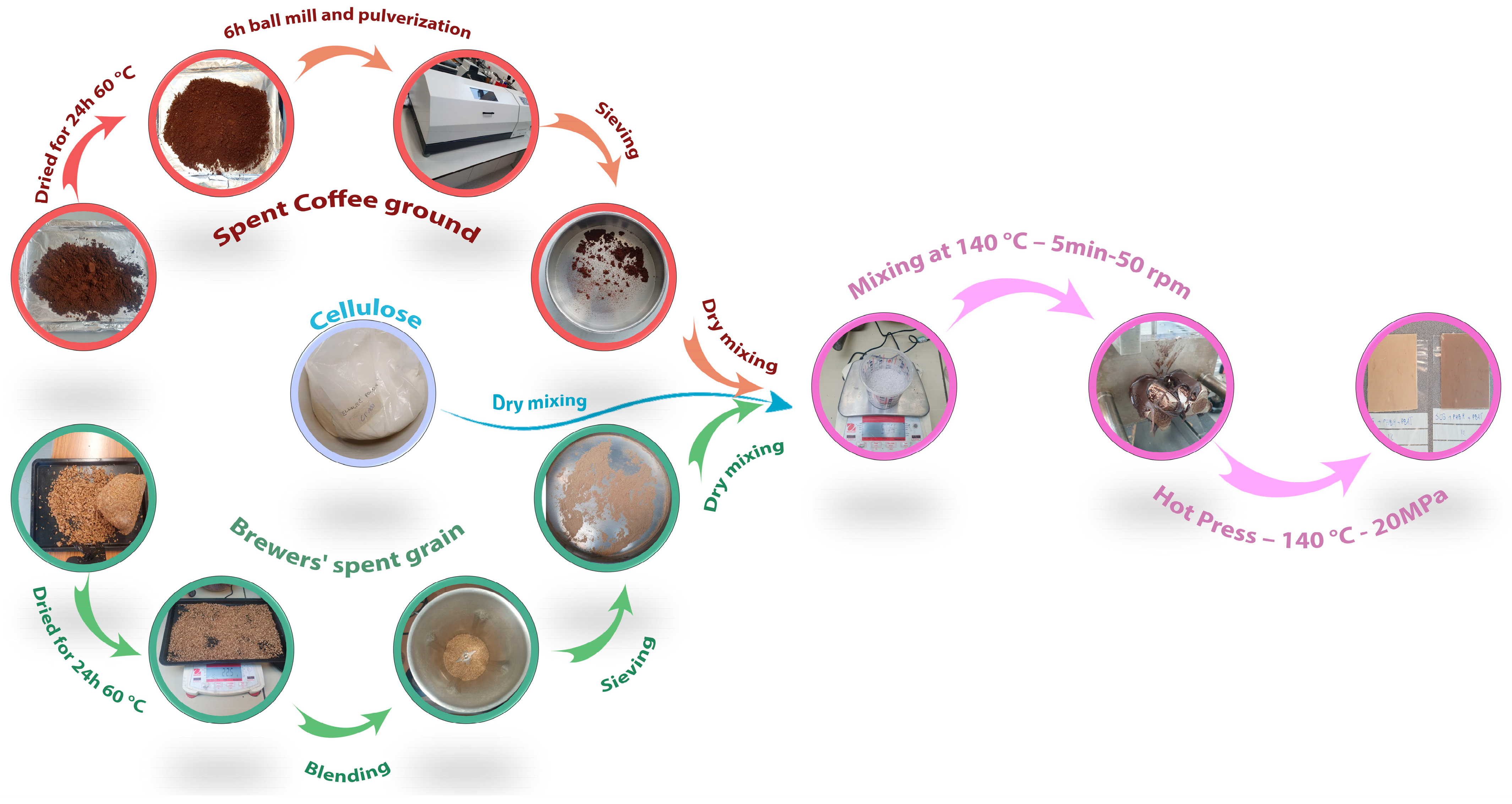
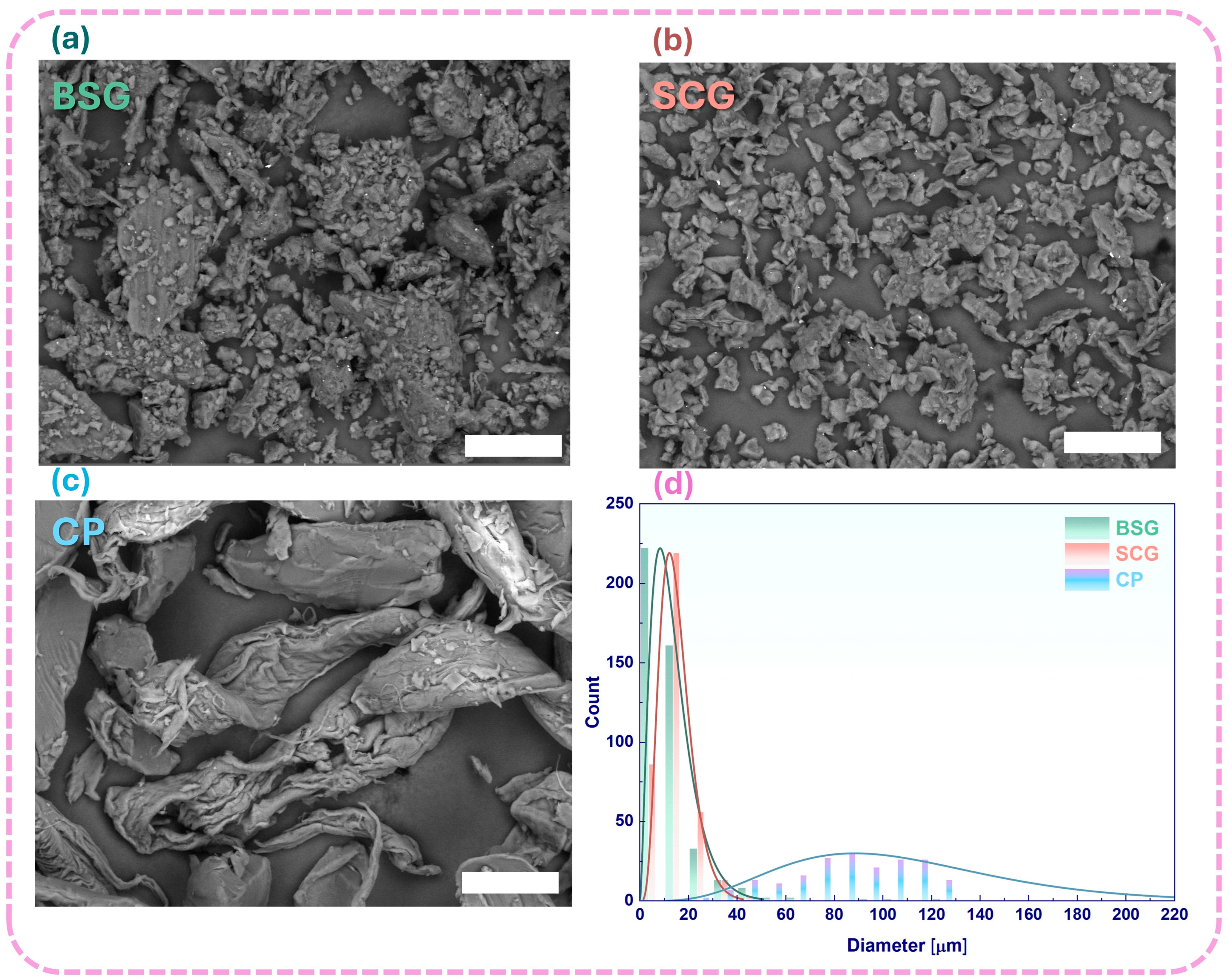
SCG and BSG were dried at 60 °C for 24 h to remove residual moisture. The dried materials were then ball-milled for 6 h, ground using a mortar and pestle, and sieved through a 125 µm mesh. BSG was additionally homogenized using a laboratory blender prior to ball milling, as shown in Figure 1. Cellulose powder (CP) was used without additive pretreatment. Figure 2 presents the particle geometries obtained from SEM images of the sieved BSG and SCG and the as-received CP. SEM micrographs (Figure 2a–c) revealed clear differences in filler geometry and size distribution. SCG consisted mainly of irregular flake-like particles with relatively limited lateral dimensions and an intermediate size distribution. BSG exhibited a more heterogeneous morphology, comprising fragmented and angular particles with broader size variability. In contrast, CP showed the coarsest particle population overall, with elongated and fibrous structures of much greater size and anisotropy. Image analysis indicated that BSG had the smallest mean equivalent diameter (13.48 µm), followed by SCG (15.00 µm), whereas CP exhibited by far the largest mean diameter (108.56 µm) (Figure 2d). Thus, in terms of mean particle size, the fillers followed the order BSG < SCG < CP, whereas BSG and CP showed greater heterogeneity in morphology and size distribution than SCG.

2.1.2. Drying and Melt Compounding

PHBH powder and PBAT pellets were vacuum-dried at 60 °C for 3 h before processing. The polymers and additives (SCG, BSG and cellulose) were dry-mixed and compounded using a Brabender internal mixer at 140 °C and 50 rpm for 5 min. The resulting melts were compression-molded at 140 °C under a pressure of 20 MPa for 2 min to produce composite sheets. The molded samples were removed from the press and cooled to room temperature under ambient conditions (Figure 1).

2.2. Characterization

Tensile properties were measured using a Zwick universal testing machine (ZwickRoell Ltd., Worcester, UK) (5 kN load cell) in accordance with ASTM D638. Dumbbell-shaped specimens were prepared from compression-molded sheets using a press cutter. Tests were conducted at a crosshead speed of 5 mm min−1. The specimen width and gauge length were 4 mm and 25 mm, respectively. At least five specimens were tested for each formulation, and the results are reported as mean values. Charpy impact strength was determined using a Zwick/Roell B5113 impact tester (ZwickRoell Ltd., Worcester, UK) equipped with a 50 J pendulum. A 2 mm-deep V-notch with a 45° angle was introduced at the specimen midpoint using a motorized notching machine (Ray-Ran, Industrial Physics, Thame, UK). Differential scanning calorimetry (DSC) (ASTM D3418) measurements were performed using a DSC Q200 (TA Instruments, New Castle, DE, USA) under a nitrogen atmosphere. Samples (5–10 mg) were subjected to 1st heating-cooling-2nd heating cycles from 2 to 145 °C at a rate of 10 °C min−1. First heating scans were used to remove the thermal histories of the composites. Enthalpies ( H m   a n d   H c ) and peak temperatures of fusion (Tm) and crystallization (Tc and Tcc) of polymer composites were measured.
Thermal stability was evaluated using a Thermogravimetric Analysis (TGA) (ASTM E1131) Q500 analyzer (TA Instruments, New Castle, DE, USA). Measurements were performed from 25 to 900 °C at a heating rate of 20 °C min−1 under a nitrogen atmosphere with a flow rate of 10 mL min−1 to monitor the loss in weight over these temperature ranges. Fracture surfaces obtained from tensile tests were examined using a TESCAN VEGA scanning electron microscope (TESCAN-UK Ltd., Huntingdon, Cambridgeshire, UK) (SEM) operated at an accelerating voltage of 10 kV. Prior to imaging, the samples were sputter-coated with a thin gold layer to enhance surface conductivity and improve image resolution. Particle size analysis was performed from SEM micrographs using ImageJ software (GPLv2) to determine the average agro-industrial waste particle lengths and their corresponding distributions.

3. Results and Discussion

3.1. Tensile Properties

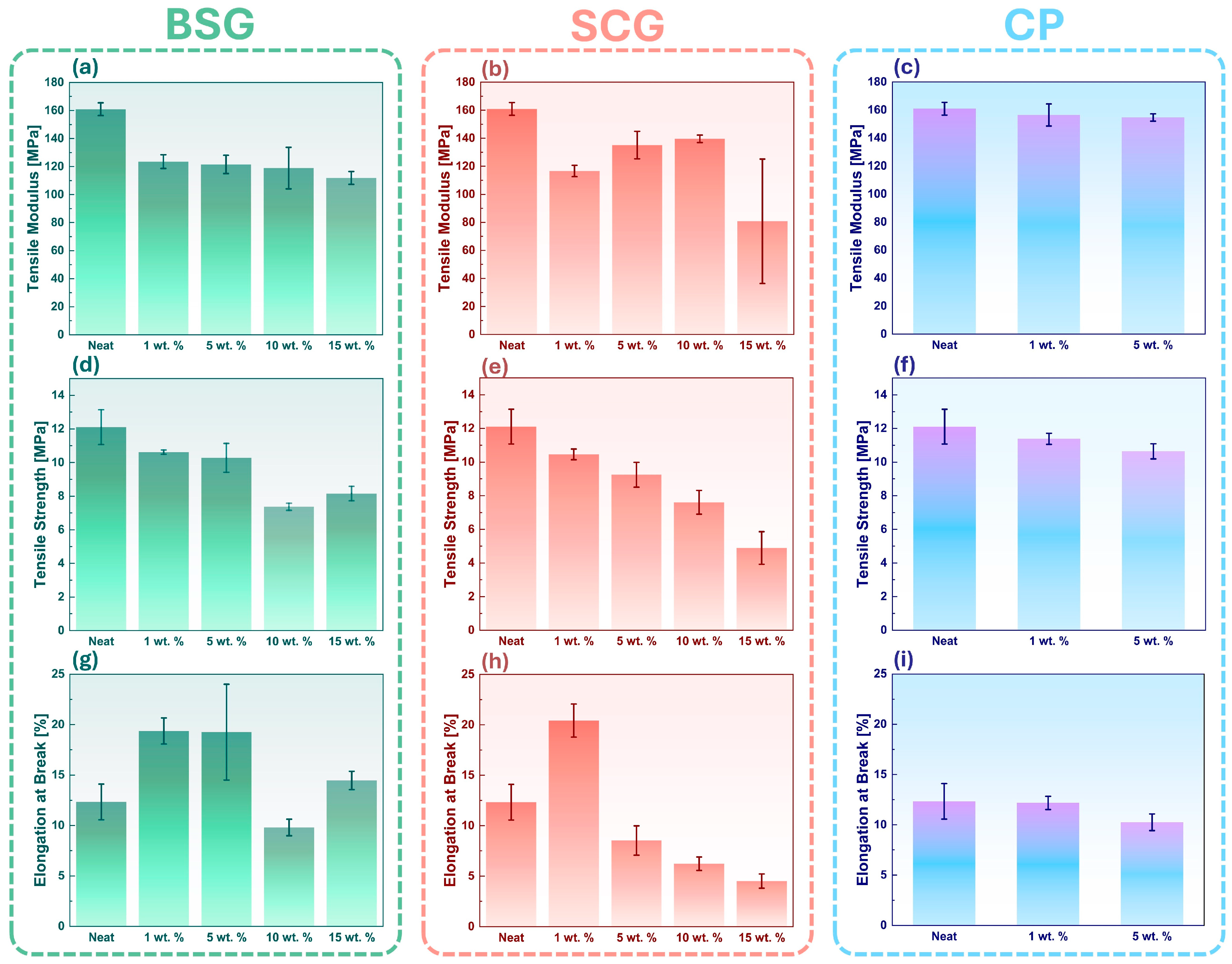
The tensile modulus of the PBAT/PHBH (50/50) blend was not improved by incorporating any of the three bio-fillers across the investigated loading range. As shown in Figure 3a–c, the neat blend exhibited the highest stiffness (160.9 MPa), consistent with the combined contribution of the crystalline PHBH phase and the more compliant PBAT phase. Introducing BSG from 1 to 15 wt.% led to a systematic reduction in modulus relative to the unfilled matrix, indicating that BSG acts as a filler phase rather than an effective reinforcing phase in this system (Figure 3a). SCG produced at best a marginal change at low–intermediate contents (5–10 wt.%), but at 15 wt.% the modulus dropped sharply and the scatter increased markedly, reflecting poor reproducibility consistent with dispersion limitations at high filler loading (Figure 3b). Although the 15 wt.% composite exhibited a lower mean modulus than the 1 wt.%, the difference was not statistically significant, which can be attributed to the large standard deviation observed for the 15 wt.% group. Such a large standard deviation and poor reproducibility are a reflection of poor filler distribution at such high loadings.
CP at 1 and 5 wt.% produced no statistically meaningful change compared with the neat blend, suggesting that, at these low loadings, any intrinsic stiffness advantage of cellulose is not translated into macroscopic reinforcement (Figure 3c). The lack of reinforcement is attributed to the opposing influences of cellulose’s high intrinsic modulus, a slight reduction in polymer crystallinity, and poor interfacial adhesion [36].
The absence of stiffening is consistent with classical composite mechanics; modulus enhancement requires efficient stress transfer from the polyester matrix to the filler, which depends strongly on interfacial adhesion and dispersion quality [37,38]. Here, the polarity mismatch between hydrophilic lignocellulosic fillers (coffee, grain, cellulose) and the comparatively hydrophobic PBAT/PHBH matrix likely limits interfacial bonding, promoting interfacial debonding and reducing the effective load-bearing contribution of the filler [37,39]. The pronounced modulus collapse and large error bars at 15 wt.% SCG further suggest microstructural heterogeneity (agglomeration, voids, and nonuniform particle distribution), which introduces stress concentrators and lowers the effective cross-section under tensile loading, yielding both reduced stiffness and higher specimen-to-specimen variability [40,41]. For BSG, the more irregular, porous, and fiber-fragment morphology can additionally promote localized yielding and increased compliance, which may benefit deformability but typically occurs at the expense of stiffness [42]. Overall, within the studied composition window, these bio-fillers do not function as reinforcing agents for PBAT/PHBH in tension; instead, their dominant effect is to maintain or decrease modulus, with high SCG loading showing the clearest signature of dispersion-limited performance.
Figure 3d–f show that introducing lignocellulosic fillers into the PBAT/PHBH (50/50) matrix does not provide a reinforcing response in tensile loading. The neat blend exhibits moderate tensile strength (12.1 MPa), consistent with the balance between the rigid, crystalline PHBH fraction and the more ductile PBAT phase. For all filler types, tensile strength decreases with increasing filler content, indicating that the added particles/fibers primarily act as stress concentrators rather than effective load-bearing phases [11]. The deterioration is most pronounced for SCG, which already causes a measurable strength loss at 5 wt.% and reaches a substantial reduction at 15 wt.% (≈59% compared to the neat blend), as shown in Figure 3e. This behavior is consistent with suboptimal interfacial adhesion and dispersion limitations; irregular SCG particles (often containing non-cellulosic, relatively compliant constituents such as residual oils) can debond early and behave mechanically like defects, while agglomeration and interfacial voids reduce the effective load-bearing cross-section [43]. In line with this interpretation, Wu et al. (2016) showed that extracting oil from spent coffee grounds improves composite strength and stiffness, highlighting the detrimental role of residual oil on interfacial wetting and load transfer [43]. ANOVA showed that tensile strength differed significantly among the SCG formulations, p < 0.0001. It is indicated that the neat sample had significantly higher strength than all SCG formulations, while the 1 wt.% and 5 wt.% composites were not significantly different from each other.
In contrast, BSG shows better strength retention, with values at 5 and 10 wt.% remaining close to the neat blend (10.3 MPa, 8.2 MPa, respectively) within experimental scatter, although still slightly lower overall; at 15 wt.% the reduction remains less severe than for SCG (Figure 3d). This comparatively improved response likely reflects a more favorable morphology and somewhat better mechanical interlocking, yet SEM evidence of fiber pull-out channels still points to interfacial failure as the governing limitation (Figure 4d,e) [44]. CP produces only a minor change, with strength remaining within ~5% of the neat value up to 10 wt.% and showing only a slight decline at higher loading, implying a limited influence of CP under the present processing and interfacial conditions (Figure 3f). Notably, the larger scatter at high SCG content is consistent with microstructural heterogeneity (agglomerates and voids), which can cause specimen-to-specimen variability by locally amplifying stress and accelerating crack initiation (Figure 4d,e) [40,41]. Generally, the tensile strength trends confirm that, without compatibilization, these hydrophilic lignocellulosic fillers provide insufficient stress transfer to offset the defect-driven weakening of the PBAT/PHBH matrix, and strength is therefore mildly to significantly compromised at higher filler fractions [37,38,39].
Overall, the lack of reinforcement in both modulus and strength can be explained by defect- and interface-dominated mechanics; particle agglomerates act as stress concentrators that promote microcrack initiation and effectively reduce the load-bearing cross-section [11]. SEM observations corroborate this mechanism by revealing voids around SCG particles and fiber pull-out channels in BSG-filled composites (Figure 4d,e), which reduce effective load transfer and contribute to a more compliant response because voids do not carry load [40,41]. Interfacial adhesion remains a key limitation; when bonding is weak, applied stress cannot be efficiently transferred from the matrix to the filler, so the filler does not contribute to strength and stiffness as a true reinforcing phase [37,38,39]. The SCG-filled composites clearly suffered from this: the particles debond at low strains, so they essentially behave like voids. The BSG fibers, while better at staying embedded until higher strain, still pulled out under stress, indicating interfacial failure as well (Figure 4d,e). In the absence of any compatibilizer or chemical coupling agent in the present PBAT/PHBH system, only limited non-covalent interactions are expected between hydrophilic lignocellulosic fillers and the comparatively hydrophobic polyester matrix, which restricts stress transfer across the interface [37,38,39]. Consequently, part of the filler population contributes as defect and void-like sites rather than as efficient load-bearing phases, and microstructural heterogeneity (agglomerates and interfacial voids), particularly at high SCG loading, further reduces the effective load-bearing area and interrupts stress-transfer pathways [40,41].
These observations can be further contextualized by previous studies on PHBV composites filled with SCG. In PHBV-based systems, the effect of SCG is strongly loading-dependent. Alharbi et al. [21] reported that low SCG additions improved tensile strength and modulus up to an optimum of about 5 wt.%, which was attributed to relatively uniform dispersion and improved interfacial stress transfer at low filler content; however, at 7 wt.% the properties declined because agglomeration and insufficient interfacial bonding became more pronounced. Fractured-surface and AFM analyses further showed increased roughness and localized filler accumulation at higher loading, consistent with the onset of defect-controlled weakening. Likewise, Bairwan et al. [24] showed that in PHBV/SCG systems the best tensile response was obtained at moderate filler contents, whereas higher loading led to poorer interfacial bonding, agglomeration, and a reduction in elongation at break, even when stiffness or strength could still be locally improved depending on particle size. In contrast, Zhao et al. [22], using untreated SCG at considerably higher contents (10–30 wt.%), found little or no significant improvement in tensile strength or modulus and a progressive loss in deformability, which they related to reduced crystallinity and poor filler-matrix compatibility. Taken together, these PHBV studies indicate that coffee waste can be beneficial only within a relatively narrow formulation window where dispersion and adhesion remain acceptable; once interfacial voiding, particle clustering, and pull-out dominate, strength and especially ductility tend to deteriorate. In this regard, the present PBAT/PHBH results are more closely aligned with the latter case, particularly at higher SCG contents, where the filler behaves predominantly as a defect-generating phase rather than a true reinforcement.
Elongation at break (EAB) is a sensitive indicator of ductile deformation and interfacial integrity in multiphase biopolymer composites. Our study shows that the neat PBAT/PHBH (50/50) blend exhibits an elongation at break (EAB) of approximately 12.3% (Figure 3g–i), consistent with the flexibility imparted by PBAT, while the inherently brittle, highly crystalline PHBH phase limits the total ductility (typical PHB EAB is only a few percent to ~10% for unmodified PHB) [45]. EAB shows a strong dependence on filler identity and loading. For BSG composites, low filler additions markedly enhance ductility. EAB increases by ~57% at 1 wt.% BSG and remains elevated at approximately 5 wt.%, indicating that a small fraction of grain-derived constituents promotes improved deformability (Figure 3g). ANOVA showed that elongation at break differed significantly among the formulations, p < 0.001, where 1 and 5 wt.% composites showed significantly higher elongation at break than the neat sample, while the 10 and 15 wt.% composites were not significantly different from the neat formulation.
This behavior is consistent with reports that brewer’s spent grain variants with higher protein/low-molecular weight components can act in a plasticizer-like manner, increasing elongation while reducing stiffness [46]. Beyond ~5 wt.% BSG, EAB decreases, consistent with a transition from “matrix-dominated” deformation to filler-controlled damage initiation. At higher loading, imperfect dispersion and limited interfacial strength promote debonding and microvoid formation under tension; void growth and coalescence then accelerate fracture and suppress elongation [47]. The partial recovery observed at 15 wt.% BSG (~47.7%) may reflect competing effects (packing/morphology changes) or simply specimen-to-specimen variability typical of natural filler systems at high loading (Figure 3g), where local agglomeration and void content strongly influence failure strain [48]. In the case of SCG, a more sharply non-linear response is seen (Figure 3h). ANOVA showed that elongation at break differed significantly among the SCG formulations, p < 0.0001. Comparisons indicated that the 1 wt.% sample had significantly higher elongation at break than all other groups, while the 5 wt.% and 10 wt.% samples, as well as the 10 wt.% and 15 wt.% samples, were not significantly different.
At 1 wt.% SCG, EAB rises substantially (≈65% relative to the neat blend), suggesting that ultra-low, well-dispersed particles and extractives can locally increase chain mobility and delay crack propagation [49,50]. A plasticization contribution is plausible because spent coffee contains lipid/oil fractions, and residual coffee oil has been reported to act as a natural plasticizer in biopolymer composites, improving flexibility at appropriate levels. However, increasing SCG to ≥5 wt.% leads to progressive embrittlement. In this regime, rigid lignocellulosic particles and particle clusters constrain matrix deformation and serve as stress concentrators; when interfacial bonding is weak, early debonding/voiding dominates, producing a steady decline in elongation. Our SEM observations (voids around SCG and pull-out features in BSG-filled specimens; Figure 4e) directly support this defect-controlled ductility loss mechanism. In contrast, CP-filled composites remain close to the neat blend at 1 wt.% and only slightly decrease at 5 wt.%, indicating that at these low contents the matrix deformation governs failure and any potential cellulose reinforcement is offset by interfacial slip/debonding (Figure 3i). The elongation behavior observed here is again consistent with previous PHBV/SCG literature. Bairwan et al. showed that elongation at break in PHBV generally decreased with increasing SCG loading [24] for both fine and coarse particles, which they attributed to restricted chain mobility, the rigid nature of the filler, and the increasing influence of interfacial defects. Alharbi et al. similarly reported that the beneficial effect of SCG in PHBV was limited to relatively low loading, while higher loading promoted agglomeration and rougher fracture morphology. Zhao et al. [22] also observed a marked decrease in deformability in untreated PHBV/SCG composites at higher SCG contents, despite only limited changes in modulus and strength. Therefore, although the present PBAT/PHBH blend is compositionally different from neat PHBV, the same general mechanism appears operative: once SCG content exceeds the level at which dispersion remains reasonably uniform, the composite response becomes increasingly governed by particle debonding, voiding, and premature crack initiation rather than by any reinforcing contribution.
From a circular-economy perspective, a comparison with recent work on repeated processing of PHBV/SCG biocomposites is also instructive. Janowski et al. [51] showed that repeated mechanical recycling of a PHBV composite containing 45 wt.% SCG increased stiffness while reducing elongation at break and impact performance, indicating a transition toward a stiffer but more brittle material after successive processing cycles. Their SEM observations suggested that repeated melt processing could reduce the size of large agglomerates and improve apparent filler homogenization; however, this microstructural refinement was accompanied by smoother fracture facets, matrix microcracking, and a more dominant brittle-fracture mechanism associated with thermal degradation and increased crystallinity of the PHBV matrix. This comparison is useful for interpreting the present results because it shows that even when filler dispersion appears to improve, ductility and toughness may still decline if the matrix becomes more brittle or if interfacial debonding remains active. In other words, better homogenization alone is not sufficient to ensure mechanical reinforcement in lignocellulosic waste-filled PHA systems. The present PBAT/PHBH blend benefits from the inherently more ductile PBAT phase, which likely explains why low filler contents can still preserve or even increase elongation in some cases; nevertheless, once filler loading becomes sufficiently high, the failure behavior again becomes dominated by defects, interfacial weakness, and early crack propagation.
Overall, these comparisons with PHBV/SCG literature and recycling studies strengthen the interpretation that the mechanical response of the present PBAT/PHBH composites is governed not simply by filler addition itself, but by the balance between dispersion quality, interfacial adhesion, matrix ductility, and the extent to which the filler acts as either a stress-transfer phase or a crack-initiation site. Thus, the current results support the view that blending PHBH with PBAT helps partially buffer the intrinsic brittleness typically observed in filled PHA systems, but does not fully overcome the deterioration in strength and ductility caused by poor compatibility and filler agglomeration at higher SCG or BSG loadings. Overall, the ductility trends emphasize that bio-filler chemistry and dispersion quality govern whether low loadings act as a plasticizer or whether higher loadings trigger defect-controlled embrittlement. We found that the nature of the waste plays a more significant role than the cellulose content alone. Although the mean values in some formulations indicate a reduction in tensile modulus or elongation at break, the relatively large scatter observed in Figure 3b,g,h suggests increased sample-to-sample variability; therefore, these changes should be interpreted cautiously and regarded as trends.

3.2. Impact Strength

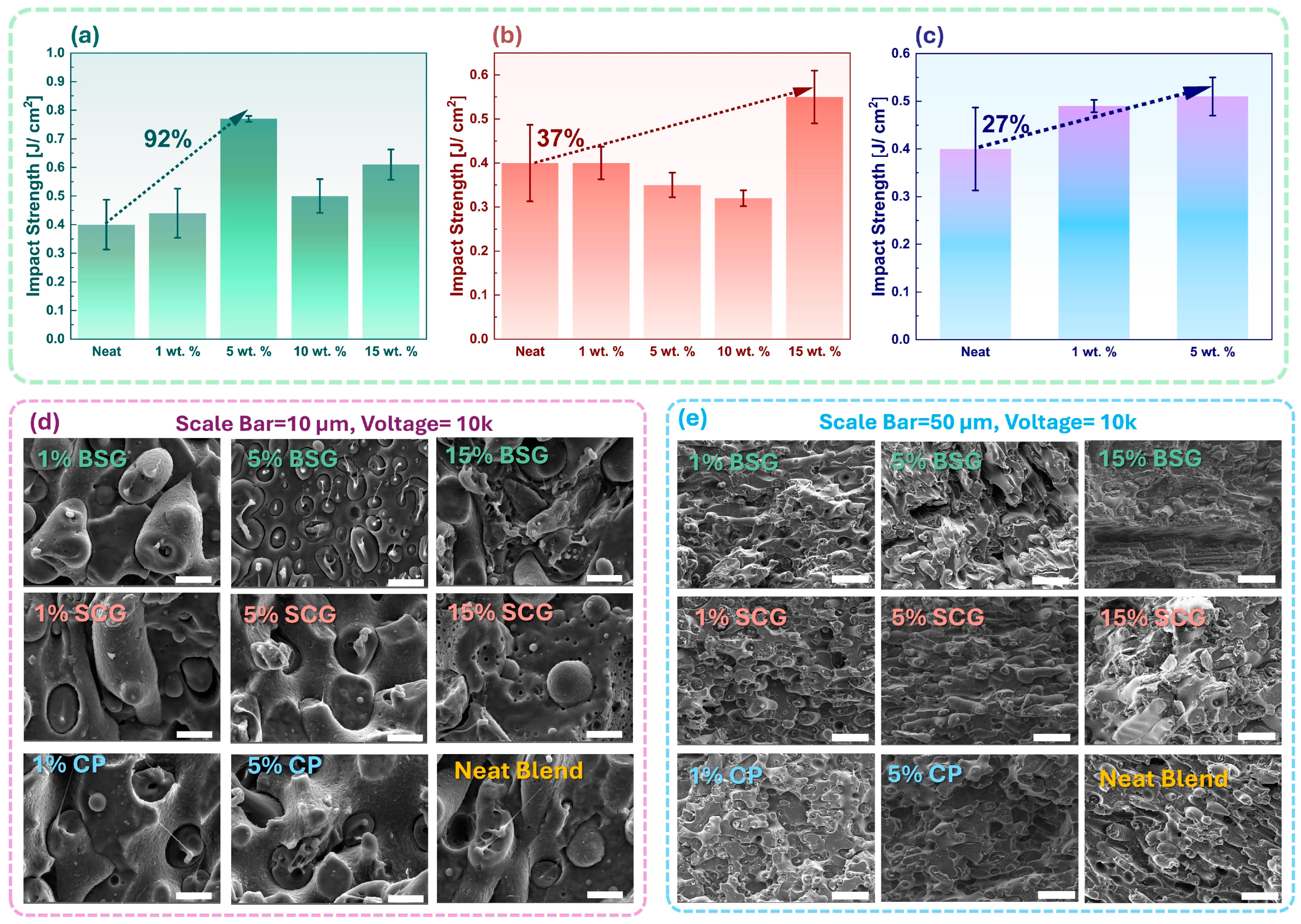
Figure 4 summarizes the impact strength of PBAT/PHBH (50/50) composites as a function of filler type and loading. The response is filler-dependent and non-monotonic, indicating that impact performance is governed by a balance between energy-dissipating processes (crack deflection/tortuosity, matrix shear yielding, interfacial debonding, and frictional pull-out) and defect-controlled failure associated with agglomeration, interfacial voids, and stress concentrations.
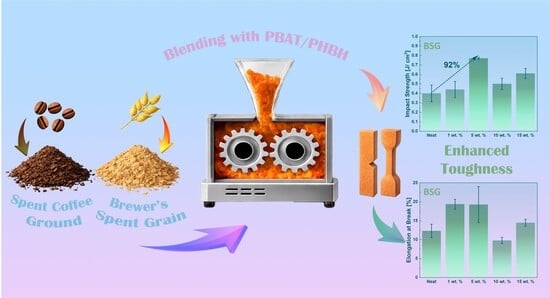
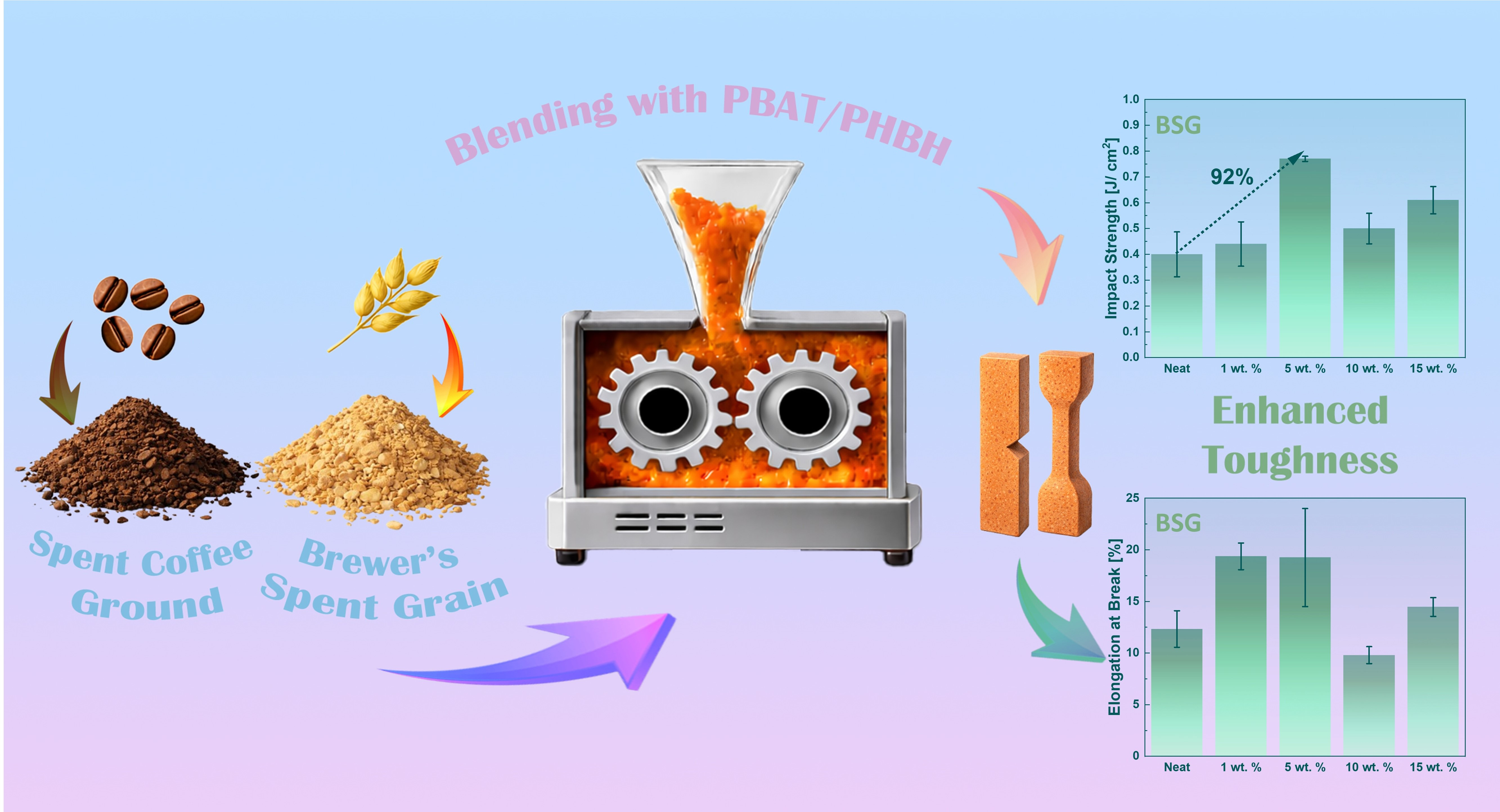
The strongest improvement is obtained with BSG at 5 wt.%, where impact strength increases by ~92% relative to the neat PBAT/PHBH blend (Figure 4a). At this low loading, BSG fragments are more likely to be sufficiently dispersed to act as micro-reinforcing elements. During impact, advancing cracks are forced to detour around the relatively stiff lignocellulosic fragments, increasing crack path tortuosity and promoting local plastic deformation of the matrix, thereby raising the absorbed fracture energy [52]. In parallel, partial interfacial debonding followed by sliding activates friction-controlled pull-out, which further dissipates energy and blunts the crack tip [52,53]. These mechanisms are directly supported by SEM observations showing distinct pull-out channels around BSG particles (Figure 4d,e), consistent with interfacial debonding and frictional pull-out as dominant dissipation modes. In addition, BSG contains hemicellulose and lignin components that can slightly plasticize PBAT/PHBH, further enhancing ductility [54]. When BSG content increases to 10–15 wt.%, impact strength remains above that of the neat blend but decreases from the 5 wt.% maximum (Figure 4a). This decline is consistent with an increased probability of particle clustering at higher loadings [55], which introduces voids and stress concentrators that facilitate crack initiation and shift the fracture response toward more defect-controlled behavior [56,57]. In summary, the peak at 5 wt.% and decline thereafter reflects an interplay of mechanisms, namely effective crack deflection and pull-out at low loadings (improving toughness), countered by agglomeration-induced stress concentration at high loadings [52].
In contrast, SCG-filled composites show a delayed toughening response. At low to moderate loadings (1–10 wt.%), impact strength is constant or slightly below the neat blend, implying that coffee particles mainly act as stress concentrators rather than effective tougheners in this range (Figure 4b). The fine, irregular morphology of SCG and potentially weaker interfacial adhesion to the PBAT/PHBH matrix can allow cracks to propagate along particle–matrix interfaces with limited activation of shear yielding or bridging, leading to a small drop in impact resistance [52,57,58]. However, at 15 wt.% SCG, the impact strength increases sharply to ~37% above the neat blend, indicating a threshold at which the filler population becomes high enough to modify the fracture process (Figure 4b). At this loading, the crack is more likely to encounter densely distributed particles, which increases crack tortuosity and fracture surface area, while extensive debonding and particle pull-out can dissipate energy through friction [52]. In addition, the porous and heterogeneous nature of SCG promotes local cavitation or microvoid formation under impact, which can further absorb energy and contribute to a net toughness gain, as confirmed by SEM images (Figure 4d,e). SCG contains natural oils and porosity; under impact, these components can cavitate or induce microvoids, further absorbing strain energy. Therefore, the SCG trend reflects competing effects: At low content, SCG behaves primarily as a defect source, whereas at high loading the cumulative contribution of tortuous crack propagation and interfacial dissipation becomes large enough to outweigh the embrittling influence. CP-100 shows only minor changes in impact resistance, with a modest increase at 5 wt.% (~+27%) and little effect at 1 wt.% (Figure 4c). This suggests limited activation of filler-based toughening. Micron-scale, low-aspect-ratio cellulose particles primarily contribute through local crack deflection and initiation of small plastic zones, but they provide minimal bridging compared with higher-aspect-ratio reinforcements [53]. Any benefit is therefore modest and highly sensitive to dispersion and interfacial quality.
SEM analysis reveals distinct pull-out channels surrounding BSG particles, providing clear evidence of friction-controlled fiber pull-out and interfacial debonding between the filler and the PBAT/PHBH matrix (Figure 4d,e). Importantly, BSG’s fiber-like morphology is advantageous. Longer, thinner filler elements can arrest cracks more effectively than blunt particles [57]. Although BSG fragments are not continuous fibers, they have a higher aspect ratio than milled powders (like SCG or CP). This geometry promotes pull-out and bridging over larger distances.
SEM fracture-surface analysis (Figure 4d,e) provides direct microstructural evidence for the filler-specific toughening windows observed in impact testing of neat PBAT/PHBH and its composites containing 1, 5, and 10 wt.% BSG and SCG, as well as 1 and 5 wt.% CP. The PBAT/PHBH composite with 5 wt.% BSG exhibits a distinctly rough, highly tortuous fracture surface, with elongated pull-out cavities, interfacial gaps, and voids surrounding BSG fragments, indicating effective load transfer prior to partial debonding and subsequent frictional pull-out (Figure 4e). This morphology is consistent with an intermediate filler–matrix adhesion regime, where the interface is sufficiently strong to promote stress transfer and crack deflection, yet weak enough to enable pull-out as a major energy-dissipation pathway [56,57,58]. At higher BSG content (15 wt.%), SEM reveals particle clustering and larger irregular voids; these agglomerated regions act as stress concentrators (flaw-like defects) and facilitate premature crack initiation and growth, rationalizing the drop in impact strength relative to the 5 wt.% optimum [59]. For SCG-filled composites, low loadings (1–5 wt.%) show comparatively smoother fracture surfaces with limited plastic deformation, suggesting that crack-deflection and pull-out mechanisms are not effectively activated. At 15 wt.% SCG, the fracture morphology becomes markedly more complex, with widespread debonding, pull-out traces, and microvoid formation associated with the porous coffee particles, supporting the delayed but substantial toughness increase at high loading. CP-100-filled samples remain relatively smooth, with only localized crack deflection and minimal matrix deformation, consistent with a weaker contribution of filler-related dissipation mechanisms (Figure 4d,e).

3.3. Thermal Analysis

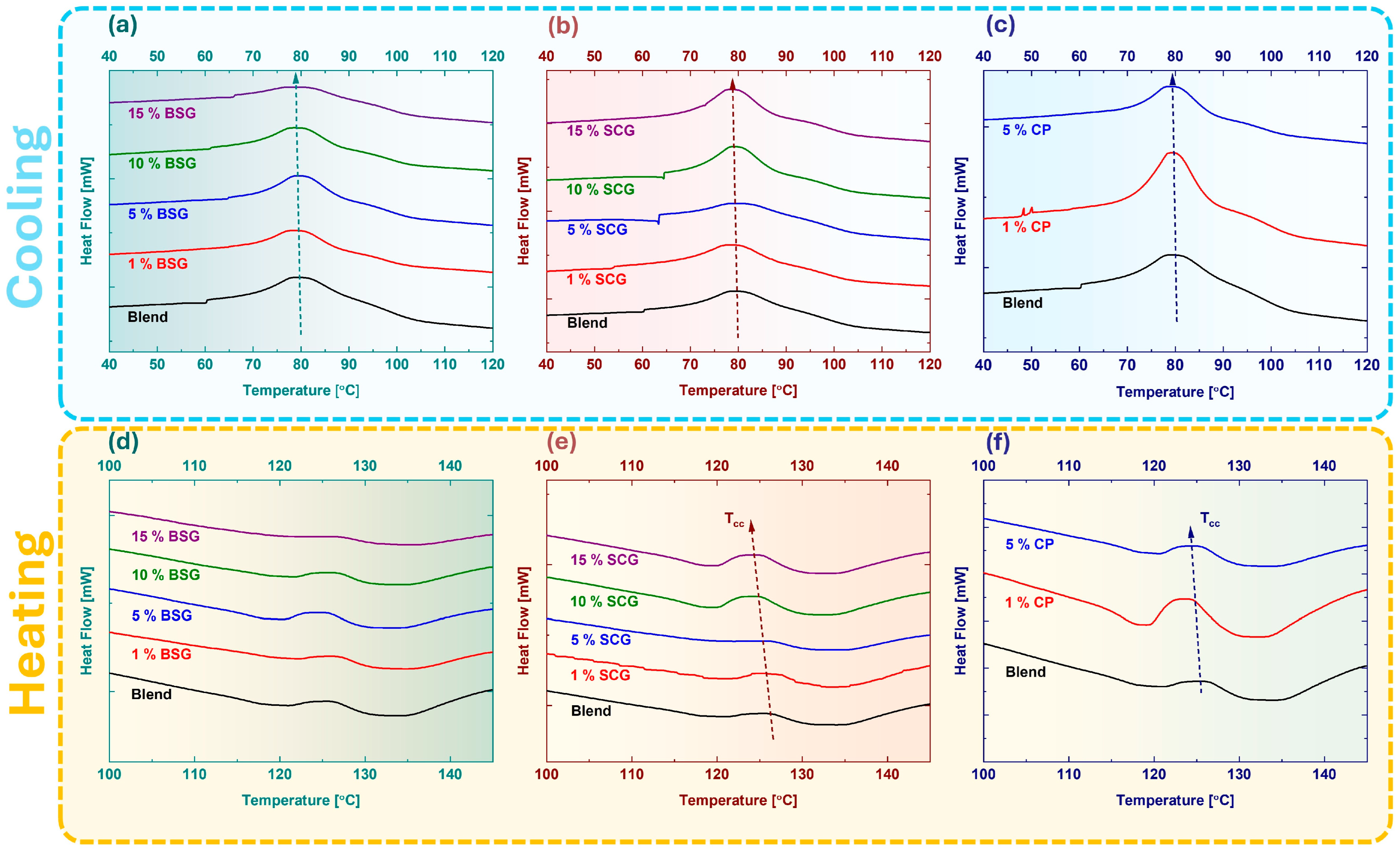
The non-isothermal DSC traces show that incorporating BSG, SCG, or CP into the PBAT/PHBH blend does not measurably shift the crystallization peak during cooling; across all loadings, the crystallization exotherm remains centered at ~80 °C (Figure 5a–c), indicating that the melt-crystallization step under the applied cooling conditions is essentially unchanged. In contrast, the second-heating scans exhibit a clear formulation dependence in the cold-crystallization region: the neat blend shows a weak cold-crystallization event at ~126–127 °C, while SCG produces a progressive downshift of Tcc with loading (to ~123–124 °C at 15 wt.%), and CP similarly depresses Tcc (to ~122–123 °C at 1–5 wt.%) (Figure 5e,f); BSG causes only subtle changes in this temperature window (Figure 5d).
The more intense Tcc feature for the 1 wt.% CP sample indicates that a larger fraction of the blend remains uncrystallized or imperfectly crystallized after cooling, and undergoes cold crystallization during heating. Its more complex shape likely reflects heterogeneity in crystal perfection and possible overlap with crystal reorganization and melting processes within the same temperature range.
This “unchanged Tc but reduced Tcc” response is consistent with prior DSC analyses of PBAT/PHA blends, where PBAT can crystallize readily during cooling, while the PHA-rich fraction may crystallize incompletely from the melt and complete ordering during reheating, making Tcc a sensitive indicator of changes in solid-state crystallization kinetics even when Tc remains constant [60]. However, it should be noted that the temperature region immediately following Tcc is complex, because multiple thermal events may overlap in the PHBH/PBAT blend. Specifically, cold crystallization may occur concurrently with the melting and reorganization of less perfect crystals. In this region, PBAT may contribute a weak melting endotherm Tm in the range of approximately 120–130 °C, while the main melting peak Tm of PHBH is typically observed at around 135–140 °C. Therefore, the post-Tcc thermal feature should be interpreted as a superposition of overlapping crystallization- and melting-related processes rather than as a single transition.
The downshift in Tcc for SCG and CP aligns with the impact trends in that the formulations exhibiting the clearest Tcc depression also show net gains in impact strength (CP: ~27% increase up to 5 wt.%; SCG: ~37% increase at 15 wt.%; Figure 4b,c), consistent with the established coupling between crystallization state–morphology and impact performance in semicrystalline polymers, where impact resistance reflects a balance between crystal-related constraints and the ability of the matrix to undergo stable plastic deformation [61]. At the same time, the lack of a simple monotonic scaling (e.g., the largest impact increase occurs for 5 wt.% BSG despite minimal Tcc change) indicates that impact is governed by combined effects of thermal state and particle-controlled fracture mechanisms; such non-linear toughness responses with filler loading are widely reported for particle-filled polymers because debonding–voiding and stress–concentration effects can compete with matrix plastic dissipation, consistent with the increasingly rough-voided fracture surfaces observed by SEM (Figure 4d,e) [62].
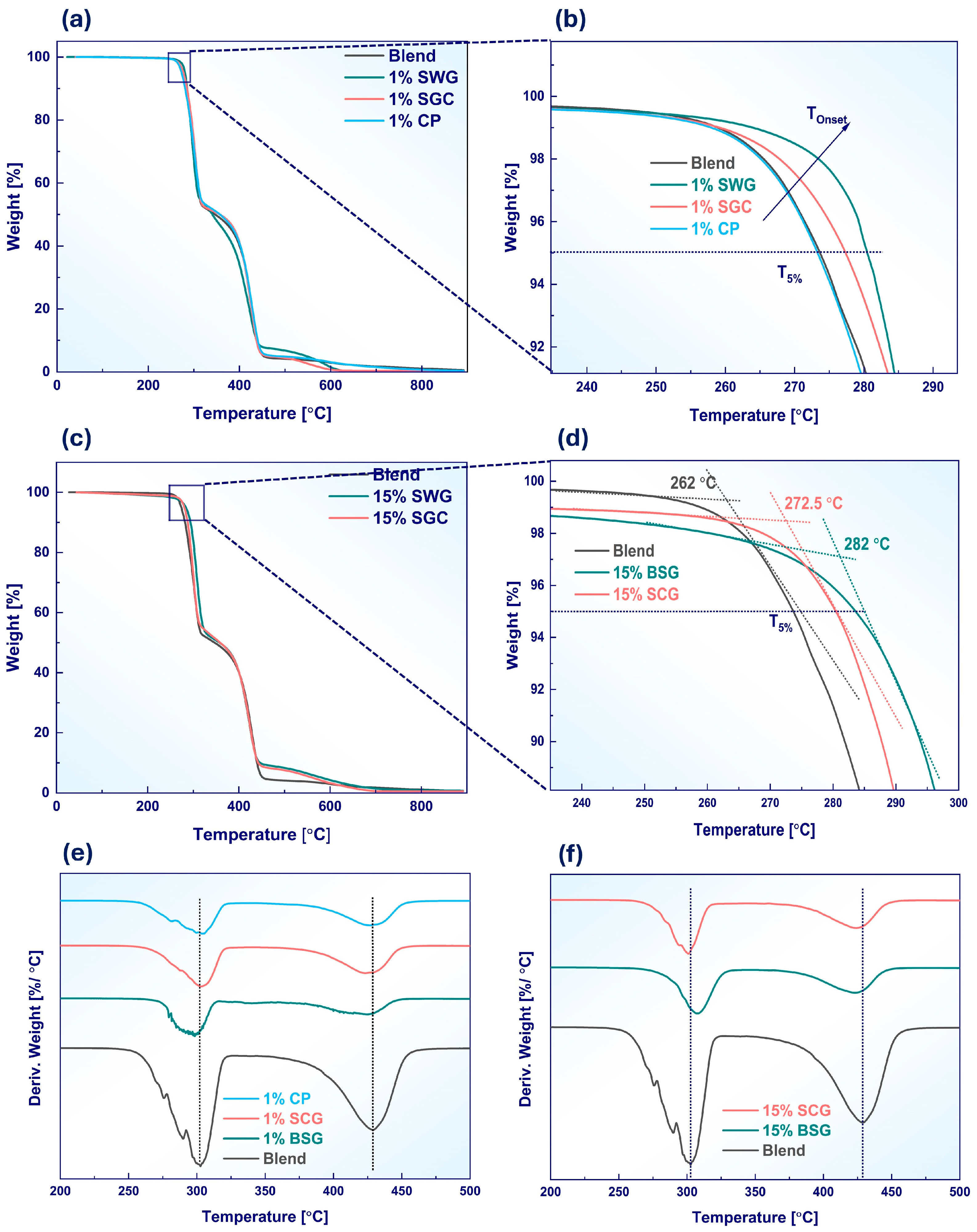
To simplify interpretation of filler effects on degradation behavior, thermal stability was discussed using the representative formulations shown in Figure 6 and Table 1, namely, 1 and 15 wt.% BSG and SCG, together with 1 wt.% CP. These compositions capture the lowest and highest investigated loadings for the agro-waste fillers and allow a clearer comparison of the resulting shifts in T5%, Tonset, Tmax1, and Tmax2.
Thermal stability was evaluated using four characteristic temperatures: T5% (temperature at 5% mass loss), Tonset (onset of the main degradation step), Tmax1 (temperature of the maximum mass-loss rate in the first degradation stage), and Tmax2 (temperature of the maximum mass-loss rate in the second degradation stage).
As depicted in Figure 6, the neat PBAT/PHBH (50/50) blend exhibits T5% ≈ 274 °C, Tonset ≈ 262 °C, and Tmax ≈ 302 °C, indicating that the dominant first depolymerization event occurs near ~300 °C, in good agreement with the reported thermal behavior of PHB-containing biodegradable polyester blends [63,64]. A second DTG maximum is observed at Tmax2 ≈ 429.2 °C, which is attributed to the decomposition of the PBAT-rich phase. Thus, the neat blend displays the expected two-step degradation profile, with the lower-temperature event associated mainly with PHBH-rich degradation and the higher-temperature event with PBAT decomposition (Figure 6e,f). At 1 wt.%, all fillers induce only minor shifts in the characteristic degradation temperatures, indicating that such low loadings do not substantially modify the dominant PBAT/PHBH degradation pathway (Figure 6a,b). For 1 wt.% CP, the early degradation temperatures are marginally lower (T5% ≈ 273.5 °C; Tonset ≈ 263 °C), while Tmax1 increases to 304.7 °C, and Tmax2 remains close to that of the neat blend (428.0 °C) (Figure 6e), consistent with a slight retardation of the main mass-loss step due to a weak barrier/char-precursor effect from cellulose, which is typically less effective than lignin-rich residues in enhancing thermal stability [63]. Overall, CP produces only a very small effect, indicating that, at this low loading, it neither markedly destabilizes nor strongly protects the blend. For 1 wt.% BSG, the initial stability increases (T5% ≈ 280.5 °C; Tonset ≈ 275 °C), but Tmax1 decreases to 298.5 °C; meanwhile, Tmax2 decreases slightly to 425.5 °C. This indicates that although the onset region is shifted to a higher temperature, the first maximum degradation rate occurs slightly earlier once decomposition begins (Figure 6e). Such behavior is consistent with overlap between degradation of the polymer matrix and thermally less stable BSG constituents, including hemicellulosic–cellulosic fractions and mineral-rich ash species, which can broaden the first degradation region and slightly shift the DTG peak to a lower temperature [65,66]. For 1 wt.% SCG, the changes remain small (T5% ≈ 277.5 °C; Tonset ≈ 267.5 °C; Tmax1 ≈ 303.2 °C; Tmax2 ≈ 426.1 °C), consistent with the lignin-containing coffee residue providing only a limited barrier/char contribution at this low loading, insufficient to strongly shift the main decomposition peak despite a modest delay in the early mass-loss region [63,64,65]. Among the 1 wt.% formulations, BSG produces the largest increase in T5% and Tonset, whereas CP shows the smallest overall effect. Comprehensively, this 1 wt.% behavior aligns with reports that small lignocellulosic additions mainly cause subtle offsets in T5%/Tonset/Tmax1, while stronger competing effects (early polysaccharide decomposition vs. char-mediated insulation) become clearer at higher filler contents [54,67]. These trends are consistent with the filler composition: SCG contains a high lignin fraction (∼25–33%), which favors thermal stability and char formation, whereas BSG (like other agricultural residues) contains substantial hemicellulose and cellulose that decompose at lower temperatures.
At 15 wt.%, filler effects become more pronounced (Figure 6c,d). For 15 wt.% BSG, the composite shows T5% ≈ 284.1 °C, Tonset ≈ 282 °C, and Tmax1 ≈ 308.2 °C; all three parameters are higher than those of the neat blend, showing that BSG at high loading most effectively delays the first degradation stage. The enlarged view in Figure 6d also confirms a clear rightward shift of the initial mass-loss region for 15 wt.% BSG relative to the neat blend. In contrast to the original expectation, Tonset is not reduced but markedly increased, indicating improved resistance to the onset of thermal decomposition. However, Tmax2 decreases to 423.8 °C, suggesting that this stabilizing effect is more pronounced for the lower-temperature PHBH-rich degradation stage than for the higher-temperature PBAT-rich stage (Figure 6f). This combination of delayed onset, higher Tmax1, and slightly lower Tmax2 suggests that BSG promotes a more thermally resistant first degradation stage, likely through char formation and restricted heat/volatile transport, while not significantly stabilizing the later PBAT decomposition event. The increased T5% indicates delayed early mass loss, while the reduced Tonset suggests the emergence of an earlier degradation contribution associated with hemicellulose/cellulose-rich regions [66]; simultaneously, the higher Tmax supports improved high-temperature stability consistent with char formation that restricts heat and volatile transport at later stages [63,64]. For 15 wt.% SCG, the profile (T5% ≈ 281.0 °C; Tonset ≈ 272.5 °C; Tmax1 ≈ 301.5 °C; Tmax2 ≈ 424.6 °C) indicates improved resistance to the onset of the main degradation step (higher Tonset), consistent with the lignin-rich nature of coffee residue and its barrier/char tendency [63,64,65], whereas Tmax remains essentially unchanged within experimental scatter, implying the principal PBAT/PHBH depolymerization peak is not strongly shifted. Thus, compared with SCG, BSG exerts a stronger stabilizing effect on the first degradation stage at high loading, as evidenced by the larger increases in T5%, Tonset, and Tmax1.
Thus, BSG at high loading appears to enhance the high-temperature stability. More precisely, BSG at 15 wt.% most strongly improves the thermal resistance of the first degradation stage, whereas the second degradation stage, assigned to PBAT, is shifted slightly to a lower temperature for all filled systems. This may reflect a thermal barrier or char-forming effect: lignocellulosic fillers often produce carbonaceous residue that protects the polymer matrix at high temperatures [63,64]. Indeed, similar studies note that adding lignin-rich materials tends to increase char yield and raise the highest decomposition temperature, since the aromatic lignin char insulates the remaining polymer [63]. In the present case, however, the most obvious stabilization is seen in Tmax1 rather than Tmax2, particularly for 15 wt.% BSG. This suggests that the beneficial effect of the filler is mainly expressed through delayed initiation and broadening of the first mass-loss event, together with a somewhat greater high-temperature residue, rather than through a substantial upward shift of the PBAT-related second DTG maximum. In our data, the increased char from 15% BSG likely comes from the breakdown of cellulose, hemicellulose and lignin contained in the residue, which is also consistent with the more pronounced residual tail observed at high temperatures. The general result is that high filler levels can slightly extend the thermal degradation range of the composite, mainly by broadening the first degradation region and increasing the remaining char residue, while the principal decomposition events still occur within approximately 298.5–308.2 °C for Tmax1 and 423.8–429.2 °C for Tmax2. These data are listed in Table 1 for all mentioned temperatures.

4. Conclusions

This study demonstrates that agro-industrial waste fillers can be strategically incorporated into PBAT/PHBH (50/50) blends to tailor mechanical performance while advancing sustainable packaging materials. Among the investigated fillers, low BSG loading (≈5 wt.%) produced the most pronounced toughening effect, with impact strength increasing by ~92% relative to the neat blend. SEM analysis indicated crack deflection and particle pull-out as dominant energy-dissipation mechanisms at low BSG content. At higher BSG loading, particle agglomeration reduced mechanical efficiency. SCG exhibited limited reinforcement efficiency overall, with modest impact improvement observed only at elevated loading, while increasing SCG content led to reductions in tensile strength and elongation due to interfacial debonding. Cellulose powder showed minimal mechanical enhancement within the investigated range. Across all systems, reductions in tensile strength, and in several cases tensile modulus, were primarily attributed to interfacial incompatibility and filler agglomeration, which limited effective stress transfer. TGA revealed a modest improvement in thermal stability at higher filler contents through increased char formation associated with lignocellulosic components. Overall, the results confirm that upcycled coffee and brewery wastes can impart selective toughness benefits to biodegradable PBAT/PHBH matrices; however, reinforcement efficiency remains constrained by poor interfacial adhesion. These findings emphasize the necessity of interface engineering strategies, such as compatibilization or surface modification, to achieve balanced mechanical reinforcement for high-performance sustainable packaging applications.

Author Contributions

Conceptualization, R.S. and S.Y.; methodology, R.S. and E.L.; validation, R.S., N.E. and E.L.; formal analysis, N.E., S.Y. and M.S.S.; investigation, N.E.; resources, R.S. and M.S.S.; data curation, N.E.; writing—original draft preparation, S.Y.; writing—review and editing, S.Y. and R.S.; supervision, R.S.; project administration, R.S. and E.L.; funding acquisition, R.S. All authors have read and agreed to the published version of the manuscript.

Funding

This research was funded by Edinburgh Napier University, SCEBE Starter Grant, grant number N480-001.

Data Availability Statement

The original data presented in the study are included in the article; further inquiries can be directed to the corresponding author.

Acknowledgments

The authors acknowledge Callum Wilson, Edinburgh Napier University, for his kind assistance in SEM characterization.

Conflicts of Interest

The authors declare no conflicts of interest. The funders had no role in the design of the study; in the collection, analyses, or interpretation of data; in the writing of the manuscript; or in the decision to publish the results.

References

  1. Windsor, F.M.; Durance, I.; Horton, A.A.; Thompson, R.C.; Tyler, C.R.; Ormerod, S.J. A catchment-scale perspective of plastic pollution. Glob. Change Biol. 2019, 25, 1207–1221. [Google Scholar] [CrossRef]
  2. Lin, L.; Mirkin, S.; Park, H.E. Biodegradable Composite Film of Brewers’ Spent Grain and Poly(Vinyl Alcohol). Processes 2023, 11, 2400. [Google Scholar] [CrossRef]
  3. Geyer, R.; Jambeck, J.R.; Law, K.L. Production, use, and fate of all plastics ever made. Sci. Adv. 2017, 3, e1700782. [Google Scholar] [CrossRef] [PubMed]
  4. Li, D.; Yang, Y.; Liu, R.; Wu, Y.; Guo, F. Review of Biopolymer Polyhydroxybutyrate (PHB) and Blends: Modification of Thermal and Mechanical Properties via Additive Manufacturing Processing. Polymers 2025, 17, 3083. [Google Scholar] [CrossRef] [PubMed]
  5. Samuel, H.S.; Ekpan, F.-D.M.; Ori, M.O. Biodegradable, recyclable, and renewable polymers as alternatives to traditional petroleum-based plastics. Asian J. Environ. Res. 2024, 1, 152–165. [Google Scholar] [CrossRef]
  6. Sukhanova, A.A.; Ertiletskaya, N.L.; Zabolotnaya, K.E.; Boyandin, A.N.; Syrtsov, S.N.; Tyulkina, E.N.; Donskoy, N.D.; Samoilo, A.S. Plasticized films based on PLA and PHB: From the choice of plasticizer to the study of packaging perspective. Chim. Techno Acta 2026, 13, 9315. [Google Scholar] [CrossRef]
  7. Marbun, L.; Zebua, H.L.P.; Faldo, A.; Nissa, R.C.; Iasya, Y.K.A.A.; Annifah, R.U.; Alrasyid, M.W.; Savetlana, S.; Nurhamiyah, Y. Thermoplastic Agar/PBAT Blending as the Alternative Substitution of Polyethylene. J. Appl. Polym. Sci. 2026, 143, e57926. [Google Scholar] [CrossRef]
  8. Zuorro, A.; Lavecchia, R.; Contreras-Ropero, J.E.; García-Martínez, J.B.; Barajas-Solano, A.F. Natural Deep Eutectic Solvents for PHB Recovery: Mechanistic Insights and Implications for Sustainable Downstream Processing. Polymers 2026, 18, 169. [Google Scholar] [CrossRef]
  9. Lovera, D.; Márquez, L.; Balsamo, V.; Taddei, A.; Castelli, C.; Müller, A.J. Crystallization, morphology, and enzymatic degradation of polyhydroxybutyrate/polycaprolactone (PHB/PCL) blends. Macromol. Chem. Phys. 2007, 208, 924–937. [Google Scholar] [CrossRef]
  10. Ludwiczak, J.; Frąckowiak, S.; Leluk, K. Study of thermal, mechanical and barrier properties of biodegradable PLA/PBAT films with highly oriented MMT. Materials 2021, 14, 7189. [Google Scholar] [CrossRef]
  11. Beber, V.C.; De Barros, S.; Banea, M.D.; Brede, M.; De Carvalho, L.H.; Hoffmann, R.; Costa, A.R.M.; Bezerra, E.B.; Silva, I.D.S.; Haag, K.; et al. Effect of babassu natural filler on PBAT/PHB biodegradable blends: An investigation of thermal, mechanical, and morphological behavior. Materials 2018, 11, 820. [Google Scholar] [CrossRef]
  12. Correa-Pacheco, Z.N.; Bautista-Baños, S.; Ortega-Gudiño, P.; Cisneros-López, E.O.; Tapia-Maruri, D.; Jiménez-Pérez, J.L. Physicochemical Characterization and Biodegradability of Nanostructured Chitosan-Based Films Reinforced with Orange Waste. J. Compos. Sci. 2025, 9, 627. [Google Scholar] [CrossRef]
  13. Trimarchi, S.; Curcio, F.; Cassano, R.; Gagliardi, F. Valorization of Agri-Food Waste in Green Composites: Influence of Orange Peel Particulates on Mechanical, Thermal, and Antioxidant PLA Properties. J. Compos. Sci. 2026, 10, 91. [Google Scholar] [CrossRef]
  14. Mäder, G.; Rüegg, N.; Tschichold, T.; Yildirim, S. Utilizing spent coffee grounds as sustainable fillers in biopolymer composites: Influence of particle size and content. Sustain. Food Technol. 2025, 3, 1151–1163. [Google Scholar] [CrossRef]
  15. Jamnongkan, T.; Sirichaicharoenkol, K.; Nethiyaphan, T.; Sakulthaew, C.; Srisawat, N.; Wachirawongsakorn, P.; Krisbiantoro, P.A.; Wu, K.C.-W.; Nguyen, N.H.; Wangkawong, K.; et al. Upcycling durian (Durio zibethinus) husk waste into PLA/activated carbon biocomposites for high-performance 3D printing filaments. J. Taiwan Inst. Chem. Eng. 2025, 176, 106331. [Google Scholar] [CrossRef]
  16. Ramandani, A.A.; Sun, Y.M.; Lan, J.C.W.; Lim, J.W.; Chang, J.S.; Srinuanpan, S.; Khoo, K.S. Upcycling food waste as a low-cost cultivation medium for Chlorella sp. microalgae. J. Sci. Food Agric. 2025, 105, 4715–4727. [Google Scholar] [CrossRef]
  17. Saeli, M.; Batra, V.S.; Singh, R.K.; Tobaldi, D.M.; Labrincha, J.A. The coffee-house: Upcycling spent coffee grounds for the production of green geopolymeric architectural energy-saving products. Energy Build. 2023, 286, 112956. [Google Scholar] [CrossRef]
  18. Couto, G.H.; Bortolini, D.G.; Hernandes, E.E.; Hashimoto, E.H.; Boettcher, D.L.; Rodrigues, S.Á.; da Cunha, M.A.A.; Pagnoncelli, M.G.B. Upcycling of Beer Processing Residues: Insights for Microbreweries Sustainability. ACS Omega 2026, 11, 4918–4939. [Google Scholar] [CrossRef]
  19. Lee, M.; Yang, M.; Choi, S.; Shin, J.; Park, C.; Cho, S.-K.; Kim, Y.M. Sequential production of lignin, fatty acid methyl esters and biogas from spent coffee grounds via an integrated physicochemical and biological process. Energies 2019, 12, 2360. [Google Scholar] [CrossRef]
  20. Mussatto, S.I. Brewer’s spent grain: A valuable feedstock for industrial applications. J. Sci. Food Agric. 2014, 94, 1264–1275. [Google Scholar] [CrossRef]
  21. Alharbi, M.; Bairwan, R.D.; Rizg, W.Y.; Khalil, H.P.S.A.; Murshid, S.S.A.; Sindi, A.M.; Alissa, M.; Saharudin, N.I.; Abdullah, C.K. Enhancement of spent coffee grounds as biofiller in biodegradable polymer composite for sustainable packaging. Polym. Compos. 2024, 45, 9317–9334. [Google Scholar] [CrossRef]
  22. Zhao, X.; Presnell, K.; Tolu, L.; Vodovotz, Y. Value-added use of spent coffee ground for low-cost poly(3-hydroxybutyrate-co-3-hydroxyvalerate) biocomposite development. J. Appl. Polym. Sci. 2024, 141, e55680. [Google Scholar] [CrossRef]
  23. Janowski, G.; Frącz, W.; Bąk, Ł.; Sikora, J.W.; Tomczyk, A.; Mrówka-Nowotnik, G.; Mossety-Leszczak, B. Effect of coffee grounds content on properties of PHBV biocomposites compared to similar composites with other fillers. Polymers 2025, 17, 764. [Google Scholar] [CrossRef]
  24. Bairwan, R.D.; Muhammad, S.; Rawi, N.F.M.; Abdullah, C.K.; Ahmad, M.I.; Khalil, H.P.S.A. Development of Sustainable PHBV Biocomposites Reinforced with Spent Coffee Ground Waste for Packaging Applications. Polym. Eng. Sci. 2026, 66, 531–547. [Google Scholar] [CrossRef]
  25. Cunha, M.; Berthet, M.A.; Pereira, R.; Covas, J.A.; Vicente, A.A.; Hilliou, L. Development of polyhydroxyalkanoate/beer spent grain fibers composites for film blowing applications. Polym. Compos. 2015, 36, 1859–1865. [Google Scholar] [CrossRef]
  26. Belardi, I.; Sarasini, F.; Tirillò, J.; Russo, P.; De Francesco, G.; Marconi, O.; Marrocchi, A. Brewers’ Spent Grain-Derived Arabinoxylan as a Sustainable Filler for Enhanced PHBV Biocomposites. Polymers 2025, 17, 114. [Google Scholar] [CrossRef]
  27. Di Mario, J.; Bertoldi, A.; Priolo, D.; Calzoni, E.; Gambelli, A.M.; Dominici, F.; Rallini, M.; Del Buono, D.; Puglia, D.; Emiliani, C.; et al. Characterization of processes aimed at maximizing the reuse of Brewery’s Spent Grain: Novel biocomposite materials, high-added-value molecule extraction, codigestion and composting. Recycling 2025, 10, 124. [Google Scholar] [CrossRef]
  28. Platnieks, O.; Gaidukovs, S.; Barkane, A.; Sereda, A.; Gaidukova, G.; Grase, L.; Thakur, V.K.; Filipova, I.; Fridrihsone, V.; Skute, M.; et al. Bio-based poly(butylene succinate)/microcrystalline cellulose/nanofibrillated cellulose-based sustainable polymer composites: Thermo-mechanical and biodegradation studies. Polymers 2020, 12, 1472. [Google Scholar] [CrossRef] [PubMed]
  29. Tu, H.; Zhu, M.; Duan, B.; Zhang, L. Recent progress in high-strength and robust regenerated cellulose materials. Adv. Mater. 2021, 33, 2000682. [Google Scholar] [CrossRef] [PubMed]
  30. Wibowo, A.C.; Misra, M.; Park, H.-M.; Drzal, L.T.; Schalek, R.; Mohanty, A.K. Biodegradable nanocomposites from cellulose acetate: Mechanical, morphological, and thermal properties. Compos. Part A Appl. Sci. Manuf. 2006, 37, 1428–1433. [Google Scholar] [CrossRef]
  31. Shahrooz Zargarian, S.; Suárez-García, S.; Saiz-Poseu, J.; Zuppiroli, L.; Lanzi, M.; Ruiz-Molina, D.; Pierini, F. Light-Activated Superhydrophobicity of Sustainable Micro-Structured Spent Coffee Grounds-Based Interfaces via Fatty Acids Modulation. ChemSusChem 2025, 18, e202402254. [Google Scholar] [CrossRef]
  32. Lichtinger, T.; Heym, B.; Maier, E.; Eichner, H.; Cole, S.T.; Benz, R. Evidence for a small anion-selective channel in the cell wall of Mycobacterium bovis BCG besides a wide cation-selective pore. FEBS Lett. 1999, 454, 349–355. [Google Scholar]
  33. Klemm, D.; Heublein, B.; Fink, H.P.; Bohn, A. Cellulose: Fascinating biopolymer and sustainable raw material. Angew. Chem. Int. Ed. 2005, 44, 3358–3393. [Google Scholar] [CrossRef]
  34. Hoffmann, R.; Morais, D.D.S.; Braz, C.J.F.; Haag, K.; Wellen, R.M.R.; Canedo, E.L.; De Carvalho, L.H.; Koschek, K. Impact of the natural filler babassu on the processing and properties of PBAT/PHB films. Compos. Part A Appl. Sci. Manuf. 2019, 124, 105472. [Google Scholar] [CrossRef]
  35. Lyu, J.S.; Lee, J.H.; Han, J. Extruded biodegradable PHBH/PBAT composites functionalized with walnut shell–derived carbon dots for sustainable antioxidant packaging. Food Biosci. 2026, 78, 108478. [Google Scholar] [CrossRef]
  36. Melo, J.D.D.; Carvalho, L.F.M.; Medeiros, A.M.; Souto, C.R.O.; Paskocimas, C.A. A biodegradable composite material based on polyhydroxybutyrate (PHB) and carnauba fibers. Compos. Part B Eng. 2012, 43, 2827–2835. [Google Scholar] [CrossRef]
  37. Cionita, T.; Siregar, J.P.; Shing, W.L.; Hee, C.W.; Fitriyana, D.F.; Jaafar, J.; Junid, R.; Irawan, A.P.; Hadi, A.E. The influence of filler loading and alkaline treatment on the mechanical properties of palm kernel cake filler reinforced epoxy composites. Polymers 2022, 14, 3063. [Google Scholar] [CrossRef]
  38. Patel, N.; Jain, P. An investigation on mechanical properties in randomly oriented short natural fiber reinforced composites. Mater. Today Proc. 2021, 37, 469–479. [Google Scholar] [CrossRef]
  39. D’Arienzo, L.; Acierno, S.; Patti, A.; Di Maio, L. Cellulose/Polyhydroxybutyrate (PHB) Composites as a Sustainable Bio-Based Feedstock to 3D-Printing Applications. Materials 2024, 17, 916. [Google Scholar] [CrossRef]
  40. Kuan, H.T.N.; Tan, M.Y.; Shen, Y.; Yahya, M.Y. Mechanical properties of particulate organic natural filler-reinforced polymer composite: A review. Compos. Adv. Mater. 2021, 30, 26349833211007502. [Google Scholar] [CrossRef]
  41. Li, Y.; Li, Q.; Ma, H. The voids formation mechanisms and their effects on the mechanical properties of flax fiber reinforced epoxy composites. Compos. Part A Appl. Sci. Manuf. 2015, 72, 40–48. [Google Scholar] [CrossRef]
  42. Visco, A.; Bardella, N.; Scolaro, C.; Belhamdi, H.; Brahimi, S.; Gatto, V.; Samiolo, R.; Beghetto, V. Reuse of beer spent grain for the industrial production of biodegradable bio-composites. Ind. Crops Prod. 2025, 235, 121684. [Google Scholar] [CrossRef]
  43. Lee, H.K.; Park, Y.G.; Jeong, T.; Song, Y.S. Green nanocomposites filled with spent coffee grounds. J. Appl. Polym. Sci. 2015, 132, 42043. [Google Scholar] [CrossRef]
  44. Sarasini, F.; Luzi, F.; Dominici, F.; Maffei, G.; Iannone, A.; Zuorro, A.; Lavecchia, R.; Torre, L.; Carbonell-Verdu, A.; Balart, R.; et al. Effect of different compatibilizers on sustainable composites based on a PHBV/PBAT matrix filled with coffee silverskin. Polymers 2018, 10, 1256. [Google Scholar] [CrossRef] [PubMed]
  45. Pachekoski, W.M.; Agnelli, J.A.M.; Belem, L.P. Thermal, mechanical and morphological properties of poly (hydroxybutyrate) and polypropylene blends after processing. Mater. Res. 2009, 12, 159–164. [Google Scholar] [CrossRef]
  46. Hejna, A.; Barczewski, M.; Kosmela, P.; Aniśko, J.; Szulc, J.; Skórczewska, K.; Piasecki, A.; Kuang, T. More than just a beer–Brewers’ spent grain, spent hops, and spent yeast as potential functional fillers for polymer composites. Waste Manag. 2024, 180, 23–35. [Google Scholar] [CrossRef] [PubMed]
  47. Fu, S.-Y.; Feng, X.-Q.; Lauke, B.; Mai, Y.-W. Effects of particle size, particle/matrix interface adhesion and particle loading on mechanical properties of particulate–polymer composites. Compos. Part B Eng. 2008, 39, 933–961. [Google Scholar] [CrossRef]
  48. Hejna, A.; Cieśliński, H.; Skórczewska, K.; Kosmela, P.; Aniśko-Michalak, J.; Piasecki, A.; Barczewski, M. The impact of brewers’ spent grain type on the structure and performance of poly(ε-caprolactone)-based composites. Cellulose 2025, 32, 8283–8307. [Google Scholar] [CrossRef]
  49. Hernández-López, G.; Barrera-Necha, L.L.; Bautista-Baños, S.; Hernández-López, M.; Pérez-Camacho, O.; Benítez-Jiménez, J.J.; Acosta-Rodríguez, J.L.; Correa-Pacheco, Z.N. Characterization of Coffee Waste-Based Biopolymer Composite Blends for Packaging Development. Foods 2025, 14, 1991. [Google Scholar] [CrossRef]
  50. Ghosh, R.; Zhao, X.; Vodovotz, Y. Addition of Coffee Waste-Derived Plasticizer Improves Processability and Barrier Properties of Poly (3-hydroxybutyrate-co-3-hydroxyvalerate)-Natural Rubber Bioplastic. Polymers 2024, 16, 2164. [Google Scholar] [CrossRef]
  51. Janowski, G.; Frącz, W.; Bąk, Ł.; Sikora, J.W.; Tomczyk, A.; Mrówka-Nowotnik, G.; Mossety-Leszczak, B.; Pawłowska, B. Effect of Multiple Mechanical Recycling Cycles on the Structure and Properties of PHBV Biocomposites Filled with Spent Coffee Grounds (SCG). Materials 2025, 18, 5368. [Google Scholar] [CrossRef]
  52. Salins, S.S.; Shetty, S.; Sachidananda, H.K. Investigating energy absorption and crack propagation in natural rubber–epoxy composites: Design, fabrication, and fracture analysis. Polym. Bull. 2025, 82, 5463–5491. [Google Scholar] [CrossRef]
  53. Thomason, J.L.; Rudeiros-Fernández, J.L. A review of the impact performance of natural fiber thermoplastic composites. Front. Mater. 2018, 5, 60. [Google Scholar] [CrossRef]
  54. Hejna, A.; Sulyman, M.; Przybysz, M.; Saeb, M.R.; Klein, M.; Formela, K. On the correlation of lignocellulosic filler composition with the performance properties of poly(ε-caprolactone) based biocomposites. Waste Biomass Valorization 2020, 11, 1467–1479. [Google Scholar] [CrossRef]
  55. Valavala, P.K.; Odegard, G.M. Modeling techniques for determination of mechanical properties of polymer nanocomposites. Rev. Adv. Mater. Sci. 2005, 9, 34–44. [Google Scholar]
  56. Demir, E.C.; Benkaddour, A.; Aldrich, D.R.; McDermott, M.T.; Kim, C.I.; Ayranci, C. A predictive model towards understanding the effect of reinforcement agglomeration on the stiffness of nanocomposites. J. Compos. Mater. 2022, 56, 1591–1604. [Google Scholar] [CrossRef] [PubMed]
  57. Sain, M.; Suhara, P.; Law, S.; Bouilloux, A. Interface modification and mechanical properties of natural fiber-polyolefin composite products. J. Reinf. Plast. Compos. 2005, 24, 121–130. [Google Scholar] [CrossRef]
  58. Bledzki, A.K.; Mamun, A.A.; Volk, J. Barley husk and coconut shell reinforced polypropylene composites: The effect of fibre physical, chemical and surface properties. Compos. Sci. Technol. 2010, 70, 840–846. [Google Scholar] [CrossRef]
  59. Gibson, R.F. Principles of Composite Material Mechanics; CRC Press: Boca Raton, FL, USA, 2007. [Google Scholar]
  60. de Matos Costa, A.R.; Santos, R.M.; Ito, E.N.; de Carvalho, L.H.; Canedo, E.L. Melt and cold crystallization in a poly(3-hydroxybutyrate) poly(butylene adipate-co-terephthalate) blend. J. Therm. Anal. Calorim. 2019, 137, 1341–1346. [Google Scholar] [CrossRef]
  61. Xu, T.; Yu, J.; Jin, Z. Effects of crystalline morphology on the impact behavior of polypropylene. Mater. Des. 2001, 22, 27–31. [Google Scholar] [CrossRef]
  62. Lauke, B.; Fu, S.-Y. Aspects of fracture toughness modelling of particle filled polymer composites. Compos. Part B Eng. 2013, 45, 1569–1574. [Google Scholar] [CrossRef]
  63. Kapuge Dona, N.L.; Smith, R.C. Tailoring polymer properties through lignin addition: A Recent perspective on lignin-derived polymer modifications. Molecules 2025, 30, 2455. [Google Scholar] [CrossRef] [PubMed]
  64. Ludueña, L.; Vázquez, A.; Alvarez, V. Effect of lignocellulosic filler type and content on the behavior of polycaprolactone based eco-composites for packaging applications. Carbohydr. Polym. 2012, 87, 411–421. [Google Scholar] [CrossRef] [PubMed]
  65. Savov, V.; Antov, P.; Kostadinova-Slaveva, A.; Yusein, J.; Dudeva, V.; Todorova, E.; Petrin, S. Development and Characterization of Sustainable Biocomposites from Wood Fibers, Spent Coffee Grounds, and Ammonium Lignosulfonate. Polymers 2025, 17, 2589. [Google Scholar] [CrossRef] [PubMed]
  66. Zhang, J.; Koubaa, A.; Xing, D.; Liu, W.; Wang, Q.; Wang, X.; Wang, H. Improving lignocellulose thermal stability by chemical modification with boric acid for incorporating into polyamide. Mater. Des. 2020, 191, 108589. [Google Scholar] [CrossRef]
  67. Camargo, F.A.; Innocentini-Mei, L.H.; Lemes, A.P.; Moraes, S.G.; Durán, N. Processing and characterization of composites of poly(3-hydroxybutyrate-co-hydroxyvalerate) and lignin from sugar cane bagasse. J. Compos. Mater. 2012, 46, 417–425. [Google Scholar] [CrossRef]
Figure 1. Flowchart illustrating the preparation procedure of the SCG, BSG and cellulose bio-fillers.
Jcs 10 00185 g001
Figure 2. SEM micrographs of the particles: (a) BSG after treatment, (b) SCG after treatment, and (c) as-received CP. Scale bar = 100 µm. (d) Particle size distribution of BSG, SCG, and CP powders, presented as count-based histograms versus particle diameter (µm).
Jcs 10 00185 g002
Figure 3. Tensile properties of PBAT/PHBH (50/50 wt.%) composites reinforced with agro-industrial fillers at different loadings. (ac) Tensile modulus, (df) tensile strength, and (gi) elongation at break for composites containing brewer’s spent grain (BSG), spent coffee grounds (SCG), and cellulose powder (CP), respectively, compared with the neat PBAT/PHBH blend. Filler contents vary from 1 to 15 Wt.% for BSG and SCG, and 1–5 wt.% for CP. Error bars represent standard deviation from replicate measurements.
Jcs 10 00185 g003
Figure 4. Impact strength and corresponding fracture surface morphology of PBAT/PHBH (50/50 wt.%) composites reinforced with agro-industrial fillers. (ac) Impact strength of composites containing BSG, SCG, and CP at different filler loadings, respectively. (d) High magnification (5k×) SEM micrographs of fractured surfaces, illustrating morphology evolution as a function of filler type and concentration. (e) Lower-magnification SEM images (1k×), highlighting dispersion quality, interfacial features, and fracture characteristics.
Jcs 10 00185 g004
Figure 5. DSC thermograms of PBAT/PHBH (50/50 wt.%) blends filled with (a,d) BSG, (b,e) SCG and (c,f) CP particles. (ac) show cooling scans, and (df) show second heating scans at 10 °C/min.
Jcs 10 00185 g005
Figure 6. TGA of PBAT/PHBH (50/50 wt.%) composites reinforced with agro-industrial fillers. (a) TGA curves of the neat blend and composites containing 1 wt.% BSG, SCG, and CP over the full temperature range. (b) Enlarged view of the initial degradation region for 1 wt.% composites, highlighting differences in onset decomposition temperature. (c) TGA curves for composites containing 15 wt.% BSG and SCG. (d) Enlarged view of the initial degradation region for 15 wt.% composites. The magnified panels emphasize the influence of filler type and concentration on thermal stability and degradation behavior. DTG profiles of the 1 wt.% composites, revealing the main decomposition stages of the polymer matrix. (e,f) DTG profiles of the 1 wt.% and 15 wt.% composites respectively, showing shifts in the maximum degradation temperatures compared with the neat blend.
Jcs 10 00185 g006
Table 1. TGA parameters of the PBAT/PHBH (50/50 wt.%) blend and its composites reinforced with CP, BSG, and SCG at different loadings, including T5%, Tonset, and Tmax.
BlendT5% °CTonset °CTmax1 °CTmax2 °C
PBAT/PHBH 50/50 wt%274.0262.0302.0429.2
PBAT/PHBH/1% BSG280.5275.0298.5425.5
PBAT/PHBH/15% BSG284.1282.0308.2423.8
PBAT/PHBH/1% SCG277.5267.5303.2426.1
PBAT/PHBH/15% SCG281.0272.5301.5424.6
PBAT/PHBH/1% CP273.5263.0304.7428.0
Disclaimer/Publisher’s Note: The statements, opinions and data contained in all publications are solely those of the individual author(s) and contributor(s) and not of MDPI and/or the editor(s). MDPI and/or the editor(s) disclaim responsibility for any injury to people or property resulting from any ideas, methods, instructions or products referred to in the content.