Article

Water Absorption and Mechanical Durability of Ramie–Flax Fibre-Reinforced Epoxy Hybrid Composites

by
Sundarakannan Rajendran
1,
Arumugaprabu Veerasimman
2,
Vigneshwaran Shanmugam
3,*,
Yo-Lun Yang
4,
Uthayakumar Marimuthu
5,
Thirumalai Kumaran Sundaresan
6 and
Koppiahraj Karuppiah
7,*
1
Department of Mechanical Engineering, Vel Tech Rangarajan Dr. Sagunthala R&D Institute of Science and Technology, Chennai 600062, Tamil Nadu, India
2
Department of Mechanical Engineering, Kalasalingam Academy of Research and Education, Krishnankovil 626126, Tamil Nadu, India
3
Department of Mechanical Engineering, Saveetha School of Engineering, Saveetha Institute of Medical and Technical Sciences, Chennai 602105, Tamil Nadu, India
4
Graduate Institute of Manufacturing Technology, National Taipei University of Technology, Taipei 10608, Taiwan
5
Department of Mechanical Engineering, Center for Flexible Electronics & Advanced Materials, Amrita Vishwa Vidyapeetham, Amritapuri, Kollam 690525, Kerala, India
6
Department of Mechanical Engineering, PSG Institute of Technology and Applied Research, Coimbatore 641062, Tamil Nadu, India
7
Department of Mechanical Engineering, KIT-Kalaignarkarunanidhi Institute of Technology, Coimbatore 641402, Tamil Nadu, India
*
Authors to whom correspondence should be addressed.
J. Compos. Sci. 2026, 10(4), 175; https://doi.org/10.3390/jcs10040175
Submission received: 4 March 2026 / Revised: 15 March 2026 / Accepted: 19 March 2026 / Published: 25 March 2026
(This article belongs to the Special Issue Sustainable Polymer Composites: Waste Reutilization and Valorization)

Abstract

Natural fibre hybrid composites have gained attention as cleaner alternatives to synthetic glass fibre systems due to their renewable feedstocks and inherent density advantage. However, moisture ingress degrades fibre–matrix integrity and mechanical performance, making durability a critical design constraint. This study systematically investigates the water absorption kinetics and post-immersion mechanical property retention in ramie–flax/epoxy hybrid composites across four fibre loadings (10–40 wt.%), with the ramie-to-flax weight ratio fixed at 1:1 in all formulations. Tensile, flexural, and impact properties were evaluated under dry and saturated conditions; Fickian diffusion kinetics were analysed to quantify moisture transport parameters; and fracture surfaces were examined by SEM. A density-based material efficiency analysis quantified the lightweighting benefit relative to equivalent synthetic glass/epoxy composites. Water absorption increased monotonically with fibre content; all formulations reached equilibrium after approximately 120 h. The 30 wt.% composite achieved dry-state tensile, flexural, and impact strengths of ca.49 MPa, ca.58 MPa, and 2.82 kJ/m2 respectively, retaining ca.78%, ca.69%, and ca.82% after full saturation, superior to all other loadings. These results establish 30 wt.% as the optimal fibre loading for moisture-exposed semi-structural applications, supporting the adoption of ramie–flax composites within a cleaner manufacturing framework.

1. Introduction

Synthetic fibre-reinforced polymers (FRPs), particularly glass and carbon fibre-based systems, have long dominated structural and semi-structural applications in aerospace, automotive, marine, and civil engineering due to their exceptional specific stiffness, strength, and corrosion resistance [1,2]. However, the sustainability of these materials has become increasingly questioned because their production is highly energy-intensive and associated with significant greenhouse gas emissions. Glass fibre manufacturing requires high-temperature melting processes that consume substantial energy, while carbon fibre production is even more demanding, typically requiring 183–286 MJ/kg with correspondingly high carbon emissions [3,4]. In addition, most FRPs employ thermoset matrices that are difficult to recycle, resulting in increasing volumes of composite waste at the end of service life [5,6]. These environmental limitations have stimulated intensive research into bio-based composite systems capable of reducing material energy intensity while maintaining functional mechanical performance. However, replacing synthetic fibres with lignocellulosic reinforcements introduces a fundamental durability challenge. The hydrophilic structure of natural fibres promotes moisture uptake, which can progressively degrade fibre–matrix interfaces and compromise long-term structural reliability. Consequently, the central scientific question is no longer simply whether natural fibres can replace synthetic fibres, but rather the identification of hybrid natural fibre systems capable of simultaneously balancing mechanical performance, moisture resistance, and material efficiency. Addressing this challenge is essential for enabling natural fibre composites to transition from niche applications to reliable semi-structural materials in real service environments.
Natural fibre-reinforced polymer composites have emerged as promising candidates for this sustainability-driven transition. Bast fibres such as flax and ramie are annually renewable, biodegradable, and exhibit low densities (1.2–1.5 g/cm3), offering intrinsic lightweighting potential relative to glass fibre (density 2.55 g/cm3) [7]. Studies have consistently demonstrated that replacing glass fibre reinforcement with natural fibres reduces overall composite density, raw material energy intensity, and end-of-life waste burden without requiring changes to established compression moulding processes [8,9]. Among bast fibres, ramie is notable for its high cellulose content (ca.76–80%) and tensile modulus approaching 60 GPa at the fibre scale [10], while flax offers competitive specific strength and natural damping characteristics suited to semi-structural panels. Despite these advantages, natural fibre composites are inherently constrained by moisture sensitivity. Their lignocellulosic structure contains abundant hydroxyl groups that readily absorb water molecules, leading to fibre swelling, matrix plasticisation, interfacial debonding, and progressive microcrack propagation [11,12]. Moisture diffusion occurs through fibre lumens, microvoids, and fibre–matrix interfaces via Fickian and capillary transport mechanisms and is strongly influenced by fibre volume fraction, void topology, and interfacial area [13]. Consequently, increasing fibre loading may enhance dry-state stiffness while simultaneously accelerating durability degradation under moisture exposure—a nonlinear coupling that remains insufficiently characterised for hybrid natural fibre systems.
Hybridisation with two or more natural fibres has been widely proposed to overcome the limitations of single-fibre systems. By combining fibres with complementary mechanical characteristics, hybrid composites can achieve synergistic performance exceeding rule-of-mixtures predictions [14,15]. Ramie contributes high stiffness and tensile load-bearing capacity, while flax enhances ductility and impact tolerance through its microfibrillar architecture. Experimental studies have demonstrated the mechanical benefits of ramie-based hybridisation: Romanzini et al. [16] reported improved modulus and fracture behaviour in ramie–glass hybrid laminates; Siregar et al. [17] achieved tensile strengths of ca.53 MPa and flexural strengths of ca.81 MPa in optimised ramie-rich configurations; and Supian et al. [18] showed that hybrid architectures improve dimensional stability and reduce thickness swelling. However, most hybridisation studies characterise performance exclusively under dry conditions. Systematic investigation of how fibre loading simultaneously governs moisture uptake kinetics, equilibrium absorption, and post-immersion mechanical property retention across multiple loading levels remains absent in the literature.
Water absorption in natural fibre composites is governed by three co-acting mechanisms: (i) Fickian diffusion of water molecules through the polymer matrix, (ii) capillary transport through processing-induced microvoids and surface cracks, and (iii) preferential penetration along fibre–matrix interfaces driven by the hydrophilicity of cellulosic hydroxyl groups [19,20,21]. Moisture uptake in lignocellulosic composites is well-documented to plasticise the matrix, swell the fibres, and degrade the interfacial bond, collectively reducing load-transfer efficiency [22]. Moudood et al. [23] reported that water-saturated flax/bio-epoxy composites exhibited approximately a 9% reduction in tensile strength and a ca.57% reduction in tensile modulus, while flexural strength and modulus decreased by nearly ca.64% and ca.70%, respectively, highlighting the severe deterioration caused by prolonged water exposure. Similarly, Dhakal et al. [24] observed that hemp fibre-reinforced polyester composites showed a significant reduction in tensile stress of about 38% for higher fibre layer configurations after water immersion for 888 h, indicating that moisture-induced degradation becomes more pronounced with increasing fibre reinforcement. Further, Arul et al. [25] demonstrated that hybrid natural fibre composites exposed to distilled and seawater environments experience considerable reductions in tensile, flexural, and impact performance, with SEM observations revealing interfacial degradation and non-Fickian moisture diffusion behaviour in fibre-rich compositions. These studies collectively confirm that fibre loading and interfacial characteristics strongly influence moisture absorption behaviour and the resulting deterioration of mechanical properties. Nevertheless, a more comprehensive understanding of how fibre loading affects the rate and severity of moisture-induced degradation in hybrid ramie–flax composites remains necessary. This limitation restricts evidence-based composite design for service conditions involving prolonged humidity or direct water contact. Identifying the minimum effective fibre loading that preserves mechanical reliability under moisture exposure, therefore, remains an important research challenge for the development of durable hybrid natural fibre composites.
In response to these unresolved challenges, the present study optimises total fibre loading within a fixed-ratio (1:1, ramie:flax) hybrid epoxy composite system, evaluating four loading levels (10, 20, 30, and 40 wt.%). The ramie-to-flax weight ratio was deliberately held constant to isolate fibre content as the sole experimental variable, enabling unambiguous attribution of performance differences to fibre loading rather than compositional hybridisation. Mechanical performance—tensile, flexural, and impact properties—is characterised under both dry and fully water-saturated conditions to quantify moisture-induced degradation and post-immersion property retention. Water absorption kinetics are analysed using the Fickian diffusion model to elucidate moisture transport mechanisms and equilibrium moisture content trends as a function of fibre loading. Fracture surfaces after water immersion are examined by scanning electron microscopy to provide mechanistic insight into moisture-driven interfacial damage. A density-based material efficiency analysis is performed to quantify the lightweighting benefit of the ramie–flax system relative to an equivalent E-glass/epoxy composite, providing a quantifiable cleaner engineering metric grounded in the experimental data. By correlating fibre loading with water absorption behaviour, mechanical property degradation, and material efficiency, this work establishes the optimal fibre loading for simultaneously maximising structural reliability under moisture exposure and minimising material mass per unit of functional performance. The findings contribute mechanistic insight into moisture-driven degradation in hybrid natural fibre composites and provide quantitative, experimentally grounded evidence supporting their adoption as a cleaner engineering material for semi-structural applications in humid or moisture-exposed service environments.

2. Materials and Methods

2.1. Materials Used and Composite Fabrication

In this study, two distinct types of natural fibres, namely flax fibre and ramie fibre, were employed to produce the hybrid composites. These fibres were obtained in the form of woven mats from Tokyo Fibres, Coimbatore, Tamil Nadu, India. The composites were manufactured using an epoxy matrix sourced from Vasavibala Resins Private Ltd., Chennai, Tamil Nadu, India, under the product code VBR 8912. The accompanying hardener, VBR 1209, was utilised in accordance with the recommended mixing ratio of 2:1 for the matrix and hardener, respectively.
The production of the hybrid composites was carried out through a series of carefully controlled procedures aimed at achieving uniform fibre dispersion within the epoxy matrix and minimising the presence of air voids, thereby ensuring consistent composite quality. Initially, the natural fibres, namely flax and ramie, were dried in an oven at 60 °C for 24 h to remove residual moisture, which is essential for enhancing fibre–matrix interfacial adhesion. The selected drying temperature was deliberately limited to avoid thermal degradation of the lignocellulosic fibres while achieving sufficient moisture reduction for composite processing. Subsequently, the epoxy resin and the corresponding hardener were thoroughly mixed to obtain a homogeneous matrix system. The prepared resin mixture was then poured over the pre-weighed fibres, which were uniformly arranged within the mould cavity. As shown in Table 1, the total fibre content of the hybrid composites varied from 10 to 40 wt.%. To ensure equal contribution from both reinforcements, ramie and flax fibres were incorporated at an identical weight fraction (1:1 ratio) in all composite formulations. This balanced hybrid configuration was selected based on the complementary mechanical characteristics of the two fibres: ramie fibres provide higher tensile stiffness and strength, while flax fibres contribute improved strain-to-failure and impact tolerance. Maintaining a 1:1 ratio allows synergistic interaction between stiffness-dominant and ductility-enhancing fibres without biassing the composite response toward a single reinforcement type. Furthermore, fixing the hybrid ratio eliminates additional compositional variables and enables isolation of total fibre loading as the primary experimental parameter. This approach allows systematic evaluation of the influence of fibre content on water absorption behaviour, interfacial integrity, and mechanical retention, without the confounding effects of varying fibre proportions.
A steel mould coated with wax was employed to shape the composite and prevent adhesion, with dimensions of 300 × 150 × 3 mm selected to accommodate the required specimen size. After pouring the epoxy matrix onto the fibre layers, the mould was left momentarily to allow initial infiltration of the resin into the fibre network. During this stage, resin penetration and fibre wetting were visually monitored at the macroscopic level. To minimise void formation and eliminate entrapped air, a roller was systematically applied over the composite surface, enabling uniform resin distribution and ensuring the absence of visible dry regions or air bubbles prior to mould closure. Once adequate impregnation was visually confirmed, the mould was sealed, and a uniform pressure of 60 kg/cm2 was applied. This compression process facilitated further resin infiltration, fibre consolidation, and improved fibre–matrix interfacial bonding, thereby enhancing the structural integrity of the composite. Finally, the mould was left undisturbed at room temperature for 24 h to allow complete curing of the epoxy matrix.

2.2. Density and Void Content Characterisation

The void content of each composite formulation was determined by comparing theoretical and experimental densities. Theoretical density (ρth) was calculated using the rule of mixtures based on the known constituent densities of the epoxy matrix (ρm = 1.15 g/cm3), ramie fibre (ρr = 1.50 g/cm3), and flax fibre (ρf = 1.53 g/cm3), as given in Equation (1). Experimental density (ρexp) was measured using the Archimedes water displacement method according to Equation (2). The void content (Vv) was subsequently calculated using Equation (3).
ρ t h = 1 ( W m ρ m + W r ρ r + W f ρ f )
where W m , W r , and W f are the weight fractions of the matrix, ramie fibre, and flax fibre, respectively, and ρ m , ρ r , and ρ f are their respective densities.
Experimental density was obtained using Archimedes’ water displacement principle:
ρ e x p = W a W a − W w × ρ w
where W a is the weight of the specimen in air, W w is the weight of the specimen fully submerged in water, and ρ w = 0.997   g / cm 3 is the density of distilled water at room temperature.
Void content was then determined as:
V v ( % ) = ( ρ t h − ρ e x p ρ t h ) × 100
The void content of each composite formulation was determined by comparing theoretical and experimental densities calculated using Equations (1)–(3). Specimens were weighed in air and then fully submerged in distilled water at room temperature to obtain the Archimedes displacement measurements. Three measurements were taken per specimen and averaged to minimise experimental error. The calculated void contents are reported in Table 2.

2.3. Mechanical and Water Absorption Testing

2.3.1. Mechanical Tests

Tensile properties were measured using a Dak System Series 7200 Universal Testing Machine (Dak System Inc., Thane, Maharashtra, India) at a crosshead speed of 2 mm/min following ASTM D638-14 [26]. Specimens conformed to Type I geometry: overall length 165 mm, gauge length 50 mm, width 13 mm, and thickness 3 mm. Strain was measured using an extensometer attached to the gauge length, and the recorded values were used to determine the tensile response. Flexural properties were evaluated by three-point bending at 2 mm/min crosshead speed in accordance with ASTM D790-10 [26]. Specimens measured 127 × 12.7 × 3 mm with a support span of 48 mm, yielding a span-to-depth ratio of 16:1. Impact resistance was determined using an Izod/Charpy Impact Tester EQ-10 (International Equipments, Mumbai, Maharashtra, India) following ISO 180/1U with unnotched specimens of dimensions 64 × 12.7 × 3 mm [27]. All tests were performed at controlled room temperature to minimise environmental variability and ensure repeatable results. For each type of composite, five specimens were tested to generate reliable data, and mean values were calculated to represent the overall mechanical response. To evaluate the effect of water uptake on the performance of the Ramie/Flax (RF/FF) epoxy hybrid composites, samples were subjected to immersion experiments. After immersion, specimens were conditioned at ambient laboratory conditions (25 ± 2 °C) for 48 h prior to mechanical re-testing. This drying step removed loosely bound surface moisture while preserving the moisture-induced structural damage—interfacial debonding, matrix plasticisation, and fibre swelling—accumulated during immersion. Consequently, the reported post-immersion mechanical values reflect the residual effect of structural degradation rather than the instantaneous fully saturated state.

2.3.2. Water Absorption Test

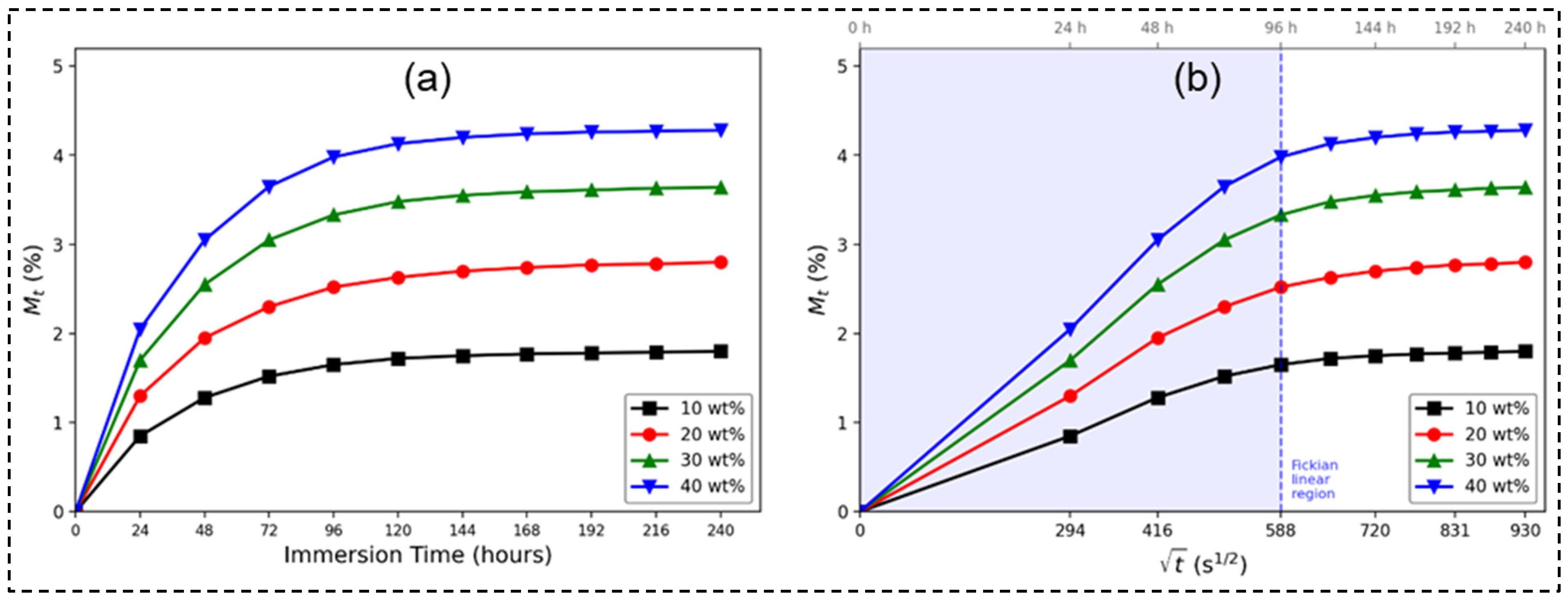
The water absorption behaviour of RF/FF epoxy hybrid composites was evaluated following the ASTM D570 standard [28]. Prior to testing, the composite specimens were carefully dried to eliminate any residual moisture by placing them in an oven at 50 °C for 5 h, after which their initial weights were recorded using a high-precision balance. The specimens were then immersed in distilled water at ambient temperature for a period of 10 days. At 24 h intervals, the samples were withdrawn from the water, lightly blotted with tissue paper to remove surface water, and immediately weighed to monitor water absorption. This procedure continued until no further increase in weight was observed, indicating that the specimens had reached saturation. In this study, all specimens attained saturation after 10 days. Inspection of the Mt vs. √t profiles (Figure 1a) confirms that equilibrium moisture content was effectively reached at approximately 120 h for all formulations, with negligible additional uptake between 120 h and 240 h. The full 10-day (240 h) immersion window was maintained to ensure complete documentation of the absorption plateau. Consequently, the water absorption values reported correspond to measurements taken at specific intervals: 24, 48, 72, 96, 120, 144, 168, 192, 216, and 240 h. The percentage of water absorbed by the composites was determined using the following expression (Equation (4)):
W A ( % ) = W t − W 0 W 0 × 100
where WA is the water absorption, Wt is the weight of the composite at time t during immersion, and W0 is the weight of the composite before water immersion.

2.4. Water Absorption Kinetics

To quantify the moisture transport mechanism governing the water absorption behaviour of the ramie–flax hybrid composites, the Fickian diffusion model was applied to the experimental absorption data. The composites exhibited Fickian diffusion behaviour, characterised by a linear increase in moisture uptake ( M t ) with the square root of immersion time ( t ) during the initial absorption stage, followed by a gradual approach to an equilibrium plateau. Three kinetic parameters were determined: the diffusion coefficient D (which quantifies the rate of moisture transport through the composite thickness), the sorption coefficient S (which characterises the equilibrium moisture capacity), and the permeability P (a composite measure of overall moisture transport ease).
For one-dimensional diffusion in a plate of thickness h , the initial stage of Fickian absorption is described by:
M t M ∞ = 4 h ( D t π ) 1 / 2
From the slope of the linear region of the M t versus t curve, the diffusion coefficient D was calculated as:
D = ( π h 2 16 M ∞ 2 ) × ( slope ) 2
where h is the specimen thickness (m), M ∞ is the equilibrium moisture content (fraction), and slope is the gradient of the linear portion of the M t versus t curve (fraction· s − 1 / 2 ).
The sorption coefficient ( S ) represents the equilibrium moisture content per unit water activity and was calculated as:
S = M ∞ a w
where a w is the water activity, taken as unity ( a w = 1 ) for full distilled water immersion.
The permeability ( P ), describing the overall ease of moisture transport through the composite, was obtained from:
P = D × S
The kinetic parameters D , S , and P were calculated from the experimental water absorption data for each composite formulation using Equations (5)–(8). The specimen thickness was h = 3 mm. The initial linear slope was extracted from the M t versus t curve over the region satisfying M t / M ∞ < 0.6 (corresponding to immersion times t ≤ 96   h ), where Fickian assumptions remain valid.

3. Results and Discussion

3.1. Density and Void Content

The theoretical and experimental densities and void contents calculated using Equations (1)–(3) are presented in Table 2. The theoretical densities, computed from the rule of mixtures using constituent densities of ρm = 1.15, ρr = 1.50, and ρf = 1.53 g/cm3, ranged from 1.180 g/cm3 (10 wt.%) to 1.282 g/cm3 (40 wt.%) with increasing fibre content. The experimental densities measured by the Archimedes method were consistently lower, yielding void contents of 1.8%, 2.4%, 3.1%, and 3.6% for the 10, 20, 30, and 40 wt.% composites, respectively. The systematic increase in void content with fibre loading is attributed to the greater difficulty of achieving complete matrix infiltration at higher fibre fractions; the denser fibre packing at elevated reinforcement levels creates narrow inter-fibre channels that resist full resin penetration under the applied compression pressure of 60 kg/cm2, resulting in micro-void formation at fibre–matrix interfaces and bundle junctions. Despite the increasing trend, all void content values remain within 1.8–3.6%, which is within the generally accepted range for hand lay-up natural fibre composites (typically <5%), confirming adequate consolidation quality across all formulations. Although the maximum void content of 3.6% is relatively low for conventional hand lay-up processing, the mould-closure pressure of 60 kg/cm2 applied during fabrication likely improved resin infiltration and reduced entrapped air within the laminate. The applied compression facilitates better fibre wetting and consolidation of the fibre network, thereby limiting the formation of interfacial voids and micro-gaps between fibre bundles. As a result, the void contents obtained in this study remain within the commonly reported range (<5%) for natural fibre-reinforced epoxy laminates fabricated using compression-assisted hand lay-up techniques. However, the progressive increase in porosity carries significant implications for moisture durability: micro-voids act as preferential pathways for capillary water ingress and reduce the effective load-bearing cross-section of the composite, compounding the moisture sensitivity that arises from the inherent hydrophilicity of the ramie and flax reinforcement.
From a material efficiency standpoint, the measured experimental densities (1.159–1.236 g/cm3) are substantially lower than those of an equivalent E-glass/epoxy composite calculated by the rule of mixtures at identical fibre weight fractions, using the well-established density of E-glass fibre (2.55 g/cm3) and epoxy resin (1.15 g/cm3) [7]. The equivalent E-glass/epoxy densities computed by the rule of mixtures range from 1.217 to 1.474 g/cm3 across the 10–40 wt.% range. For the mechanically optimal 30 wt.% formulation, the ramie–flax/epoxy composite (ρ = 1.210 g/cm3) is approximately 18.0% lighter than an equivalent E-glass/epoxy composite at the same fibre loading (ρ = 1.476 g/cm3, calculated by the rule of mixtures using ρE-glass = 2.55 g/cm3 and ρepoxy = 1.25 g/cm3, as reported by Wambua et al. [29]), underscoring the weight-saving potential of natural fibre reinforcement. For a reference structural panel of 1 m2 area and 3 mm thickness, this density difference corresponds to a mass reduction of approximately ca.0.80 kg per panel. In weight-sensitive applications such as automotive interior panels, marine components, or portable structural elements, this reduction in material mass can contribute to lower operational energy demand over the service life of the component. Importantly, this lightweighting benefit is achieved solely through fibre substitution and does not require modification of the conventional composite manufacturing process, highlighting the practical material efficiency advantage of natural fibre reinforcement.

3.2. Water Absorption Behaviour

The long-term durability of natural fibre-reinforced composites is intrinsically governed by their resistance to moisture ingress, owing to the hydrophilic nature of lignocellulosic reinforcements. Water uptake in such systems occurs through three principal mechanisms: (i) molecular diffusion through micro-voids and free volume between polymer chains, (ii) capillary transport through processing-induced surface defects and internal porosity, and (iii) preferential penetration along fibre–matrix interfaces, where hydrogen bonding between water molecules and hydroxyl groups of cellulose facilitates sorption. The evolution of water absorption as a function of immersion time is presented in Figure 1. All hybrid composites exhibited a characteristic two-stage absorption profile: an initial rapid uptake phase followed by a gradual deceleration towards equilibrium. This behaviour is typical of diffusion-controlled transport in fibre-reinforced polymer systems. Equilibrium was reached after approximately 120 h of immersion for all formulations. A clear fibre-content dependence was observed. The composite containing 40 wt.% reinforcement exhibited the highest equilibrium moisture uptake (4.28%), while the 30 wt.% composite absorbed 3.64% under identical conditions. Lower fibre loadings (10 and 20 wt.%) demonstrated significantly reduced equilibrium absorption, with the 10 wt.% composite exhibiting the lowest value (1.80%). The progressive increase in moisture uptake with fibre content is primarily attributed to the increasing fraction of hydrophilic cellulose-rich reinforcement, which introduces additional hydroxyl functional groups capable of hydrogen bonding with water molecules.
In addition to intrinsic fibre hydrophilicity, increased reinforcement content elevates fibre–matrix interfacial area and promotes microstructural heterogeneity, including localised void formation. These structural features provide preferential pathways for moisture ingress, thereby amplifying water absorption at higher fibre loadings. Conversely, lower fibre fractions correspond to a higher proportion of epoxy matrix, which, although not entirely impermeable, exhibits comparatively lower moisture affinity. Epoxy resins absorb water through interactions with polar groups formed during curing, leading to mild matrix plasticisation and interfacial swelling; however, the magnitude of matrix sorption remains substantially lower than that of the lignocellulosic fibres. Consequently, the dominant factor governing equilibrium absorption in the present system is the intrinsic hydrophilicity of the ramie–flax reinforcement rather than matrix uptake. Overall, the results confirm that moisture resistance in these hybrid composites is strongly fibre-content dependent, with matrix-rich formulations offering improved resistance to environmental exposure.

3.3. Water Absorption Kinetics Results

To obtain mechanistic insight beyond equilibrium absorption values, Fickian transport parameters were determined using Equations (5)–(8). The diffusion coefficient (D), sorption coefficient (S), and permeability (P) are summarised in Table 3. Slopes were extracted exclusively from the linear region of the Mt versus √t plots (Figure 1b), ensuring compliance with Fick’s second law assumptions for early-stage diffusion. The diffusion coefficient ranged from 2.61 × 10⁻¹² to 3.23 × 10⁻¹² m2/s across the investigated compositions. The 20 wt.% composite exhibited the lowest D value, suggesting a relatively compact fibre distribution and reduced connectivity of moisture pathways at intermediate loading. At higher fibre contents (30 and 40 wt.%), increased void content (3.1% and 3.6%, respectively; Table 2) and expanded fibre–matrix interfacial area generated additional preferential diffusion channels, resulting in moderately elevated diffusion coefficients. Nevertheless, the variation in D across formulations remained comparatively limited, indicating that fibre content influences moisture capacity more strongly than transport velocity.
In contrast, the sorption coefficient (S) exhibited a strictly monotonic increase from 0.0180 to 0.0428 g/g with increasing fibre loading. This trend directly reflects the growing concentration of hydrophilic cellulose phases capable of binding water molecules through hydrogen bonding interactions. Since S represents the thermodynamic affinity of the composite for moisture, its fibre-dependent increase confirms that equilibrium absorption is governed primarily by reinforcement chemistry rather than diffusion kinetics. Permeability (P), which integrates both diffusion rate and sorption capacity (P = D × S), increased approximately 2.5-fold across the studied range (5.58 to 13.81 × 10⁻¹⁴ m2/s). This substantial increase confirms that total moisture transport capability scales strongly with fibre content. Although the 30 wt.% composite demonstrated superior post-immersion mechanical retention (as discussed in Section 3.4), its D and p values were only marginally lower than those of the 40 wt.% composite. Therefore, its enhanced durability arises primarily from reduced equilibrium moisture uptake rather than a fundamentally slower diffusion process.
The linear relationship between Mt and √t (Figure 1b) confirms that moisture transport is predominantly Fickian under ambient immersion conditions. No significant deviation indicative of anomalous or Case II diffusion behaviour was observed within the experimental timeframe, suggesting that irreversible matrix cracking or severe interfacial debonding did not dominate moisture ingress during the exposure period. It is understood from the kinetic results that while diffusion rates are moderately influenced by fibre content, the principal driver of increased moisture susceptibility in high-fibre composites is the elevated sorption capacity associated with hydrophilic lignocellulosic reinforcement.

3.4. Effect of Water Absorption on Mechanical Properties

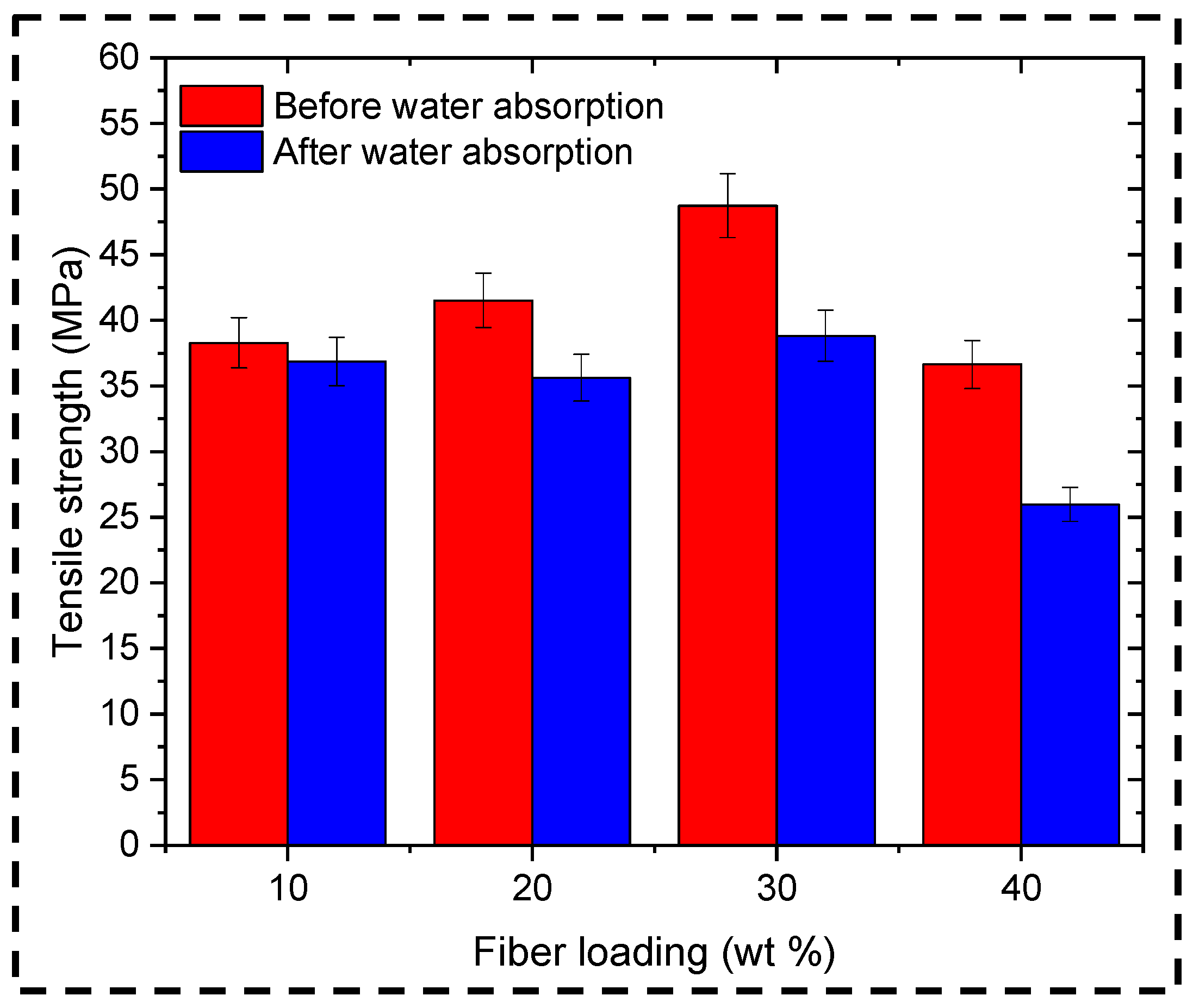
Figure 2 illustrates the tensile strength of the composites both prior to and following water absorption. Examining the tensile performance of hybrid composites with different fibre contents provides an important understanding of how the material’s mechanical properties and durability respond to changes in environmental conditions. However, the trend shifts after water absorption, with decreasing fibre percentages showing relatively smaller decreases in tensile strength compared to their counterparts with higher fibre percentages. For instance, while the composite with 40 wt.% fibre experiences a significant decrease in tensile strength after water absorption, the composite with 10 wt.% fibre shows a relatively smaller reduction. This difference suggests that lower fibre percentages may offer better resistance to moisture-induced degradation, possibly due to the higher proportion of matrix material in these composites. Conversely, composites with higher fibre percentages exhibit more pronounced decreases in tensile strength after water absorption. This observation underscores the susceptibility of high-fibre-content composites to moisture-induced weakening of the fibre–matrix interface, leading to compromised mechanical integrity.

3.5. Effect of Water Absorption on Flexural Strengths

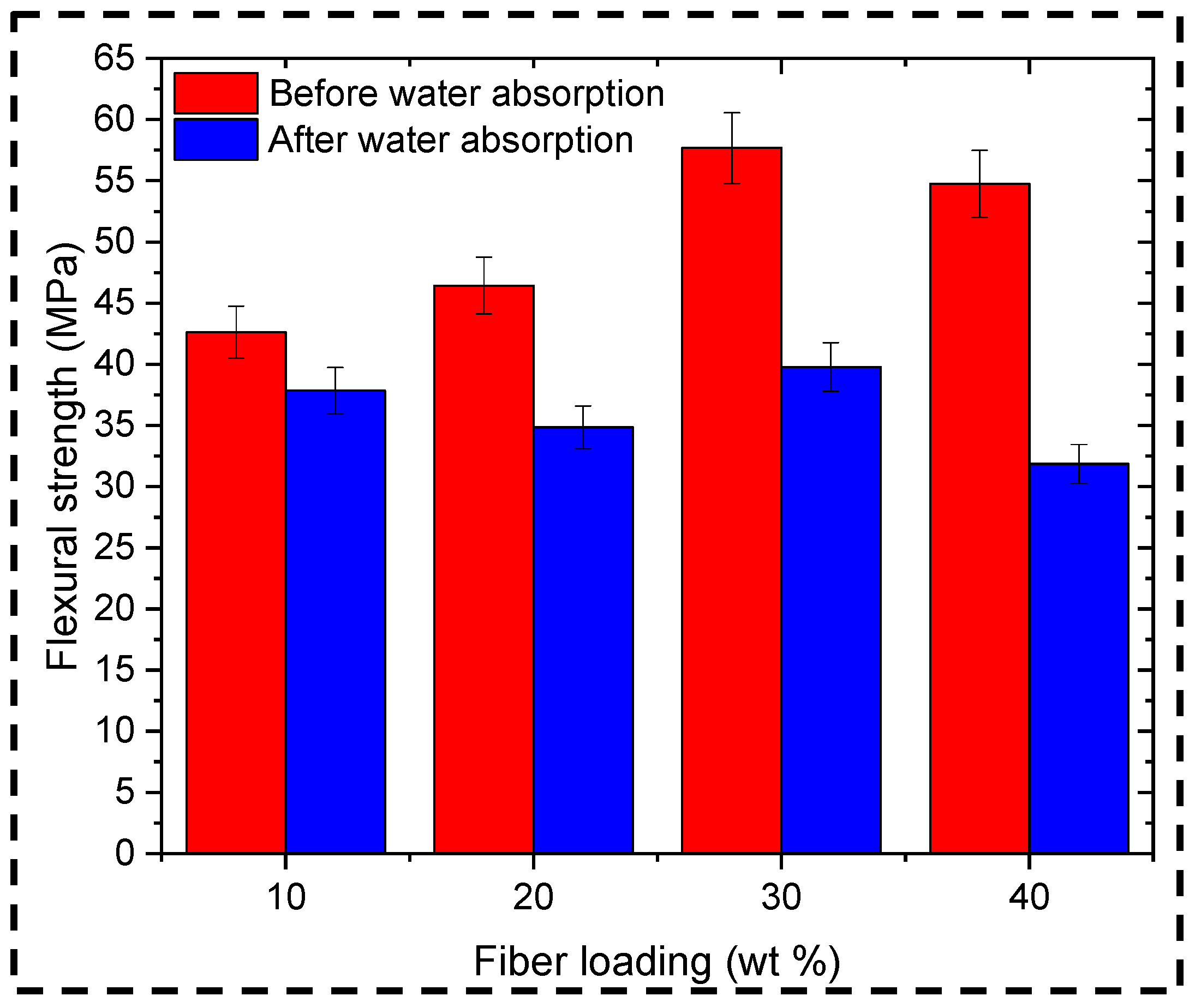
The flexural testing of hybrid composite samples offers further understanding of the material’s mechanical performance and durability under different fibre loadings and moisture exposure. Examination of the results shows that, much like the tensile behaviour, the flexural strength is influenced by the fibre content. In general, higher fibre percentages lead to improved flexural strength prior to water uptake, highlighting the reinforcing role of the fibres in enhancing composite properties. Nonetheless, following water absorption, a noticeable decline in flexural strength is observed for all fibre ratios. This decrease is likely due to the detrimental impact of moisture, including weakening at the fibre–matrix interface and diminished interfacial adhesion, which compromises the overall structural integrity of the composite.
Comparing the flexural test results across different fibre loadings reveals trends similar to those observed in the tensile tests. The percentage reduction in flexural strength after water absorption increases with fibre content, decreasing by approximately 11.23% for 10 wt.%, ca.25% for 20 wt.%, ca.31% for 30 wt.%, and ca.42% for 40 wt.% composites. The variation in flexural strength before and after water absorption is illustrated in Figure 3. Composites with higher fibre contents exhibit more pronounced strength degradation due to increased moisture uptake and interfacial weakening, whereas lower fibre loadings show comparatively smaller reductions. This trend highlights the influence of fibre content on the composite’s resistance to moisture-induced deterioration. Both tensile and flexural characterisations are essential for a comprehensive assessment of moisture-induced mechanical degradation in hybrid composites. While tensile strength reflects resistance to axial loading, flexural strength represents bending performance, which is particularly important for panel and semi-structural applications.

3.6. Effect of Water Absorption on Impact Strength

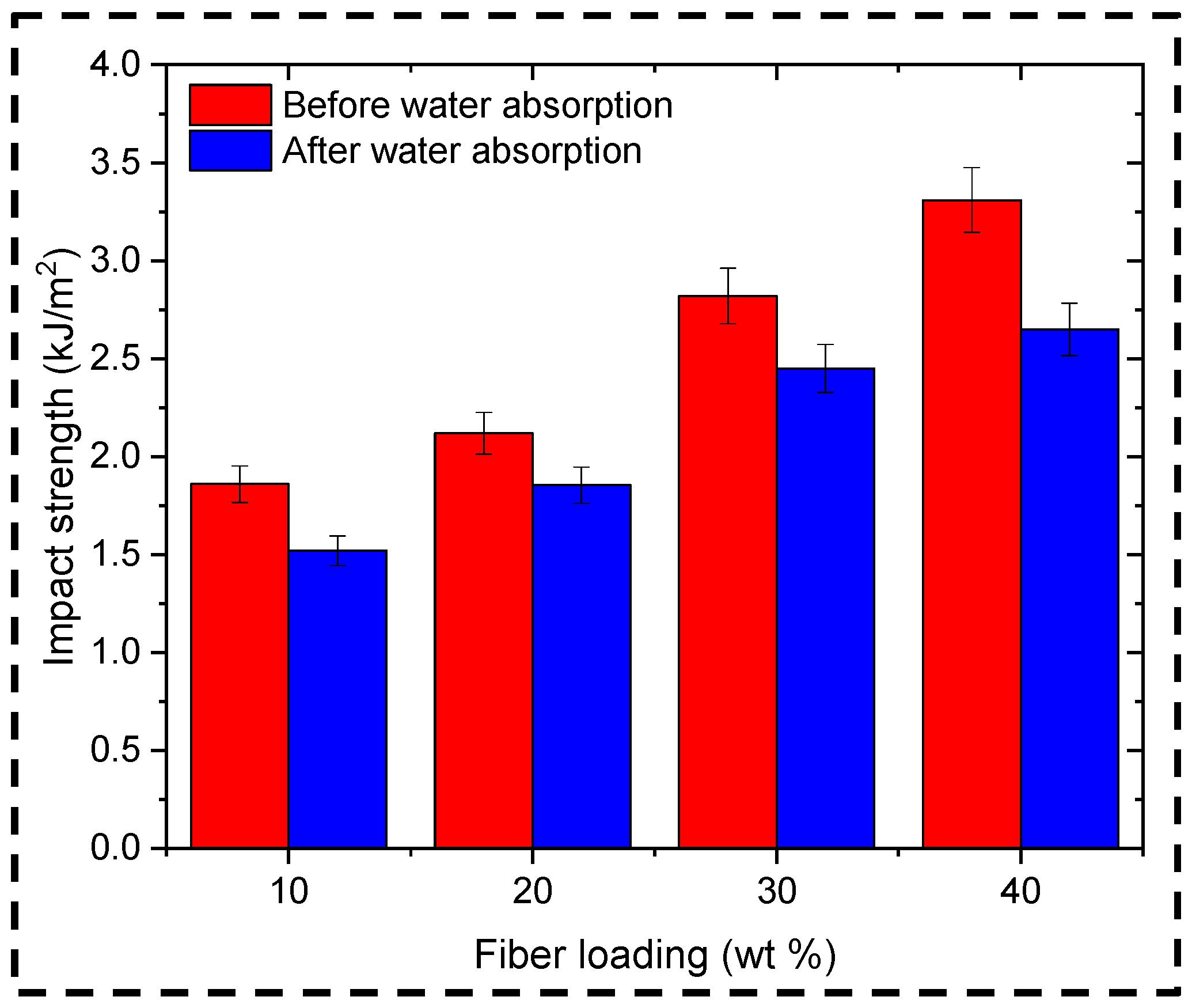
The impact testing of the hybrid composite specimens offers important information regarding the material’s ability to withstand sudden forces and its durability under different fibre loadings and exposure to moisture. The results indicate a clear relationship between fibre content and impact strength. Prior to water absorption, composites with higher fibre content generally exhibit greater impact resistance; for example, the specimen containing 40 wt.% fibre achieves the maximum impact strength of 3.31 kJ/m2, whereas the 10 wt.% fibre composite shows the lowest value of 1.86 kJ/m2. Variations in the impact strength are depicted in Figure 4. Following water immersion, all specimens display a reduction in impact strength, likely due to the detrimental effects of moisture, such as the degradation of the fibre–matrix interface and weaker interfacial bonding. Across all fibre contents, the post-absorption impact strength is lower than the initial values. Comparing the results before and after water uptake shows that the degree of reduction varies with fibre content; notably, the composite with 40 wt.% fibre undergoes a greater decrease than the 10 wt.% fibre composites, suggesting that higher fibre fractions may amplify the negative influence of moisture on the composite’s mechanical performance.

3.7. Fracture Analysis

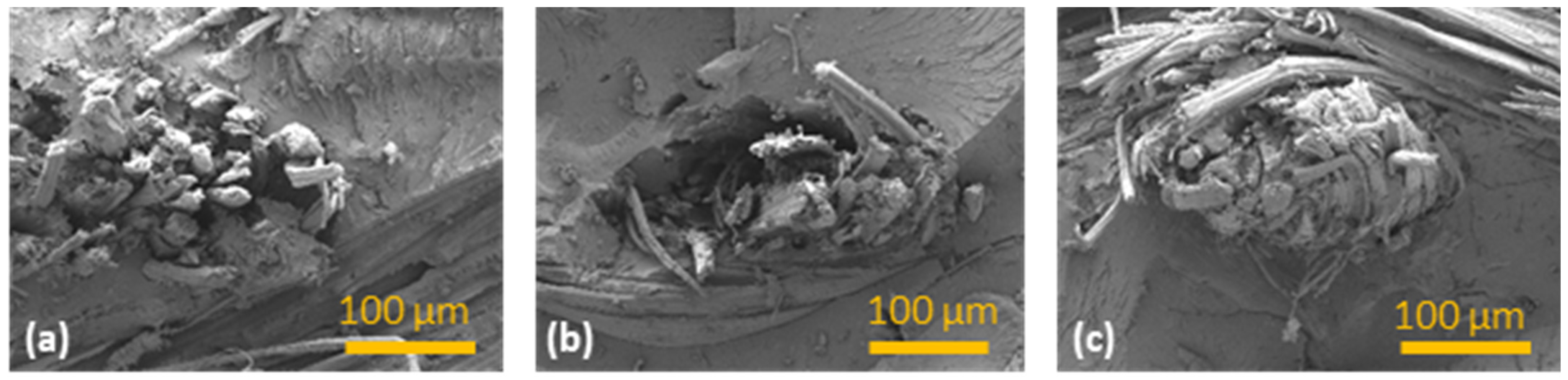
Figure 5 presents SEM micrographs of fractured surfaces after full water immersion for three representative compositions: Figure 5a shows the 30 wt.% composite, Figure 5b shows the 40 wt.% composite, and Figure 5c shows the 10 wt.% composite. Distinct differences in interfacial integrity are evident among the three compositions. The 30 wt.% composite (Figure 5a) exhibits moderate fibre pull-out, localised interfacial gaps, and limited matrix cracking, indicating partial degradation of fibre–matrix adhesion. This comparatively controlled interfacial damage is consistent with its superior tensile strength retention (~78%) and lower moisture uptake (3.64%), suggesting that the reduced void fraction at this loading restricts water penetration and limits interfacial stress concentration. In contrast, the 40 wt.% composite (Figure 5b) shows extensive fibre bundle extraction, large pull-out cavities, and pronounced interfacial separation. The smooth fibre surfaces and widened gaps indicate adhesive failure and significant deterioration of load transfer efficiency. This severe microstructural degradation correlates directly with the greater tensile strength reduction (ca.35%) and higher moisture absorption (4.28%) measured after saturation. The increased fibre content promotes greater interfacial area and microvoid formation, facilitating capillary water transport and fibre swelling, which intensifies interfacial stresses. Figure 5c represents a comparatively intact fracture surface with tightly embedded fibre bundles and preserved fibre–matrix adhesion. The limited interfacial separation supports effective stress transfer and crack-bridging behaviour, explaining the improved mechanical performance observed under minimal moisture-induced degradation. Although epoxy resins are less hydrophilic than natural fibres, they are not impermeable to moisture. Water diffusion into the crosslinked network through polar functional groups results in matrix plasticisation and stiffness reduction. Therefore, the observed mechanical deterioration arises from a coupled mechanism involving fibre swelling, matrix softening, and progressive interfacial debonding rather than fibre degradation alone.

4. Discussion of the Results

The findings of this study provide valuable insight into the trade-off between mechanical performance and environmental durability in hybrid natural fibre composites intended for moisture-exposed applications. The observed increase in water absorption with increasing fibre content confirms that moisture sensitivity remains a critical design constraint for lignocellulosic fibre composites, reinforcing previous reports that fibre volume fraction strongly governs long-term durability [30]. By systematically correlating fibre content with tensile, flexural, and impact property degradation after water exposure, this work offers quantitative evidence of how moisture ingress influences load transfer efficiency and failure mechanisms, an aspect that has often been discussed qualitatively but insufficiently compared across different fibre loadings in earlier studies. The pronounced mechanical degradation observed at higher fibre contents highlights the limitations of simply increasing reinforcement to enhance strength, thereby cautioning against over-reinforcement in applications subjected to humid or water-rich environments. In contrast, the superior retention of mechanical properties at 30 wt.% fibre content demonstrates that an intermediate fibre loading can provide an effective balance between reinforcement efficiency and moisture resistance, in agreement with trends reported for other hybrid natural fibre systems [31]. It is important to acknowledge that the identification of 30 wt.% fibre loading as the optimal composition is context-dependent, as only four discrete fibre loadings were investigated in this study. Without finer increments in fibre content and formal statistical significance testing (e.g., one-way ANOVA with Tukey post hoc comparison), the 30 wt.% formulation should be interpreted as the best-performing composition among the tested formulations rather than the absolute optimum. Determining the true optimum within the 20–40 wt.% range would require a more detailed experimental design incorporating smaller loading intervals and statistical validation in future work. Under dry conditions, the 40 wt.% composite exhibited a superior impact strength of 3.31 kJ/m2 compared to 2.82 kJ/m2 for the 30 wt.% formulation. This advantage arises from the greater number of fibres available to absorb and deflect crack energy at higher reinforcement contents. However, after water immersion, the 40 wt.% composite retains only ca.72% of its impact strength, compared to ca.82% for the 30 wt.% composite, reversing the performance hierarchy. A summary of the mechanical property retention for the investigated composites after water immersion is presented in Table 4. For applications in which impact loading is the primary design criterion and moisture exposure is limited, the 40 wt.% composite may be the more appropriate material choice. Conversely, for semi-structural applications in humid or aquatic environments where tensile and flexural performance under sustained moisture exposure is critical, the 30 wt.% composite provides the most favourable combination of properties.
At the molecular and microstructural levels, degradation of interfacial adhesion can be attributed to the combined effects of fibre swelling and matrix plasticisation induced by moisture ingress [32]. Ramie and flax fibres, being lignocellulosic in nature, contain abundant hydroxyl (–OH) groups that readily form hydrogen bonds with water molecules, leading to fibre swelling and the development of localised stresses at the fibre–matrix interface, which promote interfacial debonding [33]. Simultaneously, water molecules diffusing into the epoxy matrix act as plasticisers by increasing polymer chain mobility and weakening secondary intermolecular interactions, thereby reducing matrix stiffness and interfacial shear resistance. Although direct quantification of interfacial adhesion, such as interfacial shear strength measurements, microbond testing, or fracture energy analysis, was not performed in the present study, the SEM observations provide qualitative evidence of interfacial degradation through features such as fibre pull-out, interfacial gaps, and matrix cracking. These microstructural features, when interpreted alongside the observed reductions in tensile, flexural, and impact properties after water exposure, indirectly indicate a loss of effective fibre–matrix load transfer due to moisture-induced interfacial weakening rather than changes in fibre strength alone. It should therefore be emphasised that the SEM analysis in this work is used to support the mechanistic interpretation of failure behaviour rather than to provide a quantitative measure of interfacial adhesion. Nevertheless, the consistent correlation between fracture morphology and mechanical property degradation across different fibre loadings strengthens the validity of the proposed damage mechanisms. Overall, this discussion extends beyond reporting experimental trends by integrating macroscopic mechanical performance with microstructural observations, thereby translating the results into practical design insight for the development of reliable and durable hybrid natural fibre composites for structural and semi-structural applications in humid and water-exposed environments.
From a cleaner engineering perspective, the findings of this study provide experimentally grounded evidence supporting the case for ramie–flax hybrid composites as a viable material substitution for glass fibre reinforcement in moisture-exposed semi-structural applications. While the epoxy matrix employed in this work remains petroleum-based, it is well-established that the reinforcement phase is the primary driver of composite density, renewability, and end-of-life biodegradability in natural fibre systems [7,8]. The density advantage quantified in Section 3.1, approximately ca.18% lower than an equivalent E-glass/epoxy composite at the optimal 30 wt.% loading, translates directly to reduced material mass per functional unit, lower transport-phase energy demand, and reduced solid waste volume at end-of-life. Critically, this study demonstrates that the lightweighting benefit is achievable without compromising mechanical reliability under moisture exposure, provided fibre loading is controlled at the identified optimum. The use of a petroleum-based epoxy is acknowledged as a current limitation of the composite system; however, recent studies have demonstrated the processing compatibility of bio-derived epoxy resins with natural fibre reinforcements [32], and their adoption represents the most impactful pathway toward a fully bio-based composite with a comprehensively lower environmental burden. The present work, therefore, establishes the mechanical durability and material efficiency baseline that future bio-epoxy hybrid systems must meet or exceed to justify the transition from conventional thermoset matrices.

5. Conclusions

This study investigated water absorption kinetics and post-immersion mechanical property retention in ramie–flax/epoxy hybrid composites across four fibre loadings (10–40 wt.%), with the ramie-to-flax ratio fixed at 1:1 in all formulations, establishing this work as a fibre-loading optimisation study within a fixed hybrid system. Water absorption increased with fibre content, with equilibrium reached after approximately 120 h. Mechanical properties declined after immersion, with higher loadings showing more pronounced degradation. The 30 wt.% composite achieved the best balance of strength and moisture durability, with dry-state tensile, flexural, and impact strengths of ca.49 MPa, ca.58 MPa, and 2.82 kJ/m2, retaining ca.78%, ca.69%, and ca.82% after full saturation, superior to all other formulations. Although the 40 wt.% composite showed the highest dry impact strength (3.31 kJ/m2), its post-immersion retention was substantially lower. The 30 wt.% composite, therefore, represents the optimal fibre loading for moisture-exposed structural applications. Future work should investigate fibre surface treatments and bio-derived epoxy matrices to improve moisture resistance and extend the environmental credentials of the composite system.


Author Contributions

S.R.: Investigation, methodology, and writing—original draft. A.V.: Resources, validation, and writing—review and editing. V.S.: Supervision, validation, methodology, and writing—review and editing. Y.-L.Y.: Validation, formal analysis, and writing—review and editing. U.M.: Validation and writing—review and editing. T.K.S.: Validation and writing—review and editing. K.K.: Supervision, conceptualization, validation, formal analysis, and writing—review and editing. All authors have read and agreed to the published version of the manuscript.

Funding

This research did not receive any specific grant from funding agencies in the public, commercial, or not-for-profit sectors.

Data Availability Statement

The datasets generated and/or analysed during the current study are available from the corresponding authors upon reasonable request.

Conflicts of Interest

The authors declare that they have no competing interests.

References

  1. Shanmugam, V.; Karthikbabu, N.B.; Rajendran, S.; Das, O. Applications of Various Types of Polymer-Based Composites. In Polymer-Based Composites; CRC Press: Boca Raton, FL, USA, 2021; pp. 139–149. [Google Scholar]
  2. Kurien, R.A.; Bodaghi, M.; Mathew, N.D.; Paul, M.; Ravi, S.V.; Praveen, P. Fabrication, Properties, and Morphologies of Novel Acacia–Jute Hybrid Polymer Composites. J. Compos. Sci. 2025, 9, 316. [Google Scholar] [CrossRef] [Scilit]
  3. Zabihi, O.; Zamani, P.; Yadav, R.; Wei, Y.; Laghaei, M.; Pakdel, E.; Ahmadi, M.; Li, Q.; Hadigheh, S.A.; Naebe, M. The Sustainability Spectrum of Carbon Fibre: Balancing High Performance CFRP Composites with Environmental Responsibility. Adv. Compos. Hybrid Mater. 2025, 8, 415. [Google Scholar] [CrossRef] [Scilit]
  4. Somsuk, N.; Pramoonmak, S.; Chongkolnee, B.; Tipboonsri, P.; Memon, A. Enhancing Mechanical Properties of 3D-Printed PLA Composites Reinforced with Natural Fibers: A Comparative Study. J. Compos. Sci. 2025, 9, 180. [Google Scholar] [CrossRef] [Scilit]
  5. Pickering, K.L.; Efendy, M.G.A.; Le, T.M. A Review of Recent Developments in Natural Fibre Composites and Their Mechanical Performance. Compos. Part A Appl. Sci. Manuf. 2016, 83, 98–112. [Google Scholar] [CrossRef] [Scilit]
  6. Saba, N.; Jawaid, M.; Alothman, O.Y.; Paridah, M.T. A Review on Dynamic Mechanical Properties of Natural Fibre Reinforced Polymer Composites. Constr. Build. Mater. 2016, 106, 149–159. [Google Scholar] [CrossRef] [Scilit]
  7. Joshi, S.V.; Drzal, L.T.; Mohanty, A.K.; Arora, S. Are Natural Fiber Composites Environmentally Superior to Glass Fiber Reinforced Composites? Compos. Part A Appl. Sci. Manuf. 2004, 35, 371–376. [Google Scholar] [CrossRef] [Scilit]
  8. Gurunathan, T.; Mohanty, S.; Nayak, S.K. A Review of the Recent Developments in Biocomposites Based on Natural Fibres and Their Application Perspectives. Compos. Part A Appl. Sci. Manuf. 2015, 77, 1–25. [Google Scholar] [CrossRef] [Scilit]
  9. Mostafaei, H.; Bahmani, H.; Mostofinejad, D. Damping Behavior of Fiber-Reinforced Concrete: A Comprehensive Review of Mechanisms, Materials, and Dynamic Effects. J. Compos. Sci. 2025, 9, 254. [Google Scholar] [CrossRef] [Scilit]
  10. Romanzini, D.; Ornaghi Junior, H.L.; Amico, S.C.; Zattera, A.J. Preparation and Characterization of Ramie-Glass Fiber Reinforced Polymer Matrix Hybrid Composites. Mater. Res. 2012, 15, 415–420. [Google Scholar] [CrossRef] [Scilit]
  11. Haameem, J.A.M.; Abdul Majid, M.S.; Afendi, M.; Marzuki, H.F.A.; Hilmi, E.A.; Fahmi, I.; Gibson, A.G. Effects of Water Absorption on Napier Grass Fibre/Polyester Composites. Compos. Struct. 2016, 144, 138–146. [Google Scholar] [CrossRef] [Scilit]
  12. Sreekala, M.S.; Kumaran, M.G.; Thomas, S. Water Sorption in Oil Palm Fiber Reinforced Phenol Formaldehyde Composites. Compos. Part A Appl. Sci. Manuf. 2002, 33, 763–777. [Google Scholar] [CrossRef] [Scilit]
  13. Boukettaya, S.; Alawar, A.; Almaskari, F.; Ben Daly, H.; Abdala, A.; Chatti, S. Modeling of Water Diffusion Mechanism in Polypropylene/Date Palm Fiber Composite Materials. J. Compos. Mater. 2018, 52, 2651–2659. [Google Scholar] [CrossRef] [Scilit]
  14. Aji, I.; Zainudin, E.; Abdan, K.; Sapuan, S.; Khairul, M. Mechanical Properties and Water Absorption Behavior of Hybridized Kenaf/Pineapple Leaf Fibre-Reinforced High-Density Polyethylene Composite. J. Compos. Mater. 2013, 47, 979–990. [Google Scholar] [CrossRef] [Scilit]
  15. Swolfs, Y.; Gorbatikh, L.; Verpoest, I. Fibre Hybridisation in Polymer Composites: A Review. Compos. Part A Appl. Sci. Manuf. 2014, 67, 181–200. [Google Scholar] [CrossRef] [Scilit]
  16. Romanzini, D.; Ornaghi, H.L.; Amico, S.C.; Zattera, A.J. Influence of Fiber Hybridization on the Dynamic Mechanical Properties of Glass/Ramie Fiber-Reinforced Polyester Composites. J. Reinf. Plast. Compos. 2012, 31, 1652–1661. [Google Scholar] [CrossRef] [Scilit]
  17. Siregar, J.P.; Zalinawati, M.; Cionita, T.; Rejab, M.R.M.; Mawarnie, I.; Jaafar, J.; Hamdan, M.H.M. Mechanical Properties of Hybrid Sugar Palm/Ramie Fibre Reinforced Epoxy Composites. Mater. Today Proc. 2021, 46, 1729–1734. [Google Scholar] [CrossRef] [Scilit]
  18. Supian, A.B.M.; Jawaid, M.; Rashid, B.; Fouad, H.; Saba, N.; Dhakal, H.N.; Khiari, R. Mechanical and Physical Performance of Date Palm/Bamboo Fibre Reinforced Epoxy Hybrid Composites. J. Mater. Res. Technol. 2021, 15, 1330–1341. [Google Scholar] [CrossRef] [Scilit]
  19. Ladaci, N.; Saadia, A.; Belaadi, A.; Boumaaza, M.; Chai, B.X.; Abdullah, M.M.S.; Al-Khawlani, A.; Ghernaout, D. ANN and RSM Prediction of Water Uptake of Recycled HDPE Biocomposite Reinforced with Treated Palm Waste W. filifera. J. Nat. Fibers 2024, 21, 2356697. [Google Scholar] [CrossRef] [Scilit]
  20. Bond, D.A. Moisture Diffusion in a Fiber-Reinforced Composite: Part I—Non-Fickian Transport and the Effect of Fiber Spatial Distribution. J. Compos. Mater. 2005, 39, 2113–2142. [Google Scholar] [CrossRef] [Scilit]
  21. Rao, R.M.V.G.K.; Chanda, M.; Balasubramanian, N. A Fickian Diffusion Model for Permeable Fibre Polymer Composites. J. Reinf. Plast. Compos. 1983, 2, 289–299. [Google Scholar] [CrossRef] [Scilit]
  22. Mohammed, M.; Jawad, A.J.a.M.; Mohammed, A.M.; Oleiwi, J.K.; Adam, T.; Osman, A.F.; Dahham, O.S.; Betar, B.O.; Gopinath, S.C.B.; Jaafar, M. Challenges and Advancement in Water Absorption of Natural Fiber-Reinforced Polymer Composites. Polym. Test. 2023, 124, 108083. [Google Scholar] [CrossRef] [Scilit]
  23. Moudood, A.; Rahman, A.; Khanlou, H.M.; Hall, W.; Öchsner, A.; Francucci, G. Environmental Effects on the Durability and the Mechanical Performance of Flax Fiber/Bio-Epoxy Composites. Compos. B Eng. 2019, 171, 284–293. [Google Scholar] [CrossRef] [Scilit]
  24. Dhakal, H.N.; Zhang, Z.Y.; Richardson, M.O.W. Effect of Water Absorption on the Mechanical Properties of Hemp Fibre Reinforced Unsaturated Polyester Composites. Compos. Sci. Technol. 2007, 67, 1674–1683. [Google Scholar] [CrossRef] [Scilit]
  25. Arul, S.J.; Adhikary, P.; Jani, S.P.; Haiter Lenin, A. Moisture Diffusion Analysis and Their Effects on the Mechanical Properties of Organic Particle Filled Natural Fiber Reinforced Hybrid Polymer Composites. Int. J. Polym. Anal. Charact. 2024, 29, 42–55. [Google Scholar] [CrossRef] [Scilit]
  26. Kumar, S.M.V.; Kumar, K.L.S.; Jailani, H.S.; Rajamurugan, G. Mechanical, DMA and sound acoustic behaviour of flax woven fabric reinforced epoxy composites. Mater. Res. Express 2020, 7, 085302. [Google Scholar] [CrossRef] [Scilit]
  27. ISO 180:2019; Plastics—Determination of Izod Impact Strength. International Organisation for Standardisation (ISO): Geneva, Switzerland, 2019.
  28. Ravindran, S.; Sozhamannan, G.G.; Venkatachalapathy, V.S.K. Mechanical and water absorption behaviour on silane treated jute fiber based natural composites. Mater. Today Proc. 2022, 68, 2134–2141. [Google Scholar] [CrossRef] [Scilit]
  29. Wambua, P.; Ivens, J.; Verpoest, I. Natural Fibres: Can They Replace Glass in Fibre Reinforced Plastics? Compos. Sci. Technol. 2003, 63, 1259–1264. [Google Scholar] [CrossRef] [Scilit]
  30. Ratna Kumari, Y.; Ramanaiah, K.; Ratna Prasad, A.V.; Hemachandra Reddy, K.; Prasad Sanaka, S.; Kalyan Prudhvi, A. Experimental Investigation of Water Absorption Behaviour of Sisal Fiber Reinforced Polyester and Sisal Fiber Reinforced Poly Lactic Acid Composites. Mater. Today Proc. 2021, 44, 935–940. [Google Scholar] [CrossRef] [Scilit]
  31. Manoj, B.; Muthukumar, C.; Prasad, C.P.D.; Manickam, S.; Benjamin, T.I. Influence of Fiber Loading on the Mechanical Properties and Moisture Absorption of the Sisal Fiber-Reinforced Epoxy Composites. In Mechanical and Dynamic Properties of Biocomposites; Wiley: Hoboken, NJ, USA, 2021; pp. 265–273. [Google Scholar]
  32. Sabbagh, K.; Kessentini, R.; Klinkova, O.; Tawfiq, I.; Bouraoui, C. Long-Term Moisture Degradation of Rubber/Bamboo-Epoxy Composites. Int. J. Mech. Sci. 2025, 303, 110618. [Google Scholar] [CrossRef] [Scilit]
  33. Zhan, J.; Wang, G.; Li, J.; Guan, Y.; Zhao, G.; Naceur, H.; Coutellier, D.; Lin, J. Effect of the Compatilizer and Chemical Treatments on the Performance of Poly(Lactic Acid)/Ramie Fiber Composites. Compos. Commun. 2021, 27, 100843. [Google Scholar] [CrossRef] [Scilit]
Figure 1. Water absorption behaviour of RF/FF epoxy hybrid composites: (a) water absorption percentage vs. immersion time; (b) Mₜ vs. √t plots used for Fickian diffusion coefficient determination; the blue shaded region (√t = 0–588 s1/2; 0–96 h) indicates the Fickian linear zone prior to saturation.
Jcs 10 00175 g001
Figure 2. Tensile strength variation in RF/FF epoxy hybrid composites after water absorption.
Jcs 10 00175 g002
Figure 3. Flexural strength variation in RF/FF epoxy hybrid composites after water absorption.
Jcs 10 00175 g003
Figure 4. Impact strength variation in RF/FF epoxy hybrid composites after water absorption.
Jcs 10 00175 g004
Figure 5. SEM images of fractured surfaces after water immersion for composites containing (a) 30 wt.% fibre, (b) 40 wt.% fibre, and (c) 10 wt.% fibre, showing fibre–matrix debonding in (a,b) and relatively intact fibre bundles in (c).
Jcs 10 00175 g005
Table 1. Fabricated composite details.
S. NoComposite Fabricated (%)Fibre Reinforcement (%)Matrix Reinforcement (%)
RFFF
1Hybrid composite with 10 wt.% fibres5590
2Hybrid composite with 20 wt.% fibres101080
3Hybrid composite with 30 wt.% fibres151570
4Hybrid composite with 40 wt.% fibres202060
Table 2. Theoretical density, experimental density, and void content of ramie–flax hybrid epoxy composites.
Fibre Content (wt.%)ρth (g/cm3)ρexp (g/cm3)Void Content Vv (%)
101.1801.1591.8
201.2151.1862.4
301.2491.2103.1
401.2821.2363.6
ρth: theoretical density; ρexp: experimental density; Vv: void content.
Table 3. Fickian water absorption kinetic parameters for ramie–flax hybrid epoxy composites.
Fibre Content (wt%)M∞ (%)D (×10−12 m2/s)S (g Water/g Composite)P (×10−14 m2/s)
101.803.100.01805.58
202.802.610.02807.30
303.643.030.036411.03
404.283.230.042813.81
M∞: equilibrium moisture content; D: diffusion coefficient; S: sorption coefficient; P: permeability.
Table 4. Retention of mechanical properties of ramie–flax hybrid composites after water immersion.
Fibre
Loading
Tensile Strength (MPa)Flexural Strength (MPa)Impact Strength (kJ/m2)
DryPost-ImmersionRetention (%)DryPost-ImmersionRetention (%)DryPost-ImmersionRetention (%)
10 wt%22.15 ± 1.217.36 ± 1.078.4%32.02 ± 1.528.42 ± 1.288.8%1.86 ± 0.081.54 ± 0.0782.8%
20 wt%35.62 ± 1.827.41 ± 1.576.9%47.56 ± 1.935.67 ± 1.775.0%2.31 ± 0.101.89 ± 0.0981.8%
30 wt% ★48.78 ± 2.138.28 ± 1.878.5%57.69 ± 2.339.77 ± 2.068.9%2.82 ± 0.122.30 ± 0.1181.6%
40 wt%56.94 ± 2.437.10 ± 2.265.2%68.89 ± 2.740.11 ± 2.458.2%3.31 ± 0.142.39 ± 0.1372.2%
★ = Optimal formulation (best combined dry strength and post-immersion retention). Retention (%) = (Post-Immersion Strength/Dry Strength) × 100.
Disclaimer/Publisher’s Note: The statements, opinions and data contained in all publications are solely those of the individual author(s) and contributor(s) and not of MDPI and/or the editor(s). MDPI and/or the editor(s) disclaim responsibility for any injury to people or property resulting from any ideas, methods, instructions or products referred to in the content.