

Sustainable Mortars Incorporating Industrial Rolling Mill Residues: Microstructural, Physical, and Chemical Characteristics

 , , ,
, , ,  ,
,  and
and 
Abstract
1. Introduction
2. Materials and Methods
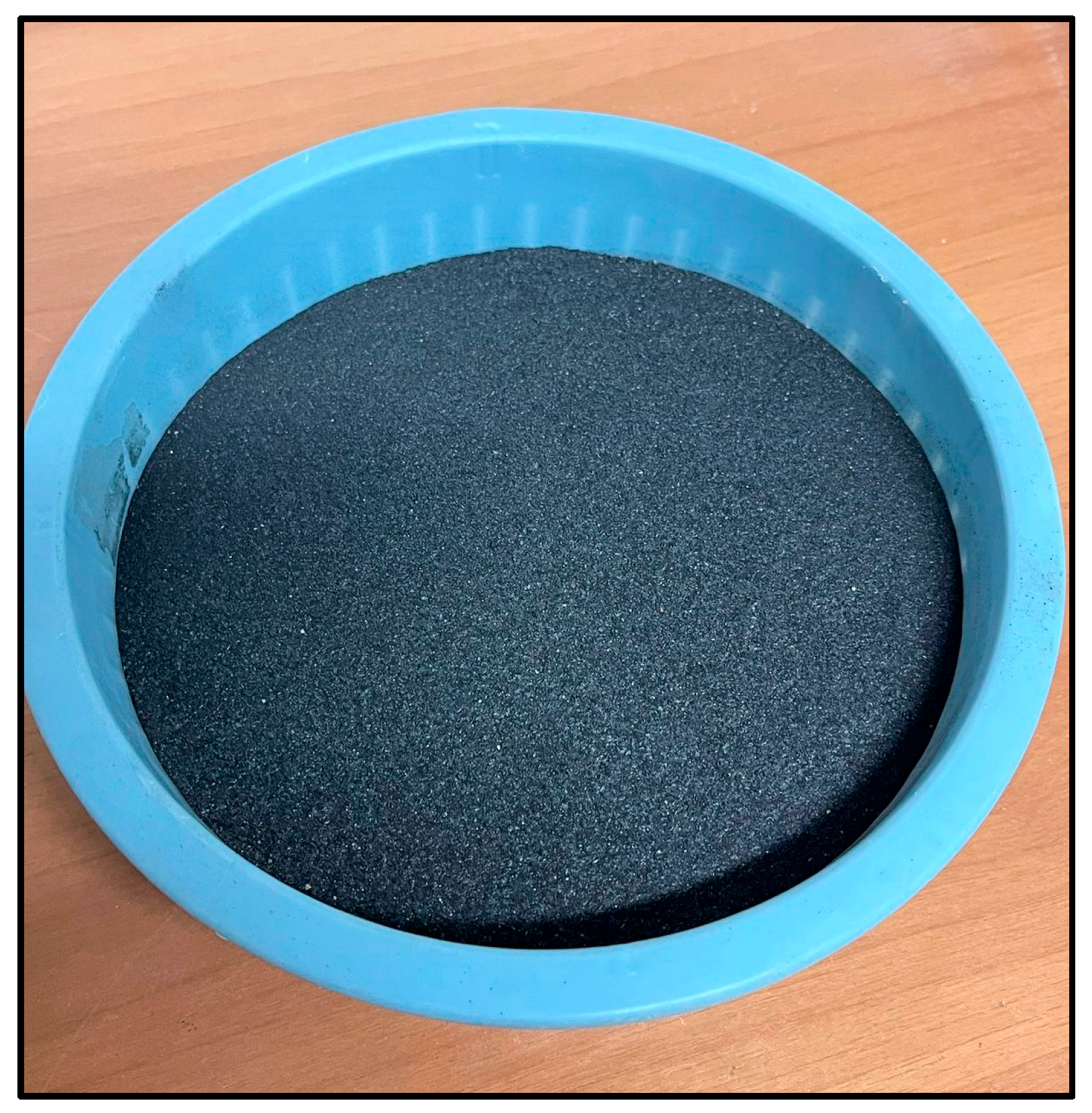
2.1. Materials
2.2. Proportions of the Mortars
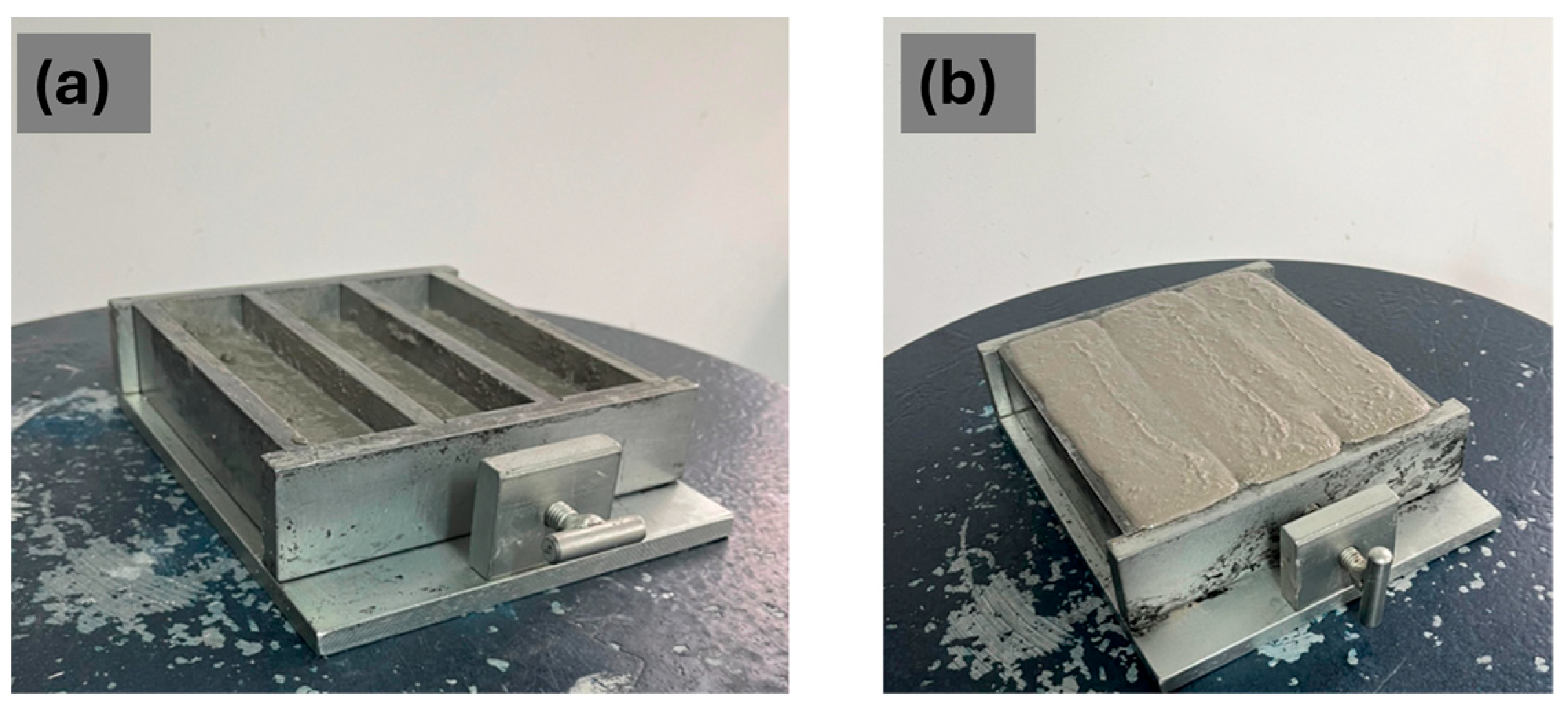
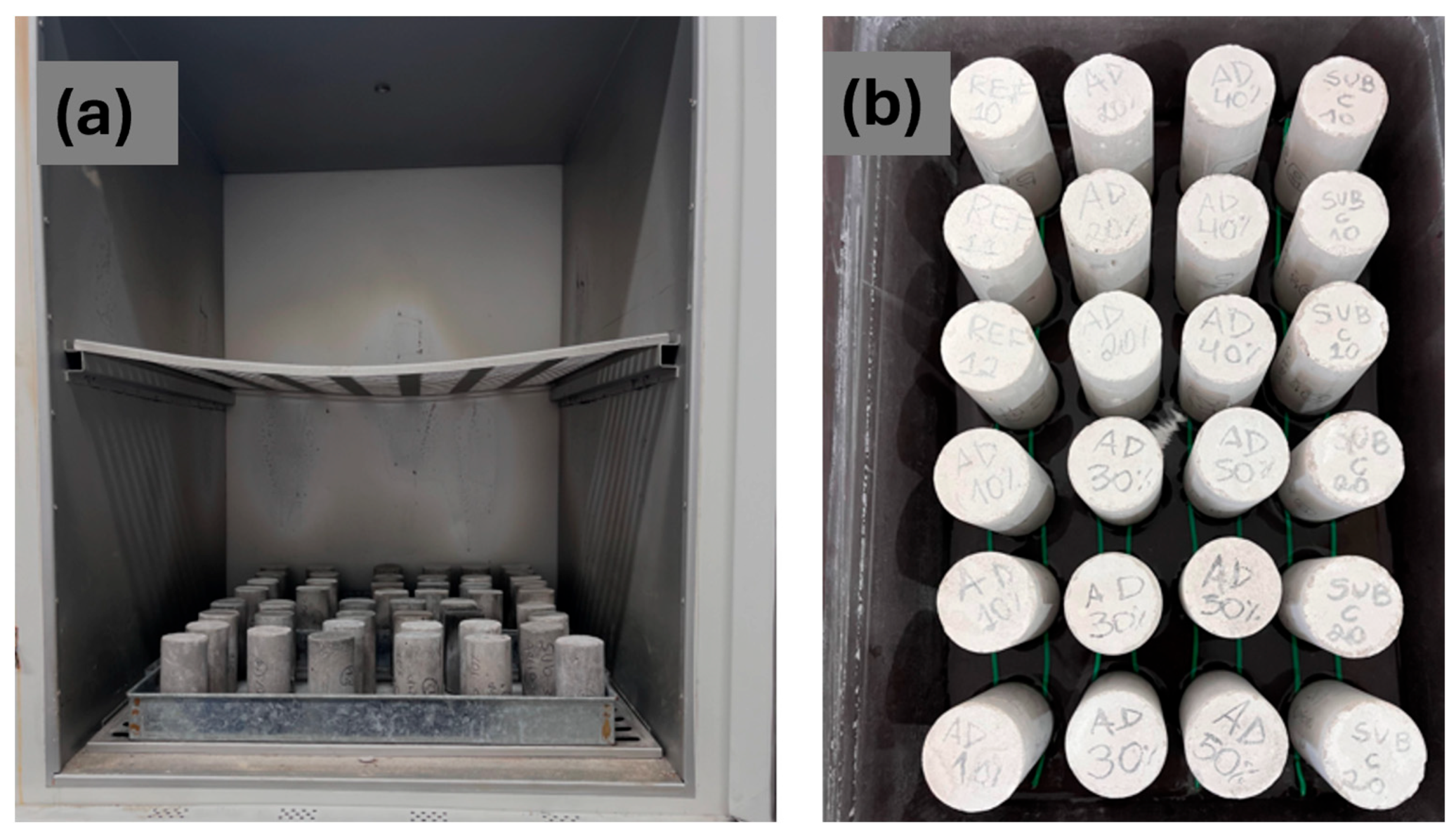
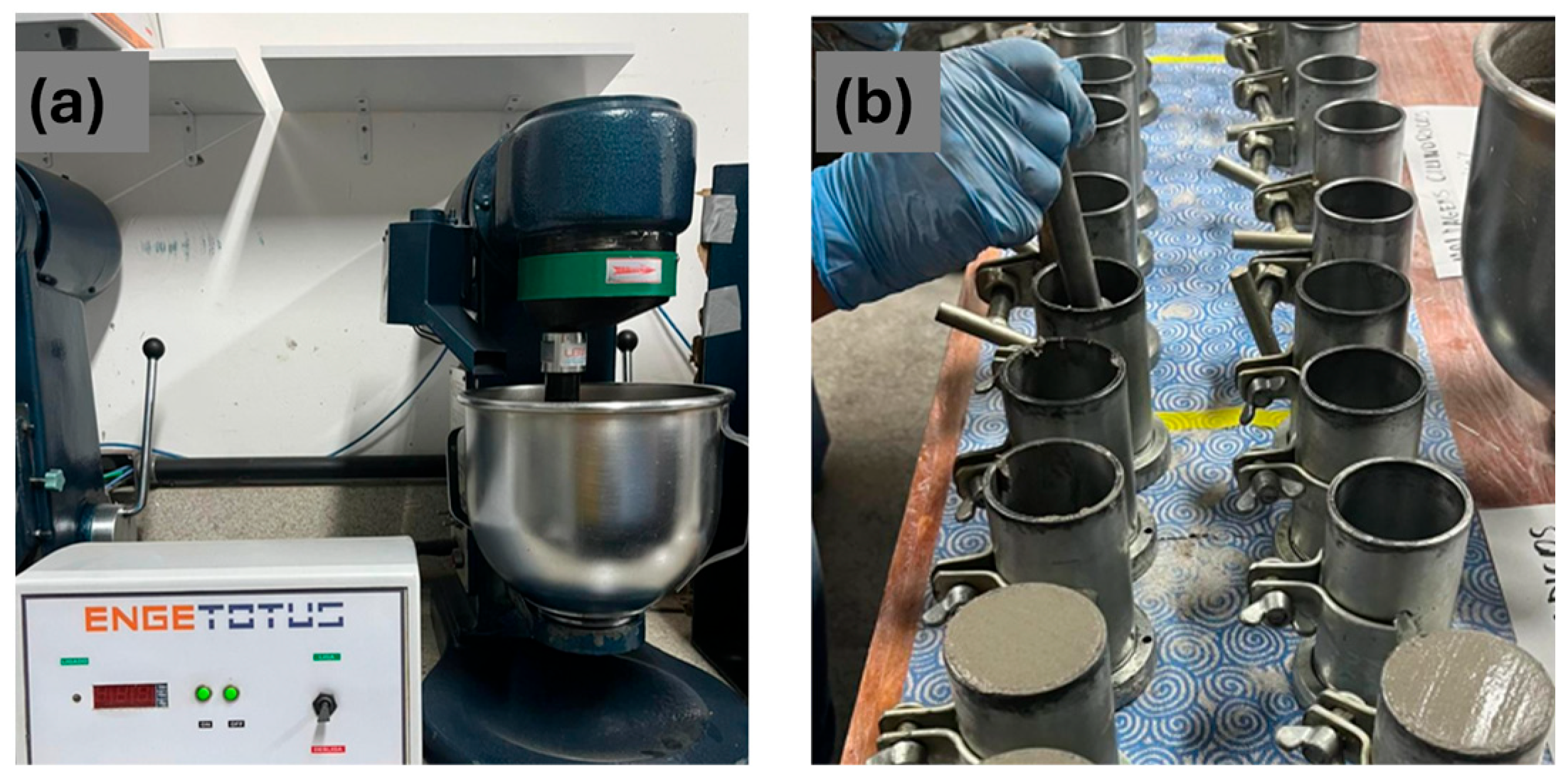
2.3. Processing of Mortars
2.4. Mechanical Tests
2.4.1. Mass Density Determination
2.4.2. Water Absorption by Capillarity
2.4.3. Axial Compression Strength
2.4.4. Flexural Tensile Strength
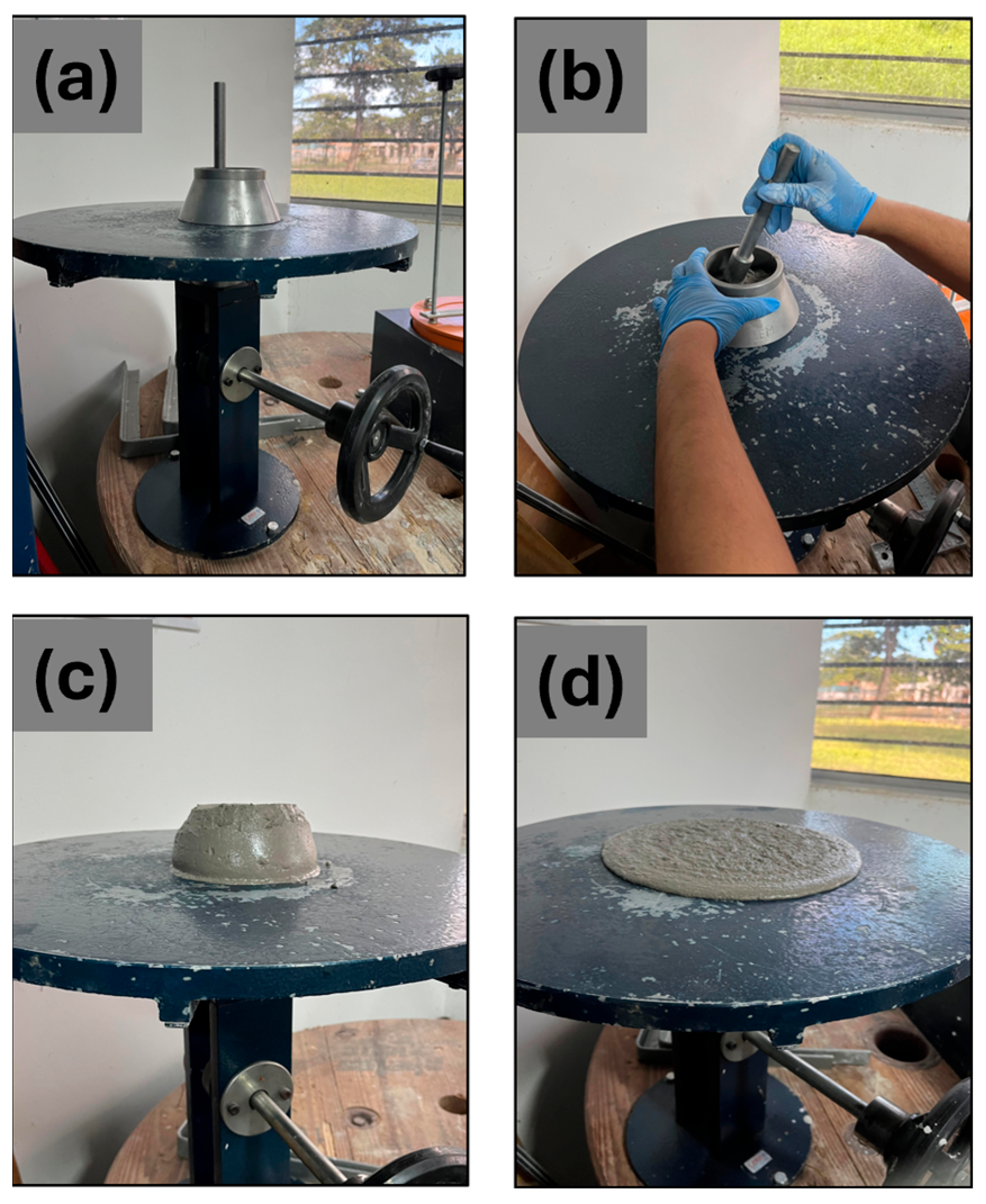
2.4.5. Determining the Consistency Index (Flow Table)
2.5. Microstructural Characterization
2.5.1. X-Ray Fluorescence (XRF)
2.5.2. X-Ray Diffraction (XRD)
2.5.3. Fourier Transform Infrared Spectroscopy (FTIR)
2.5.4. Scanning Electron Microscopy (SEM/EDS)
2.6. Statistical Analysis
3. Results and Discussions
3.1. Physical Aspects
3.2. Mechanical Behavior
3.3. Chemical Aspects of the Mortars
3.4. Structural Characteristics of the Sustainable Mortars
3.5. Microstructural Properties of the Mortars
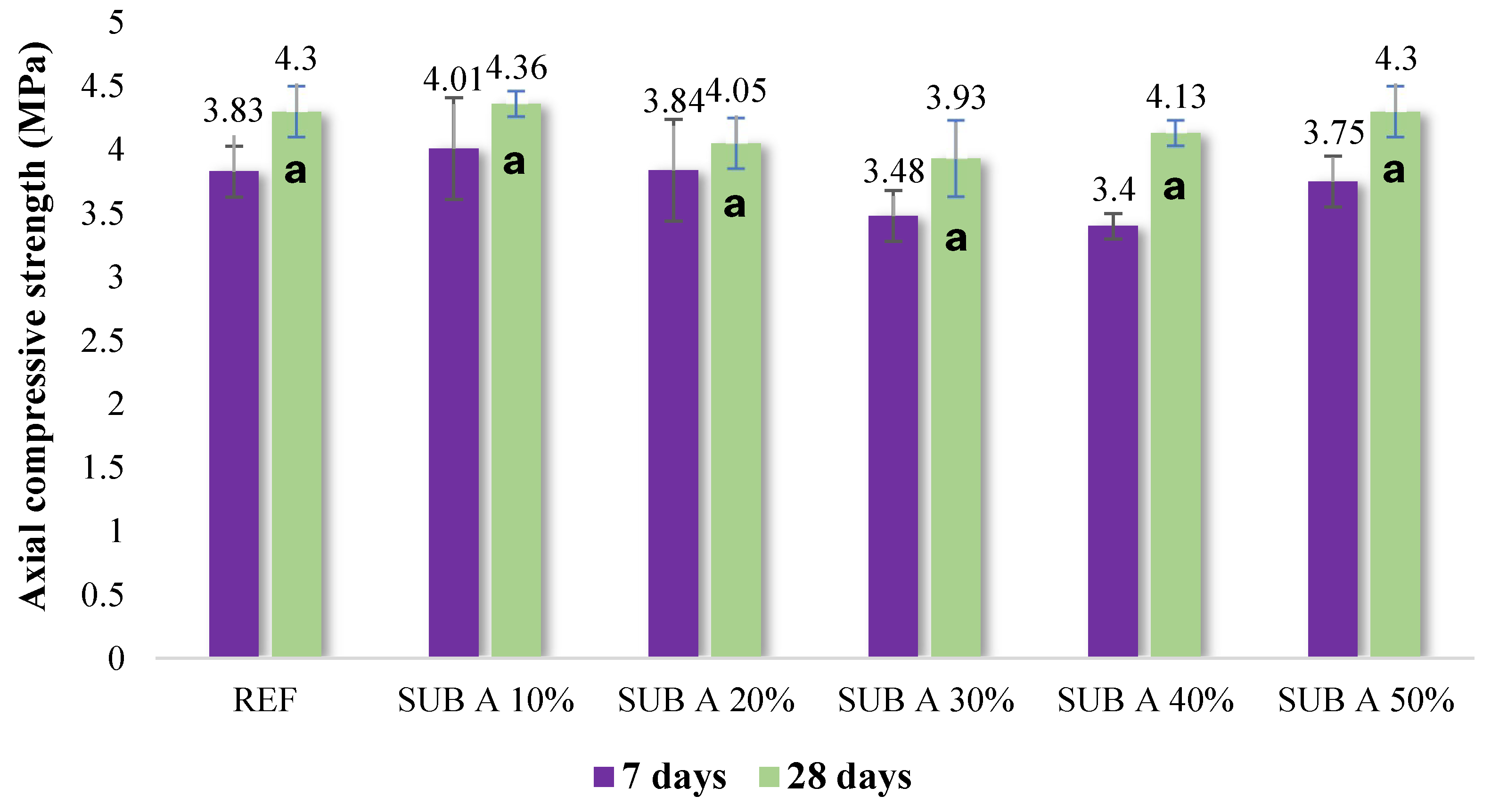
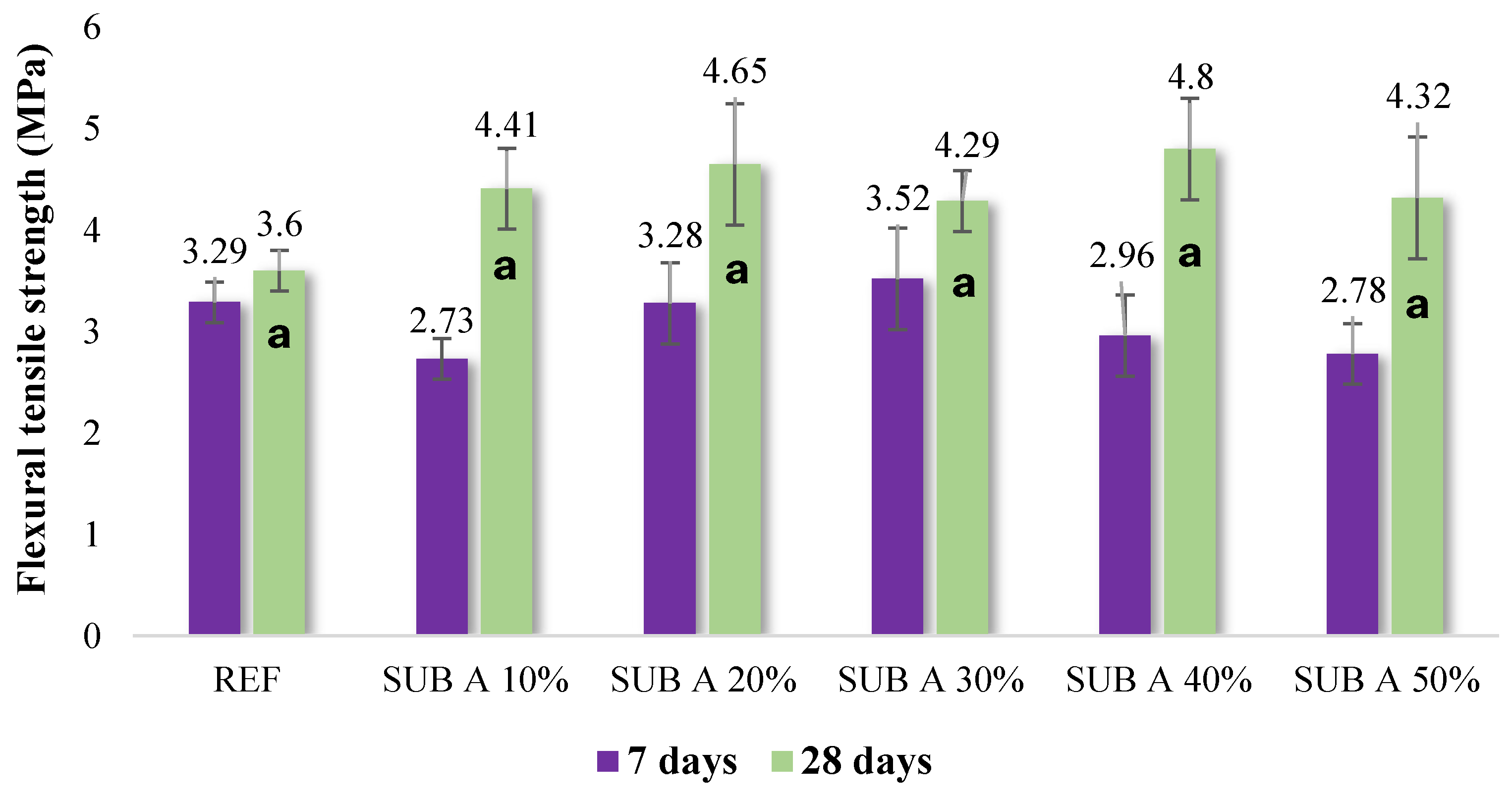
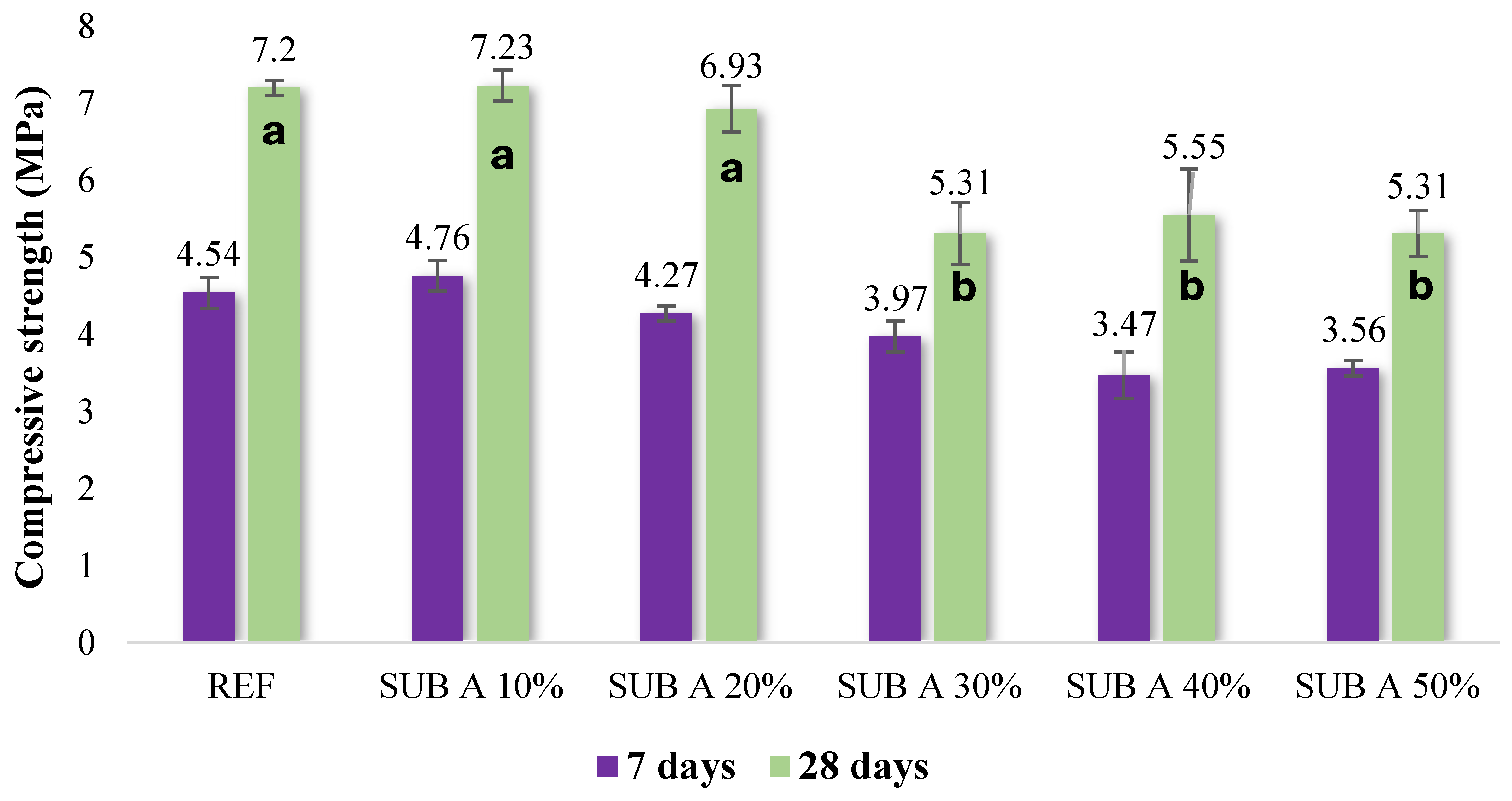
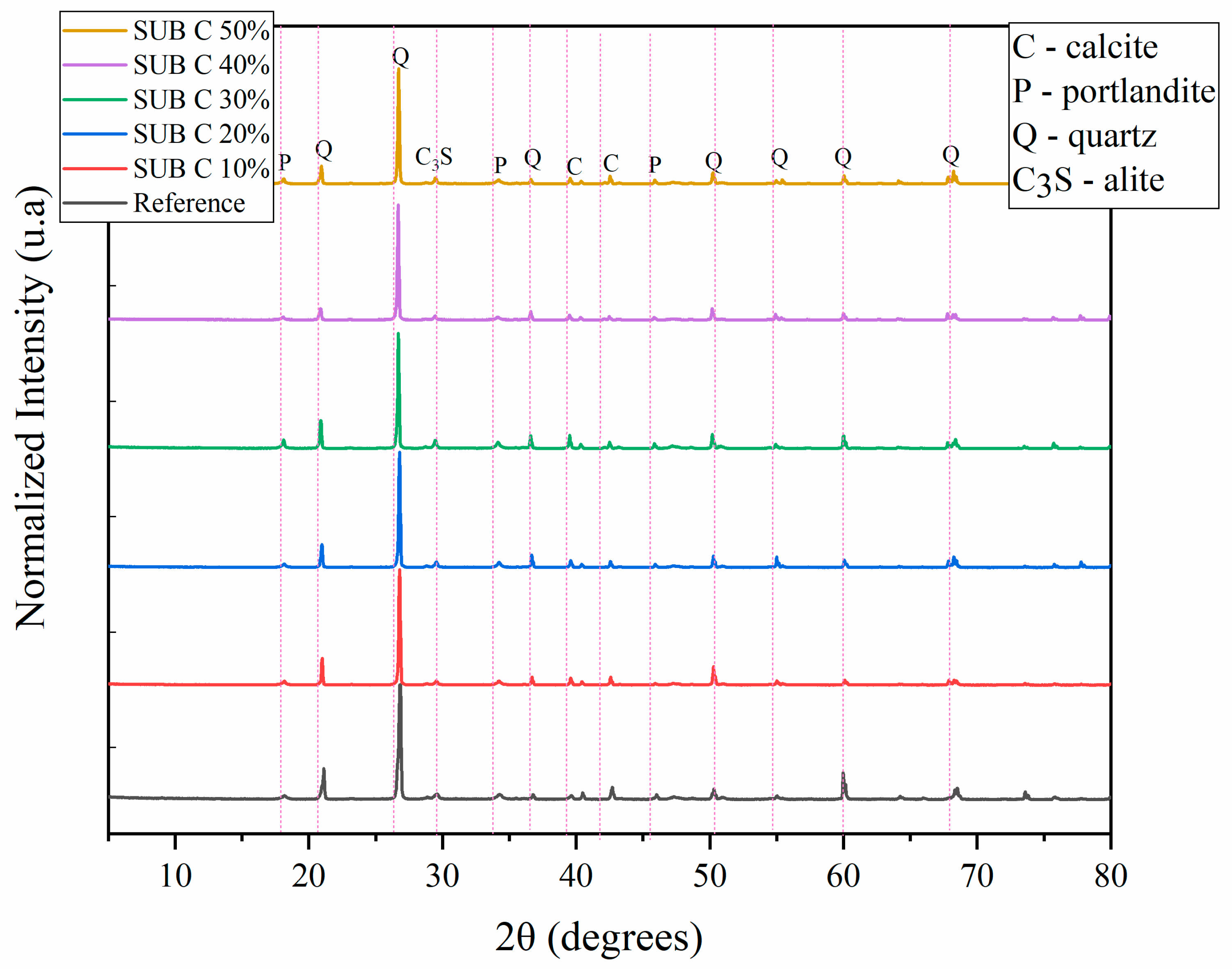
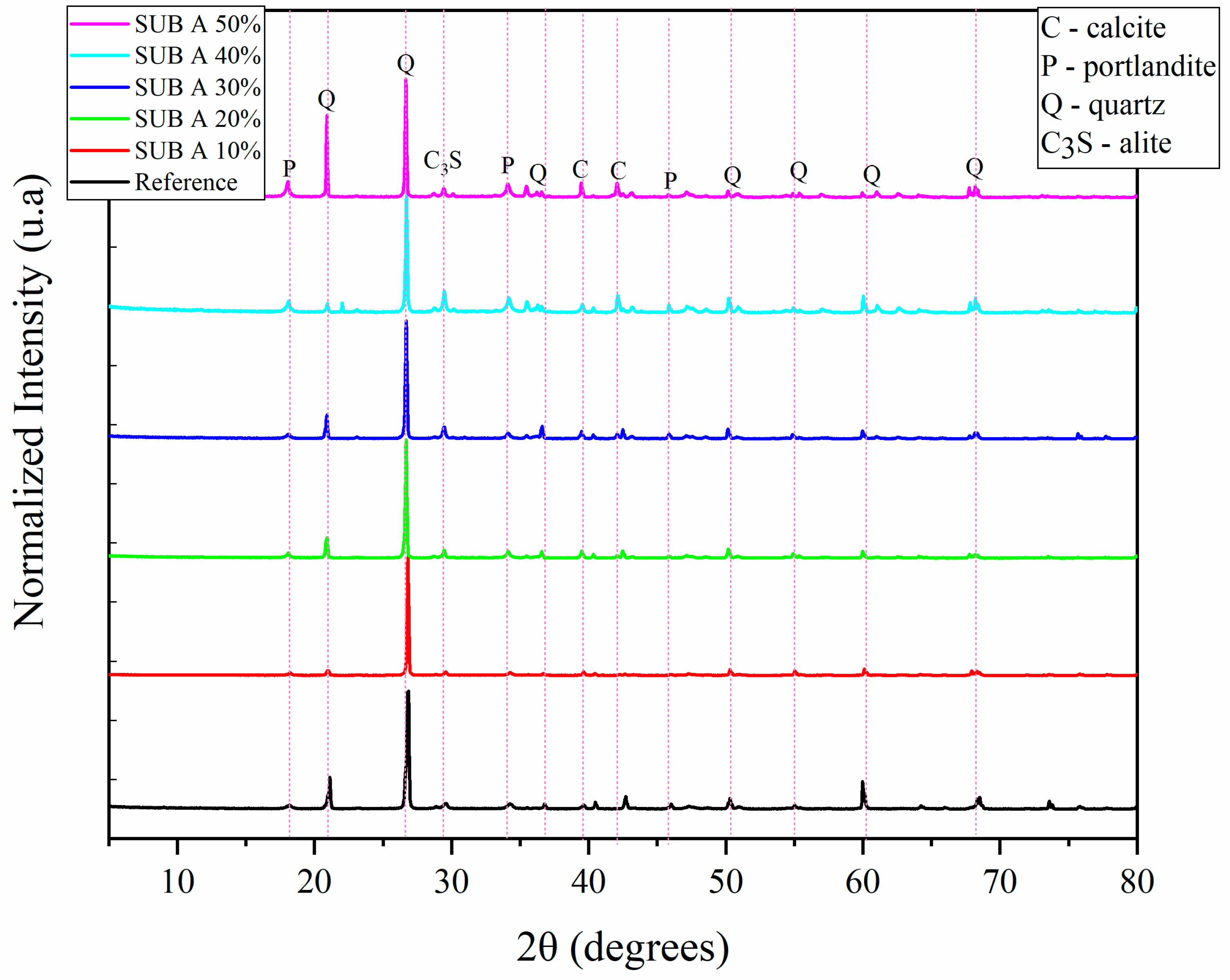
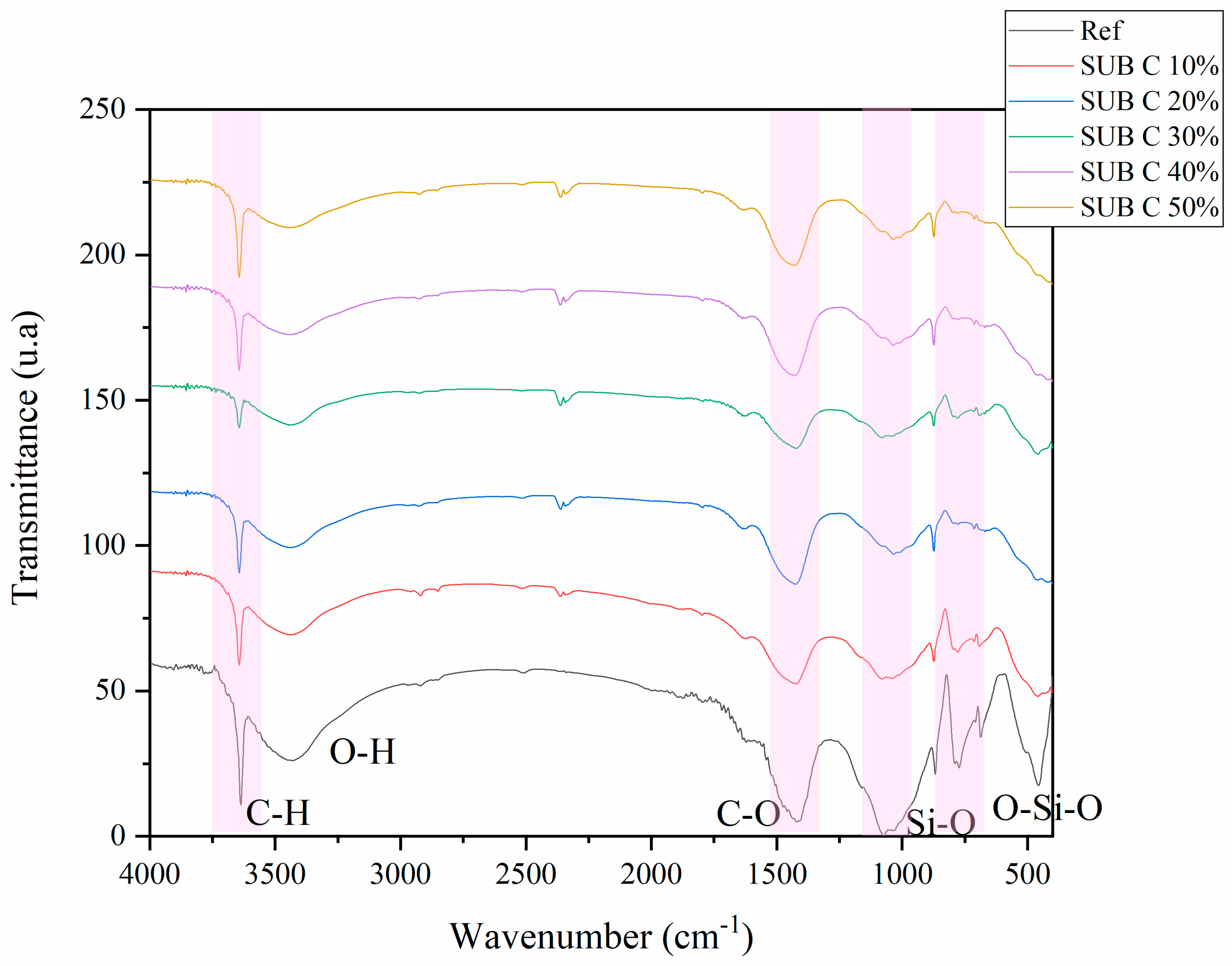
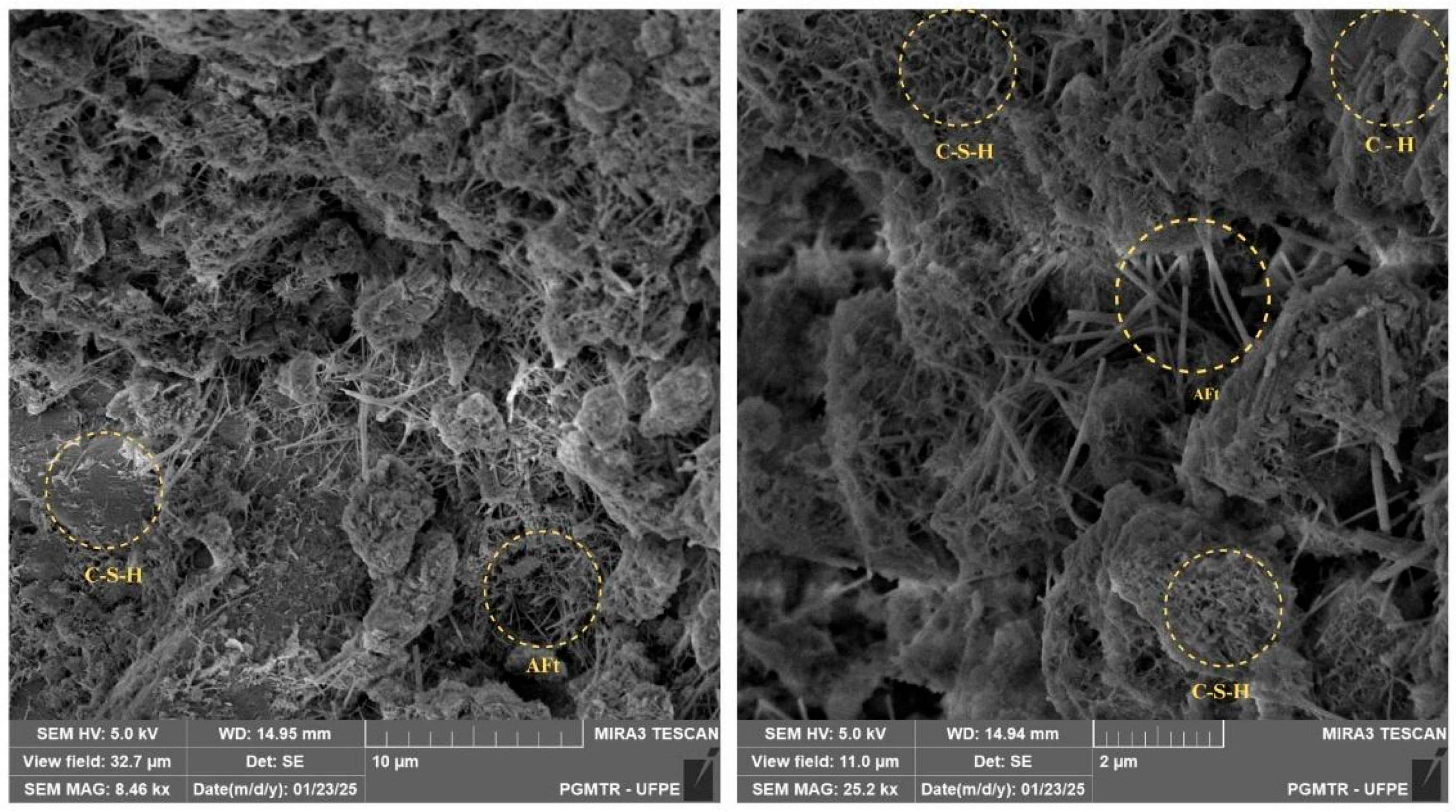
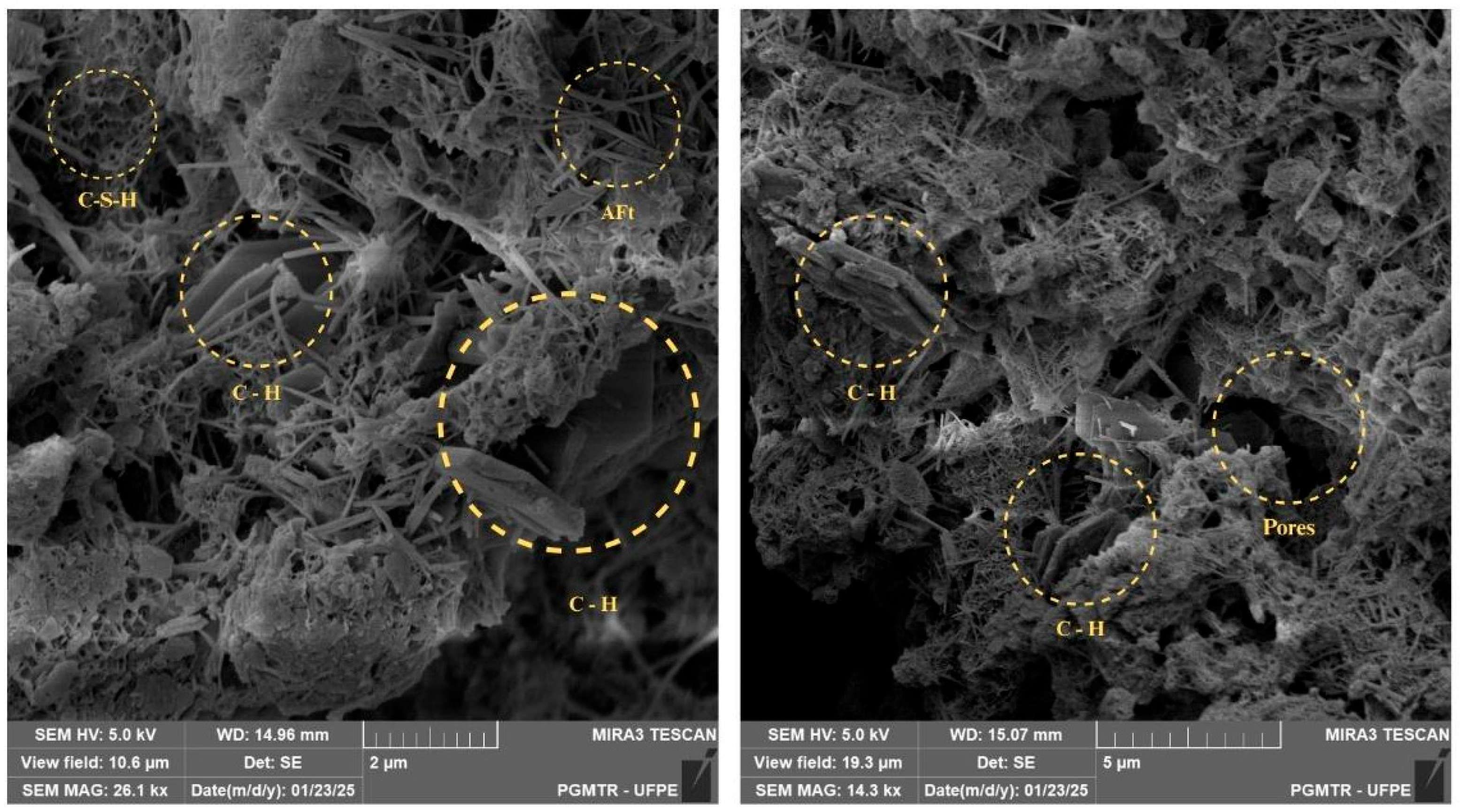
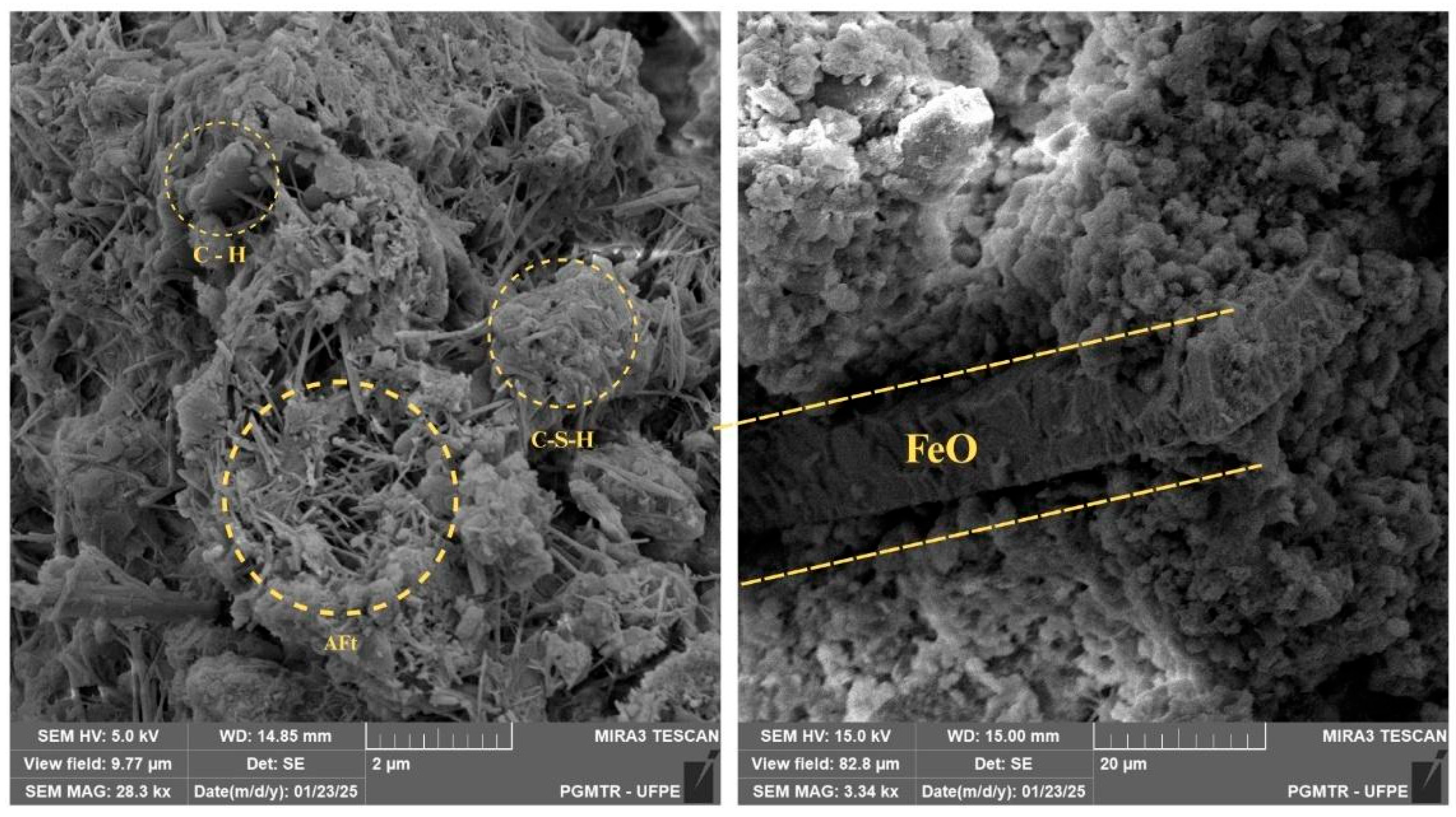
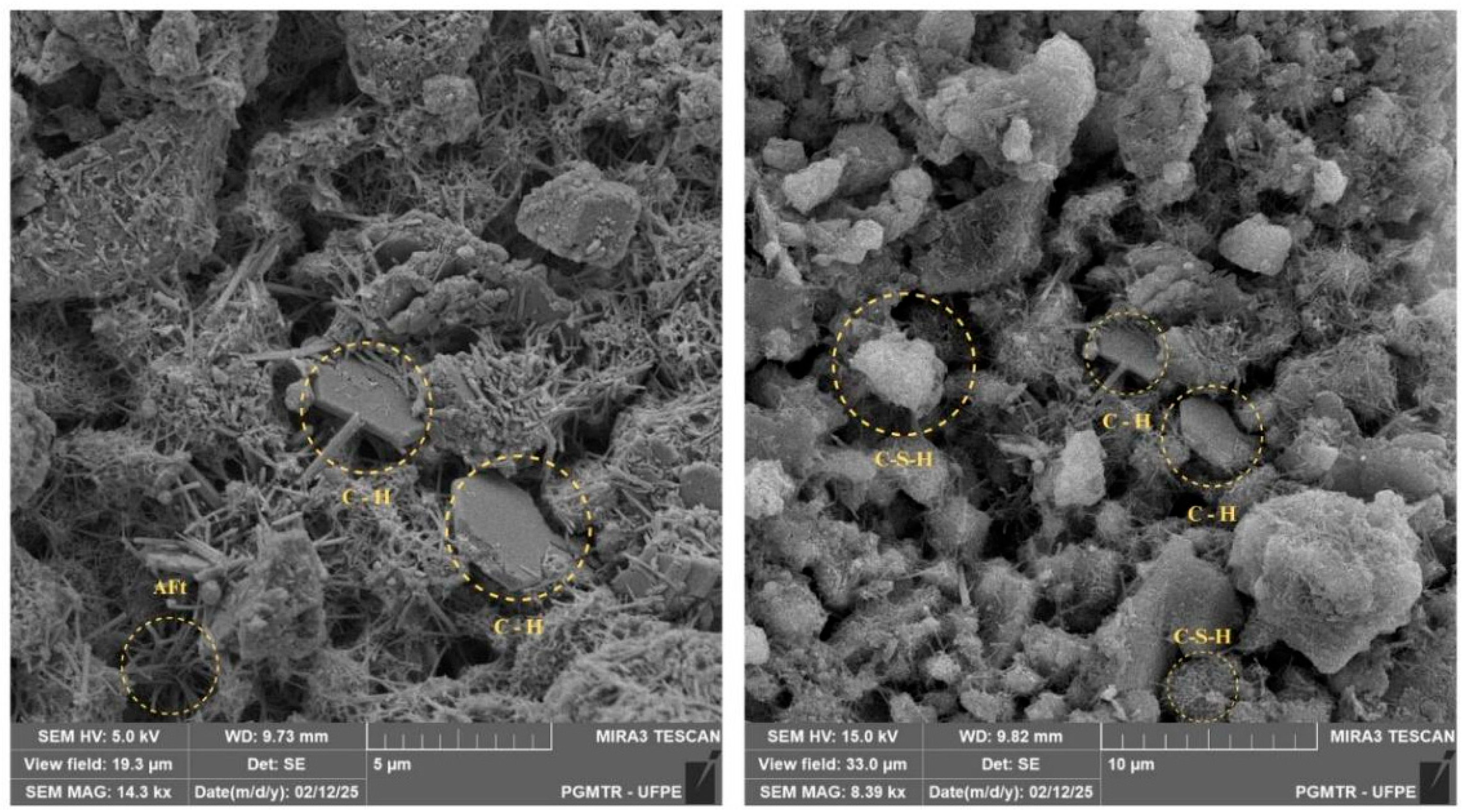
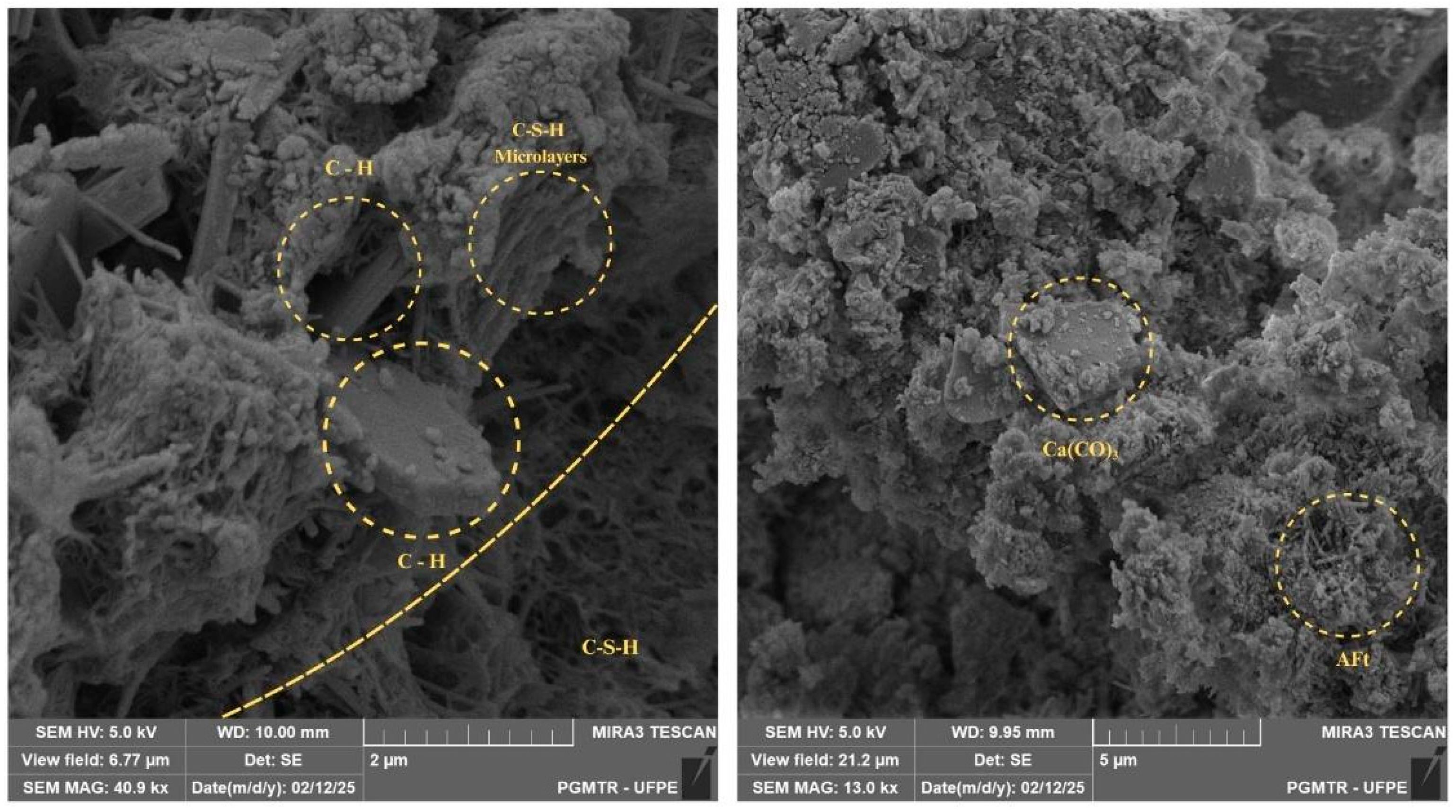
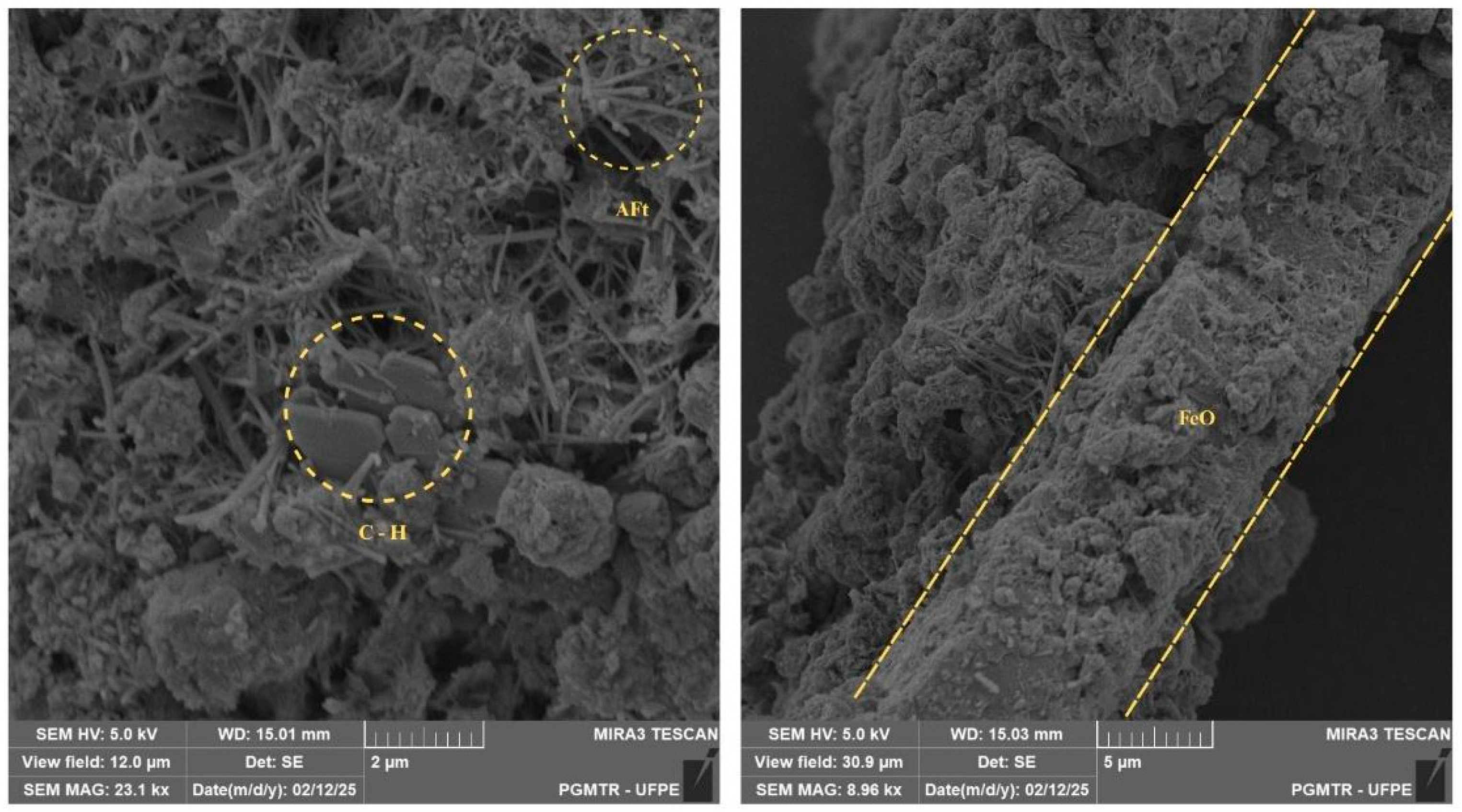
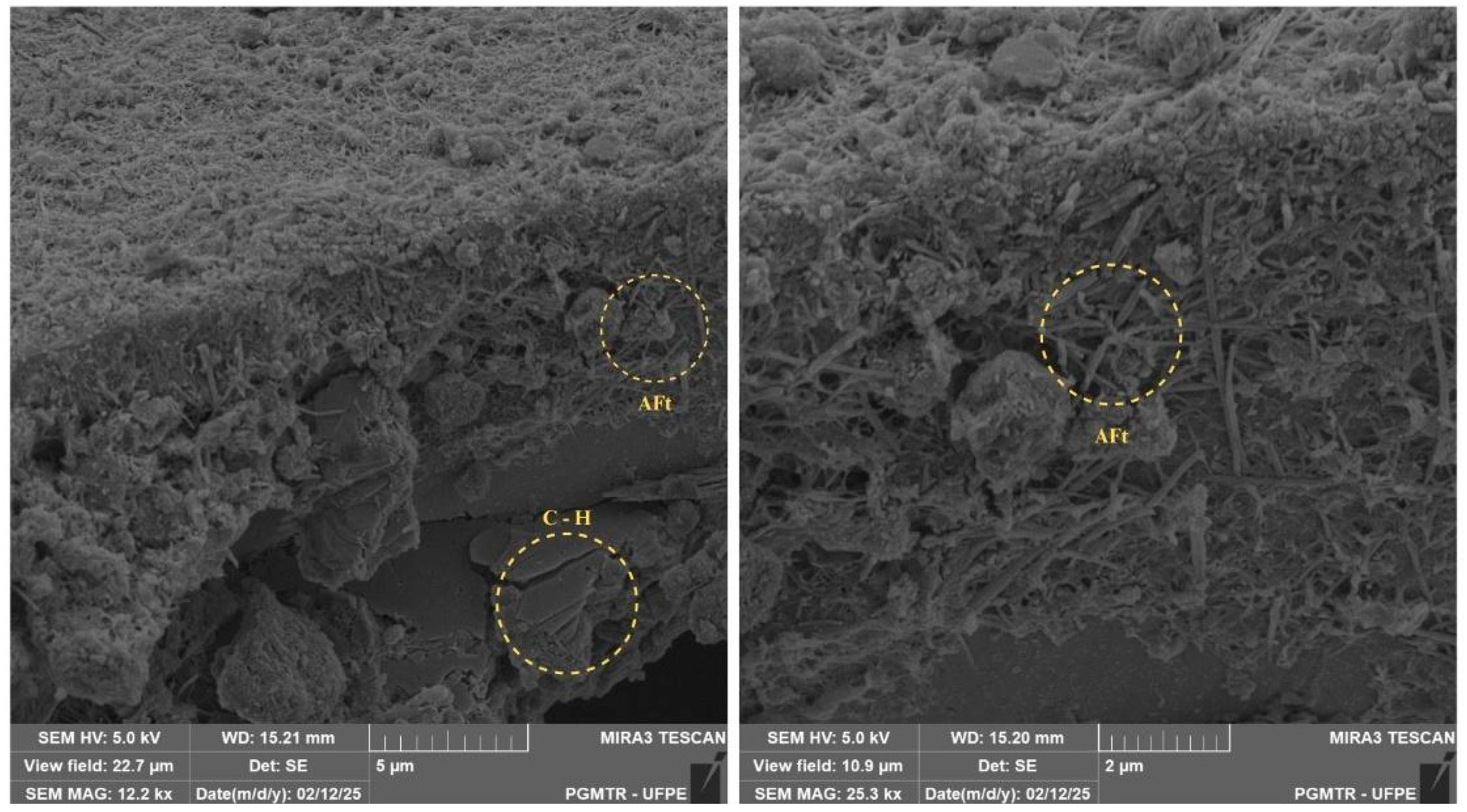
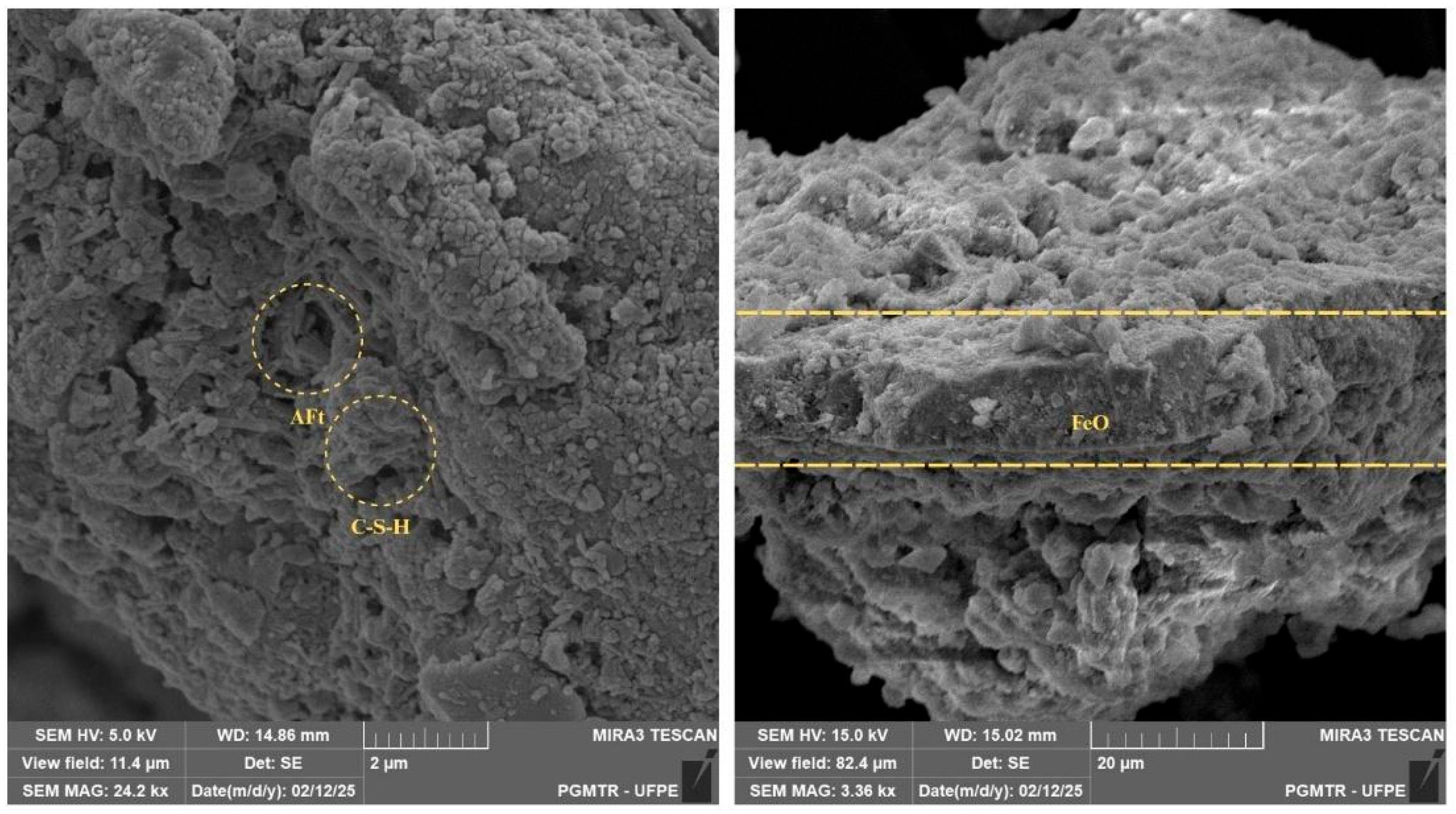
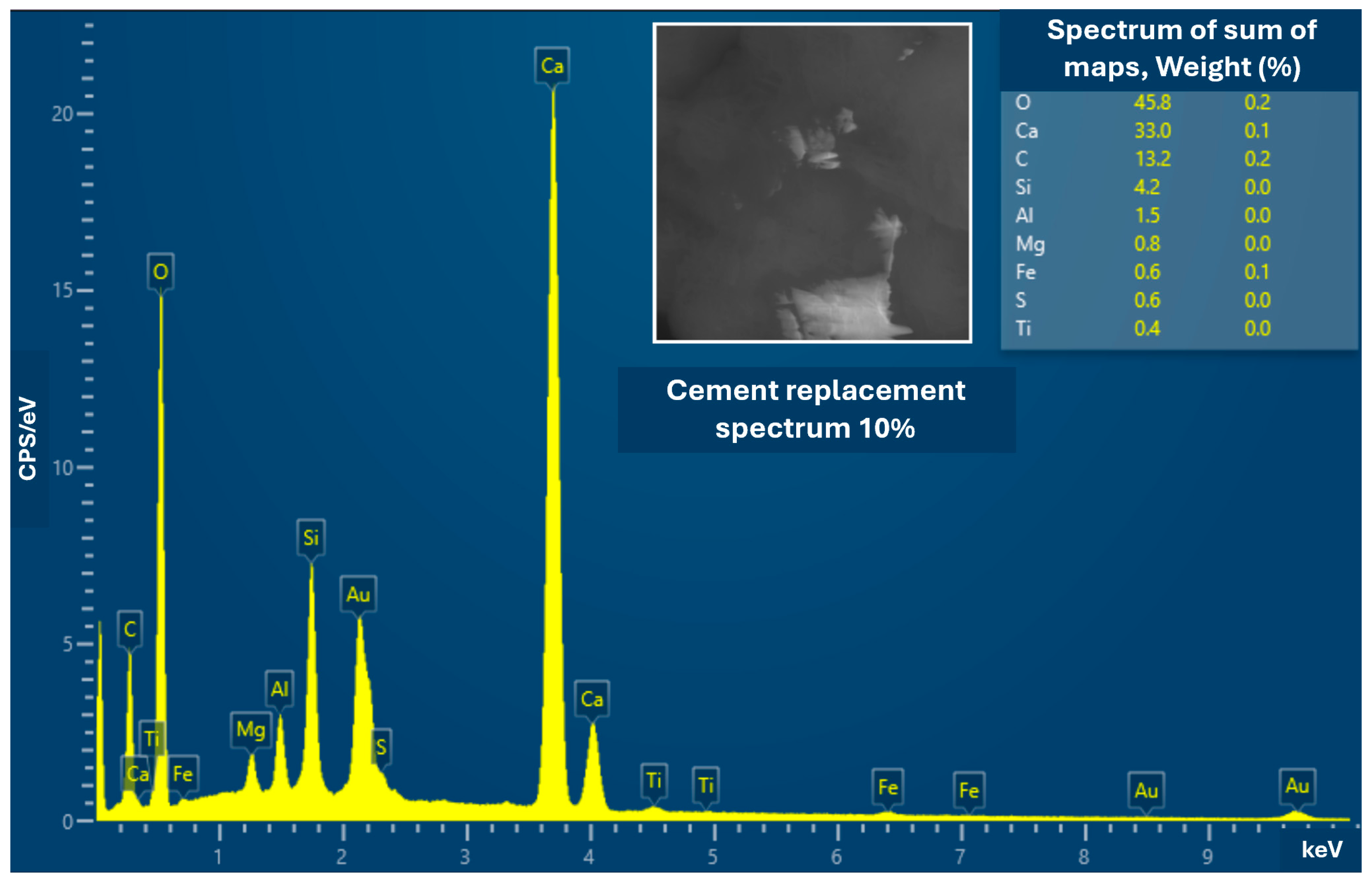
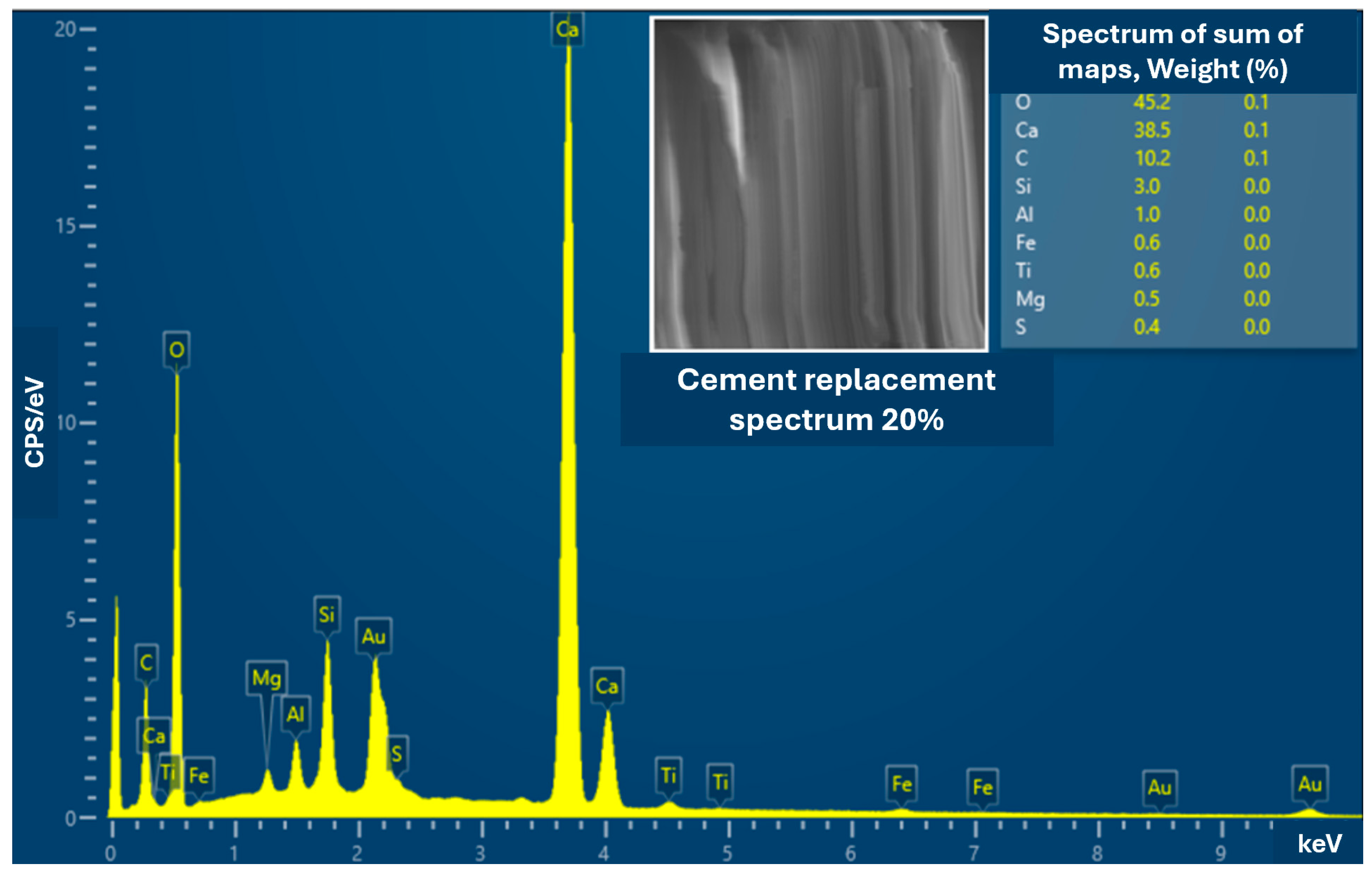
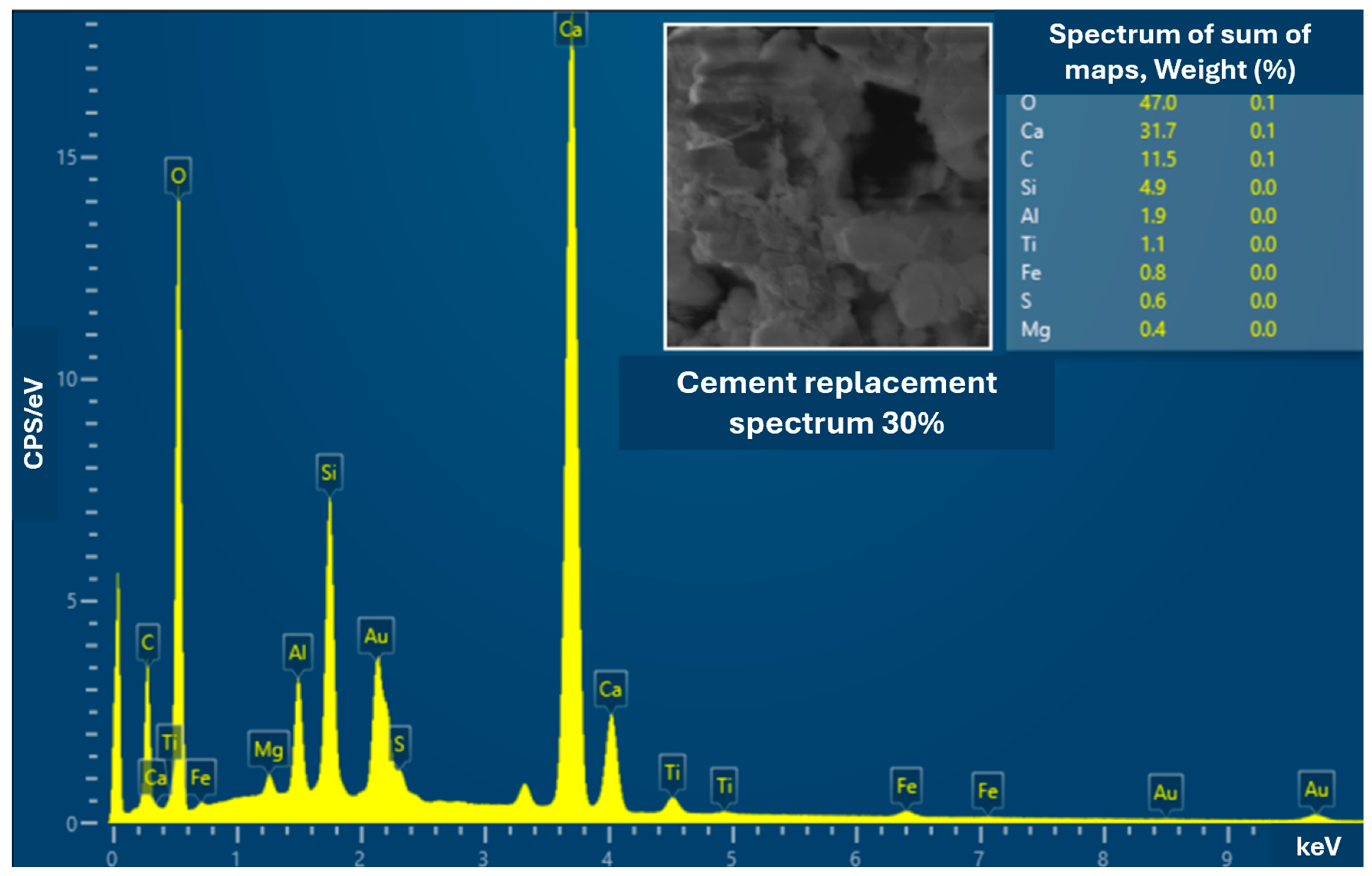
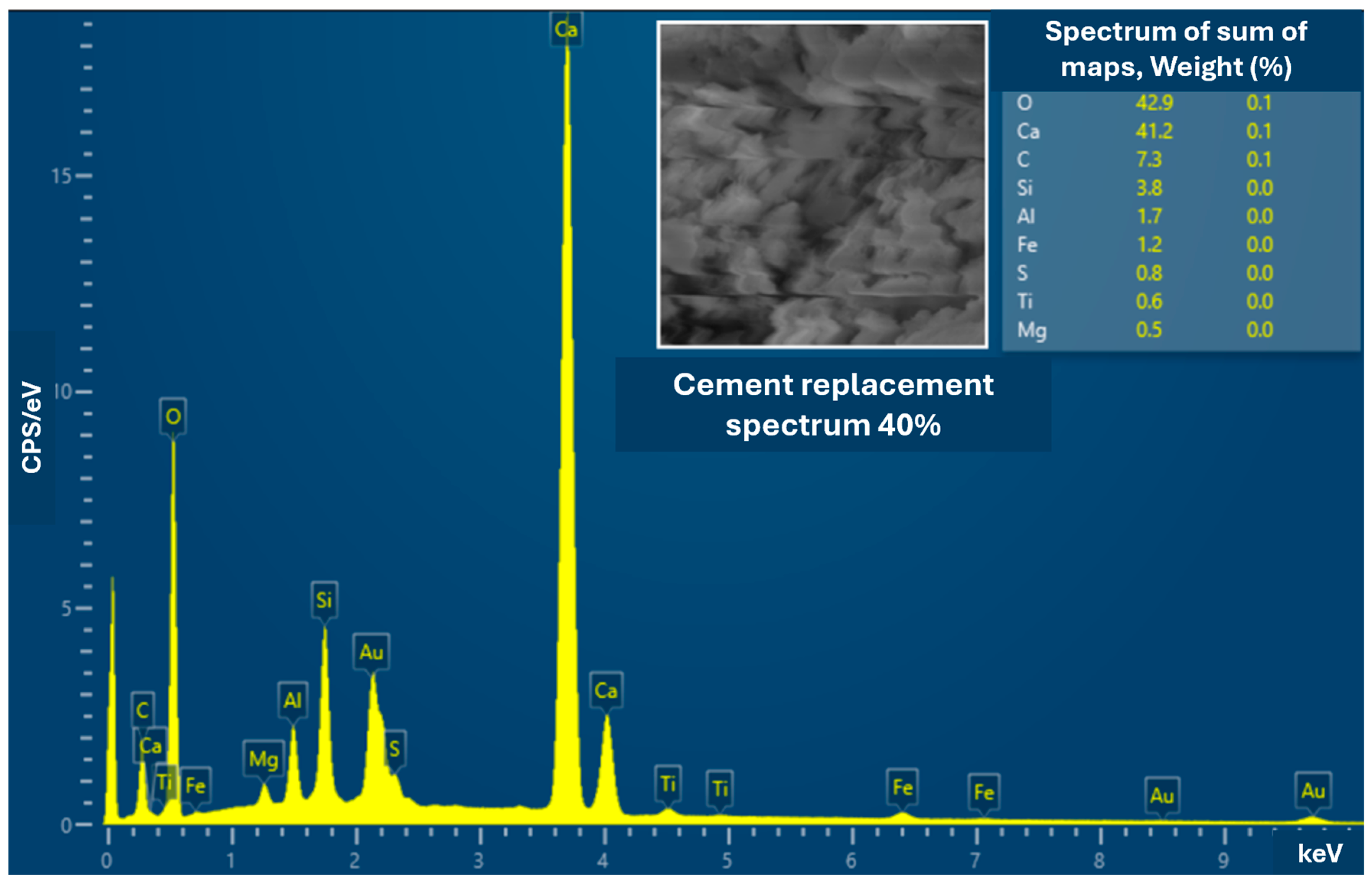
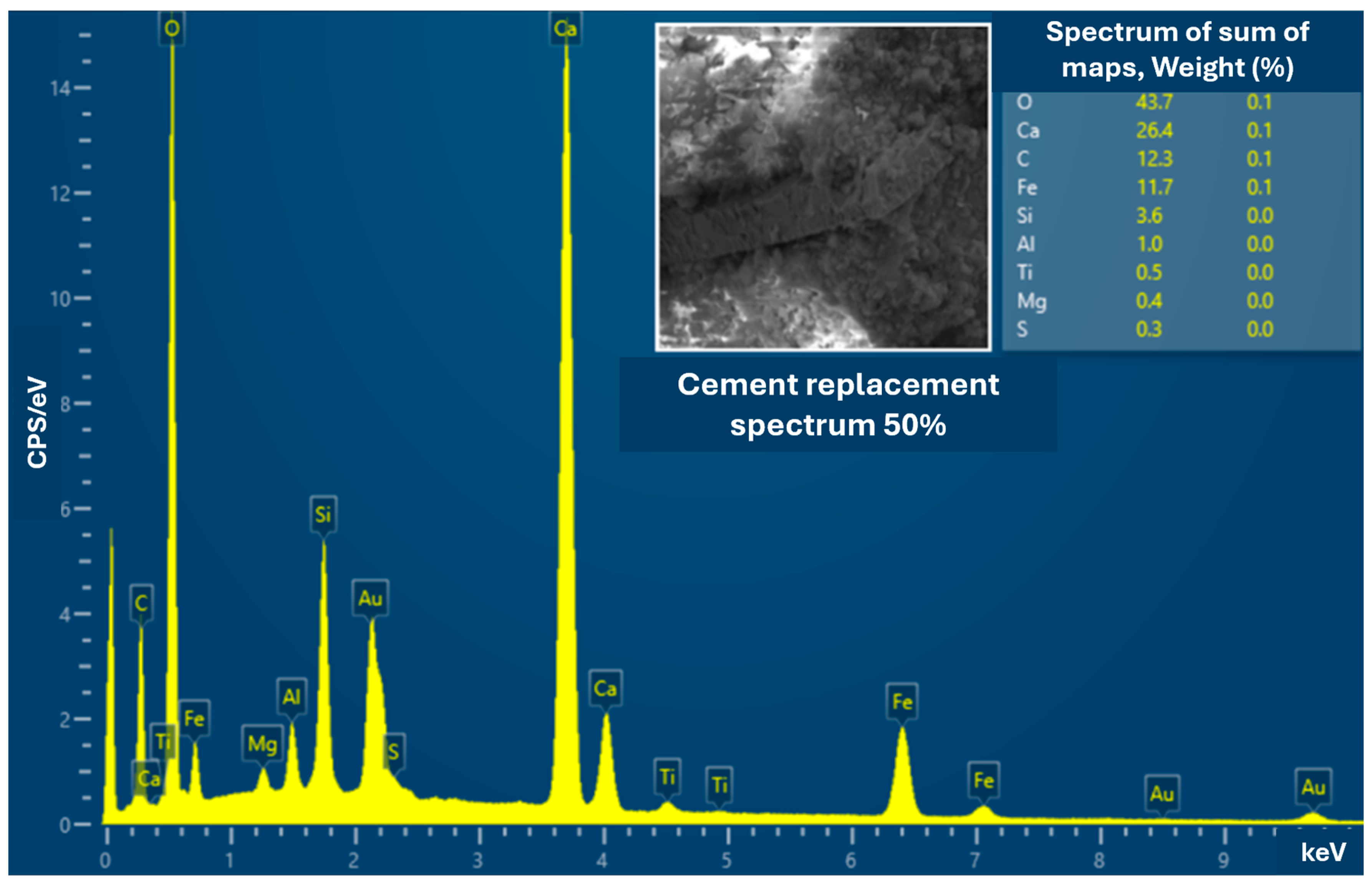
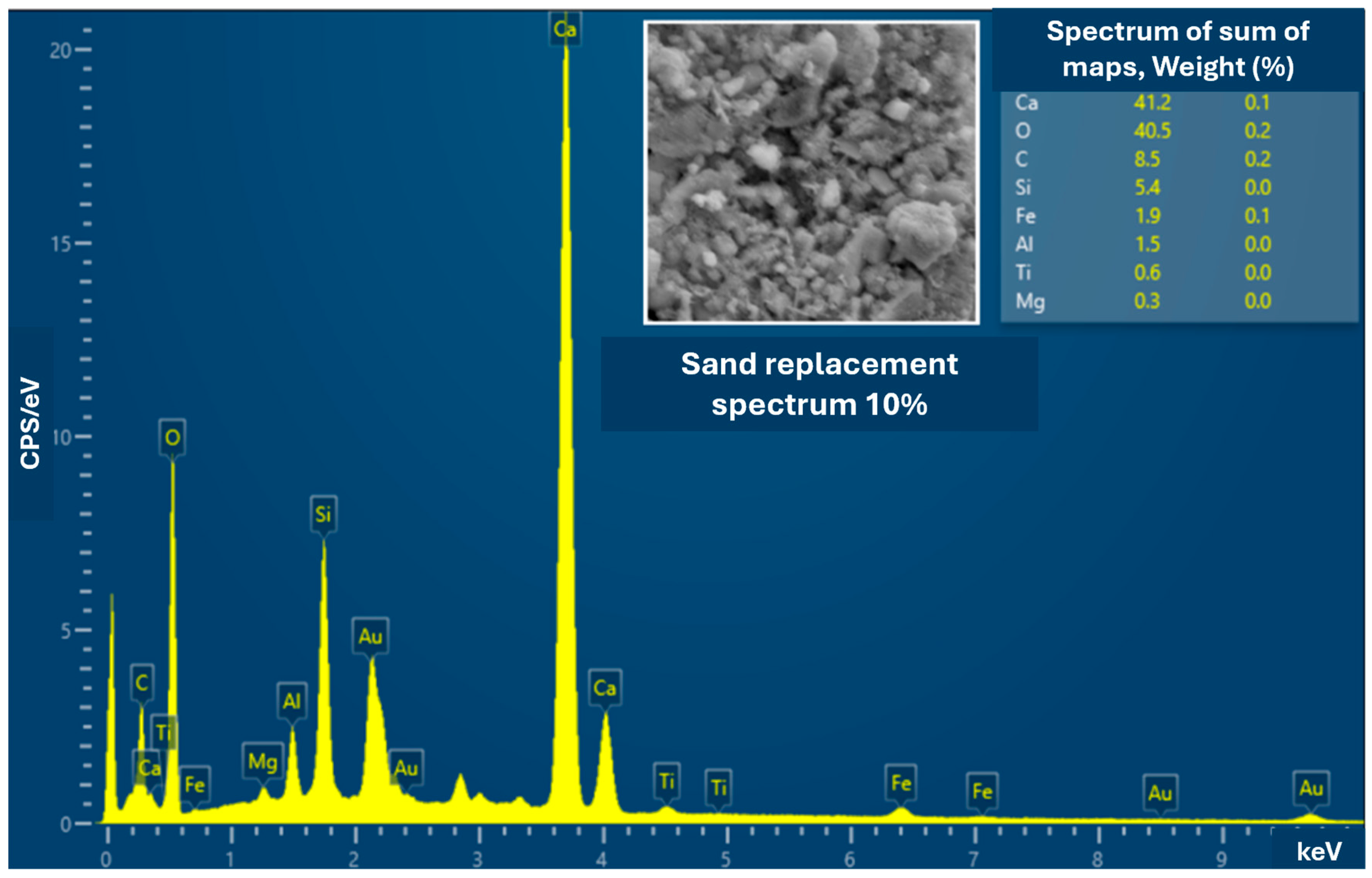
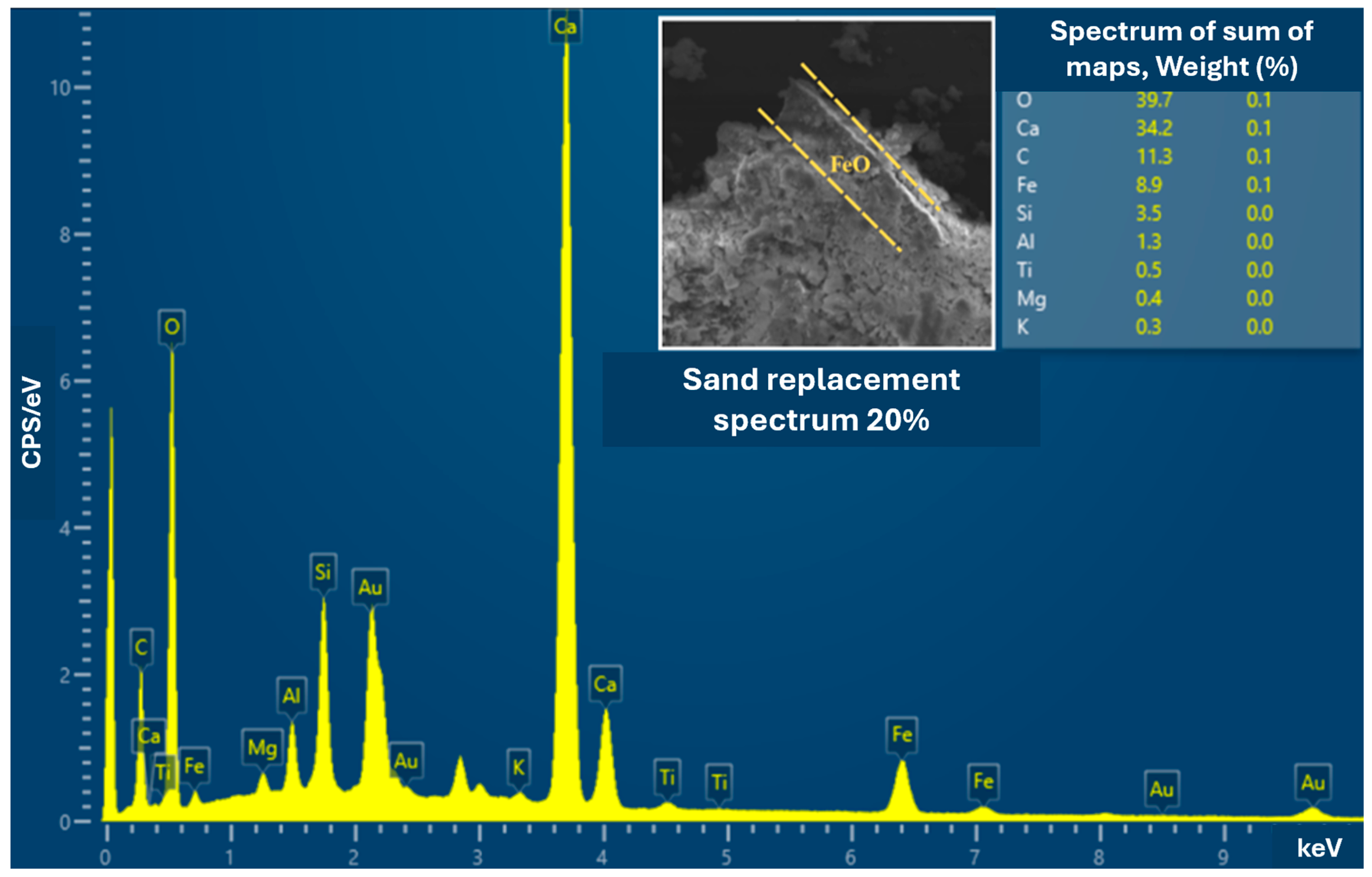
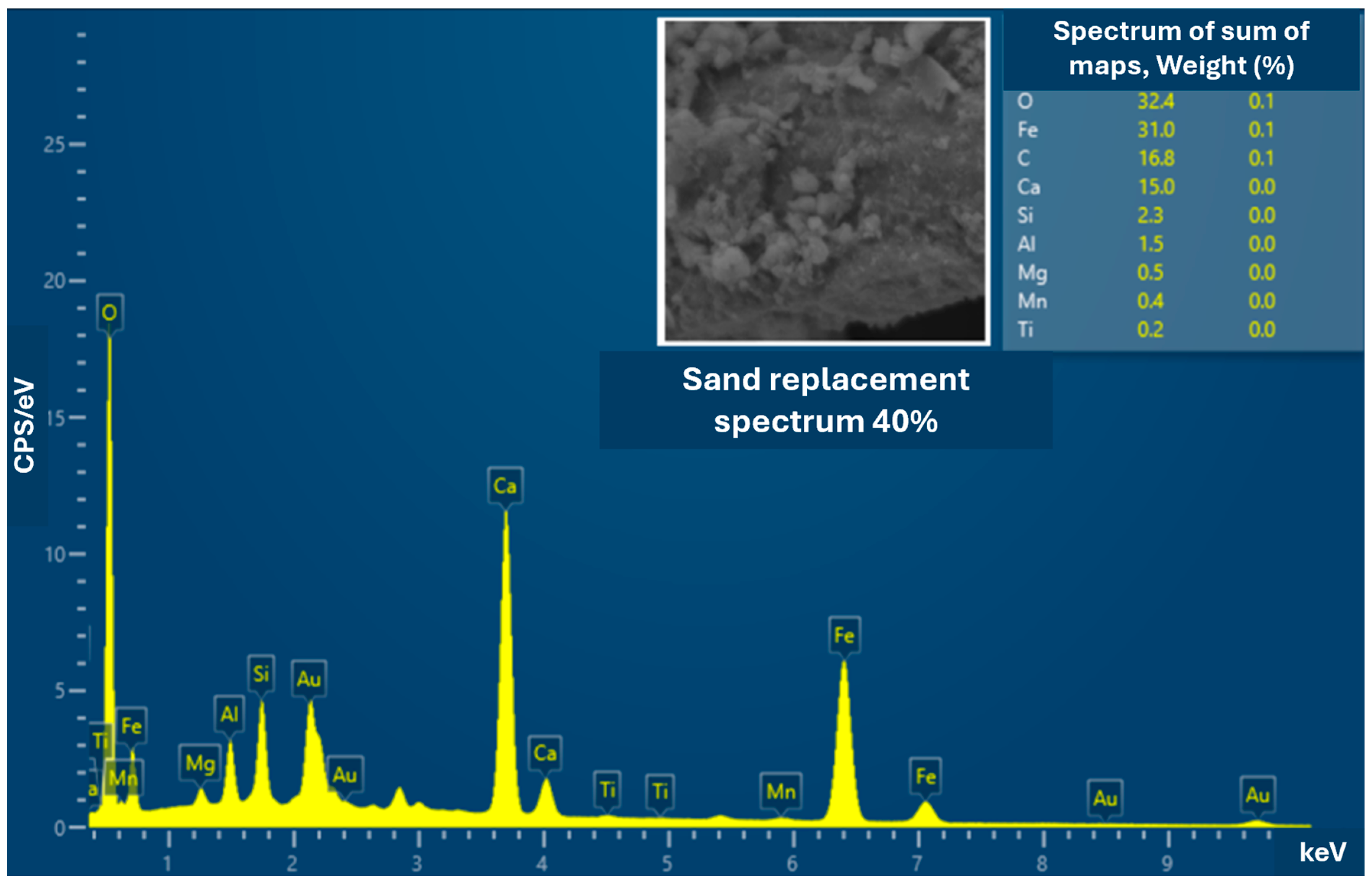
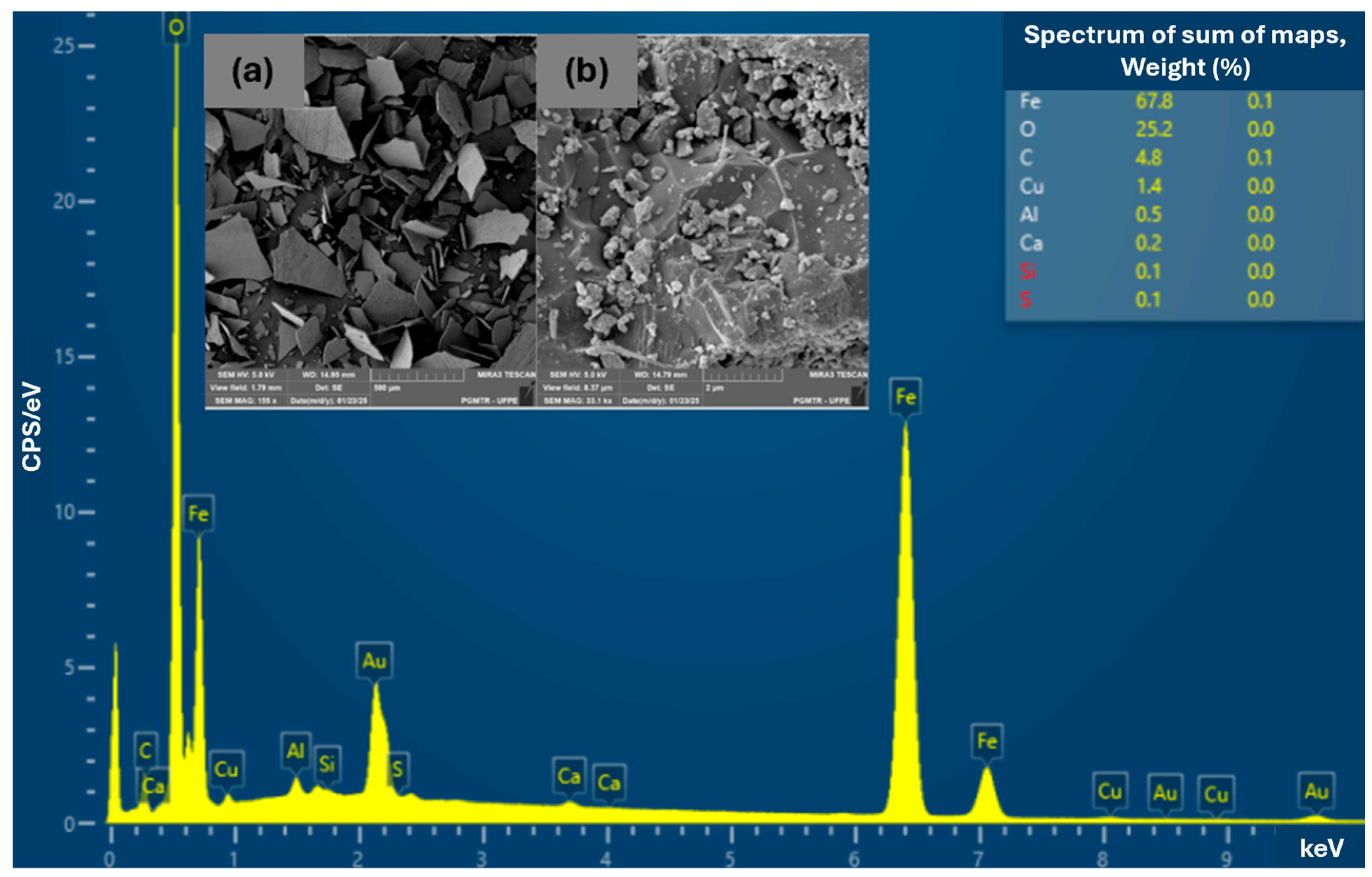
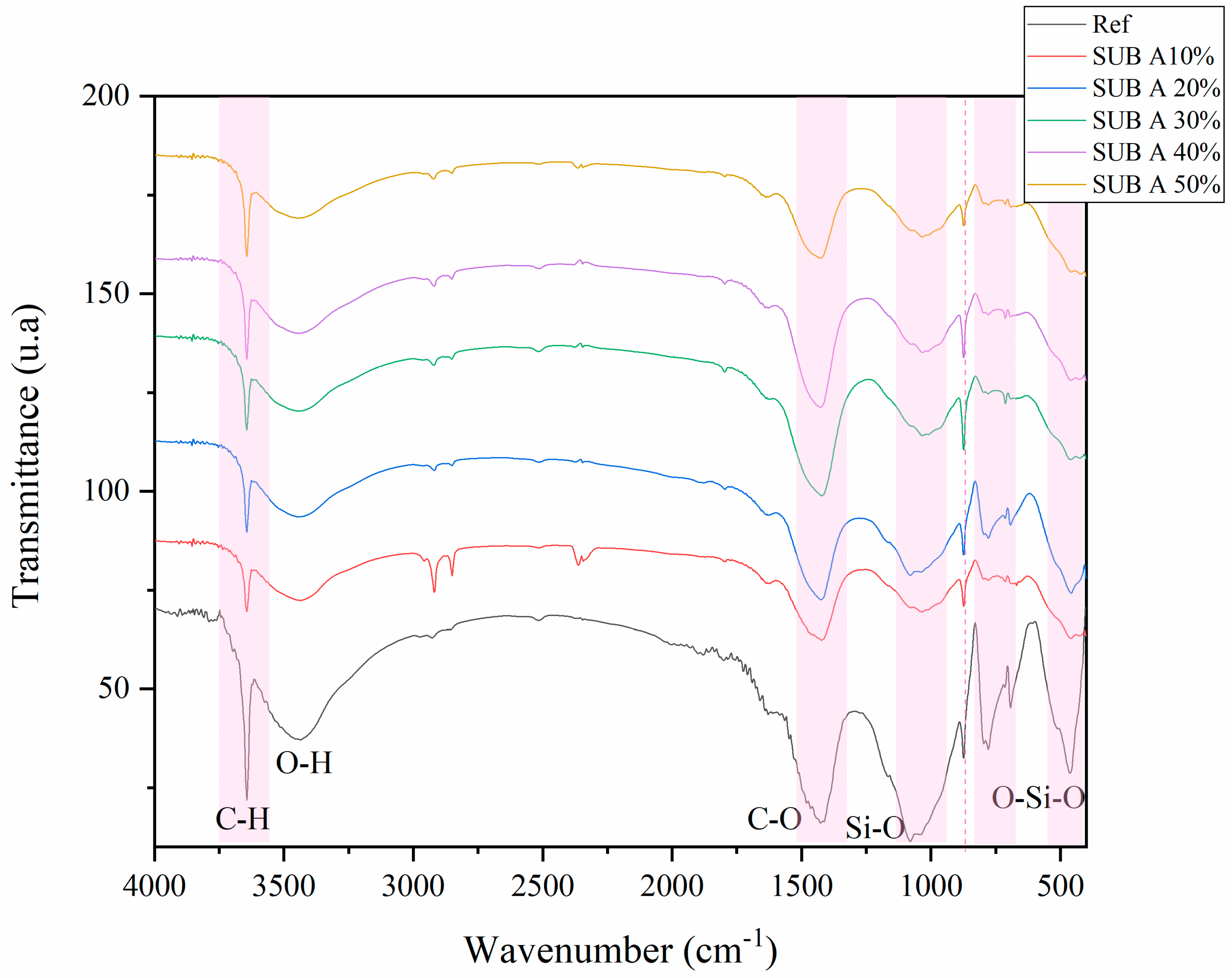
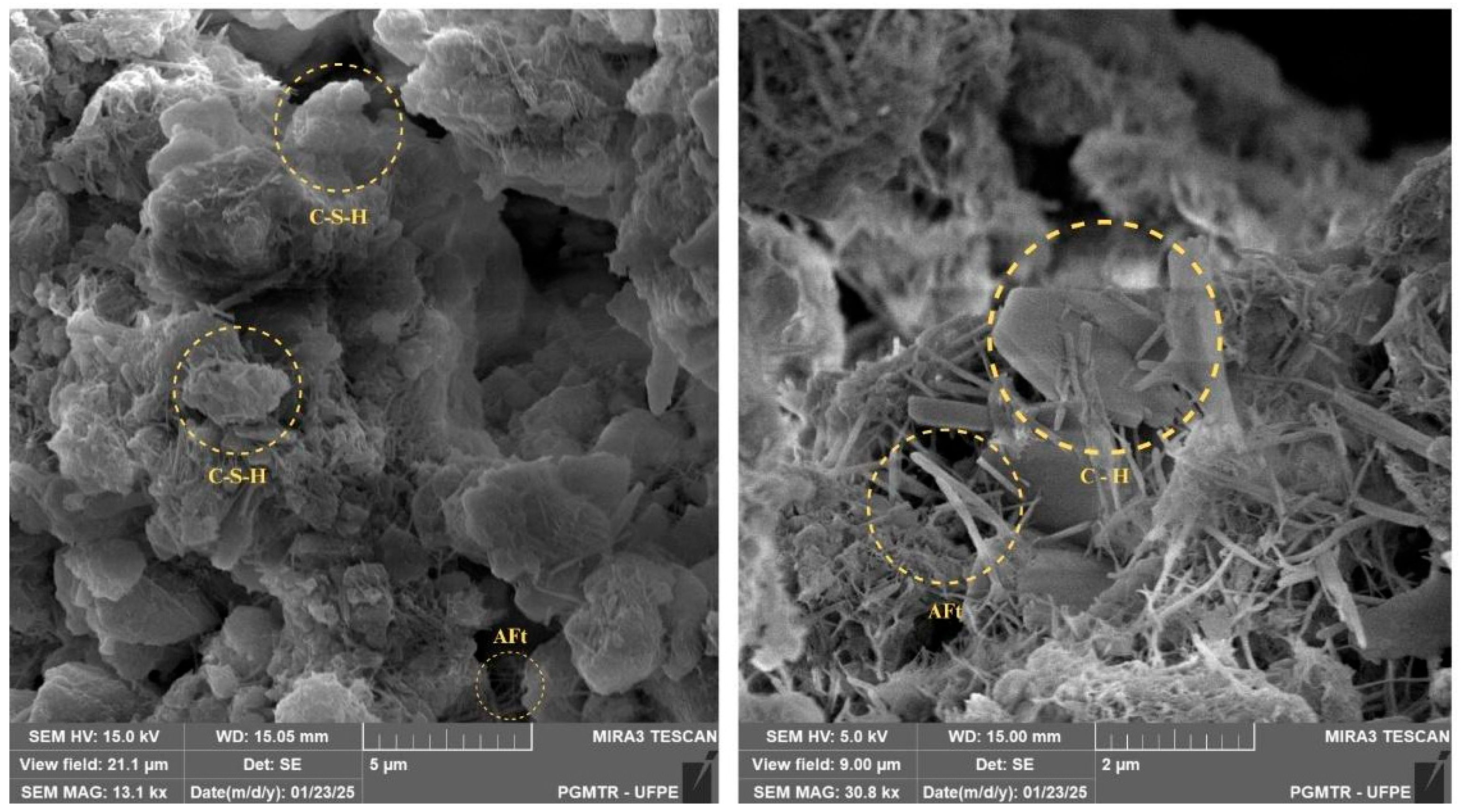
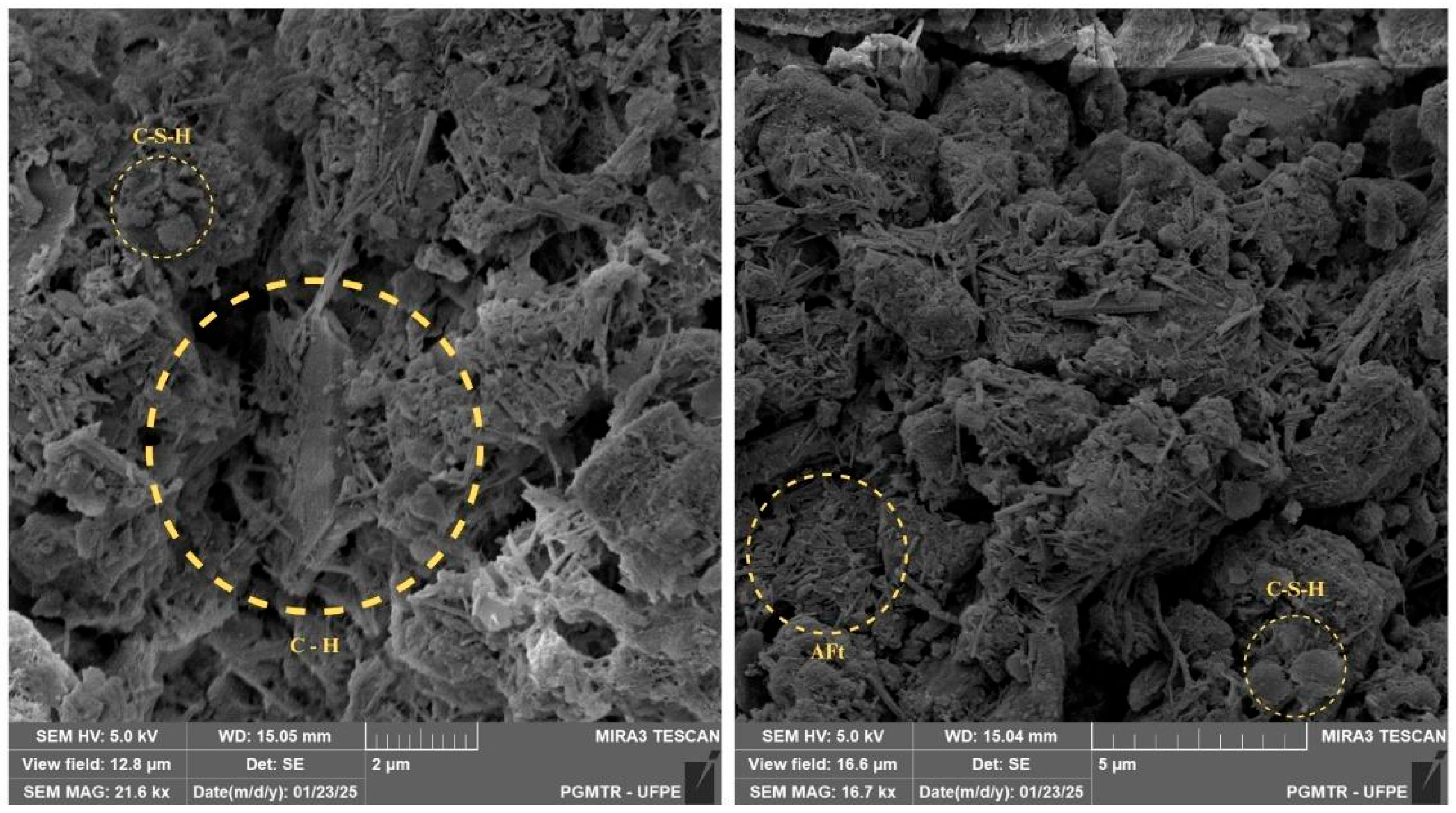
- The Mechanism of Strength Retention in Sand Replacement (SUB-A): As evidenced by the SEM micrographs (Figure 28, Figure 29, Figure 30, Figure 31 and Figure 32) and EDS mapping (Figure 38, Figure 39 and Figure 40), the mill scale particles exhibit a rough texture and a high degree of compactness within the matrix. Although XRD (Figure 20) and FTIR (Figure 22) confirm the inert chemical nature of the scale (with no new hydration products formed), the interface between the scale and the cement paste is tight and free of significant detachment voids. This effective physical interlocking at the Interfacial Transition Zone (ITZ) explains why the compressive and tensile strengths were maintained (Figure 14 and Figure 16) despite the replacement of natural sand. The scale acts as a high-stiffness inclusion that mechanically reinforces the matrix, provided it is well-encapsulated.
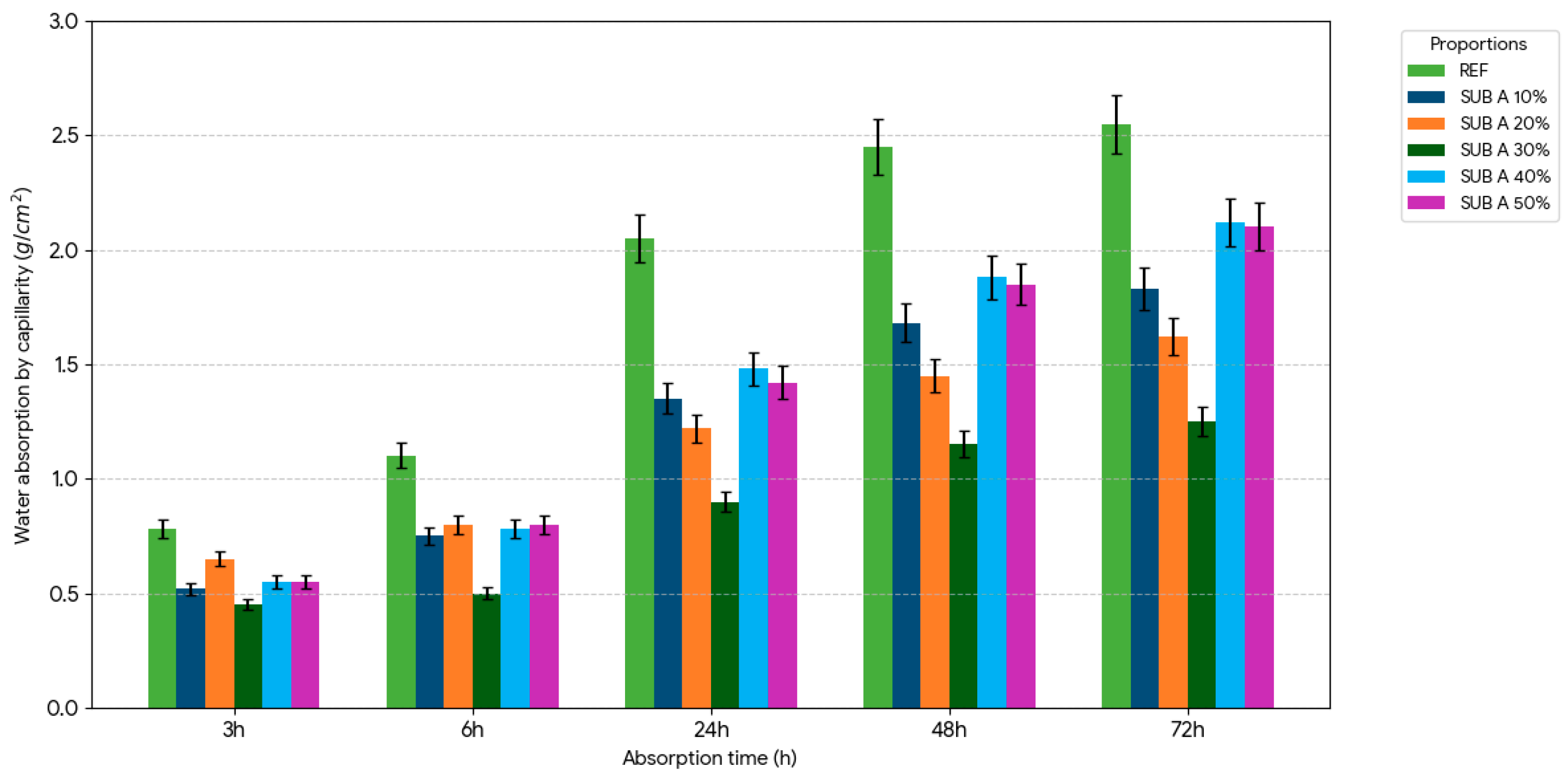
- The Mechanism of Permeability Reduction: The capillary absorption results (Figure 12), which showed a decrease in permeability for the SUB-A group, are directly explained by the EDS findings. The iron-rich scale particles are denser (5.5 g/cm3) and less porous than the natural sand they replaced. In the microstructural images, these particles appear as dense blocks that interrupt the continuity of capillary pores. Consequently, they act as impermeable physical barriers, increasing the tortuosity of the pore network and hindering water transport, both of which are critical to the enhanced durability potential of these composites.
4. Conclusions
- Cement Replacement (SUB C): This approach compromised the performance of the mortar.
- ○
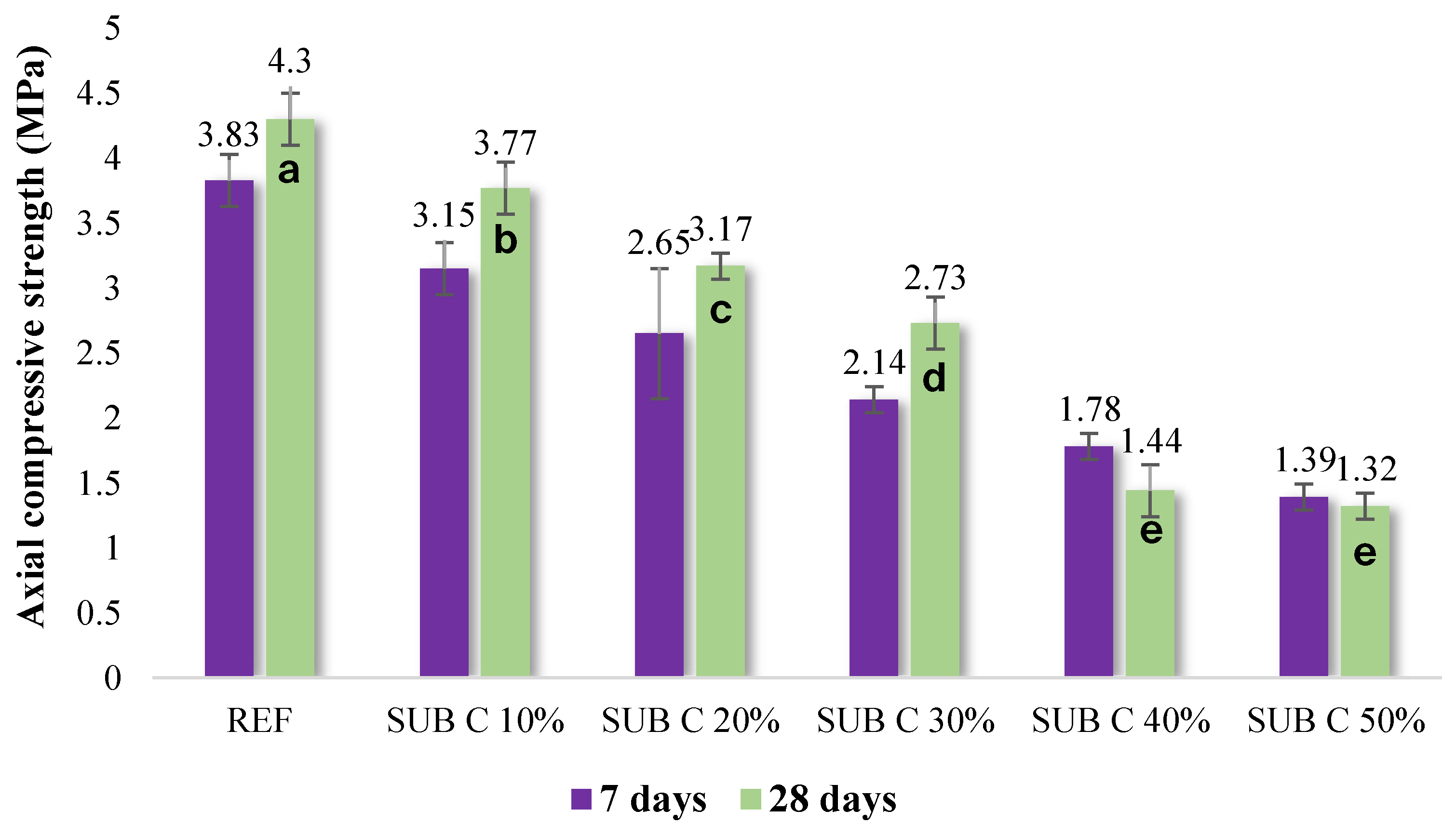
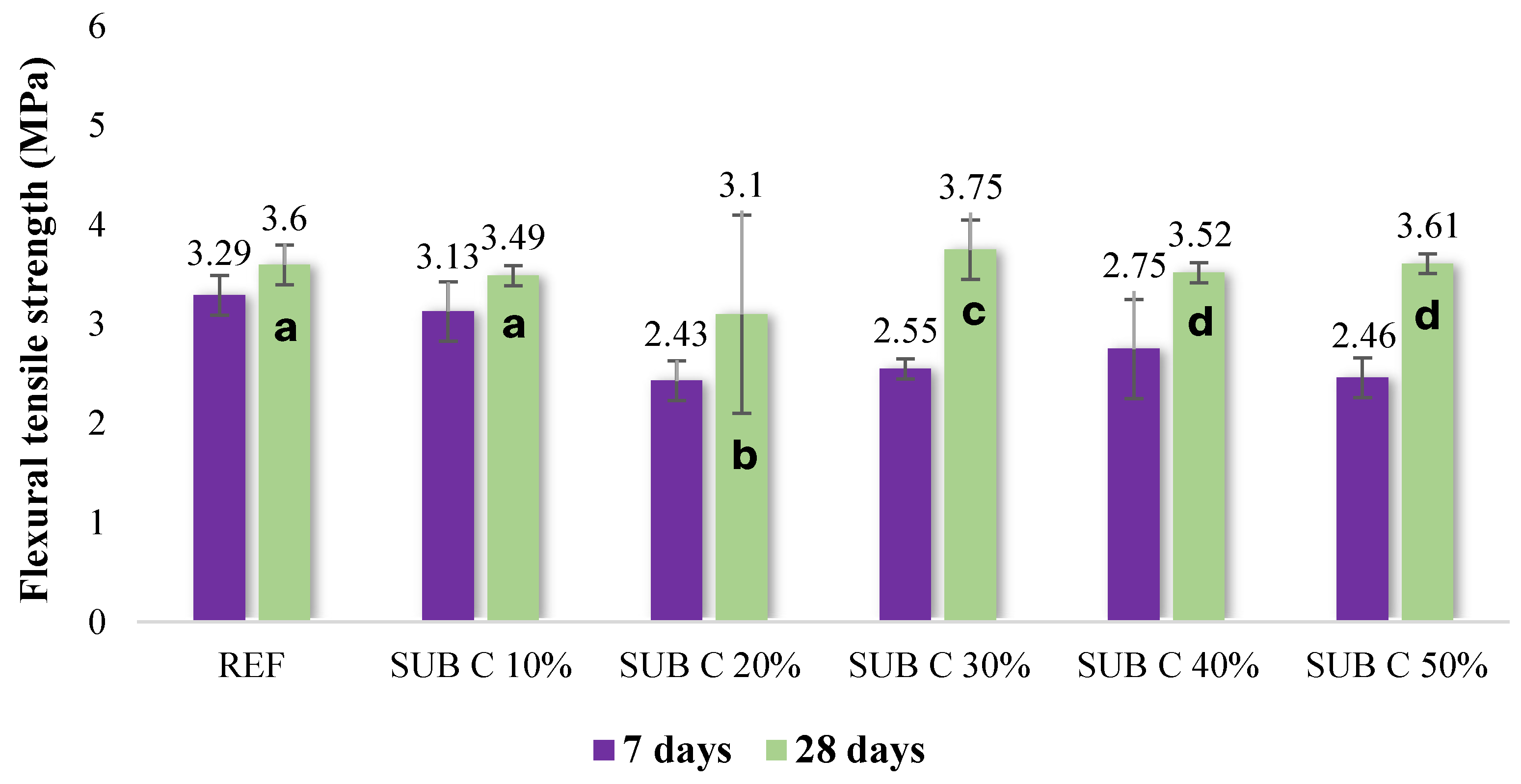
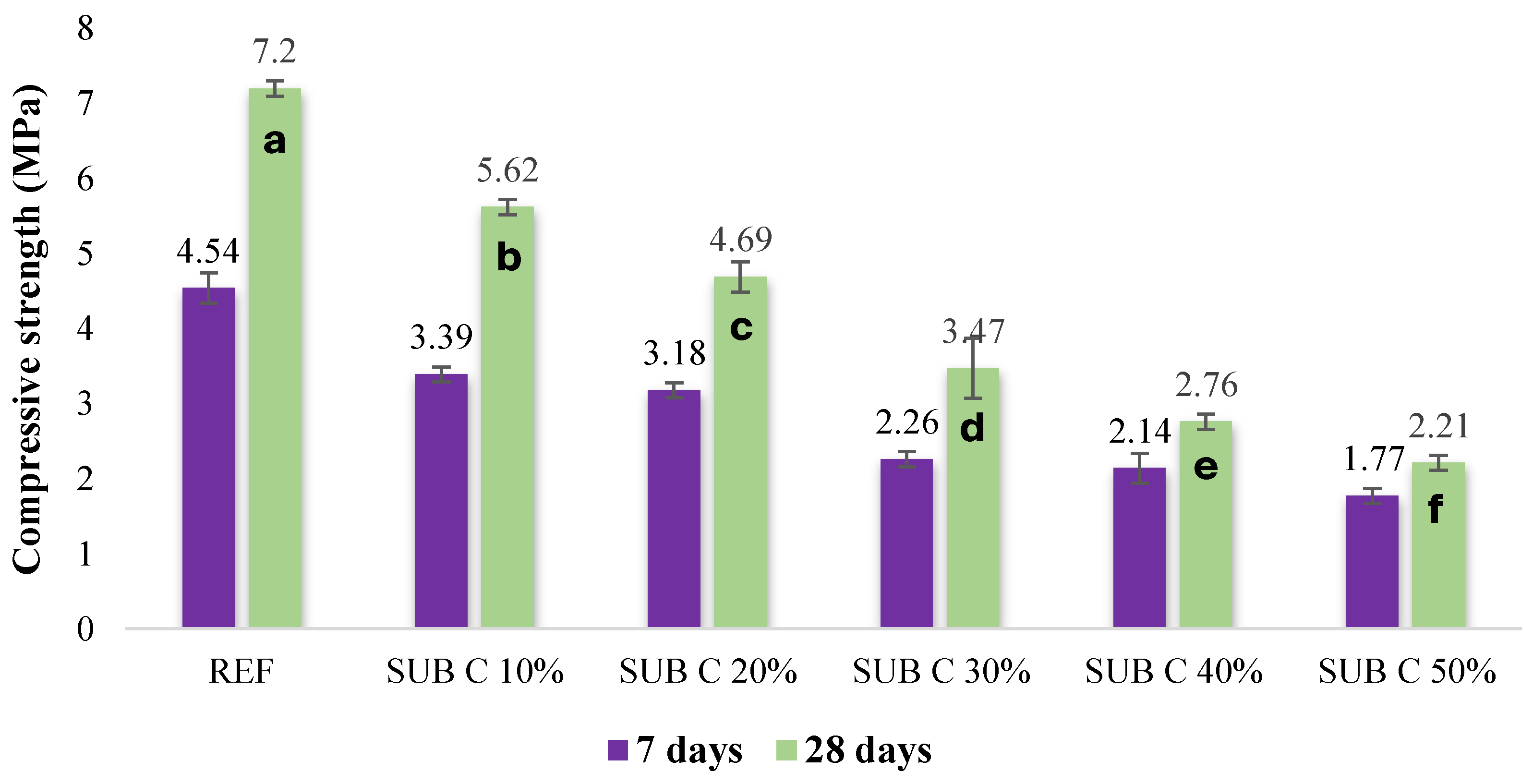
- Mechanical Properties: There was a progressive decrease in axial compressive strength and tensile strength at flexure as the replacement percentage increased. XRD and FTIR analyses revealed reduced formation of hydration products, as evidenced by decreases in the portlandite (P) and alite (C3S) peaks and in Si–O bonding bands. Chemically, a reduction in CaO content and an increase in Fe2O3 content were observed.
- ○
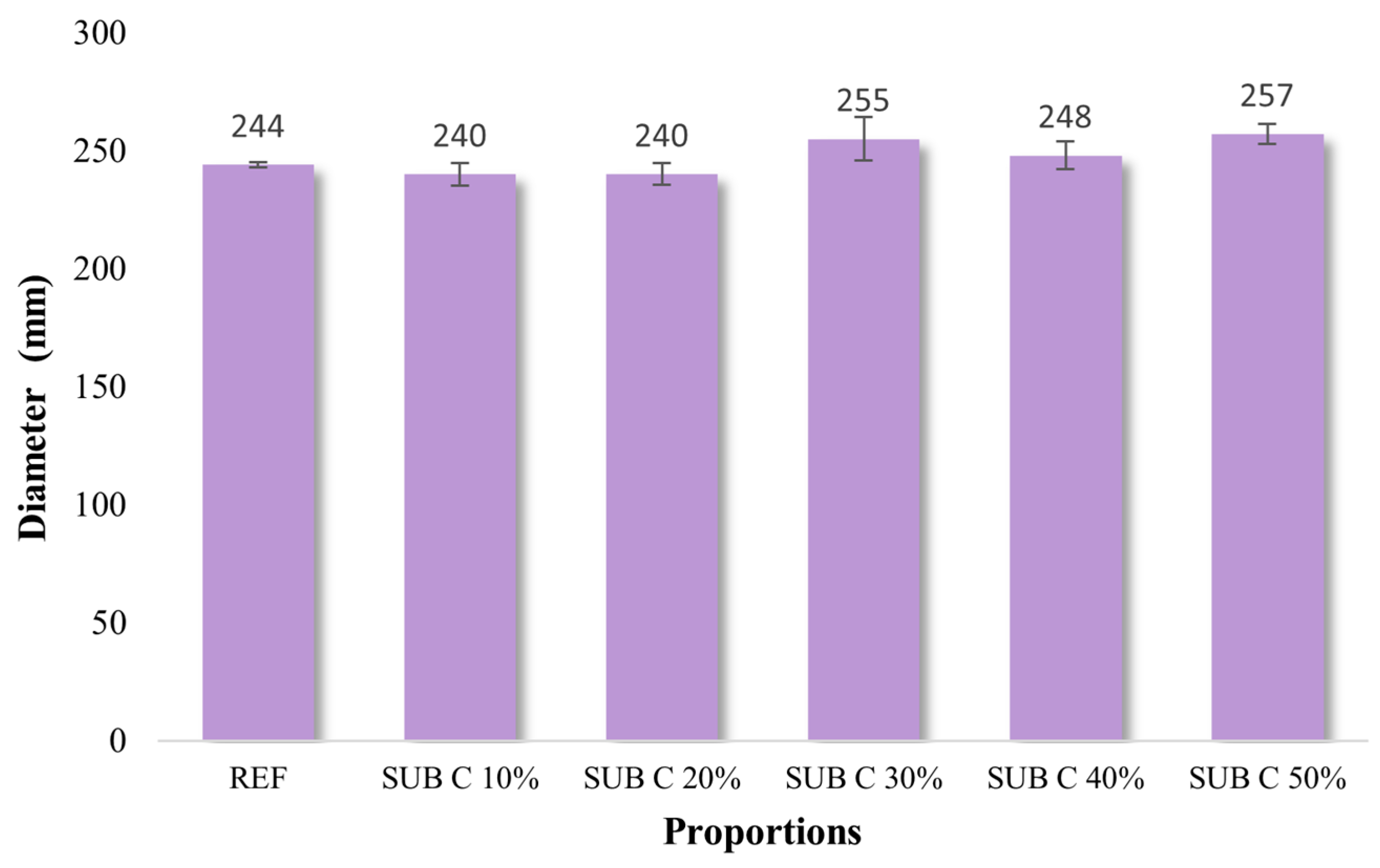
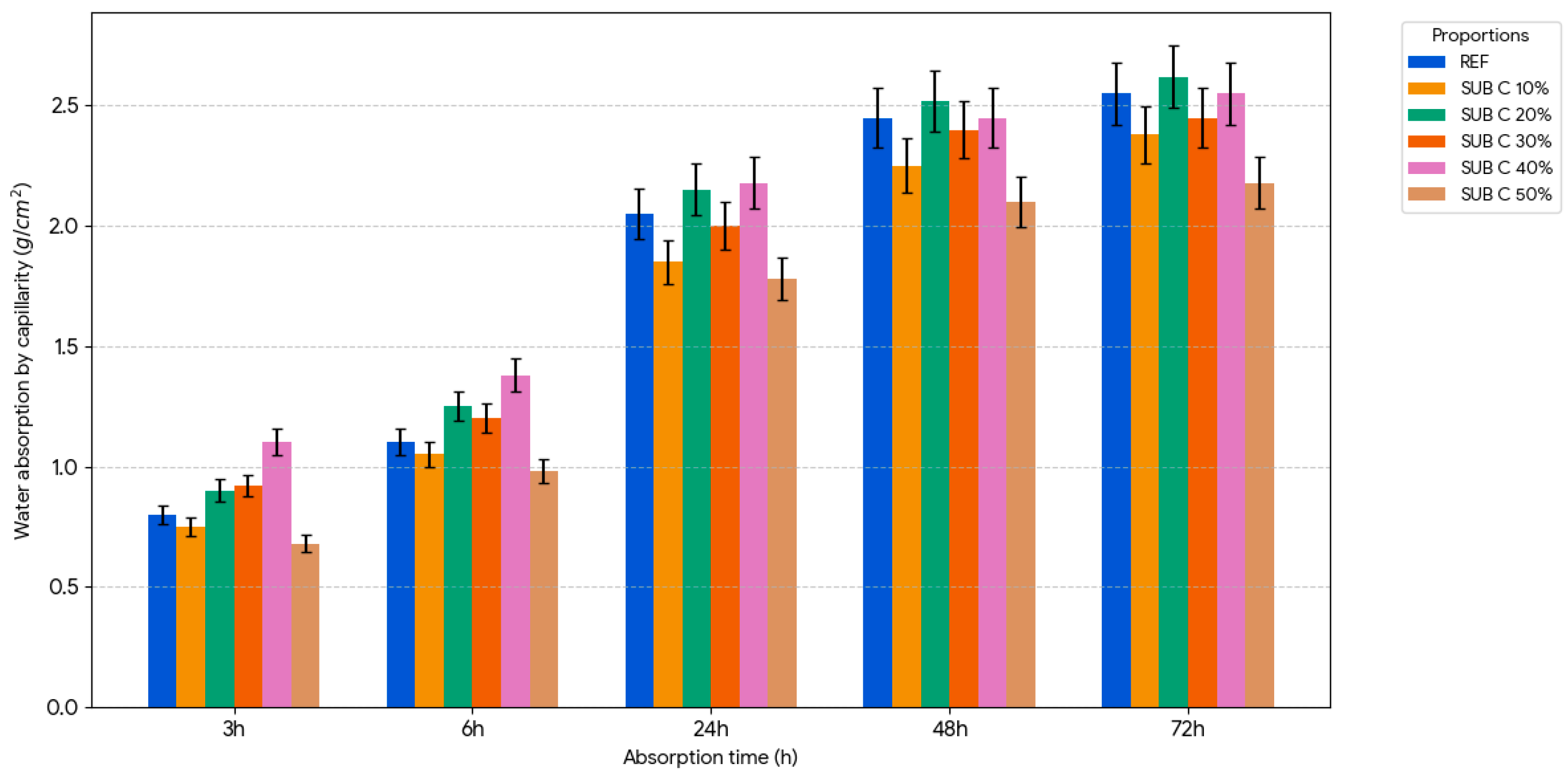
- Physical Properties: Although workability (consistency index) was maintained or slightly increased, water absorption by capillary increased in intermediate proportions (20%, 30% and 40%) compared to references.
- ○
- Conclusion (SUB C): The cement replacement route should be avoided for applications that require mechanical performance.
- Sand Substitution (SUB A): This approach offered the best balance for hardened state properties but presented a clear trade-off regarding fresh state performance.
- ○
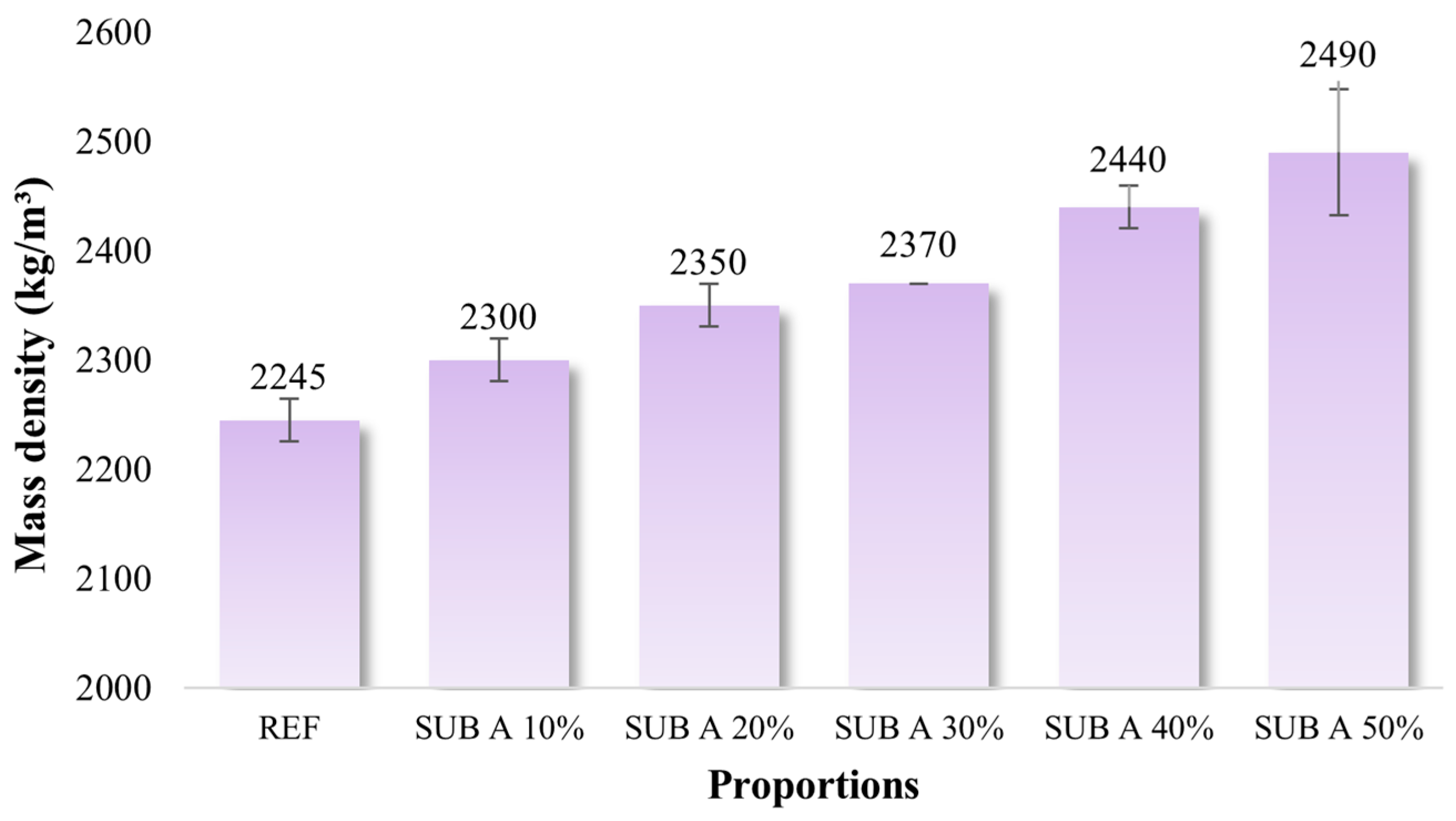
- Mechanical and Physical Balance: Unlike cement replacement, substituting sand did not compromise the hydration process, maintaining compressive and flexural strength levels comparable to the reference up to 40% replacement. Furthermore, due to the high density of mill scale (5.5 g/cm3), the matrix became denser and less permeable, with 20% and 30% proportions exhibiting the best durability indicators (i.e., the lowest capillary absorption).
- ○
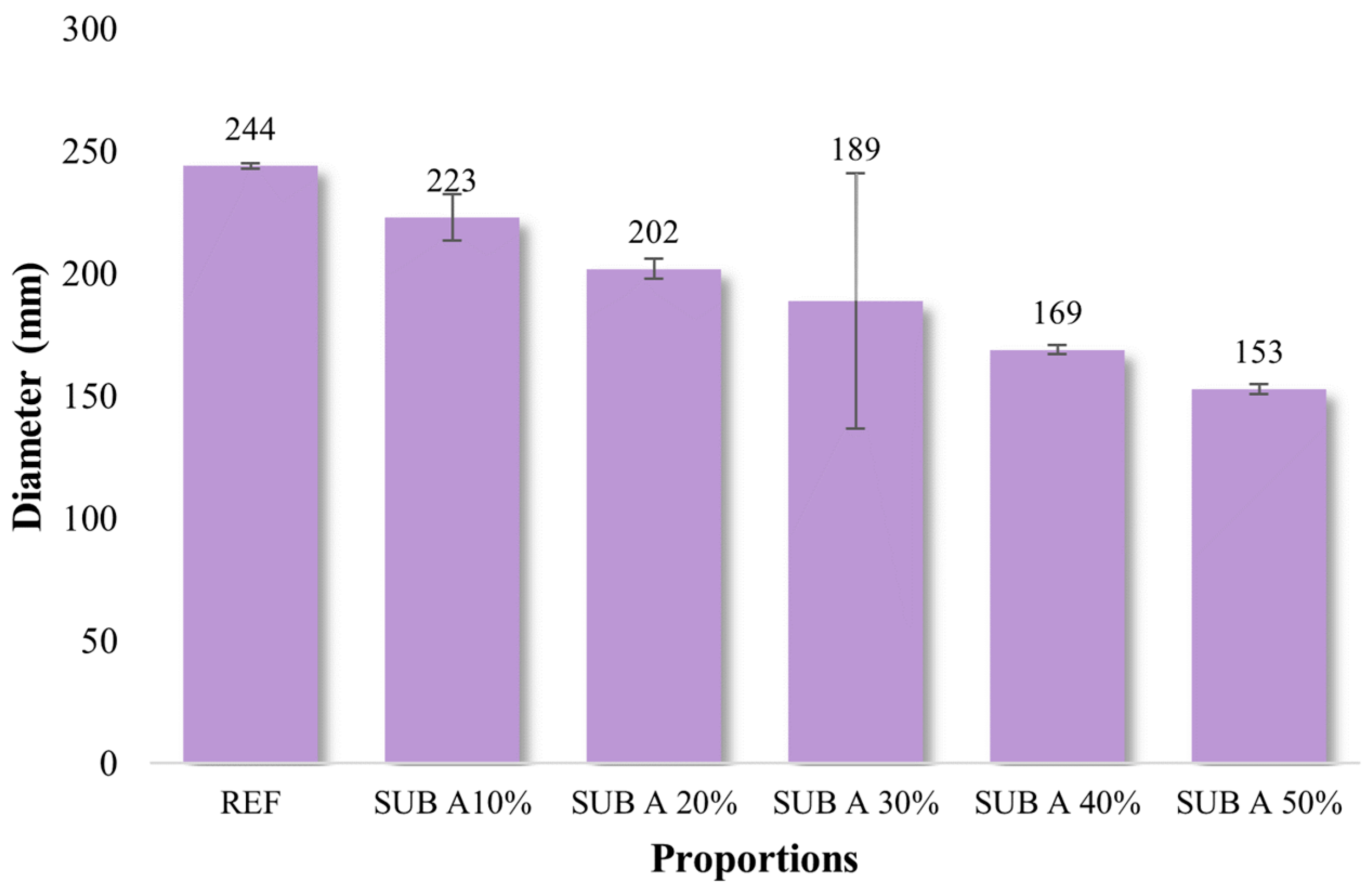
- Practical Limitations: However, a significant reduction in workability (consistency index) was observed as the scale content increased. This drastic drop represents a practical challenge for on-site applications.
Author Contributions
Funding
Data Availability Statement
Acknowledgments
Conflicts of Interest
Abbreviations
| ABNT | Associação Brasileira de Normas Técnicas |
| XRF | X-ray fluorescence |
| XRD | X-ray diffraction |
| EDS | energy-dispersive spectroscopy |
| SEM | Scanning Electron Microscopy |
| ITZ | Interfacial transition zone |
| SAW | Submerged arc welding |
| FTIR | Fourier-transform infrared spectroscopy |
References
- Baptista Junior, J.V.; Romanel, C. Sustentabilidade na indústria da construção: Uma logística para reciclagem dos resíduos de pequenas obras. Urbe-Revista Bras. Gestao Urbana 2013, 5, 27. [Google Scholar] [CrossRef][Green Version]
- Pagio, M.Z.; Carrareto, L.F.; Vieira, G.L.; Magalhães, D.C. Caracterização de resíduos siderúrgicos visando à aplicação em matrizes cimentícias. Ambiente Construído 2022, 22, 167–186. [Google Scholar] [CrossRef]
- He, Y.; Jia, S.; Yi, H.; Tang, X.; Yu, Q.; Gao, F.; Kang, D.; Zhao, S. Utilization of steel slag in air pollution and greenhouse gas emission reduction-application, mechanism and challenge: A review. J. Environ. Chem. Eng. 2024, 12, 5. [Google Scholar] [CrossRef]
- Kong, F.; Ying, Y.; Lu, S. Heavy metal pollution risk of desulfurized steel slag as a soil amendment in cycling use of solid wastes. J. Environ. Sci. 2023, 127, 349–360. [Google Scholar] [CrossRef]
- Moraes, C.A.M.; Evaldt, D.C.; Camacho, A.L.D.; Kich, A.M. Caracterização de Carepa Metálica Visando Sua Valorização Como Coproduto. In Proceedings of the Congresso Anual Da Abm, Belo Horizonte, Brazil, 30 July 2013; ABM: São Paulo, Brazil, 2013. [Google Scholar] [CrossRef]
- Gagliotti, A.B. Análise da Reciclagem de Carepa de Aço Por Meio de Processos de Redução. Bachelor’s Thesis, Universidade Tecnológica Federal do Paraná, Londrina, Brazil, 2019. [Google Scholar]
- Caus, G.D.; Bertolini, G.R.F.; Bulhões, R. Diagnóstico da gestão de resíduos sólidos: Estudo de caso em uma indústria metalúrgica. Rev. Micro Pequena Empresa São Paulo 2024, 18, 178–196. [Google Scholar] [CrossRef]
- Pereira, F.M.; de Verney, J.C.K.; Lenz, D.M. Avaliação do emprego de carepa de aço como agregado miúdo em concreto. REM Rev. Esc. Minas 2011, 64, 463–469. [Google Scholar] [CrossRef][Green Version]
- Siriwattanakarn, A.; Wongsa, A.; Eua-Anant, N.; Sata, V.; Sukontasukkul, P.; Chindaprasirt, P. Utilization of Mill Scale Waste as Natural Fine Aggregate Replacement in Mortar: Evaluation of Physical, Mechanical, Durability, and Post-Fire Properties. Recycling 2025, 10, 20. [Google Scholar] [CrossRef]
- Kushwah, R.; Gangotiya, S.; Patil, K. A Review on Engineering Behaviour of Sustainable Concrete with Steel Mill Scale and the Effect of Admixture on Workability Improvement. Int. J. Res. Appl. Sci. Eng. Technol. 2024, 12, 859–866. [Google Scholar] [CrossRef]
- Ozturk, M.; Depci, T.; Bahceci, E.; Karaaslan, M.; Akgol, O.; Sevim, U.K. Production of new electromagnetic wave shielder mortar using waste mill scales. Constr. Build. Mater. 2020, 242, 118028. [Google Scholar] [CrossRef]
- Parvathikumar, G.; Sahadevan, B.; Palanisamy, C. Scrap steel mill scale as river sand replacement in cement concrete: Effect on durability characteristics. J. Mater. Cycles Waste Manag. 2024, 26, 1490–1504. [Google Scholar] [CrossRef]
- Ahmed, Y.; Hessien, M.; Rashad, M.; Ibrahim, I. Nano-crystalline copper ferrites from secondary iron oxide (mill scale). J. Magn. Magn. Mater. 2009, 321, 181–187. [Google Scholar] [CrossRef]
- Liu, H.; Lin, H.; Liu, X.; Wang, J.; Pang, X.; Cui, S.; Kong, X. Mechanism of accelerated self-healing behavior of cement mortars incorporating triethanolamine: Carbonation of portlandite. Constr. Build. Mater. 2021, 308, 125050. [Google Scholar] [CrossRef]
- NBR 17054; Agregados—Determinação da Composição Granulométrica—Método de Ensaio. Associação Brasileira de Normas Técnicas: Rio de Janeiro, Brazil, 2022.
- NBR 7215; Portland Cement: Determination of Compressive Strength. Associação Brasileira de Normas Técnicas: Rio de Janeiro, Brazil, 2019.
- NBR 13279; Mortar for Laying and Covering Walls and Ceilings—Determination of Tensile Strength in Flexure and Compression. Associação Brasileira de Normas Técnicas: Rio de Janeiro, Brazil, 2005.
- NBR 13278; Mortar for Laying and Covering Walls and Ceilings—Determination of Mass Density and Incorporated Air Content. Associação Brasileira de Normas Técnicas: Rio de Janeiro, Brazil, 2005.
- NBR 9779; Hardened Mortar and Concrete—Determination of Water Absorption by Capillarity. Associação Brasileira de Normas Técnicas: Rio de Janeiro, Brazil, 2012.
- NBR 7222; Concrete and Mortar—Determination of Tensile Strength by Diametrical Compression of Cylindrical Specimens. Associação Brasileira de Normas Técnicas: Rio de Janeiro, Brazil, 2011.
- NBR 13276; Mortar for Laying and Covering Walls and Ceilings—Determination of the Consistency Index. Associação Brasileira de Normas Técnicas: Rio de Janeiro, Brazil, 2016.
- Girskas, G.; Kligys, M. Research on the main properties of cementitious mortars prepared with high-Fe2O3-content raw drinking water treatment sludge. Materials 2025, 18, 759. [Google Scholar] [CrossRef] [PubMed]
- Omrane, M.; Rabehi, M. Effect of natural pozzolan and recycled concrete aggregates on thermal and physico-mechanical characteristics of self-compacting concrete. Constr. Build. Mater. 2020, 247, 118576. [Google Scholar] [CrossRef]
- Mehta, P.K.; Monteiro, P.J.M. Concreto: Microestrutura, Propriedades e Materiais, 2nd ed.; IBRACON: São Paulo, Brazil, 2014; p. 751. ISBN 978-85-98576-213-3. [Google Scholar]
- Taylor, H.F.W. Cement Chemistry, 2nd ed.; Thomas Telford: London, UK, 1997. [Google Scholar]
- Veloso, C.K.d.S.; Pertile, B.H.P.; Nascimento, L.G.D.; Soares, T.K.F.; Lopes, P.D.; Moura, A.O.C.; Sousa, R.M.L.; Melo, S.T. Avaliação do desempenho da argamassa com incorporação de resíduos de materiais cerâmicos. Braz. J. Dev. 2020, 6, 822–837. [Google Scholar] [CrossRef]
- Ghrair, A.M.; Said, A.J.; Aldaoud, N.; Miqdadi, R.; Ahmad, A.A.L. Characterisation and Reverse Engineering of Eco-friendly Historical Mortar: Qasr Tuba, Desert Castles in Jordan. J. Ecol. Eng. 2021, 22, 121–134. [Google Scholar] [CrossRef]
- Ghazali, N.; Muthusamy, K.; Embong, R.; Rahim, I.S.A.; Razali, N.F.M.; Yahaya, F.M.; Ariffin, N.F.; Ahmad, S.W. Effect of Fly Ash as Partial Cement Replacement on Workability and Compressive Strength of Palm Oil Clinker Lightweight Concrete. IOP Conf. Ser. Earth Environ. Sci. 2020, 682, 012038. [Google Scholar] [CrossRef]
- Akula, P.; Little, D.N. Mineralogical characterization and thermodynamic modeling of synthesized ettringite from Ca-Al-SO4 suspensions. Constr. Build. Mater. 2021, 269, 121304. [Google Scholar] [CrossRef]
- Neville, A.M. Propriedades do Concreto, 5th ed.; Bookman: Porto Alegre, Brazil, 2016. [Google Scholar]
- Pandini, N.T. Influência da relação Mássica CaO/SiO2 Nas Propriedades Tecnológicas de Argamassas à Base de Cinza Volante Álcali-Ativada Com Cal Virgem. Master’s Thesis, Universidad e Estadual do Norte Fluminense Darcy Ribeiro, Campos dos Goytacazes, Brazil, 2019. [Google Scholar]
- Boudache, S.; Loukili, A.; Izoret, L.; Rozière, E. Investigating the role played by portlandite and C-A-S-H in the degradation response of pozzolanic and slag cements to external sulphate attack. J. Build. Eng. 2023, 67, 106053. [Google Scholar] [CrossRef]
- Mohr, B.J.; Islam, M.S.; Bryant, L. Long-term behavior of mortars experiencing delayed ettringite formation. Cement 2024, 16, 100104. [Google Scholar] [CrossRef]
- Wang, J.; Gao, C.; Tang, J.; Hu, Z.; Liu, J. The multi-scale mechanical properties of calcium-silicate-hydrate. Cem. Concr. Compos. 2023, 140, 105097. [Google Scholar] [CrossRef]
- Arnold, M.C.; de Vargas, A.S.; Bianchini, L. Study of electric-arc furnace dust (EAFD) in fly ash and rice husk ash-based geopolymers. Adv. Powder Technol. 2017, 28, 2023–2034. [Google Scholar] [CrossRef]
- Kupwade-Patil, K.; Palkovic, S.D.; Bumajdad, A.; Soriano, C.; Büyüköztürk, O. Use of silica fume and natural volcanic ash as a replacement to Portland cement: Micro and pore structural investigation using NMR, XRD, FTIR and X-ray microtomography. Constr. Build. Mater. 2018, 158, 574–590. [Google Scholar] [CrossRef]
- Teti, B.; Amorim, A.; Costa, E.; Alves, K.; Lima, N. Incorporating industrial residue of submerged arc welding (SAW) in cement-based mortar matrices as a green strategy. Next Sustain. 2025, 5, 100080. [Google Scholar] [CrossRef]
- Scrivener, K.L. Backscattered electron imaging of cementitious microstructures: Understanding and quantification. Cement Concrete Compos. 2004, 26, 935–945. [Google Scholar] [CrossRef]
- You, N.; Chen, Z.; Gao, Z.; Song, X. The effect of copper slag as a precursor on the mechanical properties, shrinkage and pore structure of alkali-activated slag-copper slag mortar. J. Build. Eng. 2024, 98, 111151. [Google Scholar] [CrossRef]








| Study | Material Replaced | Max. Replacement | Main Research Focus |
|---|---|---|---|
| Pereira et al. [8] | Fine Aggregate | Not specified | Mechanical behavior of concrete using mill scale as aggregate. |
| Ozturk et al. [11] | Fine Aggregate | 15% | Development of mortars for electromagnetic wave shielding. |
| Parvathikumar et al. [12] | Fine Aggregate | 20% | Durability characteristics and river sand replacement. |
| Siriwattanakarn et al. [9] | Fine Aggregate | 100% | Physical, mechanical, and post-fire properties. |
| Present Study | Cement and Sand | 50% | Comparison of chemical vs. physical mechanisms and ITZ analysis. |
| MgO | Al2O3 | SiO2 | P2O5 | SO3 | Cl | K2O | CaO | TiO2 | MnO | Fe2O3 | SrO | ZrO3 | |
|---|---|---|---|---|---|---|---|---|---|---|---|---|---|
| Cement | 1.01 | 5.48 | 18.54 | 0.57 | 4.25 | 0.04 | 1.66 | 65.18 | - | - | 3.18 | 0.09 | - |
| Hydrated lime | 0.62 | 0.37 | 0.84 | 0.10 | 0.14 | 0.28 | 0.13 | 97.77 | - | - | - | - | - |
| Sand | - | 1.87 | 92.17 | - | 0.14 | 0.05 | 0.16 | 0.63 | 3.09 | - | 0.41 | - | 1.47 |
| Particle Size Distribution | |||||
|---|---|---|---|---|---|
| Sieve Opening (mm) | Test Method | Sand | Mill Scale | ||
| Percentage Retained (%) | Cumulative Percentage (%) | Percentage Retained (%) | Cumulative Percentage (%) | ||
| 4.75 | NBR 17054 | 0 | 0 | 0.05 | 0.05 |
| 2.36 | 0.65 | 0.65 | 0.10 | 0.15 | |
| 1.18 | 4.21 | 4.87 | 4.66 | 4.81 | |
| 0.6 | 24.74 | 29.60 | 12.07 | 16.88 | |
| 0.3 | 42.70 | 72.30 | 50.58 | 67.45 | |
| 0.15 | 17.66 | 89.96 | 17.93 | 85.38 | |
| Background | 10.04 | 100 | 14.62 | 100 | |
| Total | 100 | - | 100 | - | |
| Al2O3 | SiO2 | SO3 | Cl | K2O | CaO | MnO | Fe2O3 | |
|---|---|---|---|---|---|---|---|---|
| Mill scale | 0.63 | 2.26 | 0.20 | 0.02 | 0.09 | 0.33 | 0.57 | 95.90 |
| Code | Mortar Configuration |
|---|---|
| REF | Reference mortar in a 1:1:6 cement:lime:sand ratio. |
| SUB-C-10% | Mortar with 10% replacement in a 1:1:6 cement:lime:sand ratio (replacing cement with scale). |
| SUB-C-20% | Mortar with a 20% replacement in a 1:1:6 cement:lime:sand ratio (replacing cement with scale). |
| SUB-C-30% | Mortar with a 30% replacement in a 1:1:6 cement:lime:sand ratio (replacing cement with scale). |
| SUB-C-40% | Mortar with a 40% replacement in a 1:1:6 cement:lime:sand ratio (replacing cement with scale). |
| SUB-C-50% | Mortar with a 50% replacement in a 1:1:6 cement:lime:sand ratio (replacing cement with scale). |
| SUB-A-10% | Mortar with a 10% replacement in a 1:1:6 cement:lime:sand ratio (replacing sand with scale). |
| SUB-A-20% | Mortar with a 20% replacement in a 1:1:6 cement:lime:sand ratio (replacing sand with scale). Mortar with a 30% replacement in a 1:1:6 ratio of cement:lime:sand (replacing sand with scale). |
| SUB-A-30% | Mortar with a 40% replacement in a 1:1:6 ratio of cement:lime:sand (replacing sand with scale). |
| SUB-A-40% | Mortar with a 50% replacement in a 1:1:6 ratio of cement:lime:sand (replacing sand with scale). |
| SUB-A-50% | Mortar with a 20% replacement in a 1:1:6 cement:lime:sand ratio (replacing cement with scale). |
| Reference | |||||||
|---|---|---|---|---|---|---|---|
| Code | Proportion | Test Specimen | Cement (kg) | Lime (kg) | Sand (kg) | Residue (kg) | Water (kg) |
| REF | 1:1:6 | 12 cylindrical | 0.7312 | 0.7312 | 4.387 | - | 1.023 |
| 6 prismatic | 0.6142 | 0.6142 | 3.685 | 0.8599 | |||
| Replacing the Cement Mass | |||||||
|---|---|---|---|---|---|---|---|
| Code | Proportion | Test Specimen | Cement (kg) | Lime (kg) | Sand (kg) | Residue (kg) | Water (kg) |
| SUB-C-10% | 1:1:6 | 12 cylindrical | 0.6581 | 0.7312 | 4.387 | 0.0731 | 1.023 |
| SUB-C-20% | 6 prismatic | 0.5528 | 0.6142 | 3.685 | 0.0614 | 0.8599 | |
| SUB-C-30% | 1:1:6 | 12 cylindrical | 0.5850 | 0.7312 | 4.387 | 0.1462 | 1.023 |
| SUB-C-40% | 6 prismatic | 0.4914 | 0.6142 | 3.685 | 0.1228 | 0.8599 | |
| SUB-C-50% | 1:1:6 | 12 cylindrical | 0.5118 | 0.7312 | 4.387 | 0.2193 | 1.023 |
| SUB-C-10% | 6 prismatic | 0.299 | 0.6142 | 3.685 | 0.1842 | 0.8599 | |
| SUB-C-20% | 1:1:6 | 12 cylindrical | 0.4387 | 0.7312 | 4.387 | 0.2925 | 1.023 |
| SUB-C-30% | 6 prismatic | 0.3685 | 0.6142 | 3.685 | 0.2457 | 0.8599 | |
| SUB-C-40% | 1:1:6 | 12 cylindrical | 0.3656 | 0.7312 | 4.387 | 0.3656 | 1.023 |
| SUB-C-50% | 6 prismatic | 0.3071 | 0.6142 | 3.685 | 0.3071 | 0.8599 | |
| Replacing the Cement Mass | |||||||
|---|---|---|---|---|---|---|---|
| Code | Proportion | Test Specimen | Cement (kg) | Lime (kg) | Sand (kg) | Residue (kg) | Water (kg) |
| SUB-A-10% | 1:1:6 | 12 cylindrical | 0.7312 | 0.7312 | 3.948 | 0.4387 | 1.023 |
| SUB-A-20% | 6 prismatic | 0.6142 | 0.6142 | 3.317 | 0.3685 | 0.8599 | |
| SUB-A-30% | 1:1:6 | 12 cylindrical | 0.7312 | 0.7312 | 3.510 | 0.8775 | 1.023 |
| SUB-A-40% | 6 prismatic | 0.6142 | 0.6142 | 2.948 | 0.7371 | 0.8599 | |
| SUB-A-50% | 1:1:6 | 12 cylindrical | 0.7312 | 0.7312 | 3.071 | 1.316 | 1.023 |
| SUB-A-10% | 6 prismatic | 0.6142 | 0.6142 | 2.579 | 1.105 | 0.8599 | |
| SUB-A-20% | 1:1:6 | 12 cylindrical | 0.7312 | 0.7312 | 2.632 | 1.755 | 1.023 |
| SUB-A-30% | 6 prismatic | 0.6142 | 0.6142 | 2.211 | 1.474 | 1.023 | |
| SUB-A-40% | 1:1:6 | 12 cylindrical | 0.7312 | 0.7312 | 2.193 | 2.193 | 1.023 |
| SUB-A-50% | 6 prismatic | 0.6142 | 0.6142 | 1.842 | 1.842 | 0.8599 | |
| CaO | SiO2 | Al2O3 | Fe2O3 | MgO | P2O5 | SO3 | Cl | K2O | TiO2 | ZrO2 | |
|---|---|---|---|---|---|---|---|---|---|---|---|
| REF | 61.85 | 29.07 | 3.50 | 1.60 | 0.90 | 0.40 | 1.62 | 0.05 | 0.43 | - | 058 |
| SUB C 10% | 57.81 | 29.40 | 3.14 | 4.30 | 0.86 | 0.35 | 1.61 | 0.05 | 0.34 | 1.63 | 0.50 |
| SUB C 20% | 55.79 | 27.59 | 2.92 | 7.97 | 0.81 | 0.36 | 1.45 | 0.09 | 0.80 | 1.69 | 0.52 |
| SUB C 30% | 53.21 | 29.14 | 2.77 | 11.19 | 0.67 | 0.33 | 1.29 | 0.07 | 0.77 | - | 0.54 |
| SUB C 40% | 50.31 | 29.24 | 2.64 | 12.91 | 0.60 | 0.35 | 1.19 | 0.08 | 0.57 | 1.58 | 0.54 |
| SUB C 50% | 49.41 | 30.67 | 2.55 | 14.51 | 0.67 | 0.26 | 1.09 | 0.09 | 0.21 | - | 0.52 |
| CaO | SiO2 | Al2O3 | Fe2O3 | MgO | P2O5 | SO3 | Cl | K2O | MnO | ZrO2 | |
|---|---|---|---|---|---|---|---|---|---|---|---|
| REF | 61.85 | 29.07 | 3.50 | 1.60 | 0.90 | 0.40 | 1.62 | 0.05 | 0.43 | - | 0.58 |
| SUB A 10% | 50.39 | 25.39 | 3.10 | 16.97 | 0.88 | 0.36 | 1.51 | 0.08 | 0.95 | - | 0.35 |
| SUB A 20% | 44.91 | 22.94 | 3.09 | 25.76 | 0.85 | 0.34 | 1.39 | 0.04 | 0.37 | - | 0.29 |
| SUB A 30% | 39.58 | 20.52 | 3.08 | 33.47 | 0.94 | 0.32 | 1.34 | 0.03 | 0.30 | 0.21 | 0.19 |
| SUB A 40% | 35.55 | 18.71 | 2.86 | 39.77 | 0.82 | 0.32 | 1.23 | 0.03 | 0.28 | 0.26 | 0.15 |
| SUB A 50% | 32.61 | 16.05 | 2.56 | 45.72 | 0.87 | 0.26 | 1.15 | 0.05 | 0.32 | 0.27 | 0.12 |
Disclaimer/Publisher’s Note: The statements, opinions and data contained in all publications are solely those of the individual author(s) and contributor(s) and not of MDPI and/or the editor(s). MDPI and/or the editor(s) disclaim responsibility for any injury to people or property resulting from any ideas, methods, instructions or products referred to in the content. |
© 2026 by the authors. Licensee MDPI, Basel, Switzerland. This article is an open access article distributed under the terms and conditions of the Creative Commons Attribution (CC BY) license.
Share and Cite
Amorim, A.L.M.; Oliveira, J.V.B.L.; Coelho, R.C.M.; Teti, B.S.; Costa, E.C.; Lima, N.B.; Alves, K.G.B.; Lima, N.B.D. Sustainable Mortars Incorporating Industrial Rolling Mill Residues: Microstructural, Physical, and Chemical Characteristics. J. Compos. Sci. 2026, 10, 42. https://doi.org/10.3390/jcs10010042
Amorim ALM, Oliveira JVBL, Coelho RCM, Teti BS, Costa EC, Lima NB, Alves KGB, Lima NBD. Sustainable Mortars Incorporating Industrial Rolling Mill Residues: Microstructural, Physical, and Chemical Characteristics. Journal of Composites Science. 2026; 10(1):42. https://doi.org/10.3390/jcs10010042
Chicago/Turabian StyleAmorim, Ana Laura M., João Victor B. L. Oliveira, Rebecca Caroline M. Coelho, Bruno S. Teti, Esdras C. Costa, Nathan B. Lima, Kleber G. B. Alves, and Nathalia B. D. Lima. 2026. "Sustainable Mortars Incorporating Industrial Rolling Mill Residues: Microstructural, Physical, and Chemical Characteristics" Journal of Composites Science 10, no. 1: 42. https://doi.org/10.3390/jcs10010042
APA StyleAmorim, A. L. M., Oliveira, J. V. B. L., Coelho, R. C. M., Teti, B. S., Costa, E. C., Lima, N. B., Alves, K. G. B., & Lima, N. B. D. (2026). Sustainable Mortars Incorporating Industrial Rolling Mill Residues: Microstructural, Physical, and Chemical Characteristics. Journal of Composites Science, 10(1), 42. https://doi.org/10.3390/jcs10010042