
Article

Effect of Surface Roughness and Skin–Core Structure of Dry-Jet Wet-Spun T800G Carbon Fiber on the Impact Resistance of Carbon Fiber-Reinforced Composites
AVIC Composite Co., Ltd., Beijing 101300, China
*
Author to whom correspondence should be addressed.
J. Compos. Sci. 2026, 10(1), 44; https://doi.org/10.3390/jcs10010044
Submission received: 7 November 2025 / Revised: 13 December 2025 / Accepted: 22 December 2025 / Published: 13 January 2026
(This article belongs to the Special Issue Carbon Fiber Composites, 4th Edition)

Abstract

The mechanical properties of carbon fiber composites (CFRCs) are governed by the carbon fibers (CFs) themselves and the fiber–matrix interface (FMI), with the synergy between the two being crucial. This study focused on how microstructural heterogeneity affects the compression after impact (CAI) of the same epoxy resin (EP) composites. The research was conducted using two variants of dry-jet wet-spun T800G CFs, labeled CF-low and CF-high. The results indicated that while CF-low exhibited a higher number of deep axial grooves and a greater surface micro-zone compressive modulus, their pronounced skin–core structure and the excessively strong interfacial bonding formed by mechanical interlocking aggravated fiber core collapse and stress concentration under mechanical loading. In contrast, the homogeneous structure and moderate interfacial characteristics of CF-high facilitated efficient stress transfer between the CFs and EP. Compared with CF-low composites, CF-high composites exhibited a 9% increase in CAI strength and a 35% reduction in damage area, significantly improving the damage tolerance of the composites. This research underscores that optimizing the synergy between the fiber properties and the interfacial behavior is key to enhancing CFRC performance.

1. Introduction

CFRCs have become essential materials for weight reduction and performance enhancement in advanced equipment [1,2], owing to their high specific strength, high specific stiffness, and strong design flexibility [3,4,5]. As CFs are the primary load-bearing skeleton of a CFRC [6,7], their microstructural characteristics directly govern the interfacial bonding with the matrix [8,9,10,11], thereby influencing the macroscopic mechanical properties and damage tolerance of the CFRC. In recent years, breakthroughs in the preparation technology for high-performance CFs enabled the gradual engineering application of T800G CFs. However, in terms of the overall performance of CFRCs, the strength conversion efficiency of CFs remained relatively low [12]. Research indicated that this discrepancy was not only related to the surface chemical activity of CFs [13] but also governed by the synergistic effects of their multi-scale structural architecture [12,14]. Investigating the multi-scale structure–property relationships spanning from CFs’ microstructure to interfacial behavior and macroscopic performance is of significant scientific importance and engineering value for advancing the performance optimization of CFRCs [15].
In the regulation of the mechanical properties of CFRCs, the relationship between the surface morphology of CFs and the FMI properties is one of the research foci. The conventional view [8,16,17,18] holds that higher surface roughness of CFs enhances interfacial bonding through mechanical interlocking, thereby improving the interlaminar properties and impact toughness of CFRCs. Wu et al. [19] demonstrated that higher surface roughness of CFs significantly reduced the crack initiation propagation rate in CFRCs, thereby promoting crack propagation along the interface and enabling greater fracture energy absorption. However, it was indicated by recent studies that excessive pursuit of high surface roughness in CFs might lead to excessively strong interfacial bonding at the fiber–matrix interface, thereby potentially inducing premature interfacial failure. Furthermore, it was argued by Andreas et al. [20] that when the groove depth on the CF surface exceeds a critical threshold, incomplete infiltration of the resin matrix into the groove roots significantly reduces the load-transfer efficiency of the interface. This phenomenon suggests that the influence of CF surface morphology on the fiber–matrix interfacial properties exhibits a nonlinear relationship [21].
Furthermore, the skin–core structure of CFs, an inherent characteristic resulting from their manufacturing process, has long been overlooked in terms of its potential influence on CFRCs [22,23]. The heterogeneity between the skin and core can lead to non-uniform axial mechanical properties in CFs [12]. Under external loading, defects located in the core region of CFs may serve as preferred sites for crack initiation [24]. The skin–core structure of CFs was deliberately attenuated by Sun et al. [25,26] through modulation of the CF production process to enhance radial homogeneity. Furthermore, a multi-scale model based on the generalized cell method of the fiber–matrix interface was established by Qi et al. [27], through which it was demonstrated that the stiffness and thickness of the skin–core structure significantly influence the shear strength of CFRCs.
However, existing studies predominantly focused on the isolated effects of either surface morphology or skin–core structure in CFs, with limited exploration into their synergistic interactions [28]. T800G CFs produced via the dry-jet wet-spun process have become a key material for primary aerospace load-bearing structures, owing to the superior performance of their composites. This process further accentuates the influence of the CFs’ microstructure on the final CFRC properties [29]. At present, an insufficient understanding of the compatibility between such micro-structural features and the EP often leads to deviations from the ideal design window in practical applications of T800G CFs [30,31,32,33]. Establishing clear mapping relationships between the surface morphology, skin–core structure, and key mechanical properties of CFRCs is therefore essential for achieving a concurrent enhancement in both strength and damage tolerance [34,35,36].
CAI is a critical toughness metric and design allowable for CFRCs, directly defining structural usability limits and generational advancements in materials technology [37]. In this study, two types of T800G CFs (CF-low and CF-high) were selected. Through multi-scale characterization methods [38], we systematically investigated how the fiber surface morphology and skin–core structure affected the CAI of their CFRCs. This work aimed to provide a theoretical foundation for the design and application of T800G CFRCs.

2. Materials and Methods

2.1. Materials

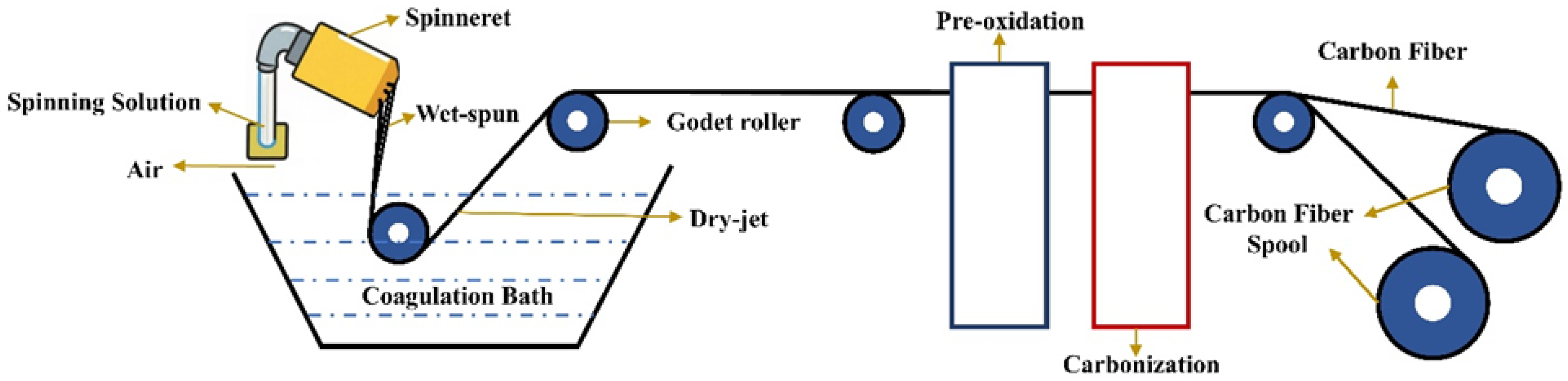
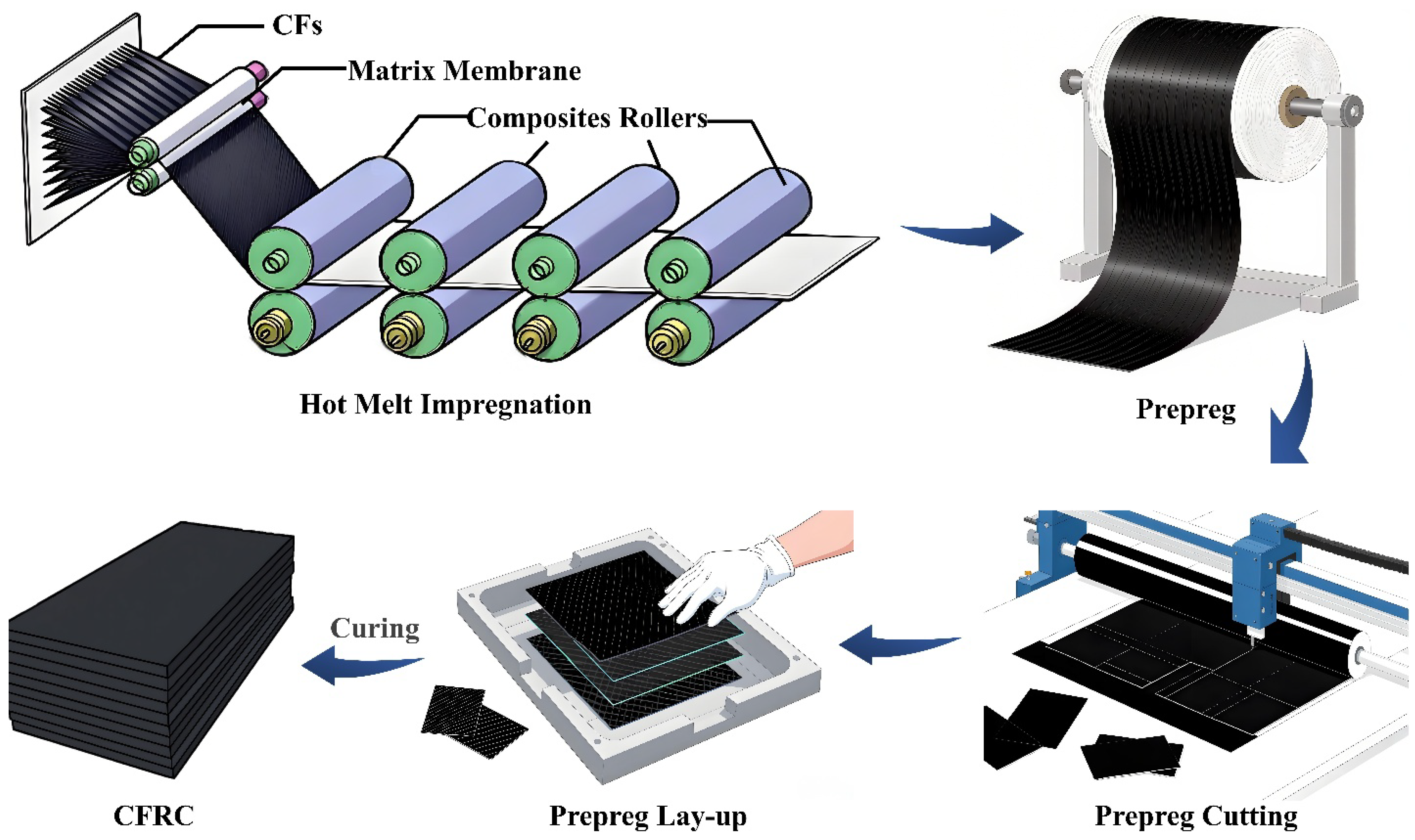
In this study, T800G CFs produced via the dry-jet wet-spun method by China Weihai Extend Co., Ltd. (Weihai, China), were employed. A schematic of the manufacturing process is shown in Figure 1. After extrusion through the spinneret, the spinning dope first passed through an air gap before entering the coagulation bath, where dual diffusion and phase separation occurred. The fibers subsequently underwent pre-oxidation and carbonization to form the final CFs. Two types of CFs with distinct microstructural characteristics were obtained by fine-tuning only the coagulation bath concentration. The typical CF properties obtained from the tests are shown in Table 1. To eliminate interference from the sizing agent in the study of fiber microstructure, the CFs were desized using solvent prior to use. The matrix used was a high-toughness EP developed by AVIC Composite Corporation Ltd., and the typical properties obtained from the tests are shown in Table 2. Prepregs were fabricated by impregnating the CFs with the EP at temperatures ranging from 100 to 130 °C; the overall fabrication flow is illustrated in Figure 2.

2.2. Tests for CF Surface Morphology

A Quanta450 FEG Scanning Electron Microscopy (SEM) (FEI Company, Hillsboro, OR, USA) device was used to observe the two-dimensional surface morphology of the CFs.
A Dimension ICON Atomic Force Microscopy (AFM) (Shanghai Erdi Instrument Technology Co., Ltd., Shanghai, China) device with quantitative nanomechanical performance testing mode was used to observe the three-dimensional surface morphology of the CFs, obtaining the arithmetic mean (Ra) and root mean square (Rq) of the CF surface roughness. Local compressive modulus values (Ra and Rq) were determined by acquiring arrays of force–distance curves across selected regions using a calibrated rigid probe.

2.3. Tests for CF Skin–Core Structure

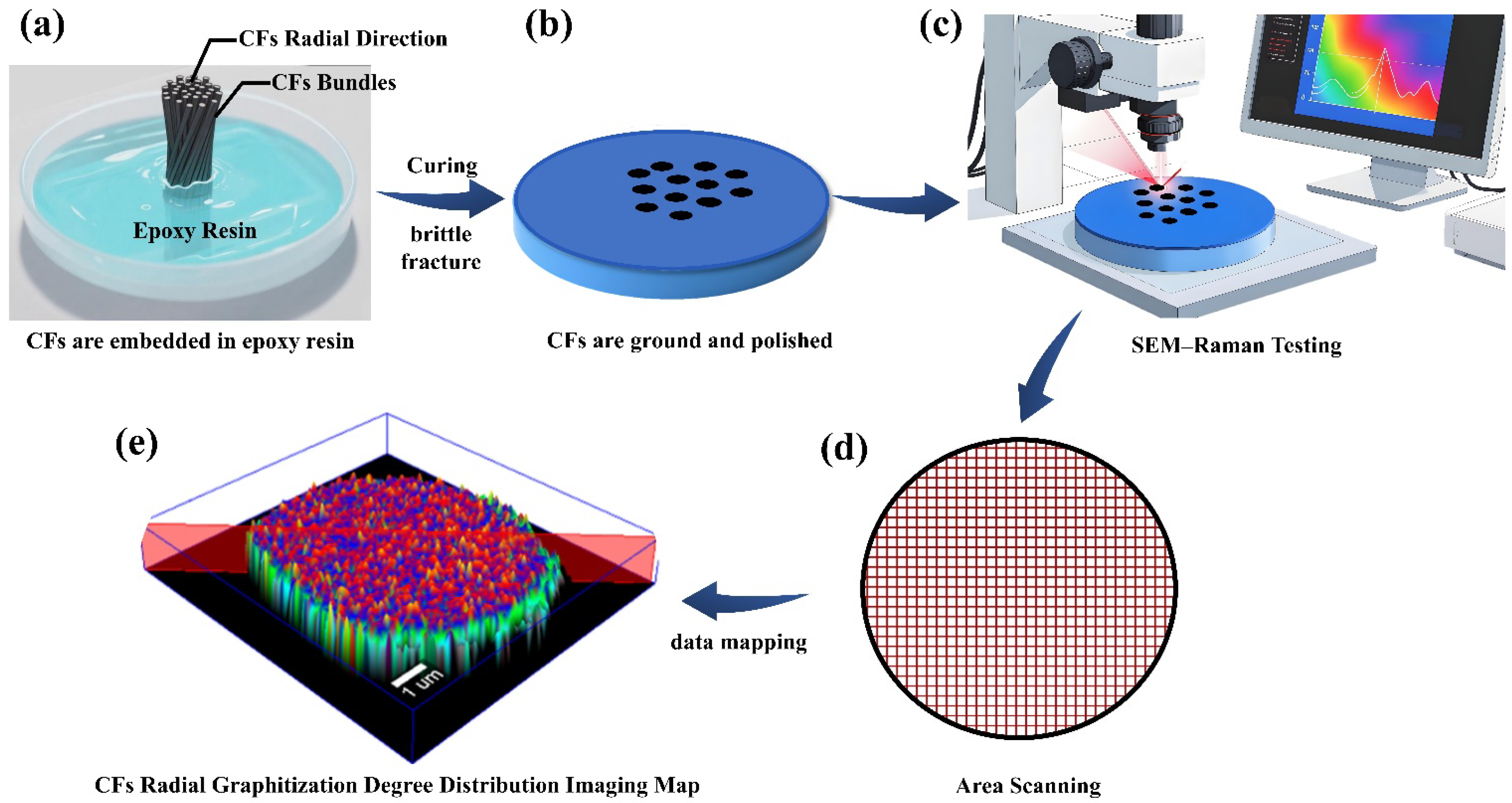
The radial skin–core structure of CFs was tested using an SEM–Raman system. Prior to testing, the CFs were embedded and cured using EP. The cured CFs were placed in liquid nitrogen and brittle-fractured. After the CFs were ground, polished, and cleaned, 532 nm laser light was used to scan along their radial surface. SEM and Raman data were overlaid, and the peak intensity ratio (ID/IG) was extracted as an indicator of graphitization degree; a schematic diagram is shown in Figure 3.

2.4. Tests for CFRC DWI and CAI

Drop-Weight Impact (DWI) tests were conducted using an Instron 9440 machine (Norwood, MA, USA) in accordance with ASTM D 7136 [39]. A hemispherical steel impact head with a diameter of 16 mm was used to impact the center of the CFRC with an energy of 6.67 J/mm; the depth was measured and a C-scan performed after the DWI. CAI tests were conducted in accordance with ASTM D 7137 [40]. The tests were performed on an Instron 5982 machine (Norwood, MA, USA). The tests were stopped when the CFRC failed or the load decreased by 30% of the maximum load [41]. Each test included at least five sets of valid data.

3. Results and Discussion

3.1. Surface Morphology

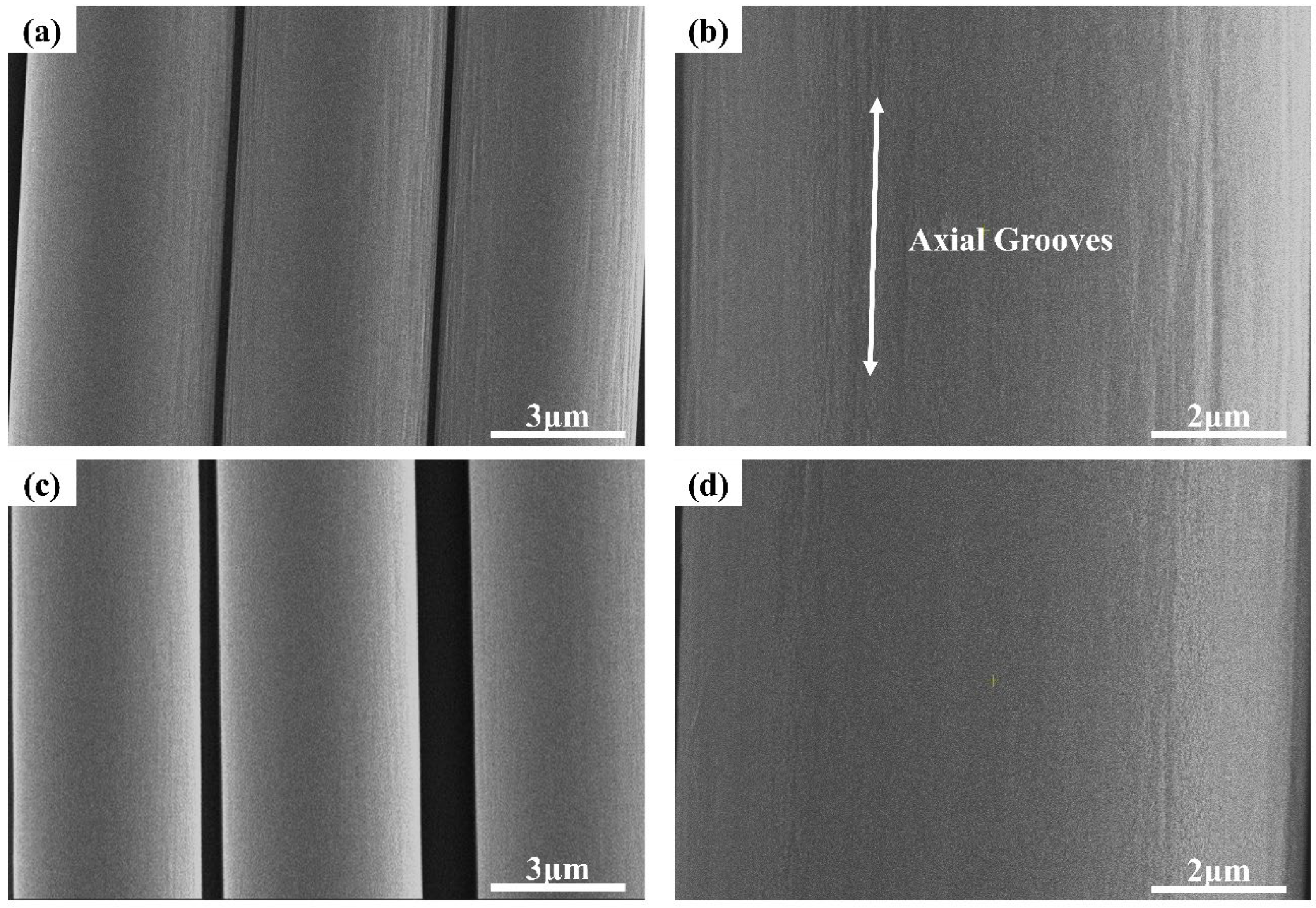
The surface morphology of CFs plays a key role in their interfacial bonding. SEM observations of CFs are shown in Figure 4. Both CFs exhibited typical dry-jet wet-spun structural characteristics, with a small number of grooves regularly distributed along the axial direction on their surfaces. The surface of CF-high appeared smooth overall, featuring highly oriented, continuous grooves. In contrast, CF-low displayed shallower and discontinuous axial grooves. According to the mechanical interlocking theory, both the number and depth of surface grooves are positively correlated with FMI bonding [18].
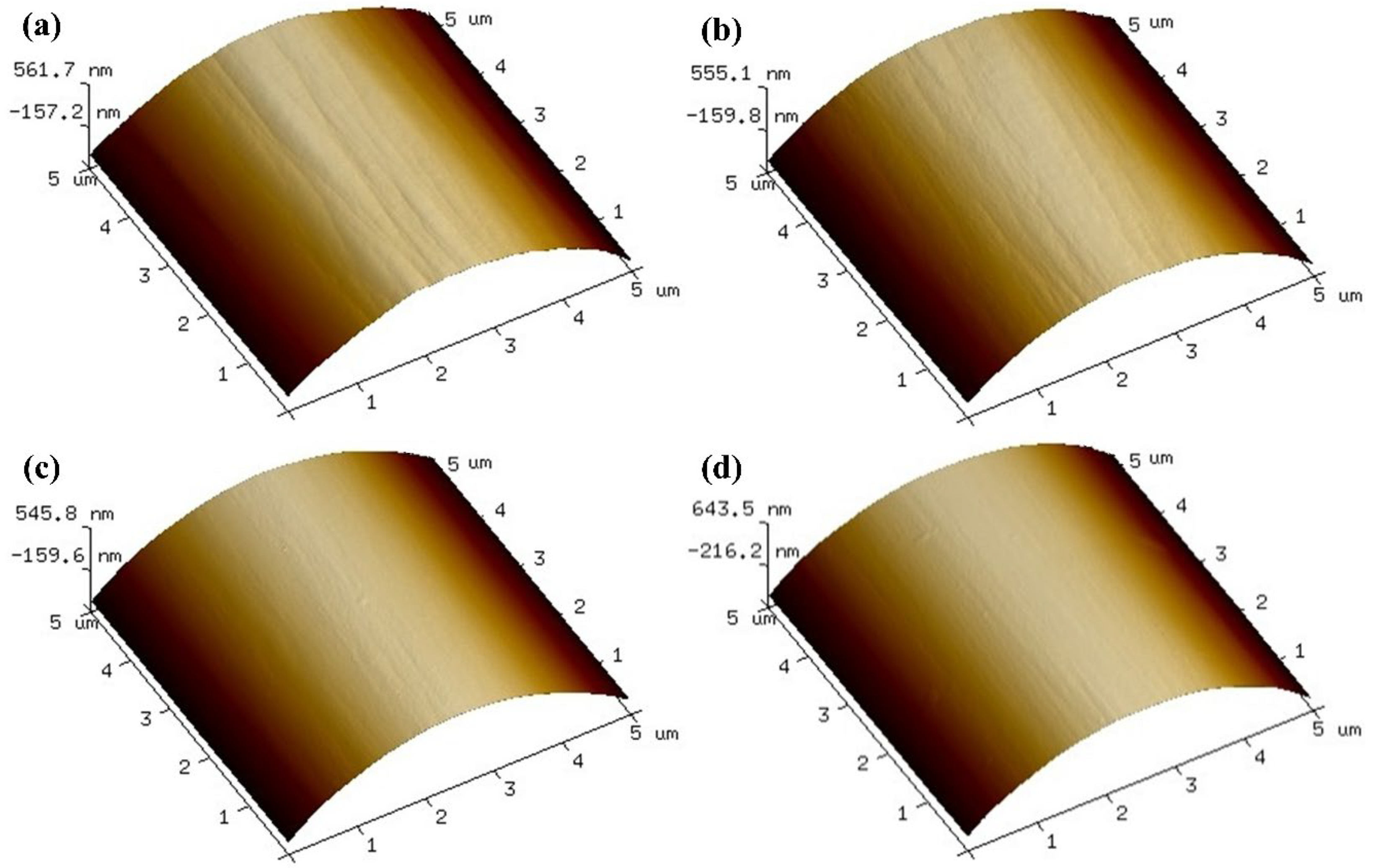
Typical AFM results for the CFs are presented in Figure 5. The surface of CF-low exhibited pronounced grooves, with a roughness (Ra) of approximately 323 nm. In comparison, CF-high showed shallower surface grooves and a lower Ra of 221 nm, indicating a more heterogeneous surface topography with prominent peak–valley structures on CF-low. Based on force–displacement measurements, the surface compressive modulus of CF-low was significantly higher than that of CF-high (Ra: 649 MPa vs. 187 MPa).
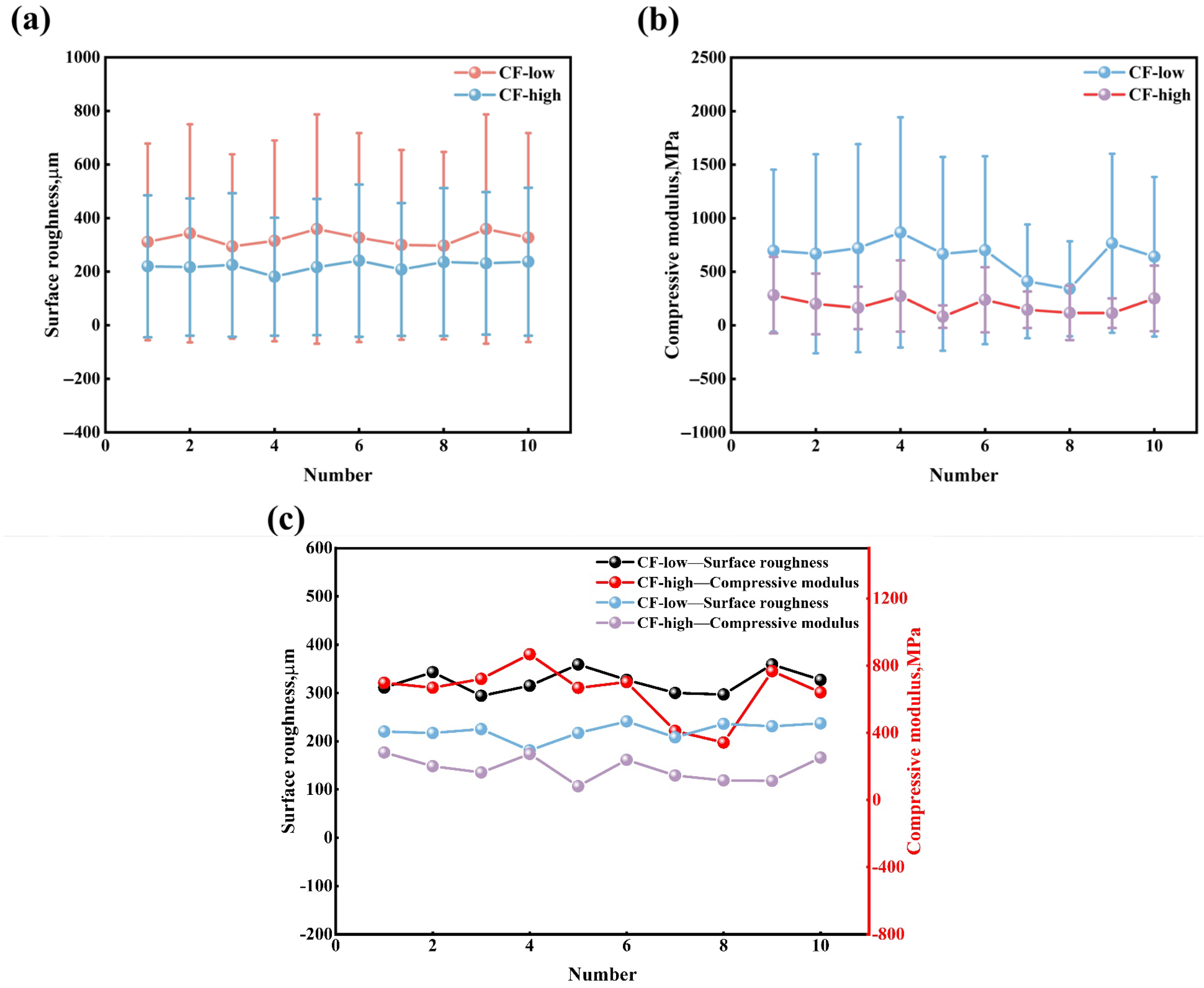
A statistical analysis of the CFs’ surface roughness and compressive modulus is summarized in Figure 6. The surface roughness (Ra and Rq) and surface compressive modulus (Ra and Rq) values of CF-low were all higher than those of CF-high. Figure 6c reveals a positive correlation between the surface roughness and compressive modulus—fibers with greater roughness exhibit higher modulus values. This may be due to the sensitivity of the compressive modulus to grooves (such as sharp peaks or deep valleys), which amplifies the surface modulus [42].

3.2. Skin–Core Structure

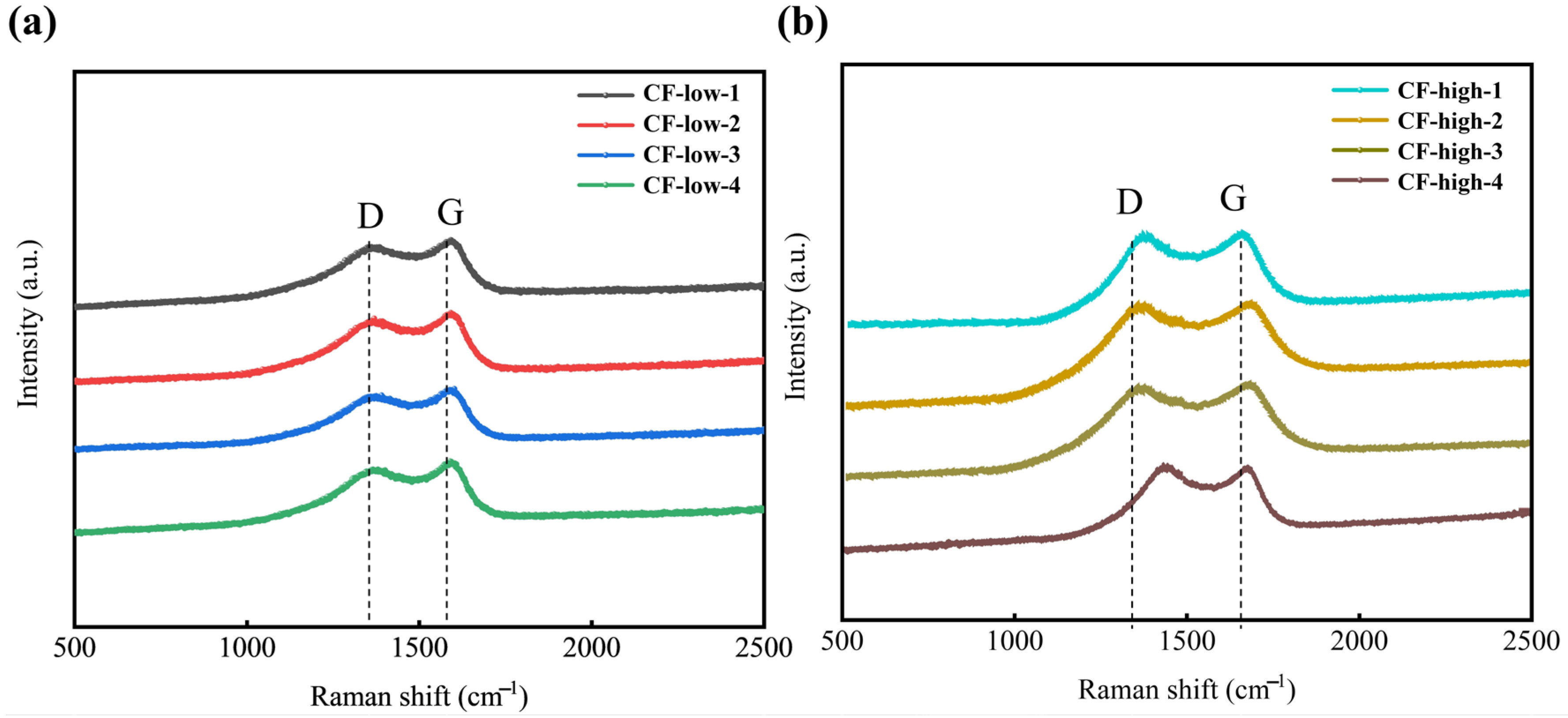
The surface graphitization degree of the CFs was evaluated using Raman spectra (Figure 7). For CF-low, the average intensities of the D and G bands were 3133 a.u. and 3383 a.u., respectively, yielding an ID/IG ratio of approximately 0.93. CF-high showed a D-band intensity of 3972 a.u. and a G-band intensity of 3281 a.u., corresponding to an ID/IG ratio of about 1.21. These results indicate a higher surface graphitization degree in CF-low compared to CF-high.
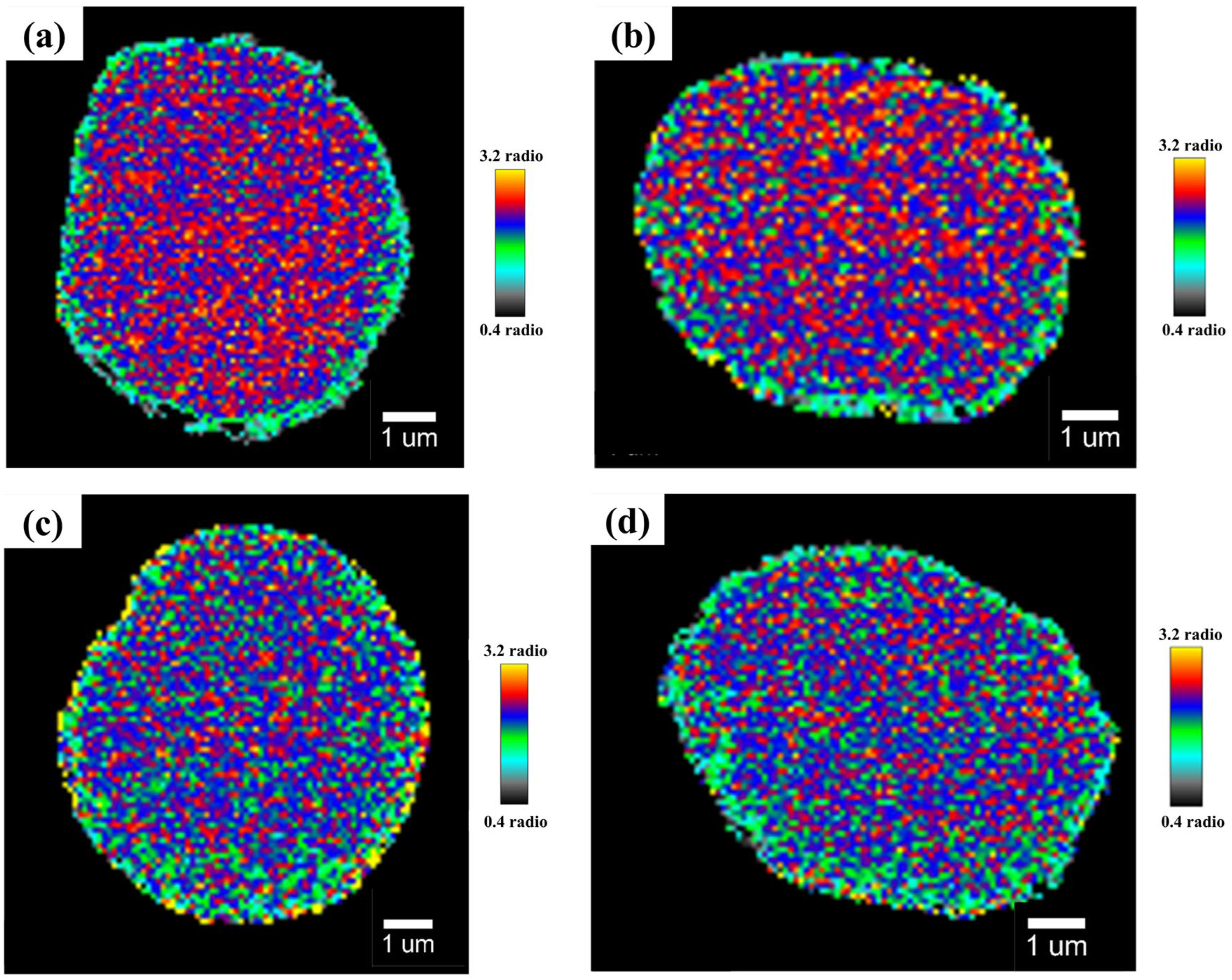
The results of SEM–Raman are shown in Figure 8. From skin to core, the color mapping transitions progressively from green to blue and then to red, accompanied by a gradual increase in the ID/IG, indicating a decreasing degree of graphitization from the outer layer inward. Image analysis revealed that CF-low exhibited a more distinct transition zone between the skin and core. In contrast, CF-high showed a relatively uniform radial distribution of graphitization, with a less pronounced difference between skin and core, indicative of a more homogeneous fiber structure overall. This structural divergence can be attributed primarily to the low-concentration coagulation bath, which promotes rapid formation of a dense skin layer but simultaneously hinders outward solvent diffusion and inward non-solvent penetration. As a result, the core undergoes delayed phase separation, amplifying structural differences between the skin and core and intensifying the skin–core heterogeneity [43,44].
Compared to CF-high, CF-low exhibited a higher degree of surface graphitization (0.93 vs. 1.21) but a more distinct skin–core structure. CFs with a pronounced skin–core structure typically exhibit a higher modulus in their surface layer, which provides enhanced initial mechanical properties (strength, modulus) under low to moderate loads. However, as the applied stress increases, defects in the core region severely constrain the overall fiber performance, leading to significant variability in mechanical behavior. A loose, less-ordered core structure is prone to initiating brittle fracture [12].

3.3. DWI and CAI of CFRCs

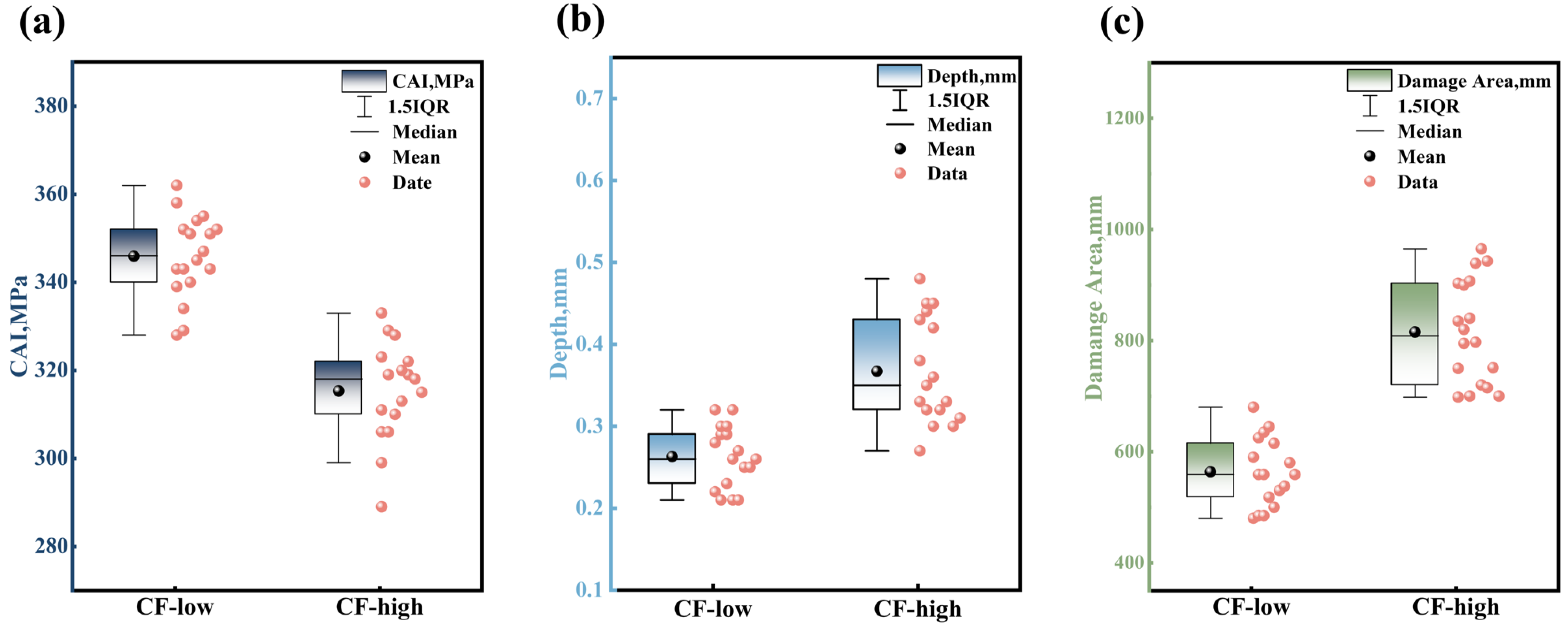
Results from the CAI and DWI tests are presented in Figure 9. For CF-low, the impact dent depth reached 0.37 mm, the back-side crack length was 797 mm, and the CAI was 316 MPa. In comparison, CF-high exhibited an impact dent depth of 0.26 mm, back-side crack length of 548 mm, and CAI of 345 MPa.
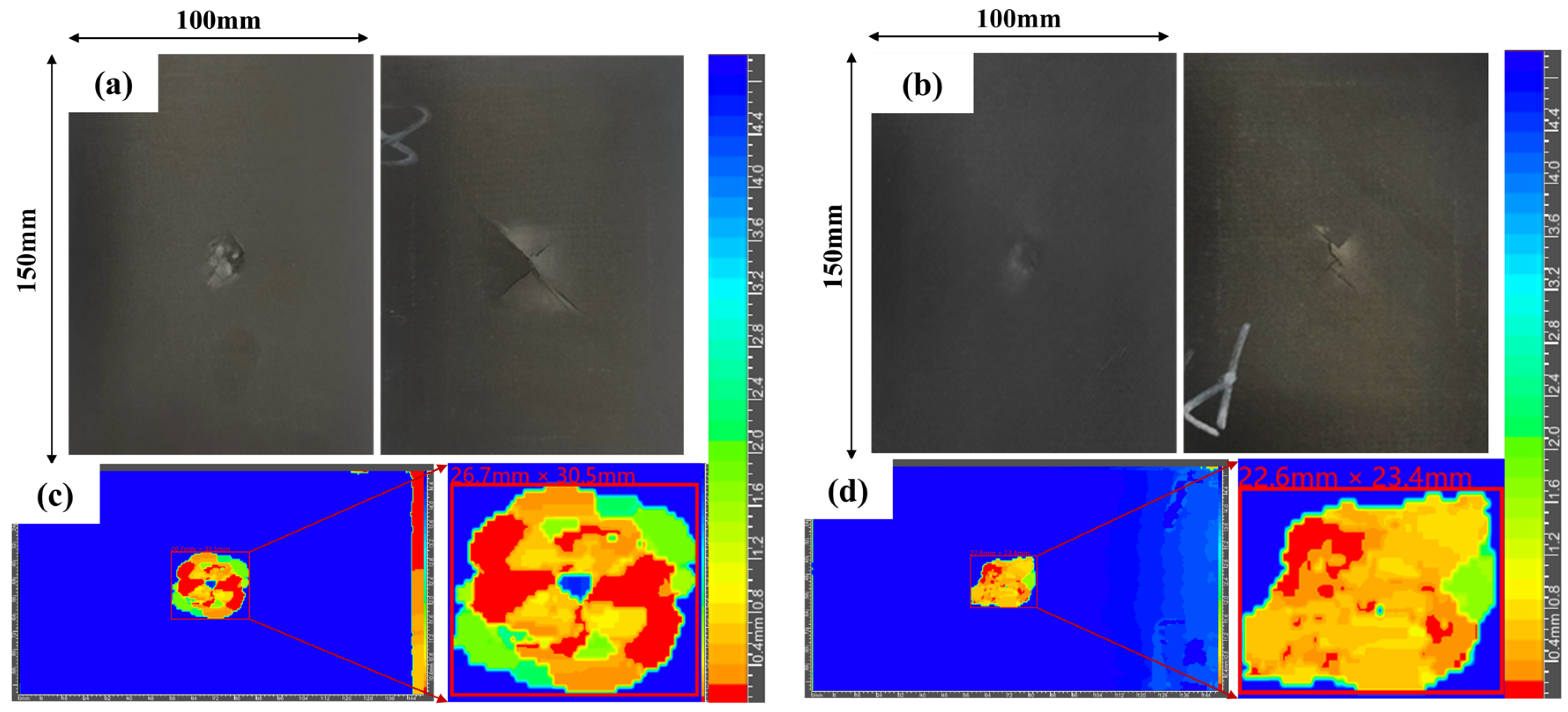
Figure 10 shows the post-impact morphology and C-scan images of the CFRCs. The impact dent exhibited a “funnel”-shaped failure zone dominated by vertical compression, with distinct compressive bulging at the dent edges, radially fractured fibers at the bottom, and cross-shaped cracks on the back side. The C-scan results revealed a color gradient from cool to warm tones from the dent center outward, indicating gradually decreasing damage depth. For the CF-low CFRC, the central region appeared blue, corresponding to a damage depth of about 4.5 mm, which suggested full penetration with extensive fiber breakage. Moving outward, the color transitioned to orange-yellow, indicating that damage shifted to limited fiber fracture and fiber–matrix debonding. The CF-high CFRC showed a similar damage distribution trend, but its crater center was green, reflecting significant yet non-penetrating damage. The dent depth of the CF-low CFRC reached 0.37 mm, with a damage area of approximately 553 mm2. Secondary cracks branched along 45° directions, with multiple sub-cracks, and bottom fiber fractures were randomly oriented. In comparison, the CF-high CFRC exhibited a shallower dent depth of 0.26 mm and a comparable damage area of about 553 mm2. Overall, the CF-low CFRC displayed more severe damage.
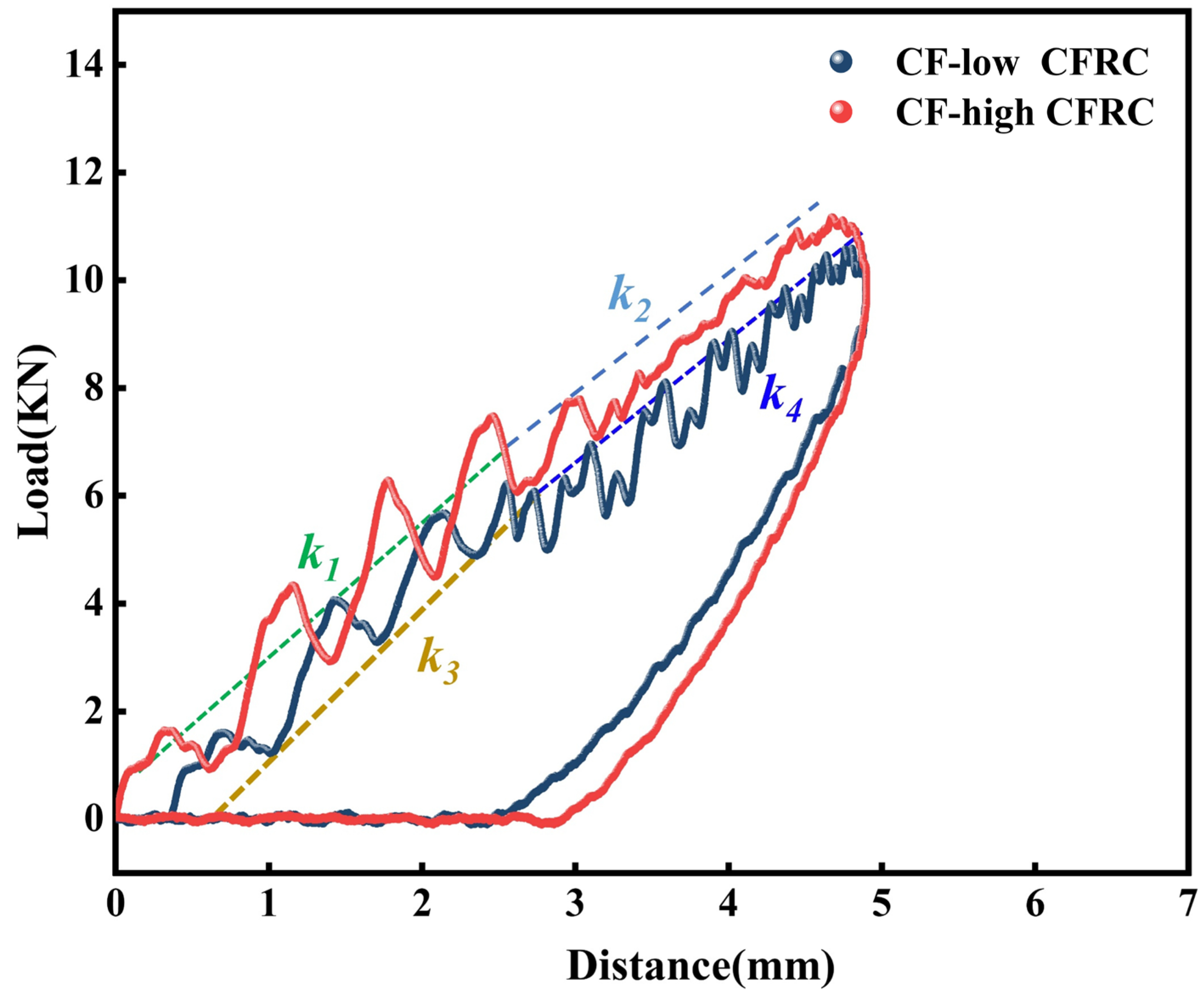
Figure 11 shows the load–displacement curves from the DWI tests of the CFRCs. The curves generally exhibit the two-stage characteristics of “bilinear/sudden failure”. For the CF-low CFRC, the initial linear stage of the curve shows a relatively high slope as the displacement increases, with the load rising gradually at a rate of K3. Slight softening occurs at a displacement of 3.3 mm, where the slope decreases to K4, and the curve exhibits a nonlinear increase before sudden failure occurs at 4.7 mm. For CF-high, the linear segment ranges from 0 to 3.1 mm with slope k1, and from 3.1 to 4.8 mm, the slope decreases to k2, which corresponds to the nonlinear softening stage. Based on preliminary fitting, k3 > k1 > k4 > k2. The curve for the CF-low composite generally exhibits “rigid–brittle” characteristics, whereas the CF-high composite curve demonstrates “tough–ductile” behavior.
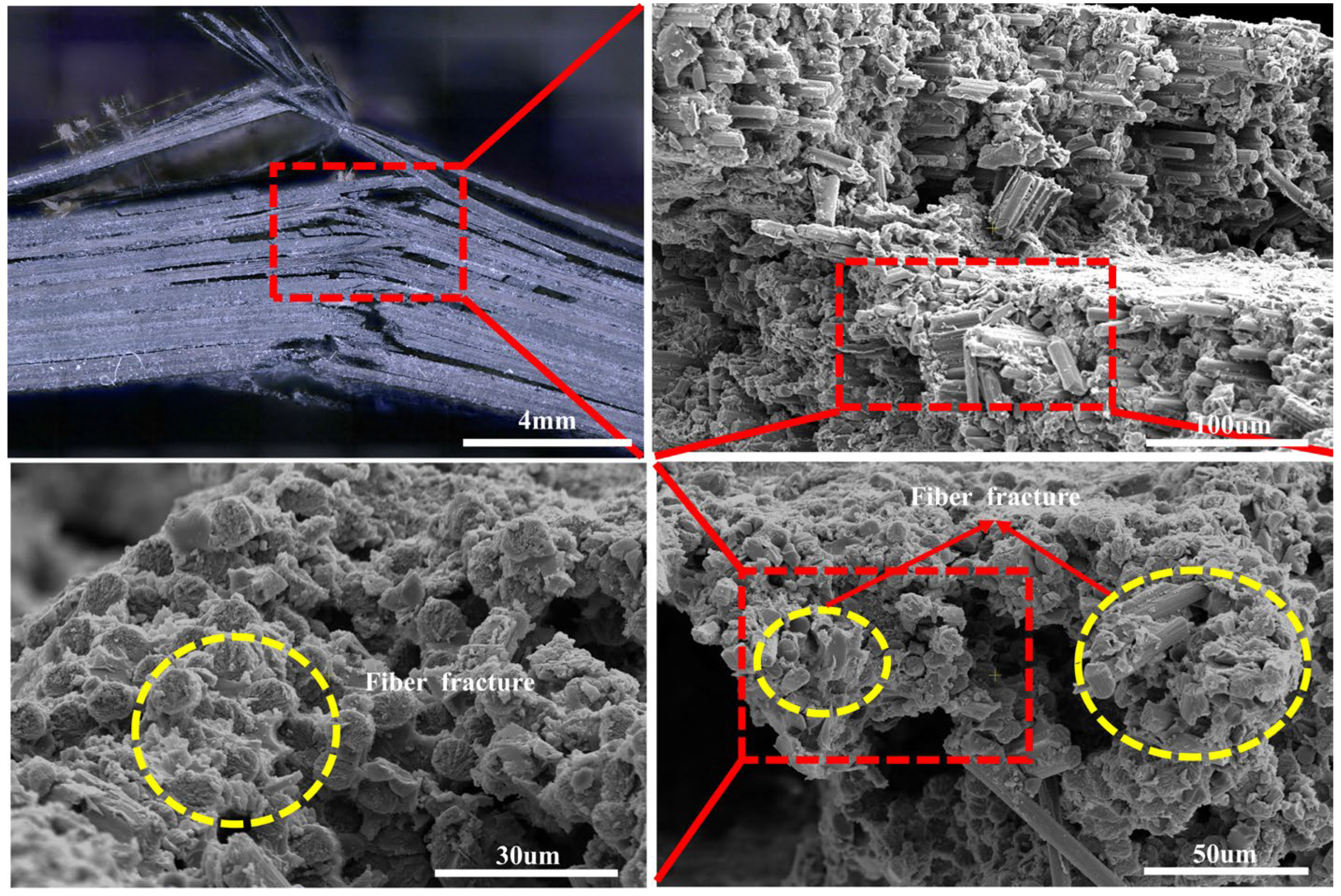
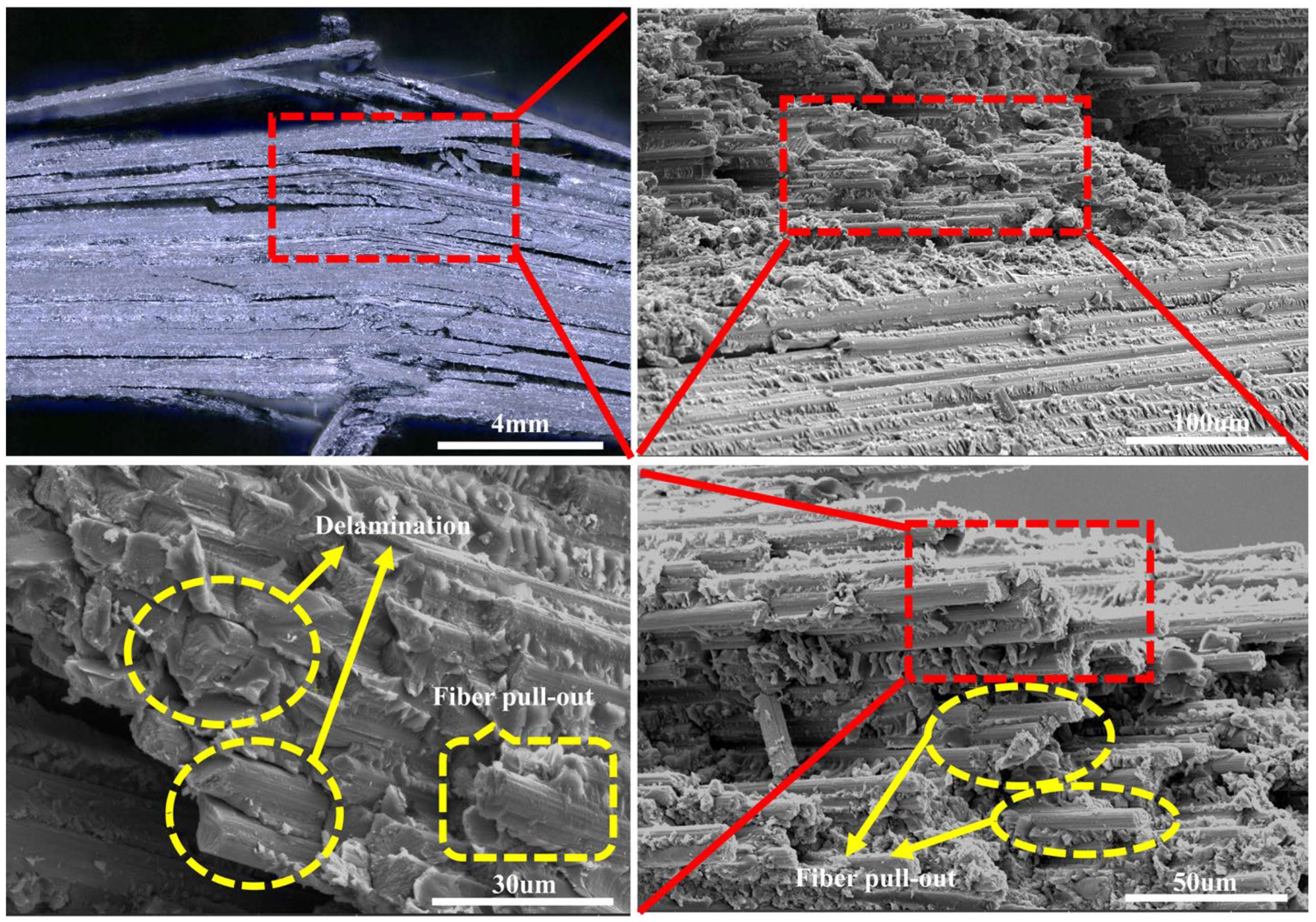
Figure 12 presents the microscopic failure morphology of the CF-low CFRC after CAI. The CF-low CFRC exhibited a failure mode dominated by fiber fracture and delamination. Most fiber fractures were located within the impact dent area, with some fibers showing communitive failure. Limited FMI debonding was observed, indicating a significant mechanical anchoring effect at the interface. Analysis of the load–displacement curve further revealed that the CF-low CFRC displayed a distinct “strong interface–brittle bulk” characteristic. In contrast, Figure 13 shows that the CF-high CFRC demonstrated more extensive fiber pull-out and interfacial debonding. The pull-out lengths ranged approximately from 20 to 50 μm. The corresponding load–displacement curve indicated that the CF-high CFRC possessed a “tough–plastic” characteristic.
Under the same testing conditions, the CF-low CFRC exhibited more severe impact damage; the differences were primarily attributed to the synergistic effects of the fiber structure and FMI interactions. Microstructural analysis indicated that the CF-low CFRC primarily exhibited fiber brittle fracture, with a relatively low proportion of FMI debonding. The deep grooves on the surface of CF-low fibers enhanced the interfacial bonding strength through mechanical interlocking. However, this strong interfacial bonding impeded energy dissipation for crack propagation along the interface, forcing stress concentration onto the fibers themselves. Concurrently, the distinct skin–core structure of CF-low exacerbated strain mismatch, where core voids became crack initiation sites. Under compressive loading, the “‘hard-shell, soft-core” fiber structure induced core collapse as the dominant failure mechanism. During the DWI stage, the high-modulus skin layer transmitted energy to the core, causing collapse due to the core’s insufficient plastic deformation capacity [45]. This resulted in phenomena such as a strong interface, rigid energy transmission, brittle fiber fracture, deep pitting, and elongated cracks. During the CAI tests, strain mismatch between the skin and core caused fiber failure. Excessive interfacial strength prevented crack reorientation at the interface, inhibiting delamination propagation and creating a vicious cycle of “stress concentration–bulk failure”, leading to sudden failure.
In contrast, the CF-high CFRC exhibited a typical progressive damage pattern. Its moderate interfacial strength permitted controlled crack propagation at the FMI. This damage mechanism involved partial debonding of interfaces within the CFRC, effectively dissipating impact energy through delamination and matrix fracture. Concurrently, the higher toughness of CF-high conferred superior buckling resistance to the CFRC [45], thereby confining the final damage area to a limited region. Notably, the damage area did not exhibit a monotonic correlation with residual strength. Although the CF-low CFRC demonstrated a larger overall damage area, its compressive strength degradation was more pronounced, revealing the differential influence of distinct damage modes on structural integrity.

4. Conclusions

This study elucidated the influence of microstructure differences in dry-jet wet-spun T800G CFs on the CAI of CFRCs. The results showed that although CF-low exhibited higher surface roughness (323 nm vs. 221 nm), its stronger interfacial bonding did not translate into better impact resistance. Under identical testing conditions, the CFRC damage was more severe. This difference was primarily attributed to the synergistic regulation of the FMI and fiber structure. The failure of the CF-low CFRC was dominated by fiber brittle fracture, where the strong interfacial bonding inhibited energy dissipation during impact. The pronounced “hard-shell, soft-core” skin–core structure of the CFs exacerbated strain mismatch, triggering collapse dominated by the fiber core, ultimately leading to a chain reaction of strong interface–rigid load transfer–fiber brittle fracture. In contrast, the CF-high CFRC achieved progressive damage propagation through moderate interfacial strength, effectively dissipating energy via interfacial debonding, delamination, and matrix cracking. Meanwhile, the toughness of the CF-high fibers provided better resistance to collapse.
This study revealed and demonstrated the limitations of the CF design paradigm that solely pursues high surface roughness and high modulus values in impact resistance scenarios. For the first time, it elucidated the microscopic mechanism of impact damage behavior in composites from the perspective of synergistic regulation between fiber skin–core structure homogeneity and interface compatibility. By establishing correlations among “fiber skin–core structure homogeneity/interface compatibility/macroscopic impact behavior,” a new design paradigm is proposed that balances fiber structure homogenization, interface optimization, and defect suppression. This provides a crucial theoretical basis and process direction for developing a new generation of “high-strength and high-toughness” CFRCs.

Author Contributions

Methodology, H.Z.; Formal analysis, H.Z.; Investigation, T.T.; Data curation, D.H.; Writing—original draft, H.W.; Writing—review & editing, Y.Z.; Supervision, Y.Z.; Funding acquisition, T.T. All authors have read and agreed to the published version of the manuscript.

Funding

This work is supported by National Key R&D Program of China (2022YFB3709100).

Institutional Review Board Statement

Not applicable.

Data Availability Statement

The raw data supporting the conclusions of this article will be made available by the authors on request.

Acknowledgments

The authors wish to thank AVIC Composite Corporation Ltd., who supported the samples, testing equipment, and other resources. We would also like to thank our families for their constant support and encouragement throughout this research.

Conflicts of Interest

Authors Han Wang, Diyi Hao, Hongfei Zhou, Yichuan Zhang, and Tiebing Tian were employed by the company AVIC Composite Corporation Ltd., Beijing 101300, China. The remaining authors declare that the research was conducted in the absence of any commercial or financial relationships that could be construed as a potential conflict of interest.

Abbreviations

The following abbreviations are used in this manuscript:
CF-lowCarbon fibers produced with low-concentration coagulation bath
CF-highCarbon fibers produced with high-concentration coagulation bath
CFRCCarbon fiber composite
CFsCarbon fibers
EPEpoxy resin
FMIFiber–matrix interface
SEMScanning Electron Microscopy
AFMAtomic Force Microscopy
SEM–RamanScanning Electron Microscopy–Raman
CAICompression after impact
DWIDrop-Weight Impact

References

  1. Aldosari, S.M.; AlOtaibi, B.M.; Alblalaihid, K.S.; Aldoihi, S.A.; AlOgab, K.A.; Alsaleh, S.S.; Alshamary, D.O.; Alanazi, T.H.; Aldrees, S.D.; Alshammari, B.A. Mechanical Recycling of Carbon Fiber-Reinforced Polymer in a Circular Economy. Polymers 2024, 16, 1363. [Google Scholar] [CrossRef]
  2. Brooks, R.A.; Liu, J.; Hall, Z.E.C.; Joesbury, A.M.; Harper, L.T.; Liu, H.; Kinloch, A.J.; Dear, J.P. The Relationship Between the Extent of Indentation and Impact Damage in Carbon-Fibre Reinforced-Plastic Composites after a Low-Velocity Impact. Appl. Compos. Mater. 2024, 31, 1869–1888. [Google Scholar] [CrossRef]
  3. Al Zahmi, S.; Alhammadi, S.; ElHassan, A.; Ahmed, W. Carbon Fiber/PLA Recycled Composite. Polymers 2022, 14, 2194. [Google Scholar] [CrossRef]
  4. Brown, K.R.; Harrell, T.M.; Skrzypczak, L.; Scherschel, A.; Wu, H.F.; Li, X.D. Carbon fibers derived from commodity polymers: A review. Carbon 2022, 196, 422–439. [Google Scholar] [CrossRef]
  5. Ursache, Ș.; Cerbu, C.; Hadăr, A. Characteristics of Carbon and Kevlar Fibres, Their Composites and Structural Applications in Civil Engineering—A Review. Polymers 2024, 16, 127. [Google Scholar] [CrossRef]
  6. Katouzian, M.; Vlase, S.; Marin, M.; Scutaru, M.L. Modeling Study of the Creep Behavior of Carbon-Fiber-Reinforced Com-posites: A Review. Polymers 2023, 15, 194. [Google Scholar]
  7. Newman, B.; Creighton, C.; Henderson, L.C.; Stojcevski, F. A review of milled carbon fibres in composite materials. Compos. Part A Appl. Sci. Manuf. 2022, 163, 107249. [Google Scholar] [CrossRef]
  8. Jin, Z.; Zhang, Z.; Meng, L. Effects of ozone method treating carbon fibers on mechanical properties of carbon/carbon composites. Mater. Chem. Phys. 2006, 97, 167–172. [Google Scholar] [CrossRef]
  9. Sharma, H.; Kumar, A.; Rana, S.; Guadagno, L. An Overview on Carbon Fiber-Reinforced Epoxy Composites: Effect of Graphene Oxide Incorporation on Composites Performance. Polymers 2022, 14, 1548. [Google Scholar] [CrossRef]
  10. Torokhov, V.G.; Chukov, D.I.; Tcherdyntsev, V.V.; Stepashkin, A.A.; Zadorozhnyy, M.Y. Influence of Interfacial Interaction and Composition on Fracture Toughness and Impact Properties of Carbon Fiber-Reinforced Polyethersulfone. Polymers 2024, 16, 860. [Google Scholar] [CrossRef]
  11. Li, S.; Liu, W.; Mao, Y.; Hou, S. Numerical cross-scale optimization of homogenized composite laminates under impact loading. Int. J. Mech. Sci. 2023, 245, 108108. [Google Scholar] [CrossRef]
  12. Nunna, S.; Naebe, M.; Hameed, N.; Fox, B.L.; Creighton, C. Evolution of radial heterogeneity in polyacrylonitrile fibres during thermal stabilization: An overview. Polym. Degrad. Stab. 2017, 136, 20–30. [Google Scholar] [CrossRef]
  13. Dilsiz, N.; Wightman, J.P. Surface analysis of unsized and sized carbon fibers. Carbon 1999, 37, 1105–1114. [Google Scholar] [CrossRef]
  14. Wang, S.; Chen, Z.H.; Ma, Q.S.; Hu, H.F.; Zheng, W.W. Effect of fiber surface state on mechanical properties of Cf/Si-O-C composites. Mater. Sci. Eng. A-Struct. Mater. Prop. Microstruct. Process. 2005, 407, 245–249. [Google Scholar] [CrossRef]
  15. Choi, J.; Jeon, C.; Lee, J.-E.; Lee, G.-H.; Hwang, S.; Han, M.; Lee, S.; Gwak, H.J.; Lee, E.; Won, J.S.; et al. Optimization of the carbonization process based on the evolution of microstructural components of polyacrylonitrile (PAN)-based fibers. Carbon 2025, 235, 120058. [Google Scholar] [CrossRef]
  16. Wang, A.; Li, R.; Liu, X. Analysis of the Tensile Properties and Probabilistic Characteristics of Large-Tow Carbon Fiber-Reinforced Polymer Composites. Polymers 2024, 16, 2197. [Google Scholar] [CrossRef]
  17. Jäger, J.; Moosburger-Will, J.; Horn, S. Determination of nano-roughness of carbon fibers by atomic force microscopy. J. Mater. Sci. 2013, 48, 6803–6810. [Google Scholar] [CrossRef]
  18. Song, W.; Gu, A.; Liang, G.; Yuan, L. Effect of the surface roughness on interfacial properties of carbon fibers reinforced epoxy resin composites. Appl. Surf. Sci. 2011, 257, 4069–4074. [Google Scholar] [CrossRef]
  19. Wu, S.; Liu, Y.; Ge, Y.; Ran, L.; Peng, K.; Yi, M. Surface structures of PAN-based carbon fibers and their influences on the interface formation and mechanical properties of carbon-carbon composites. Compos. Part A Appl. Sci. Manuf. 2016, 90, 480–488. [Google Scholar] [CrossRef]
  20. Andreas, H. The Influence of Roughness on Surface Enhanced Effects; Austrian Science Fund (FWF): Vienna, Austria, 2009. [Google Scholar]
  21. Cai, H.; Xi, J.; Chen, Y.; Ye, L. A novel micro-mechanical model for continuous carbon fiber-reinforced composites: Effect of fiber surface roughness on mechanical behaviors. Compos. Struct. 2025, 357, 118960. [Google Scholar] [CrossRef]
  22. Lee, J.-E.; Choi, J.; Lee, D.J.; Lee, S.; Chae, H.G. Radial microstructure development of polyacrylonitrile (PAN)-based carbon fibers. Carbon 2022, 191, 515–524. [Google Scholar] [CrossRef]
  23. Nunna, S.; Setty, M.; Naebe, M. Formation of skin-core in carbon fibre processing: A defect or an effect? Express Polym. Lett. 2019, 13, 146–158. [Google Scholar] [CrossRef]
  24. Sun, M.; Shao, R.; Wang, W.; Ma, T.; Li, T.; Huang, W.; Liu, Y.; Xue, Y.; Pei, X.; Xu, Z. Advances in Insight of Radial Heterogeneous Microstructure and Its Relevance to Mechanical Properties of Polyacrylonitrile-Based Carbon Fibers. Adv. Eng. Mater. 2023, 25, 2300413. [Google Scholar] [CrossRef]
  25. Sun, L.; Shang, L.; Xiao, L.; Zhang, M.; Ao, Y.; Li, M. The influence of stabilization efficiency on skin–core structure and properties of polyacrylonitrile fibers. J. Mater. Sci. 2020, 55, 3408–3418. [Google Scholar] [CrossRef]
  26. Zhu, J.; Gao, Z.; Mao, Q.; Gao, Y.; Li, Y.; Zhang, X.; Gao, Q.; Jiang, M.; Lee, S.; van Duin, A.C. Advances in developing cost-effective carbon fibers by coupling multiscale modeling and experiments: A critical review. Prog. Mater. Sci. 2024, 146, 101329. [Google Scholar] [CrossRef]
  27. Qi, G.; Zhang, B.; Du, S.; Yu, Y. Estimation of aramid fiber/epoxy interfacial properties by fiber bundle tests and multiscale modeling considering the fiber skin/core structure. Compos. Struct. 2017, 167, 1–10. [Google Scholar] [CrossRef]
  28. Wang, N.; Li, Z.; Peng, Y.; Jiang, Z.; Li, H. Micro–Macro Coupling Study on the Mechanical Properties of Continuous Fiber-Reinforced Composites. Polymers 2024, 16, 2995. [Google Scholar] [CrossRef]
  29. Kim, D.-W.; Kim, D.H.; Kim, S.R.; Kim, B.-H.; Bang, Y.H.; Yang, D.J.; Choi, G.B.; Kim, Y.A.; Yang, K.S. Effect of low processing rate on homogeneous microstructural evolution of polyacrylonitrile-based carbon fibers. Carbon Lett. 2019, 29, 479–485. [Google Scholar] [CrossRef]
  30. Duan, Z.; Li, W.; Liu, H.; Shen, P.; Yang, H.; Zhong, X.; Bao, J. Synergetic Improvement of Interfacial Performance and Impact Resistance of Carbon Fiber-Reinforced Epoxy Composite via Continuous Electrochemical Oxidation. Polymers 2025, 17, 1007. [Google Scholar] [CrossRef] [PubMed]
  31. Gao, B.; Zhang, R.; He, M.; Wang, C.; Liu, L.; Zhao, L.; Wen, Z.; Ding, Z. Interfacial microstructure and mechanical properties of carbon fiber composites by fiber surface modification with poly(amidoamine)/polyhedral oligomeric silsesquioxane. Compos. Part A Appl. Sci. Manuf. 2016, 90, 653–661. [Google Scholar] [CrossRef]
  32. Ma, T.; Shao, R.; Wang, W.; Liu, S.; Min, C.; Jiang, W.; Li, T.; Xu, Z. Enhanced graphitization and reduced radial heterogeneity of carbon fibers inheriting from irradiated/thermo-chemically stabilized PAN-fibers. Polymer 2024, 308, 127347. [Google Scholar] [CrossRef]
  33. Ma, Y.; Wang, J.; Lu, K.; Xiang, Y.; Liu, Y. The evolution of carbon fiber elements and their effects on fiber mechanical properties from molecular dynamics. Comput. Mater. Sci. 2023, 220, 112029. [Google Scholar] [CrossRef]
  34. Jen, Y.-M.; Chen, Y.-J.; Yu, T.-H. Improving the Impact Resistance and Post-Impact Tensile Fatigue Damage Tolerance of Carbon Fiber Reinforced Epoxy Composites by Embedding the Carbon Nanoparticles in Matrix. Polymers 2024, 16, 3589. [Google Scholar] [CrossRef]
  35. Dinh, D.T.; Ninh, H.D.; Nguyen, H.T.; Nguyen, D.H.; Nguyen, G.V.; Nguyen, T.H.; Pham, K.T.; La, D.D. Polyamide 6/carbon fibre composite: An investigation of carbon fibre modifying pathways for improving mechanical properties. Plast. Rubber Compos. 2024, 53, 190–199. [Google Scholar] [CrossRef]
  36. Cui, J.; Yan, S.; Zhao, Y.; Jiang, L. Low-Velocity Impact and Residual Compression Performance of Carbon Fiber Reinforced Composite Stiffened Plates. Appl. Compos. Mater. 2023, 30, 1185–1206. [Google Scholar] [CrossRef]
  37. Olhan, S.; Antil, B.; Behera, B. Low-velocity impact and quasi-static post-impact compression analysis of woven structural composites for automotive: Influence of fibre types and architectural structures. Compos. Struct. 2025, 352, 118676. [Google Scholar] [CrossRef]
  38. Ji, B.H. Effect of Coagulation Bath Concentration on the Structure and Properties of Polyacrylonitrile as-Spun Fibers during Wet-Spinning. Adv. Mater. Res. 2011, 287–290, 1832–1836. [Google Scholar] [CrossRef]
  39. ASTM D7136; Standard Test Method for Measuring the Damage Resistance of a Fiber-Reinforced Polymer Matrix Composite to a Drop-Weight Impact Event. ASTM International: West Conshohocken, PA, USA, 2020.
  40. ASTM D7137; Standard Test Method for Compressive Residual Strength Properties of Damaged Polymer Matrix Composite Plates. ASTM International: West Conshohocken, PA, USA, 2020.
  41. Mohsin, M.A.A.; Iannucci, L.; Greenhalgh, E.S. Experimental and Numerical Analysis of Low-Velocity Impact of Carbon Fibre-Based Non-Crimp Fabric Reinforced Thermoplastic Composites. Polymers 2021, 13, 3642. [Google Scholar] [CrossRef]
  42. Zaitsev, B.N.; Baklanova, N.I.; Zima, T.M. Atomic force microscopy study of surface-modified carbon fibers. Inorg. Mater. 2008, 44, 592–597. [Google Scholar] [CrossRef]
  43. Sha, Y.; Liu, W.; Li, Y.; Cao, W. Formation Mechanism of Skin-Core Chemical Structure within Stabilized Polyacrylonitrile Monofilaments. Nanoscale Res. Lett. 2019, 14, 93. [Google Scholar] [CrossRef]
  44. Hao, J.; An, F.; Yu, Y.; Zhou, P.; Liu, Y.; Lu, C. Effect of coagulation conditions on solvent diffusions and the structures and tensile properties of solution spun polyacrylonitrile fibers. J. Appl. Polym. Sci. 2017, 134. [Google Scholar] [CrossRef]
  45. Nguyen, N.L.T.; Maghe, M.; Mota-Santiago, P.; Creighton, C.; Groetsch, T.; Nunna, S.; Varley, R.J. Increasing oxygen diffusion during rapid stabilization of a PAN precursor fibre and its impact on the microstructure and properties of carbon fibre. Mater. Today Commun. 2025, 45, 112329. [Google Scholar] [CrossRef]
Figure 1. Schematic diagram of dry-jet wet spun process.
Jcs 10 00044 g001
Figure 2. Manufacturing process of CFRCs.
Jcs 10 00044 g002
Figure 3. SEM–Raman imaging schematic diagram: (a,b) specimen preparation; (c) testing; (d) fiber radial grid scanning; (e) representative results.
Jcs 10 00044 g003
Figure 4. Two-dimensional surface morphology of CFs: (a,b) CF-low; (c,d) CF-high.
Jcs 10 00044 g004
Figure 5. Three-dimensional surface morphology of CFs: (a,b) CF-low; (c,d) CF-high.
Jcs 10 00044 g005
Figure 6. AFM test results for CFs: (a) surface roughness of CFs; (b) surface compressive modulus of CFs; (c) comparison of results between CF-low and CF-high.
Jcs 10 00044 g006
Figure 7. Raman spectra from the surfaces of CFs: (a) CF-low; (b) CF-high.
Jcs 10 00044 g007
Figure 8. Radial gradient of graphitization degree of CFs: (a,b) CF-low; (c,d) CF-high.
Jcs 10 00044 g008
Figure 9. DWI and CAI test results for the two types of CFRC: (a) CAI; (b) depth; (c) damage area.
Jcs 10 00044 g009
Figure 10. CFRCs after DWI: (a) CF-low CFRC morphology; (b) CF-high CFRC morphology; (c) C-scan of CF-low CFR; (d) C-scan of CF-high CFRC.
Jcs 10 00044 g010
Figure 11. Load–displacement curves from the DWI tests of CFRCs.
Jcs 10 00044 g011
Figure 12. Micro-fracture morphology of CF-low CFRC after CAI tests.
Jcs 10 00044 g012
Figure 13. Micro-fracture morphology of CF-high CFRC after CAI tests.
Jcs 10 00044 g013
Table 1. Basic properties of the CFs.
CF TypeCoagulation Bath ConcentrationTensile Strength (MPa)Tensile Modulus (GPa)Elongation (%)
CF-lowLow58002952.10
CF-highHigh58002952.10
Table 2. Basic properties of the matrix.
Matrix TypeCuring Temperature
(°C)
Glass Transition Temperature
(°C)
Tensile Strength
(MPa)
Fracture Toughness KIC
(MPa·m1/2)
Fracture Toughness
GIC
(J/m2)
High-toughness EP180 °C/3 h180901.8900
Disclaimer/Publisher’s Note: The statements, opinions and data contained in all publications are solely those of the individual author(s) and contributor(s) and not of MDPI and/or the editor(s). MDPI and/or the editor(s) disclaim responsibility for any injury to people or property resulting from any ideas, methods, instructions or products referred to in the content.