Review

Biomass Chitosan-Based Composites for Flame Retardancy and Fire Alarm: Advances and Perspectives

1
College of Materials and Chemistry, China Jiliang University, Hangzhou 310018, China
2
National Engineering Research Center of Flame Retardant Materials, School of Materials Science & Engineering, Beijing Institute of Technology, Beijing 100081, China
*
Authors to whom correspondence should be addressed.
J. Compos. Sci. 2026, 10(1), 41; https://doi.org/10.3390/jcs10010041
Submission received: 30 November 2025 / Revised: 5 January 2026 / Accepted: 6 January 2026 / Published: 12 January 2026
(This article belongs to the Section Biocomposites)

Abstract

The appeal of chitosan (CS) stems not only from its exceptional char-forming capacity and molecular tailorability as a flame retardant, but also from its intrinsic thermal responsiveness as a potential fire warning, making it a building block of advanced materials for fire management. Herein, this review provides an up-to-date exploration of advancements in CS and its derivative-based multi-functional composites, with a particular focus on the flame-resistant and fire-warning applications. Specifically, these summaries involve various manufactory approaches, the customed flame-retardant regulation (reflected in a higher Limiting Oxygen Index (LOI) value, a V-0 rating, and a decreased peak of heat release rate (pHRR)), a corresponding principle of flame retardancy, different fire-warning modulations (lower warning temperatures and shorter response times), an underlying fire-warning mechanism (electrical current change), and challenges and opportunities for further development (the assistance of artificial intelligence (AI), multi-functional integration). We mainly aim to present a comprehensive overview that can offer strong guidance for the construction of a new generation of advanced CS-based materials.

1. Introduction

The need for material safety has become increasingly urgent, inspiring the boosting development of new-generation materials that integrate efficient flame retardancy and environmental friendliness.
Responsively, CS, derived from natural chitin, is regarded as an ideal candidate for constructing the next generation of green functional materials due to its strong molecular designability, renewability, and biocompatibility [1,2,3,4,5]. CS, currently, is widely applied in various scenarios, like antibacterial materials [6], adsorbents [7], preservative coatings [8], sensors [9], etc. In terms of flame-retardant applications, the abundant carbon and nitrogen elements in the CS molecular skeleton endow it with encouraging carbonization potential [10]. Through various modification strategies, the carbonization behavior at high temperatures and flame-retardant effect in the gas phase can be further optimized, which can significantly enhance the fire resistance performance of CS-based composite material.
However, cutting-edge research has not merely focused on the enhancement of the passive flame-retardant performance, but also the further pursuit of the intelligent evolution of fire protection concepts. More encouragingly, the unique thermal response characteristic of CS makes it to undergo obvious changes in electrical resistance when driven by heat or fire attacks. Taking advantage of this phenomenon, researchers have successfully constructed intelligent fire-warning systems, which is helpful for the transformation from passive flame retardancy to active early fire warning [11,12].
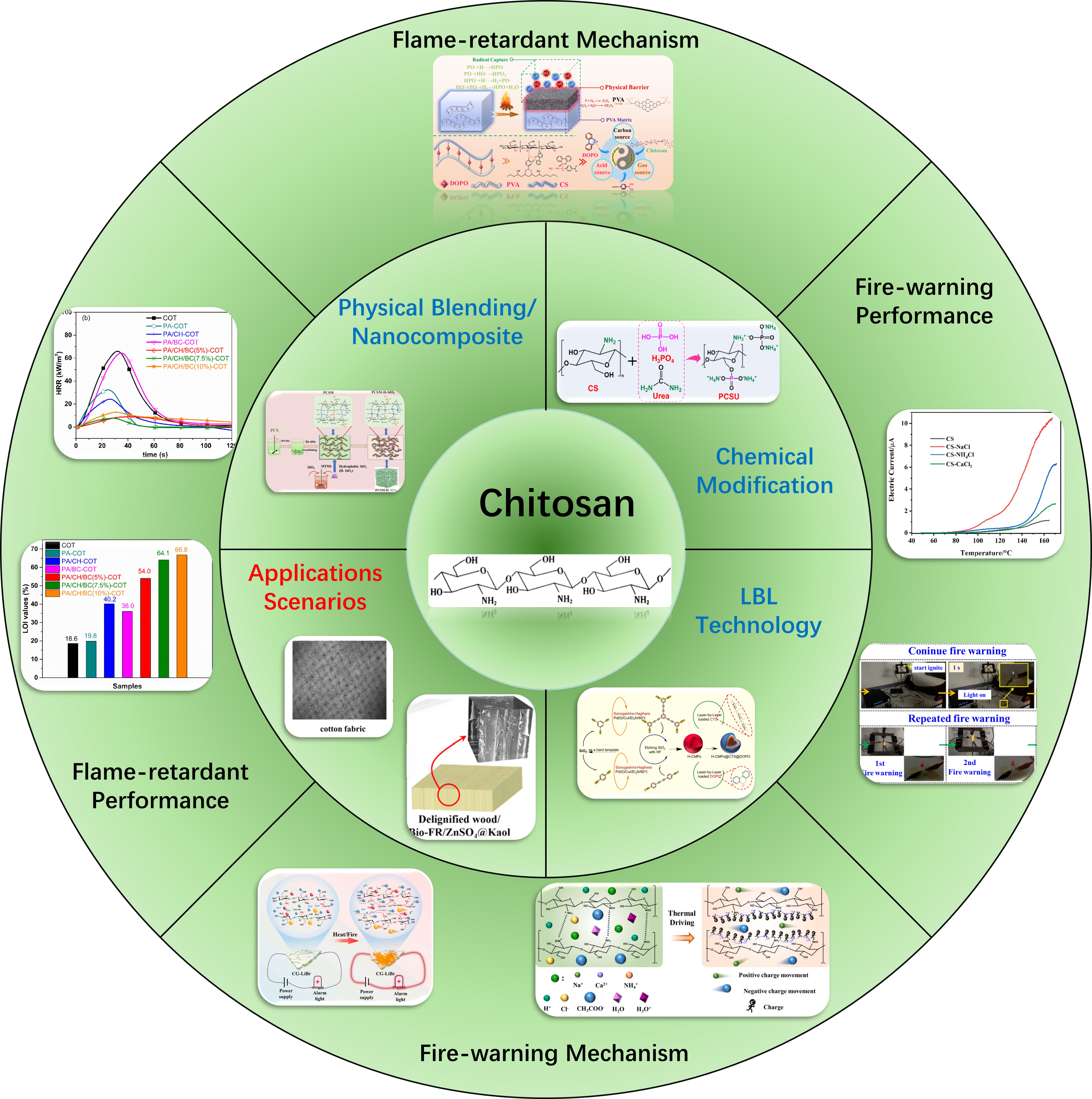
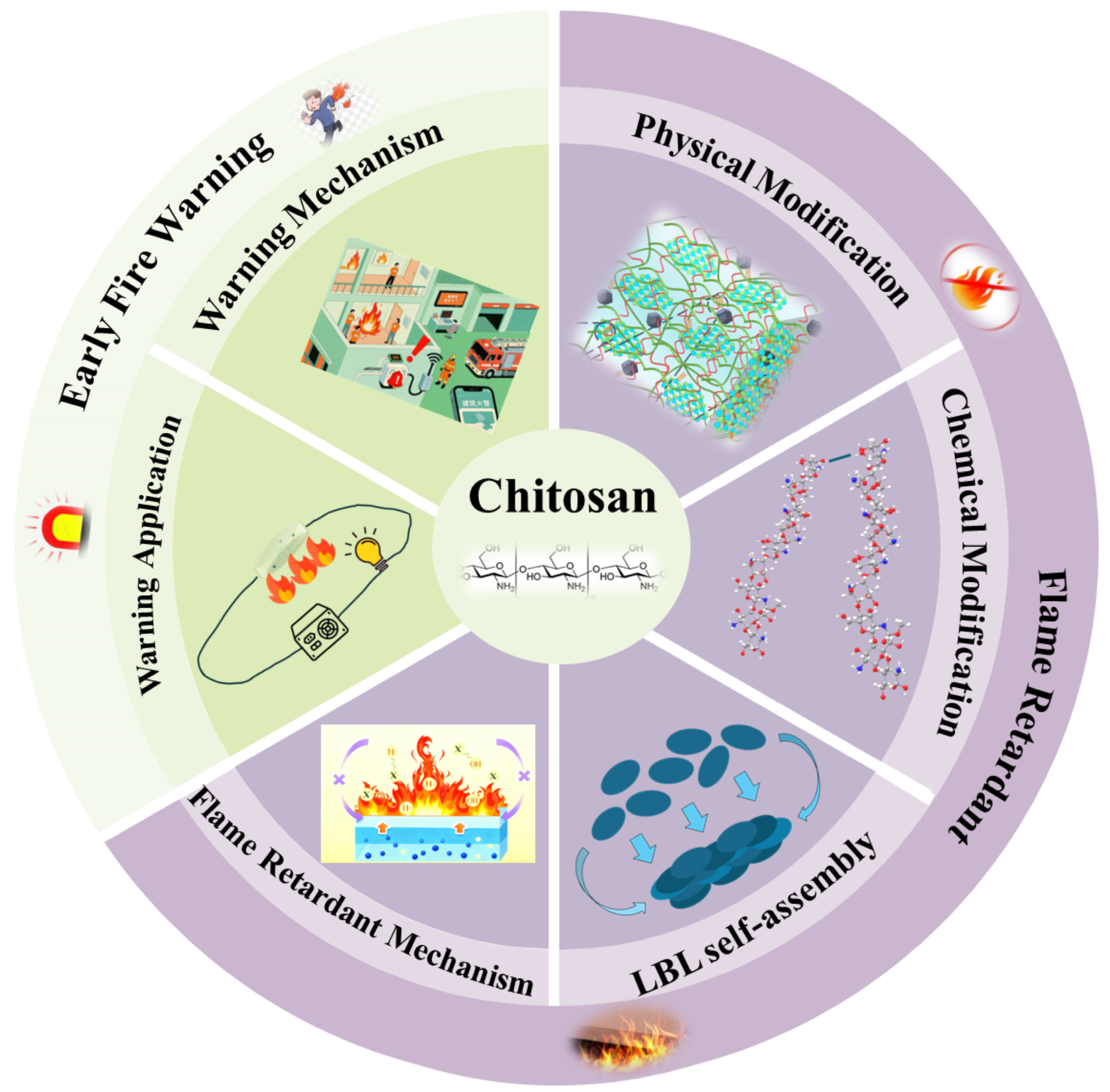
Herein, as shown in Scheme 1, this review systematically examines the latest research progress of CS-based flame-retardant research and early fire-warning investigation, involving preparation strategies, application scenarios, and flame-retardant mechanisms, while extending fire-warning research and detailing early fire-warning mechanisms. Through the comprehensive analysis of reported achievements, this review profoundly reveals the corresponding challenges and puts forward the potential developing directions.

2. Biomass CS-Based Materials for Flame Retardancy

2.1. Modification Strategies for Development of CS-Based Flame Retardants

Given the close structure–property relationship between the molecular structure of CS and its flame-retardant performance, the functionalization of CS through different fabrication strategies has become the key to regulating fire resistance behavior. To systematically clarify the progress in related research, in this work, we will categorize the primary preparation methods for CS-based flame retardants according to their dominant operating mechanisms.

2.1.1. Physical Blending/Nanocomposite

Physical modification, as a simple and efficient approach, essentially depends on the physical interactions (physical blending, cross-linking, etc.) to construct the network structure through the driven of non-covalent reactions, such as hydrogen bonds and charge interactions [13]. Normally, physical modification is irreversible, which presents a unique advantage, particularly in the processing and performance regulation. A large number of relevant studies have highlighted the broad applicability of flame retardants fabricated by physical blend that have been extended to various substrates, like porous materials, bio-based matrices, thermoplastics, thermosetting resins, etc.
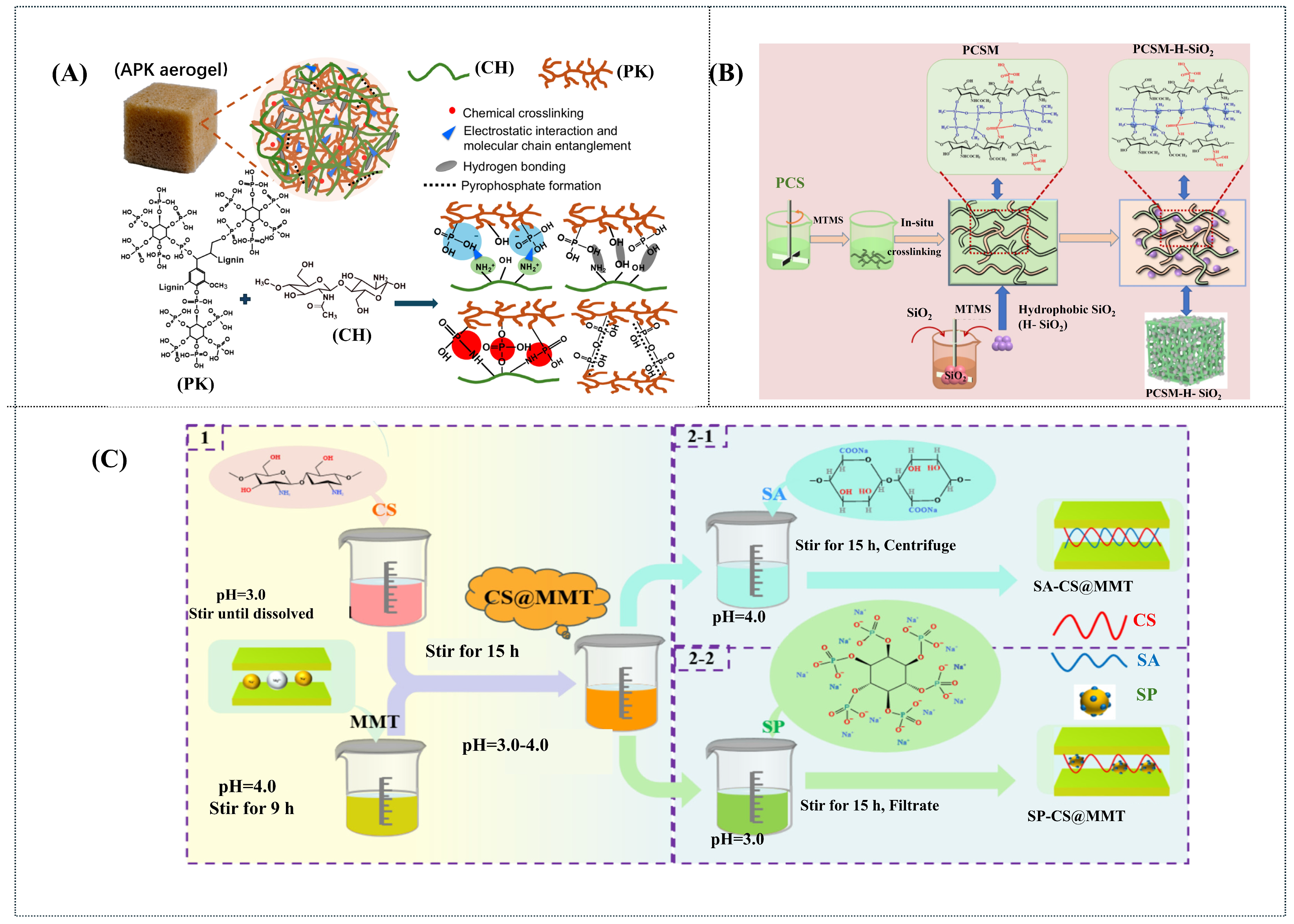
Aerogel is one of representative porous materials due to its extremely high porosity and large specific surface area, which also poses unique challenges to its flame-retardant study [14]. One method was to make full use of CS and MMT with heat resistance and CNF as reinforcing fillers to successfully build anisotropic aerogels, presented in an improved LOI value of 43% and an excellent self-extinguishing phenomenon, along with the improved Young’s modulus and water–oil double hydrophobicity, etc. [15]. Additionally, Saba Khodavandegar et al. [16] provided an alternative formulation comprising CS and PK for the establishment fire-resistance system, including a thermal conductivity of 0.034 W/mK, a compressive strength of 0.83 MPa, a LOI value of 33%, and a UL-94 V-0 rating (Figure 1A). Both of these works demonstrate that reasonable structural design strikes an efficient balance between flame retardancy and mechanical properties. Another formulation integrated MMT onto the surface of SA/CS biomass aerogel, indicating the exceptional flame retardancy (a 205% increase in LOI value) [17]. Moreover, multiple functional CS-based aerogels integrated flame retardancy and piezoresistive sensing performance through the sequent spraying of silver nanowires and SiO2 and PDMS on the CS/APP/MMT composite aerogels, exhibiting a water contact angle of 154° and a favorable self-extinguishing behavior [18]. This result was mainly attributed to the physical barrier effect caused by a dense char layer on the surface of the aerogel. Apart from aerogels, another kind of porous composite material was manufactured by the crossing between MTMS and H-SiO2 with PCS, which showcased not only an increased LOI value and UL-94 V-0 rating, but also an enhanced hydrophobicity and strong mechanical properties, etc. [19] (Figure 1B).
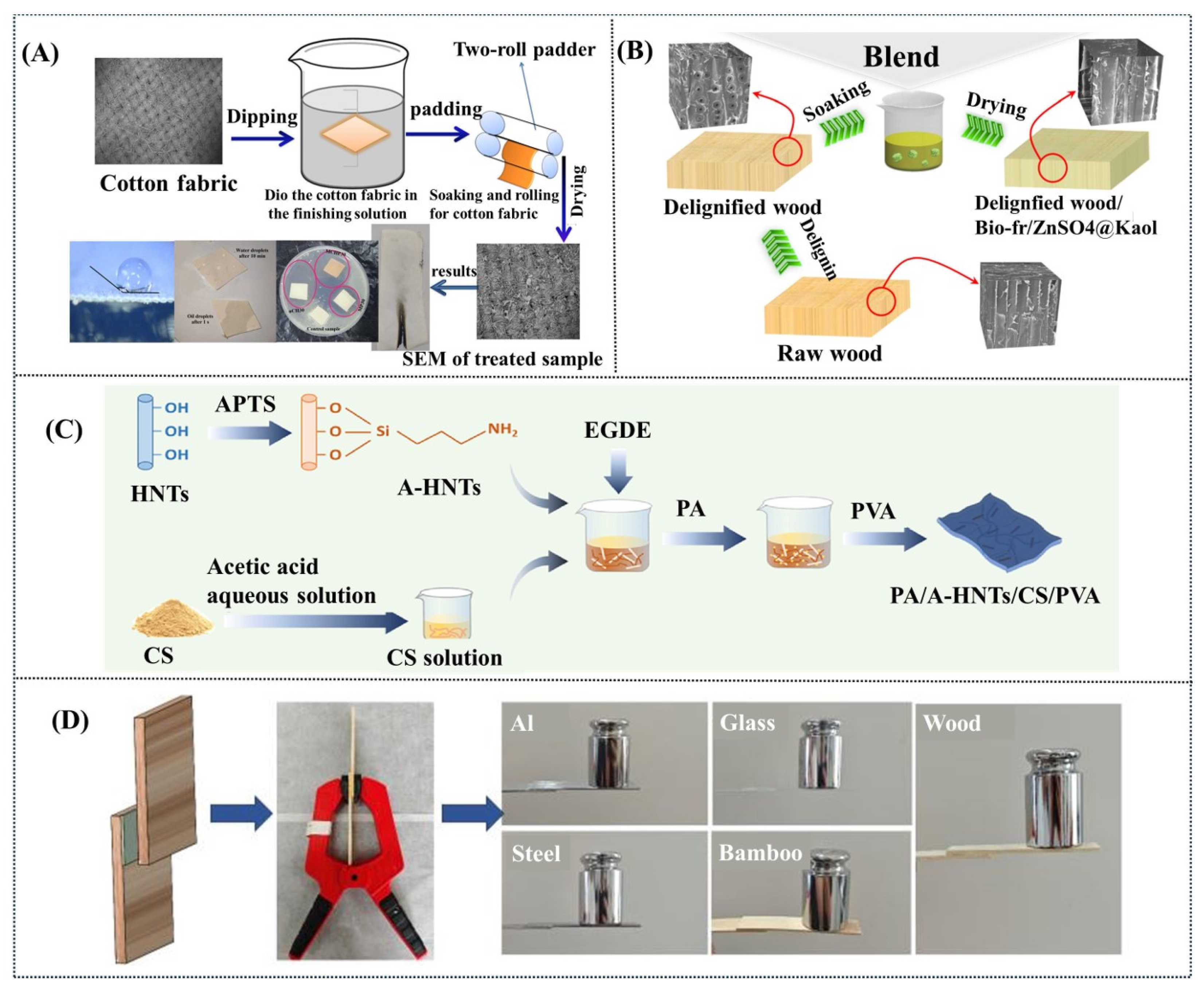
The physical modification strategy to construct flame-retardant coatings is also an important research direction. Ghada Makhlouf et al. [20] skillfully blended MP to solutions of nCS and PVA for the modulation of cotton fabric, which showed expected self-extinguishing behavior and increased LOI value, which is surprising, along with enhanced antibacterial properties and imparted hydrophobicity. Pei-Yuan Lv et al. [11] blended CS and NaH2PO4 to construct transparent CS-based composite coating, presenting improved flame-retardant performance (LOI of 51%, V-0) while integrating early fire-warning capability, high transparency, and excellent mechanical properties (tensile strength of 30 MPa). In addition, Tang et al. [21] used a CS-based flame-retardant gel compounded with ZnSO4-modified kaolinite to build a flame-retardant wood system, demonstrating the decreased pHRR by 53.5% and extending the ignition time to 55 s. This regulation ranked among the best-performing bio-based flame retardants reported recently. Moreover, the physical blending strategy has also been extended to free-standing CS-based systems. For example, Xin Ren et al. [22] soaked CS/MMT nanocomposite films into Na2Cu(OH)4 solution. The fabricated functional nanocomposite films exhibited excellent flame retardancy (LOI: 40.5%), mechanical strength (maximum tensile strength of 30.65 ± 3.48 MPa), and antibacterial activity.
The simple physical blending strategy can also be extended to the flame-retardant research of thermoplastics, such as PVA, PP, PU, etc. For instance, Qiangli Zhao et al. [23] incorporated A-HNTs, CS, and PA into PVA matrix to establish an organic–inorganic composite film, which showed an increased LOI value from 18.5% to 32.2% and passed UL-94 V-0, together with improved tensile strength and anti-ultraviolet capability. As claimed by Zhe Tu et al., a kind of CS-based hybrid material by self-assembling CS and SP in an aqueous phase and followed by intercalation into MMT layers was provided, which achieved synergistic enhancement of both flame retardancy and mechanical property (Figure 1C) [24]. For the flame-retardant modification of PU, regulated PU was treated by utilizing hydrogen bonding and π–π stacking interactions between CS, PA, and Fe-MOF, suggesting surprising flame retardancy and improved mechanical property with a 15.2% tensile strength increase and a 7.1% elongation at break increase [25].
The above-mentioned functional integration research mainly responds to the key contradiction that flame-retardant fillers normally sacrifice mechanical properties via operatable physical blending. Inspiringly, the collaborative optimization strategy promotes flame-retardant materials to move from performance balance to practical application.
Figure 1. (A) Schematic diagram of physicochemical interactions in a cross-linked structured aerogel synthesized from CS and PK. Reproduced with permission from ref. [16], Copyright 2025 Elsevier. (B) Incorporation of H-SiO2 into PCSM to form thermal insulation materials with enhanced performance. With permission from ref. [19], Copyright 2025 Elsevier. (C) Preparation of CS-based PEC intercalated MMT hybrid biomaterials (SA-CS@MMT and SP-CS@MMT) using CS, SA, and SP. With permission from ref. [24], Copyright 2024 Elsevier.
Jcs 10 00041 g001
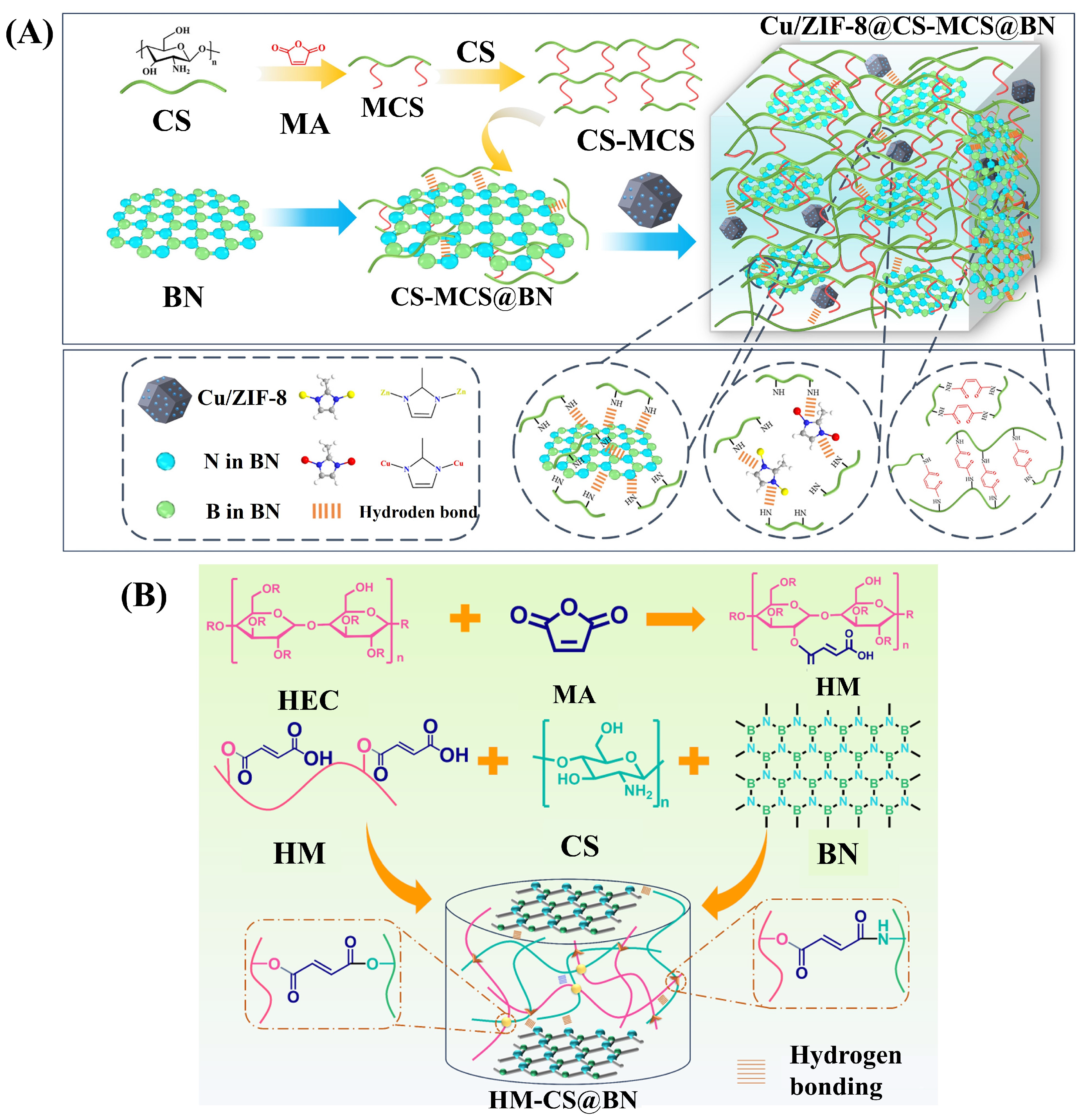
The physical blending strategy is not limited to being used for thermoplastic matrices, which also shows equal potential in thermosetting matrices, especially EP. An example is from Chen’s group, who prepared a novel bio-based flame retardant for EP utilizing electrostatic adsorption between CS, PA, and urea, which improved LOI from 22.2% to 31.2% and obviously enhanced tensile strength as well [26]. Moreover, Li Liu et al. [27] employed maleic anhydride cross-linked with CS and introduced BN and copper-doped ZIF-8 for the flame-retardant modulation of EP, presenting the expected flame retardancy and outstanding compressive properties (Figure 2A). Furthermore, the physical blend flame-retardant design principle is not only applicable to EP, but also shows broad prospects in the construction of advanced flame-retardant thermosetting adhesives. For instance, Ka et al. [28] utilized a combination of hydroxyethyl cellulose, CS, maleic anhydride, and BN to build the low-temperature curing bio-based adhesive HM-CS@BN through an organic–inorganic hybridization approach (Figure 2B). This adhesive not only achieves effective curing under low-temperature hot pressing at 60 °C but also maintains a hot water shear strength of 0.71 ± 0.077 MPa, meeting the national standard (≥0.7 MPa). It further endows plywood with outstanding flame retardancy (LOI increasing from 24.8% to 27.1%, UL-94 V-0), showing surprising versatility.
In brief, the physical blending strategy effectively improves flame retardancy, while also enabling multi-functional integration through precisely regulating the morphology and dispersion of fillers. Additionally, the approach offers significant advantages in procedural simplicity and cost-effectiveness.

2.1.2. Chemical Modification

Theoretically, chemical modification is one of the vital strategies for expected CS-based flame retardants via tailored molecular design. Specifically, some flame-retardant components can interact with functional groups in CS through covalent bonds, ionic bonds, or coordination bonds [29,30,31,32,33,34]. The strong connection between the flame-retardant unit and CS matrix not only ensures the uniform distribution of flame retardant, but also avoids the precipitation phenomenon of flame retardants caused by physical blending, which is beneficial for the achievement of efficient flame suppression.
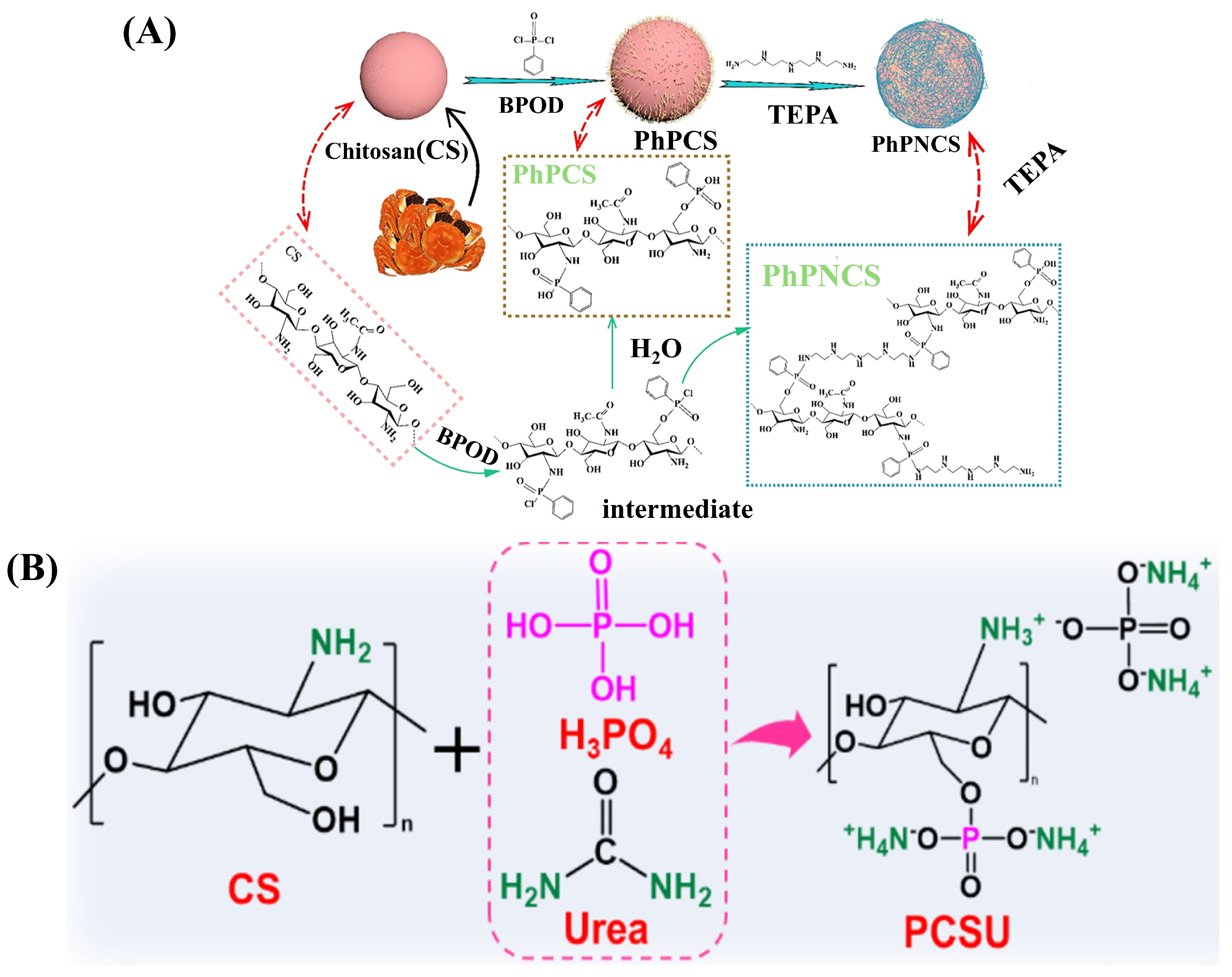
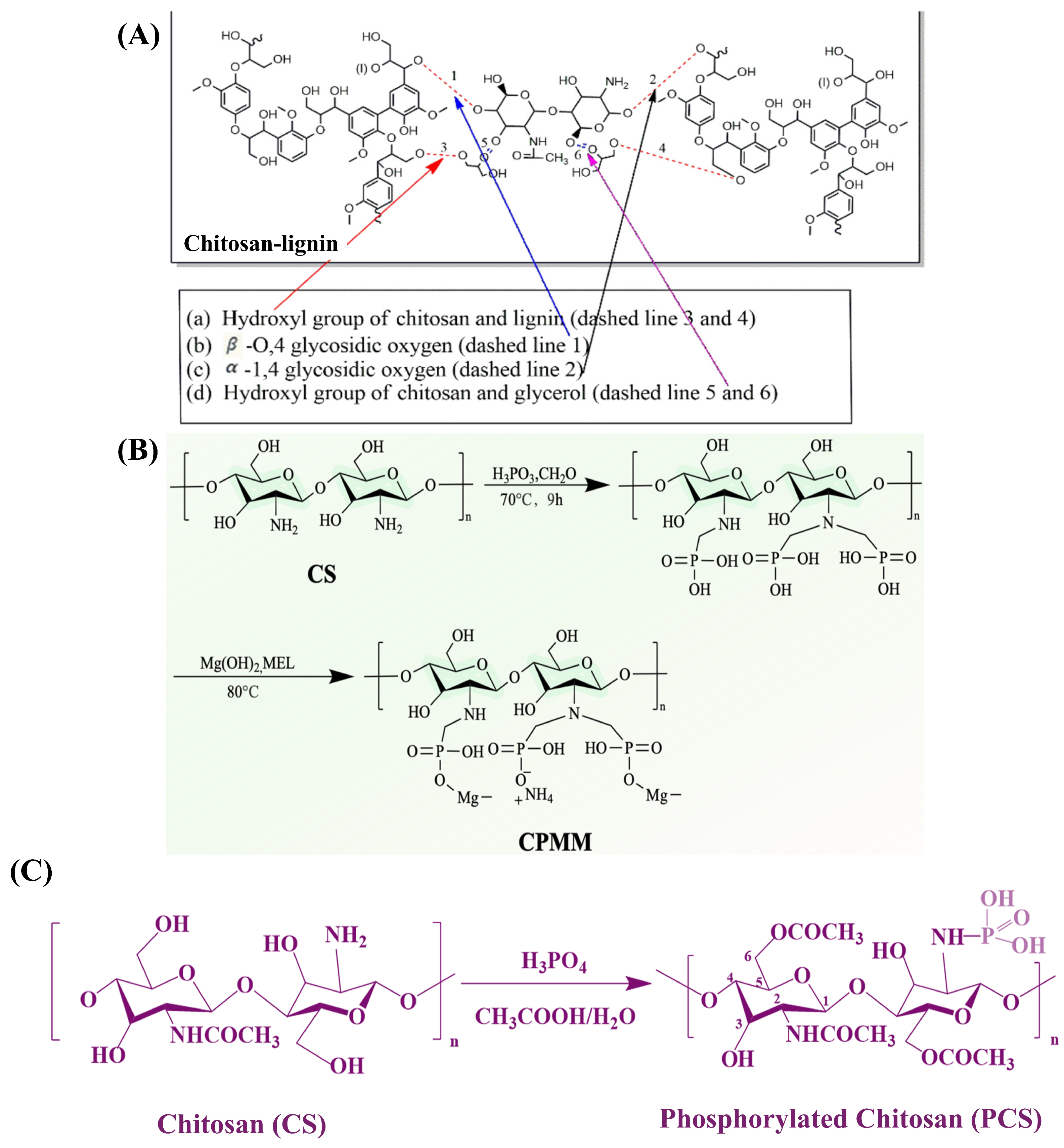
Ping Wang et al. [35] first embedded hollow microspheres into the porous skeleton of CS-based aerogel, then modified the surface with siloxane to integrate a composite aerogel. This aerogel presented significant improvements in thermal stability (decomposing at ~320 °C), compressive strength (about 800 kPa), and flame retardancy (gross calorific value < 2 MJ/Kg, achieved class A1 non-combustible). Apart from the flame-retardant aerogel, modified CS-based materials are available for the improvement of PLA, which is a flammable material that is accompanied by melting and dripping even though PLA possesses the advantages of biodegradability and biocompatibility. As stated by Xiaobing Ma et al., two kinds of CS-based flame retardants for PLA by the phosphorylation and amidation modification, respectively, were successfully prepared, causing an LOI value increase of 9% and 7%, respectively, and all passed the V-0 grade of UL-94 test at a low addition [36] (Figure 3A). This result highlighted the uniqueness of CS-based flame retardants, particularly for thermoplastic PLA. In addition, Wang’s group et al. [37] carried out the grafting treatment of 2-thiophene-formaldehyde onto a CS skeleton via one-pot Schiff base reaction for sulfur-containing bio-based derivatives, which was compounded with AP serving as an efficient flame retardant for PLA. Under the optimal ratio, modified PLA exhibited increased LOI value to 28.5% and passed UL-94 V-0 without any dripping phenomenon, along with the decreased pHRR by 52.3% and total smoke release by 73.4%, mainly attributed to the synergistic effect of catalytic carbon formation in the condensed phase and the quenching effect of phosphorus-containing free radicals in the gas phase. Similarly, Zhu et al. also utilized the reaction of CS with phenylphosphoric acid to prepare flame retardant for PLA, which presented a further increased LOI value to 30.3%, decreased pHRR to 407 kW/m2, and reduced THR to 56.1 MJ/m2, as well as the passing UL-94 V-0 rating [38]. These studies systematically increased LOI value by optimizing the chemical modification of CS generally. This confirmed the effectiveness of the synergistic regulation of the gas phase and condensed phase flame retardancy by ingenious molecular design. Moreover, it is worth noting that LOI is closely related to the free radical reactions during the combustion processing. Especially when CS is combined with flame retardants containing phosphorus and/or nitrogen elements, LOI value significantly increases.
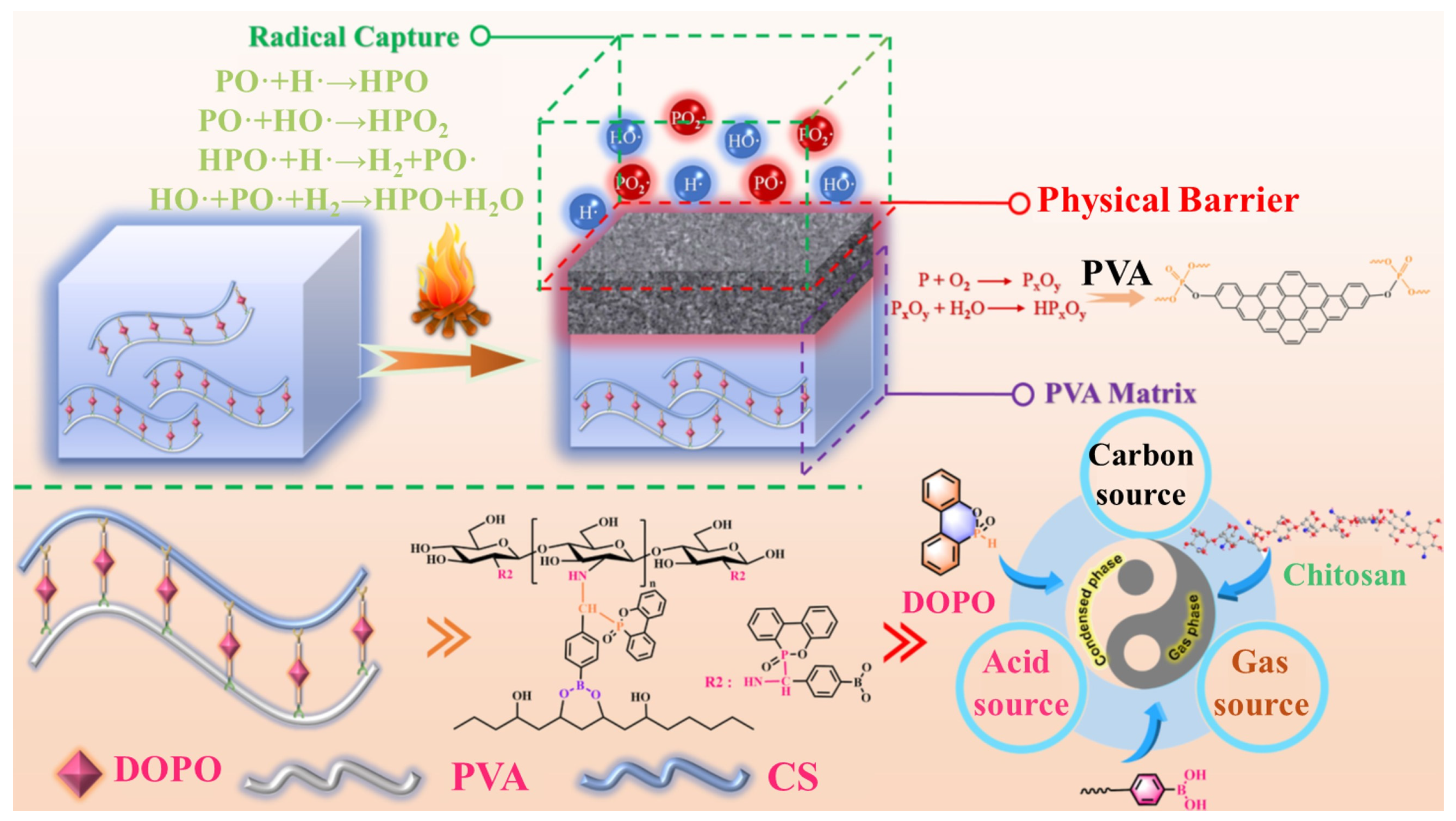
Inhibiting the melting–dripping behavior and constructing the condensed carbon layer is crucial to enhance the flame-retardant performance of PP. Nevertheless, a molecular chain of PP lacks active functional groups and shows poor self-carbonization ability, which poses a severe challenge to the flame-retardant modification. Given the above-mentioned efficient flame-retardant strategies for PLA of a particular development of biomass CS-based flame retardants, it has become a highly promising research direction for PP. As an example, Huang Zhe et al. [39] synthesized CS-based monomolecular intumescent flame retardant through the in situ polymerization for PP, resulting in the increased LOI value to 25.7% and UL-94 V-1 without any melting–dripping behavior. Meanwhile, treated PP also displayed the decreased pHRR and THR by 50.8% and 33.3%, respectively. Correspondingly, flame-retardant functionalized PVA can also be achieved by the introduction of CS-based flame retardants. Wei Tan et al. [40] made use of a two-step chemical route involving a Schiff base reaction (4-formylbenzeneboronic acid with CS molecular chain) and an addition reaction (P-H addition reaction with DOPO) to establish the ternary synergistic flame retardant for the PVA matrix, which demonstrated the highly effective flame retardancy and smoke suppression property.
Flame-retardant textiles are now gaining increased attention, driving the pursuit of high-performance and environmentally friendly solutions. Based on this, research on flame-retardant fabrics, especially bio-based flame retardants, is increasingly becoming a subject of considerable interest. There are some CS-based flame retardants prepared by chemical reaction for textiles. As a case in point, Ping Li et al. [41] successfully synthesized a phosphorated CS-based flame retardant, phosphoric acid, and urea to promote the fire resistance of polyester–cotton fabrics, presenting a self-extinguishing phenomenon and an increased LOI value to 30.0%, along with decreased pHRR and THR values (Figure 3B). Notably, these polyester–cotton fabrics simultaneously achieved hydrophobicity, demonstrating the synergistic effect of multiple functions. Moreover, Xie et al. [42] used AMVP to graft HCS for bio-based flame retardants, combining with CMC for flame-retardant coating on polyester–cotton fabrics, suggesting the satisfactory LOI value, pHRR and THR, and residual char content. In addition, Kaustubh C. Patankar et al. [43] provided another, better, CS-based flame retardant that uses melamine as the nitrogen source, sodium pyrophosphate as the phosphorus source, and glutaraldehyde as a cross-linking agent for applying cotton fabrics, showcasing the exceptional flame retardancy (further increasing LOI value to 32%, decreasing sustained burning time) and UV protection compared with the untreated cotton fabrics. The above-mentioned studies pointed out the promise of CS-based flame retardants to achieve the fire safety management of fabrics.
Figure 3. (A) Phosphorylation of CS to optimize its flame-retardant properties. With permission from ref. [36], Copyright 2022 Elsevier. (B) Synthesis of multi-functional polyester–cotton fabric using CS modified with phosphoric acid and urea. With permission from ref. [41], Copyright 2025 Elsevier.
Jcs 10 00041 g003
CS-based flame retardants also serve as a green alternative to effectively improve fire safety in the construction industry. A category of composited hybrid coating through ZnPA, COS, and DOPO has been reported, which was employed for plywood, indicating improved flame retardancy by being reflected in an increased flame retardancy index to 2.52 and a decreased pHRR of 99.39 kW/m2, accompanied by the optimized fire performance index and fire growth index [44]. Additionally, Bai et al. [45] manufactured a biomimetic and flame-retardant adhesive with a microphase-separated structure that integrated oxidized CS, HPA, and VMT-NSs-NH2 to be coated on the plywood, exhibiting an increased LOI value by 36.7% and a reduced pHRR by 25.48 kW/m2, as well as a decreased THR by 77% and TSP by 55%.
PU with outstanding elasticity, wear resistance, and adjustable mechanical properties can be used in various applications; however, the inherent flammability and released toxic gases of PU significantly limit the broader application scenarios [46]. Encouragingly, CS-based flame retardants are also one effective strategy for improving the fire resistance of PU substrates. Biyu Huang et al. [47] utilized CS from a ball milling method as raw material, with the modification of PA, combined with a PBA and catalytic effect of metal ions for CS-based flame retardant. Under ~6 wt% incorporation, treated PU passed the UL-94 V-0 rating without the melting–dripping phenomenon, along with a decreased pHRR by 58.5% and THR by 44.1%, while the residual char content increased to 9.6 wt%. Wang’s research group [48] introduced CS-based flame retardant (CS-PMPI-MPP) formed by the reaction of -NH2 groups in MPP and CS and -NCO groups in PMPI into modified silicon-containing PU, leading to the LOI increasing to 26.5% and pHRR and THR values reducing to 421.4 kW/m2 and 26.0 MJ/m2, as well as the UL-94 V-1 rating without melting–dripping. In addition, Jiang et al. [49] synthesized biomass flame retardant via cross-linking CS with PA ions and then through a ring-opening reaction with epoxy soybean oil, which was compounded with expendable graphite in ERP foam. The modified material exhibited improved flame retardancy that was reflected in a higher LOI value of 33.5%, a decreased pHRR of 99.42 kW/m2, and a decreased THR of 22.99 MJ/m2. Furthermore, Liu et al. [50] employed the reaction between -NH3 of APP and -OH of CS, followed by cross-linking with the epoxy group of NDY to prepare flame-retardant PU, displaying the improved indexes, such as an increased LOI value to 26.3%, UL-94 V-1 rating, a decreased pHRR to 399.6 kW/m2, and a reduced THR to 43.7 MJ/m2. Briefly, there have been reported some achievements of flame-retardant PU systems through various modification of CS. However, how to achieve flame-retardant efficiency without compromising other functional properties, and develop the multi-functionality of PU, will be the core of the development of high-value-added applications.
Beyond the plywood, biomass CS-based flame retardants were also employed to impart flame retardancy to other wooden products. For example, Yang et al. [51] developed bio-based flame-retardant coating via the nucleophilic addition reaction for acidified CS, a substitution reaction for adding -NH2, and the cross-linking modification with PA; subsequently, it was applied onto the wood veneers, which exhibited self-extinguishing behavior and remarkable fire resistance. In addition, Agustiany et al. [52] prepared cross-linking CS-lignin bioplastics (Figure 4A). When 0.25% lignin was added, the LOI value of the bioplastic increased to 42–48%, higher than the controlled blank one, along with the UL-94 V-0 rating.
In comparison with the aforementioned thermoplastic polymers, thermosetting EP faces different challenges of flame-retardant modification. On account of the internal three-dimensional network structure after EP curing, the flame-retardant design not only needs to consider efficiency but also balances the influence on mechanical property, thermal stability, and processing technology. By selecting CS, methyl p-hydroxybenzoate, and HCCP as raw materials, a type of CS-based flame retardant was synthesized and added into EP. With a loading of 9 wt% flame retardant, EP presented a decreased pHRR, PSPR, and TSP by 45.42%, 41.66%, and 22.56%, respectively, with an increased residual char rate to 18.88% and an increased residual char content by 207.8% [53]. Moreover, Li et al. [54] first prepared phosphorylated CS, then, when it reacted with MH, it was further cross-linked with MEL for the fabrication of a CS-based hybrid into EP, which displayed an exceptional flame suppression and smoke emission reduction capability (Figure 4B). Cui et al. [55] synthesized PCS as flame retardant through a reaction between CS and H3PO4/acetic acid solution, which was beneficial for improving flame retardancy. This fortunately promoted hydrophobicity and thermal conductivity (Figure 4C).
Figure 4. (A) Bonding structure generated through chemical modification between CS and lignin. With permission from ref. [52], Copyright 2025 Elsevier. (B) Chemically modified CS to obtain CPMM. With permission from ref. [54], Copyright 2025 Elsevier. (C) Preparation of PhPC and PhPNCS through phosphorylation and phosphoramidation reactions of chitosan with phenylphosphonic dichloride and tetraethylenepentamine, respectively. With permission from ref. [55], Copyright 2023 Elsevier.
Jcs 10 00041 g004

2.1.3. LBL Technology

LBL technology, as a surface functionalization strategy based on intermolecular interactions, can construct nano-scale flame-retardant coatings on substrate surfaces by alternately depositing positively charged CS and poly-anions [56,57]. Comparatively, LBL technology is a typical surface engineering method, presenting a prominent advantage lying in the precise introduction of flame-retardant functions at the nano scale while fully maintaining the inherent properties of a matrix.
As the application fields of fabrics extend to textile, home furnishings, transportation, and construction, the accompanying fire hazards have been increasingly emerging. How to endow fabrics with outstanding fire resistance has become the core development demand for their safe application across various fields. LBL technology provides an available approach. For example, Li’s group [58] offered a kind of biomass flame-retardant system through the ionic interaction between CS and SA, as well as the enhanced stability and strength by NaCl, which was evenly coated on the surface of jute fabric. This flame-retardant fabric exhibited an increased LOI value to 27%, a decreased vertical burning damage length to 3.8 cm from 30 cm, and a nearly 50% reduced HRC, pHRR, and THR to 86.5 J/(g·K), 82.7 W/g, and 5.6 kJ/g, respectively. Wang et al. [59] utilized the LBL strategy to establish flame-retardant coatings through multiple impregnation–drying cycles to enhance the fire resistance of cotton fabrics, exhibiting self-extinguishing phenomena, a further increased LOI value (from 18.5% to 38.5%), and decreased THR (55.4%), pHRR (44.1%), and TSP values (55.8%). Moreover, Cao et al. [60] applied synthesized protonated PCS to modify cotton and cotton–polyester fabrics for the formation of the uniform transparent coatings, resulting in an improved intrinsic LOI value to 80.7% and residual char content to 41.9%, as well other flame-retardant characteristics. This phenomenon clarified the prominent advantage of LBL—the preservation of the base fabric’s intrinsic properties during functionalization. In a nutshell, LBL, as a typical surface engineering strategy, especially for fabrics, can enhance flame retardancy as well as avoid the damage to fabrics’ inherent properties.
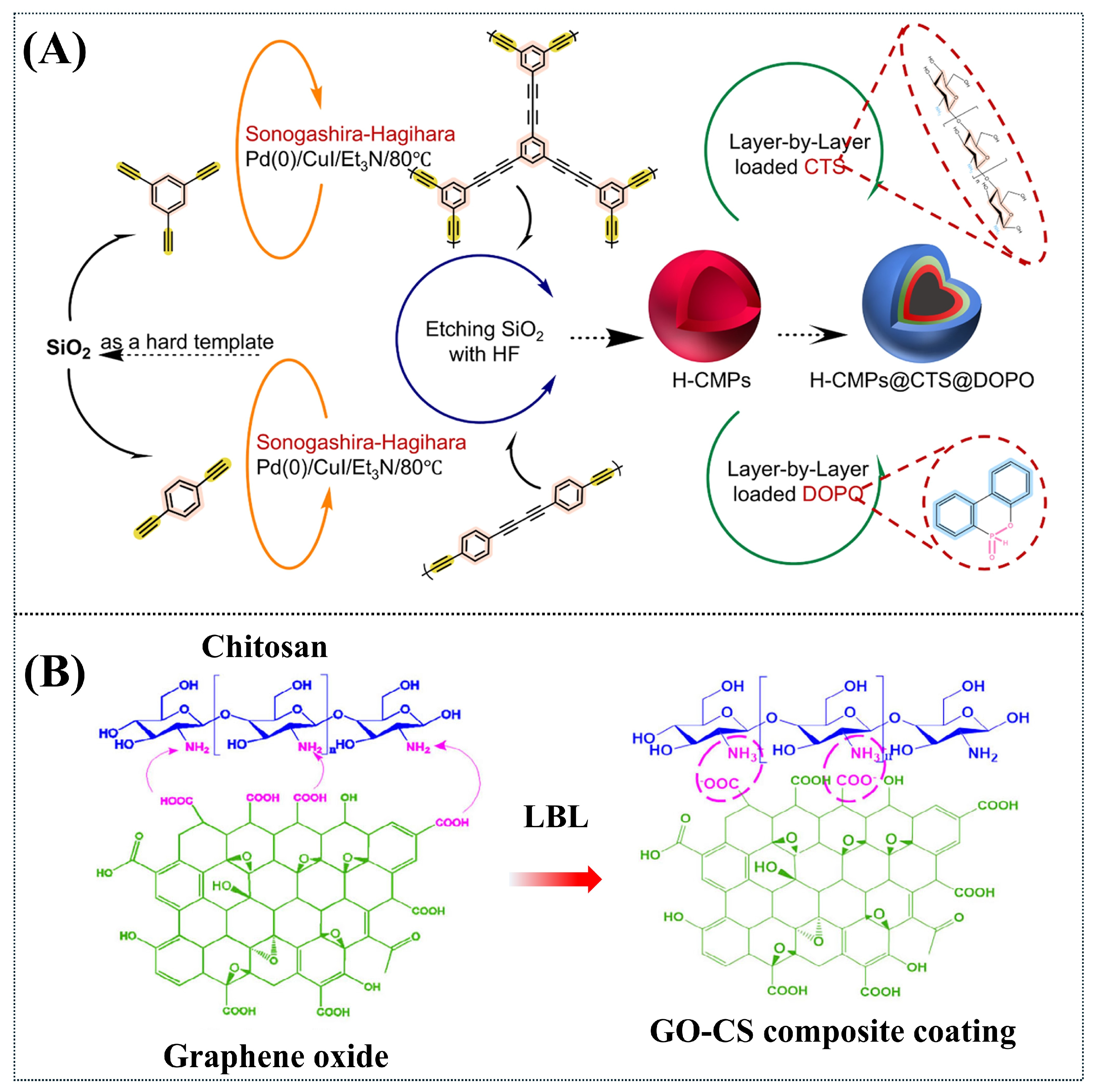
Both thermoplastic and thermosetting materials classified based on thermal behavior can also achieve flame-retardant functionalization through the addition of flame retardants that are prepared by LBL technology. Jiahao Duan et al. [61] fabricated a core-shell flame retardant for PU via LBL technology, in which APP was used as the core while CS and SiO2 were used as the shell, which made the modified PU achieve a UL-94 V-0 rating and increasing the LOI value to 30.5%. Moreover, the composite flame retardant of hollow conjugated microporous nanospheres with SiO2 as the hard template and CS and DOPO as the loading components for EP substrate was reported, leading to the decreased pHRR to 302.1 kW/m2 compared with the pure EP [62] (Figure 5A). In addition, Yang et al. developed a nano-coating based on GO and CS. When applied to foam substrates with 20 layers of the coating, the fire response time was just 3 s and the alarm duration was sustained for up to 1280 s. The pHRR was also reduced by 55.5% compared to pure foam [63] (Figure 5B).
Briefly, no matter what strategy is adopted to prepare CS-based flame retardants, it is usually necessary to introduce other flame-retardant components to achieve synergistic effects, which determines the final performance and application orientation.

2.2. Various Applications Scenarios

CS, with its unique flame-retardant mechanism, has expanded from the treatment of natural materials to the modification of synthetic polymers, demonstrating broad application prospects [64,65,66,67,68,69,70,71,72,73,74,75,76,77]. In the field of aerogels, CS as a biomass framework can self-assemble with different nano-fillers through hydrogen bonds or electrostatic interactions to construct a stable three-dimensional network structure. This structure not only effectively inhibits the shrinkage and dripping of polymers during combustion, but also forms char layer at high temperatures, which significantly enhances the fire resistance and thermal insulation performance of aerogels. Aerogels become an ideal lightweight thermal insulation and flame-retardant material [15,16,17,35,55,78]. In terms of cotton fabric and wood, CS mainly forms nanoscale coatings on the surface. This functional coating can rapidly expand and carbonize under the exposure to fire to form a physical barrier that isolates heat and oxygen, thereby significantly increasing fire resistance and effectively suppressing smoldering (Figure 6A,B) [20,21,24,42,43,45,51,58,59,60,79,80,81,82,83,84,85]. In addition, CS demonstrates satisfactory synergistic flame-retardant ability in synthetic polymer systems. For thermoplastics materials, such as PVA [85], PP, and PU [86,87], CS can serve as an efficient carbon source and gas source, which can compound with acid sources to form an efficient intumescent flame-retardant system. The introduction of flame retardant can not only remarkably suppress the pyrolysis and dripping phenomena of materials, but can also release non-flammable gases in the gas phase and dilute the oxygen concentration (Figure 6C) [23,37,40]. For thermosetting EP, CS can partially replace traditional curing agents to participate in cross-linking reactions, fixing flame-retardant elements in the three-dimensional network via the formation of covalent bonds, thereby endowing EP with intrinsic flame retardancy [53,54,88]. Furthermore, in the field of CS-based flame-retardant adhesives, they can not only provide a firm bonding strength but also establish an effective flame-retardant barrier for the prevention of the spread of flames and structural failure at the interface (Figure 6D) [27,28,45].
The application of CS-based flame retardants has expanded in multiple dimensions, ranging from porous materials to dense polymers, and from natural matrices to synthetic systems. Their multi-functional flame-retardant action modes and excellent biocompatibility make them the core materials for building a new generation of green and efficient flame-retardant systems.

2.3. Flame-Retardant Mechanism

To precisely clarify the flame-retardant mechanism, the detailed analysis of gas-phase and solid-phase processes are provided. The gas phase mechanism, referring to the flame area, mainly involves chemical reactions between oxygen and some volatile pyrolysis products after a high-temperature attack. Specifically, the structural units of CS begin to thermally decompose with the breaking of the glycosidic bond and the degradation of covalent cross-linked networks to release phosphorus and nitrogen-containing free radicals, which can capture a large number of active free radical (H· and HO·) generated during combustion to inhibit the free radical chain reactions and suppress flame spread to interrupt the combustion reaction [89]. Moreover, during the combustion process, CS can release the non-toxic gases of NH3 and N2, which can dilute the concentration of flammable gases to retard the combustion reaction. In addition, dehydration and carbonization also occur during the pyrolysis process of CS, leading to the endothermic reactions that reduce the temperature on the surface of materials and the rate of thermal reactions, ultimately achieving flame retardancy [90]. This is the working mechanism in the gas phase, which mainly include free radical and the dilution of flammable gases.
The reaction at the contact interface between the flame and polymers is crucial, leading to a distinction arising from the different flame-retardant mechanisms. CS goes though the ring-opening reactions and self-condensation cross-linking reactions, resulting in the dehydration of molecular chains into a porous expansive char layer at high temperature [91]. This kind of dense char layer formed on the surface can act as an isolation layer between substrate and flame, hindering the transfer of heat, oxygen, and combustible materials and suppressing the flame spread to further inhibit the cracking and combustion of the CS matrix. In practical applications, other flame-retardant fillers, such as APP [61], MMT [15], etc. are normally compounded with CS to form the denser and stronger char layer to enhance the physical barrier and delay the diffusion of pyrolysis products.
It is noteworthy that the above analysis suggests a systematic collaborative framework of CS-based flame-retardant systems. This involves free radical quenching in the gas phase, and residual char formation and a physical barrier layer in the condense phase, jointly constituting a multi-dimensional and highly efficient flame-retardant network. This synergistic effect of improving fire resistance can be verified in a PVA-based system, shown in Figure 7.

3. Biomass CS-Based Materials for Fire Alarm

3.1. Fire-Warning Performance of CS-Based Fire Alarm

CS, as a flame retardant, implies the starting point of the application in smart fireproof materials. In recent years, more cutting-edge explorations have focused on developing the intelligent potential of CS or its derivatives, that is, taking advantage of the intrinsic thermal response characteristics to modify CS can pave the way for early fire-warning applications. It is precisely the inspired property that has driven the development of the following CS-based early fire-warning studies.
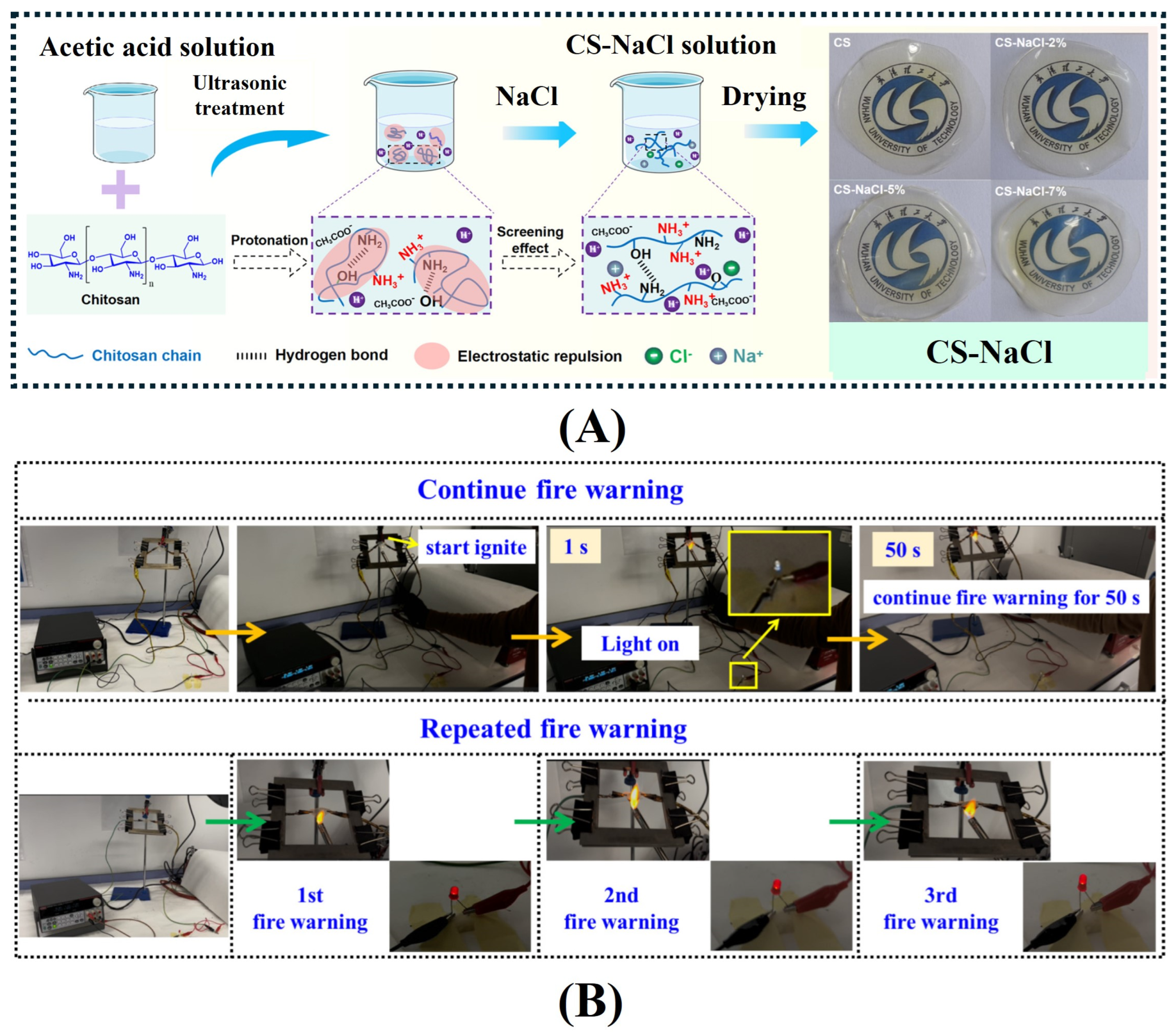
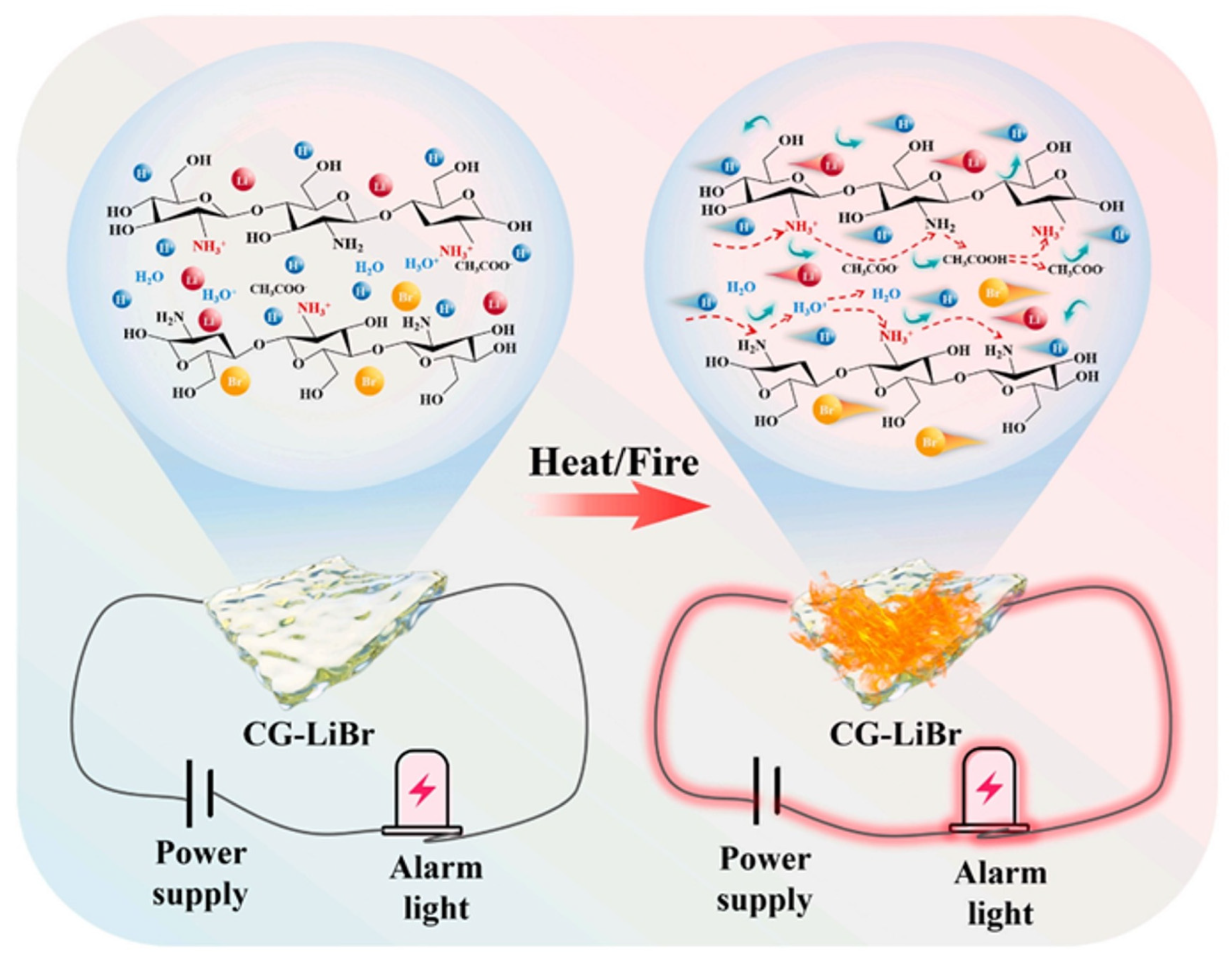
As depicted in Figure 8A, Wang et al. [78] unexpectedly discovered that CS film modified by salts could achieve the change in electrical current under the driving of temperature and external voltage, showing the potential to serve as a fire-warning monitor. The resulting CS-based film responded to ~50 °C and exhibited a ~0.4 s response time under a fire attack. According to the essential mechanism of generating electric current from CS, the influence of different cationic salts on composite CS films was analyzed in detail, demonstrating that the ionic radius of the cation has a varied effect on the rate of electrical current generation. The fabricated films showcased a dual sensing performance of humidity sensing and fire warning (~50 °C, 2s) [92]. In addition, CS derivatives modulated by carboxymethyl groups also have the characteristic of the formation of electrical current under the driving of high temperature or fires. More encouragingly, the treated composite films were also used as humidity sensors as a result of the good water absorption [9] (Figure 8B). Moreover, Han et al. [93] developed a highly sensitive CS-based film through a green and non-toxic approach, which could show astonishing fire-warning and recovery capability over a wide temperature range, along with the structural integrity under immersion or ultrasonic treatment. Wu et al. [94] prepared CS/CG films and KCG films using an energy-efficient water evaporation method, which exhibited a fast response time of 0.5 s at 100 °C. In addition, Shen’s group fabricated CS/CG and LiBr-modified CG composite films, demonstrating the further short response time of 0.41 s at 100 °C [95]. In short, existing CS-based fire warning studies generally respond to low temperatures within seconds, demonstrating remarkable advantages in a low-temperature alert, especially at a temperature lower than 100 °C. However, it should be noted that the electrical current signal generated during fire-warning processing is usually weak. Under complex actual conditions, such weak signals are easily overwhelmed by noise, making reliable monitoring difficult to achieve. Therefore, determining how to enhance the intensity of the electrical current output through reasonable modification strategies is still ongoing.

3.2. Fire-Warning Mechanism

The fire-alerting capability of CS is primarily reliant upon the movement of charge carriers within the hydrogen-bond network at elevated temperatures, a phenomenon that is explained by the Grotthuss mechanism [96]. This mechanism describes a proton-transfer process where long-range conduction occurs through the structural diffusion of a proton defect within the hydrogen-bond network of water [78]. Specifically, a proton covalently hops from H3O+ to an adjacent water molecule, thereby converting it into a new H3O+. This proton jump is followed by the rapid reorientation and reorganization of neighboring water molecules, which reconfigures the hydrogen-bond pathway and enables the next transfer event. Thus, the high mobility of protons in aqueous solutions originates from the coupled sequence of covalent bond cleavage/formation and subsequent hydrogen-bond network reorganization. This concerted mechanism enables the efficient long-range relay of ionic charge without the need for substantial mass transport.
In terms of CS-based studies, NH2 group within the CS molecule is unable to undergo protonation under the absence of acetic acid, thereby preventing the formation of the positively charged NH3 ion. Consequently, there is an inadequate supply of sites for proton transfer. Additionally, the ionic energy proves inadequate in surmounting the energy barrier for directed movement, giving rise to the insulating behavior of CS. Following the introduction of acetic acid, NH3 and H3O+ in the CS chain provide sufficient jump sites, enabling activated protons to form a conduction pathway (Figure 9) [95]. Furthermore, elevated temperatures have been shown to enhance the flexibility of the CS chains, thereby intensifying the motion of CS chains and water molecules. This, in turn, promotes ion migration within the CS matrix, ultimately forming conductive pathways. Consequently, CS exhibits electrical conductivity and possesses early-warning sensing capabilities [78]. Additionally, the introduction of additives such as electrolyte salts increases the concentration of charge carriers and carrier binding sites within the composite, thereby enhancing the ion conduction rate. This phenomenon results in an enhancement of electrical conductivity, thereby facilitating the augmentation of early-warning sensing abilities [94].
The above-mentioned analysis of the existing research system indicates that, through different strategies such as molecular design, composite strategies, and intelligent structure regulation, CS-based materials have demonstrated significant potential in terms of flame-retardant performance and early fire-warning studies. The key parameters about flame retardancy are summarized. As shown in Table 1, these investigations present significant systemic distinction, directly leading to difficulties in direct horizontal comparisons among different works. These extensive differences involve the molecular weight of CS, additive amount, modulation strategy, basis materials, and test conditions (sample size, testing instruments, data analysis, etc.), which will systematically influence final flame-retardant performance. Therefore, more attention should be paid to the structure–property relationship between material design strategies and performance trends.
More fundamentally, the systematical difference precisely reveals the research transformation from single-performance optimization to the performance superposition based on integrated design. Cutting-edge research is more inclined to integrate flame retardancy with other functions via specific molecular design or the construction of multi-level structures under low additive loading. This research orientation ensures the core fire safety performance as well as enhancing the functional integration and comprehensive practical potential, which can represent an important development direction for the next generation of intelligent fireproof CS-based materials.
In light of the current progress in CS-based fire-warning research, we systematically summarize the relevant achievements in Table 2. It is clear to see that CS-based fire-warning systems can respond to abnormal temperatures quickly within seconds, demonstrating the advantage of low-temperature warning. However, it should be objectively noted that most studies still rely on the drive from external electrical voltage, undoubtedly resulting in challenges in terms of actual deployment and energy consumption, as well as system integration. More inspiringly, apart from the fire-warning property, some systems present another performance, like humidity monitoring, repeatability, etc., suggesting that multi-function integration has become an important development trend.
Table 1. Detailed summary of CS-based flame-retardant research.
Polymeric
Matrix
FillerFiller
Content
LOI
(%)
Testing Dimensions for LOIUL-94Testing Dimensions for UL-94pHRR
(kW/m2)
Multi-FunctionsRef.
Cotton fabricMP/Nch/PVA\57.9120 mm × 50 mm\\\Antimicrobial activity[20]
AerogelsCS/MMT/CNF\43100 mm × 10 mm × 10 mm\\\Superamphiphobic[15]
AerogelsCH/PK\33140 mm × 20 mm × 10 mmV-0140 mm × 10 mm × 1 mm\Biodegradability (56%)[16]
AerogelsAlginate/CS/MMT70% MMT75\\\\\[17]
AerogelsCS/APP/MMT\64.1\\\\Superamphiphobic (154°)[18]
FilmCS/PA/PVA/A-HNTsN15E2032.280 mm × 10 mmV-0120 mm × 13 mm85.31UV resistance (<15%)[23]
FilmCS/MMT/Na2Cu(OH)4CS/10MMT-Cu40.560mm × 10 mm\\\Antimicrobial activity[22]
WoodenCS/NaH2PO4PC1551130 mm × 6 mm × 3 mmV-0\\\[11]
EPPA/PUCS7.5% PUCS31.2\V-0\907\[26]
WoodenCS/GEL/PA/ZnSO4@Kaol3.7%\\\\205\[21]
PPCS/SP/MMT5%30.980 mm × 100 mm × 3 mmV-0130 mm × 13 mm × 3 mm163\[24]
AerogelsPCSM/MTMS/H-SiO2\>80\V-0\8.48Superamphiphobic (150.2°)[19]
TPUCS/PA/Fe-MOF1%\\\\466.2\[25]
WoodenCS/HEC/BN/MAHM
-4CS@2BN
27.180 mm ×10 mm × 4 mmV-0130 mm × 13 mm × 4 mm250.37\[28]
WoodenCS/MA/BN/Cu/ZIF-8\42.8120 mm × 10 mm × 5 mmV-0120 mm × 10 mm × 5 mm138.11\[27]
AerogelsCS/HGMs\\\\\\\[35]
PLACS/BPOD/TEPA/TEA3 wt%29130 mm × 6.5 mm × 3.2 mmV-0130 mm × 13 mm × 3.2 mm423.7\[36]
PLACS-TE/AP3.75 wt% CSTE28.5130 mm × 6.5 mm × 3 mmV-0130 mm × 13 mm × 3 mm210.2\[37]
PLACS/PPA10 wt% of CPPA30.3\V-0\407\[38]
PPCS/APP/MF30% CSAPP@MF25.7%100 mm × 6.5 mm × 3.2 mmV-1100 mm × 13 mm × 3.2 mm275.89\[39]
BioplasticsCS/Lignin0.25% Lignin42–48\V-0\\\[40]
Polyester/cottonCS/H3PO4/SiO2/FAS-1725% PCSU30150 mm × 58 mm\\87Superamphiphobic (142°)[41]
Polyester/cottonCMC/HCS/AMVPT/C-AMVP-g-HCS-26.630.5\\\179.2\[42]
Cotton fabricCS/MEL/TSPP\32300 mm × 76 mm\\\UV resistance (UPF > 100)[43]
WoodenZnPA/COS/DOPO/SiO2P2\\\\99.39\[44]
WoodenOCTS/HPA/VMT-NSs-NH2\36.7\\\25.48\[45]
PUCS/PA/PBA6 wt% PBA-CS@PA\\V-0\429.7\[47]
PUCS/PMPI/MPP40 wt% CS-PMPI-MPP26.5\V-1\421.4\[48]
Cotton fabricCS/PA/ESOERPC1-EG33.5\V-010 mm × 10 mm × 50 mm99.42\[49]
PUCS/APP/NDY40% CS-APP-NDY26.380 mm × 10 mm × 4 mmV-1127 mm × 12.7 mm × 3 mm399.6\[50]
WoodenACS/MACS/PA-UiO66-NH2\29.280 mm × 10 mm × 4 mm\\\\[51]
PVACS/4-FPB/DOPOPVA@PBCS28.7\V-0\130.8\[52]
EPHCCP/HCPCP/CS9 wt% 3CS-HCPCP\\V-0100 mm × 100 mm × 3 mm757\[53]
EPMEL/MH/APP/CS7.5CPMM/7.5APP30.5130 mm × 6.5 mm × 3 mmV-0\267.1\[54]
Jute fabricCS/SA/NACL3% CH/7% SA27130 mm × 6.5 mm × 3 mm\\82.7\[59]
Cotton fabricAEP/PA/CSCot/A/I/
C/P
38.5\\\96.3\[97]
Cotton fabricPA/CH/BCPA/CH/BC(7.5%)-COT66.8120 mm × 55 mm\\7.7\[58]
Cotton fabricCS/H3PO3PCS@C1529.9150 mm × 58 mm × 2 mm\\85.3\[60]
TPUCS/APP/SiO220 wt% APP30.5\V-0\181.42\[62]
EPSiO2\CTS\APP\DOTOEP-4\\\\366.1Superhydrophobic[63]
Table 2. Detailed summary of CS-based fire-warning research.
Polymeric
Matrix
FillerFiller
Content
Trigger
Temperature (°C)
Response TimeExtra Electrical Voltage (V)Number of Repeatable WarningsMulti-FunctionsRef.
FilmNaOAc/glycerol modification5 wt% NaOAc 1201000 s\At least 3\[9]
FilmNaCl5 wt% NaCl159<1 s12At least 3\[78]
FilmNaCl/NH4Cl/CaCl2\\\\17Remote wireless transmission of monitored information[92]
FilmGN/FeCl3/Soy protein isolate/PA/glycero/urea5 wt% glycero\2.6 s12\\[93]
FilmKH2PO4/GEL10 wt% KH2PO41000.5 s\At least 3\[94]
FilmGEL/LiBr15 wt% LiBr70~900.41 s\\riboelectric nanogenerator[95]

4. Conclusions and Perspectives

As can been seen from the above analysis, the research achievements of CS-based flame retardant and early fire warning are abundant. However, there are still several bottleneck problems that limit their further development, which constitute the main direction of future research. Specifically, the main challenges can be summarized into the following points.

4.1. Advances and Challenges

The imbalance among multi-functional regulation—The imbalance among multi-functional regulations of CS-based flame-retardant studies mainly stems from three aspects. Firstly, the inherent insufficient mechanical strength and unsatisfied hydrophilicity of CS itself places constraints on its stable application in harsh environments, like high loads of additives or high humidity. Secondly, the introduction of flame retardants commonly sacrifices the mechanical property or other inherent properties due to the possible poor interface compatibility or improper addition ratios. Moreover, how to realize collaborative optimization among mutually restrictive performances is the core challenge faced by the multi-functional integration of CS-based materials. For example, even though a high content of flame retardants can enhance fire resistance, it often compromises the inherent advantages of flexibility and the low density of materials. Balancing these performance trade-offs is essential for rational material design.
The limitations of cost and large-scale production—Accomplishing the industrial products of CS-based flame-retardant materials from laboratory achievements on a large scale is still a great distance away. One primary limitation is the preparation technologies itself, comprising a complicated synthetic pathway and precise craftsmanship, which results in a long processing period and complex operation. Another challenge results from economic costs, which directly affect the competitiveness of the final product. In addition, the non-uniformity of testing standards will pose significant challenges to practical applications. The above analysis indicates the lack comparability even at the laboratory level because of distinct sample size. If we further move to large-scale production, the gap in terms of processing, performance consistency, and evaluation system will become even more prominent. Finally, the inherent characteristics of biomass CS itself restricts the uniformity of the product, which inevitably increases the difficulty in controlling the consistency in production quality under large-scale condition.
Undesirable intelligent warning—The precise and reliable warning signal transmission fundamentally depends on the construction and maintenance of conductive pathways under thermal triggering. This process is confronted with some challenges ranging from micro-mechanisms to macro-performance. First of all, the response sensitivity and threshold stability are insufficient. The early-warning sensitivity, which relies on the rapid, controlled formation of a conductive pathway, is compromised by the complex coupling between filler dispersion uniformity and matrix pyrolysis behavior. This interplay results in an unstable response threshold and a consequent risk of missed alarms. In addition, the long-term stability has a correlation with the microstructure integrity of the conductive network. The aging and structural relaxation of the materials themselves, as well as the interference of external environmental factors, provide a negative role in the accuracy and reliability of the signal. Moreover, the current fire-warning systems have weak anti-interference ability, particularly in complicated environments. The existing systems have difficultly in operating stably and accurately identifying real fire hazard signals, which seriously restricts their practical effectiveness as reliable safety management.
The lack of in-depth exploration of the mechanism—The physicochemical origin of the synergistic flame-retardant effect between CS and elements like P, N, and B remains unclear. During the pyrolysis process, the specific action paths and relative contribution weights of the free radical capture effect in the gas phase and the carbonization catalytic behavior in the condensed phase still need to be deeply elucidated through precise in situ analysis techniques coupled with theoretical calculations. On the other hand, the fire-warning reliability is mainly rooted in the dynamic evolution behavior of the conductive network under abnormal high temperatures. Nevertheless, the entire process of “construction–conductive–invalid” of this network is strongly coupled with the pyrolysis behavior of the CS matrix, resulting in a lack of theoretical support for the regulation of key parameters, like response threshold and signal stability.

4.2. Perspectives

  • AI-assisted molecular design and structural optimization
AI-assisted molecular design and structural optimization constitute the reformative development of CS-based functional study. In light of CS-based flame retardants, the combination of AI can efficiently predict the optimal grafting sites and configurations of flame-retardant elements on the CS molecular chain through machine learning models, leading to rationally designing highly effective flame retardants that have the synergistic effects of the gas phase quenching effect and catalytic char formation effect. Meanwhile, AI technology tackles the core challenges by simulating, through deep learning, the complex coupling among filler dispersion, matrix pyrolysis, and conductive pathway construction, to reverse-engineer intelligent CS-based materials with precise response thresholds and remarkable stability. This cross-disciplinary research method is not only expected to accelerate the discovery process of high-performance and multi-functional CS-based flame retardants, but also profoundly reveals the intrinsic connection between the structure–performance mechanism at the molecular level, providing a new route for the next generation of biomass intelligent CS-based materials.
  • Intelligent and multi-functional integration
Intelligence and multi-functional integration are the core directions of the development of the new generation of intelligent CS-based materials, which aims to overcome the limitation of the single flame-retardant function and systematically integrate multiple functions, such as mechanical properties, self-healing, and electromagnetic shielding. Additionally, coupling with intelligent information is beneficial for the development of CS-based sensing units, which can be combined with microprocessors, data transmission modules, etc. to create “smart systems” for applications, especially aerospace, intelligent fire protection, and wearable electronics.
  • Sustainable closed-loop design and recycling strategy
The accomplishment of sustainable closed-loop design and recycling CS-based materials can put the related study towards practical and long-term development, which can systematically run through the entire process. At the material design level, the construction of dual networks and the introduction of dynamic reversible covalent and/or non-covalent bonds, like hydrogen bonds, ion coordination, etc. could be one efficient strategy to establish functional materials. In terms of the recycling pathway, physical recycling and biodegradation technologies should be adopted. As an example, fillers or matrices can be recycled through mild physical ways to achieve the secondary utilization of materials within different service cycles.

Author Contributions

F.Y.: Conceptualization, Data curation, Writing—original draft and editing. C.C.: Conceptualization, Data curation, Writing—original draft. Y.Q.: Data curation. G.W.: Methodology. X.L.: Conceptualization, Methodology, Data curation, Writing—original draft and editing, Writing—review, Supervision. Y.-T.P.: Writing—review and editing, Supervision. All authors have read and agreed to the published version of the manuscript.

Funding

This research received no external funding.

Data Availability Statement

No new data were created or analyzed in this study.

Conflicts of Interest

The authors declare that they have no competing financial interests or personal relationships that could have appeared to influence this work.

Abbreviations

CSchitosanLOILimiting Oxygen Index
AIartificial intelligenceMMTmontmorillonite
CNFcellulose nanofibersPKphosphated sulfate lignin
PECpolyelectrolyte complexesPCSphosphated chitosan
H-SiO2modified SiO2 nanoparticlesEPepoxy resin
ZIFzeolitic imidazolate frameworkPAphytic acid
MTMSmethytrimethoxylsilanMPmelamine phosphate
PCSMphosphorylated porous materialsBNboron nitride
PPpolypropylenePVApolyvinyl alcohol
PUpolyurethaneNDYN,N-diglycidylaniline
PLApolylactic acidpHRRpeak of heat release rate
ZnPAzinc phytateAPaluminum pypophosphite
AMVPammonium vinyl phosphonateTHRtotal heat release
ERPbio-based PUF matrixCOSchitosan oligosaccharide
HCCPhexachlorocycl otriphosphorazideMELmelamine
TSPtotal smoke productionMHmagnesium hydroxide
LBLlayer-by-layer self-assemblyPhPCSphenylphosphorylated CS
PhPNCSphenylphosphoramidated CSAPPammonium polyphosphate
SAsodium alginateKCGKHPO-modified CG
Nchnano-chitosanCGCS/gelatin
A-HNTsamino-modified halloysite nanotubesH3O+hydronium ion
PUCSchitosan-based ammonium phytateMPmethyl phydroxybenzoate
SPsodium phytateTEAtriethylamine
Fe-MOFiron–metal–organic frameworkHGMshollow glass microspheres
HEChydroxyethyl celluloseTEPAtetraethylenepentamine
MAmaleic anhydrideMFmelamine formaldehyde
BPODphenylphosphoryl dichlorideCMCcarboxymethyl cellulose
CSTEbio-based chitosan derivativePBAPrussian blue analog
CPPAchitosan-based flame retardantsOCTSoxidized chitosan
ACSaminated chitosanHPAhyperbranched polymer
MPPmelamine polyphosphateESOepoxidized soybean oil
HCCPhexachlorocyclotriphosphazeneMACSacidified chitosan
PMPIpoly methyl polyphenyl polyisocyanateBCbiochar
DOPO9,10-dihydro-9-oxa-10-phospha-phenanthrene-10-oxide
H-CMPsconjugated microporous polymer with a hollow structure
PA-UiO66-NH2phytic acid-functionalized metal–organic framework
FAS-171H,1H,2H,2H-perfluorodecyltriethoxysilane
VMT-NSs-NH2surface-modified vermiculite nanosheets
PMPIpolymethylene polyphenyl polyisocyanate
HCShydroxypropyl trimethylammonium chloride chitosan
HCPCPhexa-(4-carboxyl-phenoxy)-cyclotriphosphazene
AEPepichlorohydrinmodified aramid nanofibers

References

  1. El-Araby, A.; Janati, W.; Ullah, R.; Ercisli, S.; Errachidi, F. Chitosan, chitosan derivatives, and chitosan-based nanocomposites: Eco-friendly materials for advanced applications (a review). Front. Chem. 2024, 11, 1327426. [Google Scholar] [CrossRef]
  2. Huo, X.; Li, W.; Wang, Y.; Han, N.; Wang, J.; Wang, N.; Zhang, X. Chitosan composite microencapsulated comb-like polymeric phase change material via coacervation microencapsulation. Carbohydr. Polym. 2018, 200, 602–610. [Google Scholar] [CrossRef]
  3. Zhang, L.; Xu, Y.; Feng, T.; Zhang, Y.; Sun, J.; Wang, X.; Bai, C.; Zhang, X.; Shen, J. Chitosan toughened epoxy resin by chemical cross-linking: Enabling excellent mechanical properties and corrosion resistance. Int. J. Biol. Macromol. 2024, 271, 132565. [Google Scholar] [CrossRef]
  4. MohammadAlizadeh, A.; Elmi, F. Flame retardant and superoleophilic polydopamine/chitosan-graft (g)-octanal coated polyurethane foam for separation oil/water mixtures. Int. J. Biol. Macromol. 2024, 259, 129237. [Google Scholar] [CrossRef] [PubMed]
  5. Kołodyńska, D.; Hałas, P.; Franus, M.; Hubicki, Z. Zeolite properties improvement by chitosan modification—Sorption studies. J. Ind. Eng. Chem. 2017, 52, 187–196. [Google Scholar] [CrossRef]
  6. Dhlamini, K.S.; Selepe, C.T.; Ramalapa, B.; Tshweu, L.; Ray, S.S. Reimagining chitosan-based antimicrobial biomaterials to mitigate antibiotic resistance and alleviate antibiotic overuse: A review. Macromol. Mater. Eng. 2024, 309, 2400018. [Google Scholar] [CrossRef]
  7. Brahmi, A.; Agsοus, M.; Benkhaoula, B.N.; Ziani, S.; Khireddine, H.; AitAli, S.; Abdullah, M.S.M.; Boon Xian, C.; Belaadi, A. Fluoro-hydroxyapatite/chitosan composites as an eco-friendly adsorbent for direct red 23 dye removal: Optimization through response surface methodology. J. Mol. Struct. 2025, 1321, 140212. [Google Scholar] [CrossRef]
  8. Iñiguez-Moreno, M.; Hernández-Varela, J.D.; Burelo, M.; Elizondo-Luevano, J.H.; Araújo, R.G.; Treviño-Quintanilla, C.D.; Medina, D.I. Progress in chitosan-based materials: Enhancing edible coatings and films through modifications and functionalization for food preservation. Process Biochem. 2025, 156, 175–190. [Google Scholar] [CrossRef]
  9. Li, X.; Sánchez del Río Sáez, J.; Liu, Y.; Du, S.; Cruz, C.; Wei, G.; Wang, D.-Y. Carboxymethyl chitosan-based composite film for fire warning under high humidity conditions with wireless signal transmission. Int. J. Biol. Macromol. 2025, 316, 144540. [Google Scholar] [CrossRef]
  10. Wang, C.; Yu, B.; Zhao, T.; Yang, F.; Chen, M.; Zhu, X.; Cai, Z.; Fu, B. Chitosan cryogels incorporated with phytic acid-modified UiO-66-NH2 for enhanced flame-retardant performance. Carbohydr. Polym. 2025, 353, 123259. [Google Scholar] [CrossRef]
  11. Lv, P.-Y.; Feng, X.-L.; Shi, Q.; Wan, J.-J.; He, S.-Y.; Kong, D.-M.; Li, Y.; Cao, C.-F.; Gao, J.-F.; Wang, W.; et al. Chitosan-based transparent and flame-retardant bio-composite coatings for wooden materials with rapid fire monitoring response. Constr. Build. Mater. 2025, 491, 142765. [Google Scholar] [CrossRef]
  12. Fang, N.; Chan, V. Chitosan-induced restructuration of a mica-supported phospholipid bilayer: An atomic force microscopy study. Biomacromolecules 2003, 4, 1596–1604. [Google Scholar] [CrossRef]
  13. Chen, J.; Huang, W.; Chen, Y.; Zhou, Z.; Liu, H.; Zhang, W.; Huang, J. Facile preparation of chitosan-based composite film with good mechanical strength and flame retardancy. Polymers 2022, 14, 1337. [Google Scholar] [CrossRef]
  14. Gong, L.; Liu, Y.; Lu, X.; Liu, Z. In-situ polymerization engineered anisotropic biomass fire-resistant aerogels: Triple-functional integration of thermal insulation, mechanical robustness, and fire-warning performance. Polym. Degrad. Stab. 2025, 242, 111703. [Google Scholar] [CrossRef]
  15. Sun, Y.; Chu, Y.; Deng, C.; Xiao, H.; Wu, W. High-strength and superamphiphobic chitosan-based aerogels for thermal insulation and flame retardant applications. Colloids Surf. A Physicochem. Eng. Asp. 2022, 651, 129663. [Google Scholar] [CrossRef]
  16. Khodavandegar, S.; Fatehi, P. Fully biobased flame-retardant lignin-incorporated chitosan-derived aerogel. Chem. Eng. J. 2025, 515, 163745. [Google Scholar] [CrossRef]
  17. An, J.; Ping, X.; Gao, G.; Shen, Q.; Wang, Z.; Zhang, C.; Bu, H.; Lin, Z.; Huang, C. High flame-retardant and thermal insulation performances of sodium-alginate/chitosan aerogel by coating montmorillonite on pore surface. Ceram. Int. 2025, 51, 45510–45521. [Google Scholar] [CrossRef]
  18. Chen, B.; Lu, H.; Zhu, H.; Huang, Z.; Lai, X.; Li, H.; Zeng, X. Superhydrophobic and flame-retardant chitosan/ammonium polyphosphate/montmorillonite aerogel-based piezoresistive pressure sensor for human motion detection. Sens. Actuators A Phys. 2024, 369, 115135. [Google Scholar] [CrossRef]
  19. Jia, H.; Cui, H.; Wu, N.; Deng, S.; Wang, F.; Wang, M.; Wang, Z. Fabrication of superior flame-retardant phosphorylated chitosan biobased porous composites reinforced by superhydrophobic silicone interpenetrating crosslinking networks. Carbohydr. Polym. 2025, 347, 122540. [Google Scholar] [CrossRef]
  20. Makhlouf, G.; Abdelkhalik, A.; Ameen, H. Preparation of highly efficient chitosan-based flame retardant coatings with good antibacterial properties for cotton fabrics. Prog. Org. Coat. 2022, 163, 106627. [Google Scholar] [CrossRef]
  21. Tang, W.; Qin, Z.; Li, X.; Liu, T.; Cao, X.; Yang, H.; Cao, Z.; Jin, X.; Yuan, P. Eco-friendly flame retardant comprising chitosan-based effectively enhances the flame retardancy of wood with low weight percent gain. Int. J. Biol. Macromol. 2024, 282, 136868. [Google Scholar] [CrossRef]
  22. Ren, X.; Fan, Z.; Jin, L.; Wu, X.; Wang, H.; Han, S.; Huang, C.; Zhang, Y.; Sun, F. Unleashing the potential of water-insoluble Cu(2+)-crosslinked chitosan nanocomposite film for enhanced antibacterial and flame-retardant properties. Int. J. Biol. Macromol. 2024, 283, 137455. [Google Scholar] [CrossRef]
  23. Zhao, Q.; Cheng, X.; Kang, J.; Kong, L.; Zhao, X.; He, X.; Li, J. Polyvinyl alcohol flame retardant film based on halloysite nanotubes, chitosan and phytic acid with strong mechanical and anti-ultraviolet properties. Int. J. Biol. Macromol. 2023, 246, 125682. [Google Scholar] [CrossRef]
  24. Tu, Z.; Ou, H.; Ran, Y.; Xue, H.; Zhu, F. Chitosan-based biopolyelectrolyte complexes intercalated montmorillonite: A strategy for green flame retardant and mechanical reinforcement of polypropylene composites. Int. J. Biol. Macromol. 2024, 277, 134316. [Google Scholar] [CrossRef] [PubMed]
  25. Huang, B.; Li, G.; Zhang, H.; Qu, J.; Sun, W.; Liu, L.; Liu, M.; Li, S.; Jiao, C.; Zhao, X.; et al. An eco-friendly flame retardant from chitosan, phytic acid, Fe-MOF endows thermoplastic polyurethane with enhanced fire safety and mechanical property based on hydrogen bond and pi-pi stacking. Int. J. Biol. Macromol. 2025, 310, 143139. [Google Scholar] [CrossRef] [PubMed]
  26. Chen, W.; Liu, H.; Yan, Q.; Chen, Q.; Hong, M.; Zhou, Z.-X.; Fu, H. Straightforward synthesis of novel chitosan bio-based flame retardants and their application to epoxy resin flame retardancy. Compos. Commun. 2024, 48, 101949. [Google Scholar] [CrossRef]
  27. Liu, L.; Huang, Y.; Kan, Z.; Yang, Y.; Wang, P.; Chen, Y.; Wei, D.; Lei, H.; Du, G.; Zhang, L. Organic-inorganic hybrid chitosan-based adhesive combined with Cu/ZIF-8 to construct wood composites with flame retardant properties. Int. J. Biol. Macromol. 2025, 320, 145727. [Google Scholar] [CrossRef]
  28. Kan, Z.; Huang, Y.; Wang, F.; Liu, L.; Wei, D.; Guo, H.; Chen, Y.; Xie, L.; Zhang, L.; Du, G. Low-temperature curing, flame-retardant and water-resistant modified cellulose-chitosan adhesive based on organic-inorganic hybridization. Int. J. Biol. Macromol. 2025, 329, 147835. [Google Scholar] [CrossRef]
  29. Xiao, Y.; Zheng, Y.; Wang, X.; Chen, Z.; Xu, Z. Preparation of a chitosan-based flame-retardant synergist and its application in flame-retardant polypropylene. J. Appl. Polym. Sci. 2014, 131, 40845. [Google Scholar] [CrossRef]
  30. Pardeshi, C.V.; Belgamwar, V.S. Controlled synthesis of N,N,N-trimethyl chitosan for modulated bioadhesion and nasal membrane permeability. Int. J. Biol. Macromol. 2016, 82, 933–944. [Google Scholar] [CrossRef]
  31. Liu, J.; Pu, H.; Liu, S.; Kan, J.; Jin, C. Synthesis, characterization, bioactivity and potential application of phenolic acid grafted chitosan: A review. Carbohydr. Polym. 2017, 174, 999–1017. [Google Scholar] [CrossRef]
  32. Sirvio, J.A.; Kantola, A.M.; Komulainen, S.; Filonenko, S. Aqueous modification of chitosan with itaconic acid to produce strong oxygen barrier film. Biomacromolecules 2021, 22, 2119–2128. [Google Scholar] [CrossRef]
  33. Cui, X.; Wu, Q.; Sun, J.; Gu, X.; Li, H.; Zhang, S. Preparation of 4-formylphenylboronic modified chitosan and its effects on the flame retardancy of poly(lactic acid). Polym. Degrad. Stab. 2022, 202, 110037. [Google Scholar] [CrossRef]
  34. Kumar, D.; Gihar, S.; Shrivash, M.K.; Kumar, P.; Kundu, P.P. A review on the synthesis of graft copolymers of chitosan and their potential applications. Int. J. Biol. Macromol. 2020, 163, 2097–2112. [Google Scholar] [CrossRef]
  35. Wang, P.; He, B.; An, Z.; Xiao, W.; Song, X.; Yan, K.; Zhang, J. Hollow glass microspheres embedded in porous network of chitosan aerogel used for thermal insulation and flame retardant materials. Int. J. Biol. Macromol. 2024, 256, 128329. [Google Scholar] [CrossRef]
  36. Ma, X.; Wu, N.; Liu, P.; Cui, H. Fabrication of highly efficient phenylphosphorylated chitosan bio-based flame retardants for flammable PLA biomaterial. Carbohydr. Polym. 2022, 287, 119317. [Google Scholar] [CrossRef] [PubMed]
  37. Wang, Y.; Yuan, J.; Ma, L.; Yin, X.; Zhu, Z.; Song, P. Fabrication of anti-dripping and flame-retardant polylactide modified with chitosan derivative/aluminum hypophosphite. Carbohydr. Polym. 2022, 298, 120141. [Google Scholar] [CrossRef]
  38. Zhu, G.; Wang, J.; Gao, J.; Lin, X.; Zhu, Z. Simple preparation, big effect: Chitosan-based flame retardant towards simultaneous enhancement of flame retardancy, antibacterial, crystallization and mechanical properties of PLA. Int. J. Biol. Macromol. 2025, 303, 140668. [Google Scholar] [CrossRef] [PubMed]
  39. Huang, Z.; Li, S.; Tsai, L.-C.; Jiang, T.; Ma, N.; Tsai, F.-C. Flame retardant polypropylene with a single molecule intumescent flame retardant based on chitosan. Mater. Today Commun. 2022, 33, 104689. [Google Scholar] [CrossRef]
  40. Tan, W.; Zuo, C.; Liu, X.; Tian, Y.; Bai, L.; Ren, Y.; Liu, X. Developing flame retardant, smoke suppression and self-healing polyvinyl alcohol composites by dynamic reversible cross-linked chitosan-based macromolecule. Int. J. Biol. Macromol. 2024, 280, 135734. [Google Scholar] [CrossRef]
  41. Li, P.; Ren, Y.-L.; Xu, Y.-J.; Liu, Y. One-step and multi-functional polyester/cotton fabrics with phosphorylation chitosan: Its flame retardancy, anti-bacteria, hydrophobicity, and flame-retardant mechanism. Prog. Org. Coat. 2025, 203, 109179. [Google Scholar] [CrossRef]
  42. Xie, L.; Duan, H.; Chen, K.; Qi, D.; Li, J. Bio-based flame retardant coatings for polyester/cotton fabrics with high physical properties using ammonium vinyl phosphonate-grafted chitosan complexes. Int. J. Biol. Macromol. 2024, 279, 135318. [Google Scholar] [CrossRef] [PubMed]
  43. Patankar, K.C.; Biranje, S.; Pawar, A.; Maiti, S.; Shahid, M.; More, S.; Adivarekar, R.V. Fabrication of chitosan-based finishing agent for flame-retardant, UV-protective, and antibacterial cotton fabrics. Mater. Today Commun. 2022, 33, 104637. [Google Scholar] [CrossRef]
  44. Zhang, H.; Wang, Y.; Li, F.; Zhao, J. In-situ polymerized zinc phytate chelated Si-C-P geopolymer hybrid coating constructed by incorporating chitosan oligosaccharide and DOPO for flame-retardant plywood. Constr. Build. Mater. 2023, 397, 132416. [Google Scholar] [CrossRef]
  45. Bai, Y.; Liu, T.; Zhang, X.; Li, H.; Li, J.; Ran, X.; Wang, P.; Du, G.; Yang, L.; Cao, M. Biomimetic flame retardant adhesive via combining polysiloxane, chitosan and vermiculite nanosheets inspired by nacre and arthropod cuticle. Int. J. Biol. Macromol. 2025, 289, 138870. [Google Scholar] [CrossRef]
  46. Wu, S.; Ma, S.; Zhang, Q.; Yang, C. A comprehensive review of polyurethane: Properties, applications and future perspectives. Polymer 2025, 327, 128361. [Google Scholar] [CrossRef]
  47. Huang, B.; Qu, J.; Li, G.; Zhang, H.; Geng, Y.; Liu, L.; Wang, S.; Jiao, C.; Chen, X. Green flame retardant strategy for thermoplastic polyurethanes: Sustainable utilization of oyster shell waste through chitosan extraction combined with phytic acid and Prussian blue. Polym. Degrad. Stab. 2025, 241, 111621. [Google Scholar] [CrossRef]
  48. Wang, Y.-W.; Chiang, C.-L.; Ke, C.-Y. Fabrication of novel halogen-free flame retardant containing functionalized chitosan from fisheries waste through the sol-gel technology and its fire safety performance in polyurethane resin. Polym. Degrad. Stab. 2025, 231, 111097. [Google Scholar] [CrossRef]
  49. Jiang, J.; Yang, W.; Lee, S.H.; Lum, W.C.; Du, G.; Ren, Y.; Zhou, X.; Zhang, J. Reactive bio-based flame retardant derived from chitosan, phytic acid, and epoxidized soybean oil for high-performance biodegradable foam. Int. J. Biol. Macromol. 2025, 307, 142137. [Google Scholar] [CrossRef]
  50. Liu, S.-H.; Kuan, C.-F.; Ke, C.Y.; Shen, M.Y.; Chiang, C.-L. Preparation and properties of bio-based intumescent flame retardant containing chitosan functionalized ammonium polyphosphate for polyurethane. J. Ind. Eng. Chem. 2023, 127, 303–320. [Google Scholar] [CrossRef]
  51. Yang, Y.; Huang, Y.; Yang, X.; Liu, L.; Wang, P.; Kan, Z.; Bi, W.; Xu, K.; Du, G.; Zhang, L. Preparation of multifunctional flame-retardant wood composites by crosslinking chitosan-based polymers with phytic acid functionalized UiO-66-NH2. Ind. Crops Prod. 2024, 218, 118938. [Google Scholar] [CrossRef]
  52. Agustiany, E.A.; Nawawi, D.S.; Fatriasari, W.; Wahit, M.U.; Vahabi, H.; Kayla, D.S.; Hua, L.S. Mechanical, morphological, thermal, and fire-retardant properties of sustainable chitosan-lignin based bioplastics. Int. J. Biol. Macromol. 2025, 306, 141445. [Google Scholar] [CrossRef] [PubMed]
  53. Wu, P.; Jiao, Y.; Wu, W.; Meng, C.; Cui, Y.; Qu, H. Flame retardancy and smoke suppression properties of bio-based chitosan polyelectrolyte flame retardant containing P and N in epoxy resin. Int. J. Biol. Macromol. 2024, 279, 135001. [Google Scholar] [CrossRef]
  54. Li, Y.; Yang, Z.; Guan, J.; Yan, Q.; Lei, Z. Organic-inorganic hybrid functionalized chitosan/ammonium polyphosphate (APP): A synergistic strategy for flame-retardant and high-mechanical-strength epoxy thermosets. Int. J. Biol. Macromol. 2025, 309, 142579. [Google Scholar] [CrossRef] [PubMed]
  55. Cui, H.; Wu, N.; Ma, X.; Niu, F. Superior intrinsic flame-retardant phosphorylated chitosan aerogel as fully sustainable thermal insulation bio-based material. Polym. Degrad. Stab. 2023, 207, 110213. [Google Scholar] [CrossRef]
  56. Kolibaba, T.J.; Stevens, D.L.; Pangburn, S.T.; Condassamy, O.; Camus, M.; Grau, E.; Grunlan, J.C. UV-protection from chitosan derivatized lignin multilayer thin film. RSC Adv. 2020, 10, 32959–32965. [Google Scholar] [CrossRef]
  57. Kundu, C.K.; Wang, X.; Song, L.; Hu, Y. Chitosan-based flame retardant coatings for polyamide 66 textiles: One-pot deposition versus layer-by-layer assembly. Int. J. Biol. Macromol. 2020, 143, 1–10. [Google Scholar] [CrossRef]
  58. Cheng, X.; Shi, L.; Fan, Z.; Yu, Y.; Liu, R. Bio-based coating of phytic acid, chitosan, and biochar for flame-retardant cotton fabrics. Polym. Degrad. Stab. 2022, 199, 109898. [Google Scholar] [CrossRef]
  59. Lv, L.-Y.; Cao, C.-F.; Qu, Y.-X.; Zhang, G.-D.; Zhao, L.; Cao, K.; Song, P.; Tang, L.-C. Smart fire-warning materials and sensors: Design principle, performances, and applications. Mater. Sci. Eng. R Rep. 2022, 150, 100690. [Google Scholar] [CrossRef]
  60. Cao, X.; Huang, Y.; Tian, X.; Ni, Y.; Wang, Y. Facile and atom-economical synthesis of highly efficient chitosan-based flame retardants towards fire-retarding and antibacterial multifunctional coatings on cotton fabrics. Int. J. Biol. Macromol. 2025, 300, 140205. [Google Scholar] [CrossRef]
  61. Duan, J.; Hou, Y.; Qian, X.; Shi, C.; Wan, M.; Zhu, H.; Wang, H. Multilayer chitosan/silica-coated ammonium polyphosphate flame retardants for enhanced fire resistance of thermoplastic polyurethane. Constr. Build. Mater. 2025, 474, 141120. [Google Scholar] [CrossRef]
  62. Wang, M.; Zhu, Z.; Cheng, C.; Sun, H.; Li, J.; Jiao, R.; Li, A. Conjugated microporous polymer nanoparticle hollow spheres loaded with DOPO and chitosan with excellent thermal insulation and flame retardant properties. Polym. Degrad. Stab. 2025, 239, 111424. [Google Scholar] [CrossRef]
  63. Yang, F.; Yuan, B.; Wang, Y.; Chen, X.; Wang, L.; Zhang, H. Graphene oxide/chitosan nano-coating with ultrafast fire-alarm response and flame-retardant property. Polym. Adv. Technol. 2021, 33, 795–806. [Google Scholar] [CrossRef]
  64. Asasutjarit, R.; Theerachayanan, T.; Kewsuwan, P.; Veeranondha, S.; Fuongfuchat, A.; Ritthidej, G.C. Gamma sterilization of diclofenac sodium loaded- N-trimethyl chitosan nanoparticles for ophthalmic use. Carbohydr. Polym. 2017, 157, 603–612. [Google Scholar] [CrossRef] [PubMed]
  65. De Silva, R.T.; Mantilaka, M.; Ratnayake, S.P.; Amaratunga, G.A.J.; de Silva, K.M.N. Nano-MgO reinforced chitosan nanocomposites for high performance packaging applications with improved mechanical, thermal and barrier properties. Carbohydr. Polym. 2017, 157, 739–747. [Google Scholar] [CrossRef]
  66. Rehan, M.; El-Naggar, M.E.; Mashaly, H.M.; Wilken, R. Nanocomposites based on chitosan/silver/clay for durable multi-functional properties of cotton fabrics. Carbohydr. Polym. 2018, 182, 29–41. [Google Scholar] [CrossRef]
  67. do Nascimento Sousa, S.D.; Santiago, R.G.; Soares Maia, D.A.; de Oliveira Silva, E.; Vieira, R.S.; Bastos-Neto, M. Ethylene adsorption on chitosan/zeolite composite films for packaging applications. Food Packag. Shelf Life 2020, 26, 100584. [Google Scholar] [CrossRef]
  68. Salehi, S.; Alijani, S.; Anbia, M. Enhanced adsorption properties of zirconium modified chitosan-zeolite nanocomposites for vanadium ion removal. Int. J. Biol. Macromol. 2020, 164, 105–120. [Google Scholar] [CrossRef] [PubMed]
  69. Goda, E.S.; Abu Elella, M.H.; Hong, S.E.; Pandit, B.; Yoon, K.R.; Gamal, H. Smart flame retardant coating containing carboxymethyl chitosan nanoparticles decorated graphene for obtaining multifunctional textiles. Cellulose 2021, 28, 5087–5105. [Google Scholar] [CrossRef]
  70. Guo, S.; Ren, Y.; Chang, R.; He, Y.; Zhang, D.; Guan, F.; Yao, M. Injectable self-healing adhesive chitosan hydrogel with antioxidative, antibacterial, and hemostatic activities for rapid hemostasis and skin wound healing. ACS Appl. Mater. Interfaces 2022, 14, 34455–34469. [Google Scholar] [CrossRef]
  71. Liu, Y.; Lin, S.H.; Chuang, W.T.; Dai, N.T.; Hsu, S.H. Biomimetic strain-stiffening in chitosan self-healing hydrogels. ACS Appl. Mater. Interfaces 2022, 14, 16032–16046. [Google Scholar] [CrossRef]
  72. Oladzadabbasabadi, N.; Mohammadi Nafchi, A.; Ariffin, F.; Wijekoon, M.; Al-Hassan, A.A.; Dheyab, M.A.; Ghasemlou, M. Recent advances in extraction, modification, and application of chitosan in packaging industry. Carbohydr. Polym. 2022, 277, 118876. [Google Scholar] [CrossRef]
  73. Zhang, M.; Zheng, Y.; Jin, Y.; Wang, D.; Wang, G.; Zhang, X.; Li, Y.; Lee, S. Ag@MOF-loaded p-coumaric acid modified chitosan/chitosan nanoparticle and polyvinyl alcohol/starch bilayer films for food packing applications. Int. J. Biol. Macromol. 2022, 202, 80–90. [Google Scholar] [CrossRef]
  74. Mahaninia, M.H.; Wang, Z.; Rajabi-Abhari, A.; Yan, N. Self-healing, flame-retardant, and antimicrobial chitosan-based dynamic covalent hydrogels. Int. J. Biol. Macromol. 2023, 252, 126422. [Google Scholar] [CrossRef] [PubMed]
  75. Shen, J.; Jiao, W.; Chen, Z.; Wang, C.; Song, X.; Ma, L.; Tang, Z.; Yan, W.; Xie, H.; Yuan, B.; et al. Injectable multifunctional chitosan/dextran-based hydrogel accelerates wound healing in combined radiation and burn injury. Carbohydr. Polym. 2023, 316, 121024. [Google Scholar] [CrossRef] [PubMed]
  76. Li, Y.; Guo, C.; Qi, C.; Zhang, D.; Sun, H.; Yang, S.; Wan, Y.; Wang, Y. Enhancement of the corrosion resistance of the PEO-coated 5052 aluminum alloy by the chitosan film: Effects of solvent acids. Prog. Org. Coat. 2024, 192, 108495. [Google Scholar] [CrossRef]
  77. Tan, Y.; Xu, C.; Liu, Y.; Bai, Y.; Li, X.; Wang, X. Sprayable and self-healing chitosan-based hydrogels for promoting healing of infected wound via anti-bacteria, anti-inflammation and angiogenesis. Carbohydr. Polym. 2024, 337, 122147. [Google Scholar] [CrossRef]
  78. Wang, Y.; Chen, G.; Yang, F.; Luo, Z.; Yuan, B.; Chen, X.; Wang, L. Serendipity discovery of fire early warning function of chitosan film. Carbohydr. Polym. 2022, 277, 118884. [Google Scholar] [CrossRef]
  79. Yang, X.-M.; Yin, G.-Z.; Hobson, J.; Zhai, Z.; Zhao, J.; Shentu, B. Schiff base approach to introduce chitosan-phytic acid complex for flame-retardant cotton fabrics. Eur. Polym. J. 2024, 221, 113525. [Google Scholar] [CrossRef]
  80. Li, P.; Liu, C.; Xu, Y.-J.; Jiang, Z.-M.; Liu, Y.; Zhu, P. Novel and eco-friendly flame-retardant cotton fabrics with lignosulfonate and chitosan through LbL: Flame retardancy, smoke suppression and flame-retardant mechanism. Polym. Degrad. Stab. 2020, 181, 109302. [Google Scholar] [CrossRef]
  81. Fang, Y.; Sun, W.; Li, J.; Liu, H.; Liu, X. Eco-friendly flame retardant and dripping-resistant of polyester/cotton blend fabrics through layer-by-layer assembly fully bio-based chitosan/phytic acid coating. Int. J. Biol. Macromol. 2021, 175, 140–146. [Google Scholar] [CrossRef]
  82. Li, X.-L.; Shi, X.-H.; Chen, M.-J.; Liu, Q.-Y.; Li, Y.-M.; Li, Z.; Huang, Y.-H.; Wang, D.-Y. Biomass-based coating from chitosan for cotton fabric with excellent flame retardancy and improved durability. Cellulose 2022, 29, 5289–5303. [Google Scholar] [CrossRef]
  83. Fang, Y.; Wu, J.; Chen, Y.; Wu, L. Durable flame retardant and anti-dripping of PET fabric using bio-based covalent crosslinking intumescent system of chitosan and phytic acid. Prog. Org. Coat. 2023, 183, 107785. [Google Scholar] [CrossRef]
  84. Gao, Y.-J.; Li, M.-X.; Cui, M.-L.; Cheng, X.-W.; Wu, C.; Liu, W.; Guan, J.-P. Polyaniline/chitosan coating as the novel and sustainable flame retardant and UV protection route for silk fabric. Prog. Org. Coat. 2024, 186, 108036. [Google Scholar] [CrossRef]
  85. Huo, Z.; Wu, H.; Song, Q.; Zhou, Z.; Wang, T.; Xie, J.; Qu, H. Synthesis of zinc hydroxystannate/reduced graphene oxide composites using chitosan to improve poly(vinyl chloride) performance. Carbohydr. Polym. 2021, 256, 117575. [Google Scholar] [CrossRef]
  86. Zhang, S.; Liu, X.; Jin, X.; Li, H.; Sun, J.; Gu, X. The novel application of chitosan: Effects of cross-linked chitosan on the fire performance of thermoplastic polyurethane. Carbohydr. Polym. 2018, 189, 313–321. [Google Scholar] [CrossRef] [PubMed]
  87. Wong, E.; Fan, K.; Lei, L.; Wang, C.; Baena, J.C.; Okoye, H.; Fam, W.; Zhou, D.; Oliver, S.; Khalid, A.; et al. Fire-resistant flexible polyurethane foams via nature-inspired chitosan-expandable graphite coatings. ACS Appl. Polym. Mater. 2021, 3, 4079–4087. [Google Scholar] [CrossRef]
  88. Zhou, C.; Wang, J.; Wu, K.; Pan, Z.; Cheng, Q.; Feng, L.; Wu, H.; Zhou, H. Chitosan–Fe(III) complexes via green preparation toward flame retardant and high-mechanical-strength epoxy composites. ACS Sustain. Chem. Eng. 2022, 10, 13453–13464. [Google Scholar] [CrossRef]
  89. Fu, T.; Guo, D.; Wu, J.; Wang, X.; Wang, X.; Chen, L.; Wang, Y. Inherent flame retardation of semi-aromatic polyesters via binding small-molecule free radicals and charring. Polym. Chem. 2016, 7, 1584–1592. [Google Scholar] [CrossRef]
  90. Wu, K.; Zhu, K.; Kang, C.; Wu, B.; Huang, Z. An experimental investigation of flame retardant mechanism of hydrated lime in asphalt mastics. Mater. Des. 2016, 103, 223–229. [Google Scholar] [CrossRef]
  91. Hu, Y.; Ye, Y.; Wang, J.; Zhang, T.; Jiang, S.; Han, X. Functionalization of chitosan and its application in flame retardants: A review. Int. J. Biol. Macromol. 2025, 295, 139615. [Google Scholar] [CrossRef]
  92. Li, X.; Río Sáez, J.; Du, S.; Díaz, R.; Ao, X.; Wang, D. Bio-based chitosan-based film as a bifunctional fire-warning and humidity sensor. Int. J. Biol. Macromol. 2023, 253, 126466. [Google Scholar] [CrossRef] [PubMed]
  93. Han, X.; Lu, T.; Wang, H.; Zhang, Z.; Lu, S. Phytic acid modified soy protein isolate/chitosan film: A multi-functional and degradable bio-based composite material for fire alarm sensor. Polym. Degrad. Stab. 2023, 216, 110505. [Google Scholar] [CrossRef]
  94. Wu, R.; Wang, Y.; Liu, Y.; Yuan, B. Functionalizing chitosan-based film with highly sensitive fire response and commendable flame retardancy for intelligent fire-alarm system. Compos. Part A Appl. Sci. Manuf. 2024, 178, 107999. [Google Scholar] [CrossRef]
  95. Shen, Z.; Fang, Y.; Yuan, B. Chitosan-based films with excellent flame retardancy and highly sensitive fire response for application in self-powered dual fire-alarm systems. Int. J. Biol. Macromol. 2025, 299, 140131. [Google Scholar] [CrossRef] [PubMed]
  96. Prokhorov, E.; Luna-Bárcenas, G.; González-Campos, J.B.; Kovalenko, Y.; García-Carvajal, Z.Y.; Mota-Morales, J. Proton conductivity and relaxation properties of chitosan-acetate films. Electrochim. Acta 2016, 215, 600–608. [Google Scholar] [CrossRef]
  97. Wang, Y.; Ren, J.; Ou, M.; Piao, J.; Lian, R.; Cui, J.; Guan, H.; Jiao, C.; Chen, X. Construction of composite self-assembly coating based on chitosan for enhancing the flame-retardant and antibacterial performances of cotton fabric. Int. J. Biol. Macromol. 2024, 275, 133355. [Google Scholar] [CrossRef]
Scheme 1. Schematic illustration of this review.
Jcs 10 00041 sch001
Figure 2. (A) Synthesis steps of Cu/ZIF-8@CS-MCS@BN. With permission from ref. [27], Copyright 2025 Elsevier. (B) Utilization of CS, HEC, MA, and BN as raw materials to form a physically cross-linked network. With permission from ref. [28], Copyright 2025 Elsevier.
Jcs 10 00041 g002
Figure 5. (A) preparation of conjugated microporous polymer with H-CMPs via Sonogashira–Hagihara cross-coupling reaction. With permission from ref. [62], Copyright 2025 Elsevier. (B) The interaction between CS and GO produces an intelligent GO–CS nano-coating. With permission from ref. [63], Copyright 2021 Wiley.
Jcs 10 00041 g005
Figure 6. (A) Schematic illustration for the fabrication of cotton fabric coated with a CS-based flame-retardant coating. With permission from ref. [20], Copyright 2022 Elsevier. (B) Preparation process of CS-based fire-retardant functional wood. With permission from ref. [21], Copyright 2024 Elsevier. (C) Schematic diagram of the fabrication process of PVA composite film. With permission from ref. [23], Copyright 2024 Elsevier. (D) Demonstration of adhesive bond strength on various substrates. With permission from ref. [28], Copyright 2024 Elsevier.
Jcs 10 00041 g006
Figure 7. Schematic illustration of flame-retardant mechanism. With permission from ref. [40], Copyright 2024 Elsevier.
Jcs 10 00041 g007
Figure 8. (A) Fabrication of CS-based fire-warning films (inset right images were the Chinese logo of Wuhan University of Technology). With permission from ref. [78], Copyright 2022 Elsevier. (B) simulated fire-warning processing of CS derivative-based fire-warning films. With permission from ref. [9], Copyright 2025 Elsevier.
Jcs 10 00041 g008
Figure 9. Conductive mechanism. Internal ion flow of CG-LiBr composite films under high temperature or flame attack was prepared. With permission from ref. [95], Copyright 2025 Elsevier.
Jcs 10 00041 g009
Disclaimer/Publisher’s Note: The statements, opinions and data contained in all publications are solely those of the individual author(s) and contributor(s) and not of MDPI and/or the editor(s). MDPI and/or the editor(s) disclaim responsibility for any injury to people or property resulting from any ideas, methods, instructions or products referred to in the content.