Article

Ultrasound-Assisted Deposition and Supercritical Reduction of Graphene Oxide on θ-Al2O3 Microspheres for Selective Adsorption of Methylene Blue


1
Kurnakov Institute of General and Inorganic Chemistry, Russian Academy of Sciences, 31 Leninskii Prospect, 119991 Moscow, Russia
2
Department of Materials Science, Lomonosov Moscow State University, Building, 73, Leninskie Gory, 1, 119991 Moscow, Russia
3
Department of Physics, Lomonosov Moscow State University, Building, 2, Leninskie Gory, 1, 119991 Moscow, Russia
4
Department of Chemistry, Lomonosov Moscow State University, Building, 3, Leninskie Gory, 1, 119991 Moscow, Russia
5
Lomonosov Institute of Fine Chemical Technologies, MIREA—Russian Technological University, 86 Prospect Vernadskogo, 119571 Moscow, Russia
*
Author to whom correspondence should be addressed.
J. Compos. Sci. 2026, 10(1), 31; https://doi.org/10.3390/jcs10010031
Submission received: 7 December 2025 / Revised: 25 December 2025 / Accepted: 6 January 2026 / Published: 8 January 2026
(This article belongs to the Section Composites Applications)

Abstract

A composite based on θ-Al2O3 microspheres coated with graphene oxide (GO) and reduced graphene oxide (RGO) was prepared and evaluated as a sorbent for the removal of synthetic dyes from aqueous solutions. GO was synthesized by a modified Hummers’ method and deposited onto alumina microspheres via ultrasound-assisted treatment under various conditions, followed by supercritical reduction to obtain the Al2O3_RGO composite. The structure, morphology, and composition of the materials were characterized by Raman spectroscopy, SEM, TGA/DSC, FTIR, and XRD, revealing the formation of mono- and few-layer GO/RGO coatings on the substrate surface. Adsorption tests for cationic methylene blue (MB) dye and anionic methyl orange (MO) dye demonstrated that the alumina substrate was inactive, whereas GO- and RGO-coated microspheres exhibited high adsorption efficiency for MB and partial uptake of MO from water solutions. In mixed-dye solutions, both Al2O3_GO and Al2O3_RGO composites showed selectivity toward MB, and the RGO-based composite demonstrated enhanced MB adsorption at low concentrations. The results highlight GO/RGO-coated θ-Al2O3 microspheres as convenient and selective composite sorbents for water purification processes.

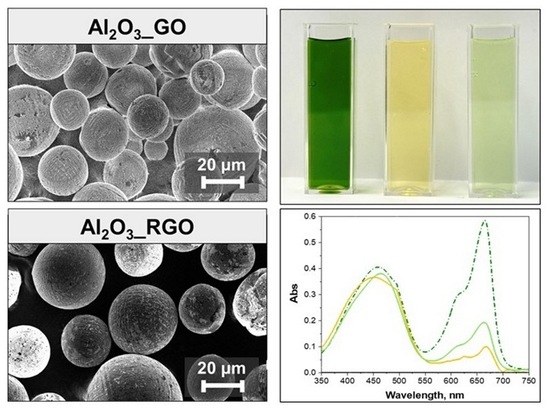
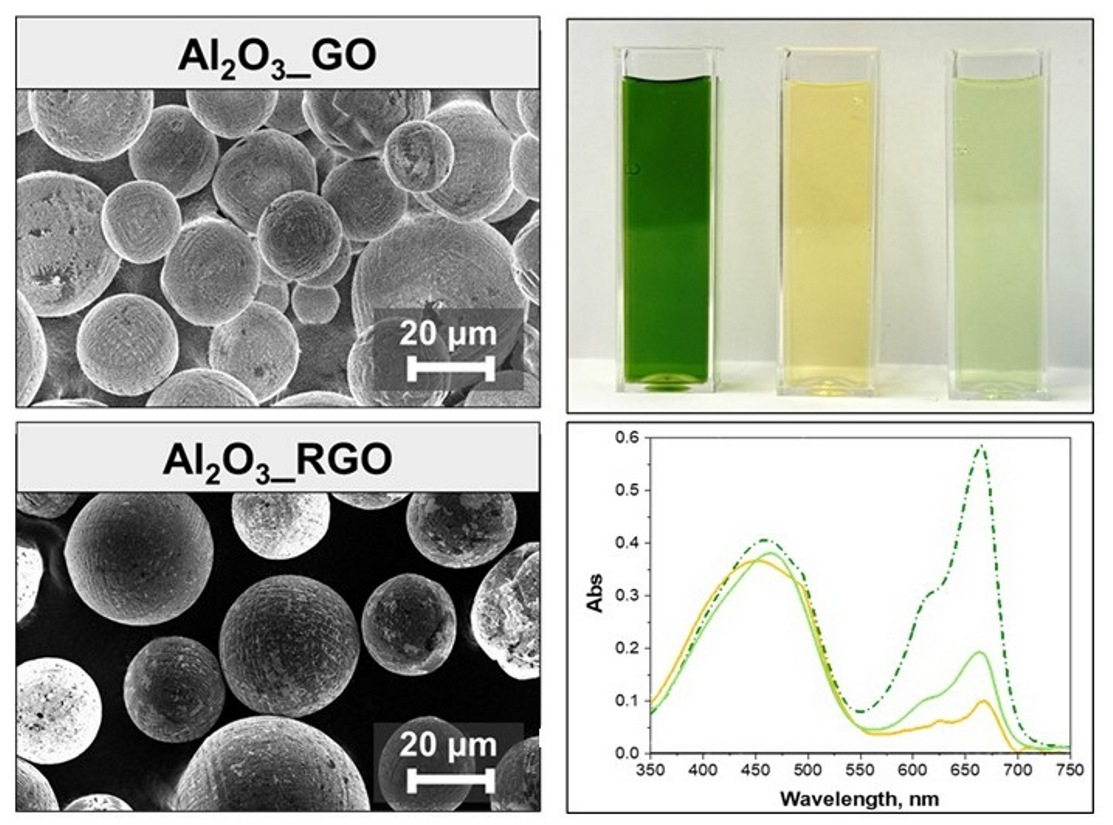
Graphical Abstract

1. Introduction

Currently, intensive economic growth is closely linked to industrial expansion, which significantly increases the load on the environment. With the development of the textile industry, water resources are primarily suffering from the risk of contamination by various dyes [1], oils [2], pharmaceuticals [3], heavy metal ions [4], and other pollutants. The highest levels of contamination are generally observed in developing countries due to the limited capacity to implement a multi-stage wastewater treatment system at industrial facilities [5].
Synthetic organic dyes enter water media mainly through industrial effluents and landfills, posing a serious threat to the aquatic ecosystem. In addition, dyes have negative effects on human health, causing dermatitis, damage to internal organs, and potential reproductive toxicity [6,7]. Consequently, the development of simple, cost-effective wastewater treatment methods that do not require expensive equipment remains a highly relevant task for material science and environmental engineering.
Carbon-containing materials have long been widely applied as efficient sorbents [8]. Activated carbon is considered a standard due to its high specific surface area, which largely determines its adsorption performance [9]. However, activated carbon has some disadvantages, including limited selectivity and difficulties in regeneration and recycling [10].
The use of graphene-based materials (carbon nanotubes, graphene oxide, reduced graphene oxide, etc.) allows for enhancing the adsorption characteristics of next-generation sorbents [11,12]. According to the literature [13,14], graphene oxide (GO) is particularly attractive for adsorption processes, as it represents a planar graphene surface decorated with a large number of oxygen-containing functional groups. Due to its negatively charged surface, GO exhibits excellent adsorption efficiency towards cationic dyes, such as methylene blue (MB) [15,16]. At the same time, GO is highly hydrophilic in aqueous or alcoholic media, which complicates its separation from purified solution and requires additional stages such as centrifugation or filtration.
Immobilization of GO on a solid support can help to solve the problem of sorbent recovery, purification, and reuse [17]. The main methods for GO deposition onto support, for example, ceramic particles, include drop-casting [18], vacuum filtration [19,20], spray-coating [21], and dip-coating [22,23]. Vacuum filtration is a quite fast method and is convenient for preparing membranes based on GO and polymers [24]. However, it is not suitable for ceramic materials, which typically possess a limited number of surface functional groups, resulting in poor adhesion of GO layers to the substrate and delamination in water solution. This was shown in [25], where GO was deposited on flat ZrO2-TiO2 substrates and used for the anaerobic decolorization of azo dyes. Two additional drying steps at 80 °C for 24 h and at 100 °C for 72 h were required to improve adhesion between the ceramic support and GO.
θ-Al2O3 is particularly suitable as a substrate for the deposition of GO for several reasons: (i) it is a chemically and thermally stable material, which is critical for adsorption/desorption processes under various conditions; (ii) the spherical morphology ensures good hydraulic properties and facilitates easy separation of the composite from purified aqueous solutions; and (iii) high-purity alumina microspheres are an inexpensive and commercially available raw material suitable for the composite preparation [26,27].
Dip-coating is a more versatile and convenient approach for forming a GO layer on the support of a complex shape. For example, in [23], dip-coating was applied for GO deposition onto a mullite foam matrix, and the resulting composite completely removed MB dye with a 5 ppm concentration from water in less than 30 min.
Removal of oxygen-containing functional groups from the GO surface results in the preparation of reduced graphene oxide (RGO) [28,29]. RGO, both in pristine form [30] and as a component of composites [31,32], can be used as a sorbent for organic compounds due to its layered structure, high defect density, and residual oxygen-containing groups. Therefore, the development of new approaches to GO/RGO-based composites is of great interest for enhancing water purification technologies.
In the present study, a composite material consisting of alumina microspheres coated with GO and RGO layers was prepared. The GO coating exhibits strong adhesion to the ceramic surface and does not peel off even after treatment in supercritical isopropanol used to reduce GO to RGO. The resulting composites were applied for the adsorption of methylene blue (MB) and methyl orange (MO) from water solution, as well as from their binary mixture in water.

2. Materials and Methods

2.1. Chemicals and Materials

Reagents, including potassium permanganate (KMnO4, CAS No. 7722-64-7), concentrated sulfuric acid (96% H2SO4, CAS No. 7664-93-9), hydrogen peroxide (30% H2O2, CAS No. 7722-84-1), hydrochloric acid (37% HCl, CAS No. 7647-01-0), isopropanol (99.9% (CH3)2CHOH, CAS No. 67-63-0), and sodium hydroxide (NaOH, CAS No. 1310-73-2), were obtained from Reakhim (Moscow, Russia).
Commercial θ-Al2O3 (Al2O3, CAS No. 1344-28-1) from Mikrointek LLC (Moscow, Russia) with spherical particles (fraction of 20–80 μm) was used as the composite matrix.
Natural graphite (Kahatagaha Graphite, Sri Lanka, 100 mesh fraction) (C, CAS No. 7782-42-5) was used for GO preparation.
All reagents were used without further purification.

2.2. Synthesis of Graphene Oxide (GO)

GO was synthesized by a modified Hummers’ method, as described in [33]. Natural graphite (1 g) was placed in 60 mL of concentrated sulfuric acid and stirred at 350 rpm for 30 min at 25 °C. Then, 1 g of KMnO4 was added in four equal portions at equal time intervals, and the oxidation was continued for 24 h. The reaction mixture was then poured into ice-cold distilled water, followed by the addition of 30 mL of H2O2. After sedimentation, the supernatant was decanted, and the solid product was repeatedly washed with water containing 10 mL of 1 M HCl. The suspension was centrifuged at 7500 rpm until the pH reached 7. The resulting GO was transferred into Petri dishes and dried in air to a constant weight.

2.3. Synthesis of Composites Al2O3_GO

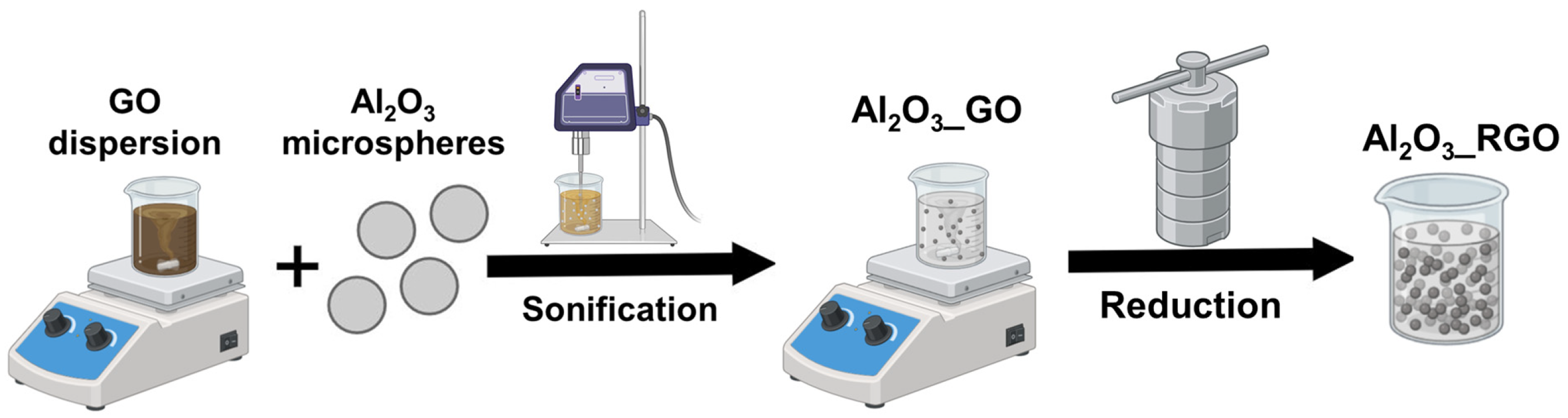
GO was pre-dispersed in water to obtain a dispersion of 1 mg/mL. Then, 1 g of spherical θ-Al2O3 was added to the GO dispersion, and the mixture was sonicated (ultrasound (US) power 1.5 W/cm3) for 1 h using an ice bath to prevent overheating. To study the activation of the θ-Al2O3 microsphere surface, the process was carried out under different conditions (Table 1). The resulting Al2O3_GO composites were washed repeatedly with distilled water (at least six times) until non-precipitated GO was completely removed. The general scheme of the synthesis procedure is shown in Figure 1.

2.4. Synthesis of Composite Al2O3_RGO

The Al2O3_RGO sample was prepared using supercritical isopropanol treatment (SCI) of the Al2O3_GO2 sample [34]. First, 100 mg of Al2O3_GO2 was placed in a quartz tube containing 5.7 mL of isopropyl alcohol. Then, the tube was loaded into a steel autoclave. The autoclave was heated in an oven to 280 °C and maintained at this temperature for 24 h. After cooling to room temperature, the autoclave was opened, and the product was collected. The resulting composite Al2O3_GO2 was washed three times with isopropanol and acetone and then dried in an oven at 120 °C to constant weight.

2.5. Characterization Techniques

FTIR spectra were recorded on a Bruker Alpha spectrometer (Karlsruhe, Germany) with a Platinum ATR accessory (the 400–4000 cm−1 range, 4 cm−1 resolution). X-ray powder diffraction (XRD) studies were performed on a Bruker D8 Advance diffractometer with CuKα1 radiation (λ = 0.154056 nm) in parallel-beam geometry. The scanning electron microscopy (SEM) images were obtained on a Carl Zeiss Supra 40 microscope (Zeiss, Oberkochen,Germany) at 10 kV (secondary electrons, 30 μm aperture). Raman spectra were registered on a Raman microscopeConfotec NR500 (SOL Instruments, Minsk, Belarus) using a green laser with a wavelength of 532 nm. UV–visible spectra were recorded on an Agilent Cary 60 spectrophotometer (Agilent, Tokyo, Japan) in a standard quartz 1 cm cuvette. Thermal analysis (TA) of samples was carried out using a synchronous thermal analyzer STA 449 F3 Jupiter combined with a QMS 403C Aëolos quadrupole mass spectrometer (NETZSCH, Selb, Germany). The samples were heated at a rate of 10 °C/min to a temperature of 800 °C in a dynamic argon flow (flow rate 50 mL/min). The change in sample mass was recorded with a resolution of 2 μg.

2.6. Adsorption Experiments

To determine the adsorption efficiency, MB and MO solutions with initial dye concentrations of 2 and 5 ppm were used. The volume of all solutions was 100 mL. For each experiment, 0.01 g of composite was added, and the aliquots for UV–vis analysis were taken over 24 h. Calibration curves were constructed for each dye type to determine the residual concentration of dye in solution.
The selective sorption performance of the GO- and RGO-containing composites toward the mixture of MB and MO was then evaluated. Sorbent samples (10 mg) were added to 100 mL of aqueous solutions containing 2 and 5 ppm organic dyes and stirred for 24 h.
To evaluate the reusability of the sorbents, cyclic experiments on the adsorption of MB with an initial concentration of 2 ppm were carried out. For each adsorption cycle, the solution volume was 100 mL, the sorbent mass was 0.01 g, and the duration of each cycle was 24 h. After each cycle, the sorbent was washed with isopropanol, dried, and reused in the subsequent experiment. A total of three cycles was performed.
Additional sorption experiments for MB removal (2 ppm) were performed under conditions simulating real ones: in a 0.01 M NaCl solution, in tap water (pH = 7.52), and in an acidic solution (pH = 2) adjusted with concentrated sulfuric acid.
The equilibrium adsorption capacity (qE) was calculated using the following Equation (1):
q E = ( c 0 c E ) × V m
where c0 and cE are the initial and equilibrium dye concentrations, V is the solution volume, and m is the mass of the sorbent.

3. Results and Discussion

3.1. Study of the Initial GO and θ-Al2O3

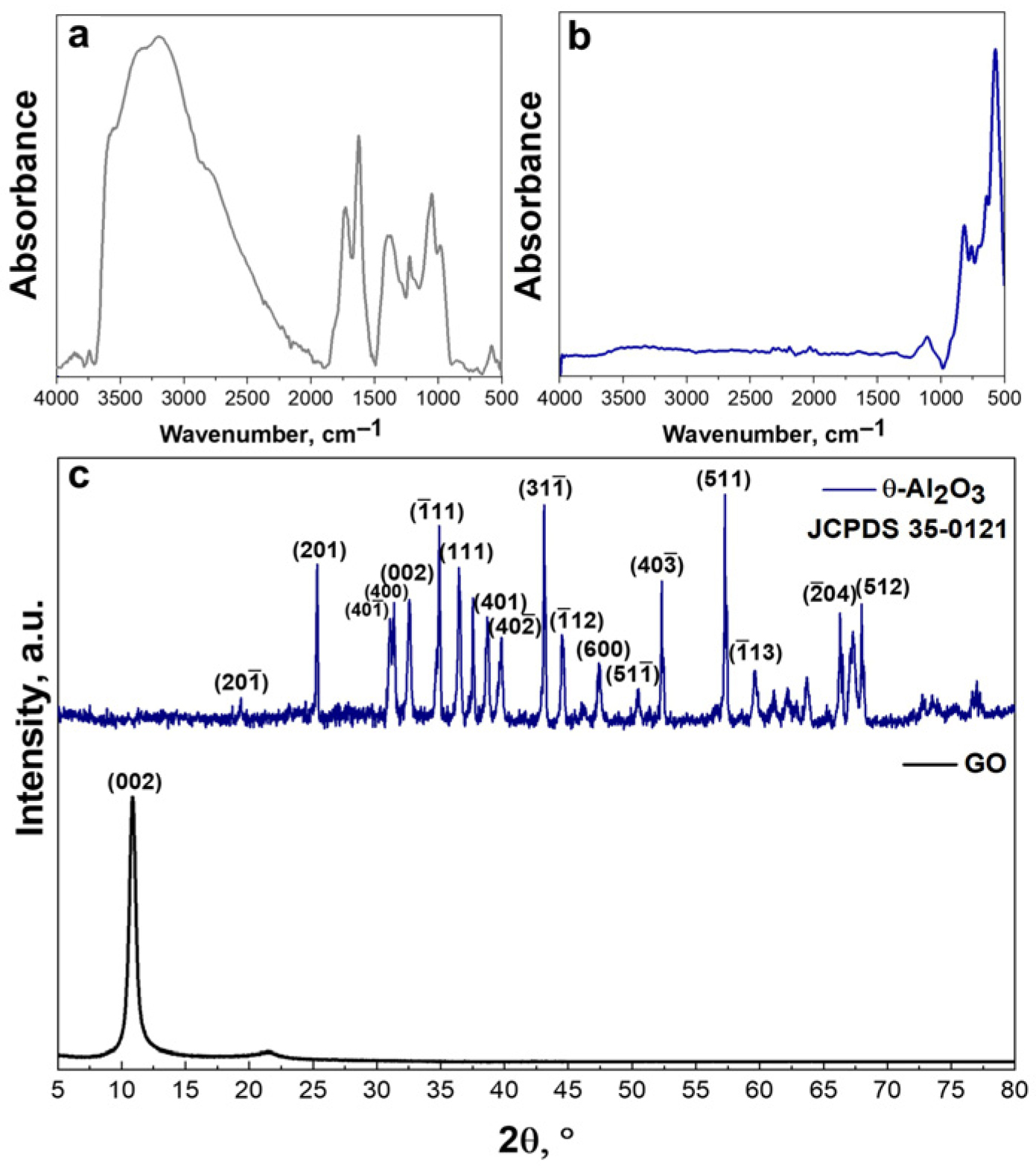
The GO synthesized by the modified Hummers’ method, according to CHNS analysis, has the following elemental composition: 46 wt.% C, 2 wt.% H, 2 wt.% S, and 50 wt.% O. The atomic composition is identical to the literature data [14] and indicates the presence of a large number of oxygen-containing functional groups on the GO surface. This is confirmed by FTIR spectroscopy data (Figure 2a). In the FTIR spectrum of GO, a broad intense band appears in the 3000–3450 cm−1 region, corresponding to the stretching vibrations of surface OH groups and adsorbed water molecules. The distinct and intense bands at 1720 cm−1 and 1620 cm−1 are assigned to the stretching vibrations of C=O groups and the bending vibrations of water molecules (δH-OH), respectively. Bands at 1368 cm−1 and 1281 cm−1 correspond to the deformation vibrations of OH groups in tertiary alcohols, whereas the bands at 1040 cm−1 and 987 cm−1 correspond to stretching vibrations of hydroxyl (OH-) and epoxy (C-O-C) groups. In addition, in the FTIR spectrum of GO synthesized by the Hummers’ method, characteristic bands at 1221 cm−1 and 1410 cm−1 are attributed to sulfate group vibrations [35].
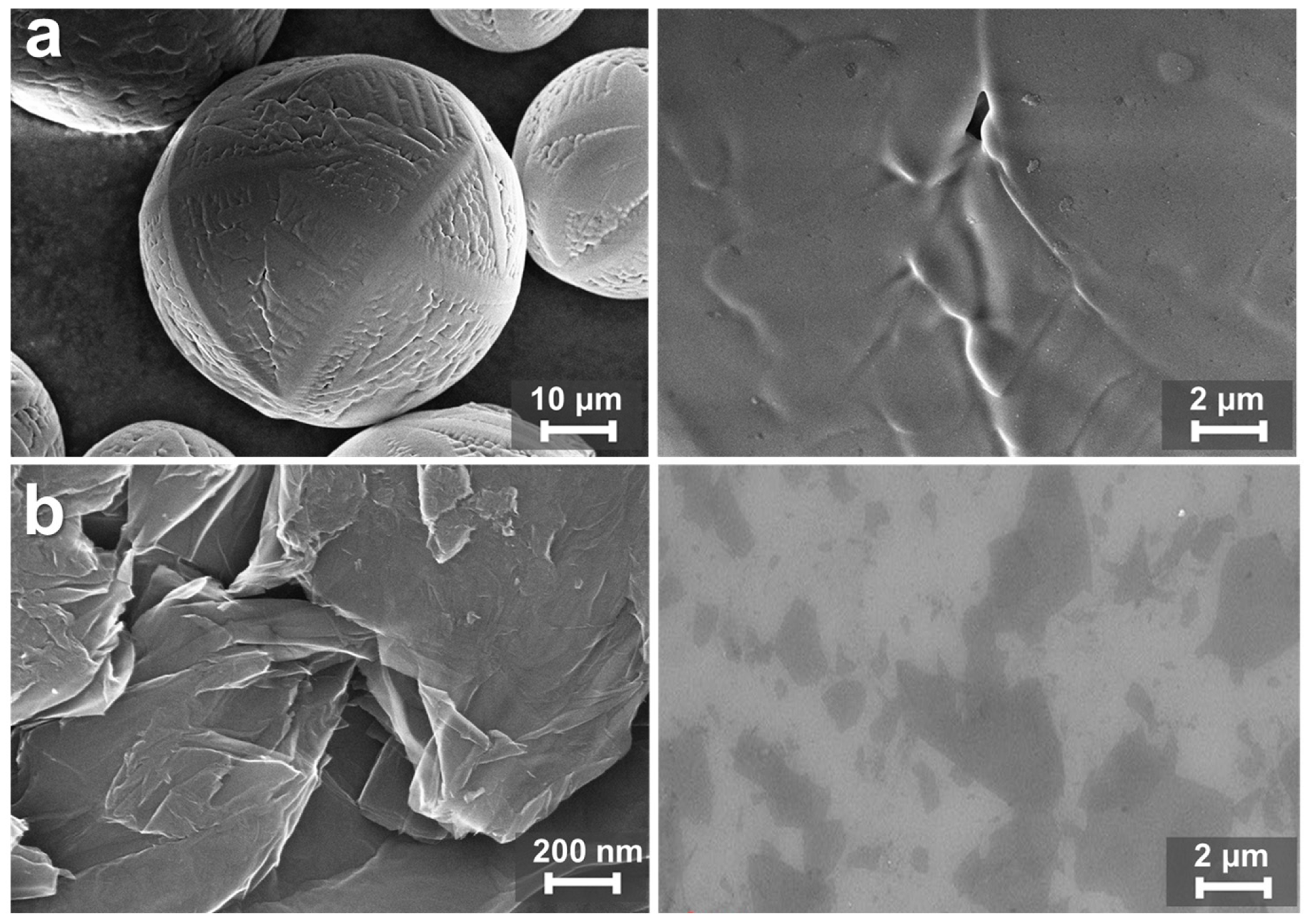
The XRD pattern of the synthesized GO sample (Figure 2c) presents a single diffraction peak at 2θ = 11°, corresponding to the [002] plane; the graphite peak at 2θ = 26.5° is absent, indicating complete oxidation [36]. SEM images of GO powder deposited on a SiO2 substrate are presented in Figure 3. According to the data analysis, GO exhibits a layered structure consisting of mono- and few-layer sheets with lateral dimensions ranging from tens or hundreds of nanometers to several micrometers, without visible defects. When compacted, GO layers form folds and wrinkles, which are almost absent on the smooth surface.
For the synthesis of Al2O3_GO composites, commercial Al2O3 with a particle fraction of 20–80 μm consisting of spherical particles was used; SEM images are shown in Figure 3. In the FTIR spectrum of Al2O3, characteristic absorption bands appear in the 400–1000 cm−1 region, with distinct maxima near 441, 562, 636, 763, and 820 cm−1, corresponding to Al-O bond vibrations. A weak and broadened band in the 3000–3600 cm−1 region corresponds to the stretching vibrations of OH groups from surface-bound water molecules (Figure 2b). The XRD pattern of the Al2O3 sample corresponds to the JCPDS 35-0121 card and indicates that the material is single-phase θ-Al2O3 [37].

3.2. Composite Preparation and Study

The dip-coating method used for composite preparation involves immersing a ceramic substrate into an aqueous suspension, followed by withdrawal, drying, and repeating the process until a layer of the desired thickness is obtained [38]. In our study, the main objective was to understand whether, and under what conditions, the adhesion of a monolayer of GO to the surface of alumina microspheres can occur. To preliminarily activate the alumina surface, the suspension was treated with high-power ultrasound. This technique leads to cavitation [39], i.e., the formation of air bubbles in the liquid which, upon collapsing near the Al2O3 surface, cause surface activation. Under US treatment, GO sheets are also partially broken, generating new free bonds. To lower the free energy of the system, the deposition of GO onto the Al2O3 surface becomes thermodynamically favorable, resulting in composite formation. An alternative means of activating the matrix surface during GO coating deposition involves treatment with acids or alkalis.
The optimal conditions for preparing composites were determined by varying the duration of US treatment and the pH of the medium. For comparison, dry mixing of GO powder and alumina microspheres was also performed, and the obtained Al2O3_GO composite was treated in SCI in order to transform GO to RGO. All prepared composite samples are listed in Table 1.
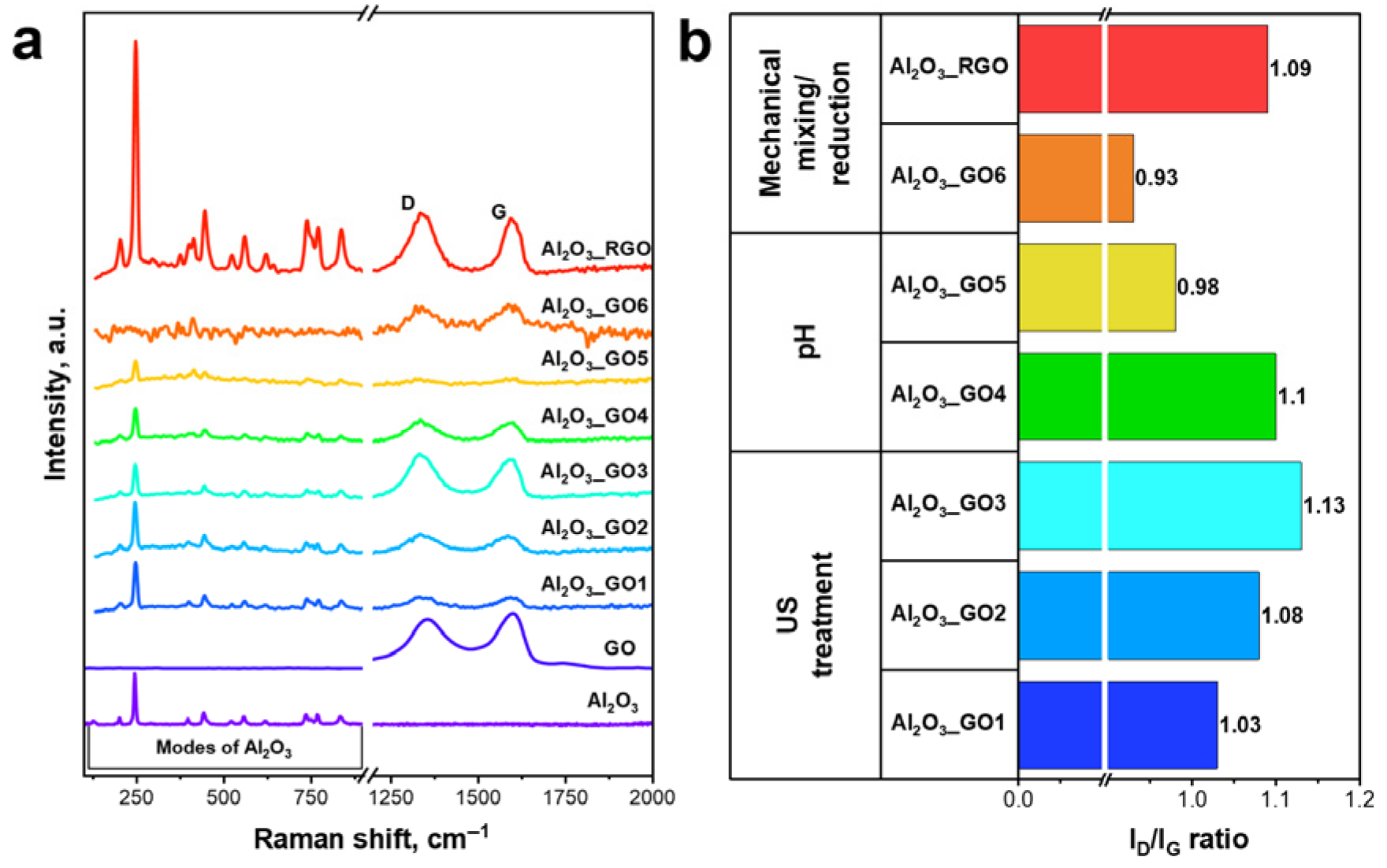
Raman spectroscopy (Figure 4) and SEM (Figure 5) were employed to characterize the obtained composites. The use of XRD as well as FTIR spectroscopy is not suitable due to these methods being quantitatively insensitive to the low mass content of GO on the alumina support surface. The Raman spectra of the initial Al2O3 and GO are shown in Figure 4a. For commercial θ-Al2O3 under excitation with a 532 nm laser, characteristic modes are observed below 900 cm−1, which are associated with A-O bonds. At the same time, Raman spectroscopy is the most suitable technique for investigating the structure and defect level of graphene-based materials. GO exhibits two intense bands in the Raman spectrum at approximately ~1350 cm−1 and ~1580 cm−1, referred to as the D and G bands, respectively [40]. The D band reflects the degree of disorder in the crystal structure and is assigned to fully symmetric vibrations of carbon atoms. The G band is observed in the Raman spectra of all carbon structures containing sp2 bonds and arises from tangential in-plane stretching vibrations of carbon atoms [41].
The obtained results (Figure 4a) indicate the presence of a GO coating on all Al2O3_GO composite samples, regardless of the preparation conditions. In addition, characteristic θ-Al2O3 modes are observed for each sample, which implies the coating is formed by a thin GO layer. In the Al2O3_GO6 sample prepared by mechanical mixing of Al2O3 and GO powders, the modes associated with θ-Al2O3 exhibit very low intensity, which is related to the thickness of the GO platelets adhered to the substrate surface. In the Al2O3_RGO sample, a clear change in the shape of the G band, typical of RGO, is observed [42], along with more intense θ-Al2O3 modes, indicating the formation of a graphene monolayer on the alumina surface. The evolution of the D and G bands’ intensity (ID/IG) is presented in Figure 4b. Although the ID/IG is commonly used to assess the defect density of graphene-based materials, in the present study, it correlates well with the increasing degree of coverage of the alumina matrix by GO or RGO layers.
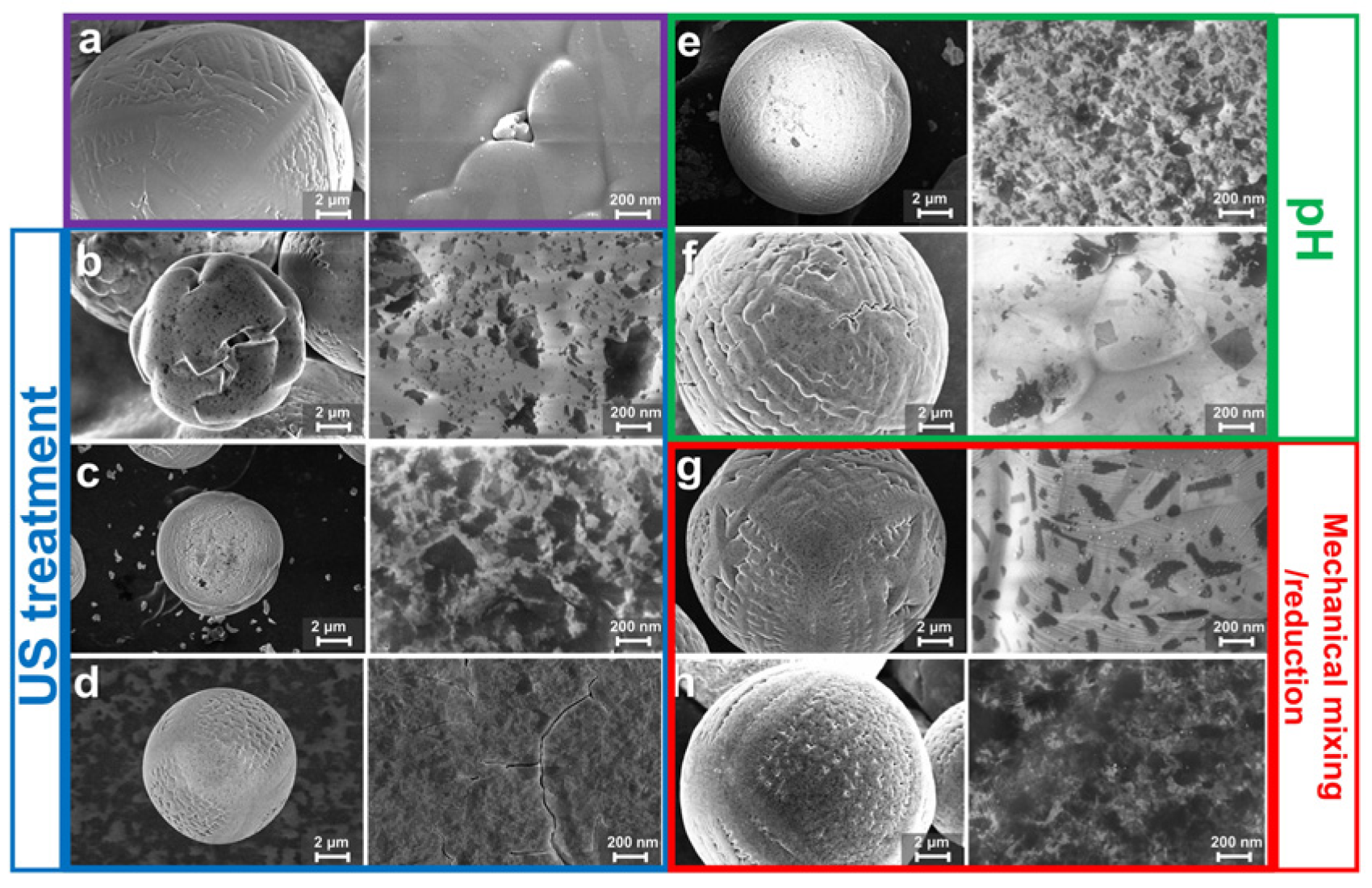
SEM images of the composites are shown in Figure 5 and Figure S1. The surface of the pure alumina exhibits some irregularities and roughness but is generally rather smooth (Figure 5a). The Al2O3_GO1 sample was prepared after 15 min of US treatment. GO layers only negligibly cover the surface of Al2O3 microspheres (Figure 5b). At the same time, it can be seen that the resulting coating consists of monolayer GO sheets, which may also adhere to each other (Figure S1a,b). Even short US treatment leads to pronounced fragmentation of GO sheets, with their lateral size in the range of 10–500 nm. Increasing the US treatment time to 1 h (sample Al2O3_GO2) results in the formation of a sufficiently uniform GO layer on the surface of alumina microspheres (Figure 5c). This explains the decrease in the GO sheet lateral size. Further increase in the US exposure (sample Al2O3_GO3) does not enhance this positive effect. The degree of substrate coverage by GO sheets increases; however, microcracks appear on the Al2O3 surface (Figure 5d).
During deposition in an acidic medium at pH = 3, an intensive coverage of the Al2O3 with GO sheets is also observed (sample Al2O3_GO4) (Figure 5e). However, complete and uniform coverage of the substrate still is not achieved. The opposite situation is observed in an alkaline medium at pH = 10. In Figure 5f, the surface of the Al2O3_GO5 is non-uniformly covered by both isolated GO monolayers and GO sheet agglomerates. This behavior is associated with the fact that in an alkaline medium, GO is partially reduced and degrades into epoxy and hydroxyl groups [43]. As a result, the partially reduced GO domains can adhere to each other, leading to the formation of agglomerates observed in the SEM images.
The Al2O3_GO6 sample prepared by mechanical mixing of the initial components consists of Al2O3 microspheres coated with multilayer GO platelets. Interestingly, even without US treatment, the lateral size of the platelets does not exceed 400 nm (Figure 5g). The interaction between the alumina microsphere surface and powdered GO occurs through electrostatic forces. However, this approach does not allow the formation of a GO monolayer coating on the Al2O3 surface.
According to the Raman spectroscopy and SEM data, the optimal method for composite fabrication is ultrasound treatment of GO and Al2O3 suspended together in a neutral medium. Based on this conclusion, the Al2O3_GO2 composite sample was reduced in supercritical isopropanol in order to remove oxygen-containing functional groups from the GO plane, yielding the Al2O3_RGO composite [44]. The resulting Al2O3_RGO microspheres exhibit a dark gray color, in contrast to the light brown color of the Al2O3_GO composites, and SEM images (Figure 5h and Figure S1c,d) show that thin graphene layers uniformly cover the surface of the substrate.
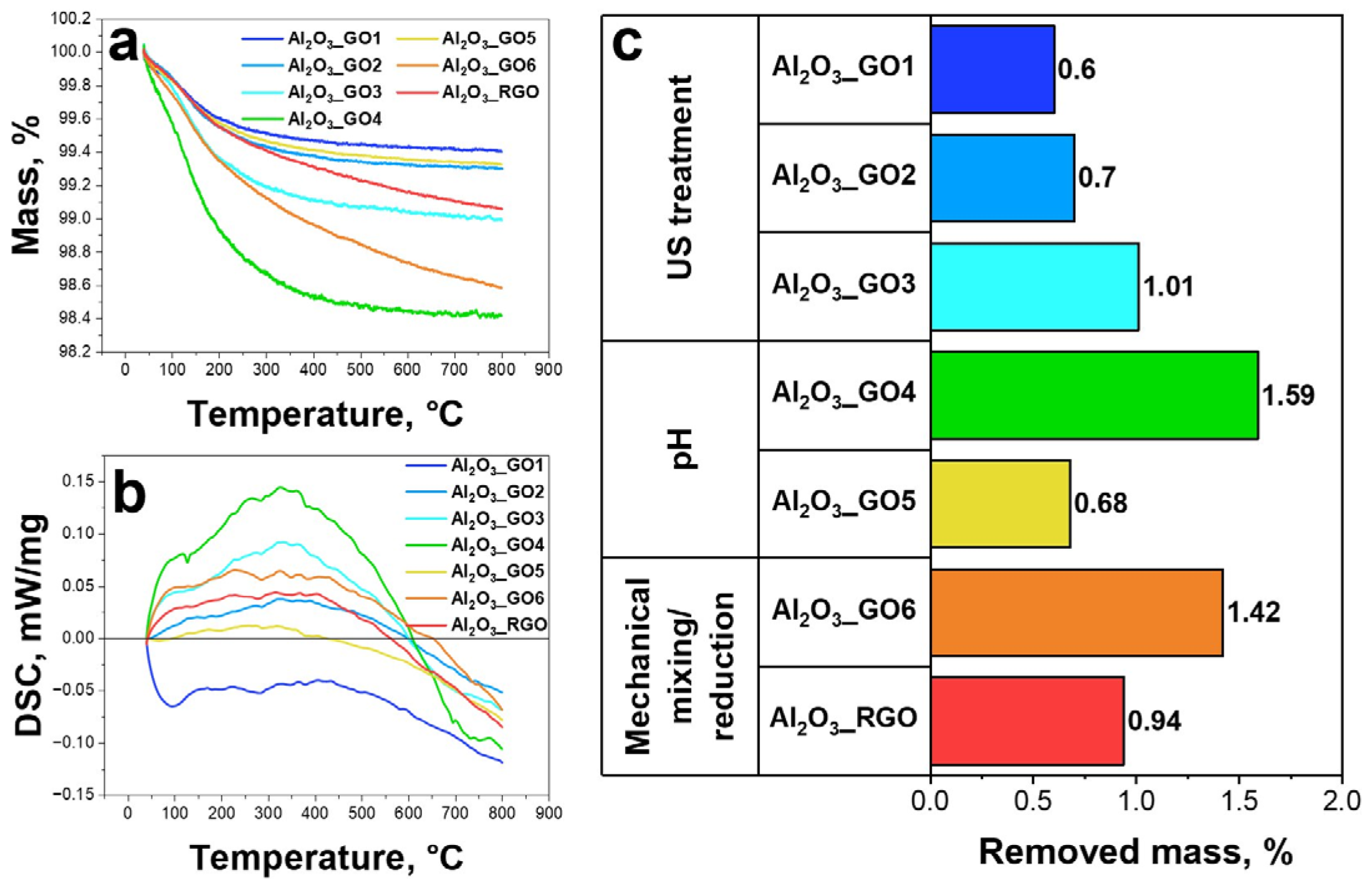
The GO content on the Al2O3 surface was determined by TGA-DSC analysis. The thermogravimetric curves (Figure 6a) show a mass loss in the temperature range of 50–400 °C for all samples, which corresponds to the removal of oxygen-containing functional groups and the decomposition of GO. At higher temperatures, a plateau is observed for Al2O3_GO1-5, whereas for the Al2O3_GO6 sample prepared by mechanical mixing of the components and for the Al2O3_RGO composite, the mass continues to decrease slightly. The Al2O3_RGO sample contains RGO on the microsphere surface, which is more thermally stable than GO [45]. In the Al2O3_GO6 sample, multilayered GO platelets are present on the alumina microsphere surface, and upon heating, a slow reduction process of these platelets is likely to occur.
According to the DSC data (Figure 6b), heating up to 400–500 °C is accompanied by exothermic effects associated with the removal of surface oxygen-containing functional groups. Endothermic effects, which are predominantly observed after heating to ≥500 °C, are related to the gradual decomposition of GO and RGO. The differences observed for the Al2O3_GO1 sample are due to the lower number of GO layers present on the alumina surface and their rapid decomposition upon heating.
The largest mass loss (1.59 wt.%) is observed for the composite obtained in an acidic medium. This may also be partly attributed to intercalated chlorine ions, which are removed during heating. A slightly lower mass (1.42 wt.%) is demonstrated by the sample prepared by mechanical mixing of GO with alumina; however, in this composite, a uniform GO monolayer is not formed, and GO is present on the microsphere surface in the form of multilayer platelets. The duration of US treatment indeed affects the GO content on the alumina microsphere surface, but the maximum mass loss recorded for composites obtained in a neutral medium does not exceed 1 wt.%. The minimum mass loss is recorded for the Al2O3_GO5 composite sample prepared in alkaline medium, which correlates with the SEM and Raman spectroscopy data. For the Al2O3_RGO sample, an increase in the mass loss is observed compared with the initial Al2O3_GO2 sample, which is associated with the formation of more thermally stable RGO.
The conducted studies have shown that US treatment of an alumina and GO suspension principally leads to the formation of a thin GO layer on the surface of the substrate. The GO content in the composite ranges from 0.6 to 1.6 wt.%. An increase in the sonication time promotes an increase in the GO coating thickness; however, it also results in severe fragmentation of GO sheets and the formation of microcracks in the Al2O3. An increase in the pH of the medium leads to partial GO reduction, and the coating is of poor quality. Therefore, the optimal conditions for composite preparation are US treatment for 1 h in a neutral or acidic medium.

3.3. Adsorption Experiments

For the sorption of organic dye experiments, the Al2O3_GO2 and Al2O3_RGO composites were selected as adsorbents. The tests were carried out using a dilute aqueous solution of the cationic dye (MB) and anionic dye (MO), as well as their mixture. These dyes are commonly used for dyeing denim and cotton fabrics and also find applications in analytical chemistry and pharmaceuticals; their uncontrolled release into industrial wastewater can have a detrimental impact on aquatic ecosystems [46]. The use of GO as an efficient sorbent for synthetic dyes has already been demonstrated in several studies [14,16], while its deposition on an inert alumina support can provide a more convenient way to introduce and remove the sorbent in a water treatment system. Figure S2 (in the Supplementary File) shows images of GO, Al2O3_GO, and Al2O3_RGO sorbents dispersed in water. It is obvious that, despite the high adsorption capacity of GO, there are certain limitations associated with its use in pristine powdered form for water purification. In contrast, the Al2O3_GO and Al2O3_RGO composites immediately settle to the bottom after the sorption processes, which enables straightforward separation of the purified solution without additional steps such as centrifugation or filtration.
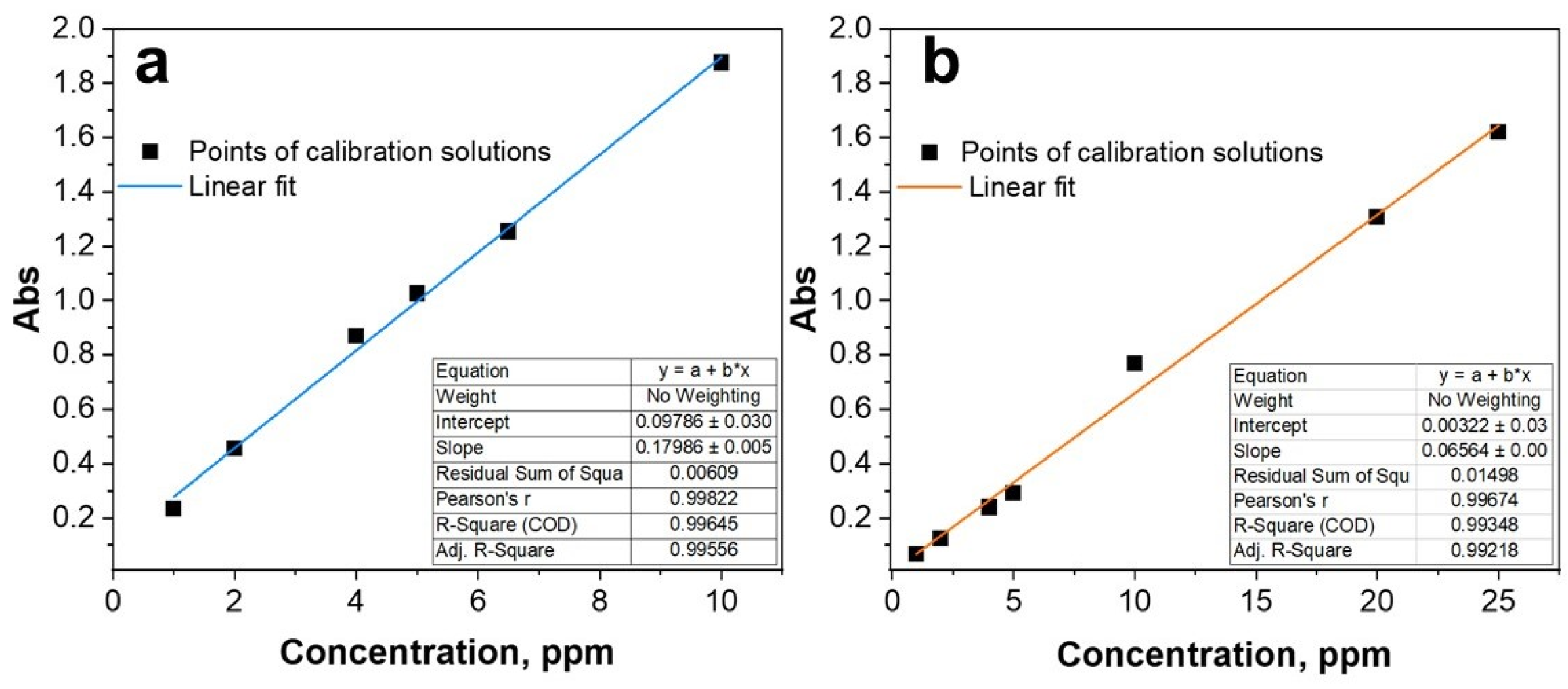
To plot calibration curves (Figure 7), a series of diluted MB and MO solutions with different concentrations was prepared. UV–visible spectroscopy was employed, since MB and MO exhibit a distinct adsorption maximum at λ = 665 nm and 464 nm, respectively. The calibration curves were used to determine the dye concentration in solution during sorption tests of the Al2O3_GO and Al2O3_RGO composites.
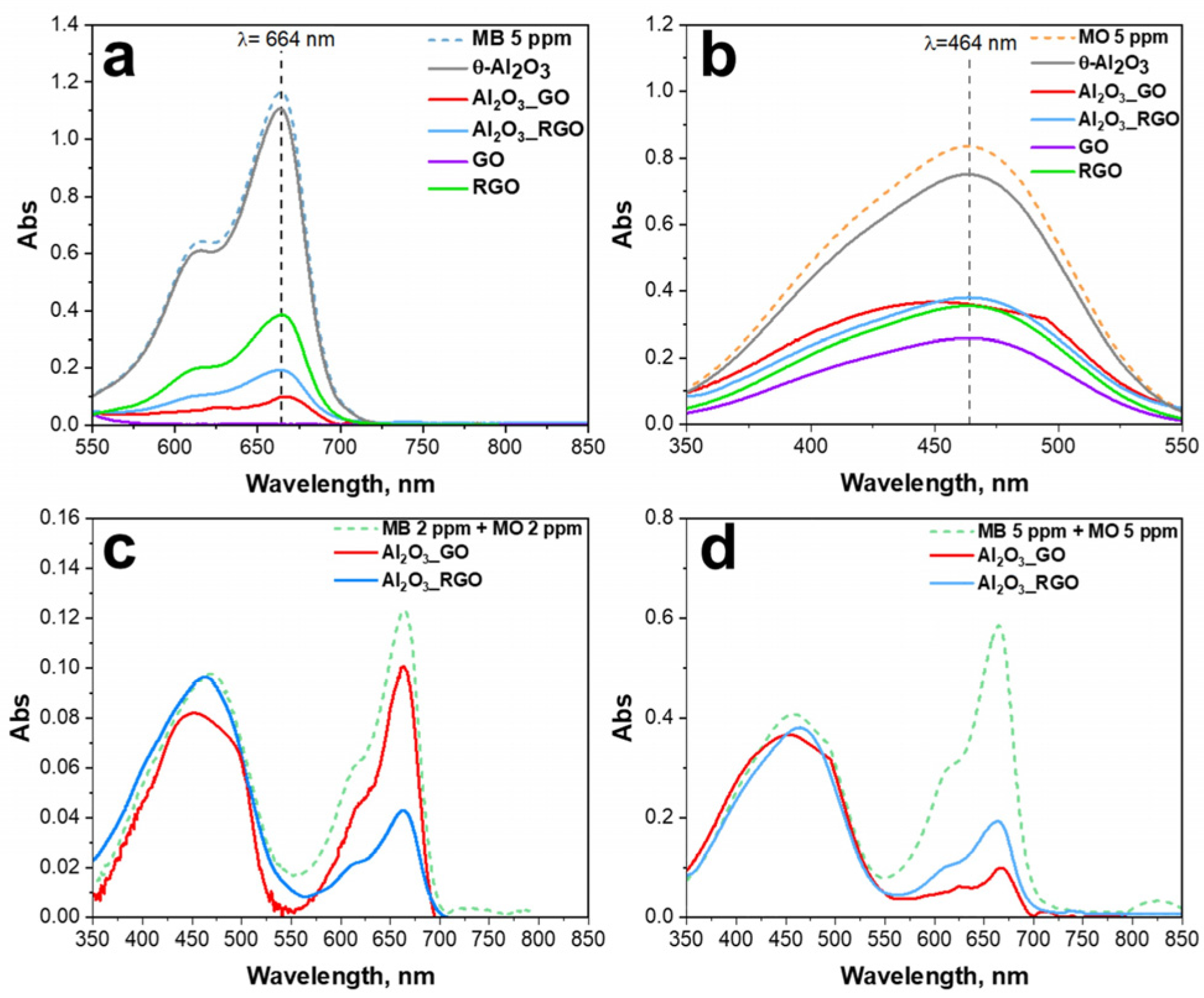
The volume of dye solutions used was 100 mL, with dye concentrations of 2 ppm and 5 ppm; the total sorbent (composite) mass was 10 mg, and the mass of GO in the sorbent was 70–100 μg. The corresponding UV–visible spectra are shown in Figure 8. As shown in Figure 8a,b, pure alumina microspheres do not exhibit any noticeable adsorption activity toward the selected dyes, as the recorded UV–visible spectra almost coincide with the initial ones. GO, due to the large number of oxygen-containing surface groups, is an excellent sorbent for MB, while pristine RGO is also capable of adsorbing the MB (Figure 8a) with a removal efficiency of approximately 72%. The GO and RGO, consistent with literature data [47,48], possess a negatively charged surface and a large number of oxygen-containing functional groups (residual functional groups in RGO). The high adsorption efficiency toward cationic MB is attributed to electrostatic interactions between the surface functional groups of GO/RGO and the positively charged dye molecules, as well as π-π stacking. These properties are retained upon deposition of GO and RGO onto the surface of Al2O3 microspheres. In the Al2O3_GO2 composite, the removal efficiency reaches ~94%, and for the Al2O3_RGO composite, it increases to ~85%, which can be explained by the participation of an extended graphene monolayer on the substrate in the adsorption process, whereas compacted RGO is quite defective and has a significantly smaller surface area. In highly diluted dye solutions, RGO exhibits a removal efficiency of MB that is higher than that of GO. The removal efficiency of the composites toward the MB (2 ppm) dye during three adsorption cycles is presented in Figure S3. It can be seen that after the third cycle, the performance of both Al2O3_GO and Al2O3_RGO remains above 60%. SEM images of composites after three adsorption cycles, presented in Figure S4, demonstrate the strong adhesion of the graphene-based materials to the alumina substrate, as the GO and RGO layers are clearly visible on the Al2O3 surface.
To evaluate the potential for practical application, three additional sorption experiments for MB removal were carried out under conditions simulating real systems: in a 0.01 M NaCl solution, in tap water (pH = 7.52), and in an acidic solution with pH = 2. The corresponding results are shown in Figure S5. Interestingly, in all series of experiments, the adsorption performance of GO and RGO is essentially identical. The composites adsorb MB dye, exhibiting a removal efficiency of ~50% in tap water and acidic media, whereas in a 0.01 M NaCl solution, the removal efficiency reaches about 70%.
In the literature, it has been reported that GO or RGO are not capable of adsorbing MO quantitatively [48], but this effect does not appear for a highly diluted solution. As demonstrated by the present experiments, both GO and RGO are able to remove MO to some extent from a solution with a concentration of 5 ppm (Figure 8b). The interaction with MO occurs via π-π stacking between the aromatic system of the dye molecules and the graphene domains with sp2 hybridization in GO and RGO [49].
In adsorption experiments with mixed-dye solution (Figure 8c,d), both composites exhibit selective uptake of the cationic dye. A decrease in the absorption maxima of MB is observed in UV–visible spectra for solutions with dye concentrations of 2 ppm and 5 ppm, whereas the adsorption of the anionic MO is not detected, indicating that the electrostatic interaction of oxygen-containing functional groups of GO/RGO with cationic dye molecules is the dominant process. Interestingly, MB adsorption from the mixed solution at lower dye concentration (2 ppm) proceeds more efficiently on the Al2O3_RGO composite than on Al2O3_GO. This can be explained by the fact that the monolayer RGO on the alumina microsphere surface is more accessible sterically for interaction with MB molecules than the GO, which is less planar due to the presence of surface functional groups.

4. Conclusions

In the present study, composite samples consisting of alumina microspheres coated with a graphene oxide layer were prepared. The optimal conditions for composite fabrication were determined as 1 h of ultrasonic treatment in acidic or neutral media, which allows coating of the alumina surface of mono- and few-layer GO. In contrast, longer US treatment or the use of alkaline media leads to partial reduction of GO, severe fragmentation of GO sheets, and the appearance of microcracks on the alumina surface. The composites were characterized by Raman spectroscopy, TGA/DSC, and SEM. Thermal analysis showed that the GO content in the composites ranged from 0.6 to 1.6 wt.%. Treatment of the Al2O3_GO composite in supercritical isopropanol resulted in the reduction of GO to reduced graphene oxide on the microsphere surface, as confirmed by Raman spectroscopy and TGA.
The Al2O3_GO and Al2O3_RGO composites were evaluated in model adsorption experiments with methylene blue and methyl orange in aqueous solutions. Both composites exhibited high adsorption efficiency toward the cationic dye MB, partial adsorption of MO, and selective removal of MB from a binary MB/MO solution with dye concentrations of 2 ppm and 5 ppm. These findings demonstrate the potential of Al2O3 microspheres coated with GO/RGO as convenient and efficient sorbents for the selective removal of cationic dyes from industrial wastewater.

Supplementary Materials

The following supporting information can be downloaded at https://www.mdpi.com/article/10.3390/jcs10010031/s1, Figure S1: Additional SEM images of (a,b) Al2O3_GO 1, and (c,d) Al2O3_RGO composites. Figure S2. Images of GO, Al2O3_GO, and Al2O3_RGO sorbents dispersed in water. Figure S3. Removal efficiency of MB (2 ppm) using Al2O3_GO and Al2O3_RGO after three adsorption cycles. Figure S4. SEM images of composites after three adsorption cycles: (a,b) Al2O3_GO and (c,d) Al2O3_RGO. Figure S5. UV-visible spectra of the dye in solutions stimulating real conditions (in a 0.01 M NaCl solution; in tap water; and in an acidic media) with the sorbent (a) Al2O3_GO, and (b) Al2O3_RGO.

Author Contributions

Conceptualization, V.I., N.M., L.K., I.K. and Y.V.I.; methodology, V.I., L.K., I.K. and Y.V.I.; formal analysis, V.I., N.M. and T.S.; investigation, V.I., N.M., L.K., I.S., T.S., I.K. and Y.V.I.; resources, I.K. and Y.V.I.; data curation, V.I., N.M., L.K., T.S., I.S. and E.E.; writing—original draft preparation, V.I., N.M. and Y.V.I.; writing—review and editing, Y.V.I.; visualization, V.I., N.M. and Y.V.I.; supervision, Y.V.I.; project administration, I.K. All authors have read and agreed to the published version of the manuscript.

Funding

The study was supported by the Russian Scientific Foundation (project No. 22-19-00110-П).

Data Availability Statement

The data presented in this study are available on request from the corresponding author.

Acknowledgments

The research infrastructure of the “Educational and Methodical Center of Lithography and Microscopy” of the Lomonosov Moscow State University was used. This work was partially supported by M.V. Lomonosov Moscow State University Program of Development. The XRD, CHNS, and Raman spectroscopy studies were performed at the Shared Facility Center of the Kurnakov Institute of General and Inorganic Chemistry (IGIC RAS).

Conflicts of Interest

The authors declare no conflicts of interest.

References

  1. Jorge, A.M.S.; Athira, K.K.; Alves, M.B.; Gardas, R.L.; Pereira, J.F.B. Textile dyes effluents: A current scenario and the use of aqueous biphasic systems for the recovery of dyes. J. Water Process Eng. 2023, 55, 104125. [Google Scholar] [CrossRef]
  2. Radelyuk, I.; Tussupova, K.; Klemeš, J.J.; Persson, K.M. Oil refinery and water pollution in the context of sustainable development: Developing and developed countries. J. Clean. Prod. 2021, 302, 126987. [Google Scholar] [CrossRef]
  3. Yang, X.; Wu, X.; Liu, X.; Wang, Y.; Wang, A. Adsorption performance of zero-valent iron-loaded biochar for tetracycline antibiotics. RSC Adv. 2025, 15, 38624–38635. [Google Scholar] [CrossRef] [PubMed]
  4. Zamora-Ledezma, C.; Negrete-Bolagay, D.; Figueroa, F.; Zamora-Ledezma, E.; Ni, M.; Alexis, F.; Guerrero, V.H. Heavy metal water pollution: A fresh look about hazards, novel and conventional remediation methods. Environ. Technol. Innov. 2021, 22, 101504. [Google Scholar] [CrossRef]
  5. Chen, P. Unlocking policy effects: Water resources management plans and urban water pollution. J. Environ. Manag. 2024, 365, 121642. [Google Scholar] [CrossRef]
  6. Kavitha, G.; Govindhan, M.; Premkumar, S. Dye pollution and its implications for human health, aquatic ecosystems, and sustainable wastewater treatment: A comprehensive review. J. Water Process Eng. 2025, 80, 109071. [Google Scholar] [CrossRef]
  7. Olas, B.; Białecki, J.; Urbańska, K.; Bryś, M. The Effects of Natural and Synthetic Blue Dyes on Human Health: A Review of Current Knowledge and Therapeutic Perspectives. Adv. Nutr. 2021, 12, 2301–2311. [Google Scholar] [CrossRef]
  8. Scaria, J.; Gopinath, A.; Ranjith, N.; Ravindran, V.; Ummar, S.; Nidheesh, P.V.; Kumar, M.S. Carbonaceous materials as effective adsorbents and catalysts for the removal of emerging contaminants from water. J. Clean. Prod. 2022, 350, 131319. [Google Scholar] [CrossRef]
  9. Ghaedi, M.; Nasab, A.G.; Khodadoust, S.; Rajabi, M.; Azizian, S. Application of activated carbon as adsorbents for efficient removal of methylene blue: Kinetics and equilibrium study. J. Ind. Eng. Chem. 2014, 20, 2317–2324. [Google Scholar] [CrossRef]
  10. Xiao, W.; Garba, Z.N.; Sun, S.; Lawan, I.; Wang, L.; Lin, M.; Yuan, Z. Preparation and evaluation of an effective activated carbon from white sugar for the adsorption of rhodamine B dye. J. Clean. Prod. 2020, 253, 119989. [Google Scholar] [CrossRef]
  11. Zhang, Y.; Luo, J.; Zhang, H.; Li, T.; Xu, H.; Sun, Y.; Gu, X.; Hu, X.; Gao, B. Synthesis and adsorption performance of three-dimensional gels assembled by carbon nanomaterials for heavy metal removal from water: A review. Sci. Total Environ. 2022, 852, 158201. [Google Scholar] [CrossRef]
  12. Singh, R.; Samuel, M.S.; Ravikumar, M.; Ethiraj, S.; Kirankumar, V.S.; Kumar, M.; Arulvel, R.; Suresh, S. Processing of Carbon-Based Nanomaterials for the Removal of Pollutants from Water/Wastewater Application. Water 2023, 15, 3003. [Google Scholar] [CrossRef]
  13. Zubair, M.; Roopesh, M.S.; Ullah, A. Challenges and prospects: Graphene oxide-based materials for water remediation including metal ions and organic pollutants. Environ. Sci. Nano 2024, 11, 3693–3720. [Google Scholar] [CrossRef]
  14. Ioni, Y.; Ibragimova, V.; Sapkov, I.; Dimiev, A. Graphene oxide with different oxygen content produced from natural and synthetic graphite sources for methylene blue sorption. Diam. Relat. Mater. 2024, 149, 111550. [Google Scholar] [CrossRef]
  15. Ioni, Y.V.; Sapkov, I.V.; Chentsov, S.I.; Efremova, E.I.; Gubin, S.P. New Method for Preparation of Composite Based on Montmorillonite and Graphene Oxide. Russ. J. Inorg. Chem. 2023, 68, 487–495. [Google Scholar] [CrossRef]
  16. Yan, H.; Tao, X.; Yang, Z.; Li, K.; Yang, H.; Li, A.; Cheng, R. Effects of the oxidation degree of graphene oxide on the adsorption of methylene blue. J. Hazard. Mater. 2014, 268, 191–198. [Google Scholar] [CrossRef]
  17. Akanji, I.O.; Iwarere, S.A.; Sani, B.S.; Mukhtar, B.; Jibril, B.E.-Y.; Daramola, M.O. Polystyrene infused with functionalized reduced graphene oxide as a reusable oil sorbent. Discov. Sustain. 2024, 5, 209. [Google Scholar] [CrossRef]
  18. Lee, Y.; Kim, N.; Park, S.; Ko, Y.-I.; Shin, Y.; Yang, B.; Yang, C.-M. Effects of high-temperature thermal reduction on thermal conductivity of reduced graphene oxide polymer composites. Appl. Surf. Sci. 2024, 650, 159140. [Google Scholar] [CrossRef]
  19. Petukhov, D.I.; Chernova, E.A.; Kapitanova, O.O.; Boytsova, O.V.; Valeev, R.G.; Chumakov, A.P.; Konovalov, O.V.; Eliseev, A.A. Thin graphene oxide membranes for gas dehumidification. J. Membr. Sci. 2019, 577, 184–194. [Google Scholar] [CrossRef]
  20. Xiong, H.; Chen, H.; Li, C. Nanosheet lateral size effects in graphene oxide films via vacuum-assisted filtration. Carbon 2025, 241, 120400. [Google Scholar] [CrossRef]
  21. Ibragimova, V.R.; Rasskazov, I.E.; Suslin, S.G.; Sapkov, I.V.; Efremova, E.I.; Ioni, Y.V. Preparation of Gas-Thermal Coatings Based on Nickel-Containing Powder with Introduced Graphite Oxide. High Energy Chem. 2024, 58, S155–S160. [Google Scholar] [CrossRef]
  22. Ramírez, C.; Belmonte, M.; Miranzo, P.; Osendi, M.I. Applications of Ceramic/Graphene Composites and Hybrids. Materials 2021, 14, 2071. [Google Scholar] [CrossRef]
  23. Singhapong, W.; Jaroenworaluck, A.; Manpetch, P. Novel and Reusable Graphene Oxide-Coated Reticulated Open-Cell Mullite Foams for Methylene Blue Dye Adsorption. ACS Omega 2024, 9, 5541–5547. [Google Scholar] [CrossRef]
  24. Liang, K.; Spiesz, E.M.; Schmieden, D.T.; Xu, A.-W.; Meyer, A.S.; Aubin-Tam, M.-E. Bioproduced Polymers Self-Assemble with Graphene Oxide into Nanocomposite Films with Enhanced Mechanical Performance. ACS Nano 2020, 14, 14731–14739. [Google Scholar] [CrossRef] [PubMed]
  25. Amin, M.S.A.; Stüber, F.; Giralt, J.; Fortuny, A.; Fabregat, A.; Font, J. Ceramic-supported graphene oxide membrane bioreactor for the anaerobic decolorization of azo dyes. J. Water Process Eng. 2022, 45, 102499. [Google Scholar] [CrossRef]
  26. Bulychev, N.A. A COMPARATIVE STUDY OF ALUMINUM OXIDE NANOPARTICLES SYNTHESIZED IN PLASMA DISCHARGE UNDER ULTRASONIC CAVITATION AND BY LASER ABLATION FOR CREATION OF COMPOSITE MATERIALS. Nanosci. Technol. Int. J. 2024, 15, 71–78. [Google Scholar] [CrossRef]
  27. Bulychev, N.A.; Butusova, O.A. Mechanical Properties of Composite Films Reinforced with Ceramic Tin Oxide Nanoparticles. Tech. Phys. 2024, 69, 2501–2506. [Google Scholar] [CrossRef]
  28. Lavin-Lopez, M.P.; Paton-Carrero, A.; Sanchez-Silva, L.; Valverde, J.L.; Romero, A. Influence of the reduction strategy in the synthesis of reduced graphene oxide. Adv. Powder Technol. 2017, 28, 3195–3203. [Google Scholar] [CrossRef]
  29. Ivannikova, A.S.; Ioni, Y.V.; Sapkov, I.V.; Kozlova, L.O.; Kozerozhets, I.V. Preparation and Reduction of Graphene Oxide/Zinc Borate Composites as Candidate Flame-Retardant Materials. Russ. J. Inorg. Chem. 2023, 68, 787–793. [Google Scholar] [CrossRef]
  30. Wijaya, R.; Andersan, G.; Permatasari Santoso, S.; Irawaty, W. Green Reduction of Graphene Oxide using Kaffir Lime Peel Extract (Citrus hystrix) and Its Application as Adsorbent for Methylene Blue. Sci. Rep. 2020, 10, 667. [Google Scholar] [CrossRef] [PubMed]
  31. Tara, N.; Alzahrani, E.A.; Alsebaii, N.M.; Dwivedi, P.; Al-Ghamdi, A.A.; Aldahiri, R.H.; Nguyen, H.T.; Oh, S.; Chaudhry, S.A. Novel Hybrid rGO-BC@ZrO2 Composite: A Material for Methylene Blue Adsorption. Water 2025, 17, 627. [Google Scholar] [CrossRef]
  32. Lee, S.; Kim, S.; Soo Han, S.; Kim, D.-W.; Lee, J.; Oh, Y. Effect of adsorbate geometry and hydrogen bonding on the enhanced adsorption of VOCs by an interfacial Fe3O4–rGO heterostructure. Chem. Eng. J. 2023, 473, 145346. [Google Scholar] [CrossRef]
  33. Ioni, Y.; Ibragimova, V. Study of Sorption Activity of Carbon Nanomaterials for Capture of Chlorine-Containing Gases. Clean Technol. 2025, 7, 39. [Google Scholar] [CrossRef]
  34. Ioni, Y.; Popova, A.; Maksimov, S.; Kozerozhets, I. Ni Nanoparticles on the Reduced Graphene Oxide Surface Synthesized in Supercritical Isopropanol. Nanomaterials 2023, 13, 2923. [Google Scholar] [CrossRef] [PubMed]
  35. Brusko, V.; Khannanov, A.; Rakhmatullin, A.; Dimiev, A. Unraveling the Infrared Spectrum of Graphene Oxide. Carbon 2024, 229, 119507. [Google Scholar] [CrossRef]
  36. Xu, C.; Yuan, R.-s.; Wang, X. Selective reduction of graphene oxide. New Carbon Mater. 2014, 29, 61–66. [Google Scholar] [CrossRef]
  37. Almotairy, A.R.Z.; Amer, A.M.; El-Kady, H.; Elwakil, B.H.; El-Khatib, M.; Eldrieny, A.M. Nanostructured γ-Al2O3 Synthesis Using an Arc Discharge Method and its Application as an Antibacterial Agent against XDR Bacteria. Inorganics 2023, 11, 42. [Google Scholar] [CrossRef]
  38. Kwon, O.; Choi, Y.; Choi, E.; Kim, M.; Woo, Y.C.; Kim, D.W. Fabrication Techniques for Graphene Oxide-Based Molecular Separation Membranes: Towards Industrial Application. Nanomaterials 2021, 11, 757. [Google Scholar] [CrossRef]
  39. Ručigaj, A.; Connell, J.G.; Dular, M.; Genorio, B. Influence of the ultrasound cavitation intensity on reduced graphene oxide functionalization. Ultrason. Sonochemistry 2022, 90, 106212. [Google Scholar] [CrossRef]
  40. Hanifah, M.F.R.; Jaafar, J.; Othman, M.H.D.; Ismail, A.F.; Rahman, M.A.; Yusof, N.; Salleh, W.N.W.; Aziz, F. Facile synthesis of highly favorable graphene oxide: Effect of oxidation degree on the structural, morphological, thermal and electrochemical properties. Materialia 2019, 6, 100344. [Google Scholar] [CrossRef]
  41. Li, Z.; Deng, L.; Kinloch, I.; Young, R. Raman spectroscopy of carbon materials and their composites: Graphene, nanotubes and fibres. Prog. Mater. Sci. 2023, 135, 101089. [Google Scholar] [CrossRef]
  42. Parpal, M.; El Sachat, A.; Sotomayor Torres, C.M.; Gómez-Romero, P.; Rueda-García, D.; Chavez-Angel, E. In situ Raman analysis of reduced-graphene oxide-based electroactive nanofluids. Diam. Relat. Mater. 2024, 141, 110541. [Google Scholar] [CrossRef]
  43. Chowdhury, H.; Saha, A.; Hasan, M.; Haider, J. Effects of Alkaline and Carboxilated Graphene Oxide (CGO) Treatment on Mechanical, Thermal, and Electrical Properties of Jute Fiber-Reinforced Epoxy Composites. J. Compos. Sci. 2025, 9, 104. [Google Scholar] [CrossRef]
  44. Khodkina, A.S.; Ovchinnikov, M.A.; Rasskazov, I.E.; Kolchin, A.V.; Korolev, D.V.; Kunitsyna, E.I.; Bakhmetiev, M.V.; Serebrennikova, S.I.; Ibragimova, V.; Mitiushev, N.D.; et al. Synthesis of hybrid materials based on reduced graphene oxide and Ni (NiO) nanoparticles by supercritical solvent and thermal treatment techniques. Mater. Sci. Eng. B 2026, 324, 118950. [Google Scholar] [CrossRef]
  45. Ying, Z.; Diao, J.; Wang, S.; Cai, X.; Cai, Y.; Liu, H.; Wang, N. Thermal stability, ripening dynamics and coalescing microstructures of reduced graphene oxide-based platinum nanocatalysts: An in-situ TEM study. Diam. Relat. Mater. 2021, 120, 108690. [Google Scholar] [CrossRef]
  46. Slama, H.B.; Chenari Bouket, A.; Pourhassan, Z.; Alenezi, F.N.; Silini, A.; Cherif-Silini, H.; Oszako, T.; Luptakova, L.; Golińska, P.; Belbahri, L. Diversity of Synthetic Dyes from Textile Industries, Discharge Impacts and Treatment Methods. Appl. Sci. 2021, 11, 6255. [Google Scholar] [CrossRef]
  47. Tao, E.; Ma, D.; Yang, S.; Hao, X. Graphene oxide-montmorillonite/sodium alginate aerogel beads for selective adsorption of methylene blue in wastewater. J. Alloys Compd. 2020, 832, 154833. [Google Scholar] [CrossRef]
  48. Molla, A.; Li, Y.; Mandal, B.; Kang, S.G.; Hur, S.H.; Chung, J.S. Selective adsorption of organic dyes on graphene oxide: Theoretical and experimental analysis. Appl. Surf. Sci. 2019, 464, 170–177. [Google Scholar] [CrossRef]
  49. Minitha, C.R.; Lalitha, M.; Jeyachandran, Y.L.; Senthilkumar, L.; Rajendra Kumar, R.T. Adsorption behaviour of reduced graphene oxide towards cationic and anionic dyes: Co-action of electrostatic and π–π interactions. Mater. Chem. Phys. 2017, 194, 243–252. [Google Scholar] [CrossRef]
Figure 1. Scheme of composite preparation.
Jcs 10 00031 g001
Figure 2. FTIR spectra of (a) GO and (b) Al2O3, and (c) XRD patterns of Al2O3 and GO samples.
Jcs 10 00031 g002
Figure 3. SEM images of (a) Al2O3 and (b) GO.
Jcs 10 00031 g003
Figure 4. Raman spectra (a) for all obtained samples and (b) D/G peak ratios.
Jcs 10 00031 g004
Figure 5. SEM images of the initial aluminum oxide (a) and synthesized GO/RGO_Al2O3 sorbents: (b) Al2O3_GO1, (c) Al2O3_GO2, (d) Al2O3_GO3, (e) Al2O3_GO4, (f) Al2O3_GO5, (g) Al2O3_GO6, (h) Al2O3_RGO.
Jcs 10 00031 g005
Figure 6. TGA (a), DSC (b), and a summary table of mass losses (c) for all obtained composites.
Jcs 10 00031 g006
Figure 7. Calibration curves of UV–visible spectra for dyes with different concentrations: (a) methylene blue and (b) methyl orange.
Jcs 10 00031 g007
Figure 8. UV–visible spectra of dye solutions. (a) MB, (b) MO, (c) mixture of dyes at concentrations of 2 ppm, and (d) 5 ppm.
Jcs 10 00031 g008
Table 1. Preparation conditions of composites.
SampleCompositionSynthesis Conditions
Al2O3θ-Al2O3Commercial θ-Al2O3 (20–80 μm)
GOGOGO synthesized by the Hummers’ method
Al2O3_GO1Al2O3 and GOUS treatment, τ = 15 min.
Al2O3_GO2Al2O3 and GOUS treatment, τ = 1 h.
Al2O3_GO3Al2O3 and GOUS treatment, τ = 2 h.
Al2O3_GO4Al2O3 and GOUS treatment, τ = 1 h. HCl solution (pH = 3) 
Al2O3_GO5Al2O3 and GOUS treatment, τ = 1 h. NaOH solution (pH = 10) 
Al2O3_GO6Al2O3 and GOMechanical mixing of GO and θ-Al2O3, τ = 24 h.
Al2O3_RGOAl2O3 and RGOTreatment Al2O3_GO2 in supercritical isopropanol.
Disclaimer/Publisher’s Note: The statements, opinions and data contained in all publications are solely those of the individual author(s) and contributor(s) and not of MDPI and/or the editor(s). MDPI and/or the editor(s) disclaim responsibility for any injury to people or property resulting from any ideas, methods, instructions or products referred to in the content.