1. Introduction
With the rapid development of marine science and technology, the demand for autonomous underwater vehicles (AUVs) in civil, military, and scientific research fields is increasing [
1]. As the core component of AUV autonomy and intelligence, the positioning accuracy of the navigation system directly affects the success and efficiency of AUV underwater missions [
2,
3]. However, the special characteristics of the underwater environment bring great challenges to the navigation and positioning of AUVs [
4,
5]. Therefore, it is of great research significance to improve the navigation accuracy of underwater vehicles.
Currently, AUV underwater navigation sensors mainly include the inertial navigation system (INS) [
6], Doppler Velocimetry (DVL) [
7], a Depth System (PS) [
8], and a Global Positioning System (GPS) [
9]. In general, INS can provide AUVs with acceleration, angular velocity, angle, velocity, and position information. However, since the calculation of velocity and position relies on the integral accumulation of acceleration and angular velocity, it requires the high accuracy of gyroscopes and accelerometers. Conventional AUVs generally use an INS that cannot provide velocity and position information, such as inertial measurement units (IMUs) and attitude and heading reference systems (AHRSs). DVL provides velocity relative to the bottom through acoustic Doppler frequency shift, which assists inertial navigation in generating position information. PS provides the AUV with depth information between the current position and the water surface. GPS can provide accurate position information on the water surface, but the signal cannot be transmitted in underwater environments [
10]. An ultra-short baseline (USBL) [
11] can provide underwater positioning; however, it is expensive and relies on external equipment. Therefore, the integrated navigation technology of INS/DVL/PS/GPS has become a research hotspot for low-cost AUV underwater navigation [
2,
3], which achieves a higher accuracy of navigation through fusing data from multiple sensors. However, it is still a challenge to optimize the sensor data fusion algorithm in the underwater complex environment.
In practical applications, commonly used navigation algorithms include dead reckoning (DR) [
12] and the extended Kalman filter (EKF) [
13]. DR estimates the position of the AUV by continuously calculating its motion state, but is easily affected by cumulative errors. EKF effectively reduces the cumulative error and provides more accurate navigation information through multiple filtering and the fusion of sensor data. However, the performance of EKF depends on accurate sensor models and environmental models, and the accuracy is still limited without the assistance of external position information [
14]. In recent years, machine learning [
15,
16], deep learning [
17,
18], and other neural network-based methods in AUV navigation [
19] have gained widespread attention.
More and more scholars are exploring the impact of machine learning and deep learning methods on improving the accuracy of AUV navigation systems [
20,
21,
22,
23]. He et al. summarized how deep neural networks (DNN) can suppress the drift error of navigation systems by calibrating inertial sensor noise and fusing navigation sensor information [
24]. Xie et al. proposed a neural network-based approach to explore the time-varying relationship between the acceleration and attitude angle, using acoustic localization and a neural network to estimate the pitch angle and reduce the impact of waves on inertial sensors [
25]. Huang et al. proposed a multi-error model-assisted extended Kalman filter method for attitude estimation, which improves the performance of MEMS sensors and enhances the accuracy of underwater glider navigation systems [
26]. Li et al. constructed a nonlinear regressive neural network model for the supervised learning of the velocity increments of DVL and INS, assisting the navigation when the DVL fails [
27]. Sabet et al. proposed a dynamic surge identification model based on low-cost MEMS to assist the dead reckoning, which improves the navigation accuracy by reducing the effects of external acceleration and electromagnetic interference on attitude [
28]. Topini et al. used four deep learning models, including MLP [
29], LSTM [
30], CNN [
31], and CNN-LSTM [
32], to estimate DVL velocity and combined dead reckoning for navigation [
33]. The above methods are mainly based on supervised learning models outputting information such as attitude and velocity to assist in improving navigation and positioning accuracy.
Since GPS can provide the navigation system with position data without cumulative errors when the AUV is sailing on the surface, the divergence of the navigation system error is suppressed. However, the GPS information is not available due to the attenuation of radio signals underwater, and the USBL data update rate is low, which makes it impossible to control the error dispersion of the navigation system. Scholars have begun to study the direct relationship between the inertial navigation system, the Doppler velocity log, the depth sensor, and GPS positioning data. The most common method is to achieve end-to-end position output through a neural network [
34]. Lv et al. proposed an adaptive GPS filtering method to address the GPS drift caused by the GPS antenna being easily covered when the AUV is sailing near the surface. By comparing the length of time without GPS data and the distance difference between GPS position and navigation position with the threshold value, the GPS drift data are filtered out and the confidence of GPS position is improved [
35]. Then, an AUV navigation dataset with GPS correction is constructed, a hybrid recurrent neural network is selected to learn the AUV navigation data, and a position correction model is constructed for the position output of the navigation system [
36]. Guo et al. estimated the AUV position based on an online process model by reconstructing state information between valid data from an ultrashort baseline positioning system [
37]. Mu et al. trained GPS and other navigation data directly through LSTM and bidirectional long- and short-term memory, and obtained the AUV position data [
38] through an end-to-end approach [
39].
Although the above navigation technologies have suppressed the divergence rate of navigation system errors to a certain extent, they still have certain limitations [
40]. For example, deep learning methods rely on a large amount of high-quality data and computing resources. To overcome the above problems, this paper proposes a navigation method that combines the traditional EKF and the virtual GPS model (VGPSM) based on deep sequence learning to provide high-precision and high-update rate navigation information for an autonomous underwater vehicle. The main contributions of this paper are summarized as follows:
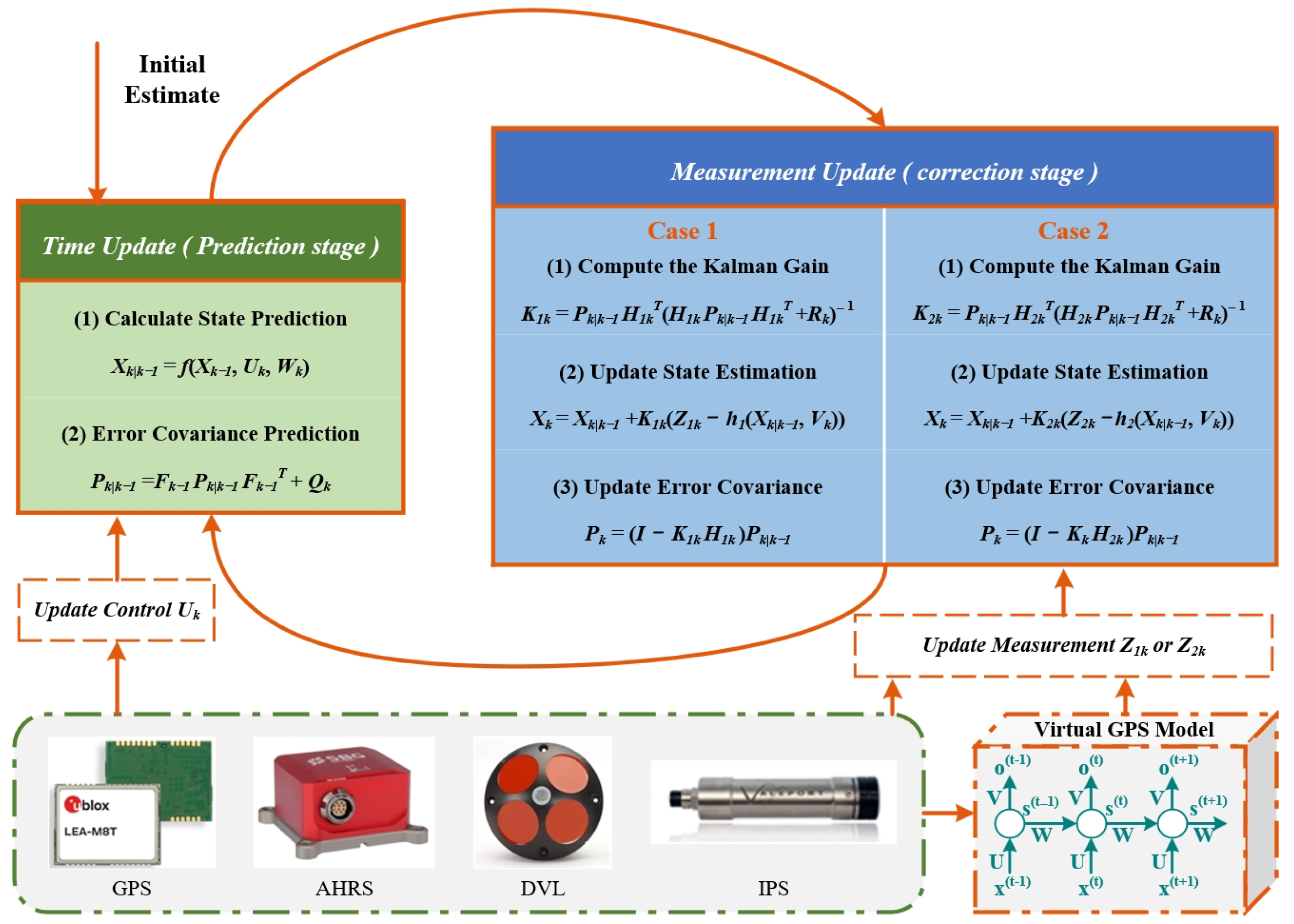
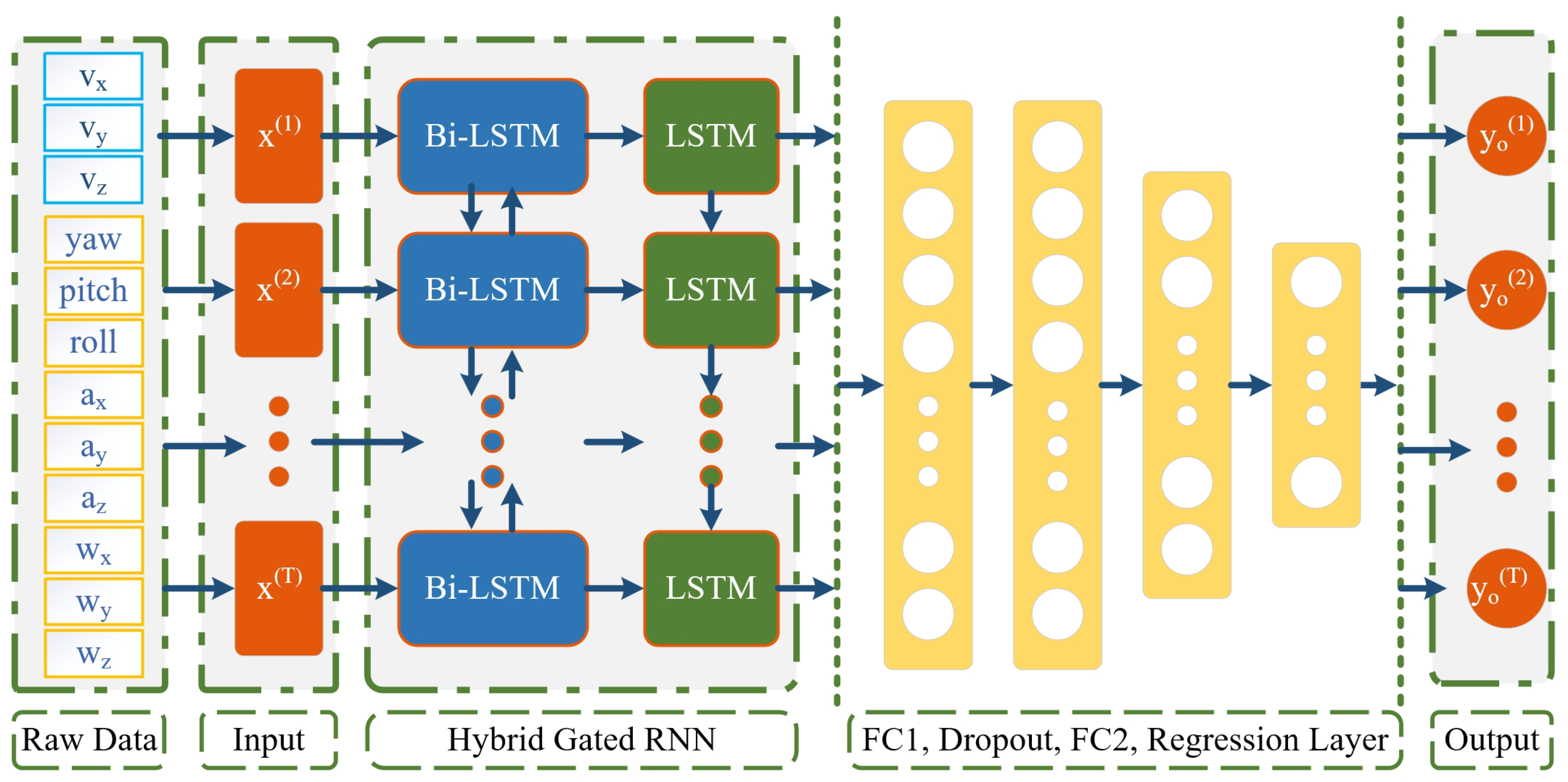
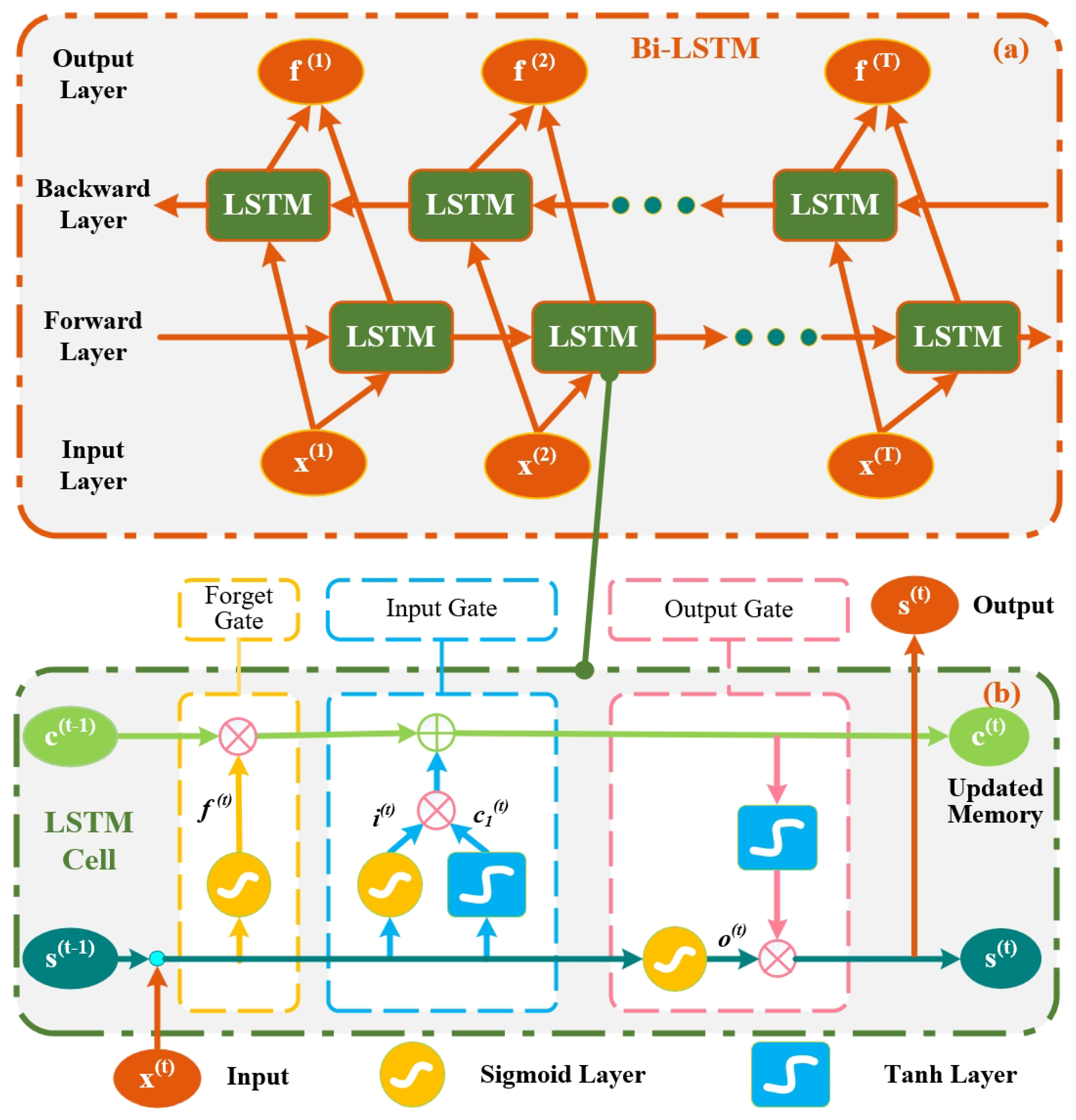
According to the high-quality navigation sensor data, when GPS data are available on the surface, based on the time-series characteristics of the navigation system data, a deep sequence learning model integrating LSTM and Bi-LSTM is constructed to learn the relationship between the GPS data and the DVL and AHRS data in the surface environment, and forms a virtual GPS model, which solves the problem of no GPS signal underwater.
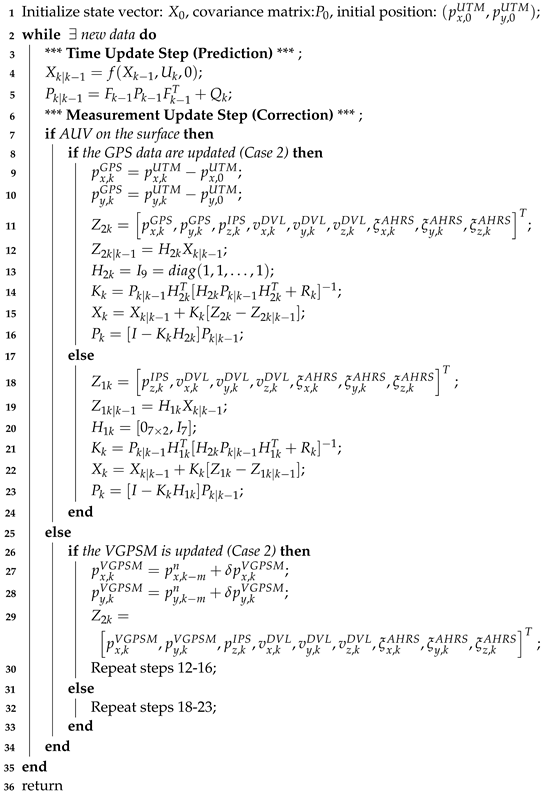
Observation vectors are constructed for two cases, depending on whether the AUVs have positional aids when performing the mission. The virtual GPS model is updated at the same frequency as the real GPS data. When there is an update in the surface GPS or the underwater VGPSM, the corresponding position is added to the observation vector. Otherwise, the observation vector does not contain position information, which effectively solves the limitations of traditional navigation methods when there is no external position assistance.
Through experiments on real navigation data, the performance and practical application effects of the proposed method in different situations are verified, which provides new ideas and references for the development of underwater vehicle navigation technology.
The structure of this paper is organized as follows:
Section 2 introduces the basic knowledge of navigation system.
Section 3 describes the specific implementation process of a virtual GPS model based on deep sequence learning and the proposed methodology.
Section 4 conducts experimental design and results, followed by
Section 5, which offers an in-depth analysis and discussion of the experimental findings. Finally,
Section 6 summarizes the key conclusions and contributions of this study. Through these contents, this study hopes to provide new theoretical and technical support for the development of AUV navigation systems.
2. Navigation System
The AUV navigation system contains functions such as sensor data acquisition and navigation positioning. The data collected using each sensor will be sent to the data center (MOOSDB). The navigation algorithm module, after acquiring the sensor data at the current moment from the MOOSDB, calculates a stable and reliable position, velocity, attitude, and other information in real time, and then sends it to the MOOSDB for the other systems of the AUV to acquire in order to perform the task more accurately. This section focuses on the two coordinate systems and the main onboard sensors of the AUV navigation system in this paper.
2.1. Coordinate System for AUV Navigation
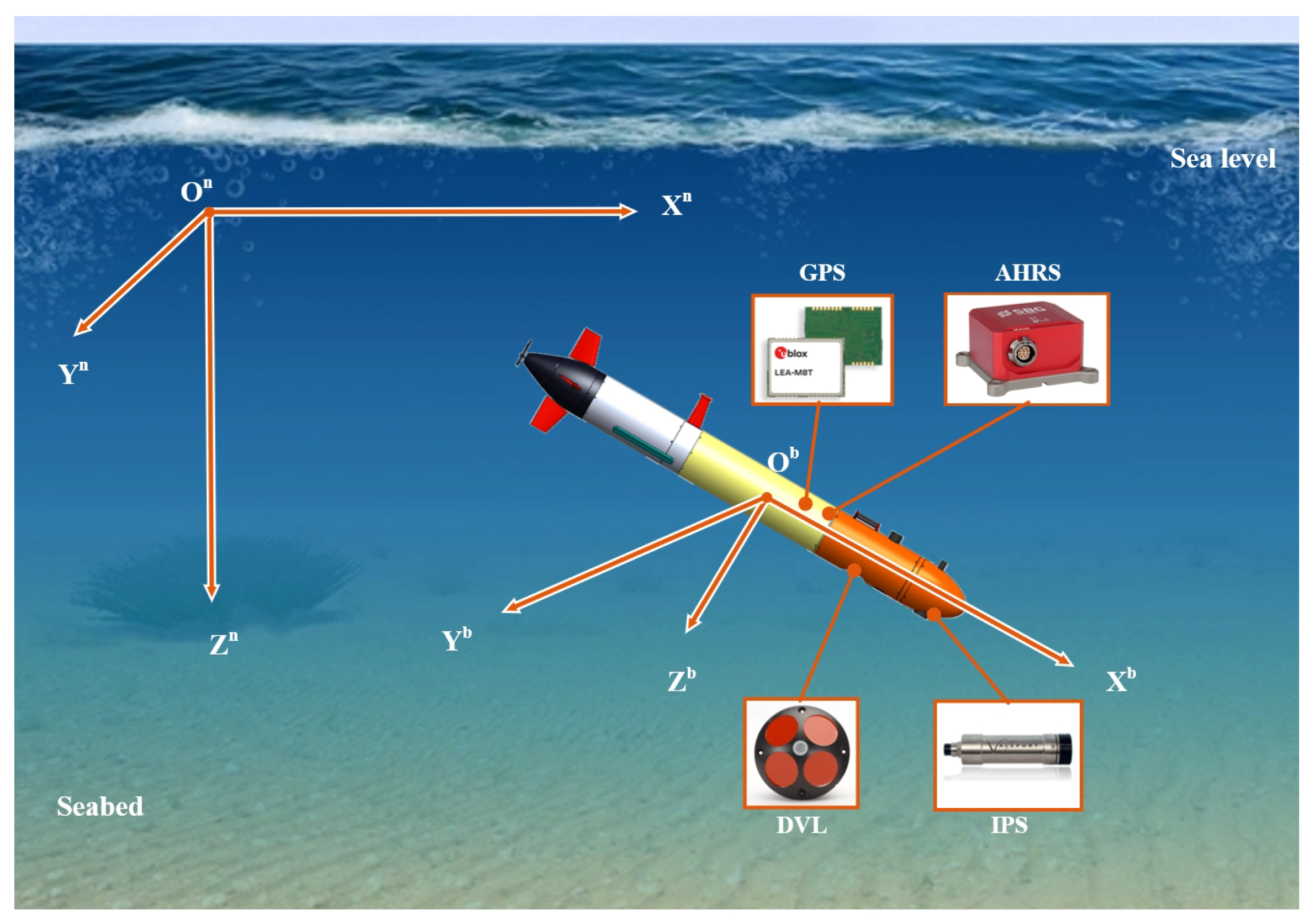
The navigation system in this paper uses both the navigation coordinate system and the body coordinate system, as shown in
Figure 1. In general, the position, velocity, attitude, acceleration, and angular velocity of the AUV come from the navigation coordinate system by default, but the velocity and acceleration of the AUV during the control system’s manipulation of the AUV’s movement come from the AUV coordinate system.
The letter n is generally used to denote the navigation coordinate system, whose origin is a point fixed to the Earth, generally starting from a stable position obtained after the navigation system is switched on. The axis points geographical north along the tangent direction of the reference ellipsoid meridian, the axis points geographical east along the normal direction of the reference ellipsoid, and the axis forms a right-handed coordinate system with the axis and the axis in the local horizontal plane, which is also known as the North-East-Down (NED) coordinate system due to its orientation.
The letter b is generally used to denote the carrier coordinate system, whose origin is fixed at the center of mass and moves with the movement of the AUV. The axis is in the same direction as the roll axis of the AUV’s angular motion and points to the front of the AUV. The axis is in the same direction as the pitch axis of the AUV’s angular motion and points to the right of the AUV. The axis is in the same direction as the heading axis of the AUV’s angular motion, and forms a right-handed coordinate system with the axis and the axis, also known as the Forward-Right-Down (FRD) coordinate system.
2.2. Onboard Sensors for AUV Navigation
This section focuses on the onboard sensors of the navigation system as shown in
Figure 1, as well as their performance parameters and output data types, which are shown in
Table 1.
The attitude and heading reference system (AHRS), model Ellipse-A AHRS, provides heading (), pitch (), roll (), three-axis acceleration (, , ,), and three-axis angular velocity (, , ) for the navigation system. The data of AHRS are mainly obtained based on three-axis gyroscopes, three-axis accelerometers, and three-axis magnetometers. Due to the use of the magnetometer, the AHRS needs to be calibrated for the local magnetic field every time the AUV is tested in a new environment.
The Doppler velocity log (DVL) sensor, model NavQuest 600 micro DVL, is used to provide three-dimensional velocity (, , ) and bottom height () for the navigation system. The transducer array of DVL adopts a four-beam JANUS configuration, which is able to reduce the adverse effects of AUV motion on DVL measurement, and has a high accuracy in the velocity measurement. The bottom height can assist in determining the validity of DVL data.
The global positioning system (GPS), model LEA-M8T GPS, provides latitude and longitude with no accumulated errors for the navigation system. This sensor can provide high-precision data near the water surface where its antenna is not covered, but it is unable to provide a position underwater due to the rapid decay of radio signals, and this paper focuses on improving this.
The intelligent pressure system (IPS), model miniIPS, provides depth () for navigation system. The sensor obtains the current depth with high accuracy based on the effect of water pressure on the resistance value, and can provide it to the AUV continuously.
4. Experimental Results
This section will mainly present the performance of the virtual GPS model and its correction of the navigation system in combination with the real GPS position.
To validate the proposed algorithm, we conducted a series of carefully controlled experiments. The experimental data were collected from the Sailfish AUV, shown in
Figure 2, under optimal sea conditions. The datasets used for this validation are ‘NavD’ and ‘VGD,’ as described in
Section 3.2.1. The ‘NavD’ dataset, with a time interval of 0.1 s, serves as the foundational dataset from which the ‘VGD’ dataset was derived. ‘VGD’ was constructed by subsampling ‘NavD’ at 1-second intervals to match the GPS update frequency.
The sensor data incorporated in these experiments include 3D attitude, 3D acceleration, and 3D angular velocity from AHRS, 3D velocity from DVL, latitude and longitude from GPS, and depth measurements from IPS. The sensors used in these experiments are detailed in
Table 1, which lists their models and key specifications. Furthermore, the primary parameters employed in the experiments are summarized in
Table 2.
4.1. The Results of Virtual GPS Model
The virtual GPS model provides position information for the AUV underwater without GPS assistance to improve the navigation system accuracy.
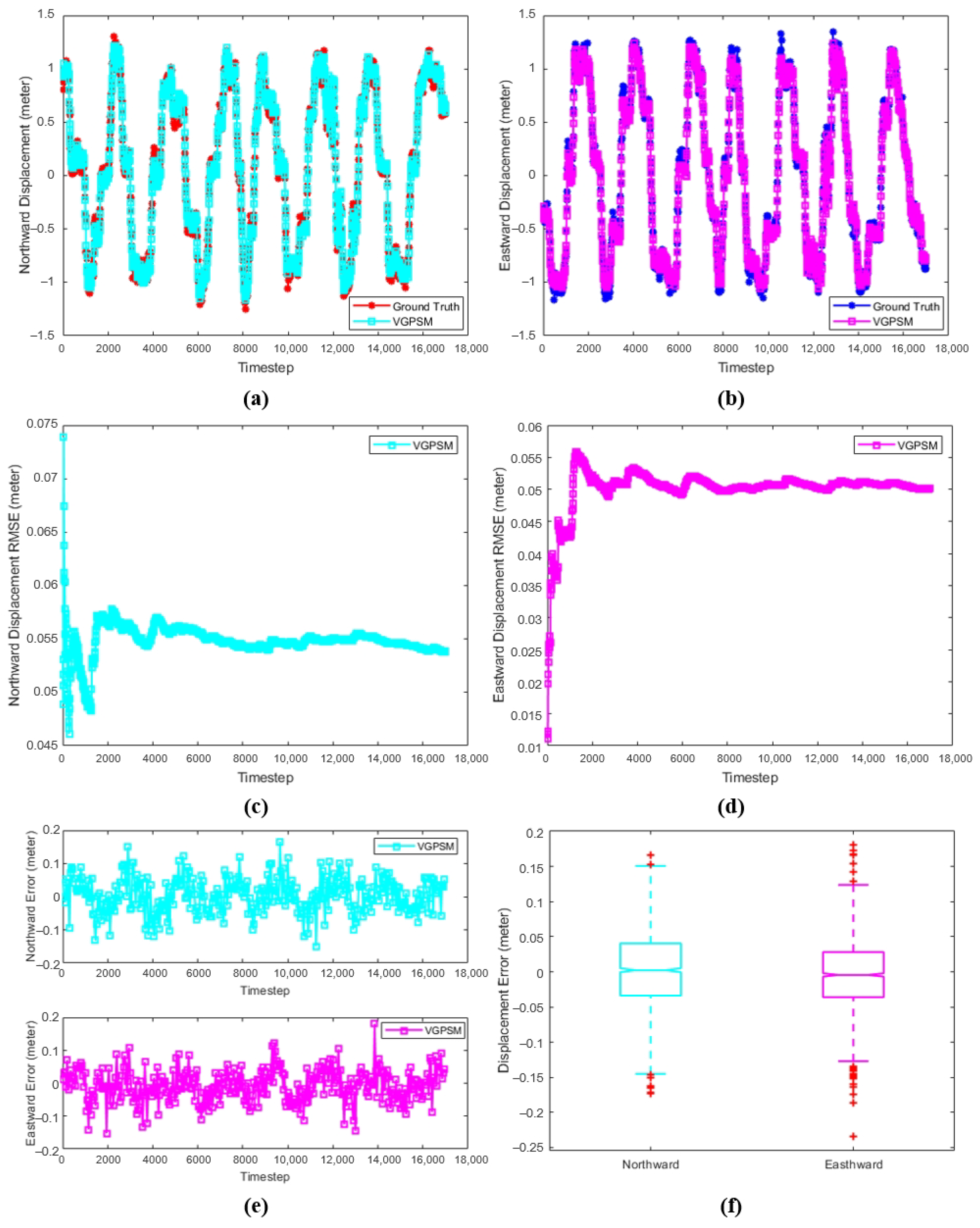
Figure 5 shows the result of the virtual GPS model. The northward and eastward displacement of GPS is taken as the true value, and that of the virtual GPS model is compared in terms of displacement waveform, root mean square error (RMSE), and single-step error.
In
Figure 5, the red and blue lines represent the true values of northward and eastward displacement, respectively, and the cyan and magenta lines represent the northward and eastward displacement of the virtual GPS model, respectively. (a) and (b) represent the northward and eastward displacement comparison between the virtual GPS model and the GPS truth. (c) and (d) represent the northward and eastward root mean square error between the virtual GPS model and the ground truth, respectively. (e) and (f) compare the error between the virtual GPS model and the truth in two ways, where (e) shows the error at each step, and (f) shows the statistics of all errors.
In order to analyze the performance of the virtual GPS model specifically, we formed a table, as shown in
Table 3, which mainly analyzes the performance of the virtual GPS model in terms of the mean, standard deviation, and median of the errors, as well as the root mean square error.
As shown in
Figure 5e, since there are positive and negative errors, we conducted two kinds of analyses on the mean and standard deviation of the errors. One is to take the absolute value of all errors and then solve for the mean (|Error-M|), as shown in Equation (
39), and the standard deviation (|Error|-S), as shown in Equation (
40). The other is to directly solve for the mean of the errors (Error-M), as shown in Equation (
41), and the standard deviation (Error-S), as shown in Equation (
42).
The calculation of RMSE is shown in Equation (
43).
where
denotes the true value of northward or eastward displacement at time step
m,
denotes the predicted value of northward or eastward displacement output using the virtual GPS model at time step
m, and
T denotes the total time steps.
4.2. The Results of Proposed Algorithm
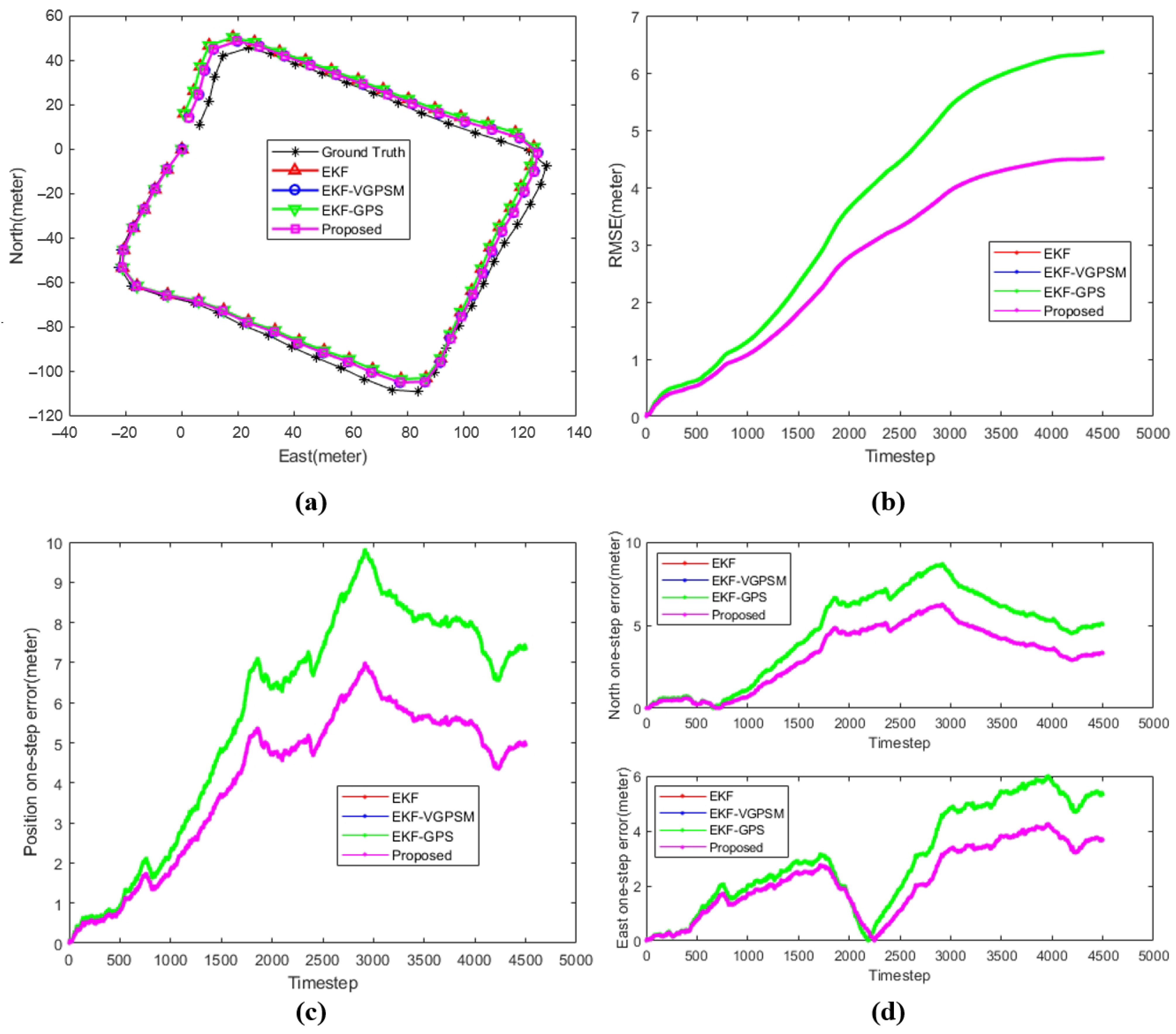
To evaluate the effectiveness of the proposed algorithm, we have meticulously designed three experimental scenarios.
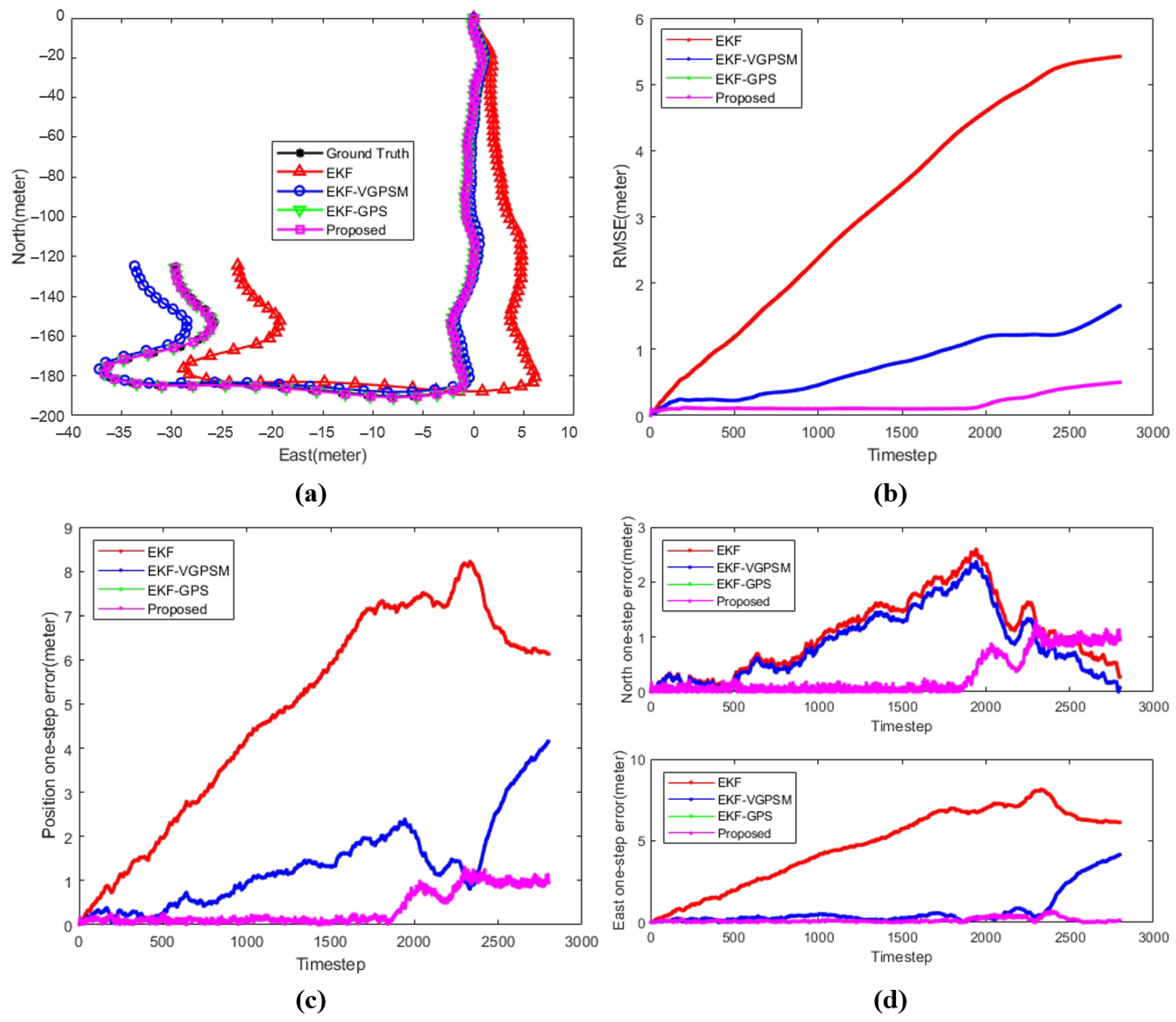
Scenario 1, as depicted in
Figure 6, provides continuous GPS assistance throughout the entire operation. In this scenario, both EKF-GPS and the proposed algorithm receive position updates directly from the GPS, while EKF-VGPSM utilizes a virtual velocity model for position correction.
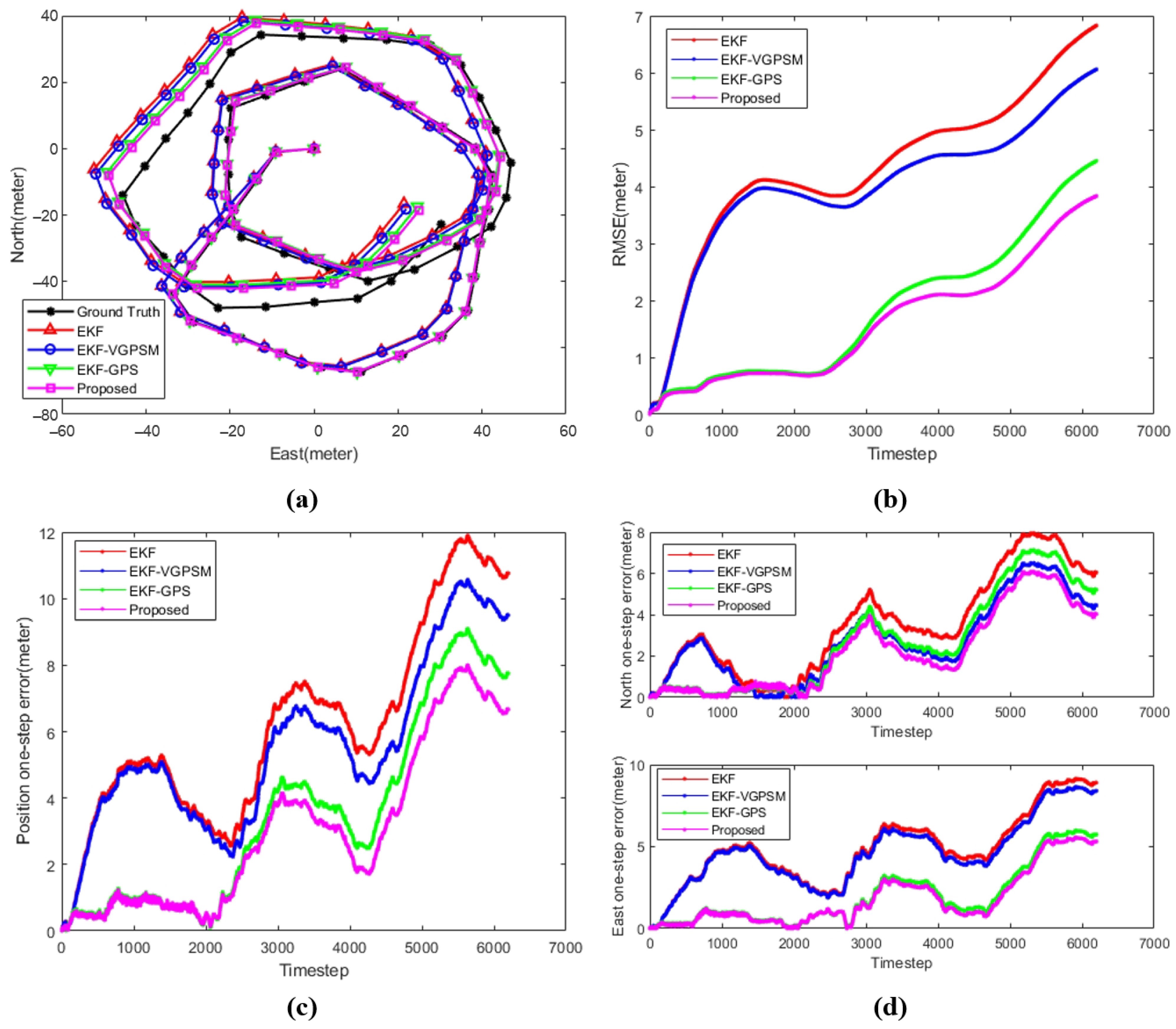
Scenario 2, illustrated in
Figure 7, involves GPS assistance only during the first third of the operation, followed by a period without GPS support during the middle third. Specifically, in this scenario, EKF-GPS and the proposed algorithm are aided by GPS during the initial phase. During the subsequent two-thirds of the operation, the proposed algorithm relies on a virtual GPS model for position updates, while EKF-VGPSM depends entirely on the virtual GPS model for the entire duration.
Scenario 3, shown in
Figure 8, operates without any GPS assistance for the entire duration. In this case, EKF-GPS behaves identically to a standard EKF without GPS, while the proposed algorithm functions equivalently to EKF-VGPSM, both relying solely on the virtual GPS model for positional updates.
These three scenarios are designed to comprehensively assess the performance of the proposed algorithm under varying conditions, particularly focusing on its robustness and accuracy in the absence of real-time GPS data, which is critical for underwater navigation systems.
In
Figure 6,
Figure 7 and
Figure 8, the black line represents the ground truth, the red line denotes the trajectory estimated using the standard extended Kalman filter (EKF), the blue line illustrates the trajectory estimated using the EKF augmented with the virtual GPS model (VGPSM), the green line depicts the trajectory estimated using the EKF with GPS positional assistance (EKF-GPS), and the magenta line represents the trajectory generated using the proposed algorithm. Subfigure (a) shows a trajectory comparison among the aforementioned algorithms against the ground truth. Subfigure (b) compares the root mean square error (RMSE) of the different methods. Subfigure (c) contrasts the single-step error across the algorithms, while Subfigure (d) breaks down the single-step error into the northward and eastward components.
To enhance the clarity of the results presented in
Figure 6,
Figure 7 and
Figure 8, we summarize the key findings in
Table 4. This table primarily includes the trajectory length, the root mean square error (RMSE), the endpoint error, the northward error (Error-N), and the eastward error (Error-E) at the endpoint, and the overall navigation accuracy for each scenario. The RMSE represents the root mean square of the displacement errors, calculated as shown in Equation (
44). The displacement error at time step
i is determined according to Equation (
45), and the navigation accuracy is computed using Equation (
46). Additionally, the optimal values achieved by each algorithm across the three scenarios are highlighted in bold to facilitate a clearer comparison of the strengths and weaknesses of each method.
where
and
denote the ground truth of the displacement at time step
i in the north and east directions, respectively,
and
denote the outputs of the virtual GPS model at time step
i in the north and east directions, respectively,
T denotes the total number of time steps, and
denotes the total distance of this set of data.
5. Experimental Analysis
5.1. The Performance Analysis of Virtual GPS Model
In order to verify the effectiveness of the virtual GPS model, we first carried out the comparison between the virtual GPS model and the true GPS data in the northward and eastward displacements, the results of which are shown in
Figure 5 and
Table 3.
From the displacement comparison in (a) and (b), it can be seen that the northward and eastward displacements output by the virtual GPS model are very close to the true displacement values of GPS. From the comparison of the root mean square error in the subfigures (c) and (d), it can be seen that the RMSE of northward and eastward displacements is basically stable at around 0.05 m. Combined with
Table 3, the root mean square errors of the virtual GPS model in the north and east directions throughout the entire process are 0.0538 m and 0.0502 m, respectively. From the error comparisons in (e) and (f), it can be seen that the single-step error fluctuates around
m to 0.1 m, and the median error is close to 0 m. Combined with
Table 3, it can be seen that the mean and covariance of the errors between the northward displacement and the true value of the virtual GPS model are 0.0019 m and 0.0538 m, respectively, and the mean and covariance of the errors between the virtual GPS model and the true value in northward displacement are 0.0019 m and 0.0538 m, respectively, and those in eastward displacement are −0.0059 m and 0.0498 m, respectively. To show the distribution of the data, the mean of the absolute value of the error is higher than that of the error, and the mean squared error of the absolute value of the error is lower than that of the error.
5.2. The Performance Analysis of Proposed Method
To evaluate the effectiveness of the proposed algorithm, we conducted three experimental scenarios under different conditions. In the first scenario, depicted in
Figure 6, both the EKF-GPS and the proposed algorithm operated with continuous GPS assistance throughout the entire process. In this setup, EKF-VGPSM relied on the position data provided by the output of the virtual GPS model. The results clearly show that the navigation accuracy of EKF-VGPSM was significantly better than that of the standard EKF. Moreover, the trajectories produced by both EKF-GPS and the proposed algorithm coincided and were noticeably more accurate than those of EKF-VGPS alone. As summarized in
Table 4, the proposed algorithm and EKF-GPS exhibited the smallest root mean square error (RMSE), endpoint error, and eastward error at the endpoint. The proposed algorithm improved navigation accuracy by 90.77 % compared to EKF, primarily due to the continuous GPS support. Additionally, EKF-VGPSM, leveraging the virtual GPS model, achieved a 69.56 % improvement in accuracy over EKF, further validating the effectiveness of the proposed method.
In the second scenario, illustrated in
Figure 7, both EKF-GPS and the proposed algorithm were initially assisted by GPS for the first one-third of the experiment. However, during the remaining two-thirds of the time, the EKF-GPS lost its positional assistance, while the proposed algorithm continued to benefit from the virtual GPS model’s output. In the first phase, the errors of both EKF-GPS and the proposed algorithm were minimal due to GPS assistance. However, in the second phase, the error of EKF-GPS began to increase as it lost GPS support. In contrast, the proposed algorithm, aided by the virtual GPS model, maintained significantly lower errors and outperformed all other algorithms. According to
Table 4, the proposed algorithm demonstrated the smallest RMSE, endpoint error, and errors in both the northward and eastward directions. The navigation accuracy of the proposed algorithm was improved by 37.77 % compared to EKF, showcasing its robustness even with partial GPS assistance.
In the third scenario, shown in
Figure 8, no GPS assistance was available. Under these conditions, EKF-GPS lost its available GPS position data, and its navigation results aligned with those of the standard EKF, as indicated by the overlapping red and green trajectories in the figure. Both EKF-VGPSM and the proposed algorithm relied entirely on the virtual GPS model for positional data, resulting in consistent navigation outcomes, as reflected by the overlapping magenta and blue lines. This scenario effectively compares the navigation performance of EKF and EKF-VGPSM. The results clearly indicate that EKF-VGPSM and the proposed algorithm, both supported by the virtual GPS model, achieved significantly better navigation accuracy than the standard EKF and EKF-GPS.
Table 4 confirms that the proposed algorithm reduced the root mean square error to 4.51 m compared to 6.37 m for EKF, resulting in a 29.2% improvement in navigation accuracy.
The effectiveness of the proposed method has been validated through a series of experiments under varying conditions. The results demonstrate that the proposed approach effectively reduces cumulative errors, with navigation accuracy improvements ranging from 29.2% to 69.56% compared to the conventional EKF. Additionally, the virtual GPS model’s output accurately predicts real GPS displacement changes, with root mean square errors of 0.0538 m northward and 0.0502 m eastward, respectively. These experimental results robustly demonstrate the proposed method’s effectiveness in improving navigation accuracy.
5.3. Error Analysis
The primary sources of error stem from sensor inaccuracies and model limitations. AHRS, while essential for orientation data, can introduce drift over time due to inherent biases and noise in gyroscope and accelerometer readings. DVL, used to measure velocity, can suffer from inaccuracies in low-quality bottom lock or turbulent conditions, leading to velocity estimation errors. GPS, although accurate, can introduce errors due to multipath effects or signal loss, especially in challenging underwater environments.
In the virtual GPS model, errors may arise from the integration of these noisy sensor data, where slight inaccuracies in velocity or orientation measurements can accumulate over time, leading to larger discrepancies. The proposed algorithm mitigates some of these errors through its innovative use of deep neural networks, which likely improves the sensor fusion process. However, the residual errors observed, such as the fluctuations in single-step errors and the slight biases in displacement predictions, indicate that the model could still be susceptible to overfitting or insufficient generalization in diverse conditions.
Overall, while the virtual GPS model and the proposed method significantly enhance navigation accuracy, particularly when GPS data are sparse or unavailable, the errors observed underscore the need for continued refinement in sensor fusion algorithms and model robustness to achieve even higher precision in underwater navigation.
5.4. Computational Complexity Analysis
The computational complexity of the extended Kalman filter primarily hinges on the matrix operations performed during the prediction and correction steps. Let n denote the dimension of the state vector, and o the dimension of the observation vector. The prediction step involves matrix multiplication and addition, leading to a complexity of . The correction step requires matrix inversion and multiplication, with a complexity of . Therefore, the overall complexity for one EKF iteration is .
The virtual GPS model, which integrates Bi-LSTM and LSTM networks, has its computational complexity determined by the number of LSTM units, the sequence length, and the structure of the fully connected layers. Let d represent the input feature dimension, T the sequence length, u the number of LSTM units, and p and q the number of units in the fully connected layers. Given the bidirectional nature of Bi-LSTM, the complexity for this layer is . For the LSTM layer, processing the sequence unidirectionally yields a complexity of . The fully connected layer computes the output from the LSTM units to the final regression layer, with a complexity of . Thus, the total complexity for processing a sequence through VGPSM is , assuming the fully connected layers and dropout do not significantly affect the complexity.
In practical AUV navigation applications, real-time performance is of paramount importance. The computational complexity of the EKF under standard conditions is . When invoking the VGPSM every m time step, the complexity increases by . While the introduction of VGPSM enhances navigational accuracy, it simultaneously imposes additional demands on computational resources. However, with the support of modern hardware, this level of computational complexity remains within an acceptable range. Specifically, by employing extended time steps m and leveraging efficient parallel computing frameworks, the method can meet the demands of most real-time AUV navigation tasks. Consequently, this approach successfully maintains high accuracy while still offering a significant real-time advantage.
6. Conclusions
To address the issue of increasing navigation errors in low-cost AUV without assisted positioning underwater, this paper introduces a virtual GPS model (VGPSM) based on deep sequence learning. By integrating VGPSM with the extended Kalman filter (EKF), the proposed approach provides a high-precision navigation solution for AUVs. The model leverages time-series data from sensors such as AHRS and DVL during surface navigation. It learns the relationship between these sensor inputs and GPS data using a hybrid architecture of LSTM and Bi-LSTM networks, which are particularly suited for processing and predicting time-series data. The VGPSM generates virtual GPS displacements updated at the same frequency as real GPS data. During underwater navigation, these virtual GPS displacements are utilized as measurements to assist the EKF in state estimation, significantly improving the accuracy and robustness of the navigation system.
However, this study presents certain limitations that warrant consideration. Firstly, the navigation datasets used for training and validation were obtained from a single AUV operating under favorable sea conditions. As a result, the generalizability of the model across different AUV platforms and in more challenging or variable marine environments remains uncertain. Additionally, the model’s computational efficiency requires further optimization to ensure its viability for deployment in real-world scenarios, where computational resources may be limited, and real-time processing demands are more stringent.
Future work will focus on addressing these limitations to enhance the robustness and applicability of the proposed method. Specifically, we aim to diversify the training datasets by incorporating data from multiple AUVs operating under varied environmental conditions, thereby improving the model’s adaptability and performance across diverse scenarios. Furthermore, we will explore advanced optimization techniques to reduce computational overhead, enabling the system to operate more efficiently across a broader range of hardware platforms.