


Abstract
Harvesting power from walking-related motions can be a sustainable energy source for powering wearables. This paper proposes a shoe insole with a 3D stackable self-supporting structure and energy harvesting capability based on triboelectrification. Initial tests showed that a unit cell of the structure could produce an open-circuit voltage of 164.5 V with a charge density of 2.02 nC/cm2, and the performance can be further improved with a higher force and a structure of multiple cells.
1. Introduction
Triboelectric nanogenerators (TENG) have proven their potential in wearable energy harvesting. Many TENG-based wearable energy harvester designs have emerged, utilizing different human body motions for various applications [1]. Harvesting energy from walking-related motions is a reliable approach and can be implemented easily [2]. In this work, we propose a shoe insole design with an hourglass-shaped self-supporting structure made from silicone rubber and copper tape, and the strong electron affinities enable its triboelectric energy harvesting functionality. The conceptual design and the output of the unit cell of the structure show promising performance for self-powered sensing applications.
2. Materials and Methods
Figure 1a illustrates the conceptual design of the proposed hourglass-shaped TENG (H-TENG) shoe insole. Such a structure design is to maximize the space usage of TENG within the shoe. When a force is applied vertically, the structure only changes size vertically while keeping the same length horizontally, as shown in Figure 1b, which is ideal for confined space applications such as insole.
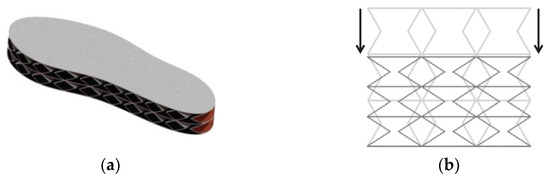
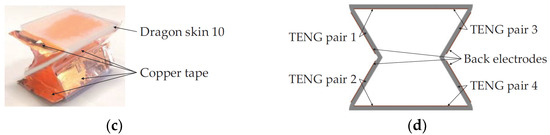
Figure 1.
(a) Conceptual design of the shoe insole; (b) illustration of H-TENG structure under compression; (c) unit cell of the shoe insole; (d) TENG configuration on the unit cell.
Figure 1c illustrates the conceptual design of the unit cell of H-TENG. The unit cell is very similar to the X-shaped TENG proposed in 2018 [3], but their material selection, fabrication procedure, and application are entirely different. H-TENG is fabricated using Dragon skin 10(DS-10) silicon elastomer and copper tape. DS-10 functions as the negative triboelectric layer, while Cu tape serves as the positive triboelectric layer and the back electrodes for the negative layer. Each cell consists of four copper–silicone TENGs located at the four corners of the unit cell, indicated in Figure 1d.
3. Discussion
Initial testing was conducted to gather the performance of the H-TENG structure. When exciting a single unit cell under 10 N force at a frequency of 3 Hz, a 3.0 cm × 3.0 cm × 2.5 cm unit cell produces an instantaneous peak open circuit voltage of 104.1 V (Figure 2a) with a charge density of 2.42 nC/cm2 (Figure 2b). Furthermore, when it increases to two cells, the measured open circuit voltage and charge density increases to 164.5 V and 2.02 nC/cm2. Raising the excitation force results in a significant improvement in energy output as well. At 20 N, a unit cell can reach an output of 133.2 V and 3.25 nC/cm2, up to 163 V and 4.02 nC/cm2 at 30 N. The power output of a single cell connected to a varying load impedance was also experimented with. We found that a single cell can reach the highest average power output density of 0.89 μW/cm2 at a load impedance of 74 MΩ.
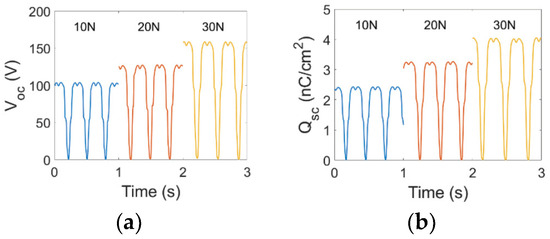
Figure 2.
The unit cell (a) open-circuit voltage and (b) charge density under different excitation forces.
4. Conclusions
We designed a TENG-based shoe insole using an hourglass-shaped pattern, with an explanation of the conceptual design as well as the method of fabrication. In addition, we conducted some initial performance tests of the structure’s unit cell. Based on the experimental results, the structure performance improves with a higher force and the number of cells, meaning the actual insole could produce more power as the force applied by the foot is larger than the experimented force.
Author Contributions
Conceptualization, Z.L. and K.C.A.; methodology, Z.L.; Software, Z.L.; formal analysis, Z.L.; writing—original draft preparation, Z.L.; writing—review and editing, L.T., W.C.G. and K.C.A.; supervision, K.C.A., L.T. and W.C.G.; project administration, K.C.A. All authors have read and agreed to the published version of the manuscript.
Funding
This research received no external funding.
Institutional Review Board Statement
Not applicable.
Informed Consent Statement
Not applicable.
Data Availability Statement
Data is available upon request.
Conflicts of Interest
The authors declare no conflicts of interest.
References
- Luo, J.; Wang, Z.L. Recent Progress of Triboelectric Nanogenerators: From Fundamental Theory to Practical Applications. EcoMat 2020, 2, e12059. [Google Scholar] [CrossRef]
- Zhu, G.; Bai, P.; Chen, J.; Lin Wang, Z. Power-Generating Shoe Insole Based on Triboelectric Nanogenerators for Self-Powered Consumer Electronics. Nano Energy 2013, 2, 688–692. [Google Scholar] [CrossRef]
- Xia, K.; Zhu, Z.; Zhang, H.; Du, C.; Xu, Z.; Wan, R. Painting a High-Output Triboelectric Nanogenerator on Paper for Harvesting Energy from Human Body Motion. Nano Energy 2018, 50, 571–580. [Google Scholar] [CrossRef]
Disclaimer/Publisher’s Note: The statements, opinions and data contained in all publications are solely those of the individual author(s) and contributor(s) and not of MDPI and/or the editor(s). MDPI and/or the editor(s) disclaim responsibility for any injury to people or property resulting from any ideas, methods, instructions or products referred to in the content. |
© 2024 by the authors. Licensee MDPI, Basel, Switzerland. This article is an open access article distributed under the terms and conditions of the Creative Commons Attribution (CC BY) license (https://creativecommons.org/licenses/by/4.0/).