


You are currently viewing a new version of our website. To view the old version click .
Proceedings
  • Abstract
  • Open Access

14 March 2024

A Novel Indium Oxide-Based Nanostructured Material Designed for CO2 Detection †
,
,
,
,
and
1
Department of Physics and Earth Sciences, University of Ferrara, Via Saragat 1, 44122 Ferrara, Italy
2
MNF—Micro Nano Facility, Sensors and Devices Center, Bruno Kessler Foundation, Via Sommarive 18, 38123 Trento, Italy
*
Author to whom correspondence should be addressed.
Presented at the XXXV EUROSENSORS Conference, Lecce, Italy, 10–13 September 2023.
This article belongs to the Proceedings XXXV EUROSENSORS Conference

Abstract

Low-cost sensors working at low/room temperature for CO2 mapping in indoor–outdoor environments are in growing demand. Solid-state gas sensors are a suitable alternative to expensive optical sensors, but to date, materials designed for chemoresistive devices have not proven functional for CO2 detection. This work addresses this challenge both in terms of sensing materials research, with the innovative use of alkali metals as dopants in semiconductors, and in terms of deeply understanding the sensing mechanism through DRIFT spectroscopy. The result is a sensor operating at 200 °C that detects CO2 between 250–5000 ppm with a negligible effect of humidity above 17 RH%.

1. Introduction

Carbon capture and storage is critical to climate change policies and strategies aimed at reducing global warming under the Paris Agreement. To address this challenge, the development of miniaturized devices based on the Internet of Things (IoT) to ensure the mapping of CO2 is pivotal. Nowadays, the most widely used direct monitoring systems for carbon dioxide are based on non-dispersive infrared (NDIR) sensors. However, compared with chemoresistive sensing devices, they suffer from many drawbacks, such as complexity, a short device lifetime, and being susceptible to interference gases. Therefore, chemoresistive devices represent an interesting alternative to the sensors currently used. In this work, an innovative nanostructured semiconducting powder based on indium oxide and doped with sodium is proposed (Na:In2O3) as a functional material for screen-printable chemoresistive CO2 sensors [1].

2. Materials and Methods

The Na:In2O3 nanopowder was synthesized by the sol-gel method and used as a functional material for screen-printed films deposited onto alumina substrates. A complete material characterization was performed from a morphological, structural, chemical, and optical point of view. A deeper electrical investigation was carried out to study the sensing performance towards CO2 (sensitivity, selectivity, stability, and effect of humidity). Furthermore, Fourier transform infrared diffuse reflectance (DRIFT) spectroscopy was combined with electrical characterization using an operando approach to monitor the gas-solid interaction occurring on the solid-state chemical sensor surface under various environmental conditions [1].

3. Discussion

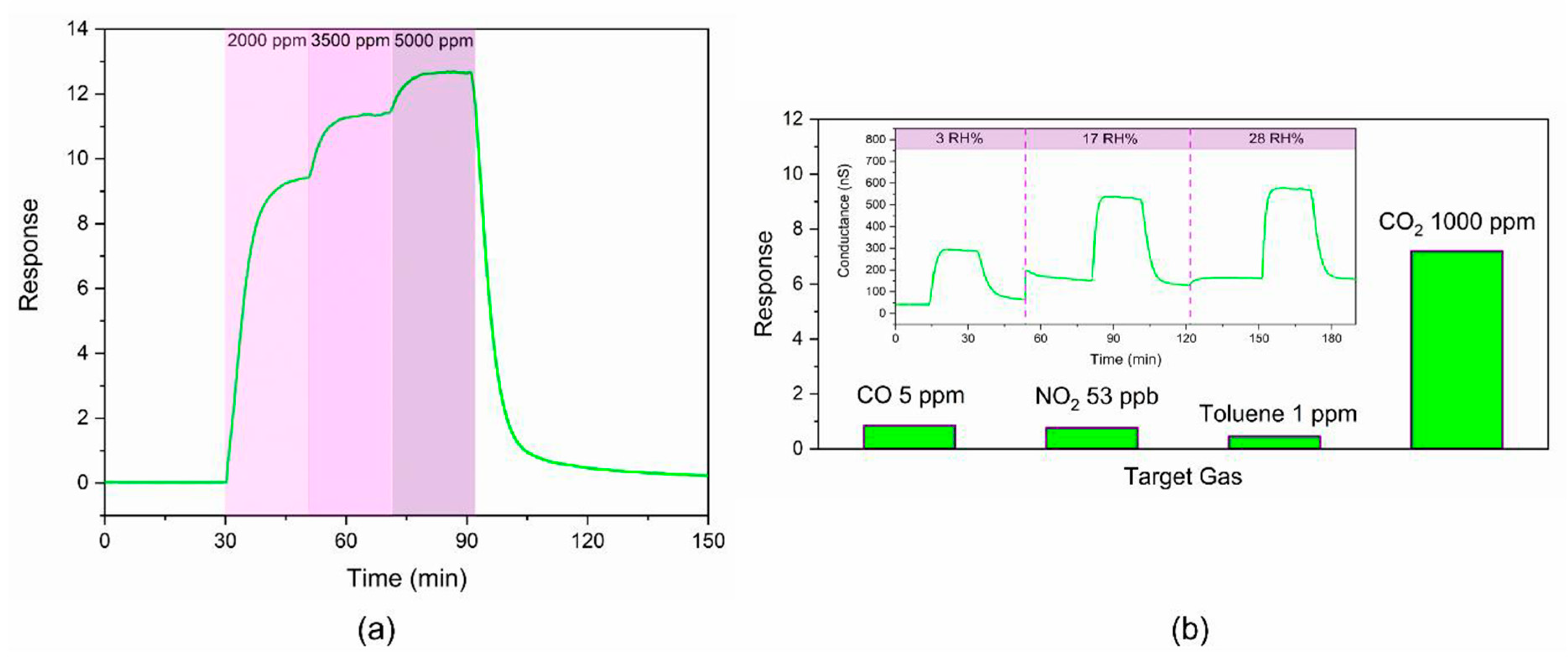
The sensitivity of Na:In2O3 to CO2 was investigated by exposing the film, operating at 200 °C, to different gas concentrations. Figure 1a shows a high and fast response with completely reversible behavior at a working temperature lower than commonly used for semiconductor-based gas sensors. Na:In2O3 film was tested with possible interfering gases to cover different relevant chemical species present in real applications, showing high selectivity (Figure 1b). The impact of water vapor on sensing performance is limited, even at low CO2 concentrations of 500 ppm (insert Figure 1b). In particular, apart from a partial conductance drop up to 17 RH%, for increasing humidity concentrations, the performance of the In2O3-based sensor seems to stabilize. Therefore, electrical activity towards different concentrations of different gases in dry and humid air highlighted high sensitivity and a negligible influence from interfering gases. In addition, in this work, in order to obtain additional information on the surface reaction mechanism of Na:In2O3 gas sensors to CO2, we provided operando DRIFT spectroscopy, which proved the adsorption of CO2 on the surface of this innovative material, leading to the formation of carbonate species [1,2].
Figure 1. (a) Dynamic response to CO2 concentrations varying from 2000 to 5000 ppm in dry air. (b) Selectivity in dry air of the sensor towards 5 ppm of CO, 53 ppb of NO2, 1 ppm of toluene, and 1000 ppm of CO2. The insert shows the influence of RH% on Na:In2O3 response to 500 ppm of CO2.

4. Patents

Patent Pending, n° IT 102022000022314.

Author Contributions

Conceptualization, A.R. and B.F.; methodology, A.R.; validation, B.F. and A.R.; investigation, A.R.; resources, A.R.; data curation, A.R.; writing—original draft preparation, A.R. and B.F.; writing—review and editing, B.F., M.V., A.G. and E.S.; supervision, V.G. All authors have read and agreed to the published version of the manuscript.

Funding

Funded POR FSE 2014/2020 by Regione Emilia-Romagna.

Institutional Review Board Statement

Not applicable.

Data Availability Statement

Data are contained within the article.

Acknowledgments

Thanks to Matteo Ferroni, Matteo Ardit, Lia Vanzetti and Andrea Pedrielli for the support on the material characterization.

Conflicts of Interest

The authors declare no conflicts of interest.

References

  1. Rossi, A.; Fabbri, B.; Spagnoli, E.; Gaiardo, A.; Valt, M.; Ferroni, M.; Ardit, M.; Krik, S.; Pedrielli, A.; Vanzetti, L.; et al. Functionalization of indium oxide for empowered detection of CO2 over an extra-wide range of concentrations. ACS Appl. Mater. Interfaces 2023, 15, 33732–33743. [Google Scholar] [CrossRef] [PubMed]
  2. Suzuki, T.; Sackmann, A.; Oprea, A.; Weimar, U.; Bârsan, N. Chemoresistive CO2 Gas Sensors Based on La2O2CO3: Sensing Mechanism Insights Provided by Operando Characterization. ACS Sens. 2020, 5, 2555–2562. [Google Scholar] [CrossRef]
Disclaimer/Publisher’s Note: The statements, opinions and data contained in all publications are solely those of the individual author(s) and contributor(s) and not of MDPI and/or the editor(s). MDPI and/or the editor(s) disclaim responsibility for any injury to people or property resulting from any ideas, methods, instructions or products referred to in the content.

Article Metrics

Citations

Article Access Statistics

Multiple requests from the same IP address are counted as one view.

