


Abstract
This paper is aimed to present the concept “Quality of information” in the frame of the General Information Theory (GIT).
1. Introduction
This paper is aimed to present the concept “Quality of information” in the frame of the General Information Theory (GIT). The development of GIT had started in the period 1977–1980. The first publication on GIT had been published in 1984 [1]. Further publications on GIT are pointed in [2].
2. Basic Concepts
2.1. Entity
In our examination, we consider the real world as a space of entities. The entities are built by other entities, connected with relationships. The entities and relationships between them form the internal structure of the entity they build.
2.2. Interaction
Building the relationship between the entities is a result of the contact among them. During the contact, one entity impacts on the other entity and vice versa. In some cases the opposite impact may not exist, but in general, the contact may be considered as two mutually opposite impacts which occur at the same time.
The set of contacts between entities forms their interaction.
2.3. Reflection
During the establishing of the contact, the impact of an entity changes temporally or permanently the internal structure and/or functionality of the impacted entity. In other words, the realization of the relationships between entities changes temporarily or permanently their internal structure and/or functionality at one or at few levels.
The change of the structure and/or functionality of the entity, which is due to the impact of the other entity we denote with the notion “reflection”.
The entities of the world interact continuously. It is possible, after one interaction, another may be realized. In this case, the changes received by any entity, during the first interaction, may be reflected by the new entity. This means that the secondary (transitive) reflection exists. One special case is the external transitive self-reflection where the entity reflects itself as a secondary reflection during any external interaction. Some entities have an opportunity of internal self-reflection. The internal self-reflection is possible only for very high levels of organization of the entities, i.e., for entities with very large and complicated structure.
2.4. INFOS
Further we will pay attention to complex entities with possibilities for self-reflection.
To avoid misunderstandings with the concepts subject, agent, animal, human, society, humanity, living creatures, etc., we use the abstract concept “INFOS” to denote every of them as well as all of the artificial creatures which have features similar to the former ones.
Infos has the possibility to reflect the reality via receptors and to operate with received reflections in its memory. The opposite is possible—via effectors, Infos has the possibility to realize in reality some of its (self-)reflections from its consciousness.
2.5. Information and Information Expectation
If the diagram on Figure 1 exists and if it is commutative, then it represents all reflection relations: (1) in reality: entities and their reflections, (2) in consciousness: mental reflections of real or mental entities; (3) between reality and consciousness: perceiving data and creating mental reflections.
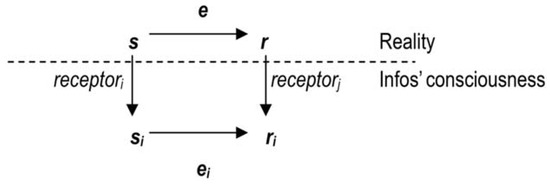
Figure 1.
Diagram of reflections.
In the diagram: (1) in reality: “s” is the source entity and “r” is a reflection in the recipient entity; “e” is a mapping from s in r; (2) in Infos’ consciousness: “si” is a reflection of the source entity and “ri” is a reflection of the reflection of the “s”; “ei” is a mapping from si in ri. “si” is called “information expectation” and “ri” is called “information” about “s” received from the reflection “r”. Commonly, the reflection “r” is called “data” about “s”.
3. Quality of Information
“si” and “ri” may be coincident or different. In the second case, some “distance” between them exists. The nature of the distance may be different in accordance to the kind of reflections. In any case, as this distance is smaller so the information “si” is more qualitative. In other words, the “quality of information” is the measure of the distance between information expectation and the corresponded information. As the |ei| becomes smaller so more qualitative becomes the information. We may propose the next formula taking in account that the |ei| may be a zero:
Qi = 1/(1 + |ei|)
4. Conclusions
This paper was aimed to introduce the concept “quality of information” from the point of view of the General Information Theory. Other formulas, for instance, for the computing of the quantity of information, will be given in other papers.
Funding
This research received no external funding.
Institutional Review Board Statement
Ethical review and approval are not required for this study.
Informed Consent Statement
Informed consent is not required for this study.
Data Availability Statement
Data available on request from the author.
Conflicts of Interest
The author declares no conflict of interest.
References
- Markov, K. A Multi-Domain Access Method. In Proceedings of the International Conference on Computer Based Scientific Research, Plovdiv, Bulgaria, 1–4 April 1984; pp. 558–563. [Google Scholar]
- Markov, K.; Ivanova, K.; Mitov, I. Basic Structure of the General Information Theory. Int. J. Inf. Theor. Appl. 2007, 14, 5–19. [Google Scholar]
Publisher’s Note: MDPI stays neutral with regard to jurisdictional claims in published maps and institutional affiliations. |
© 2022 by the author. Licensee MDPI, Basel, Switzerland. This article is an open access article distributed under the terms and conditions of the Creative Commons Attribution (CC BY) license (https://creativecommons.org/licenses/by/4.0/).