


Abstract
An initial value problem for nonlinear fractional differential equations with a tempered Caputo fractional derivative of variable order with respect to another function is studied. The absence of semigroup properties of the considered variable order fractional derivative leads to difficulties in the study of the existence of corresponding differential equations. In this paper, we introduce approximate piecewise constant approximation of the variable order of the considered fractional derivative and approximate solutions of the given initial value problem. Then, we investigate the existence and the Ulam-type stability of the approximate solution of the variable order -tempered Caputo fractional differential equation. As a partial case of our results, we obtain results for Ulam-type stability for differential equations with a piecewise constant order of the -tempered Caputo fractional derivative.
Keywords:
variable order Ψ-tempered Caputo fractional derivative; fractional differential equations; approximate solutions; existence; Hyers–Ulam stability MSC:
34A08; 34A12; 34A38
1. Introduction
Fractional derivatives and integrals of variable order are widely studied in the literature, and a comprehensive review and a good mathematical framework of fractional calculus of variable order, based on Scarpi’s approach, is provided in [1]. Surveys of the types of derivatives/integrals of variable order with some physical discussions are given in [2,3]. There are several types of definitions of variable order fractional derivatives/integrals (see, for example, [4,5,6]). These definitions keep the basic property of fractional derivatives—the nonlocality. This property unfortunately does not have the semigroup property when variable order is applied (see, for example, [5,7]). This does not allow us directly to convert the differential equation with variable order fractional derivative to an equivalent fractional integral equation as is possible for fractionals of constant order (see, for example, [8,9,10,11,12,13]). In [14], the author defines a derivative in a new way, again called a fractional derivative. This derivative keeps the locality property of ordinary derivatives and it enables one to apply directly a variable order with a semigroup property.
One of the main problems, existence, is studied by many authors. For the Riemann–Liouville fractional derivative of variable order for differential equations, existence is studied in [7], and the concept of approximate solution of the given problem is introduced. This concept is based on the application of piecewise constant orders of fractional integrals and derivatives used for various problems in [15,16].
To be more general, we consider a tempered Caputo fractional derivative with respect to another function and variable order. This type of derivative has an exponential kernel, and it generalizes the classical Caputo fractional derivative. Furthermore, this derivative is called the variable order -tempered Caputo fractional derivative. In this paper, we study the initial value problem of a nonlinear differential equation with the abovementioned fractional derivative. Based on the tempered Caputo fractional derivative, its application to differential equations, and some known results for this type of derivative, we introduce approximate solutions of the given problem and study existence and Ulam-type stability. Several examples are provided to illustrate the main results. Furthermore, as a partial case, we obtain existence and Ulam-type stability results for differential equations with a piecewise constant order -tempered Caputo fractional derivative.
2. -Tempered Fractional Calculus of Variable Order
There are several definitions for fractional integrals and derivatives of variable order depending on the time variable (see, for example, [5]).
In this paper, we combine the ideas of variable order fractional integrals and derivatives (see [5]) with -tempered fractional derivatives/integrals to generalize fractional calculus in variable order.
Let be a fixed number; be a smooth increasing function with almost everywhere in be a given constant; the function be locally integrable; and where
Definition 1.
The tempered Riemann–Liouville fractional integral of variable order with respect to the function ψ (TFIVO) is defined by (here )
We will also generalize the Caputo-type fractional derivative of variable order combining the ideas of [17] and the type III Caputo fractional derivative of variable order (see Definition 2 [5]).
Definition 2.
The tempered Caputo fractional derivative of variable order with respect to the function (GFDVO) is defined by
Remark 1.
The tempered derivatives/integrals with respect to another function, given in Definitions 1 and 2, are called Ψ-tempered derivatives/integrals.
Remark 2.
TFIVO and GFDVO are generalizations of the well-known and studied fractional integrals and derivatives (see, for example, [17,18,19]).
2.1. Some Results on Caputo-Type Fractional Derivatives of Constant Order
In our paper, we will use some known results for tempered Caputo fractional derivative with reference to another function and a constant order.
Lemma 1
(Theorem 5.2 [18]). Let be a given constant, , the function be a smooth increasing function with almost everywhere in and . Then, the IVP for the fractional differential equation with the ψ-tempered Caputo fractional derivative of constant order
is equivalent to the fractional integral equation
both to be solved for functions
Lemma 2
(Lemma 5.4 [18]). Let , ψ be a smooth monotonic function on [0, b] with almost everywhere, the function with and
Then, the IVP (1) has an unique solution , provided that
Lemma 3
(Corollary 2 [20]). Let , , be a smooth increasing function with almost everywhere in , . If
then we have
We will use the following result for the Caputo fractional derivative with respect to another function (a special case of GFDVO with and being a constant).
Lemma 4
(Lemma 2 [21]). Let , and be a smooth increasing function with almost everywhere in . Then, the function is a solution of the equation where is the Caputo fractional derivative with reference to another function given in Definition 2 with and .
Lemma 5
(Lemma 1 [21]). Given , we have
2.2. Some Results for Variable Order of Fractional Derivatives
For a general function , the -tempered Riemann–Liouville variable order fractional integral does not have the semigroup property.
Example 1.
Let , , , , and .
We will compare and applied in Definition 1. From Definition 1 we have
and
Note
Thus, .
Remark 3.
Without the semigroup property of the ψ-tempered Riemann–Liouville variable order fractional integral (see Example 1), the integral presentation of Lemma 1 is not true for the case when the order is variable (see, for example, Equation (7) [22]).
In our study, we will use the ideas of Lemma 6 [7], which will be slightly modified:
Lemma 6.
Let Then, for any there exist a natural number and points such that
where for and is the indicator of the interval , , i.e.,
Proof.
Let be a given fixed number. Note that is uniformly continuous on , so there exists a with for and .
Take . If for , then we choose and and stop the process. Otherwise, there exists a number (note ) such that Take . If for , then we choose , and stop the process. Otherwise, there exists a number (note ) such that Take and continue this process (the process will stop after a finite number since there exists a positive integer l with ). Thus, we have constructed (for some m) the function
□
Definition 3.
The piecewise constant function α defined by (4) will be called an ϵ-approximation of the variable order .
Remark 4.
Note that the partition as well as the piecewise function α, defined by (4), depend on the number ϵ.
Example 2.
Let , .
Let . We will construct an -approximation of the fractional order . Since for we take . Then, from for with . Furthermore, for .
Therefore, the partition is , and the -approximation of is
Let . Since for we take . Then, from for with . Furthermore, for with . Furthermore, for with .
Therefore, the partition is and the -approximation of is
The example illustrates the ϵ-approximation of the fractional order depends on ϵ.
Note that the claim of Lemma 6 could be proved on a half real line.
Lemma 7.
Let be such that . Then, for any , there exist a natural number and points such that
where for is the indicator of the interval , , and is the indicator of the interval (here ).
Proof.
Let be a given fixed number. From it follows that there exists a number such that
Consider the finite interval and apply Lemma 6 to it. Then, the piecewise constant function
is the function needed. □
3. Differential Equations with Variable Order of the Fractional Derivative
Consider the initial value problem (IVP) for the nonlinear scalar differential equation with the -tempered Caputo fractional derivative of variable order
where , , denotes the -tempered Caputo fractional derivatives with variable order , and is a given function.
Definition of Approximate Solutions of the Initial Value Problem (8)
We will assume is a fixed number and .
According to Lemma 6 for the given fixed number , there exists a partition of the given interval and an -approximation of , defined by (4) with Note that for the given number , the partition P is not unique. In this section, we will consider a fixed partition P, i.e., fixed points .
Let where k is an arbitrary integer . Then, with , and the fractional derivative can be written
Applying (9), we could define for any integer the following IVP for the differential equation with tempered Caputo fractional derivative of a constant order , which is deeply connected to the studied IVP (8) and the -approximation of the variable order :
With the help of the IVP (10), we will define an approximate solution of (8).
Definition 4.
For a given the function
is called an ϵ-approximate solution of IVP (8), where is a solution of IVP (10), .
Example 3.
Consider the following linear IVP:
where and is the variable order Caputo fractional derivative with reference to another function given in Definition 2 with .
Let . Then, according to Example 2, the -partition of the fractional order is given by (5), and the -approximate solution of (12) according to Lemma 4 and Definition 4 is
Let . Then, according to Example 2 the -partition of the fractional order is given by (6) and the -approximate solution of (12) according to Lemma 4 and Definition 4 is
Remark 5.
If the piecewise constant function is an ϵ-approximation of the variable order ; are solutions of the initial value problems; (10) and is an ϵ-approximate solution of (8), then, according to (9), we have for any with .
We now introduce condition (H):
Hypothesis 1
(H1). The function is a smooth increasing function with almost everywhere in , and the function .
Hypothesis 2
(H2). The function , and it is globally Lipschitz with a constant L such that
where , .
Theorem 1.
Let be a given number, condition (H1) be satisfied; be the the partition of the interval , defined in Lemma 6 for ϵ; the function ; and there exist constants such that
with
Then, IVP (8) has an ϵ-approximate solution.
Proof.
According to Lemma 2 with , , , the initial value problem with the fractional derivative of constant order (10) has a solution for all . Then, the function defined by (11) is an -approximate solution of the IVP (8). □
We now define an approximate solution of (8).
Definition 5.
The initial value problem (8) has an approximate solution if for any it has an ϵ-approximate solution.
Remark 6.
The approximate solution of (8) depends on the initial value.
Theorem 2.
Let condition (H) be satisfied. Then, IVP (8) has an approximate solution.
Proof.
Let be an arbitrary given number. According to Lemma 6 for the given number , there exist a partition P of the interval and a piecewise constant function defined by (4) which is an -approximation of the variable order .
Then, for any the inequalities
hold.
Furthermore,
- -
- for we have ;
- -
- for we have
Thus, . Therefore, , and, according to Theorem 1, the IVP (8) has an -approximate solution (the function defined by (11)). Since is an arbitrary number, we are finished. □
4. Ulam-Type Stability of Approximate Solutions
Note that the Ulam-type stability for differential equations with the Caputo-tempered fractional derivative with respect to another function is studied in [5] for the case of constant order. In the case of constant order, the fractional differential equation is equivalent to a fractional integral Equation (see Lemma 1), but it is not true for the variable order. We will now study the stability of approximate solutions of (8). In this case, we change the definitions for Ulam-type stability given in [5] (Definition 5.1).
Definition 6.
Let condition (H1) be satisfied, and . Now, (8) is said to be approximately Hyers–Ulam-stable if there exists a constant such that for any , an ϵ-approximation of the fractional order (defined by (4)) with a partition and for any function satisfying the inequality
with , there exists an ϵ-approximate solution of (8) with
where
Theorem 3
(UHS). Let condition (H) be satisfied. Then, (8) is approximately Hyers–Ulam-stable.
Proof.
Let be an arbitrary number. According to Lemma 6 there exist a partition and an -approximation of the fractional order , defined by (4). Let the function be a solution of inequality (15), . Then, for any we consider the functions such that
According to Lemma 1, the integral equality
holds.
Denote and consider the initial value problem (8) with . According to Theorem 1 the initial value problem (8) has an -approximate solution .
Let be an arbitrary fixed integer. Then, for the equality holds where is the solution of (10) with .
Then, for any , we obtain
Denote We have (see the proof of Theorem 2).
Therefore, for any we have
According to Lemma 3 with , , , , and inequalities and because (see, condition (H)), we obtain
where .
From inequality (21), it follows that
with □
We will illustrate the approximate Hyers–Ulam stability with a simple example.
Example 4.
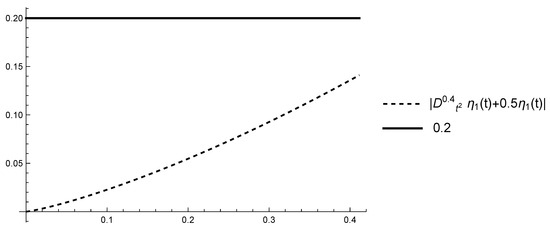
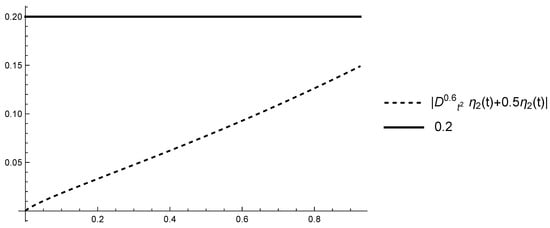
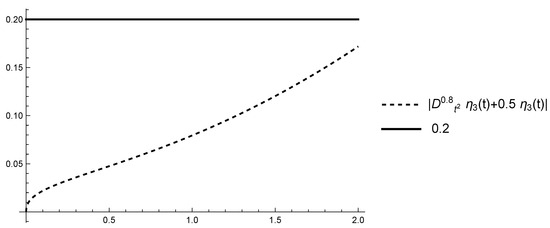
Consider the linear fractional differential Equation (12) with variable order , , and -the variable order Caputo fractional derivative with reference to another function given in Definition 2 with .
The assumptions (H1) and (H2) are satisfied with because in this case According to Theorem 3 Equation (12) is approximately Hyers–Ulam-stable. We will illustrate this for a particular value of ϵ. For example, let .
In Example 3 several ϵ-approximate solutions of (12) are given.
Then, the inequality (15) is reduced to
with , , and (see Example 3).
Figure 1.
Graphs of and on .
Figure 2.
Graphs of and on .
Figure 3.
Graphs of and on [0,2].
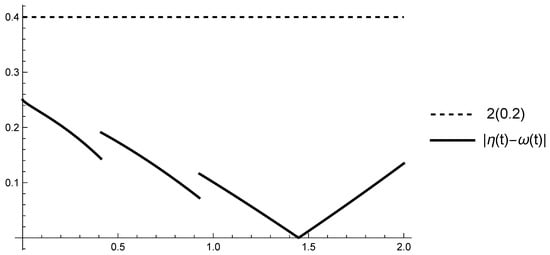
According to (13), the -approximate solution is
where .
Then, with and defined by (16) with (see Figure 4).
Figure 4.
Graphs of and on .
5. Piecewise Constant Order of the Fractional Derivative
Consider the case when the partition of the interval is given initially, and the fractional order of the fractional derivative is defined by the equality
where the constants are initially given.
Let where k is an arbitrary integer . Then, and from Definition 2 we have
Therefore,
or its equivalent
hold and their corresponding equalities cannot be applied (see, for example, Equation (6) [23], Equation (5) [16], Equation (9) [24], Equation (3.1) [25]).
In connection with the above, we will apply our approach to study IVP (8) when the order of the fractional derivative is a piecewise constant function . Our approach is based on (9).
We now introduce assumption (A):
Assumption 1
(A1). The function is an increasing function with almost everywhere, is a given constant, and the function is defined by (26).
Assumption 2
(A2). The function and there exist constants such that
with
We obtain the following existence result for the initial value problem (8) with piecewise constant order, defined by (26).
Theorem 4.
Let conditions (A1) and (A2) hold. Then, the initial value problem (8) has a solution.
Proof.
Consider the partition defined by the given point . For any , we consider the initial value problem (10). According to Lemma 2, it has a unique solution for any . Construct the function
The function is a solution of (8) because and for any we have
□
Remark 7.
The solution of (8) with a fractional derivative of piecewise constant order is not continuous on the whole interval .
The definition of Ulam-type stability for fractional derivatives of a piecewise constant order reduces to:
Definition 7.
Let condition (A1) hold and . Now, (8) is said to be Hyers–Ulam-stable if there exists a constant such that for any and for any function satisfying the inequality
with , there exists an ϵ-approximate solution of (8) with
where the function η is defined by (16).
Theorem 5
(UHS). Let condition (A1) and (A2) hold. Then, (8) is Hyers–Ulam-stable.
The proof of Theorem 5 is similar to the one of Theorem 3 without applying .
6. Conclusions
In this paper, we consider differential equations with the variable order Caputo-type fractional derivative with respect to another function and we study the general case of continuous variable order of the fractional derivative. We define in appropriate way an -solution of the given initial value problem and an approximate solution.
Furthermore, we define and study the Hyers–Ulam stability. As a partial case, we obtain results for stability of the differential equations with fractional derivatives of piecewise constant order. In future work, we hope to appropriately define some other types of Ulam stability, such as Hyers–Ulam–Rassias stability, and obtain sufficient conditions. Furthermore, the existence on the the interval could be investigated. In addition, we could consider the general case of the variable order applying a local definition for fractional derivative [14] in the future.
Author Contributions
Conceptualization, D.O., S.H. and R.P.A.; Methodology, R.P.A.; Formal analysis, D.O., S.H. and R.P.A.; Writing—original draft, D.O. and S.H.; Writing—review & editing, D.O., S.H. and R.P.A.; Funding acquisition, D.O. All authors have read and agreed to the published version of the manuscript.
Funding
S.H. is partially supported by the Bulgarian National Science Fund under Project KP-06-PN62/1.
Data Availability Statement
No new data were created or analyzed in this study. Data sharing is not applicable to this article.
Conflicts of Interest
The authors declare no conflict of interest.
References
- Garrappa, R.; Giusti, A.; Mainardi, F. Variable-order fractional calculus: A change of perspective. Commun. Nonlinear Sci. Numer. Simul. 2021, 102, 105904. [Google Scholar] [CrossRef]
- Sun, H.G.; Chang, A.; Chang, Y.; Chen, W. A review of variable-order fractional differential equations: Mathematical foundations, physical models, numebriacl methods and applications. Frac. Calc. Appl. Anal. 2019, 22, 27–59. [Google Scholar] [CrossRef]
- Patnaik, S.; Hollkamp, J.P.; Semperlotti, F. Applications ofvariable-order fractional operators: A review. Proc. R. Soc. A 2020, 476, 20190498. [Google Scholar] [CrossRef] [PubMed]
- Samko, S.; Ross, B. Integration and differentiation to a variable fractional order. Integral Transform. Spec. Funct. 1993, 4, 277–300. [Google Scholar] [CrossRef]
- Tavares, D.; Almeida, R.; Torres, D.F.M. Caputo derivatives of fractional variable order: Numerical approximations. Commun. Nonlinear Sci. Numer. Simul. 2016, 35, 69–87. [Google Scholar] [CrossRef]
- Lorenzo, C.F.; Hartley, T.T. Initialization, conceptualization, and ap plication in the generalized fractional calculus. Crit. Rev. Biomed. Eng 2007, 35, 477–553. [Google Scholar] [CrossRef]
- Zhang, S.; Hu, L. Unique existence result of approximate solution to initial value problem for fractional differential equation of variable order involving the derivative arguments on the half-axis. Mathematics 2019, 7, 286. [Google Scholar] [CrossRef]
- Kilbas, A.A.; Srivastava, H.M.; Trujillo, J.J. Theory and Applications of Fractional Differential Equations; Elsevier B.V.: Amsterdam, The Netherlands, 2006. [Google Scholar]
- Podlubny, I. Fractional Differential Equations; Academic Press: San Diego, CA, USA, 1999. [Google Scholar]
- Samko, S.; Kilbas, A.; Marichev, O. Fractional Integrals and Drivatives; Gordon and Breach Science Publishers: Longhorne, PA, USA, 1993. [Google Scholar]
- Agarwal, R.; Hristova, S.; O’Regan, D. Boundary Value Problems for Fractional Differential Equations of Caputo Type and Ulam Type Stability: Basic Concepts and Study. Axioms 2023, 12, 226. [Google Scholar] [CrossRef]
- Agarwal, R.P.; Hristova, S. Ulam-Type Stability for a Boundary-Value Problem for Multi-Term Delay Fractional Differential Equations of Caputo Type. Axioms 2022, 11, 742. [Google Scholar] [CrossRef]
- Agarwal, R.P.; Hristova, S. Boundary Value Problem for Multi-Term Nonlinear Delay Generalized Proportional Caputo Fractional Differential Equations. Fractal Fract. 2022, 6, 691. [Google Scholar] [CrossRef]
- Fedotov, A.I. Substantiation of a Quadrature-Difference Method for Solving Integro-Differential Equations with Derivatives of Variable Order. Comput. Math. Math. Phys. 2022, 62, 548–563. [Google Scholar] [CrossRef]
- Telli, B.; Souid, M.; Alzabut, J.; Khan, H. Existence and uniqueness theorems for a variable-order fractional differential equation with delay. Axioms 2023, 12, 339. [Google Scholar] [CrossRef]
- Refice, A.; Souid, M.; Yakar, A. Some qualitative properties of nonlinear fractional integro-differential equations of variable order. Intern. J. Optim. Contr. Theor. Appl. 2021, 11, 68–78. [Google Scholar] [CrossRef]
- Fahad, H.M.; Fernandez, A.; ur Rehman, M.; Siddiqi, M. Tempered and Hadamard-type fractional calculus with respect to functions. Mediterr. J. Math. 2021, 18, 143. [Google Scholar] [CrossRef]
- Mali, A.D.; Kucche, K.D.; Fernandez, A.; Fahad, H.M. On tempered fractional calculus with respect to functions and the associated fractional differential equations. Math. Meth. Appl. Sci. 2022, 45, 11134–11157. [Google Scholar] [CrossRef]
- Fernandez, A.; Ustaoglu, C. On some analytic properties of tempered fractional calculus. J. Comput. Appl. Math. 2020, 366, 112400. [Google Scholar] [CrossRef]
- Sousa, J.V.D.C.; Oliveira, E.C.D. A Gronwall inequality and the Cauchy-type problem by means of ψ-Hilfer operator. Differ. Equ. Appl. 2019, 11, 87–106. [Google Scholar]
- Almeida, R. A Caputo fractional derivative of a function with respect to another function. Commun. Nonlinear Sci. Numer. Simul. 2017, 44, 460–481. [Google Scholar] [CrossRef]
- Sarwar, S. On the Existence and Stability of Variable Order Caputo Type Fractional Differential Equations. Fractal Fract. 2022, 6, 51. [Google Scholar] [CrossRef]
- Refice, A.; Souid, M.S.; Stamova, I. On the boundary value problems of Hadamard fractional differential equations of variable order via Kuratowski MNC technique. Mathematics 2021, 9, 1134. [Google Scholar] [CrossRef]
- Hristova, S.; Benkerrouche, A.; Souid, M.S.; Hakem, A. Boundary value problems of Hadamard fractional differential equations of variable order. Symmetry 2021, 13, 896. [Google Scholar] [CrossRef]
- Benia, K.; Souid, M.S.; Jarad, F.; Alqudah, M.A.; Abdeljawad, T. Boundary value problem of weighted fractional derivative of a function with a respect to another function of variable order. J. Ineq. Appl. 2023, 2023, 127. [Google Scholar] [CrossRef]
Disclaimer/Publisher’s Note: The statements, opinions and data contained in all publications are solely those of the individual author(s) and contributor(s) and not of MDPI and/or the editor(s). MDPI and/or the editor(s) disclaim responsibility for any injury to people or property resulting from any ideas, methods, instructions or products referred to in the content. |
© 2023 by the authors. Licensee MDPI, Basel, Switzerland. This article is an open access article distributed under the terms and conditions of the Creative Commons Attribution (CC BY) license (https://creativecommons.org/licenses/by/4.0/).