

New Analytical Solutions for Time-Fractional Stochastic (3+1)-Dimensional Equations for Fluids with Gas Bubbles and Hydrodynamics

Abstract
1. Introduction
Motivations
- (a) Due to the difficulties in considering every aspect of the problem, it is useful to consider the stochastic perturbations of the nonlinear (3+1)-dimensional wave equation that describes liquids with gas bubbles, which takes the following form [28]of Equation (1) with space fractional derivatives. Hence, Equation (1) provides a good description for the liquids with gas bubbles;
- (b) Equation (1) has not previously been considered in the literature. Consequently, it is a good model for investigation. Consequently, the obtained results are new;
- (c) Equation (1) is considered as an extension to Equation (2) by taking into account the effect of fractional order only, random effects, and the combined influence of both fractional order and random effects. Hence, the obtained results for Equation (1) can be employed to restore previous results or introduce new solutions to the equations, which can be obtained as special case forms of Equation (1) (as outlined in Table 1).
2. Preliminaries
- 1.
- ;
- 2.
- , ;
- 3.
- ;
- 4.
- ;
- 5.
- ;
- 6.
- , where is included in the range of .
- 1.
- ;
- 2.
- is an almost continuous function in t for ;
- 3.
- For and are independent;
- 4.
- For , admits a normal distribution with mean and variance to be zero and , respectively.
3. Mathematical Analysis
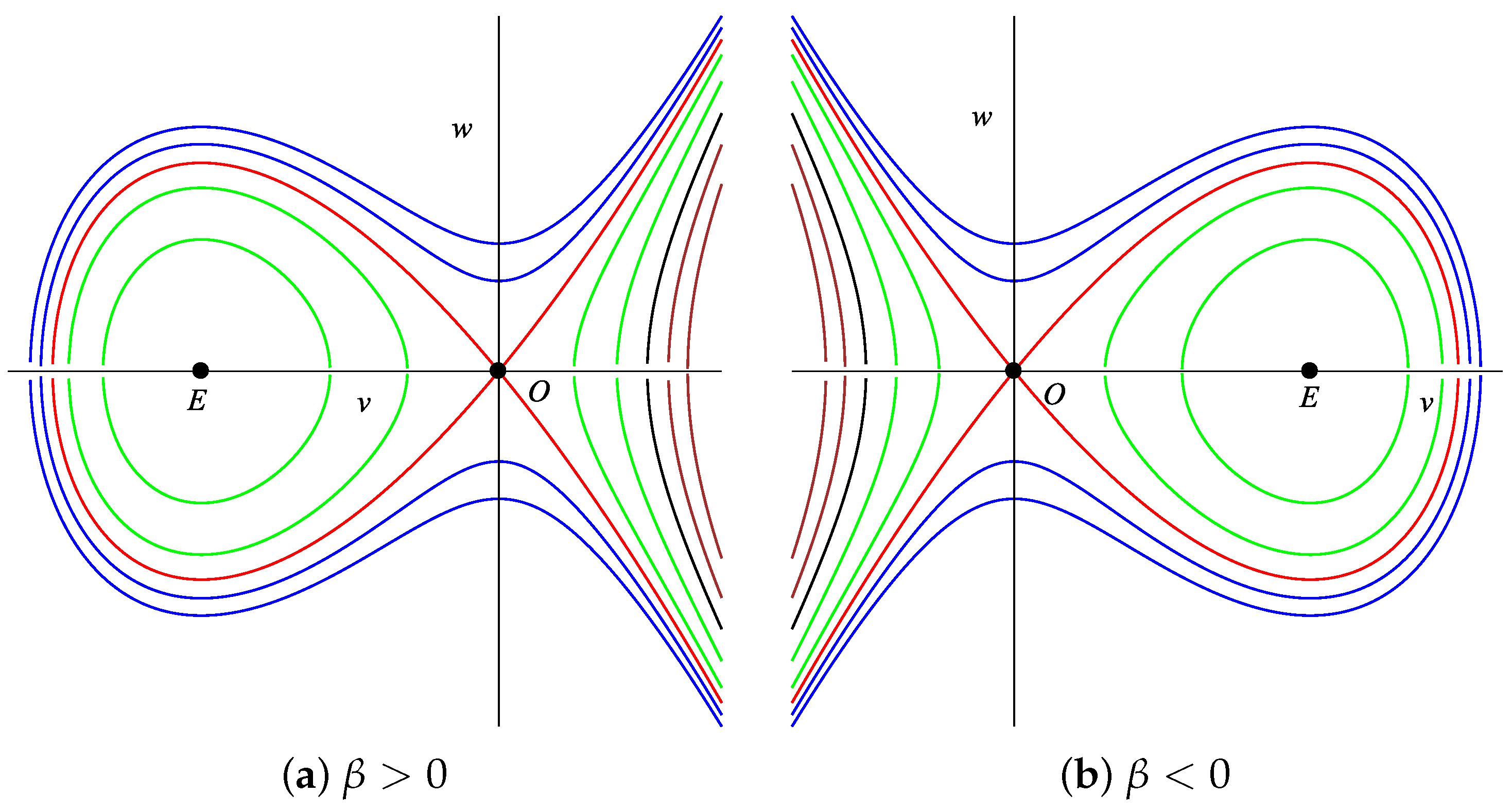
- (a) For , System (11) has a family of unbounded orbits, as illustrated by the brown lines in Figure 1a;
- (b) For , System (11) has an unbounded orbit that separates the preceding family and the succeeding family, as shown by the black lines in Figure 1a;
- (c) For , System (11) has two families of orbits: a family of periodic orbits around the center E and a family of unbounded orbits to the right of the saddle O, as shown by the green lines in Figure 1a;
- (d) For , System (11) has a homoclinic orbit passing through the saddle O and surrounding the family of periodic orbits and two unbounded orbits passing through the saddle O, as shown by the red lines in Figure 1a;
- (e) For , System (11) has a family of unbounded orbits outside the homoclinic orbit, as shown by the blue lines in Figure 1a.
4. Solution Construction
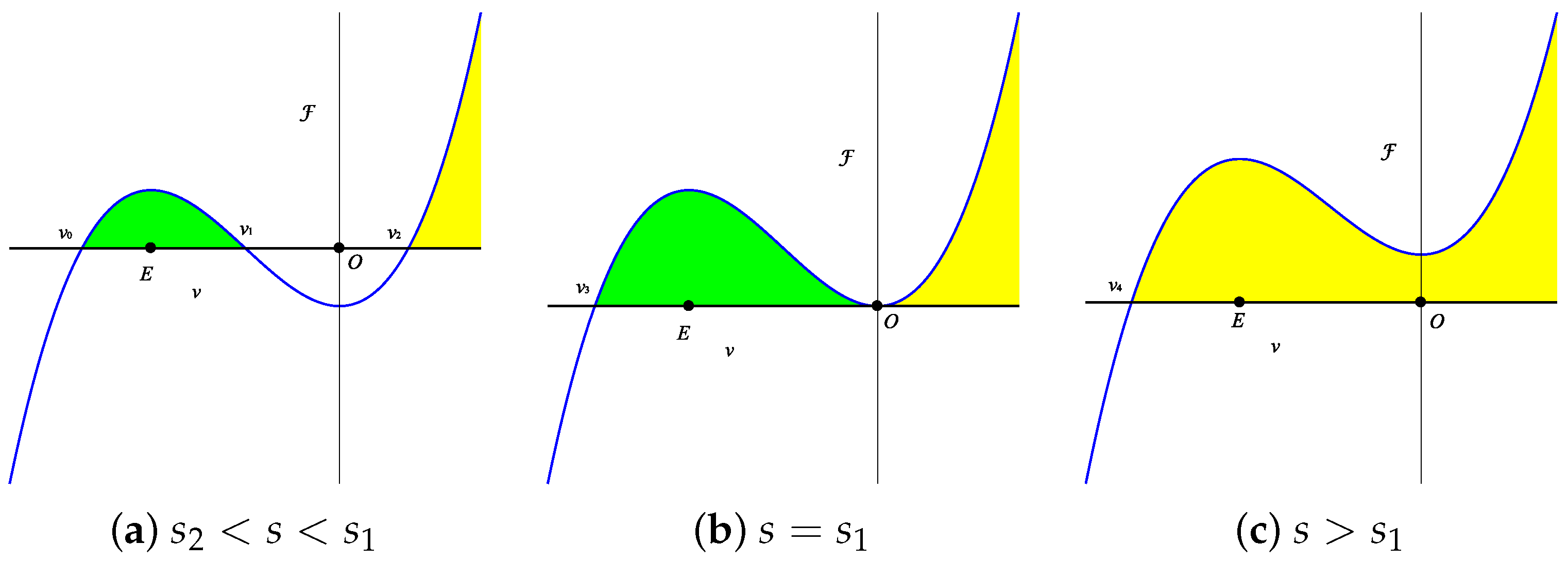
- For , there is a family of orbits consisting of periodic orbits and unbounded orbits, as shown by the green lines in Figure 1a. Since all orbits intersect the axis at three different points, takes the form , where and . We then focus on the regions that permit real propagation, i.e., the shaded regions in Figure 3a that are restricted by and . Therefore, for Equation (15), using produces the following periodic solution:Using produces the following singular solution:
- For , there is a homoclinic orbit passing through the equilibrium point O around E and two unbounded orbits passing through the equilibrium point O, as shown by the red lines in Figure 1a. These orbits intersect the axis in two points; therefore, has two real zeros: one is single (e.g., ) and the other (at O) is double. Hence, . We then focus on the regions that permit real propagation, i.e., the shaded regions in Figure 3b that are restricted by and . Therefore, for Equation (15), using produces the following one-soliton solution:Using produces the following solution:
- For , there is a family of unbounded orbits outside the homoclinic orbit and its two unbounded orbits, as shown by the blue lines in Figure 1a. All of these orbits intersect the axis on the left-hand side of equilibrium point E; therefore, has one real zero and two conjugate complex pair zeros z and . Hence, . We then focus on the region that permit real propagation, i.e., the shaded regions in Figure 3c that are restricted by . Hence, for Equation (15), using produces the following solution:where ; and . Consequently, Equation (1) has the following solution:
5. Physical Interpretation
- 1. Deviation from the periodic solution
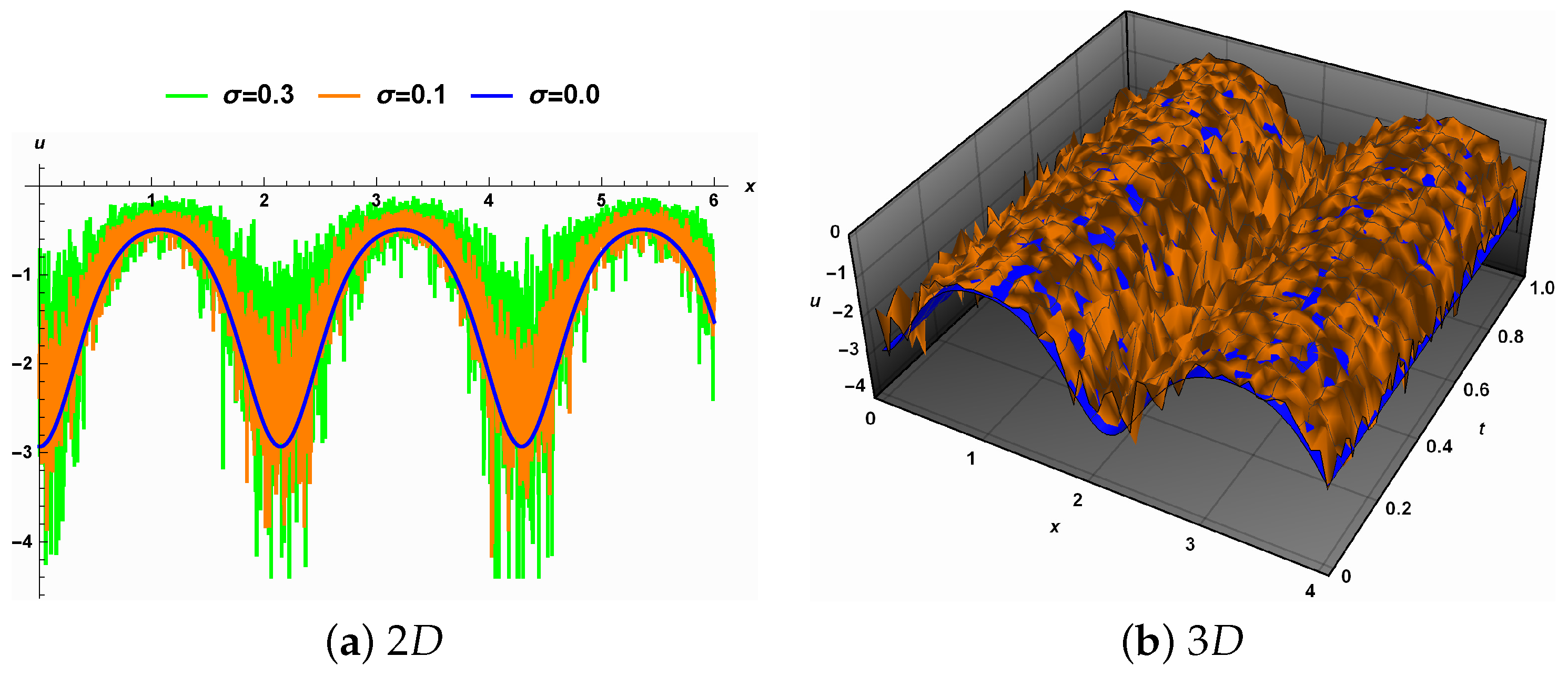
- (a) The noise effect. Figure 4a shows the 2D representation of Solution (27) for diverse noise intensity , where the fractional differential order is 1. The disturbance around the blue line, which represents the deterministic state, increases with an increase in noise strength. Note that the wave amplitude increases while the wavelength remains almost the same. It is evident from Figure 4b that the 3D solution represents a smooth periodic surface in the deterministic state () but becomes a rough surface in the non-deterministic status. Moreover, it loses its periodicity for larger values of noise intensity, so the surface becomes flat.
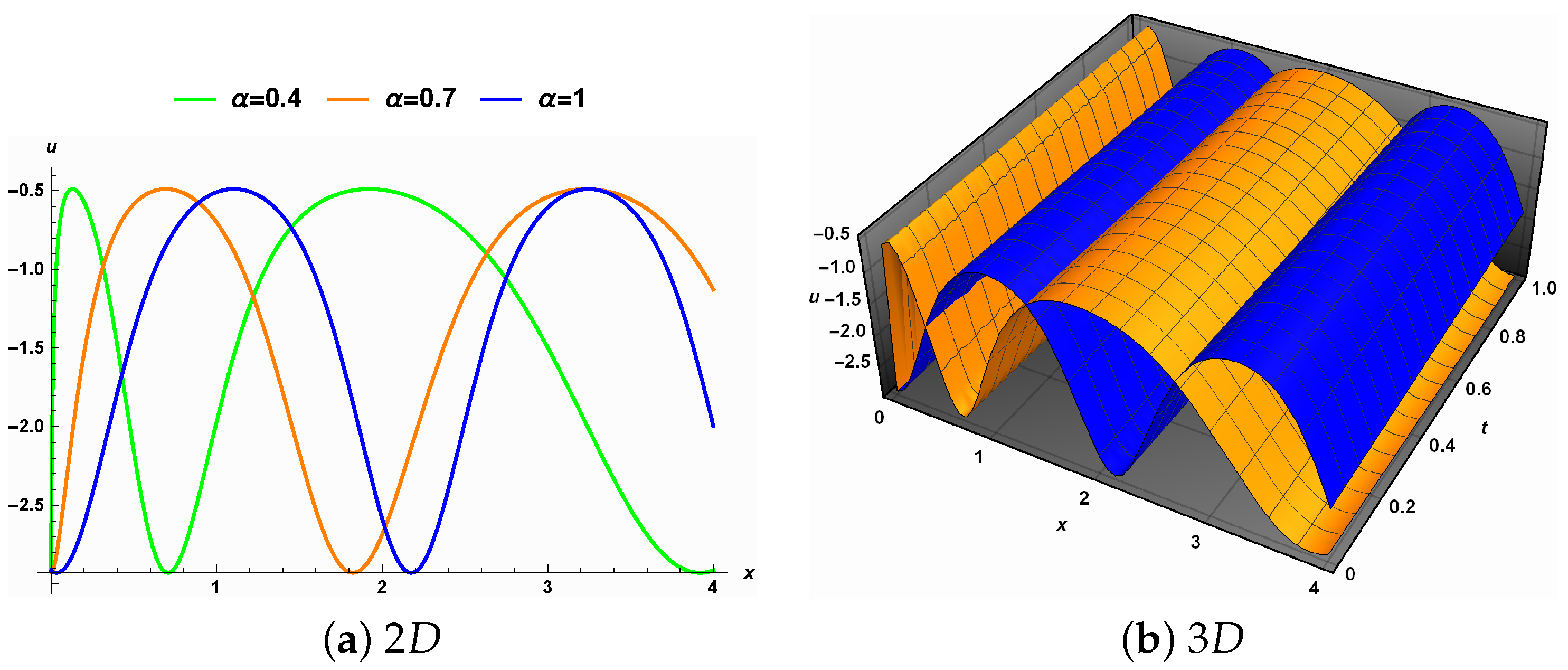
- (b) The fractional order effect. Figure 5a illustrates the impact of the fractional order in the deterministic status through the deviations surrounding the the blue line. The wavelength of Solution (27) increases as the fractional order moves away from 1, while the amplitude remains almost the same. The corresponding 3D representation of the solution is shown in Figure 5b.
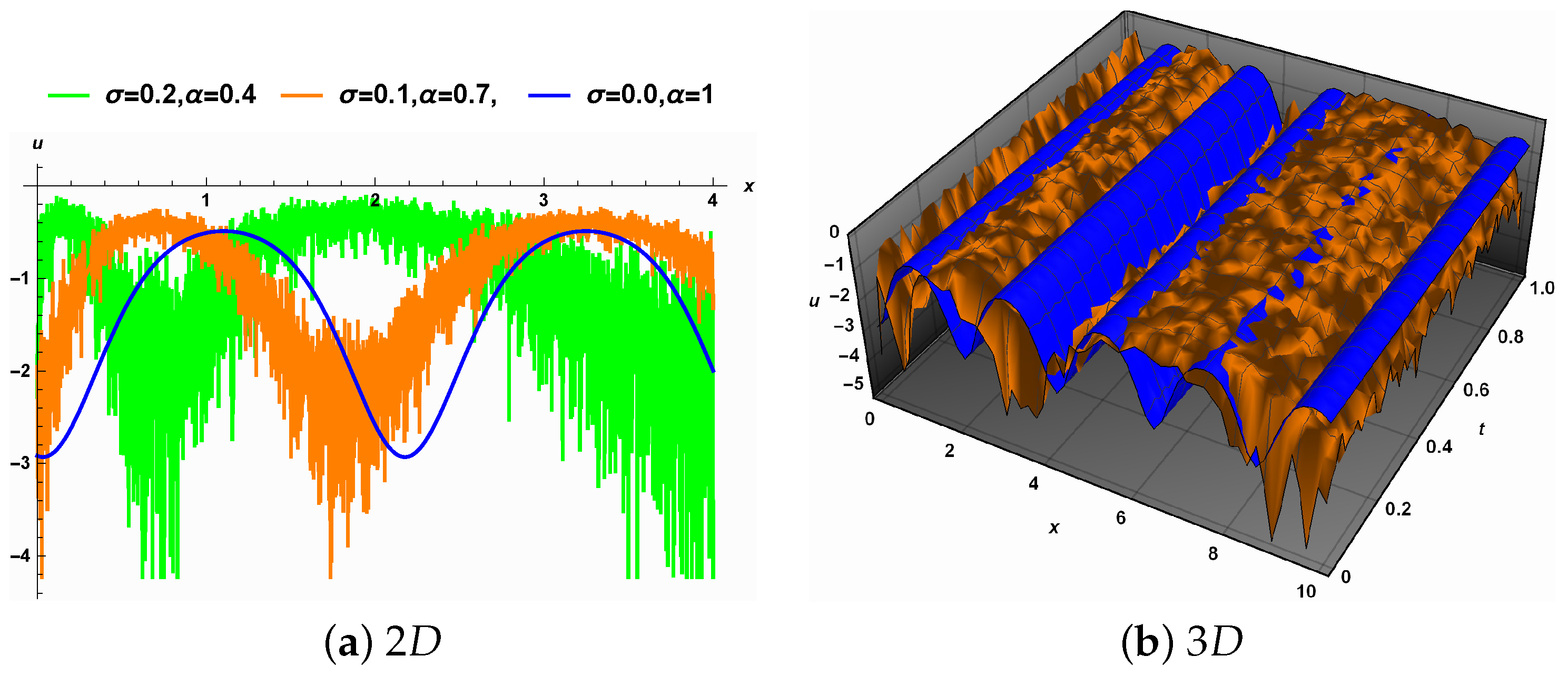
- (c) The combined influence. Figure 6a shows that the amplitude and wavelength of Solution (27) increase when both the noise intensity and the fractional order move away from 0 and 1, respectively. The surface characterized by Solution (27) that is smooth for becomes a rough surface, as shown in Figure 6b.
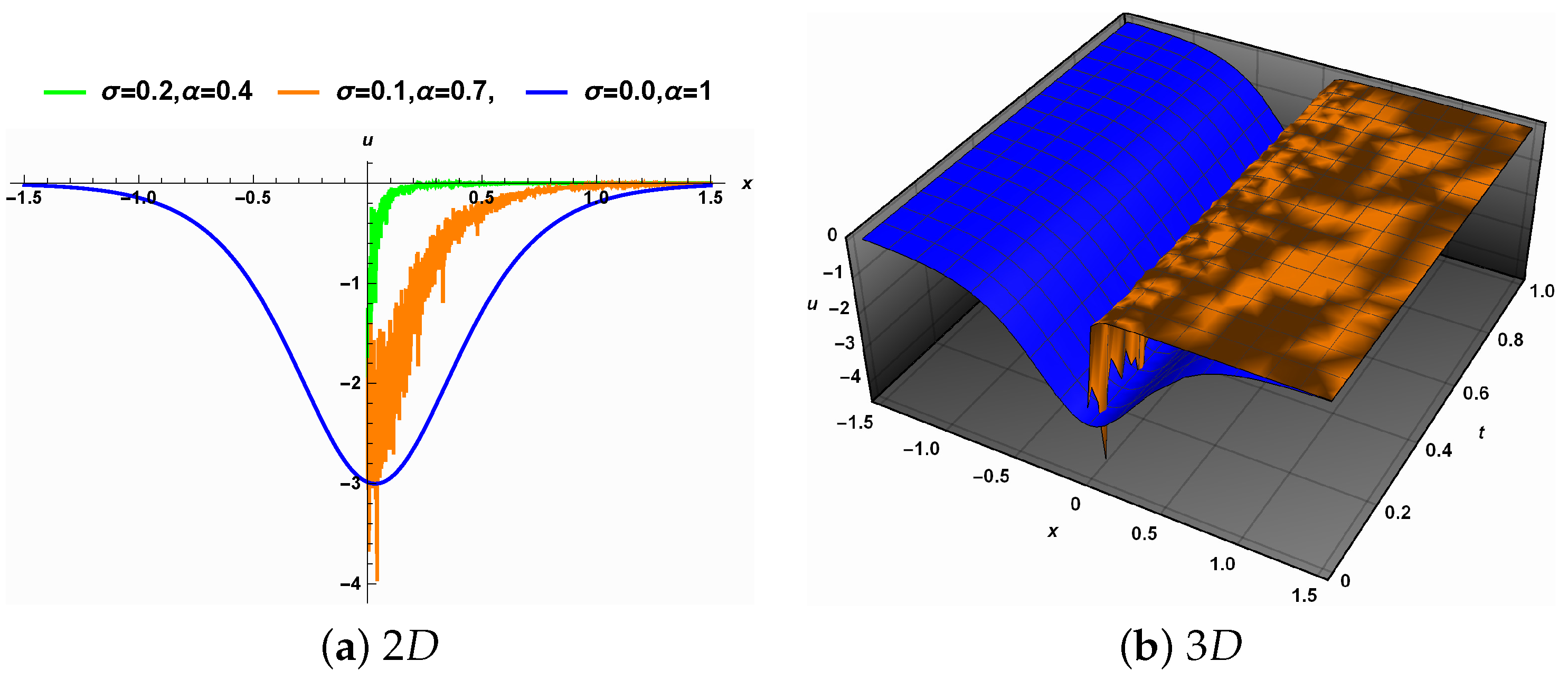
- 2. Deviation from the soliton solution
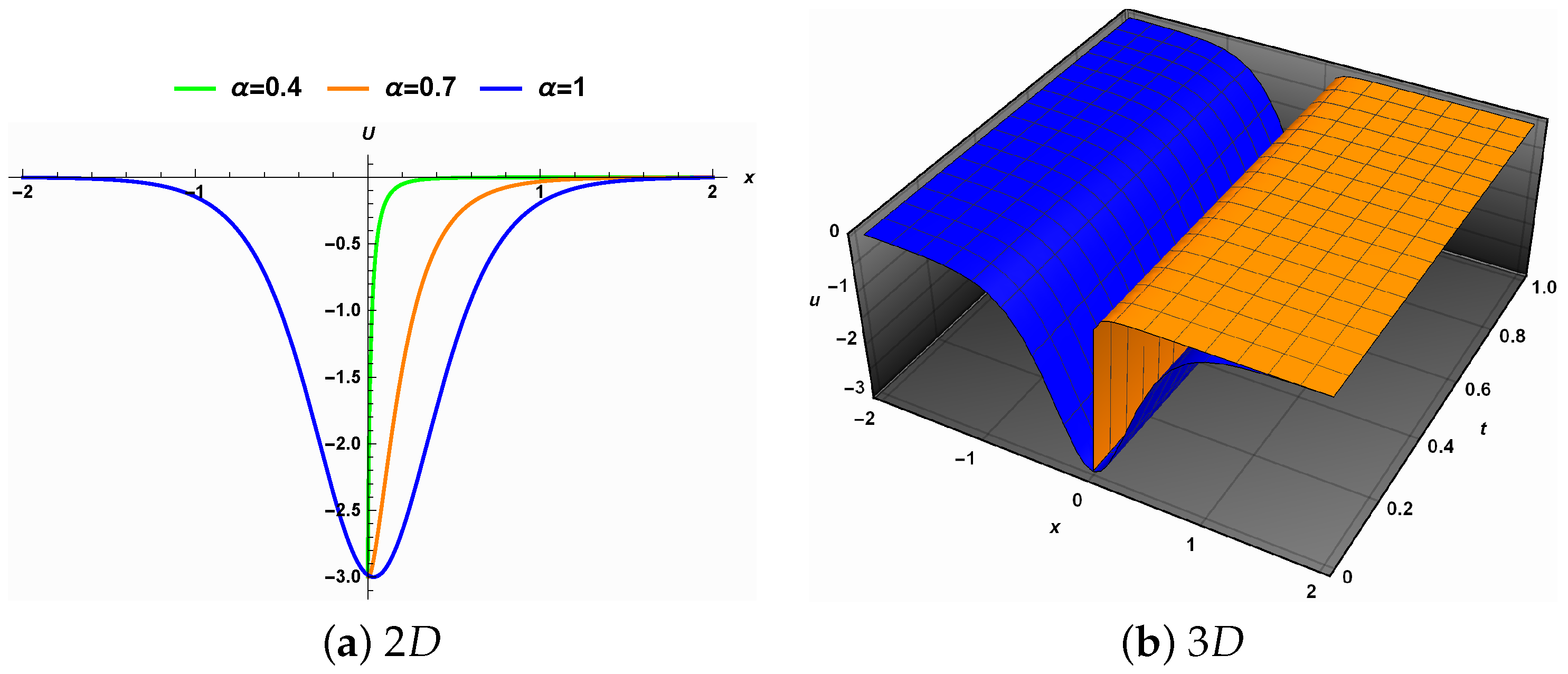
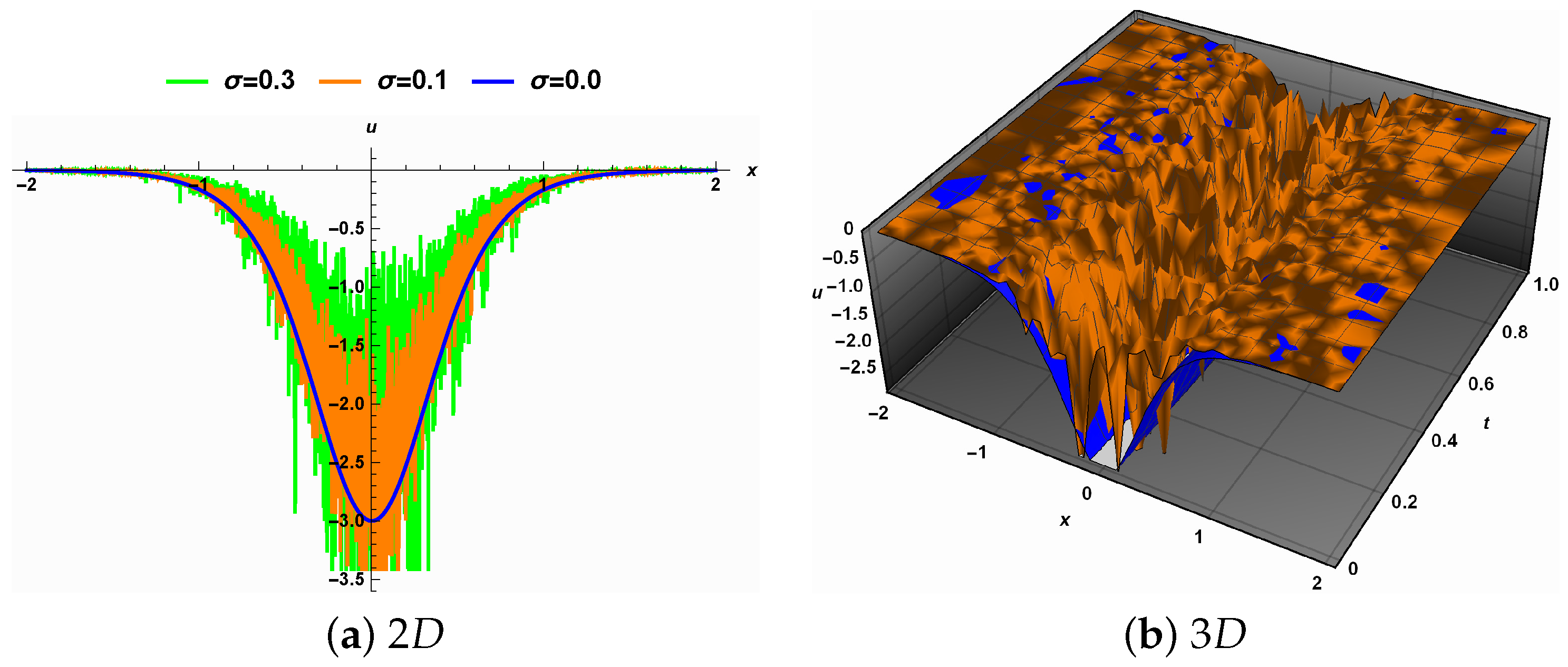
- (a) The noise effect. Figure 7a illustrates the 2D representation of Solution (28) for different noise intensity values when the fractional order . The wave height increases while the width remains almost the same as the noise intensity increases. Figure 7b shows the surface characterized by this solution, which loses its smoothness as the noise intensity increases. Further, as the noise intensity increases, the surface flattens.
6. Conclusions
Author Contributions
Funding
Data Availability Statement
Conflicts of Interest
References
- Lax, P.D. Integrals of nonlinear equations of evolution and solitary waves. Commun. Pure Appl. Math. 1968, 21, 467–490. [Google Scholar] [CrossRef]
- Ma, W.X.; Strampp, W. An explicit symmetry constraint for the Lax pairs and the adjoint Lax pairs of AKNS systems. Phys. Lett. A 1994, 185, 277–286. [Google Scholar] [CrossRef]
- Ramm, A. Inverse scattering with non-over-determined data. In Proceedings of the 2016 IEEE International Conference on Mathematical Methods in Electromagnetic Theory (MMET), Lviv, Ukraine, 5–7 July 2016; pp. 85–88. [Google Scholar]
- Hirota, R. Exact solution of the Korteweg—De Vries equation for multiple collisions of solitons. Phys. Rev. Lett. 1971, 27, 1192. [Google Scholar] [CrossRef]
- Radha, R.; Lakshmanan, M. Singularity analysis and localized coherent structures in (2+1)-dimensional generalized Korteweg–de Vries equations. J. Math. Phys. 1994, 35, 4746–4756. [Google Scholar] [CrossRef]
- Wazwaz, A.M. Two new integrable fourth-order nonlinear equations: Multiple soliton solutions and multiple complex soliton solutions. Nonlinear Dyn. 2018, 94, 2655–2663. [Google Scholar] [CrossRef]
- He, J.H. Variational iteration method—Some recent results and new interpretations. J. Comput. Appl. Math. 2007, 207, 3–17. [Google Scholar] [CrossRef]
- Schmid, R. Infinite Dimentional Lie Groups with Applications to Mathematical Physics. J. Geom. Symmetry Phys. 2004, 1, 54–120. [Google Scholar]
- Khalique, C.M.; Biswas, A. Optical solitons with power law nonlinearity using Lie group analysis. Phys. Lett. A 2009, 373, 2047–2049. [Google Scholar] [CrossRef]
- Fan, E.; Zhang, H. A note on the homogeneous balance method. Phys. Lett. A 1998, 246, 403–406. [Google Scholar] [CrossRef]
- Wang, M.; Zhou, Y.; Li, Z. Application of a homogeneous balance method to exact solutions of nonlinear equations in mathematical physics. Phys. Lett. A 1996, 216, 67–75. [Google Scholar] [CrossRef]
- Feng, Z. The first-integral method to study the Burgers–Korteweg–de Vries equation. J. Phys. Math. Gen. 2002, 35, 343. [Google Scholar] [CrossRef]
- Taghizadeh, N.; Mirzazadeh, M.; Farahrooz, F. Exact solutions of the nonlinear Schrödinger equation by the first integral method. J. Math. Anal. Appl. 2011, 374, 549–553. [Google Scholar] [CrossRef]
- Elbrolosy, M.; Elmandouh, A. Dynamical behaviour of nondissipative double dispersive microstrain wave in the microstructured solids. Eur. Phys. J. Plus 2021, 136, 1–20. [Google Scholar] [CrossRef]
- Elbrolosy, M.; Elmandouh, A. Dynamical behaviour of conformable time-fractional coupled Konno-Oono equation in magnetic field. Math. Probl. Eng. 2022, 2022, 3157217. [Google Scholar] [CrossRef]
- Elmandouh, A.A.; Elbrolosy, M.E. New traveling wave solutions for Gilson–Pickering equation in plasma via bifurcation analysis and direct method. Math. Methods Appl. Sci. 2022, 1–19. [Google Scholar] [CrossRef]
- Elmandouh, A.; Elbrolosy, M. Integrability, Variational Principle, Bifurcation, and New Wave Solutions for the Ivancevic Option Pricing Model. J. Math. 2022, 2, 3. [Google Scholar] [CrossRef]
- Siddique, I.; Mehdi, K.B.; Jaradat, M.M.; Zafar, A.; Elbrolosy, M.E.; Elmandouh, A.A.; Sallah, M. Bifurcation of some new traveling wave solutions for the time–space M-fractional MEW equation via three altered methods. Results Phys. 2022, 41, 105896. [Google Scholar] [CrossRef]
- Arnold, L. Trends and open problems in the theory of random dynamical systems. In Probability towards 2000; Springer: Berlin/Heidelberg, Germany, 1998; pp. 34–46. [Google Scholar]
- Weinan, E.; Li, X.; Vanden-Eijnden, E. Some recent progress in multiscale modeling. Multiscale Model. Simul. 2004, 39, 3–21. [Google Scholar]
- Mohammed, W.W.; Iqbal, N.; Botmart, T. Additive noise effects on the stabilization of fractional-space diffusion equation solutions. Mathematics 2022, 10, 130. [Google Scholar] [CrossRef]
- Mohammed, W.W.; Alshammari, M.; Cesarano, C.; Albadrani, S.; El-Morshedy, M. Brownian Motion Effects on the Stabilization of Stochastic Solutions to Fractional Diffusion Equations with Polynomials. Mathematics 2022, 10, 1458. [Google Scholar] [CrossRef]
- Elmandouh, A.; Fadhal, E. Bifurcation of Exact Solutions for the Space-Fractional Stochastic Modified Benjamin–Bona–Mahony Equation. Fractal Fract. 2022, 6, 718. [Google Scholar] [CrossRef]
- Van Wijngaarden, L. On the equations of motion for mixtures of liquid and gas bubbles. J. Fluid Mech. 1968, 33, 465–474. [Google Scholar] [CrossRef]
- Plesset, M.S.; Sadhal, S.S. On the stability of gas bubbles in liquid-gas solutions. In Mechanics and Physics of Bubbles in Liquids; Springer: Berlin/Heidelberg, Germany, 1982; pp. 133–141. [Google Scholar]
- Deng, G.F.; Gao, Y.T. Integrability, solitons, periodic and travelling waves of a generalized (3+ 1)-dimensional variable-coefficient nonlinear-wave equation in liquid with gas bubbles. Eur. Phys. J. Plus 2017, 132, 1–17. [Google Scholar] [CrossRef]
- Tu, J.M.; Tian, S.F.; Xu, M.J.; Song, X.Q.; Zhang, T.T. Bäcklund transformation, infinite conservation laws and periodic wave solutions of a generalized (3+ 1)-dimensional nonlinear wave in liquid with gas bubbles. Nonlinear Dyn. 2016, 83, 1199–1215. [Google Scholar] [CrossRef]
- Kudryashov, N.A.; Sinelshchikov, D.I. Equation for the three-dimensional nonlinear waves in liquid with gas bubbles. Phys. Scr. 2012, 85, 025402. [Google Scholar] [CrossRef]
- Ablowitz, M.J.; Segur, H. On the evolution of packets of water waves. J. Fluid Mech. 1979, 92, 691–715. [Google Scholar] [CrossRef]
- Ma, W.X.; Zhu, Z. Solving the (3+1)-dimensional generalized KP and BKP equations by the multiple exp-function algorithm. Appl. Math. Comput. 2012, 218, 11871–11879. [Google Scholar] [CrossRef]
- Ma, W.X.; Xia, T. Pfaffianized systems for a generalized Kadomtsev–Petviashvili equation. Phys. Scr. 2013, 87, 055003. [Google Scholar] [CrossRef]
- Alexander, J.; Pego, R.; Sachs, R. On the transverse instability of solitary waves in the Kadomtsev-Petviashvili equation. Phys. Lett. A 1997, 226, 187–192. [Google Scholar] [CrossRef]
- Yadav, S.; Arora, R. Lie symmetry analysis, optimal system and invariant solutions of (3+ 1)-dimensional nonlinear wave equation in liquid with gas bubbles. Eur. Phys. J. Plus 2021, 136, 1–25. [Google Scholar] [CrossRef]
- Khalil, R.; Al Horani, M.; Yousef, A.; Sababheh, M. A new definition of fractional derivative. J. Comput. Appl. Math. 2014, 264, 65–70. [Google Scholar] [CrossRef]
- Platen, E.; Bruti-Liberati, N. Numerical Solution of Stochastic Differential Equations with Jumps in Finance; Springer Science & Business Media: Cham, Switzerland, 2010; Volume 64. [Google Scholar]
- Kumar, S.; Hamid, I.; Abdou, M. Specific wave profiles and closed-form soliton solutions for generalized nonlinear wave equation in (3+1)-dimensions with gas bubbles in hydrodynamics and fluids. J. Ocean. Eng. Sci. 2021; in press. [Google Scholar] [CrossRef]
- Nemytskii, V.; Stepanov, V. Qualitative Theory of Differential Equations; Courier Dover Publications: New York, NY, USA, 1989; Volume 22. [Google Scholar]


| No. | Equation (1) is Reduced to | Reference | |
|---|---|---|---|
| 1. | (3+1)-dimensional Kadomtsev–Petviashvili with constant coefficients | [29,30,31] | |
| 2. | (2+1)-dimensional Kadomtsev–Petviashvili with constant coefficients | [32] | |
| 3. | (3+1)-dimensional shallow water wave equation that weakly explains nonlinear long waves in weakly dispersing medium | [28] | |
| 4. | (3+1)-dimensional shallow water wave equation that explains nonlinear waves in a fluid having gas bubbles | [28,33] | |
| 5. | (1+1)-dimensional KdV equation that describes the fluid dynamics in some complicated phenomena, such as plasma physics and lattice dynamics | [1] |
Disclaimer/Publisher’s Note: The statements, opinions and data contained in all publications are solely those of the individual author(s) and contributor(s) and not of MDPI and/or the editor(s). MDPI and/or the editor(s) disclaim responsibility for any injury to people or property resulting from any ideas, methods, instructions or products referred to in the content. |
© 2022 by the authors. Licensee MDPI, Basel, Switzerland. This article is an open access article distributed under the terms and conditions of the Creative Commons Attribution (CC BY) license (https://creativecommons.org/licenses/by/4.0/).
Share and Cite
Alhamud, M.; Elbrolosy, M.; Elmandouh, A. New Analytical Solutions for Time-Fractional Stochastic (3+1)-Dimensional Equations for Fluids with Gas Bubbles and Hydrodynamics. Fractal Fract. 2023, 7, 16. https://doi.org/10.3390/fractalfract7010016
Alhamud M, Elbrolosy M, Elmandouh A. New Analytical Solutions for Time-Fractional Stochastic (3+1)-Dimensional Equations for Fluids with Gas Bubbles and Hydrodynamics. Fractal and Fractional. 2023; 7(1):16. https://doi.org/10.3390/fractalfract7010016
Chicago/Turabian StyleAlhamud, Mohammed, Mamdouh Elbrolosy, and Adel Elmandouh. 2023. "New Analytical Solutions for Time-Fractional Stochastic (3+1)-Dimensional Equations for Fluids with Gas Bubbles and Hydrodynamics" Fractal and Fractional 7, no. 1: 16. https://doi.org/10.3390/fractalfract7010016
APA StyleAlhamud, M., Elbrolosy, M., & Elmandouh, A. (2023). New Analytical Solutions for Time-Fractional Stochastic (3+1)-Dimensional Equations for Fluids with Gas Bubbles and Hydrodynamics. Fractal and Fractional, 7(1), 16. https://doi.org/10.3390/fractalfract7010016