
Multifractal Characteristics of Tight Sandstone Pore Structure Based on Nuclear Magnetic Resonance in Benxi Formation, Ordos Basin, China

Abstract
1. Introduction
2. Experimental Methods and Theories
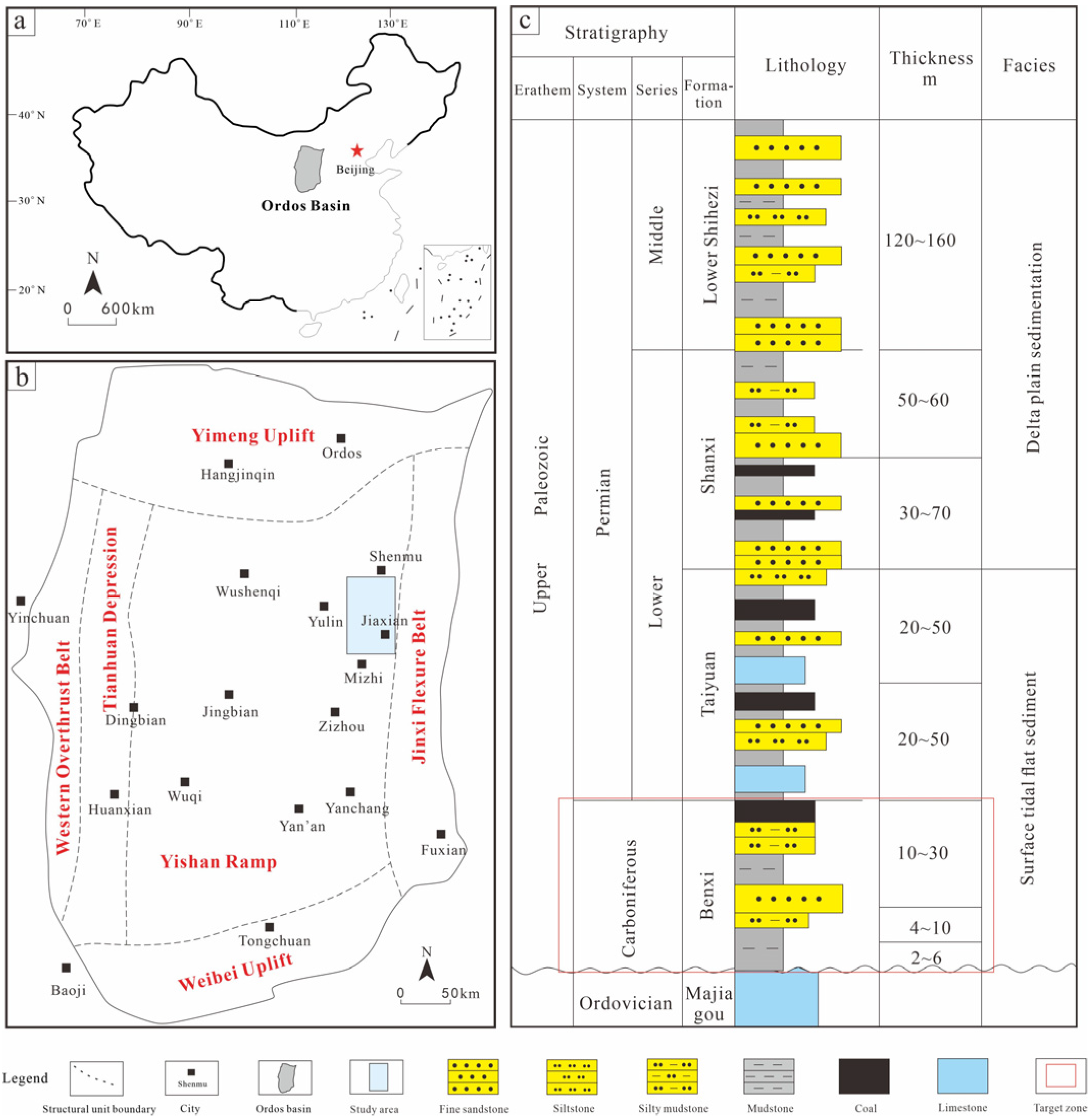
2.1. Geological Background
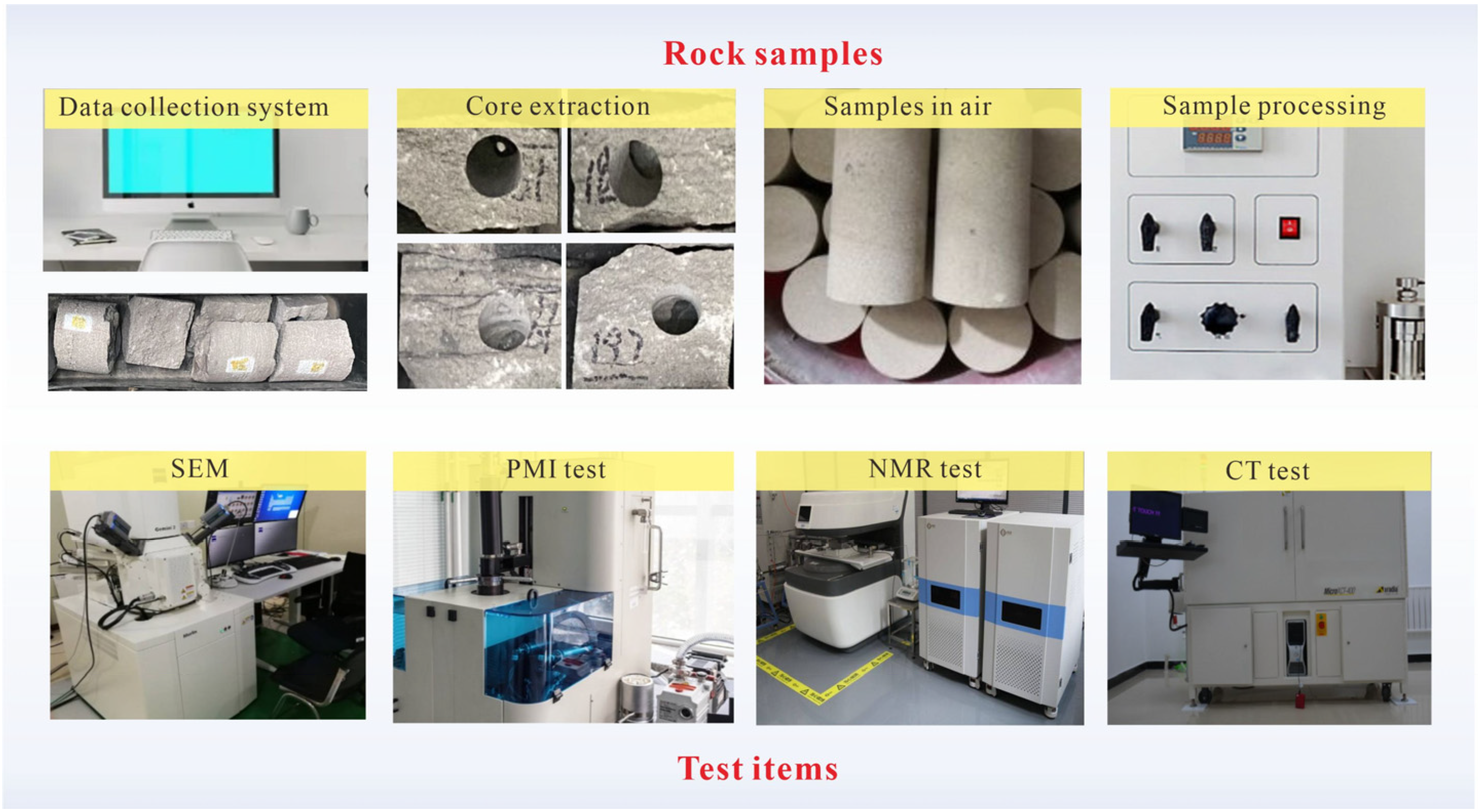
2.2. Sample Information and Experimental Process
2.3. Nuclear Magnetic Resonance Experiment (NMR)
2.4. Multifractal Theory


3. Results and Analysis
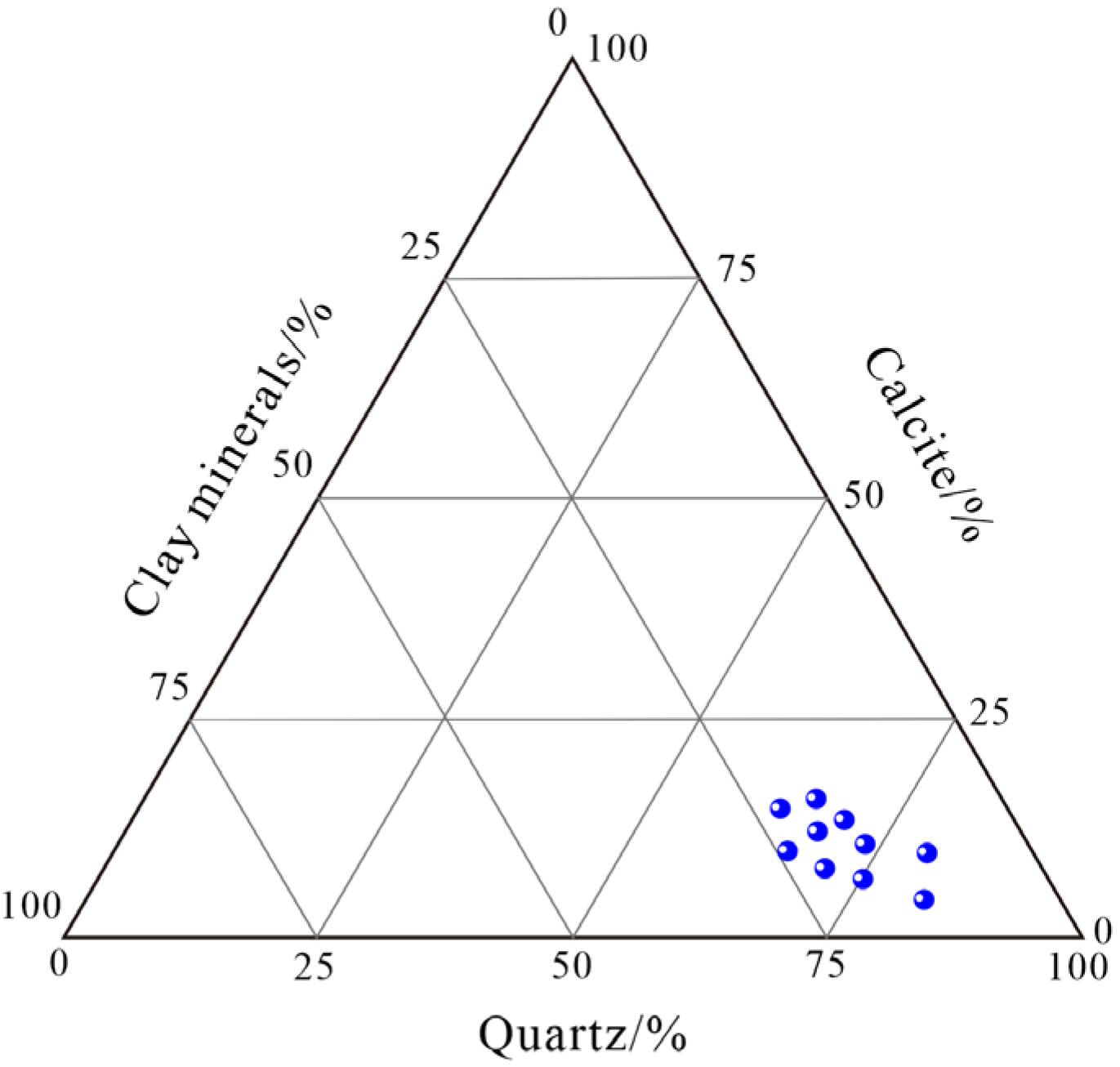
3.1. Petrological Characteristics of the Reservoir
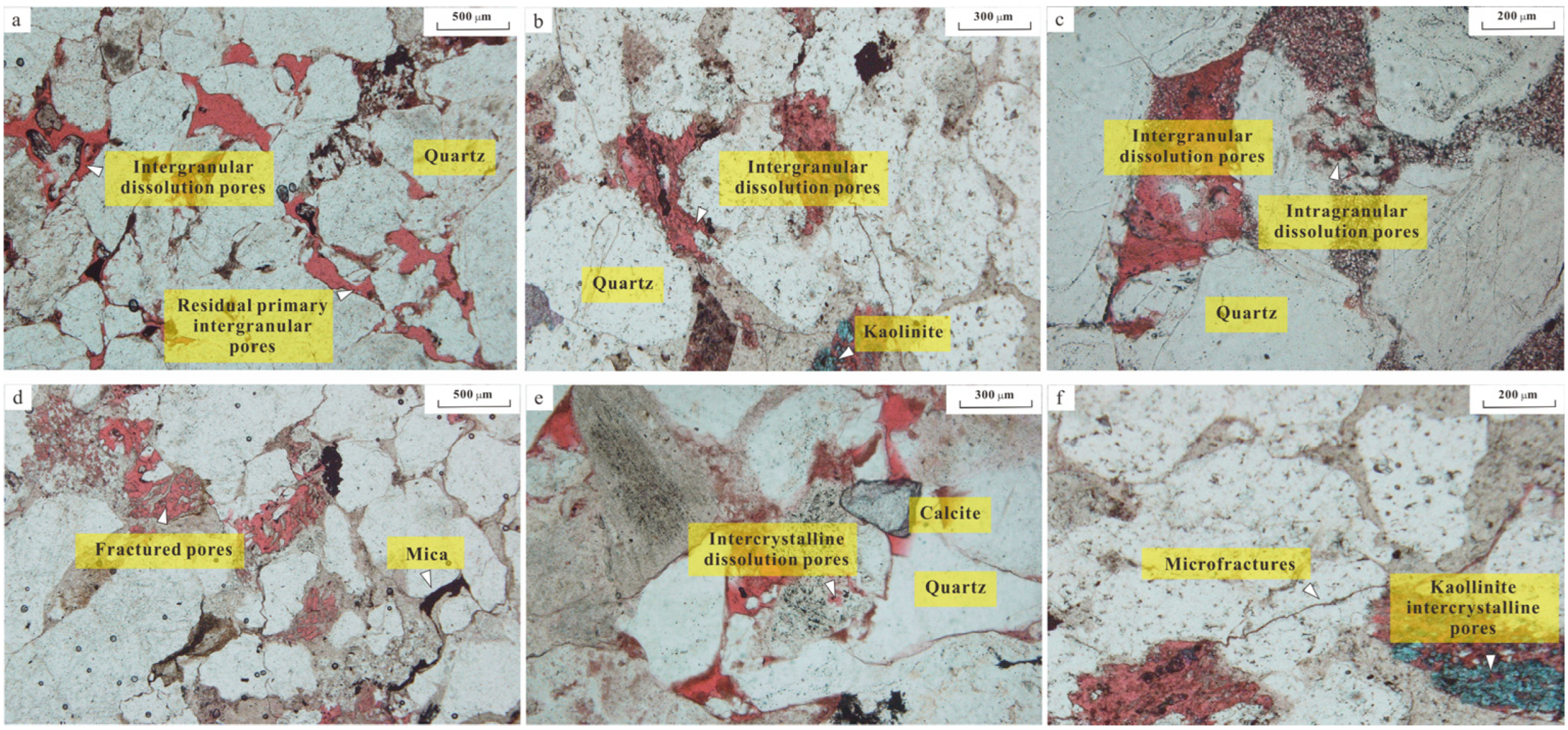
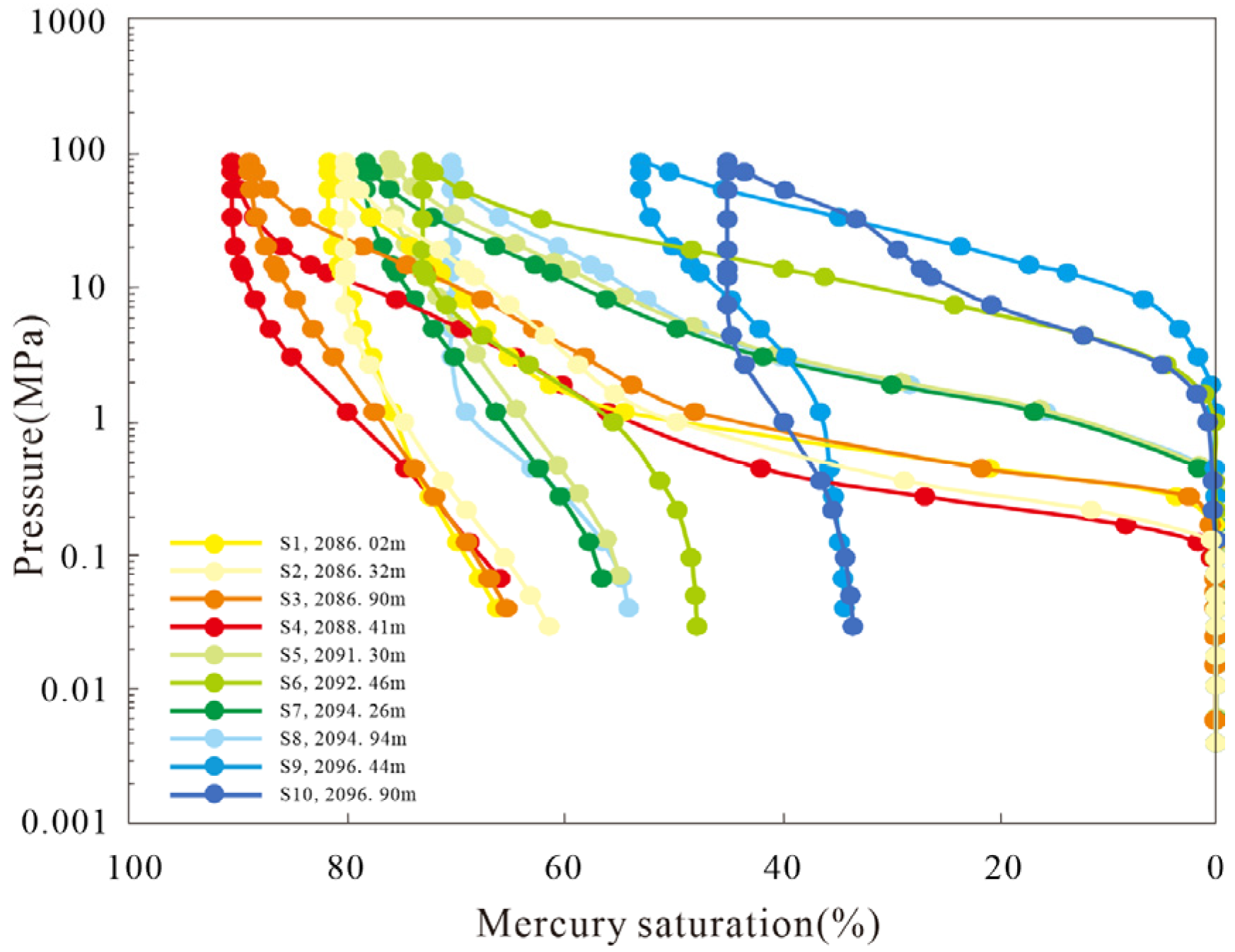
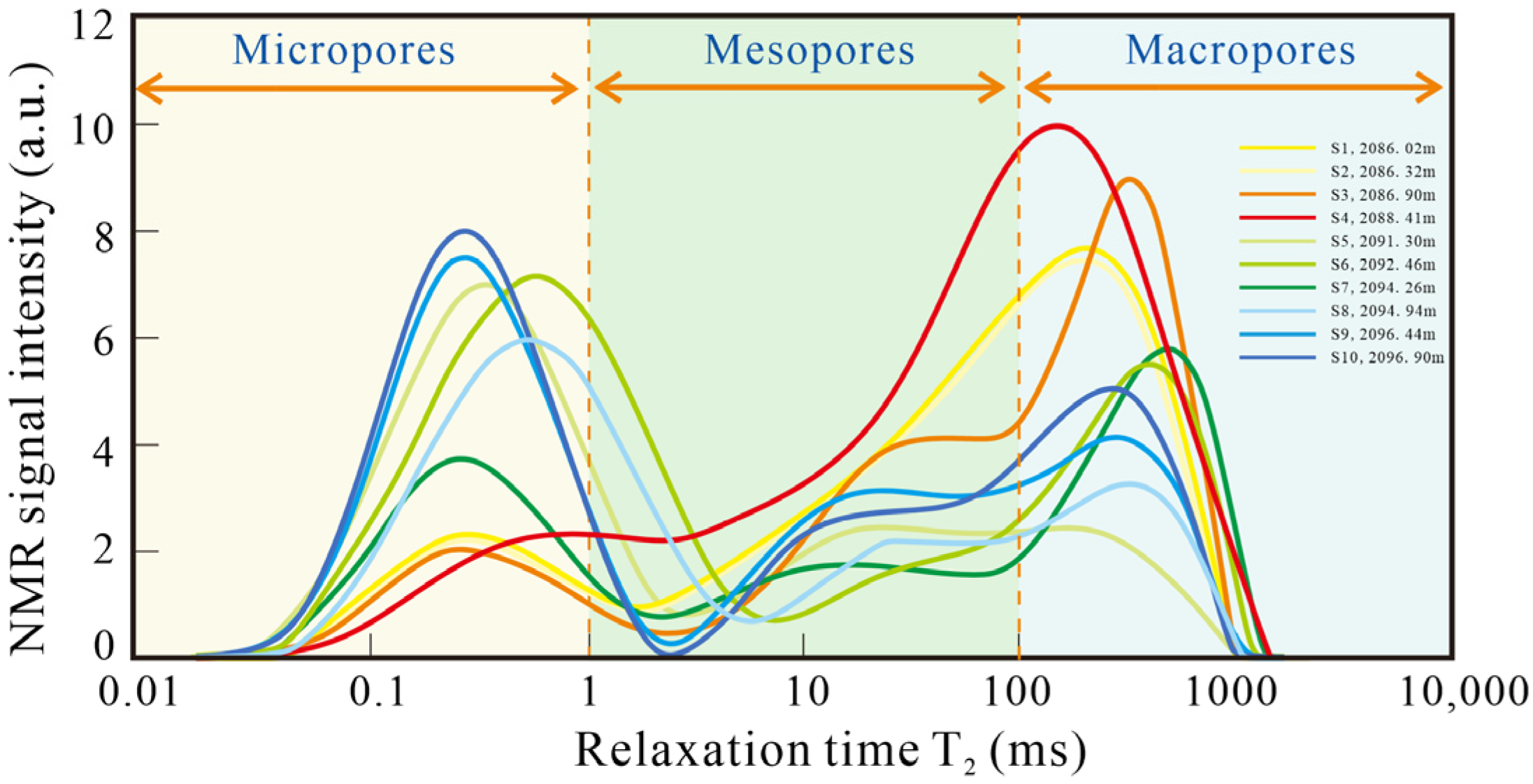
3.2. Reservoir Pore Structure Characteristics
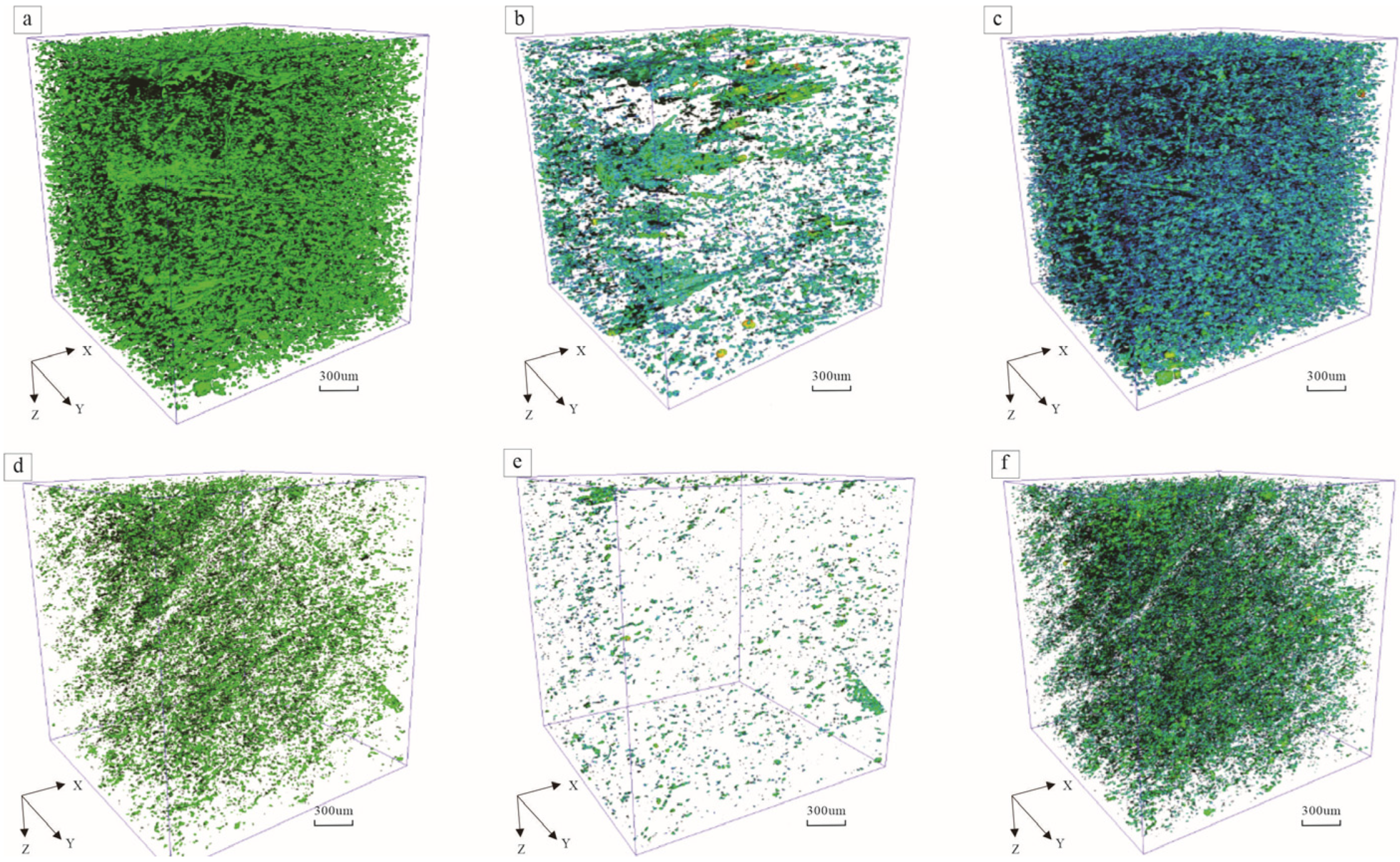
3.3. Characteristics of Reservoir Pore Network
3.3.1. Pore Network in PMI Analysis
3.3.2. Pore Networks Scanned by NMR and CT
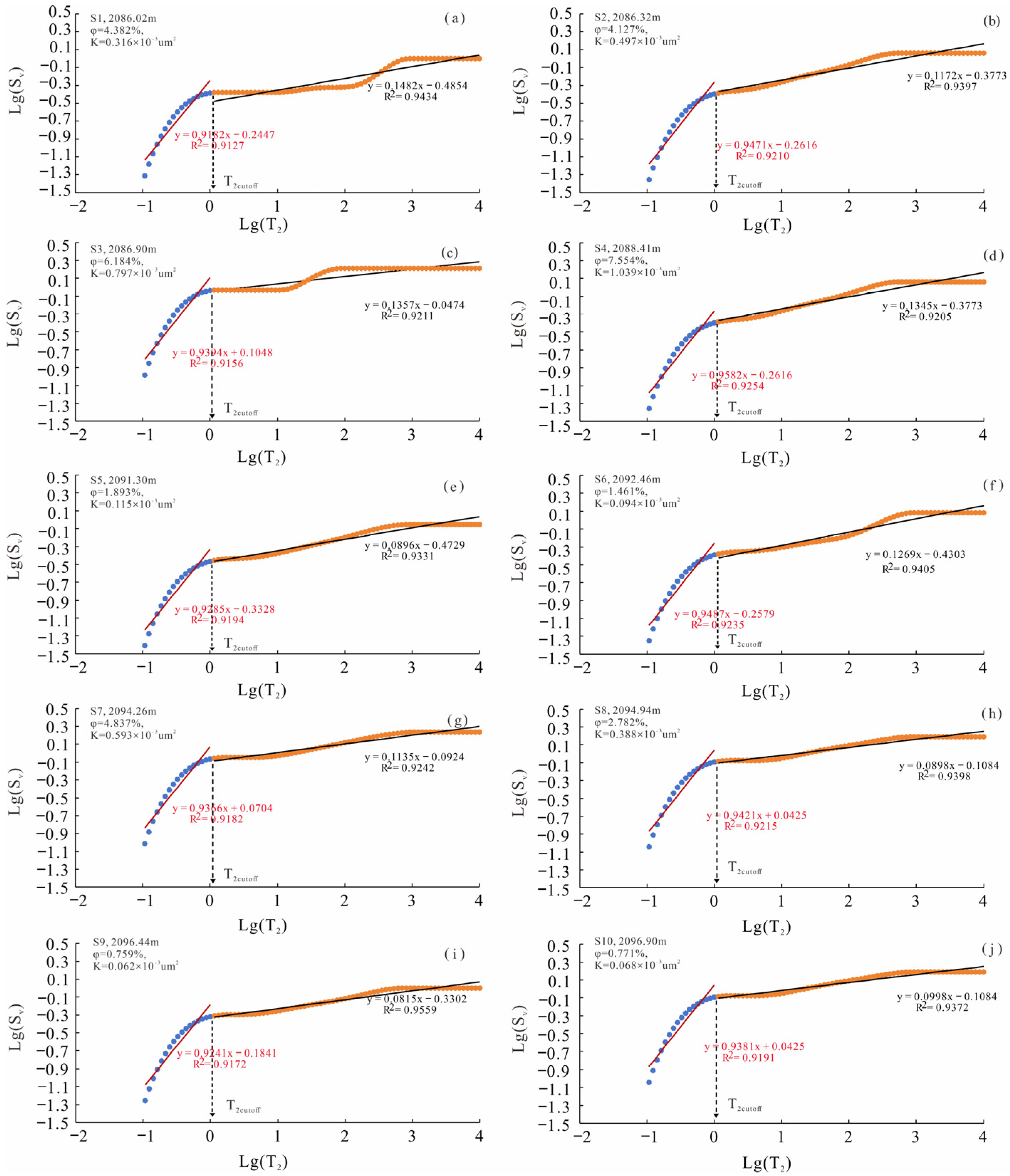
3.4. Single Fractal Characteristics
4. Discussion
4.1. Fractal Dimensions, Physical Properties and Microstructure Parameters
4.2. Multifractal Characteristics and Correlation Analysis
4.2.1. Correlation Between Physical Parameters and Multifractal Dimensions
4.2.2. Correlation Between Mineral Composition and Multifractal Dimensions
Quartz
Calcite
Clay Minerals
Principal Component Analysis
4.3. Classification of Reservoirs Based on Multifractal Parameters
5. Future Work
6. Conclusions
- (1)
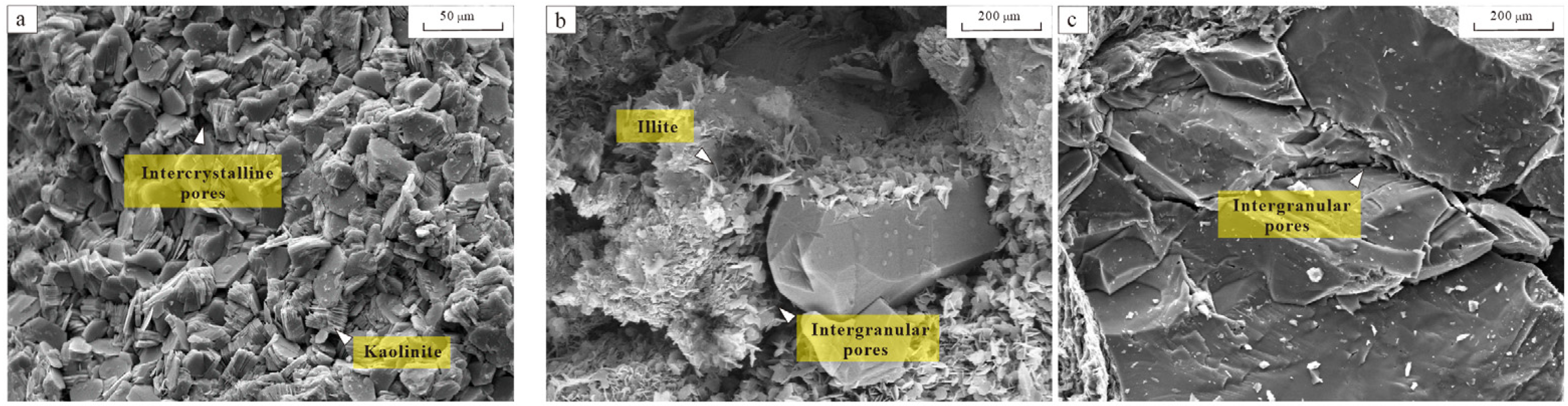
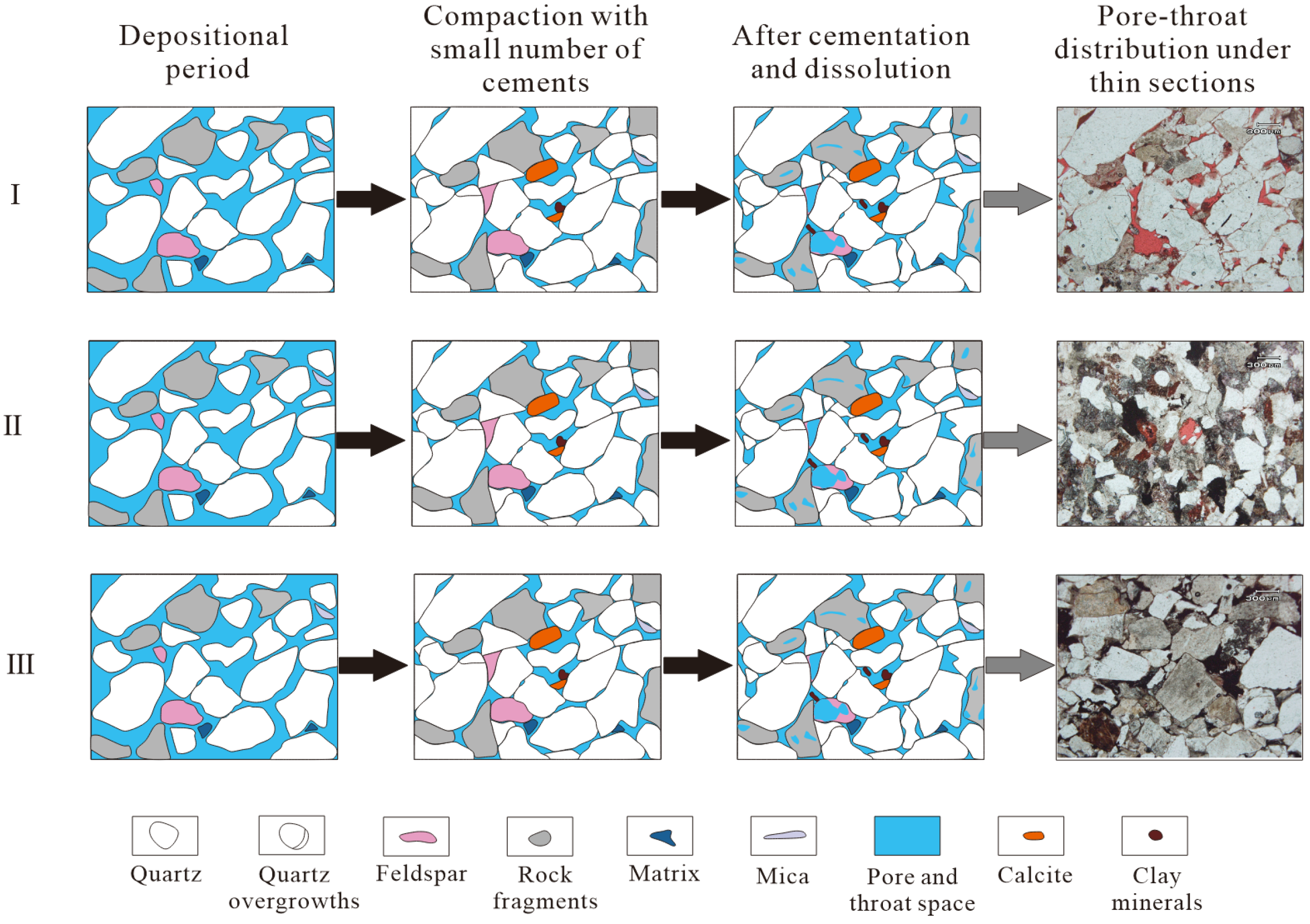
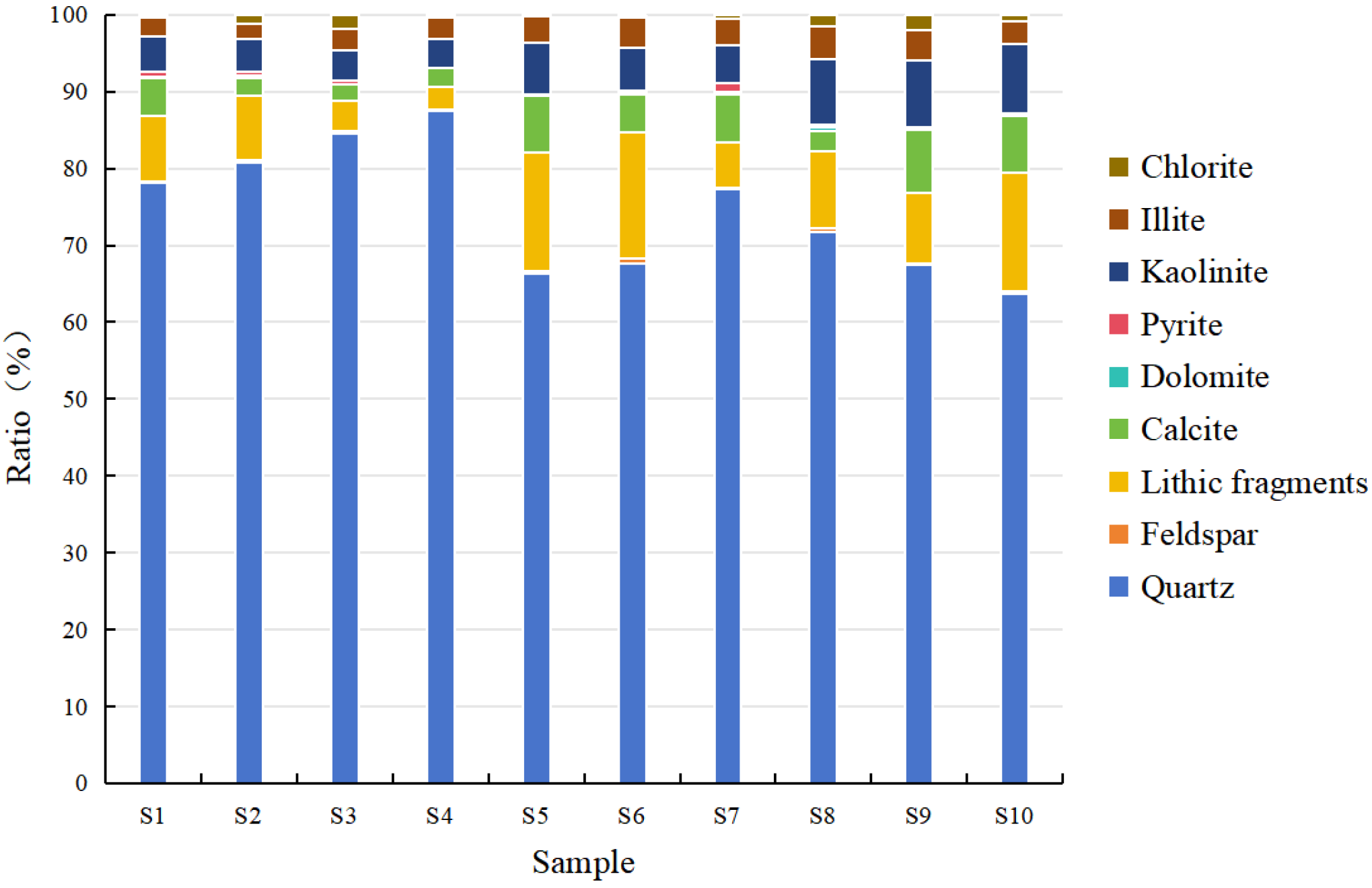
- The dominant minerals are quartz, clay minerals, rock fragments and calcite, while feldspar content is relatively minor. Due to the influence of various minerals, the pore structure shows significant heterogeneity. The pore types present include primary intergranular pores, intergranular dissolution pores, intragranular dissolution pores, intercrystalline micropores, and microfractures.
- (2)
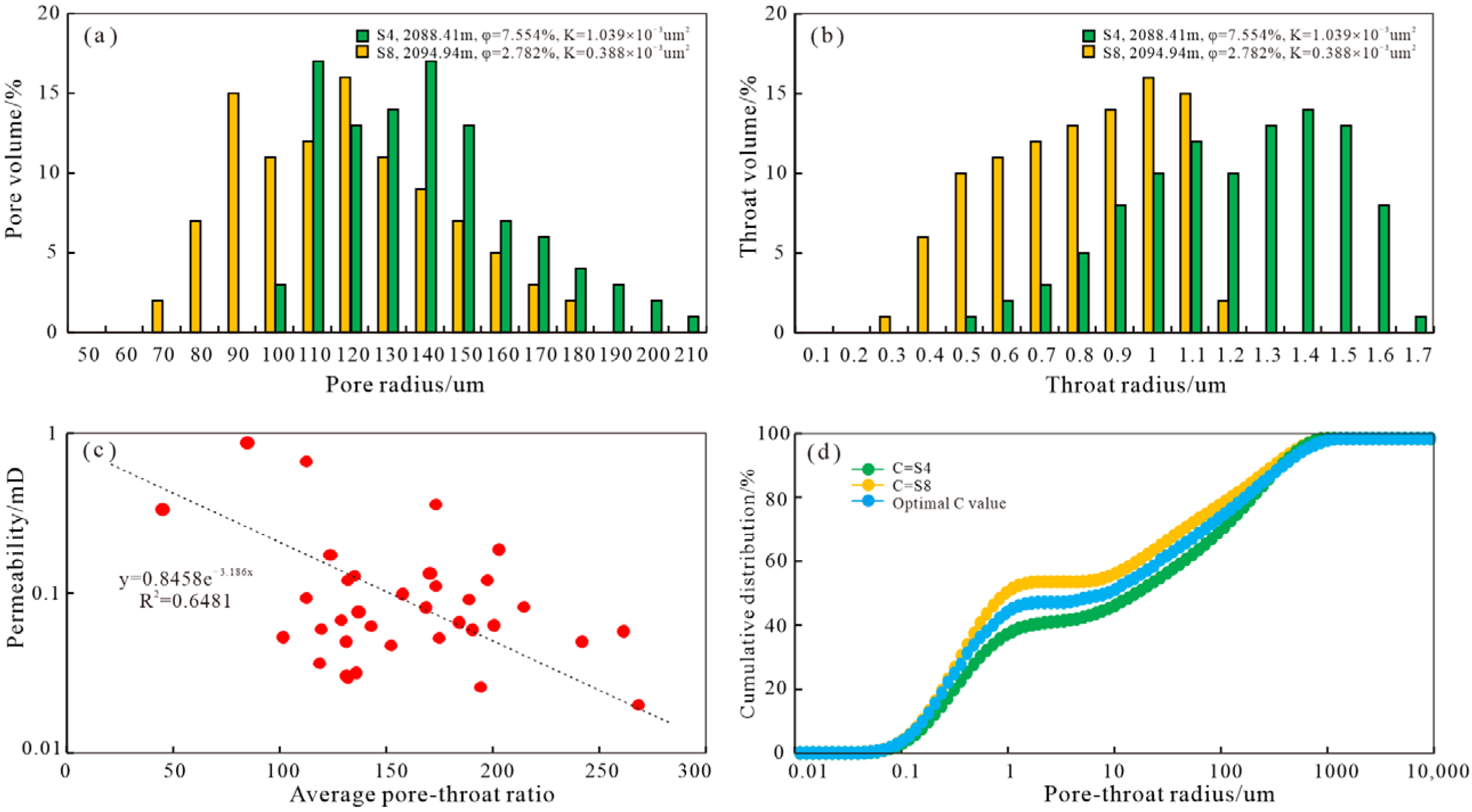
- The nuclear magnetic resonance T2 spectra of the tight sandstone samples from the study area display a bimodal pattern. As the quartz content diminishes, there is a reduction in the number of macropores, while isolated pores become more prevalent, leading to a deterioration in the connectivity of pore throats. The typical experimental results of three types of nuclear magnetic resonance, namely the right-biased bimodal type, bimodal type, and left-biased bimodal type, were obtained through saturated and centrifugal T2 spectra. For all the samples, the single fractal dimension parameter Dl exceeds Ds. In this study area, the single fractal parameters fail to fully explain the heterogeneity of the pore structure of the tight sandstone.
- (3)
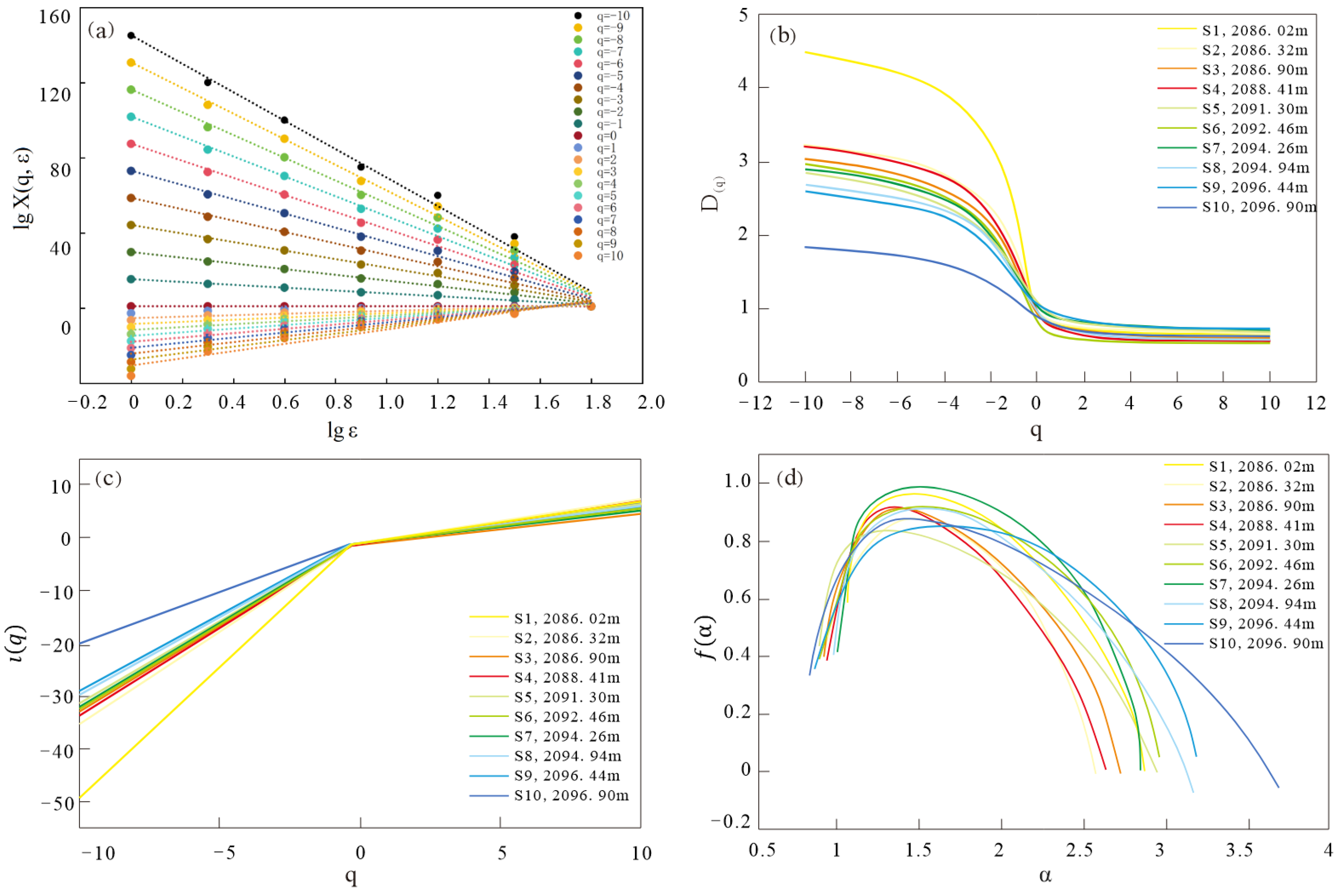
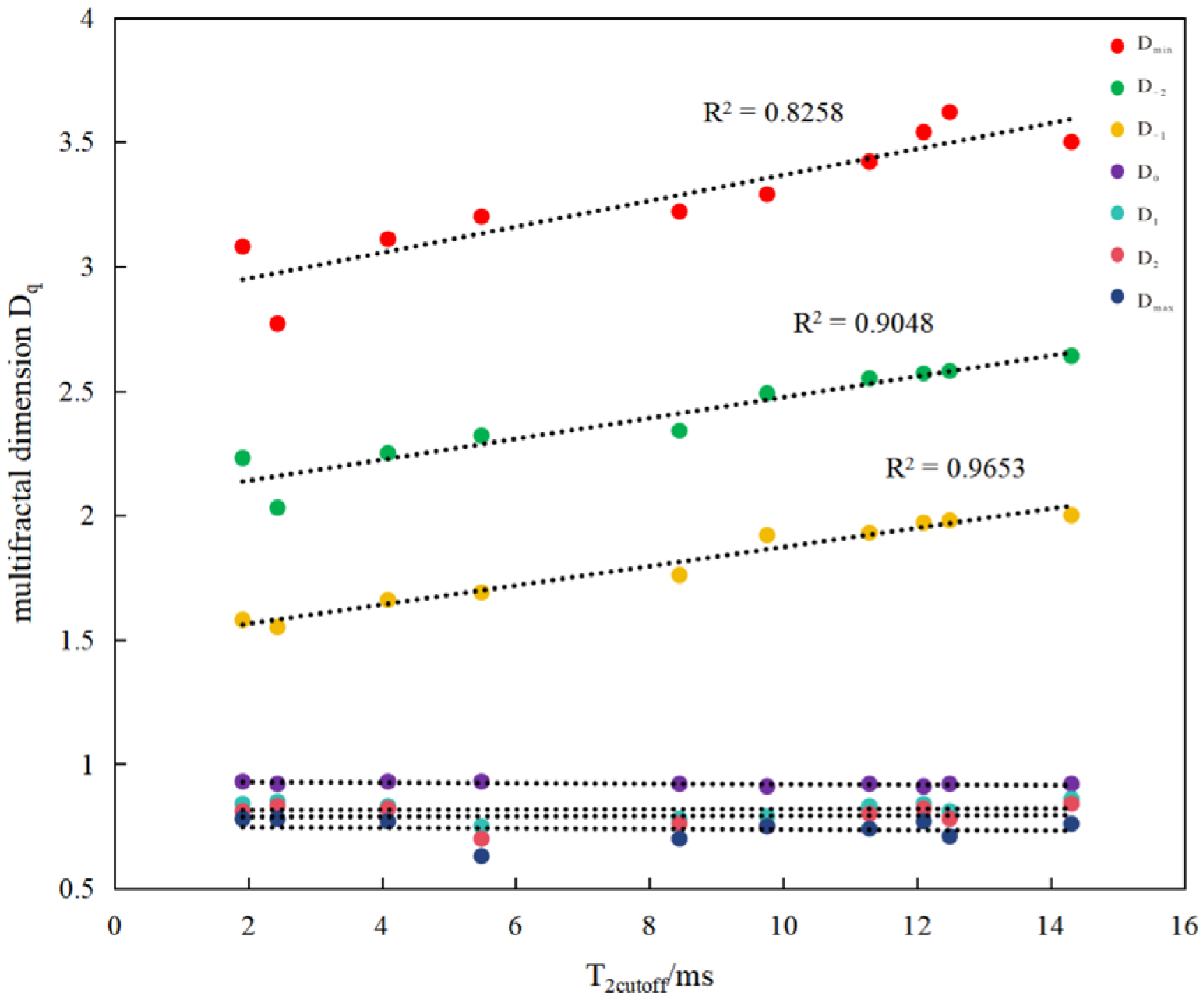
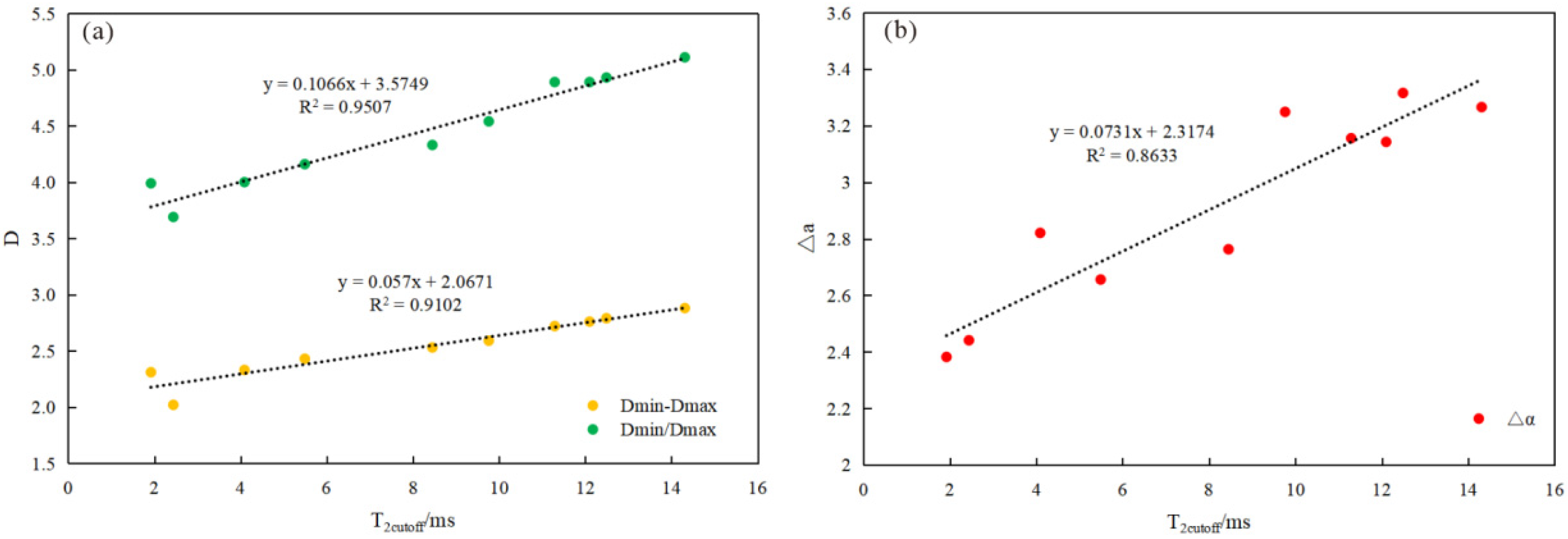
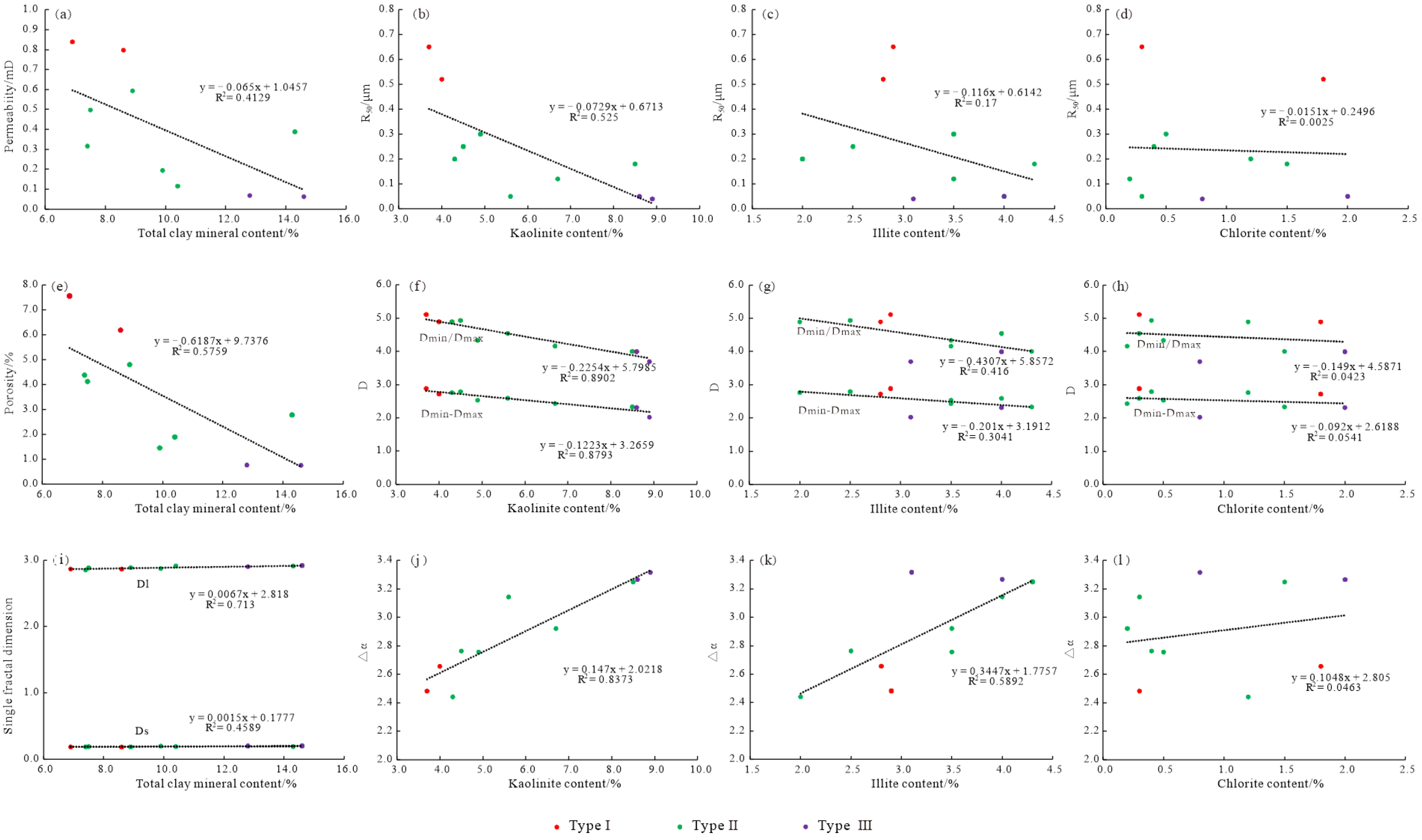
- The application of multifractal theory provides profound insights beyond single fractal analysis. The multifractal parameters can more precisely describe the pore development patterns controlled by different mineral components. Dmin-Dmax, Dmin/Dmax, and △α effectively quantify the overall heterogeneity of the pore network. Mineral composition has differentiated effects on fractal characteristics: Dmin-Dmax and Dmin/Dmax are positively correlated with quartz content, while they are negatively correlated with calcite and clay mineral (kaolinite, illite, chlorite) content. The increase in quartz content can retain more primary intergranular pores and promote dissolution, thus weakening pore heterogeneity. However, the increase in calcite and clay mineral content corresponded to the enhanced development of micropores and mesopores, thereby reducing the heterogeneity.
- (4)
- The pore structure classification method based on multiple fractal parameters can quantify the evolution of pore heterogeneity, thereby effectively evaluating the quality of the reservoir. In general, reservoirs with larger Dmin-Dmax and Dmin/Dmax values, smaller △α, weaker porosity heterogeneity, and better connectivity are favorable areas for hydrocarbon exploration and development in the study area.
Author Contributions
Funding
Data Availability Statement
Conflicts of Interest
Abbreviations
| NMR | Nuclear magnetic resonance |
| PMI | Pressure-controlled mercury injection |
| SEM | Scanning electron microscopy |
| XRD | X-ray diffraction |
| CTS | Computed Tomography scanning |
| D | Fractal dimension |
| Pd | Displacement pressure |
| P50 | Medium saturation pressure |
| Rmax | Maximum pore-throat radius |
| R50 | Median pore-throat radius |
| Smax | Maximum intrusion mercury saturation |
| Sp | Sorting factor |
| Sbou | Bound fluid saturation |
| Smov | Movable fluid saturation |
| R2 | Correlation coefficient |
| K | The slope of the fractal curve |
References
- Abuamarah, B.; Nabawy, B.; Shehata, A.; Kassem, O.; Ghrefat, H. Integrated geological and petrophysical characterization of oligocene deep marine unconventional poor to tight sandstone gas reservoir. Mar. Pet. Geol. 2019, 109, 868–885. [Google Scholar] [CrossRef]
- Wen, Z.; Wang, J.; Wang, Z.; He, Z.; Song, C.; Chen, R.; Liu, X.; Ji, T.; Li, Z. Analysis of the current status of global oil, gas, and associated resources exploration in 2023. Pet. Explor. Dev. 2024, 51, 1465–1479. [Google Scholar] [CrossRef]
- Deng, X.; Bai, B. Whole petroleum system and main controlling factors of hydrocarbon accumulation in the Mesozoic of Ordos Basin, NW China. Pet. Explor. Dev. 2025, 52, 1150–1163. [Google Scholar] [CrossRef]
- Su, N.; Song, F.; Qiu, L.; Zhang, W. Diagenetic evolution and densification mechanism of the Upper Paleozoic tight sandstones in the Ordos Basin, Northern China. J. Asian Earth Sci. 2021, 205, 104613. [Google Scholar] [CrossRef]
- Dai, J.; Dong, D.; Ni, Y.; Gong, D.; Huang, S.; Hong, F.; Zhang, Y.; Liu, Q.; Wu, X.; Feng, Z. Distribution patterns of tight sandstone gas and shale gas. Pet. Explor. Dev. 2024, 51, 767–779. [Google Scholar] [CrossRef]
- Alghamdi, F.; Alquraishi, A.; Amao, A.; Laboun, A.; Fattah, K.; Kahal, A.; Lashin, A. Depositional setting, mineralogical and diagenetic implication on petrophysical properties of unconventional gas reservoir of the silurian qusaiba formation, northwestern arabian peninsula. Geoenergy Sci. Eng. 2023, 223, 211563. [Google Scholar] [CrossRef]
- Dong, X.; Meng, X.; Pu, R. Impacts of mineralogy and pore throat structure on the movable fluid of tight sandstone gas reservoirs in coal measure strata: A case study of the Shanxi formation along the southeastern margin of the Ordos Basin. J. Pet. Sci. Eng. 2023, 220, 111257. [Google Scholar] [CrossRef]
- Sarhan, M.; Selim, E. Integrated petrophysical evaluation of conventional and unconventional reservoirs: The Matulla sandstones and Thebes carbonates in the Geisum Field, Gulf of Suez, Egypt. J. Afr. Earth Sci. 2026, 234, 105930. [Google Scholar] [CrossRef]
- Farouk, S.; Sarhan, M.; Sen, S.; Ahmad, F.; Alkahtany, K.; Reda, M. Evaluation of the Lower Cretaceous Alam El Bueib Sandstone reservoirs in Shushan Basin, Egypt—Implications for tight hydrocarbon reservoir potential. J. Afr. Earth Sci. 2024, 218, 105386. [Google Scholar] [CrossRef]
- Paul, A.; Mukherjee, S.; Biswas, M. Global review on shale: Focus on hydrocarbon geoscience & carbon sequestration. Results Earth Sci. 2025, 3, 100088. [Google Scholar] [CrossRef]
- Zhang, F.; Li, J.; Wei, G.; Liu, X.; Guo, J.; Li, J.; Fan, L.; She, Y.; Guan, H.; Yang, S.; et al. Formation mechanism of tight sandstone gas in areas of low hydrocarbon generation intensity: A case study of the Upper Paleozoic in north Tianhuan depression in Ordos Basin, NW China. Pet. Explor. Dev. 2018, 45, 79–87. [Google Scholar] [CrossRef]
- Tong, Z.; Zhang, J.; Li, Z.; Wu, Y.; Wang, D.; Gong, D. Investigation of organic-shale nanopores in the Lower Cambrian Niutitang Formation using low temperature N2 and CO2 adsorption: Multifractality and classification. Microporous Mesoporous Mater. 2022, 337, 111935. [Google Scholar] [CrossRef]
- Krakowska, P.; Puskarczyk, E.; Jędrychowski, M.; Habrat, M.; Madejski, P.; Dohnalik, M. Innovative characterization of tight sandstones from Paleozoic basins in Poland using X-ray computed tomography supported by nuclear magnetic resonance and mercury porosimetry. J. Pet. Sci. Eng. 2018, 166, 389–405. [Google Scholar] [CrossRef]
- Chen, S.; Yu, H.; Fan, W.; Arif, M. Micro-CT based observations of pore structure in tight sandstone and residual oil under CO2 and water flooding. Fuel 2026, 410, 137764. [Google Scholar] [CrossRef]
- Xiao, L.; Li, J.; Mao, Z.; Lu, J.; Yu, H.; GuoH, Y.; Li, G. A method to determine nuclear magnetic resonance (NMR) T2cutoff based on normal distribution simulation in tight sandstone reservoirs. Fuel 2018, 225, 472–482. [Google Scholar] [CrossRef]
- Li, X.; Wei, W.; Wang, L.; Ding, P.; Zhu, L.; Cai, J. A new method for evaluating the pore structure complexity of digital rocks based on the relative value of fractal dimension. Mar. Pet. Geol. 2022, 141, 105694. [Google Scholar] [CrossRef]
- Zheng, S.; Yao, Y.; Liu, D.; Cai, Y.; Liu, Y.; Li, X. Nuclear magnetic resonance T2 cutoffs of coals: A novel method by multifractal analysis theory. Fuel 2019, 241, 715–724. [Google Scholar] [CrossRef]
- Yin, L.; Wang, D.; Lu, J.; Jin, J.; Gao, J.; Liu, Y. Multifractal characteristics of slate pore structure based on nuclear magnetic resonance in cold region. Cold Reg. Sci. Technol. 2026, 242, 104733. [Google Scholar] [CrossRef]
- Liu, W.; Xiao, X.; Gao, P.; Zhao, Y.; Xing, Y.; Fan, Q.; Meng, G.; Li, J.; Zhou, Q.; Li, T.; et al. Nanopore characteristics of lower Cambrian shale based on gas adsorption and multifractal analysis: Implications for gas development and CO2 storage. Fuel 2026, 406, 137047. [Google Scholar] [CrossRef]
- Xu, C.; Wang, W.; Wang, K.; Guo, L.; Tong, Y.; Nie, Z.; Shi, Y. Non-homogeneous characterisation of nanopore structures in low-, medium- and high-rank coals based on gas adsorption and multifractal theory. Fuel 2025, 401, 135947. [Google Scholar] [CrossRef]
- Zhang, N.; Wang, X.; Wang, S.; Wang, R.; Wu, J.; Li, Z.; Song, Y. Multifractal characteristics on pore structure of Longmaxi shale using nuclear magnetic resonance (NMR). Geoenergy Sci. Eng. 2024, 241, 213176. [Google Scholar] [CrossRef]
- Yang, W.; Hou, J.; Liu, Y.; Dou, L.; Wang, X. The pore structures of different lithofacies in low-permeability sandy conglomerate reservoirs and their diagenetic impacts: A case study from the Es4 member of the northern steep slope in Dongying Depression, Bohai Bay Basin, NE China. Mar. Pet. Geol. 2022, 136, 105481. [Google Scholar] [CrossRef]
- Han, Y.; Jiang, Z.; Liang, Z.; Lai, Z.; Wu, Y.; Shi, X.; Duan, X.; Zhang, Y.; Li, Y. Study on the multifractal characterization and seepage of the shale matrix: A case study of the Longmaxi Formation in southwestern Sichuan Basin, China. Geoenergy Sci. Eng. 2024, 238, 212924. [Google Scholar] [CrossRef]
- Wang, D.; Hu, H.; Wang, T.; Tang, T.; Li, W.; Zhu, G.; Chen, X. Difference between of coal and shale pore structural characters based on gas adsorption experiment and multifractal analysis. Fuel 2024, 371, 132044. [Google Scholar] [CrossRef]
- Jiang, Z.; Mao, Z.; Shi, Y.; Wang, D. Multifractal Characteristics and Classification of Tight Sandstone Reservoirs: A Case Study from the Triassic Yanchang Formation, Ordos Basin, China. Energies 2018, 11, 2242. [Google Scholar] [CrossRef]
- Wang, J.; Jiang, F.; Hu, Q.; Zhang, C.; Yang, X.; Mo, W.; Wang, X.; Qi, Z. A quantitative model and controlling factors of secondary pore development for tight sandstone reservoirs in the carboniferous Benxi Formation, Ordos Basin, China. Mar. Pet. Geol. 2023, 148, 106034. [Google Scholar] [CrossRef]
- Hu, Y.; Guo, Y.; Zhang, J.; Shangguan, J.; Li, M.; Quan, F.; Li, G. A method to determine nuclear magnetic resonance T2 cutoff value of tight sandstone reservoir based on multifractal analysis. Energy Sci. Eng. 2019, 8, 1135–1148. [Google Scholar] [CrossRef]
- Zhao, H.; Guo, Y.; Yang, Z.; Du, X.; Hu, Y.; Kang, R.; Shangguan, J. Micro-pore multifractal characteristics of Benxi Formation sandstone reservoir in Gaoqiao area, Ordos Basin. Bull. Geol. Sci. Technol. 2020, 33, 175–184. [Google Scholar] [CrossRef]
- Zhao, D.; Hou, J.; Sarma, H.; Guo, W.; Liu, Y.; Xie, P.; Dou, L.; Chen, R.; Zhang, Z. Pore Throat Heterogeneity of Different Lithofacies and Diagenetic Effects in Gravelly Braided River Deposits: Implications for Understanding the Formation Process of High-Quality Reservoirs. Geoenergy Science and Engineering 2023, 221, 111309. [Google Scholar] [CrossRef]
- Jácomo, M.; Hartmann, G.; Oliveira, E.; Rojas, D.; Leite, E. Estimating nuclear magnetic resonance transverse surface relaxivity in pre-salt carbonates of the Santos Basin, Brazil. J. Appl. Geophys. 2025, 242, 105913. [Google Scholar] [CrossRef]
- Xu, Y.; Li, X.; Wu, X.; Zheng, W.; Zhou, B.; Tong, J. Experimental study on pore fluid characteristics of fractured sandstone based on nuclear magnetic resonance technology. J. Pet. Sci. Eng. 2022, 214, 110408. [Google Scholar] [CrossRef]
- Zhou, Y.; Wu, S.; Zhu, R.; Jiang, X.; Hua, G. A new model for determining the effective permeability of tight reservoirs based on Fractal-Monte Carlo method. Pet. Sci. 2025, 22, 3101–3118. [Google Scholar] [CrossRef]
- Min, B.; Xiong, G. Multivariate singularity power spectrum distribution and its application to radar target detection. Chaos Solitons Fractals 2026, 205, 117851. [Google Scholar] [CrossRef]
- Zhu, W.; He, X.; Lei, G.; Wang, M. Complexity analysis of three-dimensional stochastic discrete fracture networks with fractal and multifractal techniques. J. Struct. Geol. 2022, 162, 104690. [Google Scholar] [CrossRef]
- Kong, X.; Fan, H.; Fan, T.; Gao, Y.; Wang, H.; Mu, P.; Xiao, D. Fractal research on pores in oil and gas reservoirs—Inspirations from over 700 high pressure mercury injection experiments. Mar. Pet. Geol. 2024, 170, 107086. [Google Scholar] [CrossRef]
- Zhou, Y.; Wu, S.; Zhu, R.; Jiang, X.; Hua, G. A novel intermingled fractal model for predicting relative permeability in tight oil reservoirs considering microscopic pore geometry. Pet. Sci. 2025, 22, 3880–3899. [Google Scholar] [CrossRef]
- Zhao, P.; Wang, Z.; Sun, Z.; Cai, J.; Wang, L. Investigation on the pore structure and multifractal characteristics of tight oil reservoirs using NMR measurements: Permian Lucaogou Formation in Jimusaer Sag, Junggar Basin. J. Nat. Gas Geosci. 2017, 86, 1067–1081. [Google Scholar] [CrossRef]
- Ge, X.; Fan, Y.; Zhu, X.; Chen, Y.; Li, R. Determination of nuclear magnetic resonance T2 cutoff value based on multifractal theory-An application in sandstone with complex pore structure. Geophysics 2015, 80, D11–D21. [Google Scholar] [CrossRef]
- Zhang, N.; Wang, S.; Li, Z.; Guo, S.; Wang, R. Application of Multifractal Theory for Determination of Fluid Movability of Coal-Measure Sedimentary Rocks Using Nuclear Magnetic Resonance (NMR). Fractal Fract. 2023, 7, 503. [Google Scholar] [CrossRef]
- Chen, X.; Zhang, R.; Zhao, X.; Yang, J.; Lan, Z.; Luo, C.; Cai, J. Multifractal estimation of NMR T2 cut-off value in low-permeability rocks considering spectrum kurtosis: SMOTE-based oversampling integrated with machine learnin. Pet. Sci. 2023, 20, 3411–3427. [Google Scholar] [CrossRef]
- Liu, C.; Ning, Z.; Cole, D.; Wang, Q.; Chen, M. Experimental investigation on T2 cutoffs of tight sandstones: Comparisons between outcrop and reservoir cores. J. Pet. Sci. Eng. 2020, 191, 107184. [Google Scholar] [CrossRef]
- Sun, W.; Zuo, Y.; Wu, Z.; Liu, H.; Xi, S.; Shui, Y.; Wang, J.; Liu, R.; Lin, J. Fractal analysis of pores and the pore structure of the Lower Cambrian Niutitang shale in northern Guizhou province: Investigations using NMR, SEM and image analyses. Mar. Pet. Geol. 2019, 99, 416–428. [Google Scholar] [CrossRef]
- Zhu, X.; Lu, J.; Li, Y.; He, Q.; Li, S.; Xiao, Z.; Jiang, Q.; Chen, R.; Shi, W. Full-scale pore structure characterization and main controlling factors of marine–continental transitional shale and coal reservoirs in the Shanxi Formation, Ordos Basin, China. J. Nat. Gas Geosci. 2025, 10, 383–397. [Google Scholar] [CrossRef]
- Melo, M.; Guimarães, G.; Chinelatto, A.; Giannini, P.; Pontes, H.; Chinelatto, A.; Atencio, D. Kaolinite, illite and quartz dissolution in the karstification of Paleozoic sandstones of the Furnas Formation, Paraná Basin, Southern Brazil. J. South Am. Earth Sci. 2015, 63, 20–35. [Google Scholar] [CrossRef]
- Luo, D.; Zhang, J.; Luo, J.; Feng, Z.; Deng, C.; Bai, Y.; Shao, H.; Yan, M.; Tan, Z. Effects of smectite-illitization and hydrocarbon generation on the pore structure: A case study from the continental shales in China. J. Palaeogeogr. 2026, 15, 100298. [Google Scholar] [CrossRef]
- Chen, J.; Li, Q.; Zhu, R.; Mao, Z.; Chen, H. Crystal chemistry and formation of authigenic chlorite: Influence on tight sandstone reservoir in the Yanchang formation, Ordos Basin, China. Mar. Pet. Geol. 2024, 165, 106874. [Google Scholar] [CrossRef]
- Xu, X.; Zeng, L.; Dong, S.; Li, H.; Liu, J.; Ji, C. The characteristics and controlling factors of high-quality reservoirs of ultra-deep tight sandstone: A case study of the Dabei Gas Field, Tarim Basin, China. Pet. Sci. 2025, 22, 3473–3496. [Google Scholar] [CrossRef]
- Zhu, G.; Jin, J.; Xiao, Q.; Wang, L.; Sheng, G.; Tang, J.; Meng, J.; Lu, Z.; Chen, C. Key geological and engineering technologies and research directions for shale gas exploration and development in western Hubei Province, China. Energy Geosci. 2025, 6, 100460. [Google Scholar] [CrossRef]




| Sample Number | Depth (m) | Density (g/cm3) | Porosity (%) | Permeability (mD) |
|---|---|---|---|---|
| S1 | 2086.02 | 2.515 | 4.382 | 0.316 |
| S2 | 2086.32 | 2.523 | 4.127 | 0.497 |
| S3 | 2086.90 | 2.514 | 6.184 | 0.797 |
| S4 | 2088.41 | 2.522 | 7.554 | 0.839 |
| S5 | 2091.30 | 2.526 | 1.893 | 0.115 |
| S6 | 2092.46 | 2.522 | 1.461 | 0.094 |
| S7 | 2094.26 | 2.526 | 4.837 | 0.593 |
| S8 | 2094.94 | 2.521 | 2.782 | 0.388 |
| S9 | 2096.44 | 2.526 | 0.759 | 0.062 |
| S10 | 2096.90 | 2.524 | 0.771 | 0.068 |
| Sample Number | Detrital Components | Interstitial Components | |||||||
|---|---|---|---|---|---|---|---|---|---|
| Quartz | Feldspar | Lithic Fragments | Calcite | Dolomite | Pyrite | Kaolinite | Illite | Chlorite | |
| S1 | 78.2 | 0.1 | 8.5 | 4.9 | 0.2 | 0.7 | 4.5 | 2.5 | 0.4 |
| S2 | 80.8 | 0.2 | 8.5 | 2.2 | 0.3 | 0.5 | 4.3 | 2.0 | 1.2 |
| S3 | 84.6 | 0.2 | 4.0 | 2.2 | 0.0 | 0.4 | 4.0 | 2.8 | 1.8 |
| S4 | 87.5 | 0.1 | 3.0 | 2.4 | 0.1 | 0.0 | 3.7 | 2.9 | 0.3 |
| S5 | 66.3 | 0.3 | 15.5 | 7.4 | 0.0 | 0.1 | 6.7 | 3.5 | 0.2 |
| S6 | 67.7 | 0.5 | 16.5 | 4.9 | 0.3 | 0.2 | 5.6 | 4.0 | 0.3 |
| S7 | 77.3 | 0.1 | 6.0 | 6.2 | 0.4 | 1.1 | 4.9 | 3.5 | 0.5 |
| S8 | 71.7 | 0.5 | 10.0 | 2.7 | 0.5 | 0.3 | 8.5 | 4.3 | 1.5 |
| S9 | 67.4 | 0.2 | 9.2 | 8.2 | 0.3 | 0.1 | 8.6 | 4.0 | 2.0 |
| S10 | 63.7 | 0.3 | 15.5 | 7.3 | 0.1 | 0.3 | 8.9 | 3.1 | 0.8 |
| Sample Number | Depth (m) | Porosity (%) | Permeability (mD) | Pd (MPa) | P50 (MPa) | Rmax (μm) | R50 (μm) | Smax (%) | Sp | Type |
|---|---|---|---|---|---|---|---|---|---|---|
| S1 | 2086.02 | 4.382 | 0.316 | 0.7 | 2.8 | 1.7 | 0.3 | 79.5 | 2.3 | II |
| S2 | 2086.32 | 4.127 | 0.497 | 0.8 | 3.0 | 1.6 | 0.2 | 78.7 | 2.6 | II |
| S3 | 2086.90 | 6.184 | 0.797 | 0.7 | 1.6 | 2.7 | 0.5 | 88.8 | 2.0 | I |
| S4 | 2088.41 | 7.554 | 0.839 | 0.6 | 0.7 | 2.8 | 0.7 | 82.3 | 1.9 | I |
| S5 | 2091.30 | 1.893 | 0.115 | 1.1 | 10.9 | 0.6 | 0.1 | 80.6 | 2.3 | II |
| S6 | 2092.46 | 1.461 | 0.094 | 1.4 | 16.6 | 0.5 | 0.1 | 72.3 | 3.0 | II |
| S7 | 2094.26 | 4.837 | 0.593 | 1.0 | 16.8 | 1.1 | 0.3 | 81.0 | 2.1 | II |
| S8 | 2094.94 | 2.782 | 0.388 | 1.1 | 12.9 | 1.1 | 0.2 | 75.7 | 2.9 | II |
| S9 | 2096.44 | 0.759 | 0.062 | 1.5 | 49.9 | 0.3 | 0.1 | 62.6 | 4.0 | III |
| S10 | 2096.90 | 0.771 | 0.068 | 1.6 | 61.4 | 0.2 | 0.0 | 62.0 | 3.4 | III |
| Sample Number | NMR Experimental Parameters | Single Fractal Parameters | |||||||
|---|---|---|---|---|---|---|---|---|---|
| T2cutoff (ms) | Sbou (%) | Smov (%) | Ks | Ds | R2 | Kl | Dl | R2 | |
| S1 | 12.49 | 43.08 | 56.92 | 0.9182 | 2.0818 | 0.9127 | 0.1482 | 2.8518 | 0.9434 |
| S2 | 12.10 | 56.38 | 43.62 | 0.9471 | 2.0529 | 0.9210 | 0.1172 | 2.8828 | 0.9397 |
| S3 | 11.29 | 48.68 | 51.32 | 0.9394 | 2.0606 | 0.9156 | 0.1357 | 2.8643 | 0.9211 |
| S4 | 14.31 | 48.16 | 51.84 | 0.9582 | 2.0418 | 0.9254 | 0.1345 | 2.8655 | 0.9205 |
| S5 | 5.49 | 58.96 | 41.04 | 0.9285 | 2.0715 | 0.9194 | 0.0896 | 2.9104 | 0.9331 |
| S6 | 9.76 | 64.96 | 35.04 | 0.9487 | 2.0513 | 0.9235 | 0.1269 | 2.8731 | 0.9405 |
| S7 | 8.45 | 57.15 | 42.85 | 0.9366 | 2.0634 | 0.9182 | 0.1135 | 2.8865 | 0.9242 |
| S8 | 4.09 | 57.15 | 42.85 | 0.9421 | 2.0579 | 0.9215 | 0.0898 | 2.9102 | 0.9398 |
| S9 | 1.92 | 60.68 | 39.32 | 0.9241 | 2.0759 | 0.9172 | 0.0815 | 2.9185 | 0.9559 |
| S10 | 2.44 | 71.37 | 28.63 | 0.9191 | 2.0809 | 0.9191 | 0.0998 | 2.9002 | 0.9372 |
| Parameters | p-Value | Confidence Interval | Correlation Index |
|---|---|---|---|
| Dl and porosity | 0.0564 | [−0.9207, −0.1118] | 0.48 |
| Dl and permeability | 0.0962 | [−0.8777, −0.1154] | 0.31 |
| Ds and porosity | 0.1079 | [−0.8725, −0.1372] | 0.29 |
| Ds and permeability | 0.0563 | [−0.9049, −0.0168] | 0.41 |
| Sample Number | Dmin | D−2 | D−1 | D0 | D1 | D2 | Dmax | Dmin-Dmax | Dmin/Dmax | △α |
|---|---|---|---|---|---|---|---|---|---|---|
| S1 | 3.62 | 2.58 | 1.98 | 0.92 | 0.81 | 0.78 | 0.71 | 2.79 | 4.93 | 2.763 |
| S2 | 3.54 | 2.57 | 1.97 | 0.91 | 0.84 | 0.82 | 0.77 | 2.76 | 4.89 | 2.441 |
| S3 | 3.42 | 2.55 | 1.93 | 0.92 | 0.83 | 0.80 | 0.74 | 2.72 | 4.89 | 2.656 |
| S4 | 3.50 | 2.64 | 2.00 | 0.92 | 0.86 | 0.84 | 0.76 | 2.88 | 5.11 | 2.482 |
| S5 | 3.20 | 2.32 | 1.69 | 0.93 | 0.75 | 0.70 | 0.63 | 2.43 | 4.16 | 2.921 |
| S6 | 3.29 | 2.49 | 1.92 | 0.91 | 0.79 | 0.75 | 0.75 | 2.59 | 4.54 | 3.143 |
| S7 | 3.22 | 2.34 | 1.76 | 0.92 | 0.78 | 0.76 | 0.70 | 2.53 | 4.33 | 2.756 |
| S8 | 3.11 | 2.25 | 1.66 | 0.93 | 0.83 | 0.82 | 0.77 | 2.33 | 4.00 | 3.249 |
| S9 | 3.08 | 2.23 | 1.58 | 0.93 | 0.84 | 0.81 | 0.78 | 2.31 | 3.99 | 3.266 |
| S10 | 2.77 | 2.03 | 1.55 | 0.92 | 0.85 | 0.83 | 0.78 | 2.02 | 3.69 | 3.316 |
Disclaimer/Publisher’s Note: The statements, opinions and data contained in all publications are solely those of the individual author(s) and contributor(s) and not of MDPI and/or the editor(s). MDPI and/or the editor(s) disclaim responsibility for any injury to people or property resulting from any ideas, methods, instructions or products referred to in the content. |
© 2026 by the authors. Licensee MDPI, Basel, Switzerland. This article is an open access article distributed under the terms and conditions of the Creative Commons Attribution (CC BY) license.
Share and Cite
Liu, P.; Liu, Y.; Hou, J.; Bao, L.; Chen, Q. Multifractal Characteristics of Tight Sandstone Pore Structure Based on Nuclear Magnetic Resonance in Benxi Formation, Ordos Basin, China. Fractal Fract. 2026, 10, 153. https://doi.org/10.3390/fractalfract10030153
Liu P, Liu Y, Hou J, Bao L, Chen Q. Multifractal Characteristics of Tight Sandstone Pore Structure Based on Nuclear Magnetic Resonance in Benxi Formation, Ordos Basin, China. Fractal and Fractional. 2026; 10(3):153. https://doi.org/10.3390/fractalfract10030153
Chicago/Turabian StyleLiu, Peipei, Yuming Liu, Jiagen Hou, Lei Bao, and Qi Chen. 2026. "Multifractal Characteristics of Tight Sandstone Pore Structure Based on Nuclear Magnetic Resonance in Benxi Formation, Ordos Basin, China" Fractal and Fractional 10, no. 3: 153. https://doi.org/10.3390/fractalfract10030153
APA StyleLiu, P., Liu, Y., Hou, J., Bao, L., & Chen, Q. (2026). Multifractal Characteristics of Tight Sandstone Pore Structure Based on Nuclear Magnetic Resonance in Benxi Formation, Ordos Basin, China. Fractal and Fractional, 10(3), 153. https://doi.org/10.3390/fractalfract10030153