Article

Dynamic Dehydration Characteristics of Macerals in Lignite During Drying and Their Effects on Pore–Fracture Evolution and Physico-Mechanical Properties

1
State Key Laboratory of Intelligent Construction and Healthy Operation and Maintenance of Deep Underground Engineering, China University of Mining and Technology, Xuzhou 221116, China
2
School of Civil Engineering, Xinjiang Institute of Engineering, Urumqi 830023, China
3
School of Architecture Engineering, Xuzhou College of Industrial Technology, Xuzhou 221116, China
4
School of Geology and Mining Engineering, Xinjiang University, Urumqi 830047, China
*
Author to whom correspondence should be addressed.
Fractal Fract. 2026, 10(3), 152; https://doi.org/10.3390/fractalfract10030152
Submission received: 21 January 2026 / Revised: 22 February 2026 / Accepted: 24 February 2026 / Published: 26 February 2026
(This article belongs to the Section Engineering)

Abstract

Understanding the changes in physical and mechanical properties of lignite during dehydration is crucial for its sustainability in coal mining, exploitation of coalbed methane, and carbon dioxide sequestration. Through SEM and Computed Tomography (CT) scanning, combined with fractal theory, this study investigates dynamic dehydration characteristics of macerals in lignite during normal temperature drying (NTD), and their effects on pore–fracture development and physic–mechanical property evolution. The results show that the hard layers of lignite are mainly composed of ulminite (Ul), while the soft layers are primarily composed of fusinite (Fu), densinite (De), and Ul. Ul exhibits low dehydration efficiency but is prone to shrinkage and cracking heavily, whereas Fu has high dehydration efficiency and excellent thermal stability. The layered enrichment of macerals controls the development of the three-dimensional (3D) pore–fracture structures of lignite during NTD and leads to distinct cracking characteristics of fracture structures between hard and soft layers. Unlike soft layers, hard layers tend to form long, straight fracture structures with large apertures and exhibit extremely high fracture connectivity and fractal dimension (FD). In addition, the differential drying behavior of macerals causes the physical parameters of lignite such as moisture ratio (MR), drying rate (DR), and density (ρ) to show a dynamic evolution characteristic of “initial rapid decline (or increase) in the early stage–subsequent gradual decline (or increase) and stabilization in the later stage” during NTD. The unique pore–fracture structure controlled by macerals significantly alters the deformation resistance and failure mode of dehydrated lignite under uniaxial compression but has limited effect on its uniaxial compressive strength.

1. Introduction

The abundant reserves, low mining cost, and the contraction of high-rank coal production have gradually made lignite an important component of China’s energy supply system [1,2]. Nonetheless, due to its high natural water content and poor thermal stability [3,4,5,6], lignite is highly prone to dehydration and cracking in open-air environments, leading to the intense development of its pore–fracture structures and significant deterioration of its mechanical properties [7,8,9]. This will remarkably increase the risk of excessive deformation or even collapse of geological engineering rock masses such as roadways and wellbores [10,11]. Therefore, investigating the water loss, shrinkage and cracking characteristic of lignite in open-air environments is of critical significance for its sustainability in coal mining, exploitation of coalbed methane, and carbon dioxide sequestration [12,13,14].
Given that its properties are highly susceptible to external environmental influences [15,16,17], various researchers have investigated the drying behavior of lignite under different dehydration conditions and achieved numerous valuable results [9,18,19]. However, existing studies have not fully addressed the impact of microstructure on its drying behavior. Although an increasing number of studies have begun to focus on the evolution of the pore structure of lignite during the drying process [20,21,22], and its correlation with macroscopic physical quantities [23,24,25,26], these studies rarely involve the role of macerals during the drying process. Some studies have shown that the macerals of lignite have a significant impact on microstructural parameters such as its pore size types, pore volume, and connectivity [27,28,29]. Some scholars have even preliminarily revealed the differential water loss and cracking characteristics of each maceral and their influence laws on the dehydration rate and fracture development mode of lignite by combining scanning electron microscope (SEM), nuclear magnetic resonance (NMR), and CT technologies [7]. However, the dynamic dehydration characteristics of the macerals in lignite during the drying process and their effects on the overall dynamic water loss, shrinkage, and cracking behavior of lignite still need further research. Tests on rock samples that have experienced different environmental damages show that the deterioration of the pore–fracture structure is a key factor leading to significant changes in the physical and mechanical properties such as the P-wave velocity, elastic modulus, and compressive strength of the rock samples [30,31,32,33]. However, some investigators only studied the influence of the evolution of the pore–fracture system of lignite affected by macerals on its microscopic mechanical properties during NTD [34]. Detailed discussion on how the dehydration characteristics of macerals affect its macroscopic mechanical properties remains lacking.
Fractal theory provides a quantifiable mathematical framework for analyzing the complexity and heterogeneity of pore–fracture structures in rock and has been widely adopted in geological research [35,36,37]. As a core parameter in fractal theory, the fractal dimension reveals the spatial distribution characteristics of pore–fracture structures by quantifying their surface roughness and overall irregularity, thereby laying a theoretical foundation for the reliable evaluation of the evolution of macroscopic physical and mechanical properties of rocks under complex engineering geological conditions [38,39]. The commonly used calculation methods include the sphere model method [40], the Frenkel–Halsey–Hill method [41], and the box-counting method [42]. Among them, the box-counting method has been widely applied to calculate the fractal dimension of pore–fracture structures in rock due to its high computability and effective characterization capability for the spatial distribution characteristics of fractal objects [43]. Furthermore, the two-dimensional (2D) FD can effectively reflect the complexity distribution of 3D pore–fracture structures along a specific 2D plane, while the 3D FD can better characterize their overall complexity. Therefore, the combined use of these two FD values can better reveal the spatial distribution characteristics of pore–fracture structures in rock [44].
It is worth noting that recent research conducted by scholars in Dynamics in Fractal Spaces has established a unifying theoretical framework that connects fractal geometry, fractal derivatives, and dynamical equations [45,46,47,48]. These frameworks provide powerful mathematical tools for describing anomalous diffusion, memory-dependent deformation, and scale-dependent transport processes in heterogeneous media with fractal characteristics [49,50]. It has been verified that the initiation and propagation of pore–fracture structures with fractal characteristics during coal dehydration, as well as the advection–diffusion of moisture within these pore–fracture structures, all belong to typical anomalous dynamical processes [25,51]. Moreover, some scholars have successfully applied spatial fractional constitutive equations to clarify the migration behavior of non-Newtonian hole-sealing slurry in fracture networks of coal seams [52]. This will effectively guide the present study to adopt the aforementioned theoretical framework to accurately reveal the evolution of pore–fractures within different macerals of lignite and the dynamic migration behavior of moisture during NTD in subsequent research.
In summary, existing studies have mainly focused on the evolution of the mesoscopic pore–fracture structure and macroscopic drying kinetics of lignite under different dehydration conditions. However, during the NTD process, the dynamic dehydration characteristics of macerals in lignite, their controlling effect on the development of mesoscopic pore–fracture structures, and their influence on the evolution of macroscopic physical and mechanical properties remain unclear. In view of this, a series of experiments (CT scanning, uniaxial compression tests, etc.) were conducted to reveal the dynamic dehydration characteristics of the main macerals in lignite during NTD, the dynamic development of pore and fracture structures, the evolution characteristics of physical and mechanical properties, and their correlations. First, the microstructures of main macerals in different lignite layers and their dynamic dehydration characteristics during NTD were studied based on SEM and CT technologies. Subsequently, by calculating the slice-by-slice porosity and 2D FD in three directions, the influence of macerals on the dynamic development of the 3D pore–fracture structures of lignite was quantitatively analyzed. Meanwhile, the fracture structures in hard and soft layers were quantitatively analyzed using Avizo 2023 and Image J 1.54p software to clarify the effects of Ul and Fu on the cracking patterns of fracture structures in different layers. Finally, the evolution characteristics of various physical properties and uniaxial compressive mechanical properties of lignite during NTD under the influence of macerals with differentiated dehydration characteristics were discussed. The evolution of macroscopic physical and mechanical properties controlled by macerals revealed in this study can facilitate the design of coal roadway support for lignite mining engineering. Meanwhile, the evolution of pore–fractures dominated by macerals is conducive to the effective evaluation of coalbed methane drainage capacity and CO2 sequestration potential of lignite reservoirs.

2. Experiments and Methods

2.1. Test Sample

The samples in this research were collected from the 1302 working face of Xiyi Coal Mine in Xilingol region, Inner Mongolia. The third-party testing organization has systematically tested the basic information of lignite in accordance with the corresponding Chinese Standards, including Proximate analysis, XRD analysis, coal reflectance, and maceral quantity measurements. The results are presented in Table 1.
Microscopic examination showed that the main maceral groups in lignite are huminite and inertinite, with contents of 51.81% and 45.46%, respectively. Liptinite has the lowest content, accounting for only 2.74% of the total. Moreover, the Ro of the lignite is 0.28%. According to the Chinese classification of in seam coals (GB/T17607-1998) [53], the lignite is identified as low-rank subbituminous coal.
Proximate analysis shows that the lignite is characterized by high volatile matter, high moisture, and low fixed carbon content, which is determined by the different genesis of the macerals in lignite [7,54]. Specifically, the huminite is formed by the water absorption, swelling, and gelification of plant tissues during coalification. Therefore, the higher the huminite content, the higher the moisture content and volatile matter yield of the lignite. While the inertinite is formed when plant tissues undergo a complex carbonization process, including deoxygenation and dehydrogenation reactions during coalification, the higher its content, the higher the fixed carbon content. The occurrence characteristics of these two components jointly determine the results of the proximate analysis of lignite (Table 1). It should be noted that lignite ash yield of up to 16.94% is mainly influenced by the content of minerals and their oxides and has no apparent correlation with maceral.
The XRD analysis results indicate that kaolinite is the main mineral type of lignite in this area, which is mainly related to the sedimentary environment and hydrodynamic conditions. Due to the low total mineral content of lignite, it can be expected that the minerals have less influence on the lignite heterogeneity, and the difference in macerals is the main factor controlling the physical and mechanical properties of the lignite.
To avoid dehydration and oxidation, the large lignite blocks were wrapped with fresh-keeping film and transported to the laboratory immediately. After removing the surface oxide layer, the fresh inner core was drilled, cut, and ground into Φ 25 mm × 50 mm cylindrical specimens and 50 mm × 100 mm cuboid samples according to the Standard for Test Methods of Engineering Rock Mass (GB/T 50266-2013) [55], which were used for different experiments such as drying tests and CT scanning experiments, etc. Note that all the specimens were drilled parallel to the sedimentary plane to reduce the impact of sample variability on the test results, and all the prepared samples were wrapped tightly in fresh-keeping film to prevent them from dehydration and cracking in the open-air environment.

2.2. Drying Experiments

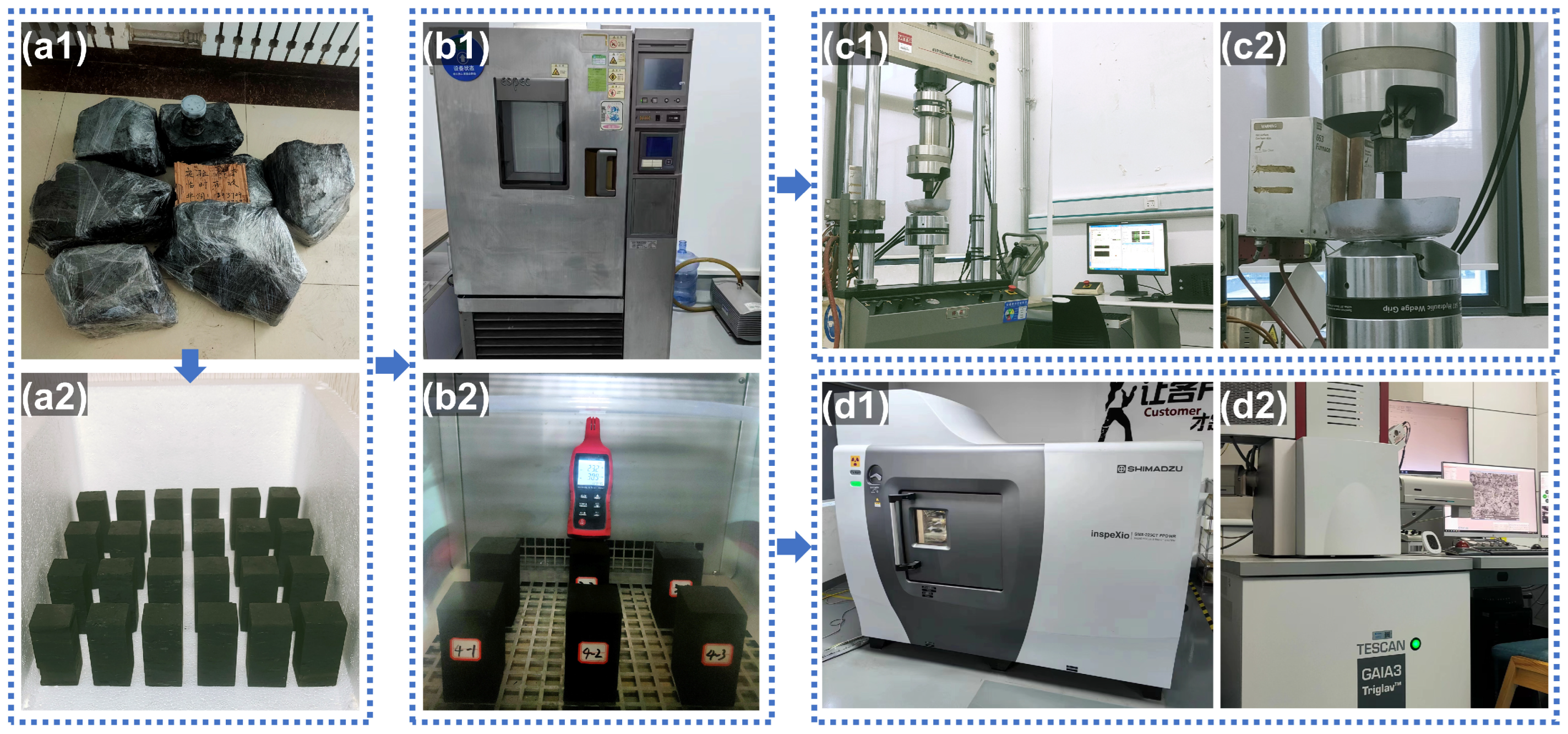
To study the changes in the macroscopic physical properties of lignite during the dehydration process, three cylindrical samples of size Φ 25 mm × 50 mm were subjected to NTD experiments using an environmental test chamber (Espec SETH-2-021L, Japan ESPEC CORP., Osaka, Japan, Figure 1(b1,b2)). The temperature and the relative humidity of the chamber were controlled at 23.5° and 31.3% during the NTD test, respectively, which is consistent with the average of the sampling site at the working face. Considering that when the water content is too low, the cylindrical samples tend to fragment completely, making it impossible to perform other experiments such as uniaxial compression tests. Therefore, the maximum drying time of the lignite samples was set for 72 h in this study (the water content can be reduced by up to 73% approximately), which is sufficient to assist us in understanding the evolution of physical properties during dehydration.
During the NTD test, the mass, diameter and height of the lignite samples were measured at variable time intervals by an electronic balance with a precision of 0.001 g and a vernier caliper with an accuracy of 0.01 mm. The specific test procedure was as follows: at the early stage of drying (0–12 h), measurements were taken every 1 h to accurately obtain the characteristics of the rapid changes in the physical properties during the phase when the moisture content of the samples drops sharply. Afterward, measurements were continued at a longer time interval (increased from 2 h, 8 h to 12 h) until the end of the experiment. Once the experiment was completed, the samples were immediately dried in a drying oven at 110 °C for 24 h and weighed to obtain their residual water content according to the Standard for Test Methods of Engineering Rock Mass (GB/T 50266-2013). Based on the residual water content, the moisture content (ωt, %) and moisture ratio (MR) at each measuring time point can be fully computed by the following equations:
ω t = m t m e m t × 100 %
M R = m t m e m 0 m e
where m0 is the initial mass (g) of the lignite sample, mt represents the sample weight (g) at time t, me is the final weight of the sample (g) after drying in the oven.
Using the calculated MR, the drying rate (DR, g/(g∙h−1)) was calculated using Equation (3) as follows:
D R = d M R d t
According to the height (H, mm), diameter (D, mm), volume (V, mm3), and mass (mt, g) of lignite samples measured in the drying process, the evolution laws of the axial strain, circumferential strain, and density (ρ, g.cm−3) were obtained in accordance with the Standard for Test Methods of Engineering Rock Mass (GB/T 50266-2013). Furthermore, the volume strain (εv) could be computed by Equation (4) as follows:
ε v = 2 ε x + ε y
where εx and εy are the circumferential strain and axial strain, respectively.

2.3. Uniaxial Compression Tests

The dehydration effect of lignite not only significantly changes its physical properties but also evidently affects its macroscopic mechanical behavior [12,34]. To explore the influence of the dehydration-induced cracking characteristics of lignite on its macroscopic mechanical properties during NTD, we conducted uniaxial compression tests on lignite samples with dehydration times of 0 h, 8 h, and 72 h, respectively.
MTS810 Rock Mechanics Test Systems (MTS Systems Corporation, Eden Prairie, MN, USA) was adopted in the uniaxial compression experiments with the test procedure recommended in Standard for Test Methods of Engineering Rock Mass (GB/T 50266-2013) (Figure 1(c1,c2)). The system consists of a test unit, a loading unit, and a control unit, and it is equipped with a servo-controlled full-automatic pressurization and data acquisition system that can automatically record the axial load and displacement in real time. Its maximum axial load is up to 100 kN with ±0.5% accuracy of applied load, suitable for various soft rock mechanical tests.
The experiment involves 18 cylindrical samples sized φ25 mm × 50 mm. These samples are grouped into three groups according to their designed dehydration time, representing three drying states of the lignite: natural state, 8 h-dehydrated state, and 72 h-dehydrated state, respectively. During the tests, the axial stress is applied using the strain control mode at 0.1 mm/min loading rate until the sample is damaged. Simultaneously, the axial load and vertical displacement of the sample are recorded in real time by the high-precision data acquisition system.
To elucidate the impact of dehydration on the macroscopic mechanical behavior of lignite, based on the test results, the uniaxial compressive strength and elastic modulus of three groups of lignite samples with different dehydration times were determined following the method in GB/T 50266-2013, and their characteristic stresses and strains were obtained using a commonly used approach [56,57]. These characteristic stresses and strains are, respectively, the crack closure stress and strain, the crack initiation stress and strain, and the peak stress and strain. Meanwhile, according to the crack closure strain, crack initiation strain, and peak strain of the three groups of lignite, their brittleness indices (BI) were calculated by Equation (5) to quantify the evolution of their brittle–ductile characteristics during dehydration.
B I = ε i ε c ε p × 100 %
where εi, εc, and εp are the crack initiation strain, the crack closure strain, and the peak strain of lignite, respectively.

2.4. Imaging Experiments

To clarify the process of moisture migration and the evolution of the pore–fracture structure of lignite during NTD, an X-ray imaging test was carried out on a cuboid sample with a size of 50 mm × 100 mm in the NTD experiment using the InspeXio SMX-225CT scanning system (Shimadzu Corporation, Kyoto, Japan) (Figure 1(d1)), to obtain its moisture distribution and pore–fracture structure in the natural state, 8 h-dehydrated state, and 72 h-dehydrated state. Before the formal test, the scanning voltage and scanning current of the CT system were set at 150 kV and 100 μA, respectively, to obtain the digital images with the highest quality. During the CT scanning, the lignite sample was wrapped well in fresh-keeping film to prevent it from dehydrating. After the CT scanning was completed, the sample was placed into the Espec SETH-2-021L (Japan ESPEC CORP., Osaka, Japan) constant climate cabinet, and the fresh-keeping film was removed to allow it to continue dehydrating until the next scanning. Finally, a series of 2D X-ray images (16-bit unsigned data type) of the lignite sample with a spatial resolution of 67.61 μm were obtained.
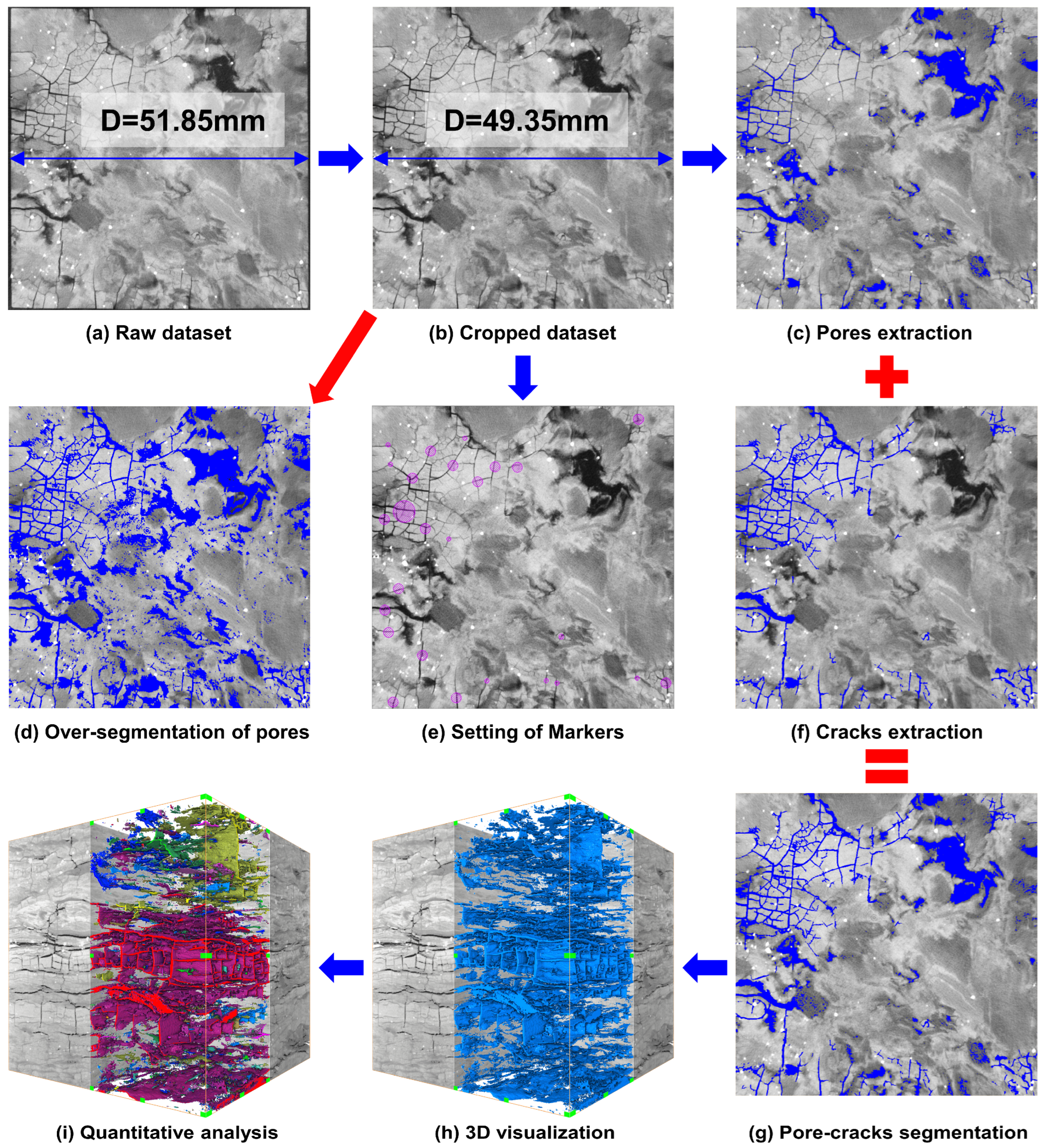
Yan’s (YS) segmentation method has demonstrated remarkable accuracy in extracting the pores and fractures of lignite that contains diverse low-density macerals [44]. Leveraging this advantage, all CT image processing in this paper was carried out using the YS segmentation method within the Avizo 2023 software. The typical workflow for this process is presented in Figure 2. Following the steps of cropping (Figure 2a,b), segmentation (Figure 2c–g), and 3D reconstruction, the pore–fracture systems of each cropped dataset (a 700 × 700 × 700-pixel subvolume located at the center of the lignite sample) were successfully obtained (Figure 2h). Subsequently, a comprehensive quantitative analysis of the pore–fracture structures was conducted using the built-in quantitative analysis module in Avizo software to obtain a series of microscopic parameters, such as porosity, fractal dimension, total volume, etc., as shown in Figure 2i. Note that the fractal dimension was calculated based on the box dimension method using the following expression:
D b = lim α 0 log N α log α = lim α 0 log N α log 1 / α
where Db is the fractal dimension of the fractal object, N(α) represents the number of cubes, with side length α required to cover it. The slope of the linear regression equation obtained from the scatter plot of logN(α) and log(1⁄α) is the fractal dimension Db, which obeys the following linear expression:
log N α = log c + D b log 1 / α
where c is a constant.
Since the pore–fracture connectivity of lignite is an important parameter for determining its coalbed methane drainage capacity and CO2 sequestration potential in coal reservoirs [58], the connected pore–fractures of lignite during the NTD process were extracted using the Axis Connectivity module in Avizo software, and the pore–fracture structure connectivity of lignite during the NTD process was calculated based on the Volume Fraction module. It should be noted that the pore–fractures of the lignite investigated in this study are not connected in the direction perpendicular to the bedding plane, so the pore–fracture connectivity was only calculated in the X direction. The relevant calculation formula is as follows:
C t = V V
where Ct represents the pore–fracture connectivity of lignite after t hours of dehydration, V′ is the volume of connected pore–fractures, and V is the volume of total pore–fractures.
Unlike the grayscale imaging mode of CT scanning [59,60], a scanning electron microscope (SEM) can directly observe the microstructure of the lignite sample [61,62]. A systematic SEM test of the lignite sample after being dehydrated for 72 h was carried out using the TESCAN GAIA3 FIB-SEM system (TESCAN Group a.s., Brno, Czech Republic) (Figure 1(d2)) to explore the morphological characteristics of macerals and their respective crack development patterns after drying. The accelerating voltage used in the tests and the voxel size of the images are 20 kV and 0.36 μm, respectively. By combining the test results of SEM observation and CT scanning, we can more accurately understand the impact of macerals on the evolution of the overall pore–fracture network of the sample and further elucidate its influence on the macroscopic physical and mechanical properties of lignite.
Note that since the widely developed primary pores in lignite can exceed 10 μm [54], this study mainly employs the Hodot classification scheme to categorize pore sizes in lignite: micropores (<10 nm), transition pores (10–100 nm), mesopores (100–1000 nm), and macropores (>1000 nm). Pores larger than 1000 nm with an aspect ratio greater than 5 are defined as fractures. These fractures are further classified based on their equivalent diameter, as detailed in the caption on page 19.

3. Results and Discussion

3.1. Petrography and Geochemistry

3.1.1. Structural Characteristics, Material Compositions, and Their Static Dehydration Characteristics

Previous studies have confirmed that due to the influence of factors such as the coalification process, coal-forming plants, and sedimentary environments, there are significant differences in the dehydration characteristics, i.e., the shrinkage-cracking features after dehydration, among various types of macerals in lignite [63]. Moreover, these macerals with different dehydration characteristics jointly control the development of the overall pore–fracture structure of lignite [34]. Based on these facts, before analyzing the dehydration characteristics in lignite, we studied the material composition and their dehydration characteristics of the lignite by integrating macroscopic morphology analysis and SEM test. Note that the samples used in this section are lignite samples dehydrated for 72 h. This is because the macerals of lignite in its natural state are relatively similar in luster and color, making it quite challenging to identify them accurately.
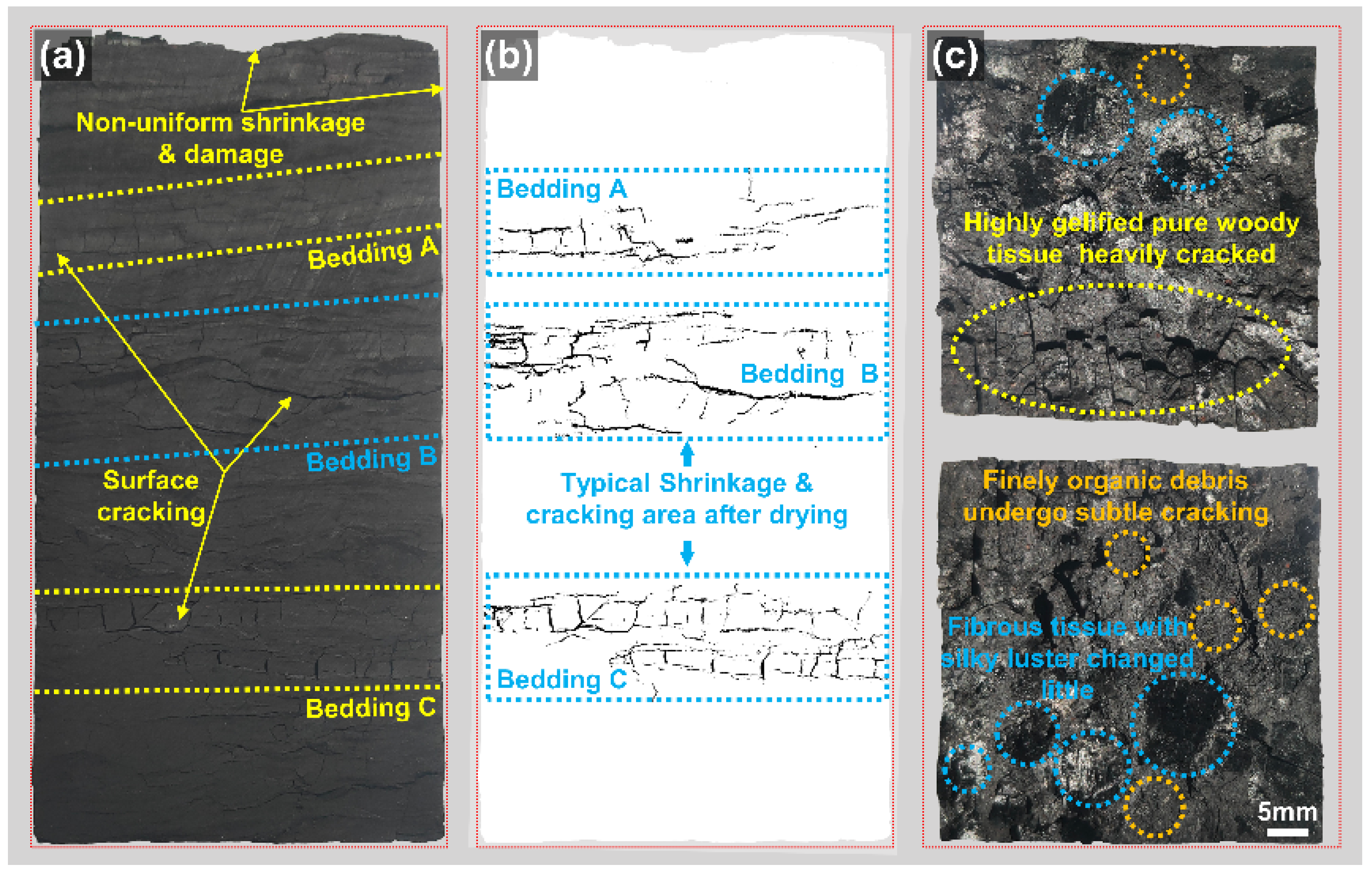
Figure 3 illustrates the macroscopic morphology of the lignite sample after drying for 72 h and the distribution map of surface cracks extracted based on the dynamic threshold segmentation method [64]. The results indicate that the lignite has obvious characteristics of a sub-horizontal bedding structure with alternating soft and hard layers (Figure 3a). Compared with the sample before drying (the red dashed line in each sub-figure represents the outer contour of the sample before drying), the lignite has undergone apparent dehydration-induced shrinkage and cracking, and the majority of the cracks are distributed in the hard layers of the lignite (Figure 3b). Based on Figure 3c, it can be concluded that the hard layers are composed of highly gelified pure woody tissue, with an overall appearance of homogeneous, compact, and rigid layered structure (the coal matrix within the yellow circle in Figure 3c). This component is highly prone to severe shrinkage and cracking after dehydration under the NTD condition, showing rather poor thermal stability. In contrast, the soft matrix layers are composed of finely fragmented organic matter (the coal matrix within the orange circle in Figure 3c), encrusted with large pieces of loose and porous fibrous tissue with a silky luster (the coal matrix within the blue circle in Figure 3c). Under the NTD condition, the finely fragmented organic matter in the soft matrix layers only undergoes slight shrinkage and cracking, while the porous fibrous tissue hardly shrinks or cracks, showing superior thermal stability.
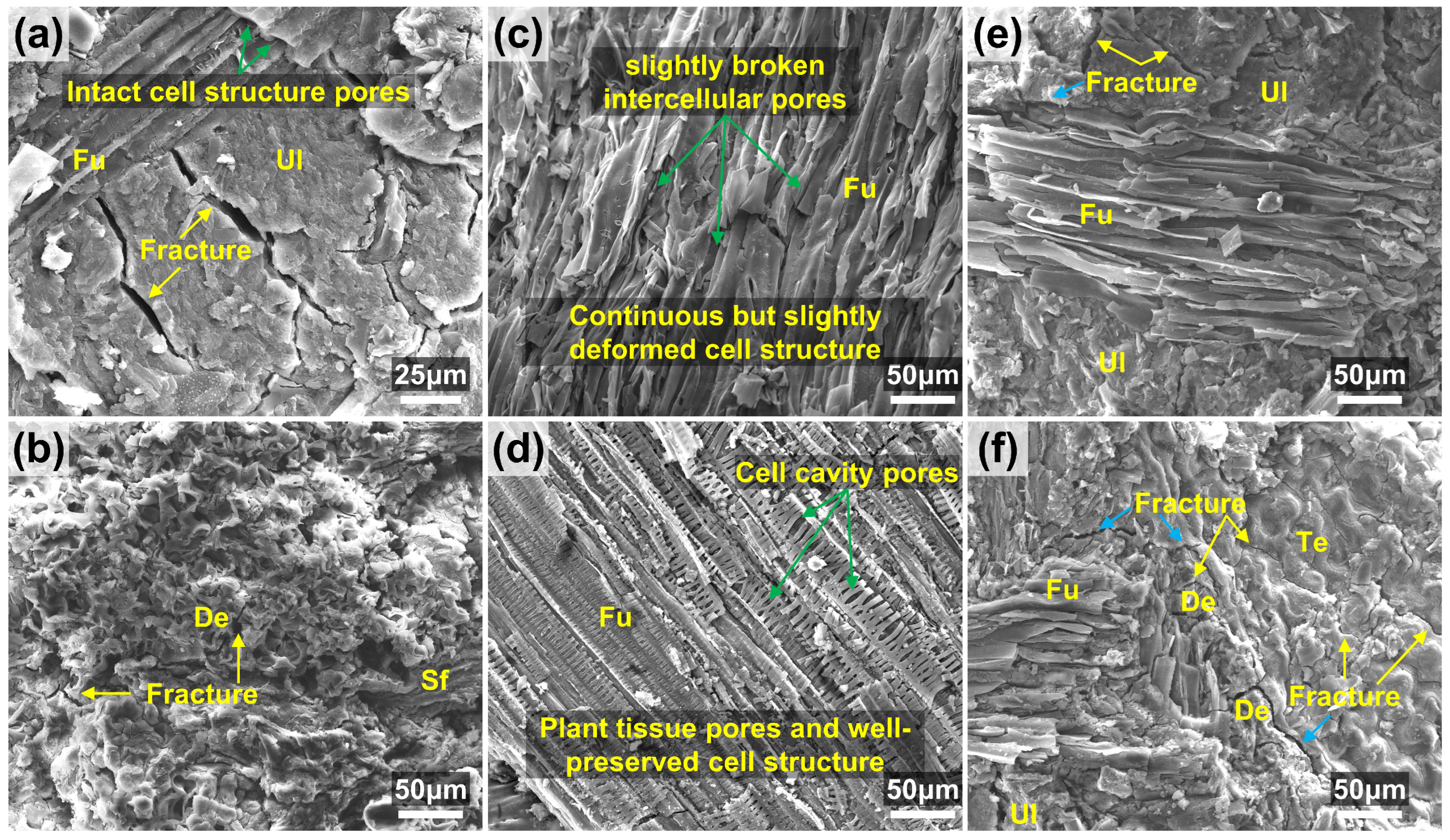
SEM observations were conducted on the gelified pure woody tissue, finely fragmented organic matter, and porous fibrous tissue shown in Figure 3c. Then, different types of macerals were identified based on the classification of the “ICCP System 1994” [65,66,67], and the results are illustrated in Figure 4a, Figure 4b,e,f, and Figure 4c,d, respectively. The results indicate that the hard matrix layers of lignite are mainly composed of intact, massive ulminite (Ul), while the soft layers mainly consist of large pieces of fusinite (Fu) and finely fragmented huminite groups (primarily ulminite (Ul) and densinite (De)). The Ul is characterized as a highly gelified pure woody tissue and exhibits a relatively compact and homogeneous massive structure. After dehydration in the open air, the water-absorbing swollen plant tissues (i.e., Ul) shrink heavily and produce long, wide, and well-oriented fractures, demonstrating rather poor thermal stability (fractures pointed to by the yellow arrows in Figure 4a,e). The De is characterized as gelified plant tissue that has been subjected to severe destruction during coalification, containing a high number of initial microfractures [7]. During the drying process, it experienced relatively slight shrinkage and cracking and is prone to forming some short-length, poorly orientated, and disorderly distributed fractures along the initial microfractures (fractures pointed to by the yellow arrows in Figure 4b). In contrast, as Fu has undergone strong oxidation during coalification [68,69], it retains a significant amount of well-preserved plant cell structures, as well as diverse micron-scale plant tissue pores (pores pointed to by the green arrows in Figure 4a,c,d), presenting a relatively loose and porous structure. Fu has been proven to be quite thermally stable even at high temperatures [70]. Thus, it hardly deforms after dehydration. In addition, due to the distinct shrinkage coefficients of the two different macerals, some cracks also occur at their interface (cracks pointed to by the blue arrows in Figure 4e,f). It should be noted that the propagation and connection of all types of cracks are usually interrupted by the nearby Fu debris, as shown in Figure 4a,e,f. That is to say, Fu has an interrupting effect on the propagation of the dehydration-induced cracks.
In summary, the lignite is a low-rank coal with an obvious sub-horizontal bedding structure formed by periodic alternating deposition of hard and soft matrix layers. The hard matrix layers are mainly composed of highly gelified Ul, which has poor thermal stability and is prone to shrink violently under NTD conditions, generating long, straight, large width, and well-directed cracks. The soft matrix layers are mainly composed of large pieces of loose and porous Fu and finely humic debris (mainly Ul and De). Fu possesses strong thermal stability and hardly cracks after dehydration and only transforms into the pore structure of lignite. De, on the other hand, tends to crack into some short, curved, small openings, poorly oriented, and randomly distributed microfractures along the primary weak surface. Moreover, Fu significantly hinders the expansion of dehydration fractures in other components. However, due to different shrinkage coefficients, it will generate some large-size interfacial fractures at the junction with other macerals. Differences in the dehydration shrinkage and cracking behavior of the macerals are the leading causes of differential shrinkage and cracking between the soft and hard matrix layers of lignite after dehydration.

3.1.2. Dynamic Dehydration Characteristics of Macerals Based on CT Scanning

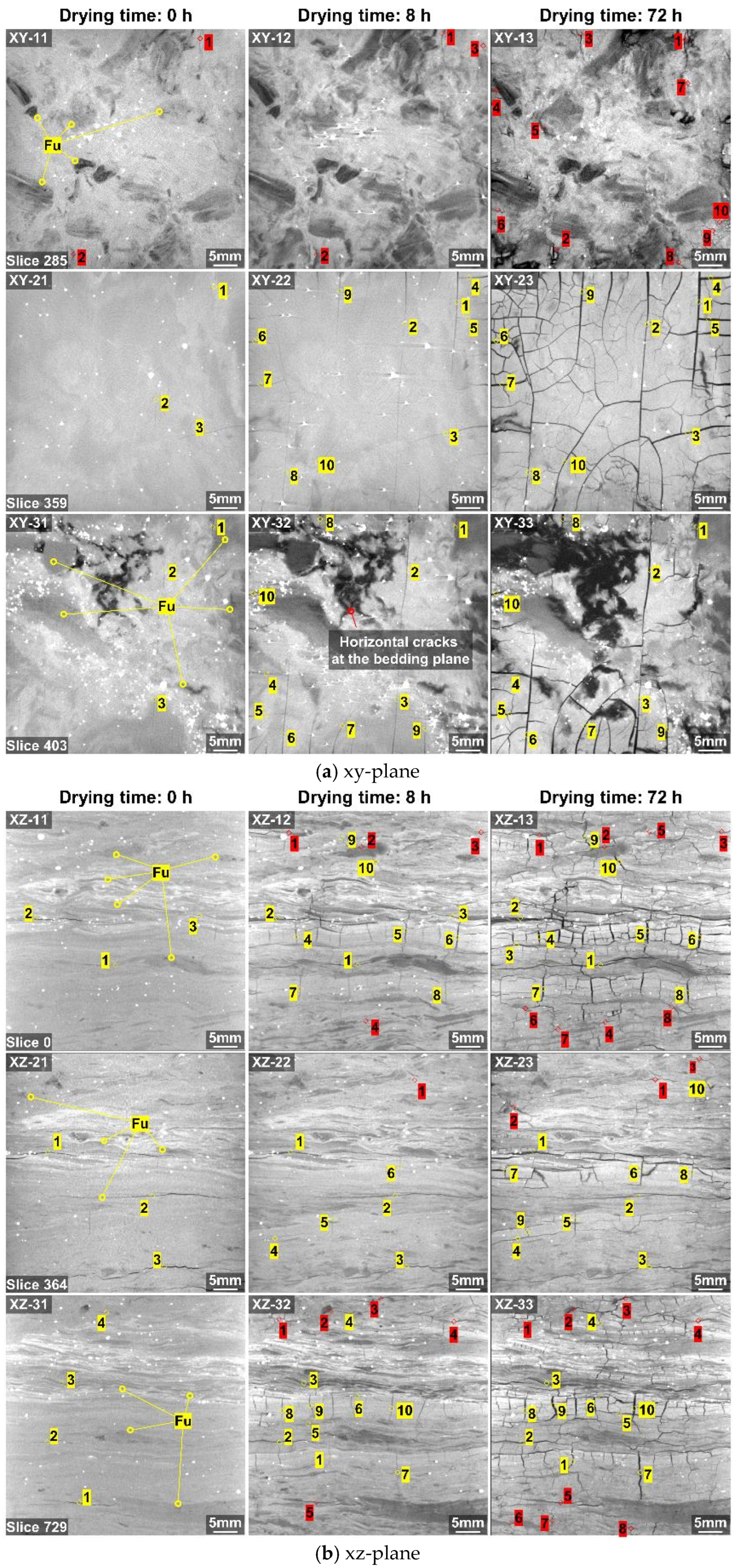
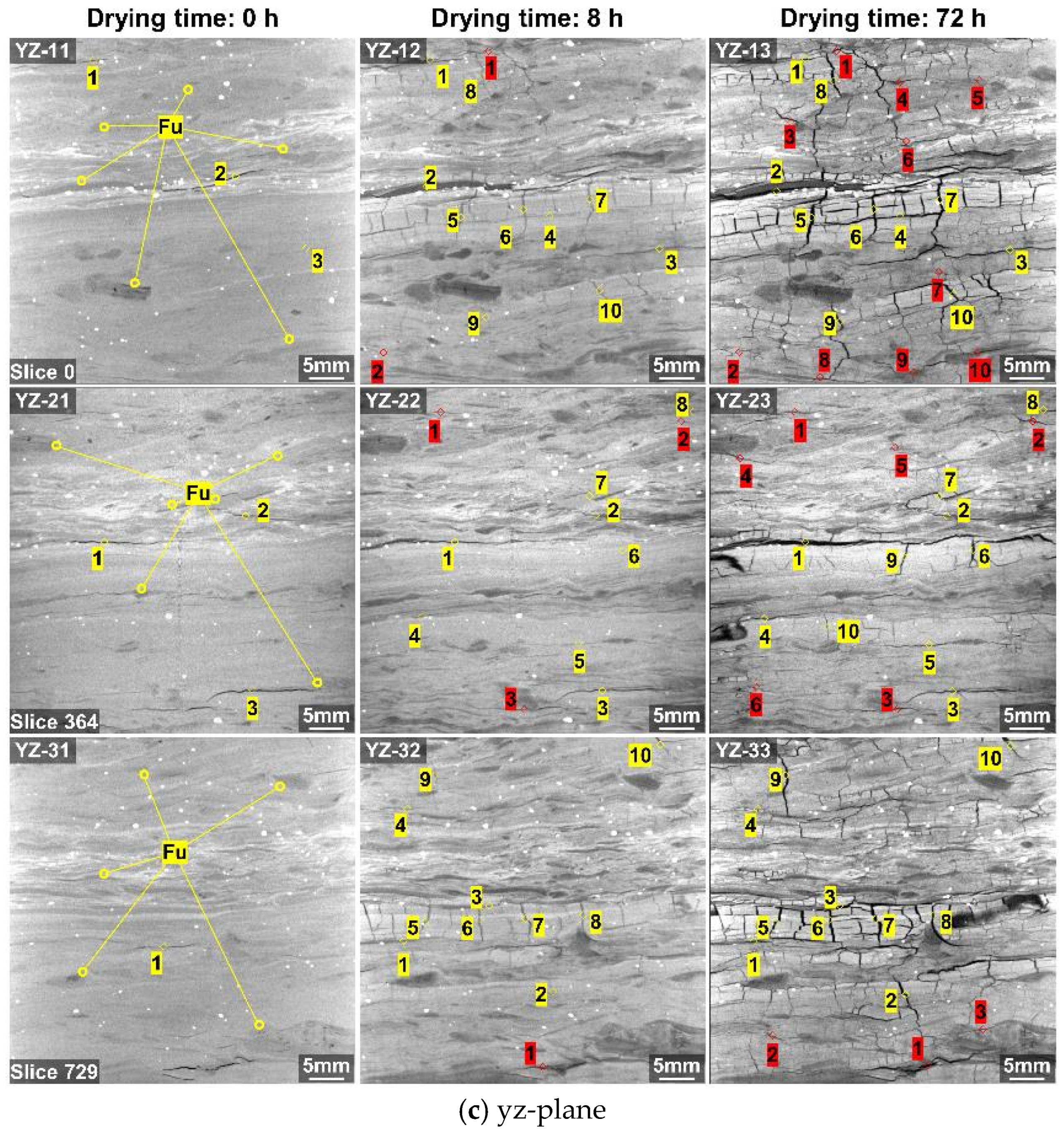
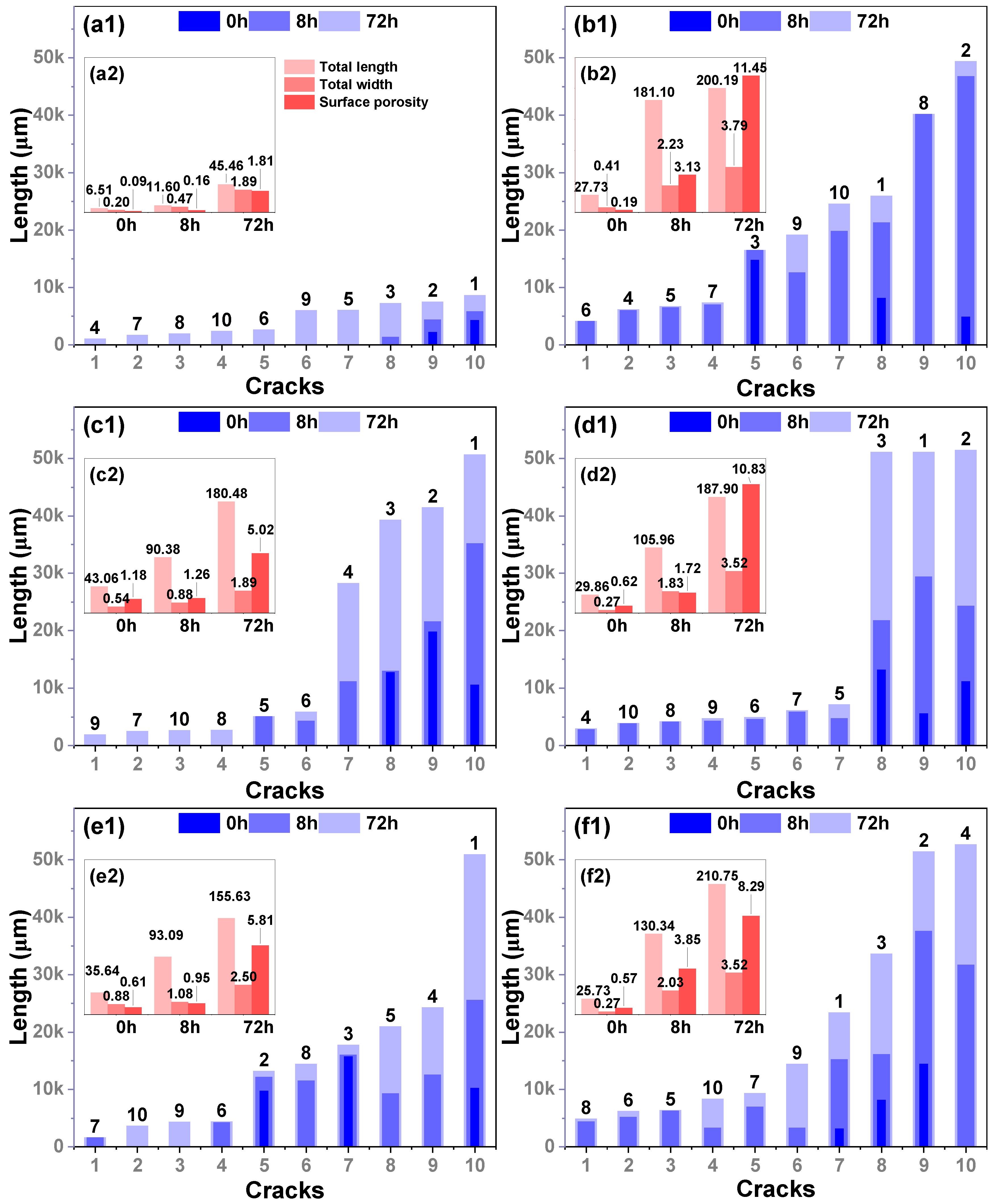
In Section 3.1.1, we systematically demonstrated the differential dehydration characteristics of each maceral of lignite after 72 h dehydration from the aspects of macrostructure and microtopography. In this part, based on CT scanning technology, we investigated the dynamic dehydration characteristics of Fu and Ul during NTD dehydration through representative slices, and the results are shown in Figure 5a–c. It should be noted that the dynamic water loss process of De was not observed because its diameter is much smaller than the spatial resolution of CT slices [66]. In addition, the dynamic changes of the geometric parameters of the top 10 longest fractures (the fractures encoded by yellow numbers in Figure 5) in each representative slice during NTD were statistically analyzed by Image J 1.54p software, and the crack ratio of each slice at different dehydration times was automatically calculated by Avizo software, and the results are shown in Figure 6.
As can be seen from Figure 5a–c, the dynamic dehydration characteristics of the two macerals are significantly different. After 8 h dehydration, the moisture content of almost all Fu (judged by grayscale values) has significantly decreased, and no noticeable change occurs in the subsequent dehydration process. This indicates that most of the free water is rapidly evaporated in the early stage of dehydration, showing extremely high drying efficiency, which is attributed to its highly permeable porous structure, as shown in Figure 4 [69]. In addition, Fu hardly deforms throughout the whole dehydration process, further confirming its high thermal stability.
In contrast, the dynamic dehydration characteristics of Ul are more complex. NMR-based studies have shown that the pore structure of gelified Ul is dominated by low-permeability micropores and transition pores [54]. Therefore, affected by its low permeability, after 8 h dehydration, only the Ul near the surface of the sample underwent moderate shrinkage and cracking due to direct exposure to the external environment (XZ-12, XZ-32, YZ-12, YZ-32 in Figure 5), while the internal Ul shows lower degree of cracking due to the lack of effective water migration channels (XZ-22, YZ-22 in Figure 5). Taking Slice 0 and Slice 364 in Figure 5b as examples, after 8 h dehydration, all 10 longest fractures in Slice 0 (the outermost slice of the sample) are cracked (Figure 6(d1)), with a total length of 105.96 mm, total width of 1.83 mm, and crack ratio of 1.72%. Compared with the 0 h dehydration data, all statistical parameters show significant increases (Figure 6(d2)). In contrast, only 6 out of the 10 longest fractures in Slice 364 (the middle slice of the sample) are cracked (Figure 6(c1)), with a total length of 90.38 mm, total width of 0.88 mm, and crack ratio of 1.26%. Compared with the 0 h dehydration data, most statistical parameters (except the total length of 10 longest fractures) show insignificant increases, and are obviously lower than those of Slice 0 at 8 h dehydration (Figure 6(c2)). The quantitative analysis results in Figure 6(e1,e2,f1,f2) also demonstrate the same statistical characteristics.
With the prolongation of water loss time, the dehydration fractures gradually expanded to the interior of the sample. The free water in the Ul inside the sample began to be discharged through these cracks, and more cracks were generated due to the shrinkage of its water loss. These newly formed cracks connected with the existing cracks to form a more complex fracture network (XY-23 in Figure 5), which further promoted the discharge of free water from Ul and ultimately led to severe shrinkage and cracking of the samples (especially the area near the exterior of the samples) after 72 h dehydration (XZ-13, XZ-33, YZ-13, YZ-33 in Figure 5). Taking Slice 0 and Slice 364 in Figure 5c as examples, after 72 h dehydration, the total length, total width, and crack ratio of the 10 longest fractures in Slice 0 (including two horizontally penetrating cracks) were 210.75 mm, 3.52 mm, and 8.29%, respectively (Figure 6(f1,f2)). In contrast, the 10 longest fractures in Slice 364 (including only one horizontally penetrating crack) had a total length of 155.63 mm, total width of 2.5 mm, and crack ratio of 5.81% (Figure 6(e1,e2)). Compared with the 8 h dehydration stage, all statistical parameters in both slices showed significant increases. However, the total length, total width, and crack ratio of the 10 longest fractures in Slice 364 after 72 h dehydration only accounted for 73.85%, 71.02%, and 70.08% of those in Slice 0, indicating that the degree of cracking in the middle of the sample was still significantly lower than that in the outer region (XZ-23, YZ-23 in Figure 5). The quantitative analysis results in Figure 6(c1,c2) and Figure 6(d1,d2) also exhibit similar statistical characteristics.
The above analysis shows that compared with Fu, Ul exhibits lower dehydration efficiency and obvious position-dependent characteristics in dynamic dehydration. Moreover, the dynamic water loss of Ul in the soft layers is significantly inhibited by Fu compared with that in the hard layers. As shown in Figure 6(a1,a2,b1,b2), after 8 h dehydration, all 10 longest fractures in Slice 359 were cracked, with the total length, total width, and crack ratio being 181.10 mm, 2.23 mm, and 3.13%, respectively. Compared with the 0 h data, these statistical parameters all showed significant increases. In contrast, only 3 out of the 10 longest fractures in Slice 285 were cracked, with the total length, total width, and crack ratio being 11.60 mm, 0.47 mm, and 0.16%, respectively—showing almost no increase compared with the data at 0 h, and these parameters only accounted for 6.41%, 21.01%, and 5.11% of the corresponding parameters in Slice 359. After 72 h dehydration, Slice 359 had one horizontally penetrating fracture among the 10 longest fractures, with the total length, total width, and crack ratio increasing to 200.19 mm, 3.79 mm, and 11.45%, respectively. The total length, total width, and crack ratio of Slice 285 after 72 h dehydration significantly increased to 45.46 mm, 1.89 mm, and 1.81%, but all three values were far lower than the corresponding values of Slice 359.
In conclusion, due to differences in microstructure, Fu and Ul exhibit significant disparities in dynamic dehydration characteristics during NTD. The loose and porous Fu demonstrates a higher dehydration efficiency, with most of its internal free water evaporated in the early drying stage and minimal influence from the spatial position. In contrast, the highly gelified Ul shows lower drying efficiency and remarkable position dependency due to its low permeability, with evaporation of internal free water spanning the entire dehydration process. Compared to the hard layers, the dynamic water loss of Ul in the soft layers is significantly inhibited by Fu, manifested as lower fracture development.

3.2. Dynamic Development of Pore–Fractures During Dehydration

3.2.1. Dynamic Development Characteristics of Pore–Fractures in 2D Planes

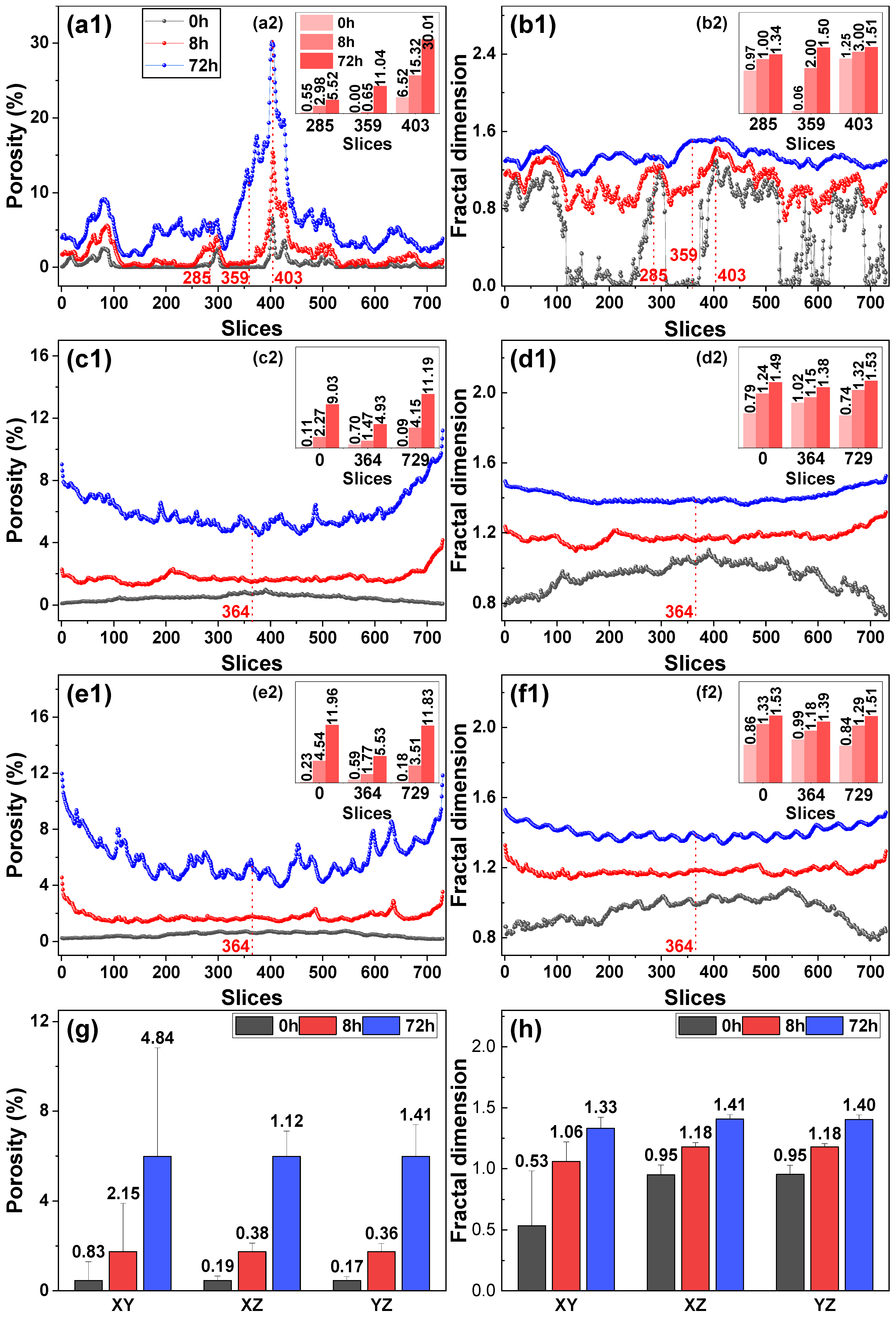
To reveal the influence of heterogeneous distribution of macerals with different dehydration characteristics on the development of pore–fracture structures in lignite during NTD, we extracted and quantitatively analyzed its 3D pore–fracture structures using the image processing method in Section 2.4. Subsequently, based on the SP and FD values, the development degree and complexity of the pore–fracture structures of the sample at each slice in the xy-plane, xz-plane, and yz-plane directions during NTD were characterized to elucidate the dynamic development characteristics of the pore–fracture structure in each direction during lignite dehydration, as shown in Figure 7.
As shown in Figure 7, the SP and FD values and their average values of the 3D pore–fractures in the three directions are relatively low due to the high integrity of the lignite samples in their natural state. However, owing to individual large-size horizontal fractures at the horizontal bedding planes, the SP and FD values at these positions are significantly higher (Figure 7(a1,b1)). Taking Slice 403 in Figure 5a as an example, influenced by the above-mentioned horizontal fractures, the surface porosity and 2D fractal dimension of Slice 403 are 6.52 and 1.25, respectively, which are much higher than those of the lignite sample in other xy-planes (Figure 7(a2,b2)).
After 8 h dehydration, the SP and FD values and their average values in all directions increased significantly, and the distribution of the SP and FD values in each direction showed apparent regularity. Specifically, the increase in SP and FD values of each xy-plane after 8 h dehydration exhibited obvious maceral dependency. After rapid dehydration, Fu in the soft layers transformed into a loose porous structure, causing a significant increase in SP and FD values of the slices in this area. The larger the total volume of Fu, the more developed the pore structure of lignite after 8 h dehydration, and the higher the SP and FD values in this area. Influenced by its own low permeability, Ul exhibited a lower drying rate, so its overall fracture development was not intense, resulting in a minor increase in the SP and FD values of the slices in this area. Taking Slice 285 in the soft layers and Slice 359 in the hard layers as examples, after 8 h dehydration, the SP and FD values of the former sharply increased from 0.55% and 0.97 at 0 h to 2.98% and 1.24, while the latter slightly increased from 0.00% and 0.06 at 0 h to 0.65% and 1.03. The low permeability of Ul also leads to obvious position dependency in its water loss and cracking, which in turn causes the SP and FD values of each slice in the xz-plane and yz-plane directions to exhibit a distribution characteristic of “higher in the outer region and lower in the inner region”, showing a significant correlation with the spatial position of the slices. Taking Slice 364 and Slice 729 in the xz-plane direction as examples, after 8 h dehydration, the SP and FD values of Slice 729 (outer side of the sample) were 4.15% and 1.32, respectively. In comparison, those of Slice 364 (middle of the sample) were 1.47% and 1.15, respectively, significantly lower than those of Slice 729.
When dehydrated to 72 h, the SP and FD values of lignite in all directions and their average values underwent a substantial increase, indicating a significant enhancement in both the development degree and complexity of the sample’s pore–fracture structure. The SP and FD values of each xy-plane still exhibited obvious maceral dependency. However, due to the large-scale cracking of Ul in the hard layers and the significant inhibition of cracking of Ul in the soft layers by Fu, the SP and FD values in the hard layers were far greater than those in the soft layers, as shown by Slice 285 in the soft layers and Slice 359 in the hard layers in Figure 7(a1). In addition to horizontal interlayer fractures, the bedding planes are distributed with a large number of vertical fractures of Ul and plant tissue pores from Fu (Figure 5a), resulting in the maximum SP and FD values (30.01%, 1.51) at this position. Influenced by the heterogeneous cracking of low-permeability Ul, the SP and FD values in the vertical direction still showed a significant correlation with the spatial position of the slices. The larger the volume and the greater the total number of individual Ul, and the closer to the sample surface, the more developed the fracture structure after 72 h dehydration, and the higher the SP and FD values. This leads to the distribution of the SP and FD values in the xz-plane and yz-plane directions of the lignite samples continuing to show the distribution characteristics of higher in the outer region and lower in the inner region.
Based on the variance of surface porosity, the heterogeneity of pore–fracture structure distribution during dehydration can be quantitatively described [28]. As shown in Figure 7g, the variance of the surface porosity is relatively low in all directions under natural conditions, indicating weak heterogeneity in the development of lignite pore–fracture structures in all directions. During NTD, the variance of surface porosity in all three directions showed a significant increase, indicating that with the continuous development of the 3D pore–fracture structure, the heterogeneity of pore–fracture development in each direction was continuously enhanced. Especially in the xy-plane direction, the variance increased sharply from 2.15 at 8 h of dehydration to 4.84 at 72 h of dehydration, showing a rather strong heterogeneity in the development of pore–fracture structure, which was attributed to the existence of obvious maceral zones with differentiated dehydration characteristics in this direction, i.e., F-zone, and U-zone.
In general, the analysis of the SP and FD values of 3D pore–fracture structure in all directions shows that the pore–fracture of lignite continues to develop with the prolongation of dehydration time during NTD, and the complexity of its structure gradually increases as well. Due to the non-uniform distribution of macerals with differentiated dehydration characteristics, the dynamic development of the pore–fracture structure in each direction exhibits apparent regularity, namely maceral dependency along the xy-plane direction and spatial position correlation along the xz-plane and yz-plane directions. However, the characteristic in the vertical direction is related to the low permeability of Ul. Thus, the spatial positional correlation of the dynamic development of the pore–fracture structure in the vertical direction is essentially an external manifestation of its maceral dependence. Additionally, the heterogeneity of its development in all directions also increases with the prolongation of dehydration time. Due to the obvious maceral zoning and the extremely complex bedding planes in the xy-plane direction, the heterogeneity of 3D pore–fracture structure development in this direction is the most significant.

3.2.2. Dynamic Development Characteristics of Fractures in 3D Space

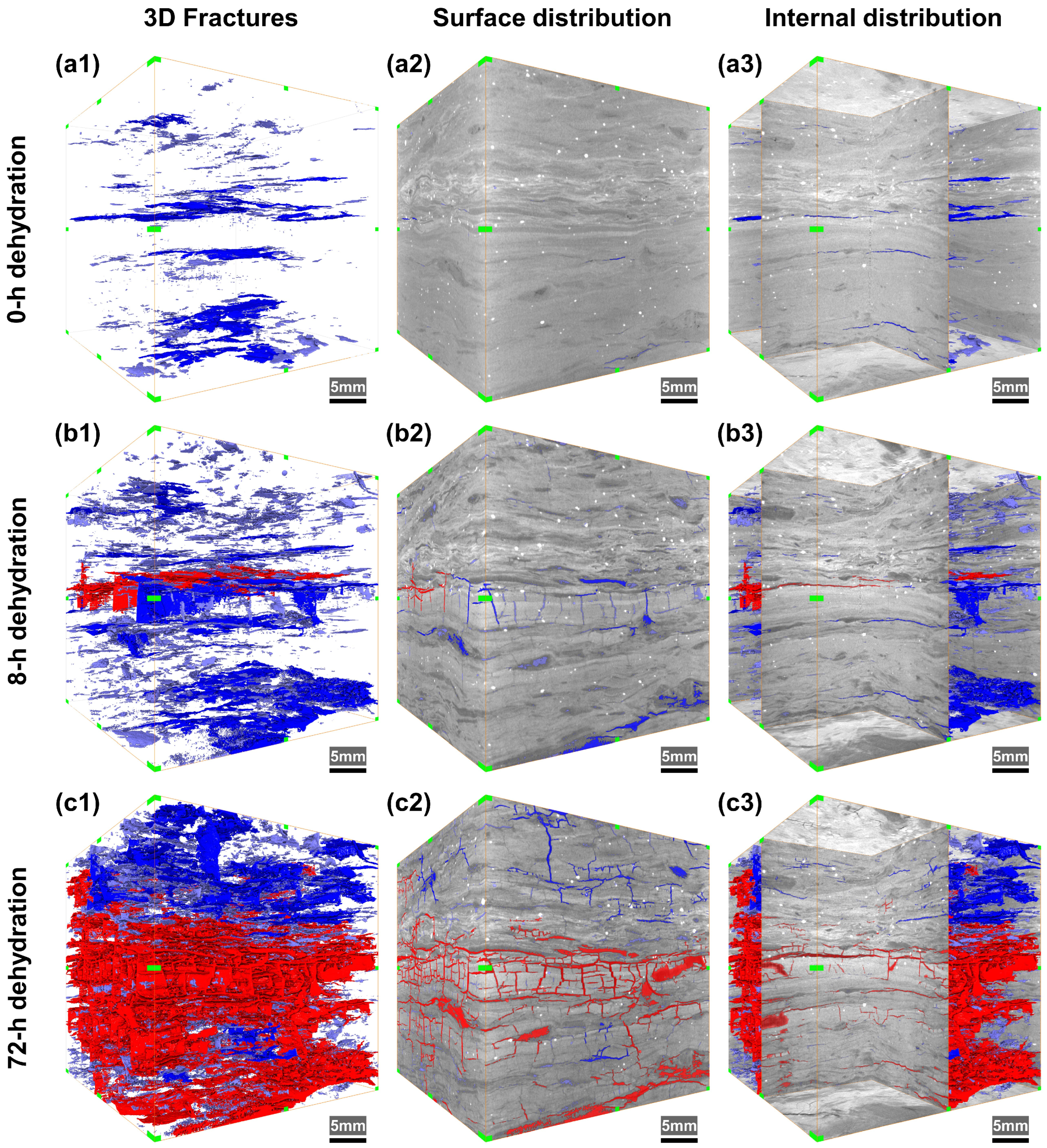
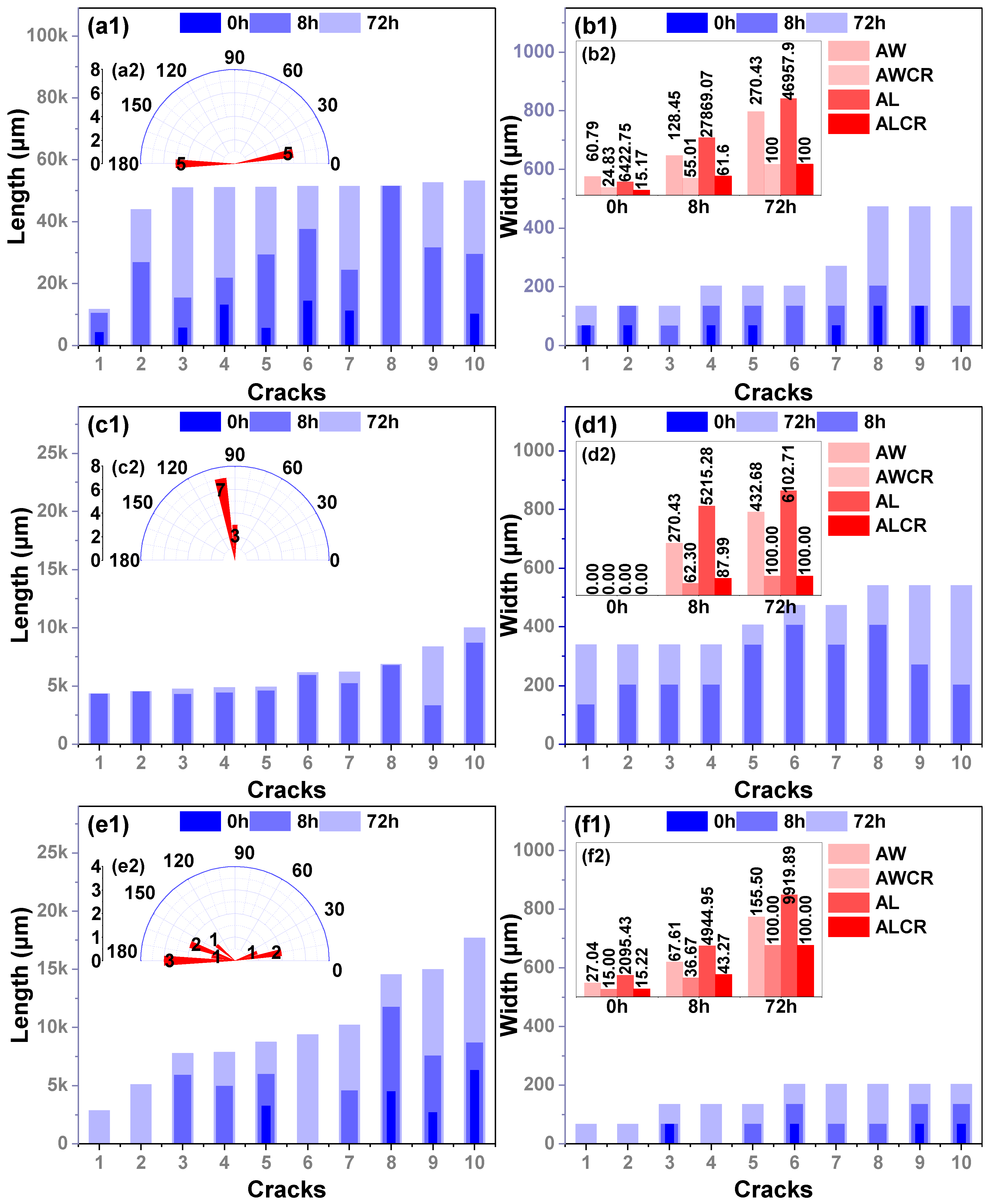
To better understand the influence of the differential cracking behavior of Ul after dehydration in different maceral zones on the development characteristics of fracture structures in each zone, the 3D fracture structures during NTD were first visualized using the Label Analysis and Volume Rendering modules in Avizo software (Figure 8). Subsequently, considering the surface-to-interior characteristics of water loss and cracking of Ul, we also used Image J software to quantitatively analyze surface fractures at the bedding planes and within the hard layers (fractures digitally encoded with yellow backgrounds in Slices 0 and 729 of Figure 5), as well as surface fractures within the soft layers (fractures digitally encoded with red backgrounds in Slices 0 and 729 of Figure 5). To ensure the representativeness of the results, 10 randomly distributed fissures from each of the aforementioned zones were selected for analysis, and the results are shown in Figure 9.
The natural state lignite samples had fewer internal fractures and were dominated by horizontal fractures at the bedding plane (Figure 8(a1,a2,a3)). After dehydration, more pronounced cracking occurs in the outer part of the sample. However, but due to the differential cracking characteristics of Ul in each zone, the development patterns of fracture structures between the hard layers and soft layers are significantly different. After 8 h dehydration, due to the non-uniform shrinkage of Ul, a greater number of vertical fractures with azimuth angles approaching 90° developed in the hard layers, almost penetrating the entire hard layers in the vertical direction (Figure 8(b1,b2,b3) and Figure 9(c2)). The AL and AW of 10 representative vertical fractures were 5215.28 μm and 270.43 μm, respectively, with ALCR and AWCR as high as 87.99% and 62.30% (Figure 9(c1,d1,d2)), indicating a high degree of development. After 8 h dehydration, due to the overall shrinkage of the hard layers in the central part of the sample, the primary sub-horizontal fractures at the nearby bedding planes also extended and propagated significantly along their original directions, forming a large-sized horizontal through-going fracture (Figure 8(b2)). The AL and AW of 10 representative horizontal fractures were 27,869.07 μm and 128.45 μm, respectively, with ALCR and AWCR of 61.60% and 55.01%, indicating slightly weaker development than vertical fractures (Figure 9(a1,b1,b2)). Hindered by Fu, fractures in the soft layers are generally isolated fractures with random distribution and no obvious dominant direction (Figure 8(b2) and Figure 9(e2)). The AL and AW of 10 representative fractures are 4944.95 μm and 67.61 μm, respectively. Compared with the previous two types of fractures, their fracture width is significantly smaller. In addition, their ALCR and AWCR are 43.27% and 36.67%, showing a considerably weak degree of development (Figure 9(e1,f1,f2)). After 72 h dehydration, with the continuous expansion of vertical and horizontal fractures in the hard layers and their extension toward the sample interior (accompanied by the initiation of numerous tiny fractures), a complex fracture system with remarkably strong connectivity was formed in the hard layers, which is composed of many well-oriented vertical and horizontal fractures featuring long length, large aperture, and low tortuosity (Figure 8(c1,c2,c3) and Figure 9(b2,d2)). Inhibited by Fu, the soft layers developed numerous fractures with short length, small aperture, high tortuosity, and poor orientation. Except for some fractures that connect with the connected fractures in the hard layers and become part of the connected system, most of the cracks remain isolated (Figure 8(c1,c2,c3) and Figure 9(f2)).
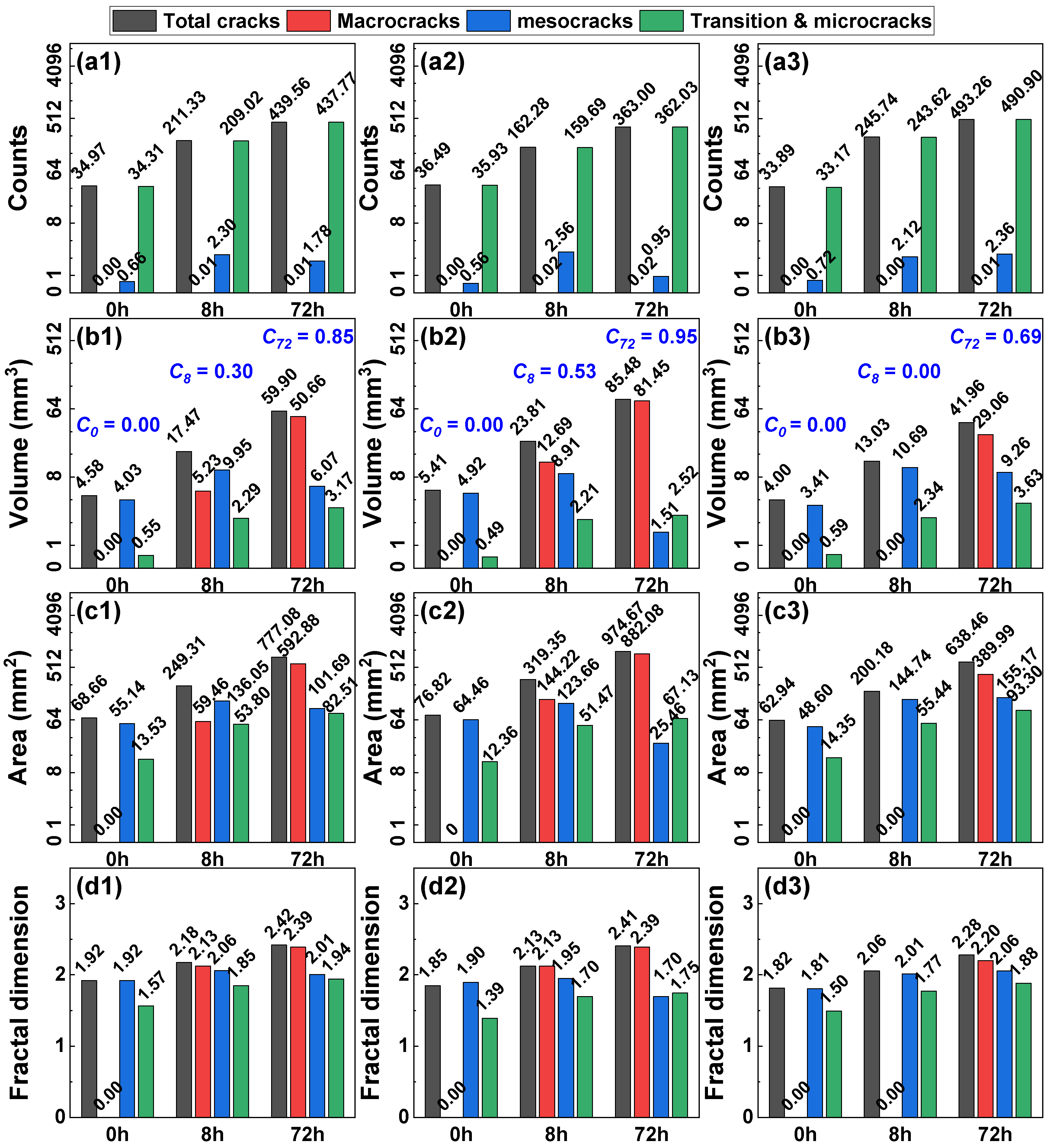
Based on the Label Analysis and Analysis Filter modules in Avizo software, quantitative analysis was conducted on the 3D fracture structures of different maceral zones during NTD. For ease of comparison, the fracture count, volume, and area of the aforementioned zones with various volumes were converted into a series of parameters with a unit volume of 1 cm3. On this basis, the connectivity of pore–fracture structures in the aforementioned zones were calculated using the method described in Section 2.4. The results are shown in Figure 10. Note: Avizo-based connectivity analysis shows that the macrocracks here are also connected cracks.
As shown in Figure 10, with the progressive cracking of Ul in different maceral zones during NTD, the total number, volume, area, and fractal dimension of fracture structures in each zone (including the overall fracture structure) all exhibit prominent linear increasing trends. Compared with other fractures in the zones, the fracture compositions of the two zones at each dehydration stage are predominantly composed of numerous microcracks and transition cracks, which have the smallest volume, area, and fractal dimension. In addition, the number of mesocracks and macrocracks in both zones is relatively small. Conversely, their volume, area, and fractal dimension are far greater than the corresponding parameters of transition and microcracks within their respective zones. Notably, before dehydration, the total number, volume, area, and fractal dimension of fractures in the hard layers were 36.49, 5.41 mm3, 76.82 mm2, and 1.85, respectively–slightly larger than those in the soft layers. This is attributed to the presence of several large sub-horizontal bedding fractures distributed at the bedding planes in the hard layers. After dehydration, due to the blocking effect of Fu, the Ul in the soft layers only cracked into more microcracks than those in the hard layers. In contrast, the Ul of the hard layers underwent significant shrinkage and cracking, leading to the development of a horizontal through-going fracture with considerably large geometric dimensions at the middle bedding plane of the sample. This, in turn, caused a considerable rise in the pore–fracture connectivity of the hard layer during NTD, and this is the primary reason for the hard layers’ fracture structure having larger volume, area, fractal dimension, and connectivity. In addition, after 72 h dehydration, the volume, area, and fractal dimension of the connected fractures in the hard layers increased to 81.45 mm3, 882.08 mm2, and 2.39, respectively, which are very close to the corresponding parameters of the overall fracture structure in the hard layers, indicating that most of the mesocracks in the hard layers have been interconnected into a connected fracture with considerably large geometric size and highly complex spatial structure (at this point, the pore–fracture connectivity of the hard layer reaches 0.95). Furthermore, after 72 h dehydration, the soft layers developed a considerable number of mesocracks and a substantially large through-going fracture, with its volume, area, and fractal dimension measuring 29.06 mm3, 389.99 mm2, and 2.20, respectively. Compared with the through-going fracture in the hard layer, all the aforementioned parameters of this fracture are significantly smaller. Additionally, this fracture also increased the connectivity of the soft layer from 0 to 0.69 after 72 h of dehydration. However, this fracture only indirectly became a connected fracture by interconnecting with the connected fractures in the hard layers, as it lacked connectivity itself. Thus, it can be concluded that the fracture structure in the soft layers has no independent connectivity throughout the entire dehydration process.
Overall, the shrinkage and cracking characteristics of Ul in different maceral zones during NTD exhibit significant differences, which are the fundamental reason for the distinct cracking patterns of 3D fracture structures in those of lignite. After dehydration, the hard layers formed a complex fracture structure composed of a large number of well-oriented vertical and horizontal fractures with longer length, larger aperture, and lower tortuosity. Compared with the soft layers, although the total number of transition and microcracks in the hard layers is smaller, its fracture structure has significantly higher volume, area, fractal dimension, and connectivity, exhibiting a higher overall development. Due to the significant hindering effect of Fu, the Ul in the soft layers formed a poorly oriented fracture structure with shorter length, smaller aperture, and higher tortuosity after cracking. The structure has obviously lower volume, area, and fractal dimension, showing a lower degree of overall development and no independent connectivity.

3.3. Evolution of Macroscopic Physical Properties of Lignite During NTD Affected by Macerals

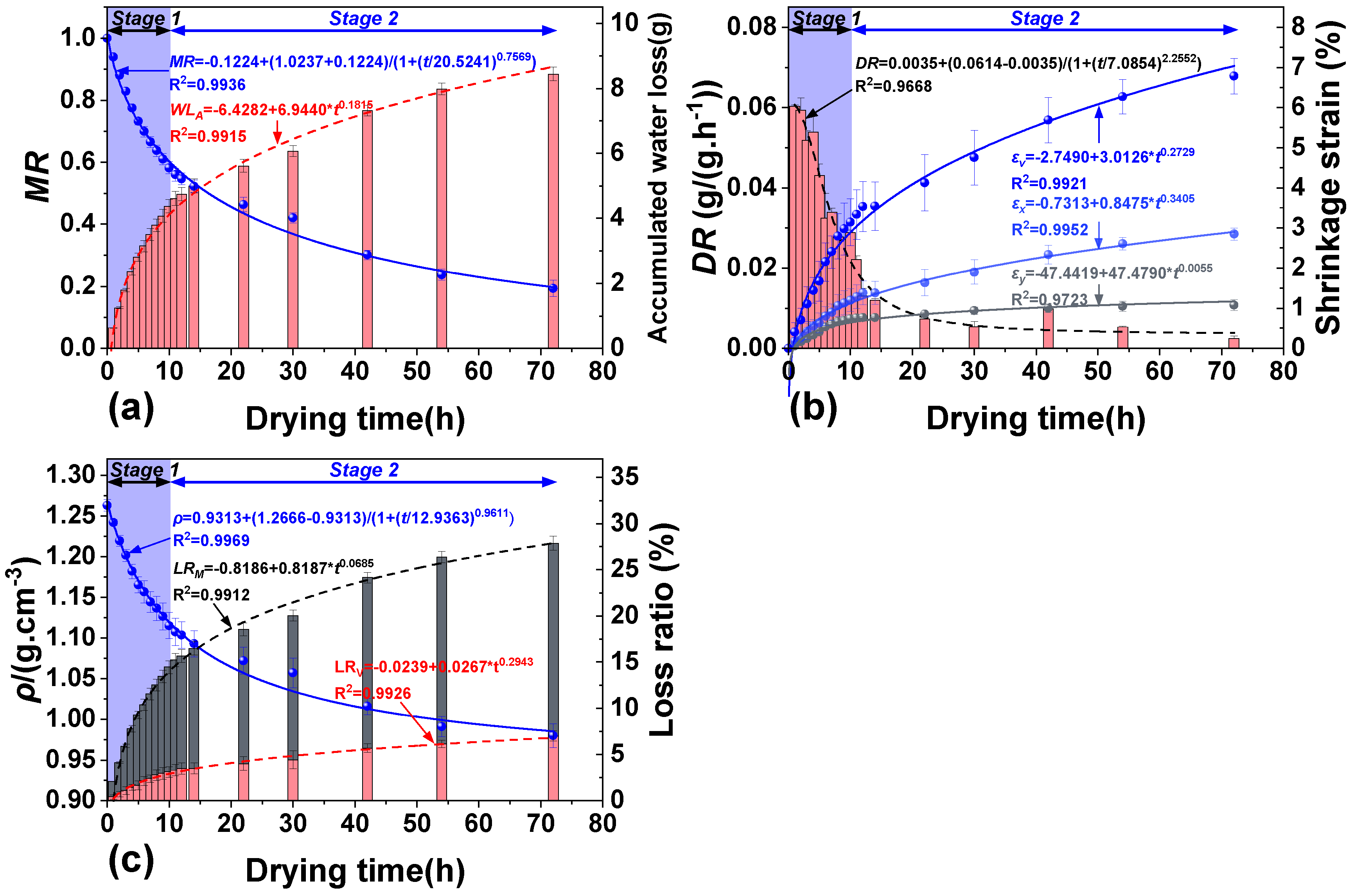
To reveal the evolution of macroscopic physical properties of lignite during NTD under the influence of macerals with different dehydration characteristics, we statistically analyzed the physical parameters of three lignite samples during NTD using the methods in Section 2.2, including height (H, mm), diameter (D, mm), volume (V, mm3), mass (mt, g), density (ρ, g·cm−3), and moisture content (ωt, %). The results are listed in Table 2. Meanwhile, based on the raw data in Table 2, a series of drying characteristic parameters such as MR and DR were further calculated. Finally, non-linear fitting was performed on them using the built-in mathematical model in Origin software. The results are shown in Figure 11.
As shown in Figure 11, the evolution of DR can be divided into two stages: the decelerating decline stage (stage I, ≤10 h) and the constant-rate stage (stage II, >10 h). In stage I, when lignite with a high natural moisture content (ω0 = 34.576%) is first exposed to the open-air environment, a considerable moisture gradient and an extremely short seepage path exist between the macerals on the sample surface and the external environment, causing the free water on the surface to be rapidly removed at an extremely high drying rate (DR ≈ 0.06 g/(g∙h−1)). With the prolongation of dehydration time, the drying front gradually moves toward the interior of the sample. Due to the well-developed and highly connected pore structure, almost all Fu undergoes rapid dehydration. In contrast, Ul in each maceral zone is either affected by its own low permeability or the dual influence of Fu’s blocking effect and its own low permeability, leading to significant water loss and shrinkage only in the near-surface Ul. As a result, the overall DR of the sample rapidly declines from 0.06 g/(g∙h−1) at t = 0 h to 0.027 g/(g∙h−1) at t = 10 h. However, the average DR of the sample remains relatively high during this stage. After entering stage II, the free water in Fu is almost completely evaporated, and the free water in the sample is mainly distributed in Ul of each zone, especially in the internal Ul far from the sample surface. However, due to the lack of highly permeable pore structures, its free water migration is highly dependent on the development of dehydration fracture networks. Thus, in this stage, with the progressive inward propagation of dehydration fractures, the DR of the sample gradually decreases and tends to a stable low value (≈0.003 g/(g∙h−1)). Non-linear fitting results of DR values during NTD show that DR exhibits an evolution characteristic of rapid initial decline followed by a gradual decrease and stabilization at a low value with dehydration time, which can be accurately described by a monotonically decreasing Logistic mathematical model (R2 = 0.9668).
With the regular evolution of DR, other physical quantities also exhibit a similar two-stage evolution pattern: a rapid decline (or increase) stage in the early period (≤10 h) and a constant-rate-decline (or increase) stage in the later period (>10 h). As shown in Table 2 and Figure 11, with the regular evolution of DR, the cumulative water loss amount (WLA, g) of lignite samples shows a monotonically increasing trend with a decreasing growth rate, while the changes in lignite mass (mt, g) and moisture content (ωt, %) exhibit a monotonically decreasing trend with a decreasing decline rate. Furthermore, the differential dehydration properties of macerals also induced regular changes in the sample’s height (H, mm), diameter (D, mm), and volume (V, mm3), thereby causing the growth rates of three strains (εx, εy, εv) to exhibit monotonically increasing trends with decreasing growth rates. Notably, due to more significant shrinkage in the hard layers than in the soft layers during dehydration, the εx of the sample was significantly greater than its εy. In addition, the mass loss ratio (LRM, %) and volume loss ratio (LRV, %) were used to quantitatively describe the monotonically increasing trends with decreasing growth rates for mass and volume, and the results are shown in Figure 11c. Since the change rate of LRM is faster than that of LRV, the ρ exhibits a monotonically decreasing trend with a decreasing decline rate, indicating that the looseness of lignite gradually increases with prolonged dehydration time. Statistical analysis of the fitting results for representative physical parameters (Table 3) shows that the dynamic evolution of MR, DR, and ρ all follows a monotonically decreasing Logistic model, while the dynamic evolution of physical parameters such as εx, εy, and εv obeys a monotonically increasing Classical Freundlich model. However, regardless of the model, the dynamic evolution of all physical quantities is characterized by monotonic variation with decreasing rates of change.
To summarize, the lignite exhibits obvious water loss and shrinkage characteristics. Influenced by the differential dehydration properties of macerals, physical parameters of lignite, such as MR, DR, ρ, and εₓ, all show dynamic evolution characteristics of rapid initial decline (or increase) followed by a gradual decrease (or increase) and converge to a certain stable value. Non-linear fitting results indicate that the dynamic evolution of MR, DR, and ρ all follows a monotonically decreasing Logistic model. In contrast, the dynamic evolution of physical parameters such as εx, εy, and εv obeys a monotonically increasing Classical Freundlich model. However, regardless of the model, the dynamic evolution of all physical quantities is characterized by monotonic variation with decreasing rates of change.

3.4. Evolution of Macroscopic Mechanical Properties of Lignite During NTD Governed by Dehydration-Induced Pore–Fractures

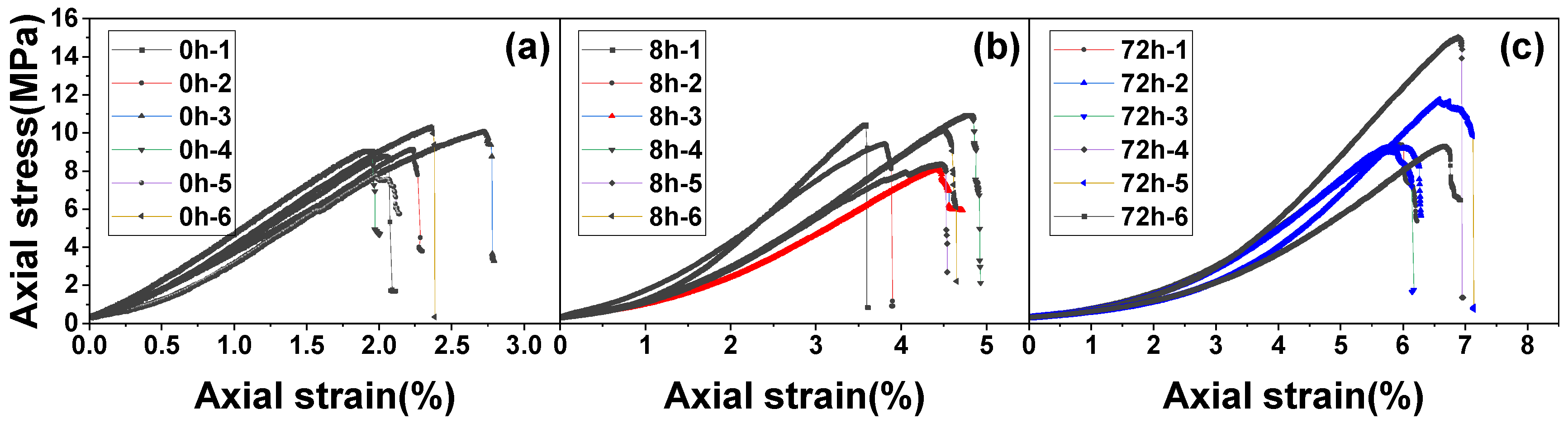
Previous studies have shown that the macerals of lignite exert a significant controlling effect on the development of 3D pore–fractures during NTD, while the dynamic evolution of pore–fracture structures significantly influences the macroscopic mechanical properties of lignite. To reveal this influence, uniaxial compression tests were conducted on three groups of lignite samples with different dehydration times (0 h, 8 h, 72 h) using the method described in Section 2.3, and the corresponding full stress–strain curves are shown in Figure 12.
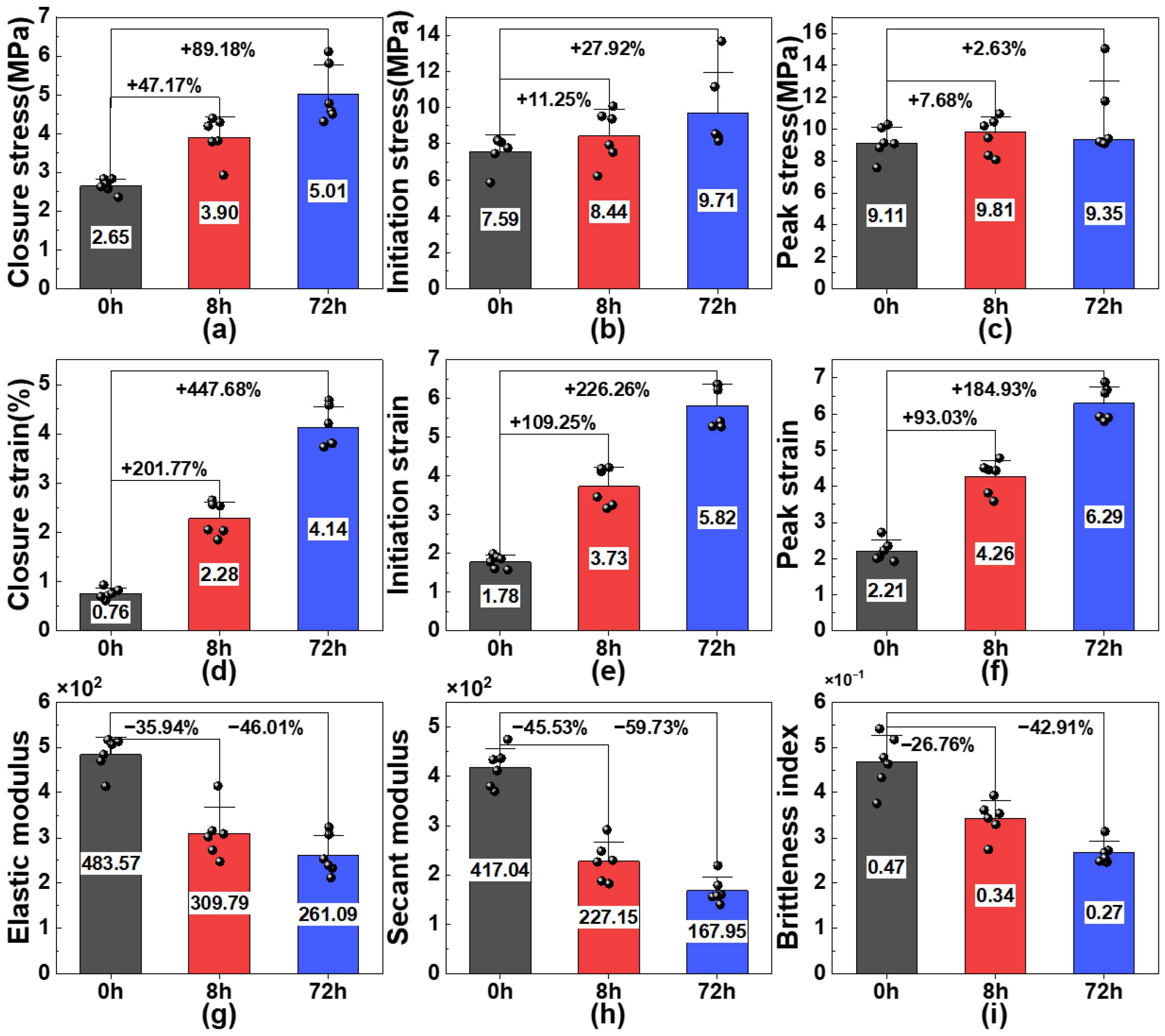
As shown in Figure 12, all stress–strain curves exhibit the same evolutionary characteristics: i.e., they all contain four stages: compaction stage, elastic stage, yield stage, and failure stage. The obvious difference is that, as the dehydration time prolonged, the durations of the compaction and pre-peak stage in lignite increased significantly. Conversely, the duration of the elastic stage showed little increase, but its slope decreased significantly. Obviously, with the extension of dehydration time, the deformation resistance of lignite under uniaxial compression has significantly deteriorated. Furthermore, the post-peak failure modes of lignite also showed noticeable changes with the increase in dehydration degree. After reaching the peak strength, the stress curves of the 0 h group samples all dropped rapidly, exhibiting obvious characteristics of brittle failure. After dehydration, the stress curves of the 8 h group samples also showed a relatively rapid decline, but compared with the 0 h group, the descent rate in the post-peak stage of the stress curves of individual coal samples was significantly slower (see the red curve in Figure 12b). This indicates that although the failure mode of the 8 h group coal samples was still dominated by brittle failure, it had shown certain plastic characteristics. In contrast to the first two groups of coal samples, a larger number of 72 h group coal samples exhibited a slow decline trend in the post-peak stage of stress curves, showing more significant plastic failure characteristics (see the blue curve in Figure 12c). Notably, while the closure stress and crack initiation stress of lignite samples significantly increased with the extension of dehydration time, their peak stress did not show significant changes.
The above-mentioned evolution of the uniaxial mechanical properties of the lignite is significantly correlated with the changes in its pore–fracture structures during NTD. Before dehydration, the sample exhibited high integrity and low porosity, with only a few mesocracks present at its bedding planes. Therefore, during uniaxial compression, it demonstrated strong deformation resistance and obvious post-failure brittle characteristics, i.e., low characteristic strain, high elastic modulus, secant modulus, and brittleness index. The quantitative analysis results shown in Figure 13 indicate that the 0 h group samples had average closure strain, crack initiation strain, and peak strain of 0.76%, 1.78%, and 2.21%, respectively, an average elastic modulus of 483.57 MPa, a secant modulus of 417.04 MPa, and an average brittleness index of 0.47 after failure. With the extension of the dehydration time, different degrees of water loss of Fu and Ul occurred, leading to the strong development of pores and fractures in different maceral zones of lignite, especially horizontal through-going fractures at bedding planes. These changes result in the requirement of greater axial loads and displacements to accomplish the compaction and crack initiation of the sample’s pore–fracture structure under uniaxial compression. Meanwhile, the development of pore–fracture structures severely damaged the sample integrity, leading to a reduction in deformation resistance and a marked transition of post-peak failure modes toward plasticity under uniaxial compression. Quantitative analysis shows that after 8 h of dehydration, the closure stress, closure strain, crack initiation stress, crack initiation strain, and peak strain of lignite increased by 47.17%, 201.77%, 11.25%, 109.25%, and 93.03%, respectively, compared to the 0 h group, while the elastic modulus, secant modulus, and brittleness index decreased by 35.94%, 45.53%, and 26.76%, respectively. After 72 h of dehydration, the values of the above parameters again changed drastically along the original trend, indicating that the mechanical response of lignite under uniaxial compression conditions has been fundamentally changed. Special attention should be paid to the fact that the peak strength of the lignite did not deteriorate significantly with the prolongation of the dewatering time, which is mainly due to the following reasons: First, during NTD of lignite, only horizontal through-going macrocracks were formed at the bedding planes, while its vertical structure still maintained high integrity. Second, Atomic Force Microscopy (AFM) tests show that the micro-mechanical properties of lignite did not undergo significant deterioration during dehydration [34].
In summary, the dehydration of lignite promoted the intense development of its pore–fracture systems and destroyed its internal structural integrity. This not only caused a significant reduction in pre-peak deformation resistance but also led to a marked transition of post-peak failure modes from brittleness to plasticity under uniaxial compression, characterized by obvious increases in characteristic stresses (except peak strength) and strains, as well as significant decreases in elastic modulus and brittleness index. However, since dehydration only formed horizontal through-going macrocracks at the bedding planes of lignite without evident deterioration in its micro-mechanical properties, the NTD process had limited effect on its uniaxial compressive strength.

4. Conclusions

This paper investigates the structural characteristics of main macerals in lignite and their dehydration properties during NTD based on SEM and μ-CT technologies. Additionally, Avizo and Image J software and fractal theory were employed to quantitatively analyze the effect of macerals on the development characteristics of 3D pore–fracture structures in lignite and the cracking patterns in different layers during NTD. Finally, the evolution characteristics of physical-mechanical properties of lignite during NTD under the influence of macerals were discussed. The main conclusions are as follows:
  • The lignite exhibits a distinct bedding structure with alternating soft-hard layers. The hard layers are mainly composed of Ul, while the soft layers consist of Fu, De, and Ul. Ul shows a low dehydration rate but poor thermal stability. After dehydration, it tends to form long, straight and well-oriented fractures with large apertures. Fu features a high dehydration rate and excellent thermal stability, losing most of its moisture in the early dehydration stage and transforming into the pore structure of lignite. Additionally, Fu significantly hinders the propagation of the dehydration fractures in other macerals, but its presence promotes the development of interfacial fractures between itself and other macerals.
  • The evolution curves of SP and FD values during NTD show that the development of pore–fracture structures is significantly maceral-dependent. The larger the total volume of Fu, the more developed the pore structure of lignite after 8 h dehydration. The larger the geometric dimension and the greater the total number of individual Ul blocks, and the closer their distribution to the sample’s surface, the more developed the fracture structures, particularly after 72 h dehydration. Additionally, influenced by the distinct maceral zones in the xy-plane direction and the highly complex composition of bedding planes, the heterogeneity in the development of pore–fracture structures in this direction is most pronounced throughout the NTD process.
  • Influenced by the differentiated cracking characteristics of Ul in different zones, the development patterns of fracture structures in the hard layers and soft layers exhibit significant differences. After dehydration, the hard layers form a complex fracture structure composed of many long-length, large-aperture, low-tortuosity, and well-oriented vertical and horizontal fractures, featuring extremely high fracture volume, area, fractal dimension, and connectivity. In contrast, due to the significant hindrance of adjacent Fu, the cracked Ul in the soft layers generates numerous short-length, small-aperture, high-tortuosity fractures with poor orientation, demonstrating remarkably lower values in fracture volume, area, fractal dimension, and overall development degree, without independent connectivity.
  • Governed by the differentiated dehydration characteristics of macerals, the evolution of physical parameters of lignite exhibits significant consistency during NTD, i.e., they show the dynamic evolution characteristics of “rapid decrease (or increase) in the early stage–gradual decrease (or increase) in the late stage and converge to a certain stable value”. The nonlinear fitting results indicate that the dynamic evolutions of MR, DR, and ρ all conform to the nonlinear monotonic decreasing Logistic model, while the dynamic evolutions of physical parameters such as εx, εy, and εv follow the nonlinear monotonic increasing Classical Freundlich model.
  • The intense development of pore–fractures in lignite during NTD alters its macroscopic mechanical behavior under uniaxial compression. With significant water loss from Fu and progressive cracking of Ul, the degree of pore–fracture structure development gradually increases, leading to a notable reduction in its pre-peak deformation resistance and a remarkable transition of failure mode from brittleness to plasticity. However, the uniaxial compressive strength of lignite was limitedly affected by the development of pore–cracks because only horizontally penetrating macrocracks were formed after water loss, and its structure in the vertical direction still retained better integrity, and the AFM-based test results showed that its micromechanical properties did not deteriorate significantly after dehydration.

Author Contributions

S.Y.: Writing—original draft, Writing—review and editing. L.H.: Investigation, Methodology, Supervision. J.R.: Formal analysis, Data curation. W.D.: Conceptualization, Project administration. G.L.: Funding acquisition, Validation, Visualization. All authors have read and agreed to the published version of the manuscript.

Funding

This study was supported by the National Natural Science Foundation of China (NSFC) (Grant No. 51574223).

Data Availability Statement

Data will be made available on request.

Conflicts of Interest

The authors declare no conflict of interest.

References

  1. Xia, Y.; Zhang, R.; Cao, Y.; Xing, Y.; Gui, X. Role of molecular simulation in understanding the mechanism of low-rank coal flotation: A review. Fuel 2020, 262, 116535. [Google Scholar] [CrossRef]
  2. Masudi, A.; Che Jusoh, N.W.; Muraza, O. Recent progress on low rank coal conversion to dimethyl ether as clean fuel: A critical review. J. Clean. Prod. 2020, 277, 124024. [Google Scholar] [CrossRef]
  3. Han, X.; Liu, M.; Wu, K.; Chen, W.; Xiao, F.; Yan, J. Exergy analysis of the flue gas pre-dried lignite-fired power system based on the boiler with open pulverizing system. Energy 2016, 106, 285–300. [Google Scholar] [CrossRef]
  4. Atsonios, K.; Violidakis, I.; Sfetsioris, K.; Rakopoulos, D.C.; Grammelis, P.; Kakaras, E. Pre-dried lignite technology implementation in partial load/low demand cases for flexibility enhancement. Energy 2016, 96, 427–436. [Google Scholar] [CrossRef]
  5. Gao, J.; Chu, R.-Z.; Meng, X.-L.; Yang, J.-Y.; Yang, D.-G.; Li, X.; Lou, W.-T. Synergistic mechanism of CO2 and active functional groups during low temperature oxidation of lignite. Fuel 2020, 278, 118407. [Google Scholar] [CrossRef]
  6. Pawlak-Kruczek, H.; Niedźwiecki, Ł.; Ostrycharczyk, M.; Czerep, M.; Plutecki, Z. Potential and methods for increasing the flexibility and efficiency of the lignite fired power unit, using integrated lignite drying. Energy 2019, 181, 1142–1151. [Google Scholar] [CrossRef]
  7. Xin, F.; Xu, H.; Tang, D.; Chen, Y.; Cao, L.; Yuan, Y. Experimental study on the change of reservoir characteristics of different lithotypes of lignite after dehydration and improvement of seepage capacity. Fuel 2020, 277, 118196. [Google Scholar] [CrossRef]
  8. Liu, W.; Niu, S.; Tang, H. Structural characteristics of pores and fractures during lignite pyrolysis obtained from X-ray computed tomography. J. Petrol. Sci. Eng. 2023, 220, 111150. [Google Scholar] [CrossRef]
  9. Zhang, T.; Lou, C.; Teng, D.; Li, G.; Li, P.; Yun, Q.; Zhou, G. Hot-air drying behavior of lignite and quantitative characterization for its surface damage. Dry. Technol. 2023, 41, 2171–2188. [Google Scholar] [CrossRef]
  10. Yu, Y.; Ni, C.; Cui, W.; Cheng, W.; Chen, Y. Progressive failure characteristics of coal under uniaxial compression: A comprehensive application of micro-ct and digital volume correlation. Bull. Eng. Geol. Environ. 2024, 83, 419. [Google Scholar] [CrossRef]
  11. Wu, Y.; Wang, D.; Wang, L.; Shang, Z.; Zhu, C.; Wei, J.; Yuan, A.; Zhang, H.; Zeng, F. An analysis of the meso-structural damage evolution of coal using X-ray CT and a gray-scale level co-occurrence matrix method. Int. J. Rock Mech. Min. 2022, 152, 105062. [Google Scholar] [CrossRef]
  12. Ma, H.; Song, Y.; Yang, J.; Zheng, J.; Shen, F.; Shao, Z. Experimental investigation on acoustic emission and damage characteristics of dehydrated lignite in uniaxial compression test. Bull. Eng. Geol. Environ. 2023, 82, 292. [Google Scholar] [CrossRef]
  13. Ma, H.; Song, Y.; Yang, J.; Zheng, J.; Shen, F.; Shao, Z.; Xia, Z. Experimental Investigation on Physical–Mechanical Behaviors and Macro–Micro-structural Responses of Lignite Subjected to Freeze–Thaw Cycles. Nat. Resour. Res. 2023, 32, 543–566. [Google Scholar] [CrossRef]
  14. Bhaskaran, S.; Samdani, G.; Aghalayam, P.; Ganesh, A.; Singh, R.P.; Sapru, R.K.; Jain, P.K.; Mahajani, S. Experimental studies on spalling characteristics of Indian lignite coal in context of underground coal gasification. Fuel 2015, 154, 326–337. [Google Scholar] [CrossRef]
  15. Zhang, G.; Ranjith, P.G.; Perera, M.S.A.; Lu, Y.; Choi, X. Quantitative Analysis of Micro-structural Changes in a Bituminous Coal After Exposure to Supercritical CO2 and Water. Nat. Resour. Res. 2019, 28, 1639–1660. [Google Scholar] [CrossRef]
  16. Zhang, G.; Ranjith, P.G.; Fu, X.; Li, X. Pore-fracture alteration of different rank coals: Implications for CO2 sequestration in coal. Fuel 2021, 289, 119801. [Google Scholar] [CrossRef]
  17. Liu, Y.; Lin, B.; Liu, T.; Liu, T.; Yang, J. Study on the micro conjugate heat transfer characteristics of coal reconstructed from CT images under the influence of temperature. Fuel 2023, 349, 128643. [Google Scholar] [CrossRef]
  18. Komatsu, Y.; Sciazko, A.; Zakrzewski, M.; Kimijima, S.; Hashimoto, A.; Kaneko, S.; Szmyd, J.S. An experimental investigation on the drying kinetics of a single coarse particle of Belchatow lignite in an atmospheric superheated steam condition. Fuel Process. Technol. 2015, 131, 356–369. [Google Scholar] [CrossRef]
  19. Gao, M.; Wan, K.; Miao, Z.; He, Q.; Ji, P.; Pei, Z. Hot-air drying behavior and fragmentation characteristic of single lignite particle. Fuel 2019, 247, 209–216. [Google Scholar] [CrossRef]
  20. Rong, L.; Xiao, J.; Wang, X.; Sun, J.; Jia, F.; Chu, M. Low-rank coal drying behaviors under negative pressure: Thermal fragmentation, volume shrinkage and changes in pore structure. J. Clean. Prod. 2020, 272, 122572. [Google Scholar] [CrossRef]
  21. Liu, N.; Sun, L.; Qin, B.; Zhang, S.; Du, W. Evolution of pore and fracture of coal under heating–freezing effects: An experimental study. Fuel 2021, 306, 121618. [Google Scholar] [CrossRef]
  22. Gao, M.; Wan, K.; Miao, Z.; He, Q.; Xue, S.; Dong, X. Hot-air drying shrinkage process of lignite and its cracking mechanism. Fuel 2022, 316, 123187. [Google Scholar] [CrossRef]
  23. Liu, X.; Yu, H.; Wei, L. Experimental study on the dehydration characteristics and evolution of the physicochemical structure of XilinGol lignite during the dehydration process. Fuel 2021, 291, 120241. [Google Scholar] [CrossRef]
  24. Cheng, C.; Gao, M.; Miao, Z.; Wan, K.; He, Q. Structural changes mechanism of lignite during drying: Correlation between macroscopic and microscopic. Fuel 2023, 339, 126955. [Google Scholar] [CrossRef]
  25. Zhou, Y.; Gao, M.; Miao, Z.; Cheng, C.; Wan, K.; He, Q. Physicochemical properties and combustion kinetics of dried lignite. Energy 2024, 289, 129928. [Google Scholar] [CrossRef]
  26. Yang, N.; Hu, G.; Zhu, J.; Duan, H.; Wang, T.; Li, Y. Evolution of pore-fracture structure and permeability of coal by microwave irradiation under uniaxial compression. J. Nat. Gas Sci. Eng. 2022, 107, 104759. [Google Scholar] [CrossRef]
  27. Zhou, S.; Liu, D.; Cai, Y.; Yao, Y. Gas sorption and flow capabilities of lignite, subbituminous and high-volatile bituminous coals in the Southern Junggar Basin, NW China. J. Nat. Gas Sci. Eng. 2016, 34, 6–21. [Google Scholar] [CrossRef]
  28. Wu, Y.; Tao, S.; Bi, C.; Tang, S.; Men, X. Pore-fracture and permeability heterogeneity of different marcolithotypes of medium-rank coals in Jixi Basin, China. J. Petrol. Sci. Eng. 2023, 231, 212395. [Google Scholar] [CrossRef]
  29. Zhao, J.; Shen, J.; Qin, Y.; Wang, J.; Zhao, J.; Li, C. Coal Petrology Effect on Nanopore Structure of Lignite: Case Study of No. 5 Coal Seam, Shengli Coalfield, Erlian Basin, China. Nat. Resour. Res. 2021, 30, 681–695. [Google Scholar] [CrossRef]
  30. Qiu, B.; Fan, L.; Du, X. Microstructure deterioration of sandstone under freeze-thaw cycles using CT technology: The effects of different water immersion conditions. J. Rock Mech. Geotech. 2025, 17, 1599–1611. [Google Scholar] [CrossRef]
  31. Hou, C.; Jin, X.; He, J.; Li, H. Experimental studies on the pore structure and mechanical properties of anhydrite rock under freeze-thaw cycles. J. Rock Mech. Geotech. 2022, 14, 781–797. [Google Scholar] [CrossRef]
  32. Zhu, H.; Jiao, Z.; Zhao, P.; Tang, X.; Chen, S.; Tao, L. Physico-mechanical properties of granite after thermal treatments using different cooling media. J. Rock Mech. Geotech. 2024, 17, 3619–3631. [Google Scholar] [CrossRef]
  33. Sun, X.; Shi, F.; Ding, J.; Tao, Z.; Zhang, Y.; Miao, C.; Cui, L. Study on Microscopic Mechanism and Failure Mode of Water–Rock Coupling in Fine Sandstone Under Uniaxial Compression. Rock Mech. Rock Eng. 2023, 56, 6823–6842. [Google Scholar] [CrossRef]
  34. Xin, F.; Fang, C.; Wang, S.; Xiong, B.; Cao, C.; Liu, D.; Tang, D.; Xu, H. Influence of Composition on Differential Evolution of Pore–Fracture Systems and Micro-mechanical Properties of Lignite During Drying-Wetting Cycles. Nat. Resour. Res. 2024, 33, 365–388. [Google Scholar] [CrossRef]
  35. Han, J.; Liu, Z.; Yang, H.; Zhou, Z.; Gu, Q.B. Modeling of water-injected coal with fracture-pore structure and experimental study of gas-water two-phase transport characteristics. Int. J. Rock Mech. Min. 2025, 195, 106272. [Google Scholar] [CrossRef]
  36. Zhang, L.K.; Zhao, D.; Yan, K.; Wang, J.; Fan, L. Characterization of CT pore structure and permeability evolution of water-bearing coal samples under the effect of liquid nitrogen freeze-thaw cycle. Fuel 2026, 404, 136186. [Google Scholar] [CrossRef]
  37. Wang, A.; Wang, L. A Fractal-Based Quantitative Method for the Study of Fracture Evolution of Coal under Different Confining Pressures. Fractal Fract. 2024, 8, 159. [Google Scholar] [CrossRef]
  38. Zhang, H.X.; Sun, W.C.; Xie, Q.; Chen, Y.C.; Tu, Z.N.; Ban, Y.X. Study on mechanical properties and damage characteristics of acid corrosion in granite based on NMR technology. Eng. Geol. 2024, 340, 107678. [Google Scholar] [CrossRef]
  39. Gao, H.M.; Lan, Y.W.; Zhao, Y.L.; Li, Z.M. Pore fractal and damage characteristics of granite following high-temperature heating and water cooling. Acta Geotech. 2025, 20, 5257–5276. [Google Scholar] [CrossRef]
  40. Jiang, Z.; Liu, F.; Cai, G.J.; He, H.; Shi, W.; He, Y. Fractal characterization of pore structure evolution in pre-fractured sandstone under cyclic freeze-thaw. J. Petrol. Sci. Eng. 2025, 247, 213649. [Google Scholar] [CrossRef]
  41. Zheng, Y.F.; Zhai, C.; Sang, S.X.; Chen, A.K.; Xu, J.Z.; Sun, Y.; Xu, H.X.; Xu, H.Y.; Lai, Y.S. Pore structure evolution of anthracite modified by CO2 foam fracturing fluid under different temperature and pressure conditions. Fuel 2025, 401, 135929. [Google Scholar] [CrossRef]
  42. You, S.; Feng, Q.X.; Elmo, D.; Geng, Q.C.; Wang, Y.T.; Gao, Y. Distribution and evolution mechanisms of deep sandstone pore-fracture system by using 3D CT reconstruction. J. Petrol. Sci. Eng. 2026, 258, 214354. [Google Scholar] [CrossRef]
  43. Wang, D.; Zeng, F.; Wei, J.; Zhang, H.; Wu, Y.; Wei, Q. Quantitative analysis of fracture dynamic evolution in coal subjected to uniaxial and triaxial compression loads based on industrial CT and fractal theory. J. Petrol. Sci. Eng. 2021, 196, 108051. [Google Scholar] [CrossRef]
  44. Yan, S.; Han, L.; Zhang, S.; Zhao, W.; Meng, L. Evolution Characteristics of Pore–Fractures and Mechanical Response of Dehydrated Lignite Based on In Situ Computed Tomography (CT) Scanning. Fractal Fract. 2025, 9, 220. [Google Scholar] [CrossRef]
  45. Allwright, A.; Atangana, A. Fractal advection-dispersion equation for groundwater transport in fractured aquifers with self-similarities. Eur. Phys. J. Plus 2018, 133, 48. [Google Scholar] [CrossRef]
  46. Razminia, K.; Razminia, A.; Torres, D.F.M. Pressure responses of a vertically hydraulic fractured well in a reservoir with fractal structure. Appl. Math. Comput. 2015, 257, 374–380. [Google Scholar] [CrossRef]
  47. Razminia, K.; Razminia, A.; Tenreiro Machado, J.A. Analysis of diffusion process in fractured reservoirs using fractional derivative approach. Commun. Nonlinear Sci. Numer. Simul. 2014, 19, 3161–3170. [Google Scholar] [CrossRef]
  48. Yan, S.; Liu, Y.; Liang, Y. A space fractal derivative crack model for characterizing chloride ions superdiffusion in concrete in the marine tidal zone. Constr. Build. Mater. 2024, 450, 138585. [Google Scholar] [CrossRef]
  49. Al-Rbeawi, S. Rate and pressure behavior considering the fractal characteristics of structurally disordered fractured reservoirs. J. Pet. Explor. Prod. Technol. 2021, 11, 483–507. [Google Scholar] [CrossRef]
  50. Lei, D.; Sun, H.; Zhang, Y.; Blaszczyk, T.; Yu, Z. Upscaling solute transport in rough single-fractured media with matrix diffusion using a time fractional advection-dispersion equation. J. Hydrol. 2023, 627, 130280. [Google Scholar] [CrossRef]
  51. Zhou, H.W.; Cao, Y.P.; Xie, S.L.; Liu, Z.L.; Jia, W.H. Evolution of pore-fracture structure and mechanical properties of coal under dry-wet cycle. Int. J. Rock Mech. Min. 2025, 192, 106146. [Google Scholar] [CrossRef]
  52. Yao, M.; Liu, Z.; Yang, H.; Dong, S. Characteristics and factors influencing the nonlinear seepage of paste material injected into a fractal-like tree fracture bifurcation network around coal seam boreholes. Phys. Fluids 2025, 37, 013122. [Google Scholar] [CrossRef]
  53. GB/T17607-1998; Chinese Classification of in Seam Coals. Chinese Standard: Beijing, China, 1998.
  54. Xin, F.; Cao, C.; Fang, C.; Wang, S.; Xiong, B.; Tang, D.; Xu, H. Effects of lignite composition on reservoir structure, water–gas-bearing features and gas enrichment. Fuel 2023, 353, 129203. [Google Scholar] [CrossRef]
  55. GB/T 50266-2013; Standard for Test Methods of Engineering Rock Mass. Chinese Standard: Beijing, China, 2013.
  56. Zhu, J.; Qi, T.; Li, J.; Cheng, Z.; Zhang, Y. The Effects of High Temperature on Crack Propagation and Failure Characteristics of Sandstone. Rock Mech. Rock Eng. 2023, 56, 5753–5779. [Google Scholar] [CrossRef]
  57. Shan, C.; Yao, Q.; Cao, S.; Xu, Q.; Zheng, C.; Xia, Z.; Li, Y.; Yan, L. Fracture Development Patterns and Micro–Macrostructural Fractal Characteristics of Acid–Base Coal Samples. Nat. Resour. Res. 2024, 33, 831–865. [Google Scholar] [CrossRef]
  58. Wang, G.; Qin, X.; Shen, J.; Zhang, Z.; Han, D.; Jiang, C. Quantitative analysis of microscopic structure and gas seepage characteristics of low-rank coal based on CT three-dimensional reconstruction of CT images and fractal theory. Fuel 2019, 256, 115900. [Google Scholar] [CrossRef]
  59. Zhou, Z.; Sheng, M.; Ge, Z.; Li, R.; Gong, S.; Zhang, H. Mechanical properties and failure characteristics of supercritical carbon dioxide soak in water-bearing coal rocks. Energy 2024, 286, 129599. [Google Scholar] [CrossRef]
  60. Zhao, C.; Cheng, Y.; Wang, C.; Zhang, K.; Wang, Z.; Chu, P.; Yang, T. 3-D visual analysis and quantitative characterization on coal matrix based on Micro-CT. Int. J. Rock Mech. Min. 2024, 176, 105694. [Google Scholar] [CrossRef]
  61. Li, Z.; Liu, D.; Cai, Y.; Ranjith, P.G.; Yao, Y. Multi-scale quantitative characterization of 3-D pore-fracture networks in bituminous and anthracite coals using FIB-SEM tomography and X-ray μ-CT. Fuel 2017, 209, 43–53. [Google Scholar] [CrossRef]
  62. Wang, H.; Li, J.; Dong, Z.; Fan, C.; Zhang, Y.; Chen, X. Effect of thermal damage on the pore–fracture system during coal spontaneous combustion. Fuel 2023, 339, 127439. [Google Scholar] [CrossRef]
  63. Xin, F.; Xu, H.; Tang, D.; Cao, L. Properties of lignite and key factors determining the methane adsorption capacity of lignite: New insights into the effects of interlayer spacing on adsorption capacity. Fuel Process. Technol. 2019, 196, 106181. [Google Scholar] [CrossRef]
  64. Yan, S.; Han, L.; Meng, L.; Zhao, W. Application of clay minerals in the synthesis of cretaceous mudstones and microstructural analysis of their deterioration mechanism. Sci. Rep. 2024, 14, 29414. [Google Scholar] [CrossRef] [PubMed]
  65. International Committee for Coal and Organic Petrology (ICCP). The new inertinite classification (ICCP System 1994). Fuel 2001, 80, 459–471. [Google Scholar] [CrossRef]
  66. Pickel, W.; Kus, J.; Flores, D.; Kalaitzidis, S.; Christanis, K.; Cardott, B.J.; Misz-Kennan, M.; Rodrigues, S.; Hentschel, A.; Hamor-Vido, M.; et al. Classification of liptinite—ICCP System 1994. Int. J. Coal Geol. 2017, 169, 40–61. [Google Scholar] [CrossRef]
  67. Sykorová, I.; Pickel, W.; Christanis, K.; Wolf, M.; Taylor, G.H.; Flores, D. Classification of huminite—ICCP system 1994. Int. J. Coal Geol. 2005, 62, 85–106. [Google Scholar] [CrossRef]
  68. Xin, F.; Xu, H.; Tang, D.; Liu, D.; Cao, C. Problems in pore property testing of lignite: Analysis and correction. Int. J. Coal Geol. 2021, 245, 103829. [Google Scholar] [CrossRef]
  69. Li, G.; Qin, Y.; Yao, H.; Qu, J.; Zhang, H.; Fang, X.; Shang, F.; Zhang, L. 3D pore structure characterization and permeability anisotropy visualization simulation of fusain. Energy 2024, 291, 130422. [Google Scholar] [CrossRef]
  70. Han, L.; Shen, J.; Wang, J.; Shabbiri, K. Characteristics of Pore Evolution and Its Maceral Contributions in the Huolinhe Lignite during Coal Pyrolysis. Nat. Resour. Res. 2021, 30, 2195–2210. [Google Scholar] [CrossRef]
Figure 1. Experimental flow chart: (a1,a2) the lignite blocks and some prepared lignite samples; (b1,b2) Espec SETH-2-021L constant climate cabinet and the drying lignite samples; (c1,c2) MTS 810 material testing systems (MTS Systems Corporation, Eden Prairie, MN, USA) and the uniaxial compressive sample; (d1,d2) InspeXio SMX-225CT FPD HR CT scanning system (Shimadzu Corporation, Kyoto, Japan) and TESCAN GAIA3 FIB-SEM equipment (TESCAN Group a.s., Brno, Czech Republic).
Fractalfract 10 00152 g001
Figure 2. Image processing workflow: (a,b) the CT dataset of lignite before and after cropping; (c,d) segmentation of pores and fractures using the Interactive Top-Hat module; (e) manual setting of markers on the fractures; (f) screening of fractures via the “Reconstruction from Markers” module; (g) merging of pores and fractures by the “Or Image” command; (h) 3D visualization of the pore–fracture structures; (i) quantitative analysis through the “Label Analysis” command.
Fractalfract 10 00152 g002
Figure 3. Macrostructural characteristics of lignite and its shrinkage–cracking behavior after 72 h dehydration: (a) alternating soft-hard bedding structure; (b) intense shrinkage and selective distribution of fractures; (c) components in different layers and their shrinkage–cracking characteristics.
Fractalfract 10 00152 g003
Figure 4. Microstructure of the main macerals and their shrinkage-cracking characteristics after 72 h dehydration: (a) ulminite; (b) densinite and semifusinite (Sf); (c,d) fusinite; (e,f) mixture of multiple macerals, including textinite (Te).
Fractalfract 10 00152 g004
Figure 5. Dynamic dehydration characteristics of macerals at different parts during NTD revealed by representative slices: (a) in the soft layers (slice 285), hard layers (slice 359) and bedding plane (slice 403) at xy-plane direction; (b) at the exterior part (slice 0 and slice 729) and interior part (slice 364) at xz-plane direction; (c) within the exterior part (slice 0 and slice 729) and interior part (slice 364) at yz-plane direction (Bright: minerals; Gray: macerals; Black: pores and cracks; Yellow-background numbers: the top ten longest cracks in current slice; Red-background numbers: cracks in soft layers).
Fractalfract 10 00152 g005aFractalfract 10 00152 g005b
Figure 6. Statistics on geometric parameters of the 10 longest cracks in different slices and surface porosity (SP) of the slices during NTD. Note: (a1,a2,b1,b2) present the statistical results for slice 285 and slice 359 in Figure 5a, respectively; (c1,c2,d1,d2) show those for slice 364 and slice 0 in Figure 5b, respectively; (e1,e2,f1,f2) represent the data for slice 364 and slice 0 in Figure 5c, respectively.
Fractalfract 10 00152 g006
Figure 7. Variations of surface porosity and 2D fractal dimension of pore–fracture structures in different directions during NTD. Note: (a1,c1,e1) are the variations of surface porosity in the xy-plane, xz-plane, and yz-plane directions, respectively; (a2,c2,e2) are the variations of surface porosity for representative slices in the xy-plane, xz-plane, and yz-plane directions, respectively; (b1,d1,f1) are the variations of 2D fractal dimension in the xy-plane, xz-plane, and yz-plane directions, respectively; (b2,d2,f2) are the variations of 2D fractal dimension for representative slices in the xy-plane, xz-plane, and yz-plane directions, respectively; (g,h) are the mean and standard deviation of the surface porosity and 2D fractal dimension in three directions, respectively.
Fractalfract 10 00152 g007
Figure 8. Dynamic evolution of fractures in lignite from different perspectives during NTD. Note: (a1,b1,c1) are the 3D fractures of lignite after dehydration for 0, 8, and 72 h, respectively; (a2,b2,c2) are the 3D fracture distribution on lignite surface after 0, 8, and 72 h dehydration; (a3,b3,c3) are the 3D fracture distribution inside the lignite after 0, 8, and 72 h dehydration; the macrocracks (equivalent diameter > 10 mm) are colored red, the mesocracks (1 mm < equivalent diameter ≤ 10 mm) are colored blue, and transition and microcracks (equivalent diameter ≤ 1 mm) are rendered gray.
Fractalfract 10 00152 g008
Figure 9. Statistics on geometric parameters of three types of cracks during NTD. Note: (a1,b1,a2,b2) present the statistics of the length, width, angle, and other parameters of 10 horizontal fractures at the bedding plane, respectively. (c1,d1,c2,d2) show the same parameters for 10 cracks in the hard layers, and (e1,f1,e2,f2) do the same for 10 cracks in the soft layers. AW = average width, AWCR = average width completion rate, AL = average length, ALCR = average length completion rate.
Fractalfract 10 00152 g009
Figure 10. Statistics of the main parameters of various types of cracks in different zones during NTD. Note: (a1d1) present the statistics of the counts, volume, area, and fractal dimension of the whole fracture structures, respectively. (a2d2,a3d3) show the same parameters for fracture structures in the hard and soft layers, respectively. The Ct values (i.e., C0, C8, and C72) in (b1b3) represent the pore–fracture connectivity of the whole, hard layer, and soft layer at each dehydration time, respectively.
Fractalfract 10 00152 g010
Figure 11. Evolution of the physical properties of lignite during NTD: (a) moisture ratio (MR) and accumulated water loss (WLA); (b) drying rate (DR) and three types of shrinkage strain (circumferential strain (εx), axial strain (εy), and volumetric strain (εv)); (c) density (ρ), mass loss ratio (LRM), and volume loss ratio (LRV); blue-filled areas: data for Stage 1; unfilled areas: data for Stage 2.
Fractalfract 10 00152 g011
Figure 12. Stress–strain curves of lignite samples with different dehydration times obtained from uniaxial compression tests: (a) 0 h; (b) 8 h; (c) 72 h.
Fractalfract 10 00152 g012
Figure 13. Statistics on the main mechanical parameters and corresponding change rate of lignite samples with different dehydration times: (a) closure stress; (b) initiation stress; (c) peak stress; (d) closure strain; (e) initiation strain; (f) peak strain; (g) elastic modulus; (h) secant modulus; (i) brittleness index.
Fractalfract 10 00152 g013
Table 1. General information of the coal sample.
Properties Lignite
Maceral composition (%)Huminite51.81
Inertinite 45.46
Liptinite2.74
Ro (%) Vitrinite reflectance 0.28
Proximate analysis, %Mad17.40
Aad16.94
Vad28.51
FCad37.15
XRD analysis, %Organic carbon and others89.38
Kaolinite5.87
Quartz1.99
Diaoyudaoite1.75
Siderite1.01
Note: M, moisture (ad refers to the air-dried basis); A, ash; V, volatile matter; FC, fixed carbon.
Table 2. Statistics on the physical properties of dehydrated lignite during NTD.
Time/hH/mmD/mmV/mm3mt/gρ/(g.cm−3)ωt/%
AvgSDAvgSDAvgSDAvgSDAvgSDAvgSD
050.2750.02524.6410.08223.9630.01530.2690.1721.2630.00734.5760.506
150.2450.02024.5980.06723.8650.05829.6390.1641.2420.00433.1850.505
250.1920.04524.5740.04823.7940.08429.0190.1721.2200.00731.7560.53
350.1520.04024.5360.03523.7000.11728.4760.1611.2020.00730.4570.505
450.1080.02224.5030.04223.6170.0927.9130.1791.1820.00929.0530.536
550.0720.03824.4840.02623.5640.13227.4620.1731.1650.0127.8870.509
650.0050.03624.4420.02523.4510.1327.1220.2321.1570.01426.9830.663
749.9730.03224.4190.03223.3920.1126.7670.2381.1440.01326.0130.693
849.9400.04624.3790.01623.3000.1526.4760.2371.1360.01525.2010.699
949.9220.0524.3610.01523.2570.16926.1930.2391.1260.01624.3910.718
1049.9070.03424.3440.01523.2180.15525.8910.2421.1150.01623.5080.734
1149.8950.04024.3230.0223.1730.16325.6600.251.1070.01722.8190.769
1249.8920.04224.3000.01523.1270.16425.5220.2311.1040.01622.4040.716
1449.8880.04424.3000.01623.1250.15925.2710.2321.0930.01621.6320.722
2249.8470.04724.2430.01222.9980.18224.6560.3151.0720.01719.6761.041
3049.8030.07024.2020.02422.9010.17624.2030.3071.0570.01818.1750.727
4249.7720.07824.0510.02822.6010.14822.9570.1421.0160.0113.7350.706
5449.7490.08723.9980.04322.4900.11722.2840.2030.9910.01211.1300.824
7249.7020.09223.8970.04222.2810.11921.8290.2560.9800.0159.2711.266
Note: Avg, Average value; SD, Standard deviation.
Table 3. Fitted results of representative physical parameters for lignite under NTD conditions.
No.ModelEquationFunctionCoefficientsR2
1Logistic y = A 1     A 2 1   +   x / x 0 p + A 2 MR = f(t) A 1 = 1.0237, A 2 = −0.1224,
x 0 = 20.5241, p = 0.7569
0.9936
2DR = f(t) A 1 = 0.0614, A 2 = 0.0035,
x 0 = 7.0854, p = 2.2552
0.9668
3 ρ = f(t) A 1 = 1.2666, A 2   = 0.9313,
x 0 = 12.9363, p = 0.9611
0.9969
4Classical Freundlich y = a + b × x c WLA = f(t) a = −6.4282, b = 6.9440,
c   = 0.1815
0.9915
5 ε v = f(t) a   = −2.7490, b   = 3.0126,
c   = 0.2729
0.9921
6 ε x = f(t) a   = −0.7313, b   = 0.8475,
c   = 0.3405
0.9952
7 ε y = f(t) a   = −47.4419, b   = 47.4790,
c = 0.0055
0.9723
8LRM = f(t) a   = −0.8186, b   = 0.8187,
c   = 0.0685
0.9912
9LRV = f(t) a   = −0.0239, b   = 0.0267,
c   = 0.2943
0.9926
Disclaimer/Publisher’s Note: The statements, opinions and data contained in all publications are solely those of the individual author(s) and contributor(s) and not of MDPI and/or the editor(s). MDPI and/or the editor(s) disclaim responsibility for any injury to people or property resulting from any ideas, methods, instructions or products referred to in the content.