You are currently viewing a new version of our website. To view the old version click .
Fractal and Fractional
  • Article
  • Open Access

5 December 2025

Influence of Key Parameters on the Fractal Dimension and Impact on Gas-Bearing Capacity: A Case Study from the Lower Shihezi Formation, Ordos Basin


,
,
,
and
1
National Key Laboratory of Petroleum Resources and Engineering, China University of Petroleum (Beijing), Beijing 102249, China
2
College of Geosciences, China University of Petroleum (Beijing), Beijing 102249, China
3
Exploration and Development Research Institute, SINOPEC North China Company, Zhengzhou 450006, China
*
Author to whom correspondence should be addressed.
This article belongs to the Special Issue Fractal Analysis in Unconventional Reservoirs: Theory and Applications

Abstract

Pore–throat structure and gas distribution are critical factors in evaluating the quality of tight sandstone reservoirs and hydrocarbon resource potential. Twelve tight sandstone samples from the Lower Permian Shihezi Formation in Hangjin Banner, Ordos Basin, were selected for CTS, X-ray diffraction, HPMI, and gas displacement NMR analyses. By converting the T2 spectra into pore–throat distributions and applying fractal methods, we quantitatively analyzed the influences of multiple factors on gas distribution characteristics across different pore–throat sizes. The main results are as follows: All samples exhibit a three-stage pore–throat distribution, defining mesopores, micropores, and nanopores; quartz content mainly influences the fractal dimension of mesopores by enhancing structural stability and gas storage capacity, whereas clay minerals control the fractal characteristics of nanopores by increasing pore–throat complexity. An increase in clay mineral content increases the fractal dimension, indicating stronger reservoir heterogeneity and consequently poorer gas-bearing capacity. Larger pore–throat parameters (Rm, Sk, and Smax) correspond to lower fractal dimensions, indicating better connectivity and greater gas storage capacity. Among these factors, pore–throat parameters exert the most significant influence on the fractal dimensions of mesopores and micropores, jointly determining the overall connectivity and the upper limit of the reservoir’s gas-bearing capacity. The results demonstrate that larger pore–throat parameters and higher quartz content help reduce the fractal dimension and enhance the gas-bearing capacity of tight reservoirs. This research enhances understanding of pore–throat structures and gas-bearing capacity in low-permeability reservoirs and provides a theoretical basis for exploration, development, and enhanced recovery in the study area.

1. Introduction

Tight sandstone gas reservoirs are currently a significant global source of gas [1,2,3]. In China, the Ordos Basin is the leading region for tight gas development, but due to its complex sedimentology, these reservoirs exhibit strong heterogeneity, complex pore–throat structures, and significant variations in gas saturation, necessitating quantitative characterization of gas distribution [4,5,6,7,8].
When developing tight gas reservoirs, the characteristics of gas distribution have garnered increasing attention [9,10,11], because they directly affect well recovery rates [12,13,14,15]. The pore–throat structure of tight sandstone gas reservoirs reflects the geometry, size, distribution, and connectivity of pores and throats. It not only influences gas migration and accumulation but also affects gas distribution patterns [16,17,18]. Generally, better pore–throat structures correspond to higher movable volumes, better gas-bearing properties, and improved single-well productivity and recovery rates [15,19,20]. However, this perspective often overlooks the heterogeneous gas distribution across different pore–throat size scales, leading to an incomplete understanding of internal reservoir behavior. Since the conceptualization of fractal theory, the fractal dimension has been widely applied to characterize the heterogeneity of microscopic pore–throats and enable quantitative analysis of the relationship between pore–throat structures and reservoir parameters. However, it is often used as a concept describing the reservoir as a whole, which overlooks the self-similarity within pore–throats of different sizes. Therefore, using the fractal dimension as a basis for classifying pore–throat sizes can more precisely depict the heterogeneity of pore–throats at different scales.
Previous studies have shown that different pore–throat structures directly influence the internal gas distribution within tight sandstone reservoirs [21]. However, most previous work has relied on a single experimental technique—such as high-pressure mercury intrusion (HPMI), constant-rate mercury intrusion, or nuclear magnetic resonance (NMR)—to characterize the pore–throat structure [22,23,24]. Each of these methods alone is insufficient to comprehensively represent the overall pore–throat system and cannot accurately characterize the actual gas distribution within the reservoir [13,25,26]. Incorporating gas displacement water nuclear magnetic resonance (GDWNMR) experiments into pore–throat structure studies enables simultaneous characterization of internal pore–throat structures and insights into gas distribution features. This approach is vital for understanding gas displacement effects and gas distribution laws within reservoirs, elucidating the gas distribution mechanisms in tight sandstone reservoirs, and guiding gas reservoir development [1,27].
The aim of this study is to investigate the factors controlling gas occurrence within multi-scale pore–throats based on fractal dimension theory, using tight sandstone samples from the Lower Permian Shihezi Formation in the Hangjinqi area of the Dongsheng gas field, Ordos Basin. Using comprehensive techniques, including casting thin sections (CTS), scanning electron microscopy (SEM), X-ray diffraction (XRD), high-pressure mercury injection (HPMI), and gas displacement water nuclear magnetic resonance (GDWNMR), we analyzed the effects and mechanisms of multiple factors on gas distribution within the reservoir. The specific research objectives are as follows: (i) to classify pore–throat types based on multiple experimental methods and determine the boundaries of different pore–throat scales; (ii) to systematically reveal the gas distribution characteristics of reservoirs with different pore–throat types after displacement; (iii) to quantitatively investigate the influence of mineral composition, petrophysical parameters, and pore–throat heterogeneity on fractal dimension and gas distribution. This study provides a theoretical geological basis for evaluating tight sandstone reservoir quality and fluid distribution, as well as for exploration and development, and offers an important reference for the exploitation of other tight sandstone gas reservoirs.

2. Geological Background

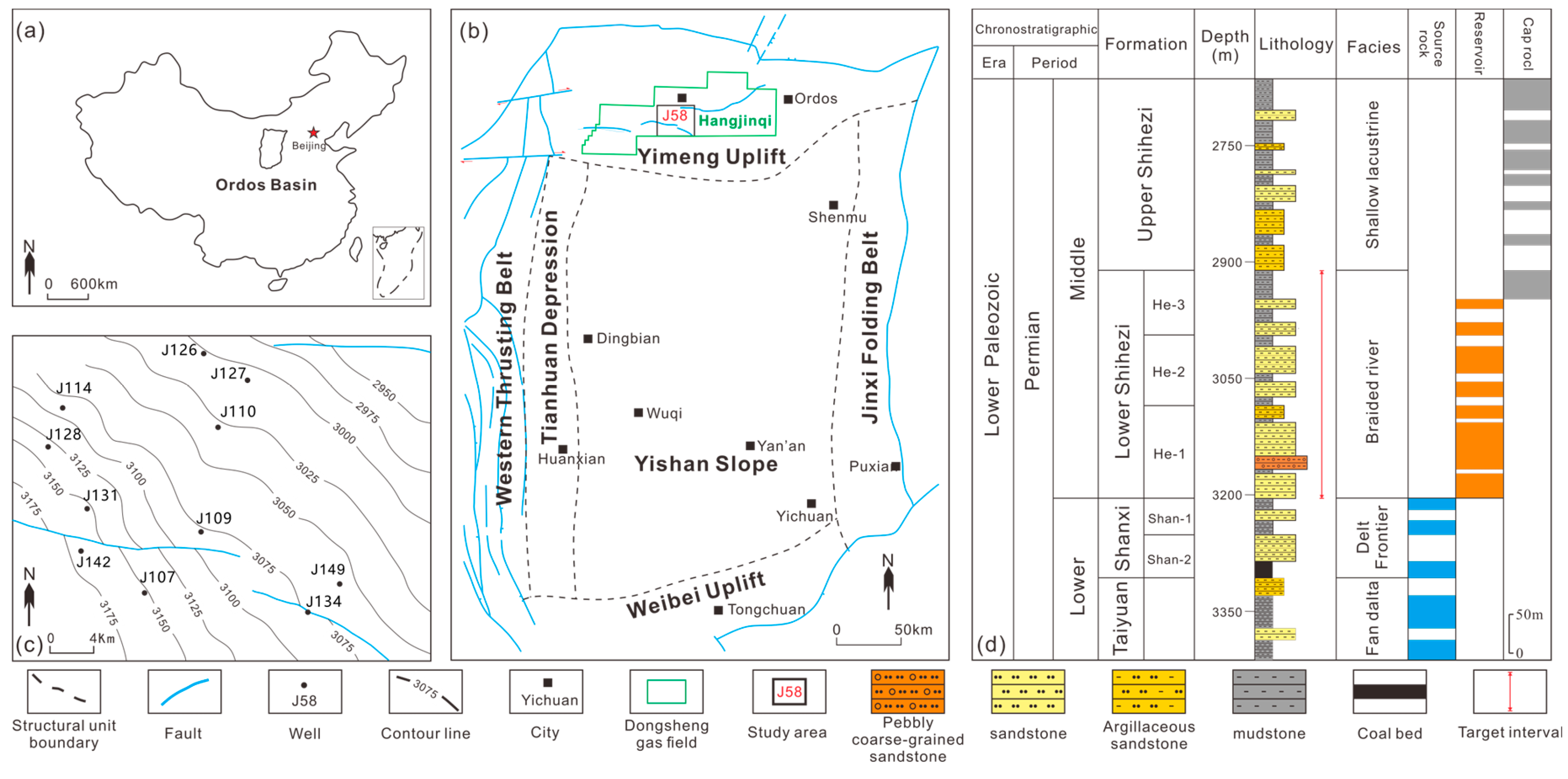
The Ordos Basin is the second-largest inland sedimentary basin in China, covering an area of ~25 × 104 km2. It formed on the North China Platform (Figure 1a) and is the largest oil and gas-bearing basin in China [28,29]. In the Permian, due to the collision between the North China Plate and the Yangtze Plate, the Ordos Basin transformed from a marine sedimentary basin to a cratonic basin [30]. Following the Jurassic period, the Ordos Basin underwent multiple episodes of tectonic deformation and different sedimentary processes. The basin features six tectonic components: the Weibei Uplift, Yimeng Uplift, Jinxi Fold Belt, West Thrust Belt, Yishan Slope, and Tianhuan Depression (Figure 1b). The study area is located in the central part of the Yimeng Uplift, specifically in the Dongsheng Gas Field’s Jin 58 Block, which covers ~980 km2. The reservoir is characterized by a simple monocline and relatively flat strata (Figure 1c). By the end of 2024, the Dongsheng Gas Field’s Paleozoic formations had a cumulative proven reserve of 251.8 × 10⁸ m3. In the J58 well area, there were a total of 377 wells, with daily gas production of 2.365 × 10⁸ m3 and daily water production of 1095 m3. The total cumulative gas production reached 7.745 × 10⁸ m3.
Figure 1. (a) Location map of the Ordos Basin in China. (b) The position of the J58 block on a structural map of the Ordos Basin. (c) Locations of exploration wells and faults in the J58 block. (d) Stratigraphic column of the Permian System in the Dongsheng Gas Field, Ordos Basin (modified from [9]).
The Permian stratigraphy in the Upper Paleozoic of the Dongsheng Gas Field, from bottom to top, consists of the Shanxi, Taiyuan, Lower Shihezi, Upper Shihezi, and Shiqianfeng formations (Figure 1d). The target formation for this study is the Permian Lower Shihezi Formation of the Dongsheng Gas Field, at depths of 2900 to 3200 m subsurface, which can be further subdivided into three units (Figure 1d). The depositional environment of the Lower Shihezi Formation was a braided river system, mainly composed of deposits from braided fluvial channels, point bars, and floodplains, with coarse-grained sandstones forming the main reservoir units [31,32,33]. The Shanxi Formation consists of interbedded carbonaceous mudstone, coal seams, and dark gray mudstone, deposited in a delta plain and wetland swamp environment. The Taiyuan Formation, on the other hand, represents a marine–continental transitional sequence deposited on an erosional surface and includes a thick, widely distributed coal-bearing source rock [9]. The coal seams and dark-colored mudstone layers within the Shanxi and Taiyuan Formations serve as the primary hydrocarbon source rocks. The hydrocarbon-generation potential (S1 + S2) ranges from 42 to 123.14 mg/g, with an average of 103.62 mg/g. The chloroform bitumen “A” content varies between 0.39% and 2.16%, averaging 0.96%. These coal-bearing source rocks have reached the mature to highly mature stages, supplying abundant natural gas to the overlying Lower Shihezi Formation [28,34]. The gas generated from these source rocks migrated upward into the shallow tight sandstone reservoirs of the Lower Shihezi Formation [9]. The thick and widespread mudstone of the Upper Shihezi Formation serves as an effective caprock (Figure 1d). The samples used in this study were collected from the tight sandstones of the Lower Shihezi Formation.

3. Samples and Methods

3.1. Samples

Detailed observations were conducted on core samples from 11 wells in Block J58 of the Dongsheng Gas Field, from which 12 sandstone sidewall core samples from the target formation were collected, covering the main reservoir types. Each sample had a diameter of 2.5 cm and a length of 7.5 cm and was obtained by drilling a fresh core plug perpendicular to the wellbore. Before the experiments, the 12 samples were cleaned to remove residual hydrocarbons and then dried at 120 °C for 48 h. Initially, a 0.5 cm length was cut from the top of each sample for thin-section (CTS) observation to examine the lithological characteristics and pore morphology. Subsequently, a 2 cm section was extracted from each sample for scanning electron microscope (SEM) observation; the remaining 5 cm section was divided for gas-displacement water nuclear magnetic resonance (GDWNMR) experiments. After completing the GDWNMR experiments, a 3 cm length of the sample section was used for high-pressure mercury injection (HPMI) experiments, and a 2 cm length was allocated for X-ray diffraction (XRD) analysis.

3.2. Experimental Methods

3.2.1. Porosity and Permeability

The CMS-300 (Haina New Materials, Anhui, China) reservoir porosity and permeability testing instrument of the State Key Laboratory of China University of Petroleum (Beijing) was used. Porosity and permeability were measured using helium expansion and dynamic pressure methods, respectively [35]. The physical property testing environment temperature is 25 °C, the confining pressure is 200 psi, and the testing standard is SY/T 5336-2006 [36].

3.2.2. CTS and SEM

Polished thin sections with a thickness of 0.03 mm were impregnated with blue resin and observed using a Nikon-LV100nPOL polarizing microscope (Nikon Instruments Inc, Tokyo, Japan). The testing standard is SY/T 5368-2016 [37]. The mineral and pore morphological characteristics of the cast thin sections can be directly observed [38]. Using Quanta-200f FESEM (Lanscientific, Suzhou, China) with the highest resolution of 1.2 nm for scanning electron microscopy analysis, SEM analysis can obtain high-resolution microscopic images of the pore–throat, authigenic minerals, inter-crystalline micropores, etc., of clay minerals from nano- to micro-scales [39].

3.2.3. XRD

X-ray diffraction (XRD) experiments, widely used to study tight reservoirs, provide information on mineral composition and content [40,41]. The mineral content of the samples correlates positively with the intensity of their spectral peaks. The XRD experiment was conducted using a D8 DISCOVER instrument (Lanscientific, Suzhou, China). The experimental methods and procedures followed the national standard SY/T 5163-2018 [42] and test conditions: a test temperature of 24 °C, relative humidity of 35%, Cu-Kα radiation wavelength (λ) of 0.154 nm, voltage of 40 KV, electric current of 40 mA, scanning range of 3–35°, measurement accuracy of a diffraction angle (2θ) of 0.02°, and slit width of 0.6 mm. Before testing, the samples were crushed to a particle size below 200 mesh and coated onto glass slides. It was necessary to separate the clay mineral components from a stable water suspension when determining the clay mineral content.

3.2.4. Gas Displacement Water Tests and NMR Measurements

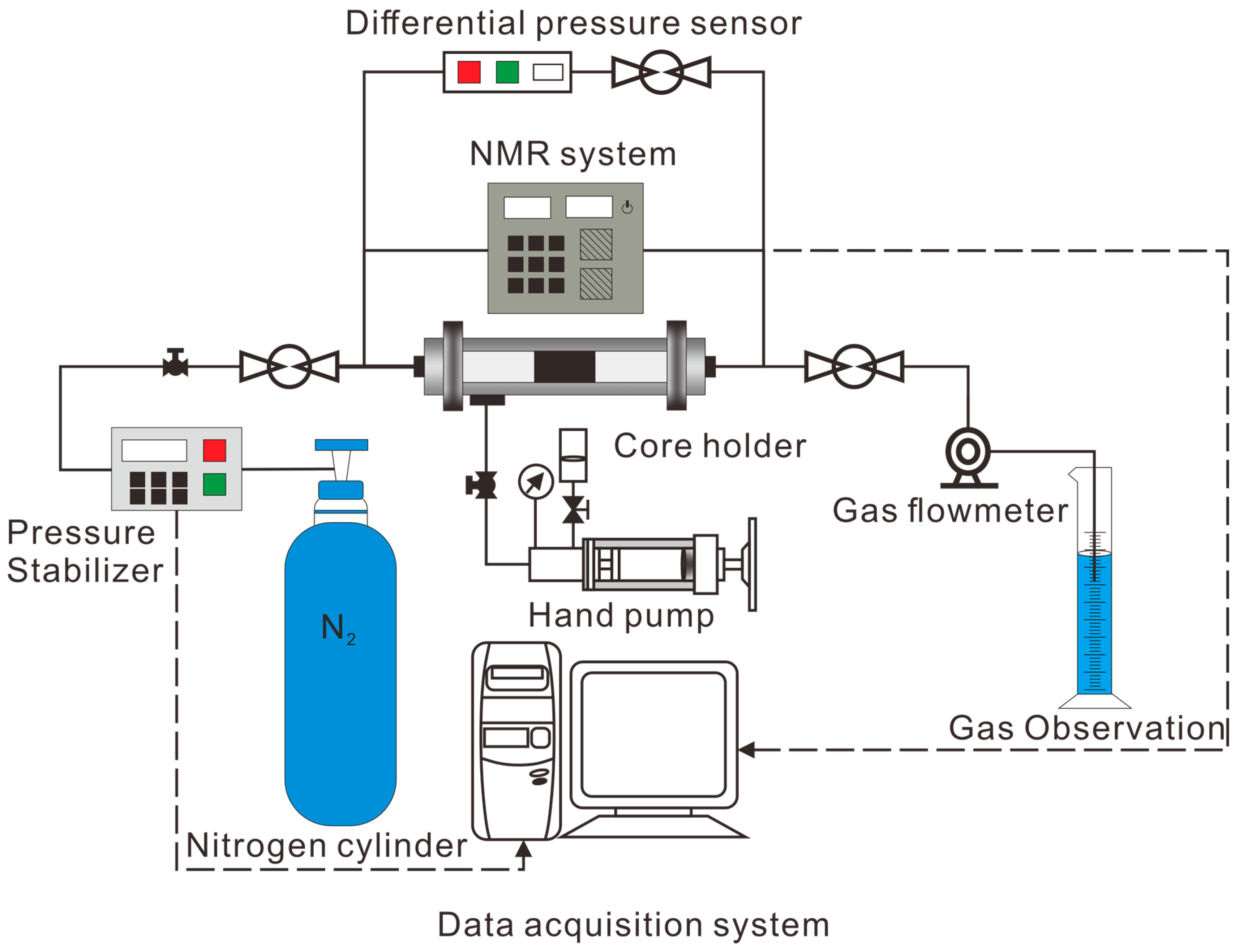
The gas displacement water nuclear magnetic resonance experimental setup primarily consists of a core holder, nuclear magnetic resonance system, gas flowmeter system, gas observation system, hand pump for surrounding pressure, nitrogen cylinder, differential pressure sensor, and data acquisition system (Figure 2). Nuclear magnetic resonance experiments were conducted on the MARAN-DRX/2 equipment (Oxford Instruments, Oxford, UK). The experiment was conducted at room temperature (20 °C) and consisted of a core water-saturated experiment, a gas-displacement experiment, and a centrifugation experiment. The specific experimental procedures are as follows. (1) Place the tight sandstone samples in an oven at 105 °C for 72 h to remove impurities, hydrocarbons, and residual water. Then, measure the mass and dimensions of the dried samples. Subsequently, the samples were evacuated and saturated with simulated formation water for seven days. The salinity of the simulated formation water is 22.357 mg/L, matching the salinity of the Lower Shihezi Formation water. The mass of the samples under water-saturated conditions was measured, and the NMR test was conducted on fully water-saturated samples. (2) Load the fully water-saturated samples into the core holder and apply a confining pressure of 12 MPa. (3) After confirming no leakage, inject nitrogen gas at pressures of 10 MPa. Displace the solution out of the sample until irreducible saturation is achieved. (4) After each gas displacement experiment, measure the sample’s NMR T2 spectrum under irreducible water saturation conditions. The experimental conditions are 25 °C, the resonance frequency is 2.38 MHz, the echo interval is 0.1 ms, the number of scans is 128, the waiting time is 3 s, and the echo number is 17,500. (5) After all gas displacement water experiments are completed, centrifuge the samples for one hour at 400 PSI. Under this centrifugal pressure, the tight sandstone will lose all of its internal mobile fluid [19]. After centrifugation, the T2 spectrum of the samples will be measured again using parameters consistent with those in the previous steps.
Figure 2. Schematic diagram of the gas displacement water nuclear magnetic resonance experiment setup.

3.2.5. HPMI

The samples used for NMR experiments were later used again for HPMI experiments to ensure consistency in the measured pore–throat distribution characteristics in the samples. HPMI experiments were conducted using an AutoPore IV9505 mercury porosimeter (Malvern Panalytical, Great Malvern, UK). The test standard is SY/T 5346-2005 [43]. The highest mercury pressure in the experiment was 200.62 MPa, and the corresponding pore radius was 37 nm, the minimum pore radius obtained in the experiment. When the mercury injection pressure reaches the maximum, the pressure gradually decreases, and the mercury is discharged from the sample. The HPMI test can be used to determine the variation curve of capillary pressure with mercury saturation during mercury injection. The equivalent pore–throat radius of capillary pressure can be calculated using the Washburn equation [44]:
r = 2 σ c o s θ P c
where Pc represents the mercury pressure, in MPa; r indicates the pore–throat radius, in µm; θ denotes the contact angle, at 140°; σ signifies the interfacial tension, at 0.48 N/m. Finally, multiple characteristic parameters representing the pore size distribution can be obtained.

3.3. Analytical Theory

3.3.1. Determination of Movable Volume and Gas Distribution Under Different Pressures

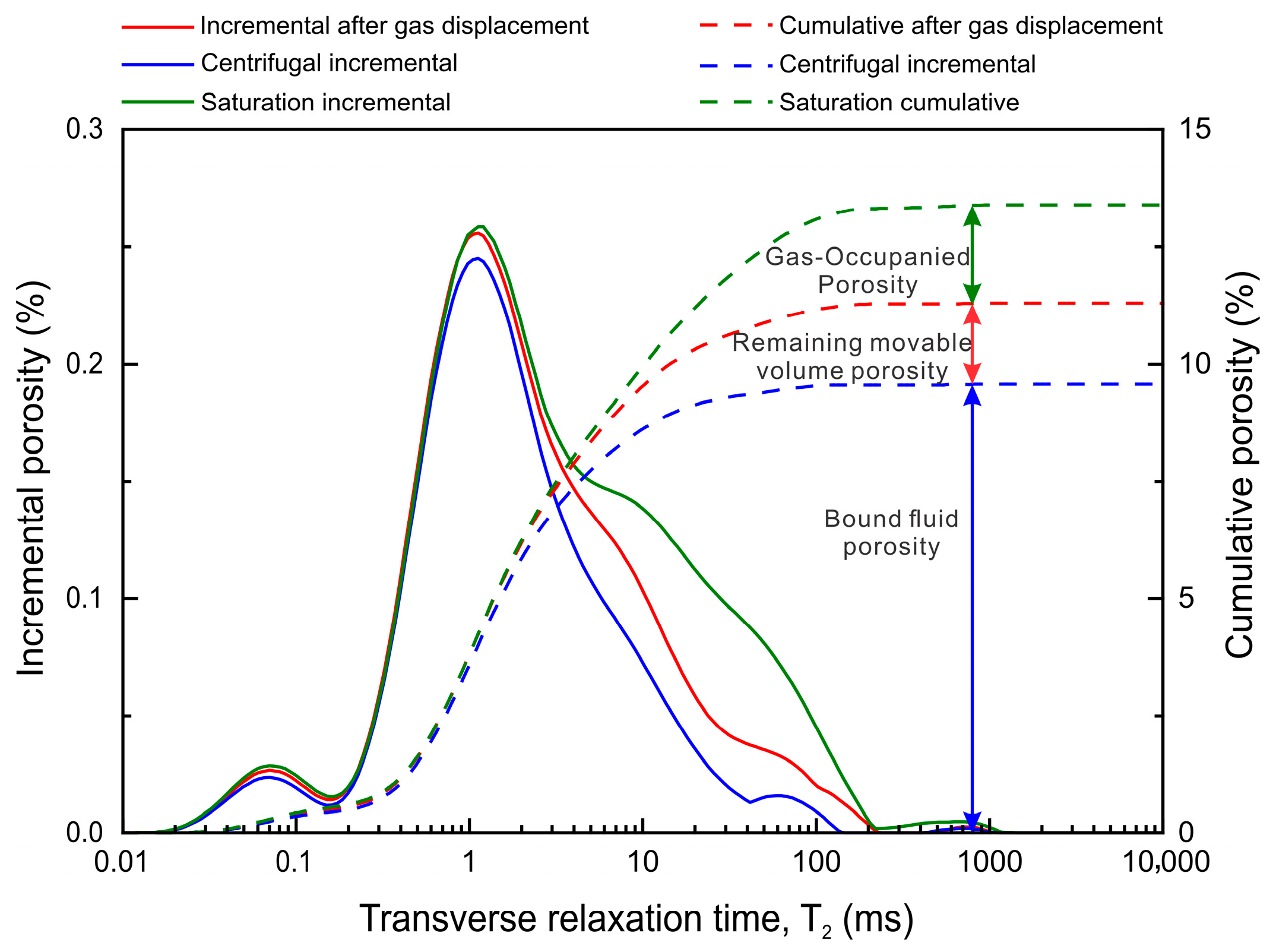
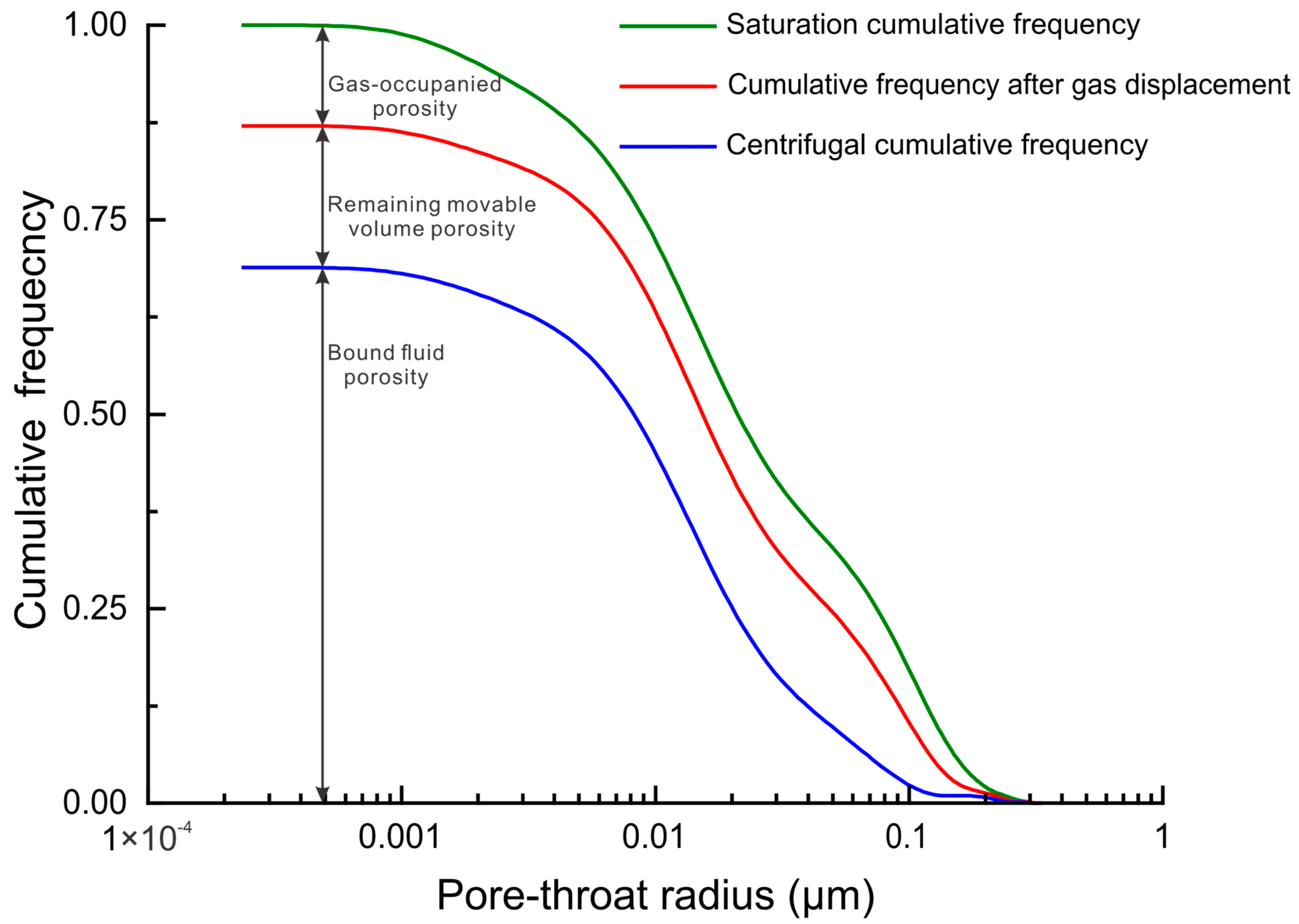
The T2 spectrum obtained under water-saturated and centrifugation conditions indicates the saturation and porosity of the movable and bound fluids in the sample [45,46]. The difference in the T2 spectrum is measured before and after water is displaced by nitrogen in the core, which can be used to determine the porosity occupied by gas and remaining fluid under displacement (Figure 3). The porosity occupied by the movable volume (Pmv) refers to the difference between the porosity under the water-saturated and centrifuged conditions. The gas-occupied porosity (Pog) is the difference of the T2 spectrum between the porosity under water-saturated conditions and the water-occupied porosity after water displacement by gas.
Figure 3. Gas-occupied porosity, bound water porosity, and remaining movable fluid porosity obtained from the gas displacement water nuclear magnetic resonance experiment.

3.3.2. Method of Transforming NMR T2 Spectrum into Pore–Throat Size Distribution

Utilizing HPMI data allows the same sample’s NMR T2 spectrum to be converted into a reservoir pore–throat size distribution. The measured T2 spectrum can be linked to pore–throat structures using conversion formulas, directly reflecting the distribution of different pore–throat sizes. According to the fundamental principles of nuclear magnetic resonance, the transverse relaxation time T2 spectrum is related to the size and shape of pore–throat spaces. The relationship between T2 spectrum and the pore surface-to-volume ratio (S/V) can be expressed as follows [47]:
1 T 2 = ρ · S V = ρ · F r ,
where ρ is the surface relaxation rate, μm/ms; S is the pore surface area, μm2; V is the pore volume, μm3; F is the pore shape factor (for cylindrical pores, F = 2), which is dimensionless. Previous research results have shown that the relationship between the T2 distribution and pore–throat radius is a power function [48]:
T 2 = r n ρ · F ,
where n is a power exponent, dimensionless, and ρ and F can be regarded as constants [49]; thus, for Equation (2), we define
C = 1 ρ F ,
According to Equations (2) and (3), the relationship between T2 and r can be expressed as
r = C T 2 1 / n ,
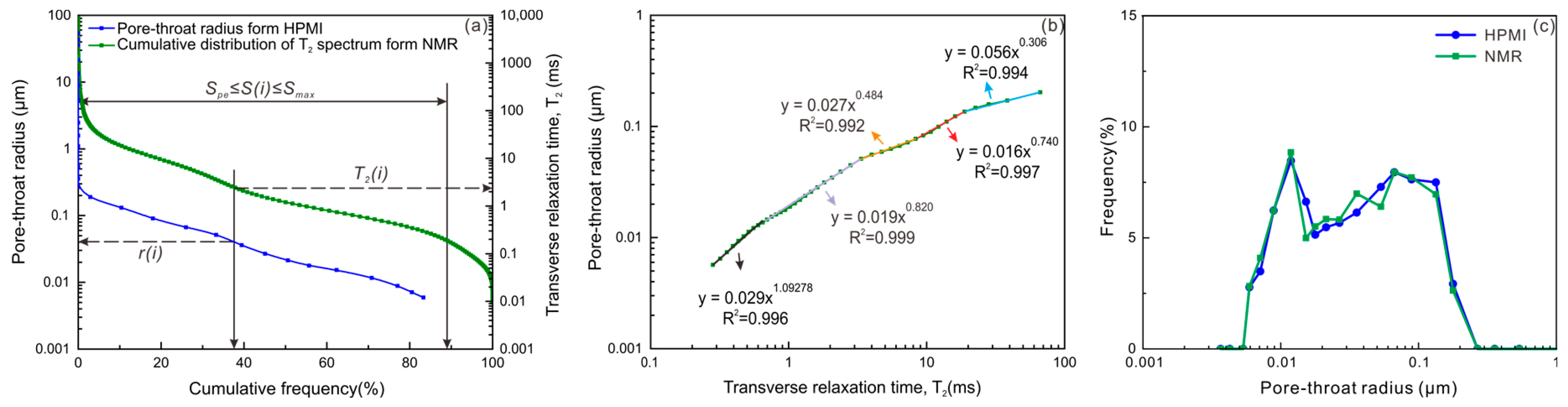
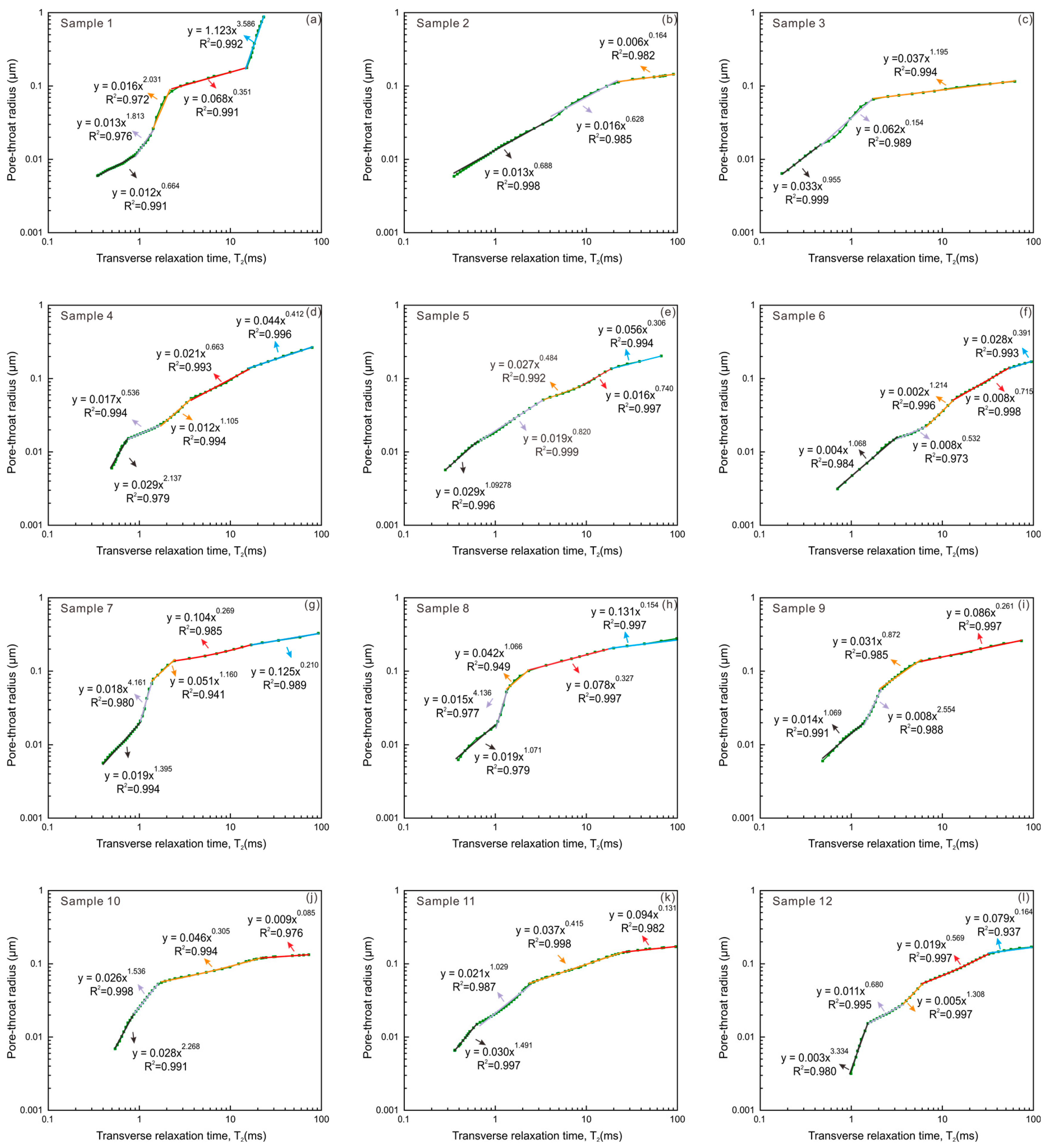
First, the pore–throat size distribution determined using the HPMI test is plotted as a cumulative distribution frequency graph. Subsequently, the cumulative amplitude percentages of the T2 spectrum are calculated using the NMR test structures of water-saturated samples. The results of both experiments are cumulated from larger to smaller pore–throats and then plotted on a single graph. The longitudinal central interpolation method is employed to obtain the corresponding T2(i) values and pore–throat radius r(i) for the same cumulative frequency S(i) (Figure 4a). Finally, the parameters C and n are determined by fitting the T2(i) and r(i) curves using Equation (5). This study employs a multi-segment fitting approach to convert the T2 spectrum into pore–throat radii, aiming to achieve optimal fitting accuracy. The segmentation is based on whether a power-law relationship ( r = C T 2 1 / n ) exists within each interval (Figure 4b,c). The number and position of segments vary depending on the characteristics of individual samples. While it is theoretically possible to divide the curve into more segments to achieve higher local fitting precision, doing so may amplify the inherent fitting error. Therefore, in this study, we deliberately limited the number of segments to the minimum necessary, ensuring both accuracy and stability of the fitting results. Based on the fitting results of different samples, the NMR data for each sample were converted into a pore–throat size distribution. The “multi-segment” fitting method shows a high correlation coefficient, with an R2 greater than 0.9 for each fitting segment (Figure 5).
Figure 4. (a) Diagram of the method of converting the T2 spectrum into pore-throat size distribution of sample 5 (b) Method of obtaining the C and n values of sample 5 (c) Comparison between the pore-throat size distribution curves converted by NMR movable fluid T2 spectrum and obtained by HPMI testing of sample 5.
Figure 5. Multi-segment fitting process for obtaining parameters C and n from different samples.
In this study, HPMI is applied strictly within the pore–throat size range where the method is generally considered reliable (above the ultra-nanopore scale). The characterization of pore–throats smaller than this range relies exclusively on NMR T2 spectra. By integrating the two datasets through cumulative matching, the pore–throat size distribution used in this work does not involve extending the HPMI model into pore–throat sizes for which it is not applicable.
During displacement, gas entering the pore–throat changes the fluid volume, resulting in variations in the NMR T2 spectrum measured after displacement. Since the total volume of the sample’s pore–throat remains constant, variation occurs in the distribution of fluids within the pore–throat. Therefore, by dividing the values of each point of the T2 spectrum obtained after gas displacement by the cumulative value of the NMR T2 spectrum of water-saturated samples and summing the results, the cumulative probability curve can be obtained after water displacement by gas. The difference between this curve and the cumulative probability curve of water-saturated samples represents the cumulative probability of gas distribution within the pore–throat (Figure 6).
Figure 6. Cumulative frequency distribution curve of gas-occupied porosity, bound water porosity, and remaining movable volume porosity obtained from the gas displacement water nuclear magnetic experiment.

3.3.3. Fractal Theory

When the pore–throat structure of tight sandstone is locally magnified, its morphology and complexity resemble those of the overall reservoir, exhibiting self-similarity. Therefore, fractal theory can be used to quantitatively characterize the pore–throat structure of the reservoir. A higher fractal dimension indicates greater reservoir heterogeneity. In high-pressure mercury intrusion (HPMI) experiments, different capillary pressures correspond to the pore–throat sizes that mercury can enter; thus, as the pressure increases, more pore–throats can be characterized. Therefore, HPMI experimental data can be used to study fractal characteristics and quantitatively characterize the effect of pore–throat heterogeneity on the movable fluid within pore–throats of different sizes in Lower Shihezi Formation tight sandstone reservoirs. According to fractal geometry principles, the number of pore–throats with a radius greater than r is denoted as N. The relationship between the number of pore–throats N and the pore–throat radius r can be expressed as
N > r = r r m a x F r d r = a r D ,
In the equation, r is the pore–throat radius in μm, and a is a constant. Since the pore space of the rock consists of a series of capillary bundles, the Brooks–Corey model can be applied. Accordingly, the cumulative volume percentage V ( c ) of pores with a radius smaller than r can be expressed as
V c = r r m a x 3 D ,
In the equation, r max is the maximum pore–throat radius in μm. Taking the logarithm of both sides of Equation (7) yields
log V c = log 1 S H g = 3 D log r 3 D ,
In the equation, S Hg is the mercury saturation in %. In a double-logarithmic coordinate system, l o g ( 1 S Hg ) and log r exhibit a linear relationship over different value ranges. Therefore, a multi-segment fitting approach is used to determine the slope 3 − D, from which the fractal dimension D n for different pore–throat size ranges can be obtained.

4. Results

4.1. Porosity, Permeability, Mineral, and Pore–Throat Characteristics

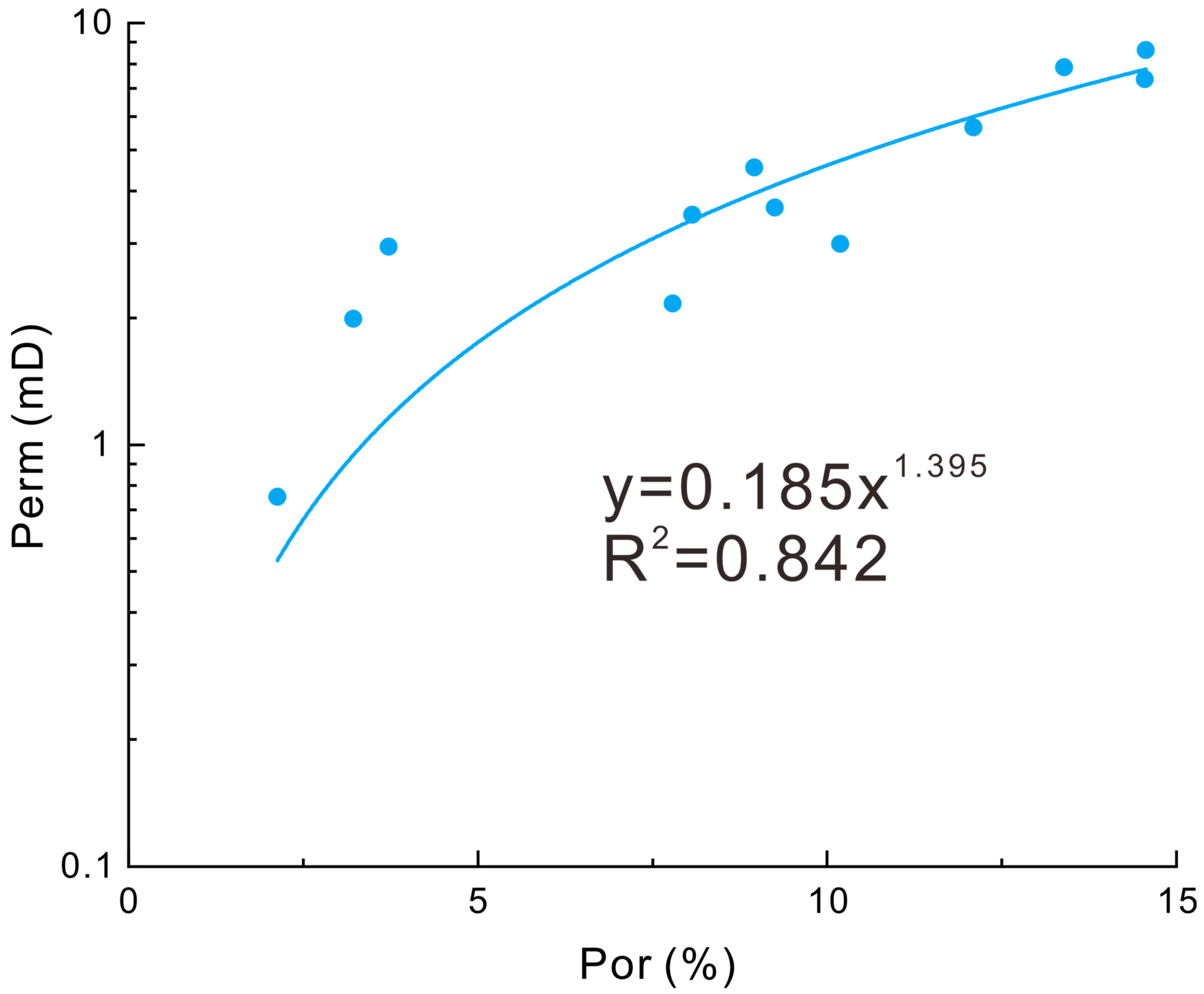
The porosity and permeability measurements for the 12 samples are shown in Table 1. The porosity and permeability exhibit a strong positive correlation (R2 = 0.842), indicating a high degree of coupling between reservoir property parameters (Figure 7). The variation in permeability is primarily controlled by porosity, reflecting the consistency between the two parameters in terms of pore–throat connectivity and fluid migration. Porosity is in the range of 2.12~14.55%, with an average of 8.99%. The permeability distribution is in the range of 0.75~8.62 mD, with an average value of 4.33 mD.
Table 1. Porosity, permeability, and mineral composition and contents of 12 samples.
Figure 7. The relationship between porosity and permeability of samples.
The results of XRD quantitative analysis indicate that the mineral composition of the tight sandstone primarily comprises quartz, feldspar, calcite, and clay minerals (Table 1). XRD results reveal that quartz content is highest in the study area, ranging from 52% to 70.9%, with an average of 60.5%. Sample 6 exhibits notably higher quartz content (70.9%) compared to other samples. The average feldspar content is 14.8%, predominantly composed of plagioclase. Carbonate minerals are present in cement, primarily calcite, along with lower concentrations of other carbonate minerals. The variation in calcite content among samples ranges from 4% to 13.9%, with sample 10 being the richest in carbonate minerals (13.9%). Similarly, there is significant variation in clay mineral content, ranging from 10.4% to 26.6%, with an average of 16.7%. The predominant clay mineral is kaolinite, with an average content of 42.7%, followed by chlorite (25.8%). Illite/smectite (I/S) (15.8%) and mixed-layer illite content are the lowest (15.5%).
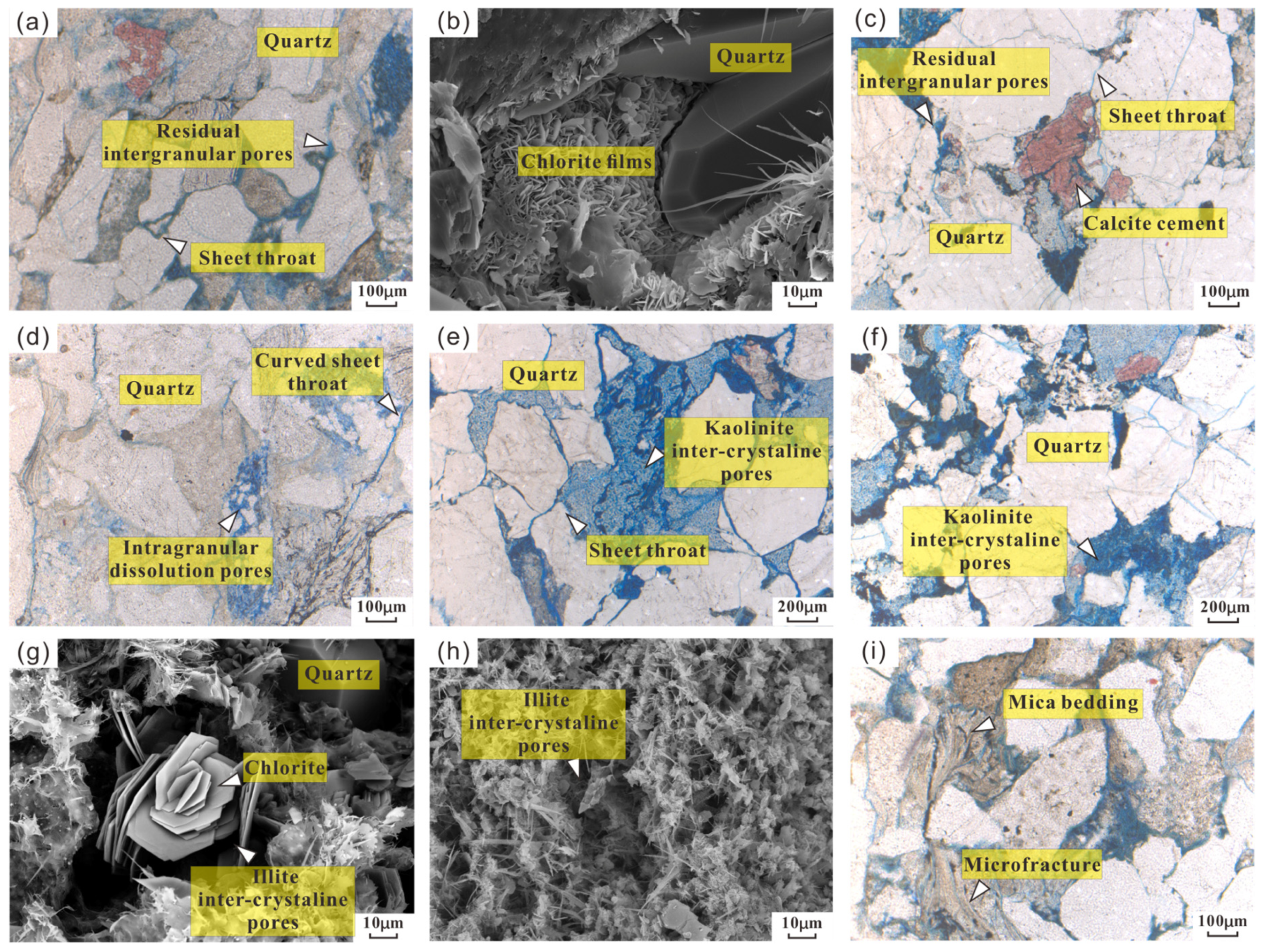
Analysis of CTS and SEM results reveals a diverse range of pore–throats within the tight sandstone reservoir. The pore categories primarily encompass intergranular residual pores, intragranular dissolution pores, inter-crystalline pores, and micro-fractures (Figure 8). For pore–throat structures, prominent variations include sheet throats and curved sheet throats. Intergranular residual pores, characterized by triangular shapes, form as original pores are filled and reduced due to reservoir compaction and cementation. These residual intergranular pores typically exhibit larger radii and are frequently found coexisting with chlorite films (Figure 8a,b). Sheet and curved sheet throats often accompany intergranular residual pores within samples (Figure 8c,d). Intragranular dissolution pores manifest as irregularly shaped voids resulting from the dissolution of unstable components within or surrounding detrital grains. Notably, feldspar dissolution pores exhibit significant development (Figure 8d). Inter-crystalline pores, on the other hand, represent micro-scale voids formed between or within grains by clay minerals like illite and chlorite. They typically feature a pore–throat radius below 0.1 μm (Figure 8e–h). Micro-fractures denote discontinuous planes formed by brittle minerals subjected to tectonic stresses. Generally, these fractures exhibit a pore–throat radius below 1 μm, with limited occurrences in the samples. Specifically, only a small number of mica cleavage micro-fractures are discernible in sample 2 (Figure 8i).
Figure 8. Mineral composition and pore and throat types in J58 determined by CTS and SEM. (a) Intergranular pores with lining chlorite and sheet throats (Sample 4); (b) Lining chlorite adhered to the surface of residual intergranular pores, with developed authigenic quartz, SEM (Sample 5); (c) Residual intergranular pores lined with chlorite and calcareous cement (Sample 10); (d) Intragranular dissolution pores formed in feldspar and curved sheet throats (Sample 12); (e) Inter-crystalline micropores and sheet throats (Sample 9); (f) Intergranular pores and kaolinite inter-crystalline pores (Sample 3); (g) Inter-crystalline pores formed between chlorite and illite, SEM (Sample 8); (h) Illite developed to form inter-crystalline pores, SEM (Sample 11). (i) Microfracture and mica bedding microfracture formed by strong compaction (Sample 6).

4.2. HPMI Results

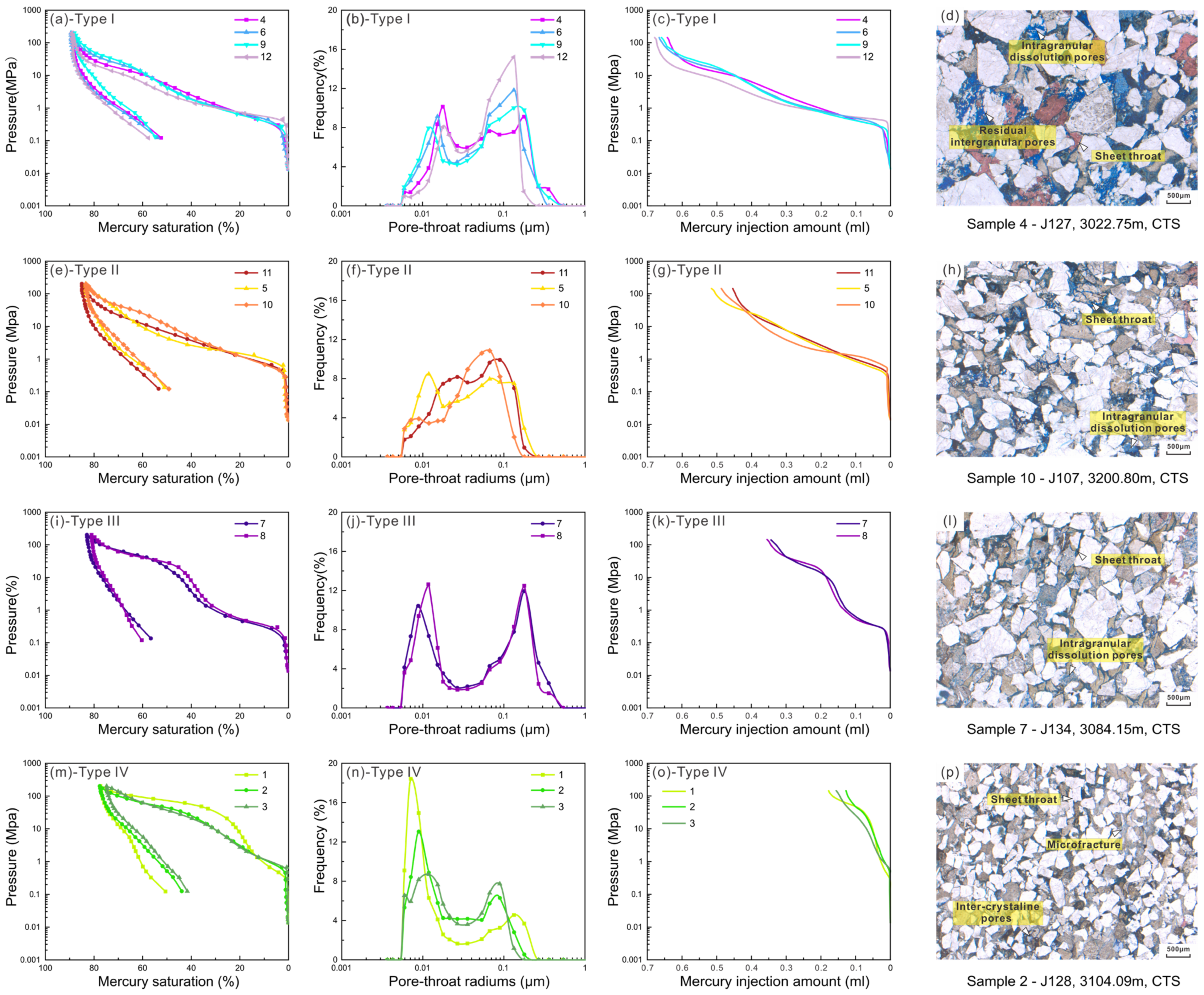
Figure 9 and Table 2 present the capillary pressure curves and pore–throat size distributions of the twelve samples. The classification of pore–throat structure types is based on two key indicators: (1) mercury-intrusion saturation and the corresponding mercury-intrusion volume and (2) the position of the dominant peak in the pore–throat size distribution curve and the consistency of its overall morphology. First, the samples are graded according to mercury-intrusion saturation, with threshold values of 86%, 83%, and 80%, corresponding to mercury-intrusion volumes of 0.6, 0.4, and 0.3 mL/g, respectively. On this basis, and by further integrating the dominant peak characteristics and morphological differences in the pore–throat size distribution curves, the pore–throat structures of the samples are classified into four types. The capillary pressure curve section of Type I samples is long and gentle, distributed when the mercury injection pressure is below 1 MPa (Figure 9a), and the average threshold pressure (Pt) is 0.213 MPa, indicating that Type I pore–throats have a larger pore–throat development average radius (Ra), which is in the range of 0.476~0.708 μm, with an average of 0.593 μm; therefore, mercury enters the sample more easily in the initial stage. The pore–throat size distribution of Type I pore–throat structures exhibits a bimodal distribution (Figure 9b), with the right prominent peak dominating, primarily distributed between 0.06 and 0.3 μm, whereas a secondary peak is evident on the left side, distributed between 0.008 and 0.03 μm. The maximum mercury injection volume is distributed between 0.6 and 0.7 mL (Figure 9c). The Type I pore–throat assemblage mainly consists of residual intergranular pores, intragranular dissolved pores, and curved sheet pores (Figure 9d). To further quantify the characteristics of the pore–throat structure, this study introduces two dimensionless parameters—the sorting coefficient (Sc) and the homogeneity coefficient (Hc)—to characterize the dispersion and uniformity of the pore–throat size distribution. Type I samples also exhibit a moderate sorting coefficient (Sc ≈ 2.48) and a relatively low homogeneity coefficient (Hc ≈ 0.164), indicating a relatively concentrated pore–throat size distribution, as well as good uniformity and connectivity (Table 2). The average maximum mercury saturation (Smax) for this type is 88.90%. The average maximum mercury withdrawal efficiency (We) is 38.47%. Type I is dominated by large pore–throats with high connectivity. The maximum pore–throat radius (Rmax) and median pore–throat radius (Rm) are both the largest, measuring 3.94 μm and 0.187 μm.
Figure 9. Capillary pressure curves (a,e,i,m), pore-throat size distribution curves (b,f,j,n), cumulative mercury injection curve (c,g,k,o) and corresponding pore-throat combination types (d,h,l,p) of the four types of typical samples.
Table 2. Pore-throat structure parameters and movable volume parameters obtained from high-pressure mercury injection and nuclear magnetic resonance.
The capillary pressure curves of the Type II samples exhibit a longer and flatter profile, primarily distributed above a mercury injection pressure of 1 MPa (Figure 9e). The pore–throat distribution curve also shows a unimodal shape, with pore–throat sizes ranging from 0.006 to 0.3 μm (Figure 9f). The maximum mercury injection of Type II samples is lower than that of Type I samples, ranging from 0.4 to 0.5 mL (Figure 9g). The main types of pore–throats in Type II samples are intergranular dissolution pores and sheet throats (Figure 9h). The Pt values of Type II samples are relatively high (with an average of 0.468 MPa), and the pore–throat sizes are distributed more evenly (between 0.007 and 0.2 μm). This pore–throat structure exhibits smaller Ra values (an average of 0.298 μm) than Type I, indicating relatively good pore–throat connectivity, with an average We value of 38.94%. Compared with Type I, Type II samples exhibit slightly lower Hc (average 0.176) and similar Sc (average 2.33), indicating better uniformity but slightly higher dispersion in pore–throat size distribution (Table 2).
The capillary pressure curve of Type III samples consists of two short horizontal segments, ranging from 0.1 to 1 MPa and from 11 to 85 MPa (Figure 9i). Similarly, the pore–throat size distribution curve exhibits a bimodal distribution, with the proportions of the two peaks being relatively close. The left peak primarily ranges from 0.005 to 0.03 μm. In contrast, the right peak varies mainly between 0.04 and 0.05 μm, indicating that the pore–throat sizes in Type III structures have similar contents (Figure 9). The maximum mercury injection distribution of Type III samples is 0.3~0.4 mL (Figure 9k). The average Smax of Type III structures is 81.90%, with an average Pt value of 0.438 MPa. The predominant pore types in these reservoirs include feldspar dissolution pores, inter-crystalline pores, and residual intergranular pores, while throat types mainly consist of curved sheet shapes and tubular shapes (Figure 9l). The We value of Type III structures is relatively low, with an average of 28.58%, indicating relatively poor pore connectivity (Table 3).
Table 3. Fractal dimensions of pore-throats of different sizes and their corresponding porosity and permeability in the Hangjinqi area, Ordos Basin.
Similarly to Type I structures, the pore–throat size distribution curve of Type IV is bimodal. However, unlike Type I structures, the prominent peak is on the left side, primarily distributed between 0.006 and 0.02 μm, while the secondary peak is on the right side, distributed between 0.05 and 0.2 μm (Figure 9m,n). The maximum mercury injection volume of Type IV samples is the smallest, ranging from 0.1 to 0.2 mL (Figure 9o). Notably, the left peak is most pronounced in sample 1. Type IV samples show higher Sc (average 2.65) and the lowest Hc (average 0.125), suggesting the strongest dispersion in pore–throat size, yet relatively uniform development within each size interval, reflecting a complex but relatively stable pore–throat network structure. The predominant pore type is inter-crystalline, with a few developed micro-fractures, while throat types mainly consist of curved, sheet-like, and tubular throats (Figure 9p). Type IV exhibits the smallest Ra values, averaging 0.217 μm (Table 3).

4.3. NMR Results

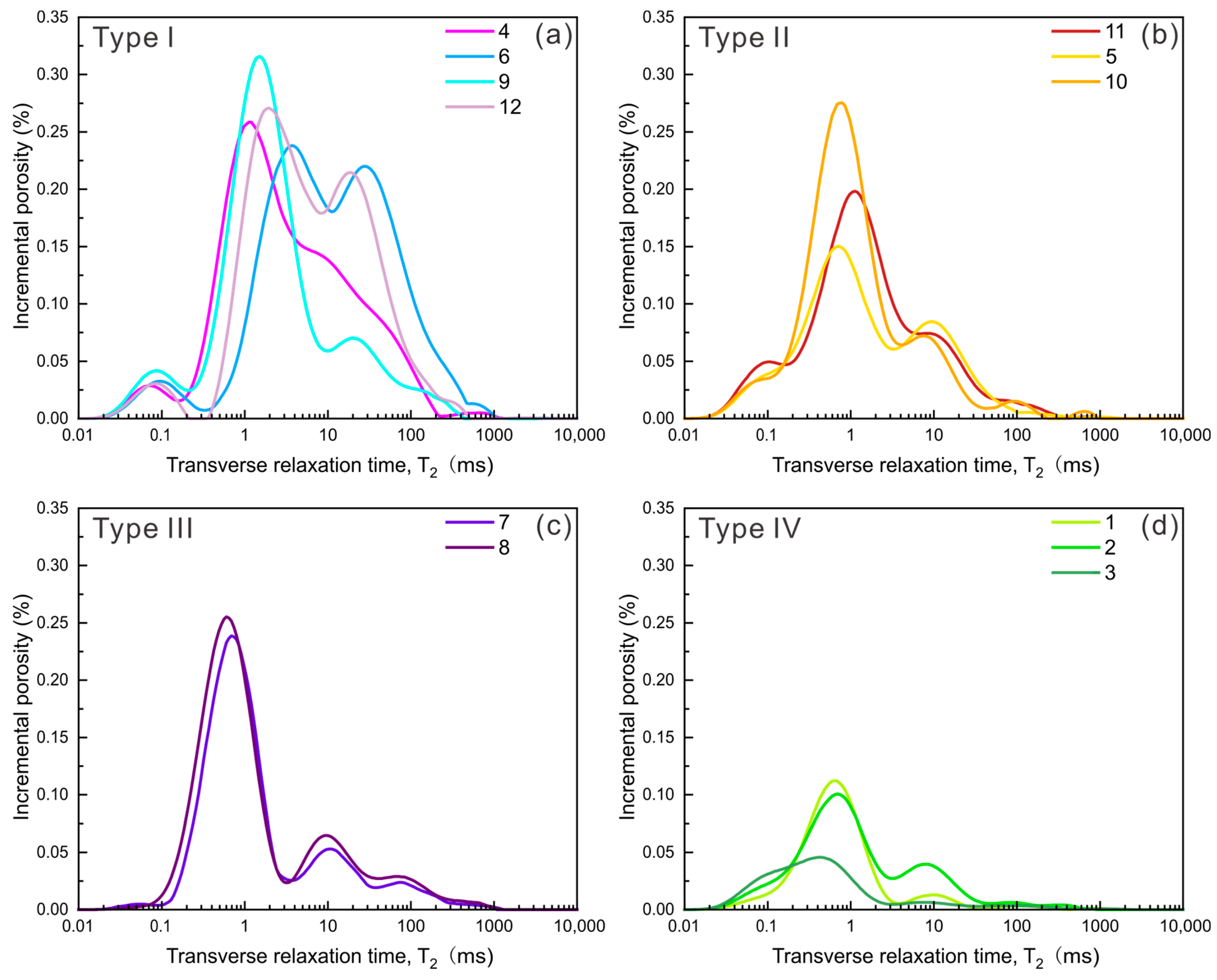
NMR experiments, which measure the spin signals of hydrogen nuclei within sample pores under low-frequency magnetic fields, can comprehensively reflect the distribution characteristics of the entire pore space. The water-saturated T2 spectrum of 12 samples shows different distribution characteristics (Figure 10). The distribution of T2 spectra varies significantly, with values primarily between 0.02 ms and 1000 ms, indicating different characteristics of the pore–throat radius distribution. Approximately 85% of the T2 spectrum exhibits bimodal distributions. The main part of the T2 spectrum of samples with the Type I pore–throat structure lies to the right of 1 ms, as in Sample 9, which shows the most significant variation in incremental porosity, with a maximum of 0.315%. Conversely, as the pore–throat structure deteriorates, the range and magnitude of the T2 spectrum distribution gradually decrease for the other types of samples. For instance, Sample 3 exhibits the lowest incremental porosity amplitude (0.041%). Table 3 presents the movable volume porosity (Pmv) and movable volume saturation (Smv) obtained from NMR curves under water-saturated conditions and after centrifugation. With the deterioration of the pore–throat structure, both the average Pmv and Smv gradually decrease. The distribution range of Pmv is 0.33% to 6.24%, and the distribution range of Smv is 13.05% to 42.82%. Sample 6 exhibits the maximum values for both Pmv and Smv.
Figure 10. The T2 spectrum of 12 studied sandstone samples obtained from the nuclear magnetic resonance experiment. (a) Type I pore-throat structure; (b) Type III pore-throat structure; (c) Type II pore-throat structure; (d) Type IV pore-throat structure.
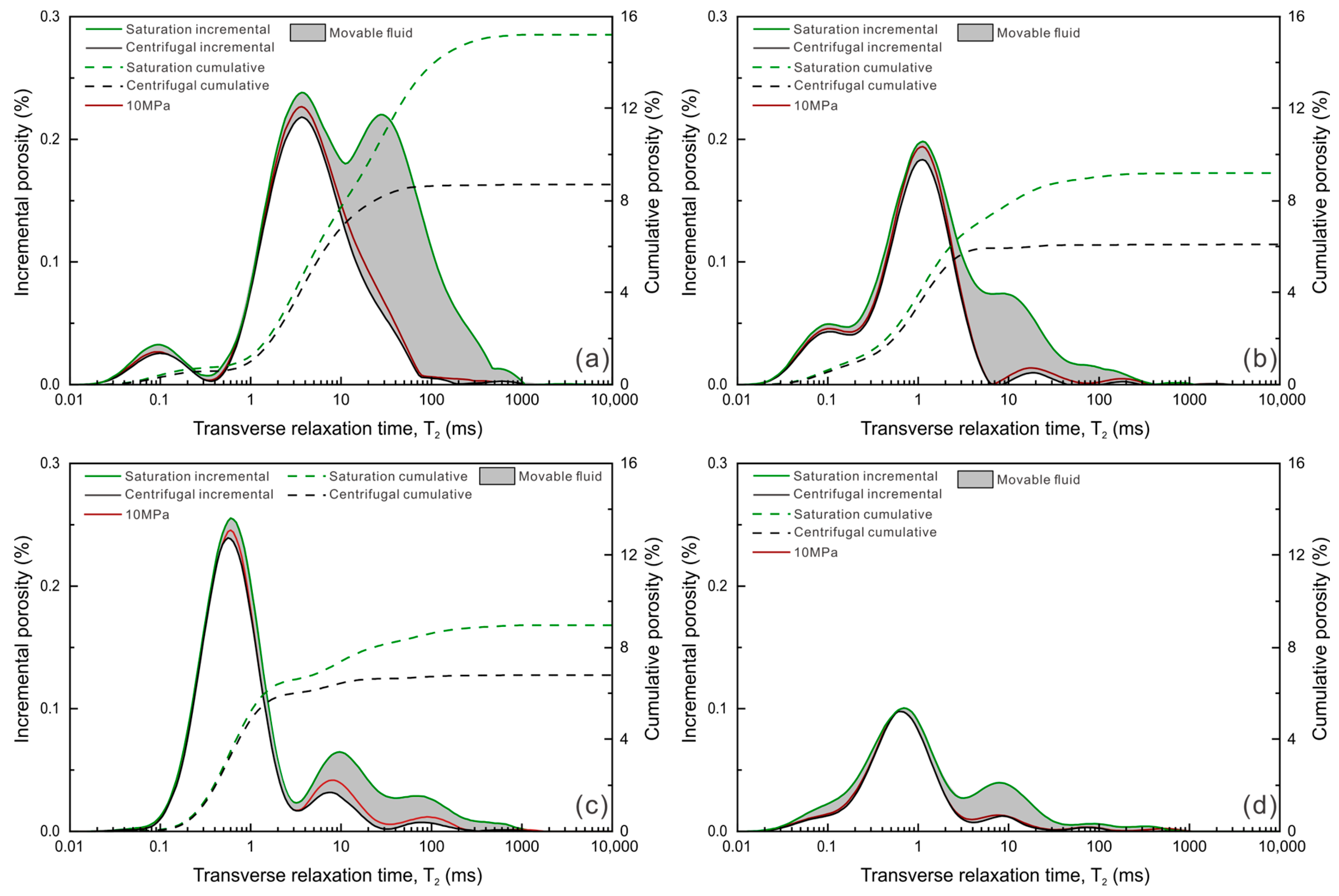
The gas displacement water nuclear magnetic resonance (GDWNMR) T2 spectrum of various pore–throat structure samples shows significant changes after 10 MPa displacement pressures, and all samples display bimodal distribution characteristics in their T2 spectrum (Figure 11). The statistical parameters for the post-gas displacement of different sample types are listed in Table 3. The results indicate that Type I samples exhibit the highest Pog and Sg under a displacement pressure of 10 MPa, with average values of 4.17% and 30.1%, respectively. This suggests that Type I pore–throat structures exhibit strong reservoir performance and fluid flow capabilities, with good pore–throat connectivity and effective gas displacement. Type II structures have more nanopores and better mesopore connectivity, resulting in higher Pog and Sg under a displacement pressure of 10 MPa, with average values of 2.48% and 27.4%, respectively. Type III structures have smaller average median pore–throat radius (Rm) values (0.031 μm) and relatively poor physical properties, leading to lower Pog and Sg, with average values of 1.56% and 18.5%, respectively. Type IV structures exhibit the poorest physical property characteristics, with the highest number of nanopores and poor connectivity, resulting in the lowest Pog and Sg under a displacement pressure of 10 MPa, with average values of 0.58% and 18%, respectively.
Figure 11. Typical nuclear magnetic resonance T2 spectrum of water-saturated conditions, gas displacement water at different pressures, and centrifugal conditions. (a) Sample 6, Type I pore-throat structure; (b) Sample 11, Type III pore-throat structure; (c) Sample 8, Type II pore-throat structure; (d) Sample 1, Type IV pore-throat structure.

4.4. Fractal Characteristics of Pore–Throats in Tight Sandstone Reservoirs

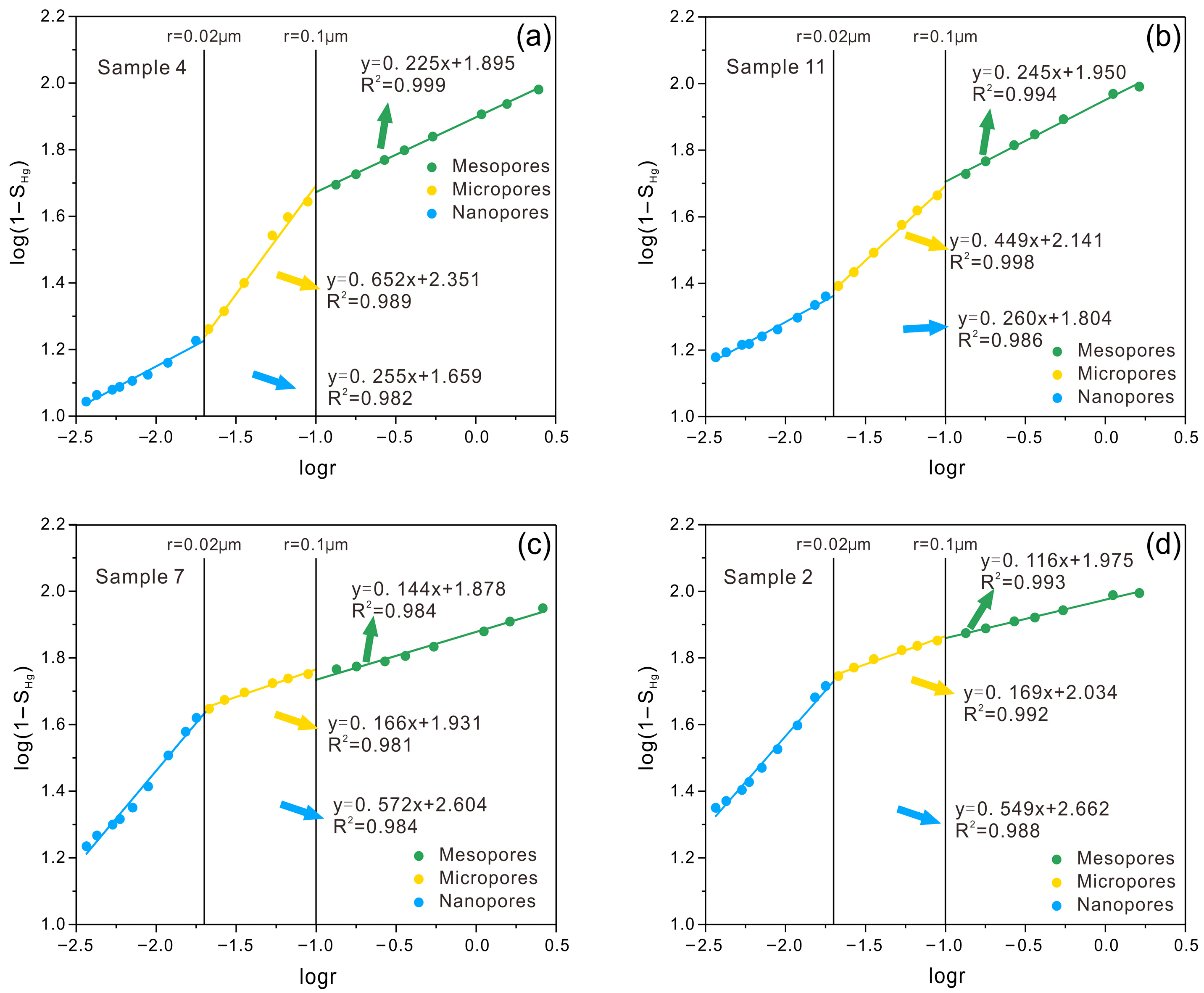
The high-pressure mercury intrusion (HPMI) capillary pressure curves of the samples show that the fractal characteristic curves exhibit a three-segment pattern (Figure 12), indicating that the pore–throat structures of the samples exhibit multiple fractal features. Based on the fractal results, the pore–throats within the samples can be classified into three types: mesopores (r > 0.1 μm), micropores (0.02 μm < r < 0.1 μm), and nanopores (r < 0.02 μm), and the fractal dimension Dn corresponding to each pore–throat size can be determined separately (Table 3). Using the formula K i = d S i r i 2 i ( d S i r i 2 ) (where d S i is the frequency increment corresponding to a given pore–throat radius), the permeability contribution Kn of pore–throats of different sizes can be calculated. In this study, the terms “nanopores,” “micropores,” and “mesopores” refer to pore–throat size classes commonly used in petrophysical characterization of clastic reservoirs, rather than the IUPAC adsorption-based definitions. Combined with the results from the NMR curve conversion, the porosity ϕ n corresponding to the three pore–throat types is separately quantified. By calculating the porosity-weighted average of each pore space, the total fractal dimension of the entire pore system can be determined:
D = D 1 ϕ 1 + D 2 ϕ 2 + + D n ϕ n ϕ 1 + ϕ 2 + + ϕ n ,
Figure 12. Fractal dimension fitting curve of different type samples based on high-pressure mercury injection method. (a) Sample 4, Type I pore-throat structure; (b) Sample 11, Type III pore-throat structure; (c) Sample 7, Type II pore-throat structure; (d) Sample 2, Type IV pore-throat structure.
In the equation, D represents the total fractal dimension of the reservoir, Dn denotes the fractal dimension corresponding to different pore–throat sizes, and ϕ n is the porosity contribution of different pore–throat sizes.
The fractal dimensions of different pore–throat scales and their contributions to reservoir properties show that mesopores have the highest average fractal dimension of 2.805 and contribute the most to reservoir properties, with porosity and permeability of 2.066% and 3.063 mD, respectively, indicating that the storage capacity and connectivity of the reservoir are mainly controlled by mesopores (Table 3). Micropores have a fractal dimension range of 2.348–2.882, with an average of 2.638, and their contribution to reservoir properties is second only to that of mesopores, suggesting that micropores exhibit relatively weak heterogeneity with a more uniform pore distribution, but their impact on reservoir properties is less than that of mesopores. Nanopores have an average fractal dimension of 2.619, which is between that of mesopores and micropores; due to their small size, their contributions to porosity and permeability are the lowest. The total fractal dimension of the samples ranges from 2.467 to 2.898, with an average of 2.642, reflecting a certain degree of heterogeneity in the reservoir pore–throat network.

4.5. Pore–Throat Size Distribution and Gas Distribution Results

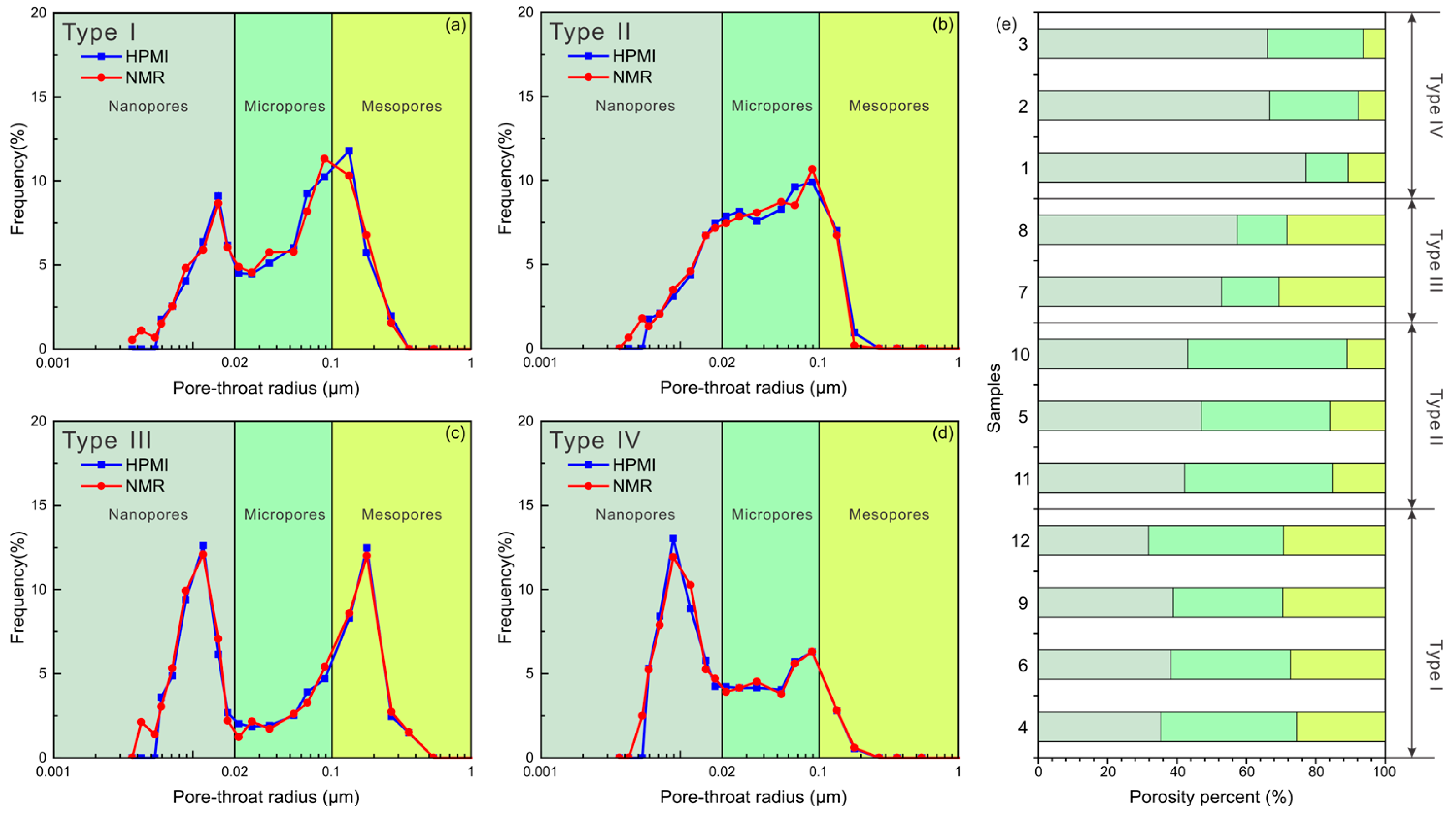
Based on the classification of fractal pore–throat sizes, the proportions of different pore–throat types were calculated (Figure 13a–d). Most samples in this study are dominated by nanopores, while Type I samples exhibit relatively balanced proportions among the three pore–throat types. In Type I pore–throat structures, micropores account for an average of 27.9%, mesopores account for 35.9%, and nanopores account for 36.1%. In Type II pore–throat structures, the proportion of nanopores increases compared with Type I, averaging 44.1%. Type III pore–throat structures show strong heterogeneity, with the nanopore proportion further increasing to 55.1%; micropores represent the lowest proportion, averaging 15.4%, while mesopores account for 29.5%, similar to Type I. In Type IV pore–throat structures, mesopores have the lowest average proportion, only 8.2%, whereas nanopores reach the highest proportion (69.9%) (Figure 13e). Overall, from Type I to Type IV, the proportion of nanopores gradually increases, indicating a structural transition toward nanopore-dominated pore–throat systems.
Figure 13. Pore-throat size distributions determined by HPMI and transformed by NMR T2 spectrum for the different pore-throat structures. (a) Sample 6, Type I pore-throat structure; (b) Sample 11, Type II pore-throat structure; (c) Sample 8, Type III pore-throat structure; (d) Sample 1, Type IV pore-throat structure. (e) The proportion of porosity contributed by pore-throat types of various scales.
The NMR T2 spectrum primarily reflects the fluid volume within the pore–throat. The transformed distribution curve represents the fluid distribution characteristics. Therefore, the changes in fluid volume after gas displacement directly correspond to Pog. Based on Equation (5) and the conversion process depicted in Figure 4 and Figure 5, the T2 spectrum of the 12 samples was first transformed into pore–throat size distribution curves using the multi-stage fitting method (Table 4). In Type I pore–throat structures, both Pog and Sg reach their highest values in mesopores, with average values of 2.878% and 74.40%, respectively, indicating that gas mainly resides in mesopores. The contributions from micropores and nanopores are much lower, with average Pog values of 0.909% and 0.350% and average Sg values of 17.73% and 7.15%, respectively. In Type II structures, Pog and Sg are more evenly distributed, though mesopores still dominate (average Pog: 0.874%; average Sg: 68.56%), and the contribution from micropores increases significantly (average Pog: 1.330%; average Sg: 34.04%). Type III structures show greater heterogeneity in gas distribution, with the average Pog and Sg in mesopores reaching 1.431% and 57.24%, while contributions from micropores and nanopores remain relatively low. Type IV structures are dominated by nanopores and micropores, showing weaker overall gas storage capacity. The average Pog and Sg in mesopores are only 0.167% and 62.94%, while micropores and nanopores have average Pog values of 0.177% and 0.071%, and average Sg values of 27.96% and 3.61%, respectively. Overall, both Pog and Sg increase significantly with pore–throat size. Mesopores serve as the primary spaces for gas storage and flow, whereas micropores and nanopores, despite possessing certain storage capacity, contribute relatively less to overall gas accumulation.
Table 4. Gas-occupied porosity (Pog) and gas saturation (Sg) of different sizes in the Hangjinqi area, Ordos Basin.

5. Discussion

5.1. The Influence of Total Pore–Throat Parameters on Fractal Dimension and Reservoir Gas-Bearing Capacity

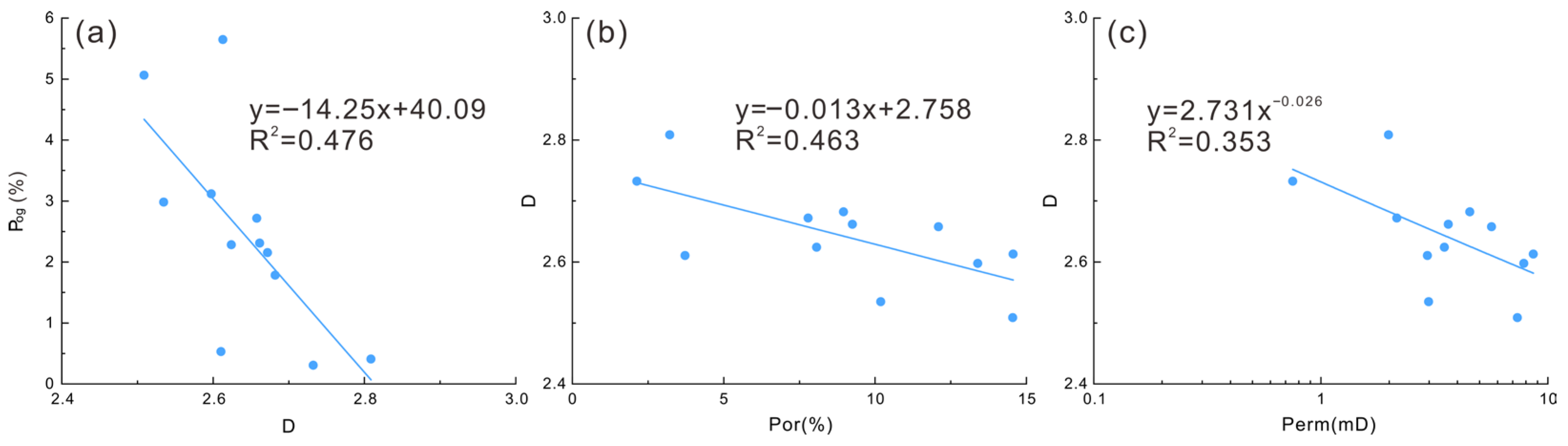
The correlation between the reservoir fractal dimension (D) and gas-bearing parameters indicates that an increase in D is unfavorable for gas accumulation. The total Pog shows a clear negative correlation with D (Figure 14a). For example, in Type I sample 12, with a relatively low fractal dimension (D = 2.509), Pog reaches 5.06%. In contrast, when D increases to 2.809, Pog drops to only 0.407% (Type IV sample 3). These results suggest that from Type I to Type IV, the pore–throat structures become increasingly complex and finer, with significantly weakened connectivity between pores and throats. This reduction in pore–throat connectivity limits the available gas storage space, leading to a higher D and, consequently, a marked decrease in Pog, which is unfavorable for sufficient gas charging.
Figure 14. Relationship between Pog and D (a); relationship between D and porosity (b); relationship between D and permeability (c).
Both porosity and permeability exhibit negative correlations with D (Figure 14b,c). As porosity increases from 3% to 12% and permeability rises from 0.1 mD to 10 mD, the fractal dimension decreases from approximately 2.8 to 2.6, indicating that reservoirs with better physical properties have simpler and more homogeneous pore–throat structures. These results demonstrate that D is strongly controlled by reservoir quality: higher porosity and permeability reflect well-preserved primary pore–throat systems with stronger connectivity and fewer fine pore–throats, resulting in lower D. In contrast, in low-porosity and low-permeability reservoirs, compaction and cementation significantly modify pore–throat systems, producing multi-scale, heterogeneous fine pore–throat networks that increase structural complexity and D. An increase in D signifies higher structural disorder and poorer pore connectivity, which hinders gas charging and preservation, ultimately leading to lower Pog and reduced gas saturation.
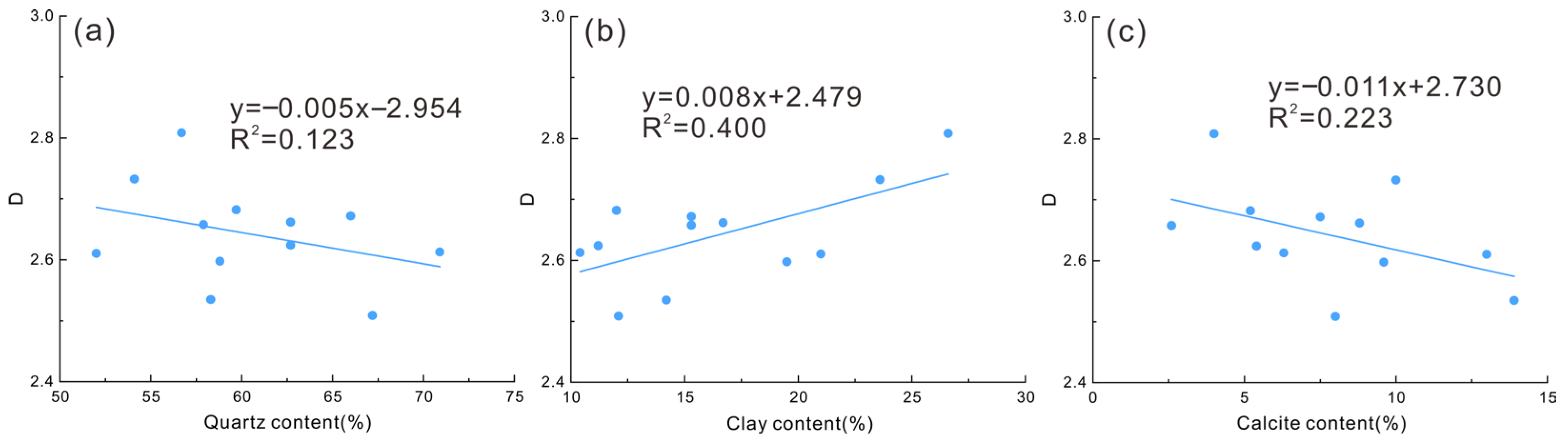
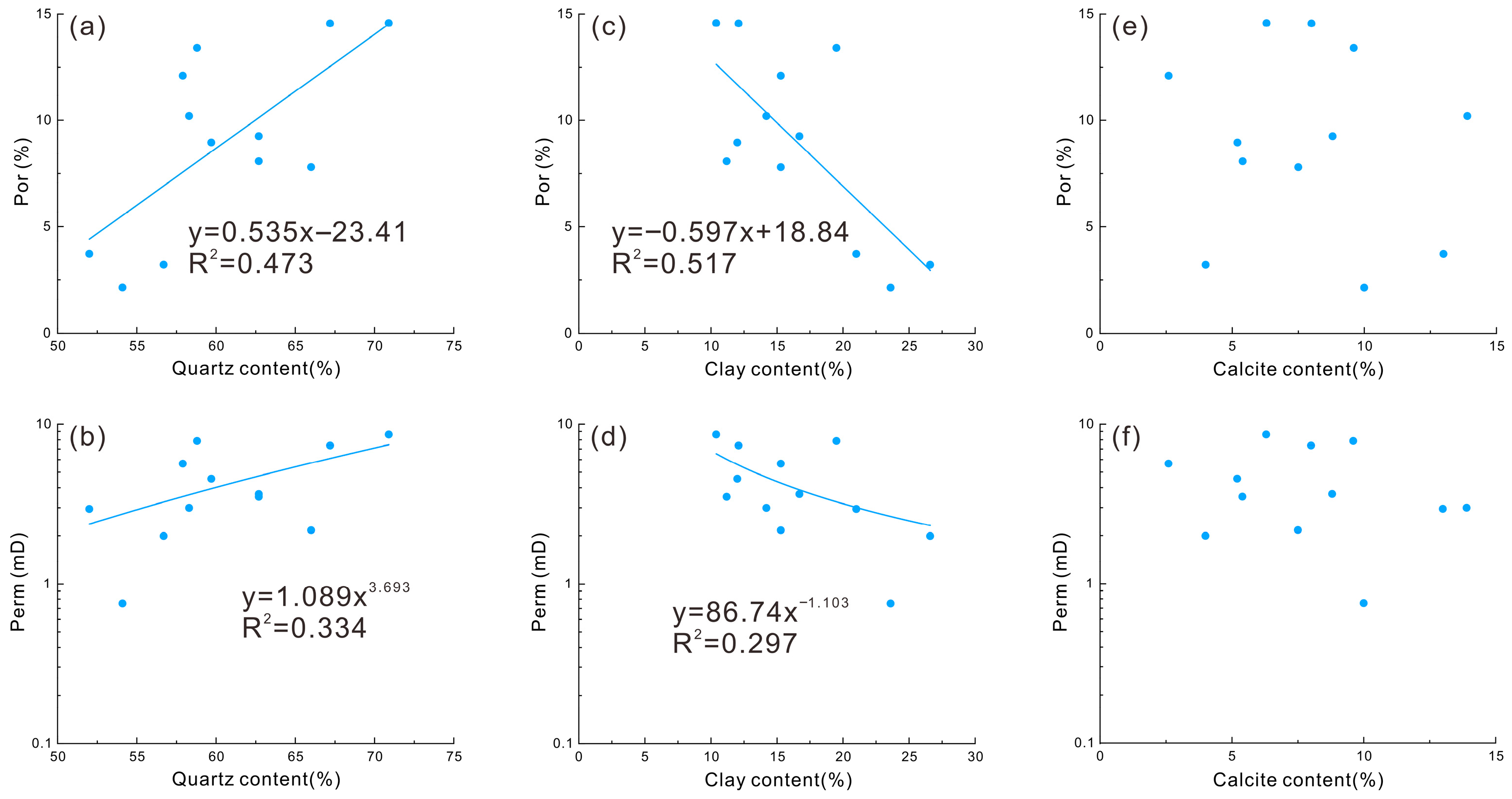
The correlation analysis results indicate that different mineral components have distinct influences on D. Overall, quartz and calcite contents show weak negative correlations with the fractal dimension (Figure 15a,c), whereas the total clay content shows a positive correlation with D (Figure 15b). An increase in quartz content strengthens the rigidity of the grain framework and helps preserve the primary pore–throat structure, resulting in a more concentrated pore–throat distribution, improved connectivity, and consequently lower D, which enhances the reservoir’s gas-bearing potential. This observation is consistent with previous studies [50,51,52]. Higher quartz content can improve reservoir physical properties, as supported by the correlation between quartz content and petrophysical parameters (Figure 16a,b). In contrast, clay minerals (such as illite and kaolinite) occur as platy or fibrous aggregates filling the pore–throats or coating grain surfaces, which reduces the pore–throat radius, weakens reservoir properties (Figure 16c,d), and increases structural complexity, thereby enhancing the fractal characteristics of the pore–throat system and resulting in higher D. Such high-D structures are unfavorable for gas charging and migration, as the available space for gas movement becomes restricted, leading to a significant decline in gas-bearing capacity. The negative correlation between calcite content and D is relatively weak. Moderate calcite cementation can stabilize the pore–throats structure and enhance gas preservation, whereas excessive calcite precipitation may clog pore–throats and reduce gas-bearing capacity. Therefore, the calcite content exerts only a minor influence on petrophysical properties and shows nearly no correlation (Figure 16e,f). Moderate calcite cementation can stabilize the pore–throat structure and promote gas preservation, whereas excessive calcite precipitation may block pore–throats and deteriorate the gas-bearing capacity. Therefore, clay minerals increase D and reduce the gas-bearing potential through pore–throat filling and structural refinement, while quartz decreases D and improves the gas-bearing potential by enhancing the framework support and regularity of the pore–throat system. In summary, the mineral composition controls the storage capacity and structural complexity of pore–throat systems, thereby regulating the fractal dimension, which ultimately determines the reservoir’s gas accumulation potential.
Figure 15. Relationship between D and mineral content of tight sandstone samples in the study area. (a) relationship between D and quartz content; (b) relationship between D and clay content; (c) relationship between D and calcite content.
Figure 16. Relationship between mineral content of tight sandstone samples and reservoir properties in the study area. (a) Relationship between por and quartz content; (b) relationship between perm and clay content; (c) relationship between por and clay content; (d) relationship between perm and clay content; (e) relationship between por and calcite content. (f) relationship between perm and calcite content.
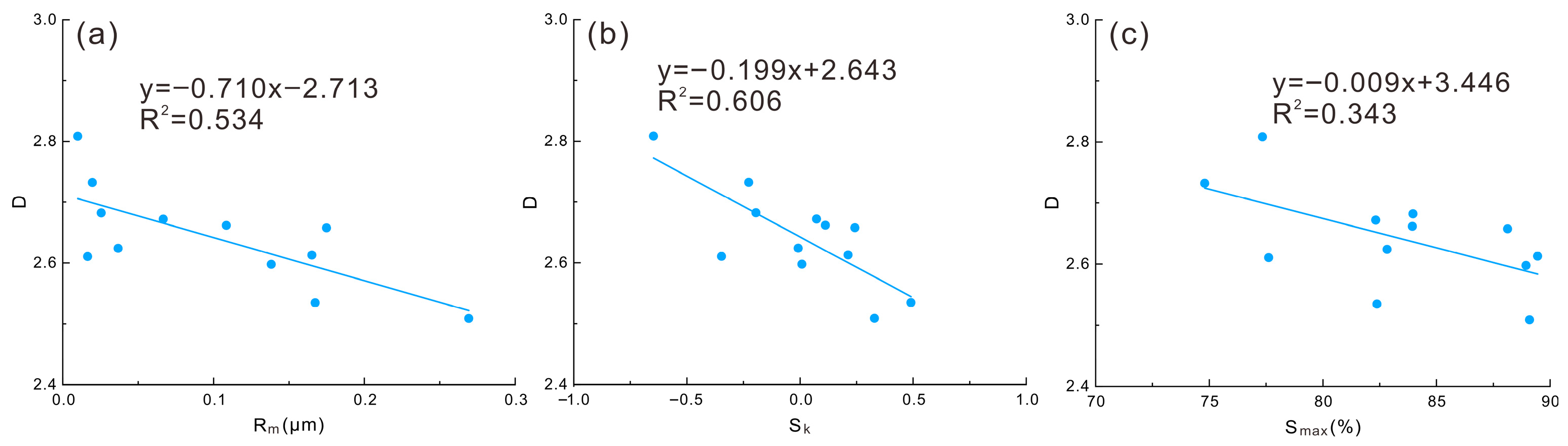
The correlations between D and pore–throat structural parameters show significant differences, which constitute a primary factor controlling variations in gas-bearing capacity. Among these parameters, Sk exhibits the strongest correlation with D, followed by Rm, while Smax shows a relatively weaker correlation (Figure 17). These differences reflect the varying significance of each parameter in characterizing the pore–throat structure and its influence on reservoir gas-bearing properties. First, Sk exerts the most pronounced control of D (Figure 17b). Sk directly reflects the symmetry and concentration of the pore–throat radius distribution and serves as an important indicator of the homogeneity of the pore–throat system. When Sk is low or negative, the distribution of the pore–throat radius tends to be skewed toward the fine-pore end, increasing asymmetry, enhancing structural complexity, and widening the distribution range, which significantly increases D. Since Sk captures the overall statistical distribution characteristics of the pore–throat system and is highly sensitive to structural heterogeneity, it shows the strongest correlation with D. Reservoirs with low Sk values correspond to high-D structures characterized by refined pore–throat systems, poor connectivity, limited gas storage space, and markedly reduced gas-bearing capacity. Second, the correlation between Rm and D is slightly weaker than that of Sk (Figure 17a). Rm reflects the central tendency of the overall pore–throat size and is directly related to the average pore–throat scale. A larger Rm indicates a higher proportion of micropores and mesopores, better connectivity, and simpler structure, thereby resulting in lower D. Although Rm effectively characterizes the scale of the pore–throat system, it primarily represents the “average property” and is less sensitive to the distribution pattern and structural dispersion than Sk, resulting in a slightly weaker correlation. Finally, Smax shows the weakest correlation with D (Figure 17c). Smax primarily reflects the overall accessibility and connectivity of the pore–throat system, serving as a macroscopic indicator of the degree of interconnection between pores and throats. Although reservoirs with higher Smax values typically have better connectivity and lower D, Smax is simultaneously influenced by multiple factors, such as the shape of the capillary pressure curve, the number of connected pore–throat pathways, and mercury intrusion dynamics, which introduce certain non-uniqueness. Therefore, its linear correlation with D is relatively weak. Nevertheless, Smax can still reflect the overall movable pore–throat space from a macroscopic perspective, and its variation trend remains consistent with that of the gas-bearing capacity.
Figure 17. Relationship between D and pore-throat structure parameters of tight sandstone samples in the study area. (a) Relationship between D and Rm; (b) relationship between D and Sk; (c) relationship between D and Smax.

5.2. The Influence of Pore–Throat Parameters at Different Scales on Fractal Dimension and Reservoir Gas-Bearing Capacity

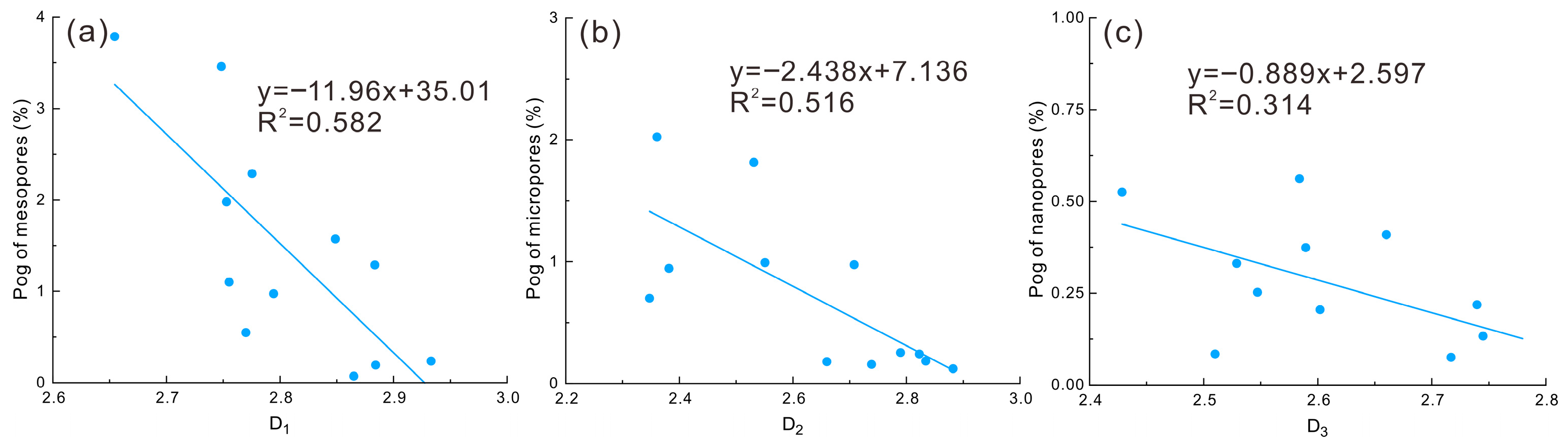
The D of pore–throats at different scales shows a clear negative correlation with Pog within the reservoir, though the correlation strength varies among scales. Overall, the trend indicates that a higher D corresponds to lower Pog, suggesting that as the pore–throat structure becomes more complex and heterogeneous, the reservoir’s gas-bearing capacity decreases. The fractal dimension of mesopores (D1) shows the strongest correlation with Pog (R2 = 0.582), suggesting that the structural complexity of macroscopic seepage channels plays a dominant role in controlling gas charging and accumulation (Figure 18a). A higher D1 value indicates that mesopores are more dispersed and poorly connected, thereby restricting gas flow and significantly reducing the amount of movable gas. The fractal dimension of micropores (D2) also exhibits a strong negative correlation with Pog (R2 = 0.516), indicating that the complexity of medium pore–throats significantly affects gas occurrence (Figure 15b). Micropores serve as the primary pathways for gas migration and storage, and their distribution uniformity and connectivity directly determine gas flow and mobility. An increase in D2 implies a more scattered distribution of micropores and a higher proportion of fine pores, leading to enhanced gas retention and reduced charging efficiency. In contrast, the fractal dimension of nanopores (D3) shows the weakest correlation with Pog (R2 = 0.314), suggesting that although micro–nano pore–throat structures influence gas occurrence states (such as adsorption and capillary trapping), their control over the overall gas-bearing capacity is limited (Figure 18c). Nanopores primarily provide spaces for gas retention and diffusion rather than serving as main storage channels; therefore, their structural complexity has a relatively minor effect on the reservoir’s overall gas-bearing potential. In general, as the pore–throat scale decreases, the correlation between fractal dimension and gas-bearing porosity weakens, reflecting that gas is mainly enriched in medium-to-large pore–throat systems characterized by simpler structures and better connectivity, while micro–nano pore–throats primarily participate in gas adsorption and retention. This indicates a hierarchical control mechanism of multi-scale pore–throat structures on gas accumulation in tight sandstone reservoirs: mesopores determine the macroscopic gas storage capacity, micropores control seepage pathways and gas mobility, and nanopores influence microscopic gas occurrence and diffusion behavior. Together, these factors govern the reservoir’s overall gas-bearing capacity.
Figure 18. Relationship between the Pog of pore-throats with different sizes and the fractal dimension Dn of them. (a) Relationship between Pog of mesopores and D1; (b) relationship between Pog of micropores and D2; (c) relationship between Pog of nanopores and D3.
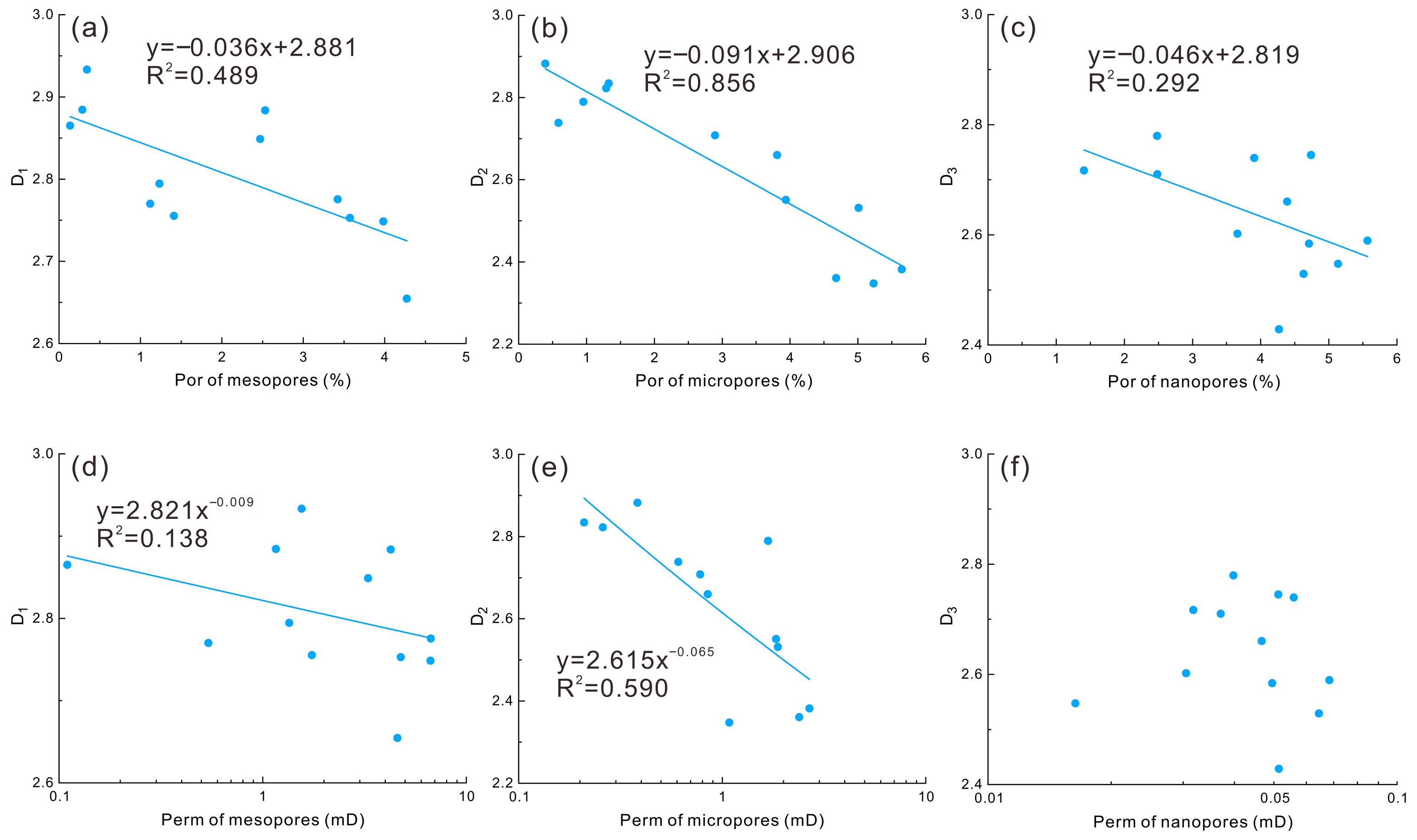
The correlation analysis between the fractal dimensions (Dn) of pore–throats at different scales and their contributions to porosity and permeability indicates that D1 of mesopores and D2 of micropores show significant negative correlations with physical parameters, whereas the correlation is weaker for nanopores (Figure 19). This reflects the hierarchical control of multi-scale pore–throat structures on reservoir properties and gas-bearing capacity. When the D1 of mesopores is low, the pore–throat structure is regular and well-connected, providing a large effective storage space and low capillary resistance, facilitating substantial gas charging and maintaining high gas saturation. In contrast, as D1 increases, mesopores become segmented or isolated by fine throats, reducing gas storage space and the proportion of movable gas (Figure 19a,d). D2 of micropores shows the strongest correlation with porosity and permeability (R2 = 0.856 and 0.690, respectively). A lower D2 value indicates simpler, more continuous pore–throat channels, forming an efficient seepage network that ensures good reservoir connectivity and high movable gas saturation (Figure 19b,e). In contrast, D3 of nanopores shows an insignificant correlation with reservoirs’ physical properties (R2 = 0.292). Due to their size and large specific surface area, micropore–throats are mainly developed within cements and clay minerals, where gas primarily exists in adsorbed or capillary-bound states (Figure 19c,f). Although they increase the total pore volume, their contribution to effective flow and movable gas is limited. Moreover, as D3 increases, the adsorption surface area enlarges, further reducing the proportion of movable gas. Therefore, variations in Dn within each pore–throat scale reflect the evolutionary trend of the pore–throat system from homogeneous and simple to multi-scale and heterogeneous. Low fractal dimensions in mesopores and micropores indicate simple, well-connected systems that are crucial for forming effective seepage networks and movable gas spaces. Conversely, high fractal dimensions in micro- and nanopores correspond to complex, poorly connected systems that hinder gas charging and migration, leading to a marked reduction in effective gas storage space and gas saturation. Among these, the fractal dimension of micropores (D2) serves as a key indicator for evaluating the effectiveness of seepage networks and predicting movable gas potential; D1 of mesopores reflects the upper limit of movable gas storage space, while an increase in D3 for nanopores signifies enhanced adsorption effects and reduced gas mobility.
Figure 19. Relationship between the fractal dimension Dn of pore-throats with different sizes and their contribution to physical properties. (ac) Relationship between fractal dimension Dn of pore-throats with different sizes and their contribute porosity; (df) relationship between fractal dimension Dn of pore-throats with different sizes and their contribute permeability.
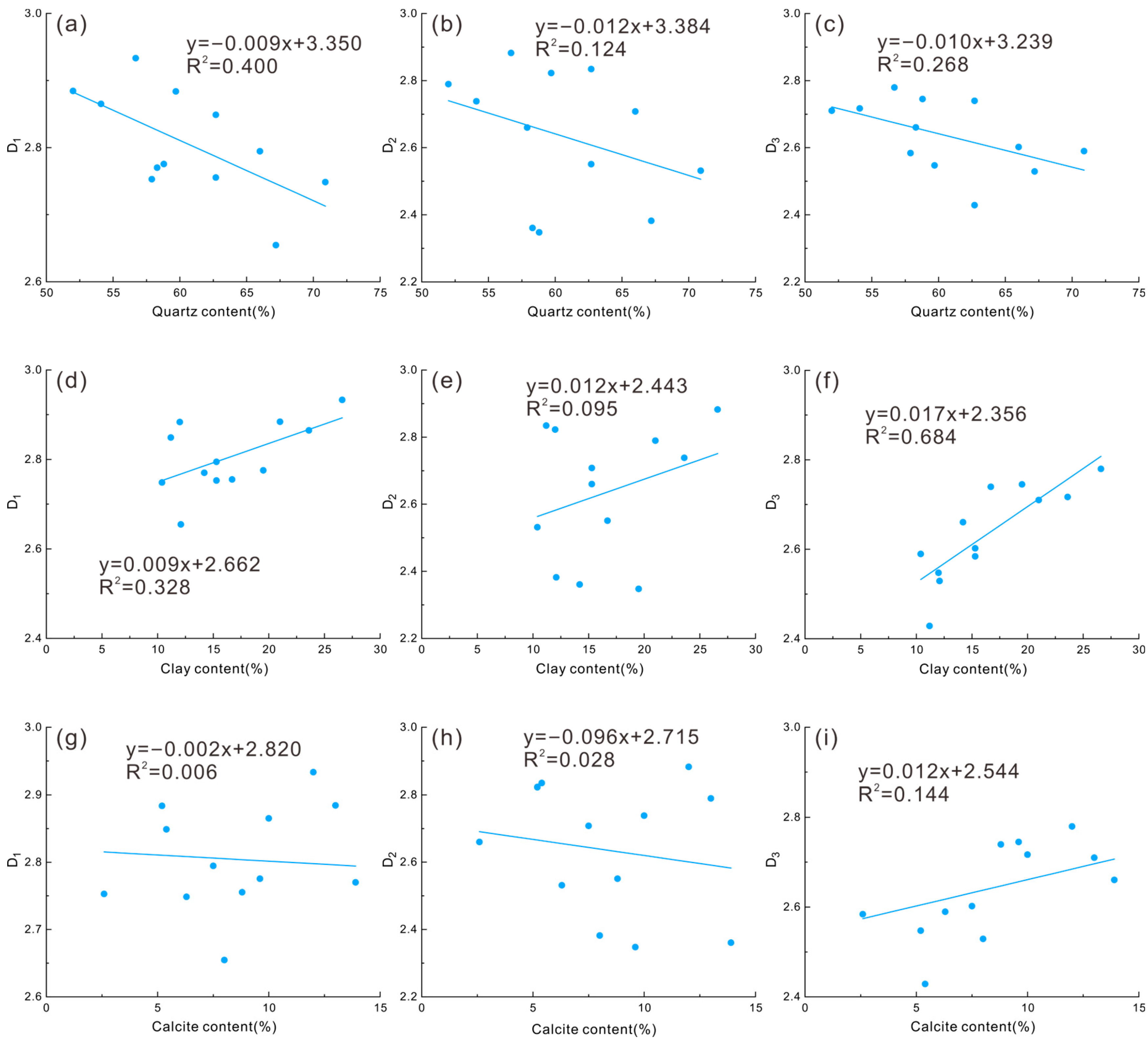
The influence of different mineral contents on the D of pore–throats at various scales shows significant variability (Figure 20). The quartz content shows an overall negative correlation with D across all scales, with the strongest correlation observed in mesopores. This indicates that quartz enhances the rigidity and compressive strength of the reservoir framework, leading to a more regular pore–throat structure, a more concentrated pore size distribution, and the preservation of mesopores (Figure 20a–c). Such structures are characterized by better connectivity and permeability, forming relatively low-D homogeneous systems that provide favorable physical spaces for gas accumulation and migration. Therefore, reservoirs with greater quartz content generally display higher porosity, greater permeability, and better gas-bearing properties. This feature is most evident in Type I samples—for example, sample 12, with a quartz content of 67.2%, shows a mesopores Sg of 3.787%, representing the highest gas-bearing capacity among all samples. In contrast, the clay mineral content shows a positive correlation with fractal dimension, particularly in micropores and nanopores (Figure 20d–f). This suggests that clay minerals, occurring in film-like, lamellar, or pore-filling forms, significantly increase the irregularity and heterogeneity of medium and small pore–throats, thereby enhancing the structural complexity of the pore–throat system but hindering the seepage of gas. The influence of calcite content on the fractal dimension at different pore–throat scales is relatively weak, indicating that calcite may play dual roles—either blocking pore–throats or regularizing their structure (Figure 20g–i). These opposing effects result in an overall insignificant impact of calcite content on D across different pore–throat sizes.
Figure 20. Relationship between the fractal dimension Dn of pore-throats with different sizes and mineral content. (ac) Relationship between fractal dimension Dn of pore-throats with different sizes and quartz content; (df) relationship between fractal dimension Dn of pore-throats with different sizes and clay content; (gi) relationship between fractal dimension Dn of pore-throats with different sizes and calcite content.
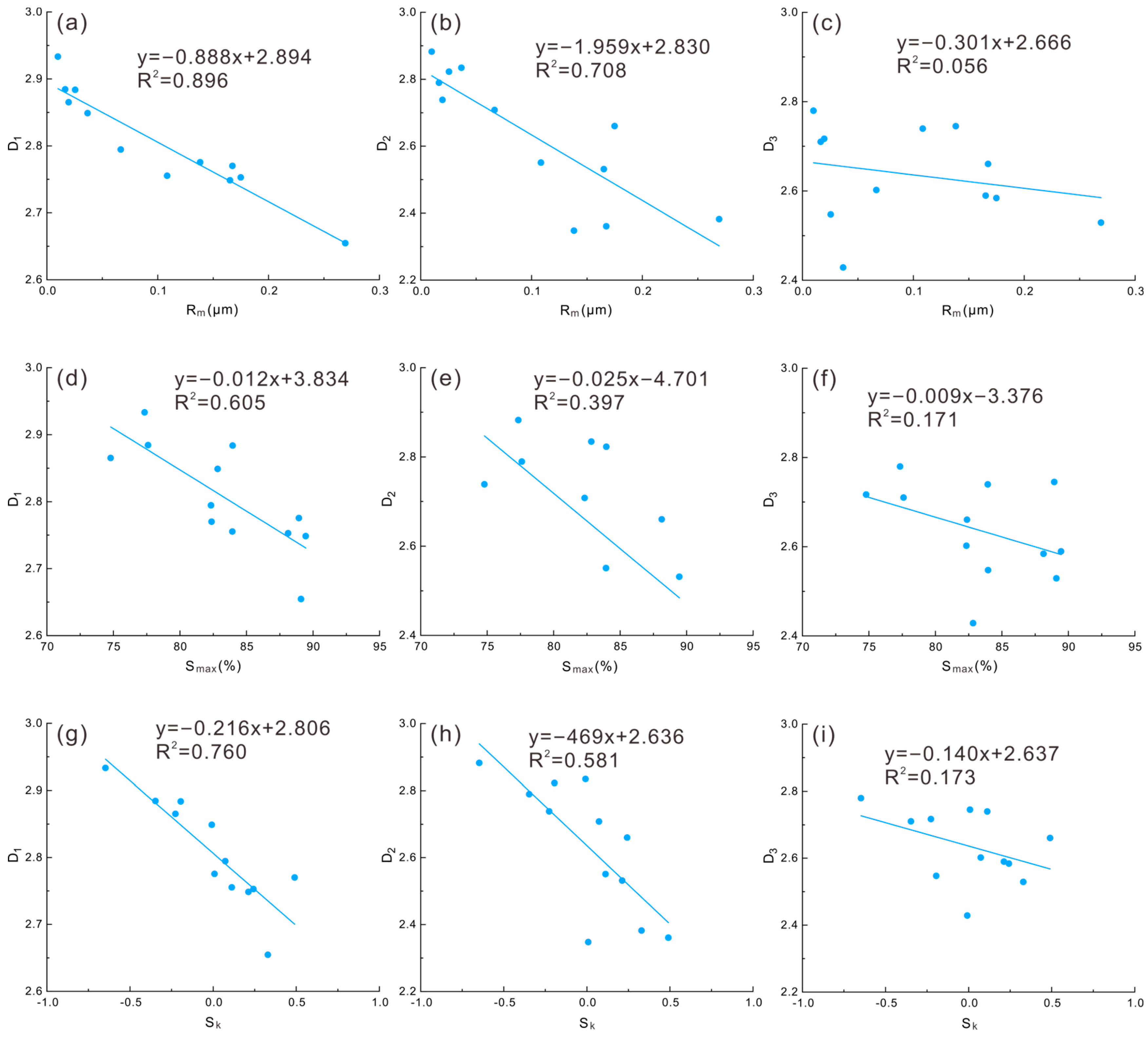
At different pore–throat scales, the fractal dimension (Dn) shows a clear negative correlation with pore–throat parameters, though the correlation strength varies depending on the scale and parameter type. Overall, Rm exhibits the strongest correlation with fractal dimension, with R2 values of 0.896 and 0.708 for mesopores and micropores, respectively. This indicates that larger average pore–throat radii correspond to more regular and homogeneous structures, resulting in significantly lower fractal dimensions (Figure 21a–c). Samples with well-developed mesopores exhibit concentrated pore–throat size distributions, greater connectivity, and lower flow resistance, reflecting reduced geometric complexity and, consequently, greater gas-bearing capacity. As the pore–throat scale decreases, the correlation between Rm and (Dn) weakens, suggesting that in finer pore–throats, the structure is more strongly affected by the mineral composition and clay filling, increasing geometric randomness and reducing the gas-bearing potential. Smax (maximum mercury saturation) also shows a negative correlation with the fractal dimension (Figure 21d–f). At mesopore scales, the correlation reaches 0.605, indicating that when mesopores are well developed, reservoir connectivity improves, the structure becomes more homogeneous, and the fractal dimension decreases. The presence of large pore–throats significantly enhances connectivity and permeability, promoting free gas accumulation and migration. Conversely, at nanopore scales, the correlation between Smax and D3 becomes weaker. This is because nanopores have poor connectivity and more dispersed pore–throat size distributions, which increase structural complexity and increase the fractal dimension, ultimately resulting in poorer gas-bearing capacity. Sk, which reflects the symmetry of the pore–throat size distribution, also shows a negative overall correlation with Dn (Figure 21g–i). When the pore size distribution is skewed toward the large-pore end, the system becomes more homogeneous, and the fractal dimension decreases. In contrast, when the skewness shifts toward smaller pores, the pore–throat distribution widens, heterogeneity increases, and the fractal dimension increases. This variation reveals the control of pore–throat distribution characteristics for gas occurrence: systems with a low fractal dimension correspond to reservoirs dominated by mesopores, with a higher proportion of free gas and stronger flow capacity; systems with a high fractal dimension correspond to reservoirs dominated by fine pore–throats, where complex structures favor adsorbed gas accumulation and hinder gas flow.
Figure 21. Relationship between the fractal dimension Dn of pore-throats with different sizes and pore-throat structure parameters. (ac) Relationship between fractal dimension Dn of pore-throats with different sizes and Rm; (df) relationship between fractal dimension Dn of pore-throats with different sizes and Smax; (gi) relationship between fractal dimension Dn of pore-throats with different sizes and Sk.
In summary, Rm, Smax, and Sk influence variations in fractal dimension by regulating the distribution characteristics of pore–throat sizes, and the magnitude of Dn reflects the heterogeneity and complexity of the pore–throat system. When Rm and Smax are larger and Sk is positively skewed, the reservoir structure tends to be more homogeneous, with a lower fractal dimension, dominated by free gas and exhibiting good gas-bearing capacity. Conversely, when these parameters decrease or shift toward nanopores, the pore–throat system becomes more complex, with higher fractal dimensions, dominated by adsorbed gas and characterized by poor gas-bearing capacity.

6. Future Work

Future research can further integrate gas displacement water nuclear magnetic resonance (GDWNMR) experiments with microscopic visualization techniques to investigate the dynamic evolution of gas distribution under varying displacement pressures and multi-cycle injection conditions. In addition, three-dimensional digital core reconstruction and numerical simulation methods can be introduced to quantitatively verify the coupling mechanisms underlying multi-scale fractal characteristics and gas migration processes, thereby enhancing understanding of gas–water distribution patterns in tight sandstone reservoirs and providing a theoretical basis and technical support for efficient reservoir development.

7. Conclusions

(1)
The results indicate that the pore–throat system of the Lower Shihezi Formation tight sandstone reservoir in Hangjin Banner, Ordos Basin, exhibits a distinct three-stage distribution pattern, which can be divided into mesopores, micropores, and nanopores. Different pore–throat sizes play distinct roles within the reservoir: mesopores are the primary contributors to effective porosity and gas storage capacity, while micropores and nanopores mainly influence gas retention and diffusion, contributing less to the reservoir’s overall gas-bearing capacity.
(2)
Fractal analysis results show that mineral composition and pore–throat structure lead to variations in fractal dimension, thereby influencing the gas-bearing capacity of the reservoir. Overall, a higher clay mineral content is the primary factor responsible for the increase in fractal dimension, indicating enhanced complexity and heterogeneity of the pore–throat system, which, in turn, deteriorates reservoir physical properties and hinders hydrocarbon migration and accumulation. The pore–throat structural parameters (Rm, Sk, and Smax) exert a significant impact on fractal characteristics: larger values of these parameters reflect a more homogeneous pore–throat system with better connectivity and a lower fractal dimension, conditions that facilitate gas migration and accumulation and ultimately enhance the reservoir’s gas storage capacity.
(3)
The mechanisms controlling gas occurrence vary significantly across different pore–throat scales. At different scales, only physical parameters corresponding to micropores exhibit strong control over the fractal dimension. Quartz content mainly affects the fractal dimension of mesopores, reflecting the supporting and framework-preserving effects of quartz grains, which are favorable for gas storage. In contrast, clay mineral content primarily controls the fractal dimension of nanopores, indicating that clay filling increases nanopore structural complexity. Meanwhile, pore–throat structural parameters exert the most significant influence on the fractal dimensions of mesopores and micropores. Larger values of Rm, Sk, and Smax correspond to lower fractal dimensions and better connectivity, thereby increasing the upper limit of the reservoir’s gas-bearing capacity.

Author Contributions

Conceptualization and methodology, L.B.; software, L.B.; formal analysis, Y.L. and Q.C.; investigation, L.B. and Q.C.; resources, Z.Z.; data curation, Q.C.; writing—original draft preparation, L.B.; writing—review and editing, J.H.; visualization, Y.L.; funding acquisition, Y.L. and J.H. All authors have read and agreed to the published version of the manuscript.

Funding

This research was funded by the National Natural Science Foundation of China (Nos. 42072146 and 42472205).

Data Availability Statement

All of the data and models generated or used in the present study are available from the corresponding author upon request.

Conflicts of Interest

Author Zhanyang Zhang was employed by Exploration and Development Research Institute, SINOPEC North China Company. The remaining authors declare that the research was conducted in the absence of any commercial or financial relationships that could be construed as a potential conflict of interest.

Abbreviations

HPMIHigh-pressure mercury intrusion
NMRNuclear magnetic resonance
SEMScanning electron microscopy
XRDX-ray diffraction
Dfractal dimension
PmvMovable volume
SmvMovable volume saturation 
PogGas-occupied porosity
SgGas saturation
ScSorting coefficient
HcHomogeneity coefficient
PtThreshold pressure 
RmaxMaximum pore-throat radius
RmMedian pore-throat radius
WeMercury withdrawal efficiency 
SmaxMaximum mercury saturation 

References

  1. Clarkson, C.R.; Freeman, M.; He, L.; Agamalian, M.; Melnichenko, Y.B.; Mastalerz, M.; Bustin, R.M.; Radliński, A.P.; Blach, T.P. Characterization of Tight Gas Reservoir Pore Structure Using USANS/SANS and Gas Adsorption Analysis. Fuel 2012, 95, 371–385. [Google Scholar] [CrossRef]
  2. Sun, L.; Fang, C.; Li, F.; Zhu, R.; He, D. Petroleum Exploration and Development Practices of Sedimentary Basins in China and Research Progress of Sedimentology. Pet. Explor. Dev. 2010, 37, 385–396. [Google Scholar] [CrossRef]
  3. Zou, C.; Zhang, G.; Yang, Z.; Tao, S.; Hou, L.; Zhu, R.; Yuan, X.; Ran, Q.; Li, D.; Wang, Z. Concepts, Characteristics, Potential and Technology of Unconventional Hydrocarbons: On Unconventional Petroleum Geology. Pet. Explor. Dev. 2013, 40, 413–428. [Google Scholar] [CrossRef]
  4. Bluck, B.J. Structure of Coarse Grained Braided Stream Alluvium. Earth Environ. Sci. Trans. R. Soc. Edinb. 1979, 70, 181–221. [Google Scholar] [CrossRef]
  5. Lunt, I.A.; Bridge, J.S. Evolution and Deposits of a Gravelly Braid Bar, Sagavanirktok River, Alaska. Sedimentology 2004, 51, 415–432. [Google Scholar] [CrossRef]
  6. Miall, A.D. A Review of the Braided-River Depositional Environment. Earth-Sci. Rev. 1977, 13, 1–62. [Google Scholar] [CrossRef]
  7. Stroker, T.M.; Harris, N.B.; Elliott, W.C.; Wampler, J.M. Diagenesis of a Tight Gas Sand Reservoir: Upper Cretaceous Mesaverde Group, Piceance Basin, Colorado. Mar. Pet. Geol. 2013, 40, 48–68. [Google Scholar] [CrossRef]
  8. Tobin, R.C.; McClain, T.; Lieber, R.B.; Ozkan, A.; Banfield, L.A.; Marchand, A.M.E.; McRae, L.E. Reservoir Quality Modeling of Tight-Gas Sands in Wamsutter Field: Integration of Diagenesis, Petroleum Systems, and Production Data. AAPG Bull. 2010, 94, 1229–1266. [Google Scholar] [CrossRef]
  9. Zhao, D.; Hou, J.; Sarma, H.; Guo, W.; Liu, Y.; Xie, P.; Dou, L.; Chen, R.; Zhang, Z. Pore Throat Heterogeneity of Different Lithofacies and Diagenetic Effects in Gravelly Braided River Deposits: Implications for Understanding the Formation Process of High-Quality Reservoirs. Geoenergy Sci. Eng. 2023, 221, 111309. [Google Scholar] [CrossRef]
  10. Guo, P.; Zhou, R.; Tian, Z.; Wang, Y.; Yan, L.; Zhao, J.; Yu, C. Gas and Water Distribution Characteristics of Water-Driven Gas Process in Tight Sandstone Gas Reservoirs: A Microscale Study by Molecular Simulation and Experiment. Energy Rep. 2022, 8, 7025–7036. [Google Scholar] [CrossRef]
  11. Wang, W.; Li, T.; Xiao, D.; Wang, B.; Yang, Y.; Zhang, Y.; La, W.; He, J. Geological Conditions and Controls on Accumulation of Tight Sandstone Gas, Deep Part of the Shengbei Sub-Sag, Turpan-Hami Basin, NW China. Mar. Pet. Geol. 2023, 158, 106513. [Google Scholar] [CrossRef]
  12. Lai, J.; Wang, G.; Meng, C.; Guan, B.; Zheng, X.; Zhou, L.; Xin, Y.; Han, C. Pore Structure Characteristics and Formation Mechanisms Analysis of Tight Gas Sandstones. Prog. Geophys. 2015, 30, 217–227. [Google Scholar]
  13. Liu, G.; Wang, Y.; Yin, H.; Ding, Y.; Lan, Y.; Yang, D. Determination of Gas-Water Seepage Characteristics with Consideration of Dynamic Pore-Throat Structure in a Tight Sandstone Gas Formation. Mar. Pet. Geol. 2022, 136, 105440. [Google Scholar] [CrossRef]
  14. Sima, L.; Wang, C.; Wang, L.; Wu, F.; Ma, L.; Wang, Z. Effect of Pore Structure on the Seepage Characteristics of Tight Sandstone Reservoirs: A Case Study of Upper Jurassic Penglaizhen Fm Reservoirs in the Western Sichuan Basin. Nat. Gas Ind. B 2017, 4, 17–24. [Google Scholar] [CrossRef]
  15. Wang, X.; Song, Y.; Guo, X.; Chang, Q.; Kong, Y.; Zheng, M.; Qin, Z.; Yang, X. Pore-Throat Structure Characteristics of Tight Reservoirs of the Middle Permian Lucaogou Formation in the Jimsar Sag, Junggar Basin, Northwest China. J. Pet. Sci. Eng. 2022, 208, 109245. [Google Scholar] [CrossRef]
  16. Fu, H.; Wang, X.; Zhang, L.; Gao, R.; Li, Z.; Xu, T.; Zhu, X.; Xu, W.; Li, Q. Investigation of the Factors That Control the Development of Pore Structure in Lacustrine Shale: A Case Study of Block X in the Ordos Basin, China. J. Nat. Gas Sci. Eng. 2015, 26, 1422–1432. [Google Scholar] [CrossRef]
  17. Lai, J.; Wang, G.; Wang, Z.; Chen, J.; Pang, X.; Wang, S.; Zhou, Z.; He, Z.; Qin, Z.; Fan, X. A Review on Pore Structure Characterization in Tight Sandstones. Earth-Sci. Rev. 2018, 177, 436–457. [Google Scholar] [CrossRef]
  18. Liu, G.; Yin, H.; Lan, Y.; Fei, S.; Yang, D. Experimental Determination of Dynamic Pore-Throat Structure Characteristics in a Tight Gas Sandstone Formation with Consideration of Effective Stress. Mar. Pet. Geol. 2020, 113, 104170. [Google Scholar] [CrossRef]
  19. Feng, D.; Liu, C.; Feng, X.; Wang, X.; Awan, R.S.; Yang, X.; Xu, N.; Wu, Y.; Wu, Y.; Zang, Q. Movable Fluid Evaluation of Tight Sandstone Reservoirs in Lacustrine Delta Front Setting: Occurrence Characteristics, Multiple Control Factors, and Prediction Model. Mar. Pet. Geol. 2023, 155, 106393. [Google Scholar] [CrossRef]
  20. Zhang, Q.; Liu, Y.; Wang, B.; Ruan, J.; Yan, N.; Chen, H.; Wang, Q.; Jia, G.; Wang, R.; Liu, H.; et al. Effects of Pore-Throat Structures on the Fluid Mobility in Chang 7 Tight Sandstone Reservoirs of Longdong Area, Ordos Basin. Mar. Pet. Geol. 2022, 135, 105407. [Google Scholar] [CrossRef]
  21. Qiao, J.; Zeng, J.; Xia, Y.; Cai, J.; Chen, D.; Jiang, S.; Han, G.; Cao, Z.; Feng, X.; Feng, S. A Three Dimensional Visualized Physical Simulation for Natural Gas Charging in the Micro-Nano Pore System. Pet. Explor. Dev. 2022, 49, 349–362. [Google Scholar] [CrossRef]
  22. Zhang, H.; Li, X.; Liu, J.; Wang, Y.; Guo, L.; Wu, Z.; Tian, Y. A Fractal Characteristics Analysis of the Pore Throat Structure in Low-Permeability Sandstone Reservoirs: A Case Study of the Yanchang Formation, Southeast Ordos Basin. Fractal Fract. 2025, 9, 224. [Google Scholar] [CrossRef]
  23. Cui, H.; Zhu, S.; Wang, J.; Gao, Y.; Wan, C.; Tong, H. Physical Properties, Pore-Throat Structure, Fractal Characteristics and Their Effects on the Gas-Bearing Capacity of Tight Sandstone: A Case Study from the Northern Tianhuan Depression, Ordos Basin, China. Nat. Resour. Res. 2022, 31, 1559–1584. [Google Scholar] [CrossRef]
  24. Wu, H.; Ji, Y.; Liu, R.; Zhang, C.; Chen, S. Pore Structure and Fractal Characteristics of a Tight Gas Sandstone: A Case Study of Sulige Area in the Ordos Basin, China. Energy Explor. Exploit. 2018, 36, 1438–1460. [Google Scholar] [CrossRef]
  25. Rosenbrand, E.; Fabricius, I.L.; Fisher, Q.; Grattoni, C. Permeability in Rotliegend Gas Sandstones to Gas and Brine as Predicted from NMR, Mercury Injection and Image Analysis. Mar. Pet. Geol. 2015, 64, 189–202. [Google Scholar] [CrossRef]
  26. Yin, X.; Shu, J.; Li, Y.; Gao, W.; Lu, J.; Wu, P.; Ma, L. Impact of Pore Structure and Clay Content on the Water-Gas Relative Permeability Curve within Tight Sandstones: A Case Study from the LS Block, Eastern Ordos Basin, China. J. Nat. Gas Sci. Eng. 2020, 81, 103418. [Google Scholar] [CrossRef]
  27. Gao, Z.; Yang, X.; Hu, C.; Wei, L.; Jiang, Z.; Yang, S.; Fan, Y.; Xue, Z.; Yu, H. Characterizing the Pore Structure of Low Permeability Eocene Liushagang Formation Reservoir Rocks from Beibuwan Basin in Northern South China Sea. Mar. Pet. Geol. 2019, 99, 107–121. [Google Scholar] [CrossRef]
  28. Xiao, X.M.; Zhao, B.Q.; Thu, Z.L.; Song, Z.G.; Wilkins, R.W.T. Upper Paleozoic Petroleum System, Ordos Basin, China. Mar. Pet. Geol. 2005, 22, 945–963. [Google Scholar] [CrossRef]
  29. Yang, Y.; Li, W.; Ma, L. Tectonic and Stratigraphic Controls of Hydrocarbon Systems in the Ordos Basin: A Multicycle Cratonic Basin in Central China. AAPG Bull. 2005, 89, 255–269. [Google Scholar] [CrossRef]
  30. Yang, H.; Zhang, J.; Wang, F.Y.; Wang, H.C. Characteristics of Paleozoic Gas System in Ordos Basin. Nat. Gas Ind. 2000, 20, 7–11. [Google Scholar]
  31. Wang, T.; Hou, M.; Chen, H.-D.; Hou, Z.; Chen, A.; Su, Z.-T. Coupling Relationship between Yinshan Episodic Orogenic Movement of Hercynian Tectonic Cycle and Filling Cycle of the North Ordos Basin in China. J. Chengdu Univ. Technol. (Sci. Technol. Ed.) 2014, 41, 310–317. [Google Scholar]
  32. Wang, R.; Shi, W.; Xie, X.; Zhang, W.; Qin, S.; Liu, K.; Busbey, A.B. Clay Mineral Content, Type, and Their Effects on Pore Throat Structure and Reservoir Properties: Insight from the Permian Tight Sandstones in the Hangjinqi Area, North Ordos Basin, China. Mar. Pet. Geol. 2020, 115, 104281. [Google Scholar] [CrossRef]
  33. Li, J.; Zhang, X.; Tian, J.; Liang, Q.; Cao, T. Effects of Deposition and Diagenesis on Sandstone Reservoir Quality: A Case Study of Permian Sandstones Formed in a Braided River Sedimentary System, Northern Ordos Basin, Northern China. J. Asian Earth Sci. 2021, 213, 104745. [Google Scholar] [CrossRef]
  34. Xu, Q.; Shi, W.; Xie, X.; Busbey, A.B.; Xu, L.; Wu, R.; Liu, K. Inversion and Propagation of the Late Paleozoic Porjianghaizi Fault (North Ordos Basin, China): Controls on Sedimentation and Gas Accumulations. Mar. Pet. Geol. 2018, 91, 706–722. [Google Scholar] [CrossRef]
  35. Haskett, S.E.; Narahara, G.M.; Holditch, S.A. A Method for Simultaneous Determination of Permeability and Porosity in Low-Permeability Cores. SPE Form. Eval. 1988, 3, 651–658. [Google Scholar] [CrossRef]
  36. SY/T 5336-2006; Practices for Core Analysis. National Standard of the People’s Republic of China: Beijing, China, 2006.
  37. SY/T 5368-2016; Identification of Rock Flakes. National Standard of the People’s Republic of China: Beijing, China, 2016.
  38. Soeder, D.J.; Chowdiah, P. Pore Geometry in High- and Low-Permeability Sandstones, Travis Peak Formation, East Texas. SPE Form. Eval. 1990, 5, 421–430. [Google Scholar] [CrossRef]
  39. Bjørlykke, K.; Brendsdal, A. Diagenesis of the Brent Sandstone in the Statfjord Field, North Sea. In Roles of Organic Matter in Sediment Diagenesis; Gautier, D.L., Ed.; SEPM Society for Sedimentary Geology: Claremore, OK, USA, 1985; Volume 38. [Google Scholar] [CrossRef]
  40. Schmitt, M.; Halisch, M.; Müller, C.; Fernandes, C.P. Classification and Quantification of Pore Shapes in Sandstone Reservoir Rocks with 3-D X-Ray Micro-Computed Tomography. Solid Earth 2016, 7, 285–300. [Google Scholar] [CrossRef]
  41. Su, Y.; Zha, M.; Jiang, L.; Ding, X.; Qu, J.; Jin, J.; Iglauer, S. Pore Structure and Fluid Distribution of Tight Sandstone by the Combined Use of SEM, MICP and X-Ray Micro-CT. J. Pet. Sci. Eng. 2022, 208, 109241. [Google Scholar] [CrossRef]
  42. SY/T 5163-2018; Analysis Method for Clay Minerals and Ordinary Non-Clay Minerals in Sedimentary Rocks by the X-Ray Diffraction. National Standard of the People’s Republic of China: Beijing, China, 2018.
  43. SY/T 5346-2005; Rock Capillary Pressure Measurement. National Standard of the People’s Republic of China: Beijing, China, 2005.
  44. Washburn, E.W. The Dynamics of Capillary Flow. Phys. Rev. 1921, 17, 273–283. [Google Scholar] [CrossRef]
  45. Timur, A. Pulsed Nuclear Magnetic Resonance Studies of Porosity, Movable Fluid, and Permeability of Sandstones. J. Pet. Technol. 1969, 21, 775–786. [Google Scholar] [CrossRef]
  46. Kenyon, W. Nuclear Magnetic Resonance as a Petrophysical Measurement. Nucl. Geophys. 1991, 6, 153–172. [Google Scholar]
  47. Brownstein, K.R.; Tarr, C.E. Importance of Classical Diffusion in NMR Studies of Water in Biological Cells. Phys. Rev. A 1979, 19, 2446–2453. [Google Scholar] [CrossRef]
  48. Mao, Z.-Q.; He, Y.-D.; Ren, X.-J. An Improved Method of Using NMR T2 Distribution to Evaluate Pore Size Distribution. Chin. J. Geophys. 2005, 48, 412–418. [Google Scholar] [CrossRef]
  49. Jiang, F.; Zhang, C.; Wang, K.; Zhao, Z.; Zhong, K. Characteristics of Micropores, Pore Throats, and Movable Fluids in the Tight Sandstone Oil Reservoirs of the Yanchang Formation in the Southwestern Ordos Basin, China. AAPG Bull. 2019, 103, 2835–2859. [Google Scholar] [CrossRef]
  50. Qu, Y.; Sun, W.; Tao, R.; Luo, B.; Chen, L.; Ren, D. Pore-Throat Structure and Fractal Characteristics of Tight Sandstones in Yanchang Formation, Ordos Basin. Mar. Pet. Geol. 2020, 120, 104573. [Google Scholar] [CrossRef]
  51. Zhang, L.; Liu, J.; He, X.; Feng, F.; Li, W.; Wang, M.; Zhu, W.; Zhu, Y. Fractal Characteristics and Influencing Factors of Pore Structure in Tight Sandstone: A Case Study from Chang 6 Member of the Southwestern Yishan Slope. Processes 2025, 13, 988. [Google Scholar] [CrossRef]
  52. Peng, J.; Han, H.; Xia, Q.; Li, B. Fractal Characteristic of Microscopic Pore Structure of Tight Sandstone Reservoirs in Kalpintag Formation in Shuntuoguole Area, Tarim Basin. Pet. Res. 2020, 5, 1–17. [Google Scholar] [CrossRef]
Disclaimer/Publisher’s Note: The statements, opinions and data contained in all publications are solely those of the individual author(s) and contributor(s) and not of MDPI and/or the editor(s). MDPI and/or the editor(s) disclaim responsibility for any injury to people or property resulting from any ideas, methods, instructions or products referred to in the content.

Article Metrics

Citations

Article Access Statistics

Multiple requests from the same IP address are counted as one view.