Article

Comparative Study on Pore Characteristics and Methane Adsorption Capacity of the Lower Silurian Longmaxi Shales with Different Lithofacies


1
Xinjiang Key Laboratory for Geodynamic Processes and Metallogenic Prognosis of the Central Asian Orogenic Belt, Xinjiang University, Urumqi 830017, China
2
School of Geology and Mining Engineering, Xinjiang University, Urumqi 830047, China
3
Research Institute of Exploration and Development, SINOPEC Jianghan Oilfield Company, Wuhan 430223, China
4
School of Geosciences, Yangtze University, Wuhan 430100, China
5
School of Earth Resources, China University of Geosciences, Wuhan 430074, China
6
College of Petroleum Engineering, Shandong Institute of Petroleum and Chemical Technology, Dongying 257061, China
*
Authors to whom correspondence should be addressed.
Fractal Fract. 2026, 10(3), 154; https://doi.org/10.3390/fractalfract10030154
Submission received: 28 December 2025 / Revised: 13 February 2026 / Accepted: 24 February 2026 / Published: 27 February 2026

Abstract

In this study, shale samples with diverse lithofacies from the Lower Silurian Longmaxi Formation in the Fuling Field were investigated to evaluate the variations in pore characteristics and methane adsorption capacity (MAC) of different shale lithofacies. A set of experiments were performed, such as total organic carbon (TOC) content, X-ray diffraction (XRD), field emission–scanning electron microscopy (FE-SEM), low-pressure gas (CO2/N2) adsorption, and high-pressure methane adsorption. Combined with TOC content and mineral composition, three types of shale lithofacies were identified, including organic-rich (OR) argillaceous-rich siliceous (S-3) shale lithofacies, organic-moderate (OM) argillaceous/siliceous mixed (M-2) shale lithofacies, and organic-lean (OL) siliceous-rich argillaceous (CM-1) shale lithofacies. Through detailed comparative analyses, we found that OR S-3 shales possess the maximum TOC content, the most developed heterogeneous organic micro-mesopores, the largest pore volume (PV), and the highest pore surface area (PSA); consequently, they display the strongest MAC. Conversely, OL CM-1 shales have the lowest TOC content and the highest clay content, and thus the smallest PSA and the poorest methane adsorption performance. In conclusion, considering the excellent gas storage potential, sustained shale gas production, and brittle response to hydraulic fracturing, OR S-3 shales are superior to shale gas exploration and exploitation compared with OM M-2 and OL CM-1 shales.

1. Introduction

In recent years, shale gas has been commercially developed and has become one of the most important energy resources in North America and China due to advanced horizontal drilling and hydraulic fracturing techniques [1,2,3,4]. Distinguished from conventional gas resources, shale gas is unique and stored in shale reservoirs in three main mechanisms: (1) free gas in pores and fractures, (2) adsorbed gas on pore surfaces of organic matter and clay minerals, and (3) a minor fraction of dissolved gas in formation water and liquid hydrocarbons [5]. Consequently, the nanometer- to micrometer-scale pores, together with the fractures, serve as the essential storage spaces, and migration pathways are critical to the productivity of shale gas reservoirs [6,7,8]. Determining pore characteristics (including pore types and pore structures such as pore volume (PV), pore surface area (PSA), and fractal dimension (FD)) [9,10,11], and understanding geological controls on pore development are fundamental to evaluating the potential of shale gas resources [12,13,14].
Lithofacies represent a rock or rock assemblage formed under specific sedimentary conditions, resulting from comprehensive effects of various physical, chemical, and biological factors in complex sedimentary environments. It is the material manifestation of a sedimentary environment and preserves valuable mineralogy, geochemistry, petrology, and petrophysical information of rocks [15]. Currently, the variations in pore development in shales among different lithofacies have been reported by some studies [16,17,18], and meaningful discoveries have been achieved [19,20,21]. Several scholars preliminarily suggested that siliceous lithofacies exhibit large pore spaces and that it is the most favorable lithofacies type for shale gas storage [22,23,24]. However, comparative studies on the pore fractal characteristics of shales with different lithofacies are relatively rare.
Previous studies have shown that adsorbed gas constitutes a significant portion of total gas content, ranging from 20 to 85% in the five United States shale formations of Lewis, Barnett, New Albany, Antrim, and Ohio [5], and exceeding 50% for Longmaxi shales in China [25]. Nevertheless, the factors affecting the methane adsorption capacity (MAC) of shales, especially the effects of the shale pore fractal characteristics on the MAC, are ambiguous. In addition, the relationship between MAC and shale lithofacies remains poorly reported, and the variations in MAC for shales with different lithofacies are not well understood. It is necessary to thoroughly discuss the influencing factors and differential characteristics of MAC among different shale lithofacies.
Employing integrated experiments of organic geochemistry, mineral composition, field emission–scanning electron microscopy (FE-SEM), low-pressure gas adsorption, and high-pressure methane adsorption, this study systematically investigates the pore characteristics (including pore types, PV, PSA, and FD) and MAC of different shale lithofacies. The key objectives of this study are to (1) identify the types of shale lithofacies; (2) analyze the variations in pore types, pore structures, and MAC across different shale lithofacies; and (3) discuss the dominant factors controlling pore development and MAC of different shale lithofacies.
This study focuses on the reservoir and gas-storage characteristics across different shale lithofacies, as well as the dominant factors controlling the formation of high-quality shale lithofacies, which is of great significance for well location optimization and shale gas exploration and development.

2. Geological Setting and Samples

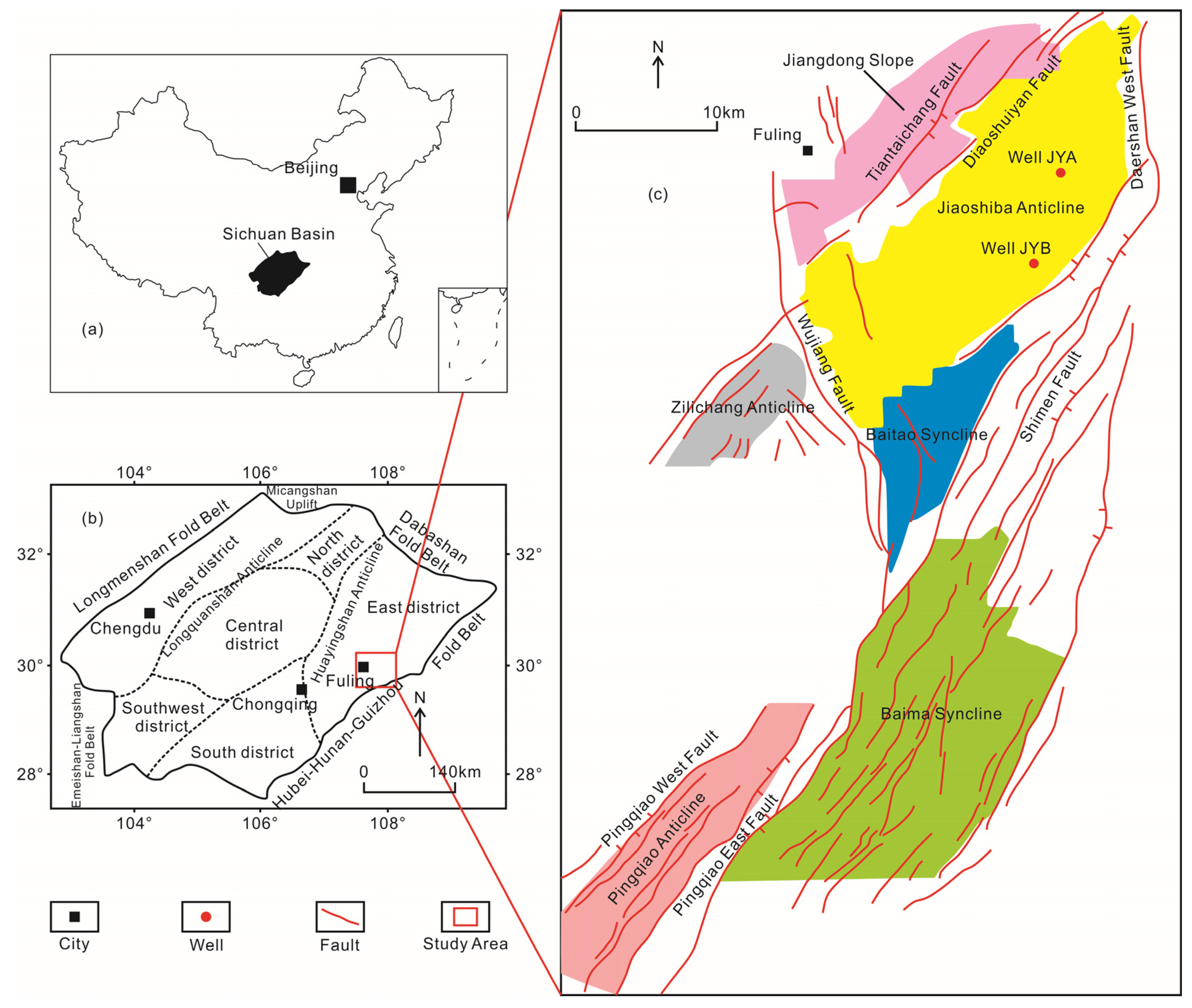
The Fuling Shale Gas Field is located in the eastern Sichuan Basin, southwest China (Figure 1a,b). Its structural framework is controlled by three fault systems trending in the NE, NS, and NW directions, which subdivide the Fuling Field into several secondary structural units, including the Jiangdong slope, Jiaoshiba anticline, Zilichang anticline, Baitao syncline, Pingqiao anticline, and Baima syncline (Figure 1c). The shale gas wells of JYA and JYB studied in this paper are situated in the main part of the Jiaoshiba block (Figure 1c). The Jiaoshiba block is a gentle box-shaped anticline and marked by flat strata and undeveloped faults [26]. The fault densities in this area are generally less than 0.02/km2, and the fault scales are also small, with the largest fault distance less than 50 m [27]. The relatively tectonically stable background provides an ideal research area to eliminate the influence of external structural deformation and focus on the discussion of internal lithofacies on the control of shale pore development and MAC.
During the Late Ordovician to Early Silurian, the Fuling area was characterized by a low-energy and hypoxia deep-water shelf to shallow-water shelf environment, with deposits of Upper Ordovician Wufeng–Lower Silurian Longmaxi Formation shales [28,29]. Based on shale lithology, color, and biological fossil assemblages, the Wufeng–Longmaxi Formation shales can be divided into three intervals from bottom to top: the first member from Longmaxi Formation shales (Long 1 shales, including Wufeng Formation shales), the second member from Longmaxi Formation shales (Long 2 shales), and the third member from Longmaxi Formation shales (Long 3 shales). Among them, the dark radiolarian and graptolite Long 1 shales are the main target interval of shale gas production [30].
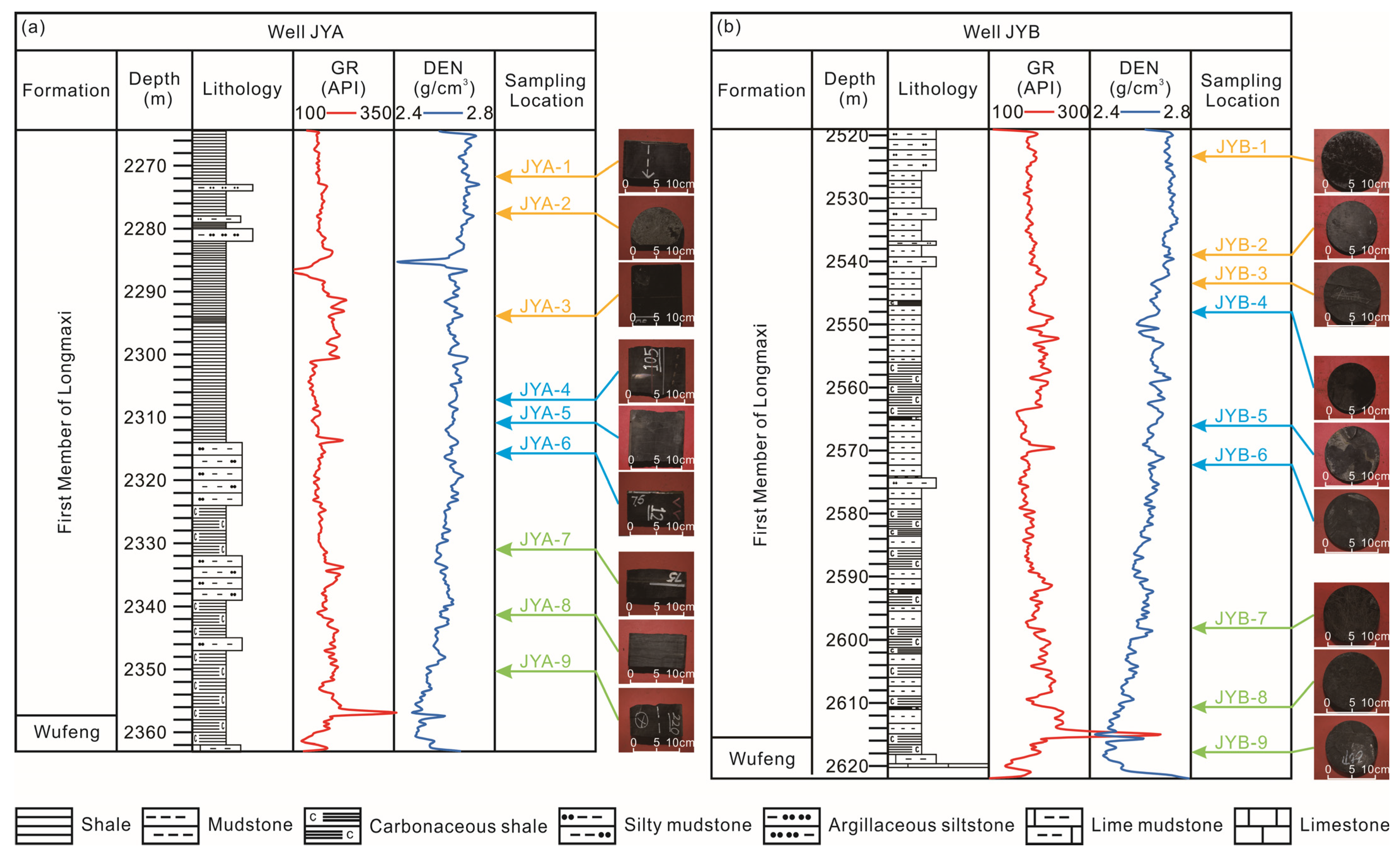
Typical marine shale samples in this study within the Lower Silurian Longmaxi Formation were selected from wells JYA and JYB in the Jiaoshiba block. These collected shale samples (standard core cylinders with a diameter of 10 cm) are approximately evenly distributed at the first member of the Longmaxi Formation, covering the variability in TOC content, mineral composition, and lithofacies (Figure 2). Detailed geological attributes of these samples regarding burial depth, TOC content, mineral composition, and lithofacies are provided in Table 1.

3. Materials and Methods

3.1. TOC Content

The TOC content was measured with a CS844 carbon/sulfur analyzer (Leco Corporation, St Joseph, MI, USA). Prior to the analysis, the studied samples of about 10 g were crushed to a powder of 200 mesh and were then treated with hydrochloric acid to eliminate any inorganic carbonates. The TOC values were derived from the amounts of CO2 released during sample combustion.

3.2. X-Ray Diffraction (XRD)

The mineral composition of the studied samples was determined by a D/max-2600 X-ray diffractometer (Rigaku Corporation, Tokyo, Japan) at a working voltage of 40 kV and current of 30 mA with Cu Kα radiation (λ = 0.154 nm). Powdered shale samples with 200 mesh of about 2 g were scanned using a step size of 4°/min from 3° to 85°. Semi-quantitative analysis of relative mineral percentages was conducted based on the area under the curve for the major peaks of each mineral.

3.3. Field Emission–Scanning Electron Microscopy (FE-SEM)

The microscopic pore type, morphology, size, and number of studied shale samples was observed using a Zeiss Merlin Compact FE-SEM (Carl Zeiss AG, Oberkochen, Germany). Prior to the experiment, rectangular shale samples 10 mm × 8 mm × 5 mm in size were first mechanically grinded, followed by argon ion polishing with a LEICA EM RES102 system (Leica Corporation, Wetzlar, Germany) to produce a flat surface. Secondary electron imaging was subsequently employed to capture high-resolution images of the polished sample surfaces.

3.4. Low-Pressure Gas Adsorption

Low-pressure CO2 and N2 adsorption analyses were conducted to measure the pore structure of the studied shale samples using a Quantachrome Autosorb-iQ3 fully automatic specific surface area and porosity analyzer (Quantachrome Instruments, Boynton Beach, FL, USA). Before the experiment, about 2 g of the powdered samples (60–80 mesh) were oven-dried and outgassed at 110 °C for 12 h in a vacuum tube. The CO2 adsorption measurements were maintained at temperature of 273.15 K, while the N2 adsorption–desorption isotherms were obtained at temperature of 77.35 K. The relative pressure (P/P0) applied for CO2 and N2 adsorption was 4 × 10⁻⁴–3 × 10⁻² and 0.005–1, respectively. CO2 adsorption data were interpreted with the Density Functional Theory (DFT) model to calculate the volume (V) and surface area (SA) of micropores (MIPs, <2 nm), and N2 adsorption data were interpreted with the Barrett–Joyner–Halenda (BJH) method to calculate the V and SA of mesopores (MEPs, 2–50 nm) and macropores (MAPs, >50 nm).

3.5. Fractal Theory

Fractal theory has been widely employed to describe the porous structure and surface irregularity of shales [11,13,14,15]. FD (D), ranging from 2 to 3, is a petrophysical parameter to characterize the pore surface roughness and pore structure complexity of porous materials. The larger the FD, the greater the complexity and the stronger the heterogeneity of the pores. Based on the N2 adsorption data, we could effectively calculate the FD using the Frenkel–Halsey–Hill (FHH) model as follows [31,32]:
ln V = D 3 l n ( l n P 0 P ) + C o n s t a n t
where V (cm3/g) is the adsorbed gas volume at the equilibrium pressure P, P (MPa) is the equilibrium pressure, P0 (MPa) is the saturation vapor pressure, and D is the FD.

3.6. High-Pressure Methane Adsorption

3.6.1. Excess Methane Adsorption

High-pressure methane isothermal adsorption experiments were performed on a gravimetric isothermal adsorption apparatus (ISOSORP-HP II Static (Rubotherm GmbH, Bochum, Germany)) with maximum test pressure and a temperature of 35 MPa and 200 °C, respectively. Powdered samples (60–80 mesh) of about 20 g were first outgassed in a vacuum sample cell at 110 °C for 12 h to fully remove moisture and impure gases. High-purity methane (99.99%) was introduced into the sample cell as the adsorbent. Adsorption experiments were conducted over a pressure range from 0 to 24 MPa at a constant temperature of 30 ± 0.1 °C. The methane excess adsorption was quantified using the routine methods reported in the literature [33,34].

3.6.2. Calculation of Absolute Methane Adsorption

The isothermal adsorption experiment could only obtain the excess adsorption capacity (Vexc) [33,34,35,36]. The absolute adsorption capacity (Vabs) was acquired through the transformation of excess adsorption capacity according to the adapted Langmuir equation [37,38]:
V a b s = V L P P + P L
V e x c = V a b s 1 ρ g a s ρ a d s = V L P P + P L 1 ρ g a s ρ a d s
where Vabs (cm3/g) is the absolute adsorption capacity of methane; Vexc (cm3/g) is the excess adsorption capacity of methane; VL (cm3/g) is the Langmuir volume, representing the maximum MAC; PL (MPa) is the Langmuir pressure, representing the pressure at half the amount of the Langmuir volume; and ρgas (g/cm3) and ρads (g/cm3) are the density of free-phase methane and adsorbed-phase methane, respectively.
At low-pressure subcritical conditions, the density of free-phase methane is much less than the density of adsorbed-phase methane and can be ignored, and the absolute adsorption capacity closely approximates the excess adsorption capacity. In contrast, at high-pressure supercritical conditions, the density of free-phase methane increases rapidly with increasing pressure, and pronounced divergence exists between the absolute and excess adsorption capacities. The excess adsorption capacity begins to decline after the maximum volume [33,34,35,36], and the “negative adsorption” phenomenon appears [37,38].

4. Results

4.1. Shale Lithofacies

The TOC values of the analyzed shales from the Longmaxi Formation in wells JYA and JYB range from 0.50% to 3.85% and 0.41% to 5.27%, with an average of 1.89% and 2.00%, respectively (Table 1). The mineral composition is predominantly composed of quartz and clay minerals. In well JYA, the quartz and clay mineral contents range from 31.0% to 50.1% and 25.3% to 58.0%, with an average of 39.0% and 40.8%, respectively (Table 1). In well JYB, the quartz and clay mineral contents range from 27.0% to 58.4% and 24.1% to 63.3%, with an average of 39.4% and 42.9%, respectively (Table 1). Overall, both the TOC and quartz contents of these shales exhibit an increasing trend with depth, whereas the clay mineral content shows a decreasing tendency with depth (Table 1).
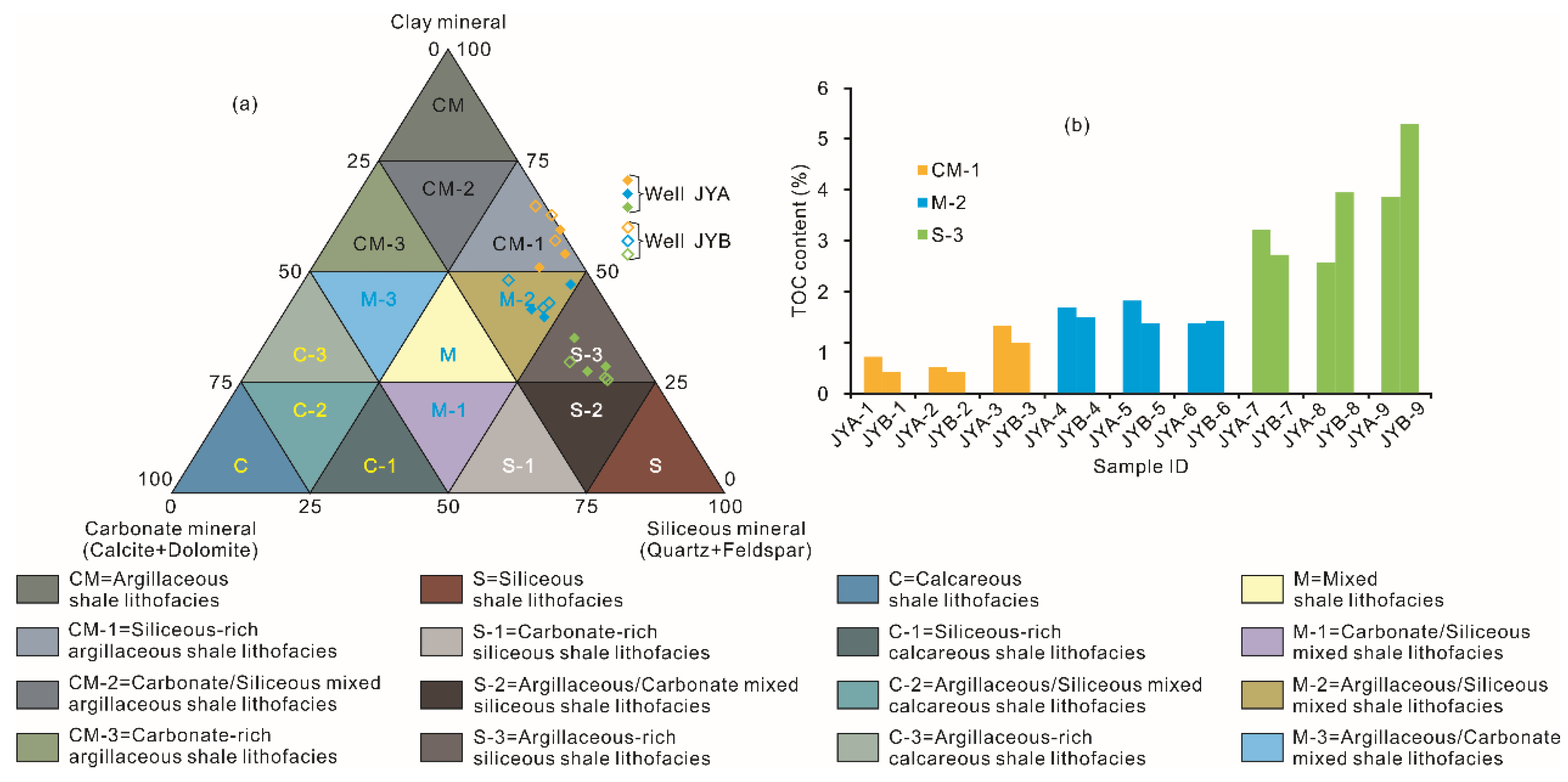
According to the ternary diagram composed of carbonate (calcite and dolomite), siliceous (quartz and feldspar), and clay minerals, shale lithofacies can be categorized into four types: calcareous shale lithofacies, siliceous shale lithofacies, argillaceous shale lithofacies, and mixed shale lithofacies. Each lithofacies type can be further subdivided into four specific lithofacies [22,39]. Three main types of shale lithofacies were identified in the study area based on XRD experimental data, including siliceous-rich argillaceous shale lithofacies (CM-1), argillaceous/siliceous mixed shale lithofacies (M-2), and argillaceous-rich siliceous shale lithofacies (S-3) (Figure 3a). Figure 3b shows the TOC content distribution across these three main shale lithofacies. The TOC content for the CM-1 shales varies from 0.41% to 1.31%, with an average value of 0.72%. The TOC content for the M-2 shales varies from 1.36% to 1.81%, with an average value of 1.52%. The TOC content for the S-3 shales varies from 2.56% to 5.27%, with an average value of 3.59%. Integrating the TOC content and mineral composition, we further divided shale lithofacies into organic-lean (OL) CM-1 shale lithofacies, organic-moderate (OM) M-2 shale lithofacies, and organic-rich (OR) S-3 shale lithofacies. OL CM-1 shales are mainly developed at the upper part of the Long 1 Formation (Figure 2). OM M-2 shales are mainly located at the middle part of the Long 1 Formation (Figure 2). OR S-3 shales are mainly distributed at the lower part of the Long 1 Formation (Figure 2).

4.2. Pore Characteristics

4.2.1. Pore Types

In recent studies, many scholars have successfully recognized shale pore types based on pore morphology and its interrelation with mineral particles. Shale pores can be divided into organic matter pores, mineral matrix pores in the form of interparticle pores and intraparticle pores, and micro-fracture pores [6,7,8].
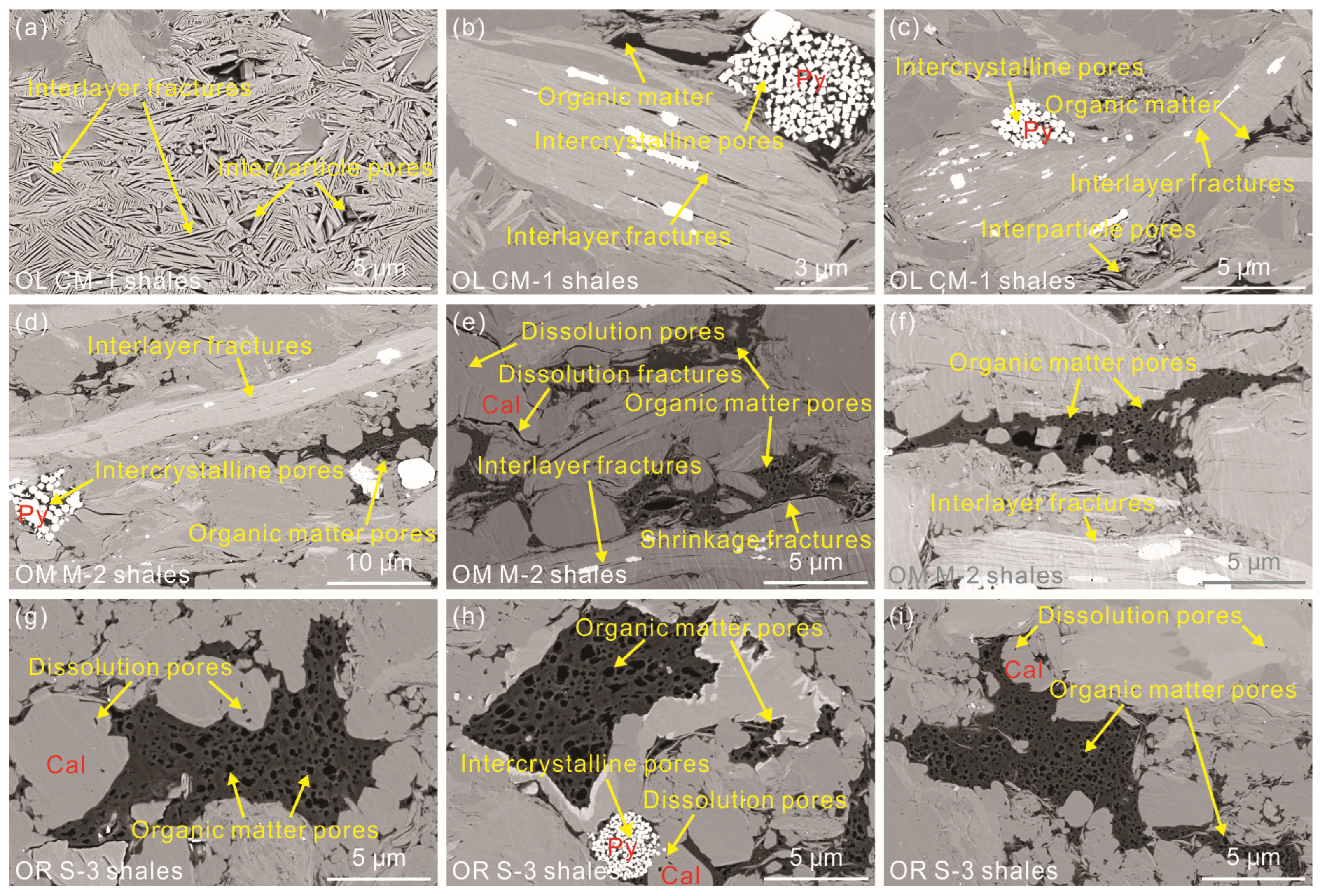
The formation of organic matter pores is attributed to the generation and expulsion of hydrocarbons during the thermal evolution of organic matter [1,6,40], and they are widely distributed in OR S-3 and OM M-2 shales (Figure 4d–i). These organic matter pores are usually nanometer scale and exhibit bubble-like or elliptical shapes (Figure 4g–i).
Interparticle pores exist between adjacent mineral particles and typically display triangular to polygonal shapes, generally with a large in size of several micrometers (Figure 4a,c). Intraparticle pores are commonly identified as intercrystalline pores within pyrite framboids and dissolution pores within unstable minerals. Pyrite intercrystalline pores are visible across all shale lithofacies (Figure 4b–d,h), some of which filled with organic matter to form secondary organic pores. Dissolution pores (including some ring-like grain marginal dissolution micro-fractures) are produced through dissolving unstable minerals such as calcite and feldspar by organic acidic fluids during hydrocarbon generation [41]. These dissolution pores are typically circular to elliptical and most abundant in OR S-3 shales (Figure 4g–i).
Interlayer micro-fractures formed along the cleavage planes of oriented clay platelets due to dehydration shrinkage and mineral-phase transition during diagenesis [42,43] represent the dominant micro-fracture pores in the studied shales. These micro-fractures are parallel to each other, with lengths extending up to several micrometers, and are abundantly developed in OL CM-1 and OM M-2 shales (Figure 4a–f).

4.2.2. Isotherms of CO2 Adsorption

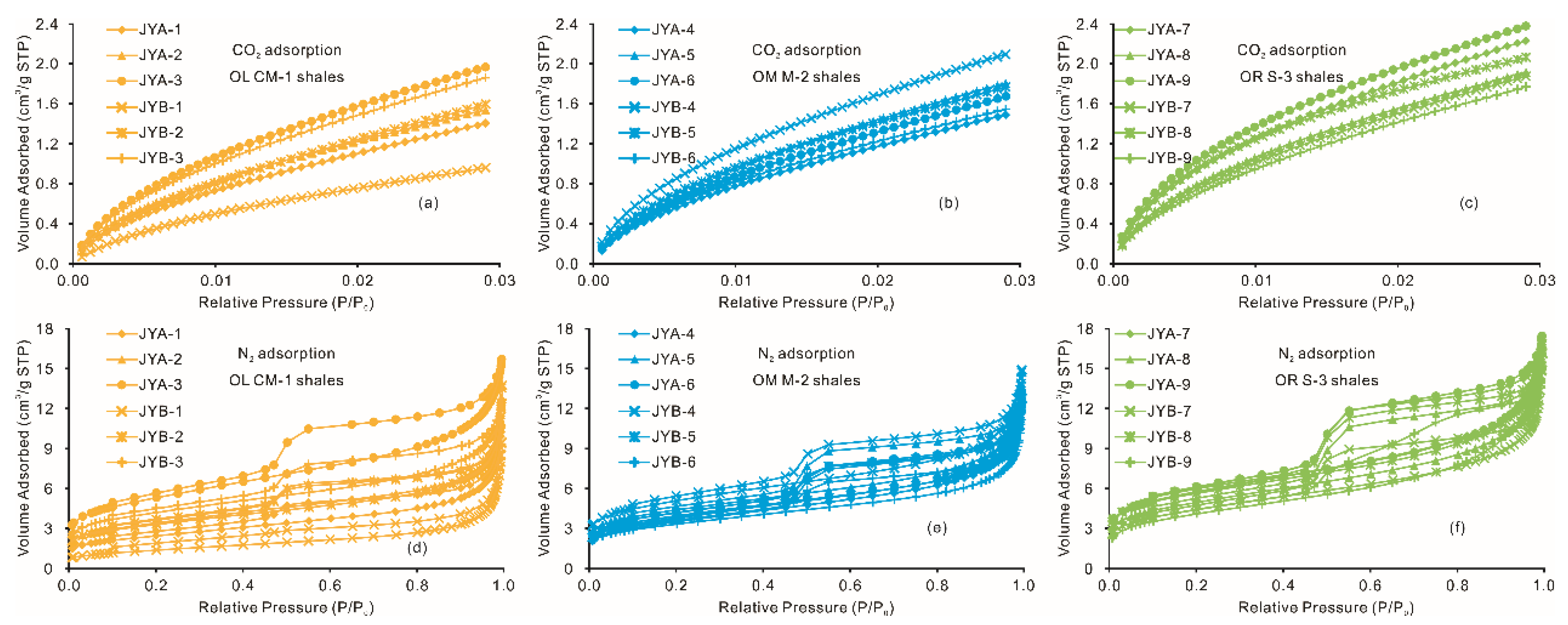
Figure 5a–c present CO2 adsorption isotherms of samples from different shale lithofacies. These CO2 adsorption isotherms correspond to type I according to the IUPAC classification [44], indicating MIPs within the shales. The maximum adsorption (i.e., the amount of adsorption at maximum relative pressure) is greatest in OR S-3 shales, ranging from 1.76 cm3/g to 2.37 cm3/g, with an average of 2.03 cm3/g. The maximum adsorption for OM M-2 shales varies from 1.48 cm3/g to 2.09 cm3/g, with an average of 1.72 cm3/g. OL CM-1 shales have the lowest CO2 adsorption, lying between 0.96 cm3/g and 1.96 cm3/g, with an average of 1.55 cm3/g.

4.2.3. Isotherms of N2 Adsorption and Desorption

N2 adsorption–desorption isotherms of shale samples with different lithofacies are shown in Figure 5d–f. These isotherms for N2 adsorption–desorption are classified as type IV based on the IUPAC classification [45]. The adsorption branches display reversed S-shaped features marked by a sharp uptake in adsorption amount at both low (<0.05) and high (>0.95) relative pressures. The typical capillary hysteresis loops appear in the desorption process to be a mixture of types H2 and H3, indicative of the superposition of ink-bottle-shaped and slit-shaped pore types in the shales [46]. The main pore types developed in the OL CM-1 shales are clay cleavage micro-fractures, which contribute to the slit-shaped pores, whereas the OR S-3 shales exhibit composite pore shapes and develop some ink-bottle-shaped pores, which are consistent with the primary pore types of organic matter and dissolution pores. In addition, the average N2 adsorption amounts at the maximum relative pressure for OR S-3, OM M-2, and OL CM-1 shales are 16.64 cm3/g, 13.07 cm3/g, and 12.47 cm3/g, respectively.

4.2.4. PV and SA

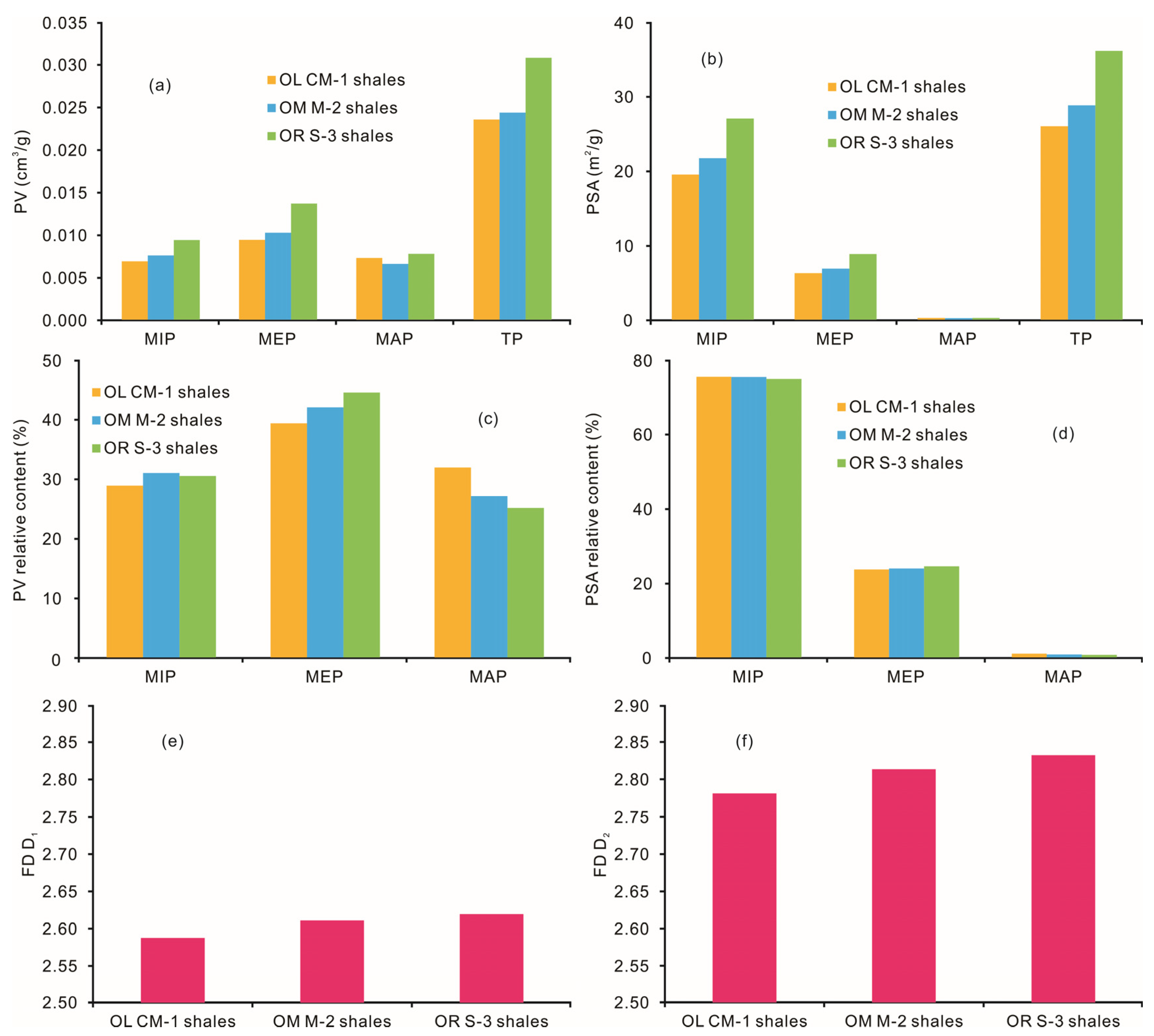
The PV and SA of different shale lithofacies are summarized in Table 2 and Table 3 and Figure 6a,b, and show obvious distinctions. The PV of OR S-3 shales is the largest (Figure 6a), with an average total pore (TP) V of 0.03077 cm3/g (Table 2). In comparison, the PV in OM M-2 shales is in the middle (Figure 6a), and the average TP V is 0.02434 cm3/g (Table 2), while OL CM-1 shales exhibit the smallest PV (Figure 6a), with an average TP V of 0.02353 cm3/g (Table 2). Similarly, OR S-3 shales possess the largest PSA (Figure 6b), and the average TP SA is 36.100 m2/g (Table 3). OM M-2 shales have the middle PSA (Figure 6b), with an average TP SA of 28.785 m2/g (Table 3), whereas OL CM-1 shales hold the smallest PSA (Figure 6b), and the average TP SA is 25.979 m2/g (Table 3).
The proportional distributions of PV and SA across MIPs, MEPs, and MAPs are depicted in Table 2 and Table 3 and Figure 6c,d. For OR S-3 shales, MEPs are the main contributor to PV, accounting for an average of 44.45%, followed by MIPs, with a mean value of 30.46%, while MAPs are the most undeveloped ones, with a percentage of 25.09% (Figure 6c, Table 2). The development pattern of the PV proportion in OM M-2 shales is similar to that in OR S-3 shales (Figure 6c), where the average percentage of PV for MIPs, MEPs, and MAPs is 30.96%, 41.98%, and 27.06%, respectively (Table 2). For OL CM-1 shales, although MEPs dominate the PV, different from OR S-3 and OM M-2 shales, the proportion of MAPs increases and exceeds that of MIPs (Figure 6c). Specifically, the average PV percentage of MIPs, MEPs, and MAPs is 28.84%, 39.29%, and 31.87%, respectively (Table 2). MIPs provide the main PSA and substantially exceed the contributions from MEPs and MAPs (Figure 6d). The average proportion of MIP SA in OR S-3, OM M-2, and OL CM-1 shales is 74.81%, 75.31%, and 75.36%, respectively (Table 3).

4.2.5. FD

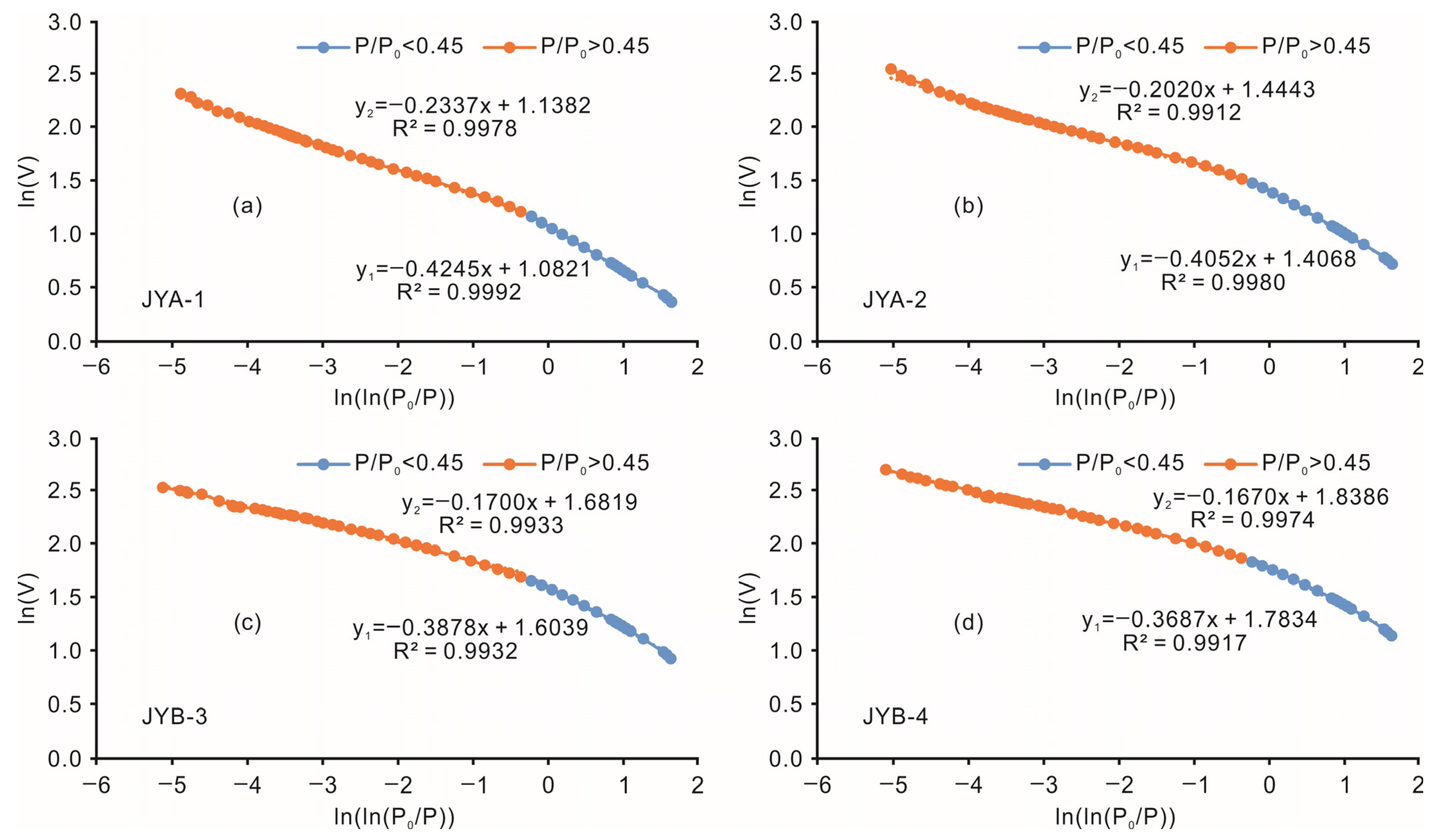
The FHH regression analysis plots of lnV versus ln(ln(P0/P)) from N2 adsorption data of four representative shale samples are presented in Figure 7. As displayed in Figure 7, there are two distinct segments with different slopes at the P/P0 intervals of 0–0.45 and 0.45–1. Two fractal dimensions (FDs), D1 and D2, were calculated from the two linear segments at the P/P0 intervals of 0–0.45 and 0.45–1, respectively (Table 4). D1 represents the pore surface roughness or irregularity, and D2 reflects the pore structure complexity [11,13,14,15].
The OL CM-1 shales have the smallest values of FDs D1 and D2 (Figure 6e,f), ranging from 2.5339 to 2.6122 and 2.6786 to 2.8335, with an average of 2.5875 and 2.7814, respectively (Table 4). The FDs D1 and D2 of the OM M-2 shales are moderate and range from 2.5771 to 2.6332 and 2.8025 to 2.8330, with average values of 2.6111 and 2.8135, respectively (Table 4). However, the OR S-3 shales show the maximum FD values of D1 and D2 (Figure 6e,f), ranging from 2.5878 to 2.6482 (average 2.6196) and 2.8063 to 2.8925 (average 2.8324), respectively (Table 4). The highest values of FD suggest that the pores in the OR S-3 shales are the most heterogeneous.

4.3. Methane Adsorption Isotherms

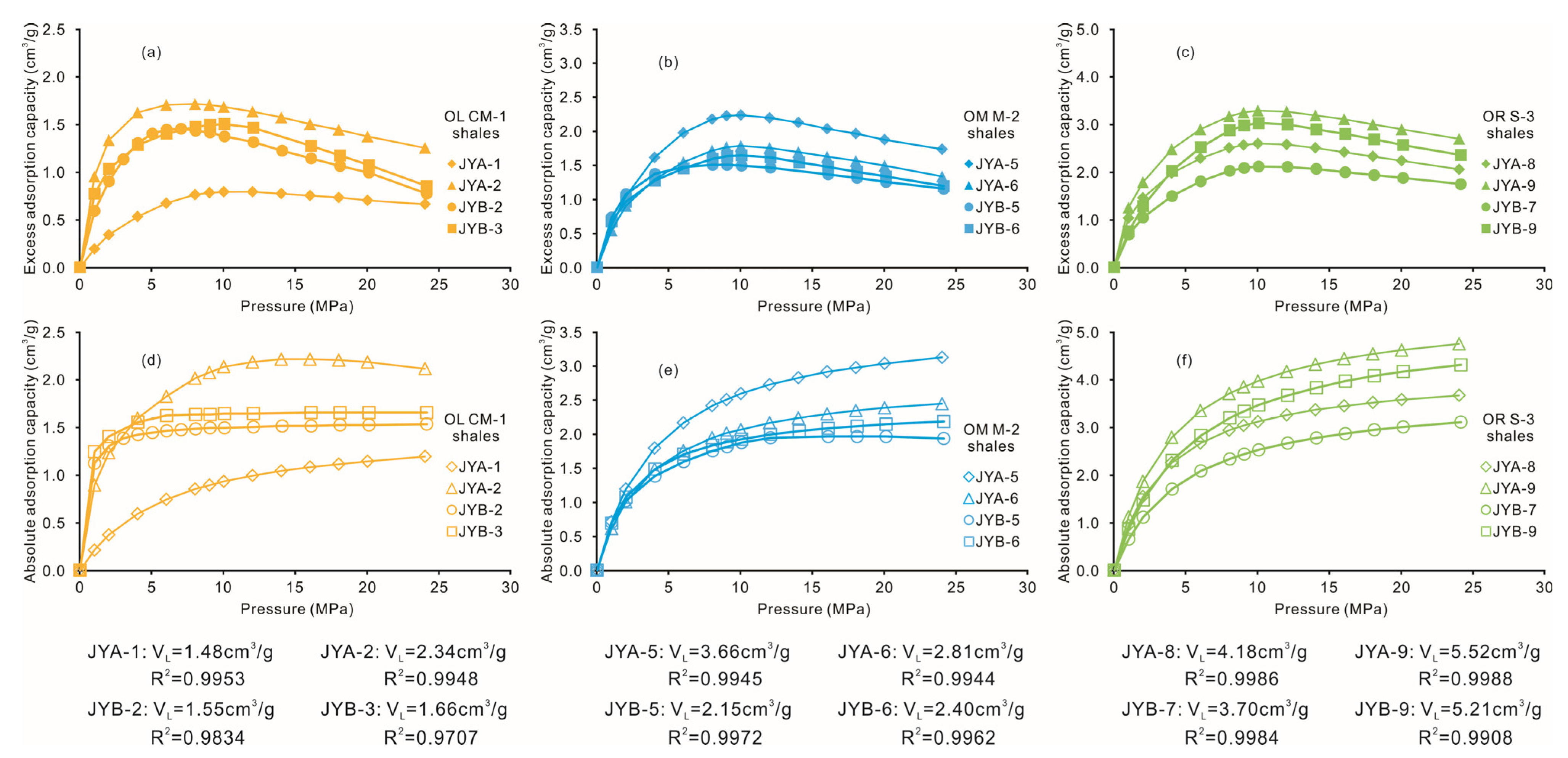
Methane adsorption isotherms of the shale samples from various lithofacies are shown in Figure 8. Across the measured pressure range, the excess adsorption isotherms initially rise rapidly with the increasing pressure, reaching a maximum when the pressure is about 8–10 MPa, after which they begin to slowly decrease as the pressure continues to increase. It is obvious that “negative adsorption” appears at a high pressure (Figure 8a–c).
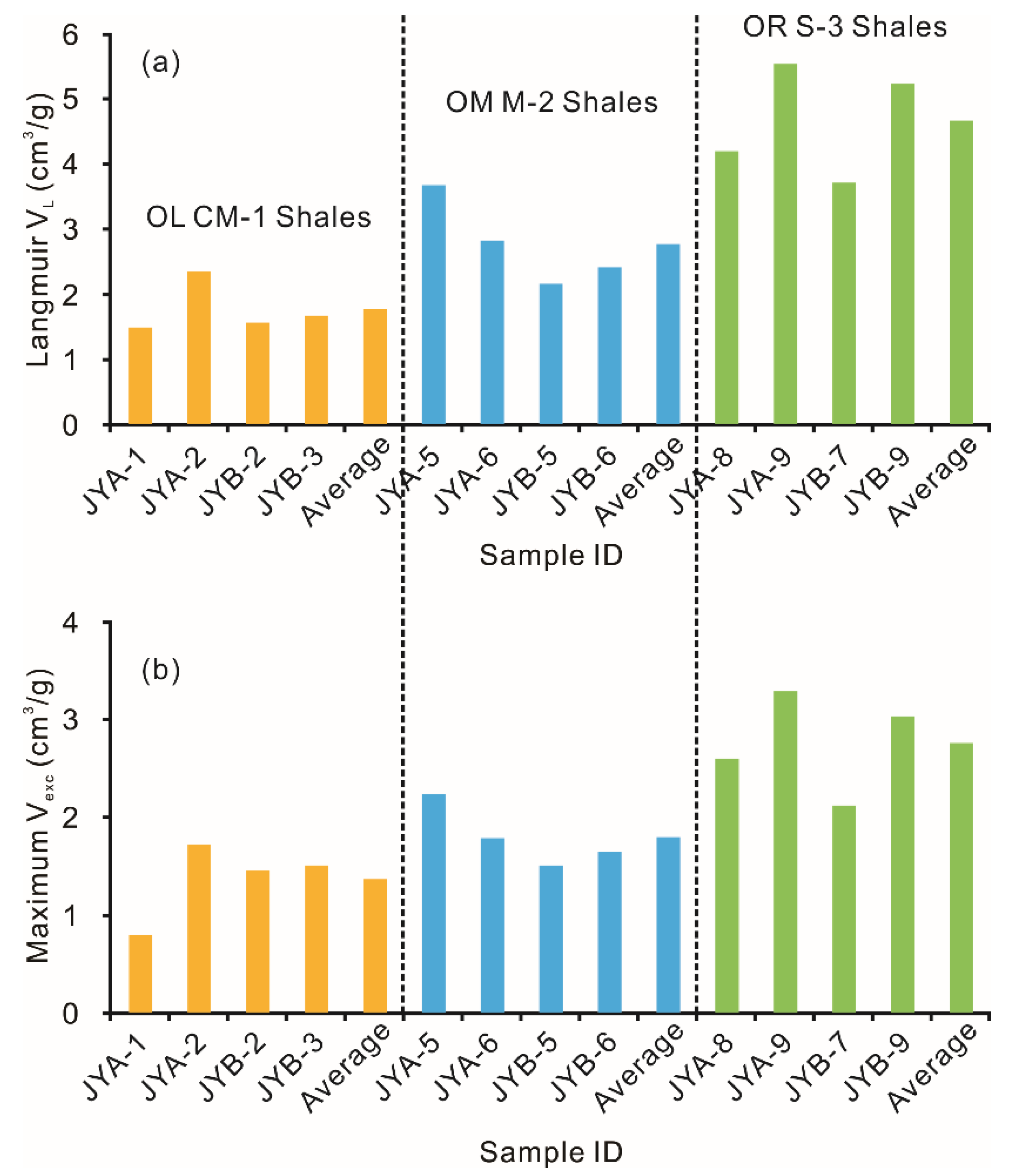
Although the adsorption isotherms of shales from different lithofacies are similar in shape, the MAC is pretty different. The excess adsorption isotherms are well fitted by the adapted Langmuir equation, with the correlation coefficients (R2) exceeding 0.99, and the derived Langmuir volumes (VL) are presented in Figure 8. As can be seen, the average VL is 1.76 cm3/g for OL CM-1 shales, compared to 2.76 cm3/g for OM M-2 shales and 4.65 cm3/g for OR S-3 shales. These results indicate that OR S-3 shales possess the largest MAC, whereas OL CM-1 shales have the smallest value.
In addition, the absolute adsorption isotherms are calculated and exhibited in Figure 8d–f. The absolute adsorption capacity of methane increases sharply at a low-pressure range (<6 MPa), followed by a slow increase at a high-pressure stage. Notably, the absolute adsorption amount is significantly higher than the excess adsorption amount, and this difference becomes more pronounced with increasing pressure.

5. Discussion

5.1. Controlling Factors of Pore Development

5.1.1. Effect of Organic Matter on Pore Development

The internal components of shale (both organic matter and mineral composition) serve as the fundamental factors that determine the variations in pore development characteristics in shales across different lithofacies.
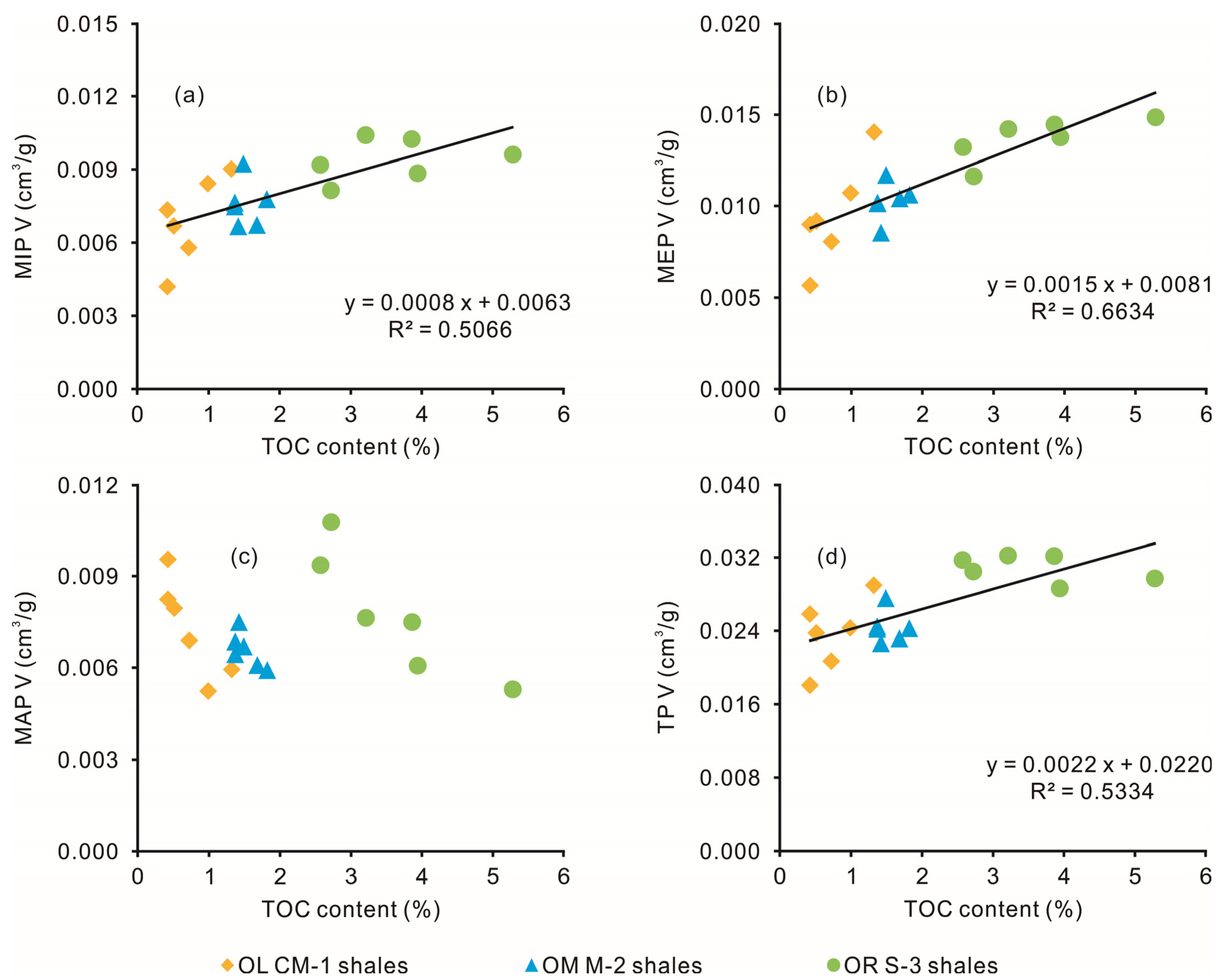
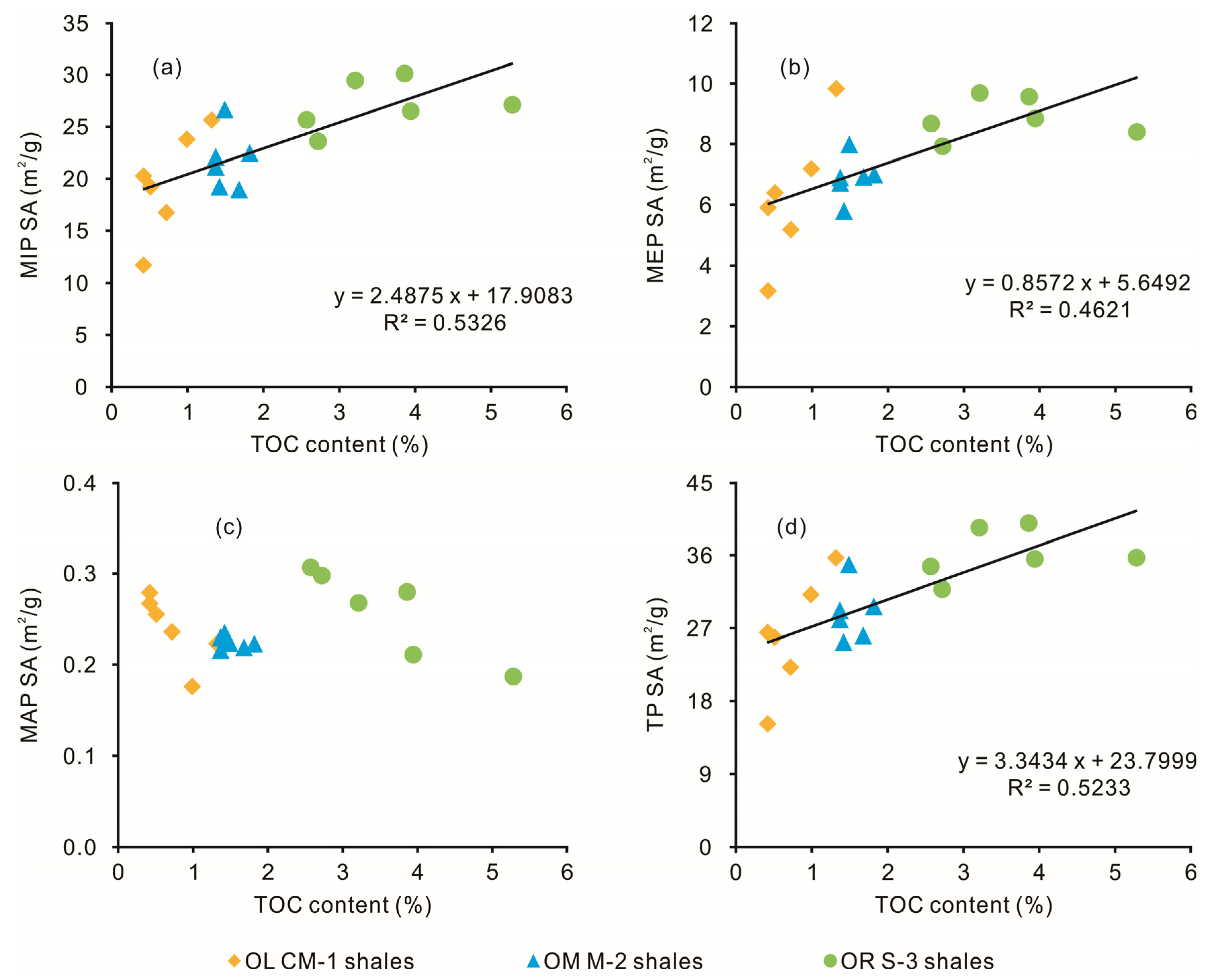
TOC content exhibits a strong positive relationship with the volumes (Vs) of both MIPs and MEPs (Figure 9a,b). However, there is no clear correlation between TOC content and MAP V (Figure 9c). Similar to the case of PV, evidently positive relationships have been found between TOC content and MIP and MEP surface areas (SAs) (Figure 10a,b), but TOC content and MAP SA is poorly correlated (Figure 10c). These findings suggest that organic matter is the main contributor to the development of MIPs and MEPs [15,19], which aligns with the results of previous studies on Wufeng–Longmaxi shales [22,24,47]. A large number of bubble-like and elliptical organic pores are developed in organic matter after intensive thermal maturation and hydrocarbon expulsion, which are mainly of MIP and MEP scales (Figure 4g–i). These organic micro-mesopores are the main contributors to PV and SA development, as shown by the apparent positive relationships between TOC content and both TP V and SA (Figure 9d and Figure 10d).
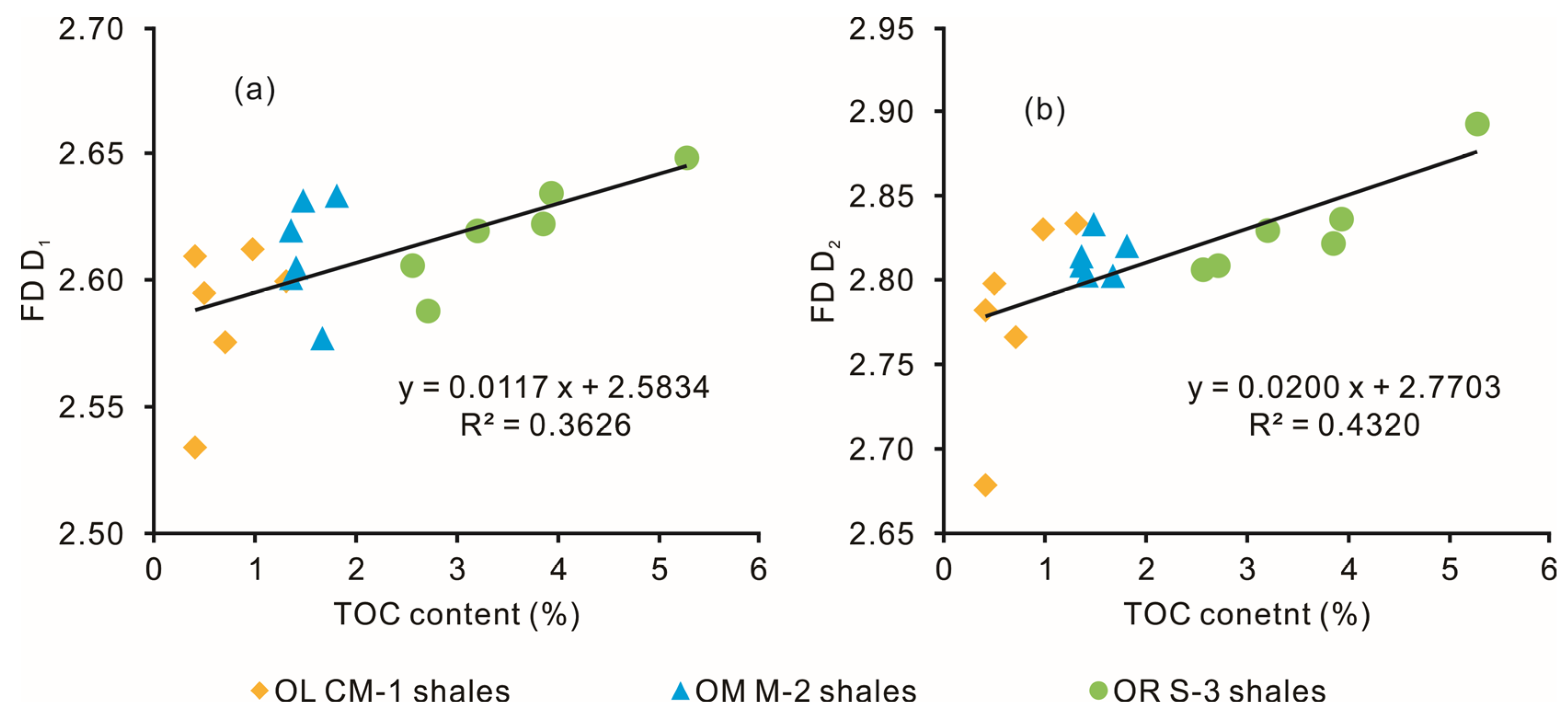
In addition, Figure 11 shows the relationships between TOC content and FDs (both D1 and D2). Positive relationships clearly exist between the TOC content and FDs, indicating that higher organic matter content contributes to more irregular and complex pore networks. These positive relationships have also been confirmed by the Lower Cambrian Niutitang shales in the Sichuan Basin [48] and Upper Triassic Yanchang shales in the Ordos Basin [49]. Organic-rich shales have more heterogeneous organic micro-mesopores, likely resulting in larger FDs and more complicated pore networks [48,49].

5.1.2. Effect of Mineral Composition on Pore Development

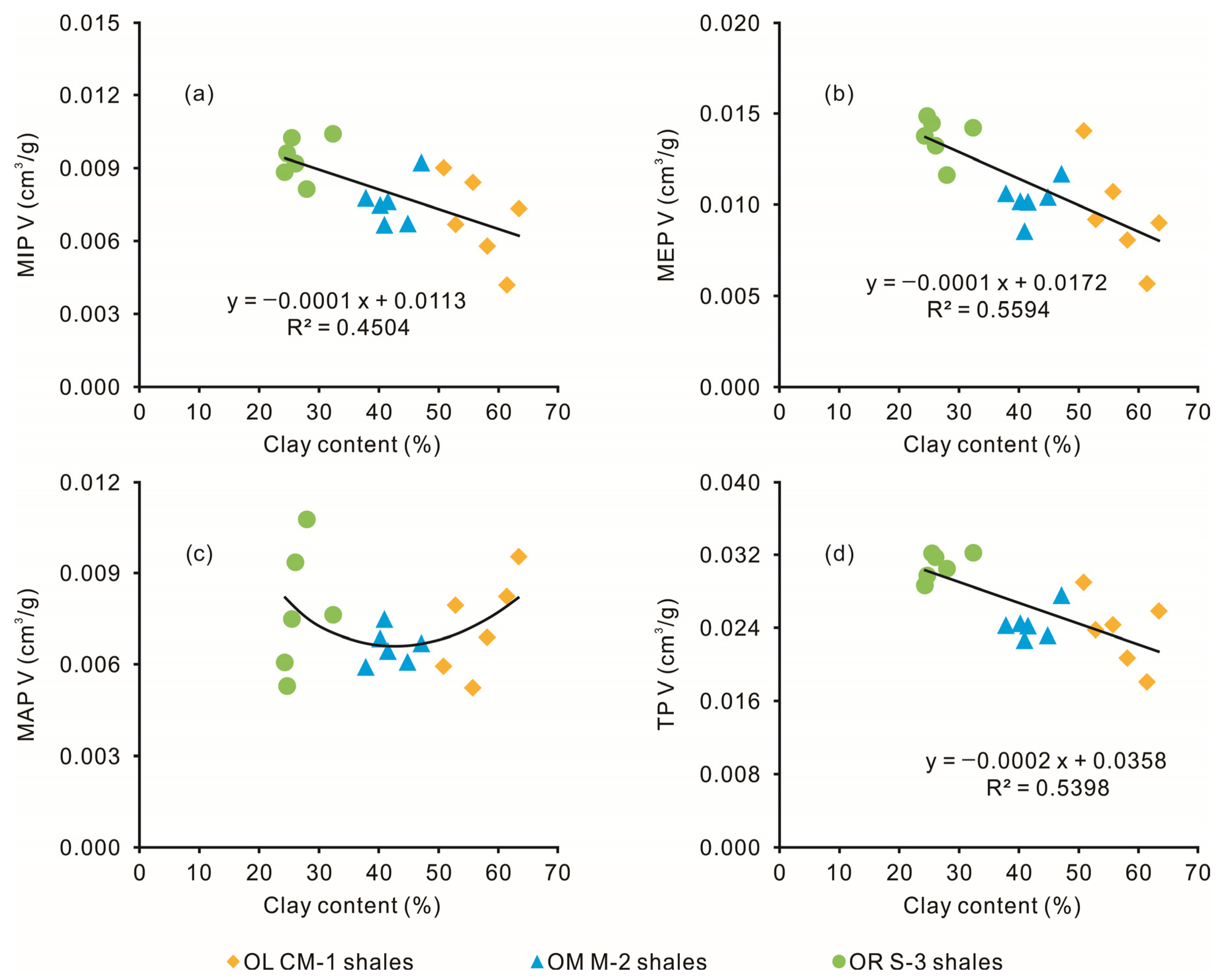
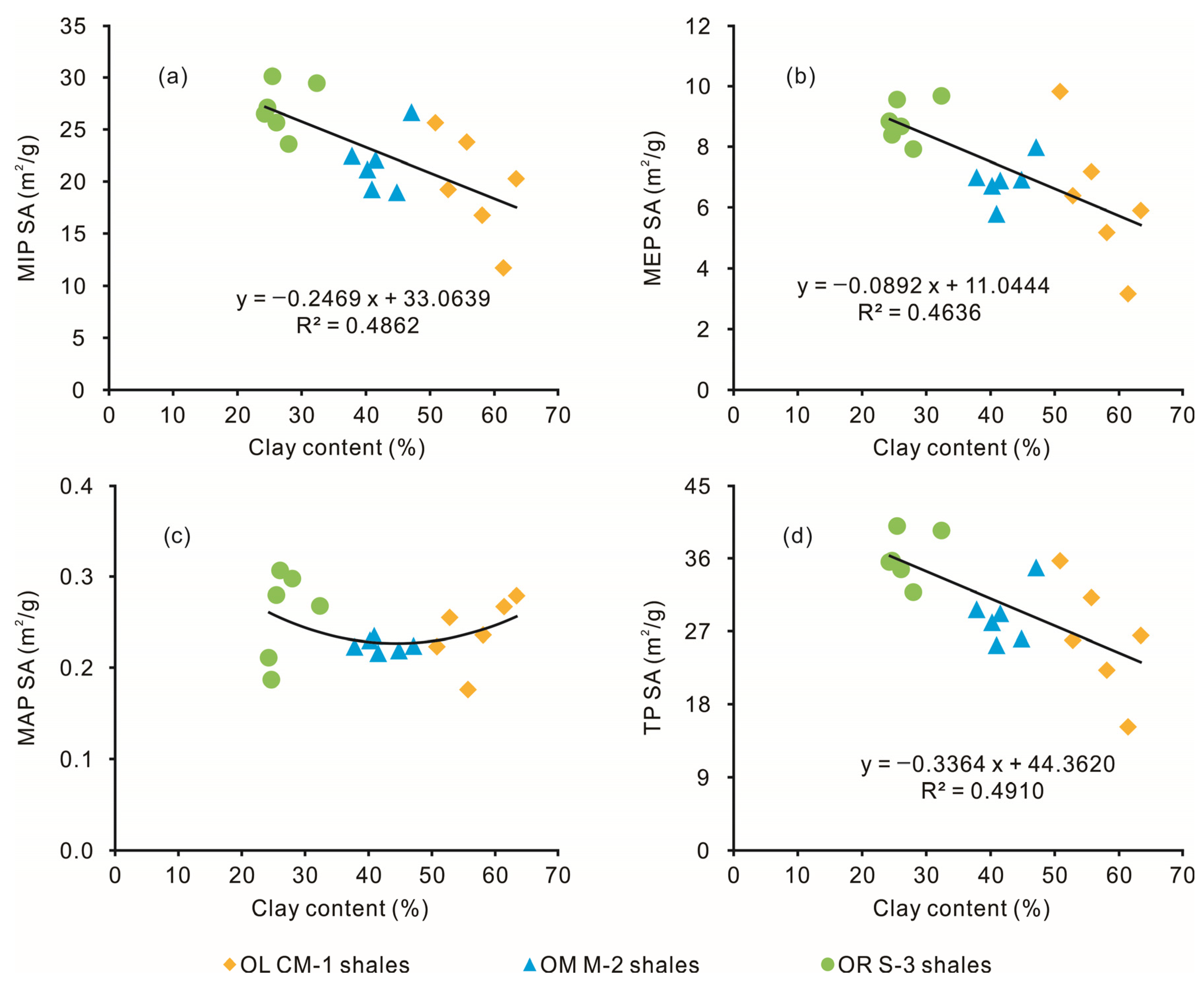
Strong negative correlations are observed between total clay content and the Vs of MIPs and MEPs (Figure 12a,b), as well as the correlations between total clay content and the SAs of MIPs and MEPs (Figure 13a,b). Regarding MAPs, both PV and SA tend to decrease with an increase in total clay content. However, the situation changes when total clay content exceeds 50%, with the V and SA of MAPs increasing with the increase in total clay content (Figure 12c and Figure 13c). As indicated, clay minerals play a more substantial role in the development of MAPs instead of MIPs and MEPs. This observation is consistent with previous studies that clay mineral composition rather than organic matter serves as the main factor controlling MAP development [15,19,22]. Abundant interlayer cleavage micro-fractures developed in the clay-rich shales are the fundamental factor for the increase in MAP V and SA (Figure 4a–c). Nevertheless, due to the low compressive strength of clay minerals, shales with high clay mineral content lack the protective framework provided by rigid quartz particles (Table 1) and are more susceptible to being compacted during the diagenesis process, resulting in a reduction in or even closure of clay mineral pores [18,50]. In general, clay minerals have a negative effect on pore structure parameters (Figure 12d and Figure 13d).
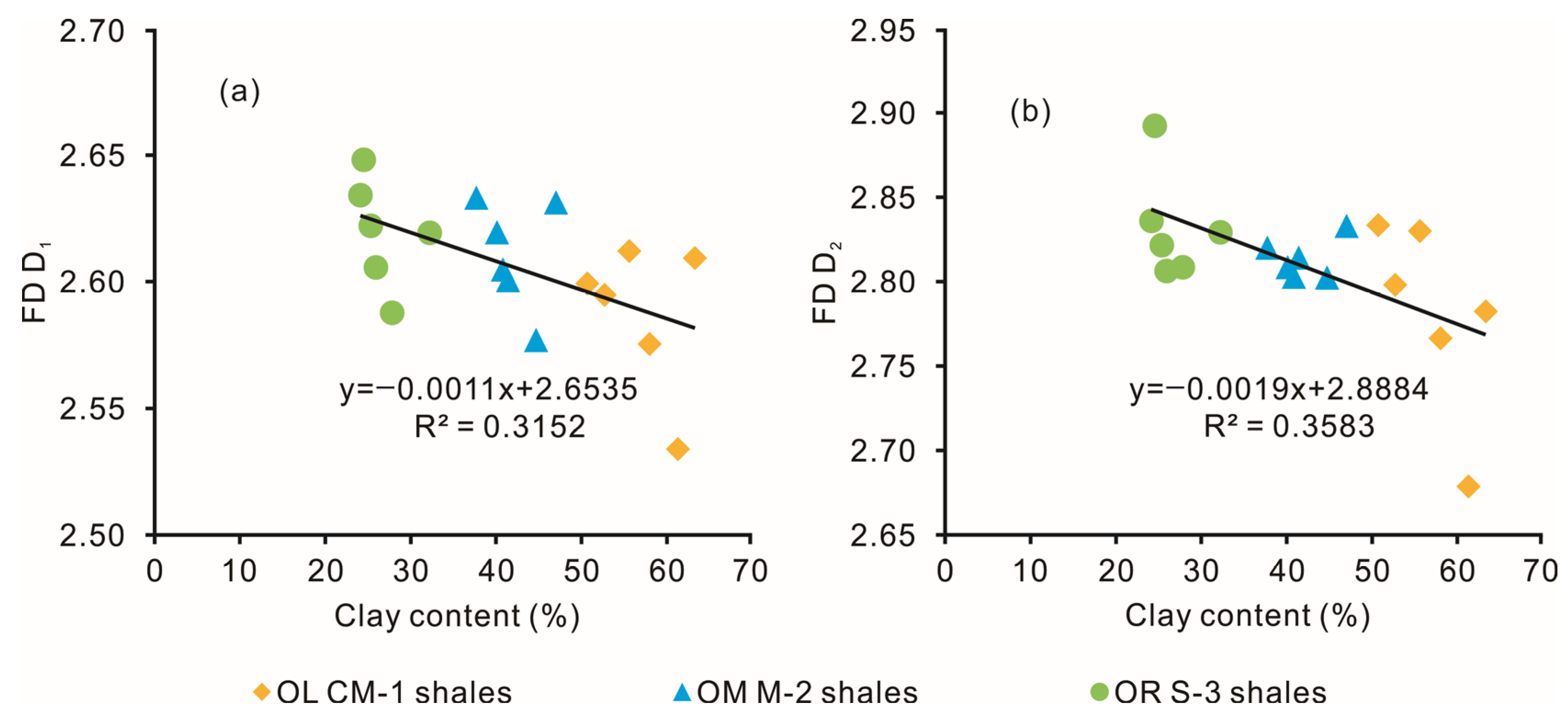
Furthermore, Figure 14 represents an obvious negative relationship between clay content and FDs (both D1 and D2), implying that increased clay content reduces the heterogeneity of pores. The lower FD values of clay-rich shales are possibly due to the development of clay-associated macropores or microfractures and to the decrease in complex organic micro-mesopores [48,49].

5.1.3. Conceptual Model for Development of Pores in Different Shale Lithofacies

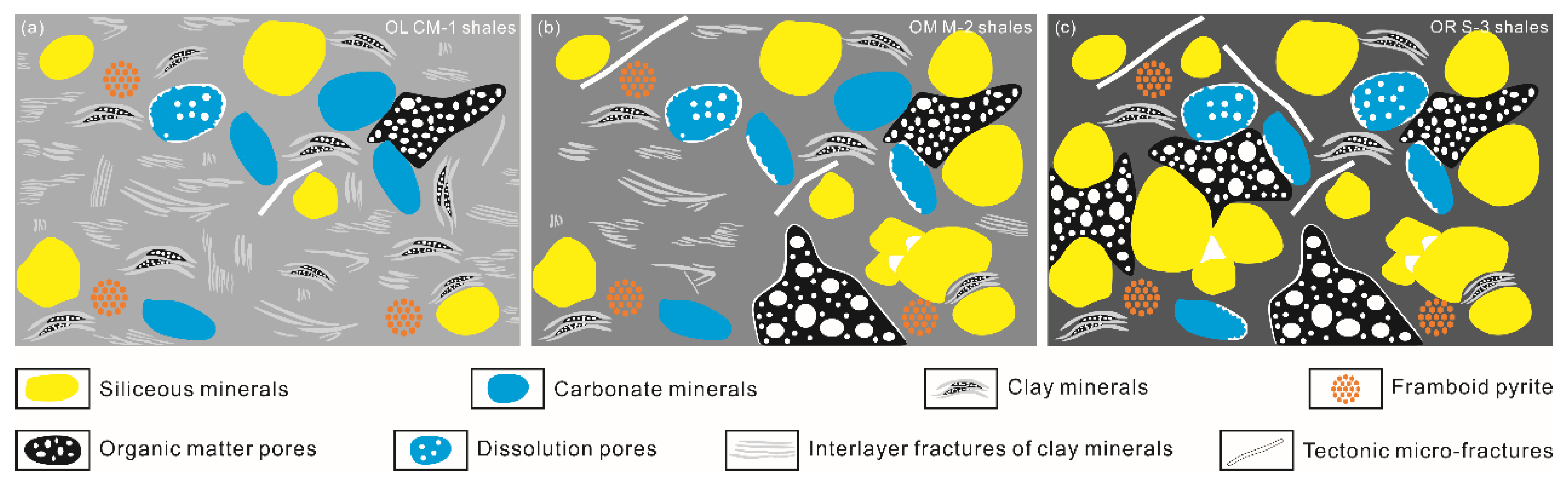
Based on the comparative analysis of pore types and quantitative evaluation of pore structures, an idealized conceptual model for the development of pores among shales of different lithofacies is proposed (Figure 15).
Figure 15a shows the pore development in OL CM-1 shales, which are the shales rich in clay minerals and poor in siliceous minerals and displaying the lowest TOC abundance (Table 1). The existence of organic pores is limited, with only a small number of pores appearing in the residual organic matter dispersed among clay particles. Instead, the interlayer cleavage micro-fractures between oriented clay platelets formed during clay diagenesis constitute the predominant pore type of OL CM-1 shales. These micro-fracture systems serve as channels connecting pores and macro-fractures, effectively improving the gas flowing capacity of shales [51,52]. Figure 15c illustrates the development of pores in OR S-3 shales. These shales feature a high content of siliceous minerals and low content of clay minerals and also present a high TOC abundance (Table 1). Unlike the dispersed distribution of organic matter in OL CM-1 shales, organic matter particles in OR S-3 shales are usually largely spongy. Abundant organic pores formed by the generation and expulsion of hydrocarbon fluids during the thermal evolution of kerogen [1,6,40] dominate the pore type in these organic-rich shales. A single organic matter sponge with micrometer scale can contain hundreds of pores. Meanwhile, these organic pores are well preserved against compaction due to the rigidity of siliceous minerals [24,53] and exhibit perfect roundness (Figure 4g–i and Figure 15c). Such organic pores form efficient pore networks [6,7,9,54], contributing to the total porosity and gas storage of organic-rich shales around the world [55,56,57,58]. Additionally, the dissolution pores produced by organic acidic fluids dissolving unstable minerals contribute another significant pore type for OR S-3 shales (Figure 15c). Figure 15b represents the development of pores in OM M-2 shales, which are the shales characterized by moderate values of clay and siliceous minerals and also by intermediate TOC abundance (Table 1). The coexistence of organic pores and clay cleavage micro-fractures developed within scattered organic matter and clay particles becomes the distinctive pore structure of OM M-2 shales, though in lesser abundance than that of corresponding pores in OR S-3 and OL CM-1 shales, respectively.
In terms of pore structures, the development of MIPs, MEPs and FDs is primarily controlled by the organic matter, while clay minerals play an important role in the development of MAPs. Consequently, OR S-3 shales have the largest TP and fractional pore (particularly MIP and MEP) Vs and SAs and the most complicated pore networks (Figure 6), attributed to having the highest TOC content. In contrast, OL CM-1 shales have a relatively developed MAP V but the smallest PSAs (Figure 6) due to having the highest clay mineral content and lowest TOC abundance.

5.2. Controlling Factors of MAC

5.2.1. Effect of Organic Matter on MAC

The MAC of shales with different lithofacies is closely related to both organic matter and inorganic composition, as well as the pore systems they controlled.
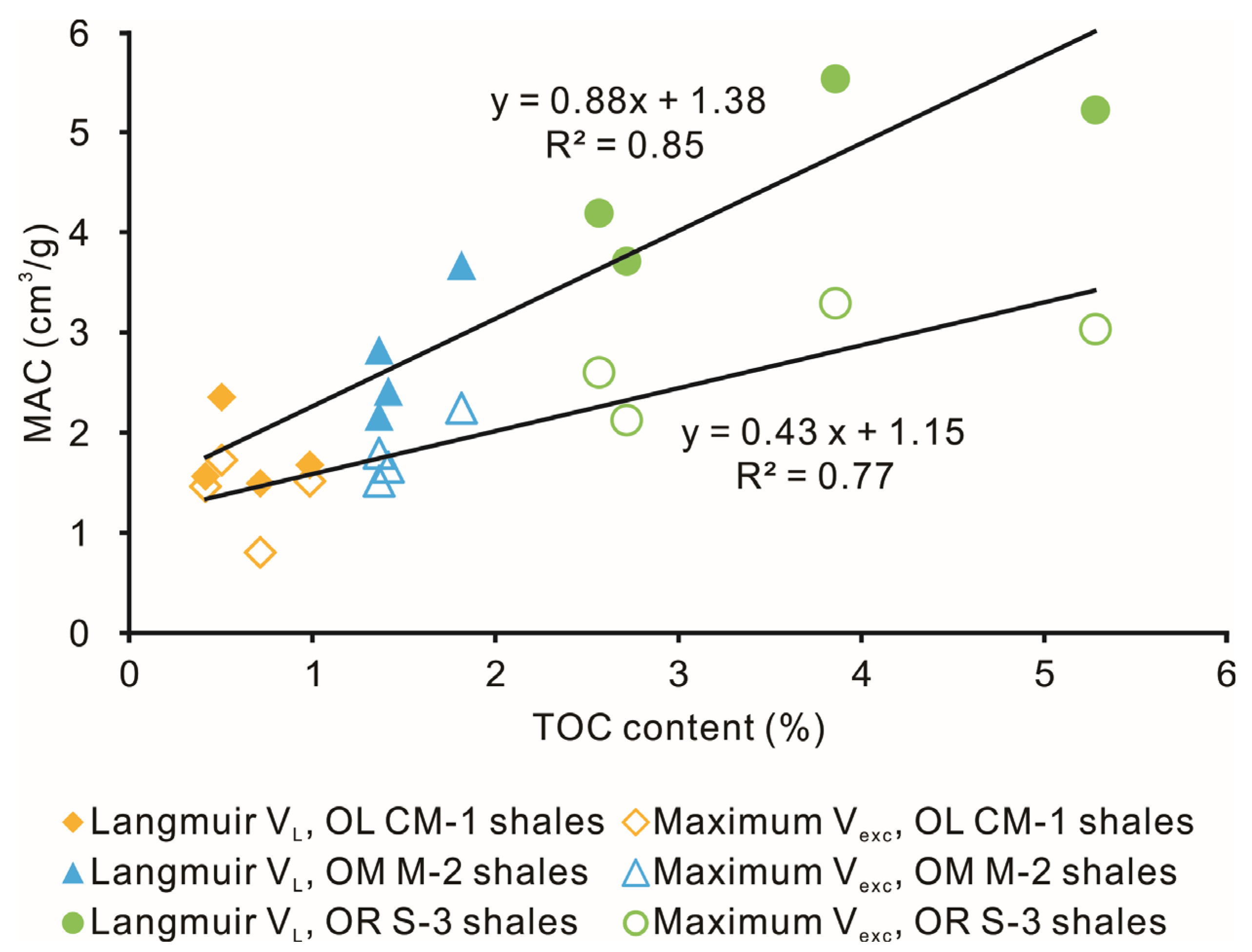
Organic matter contains numerous nanoscale organic pores, which have larger internal SAs and greater adsorption energies compared with large pores, and it is widely considered a critical factor controlling the MAC of shales [59,60]. As can be seen from Figure 16, methane adsorption parameters (both the Langmuir VL and the maximum Vexc) are positively correlated with the TOC content. Similar correlations have been reported in many other shales, such as the Lower Cretaceous Fort St John shales and Buckinghorse shales [61,62], Lower Jurassic Gordondale shales [40], Upper Devonian Woodford shales [59], Lower Cambrian Niutitang shales, Middle Cambrian Arthur creek shales, Lower Silurian Longmaxi shales and Upper Permian Dalong shales [37,63], Upper Cambrian–Lower Ordovician Alum shales and Lower Toarcian Posidonia shales [34,36], and Upper Triassic Yanchang shales [64]. This widespread correlation is explained as the formation of a large number of organic micro-mesopores after the generation and expulsion of hydrocarbons at the mature to over-mature thermal stages of organic-rich shales (Figure 4g–i, Figure 9a,b and Figure 10a,b). These organic micro-mesopores provide abundant PSAs (Figure 10d), thereby increasing the sites for methane retention and enhancing the MAC of shales.

5.2.2. Effect of Mineral Composition on MAC

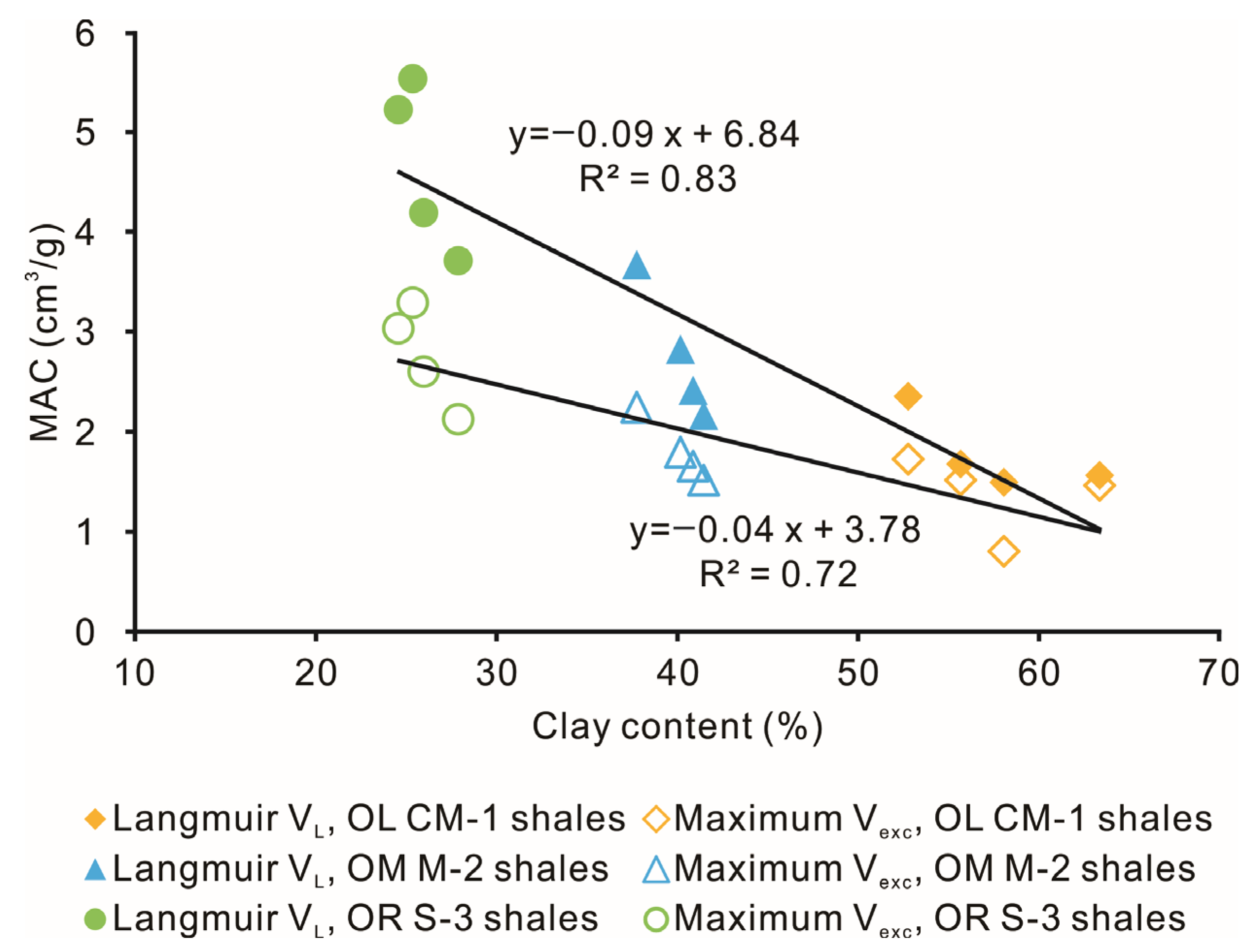
In general, in addition to organic matter, mineral composition—in particular, clay minerals such as montmorillonite, illite, illite–smectite mixed layer, kaolinite, and chlorite—have been reported to be associated with small pores with effective radii of 1–2 nm, supplying a certain number of adsorption sites and contributing to the MAC of shales [40,65,66]. To evaluate whether clay minerals contribute to the MAC of the studied shales, the Langmuir VL and the maximum Vexc are plotted against the total clay content and displayed in Figure 17. Apparently, a negative correlation is identified between total clay content and MAC. This result suggests that the adsorption of clay minerals is very limited, despite clay minerals being the dominant component of the Longmaxi shales (Table 1). This finding contrasts with certain previous studies [67,68], in which the MAC of shales increases with total clay content. In fact, shales with higher clay content in the study area have a poorer MAC due to their concomitant lower TOC content (Table 1), which further supports the interpretation that organic matter is the primary factor controlling the MAC of these shales. This kind of manifestation was also discovered by Wang et al. (2013) [63] and Tian et al. (2016) [38]. Furthermore, the abundant interlayer cleavage micro-fractures developed in clay-rich shales (Figure 4a–c) are the main providers of MAPs (Figure 12c), while the contribution of MAPs to PSA is quite restricted (Figure 6b,d). In addition, the pores associated with clay minerals are likely destroyed by compaction due to the low mechanical strength of clay minerals [69,70]. All of the above reasons collectively account for the negative impact of clay minerals on the adsorption of shales in the study area.

5.2.3. Effect of Pore Structure on MAC

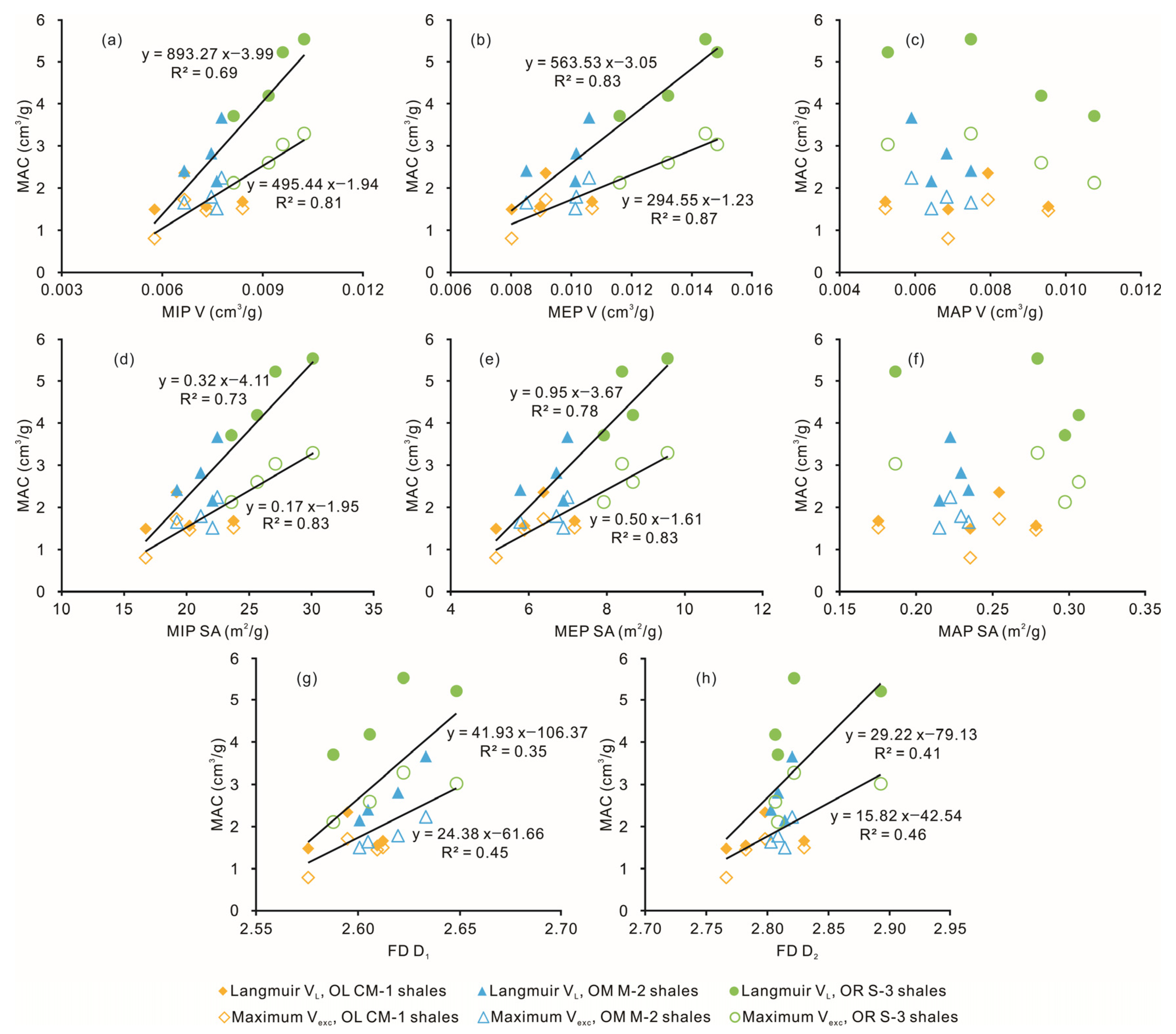
As discussed above, the influences of organic matter and mineral composition on shale MAC can be fundamentally attributed to the control of the pore system on the MAC of shales. Both the Langmuir VL and maximum Vexc are positively correlated with the pore structure parameters of MIPs and MEPs (MIP V, MIP SA, MEP V, and MEP SA), but are not significantly correlated with the pore structure parameters of MAPs (MAP V and MAP SA) (Figure 18), indicating that the adsorption of methane molecules predominantly occurs in MIPs and MEPs. The adsorption process of gas in porous shale reservoirs reflects the interaction between the pore framework and gas molecules and is governed by the van der Waals force, which can be strengthened because of the proximity of the pore walls [71]. As a result, with the increased adsorption energies, the smaller pores have greater adsorption potential compared with the larger pores and could preferentially adsorb more gas. Additionally, smaller pores are the main contributor to the PSAs (Figure 6), and thus could provide substantially more adsorption sites for gas molecules.
Moreover, when the methane adsorption parameters (Langmuir VL and Maximum Vexc) were plotted against the FDs (D1 and D2), positive correlations were found to exist between the MAC and FDs (Figure 18g,h). The higher values of FDs indicate more organic micro-mesopores with rough surfaces and complex structures developed in the shales (Figure 9, Figure 10 and Figure 11), at which more abundant active sites are available for methane adsorption. The coupling parameters constructed by the FD and PSA have superior potential to predict the MAC of shales.
From the comprehensive analysis presented above, it can be concluded that OR S-3 shales have the highest TOC content, well-developed heterogeneous organic micro-mesopores, and the largest PSA; consequently, they have the strongest MAC (Figure 19). In contrast, OL CM-1 shales, characterized by the lowest TOC content and the highest clay mineral content, have the worst methane adsorption performance (Figure 19).

6. Conclusions

This work comprehensively investigated the pore characteristics and MAC of different shale lithofacies from the Longmaxi Formation in Fuling Field, Sichuan Basin, using a series of related experimental methods, such as TOC content, XRD, FE-SEM, low-pressure CO2/N2 adsorption, and high-pressure methane adsorption. Positive correlations between TOC content and FDs (D1 and D2), as well as Vs and SAs of MIPs, MEPs, and TPs, suggest that heterogeneous organic micro-mesopores are the primary contributors to pore development. The cleavage micro-fractures developed in clay minerals are the main controlling factor for the development of MAPs. However, clay-rich shales are more susceptive to mechanical compaction because of the low siliceous mineral content, resulting in a reduction in or even closure of clay pores and a negative impact of clay minerals on the TP development. MAC increases with the increase in TOC content, FDs (D1 and D2), and micro- and mesopore Vs and SAs, while it decreases with the increase in clay mineral content, indicating that heterogeneous organic micro-mesopores function as the primary adsorption sites and promote the MAC of shales. OR S-3 shales have the most developed heterogeneous organic micro-mesopores, the largest PV, the highest PSA, and thus the strongest MAC. Considering the excellent storage space, sustainable gas production, and favorable brittleness to hydraulic fracturing, OR S-3 shales are the most promising reservoir for shale gas exploration and development.
More importantly, FDs can serve as effective bridges to establish the relationships between pore heterogeneity and gas adsorption behavior, thereby improving the prediction of the MAC of shales based solely on the TOC content. FDs are valuable parameters for evaluating the resource potential of shale reservoirs. However, unlike the relatively stable tectonic background of North America, marine shale formations in southern China have experienced multiple tectonic activities and complex structural deformation after their original deposition. Thus, discussing the comprehensive effects of external structural deformation and internal lithofacies on shale pore properties and methane adsorption behavior based on shale gas wells from varied structural settings is a potential topic of further study.

Author Contributions

Conceptualization, X.Z. (Xiaoming Zhang), C.H. and J.W.; methodology, X.Z. (Xiaoming Zhang), C.H. and J.W.; validation, L.C.; formal analysis, X.Z. (Xiaoming Zhang), X.Z. (Xiaomei Zhang), H.C., L.M. and Y.L.; investigation, X.Z. (Xiaoming Zhang), X.Z. (Xiaomei Zhang), H.C., L.M. and Y.L.; resources, L.C. and Z.S.; data curation, X.Z. (Xiaoming Zhang); writing—original draft preparation, X.Z. (Xiaoming Zhang); writing—review and editing, W.S.; project administration, C.H. and L.C.; funding acquisition, X.Z. (Xiaoming Zhang) and C.H. All authors have read and agreed to the published version of the manuscript.

Funding

This work was jointly supported by the “Tianchi Talent” funded by Xinjiang Uygur Autonomous Region Introduction Plan, the Key Research and Development Program of Xinjiang Uygur Autonomous Region (Nos. 2024B03007 and 2024B03007-2), the Research Initiation Fund of Shandong Institute of Petroleum and Chemical Technology (No. DJB20240013), and the Natural Science Foundation of Dongying City (No. 2025ZR018).

Data Availability Statement

The original contributions presented in this study are included in the article. Further inquiries can be directed to the corresponding authors.

Acknowledgments

The samples in this manuscript were from the Sinopec Jianghan Oilfield Company, for which we would like to express our gratitude. In addition, we are grateful to the academic editor and four anonymous reviewers for their excellent assistance and constructive comments that considerably improved the quality of this work.

Conflicts of Interest

Authors Lanpu Chen and Zhiguo Shu were employed by the Research Institute of Exploration and Development, SINOPEC Jianghan Oilfield Company. The remaining authors declare that the research was conducted in the absence of any commercial or financial relationships that could be construed as a potential conflict of interest.

References

  1. Jarvie, D.M.; Hill, R.J.; Ruble, T.E.; Pollastro, R.M. Unconventional shale-gas systems: The Mississippian Barnett Shale of north-central Texas as one model for thermogenic shale-gas assessment. AAPG Bull. 2007, 91, 475–499. [Google Scholar] [CrossRef]
  2. Zou, C.N.; Dong, D.Z.; Wang, S.J.; Li, J.Z.; Li, X.J.; Wang, Y.M.; Li, D.H.; Cheng, K.M. Geological characteristics and resource potential of shale gas in China. Pet. Explor. Dev. 2010, 37, 641–653. [Google Scholar] [CrossRef]
  3. Zou, C.N.; Dong, D.Z.; Wang, Y.M.; Li, X.J.; Huang, J.L.; Wang, S.F.; Guan, Q.Z.; Zhang, C.C.; Wang, H.Y.; Liu, H.L.; et al. Shale gas in China: Characteristics, challenges and prospects (I). Pet. Explor. Dev. 2015, 42, 753–767. [Google Scholar] [CrossRef]
  4. Zou, C.N.; Dong, D.Z.; Wang, Y.M.; Li, X.J.; Huang, J.L.; Wang, S.F.; Guan, Q.Z.; Zhang, C.C.; Wang, H.Y.; Liu, H.L.; et al. Shale gas in China: Characteristics, challenges and prospects (II). Pet. Explor. Dev. 2016, 43, 182–196. [Google Scholar] [CrossRef]
  5. Curtis, J.B. Fractured shale-gas systems. AAPG Bull. 2002, 86, 1921–1938. [Google Scholar] [CrossRef]
  6. Loucks, R.G.; Reed, R.M.; Ruppel, S.C.; Jarvie, D.M. Morphology, genesis, and distribution of nanometer-scale pores in siliceous mudstones of the Mississippian Barnett Shale. J. Sediment. Res. 2009, 79, 848–861. [Google Scholar] [CrossRef]
  7. Loucks, R.G.; Reed, R.M.; Ruppel, S.C.; Hammes, U. Spectrum of pore types and networks in mudrocks and a descriptive classification for matrix-related mudrock pores. AAPG Bull. 2012, 96, 1071–1098. [Google Scholar] [CrossRef]
  8. Slatt, R.M.; O’Brien, N.R. Pore types in the Barnett and Woodford gas shales: Contribution to understanding gas storage and migration pathways in fine-grained rocks. AAPG Bull. 2011, 95, 2017–2030. [Google Scholar] [CrossRef]
  9. Chalmers, G.R.L.; Bustin, R.M.; Power, I.M. Characterization of gas shale pore systems by porosimetry, pycnometry, surface area, and field emission scanning electron microscopy/transmission electron microscopy image analyses: Examples from the Barnett, Woodford, Haynesville, Marcellus, and Doig units. AAPG Bull. 2012, 96, 1099–1119. [Google Scholar] [CrossRef]
  10. Wang, P.F.; Jiang, Z.X.; Chen, L.; Yin, L.S.; Li, Z.; Zhang, C.; Tang, X.L.; Wang, G.Z. Pore structure characterization for the Longmaxi and Niutitang shales in the Upper Yangtze Platform, South China: Evidence from focused ion beam-He ion microscopy, nano-computerized tomography and gas adsorption analysis. Mar. Pet. Geol. 2016, 77, 1323–1337. [Google Scholar] [CrossRef]
  11. Yang, R.; He, S.; Yi, J.Z.; Hu, Q.H. Nano-scale pore structure and fractal dimension of organic-rich Wufeng-Longmaxi shale from Jiaoshiba area, Sichuan Basin: Investigations using FE-SEM, gas adsorption and helium pycnometry. Mar. Pet. Geol. 2016, 70, 27–45. [Google Scholar] [CrossRef]
  12. Chen, L.; Jiang, Z.X.; Liu, Q.X.; Jiang, S.; Liu, K.Y.; Tan, J.Q.; Gao, F.L. Mechanism of shale gas occurrence: Insights from comparative study on pore structures of marine and lacustrine shales. Mar. Pet. Geol. 2019, 104, 200–216. [Google Scholar] [CrossRef]
  13. Li, Y.; Wang, Z.S.; Pan, Z.J.; Niu, X.L.; Yu, Y.; Meng, S.Z. Pore structure and its fractal dimensions of transitional shale: A cross-section from east margin of the Ordos Basin, China. Fuel 2019, 241, 417–431. [Google Scholar] [CrossRef]
  14. Ma, X.; Guo, S.B.; Shi, D.S.; Zhou, Z.; Liu, G.H. Investigation of pore structure and fractal characteristics of marine-continental transitional shales from Longtan Formation using MICP, gas adsorption, and NMR (Guizhou, China). Mar. Pet. Geol. 2019, 107, 555–571. [Google Scholar] [CrossRef]
  15. Xu, S.; Gou, Q.Y.; Hao, F.; Zhang, B.Q.; Shu, Z.G.; Lu, Y.B.; Wang, Y.X. Shale pore structure characteristics of the high and low productivity wells, Jiaoshiba shale gas field, Sichuan Basin, China: Dominated by lithofacies or preservation condition? Mar. Pet. Geol. 2020, 114, 104211. [Google Scholar] [CrossRef]
  16. Wang, P.F.; Jiang, Z.X.; Yin, L.S.; Chen, L.; Li, Z.; Zhang, C.; Li, T.W.; Huang, P. Lithofacies classification and its effect on pore structure of the Cambrian marine shale in the Upper Yangtze Platform, South China: Evidence from FE-SEM and gas adsorption analysis. J. Pet. Sci. Eng. 2017, 156, 307–321. [Google Scholar] [CrossRef]
  17. Li, Y.F.; Schieber, J.; Fan, T.L.; Wei, X.J. Pore characterization and shale facies analysis of the Ordovian-Silurian transition of northern Guizhou, South China: The controls of shale facies on pore distribution. Mar. Pet. Geol. 2018, 92, 697–718. [Google Scholar] [CrossRef]
  18. Yang, W.; Zuo, R.S.; Jiang, Z.X.; Chen, D.X.; Song, Y.; Luo, Q.; Wang, Q.Y.; Zhu, H.J. Effect of lithofacies on pore structure and new insights into pore-preserving mechanisms of the over-mature Qiongzhusi marine shales in Lower Cambrian of the southern Sichuan Basin, China. Mar. Pet. Geol. 2018, 98, 746–762. [Google Scholar] [CrossRef]
  19. Zhang, L.C.; Lu, S.F.; Jiang, S.; Xiao, D.S.; Chen, L.; Liu, Y.; Zhang, Y.Y.; Li, B.; Gong, C. Effect of shale lithofacies on pore structure of the Wufeng-Longmaxi shale in Southeast Chongqing, China. Energy Fuels 2018, 32, 6603–6618. [Google Scholar] [CrossRef]
  20. Wang, X.M.; Liu, L.F.; Wang, Y.; Sheng, Y.; Zheng, S.S.; Wu, W.W.; Luo, Z.H. Comparison of the pore structures of Lower Silurian Longmaxi Formation shales with different lithofacies in the southern Sichuan Basin, China. J. Nat. Gas Sci. Eng. 2020, 81, 103419. [Google Scholar] [CrossRef]
  21. Yang, W.; He, S.; Iglauer, S.; Guo, X.W.; Zhai, G.Y.; Zhou, Z.; Dong, T.; Tao, Z.; Wei, S.L. Porosity characteristics of different lithofacies in marine shale: A case study of Neoproterozoic Sinian Doushantuo formation in Yichang area, China. J. Pet. Sci. Eng. 2020, 187, 106856. [Google Scholar] [CrossRef]
  22. Wu, L.Y.; Lu, Y.B.; Jiang, S.; Lu, Y.C.; Liu, X.F.; Hu, H.Y. Pore structure characterization of different lithofacies in marine shale: A case study of the Upper Ordovician Wufeng-Lower Silurian Longmaxi formation in the Sichuan Basin, SW China. J. Nat. Gas Sci. Eng. 2018, 57, 203–215. [Google Scholar] [CrossRef]
  23. Guo, X.W.; Qin, Z.J.; Yang, R.; Dong, T.; He, S.; Hao, F.; Yi, J.Z.; Shu, Z.G.; Bao, H.Y.; Liu, K.Y. Comparison of pore systems of clay-rich and silica-rich gas shales in the lower Silurian Longmaxi formation from the Jiaoshiba area in the eastern Sichuan Basin, China. Mar. Pet. Geol. 2019, 101, 265–280. [Google Scholar] [CrossRef]
  24. Yang, F.; Xu, S.; Hao, F.; Hu, B.Y.; Zhang, B.Q.; Shu, Z.G.; Long, S.Y. Petrophysical characteristics of shales with different lithofacies in Jiaoshiba area, Sihuan Basin, China: Implications for shale gas accumulation mechanism. Mar. Pet. Geol. 2019, 109, 394–407. [Google Scholar] [CrossRef]
  25. Pan, L.; Xiao, X.M.; Tian, H.; Zhou, Q.; Cheng, P. Geological models of gas in place of the Longmaxi shale in Southeast Chongqing, South China. Mar. Pet. Geol. 2016, 73, 433–444. [Google Scholar] [CrossRef]
  26. Guo, T.L.; Zhang, H.R. Formation and enrichment mode of Jiaoshiba shale gas field, Sichuan Basin. Pet. Explor. Dev. 2014, 41, 31–40. [Google Scholar] [CrossRef]
  27. Yi, J.Z.; Bao, H.Y.; Zheng, A.W.; Zhang, B.Q.; Shu, Z.G.; Li, J.Q.; Wang, C. Main factors controlling marine shale gas enrichment and high-yield wells in South China: A case study of the Fuling shale gas field. Mar. Pet. Geol. 2019, 103, 114–125. [Google Scholar] [CrossRef]
  28. Guo, X.S.; Hu, D.F.; Li, Y.P.; Liu, R.B.; Wang, Q.B. Geological features and reservoiring mode of shale gas reservoirs in Longmaxi Formation of the Jiaoshiba area. Acta Geol. Sin. 2014, 88, 1811–1821. [Google Scholar] [CrossRef]
  29. Huang, H.Y.; He, D.F.; Li, Y.Q.; Li, J.; Zhang, L. Silurian tectonic-sedimentary setting and basin evolution in the Sichuan area, southwest China: Implications for palaeogeographic reconstructions. Mar. Pet. Geol. 2018, 92, 403–423. [Google Scholar] [CrossRef]
  30. Li, Y.F.; Zhang, T.W.; Ellis, G.S.; Shao, D.Y. Depositional environment and organic matter accumulation of Upper Ordovician-Lower Silurian marine shale in the Upper Yangtze Platform, South China. Palaeogeogr. Palaeoclimatol. Palaeoecol. 2017, 466, 252–264. [Google Scholar] [CrossRef]
  31. Pfeifer, P.; Avnir, D. Chemistry in noninteger dimensions between two and three. 1. Fractal theory of heterogeneous surfaces. J. Chem. Phys. 1983, 79, 3558–3565. [Google Scholar] [CrossRef]
  32. Avnir, D.; Jaroniec, M. An isotherm equation for adsorption on fractal surfaces of heterogeneous porous materials. Langmuir 1989, 5, 1431–1433. [Google Scholar] [CrossRef]
  33. Gasparik, M.; Ghanizadeh, A.; Bertier, P.; Gensterblum, Y.; Bouw, S.; Krooss, B.M. High-pressure methane sorption isotherms of black shales from the Netherlands. Energy Fuels 2012, 26, 4995–5004. [Google Scholar] [CrossRef]
  34. Gasparik, M.; Bertier, P.; Gensterblum, Y.; Ghanizadeh, A.; Krooss, B.M.; Littke, R. Geological controls on the methane storage capacity in organic-rich shales. Int. J. Coal Geol. 2014, 123, 34–51. [Google Scholar] [CrossRef]
  35. Rexer, T.F.; Benham, M.J.; Aplin, A.C.; Thomas, K.M. Methane adsorption on shale under simulated geological temperature and pressure conditions. Energy Fuels 2013, 27, 3099–3109. [Google Scholar] [CrossRef]
  36. Rexer, T.F.; Mathia, E.J.; Aplin, A.C.; Thomas, K.M. High-Pressure methane adsorption and characterization of pores in Posidonia shales and isolated kerogens. Energy Fuels 2014, 28, 2886–2901. [Google Scholar] [CrossRef]
  37. Tan, J.Q.; Weniger, P.; Krooss, B.; Merkel, A.; Horsfield, B.; Zhang, J.C.; Boreham, C.J.; Graas, G.V.; Tocher, B.A. Shale gas potential of the major marine shale formations in the Upper Yangtze Platform, South China, Part II: Methane sorption capacity. Fuel 2014, 129, 204–218. [Google Scholar] [CrossRef]
  38. Tian, H.; Li, T.F.; Zhang, T.W.; Xiao, X.M. Characterization of methane adsorption on overmature Lower Silurian-Upper Ordovician shales in Sichuan Basin, southwest China: Experimental results and geological implications. Int. J. Coal Geol. 2016, 156, 36–49. [Google Scholar] [CrossRef]
  39. Wu, L.Y.; Hu, D.F.; Lu, Y.C.; Liu, R.B.; Liu, X.F. Advantageous shale lithofacies of Wufeng Formation-Longmaxi Formation in Fuling gas field of Sichuan Basin, SW China. Pet. Explor. Dev. 2016, 43, 208–217. [Google Scholar] [CrossRef]
  40. Ross, D.J.K.; Bustin, R.M. Shale gas potential of the Lower Jurassic Gordondale Member, northeastern British Columbia, Canada. Bull. Can. Pet. Geol. 2007, 55, 51–75. [Google Scholar] [CrossRef]
  41. Allan, A.M.; Vanorio, T.; Dahl, J.E.P. Pyrolysis-induced P-wave velocity anisotropy in organic-rich shales. Geophysics 2014, 79, 41–53. [Google Scholar] [CrossRef]
  42. Guo, X.S.; Hu, D.F.; Wei, X.F.; Li, Y.P. Main controlling factors on shale fractures and their influences on production capacity in Jiaoshiba area, the Sichuan Basin. Oil Gas Geol. 2016, 37, 799–808, (in Chinese with English abstract). [Google Scholar]
  43. Wang, X.M.; Jiang, Z.X.; Wang, S.C.; Chen, L.; Wei, K.; Gao, F.L. Characteristics of natural fractures in shale and their control effect on shale gas accumulation and development. Sci. Technol. Eng. 2018, 18, 34–42, (in Chinese with English abstract). [Google Scholar]
  44. Sing, K.S.W. Reporting physisorption data for gas/solid systems with special reference to the determination of surface area and porosity. Pure Appl. Chem. 1985, 57, 603–619. [Google Scholar] [CrossRef]
  45. Gregg, S.J.; Sing, K.S.W. Adsorption, Surface Area, and Porosity, 2nd ed.; Academic Press: New York, NY, USA, 1982. [Google Scholar]
  46. Thommes, M.; Kaneko, K.; Neimark, A.V.; Olivier, J.P.; Rodriguez-Reinoso, F.; Rouquerol, J.; Sing, K.S.W. Physisorption of gases, with special reference to the evaluation of surface area and pore size distribution (IUPAC Technical Report). Pure Appl. Chem. 2015, 87, 1051–1069. [Google Scholar] [CrossRef]
  47. Wang, Y.; Liu, L.F.; Zheng, S.S.; Luo, Z.H.; Sheng, Y.; Wang, X.M. Full-scale pore structure and its controlling factors of the Wufeng-Longmaxi shale, southern Sichuan Basin, China: Implications for pore evolution of highly overmature marine shale. J. Nat. Gas Sci. Eng. 2019, 67, 134–146. [Google Scholar] [CrossRef]
  48. Yang, F.; Ning, Z.F.; Liu, H.Q. Fractal characteristics of shales from a shale gas reservoir in the Sichuan Basin, China. Fuel 2014, 115, 378–384. [Google Scholar] [CrossRef]
  49. Liu, X.J.; Xiong, J.; Liang, L.X. Investigation of pore structure and fractal characteristics of organic-rich Yanchang formation shale in central China by nitrogen adsorption/desorption analysis. J. Nat. Gas Sci. Eng. 2015, 22, 62–72. [Google Scholar] [CrossRef]
  50. Sun, W.J.B.; Zuo, Y.J.; Wang, S.Y.; Wu, Z.H.; Liu, H.; Zheng, L.J.; Luo, Y.L. Pore structures of shale cores in different tectonic locations in the complex tectonic region: A case study of the Niutitang Formation in Northern Guizhou, Southwest China. J. Nat. Gas Sci. Eng. 2020, 80, 103398. [Google Scholar] [CrossRef]
  51. Zhang, X.M.; Shi, W.Z.; Hu, Q.H.; Zhai, G.Y.; Wang, R.; Xu, X.F.; Meng, F.L.; Liu, Y.Z.; Bai, L.H. Developmental characteristics and controlling factors of natural fractures in the lower paleozoic marine shales of the upper Yangtze Platform, southern China. J. Nat. Gas Sci. Eng. 2020, 76, 103191. [Google Scholar] [CrossRef]
  52. Zhang, X.M.; Wang, R.; Shi, W.Z.; Hu, Q.H.; Xu, X.F.; Shu, Z.G.; Yang, Y.; Feng, Q. Structure- and lithofacies-controlled natural fracture developments in shale: Implications for shale gas accumulation in the Wufeng-Longmaxi Formations, Fuling Field, Sichuan Basin, China. Geoenergy Sci. Eng. 2023, 223, 211572. [Google Scholar] [CrossRef]
  53. Gou, Q.Y.; Xu, S.; Hao, F.; Yang, F.; Shu, Z.G.; Liu, R. The effect of tectonic deformation and preservation condition on the shale pore structure using adsorption-based textural quantification and 3D image observation. Energy 2021, 219, 119579. [Google Scholar] [CrossRef]
  54. Bernard, S.; Wirth, R.; Schreiber, A.; Schulz, H.M.; Horsfield, B. Formation of nanoporous pyrobitumen residues during maturation of the Barnett Shale (Fort Worth Basin). Int. J. Coal Geol. 2012, 103, 3–11. [Google Scholar] [CrossRef]
  55. Curtis, M.E.; Cardott, B.J.; Sondergeld, C.H.; Rai, C.S. Development of organic porosity in the Woodford Shale with increasing thermal maturity. Int. J. Coal Geol. 2012, 103, 26–31. [Google Scholar] [CrossRef]
  56. Chen, J.; Xiao, X.M. Evolution of nanoporosity in organic-rich shales during thermal maturation. Fuel 2014, 129, 173–181. [Google Scholar] [CrossRef]
  57. Pommer, M.; Milliken, K. Pore types and pore-size distributions across thermal maturity, Eagle Ford Formation, southern Texas. AAPG Bull. 2015, 99, 1713–1744. [Google Scholar] [CrossRef]
  58. Ko, L.T.; Loucks, R.G.; Zhang, T.W.; Ruppel, S.C.; Shao, D.Y. Pore and pore network evolution of Upper Cretaceous Boquillas (Eagle Ford-equivalent) mudrocks: Results from gold tube pyrolysis experiments. AAPG Bull. 2016, 100, 1693–1722. [Google Scholar] [CrossRef]
  59. Zhang, T.W.; Ellis, G.S.; Ruppel, S.C.; Milliken, K.; Yang, R.S. Effect of organic-matter type and thermal maturity on methane adsorption in shale-gas systems. Org. Geochem. 2012, 47, 120–131. [Google Scholar] [CrossRef]
  60. Hao, F.; Zou, H.Y.; Lu, Y.C. Mechanisms of shale gas storage: Implications for shale gas exploration in China. AAPG Bull. 2013, 97, 1325–1346. [Google Scholar] [CrossRef]
  61. Chalmers, G.R.L.; Bustin, R.M. The organic matter distribution and methane capacity of the Lower Cretaceous strata of Northeastern British Columbia, Canada. Int. J. Coal Geol. 2007, 70, 223–239. [Google Scholar] [CrossRef]
  62. Chalmers, G.R.L.; Bustin, R.M. Lower Cretaceous gas shales in northeastern British Columbia, Part I: Geological controls on methane sorption capacity. Bull. Can. Pet. Geol. 2008, 56, 1–21. [Google Scholar] [CrossRef]
  63. Wang, S.B.; Song, Z.G.; Cao, T.T.; Song, X. The methane sorption capacity of Paleozoic shales from the Sichuan Basin, China. Mar. Pet. Geol. 2013, 44, 112–119. [Google Scholar] [CrossRef]
  64. Ji, W.M.; Song, Y.; Jiang, Z.X.; Wang, X.Z.; Bai, Y.Q.; Xing, J.Y. Geological controls and estimation algorithms of lacustrine shale gas adsorption capacity: A case study of the Triassic strata in the southeastern Ordos Basin, China. Int. J. Coal Geol. 2014, 134–135, 61–73. [Google Scholar] [CrossRef]
  65. Ross, D.J.K.; Bustin, R.M. Characterizing the shale gas resource potential of Devonian-Mississippian strata in the Western Canada sedimentary basin: Application of an integrated formation evaluation. AAPG Bull. 2008, 92, 87–125. [Google Scholar] [CrossRef]
  66. Ross, D.J.K.; Bustin, R.M. The importance of shale composition and pore structure upon gas storage potential of shale gas reservoirs. Mar. Pet. Geol. 2009, 26, 916–927. [Google Scholar] [CrossRef]
  67. Ji, L.M.; Zhang, T.W.; Milliken, K.L.; Qu, J.L.; Zhang, X.L. Experimental investigation of main controls to methane adsorption in clay-rich rocks. Appl. Geochem. 2012, 27, 2533–2545. [Google Scholar] [CrossRef]
  68. Liu, D.; Yuan, P.; Liu, H.M.; Li, T.; Tan, D.Y.; Yuan, W.W.; He, H.P. High-pressure adsorption of methane on montmorillonite, kaolinite and illite. Appl. Clay Sci. 2013, 85, 25–30. [Google Scholar] [CrossRef]
  69. Chen, S.B.; Han, Y.F.; Fu, C.Q.; Zhang, H.; Zhu, Y.M.; Zuo, Z.X. Micro and nano-size pores of clay minerals in shale reservoirs: Implications for the accumulation of shale gas. Sediment. Geol. 2016, 342, 180–190. [Google Scholar] [CrossRef]
  70. Dong, T.; Harris, N.B.; Ayranci, K.; Twemlow, C.E.; Nassichuk, B.R. The impact of composition on pore throat size and permeability in high maturity shales: Middle and Upper Devonian Horn River Group, northeastern British Columbia, Canada. Mar. Pet. Geol. 2017, 81, 220–236. [Google Scholar] [CrossRef]
  71. Mosher, K.; He, J.J.; Liu, Y.Y.; Rupp, E.; Wilcox, J. Molecular simulation of methane adsorption in micro- and mesoporous carbons with applications to coal and gas shale systems. Int. J. Coal Geol. 2013, 109–110, 36–44. [Google Scholar] [CrossRef]
Figure 1. (a,b) Regional locations of Sichuan Basin and the study area (Fuling Field); (c) tectonic units and well positions of Fuling Field (modified from Ref. [15]).
Fractalfract 10 00154 g001
Figure 2. Simplified stratigraphic columns of wells JYA and JYB in the Fuling Field. Arrows represent the shale samples in these wells with corresponding burial depth, and yellow, blue, and green arrows represent OL CM-1, OM M-2, and OR S-3 shales, respectively. The Wufeng Formation belongs to the Upper Ordovician period, while the Longmaxi Formation formed during the Lower Silurian period. (a) Well JYA; (b) well JYB.
Fractalfract 10 00154 g002
Figure 3. (a) Ternary diagram of mineralogy indicating that the shales are dominated by siliceous-rich argillaceous shale lithofacies (CM-1), argillaceous/siliceous mixed shale lithofacies (M-2), and argillaceous-rich siliceous shale lithofacies (S-3); (b) distribution of TOC content in the three lithofacies.
Fractalfract 10 00154 g003
Figure 4. FE-SEM images of the studied shales with different lithofacies. (ac) OL CM-1 shales; (df) OM M-2 shales; (gi) OR S-3 shales.
Fractalfract 10 00154 g004
Figure 5. CO2 and N2 isotherms of the studied shales with different lithofacies. (a) CO2 isotherms of the OL CM-1 shales; (b) CO2 isotherms of the OM M-2 shales; (c) CO2 isotherms of the OR S-3 shales; (d) N2 isotherms of the OL CM-1 shales; (e) N2 isotherms of the OM M-2 shales; (f) N2 isotherms of the OR S-3 shales.
Fractalfract 10 00154 g005
Figure 6. (ad) Average PV and SA and their percentage distributions in the shales with different lithofacies; (e,f) average FD distributions in the shales with different lithofacies.
Fractalfract 10 00154 g006
Figure 7. FD fitting results of the studied shale samples (partial). (a) Sample JYA-1; (b) sample JYA-2; (c) sample JYB-3; (d) sample JYB-4.
Fractalfract 10 00154 g007
Figure 8. Methane excess and absolute adsorption isotherms of the shales with different lithofacies. (a) Excess adsorption isotherms of the OL CM-1 shales; (b) excess adsorption isotherms of the OM M-2 shales; (c) excess adsorption isotherms of the OR S-3 shales; (d) absolute adsorption isotherms of the OL CM-1 shales; (e) absolute adsorption isotherms of the OM M-2 shales; (f) absolute adsorption isotherms of the OR S-3 shales.
Fractalfract 10 00154 g008
Figure 9. Relationships between TOC content and (a) MIP V, (b) MEP V, (c) MAP V, and (d) TP V of the shales with different lithofacies.
Fractalfract 10 00154 g009
Figure 10. Relationships between TOC content and (a) MIP SA, (b) MEP SA, (c) MAP SA, and (d) TP SA of the shales with different lithofacies.
Fractalfract 10 00154 g010
Figure 11. Relationships between TOC content and (a) FD D1 and (b) FD D2 of the shales with different lithofacies.
Fractalfract 10 00154 g011
Figure 12. Relationships between clay mineral content and (a) MIP V, (b) MEP V, (c) MAP V, and (d) TP V of the shales with different lithofacies.
Fractalfract 10 00154 g012
Figure 13. Relationships between clay mineral content and (a) MIP SA, (b) MEP SA, (c) MAP SA, and (d) TP SA of the shales with different lithofacies.
Fractalfract 10 00154 g013
Figure 14. Relationships between clay mineral content and (a) FD D1 and (b) FD D2 of the shales with different lithofacies.
Fractalfract 10 00154 g014
Figure 15. Conceptual models for pore development in shales with different lithofacies. (a) OL CM-1 shales, where the primary pore types are clay cleavage micro-fractures; (b) OM M-2 shales, with a coexistence of clay cleavage micro-fractures and organic pores; (c) OR S-3 shales, where organic pores and dissolution pores are abundant and the dominant pore types.
Fractalfract 10 00154 g015
Figure 16. Correlations between TOC content and MAC of the shales with different lithofacies.
Fractalfract 10 00154 g016
Figure 17. Correlations between clay mineral content and MAC of the shales with different lithofacies.
Fractalfract 10 00154 g017
Figure 18. Correlations between pore structure parameters and MAC of the shales with different lithofacies. (a) MIP V, (b) MEP V, (c) MAP V, (d) MIP SA, (e) MEP SA, (f) MAP SA, (g) FD D1, and (h) FD D2.
Fractalfract 10 00154 g018
Figure 19. Comparisons of MAC between different lithofacies shales. (a) Comparisons of the Langmuir VL; (b) comparisons of the maximum Vexc. The dashed lines represent the dividing line between the different lithofacies shales.
Fractalfract 10 00154 g019
Table 1. Basic geological parameters of the studied shale samples.
WellSample IDDepth (m)TOC (%)Minerals (%)Lithofacies
QuartzFeldsparCalciteDolomitePyriteTotal Clays
JYAJYA-12271.72 0.71 34.9 5.1 0.0 0.0 2.0 58.0 OL CM-1
JYA-22277.59 0.50 37.3 6.2 0.0 1.8 2.0 52.7 OL CM-1
JYA-32293.85 1.31 34.5 6.7 4.2 3.9 0.0 50.7 OL CM-1
JYA-42307.17 1.67 36.6 9.9 4.1 0.0 4.7 44.7 OM M-2
JYA-52310.84 1.81 35.7 9.7 2.6 9.6 4.7 37.7 OM M-2
JYA-62315.71 1.36 31.0 12.3 4.9 8.9 2.8 40.1 OM M-2
JYA-72330.97 3.20 42.3 8.9 3.7 5.2 7.7 32.2 OR S-3
JYA-82341.34 2.56 49.0 9.3 7.4 3.0 5.4 25.9 OR S-3
JYA-92350.30 3.85 50.1 7.2 2.7 3.6 11.1 25.3 OR S-3
JYBJYB-12523.35 0.41 31.3 5.7 0.0 0.0 1.7 61.3 OL CM-1
JYB-22538.95 0.41 27.0 6.1 0.0 1.9 1.7 63.3 OL CM-1
JYB-32543.47 0.98 32.2 8.1 2.2 0.0 1.9 55.6 OL CM-1
JYB-42548.08 1.48 31.5 5.0 5.3 9.6 1.6 47.0 OM M-2
JYB-52566.09 1.36 37.4 8.2 3.9 6.1 3.0 41.4 OM M-2
JYB-62572.28 1.41 35.9 9.7 5.6 6.1 1.9 40.8 OM M-2
JYB-72598.12 2.71 46.6 7.4 8.7 3.7 5.8 27.8 OR S-3
JYB-82610.63 3.93 54.4 8.2 2.6 5.3 5.4 24.1 OR S-3
JYB-92617.79 5.27 58.4 3.5 3.2 4.9 5.5 24.5 OR S-3
Table 2. Pore volumes (PVs) of the studied shale samples.
Sample IDPVsLithofacies
MIP (cm3/g)Percentage (%)MEP (cm3/g)Percentage (%)MAP (cm3/g)Percentage (%)TP (cm3/g)
JYA-10.00575 27.91 0.00800 38.81 0.00686 33.28 0.02062 OL CM-1
JYA-20.00665 28.04 0.00914 38.55 0.00792 33.41 0.02370 OL CM-1
JYA-30.00898 31.09 0.01400 48.46 0.00591 20.45 0.02889 OL CM-1
JYB-10.00415 23.09 0.00561 31.22 0.00821 45.69 0.01797 OL CM-1
JYB-20.00730 28.33 0.00895 34.73 0.00952 36.94 0.02577 OL CM-1
JYB-30.00838 34.56 0.01067 44.00 0.00520 21.44 0.02425 OL CM-1
JYA-40.00669 28.94 0.01037 44.86 0.00606 26.20 0.02312 OM M-2
JYA-50.00775 32.01 0.01058 43.66 0.00589 24.32 0.02422 OM M-2
JYA-60.00745 30.50 0.01015 41.55 0.00683 27.95 0.02442 OM M-2
JYB-40.00920 33.43 0.01165 42.33 0.00667 24.24 0.02752 OM M-2
JYB-50.00761 31.51 0.01012 41.90 0.00642 26.58 0.02415 OM M-2
JYB-60.00664 29.38 0.00849 37.57 0.00747 33.05 0.02260 OM M-2
JYA-70.01038 32.28 0.01417 44.07 0.00760 23.65 0.03216 OR S-3
JYA-80.00916 28.91 0.01319 41.63 0.00933 29.46 0.03168 OR S-3
JYA-90.01022 31.82 0.01443 44.93 0.00747 23.25 0.03211 OR S-3
JYB-70.00811 26.65 0.01158 38.05 0.01074 35.29 0.03043 OR S-3
JYB-80.00881 30.83 0.01373 48.04 0.00604 21.13 0.02858 OR S-3
JYB-90.00958 32.30 0.01482 49.970.00526 17.73 0.02966 OR S-3
Table 3. Pore surface areas (PSAs) of the studied shale samples.
Sample
ID
PSAsLithofacies
MIP (m2/g)Percentage (%)MEP (m2/g)Percentage (%)MAP (m2/g)Percentage
(%)
TP (m2/g)
JYA-116.683 75.60 5.149 23.33 0.235 1.06 22.068 OL CM-1
JYA-219.141 74.30 6.366 24.71 0.254 0.99 25.761 OL CM-1
JYA-325.572 71.84 9.803 27.54 0.222 0.62 35.597 OL CM-1
JYB-111.642 77.41 3.131 20.82 0.266 1.77 15.039 OL CM-1
JYB-220.196 76.65 5.873 22.29 0.278 1.06 26.347 OL CM-1
JYB-323.722 76.37 7.163 23.06 0.175 0.56 31.060 OL CM-1
JYA-418.885 72.62 6.902 26.54 0.218 0.84 26.006 OM M-2
JYA-522.415 75.69 6.979 23.57 0.222 0.75 29.616 OM M-2
JYA-621.084 75.28 6.696 23.91 0.229 0.82 28.009 OM M-2
JYB-426.581 76.45 7.967 22.91 0.223 0.64 34.771 OM M-2
JYB-522.032 75.66 6.874 23.60 0.215 0.74 29.121 OM M-2
JYB-619.184 76.17 5.769 22.90 0.234 0.93 25.187 OM M-2
JYA-729.400 74.75 9.663 24.57 0.267 0.68 39.330 OR S-3
JYA-825.602 74.08 8.654 25.04 0.306 0.89 34.562 OR S-3
JYA-930.060 75.38 9.540 23.92 0.279 0.70 39.879 OR S-3
JYB-723.542 74.16 7.906 24.90 0.297 0.94 31.745 OR S-3
JYB-826.435 74.54 8.818 24.87 0.210 0.59 35.463 OR S-3
JYB-927.062 75.97 8.375 23.51 0.186 0.52 35.623 OR S-3
Table 4. FDs of the studied shale samples.
Sample IDD1 (P/P0 < 0.45)Coefficient (R2)D2 (P/P0 > 0.45)Coefficient (R2)Lithofacies
JYA-12.5755 0.9992 2.7663 0.9978 OL CM-1
JYA-22.5948 0.9980 2.7980 0.9912 OL CM-1
JYA-32.5994 0.9964 2.8335 0.9934 OL CM-1
JYB-12.5339 0.9988 2.6786 0.9929 OL CM-1
JYB-22.6094 0.9973 2.7822 0.9902 OL CM-1
JYB-32.6122 0.9932 2.8300 0.9933 OL CM-1
JYA-42.5771 0.9967 2.8025 0.9979 OM M-2
JYA-52.6332 0.9924 2.8201 0.9981 OM M-2
JYA-62.6196 0.9949 2.8086 0.9989 OM M-2
JYB-42.6313 0.9917 2.8330 0.9974 OM M-2
JYB-52.6007 0.9954 2.8141 0.9984 OM M-2
JYB-62.6049 0.9958 2.8028 0.9935 OM M-2
JYA-72.6194 0.9922 2.8293 0.9959 OR S-3
JYA-82.6057 0.9922 2.8063 0.9953 OR S-3
JYA-92.6222 0.9917 2.8217 0.9964 OR S-3
JYB-72.5878 0.9928 2.8085 0.9884 OR S-3
JYB-82.6343 0.9879 2.8361 0.9825 OR S-3
JYB-92.6482 0.9881 2.8925 0.9573 OR S-3
Disclaimer/Publisher’s Note: The statements, opinions and data contained in all publications are solely those of the individual author(s) and contributor(s) and not of MDPI and/or the editor(s). MDPI and/or the editor(s) disclaim responsibility for any injury to people or property resulting from any ideas, methods, instructions or products referred to in the content.