Article

Qualitative Analysis of Second-Order Atangana–Baleanu Fractional Delay Equations

1
Department of Mathematics, College of Sciences, University of Ha’il, Ha’il 55473, Saudi Arabia
2
Department of Mathematics, Hodeidah University, Al-Hudaydah 3114, Yemen
3
Department of Mathematics, Saveetha School of Engineering, SIMATS, Saveetha University, Chennai 602105, Tamil Nadu, India
4
Department of Mathematics, College of Science, King Khalid University, Abha 61421, Saudi Arabia
5
Department of Mathematics, Faculty of Sciences, Islamic University of Madinah, Madinah 42351, Saudi Arabia
6
Department of Mathematics, College of Science, Qassim University, Buraydah 51452, Saudi Arabia
*
Authors to whom correspondence should be addressed.
Fractal Fract. 2026, 10(3), 150; https://doi.org/10.3390/fractalfract10030150
Submission received: 27 January 2026 / Revised: 17 February 2026 / Accepted: 24 February 2026 / Published: 26 February 2026
(This article belongs to the Section General Mathematics, Analysis)

Abstract

This paper investigates qualitative properties of fractional delay differential equations formulated in terms of the Atangana–Baleanu–Caputo (ABC) fractional derivative of order 1 < ϱ < 2 . Three related problem settings are examined: equations with variable delay, the constant-delay case, and a multi-delay extension involving several discrete delay terms. For each formulation, sufficient conditions ensuring existence and uniqueness of solutions are established in both the supremum norm and an exponentially weighted Maksoud norm. The analysis is carried out using Banach’s fixed point theorem in conjunction with progressive contractions and suitable Lipschitz-type conditions. In addition, Ulam–Hyers (UH) and Ulam–Hyers–Rassias (UHR) stability results are derived, providing quantitative estimates on the sensitivity of solutions with respect to perturbations. To complement the theoretical findings, numerical examples are presented, one of which illustrates the behavior of approximate solutions for various fractional orders.

1. Introduction

Fractional calculus (FC) extends classical differentiation and integration to non-integer orders. Its origin is commonly traced to the 1695 correspondence between Gottfried Wilhelm Leibniz and Guillaume de l’Hôpital, where the possibility of derivatives of non-integer order was first discussed [1]. A systematic theory was developed later through the foundational contributions of Liouville, Riemann, Grünwald, and Letnikov, which established the main constructions of fractional operators (FOs) and their analytical properties [2,3]. In modern applications, FC provides an effective framework for modeling phenomena with memory, hereditary features, and long-range dependence. Because FOs intrinsically incorporate past states, they are well-suited for describing anomalous diffusion, viscoelastic behavior, and various processes in biological systems, unlike integer-order derivatives that encode only local behavior [4,5]. Consequently, FC has become a standard tool in many areas of science and engineering.
Fractional differential equations (FDEs) naturally arise when memory and non-local interactions are essential. Their theoretical foundations were developed extensively in the second half of the twentieth century, with comprehensive treatments in [1,2,4]. These works established existence, uniqueness, and stability theories that extend the classical theory of ordinary differential equations. For many years, the Caputo and Riemann-Liouville (R-L) derivatives were the most frequently used, each with advantages and limitations. In particular, the Caputo fractional derivative (Caputo FD) is widely used in applications because it accommodates classical initial conditions and is therefore compatible with physically meaningful initial value problems [6]. Nevertheless, both operators involve singular kernels, which may restrict their suitability for some physical models and may increase the difficulty of numerical implementations [7].
To address these issues, several non-singular kernel FOs have been introduced. Among the most prominent is the ABC derivative proposed in [7], which employs the Mittag–Leffler (ML) function as a kernel, removing the singularity while retaining a non-local memory structure. This formulation has stimulated extensive research on ABC-type FDEs and their applications in thermal science, fluid dynamics, control, and biological modeling [8,9].
By adding delay effects to FDEs, FC’s modeling power is further increased. A classical functional-analytic framework for delay systems was established in [10], and delay differential equations (DDEs) have a long history. A flexible description of complex dynamics can be obtained by combining FOs with delay mechanisms to create models that capture both distributed memory and time-lagged interactions [11,12,13]. Fractional delay differential equations (FDDEs) are especially helpful when a system’s evolution depends on its state at particular earlier times in addition to its current state and historical trajectory. For instance, neural networks use these models to depict transmission delays [14], population dynamics use them to explain maturation and gestation effects [15], and control systems use them to account for actuation and computation delays [16].
Analytically, FDDEs are very different from non-delay FDEs and classical DDEs. Basic properties like existence, uniqueness, and stability are made more difficult to establish by the non-locality of FOs and delay terms [17,18]. Agarwal (2010) [12], Benchohra (2009) [13], and Mohan (2022) [19] are just a few examples of recent works that have addressed portions of this program under various assumptions regarding the delay structure and nonlinearities.
Stability analysis is also central in the theory of differential equations, as it clarifies the dependence of solutions on perturbations and approximations. The concept of Ulam–Hyers (UH) stability originated in [20] and was formalized in [21]. A further generalization, now known as Ulam–Hyers–Rassias (UHR) stability, was introduced in [22] by allowing variable bounds on perturbations. In the context of FDEs, Ulam-type stability is especially relevant for applications and numerical computations because it quantifies how approximate solutions relate to exact ones [23,24]. Recent studies have extended these ideas to several classes of FDEs, including problems with impulses, boundary conditions, and other non-local effects [25,26,27]. In addition, recent works on nabla fractional operators highlight the memory effect and its role in qualitative analysis: Hong et al. [28] developed nabla fractional distributed optimization algorithms over undirected and directed graphs; Dimitrov and Jonnalagadda [29] established existence results for nabla fractional problems with anti-periodic boundary conditions; and Zhu and Zhu [30] analyzed sequential linear FDEs with nabla derivatives on time scales, providing frameworks for existence, uniqueness, and stability of solutions.
Despite this progress, the theoretical analysis of fractional delay models, particularly those involving higher-order derivatives, multiple delays, and variable delay functions is still not complete. The present study is motivated by establishing existence, uniqueness, and Ulam-type stability results for such models under general, verifiable hypotheses. In addition, the choice of functional norm can significantly affect contraction properties in fixed point arguments, and investigating alternative norms can broaden applicability and sharpen estimates. Finally, the theoretical developments are complemented by numerical examples to illustrate the behavior of solutions for fractional delay systems governed by the ABC operator.
Recent developments in FDEs with nonsingular ML kernels have significantly enriched the theoretical framework of ABC-type operators. The Lyapunov-type inequality for fractional operators with nonsingular kernels was established in [31], offering qualitative tools for stability analysis. The work in [32] addressed coupled second-order pantograph equations involving ABC fractional derivatives. It used fixed point techniques to derive existence results. While ref. [33] examined BVPs with nonlinear integral conditions under ML kernel operators, ref. [34] examined stability properties for ABC-type implicit FDEs. In [35], a higher-order extension of AB operators and a related Gronwall-type inequality were created, enhancing analytical capabilities for qualitative analysis.
More recently, ref. [36] studied FDDEs and proved Ulam–Hyers stability, existence, and uniqueness. The current study of FDDEs within the ABC operator is motivated by these contributions taken together. More specifically, we investigate the following FDDE
D ϱ A B C u ( ) = Φ , u ( ) , u ( τ ( ) ) , ( 0 , T ] , 1 < ϱ < 2 , u ( ) = ς ( ) , u ( ) = ς ( ) , [ δ , 0 ] ,
where D ϱ A B C denotes the ABC-type FD, ς C 1 ( [ δ , 0 ] ) is a prescribed initial function, Φ : [ 0 , T ] × R 2 R is continuous, and the delay function τ ( ) .
To better illustrate the scope of the proposed model, we also examine two important special cases.
(i)
Constant delay case. When τ ( ) = δ with a constant delay δ > 0 , problem (1) reduces to
D ϱ A B C u ( ) = Φ , u ( ) , u ( δ ) , ( 0 , T ] , 1 < ϱ < 2 , u ( ) = ς ( ) , u ( ) = ς ( ) , [ δ , 0 ] ,
which models systems with a single fixed memory lag.
(ii)
Multiple-delay case. For systems involving several discrete delays δ i > 0 , i = 1 , 2 , , m , we consider the multi-term FDDE
D ϱ A B C u ( ) = Φ , u ( ) , u ( δ 1 ) , , u ( δ m ) , ( 0 , T ] , 1 < ϱ < 2 , u ( ) = ς ( ) , u ( ) = ς ( ) , [ max δ i , 0 ] ,
where Φ : [ 0 , T ] × R m + 1 R is continuous and satisfies a suitable Lipschitz condition.
The main contributions of this work can be summarized as follows. We develop a unified analytical framework for FDDEs involving the ABC derivative that simultaneously treats constant, variable, and multiple delay cases. In this setting, we refine contraction conditions for fractional delay models with combined memory and delay effects, establishing existence and uniqueness results for problems (13) in both the classical supremum norm and the weighted Maksoud norm, thereby strengthening the analysis of ABC-type equations with delays. We further derive UH and UHR stability results with explicit constants quantifying the effect of perturbations. The analytical difficulties arising from the nonsingular fractional kernel and delay terms are addressed via progressive contractions and weighted-norm estimates. Finally, numerical examples based on an Adams–Bashforth-type scheme illustrate the qualitative behavior of the solutions.
The remainder of the paper is organized as follows. Section 2 collects the required preliminaries, including definitions and basic facts. In Section 3, we prove the main existence and uniqueness theorems and derive the UH and UHR stability results. Section 4 discusses further remarks, special cases, and extensions of the main conclusions. Section 5 presents illustrative examples and applications supporting the theoretical findings. Section 6 closes the paper with concluding remarks and possible directions for future research.

2. Preliminaries

This section introduces the basic definitions, notation, and preliminary results needed for the subsequent analysis.
Throughout, R + denotes the set of positive real numbers. The function B ( ϱ ) denotes the normalization function, satisfying B ( 0 ) = B ( 1 ) = 1 , and the fractional order is restricted to 1 < ϱ < 2 . The delay parameter δ > 0 is fixed, and all results are established on the interval [ 0 , T ] with T > 0 . We introduce the following function spaces:
  • C ( [ δ , T ] , R ) : the Banach space of continuous functions ϑ : [ δ , T ] R equipped with the supremum norm
    ϑ = sup [ δ , T ] | ϑ ( ) | .
  • C 1 ( [ δ , T ] , R ) : the space of continuously differentiable functions endowed with the norm
    ϑ C 1 = ϑ + ϑ .
  • L p ( [ δ , T ] , R ) , 1 p < : the space of p-integrable functions on [ δ , T ] .
Definition 1 
(Bielecki (Weighted) Norm [25]). For θ > 0 , the exponentially weighted norm on C ( [ δ , T ] , R ) is defined by
ϑ θ = sup [ δ , T ] | ϑ ( ) | e θ .
This norm is equivalent to the supremum norm and is particularly useful in analyzing DDEs using contraction-type arguments.
Definition 2 
([1]). The Gamma function Γ ( r ) , for R e ( r ) > 0 , is defined by
Γ ( r ) = 0 r 1 e d .
Definition 3 
([4]). The one-ML function is defined by
E ϱ ( r ) = k = 0 r k Γ ( ϱ k + 1 ) , ϱ > 0 , r C .
Definition 4 
([2]). For a function ϑ L 1 ( [ 0 , T ] ) and ϱ > 0 , the R-L type fractional integral (FI) of order ϱ is defined as
I a + ϱ R L ϑ ( ) = 1 Γ ( ϱ ) a ( s ) ϱ 1 ϑ ( s ) d s , > 0 .
Definition 5 
([7]). Let 0 < ϱ < 1 and ϑ H 1 ( 0 , T ) . The ABC-FD of order ϱ is defined as
D a + ϱ A B C ϑ ( ) = B ( ϱ ) 1 ϱ a E ϱ ϱ 1 ϱ ( s ) ϱ ϑ ( s ) d s ,
where B ( ϱ ) is a normalization function satisfying B ( 0 ) = B ( 1 ) = 1 .
Definition 6 
([7]). The AB-FI associated with the ABC-FD for 0 < ϱ < 1 is defined as
I a + ϱ A B ϑ ( ) = 1 ϱ B ( ϱ ) ϑ ( ) + ϱ B ( ϱ ) I a + ϱ R L ϑ ( ) ,
where I a + ϱ R L is the R-L type FI.
Definition 7 
([31]). Let n < ϱ n + 1 , and ϑ be a function with ϑ ( n ) H 1 ( a , b ) . Then, ABC-type FD satisfies
D a + ϱ A B C ϑ ( ) = D a + δ A B C ϑ ( n ) ( ) , = B ( ϱ n ) n + 1 ϱ a E ϱ n ϱ n n + 1 ϱ ( t s ) ϱ n ϑ ( n + 1 ) ( s ) d s ,
where δ = ϱ n , and n N 0 .
Moreover, the AB-FI associated with ABC-FD for n < ϱ < n + 1 is defined as
I a + ϱ A B ϑ ( ) = n + 1 ϱ B ( ϱ n ) I a + n ϑ ( ) + ϱ n B ( ϱ n ) I a + ϱ R L ϑ ( ) ,
where
I a + n ϑ ( ) = 1 Γ ( n ) a ( s ) n 1 ϑ ( s ) d s , > a .
Lemma 1 
([31]). Let ϑ ( ) be a function defined on ( a , b ) and n < ϱ n + 1 , we have
I a + ϱ A B D a + ϱ A B C ϑ ( ) = ϑ ( ) j = 0 n ϑ ( j ) ( a ) j ! ( a ) j ,
for some n N 0 , where ϑ ( j ) ( ) = d d j ϑ ( ) .
Lemma 2 
([31,32]). Let 1 < ϱ 2 . Then the solution of the next linear problem
D 0 + ϱ A B C φ ( ) = ϑ ( ) , φ ( 0 ) = c 1 , φ ( 0 ) = c 2 ,
is given by
φ ( ) = c 1 + c 2 + 2 ϱ B ( ϱ 1 ) 0 ϑ ( ξ ) d ξ + ϱ 1 B ( ϱ 1 ) Γ ( ϱ ) 0 ( s ) ϱ 1 ϑ ( s ) d s .
Definition 8. 
A function τ : [ 0 , T ] R is called a delay function if it satisfies:
1.
τ ( ) for all [ 0 , T ] ,
2.
τ is continuous on [ 0 , T ] ,
3.
There exists δ > 0 such that τ ( ) δ for all [ 0 , T ] .
Lemma 3 
([25]). Let ( X , · ) be a Banach space and T : X X be an operator satisfying:
T u T v κ u v , for all u , v X ,
with 0 κ < 1 . Then T has a unique fixed point in X.

3. Main Results

Let C = C ( [ δ , T ] , R ) be a Banach space. Consider the following assumptions:
Assumption 1. 
Φ C ( [ 0 , T ] × R 2 , R ) , τ C ( [ 0 , T ] , [ δ , T ] ) , τ ( ) .
Assumption 2. 
L > 0 such that
| Φ ( t , u 1 , v 1 ) Φ ( t , u 2 , v 2 ) | L ( | u 1 u 2 | + | v 1 v 2 | ) , [ 0 , T ] , u i , v i R .

3.1. Existence and Uniqueness via Supremum Norm

Theorem 1. 
Assume that Assumptions 1–2 hold. If
2 L B ( ϱ 1 ) ( 2 ϱ ) T + ( ϱ 1 ) T ϱ Γ ( ϱ + 1 ) < 1 ,
then the system (1) has a unique solution in C .
Proof. 
In view of Lemma 2, we define the operator T : C C , where C = C ( [ δ , T ] ) , by
T u ( ) = ς ( ) , [ δ , 0 ] , ς ( 0 ) + ς ( 0 ) + 2 ϱ B ( ϱ 1 ) 0 Φ ( s , u ( s ) , u ( τ ( s ) ) ) d s   + ϱ 1 B ( ϱ 1 ) Γ ( ϱ ) 0 ( s ) ϱ 1 Φ ( s , u ( s ) , u ( τ ( s ) ) ) d s , [ 0 , T ] .
For [ δ , 0 ] , T u ( ) = ς ( ) is well-defined. For [ 0 , T ] , let u , v C . Then
| T u ( ) T v ( ) | 2 ϱ B ( ϱ 1 ) 0 | Φ ( s , u ( s ) , u ( τ ( s ) ) ) Φ ( s , v ( s ) , v ( τ ( s ) ) ) | d s + ϱ 1 B ( ϱ 1 ) Γ ( ϱ ) 0 ( s ) ϱ 1 | Φ ( s , u ( s ) , u ( τ ( s ) ) ) Φ ( s , v ( s ) , v ( τ ( s ) ) ) | d s .
Using Assumption 2,
| T u ( ) T v ( ) | 2 L ( 2 ϱ ) T B ( ϱ 1 ) u v + 2 ( ϱ 1 ) L B ( ϱ 1 ) Γ ( ϱ ) u v 0 ( s ) ϱ 1 d s 2 L B ( ϱ 1 ) ( 2 ϱ ) T + ( ϱ 1 ) T ϱ Γ ( ϱ + 1 ) u v .
Over [ δ , T ] ,
T u T v 2 L B ( ϱ 1 ) ( 2 ϱ ) T + ( ϱ 1 ) T ϱ Γ ( ϱ + 1 ) u v .
By the given condition, T is a contraction on the Banach space ( C , · ) . By Banach’s fixed point theorem, T has a unique fixed point, which is the unique solution of (1). □

3.2. Existence and Uniqueness via Bielecki Norm

Here, we use the Bielecki norm u θ = sup [ δ , T ] | u ( ) | e θ , θ > 0 .
Theorem 2. 
Assume that Assumptions 1–2 hold. If
L < B ( ϱ 1 ) 2 ( 2 ϱ ) T ,
then there exists θ > 0 such that the operator T has a unique fixed point in C , and hence the system (1) has a unique solution.
Proof. 
For [ δ , 0 ] , T u ( ) = ς ( ) , and the result is trivial. For [ 0 , T ] , let u , v C . Then
| T u ( ) T v ( ) | L ( 2 ϱ ) B ( ϱ 1 ) 0 | u ( s ) v ( s ) | + | u ( τ ( s ) ) v ( τ ( s ) ) | d s + ( ϱ 1 ) L B ( ϱ 1 ) Γ ( ϱ ) 0 ( s ) ϱ 1 | u ( s ) v ( s ) | + | u ( τ ( s ) ) v ( τ ( s ) ) | d s .
Multiplying both sides by e θ , we have
| T u ( ) T v ( ) | e θ L ( 2 ϱ ) B ( ϱ 1 ) 0 | u ( s ) v ( s ) | e θ s + | u ( τ ( s ) ) v ( τ ( s ) ) | e θ s d s + ( ϱ 1 ) L B ( ϱ 1 ) Γ ( ϱ ) 0 ( s ) ϱ 1 e θ ( s ) | u ( s ) v ( s ) | e θ s + | u ( τ ( s ) ) v ( τ ( s ) ) | e θ s d s .
Note that τ ( ) implies e θ e θ τ ( ) , so
| u ( τ ( ) ) v ( τ ( ) ) | e θ | u ( τ ( ) ) v ( τ ( ) ) | e θ τ ( ) u v θ .
Thus
| T u ( ) T v ( ) | e θ 2 L ( 2 ϱ ) T B ( ϱ 1 ) u v θ + 2 ( ϱ 1 ) L B ( ϱ 1 ) Γ ( ϱ ) u v θ 0 ( s ) ϱ 1 e θ ( s ) d s 2 L B ( ϱ 1 ) ( 2 ϱ ) T + ϱ 1 θ ϱ u v θ ,
where the following inequality holds
0 ( s ) ϱ 1 e θ ( s ) d s Γ ( ϱ ) θ ϱ .
Define κ ( θ ) : = 2 L B ( ϱ 1 ) ( 2 ϱ ) T + ϱ 1 θ ϱ . Given L < B ( ϱ 1 ) 2 ( 2 ϱ ) T , since θ > 0 , we choose θ to be sufficiently large such that κ ( θ ) < 1 .
This is possible since lim θ κ ( θ ) = 2 L ( 2 ϱ ) T B ( ϱ 1 ) < 1 by the given condition.
Consequently, the operator T defines a contraction on the Banach space ( C , · θ ) , and hence, by Banach’s fixed point theorem, it admits a unique fixed point. □
Remark 1. 
Consider the special case of FDDE (1) with τ ( ) = δ , where δ > 0 is a constant delay (2). Next, by employing progressive contraction techniques alongside a modified Lipschitz condition distinct from those in Theorems 1 and 2, we establish the existence and uniqueness of solutions to the FDDE (1) for τ ( ) = δ .
Theorem 3. 
Let Assumption 1 be satisfied and let Φ : [ 0 , T ] × R 2 R be a continuous function. Assume that there exists a constant L > 0 such that
| Φ ( , u 1 , v ) Φ ( , u 2 , v ) | L | u 1 u 2 | ,
for all u 1 , u 2 , v R and [ 0 , T ] . If there exists θ > 0 such that
Λ : = L B ( ϱ 1 ) 2 ϱ θ + ϱ 1 θ ϱ < 1 ,
then FDDE (2) admits a unique solution.
Proof. 
Clearly, the FDDE (2) is equivalent to the integral formulation presented below:
u ( ) = ς ( ) , δ 0 , ς ( 0 ) + ς ( 0 ) + 2 ϱ B ( ϱ 1 ) 0 Φ ( s , u ( s ) , u ( s δ ) ) d s   + ϱ 1 B ( ϱ 1 ) Γ ( ϱ ) 0 ( s ) ϱ 1 Φ ( s , u ( s ) , u ( s δ ) ) d s , 0 T .
For progressive contractions, we divide [ 0 , T ] into n equal parts, each with length A, satisfying 0 < A < δ and n A = T . The partition is defined as follows
0 = 0 < 1 < < n = T , k k 1 = A .
Moreover, it is clear that whenever k + 1 , we have δ k , a consequence of
k + 1 = k + A δ k + A δ < k since A < δ .
Case 1: Consider the Banach space ( C 1 , · 1 ) , where C 1 denotes the set of continuous functions u : [ δ , 1 ] R , equipped with the norm defined by
u 1 = max [ δ , 1 ] | u ( ) | e θ ;
we also take u ( ) = ς ( ) , u ( ) = ς ( ) for δ 0 . Now, define the operator T 1 : C 1 C 1 by
T 1 u ( ) = ς ( ) , δ 0 , ς ( 0 ) + ς ( 0 ) + 2 ϱ B ( ϱ 1 ) 0 Φ ( s , u ( s ) , u ( s δ ) ) d s   + ϱ 1 B ( ϱ 1 ) Γ ( ϱ ) 0 ( s ) ϱ 1 Φ ( s , u ( s ) , u ( s δ ) ) d s , 0 1 .
For u ( ) , v ( ) C 1 , T 1 u ( ) = T 1 v ( ) if [ δ , 0 ] , thus we take [ 0 , 1 ] . Therefore
| T 1 u ( ) T 1 v ( ) | 2 ϱ B ( ϱ 1 ) 0 | Φ ( s , u ( s ) , u ( s δ ) ) Φ ( s , v ( s ) , v ( s δ ) ) | d s + ϱ 1 B ( ϱ 1 ) Γ ( ϱ ) 0 ( s ) ϱ 1 | Φ ( s , u ( s ) , u ( s δ ) ) Φ ( s , v ( s ) , v ( s δ ) ) | d s .
For s [ 0 , 1 ] , since s δ [ δ , 0 ] , we have
u ( s δ ) = ς ( s δ ) = v ( s δ ) .
Therefore, using the defining properties of C 1 , we deduce
| T 1 u ( ) T 1 v ( ) | 2 ϱ B ( ϱ 1 ) 0 L | u ( s ) v ( s ) | d s + ( ϱ 1 ) L B ( ϱ 1 ) Γ ( ϱ ) 0 ( s ) ϱ 1 | u ( s ) v ( s ) | d s .
Multiplying both sides by e θ
| T 1 u ( ) T 1 v ( ) | e θ 2 ϱ B ( ϱ 1 ) 0 L | u ( s ) v ( s ) | e θ s d s + ( ϱ 1 ) L B ( ϱ 1 ) Γ ( ϱ ) 0 ( s ) ϱ 1 | u ( s ) v ( s ) | e θ d s .
Note that | u ( s ) v ( s ) | e θ = | u ( s ) v ( s ) | e θ s e θ ( s ) u v 1 e θ ( s ) , so
| T 1 u ( ) T 1 v ( ) | e θ 2 ϱ B ( ϱ 1 ) θ L u v 1 + ( ϱ 1 ) L B ( ϱ 1 ) Γ ( ϱ ) u v 1 0 ( s ) ϱ 1 e θ ( s ) d s .
Using the substitution w = s , we obtain
0 ( s ) ϱ 1 e θ ( s ) d s = 0 w ϱ 1 e θ w d w Γ ( ϱ ) θ ϱ ,
and
0 e θ ( s ) d s = 1 e θ θ 1 θ .
For [ 0 , 1 ] , we obtain
T 1 u T 1 v 1 L B ( ϱ 1 ) 2 ϱ θ + ϱ 1 θ ϱ u v 1 .
From the condition (5), T 1 is a contraction, which guarantees the existence of a unique fixed point u 1 C 1 , satisfying FDDE (2) on [ δ , 1 ] .
Case 2: We now enlarge the domain to the interval [ δ , 2 ] . Let ( C 2 , · 2 ) denote the Banach space of continuous functions u : [ δ , 2 ] R , equipped with the norm:
u 2 = max [ δ , 2 ] | u ( ) | e θ ,
we also take u ( ) = ς 1 ( ) , u ( ) = ς 1 ( ) , for δ 1 . Define the operator T 2 : C 2 C 2 by
T 2 u ( ) = ς 1 ( ) , δ 1 , ς ( 0 ) + ς ( 0 ) + 2 ϱ B ( ϱ 1 ) 0 Φ ( s , u ( s ) , u ( s δ ) ) d s   + ϱ 1 B ( ϱ 1 ) Γ ( ϱ ) 0 ( s ) ϱ 1 Φ ( s , u ( s ) , u ( s δ ) ) d s , 1 2 .
For u ( ) , v ( ) C 2 , T 2 u ( ) = T 2 v ( ) if [ δ , 1 ] , thus we take [ 1 , 2 ] . Therefore
| T 2 u ( ) T 2 v ( ) | 2 ϱ B ( ϱ 1 ) 0 | Φ ( s , u ( s ) , u ( s δ ) ) Φ ( s , v ( s ) , v ( s δ ) ) | + ϱ 1 B ( ϱ 1 ) Γ ( ϱ ) 0 ( s ) ϱ 1 | Φ ( s , u ( s ) , u ( s δ ) ) Φ ( s , v ( s ) , v ( s δ ) ) | d s .
Since 0 s 2 , we have ( s δ ) [ δ , 1 ] , i.e., u ( s δ ) = ς 1 ( s δ ) = v ( s δ ) .
Thus, from the definition of C 2 , we obtain the same estimate as in Case 1, and similarly
T 2 u T 2 v 2 Λ u v 2 .
For any θ > 0 such that Λ < 1 , the operator T 2 acts as a contraction. Consequently, it admits a unique fixed point u 2 C 2 , which serves as the solution of the FDDE (2) on the interval [ δ , 2 ] .
Case 3: By repeatedly applying the construction up to the n-th iteration, we obtain a continuous sequence u n that furnishes a single solution to the FDDE (2) on the interval [ δ , n ] = [ δ , T ] . □
Remark 2. 
Consider the special case of FDDE (1) involving multiple constant delays u ( τ ( ) ) = u ( δ 1 ) , u ( δ 2 ) , , u ( δ m ) , with δ i > 0 , as given in (3). By extending the contraction approach and imposing an appropriate Lipschitz condition adapted to the multi-delay structure, distinct from those used in Theorems 1 and 2, we establish the existence and uniqueness of solutions to the FDDE (1) in the presence of multiple constant delays.
Now, we need to prove the uniqueness result for the problem (3).
Theorem 4. 
Let assumption 1 holds, and let Φ C ( [ 0 , T ] × R m + 1 , R ) be a continuous. Suppose there exists a positive constant L Φ such that
| Φ ( , u 1 , v 1 , , v m ) Φ ( , u 2 , w 1 , , w m ) | L Φ | u 1 u 2 | + i = 1 m | v i w i | ,
for all u 1 , u 2 , v i , w i R ( i = 1 , , m ) and [ 0 , T ] . If
L Φ ( 1 + m ) Λ < 1 ,
then, FDDE (3) admits a unique solution.
Proof. 
Using Lemmas 1 and 2 with the initial conditions, we obtain
u ( ) = ς ( 0 ) + ς ( 0 ) + A B I 0 + ϱ Φ ( , u ( ) , u ( δ 1 ) , , u ( δ m ) ) , [ 0 , T ] .
More explicitly, using the Definition 7 for 1 < ϱ < 2 (so n = 1 ),
u ( ) = ς ( 0 ) + ς ( 0 ) + 2 ϱ B ( ϱ 1 ) 0 Φ ( s , u ( s ) , u ( s δ 1 ) , , u ( s δ m ) ) d s + ϱ 1 B ( ϱ 1 ) Γ ( ϱ ) 0 ( s ) ϱ 1 Φ ( s , u ( s ) , u ( s δ 1 ) , , u ( s δ m ) ) d s , [ 0 , T ] .
For [ δ , 0 ] , where δ = max δ i , we have u ( ) = ς ( ) . Define the kernel
K ( , s ) = 2 ϱ B ( ϱ 1 ) + ϱ 1 B ( ϱ 1 ) Γ ( ϱ ) ( s ) ϱ 1 .
Then, we can write
u ( ) = ς ( 0 ) + ς ( 0 ) + 0 K ( , s ) Φ ( s , u ( s ) , u ( s δ 1 ) , , u ( s δ m ) ) d s , [ 0 , T ] .
Define the Banach space
Y = { u C : u ( ) = ς ( ) for [ δ , 0 ] } , with u θ = sup [ 0 , T ] e θ | u ( ) | ,
where θ > 0 . Define the operator F : Y Y by
( F u ) ( ) = ς ( ) , [ δ , 0 ] , ς ( 0 ) + ς ( 0 ) + 0 K ( , s ) Φ ( s , u ( s ) , u ( s δ 1 ) , , u ( s δ m ) ) d s , [ 0 , T ] .
The continuity of Φ and the kernel K ensures that F maps Y into Y.
Now, we show that F is a contraction mapping. Let u , v Y . For [ 0 , T ] , we have
| ( F u ) ( ) ( F v ) ( ) | 0 K ( , s ) | Φ ( s , u ( s ) , u ( s δ 1 ) , , u ( s δ m ) ) Φ ( s , v ( s ) , v ( s δ 1 ) , , v ( s δ m ) ) | d s L Φ 0 K ( , s ) | u ( s ) v ( s ) | + i = 1 m | u ( s δ i ) v ( s δ i ) | d s .
Note that for s δ i [ 0 , T ] , we have | u ( s δ i ) v ( s δ i ) | sup τ [ 0 , T ] | u ( τ ) v ( τ ) | . Also, for s [ 0 , ] , we have | u ( s ) v ( s ) | sup τ [ 0 , T ] | u ( τ ) v ( τ ) | . However,
| u ( s ) v ( s ) | e θ s u v θ ,
and for s δ i [ 0 , T ] (so s δ i 0 ),
| u ( s δ i ) v ( s δ i ) | e θ ( s δ i ) u v θ e θ s u v θ ,
because e θ δ i 1 . Hence, Equation (9) becomes
| ( F u ) ( ) ( F v ) ( ) | L Φ u v θ + i = 1 m u v θ 0 K ( , s ) e θ s d s L Φ ( 1 + m ) u v θ 0 K ( , s ) e θ s d s .
To evaluate the integral in (10), we introduce the substitution t = s , yielding
0 K ( , s ) e θ s d s = 2 ϱ B ( ϱ 1 ) 0 e θ s d s + ϱ 1 B ( ϱ 1 ) Γ ( ϱ ) 0 ( s ) ϱ 1 e θ s d s 2 ϱ B ( ϱ 1 ) · e θ 1 θ + ϱ 1 B ( ϱ 1 ) e θ θ ϱ .
Multiplying both sides of (10) by e θ , we obtain
e θ | ( F u ) ( ) ( F v ) ( ) | L Φ ( 1 + m ) u v θ 2 ϱ B ( ϱ 1 ) · 1 e θ θ + ϱ 1 B ( ϱ 1 ) θ ϱ L Φ ( 1 + m ) u v θ 2 ϱ B ( ϱ 1 ) · 1 θ + ϱ 1 B ( ϱ 1 ) θ ϱ .
Taking the supremum over [ 0 , T ] ,
F u F v θ L Φ ( 1 + m ) Λ u v θ .
Since L Φ ( 1 + m ) Λ < 1 , the operator F is a contraction on ( Y , · θ ) .
By the Banach fixed point theorem, F admits a unique fixed point u * Y . Consequently, u * satisfies (8) and is the unique solution of the initial value problem (3) on [ δ , T ] . □

3.3. UH and UHR Stability

Definition 9 
([23]). FDDE (1) is UH stable if there exists a real number K > 0 such that for every ϵ > 0 and for every function v C satisfying
D ϱ A B C v ( ) Φ ( , v ( ) , v ( τ ( ) ) ) ϵ , [ 0 , T ] ,
with v ( ) = ς ( ) , v ( ) = ς ( ) for [ δ , 0 ] , there exists a solution u of FDDE (1) such that
| v ( ) u ( ) | K ϵ , [ 0 , T ] .
Definition 10 
([24]). FDDE (1) is UHR stable with respect to ϕ C ( [ 0 , T ] , R + ) if there exists a real number K > 0 such that for every function v C satisfying
D ϱ A B C v ( ) Φ ( , v ( ) , v ( τ ( ) ) ) ϕ ( ) , [ 0 , T ] ,
with v ( ) = ς ( ) , v ( ) = ς ( ) for [ δ , 0 ] , there exists a solution u of FDDE (1) such that
| v ( ) u ( ) | K ϕ ( ) , [ 0 , T ] .
Consider the ABC-type FDE with delay:
D ϱ A B C u ( ) = Φ ( , u ( ) , u ( τ ( ) ) ) , [ 0 , T ] , 1 < ϱ < 2 , u ( ) = ς ( ) , u ( ) = ς ( ) , [ δ , 0 ] ,
where τ ( ) , ς C 1 ( [ δ , 0 ] ) , Φ C ( [ 0 , T ] × R 2 , R ) .
Theorem 5 
(UH Stability). Under assumptions of Theorem 1. Then FDDE (1) is UH stable.
Proof. 
Let v satisfy the inequality
D ϱ A B C v ( ) Φ ( , v ( ) , v ( τ ( ) ) ) ϵ , [ 0 , T ] .
Then there exists a function q ( ) with | q ( ) | ϵ such that
D ϱ A B C v ( ) = Φ ( , v ( ) , v ( τ ( ) ) ) + q ( ) , [ 0 , T ] .
Using AB-FI operator I ϱ A B , we obtain the equivalent integral equation,
v ( t ) = ς ( 0 ) + ς ( 0 ) t + 2 ϱ B ( ϱ 1 ) 0 t [ Φ ( s , v ( s ) , v ( τ ( s ) ) ) + q ( s ) ] d s + ϱ 1 B ( ϱ 1 ) Γ ( ϱ ) 0 t ( t s ) ϱ 1 [ Φ ( s , v ( s ) , v ( τ ( s ) ) ) + q ( s ) ] d s .
Let u be the unique solution of FDDE (1) given by
u ( ) = ς ( 0 ) + ς ( 0 ) + 2 ϱ B ( ϱ 1 ) 0 Φ ( s , u ( s ) , u ( τ ( s ) ) ) d s + ϱ 1 B ( ϱ 1 ) Γ ( ϱ ) 0 ( s ) ϱ 1 Φ ( s , u ( s ) , u ( τ ( s ) ) ) d s .
Subtracting (14) from (13),
v ( t ) u ( t ) = 2 ϱ B ( ϱ 1 ) 0 t [ Φ ( s , v ( s ) , v ( τ ( s ) ) ) Φ ( s , u ( s ) , u ( τ ( s ) ) ) + q ( s ) ] d s + ϱ 1 B ( ϱ 1 ) Γ ( ϱ ) 0 t ( t s ) ϱ 1 [ Φ ( s , v ( s ) , v ( τ ( s ) ) ) Φ ( s , u ( s ) , u ( τ ( s ) ) ) + q ( s ) ] d s .
It follows from Assumption 1 that
| v ( ) u ( ) | 2 ϱ B ( ϱ 1 ) 0 [ L ( | v ( s ) u ( s ) | + | v ( τ ( s ) ) u ( τ ( s ) ) | ) + | q ( s ) | ] d s + ϱ 1 B ( ϱ 1 ) Γ ( ϱ ) 0 ( s ) ϱ 1 [ L ( | v ( s ) u ( s ) | + | v ( τ ( s ) ) u ( τ ( s ) ) | ) + ϵ ] d s .
Define w ( s ) = | v ( s ) u ( s ) | . Since τ ( s ) s , we have
w ( ) 2 L ( 2 ϱ ) B ( ϱ 1 ) 0 [ sup ξ [ 0 , s ] w ( ξ ) + ϵ ] d s + 2 ( ϱ 1 ) L B ( ϱ 1 ) Γ ( ϱ ) 0 ( s ) ϱ 1 sup ξ [ 0 , s ] w ( ξ ) d s + ( ϱ 1 ) ϵ B ( ϱ 1 ) Γ ( ϱ ) 0 ( s ) ϱ 1 d s .
Let M ( ) = sup s [ 0 , ] w ( s ) . Then
M ( ) 2 L ( 2 ϱ ) T B ( ϱ 1 ) M ( ) + ( 2 ϱ ) T B ( ϱ 1 ) ϵ + 2 ( ϱ 1 ) L B ( ϱ 1 ) Γ ( ϱ ) T ϱ ϱ M ( ) + ( ϱ 1 ) ϵ B ( ϱ 1 ) Γ ( ϱ ) T ϱ ϱ ,
which implies
M ( ) 2 L B ( ϱ 1 ) ( 2 ϱ ) T + ( ϱ 1 ) T ϱ Γ ( ϱ + 1 ) M ( ) + ϵ B ( ϱ 1 ) ( 2 ϱ ) T + ( ϱ 1 ) T ϱ Γ ( ϱ + 1 ) .
Since C : = 2 L B ( ϱ 1 ) ( 2 ϱ ) T + ( ϱ 1 ) T ϱ Γ ( ϱ + 1 ) < 1 , M ( ) C M ( ) + 1 2 L C ϵ , and
M ( ) C ϵ 2 L ( 1 C ) .
Taking K = C 2 L ( 1 C ) , we obtain
| v ( ) u ( ) | K ϵ , [ 0 , ] .
Theorem 6 
(UHR Stability). Under assumptions of Theorem 1, assume the following:
  • There exists λ > 0 and a continuous function ϕ : [ 0 , T ] R + such that
I ϱ A B C ϕ ( ) λ ϕ ( ) , [ 0 , T ] .
Then, the FDDE (1) is UHR stable with respect to ϕ.
Proof. 
Let v satisfy the inequality
D ϱ A B C v ( ) Φ ( , v ( ) , v ( τ ( ) ) ) ϕ ( ) , [ 0 , T ] .
Then, there exists q ( ) with | q ( ) | ϕ ( ) such that
D ϱ A B C v ( ) = Φ ( , v ( ) , v ( τ ( ) ) ) + q ( ) .
Proceeding similarly to Theorem 5, we obtain
| v ( ) u ( ) | 2 ϱ B ( ϱ 1 ) 0 [ L ( | v ( s ) u ( s ) | + | v ( τ ( s ) ) u ( τ ( s ) ) | ) + ϕ ( s ) ] d s + ϱ 1 B ( ϱ 1 ) Γ ( ϱ ) 0 ( s ) ϱ 1 [ L ( | v ( s ) u ( s ) | + | v ( τ ( s ) ) u ( τ ( s ) ) | ) + ϕ ( s ) ] d s .
Let w ( ) = | v ( ) u ( ) | and M ( ) = sup s [ 0 , ] w ( s ) . Then
w ( ) 2 L ( 2 ϱ ) T B ( ϱ 1 ) M ( ) + 2 ϱ B ( ϱ 1 ) 0 ϕ ( s ) d s + 2 ( ϱ 1 ) L B ( ϱ 1 ) Γ ( ϱ ) 0 ( s ) ϱ 1 M ( s ) d s + ϱ 1 B ( ϱ 1 ) Γ ( ϱ ) 0 ( s ) ϱ 1 ϕ ( s ) d s .
Using the AB-FI condition for 1 < ϱ < 2 , we have
I ϱ A B C ϕ ( ) = 2 ϱ B ( ϱ 1 ) 0 ϕ ( s ) d s + ϱ 1 B ( ϱ 1 ) Γ ( ϱ ) 0 ( s ) ϱ 1 ϕ ( s ) d s λ ϕ ( ) .
Therefore
w ( ) 2 L ( 2 ϱ ) T B ( ϱ 1 ) M ( ) + 2 ( ϱ 1 ) L B ( ϱ 1 ) Γ ( ϱ ) T ϱ ϱ M ( ) + λ ϕ ( ) = 2 L B ( ϱ 1 ) ( 2 ϱ ) T + ( ϱ 1 ) T ϱ Γ ( ϱ + 1 ) M ( ) + λ ϕ ( )
Since C = 2 L B ( ϱ 1 ) ( 2 ϱ ) T + ( ϱ 1 ) T ϱ Γ ( ϱ + 1 ) < 1 , M ( ) C M ( ) + λ ϕ ( ) . Then
M ( ) λ 1 C ϕ ( ) .
Taking K 1 : = λ 1 C , we obtain
| v ( ) u ( ) | K 1 ϕ ( ) , [ 0 , ] .

4. Special Cases

Remark 3. 
Some of the points we address as observations are covered by our current problem:
  • Our system reduces to a classical second-order ODE when ϱ = 2 and τ ( ) = (no delay):
    u ( ) = Φ ( , u ( ) , u ( ) ) , [ 0 , T ] , u ( 0 ) = ς ( 0 ) , u ( 0 ) = ς ( 0 ) .
    In this instance, classical ODE theory with the Lipschitz condition is recovered by our existence and uniqueness results.
  • Our framework includes Caputo FDEs with delays in the limit as the ABC kernel gets closer to the power-law kernel. In particular, our findings give existence, uniqueness, and stability theorems for the Caputo FDDEs are examined in [1,4] when the ML kernel reduces to the power-law kernel.
  • Our framework incorporates the significant class of constant delay FDEs that have been thoroughly examined in the literature when τ ( ) = δ with constant delay δ > 0 . Compared to previous studies, our results are more general than those of the works [14,18].
Corollary 1. 
The ABC-type FDDE (1) includes, as particular cases, several well-known models studied in the literature:
1.
classical second-order ordinary differential equations obtained by setting ϱ = 2 and τ ( ) = δ [37];
2.
first-order delay differential equations recovered in the limit ϱ 1 + [1,4];
3.
constant-delay fractional models previously considered in [14,18];
4.
FDDEs with a single constant delay τ ( ) = δ , corresponding to (2).
5.
FDDEs with a multi-term delay u ( τ ( ) ) = u ( δ 1 ) , u ( δ 2 ) , , u ( δ m ) , with δ i > 0 , as given in (3).
Moreover, if the contraction conditions (4), (5), or (7) are satisfied, then each of the above special cases admits a unique solution. In addition, the corresponding solutions inherit the stability properties established in the general framework.
Corollary 2 (Non-delay Case).
If the delay function satisfies τ ( ) = (i.e., no delay), the system (1) reduces to
D ϱ A B C u ( ) = Φ ( , u ( ) , u ( ) ) , [ 0 , T ] , 1 < ϱ < 2 , u ( 0 ) = ς ( 0 ) , u ( 0 ) = ς ( 0 ) .
All main results (existence, uniqueness, UH, and UHR stability) hold in this case with the Lipschitz constant L replaced by 2 L .
Proof. 
For τ ( ) = , the Lipschitz condition on Φ becomes
| Φ ( , u 1 , u 1 ) Φ ( , u 2 , u 2 ) | L ( | u 1 u 2 | + | u 1 u 2 | ) = 2 L | u 1 u 2 | .
Hence, the uniqueness condition is adjusted to 2 L < B ( ϱ 1 ) T 2 ϱ . Applying the same fixed-point arguments and stability analysis as in the general theorems, we obtain the desired existence, uniqueness, and stability results. □

5. Examples

This section presents theoretical and numerical examples to illustrate the applicability of the main results.
Example 1. 
Consider the ABC-type FDE with delay:
D 1.5 A B C u ( ) = 1 10 sin ( u ( ) ) + u ( 0.2 ) 1 + u 2 ( 0.2 ) , [ 0 , 2 ] , u ( ) = 2 , u ( ) = 2 , [ 0.2 , 0 ] .
Here, ϱ = 1.5 , T = 2 , δ = 0.2 , and ς ( ) = 2 .
Let Φ ( , u , v ) = 1 10 sin ( u ) + v 1 + v 2 . Assumption 1 holds, since τ ( ) = 0.2 < . We verify Assumption 2: For any u 1 , u 2 , v 1 , v 2 R ,
| Φ ( , u 1 , v 1 ) Φ ( , u 2 , v 2 ) | = 1 10 sin ( u 1 ) sin ( u 2 ) + v 1 1 + v 1 2 v 2 1 + v 2 2 1 10 | sin ( u 1 ) sin ( u 2 ) | + v 1 1 + v 1 2 v 2 1 + v 2 2 1 10 ( | u 1 u 2 | + | v 1 v 2 | ) .
So L = 1 10 . For B ( ϱ 1 ) = B ( 0.5 ) = 1 , the condition
C : = 2 L B ( ϱ 1 ) ( 2 ϱ ) T + ( ϱ 1 ) T ϱ Γ ( ϱ + 1 ) = 1 5 1 + 0.5 ( 2 ) 1.5 Γ ( 2.5 ) 0.412 < 1
is satisfied. Therefore, by the uniqueness theorem (Theorem 1), Equation (16) has a unique solution.
Now, consider an approximate solution v ( ) satisfying
D 1.5 A B C v ( t ) 1 10 sin ( v ( t ) ) + v ( t 0.2 ) 1 + v 2 ( t 0.2 ) ϵ .
Let u ( ) be the exact solution. Then, by the UH stability theorem (Theorem 5), there exists K > 0 such that
| v ( ) u ( ) | K ϵ , [ 0 , 2 ] .
Since C 0.313 < 1 , K = C 2 L ( 1 C ) = 0.412 2 10 ( 1 0.412 ) 3.5 > 0 . Then
| v ( ) u ( ) | 3.5 ϵ , [ 0 , 2 ] .
Example 2. 
Consider the nonlinear ABC-type FDDE:
D 1.4 A B C u ( ) = 1 12 u ( ) 1 + | u ( ) | + u ( 0.3 ) 1 + | u ( 0.3 ) | , [ 0 , 1.5 ] , u ( ) = cos ( ) , u ( ) = sin ( ) , [ 0.3 , 0 ] .
Here, ϱ = 1.4 , T = 1.5 , δ = 0.3 .
Let Φ ( , u , v ) = 1 12 u 1 + | u | + v 1 + | v | . Since 0.3 < , Assumption 1 holds. Then, for any u 1 , u 2 , v 1 , v 2 R ,
| Φ ( , u 1 , v 1 ) Φ ( , u 2 , v 2 ) | 1 12 ( | u 1 u 2 | + | v 1 v 2 | ) .
So, Assumption 1 holds with L = 1 12 .
For ϱ = 1.4 , the condition 0.084 L < B ( 0.4 ) ( 1.5 ) 2 ( 2 1.4 ) = 1.5 1.2 1.25 is satisfied when B ( 1.4 ) = 1 .
Now, take ϕ ( ) = e . We verify the AB-FI condition:
I ϱ A B C ϕ ( ) λ ϕ ( ) , [ 0 , 1.5 ] .
Therefore,
I 1.4 A B C e = 2 1.4 B ( 1.4 ) 0 e s d s + 1.4 B ( 1.4 ) Γ ( 1.4 ) 0 ( s ) 0.4 e s d s .
Using the inequality 0 ( s ) 0.4 e s d s e 0 s 0.4 d s = 1.4 1.4 e ( 1.5 ) 1.4 1.4 e , we get
I 1.4 A B C e 1 B ( 1.4 ) 0.6 + ( 1.5 ) 1.4 Γ ( 1.4 ) e .
For B ( 1.4 ) 1 and Γ ( 1.4 ) 0.8873 , ( 1.5 ) 1.4 1.660 , we have
I 1.4 A B C e 0.6 + 1.660 0.8873 e = 2.472 e .
Thus, the condition holds with λ = 2.472 .
Therefore, by the UHR stability theorem (Theorem 6), for any approximate solution v ( ) satisfying:
D 1.4 A B C v ( ) 1 12 v ( ) 1 + | v ( ) | + v ( 0.3 ) 1 + | v ( 0.3 ) | e ,
there exists a unique solution u ( ) such that:
| v ( ) u ( ) | K 1 e , [ 0 , 1.5 ] ,
where K 1 = λ 1 C = 2.472 1 0.245 = 3.274 > 0 and C 0.245 < 1 .
Example 3. 
Consider the following ABC-type FDDE:
D 1.5 A B C u ( ) = u ( ) + 1 2 u ( p ) + sin , ( 0 , 5 ] , u ( ) = cos , u ( ) = sin , [ 0.5 , 0 ] ,
where ϱ = 1.5 , T = 5 , δ = 0.5 , ς ( ) = cos ( ) , ς ( ) = sin ( ) , and the nonlinear function Φ ( , u , v ) = u + 1 2 v + sin is continuous and satisfies a global Lipschitz condition with respect to its second and third arguments, ensuring that the hypotheses of the existence and uniqueness theorems are fulfilled.
Now, we compute a numerical approximation for the problem (18) using an Adams-Bashforth-type predictor-corrector scheme applied to the equivalent Volterra integral formulation.
For ϱ = 1.5 , we have n = 1 and δ = ϱ 1 = 0.5 . By Lemma 1 and Definition 7, applying the AB-fractional integral operator I 0 + ϱ A B to both sides of (18) yields
u ( ) = u ( 0 ) + u ( 0 ) + ( 2 ϱ ) 0 Φ s , u ( s ) , u ( s δ ) d s + ϱ 1 Γ ( ϱ ) 0 ( s ) ϱ 1 Φ s , u ( s ) , u ( s δ ) d s ,
since B ( ϱ ) = 1 . For (18), we have
Φ ( , u , v ) = u + 1 2 v + sin , u ( 0 ) = 1 , u ( 0 ) = 0 ,
and the history function
u ( ) = cos , [ δ , 0 ] .

5.1. Discretization Scheme

Let h = T / N and n = n h for n = 0 , 1 , , N , chosen such that δ = m h for some m N . Denote by u n u ( n ) . For n 0 , we define
Φ n = Φ n , u n , u n m ,
where u n m = cos ( n m ) if n m < 0 .
The predictor step is given by
u n + 1 p = u 0 + n + 1 u 0 + ( 2 ϱ ) h j = 0 n Φ j + ϱ 1 Γ ( ϱ ) j = 0 n h ϱ ϱ ( n + 1 j ) ϱ ( n j ) ϱ Φ j .
The corrector step is
u n + 1 = u 0 + n + 1 u 0 + ( 2 ϱ ) h 2 Φ 0 + 2 j = 1 n Φ j + Φ n + 1 p + ϱ 1 Γ ( ϱ ) j = 0 n j j + 1 ( n + 1 s ) ϱ 1 Φ ˜ j ( s ) d s ,
where Φ ˜ j is the linear interpolation of Φ j and Φ j + 1 .

5.2. Numerical Results

The computation is carried out with step size h = 0.01 ( N = 500 ). Selected numerical values of the approximate solution are reported in Table 1.
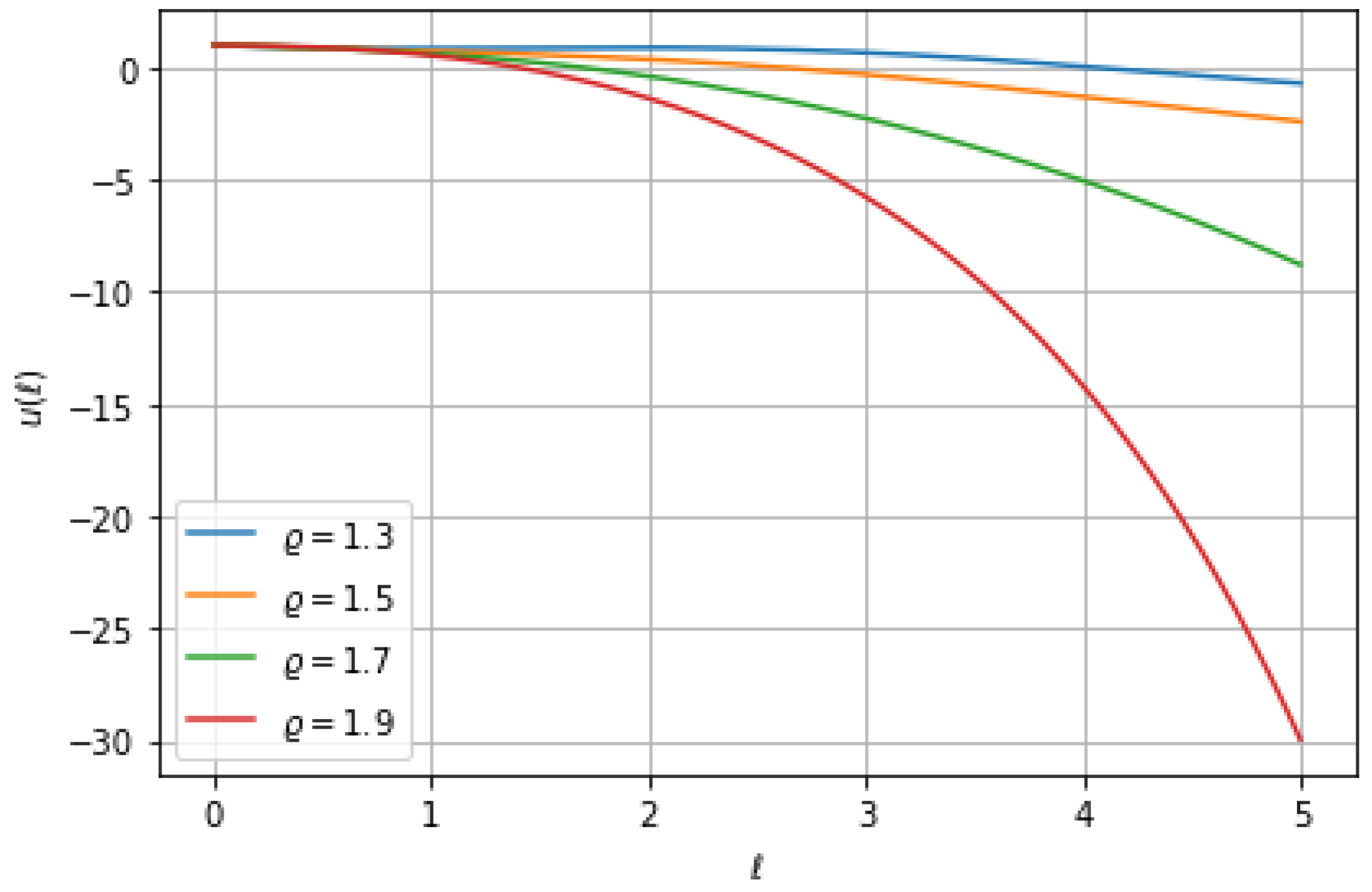
Figure 1 depicts the numerical solution of problem (18) on [ 0 , 5 ] with different fractional orders ϱ = 1.3 , 1.5 , 1.7 , and 1.9 . The numerical results confirm the existence and uniqueness analysis and illustrate the influence of the fractional order and delay term on the solution dynamics.
Remark 4. 
The numerical scheme employed in Example 3 is a variant of the fractional Adams method, for which convergence analysis has been developed in the context of Caputo derivatives (see, e.g., [38,39,40]). Under appropriate smoothness conditions, one can show that the error is of order O ( h min { 2 , 1 + ϱ } ) . Extending such estimates to the ABC derivative is straightforward because the integral equation (Equation (19)) involves only standard and fractional integrals. The example presented above is meant to illustrate the theoretical results and to demonstrate the practical applicability of the method; a detailed numerical analysis is left for future work.

6. Conclusions

This paper studied a class of second-order FDDEs formulated in terms of the ABC fractional derivative with time-dependent delays. Sufficient conditions for the existence and uniqueness of solutions were established under explicit Lipschitz-type assumptions, using both the classical supremum norm and an exponentially weighted Maksoud norm. The analysis shows that the choice of norm plays an important role in the contraction estimates, and that the Maksoud norm is particularly effective in handling delay terms and in obtaining sharper bounds. Moreover, the results indicate that the Lipschitz constants and the fractional order ϱ have a direct influence on uniqueness and stability properties.
UH and UHR stability were also investigated for the considered class of equations. These stability concepts provide quantitative information on the sensitivity of solutions to perturbations, with UH stability corresponding to uniform bounds and UHR stability allowing time-dependent perturbation estimates. The derived stability results are consistent with the existence and uniqueness theory. Several special cases were identified, and the illustrative examples and numerical simulations support the theoretical analysis and demonstrate the applicability of the proposed framework.
From a methodological viewpoint, the progressive contraction approach, based on constructing solutions on successive subintervals, proved to be an effective tool for addressing the delay structure. In addition, the use of the Maksoud norm provides a flexible mechanism for controlling the contribution of delayed arguments via suitable weighting, yielding more refined analytical estimates.
Several avenues for future research stem from this work. These include extending ABC-type fractional delay differential equations to orders ϱ > 2 , investigating generalized models with respect to an auxiliary function ψ and a weight w, and developing rigorous numerical schemes with error and convergence analysis to complement the qualitative illustrations presented here.

Author Contributions

Conceptualization, M.S.A. and B.Y.; methodology, M.S.A.; software, M.S.A. and K.A.; validation, K.A., O.O. and A.A.; formal analysis, M.S.A.; investigation, B.Y., O.O. and A.A.; writing—original draft preparation, M.S.A. and K.A.; writing—review and editing, A.E.H., M.S.A., B.Y., O.O., H.S. and A.A.; supervision, K.A. and A.A.; project administration, K.A. and A.A. All authors have read and agreed to the published version of the manuscript.

Funding

The authors extend their appreciation to the Deanship of Research and Graduate Studies at King Khalid University for funding this work through the Large Research Project under grant number RGP2/171/46.

Data Availability Statement

The data used in this paper is included within the paper.

Conflicts of Interest

The authors declare no conflicts of interest.

References

  1. Podlubny, I. Fractional Differential Equations; Academic Press: New York, NY, USA, 1999. [Google Scholar]
  2. Samko, S.G.; Kilbas, A.A.; Marichev, O.I. Fractional Integrals and Derivatives: Theory and Applications; Gordon and Breach: London, UK, 1993. [Google Scholar]
  3. Miller, K.S.; Ross, B. An Introduction to the Fractional Calculus and Fractional Differential Equations; Wiley: Hoboken, NJ, USA, 1993. [Google Scholar]
  4. Kilbas, A.A.; Srivastava, H.M.; Trujillo, J.J. Theory and Applications of Fractional Differential Equations; Elsevier: Amsterdam, The Netherlands, 2006. [Google Scholar]
  5. Baleanu, D.; Diethelm, K.; Scalas, E.; Trujillo, J.J. Fractional Calculus: Models and Numerical Methods; World Scientific: Singapore, 2019. [Google Scholar]
  6. Diethelm, K. The Analysis of Fractional Differential Equations; Springer: Berlin/Heidelberg, Germany, 2010. [Google Scholar]
  7. Atangana, A.; Baleanu, D. New fractional derivatives with non-local and non-singular kernel: Theory and application to heat transfer model. Therm. Sci. 2016, 20, 763–769. [Google Scholar] [CrossRef]
  8. Gómez-Aguilar, J.F.; Atangana, A. Fractional-order transmission line model with Atangana-Baleanu derivative. Eur. Phys. J. Plus. 2019, 134, 1–14. [Google Scholar]
  9. Khan, H.; Li, Y.; Khan, A.; Khan, A. Existence of solution for a fractional-order Lotka-Volterra reaction-diffusion model with Atangana-Baleanu derivative. J. Math. Anal. Appl. 2020, 481, 123477. [Google Scholar]
  10. Hale, J.K.; Verduyn Lunel, S.M. Introduction to Functional Differential Equations; Springer: Berlin/Heidelberg, Germany, 1993. [Google Scholar]
  11. Lakshmikantham, V.; Leela, S.; Devi, J.V. Theory of Fractional Dynamic Systems; Cambridge Scientific Publishers: Cambridge, UK, 2009. [Google Scholar]
  12. Agarwal, R.P.; Zhou, Y.; He, Y. Existence of fractional neutral functional differential equations. Comput. Math. Appl. 2010, 59, 1095–1100. [Google Scholar] [CrossRef]
  13. Benchohra, M.; Henderson, J.; Ntouyas, S.K.; Ouahab, A. Existence results for fractional order functional differential equations with infinite delay. J. Math. Anal. Appl. 2009, 338, 1340–1350. [Google Scholar] [CrossRef]
  14. Wang, G.; Zhang, L. Ulam-Hyers-Mittag-Leffler stability of fractional-order delay differential equations. Optimization 2014, 63, 1191–1202. [Google Scholar] [CrossRef]
  15. Kuang, Y. Delay Differential Equations with Applications in Population Dynamics; Academic Press: Cambridge, MA, USA, 1993. [Google Scholar]
  16. Zhou, Y. Basic Theory of Fractional Differential Equations; World Scientific: Singapore, 2014. [Google Scholar]
  17. Anwar, A.K. Existence and Uniqueness of Solutions for Atangana-Baleanu Fractional Differential Equations in Caputo-Sense. Punjab Univ. J. Math. 2024, 56, 650–667. [Google Scholar] [CrossRef]
  18. Zhang, S. Existence and uniqueness of solutions for fractional differential equations with delay. Electr. J. Diff. Equ. 2017, 194, 1–10. [Google Scholar]
  19. Mohan, J.J.; Deekshitulu, G.V.S.R. Fractional differential equations with delay: Existence, uniqueness and Ulam stability. J. Appl. Math. Comput. 2022, 68, 1–25. [Google Scholar]
  20. Ulam, S.M. A Collection of Mathematical Problems; Interscience Publishers: Geneva, Switzerland, 1960. [Google Scholar]
  21. Hyers, D.H. On the stability of the linear functional equation. Proc. Natl. Acad. Sci. USA 1941, 27, 222–224. [Google Scholar] [CrossRef] [PubMed]
  22. Rassias, T.M. On the stability of the linear mapping in Banach spaces. Proc. Am. Math. Soc. 1978, 72, 297–300. [Google Scholar] [CrossRef]
  23. Rus, I.A. Ulam stabilities of ordinary differential equations in a Banach space. Carpathian J. Math. 2009, 26, 103–107. [Google Scholar]
  24. Jung, S.M. Hyers-Ulam-Rassias Stability of Functional Equations in Nonlinear Analysis; Springer Science Business Media: Berlin/Heidelberg, Germany, 2011; Volume 48. [Google Scholar]
  25. Wang, J.; Zhang, Y. Ulam-Hyers stability of fractional differential equations with delays. Adv. Differ. Equ. 2020, 2020, 1–12. [Google Scholar] [CrossRef]
  26. Li, X.; Wang, J. Ulam-Hyers stability for ABC fractional differential equations with non-instantaneous impulses. Appl. Math. Lett. 2021, 112, 106850. [Google Scholar] [CrossRef]
  27. Zada, A.; Ali, S.; Li, Y. Ulam-type stability for a class of implicit fractional differential equations with non-instantaneous impulses. Adv. Differ. Equ. 2020, 2020, 317. [Google Scholar]
  28. Hong, X.; Wei, Y.; Zhou, S.; Yue, D. Nabla fractional distributed optimization algo-rithms over undirected/directed graphs. J. Frankl. Inst. 2024, 361, 1436–1454. [Google Scholar] [CrossRef]
  29. Dimitrov, N.D.; Jonnalagadda, J.M. Existence results for nabla fractional problems with anti-periodic boundary conditions. Mathematics 2025, 13, 2487. [Google Scholar] [CrossRef]
  30. Zhu, C.C.; Zhu, J. Fractional-Order Sequential Linear Differential Equations with Nabla Derivatives on Time Scales. Axioms 2024, 13, 447. [Google Scholar] [CrossRef]
  31. Abdeljawad, T. A Lyapunov type inequality for fractional operators with nonsingular Mit-tag-Leffler kernel. J. Inequal. Appl. 2017, 2017, 130. [Google Scholar] [CrossRef]
  32. Ali, S.M.; Abdo, M.S.; Sontakke, B.; Shah, K.; Abdeljawad, T. New results on a coupled system for second-order pantograph equations with ABC fractional derivatives. AIMS Math. 2022, 7, 19520–19538. [Google Scholar] [CrossRef]
  33. Abdo, M.S.; Abdeljawad, T.; Ali, S.M.; Shah, K. On fractional boundary value problems involving fractional derivatives with Mittag-Leffler kernel and nonlinear integral conditions. Adv. Differ. Equ. 2021, 2021, 37. [Google Scholar] [CrossRef]
  34. Asma Shabbir, S.; Shah, K.; Abdeljawad, T. Stability analysis for a class of implicit fractional differential equations involving Atangana–Baleanu fractional derivative. Adv. Differ. Equ. 2021, 2021, 395. [Google Scholar] [CrossRef] [PubMed]
  35. Abdeljawad, T.; Thabet, S.; Kedim, I.; Ayari, M.I.; Khan, A. A higher-order extension of Atangana–Baleanu fractional operators with respect to another function and a Gronwall-type inequality. Bound. Val. Prob. 2023, 2023, 49. [Google Scholar] [CrossRef]
  36. Hafeez, F.; Jeelani, M.B.; Alhamzi, G. Fractional-Order Delay Differential Equations: Ex-istence, Uniqueness, and Ulam–Hyers Stability. Axioms 2025, 14, 817. [Google Scholar] [CrossRef]
  37. Seong, H.Y.; Majid, Z.A. Solving second order delay differential equations using direct two-block method. Ain Shams Eng. J. 2017, 8, 59–66. [Google Scholar] [CrossRef]
  38. Diethelm, K.; Ford, N.J.; Freed, A.D. Detailed error analysis for a fractional Adams method. Numer. Algorithms 2004, 36, 31–52. [Google Scholar] [CrossRef]
  39. Garrappa, R. On linear stability of predictor-corrector algorithms for fractional dif-ferential equations. Int. J. Comput. Math. 2010, 87, 2281–2290. [Google Scholar] [CrossRef]
  40. Toufik, M.; Atangana, A. New numerical approximation of fractional derivative with non-local and non-singular kernel: Application to chaotic models. Eur. Phys. J. Plus. 2017, 132, 444. [Google Scholar] [CrossRef]
Figure 1. Numerical solutions of the ABC-type FDDE (18) for different fractional orders.
Fractalfract 10 00150 g001
Table 1. Approximate solution of problem (18) for different fractional orders ϱ .
ϱ = 1.3 ϱ = 1.5 ϱ = 1.7 ϱ = 1.9
0.0 1.00001.00001.00001.0000
0.5 0.91260.88990.86480.8363
1.0 0.99580.97050.94120.9074
1.5 1.20411.15281.09861.0412
2.0 1.42291.33471.24631.1561
2.5 1.51271.41261.31451.2162
3.0 1.43841.31651.19721.0809
3.5 1.17061.02250.88160.7483
4.0 0.73320.56530.41170.2728
4.5 0.19340.0259 0.1241 0.2549
5.0 0.2946 0.4878 0.6553 0.7972
Disclaimer/Publisher’s Note: The statements, opinions and data contained in all publications are solely those of the individual author(s) and contributor(s) and not of MDPI and/or the editor(s). MDPI and/or the editor(s) disclaim responsibility for any injury to people or property resulting from any ideas, methods, instructions or products referred to in the content.