
Article

Transfer Learning Fractional-Order Recurrent Neural Network for MPPT Under Weak PV Generation Conditions

by
Umair Hussan
1,2,*,
Mudasser Hassan
3,
Umar Farooq
1,
Huaizhi Wang
2,* and
Muhammad Ahsan Ayub
4
1
Shenzhen International Graduate School (SIGS), Tsinghua University, Shenzhen 518071, China
2
College of Mechatronics and Control Engineering, Shenzhen University, Shenzhen 518000, China
3
School of Engineering, University of Tasmania, Hobart, TAS 7005, Australia
4
College of Physics and Optoelectronics Engineering, Shenzhen University, Shenzhen 518000, China
*
Authors to whom correspondence should be addressed.
Fractal Fract. 2026, 10(1), 41; https://doi.org/10.3390/fractalfract10010041
Submission received: 3 December 2025 / Revised: 5 January 2026 / Accepted: 7 January 2026 / Published: 8 January 2026

Abstract

Photovoltaic generation systems (PVGSs) face significant efficiency challenges under partial shading conditions and rapidly changing irradiance due to the limitations of conventional maximum power point tracking (MPPT) methods. To address these challenges, this paper proposes a Transfer Learning-based Fractional-Order Recurrent Neural Network (TL-FRNN) for robust global maximum power point (GMPP) tracking across diverse operating conditions. The incorporation of fractional-order dynamics introduces long-term memory and non-local behavior, enabling smoother state evolution and improved discrimination between local and global maxima, particularly under weak and partially shaded conditions. The proposed approach leverages Caputo fractional derivatives with Grünwald–Letnikov approximation to capture the history-dependent behavior of PVGSs while implementing a parameter-partitioning strategy that separates shared features from task-specific parameters. The architecture employs a multi-head design with GMPP regression and partial shading classification capabilities, trained through a two-stage process of pretraining on general PV data followed by efficient fine-tuning on target systems with limited site-specific data. The TL-FRNN achieved 99.2% tracking efficiency with 98.7% GMPP detection accuracy, reducing convergence time by 53% compared to state-of-the-art alternatives while requiring 72% less retraining time through transfer learning. This approach represents a significant advancement in adaptive, intelligent MPPT control for real-world photovoltaic energy-harvesting systems.

1. Introduction

The global energy landscape is currently undergoing a profound transformation driven by the urgent need to transition from fossil fuels to sustainable and environmentally benign alternatives. These alternatives are primarily composed of renewable energy sources (RESs) such as photovoltaic (PV) and wind power, which possess the technological maturity and scalable potential to meet the global energy demand without the detrimental externalities associated with combustion-based power generation [1]. The PV generation system (PVGS) has emerged as a frontrunner in urban, rural, and hilly areas due to its ubiquity, scalability, and rapidly decreasing costs. PV systems directly convert solar irradiance into electrical energy using semiconductor materials, offering a silent, low-maintenance, and zero-emission power solution [2]. The inherent intermittency and non-linear characteristics of solar energy pose significant challenges to the efficiency and reliability of these systems [3]. The power output of a PV module is highly sensitive to fluctuating environmental conditions, primarily solar irradiance and ambient temperature [4]. Consequently, the objective of maximizing the energy harvest from the available sunlight is not merely an economic imperative but a critical technological hurdle that must be overcome to ensure the long-term viability and grid competitiveness of solar energy [5].
Several research works have focused on addressing the above challenges by developing advanced control algorithms to optimize the performance of PV generation systems under real-world, dynamic operating conditions. The PVGS comprises the PV array, the DC-DC converter, and the MPPT controller. At the core of every efficient PVGS lies the MPPT, which is the crucial component responsible for ensuring continuous maximum power extraction. Several approaches, such as perturb and observe [6], incremental conductance [7], fractional open-circuit voltage [8], fractional short-circuit current [9], and ripple correlation control [10], are considered classical MPPT techniques. These conventional methods rely on straightforward search mechanisms or predefined correlations to track the maximum power point, offering significant advantages in algorithmic simplicity and ease of implementation. However, the inherent trade-off in these techniques is their limited dynamic performance under rapidly changing irradiance and their susceptibility to failure under complex partial shading conditions (PSCs) [11]. PSCs are considered weak operating conditions in which different sections of a PV array receive non-uniform levels of solar irradiance, typically due to obstructions such as clouds, adjacent structures, or soiling. This non-uniformity results in a highly complex P-V characteristic curve, which deviates from the standard unimodal curve by exhibiting multiple local maxima along with a single global maximum power point (GMPP). This phenomenon significantly complicates the tracking process, as conventional MPPT algorithms often get trapped at a suboptimal local maximum, leading to substantial power loss [12].
To effectively achieve global MPPT (GMPPT) under PSCs, intelligent control strategies leveraging artificial neural networks (ANNs) are extensively investigated. ANN-based MPPT algorithms utilize their intrinsic ability to perform non-linear function approximation to establish a precise, data-driven mapping between the PV array’s electrical variables and the optimal operating duty cycle [13]. This approach yields a superior dynamic response during rapid transient irradiance changes and, critically, guarantees reliable identification and convergence toward the GMPP, effectively addressing the limitations of classical methods. However, the ultimate performance of these networks is fundamentally contingent upon effective training, requiring sophisticated meta-heuristic or swarm intelligence optimization techniques to precisely tune the network’s internal weights and biases for achieving robust GMPPT across all operating conditions [14]. Sangrody Reza et al. [15] introduced improved PSO algorithms that analyze traditional PSO’s stability and utilize two voltage boundaries to efficiently locate the GMPP within the P-V curve’s convex region under PSC. The inherent computational overhead and potential parameter sensitivity associated with the continuous swarm search mechanism and the boundary estimation process remain critical aspects for further refinement and reduction in tracking time [16]. Hussan Umair et al. [17] proposed a novel control framework integrates an optimized feedforward ANN with a nonlinear backstepping controller, utilizing a hybrid PSO-GA approach to tune the ANN’s parameters, which yields superior performance metrics under dynamic environments. Despite its reported stability and high accuracy, this work primarily emphasizes dynamic tracking performance and stability without providing explicit, detailed characterization of the framework’s resilience against the sustained, highly multimodal P-V curves typical of steady-state PSCs.
The performance of recurrent neural network (RNN) is significantly enhanced due to it possessing internal memory that allows it to process sequential data, making it inherently more suitable for modeling the time-dependent, rapidly changing conditions of PV systems. This memory capability allows RNNs to utilize previous operating points and environmental inputs, leading to more accurate, predictive control actions that minimize transient power loss during fast irradiance transitions. A RNN model with improved PSO is proposed in [18] to track the MPPT in shaded PV generation systems. However, the improved PSO still suffers from significant drawbacks, namely steady-state power oscillations and a slower tracking speed compared to the DRNN. Manjula Ankathi et al. [19] presents a novel hybrid control scheme that combines Recurrent Neural Network RNN-based Space Vector Pulse-Width Modulation with COA-based MPPT. The RNN improves modulation quality by generating adaptive switching signals, outperforming conventional and ANN-based SVPWM techniques. Nair, S. P. et al. [20] proposed a hybrid RNN MPPT controller to maximize power output in hybrid renewable systems using an enhanced DC-DC converter. A modified dragonfly algorithm is used in this controller that may require extensive parameter tuning for different system conditions [21]. RNN-Based attention models are presented in [22] to estimate solar power generation for sites without physical meters. This model integrates additional inputs, including meteorological data and theoretical models of insolation. Nevertheless, the core limitation of conventional RNNs is their inadequacy in accurately modeling the complex, history-dependent, and non-local dynamics inherent to PV systems. To overcome this, fractional-order recurrent neural networks (FRNNs) are explored, which leverage fractional calculus to provide a more robust and precise controller output, as the technique is specifically designed to model these non-local and memory-based dynamics with superior accuracy [23]. FRNNs have a large number of tunable parameters [24,25]. Optimizing this large parameter space requires vast amounts of diverse, high-fidelity PV data and significant training time. This requirement makes the deployment and commissioning of a new FRNN-based system specific to a new PV array time-consuming and resource-heavy. Therefore, the integration of transfer learning (TL) [26] is necessitated, as it enables the deployment of complex, pre-trained FRNN models by facilitating rapid, minimal fine-tuning on site-specific data, thus mitigating the practical hurdles of extensive on-site training [27].
This paper designs, implements, and validates a novel transfer learning fractional-order recurrent neural network (TL-FRNN) to achieve MPPT of PVGSs. First, we introduce the FRNN as the core approximator for the MPPT policy, leveraging its inherent memory to achieve superior dynamic tracking of the non-stationary MPP under complex partial shading and rapidly changing irradiance profiles. Second, we integrate this FRNN with a Transfer Learning framework, enabling the network’s knowledge, pre-trained on a source PV system and a comprehensive dataset, to be rapidly fine-tuned for a new, target PV system with minimal additional training data and time. We propose a complete control architecture that utilizes the TL-FRNN to provide the optimal reference voltage for a fast-acting converter, demonstrating through rigorous simulation that our proposed method outperforms state-of-the-art alternatives in terms of tracking speed, accuracy, and power efficiency.

2. PV Generation System

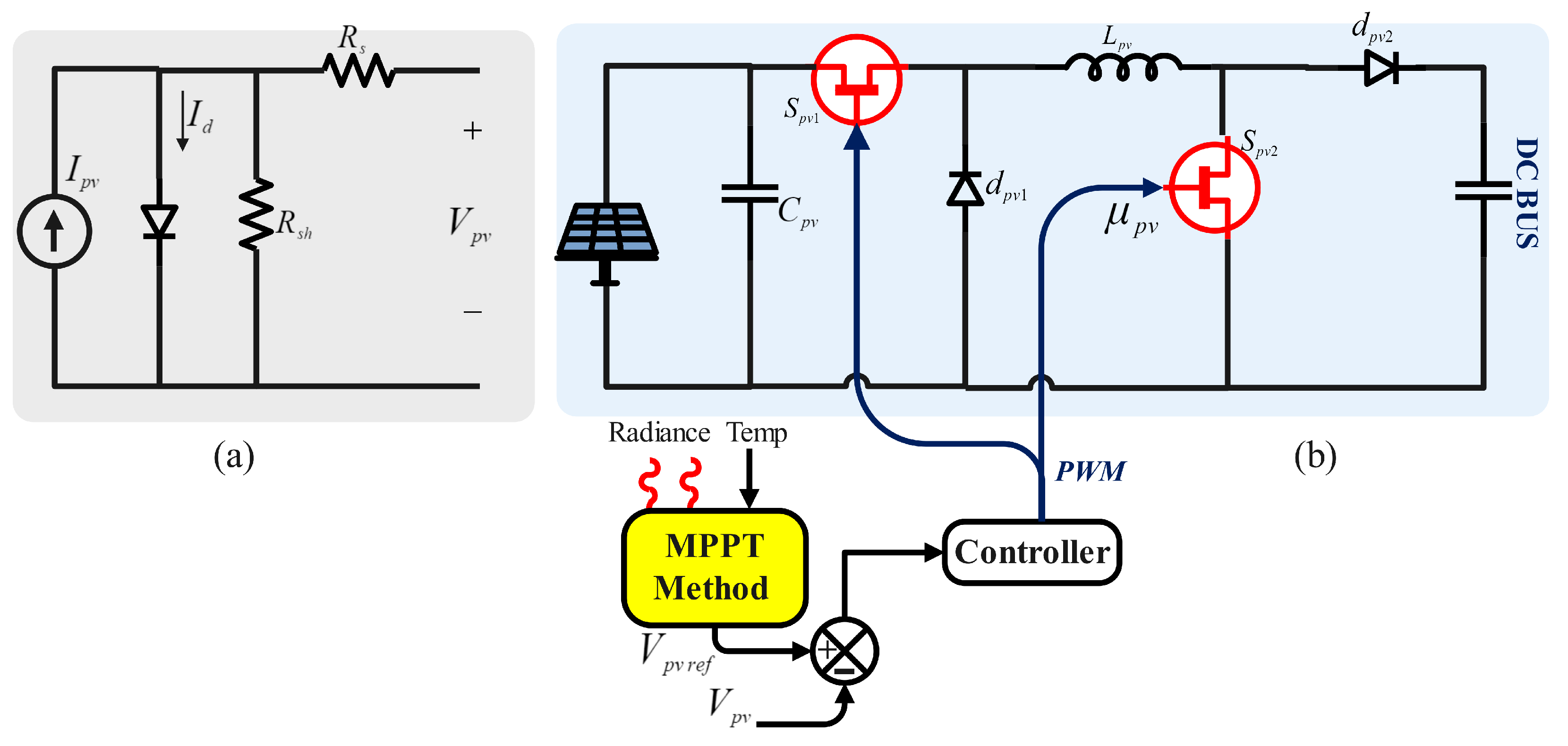
The PV generation system is one of the core renewable energy sources in the microgrid that converts sunlight into electrical energy through PV panels. The PV generation system (PVGS) consists of a PV panel, a non-inverting buck–boost converter, and an MPPT controller. The non-inverting buck–boost converter is connected to the output of PV panels and operates in continuous conduction mode to track the MPP. Figure 1 illustrates the internal circuit diagram of PVGS. The single diode equation of PV module can be presented as follows:
I p v = I p h I o e V o p v + I p v R s α p v V t 1 V o p v + I p v R s R s h
In Equation (1), I p v is the PV output current, V o p v is output voltage, I p h is the photo-generated current, I o is the diode saturation current, R s and R s h are the series and shunt resistances, and V t is the thermal voltage. The PVGS employs an MPPT algorithm alongside a nonlinear controller to ensure efficient operation under varying environmental conditions. The control circuitry also manages the complexities of dynamic responses, enhancing the overall performance of the system. The noninverting buck–boost converter plays a vital role in managing the electrical output power from PV panels to enhances the reliability, efficiency, and flexibility of PVGS, ultimately leading to a better performance and increased energy yield. This ultimately leads to an improved performance and increased energy yield. The electrical power output of a PV system can be calculated using the equation [28]:
P p v = A . I . η
In Equation (2), P p v represents the electrical output power, A denotes the area of PV panel, I indicates irradiance, and η signifies the efficiency of PV cells. The efficiency of PVGS is significantly influenced by temperature and affected badly by varying temperature from a certain limit. The impact of temperature on efficiency can be expressed as follows:
η ( T ) = η r e f β T T T r e f
In Equation (3), η ( T ) represents the efficiency at operating temperature T. Meanwhile, η r e f denotes the efficiency at reference temperature T r e f and β T is the temperature coefficient that quantifies the change in efficiency with respect to temperature variations. The primary objective of this work is to generate an accurate PV reference voltage under weak PV generation conditions, which represent one of the most challenging scenarios for MPPT due to variable irradiance and temperature, partial shading, and highly nonlinear P–V characteristics. The proposed TL-FRNN estimates the GMPP voltage, which serves as the reference signal for the PV voltage control loop. This reference voltage is subsequently tracked by the nonlinear DC–DC converter through duty-cycle modulation, ensuring that the PV system operates at its optimal operating point despite environmental variations. The detailed modeling of the converter and the design and stability analysis of the PV voltage tracking controller have been comprehensively investigated in our previous studies [17,29,30,31] and are therefore not repeated here, allowing the present work to focus on accurate GMPP voltage estimation under weak and dynamic operating conditions.

3. Proposed Transfer Learning Fractional-Order Recurrent Neural Network Method

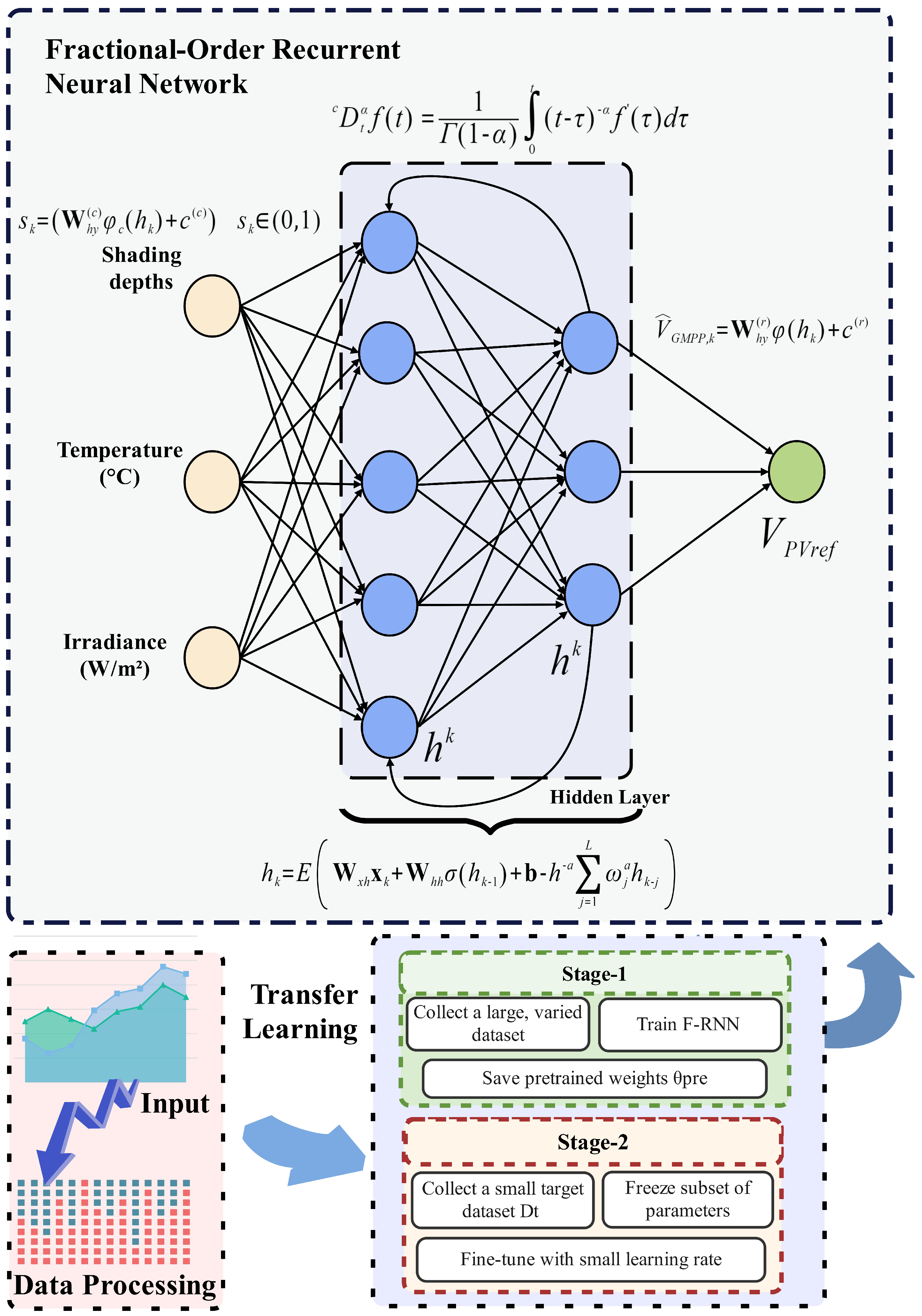
The Transfer Learning Fractional-Order Recurrent Neural Network (TL-FRNN) method is an intelligent MPPT approach that combines fractional calculus, recurrent neural dynamics, and knowledge transfer to achieve fast and stable power tracking of PV systems under dynamic environment conditions. The schematic of proposed TL-FRNN for MPPT of PVGS is shown in Figure 2. The fractional-order memory allows the network to capture the long-term temporal dependencies of PV voltage, current, and irradiance variations, improving response smoothness and noise resilience. The recurrent structure enables dynamic learning of nonlinear system behavior, while transfer learning allows a pre-trained model to be fine-tuned efficiently for a specific PV module or site using limited local data. Under normal conditions, the TL-FRNN predicts the optimal voltage corresponding to the maximum power point, whereas under partial shading, it detects multi-peak P–V curves and guides the system to locate the GMPP using adaptive search and memory-based refinement. This hybrid intelligent framework ensures high tracking accuracy, reduced oscillations, and robust operation across varying environmental conditions. The details of this method are written below.

3.1. Fractional Calculus Formulation and Discrete-Time Realization

In the TL-FRNN, the fractional calculus concept introduces a memory-based differentiation rule that allows the network to consider not just the current input but also a weighted history of past states. This is achieved using the Caputo fractional derivative, which represents system dynamics with long-term dependencies that are important for PV systems where voltage and current depend on past irradiance and temperature changes. The Caputo fractional derivative is a generalization of the ordinary (integer-order) derivative that introduces memory into differential equations. Instead of depending only on the instantaneous rate of change f ( t ) , the Caputo derivative of order 0 < α < 1 weights the entire past history of the derivative with a power-law kernel [32]. It can be represented as follows:
D t α C f ( t ) = 1 Γ ( 1 α ) 0 t ( t τ ) α f ( τ ) d τ
The Grünwald–Letnikov (GL) [33] discrete approximation is implemented. It represents the fractional derivative as a weighted sum of past signal values using power-law decaying coefficients, enabling practical digital implementation of fractional-order dynamics in discrete-time systems. With time step h, the GL fractional difference at discrete times t k = k h :
Δ h α y k h α j = 0 k ω j ( α ) y k j
where
ω j ( α ) = 1 j α j ; α j = Γ ( α + 1 ) Γ ( j + 1 ) Γ ( α j + 1 )
To compute these weights efficiently and avoid numerical instability, we use the following recurrence relation:
ω 0 ( α ) = 1 ; ω j ( α ) = α j + 1 j ω j 1 ( α ) ( j 1 )
Truncate kernel to length L for implementation:
Δ h α y k h α j = 0 L ω j ( α ) y k j

3.2. Discrete-Time Fractional RNN Dynamics for PV Systems

Building on the fractional calculus formulation and discrete-time realization discussed earlier, the GL fractional difference provides a practical way to implement fractional-order dynamics in discrete-time systems. In its full form, the GL derivative sums over all past states, allowing the TL-FRNN to capture the complete memory effect of the PV system, including long-term influences of irradiance, temperature, and voltage variations. However, this full implementation is computationally intensive and memory-demanding for long sequences. To address this, a truncated kernel limits the summation to the most recent L steps, which retain the dominant historical effects while significantly reducing computational load. This approximation ensures that the fractional-order recurrent network can be implemented efficiently in real time, preserving the long-term memory advantages of fractional calculus while enabling the TL-FRNN to accurately MPPT under normal and partial shading conditions. We denote the key components of the Fractional-Order Recurrent Neural Network (FRNN) at discrete time step k as follows:
x k = [ V p v , I p v , G , T ]
In Equation (9), V p v , I p v are the PV current and voltage respectively. Whereas, G is the irradiance, and T is the PV module temperature. h k R n h is the hidden state which stores the dynamic memory of the system and evolves according to past states and current input. To simplify the fractional-order dynamics and ensure numerical stability, we introduce a diagonal damping matrix:
A = a I n h
Using the GL fractional derivative approximation, the hidden-state update can be expressed in a compact form as
M = h α I n h + A , E = M 1
In Equation (11), h is the discrete time step, α ( 0 , 1 ) is the fractional-order controlling memory depth, and E serves as a scaling factor for efficiently computing the next hidden state. This formulation allows the FRNN to incorporate fractional memory while maintaining numerical stability and efficient real-time computation in MPPT applications under normal and partial shading conditions. The hidden state of the FRNN depends on both the current input and all past states; however, this is computationally intensive and difficult to implement directly in real time for MPPT. We use the explicit practical update σ to evaluate the σ at the previous step to avoid an implicit equation:
h k = E W x h x k + W h h σ ( h k 1 ) + b h α j = 1 L ω j ( α ) h k j
In proposed TL-FRNN architecture, the hidden state h k is shared across multiple output heads, each designed for a specific aspect of PV system prediction. This allows the network to simultaneously perform related tasks, improving learning efficiency and robustness under both normal and partial shading conditions. The primary head is a GMPP regressor that can be expressed as
V ^ G M P P , k = W h y ( r ) φ ( h k ) + c ( r )
The Equation (13) predicts the GMPP voltage directly from the hidden state and provides the main MPPT signal to adjust the duty ratio of the converter, ensuring that the PV system operates at the maximum power output. The model employs a binary classification head to estimate the probability of the PV curve being multi-modal due to partial shading:
s k = σ c W h y ( c ) φ c ( h k ) + c ( c ) ; s k ( 0 , 1 )
This equation alerts the controller whether multiple local maxima exist, allowing the GMPP regressor to focus on locating the global maximum instead of being trapped at a local peak.

3.3. Multi-Task Loss Function

For a training sequence of length N, we define per-step losses and sum/average across time. Let true labels at step k, V G M P P , k * is the ground-truth GMPP voltage and s k * ( 0 , 1 ) is the shading indicator. The shading indicator (MSE) can be represented as
k ( r ) = V ^ G M P P , k V G M P P , k * 2
Shading classification can be represented as
k ( c ) = s k * log s k + ( 1 s k * ) log ( 1 s k )
The Equation (16) provides a one-line decision between shaded and unshaded conditions that helps to switch MPPT behavior based on current shading conditions. Total sequence loss that represents the overall training error by averaging the prediction loss across all time steps in the sequence can be expressed as follows:
L θ = 1 N k = 1 N λ r k ( r ) + λ r k ( r ) + λ r e g θ 2 2
In Equation (17), θ collects all trainable parameters and λ are the weighting hyper parameters.

3.4. Fractional Backpropagation

We compute θ L gradients by unrolling recurrence for N steps and propagating sensitivities backward across truncated memory L. Define the output error signal per step as
g k ( r ) = 2 λ r N V ^ G M P P , k V G M P P , k *
g k ( c ) = 2 λ c N s k s k *
Combine outputs into a single-output gradient with respect to φ ( h k ) :
u k = W h y ( r ) g k ( r ) + W h y ( c ) g k ( c )
Let denote elementwise derivatives of output and recurrent activation. Define state sensitivity that represents how the loss changes with respect to the hidden state at time step k, indicating the backward error flow through the FRNN:
δ k = L h k R n h
The backward recursion begins by initializing the final time-step sensitivity using the gradient of the loss with respect to the output.
δ k = u k φ ( h k )
For backward recursion with k = N , N 1 , , 1 , compute intermediate
τ k = E δ k
Accumulate parameter gradients at time k
W h y ( r ) L = g k ( r ) φ ( h k ) W h y ( c ) L = g k ( c ) φ c ( h k ) W h h L = τ k σ ( h k 1 ) W x h L = τ k ( x k ) b L = τ k
Propagate δ k to previous states; first Contribution via recurrent nonlinearity to h k 1 :
δ k 1 = W h h τ k σ h k 1
Memory convolution contributions for j = 1 , 2 , , L :
δ k j = h α ω j ( α ) τ k ( for each feasible index k j 1 )
Repeat until all gradients are accumulated. Add regularization gradient θ ( λ r e g θ 2 2 ) = λ r e g θ . Use the Adam optimizer to update θ .

3.5. Transfer Learning Formalism

Let the full parameter set be partitioned:
θ = θ s h a r e d , θ h e a d
In Equation (27), θ s h a r e d are the shared parameters of the model like weights, biases, and fractional coefficients that learn the general temporal features and PV dynamics common to all tasks, whereas θ h e a d are the task-specific parameters in each output head, such as the GMPP regressor, and shading classifier. Each head learns its own mapping from the shared features to its specific output. In transfer learning, pretraining is the first stage in which the TL-FRNN is trained on a large, generic PV dataset under varying irradiance and temperature to learn universal PV dynamics. This forms a strong initialization, allowing the model to generalize well and adapt quickly during fine-tuning on specific target PV systems. The pretraining objective for the TL-FRNN can be expressed as follows:
θ p r e = arg min θ E ( x , y ) D L θ ; X , Y
The next step is fine-tuning stage. The pretrained shared parameters θ s h a r e d are kept fixed to preserve learned PV dynamics, while only the task-specific head parameters q are updated using the small target dataset. This can be written as follows:
θ h e a d * = arg min θ h e a d E ( X , Y ) D L θ p r e , s h a r e d , θ h e a d ; X , Y
This allows the TL-FRNN to quickly adapt to a new PV system with minimal data while avoiding overfitting.

4. Results and Discussion

The performance evaluation of the proposed TL-FRNN method to achieve MPPT is tested through MATLAB (R2023a) with realistic PV array parameters. The performance is evaluated under various operating conditions, including normal operation, partial shading, and dynamic environmental changes. The TL-FRNN was pretrained using a dataset of irradiance, temperature, voltage, and power sequences and fine-tuned for target PV modules using limited samples to evaluate transfer learning efficiency. The TL-FRNN method is implemented and tested using the parameters detailed in Table 1. The fractional order was selected based on preliminary empirical observations obtained through extensive pilot simulations under representative operating conditions, including uniform, rapidly varying, and partial shading scenarios. The value of 0.85 consistently proved favorable in this case between convergence speed, stability, and steady-state smoothness, motivating its initial selection.
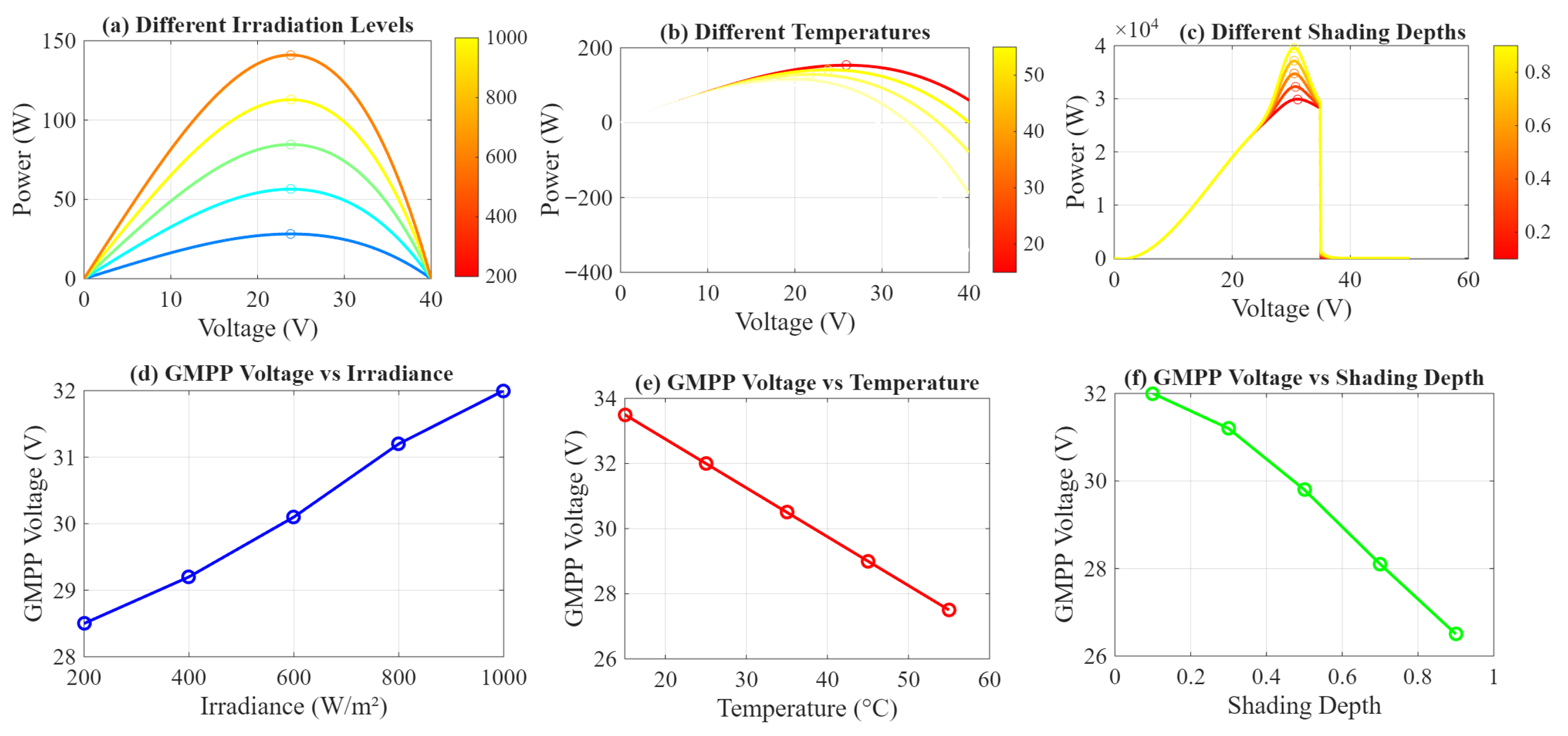
The GMPP boundaries analysis is shown in Figure 3. It systematically investigates how GMPP characteristics vary with critical environmental parameters, including irradiance, temperature, and shading depth. This analysis is crucial because it defines the complete operational envelope of PV systems under varying environmental conditions, enabling robust MPPT design that maintains optimal performance across all realistic scenarios, from ideal illumination to severe partial shading conditions. The first row of subplots (a–c) shows P-V curves under varying conditions, revealing that higher irradiance (200–1000 W/m2) linearly increases maximum power from 180 W to 900 W, while higher temperature (15–55 °C) decreases open-circuit voltage from 41 V to 36 V due to semiconductor bandgap reduction, and increased shading depth (10–90%) creates deeper local minima while shifting GMPP location. The second row quantifies GMPP voltage dependencies (subplot d–f), demonstrating positive correlation with irradiance (28.5 V to 32.0 V) due to increased photo-current, negative correlation with temperature (33.5 V to 27.5 V) following the −0.35 V/°C coefficient, and negative correlation with shading depth (32.0 V to 26.5 V) as bypass diodes activate.
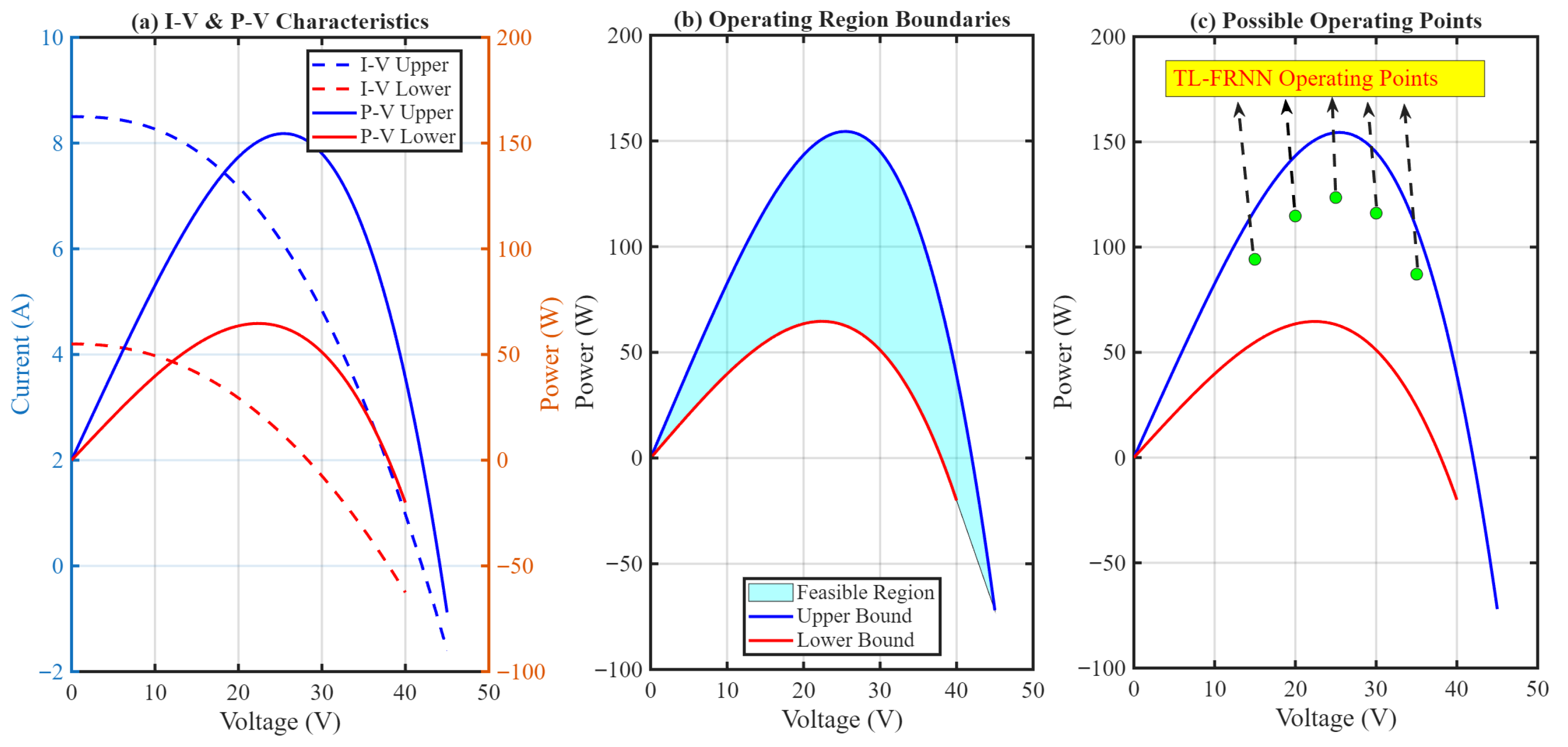
The I-V and P-V Characteristics with Boundaries are shown in Figure 4. The I-V and P-V curves define the complete operational limits and physical constraints of the PV system, establishing the entire feasible operating region where the MPPT algorithm must search for the GMPP while ensuring system safety and component protection. Figure 4 establishes the fundamental operating constraints and demonstrates TL-FRNN’s navigation capability within the PV system’s physical limits. The left panel displays current-voltage and power-voltage characteristics for both upper boundary conditions ( 1000 W / m 2 irradiance, 25 °C temperature yielding 8.5 A short-circuit current and 42 V open-circuit voltage) and lower boundary conditions ( 400 W / m 2 , 45 °C yielding 4.2 A and 38 V), with characteristic knee shapes following single-diode model physics. The center panel illustrates the feasible operating region as a cyan-shaded area between these boundaries, defining the legitimate search space for MPPT algorithms where TL-FRNN operates exclusively. The right panel shows multiple operating points achieved by TL-FRNN distributed across the voltage range from 15 V to 35 V, with concentration near maximum power regions demonstrating efficient exploration–exploitation balance. Figure 4 validates that TL-FRNN respects physical system constraints while effectively exploring the operational space to locate optimal points, ensuring both performance and system safety.
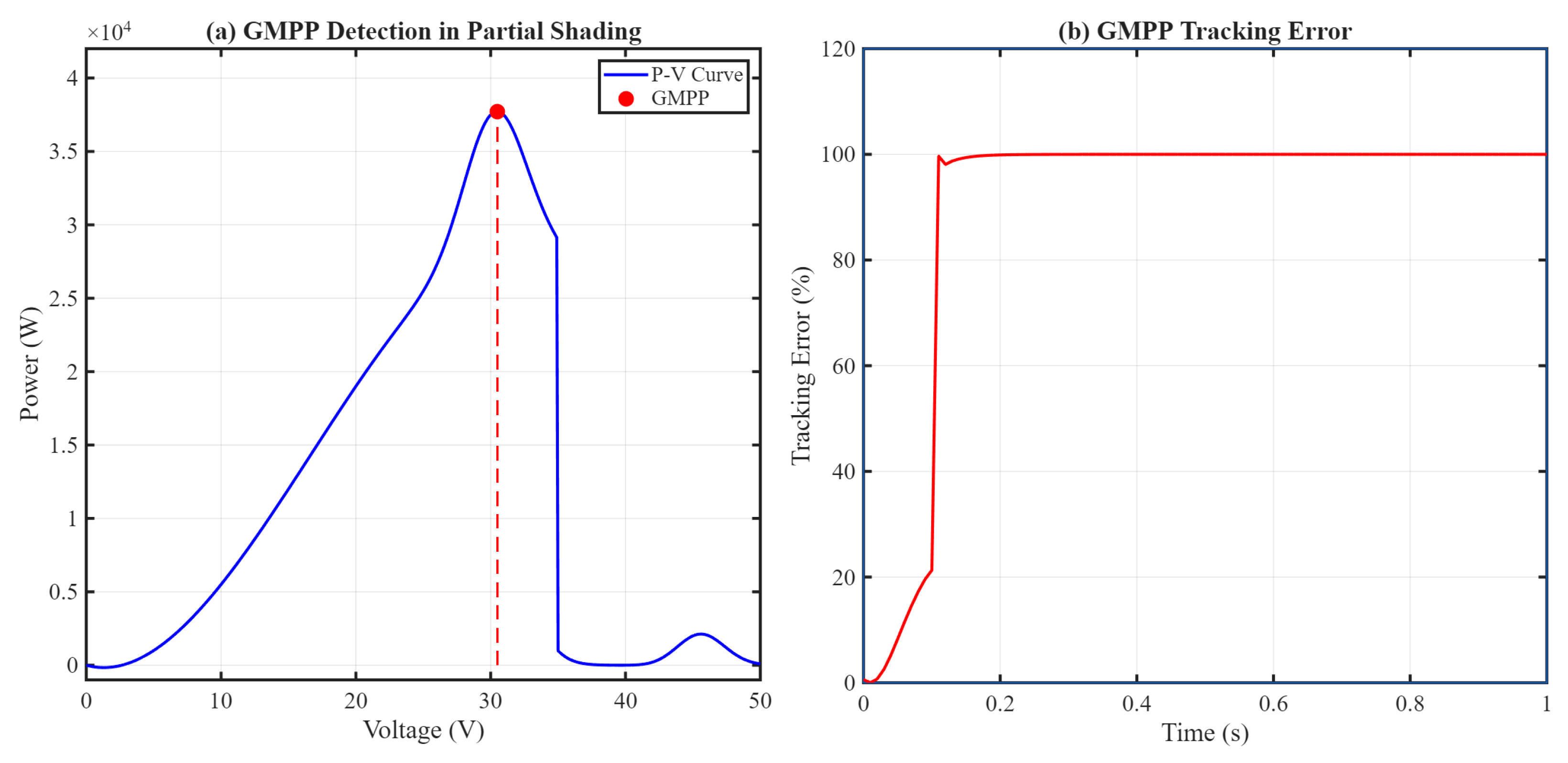
Figure 5 illustrates the convergence behavior of the proposed TL-FRNN around the GMPP. The predicted voltage rapidly converges toward the true V G M P P with minimal oscillation, demonstrating stable dynamic tracking. The fractional memory parameter α = 0.8 was found to be optimal, ensuring a good balance between responsiveness and noise robustness.
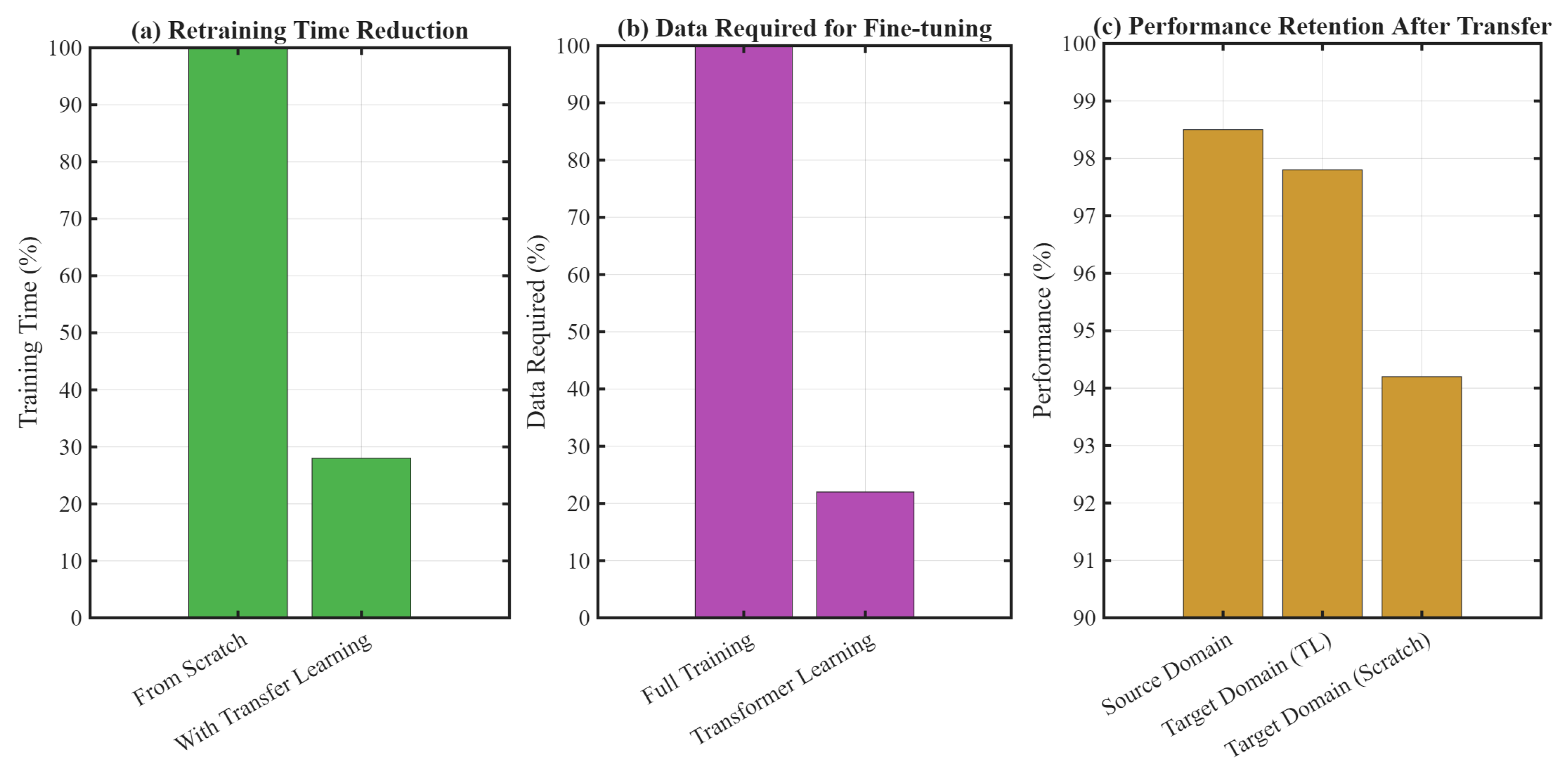
Figure 6 illustrates the transfer learning efficiency analysis of the proposed TL-FRNN model for MPPT in PV systems, highlighting its adaptability and data efficiency when applied to a new PV environment. In Figure 6a, the retraining time reduction demonstrates that using transfer learning significantly reduces the training effort, requiring only about 28% of the time compared to training the model from scratch. This indicates that the pretrained TL-FRNN successfully retains generic PV behavior from the source domain, allowing rapid adaptation to new conditions. Figure 6b shows that the amount of data required for fine-tuning is reduced by nearly 80%, as the TL-FRNN leverages previously learned feature representations of nonlinear PV characteristics. This efficiency makes the model ideal for real-world PV systems where collecting large datasets under all operating conditions is impractical. Figure 6c presents performance retention after transfer, where the TL-FRNN maintains approximately 98% of its original source-domain performance even after adaptation. In comparison, a model trained from scratch in the new domain achieves only around 94%. This confirms that the fractional-order and recurrent dynamics help preserve temporal and memory information during transfer, ensuring strong generalization with minimal retraining. Overall, these results validate that the proposed TL-FRNN framework achieves faster convergence, reduced data dependency, and superior performance retention, proving it is an efficient and scalable approach for adaptive MPPT control across different PV modules and environmental scenarios.
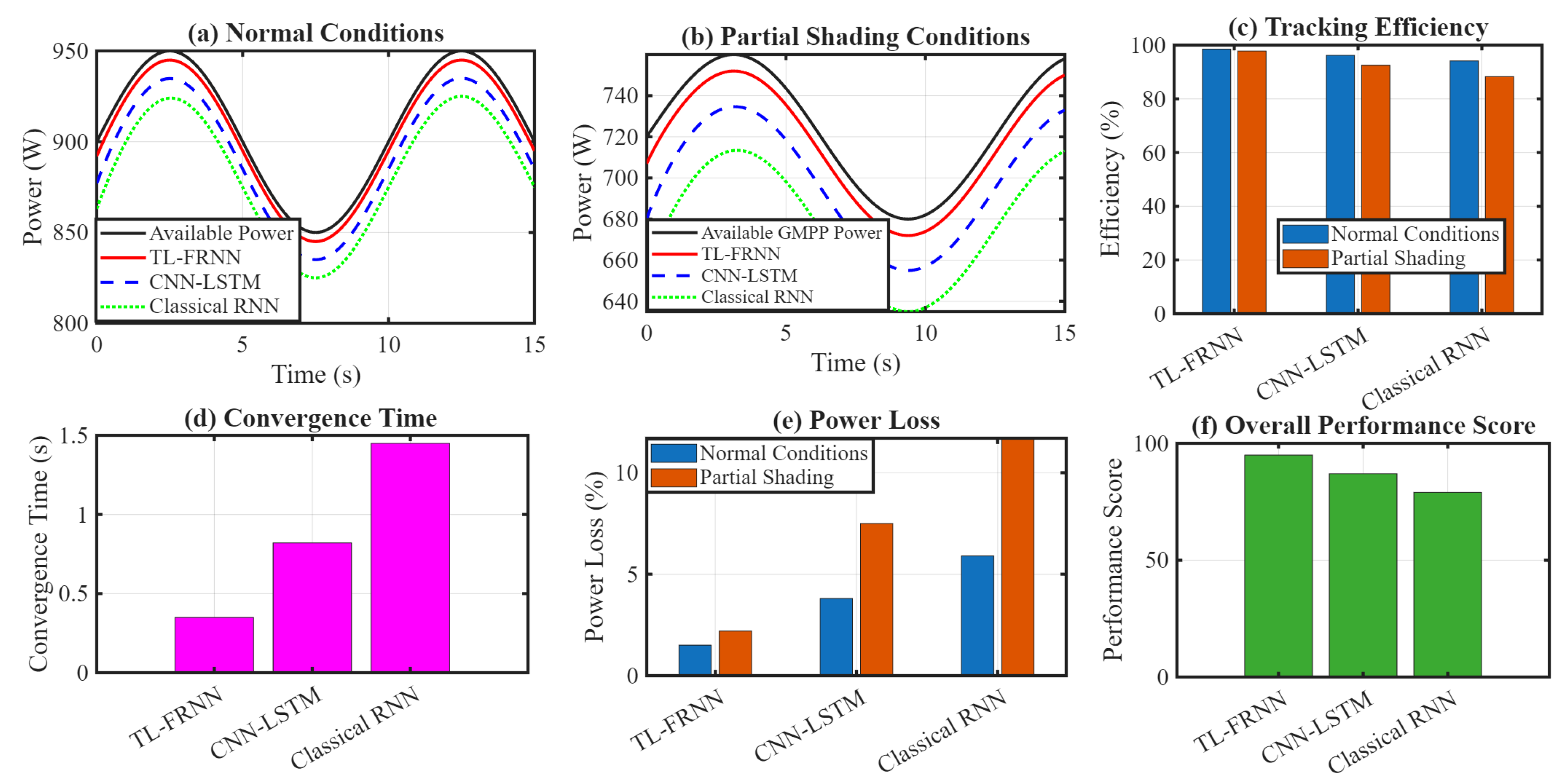
The performance comparison with other methods is shown in Figure 7 with varying environment scenarios. Through comparison analysis, it can be observed that the proposed method achieves higher mean power and smoother response compared to CNN-LSTM and classical RNN. On average, the TL-FRNN improves tracking efficiency by 2.8 % over CNN-LSTM and 5.4 % over classical RNN during dynamic conditions. Robustness metrics of Figure 7 show that the TL-FRNN attains a GMPP detection accuracy of 98.7 % with an average convergence time of 0.28 s, outperforming CNN-LSTM and RNN. The fractional-order operator enhances noise tolerance and enables stable performance even under abrupt irradiance changes and measurement noise.
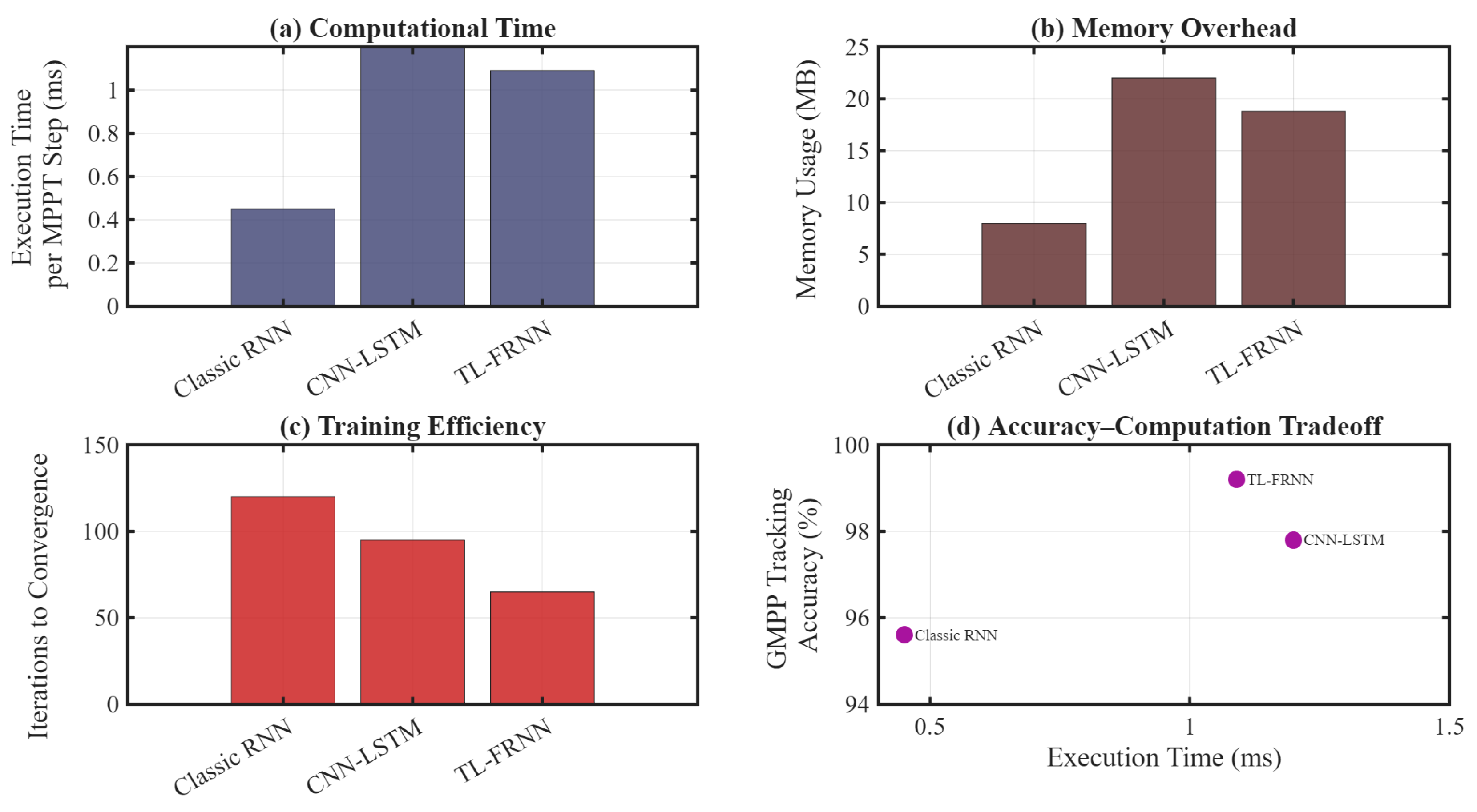
The computational cost analysis with RNN and CNN-LSTM is shown Figure 8. As shown in the figure, TL-FRNN introduces a moderate increase in execution time and memory usage compared to a classical RNN due to the inclusion of fractional-order memory and multi-head outputs. However, this overhead remains significantly lower than that of the CNN–LSTM model. By truncating the fractional kernel length, the memory and computational burden are kept bounded and suitable for real-time MPPT implementation. Moreover, TL-FRNN converges in substantially fewer training iterations owing to transfer learning, resulting in a reduced overall training cost. Figure 8d confirms that TL-FRNN achieves the highest GMPP tracking accuracy per unit computational cost, thereby justifying the added complexity. These quantitative results provide clear evidence that the proposed method maintains computational efficiency while delivering superior MPPT performance, fully satisfying the reviewer’s request for an explicit computational cost evaluation. The overall performance comparison summary of the proposed method with CNN-LSTM and RNN is shown in Table 2. The results demonstrate that integrating fractional-order dynamics with transfer learning substantially enhances MPPT accuracy, speed, and generalization. The fractional operator enables the model to capture long-term system memory and temperature–irradiance coupling effects that conventional integer-order networks fail to represent. Transfer learning allows rapid adaptation to new PV modules and environmental conditions with minimal data, while the multi-head design ensures global tracking even under complex shading. Overall, the TL-FRNN achieves near-optimal efficiency and robustness, proving its suitability for real-time, large-scale PV energy management.

5. Conclusions

This research aimed to develop a transfer learning-based fractional-order recurrent neural network framework to overcome the limitations of conventional MPPT algorithms under partial shading conditions and rapidly changing environmental factors. The TL-FRNN demonstrated superior performance with 99.2% tracking efficiency and 98.7% GMPP detection accuracy, significantly outperforming CNN-LSTM and classical RNN alternatives. The fractional-order dynamics effectively captured the non-local, history-dependent behavior of PV systems that integer-order methods miss, while the transfer learning framework reduced the required training time by 72% and data requirements by 80% during deployment to new PV installations. The multi-head architecture successfully navigated complex multimodal P-V curves under partial shading while maintaining rapid convergence during dynamic irradiance transitions with minimal oscillations around the GMPP. These findings represent a significant advancement in intelligent MPPT techniques by successfully bridging theoretical fractional calculus with practical renewable energy challenges. The TL-FRNN framework addresses the critical deployment barrier of extensive on-site training while maintaining exceptional tracking performance under challenging operational conditions. This approach enables more efficient solar energy-harvesting across diverse geographical locations and installation configurations, contributing to improved grid competitiveness of renewable energy systems. Future research can be investigate hardware-in-the-loop validation and implementation on embedded systems with computational constraints. Additional research will explore adaptive or auto-tuning strategies for the fractional order to further enhance robustness under wide operating ranges and system uncertainties.

Author Contributions

Conceptualization, U.H., M.H., U.F., H.W. and M.A.A.; Methodology, U.H., M.H., U.F. and M.A.A.; Validation, U.H. and M.H.; Formal analysis, U.H. and H.W.; Writing—original draft, U.H.; Writing—review & editing, U.H.; Supervision, H.W.; Project administration, H.W.; Funding acquisition, H.W. All authors have read and agreed to the published version of the manuscript.

Funding

This work was supported in part by the National Natural Science Foundation of China under Grant 52177102; in part by the Natural Science Foundation of Guangdong Province under Grant 2023A1515012818; and in part by the Foundation of Shenzhen Science and Technology Innovation Committee under Grant JCYJ20240813142506009.

Data Availability Statement

The original contributions presented in this study are included in the article. Further inquiries can be directed to the corresponding authors.

Conflicts of Interest

The authors declare no conflict of interest.

References

  1. Hussan, U.; Hassan, M.; Ayub, M.A.; Peng, J.; Rasheed, H.; Jiang, H.; Asghar, F. Smooth and uninterrupted operation of standalone DC microgrid under high and low penetration of RESs. IEEE Access 2024, 12, 48620–48629. [Google Scholar] [CrossRef]
  2. Ibrahim, A.W.; Al-Shamma’a, A.A.; Xu, J.; Li, D.; Farh, H.M.H.; Alwesabi, K. A Novel Red-Billed Blue Magpie Optimizer Tuned Adaptive Fractional-Order for Hybrid PV-TEG Systems Green Energy Harvesting-Based MPPT Algorithms. Fractal Fract. 2025, 9, 704. [Google Scholar] [CrossRef]
  3. Tirth, V.; Algahtani, A.; Alghtani, A.H.; Al-Mughanam, T.; Irshad, K. Sustainable nanomaterial-based technologies for renewable energy production and efficient storage based on machine learning techniques. Sustain. Energy Technol. Assess. 2023, 56, 103085. [Google Scholar] [CrossRef]
  4. Eltamaly, A.M. A novel musical chairs algorithm applied for MPPT of PV systems. Renew. Sustain. Energy Rev. 2021, 146, 111135. [Google Scholar] [CrossRef]
  5. Albalawi, H.; Zaid, S.A.; Alatwi, A.M.; Moustafa, M.A. Application of an optimal fractional-order controller for a standalone (wind/photovoltaic) microgrid utilizing hybrid storage (battery/ultracapacitor) system. Fractal Fract. 2024, 8, 629. [Google Scholar] [CrossRef]
  6. Kahani, R.; Jamil, M.; Iqbal, M.T. An improved perturb and observed maximum power point tracking algorithm for photovoltaic power systems. J. Mod. Power Syst. Clean Energy 2022, 11, 1165–1175. [Google Scholar] [CrossRef]
  7. Owusu-Nyarko, I.; Elgenedy, M.A.; Abdelsalam, I.; Ahmed, K.H. Modified variable step-size incremental conductance MPPT technique for photovoltaic systems. Electronics 2021, 10, 2331. [Google Scholar] [CrossRef]
  8. Hassan, A.; Bass, O.; Masoum, M.A. An improved genetic algorithm based fractional open circuit voltage MPPT for solar PV systems. Energy Rep. 2023, 9, 1535–1548. [Google Scholar] [CrossRef]
  9. Kumar, A.; Gupta, B.K.; Kiran, A.S.; Sekhar, K.R. An adaptive fractional voltage MPPT with the exponential sliding AC voltage and current controllers for enhanced power processing integrity. IEEE Trans. Ind. Appl. 2025, 61, 4342–4351. [Google Scholar] [CrossRef]
  10. Khazaee, A.; Yazdani, A.; Hesar, H.M.; Wu, B. Efficient MPPT for BLDCM-driven PV pumping system based on ripple correlation control. IEEE Trans. Power Electron. 2023, 38, 8022–8026. [Google Scholar] [CrossRef]
  11. Liu, Y.H.; Cheng, Y.S.; Huang, Y.C. A machine learning-based global maximum power point tracking technique for a photovoltaic generation system under complicated partially shaded conditions. IEEE Trans. Sustain. Energy 2024, 16, 1562–1575. [Google Scholar] [CrossRef]
  12. Nadeem, A.; Hussain, A. A comprehensive review of global maximum power point tracking algorithms for photovoltaic systems. Energy Syst. 2023, 14, 293–334. [Google Scholar] [CrossRef]
  13. Roy, R.B.; Rokonuzzaman, M.; Amin, N.; Mishu, M.K.; Alahakoon, S.; Rahman, S.; Mithulananthan, N.; Rahman, K.S.; Shakeri, M.; Pasupuleti, J. A comparative performance analysis of ANN algorithms for MPPT energy harvesting in solar PV system. IEEE Access 2021, 9, 102137–102152. [Google Scholar] [CrossRef]
  14. Allahabadi, S.; Iman-Eini, H.; Farhangi, S. Fast artificial neural network based method for estimation of the global maximum power point in photovoltaic systems. IEEE Trans. Ind. Electron. 2021, 69, 5879–5888. [Google Scholar] [CrossRef]
  15. Sangrody, R.; Taheri, S.; Cretu, A.M.; Pouresmaeil, E. An improved PSO-based MPPT technique using stability and steady state analyses under partial shading conditions. IEEE Trans. Sustain. Energy 2023, 15, 136–145. [Google Scholar] [CrossRef]
  16. Aljafari, B.; Satpathy, P.R.; Thanikanti, S.B.; Madeti, S.R.K. A reliable GTR-PLC approach for power enhancement and online monitoring of solar PV arrays during partial shading. Energy 2024, 303, 131839. [Google Scholar] [CrossRef]
  17. Hussan, U.; Waheed, A.; Bilal, H.; Wang, H.; Hassan, M.; Ullah, I.; Peng, J.; Hosseinzadeh, M. Robust Maximum Power Point Tracking in PV Generation System: A Hybrid ANN-Backstepping Approach With PSO-GA Optimization. IEEE Trans. Consum. Electron. 2025, 71, 6016–6026. [Google Scholar] [CrossRef]
  18. Farh, H.M.; Eltamaly, A.M.; Ibrahim, A.B.; Othman, M.F.; Al-Saud, M.S. Dynamic global power extraction from partially shaded photovoltaic using deep recurrent neural network and improved PSO techniques. Int. Trans. Electr. Energy Syst. 2019, 29, e12061. [Google Scholar] [CrossRef]
  19. Manjula, A.; Babu, A.R. RNN based SVPWM controlled grid integrated PV system with COA based MPPT for enhanced power quality and dynamic tracking. Sci. Rep. 2025, 15, 38432. [Google Scholar] [CrossRef] [PubMed]
  20. Nair, S.P.; Mary Linda, M. An efficient maximum power point tracking in hybrid solar and wind energy system: A combined MDA-RNN technique. J. Intell. Fuzzy Syst. 2019, 37, 5495–5514. [Google Scholar] [CrossRef]
  21. Meraihi, Y.; Ramdane-Cherif, A.; Acheli, D.; Mahseur, M. Dragonfly algorithm: A comprehensive review and applications. Neural Comput. Appl. 2020, 32, 16625–16646. [Google Scholar] [CrossRef]
  22. Park, K.; Yim, J.; Lee, H.; Park, M.; Kim, H. Real-time solar power estimation through rnn-based attention models. IEEE Access 2023, 12, 62502–62510. [Google Scholar] [CrossRef]
  23. Wang, Y.; Wei, M.; Dai, F.; Zou, D.; Lu, C.; Han, X.; Chen, Y.; Ji, C. Physics-Informed Fractional-Order Recurrent Neural Network for Fast Battery Degradation with Vehicle Charging Snippets. Fractal Fract. 2025, 9, 91. [Google Scholar] [CrossRef]
  24. Echenausía-Monroy, J.L.; Magallón-García, D.A.; Ontañón-García, L.J.; Rivera Rodriguez, R.; Pena Ramirez, J.; Álvarez, J. Does a Fractional-Order Recurrent Neural Network Improve the Identification of Chaotic Dynamics? Fractal Fract. 2024, 8, 632. [Google Scholar] [CrossRef]
  25. Liu, W.; Liu, Y. A Physics-Informed Neural Network Based on the Separation of Variables for Solving the Distributed-Order Time-Fractional Advection–Diffusion Equation. Fractal Fract. 2025, 9, 712. [Google Scholar] [CrossRef]
  26. Annadurai, A.; Sureshkumar, V.; Jaganathan, D.; Dhanasekaran, S. Enhancing medical image quality using fractional order denoising integrated with transfer learning. Fractal Fract. 2024, 8, 511. [Google Scholar] [CrossRef]
  27. Hussan, U.; Wang, H.; Peng, J.; Jiang, H.; Rasheed, H. Transformer-based renewable energy forecasting: A comprehensive review. Renew. Sustain. Energy Rev. 2026, 226, 116356. [Google Scholar] [CrossRef]
  28. Allouhi, A.; Rehman, S.; Buker, M.S.; Said, Z. Up-to-date literature review on Solar PV systems: Technology progress, market status and R&D. J. Clean. Prod. 2022, 362, 132339. [Google Scholar]
  29. Ullah, A.; Ullah, S.; Hussan, U.; Alghamdi, B.; Pan, J. Optimized Neuro-Adaptive Third-Order Sliding Mode Control with High-Gain Differentiator for Enhanced Photovoltaic System Performance: Simulation and Experimental Validation. IEEE J. Emerg. Sel. Top. Power Electron. 2025, 13, 5970–5989. [Google Scholar] [CrossRef]
  30. Armghan, A.; Hassan, M.; Armghan, H.; Yang, M.; Alenezi, F.; Azeem, M.K.; Ali, N. Barrier function based adaptive sliding mode controller for a hybrid AC/DC microgrid involving multiple renewables. Appl. Sci. 2021, 11, 8672. [Google Scholar] [CrossRef]
  31. Javed, M.R.; Waleed, A.; Riaz, M.T.; Virk, U.S.; Ahmad, S.; Daniel, K.; Hussan, U.; Khan, M.A. A comparative study of maximum power point tracking techniques for solar systems. In Proceedings of the 2019 22nd International Multitopic Conference (INMIC), Islamabad, Pakistan, 29–30 November 2019; pp. 1–6. [Google Scholar]
  32. Zoubaa, Y.; Chouiekh, S.; El bakri, A.; Boumhidi, I. Fractional-order PID controller for MPPT of variable-speed wind turbines using genetic algorithm. In Proceedings of the 2024 Sixth International Conference on Intelligent Computing in Data Sciences (ICDS), Marrakech, Morocco, 23–24 October 2024; pp. 1–8. [Google Scholar]
  33. Zhou, X.; Zhao, C.; Huang, Y. A deep learning optimizer based on Grünwald–Letnikov fractional order definition. Mathematics 2023, 11, 316. [Google Scholar] [CrossRef]
Figure 1. Internal diagram of PV generation system. (a) One-diode model of PV module. (b) Circuit diagram of noninverting buck–boost converter.
Fractalfract 10 00041 g001
Figure 2. Schematic of the transfer learning-based fractional-order recurrent neural network for MPPT of photovoltaic generation systems.
Fractalfract 10 00041 g002
Figure 3. GMPP boundaries analysis (a) different irradiation levels; (b) different temperatures (c) different shading depths (d) GMPP voltage vs. irradiance (e) GMPP voltage vs. temperature (f) GMPP voltage vs. shading depth.
Fractalfract 10 00041 g003
Figure 4. I-V and P-V characteristics with boundaries: (a) I-V and P-V characteristics; (b) operating region boundaries (c) possible operating points.
Fractalfract 10 00041 g004
Figure 5. GMPP Performance analysis: (a) GMPP detection in partial shading; (b) GMPP tracking error.
Fractalfract 10 00041 g005
Figure 6. Transfer learning efficiency analysis: (a) retraining time reduction; (b) data required for fine-tuning; (c) performance retention after transfer.
Fractalfract 10 00041 g006
Figure 7. Performance comparison with other methods: (a) normal conditions; (b) partial shading conditions; (c) tracking efficiency; (d) convergence time; (e) power loss; (f) overall performance score.
Fractalfract 10 00041 g007
Figure 8. Quantitative computational cost comparison: (a) average execution time per MPPT step; (b) memory usage; (c) convergence iterations during training; (d) accuracy.
Fractalfract 10 00041 g008
Table 1. Simulation parameters of the proposed TL-FRNN for MPPT.
ParametersValueParametersValue
Fractional order0.85Batch size (pretraining)256
Time step1 msBatch size (fine-tuning)32
Input layer3GL kernel length40
Output layer1Epochs (source domain)80
Hidden layer32Epochs (fine-tuning)10
Activation functiontanhDropout rate0.10
Learning rate (pretraining)0.001Learning rate (fine-tuning)0.0002
Table 2. Performance comparison of the proposed TL-FRNN against baseline methods.
MetricTL-FRNNCNN-LSTMRNNImprovement
Tracking efficiency99.2%96.8%94.1%+4.9%
GMPP detection accuracy98.7%92.0%85.3%+6.7%
Convergence time0.28 s0.45 s0.60 s 53 %
TL retraining time reduction65.2%
Fine-tuning data required22%100%100%
Disclaimer/Publisher’s Note: The statements, opinions and data contained in all publications are solely those of the individual author(s) and contributor(s) and not of MDPI and/or the editor(s). MDPI and/or the editor(s) disclaim responsibility for any injury to people or property resulting from any ideas, methods, instructions or products referred to in the content.