


Abstract
In the era of deepfakes and AI-generated content, digital image manipulation poses significant challenges to image authenticity, creating doubts about the credibility of images. Traditional image forensics techniques often struggle to detect sophisticated tampering, and passive detection approaches are reactive, verifying authenticity only after counterfeiting occurs. In this paper, we propose a novel full-resolution secure learned image codec (SLIC) designed to proactively prevent image manipulation by creating self-destructive artifacts upon re-compression. Once a sensitive image is encoded using SLIC, any subsequent re-compression or editing attempts will result in visually severe distortions, making the image’s tampering immediately evident. Because the content of an SLIC image is either original or visually damaged after tampering, images encoded with this secure codec hold greater credibility. SLIC leverages adversarial training to fine-tune a learned image codec that introduces out-of-distribution perturbations, ensuring that the first compressed image retains high quality while subsequent re-compressions degrade drastically. We analyze and compare the adversarial effects of various perceptual quality metrics combined with different learned codecs. Our experiments demonstrate that SLIC holds significant promise as a proactive defense strategy against image manipulation, offering a new approach to enhancing image credibility and authenticity in a media landscape increasingly dominated by AI-driven forgeries.
1. Introduction
In the past, a picture was worth a thousand words, but in the modern era of deepfakes and manipulated media, a picture now leads to a thousand doubts. Digital image manipulation has long posed a security threat to images shared on social media, causing people to increasingly distrust sensitive images circulating on these platforms, often requiring them to re-confirm the image source. Detecting forged images from simple editing operations, such as splicing and copy–move, remains challenging due to the increasing sophistication of these techniques. The rise of deepfakes [1] has further worsened the credibility issue of social media images, as tampering and counterfeiting are no longer limited to experts.
Image forensics techniques [2,3] are considered passive approaches to proving content authenticity because they detect tampering by detecting signal inconsistencies in the image. These altered images are redistributed in either lossless or lossy formats. For lossless-encoded images, pixel-based characteristics such as noise [4], patterns [5], and camera properties [6,7] are analyzed to detect local inconsistencies and identify image forgery. In the case of lossy image codecs like JPEG, methods [8,9] exist to detect double JPEG compression, as JPEG exhibits specific characteristics in its DCT coefficients that help identify possible manipulated images. Active approaches, such as trustworthy cameras [10,11] or fragile digital watermarking [12,13], attempt to authenticate the image upon creation and detect later modifications by verifying embedded signatures or watermarks. These are considered active because any break in the signature or watermark serves as solid evidence of tampering. However, authenticity verification typically occurs only after counterfeiting has taken place.
We propose a novel proactive approach, the secure learned image codec (SLIC), designed to prevent image manipulation from the outset. Figure 1 demonstrates the self-destruction effects of our proposed SLIC, which forces a malicious actor to obtain severely degraded visual content after re-compression. Once the content owner releases a sensitive image in SLIC format, the content is protected, as any subsequent re-compression—even after image editing—will result in eye-catching artifacts. In other words, SLIC is a non-idempotent codec. Because the content of an SLIC image is either original with good quality or visually damaged after tampering, images encoded with this secure codec hold greater credibility. If the public tends to trust only SLIC images, malicious actors will be forced to fabricate fake images in SLIC format to gain trust, a task that is considered non-trivial. Thus, counterfeiting can be prevented from the outset.
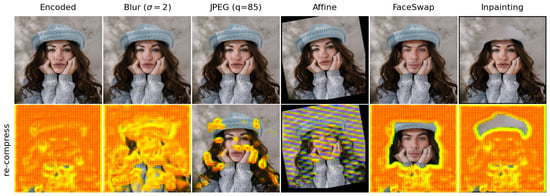
Figure 1.
The proposed secure learned image codec (SLIC) will be self-destroyed after re-compression. Top images from left to right: the first encoded image, blurred encoded image, JPEG compressed image, affine transformed image (shifted 10 pixels, rotated 5°, scaled 95%), face-swapped image, and inpainted image. The bottom re-compressed images are severely damaged.
Designing a secure codec based on conventional codecs is challenging because most of them rely on linear and unitary transforms such as the Discrete Cosine Transform (DCT). In contrast, the non-linear transform employed by a learned image codec has the potential to have a “destroy after re-compression” effect, as adversarial examples are known to neural networks. Adversarial attacks can introduce imperceptible perturbations into input images, leading to file size expansion [14] or significant quality degradation [15]. We think there are two approaches to developing a secure learned codec:
- 1.
- Watermarking a learned image codec in the compressed domain [16] as a universal adversarial attack so that the watermark added in the latent vector will cause out-of-distribution perturbations in the reconstructed image.
- 2.
- Training a neural codec whose decoder will generate out-of-distribution perturbations not seen in the training dataset.
The first approach has been validated in [16] but is limited to a fixed image resolution and watermark secret bit length. In this work, we achieve the second approach by generalizing the SLIC in full resolution and providing instant content protection right after compression. We summarize the contributions of this paper as follows:
- We introduce the full-resolution SLIC, which verifies content authenticity through destructive re-compression. The SLIC internally applies a universal adversarial attack to its output. We think developing a non-idempotent codec as a secure codec for authenticity verification will be a new area to explore to counter manipulated images.
- We propose using perceptual quality metrics in the adversarial loss to fine-tune a learned image codec that effectively generates out-of-distribution perturbations in the decoder output. We analyze and compare the antagonistic effects of various perceptual quality metrics.
- We point out the research opportunity of designing an efficient and effective perceptual metric to maximize perceptual loss. This may be an interesting topic for the study of adversarial attacks on learned image codecs.
2. Related Works
2.1. Watermarking to Defend against Image Manipulation
Ensuring digital image integrity has long been a critical issue due to the widely available image manipulation software. Therefore, watermarking has become a popular technique for copyright enforcement and image authentication [17]. The invention of deepfakes [1] further exacerbated the credibility issue because generative models to swap facial identities or revise the attributes of faces are also widely available on the internet.
Adversarial attacks [18] against generative models and adversarial watermarking [19,20] are well-known active defense strategies against deepfakes. Lv [19] proposed an adversarial attack-based smart watermark model to exploit deepfake models. When deepfakes manipulate their watermarked images, the output images become blurry and easily recognized by humans. Yu et al. [21] took a different approach by embedding watermarks as fingerprints in the training data for a generative model. They discovered the transferability of such fingerprints from training data to generative models, thereby enabling deepfake attribution through model fingerprinting. Wang et al. [22] proposed an invisible adversarial watermarking framework to enhance the copyright protection efficacy of watermarked images by misleading classifiers and disabling watermark removers. Zhang et al. [23] developed a recoverable generative adversarial network to generate self-recoverable adversarial examples for privacy protection in social networks. More recently, EditGuard [20] utilizes image steganography and watermarking techniques to unify copyright protection and tamper-agnostic localization.
These adversarial watermarking approaches are successful but focus on the image content without considering the image format, i.e., the container of the image content during transmission. We take a step further to develop a secure image codec with a learned image codec, which injects adversarial perturbations into the image content during the initial encoding and decoding process. The originality of the image is authenticated by its visual quality because any subsequent compressions after image editing will lead to severe quality degradation, as demonstrated in Figure 1.
2.2. Learned Image Compression
The learned image compression (LIC) technique is an end-to-end approach that automatically learns a pair of image encoders and decoders from a collection of images without the need for the hand-crafted design of coding tools. This field of learned image compression has witnessed significant advancements [24,25,26,27] in the past few years, surpassing traditional expert-designed image codecs. Several comprehensive surveys and introductory papers [28,29,30] have summarized these achievements.
However, by default, neural network-based codecs do not consider idempotence like traditional image codecs. Idempotence refers to image quality stability after a series of re-compressions, which is crucial to practical image codecs. Kim et al. [31] first identified the instability issue of successive deep image compression and proposed including feature identity loss to mitigate it. Specific methods, such as invertible networks [32,33], have been proposed to improve the idempotence of neural codecs. Recent work from Xu et al. [34] further proves that the conditional generative model-based perceptual codec satisfies idempotence.
Meanwhile, neural image codecs are no exception to adversarial attacks. Liu et al. [14] investigated the robustness of learned image compression, where imperceptibly manipulated inputs can significantly increase the compressed bitrate. Such attacks can potentially exhaust the storage or network bandwidth of computing systems. Chen and Ma [15] examined the robustness of learned image codecs and investigated various defense strategies against adversarial attacks to improve robustness.
A non-idempotent image codec is not practical in image applications but is worth exploring for image authentication. If a neural codec could be self-destructive in quality after re-compression, it would be a roadblock for image tampering in this format. Thus, we can accumulate trust in such secure learned image codecs and deter counterfeiting behaviors.
2.3. Perceptual Distance Metrics
The evaluation of image distortion from lossy compression relies on full-reference image quality assessment metrics, which gauge the similarity between the distorted and the original images as human observers perceive. In addition to the traditional Mean-Square Error (MSE), subjective metrics such as SSIM [35], GMSD [36], and NLPD [37] have been widely employed. These quality metrics somehow represent the signal difference in a transformed domain (e.g., GMSD from the image gradient), hoping to align with human perceptual judgment. Recently, new DNN-based methods like VGG loss [38], LPIPS [39], PIM [40], and DISTS [41] have been proposed. These approaches have demonstrated superior predictive performance for subjective image quality. Their efficacy has been confirmed through validation against human judgments on benchmark datasets like BAPPS [39] and CLIC2021 [42], which comprise a comprehensive collection of two-alternative forced choice (2AFC) human judgments. More recent works, such as Deep Distance Correlation (DeepDC) [43], which focuses on feature space comparisons between pre-trained DNNs, improve on earlier metrics like LPIPS and DISTS by incorporating distance correlation to handle structure and texture similarities effectively.
In various computer vision tasks, such as style transfer [44], super-resolution [45], and watermarking [46], these quality metrics are often used in the loss function as perceptual loss to improve the image quality. In this work, we utilize and compare these quality metrics’ effectiveness as a perceptual loss to maximize the visual divergence as an adversarial attack.
2.4. Adversarial Attacks
Szegedy et al. [47] first introduced the notion of adversarial examples and demonstrated that neural networks are vulnerable to small perturbations in input data. The goal of an adversarial attack is to find an adversarial example that is indistinguishable to the human eye but can lead to significant misclassifications. Adversarial attacks can be either targeted or untargeted.
Searching for adversarial examples was once considered computationally expensive because of its optimization nature. Szegedy et al. approximated it using a box-constrained L-BFGS. Goodfellow et al. [48] proposed the Fast Gradient Sign Method (FGSM), a straightforward yet powerful approach for generating adversarial examples. FGSM is computationally efficient because it leverages the gradient of the loss function concerning the input data to create perturbations that maximize the model’s prediction error.
Later, more sophisticated attack techniques were introduced. Kurakin et al. [49] extended FGSM by developing the iterative method I-FGSM, which applies FGSM multiple times with small step sizes. Madry et al. [50] substituted FGSM with Projected Gradient Descent (PGD), which iteratively adjusts the perturbations based on the same calculation formula as FGSM, but differs in introducing random noise to the original image and constraining total perturbation by clamping the noise in every iteration. Carlini and Wagner [51] proposed C&W attacks, which optimized a different objective function to generate adversarial examples. These attacks demonstrated a higher success rate in bypassing defenses.
Zhu et al. [52] conduct iterative FGSM and PGD attacks on six LIC models and use PGD training as a defense method to improve the robustness. Chen and Ma [15] propose the Fast Threshold-constrained Distortion Attack (FTDA) approach to generate adversarial examples with balanced performance and complexity compared to methods like C&W or I-FGSM. It is known that “adversarial examples are not bugs but features of neural networks”. However, in the context of developing an SLIC, it is not effective to perform an adversarial attack on a per-image basis or even learn a universal adversarial perturbation to exploit the re-compression quality.
3. Proposed Method
3.1. Idempotence of Image Codec
The idempotence of an image codec refers to the codec’s stability to re-compression. For any input image , the neural encoder transforms x into a latent representation . The neural decoder reconstructs an estimation of x as . Here, we denote as the n-th compression result of x and as the composition of the encode-then-decode function. We use a perceptual metric to measure the distortion caused by a lossy image codec. A lossy image codec usually ensures . We say that an image codec is idempotent if
That is, an idempotent codec always produces the same result when re-compressing a prior reconstruction. To create a non-idempotent image codec as a secure codec, we wish to make a visually destroyed second compressed image , which satisfies
but its first compressed image remains perceptually close to the original image x as
3.2. Adversarial Loss for Perceptual Divergence
We fine-tune a neural encoder/decoder pair and with model parameters and to obtain an SLIC codec, such that the perceptual distance between and diverges as much as possible, that is,
where and are the first and second compression results, the perceptual distance can be any previously discussed quality metrics, such as or . Ideally, the perceptual distance of is minimized through the rate–distortion optimization process. Figure 2 shows the SLIC training flow.
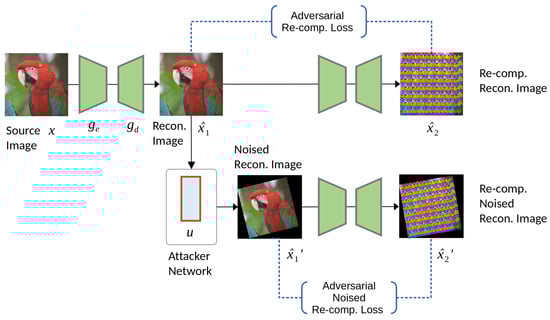
Figure 2.
The SLIC training flow. In a rate–distortion optimized neural codec, we introduce the adversarial re-compression and the adversarial noised re-compression losses.
Our loss function to fine-tune the SLIC is defined as:
where and are hyper-parameters that control the trade-off between bitrate, distortion, and the loss caused by the adversarial re-compression, . The bitrate of the transformed discrete code , , is lower-bounded by the entropy of the discrete probability distribution . Here, we estimate the discrete probability distribution using a neural network and then encode it into a bitstream with an entropy coder. The distortion is measured using a distance metric , where MSE or SSIM is commonly used. We add the adversarial re-compression loss in the training flow as follows:
where is the perceptual distance, such as LPIPS or GMSD mentioned in Section 2.3. A smaller distance represents a similar image pair, where a zero distance means identical images. To divert the perceptual quality of from , we design the adversarial loss function as a constant minus perceptual distance, passing through the ReLU function. When the ReLU function reaches its minimal value at zero, the perceptual distance approaches the constant . The design of the adversarial loss function stabilizes the loss during training and provides better control over adversarial trade-offs.
Except for modeling the divergence between the encoded and re-compressed , we treat any possible image editing operation that comes with image tampering as a noise attack and use a noise-adding attacker u to simulate it. The noised encoded image and the noised second re-compression image are also considered in the adversarial loss function. As indicated in Figure 2, we denote the first and second terms of Equation (6) as adversarial re-compression loss and adversarial noised re-compression loss, respectively.
With the adversarial re-compression loss , we fine-tune the image codec to attack itself by generating invisible adversarial perturbation in the reconstructed image . As a result, when the reconstructed image is re-compressed, it exploits the image encoder and produces a severely damaged image . The SLIC’s coding efficiency, i.e., the bitrate, is maintained by the rate–distortion loss during the fine-tuning process.
3.3. Noise Attack Simulation
In practical scenarios, the published SLIC-encoded image may undergo various editing operations such as cropping, scaling, rotation, and lighting adjustment before the tampering behavior. These edits are considered noise attacks to the SLIC-encoded image, and our SLIC should be robust to these attacks. To simulate noise attacks, we use an attacker u similar to [53] and derive the noised encoded image as , then re-compress it as . We define eight types of editing operations commonly used in creating spliced fake images, including crop, Gaussian blur, median filtering, lightening, sharpening, histogram equalization, affine transform, and JPEG compression. We then test the resilience of our first encoded image against these image manipulations and evaluate the effectiveness of the SLIC upon re-compression.
Surprisingly, our SLIC demonstrates robustness against non-filtering editing operations such as lightening, sharpening, and histogram equalization, even without noise attack simulation. These attacks tend to increase rather than decrease the magnitude of the adversarial perturbation. We classify Gaussian blur, median filtering, affine transform, and JPEG compression as filtering editing operations. These adversarial perturbations added to the first encoded image are partially filtered due to resampling. Therefore, to enhance robustness, we simulate three types of noise attacks in fine-tuning:
Gaussian blur: We randomly apply Gaussian blur with a kernel size of 3 and variance ranging from 0.1 to 1.5 to the first encoded images.
Affine transform: We randomly rotate the encoded images from −10 to 10 degrees, translate them from 0% to 10% on both axes, and scale them from 90% to 110%.
JPEG compression: We re-compress the encoded images with random JPEG quality from 70 to 95. Although differentiable JPEG quantization simulations have been proposed, such as mask-and-drop [54] and cubic rounding [55], we use an image transformation task to simulate the JPEG compression effects because of better robustness. More details are given in Appendix A.1.
During training, the noise attacker will randomly apply one of the above noise attacks. We do not simulate other attacks because, through experiments, we found that randomly alternating these three attacks enhances the robustness of the eight pre-defined noise attacks. Further discussion on this is provided in Section 4.4.
4. Experimental Results
We implemented our SLIC using the CompressAI [56] release of neural codecs [24,25,26], denoted as Balle2018, Minnen2018, and Cheng2020. The MSE-optimized pre-trained models from CompressAI were used for fine-tuning. For training, we randomly selected 90% of the images from the COCO dataset [57] as the training set and the remaining 10% as the validation set. We employed the PyTorch 2.0.0 built-in Adam optimizer with a learning rate to fine-tune a pre-trained LIC mode for 100 epochs. An early stopping criterion was implemented during training if the learning rate decayed lower than . Training images were randomly cropped as patches with a batch size of 12 using an NVIDIA GeForce RTX 4090 GPU. We set in the adversarial loss function from Equation (6). In the overall rate–distortion adversarial loss function from Equation (5), we follow the same value setting as CompressAI and tweak the hyper-parameter, as shown in Table 1. We report the experimental numbers using a high bitrate setting as quality scale 8. However, the destructive re-compression effect can be observed for all quality settings.

Table 1.
The values for different LIC quality scales.
We evaluated our SLIC on the Kodak [58], FFHQ [59], and DIV2K [60] datasets. We used the original-resolution images from Kodak () and FFHQ (). Due to GPU memory constraints, we resized the DIV2K images to around and padded the size with a multiple of 32 using replication mode. To evaluate our SLIC’s robustness, we defined eight types of editing operations commonly mixed with image tampering: crop, Gaussian blur, median filtering, lightening, sharpening, histogram equalization, affine transform, and JPEG compression. The parameter settings are listed in Table 2.
Table 2.
Parameter settings of editing operations used for evaluation.
4.1. Perceptual Metrics Comparison
Since our adversarial re-compression loss leverages the perceptual metric to divert the perceptual distance between re-compression results, we first tested different perceptual metrics with the Balle2018 codec to observe the adversarial effects. The last two rows of Table 3 show that the traditional metrics and are unsuccessful in achieving this goal. Their re-compression PSNR values are high, so the visual quality remains indistinguishable to the human eye. During the training, the adversarial loss of MSE and MS-SSIM in Figure 3a and re-compression PSNR in Figure 3b remain flat. We think this is because the MSE is a summation-based metric, and the SSIM operates on a small local window with luminance, contrast, and structure components. Minimizing MSE or MS-SSIM for a reconstruction-based neural network is straightforward and efficient. Still, these pixel-based metrics cannot provide helpful perceptual features for the neural network to divert the re-compression quality.
Table 3.
The re-compression quality degradation in PSNR of the SLICs. We used Balle2018 as the primary codec with different perceptual metrics to fine-tune the SLICs. A significantly low PSNR indicates the destructiveness of re-compression.
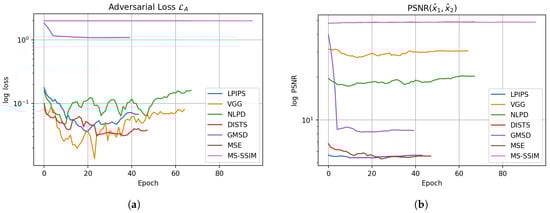
Figure 3.
The trends of (a) adversarial loss and (b) re-compression PSNR among various perceptual metrics during training.
Then, we tested the DNN-based perceptual metrics and . The VGGLoss uses the intermediate feature activations of a pre-trained VGG network (precisely, layers like conv1_2, conv2_2, conv3_3, and conv4_3) to compute the perceptual loss, which captures image quality more effectively than simple pixel-wise losses. The LPIPS metric builds on a pre-trained VGG network and adds a linear layer as weights to re-calibrate each feature map’s importance with a human-rated ground truth. From Figure 3a, the use of and in the adversarial loss is efficient, as the loss decreases obviously through epochs. We observe a similar loss pattern on a recently developed DNN-based metric, DISTS.
However, the quality result from the PSNR value of differs greatly from that of and , where its re-compression quality remains indistinguishable from the first compression result. The re-compression PSNR value of or , shown in Table 3, is significantly lower, so the SLIC trained with perceptual metric or effectively degrades visual quality. We think this is because both LPIPS and DISTS learn a weighting layer on top of the VGG feature maps with a human-rated perceptual dataset, so the two metrics weigh more on features that are sensitive to human perception. As a result, a tiny invisible perturbation added to the compressed output will trigger a change in a perceptual sensitive feature map that causes severe quality damage in the re-compression. As for VGGLoss, feature maps are learned specifically for object detection purposes, and the magnitude of feature map coefficients highly impacts the calculation of VGGLoss (L1 or L2 norm). Therefore, we can observe that the adversarial loss of decreases (which means increased quality divergence) during training in Figure 3b, but the PSNR values remain high and less changed in Figure 3a throughout the training process. That is, the increased distance of VGGLoss does not divert the actual perceptual distance of two images.
In addition to the DNN-based perceptual metric, we include the test with the better-developed traditional quality metrics GMSD and NLPD to compare their ability to divert the re-compression quality. The Gradient Magnitude Similarity Deviation (GMSD) [36] is designed to measure perceptual similarity and focus on gradient information in both the x and y directions, as human vision is highly sensitive to edges and gradient changes in images. The Normalized Laplacian Pyramid Distance (NLPD) [37] is rooted in Laplacian Pyramid decomposition, which captures image details at multiple scales and mimics the multi-scale nature of human visual perception. Table 3 shows that both GMSD and NLPD reduce the PSNR of re-compression image notably compared to MSE and MS-SSIM. However, the adversarial effect of NLPD is not robust to various editing operations like GMSD, which is showcased in Section 4.3. We can think of NLPD as a metric scored from a simplified shallow network with Laplacian filters compared to the VGGLoss from a deep VGG network that learns filter maps from ImageNet. This may explain the lesser effectiveness of NLPD as a perceptual metric to divert the visual quality.
As GMSD computes the gradient magnitude similarity (GMS) between two images and uses the standard deviation of the GMS values to measure the difference, a minor update on the standard deviation of GMS may lead to regions of significant perceptual differences due to gradient change. This is why the GMSD is quite effective in diverting the visual quality as PSNR decreases, as shown in Figure 3b.
4.2. Destructive-Compression Effects
We present the qualitative re-compression results of in Figure 4. In the second and third rows of Figure 4, the re-compression quality of the SLIC codec trained with the perceptual metrics and is almost destroyed and unrecognizable from the prior compressed , which aligns with the low averaged PSNR value of around 5 in Table 3. The quality damage introduced by the perceptual metrics LPIPS and DISTS are far more severe than artifacts caused by other adversarial attacks [15,52]. It is interesting to note that LPIPS and DISTS have different artifact patterns, probably due to the design nature of the perceptual metric. The re-compression artifacts caused by the metric combined with the neural codecs Balle2018, Minnen2018, and Cheng2020 are presented in Figure 5, Figure A2 and Figure A3, respectively. Their artifact patterns are similar except for the overflowed and truncated pixel colors, which should be affected by the randomness of image batches when we fine-tune the neural codec.
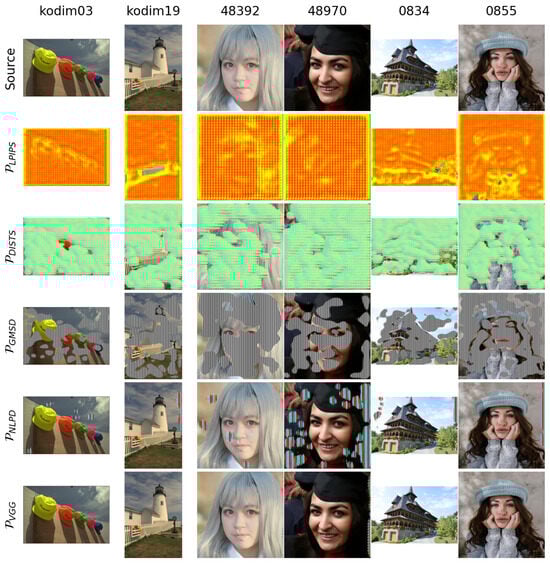
Figure 4.
The re-compression visual quality of the SLICs. The top row shows the source images and the remaining rows are the re-compressed images of Balle2018 codecs, adversarially trained with different perceptual metrics.
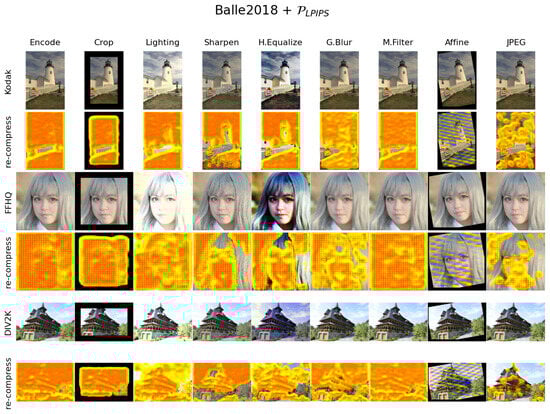
Figure 5.
The re-compressed results of Balle2018 + SLIC images after various editing operations.
The re-compression artifacts caused by the metric have easily visible uniform vertical black-and-white stripes, as shown in the fourth row of Figure A1. We think the pattern may come from the image gradients in the x direction. The metric causes fewer artifacts than but with similar vertical thicker red and light blue strips. The last row in Figure 4 shows the re-compression result of metric . The VGGLoss metric causes very few artifacts near image borders, like the “48970” image of the FFHQ dataset, which echoes the findings we mentioned in the previous section; the VGGLoss is not an adequate metric to exploit the neural encoder for a degraded re-compression result.
We provide more destructive-compression results in Appendix A.2. Pursuing a perfect perceptual metric that 100% matches human visual judgment is a holy grail of the image quality assessment research field. Most studies focus on minimizing perceptual loss, but almost zero studies have been conducted on effectively diverting one perceptual quality from another. This may be an interesting research topic for studying adversarial attacks on learned image codecs.
4.3. Robustness Against Editing Operations
Due to the original image being manipulated for counterfeiting, which will undergo various image distortions, the SLIC must be robust enough for possible image editing. We present our SLIC’s robustness against eight pre-defined editing operations in Table 4. We tested three selected neural codecs with the perceptual metrics and , and the PSNR values were less than 10 in general across the tested SLICs. Figure 5 shows the Balle2018 + codec’s re-compression quality degradation as an example; more results are listed in Appendix A.2.
Table 4.
The re-compression quality degradation on edited images in PSNR. The SLICs were trained using different neural codecs and perceptual metrics and evaluated on test datasets.
The robustness of cropping proves that the adversarial perturbations added to the compressed output are translation-invariant. Our SLIC is not impacted by possible distortions such as sharpening, lighting adjustment, and color adjustment during image tampering because these edits will not smooth out the adversarial perturbations but magnify them. Filtering editing operations such as Gaussian blur, median filtering, affine transform, and JPEG compression, will partially filter out adversarial perturbations. Still, the noise attacker simulates this kind of distortion during training. Therefore, our SLIC can still destroy the visual quality after re-compression given challenging distortions such as blurring, rotation, scaling, and JPEG compression. The qualitative results in Figure 5 demonstrate our SLIC’s robustness in being used as a secure image codec.
As JPEG is a well-known traditional re-compression attack, we wondered whether our SLIC can resist the re-compression attack from modern neural image codecs. We conducted a re-compression attack on the SLIC images using the original neural image codecs and present the result in Table 5. From Table 5, the adversarially trained SLICs, Balle2018 + and Minnen2018 + , are robust to vanilla neural codecs, except for Cheng2020. The Balle2018 and Minnen2018 re-compressed SLIC image will lead to a low PSNR value around 17 with noticeable artifacts. A neural codec with a superior compression rate like Cheng2020 will filter out adversarial perturbations in SLIC images and invalidate security protection. However, if an SLIC is trained with a high-compression-rate codec, e.g., Cheng2020 + SLIC, its adversarial perturbation will resist all other neural codecs, as indicated in the last row of Table 5.
Table 5.
The re-compression quality degradation of SLICs in PSNR. We use the original LIC to re-compress as a kind of re-compression attack.
Our preliminary result for neural codec re-compression robustness is encouraging, as we do not simulate the neural re-compression attack during training. Future work could consider how to incorporate neural compressor attacks in the attacker network for a more robust SLIC.
4.4. Robustness Against GenAI
In the era of AI-generated content, generative AI (GenAI) tools can manipulate images conveniently and provide more realistic outputs than traditional image editing software. For deepfakes, research efforts like FaceShifter [61] have developed methods to transfer a target face onto a victim’s image, producing highly realistic results. Online tools such as Remaker AI [62] provide vivid face swap tools that are freely available to the public. We tested our SLIC with Remaker AI face swap and Stable Diffusion Inpaint [63] to validate its robustness against GenAI tools. Figure 6 demonstrates that our SLIC can still damage the image quality of a GenAI-manipulated image after re-compression.
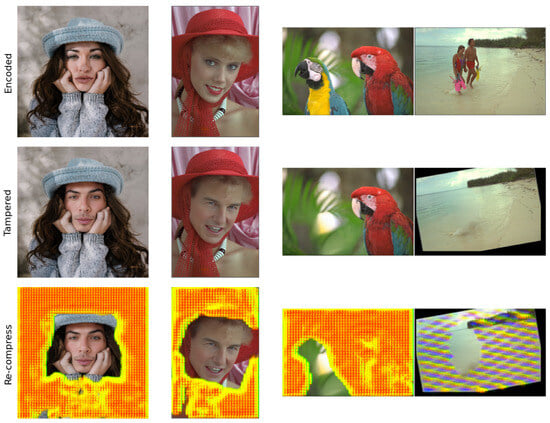
Figure 6.
The results of the Balle2018 + SLIC images were re-compressed after GenAI manipulation: faceswap and stable diffusion inpainting.
We provide two face swap results and two inpainting results in Figure 6. After re-compression, only the implanted regions with the target face or generated background are kept; the remaining areas are destroyed with adversarial artifacts. The last column of Figure 6 shows our SLIC’s robustness in dealing with compound editing, in which an image is rotated, scaled, and then inpainted. If an image is encoded in SLIC format, the whole image is protected unless the tampering behavior transplants a large portion of the region. In that case, almost all the essential information in the protected image is lost, which also means the integrity of the image is protected.
However, if the SLIC-encoded image contains a face we want to protect, the adversarial effect is lost after the victim’s face is re-generated onto the target image. In Figure 7, the tampered image in the third column comprises a non-SLIC encoded image and an SLIC-encoded face. The adversarial perturbations on the victim’s face are transformed by the generative model’s encoder to a latent space representation and re-generated, aligned, and blended onto the target image. Face-swapping eliminates adversarial perturbations, so the re-compression result remains high-quality. Preserving the adversarial perturbations through the face re-generation process would be an essential research direction to explore.
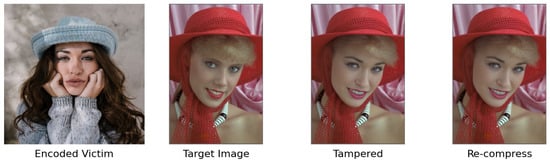
Figure 7.
The failed case: an SLIC-protected face will lose its adversarial perturbations after deepfake re-generation of the victim’s face on the target image.
4.5. Coding Efficiency Impact
Conceptually, the proposed SLIC generates out-of-distribution noise signals, as adversarial perturbations in the decoder output will reduce the coding efficiency of natural images. Therefore, when fine-tuning the neural codec, we keep the rate–distortion function and jointly optimize it with the adversarial loss. We present the rate–distortion curve of our SLIC evaluated on the Kodak dataset in Figure 8. Our fine-tuned neural codec as an SLIC remains optimal in terms of coding efficiency compared to vanilla ones.
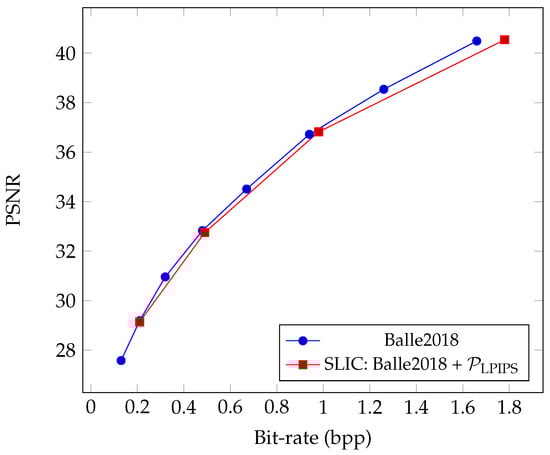
Figure 8.
The rate–distortion curve of the SLIC Balle2018 + compared with the original codec. They were evaluated on the Kodak dataset.
5. Discussion
Our work demonstrated the ability of our SLIC to generate destructive results upon re-compression, effectively preventing unauthorized image modifications. However, several areas require further investigation to maximize its effectiveness and practical applicability.
5.1. Effectiveness of Perceptual Metrics
Our experiments highlighted that different perceptual metrics influence the performance of the SLIC in generating destructive-compression effects. We observed that deep-learning-based metrics like LPIPS and DISTS are more effective in creating visually disruptive artifacts compared to traditional metrics such as MSE or SSIM. Despite this, the selection of the most suitable perceptual metric for SLICs remains an open research question. Understanding why specific metrics better induce visual distortions requires further exploration into their internal mechanisms.
5.2. Adversarial Perturbation Preservation
One limitation we identified is the loss of adversarial perturbations when the protected image undergoes complex manipulations, such as face-swapping or deepfake generation using generative models. Preserving adversarial perturbations through such transformations is a critical area for future research. Investigating methods to make these perturbations invariant to transformations or exploring how to embed them more deeply within the image’s feature space could lead to more robust defenses against generative AI manipulations.
5.3. Limitations
Although our SLIC focuses on tampering prevention by generating severely degraded content upon re-compression, it cannot guarantee that every part of the content will be destroyed. This limitation is evident in Table 5, where a PSNR of 5 indicates an entirely unusable image. However, certain unknown editing operations, such as a neural codec re-compression attack, might produce an image with artifacts and a low PSNR (e.g., a value of 21) that remains applicable for redistribution. To mitigate this, developing image authentication features for our SLIC is an essential direction for future work. By doing so, we can achieve both tampering prevention and image authentication. For cases where tampered images contain artifacts but are still marginally usable, post-authenticity validation can serve as a complementary measure to address this limitation.
6. Conclusions
In this paper, we proposed a full-resolution secure learned image codec (SLIC) as a proactive defense mechanism against image manipulation and tampering. Unlike traditional codecs, SLIC employs adversarial perturbations that degrade image quality upon subsequent re-compression, ensuring that any edited or tampered image is visually compromised. Our experiments demonstrate that SLIC effectively creates a non-idempotent codec, where the first encoded image remains high-quality, while the second re-compressed version exhibits severe visual degradation. We achieved this by incorporating perceptual quality metrics into the adversarial loss, which enabled our codec to generate out-of-distribution perturbations. Among the tested perceptual metrics, LPIPS and DISTS were particularly effective in creating adversarial artifacts. Additionally, SLIC showed robustness against a variety of common image editing operations and GenAI-based manipulations, including face-swapping and inpainting. Our proposed SLIC highlights the potential of integrating adversarial training with learned image codecs as a novel approach to enhance image authentication and manipulation resistance. Though it has limitations, we believe this proactive strategy paves a new path for digital content verification from an image format perspective, restoring trust in image credibility when faced with advancing image manipulation techniques. We have released our source code at https://github.com/chenhsiu48/SLIC, accessed on 2 November 2024, to facilitate reproducibility and enable further validation by the research community.
Author Contributions
Conceptualization, C.-H.H.; methodology, C.-H.H.; software, C.-H.H.; validation, C.-H.H.; writing, C.-H.H.; visualization, C.-H.H.; supervision, J.-L.W.; funding acquisition, J.-L.W. All authors have read and agreed to the published version of the manuscript.
Funding
This research was partially supported by the Minister of Science and Technology, Taiwan (grant number: MOST 111-2221-E-002-134-MY3), and National Taiwan University (grant number: NTU-112L900902).
Data Availability Statement
No new data were created in this study. Data sharing is not applicable to this article.
Conflicts of Interest
The authors declare no conflicts of interest.
Appendix A
Appendix A.1. UNetJPEG Image Transformation Task
In training our SLIC, we used a UNet-based architecture, UNetJPEG, as an image transformation task to approximate the effects of JPEG compression while conditioning on a specified quality factor. Our UNetJPEG is conditioned on the JPEG quality factor. The quality factor, which typically ranges from 10 to 100, is concatenated as an additional channel to the input image. This allows the network to adjust its output based on the provided quality factor, simulating the compression artifacts associated with various JPEG quality levels. The concatenated input is passed through the network, and the decoder reconstructs an image that mimics the distortions caused by JPEG compression at the given quality. During training, we use the standard JPEG encoder/decoder to create source and distorted image pairs for the neural network to approximate. We train the UNetJPEG network for 100 epochs on the COCO dataset.
The architecture of UNetJPEG is summarized in Table A1. The network consists of four encoding layers, a middle bottleneck, and four decoding layers, each followed by ReLU activations. Skip connections are added between corresponding encoder and decoder layers, enabling the network to retain high-frequency details. Max pooling operations are used for downsampling in the encoder, and bilinear upsampling is employed in the decoder.
Table A1.
The architecture of UNetJPEG.
Table A1.
The architecture of UNetJPEG.
| Layer | Operation | Output Shape |
|---|---|---|
| Input | Input image + quality factor (4 channels) | |
| Encoder 1 | Conv2d (4, 64, 3 × 3) + ReLU | |
| Encoder 2 | MaxPool2d + Conv2d (64, 128, 3 × 3) + ReLU | |
| Encoder 3 | MaxPool2d + Conv2d (128, 256, 3 × 3) + ReLU | |
| Encoder 4 | MaxPool2d + Conv2d (256, 512, 3 × 3) + ReLU | |
| Middle | MaxPool2d + Conv2d (512, 1024, 3 × 3) + ReLU | |
| Decoder 4 | Upsample + Conv2d (1024, 512, 3 × 3) + ReLU | |
| Decoder 3 | Upsample + Conv2d (512, 256, 3 × 3) + ReLU | |
| Decoder 2 | Upsample + Conv2d (256, 128, 3 × 3) + ReLU | |
| Decoder 1 | Upsample + Conv2d (128, 64, 3 × 3) + ReLU | |
| Output | Conv2d (64, 3, 1 × 1) + Sigmoid |
Table A2 shows the superior robustness against JPEG compression using UNetJPEG on three test datasets. A significantly lower PSNR value indicates eye-catching artifacts that destroy the visual quality after re-compression.
Table A2.
The re-compression robustness comparison against JPEG on different simulation strategies. Here, the SLIC used is Balle2018 + .
Table A2.
The re-compression robustness comparison against JPEG on different simulation strategies. Here, the SLIC used is Balle2018 + .
| Simulation | Kodak | FFHQ | DIV2K |
|---|---|---|---|
| JPEG↓ | JPEG↓ | JPEG↓ | |
| UNetJPEG | 8.69 | 8.49 | 15.00 |
| Cubic round [55] | 25.89 | 27.62 | 36.52 |
The PSNR values highlighted in bold represent the effective destructiveness of re-compression.
Appendix A.2. More Destructive-Compression Effects
This section presents more qualitative re-compression results of SLICs trained with different perceptual metrics.
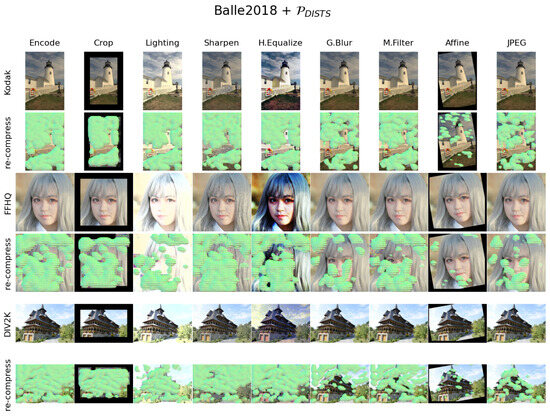
Figure A1.
The re-compressed results of Balle2018 + SLIC images after various editing operations.
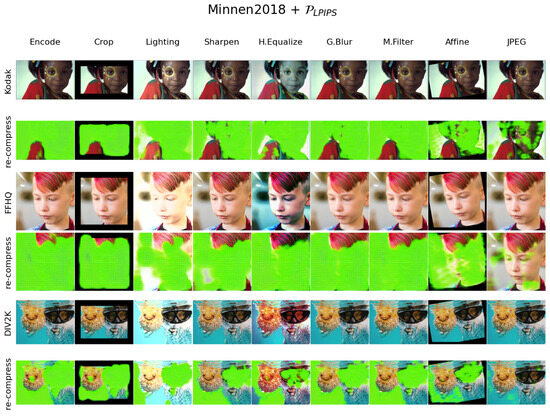
Figure A2.
The re-compressed results of Minnen2018 + SLIC images after various editing operations.
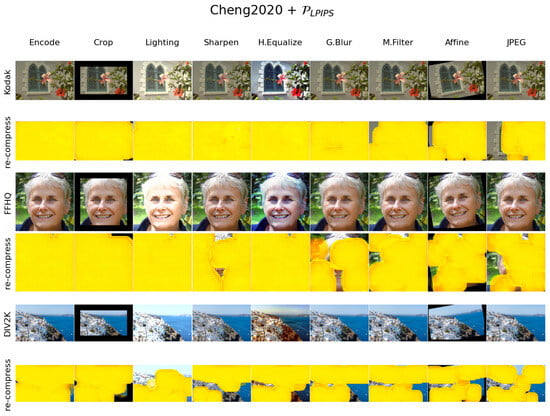
Figure A3.
The re-compressed results of Cheng2018 + SLIC images after various editing operations.
References
- Tolosana, R.; Vera-Rodriguez, R.; Fierrez, J.; Morales, A.; Ortega-Garcia, J. Deepfakes and beyond: A survey of face manipulation and fake detection. Inf. Fusion 2020, 64, 131–148. [Google Scholar] [CrossRef]
- Piva, A. An overview on image forensics. Int. Sch. Res. Not. 2013, 2013, 496701. [Google Scholar] [CrossRef]
- Zanardelli, M.; Guerrini, F.; Leonardi, R.; Adami, N. Image forgery detection: A survey of recent deep-learning approaches. Multimed. Tools Appl. 2023, 82, 17521–17566. [Google Scholar] [CrossRef]
- Mahdian, B.; Saic, S. Using noise inconsistencies for blind image forensics. Image Vis. Comput. 2009, 27, 1497–1503. [Google Scholar] [CrossRef]
- Bayram, S.; Sencar, H.T.; Memon, N. An efficient and robust method for detecting copy-move forgery. In Proceedings of the 2009 IEEE International Conference on Acoustics, Speech and Signal Processing, Taipei, Taiwan, 19–24 April 2009; pp. 1053–1056. [Google Scholar]
- Ghosh, A.; Zhong, Z.; Boult, T.E.; Singh, M. SpliceRadar: A Learned Method For Blind Image Forensics. In Proceedings of the CVPR Workshops, Long Beach, CA, USA, 16–20 June 2019; pp. 72–79. [Google Scholar]
- Popescu, A.C.; Farid, H. Exposing digital forgeries in color filter array interpolated images. IEEE Trans. Signal Process. 2005, 53, 3948–3959. [Google Scholar] [CrossRef]
- Mahdian, B.; Saic, S. Detecting double compressed JPEG images. In Proceedings of the 3rd International Conference on Imaging for Crime Detection and Prevention (ICDP 2009), London, UK, 3 December 2009. [Google Scholar]
- Park, J.; Cho, D.; Ahn, W.; Lee, H.K. Double JPEG detection in mixed JPEG quality factors using deep convolutional neural network. In Proceedings of the European Conference on Computer Vision (ECCV), Munich, Germany, 8–14 September 2018; pp. 636–652. [Google Scholar]
- Friedman, G.L. The trustworthy digital camera: Restoring credibility to the photographic image. IEEE Trans. Consum. Electron. 1993, 39, 905–910. [Google Scholar] [CrossRef]
- Blythe, P.; Fridrich, J. Secure digital camera. Digit. Investig. 2004. Available online: https://dfrws.org/presentation/secure-digital-camera/ (accessed on 2 November 2024).
- Kundur, D.; Hatzinakos, D. Digital watermarking for telltale tamper proofing and authentication. Proc. IEEE 1999, 87, 1167–1180. [Google Scholar] [CrossRef]
- Lu, C.S.; Liao, H.Y.M. Structural digital signature for image authentication: An incidental distortion resistant scheme. In Proceedings of the 2000 ACM Workshops on Multimedia, Los Angeles, CA, USA, 30 October–3 November 2000; pp. 115–118. [Google Scholar]
- Liu, K.; Wu, D.; Wu, Y.; Wang, Y.; Feng, D.; Tan, B.; Garg, S. Manipulation Attacks on Learned Image Compression. IEEE Trans. Artif. Intell. 2023, 5, 3083–3097. [Google Scholar] [CrossRef]
- Chen, T.; Ma, Z. Towards robust neural image compression: Adversarial attack and model finetuning. IEEE Trans. Circuits Syst. Video Technol. 2023, 33, 7842–7856. [Google Scholar] [CrossRef]
- Huang, C.H.; Wu, J.L. SLIC: Secure Learned Image Codec through Compressed Domain Watermarking to Defend Image Manipulation. In Proceedings of the 6th ACM International Conference on Multimedia in Asia, Auckland, New Zealand, 3–6 December 2024; pp. 1–7. [Google Scholar]
- Rey, C.; Dugelay, J.L. A survey of watermarking algorithms for image authentication. EURASIP J. Adv. Signal Process. 2002, 2002, 1–9. [Google Scholar] [CrossRef]
- Ruiz, N.; Bargal, S.A.; Sclaroff, S. Disrupting Deepfakes: Adversarial Attacks Against Conditional Image Translation Networks and Facial Manipulation Systems. arXiv 2020, arXiv:2003.01279. [Google Scholar]
- Lv, L. Smart watermark to defend against deepfake image manipulation. In Proceedings of the 2021 IEEE 6th International Conference on Computer and Communication Systems (ICCCS), Chengdu, China, 23–26 April 2021; pp. 380–384. [Google Scholar]
- Zhang, X.; Li, R.; Yu, J.; Xu, Y.; Li, W.; Zhang, J. Editguard: Versatile image watermarking for tamper localization and copyright protection. In Proceedings of the IEEE/CVF Conference on Computer Vision and Pattern Recognition, Seattle, WA, USA, 16–22 June 2024; pp. 11964–11974. [Google Scholar]
- Yu, N.; Skripniuk, V.; Abdelnabi, S.; Fritz, M. Artificial fingerprinting for generative models: Rooting deepfake attribution in training data. In Proceedings of the IEEE/CVF International Conference on Computer Vision, Montreal, QC, Canada, 10–17 October 2021; pp. 14448–14457. [Google Scholar]
- Wang, J.; Wang, H.; Zhang, J.; Wu, H.; Luo, X.; Ma, B. Invisible Adversarial Watermarking: A Novel Security Mechanism for Enhancing Copyright Protection. ACM Trans. Multimed. Comput. Commun. Appl. 2024, 21, 43. [Google Scholar] [CrossRef]
- Zhang, J.; Wang, J.; Wang, H.; Luo, X. Self-recoverable adversarial examples: A new effective protection mechanism in social networks. IEEE Trans. Circuits Syst. Video Technol. 2022, 33, 562–574. [Google Scholar] [CrossRef]
- Ballé, J.; Minnen, D.; Singh, S.; Hwang, S.J.; Johnston, N. Variational image compression with a scale hyperprior. arXiv 2018, arXiv:1802.01436. [Google Scholar]
- Minnen, D.; Ballé, J.; Toderici, G.D. Joint autoregressive and hierarchical priors for learned image compression. Adv. Neural Inf. Process. Syst. 2018, 31, 10771–10780. [Google Scholar]
- Cheng, Z.; Sun, H.; Takeuchi, M.; Katto, J. Learned image compression with discretized gaussian mixture likelihoods and attention modules. In Proceedings of the 2020 IEEE/CVF Conference on Computer Vision and Pattern Recognition (CVPR), Seattle, WA, USA, 13–19 June 2020; pp. 7939–7948. [Google Scholar]
- Guo, Z.; Zhang, Z.; Feng, R.; Chen, Z. Causal contextual prediction for learned image compression. IEEE Trans. Circuits Syst. Video Technol. 2021, 32, 2329–2341. [Google Scholar] [CrossRef]
- Ma, S.; Zhang, X.; Jia, C.; Zhao, Z.; Wang, S.; Wanga, S. Image and video compression with neural networks: A review. IEEE Trans. Circuits Syst. Video Technol. 2019, 30, 1683–1698. [Google Scholar] [CrossRef]
- Yang, Y.; Mandt, S.; Theis, L. An introduction to neural data compression. arXiv 2022, arXiv:2202.06533. [Google Scholar]
- Huang, C.H.; Wu, J.L. Unveiling the Future of Human and Machine Coding: A Survey of End-to-End Learned Image Compression. Entropy 2024, 26, 357. [Google Scholar] [CrossRef] [PubMed]
- Kim, J.H.; Jang, S.; Choi, J.H.; Lee, J.S. Instability of successive deep image compression. In Proceedings of the 28th ACM International Conference on Multimedia, Seattle, WA, USA, 12–16 October 2020; pp. 247–255. [Google Scholar]
- Helminger, L.; Djelouah, A.; Gross, M.; Schroers, C. Lossy Image Compression with Normalizing Flows. In Proceedings of the Neural Compression: From Information Theory to Applications—Workshop @ ICLR 2021, Virtually, 6 May 2021. [Google Scholar]
- Li, Y.; Xu, T.; Wang, Y.; Liu, J.; Zhang, Y.Q. Idempotent learned image compression with right-inverse. Adv. Neural Inf. Process. Syst. 2024, 36, 12878–12896. [Google Scholar]
- Xu, T.; Zhu, Z.; He, D.; Li, Y.; Guo, L.; Wang, Y.; Wang, Z.; Qin, H.; Wang, Y.; Liu, J.; et al. Idempotence and perceptual image compression. arXiv 2024, arXiv:2401.08920. [Google Scholar]
- Wang, Z.; Bovik, A.C.; Sheikh, H.R.; Simoncelli, E.P. Image quality assessment: From error visibility to structural similarity. IEEE Trans. Image Process. 2004, 13, 600–612. [Google Scholar] [CrossRef]
- Xue, W.; Zhang, L.; Mou, X.; Bovik, A.C. Gradient magnitude similarity deviation: A highly efficient perceptual image quality index. IEEE Trans. Image Process. 2013, 23, 684–695. [Google Scholar] [CrossRef] [PubMed]
- Laparra, V.; Ballé, J.; Berardino, A.; Simoncelli, E.P. Perceptual image quality assessment using a normalized Laplacian pyramid. Electron. Imaging 2016, 2016, 1–6. [Google Scholar] [CrossRef]
- Johnson, J.; Alahi, A.; Fei-Fei, L. Perceptual losses for real-time style transfer and super-resolution. In Proceedings of the European Conference on Computer Vision (ECCV), Amsterdam, The Netherlands, 11–14 October 2016; Springer: Berlin/Heidelberg, Germany, 2016; pp. 694–711. [Google Scholar]
- Zhang, R.; Isola, P.; Efros, A.A.; Shechtman, E.; Wang, O. The Unreasonable Effectiveness of Deep Features as a Perceptual Metric. In Proceedings of the 2018 IEEE/CVF Conference on Computer Vision and Pattern Recognition, Salt Lake City, UT, USA, 18–23 June 2018. [Google Scholar]
- Bhardwaj, S.; Fischer, I.; Ballé, J.; Chinen, T. An unsupervised information-theoretic perceptual quality metric. Adv. Neural Inf. Process. Syst. 2020, 33, 13–24. [Google Scholar]
- Ding, K.; Ma, K.; Wang, S.; Simoncelli, E.P. Image quality assessment: Unifying structure and texture similarity. IEEE Trans. Pattern Anal. Mach. Intell. 2020, 44, 2567–2581. [Google Scholar] [CrossRef]
- CLIC 2021: Workshop and Challenge on Learned Image Compression. Available online: https://clic.compression.cc/2021/tasks/index.html (accessed on 2 November 2024).
- Zhu, H.; Chen, B.; Zhu, L.; Wang, S.; Lin, W. DeepDC: Deep Distance Correlation as a Perceptual Image Quality Evaluator. arXiv 2022, arXiv:2211.04927. [Google Scholar]
- Gatys, L.A.; Ecker, A.S.; Bethge, M. A neural algorithm of artistic style. arXiv 2015, arXiv:1508.06576. [Google Scholar] [CrossRef]
- Ledig, C.; Theis, L.; Huszár, F.; Caballero, J.; Cunningham, A.; Acosta, A.; Aitken, A.; Tejani, A.; Totz, J.; Wang, Z.; et al. Photo-realistic single image super-resolution using a generative adversarial network. In Proceedings of the 2017 IEEE Conference on Computer Vision and Pattern Recognition (CVPR), Honolulu, HI, USA, 21–26 July 2017; pp. 4681–4690. [Google Scholar]
- Huang, C.H.; Wu, J.L. Image Data Hiding in Neural Compressed Latent Representations. In Proceedings of the IEEE International Conference on Visual Communications and Image Processing (VCIP), Jeju, Republic of Korea, 4–7 December 2023. [Google Scholar]
- Szegedy, C.; Zaremba, W.; Sutskever, I.; Bruna, J.; Erhan, D.; Goodfellow, I.; Fergus, R. Intriguing properties of neural networks. arXiv 2013, arXiv:1312.6199. [Google Scholar]
- Goodfellow, I.J.; Shlens, J.; Szegedy, C. Explaining and harnessing adversarial examples. arXiv 2014, arXiv:1412.6572. [Google Scholar]
- Kurakin, A.; Goodfellow, I.J.; Bengio, S. Adversarial examples in the physical world. In Artificial Intelligence Safety and Security; Chapman and Hall/CRC: Boca Raton, FL, USA, 2018; pp. 99–112. [Google Scholar]
- Madry, A.; Makelov, A.; Schmidt, L.; Tsipras, D.; Vladu, A. Towards deep learning models resistant to adversarial attacks. arXiv 2017, arXiv:1706.06083. [Google Scholar]
- Carlini, N.; Wagner, D. Towards evaluating the robustness of neural networks. In Proceedings of the 2017 IEEE Symposium on Security and Privacy (SP), San Jose, CA, USA, 22–26 May 2017; pp. 39–57. [Google Scholar]
- Zhu, T.; Sun, H.; Xiong, X.; Zhu, X.; Gong, Y.; Fan, Y. Attack and defense analysis of learned image compression. arXiv 2024, arXiv:2401.10345. [Google Scholar]
- Huang, C.H.; Wu, J.L. Joint Image Data Hiding and Rate-Distortion Optimization in Neural Compressed Latent Representations. In MultiMedia Modeling; Springer: Cham, Switzerland, 2024; pp. 94–108. [Google Scholar]
- Zhu, J.; Kaplan, R.; Johnson, J.; Fei-Fei, L. Hidden: Hiding data with deep networks. In Proceedings of the European Conference on Computer Vision (ECCV), Munich, Germany, 8–14 September 2018; pp. 657–672. [Google Scholar]
- Shin, R.; Song, D. Jpeg-resistant adversarial images. In Proceedings of the NIPS 2017 Workshop on Machine Learning and Computer Security, Long Beach, CA, USA, 8 December 2017; Volume 1. [Google Scholar]
- Bégaint, J.; Racapé, F.; Feltman, S.; Pushparaja, A. CompressAI: A PyTorch library and evaluation platform for end-to-end compression research. arXiv 2020, arXiv:2011.03029. [Google Scholar]
- Russakovsky, O.; Deng, J.; Su, H.; Krause, J.; Satheesh, S.; Ma, S.; Huang, Z.; Karpathy, A.; Khosla, A.; Bernstein, M.; et al. Imagenet large scale visual recognition challenge. Int. J. Comput. Vis. 2015, 115, 211–252. [Google Scholar] [CrossRef]
- Kodak PhotoCD Dataset. 1999. Available online: http://r0k.us/graphics/kodak/ (accessed on 10 October 2024).
- Karras, T.; Laine, S.; Aila, T. A Style-Based Generator Architecture for Generative Adversarial Networks. In Proceedings of the IEEE/CVF Conference on Computer Vision and Pattern Recognition (CVPR), Long Beach, CA, USA, 15–20 June 2019; pp. 4401–4410. [Google Scholar]
- Agustsson, E.; Timofte, R. NTIRE 2017 Challenge on Single Image Super-Resolution: Dataset and Study. In Proceedings of the IEEE Conference on Computer Vision and Pattern Recognition (CVPR) Workshops, Honolulu, HI, USA, 21–26 July 2017. [Google Scholar]
- Li, L.; Bao, J.; Yang, H.; Chen, D.; Wen, F. Faceshifter: Towards high fidelity and occlusion aware face swapping. arXiv 2019, arXiv:1912.13457. [Google Scholar]
- Remaker Face Swap Online Free. Available online: https://remaker.ai/face-swap-free/ (accessed on 28 September 2024).
- Rombach, R.; Blattmann, A.; Lorenz, D.; Esser, P.; Ommer, B. High-Resolution Image Synthesis with Latent Diffusion Models. arXiv 2021, arXiv:2112.10752. [Google Scholar]
Disclaimer/Publisher’s Note: The statements, opinions and data contained in all publications are solely those of the individual author(s) and contributor(s) and not of MDPI and/or the editor(s). MDPI and/or the editor(s) disclaim responsibility for any injury to people or property resulting from any ideas, methods, instructions or products referred to in the content. |
© 2025 by the authors. Licensee MDPI, Basel, Switzerland. This article is an open access article distributed under the terms and conditions of the Creative Commons Attribution (CC BY) license (https://creativecommons.org/licenses/by/4.0/).