


Abstract
Immersive journalism is a new form of media communication that uses extended reality systems to produce its content. Despite the possibilities it offers, its use is still limited in the media due to the lack of systematised and scientific knowledge regarding its application. This is a problem because it is a very powerful technology that changes the way audiences receive information and can be used both for new forms of storytelling that generate greater user engagement and for very sophisticated disinformation, which is why it is really important to study it. This study analyses articles published in the last 5 years that cover the use of extended technologies and the metaverse applied to immersive journalism. A systematic literature review applying PRISMA was carried out to identify literature within Web of Science, Scopus and Google Scholar (n = 61). Quantitative and qualitative analyses were conducted on the data collection techniques, the type of the data and the analysis techniques used. The results show a low level of methodological maturity, with research that is fundamentally descriptive and not very formalised, which limits the scope of its results and, therefore, the transfer of knowledge for its application in the configuration of new immersive journalistic products. The metaverse and extended technologies are considered independently and with distinct applications. It is concluded that research in this area is still in an initial exploratory and generalist stage that offers results that are not yet applicable to the promotion of this type of media format.
1. Introduction
1.1. Technologies Applied to Immersive Journalism
In recent years, a new term has emerged in journalistic innovation and research, called immersive journalism. De la Peña [1] is considered one of the pioneers in the study of immersive journalism, which she defines as “the production of news in a way people can have first-person experiences of the events or situations described” [2]. To achieve this, one of the main tools and technologies that immersive journalism relies on is virtual reality.
In the last few years of research in this field, there has been growing interest in the possibilities offered by the use of virtual reality and 360° video technologies for the creation of journalistic content [3]. These technologies fall within what is known as the virtuality continuum, a concept that establishes a scale ranging from completely real to completely virtual, passing through intermediate states of augmented reality and virtuality [4]. There are several large journalistic corporations that have applied immersive technologies, mainly 360° video and virtual reality, when producing their journalistic pieces, such as The New York Times, The Washington Post and The Guardian [5]. In 2015, The New York Times published its first 360° video report [6] called “Walking New York” [7]. In Spain, Radiotelevisión Española (RTVE) and El País have published immersive journalistic pieces. RTVE’s content has been produced mainly by its innovation laboratory, LabRTVE.es [8]. El País offer their immersive content using the El País VR app [9], although they have also published some of their 360° reports [10] on their YouTube channel [11].
The decision to produce immersive reports and pieces gives the viewer the feeling of being immersed in a reality that is not only being depicted, but also experienced in a mimetic way, which favours a deeper and more meaningful understanding of it [12]. As suggested by Barreda-Ángeles et al., this immersive storytelling has great potential to provide enjoyable experiences that can appeal to a wider audience [13].
This exploration of new formats and communication alternatives is linked to the need to renew the way stories are told [14]. As a result, 360° videos and virtual reality are increasingly being explored in newsrooms to develop new immersive techniques for storytelling [15]. Similarly, the metaverse remains a vast creative ecosystem that needs to be further explored before it can be used by large media companies and, most importantly, become part of society’s everyday experience of receiving information [16].
Both the metaverse and virtual reality, unlike traditional media, are technologies that aim to introduce the user to environments where experimentation is paramount and the viewer becomes part of the story. But why is this so important for journalism? Firstly, attention grabbing is complicated, and the use of immersive technologies is a positive point of view to explore and develop new forms of informative storytelling and products that involve the user in the story [17]. For its part, the metaverse enables the representation of the viewer and, in the case of augmented technologies such as virtual reality, the boundaries of the real environment are lost. However, there is growing concern that virtual reality environments and the metaverse present a scenario for the possible psychological and emotional manipulation of their users to a degree unimaginable in contemporary media [18]. This can be used as a very sophisticated means of disinformation [19], creating a distortion of reality and our own senses, creating alternative worlds and deepfakes. This is why it is so important to analyse them properly and develop new efforts to prepare users to properly navigate the new dynamics of the immersive digital age [20].
The concept of the “metaverse” first appeared in Neal Stephenson’s 1992 science fiction novel, Snow Crash [21]. Almost thirty years later, in 2021, Facebook founder Mark Zuckerberg presented the “metaverse” at the “Facebook Connect 2021” conference [22] as something new and different that was not only the company’s new name, now Meta, but the emergence of a disruptive era [23]. Although the basic concept is similar, the difficulty in finding a comprehensive and generalised definition of the metaverse likely lies precisely in the fact that it is still in the process of establishing its characteristics and limits, hence everyone who speaks of the metaverse has their own idea and interpretation of what it is [24]. However, to give a rough definition of the metaverse, it can be explained as a virtual world that connects our imagination with real life. It uses many existing technologies to create a transformed universe in which people can have new experiences through their virtual character [25]. For example, Mark Zuckerberg’s “metaverse” is a combination of the real and the virtual, making the world less distant [26]. People often tend to confuse the metaverse and think it is synonymous with virtual reality, and vice versa. However, a virtual reality experience does not have to be part of a metaverse. On the contrary, the development of the metaverse is highly dependent on the adoption of emerging technologies such as virtual reality [27], among others.
There are many professional disciplines in which immersive experiences can be generated and applied, such as in art, education, engineering, medicine or entertainment [28]. And, of course, it can be a place for all kinds of formal and informal communications [29], so its application in the field of journalism and communication in general opens up an extraordinary space for innovation.
1.2. Objectives
This study explores the ways, documented in the scientific literature, that journalism and media use immersive technologies and the metaverse to develop news pieces.
The main objective is to determine the scientific characteristics of the publications that make up the state-of-the-art literature on immersive technologies applied to journalism through a systematic review, in order to determine the current state of studies in this field and the maturity level of the research. For this purpose, a systematic literature review of academic articles on the metaverse and immersive technologies applied to media and journalism in the last five years has been carried out.
Through the published scientific literature, we analyse how the study of immersive technologies applied to these areas of knowledge is approached. In order to achieve the main objective, the following specific objectives are set out:
SO1. Identify the nature of the literature retrieved.
SO2. Describe and establish analysis techniques.
SO3. Identify and establish a classification of immersive technologies.
2. Materials and Methods
The methodological structure of the study provides for two phases, as shown in Figure 1. First, a systematic literature review (SLR) is conducted to retrieve scientific publications in the area under study. This is followed by a qualitative analysis of the collected scientific literature.
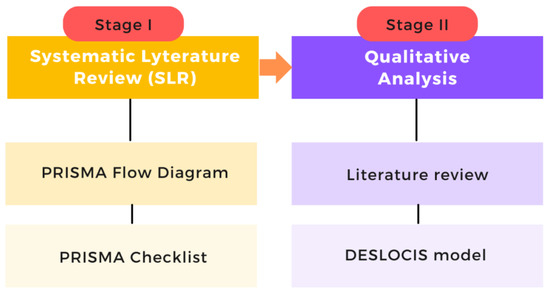
Figure 1.
Methodological Process.
2.1. Stage 1: Systematic Literature Review (SLR)
The systematic literature review (SLR) allows us to analyse the scientific literature in a specific area of knowledge in a rigorous and standardised way.
Table 1 details the relationship between the specific objectives and the research questions, which are based on an initial questioning of the level of maturity of the research related to the object of study and the importance that this maturity has on the level of applied and operational knowledge of this research.

Table 1.
Link between objectives and research questions.
2.2. Criteria for Systematic Literature Review
To carry out the SLR, the PRISMA flow diagram was followed to establish the steps to retrieve relevant scientific literature in the area under study. The three established stages were followed: identification, screening and defining robust criteria for each of them in order to guarantee the validity of the results and ensure they can be replicated and reproduced in future research [30].
2.2.1. Identification
In the first stage, identification, Web of Science, Scopus and Google Scholar were chosen as the databases on which to perform the searches due to their widespread use in scientific publications related to the research area [31]. Publish or Perish 8 software [32] was used because, in addition to retrieving the relevant scientific literature, it allows for the incorporation of the updated bibliometric data of the articles. A timeframe of five years (2017–2022) was set for retrieving the documents. Although the application of immersive technologies in journalism has been considered since 2010 [1], the first studies show very early possibilities, as the technology was not yet very developed, and only in the last five years has this technology been implemented in journalism, as can be seen in the immersive experiences of mainstream media [7,8,9,10].
A vocabulary list related to the area of extended reality applied to immersive journalism was then created with terms in American English and Spanish to maximise the scope of the search. The vocabulary was broken down into general words related to the area of research and specific words related to the area of journalism and communication. This selection was made on the basis of both the descriptors of the project (IND2022/SOC-23503) funded by the Autonomous Community of Madrid and the professional judgement of the researchers, who are experts in the area under study.
In order to optimise searches, Boolean operators were created through combining established words including the logical operators AND and OR. Thus, the following formula was used:
“General English word” AND (“specific English word” OR “specific English word” OR “specific English word” OR “specific English word” [....])
“General Spanish word” AND (“specific Spanish word” OR “specific Spanish word” OR “specific Spanish word” OR “specific Spanish word” [....])
Once the Boolean operators were constructed, they were entered into the “Title” section of the Publish or Perish software to perform searches. In this way, literature would be retrieved that contains one of the terms of the constituted vocabulary in its title. All searches were carried out from the institutional network of the Rey Juan Carlos University in November 2022.
2.2.2. Screening
Once the list of unique records was obtained, criteria for the selection of relevant publications for the study was established. Given that the Publish or Perish software categorises the retrieved items according to their type, a decision was made to limit the research to articles and conference papers due to their relevance as a channel for broadcasting scientific knowledge. In addition, records whose title is not in English or Spanish were deleted. This was followed by an individual review of the retrieved items through assessing the abstract to determine whether or not they relate to the area under investigation.
2.2.3. Included
This stage was carried out once the final records were checked for compliance with all requirements. A matrix of single records was developed to be fully assessed. The documents included in this matrix were those subjected to the analytical process.
2.3. Application of the PRISMA Procedure
The procedure established in the Transparent Reporting of Systematic Reviews and Meta-Analyses [33] was followed to undertake the SLR, using the PRISMA flow diagram and the PRISMA checklist as fundamental elements to guarantee an accurate and standardised systematic review. Figure 2 shows the process that was carried out in detail.
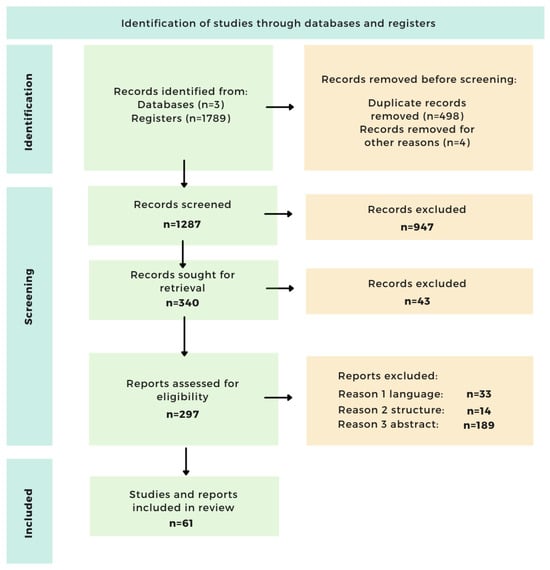
Figure 2.
Process of identifying studies using the PRISMA model.
2.3.1. Identification Phase
Firstly, the general and specific terms used to perform the searches in English and Spanish are included in Table 2 and Table 3.
Table 2.
Search terms in English.
Table 3.
Search terms in Spanish.
The terms “virtual reality”, “realidad virtual”, “augmented reality”, “realidad aumentada”, “mixed reality” and “realidad mixta” were initially included, but they were very general terms and returned many non-specific results.
As a result of the combination of general and specific words, the Boolean operators were obtained and shown in Table 4.
Table 4.
Boolean operators in English and Spanish.
Once the Boolean operators were entered in the “Title” field of the “Publish or Perish” application, the results displayed in Table 5 were obtained.
Table 5.
Results of search using Boolean operators in English and Spanish.
The number of records obtained through adding up the searches for each of the Boolean operators in English and Spanish is 1789. Through putting all the results together in a single matrix, 498 duplicate elements were eliminated, resulting in 1291 unique records.
To validate these results, a second manual check of the records was carried out, in which 4 duplicates were identified, resulting in 1287 records. Thus, a single matrix was created with the title, authors, DOI, type and citations from the 3 databases.
The data matrices generated in the search process of this first stage are available on Zenodo [34].
2.3.2. Screening Phase
After applying the first filter criterion on the 1287 records, 947 items (citations, letters and reviews, surveys, editorials and material not in English or Spanish) were eliminated. Once the above items were excluded, a matrix with 340 entries was obtained.
A search was then carried out for each of the records. In this search, 297 documents were retrieved, and 43 records were excluded because they could not be found.
Subsequently, through applying the criteria defined in the methodology, 236 entries were excluded on the basis of the following criteria:
- Criterion 1. When accessing the full text, 33 documents were not written in English or Spanish.
- Criterion 2. Fourteen documents were not articles or conference papers.
- Criterion 3. When evaluating the abstracts of the publications, 189 documents do not correspond to the area of study of the research.
The data matrices generated in the screening stage can be found on Zenodo [34].
2.3.3. Included Phase
Finally, after applying all the exclusion criteria, the analysis sample consisted of 61 documents, 59 of which were in English and 2 in Spanish.
These were included in a single matrix along with their impact metrics [34].
2.4. Stage 2: Qualitative Analysis of the Literature
Once the literature related to the object of study was retrieved, a qualitative analysis of the corpus of publications was carried out, categorising the formal characteristics of the studies.
For this purpose, articles were set as the unit of analysis, and the DESLOCIS model was used: descriptors for a systematic literature review on social sciences [35], an analytical framework for evaluating scientific literature in the social sciences.
This model was applied through an analysis sheet for researchers available through an online form, created with the LimeSurvey application by the Grupo Ciberimaginario group [36], through which the information was collected.
Through this sheet, the following variables were analysed: hypotheses and research questions of the study, study disciplines, object of study, techniques for the development of the overall experience, professional sector, type of research, universe of study, type of data collection, analysis type, sampling methods and conclusions.
The results of the analysis were then downloaded in .csv format, followed by a quantitative analysis of the percentages of the variables under study. The matrix containing the data of the publications analysed is available on Zenodo [37].
3. Results
After reading, recording and analysing the data obtained, the results were presented according to the variables established in the DESLOCIS model.
The number of research studies in this area, in comparison to other studies in the field of technology-related journalism, remains low. However, it has grown significantly between 2017 and 2022, when the number of articles increased tenfold (Figure 3).
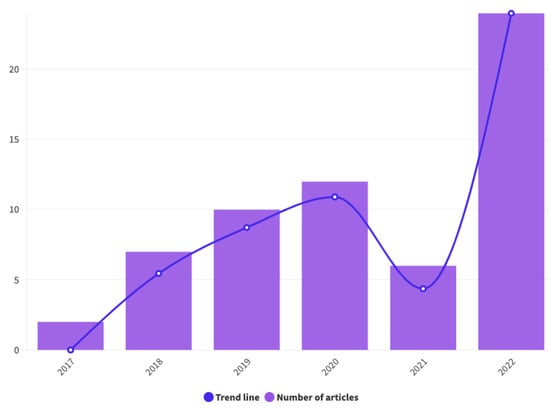
Figure 3.
Number of articles per year of search (2017–2022).
The first variable analysed was the hypotheses and research questions stated in the texts. The following results were obtained:
- -
- Articles not stating hypotheses or research questions (n = 40);
- -
- Articles stating hypotheses and/or research questions (n = 21).
Most texts did not state hypotheses or research questions. Based on the obtained results, the stated hypotheses were classified according to whether they referred to the metaverse (Figure 4) or to immersive technologies (Figure 5).
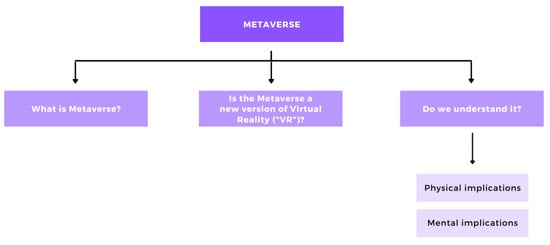
Figure 4.
Stated hypotheses regarding the metaverse.
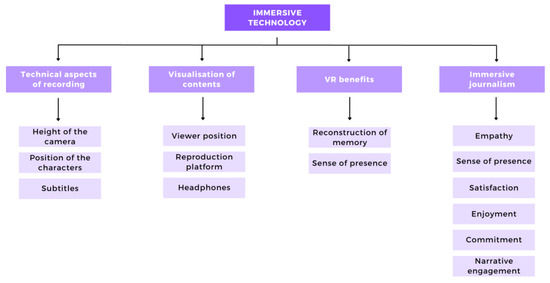
Figure 5.
Stated hypotheses regarding immersive technologies.
Studies linked to the metaverse raised research questions such as “what is the metaverse?”; “is the metaverse a new version of virtual reality?”; “do we understand it?”
The papers addressing immersive technology offered hypotheses and research questions in the following thematic sub-areas shown in Table 6.
Table 6.
Thematic sub-areas into which the research was classified.
Some articles formulate one or more hypotheses and/or research questions. The hypotheses and research questions stated verbatim in the retrieved texts can be found on Zenodo [37].
The main discipline from which the study was approached was selected from the list of disciplines provided by the Spanish Ministry of Education, Culture and Sport, in order to know the area from which the researchers originate, as it allowed an understanding of the disciplines that are studying this research topic, which are shown in Figure 6.
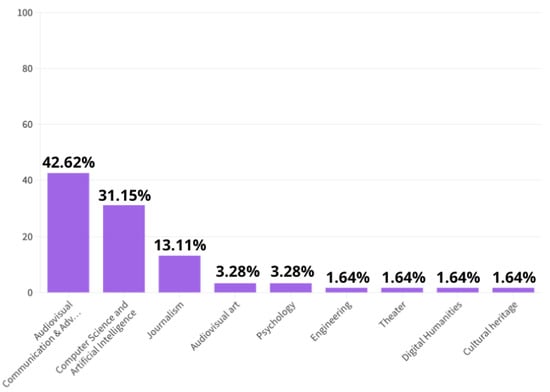
Figure 6.
Percentage of the number of articles by study discipline.
Most of the articles were studied from the discipline of audiovisual communication and advertising (42.62%), which together with the articles studied from journalism (13.11%) made up more than half of the articles retrieved (55.73%). In addition, there was a high percentage of articles retrieved that were studied from the discipline of computer science and artificial intelligence (31.15%).
Figure 7 shows the analysis of the technology studied in the literature according to the levels of the virtuality continuum [38], most of the articles are studied from the first level of the virtuality continuum, 360° videos (36.07%), closely followed by immersive virtual reality (32.79%).
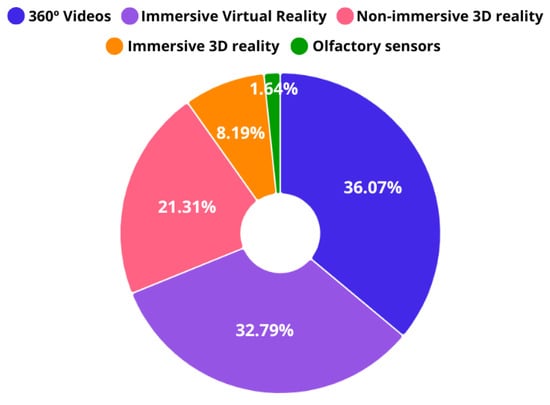
Figure 7.
Percentage of articles according to the object of the virtuality continuum from which they are studied.
The articles analysed address different techniques for the development of the proposed experience. Figure 8 shows that 30.88% of the articles study 360° video as an overall experience and 22.06% focus on the development of metaverses.
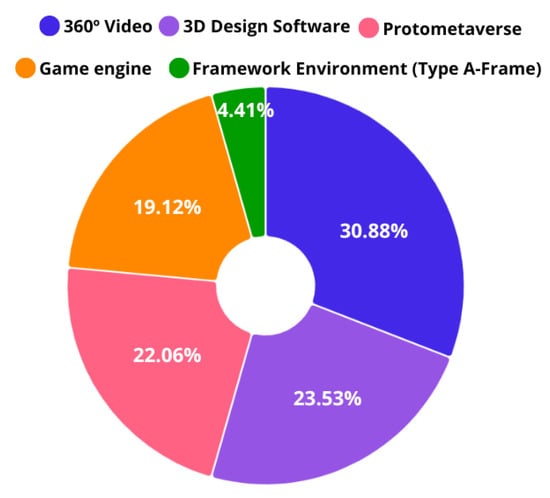
Figure 8.
Percentage of items according to the techniques for the development of the experience.
In terms of the sector from which the research was conducted, shown in Figure 9, more than half of the literature retrieved applied to the quaternary sector (63.93%), with information technology being the main area from which studies were approached (45.9%). Only 4.92% of the total recovered articles were approached from the entertainment sector. It should be noted that there were no articles that originated from the primary sector.
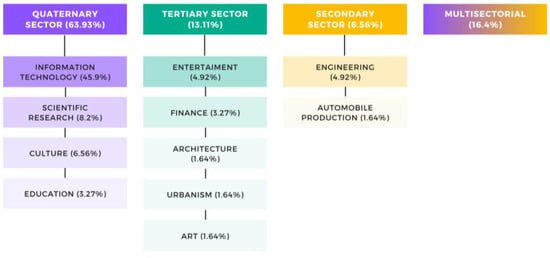
Figure 9.
Percentage of items by professional sector to which they apply.
Figure 10 shows the type of research conducted, where three quarters of the articles were descriptive and analytical (75.41%), 40.98% were descriptive and 34.43% were analytical.
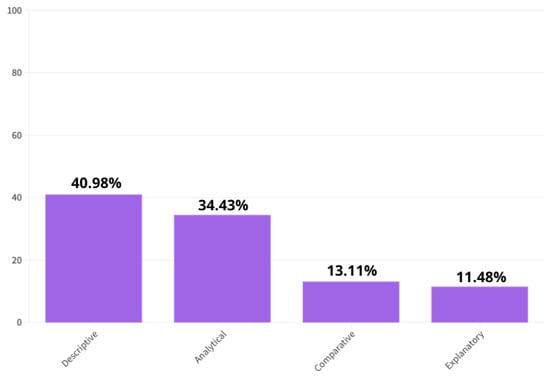
Figure 10.
Percentage of the number of articles by research type.
Figure 11 shows that 55.74% of the articles retrieved the universe of study was not stated, while 29.5% of the articles used subjects or natural persons as the universe of study and 11.75% used documents.
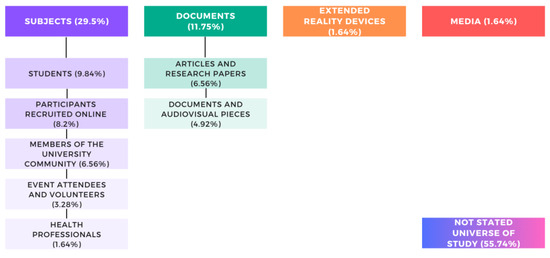
Figure 11.
Percentage of universe of study.
Although several types of data collection techniques could be used, in the analysis, a maximum of two categories were selected: primary and secondary.
Surveys were the most commonly used type of data collection (33.9%), with experiments being the least used type of data collection (5.08%), as shown in Figure 12.
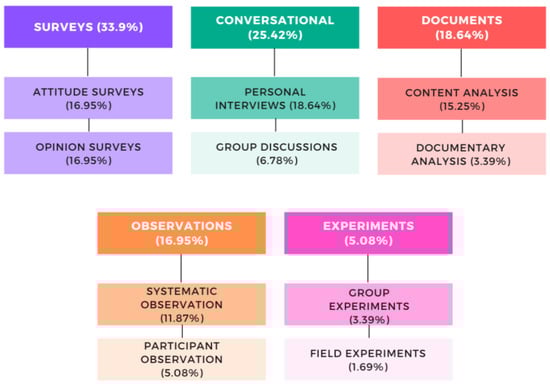
Figure 12.
Percentage of types of information collected.
As far as the analysis techniques used are concerned, two categories were also selected: primary and secondary, although several types could be used.
Figure 13 shows that 66.67% of the analysis was qualitative, and 15.55% was quantitative.
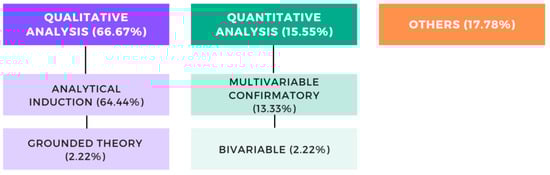
Figure 13.
Percentage of articles by type of analysis.
In almost all of the literature reviewed, no explicit reference was made to any theory or theoretical, epistemic or methodological approach. Only 2.22%, for example, referred to grounded theory, and the following theories are specifically mentioned in the texts: construal level theory (CLT), human-centred design (HCD), actor–network theory (ANT) and normative theory.
As far as sampling techniques and methods are concerned, Figure 14 shows that 52.46% of the articles did not state the sample or it is not applicable. 22.95% of the articles used a purposive sample, 13.11% used a structural sample and the remainder used probabilistic sampling.
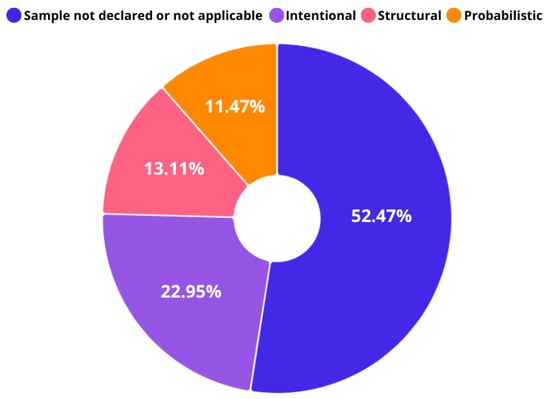
Figure 14.
Percentage of items according to sampling technique.
For the analysis of the conclusions stated in the articles, these were classified according to a selection of the following communication theories: functionalism, structuralism, critical theory, affect theory, semiotics and theory of effects [39].
Figure 15 shows that 11.48% of the articles did not state conclusions. 22.95% of the conclusions were framed within functionalism, the same percentage as in the theory of effects. The rest of the theories presented percentages of less than 14%.
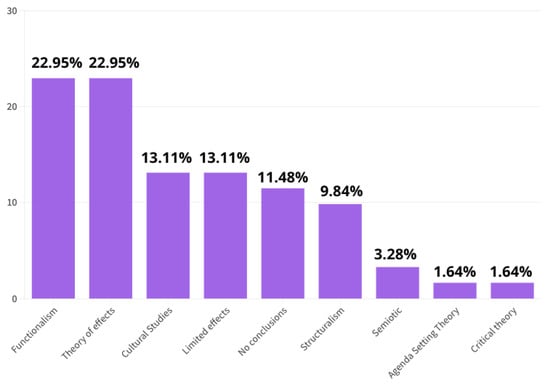
Figure 15.
Percentage ranking of article conclusions.
4. Discussion and Conclusions
The results of the literature review show that the application of virtual and extended reality technologies in journalism to create innovative immersive formats is a growing area of research, but that there is a lack of comparable research exploring the application of the metaverse to these types of products. This is consistent with what Trunfio and Rossi [40] say about developments in metaverse research: journalism is one of the many areas where applications are still very tentatively explored, so there are no specific studies of metaverse developments for journalism. Rashid et al. confirm this idea [28] and have included the study of journalism in this area, but as part of more general and cautious studies at this stage.
In the original approach, the keyword “metaverse” was considered under the umbrella of immersive technologies. It was thus considered synonymous with virtual reality, as the concept of the metaverse has been treated in more recent studies as being based on augmented reality or virtual reality technology [41]. However, the results show that the metaverse and immersive technologies used for immersive journalism are studied from isolated and not necessarily converging perspectives.
The analysis of the different areas in which the metaverse can be applied shows a distinction between the metaverse and so-called “immersive” or “virtual reality” technologies. This is consistent with the approach of Mystakidis [42], who concludes that the metaverse is an amalgamation of immersive technologies such as virtual and augmented reality that enable the creation of interactive virtual environments and the realisation of multisensory experiences, rather than an immersive technology in itself. These findings highlight the importance of avoiding the term “metaverse” as a synonym for “virtual reality” in future systematic literature reviews in this field.
Since immersive journalism is a new field of research, there is a lack of studies on searching and evaluating literature on the subject. It can be concluded that academic research in this area is at an initial exploratory stage, so it is important to conduct systematic literature studies to lay the foundations for future meta-research in this area. The application of this technique to the analysis of new journalistic formats and innovations in their development offers more precise and in-depth knowledge of the field of study, as noted in the work of Lopezosa et al. [31], the study of Heravi et al. [43] applied to journalistic innovations through data journalism from the point of view of preserving the content produced, or the emergence of slow journalism evaluated by Mendes and Marinho [44]. This lack of research into exploring narrative models in virtual reality that offer greater immersion to generate new forms of engagement and emotional attachment to the content presented is an aspect also noted by Caerols, Sidorenko and Garrido [45]. However, in this context, Paíno Ambrosio and Rodríguez-Fidalgo [3] have pointed out that this is due to the fact that we are in a phase of exploration of a new field of research, closely related to changes in the way news is told. On the other hand, the lack of studies and knowledge should be used as an opportunity for further research in this emerging field, which needs to be explored in depth [19]. This early stage in the application of immersive narratives in the media coincides with the conclusions of the study by Colussi and Assunçao [46], which points to the lack of references and media that really consider virtual reality content as a priority in their production methods.
Hardly any formalised research techniques were used in the studies assessed. Few specified the process of information collection, processing or analysis. Furthermore, most studies did not state the objectives, hypotheses or universe of the study. The fact that the predominant technique for collecting information was surveys and that neither a theory nor a theoretical, epistemological or methodological approach was explicitly stated confirms the conclusion that most of the cases are studies in an initial and exploratory phase. Therefore, not only is there ample room for the development of more comprehensive and formalised research on the use of immersive technologies in journalism, but it is also necessary if academia is to make a scholarly contribution to offering professional tools to promote the development of these types of formats in the media.
This lack of knowledge that provides an analytical framework for user experience and clear communication variables that identify how an effective journalistic product should be constructed, as well as assessing the characteristics of misinformation that can be disseminated through these media, leads to an important need for further research in this area, as it directly affects the development and application of these technologies in this sector. In this sense, the conclusion is that it is important to continue to develop studies aimed at prototyping products that specifically analyse the variables that operational models can offer from an informational, narrative, ethical and commercial perspective that can be applied in the media. On a practical level, the conclusions point in the direction of studies aimed at developing real prototypes.
Author Contributions
Conceptualisation, A.S.-A., A.C.-A., M.G. and J.L.R.-T.; methodology, A.S.-A., A.C.-A. and M.G.; validation, M.G. and J.L.R.-T.; formal analysis, A.S.-A. and A.C.-A.; investigation, A.S.-A., A.C.-A., M.G. and J.L.R.-T.; writing—original draft preparation, A.S.-A., A.C.-A. and M.G.; writing—review and editing, A.S.-A., A.C.-A., M.G. and J.L.R.-T.; supervision, M.G. and J.L.R.-T.; project administration, M.G.; funding acquisition, M.G. and A.S.-A. All authors have read and agreed to the published version of the manuscript.
Funding
This work was supported by the Autonomous Community of Madrid (Spain) with a grant for industrial doctorates (IND2022/SOC-23503) with the collaboration agreement with Prodigioso Volcán S.L; Universidad Rey Juan Carlos (ID 501100007511) with a grant call for Personnel in Training 2020 (PREDOC 20-008); and the Ministry of Science and Innovation of Spain and the European Union under eCOMCIENCIA project (PID2021-127019OB-I00).
Acknowledgments
To Prodigioso Volcán S.L. for the support and collaboration in the training and development of innovations during the industrial PhD.
Conflicts of Interest
No potential conflict of interest were reported by the authors.
References
- De La Peña, N.; Weil, P.; Llobera, J.; Giannopoulos, E.; Pomés, A.; Spanlang, B.; Friedman, D.; Sanches-Vives, M.; Slater, M. Immersive Journalism: Immersive Virtual Reality for the First-Person Experience of News. Presence 2010, 19, 291–301. [Google Scholar] [CrossRef]
- Van Damme, K.; All, A.; De Marez, L.; Van Leuven, S. 360° Video Journalism: Experimental Study on the Effect of Immersion on News Experience and Distant Suffering. J. Stud. 2019, 20, 2053–2076. [Google Scholar] [CrossRef]
- Paíno-Ambrosio, A.; Rodríguez-Fidalgo, M.I. A proposal for the classification of immersive journalism genres based on the use of virtual reality and 360-degree video. Rev. Lat. Comun. Soc. 2019, 74, 1132–1153. [Google Scholar]
- Sánchez, R.; Sebastiá, R. Realidad aumentada. Recurso para el aprendizaje de la geografía: Geoalcoi. In Proceedings of the XVI Congreso Nacional de Tecnologías de la Información Geográfica, Alicante, Spain, 25–27 June 2014. [Google Scholar]
- Domínguez, E. Going beyond the classic news narrative convention: The background to and challenges of immersion in journalism. Front. Digit. Humanit. 2017, 4, 10. [Google Scholar] [CrossRef]
- Pérez-Seijo, S. Uso del vídeo 360° por los medios nativos digitales. Análisis exploratorio de los primeros pasos en el ecosistema periodístico español. Prof. Inf. 2021, 30, 1–12. [Google Scholar]
- Walking New York|360 VR Video|The New York Times. YouTube. Available online: https://www.youtube.com/watch?v=f0-89v4Fk-M (accessed on 12 March 2023).
- Ciudades Vacías Por el CORONAVIRUS|Video 360|Lab. YouTube. Available online: https://www.youtube.com/watch?v=N4bVFd8vTNU (accessed on 12 March 2023).
- El País VR. Google Play. Available online: https://play.google.com/store/apps/details?id=com.elpais.elpaisvr (accessed on 12 March 2023).
- Vídeos 360o de EL PAÍS. YouTube. Available online: https://www.youtube.com/playlist?list=PLeEzCJHXClX1sC0lPqOCqj1AF-Rj7Sr3A (accessed on 12 March 2023).
- Gutiérrez-Caneda, B.; Pérez-Seijo, S.; López-García, X. Analysing VR and 360-degree video apps and sections. A case study of seven European news media outlets. Rev. Lat. Comun. Soc. 2020, 75, 149–167. [Google Scholar]
- Benítez de Gracia, M.J.; Herrera Damas, S. Analysis of the Level of Immersion of 360º Video Features Produced by Spanish Media. Commun. Soc. 2019, 32, 77–95. [Google Scholar] [CrossRef]
- Barreda-Ángeles, M.; Aleix-Guillaume, S.; Pereda-Baños, A. An “Empathy Machine” or a “Just-for-the-Fun-of-It” Machine? Effects of Immersion in Nonfiction 360-Video Stories on Empathy and Enjoyment. Cyberpsychol. Behav. Soc. Netw. 2020, 23, 683–688. [Google Scholar] [CrossRef]
- Ivars-Nicolás, B.; Martínez-Cano, F.J.; Cuadra-Martínez, J. Immersive experiences in 360° video for social youth engagement. Catalan J. Commun. Cult. Stud. 2020, 12, 225. [Google Scholar] [CrossRef]
- Mabrook, R.; Singer, J.B. Virtual Reality, 360° Video, and Journalism Studies: Conceptual Approaches to Immersive Technologies. J. Stud. 2019, 20, 2096–2112. [Google Scholar] [CrossRef]
- Pötzsch, H. Promises, pitfalls and potentials of immersive journalism. In Insights on Immersive Journalism, 1st ed.; Sánchez, A.L., Ed.; Routledge: London, UK, 2023. [Google Scholar]
- Martingano, A.J.; Herera, F.; Konrath, S. Virtual Reality Improves Emotional but Not Cognitive Empathy: A Meta-Analysis. Technol. Mind Behav. 2021, 2, 1–39. [Google Scholar] [CrossRef]
- Facebook Misinformation is Bad Enough. The Metaverse Will be Worse. The Washington Post. Available online: https://www.washingtonpost.com/opinions/2022/08/22/metaverse-political-misinformation-virtual-reality/ (accessed on 20 September 2023).
- Brown, J.G.; Bailenson, J.N.; Hancock, J. Misinformation in Virtual Reality. J. Online Trust Saf. 2023, 1, 1–31. [Google Scholar] [CrossRef]
- From Post-Truth to Post-Reality: The Future of Disinformation. Friends of Europe. Available online: https://www.friendsofeurope.org/insights/from-post-truth-to-post-reality-the-future-of-disinformation/ (accessed on 20 September 2023).
- Zhao, Y.; Jiang, J.; Chen, Y.; Liu, R.; Yang, Y.; Xue, X.; Chen, S. Metaverse: Perspectives from graphics, interactions and visualization. Vis. Inform. 2022, 6, 56–67. [Google Scholar] [CrossRef]
- The Metaverse Will Reshape Our Lives. Let’s Make Sure It’s for the Better. Time. Available online: https://time.com/6197849/metaverse-future-matthew-ball/ (accessed on 15 March 2023).
- Novak, K. Introducing the Metaverse, Again! TechTrends 2022, 66, 737–739. [Google Scholar] [CrossRef]
- Nanobashvili, L. If the Metaverse is Built, Will Copyright Challenges Come? 21 UIC Rev. Intell. Prop. L. 2022, 21, 215. [Google Scholar]
- Bale, A.S.; Ghorpade, N.; Hashim, M.F.; Vaishnav, J.; Almaspoor, Z. A Comprehensive Study on Metaverse and Its Impacts on Humans. Adv. Hum.-Comput. Interact. 2022, 2022, 1–11. [Google Scholar] [CrossRef]
- Wang, J.; Medvegy, G. Exploration the future of the metaverse and smart cities. In Proceedings of the 22th International Conference on Electronic Business (ICEB), Bangkok, Thailand, 13–17 October 2022. [Google Scholar]
- Muzi, Q.; Yinan, S.; Yuan, F. Digital Media and VR Art Creation for Metaverse. In Proceedings of the 2nd Asia Conference on Information Engineering (ACIE), Haikou, China, 15–17 January 2022. [Google Scholar]
- Rashid, M.M.; Choi, P.; Kwon, K.R.; Kwon, S.G.; Lee, S.H. Emergence of the Metaverse: How Blockchain, AI, AR/VR, and Digital Transformation Technologies will change the Future World. In Proceedings of the 18th International Conference on Multimedia Information Technology and Applications, Jeju, Republic of Korea, 5 July 2022. [Google Scholar]
- Ilyina, I.A.; Eltikova, E.A.; Uvarova, K.A.; Chelysheva, S.D. Metaverse—Death to Offline Communication or Empowerment of Interaction? Commun. Strateg. Digit. Soc. Semin. (ComSDS) 2022, 2022, 117–119. [Google Scholar]
- Parums, D.V. Editorial: Review Articles, Systematic Reviews, Meta-Analysis, and the Updated Preferred Reporting Items for Systematic Reviews and Meta-Analyses (PRISMA) 2020 Guidelines. Med. Sci. Monit. 2021, 27, e934475. [Google Scholar] [CrossRef]
- Lopezosa, C.; Codina, L.; Fernández-Planells, A.; Freixa, P. Journalistic innovation: How new formats of digital journalism are perceived in the academic literature. Journalism 2021, 24, 821–838. [Google Scholar] [CrossRef]
- Publish or Perish. Harzing.com. Available online: https://harzing.com/resources/publish-or-perish (accessed on 23 February 2023).
- Page, M.J.; McKenzie, J.E.; Bossuyt, P.M.; Boutron, I.; Hoffmann, T.C.; Mulrow, C.D.; Shamseer, L.; Tetzlaff, J.M.; Akl, E.A.; Brennan, S.E.; et al. The PRISMA 2020 Statement: An Updated Guideline for Reporting Systematic Reviews. BMJ 2021, 372, 1–9. [Google Scholar]
- Systematic Literature Review Results: PRISMA Statement Phases for Metaverse and Extended Realities in Immersive Journalism. Zenodo. Available online: https://zenodo.org/record/7973865 (accessed on 14 June 2023).
- Gertrudix, M.; Romero-Luis, J.; Carbonell-Alcocer, A. Descriptors for a systematic literature review on social sciences (DESLOCIS) (Version 1). Zenodo 2021. [Google Scholar] [CrossRef]
- Encuesta LimeSurvey. LimeSurvey. Available online: https://encuestas.ciberimaginario.es/ (accessed on 19 December 2022).
- Sample Records: A Systematic Review in Metaverse and Extended Realities in Immersive Journalism. Zenodo. Available online: https://zenodo.org/record/7973969 (accessed on 14 June 2023).
- Milgram, P.; Kishino, F. Augmented Reality: A class of displays on the reality-virtuality continuum. SPIE Proc. 1994, 2351, 282–292. [Google Scholar]
- Cobley, P.; Schulz, P.J. Theories and Models of Communication; De Gruyter Mouton: Berlin, Germany; Boston, MA, USA, 2013. [Google Scholar]
- Trunfio, M.; Rossi, S. Advances in Metaverse Investigation: Streams of Research and Future Agenda. Virtual Worlds 2022, 1, 103–129. [Google Scholar] [CrossRef]
- Sarıtaş, M.T.; Topraklıkoğlu, K. Systematic literature review on the use of metaverse in education. Int. J. Technol. Educ. (IJTE) 2022, 5, 586–607. [Google Scholar] [CrossRef]
- Mystakidis, S. Metaverse. Encyclopedia 2022, 2, 486–497. [Google Scholar] [CrossRef]
- Heravi, B.; Cassidy, K.; Davis, E.; Harrower, N. Preserving Data Journalism: A Systematic Literature Review. J. Pract. 2022, 16, 2083–2105. [Google Scholar] [CrossRef]
- Mendes, I.; Marinho, S. Slow Journalism: A Systematic Literature Review. J. Pract. 2022. [Google Scholar] [CrossRef]
- Caerols Mateo, R.; Sidorenko Bautista, P.; Garrido Pintado, P. Hacia un modelo de narrativa en periodismo inmersivo. Rev. Lat. Comun. Soc. 2020, 75, 341–365. [Google Scholar] [CrossRef]
- Colussi, J.; Assunção Reis, T. Periodismo inmersivo. Análisis de la narrativa en aplicaciones de realidad virtual. Rev. Lat. Comun. Soc. 2020, 77, 19–32. [Google Scholar] [CrossRef]
Disclaimer/Publisher’s Note: The statements, opinions and data contained in all publications are solely those of the individual author(s) and contributor(s) and not of MDPI and/or the editor(s). MDPI and/or the editor(s) disclaim responsibility for any injury to people or property resulting from any ideas, methods, instructions or products referred to in the content. |
© 2023 by the authors. Licensee MDPI, Basel, Switzerland. This article is an open access article distributed under the terms and conditions of the Creative Commons Attribution (CC BY) license (https://creativecommons.org/licenses/by/4.0/).