1. Introduction
The global transition toward smart cities has profoundly reshaped contemporary urban governance by embedding digital intelligence into planning, management, and decision-making systems [
1,
2]. While early smart city narratives emphasized technological modernization and infrastructural optimization, contemporary scholarship increasingly recognizes that digital transformation is inseparable from broader goals of sustainability, institutional effectiveness, and inclusive governance. Within this evolving landscape, artificial intelligence (AI) has emerged as a strategic governance resource, enabling advanced analytics, predictive modeling, scenario simulation, and decision-support mechanisms capable of addressing the growing complexity of metropolitan development [
3,
4]. Recent reviews identify AI as a foundational enabler of sustainable smart city strategies, particularly through data-intensive planning, service optimization, and integrated urban management systems [
5,
6]. However, despite rapid technological diffusion, the role of AI in strengthening participatory urban planning and meaningful citizen engagement remains insufficiently theorized and empirically examined, especially outside highly resourced Western contexts [
7,
8,
9].
A substantial body of smart city scholarship continues to conceptualize AI through a predominantly technocentric lens, prioritizing efficiency gains, operational control, and administrative optimization [
3,
6]. Although such approaches have delivered measurable improvements in service delivery and performance management, they risk reinforcing top-down governance structures and marginalizing citizens’ influence over urban futures. When AI systems are integrated into administrative workflows without transparent participatory safeguards, citizen engagement may be reduced to passive data provision or consultative exercises with limited decision impact [
10,
11]. Participation under such conditions risks becoming symbolic rather than transformative, thereby weakening democratic accountability and diminishing the legitimacy of planning outcomes [
9,
12].
Participatory urban planning theory, by contrast, emphasizes that inclusive and deliberative governance enhances legitimacy, responsiveness, and long-term sustainability [
13,
14]. Decades of research demonstrate that participation quality, defined by influence, feedback loops, and institutional responsiveness, is as critical as participation access itself. Without mechanisms linking public input to planning outcomes, engagement becomes procedural rather than substantive [
10,
12,
13,
14]. In digitally enabled urban environments, participation platforms can expand reach and diversify voices; yet, without governance design that ensures deliberation, co-production, and traceable decision-making, digital tools may replicate or even intensify technocratic dynamics [
3,
9,
13].
Within this context, AI occupies a dual and contested position. On the one hand, AI offers significant potential to enhance participatory planning by synthesizing large-scale citizen input, enabling interactive visualization of planning trade-offs, and supporting adaptive planning cycles aligned with sustainability objectives [
3,
4]. Emerging tools such as sentiment analysis, predictive analytics, and immersive visualization platforms may strengthen transparency and collective understanding. On the other hand, AI-assisted governance introduces ethical and institutional challenges, including algorithmic opacity, accountability gaps, data privacy risks, and potential exclusion of digitally vulnerable populations [
10,
11]. In metropolitan regions characterized by socio-economic diversity and uneven digital access, AI-enabled participation may inadvertently privilege technologically confident groups and undermine representativeness [
15,
16]. Moreover, public trust in AI-supported governance is not an automatic consequence of technological deployment; rather, it depends on perceived fairness, transparency, usefulness, and institutional credibility [
11,
17].
Despite growing recognition of these tensions, there remains a notable lack of empirically grounded research examining AI-enabled participatory planning as a governance phenomenon shaped by institutional capacity and trust dynamics. Existing studies frequently focus on adoption trajectories or technical performance metrics, with limited attention to how AI reshapes participation mechanisms, power relations, and everyday planning practice [
7,
8,
9,
10]. In particular, evidence from rapidly urbanizing metropolitan regions in the Global South remains scarce, limiting the generalizability of smart governance debates that are often derived from Western case studies.
This study addresses this gap through an empirical examination of the Dammam Metropolitan Area (DMA), Saudi Arabia. DMA, comprising Dammam, Al Khobar, and Dhahran, is one of the Kingdom’s most economically strategic and rapidly urbanizing metropolitan regions [
18,
19]. It has been prioritized under Saudi Vision 2030 as a focal area for digital transformation, smart city implementation, and sustainability-oriented development [
20]. The region has begun deploying AI- and IoT-enabled systems in traffic management, municipal services, environmental monitoring, and spatial planning [
21]. These characteristics position DMA as a critical governance testbed for examining how AI integration intersects with participatory urban planning in a non-Western, institutionally transforming context. By situating DMA within broader comparative smart city debates, this study contributes internationally relevant insights into how AI-enabled governance unfolds beyond highly resourced European or North American cases.
Conceptually, this research adopts a governance-centered framework that positions AI not as a neutral technological solution but as a facilitative instrument embedded within institutional arrangements and mediated by participation quality and public trust. From this perspective, AI’s participatory potential depends on institutional readiness, interdepartmental coordination, regulatory clarity, and organizational learning. Trust functions both as a precondition and as an outcome of meaningful participation, reinforcing or constraining the legitimacy of AI-enabled planning.
The overall objective of this study is therefore to examine how AI can support participatory urban planning for sustainable smart cities, with particular attention to the mediating role of institutional capacity and the reinforcing role of public trust in the Dammam Metropolitan Area. To achieve this objective, the study addresses the following research questions:
RQ1: How do stakeholders in DMA perceive AI awareness, use, and its potential role in participatory urban planning?
RQ2: How does institutional and technical readiness mediate the relationship between AI deployment and participation quality?
RQ3: How does public trust interact with AI-enabled participatory mechanisms in shaping governance legitimacy and sustainability outcomes?
By answering these questions, the study advances smart city scholarship in three key ways. First, it empirically validates a governance-centered conceptual framework linking AI capabilities, institutional capacity, participation quality, and trust dynamics. Second, it contributes evidence from a rapidly transforming metropolitan context in the Global South, expanding the geographical scope of AI governance research. Third, it provides policy-relevant insights for cities seeking to align AI-driven innovation with inclusive, accountable, and sustainability-oriented urban planning practices.
3. Methodology
This study adopts a convergent mixed-methods research design to examine AI-enabled participatory urban planning as a socio-technical and institutionally mediated governance process. Consistent with the conceptual framework developed in
Section 2, AI is treated not as an autonomous technological driver but as a governance instrument whose participatory effects are conditioned by institutional capacity and public trust.
Importantly, this research is positioned as an exploratory and theory-building empirical study. Given the relatively limited body of empirical evidence on AI-enabled participatory planning in rapidly urbanizing non-Western contexts, particularly within the Gulf region, the study seeks to generate context-sensitive insights rather than establish definitive causal claims. The exploratory orientation is appropriate where governance innovations are emergent, institutional arrangements are evolving, and longitudinal data remain limited. Accordingly, the research aims to identify patterns, relationships, and governance dynamics that can inform subsequent confirmatory and comparative studies.
Mixed-methods approaches are particularly suitable for exploratory governance research because they allow for the combination of quantitative pattern identification with qualitative contextual interpretation [
45,
46,
47]. The design facilitates triangulation and enhances analytical robustness while acknowledging that the findings represent a structured exploratory assessment rather than a longitudinal or experimental evaluation [
48,
49].
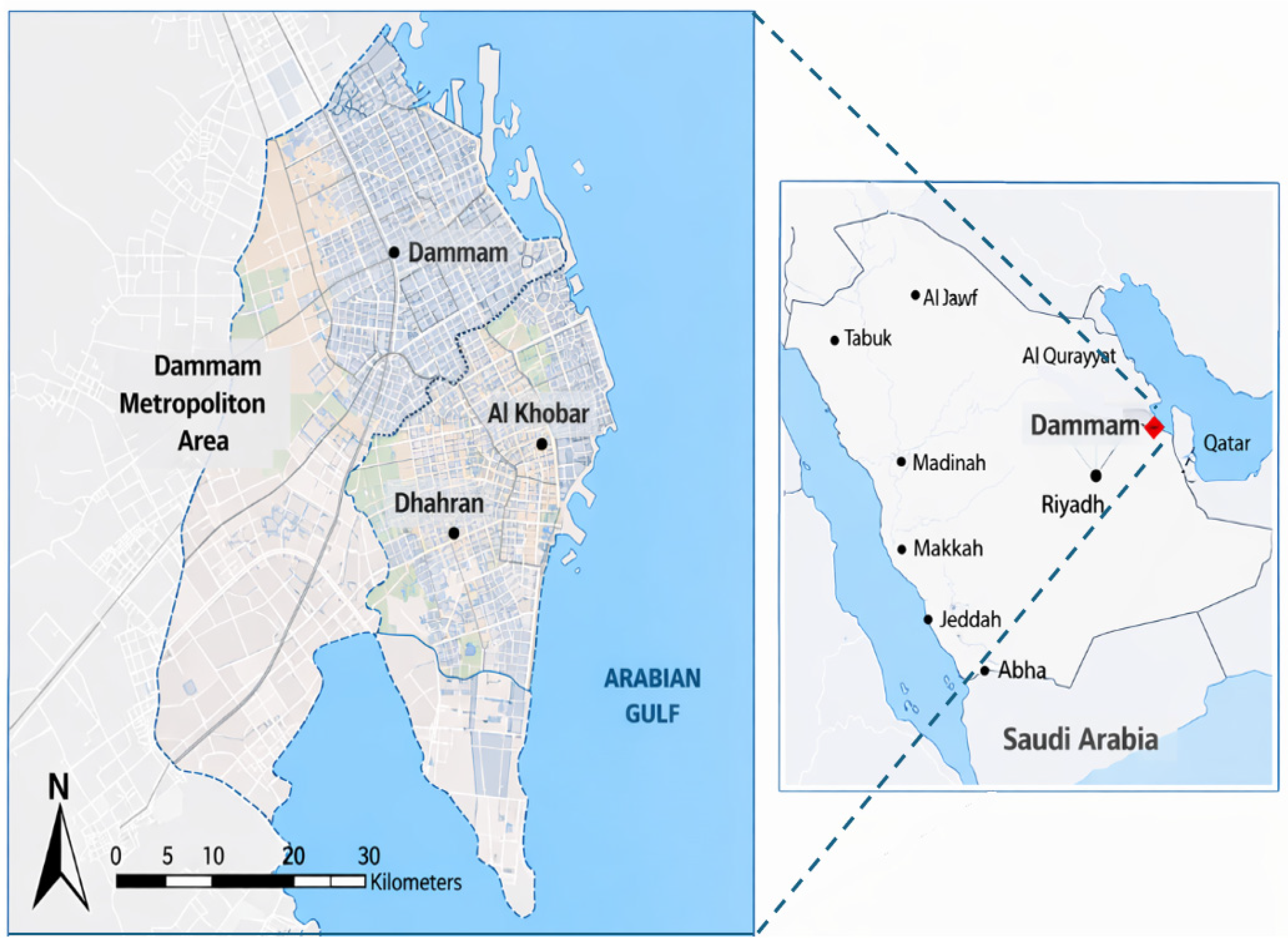
The empirical focus is the Dammam Metropolitan Area (DMA), comprising Dammam, Al Khobar, and Dhahran (
Figure 2). DMA represents one of Saudi Arabia’s most rapidly urbanizing and economically strategic regions and has been prioritized for smart city implementation under Saudi Vision 2030 [
18,
19,
20,
21]. Ongoing AI- and IoT-enabled initiatives, including digital municipal platforms, GIS-based zoning, traffic optimization systems, and environmental monitoring infrastructures, make DMA an appropriate governance laboratory for exploring how AI intersects with participatory urban planning in a transforming institutional context [
20,
27].
Given the relative novelty of structured AI-enabled participatory planning in the region, the DMA case is examined as an exploratory metropolitan testbed, generating empirical insights that may inform broader Gulf and Global South smart governance discussions.
Data collection relied on a cross-sectional digital survey, complemented by qualitative open-ended responses. The study received ethical approval from the Institutional Review Board of Imam Abdulrahman Bin Faisal University (protocol code IRB-2026-06-0008), approved on 06 January 2026, prior to the initiation of the questionnaire survey. Following IRB approval, data collection commenced on 10 January 2026.
Survey invitations were distributed electronically via official institutional mailing lists and professional networks to ensure standardized administration across stakeholders. A uniform questionnaire was used for all respondent categories to ensure analytical comparability. The digital mode of administration aligns with the study’s focus on digitally mediated governance systems and reflects high digital accessibility in the study region [
9,
11].
A purposive sampling strategy was adopted to recruit respondents with direct or indirect experience in urban planning, governance, or smart city initiatives [
50,
51]. Participants included municipal planners, public officials, private-sector professionals, academics, and residents who had engaged in municipal or digital participation processes. This sampling approach reflects the exploratory objective of capturing informed stakeholder perceptions within a governance ecosystem rather than generating statistically representative population estimates.
Out of 400 distributed invitations, 260 valid responses were received (65% response rate), consistent with comparable smart governance studies in the Gulf region [
18,
19,
21]. While the sample size is modest relative to population-scale surveys, it is appropriate for exploratory governance research aimed at identifying institutional readiness patterns and participation dynamics among relevant actors. The survey instrument was structured around the conceptual framework linking AI capabilities, institutional readiness, participation quality, and public trust. Five interrelated constructs were operationalized:
Citizen participation and engagement
Awareness and use of AI tools
Institutional and technical readiness
Perceived benefits of AI
Perceived risks and ethical concerns
Items were measured using five-point Likert scales (1 = strongly disagree to 5 = strongly agree), a format widely used in governance and digital transformation research [
15,
52]. Although Likert responses are ordinal in nature, means and standard deviations were calculated to provide interpretable summaries of central tendency across stakeholder perceptions. Interpretation followed conventional thresholds: values below 2.5 indicate low agreement, values near 3 reflect neutrality or moderate perception, and values above 3.5 indicate relatively strong agreement. These statistical summaries are used descriptively and comparatively rather than inferentially to establish causal effects, consistent with the exploratory orientation of the study. The instrument was developed based on established literature, reviewed by experts, and pilot tested to enhance clarity and reliability [
53,
54].
Quantitative analysis focused on identifying perceptual patterns and associations among key constructs. Descriptive statistics summarized levels of AI awareness, institutional readiness, participation experience, and trust perceptions. Cronbach’s alpha assessed internal consistency. Correlation and regression analyses explored associations between institutional readiness, AI awareness, participation quality, and trust, providing indicative, not definitive, evidence of governance dynamics consistent with the conceptual framework [
7,
34,
37,
38]. Given the exploratory nature of the research, regression findings are interpreted cautiously as relational insights rather than causal determinations.
To deepen contextual understanding, open-ended survey responses were analyzed using reflexive thematic analysis following Braun and Clarke’s six-stage framework [
55]. Coding was conducted independently by three researchers, achieving strong inter-coder reliability (κ = 0.81). Emergent themes were mapped onto the framework’s dimensions, enabling direct comparison between quantitative patterns and qualitative interpretations.
The convergent integration of findings occurred during interpretation, where qualitative evidence was used to contextualize statistical trends and illuminate institutional bottlenecks, trust concerns, and participation paradoxes. This triangulation strategy strengthens interpretive validity while maintaining the exploratory character of the study.
Participation was voluntary, informed consent was obtained electronically, and no personally identifiable information was collected. Data were securely stored in accordance with established research ethics standards [
56]. As an exploratory cross-sectional study, several limitations apply. The design does not permit causal inference or longitudinal tracking of AI adoption trajectories. The purposive sampling strategy limits statistical generalizability to the broader metropolitan population. Findings reflect stakeholder perceptions at a specific point in time (January 2026) and do not capture subsequent institutional or technological developments.
However, these characteristics are consistent with exploratory governance research aimed at identifying emerging patterns and informing future confirmatory, comparative, and longitudinal investigations. By positioning DMA as an empirical testbed, this study contributes foundational evidence for advancing theory and practice in AI-enabled participatory urban planning within sustainability-oriented smart city contexts.
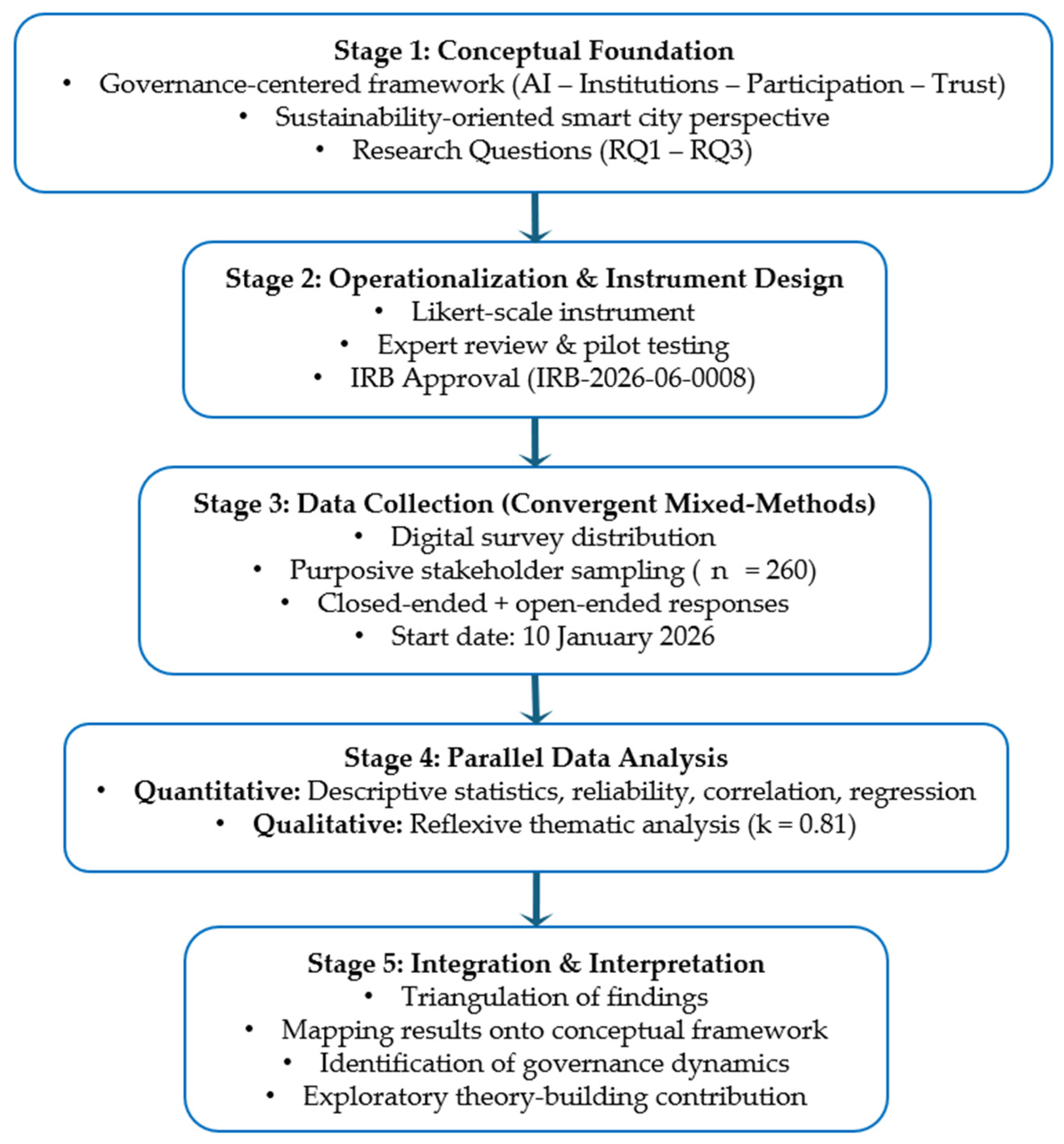
Figure 3 summarizes the sequential and integrative stages of the research design, beginning with conceptual framework development and construct operationalization, followed by concurrent quantitative and qualitative data collection under a convergent mixed-methods approach, parallel analytical procedures, and integrated triangulation aligned with the governance-centered framework.
4. Results
4.1. Demographic and Professional Background
This subsection presents the demographic and professional characteristics of the respondents, as summarized in
Table 1. The selected variables, professional role, years of governance-related experience, sectoral affiliation, educational attainment, and familiarity with smart city initiatives, reflect the multi-actor governance environment emphasized in smart city and participatory planning literature [
1,
13,
38]. Because perceptions of AI adoption, participation quality, and institutional trust often vary across institutional positions and exposure to digital governance initiatives [
9,
13], clarifying respondent composition is essential for interpreting subsequent findings.
The sample was constructed through purposive stakeholder sampling targeting individuals with direct or indirect involvement in urban governance, planning processes, or digital transformation initiatives. In this context, the category “citizen/resident” does not refer to a random cross-section of the general population. Rather, it denotes civic participants who had prior engagement with municipal processes, consultation platforms, or digital governance initiatives in the Dammam Metropolitan Area (DMA). This distinction ensures conceptual consistency with the study’s governance-focused design.
Academics and researchers constituted 27.31% of respondents, municipal planners 26.54%, and local government officials 25.00%. Civic participants (citizens/residents) accounted for 14.23%, while 6.92% represented other professional backgrounds. This distribution reflects a governance-oriented stakeholder sample rather than a population-wide citizen survey. Such a composition aligns with the study’s objective of examining AI-enabled participatory planning from institutional and informed civic perspectives [
13,
38].
The “years of experience” variable refers to governance-related professional or civic engagement experience rather than general employment tenure. For institutional actors, this reflects years of involvement in planning, municipal administration, or sectoral governance. For civic participants, it reflects years of engagement in participatory processes, consultation exercises, or governance-related initiatives within DMA. Approximately 31.92% reported 5–10 years of relevant experience, 25.38% reported 11–15 years, and 24.62% had more than 15 years, while 18.08% had less than five years. The mean experience score (M = 2.57, SD = 1.05) indicates a predominance of mid- to senior-level stakeholders. This experience profile is relevant for evaluating institutional readiness, as organizational learning and governance exposure influence how AI systems are interpreted and assessed [
7,
30,
31,
32].
Sectoral affiliation illustrates the interdisciplinary governance ecosystem represented in the sample. Respondents were primarily affiliated with urban planning (26.15%), waste management (25.38%), and oil and gas (18.08%), followed by academia (16.54%) and construction (10.00%). The inclusion of respondents from the oil and gas sector reflects DMA’s economic structure, where energy industries play a central role in metropolitan governance, infrastructure investment, environmental management, and digital transformation strategies. Energy-sector actors are therefore directly connected to urban planning, sustainability initiatives, and AI-supported infrastructure systems in the region. This cross-sectoral representation supports a holistic understanding of AI-enabled participatory governance, where planning decisions intersect with environmental services, infrastructure systems, and economic activities [
1,
2,
3].
The respondent pool demonstrates relatively high levels of formal education: 26.15% held a master’s degree, 21.54% held a doctorate, 14.23% reported professional certification, and 22.69% held a bachelor’s degree, while 15.38% reported high school education or lower. The mean educational level (M = 2.97, SD = 1.28) indicates a generally well-educated sample. However, this mean should not be interpreted deterministically as evidence of “strong digital capacity.” Rather, it suggests that many respondents possess advanced formal qualifications, which may influence their familiarity with governance systems and digital transformation initiatives. The relationship between educational attainment and digital engagement remains contextual and is examined empirically in later sections rather than assumed a priori [
14,
15].
A majority of respondents (62.16%) reported familiarity with the concept of smart cities, while 37.84% reported no familiarity. Awareness of DMA’s specific smart city initiatives was more uneven: 28.85% indicated awareness, 43.08% partial awareness, and 28.08% no awareness.
Given the governance-oriented composition of the sample, higher levels of familiarity may reflect professional exposure among planners, officials, academics, and sectoral actors. Civic participants displayed comparatively more heterogeneous awareness levels, highlighting that exposure to digital transformation initiatives varies across stakeholder categories. This variation is consistent with smart city research showing that awareness and engagement differ according to institutional position and professional proximity to governance processes [
9,
17,
39].
Overall, the demographic and professional profile demonstrates that the study sample represents an informed, governance-relevant stakeholder group rather than a general population survey. This composition strengthens the study’s ability to examine AI-enabled participatory urban planning from institutional, technical, and engaged civic perspectives, while also requiring careful interpretation of findings in light of stakeholder distribution. The clarified sampling logic supports the study’s exploratory and governance-centered positioning developed in earlier sections.
4.2. Citizen Engagement in Urban Planning
This subsection examines patterns of stakeholder engagement in urban planning using the indicators summarized in
Table 2. Given the purposive and governance-oriented sampling strategy described in
Section 4.1, engagement is analyzed across informed stakeholder categories, including planners, government officials, academics, sectoral professionals, and engaged civic participants, rather than as a population-representative citizen survey. The selected variables capture both the extent of engagement (participation history and frequency) and the quality of engagement (perceived influence, outcome effectiveness, availability of opportunities, digital confidence, and willingness to engage under improved technological conditions). This operationalization reflects participatory planning theory and aligns with the conceptual framework, which positions participation quality and institutional responsiveness as central determinants of meaningful AI-enabled governance [
11,
12,
13].
As shown in
Table 2, 74.52% of respondents reported prior participation in municipal planning or governance processes, while 25.48% reported no prior involvement. This relatively high level of participation exposure reflects the governance-focused composition of the sample and indicates that formal participation channels exist within DMA’s planning system. However, participatory theory emphasizes that exposure alone does not guarantee substantive influence [
12].
Participation frequency further clarifies institutional patterns. Nearly half of respondents (48.26%) reported occasional engagement (one to two times per year), and 25.48% reported frequent engagement (quarterly or more), while 26.25% reported never participating. The predominance of occasional participation suggests that engagement mechanisms may be episodic rather than embedded within routine planning cycles. This pattern mirrors findings in smart governance research, where participation often occurs in project-based or consultative formats rather than as continuous collaborative processes [
13,
25].
The most consequential findings concern perceived influence and outcome effectiveness. A majority of respondents (64.23%) disagreed or strongly disagreed that planners genuinely consider public input in decision-making, while only 23.46% agreed. The mean score (M = 2.17, SD = 1.42) falls clearly within the low-agreement range on the five-point Likert scale, indicating weak perceived responsiveness. This result suggests that although participation mechanisms are present, their influence on planning decisions is widely perceived as limited.
Similarly, trust that participation leads to meaningful change remains constrained. Approximately 62.95% disagreed that their participation produces tangible outcomes, compared with only 24.70% who expressed agreement (M = 2.63, SD = 1.12). Together, these results point to a structural gap between engagement mechanisms and perceived decision impact, reinforcing long-standing critiques of tokenistic participation in urban governance [
11,
12,
13,
19].
Perceptions of the sufficiency of participation opportunities were more ambivalent. While 34.80% agreed that sufficient engagement channels exist, 44.80% remained neutral. This distribution suggests uneven awareness or differential access to participation mechanisms across stakeholder groups, a phenomenon commonly observed in smart city governance contexts [
13,
14,
15,
16,
17].
In contrast, digital participation confidence was comparatively strong within this governance-focused sample. More than half of respondents (53.20%) expressed confidence in using digital tools to engage in planning (M = 3.53, SD = 0.98), and 53.60% indicated willingness to engage more actively if easier digital tools were introduced (M = 3.55, SD = 1.09). Given the professional and academic composition of much of the sample, these levels of digital readiness should not be generalized to the broader population. Rather, they reflect the capacities of engaged stakeholders operating within DMA’s governance ecosystem.
Taken together, the results reveal a clear governance dynamic: relatively high participation exposure and moderate digital readiness coexist with low perceived influence and limited confidence in participatory outcomes. The particularly low mean score for perceived influence (M = 2.17) underscores a central finding of the study that institutional responsiveness remains the primary bottleneck in achieving meaningful participatory planning. This pattern reflects what may be described as a stakeholder participation paradox, where engagement structures are present but their substantive impact is questioned.
These findings reinforce the conceptual framework’s proposition that participation frequency and technological accessibility alone are insufficient to achieve participatory urban governance. Institutional mediation, transparent feedback mechanisms, and decision traceability are necessary to translate engagement into perceived influence and trust [
11,
12,
13].
To assess whether perceptions varied systematically across stakeholder categories, exploratory cross-tabulations were conducted by professional role. While detailed subgroup tables are not presented for brevity, the patterns indicate that municipal planners and government officials reported slightly higher perceptions of opportunity availability and digital confidence, whereas civic participants and non-governmental professionals were more likely to express skepticism regarding influence and outcome effectiveness. These variations align with institutional proximity effects documented in governance research, where actors embedded within administrative structures tend to perceive higher responsiveness than external stakeholders [
9,
24].
Importantly, however, the overall pattern of low perceived influence remained consistent across stakeholder groups, suggesting that the participation paradox identified in this study reflects a broader institutional dynamic rather than the perceptions of a single category. This consistency strengthens the exploratory conclusion that institutional readiness and governance design, rather than stakeholder type alone, shape perceptions of participatory effectiveness within DMA.
4.3. Awareness and Use of AI Tools
This subsection examines stakeholder awareness, interaction, perceived benefits, and concerns regarding AI use in urban governance, drawing on the indicators summarized in
Table 3. These variables correspond to the AI capability dimension of the conceptual framework, which conceptualizes AI not as an autonomous driver of participation, but as a governance-enabling technology whose participatory effects are mediated by institutional capacity and public trust [
3,
38].
The results indicate a high level of conceptual awareness of AI applications in urban governance. A substantial majority of respondents (79.62%) reported being aware of AI use in urban systems, while only 20.38% indicated no awareness. This finding reflects growing exposure to AI discourse within governance and professional environments and aligns with recent smart city research documenting increasing familiarity with AI concepts among urban stakeholders [
4,
5,
6]. However, awareness does not translate into widespread experiential engagement. Only 40.38% of respondents reported direct interaction with AI-based urban systems, while 36.54% reported no interaction and 23.08% were unsure. The mean score for interaction (M = 1.83, SD = 0.78), coded on a categorical scale (1 = Yes; 2 = No; 3 = Unsure), indicates that practical exposure remains limited relative to conceptual awareness. This awareness–use gap reinforces findings from AI governance literature suggesting that strategic narratives about AI adoption often outpace institutional implementation and operational integration [
7,
8,
9,
34].
Respondents were asked to identify AI tools perceived as most useful for enhancing engagement in planning processes. The distribution of responses indicates stronger support for tools that enhance transparency and collective interpretation, such as sentiment analysis of public feedback (27.36%) and interactive planning maps (21.46%),compared to more automated or transactional interfaces such as AI-powered chatbots (8.02%).
The reported mean score (M = 3.45, SD = 1.35) for preferred AI engagement tools was calculated using a five-point Likert-type coding scale (1 = strongly unfavorable; 5 = strongly favorable), where higher values indicate stronger perceived usefulness. A mean of 3.45 therefore reflects moderate positive orientation toward AI tools that facilitate deliberation and visualization rather than automation. This distinction suggests that stakeholders perceive AI as most valuable when it enhances interpretability and communication rather than replacing human judgment, an insight consistent with participatory governance research [
39,
40].
Perceptions of AI’s benefits further illuminate stakeholder expectations. The most frequently identified benefits were improved transparency and accountability (22.76%) and efficient data processing (20.69%), followed by broader public participation (17.24%). The overall mean benefit score (M = 3.53, SD = 1.52), measured on a five-point Likert scale (1 = strongly disagree; 5 = strongly agree), indicates cautious optimism regarding AI’s governance value.
This result suggests that AI is positively perceived when framed as a tool for enhancing openness, responsiveness, and decision support rather than managerial control. In governance contexts, technological legitimacy appears to be associated more strongly with transparency-enhancing functions than with efficiency gains alone [
11,
13].
Despite perceived benefits, concerns regarding AI deployment remain pronounced. The most frequently cited risks include mistrust in technology (24.88%), exclusion of digitally vulnerable populations (24.38%), and lack of transparency in decision-making processes (22.89%). The relatively high mean concern score (M = 3.46, SD = 1.37), based on a five-point Likert scale, indicates that risk perceptions are substantial and cannot be dismissed as marginal.
These concerns reflect themes widely discussed in AI governance literature, including algorithmic opacity, digital divide effects, and accountability gaps [
14,
15,
16,
41]. Importantly, exclusion and mistrust emerge as dominant concerns, reinforcing the argument that AI adoption without institutional safeguards may exacerbate rather than mitigate governance inequalities.
Taken together, the findings reveal a structural tension: high conceptual awareness of AI coexists with limited direct interaction and conditional trust. The awareness–use gap suggests that institutional readiness and implementation depth remain uneven. Furthermore, the simultaneous presence of moderate optimism (M = 3.53) and significant concern (M = 3.46) indicates that stakeholder acceptance of AI-enabled planning is contingent upon governance design rather than technological availability alone. These patterns provide empirical support for the conceptual framework’s core proposition: AI’s participatory value is mediated by institutional readiness and trust dynamics rather than by awareness or technical capability alone.
It is important to acknowledge that the relatively strong digital confidence and awareness levels observed in this subsection may reflect the professional composition of the sample, which includes planners, officials, academics, and sectoral professionals with governance-related exposure. As such, digital readiness levels should not be interpreted as representative of the broader metropolitan population. Instead, they reflect the capacities of engaged stakeholders operating within DMA’s governance ecosystem. This reflexive consideration strengthens the exploratory positioning of the study and reinforces the need for future research incorporating broader population-based sampling to assess AI acceptance across more diverse demographic groups.
4.4. Institutional and Technical Readiness
This subsection examines institutional and technical readiness for integrating AI into participatory urban planning, drawing on the indicators summarized in
Table 4. These variables correspond to the institutional capacity dimension of the conceptual framework, which mediates the relationship between AI deployment and participatory outcomes by shaping how technologies are governed, coordinated, and experienced by stakeholders [
7,
8,
9,
38]. Rather than treating institutional readiness as an isolated or deterministic variable, this study conceptualizes it as a mediating governance condition whose effects are reinforced or constrained through participation quality and trust dynamics.
As shown in
Table 4, assessments of municipal readiness to integrate AI into participatory planning are moderate to cautious. Approximately 63.70% of respondents rated readiness as moderate to very poor, while 36.30% perceived it as good or excellent. The mean score (M = 3.07, SD = 1.27), based on a five-point scale (1 = very poor; 5 = excellent), indicates a mid-range evaluation leaning toward structural limitation rather than institutional maturity.
This distribution suggests that while foundational infrastructure and strategic ambition may be present, institutional integration remains uneven. Such patterns align with research demonstrating that AI adoption in public-sector contexts frequently advances rhetorically faster than organizational integration, often constrained by fragmented responsibilities and governance complexity [
33,
34,
35,
38].
Human capital emerges as a prominent constraint. A majority of respondents (52.67%) disagreed or strongly disagreed that municipal staff are adequately trained to use AI tools effectively (M = 2.58, SD = 1.02). This low mean score, derived from a five-point Likert scale (1 = strongly disagree; 5 = strongly agree), indicates limited confidence in institutional skill readiness.
This finding is consistent with empirical studies highlighting that AI implementation in governance settings is often constrained less by technological availability than by capacity gaps, training deficits, and institutional learning barriers [
13,
14,
15,
19]. Importantly, this capacity limitation appears to intersect with participation concerns identified in
Section 4.2, suggesting that institutional mediation, not technological access alone, shapes participatory effectiveness.
Perceptions of interdepartmental coordination further underscore institutional fragmentation. Nearly half of respondents reported insufficient coordination across departments to support AI deployment, reflected in a mean score of M = 2.96 (SD = 1.23). This near-neutral but slightly negative evaluation suggests that AI initiatives may remain siloed within technical or digital units rather than integrated into planning, governance, and public engagement structures.
Such fragmentation has been widely identified as a barrier to participatory digital governance, particularly when coordination mechanisms fail to connect technological innovation with deliberative planning processes [
7,
13].
Perceptions of regulatory clarity were more mixed. While 41.89% agreed that clear regulations guide AI use in urban planning, 35.18% remained neutral. The mean score (M = 3.36, SD = 1.15) indicates moderate confidence in the existence of formal frameworks, but the substantial neutral share suggests uncertainty regarding enforcement, operationalization, or transparency of such regulations. This pattern reflects broader AI governance debates, where formal policy frameworks may exist but lack procedural clarity or consistent implementation at the municipal level [
19,
38].
Respondents expressed comparatively stronger confidence in citizens’ digital literacy (M = 3.64, SD = 1.08) and in AI’s potential to improve trust in urban decision-making (M = 3.65, SD = 1.08). These moderately positive scores indicate that stakeholders perceive digital readiness and trust gains as possible, though conditional. However, as noted in
Section 4.3, concerns regarding exclusion and mistrust remain significant. Therefore, these moderately positive assessments should not be interpreted as unconditional endorsement, but rather as potential trust gains contingent upon governance safeguards and institutional transparency.
Taken together,
Table 4 reveals a nuanced governance dynamic. Institutional readiness is neither absent nor fully mature; rather, it occupies a transitional position characterized by partial regulatory foundations, moderate digital capacity, and significant human capital and coordination gaps. These patterns reinforce the conceptual framework’s mediating logic: AI’s participatory impact depends not solely on technological capability, but on the institutional environment within which it is embedded.
Qualitative triangulation (
Section 4.5) and the broader integrative analysis further indicate that institutional capacity variables are closely associated with perceptions of participation quality and public trust, yet they do not operate independently. Rather, their influence is interdependent with digital confidence, stakeholder engagement patterns, and perceived transparency within governance processes. Accordingly, institutional readiness should be interpreted as a mediating governance condition rather than as a single decisive determinant of AI-enabled participatory outcomes. It is important to acknowledge that the majority of respondents in this study are professionals embedded within governance-related sectors (planners, officials, academics, and sectoral experts). As such, perceptions of municipal readiness and digital capacity may reflect institutional familiarity and professional proximity. Exploratory cross-tab analyses suggest that respondents affiliated with municipal or planning sectors expressed slightly higher confidence in regulatory clarity and coordination than civic participants. However, concerns regarding staff training and fragmentation were consistent across categories. This consistency strengthens the interpretation that institutional readiness challenges are systemic rather than group-specific. At the same time, the professional composition of the sample underscores the exploratory nature of the study and suggests the need for future population-based research to assess readiness perceptions across broader demographic segments.
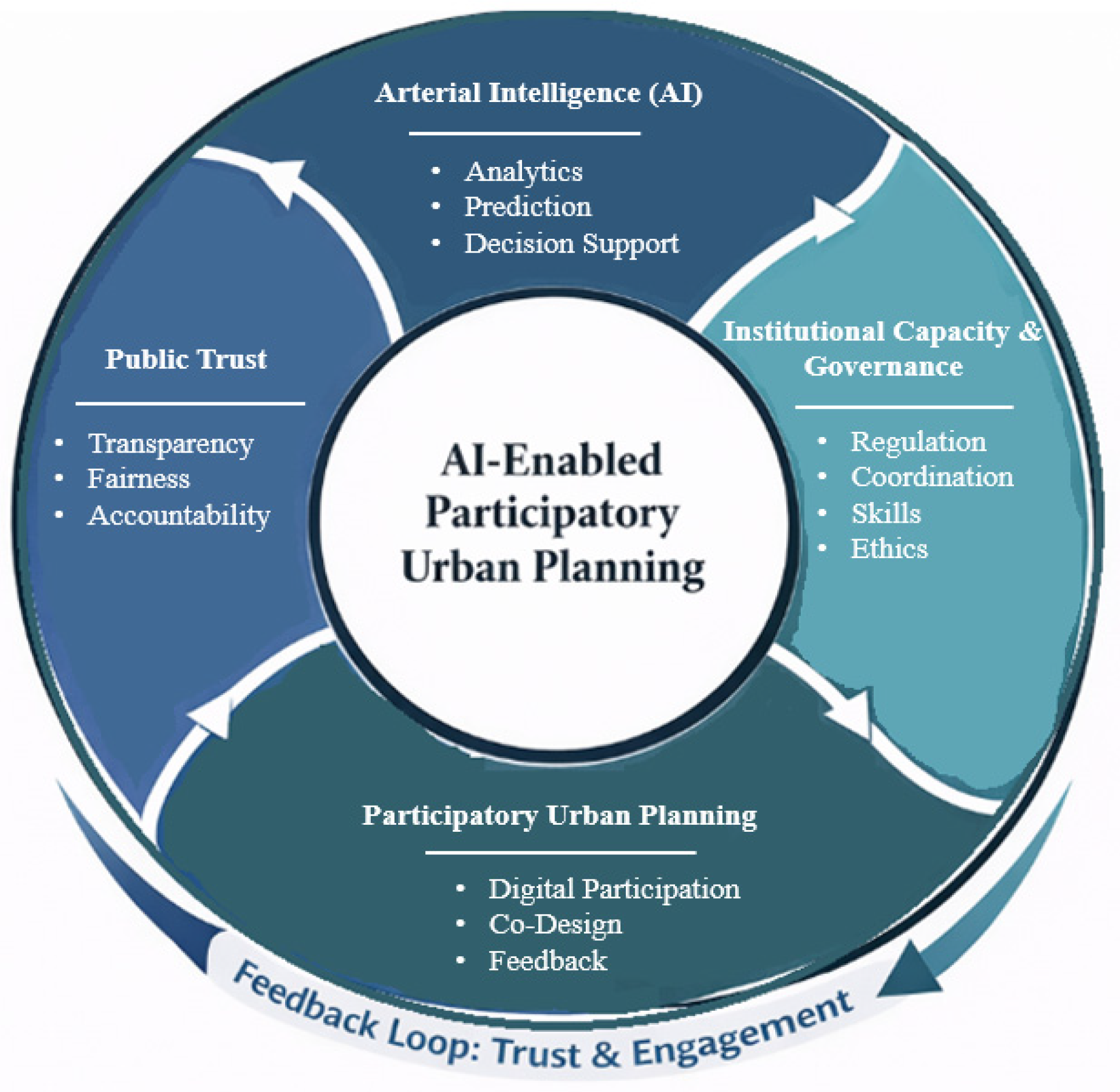
Overall, the findings do not suggest that institutional readiness alone determines AI-enabled participatory outcomes. Rather, institutional capacity functions as a mediating governance condition whose effects are reinforced or constrained through stakeholder trust, engagement quality, and implementation design. This interpretation aligns with the governance-centered conceptual framework presented in
Figure 1 and supports the study’s broader argument that AI-enabled participatory planning is fundamentally a socio-technical and institutionally mediated process.
4.5. Thematic Analysis of Open-Ended Responses
To complement the quantitative findings, a reflexive thematic analysis was conducted to explore how stakeholders interpret AI-enabled participatory urban planning as a socio-technical and institutionally mediated governance process. Following Braun and Clarke’s six-step framework [
55], 214 substantive open-ended responses were coded using NVivo 12. Three researchers independently generated initial codes, compared interpretations, and iteratively refined a shared codebook. Thematic saturation was reached after 34 responses, and inter-coder reliability was strong (κ = 0.81), indicating analytical rigor.
The qualitative findings provide contextual depth to the survey results by illuminating how institutional readiness, participation quality, and trust dynamics are experienced and articulated by stakeholders. Importantly, the themes reinforce the governance-centered conceptual framework, which positions AI not as an isolated technological solution but as a catalyst embedded within regulatory structures, organizational culture, and participatory processes.
Five interrelated themes emerged: (1) governance and regulatory reform; (2) digital transformation and emerging smart technologies; (3) capacity building and organizational culture; (4) stakeholder participation and transparency; and (5) sustainability-oriented service improvement. Collectively, these themes reveal that stakeholders interpret AI-enabled planning primarily as an institutional transformation challenge rather than a purely technical innovation.
Governance and regulatory reform emerged as the most frequently referenced theme (41% of coded segments). Respondents repeatedly emphasized the need for clearer legal mandates, harmonized jurisdictional responsibilities, and coherent multi-level governance structures to support AI-enabled planning. Calls for a “clear legal framework,” a “national transition roadmap,” and mechanisms to prevent administrative overlap echo the quantitative findings regarding regulatory ambiguity and coordination gaps (
Section 4.4). These insights reinforce the argument that AI adoption is inseparable from governance architecture. Stakeholders perceive that without clarified decision rights, enforcement mechanisms, and accountability procedures, AI tools risk becoming symbolic or fragmented interventions. This theme strongly aligns with smart governance scholarship emphasizing regulatory coherence as a precondition for effective digital transformation.
The second theme (31%) reflects cautious enthusiasm for AI and emerging technologies as enablers of more transparent and responsive planning. Stakeholders proposed the use of AI-powered dashboards, predictive analytics for service needs, blockchain-enabled licensing systems, IoT-based infrastructure monitoring, and immersive visualization tools such as virtual reality platforms and digital twins to simulate planning scenarios. Digital twins and predictive modeling tools were frequently framed as mechanisms to enhance transparency by allowing stakeholders to visualize alternative urban futures and assess trade-offs in real time. These technologies were viewed as particularly valuable for scenario testing, infrastructure optimization, and participatory design workshops. However, respondents stressed that such tools must be embedded within coordinated institutional workflows rather than deployed as standalone technical systems. This theme directly mirrors the awareness–use gap identified in
Section 4.3: while stakeholders recognize the transformative potential of AI and advanced visualization technologies, they perceive that practical implementation remains constrained by institutional integration challenges.
Capacity building and organizational culture (27%) emerged as a critical mediating factor linking technological ambition to governance outcomes. Respondents highlighted the urgent need to upskill municipal staff, establish innovation labs, foster cross-sector partnerships with universities, and institutionalize continuous learning mechanisms. Several participants emphasized that leadership commitment and change-management programs are essential to cultivate a data-informed and participatory organizational mindset. This reinforces the quantitative finding that staff training received one of the lowest readiness scores (M = 2.58). Importantly, stakeholders framed human capital not merely as a technical skill gap but as a cultural transformation requirement, underscoring the socio-technical nature of AI-enabled governance.
Stakeholder participation and transparency (24%) provided qualitative depth to the participation paradox identified in
Section 4.2. Respondents advocated for interactive platforms enabling residents and professionals to submit feedback, vote on neighborhood initiatives, monitor municipal KPIs through open dashboards, and track the status of submitted proposals. At the same time, concerns about digital exclusion and representational inequities were prominent. Stakeholders emphasized the need for multilingual interfaces, accessible design standards, and hybrid participation models combining digital and in-person engagement to prevent marginalization of digitally vulnerable groups. This theme confirms that stakeholders view AI as legitimate only when it strengthens deliberation, traceability, and feedback loops, thereby enhancing trust rather than replacing participatory governance.
A cross-cutting theme (22%) emphasized AI’s potential to advance environmental sustainability and urban resilience. Suggested applications included AI-optimized waste management, renewable-energy-integrated smart parking, predictive maintenance of public infrastructure, real-time environmental monitoring, and green infrastructure modeling through digital twin systems. These perspectives align AI-enabled participation with broader sustainability objectives, linking technological innovation with ecological accountability and quality-of-life improvements. Stakeholders therefore conceptualize AI not only as a governance tool, but as an instrument for advancing long-term urban resilience.
Collectively, the thematic findings demonstrate strong convergence with the quantitative results. Governance reform, institutional capacity building, and trust-enhancing transparency consistently emerge as prerequisites for effective AI-enabled participatory planning. Emerging technologies, such as digital twins and immersive visualization, are perceived as valuable only when embedded within coherent regulatory frameworks and organizational learning systems. Thus, the qualitative evidence strengthens the study’s core proposition: AI-enabled participatory urban planning functions as a socio-technical governance process in which technological capability, institutional readiness, and public trust are mutually reinforcing. Stakeholders do not view AI as a substitute for governance reform; rather, they interpret it as a catalyst whose effectiveness depends on institutional alignment and inclusive design.
4.6. Integrative Synthesis of Findings in Relation to the Conceptual Framework
Taken together, the empirical findings from
Section 4.1,
Section 4.2,
Section 4.3,
Section 4.4 and
Section 4.5 provide coherent and mutually reinforcing support for the conceptual framework presented in
Figure 1, which positions AI as a governance enabler whose participatory effects are mediated by institutional capacity and reinforced through public trust. Across descriptive patterns and qualitative triangulation, the results converge on a consistent insight: AI does not independently produce meaningful participation in urban planning. Rather, its governance value emerges through its interaction with institutional readiness, stakeholder engagement dynamics, and trust-building mechanisms embedded within the metropolitan governance ecosystem.
The demographic and professional profile outlined in
Section 4.1 provides important interpretive grounding for this synthesis. The sample reflects a purposively selected group of governance-relevant stakeholders, including planners, officials, academics, sectoral professionals, and engaged civic participants, whose evaluations are shaped by institutional proximity and professional exposure. This multi-actor composition reinforces the framework’s premise that AI-enabled participatory planning must be understood within a governance system characterized by differentiated roles, sectoral interdependencies, and varying degrees of institutional embeddedness. At the same time, the professional orientation of the sample suggests that observed digital confidence and awareness levels reflect governance-facing stakeholders rather than the broader population, strengthening the exploratory positioning of the study.
Section 4.2 revealed a stakeholder participation paradox that directly supports the framework’s emphasis on participation quality. While formal engagement channels and digital readiness are relatively well established, perceived influence and outcome effectiveness remain low. The particularly weak evaluation of perceived influence (M = 2.17) indicates that participation mechanisms are not consistently translated into visible decision impact. This finding confirms the framework’s central proposition that participation frequency and technological access are insufficient without institutional mechanisms that ensure responsiveness, feedback, and accountability. In this context, AI-enabled tools represent latent participatory potential that remains contingent upon governance design.
Section 4.3 further substantiates this mediating logic through the identification of an awareness–use gap. High levels of conceptual awareness of AI coexist with limited direct interaction and conditional trust. Stakeholders express moderate optimism regarding AI’s potential benefits, particularly in enhancing transparency and accountability, while simultaneously articulating concerns related to exclusion, mistrust, and opacity. This duality reinforces the framework’s treatment of AI as a facilitative technology whose legitimacy depends on institutional safeguards and transparency conditions rather than on technological sophistication alone.
Section 4.4 demonstrates that institutional and technical readiness functions as a governance mediator rather than a single decisive factor. Moderate municipal readiness, skill gaps, coordination challenges, and regulatory ambiguity constrain the translation of AI adoption into participatory gains. At the same time, respondents recognize the potential for AI to enhance trust and transparency when embedded within coherent governance arrangements. Qualitative triangulation (
Section 4.5) reinforces this interpretation, highlighting stakeholders’ calls for regulatory clarity, capacity building, organizational learning, and integrated deployment of emerging tools such as predictive analytics and digital twins. Across themes, AI is consistently framed as part of a broader institutional transformation process rather than as a standalone technical intervention.
The thematic findings also illuminate the dynamic relationship between participation and trust embedded in the conceptual framework. Stakeholders view trust not as an automatic by-product of digital innovation, but as a cumulative outcome of transparency, feedback loops, inclusivity, and visible responsiveness. This perspective supports the framework’s feedback logic, in which institutional performance shapes participation quality, participatory experience influences trust, and trust conditions the legitimacy of AI-supported governance over time.
Overall, the integrated findings validate the framework’s core assumptions while refining its interpretation. AI-enabled participatory urban planning operates as a socio-technical governance system in which technological capabilities, institutional arrangements, stakeholder engagement patterns, and trust dynamics are mutually reinforcing. Realizing the participatory promise of AI therefore requires more than digital deployment; it demands coordinated institutional reform, sustained capacity development, inclusive participation design, and governance practices that prioritize transparency and accountability. In the Dammam Metropolitan Area context, AI’s transformative potential lies not in automation alone, but in its strategic integration within trust-oriented and institutionally coherent urban governance structures.
5. Discussion
This study examined AI-enabled participatory urban planning as a socio-technical governance process within a rapidly transforming metropolitan context. The findings demonstrate that AI’s contribution to participatory urban governance does not derive from technological deployment alone, but from its interaction with institutional capacity, stakeholder engagement quality, and trust-oriented governance arrangements [
1,
2,
3,
4,
5]. Rather than confirming institutional readiness as a singularly decisive factor, the results show that institutional capacity functions as a mediating condition that shapes how AI tools are interpreted, integrated, and experienced within planning processes.
A central contribution of this study is the empirical refinement of the participation paradox identified in prior smart city scholarship. While formal engagement channels and digital participation capacity appear relatively established among governance-facing stakeholders, perceived influence and outcome effectiveness remain weak. This misalignment confirms long-standing critiques of procedural or consultative participation, where engagement mechanisms exist without meaningful decision impact [
13,
14,
15].
In AI-enabled environments, this gap becomes even more significant. Algorithmic systems, particularly when opaque or insufficiently explained, may intensify perceptions of distance between stakeholders and decision-making institutions. The findings therefore reinforce participatory planning theory by demonstrating that technological expansion of engagement channels does not automatically translate into governance legitimacy [
5,
6,
7,
8,
9].
The results also reveal a pronounced awareness–use gap: high conceptual familiarity with AI coexists with limited direct interaction. This pattern mirrors findings in regional digital governance studies, including research conducted in the United Arab Emirates, where ambitious smart city strategies coexist with uneven participatory integration and variable levels of public trust in algorithmic governance systems. Comparative Gulf research suggests that citizens in highly digitized cities such as Dubai and Abu Dhabi often express confidence in technological efficiency but remain cautious regarding transparency, accountability, and algorithmic explainability [
27,
51].
Similarly, in the Dammam Metropolitan Area, stakeholders demonstrated cautious optimism toward AI when it enhances transparency and sense-making, particularly through interactive planning maps, predictive analytics, immersive visualization, and emerging digital twin technologies. Digital twins, in particular, were viewed as tools capable of improving scenario transparency and public understanding of planning trade-offs [
8,
15,
32,
33]. However, respondents expressed less enthusiasm for automated systems that replace human judgment or obscure deliberative processes. These findings align with regional governance debates emphasizing that AI legitimacy depends on institutional transparency and procedural safeguards rather than innovation rhetoric alone.
Institutional readiness emerged not as a dominant determinant but as a governance mediator shaping AI’s participatory potential [
13]. Skill gaps, coordination challenges, and regulatory ambiguity constrain the translation of AI adoption into participatory gains [
34,
35,
36]. However, these constraints operate in interaction with digital confidence, engagement design, and trust dynamics [
35]. This interpretation refines existing digital government theory by demonstrating that institutional capacity influences participation and trust indirectly through its effects on responsiveness, feedback mechanisms, and transparency [
15,
32]. Qualitative triangulation further confirmed that stakeholders perceive regulatory coherence, organizational learning, and cross-departmental integration as prerequisites for meaningful AI-enabled participation. Importantly, institutional mediation does not imply institutional control. Instead, it highlights that AI’s governance outcomes depend on how institutions structure interaction, accountability, and inclusivity within socio-technical systems.
It is necessary to acknowledge that the relatively high levels of digital participation confidence observed in this study may reflect the professional composition of the sample. The majority of respondents were planners, officials, academics, and sectoral professionals with governance exposure. Consequently, digital literacy levels reported here should not be interpreted as representative of the broader metropolitan population. This reflexive consideration does not undermine the findings; rather, it clarifies that the study captures perceptions among governance-relevant stakeholders who shape AI deployment decisions. Future research incorporating broader demographic sampling would strengthen understanding of how AI-enabled participation is perceived across more diverse citizen groups.
Across quantitative and qualitative findings, trust emerges not as an automatic consequence of AI adoption, but as a dynamic and cumulative outcome of transparent governance practice. Stakeholders consistently linked trust to explainability, feedback loops, regulatory clarity, and inclusive engagement design. This resonates with Gulf-region trust studies showing that digital government legitimacy is sustained when transparency mechanisms accompany technological modernization.
The Dammam findings therefore align with emerging regional scholarship suggesting that smart city trust in Gulf contexts is contingent on visible responsiveness and clear governance safeguards rather than technological prestige.
The sustainability-oriented themes further extend the discussion. Stakeholders associated AI not only with governance modernization but also with environmental optimization, infrastructure efficiency, and resilience-building. Applications such as AI-optimized waste systems, predictive maintenance, renewable-integrated smart infrastructure, and digital twin simulations of green development were framed as pathways toward sustainable urban futures. This integration of participation, trust, and sustainability strengthens the argument that AI-enabled participatory planning must be evaluated through long-term governance value rather than short-term efficiency gains. Three broader implications emerge:
For smart city theory, the study moves beyond technocentric adoption narratives by empirically demonstrating that AI’s participatory effects are mediated by institutional coherence and trust-oriented governance design.
For participatory planning theory, the findings illustrate how AI can both enable and undermine participation depending on how socio-technical systems are structured.
For Gulf smart governance debates, the results provide comparative insight into how rapidly digitizing metropolitan regions can integrate AI while addressing trust, transparency, and inclusion challenges similar to those identified in UAE and other regional smart city contexts.
Overall, the discussion suggests that AI-enabled participatory urban planning in rapidly urbanizing Gulf cities requires balanced investment in technological innovation, institutional integration, and trust-building governance practices. AI’s transformative potential lies not in automation alone, but in its strategic embedding within transparent, accountable, and inclusive planning systems. Without such alignment, AI risks reinforcing technocratic planning models rather than advancing sustainable and democratically legitimate urban futures.
6. Conclusions, Limitations, and Future Research
6.1. Conclusions
This exploratory and theory-building study examined AI-enabled participatory urban planning within the Dammam Metropolitan Area (DMA), positioning artificial intelligence as a socio-technical governance enabler rather than a standalone technological solution. By integrating survey-based evidence with qualitative thematic insights, the study advances a governance-centered conceptual framework in which AI’s participatory effects are mediated by institutional capacity and reinforced through trust-oriented engagement processes.
The findings demonstrate that AI awareness and digital readiness among governance-facing stakeholders are relatively high; however, perceived influence and outcome effectiveness remain limited. This participation paradox confirms that technological diffusion does not automatically translate into meaningful engagement. Instead, participation quality, characterized by responsiveness, transparency, and visible decision traceability, emerges as the central condition shaping trust and sustained involvement.
Importantly, institutional readiness does not operate as a deterministic or singularly decisive factor. Rather, it functions as a mediating governance condition influencing how AI tools are integrated, interpreted, and legitimized within planning systems. Skill gaps, coordination challenges, and regulatory ambiguity constrain AI’s participatory contribution, but their effects are interdependent with stakeholder engagement dynamics and transparency mechanisms.
The qualitative findings further reinforce this interpretation. Stakeholders consistently frame AI as a lever for broader institutional reform, calling for regulatory coherence, capacity building, inclusive design, and sustainability-oriented implementation. Emerging tools such as predictive analytics and digital twins are perceived as valuable when they enhance visualization, scenario transparency, and deliberative understanding, rather than automate or obscure planning processes. From a scholarly perspective, the study contributes three distinct advances:
It provides one of the first governance-centered empirical examinations of AI-enabled participatory planning in a Gulf metropolitan context.
It extends participatory planning theory by empirically demonstrating how AI tools interact with institutional mediation and trust dynamics.
It refines smart city scholarship by moving beyond technocentric adoption narratives toward a socio-technical governance model applicable to rapidly urbanizing Global South cities.
Thus, the study clarifies that AI’s participatory promise is fundamentally a governance challenge rather than a technological one.
6.2. Limitations and Future Research Directions
While offering regionally original and theory-building insights, this study has several limitations that frame it explicitly as exploratory.
First, the cross-sectional design captures perceptions at a single point in time (January 2026). As AI initiatives mature within DMA and other Saudi cities post-2026, institutional capacity, stakeholder experience, and trust dynamics may evolve significantly. Longitudinal tracking is therefore necessary to assess whether observed awareness–use gaps narrow over time, whether institutional coordination improves, and whether AI deployment leads to measurable participatory or trust gains. Future panel studies could monitor governance reform trajectories and technology integration stages across multiple years.
Second, the purposive stakeholder sampling strategy strengthens governance relevance but limits statistical generalizability to the broader metropolitan population. The sample reflects governance-facing actors, planners, officials, academics, sectoral professionals, and engaged civic participants, whose digital confidence and awareness levels may exceed those of the general public. Future research employing stratified population-based surveys would allow broader representational assessment of AI-enabled participation.
Third, the study relies on perception-based measures rather than direct behavioral or institutional performance data. Although perceptions are critical in governance and trust research, integrating behavioral indicators, such as platform usage analytics, participation frequency logs, or documented planning outcomes, would strengthen causal inference.
Fourth, while qualitative triangulation deepened interpretive validity, additional ethnographic or case-based analysis of specific AI implementation projects could provide more granular insights into governance transformation processes.
Building on these limitations, several avenues for future research emerge:
Longitudinal governance studies tracking institutional reform and trust dynamics as AI systems mature.
Comparative Gulf research examining similarities and differences between Saudi cities and other regional smart governance contexts (e.g., UAE metropolitan models).
Experimental or pilot-based studies testing specific AI tools such as digital twins, immersive visualization platforms, or predictive planning systems within live participatory processes.
Equity-focused research assessing how AI-enabled participation affects digitally vulnerable and marginalized populations.
Institutional performance analysis linking AI deployment to measurable planning outcomes and service improvements.
As an exploratory governance-centered study situated within a rapidly digitizing metropolitan context, this research does not claim universal generalizability. Instead, it provides a theoretically grounded and empirically supported framework for understanding AI-enabled participatory urban planning as a mediated socio-technical process. In rapidly urbanizing smart cities across the Gulf and beyond, AI’s transformative potential will depend less on technological sophistication and more on institutional coherence, inclusive participation design, and trust-building governance practices. Sustained institutional reform, capacity development, and transparency-oriented policy design are therefore essential to ensure that AI contributes to inclusive, accountable, and sustainable urban futures rather than reinforcing technocratic planning models.