
Review

Nature-Based Solutions in Urban Regeneration: A Review of Methods, Governance, and Future Directions


1
School of Architecture and Built Environment, Faculty of Engineering, Queensland University of Technology, Brisbane 4000, Australia
2
Centre for Environment and Society, Queensland University of Technology, Brisbane 4000, Australia
3
School of Architecture, Design and Planning, The University of Queensland, Brisbane 4072, Australia
*
Author to whom correspondence should be addressed.
Urban Sci. 2026, 10(3), 130; https://doi.org/10.3390/urbansci10030130
Submission received: 9 December 2025 / Revised: 6 February 2026 / Accepted: 6 February 2026 / Published: 1 March 2026
(This article belongs to the Special Issue Urban Regeneration: A Rethink)

Abstract

Urban regeneration is increasingly expected to integrate environmental resilience, social equity, and cultural heritage alongside economic objectives. This narrative review examines how nature-based solutions (NbS) can be embedded within regeneration strategies through ecological landscape planning and design. A structured search of peer-reviewed literature and policy reports identified 34 academic studies and 13 reports that were coded and synthesised into three thematic areas: (i) NbS typologies and applications, including urban forests, blue–green infrastructure, and landscape-led regeneration; (ii) governance frameworks addressing equity, participation, anti-displacement safeguards, and cultural sensitivity; and (iii) methodological advances such as Geographic Information Systems (GIS)-based spatial analysis, multi-criteria decision frameworks, microclimate modelling, and participatory co-design tools. The review finds that NbS can enhance climate adaptation, biodiversity, and community wellbeing, yet implementation often remains fragmented because of governance barriers and uneven policy integration. Strengthening participatory processes, embedding culturally informed design principles, and incorporating anti-displacement measures are essential to ensure socially just outcomes. Strategic instruments, particularly Strategic Environmental Assessment (SEA), combined with GIS and multi-criteria tools, can support more coherent long-term decision-making. Future research should prioritise cross-sectoral policy coordination, long-term monitoring, and inclusive governance to ensure that NbS-driven regeneration contributes to equitable, resilient, and culturally grounded urban futures.

1. Introduction

1.1. Urban Regeneration and Emerging Challenges

As more than half of the world’s population now lives in urban areas, cities face increasing pressures from climate change, rapid development, and the degradation of natural capital, all of which threaten urban sustainability [1]. In response to these challenges, urban regeneration has become a central theme in global research, aiming to address urban decline, restore deteriorating infrastructure, and improve residents’ quality of life [2]. Although terms such as urban renewal, redevelopment and restoration are often used interchangeably, urban regeneration functions as an umbrella concept encompassing multiple approaches to urban transformation [3]. Four principal regeneration modes, namely redevelopment, conservation, revitalisation and rehabilitation, have been identified, alongside decision-making frameworks for selecting appropriate modes based on sustainability performance, physical conditions and contextual constraints [2,4].
At the large scale, interventions are described as urban renewal or urban regeneration [3]. Urban renewal emphasises slum clearance and reconstruction with heritage consideration [3,5], whereas urban regeneration adopts a comprehensive approach integrating physical, social, economic and environmental improvements [3,6]. At the site or building scale, rehabilitation focuses on restoring functionality, safety and energy efficiency through repair and adaptive reuse, supporting heritage conservation [7], while redevelopment refers to site-specific construction projects [3]. Contemporary regeneration increasingly emphasises the revitalisation of underutilised land, aiming to deliver environmental remediation, resilience, affordable housing, public space improvements, and new economic opportunities [8]. As a result, urban regeneration has evolved into a holistic vision of urban living grounded in inclusiveness, resilience, community engagement, and shared prosperity [9]. This social dimension has been further reinforced by recent research, which argues that incorporating social innovation into regeneration strategies can promote cooperation, social cohesion, fulfilment of human needs, empowerment, and sustainability—critical factors for enabling more resilient and inclusive urban transitions [10].
However, although regeneration initiatives have been around since the late 1800s, current global shifts require a rethinking of the approach [9]. Key drivers include the need for fair post-pandemic recovery, responses to climate change, and the impact of digital transformation. While these trends can be seen as risks to cities, they also open new possibilities. Recent changes—like the adoption of electric vehicles, growth in remote work, digitalisation of services, evolving supply chains, and renewed interest in suburban areas—illustrate how quickly urban life is adapting [9].
However, these changes occur against a backdrop of growing complexity, deep uncertainty, and global-scale challenges that define the “urban century” [11]. Addressing these pressures requires transformative approaches capable of achieving planetary sustainability [11]. Concepts such as urban sustainability, resilience, and transformation have long informed regeneration strategies, yet their current application often suffers from fragmented interpretations and conceptual overlap, limiting their effectiveness in guiding systemic urban change [11]. To realise their full potential, urban regeneration must adopt integrated strategies that combine ecological restoration, social equity, and cultural continuity.

1.2. Nature-Based Solutions as a Regenerative Strategy

Within this context, nature-based solutions (NbS), grounded in ecological planning and design, offer a robust pathway for enhancing climate resilience and mitigating the impacts of climate change, while supporting the sustainable development of cities and strengthening social–ecological resilience by addressing both environmental and socio-cultural dimensions of urban transformation [12,13].
NbS as a concept was formally introduced by the International Union for Conservation of Nature (IUCN) and defined as actions to protect, sustainably manage, and restore natural or modified ecosystems that address societal challenges effectively and adaptively, while providing human well-being and biodiversity benefits [14,15].
Europe has played a leading role in mainstreaming NbS through several Horizon-funded urban regeneration projects. The proGIreg project (Productive Green Infrastructure for Post-Industrial Urban Regeneration) implemented NbS in cities such as Dortmund, Turin, and Zagreb, transforming post-industrial areas through co-designed green infrastructure that delivered ecological, social, and economic benefits [16]. The INTERLACE project focused on restoring urban ecosystems and building local capacities across Europe and Latin America, integrating NbS into governance frameworks and fostering international collaboration [17]. More recently, the ReGreeneration initiative is working across nine European cities to regenerate marginalised neighbourhoods using NbS that enhance biodiversity, climate resilience, and community wellbeing [18].
The concept of incorporating nature into urban regeneration is not new. Historically, large urban parks such as Victoria Park in London and Central Park in New York were created in the 19th century as a response to severe public health crises, including cholera outbreaks, and were envisioned as “urban lungs” to improve air quality and provide access to fresh air and sunlight for city dwellers [19,20]. In the last century, the breakthrough approach of incorporating nature into urban design was significantly influenced by Ian McHarg’s pioneering work Design with Nature (1969), which advocated for a holistic, ecological approach to land use planning [21]. McHarg’s perspective not only laid the foundation for contemporary ecological design concepts but also influenced early thinking around urban regeneration, particularly through his emphasis on integrating natural systems into the urban fabric [22,23].
Even though NbS are often celebrated for their ecological and social benefits, they can also inadvertently contribute to green gentrification if not carefully planned [24,25]. A prominent example is New York City’s High Line, an elevated railway that was converted into a linear park. The project has been severely criticised for its role in green gentrification, despite being commended for its creative design and ecological restoration [24,25]. Concerns regarding equity and inclusivity in urban greening initiatives were raised by the displacement of long-term, lower-income residents and the conversion of the area into a high-end real estate zone brought about by the influx of investment and rising property values surrounding the High Line [24,25].
These dynamics highlight the importance of designing high-quality and accessible NbS, such as local green spaces, that not only restore ecological functions but also enhance social equity, quality of life, and overall health and well-being, while reducing crime and preventing green gentrification [26,27,28]. In support of this, Lee et al. provided empirical evidence that larger urban parks are associated with reduced crime risk and improved physical health outcomes in communities [29]. Their mediation analysis revealed that park size influences health both directly and indirectly through its impact on neighbourhood safety [29].
However, Geiselhart and Spenger demonstrated that urban redevelopment efforts can result in subtle forms of environmental inequality, with access to environmental benefits such as green space and peaceful surroundings unevenly distributed across neighbourhoods [30]. Their notion of “environmental microsegregation” demonstrates how redevelopment may instil inequalities in the urban fabric, typically favouring wealthier people while subjecting disadvantaged populations to environmental costs [30]. Cucca et al. highlighted a critical gap that persists in understanding the sequencing and causality between greening and gentrification—whether NbS trigger displacement or are deployed in already gentrifying contexts [31]. Moreover, critics warn of serious ethical and environmental justice risks. Mainstream frameworks often co-opt Indigenous knowledge, commodify ecosystems, and transform them into carbon market instruments, enabling greenwashing that prioritises profit over systemic change while excluding Indigenous Peoples from decision-making and the principle of Free, Prior and Informed Consent [32]. These concerns emphasise the need for governance models that uphold Indigenous sovereignty, embed environmental and social justice principles, and ensure inclusive participation in regeneration strategies [32]. Moreover, many studies focus narrowly on ecological performance or isolated case studies, overlooking the need for integrated frameworks that address equity, cultural heritage, and strategic planning [31].
A review paper revealed that research on NbS in Australia rarely adheres to widely recognised definitions, such as those provided by the IUCN or UNEP [33]. The study found that local councils are increasingly adopting NbS in urban planning to tackle the complex challenges posed by climate change at the interface between humans and the environment [33]. Despite this uptake, there remains no agreement on the definitions or methodologies of NbS, research tends to focus primarily on urban settings, and implementation is largely bottom-up and locally driven, occurring without a coordinated national policy framework [33]. Recent international scholarship reinforces these observations, emphasising the role of participatory and co-governance approaches in NbS [34,35,36], the need to better understand human–nature interactions in urban environments [37], and the importance of addressing implementation challenges and success factors identified in systematic reviews of NbS in urban and waterfront regeneration contexts [38,39]. However, although reviews of urban regeneration exist, including work concerned with transport-oriented regeneration and studies on community participation and governance [40,41], these do not examine NbS. To the best of our knowledge, no review considers how NbS are conceptualised, implemented or governed specifically within urban regeneration.

1.3. Aim and Scope of the Review

In response to this gap, the present review provides the first structured and critical synthesis of how NbS are conceptualised, applied and governed within urban regeneration. It has four main objectives. The first is to identify the principal typologies and applications of NbS across regeneration contexts. The second is to examine governance models with specific attention to equity, participation and policy alignment. The third is to review methodological tools, including GIS, multi-criteria decision analysis and microclimate modelling, that support planning, design and assessment. The fourth is to outline strategic directions for embedding NbS within long-term, socially just and ecologically resilient regeneration frameworks.
A narrative review approach was selected because research on NbS and urban regeneration relies on heterogeneous sources that include peer-reviewed studies, policy reports, design frameworks and governance documents. Narrative and interpretative syntheses are widely used in urban planning, urban design and landscape architecture, where interdisciplinary and context-dependent knowledge requires integrative rather than quantitative approaches. This is reflected in contemporary scholarship on narrative methods in planning and urban landscape research [42,43,44]. The selection of this approach is also consistent with methodological guidance for exploratory and interdisciplinary review types [45].
Through a thematic analysis of peer-reviewed literature and policy reports, the review bridges ecological design with participatory governance and strategic decision-support tools such as Strategic Environmental Assessment (SEA) and GIS. SEA has emerged as a key strategic instrument in urban and regional planning because it evaluates social, cultural, economic and environmental impacts across alternative scenarios that are developed collaboratively with all potentially affected parties [46,47]. Overall, the thematic analysis offers a critical synthesis of the opportunities and challenges associated with NbS implementation, identifying key patterns, divergences and gaps that shape current practice. By consolidating existing evidence, the review highlights both enabling conditions and persistent barriers to the integration of NbS within urban regeneration. In doing so, it contributes to ongoing debates on aligning regeneration policies with the Sustainable Development Goals, particularly Goal 11, which seeks to promote sustainable, inclusive and resilient urban development. The review further clarifies how NbS are applied, governed and evaluated in regeneration contexts, identifying dominant typologies, governance challenges and methodological approaches, and providing a coherent foundation for more equitable and strategically aligned NbS-driven regeneration.

2. Materials and Methods

This review used a thematic narrative synthesis to examine the recent literature on NbS in urban regeneration. The aim was to identify thematic patterns, methodological approaches and governance challenges, rather than to conduct a systematic meta-analysis. The review followed three stages: literature search, study selection and thematic synthesis. Given the conceptual, policy-oriented and methodologically diverse nature of the literature, a narrative approach was judged to be more appropriate than a purely systematic or meta-analytic review [42,45,48].

2.1. Literature Search

The primary database consulted was Elsevier Scopus, given its wide coverage of peer-reviewed journals across disciplines including urban studies, planning, environmental science, and social sciences. A supplementary search was conducted in Google Scholar to identify additional relevant studies and grey literature (e.g., policy reports). The search covered publications up to 1 September 2025.

2.2. Search Criteria

The search strategy combined keywords related to NbS and urban regeneration. The following search string was adapted to the syntax of each database:
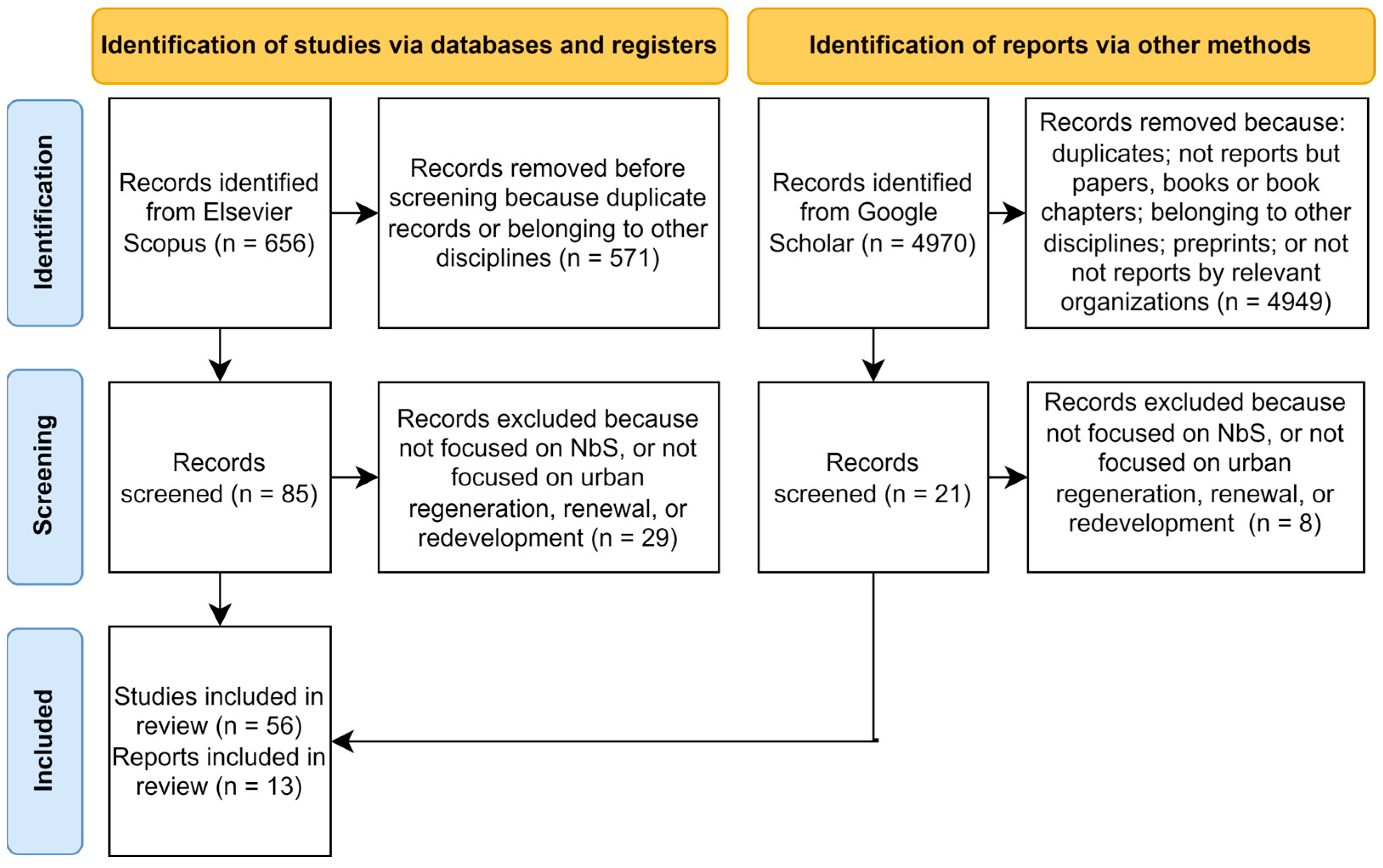
“Nature-based solutions” OR “NBS” AND “urban regeneration” OR “urban redevelopment” OR “urban renewal”. In Elsevier Scopus, these terms were searched in abstracts, keywords, and titles. Filters were applied to include only peer-reviewed journal articles and reviews, and publications in English. In Google Scholar, due to technical limitations, the search of these terms was applied to any part of the document. This search aimed to retrieve only reports published in English. This difference in the two searches required diversified approaches in processing the initial results (656 in Scopus, 4970 in Google Scholar), to identify relevant studies and reports explicitly addressing the intersection of NbS and urban regeneration, or discussing governance, planning, or methodological frameworks relevant to regeneration contexts.

2.3. Selection Process

The selection process followed PRISMA guidelines [49] (Figure 1), including identification, screening, eligibility, and inclusion steps. The initial Scopus search returned 656 records. Due to the high number of results, we focused on documents that were specifically focused on high-quality academic outputs, narrowing the search down to peer-reviewed articles published in journals, including reviews. Results from multiple searches were combined to remove duplicates, and any publication that was considered off-topic; for example, publications approaching NbS in urban areas that were not associated with urban regeneration projects or that treated this topic from another discipline’s perspective (e.g., construction material science). Studies were excluded if they:
(i)
Addressed NbS only in ecological or technical contexts without links to urban regeneration;
(ii)
Focused solely on economic regeneration without an environmental dimension;
(iii)
Lacked empirical, methodological, or structured conceptual contribution (e.g., purely opinion-based commentaries);
(iv)
Were discipline-adjacent (e.g., construction material science) without relevance to planning or governance.
These criteria ensured that included studies explicitly examined the intersection of NbS and urban regeneration.
The Google Scholar initial search (nature-based solutions and urban regeneration, renewal, or redevelopment) gave 4970 results. Due to the high number of results, we focused on documents that were not captured by the more accurate search in Elsevier Scopus—namely, reports instead of peer-reviewed articles or book chapters. A major screening process took place to select only reports (which excluded peer-reviewed articles, preprints and book chapters, as well as books). We excluded any report that was not on-topic, and that from its title did not show to be focused on the key topics relevant to our study (NbS and urban regeneration/renewal/redevelopment). We also considered as ‘not relevant’ to our study any university thesis or publication by organisations without established scientific credibility. As an example, a key source was the European Union as well as other national or international organisations (government and NGOs). Only 21 reports were shortlisted as relevant. These reports were then screened in even higher detail, separating the ones focused on NbS and urban regeneration, renewal, and redevelopment, from the ones that only marginally addressed these topics or focused on only one of them. Exclusion criteria included: (i) reports only addressing NbS in ecological or technical contexts without links to urban regeneration; (ii) purely economic regeneration studies without an environmental dimension; and (iii) opinion pieces lacking empirical or methodological contribution. As a result, another 8 studies were removed. The remaining 13 studies were included.

2.4. Thematic Synthesis

The included publications were analysed using a thematic narrative synthesis combining an initial deductive orientation, informed by the aims of the review, with inductive coding based on iterative reading of the literature. Broad sensitising categories relating to applications of NbS, governance and equity, and methodological approaches guided the analysis without predetermining the final themes.
Each document was coded for recurrent conceptual, methodological, and governance-related features. Two authors independently coded a purposive subset of publications to refine the coding structure. Coding discrepancies were resolved through discussion, and a shared coding framework was subsequently applied across the full dataset.
This iterative deductive–inductive process resulted in the consolidation of three overarching analytical themes, which structure Section 3: (i) typologies and applications of nature-based solutions in urban regeneration; (ii) governance challenges and equity considerations; and (iii) methodological innovations supporting planning and implementation. Research gaps and future directions were identified through cross-theme comparison and interpretative synthesis.
As part of the thematic synthesis, the 69 included documents (56 peer-reviewed articles and 13 reports) were further examined to identify sub-themes within the three overarching analytical themes. The coding process showed that Theme 2, ‘Governance challenges and equity considerations’, comprised three sub-themes: equity and anti-displacement safeguards (including heritage and place governance); participatory co-design and stewardship; and strategic integration and policy alignment. Theme 3, ‘Methodological innovations supporting planning and implementation’, contained four sub-themes: GIS and spatial analysis; multi-criteria decision analysis tools; microclimate modelling; and participation instrumentation. Theme 1, ‘Typologies of nature-based solutions’, remained a single, integrated thematic stream.
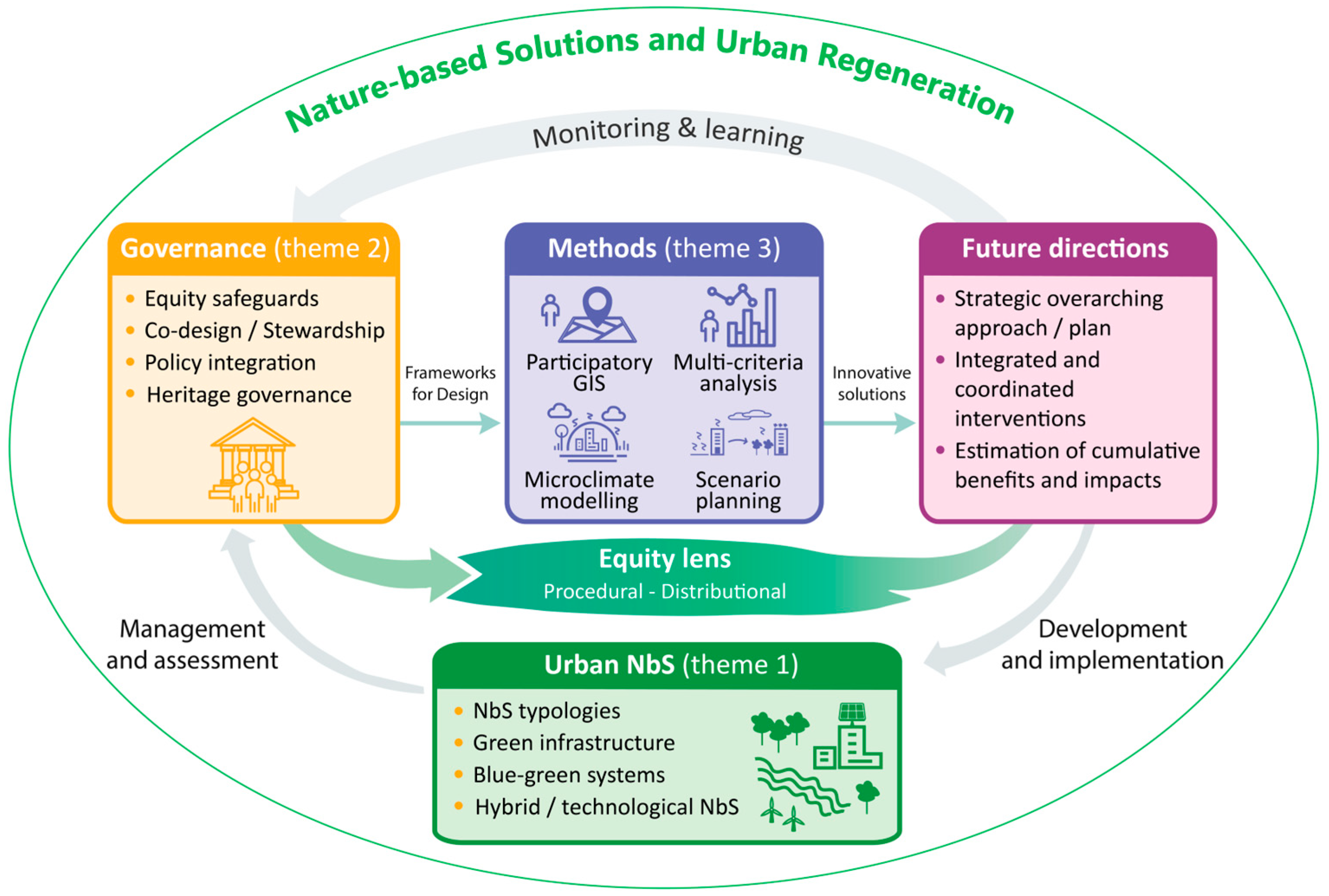
To support interpretation of the three thematic areas derived from the synthesis, Figure 2 presents the conceptual framework used to structure the analytical process. The framework illustrates the relationships among NbS outputs (Theme 1), governance arrangements (Theme 2), and methodological approaches (Theme 3), showing how governance shapes methodological choices, and how methods integrate spatial, ecological, and socio-demographic evidence with stakeholder knowledge to generate NbS typologies. An equity lens—both procedural and distributional—was applied across all stages, while monitoring and learning iteratively update assumptions and indicators to inform coordinated interventions and future directions for NbS-driven urban regeneration.

3. Results and Discussion

Table 1 presents the number and type of documents (peer-reviewed articles and policy reports) included under each of the three overarching themes and their associated sub-themes.
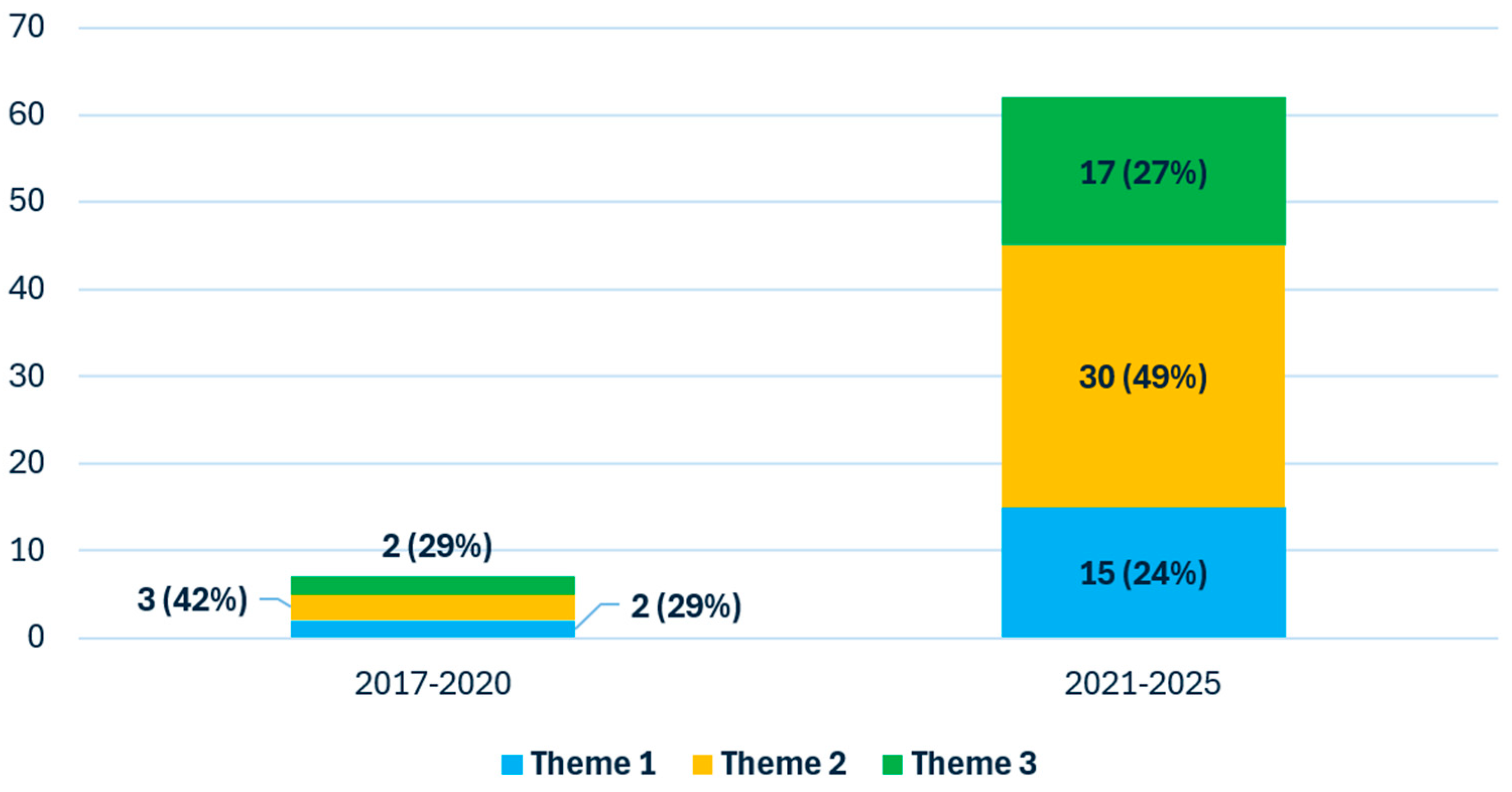
Figure 3 illustrates how each thematic area of the literature grew between 2017 and 2020 and 2021–2025, indicating an exponential increase in publications focused on NbS and urban regeneration/redevelopment/renewal. This growth indicates that these practices are becoming more and more frequent, becoming a staple for sustainable and inclusive urban processes.
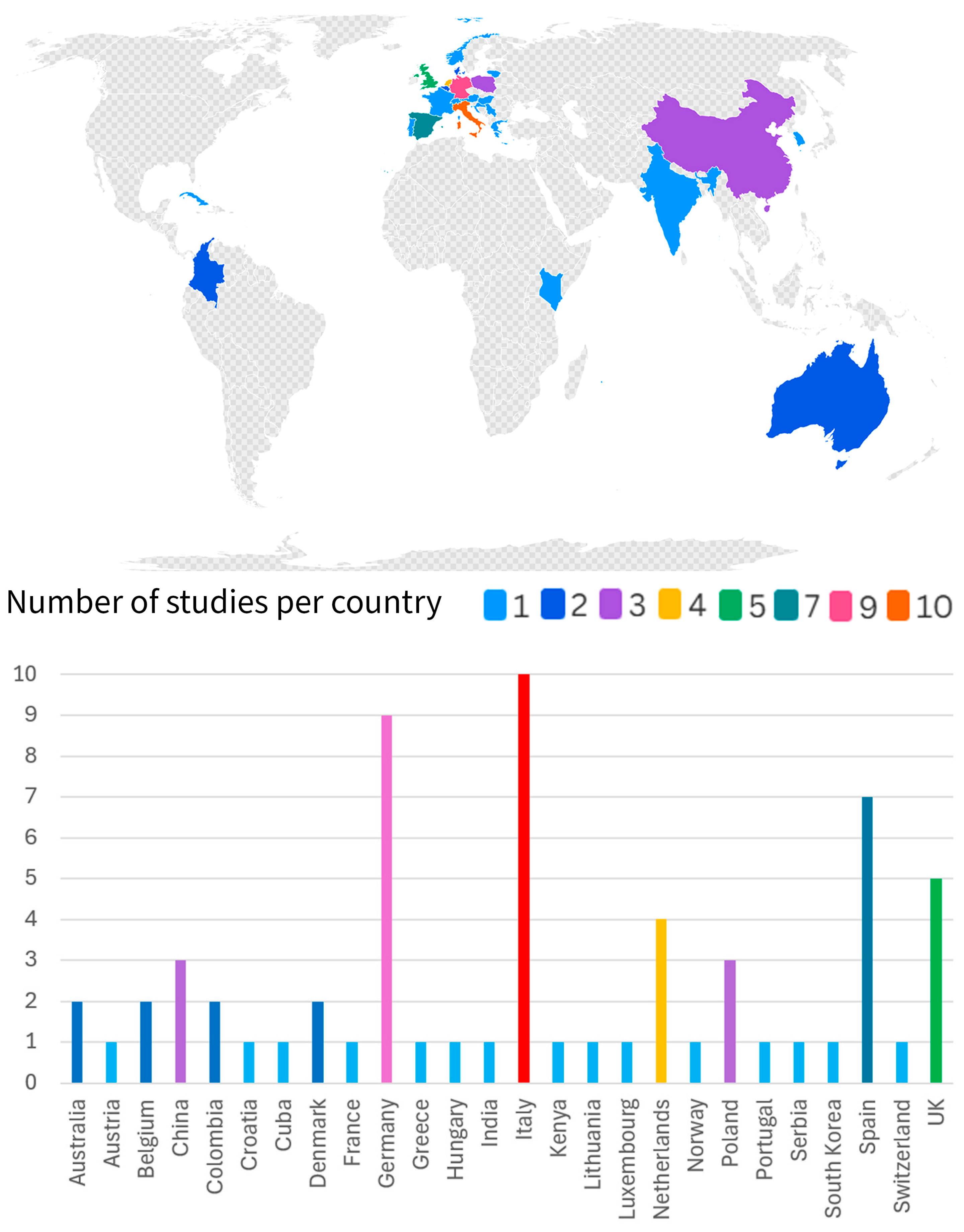
As illustrated in Figure 4, the documents retrieved in the literature focus almost exclusively on European case studies, with most studies exploring urban regeneration in Italy (10), Germany (9), Spain (7), the United Kingdom (5), the Netherlands (4), and Poland (3). Other states represented in the literature are outside the European Union, China (3), Australia (2) and Colombia (2) are the most represented country, with only one study based in Africa (Kenya). Other countries represented with one or two case studies are: Austria, Belgium, Croatia, Cuba, Denmark, France, Greece, Hungary, India, Lithuania, Luxembourg, Norway, Portugal, Serbia, South Korea, and Switzerland.
Key findings and open challenges on application, governance, and methodologies for NbS applied to urban regeneration emerging from the literature are presented below.

3.1. Theme 1—Typologies of Nature-Based Solutions

Analysis of the literature shows that NbS in urban regeneration are widely conceptualised as multifunctional strategies that combine ecological restoration with social and economic revitalisation [50,51,52]. Rather than isolated greening interventions, NbS are framed as systemic approaches that enhance climate resilience, biodiversity, public health, and community wellbeing.
Across the reviewed studies, three broad categories of NbS typologies emerge.
First, green infrastructure—such as urban forests, parks, green roofs, and vegetated façades—is consistently shown to mitigate heat islands, improve biodiversity, and support placemaking by creating inclusive and multifunctional spaces [51,53,54,55].
Second, blue–green systems, including river restoration, wetlands, and permeable surfaces, address stormwater management, reduce flood risks, and promote ecological and social connectivity [56,57,58,59].
Third, hybrid and technological NbS, such as smart façades, vertical greening systems, or integrated energy–nature configurations, illustrate how ecological and technological functions can be combined to support climate resilience and resource efficiency [60,61,62].
Applications of these typologies span multiple scales and urban contexts. Comparative work on forest-based NBS across Europe and China demonstrates their role in rehabilitating degraded land and supporting economic transition [50]. Similarly, multi-city reviews emphasise the multifunctionality of NbS—from green roofs and community gardens to river corridor restoration—across diverse regeneration settings [51]. Evidence from European and Asian cities further highlights how NbS can improve thermal comfort, strengthen cultural placemaking, and provide cost-effective alternatives to grey infrastructure [52,53,63]. Indicator frameworks and performance monitoring tools have been developed to evaluate the environmental and social outcomes of NbS, providing structured ways to assess their contribution to regeneration processes, including neglected spaces [59,64,65,66].
Overall, the literature positions NbS as strategic, multifunctional interventions capable of enhancing ecological performance, cultural vibrancy, and social equity within urban regeneration initiatives.

3.2. Theme 2—Governance Challenges and Equity Considerations

The 34 documents addressing governance in NbS-driven urban regeneration are organised into three key areas: (2.1) equity and anti-displacement safeguards, including heritage and place governance (10 documents); (2.2) participatory co-design and stewardship (15 documents); and (2.3) strategic integration and policy alignment (9 documents). These sub-themes reflect the thematic categorisation presented in Table 1.

3.2.1. Equity and Anti-Displacement Safeguards

Urban regeneration processes have long been associated with both socio-economic improvement and risks of displacement or gentrification [67]. Recent work emphasises the need for NbS to maximise ecosystem services while also supporting vulnerable groups through equitable access and participation in decision-making [19]. Accessibility—both spatial and political—emerges as a critical factor for socially just NbS implementation, with empirical studies demonstrating how inclusive design processes can broaden access and strengthen community wellbeing [68].
At the same time, persistent governance tensions—between ecological ambitions and social realities—underscore the need for deliberative processes capable of addressing these trade-offs transparently and engaging diverse urban groups [69]. Recent studies from Latin America reveal how limited transparency, institutional inertia, and structural barriers embedded in planning systems can suppress community engagement and weaken socially inclusive outcomes [70]. Successful interventions therefore tend to integrate NbS within broader social and institutional strategies rather than treating them as isolated technical solutions [71]. Additionally, recent scholarship shows that shifting political, social, and economic conditions have widened the range of community actors involved in NbS design and implementation, raising new questions about whose voices are amplified within governance processes [72]. Financial and organisational models—such as mixed public–private governance, sponsorship, and revenue-stream mechanisms—also shape the inclusivity and long-term feasibility of NbS, underscoring the need for governance arrangements that balance stewardship with financial viability [73]. Finally, attention to cultural values and heritage is increasingly recognised as essential to ensure that NbS-driven regeneration enhances not only ecological and socio-economic outcomes, but also the cultural significance embedded within historic and heritage sites [74].

3.2.2. Participatory Co-Design and Stewardship

Participation and co-design are widely recognised as essential for equitable and effective NbS-driven urban regeneration, yet significant governance challenges persist. Numerous studies show that despite strong community interest, NbS interventions often struggle to meaningfully incorporate diverse actors—decision-makers, technical experts, residents, and marginalised groups—into transparent and collaborative design processes.
Evidence from the self-managed community of Christiania in Copenhagen illustrates how even highly engaged communities face barriers when their work lacks formal recognition, limiting access to funding, institutional support, and integration with city planning frameworks [75]. Broader international research confirms that structural constraints—including unequal power relations, varying levels of knowledge, and restricted access to decision-making—frequently undermine inclusive participation and long-term stewardship [76]. These dynamics can result in uneven benefits across neighbourhoods, where participatory NbS projects may unintentionally reinforce existing socio-spatial inequalities [77,78].
Differences in values and priorities further complicate co-design. For example, surveys in the United Kingdom reveal tensions between public support for rewilding and competing cultural or recreational expectations for brownfield regeneration, making it difficult to develop management plans that satisfy multiple groups [79]. Parallel challenges appear in community-garden projects in Barcelona, where ecological and social benefits are substantial, yet weak tenure arrangements, unclear responsibilities, and lack of legal recognition hinder long-term stewardship and municipal coordination [80].
Urban living labs—tested in Christiania, Milan, and London—offer promising avenues for structured co-creation by integrating community knowledge with technical expertise [75,81]. However, their scalability is constrained by persistent issues such as power asymmetries, fragmented networks, and insufficient capacity for sustained engagement. Overcoming distrust built by past top-down initiatives is critical; long-term trust-building efforts in projects such as London’s South Thamesmead demonstrate how iterative engagement and transparent governance can rebuild relationships and strengthen community participation [82].
Similar participation barriers emerge in other contexts, including Turin—where competing agendas among residents, businesses, planners, and NGOs complicate co-design and long-term site management [83]—and Porto, where knowledge hierarchies limit equitable participation despite inclusive intentions [84]. Successful cases emphasise the importance of locally tailored governance innovations. In Berlin’s Marzahn-Hellersdorf district, co-creation workshops and spatial mapping enabled collaborators to develop context-specific guidelines that link ecological benefits with social wellbeing [85].
Across this literature, the need for adaptive, transparent, and trust-building governance frameworks is consistently highlighted. Evidence from proGIreg cities shows that participation must move beyond consultation toward genuine empowerment, supported by flexible, bottom-up processes capable of addressing power imbalances and sustaining shared stewardship [86]. Complementing this, the URBiNAT project stresses that effective co-creation requires clear communication rules, shared expectations, transparent decision-making structures, and mediation processes grounded in local knowledge and cultural values [87].

3.2.3. Strategic Integration and Policy Alignment

Strategic integration of NbS into urban regeneration is frequently constrained by social, institutional, economic, spatial, and technical barriers. A review of urban and peri-urban agriculture initiatives highlights the recurring obstacles of insufficient governmental support, limited community engagement, high implementation costs, and infrastructural constraints [88]. Policy instruments—including financial incentives, regulatory frameworks, and planning guidelines—play a crucial role in enabling NbS adoption, whether through formal legislation (e.g., the Community Empowerment Act in Glasgow) or strategic vision documents such as Malmö’s South Hyllie Master Plan [88].
Effective governance requires coordination across multiple scales—from international and national policy frameworks to regional networks and local authorities—reflecting the diversity of actors involved in NbS implementation. Evidence from the Urban Agenda for the European Union demonstrates that successful NbS governance relies on the combined effects of knowledge sharing, participatory planning, and regulatory support [89]. Case studies reveal that adaptive, incremental governance approaches—such as “learning by doing”—may be more feasible than transformative reforms, particularly where formal regulation alone cannot address local knowledge gaps or procedural challenges [89].
Integrating NbS into existing legal and institutional contexts is essential for moving beyond symbolic commitments. For example, research from Belgrade shows that embedding NbS within statutory planning processes is necessary to ensure meaningful implementation rather than aspirational policy statements [90]. Comparative work across European cities further underscores the need to align interventions across spatial and temporal scales, situating project-level actions within broader district- and city-scale planning frameworks [91].
Several tools have been developed to support this strategic integration. The DPSIR model, for instance, provides a structured method for assessing cumulative impacts and ecosystem service performance in complex urban settings [92]. Its application in contexts such as the Milano Santa Giulia district demonstrates how social, economic, and ecological values can be integrated into coordinated territorial networks involving public authorities, non-profits, and private actors [93].
Despite increasing interest, NbS remain significantly underfunded worldwide, with less than 1% of global urban infrastructure investment directed toward nature-based approaches [94]. In Europe, post-pandemic construction-led development has intensified pressures on nature-based agendas, illustrating the disconnect between economic development priorities and ecological strategies [94]. Initiatives such as the Urban Agenda for the EU and its thematic partnerships highlight ongoing efforts to align funding, regulation, and knowledge-sharing for urban greening [95].
Broader strategic thinking is also needed within design and planning processes. Scholars argue for planning approaches that identify and integrate diverse stakeholder values, assess resilience ex-ante and ex-post, and embed NbS into continuous, multi-phase planning cycles [96]. Among existing policy instruments, SEA is identified as a key statutory tool capable of supporting these objectives, particularly when integrated across planning stages and applied at the local and urban scale [96]. However, the reviewed studies do not report the use of other statutory impact assessment procedures for NbS in urban regeneration. While tools such as Sustainability Appraisal [69], economic impact assessment [77], risk assessment [87,97], ecosystem services assessment, climate vulnerability assessment [90,97], and life-cycle assessment [63,88] are discussed or applied in some cases, they largely remain project-level decision-support instruments rather than mechanisms with formal influence on land-use or urban planning.

3.3. Theme 3—Methodological Innovations Supporting Planning and Implementation

Nineteen documents focused on methodological aspects related to the design, assessment, and implementation of NbS. These contributions are grouped into the four sub-themes presented in Table 1: (3.1) Geographic Information Systems and spatial analysis (3 documents); (3.2) multi-criteria decision analysis (5 documents); (3.3) microclimate modelling (6 documents); and (3.4) participatory monitoring and co-design tools (5 documents).

3.3.1. GIS and Spatial Analysis

Two main applications of GIS emerge in the literature. First, GIS is used to identify priority areas for NbS-based regeneration, integrating ecological and social indicators. For instance, Pineda-Pinto et al. (2021) developed a social–ecological injustices index to reveal deprivation hotspots in Melbourne by analysing environmental burdens, land-use patterns, and community mobilisation [98]. Similar hotspot analyses in Shimla highlight how spatial statistics (e.g., Moran’s I, Getis-Ord Gi*) reveal fragmented regeneration efforts and the absence of coordinated area-based strategies [99].
Second, GIS supports suitability assessments that match NbS types to local urban conditions. Chen et al. (2025) demonstrate this by integrating land-cover data with stakeholder input to map optimal locations for green roofs, vertical greening, and linear corridors in Hong Kong, combining social, environmental, and economic criteria [100].

3.3.2. Multi-Criteria Decision Analysis (MCDA)

MCDA is widely applied as a decision-support tool to evaluate trade-offs among environmental, social, technical, and economic criteria in NbS planning [101]. Site-specific frameworks help planners compare feasible alternatives under realistic constraints.
Examples include an evaluation method for NbS in Bogotá that integrates MCDA with monitoring tools to assess ecosystem service outcomes across scenarios [102], and a GIS-linked MCDA model supporting street-tree selection in Melbourne, balancing stormwater management, sunlight availability, and visual quality [103]. At broader scales, EU Horizon guidelines propose standardised indicators—such as brownfield reclamation, open-space ratios, energy-efficient buildings, and heritage preservation—to monitor NbS performance from building to metropolitan levels [104]).

3.3.3. Microclimate Modelling

Microclimate modelling supports climate-sensitive NBS design by simulating impacts on thermal comfort, air flow, and energy performance. In Lodz, modelling showed how greenery alters microclimatic conditions in dense historic street canyons [105]. In Hamburg, Greenpass modelling assessed NbS-based redevelopment scenarios to quantify benefits across energy, water, and air systems [106].
Modelling also helps evaluate broader planning implications, such as densification, mobility, and housing demand, by comparing NbS-based redevelopment scenarios [107]. Temporal remote-sensing assessments in Latina demonstrate how vegetation and water dynamics track the long-term effects of NbS interventions [108].
Recent applications integrate microclimate modelling with participatory design. For example, scenario mapping workshops embedded microsimulations into inclusive decision-making for NbS retrofits in the UK [109], and co-evaluation in Genoa incorporated psychological and perceptual aspects of thermal comfort into option selection [110].

3.3.4. Participatory Monitoring and Co-Design Tools

Modelling and monitoring instruments increasingly support participatory processes, allowing communities to shape and evaluate NbS. In Milan, a social-monitoring framework captured stakeholder perceptions of cohesion, safety, belonging, and interactions with nature to inform co-created interventions [111]. A complementary tool for assessing psychosocial co-benefits in Spain linked user perceptions to spatial variation in green/blue elements through a Delphi-validated questionnaire [112].
Participatory “research-through-design” approaches advance co-creation across cultures and climates, as shown in projects in Matera and Riyadh where community groups, experts, and municipal actors collaborated across iterative design phases [113].
Biodiversity-sensitive urban design at Fishermans Bend in Melbourne further demonstrates how workshops, species selection discussions, and spatial modelling support ecosystem-centred regeneration [114]. Broader comparative analyses of 32 post-industrial NbS projects across Europe reveal how stakeholder networks influence co-benefits, collaboration, and governance outcomes [115].

4. Future Directions

This review of the literature highlights current practices and methodologies capable of supporting holistic urban regeneration based on NbS. There are, however, some glaring opportunities to maximise efforts to achieve benefits and sustainable outcomes for the environment as well as for the communities promoting, interested in, and impacted by these urban interventions.

4.1. Best Practices and Lessons for Future Interventions

Across the studies reviewed, early, inclusive, and transparent participation consistently emerges as a foundation for socially just and effective NbS implementation. Successful examples demonstrate the value of involving government, civil society, residents, First Nations groups, and other stakeholders from the outset, while persistent barriers—such as power imbalances, limited transparency, and consultation fatigue—continue to undermine equitable co-creation [81].
Participatory tools including GIS, multi-criteria analysis, and co-design workshops can help reconcile competing values and priorities across environmental, cultural, social, and economic dimensions [102,103]. However, many NbS projects still lack a strategic vision, focusing narrowly on individual sites without considering district- or city-scale systems [72].
Future efforts must therefore emphasise systemic planning, stronger governance frameworks, and long-term stewardship structures that move beyond ad hoc or isolated project-based approaches.

4.2. Strategic Consideration of Cumulative Benefits and Impacts

Maximising the impact of NbS requires decision-making frameworks that integrate cumulative, cross-sectoral, and long-term considerations. While Environmental Impact Assessment (EIA) is commonly used, its project-specific focus limits its ability to address broader social and institutional contexts [116].
By contrast, SEA provides a more suitable approach, offering mechanisms for evaluating policies, plans, and programmes in terms of environmental, social, cultural, and economic impacts while embedding participation throughout [117,118,119].
Complementary tools—such as cumulative effects assessment, life-cycle assessment, and cost–benefit analysis—can further strengthen strategic planning when integrated within SEA, although each has limitations if used in isolation [120,121,122].
Future research should explore how these frameworks can be combined to support anticipatory, multi-scalar planning that assesses alternatives, maps cumulative impacts, and aligns NbS interventions across temporal and spatial scales.

4.3. Socio-Economic and Financial Aspects

There is a growing body of literature and international practice—especially in Europe—that highlights novel approaches to governance around NbS, based on bringing together public, private, and community interests for the development of case-specific solutions [73]. Emerging successful strategies include: private donation and sponsorship models (e.g., in Turin, Italy), collaborations with research (also Turin), remuneration of beneficiaries through public partners, recurring revenue streams such as renting (e.g., in Dortmund, Germany), and sales as one-off payments for goods (e.g., in Ningbo, China) [73].
Expanding the number of voices included in decision-making can, at the same time, steer urban regeneration based on NbS towards culturally sensitive decisions that not only account for the economic prosperity of the communities impacted and for the ecological values embedded in the urban environment, but also for the cultural values embedded in historic and heritage sites that can be directly interested by urban regeneration processes through NbS [74]. However, these best practices have proven successful in specific contexts; their adoption and diversified socio-economic contexts will likely require adjustment, testing, and ultimately collaborative co-design of new solutions based on community participation and decision-makers accountability.

4.4. A Call to Strategic Action

Despite growing interest in NbS, our review found no evidence that SEA is currently being applied specifically to NbS-driven urban regeneration. Existing SEA research focuses mostly on climate adaptation, flood risk, or land-use management [123,124,125].
Given its strategic orientation, SEA is well positioned to embed NbS within long-term urban planning cycles by integrating environmental and social objectives into municipal master plans, zoning ordinances, and public investment and budget allocation processes [126,127]. SEA can also support alternative scenario development, incorporate social equity considerations, and strengthen community participation, while facilitating innovative financing and stewardship mechanisms such as public–private partnerships and green bonds. This strategic function is illustrated in the SEA of England’s European Regional Development Fund (ERDF) Operational Programme, which emphasises the role of SEA in guiding programme design, investment priorities, and long-term decision-making [128]. We therefore recommend adapting SEA as a core decision-support tool for NbS-led regeneration, recognising its capacity to link local project implementation with city-scale visions of environmental, social, and economic sustainability. Without such strategic frameworks, NbS efforts risk remaining fragmented, reactive, and vulnerable to greenwashing and inequitable outcomes.

4.5. Limitations and Future Research

This review has two main limitations. First, the literature analysed was restricted to English-language sources. During the screening process, we identified several relevant papers published in Italian, which were excluded based on our inclusion criteria, these studies could have provided additional insights into nature-based approaches to urban regeneration. Future research should adopt a multilingual approach, supported by AI-based translation tools that can facilitate efficient and cost-effective access to non-English scientific literature [129,130].
Second, our search strategy relied primarily on Scopus for peer-reviewed articles, supplemented by Google Scholar for policy reports. While Scopus offers comprehensive coverage of high-quality academic outputs, this reliance may have limited the inclusion of relevant studies indexed in other databases. Expanding future searches to include additional databases and regional repositories could strengthen the breadth and inclusivity of evidence. Finally, while systematic or meta-analytic reviews may be appropriate for evaluating the performance of specific NbS interventions, the aim of this review was to synthesise conceptual, governance and methodological patterns across diverse contexts, for which a narrative approach is more suitable. Nevertheless, future research could adopt more quantitative review methods to assess the use of indicators for measuring the effectiveness of NbS interventions, the prevalence of different NbS typologies, the role of social solutions, and the specific impacts of NbS on urban regeneration outcomes. In addition, the economic and social dimensions of NbS-driven regeneration require more detailed investigation. Comparative analysis is needed to determine which interventions offer the greatest ecosystem service benefits and generate indirect societal gains, such as reduced hospital admissions resulting from improved air quality, lower prescription rates associated with better mental health, and increased community wellbeing. Such evidence would help position urban regeneration not as a financial cost but as a long-term societal investment. This need for economic and policy clarity is particularly important in countries outside Europe, where coordinated funding streams for NbS are not yet well established. As highlighted by [33], Australia lacks a consistent national definition of NbS, implementation remains highly localised, and there is no integrated policy framework to support wider adoption. In contrast, the European experience shows how strategic investment and coherent policy support can accelerate the uptake and mainstreaming of NbS in urban regeneration. Further work is therefore required to understand how governance arrangements and funding mechanisms can maximise these benefits while preventing unintended consequences such as green gentrification, ensuring that NbS contribute to equitable and inclusive urban development.

5. Conclusions: Toward Regenerative Urban Futures

This review synthesised evidence on how NbS are applied in urban regeneration, focusing on three thematic areas: applications, governance, and methodological innovations. First, NbS applications demonstrate significant potential to transform underutilised land into multifunctional landscapes that improve climate resilience, biodiversity, and social wellbeing through green infrastructure, blue–green systems, and hybrid solutions. Second, governance remains the critical bottleneck: despite advanced analytical tools, persistent gaps—such as displacement risks, fragmented decision-making, and limited participation—undermine equity objectives. Third, methodological advances, including GIS-based spatial analysis, multi-criteria decision frameworks, and microclimate modelling, offer powerful instruments for planning and evaluation, yet they cannot deliver systemic change without being embedded in inclusive governance structures.
To overcome these challenges, we argue that Strategic Environmental Assessment (SEA) should be adapted as a core policy tool for NbS-driven regeneration. SEA’s strategic scale, participatory ethos, and integrative capacity make it uniquely suited to align ecological ambitions with social justice imperatives. Coupled with participatory governance and integrated technical tools, SEA can ensure that regeneration moves beyond site-specific interventions toward systemic, anticipatory planning that addresses cumulative impacts and long-term sustainability. Embedding SEA alongside inclusive co-design processes and advanced modelling will enable cities to reconcile ecological restoration with cultural continuity and equity.
Future research should broaden geographic coverage to capture diverse governance cultures and implementation models, particularly in regions outside Europe where national frameworks and funding mechanisms for NbS are less established. Greater attention is also needed to long-term monitoring, evaluation of cumulative impacts, and comparative analysis of cost-effectiveness and co-benefits. Advancing these research directions will support the development of NbS as a strategic, equitable, and culturally grounded pathway for regenerative urban futures.

Author Contributions

Conceptualization, A.R. and U.B.; methodology, A.R. and U.B.; formal analysis, A.R. and U.B.; writing—original draft preparation, A.R. and U.B.; writing—review and editing, A.R., U.B. and A.C.; visualisation, U.B. All authors have read and agreed to the published version of the manuscript.

Funding

This research received no external funding.

Institutional Review Board Statement

Not applicable.

Informed Consent Statement

Not applicable.

Data Availability Statement

No new data were created or analysed in this study. All data supporting the findings of this review are derived from previously published sources, which are cited throughout the manuscript.

Acknowledgments

During the preparation of this manuscript, the authors used AI-assisted tools, including Microsoft Copilot (GPT-5.2) and ChatGPT (GPT-5), for grammar refinement and language editing purposes. The authors have reviewed and edited all outputs and take full responsibility for the content of this publication.

Conflicts of Interest

The authors declare no conflicts of interest.

Abbreviations

The following abbreviations are used in this manuscript:
NbSNature-based solutions
SEAStrategic Environmental Assessment
GISGeographic Information Systems
EIAEnvironmental Impact Assessment
DPSIRDriving force–Pressure–State–Impact–Response

References

  1. Dentinho, T.P. Unsustainable Cities, a Tragedy of Urban Infrastructure. Reg. Sci. Policy Pract. 2011, 3, 231–248. [Google Scholar] [CrossRef]
  2. Liu, Y.; Shen, L.; Ren, Y.; Zhou, T. Regeneration towards Suitability: A Decision-Making Framework for Determining Urban Regeneration Mode and Strategies. Habitat Int. 2023, 138, 102870. [Google Scholar] [CrossRef]
  3. Zheng, H.W.; Shen, G.Q.; Wang, H. A Review of Recent Studies on Sustainable Urban Renewal. Habitat Int. 2014, 41, 272–279. [Google Scholar] [CrossRef]
  4. Zheng, H.W.; Shen, G.Q.; Song, Y.; Sun, B.; Hong, J. Neighborhood Sustainability in Urban Renewal: An Assessment Framework. Environ. Plan. B Urban Anal. City Sci. 2017, 44, 903–924. [Google Scholar] [CrossRef]
  5. Couch, C.; Sykes, O.; Börstinghaus, W. Thirty Years of Urban Regeneration in Britain, Germany and France: The Importance of Context and Path Dependency. Prog. Plan. 2011, 75, 1–52. [Google Scholar] [CrossRef]
  6. Akkar Ercan, M. Challenges and Conflicts in Achieving Sustainable Communities in Historic Neighbourhoods of Istanbul. Habitat Int. 2011, 35, 295–306. [Google Scholar] [CrossRef]
  7. Oliveira, A.M.C.P.d.; Lanzinha, J.C.G.; Kern, A.P. Building Rehabilitation: A Sustainable Strategy for the Preservation of the Built Environment. Sustainability 2024, 16, 553. [Google Scholar] [CrossRef]
  8. Amirtahmasebi, R.; Orloff, M.; Wahba, S.; Altman, A. Regenerating Urban Land: A Practitioner’s Guide to Leveraging Private Investment; World Bank Publications: Washington, DC, USA, 2016. [Google Scholar]
  9. UN-Habitat. Urban Regeneration as a Tool for Inclusive and Sustainable Recovery; Report on the Expert Group Meeting; UN-Habitat: Nairobi, Kenya, 2022. [Google Scholar]
  10. Figueiredo, Y.D.d.S.; Prim, M.A.; Dandolini, G.A. Urban Regeneration in the Light of Social Innovation: A Systematic Integrative Literature Review. Land Use Policy 2022, 113, 105873. [Google Scholar] [CrossRef]
  11. Elmqvist, T.; Andersson, E.; Frantzeskaki, N.; McPhearson, T.; Olsson, P.; Gaffney, O.; Takeuchi, K.; Folke, C. Sustainability and Resilience for Transformation in the Urban Century. Nat. Sustain. 2019, 2, 267–273. [Google Scholar] [CrossRef]
  12. Wu, B.-S.; Ruangpan, L.; Sanchez, A.; Rasmussen, M.; Rene, E.R.; Vojinovic, Z. Environmental Design Features for Large-Scale Nature-Based Solutions: Development of a Framework That Incorporates Landscape Dynamics into the Design of Nature-Based Solutions. Sustainability 2021, 13, 6123. [Google Scholar] [CrossRef]
  13. Albert, C.; Brillinger, M.; Guerrero, P.; Gottwald, S.; Henze, J.; Schmidt, S.; Ott, E.; Schröter, B. Planning Nature-Based Solutions: Principles, Steps, and Insights. Ambio 2021, 50, 1446–1461. [Google Scholar] [CrossRef]
  14. IUCN. Guidance for Using the IUCN Global Standard for Nature-Based Solutions, 1st ed.; International Union for Conservation of Nature (IUCN): Gland, Switzerland, 2020. [Google Scholar]
  15. Cohen-Shacham, E.; Walters, G.; Janzen, C.; Maginnis, S. Nature-Based Solutions to Address Societal Challenges; IUCN: Gland, Switzerland, 2016. [Google Scholar]
  16. proGIreg About the Project. Available online: https://progireg.eu/the-project/ (accessed on 25 January 2026).
  17. INTERLACE. Aim and Objectives of INTERLACE. Available online: https://interlace-project.eu/node/14.html (accessed on 25 January 2026).
  18. ReGreeneration About The Project. Available online: https://regreeneration.eu/about/ (accessed on 25 January 2026).
  19. Russo, A. Renaturing for Urban Wellbeing: A Socioecological Perspective on Green Space Quality, Accessibility, and Inclusivity. Sustainability 2024, 16, 5751. [Google Scholar] [CrossRef]
  20. Klein, C. How Pandemics Spurred Cities to Make More Green Space for People. Available online: https://www.history.com/news/cholera-pandemic-new-york-city-london-paris-green-space (accessed on 20 October 2020).
  21. McHarg, I.L. Design with Nature; American Museum of Natural History: New York, NY, USA, 1969. [Google Scholar]
  22. Douglas, I. 50 Years Change in Urban Land Use and Ecological Planning Globally in the Era of Design with Nature. Ecosyst. Health Sustain. 2019, 5, 185–198. [Google Scholar] [CrossRef]
  23. Xiang, W.-N. Ian McHarg and “the Ecology of the City”. Socio Ecol. Prac. Res. 2019, 1, 163–164. [Google Scholar] [CrossRef][Green Version]
  24. Gould, K.; Lewis, T. Green Gentrification; Routledge: London, UK, 2016. [Google Scholar]
  25. Bressane, A.; Pinto, J.P.d.C.; Medeiros, L.C.d.C. Countering the Effects of Urban Green Gentrification Through Nature-Based Solutions: A Scoping Review. Nat.-Based Solut. 2024, 5, 100131. [Google Scholar] [CrossRef]
  26. Spotswood, E.N.; Benjamin, M.; Stoneburner, L.; Wheeler, M.M.; Beller, E.E.; Balk, D.; McPhearson, T.; Kuo, M.; McDonald, R.I. Nature Inequity and Higher COVID-19 Case Rates in Less-Green Neighbourhoods in the United States. Nat. Sustain. 2021, 4, 1092–1098. [Google Scholar] [CrossRef]
  27. Crossley, A.J.; Russo, A. Has the Pandemic Altered Public Perception of How Local Green Spaces Affect Quality of Life in the United Kingdom? Sustainability 2022, 14, 7946. [Google Scholar] [CrossRef]
  28. Hunter, R.F.; Cleland, C.; Cleary, A.; Droomers, M.; Wheeler, B.W.; Sinnett, D.; Nieuwenhuijsen, M.J.; Braubach, M. Environmental, Health, Wellbeing, Social and Equity Effects of Urban Green Space Interventions: A Meta-Narrative Evidence Synthesis. Environ. Int. 2019, 130, 104923. [Google Scholar] [CrossRef] [PubMed]
  29. Lee, L.H.; Haque, A.; Cui, J.; Smith, A.; Mancus, G.; Yi, N.; Yuen, H.K. Examining the Indirect Effect of Park Size on Community Health via Crime Risk in Alabama: A Cross-Sectional Mediation Model. Health Place 2025, 92, 103423. [Google Scholar] [CrossRef]
  30. Geiselhart, K.; Spenger, D. Environmental Microsegregation: Urban Renewal and the Political Ecology of Health. Urban Plan. 2022, 8, 296–311. [Google Scholar] [CrossRef]
  31. Cucca, R.; Friesenecker, M.; Thaler, T. Green Gentrification, Social Justice, and Climate Change in the Literature: Conceptual Origins and Future Directions. Urban Plan. 2023, 8, 283–295. [Google Scholar] [CrossRef]
  32. Pham, N.; Gilbertson, T.; Witchger, J.; Soto-Danseco, E.; Goldtooth, T.B. Nature-Based Solutions; Indigenous Environmental Network Climate Justice Program Series; Indigenous Environmental Network: Bemidji, MN, USA, 2022. [Google Scholar]
  33. Zhu, D.; Zhang, Y.; Kendal, D.; Fraser, L.; Flies, E.J. Nature-Based Solutions in Australia: A Systematic Quantitative Literature Review of Terms, Application and Policy Relevance. Nat.-Based Solut. 2023, 4, 100092. [Google Scholar] [CrossRef]
  34. Latinopoulos, D.; Pelaez-Sanchez, S.; Briega Martos, P.; Berruezo, E.; Outón, P. Transforming Public Space with Nature-Based Solutions: Lessons from Participatory Regeneration in Lorca, Spain. Land 2025, 14, 2066. [Google Scholar] [CrossRef]
  35. Biancifiori, S.; Torabi Moghadam, S.; Lombardi, P. Participatory Digital Solutions for Nature-Based Solution Urban Projects: A Systematic PRISMA Literature Review. Sustainability 2025, 17, 7945. [Google Scholar] [CrossRef]
  36. Slobodníková, K.; Tóth, A. Planning for People with People: Green Infrastructure and Nature-Based Solutions in Participatory Land-Use Planning, Co-Design, and Co-Governance of Green and Open Spaces. Land 2025, 14, 1801. [Google Scholar] [CrossRef]
  37. Jones, L.; Anderson, S.; Læssøe, J.; Banzhaf, E.; Jensen, A.; Tubadji, A.; Hutchins, M.; Yang, J.; Taylor, T.; Wheeler, B.W.; et al. Re-Thinking People and Nature Interactions in Urban Nature-Based Solutions. Sustainability 2025, 17, 3043. [Google Scholar] [CrossRef]
  38. Marzio, S.; Tosi, J.; Poggi, F.; Amado, M. Nature-Based Solutions for Urban Waterfront Regeneration: A Systematic Review of Frameworks, Strategies and Applications. City Environ. Interact. 2026, 29, 100281. [Google Scholar] [CrossRef]
  39. Zarei, M.; Shahab, S. Nature-Based Solutions in Urban Green Infrastructure: A Systematic Review of Success Factors and Implementation Challenges. Land 2025, 14, 818. [Google Scholar] [CrossRef]
  40. Dindar, S. A Systematic Review of Urban Regeneration’s Impact on Sustainable Transport: Traffic Dynamics, Policy Responses, and Environmental Implications. Sustain. Dev. 2025, 33, 399–426. [Google Scholar] [CrossRef]
  41. Park, E.J.; Kang, E.; Shin, Y. Urban Regeneration and Community Participation: A Critical Review of Project-Based Research. Open House Int. 2025, 50, 834–856. [Google Scholar] [CrossRef]
  42. Ameel, L. New Directions for Narrative Approaches to Urban Planning. Fenn.-Int. J. Geogr. 2022, 199, 291–293. [Google Scholar] [CrossRef]
  43. Abusaada, H.; Elshater, A. Practical Strategies and Guidance for Contextual Literature Reviews in Urban Studies. Societies 2025, 15, 163. [Google Scholar] [CrossRef]
  44. Van Damme, S. In Search of Landscape as a Medium for Integration: The Potentials of Landscape Narratives in the Practice of Landscape Architecture. Landsc. J. 2018, 37, 101–122. [Google Scholar] [CrossRef]
  45. Birkic, V.; Celeste, T.; Cochrane, L. Which Review Is That? A Guide to Review Types. Available online: https://unimelb.libguides.com/whichreview/home (accessed on 25 January 2026).
  46. Fischer, T.B.; González, A. Conclusions: Towards a Theory of Strategic Environmental Assessment? In Handbook on Strategic Environmental Assessment; Fischer, T.B., González, A., Eds.; Edward Elgar Publishing: Cheltenham, UK, 2021; pp. 425–437. [Google Scholar]
  47. Partidário, M.; Monteiro, M.B.; Martins, R. Novel Perspectives for Multi-Actor Collaboration in Strategic Environmental Assessment Using ST4S. Environ. Impact Assess. Rev. 2023, 99, 107023. [Google Scholar] [CrossRef]
  48. Grant, M.J.; Booth, A. A Typology of Reviews: An Analysis of 14 Review Types and Associated Methodologies. Health Inf. Libr. J. 2009, 26, 91–108. [Google Scholar] [CrossRef]
  49. Page, M.J.; McKenzie, J.E.; Bossuyt, P.M.; Boutron, I.; Hoffmann, T.C.; Mulrow, C.D.; Shamseer, L.; Tetzlaff, J.M.; Akl, E.A.; Brennan, S.E.; et al. The PRISMA 2020 Statement: An Updated Guideline for Reporting Systematic Reviews. BMJ 2021, 372, n71. [Google Scholar] [CrossRef] [PubMed]
  50. Armstrong, A.; Schio, D.; Baró, N.; Vreese, D.; Wolff, R.; Ostoi, K.; Mishra, S.; Tyrväinen, H.; Groen, S. Synthesis Report Summarizing the Comparative Analysis of Urban Forests as Nature-Based Solutions Implementation in Europe and China; European Forest Institute: Joensuu, Finland, 2023. [Google Scholar]
  51. Bona, S.; Silva-Afonso, A.; Gomes, R.; Matos, R.; Rodrigues, F. Nature-Based Solutions in Urban Areas: A European Analysis. Appl. Sci. 2022, 13, 168. [Google Scholar] [CrossRef]
  52. Boros, J.; Mahmoud, I. Urban Design and the Role of Placemaking in Mainstreaming Nature-Based Solutions. Learning from the Biblioteca Degli Alberi Case Study in Milan. Front. Sustain. Cities 2021, 3, 635610. [Google Scholar] [CrossRef]
  53. Romano, R.; Di Monte, E.; Sore, A. New Perspectives and Moving Targets to Improve Biodiversity and Urban Resilience. TECHNE-J. Technol. Archit. Environ. 2024, 27, 151–166. [Google Scholar] [CrossRef]
  54. Marrone, P.; Orsini, F. Architecture and the “Imaginary Planet”. Projects and Technologies for an Intermediate Landscape in the City. TECHNE-J. Technol. Archit. Environ. 2021, 2, 64–70. [Google Scholar] [CrossRef]
  55. Rink, D.; Schmidt, C. Afforestation of Urban Brownfields as a Nature-Based Solution. Experiences from a Project in Leipzig (Germany). Land 2021, 10, 893. [Google Scholar] [CrossRef]
  56. He, Q.; Reith, A. Using Nature-Based Solutions to Support Urban Regeneration: A Conceptual Study. Pollack Period. 2022, 17, 139–144. [Google Scholar] [CrossRef]
  57. Mariano, C.; Marino, M. Urban Planning for Climate Change: A Toolkit of Actions for an Integrated Strategy of Adaptation to Heavy Rains, River Floods, and Sea Level Rise. Urban Sci. 2022, 6, 63. [Google Scholar] [CrossRef]
  58. Shafray, E.; Kim, S. A Study of Walkable Spaces with Natural Elements for Urban Regeneration: A Focus on Cases in Seoul, South Korea. Sustainability 2017, 9, 587. [Google Scholar] [CrossRef]
  59. Sørup, H.J.D.; Arnbjerg-Nielsen, K. NBS for Hydro-Meteorological Risk Reduction: Review of Existing Knowledge Base, Practices and Policies; RECONECT Consortium: Delft, The Netherlands, 2021. [Google Scholar]
  60. Lassandro, P.; Capotorto, S.; Mammone, V. Nature-Based Solutions: Green and Smart Façade with an Innovative Cultivation System for Sustainable Buildings and More Climate-Resilient Cities. Sustainability 2025, 17, 4580. [Google Scholar] [CrossRef]
  61. Panori, A.; Komninos, N.; Latinopoulos, D.; Papadaki, I.; Gkitsa, E.; Tarani, P. Blending Nature with Technology: Integrating NBSs with RESs to Foster Carbon-Neutral Cities. Designs 2025, 9, 60. [Google Scholar] [CrossRef]
  62. Sommese, F. Nature-Based Solutions to Enhance Urban Resilience in the Climate Change and Post-Pandemic Era: A Taxonomy for the Built Environment. Buildings 2024, 14, 2190. [Google Scholar] [CrossRef]
  63. Nilsson, L.; Cárdenas, N.; Kirimi, F.; Ohler, S.; Mulligan, J. Costing of Nature-Based and Grey Solutions for Water Management: Case Studies in Nairobi. Proc. Inst. Civ. Eng.-Civ. Eng. 2024, 177, 30–42. [Google Scholar] [CrossRef]
  64. Wendling, L.; Rinta-Hiiro, V.; Jermakka, J.; Fatima, Z.; Rüdenhausen, M.Z.-C.; Ascenso, A.; Miranda, A.I.; Roebeling, P.; Martins, R.; Mendonça, R. Performance and Impact Monitoring of Nature-Based Solutions. D3.1 Deliverable; European Commission: Espoo, Finland, 2019. [Google Scholar]
  65. Xiang, P.; Yang, Y.; Li, Z. Theoretical Framework of Inclusive Urban Regeneration Combining Nature-Based Solutions with Society-Based Solutions. J. Urban Plan. Dev. 2020, 146, 04020009. [Google Scholar] [CrossRef]
  66. Kailash, G.; Chitra, M.B. Transforming Urban Neglected Spaces: The Role of Adaptive Reuse and Nature-Based Solutions. Int. Res. J. Multidiscip. Scope 2025, 6, 1027–1050. [Google Scholar] [CrossRef]
  67. Bockarjova, M.; Botzen, W.J.W.; van Schie, M.H.; Koetse, M.J. Property Price Effects of Green Interventions in Cities: A Meta-Analysis and Implications for Gentrification. Environ. Sci. Policy 2020, 112, 293–304. [Google Scholar] [CrossRef]
  68. Marchigiani, E.; Chiarelli, B.; Garofolo, I. Spatial Accessibility as a Driver to Build an Inclusive and Proactive City. Urbani Izziv 2021, 32, 7–21. [Google Scholar] [CrossRef]
  69. Haase, D.; Kabisch, S.; Haase, A.; Andersson, E.; Banzhaf, E.; Baró, F.; Brenck, M.; Fischer, L.K.; Frantzeskaki, N.; Kabisch, N.; et al. Greening Cities—To Be Socially Inclusive? About the Alleged Paradox of Society and Ecology in Cities. Habitat Int. 2017, 64, 41–48. [Google Scholar] [CrossRef]
  70. Pradilla, G.; Hack, J. An Urban Rivers Renaissance? Stream Restoration and Green–Blue Infrastructure in Latin America—Insights from Urban Planning in Colombia. Urban Ecosyst. 2024, 27, 2245–2265. [Google Scholar] [CrossRef]
  71. Camerin, F.; Longato, D. Designing Healthier Cities to Improve Life Quality: Unveiling Challenges and Outcomes in Two Spanish Cases. J. Urban Des. 2025, 30, 1–30. [Google Scholar] [CrossRef]
  72. Sekulova, F.; Anguelovski, I. The Governance and Politics of Nature-Based Solutions; Lund University: Lund, Sweden, 2017. [Google Scholar]
  73. Stork, S.; Pölling, B.; Lorleberg, W.; Morgenstern, R.; Feil, J.-H. Clustering Business Models of Heterogeneous Nature-Based Solutions Implementing Innovative Governance and Financing Concepts. Land 2023, 12, 2116. [Google Scholar] [CrossRef]
  74. Grazuleviciute-Vileniske, I.; Zmejauskaite, D. ‘Archeology’ of Hidden Values of Underutilized Historic Industrial Sites in Context of Urban Regeneration and Nature-Based Solutions. Buildings 2025, 15, 205. [Google Scholar] [CrossRef]
  75. Morgado, M.H.; Vastardi, D.V.; Baudot Almeida, F.-E.; Dahy, H. “Spongetown” Christiania as an Urban Living Lab: Nature-Based Solutions for Resilient, Circular, Symbiotic, and Regenerative Transitions in Urban Waters. Nat.-Based Solut. 2025, 8, 100237. [Google Scholar] [CrossRef]
  76. Säumel, I.; Reddy, S.; Wachtel, T. Edible City Solutions—One Step Further to Foster Social Resilience through Enhanced Socio-Cultural Ecosystem Services in Cities. Sustainability 2019, 11, 972. [Google Scholar] [CrossRef]
  77. Wild, T.; Freitas, T.; Vandewoestijne, S.; Bulkeley, H.; Naumann, S.; Vojinović, Z.; Calfapietra, C.; Whiteoak, K. Nature-Based Solutions: State of the Art in EU-Funded Projects; Publications Office of the European Union: Luxembourg, 2020. [Google Scholar]
  78. van der Jagt, A.; Dorst, H.; Raven, R.; Runhaar, H. The Nature of Innovation for Urban Sustainability; Publications Office of the European Union: Luxembourg, 2017. [Google Scholar]
  79. Masood, N.; Russo, A. Community Perception of Brownfield Regeneration through Urban Rewilding. Sustainability 2023, 15, 3842. [Google Scholar] [CrossRef]
  80. Langemeyer, J.; Camps-Calvet, M.; Calvet-Mir, L.; Barthel, S.; Gómez-Baggethun, E. Stewardship of Urban Ecosystem Services: Understanding the Value(s) of Urban Gardens in Barcelona. Landsc. Urban Plan. 2018, 170, 79–89. [Google Scholar] [CrossRef]
  81. Bradley, S.; Mahmoud, I.H.; Arlati, A. Integrated Collaborative Governance Approaches Towards Urban Transformation: Experiences from the CLEVER Cities Project. Sustainability 2022, 14, 15566. [Google Scholar] [CrossRef]
  82. Bradley, S.; Mahmoud, I.H. Strategies for Co-Creation and Co-Governance in Urban Contexts: Building Trust in Local Communities with Limited Social Structures. Urban Sci. 2024, 8, 9. [Google Scholar] [CrossRef]
  83. Dogan, E.; Cuomo, F.; Battisti, L. Reviving Urban Greening in Post-Industrial Landscapes: The Case of Turin. Sustainability 2023, 15, 12760. [Google Scholar] [CrossRef]
  84. Caitana, B.; Moniz, G.C. Co-Production Boundaries of Nature-Based Solutions for Urban Regeneration: The Case of a Healthy Corridor. Urban Plan. 2024, 9, 7306. [Google Scholar] [CrossRef]
  85. Mohr-Stockinger, S.; Sanft, S.J.; Büttner, F.; Butenschön, S.; Rennert, R.; Säumel, I. Awakening the Sleeping Giant of Urban Green in Times of Crisis—Coverage, Co-Creation and Practical Guidelines for Optimizing Biodiversity-Friendly and Health-Promoting Residential Greenery. Front. Public Health 2023, 11, 1175605. [Google Scholar] [CrossRef]
  86. Wilk, B.; Barbara, A.; Vasileios, L.; Matija, V.; Dagmar, K.; Riccardo, S. Co-Designing Nature-Based Solutions in Living Labs; Report on Workshop Round 1 in Frontrunner Cities, Deliverable No. 2.3, ProGIreg; Horizon 2020 Grant Agreement No 776528 European Commission; ICLEI: Freiburg, Germany, 2019. [Google Scholar]
  87. Nunes, N.; Björner, E.; Hilding-Hamann, K.E. Guidelines for Citizen Engagement and the Co-Creation of Nature-Based Solutions: Living Knowledge in the URBiNAT Project. Sustainability 2021, 13, 13378. [Google Scholar] [CrossRef]
  88. Artmann, M.; Sartison, K. The Role of Urban Agriculture as a Nature-Based Solution: A Review for Developing a Systemic Assessment Framework. Sustainability 2018, 10, 1937. [Google Scholar] [CrossRef]
  89. Ricci, L. Integrated Approaches to Ecosystem Services: Linking Culture, Circular Economy and Environment Through the Re-Use of Open Spaces and Buildings in Europe. Land 2022, 11, 1161. [Google Scholar] [CrossRef]
  90. Štrbac, S.; Kašanin-Grubin, M.; Pezo, L.; Stojić, N.; Lončar, B.; Ćurčić, L.; Pucarević, M. Green Infrastructure Designed Through Nature-Based Solutions for Sustainable Urban Development. Int. J. Environ. Res. Public Health 2023, 20, 1102. [Google Scholar] [CrossRef]
  91. Mahmoud, I. Nature-Based Solutions across Spatial Urban Scales: Three Case Studies from Nice, Utrecht and Milan. Proc. Inst. Civ. Eng. Urban Des. Plan. 2024, 177, 109–122. [Google Scholar] [CrossRef]
  92. Lafortezza, R.; Sanesi, G. Nature-Based Solutions: Settling the Issue of Sustainable Urbanization. Environ. Res. 2019, 172, 394–398. [Google Scholar] [CrossRef]
  93. Cetara, L.; Azzimonti, O.; Saracino, R.; Pianegonda, A.; Lapi, M.; Ballarin Denti, A. LUIGI Value Chains and Business Models. In Shaping a Sustainable Future with Green Infrastructure; Zucchelli, D., Rovere, A., Lo Monaco, S., Giombini, V., Simion, H., Marsoner, T., Egarter Vigl, L., Cetara, L., Azzimonti, O., Saracino, R., et al., Eds.; Città metropolitana di Milano, Fondazione Lombardia per l’Ambiente: Milan, Italy, 2022; pp. 69–81. [Google Scholar]
  94. Lafortezza, R.; Davies, C. Pandemic Urban Development Is Leading Us Away from Nature. Environ. Res. 2023, 217, 114858. [Google Scholar] [CrossRef]
  95. Varbova, V.; Zhechkov, R. Ex-Ante Assessment of the Thematic Area “Greening Cities” Under the Urban Agenda for the EU Final Report; European Commission: Brussels, Belgium, 2022. [Google Scholar]
  96. Mussinelli, E.; Tartaglia, A.; Bisogni, L.; Malcevschi, S. The Role of Nature-Based Solutions in Architectural and Urban Design. TECHNE-J. Technol. Archit. Environ. 2018, 15, 116–123. [Google Scholar]
  97. UN-Habitat. Cities and Climate Action: World Cities Report 2024. UN-Habitat: Nairobi, Kenya, 2024.
  98. Pineda-Pinto, M.; Nygaard, C.A.; Chandrabose, M.; Frantzeskaki, N. Mapping Social-Ecological Injustice in Melbourne, Australia: An Innovative Systematic Methodology for Planning Just Cities. Land Use Policy 2021, 104, 105361. [Google Scholar] [CrossRef]
  99. Thakur, A. Sustainable Urban Policy Development in Hill Cities: A Case Study of Shimla’s LULC Changes and Urban Regeneration Efforts. Urban Gov. 2025, 5, 342–362. [Google Scholar] [CrossRef]
  100. Chen, Y.; Dou, Y.; Xu, S.; Shun Chan, F.K.; Chong, D.; Chen, B.; Wang, Y. Integrating NbS in Compact City Renewal: Preferences, Constraints, and Opportunities. Ecol. Indic. 2025, 178, 114003. [Google Scholar] [CrossRef]
  101. Teotónio, I.; Silva, C.M.; Cruz, C.O. Economics of Green Roofs and Green Walls: A Literature Review. Sustain. Cities Soc. 2021, 69, 102781. [Google Scholar] [CrossRef]
  102. Uribe-Aguado, J.; Patiño, J.N.; Wild, T.; Kozak, D.; Sánchez, J.P.R. A Decision Support Tool for the Selection of Biophysical Methodologies to Assess Urban Nature-Based Solutions Using Regulating Ecosystem Services. Urban For. Urban Green. 2025, 112, 128842. [Google Scholar] [CrossRef]
  103. Langenheim, N.; White, M. Green Infrastructure and Urban-Renewal Simulation for Street Tree Design Decision-Making: Moderating Demands of Stormwater Management, Sunlight and Visual Aesthetics. Int. J. Environ. Res. Public Health 2022, 19, 8220. [Google Scholar] [CrossRef] [PubMed]
  104. Wendling, L.; Dumitru, A.; Arnbjerg-Nielsen, K.; Baldacchini, C.; Connop, S.; Dubovik, M.; Fermoso, J.; Hölscher, K.; Nadim, F.; Pilla, F.; et al. Indicators of NBS Performance and Impact. In Evaluating the Impact of Nature-Based Solutions: A Handbook for Practitioners; Dumitru, A., Ed.; European Commission: Brussels, Belgium, 2021. [Google Scholar]
  105. Bochenek, A.D.; Klemm, K. Effectiveness of Tree Pattern in Street Canyons on Thermal Conditions and Human Comfort. Assessment of an Urban Renewal Project in Historical District in Lodz (Poland). Atmosphere 2021, 12, 751. [Google Scholar] [CrossRef]
  106. Scharf, B.; Kogler, M.; Kraus, F.; Garcia Perez, I.; Gutierrez Garcia, L. NBS Impact Evaluation with GREENPASS Methodology Shown by the Case Study ‘Fischbeker Höfe’ in Hamburg/Germany. Sustainability 2021, 13, 9167. [Google Scholar] [CrossRef]
  107. Erlwein, S.; Pauleit, S. Trade-Offs between Urban Green Space and Densification: Balancing Outdoor Thermal Comfort, Mobility, and Housing Demand. Urban Plan. 2021, 6, 5–19. [Google Scholar] [CrossRef]
  108. Bonifazi, G.; Gasbarrone, R.; Serranti, S. Assessing the Environmental Performances of Nature-Based Solutions Implementation in Urban Environments through Visible and Near-Infrared Spectroscopy: A Combined Approach of Proximal and Remote Sensing for Monitoring and Evaluation. Sustainability 2023, 15, 16076. [Google Scholar] [CrossRef]
  109. Torkfar, P.; Russo, A. Assessing the Benefits of Climate-Sensitive Design with Nature-Based Solutions for Climate Change Adaptation in Urban Regeneration: A Case Study in Cheltenham, UK. Sustainability 2023, 15, 15855. [Google Scholar] [CrossRef]
  110. Mosca, F.; Dotti Sani, G.M.; Giachetta, A.; Perini, K. Nature-Based Solutions: Thermal Comfort Improvement and Psychological Wellbeing, a Case Study in Genoa, Italy. Sustainability 2021, 13, 11638. [Google Scholar] [CrossRef]
  111. Mahmoud, I.H.; Morello, E.; Vona, C.; Benciolini, M.; Sejdullahu, I.; Trentin, M.; Pascual, K.H. Setting the Social Monitoring Framework for Nature-Based Solutions Impact: Methodological Approach and Pre-Greening Measurements in the Case Study from CLEVER Cities Milan. Sustainability 2021, 13, 9672. [Google Scholar] [CrossRef]
  112. Herranz-Pascual, K.; Anchustegui, P.; Cantergiani, C.; Iraurgi, I. Tool Used to Assess Co-Benefits of Nature-Based Solutions in Urban Ecosystems for Human Wellbeing: Second Validation via Measurement Application. Land 2025, 14, 203. [Google Scholar] [CrossRef]
  113. Raffa, A.; Moscatelli, M. Urban Green Regeneration: Design Exploration for Climate-Resilient Streetscapes Through NbS. TECHNE-J. Technol. Archit. Environ. 2025, 29, 229–239. [Google Scholar] [CrossRef]
  114. Kirk, H.; Garrard, G.E.; Croeser, T.; Backstrom, A.; Berthon, K.; Furlong, C.; Hurley, J.; Thomas, F.; Webb, A.; Bekessy, S.A. Building Biodiversity into the Urban Fabric: A Case Study in Applying Biodiversity Sensitive Urban Design (BSUD). Urban For. Urban Green. 2021, 62, 127176. [Google Scholar] [CrossRef]
  115. Pânzaru, M.D.R.; Iojă, C.I.; Niță, A. Are nature-based solutions a new approach in post-industrial regeneration projects? Carpathian J. Earth Environ. Sci. 2020, 15, 179–188. [Google Scholar] [CrossRef]
  116. Jay, S.; Jones, C.; Slinn, P.; Wood, C. Environmental Impact Assessment: Retrospect and Prospect. Environ. Impact Assess. Rev. 2007, 27, 287–300. [Google Scholar] [CrossRef]
  117. Haase, A. The Contribution of Nature-Based Solutions to Socially Inclusive Urban Development—Some Reflections from a Social-Environmental Perspective. In Nature-Based Solutions to Climate Change Adaptation in Urban Areas: Linkages Between Science, Policy and Practice; Springer International Publishing: Cham, Germany, 2017; pp. 221–236. [Google Scholar]
  118. IAIA. Strategic Environmental Assessment: Performance Criteria; IAIA: Fargo, ND, USA, 2002. [Google Scholar]
  119. United Nations. Protocol on Strategic Environmental Assessment to the Convention on Environmental Impact Assessment in a Transboundary Context; United Nations: New York, NY, USA, 2017. [Google Scholar]
  120. Blakley, J.; Russell, J. International Progress in Cumulative Effects Assessment: A Review of Academic Literature 2008–2018. J. Environ. Plan. Manag. 2022, 65, 186–215. [Google Scholar] [CrossRef]
  121. Seyedabadi, M.R.; Eicker, U. A Critical Review of Urban Scale Life Cycle Assessment of the Built Environment. Sustain. Anal. Model. 2023, 3, 100026. [Google Scholar] [CrossRef]
  122. Chelli, A.; Brander, L.; Geneletti, D. Cost-Benefit Analysis of Urban Nature-Based Solutions: A Systematic Review of Approaches and Scales with a Focus on Benefit Valuation. Ecosyst. Serv. 2025, 71, 101684. [Google Scholar] [CrossRef]
  123. Casteli Figueiredo Gallardo, A.L.; Bond, A. A Nature-Based Solutions Framework for Embedding Climate Change Mitigation and Adaptation into Urban Land Use Plans through Strategic Environmental Assessment (SEA). Environ. Manag. 2025, 75, 256–271. [Google Scholar] [CrossRef] [PubMed]
  124. Qin, X.; Wang, S.; Meng, M. SEA for Better Climate Adaptation in the Face of the Flood Risk: Multi-Scenario, Strategic Forecasting, Nature-Based Solutions. Environ. Impact Assess. Rev. 2024, 106, 107495. [Google Scholar] [CrossRef]
  125. Semeraro, T.; Gatto, E.; De Bellis, L.; Luvisi, A.; Emmanuel, R.; Buccolieri, R. A Decision-Making Framework for Promoting the Optimum Design and Planning of Nature-Based Solutions at Local Scale. Urban For. Urban Green. 2023, 84, 127945. [Google Scholar] [CrossRef]
  126. European Parliament and Council. Directive 2001/42/EC of the European Parliament and of the Council of 27 June 2001 on the Assessment of the Effects of Certain Plans and Programmes on the Environment. Off. J. Eur. Communities 2001, 44, 30. [Google Scholar]
  127. Ronchi, S.; Arcidiacono, A.; Pogliani, L. Integrating Green Infrastructure into Spatial Planning Regulations to Improve the Performance of Urban Ecosystems. Insights from an Italian Case Study. Sustain. Cities Soc. 2020, 53, 101907. [Google Scholar] [CrossRef]
  128. LUC. Strategic Environmental Assessment of England’s ERDF Operational Programme; LUC: London, UK, 2014. [Google Scholar]
  129. Gunawan, L.S.; Feivel, B.; Shiddiqi, H.A.; Manalu, S.R. Evaluating the Accuracy and Naturalness of AI-Generated Translations Using BLEU and METEOR: A Comparison of ChatGPT, Gemini, Copilot, and DeepSeek. Procedia Comput. Sci. 2025, 269, 815–824. [Google Scholar] [CrossRef]
  130. Steigerwald, E.; Ramírez-Castañeda, V.; Brandt, D.Y.C.; Báldi, A.; Shapiro, J.T.; Bowker, L.; Tarvin, R.D. Overcoming Language Barriers in Academia: Machine Translation Tools and a Vision for a Multilingual Future. Bioscience 2022, 72, 988–998. [Google Scholar] [CrossRef] [PubMed]
Figure 1. PRISMA methodology applied to our study (Adapted from [49]).
Urbansci 10 00130 g001
Figure 2. Conceptual framework showing the research workflow linking governance arrangements (Theme 2), methodological approaches (Theme 3), and urban NbS (Theme 1). Governance shapes method selection and parameterisation. Methods synthesise spatial and socio-demographic data together with stakeholder knowledge to shape novel approaches and generate NbS typologies. An equity lens (procedural and distributional) was applied across all stages, while monitoring and learning iteratively update assumptions and indicators to inform coordinated interventions and future directions.
Urbansci 10 00130 g002
Figure 3. Graphic visualisation of the number of documents relevant to this study, per theme and date of publication.
Urbansci 10 00130 g003
Figure 4. Geographical distribution of case studies (above) and comparative frequency of studies by country (below). The map illustrates the global spread of NbS-related urban regeneration cases, while the bar chart provides a clearer comparison of the number of studies conducted in each country (own product using Flourish Studio Visualisation and MS Excel).
Urbansci 10 00130 g004
Table 1. Literature review results by theme and sub-theme.
Themes and SubthemesArticlesReports
Theme 1—Typologies of nature-based solutions143
Theme 2—Governance challenges and equity concerns258
2.1—Equity and anti-displacement safeguards, including heritage and place governance81
2.2—Participatory co-design and stewardship105
2.3—Strategic integration and policy alignment72
Theme 3—Methodological innovations supporting planning and implementation172
3.1—Methodological innovation GIS and spatial analysis30
3.2—Multi-criteria analysis tools32
3.3—Micro-climate modelling60
3.4—Participation instrumentation50
Disclaimer/Publisher’s Note: The statements, opinions and data contained in all publications are solely those of the individual author(s) and contributor(s) and not of MDPI and/or the editor(s). MDPI and/or the editor(s) disclaim responsibility for any injury to people or property resulting from any ideas, methods, instructions or products referred to in the content.