1. Introduction
Urbanization is transforming landscapes globally, often at the expense of natural ecosystems. As cities expand outward in a phenomenon of urban sprawl, low-density development sprawls into peripheral areas, leading to habitat loss and environmental degradation [
1,
2,
3]. Wetlands, which are vital ecosystems for flood mitigation, water purification, carbon storage, and biodiversity, are among the most threatened land covers in rapidly urbanizing regions [
4,
5,
6]. Globally, over 64% of wetlands have disappeared since 1900, with urban expansion identified as a major driver [
7,
8]. This decline is occurring at a time when wetlands’ climate regulation services are most needed. The loss of wetlands not only means the loss of critical wildlife habitats, but also the erosion of natural defences against climate extremes. For instance, urban wetlands can reduce flood peaks by 30–50% through water storage and infiltration [
9], and one acre of wetland can absorb up to 1.5 million gallons of floodwater [
10]. Replacing these natural “sponges” with impermeable surfaces greatly increases urban flood risk, whereas [
11] cities lacking wetlands experience significantly higher flood frequency and severity [
12]. Wetland loss also removes carbon sinks [
13] and diminishes urban cooling effects [
14], undermining climate resilience in cities [
15].
These global concerns resonate strongly in South Asia. Rapid urban growth in floodplains has been documented across the region, from the megacities to secondary cities [
16]. A recent global analysis found that human settlements have expanded continuously into flood-prone zones since the 1980s [
17]. In particular, China and South Asian countries show rapid urban growth in flood zones, fragmenting wetlands that are crucial for water retention and flood control [
18]. A study by [
17] estimated that worldwide urban expansion from 1985 to 2015 led to extensive development on floodplains, with notable hot spots in Asia. Urban expansion in these regions has fragmented wetland systems that are crucial for water retention and flood control, increasing exposure to climate-related hazards. The consequences are evident: for example, Dhaka, Bangladesh lost 69% of its wetlands from 1990 to 2020, accompanied by a 3.4–9.3 °C rise in land surface temperatures [
19]. Other Indian megacities like Bengaluru have seen their built-up area increase ten-fold since the 1960s, with wetland extents shrinking and becoming more fragmented [
20]. These cases illustrate how unplanned urban sprawl in developing countries often comes at a high environmental cost, degrading natural infrastructures and amplifying urban climate risks [
21].
Colombo, the commercial capital of Sri Lanka, exemplifies these dynamics at a city scale. The Colombo Metropolitan Region has experienced unchecked suburban growth in recent decades, driven by demographic and economic changes. Currently about 25% of Sri Lanka’s population lives in urban areas, and this is projected to rise to nearly 65% by 2030 [
22]. Much of this growth is concentrated in the Colombo District, the nation’s urban core. As a coastal delta plain with numerous marshes, lakes, and paddy fields, Colombo historically benefited from an interconnected wetland network providing natural drainage and flood protection [
23,
24]. However, sustained urban expansion, often unplanned or informal, has increasingly encroached on these wetland systems. Past studies noted that wetlands in and around Colombo have been reducing at an “alarming rate” due to urbanization and land reclamation. Between 1981 and 2008, for instance, an estimated 43% of Colombo’s paddy lands and up to 65% of certain marshes were converted to non-wetland uses [
23]. Such conversion has undermined flood control; the city’s wetlands once acted as natural retention basins (sponges) for monsoonal rains, but their diminished extent has contributed to more frequent urban flooding. Concurrent issues include wetland pollution (from sewage and solid waste dumping), eutrophication, and loss of biodiversity due to habitat fragmentation [
25]. All these trends threaten the resilience and livability of Colombo.
Recognizing the importance of its wetlands, Colombo has garnered international attention. In 2018, Colombo became one of the first 18 cities worldwide to receive the Ramsar Wetland City Accreditation [
26], a designation awarded to cities that prioritize the conservation and wise use of urban wetlands. This recognition underscores that Colombo’s wetlands are globally significant and that city authorities have committed to protect them. Indeed, local agencies have begun to integrate wetlands into urban development plans; for example, the Sri Lanka Land Development Corporation has constructed wetland parks and flood detention areas (such as Beddagana Wetland Park and Diyatha Uyana park) to both safeguard wetlands and provide public amenities [
27]. The Colombo Commercial City Development Plan 2019–2030 likewise envisions a network of green spaces linked by waterways and wetlands to enhance climate resilience [
28]. Despite these efforts, major challenges remain. Despite these initiatives, continued development pressures associated with infrastructure expansion, real estate growth, and population increase remain significant, raising concerns about the long-term effectiveness of wetland protection efforts [
29].
In this context, this study advances a spatially explicit methodological framework to analyze and project wetland vulnerability under urban sprawl, using Colombo, Sri Lanka as a representative rapidly urbanizing metropolitan region. The study objectives are to: (1) quantify the magnitude and spatial pattern of urban expansion in Colombo District over the past two decades using multi-temporal land use land cover (LULC) data; (2) characterize changes in wetland extent and spatial configuration in relation to observed urban growth; (3) simulate future land cover trajectories (2040 and 2060) using a CA–Markov model to project potential wetland loss under a business-as-usual development scenario; and (4) demonstrate the implications of these projections for wetland vulnerability, urban sustainability, and climate resilience. By integrating GIS-based change detection, Shannon’s entropy as a quantitative measure of sprawl dynamics, and scenario-based CA–Markov modelling, the study moves beyond retrospective mapping to provide forward-looking, spatially resolved insights into where and how wetland losses are likely to concentrate. This combined approach enables the identification of vulnerable peri-urban transition zones that are not readily detectable through static analyses alone. Although CA–Markov and related spatial modelling approaches are widely used to simulate urban growth and land use change, their integration with assessments of urban ecosystem impacts and planning decision making remains limited. This study advances existing work by linking long-term urban sprawl dynamics with the spatial vulnerability of urban wetlands in the Colombo Metropolitan Region, using CA–Markov projections not only to identify future land conversion patterns but also to inform ecosystem-based planning and wetland protection priorities. By situating land use projections within an urban sustainability and territorial planning context, the study moves beyond descriptive mapping and demonstrates how spatial modelling outputs can support climate resilient and ecosystem-sensitive urban planning. The findings are interpreted within the broader international literature on urban sprawl and wetland degradation, positioning the proposed framework as a transferable methodological tool for anticipating ecosystem vulnerability in fast-growing cities, particularly in the Global South.
2. Urban Sprawl, Wetlands, and Climate Resilience: Global and Regional Perspectives
Urban sprawl is typically defined as the uncontrolled outward expansion of urban areas into previously undeveloped land, characterized by low-density, car-dependent development and fragmented open spaces [
30,
31]. Sprawl has been widely criticized for its environmental impacts, which include excessive land consumption, habitat destruction, increased energy use and emissions (due to longer travel distances), and pollution of air and water [
32]. One major consequence of sprawl is the conversion of natural land covers such as forests, grasslands, and wetlands into urban and peri-urban built-up areas [
33]. Studies have linked urban sprawl to significant losses in biodiversity and ecosystem services worldwide [
34]. In their global assessment, ref. [
35] found that continued urban expansion under mid-range development scenarios could lead to 11–33 million hectares of natural habitat loss by 2100, intensifying species extinctions and ecosystem degradation. A particularly vulnerable ecosystem in this regard is wetlands. Wetlands (including marshes, swamps, bogs, fens, estuaries, and mangroves) often occupy flat, low-lying areas attractive for agriculture and urban development [
36]. Historically, wetlands near cities were frequently drained or filled as they were mistakenly deemed “wastelands” impeding progress. The cumulative impact of such practices is stark, as noted above, and at least two-thirds of the world’s wetlands have been lost over the last century [
37,
38,
39].
The loss of wetlands to urban sprawl is a double blow to environmental well-being and climate resilience. First, it destroys the rich biodiversity that wetlands harbour from migratory waterfowl and amphibians to unique hydrophytic vegetation, many of which cannot survive in other habitats [
40]. Second, it strips away crucial ecosystem services that underpin human safety and health in cities [
41]. Wetlands act as natural flood buffers, storing excess rainfall and river overflow and releasing it slowly, thereby reducing flood peaks [
42]. Modelling studies and empirical evidence have shown that preserving wetlands can substantially lower flood heights and flood damage in urban areas [
43]. For example, a U.S. Geological Survey study indicated that wetland conservation in certain watersheds reduced stormwater runoff peaks by up to 30–50% [
44]. Conversely, urban areas that have lost their wetlands often see a rise in flash flooding, a trend exacerbated by climate change, which is increasing the intensity of heavy rainfall events [
45]. Wetlands also improve water quality by filtering pollutants (sediments, nutrients, heavy metals) from surface runoff [
46]. They support groundwater recharge by allowing water to slowly percolate, and they moderate local climates (wetlands tend to have a cooling effect through evaporative processes) [
47]. Peatlands and other wetland types are among the planet’s most effective carbon sinks, sequestering carbon in waterlogged soils over millennial time scales [
48]. Draining or building over wetlands not only halts carbon sequestration but can release stored carbon as CO
2, contributing to greenhouse emissions [
49]. Wetland loss is therefore directly linked to climate change, both as a victim (sea-level rise and drought can degrade wetlands) and as a contributor when lost (through CO
2 release and lost adaptation capacity) [
50].
Urban sprawl’s impact on wetlands is a growing concern in South Asia, a region experiencing some of the fastest urban growth and high climate vulnerability [
16]. Many South Asian cities are situated on river floodplains, deltas, or coastal lowlands rich in wetlands. As these cities expand, wetlands have been rapidly converted to built environments [
17]. A study by [
23] observes that since market-economic reforms in the 1980s, South Asian urban wetlands have faced intensified degradation driven by real estate booms and weak environmental regulation. The case of Dhaka, Bangladesh is illustrative: Dhaka’s wetland area has shrunk dramatically due to formal and informal development, leading to severe urban flooding, waterlogging, and heat island effects [
19]. A recent study projects that if current trends continue, Dhaka could lose an additional 74–90% of its remaining wetlands by 2050, rendering future flood disasters even more catastrophic [
51]. Mumbai, India has similarly seen extensive reclamation of its coastal marshes and lakes for urban projects, contributing to recurrent flooding (e.g., the 2005 flood disaster) [
52]. Karachi, Pakistan and Chennai, India are other major cities where wetland destruction (of mangroves and urban lakes, respectively) has been linked to heightened flood risk and water scarcity [
53,
54]. Even secondary cities are not immune: in Bangalore (Bengaluru), often called the “city of lakes,” unplanned urban sprawl led to the disappearance or severe pollution of many of its 200+ lakes and wetlands, with only a fraction remaining ecologically functional by 2020 [
55]. The Bangalore case, studied by [
56], also shows a complex pattern of change, while overall open water surface area declined (64 km
2 in 1965 to 55 km
2 in 2018), some wetlands in outer rural fringes converted to vegetated green spaces or agriculture as the city sprawled, thus altering wetland quality as well as quantity. What emerges from regional studies is that urban sprawl rarely replaces wetlands with equally permeable or eco-friendly land uses; instead, wetlands give way to impervious surfaces (buildings, roads) or are relegated to narrow canals and retention basins that cannot replicate natural functions [
18].
Urban sprawl in Colombo has been occurring in parallel with these regional trends. Colombo’s wetlands, including the famous Muthurajawela Marsh, Bellanwila-Attidiya Sanctuary, Bolgoda Lake system, and numerous smaller marshes and irrigation tanks, have historically safeguarded the city by storing rainfall and river overflows [
57]. However, uncontrolled expansion of the built environment has led to wetland fragmentation and loss. A study by [
58] documented that urbanization in Colombo had already resulted in notable wetland loss and degradation by the 2010s, with negative impacts on flood patterns and biodiversity. Another local analysis found that the Kolonnawa marsh (a key urban wetland) lost nearly 39% of its area between 2010 and 2018 due to encroachments and territorialization [
59]. This not only reduced the marsh’s water-holding capacity but also altered its ecology. Native marsh grasses gave way to scrub and invasive plants, further diminishing the wetland’s flood retention and habitat value [
60]. The literature also highlights institutional factors that allowed such degradation: overlapping jurisdictions, inadequate enforcement of land use plans, and socio-economic pressures for urban land all contribute [
61]. Until recently, filling wetlands for housing or commercial use was done with little oversight in Colombo, a pattern also seen in other Sri Lankan cities. The Metro Colombo Urban Development Project (MCUDP) in the early 2010s attempted to map and protect wetlands, leading to the creation of the Wetland Management Strategy in 2016 [
62]. Under this strategy, wetlands were legally defined and several were designated for protection or restoration such as Beddagana Wetland Park [
63]. The Ramsar City accreditation in 2018 built on this by providing international impetus [
64]. Yet, satellite-based analyses suggest that despite these measures, wetland conversion has continued, if somewhat slowed, in the face of Colombo’s expanding urban footprint [
65,
66].
In summary, the existing literature consistently identifies urban sprawl as a major driver of wetland loss globally and across South Asia, with direct consequences for climate resilience, flood regulation, and urban environmental quality. However, important gaps remain in the use of spatially explicit, forward-looking modelling approaches that can both quantify past change and anticipate how wetland systems may respond under continued, unregulated urban expansion. Much of the current evidence remains retrospective, limiting its utility for proactive planning and risk mitigation.
This study addresses these gaps by integrating multi-temporal land cover analysis with entropy-based sprawl diagnostics and CA–Markov scenario modelling to evaluate wetland vulnerability in Colombo under a business-as-usual development trajectory. Beyond documenting observed change, the approach enables projection of future wetland loss and identification of spatial hotspots of vulnerability, generating decision-relevant insights for urban planning and wetland conservation. The following sections present the methodological framework and modelling procedures, followed by results and a discussion that situates the findings within the broader literature and policy context.
3. Methods
3.1. Study Area
The study focuses on Colombo District, Sri Lanka, which covers approximately 699 km
2 on the island’s western coast. Colombo District encompasses the country’s administrative capital Sri Jayawardenepura Kotte and the city of Colombo, along with suburban and semi-rural divisions. The area is generally low-lying (elevation < 50 m) and is part of the Kelani River delta plain. It has a tropical monsoonal climate, with a bimodal rainfall pattern (major rainy season from April to June and secondary rains from September to November) [
67,
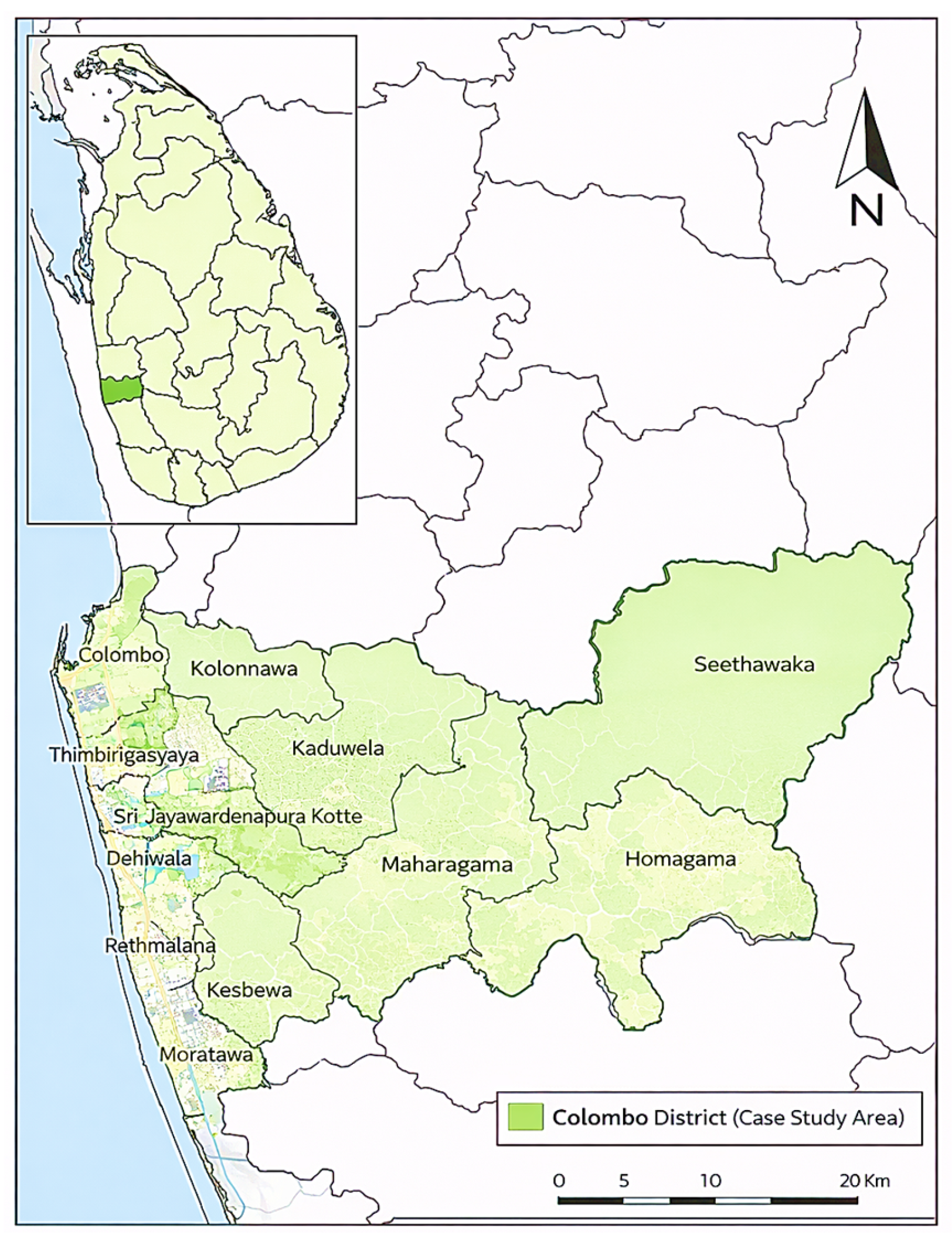
68]. The district contains a dense urban core and rapidly urbanizing suburbs, interspersed with wetlands such as marshes, paddy fields, lakes (e.g., Beira Lake, Bolgoda Lake), and canals. For administrative and analysis purposes, Colombo District is divided into 13 Divisional Secretariat Divisions (DSDs), which we used as spatial units in certain analyses (e.g., for entropy calculations). These DSD zones include Colombo, Thimbirigasyaya, Dehiwala, Sri Jayawardenapura Kotte (SJP), Kolonnawa, Kaduwela, Homagama, Maharagama, Kesbewa, Moratuwa, Rathmalana, Padukka, and Seethawaka [
28].
Figure 1 shows the location of Colombo District considered as the case study.
Colombo’s wetlands range from coastal mangrove and salt marsh areas to freshwater inland marshes and artificial lakes. Notably, the Muthurajawela Marsh (north of Colombo city) is Sri Lanka’s largest saline coastal peat bog, and the Bellanwila-Attidiya Wetland Sanctuary is an important urban marsh located south-east of central Colombo. Many wetlands are hydrologically connected by a network of canals (e.g., the Hamilton Canal and Kolonnawa Ela), some of which date back to colonial times and were used for transport. These wetlands provide critical ecosystem services: flood control for a city prone to monsoon flooding, regulation of water flow into the Kelani River and drainage to the sea, water purification, urban cooling, recreational space, and habitat for urban wildlife (over 250 species of wetland birds, reptiles, and fish have been recorded in Colombo’s wetlands) [
69,
70]. However, as described, urban development pressures have increasingly converted these landscapes. Built-up land in Colombo includes residential neighbourhoods (from high-density low-income settlements to sprawled suburban housing), commercial and industrial zones, roads and highways (notably the Outer Circular Highway completed in the 2010s), and infrastructure like the Port City land reclamation. Much of this development has come at the cost of filling low-lying lands. Our study aimed to capture these land use changes over a multi-decade period [
71,
72].
3.2. Data Sources and Preprocessing
We employed a combination of remote sensing data and ancillary spatial data to assess land cover dynamics. Multi-temporal satellite imagery from the United States Geological Survey (USGS) was the primary data source for land use/land cover (LULC) classification. Cloud-free (or minimal cloud) images were obtained from the Landsat series for three points: 1997, 2007, and 2017. Specifically, Landsat-5 Thematic Mapper (TM) imagery was used for 1997 and 2007, and Landsat-8 Operational Land Imager (OLI) imagery for 2017. All images correspond roughly to the same season (around December–February) to minimize seasonal vegetation differences. The imagery has a 30 m spatial resolution, suitable for detecting broad land cover categories and changes over the district scale. Standard preprocessing steps were followed: radiometric and atmospheric corrections were applied (using the LEDAPS tool for Landsat) to ensure reflectance values were comparable across dates. The images were then subset to the Colombo District boundary.
For ground reference and training data, we utilized high-resolution Google Earth imagery and historical aerial photographs or maps were available for the earlier years. Existing land use maps from the Survey Department of Sri Lanka, and the Wetland Zoning maps from the 2016 Wetland Management Strategy for Colombo were referred to in order to validate wetland locations and extents. A digital elevation model (SRTM 1 Arc-Second Global DEM Version 3; 30 m resolution) was used to help distinguish low-lying wetlands from other land (e.g., sometimes forests on higher ground can be confused with wetland vegetation in spectral terms; elevation helped mask out unlikely wetland areas).
Land Cover Classification and Change Detection
We performed supervised classification of the satellite images to produce LULC maps for 1997, 2007, and 2017. Six major land cover classes were defined based on the study focus and visual interpretation of Colombo’s landscape: (1) Built-up (all urban or developed land, including buildings, paved surfaces, and urban bare soil), (2) Wetlands (including natural marshes, swamps, flooded paddy fields, and other inundated lowland vegetation), (3) Water bodies (lakes, rivers, canals, open water), (4) Agriculture (non-wetland croplands and plantations), (5) Forest/Vegetation (woodlands, shrubland, parks not in wetlands), and (6) Others (e.g., grassland, barren land not developed). Wetlands were carefully distinguished from open water: wetlands in our definition often have mixed signatures of water and vegetation and are periodically or seasonally wet (as per Ramsar definition used by the Colombo Wetland Management plan). Training polygons for each class were digitized on each image by referencing ground truth data; for example, we identified known wetland patches (such as Bellanwila-Attidiya, Kolonnawa Marsh, Muthurajawela) on the imagery and collected representative spectral signatures. An Interactive Supervised Classification approach was taken (using QGIS): we employed maximum likelihood classification on each year’s image, and then manually refined the outputs by removing obvious misclassifications through visual inspection and ancillary data. The classification accuracies were assessed using independent validation points (randomly sampled and verified against high-res imagery or field knowledge). Each map achieved an overall accuracy above 85% (the wetland class specifically had >80% user’s and producer’s accuracy, owing to the distinct spectral/moisture signals of wetlands in Colombo).
Once classified maps were available for 1997, 2007, 2017, we conducted a change detection analysis to quantify changes in land cover, with emphasis on built-up and wetland classes. We computed the area of each class in each year and then calculated class transitions over the 1997–2007 and 2007–2017 intervals. In particular, we extracted how much wetland area was lost and what it was converted into (e.g., built-up, water, etc.), and conversely if any new wetlands appeared (e.g., due to rice fields being abandoned and turning into marsh). We also tabulated the increase in built-up area over time. These figures were later used to calibrate the land cover simulation. Additionally, spatial change maps were generated to visualize where major conversions occurred, for instance, highlighting zones where wetlands in 1997 were replaced by urban land by 2017.
In this study, the “wetland” class encompasses both natural wetland systems (e.g., marshes, swamps, and permanently or seasonally inundated lowland vegetation) and flooded or seasonally inundated paddy fields. This classification adopts a hydrologic wetness-based interpretation consistent with how wetlands are discussed in regional planning and environmental management contexts for Colombo, where natural wetlands and flooded agricultural lands are spatially interwoven and challenging to separate consistently using medium-resolution satellite imagery. This aggregation introduces heterogeneity in ecological function and land management status, which should be considered when interpreting the results. Projected wetland conversion includes both loss of natural wetland areas and conversion of managed, flood-prone agricultural landscapes. Accordingly, the results are best interpreted in terms of the spatial exposure of wetland-related landscapes to urban expansion, rather than as a direct measure of degradation of intact natural wetlands alone.
3.3. CA–Markov-Based Land Cover Simulation
To project future land use and land cover (LULC) dynamics and associated wetland losses, an integrated Markov chain and Cellular Automata (CA) modelling framework was applied [
73,
74]. This hybrid approach is widely used to simulate both the quantity of land cover change, through Markovian transition probabilities, and its spatial allocation, through CA-based neighbourhood rules [
75,
76]. The simulations were implemented in QGIS 3.28 using the MOLUSCE (Modules for Land Use Change Simulation) plugin [
77]. MOLUSCE combines Markov chains to estimate transition probabilities between LULC classes with Cellular Automata to allocate these changes spatially based on proximity to drivers such as roads, urban centres, and existing built-up areas [
78,
79]. This integration supports a spatially explicit representation of urban expansion and its encroachment into ecologically sensitive zones [
80].
Markov chain analysis was first used to derive transition probability matrices from observed land cover changes during the periods 1997–2007 and 2007–2017. These matrices quantify the likelihood of persistence and conversion among all LULC classes, including transitions from wetland to built-up land. To enhance temporal robustness, transition probabilities from the two sub-periods were combined to represent longer-term land-change tendencies. These probabilities were then extrapolated to simulate future LULC conditions for the target years 2040 and 2060, corresponding to approximately one- and two-generation planning horizons.
Spatial allocation of projected land cover change was governed by a CA mechanism that accounts for neighbourhood effects and spatial contiguity. Transition potential modelling within MOLUSCE was implemented using a trained artificial neural network (ANN), which integrates multiple spatial driving factors to estimate the relative likelihood of land use transitions at the pixel level. The driving factors included distance to existing built-up areas, distance to road networks, elevation, and designated protected areas. Continuous driver layers were internally standardized within the software environment to ensure comparability prior to integration, while protected areas were incorporated as spatial constraints that reduce the likelihood of urban expansion within legally conserved zones.
The CA component applies a fixed neighbourhood configuration consistently across all simulations, allowing land use change to propagate outward from existing urban areas into adjacent pixels. This contiguity rule ensures that simulated urban expansion reflects the clustered, edge-growth characteristics observed in historical development patterns, rather than random spatial allocation. Model calibration focused on reproducing observed spatial patterns of land cover by simulating the 2017 LULC map using earlier time steps, following standard MOLUSCE procedures rather than parameter optimization.
Model performance was evaluated by comparing the simulated and observed 2017 LULC maps using the Kappa index of agreement. The validation results indicated strong agreement, with Kappa values exceeding 0.80 for built-up areas and 0.75 for wetlands, demonstrating that the model adequately re-produces recent urban expansion and wetland change patterns. Based on this performance, the calibrated model was used to generate future LULC projections for 2040 and 2060 under a business-as-usual scenario. This scenario assumes continuity of historical land use transition dynamics observed between 1997 and 2017, with no explicit policy interventions or alternative development trajectories incorporated into the model structure.
3.4. Urban Sprawl Measurement: Shannon’s Entropy
To quantitatively measure the degree of urban sprawl in Colombo, we applied Shannon’s entropy method, a common technique in urban studies to gauge the dispersion or concentration of built-up area [
81,
82]. Shannon’s entropy (H) is given by:
where
is the proportion of the total urban built-up area that lies in the
i-th zone (out of
n zones) [
83]. For this study, we used the 13 DSDs of Colombo as the spatial zones in the entropy calculation. Using the classified maps, we computed the total built-up area within each DSD for each of the years 1997, 2007, 2017 (and later for the simulated 2040 and 2060) [
84]. From these,
= (built-up area in zone
i)/(total built-up area in Colombo District). The entropy value H was then calculated for each year. The entropy can range from 0 to
(here
) [
85]. To enable comparison over time, one can also use a normalized entropy
, scaling it between 0 and 1. An entropy value near 0 indicates that built-up development is highly concentrated in a few zones (i.e., very compact city), whereas a value near 1 indicates development is maximally dispersed (i.e., sprawl) [
86]. Urban studies often consider a threshold (like 0.5 of normalized entropy) beyond which a city can be deemed sprawling [
87,
88].
We computed H for each time point to see how Colombo’s urban spatial form has evolved: increasing entropy over time would indicate a trend toward more sprawl (dispersion), while decreasing entropy might indicate centralization or densification of development. Additionally, we examined entropy changes at the zone level. For each DSD, we calculated its local entropy contribution and tracked how its share of urban area changed. This helped identify which parts of Colombo saw the most dispersion of growth (for example, a peripheral zone that gained a lot of new urban areas would cause an increase in entropy). We present both the total entropy of the city for each year and the zone-specific patterns. This approach of using DSDs (administrative units) is somewhat coarse, but it aligns with available data and planning units. Other methods like grid-based entropy (dividing area into uniform cells) or radial analysis (entropy in concentric rings from city centre) could also be used; however, the DSD approach was preferred as it corresponds to actual governance zones.
All derived metrics, including temporal changes in built-up and wetland areas, Shannon entropy values, and spatial change maps, were compiled for integrated analysis. Descriptive statistics and graphical outputs were generated to examine long-term trends, including time-series plots of built-up and wetland area from 1997 to 2060 and thematic maps illustrating the spatial distribution of wetland loss. Administrative divisions (Divisional Secretariat Divisions, DSDs) were used as analytical units to support spatial interpretation, enabling identification of rapidly expanding suburban areas and associated wetland declines. Spatial analyses and map production were conducted using GIS software, primarily ArcGIS 10.8 and QGIS 3.16, while Microsoft Excel and R (version 4.3.2) were used for tabular data processing and graphical visualization. All area calculations were performed in a projected coordinate system (UTM Zone 44N) to ensure spatial accuracy, and results are reported in hectares (ha).
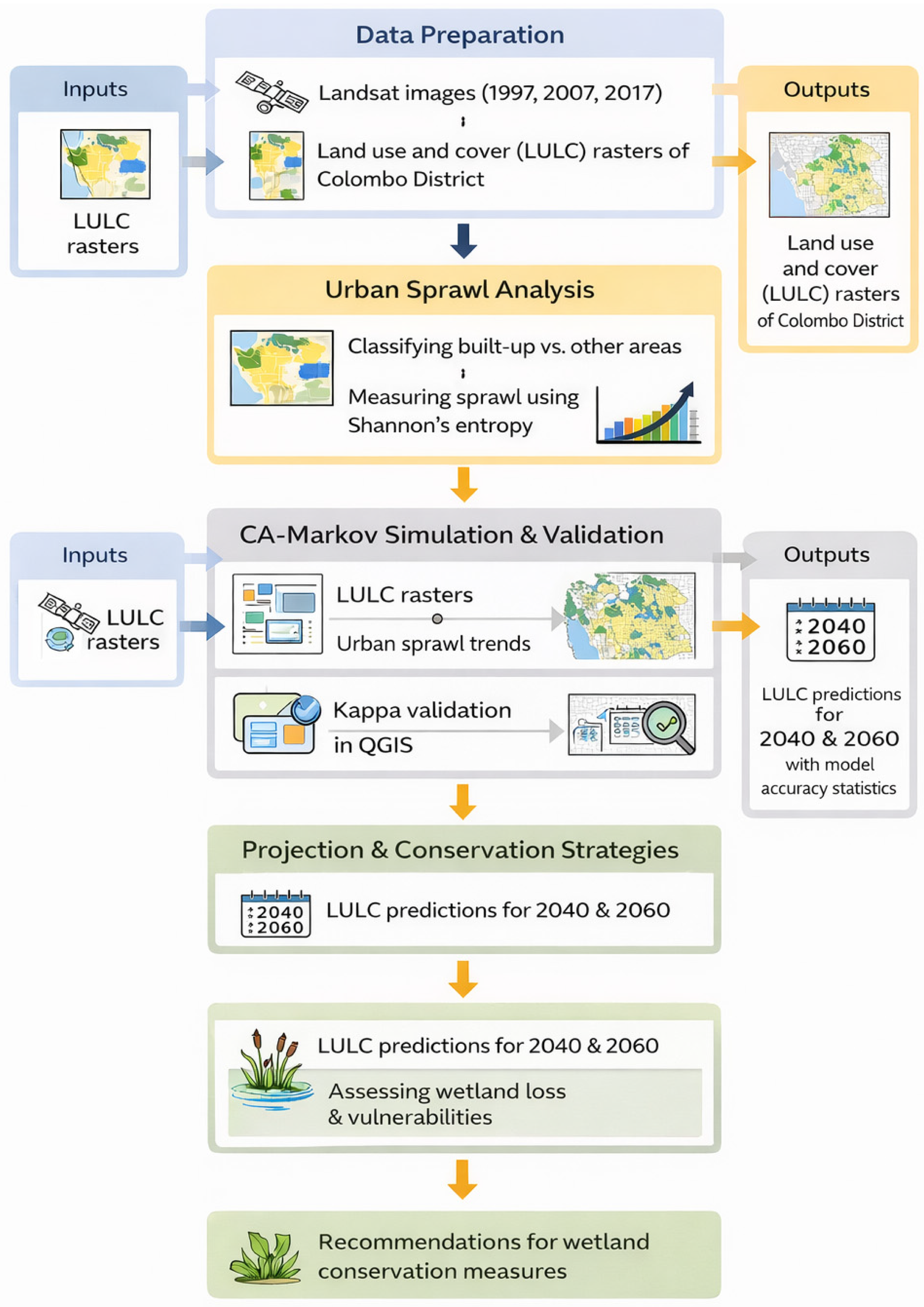
Figure 2 shows the steps of overall research methodology.
4. Results
4.1. Land Use/Land Cover Changes (1997–2017)
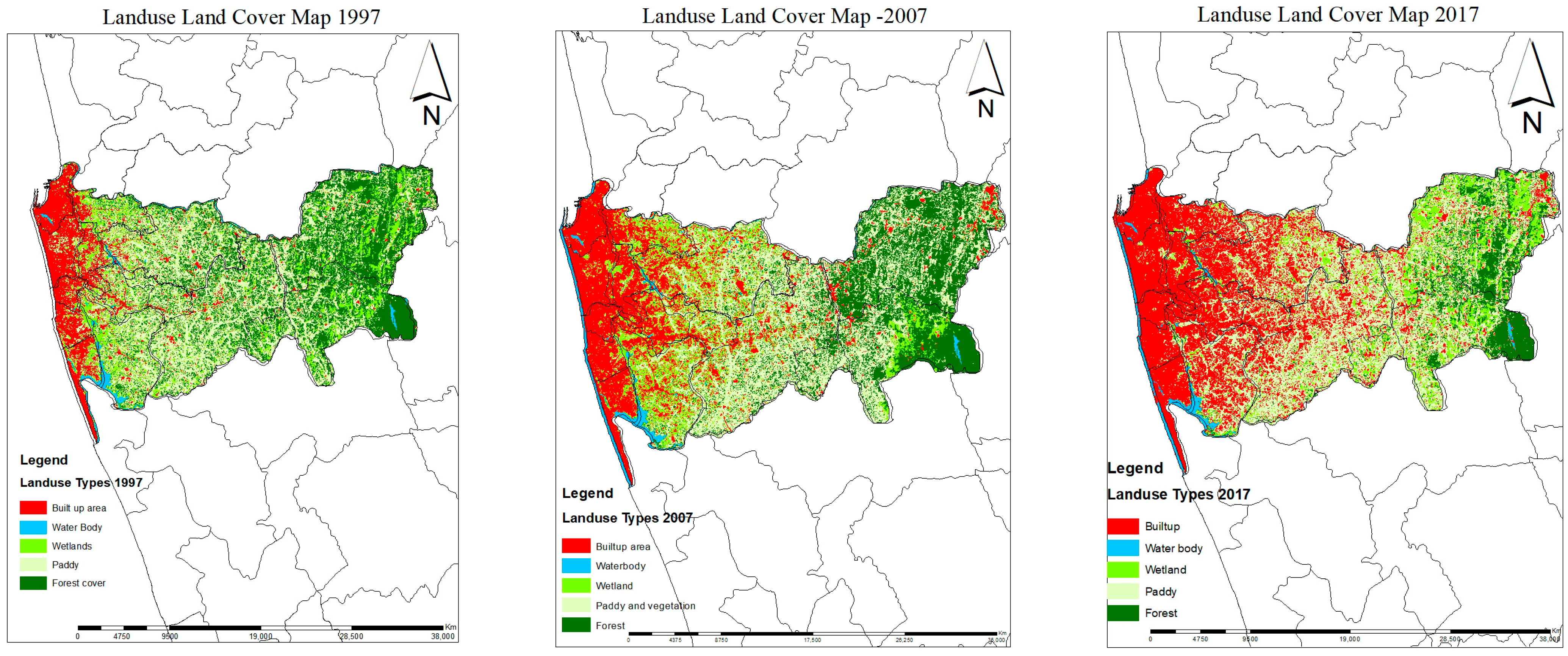
The classified land cover maps for 1997, 2007, and 2017 show pronounced urban expansion across Colombo District over the 20-year period, accompanied by a substantial reduction in wetlands and other permeable land covers (
Figure 3). Quantitative analysis indicates that the built-up area nearly tripled between 1997 and 2017, while wetland extent declined by approximately one quarter over the same period (
Table 1), reflecting intensifying development pressure on ecologically sensitive landscapes.
Built-up land covered approximately 9266 ha of Colombo District in 1997 and expanded to about 16,300 ha by 2007, reaching 25,341 ha in 2017. This represents a net increase of roughly 16,075 ha between 1997 and 2017, corresponding to a 173 percent increase relative to the 1997 baseline. As a result, the developed footprint of the district expanded to nearly 2.7 times its original extent within two decades. Spatial patterns of urban growth varied over time. During the period 1997–2007, expansion was dominated by infilling of inner suburban areas and fringe towns such as Dehiwala, Sri Jayawardenapura-Kotte, and Kaduwela, with development strongly aligned along major transportation corridors. In contrast, growth between 2007 and 2017 extended further into peripheral areas, including Homagama and parts of Seethawaka, while also intensifying development in several coastal suburbs such as Moratuwa and areas north of the district boundary near Wattala.
Wetland extent in Colombo District declined from an estimated 11,758 ha in 1997 to 8663 ha by 2017, reflecting a loss of approximately 3095 ha, or about 26 percent of the original wetland area. The largest absolute losses occurred in Divisional Secretariat Divisions that historically supported extensive marshlands and lowland paddy systems but experienced rapid urbanization. Homagama, for example, contained approximately 1522 ha of wetlands in 1997, which declined to around 1120 ha by 2017. Kaduwela, encompassing portions of the Diyawanna Oya wetland complex and marshlands along the Kelani River, experienced a reduction in wetland area from about 1229 ha to 823 ha over the same period. The most severe decline was observed in Kolonnawa, where wetland extent decreased from approximately 859 ha in 1997 to about 129 ha in 2017, representing an 85 percent reduction and indicating extensive encroachment and degradation of the Kolonnawa Marsh system.
In highly urbanized central areas, wetlands were almost entirely eliminated by 2017. Colombo DSD contained approximately 86 ha of wetlands in 1997, which declined to less than 6 ha by 2017, indicating near-total disappearance of wetland systems from the urban core, with only small remnant fragments persisting along features such as the margins of Beira Lake. In contrast, some peripheral divisions, including Padukka and parts of Seethawaka, experienced comparatively lower rates of wetland loss, reflecting reduced development pressure. Wetlands located within formally protected areas, such as sections of the Bellanwila–Attidiya wetland complex, also exhibited greater persistence over time.
Other land cover categories also underwent notable changes. Agricultural lands, including upland cultivation and plantation areas, declined over the study period, largely due to conversion to built-up land and other uses. Open water bodies, such as lakes and reservoirs, exhibited relatively limited net change, with area estimates fluctuating between approximately 1095 ha in 1997 and 1363 ha in 2017. These variations likely reflect a combination of seasonal water-level changes, infilling of smaller water bodies, and the creation of new flood retention ponds, rather than a systematic long-term trend in open water extent.
The change analysis indicates that most of the wetland loss was due to conversion to built-up land. Spatial overlays show that large portions of former marshes and seasonal wetlands have been turned into residential neighbourhoods, industrial zones, or infrastructure corridors. For example, the outer Colombo areas (like Kaduwela/Homagama) saw paddy fields and marshy lands replaced by housing schemes and roads. In Kolonnawa and Kotte, much wetland area was lost to expansion of urban settlements and landfill (garbage dumping also took place in some wetlands). A small fraction of wetlands transitioned to what we classified as “water” (this could happen if a marsh was dredged into an open lake or if water management increased permanent inundation), but this was minimal. The built-up expansion, on the other hand, often consumed not just wetlands but also agricultural and other open lands. Visually,
Figure 3 demonstrates that in 1997, urban land was heavily concentrated along the coastal strip and main road arteries, while vast inland areas (especially in the east and north of the district) remained green (agriculture) or blue (wetlands). By 2017, the grey/red areas (built-up) spread mosaic-like across much of the map, with green patches shrinking and blue wetland patches either disappearing or becoming very isolated. Particularly notable is the emergence of continuous urban corridors connecting what were once separate towns. The area from Colombo city extending east through Kotte to Battaramulla, and south to Maharagama, has essentially become one contiguous urban mass by 2017. Similarly, the corridor to the north towards Ragama/Kelaniya (just outside district) filled in. Wetlands now survive mainly in two forms: (a) a few large complexes (e.g., the Muthurajawela marsh at the northern edge, and parts of Bolgoda Lake wetlands in the south) and (b) small, fragmented pockets within the urban matrix (e.g., remaining bits of Kolonnawa marsh, Kotte marsh). Many of these pockets are under threat or in degraded condition.
4.2. CA–Markov-Based Projections of Future Land Use and Land Cover (2040–2060)
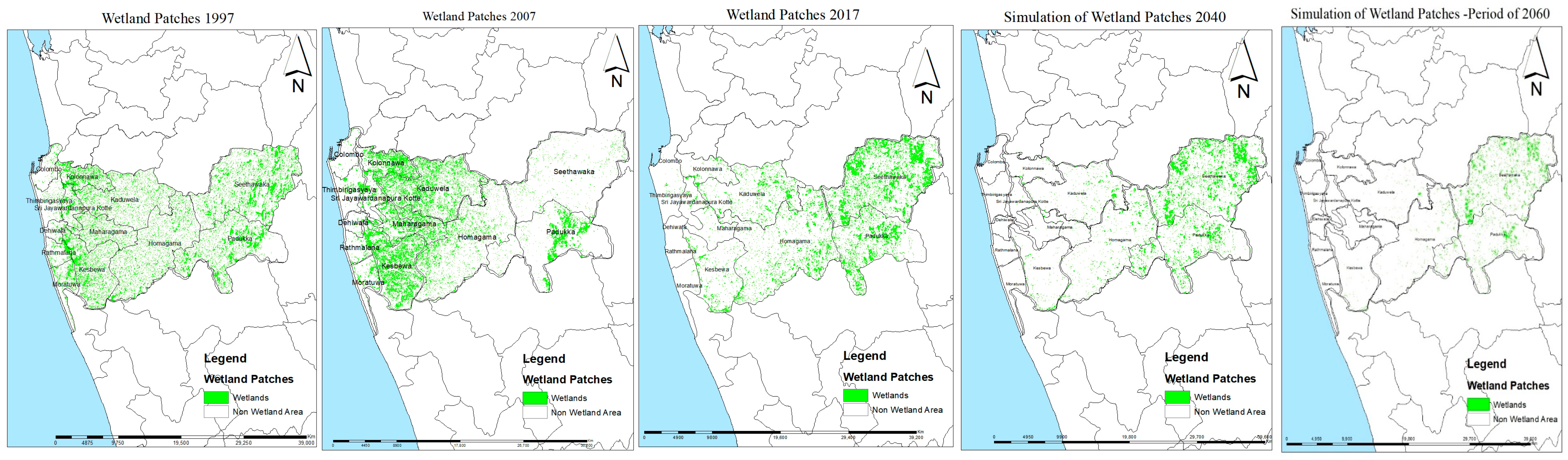
Future land use and land cover (LULC) patterns for Colombo District were projected for 2040 and 2060 using a calibrated CA–Markov chain modelling framework implemented through the MOLUSCE plugin in QGIS. The model integrates Markov chain transition probabilities, which quantify the likelihood of land cover change based on historical trajectories, with Cellular Automata rules that govern the spatial allocation of these changes across the landscape. The resulting projections represent a business-as-usual scenario in which land cover transitions observed between 1997 and 2017 continue into the future without major policy or regulatory intervention. The projected LULC quantities are summarized in
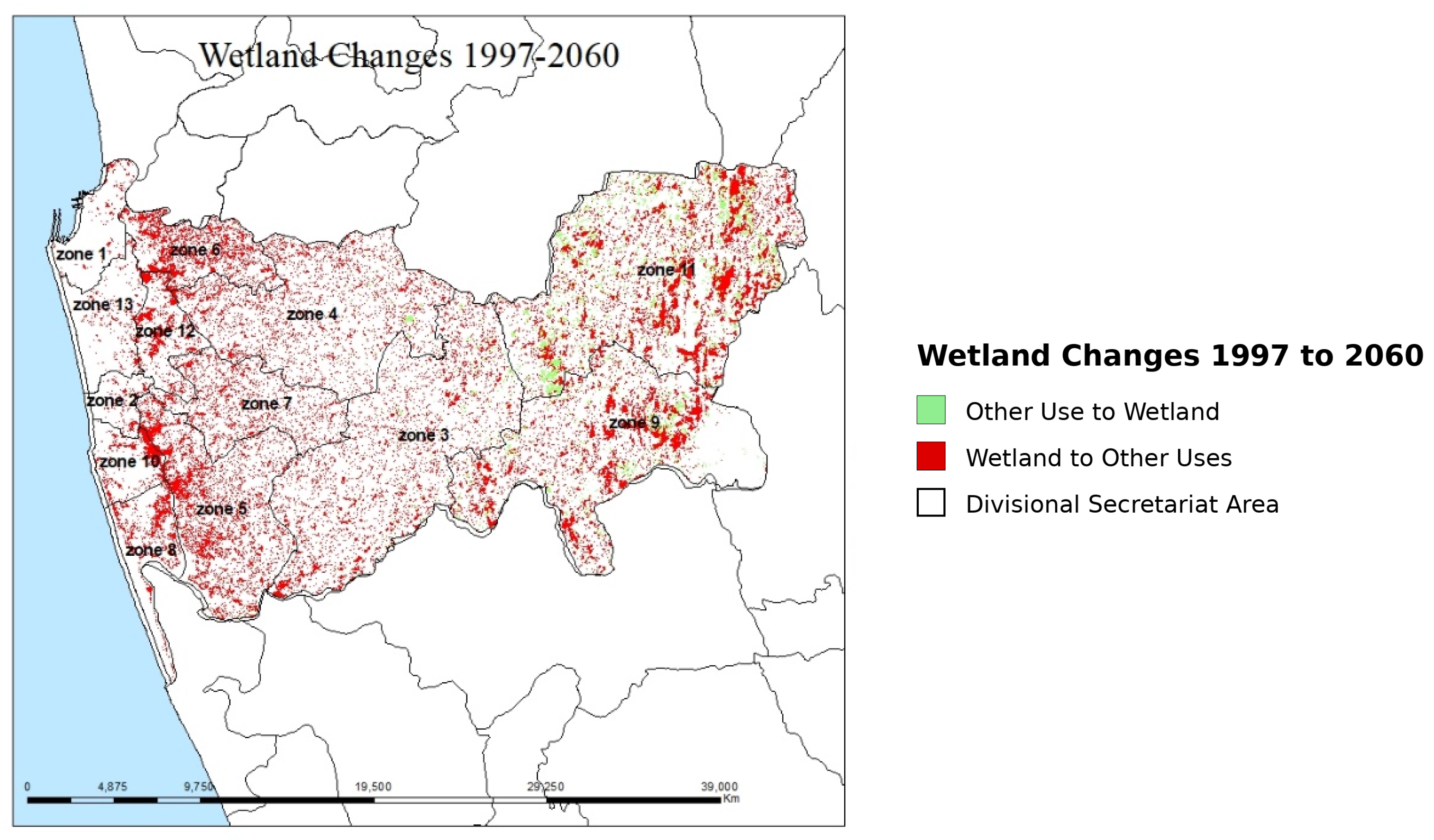
Table 2, and the spatial configuration for wetland changes predicted for 2040 and 2060 via simulations is shown in
Figure 4.
The CA–Markov simulations indicate continued expansion of built-up land, with a gradual deceleration in growth rates over time as transition opportunities diminish and spatial constraints intensify. Built-up area is projected to increase to approximately 30,016 ha by 2040 and further to 32,548 ha by 2060. Relative to the 2017 baseline, this corresponds to an increase of about 7200 ha by 2040, representing a 28 percent growth, followed by an additional increase of roughly 2500 ha between 2040 and 2060, equivalent to an 8 percent growth. The slowing rate of expansion reflects the Markov-based recognition of declining transition probabilities in highly urbanized zones and the CA-driven saturation of spatially suitable areas (
Figure 5). By 2060, built-up land is projected to occupy nearly 47 percent of the district’s total area, up from approximately 36 percent in 2017, indicating that much of the developable land in the western portion of Colombo District becomes urbanized under continued growth trajectories.
In contrast, the CA–Markov projections show a pronounced and accelerating decline in wetland extent, driven primarily by persistent transition probabilities from wetland to built-up land in peri-urban zones. Total wetland area is projected to decrease from 8663 ha in 2017 to approximately 5041 ha by 2040 and further to about 2352 ha by 2060. This represents an additional loss of roughly 3622 ha between 2017 and 2040, corresponding to a 42 percent reduction, followed by a further loss of approximately 2689 ha between 2040 and 2060, equivalent to a 53 percent reduction. Cumulatively, the CA–Markov simulations suggest that nearly 73 percent of the wetlands present in 2017 would be lost by 2060. When compared with the 1997 baseline, the model indicates an overall wetland reduction approaching 80 percent, underscoring the long-term vulnerability of wetland systems under sustained urban expansion.
The spatial allocation component of the CA–Markov model reveals that wetland loss is not uniformly distributed but is concentrated within suburban transition zones where development pressure is highest. Wetlands located in Divisional Secretariat Divisions such as Kaduwela, Homagama, Padukka, and Kesbewa exhibit high transition potential from wetland to built-up classes, reflecting their proximity to existing urban areas and transportation networks. In Kaduwela, simulated wetland extent declines from approximately 823 ha in 2017 to about 271 ha by 2040 and further to around 68 ha by 2060, corresponding to a loss exceeding 90 percent of its 2017 wetland area. Homagama shows a similar trajectory, with wetlands decreasing from approximately 1120 ha in 2017 to about 471 ha in 2040 and 165 ha by 2060, leaving only a small fraction of its historical wetland coverage. Padukka, which remains comparatively less urbanized, exhibits a more gradual decline, retaining a larger share of wetlands relative to more intensively developed divisions, although substantial losses are still projected by the end of the simulation period. At the Divisional Secretariat Division level, projected wetland loss is spatially uneven under the business-as-usual scenario. Peri-urban divisions such as Padukka, Homagama, and Kaduwela are projected to experience the largest absolute reductions in wetland area by 2040 and 2060, reflecting continued outward urban expansion, while more urbanized divisions show comparatively smaller absolute changes due to limited remaining wetland extent.
By 2060, the CA–Markov projections indicate that remaining wetlands are largely confined to areas with low transition probabilities due to strong biophysical or institutional constraints on development. These include portions of the Muthurajawela wetland system and segments of the Bolgoda Lake complex, where persistent inundation, hydrological conditions, or formal protection reduce the likelihood of conversion. Minor inconsistencies observed in simulated wetland values for specific divisions are interpreted cautiously and likely reflect classification or tabulation artefacts rather than true wetland expansion. Overall, the CA–Markov modelling results highlight the role of path-dependent urban growth processes in shaping future wetland vulnerability and demonstrate how continued urban sprawl is likely to concentrate wetland loss within peri-urban landscapes.
4.3. Urban Sprawl Index (Entropy) Results
Shannon’s entropy was used to quantify changes in the spatial distribution of built-up land in Colombo District and to assess shifts in urban dispersion over time. District-level entropy values show a consistent increase across the study period, with overall entropy rising from approximately 0.85 in 1997 to 1.13 in 2007 and further to 1.45 by 2017. This upward trend indicates a gradual redistribution of built-up land away from a highly centralized pattern. When normalized by the maximum possible entropy for the number of zones considered, the entropy index increased from approximately 0.23 to 0.39 over the same period. While these normalized values remain well below levels typically associated with highly dispersed or fully sprawling urban systems, the increase reflects a measurable shift toward less concentrated and more spatially distributed urban growth.
Zone-level entropy values provide further insight into the spatial processes underlying this trend (
Table 3). Core urban divisions, including Colombo DSD and Dehiwala, exhibit declining entropy values over time, reflecting consolidation and saturation of built-up land rather than outward expansion. In these divisions, the proportional contribution of built-up land to the district total declined as urban growth accelerated in other areas, resulting in lower entropy contributions despite high absolute levels of development. This pattern is characteristic of mature urban cores where opportunities for horizontal expansion are limited.
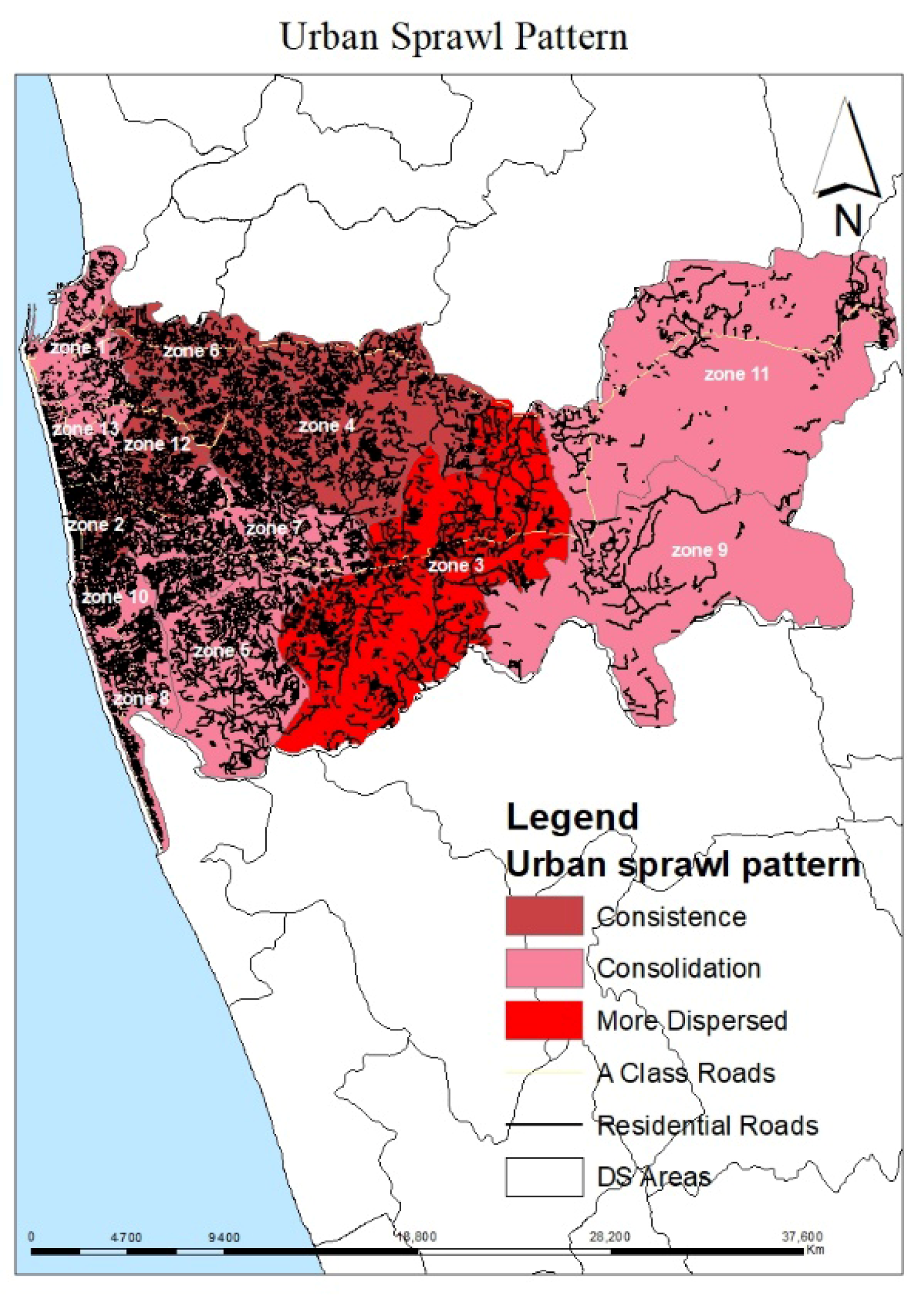
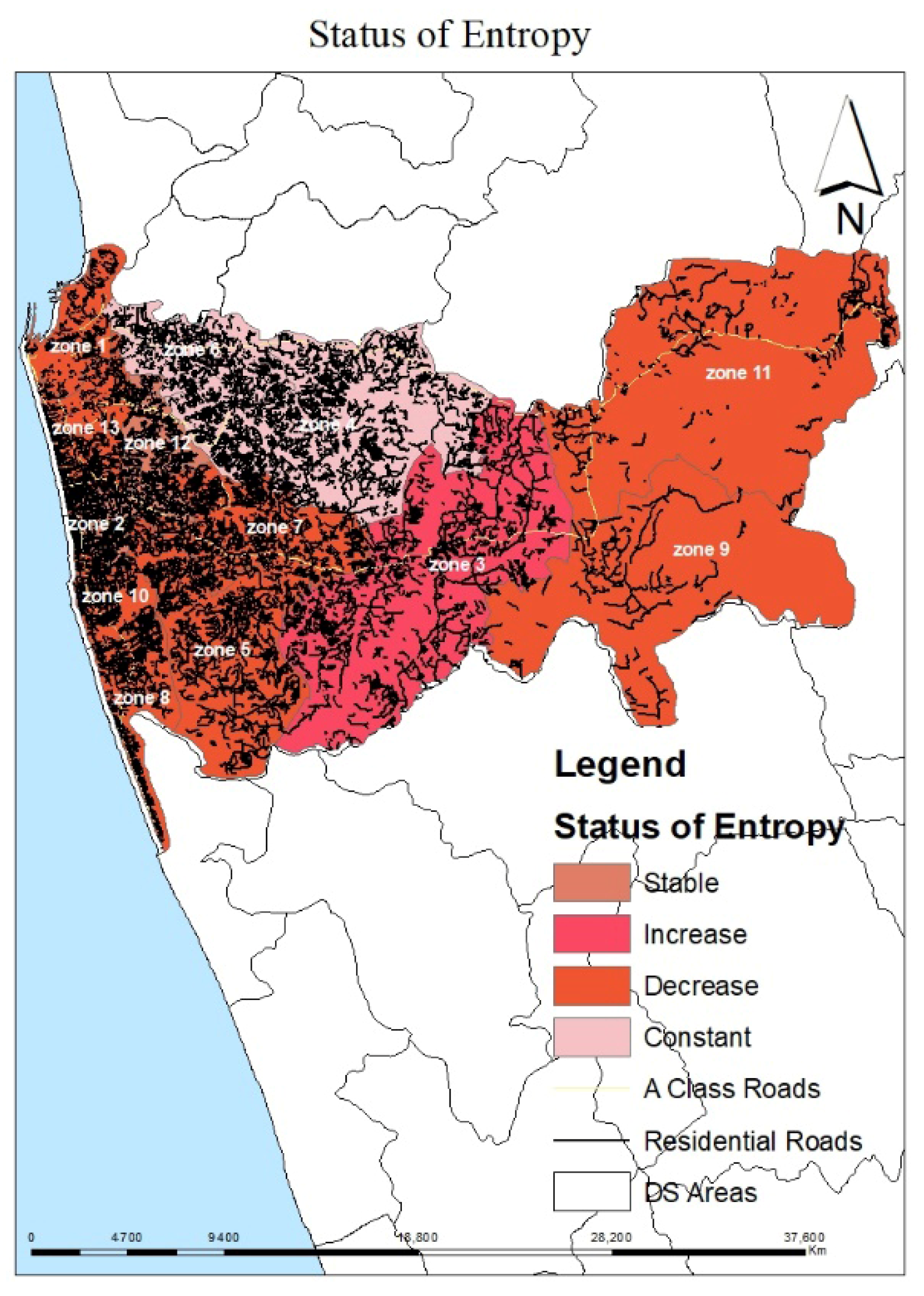
In contrast, several peri-urban divisions show notable increases in entropy, indicating a dispersion of development across a broader spatial extent. Homagama, Kaduwela, and Padukka emerge as key contributors to the rise in district-level entropy. These divisions contained relatively small proportions of built-up land in 1997 but experienced rapid and spatially extensive growth by 2017, increasing their share of total built-up area. Elevated entropy values in these zones indicate that development is distributed across multiple locations rather than concentrated in compact clusters, consistent with peri-urban expansion and edge-driven growth processes. Similar, though less pronounced, trends are observed in Seethawaka, suggesting emerging dispersion in more peripheral areas. Several intermediate divisions, including Sri Jayawardenapura Kotte and Kolonnawa, display relatively stable entropy values over time. In these areas, urban growth appears to have occurred primarily through infilling and consolidation of existing developed land, resulting in limited changes in spatial dispersion. Kolonnawa shows a slight decline in entropy as previously heterogeneous land cover patterns became more uniformly urbanized, illustrating how extensive conversion can reduce entropy by diminishing spatial heterogeneity.
Entropy values derived from CA–Markov simulated land use maps suggest that this trend toward increased dispersion is likely to continue, although at a diminishing rate. District-level entropy is projected to increase to approximately 1.56 by 2040 and 1.63 by 2060, with normalized entropy approaching 0.44. The slowing rate of increase indicates that urban development is expected to remain relatively concentrated overall, even as incremental dispersion continues. This deceleration likely reflects increasing saturation of built-up land across most divisions, as well as constraints imposed by district boundaries and remaining non-developable areas. Outer divisions such as Padukka continue to contribute to projected increases in entropy, while inner zones show limited additional change.
Figure 6 and
Figure 7 illustrate the spatial distribution of entropy values and the corresponding urban development patterns in Colombo.
5. Discussion
In this study, CA–Markov model outputs are interpreted as indicators of spatial vulnerability rather than as deterministic predictions of future land use change. Unlike many prior applications that emphasize aggregate urban growth or land cover transitions, the analysis focuses on the spatial intersection between projected urban expansion and wetland areas under a continuation of observed development dynamics. Because the modelling framework is based on a continuation of historical transition patterns, the analysis does not attempt to assess the effectiveness of specific policy or conservation measures but instead provides a baseline against which such interventions could be evaluated in future work. Accordingly, the projected land use trajectories should be interpreted as conditional scenarios rather than deterministic forecasts, representing the likely consequences of maintaining existing development patterns in the absence of substantive policy or governance intervention.
Interpreted through a CA–Markov modelling lens, the results demonstrate how historical land use transition dynamics can lock rapidly urbanizing cities into development trajectories that progressively erode wetland systems. Unlike static land cover assessments, CA–Markov modelling explicitly captures both the probability of land cover transitions and their spatial realization, allowing wetland vulnerability to be understood as a path-dependent outcome of sustained urban expansion. In Colombo, high transition probabilities from wetland to built-up land, combined with strong spatial attraction to existing urban areas and infrastructure, generate a self-reinforcing pattern of wetland loss under a business-as-usual scenario. Similar dynamics have been observed in other rapidly urbanizing regions, where wetlands consistently emerge as one of the most vulnerable land cover classes under continued urban growth [
89,
90,
91].
The CA–Markov projections indicate that wetland decline accelerates over time as urban expansion advances into peri-urban transition zones. While historical analysis shows a 26 percent reduction in wetland extent between 1997 and 2017, the model projects that more than 70 percent of the remaining wetlands could be lost by 2060 if current transition regimes persist. This disproportionate future loss reflects the Markovian assumption of temporal continuity in transition probabilities, coupled with Cellular Automata rules that favour contiguous urban expansion. Once wetlands become embedded within expanding urban matrices, their likelihood of persistence declines sharply, even in the absence of explicit policy drivers promoting conversion. In this sense, wetland vulnerability emerges not merely from development pressure but from the spatial logic of urban growth encoded within the CA–Markov framework.
The spatial allocation component of the CA–Markov model reveals that future wetland loss is highly uneven across the landscape. Projected losses are concentrated in suburban transition zones such as Kaduwela, Homagama, Padukka, and Kesbewa, where proximity to existing built-up areas and transportation corridors produces high transition potential. This pattern highlights a critical blind spot in conventional planning approaches that prioritize protection of high-profile wetlands in urban cores while overlooking smaller or fragmented wetlands in rapidly transforming suburban areas. Comparable peri-urban vulnerability patterns have been documented in cities such as Guangzhou and Dhaka, where wetland loss has closely followed outward urban expansion.
From a climate resilience perspective, the CA–Markov results indicate that continued urban expansion progressively erodes Colombo’s capacity to regulate hydrological processes by reducing the extent and connectivity of wetland systems. By 2060, the simulations project that wetland area may decline to approximately 2350 ha, compared to nearly 11,760 ha in 1997, representing a substantial loss of natural stormwater storage capacity. This spatial pattern is particularly significant given Colombo’s history of severe flooding events, including those in 2010 and 2016, which have been linked to wetland encroachment and disruption of natural drainage pathways. Hydrological studies consistently show that wetland loss increases runoff coefficients and shortens time-to-peak during storm events, placing additional pressure on urban drainage infrastructure as permeable landscapes are replaced by impervious surfaces [
92,
93,
94].
The entropy analysis complements these findings by indicating a gradual redistribution of urban development toward peri-urban areas rather than widespread dispersion across the district. While overall urban growth remains relatively concentrated, incremental increases in entropy suggest that development pressure is expanding into wetland-dominated fringe zones, reducing landscape permeability across a broader spatial extent. This pattern limits the persistence of large, contiguous wetland areas that function as hydrologic buffers and increases reliance on engineered canal and pumping systems for flood management [
95,
96,
97]. Together, the spatial coincidence of high transition probabilities from wetland to built-up land and modest but persistent increases in entropy helps explain why flood risk in Colombo is likely to intensify under business-as-usual urban growth trajectories, even without a shift toward fully diffuse urban sprawl [
98]. Furthermore, recent studies highlight ongoing wetland loss in the Colombo region, which supports the trends identified through the CA–Markov analysis for the location, which also supports in validating the outcomes. Independent analyses indicate that from 2001 to February 2024, Colombo’s wetlands decreased by approximately 2.68 km
2, with corresponding hydrological impacts linked to urban expansion [
99]. In addition, a 2025 study using 2023 Landsat 8/9 data documented that urban wetlands in Colombo are under substantial pressure from rapid urbanization, reinforcing that the trends observed between 1997 and 2017 have not reversed [
100].
Beyond flood regulation, the projected loss and fragmentation of wetlands have implications for urban microclimate regulation, air quality, and ecological functioning [
101]. Wetlands and associated vegetated open spaces contribute to cooling through evapotranspiration and facilitate air circulation, particularly in tropical cities like Colombo [
102]. Recent studies in Colombo have identified a ‘threshold value of efficiency’ (TVoE) for wetland cooling, suggesting that larger, interconnected wetland clusters are far more effective at moderating ambient temperatures than isolated patches [
68,
100]. Ecologically, the Colombo Wetland Complex (CWC) supports diverse assemblages of nearly 250 plant and 285 animal species, including rare urban residents like the fishing cat (
Prionailurus viverrinus) [
63]. These systems provide essential services such as water purification (‘the kidneys of the city’), mosquito regulation, and food security through urban agriculture [
65]. Continued degradation undermines these services and the recreational well-being of the 2.3 million residents who depend on them. Importantly, the CA–Markov projections should be interpreted as conditional scenarios rather than deterministic forecasts. The business-as-usual simulations explicitly assume the absence of major policy interventions, representing the ‘cost of inaction’. The strength of this approach lies in its ability to translate abstract development trends into spatially explicit vulnerability outcomes, providing decision-relevant insights for planners to shift from reactive to proactive conservation. Moreover, beyond identifying spatial patterns of wetland vulnerability, recent work has demonstrated how prospective land use analyses can be operationally integrated into planning decisions through ecosystem and ecosystem service assessments. For example, ref. [
103] showed that spatial projections of land conversion can be combined with functional ecosystem evaluations to support decisions aimed at ecosystem protection rather than solely documenting morphological change. In this context, the CA–Markov-based identification of high-risk wetland conversion zones in Colombo could be complemented by ecosystem service assessments (e.g., flood regulation, water retention, cooling) to prioritize protection and guide climate-resilient land use planning.
5.1. Recommendations
Building on the empirical and modelled results, this study identifies several priority directions for urban planning and policy intervention in Colombo. Foremost among these is the need to formally protect remaining wetlands by designating them as non-developable zones, explicitly recognizing their role as ecological assets and flood-regulation infrastructure. Major wetland systems such as Muthurajawela, Bellanwila–Attidiya, Kolonnawa, and the Kotte marshes should be secured through conservation or flood-buffer zoning, with clear restrictions on filling and construction. Regulatory designation alone is insufficient; enforcement must be strengthened through a combination of legal controls, routine satellite-based monitoring of wetland extent, and community-level reporting mechanisms to detect and deter encroachment.
Protection should be complemented by active wetland restoration and creation, particularly in areas where historical wetland loss has already weakened hydrological buffering capacity. Degraded or abandoned low-lying lands provide opportunities for re-flooding and marsh re-establishment, while further naturalization could enhance flood attenuation and ecological connectivity. In addition, constructed wetlands integrated into urban parks and open spaces can serve multiple functions, including stormwater management, biodiversity enhancement, and recreation. When planned strategically, such interventions can also contribute to carbon sequestration objectives, strengthening their relevance within climate mitigation frameworks.
Urban growth management should focus on redirecting development patterns rather than simply restricting growth. Limiting outward sprawl requires prioritizing compact and vertical development within pre-identified urban centres, including the Colombo core and selected suburban nodes. However, densification must be accompanied by deliberate green design to avoid exacerbating runoff and heat stress. Integrating green roofs, permeable pavements, retention areas, and green corridors into high-density developments is essential to maintain hydrological and thermal performance. Planning incentives, such as expedited approvals or tax benefits, could be used to encourage developments that demonstrably contribute to water retention and urban greening.
Recognizing that some wetland loss may be difficult to avoid under socio-economic pressure, flood infrastructure investment must proceed in parallel with conservation efforts. Where wetlands are lost, compensatory measures such as retention basins and upgraded drainage systems are necessary. However, reliance on grey infrastructure alone is unlikely to be cost-effective or sufficient, as engineered systems often fail to replicate the multifunctional services provided by wetlands and can impose substantial long-term maintenance costs [
48,
91]. A hybrid approach that integrates green–blue infrastructure with conventional drainage systems offers a more resilient and economically efficient pathway.
Effective implementation of these strategies depends on community and stakeholder engagement. Public understanding of wetland functions, particularly their role in flood mitigation, public health, and quality of life, can generate political and social support for protection. Initiatives such as wetland parks, citizen science programmes, educational curricula, and nature-based recreation can help embed wetlands within everyday urban experience. The Ramsar Wetland City designation provides an additional opportunity to leverage wetlands as part of Colombo’s identity and tourism appeal, reinforcing institutional accountability for their preservation.
Finally, Colombo should institutionalize regular wetland monitoring and applied research as part of its urban governance framework. Periodic mapping of wetlands using remote sensing at two- to three-year intervals, combined with public dissemination of results, would enhance transparency and enable early detection of accelerating loss. Partnerships with academic institutions and international research organizations, such as the International Water Management Institute, could support methodological consistency and innovation. Future research should also explore interactions between urbanization and climate change, including sea-level rise and extreme rainfall, to assess whether some wetlands may migrate inland or require managed adaptation pathways.
Taken together, these recommendations align closely with global sustainability and climate frameworks. Protecting urban wetlands contributes directly to multiple Sustainable Development Goals, including SDG 11 on sustainable cities and disaster risk reduction, SDG 13 on climate adaptation, SDG 6 on water management, and SDG 15 on biodiversity conservation. The findings of this study therefore extend beyond Colombo, demonstrating how locally grounded, model-informed planning decisions can contribute to broader national and international sustainability commitments.
5.2. Limitations and Areas for Future Research
Although this study integrates multi-temporal land cover analysis with CA–Markov modelling to examine long-term wetland vulnerability, several limitations should be acknowledged. First, uncertainty in land use and land cover classification remains an inherent challenge. Distinguishing wetlands from certain agricultural land uses, particularly seasonal rice paddies, is difficult because these landscapes can exhibit wetland-like spectral characteristics during inundated periods and appear as dry land during other seasons. While the analysis focused on clearly identifiable wetland features to minimize misclassification, some degree of uncertainty remains, and wetland area estimates may carry a margin of error on the order of 15–20%. In addition, wetlands were treated as a single land cover class, despite substantial variation in ecological condition and function across sites. Future research could address this limitation by incorporating wetland typologies or health indices that distinguish between intact, degraded, and artificial wetland systems, thereby moving beyond area-based assessments toward functional vulnerability analysis.
The modelling framework itself introduces additional constraints. The CA–Markov simulations assume temporal stationarity in land use transition probabilities, implying that past trends will continue into the future in the absence of intervention. In reality, urban development trajectories can be altered by policy shifts, major infrastructure investments, or environmental change. For example, the establishment of new protected wetland parks or, conversely, large-scale transportation or housing projects could substantially modify transition dynamics. Climate change also introduces uncertainty that is not explicitly represented in the current model. Sea-level rise, changes in rainfall intensity, or altered hydrological regimes could lead to wetland loss in some areas while enabling wetland migration or expansion in others. Incorporating socio-economic scenarios, policy interventions, or climate-sensitive drivers into future modelling efforts would allow exploration of alternative pathways beyond the business-as-usual trajectory presented here.
The entropy-based assessment of urban sprawl also has limitations related to spatial resolution. Entropy was calculated using administrative units, which are appropriate for alignment with planning jurisdictions but may obscure finer-scale patterns of land fragmentation and micro-level sprawl dynamics. Grid-based or moving-window entropy approaches could provide additional insight into localized development patterns, particularly in heterogeneous peri-urban landscapes. Future studies could compare zone-based and grid-based entropy metrics to better understand scale effects in sprawl characterization.
Another limitation concerns the largely descriptive and predictive nature of the analysis. While the study demonstrates strong spatial and temporal associations between urban expansion and wetland loss, it does not explicitly model the underlying causal drivers of these changes. Factors such as population growth, land market dynamics, infrastructure investment decisions, and governance or enforcement gaps are discussed qualitatively but not formally analyzed. Interdisciplinary research integrating spatial modelling with institutional, economic, and governance analyses could help explain why wetland loss persists despite existing management strategies and policy commitments, such as Colombo’s Wetland Management Strategy.
Finally, the impacts of projected wetland loss on flooding, biodiversity, and ecosystem services are discussed conceptually rather than quantified directly. While the CA–Markov results clearly indicate substantial future wetland decline, translating these changes into measurable outcomes, such as flood depth, economic damage, or species loss, would strengthen the policy relevance of the findings. Future research could couple land use projections with hydrological models to simulate flood scenarios under alternative wetland configurations or apply ecological models to assess biodiversity loss associated with shrinking and fragmenting wetland habitats. Such integrated modelling approaches would enable more explicit evaluation of trade-offs between development and environmental risk.
Despite these limitations, the overall trends identified in this study are robust and consistent with both regional and global evidence. Addressing the limitations outlined above would not overturn the central findings but would deepen understanding of the mechanisms driving wetland vulnerability and enhance the capacity of spatial modelling tools to support resilience-oriented urban planning.
6. Conclusions
This study assessed urban sprawl-driven wetland changes in Colombo, Sri Lanka, using a spatially explicit framework that integrates multi-temporal land use and land cover analysis, Shannon entropy, and CA–Markov chain modelling. Results show a strong inverse relationship between urban expansion and wetland persistence. Between 1997 and 2017, built-up land increased by approximately 173 percent while wetland extent declined by about 26 percent. Under a business-as-usual trajectory, CA–Markov simulations indicate that nearly 80 percent of wetlands present in 1997 could be lost by 2060, highlighting the severity of future risk. Collectively, the results emphasize spatial risk concentration rather than uniform ecosystem service loss. Wetland decline does not occur evenly across the metropolitan region; instead, the analysis shows how urban form and infrastructure networks shape uneven exposure to development pressure. From this perspective, the findings point to the need for spatially targeted planning interventions aimed at disrupting path-dependent conversion processes, rather than uniform, city-wide approaches.
The CA–Markov framework enables anticipatory assessment of wetland vulnerability by combining Markov transition probabilities, which quantify the likelihood of land cover change based on historical trends, with Cellular Automata rules that govern spatial allocation. This approach reveals that wetland loss is path-dependent and spatially concentrated in peri-urban transition zones where proximity to existing development accelerates conversion. Entropy analysis corroborates this pattern by indicating a shift toward increasingly dispersed urban growth.
The projections are conditional and do not account for policy interventions, governance changes, climate-driven hydrological processes, or variation in wetland ecological condition. They therefore represent the consequences of maintaining current land use transition regimes rather than deterministic forecasts. Despite these limitations, the findings demonstrate that Colombo’s present development trajectory is incompatible with long-term wetland persistence. More broadly, the study illustrates the value of CA–Markov modelling as a planning-support tool for identifying ecosystem vulnerability under urban expansion in rapidly growing cities.




 ,
,