
Real Estate Trends and 15-Min Cities: A Scoping Review and Spatial–Economic Framework



Abstract
1. Introduction
2. Materials and Methods
2.1. Strategy for Searching and Selecting Sources
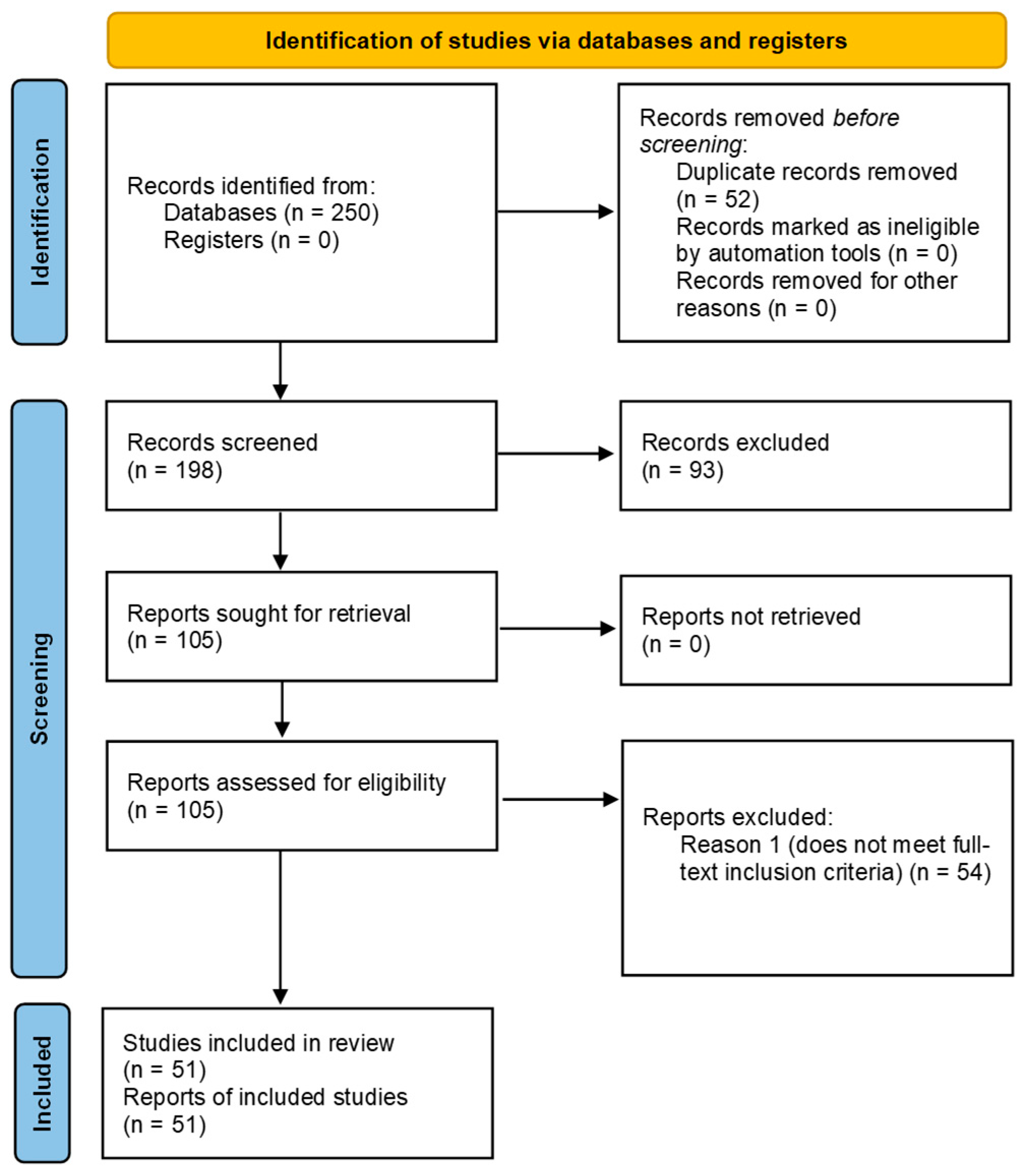
- A comprehensive literature search and screening process was performed in line with scoping review guidance, aiming to map the breadth of evidence, identify conceptual gaps, and support framework development, without conducting a primary empirical assessment or a brief summary of the magnitude of the result.
- Based on this evaluation, a critical analysis was generated by referencing some examples of how various international cities (Paris, Barcelona, Melbourne, Stockholm) employed the principles of Social Cohesion and the 15 MC model. In this study, the cities cited as examples are utilized not as primary empirical case studies with new data or field research. Instead, they are included as illustrative case evidence in the scoping synthesis, with the aim of linking the mechanisms emerging from literature (e.g., proximity premium, market reaction time, displacement risks) with recognizable policies and interventions in specific cities. Therefore, references to cities serve exclusively as interpretative/exemplary “policy anchors” to illustrate the mechanisms arising from the synthesis of evidence, rather than as a source of primary data or a basis for new empirical assessment in this article.
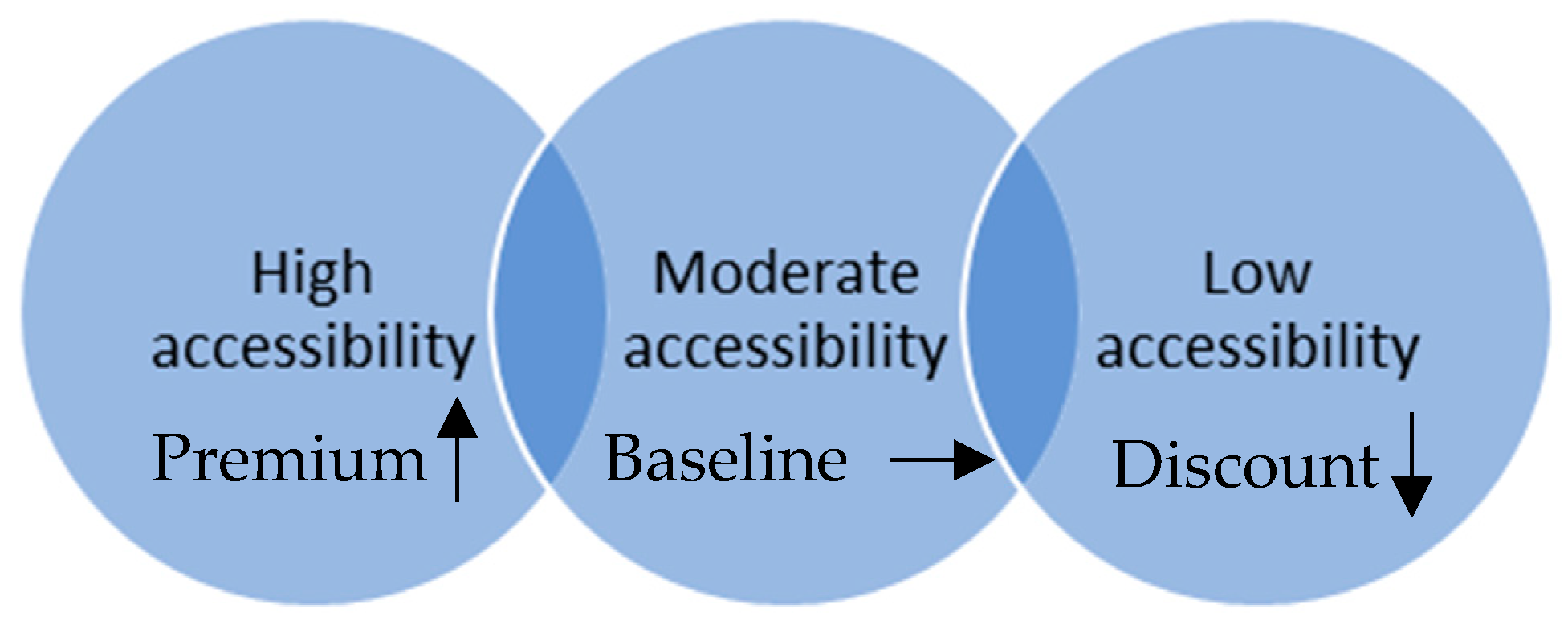
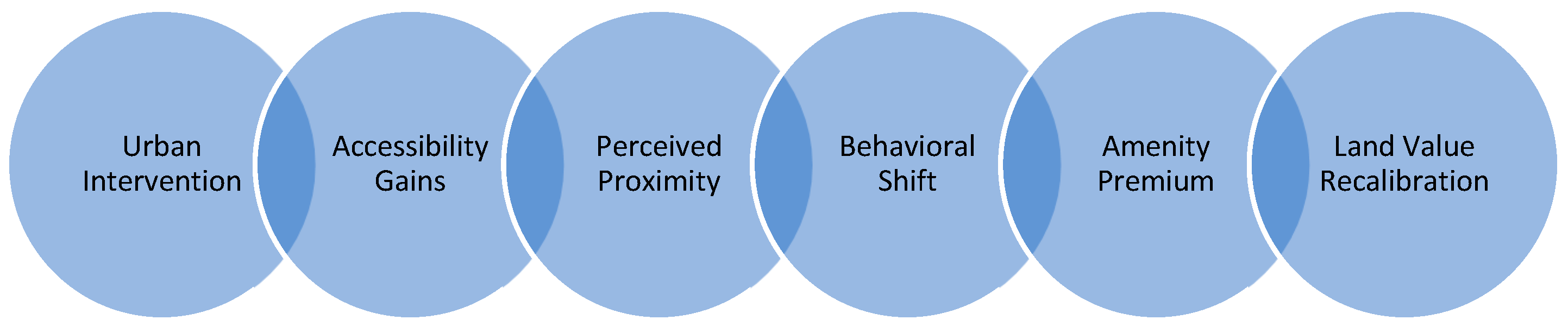
- the mechanism of formation of the phenomenon of “proximity premium”,
- socio-economic factors and how these shape the reinforcement of population displacement phenomena,
- the institutional structures and governance policies.
- 3.
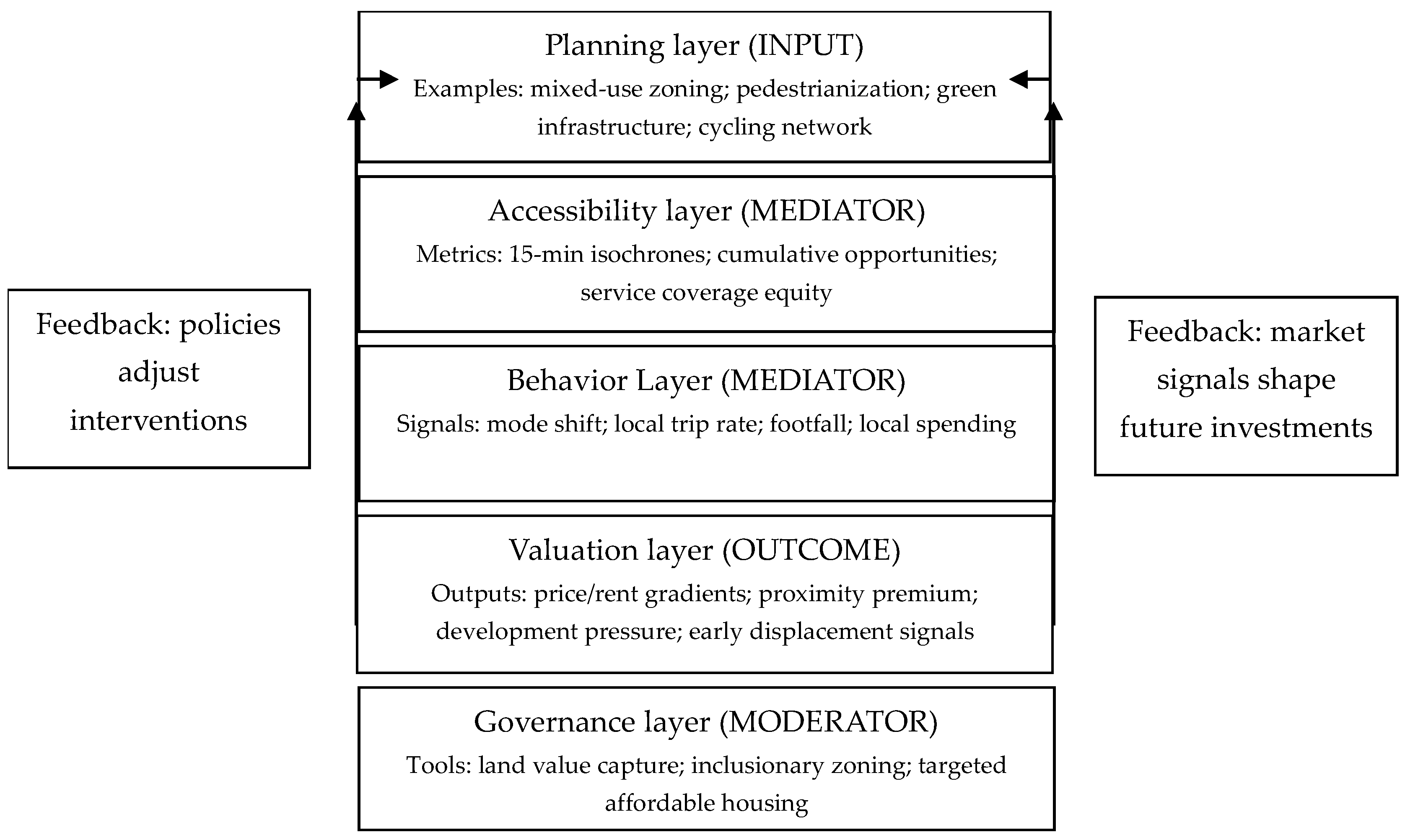
- Planning, accessibility, behavior, valuation, and governance are the key elements that constitute a five-part spatial economic framework. As this framework is interdependent, the feedback loop of spatial interventions plays a reciprocal role, contributing to social issues and real estate market dynamics.
- Addressing the Asymmetry: Other measures, such as the walkability index or access to green spaces, are valid metrics but do not provide a holistic view of the situation. But today’s systems for assessing health do little to determine large-scale qualitative categories of individuals’ perceptions of safety, emotional connections to places, or social trust in space. The model recommends using poetic and storytelling approaches (e.g., community mapping through interviews) to measure these dimensions.
- Time Level: Evaluating what the immediate financial effects are on property values and the longer-term social and environmental consequences, community resilience, and social marginalization. The framework enables this multi-temporal reading.
- Power and Equity Factor: The question of who ultimately gets to benefit from improved accessibility, as seen by the framework proposed here, is one that this methodological framework addresses. It seeks to analyze the distribution patterns of distance benefits across different socio-economic groups and to formulate methods to achieve an equitable distribution [26].
2.2. Equity and Governance Dimensions
- Territorial governance models: The planning system should use territorial governance models that base their organization on actual geographic areas (15 MC zones) instead of administrative limits.
- Inter-agency task forces: The integration of transport and housing functions with climate and social planning happens through inter-agency task forces, which handle shared responsibilities.
- The community can participate in budgeting decisions through participatory budgeting and co-creation platforms, which enable them to shape 15 MC priorities and resource allocation.
- Digital governance tools: Using mobility and land use data to monitor proximity outcomes and spatial inequalities in real time.
3. Findings (Literature Synthesis)
3.1. Key Trends Identified
3.2. Proximity and Real Estate Values
3.3. Green Spaces and Proximity
3.4. Mixed-Use and Urban Morphology
3.5. Planning Frameworks in the Global Scene
4. Discussion
4.1. Spatial–Economic Impacts
4.2. Accessibility as a Value Driver
4.3. Real Estate Markets’ Sensitivity
4.4. Feedback Loops Between Planning and Capital
4.5. Risks of Spatial Inequity and Displacement
4.6. Planning for Proximity, Creating Scarcity
4.7. Socio-Spatial Sorting and Uneven Access
5. Toward a Spatial–Economic Framework for the 15-Min City
- Proximity to services and amenities, within a 15-min walk or cycle
- Diversity of land uses and urban functions within neighborhoods
- Density and compactness to support transit, social infrastructure, and public life.
- The Planning Layer (Spatial Intervention).
- The Accessibility layer (Functional Proximity).
- Behavioral layer (Mobility and Lifestyle changes).
- The Valuation layer (How the Real Estate Market reacts).
- Regulation and Redistribution is the governance layer.
6. Conclusions, Limitations, and Future Research
- Cross-sectoral planning integration requires the unification of work between mobility and housing departments, health and education sectors, and environmental protection agencies.
- Land value captures and redistribution, meaning recovering part of the value uplift generated by public interventions to fund affordable housing and infrastructure.
- Inclusionary zoning and social housing mandates, as the law demands that proximity-enriched developments under inclusionary zoning and social housing obligations remain accessible to people from different income levels.
- Spatial equity audits and participatory tools through measuring access inequalities and community participation in priority settings.
- Regional and metropolitan governance systems to prevent fragmented implementation and spatial inequalities between administrative areas.
Author Contributions
Funding
Institutional Review Board Statement
Informed Consent Statement
Data Availability Statement
Conflicts of Interest
References
- Munn, Z.; Peters, M.D.J.; Stern, C.; Tufanaru, C.; McArthur, A.; Aromataris, E. Systematic review or scoping review? Guidance for authors when choosing between a systematic or scoping review approach. BMC Med. Res. Methodol. 2018, 18, 143. [Google Scholar] [CrossRef]
- Allam, Z.; Reza, K.-G.A.; Lassaube, U.; Chabaud, D.; Moreno, C. Mapping the Implementation Practices of the 15-Minute City. Smart Cities 2024, 7, 2094–2109. [Google Scholar] [CrossRef]
- Elldér, E. Built environment and the evolution of the ‘15-minute city’: A 25-year longitudinal study of 200 Swedish cities. Cities 2024, 149, 104942. [Google Scholar] [CrossRef]
- Khavarian-Garmsir, A.R.; Sharifi, A.; Sadeghi, A. The 15-minute city: Urban planning and design efforts toward creating sustainable neighborhoods. Cities 2023, 132, 104101. [Google Scholar] [CrossRef]
- Moreno, C.; Allam, Z.; Chabaud, D.; Gall, C.; Pratlong, F. Introducing the ‘15-Minute City’: Sustainability, Resilience and Place Identity in Future Post-Pandemic Cities. Smart Cities 2021, 4, 93–111. [Google Scholar] [CrossRef]
- Moreno, C.; Chabaud, D.; Gall, C. The 15-Minute City Model: An Integrated Urban Approach and a Game Changing Lifestyle Narrative. In From the City as a Project to the City Project; Urban Book Series; Springer: Cham, Switzerland, 2025; pp. 681–707. [Google Scholar] [CrossRef]
- Allam, Z.; Bibri, S.E.; Jones, D.S.; Chabaud, D.; Moreno, C. Unpacking the ‘15-Minute City’ via 6G, IoT, and Digital Twins: Towards a New Narrative for Increasing Urban Efficiency, Resilience, and Sustainability. Sensors 2022, 22, 1369. [Google Scholar] [CrossRef]
- Grant, J.L. Complete Community: Planning Theory From Practice. J. Am. Plan. Assoc. 2024, 90, 213–229. [Google Scholar] [CrossRef]
- Aboulnaga, M.; Ashour, F.; Elsharkawy, M.; Lucchi, E.; Gamal, S.; Elmarakby, A.; Haggagy, S.; Karar, N.; Khashaba, N.H.; Abouaiana, A. Urbanization and Drivers for Dual Capital City: Assessment of Urban Planning Principles and Indicators for a ‘15-Minute City’. Land 2025, 14, 382. [Google Scholar] [CrossRef]
- Ben, S.; Zhu, H.; Lu, J.; Wang, R. Valuing the Accessibility of Green Spaces in the Housing Market: A Spatial Hedonic Analysis in Shanghai, China. Land 2023, 12, 1660. [Google Scholar] [CrossRef]
- Ferrer-Ortiz, C.; Marquet, O.; Mojica, L.; Vich, G. Barcelona under the 15-Minute City Lens: Mapping the Accessibility and Proximity Potential Based on Pedestrian Travel Times. Smart Cities 2022, 5, 146–161. [Google Scholar] [CrossRef]
- Koster, H.R.A.; Rouwendal, J. The Impact of Mixed Land Use on Residential Property Values. J. Reg. Sci. 2012, 52, 733–761. [Google Scholar] [CrossRef]
- Pivo, G.; Fisher, J.D. The Walkability Premium in Commercial Real Estate Investments. Real Estate Econ. 2011, 39, 185–219. [Google Scholar] [CrossRef]
- Wu, J.; Wang, M.; Li, W.; Peng, J.; Huang, L. Impact of Urban Green Space on Residential Housing Prices: Case Study in Shenzhen. J. Urban Plan. Dev. 2015, 141, 05014023. [Google Scholar] [CrossRef]
- Zhang, B.; Xie, G.; Xia, B.; Zhang, C. The Effects of Public Green Spaces on Residential Property Value in Beijing. J. Resour. Ecol. 2025, 3, 243–252. [Google Scholar] [CrossRef]
- Glaeser, E.; Gyourko, J. The Economic Implications of Housing Supply. J. Econ. Perspect. 2018, 32, 3–30. [Google Scholar] [CrossRef]
- Biraghi, C.A.; Ogut, O.; Dong, T.; Tadi, M. CityTime: A Novel Model to Redefine the 15-Minute City Globally Through Urban Diversity and Proximity. Urban Sci. 2025, 9, 36. [Google Scholar] [CrossRef]
- Elldér, E. Exploring socio-economic inequalities in access to the 15-minute city across 200 Swedish built-up areas. J. Transp. Geogr. 2025, 122, 104060. [Google Scholar] [CrossRef]
- Iqbal, A.; Nazir, H.; Qazi, A.W. Exploring the 15-Minutes City Concept: Global Challenges and Opportunities in Diverse Urban Contexts. Urban Sci. 2025, 9, 252. [Google Scholar] [CrossRef]
- Piaggio, M. The value of public urban green spaces: Measuring the effects of proximity to and size of urban green spaces on housing market values in San José, Costa Rica. Land Use Policy 2021, 109, 105656. [Google Scholar] [CrossRef]
- Wolch, J.R.; Byrne, J.; Newell, J.P. Urban green space, public health, and environmental justice: The challenge of making cities ‘just green enough’. Landsc. Urban Plan. 2014, 125, 234–244. [Google Scholar] [CrossRef]
- Ivey, R.; Bereitschaft, B. The Impact of Walkability on the Sales Price of Commercial Properties When Controlling for the Effects of Economic Recession: A Case Study of Omaha, Nebraska. J. Real Estate Lit. 2021, 29, 43–59. [Google Scholar] [CrossRef]
- Arksey, H.; O’Malley, L. Scoping studies: Towards a methodological framework. Int. J. Soc. Res. Methodol. 2005, 8, 19–32. [Google Scholar] [CrossRef]
- Levac, D.; Colquhoun, H.; O’Brien, K.K. Scoping studies: Advancing the methodology. Implement. Sci. 2010, 5, 69. [Google Scholar] [CrossRef]
- Peters, M.D.; Marnie, C.; Tricco, A.C.; Pollock, D.; Munn, Z.; Alexander, L.; McInerney, P.; Godfrey, C.M.; Khalil, H. Updated methodological guidance for the conduct of scoping reviews. JBI Evid. Synth. 2020, 18, 2119. [Google Scholar] [CrossRef]
- Pellicelli, G.; Marinelli, L.; Caselli, B.; Zazzi, M.; Rossetti, S. Operative methodology for the assessment of pedestrian accessibility to facilities for the 15-minute city neighbourhood-scale planning scenarios. Sustain. Cities Soc. 2025, 134, 106953. [Google Scholar] [CrossRef]
- Xue, C.; Ju, Y.; Li, S.; Zhou, Q. Research on the sustainable development of urban housing price based on transport accessibility: A case study of Xi’an, China. Sustainability 2020, 12, 1497. [Google Scholar] [CrossRef]
- Allam, Z.; Bibri, S.E.; Chabaud, D.; Moreno, C. The Theoretical, Practical, and Technological Foundations of the 15-Minute City Model: Proximity and Its Environmental, Social and Economic Benefits for Sustainability. Energies 2022, 15, 6042. [Google Scholar] [CrossRef]
- Chen, L.; Liu, X.; Sun, T.; Ma, N.; Zhang, T. Compact urban morphology and the 15-minute city: Evidence from China. Transp. Res. Part A Policy Pract. 2025, 196, 104482. [Google Scholar] [CrossRef]
- Abbiasov, T.; Heine, C.; Sabouri, S.; Salazar-Miranda, A.; Santi, P.; Glaeser, E.; Ratti, C. The 15-minute city quantified using human mobility data. Nat. Hum. Behav. 2024, 8, 445–455. [Google Scholar] [CrossRef]
- Willberg, E.; Fink, C.; Toivonen, T. The 15-minute city for all?—Measuring individual and temporal variations in walking accessibility. J. Transp. Geogr. 2023, 106, 103521. [Google Scholar] [CrossRef]
- Jiang, F.; Ma, J. Environmental Justice in the 15-Minute City: Assessing Air Pollution Exposure Inequalities Through Machine Learning and Spatial Network Analysis. Smart Cities 2025, 8, 53. [Google Scholar] [CrossRef]
- Deng, Z.; Lee, J.; Gim, T.-H.T. 15-minute city for all? Rethinking the 15-minute city for urban older populations. Appl. Geogr. 2025, 184, 103747. [Google Scholar] [CrossRef]
- Liu, M.; Xu, Y.; Chen, Y.; Yan, W. Evaluating child-friendliness in the 15-minute community living circle: An example from Shanghai’s Dongyuan I Village. J. Urban Aff. 2025, 1–34. [Google Scholar] [CrossRef]
- Bruno, M.; Melo, H.; Campanelli, B.; Loreto, V. A universal framework for inclusive 15-minute cities. Nat. Cities 2024, 1, 633–641. [Google Scholar] [CrossRef]
- Lu, M.; Diab, E. Developing a 15-minute city policy? Understanding differences between policies and physical barriers. Transp. Res. Part A Policy Pract. 2025, 191, 104307. [Google Scholar] [CrossRef]
- Balletto, G.; Pezzagno, M.; Richiedei, R. 15-Minute City in Urban Regeneration Perspective: Two Methodological Approaches Compared to Support Decisions. In Computational Science and Its Applications—ICCSA 2021; Presented at the Lecture Notes in Computer Science; Springer: Cham, Switzerland, 2021; pp. 535–548. [Google Scholar] [CrossRef]
- Marchigiani, E.; Bonfantini, B. Urban Transition and the Return of Neighbourhood Planning. Questioning the Proximity Syndrome and the 15-Minute City. Sustainability 2022, 14, 5468. [Google Scholar] [CrossRef]
- Rojas-Rueda, D.; Norberciak, M.; Morales-Zamora, E. Advancing Health Equity through 15-min Cities and Chrono-urbanism. J. Urban Health 2024, 101, 483–496. [Google Scholar] [CrossRef]
- Bosch Checa, C.; Coll Aliaga, E.; Correcher Rigau, M.; de la Torre Fornés, P.; Guardiola Ibañez, N.; Jiménez Garcia, C.; Lerma Arce, V.; Saez, E.L.; Sancha Llamosí, R.; Stamos, I.; et al. Extended Progress Report on the Valencia CityLab During 2023; Publications Office of the European Union: Luxembourg, 2024. [Google Scholar] [CrossRef]
- Fuhrmann, M. 15-minute city—From concept to practical dimension. Complexity of housing estates: A proposal for a measuring tool. Pr. I Stud. Geogr. 2024, 69, 61–72. [Google Scholar] [CrossRef]
- Wang, H.; Tsoi, K.H.; Loo, B.P.Y. An assessment framework for 15-minute Cities: Progress worldwide and the impact of urban form. Transp. Res. Part A Policy Pract. 2025, 199, 104583. [Google Scholar] [CrossRef]
- Allam, Z.; Bibri, S.E.; Chabaud, D.; Moreno, C. The ‘15-Minute City’ concept can shape a net-zero urban future. Humanit. Soc. Sci. Commun. 2022, 9, 126. [Google Scholar] [CrossRef]
- Pérez Molina, E.; Vargas Aguilar, D. Uncertainly in land value modeling of the San José Metropolitan Region, Costa Rica. Ingeniería 2024, 34, 43–50. [Google Scholar] [CrossRef]
- Guzman, L.A.; Oviedo, D.; Cantillo-Garcia, V.A. Is proximity enough? A critical analysis of a 15-minute city considering individual perceptions. Cities 2024, 148, 104882. [Google Scholar] [CrossRef]
- Yin, L.; Zhang, H.; Patterson, K.; Silverman, R.; Wu, L. Walkability, Safety, and Housing Values in Shrinking Cities: Spatial Hedonic Study in Buffalo, Pittsburgh, and Detroit. J. Urban Plan. Dev. Div. ASCE 2020, 146, 04020029. [Google Scholar] [CrossRef]
- Litman, T.A. Economic Value of Walkability. Transp. Res. Rec. 2003, 1828, 3–11. [Google Scholar] [CrossRef]
- Moreno, C. Definition of the 15-Minute City: WHAT IS THE 15-MINUTE CITY? Presented at the OBEL AWARD Jury. October 2021. Available online: https://www.researchgate.net/publication/362839186_Definition_of_the_15-minute_city_WHAT_IS_THE_15-MINUTE_CITY (accessed on 5 October 2025).
- Alonso, W. Location and land use: Toward a general theory of land rent. In Publications of the Joint Center for Urban Studies of the Massachusetts Institute of Technology and Harvard University; Harvard University Press: Cambridge, MA, USA, 1964. [Google Scholar]
- Muth, R.F. Cities and Housing: The Spatial Pattern of Urban Residential Land Use. J. Econ. Lit. 1969, 8, 493–495. [Google Scholar]
- Glaeser, E.L.; Kolko, J.; Saiz, A. Consumer city. J. Econ. Geogr. 2001, 1, 27–50. [Google Scholar] [CrossRef]
- Boyle, A.; Barrilleaux, C.; Scheller, D. Does Walkability Influence Housing Prices? Soc. Sci. Q. 2014, 95, 852–867. [Google Scholar] [CrossRef]
- Liusman, E.; Ho, D.C.W.; Lo, H.C.; Lo, D.Y.F. Office rents, mixed-use developments, and agglomeration economies: A panel data analysis. J. Prop. Investig. Financ. 2017, 35, 455–471. [Google Scholar] [CrossRef]
- Kim, E.J.; Kim, H. Neighborhood Walkability and Housing Prices: A Correlation Study. Sustainability 2020, 12, 593. [Google Scholar] [CrossRef]
- Yates, S.; Miller, N.G. Residential Land Values and Walkability. J. Sustain. Real Estate 2011, 3, 23–43. [Google Scholar] [CrossRef]
- Chernobai, E.; Ma, Z. The Effect of Walkability on House Prices. J. Hous. Res. 2022, 31, 53–73. [Google Scholar] [CrossRef]
- Graells-Garrido, E.; Serra-Burriel, F.; Rowe, F.; Cucchietti, F.M.; Reyes, P. A city of cities: Measuring how 15-minutes urban accessibility shapes human mobility in Barcelona. PLoS ONE 2021, 16, e0250080. [Google Scholar] [CrossRef]
- Abidola, A.Q.; Akingbemisola, S.P.; Balogun, O.B.; Adebayo, A.; Raji, M.O. Impact of Road Network on Residential Property Values in Ojo Local Government Area, Lagos, Nigeria. Asian J. Geogr. Res. 2025, 8, 142–152. [Google Scholar] [CrossRef]
- Chen, K.; Lin, H.; You, S.; Han, Y. Review of the impact of urban parks and green spaces on residence prices in the environmental health context. Front. Public Health 2022, 10, 993801. [Google Scholar] [CrossRef]
- McCord, J.; McCord, M.; McCluskey, W.; Davis, P.T.; McIlhatton, D.; Haran, M. Effect of public green space on residential property values in Belfast metropolitan area. J. Financ. Manag. Prop. Constr. 2014, 19, 117–137. [Google Scholar] [CrossRef]
- Zhang, J.; Tan, P.Y.; Zeng, H.; Zhang, Y. Walkability Assessment in a Rapidly Urbanizing City and Its Relationship with Residential Estate Value. Sustainability 2019, 11, 2205. [Google Scholar] [CrossRef]
- Mouratidis, K. The 15-minute city revisited: A GIS approach to measuring, visualizing, and analyzing accessibility by proximity and by public transport supply. Travel Behav. Soc. 2026, 42, 101151. [Google Scholar] [CrossRef]
- Balletto, G.; Ladu, M.; Milesi, A.; Borruso, G. A Methodological Approach on Disused Public Properties in the 15-Minute City Perspective. Sustainability 2021, 13, 593. [Google Scholar] [CrossRef]
- Kabisch, N.; Egerer, M. Resetting the clock by integrating urban nature and its biodiversity into the 15-minute city concept. Nat. Commun. 2025, 16, 9281. [Google Scholar] [CrossRef] [PubMed]
- Xu, Y.; Chen, R.; Du, H.; Chen, M.; Fu, C.; Li, Y. Evaluation of green space influence on housing prices using machine learning and urban visual intelligence. Cities 2025, 158, 105661. [Google Scholar] [CrossRef]
- Saeed, A.A.; Mullahwaish, L.T. Effect of Green Areas Density on Real Estate Price in Ramadi City. Int. J. Des. Nat. Ecodyn. 2020, 15, 253–259. [Google Scholar] [CrossRef]
- Lee, J.-W.; Lee, S.-W.; Kim, H.G.; Jo, H.-K.; Park, S.-R. Green Space and Apartment Prices: Exploring the Effects of the Green Space Ratio and Visual Greenery. Land 2023, 12, 2069. [Google Scholar] [CrossRef]
- Trojanek, R.; Głuszak, M.; Tanaś, J. The effect of urban green spaces on house prices in Warsaw. Int. J. Strateg. Prop. Manag. 2018, 22, 358–371. [Google Scholar] [CrossRef]
- Liu, D.; Huang, J.; Fang, D.; Lee, J.; Liu, Y.; Wang, S.; Kan, Z. Assessment of the 15-minute park accessibility accounting for fine-grained 3D pedestrian network and subjective quality perception among the public housing residents. Urban For. Urban Green. 2025, 114, 129165. [Google Scholar] [CrossRef]
- Treija, S.; Zaleckis, K.; Bratuškins, U.; Bondars, E.; Koroļova, A. Searching for 15-Minute City in Large-Scale Housing Estates: Service Proximity and Diversity in the Context of Population Density. Landsc. Archit. Art 2025, 27, 9–17. [Google Scholar] [CrossRef]
- Song, Y.; Knaap, G.-J. Measuring the effects of mixed land uses on housing values. Reg. Sci. Urban Econ. 2004, 34, 663–680. [Google Scholar] [CrossRef]
- Knox, P.; McCarthy, L. Urbanization: An Introduction to Urban Geography; Pearson: Boston, UK, 2012. [Google Scholar]
- Chen, Y.; Yang, X.; Li, X.; Yang, L.; Cheng, S.; Tang, G.; Biljecki, F. Vertical 15-minute city: Modeling urban density and functional mix with multi-source geospatial data. Cities 2026, 169, 106516. [Google Scholar] [CrossRef]
- Huang, H.; Li, J. The spatial variation of moderating effects of density and natural amenities on housing prices in Wuhan, China. Reg. Sci. Policy Pract. 2021, 13, 1778–1804. [Google Scholar] [CrossRef]
- Murgante, B.; Patimisco, L.; Annunziata, A. Developing a 15-minute city: A comparative study of four Italian Cities-Cagliari, Perugia, Pisa, and Trieste. Cities 2024, 146, 104765. [Google Scholar] [CrossRef]
- Pinto, F.; Akhavan, M. Scenarios for a Post-Pandemic City: Urban planning strategies and challenges of making ‘Milan 15-minutes city’. Transp. Res. Procedia 2022, 60, 370–377. [Google Scholar] [CrossRef]
- Murgante, B.; Annunziata, A. Application of the 15-Minute City Criteria to a Metropolitan Area: A Case Study of the Metropolitan City of Cagliari, Italy. Int. J. E-Plan. Res. 2025, 14, 40. [Google Scholar] [CrossRef]
- Gordon, P.; Richardson, H.W. Are Compact Cities a Desirable Planning Goal? J. Am. Plan. Assoc. 1997, 63, 95–106. [Google Scholar] [CrossRef]
- Guzman, L.A.; Arellana, J.; Oviedo, D.; Moncada, C.A. COVID-19, activity and mobility patterns in Bogotá. Are we ready for a ‘15-minute city’? Travel Behav. Soc. 2021, 24, 245–256. [Google Scholar] [CrossRef]
- Tian, P.; Xiao, W.; Yuan, F. Assessing the Combinational Effects of Access to Urban Amenities on Housing Prices: A Perspective on the ‘15-Minute City’. Appl. Spat. Anal. 2025, 18, 29. [Google Scholar] [CrossRef]
- Murgante, B.; Valluzzi, R.; Annunziata, A. Developing a 15-minute city: Evaluating urban quality using configurational analysis. The case study of Terni and Matera, Italy. Appl. Geogr. 2024, 162, 103171. [Google Scholar] [CrossRef]
- Khavarian-Garmsir, A.R.; Sharifi, A.; Abadi, M.H.H.; Moradi, Z. From Garden City to 15-Minute City: A Historical Perspective and Critical Assessment. Land 2023, 12, 512. [Google Scholar] [CrossRef]
- Correa-Parra, J.; Vergara-Perucich, F.; Aguirre-Nuñez, C.; Ulloa-León, F.I. The 15-minute city and real estate capital: Contributions from Chile’s major cities. Town Plan. Rev. 2025, 96, 671–696. [Google Scholar] [CrossRef]
- Hughes, S.; Hoffmann, M. Just urban transitions: Toward a research agenda. WIREs Clim. Change 2020, 11, e640. [Google Scholar] [CrossRef]
- Abdelfattah, L.; Deponte, D.; Fossa, G. The 15-minute city: Interpreting the model to bring out urban resiliencies. Transp. Res. Procedia 2022, 60, 330–337. [Google Scholar] [CrossRef]
- Allam, Z.; Moreno, C.; Chabaud, D.; Pratlong, F. Proximity-Based Planning and the ‘15-Minute City’: A Sustainable Model for the City of the Future. In The Palgrave Handbook of Global Sustainability; Palgrave Macmillan: Cham, Switzerland, 2022; pp. 1–20. [Google Scholar] [CrossRef]
- D’Acci, L. Quality of urban area, distance from city centre, and housing value. Case study on real estate values in Turin. Cities 2019, 91, 71–92. [Google Scholar] [CrossRef]
- Luo, J.; Zhai, S.; Song, G.; He, X.; Song, H.; Chen, J.; Liu, H.; Feng, Y. Assessing Inequity in Green Space Exposure toward a ‘15-Minute City’ in Zhengzhou, China: Using Deep Learning and Urban Big Data. Int. J. Environ. Res. Public Health 2022, 19, 5798. [Google Scholar] [CrossRef]
- Elldér, E. The 15-minute city dilemma? Balancing local accessibility and gentrification in Gothenburg, Sweden. Transp. Res. Part D Transp. Environ. 2024, 135, 104360. [Google Scholar] [CrossRef]
- Li, S.; Cao, X.; Liu, L.; Li, A. Inequality of divided and shared socio-economic resources in 15-minute cities of China. Geogr. Sustain. 2025, 6, 100337. [Google Scholar] [CrossRef]
- Vale, D.; Lopes, A.S. Accessibility inequality across Europe: A comparison of 15-minute pedestrian accessibility in cities with 100,000 or more inhabitants. NPJ Urban Sustain. 2023, 3, 55. [Google Scholar] [CrossRef]
- Israel, F.; Otero, G.; Soza-Parra, J.; Broitman, D. 15-minute city, proximity, and urban segregation in Latin-American cities: The case of Santiago de Chile. Transp. Res. Part A Policy Pract. 2026, 204, 104789. [Google Scholar] [CrossRef]
- Fan, Y.; Wang, Y.; Yu, Y.; Liang, J. Shenzhen’s 15-minute city initiative: A model for high-quality urban development. Transp. Res. Part A Policy Pract. 2025, 199, 104547. [Google Scholar] [CrossRef]
- Yue, L.; Xu, F.; Zhao, H.; Yue, M. Multi-Dimensional Inequalities and Determinants of Neighborhood Facility Accessibility Under the 15-Minute City Framework. Appl. Spat. Anal. Policy 2026, 19, 11. [Google Scholar] [CrossRef]
- Liu, D.; Wang, J.; Song, J.; Kwan, M.P.; Fang, D.; Ariga, T.; Chen, Y.; Stinckwich, S. Exploring the inequality in fine-grained primary healthcare accessibility in Macau based on high-resolution geospatial data under the 15-minute city framework. Appl. Geogr. 2025, 174, 103473. [Google Scholar] [CrossRef]
- Hamidi, S.; Bonakdar, A.; Keshavarzi, G.; Ewing, R. Do Urban Design qualities add to property values? An empirical analysis of the relationship between Urban Design qualities and property values. Cities 2020, 98, 102564. [Google Scholar] [CrossRef]
- Leskinen, N.; Vimpari, J.; Junnila, S.; Leskinen, N.; Vimpari, J.; Junnila, S. A Review of the Impact of Green Building Certification on the Cash Flows and Values of Commercial Properties. Sustainability 2020, 12, 2729. [Google Scholar] [CrossRef]
- Duranton, G.; Puga, D. Urban Growth and Its Aggregate Implications. Econometrica 2023, 91, 2219–2259. [Google Scholar] [CrossRef]
- Lima, F.T.; Brown, N.C.; Duarte, J.P. A Grammar-Based Optimization Approach for Designing Urban Fabrics and Locating Amenities for 15-Minute Cities. Buildings 2022, 12, 1157. [Google Scholar] [CrossRef]
- Rahman, F.; Oliver, R.; Buehler, R.; Lee, J.; Crawford, T.; Kim, J. Impacts of point of interest (POI) data selection on 15-Minute City (15-MC) accessibility scores and inequality assessments. Transp. Res. Part A Policy Pract. 2025, 195, 104429. [Google Scholar] [CrossRef]
- Salazar, J.E.A.; Rincón, S.W.; Garcia, D.A.E. Diverse Opportunity Potential through Geographic Accessibility Modeling as a Basis for Planning towards the 15-Minute City and Spatial Justice. Future Cities Environ. 2025, 11, fce-2025-033. [Google Scholar] [CrossRef]



| City | Proximity Interventions | Typical Indicators | Market Effect | Danger |
|---|---|---|---|---|
| Paris (15-min city proximity policies) | Pedestrianizations/active mobility infrastructure | Access to services, quality of public space | Upgrading the attractiveness of highly accessible areas | Gentrification/price pressures |
| Barcelona (Superblocks) | Reduction in the use of private car/“green islands”/improved walkability | Changes in accessibility/public space, environmental quality | Proximity premium/speculation | Displacement/touristification |
| Melbourne (20-min neighbourhood) | Local services/active mobility pilots | Service coverage, safety/comfort, car dependence | Mild/heterogeneous effects | Uneven spatial benefits |
| Sweden urban areas (longitudinal 15-min city logic) | Density/mixed uses/accessibility | Temporal accessibility indicators | Rise in values/income restructuring | Socio-spatial sorting |
| Mechanism | Indicative Range of Market Effect | Observation |
|---|---|---|
| Proximity to green space | ~2.8–3.1% (at short distances) | The effect diminishes with distance |
| Distance from green space index | ~5% (in specific studies/indices) | Depends on type or quality of green space |
| Connectivity/physical infrastructure | ~15–25% (in some contexts) | Strong dependence on urban context |
| Land use diversity | ~1.1–3.4% | Subject to compatibility |
| Strategic Policy Instruments | Layer |
|---|---|
| Zoning reform, urban design guidelines, streetscape investments | Planning |
| Transit prioritization, pedestrianization, and active mobility subsides | Accessibility |
| Behavioral nudges, incentives for local commerce, and telework policies | Behavior |
| Property tax adjustments, rent regulation, and market monitoring | Valuation |
| Inclusionary zoning, rent regulation, and market monitoring | Governance |
| Layer | Indicators & Typical Data | Analytical Approaches | Policy Instruments |
|---|---|---|---|
| Planning (spatial intervention) | Zoning and land-use rules; facility sitting; street/cycle-network upgrades; green corridors. Data: plans, zoning, network, POIs [100], project logs. | Policy coding; GIS network analysis; before-after mapping. | Complete streets; superblocks; mixed-use zoning; public facility sitting; green infrastructure programs. |
| Accessibility (functional proximity) | 15-min accessibility score; cumulative opportunities; travel time to essential services; equity of coverage. Data: network, GTFS, service locations, population grid. | Isochrones; accessibility indices; spatial inequality metrics. | Service standards; targeted investments; transit and micro-mobility regulation. |
| Behavior (mobility & use) | Mode share; local trip rate; footfall; park visitation; perceived safety/comfort. Data: surveys, counts, mobile phone data, business registry. | Interrupted time series; panel models; activity-based/agent-based models; mixed methods. | Public space programming; safety measures; participatory design; support for local commerce. |
| Valuation (market response) | Price/rent gradients; price per m2; cap rates; development permits; early displacement signals. Data: transactions, rents/listings, permits, parcels. | Hedonic models; spatial econometrics; DiD; event studies; repeat-sales. | Vacancy/anti-speculation taxes; development controls; uplift-triggered affordability requirements. |
| Governance (redistribution) | Share of uplift captured; affordable unit delivery; rent burden; evictions/displacement; equity KPIs. Data: assessments, budgets, housing registry, eviction data. | Value capture accounting; distributional impact assessment; equity audits [101]; scenarios. | Land value capture; inclusionary zoning; social housing mandates; rent stabilization; community benefit agreements. |
Disclaimer/Publisher’s Note: The statements, opinions and data contained in all publications are solely those of the individual author(s) and contributor(s) and not of MDPI and/or the editor(s). MDPI and/or the editor(s) disclaim responsibility for any injury to people or property resulting from any ideas, methods, instructions or products referred to in the content. |
© 2026 by the authors. Licensee MDPI, Basel, Switzerland. This article is an open access article distributed under the terms and conditions of the Creative Commons Attribution (CC BY) license.
Share and Cite
Karanikolas, N.; Kyriakidou, E. Real Estate Trends and 15-Min Cities: A Scoping Review and Spatial–Economic Framework. Urban Sci. 2026, 10, 108. https://doi.org/10.3390/urbansci10020108
Karanikolas N, Kyriakidou E. Real Estate Trends and 15-Min Cities: A Scoping Review and Spatial–Economic Framework. Urban Science. 2026; 10(2):108. https://doi.org/10.3390/urbansci10020108
Chicago/Turabian StyleKaranikolas, Nikolaos, and Eleni Kyriakidou. 2026. "Real Estate Trends and 15-Min Cities: A Scoping Review and Spatial–Economic Framework" Urban Science 10, no. 2: 108. https://doi.org/10.3390/urbansci10020108
APA StyleKaranikolas, N., & Kyriakidou, E. (2026). Real Estate Trends and 15-Min Cities: A Scoping Review and Spatial–Economic Framework. Urban Science, 10(2), 108. https://doi.org/10.3390/urbansci10020108