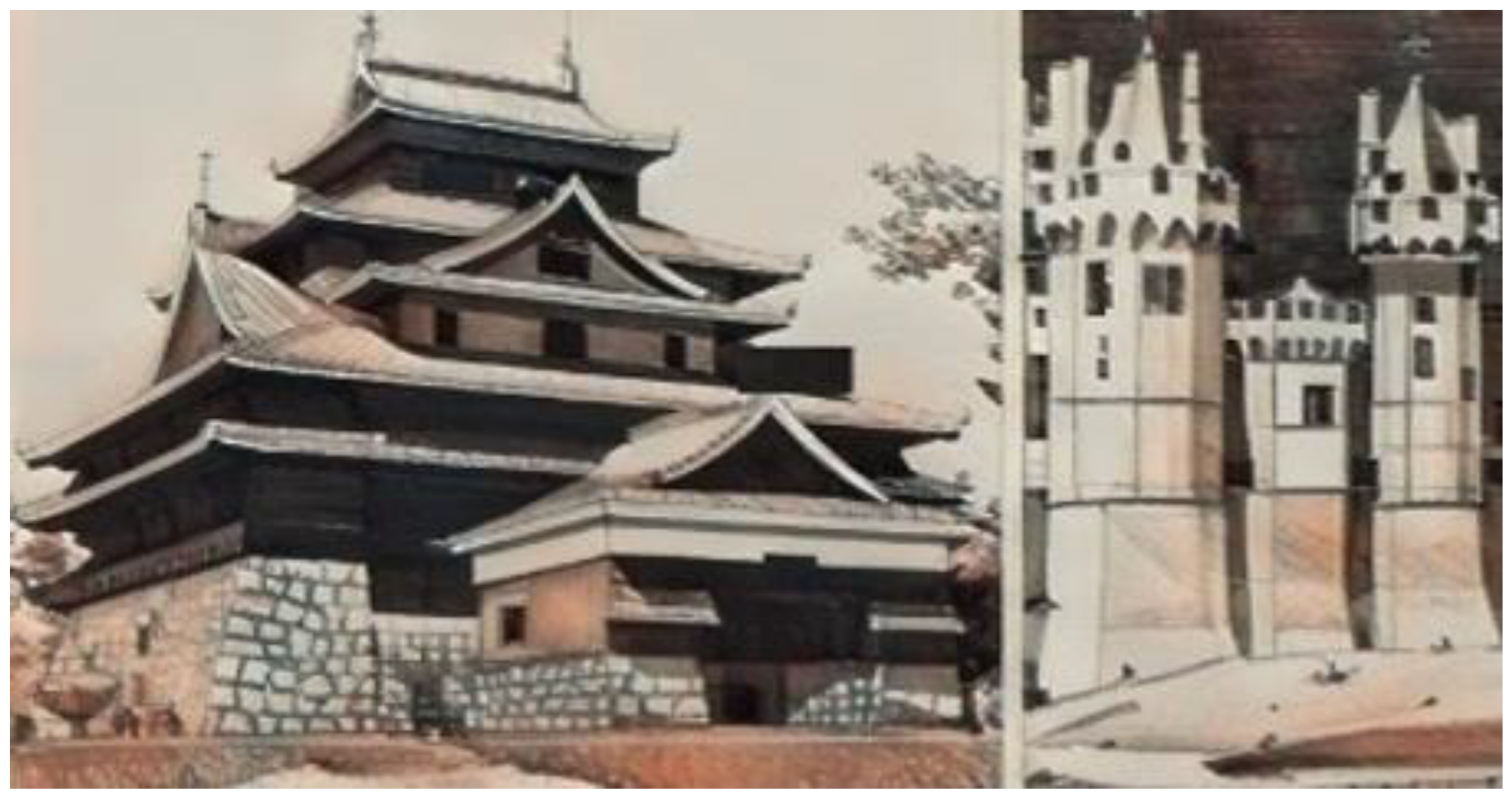
1. Introduction
The meanings of heritage sites stem not only from architecture and history but also from circulating narratives shaped by national identity, politics, religion, ethnicity and other sociocultural factors. For these reasons, a site like the Kremlin may feel different to a Putin loyalist than to others. Architects also invoke heritage ideals through revival aesthetics—such as medieval façades—that can include some groups while alienating others. This article pursues three aims: (1) to show how the same heritage or revival site can feel oppressive or welcoming, making places selectively permeable; (2) to examine how Crime Prevention Through Environmental Design (CPTED) can produce hostile atmospheres; and (3) to argue that atmospheres, though selectively experienced, are real features of environments. “Real” is used in its established philosophical sense to indicate that atmospheric qualities belong to environments and persist independently of any single perceiver.
To support these aims, the article deploys built-form analyses enriched with qualitative observations from sites and interviews with people who have encountered them, plus media and scholarly sources. The overall argument is framed by Gibson’s ecological psychology [
1,
2], which clarifies how environmental features structure perception and action. A second interpretive lens comes from CPTED, which uses ornamental walls, elevation changes and other territorial cues [
3,
4] to make strangers look and feel conspicuous, thereby regulating their entry. It will be shown that heritage or revivalist features, such as fortified design, can intensify the effect by contributing to intimidating atmospheres.
This connects to the article’s central claim: that CPTED interventions and the hostile atmospheres they generate can be understood through Gibson’s affordances. Affordances are not impressions, but actionable possibilities linked to benefits or harms [
1,
2]. Just as a river may be swimmable or dangerous depending on skill, urban settings vary in accessibility across backgrounds [
5,
6]. Research shows that energy-depleting conditions—including fatigue, debt or poor weather—make slopes seem steeper or distances longer [
7,
8,
9,
10,
11,
12]. Extrapolating, one can speculate that CPTED-like features—common in heritage and revival sites—place disproportionate burdens on vulnerable groups.
The analysis centers on the selectively hostile or welcoming atmospheres of contested heritage sites. A primary case is Cairo’s Tahrir Square, with attention to how retrofits have altered the site’s availability for protest. Additional illustrations come from Buenos Aires’s Plaza del Congreso and Plaza de Mayo during women’s demonstrations. For revivalist settings, the discussion turns to contemporary university campuses that appropriate medieval design elements to create atmospheres that exclude some groups more than others. One case examines how unhoused individuals seek shelter in a nearby fast-food outlet during inclement weather while avoiding a publicly accessible revivalist site with a fortified appearance that discourages entry despite superior amenities. The discussion becomes especially relevant amid accelerating climate change and rising weather volatility.
Gibson notes that cultural practices mediate affordances [
2], as with stairways that exclude wheelchair users or harassment that constrains women’s mobility [
13]. Yet he also holds that affordances are registered directly through ambient energy arrays—light, heat, sound, food sugars—a view that does not fully explain Tahrir Square. Post-2015 CPTED-style redesigns exposed Egyptians to greater surveillance and risk than tourists [
14]. Here, threat perception depended not only on environmental cues but also on political attunement. Still, as with Gibson’s “negative affordance” of a cat for a mouse [
1] (p. 146), Tahrir was selectively but objectively dangerous for Egyptians.
Griffero describes atmospheres as an “emotional skin” shaped by climatic, historical and infrastructural constellations [
15,
16], treating them as relatively stable, affordance-like presences unevenly encountered across groups. This article accepts that view but adds that a single setting can generate divergent atmospheres for different populations, illustrating how Gibsonian realism aligns with constructivist insights from enactive cognitive science [
17]. Gibson maintains that actions are “exploratory and stimulus-producing” [
1] (p. 138) and that environmental affordances manifest positively or negatively according to users’ capacities, as when a lake poses varying risks depending on swimming skill. Studies likewise indicate that oppressive atmospheres can emerge when individuals struggle to move forward [
18,
19,
20,
21]. In prestigious heritage or revivalist settings, a similar dynamic can occur: unhoused people may move more hesitantly, increasing their conspicuousness and inviting stricter responses, much as tourist-behavior attracts touts. The resulting hostile atmosphere is co-produced by the built form, situated behaviors and broader sociocultural and historical conditions, yet remains real in Gibson’s ontological sense. This abstract analysis has a more practical upshot. By linking atmospheric dynamics with socio-spatial governance, the argument complements work in urban political ecology, especially scholarship showing how aestheticized built forms become tools for consolidating power and producing unequal access to public venues [
22,
23,
24,
25].
2. Methods and Materials
This article adopts an interdisciplinary approach that brings ecological psychology, built-form interpretation, political history, urban geography and heritage scholarship into dialogue. Though theoretically oriented, the study is informed by IRB-approved empirical components, namely, previously collected but unpublished interview data, along with onsite evaluations of architectural configurations and use patterns. Within this frame, the analysis applies affordance theory, examining architectural and spatial features—building massing, CPTED elements, elevation changes, sightlines, façade treatments and territorial cues—to assess impacts on movement, comfort, accessibility and perceived risk.
Following work in political ecology [
22,
23,
24,
25], the analysis considers aesthetic and spatial changes as ways authorities govern, shaping what people can and cannot do in a place. These changes shift constraints and opportunities, giving some groups easier access to urban resources while making it harder for others. Because affordances arise through relations between environments and agents’ capacities, which are socially inflected, broader historical and political conditions become relevant. Sites such as Tahrir Square are poorly appreciated apart from colonial legacies, revolutionary cycles, state interventions and symbolic reappropriations. UNESCO heritage research [
26] and scholarship in affective urbanism [
27,
28] underscore these dynamics.
Having outlined the theoretical lenses guiding the study, the remainder of this section specifies the rationale for case selection (
Section 2.1). It then outlines procedures for onsite observation (
Section 2.2) and interviews (
Section 2.3), before clarifying the analytical role of diagrammatic illustrations and conceptual refinement within the overall interpretive process (
Section 2.4).
2.1. Case Selection
Main cases were selected for their analytic diversity and for the ways they reveal selective permeability under differing political and architectural regimes.
Tahrir Square—central to the 2011 Egyptian Revolution—represents a contested heritage landscape that underwent retrofits between 2015 and 2020. These alterations followed established design principles that signal control over space and render it atmospherically oppressive to outsiders [
4], illustrating how states reorganize urban layouts to suppress collective presence.
The DeVos Center—part of Grand Valley State University in Michigan—exemplifies a contemporary revivalist complex in which neo-medieval aesthetics introduce exclusionary cues toward unhoused populations, amplified by local climatic volatility.
The Buenos Aires women’s marches—mentioned at the outset—demonstrate how collective action can temporarily invert negative affordances, transforming atmospheres and altering perceived risk profiles for different cohorts. The Buenos Aires case is treated as a comparative reference rather than a primary field site.
Across the main cases, the analysis identifies salient architectural, symbolic and territorial features, situates them within political and historical narratives, examines how different groups encounter divergent affordances and assesses how climate, economic position, gender and other vulnerabilities mediate these encounters. This comparative structure clarifies how selectively enabling or restrictive atmospheres can emerge through interactions between aesthetic design and political affordances.
Given the qualitative and context-sensitive nature of the data, the cases and findings are treated as illustrative of recurrent experience in cities, not as definitive or generalizable. Such limitations are common in cultural research, where outcomes depend on parameterization, participant positioning and historical timing. The selective permeability model is motivated by this variability, recognizing that environments afford different possibilities, risks and atmospheric tones to different individuals under specific conditions.
2.2. Onsite Observations
For Tahrir, onsite observations come from two primary sources. The first consists of news reports and scholarly literature, cited as such, with the unpredictable transformations following the 2011 Egyptian revolution making retroactive analysis—and hence use of published accounts—nearly unavoidable. This material is supplemented by long-term, informal familiarity with the site, derived from repeated presence between 2011 and 2025. Reliance on such familiarity, which functions as an interpretive resource, is again justified by the retroactive nature of the study and by the challenges of conducting site-sensitive research in a context of heavy state security and surveillance.
For the DeVos Center—the main revivalist site considered—state security and surveillance were not obstacles, and there were no politically motivated retrofits, meaning less need for longitudinal study. Thus, in contrast to Tahrir, more formal observations were feasible. During visits, the author conducted direct observation focusing on movement patterns, congregation and dispersal, avoidance behaviors, surveillance visibility and climate-related practices (e.g., heat refuge and exposure avoidance). Photographic documentation was limited to instances when the space was empty and supplied the basis for hand-drawn (but digitally refined) illustrations accompanying this article. Together, these mixed approaches informed the built-form interpretive analyses by enabling close examination of spatial configurations, circulation patterns, visibility and territorial cues as encountered in situ.
Across cases, data were documented through field notes, annotated sketches or photographs and post-visit analytical memos, supporting systematic comparison despite contextual variation.
2.3. Interviews
The study incorporates previously collected, unpublished interview data obtained with informed consent and IRB approval as part of a separate project that examined the selective hostility of urban environments toward women. Because of this, the participant responses are used as a supplement rather than as a standalone empirical dataset, providing contextual and experiential triangulation that informs the interpretation of affordances in urban spaces.
The data was generated from semi-structured interviews, though some opted to provide written responses. Thematic prompts focused on spatial comfort, perceived threat, avoidance and adaptive strategies as well as environmental features influencing feelings of safety, ease or hostility. Because the data were gathered for an adjacent project, participants were not directly asked about atmospheres. This had the inadvertent advantage of reducing the likelihood of priming the reporting of atmospheres where this might not have otherwise occurred. Nonetheless, volunteers repeatedly engaged the phenomenology of atmospheres either overtly or by talking about “places of intimidation” or locales that feel “really, really heavy.”
Participants came from diverse regions, including Central Asia, East Asia, Southeast Asia, Latin America, North America, North Africa, Sub-Saharan Africa, Europe and Russia. Many had lived in multiple cities across different countries, enabling comparative reflections. While respondents were neither encouraged nor discouraged from discussing intersectional factors, many spontaneously reflected on religion, ethnicity and community norms. Initially, the sample included women and non-gender-conforming individuals (N = 56 in-person interviews; N = 9 written accounts). Later, men (N = 29) were interviewed for comparative purposes, specifically to assess gender-differentiated perceptions of environmental hostility.
Interviews were conducted in English unless a different language was preferred. Participants were not financially compensated. For privacy reasons, conversations were documented through contemporaneous handwritten notes taken by research assistants.
2.4. Pictorial Analysis and Conceptual Clarification
As an additional methodological component, the diagrammatic figures used throughout also function as analytical tools. Hand-drawn and digitally refined sketches highlight spatial relations, circulation paths, lines of sight, elevation changes and zones of exposure. This approach also served as a substitute where obtaining publishable images of sensitive sites, such as Tahrir Square, or non-copyrighted aerial views was not feasible. In some cases, the depictions show differing social arrangements that interviewees identified as producing atmospheric shifts. In these instances, computer graphics—rather than photographing staged scenes with human performers—provided a practical and demonstrative solution. The figures also include two maps from OpenStreetMap, used under the Open Data Commons Open Database License.
The stylized illustrations—tonally adjusted to maintain a consistent visual register—is used for conceptual clarification rather than empirical depiction. In particular, the figures function as a method of spatial abstraction, presenting overall layouts in ways difficult to capture photographically. The depictions direct comparative attention to affordance gradients, selectively hostile features and atmospheric transitions across cases.
Other methodological approaches involve conceptual and phenomenological clarification. Some might regard this as outside the scope of contemporary science, but Gibson—among the leading psychologists of the 20th century [
29], whose empirical work included aviation-perception research for the military, among much else—would disagree. He addressed epistemological and metaphysical matters, discussed queries raised by numerous prominent figures in the history of philosophy, citing some of them as influential in his work [
2]. A supposition in Gibson’s last two books was that good science does not progress if the starting point is philosophically confused concepts.
3. Selective Permeability, Atmospheres and Political Affordances
This section provides the theoretical grounding for the analyses to be deployed. After this, the discussion turns to the case studies.
Environmental psychologists drawing on affordance theory argue that we perceive settings much as we register faces—rapidly and intuitively [
30] (p. 32). A nighttime street, for instance, may be instantly read as safe or menacing. As with faces, it can be difficult to isolate which elements generate these affective qualities. Tearfully happy expressions can appear sad when photographically cut off from jubilant award ceremonies [
19,
31,
32]. Likewise, a police officer’s stern expression may present a threatening obstacle—or negative affordance—to an assailant while carrying a positive valence for a victim. The officer’s presence can also shift the atmospheres for various parties at the scene. This underscores that a setting’s atmospheric qualities, like its affordances, can be threatening, welcoming, thwarting, enabling or somewhere in between, depending on one’s background.
Whyte’s time-lapse recordings of urban spaces reinforce this, showing that features such as low open steps create a “cordial relation with the street” that motivates entry [
33] (p. 56). Berleant likewise notes that some architectural forms are “participatory” and draw us in; others “confront us with solid, opposing planes” [
34] (pp. 94–95).
For a participatory case, consider a city park where winding paths hide the broader layout, with each curve pulling visitors forward to see what is out of view [
30,
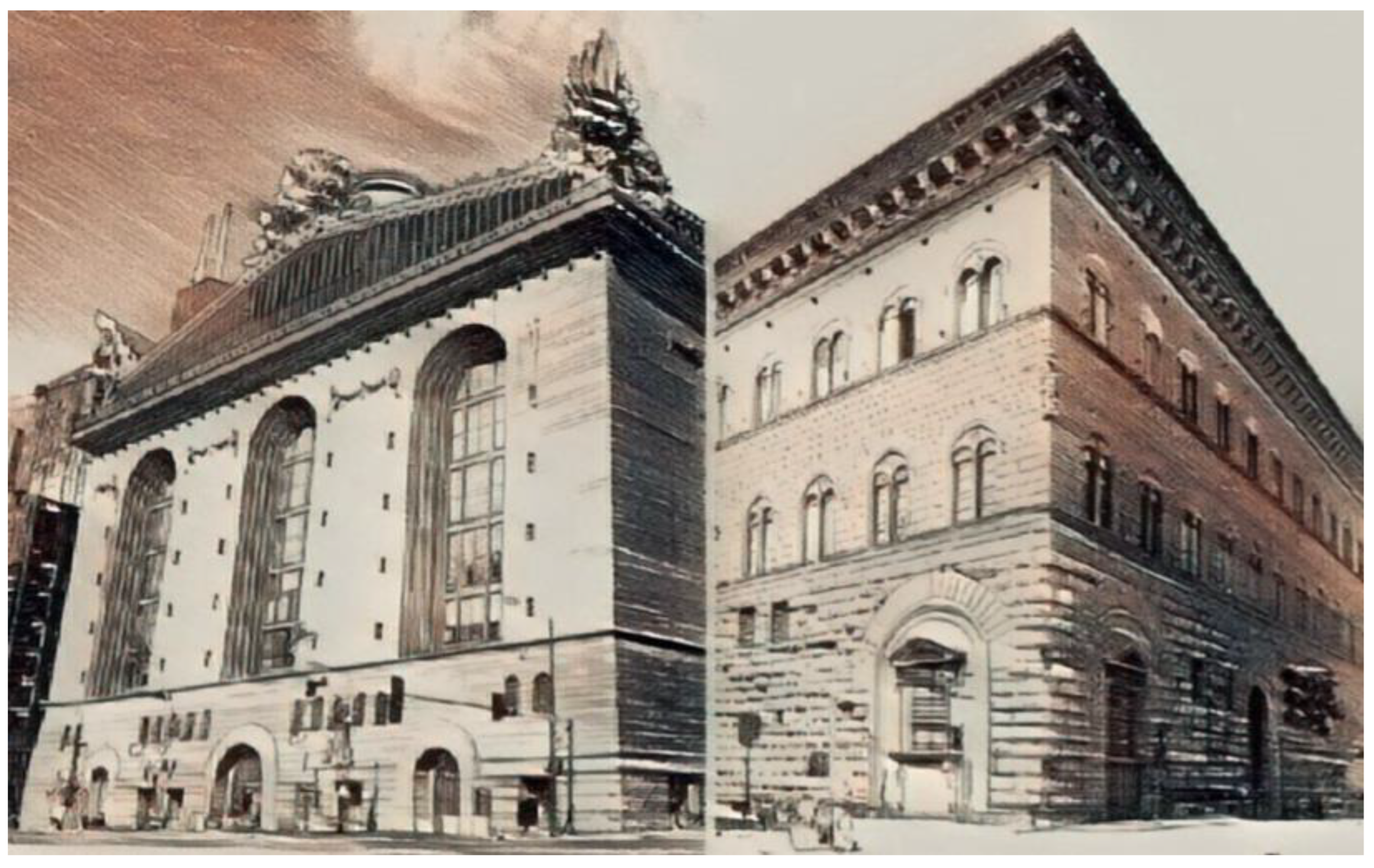
35]. Conversely, Chicago’s Harold Washington Library—modeled on fortified Renaissance architecture—conveys defensiveness near the ground, where heavy masonry and smaller windows dominate, some of them resembling gun slits [
35] (
Figure 1). As with the Medici–Riccardi Palace in Florence, the style becomes increasingly delicate and open at higher levels. Although visually impressive, scholarship suggests that heritage design—taken broadly to include revivalist forms—often becomes authority-laden and radiates exclusionary atmospheres that privilege insiders while marginalizing outsiders [
16,
36].
Whether a setting is inviting or not depends not only on design, but on who encounters it. Gender, age, ethnicity, national identity and political orientation shape how spaces are perceived and which actions are objectively possible. Originating in urban geography [
37], the selective permeability framework now informs analyses of social media, multicultural interaction and mental health [
38,
39,
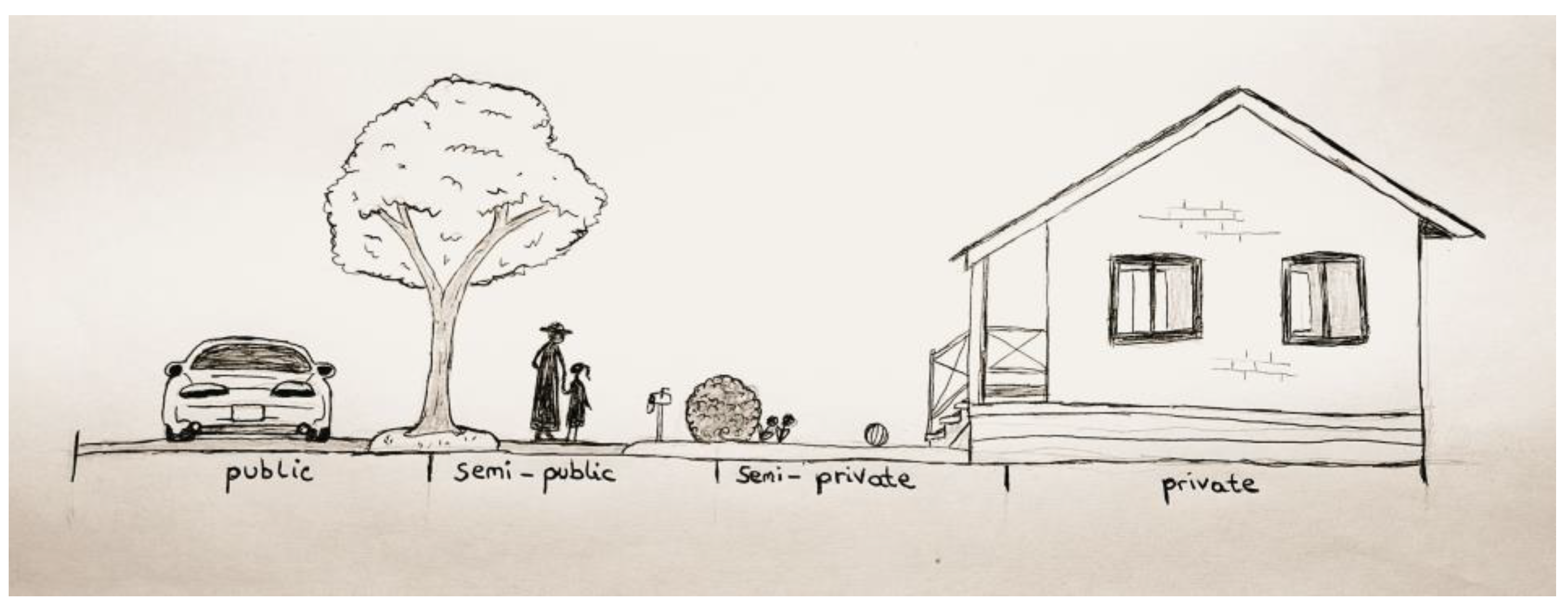
40], yet it has not been applied to atmospheres in a sustained way. The idea is straightforward: a stairway blocks wheelchair users, just as a nighttime street can feel atmospherically ominous to women if it exposes them to greater risk than men. Territorial cues—decorative walls, elevation changes, contrasting tiling and landscaping [
4]—can likewise create private atmospheres that selectively discourage outsiders (
Figure 2).
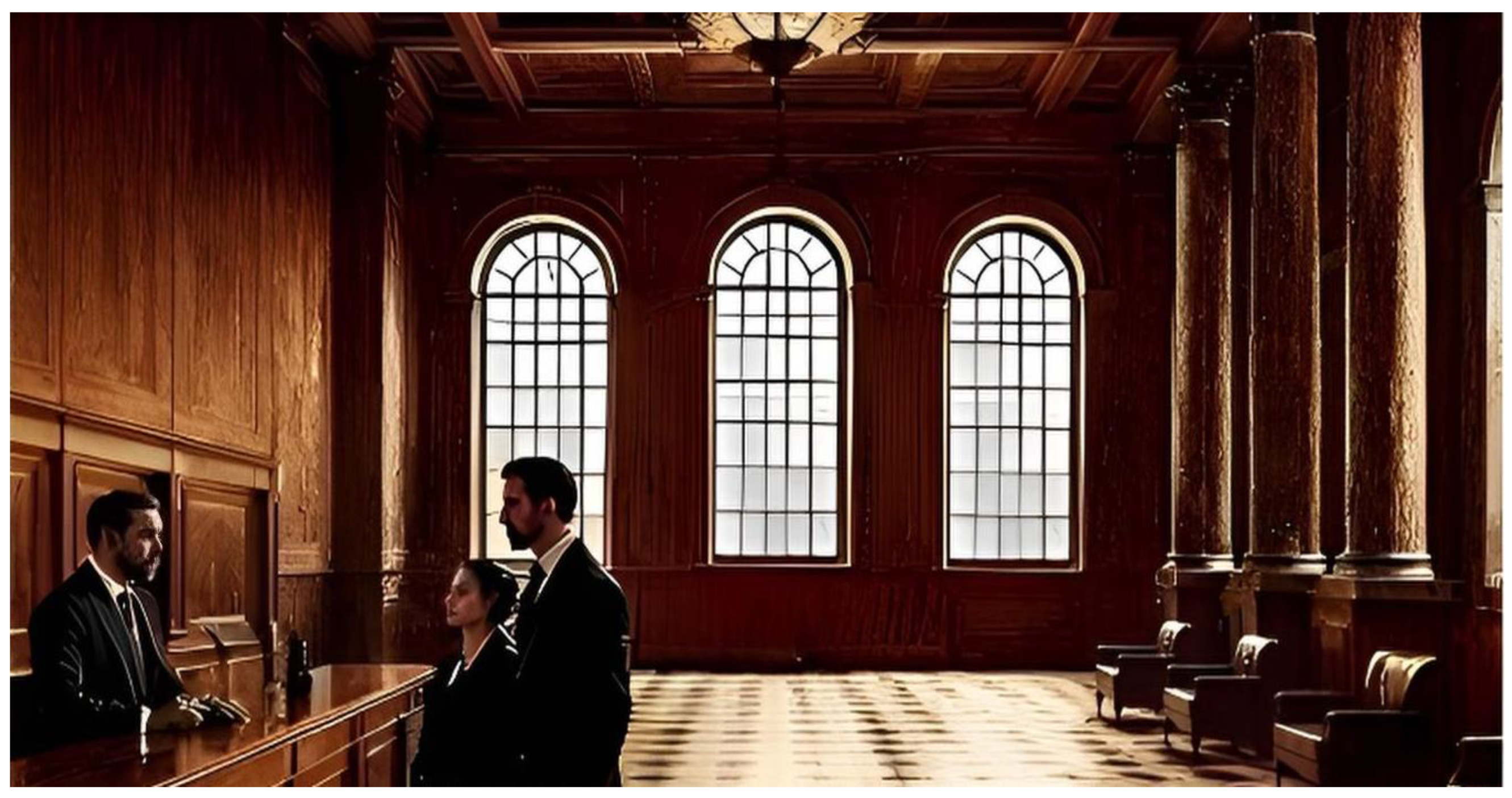
Banks with grandiose classical features illustrate a similar pattern (
Figure 3): affluent visitors may feel at ease while the non-affluent sense exclusion and may be less welcomed [
37,
41]. Griffero suggests a regel aura may stably persist here that empowers institutional actors and undermines clients [
16,
42].
Another view—not exclusive of Griffero’s—aligns with a capacity-based understanding of what may be described as atmospheric affordances: the bank’s mood ranges from mundane and empowering for financial advisers to intimidating for non-affluent clients. A question concerns the extent to which these atmospheres are environmentally located or “in the heads” of observers. A common view holds that architectural atmospheres are subjective [
43]. Yet some scholars defend a different account. Böhme argues that atmospheres span the subjective–objective divide [
44]. Dewey likewise treats the emotional qualities of settings as relational [
45,
46], and Dreyfus notes that moods and atmospheres can immerse us as though we were “in” them [
47].
The views of the last three commentators parallel Gibson’s account of affordances as action possibilities that emerge from relations between environmental structures and an agent’s capacities [
2]. Such possibilities remain perceptible even when not exploitable, as when a wheelchair user recognizes that others can climb stairs. This echoes Koffka—cited by Gibson as an influence [
2]—who maintains that we can perceive a gloomy landscape without becoming sad, though atmospheres can still affect how people feel and act [
48]. While not sufficient for Gibson’s ecological realism, Koffka’s view meets a basic condition of it by preserving some independence between subjects and what they observe. The idea that people encounter different atmospheres in the same environment—or register them with different intensity—similarly aligns with the affordance view, where environmental possibilities vary objectively with an individual’s abilities.
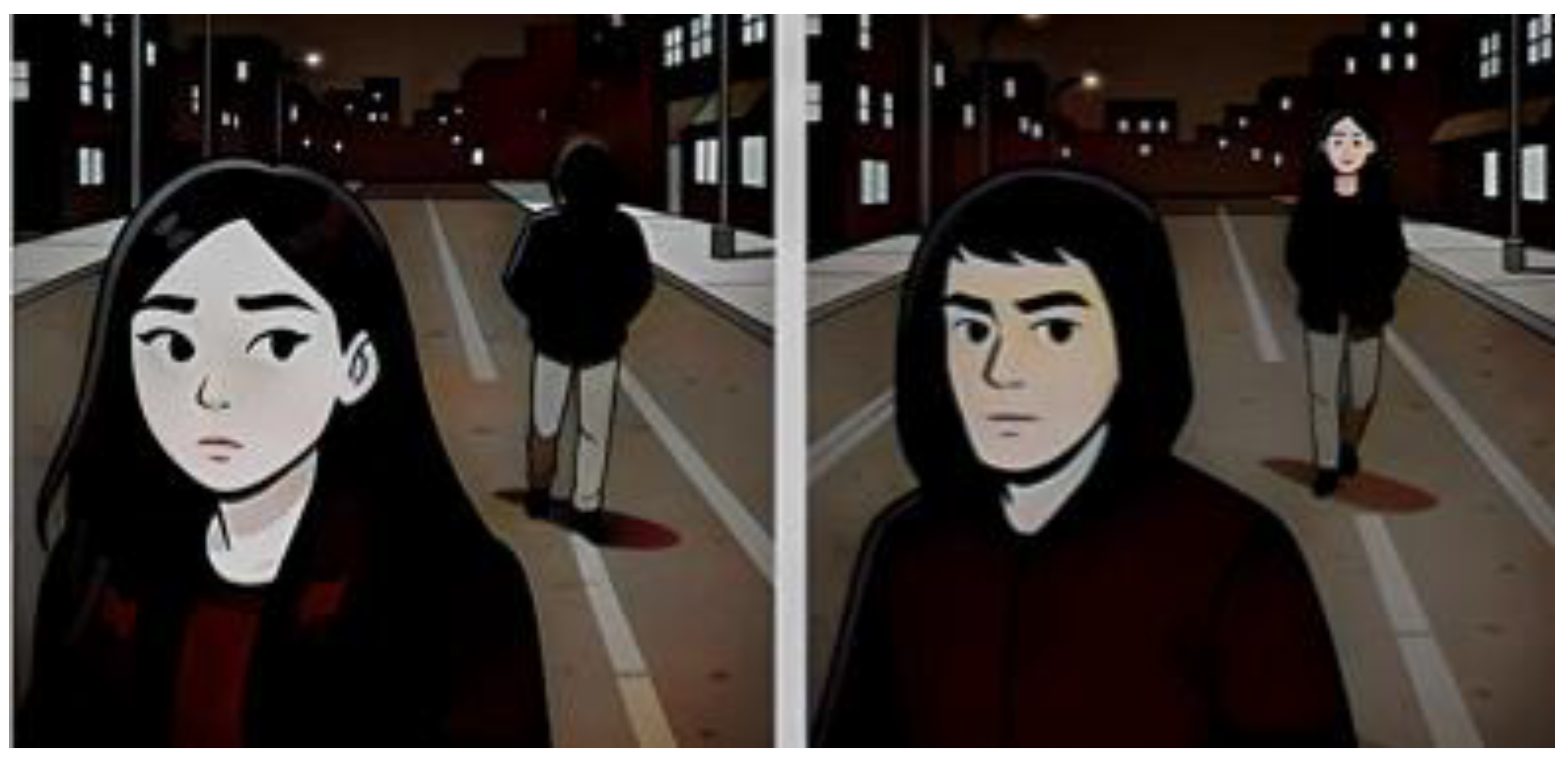
To elucidate these points, readers may consider
Figure 4—a composite constructed from scenarios raised by women interviewees—and answer the following questions. Is the left setting more ominous than the right? If so, is the threatening quality located in the rearward man, the general setting or both—and do readers register the emotional aura without feeling it, owing to their non-immersion and hence safety, paralleling what Koffka says [
48]? Finally, although nothing indicates that the men in either image intend harm, is it unreasonable for a woman to assess the left scene as riskier than the right?
Some of these questions hint at a distinction in which affordances are usually specified in spatially bounded terms—this road is walkable, for example—whereas an atmosphere can diffuse across a scene [
15,
16]. Gibson equates affordances with values: they are environmental properties—directly perceived, non-subjective, valenced possibilities for action, which he classifies as “positive” or “negative” [
1,
2]. Both types constrain behavior, though in different ways. A road limits movement to particular directions; yet it is usually a positive affordance: it provides access to a destination—a positive benefit or value that increases the numeric value of possible actions in a positive direction. Conversely, a sexually aggressive man menacing a street would register for most women as a potent negative affordance. He not only poses a direct threat—a negative value; he also imposes negative restrictions on freedom of movement, usually motivating avoidance or flight.
Although affordances can carry atmospheric qualities, and atmospheres can shape which affordances are perceived as actionable, some distinctions are worth making. Regarding the left-hand scenario represented in
Figure 4, interviewees indicated that unease arises not only from the man’s presence but also from his rearward position, his hidden face, the reduced nighttime visibility and the absence of other people. Identifying the man as presenting negative affordances fits Gibson’s framework; interpreting the overall atmosphere as a negative affordance, however, extends beyond Gibson’s claims for reasons discussed later. Even so, ambient configurations can guide behavior in valenced ways similar to positive or negative affordances [
19,
20,
49]. Heijmeskamp has framed situations or overall configurations as affordance-bearing [
50], and this article adopts a similar stance regarding atmospheres. It will also argue that atmospheres share the non-subjective grounding that Gibson attributes to affordances.
A last point is that the selective effects noted in this section gain political significance when they follow demographic lines. Women disproportionately face sexual predation and therefore register more negative affordances in many urban settings. These political affordances lie not only in immediate threats but in broader social configurations and carry an atmospheric quality; they reinforce stereotyped and unequal mobility regimes while both shaping and partly emerging from ominous urban atmospheres [
41,
51,
52,
53,
54].
4. Heritage and Selective Permeability
Following the mixed-method approach outlined earlier—which combines built-form interpretation, political history, onsite observations and some interview material—this section turns to Cairo’s Tahrir Square as an exemplary case. The site demonstrates how contested heritage, spatial cues and political interventions co-produce atmospheric affordances. The discussion begins with the political history that contributes to Tahrir’s heritage status.
A preliminary point is that while heritage resists precise definition, since any set of key features usually fails at some point [
55], Tahrir qualifies because of its history and its symbolic weight in the Egyptian national consciousness. Built in the 19th century as the centerpiece of Cairo’s Parisian-inspired downtown and originally called Ismailia Square, it was renamed Tahrir—“liberation”—after the 1952 Revolution [
56,
57,
58]. Long before the official renaming, the square served as a site of dissent and was informally known as Tahrir [
14]. In the decades leading to the 2011 Arab Spring and the January Revolution in Egypt, it remained a locus for protest [
57,
58,
59,
60,
61].
A second point is that Egypt’s historical heritage shaped the timing of the 2011 uprising, which began on January 25, a national holiday commemorating police officers killed resisting British forces in 1952 [
58,
61]. Mubarak’s government had canonized the day to valorize security services, but protesters inverted its meaning to highlight contemporary police brutality [
59]. Such reversals exemplify “contested heritage” [
62,
63], wherein symbols like squares, monuments, and religious texts hold no fixed meaning but remain open to reinterpretation—as seen in recent vandalism of statues of leaders such as Winston Churchill and Cecil Rhodes.
A third point is that the ideology of “liberation” associated with Tahrir has been contested since the 1952 Revolution. Authoritarian regimes often co-opt ideals such as liberty and democracy. Fitting this pattern, the dictator Hosni Mubarak led Egypt’s National Democratic Party (NDP) until he was deposed in the 2011 Arab Spring. The square’s contested significance deepened as state institutions increasingly concentrated around it [
14,
57,
58,
59,
60,
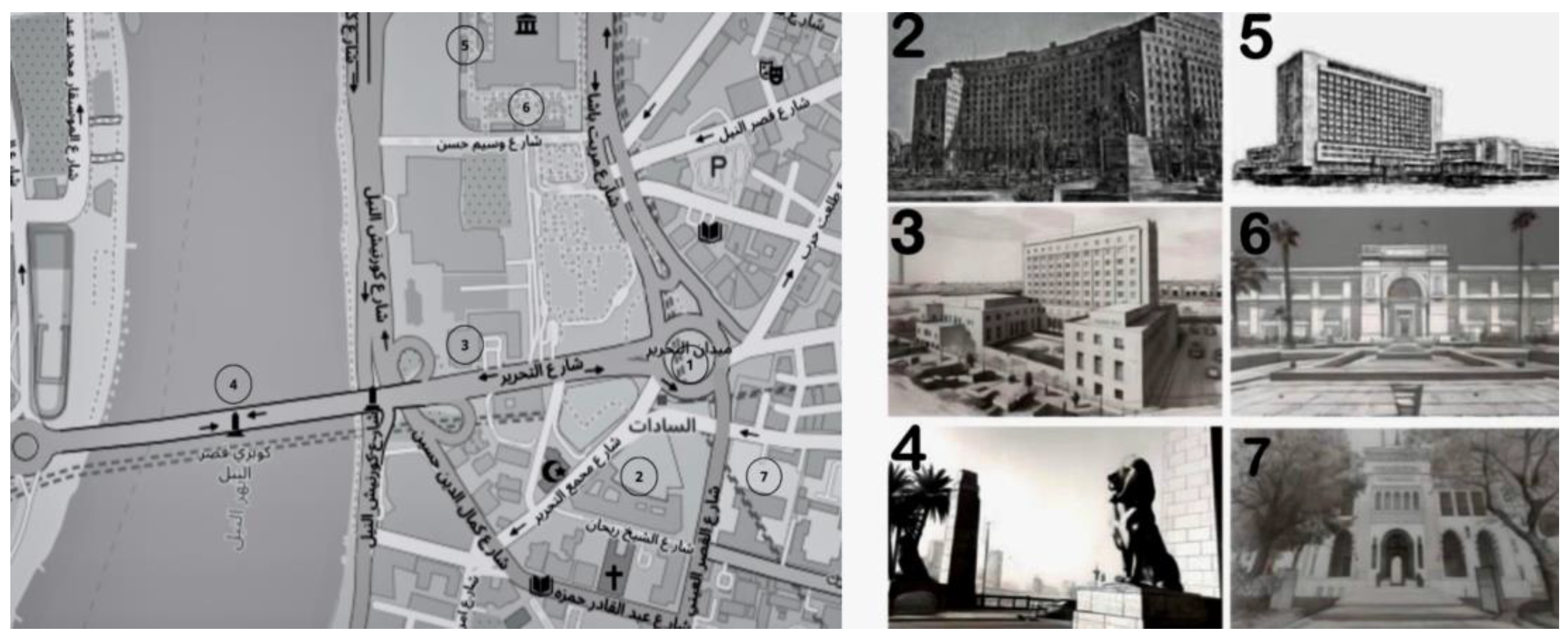
61], as shown in
Figure 5. The Mogamma administrative complex opened in 1949, followed by the Arab Socialist Union headquarters in 1958, later occupied by the NDP. The Arab League established its headquarters in 1960. The Museum of Egyptian Antiquities and the American University in Cairo’s downtown campus were already nearby, and the Qasr el-Nil Bridge (1930s) linked the square to Zamalek Island. The opening of Sadat Station in 1987—named after Egypt’s second military dictator, the first being Gamal Nasser—firmly embedded the square within Cairo’s infrastructural core.
The square’s dual role as a place of resistance and a symbol of state authority aligns with UNESCO reporting suggesting that public memory and state narratives can vie for influence over politically charged heritage sites [
26]. In Böhme’s and Griffero’s terms [
15,
16,
44], the square accrued diffuse emotional charges that gave rise to varied atmospheric attunements. This is evident from memoirs and onsite accounts from the January Revolution, which describe both positive and negative public atmospheres or moods [
64,
65,
66], with interviewees echoing similar sentiments. Among these were pride in national identity, unease under surveillance and the collective energy of defiance.
The Egyptian flag also became a focal point of contested heritage. Known as ʿ
Alam al-Tahrir, it originated in anti-colonial struggles and gained official prominence after the 1952 Revolution [
67]. During the 2011 uprising, activists co-opted the flag—already a unity emblem—as a symbol of collective opposition. Waving it, painting it on faces, incorporating it into clothing and otherwise displaying it signaled revolutionary allegiance [
14,
66,
68]. Accounts from that time suggest these practices added to the square’s tangible, publicly accessible atmospheric qualities, ranging from ominous to carnivalesque depending on the day, shaping how people moved, assembled and perceived [
64,
65,
66]. If the flag thereby increased group coherence, then it played a role in reconfiguring the affordance space since collective possibilities differ from what individuals can do alone.
Yet, as with the square itself, the military soon reclaimed this evocative symbol. This occurred in the summer of 2013 when crowds gathered in Tahrir to register dissatisfaction with the Islamic government led by Mohamed Morsi, who had flouted democratic norms despite being elected [
69]. Helicopters flew overhead carrying massive flags while smaller ones were dropped into the crowds [
70,
71]. For many, this signaled that military leaders were siding with January 25 ideals and encouraging further action [
14]. This was true to the extent that top officers were days away from executing a coup, which was framed as fulfilling the popular will, with research polls showing that about half the population supported it [
72,
73]. Consequently, the same flag that had afforded grassroots solidarity now signaled alignment with military power—power newly framed as standing with the people and their revolutionary aspirations, now directed against Islamists. But while many experienced the 2013 coup against the elected government as an extension of the January Revolution, it will be shown that the square’s affective field was already being steered back toward restoring the status quo of military leadership.
Following Morsi’s removal, the regime cracked down on dissent [
74,
75,
76,
77,
78,
79,
80,
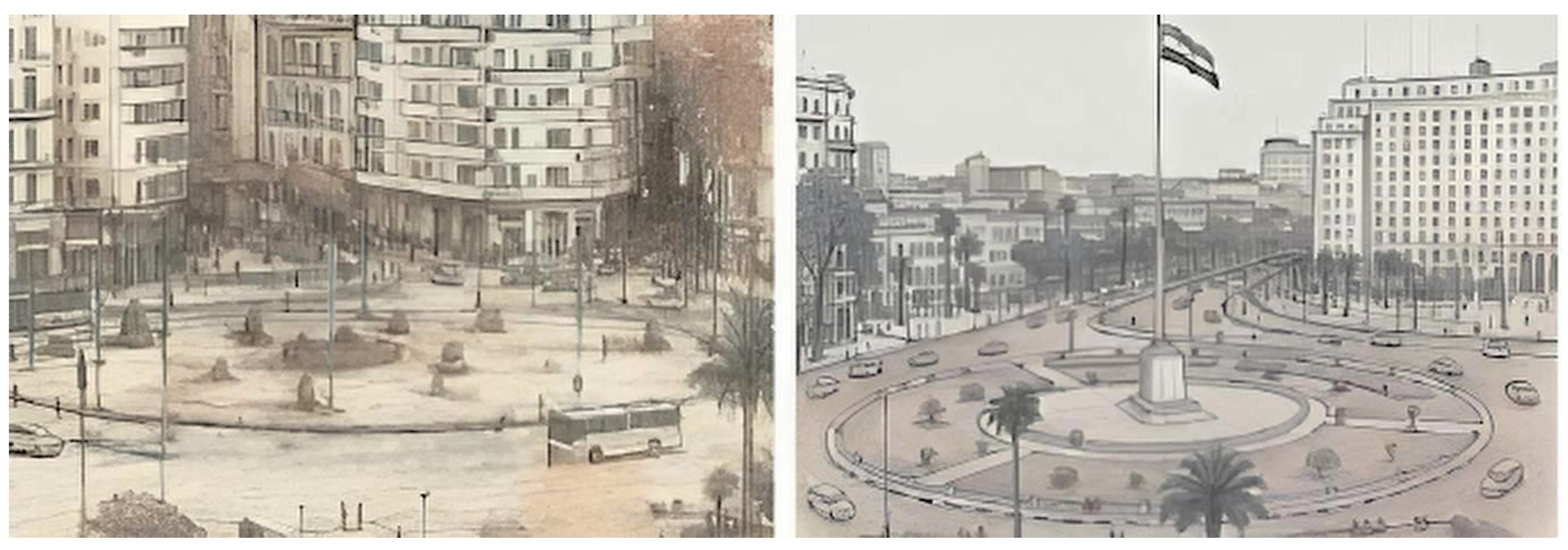
81] and also had Tahrir reengineered in ways corresponding to CPTED principles. Decorative walls were installed with three entry points—later reduced to two—along with elevation and tiling changes and more carefully manicured plants (
Figure 6). Such interventions are common in defensible design and are intended to evoke discomfort among outsiders [
4,
82], who feel awkward entering and stand out more to those monitoring the area [
4]. The aim, in Newman’s words, is to create a felt sense that a space is “under the undisputed influence of a particular group” [
4] (p. 3), and it seems likely that the military leadership sought to exert its authority in the square’s architecture.
An additional possibility, proposed at the outset, is that the retrofit made the square less permeable to Egyptians than to tourists. To recapitulate the argument, fatiguing conditions make space look less accessible because it actually is less penetrable [
7,
8,
9,
12]. Debt and sadness also are physiologically taxing [
83,
84,
85], decreasing perceived and actual accessibility [
10,
11]. By slight extension, one can propose that CPTED features are more severe to the depleted than to the energetic. Egypt’s post-2011 economic hardship left many residents financially and politically exhausted [
86,
87,
88,
89,
90,
91,
92]. After the 2015 redesign, Egyptians largely avoided Tahrir Square, despite regularly crossing roads to sit in small green spaces with tourists [
14]. A further point, developed later, is that the square was more dangerous to Egyptians, who were harassed by police more frequently than foreign visitors [
37].
Other alterations to Tahrir and its vicinity occurred after the 2013 coup. The demolition of the NDP headquarters in 2015 was arguably done partly with the intention of creating distance between the new government and Mubarak-era authoritarianism. Likewise, the addition of a central flag on an austere pedestal, officially commemorating the January 25 martyrs, fused revolutionary imagery with state legitimacy. But the regime did not live up to these ideas, for it maintained the old security apparatus [
61,
74,
75,
76,
77,
78,
79,
80,
81]. Around this time, the meaning of the flag changed in the public consciousness. While it had signaled dissent in 2011—so much so that many expressed defiance by draping it from flat balconies—displaying the flag increasingly signaled support for the new military regime [
14].
These symbolic gestures, paired with CPTED modifications, implied that protest no longer belonged in the square. Tourists may have encountered the setting as aesthetically enhanced, whereas Egyptians facing police harassment had different experiences, with interviewees recollecting an intimidating or alienating vibe. As one respondent recalled, “Between 2013 and 2015, there were attempts to ‘beautify’ Tahrir. It was treated as a garden, with flowerpots on the edges of the square. There was a tragic humor in the design as it had turned into a landscape of silence.” The military rulers “decided to erect a large flagpole that did not manage to demand the respect it wanted. It began to feel as though the square itself turned defensive” and “there was less to care about” because it now belonged the authoritarian regime.
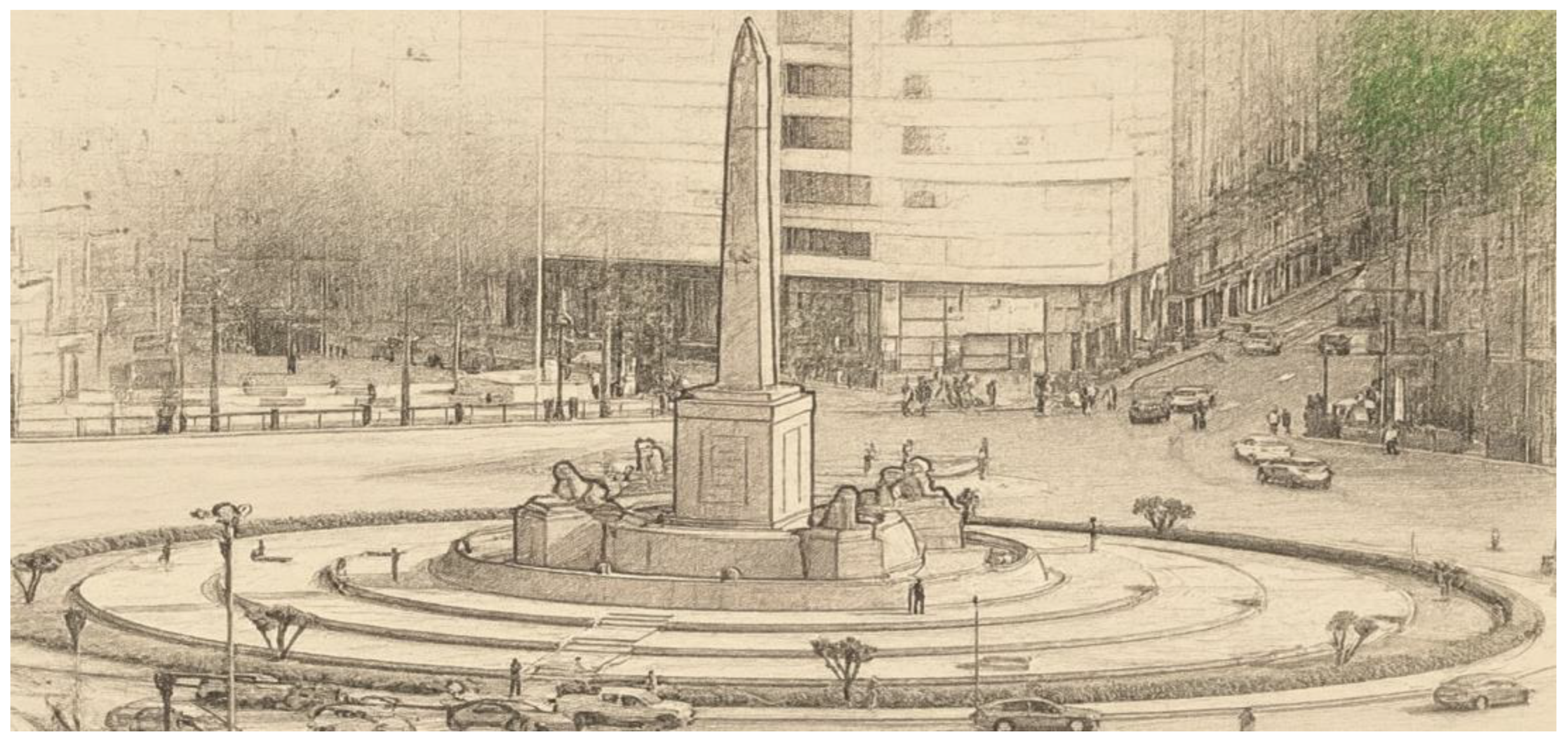
By 2020, the regime expanded this project of atmospheric re-engineering. A new redesign (
Figure 7) installed a central obelisk surrounded by sphinx statues, shifting the site’s orientation from revolutionary memory toward pharaonic antiquity, as if to erase the January Revolution. The ancient stone artifacts convey permanence and supply a pretext for a constant security presence, creating strong negative affordances for political assembly.
Interview reflections from a respondent capture some of the atmospheric shifts precipitated by the 2020 retrofit:
In its current redesign, the defensive tone turned oppressive. The granite and marble do not feel smooth as they do with ancient Egyptian sculpture. Instead, it feels hard and sharp. As sharp as the obelisk above it. In fact, when I see the obelisk from any direction like Talaat Harb, for instance, I feel the small pain of a needle. I also feel the pain of the guards who have to stand for hours to make sure no one steps into the square. The square once gave us dignity, and now it is taking it back from us.
The 2020 redesign stabilizes the space as a curated object of display, permeable to tourists seeking visual spectacle yet atmospherically and politically hostile to collective action. It is recast as a site for looking rather than gathering, echoing what political ecologists describe as governance through aestheticization—initiatives using beatification to exert control or extol certain political views [
22,
23,
24,
25,
93,
94,
95,
96].
5. Atmospheres and Political Affordances
Discussing Edinburgh Castle, Arbib—a neuroscientist writing on urban matters—notes that its atmosphere shifts with historical context: once hostile to approaching soldiers, the fortress now conveys a welcoming ambience to tourists [
97] (Ch. 4). Arbib distinguishes Gibsonian affordances from atmospheric ones. Specifically, he treats atmospheric affordances as openings for subjective emotional experiences, whereas Gibson understands them as action avenues.
Without denying a felt dimension, the argument in this section is that atmospheric qualities also function as positive or negative affordances, shaping mobility by expressing the safety or danger of a setting. This perspective foregrounds the political character of architectural atmospheres and offers conceptual clarification regarding their relationship to Gibsonian affordances and selective permeability.
Arbib’s description of Edinburgh Castle’s atmospheres aligns with claims by other scholars that artifacts embody values [
98,
99,
100]. His position suggests that atmospheres manifest differently depending on the parties involved (e.g., attackers versus defenders) and the historical period. This overlaps with Gibson’s view, as he equates affordances with values [
1,
2]. For instance, after an ice storm, the traversable use-value of the castle’s cobblestone paths diminishes. But this is usually more so for elderly visitors than young adults.
The observation that the values of Edinburgh Castle depend on who encounters it recalls an earlier example: the neoclassical bank in
Figure 3, which expresses legacy values (wealth, prestige, reliability) [
98] that may bolster institutional actors and undercut certain clients [
16,
37,
41].
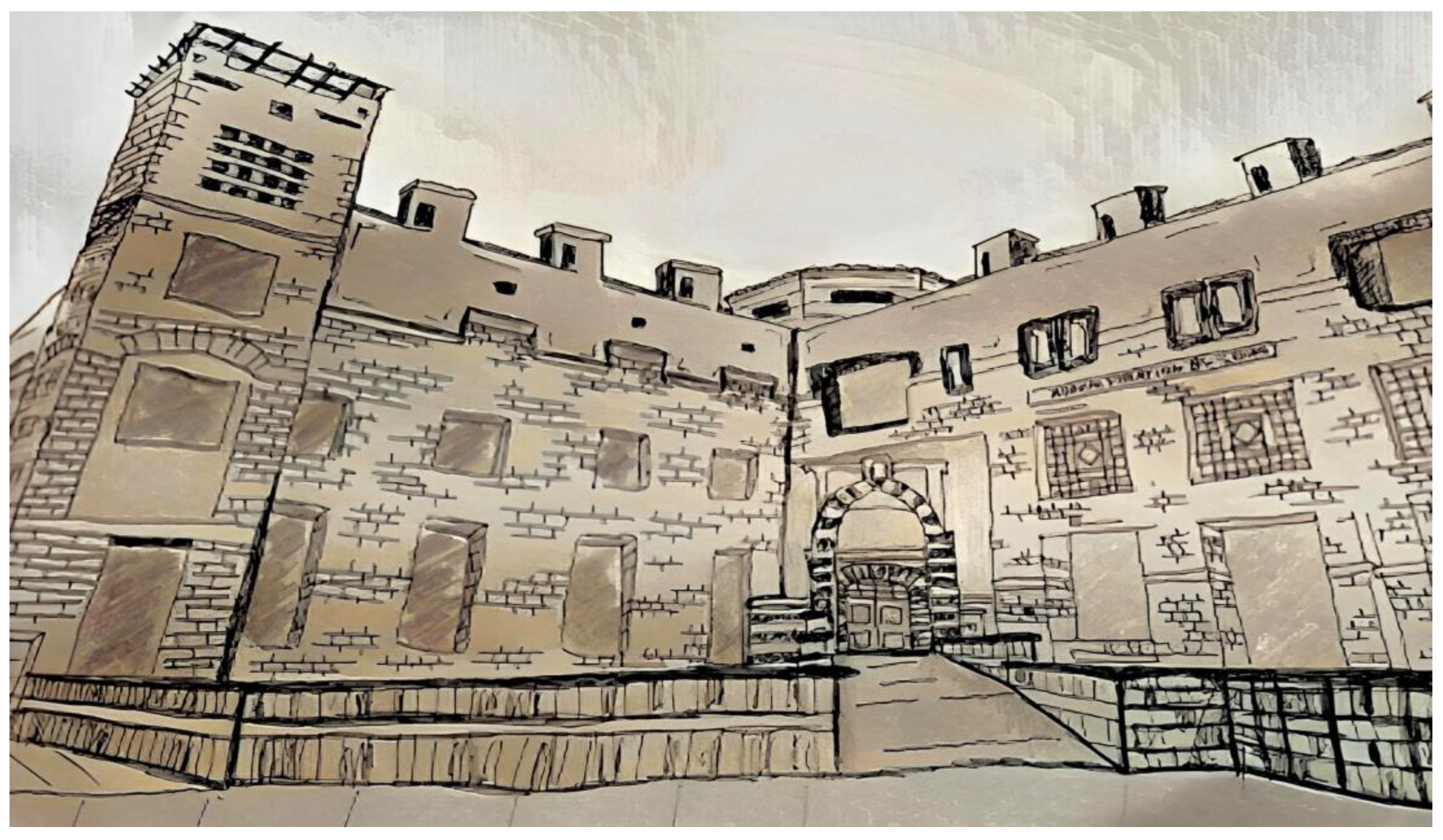
A comparable revivalist case appears in the Administration Building at the American University in Cairo’s new campus (
Figure 8). Modeled after a Fatimid fortress, entry from the main plaza requires crossing a trench on a mock drawbridge, passing through what resembles a gatehouse and moving beneath an arch that recalls a portcullis. Slit windows and a crenulated roofline reinforce the citadel motif. The design expresses hierarchical legacies of the medieval period in which universities first emerged and that persist in these institutions. As with the bank, the building’s commanding presence may yield an empowering or alienating atmosphere depending on the entrant’s status.
Built environments, such as the 2015 and 2020 redesigns of Tahrir—featuring the flag monument and pharaonic sculptures—express meanings and values that shape behavioral possibilities. Researchers connect this to atmospheric qualities [
15,
16,
20,
36,
41,
66,
101]. Before elaborating on connections between atmospheres and selective permeability, a brief recap of earlier discussions is useful. First, studies already cited show that depletion intensifies perceived obstacles [
7,
8,
9,
10,
11,
12]. Second, CPTED territory markers like elevation changes and tiling shifts arguably regulate the depleted disproportionately, discouraging their entry into a symbolically cordoned space [
37]. Third, being exhausted or depressed is sometimes nearly synonymous with encountering enervating and desolate atmospheres that constrict the ability to move forward and accomplish tasks [
18,
21].
An additional point that clarifies atmospheric perception is Gibson’s distinction between ontological and epistemological realism [
1,
2]. Ontologically, the features that make a stairway climbable persist independently of observers [
102], and it will be shown that many atmospheric attributes share this independence. Epistemologically, however, Gibson holds that information carried by energy and chemical flows is sufficient for the direct detection of affordances without interpretive mediation [
1,
2]. Atmospheric perception diverges here, for sensing an ominous or inviting aura—as discussed earlier—typically requires attunement to factors such as political conditions that lie beyond the immediate physical setting yet still exist independently of any individual. In this way, atmospheres align with ontological but not epistemological realism—or so the argument will go.
This is one reason that people attune to different atmospheres. The habitual practices of a fisherwoman, for instance, may help her effortlessly read literal atmospheres—wind, clouds, temperature, water patterns—and anticipate incoming weather. Yet she might be less calibrated if transported into an unfamiliar urban setting, such as a nightlife district with a hostile sexual energy that is not always conveyed by immediate cues alone but is also registered through attunement to the conventions of the given society.
This contrast adds nuance to Canepa and colleagues’ framing of urban atmospheres as empathic ties between people and their architectural environment [
42]. Tahrir further complicates this account. Early in the 2011 January Revolution, dissidents were assaulted or killed in or near the square [
61,
64,
65]. Soon after, according to onsite sources, demonstrators established checkpoints to screen for plainclothes officers and installed protest art while organizing spaces for food preparation, medical care, waste disposal and shelter [
65,
103,
104]. At this stage, the square took on a carnivalesque atmosphere [
66], and one can imagine an empathic relation emerging between the space and its inhabitants. Yet interviewees indicate that this dissipated after the 2013 coup, with the military reorienting Tahrir’s aura, co-opting the square’s recent and longstanding emotional associations.
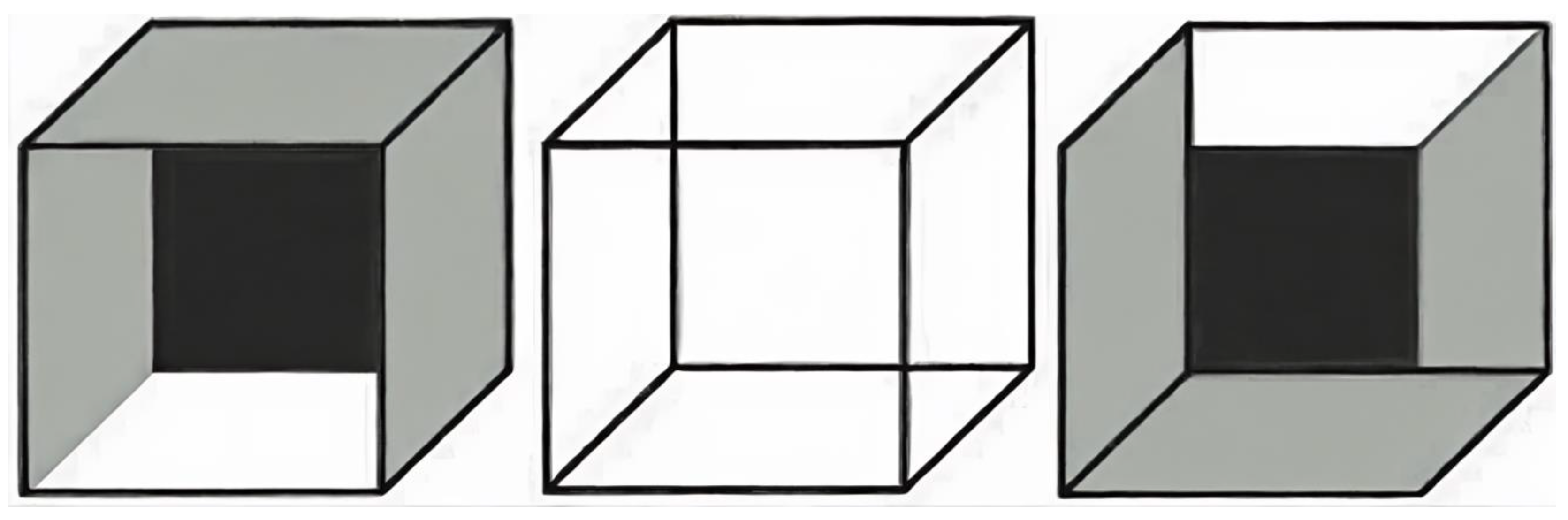
A takeaway is that both the January uprising and the redesign relied on the square’s emotional weight, anchored in its revolutionary history—reawakened during the Arab Spring and later reabsorbed by the state. That legacy made Tahrir a contested site. Its location reinforced this: it is a hub in downtown Cairo, known for its 19th-century architecture, historic hotels and iconic eateries like Café Riche, once a haunt for writers, artists and dissidents. From Tahrir, one can stroll to other important areas such as Zamalek Island and the main train station. Islamic and Coptic Cairo are farther but still walkable. Combined with the architectural representations of state surrounding the square, these features attracted protesters, cementing Tahrir’s ideological value during the January Revolution. A case can be made that later, when military leadership reappropriated the Tahrir spirit while suppressing demonstrations through CPTED features, the square became multistable. Like a Necker cube whose appearance shifts with one’s focus (
Figure 9), the redesigned space selectively exuded a negative aura for those habituated to Egypt’s sociopolitical and historically extended realities.
Crucially, Gibson’s framing accommodates selective permeability in Tahrir and elsewhere as agents help disclose different action possibilities. Biting realizes the affordances of an apple [
1] (pp. 138–139) and a stone becomes a missile or a paperweight depending on deployment [
2] (p. 134). Food also shows how affordances shift from negative to positive, as with a peanut being detrimental or not depending on a person’s allergy, even though the properties causing harm persist independently of a particular observer [
5,
6].
Now, to what extent can the same be said of urban atmospheres in Tahrir or elsewhere? Newman, one of the classic CPTED theorists, offers helpful insight. Earlier, a truncated version of one of his statements was cited, but the fuller passage is illuminating. Newman writes: “Design can make it possible for both inhabitant and stranger to perceive that an area is under the undisputed influence of a particular group, that they dictate the activity taking place within it, and who its users are to be” [
4] (p. 2–3). He continues: “This can be made so clearly evident that residents will not only feel confident, but feel it incumbent upon them to question the comings and goings of people” [
4] (p. 3). He concludes: “Any intruder will be made to anticipate that his presence will be under question and open to challenge,” enough so to “be deterred from even contemplating entry” [
4] (p. 3).
This account almost perfectly describes Tahrir and further suggests that its redesign may have enabled police in much the same way classical bank architecture empowers its employees. In this sense, the square became dangerous for Egyptians and, consequently, negatively affordant. In the paragraph after the passage quoted above, Newman adds that such outcomes depend not only on the configuration of the immediate space but also on the “social fabric” [
4] (p. 3) beyond it—paralleling the point that registering atmospheres involves attunement to a broader milieu. Newman also discusses how behavior modulates atmospheres. Contrasting cases where residents hold undisputed control, he describes a neighborhood with an “atmosphere of heightened danger,” where inhabitants “felt they had no right to question, and were afraid to question, the presence of strangers as a means of anticipating and preventing crimes before they occurred” [
4] (p. 166).
In both the design that Newman criticizes and the alternative that he advocates—one group or another becomes disempowered, with its action possibilities shaped by what are, in effect, negative affordances. Experiments already cited show that fatigue makes environments both perceptually and functionally less accessible, and related studies find that anxious climbers perceive grip areas as less reachable [
105,
106]. The reverse can also hold: diminished reachability can intensify anxiety, just as an inability to move forward on tasks may be symptomatic of depression [
21]. Egyptians’ hesitant movements around the redesigned square likely amplified its hostile atmosphere and may have drawn additional attention from security forces, much as a tourist’s hesitation attracts touts. Newman’s data reinforces a similar point—though with criminals as the source of anxiety—showing that an “atmosphere of fear” leads residents to curtail their activities in a neighborhood and to avoid questioning suspicious behavior, heightening the aggressors’ control [
4] (p. 166).
These architectural cases illuminate Tahrir. Once more, Gibson equates meaning with affordances and values [
1,
2]. Like Gibson’s cliff [
2] (p. 132), the square carries perilous meanings for many Egyptians after 2015. Yet unlike the cliff, whose brink is visually specified, the threat in Tahrir became atmospherically diffused, especially for Egyptians subject to greater police harassment than tourists [
14]. The 2015 redesign intensified this effect by raising the national flag on a stark pedestal. While nominally commemorating the January Revolution martyrs, interviewees reported that the flag was by this time reassociated with state authority and that its presence signaled the revolution’s end—a message reinforced by subsequent crackdowns on dissent [
87,
88,
89,
90,
91,
92,
93,
94]. Multiple local respondents added that the retrofit was expressively hostile and the flag akin to a middle finger.
6. Aesthetic Fortification, Atmospheres and Selective Hostility
It was earlier suggested that the Washington Herald Library and AUC’s Administration Building—drawing from Renaissance and medieval styles, respectively—may discourage some from entering. The idea is that heritage-coded revivalist venues can generate selectively permeable atmospheres. Expanding, this section analyzes the Richard M. DeVos Center at Grand Valley State University (GVSU) in Grand Rapids, Michigan. Modeled after Cambridge University and opened in 2000 [
107,
108], the focus is on how its atmospheric qualities vary across social cohorts. The analysis has design implications amid accelerating climate change and weather volatility, since the architecture appears to lead unhoused people to favor a nearby fast-food outlet during inclement conditions.
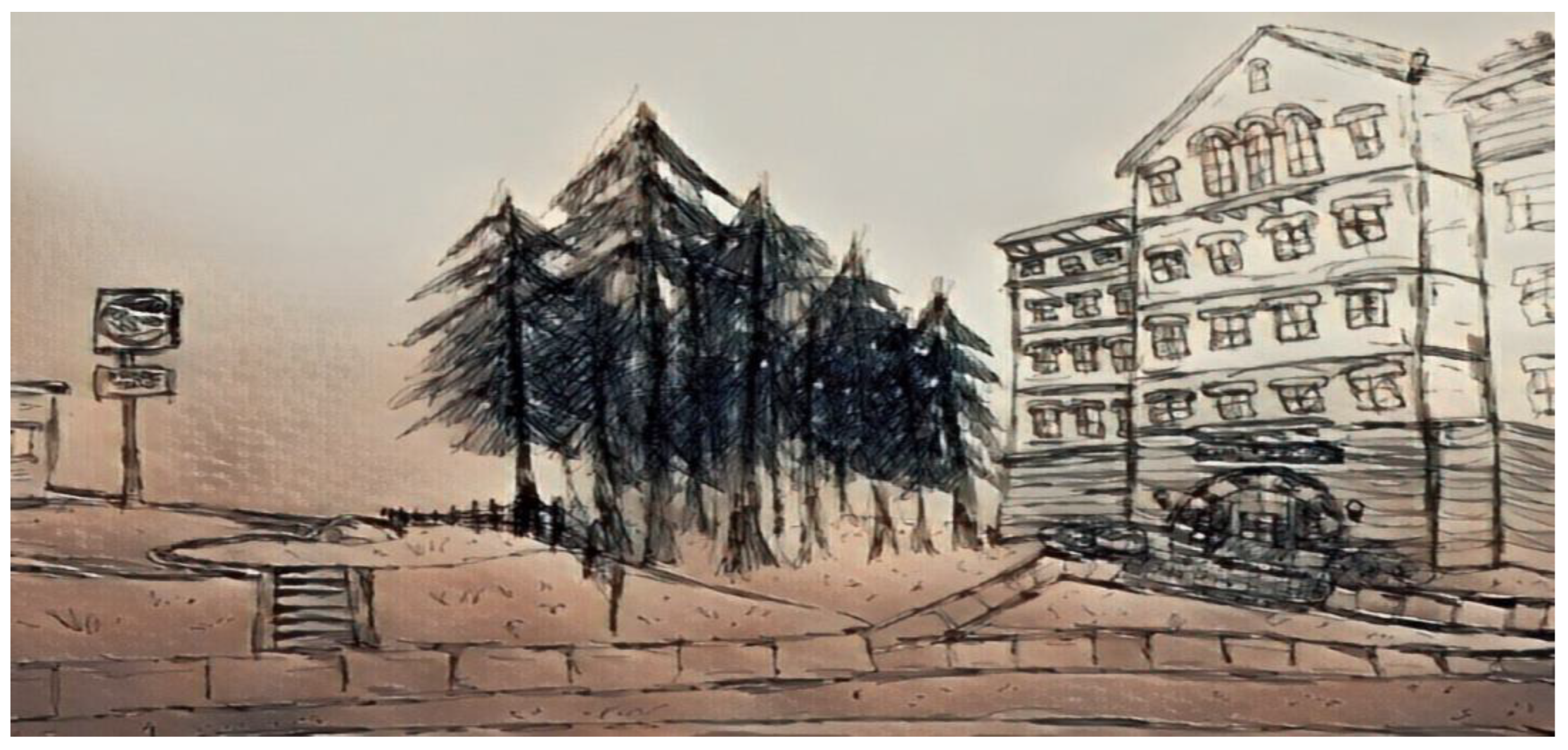
A minimalist medieval-style pastiche that dominates its downtown block, the DeVos Center sits beside a Burger King that serves as a de facto shelter for the unhoused during bad weather. Yet onsite observations show that the unhoused rarely enter the campus—even though no signs restrict access, the gates remain open and the buildings stay accessible when Burger King closes. Security patrols are infrequent and instructed not to interfere [
107,
109], and while the campus uses forensic CCTV surveillance, the cameras are not visible [
107,
109]. The facility has padded benches, semi-secluded nooks, restrooms, showers, eateries and free high-speed Wi-Fi—with most unhoused individuals owning smartphones [
110,
111]. Given these resources, their avoidance of the campus is perplexing.
A partial explanation is the DeVos Center incorporates CPETD elements, such as decorative walls, tiling changes and elevation shifts [
4], the last shown to restrict movement [
33]. Fortified stylistic cues, common in heritage-coded sites, reinforce the effect. Three of the complex’s four sides have a single arched entryway reminiscent of castle gates, and low brick walls symbolically cordon off parts of the property. The north side, adjacent to Burger King, is especially unwelcoming: visitors must navigate an awkward stairway, turn sharply and pass a chain-link fence and tree line to reach a recessed, gatehouse-like foyer (
Figure 10). Before entering, the walkway shifts from concrete to ornamental brick. Taken together, these features signal a privately controlled space [
4,
33,
112].
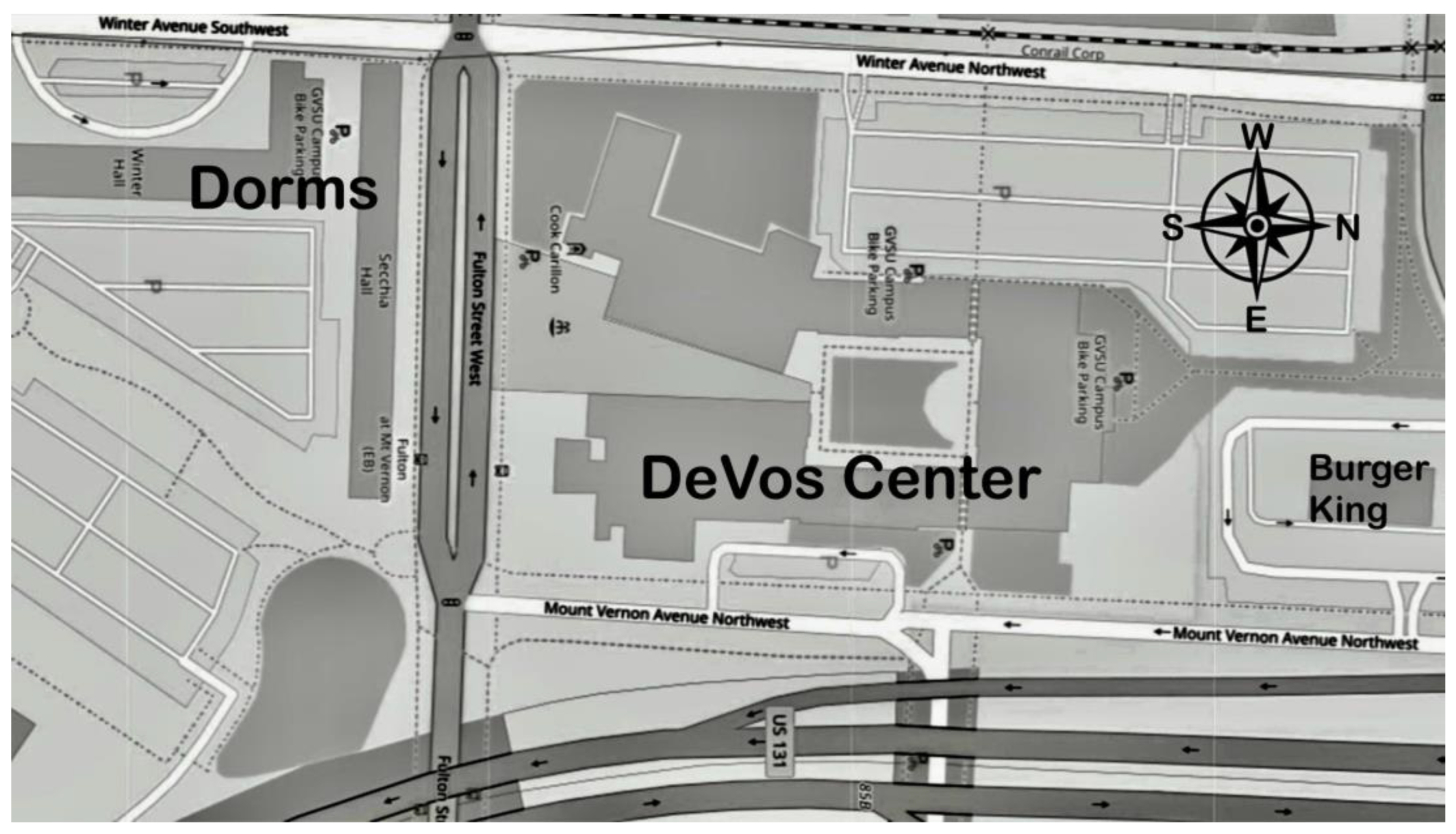
DeVos opens most where it is least exposed: the south end, farthest from Burger King, where faux-brownstone residences limit foot traffic largely to GVSU affiliates. The courtyard narrows toward the brownstones, which are more aesthetically appealing than the overpass, the Burger King or the parking lots in other directions (see
Figure 11 for map).
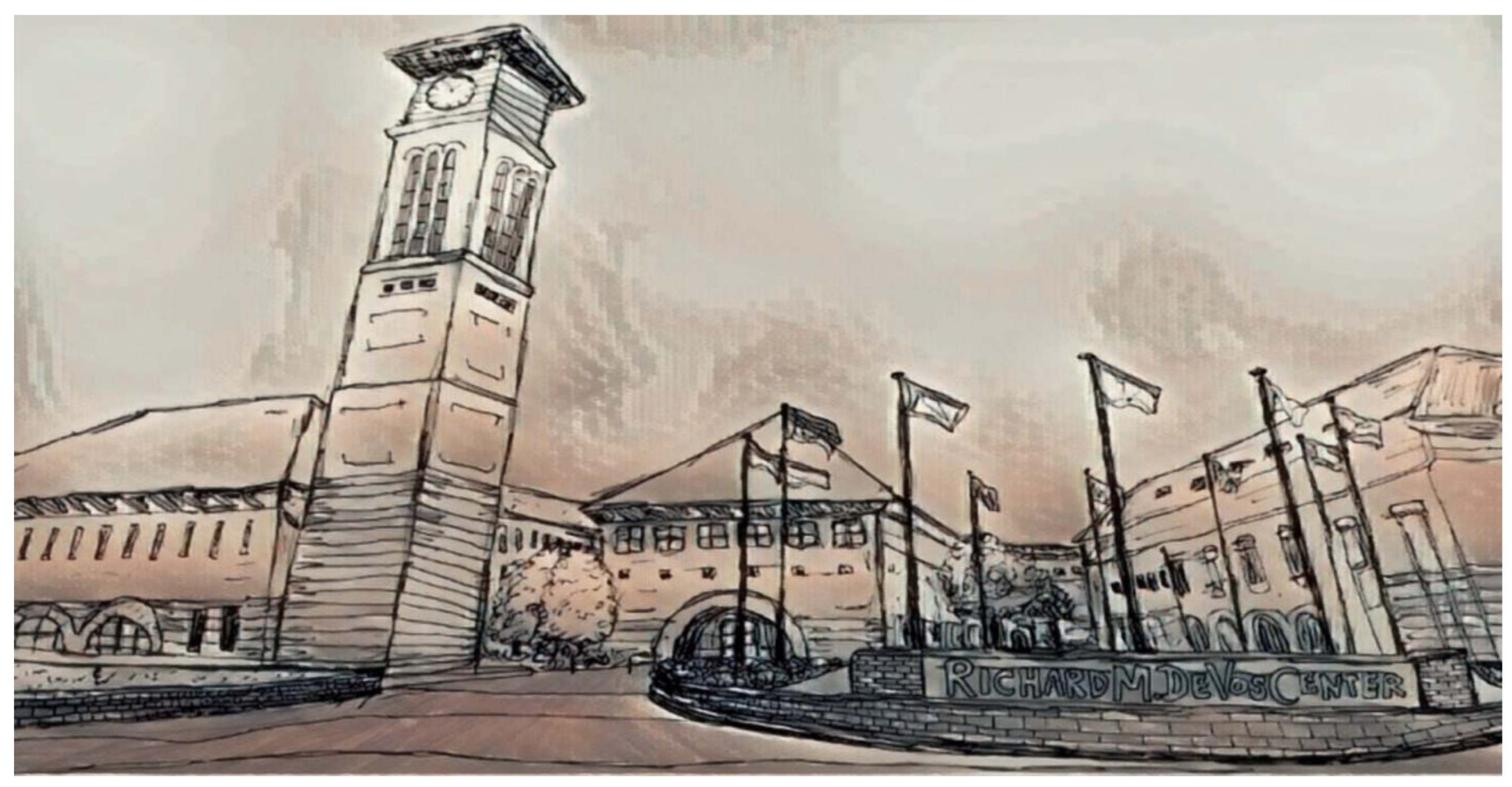
The south facing DeVos entrance, while less hostile than others, remains defensive by the standard that have been outlined. A wide walkway rises from the public sidewalk, flanked by a Gothic-style library on a raised and walled lawn. Opposite stands a barracks-like building and a high brick wall shielding a Victorian-style cottage and garden. Between these structures, a semi-circular wall bisects the wide southern entrance. It appears low from a distance but rises to two and a half meters at close range, bearing the DeVos name. Inside, international flags circle a fountain hidden from street view (
Figure 12).
Attractive as all this is, field research shows that strongly delineated boundaries and brisker elevation changes discourage movement. This defensive posture is reinforced by the Center’s feudal motifs, loosely modeled on Cambridge University [
107]. While aesthetically pleasing, these features express latent hostility, having originated as design elements intended to resist intrusion [
112]. These revivalist cues gain sharper clarity when set against the fortified structures in
Figure 13, whose defensive geometries were historically intended to keep intruders out [
97]. At ground level these buildings are most secure, with few or no windows, restricted entrances and rugged surfaces that deflect missiles, while higher levels transition to lighter masonry, ornate detailing and larger windows that taper into spire-like elements dissolving into air [
112]. Earlier analyses suggest such designs project an exclusionary atmosphere; the question here is how selectively they do so under varying social and environmental conditions.
The defensive geometries just described help illuminate the atmospheric cues that might be operating in the DeVos Center, which draws from a fortification lineage whose visual signals most observers implicitly recognize. Masonry is rougher and grayer at lower levels in the university complex, shifting to warmer tones above. At ground level, glass is limited in street-facing façades, except behind ornamental walls surrounding the library. Heavy arches reminiscent of spiked portcullises frame these windows. The adjacent clock tower reinforces this aesthetic: its base is windowless and clad in coarse gray masonry, while higher levels feature warmer brick and cascading glass (see
Figure 12 above). Both the tower and library include narrow windows resembling arrow loops.
While visually appealing, DeVos’s fortification lineage leans toward exclusion. Interviews corroborate this, not only among unhoused individuals but even among students in nearby dorms. Some described early uncertainty about whether they were allowed to enter the DeVos Center when they first moved in, recalling unease during their initial ingress. The design echoes hostile architecture, such as Robert Moses’s low overpasses in New York, said to have blocked buses carrying poorer largely Black residents to Jones Beach [
113]. Yet a key difference remains: whereas Moses imposed hard obstructions, the DeVos Center operates more subtly through social attunement to tacit territoriality cues, which Newman [
4] and more recent analyses, such as Arbib’s [
97], link to atmospheres that weigh on outsiders.
A reason these implicit territorial markers may be especially forbidding to unhoused individuals—who have been observed to gravitate toward the Burger King instead of the DeVos campus [
108]—has already been noted. They often contend with poor health, inadequate nutrition and depressed mood [
114,
115,
116], and affordance-based studies indicate such conditions—along with financial challenges—make venues less accessible, both perceptually and physically [
7,
8,
9,
10,
11]. Crucially, these embodied depletions do not operate in isolation: they interact with literal atmospheres, that is, inclement weather conditions, which shape action-readiness as directly as architectural cues do.
Onsite observations—as stated—show many unhoused people gather at Burger King to escape the elements [
105]. Heat, cold or rain sap energy, with the latter two leading people to wear cumbersome layers [
117], all while bad weather exacerbates headaches and joint pain [
118,
119,
120,
121,
122]. These strains make movement more taxing, and inclement weather itself can be action-impeding [
12]. If CPTED and feudal features press more heavily on depleted individuals, then unpleasant weather, by taxing the body, plausibly amplifies the exclusionary atmosphere projected by the DeVos Center’s heavy lines and defensive façades. Here, an uncomfortable conceptual tension emerges: architecture is usually meant to shelter people from dangerous conditions, yet its revivalist and defensive cues can repel the very individuals most in need of refuge—precisely at a moment when climate-driven extremes intensify exposure. That unhoused individuals routinely seek shelter at Burger King underscores how literal atmospheres entwine with territorial signals: architectural form can fail its core protective function when its atmospheric weight deters those already living at the edge of climatic and bodily precarity.
The situation becomes even more consequential once we consider how exclusionary design interacts with escalating climate volatility. The foregoing discussion shows that revivalist or heritage architecture—especially when coupled with CPTED-style defensive design—can operate as increasingly potent barriers under intensifying weather extremes. Where such buildings already project a forbidding affective weight on vulnerable bodies, harsher climates amplify this burden. This accords with research in affective urbanism, heritage studies and climate-change adaptation, which combine to indicate that historically coded designs interface unevenly with climate vulnerability, producing atmospheres that are politically and environmentally stratified [
22,
23,
24,
25,
93,
94,
95,
96,
123,
124,
125].
The DeVos Center, cited here as a cautionary exemplar for cities worldwide, sits within the Great Lakes basin where climatic shifts are well documented: summer lake-surface temperatures have risen faster than ambient air due to diminishing ice cover and albedo feedbacks [
126]; annual precipitation and heavy-rain events have increased by roughly 10% over the past century [
127]; and models forecast hotter, more variable summers alongside diminishing cold extremes, intensifying both heat stress and hydrologic volatility [
128]. Lake-effect research likewise shows that shrinking ice cover and warmer waters intensify localized snowfall [
129], with future lake-effect storms potentially delivering up to 14% more precipitation as atmospheric moisture increases [
130]. Under such conditions, architecture’s atmospheric and territorial signals will not merely exclude—they will collide with embodied precarity, effectively turning built form into an operative force within climate injustice.
7. Expressive Sites and Governance Through Aestheticization
Suppose an adult makes something resembling an upside-down “OK” hand sign while leaving a birthday party hosted by a Paraguayan family. In much of Latin America, this gesture means “in your ass” and can serve as a joking response to a humorous over-ask, though a Korean attendee might not know the connotation. A similar sign—originating as anti-liberal trolling—has been adopted by some members of the alt-right as a white-power symbol. If the departing guest is angry about the presence of a Black child, the gesture becomes hostile for those who grasp its implications. These examples show how gestures can be multistable without being mere mental projections, and they introduce the broader claim that architectural expressiveness can function in similarly multistable ways.
The section begins with an illustration: the DeVos Center, which has a grassy courtyard bordered by benches and decorative chains on two of its four sides. This design choice was made over the objections of the architects by former university President Arend Lubbers, who sought to emulate the empty manicured lawns of Cambridge [
131]. The chains are easy to step over yet effectively restrict access, since during extensive observations students were never observed entering the space. Interviews indicate they usually do not notice the chains or their role in excluding people, expressing bafflement as to why they sit on the lawns of the main campus in nearby Allendale but not here. This minor case of governance through aestheticization casts a restrictive aura on the area, and somewhat ironically, the aestheticization subtracts an aesthetic feature that would otherwise attract students—people—producing a self-reinforcing effect [
132].
A more explicit theoretical framing helps clarify how these architectural “gestures” operate. Quoting Koffka, Gibson observes that meaning and value are perceived directly: water says “Drink me,” thunder says “Fear me” [
2]. Though not quite Gibson’s framing, these emotive callings indicate something about the affordance field: a stormy atmosphere can impose negative affordances, reducing mobility or prompting people to seek shelter. The Koffka passage that Gibson draws from also mentions social cues from humans, such as beaconing signs, and architectural gestures can similarly widen or restrict action possibilities. The DeVos courtyard functions precisely in this register: it shapes embodied perception of value and modulates what actions feel permissible.
This dynamic becomes clearer when contrasted with an overt gestural example of what scholars characterizes as governance through aestheticization [
22,
23,
24,
25,
93,
94,
95,
96]—namely, the Babies of the Borough initiative in Southeast London. The project involved painting expressively cute, large-eyed baby faces on shop shutters to evoke communal care and was reportedly linked to crime reduction [
37]. The DeVos Center exhibits comparable patterns, albeit in more hostile directions. Like a fortress employing inward-looking convex forms [
112], it presents an introverted stance. Three façades offer a single arched entry beneath heavy stonework. Even the more open side—facing university residences—introduces subtle elevation shifts and a protruding convex wall that hides a fountain and flowers from sidewalk pedestrians. Together, these attributes present a threshold. Gesturally, the heritage-coded cues are akin to a formal handshake staged to create a courteous yet cooling distance, rather than delivering anything resembling a welcoming embrace.
Debord’s language of psychogeography offers an additional interpretive lens. As Debord might have put it, President Lubbers wished to recalibrate the psychogeography, the “effects of the geographical environment … on the emotions and behavior of individuals” [
133] (p. 23). Debord elaborates on the “appealing or repelling character of certain places” and their “distinct psychic atmospheres” and variations in “ambiance” [
133] (p. 25). All this, he says, changes “the path of least resistance which is automatically followed in aimless strolls,” but not strictly according “to the physical contour of the ground” [
133] (p. 25). Yet while Debord imagined expansive, liberating psychogeographies, the examples considered here lean toward restrictive ones.
A concern is that the insertion of aesthetic order—revivalist façades, manicured lawns or symbolic ornamentation—can manufacture a sense of civility and legitimacy that selectively excludes those who do not fit the projected user profile. Several scholars show that aesthetic and other forms of urban upgrading often depoliticize underlying conflicts, reframing governance as neutral design rather than a set of contested political decisions [
22,
23,
24,
25,
93,
94,
95,
96,
134,
135]. In this light, the DeVos Center’s revivalist styling not only communicates institutional prestige but performs a political function: it naturalizes selective permeability by presenting exclusionary cues as mere aesthetic refinement. This aligns with research on how urban design can manufacture consent through sensory appeal, projecting order and efficiency while concealing differential access to space.
This parallels earlier cases where Tahrir’s monumental flag was likened by locals to a middle finger, aligning with literature on architecture’s gestural qualities [
136,
137,
138,
139]. Importantly, these atmospheric cues have observable effects: they influence movement, comfort and occupancy. Several implications follow.
First, expressive cues can modulate a scene’s mood, yet not in the same way for all. As mentioned earlier, a stern police officer may make a scene more ominous to a wrongdoer but introduce a reassuring sense to someone seeking help. Similar dynamics appear in built environments. As seen, CPTED features in Tahrir’s 2015 redesign generated a hostile atmosphere for Egyptians who faced heightened risk there [
14,
57], and the DeVos Center—though not formally excluding the unhoused—nonetheless signals that they are less welcome than institutional affiliates. Just as the significance of gestures varies across cultures [
140], architectural atmospheres are unevenly present for different social groups. In this way, heritage-coded cues function as instruments of selective permeability.
A second and third point—highlighted already—bear emphasis. One of them is that atmospheres can deter without generating matching internal emotions [
48]. An observer may register tension in an argument or hostility in a building without feeling personally endangered. An Egyptian might perceive Tahrir’s ominous aura from afar and choose not to enter for that reason, just as a passerby can sense the DeVos Center’s unwelcoming tone without experiencing discomfort. In both cases, the deterrent effect remains. At the same time—and this is the other point—lived context can modulate how atmospheres are perceived and felt. Egyptians’ political struggles amplify Tahrir’s menace, while economic marginalization heightens the DeVos Center’s forbidding quality for unhoused individuals. These differences do not undermine the reality of atmospheres: a pub district, as noted previously, may feel—and be—threatening to a woman at night due to lived vulnerability.
Some argue that emotional atmospheres cannot exist in the world because they are not tied to single objects. Yet many properties depend on relational configurations: relativistic measurements of length, facial expressions and color constancy all rely on framing contexts [
19,
31,
141]. Atmospheres likewise arise from distributed relations among form, history and embodied vulnerability.
Beyond theoretical claims, there are clear empirical cases where atmospheres are cohort-specific. As noted, women often report that the most threatening environmental feature is simply the presence of men [
41]. This perception interacts with infrastructural and social factors, which can disrupt the dynamic. Consider, for example, the remarks of a Latin American woman interviewed as part of a larger, ethically approved project tied to this article. Although she had experienced serious safety issues across multiple South American countries, she reported that a contrasting aura permeated Buenos Aires women’s marches to la Plaza del Congreso and la Plaza de Mayo. She said these demonstrations generated “an atmosphere of unity,” marked by “collective sadness from shared pain and anger—directed outward, not inward.” This atmosphere, she stated, became “an empowering source of strength and solidarity,” a space “free from the male gaze,” where “our bodies were no longer an object” and “body autonomy was fully expressed.” She identified this as her only genuine experience of safety in South American streets. She added that this was not merely a subjective perception; in these marches, she was genuinely safer than in her typical day-to-day life.
Together, these observations reaffirm that accurate perception often involves grasping what is distributed across an entire configuration rather than confined to discrete elements. This principle applies equally to the selectively ominous atmosphere of Tahrir Square for Egyptians, the forbidding aura of the DeVos Center for the unhoused and the empowering mood of Buenos Aires marches for women. In each case, no single component—the flag, CPTED features, ornamental chains, feudal façades or the design of la Plaza del Congreso and la Plaza de Mayo—was sufficient on its own. Rather, atmospheres emerged holistically, as gestalts brought out by specific cultural and historical contexts as well as by the physical spaces. Understood in Gibsonian terms, they were genuinely present in the environment, shaping affordances and associated experiences in real and selective ways.
8. Conclusions
This article has argued that urban atmospheres are publicly available, selectively permeable fields that can be examined through ecological psychology. Social prescriptions—whether in everyday etiquette or CPTED interventions—can be as restrictive as physical barriers, generating hostile atmospheres for some more than others. The resulting view maintains Gibsonian realism about environmental meanings without undercutting how histories, habits and sociopolitical contexts foreground certain affordances.
Three conclusions follow. First, atmospheric hostility, friendliness or neutrality often reflect differential affordances rather than subjective taste: a site can be inviting to insiders yet exclusionary to others. Second, ambient cues such as elevation changes, ornamental walls, surface contrasts and symbolic installations shape who may gather, linger or traverse, functioning as political affordances. Third, atmospheres are historically sedimented and can be contested or reshaped as practices and narratives evolve.
The case studies demonstrate these points. In Tahrir Square, shifts from revolutionary openness to CPTED retrofits and later monumentalization reoriented affordances from assembly toward surveillance—appearing as beautification to tourists but atmospherically hostile to many Egyptians. This dynamic exemplifies governance through aestheticization, in which beautification, monumentalization and heritage motifs serve to project images of stability and progress while obscuring the political work of selective permeability. Such interventions often obscure spatial conflict by framing exclusion as a matter of landscape improvement rather than sociopolitical restructuring. At the DeVos Center, revivalist façades and territorial cues cultivate an exclusionary aura that deters unhoused individuals despite formal openness. By contrast, Buenos Aires women’s marches temporarily inverted ordinary street affordances, producing a rare atmosphere of safety and solidarity.
Practical implications follow. Designers and planners should assess not only formal accessibility but also differential atmospheric impacts across groups defined by gender, class, disability or migratory status. CPTED strategies must be evaluated for exclusionary side effects. Heritage managers and campus administrators should also examine whether revivalist aesthetics unintentionally produce “fortification effects.”
Climate volatility magnifies the stakes. Rising heat, erratic precipitation and intensifying storms interact with architectural boundaries, shaping how atmospheres are felt. Buildings intended as refuges can exacerbate vulnerability when their affordances exclude those most in need of shelter, turning selective permeability into a matter of survival.
Limitations remain. The analysis draws on qualitative evidence and illustrative cases, and future work might incorporate more systematic behavioral mapping and physiological indicators of effort and stress, alongside sustained longitudinal observations before and after design changes. Cross-cultural comparisons beyond the current sites would also help test the framework’s portability, and partnerships with community groups could clarify how atmospheres are co-produced in practice.
Through such efforts, we may come to better diagnose how atmospheres are designed and redesigned. We may thereby shed new light on how architecture and social prescriptions—typically mutually implying—quietly determine who feels at home, who pauses at the threshold of a venue and who gets excluded. This vision of democratic urbanism makes atmospheric permeability a civic obligation, helping produce public spaces that afford dignified passage to an ever-wider public.