
Article

Rating and Spatial Pattern Analysis of Human–Land Symbiosis Relationship from an Ecological Perspective: A Case Study of the “Five Poles” Urban Agglomeration in the Yellow River Basin
School of Economics, Qingdao University, Qingdao 266071, China
*
Author to whom correspondence should be addressed.
Urban Sci. 2026, 10(1), 40; https://doi.org/10.3390/urbansci10010040

Submission received: 3 October 2025 / Revised: 4 January 2026 / Accepted: 6 January 2026 / Published: 10 January 2026

Abstract

The “Anthropocene” has witnessed unprecedented challenges to the sustainability of human development. Resolving the contradiction between humans and land and achieving coordinated development has become a pressing issue across many disciplines in the era of ecological civilization. This study adopts an ecological perspective to investigate the symbiotic relationship between humans and land in the “Five Poles” urban agglomerations of the Yellow River Basin. In this framework, ecosystem service value and human well-being are employed to quantify “human” and “land,” respectively. The Lotka–Volterra model is then applied as a structural analogy to quantify the dynamic interactions within this symbiotic relationship, treating ecosystem service value and human well-being as two interdependent systems with feedback mechanisms. For the “Five Poles” urban agglomerations in the Yellow River Basin, the ecosystem service and human well-being pressures, along with the symbiosis indices for the period 2011–2020, were calculated and categorized. The results were first subjected to a visual analysis to describe the spatial patterns. Subsequently, spatial autocorrelation analysis was employed to quantitatively investigate the clustering and heterogeneity of these patterns, thereby systematically elucidating the spatial characteristics of human–land symbiosis in the Yellow River Basin. The findings indicate that: (1) the human–land relationship in the Yellow River Basin has evolved from partial interaction to mutualism, reflecting improved coordination within the regional human–land system. (2) The evaluation of this relationship improved between 2011–2015 and 2016–2020. (3) High-evaluation areas have shifted from east to west, exhibiting distinct agglomeration characteristics.

1. Introduction

Since the dawn of humankind, the relationship between humans and land has continually evolved. It continues to influence social and economic progress, environmental sustainability, and the long-term trajectory of human civilization. Harmony between humans and nature is essential for sustainable development [1] and for Chinese modernization. At present, resource crises and ecological degradation continue to intensify, rendering the relationship between humans and nature increasingly complex. Contradictions between humans and land—manifested in global warming, food crises, and environmental pollution—are becoming increasingly prominent. Promoting coordinated development of the human–land relationship has become a key issue in contemporary social and economic development. In this context, addressing the imbalance in the coordination mechanism of the human–land system and exploring adaptive governance pathways has become an urgent interdisciplinary research priority. At the same time, urban agglomerations can effectively address complex socio-economic and resource challenges while enriching the concept of sustainable development grounded in the harmonious coexistence of humans and nature [2].
Extensive research has been conducted on the human–land relationship. Numerous scholars, both domestically and internationally [3,4], have investigated the human–land relationship from diverse disciplines, perspectives, and scales, exploring its evolution, distribution patterns, and internal driving mechanisms. First, regarding research content, most scholars define the human–land relationship as the interaction between human activities and the geographical environment, considering it the core of geographical research. This theoretical orientation not only deepens the understanding of the human–land relationship in China but also fosters innovation in interdisciplinary research paradigms within sustainable development [5]. At the same time, the theoretical foundation of the human–land relationship has played a significant role in disciplinary development and in formulating major national development strategies [6]. Some scholars have examined the coordination between ecosystem services and human livelihoods and well-being from the perspective of human–land symbiosis. In this context, the symbiotic environment of natural ecosystems and socio-economic systems is optimized to facilitate the flow of materials, energy, and information [7,8].
Third, regarding research scale, most scholars have selected specific regions as their objects of study. For instance, Wan (2024) examined the central area of the modern Shanghai Bund, summarizing five developmental processes and stage characteristics in the evolution of the human–land relationship in this region [9]. Jing (2021) analyzed the sustainable development of the human–land system in Shandong Province with a focus on supply and demand [10]. The Yellow River Basin plays a vital role in China’s economic and social development as well as ecological security. Recent studies in the Yellow River Basin have addressed ecological carrying capacity, the impacts of human activities on ecosystems, pathways for sustainable transformation of the human–land system, and co-evolution simulations and trend predictions [11,12].
Ecosystem services link the natural environment and human well-being by providing essential products and functions [13,14]. Research on the relationship between ecosystem services and human well-being has primarily focused on quantitative assessments and impact mechanisms [15]. As a basis for studying impact mechanisms, ecosystem service assessments have developed value and material quality evaluation systems; however, their simplified numerical representations make it difficult to analyze nonlinear relationships with human well-being. Although the cascade framework enhances understanding of mechanisms through analysis of service flow processes, it fails to establish a quantitative mapping between service supply and well-being outcomes [16,17,18]. Regarding the impact mechanisms of ecosystem services and human well-being, some scholars have constructed a “cascade–coupling” transformation paradigm to analyze mutual feedback mechanisms of ecological well-being, while others have revealed spatial heterogeneity in the synergistic effects between the two through the sustainable livelihoods framework [19,20]. Scientific coordination of ecosystem services and human well-being is essential for fostering harmonious coexistence between humans and nature. This study evaluates the degree of coordination in human–land symbiosis from an ecological perspective, thereby promoting the management and sustainable development of regional ecosystems and enriching the application of ecological economics theory [21,22].
Building upon the existing research background, this study identifies gaps in the current literature, particularly the lack of a systematic incorporation of ecological symbiosis theory into watershed-scale human–land relationship analysis and the limited application of dynamic models to quantify interaction intensity. To address these gaps, the “Five Poles” urban agglomerations in the Yellow River Basin were selected as a case study to evaluate and analyze the spatial patterns of human–land symbiotic relationships from an ecological perspective. Specifically, this study is guided by three core research questions: (1) How can the dynamic interactions between ecosystem services and human well-being in the “Five Poles” urban agglomerations be quantitatively assessed? (2) What spatiotemporal evolution patterns and spatial differentiation characteristics did human–land symbiosis in this region exhibit from 2011 to 2020? (3) What drives the spatial clustering patterns and heterogeneity of human–land symbiosis among the different urban agglomerations? To answer these questions, a theoretical analytical framework for human–land symbiosis was first constructed. Subsequently, an improved equivalent factor method was employed to calculate ecosystem service values, and a comprehensive evaluation index system was developed to measure human well-being levels. Subsequently, the Lotka–Volterra symbiosis model is introduced as a structural analytical framework. Originally developed to describe interspecies dynamics, its mathematical form is adopted here to characterize bidirectional feedback and co-evolutionary relationships between systems. Crucially, this application does not equate social-ecological systems with biological populations, but rather leverages the model to capture the interactive mechanisms—competition, promotion, and symbiosis—between coupled ecosystem service value (ESV) and human well-being (HWB). Finally, spatial autocorrelation methods were utilized to reveal the spatial clustering characteristics of these relationships. This study provides not only new analytical perspectives and empirical evidence for understanding the synergistic evolution mechanisms of human–land systems in the Yellow River Basin but also offers insights for spatial management to support the basin’s ecological conservation and high-quality development strategies.

2. Analysis of the Theoretical Mechanism of Human–Land Symbiotic Relationship

2.1. Theoretical Implications and Mechanisms of Human–Land Symbiosis

2.1.1. From Biological Symbiosis to Human–Land Symbiosis

“Symbiosis” originates from biology, describing cooperative relationships formed through energy, material, and information exchange between species. Through theoretical evolution, it has become a crucial interdisciplinary analytical framework for deciphering the cooperative mechanisms of complex systems [23]. This study innovatively applies it to human–land system analysis, defining human–land symbiosis as: a dynamic equilibrium achieved through mutual benefit and co-evolution between human societies and natural geographical environments. It is fundamentally a bidirectional feedback process, not unidirectional conquest [24].

2.1.2. Basic Patterns and Mechanisms of Human–Land Symbiosis

Human–land symbiosis can be categorized into three fundamental patterns. First is mutualistic symbiosis, characterized by sustained improvements in ecosystem health and service provision alongside socioeconomic prosperity and heightened human well-being. Its underlying mechanism lies in how human “mutualistic behaviors”—such as ecological investments and green technologies—enhance ecosystem service capacity, thereby laying a solid foundation for economic development and livelihood improvements. This ultimately forms a positive feedback loop: “environmental investment → service enhancement → welfare improvement.” Second is skewed mutualism, primarily characterized by rapid economic growth accompanied by ecosystem degradation. Its root cause lies in humans pursuing short-term gains through “skewed actions” like predatory exploitation and pollution discharge, while ecosystems passively bear the pressure without receiving effective compensation for their value. Finally, competitive symbiosis manifests as severe ecosystem degradation coexisting with socioeconomic stagnation and decline. Under this model, humanity’s excessive exploitation of nature breaches ecological thresholds, causing ecosystem service functions to collapse. Conversely, the deteriorating environment severely constrains economic recovery and welfare improvement through resource scarcity and frequent disasters, trapping the system in a vicious “lose-lose” cycle.

2.1.3. Operational Mechanisms and Spatial Characteristics of Human–Land Symbiosis

The human–land symbiotic relationship operates through specific bidirectional mechanisms. From the “human” perspective, human impacts on “land” follow a three-tiered progressive model: direct exploitation, transformative development, and passive adaptation [25]. From the ‘land’ perspective, its influence on “humans” encompasses inherent impacts such as providing subsistence resources and ecosystem services, as well as feedback and retaliatory effects triggered by sustained human pressures [26]. Furthermore, spatial heterogeneity shapes regionally differentiated patterns of human–land symbiosis, with variations in resource endowments and cultural traditions jointly fostering diverse regional adaptive symbiosis patterns.

2.1.4. Quantitative Methodology: Adopting the Lotka–Volterra Model as an Analytical Analogy

To quantify the above complex dynamic symbiotic relationship, this study introduces the Lotka–Volterra model derived from ecology. Originally used to describe interactions among biological populations (such as competition and symbiosis), the essence of its mathematical structure lies in characterizing the interactive relationships between two or more dynamic systems that possess intrinsic growth logic and mutual influence mechanisms. In this research, ecosystem service value (ESV) and human well-being (HWB) are regarded as two system state variables, whose evolution at the watershed scale exhibits features similar to population dynamics, such as growth, saturation, and mutual inhibition or promotion.
Specifically, ESV serves as a quantitative representation of the total ecological function of the “land system,” whose changes are jointly influenced by natural resilience and human activities. HWB represents the development level of the “human system,” whose improvement depends both on resource utilization and ecological support, while also generating feedback on the ecosystem [27]. Here, the Lotka–Volterra model is employed as a structural analogy and analytical tool, rather than directly equating the “Earth,” “ecosystem,” or “human society” with biological populations. The competition coefficients (α, β) in the model are used to quantify the strength of mutual inhibition or promotion between ESV and HWB, while parameters such as the intrinsic growth rate reflect the inherent development potential and constraints of each system. This study draws on the mathematical framework of the model for describing interactions between dynamic systems, aiming to reveal the bidirectional feedback and trade-off mechanisms within the human–land system [28,29]. Through this approach, we move beyond static correlation analysis to dynamically quantify the direction and intensity of interactions between the two systems, thereby enabling the classification and diagnosis of human–land symbiotic patterns.

2.2. Symbiotic Relationship Between Ecosystem Services and Human Well-Being

Ecosystem services and human well-being are inextricably connected through material cycles, energy flows, and information feedback. The symbiotic evolution model comprises positive synergy, negative locking, and threshold effects. Positive synergy enhances both human well-being and ecosystem services, whereas negative locking degrades them. The threshold effect indicates that once the ecosystem’s carrying capacity is exceeded, human well-being declines rapidly. Thus, ecosystem services and human well-being are mutually influential and interdependent, producing both positive and negative effects.
From a supportive perspective, ecosystem services—serving as key carriers of human well-being—provide basic resource supplies and ecological support for social and economic activities through their multidimensional functional attributes. The United Nations Millennium Ecosystem Assessment (MA) provides a theoretical framework that categorizes ecosystem services into four groups: provisioning services, regulating services, cultural services, and supporting services. Ecosystems with sound structures and stable functions not only constitute the ecological foundation for the survival of human civilization but also ensure habitable conditions for human society through the continuous provision of services. Human well-being also exerts regulatory effects on ecosystems. Economically, human well-being enhances resource efficiency through green technologies and guides the ecological transformation of industry in line with the Environmental Kuznets Curve (EKC) theory. Socially and culturally, ecological citizenship identity is cultivated through meaning-construction strategies within the framework of environmental communication. Such multidimensional interventions ultimately enhance the resilience of social–ecological systems (SES), forming a positive feedback cycle of “environmental investment–service value–well-being.” From an ecological perspective, human activities impose pressures on ecosystems, while the limited and varied effects of natural resources influence human well-being. Humans must conserve and use natural resources efficiently in economic development, given their limited availability. Otherwise, mismanagement leads to resource depletion, constraining economic growth and diminishing human well-being. Ecosystem deterioration further reduces the efficiency of human activities and hinders high-quality economic development [30,31].
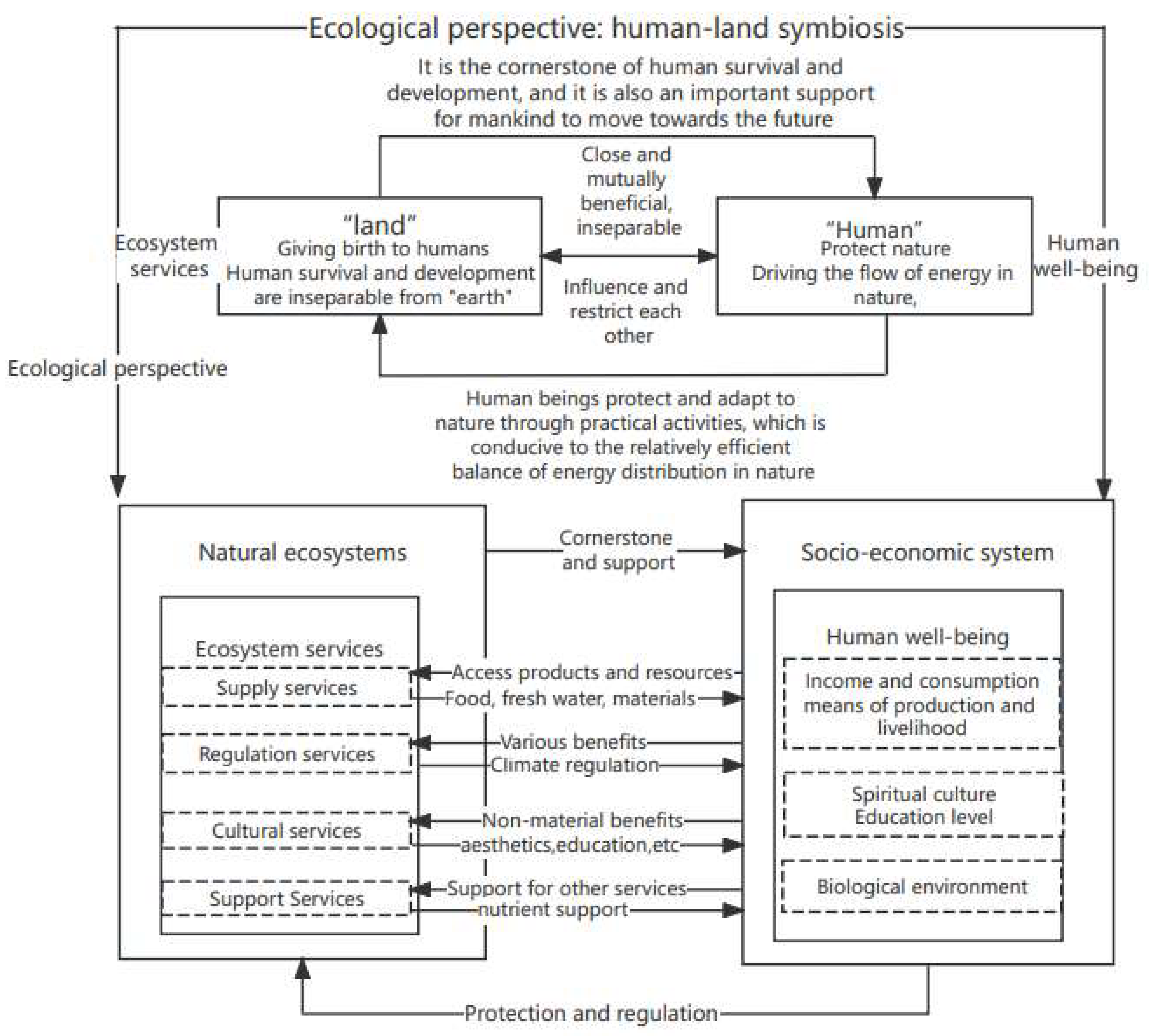
Ecosystems and human well-being are intrinsically linked. If one is disrupted, the other inevitably suffers. Three types of interactions exist between ecosystem services and human well-being: mutualism, in which both benefit; partial symbiosis, in which one benefits while the other suffers; and competition, in which both suffer. Figure 1 illustrates the theoretical mechanism of the human–land relationship.

3. Methods

3.1. Research Area and Data Source

To systematically investigate the core issues outlined in the introduction—namely, the dynamic interaction, spatiotemporal evolution, and spatial mechanisms of the human–land symbiotic relationship—a research framework integrating ecological modeling with spatial analysis was constructed using multi-source data. The research design proceeded according to the following sequence: first, ecosystem service value and human well-being level were evaluated; second, the Lotka–Volterra model was applied to calculate pressure and symbiosis indices, enabling the classification of relationship types; finally, spatial pattern analysis and spatial autocorrelation were employed to identify spatial distribution patterns and clustering characteristics. The subsequent sections provide a detailed description of the data sources and specific methodologies employed in each of these steps.
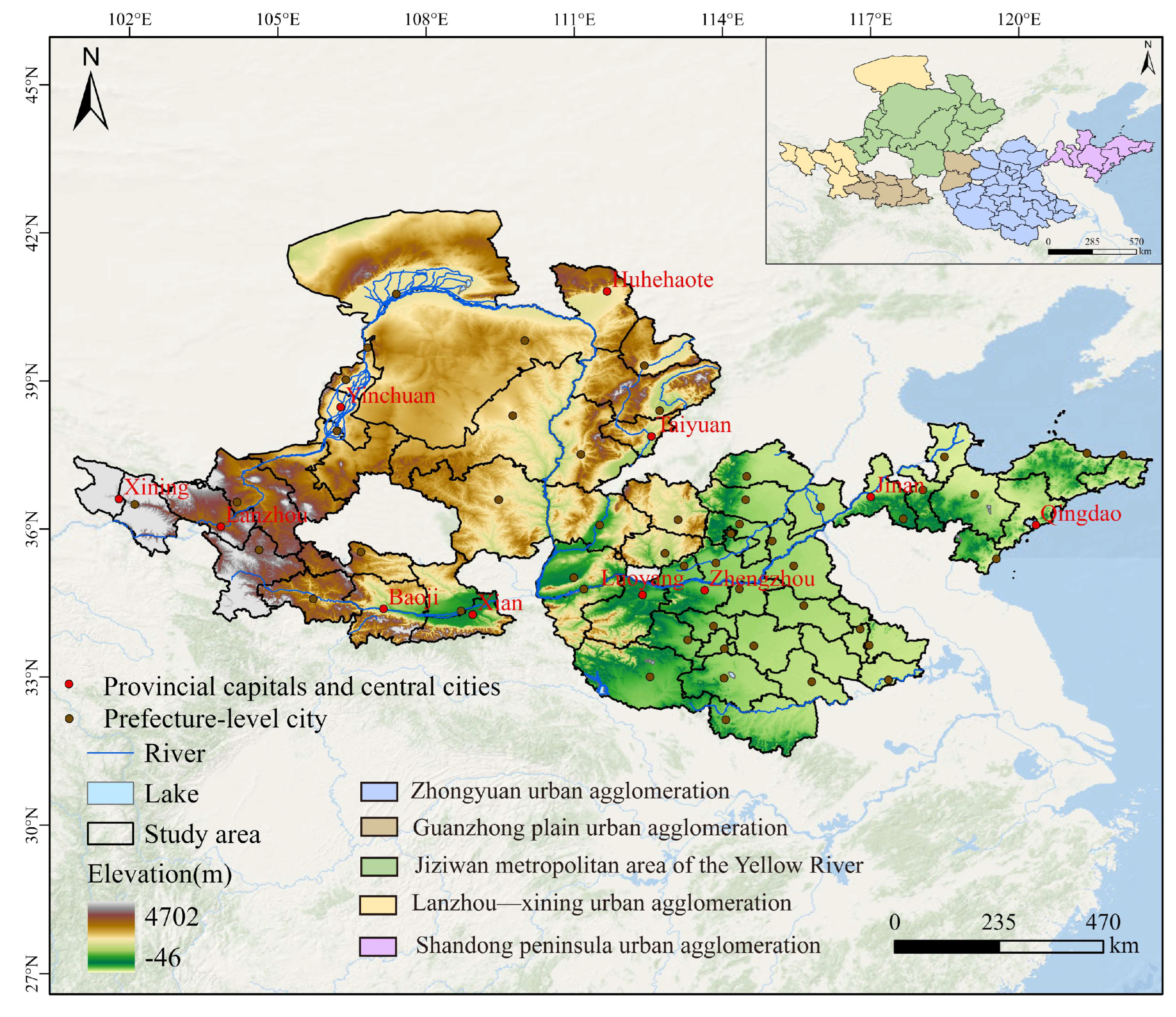
River basins are considered optimal regions for studying ecosystem services [32]. This study focuses on the “five poles” urban agglomerations within the Yellow River Basin. The region exhibits diverse vegetation, including crops, forests, and grasslands. Land use is dominated by cultivated land, wetlands, woodlands, and grasslands. The Yellow River faces severe challenges, including extensive soil erosion, limited resources and environmental carrying capacity, and unbalanced as well as inadequate development across its provinces. According to the Outline of Ecological Protection and High-Quality Development Plan for the Yellow River Basin issued by the State Council, a development framework of “one axis, two regions, and five poles” should be established, with urban agglomerations playing a leading role in promoting high-quality development across the entire basin. The “five poles” urban agglomerations of the Yellow River Basin are central to regional economic development as well as the spatial distribution of population and productivity. These urban areas are highly concentrated and densely populated, with limited land resources, thereby exacerbating the human–land contradiction. In addition, urban agglomerations—defined as groups of interacting cities within a specific scale and region—exhibit core characteristics such as polycentric structures, high integration, and ecological symbiosis [33]. This study explores the symbiotic relationship between humans and land in the Yellow River Basin, with a focus on the “five poles” urban agglomerations. These agglomerations include the Shandong Peninsula, Central Plains, Guanzhong Plain, Ji-shaped Bend Metropolitan Area, and Lanzhou–Xining urban agglomerations, spanning the upper, middle, and lower reaches of the Yellow River Basin. The “five poles” urban agglomerations are crucial for ecological protection and high-quality development in the Yellow River Basin, facilitating the efficient use of regional resources. Given that Haibei, Hainan, the South China Sea, Jiyuan, and Linxia are autonomous prefectures with substantial data gaps, 62 prefecture-level cities within the five poles were ultimately selected as the research area (Figure 2).
The data used in this paper are mainly divided into vector zoning data, land use type data, national census data, statistical yearbook data, and national agricultural product cost–benefit compilation data. Panel data of prefecture-level cities from five urban agglomerations in the Yellow River Basin from 2011 to 2023 were selected as the research sample. First, according to the time frames of the 12th and 13th Five-Year Plans as well as the content related to resources, environment, and economic development, the data were grouped for processing. The data of each prefecture-level city from 2011 to 2023 were divided into two groups: 2011–2015 and 2016–2020, which to some extent reduces the influence of policy factors (Table 1).

3.2. Calculation Method of Ecosystem Service Value

Currently, various methods exist for evaluating ecosystem service value (ESV), but no unified standard has yet been established. Among these, the equivalent factor method is particularly suitable for large-scale regional studies because of its low data requirements and computational convenience [34,35]. This study adopts the equivalent factor correction system developed by Xie et al. (2015) [36] and colleagues within the Costanza evaluation framework, adapted to China’s national conditions. It integrates relevant results from recent ESV calculations [14,36,37,38], and ultimately constructs an ESV measurement model for the “five poles” urban agglomerations in the Yellow River Basin. The ESV equivalent factor is defined as one-seventh of the average market value of major grain crops in the region. The equivalent factor of ESV was calculated as 1955.67 (CNY/ha), and the coefficients of ESV per unit area are presented in Table 2. The total ESV was calculated using the following formula:
E c   =   1 7 i = 1 n   m i p i q i M
where Ec is the economic value of providing production service function per unit area of farmland ecosystem (CNY/ha); i is crop species; pi is the national average purchase price of the i-th grain crop (CNY/kg); qi is the yield of the ith grain crop (kg/ha); m is the total area of food crops; n is the type of food crops.
ESV = i = 1 n ( LUC I × VC i )
where ESV is the ecosystem service value (element), LUCi is the area of land use type i (ha), VCi is the ecosystem service value coefficient element/(ha) of land use type i, and n is the number of regional land use types. The equivalent coefficient of ecosystem service value of ‘Wuji‘ urban agglomeration in the Yellow River Basin is calculated, as shown in Table 2.
The ecosystem service value (ESV) in this study was assessed using the equivalent factor method developed by Xie et al. (2015) [36]. Despite its recognized limitations, the method’s applicability is well-justified in the context of this research. This approach provides a simplified representation that cannot fully capture complex ecological processes, environmental heterogeneity across the basin’s upper, middle, and lower reaches, or the dynamic nature of ecosystem service flows. Nevertheless, land serves as the direct carrier of ecosystem services. Consequently, land-use-based ESV assessment allows for the rapid and accurate identification of spatial patterns across diverse regions, contributing to its status as one of the most widely adopted approaches in contemporary quantitative ecosystem service research. Among scholars in China, the equivalent factor assessment proposed by Xie et al. (2015) [36] represents the most prevalent methodology. Furthermore, its advantages—namely low data requirements and computational convenience—render it a viable approach for spatiotemporal comparative analysis across large-scale regions, thereby providing an effective means to systematically reveal macro-level interactive patterns between ESV and human well-being. Therefore, the results derived from this method will be interpreted with caution, and it is recommended that future research adopt process-based models or unit service function quantity methods to obtain more refined assessments, as suggested by [19].

3.3. Human Well-Being Evaluation Index System

The construction of human well-being indicators aims to comprehensively measure individuals’ quality of life and overall well-being. In the early development of the human well-being concept, evaluation indicators primarily consisted of economic and social measures [39]. With the involvement of researchers from diverse disciplines, indicators such as the Environmental Performance Index and the Human Development Index have gradually been proposed and applied in this field [23]. Given that subjective well-being largely derives from objective well-being, and population differences need not be distinguished in coupling studies of ecosystem services and human well-being [19], this study considers only objective well-being in its evaluation. Drawing on the research of Xue (2023) [40] and adapting to the conditions of the study area, eight second-level indicators and 18 third-level indicators were selected to evaluate human well-being across three dimensions: economy, society, and ecology. The evaluation index system for human well-being is presented in Table 3. Income and consumption reflect the income levels available to residents for expenditure and savings. Means of production and means of living capture the quality and efficiency of economic growth. Per capita road length and the number of broadband access users indicate the degree of transportation development and Internet participation, representing the ability to access resources. Social equity is reflected in the equalization of basic public services, indicating government investment and effectiveness in education, healthcare, social security, and related areas. Accordingly, the social dimension is represented by four indicators: medical security, social security, spiritual culture, and educational environment. The ecological dimension is assessed through indicators related to water resources and air quality, including industrial wastewater discharge and sulfur dioxide emissions.

3.4. Calculation of Human–Land Symbiosis Rating

The Lotka–Volterra model is adopted as a conceptual and analytical framework to quantify the symbiotic dynamics between ecosystem services (ESV) and human well-being (HWB). Originally developed to describe interspecies interactions, its mathematical structure is applied here not to equate social-ecological systems with biological populations, but to capture the direction and strength of bidirectional feedback between ESV and HWB as two interacting systems. The model’s differential equation is given in Formula (3).
d N 1 ( t ) d t = N 1 ( a 1 b 1 N 1 c 21 N 2 ) d N 2 ( t ) d t = N 2 ( a 2   b 2 N 1 c 12 N 2 )
where d N 1 ( t ) d t and d N 2 ( t ) d t represent the instantaneous growth of population 1 and population 2 during period t, respectively. Parameters a1 and a2 denote the natural growth rates of populations 1 and 2; c12 and c21 represent the competitive inhibition coefficients between the two populations; and N1 and N2 indicate the sizes of populations 1 and 2, respectively. Ecological theory suggests that within a given environment, populations of large scale inevitably encounter limiting factors that constrain their continuous expansion. Parameters b1 and b2 denote the self-limiting coefficients of populations 1 and 2, respectively [41]. Ecosystems and humans can thus be regarded as two distinct populations interacting within the framework of the human–land relationship. Accordingly, applying the Lotka–Volterra model to analyze their symbiotic relationship is considered feasible. Therefore, this study constructs a Lotka–Volterra model of ecosystem services and human well-being. The general form of the model is expressed as follows:
d E ( t ) d t   =   R E ( t ) E ( t ) ( 1     E ( t ) K E ( t )     α ( t ) H ( t ) K E ( t ) ) d H ( t ) d t   =   R H ( t ) H ( t ) ( 1     H ( t ) K H ( t )   β ( t ) E ( t ) K H ( t ) )
where E(t) denotes the value of ecosystem services, and H(t) denotes human well-being. RE(t) denotes the growth rate of ecosystem service value, RH(t) denotes the growth rate of human well-being, KE(t) denotes the maximum attainable value of ecosystem services, and KH(t) denotes the maximum attainable value of human well-being. The coefficient α(t) represents the competitive effect of ecosystem services on human well-being, while β(t) represents the competitive effect of human well-being on ecosystem services. These competition coefficients reflect the relative competitive abilities of ecosystems and humans, with larger coefficients indicating stronger inhibitory effects in the competitive relationship. The Lotka–Volterra model of ecosystem services and human well-being was discretized with reference to the gray estimation method proposed in related studies [42]. First, Formula (4) was transformed into the following general form:
d E ( t ) d t   =   a E E ( t )   +   b E E ( t ) 2   +   c E E ( t )   ×   H ( t ) d H ( t ) d t   =   a H H ( t )   +   b H H ( t ) 2   +   c H H ( t )   ×   E ( t )
Taking Equation (3) as an example, the discretized formula (6) for ecosystem service value is derived. By substituting data from different time points t into Equation (6), the matrix expression (7) of ecosystem service value is obtained:
E ( t + 1 )     E ( t )   =   a E m   +   b H m 2   +   c H m · n
Among them,
m = E t + E t + 1 2 , n = H t + H t + 1 2
Y E N = B E a E
The parameter estimation of Equation (6) is:
A I   =   [ a E , b E , c E ] T   =   ( B E T B E ) 1 B E T Y E N
The coefficients in the Formula (5) are obtained according to the matrix AE:
α t   =     c E b E , K I t   = a E b E ,   β t   =     b H c H ,   K H t   =   a H c H
Following Zhang’s (2017) research [43], the stress index SE(t) of ecosystem service value on human well-being is calculated, as expressed in Formula (9). If SE(t) > 0, ecosystem services exert a positive effect on human well-being; if SE(t) < 0, they exert an inhibitory effect. Similarly, the force index SH(t) of human well-being on ecosystem services is defined in Formula (10). If SH(t) > 0, human well-being promotes ecosystem services; if SH(t) < 0, it inhibits them. By comprehensively analyzing both indices, the degree of force coordination is determined. When both indices are greater than 0 and the symbiosis index exceeds 1, coordination is considered high and classified as Level S. If one force index is positive and the other negative, and the symbiosis index lies between 0 and 1, the system exhibits a higher level of coordinated symbiosis, classified as Levels A or B. If the symbiosis index falls between −1 and 0, it indicates a lower level of coordinated symbiosis, classified as Levels C or D. Finally, when both force indices are less than 0 and the symbiosis index is below −1, the system reflects a low-level coordinated symbiosis, classified as Level E. The classification results are summarized in Table 4.
S E t = K E t K H t + α ( t ) = a E c H b H a E b E a H
S H ( t )   = K H t K E t + β ( t ) = a H b E a H c E c H a E
The symbiotic index in Formula (13) is calculated according to the force index in Formulas (11) and (12):
S I ( t )   =   S E ( t )   +   S H ( t ) S E 2 ( t ) + S H 2 ( t )
Building on the research of Wu et al. (2019) [44], this study integrates the symbiosis index with the force index to evaluate the degree of coordinated symbiosis between ecosystem services and human well-being. In this classification, Level S represents the optimal condition, whereas Level E represents the poorest condition, as summarized in Table 4.

4. Results and Analysis

4.1. Spatial Pattern Analysis of Ecosystem Service Value

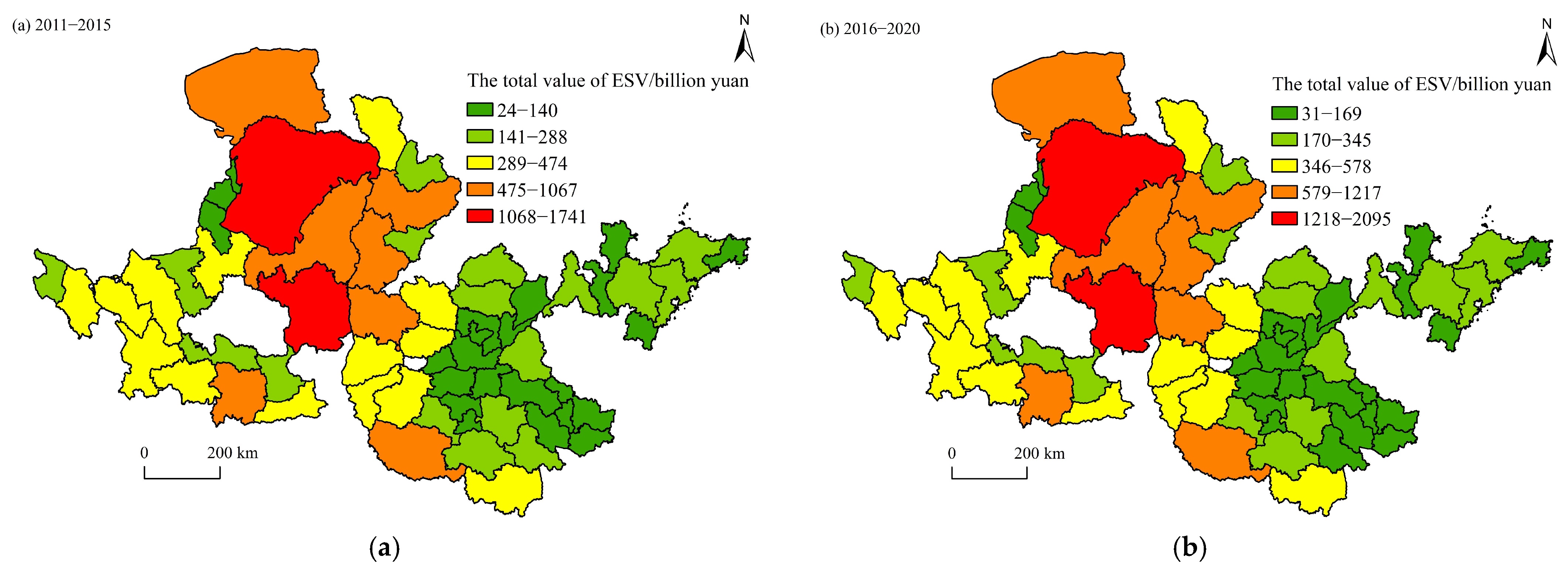
Based on the ESV coefficient table, the ESV of the “five poles” urban agglomerations in the Yellow River Basin was calculated for 2011–2015 and 2016–2020, as shown in Figure 3. Overall, the average ESV during 2016–2020 increased compared with that of 2011–2015. The Ji-shaped Bend Metropolitan Area exhibited the highest ESV. The average total ESV ranged from 106.8 to 174.1 billion yuan during 2011–2015, and from 121.8 to 209.5 billion yuan during 2016–2020. The central cities of the Ji-shaped Bend Metropolitan Area—Taiyuan, Yinchuan, and Hohhot—had relatively high ESV. These three cities constitute the core of the metropolitan area, exerting a driving effect on surrounding cities. The peripheral cities provide significant ecosystem service functions, constituting an essential component of the regional economy, society, and environment, and generating substantial ESVs. In contrast, the Central Plains Urban Agglomeration exhibited relatively low average ESVs. The total value of ecosystem services in both central and peripheral cities of this agglomeration ranged between 24 and 345 billion yuan. The ESVs of the central cities of Luoyang and Zhengzhou were comparatively low. In peripheral cities such as Nanyang and Fuyang, the average total ESV ranged from 24 to 140 billion yuan during 2011–2015, and from 31 to 16.9 billion yuan during 2016–2020. These values differed substantially from those in other areas of the Yellow River Basin. Degradation of forest ecosystem functions in these regions has resulted in ecological problems, including reduced water conservation capacity and deteriorating air quality. Although the ESVs of the “five poles” urban agglomerations in the Yellow River Basin varied spatially, the differences between central and peripheral cities were relatively small, indicating a significant radiation effect.

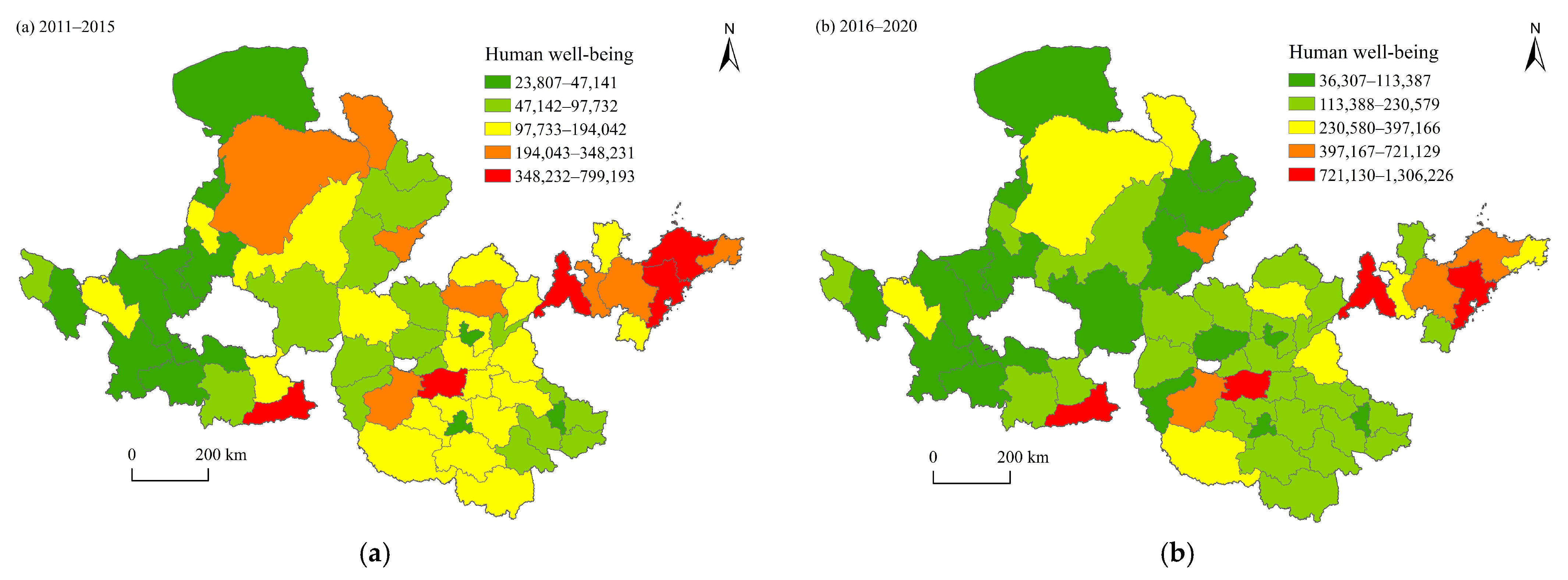
4.2. Spatial Pattern Analysis of Human Well-Being Development Level

Figure 4 presents the calculated results of human well-being. For analytical convenience, the logarithmic values were divided into five intervals: very low, low, medium, high, and very high. During 2011–2015, Qingdao, Xi’an, and Zhengzhou exhibited the highest levels of human well-being in the study area, most of them being first-tier cities. These cities served as the central hubs of the Shandong Peninsula, Guanzhong Plain, and Central Plains urban agglomerations. They were characterized by rapid economic development and convenient transportation, and neighboring cities in these regions also exhibited relatively high levels of human well-being. Other cities with higher levels of human well-being included Taiyuan, Yan’an, and Luoyang. Most cities, however, fell into the medium category. Cities with lower levels of human well-being, such as Zhongwei and Baiyin, exhibited a single industrial structure. Limited employment growth in these areas increased pressure on youth and transitional labor groups, thereby restricting overall employment and income growth. During 2016–2020, most cities in the “five poles” of the Yellow River Basin were classified at lower levels of human well-being. The Ji-shaped Bend Metropolitan Area exhibited the lowest human well-being, with central cities such as Yinchuan and peripheral cities such as Bayannur and Baiyin all falling into the lowest category. The distribution of medium-level human well-being across the “five poles” urban agglomerations of the Yellow River Basin was relatively uniform. Higher levels of human well-being were mainly concentrated in coastal areas such as Qingdao, Rizhao, and Weihai, where foreign trade, tourism, and other rapidly developing sectors supported stronger economic and cultural development compared with inland regions. Compared with 2011–2015, overall human well-being improved during 2016–2020, with a relative reduction in the number of cities classified at the medium level. Within urban agglomerations, peripheral cities tended to exhibit higher well-being when central cities were strong, and lower well-being when central cities were weak. Therefore, urban agglomerations should prioritize the development of central cities and fully leverage their radiation effect on surrounding peripheral cities.

4.3. Analysis of Symbiotic Force Index and Spatial Pattern of Ecosystem Services and Human Well-Being

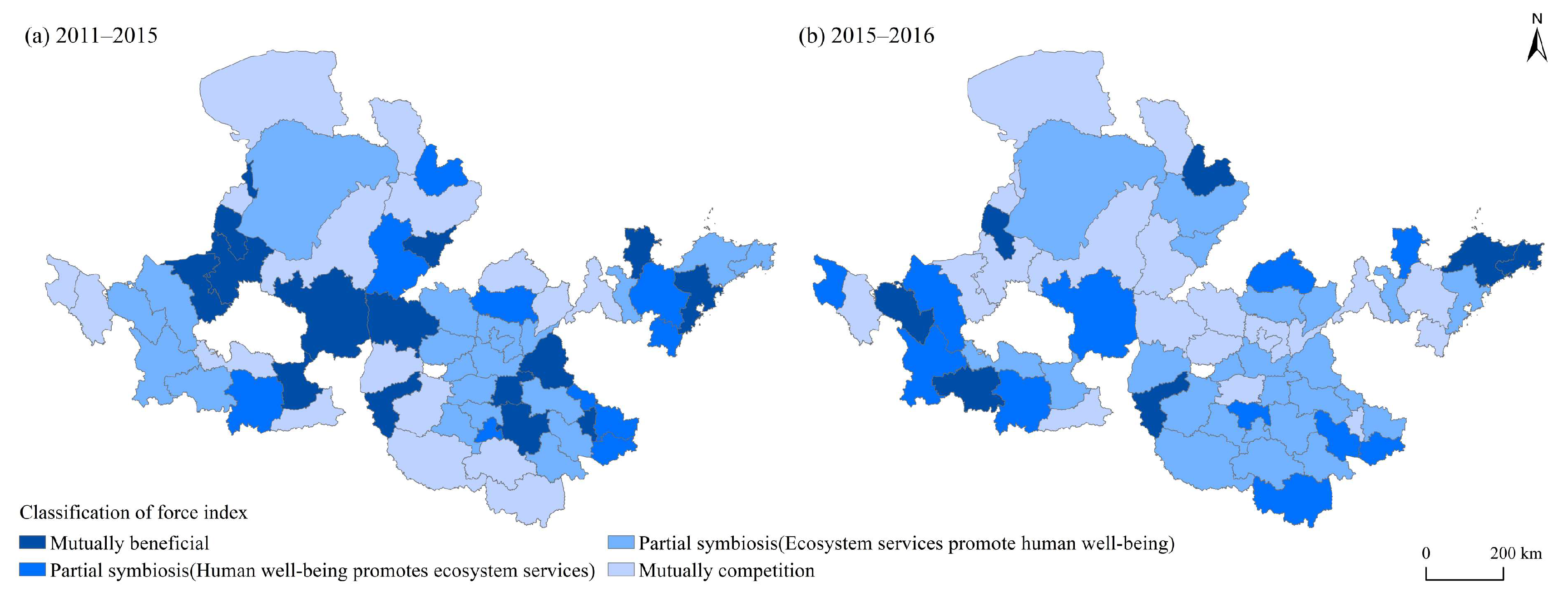
The overall stress conditions of the ‘Five Poles’ in the Yellow River Basin were first calculated. The results indicate that from 2011 to 2015, the ecosystem service pressure index (SE) was greater than 0, while the human well-being pressure index (SH) was less than 0 across the region. This pattern indicates that during this period, ecosystem services enhanced human well-being, whereas human well-being exerted a suppressive effect on ecosystem services, representing a state of partial beneficial symbiosis. This phenomenon can be attributed to the rapid economic development and a relatively less refined industrial development model prevalent in the ‘Five Poles’ during the 2011–2015 period. From 2016 to 2020, both SE and SH were greater than 0, demonstrating that ecosystem services and human well-being were in a mutually beneficial symbiotic state, reinforcing each other. This shift coincided with the region’s increasing emphasis on sustainable development, which fostered a more coordinated human–land relationship.
To conduct a more detailed analysis, force indices were calculated for the five urban agglomerations and 62 prefecture-level cities. The results are presented in Table 5 and Table 6.
According to Table 5, from 2011–2015 to 2016–2020, the stress index of the Ji-shaped Bend Metropolitan Area remained unchanged, indicating a state in which ecosystem services promoted human well-being while human well-being inhibited ecosystem services. This reflects a partial symbiotic relationship between the two. The force index of human well-being in this region remained negative, and its economic development lagged behind that of the eastern coast. This lag likely restricted infrastructure and public services, as well as residents’ income and consumption capacity, thereby inhibiting improvements in overall well-being. In the Shandong Peninsula urban agglomeration, ecosystem services consistently promoted human well-being. The human well-being stress index of the Central Plains urban agglomeration shifted from negative to positive, and the relationship between ecosystem services and human well-being evolved from partial symbiosis to mutualism. This indicates strengthened regional awareness of ecological protection and balanced socio-economic development. In the Guanzhong Plain urban agglomeration, mutual inhibition between ecosystem services and human well-being was observed during 2011–2015. During 2016–2020, the human well-being stress index shifted from negative to positive. During this period, the rise of the green economy and sustainable industries provided greater financial and technical support for ecological protection and environmental governance, thereby enhancing ecological conditions. The situation in the Lanzhou–Xining (Lanxi) urban agglomeration between 2011 and 2015 was similar to that of the Guanzhong Plain. In the subsequent five years, improvements in ecosystem services exerted a driving effect on human well-being.
According to Figure 5, the stress index of ecosystem services in Qingdao and Zhoukou shifted from positive to negative. As the central city of the Shandong Peninsula Urban Agglomeration, Qingdao exhibited significant non-equilibrium between the rate of ecosystem service function development and the intensity of regional socio-economic expansion. According to the Environmental Kuznets Curve theory, if coordination within the ecological–economic system continues to weaken and fails to be rebalanced through effective regulatory mechanisms, the regional ecological security pattern of the urban agglomeration may degrade through spatial spillover effects.
In Bayannaoer, Hohhot, and other regions, the force indices of both ecosystem services and human well-being were negative, indicating a state of mutual competition. Among these, Hohhot, as the central city of the Central Plains Urban Agglomeration, should promptly adjust its industrial structure and strengthen ecological protection. At the same time, Taiyuan and Hohhot, central cities of the Ji-shaped Bend Metropolitan Area, exhibited a commensal symbiosis type. In peripheral node cities such as Wuhai and Wuzhong, the stress indices of ecosystem services and human well-being shifted from positive to negative, indicating a transition from mutualism to mutual competition. Central cities exploit surrounding resources, while peripheral cities are compelled to undertake high-pollution industries. This dual coercion pushes the resilience thresholds of ecosystem service and human well-being systems beyond their limits, thereby increasing systemic risks. Innovating value-added pathways of ecological industrialization in peripheral cities is essential to breaking the “center–periphery” trap.

4.4. Spatial Pattern and Agglomeration Characteristics of the Symbiotic Relationship

First, using spatial visualization methods, the spatial distribution of symbiotic ratings during the periods 2011–2015 and 2016–2020 was qualitatively described, preliminarily revealing its evolutionary trends. Then, to quantitatively test the statistical significance and clustering patterns of the above spatial patterns, spatial autocorrelation analysis was conducted. Specifically, the results of the global Moran’s I indicate that the spatial distribution exhibits regular clustering characteristics. On this basis, local Moran’s I was used to further identify specific spatial association patterns in the study area, such as high-high clusters and low-low clusters.

4.4.1. Symbiotic Rating and Spatial Pattern Analysis of Ecosystem Services and Human Well-Being

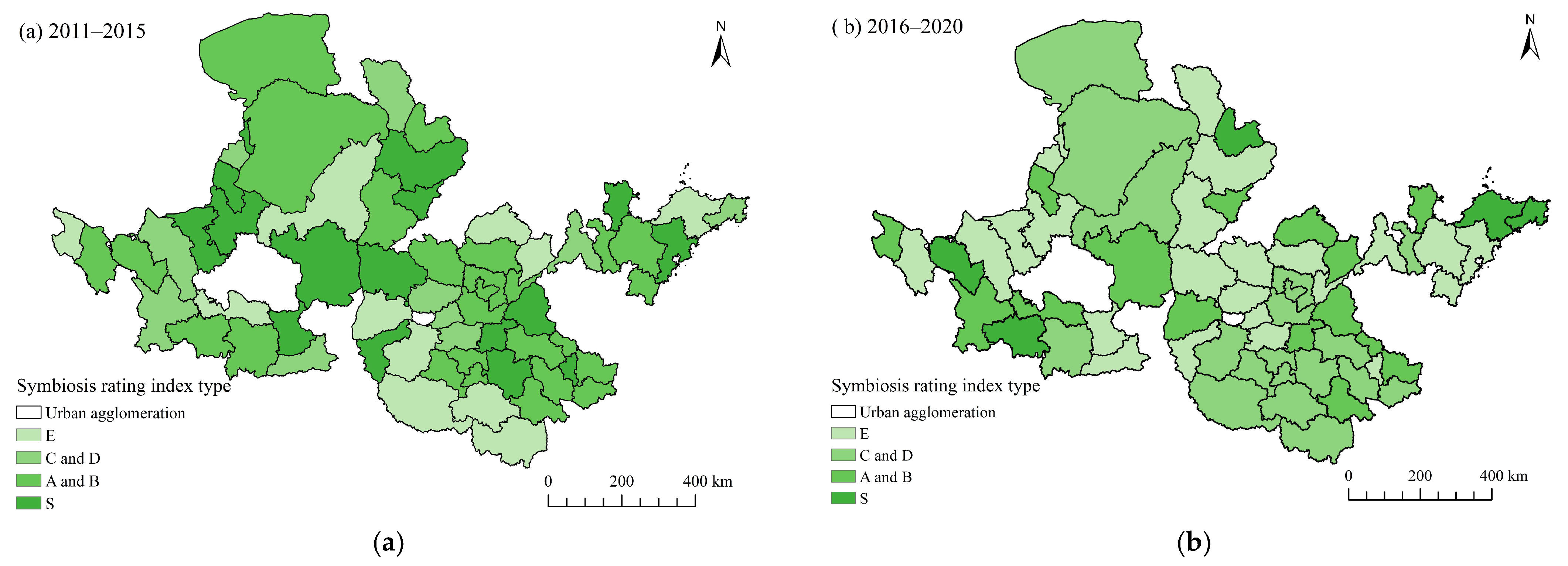
The symbiosis index of ecosystem services and human well-being was calculated based on the stress index. This study integrates these two indices and applies the rating criteria in Figure 5 to analyze the symbiosis between ecosystem service value and human well-being in the “five poles” urban agglomerations of the Yellow River Basin from 2011 to 2020. Class S represents the highest level of coordinated symbiosis; Classes A and B indicate higher-level coordination; Classes C and D represent lower-level coordination; and Class E denotes the lowest level of coordinated symbiosis.
Overall, the symbiosis ratings were Class C in 2011–2015 and Class B in 2016–2020. During the first period, the ecosystem services stress index was lower than the human well-being index, indicating weaker coordination. In the second period, the symbiosis rating improved; however, the impact of ecosystem services on human well-being shifted from promotion to inhibition, underscoring the need for sustainable development. To further examine the current state of human–land symbiosis in the “five poles” of the Yellow River Basin, this study conducted a symbiotic rating analysis of ecosystem services and human well-being across five urban agglomerations and 62 cities.
Table 6 presents the symbiotic ratings of the five urban agglomerations. The symbiosis ratings of ecosystem service value and human well-being in these agglomerations advanced to higher levels of coordinated symbiosis between 2011–2015 and 2016–2020, consistent with the overall changes observed above. The degree of human–land symbiosis coordination was high in the Shandong Peninsula and Central Plains Urban Agglomerations, indicating relatively harmonious ecosystem and human well-being systems. In contrast, coordination between ecosystem services and human well-being was low in the Lanzhou–Xining (Lanxi) and Guanzhong Plain Urban Agglomerations, likely due to shortcomings in ecological governance policies. The establishment of innovation clusters could help these two regions mitigate ecological degradation. The symbiosis rating of the Ji-shaped Bend Metropolitan Area was overall lower. Although the region plays a vital role in the development of the Yellow River Basin, its environment remains fragile. Therefore, strengthening environmental protection and governance is essential for both the Yellow River Basin and the nation as a whole.
Figure 6 presents the symbiotic ratings of 62 cities. Fifteen cities, including Kaifeng and Linfen, achieved a balance between ecological protection and economic development during 2011–2015. These cities are located in the Central Plains and Guanzhong Plain Urban Agglomerations, maintaining interdependent relationships with their central cities. Strengthening linkages between peripheral and central cities can promote factor flows and resource sharing.
From 2011–2015 to 2016–2020, the number of cities rated at Level S for symbiosis between human well-being and ecosystem services decreased, while the number classified at lower levels of coordinated symbiosis increased. This lack of coordination between urban development and the ecological environment adversely affects human–land relationships within urban agglomerations. Many urban areas, such as Baiyin, exhibited a low degree of symbiotic coordination between human well-being and ecosystem services during 2016–2020, suggesting imbalances in industrial and ecological adjustment.
During 2016–2020, Lanzhou and Weihai demonstrated a high degree of coordination and symbiosis between ecosystem services and human well-being. As the central city of the Lanzhou–Xining Urban Agglomeration, Lanzhou played a vital role in adjusting and optimizing human–land relationships. The harmonious coexistence of its human–land system has far-reaching influence and strategic significance for promoting broader human–land relationship development. Significant differences were observed in the symbiotic rating indices among cities within the Shandong Peninsula Urban Agglomeration.
This study reveals that the human–land symbiotic relationship within the watershed is characterized by coexisting synergy and heterogeneity across both the overall watershed and individual nodal scales, demonstrating significant spatial scale effects. From 2016 to 2020, the overall symbiosis ratings for the watershed and its urban agglomerations showed general improvement, which can be attributed to the macro-level guiding influence of national strategies such as ‘Ecological Civilization Construction’. Conversely, the evolutionary pathways and outcomes diverged significantly across regions. For instance, the Shandong Peninsula and Central Plains urban agglomerations progressed to an S-level (mutualistic symbiosis) status, while the Lanzhou-Xi’an (Lanxi) urban agglomeration remained in a D-level (low coordination) state. This phenomenon of ‘overall improvement amidst local differentiation’ illuminates a key evolutionary mechanism of the human–land system: while macro-level policy establishes the overarching framework, localized factors—including regional resource endowment, industrial structure, and governance capacity—are the dominant forces shaping differentiated trajectories characterized by path dependence. Therefore, watershed management should adopt targeted, zone-specific controls that are tailored to nodal typologies within the overarching strategic guidance, so as to mitigate the potential failure risk of ‘one-size-fits-all’ policies in the context of complex scale effects.

4.4.2. Spatial Autocorrelation Analysis

Building upon the preceding analysis of the ecosystem service and human well-being co-ratings, pronounced disparities in ratings across regions have been initially identified. However, whether this observed pattern is statistically significant or a product of random spatial processes necessitates statistical verification. To this end, this study utilizes spatial autocorrelation analysis, incorporating both global and local Moran’s I indices to examine the inherent spatial clustering and heterogeneity. Specifically, the global Moran’s I evaluates the overall similarity of attribute values across spatial units at a regional scale, determining the general tendency toward clustering or dispersion. In contrast, the local Moran’s I detects specific spatial clusters and outliers at a local scale by comparing each unit’s attribute value with those of its neighbors, thereby revealing localized spatial correlation patterns. For both indices, statistical significance was tested against the null hypothesis of spatial randomness, with a p-value of less than 0.1 indicating significant spatial autocorrelation. All computations for the global and local Moran’s I indices were performed using Stata 17.0.
(1). Global Moran’s I Analysis
A global Moran’s I value greater than 0 indicates positive spatial correlation (i.e., agglomeration), meaning that the rating of a prefecture-level city is similar to that of its neighboring provinces and cities when both are relatively high. A value less than 0 indicates negative spatial correlation (i.e., discreteness), where substantial rating differences exist between a prefecture-level city and its neighbors. Reliable application of the global Moran’s I requires more than 30 samples. This study employed data from 62 cities across five urban agglomerations in the Yellow River Basin, thereby satisfying the sample size requirement. Both global and local spatial autocorrelation tests require a spatial weight matrix, which in this study was constructed using a distance matrix based on geographical distance. The distance matrix was incorporated into the spatial weight matrix to describe spatial relationships, such as relative distance or adjacency between locations.
According to Table 7, the symbiosis index of ecosystem service value and human well-being during 2011–2015 exhibited no significant spatial autocorrelation and tended toward a random distribution. The global Moran’s I was significantly negative during 2016–2020, indicating substantial disparities between the symbiosis ratings of adjacent cities. From a temporal perspective, the global Moran’s I was not significant in 2011–2015 but became significant in 2016–2020, suggesting that spatial symbiosis between ecosystem service value and human well-being gradually intensified over time, with spatial distribution exhibiting regular agglomeration characteristics.
(2). Local Moran’s I Analysis
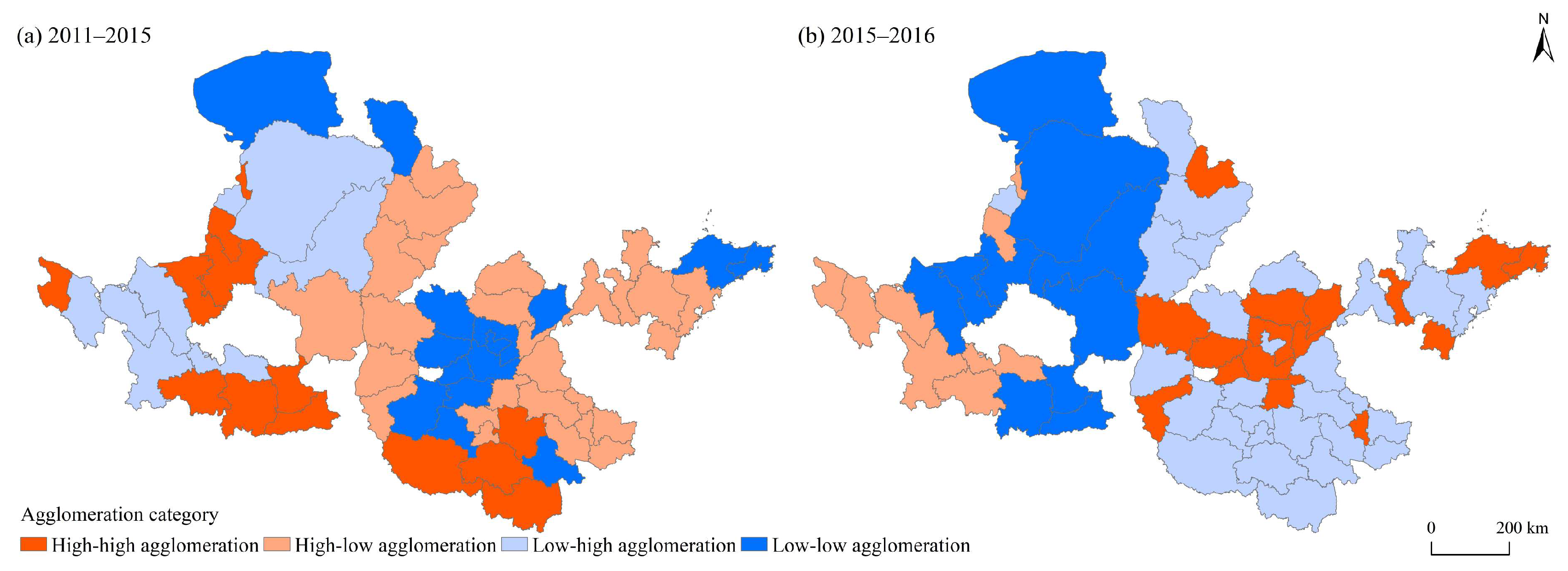
The global Moran I tests spatial autocorrelation at the regional (macro) scale. However, as emphasized by Wang et al. (2014) [45], global spatial autocorrelation does not necessarily reflect local spatial autocorrelation. Thus, agglomeration identified by the global Moran’s I does not imply that all subregions exhibit clustering. The global Moran’s I reflects only overall spatial autocorrelation, and it cannot directly capture local-level patterns. Within a region, some samples may exhibit positive correlation while others display negative correlation. In such cases, positive and negative correlations may offset each other, causing the global Moran’s I to approach zero and its significance to decline. To address this limitation, this study calculated the local Moran’s I for the study area. The local Moran’s I, also known as the Local Indicators of Spatial Association (LISA), was first proposed by Alon et al. (2016) [46]. The local Moran’s I can accurately capture the spatial autocorrelation of local samples. The clustering results derived from the local Moran’s I scatter plot are presented in Figure 7.
The four quadrants of the local Moran’s I scatter plot represent distinct types of spatial association. The first quadrant corresponds to High–High agglomeration, where both a region and its neighboring regions exhibit high ratings, reflecting positive spatial autocorrelation. The second quadrant corresponds to Low–High agglomeration, where a region with low ratings is surrounded by higher-rated neighbors, reflecting negative spatial autocorrelation. The third quadrant corresponds to Low–Low agglomeration, where both a region and its neighbors exhibit low ratings, also representing positive spatial autocorrelation and reflecting low-value clustering. The fourth quadrant corresponds to High–Low agglomeration, where a region with high ratings is surrounded by lower-rated neighbors, reflecting negative spatial autocorrelation.
According to Figure 7, in the 2011–2015 local Moran’s I scatter plot, most cities fell into the High–Low quadrant, exhibiting spatial negative correlation. In these cases, urban ecosystem service and human well-being ratings were higher than those of their neighboring cities. During 2016–2020, most cities shifted to Low–High agglomeration. Compared with 2011–2015, more cities were influenced by higher-rated neighbors. For example, cities near Qingdao and Bozhou may have been influenced by higher-rated neighboring areas, with ratings expected to gradually increase over the next five years due to policy spillover effects, environmental advantages, and other contextual factors. There were 13 cities with High–High agglomeration in 2011–2015 and 16 cities in 2016–2020. These cities shared high symbiotic ratings with their surrounding areas and demonstrated spatial clustering. Such clustering may be attributed to natural conditions, levels of economic development, population density, and other influencing factors. The pattern of Low–Low agglomeration was similar to that of High–High agglomeration. The number of cities exhibiting Low–Low agglomeration decreased slightly in 2016–2020 compared with 2011–2015, but the overall change was not substantial.

5. Discussions

This study applied the Lotka–Volterra model to analyze the dynamic interaction between ecosystem service value (ESV) and human well-being (HWB) in the five core urban agglomerations of the Yellow River Basin. The following discussion directly addresses the three core research questions proposed in the Introduction, interprets the research findings by comparing them with existing literature, and explores their broader implications.

5.1. Quantitative Assessment of Dynamic Interactions: The Lotka–Volterra Model as a Diagnostic Tool

The first research question is: How to quantitatively assess the dynamic interaction between ecosystem services and human well-being? This study addresses this question by applying the Lotka–Volterra model—a fundamental ecological theoretical model describing species interactions [41]—to the human–land system. Treating ESV and HWB as two interacting “populations”, the model not only quantifies their coordination state, but more importantly, measures the direction and intensity of their bidirectional impacts. This approach fills a critical gap identified in the literature review: traditional static coupling metrics or cascade frameworks often fail to establish quantitative mappings of dynamic feedback loops [16,18]. Our application demonstrates that the model can effectively classify symbiosis types (e.g., mutualism, competition) and reveal transitions masked by composite indices, such as the “coordination paradox” discussed below. While analogous applications of this model exist in economic-ecological systems [42,44], its systematic application to ESV-HWB correlation analysis at the urban agglomeration scale provides an innovative methodological contribution to regional sustainability assessment.

5.2. Spatiotemporal Evolution and Spatial Differentiation: From Fragmentation to Clustered Interdependence

The second research question concerns the spatiotemporal evolution patterns and spatial differentiation characteristics during the period 2011–2020. Our findings reveal a clear trajectory: the human–land relationship at the basin scale evolved from commensalism (2011–2015) to mutualism (2016–2020). This positive trend aligns with broader assessments indicating that China’s ecological governance has been progressively strengthened during this period, particularly under the framework of ecological civilization construction [8]. However, the significant spatial heterogeneity we observed—where the Shandong Peninsula achieved a high level of mutualism while the Lanzhou-Xining region remained in a state of low coordination—echoes findings from studies of other large river basins, which highlight the highly uneven distribution of development and conservation outcomes due to geographical gradients and economic disparities [11,32]. This confirms that a “one-size-fits-all” interpretation of progress across the entire basin is inadequate.
Spatially, the shift from a random pattern to a significant “high-low” clustering pattern (reflected in changes in the global Moran’s I) indicates the growing importance of regional interdependence. The formation of “high-high” clusters (e.g., around Lanzhou and Weihai) and “low-low” clusters suggests the existence of spatial spillover effects, similar to patterns observed in regional innovation or pollution studies [45]. This spatial clustering directly addresses the question of spatial differentiation, transcending the simplistic east–west narrative and highlighting specific synergy zones and risk zones. The “core-periphery trap” observed in the “ji-shaped” bend urban agglomeration of the Yellow River—where the development of core cities appears to inhibit peripheral areas—resonates with research on unbalanced development within urban agglomerations [33].

5.3. Drivers of Clustering and Heterogeneity: Dissecting the Coordination Paradox and Policy Effectiveness

The third research question explores the drivers of spatial clustering patterns and heterogeneity. Our analysis points to the complex interaction of multiple factors, centered on the identified “coordination paradox”. This paradox—that the overall symbiosis rating improved despite the shift in ESV’s impact on HWB from promotion to inhibition—suggests that underlying drivers may be creating unsustainable tensions. This phenomenon can be interpreted through the lens of the Environmental Kuznets Curve (EKC) hypothesis and its critiques. The initial improvement in coordination may reflect the early stage of the EKC, where growing economic capacity (HWB) allows investment in improving certain aspects of environmental quality (ESV). However, the shift toward inhibitory pressure may indicate that the scale and nature of economic growth are beginning to overwhelm the regulating and supporting services that underpin long-term well-being—a common challenge in rapidly urbanizing regions [10,19,47]. This implies that even “greener” overall economic growth may exacerbate pressure on critical ecological foundations, a driver often overlooked in purely economic or composite environmental indices.
The spatial heterogeneity of symbiosis outcomes further points to regionally differentiated capabilities as a key driver. The success of the Shandong Peninsula may stem from its stronger economic base, diversified industries, and greater capacity for green technology adoption, enabling its transition to mutualism. In contrast, regions like Lanzhou-Xining, which rely more on resource-intensive industries and have more fragile ecological foundations, face more arduous transformation challenges, resulting in path dependence and low coordination. This aligns with the sustainable livelihoods framework, which emphasizes that different capital endowments lead to distinct social-ecological outcomes [20]. Furthermore, spatial clustering itself acts as a driver, as adjacent regions with high or low coordination can reinforce their development trajectories through shared policies, resource flows, or common challenges.

5.4. Broader Implications and Limitations

These findings have important implications for the high-quality development strategy of the Yellow River Basin. They advocate for the implementation of differentiated and spatially aware governance. Policies must move beyond basin-wide uniform targets and identify distinct symbiosis types: promoting innovation in high-coordination clusters, implementing targeted ecological compensation and capacity-building in low-coordination trap zones, and managing cross-administrative spillover effects in clustered regions.
This study is not without limitations, which also point to directions for future research. First, the equivalent factor method used for ESV calculation, while convenient for large-scale analysis, simplifies complex ecological processes. Future work could integrate spatially explicit ecosystem process models [37]. Second, the HWB index is objective; incorporating subjective well-being data would enrich the analysis [39]. Third, applying the Lotka–Volterra model—originally developed in population ecology—to human-environment coupled systems inevitably involves inherent theoretical simplifications and applicability boundaries. The model assumes interactions to be direct, instantaneous, and symmetric, which may not fully capture delayed feedback, threshold effects, and multi-level indirect causal chains commonly observed in socio-ecological systems. Furthermore, key parameters in the model, such as intrinsic growth rate and environmental carrying capacity, carry meanings in human–land systems that are far more complex than in purely biological contexts, as their values often integrate both natural dynamics and socio-economic processes. In this study, the model is employed primarily to leverage its formalized structure in revealing the relative direction and intensity of bidirectional interactions between ESV and HWB, rather than to precisely simulate biological population dynamics. Future research could further integrate complex-system tools such as system dynamics models or agent-based models to better incorporate external drivers and micro-level mechanisms, including climate change, policy interventions, and multi-agent behavioral heterogeneity.
In conclusion, by directly addressing the proposed research questions and contextualizing the findings within existing scientific discourse, this study shows that the human–land relationship in the Yellow River Basin is undergoing a complex transformation, characterized by overall progress, a hidden “coordination paradox”, and entrenched spatial inequalities. It underscores the necessity of dynamic assessment tools and context-specific policies for advancing toward a path of genuine, sustainable mutualism.

6. Conclusions

This study employs the Lotka–Volterra symbiosis model and spatial analysis methods to evaluate and analyze the human–land symbiosis patterns within the five major urban clusters of the Yellow River Basin during 2011–2020. The primary findings are as follows:
  • The human–land symbiosis model achieves a qualitative leap from “partial reciprocity” to “holistic mutual benefit.”
    • The model results of this study indicate that the overall human–land relationship within the “Five Poles” of the Yellow River Basin has undergone a paradigm shift from partial symbiosis (2011–2015, SE > 0, SH < 0) to mutually beneficial symbiosis (2016–2020, SE > 0, SH > 0). This transformation did not occur uniformly but exhibited significant inter-city heterogeneity. Specifically, while the Ji-shaped Bend Metropolitan Area maintained its original partially symbiotic pattern, the other four urban clusters all upgraded their symbiosis models: the Shandong Peninsula and Central Plains Urban Clusters advanced from partially symbiotic or mutually inhibitory to mutually beneficial symbiosis (S-level), while the Guanzhong Plain and Lanzhou-Xining Urban Clusters transitioned from mutual inhibition (E-level) to lower-level coordinated symbiosis (C-level and D-level). This finding demonstrates that during the 13th Five-Year Plan period, the synergy between ecological conservation and socioeconomic development has substantially strengthened across most regions of the Yellow River Basin.
  • Symbiosis ratings have significantly improved, but the direction of interactions between subsystems has undergone a critical shift.
    • From a comprehensive rating perspective, the overall symbiosis index of the river basin improved from Class C (lower coordination level) in 2011–2015 to Class B (higher coordination level) in 2016–2020. Ratings for all five major urban agglomerations increased (Table 7), with 20 cities achieving Class S symbiosis representing high coordination. However, an in-depth stress index analysis reveals a critical issue: while ratings improved, the stress index (SE) of ecosystem services on human well-being shifted from a facilitating role to an inhibiting one. This indicates that despite increased overall system coordination, the marginal benefits of ecological services may be diminishing, or the dependency pattern of economic growth on ecological services has not fundamentally changed. This suggests that potential pressures on future sustainable development remain.
  • High-value areas exhibit a spatial shift from east to west, forming a pronounced clustering pattern.
    • Spatial analysis clearly reveals the dynamic evolution of symbiosis rating patterns. During 2011–2015, high-rating areas were primarily concentrated in the Shandong Peninsula urban cluster in the east and the “U-shaped” metropolitan area in the central region. By 2016–2020, high-rating areas shifted westward, predominantly clustering in the Lanzhou-Xining urban cluster. The global Moran’s I index shifted from insignificant negative correlation (2011–2015) to significant negative correlation (2016–2020), confirming that the spatial pattern of symbiotic relationships evolved from random distribution to distinct “high-low” or “low-high” clustering patterns. This implies adjacent distribution of high-rated and low-rated cities, with simultaneous intensification of spatial differentiation and dependency. The local Moran’s I further identifies “high-high” clusters represented by Lanzhou and Weihai, and “low-low” clusters represented by Baiyin and Zhongwei, providing precise spatial targeting for implementing differentiated regional collaborative governance policies.

Author Contributions

Conceptualization, X.Z.; Methodology, X.Z.; Formal analysis, X.Z.; Investigation, X.T.; Data curation, X.T.; Writing – original draft, X.T.; Writing – review & editing, X.Z.; Funding acquisition, X.Z. All authors have read and agreed to the published version of the manuscript.

Funding

This research was funded by the MOE (Ministry of Education in China) Project of Hu-manities and Social Sciences, grant number 20YJCZH249 and the Department of Science and Technology of Shandong Province, grant number ZR202211300436.

Institutional Review Board Statement

Not applicable.

Informed Consent Statement

Not applicable.

Data Availability Statement

The raw data supporting the conclusions of this article will be made available by the authors on request.

Acknowledgments

The authors have reviewed and edited the output and take full responsibility for the content of this publication.

Conflicts of Interest

The authors declare no conflicts of interest.

References

  1. Giddings, B.; Hopwood, B.; O’Brien, G. Environment, economy and society: Fitting them together into sustainable development. Sustain. Dev. 2002, 10, 187–196. [Google Scholar] [CrossRef]
  2. Qiu, J.; Yu, D.; Huang, T. Influential paths of ecosystem services on human well-being in the context of the sustainable development goals. Sci. Total Environ. 2022, 852, 158443. [Google Scholar] [CrossRef] [PubMed]
  3. Harden, C.P. Framing and reframing questions of human-environment interactions. Ann. Assoc. Am. Geogr. 2012, 102, 737–747. [Google Scholar] [CrossRef]
  4. Ma, E.; Cai, J.; Han, Y.; Liao, L.; Lin, J. Research progress and prospect of remote coupling of human-earth system. Adv. Geogr. Sci. 2020, 39, 310–326. [Google Scholar]
  5. Wu, C. Human-Land Relationship and Economic Layout: Wu Chuanjun’s Anthology; Xueyuan Press: Beijing, China, 1998; pp. 28–33. [Google Scholar]
  6. Lu, A. Theoretical study on the human-terrestrial system in geography. Geogr. Stud. 2002, 21, 135–139. [Google Scholar]
  7. Xie, W.; Hu, B.; Zhang, L. Coupling relationship and simulation prediction of ecosystem services and people’s livelihood and well-being from the perspective of human-land symbiosis: A case study of Karst-Beibu Gulf in Southwest Guangxi. J. Environ. Eng. Technol. 2024, 14, 583–591. [Google Scholar]
  8. Moldan, B.; Janoušková, S.; Hák, T. How to understand and measure environmental sustainability: Indicators and targets. Ecol. Indic. 2012, 17, 4–13. [Google Scholar] [CrossRef]
  9. Wan, Y. Analysis of the evolution of human-land relationship in the deep area of modern Shanghai Bund (1843–1949). Fudan J. (Soc. Sci. Ed.) 2024, 66, 67–74. [Google Scholar]
  10. Jing, B. Research on the Sustainable Development of Human-Land Systems from the Perspective of Supply and Demand. Ph.D. Thesis, Shandong Normal University, Jinan, China, 2021. [Google Scholar]
  11. Liu, H.; Lu, J.; Wang, C.; Ding, Y.; Yang, Z.; Li, Z.; Qiao, J. Spatio-temporal coupling analysis of human-nature interactionsin the Yellow River Basin based at a grid scale. Acta Ecol. Sin. 2024, 44, 6499–6512. Available online: https://www.ecologica.cn/stxb/article/abstract/stxb202401250238 (accessed on 11 January 2025).
  12. Zhang, H.; Xu, K.; Guo, F.; Liu, A. Research on the sustainable utilization of water resources in the Yellow River Basin based on the ecological footprint of water resources. J. Environ. Eng. Technol. 2024, 14, 1732–1742. [Google Scholar]
  13. Liu, Y.; Zhao, W.; Ding, J. Research progress and prospect of grassland social-ecological system. Resour. Sci. 2024, 46, 1523–1539. [Google Scholar]
  14. Costanza, R.; d’Arge, R.; de Groot, R.; Farber, S.; Grasso, M.; Hannon, B.; Limburg, K.; Naeem, S.; O’Neill, R.V.; Paruelo, J.; et al. The value of the world’s ecosystem services and natural capital. Nature 1997, 387, 253–260. [Google Scholar] [CrossRef]
  15. Liu, D.; Chen, H.; Wang, Q.; Zhang, J.; Shi, J. The influence mechanism of village ecosystem services on human well-being in loess hilly and gully region: A case study of Mizhi County, Shaanxi Province. Soil Water Conserv. Res. 2024, 31, 69–78. [Google Scholar]
  16. Peng, J.; Hu, X.; Zhao, M.; Liu, Y.; Tian, L. Research progress on ecosystem service trade-offs: From cognition to decision-making. Geogr. J. 2017, 72, 960–973. [Google Scholar]
  17. Wang, B.; Zhang, Q.; Cui, F.Q. Scientific research on ecosystem services and human well-being: A bibliometric analysis. Ecol. Indic. 2021, 125, 107449. [Google Scholar] [CrossRef]
  18. Lu, A.; Fan, J. The rise and role of regional sustainable development research. Proc. Chin. Acad. Sci. 2012, 27, 290–300+319. [Google Scholar]
  19. Qiu, J.; Liu, Y.; Chen, C.; Huang, Q. The spatial pattern and driving forces of the coupling of ecosystem services and human well-being: A case study of Guangzhou. J. Nat. Resour. 2023, 38, 760–778. [Google Scholar]
  20. Long, Q. A Study on the Coordinated Development of Ecosystem Services and Residents’ Well-Being from the Perspective of Livelihood. Master’s Thesis, Guizhou Normal University, Guiyang, China, 2024. [Google Scholar]
  21. Hariram, N.P.; Mekha, K.B.; Suganthan, V.; Sudhakar, K. Sustainalism: An integrated socio-economic-environmental model to address sustainable development and sustainability. Sustainability 2023, 15, 10682. [Google Scholar] [CrossRef]
  22. Semeraro, T.; Scarano, A.; Buccolieri, R.; Santino, A.; Aarrevaara, E. Planning of urban green spaces: An ecological perspective on human benefits. Land 2021, 10, 105. [Google Scholar] [CrossRef]
  23. Liu, J. Research on the Collaborative Development of ‘People-Land-Industry’ in Rural Tourism from the Perspective of Symbiosis. Master’s Thesis, Jishou University, Jishou, China, 2025. [Google Scholar]
  24. Hu, Y. Research on the Collaborative Mechanism of Cross-Border E-Commerce Supply Chains Based on Symbiosis Theory. Master’s Thesis, Shanghai Customs College, Shanghai, China, 2025. [Google Scholar]
  25. Shi, P.; Wan, H.; Liu, Y.; Wang, Y.; Sun, C.; Cao, M.; Yu, J. Assessment of the contribution of biodiversity to human well-being: A case study of Qianjiangyuan area. J. Ecol. Rural Environ. 2023, 39, 1008–1019. [Google Scholar]
  26. Li, C.; Xie, W.; Wang, Q.; Yu, F.; Hao, Z.; Yuan, Z. Spatio-temporal evolution of the coupling relationship between ecosystem services and human well-being in Shangluo. J. Ecol. 2024, 43, 2694–2701. [Google Scholar]
  27. Venkatachalam, L. Environmental economics and ecological economics: Where they can converge? Ecol. Econ. 2007, 61, 550–558. [Google Scholar] [CrossRef]
  28. You, C.; Liu, W.; Qu, H.; Feng, C.-C.; Guo, L. Nonlinear dynamics of natural and cultural ecosystem service supply and demand. npj Herit. Sci. 2025, 13, 555. [Google Scholar] [CrossRef]
  29. Chen, C.; Wang, J.; Li, D.; Sun, X.; Zhang, J.; Yang, C.; Zhang, B. Unraveling nonlinear effects of environment features on green view index using multiple data sources and explainable machine learning. Sci. Rep. 2024, 14, 30189. [Google Scholar] [CrossRef]
  30. Liu, D.; Chen, X.; Shi, Q.; Yang, M.; Chen, H.; Zhang, H.; Li, N. Research on the spatial zoning and driving factors of ecosystem service bundles and human well-being in China. Ecol. Indic. 2025, 178, 114082. [Google Scholar] [CrossRef]
  31. Kandziora, M.; Burkhard, B.; Müller, F. Interactions of ecosystem properties, ecosystem integrity and ecosystem service indicators—A theoretical matrix exercise. Ecol. Indic. 2013, 28, 54–78. [Google Scholar] [CrossRef]
  32. Li, L.; Zhao, F.; Zhu, L.; He, S.; Ye, L. Geographical detection of ecosystem service trade-offs and spatial differentiation mechanisms in the Qihe River Basin. Ecology 2021, 41, 7568–7578. [Google Scholar]
  33. Wang, W.; Wu, Z. Measurement and comparison of spatial structure ensemble energy efficiency of three major urban agglomerations in China. Urban Dev. Res. 2013, 20, 63–71. [Google Scholar]
  34. Li, J.; Lei, Q.; Hu, D.; Hu, D.; Li, Y.; Yi, H. Analysis of the spatial and temporal correlation between human activity intensity and ecosystem service value in the Yangtze River Economic Belt. Resour. Environ. Yangtze River Basin 2024, 33, 1992–2003. [Google Scholar]
  35. Mononen, L.; Auvinen, A.P.; Ahokumpu, A.L.; Rönkä, M.; Aarras, N.; Tolvanen, H.; Kamppinen, M.; Viirret, E.; Kumpula, T.; Vihervaara, P. National ecosystem service indicators: Measures of social–ecological sustainability. Ecol. Indic. 2016, 61, 27–37. [Google Scholar] [CrossRef]
  36. Xie, G.; Zhang, C.; Zhang, C.; Xiao, Y.; Lu, C. The value of ecosystem services in China. Resour. Sci. 2015, 37, 1740–1746. [Google Scholar]
  37. Xu, Z.H.; Wei, H.J.; Fan, W.G.; Wang, X.; Huang, B.; Lu, N.; Ren, J.; Dong, X. Energy modeling simulation of changes in ecosystem services before and after the implementation of a Grain-for-Green Program on the Loess Plateau: A case study of the Zhifanggou valley in Ansai County, Shaanxi Province, China. Ecosyst. Serv. 2018, 31, 32–43. [Google Scholar] [CrossRef]
  38. Geng, T.; Chen, H.; Zhang, X.; Shi, Q.; Liu, D. Spatiotemporal evolution characteristics and influencing factors of ecosystem service value in Shaanxi Province based on GWR. J. Nat. Resour. 2020, 35, 1714–1727. [Google Scholar]
  39. Robert, C.; Ida, K.; Enrico, G.; Lovins, H.; McGlade, J.; Pickett, K.E.; Ragnarsdóttir, K.V.; Roberts, D.; De Vogli, R.; Wilkinson, R. Development: Time to leave GDP behind. Nature 2014, 505, 283–285. [Google Scholar] [CrossRef]
  40. Xue, D. Spatio-Temporal Evolution of Land Use Multifunctionality and Its Coupling Relationship with Human Well-Being. Master’s Thesis, Henan Agricultural University, Zhengzhou, China, 2023. [Google Scholar]
  41. Tan, C.; Wang, J. Symbiotic model and dynamic evolution analysis of shipping unit based on Lotka-Volterra model. China Navig. 2023, 46, 69–76. [Google Scholar]
  42. Yang, H.; Hu, J. Research on the coordination degree of economic system in Yunnan minority areas based on Lotka-Volterra model. Ecol. Econ. 2018, 34, 60–65. [Google Scholar]
  43. Zhang, Z. Two-step measurement of ecological civilization threshold and green value: Index-index coupling chain method. China Popul. Resour. Environ. 2017, 27, 212–224. [Google Scholar]
  44. Wu, Y.; Luo, H.; Wang, Y. Study on ecological security measurement of urban agglomeration in Guanzhong Plain based on Lotka-Volterra symbiosis model. Soil Water Conserv. Bull. 2019, 39, 230–239+245+322. [Google Scholar]
  45. Wang, Q.; Xu, W. Spatial panel interaction model analysis of China’s inter-provincial trade under multidimensional distance. China’s Ind. Econ. 2014, 31–43. [Google Scholar] [CrossRef]
  46. Alon, S.; Gayer, G. Utilitarian Preferences with Multiple Priors. Econometrica 2016, 84, 1181–1201. [Google Scholar] [CrossRef]
  47. Li, S.; Xie, J.; Paudel, B. Do ecological restoration projects undermine economic performance? A spatially explicit empirical study in Loess Plateau, China. Remote Sens. 2023, 15, 3035. [Google Scholar] [CrossRef]
Figure 1. Theoretical mechanism diagram of human–land relationship.
Urbansci 10 00040 g001
Figure 2. Overview of the study area. Note: A schematic diagram of the theoretical mechanism of human–land relationships. Note: The place names in the legend are presented in Chinese Pinyin to reflect local characteristics. The specific explanations are as follows: “Guanzhong” refers to the Guanzhong Plain urban agglomeration, literally meaning “the plain within the passes,” which is the historical name for the fertile basin in central Shaanxi Province, named for being surrounded by numerous mountain passes. “Zhongyuan” refers to the Central Plains urban agglomeration, which designates the vast alluvial plain of the middle and lower reaches of the Yellow River, regarded as the central region of Chinese geography. “Jiziwan” refers to the ‘Jiziwan’ metropolitan area, named for the unique winding course of the Yellow River in the region, which resembles the Chinese character “ji”.
Urbansci 10 00040 g002
Figure 3. (a) Calculated Results of Ecosystem Service Values in the Yellow River Basin, 2011–2015. (b) Calculated Results of Ecosystem Service Values in the Yellow River Basin, 2016–2020.
Urbansci 10 00040 g003
Figure 4. (a) Calculated Results of Human Well-Being in the Yellow River Basin, 2011–2015. (b) Calculated Results of Human Well-Being in the Yellow River Basin, 2016–2020. Note: The numerical classification in Figure 4 was derived using the natural breakpoint classification method in ArcGIS10.8. For the same index across different time periods, natural breakpoints were used to obtain representative fracture values suitable for each period. The values of human well-being in the study area differed significantly between the two periods, 2011–2015 and 2016–2020. To facilitate analysis, the natural breakpoint classification method was employed to categorize numerical values across the two time periods.
Urbansci 10 00040 g004
Figure 5. Results of force indices for 62 prefecture-level cities.
Urbansci 10 00040 g005
Figure 6. (a) Symbiosis ratings of ecosystem service value and human well-being, 2011–2015. (b) Symbiosis ratings of ecosystem service value and human well-being, 2016–2020. Note: Figure 6 presents the ratings of 62 cities for 2011–2015 and 2016–2020, respectively. The two maps are based on Map Review No. GS (2024) 0650, and the base map has not been modified.
Urbansci 10 00040 g006
Figure 7. Local Moran clustering of ecosystem service value and human well-being ratings.
Urbansci 10 00040 g007
Table 1. Data Source and Description.
Data TypeApplication ScenarioData FormatData Source
Administrative Division DataResearch AreaVectorStandard map of the Ministry of Natural Resources Standard Map Service System http://bzdt.ch.mnr.gov.cn/ with the map approval number GS(2024)0650 (accessed on 11 January 2025)
Land use dataESVRaster (30 m)Huang et al.’s team at Wuhan University http://doi.org/10.5281/zenodo.4417809 (accessed on 12 June 2024)
National census dataHW
Control
Statistical dataNational Bureau of Statistics https://www.stats.gov.cn/ (accessed on 20
June 2024)
Statistical Yearbook DataHW ControlStatistical dataOfficial Website of China Urban Statistical Yearbook
National Compilation of Agricultural Product Cost and Revenue DataESVStatistical dataNational Bureau of Statistics https://www.stats.gov.cn/ (accessed on 8 June 2024)
Note: ESV refers to Ecosystem Services Value Assessment; HW refers to Human Well-Being Assessment; Control refers to Impact Factors Assessment.
Table 2. Equivalent Coefficient of ESV per Unit Area in the Yellow River Basin.
Primary
Classification
Secondary
Classification
ForestGrasslandFarmlandWetlandWaterBarren Land
Provisioning
services
Food supply645.37840.941955.67704.041036.5039.11
Raw material supply5827.89704.04762.71469.36684.4878.23
Regulating servicesAir quality regulation8448.49 2933.501408.084713.16997.39117.34
Climate regulation7959.573050.841897.0026,499.314028.68254.24
Regulation of water flows7998.692972.621505.8726,284.1936,707.91136.90
Waste treatment3363.752581.482718.3828,161.6329,041.68508.47
Habitat servicesMaintenance of soil fertility7861.794380.702874.833891.78801.82332.46
Habitat services8820.073657.101994.787216.426707.94782.27
Cultural servicesCultural&amenity services4067.79 1701.43332.469172.098683.17469.36
Total 54,993.41 22,822.6615,449.78107,111.9988,689.592718.38
Table 3. Construction of human well-being indicator system.
DimensionalIndicator LayerIndexWeightAttribute
GDP per capita0.022+
Income and consumptionAdded value of tertiary industry0.020+
Per capita total retail sales of social consumer goods0.031+
economymeans of productionTotal power of agricultural machinery (kilowatts)0.069+
Total sown area of crops per capita (thousand hectares)0.072+
means of subsistencePer capita comprehensive food possession0.072+
Per capita living electricity consumption of urban and rural residents0.069+
resource acquisition capabilityPer capita road length0.072+
Proportion of broadband access users0.052+
societymedical securityNumber of beds in hospitals and health centers per capita0.072+
social securityPer capita social welfare adoption unit bed number0.072+
spiritual culturePer capita total collection of public libraries0.071+
educational levelPercentage of students in general secondary schools0.071+
Industrial wastewater discharge (million tons)0.042
Industrial sulfur dioxide emissions (tons)0.022
Ecologybiotic environmentIndustrial soot emissions (tonnes)0.020
Comprehensive utilization rate of industrial solid waste (%)0.072+
Domestic waste harmless treatment rate (%)0.072+
Note: "+" indicates that the indicator is a positive indicator, meaning the higher the value, the greater the positive contribution to the comprehensive score. "−" indicates that the indicator is a negative indicator, meaning the higher the value, the greater the negative contribution to the comprehensive score.
Table 4. Basis for rating ecosystem services and human well-being.
Symbiotic LevelForce IndexSymbiotic IndexRating
High-level
coordination symbiosis
SE(t) > 0, SH(t) > 0S1(t) > 1S-class
Higher-level coordination symbiosisSE(t) > 0, SH(t) < 0, |SH(t)| < SE(t)0 < S1(t) < 1A-class
SE(t) < 0, SH(t) > 0, |SE(t)| < SH(t)0 < S1(t) < 1B-class
Lower-level coordination symbiosisSE(t) > 0, SH(t) < 0, SE(t) < |SH(t)|−1 < S1(t) < 0C-class
SE(t) < 0, SH(t) > 0, SH(t) < |SE(t)|−1 < S1(t) < 0D-class
Low-level coordination symbiosisSE(t) < 0, SH(t) < 0S1(t) < −1E-class
Table 5. Results of force indices of five urban agglomerations.
Shandong Peninsula Urban AgglomerationCentral Plains Urban AgglomerationGuanzhong Plain Urban AgglomerationThe Yellow River ‘ji’ Word Bend City GroupLanxi Urban Agglomeration
2011–2015SE > 0, SH < 0 Ecosystem services promote human well-being, and human well-being inhibits ecosystem services.SE < 0, SH > 0 Ecosystem services inhibit human well-being, and human well-being promotes ecosystem services.SE < 0, SH < 0 Ecosystem services and human well-being inhibit each other.SE > 0, SH < 0 Ecosystem services promote human well-being, and human well-being inhibits ecosystem services.SE < 0, SH < 0 Ecosystem services and human well-being inhibit each other.
2016–2020SE > 0, SH > 0 Ecosystem services and human well-being promote each other.SE > 0, SH > 0 Ecosystem services and human well-being promote each other.SE < 0, SH > 0 Ecosystem services inhibit human well-being, and human well-being promotes ecosystem services.SE > 0, SH < 0 Ecosystem services promote human well-being, and human well-being inhibits ecosystem services.SE > 0, SH < 0 Ecosystem services inhibit human well-being, and human well-being promotes ecosystem services.
Table 6. Rating results of symbiosis between ecosystem service value and human well-being in five urban agglomerations.
Shandong Peninsula Urban AgglomerationCentral Plains Urban AgglomerationGuanzhongPlain Urban AgglomerationThe Yellow River ‘ji’ Word Bend City GroupLanxi Urban agglomeration
2011–2015ABEDE
2016–2020SSCCD
Table 7. Global Moran index of ecosystem service value and human well-being rating.
VariablesIE (I)sd (I)zp-Value *
year 2011–2015−0.010−0.0160.0090.6710.251
year 2016–2020−0.032−0.0160.010−1.6270.052
Note: * p < 0.1.
Disclaimer/Publisher’s Note: The statements, opinions and data contained in all publications are solely those of the individual author(s) and contributor(s) and not of MDPI and/or the editor(s). MDPI and/or the editor(s) disclaim responsibility for any injury to people or property resulting from any ideas, methods, instructions or products referred to in the content.