Ultra-High Resolution Large-Eddy Simulation of Typhoon Yagi (2024) over Urban Haikou

 , ,
, , 
Abstract
1. Introduction
2. Data and Methods
2.1. Observational Data and Meteorological Station Configuration
2.2. ERA5/WRF/PALM Model Configuration
2.3. Time Standardization and Sequence Alignment
3. Results
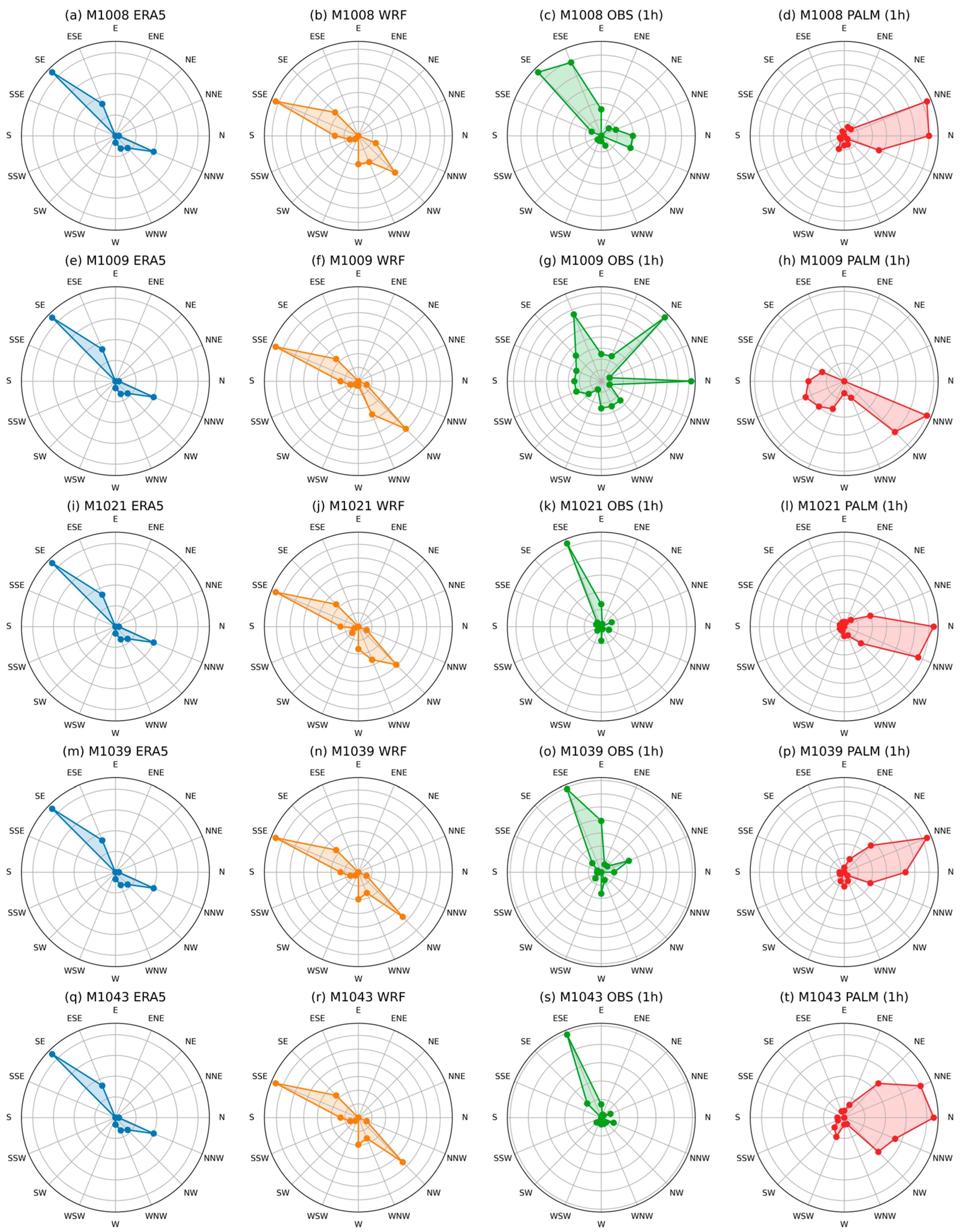
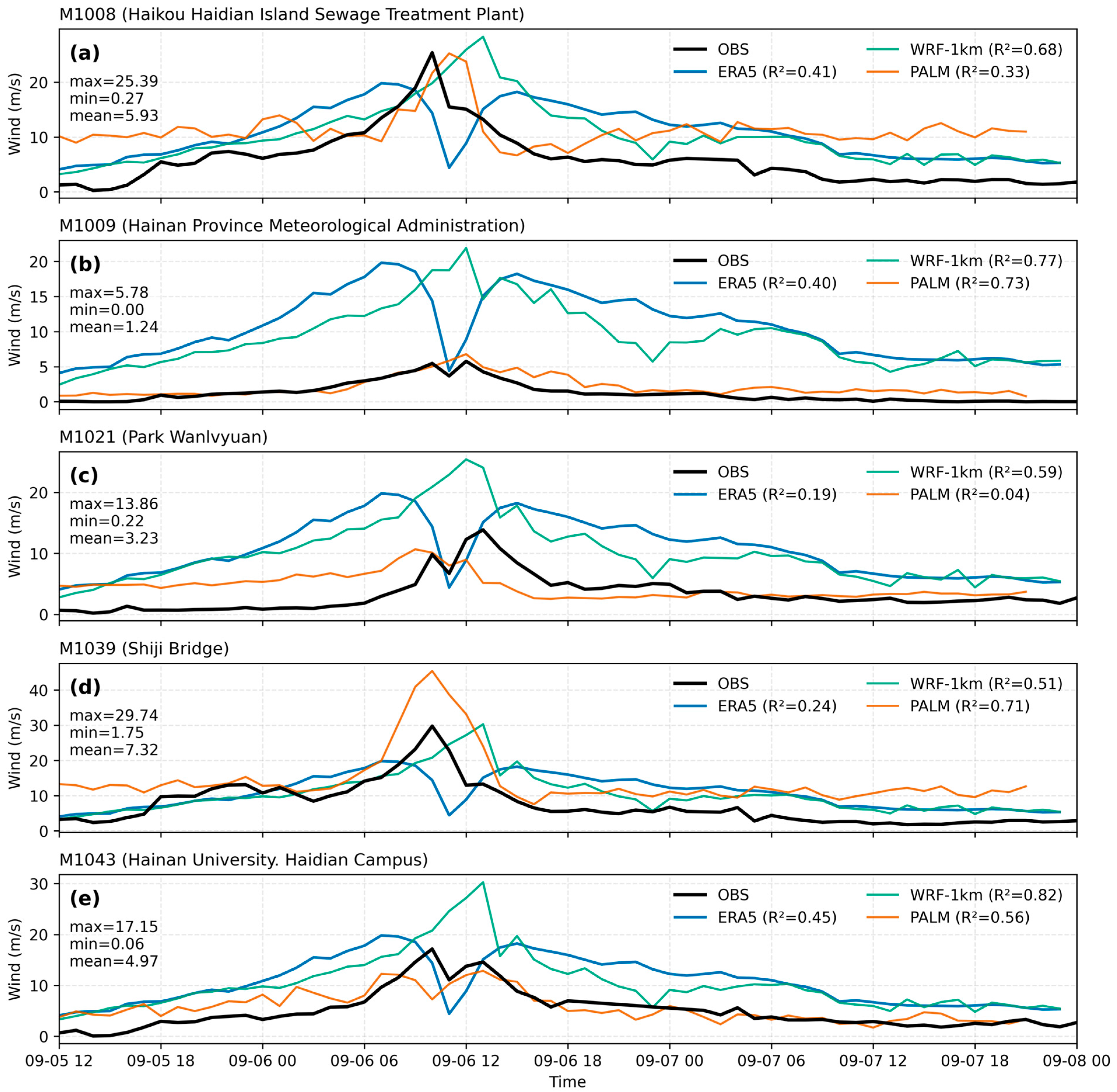
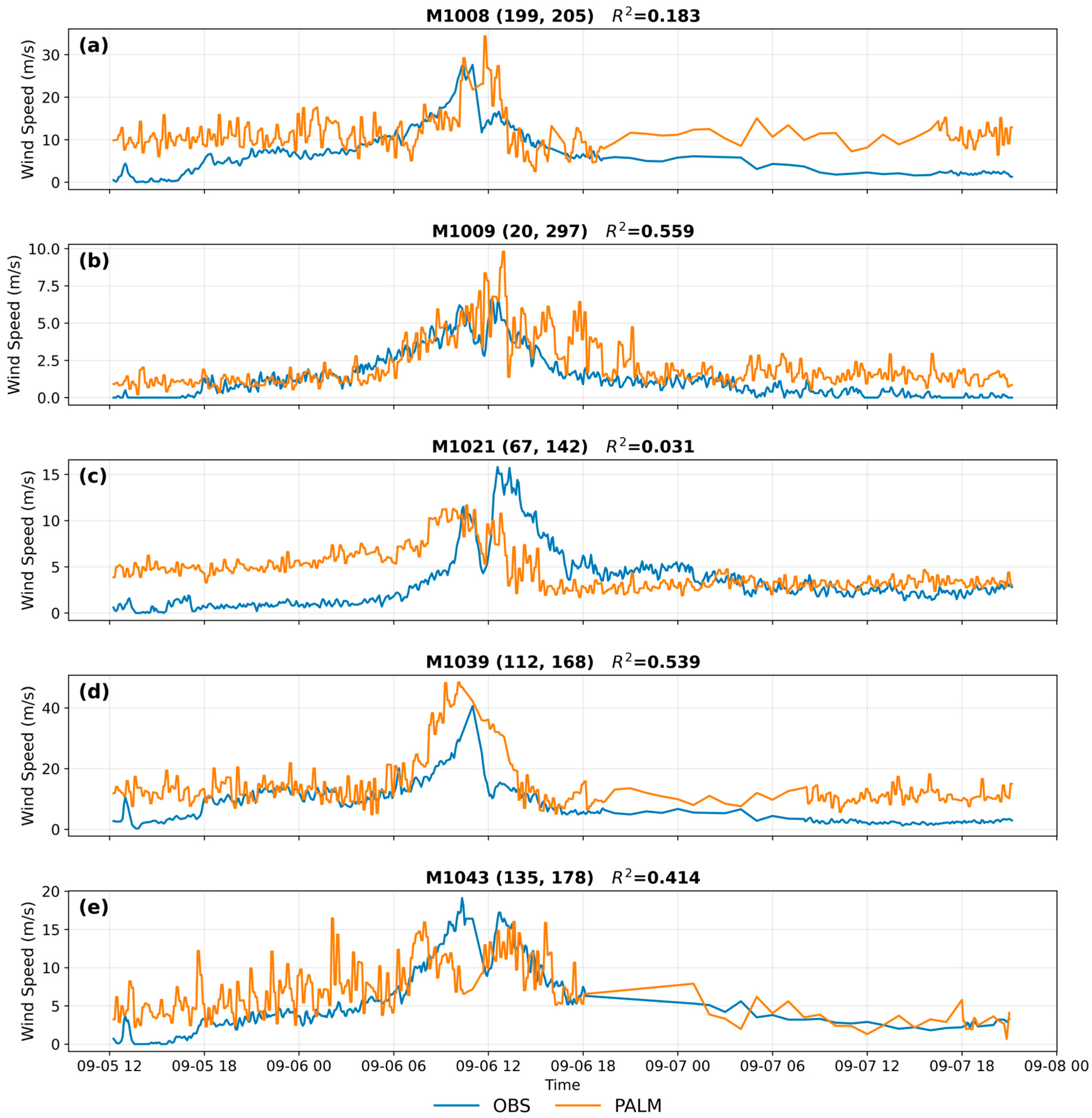
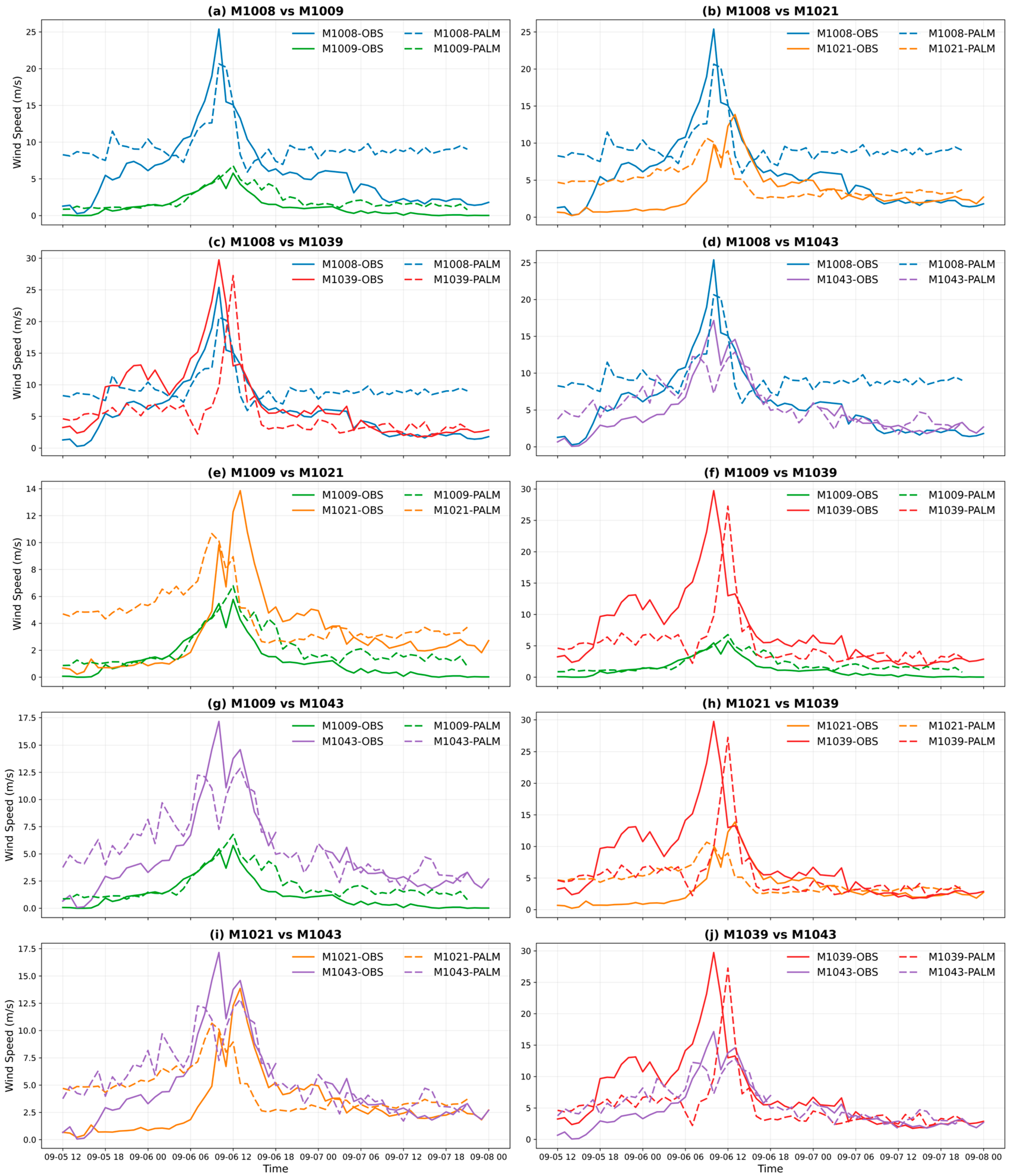
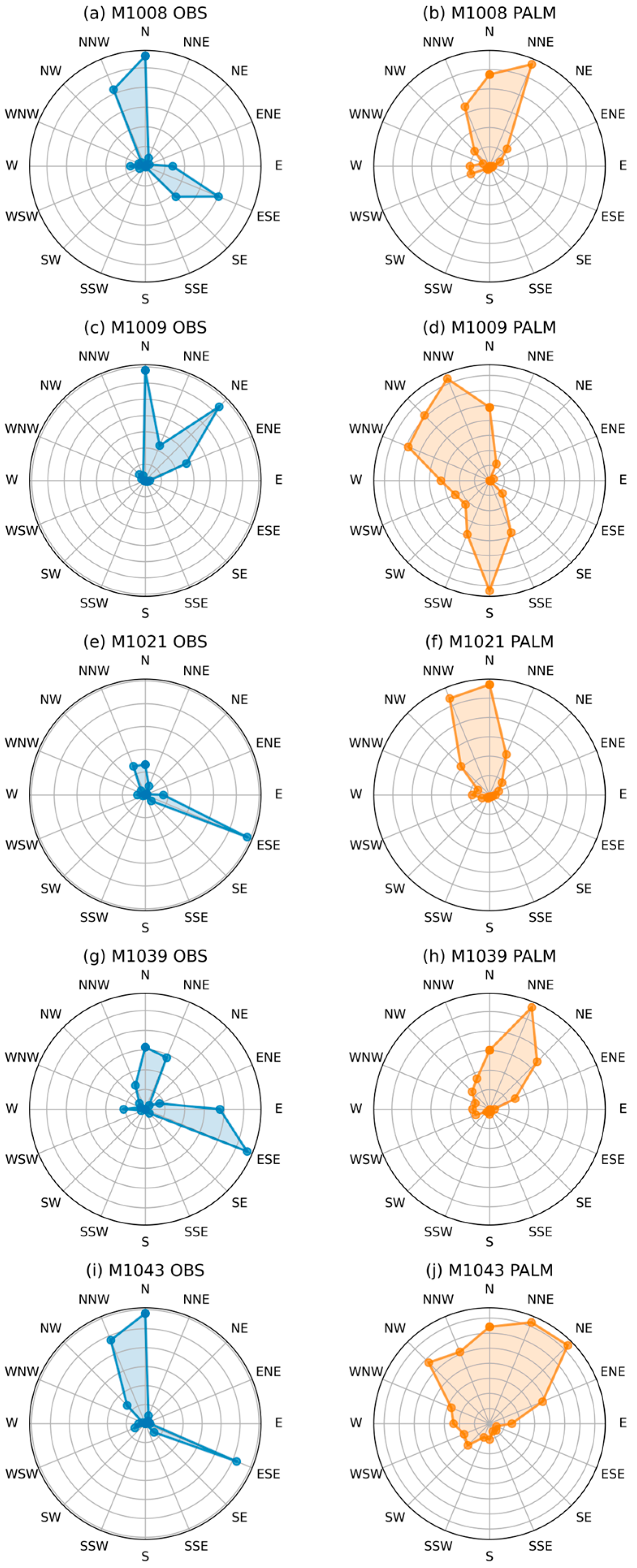
3.1. Model Performance Evaluation
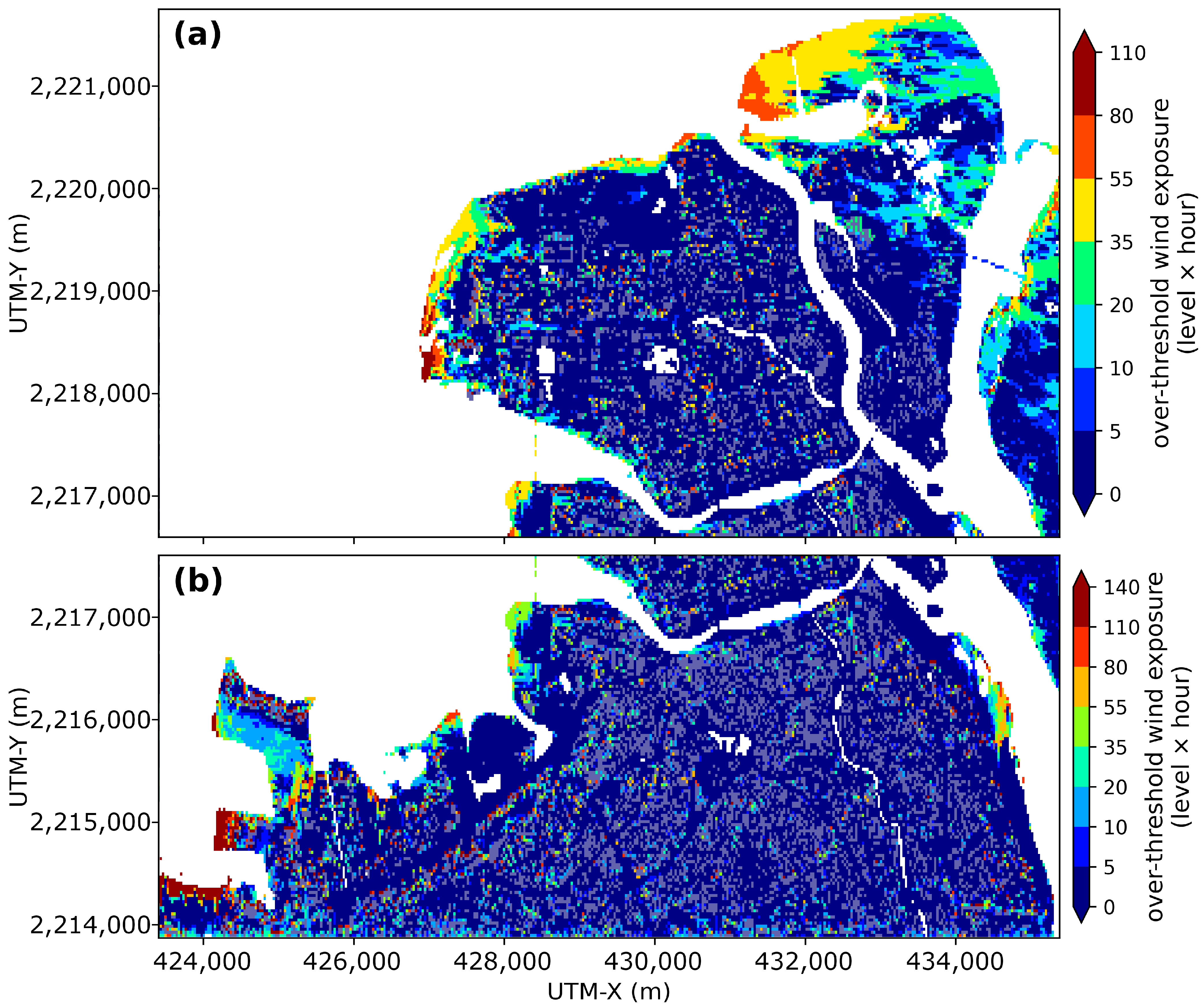
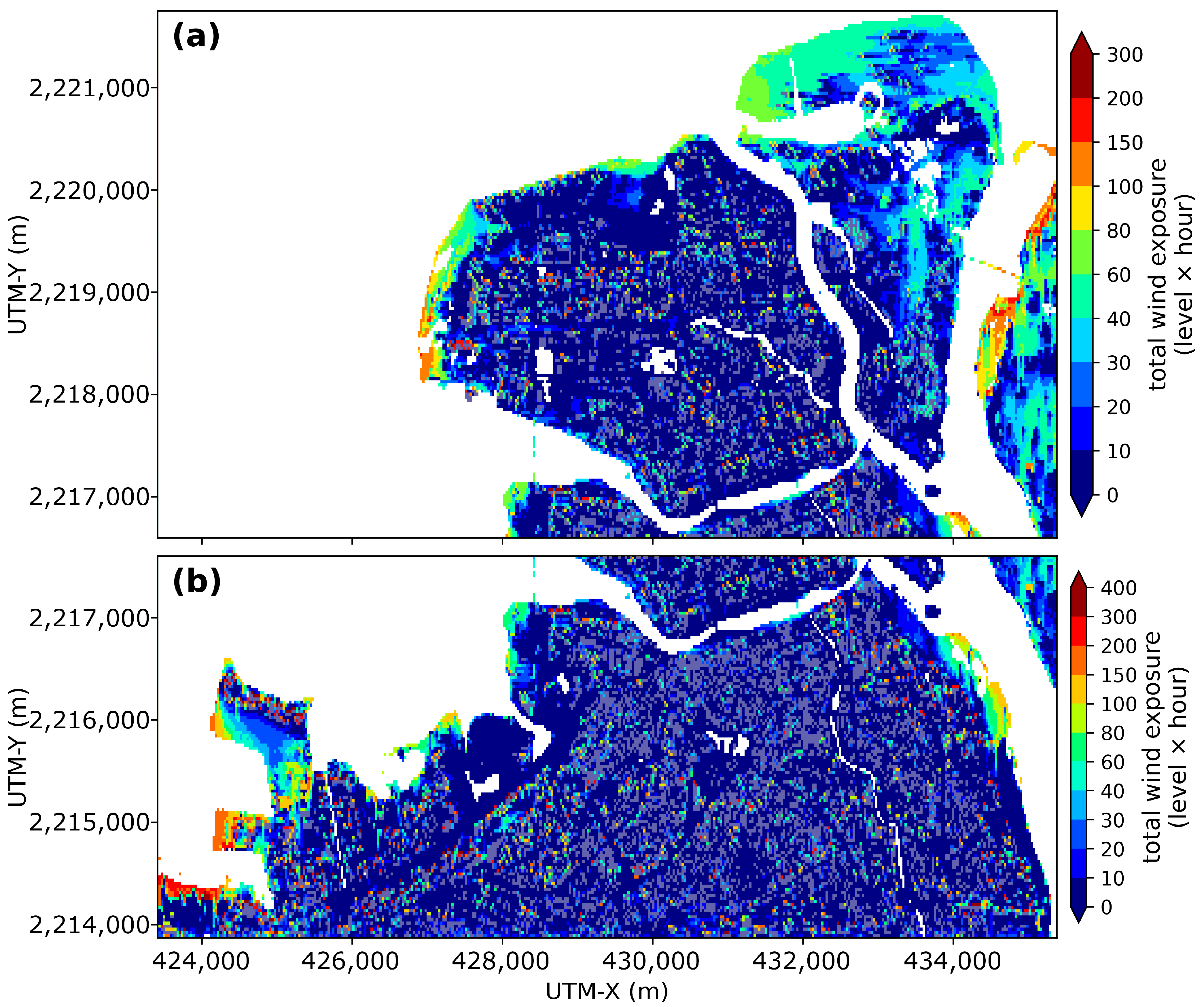
3.2. Wind Field Characteristics
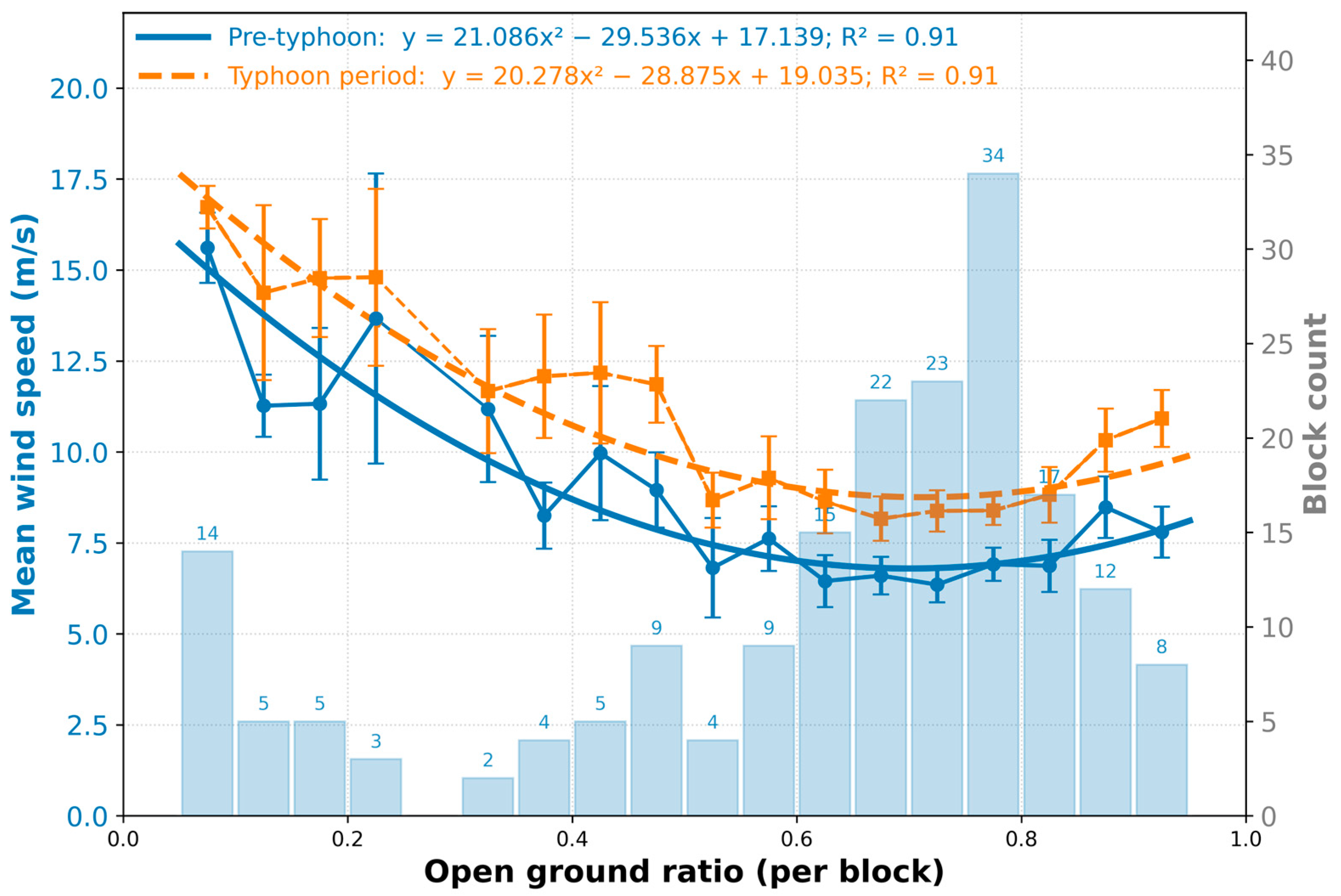
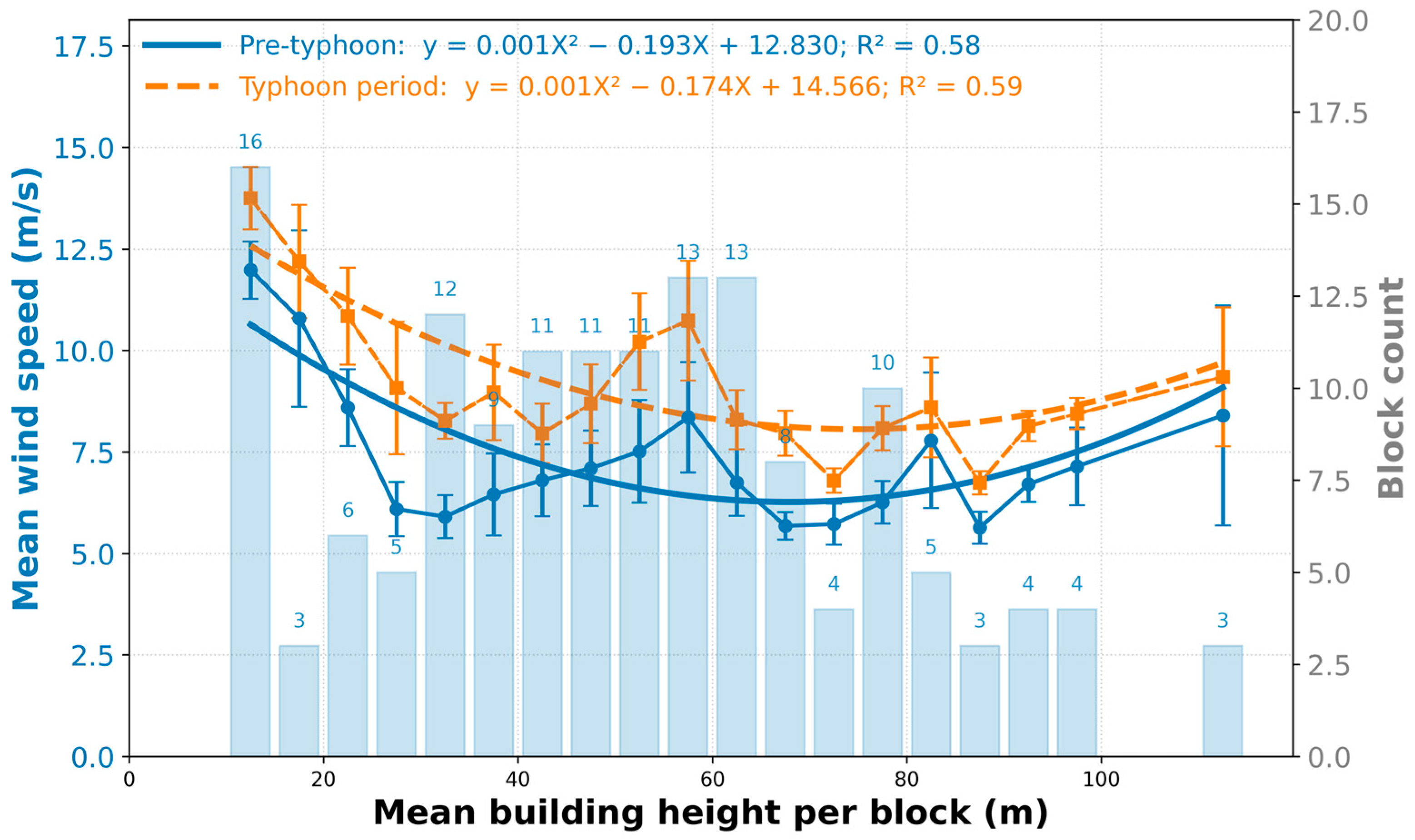
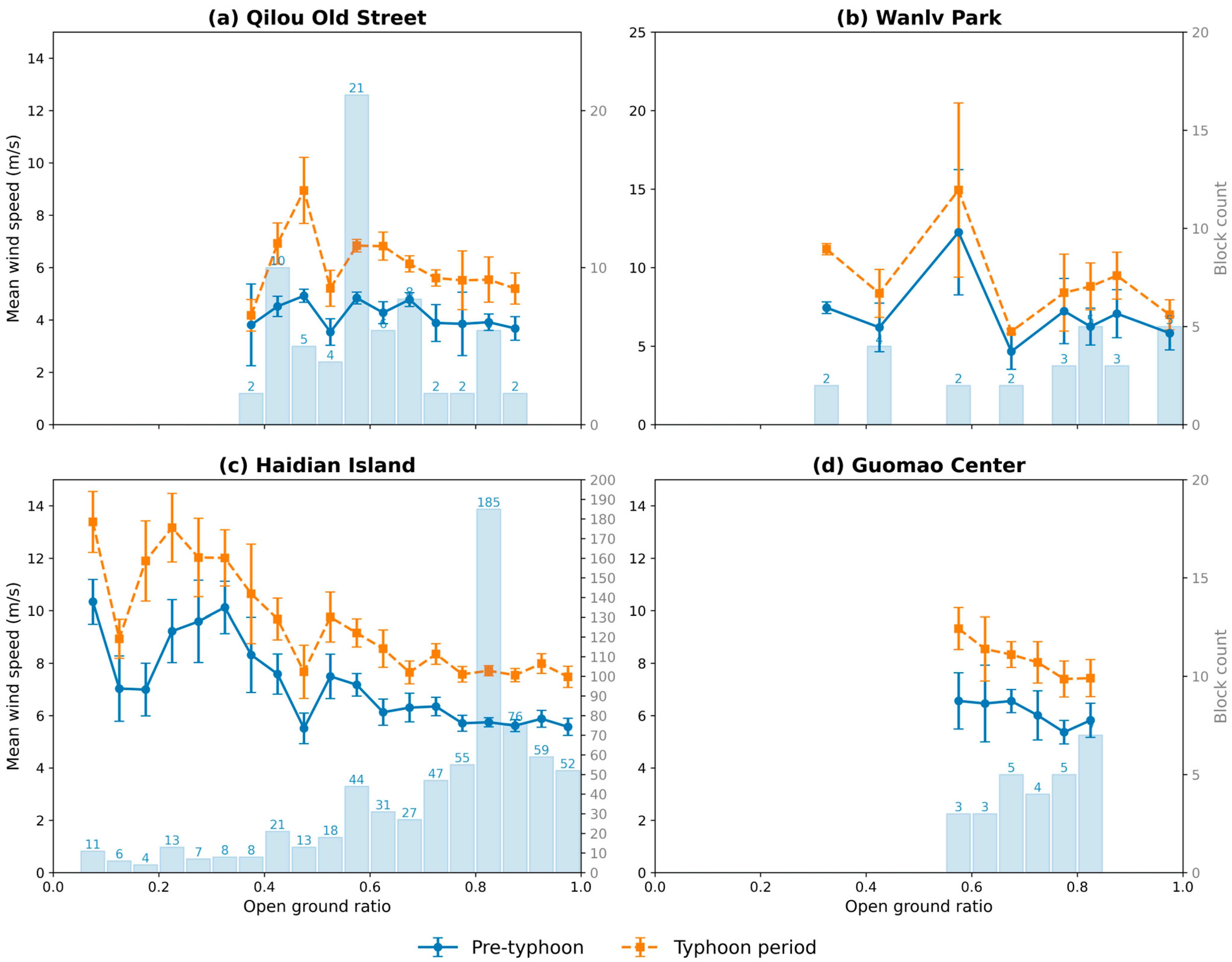
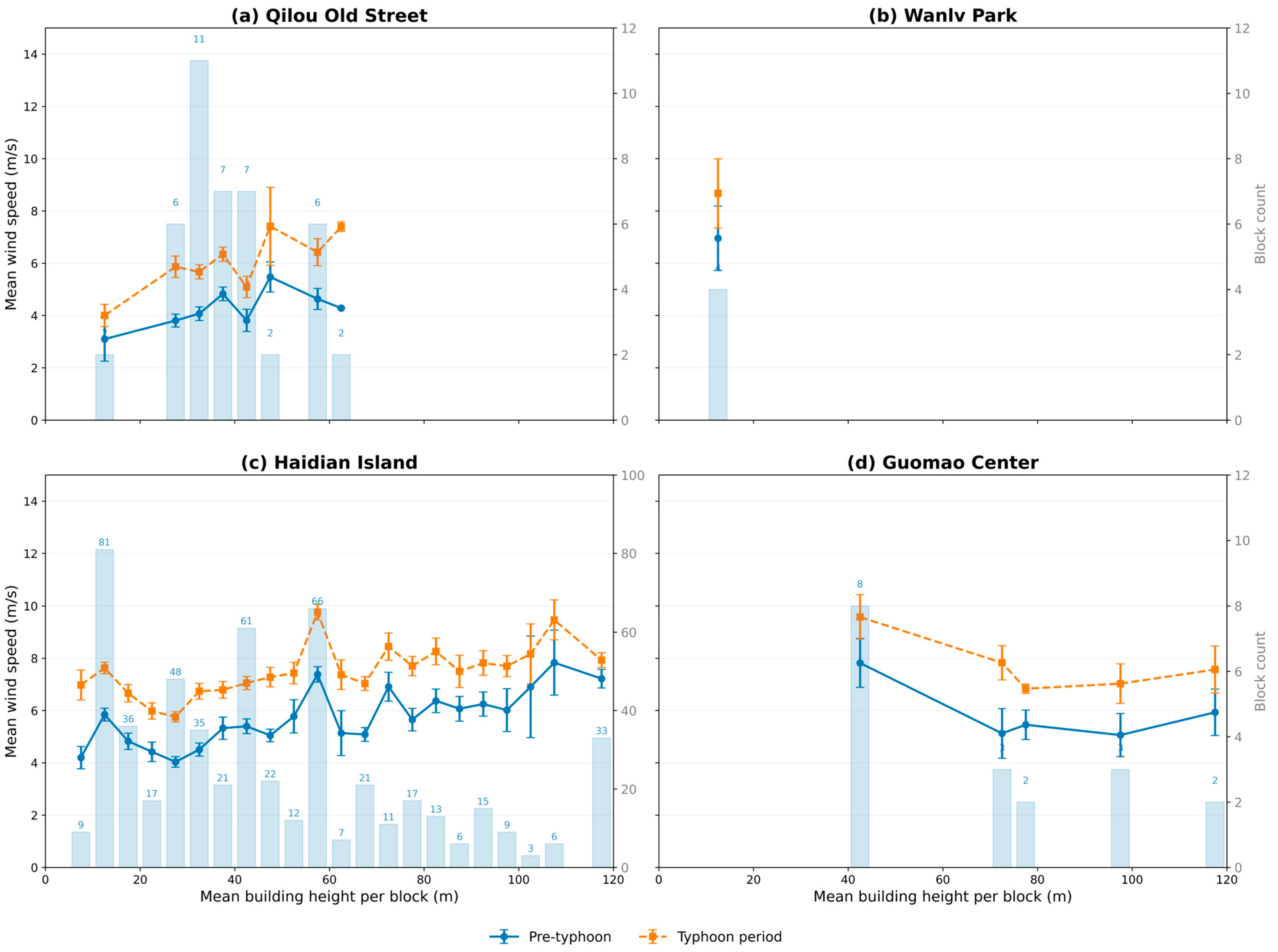
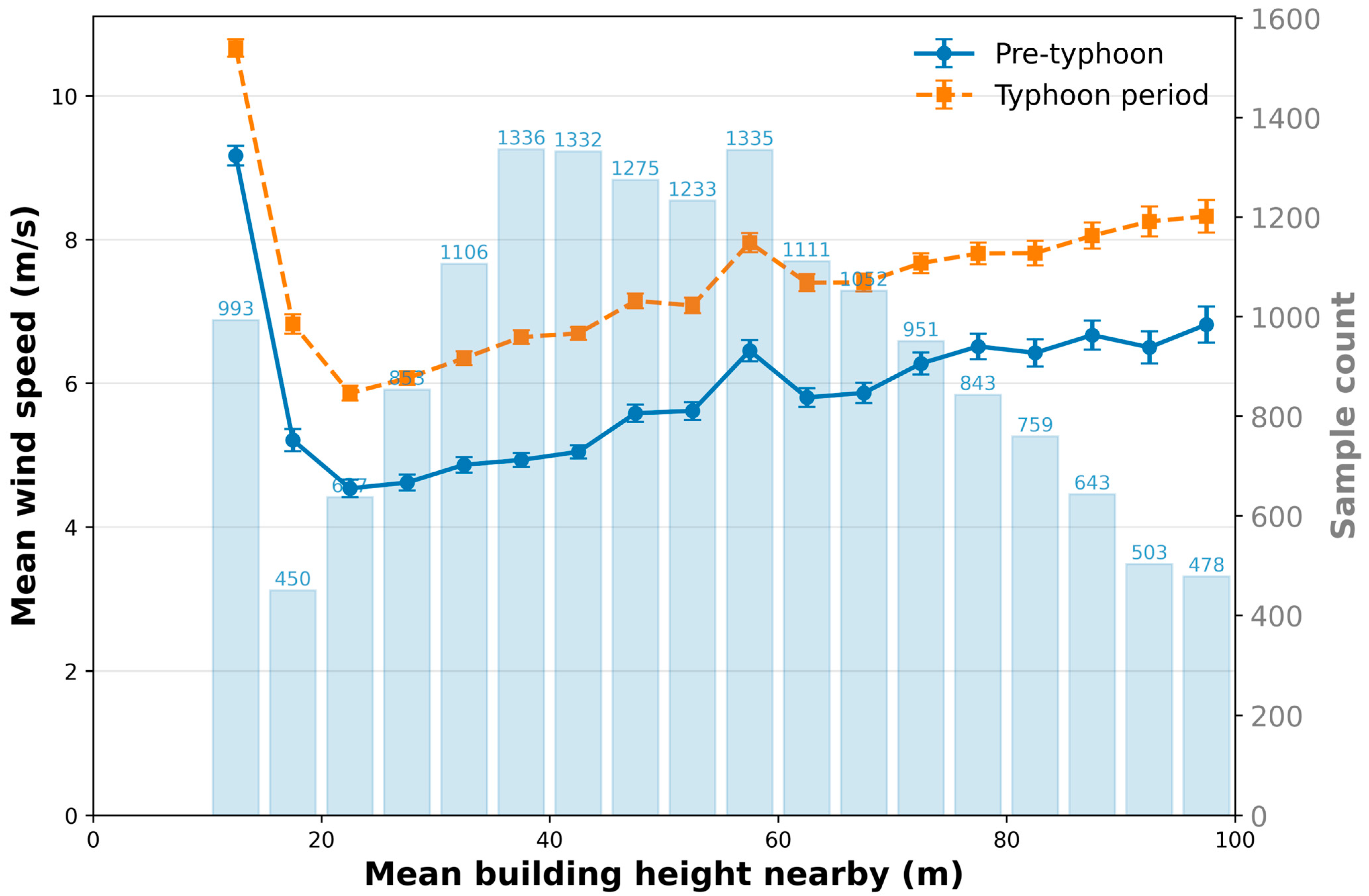
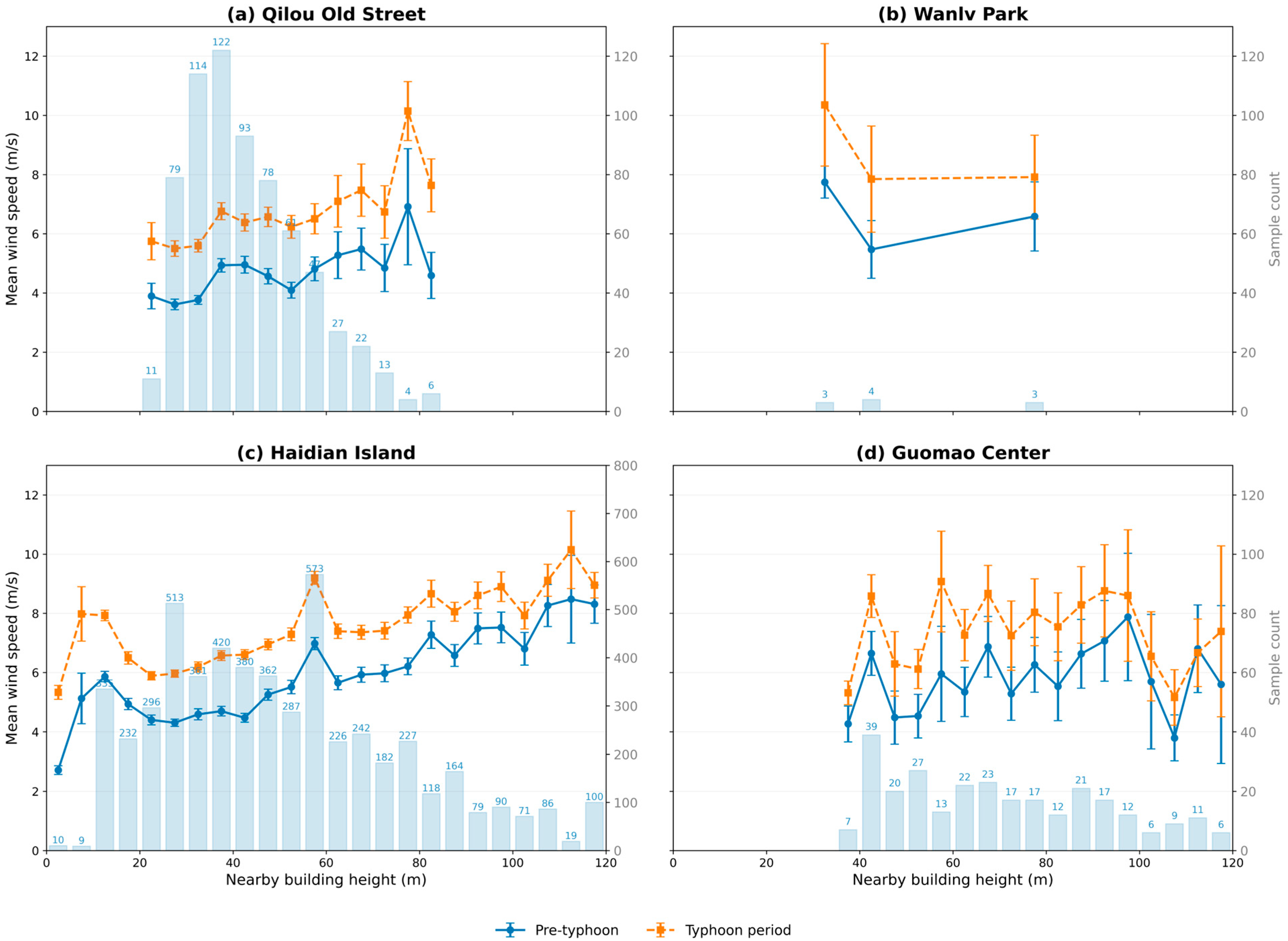
3.3. Urban Structure Impact on Wind Speed
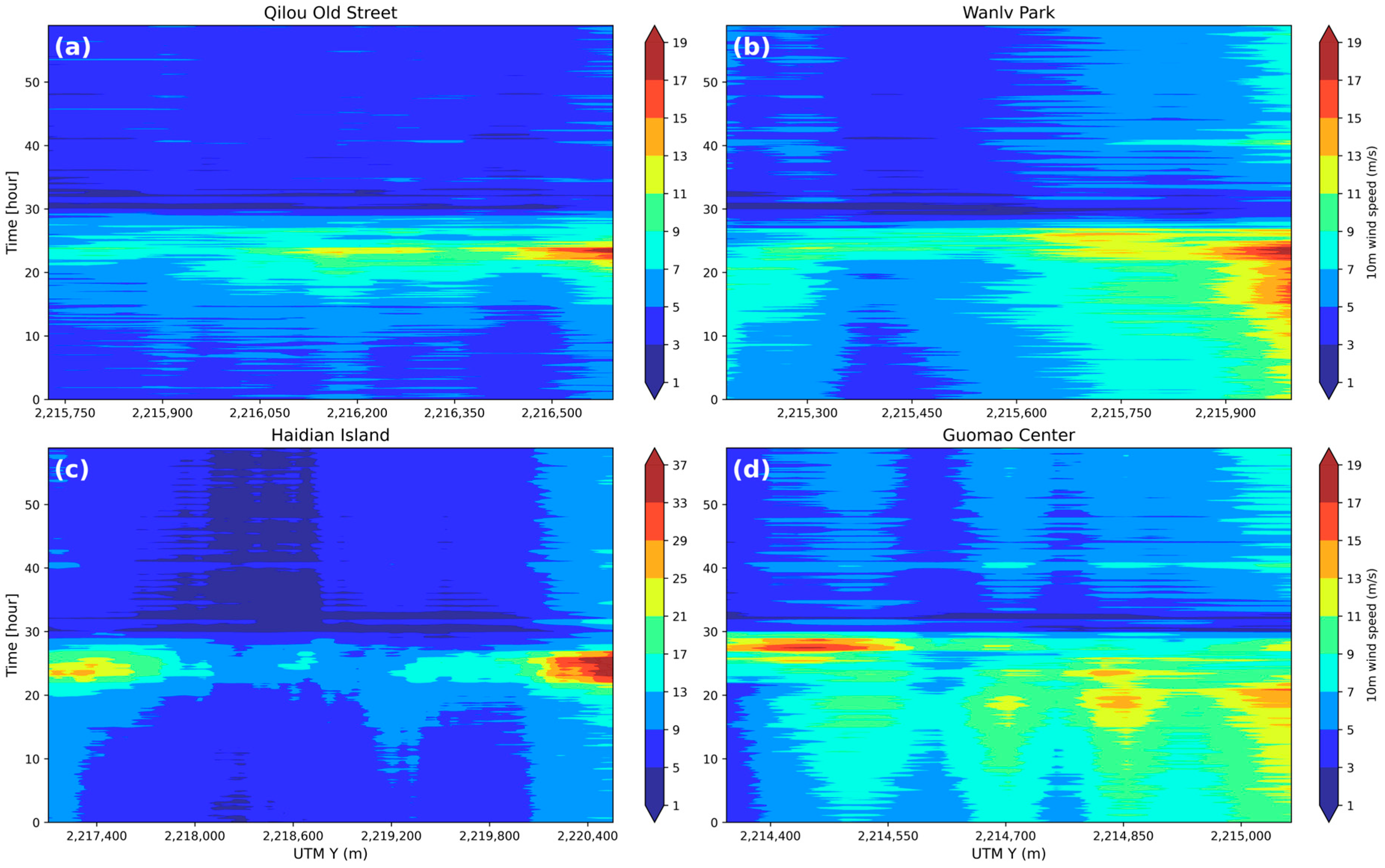
3.4. Spatiotemporal Evolution
4. Discussion
5. Conclusions
- (1)
- Multiscale modeling performance.
- (2)
- Spatial pattern (“coastal high, urban-core low”).
- (3)
- Open-space ratio: robust U-shape.
- (4)
- Building height: U-shaped nonlinearity.
- (5)
- Spatiotemporal evolution.
Author Contributions
Funding
Institutional Review Board Statement
Informed Consent Statement
Data Availability Statement
Acknowledgments
Conflicts of Interest
Appendix A


Appendix B


References
- Emanuel, K. Increasing destructiveness of tropical cyclones over the past 30 years. Nature 2005, 436, 686–688. [Google Scholar] [CrossRef] [Scilit]
- Peduzzi, P.; Chatenoux, B.; Dao, H.; De Bono, A.; Herold, C.; Kossin, J.; Mouton, F.; Nordbeck, O. Global trends in tropical cyclone risk. Nat. Clim. Change 2012, 2, 289–294. [Google Scholar] [CrossRef] [Scilit]
- Webster, P.J.; Holland, G.J.; Curry, J.A.; Chang, H.-R. Changes in tropical cyclone number, duration, and intensity in a warming environment. Science 2005, 309, 1844–1846. [Google Scholar] [CrossRef] [Scilit]
- Hallegatte, S.; Green, C.; Nicholls, R.J.; Corfee-Morlot, J. Future flood losses in major coastal cities. Nat. Clim. Change 2013, 3, 802–806. [Google Scholar] [CrossRef] [Scilit]
- Yang, D.; Zhang, N.; Tang, J. Impacts of urban morphology on typhoon-induced wind hazards at the pedestrian level. Urban Clim. 2025, 60, 102351. [Google Scholar] [CrossRef] [Scilit]
- Kim, D.-H.; Rho, J.-H.; Kim, J.J. Impact of super high-rise buildings on gust generation in surrounding areas during typhoon landfall: Large-eddy simulations. Sustain. Cities Soc. 2025, 74, 106714. [Google Scholar] [CrossRef] [Scilit]
- Nakayama, H.; Takemi, T.; Nagai, H. Coupling of WRF and building-resolving urban CFD models for analysis of strong winds over an urban area. In Proceedings of the 14th Conference on Mesoscale Processes, American Meteorological Society, Los Angeles, CA, USA, 1–4 August 2011; p. 31. [Google Scholar]
- Xu, M.; Tan, Y.; Shi, C.; Xing, Y.; Shang, M.; Wu, J.; Yang, Y.; Du, J.; Bai, L. Spatiotemporal patterns of typhoon-induced extreme precipitation in Hainan Island, China, 2000–2020, using satellite-derived precipitation data. Atmosphere 2024, 15, 891. [Google Scholar] [CrossRef] [Scilit]
- CPC Central Committee & The State Council of PRC. Overall Plan for the Construction of Hainan Free Trade Port. Official Government Document, 1 June 2020. Available online: https://www.gov.cn/zhengce/2020-06/01/content_5516608.htm (accessed on 12 November 2025).
- Yang, F.; Wu, S. Change of frequency of extreme weather events in Hainan Island over the last 39 years. Meteorol. Mon. 2007, 33, 107–113. [Google Scholar] [CrossRef]
- Wang, S.H.; Huang, S.L.; Budd, W.W. Resilience analysis of the interaction of between typhoons and land use change. Landsc. Urban Plan. 2012, 106, 303–315. [Google Scholar] [CrossRef] [Scilit]
- Song, J.; Huang, B.; Li, R. Assessing local resilience to typhoon disasters: A case study in Nansha, Guangzhou. PLoS ONE 2018, 13, e0190701. [Google Scholar] [CrossRef] [Scilit] [PubMed]
- Kapucu, N.; Sadiq, A.A. Disaster policies and governance: Promoting community resilience. Politics Gov. 2016, 4, 58–61. [Google Scholar] [CrossRef] [Scilit]
- Wang, T.Y.; Lin, C.Y. Enhancing urban resilience and sustainability under wind disasters with carbon emission as an indicator. In Bridge Maintenance, Safety, Management, Digitalization and Sustainability; CRC Press: Boca Raton, FL, USA, 2024; pp. 3311–3319. [Google Scholar]
- Hersbach, H.; Bell, B.; Berrisford, P.; Hirahara, S.; Horányi, A.; Muñoz-Sabater, J.; Nicolas, J.; Peubey, C.; Radu, R.; Schepers, D.; et al. The ERA5 global reanalysis. Q. J. R. Meteorol. Soc. 2020, 146, 1999–2049. [Google Scholar] [CrossRef] [Scilit]
- Xu, J. Yagi. Zenodo. 2026. Available online: https://zenodo.org/records/18214138 (accessed on 1 December 2025).
- Maronga, B.; Banzhaf, S.; Burmeister, C.; Esch, T.; Forkel, R.; Fröhlich, D.; Fuka, V.; Gehrke, K.F.; Geletič, J.; Giersch, S.; et al. Overview of the PALM model system 6.0. Geosci. Model Dev. 2020, 13, 1335–1372. [Google Scholar] [CrossRef] [Scilit]
- Rozoff, C.M.; Nolan, D.S.; Bryan, G.H.; Hendricks, E.A.; Knievel, J.C. Large-eddy simulations of the tropical cyclone boundary layer at landfall in an idealized urban environment. J. Appl. Meteorol. Climatol. 2023, 62, 1499–1518. [Google Scholar] [CrossRef] [Scilit]
- Chen, X.; Bryan, G.H.; Zhang, J.A.; Cione, J.J.; Marks, F.D. A framework for simulating the tropical-cyclone boundary layer using large-eddy simulation and its use in evaluating PBL parameterizations. J. Atmos. Sci. 2021, 78, 3559–3580. [Google Scholar] [CrossRef] [Scilit]
- Chen, X.; Rozoff, C.M. Large-eddy simulation of internal boundary layers and near-surface wind estimation during hurricane landfalls. Geophys. Res. Lett. 2025, 52, e2025GL114816. [Google Scholar] [CrossRef] [Scilit]
- Wang, H.; Wang, Q.; Fu, Z.; Tang, J.; Chan, P.W.; Zheng, X. Wind impacts on buildings in Hong Kong during Super Typhoon Mangkhut: LES diagnosis of pressure and risk hotspots. Build. Simul. 2025, 18, 385–401. [Google Scholar] [CrossRef] [Scilit]
- Huang, M.; Liao, S.; Lou, W.; Lin, W.; Kareem, A. Multi-scale simulation of typhoon wind field at building scale utilizing mesoscale model with nested large-eddy simulation. J. Wind. Eng. Ind. Aerodyn. 2024, 249, 105733. [Google Scholar] [CrossRef] [Scilit]
- Zhao, Z.; Xiao, Y.; Li, C.; Chan, P.W.; Hu, G.; Zhou, Q. Multiscale simulation of the urban wind environment under typhoon weather conditions. Build. Simul. 2023, 16, 1713–1734. [Google Scholar] [CrossRef] [Scilit]
- Lo, K.-W.; Chan, P.-W.; Lai, K.K. Observations and simulations of the winds at a bridge in Hong Kong during two tropical cyclone events in 2023. Appl. Sci. 2024, 14, 7789. [Google Scholar] [CrossRef] [Scilit]
- Hendricks, E.A.; Knievel, J.C.; Nolan, D.S. Evaluation of boundary-layer and urban-canopy parameterizations for simulating wind in Miami during Hurricane Irma (2017). Mon. Weather. Rev. 2021, 149, 2321–2349. [Google Scholar] [CrossRef] [Scilit]
- China News Service. Hainan Meteorological Observatory Assessment: Typhoon Yagi’s Destructive Power Far Exceeded Rammasun, the First Strongest Typhoon to Make Landfall in Hainan. Video News Report. China News Service, 4 September 2024. Available online: https://www.chinanews.com/shipin/cns-d/2024/09-04/news999015.shtml (accessed on 12 November 2025).
- The Paper (Pengpai News). Super Typhoon Yagi Makes Landfall in Wenchang, Hainan, the Strongest Autumn Typhoon Since 1949 in China. News Report. China News Service, 6 September 2024. Available online: https://www.thepaper.cn/newsDetail_forward_28653768 (accessed on 12 November 2025).
- Hainan Meteorological Service. Top Ten Weather and Climate Events in Hainan Province in 2024: Typhoon Yagi Ranks First (Longlou, Wenchang, 66.7 m·s−1). Press Release. Hainan Meteorological Service, 13 February 2025. Available online: http://hi.cma.gov.cn/xwzx/gzdt/202502/t20250213_6851155.html (accessed on 12 November 2025).
- State Council Information Office (China). Monthly Meteorological Review for September: Gusts of 66.7 m·s−1 at Longlou Town. Press Conference Transcript. China Meteorological Administration, 9 September 2024. Available online: http://www.scio.gov.cn/xwfb/bwxwfb/gbwfbh/qxj/202409/t20240909_862184.html (accessed on 12 November 2025).
- China Meteorological Administration. Typhoon Yagi Made Landfall Along the Coast of Wenchang, Hainan, on September 6 at 16:20 UTC. CMA News Release. China Meteorological Administration, 6 September 2024. Available online: https://www.cma.gov.cn/2011xwzx/2011xqxxw/2011xqxyw/202409/t20240906_6547833.html (accessed on 12 November 2025).
- Zhang, Y.; Li, Q.; Cao, S.; Cao, J. Embedded large eddy simulation of typhoon wind field and its effects in a large-scale complex urban area with field validations. Phys. Fluids 2025, 37, 087103. [Google Scholar] [CrossRef] [Scilit]
- Wei, C.; Zhao, X.; Liu, Y.; Yang, P.; Zhou, Z.; Chen, Y. Bias analysis and correction of ERA5 reanalysis in the context of tropical cyclones. J. Geophys. Res. Atmos. 2025, 130, e2024JD042737. [Google Scholar] [CrossRef] [Scilit]
- Zhang, Y.; Cao, S.; Zhao, L.; Cao, J. A case application of WRF-UCM models to the simulation of urban wind speed profiles in a typhoon. J. Wind. Eng. Ind. Aerod. 2022, 220, 104874. [Google Scholar] [CrossRef] [Scilit]
- Xie, B.; Fung, J.C.H.; Chan, A.; Lau, A.K.-H. Evaluation of nonlocal and local planetary boundary layer schemes in the WRF model. J. Geophys. Res. Atmos. 2012, 117, D12103. [Google Scholar] [CrossRef] [Scilit]
- Mahrt, L. Stably stratified atmospheric boundary layers. Annu. Rev. Fluid Mech. 2014, 46, 23–45. [Google Scholar] [CrossRef] [Scilit]
- Donelan, M.A.; Haus, B.K.; Reul, N.; Plant, W.J.; Stiassnie, M.; Graber, H.C.; Brown, O.B.; Saltzman, E.S. On the limiting aerodynamic roughness of the ocean in very strong winds. Geophys. Res. Lett. 2004, 31, L18306. [Google Scholar] [CrossRef] [Scilit]
- Powell, M.D.; Vickery, P.J.; Reinhold, T.A. Reduced drag coefficient for high wind speeds in tropical cyclones. Nature 2003, 422, 279–283. [Google Scholar] [CrossRef] [Scilit]
- Blocken, B.; Carmeliet, J. Pedestrian wind environment around buildings: Literature review and practical examples. J. Therm. Envel. Build. Sci. 2004, 28, 107–159. [Google Scholar] [CrossRef] [Scilit]
- Blocken, B. 50 years of computational wind engineering: Past, present and future. J. Wind. Eng. Ind. Aerodyn. 2014, 129, 69–102. [Google Scholar] [CrossRef] [Scilit]
- Britter, R.E.; Hanna, S.R. Flow and dispersion in urban areas. Annu. Rev. Fluid Mech. 2003, 35, 469–496. [Google Scholar] [CrossRef] [Scilit]
- Tominaga, Y.; Mochida, A.; Yoshie, R.; Kataoka, H.; Nozu, T.; Yoshikawa, M.; Shirasawa, T. AIJ guidelines for practical applications of CFD to pedestrian wind environment around buildings. J. Wind. Eng. Ind. Aerodyn. 2008, 96, 1749–1761. [Google Scholar] [CrossRef] [Scilit]
- Hunter, L.; Johnson, G.T.; Watson, I.D. An investigation of three-dimensional characteristics of flow regimes within the urban canyon. Atmos. Environ. Part B Urban Atmos. 1992, 26, 425–432. [Google Scholar] [CrossRef] [Scilit]
- Ng, E. Policies and technical guidelines for urban planning of high-density cities—Air ventilation assessment (AVA) of Hong Kong. Build. Environ. 2009, 44, 1478–1488. [Google Scholar] [CrossRef] [Scilit]


Disclaimer/Publisher’s Note: The statements, opinions and data contained in all publications are solely those of the individual author(s) and contributor(s) and not of MDPI and/or the editor(s). MDPI and/or the editor(s) disclaim responsibility for any injury to people or property resulting from any ideas, methods, instructions or products referred to in the content. |
© 2026 by the authors. Licensee MDPI, Basel, Switzerland. This article is an open access article distributed under the terms and conditions of the Creative Commons Attribution (CC BY) license.
Share and Cite
Xu, J.; Wu, J.; Xing, Y.; Yang, D.; Shang, M.; Shi, C.; Shi, C.; Bai, L. Ultra-High Resolution Large-Eddy Simulation of Typhoon Yagi (2024) over Urban Haikou. Urban Sci. 2026, 10, 42. https://doi.org/10.3390/urbansci10010042
Xu J, Wu J, Xing Y, Yang D, Shang M, Shi C, Shi C, Bai L. Ultra-High Resolution Large-Eddy Simulation of Typhoon Yagi (2024) over Urban Haikou. Urban Science. 2026; 10(1):42. https://doi.org/10.3390/urbansci10010042
Chicago/Turabian StyleXu, Jingying, Jing Wu, Yihang Xing, Deshi Yang, Ming Shang, Chenxiao Shi, Chunxiang Shi, and Lei Bai. 2026. "Ultra-High Resolution Large-Eddy Simulation of Typhoon Yagi (2024) over Urban Haikou" Urban Science 10, no. 1: 42. https://doi.org/10.3390/urbansci10010042
APA StyleXu, J., Wu, J., Xing, Y., Yang, D., Shang, M., Shi, C., Shi, C., & Bai, L. (2026). Ultra-High Resolution Large-Eddy Simulation of Typhoon Yagi (2024) over Urban Haikou. Urban Science, 10(1), 42. https://doi.org/10.3390/urbansci10010042