Article

Coming Home in the Age of Industry 4.0? The Effects of Offshoring and Backshoring on Manufacturing Companies’ Success


by
Alexander Werbik
1,
Julien Nussbaum
1 and
Johannes Winter
2,3,*
1
Lucerne School of Business, Lucerne University of Applied Sciences and Arts, 6002 Luzern, Switzerland
2
L3S Research Center, Leibniz University of Hannover, 30167 Hannover, Germany
3
Acatech—National Academy of Science and Engineering, 80333 Munich, Germany
*
Author to whom correspondence should be addressed.
Submission received: 4 July 2024 / Revised: 24 September 2024 / Accepted: 25 September 2024 / Published: 1 October 2024

Abstract

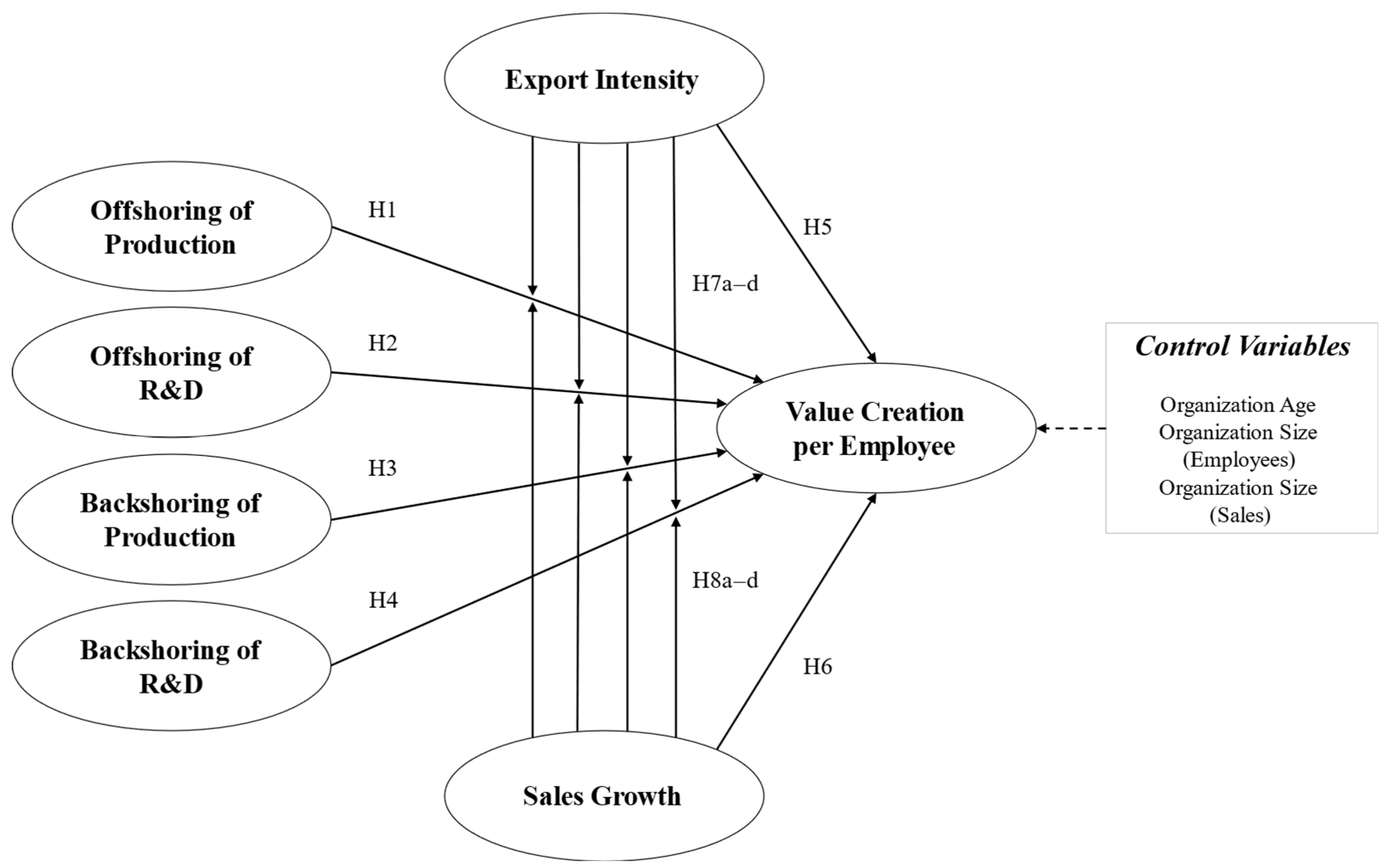
This study explores the effects of offshoring and backshoring on value creation per employee within the manufacturing sector by investigating the difference between firms that did and those that did not engage in corresponding relocation activities. Historically, offshoring has been a strategy to reduce costs and increase efficiency. However, the rise of advanced digital technologies and changing market dynamics have sparked a countertrend toward backshoring. Using data from the European Manufacturing Survey, this research examines how these strategies impact value creation, also taking into account the roles of sales growth and export intensity as potential moderators. The results of hierarchical regression analysis indicate that neither firms that have engaged in offshoring of production nor firms that have engaged in offshoring of R&D have significantly higher or lower value creation per employee than those that did not. In contrast, firms that have engaged in backshoring of production realize higher value creation when coupled with high sales growth. Firms that have engaged in backshoring of R&D, on the other hand, realize higher value creation when combined with high export intensity. These findings highlight the importance of aligning strategic decisions with both technological capabilities and market conditions to enhance productivity. The study suggests that a balanced and holistic approach, integrating both offshoring and backshoring strategies tailored to specific business contexts, can optimize value creation and maintain competitiveness in a rapidly evolving global landscape.
Keywords: offshoring; backshoring; R&D; manufacturing; digital technologies offshoring; backshoring; R&D; manufacturing; digital technologies