


Abstract
Connected vehicle platforms enable large-scale collection of vehicle dynamics data from production fleets, creating opportunities for passive roadway monitoring using onboard sensing systems. While existing vibration-based approaches primarily focus on pavement roughness estimation, the ability of fused onboard signals to capture defect-level characteristics remains insufficiently explored. This study investigates whether Road Surface Monitoring (RSM) signals, developed by Honda as an integrated OEM sensing approach, contain distinguishable patterns associated with specific road surface defects. A framework is developed to analyze, detect, and classify defect-related vibration signatures using these fused signals. The approach introduces the Defect Consistency Index (DCI), which measured a 29% average difference between pothole and patching signal signatures within the dataset. A threshold-based Defect Identification Algorithm (DIA) was then applied to detect defective segments, achieving 89% detection accuracy. A machine learning pipeline using shape-based features was subsequently used to classify potholes and patching, achieving up to 90% classification accuracy on the evaluated dataset. The framework was evaluated using real-world RSM data collected from a single instrumented vehicle within a limited geographic region. The results indicate that fused vibration signals contain recurring defect-related patterns that may support defect-level analysis using compact, non-visual measurements. These findings indicate the potential of connected vehicle vibration sensing for scalable roadway monitoring while highlighting the need for broader validation across vehicles, environments, and defect conditions.
1. Introduction
Road surface defects, including potholes and patching, significantly impact traffic safety and infrastructure maintenance costs. Poor road conditions contribute to thousands of accidents annually and require substantial repair budgets. For example, in the United States, the Surface Transportation Reauthorization and Reform Act allocated $46 billion annually for highway maintenance, with insurance reports estimating $3 billion in damages from potholes alone and approximately 10,000 traffic accidents associated with deteriorated road conditions [1,2]. As transportation infrastructure continues to age, demands for inspection and maintenance are increasing. Conventional inspection methods rely on periodic surveys and visual assessments, which are labor-intensive and inherently reactive, highlighting the need for scalable and continuous monitoring approaches [3].
A fundamental shift in this direction is enabled by connected vehicle (CV) systems, where modern production vehicles operate as continuously sensing units during normal driving. Current vehicles are equipped with multiple onboard sensors that measure vehicle dynamics, including accelerations and responses associated with vehicle–road interaction. These sensors are already deployed at scale and operate without any modification to standard driving behavior, enabling passive data collection without dedicated inspection systems or additional instrumentation. In parallel, automotive manufacturers are increasingly collecting such measurements through connected vehicle platforms for diagnostics, performance monitoring, and fleet-level analytics. As a result, large fleets of vehicles continuously generate data that inherently reflects roadway conditions. For example, Road Surface Monitoring (RSM) signals, developed by Honda as an integrated sensing approach, combine multiple onboard measurements, including six degree-of-freedom accelerations, into a single time-series representation of vehicle response. Such fused signals provide a structured and standardized form of vibration data that can be aggregated across vehicles and over time.
At the fleet level, this creates a distributed sensing system in which individual vehicles provide partial observations of roadway conditions. In real traffic scenarios, some vehicles traverse a given defect while others avoid it depending on lane position, trajectory, and driving behavior. However, repeated observations across a fleet accumulate over space and time, enabling statistical identification of defect-related patterns. The variability introduced by differences in speed, vehicle dynamics, and trajectories contributes to signal diversity and supports robust characterization of road conditions. The scale of such systems introduces practical constraints on data handling and computation. Continuous measurements across connected fleets generate substantial data volumes, making efficient transmission, storage, and processing essential considerations. In this setting, compact signal representations and computationally efficient methods are necessary for practical deployment. Vibration-based signals offer a relatively low data footprint while retaining relevant information about road surface interactions, making them suitable for large-scale aggregation and efficient analysis.
Previous research has examined the use of mobile accelerometer data to estimate pavement roughness indices such as the International Roughness Index (IRI). These studies use vibration information from smartphones or other low-cost devices to measure general ride quality. They focus on overall surface roughness rather than the identification of specific defect types. This line of work has shown that mobile devices can capture changes in pavement condition, but the signals are highly sensitive to phone placement, mounting orientation, and sampling variability. As a result, these systems provide useful network-level screening but struggle to separate individual defect classes such as potholes or patching [4,5]. Some recent work has used smartphones and machine learning to classify point anomalies such as potholes and patches. For example, Kyriakou et al. combined phone sensors with supervised learning to detect several forms of surface irregularities [6]. These systems show that vibration patterns contain useful information about localized events. However, they rely on non-standardized sensors and produce inconsistent signals across vehicles and users.
Vision-based approaches have become increasingly popular for detecting potholes and other visible surface anomalies, providing detailed spatial information and enabling direct localization of visible damage. These methods use cameras installed on vehicles or roadside infrastructure to identify defects through image processing or deep learning [3,7,8]. However, vision systems introduce significant data and computational demands. Continuous image acquisition requires substantial storage, transmission, and processing resources, particularly when deployed at scale across large transportation networks. This creates practical limitations for real-time or distributed implementations, often requiring either high-performance onboard hardware or transfer of large data streams to centralized data centers. Privacy considerations further complicate deployment. The collection and storage of visual data raise concerns related to personal privacy and regulatory compliance, particularly under data protection frameworks such as those in Europe. In addition, although very effective in controlled environments, their performance in real-world deployment is sensitive to environmental conditions such as lighting variability, shadows, occlusion, weather, and camera contamination, which can reduce reliability. These factors collectively limit the scalability of vision-based defect detection systems in large-scale, real-world applications.
In recent years, several original equipment manufacturers have released connected-vehicle datasets that report road roughness estimated from production vehicles. These datasets use vehicle dynamics measurements such as suspension travel, wheel displacement, or chassis acceleration to estimate IRI at network scale. For example, Chen et al. used GM fleet data to estimate IRI and validated the results against certified profilers [9]. Researchers [5] used connected vehicle measurements to examine roughness screening along interstate corridors. In another study, billions of connected-vehicle measurements were used to track long-term changes in pavement roughness across multiple seasons [10]. These studies demonstrate that connected-vehicle data can measure ride quality over large regions with lower cost than traditional profilers. However, they focus entirely on roughness indices and do not analyze defect-level vibration signatures. They also do not attempt to separate different defect classes or evaluate the consistency of event-specific signals.
Accordingly, the goal of this study is to address the central research question: whether fused vibration signals contain sufficiently consistent and separable signatures to support defect-level pavement defect analysis under real-world variability. To answer this question, this study utilizes Road Surface Monitoring (RSM) signals, developed by Honda as an integrated Original Equipment Manufacturer (OEM) sensing approach. RSM signals combine multiple vehicle dynamics channels into a single time-series representation designed to remain stable across vehicles and trips. The reasons for using these signals are that such signals are already collected in large volumes, but their ability to capture consistent, defect-specific patterns has not been systematically evaluated.
To demonstrate the applicability of RMS for the goal of this research, this study develops a framework for defect-level identification by analyzing the structure and separability of defect-related vibration patterns in RSM signals. The framework begins with an exploratory analysis and introduces the Defect Consistency Index (DCI) to quantify differences across defect categories. Because the exploratory results show an average difference of 29% between RSM signals collected over potholes and patching areas, the next step evaluates whether defective road segments can also be distinguished from intact road segments. For this purpose, a threshold-based method using Hampel identification, referred to as the Defect Identification Algorithm (DIA), is applied to detect candidate defect segments in the time series. Finally, because defective segments can be identified and different defect categories exhibit measurable signal differences, a machine learning pipeline with tailored feature engineering is used to evaluate the extent to which RSM signals support classification of defect types under real-world conditions.
2. Materials and Methods
This section outlines the methodological framework used to evaluate and classify road surface defects from H_RSM signals. Early-stage analysis, including exploratory data analysis and defect consistency assessment, is presented here to establish the presence of recurring signal patterns and justify subsequent modeling choices. Procedures related to defect identification and feature construction are also included in this section, as they define the transformation from raw signals to structured inputs. Model training and performance evaluation, which depend on these definitions, are presented later in Section 4.
2.1. Exploratory Data Analysis and Defect Consistency
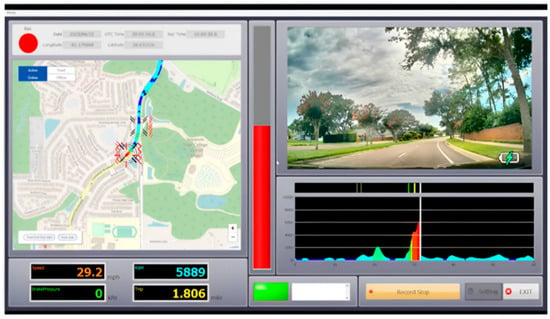
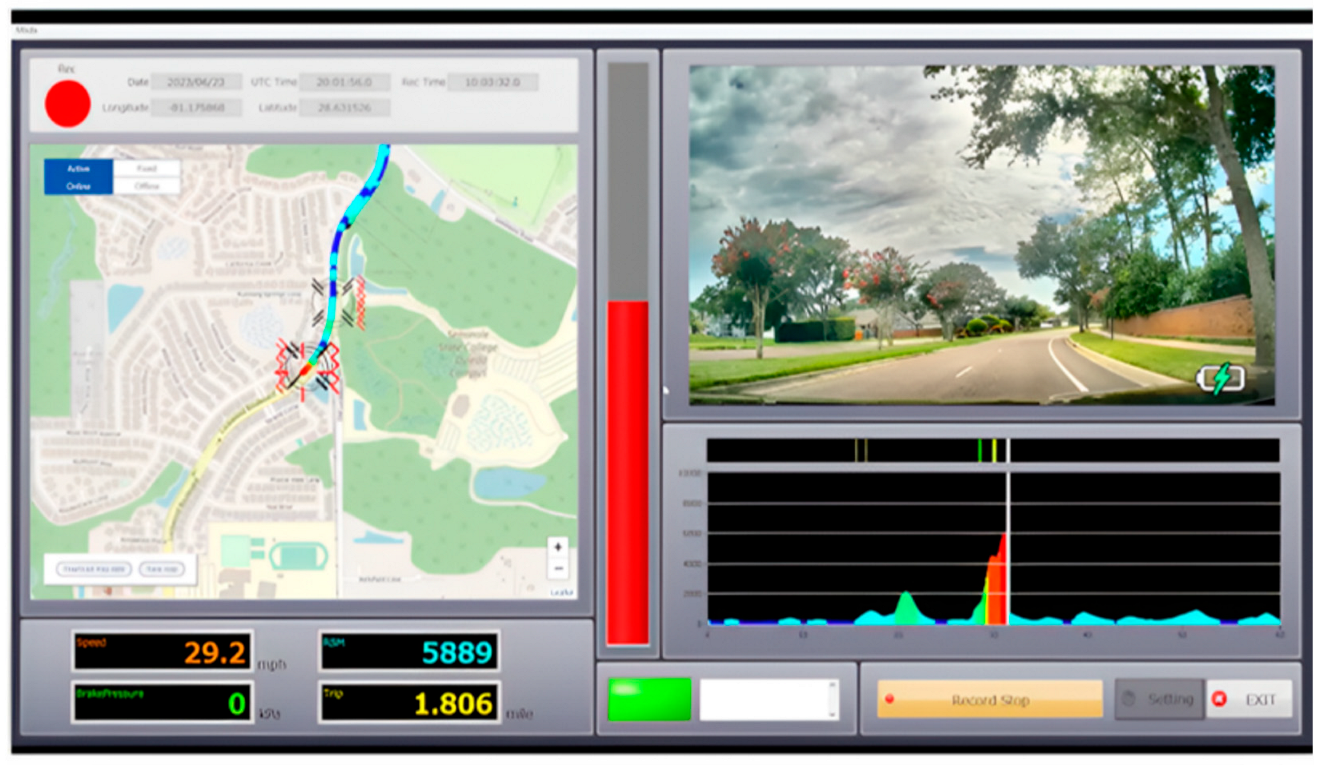
This section presents an exploratory data analysis of H_RSM signals and quantifies the consistency of differences in these signals across various defective road segments. The data were collected in Orlando, Florida, using an SUV equipped with six-degree-of-freedom accelerometers and a camera, along with proprietary software (Figure 1) developed by Honda and i-Probe specifically for Honda’s Road Surface Monitoring (H_RSM) applications. The proprietary software logs the accelerometer signals, vehicle coordinates, speed, and accompanying camera images for each second of data collection. Although the method is intended to operate independently of visual data, the synchronized camera images were used by a researcher to manually label the segments as either defective (potholes or patching) or intact. Potholes were identified as localized pavement depressions or cavities visible in the camera imagery, whereas patching referred to repaired pavement regions with visually distinguishable surface texture or elevation differences relative to the surrounding roadway. Labeling was performed by a single researcher as part of this exploratory study. This approach provided ground-truth labels for training and evaluation. The sampling frequency during data collection was set to 10 Hz. This frequency was chosen to align with both the capabilities of the prototype vehicle setup and anticipated future hardware deployments from the automotive manufacturer. Typical consumer vehicles currently transmit sensor signals at 1 Hz, but higher frequencies such as 10 Hz may be implemented in future applications. Depending on future system requirements and data handling capabilities, higher sampling rates could be explored if additional resolution becomes necessary. The dataset consists of measurements collected from a single instrumented vehicle operating within a specific geographic region. The sample size is limited, with fewer observations for potholes than patching. Accordingly, the analysis is focused on evaluating signal-level consistency and separability rather than establishing generalizable performance across vehicles, environments, or defect populations.
Figure 1.
The associated software for data collection.
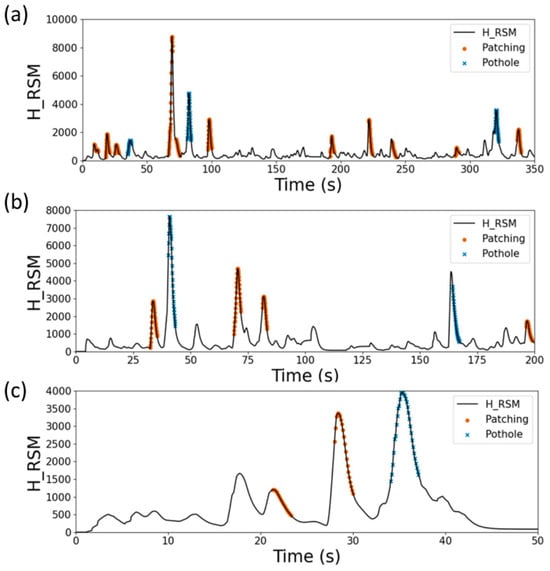
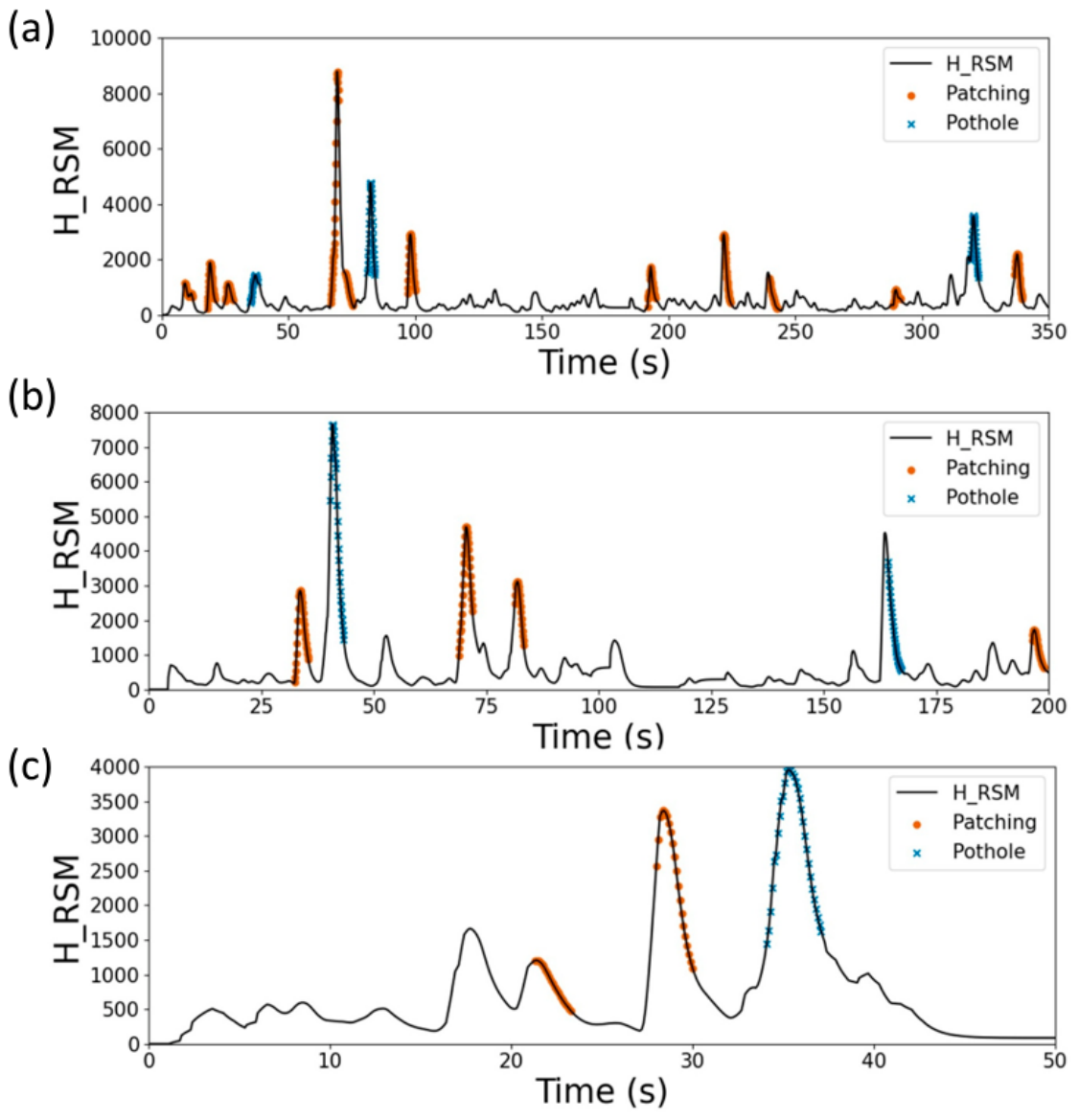
As part of the initial exploratory analysis, Figure 2 presents three H_RSM signals collected from different road segments, along with the labeled defect points. Several observations can be made. First, Figure 2a,b show that the amplitudes of H_RSM signal at potholes are usually higher than at patching locations. However, patching amplitudes can reach similar levels to potholes, as seen at 70 s and 165 s in Figure 2b. Second, Figure 2c reveals a smaller peak at 40 s following a larger magnitude peak at 36 s, which may indicate an after-shock effect associated with the vehicle’s response after crossing a pothole, likely arising from suspension dynamics and tire–road interaction following the initial impact.
Figure 2.
Labeled H_RSM signal segments: (a) the first segment; (b) the second segment; (c) the third segment.
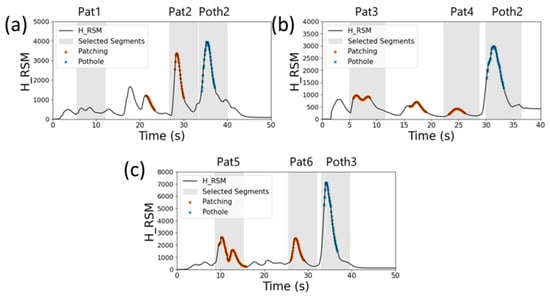
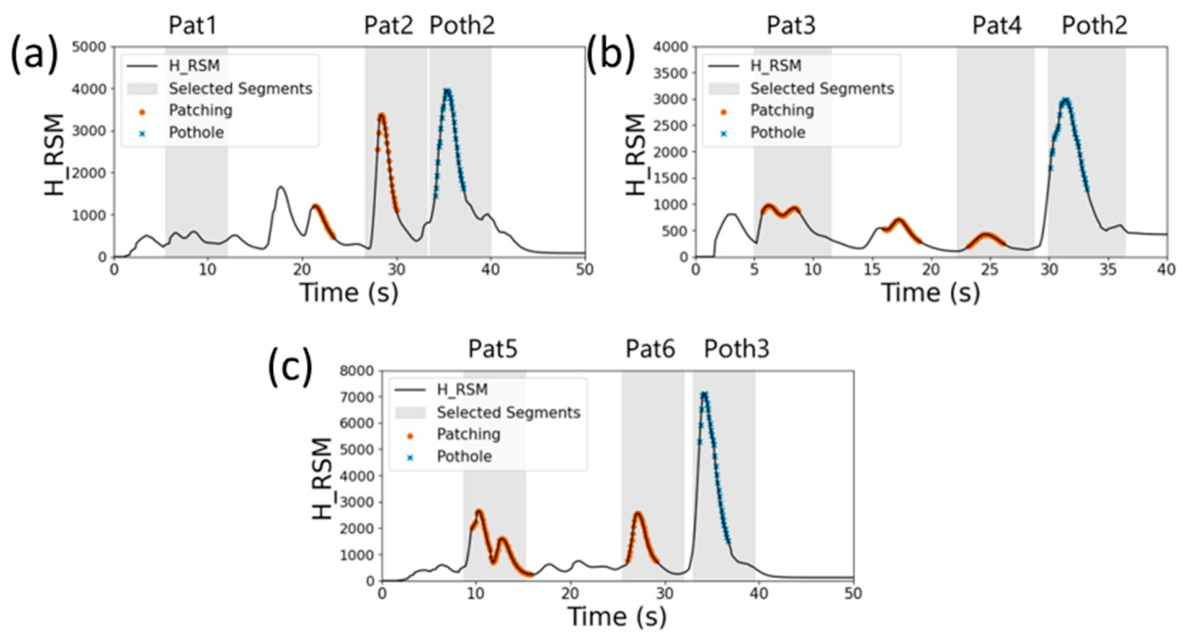
As the second part of the exploratory analysis, three H_RSM signals collected from the same road segment were used to evaluate the consistency of differences in these signals across various defective road sections, as shown in Figure 3. This figure also shows the selected segments corresponding to patching and potholes, alongside the originally labeled data points. The selected segments do not exactly match the labeled points for several reasons. First, the effect of passing over a pothole can continue beyond the defect, appearing as an after-shock, as seen in Figure 2. Second, to capture this effect, the segments were extended, whether for patching or pothole, up to a point that does not overlap with the next segment. Third, the segments were slightly extended before the labeled points to account for the initiation of a peak caused by a defect and to minimize potential human error in labeling. Fourth, the segment length was kept constant to quantitatively evaluate the consistency of defect differences using evaluation metrics. Finally, although the selected segments were placed on the exact location of defects, some defects in certain signals were mislabeled, as noted in Figure 3a.
Figure 3.
H_RSM signals collected from the same road segment: (a) the first signal; (b) the second signal; (c) the third signal.
Consequently, each dataset includes two selected segments corresponding to patching and one segment corresponding to a pothole. These segments are labeled as “PatX” and “PothX”, where X represents the segment number. Specifically, Pat1, Pat3, and Pat5 correspond to passages over the same patching, while Pat2, Pat4, and Pat6 correspond to passages over another patching. Poth1, Poth2, and Poth3 indicate passages over the same pothole.
Two methods were adopted to assess the consistency of differences in defect signals. The first is the Pearson correlation coefficient [11], which quantifies the linear relationship between two time series signals, and , each with data points. The coefficient, denoted as , is calculated using the sample means of the signals and . The value ranges from −1 to 1, where 1 represents a perfect positive linear relationship, −1 represents a perfect negative linear relationship. The coefficient is computed as follows:
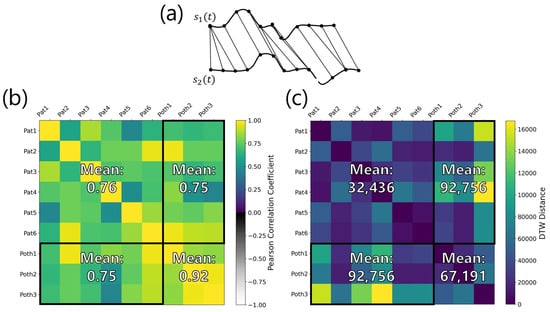
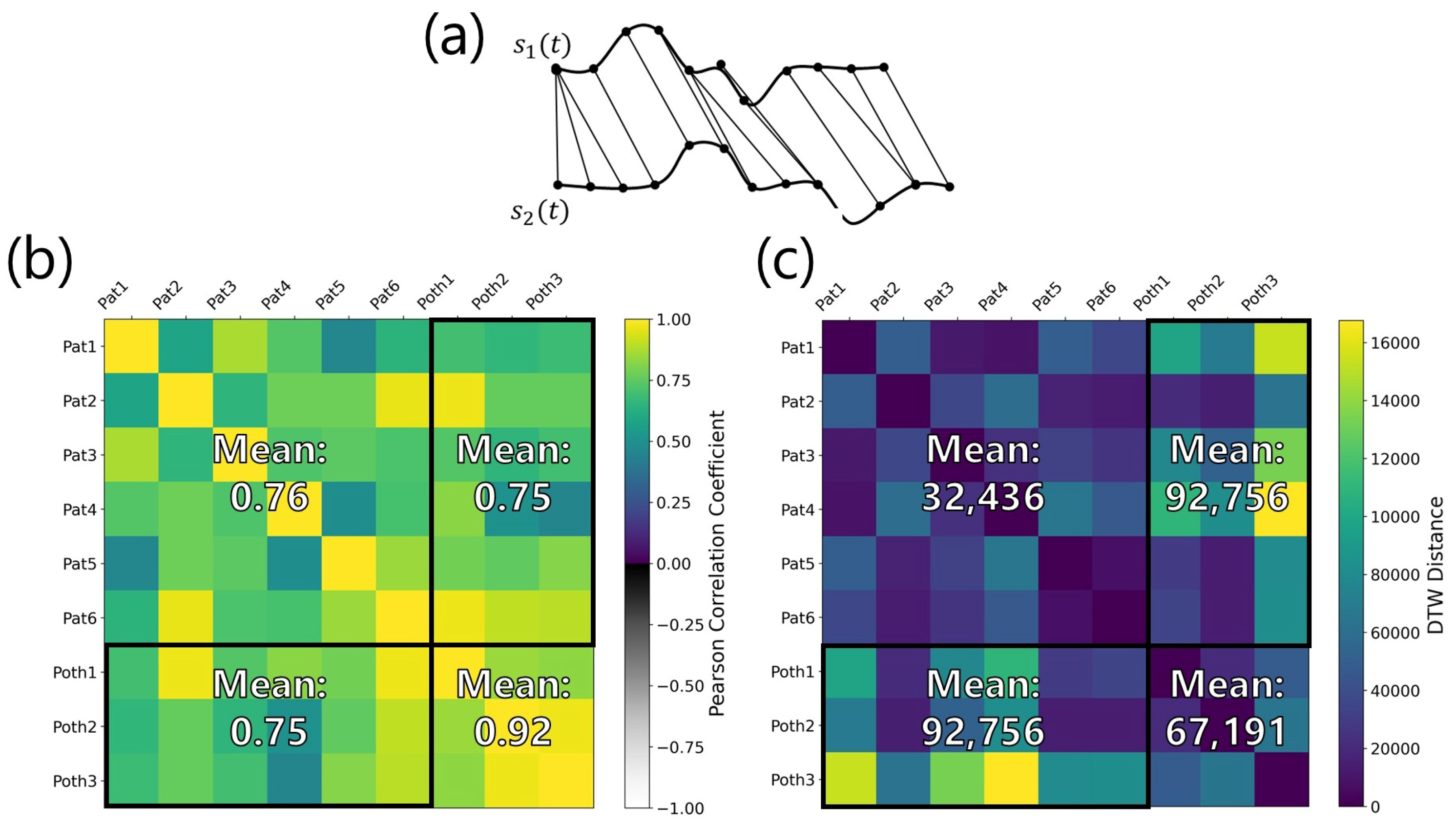
The second metric used is Dynamic Time Warping (DTW) [12], an algorithm that measures the similarity between two time series signals even when there are variations in timing or local distortions. DTW can be thought of as a specialized “distance” measure, similar in spirit to Euclidean distance, but adapted for time series. While Euclidean distance simply compares values at corresponding time points, it is sensitive to small shifts or differences in timing. In contrast, DTW compensates for these local timing shifts by finding an optimal alignment between the two signals, effectively “warping” the time axis to minimize overall differences. In this way, DTW produces a distance-like value that quantifies the dissimilarity between signals while being robust to small variations in timing or shape. Figure 4a illustrates this concept by showing how DTW aligns points between two signals, a classical depiction often used to introduce this method. This approach is well-suited for comparing H_RSM signals for the same type of defect, as slight differences in signal shapes can arise due to variations in wheel positioning, timing, or vehicle speed when traversing defects. For this application, low DTW values between segments of the same defect type suggest similar responses in the H_RSM signals, which may support classification. Conversely, high DTW values across different defect types indicate differences in signal patterns that may assist separation in machine learning models.
Figure 4.
DTW algorithm: (a) alignment of signals using DTW; (b) average Pearson coefficients across different defect types; (c) average Dynamic Time Warping algorithm values across different defect types.
The DTW algorithm operates as follows. Consider and as two signals with and data points respectively. A cost matrix is initialized, where D[i,j] represents the cumulative distance between and . The matrix has dimensions , with , for , and for . The cost matrix is then computed using the local Euclidean distance between each pair of points, , and the recursive relation:
for and and the DTW distance between the two signals is given by the value .
The Pearson correlation coefficient captures linear relationships between signal amplitudes, while DTW captures similarity in signal shape under temporal misalignment. Using both metrics provides a complementary assessment of defect signatures in both amplitude and time-warped domains. Accordingly, the Pearson correlation coefficient () and Dynamic Time Warping (DTW) values were calculated separately for each pair of selected segments and presented in matrix form in Figure 4b,c. These matrices are divided into four sub-matrices. The upper left (UL) sub-matrix represents comparisons of H_RSM segments for patching, while the lower right (LR) sub-matrix represents comparisons for potholes. The upper right (UR) and lower left (LL) sub-matrices, which are transposes of each other, represent comparisons between patching and pothole segments. The average values for these sub-matrices are as follows:
- ;
- ;
- .
The corresponding average DTW values are:
- ;
- ;
- .
For patching, DTW shows a much lower within-patching distance (32,436) compared with cross-defect distances (92,756), meaning patching segments are more similar to each other under DTW. For potholes, Pearson correlation shows a high within-pothole similarity (0.92) compared with patching and cross-defect correlations around 0.75–0.76. These results suggest that DTW was more sensitive to similarities among patching segments, whereas the Pearson correlation coefficient more clearly captured similarities among pothole segments. This difference is expected because Pearson correlation measures linear similarity in signal shape, whereas DTW accounts for temporal misalignment between signal segments. These observations support the use of both metrics to evaluate the consistency and separability of defect-related RSM signals.
We introduce the DCI to quantify the relative distinguishability of pothole and patching vibration signatures. Since Pearson correlation values have a bounded interpretation as measures of linear correlation, while DTW values are distance-based and depend on factors such as signal length, amplitude scaling, and preprocessing, the DCI does not directly combine raw Pearson and DTW values. Instead, both metrics are used as relative comparative measures within a consistent normalization. Accordingly, the DCI compares within-defect and cross-defect relationships using both Pearson correlation and Dynamic Time Warping. Equal weighting was selected to provide a simple and interpretable combined indicator for this exploratory analysis, although alternative weighting strategies could be considered in future work. The resulting DCI is therefore interpreted as a relative exploratory indicator of defect distinguishability and does not represent a universal threshold for classification.
The DCI was calculated using the average r and DTW values from the sub-matrices shown in Figure 4b,c. As a result, the DCI was computed as 29%, indicating that the signatures of patching and potholes in the H_RSM signals differ by 29% on average. This value indicates a measurable level of separation between defect types within the dataset, supporting the further use of defect classification models that rely on consistent differences in signal patterns. Such measurable differences support the feasibility of applying machine learning models to classify these defects within the evaluated dataset.
2.2. Defect Identification Algorithm
To demonstrate that defects can also be identified relative to intact road sections, we design a simple and interpretable first-stage detector, Defect Identification Algorithm, based on a Hampel Identifier [13] to separate large defect peaks from intact segments. The Hampel Identifier is a robust outlier detection method that identifies data points exceeding a specified threshold, . It is formulated as:
where is a signal containing outliers, such as peaks in the H_RSM signal caused by defects, referred to here as defect peaks. The coefficient in Equation (4) can be determined based on the expected percentage of outliers (defect peaks) and the length of the moving window [14]. The parameter in Equations (4) and (5) is an odd number that adjusts the moving window’s length and can be selected as twice the maximum length of outliers plus one [15]. However, determining c in advance is challenging because the expected percentage of outliers is not known [16].
Furthermore, this study applies an exponent to the signal, expressed as , to amplify high-magnitude defect-related peaks relative to lower-magnitude background fluctuations. This transformation can improve the separation between defect-related peaks and intact road segments. However, larger values of may also over-amplify isolated noise or non-defect fluctuations. Therefore, a two-step Defect Identification Algorithm (DIA) is proposed in this study. The first step of DIA determines suitable values for the Hampel coefficient and the exponent using a grid-search procedure. The search range for was set from 3 to 12 to cover both sensitive and conservative Hampel thresholds. Values near the lower end of this range allow smaller deviations from the local median to be detected, increasing sensitivity to potential defect peaks but also increasing false detections in intact road segments. Values near the upper end impose a stricter threshold, reducing false detections but potentially missing weaker defect responses. The search range for was set from 1 to 4 to evaluate moderate levels of peak amplification. A value of preserves the original signal, while larger values progressively emphasize high-magnitude peaks relative to lower-magnitude fluctuations. The upper limit of was selected to avoid excessive distortion of the signal and over-amplification of isolated noise.
Accordingly, a grid search was conducted over all combinations of and . Each combination was evaluated using the recorded signals by assessing whether defect-related peaks were consistently detected while intact road segments remained largely below the adaptive threshold. The selected parameters, and , provided a stable balance between identifying major defect-related peaks and limiting excessive false detections in intact regions. Because this study focuses on an exploratory evaluation using a limited dataset, these parameters should be interpreted as empirically tuned values rather than universally optimal constants. The window length was selected based on the observed span of consecutive defect-related peaks in the recorded signals. After these parameters were determined, the second step applied the Hampel identifier to the H_RMS signals using the same parameter settings throughout the dataset.
2.3. Machine Learning Pipeline for Defect Classification
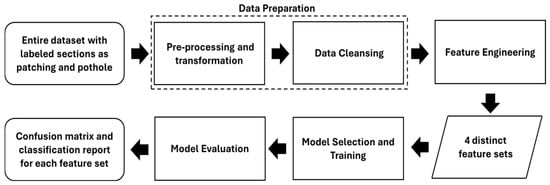
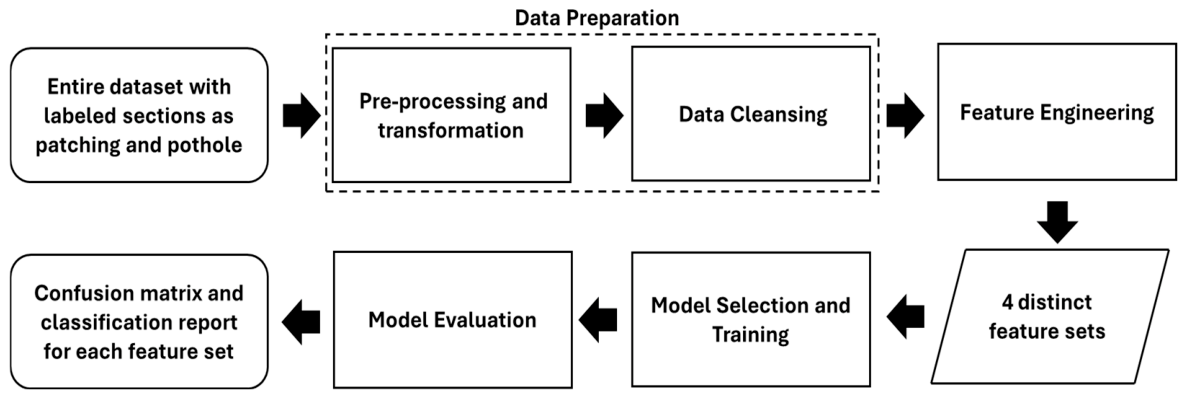
In the final step of the framework, motivated by the distinguability and detectability of defects, a shape-based feature pipeline for fused vibration signals is proposed to differentiate detected defect types. The structure of the pipeline is illustrated in Figure 5. It begins with preprocessing and transformation of labeled H_RSM segments extracted from the full dataset. Segments that deviated from the typical signal shape were then removed. These two steps constitute the data preparation stage. Next, four distinct feature sets were generated from the prepared data. Each feature set was divided into training and testing subsets, and a machine learning model was trained using five-fold stratified cross-validation within the training subset. Finally, model performance was evaluated on the test subsets using the metrics described in the previous section.
Figure 5.
Overall flow of the machine learning pipeline.
2.4. Data Preparation
In the preprocessing stage, labeled H_RSM segments were modified to account for the continued signal response following the passage over a pothole, which can appear as an after-shock (as seen in Figure 3). To capture this extended effect, all labeled segments, regardless of defect type, were lengthened to twice their original size. This extension ensures that input segments reflect the full defect signature during inference, where the defect type is not known in advance. Additionally, segments were extended by six data points before the original start point to capture the initial rise in the signal in cases where the original label did not include the full defect onset. This approach is similar to the extension method used in the defect consistency analysis. In this case, however, the doubling of segment length occasionally resulted in merged segments. The original labeled positions were not adjusted to preserve possible uncertainty due to manual annotation. As described previously, labeling was performed by a researcher using synchronized camera images. Slight temporal mismatch may exist between when a defect is visible in the camera frame and when the vibration response is recorded by the sensors. Adjusting for this offset without precise calibration could introduce additional bias. This step is referred to as preprocessing in the pipeline.
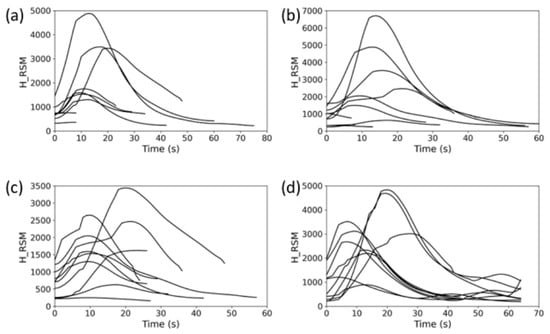
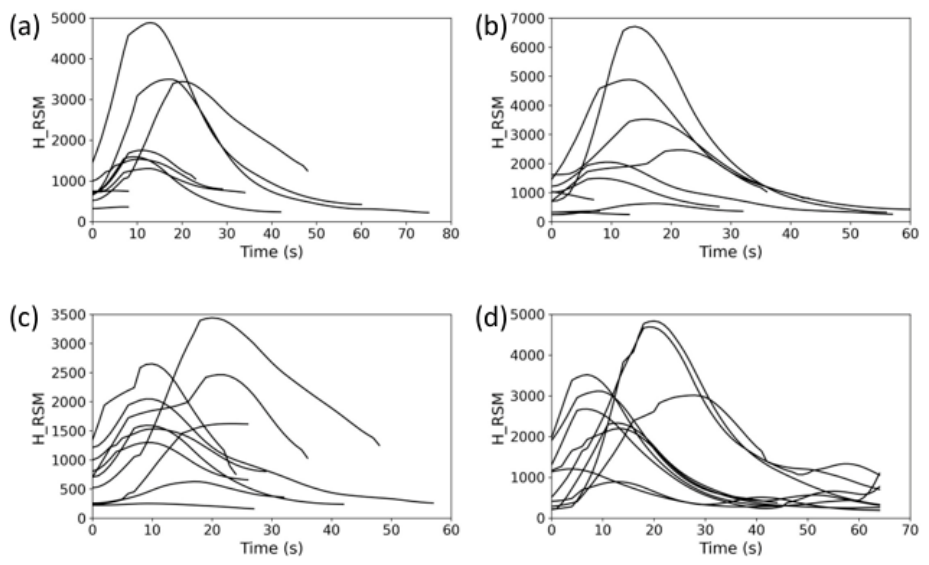
In the second step of data preparation, merged labeled segments containing more than two peaks were subdivided into smaller segments, each with at most two peaks. This was done using local minima and maxima to isolate appropriate boundaries. Based on field observations, a single defect, particularly a pothole, often produces two consecutive peaks in H_RSM signals (see Figure 3). Limiting segments in this way ensures consistency across the dataset and improves interpretability. In the final stage of data preparation, referred to as data cleaning, segments that deviated from the typical signal shape were removed. These atypical shapes often resulted from the transformation of long segments or inaccuracies in labeling. Segments were excluded if they (i) decreased continuously at the beginning instead of rising to a peak, (ii) increased at the end rather than stabilizing or declining, (iii) lacked any clear peaks, or (iv) were substantially shorter than average. Figure 6a,b show examples of raw segments before preparation, while Figure 6c,d show examples after preprocessing, transformation, and cleaning. These segmentation and cleaning rules were applied consistently across all labeled signals. The resulting processed segments exhibited recurring structural characteristics, including dominant impact peaks, asymmetric decay behavior, and localized secondary responses. These observed patterns motivated the shape-based feature characterization and classification framework presented in the following section.
Figure 6.
Data preparation stage. (a,b) Two sets of 10 randomly selected labeled segments before data preparation. (c,d) Two sets of 10 randomly selected labeled segments after data preparation.
2.5. Feature Construction for Defect Classification
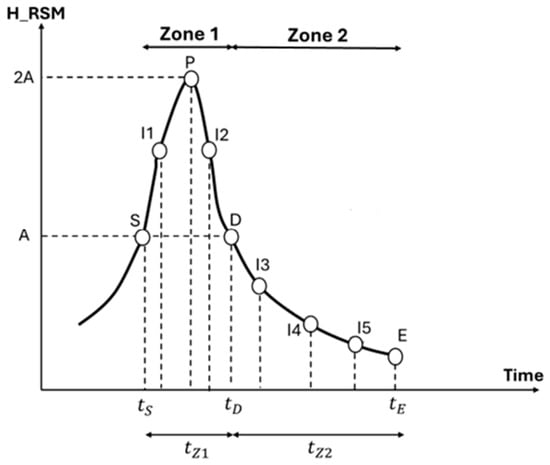
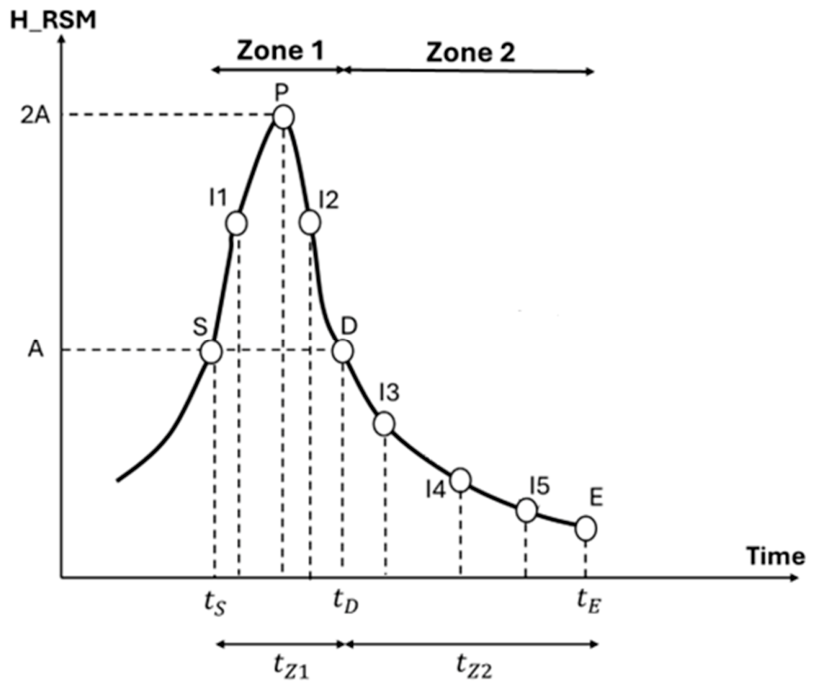
The processed defect segments exhibited recurring structural characteristics that could be used to distinguish different defect types. To quantitatively encode these patterns, four distinct feature sets were designed to describe the shape and temporal structure of the H_RSM signals. Figure 7 illustrates a typical labeled segment. In this figure, point P marks the peak of the largest signal amplitude, observed early in the segment. The amplitude at point P is denoted as 2A. Points S and D correspond to the signal values at half the peak amplitude (i.e., A), indicating the onset and offset of the main peak, respectively. These define two subregions of the signal: Zone 1 spans from S to D, and Zone 2 extends from D to E, the end of the segment. The durations of these zones are given by and . For finer resolution, internal points I1 and I2 divide the interval from S to P and P to D into equal halves, while points I3, I4, and I5 divide the interval from D to E into four equal parts. These reference points serve as anchors for computing shape-descriptive features in the subsequent analysis. This segmentation into zones and internal points enables capturing both global and localized signal characteristics critical for distinguishing defect types.
Figure 7.
A typical shape of labeled H_RSM signal segment.
Using the characteristics of a typical labeled H_RSM segment, four distinct feature datasets were generated. The main goal was to encode the shape of the segments rather than their amplitudes since no direct correlation was observed between the amplitudes of H_RSM segments corresponding to different defects. Accordingly, the feature sets are as follows:
The 1st Feature Set: This set consists of 11 parameters. Two parameters are the slope of two lines between points S and P, between P and D. The other two parameters are the ratio of to , and the ratio of areas of the H_RSM signal in Zone 1 and Zone 2. Three parameters are the standard deviation, skewness and kurtosis of the signal segment located between points S and D [17]. The final four parameters are the parameters of the generalized exponential Gaussian distribution [18] which were computed for H_RSM signal portions in Zone 2. These parameters and their explanations are as follows: (i) the location parameter shifts the entire distribution along the x-axis, similar to how the mean determines the central tendency in a normal distribution. The scale parameter affects the spread of the data by stretching or compressing the distribution, analogous to the role of standard deviation in a normal distribution. The shape parameter introduces asymmetry to the distribution by controlling its skewness, thus enabling the model to better fit data that are not symmetrically distributed. Lastly, the kurtosis parameter adjusts the peakiness and tail weight of the distribution, allowing it to represent data with heavy tails or varying degrees of peakiness, which can be significantly different from that of a normal distribution. Given the flexibility of the generalized exponential Gaussian distribution (GEGD) in modeling diverse data behaviors beyond the normal distribution, it was chosen to represent the shape of the H_RSM data segments in Zone 2. This choice is particularly suitable as the GEGD can model the segments as resembling a Gaussian distribution when a peak is present, or an exponential distribution when a peak is absent.
The 2nd Feature Set: This set contains 59 features. The additional 24 parameters are the parameters of the 3rd order polynomials fitted between point pairs (S, P), (P, D), (D, I3), (I3, I4), (I4, I5), and (I5 and E). The polynomials were fitted to normalized values of signal portions to exclude the effect of signal amplitude. Other additional 24 parameters are the division of areas within each other between point pairs (S, I1), (I1, P), (P, I2) and (I2, D), and also between point pairs (D, I3), (I3, I4), (I4, I5) and (I5, E).
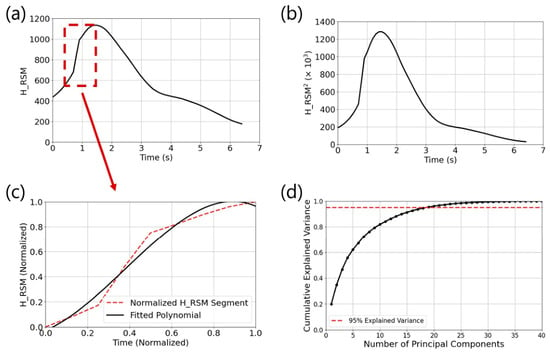
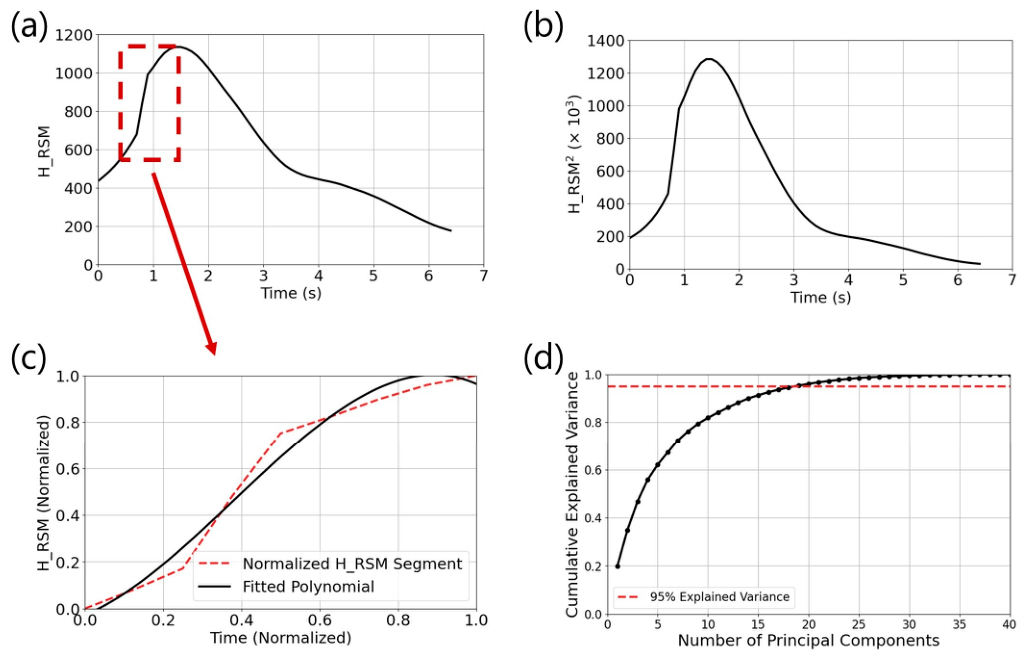
The 3rd Feature Set: This set contains 118 features. The additional 59 features are the same parameters used in the 2nd feature set but obtained from the square magnitude of each labeled segment. The motivation behind this approach is that this process can extend the distance between large peaks and small peaks or signal points with small values, which might help encode the differences between H_RSM signal segments corresponding to different defect types. As an example, Figure 8a shows an H_RSM segment corresponding to a pothole, while Figure 8b shows the square magnitude of this signal. As these figures show, a small peak located in Zone 2 of this segment (see 4–5 s in Figure 8a) is less apparent with respect to main peak at 1–2 s in the square amplitude signal. In addition, Figure 8c shows the fitted polynomial to normalized values of the segment located between points S and P. It should be noted that the feature sets are constructed from a limited number of training samples, which may increase the risk of overfitting. This is particularly relevant for the third feature set with 118 features. The use of PCA in the fourth feature set partially addresses this issue by reducing dimensionality while retaining most of the variance in the data. However, the reported classification performance should be interpreted with this limitation in mind.
Figure 8.
Feature set construction: (a) an H_RSM segment corresponding to a pothole, (b) square magnitude of the segment, (c) polynomial fit to a normalized portion of the segment, (d) PCA projection of third feature set to construct the fourth feature set.
The 4th Feature Set: This set contains 18 features, which were obtained from the 3rd feature set through Principal Component Analysis (i.e., PCA), which is a dimensionality reduction method [19]. The goal of this subset is to avoid the curse of dimensionality, which refers to the various issues that arise in high-dimensional spaces, such as increased computational complexity, data sparsity, reduced effectiveness of distance metrics, and risk of overfitting. Accordingly, PCA transforms a feature set into a set of orthogonal (uncorrelated) components, ordered by the amount of variance they explain, thereby simplifying the complexity of high-dimensional data while retaining its essential patterns. Afterwards, as a rule of thumb, the components that explain 95% of the total variance are used as the new features. Figure 8d shows that 18 features reached 95% of the total explained variance.
The feature sets were split into training and testing subsets, and four training subsets were fed into a Random Forest machine learning model. Each training subset included 28 data points for patching and 11 data points for pothole, while each testing subset contained 7 data points for patching and 3 data points for pothole. Random Forest was selected because it builds multiple decision trees during training and combines their outputs to improve predictive performance [19]. Each tree is trained on a random subset of data (bagging) and uses a random subset of features for splitting nodes, which enhances model robustness and accuracy while mitigating overfitting. By averaging the predictions of these trees, Random Forest provides a more stable and accurate prediction than individual decision trees. The Random Forest hyperparameters were selected using a grid search procedure within the training subset. The tuned parameters included the number of trees, maximum tree depth, and minimum number of samples required to split an internal node. Five-fold stratified cross-validation was used during model training to reduce sensitivity to class imbalance in the small dataset. The final model performance was then evaluated using the held-out test subset.
3. Results and Discussion
This section presents the results of the proposed framework, beginning with evaluation of the Defect Identification Algorithm (DIA) and followed by assessment of the machine learning classification pipeline using the constructed feature sets.
3.1. Defect Identification Results
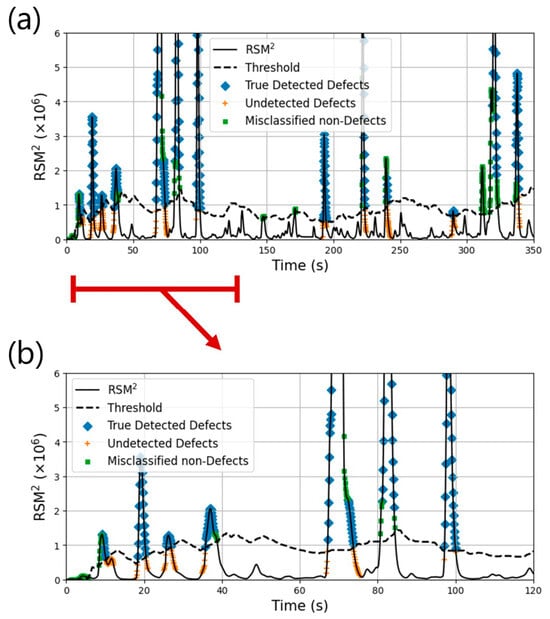
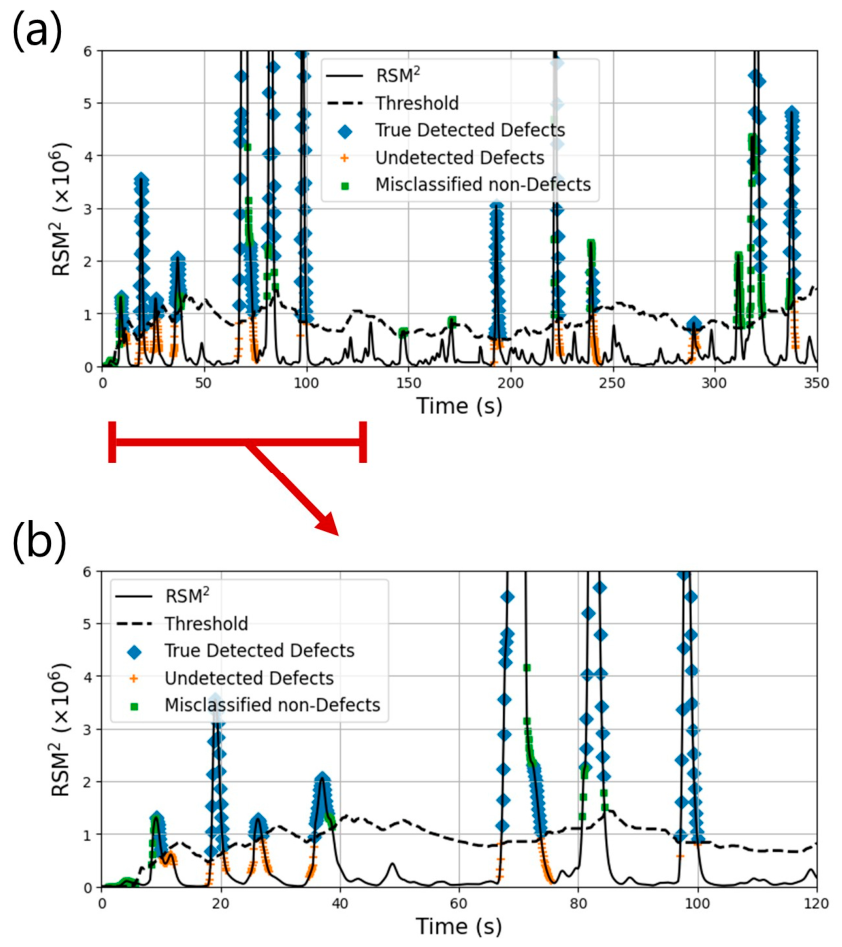
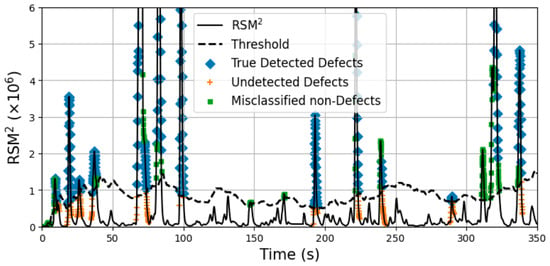
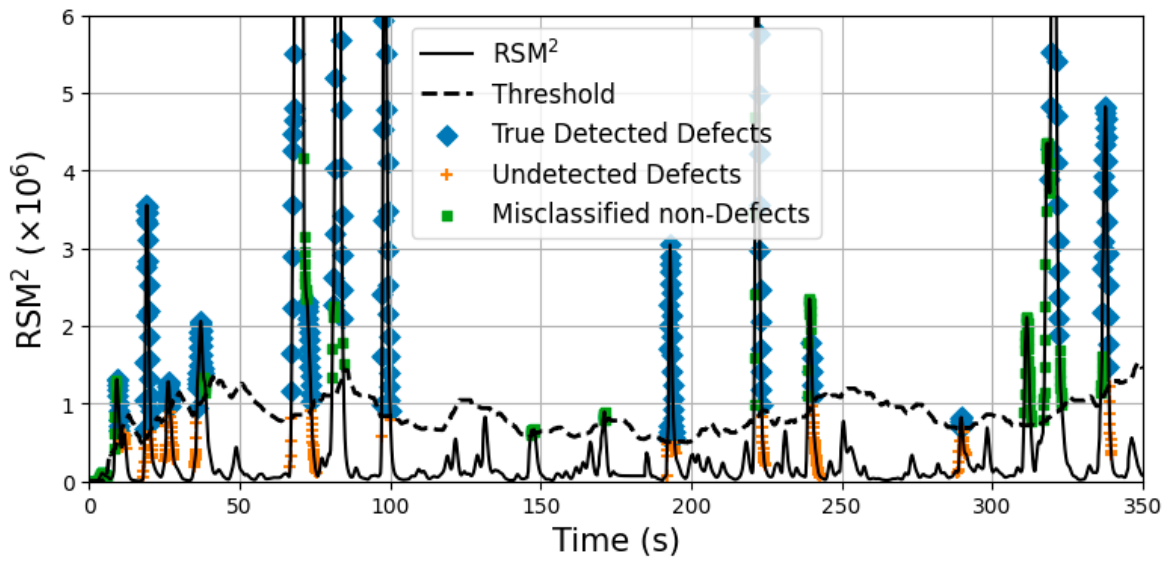
Three H_RSM signals from the 11 recorded datasets, each from a different road segment, were used to demonstrate and evaluate DIA. Figure 9a presents 350 s long signal alongside the calculated threshold . Using the labels for patching and potholes, three outcomes are illustrated: (i) true detected defects, where labeled H_RSM points exceed ; (ii) undetected defects, where labeled H_RSM points do not exceed ; and (iii) misclassified non-defects, where points exceed the threshold but are not labeled as defects. These outcomes were visualized for result interpretation rather than as evaluation metrics. This is because DIA is based on thresholding, and lower parts of defect peaks may not be identified as outliers. Future improvements, as discussed in Section 4, could involve capturing the entire extent of detected peaks.
Figure 9.
The first signal showing (a) the complete signal and (b) a selected segment for closer analysis.
The evaluation focused on whether DIA successfully detected the highest values of defect peaks while avoiding false detection of peaks that were not labeled as defects. True positive (TP) instances for defective road segments refer to defect peaks where any portion was detected by DIA, and false positive (FP) instances for defective road segments refer to intact peaks that were incorrectly detected by DIA. Similarly, TP and FP instances were computed for intact road segments. Figure 9a,b show that DIA detected the defect peaks effectively while mostly avoiding intact peaks, except for two peaks at 5 s and 10 s and three peaks at 148 s, 175 s, and 310 s. Although these five intact peaks were misclassified, all defect peaks were correctly detected because successfully identified the higher amplitude values. These false detections are primarily associated with boundary regions and localized signal fluctuations, where threshold-based separation becomes less stable.
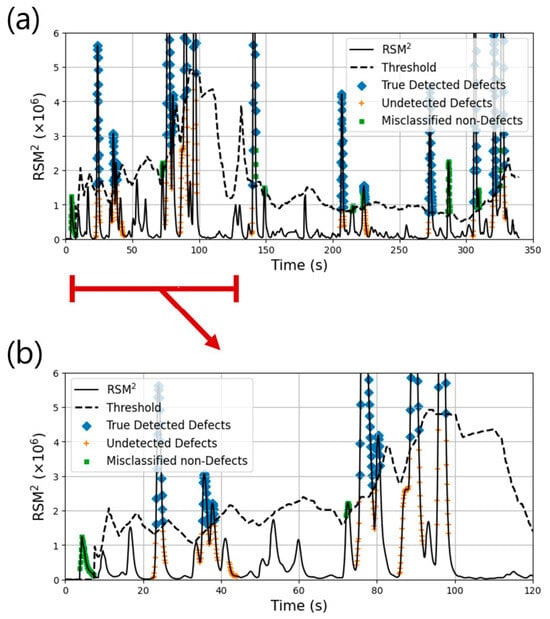
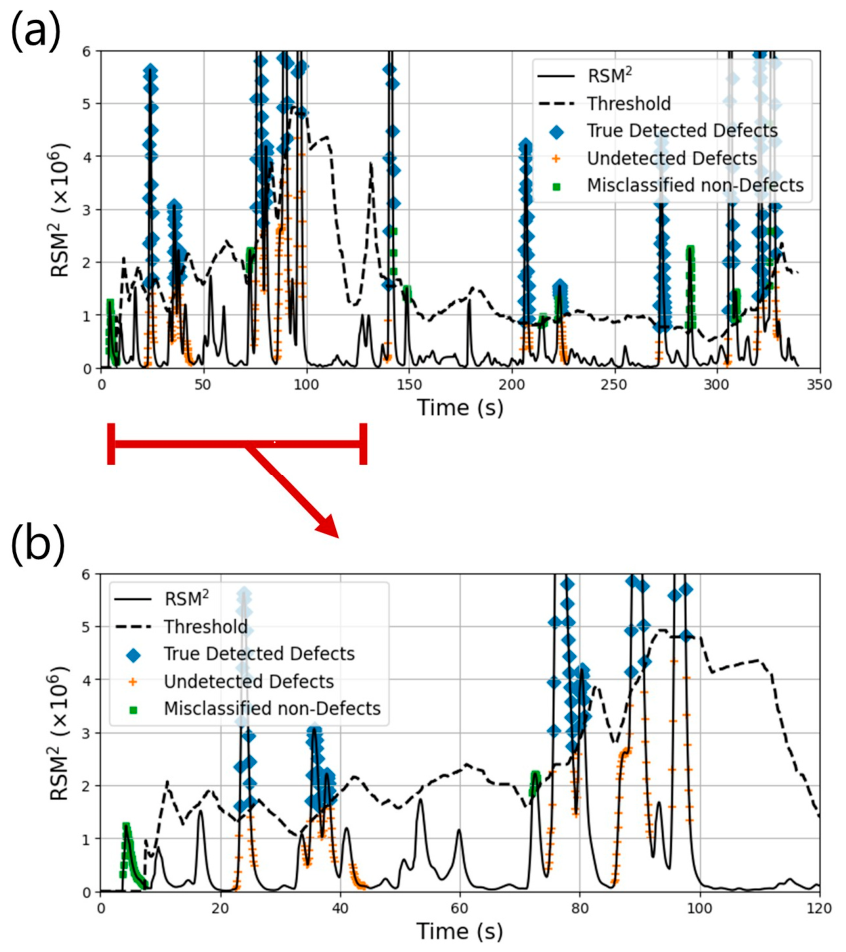
Another signal used in the evaluation of DIA is shown in Figure 10a, with a focused section shown in Figure 10b. These figures show that DIA again successfully detected the defect peaks while mostly avoiding intact peaks, except for six peaks at 8 s, 72 s, 150 s, 210 s, 285 s, and 310 s. All defect peaks were identified correctly.
Figure 10.
The second signal showing (a) the complete signal and (b) a selected segment for closer analysis.
The last signal used in the evaluation of DIA is shown in Figure 11. This signal is shorter compared to the previous examples. The figure shows that DIA again misclassified two intact peaks as defects but correctly identified all three defect peaks. It also illustrates that when the threshold is zero or near zero at the beginning of the signal, there is a higher likelihood of misclassifying intact peaks near the signal boundaries.
Figure 11.
The third signal showing the complete signal.
Table 1 presents the confusion matrices and Table 2 presents the classification report [19,20] for each dataset and the combined results. The DIA evaluation was performed at the peak level rather than at the individual time-point or full-segment level. A defect peak was counted as correctly detected if any portion of the peak exceeded the Hampel threshold, while an intact peak was counted as a false positive if it exceeded the threshold without being labeled as a defect. Across all datasets, all 28 defect peaks were correctly identified, while 13 of 90 intact peaks were misclassified. Evaluation metrics were computed using the combined confusion matrix. These include: (i) precision, the ratio of true positives (TP) to TP and false positives (FP), indicating the correctness of positive predictions; (ii) recall, the ratio of TP to TP and false negatives (FN), reflecting the model’s ability to detect actual positives; (iii) accuracy, the proportion of correct predictions across all classes; (iv) micro-averaged metrics, which aggregate across instances to provide global performance; and (v) macro-averaged metrics, which average class-wise metrics to give equal weight to each class [19,20].
Table 1.
Confusion matrices.
Table 2.
Classification report for defect identification.
The model achieved a precision of 0.68 for defective segments, indicating a moderate false positive rate, and a perfect recall of 1.00, correctly identifying all true defects. The corresponding F1-score is 0.81. For intact segments, the model achieved a precision of 1.00 and a recall of 0.86, yielding an F1-score of 0.92. Overall accuracy was 0.89. The macro-averaged precision, recall, and F1-score were 0.84, 0.93, and 0.87, respectively. Weighted averages were 0.90, 0.88, and 0.88, respectively, reflecting the model’s robustness across class imbalances. These results indicate that the thresholding algorithm was able to distinguish defective and intact segments within the evaluated dataset.
3.2. Feature-Based Defect Classification
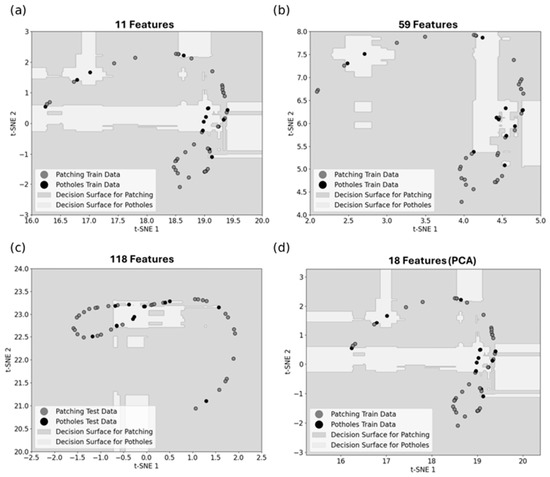
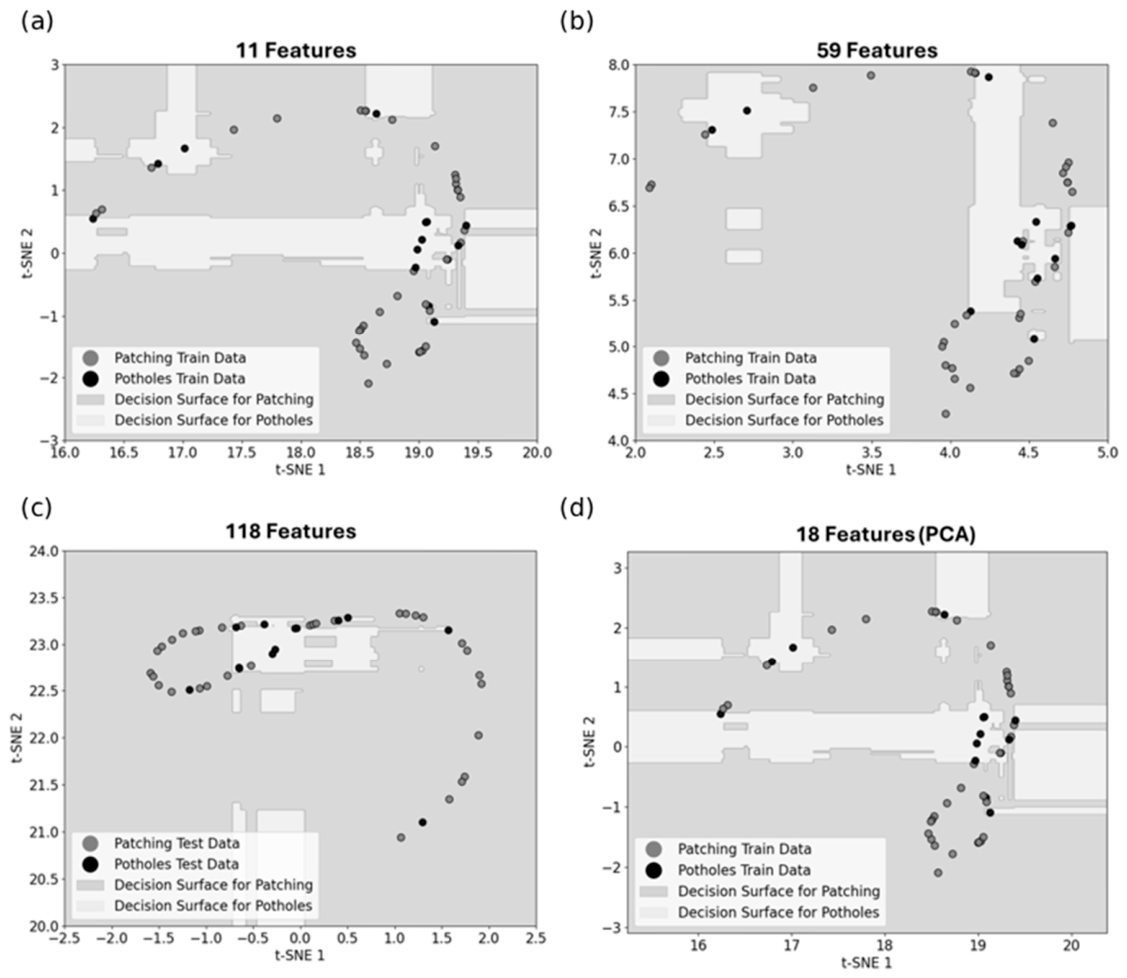
Using the feature sets and model training procedure described in Section 2.5, the classification results were evaluated through visualization and confusion matrix analysis. Figure 12 shows t-Distributed Stochastic Neighbor Embedding (i.e., t-SNE) plots of the features on a two-dimensional space along with the decision surfaces for defects that were determined by the models trained by different features. The algorithm t-SNE is a dimensionality reduction technique that helps visualize high-dimensional data by maintaining local similarities and revealing clusters in a lower-dimensional space [21]. Figure 12 shows that as the number of features increased, the data points belonging to different defects showed increased visual separation by accumulating at more specific areas, which led to more localized decision surface for potholes. The figure also shows that using PCA does not necessarily help to reveal a more distinct pattern of data points.
Figure 12.
t-SNE visualization showing the first feature set in (a), the second in (b), the third in (c), and the fourth in (d).
The confusion matrix results for each feature set are demonstrated in Table 3. The best performance on the evaluated test subset was obtained using the 4th feature set with 18 features, where all potholes and patching samples in the test subset were classified correctly. The second-best performance was obtained using the 3rd feature set with 118 features. However, t-SNE graphs in Figure 12c show that the data points corresponding to different defects were isolated better than each other using the 3rd dataset. The perfect performance with the 4th dataset may indicate potential overfitting, as the model could have overly specialized in identifying isolated pothole data points, as seen in Figure 12d. Overall, the 3rd and 4th feature sets produced the strongest performance on the evaluated test subset. However, the perfect classification obtained with the 4th feature set should be interpreted cautiously because the test subset contained only 10 samples, including three pothole samples.
Table 3.
Confusion matrices for defect classification using different number of features and classification report.
The classification report for the 3rd feature set, which was computed using the metrics used in assessing defect identification results, is also shown in the table. The classification report for the 4th feature set is not emphasized because all metrics would equal 1.00 on this small test subset, which could overstate the reliability of the result. The classification report indicates that the model performs well, with an overall accuracy of 90%. For the individual classes, it achieved a precision of 88% and a perfect recall of 100% for classification of patching, resulting in an F1 score of 0.93. For classification of potholes, it achieved a perfect precision of 100% but had a lower recall of 67%, leading to an F1 score of 0.80. The macro average scores are 94% precision, 83% recall, and 87% F1 score, while the weighted averages are 91% precision, 90% recall, and 89% F1 score. This performance should be interpreted in the context of the underlying sample distribution, as the dataset contains fewer pothole samples than patching samples. This imbalance may contribute to the variability observed in pothole recall.
4. Conclusions
This study suggests that fused OEM vibration signals contain distinguishable defect-related patterns that support classification. A new metric, the DCI was introduced to quantify differences between signal segments corresponding to potholes and patching. The average difference between these defect types was measured as 29%, indicating measurable differences in signal behavior. This supports the hypothesis that different defect types leave distinguishable signatures in the H_RSM signal, enabling the use of supervised classification methods.
Building on this, the proposed framework applied a threshold-based detection algorithm using a Hampel Identifier to identify defective segments. The algorithm achieved a defect detection recall of 1.00 and an overall accuracy of 89%. A machine learning pipeline was then used to classify defect types based on engineered feature sets. The best-performing feature set yielded a classification accuracy of 90%, with recall ranging from 67% to 100% for potholes and 100% for patching. These results indicate that H_RSM-based vibration sensing may support defect-level analysis using compact, non-visual signals and motivate further evaluation in larger connected vehicle datasets.
The study is based on a limited dataset collected from a single instrumented vehicle within a specific geographic region, with a relatively small number of labeled defect samples and class imbalance between defect types. Only two defect categories, potholes and patching, are considered, and no external validation dataset is used. These factors limit the generalizability of the reported classification performance and may introduce sensitivity to vehicle-specific dynamics, operating conditions, and sampling characteristics. Future work will focus on expanding the dataset across multiple vehicles, environments, and defect types to further evaluate robustness and scalability in large-scale connected vehicle settings.
Author Contributions
Conceptualization D.O. and F.N.C.; methodology, K.K. and B.U.; software, K.K.; validation, K.K., B.U. and F.N.C.; formal analysis, K.K. and B.U.; investigation, K.K., B.U., D.O., J.C. and F.N.C.; resources, D.O. and F.N.C.; data curation, B.U. and F.N.C.; writing; original draft preparation, K.K., B.U. and F.N.C.; writing—review and editing, B.U., K.K., D.O., J.C. and F.N.C.; visualization, K.K. and B.U.; supervision, D.O. and F.N.C.; project administration, D.O. and F.N.C.; funding acquisition, D.O. and F.N.C. All authors have read and agreed to the published version of the manuscript.
Funding
This research was partially funded by i-Probe Inc. McLean, Virginia.
Data Availability Statement
The data used in this study were provided by Honda Motor Company under a data-use agreement and are subject to proprietary and confidentiality restrictions. The data are not publicly available due to contractual obligations associated with their use.
Acknowledgments
The authors gratefully acknowledge the contributions of several Transtek engineers and interns, including Chuanzhi Dong and Ru Zhen, for their efforts in advancing machine learning developments and engaging in productive discussions. Several i-Probe administrators and engineers contributed to the development of this work funded by i-Probe Inc. Special thanks are extended to Shinya Shimada of i-Probe Inc. for his invaluable input in the development and application of the technologies. The authors also sincerely appreciate the insights and support provided by officials and engineers from FDOT and Orange County, which were instrumental in facilitating real-world implementation of the technology. The authors acknowledge the collaboration and support of Honda Motor Company for generously sharing data, which significantly enhanced this work. The authors have reviewed and edited the output and take full responsibility for the content of this publication.
Conflicts of Interest
Berkin Uluutku, Korkut Kaynardag, and John Cotter are or were employed by Transtek International Group LLC during the period in which the research was conducted. Daisuke Oshima is the Chief Executive Officer of I-Probe Inc. Fikret Necati Catbas was a co-founder of Transtek International Group LLC. No other financial or non-financial competing interests are declared.
Abbreviations
The following abbreviations are used in this manuscript:
| RSM | Road Surface Monitoring |
| H_RSM | Honda’s Road Surface Monitoring |
| CV | Connected Vehicle |
| IRI | International Roughness Index |
| DCI | Defect Consistency Index |
| DIA | Defect Identification Algorithm |
| OEM | Original Equipment Manufacturer |
| DTW | Dynamic Time Warping |
References
- Traffic Safety Facts 2015; U.S. Department of Transportation, National Highway Traffic Safety Administration: Washington, DC, USA, 2015.
- Keeping Safe While Driving and Dealing with Potholes, Other Road Defects When Using Commercial or Company Vehicles. Available online: https://www.safetyinsurance.com/resource_center/commercial/potholescomm.html (accessed on 27 May 2025).
- Zhou, Y.; Guo, X.; Hou, F.; Wu, J. Review of Intelligent Road Defects Detection Technology. Sustainability 2022, 14, 6306. [Google Scholar] [CrossRef] [Scilit]
- Douangphachanh, V.; Oneyama, H. A Study on the Use of Smartphones for Road Roughness Condition Estimation. J. East. Asia Soc. Transp. Stud. 2013, 10, 1551–1564. [Google Scholar] [CrossRef]
- Mahlberg, J.A.; Li, H.; Zachrisson, B.; Leslie, D.K.; Bullock, D.M. Pavement Quality Evaluation Using Connected Vehicle Data. Sensors 2022, 22, 9109. [Google Scholar] [CrossRef] [Scilit] [PubMed]
- Kyriakou, C.; Christodoulou, S.E.; Dimitriou, L. Spatial Roadway Condition-Assessment Mapping Utilizing Smartphones and Machine Learning Algorithms. Transp. Res. Rec. J. Transp. Res. Board 2021, 2675, 1118–1126. [Google Scholar] [CrossRef] [Scilit]
- Wang, J.; Meng, R.; Huang, Y.; Zhou, L.; Huo, L.; Qiao, Z.; Niu, C. Road Defect Detection Based on Improved YOLOv8s Model. Sci. Rep. 2024, 14, 16758. [Google Scholar] [CrossRef] [Scilit] [PubMed]
- Zhong, J.; Kong, D.; Wei, Y.; Pan, B. YOLOv8 and Point Cloud Fusion for Enhanced Road Pothole Detection and Quantification. Sci. Rep. 2025, 15, 11260. [Google Scholar] [CrossRef] [Scilit] [PubMed]
- Chen, J.; Grimm, D.K.; Bai, F.; Grace, J.; Relan, S.; Vavrik, W. Crowd-Sensing Road Surface Quality Using Connected Vehicle Data. Transp. Res. Rec. J. Transp. Res. Board 2021, 2675, 729–739. [Google Scholar] [CrossRef] [Scilit]
- Mathew, J.K.; Desai, J.; Sakhare, R.S.; Hunter, J.; Bullock, D.M. Spatiotemporal Analysis of Pavement Roughness Using Connected Vehicle Data for Asset Management. J. Transp. Technol. 2025, 15, 1–16. [Google Scholar] [CrossRef]
- Ang, A.H.-S.; Tang, W.H. Probability Concepts in Engineering: Emphasis on Applications in Civil & Environmental Engineering, 2nd ed.; John Wiley & Sons: Hoboken, NJ, USA, 2007; ISBN 978-0-471-72064-5. [Google Scholar]
- Berndt, D.J.; Clifford, J. Using Dynamic Time Warping to Find Patterns in Time Series. In Proceedings of the 3rd International Conference on Knowledge Discovery and Data Mining; AAAI Press: Seattle, WA, USA, 1994; pp. 359–370. [Google Scholar]
- Pearson, R.K.; Neuvo, Y.; Astola, J.; Gabbouj, M. Generalized Hampel Filters. EURASIP J. Adv. Signal Process. 2016, 2016, 87. [Google Scholar] [CrossRef] [Scilit]
- Davies, L.; Gather, U. The Identification of Multiple Outliers. J. Am. Stat. Assoc. 1993, 88, 782–792. [Google Scholar] [CrossRef]
- Nongpiur, R.C. Impulse Noise Removal in Speech Using Wavelets. In Proceedings of the 2008 IEEE International Conference on Acoustics, Speech and Signal Processing; IEEE: Las Vegas, NV, USA, 2008; pp. 1593–1596. [Google Scholar]
- Kaynardag, K.; Yang, C.; Salamone, S. A Rail Defect Detection System Based on Laser Doppler Vibrometer Measurements. NDT E Int. 2023, 137, 102858. [Google Scholar] [CrossRef] [Scilit]
- Shanmugam, R.; Chattamvelli, R. Statistics for Scientists and Engineers; John Wiley & Sons, Inc.: Hoboken, NJ, USA, 2015; ISBN 978-1-119-04718-6. [Google Scholar]
- Marmolejo-Ramos, F.; Barrera-Causil, C.; Kuang, S.; Fazlali, Z.; Wegener, D.; Kneib, T.; De Bastiani, F.; Martinez-Flórez, G. Generalised Exponential-Gaussian Distribution: A Method for Neural Reaction Time Analysis. Cogn. Neurodynamics 2023, 17, 221–237. [Google Scholar] [CrossRef] [Scilit]
- Hastie, T.; Tibshirani, R.; Friedman, J.H. The Elements of Statistical Learning: Data Mining, Inference, and Prediction, 2nd ed.; Springer Series in Statistics; Springer: New York, NY, USA, 2009; ISBN 978-0-387-84857-0. [Google Scholar]
- Powers, D.M.W. Evaluation: From Precision, Recall and F-Measure to ROC. Inf. Markedness Correl. 2020. [Google Scholar] [CrossRef] [Scilit]
- van der Maaten, L.; Hinton, G. Visualizing Data Using T-SNE. J. Mach. Learn. Res. 2008, 9, 2579–2605. [Google Scholar]

Disclaimer/Publisher’s Note: The statements, opinions and data contained in all publications are solely those of the individual author(s) and contributor(s) and not of MDPI and/or the editor(s). MDPI and/or the editor(s) disclaim responsibility for any injury to people or property resulting from any ideas, methods, instructions or products referred to in the content. |
© 2026 by the authors. Licensee MDPI, Basel, Switzerland. This article is an open access article distributed under the terms and conditions of the Creative Commons Attribution (CC BY) license.