1. Introduction
Road traffic injuries remain a major global safety and infrastructure problem, with vehicle speed consistently identified as a central risk factor for both crash occurrence and injury severity. Recent global assessments report that road traffic crashes continue to cause more than one million fatalities each year, with limited progress on urban streets and secondary roads where vulnerable road users (VRUs) are frequently exposed [
1]. The relationship between speed and injury risk is strongly nonlinear, meaning that small reductions in operating speed can lead to substantial reductions in fatal and serious injuries [
2]. This effect is particularly relevant in mixed traffic environments, where pedestrians and cyclists share space with motorised traffic.
Traffic calming measures (TCMs) are interventions designed to reduce operating speeds, improve safety, and enhance the liveability of streets and roads. Early traffic calming practice focused mainly on physical and geometrical measures such as speed humps, raised platforms, chicanes, and road narrowing, which constrain driver behaviour through self-enforcing design [
3,
4]. Recent empirical studies confirm that these measures remain among the most effective tools for achieving sustained reductions in speed and improvements in safety, especially in residential areas and pedestrian-oriented urban contexts [
5].
In recent years, the scope of TCM has expanded beyond physical design. Regulatory interventions such as area-wide 30 km/h speed limits, automated speed enforcement, and Vision Zero policy frameworks are now widely implemented as core speed management strategies [
6,
7]. At the same time, perceptual interventions, including surface treatments, road markings, and visual cues, have gained attention as lower-cost options to influence driver behaviour, often evaluated through driving simulator studies [
8,
9]. In parallel, digital and technological interventions such as intelligent speed assistance, variable speed limits, and connected vehicle systems are increasingly deployed, supported by advances in sensing, communication, and data-driven control [
10,
11,
12].
This diversification has led to a fragmented evidence base, where studies differ in evaluation methods, outcome metrics, spatial scale, and reporting quality. Field-based studies provide real-world evidence but often suffer from confounding factors and inconsistent documentation [
13]. Driving simulator studies allow controlled testing of behavioural mechanisms but raise questions regarding external validity [
14]. Modelling, simulation, and computation-based studies provide system-wide insights but rely on assumptions that may not fully reflect long-term behavioural adaptation [
15]. As a result, practitioners face difficulties in comparing interventions and selecting appropriate measures for specific road contexts.
This paper addresses these challenges through a systematic review of TCMs applied to urban and secondary roads. The review focuses on peer-reviewed literature published after 2020 and follows PRISMA 2020 guidelines [
16]. Interventions are structured within a three-cluster taxonomy comprising physical and geometrical measures, regulatory and perceptual interventions, and digital and technological approaches. This review aims to systematically evaluate the effectiveness of TCMs on speed, safety, and operational outcomes in urban and secondary road environments. The remainder of the paper is structured as follows:
Section 2 discusses the contributions and the methodology of the study;
Section 3 presents the proposed taxonomy of the TCMs, the key findings, and the research gaps;
Section 4 discusses the implementation approaches of TCM, including naturalistic driving, driving simulator, and simulation/computations-based approaches; and
Section 5 demonstrates the concluding facts of the study.
2. Contributions and Research Methodology
2.1. Contributions
This study makes several contributions to the literature on TCMs for urban and secondary roads. Recent review papers have provided important syntheses of traffic calming effectiveness, but most focus on a restricted subset of interventions, commonly physical and geometrical measures or regulatory and enforcement-based approaches [
17,
18]. In addition, many reviews prioritise real-world before-and-after studies and exclude evidence derived from driving simulators or analytical and simulation-based evaluations, despite their increasing use in traffic calming research [
13,
19]. This creates fragmentation across intervention types and limits cross-study comparability.
The first contribution of this review is the integration of evidence across different evaluation environments. The synthesis includes TCMs assessed through real-world field studies and naturalistic driving studies (NDS), driving simulator experiments, and traffic or network simulation models and computational analyses. This approach reflects recent methodological discussions that emphasise the complementary roles of experimental, behavioural, and observational evidence in road safety research [
14]. By synthesising results across testing environments, the review captures both behavioural mechanisms and observed safety outcomes within a unified framework.
The second contribution is the use of a multi-dimensional effect classification. Several recent reviews concentrate primarily on speed or crash outcomes [
2] while giving limited attention to operational, environmental, or social impacts. In contrast, this review systematically organises reported effects across six domains, namely speed reduction, crash and injury reduction, congestion and environmental effects, operational challenges, user acceptance, and unintended consequences. Effect measures included percentage speed reduction, crash reduction rates, and qualitative behavioural outcomes. This structure is consistent with recent calls for broader evaluation frameworks that reflect the multiple objectives and trade-offs of contemporary speed management [
13,
20].
A third contribution is the emphasis on digital and technological traffic calming approaches. Advances in sensing, connectivity, automation, and artificial intelligence have led to rapid growth in interventions such as intelligent speed assistance, automated speed enforcement, variable speed limits, adaptive traffic management, and real-time behavioural feedback systems [
10,
11,
21]. While these measures are increasingly deployed and studied, they are often underrepresented or only partially covered in traditional traffic calming reviews. This review systematically incorporates digital and technological interventions alongside physical, regulatory, and perceptual measures and evaluates their reported impacts and limitations.
Finally, by combining an inclusive evidence base, a coherent intervention taxonomy, and a comprehensive effect framework, we address key gaps identified in recent synthesis studies. We provide a consolidated and context-sensitive understanding of TCMs on urban and secondary roads and support more informed selection, integration, and evaluation of speed management interventions in research and practice.
2.2. Methodology
This systematic review was conducted and reported in accordance with the Preferred Reporting Items for Systematic Reviews and Meta-Analyses (PRISMA 2020) guideline [
16]. The focus is placed on recent literature published between January 2020 and February 2026 and on capturing evidence across different evaluation environments, including real-world studies, driving simulator experiments, and analytical or simulation-based methodological approaches for assessing TCMs. The review period was selected to capture recent developments in traffic calming research, particularly the growing body of work on digital and technological interventions.
2.2.1. Information Sources and Search Strategy
A comprehensive literature search was conducted using major scientific databases, including Scopus, ScienceDirect, and SpringerLink. The selection of these databases was based on their extensive coverage of the literature on transportation engineering, road safety, and intelligent transportation systems. Preliminary scoping indicated substantial overlap between Scopus and Web of Science for the targeted journals; therefore, Web of Science was not included to maintain efficiency. These databases were selected to cover research in transportation engineering, road safety, human factors, and intelligent transportation systems. The search was limited to peer-reviewed journal articles published in English from January 2020 onward, using the following search strings: (“traffic calming” OR “speed management”) AND (urban OR city). It has to be noted that search strings were adapted to each database’s syntax. In addition, the reference lists of recent review papers were screened to identify relevant studies not captured through database searches [
13].
To ensure transparency and reproducibility, the complete search strategies for each database are provided below. Search strings were adapted to the syntax and indexing rules of each database.
Scopus: (TITLE-ABS-KEY(“traffic calming” OR “speed management”) AND TITLE-ABS-KEY(urban OR city)) AND (LIMIT-TO(PUBYEAR, 2020–2026)) AND (LIMIT-TO(LANGUAGE, “English”)) AND (LIMIT-TO(DOCTYPE, “ar”)).
ScienceDirect: (“traffic calming” OR “speed management”) AND (urban OR city) AND pub-date > 2019 AND pub-type(journals) AND language(english).
SpringerLink: (“traffic calming” OR “speed management”) AND (urban OR city) AND year:[2020 TO 2026] AND type:(“Journal Article”) AND language:“English”.
2.2.2. Eligibility Criteria
The inclusion criteria were defined to ensure the review captured the most relevant and rigorous contributions. Studies were included if they met three conditions. First, the study should have examined one or more TCMs implemented on urban or secondary roads. Second, it should have reported outcomes related to speed behaviour, crash or injury indicators, safety surrogates, traffic flow, environmental effects, operational performance, or user responses from either real-world, simulation, or driving simulator studies. Third, the study should have been published in an English-language peer-reviewed journal after 2020. Exclusion criteria were applied at different stages: duplicated entries, studies outside the defined scope (for instance, vehicle technologies unrelated to speed management, or lacking a clear description of the intervention or evaluation method), inaccessible or unretrievable full texts, publications with insufficient methodological or contextual detail, and duplicates that were not automatically filtered. These criteria are consistent with recent systematic reviews in traffic calming and road safety research [
17,
19].
2.2.3. Selection and Data Collection Process
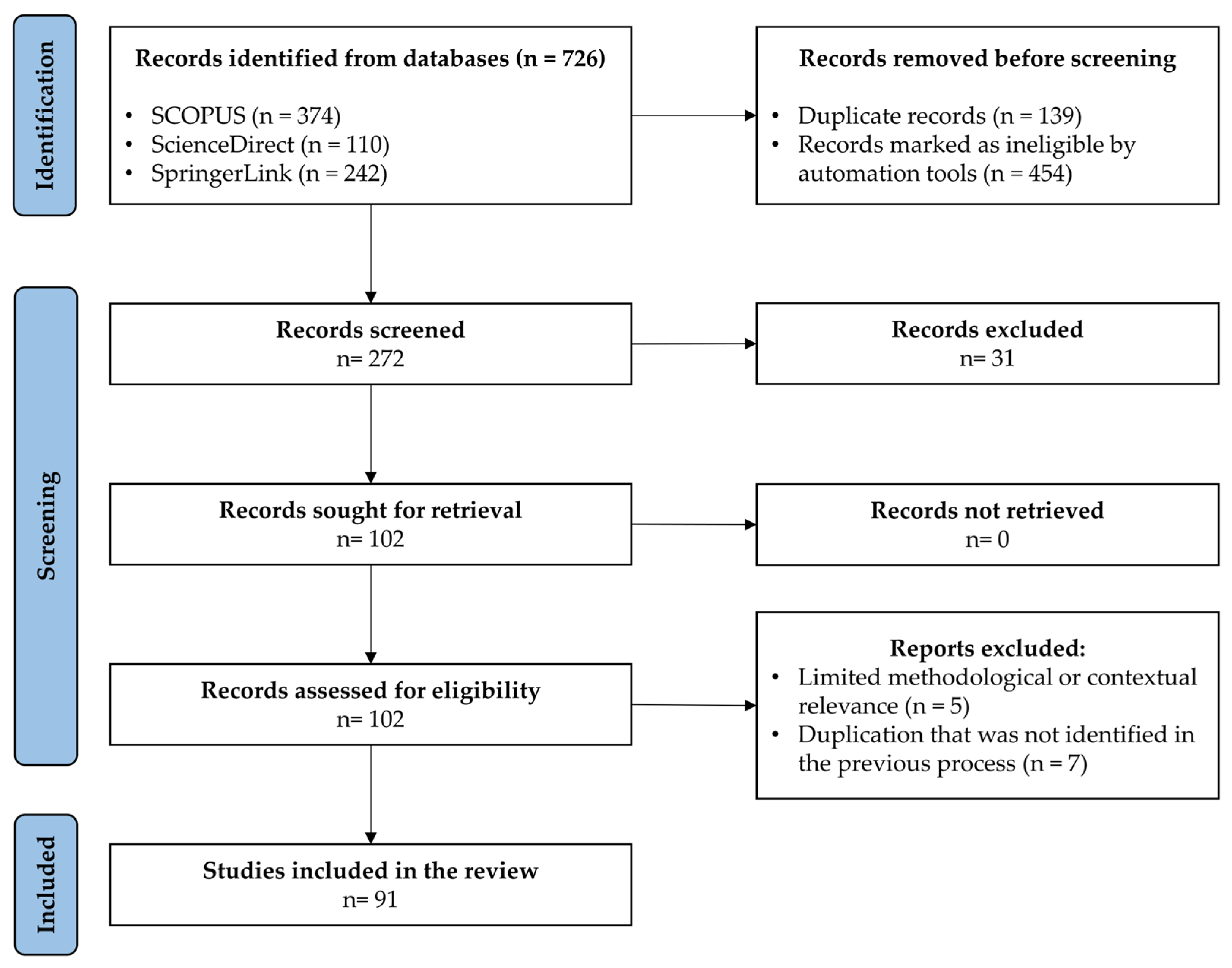
Of the 726 records initially retrieved, 454 were removed by automated tools using predefined filters based on language, publication year, and document type. A further 139 records were identified as duplicates and removed, leaving 272 records for screening. During the screening stage, 31 records were excluded based on title and abstract, leaving 102 records to be retrieved. All 102 records were successfully retrieved and assessed for eligibility. At this stage, 12 records were excluded, including 5 for limited methodological or contextual relevance and 7 for duplication not identified in earlier stages. Ultimately, 91 studies were included in the final review.
Figure 1 shows the PRISMA flow diagram of the study. Screening was conducted independently by two reviewers, with disagreements resolved through discussion. In addition, data extraction was performed by one reviewer and cross-checked for consistency. Risk of bias in the included studies was assessed qualitatively by the co-authors. The assessment was conducted independently, with discrepancies resolved through discussion. For each included study, data were extracted on intervention type, study context, methodological approach, outcome measures (e.g., speed, crash, operational indicators), and reported effects across the defined domains. In this review, the scope is limited to urban environments, and the term secondary roads refers exclusively to lower hierarchy roads within urban areas rather than rural or interurban road types.
Given the heterogeneity of intervention types, study designs, and outcome metrics, the synthesis adopted a qualitative narrative approach rather than a quantitative meta-analysis. This approach is widely recommended when integrating evidence across experimental, observational, and simulation-based studies in road safety research [
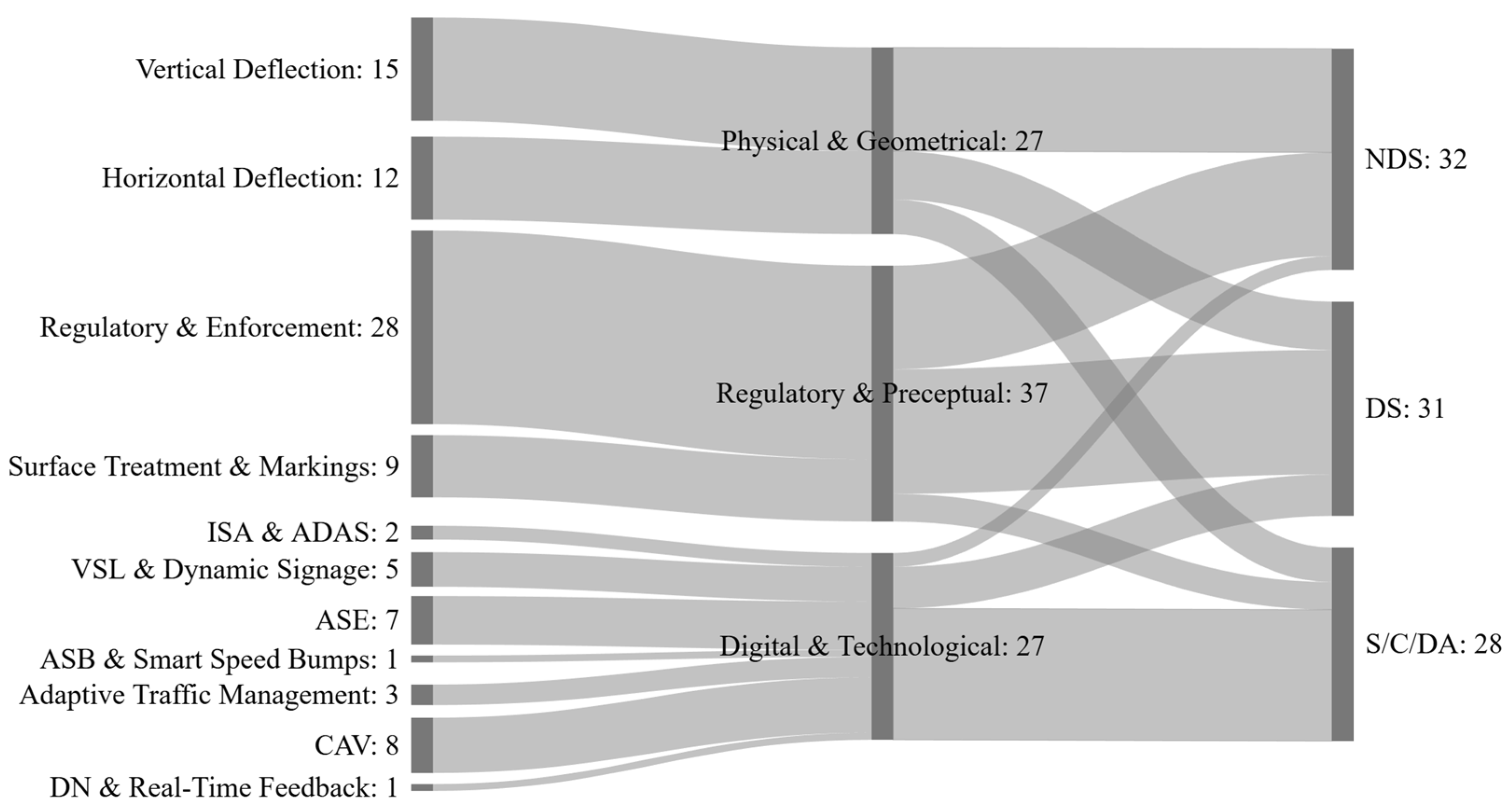
20]. To provide an overview of how the reviewed literature is distributed across intervention types and research methodologies, a Sankey diagram was constructed (
Figure 2). The Sankey diagram should be read from left to right, with individual TCM categories connected to their corresponding clusters and, subsequently, to the methodological approaches used to evaluate them. The width of each flow represents the number of studies associated with a given combination of intervention type, cluster, and evaluation method. Thus, wider flows indicate a higher concentration of studies in that specific linkage.
Figure 2 highlights several key patterns in the literature. Physical and regulatory interventions are predominantly evaluated using real-world and naturalistic approaches, reflecting their established implementation in practice. In contrast, digital and technological interventions are more frequently assessed through simulation and computational methods, indicating their emerging and often pre-deployment nature. In addition, certain intervention types, such as horizontal deflection measures, are underrepresented in naturalistic driving studies, suggesting gaps in real-world behavioural evidence for these interventions.
2.2.4. Protocol Registration
No review protocol was registered for this study. All methodological steps were conducted in accordance with the PRISMA 2020 guidelines, and all decisions were documented transparently within the manuscript.
3. Taxonomy of TCMs
TCMs are not a homogeneous class of interventions but rather a heterogeneous set of design, regulatory, perceptual, and technological strategies that operate through different causal mechanisms. A structured taxonomy is therefore necessary to enable meaningful synthesis across studies, facilitate comparison of reported effects, and support context-sensitive decision making for urban and secondary road environments. Building on established classifications in the traffic calming and speed management literature, this review adopts a three-cluster taxonomy comprising physical and geometrical measures, regulatory and perceptual interventions, and digital and technological approaches. The taxonomy reflects both the dominant mechanism through which speed reduction is achieved and the degree to which compliance is self-enforcing versus externally induced.
The proposed taxonomy also responds to recent shifts in practice and research. Traditional traffic calming literature focused primarily on physical and geometrical devices deployed at the street or neighbourhood scale [
22]. More recent work has expanded to include area-wide regulatory strategies, perceptual treatments tested through driving simulators, and data-driven digital interventions enabled by sensing, connectivity, and automation. Treating these approaches within a single analytical framework allows for a more comprehensive assessment of effectiveness, operational constraints, and unintended consequences.
Table 1 summarises the taxonomy used in this review, including clusters, categories, and the main effect domains reported in the literature, namely speed reduction, crash and injury outcomes, congestion and environmental effects, operational challenges, user acceptance, and unintended consequences. As the table suggests;
Vertical deflection dominates evidence on speed reduction and crash outcomes, but also shows the highest reporting of operational challenges and unintended effects.
Regulatory and enforcement measures have the strongest evidence base for crash reduction, but also substantial operational and acceptance issues.
Surface treatments are disproportionately evaluated for speed effects, often in controlled settings, with limited evidence of crash reduction.
User acceptance and unintended consequences are systematically under-reported across all digital categories.
Table 1.
Taxonomy of TCMs and synthesis of reported effects. The heat map (colour palette from red for 0 to green for 18) and the numerical values indicate the studies that report evidence for each effect domain within the corresponding TCM category.
Table 1.
Taxonomy of TCMs and synthesis of reported effects. The heat map (colour palette from red for 0 to green for 18) and the numerical values indicate the studies that report evidence for each effect domain within the corresponding TCM category.
| Clusters | Categories | Effects |
|---|
Speed
Reduction | Crash and Injury Reduction | Congestion
& Environment | Operational
Challenges | User
Acceptance | Unintended
Consequences |
|---|
| Physical and geometrical | Vertical deflection | 12 | 9 | 3 | 5 | 4 | 3 |
| Horizontal deflection | 4 | 3 | 2 | 2 | 2 | 1 |
| Regulatory and perceptual | Regulatory and enforcement | 18 | 14 | 5 | 6 | 7 | 4 |
| Surface treatment and markings | 7 | 4 | 2 | 1 | 3 | 1 |
| Digital and Technological | ISA and ADAS | 2 | 1 | 1 | 1 | 1 | 1 |
| VSL and Dynamic Signage | 5 | 4 | 4 | 3 | 2 | 2 |
| ASE | 7 | 6 | 2 | 4 | 2 | 3 |
| ASB and Smart Speed Bumps | 1 | 0 | 0 | 1 | 0 | 1 |
| Adaptive Traffic Management | 3 | 2 | 3 | 2 | 1 | 1 |
| CAV | 6 | 3 | 5 | 3 | 1 | 2 |
| DN and Real-Time Feedback | 1 | 0 | 0 | 0 | 1 | 0 |
In this section, we examine each TCM cluster in greater detail.
Section 3.1 reviews physical and geometrical interventions, focusing on vertical and horizontal deflection devices and their reported impacts on operating speed, safety outcomes, and operational conditions.
Section 3.2 addresses regulatory and perceptual measures, including speed limit policies, enforcement mechanisms, and surface treatments that influence driver behaviour primarily through institutional and perceptual mechanisms.
Section 3.3 then discusses digital and technological traffic calming approaches, including intelligent speed assistance, automated speed enforcement, variable speed limits, and connected-vehicle-based coordination systems. For each cluster, the review synthesises the available evidence on effectiveness and identifies the main research gaps highlighted in the literature. The reported effect magnitudes should be interpreted as context-dependent values derived from individual studies and should vary according to design parameters, traffic composition, and local conditions.
3.1. Physical and Geometrical TCMs
3.1.1. Definitions and Terminology
Physical and geometrical TCMs are engineered modifications to the roadway vertical profile or horizontal alignment that reduce operating speeds through self-enforcing kinematic constraints. In this section, the scope is limited to vertical deflection, horizontal deflection, and their combinations. Vertical deflection refers to measures that alter the longitudinal profile, thereby increasing discomfort and vehicle dynamic demands at higher speeds and incentivising lower approach and traversal speeds [
14,
23]. Typical devices include speed humps, speed tables, raised crosswalks, and related raised platforms, deployed either as point measures at conflict locations or as repeated sequences to maintain compliance over a corridor [
4,
24]. Horizontal deflection refers to measures that alter the lateral path or effective roadway width, increasing steering demand and reducing perceived speed comfort through constrained alignment, with common applications including chicanes, curb extensions, and lane narrowing implemented through geometric redesign, often complemented by traffic islands where relevant to manage movements and exposure [
3,
25].
3.1.2. Findings
Physical TCMs rely on vertical and horizontal deflections to force motorists to adopt safe operating speeds. Vertical measures, such as speed humps, speed tables, and raised pedestrian crossings, are consistently identified as the most effective tools for reducing both the frequency and severity of crashes. Empirical evidence from specific field studies indicates that round-top speed humps have been associated with average speed reductions of approximately 46%. In comparison, flat-top humps have been reported to reduce flow by up to 52%, depending on design characteristics and site conditions [
26]. Furthermore, speed tables, longer, flat-topped structures that accommodate a vehicle’s entire wheelbase, can halve average speeds in urban contexts and are particularly effective at protecting pedestrians by elevating crossing areas to sidewalk level. These vertical interventions are essential for achieving the 30 km/h threshold [
2]. The literature indicates robust speed reductions and associated safety benefits when devices are credibly designed and installed, particularly in pedestrian-rich environments where impact speed is a primary determinant of injury severity [
5,
27,
28]. While reported effect sizes vary with device geometry, spacing, target speed environment, and traffic composition, the direction of effect is consistently favourable, supporting vertical deflection as a high-confidence intervention when sustained speed compliance is required [
29,
30].
Horizontal and lateral measures, including chicanes, pinch points, and roundabouts, influence behaviour by introducing shifts in the vehicle’s path [
31]. Chicanes transform straight roadways into serpentine paths, reducing speeds by up to 50% through increased steering workload and cognitive demand [
32]. Roundabouts serve as critical geometric interventions that eliminate perpendicular conflict points; a single-lane roundabout has only 8 conflict points compared to 32 at a traditional intersection. Advanced designs such as turbo-roundabouts utilise physical dividers to prevent improper lane changes, reducing crashes by approximately 70% in high-traffic environments [
33]. Additionally, mini-roundabouts (up to 4 m in diameter) provide a cost-effective alternative for constrained urban spaces where full-scale reconstruction is not feasible [
32].
Road narrowing treatments, such as chokers, bulb-outs, and pedestrian refuge islands, physically restrict the carriageway width to enhance safety. Curb extensions (bulb-outs) shorten pedestrian crossing distances and improve mutual visibility between motorists and walkers. Refuge islands allow pedestrians to cross one direction of traffic at a time, though their effectiveness is highly dependent on “free view” width, the degree to which the driver’s sightline past the island is obstructed. Studies show that lane narrowing can reduce operating speeds by approximately 35%, as the perceived risk of a narrower path naturally encourages more cautious driving behaviour [
34].
Road diets, specifically 4-to-3 lane conversions, have emerged as a robust geometric countermeasure for high-capacity urban and suburban roads. By replacing two through lanes in each direction with a single through lane and a centre two-way left-turn lane (TWLTL), conflict points associated with lane-changing and left-turn manoeuvres are minimised. Research in the United States and Canada suggests that road diets can reduce total crashes by 25% to 44%. These reconfigurations often reclaim road space to install buffered bicycle lanes or wider sidewalks, further supporting active mobility and enhancing the corridor’s overall liveability [
13,
35].
The most effective results are often achieved through an integrated approach or “bundling” of physical devices. In Mauritius, combining speed tables with pinch points resulted in 30% to 50% reductions in speed at the centre of the calmed zone [
36]. Similarly, in Slovenia, a comprehensive redesign utilising plantings, planters, and benches alongside speed humps [
37] reduced peak-hour flows and through-traffic by nearly one-third [
25]. However, the literature emphasises that the spacing between devices is a critical determinant of speed uniformity; gaps exceeding 100 m often lead to “kangaroo driving,” where motorists rapidly accelerate between measures [
38]. In addition, recurring implementation trade-offs that can condition net benefit, including discomfort and noise associated with vertical devices, diversion or redistribution effects if treatments are unevenly applied, mixed air quality implications where stop and go patterns are induced, and maintenance or pavement wear issues that can erode effectiveness and acceptance over time [
39,
40].
The reviewed literature reports a wide range of intervention types and associated outcomes across different road contexts.
Table 2 summarises the main classes of physical traffic calming interventions discussed in this section and synthesises the key reported effects and representative references identified in the literature.
3.1.3. Research Gaps and Open Research Questions
A persistent limitation is the scarcity of long-term, high-quality evaluations that track behavioural adaptation and safety outcomes beyond the initial post-implementation period [
43,
44]. Many studies focus on short follow-up windows or on speed outcomes alone, leaving uncertainty about whether speed reductions and safety gains persist as drivers adapt, and how maintenance-related degradation affects performance over multi-year horizons [
45]. This is particularly consequential for vertical deflection, where pavement wear, settlement, and maintenance quality can alter the functional geometry and, in turn, the effective speed control profile [
15].
A second gap concerns heterogeneous impacts across vehicle classes and operational contexts. The literature notes that effects may differ for heavy vehicles, buses, and emergency services. Still, evidence remains mixed and comparatively sparse on how vertical and horizontal deflection influence heavy vehicle speeds, ride quality, braking and acceleration patterns, and network operations, and on how these trade-offs should be balanced against safety objectives in mixed traffic and transit-priority environments [
4,
30,
46,
47].
A third gap relates to integration and optimisation, since combined schemes are often advocated but less often evaluated in ways that isolate marginal and synergistic contributions of vertical versus horizontal elements, control for spillovers such as diversion, and identify design rules for spacing and sequencing across different road types and context archetypes [
48].
The literature also highlights several unresolved issues related to the long-term effectiveness, operational impacts, and optimisation of physical traffic calming interventions.
Table 3 summarises the main research gaps identified in the reviewed studies and presents the associated open research questions that emerge from the current evidence base.
3.2. Regulatory and Perceptual TCMs
3.2.1. Definitions and Terminology
Regulatory traffic calming interventions are measures that reduce operating speeds and crash risk through rule-setting, deterrence, and institutional mechanisms, rather than geometric constraints. In this review, regulatory interventions include posted speed limits, area-wide speed zoning, automated and manual enforcement, and policy-level frameworks that formalise speed management objectives and accountability, such as Vision Zero-oriented programs [
6,
49]. Their primary causal pathways are changes in perceived detection probability, sanction severity, and the perceived legitimacy of the speed regime, which together influence compliance behaviour and speed choice [
7].
Perceptual traffic calming interventions are non-geometric measures intended to alter driver behaviour by changing risk perception, attention allocation, or speed expectancy through visual and contextual cues [
40]. Under this definition, perceptual interventions include surface treatments and design cues such as rumble strips, road studs, coloured or textured pavement, transverse markings, rhythm-based or perspective-based marking patterns, and streetscape cues such as avenue planting, provided that these treatments do not rely on permanent vertical or horizontal deflection of the vehicle path [
9,
50,
51]. A key conceptual distinction in this domain is between informational or advisory cues, which rely on voluntary compliance. In addition, regulatory cues are paired with credible enforcement or policy commitments, which can shift behaviour through both expectancy and deterrence [
52].
3.2.2. Findings
The reviewed evidence indicates that regulatory measures can produce statistically significant reductions in crash outcomes by 26%, with stronger results when measures are implemented area-wide rather than as isolated point treatments [
17]. Synthesis studies cited in the provided material report substantial reductions in total crashes and injury crashes for area-wide regulatory strategies, consistent with a mechanism in which broad speed compliance reduces both the conflict probability and the kinetic energy in collisions [
5]. Automated and visible speed enforcement programs are frequently highlighted as effective tools for reducing speeding [
53,
54]. However, performance depends on sustained intensity, credible siting, and public legitimacy, and can be undermined by inconsistent enforcement or perceived misalignment between posted limits and road design [
55,
56].
Perceptual interventions generally demonstrate measurable but more variable effects on speed and driver behaviour. Studies indicate that surface-based cues and visual patterns can increase hazard salience, influence attention, and prompt speed adaptation, particularly on approaches to conflict points, transitions, and locations where expectancy management is important [
8,
57]. However, the evidence also suggests that purely perceptual measures often yield smaller speed reductions than interventions that physically constrain speed, and may be vulnerable to habituation if deployed without a supportive context or if overused, implying that design coherence and site specificity are important determinants of effectiveness [
14,
58]. User perception findings further indicate that vulnerable road users may report improved perceived safety, while drivers may express scepticism toward measures seen as primarily symbolic or punitive, which can affect compliance and long-term acceptability [
59,
60].
Across the reviewed literature, combined regulatory plus perceptual packages are repeatedly presented as a pragmatic way to improve the credibility and salience of the intended speed regime without extensive reconstruction. The logic is that regulation and enforcement establish normative and deterrence-based constraints, while perceptual cues localise and reinforce speed expectancy at points of elevated risk [
52]. This contributes to a more self-enforcing environment even in the absence of geometric deflection. Nonetheless, limitations noted in the cited material include context sensitivity, potential unintended consequences such as diversion or noise for some surface treatments, and the risk that poorly implemented packages may reduce situational awareness or produce inconsistent behavioural responses, reinforcing the need for context-sensitive design, monitoring, and iterative refinement.
The reviewed literature reports a range of regulatory and perceptual interventions with varying degrees of effectiveness depending on enforcement intensity, contextual design, and behavioural responses.
Table 4 summarises the main intervention classes discussed in this section, together with the reported effects and representative references identified in the literature.
3.2.3. Research Gaps and Open Research Questions
A key gap is the limited availability of rigorous, long-term evaluations that isolate the causal effects of regulatory interventions from concurrent changes in street design, traffic volumes, and broader safety programs. Many implementations occur as part of multi-component initiatives, complicating attribution and limiting the transferability of effect sizes across contexts [
65]. This is especially relevant for policy packages, where observed safety changes may reflect governance and enforcement changes as much as the nominal speed management intervention.
A second gap concerns behavioural mechanisms, legitimacy, and equity. While multiple sources emphasise the role of perceived fairness and acceptance, there is limited cumulative evidence on how perceptions evolve, how different enforcement and communication strategies shape acceptance, and how regulatory and perceptual regimes distribute benefits and burdens across neighbourhoods and user groups. A third gap concerns the durability and boundary conditions of perceptual interventions, including habituation, transferability across cultures and road environments, and the conditions under which surface treatments deliver net safety benefit without unintended operational or behavioural consequences [
19,
66].
Despite the growing body of research on regulatory and perceptual traffic calming interventions, several methodological and conceptual limitations remain in the current evidence base.
Table 5 summarises the main research gaps identified in the reviewed studies and outlines the associated open research questions that require further investigation.
3.3. Digital and Technological TCMs
3.3.1. Definitions and Terminology
Digital and technological traffic calming and speed management interventions are measures that influence speed choice and traffic dynamics through sensing, computation, communication, automation, and data-driven control, rather than via permanent geometric constraint. In this review, the term covers both vehicle-based and infrastructure-based approaches, as well as hybrid systems that integrate roadside sensing with in-vehicle feedback. A core definitional distinction is whether the mechanism is advisory, meaning it provides information or feedback that relies on voluntary driver compliance, or mandatory, meaning it constrains behaviour through automated limiting or sanctioning [
10,
67].
In-vehicle technologies include intelligent speed adaptation and related advanced driver assistance functions that warn, prompt, or limit speed based on geolocated speed limits and contextual constraints [
68]. Infrastructure-based technologies include variable speed limits and dynamic signage, where displayed limits are adjusted in real time as a function of traffic state, weather, incidents, or operational objectives such as flow stabilisation and crash risk reduction [
69,
70,
71]. Automated speed enforcement refers to camera or radar-based detection linked to administrative processing and sanctioning, sometimes supported by analytics for placement and performance monitoring [
72,
73]. IoT-enabled adaptive traffic management refers to distributed sensing and connected control systems for real-time signal optimisation, rerouting, and network management, often with artificial intelligence components for prediction or control [
11,
74,
75,
76]. Connected and automated vehicle concepts include vehicle-to-vehicle and vehicle-to-infrastructure coordination for speed harmonisation, with impacts moderated by penetration rate and communication reliability [
77,
78]. Digital nudging and real-time feedback include immediate speed-related feedback delivered via in-vehicle interfaces or smart roadside devices, intended to prompt rapid behavioural correction [
21].
3.3.2. Findings
Across the reviewed literature, the most consistently supported outcomes are reductions in mean speed and reductions in the proportion of vehicles exceeding posted limits for variable speed limits, automated speed enforcement, and intelligent speed adaptation, with the magnitude of benefit varying by baseline speeding, credibility of control, enforcement intensity, and system calibration. Safety benefits are reported most reliably where interventions achieve sustained speed reductions and operate across meaningful spatial extents, with studies associating variable speed limits and automated enforcement with reductions in crash frequency and injury severity and noting that multi-component strategies can strengthen effects when implementation is coherent and monitored.
For network performance and environmental outcomes, IoT-enabled adaptive management and connected vehicle coordination are frequently associated with reductions in congestion, reductions in delay, and emissions improvements through smoother speed profiles and reduced stop-and-go driving, although reported gains depend strongly on sensing quality, controller design, penetration of equipped vehicles, and the behavioural realism of evaluation settings, which are often simulation-heavy for these technologies [
44,
79,
80]. The literature also highlights operational and distributional trade-offs, including localised capacity impacts around enforcement points, limited spatial or temporal influence where systems are poorly sited or intermittently active, and performance degradation if maintenance and calibration are not sustained, implying that governance and lifecycle management are material determinants of effectiveness. Human factors evidence further indicates that perceived legitimacy, trust in automation, and perceived usefulness shape compliance and behavioural adaptation, particularly for advisory in-vehicle systems and nudging interventions that require active cooperation.
The reviewed studies report a diverse range of digital and technological traffic calming interventions with varying impacts on speed compliance, safety outcomes, and traffic operations.
Table 6 summarises the main classes of digital interventions discussed in this section and synthesises the reported effects together with representative references from the reviewed literature.
3.3.3. Research Gaps and Open Research Questions
A first recurring gap is the imbalance between short-duration evaluations and the need for long-term evidence under routine operations. Many studies, particularly for IoT-enabled adaptive management and connected vehicle coordination, rely on simulation or limited pilots, leaving uncertainty about sustained safety benefits, behavioural adaptation over months and years, and performance under realistic degradation, communication failures, or evolving traffic composition [
91]. This limits the ability to provide robust deployment guidance for urban and secondary road networks, where operating conditions are heterogeneous and failure-tolerance requirements are stringent.
A second gap concerns behavioural mechanisms and equity-relevant impacts. The evidence indicates that acceptance, perceived fairness, and legitimacy are central to compliance for automated enforcement and advisory systems. Yet there is limited cumulative knowledge on how these factors evolve, how they differ across driver populations, and how system design choices shift risk and benefit across user groups, including vulnerable road users who experience indirect effects from speed management regimes [
10,
92]. A third gap relates to integration and attribution. Many deployments combine digital elements with other measures. Still, evaluation designs often struggle to quantify marginal and synergistic effects, to control for spillovers such as diversion or corridor-wide behavioural changes, and to relate performance to operational governance, calibration, and maintenance practices [
88,
89].
Although digital and technological TCMs show considerable potential to improve speed management and network performance, the current literature reveals several unresolved challenges related to long-term effectiveness, behavioural adaptation, and system integration.
Table 7 summarises the main research gaps identified in the reviewed studies and presents the corresponding open research questions that emerge from the existing evidence base.
4. Methodological Approaches for Assessing TCMs
The transition from a reactive discipline dependent on crash statistics to a proactive science requires high-fidelity data to understand the precursors to traffic accidents. Deploying road safety interventions in urban environments involves choosing between three primary paradigms: (1) real-world sites (Naturalistic Driving Studies), (2) driving simulators, and (3) computational simulation environments. Each methodology is constrained by specific implementation barriers, ranging from technical fidelity and behavioural validity to ethical dilemmas and computational complexity. In urban settings, the growing presence of highly connected vehicles and the need for optimised signal control strategies add layers of complexity to these deployments.
Table 8 summarises the primary advantages and constraints of each approach:
4.1. Naturalistic Driving Studies (NDS)
Naturalistic driving studies collect detailed trajectory, vehicle, and sometimes video data from drivers in instrumented vehicles during their everyday trips, with no experimental instructions beyond normal driving. This approach captures how people actually respond to road geometry, traffic, weather, work zones, and signage in a real-world context, which is difficult to reproduce under experimental control [
22]. NDS have been used to link driver behaviour (speed choice, lane position, car-following, distraction) with specific infrastructure elements (curves, intersections, ramps, work zones) and conditions, supporting infrastructure evaluation in a Safe System framework [
60]. They also enable the study of near-crashes and conflicts, which are far more frequent than recorded crashes, providing richer information on safety-critical behaviour [
83]. NDS data are especially powerful for understanding driver distraction, crash/near-crash causation, and operational impacts across many contexts.
However, NDS are resource-intensive: collecting, processing, and coding continuous naturalistic data is costly and time-consuming, and substantial manual or semi-automated data preparation is usually required (e.g., video coding and linking roadway inventories to trajectories). Because serious crashes are rare, a large sample size is needed to observe enough events for robust causal inference, which limits their feasibility for evaluating very specific new interventions on short time scales. There is also limited experimental control and greater potential for confounding factors, making it harder to isolate the impact of a single safety measure compared to controlled experiments. Privacy, data security, and consent issues are non-trivial, especially when collecting driver-, vehicle-, and environment-level data at high frequency.
4.2. Driving Simulator
Driving simulators place drivers in a virtual, interactive driving environment, allowing researchers to manipulate road design, traffic, and safety treatments in a safe, repeatable way. Systematic reviews show that simulators are widely used to evaluate the effects of road geometry, signage, work zones, automated driving takeovers, and training interventions on speed choice, lane keeping, takeover time, and other detailed behavioural measures [
14]. Driving simulators can present hazardous or rare scenarios (e.g., imminent collisions, automation failures) that would be unethical or impractical to stage on real roads, and they enable tight control over experimental conditions and randomisation. High-fidelity simulators with rich motion and visual systems can detect nuanced unsafe behaviours and support the development and testing of behaviour-detection algorithms. Validation work comparing simulator and on-road data suggests good relative validity (i.e., correct ranking of treatments) and, in some cases, acceptable absolute validity, especially when scenarios and performance metrics are carefully matched [
51].
The main limitations of driving simulators are external validity and sampling issues. Driver behaviour may differ because participants know they are in an experiment and face no real crash risk. Moreover, lower-fidelity driving simulators can under-represent vehicle dynamics and visual cues, affecting speed choice, headway, and takeover performance [
57]. Simulator sickness can restrict exposure duration and exclude sensitive populations (e.g., older or motion-sensitive drivers). Many studies use small, convenience samples (often students or volunteers), which limits generalizability and makes it difficult to estimate actual crash outcomes; systematic reviews on simulator-based training highlight that improvements in simulated performance do not yet clearly translate into proven real-world crash reduction [
64]. As a result, driving simulator findings typically need calibration or validation against naturalistic or on-road data before they can be used for definitive safety impact estimates.
4.3. Microsimulation and Other Computational Models
Traffic simulation (mainly microsimulation, but also mesoscopic and macroscopic models) represents vehicles as interacting agents in a coded network, allowing virtual “what-if” testing of infrastructure designs, control strategies, and policy interventions at the network scale. Recent reviews show that microsimulation coupled with surrogate safety measures (e.g., conflicts, time-to-collision, or deceleration-based indices) is increasingly used to assess road safety proactively and reactively, especially for complex networks and for evaluating connected and automated vehicle (CAV) scenarios [
91]. Calibration with real traffic data can produce realistic flow and trajectory patterns, which are then post-processed with tools like the Surrogate Safety Assessment Model (SSAM) to approximate crash likelihood or conflict rates [
50]. Simulation can rapidly explore many scenarios (e.g., AV penetration rates, alternative geometric designs, incident conditions) that would be infeasible, too costly, or unsafe to test in the field.
The key drawback is that safety results depend heavily on model assumptions, calibration, and the choice of surrogate measures. Reviews emphasise that current traffic simulation tools still lack comprehensive, physically and behaviourally realistic crash models, so they typically infer safety from conflicts or near-miss indicators rather than simulating crashes directly. Surrogate safety metrics vary in terms of prediction accuracy, robustness, and computational cost; no single measure performs best on all dimensions, and each can be adequate or inadequate depending on the application and data. If driver behaviour parameters are not calibrated using empirical data (e.g., NDS or simulator-derived behaviour), simulations may misrepresent risk, particularly for human–CAV interactions or overtaking and lane-change manoeuvres [
93]. Consequently, simulation approaches are powerful for comparative and exploratory analysis, but their absolute safety predictions should be treated cautiously and ideally anchored in field or naturalistic evidence.
5. Discussion and Conclusions
This review synthesised recent evidence on TCMs applied to urban and secondary roads using a structured taxonomy and effect framework. By integrating findings from real-world field studies, naturalistic driving data, driving simulator experiments, and simulation-based evaluations, the review provides a comparative assessment of how different classes of interventions influence speed, safety, operations, and user responses.
Physical and geometrical measures, particularly vertical deflection devices such as speed humps, speed tables, and raised platforms, show the most consistent evidence for sustained speed reduction and crash and injury mitigation, primarily due to their self-enforcing nature and limited reliance on driver compliance or enforcement intensity. Regulatory and perceptual interventions present more heterogeneous evidence. Area-wide speed limits and enforcement-based strategies, especially automated speed enforcement implemented within coherent policy frameworks, demonstrate robust safety benefits, while surface treatments and perceptual markings typically yield modest and context-dependent effects, with supporting evidence often derived from controlled or simulator-based studies and limited confirmation of long-term real-world impacts. Digital and technological interventions represent a rapidly expanding research domain, encompassing intelligent speed assistance, variable speed limits, adaptive traffic management, and connected and automated vehicle-based control. Although simulation studies and pilot deployments indicate potential benefits for speed compliance, traffic stability, and congestion management, empirical evidence on long-term safety outcomes, behavioural adaptation, and equity implications remains limited and uneven across technologies. Across these categories, operational challenges, user acceptance, and unintended consequences are inconsistently reported, constraining direct comparison and generalisation.
Methodologically, the literature reveals a clear segmentation of methodological approaches for assessing TCMs. Real-world and naturalistic studies dominate assessments of physical and regulatory measures, driving simulators are primarily used to test perceptual interventions, and computational models underpin most digital and connected vehicle research. This fragmentation limits cross-comparison and complicates translating findings into integrated design and policy guidance.
Overall, the evidence indicates that effective speed management cannot rely on a single type of intervention. Instead, context-sensitive combinations of physical, regulatory, perceptual, and digital measures are required to achieve durable and robust safety outcomes. A set of key criteria should guide the selection and integration of these measures. First, road function and surrounding context play a central role: access streets and pedestrian-oriented environments benefit more from self-explaining and self-enforcing physical measures, whereas higher-order roads require a stronger reliance on regulatory and enforcement-based approaches. Second, traffic composition, particularly the presence of vulnerable road users, necessitates more stringent and physically enforced speed reductions. Third, baseline speed levels and speeding patterns help determine whether corrective (enforcement-based) or preventive (design-based) measures are more appropriate.
Among measure types, physical interventions are most effective for achieving self-enforcing speed reductions, particularly in pedestrian-intensive environments. Regulatory and enforcement measures are more suitable at the area-wide scale, provided they are supported by credible and consistent enforcement. Perceptual measures can enhance driver awareness at critical locations such as transitions, gateways, and conflict points. Digital interventions are particularly relevant in dynamic or network-level contexts that require real-time adaptation.
Effective integration further requires alignment between intervention mechanisms, consistency between road design and posted speed limits, and careful consideration of operational constraints, user acceptance, and potential unintended effects (e.g., traffic displacement or risk compensation). Future research should prioritise long-term and multi-method evaluations that explicitly address behavioural adaptation, equity implications, and unintended consequences, thereby supporting the development of more robust and transferable traffic calming strategies.
Another important consideration in TCMs is ensuring that TCMs are applied fairly and accepted by the public, which requires participatory planning, transparent communication, and context-sensitive design. Engaging local stakeholders can improve alignment with user needs and increase perceived legitimacy, while clear communication of objectives and expected outcomes helps build trust, particularly for regulatory and technology-based interventions. In addition, equity-oriented evaluation frameworks should be used to assess how benefits and potential burdens, such as diversion or accessibility impacts, are distributed across different user groups, including vulnerable road users and public transport users. Incorporating user acceptance alongside safety and operational metrics can further support more inclusive and effective implementations.
6. Outlook
Future research should prioritise integrating evidence from real-world studies, driving simulators, and computational models to improve the robustness and transferability of findings. Driving simulators can be used to isolate behavioural responses to specific TCMs under controlled conditions, while simulation models can extend these findings to network-level scenarios. However, the validity of such models depends on behavioural calibration using empirical data. Naturalistic driving studies and field observations should therefore be used to parameterise and validate simulation outputs. In addition, the development of consistent performance metrics across methodologies, linking behavioural indicators, surrogate safety measures, and observed crash outcomes, would support a more coherent interpretation of results. Longitudinal and multi-method study designs are also needed to capture behavioural adaptation and to assess the long-term effectiveness of interventions under real-world operating conditions.
Assessing the long-term impacts of TCMs requires methodological approaches that extend beyond short-term before-and-after evaluations. Longitudinal study designs, including extended before-and-after analyses, are essential to capture temporal dynamics such as behavioural adaptation, compliance decay, and maintenance-related changes in intervention performance. Naturalistic driving studies offer a valuable source of continuous, high-resolution data on speed choice, acceleration patterns, and lane positioning over extended periods, enabling the analysis of behavioural changes under real-world conditions.
Given the rarity of crash events, surrogate safety measures such as time-to-collision, deceleration rates, and conflict indicators can be used to assess evolving safety conditions over time. In parallel, simulation-based approaches, when calibrated with empirical data, allow the exploration of long-term and network-level impacts under varying traffic demand, technology penetration, and behavioural assumptions. Integrating these methods within a unified framework would support a more robust assessment of the durability and effectiveness of traffic calming interventions.