


Abstract
This study analyses the transition from traditional barrier-based toll collection to a free-flow tolling (FFT) system on a national motorway corridor. The aim is to quantify how FFT affects mobility, safety and environmental performance when physical toll plazas are replaced by overhead gantries. Operational data at toll barriers and booths are first characterised in terms of traffic volumes, queue events and accident frequency, and a set of Key Performance Indicators is defined to describe both mobility and environmental effects. Travel times are modelled for light and heavy vehicles, distinguishing between electronic toll collection and manual payment, while demand variations are estimated using elasticities with respect to travel time. Environmental impacts are assessed through an energy-based model of deceleration, queueing and acceleration combined with fuel-specific emission factors for CO2-equivalent and PM10. The results show that removing physical toll plazas reduces queues by about 79.5% and is expected to reduce accidents in toll areas by roughly 50%, with CO2-equivalent emissions at toll locations decreasing by up to 80% for light vehicles and 85% for heavy vehicles, and corridor-wide emissions also being significantly reduced, even when induced demand is considered. A final application to a photovoltaic green island on a decommissioned toll plaza illustrates how FFT can be coupled with infrastructure reuse to support cost-effective decarbonisation.
1. Introduction
Toll motorways play a central role in the financing and management of long-distance road transport, but traditional toll plazas are also well-known operational bottlenecks. Vehicles are forced to decelerate, often queue, and then accelerate again in short distances, which generates localised congestion, additional fuel consumption and increased emissions, especially during peak periods and holiday traffic. These operating conditions also contribute to a higher risk of rear-end collisions and lane-change conflicts in the vicinity of toll booths and barriers [1,2].
To address these issues, many countries have progressively moved from manual or mixed tolling schemes to electronic systems such as electronic toll collection (ETC), all-electronic tolling (AET), open-road tolling (ORT) and multi-lane free-flow (MLFF) [3]. In these systems, tolls are collected by overhead gantries equipped with sensors, cameras and communication devices, while vehicles maintain near free-flow speeds and no longer stop at physical barriers. A growing body of empirical work has quantified how such systems affect traffic performance, emissions, and safety. For example, studies on ETC and open-road tolling facilities have shown that replacing manual lanes with electronic lanes can significantly improve travel times and reduce local pollutant concentrations at toll stations [1,4,5]. More recently, corridor-scale simulations and field measurements have highlighted that advanced MLFF configurations can reduce CO2 emissions in the range of 25–45% and NOx emissions up to almost 100% in the immediate tolling area, depending on the baseline design and traffic composition [2,6]. n Research has also emphasised that the environmental and operational effects are not limited to the immediate vicinity of toll plazas. Distance-based ETC and dynamic tolling schemes supported by MLFF technology have been investigated as transport demand management measures to redistribute flows in space and time, with potential benefits for both congestion and emissions at the network level [6,7,8,9]. From an environmental perspective, several authors have developed fuel consumption and emission models tailored to electronic tolling contexts, showing that queue lengths, approach speeds and lane configurations at toll stations play a critical role in the overall footprint of the toll infrastructure [4,5]. In parallel, safety studies have reported substantial reductions in crash frequency after the conversion of conventional plazas to open-road tolling, with reductions of the order of 20–30% in some freeway case studies [10].
Despite this growing literature, several aspects remain only partially explored. First, many studies focus either on emissions, safety, or on economic performance, whereas integrated assessments that jointly consider mobility, safety and environmental indicators for a full toll corridor are less common. Second, the net environmental effect at the corridor scale is not always straightforward: while removing queues and stop-and-go patterns tends to reduce local emissions at toll locations, higher average speeds and induced demand may offset part of these gains elsewhere on the network, leading to mixed or context-dependent results [6,8]. Third, relatively little attention has been paid to the physical toll plazas themselves once their tolling function is removed. These sites typically occupy large areas with direct access to the motorway and electrical infrastructure, making them attractive candidates for new functions, such as photovoltaic (PV) plants, electric vehicle (EV) charging hubs or multipurpose green islands in support of sustainable road corridors.
In this context, the Italian motorway network is also considering a progressive evolution towards free-flow schemes. The case study presented in this paper originates from a technical project carried out in cooperation with a major Italian Intelligent Transport Systems operator, which provided detailed operational data for a national-scale toll corridor and supported the development of dedicated modelling tools. Building on this work, the present paper has two overarching aims: (i) to quantify how the conversion from traditional toll plazas to free-flow tolling (FFT) affects mobility, safety and environmental performance along a representative motorway corridor; and (ii) to explore how the surplus land freed by decommissioned toll plazas can be repurposed, with a focus on a large PV green island at a major barrier station.
The contribution of the paper is threefold. First, it offers an integrated assessment of travel times, queues, accidents, and emissions at toll locations before and after FFT, combining a microscopic description of toll-related manoeuvres with corridor-scale indicators. Second, it explicitly accounts for the demand variations induced by travel-time savings and evaluates whether the environmental benefits at toll plazas remain significant at the corridor level once induced demand is considered. Third, it treats decommissioned toll plazas as strategic spatial resources and develops a quantitative example in which a former barrier is transformed into a PV plant with attractive payback times, thus linking free-flow tolling to the broader agenda of low-carbon infrastructure design.
The paper is organised as follows: Section 2 describes the case study, the data sources and the modelling approach for travel time, demand, and emissions. Section 3 presents the main results for mobility, safety and environmental performance under traditional and free-flow scenarios, as well as the PV green island application. Moreover, Section 3 discusses the implications for sustainable road design and toll-plaza reuse, and Section 4 summarises the main conclusions and outlines directions for future research.
2. Materials and Methods
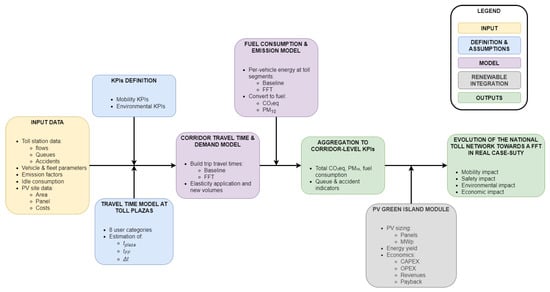
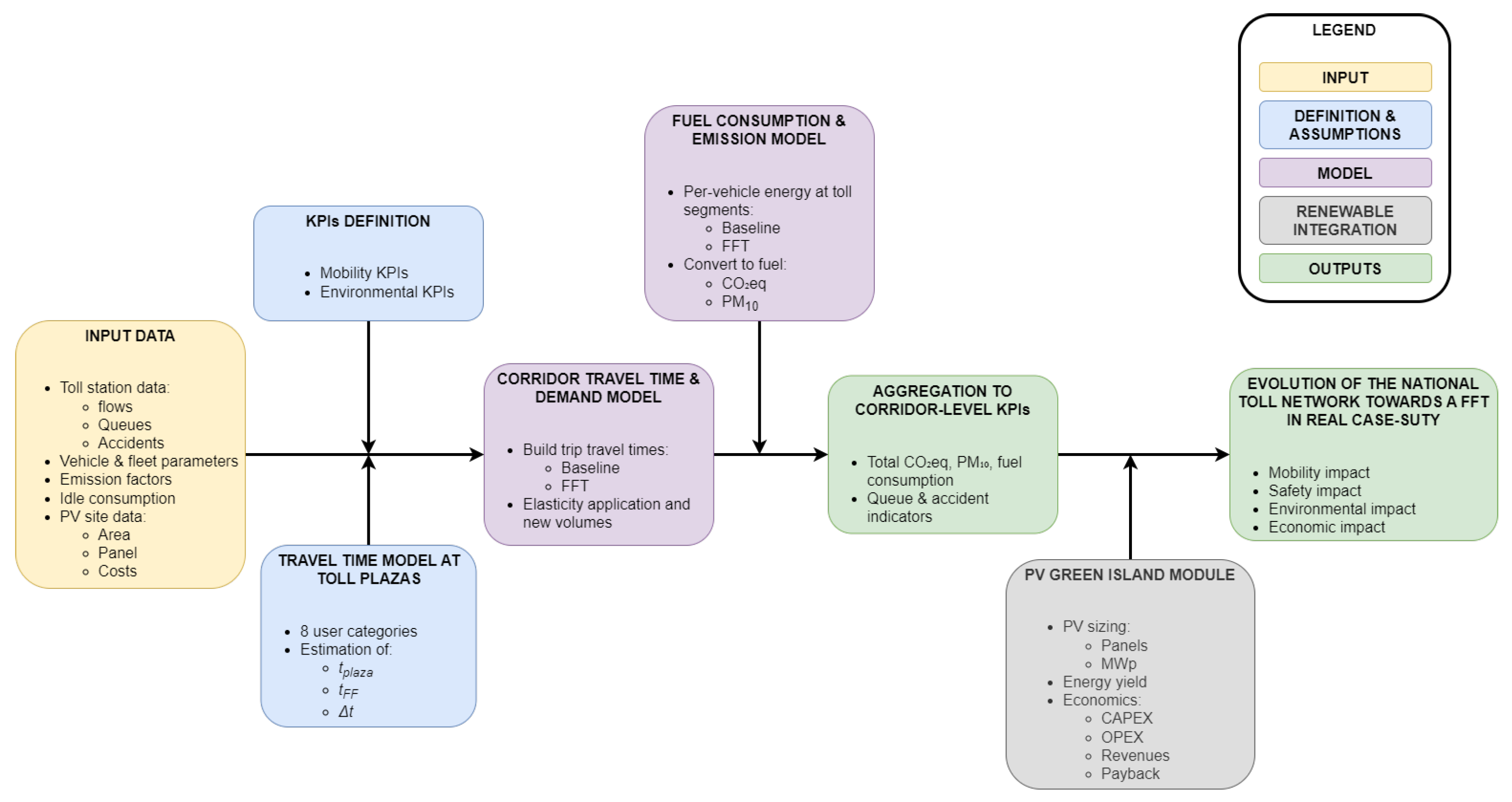
This section describes the modelling framework used to quantify how the transition from traditional toll plazas to FFT affects mobility, safety and environmental performance along the case study corridor, and to assess the potential of a PV green island at a decommissioned barrier station. The model approach combines operational data from toll stations with simplified physical models of vehicle dynamics, demand response and emissions. First the study corridor and the available data on traffic volumes, queues and accidents are described and a set of Key Performance Indicators (KPIs) are defined to constantly capture mobility and environmental effects. Then, a microscopic travel-time model is developed for eight user categories, distinguishing between light and heavy vehicles, ETC and manual payment, and barrier/booth stations. These toll-related times are aggregated at the corridor level and used in an elasticity framework to estimate induced demand. Environmental impacts are evaluated through an energy-based fuel consumption model combined with fuel-specific emission factors for CO2-equivalent and PM10, explicitly accounting for queue emissions. Finally, the same framework is extended to a PV green island case study in which the surplus land at a decommissioned barrier is reused for a utility-scale PV plant, and its energy production and economic performance are quantified. Figure 1 presents the structure, followed by the framework.
Figure 1.
Flowchart of the proposed methodology for the evolution of the national toll network towards an FFT model in real case study.
2.1. Study Design and Case-Study Corridor
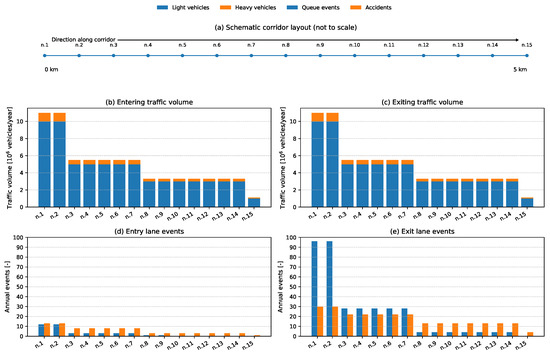
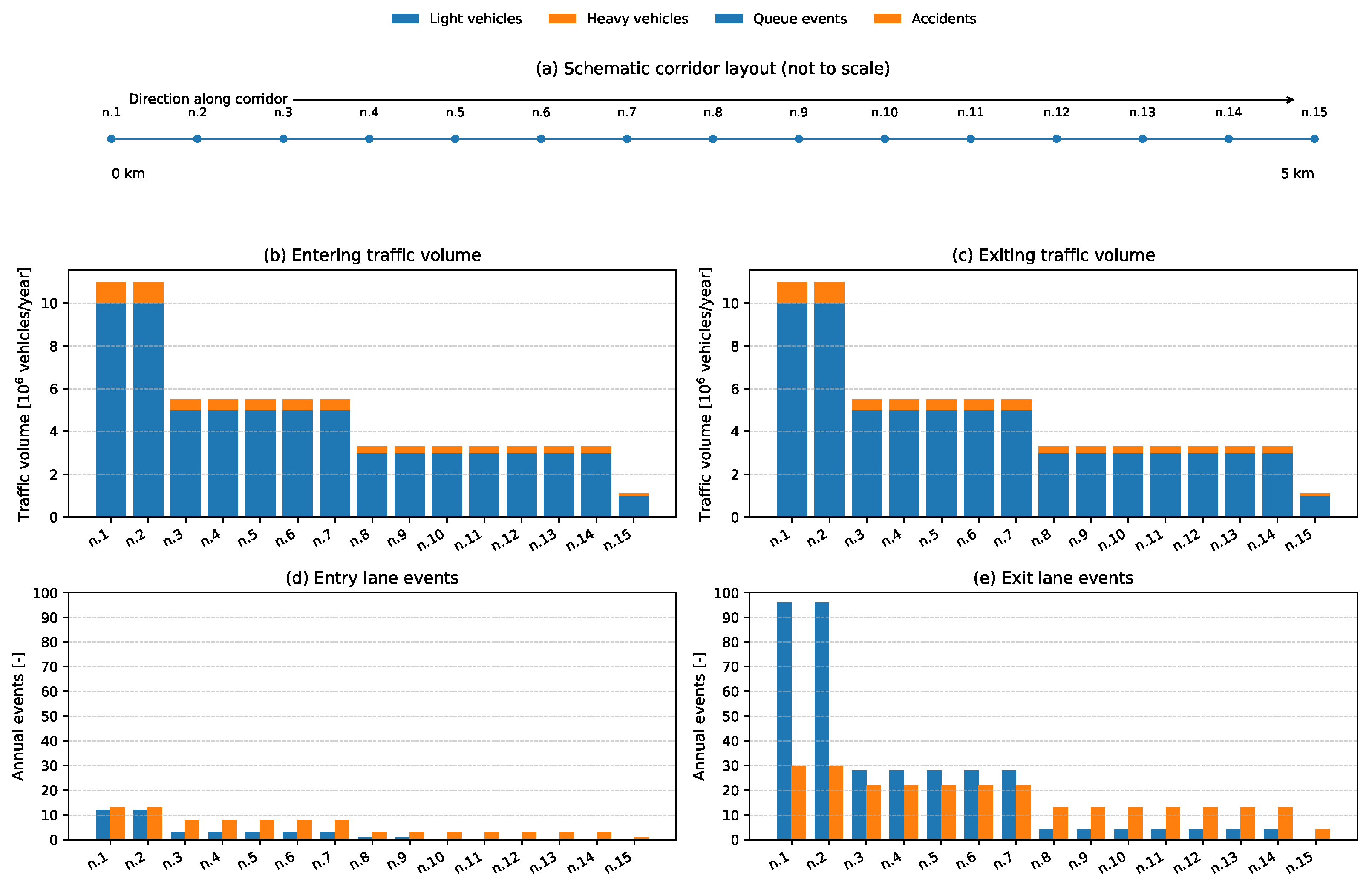
The research is structured as a quantitative scenario-based before-and-after comparison of replacing legacy toll plazas with an FFT system on a representative Italian motorway corridor. The corridor, provided by the infrastructure manager, consists of one main barrier toll station and fifteen conventional toll booths, each with distinct traffic volumes and operational characteristics (Table 1). The spatial layout of the 5-km study corridor and the sequence of toll stations (not to scale) are summarised in Figure 2a, while the station-level operational inputs are reported in Figure 2b–e.
Table 1.
Data provided by infrastructure manager for a representative highway segment.
Figure 2.
Station-level inputs and spatial context for the case-study corridor: (a) schematic layout of the 5 km corridor, showing the sequence of toll stations (not to scale); (b,c) annual entering/exiting traffic volumes (light and heavy vehicles); (d,e) observed queue events and accidents at entry and exit lanes (visual summary of Table 1).
For every station, annual flows of light and heavy vehicles, the number of queue events, and recorded accidents at entry and exit lanes were supplied (Table 2).
Table 2.
Summary statistics for the study corridor.
Toll users are divided into two categories according to their payment method: ETC and manual payment. This 70/30 split is consistently applied to all stations. Furthermore, vehicle demand is disaggregated into light vehicles (passenger cars and vans) and heavy vehicles (trucks and buses, i.e., motorway operators’ heavy vehicle class, which broadly corresponds to vehicles with a gross vehicle weight above 3.5 tonnes). In the modelling framework, heavy vehicles are represented by reference parameters consistent with a heavy-duty fleet (e.g., a reference mass of 25 tonnes; see Appendix A, Table A1) and typical operating speeds. Country-specific regulations regarding speed limits for heavy vehicles are not modelled explicitly.
Two scenarios are explored:
- Baseline scenario, with traditional tolling, which involves the presence of physical toll plazas with manual and ETC lanes. This includes deceleration and acceleration near the plazas, toll collection times and queue formation.
- FFT scenario, where the barrier and booths are removed and replaced by overhead gantries with automatic vehicle identification. Vehicles travel at near-cruise speed without stopping for payment and with strongly reduced toll-related queuing.
Each scenario is assessed using various performance indicators, including mobility and environmental factors, to determine the anticipated benefits of FFT.
2.2. Kpis Definition
The analysis relies on a set of KPIs that consistently capture both mobility efficiency and environmental impact, in line with the European guidelines on the external costs of transport [11]. The environmental KPIs considered are as follows:
- Fuel consumption per vehicle: the average annual fuel use per vehicle on the corridor, used as a proxy for user operating costs and energy demand;
- Total CO2-equivalent emissions: the aggregated greenhouse gas emissions associated with fuel consumption, expressed as CO2-equivalent using standard emission factors;
- PM10 emissions: the total emissions of particulate matter with aerodynamic diameter lower than 10 μm, used as a representative indicator of local air pollution.
On the other hand, the mobility KPIs identified for the study are as follows:
- Average travel time: corridor-average time needed to traverse 1 km, before and after FFT implementation;
- Number of queues: count of congestion events generated by toll operations, excluding incidents;
- Traffic demand: effective flow on the corridor, adjusted for induced demand due to reduced travel time;
- Accident frequency at toll locations: the annual number of accidents occurring in the entry and exit lanes of toll plazas (number of accidents per year).
Table 3 summarizes the KPIs, highlighting the data required for the study, the calculation method used and their units of measurement.
Table 3.
Summary of environmental and mobility KPIs, with required input data, calculation method, and units.
Accident frequency at toll locations is evaluated using the annual accident counts recorded at the entry and exit lanes, supplied by the motorway operator (Table 2). For clarity, an exposure-normalised accident rate could be obtained by dividing annual accident counts by corridor traffic volumes; however, since demand differences between scenarios are small in this case study, the baseline vs. FFT interpretation is not materially affected. For the FFT scenario, since post-implementation safety data are not available, the expected accident frequency is estimated through a scenario-based crash modification factor (CMF) taken from open-road/multi-lane free-flow tolling safety evaluations ([10]). Accordingly, accidents under FFT are computed as . In this study, a representative value of is adopted to reflect the order of magnitude of crash reductions reported for toll-plaza-to-open-road tolling conversions in the cited literature; this should be interpreted as a scenario assumption rather than a corridor-specific causal estimate.
2.3. Travel Time Model at Toll Plazas
To quantify the time lost due to traditional tolling, the toll plaza segment is modelled for eight user categories, based on the following combinations:
- Payment methods: depending on whether ETC or manual payment is considered;
- Vehicle class: depending on whether a light vehicle or heavy vehicle is considered;
- Station type: depending on whether barriers or booths are considered.
For each user category, the total time spent in the toll area in baseline scenario is computed, as reported in (1), as the sum of the following:
- representing the time to brake from approaching speed to a near-stop;
- meaning the payment time, considered only in manual tolling scenario, and assumed to be negligible for ETC;
- representing the time to accelerate back to the approach speed;
- accounting for delays in queues.
In this context, deceleration time is approximated assuming a constant deceleration over a predefined distance , and is computed through Equation (2).
In deceleration time, the speed represents the approaching speed of the vehicle. These speeds are the representative operating values adopted for the toll-plaza influence segments (see Table 4) and should not be interpreted as country-specific statutory speed limits. For heavy vehicles, the adopted values are consistent with typical heavy-duty operations and implicitly reflect speed-limited fleets. Stopping distances differ by station type, and 100 m is considered at barriers with motorway speeds and 50 m at booths, due to the lower approach speeds. Then, acceleration time is computed for light vehicles through the literature on toll-plaza time losses, while the time for heavy vehicles is computed through (3), considering vehicle dynamics [12,13].
where the following hold:
- P is the vehicle power, assumed to be 250 kW.
- m is the vehicle mass, assumed to be 25 t.
- is the final speed in km/h.
- is the rolling resistance coefficient, assumed to be 0.012.
- g is the gravitational acceleration 9.81 m/s2.
In the FFT scenario, the same segment is traversed at constant speed without stopping, and the corresponding travel time is computed through Equation (4).
This led to the saving time per passage , as calculated in Equation (5), computed separately for each of the eight user categories, and subsequently multiplied by the annual number of passages in each category.
Model parameters for travel time computation at toll plazas, segmented for user category, are collected in Table 4 considering distance parameters, and in Table 5 considering time parameters.
Table 4.
Vehicle types and segment geometry.
Table 5.
Travel time components and time savings.
2.4. Corridor Travel Time and Demand Forecasting
The total travel time combines three different components to be calculated:
- Highway cruising time, assuming average trip distances of 100 km for light vehicles and 500 km for heavy vehicles, with representative cruising speeds of 110 km/h (light vehicles) and 84 km/h (heavy vehicles, consistent with typical speed-limited heavy-duty operation), respectively.
- Toll-plaza time, obtained by summing the toll-segment times over all plazas encountered.
- Queue delay is evaluated using operational data on queue events at each station. Following this, assumptions are adopted based on queue statistics. Each queue corresponds to approximately 180 vehicles per lane, with an average duration of 1.5 h [12,13]. Furthermore, the average queueing time per affected vehicle is 10 min. A one-way sensitivity check was performed by varying the assumed queue size and mean waiting time within plausible ranges. Given the relatively low frequency of queue events compared to annual traffic volumes, the resulting average queue delay across the corridor remains in the order of seconds per manual trip. The comparison between the baseline and the FFT is therefore not materially affected. Finally, in line with the operational definition of toll-related queue events adopted in this study (i.e., queues generated by toll operations at manual payment lanes), queue delays are attributed to vehicles using manual payment, which represent 30% of the flow. For ETC users, queuing is assumed to be negligible and is therefore approximated as zero in the present model. Occasional spillback affecting ETC lanes during extreme peak conditions is not modelled explicitly and would increase baseline delays, thus making the estimated FFT benefits for ETC users conservative.
For each toll station and vehicle class, the total annual time lost in queues is computed and divided by the annual number of affected vehicles, yielding the average queue delay per trip. Adding the three components results in the baseline travel time computation. Then, the FFT travel time () scenario excludes toll-plaza and queue components, retaining only cruising time. To estimate how these travel time reductions affect demand, a standard elasticity formulation, presented in (6), is used, where Q is the baseline traffic volume, is the relative travel time change, and is the travel time elasticity of the demand [14,15].
In this context, values of , for light vehicles and for heavy vehicles are adopted, reflecting the low responsiveness of freight traffic to travel time savings [14,15]. Finally, demand adjustments are conducted separately for each user category, and the resulting flows feed into the environmental assessment.
2.5. Fuel Consumption and Emission Modelling
The environmental module evaluates fuel consumption, CO2-equivalent emissions, and PM10 for both scenarios at each toll station and for the corridor as a whole. The procedure consists of three different steps: first the energy demand per vehicle passage is evaluated, then conversion to fuel consumption is performed, and finally the emissions factors and queue emissions are computed. In the first step, the mechanical energy required to traverse the toll segments, for each vehicle class and station type, is calculated as the sum of three major contributions:
- Acceleration energy, associated with speeding up from near-zero to the approach speed. This acceleration energy results in zero in the FFT scenario;
- Aerodynamic drag energy, proportional to drag coefficient, frontal area, air density, and the square of the speed, integrated over distance;
- Rolling resistance energy, computed by the product of rolling resistance and travelled distance.
Physical parameters, such as mass, drag coefficients, frontal areas, air density, and rolling resistance coefficient, follow typical values for light and heavy vehicles [16,17,18]. Then, total mechanic energy is converted to fuel use using the lower heating value of each fuel and representative efficiencies through (7), where f denotes the fuel type, such as gasoline, diesel, LPG or methane, is the energy content per litre, and is the engine efficiency for that fuel.
In this context, heavy vehicles are assumed to operate exclusively with diesel, while the passenger car fleet is disaggregated onto gasoline, diesel LPG, methane and electric vehicles according to current Italian fleet shares. As a last step, CO2-equivalent emissions are obtained from fuel consumption by fuel-specific CO2 emission factors. PM10 emissions are computed considering the presence of particulate filters. Separate emission factors are used for vehicles with and without filters; these are then weighted according to the share of each sub-fleet, meaning gasoline, diesel, and heavy duty [19,20,21]. Emissions from queues are evaluated separately. For each fuel type, a fuel-consumption rate at idle (L/s) is specified. Multiplying this rate by the cumulative queueing time at each toll plaza yields additional fuel use during queueing; the associated CO2 and PM10 are calculated with the same emission factor [22,23,24]. Finally, emissions per vehicle passage are aggregated over annual traffic volumes at each station for both baseline and free-flow scenarios. For the FFT scenario, acceleration-related energy and queue-related emissions are neglected while drag and rolling resistance components are recomputed at constant speed and the adjusted traffic volumes from Section 2.4. Appendix A collects the overall parameters considered in the methodology [17,18,19,20,21].
2.6. Green Island Case Study Implementation
In order to explore how decommissioned toll plazas can support low-carbon infrastructure, the study includes a green island application at a large barrier station, similar to the Milan East toll plazas. The concept combines a ground PV plant with potential for EV charging facilities and landscape green areas; however, this quantitative assessment focuses on the PV component. At the beginning, a usable surface is estimated from satellite imagery by subtracting carriageway and safety buffers from the dismissed toll area, yielding 80,000 m2. Therefore, the PV layout is sized, assuming standard monocrystalline modules with an area of 1.8 m2 and 1.75 as spacing factors to account for inter-row distances, access lanes and shading constraints. Thus, to calculate the total installable panels, Equation (8) is used.
This, combined with the single peak power of 400 Wp per module, will help to evaluate the capacity of the system. Annual electricity generation is obtained from site-specific yieldds provided by the European Commission Photovoltaic Geographical Information System (PVGIS), which are approximatively 1269 kWh/kWp for the selected tilt and orientation. Then, an economic evaluation is conducted using Capital Expenditure (CAPEX) and Operating Expenditures (OPEX). C APEX includes module costs, assumed at 0.28 €/Wp, plus central inverters sized at 1000 kW each, with a unit cost of 100,000 €. Installation and grid connection costs are represented as a 20% surcharge on equipment cost. Additionally, OPEX is set to 8% of CAPEX to cover maintenance, insurance and other operating items. Finally, annual revenues () are computed by multiplying the expected energy production by the reference Italian selling price of 53 €/MWh, and simple payback time is obtained by Equation (9).
Similar approaches based on utility-scale PV at existing highway infrastructure have recently been proposed for Italy and for highway service areas [25,26].
3. Results and Discussion
This section presents the quantitative impact of converting the study corridor from legacy toll plazas to an FFT system. Results are reported for mobility and safety indicators, such as travel times, queues, and induced demand, and for environmental performance, such as fuel use CO2-equivalent and PM10 emissions, at both the toll plaza and corridor levels. The final subsection evaluates the integration of a PV-supplied green island application at the decommissioned barrier station.
3.1. Mobility and Safety Outcomes
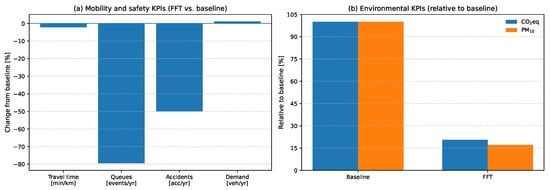
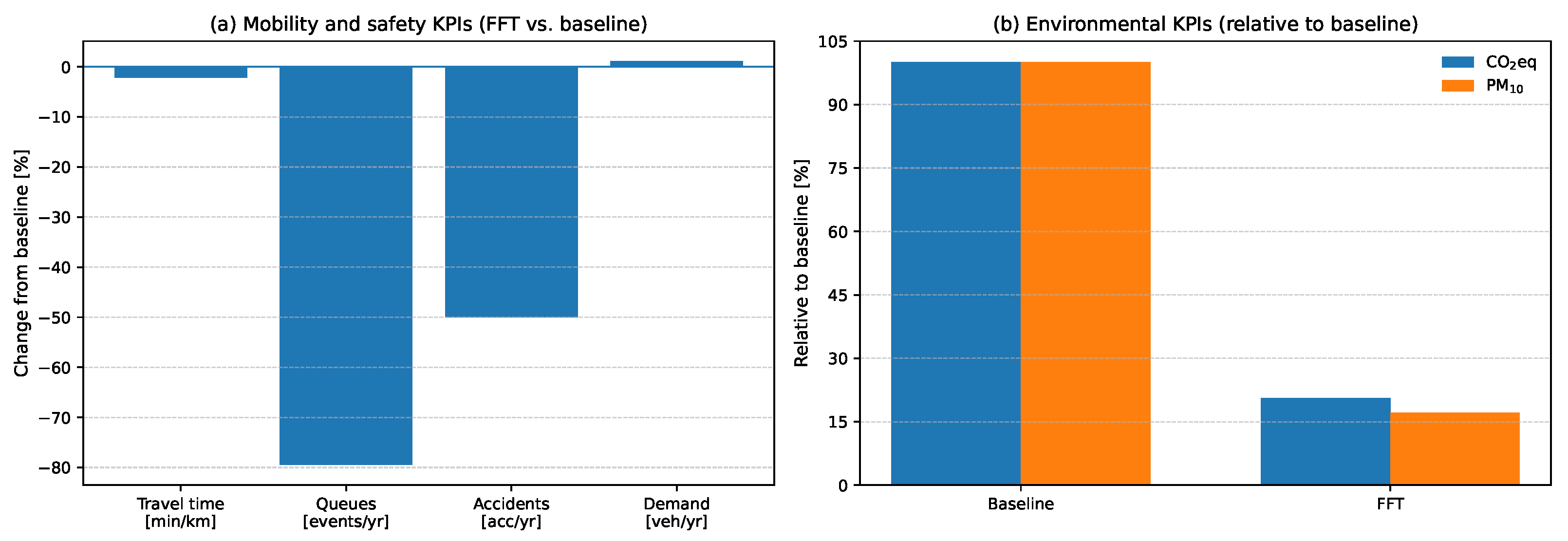
With physical toll plazas in place, the 5 km study corridor handles around 16 million light vehicles and 2.3 million heavy vehicles per year; 85 toll-related queue events and 45 accidents are recorded at the entry and exit lanes. Congestion and incident risk are concentrated at the main barrier station and the busiest booths. In contrast, lightly loaded stations rarely experience queues, yet still record a significant number of crashes. In the FFT scenario, barriers and booths are replaced by overhead gantries so that vehicles no longer need to decelerate for payment and toll-operation queueing is strongly reduced. In the scenario analysis, the annual number of toll-related queue events decreased from 85 to 17 events/year (Table 6), representing residual operational disturbances rather than systematic toll-plaza queuing. Within this modelling framework, a corridor-wide comparison between the baseline scenario and the FFT scenario indicates a 79.5% reduction in toll-related queues and an estimated 50% decrease in accidents at toll locations (computed by applying the CMF described in Section 2.2). The overall results are provided in Table 6.
Table 6.
Corridor-level mobility KPIs under baseline and FFT scenarios.
This estimated reduction is consistent with the reductions in crashes reported in previous studies on the conversion of conventional plazas to open-road or multi-lane free-flow tolling.
To assess the robustness of the queue-delay component with respect to modelling assumptions, a one-way sensitivity check was performed by separately varying the assumed queue size and the mean queueing time per affected vehicle, while keeping the other parameters at their reference values (see Table 7).
where is the annual number of queue events, the assumed queue size, the mean queueing time (min/veh), and D the annual corridor demand (veh/year).
Table 7.
One-way sensitivity check of the corridor-average queue delay to key queue parameters. In each block, only one parameter is varied while the other is kept at its reference value ( veh/event, min/veh).
A one-way sensitivity check was performed on the queue-delay assumptions by varying (separately) the assumed queue size and the mean queueing time per affected vehicle within plausible ranges. The resulting corridor-average queue delay under baseline and FFT scenarios is reported in Table 7. Across these variations, the corridor-average queue delay remains small and the baseline vs. FFT comparison is not materially affected.
At the single-vehicle level of a single toll plaza, FFT drastically reduces time spent in the toll area. For the eight user categories, the total time spent in the toll segment under traditional tolling combines deceleration, toll payment, acceleration and queue delay. In FFT conditions, only a short cruising time over the former toll segment remains. Using the travel time components summarized in Table 5, FFT reduces total plaza time by more than 90% for manual users and 50 ÷ 60 % for ETC users, with slightly larger absolute savings for heavy vehicles due to the longer acceleration phases. When these local savings are embedded into the complete journey travel time, assuming average trip lengths of 100 km for light vehicles and 500 km for heavy vehicles, the relative reduction in door-to-door travel time is reduced, but this reduction is non-negligible for manual users, as reported in Table 8. This difference reflects the fact that ETC users already avoid most queues and that heavy vehicles travel longer distances, so toll-plaza delays represent a smaller share of their total journey. These travel time reductions are fed into the elasticity demand model described in Section 2.4. Considering a travel time elasticity of 0.5 for light vehicles and 0.2 for heavy ones, when applied separately to ETC and manual users, the FFT scenario presents Table 8 as output. Once weighted by the initial traffic volumes and the split between ETC and manual payment (70% and 30%), the overall corridor demand increases by 1.1%, indicating that induced demand slightly offsets, but does not negate, the mobility and environmental gains of FFT. Table 8 collects the overall data computed for this KPI phase identification.
Table 8.
Travel-time reduction and demand change by user category.
3.2. Environmental Impacts
Environmental performance is first evaluated at the scale of individual toll stations, focusing on the additional fuel use and emissions associated with deceleration, queueing and acceleration. All environmental results reported in this section refer to toll-related emissions within toll plazas (i.e., barriers and booths), rather than the total emissions of an entire motorway trip. This includes the incremental fuel use and emissions associated with deceleration, queueing and acceleration during toll operations. Using the energy-based model, and the physical and emissions parameter described in Appendix A, each vehicle’s passage through a toll barrier or booth is associated with incremental changes in fuel consumption and corresponding CO2-equivalent and PM10 emissions. Comparing the traditional plazas with the FFT configuration, meaning no acceleration from standstill, no queues and slightly higher drag at constant speed, the KPI per vehicle shows a substantial reduction, as shown in Table 9, where the values refer to CO2-equivalent and PM10 emissions and are normalised with respect to the baseline scenario.
Table 9.
Per-vehicle CO2-equivalent and PM10 emissions at toll barriers and booths, before and after FFT implementation.
CO2-equivalent emissions per vehicle at barrier stations fall by 81% for light vehicles and 85% for heavy vehicles. Moreover at booth stations, the corresponding reductions are 67% and 71%, respectively. These values reflect the higher approach speeds and longer acceleration distances at barriers, where free-flow operation avoids energy-intensive stop–start processes.
Then, the emissions-per-vehicle factors are combined with annual flows at each station (Table 1) to obtain total emissions for the full corridor. At baseline, when including both acceleration, drag, and rolling components and emissions from queues at manual lanes, the analysis yields 15.78 kt/year of CO2-equivalent and 1.16 t/year of PM10 along the study segment. In the FFT scenarios, three effects are captured simultaneously (as formalised in Section 2.5):
- Removal of acceleration from a stop at toll plazas;
- Removal of queue-related emissions for manual users;
- Higher average cruising speed and 1.1% increment in demand.
From a mechanistic standpoint, the estimated reductions are primarily driven by the elimination of stop-and-go manoeuvres at toll plazas. In our formulation (Section 2.5), emissions are computed by combining an acceleration-related term, rolling and aerodynamic resistances, and a queue-idling component. Under the FFT scenario, the disappearance of braking, stopping and acceleration patterns at barriers and booths therefore represents the dominant contributor to the lower CO2eq and PM10 emissions in the toll-area influence segments. The queue-idling component plays a secondary role since queue events only occur intermittently throughout the year. Furthermore, the slight increase in demand in the FFT scenario provides limited compensation and does not alter the overall interpretation.
Even when the higher traffic volumes are accounted for, aggregate emissions remain lower than baseline, as the total CO2-equivalent decreases from 15.78 to 3.25 kt/year and PM10 from 1.17 to 0.20 t/year. These values correspond to a corridor-wide CO2-equivalent and a PM10 reduction on the order of 79.4% and 82.9%, with the largest absolute savings being associated with heavy vehicles due to their higher baseline fuel consumption. The corridor level KPIs are reported in Table 10. These reductions are consistent with previous assessments of electronic/open-road or multi-lane free-flow tolling, which reported substantial decreases in fuel consumption and local pollutants at toll facilities once idling and stop-and-go operations were reduced or eliminated [1,2,4,5,22,23,24].
Table 10.
Corridor-level CO2eq and PM10 emissions under baseline and FFT tolling.
3.3. Green Island Application at Decommissioned Barrier
Applying this framework to the examined barrier station shows that a single decommissioned toll plaza can host a utility-scale PV plant. The available area of 80,000 m2 allows for the installation of 25,397 of the selected 400 Wp modules for an installed capacity of 10.2 MWp. Under the local solar resource conditions obtained by PVGIS, the specific yield of 1269 kWh/kWp translates into an annual electricity production of 32.23 GWh. Focusing on cost estimation, the total CAPEX is estimated at 4.63 M€, including the module and inverter costs incremented by the 20% due to the installation and grid connection. On the other hand, OPEX is estimated at 0.37 M€/year, which is assumed to be 8% of CAPEX. With a wholesale electricity price of 53 €/MWh, the plant would generate 1.71 M€/year of gross revenue. Subtracting the OPEX yields a net annual cash flow of 1.34 M€/year, which implies a simple payback time of 3.5 years. Table 11 indicates that, beyond the mobility and emission benefits of FFT, converting just one large barrier into a PV green island can provide a sizeable source of clean electricity with attractive economic performance, highlighting the strategic value of surplus toll-plaza land for motorway decarbonisation.
Table 11.
Key parameters of the PV green island installed on a decommissioned toll barrier.
Despite the relevant results, several limitations of the present work point to directions for future research. The traffic and emission models adopted in this work are simplified and focus on a single corridor. However, extending the framework to dynamic traffic assignment, more detailed vehicle fleets, and larger networks would allow for analysis of broader rebound effects and route-choice shifts. The emissions module could be further refined by coupling the energy-based approach with speed-dependent emission factors or microscopic models and by exploring alternative fuel and powertrain scenarios. Finally, the PV green island concept could be expanded to include energy storage, fast-charging for electric vehicles, and the multi-criteria evaluation of different reuse options for toll plaza lands. Despite these limitations, the case study demonstrates that FFT, combined with the strategic reuse of decommissioned toll plazas, can deliver substantial gains in mobility, safety and environmental performances and contribute to the design of more sustainable road corridors.
4. Conclusions
This paper investigated the transition from traditional toll plazas to an FFT system along a representative motorway corridor, combining a microscopic description of toll-related operations with corridor-scale indicators of mobility, safety and environmental performance. Operational data supplied by the motorway operator were used to characterise traffic volumes, queue events and accidents at barriers and booths. Queue delays were derived from toll-operation queue events and attributed to manual lanes. Residual delays for ETC users due to spillback in extreme peak conditions were ignored, resulting in a conservative estimate of the FFT benefits for ETC users. Then a physically based model framework was developed to estimate travel times, demand response and emissions in baseline and FFT scenarios. Finally, the model was integrated with a PV green island installed on a decommissioned barrier station. From a mobility and safety perspective, the results indicate that FFT can substantially improve operating conditions at toll locations. For the 5 km study corridor, removing physical plazas is expected to reduce toll-related queues by 79.5% and toll-area crashes by around 50%. At the scale of a single plaza, the time spent in the toll segment decreases by more than 90% for manual users and between 50 and 60% for ETC users, reflecting the elimination of toll collection time and most stop-and-go operations. When embedded in full trip travel times, these savings become lower, but still are not negligible reductions, especially for manual users, and they translate into an overall increment in corridor demand of 1.1% once travel time elasticities are considered. This suggests that induced demand partially offsets the mobility benefits of FFT but does not eliminate them. The environmental impacts are more pronounced at the plaza scale, where per-vehicle CO2-equivalent and PM10 emissions fall by 81 ÷ 85% at barrier stations and by 65 ÷ 71% at booths, mainly because the free-flow operation removes energy-intensive acceleration from stop-and-queue emissions. When the per-vehicle factors are combined with annual flows at each station, corridor emissions are also strongly reduced. In the case study, CO2-equivalent emissions decreased from 15.8 kt/year to 3.25 kt/year and PM10 from 1.17 t/year to 0.20 t/year, corresponding to reductions on the order of 80% for both pollutants, even after induced demand is considered. The largest absolute savings are associated with heavy vehicles, due to their higher baseline consumptions. Finally, PV green island application shows how FFT can be coupled with renewable integration and infrastructure reuse to further support transportation decarbonisation. Reusing 80,000 m2 of land at a decommissioned barrier allows for the installation of 25,397 PV modules (10.16 MWp) with an annual electricity production of 32.23 GWh/year. Under current cost and price assumptions, the total investment of 4.63 M€ is recovered in 3.46 years thanks to net revenues of 1.34 M€/year. Beyond its standalone economic attractiveness, this PV plant can offset a significant share of the emissions generated by the motorway traffic, thus turning former bottlenecks into energy assets.
Author Contributions
C.G.C.: Data Curation, Methodology, Software, Formal analysis, Conceptualization, Investigation, Writing—original draft preparation, Writing—review and editing, Visualization. N.M.: Investigation, Methodology, Data Curation, Formal analysis, Writing—original draft preparation, Writing—Review & Editing, Visualization. M.L.: Writing—Review and Editing, Supervision, Project administration, Funding acquisition. F.B.: Review and Editing. All authors have read and agreed to the published version of the manuscript.
Funding
This study was carried out within the MOST—Sustainable Mobility Center and received funding from the European Union Next-GenerationEU (PIANO NAZIONALE DI RIPRESA E RESILIENZA (PNRR)—MISSIONE 4 COMPONENTE 2, INVESTIMENTO 1.4—D.D. 1033 17 June 2022, CN00000023). This manuscript reflects only the authors’ views and opinions; neither the EU nor the European Commission can be considered responsible for them.
Informed Consent Statement
Not applicable.
Data Availability Statement
No new data were created or analyzed in this study. Data sharing is not applicable to this article.
Conflicts of Interest
The authors declare no conflicts of interest.
Appendix A. Emission Model Parameters
Table A1.
Vehicle-related physical parameters used in the emission model.
Table A2.
Fuel properties and engine efficiencies.
Table A3.
Vehicle fleet composition.
Table A4.
CO2 and PM10 emission factors and queue-related emissions.
References
- Lin, J.; Yu, D. Traffic-related air quality assessment for open road tolling highway facility. J. Environ. Manag. 2008, 88, 962–969. [Google Scholar] [CrossRef] [Scilit] [PubMed]
- Milenković, M.; Stepanović, N.; Glavić, D.; Tubić, V.; Ivković, I.; Trifunović, A. Methodology for determining ecological benefits of advanced tolling systems. J. Environ. Manag. 2020, 258, 110007. [Google Scholar] [CrossRef] [Scilit]
- Shahrier, M.; Hasnat, A.; Al-Mahmud, J.; Huq, A.S.; Ahmed, S.; Haque, M.K. Towards intelligent transportation system: A comprehensive review of electronic toll collection systems. IET Intell. Transp. Syst. 2024, 18, 965–983. [Google Scholar] [CrossRef] [Scilit]
- Weng, J.; Wang, R.; Wang, M.; Rong, J. Fuel Consumption and Vehicle Emission Models for Evaluating Environmental Impacts of the ETC System. Sustainability 2015, 7, 8934–8949. [Google Scholar] [CrossRef] [Scilit]
- Ramandanis, I.D.; Politis, I.; Basbas, S. Assessing the Environmental and Economic Footprint of Electronic Toll Collection Lanes: A Simulation Study. Sustainability 2020, 12, 9578. [Google Scholar] [CrossRef] [Scilit]
- Sampaio, C.; Coelho, M.C.; Macedo, E.; Bandeira, J.M. Emissions based tolls—Impacts on the total emissions of an intercity corridor. Transp. Res. Part D Transp. Environ. 2021, 101, 103093. [Google Scholar] [CrossRef] [Scilit]
- Chang, T.H.; Tseng, J.S.; Hsieh, T.H.; Hsu, Y.T.; Lu, Y.C. Green transportation implementation through distance-based road pricing. Transp. Res. Part A Policy Pract. 2018, 111, 53–64. [Google Scholar] [CrossRef] [Scilit]
- Lombardi, C.; Picado-Santos, L.; Annaswamy, A.M. Model-Based Dynamic Toll Pricing: An Overview. Appl. Sci. 2021, 11, 4778. [Google Scholar] [CrossRef] [Scilit]
- Sumardi, T.; Oneyama, H.; Yanagihara, M. Critical examination of multilane free-flow tolling system implementation in Indonesia. E3S Web Conf. 2024, 479, 07024. [Google Scholar] [CrossRef] [Scilit]
- Yang, H.; Ozbay, K.; Bartin, B. Effect of Open Road Tolling on Safety Performance of Freeway Mainline Toll Plazas. Transp. Res. Rec. J. Transp. Res. Board 2012, 2324, 101–109. [Google Scholar] [CrossRef] [Scilit]
- Zahedieh, F.; Lee, C. Impacts of a Toll Information Sign and Toll Lane Configuration on Queue Length and Collision Risk at a Toll Plaza with a High Percentage of Heavy Vehicles. Vehicles 2024, 6, 59. [Google Scholar] [CrossRef] [Scilit]
- Bari, C.S.; Chandra, S.; Dhamaniya, A.; Arkatkar, S.; Navandar, Y.V. Service time variability at manual operated tollbooths under mixed traffic environment: Towards level-of-service thresholds. Transp. Policy 2021, 106, 11–24. [Google Scholar] [CrossRef] [Scilit]
- Bari, C.S.; Navandar, Y.V.; Dhamaniya, A. Delay modelling at manually operated toll plazas under mixed traffic conditions. Int. J. Transp. Sci. Technol. 2022, 11, 17–31. [Google Scholar] [CrossRef] [Scilit]
- Litman, T.A.; Litman, T. Understanding Transport Demands and Elasticities How Prices and Other Factors Affect Travel Behavior; Victoria Transport Policy Institute: Victoria, BC, Canada, 2025. [Google Scholar]
- Litman, T. Transport Elasticities: Impacts on Travel Behaviour—SUTP; The National Academies of Sciences, Engineering, and Medicine: Washington, DC, USA, 2013. [Google Scholar]
- Chu, H.; Na, X.; Liu, H.; Wang, Y.; Yang, Z.; Zhang, L.; Chen, H. Real-Time Co-optimization of Gear Shifting and Engine Torque for Predictive Cruise Control of Heavy-Duty Trucks. Chin. J. Mech. Eng. 2024, 37, 42. [Google Scholar] [CrossRef] [Scilit]
- Van Greunen, R.; Oosthuizen, C. Data Driven Methods for Finding Coefficients of Aerodynamic Drag and Rolling Resistance of Electric Vehicles. World Electr. Veh. J. 2023, 14, 134. [Google Scholar] [CrossRef] [Scilit]
- Sandrini, G.; Gadola, M.; Chindamo, D.; Candela, A.; Magri, P. Exploring the Impact of Vehicle Lightweighting in Terms of Energy Consumption: Analysis and Simulation. Energies 2023, 16, 5157. [Google Scholar] [CrossRef] [Scilit]
- EEA. EMEP/EEA Air Pollutant Emission Inventory Guidebook 2023; Technical Report EEA Report No 06/2023; European Environment Agency: Copenhagen, Denmark, 2023. [Google Scholar]
- INFRAS. Handbook Emission Factors for Road Transport, HBEFA 4.2: Documentation of the 2022 Update; Technical Report; INFRAS: Berne, Switzerland, 2022. [Google Scholar]
- EcoTransIT World Initiative. Environmental Methodology and Data Update 2024; Technical Report; EcoTransIT World: Hanover, Germany, 2024; Methodology report, based on HBEFA 4.2 emission and energy factors. [Google Scholar]
- Lin, M.Y.; Chen, Y.C.; Lin, D.Y.; Hwang, B.F.; Hsu, H.T.; Cheng, Y.H.; Liu, Y.T.; Tsai, P.J. Effect of Implementing Electronic Toll Collection in Reducing Highway Particulate Matter Pollution. Environ. Sci. Technol. 2020, 54, 9210–9216. [Google Scholar] [CrossRef] [Scilit] [PubMed]
- Lai, C.H.; Hsiao, P.K.; Yang, Y.T.; Lin, S.M.; Candice Lung, S.C. Effects of the manual and electronic toll collection systems on the particulate pollutant levels on highways in Taiwan. Atmos. Pollut. Res. 2021, 12, 25–32. [Google Scholar] [CrossRef] [Scilit]
- He, H.d.; Lu, D.; Zhao, H.; Peng, Z.R. Characterizing CO2 and NOx emission of vehicles crossing toll stations in highway. Transp. Res. Part D Transp. Environ. 2024, 126, 104024. [Google Scholar] [CrossRef] [Scilit]
- Piras, G.; Orsini, G.; Muzi, F. Energy Transition of Road Infrastructures: Analysis of the Photovoltaic Potential on the A3 Napoli-Pompei-Salerno Highway. Energies 2025, 18, 3042. [Google Scholar] [CrossRef] [Scilit]
- Zhang, S.; Jiang, W.; Wang, T.; Zhang, Y.; Yuan, D. A Comprehensive Framework for the Design and Evaluation of Photovoltaic Self-Sufficient Energy Systems in Highway Service Areas. Renew. Energy 2025, 256, 123877. [Google Scholar] [CrossRef] [Scilit]

Disclaimer/Publisher’s Note: The statements, opinions and data contained in all publications are solely those of the individual author(s) and contributor(s) and not of MDPI and/or the editor(s). MDPI and/or the editor(s) disclaim responsibility for any injury to people or property resulting from any ideas, methods, instructions or products referred to in the content. |
© 2026 by the authors. Licensee MDPI, Basel, Switzerland. This article is an open access article distributed under the terms and conditions of the Creative Commons Attribution (CC BY) license.