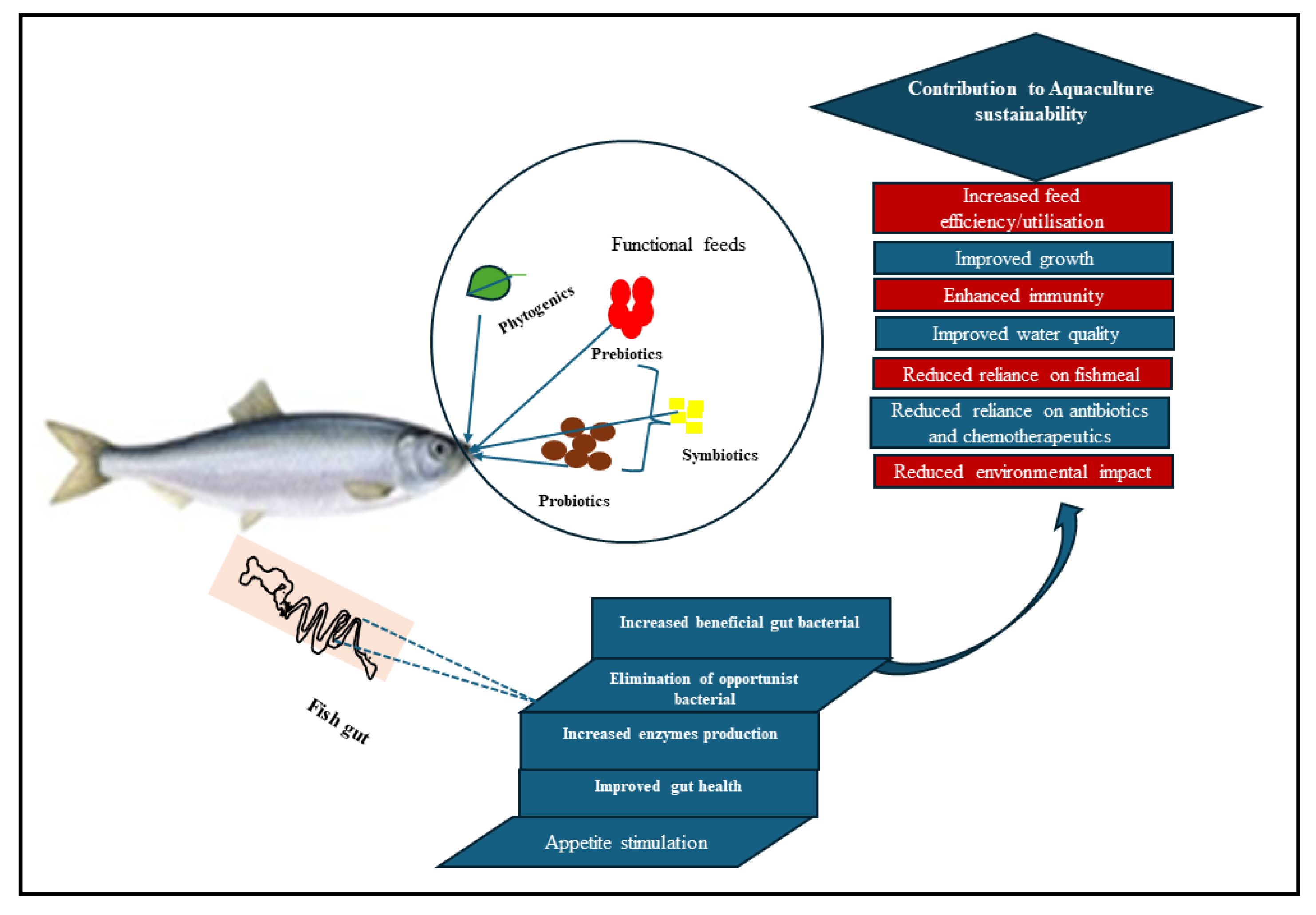

The Role of Functional Feed Additives in Enhancing Aquaculture Sustainability


Abstract
1. Introduction
2. Objectives
- Itemize some common functional feed additives and their contribution to aquaculture sustainability;
- Identify challenges associated with the use of functional feed additives.
3. Methodology
4. Some Common Functional Feed Additives in Aquaculture
4.1. Probiotics
4.2. Prebiotics
4.3. Phytogenics
5. Aquaculture and Its Sustainability Issues
6. Functional Feed Additives and Their Sustainability Roles
6.1. Feed Efficiency Improvement

| Animal Species | Types of Functional Feed Additives | Name of Strain | Concentration | Duration | Feed Conversion Ratio | Specific Growth Rate (%d−1) | Protein Efficiency Ratio | Reference |
|---|---|---|---|---|---|---|---|---|
| Tilapia (Oreochromis niloticus × Oreochromis aureus) | Probiotics | Clostridium butyricum | Control 0.5 g kg−1 diet 1 g 2 g 4 g 8 g kg−1 diet (1.5 × 10⁸) | 56 days | 1.14 ± 0.02 d 1.12 ± 0.01 cd 1.06 ± 0.02 ab 1.03 ± 0.03 a 1.07 ± 0.02 abc 1.10 ±0.02 bcd | 3.54 ± 0.02 d 3.56 ± 0.02 cd 3.65 ± 0.03 ab 3.69 ± 0.05 a 3.63 ± 0.03 abc 3.59 ± 0.03 bcd | NP | [107] |
| Rainbow trout (Oncorhynchus mykiss) Broodstock | probiotics | Bio-Aqua® (Pediococcus acidilactici, Enterococcus faecium, Bacillus subtilis, Lactobacillus acidophilus, Lactobacillus plantarum, Lactobacillus casei) | Control 1 × 10⁹ (cfu/kg) 2 × 10⁹ 4 × 10⁹ | 56 days | 1.6 ± 0.0 a 1.5 ± 0.1 a 1.3 ± 0.1 ab 1.1 ± 0.0 b | 0.4 ± 0.0 0.4 ± 0.1 0.5 ± 0.0 0.6 ± 0.0 | NP | [108] |
| Catfish (Clarias gariepinus) | Probiotics | Bacillus NP5 | Control 1 × 10⁹ 1 × 10¹⁰ | 30 days | 2.14 ± 0.13 a 1.0 ±1.4 b 1.09 ± 0.07 b | 1.49 ± 0.14 b 2.56 ± 0.08 a 2.44 ± 0.13 a | NP | [109] |
| Nile tilapia (Oreochromis niloticus) | Probiotics | Saccharomyces cerevisiae | Control 1 g kg−1 diet. 2 g 4 g | 60 days | 1.68 ± 0.01 b 1.39 ± 0.01 b 1.28 ± 0.01 ab 1.18 ± 0.01 a | 1.59 ± 0.25 a 1.67 ± 0.40 ab 1.70 ± 0.25 ab 2.10 ± 0.19 b | 2.11 ± 0.01 a 2.28 ± 0.01 ab 2.43 ± 0.01 ab 2.71 ± 0.01 b | [43] |
| White shrimp (Litopenaeus vannamei) | Probiotics | Bacillus subtilis Lactobacillus pentosus Lactobacillus fermemtum Saccharomyces cerevisiae Mixture of all probiotics at 107, 108 and 109 Concentrations | 109 cfu kg−1 diet. 109 109 109 107 108 109 c control | 56 days | 1.64 ± 0.02 ab 1.67 ± 0.02 ab 1.75 ± 0.01 bc 1.82 ± 0.04 c 1.82 ± 0.03 c 1.67 ± 0.01 ab 1.53 ± 0.02 a 1.82 ± 0.01 c | NP | NP | [98] |
| Abalone (Haliotis discus hannai) | Probiotics | Bacillus licheniformis | 103 cfu/mL 105 107 Control | 56 days | 0.92 ± 0.01 b* 0.70 ± 0.01 a* 0.76 ± 0.01 a* 1.15 ± 0.01 c* | 0.22 ± 0.02 b 0.29 ± 0.02 a 0.26 ± 0.01 ab 0.17 ± 0.01 c | [54] | |
| Pacific white shrimp (Litopenaeus vannamei) | Prebiotics | Mannan oligosaccharide | 1 g kg−1 feed. 2 g 4 g 6 g 8 g Control | 56 days | 1.55 ± 0.03 bc 1.44 ± 0.02 c 1.60 ± 0.07 b 1.58 ± 0.33 b 1.61 ± 0.04 b 1.78 ± 0.05 a | 2.46 ± 0.03 ab 2.59 ± 0.02 c 2.51 ± 0.05 c 2.51 ± 0.04 bc 2.51 ± 0.05 c 2.29 ± 0.05 a | [110] | |
| Thinlip grey mullet (Liza ramada) | Prebiotics | Mannan oligosaccharide | 0.5% 1% 2% Control | 56 days | 1.22 ± 0.02 b 1.21 ± 0.03 b 1.24 ± 0.01 b 1.43 ± 0.10 a | 2.57 ± 0.02 a 2.54 ± 0.03 a 2.47 ± 0.02 b 2.34 ± 0.04 c | 2.71 ± 0.05 a 2.75 ± 0.09 a 2.66 ± 0.03 b 2.32 ± 0.15 c | [100] |
| Rohu (Labeo rohita) | Prebiotics Probiotics Symbiotics | Fructo Oligosaccharide Baccillus licheniformis Bacillus methylotrophicus FOS + Bacillus licheniformis FOS + Bacillus methylotrophicus | 107 cfu/g Control | 90 days | 2.22 ± 0.01 d* 2.0 ± 0.01 c* 2.02 ± 0.02 c* 1.74 ± 0.01 a* 1.84 ± 0.01 b* 2.4 ± 0.01 e* | 1.26 ± 0.01 a* 1.34 ± 0.02 b* 1.34 ± 0.01 b* 1.42 ± 0.02 c* 1.37 ± 0.01 bc* 1.19 ± 0.02 a* | 1.29 ± 0.02 b 1.43 ± 0.01 c* 1.41 ± 0.01 c* 1.64 ± 0.02 e* 1.55 ± 0.02 d* 1.19 ± 0.02 a* | [111] |
| Nile tilapia (Oreochromis niloticus) | Probiotics, prebiotics and symbiotics | Lactobacillus plantarum CR1T5 Xylooligosaccharides Lactobacillus plantarum + xylooligosaccharides | 108 CFU g−1 10 g kg−1 diet (108 CFU g−1 + 10 g kg−1) Control | 84 days | 1.56 ± 0.01 c 1.55 ± 0.01 b 1.50 ± 0.01 b 1.62 ± 0.01 a- | 2.61 ± 0.01 b 2.59 ± 0.01 b 2.70 ± 0.03 a 2.53 ± 0.02 c | [40] | |
| Snakehead fish (Channa argus) | Probiotics and Symbiotics | Enterococcus faecalis Lactococcus lactis Enterococcus faecalis + Lactococcus lactis Control | 1.0 × 10⁸ cfu/g of diet | 56 days | 1.29 ± 0.01 b- 1.23 ± 0.03 c- 1.27 ± 0.02 b- 1.34 ± 0.02 a- | 2.38 ± 0.03 b 2.51 ± 0.02 c 2.42 ± 0.01 bc 2.26 ± 0.03 a | 1.84 ± 0.03 b 1.93 ± 0.01 c 1.88 ± 0.01 b 1.77 ± 0.02 a | [99] |
| Nile tilapia (Oreochromis niloticus) | Phytogenics | Essential oil from Lemon grass (Cymbopogon citratus) Essential oil from geranium (Pelargonium graveolens) | 200 mg kg−1 Lemon grass oil 400 mg kg−1 Lemon grass oil 200 mg kg−1 geranium oil 400 mg kg−1 geranium oil Control | 84 days | 1.79 ± 0.01 bc* 1.75 ± 0.04 bc* 1.86 ±0.04 ab* 1.77 ± 0.03 c* 1.89 ± 0.03 a* | 3.90 ± 0.01 a* 3.88 ± 0.04 a* 3.78 ± 0.03 b* 3.93 ± 0.03 a* 3.75 ± 0.04 b* | 1.75 ± 0.01 ab* 1.78 ± 0.04 a* 1.68 ± 0.03 bc* 1.76 ± 0.03 ab* 1.65 ± 0.02 c* | [101] |
| Rainbow trout (Oncorhynchus mykiss) | Phytogenics | Garlic (Allium sativum) | 1% 2% 3% Control | 120 days | 0.74 ± 0.02 a 0.73 ± 0.04 a 0.73 ± 0.03 a 0.76 ± 0.01 a | 2.63 ± 0.00 b 2.66 ± 0.03 bc 2.68 ± 0.04 c 2.60 ±0.01 a | [102] | |
| Rainbow trout (Oncorhynchus mykiss) | Phytogenics | Garlic (Allium sativum) | 5% 7% 10% Control | 90 days | 2.90 ± 0.0 a 1.90 ± 0.0 d 2.60 ± 0.0 b 2.10 ± 0.0 c | 3.62 ± 0.03 a 3.68 ± 0.02 a 3.65 ± 0.01 a 3.50 ± 0.02 b | [112] |
6.2. Sustainable Resource Utilization
| Name of Species | Types of FFA | Strain | Experimental Design | Duration of Study | Effects | Reference |
|---|---|---|---|---|---|---|
| Amberjack (Seriola dumerili) | Probiotics | Heat-killed Lactobaccilus plantarum | Control (0%) SBM), 15%, 30%, and 45% SBM supplemented with probiotics at 0% or 0.1% | 56 days | Higher final weight, weight gain, specific growth rate, feed ingestion rate, and protein retention in 30% SBM supplemented with probiotics. Similar hematocrit levels except for 30% SBM without probiotics supplementation. Similar hemoglobin levels, except for SBM 45%, without probiotic supplementation. Higher serum bactericidal activity in 30% SBM supplemented with probiotics. 30% SBM and 0% SBM exhibited higher tolerance to low-salinity stress. High ADCP in all treatments except for 40% SBM with and without probiotic supplementation. | [115] |
| Largemouth Bass (Micropterus salmoides) | Probiotics | Fermentation of SBM with Bacillus subtilis, Lactobacillus and Saccharomyces cerevisiae | Control (0% SBM), 15%, 30%, 45% and 60% SBM and FSBM | 56 days | Similar nutrient utilization of fish fed 35% FSBM with the control in terms of ADDM, ADCP, ADCL, protein retention, and lipid retention. Similar final weight, SGR, feed intake, and FCR of 35% FSBM with the control. No harm was evident in the intestinal epithelial mucosa in all treatment groups. Significantly lower intestinal villus height in 60% SBM group than the control. Significantly lower villus width of 45% and 60% SBM and 60% FSBM groups than that of the control group | [42] |
| Oriental river prawn (Macrobrachium nipponense) | Probiotics | Fermented SBM fortified with probiotics (Pediococcus acidilactic, Enterococcus faecalis, Saccharomyces cerevisiae, Candida utilis, Bacillus subtilis, Bacillus licheniformis, Rhodopseudomonas palustris) and enzymes (protease, cellulase, and xylanase) | Control 25% FSBM 50% FSBM 75% FSBM 100% FSBM | 56 days | Higher weight gain, SGR, and FCR in fish fed 25% SBM compared to other treatments and the control. Higher total hemocyte counts in control, 25% and 50% FSBM than other treatments. Higher mortality rate on exposure to Aeromonas hydrophila in 75 and 100% SBM than the control, 25 and 50% SBM. | [116] |
| Silver Barb (Barbonymus gonionotus) | Probiotics | SBM fermented with Lactobacillus paracasei | 20% FM + 20% FSBM 20%FM + 20%SBM 40% FSBM 40% SBM 40% FM (Control) | 90 days | Higher weight gain and SGR in fish fed the control, 20% FM + 20% FSBM and 20% FM + 20% SBM compared to fish fed 40% FSBM and 40% SBM. Lower hematocrit, hemoglobin, and erythrocyte counts in fish fed 40% SBM diet compared to those fed the control and 20% FM + 20% FSBM. | [118] |
6.3. Enhanced Disease Resistance/Immunity
6.4. Antiparasitic
6.5. Improved Water Quality
7. Adoption of Functional Feed Additives
8. Challenges Associated with Functional Feed Additives
9. Conclusions
10. Future Directions and Recommendations
Author Contributions
Funding
Conflicts of Interest
References
- Edwards, P.; Zhang, W.; Belton, B.; Little, D.C. Misunderstandings, Myths and Mantras in Aquaculture: Its Contribution to World Food Supplies Has Been Systematically over Reported. Mar. Pol. 2019, 106, 103547. [Google Scholar] [CrossRef] [Scilit]
- Dawood, M.A.; Koshio, S. Recent Advances in the Role of Probiotics and Prebiotics in Carp Aquaculture: A Review. Aquaculture 2016, 454, 243–251. [Google Scholar] [CrossRef] [Scilit]
- Olaganathan, R.; Kar Mun, A.T. Impact of Aquaculture on the Livelihoods and Food Security of Rural Communities. Int. J. Fish. Aquat. Stud. 2017, 5, 278. [Google Scholar]
- Wang, B.; Cao, L.; Micheli, F.; Naylor, R.L.; Fringer, O.B. The Effects of Intensive Aquaculture on Nutrient Residence Time and Transport in a Coastal Embayment. Environ. Fluid Mech. 2018, 18, 1321–1349. [Google Scholar] [CrossRef] [Scilit]
- Valenti, W.C.; Kimpara, J.M.; Preto, B.D.L.; Moraes-Valenti, P. Indicators of Sustainability to Assess Aquaculture Systems. Ecol. Indic. 2018, 88, 402–413. [Google Scholar] [CrossRef] [Scilit]
- Valenti, W.C.; Kimpara, J.M.; Preto, B.L. Measuring Aquaculture Sustainability. World Aquac. 2011, 42, 26–30. [Google Scholar]
- Boyd, C.E.; McNevin, A.A.; Davis, R.P. The Contribution of Fisheries and Aquaculture to the Global Protein Supply. Food Secur. 2022, 14, 805–827. [Google Scholar] [CrossRef] [Scilit]
- Ansari, F.A.; Guldhe, A.; Gupta, S.K.; Rawat, I.; Bux, F. Improving the Feasibility of Aquaculture Feed by Using Microalgae. Environ. Sci. Pollut. Res. 2021, 28, 43234–43257. [Google Scholar] [CrossRef] [Scilit]
- Lieke, T.; Hoseinifar, S.H.; Pan, B.; Straus, D.L.; Steinberg, C.E. Sustainable Aquaculture Requires Environmental-friendly Treatment Strategies for Fish Diseases. Rev. Aquac. 2020, 12, 943–965. [Google Scholar] [CrossRef] [Scilit]
- Mugimba, K.K.; Byarugaba, D.K.; Mutoloki, S.; Evensen, Ø.; Munang’andu, H.M. Challenges and Solutions to Viral Diseases of Finfish in Marine Aquaculture. Pathogens 2021, 10, 673. [Google Scholar] [CrossRef] [Scilit]
- Salunke, M.; Kalyankar, A.; Khedkar, G.D.; Shingare, M.; Khedkar, C. A Review on Shrimp Aquaculture in India: Historical Perspective, Constraints, Status and Future Implications for Impacts on Aquatic Ecosystem and Biodiversity. Rev. Fish. Sci. Aquac. 2020, 28, 282–302. [Google Scholar] [CrossRef] [Scilit]
- Ward, G.M.; Faisan Jr, J.P.; Cottier-Cook, E.J.; Gachon, C.; Hurtado, A.Q.; Lim, P.E.; Brodie, J. A Review of Reported Seaweed Diseases and Pests in Aquaculture in Asia. J. World Aquac. Soc. 2020, 51, 815–828. [Google Scholar] [CrossRef] [Scilit]
- Ahmed, N.; Thompson, S.; Glaser, M. Global Aquaculture Productivity, Environmental Sustainability, and Climate Change Adaptability. Environ. Manag. 2019, 63, 159–172. [Google Scholar] [CrossRef] [Scilit]
- Burridge, L.; Weis, J.S.; Cabello, F.; Pizarro, J.; Bostick, K. Chemical Use in Salmon Aquaculture: A Review of Current Practices and Possible Environmental Effects. Aquacultture 2010, 306, 7–23. [Google Scholar] [CrossRef] [Scilit]
- Mavraganis, T.; Constantina, C.; Kolygas, M.; Vidalis, K.; Nathanailides, C. Environmental Issues of Aquaculture Development. Egypt. J. Aquat. Biol. Fish. 2020, 24, 441–450. [Google Scholar] [CrossRef] [Scilit]
- Bandara, T. Alternative Feed Ingredients in Aquaculture: Opportunities and Challenges. J. Entomol. Zool. Stud. 2018, 6, 3087–3094. [Google Scholar]
- Barroso, F.G.; de Haro, C.; Sánchez-Muros, M.J.; Venegas, E.; Martínez-Sánchez, A.; Pérez-Bañón, C. The Potential of Various Insect Species for Use as Food for Fish. Aquaculture 2014, 422, 193–201. [Google Scholar] [CrossRef] [Scilit]
- Chemello, G.; Zarantoniello, M.; Randazzo, B.; Gioacchini, G.; Truzzi, C.; Cardinaletti, G.; Riolo, P.; Olivotto, I. Effects of Black Soldier Fly (Hermetia illucens) Enriched with Schizochytrium Sp. on Zebrafish (Danio rerio) Reproductive Performances. Aquaculture 2022, 550, 737853. [Google Scholar] [CrossRef] [Scilit]
- Glencross, B.D. A Feed Is Still Only as Good as Its Ingredients: An Update on the Nutritional Research Strategies for the Optimal Evaluation of Ingredients for Aquaculture Feeds. Aquac. Nutr. 2020, 26, 1871–1883. [Google Scholar] [CrossRef] [Scilit]
- Torrecillas, S.; Robaina, L.; Caballero, M.J.; Montero, D.; Calandra, G.; Mompel, D.; Karalazos, V.; Kaushik, S.; Izquierdo, M.S. Combined Replacement of Fishmeal and Fish Oil in European Sea Bass (Dicentrarchus labrax): Production Performance, Tissue Composition and Liver Morphology. Aquaculture 2017, 474, 101–112. [Google Scholar] [CrossRef] [Scilit]
- Lulijwa, R.; Rupia, E.J.; Alfaro, A.C. Antibiotic Use in Aquaculture, Policies and Regulation, Health and Environmental Risks: A Review of the Top 15 Major Producers. Rev. Aquac. 2020, 12, 640–663. [Google Scholar] [CrossRef] [Scilit]
- Romero, J.; Feijoó, C.G.; Navarrete, P. Antibiotics in Aquaculture–Use, Abuse and Alternatives. Health Environ. Aquac. 2012, 159, 159–198. [Google Scholar]
- Chopin, T.; Cooper, J.A.; Reid, G.; Cross, S.; Moore, C. Open-water Integrated Multi-trophic Aquaculture: Environmental Biomitigation and Economic Diversification of Fed Aquaculture by Extractive Aquaculture. Rev. Aquac. 2012, 4, 209–220. [Google Scholar] [CrossRef] [Scilit]
- Granada, L.; Sousa, N.; Lopes, S.; Lemos, M.F. Is Integrated Multitrophic Aquaculture the Solution to the Sectors’ Major Challenges?–A Review. Rev. Aquac. 2016, 8, 288–300. [Google Scholar] [CrossRef] [Scilit]
- Knowler, D.; Chopin, T.; Martínez-Espiñeira, R.; Neori, A.; Nobre, A.; Noce, A.; Reid, G. The Economics of Integrated Multi-trophic Aquaculture: Where Are We Now and Where Do We Need to Go? Rev. Aquac. 2020, 12, 1579–1594. [Google Scholar] [CrossRef] [Scilit]
- Onomu, A.; Slater, M.; Vine, N. Feeding Indicators and Bioremediation Ability of Warty Sea Cucumber Neostichopus Grammatus Fed Potential Wastes from Abalone Haliotis Midae Farming. Aquacult. Environ. Interact. 2023, 15, 45–57. [Google Scholar] [CrossRef] [Scilit]
- Onomu, A.J.; Slater, M.J.; Vine, N.G. Coculture of Abalone (Haliotis Midae) and Sea Cucumber (Neostichopus grammatus) to Reduce Tank Cleaning Frequency in Abalone Farming. Aquac. Int. 2024. [Google Scholar] [CrossRef] [Scilit]
- Sakka, S. Chapter 11.1. 2. Sol–Gel Process and Applications. In Handbook of Advanced Ceramics; Academic Press: New York, NY, USA, 2013; pp. 883–910. [Google Scholar]
- Tom, A.P.; Jayakumar, J.S.; Biju, M.; Somarajan, J.; Ibrahim, M.A. Aquaculture Wastewater Treatment Technologies and Their Sustainability: A Review. Energy Nexus 2021, 4, 100022. [Google Scholar] [CrossRef] [Scilit]
- Le Boucher, R.; Vandeputte, M.; Dupont-Nivet, M.; Quillet, E.; Ruelle, F.; Vergnet, A.; Kaushik, S.; Allamellou, J.M.; Médale, F.; Chatain, B. Genotype by Diet Interactions in European Sea Bass (Dicentrarchus labrax L.): Nutritional Challenge with Totally Plant-Based Diets1. J. Anim. Sci. 2013, 91, 44–56. [Google Scholar] [CrossRef] [Scilit]
- Panserat, S.; Hortopan, G.A.; Plagnes-Juan, E.; Kolditz, C.; Lansard, M.; Skiba-Cassy, S.; Esquerré, D.; Geurden, I.; Médale, F.; Kaushik, S.; et al. Differential Gene Expression after Total Replacement of Dietary Fish Meal and Fish Oil by Plant Products in Rainbow Trout (Oncorhynchus mykiss) Liver. Aquaculture 2009, 294, 123–131. [Google Scholar] [CrossRef] [Scilit]
- Vélez-Calabria, G.; Peñaranda, D.S.; Jover-Cerdá, M.; Llorens, S.M.; Tomás-Vidal, A. Successful Inclusion of High Vegetable Protein Sources in Feed for Rainbow Trout without Decrement in Intestinal Health. Animals 2021, 11, 3577. [Google Scholar] [CrossRef] [Scilit] [PubMed]
- Gómez, B.; Munekata, P.E.; Zhu, Z.; Barba, F.J.; Toldrá, F.; Putnik, P.; Kovačević, D.B.; Lorenzo, J.M. Challenges and Opportunities Regarding the Use of Alternative Protein Sources: Aquaculture and Insects. Adv. Food Nutr. Res. 2019, 89, 259–295. [Google Scholar] [CrossRef] [Scilit] [PubMed]
- Dauda, A.B.; Ajadi, A.; Tola-Fabunmi, A.S.; Akinwole, A.O. Waste Production in Aquaculture: Sources, Components and Managements in Different Culture Systems. Aquac. Fish. 2019, 4, 81–88. [Google Scholar] [CrossRef] [Scilit]
- Encarnação, P. Functional Feed Additives in Aquaculture Feeds. In Aquafeed Formulation; Nates, S.F., Ed.; Academic Press: Cambridge, MA, USA, 2016; pp. 217–237. [Google Scholar]
- Amenyogbe, E.; Chen, G.; Wang, Z.; Huang, B.; Li, H. The Exploitation of Probiotics, Prebiotics and Synbiotics in Aquaculture: Present Study, Limitations and Future Directions: A Review. Aquac. Int. 2020, 28, 1017–1041. [Google Scholar] [CrossRef] [Scilit]
- Doğukan, K.A.Y.A.; Hersi, M.A.; Ercüment, G.E.N.Ç.; Arslan, H.Ö. Symbiotic Effect of Bacillus Clausii and Galacto-Oligosaccharide on Growth and Survival Rates in Red Cherry Shrimp (Neocaridina davidi). Mar. Life Sci. 2022, 42, 146–151. [Google Scholar]
- Nya, E.J.; Dawood, Z.; Austin, B. The Garlic Component, Allicin, Prevents Disease Caused by Aeromonas Hydrophila in Rainbow Trout, Oncorhynchus mykiss (Walbaum). J. Fish Dis. 2010, 33, 293–300. [Google Scholar] [CrossRef] [Scilit]
- Yi, Y.; Zhang, Z.; Zhao, F.; Liu, H.; Yu, L.; Zha, J.; Wang, G. Probiotic Potential of Bacillus velezensis JW: Antimicrobial Activity against Fish Pathogenic Bacteria and Immune Enhancement Effects on Carassius auratus. Fish Shellfish Immunol. 2018, 78, 322–330. [Google Scholar] [CrossRef] [Scilit]
- Van Doan, H.; Hoseinifar, S.H.; Tapingkae, W.; Seel-Audom, M.; Jaturasitha, S.; Dawood, M.A.; Wongmaneeprateep, S.; Thu, T.T.N.; Esteban, M.Á. Boosted Growth Performance, Mucosal and Serum Immunity, and Disease Resistance Nile Tilapia (Oreochromis niloticus) Fingerlings Using Corncob-Derived Xylooligosaccharide and Lactobacillus Plantarum CR1T5. Probiotics Antimicrob. Proteins 2020, 12, 400–411. [Google Scholar] [CrossRef] [Scilit]
- Avella, M.A.; Olivotto, I.; Silvi, S.; Ribecco, C.; Cresci, A.; Palermo, F.; Polzonetti, A.; Carnevali, O. Use of Enterococcus Faecium to Improve Common Sole (Solea solea) Larviculture. Aquaculture 2011, 315, 384–393. [Google Scholar] [CrossRef] [Scilit]
- He, M.; Yu, Y.; Li, X.; Poolsawat, L.; Yang, P.; Bian, Y.; Guo, Z.; Leng, X. An Evaluation of Replacing Fish Meal with Fermented Soybean Meal in the Diets of Largemouth Bass (Micropterus salmoides): Growth, Nutrition Utilization and Intestinal Histology. Aquac. Res. 2020, 51, 4302–4314. [Google Scholar] [CrossRef] [Scilit]
- Islam, S.M.; Rohani, M.F.; Shahjahan, M. Probiotic Yeast Enhances Growth Performance of Nile Tilapia (Oreochromis niloticus) through Morphological Modifications of Intestine. Aquac. Rep. 2021, 21, 10800. [Google Scholar] [CrossRef] [Scilit]
- Kumar, P.; Jain, K.K.; Sardar, P. Effects of Dietary Synbiotic on Innate Immunity, Antioxidant Activity and Disease Resistance of Cirrhinus mrigala Juveniles. Fish Shellfish Immunol. 2018, 80, 124–132. [Google Scholar] [CrossRef] [Scilit] [PubMed]
- Merrifield, D.L.; Dimitroglou, A.; Foey, A.; Davies, S.J.; Baker, R.T.; Bøgwald, J.; Castex, M.; Ringø, E. The Current Status and Future Focus of Probiotic and Prebiotic Applications for Salmonids. Aquaculture 2010, 302, 1–18. [Google Scholar] [CrossRef] [Scilit]
- Parker, R.B. Probiotics, the Other Half of the Antibiotic Story. Anim. Nutr. Health 1974, 29, 4–8. [Google Scholar]
- Fuller, R. Probiotics in Man and Animals. J. Appl. Bacteriol. 1989, 66, 365–378. [Google Scholar] [PubMed]
- FAO/WHO. Health and Nutritional Properties of Probiotics in Food Including Powder Milk with Live Lactic Acid Bacteria; Food and Agriculture Organization of the United Nations: Rome, Italy, 2001. [Google Scholar]
- Verschuere, L.; Rombaut, G.; Sorgeloos, P.; Verstraete, W. Probiotic Bacteria as Biological Control Agents in Aquaculture. Microbiol. Mol. Biol. Rev. 2000, 64, 655–671. [Google Scholar] [CrossRef] [Scilit]
- Bezkorovainy, A. Probiotics: Determinants of Survival and Growth in the Gut. Am. J. Clin. Nutr. 2001, 73, 399s–405s. [Google Scholar] [CrossRef] [Scilit] [PubMed]
- Gupta, V.; Garg, R. Probiotics. Indian J. Med. Microbiol. 2009, 27, 202–209. [Google Scholar] [CrossRef] [Scilit] [PubMed]
- Senok, A.C.; Ismaeel, A.Y.; Botta, G.A. Probiotics: Facts and Myths. Clin. Microbiol. Infect. 2005, 11, 958–966. [Google Scholar] [CrossRef] [Scilit]
- Eissa, E.S.H.; Baghdady, E.S.; Gaafar, A.Y.; El-Badawi, A.A.; Bazina, W.K.; Abd AI-Kareem, O.M.; Abd EI-Hamed, N.N.B. Assessing the Influence of Dietary Pediococcus Acidilactici Probiotic Supplementation in the Feed of European Sea Bass (Dicentrarchus labrax L.) (Linnaeus, 1758) on Farm Water Quality, Growth, Feed Utilization, Survival Rate, Body Composition, Blood Biochemical Parameters, and Intestinal Histology. Aquac. Nutr. 2022, 2022, 1–11. [Google Scholar] [CrossRef] [Scilit]
- Gao, X.; Zhang, M.; Li, X.; Han, Y.; Wu, F.; Liu, Y. Effects of a Probiotic (Bacillus licheniformis) on the Growth, Immunity, and Disease Resistance of Haliotis Discus Hannai Ino. Fish Shellfish Immunol. 2018, 76, 143–152. [Google Scholar] [CrossRef] [Scilit] [PubMed]
- Kuhlwein, H.; Merrifield, D.L.; Rawling, M.D.; Foey, A.D.; Davies, S.J. Effects of Dietary β-(1,3) (1,6)-D-Glucan Supplementation on Growth Performance, Intestinal Morphology and Haemato-Immunological Profile of Mirror Carp (Cyprinus carpio). J. Anim. Physiol. Anim. Nutr. 2014, 94, 279–289. [Google Scholar] [CrossRef] [Scilit] [PubMed]
- Wang, Y.B.; Xu, Z.R. Effect of Probiotics for Common Carp (Cyprinus carpio) Based on Growth Performance and Digestive Enzyme Activities. Anim. Feed Sci. Technol. 2006, 127, 283–292. [Google Scholar]
- Sugita, H.; Miyajima, C.; Deguchi, Y. The Vitamin B12-Producing Ability of the Intestinal Microflora of Freshwater Fish. Aquaculture 1991, 92, 267–276. [Google Scholar] [CrossRef] [Scilit]
- Sugita, H.; Takahashi, J.; Deguchi, Y. Production and Consumption of Biotin by the Intestinal Microflora of Cultured Freshwater Fishes. Biosci. Biotechnol. Biochem. 1992, 56, 1678–1679. [Google Scholar] [CrossRef] [Scilit]
- Ten Doeschate, K.I.; Coyne, V.E. Improved Growth Rate in Farmed Haliotis midae through Probiotic Treatment. Aquaculture 2008, 284, 174–179. [Google Scholar] [CrossRef] [Scilit]
- Vine, N.G.; Leukes, W.D.; Kaiser, H. Probiotics in Marine Larviculture. FEMS Microbiol. Rev. 2006, 30, 404–427. [Google Scholar] [CrossRef] [Scilit] [PubMed]
- Bajagai, Y.S.; Klieve, A.V.; Dart, P.J.; Bryden, W.L. Probiotics in Animal Nutrition—Production, Impact and Regulation; Makkar, H.P.S., Ed.; FAO Animal Production and Paper Health No. 179; FAO: Rome, Itlay, 2016. [Google Scholar]
- Azad, I.S.; Ai-Marzouk, A. Autochthonous Aquaculture Probiotics-A Critical Analysis. Res. J. Biotechnol. 2008, 3, 171–177. [Google Scholar]
- Gatesoupe, F.J. The Use of Probiotics in Aquaculture. Aquaculture 1999, 180, 147–165. [Google Scholar] [CrossRef] [Scilit]
- He, S.; Liu, W.; Zhou, Z.; Mao, W.; Ren, P.; Marubushi, T.; Ringø, E. Evaluation of Probiotic Strain Bacillus Subtilis C-3102 as a Feed Supplement for Koi Carp (Cyprinus carpio). J. Aquac. Res. Dev. 2011, S1, 1–7. [Google Scholar] [CrossRef]
- Bozkurt, M.; Aysul, N.; Küçükyilmaz, K.; Aypak, S.; Ege, G.; Catli, A.U.; Akşit, H.; Beijnink, F.; Seyrek, K.; Çınar, K. Efficacy of In-Feed Preparations of an Anticoccidial, Multienzyme, Prebiotic, Probiotic, and Herbal Essential Oil Mixture in Healthy and Eimeria Spp.-Infected Broilers. Poult. Sci. 2014, 93, 389–399. [Google Scholar] [CrossRef] [Scilit] [PubMed]
- Gibson, G.R.; Roberfroid, M.B. Dietary Modulation of the Human Colonic Microbiota: Introducing the Concept of Prebiotics. J. Nutr. 1995, 125, 1401–1412. [Google Scholar] [CrossRef] [Scilit] [PubMed]
- Kim, G.B.; Seo, Y.M.; Kim, C.H.; Paik, I.K. Effect of Dietary Prebiotic Supplementation on the Performance, Intestinal Microflora, and Immune Response of Broilers. Poult. Sci. 2011, 90, 75–82. [Google Scholar] [CrossRef] [Scilit] [PubMed]
- Roberfroid, M. Dietary Fiber, Inulin, and Oligofructose: A Review Comparing Their Physiological Effects. Crit. Rev. Food Sci. Nutr. 1993, 33, 103–148. [Google Scholar] [CrossRef] [Scilit] [PubMed]
- Davani-Davari, D.; Negahdaripour, M.; Karimzadeh; Seifan, M.; Mohkam, M.; Masoumi, S.J.; Berenjian, A.; Ghasemi, Y. Prebiotics: Definition, Types, Sources, Mechanisms, and Clinical Applications. Foods 2019, 8, 92. [Google Scholar] [CrossRef] [Scilit] [PubMed]
- Gibson, G.R.; Probert, H.M.; Van Loo, J.; Rastall, R.A.; Roberfroid, M.B. Dietary Modulation of the Human Colonic Microbiota: Updating the Concept of Prebiotics. Nutr. Res. Rev. 2004, 17, 259–275. [Google Scholar] [CrossRef] [Scilit] [PubMed]
- Anadón, A.; Ares, I.; Martínez-Larrañaga, M.R.; Martínez, M.A. Prebiotics and Probiotics in Feed and Animal Health. In Nutraceuticals in Veterinary Medicine; Gupta, R., Srivastava, A., Lall, R., Eds.; Springer: Cham, Switzerland, 2019; pp. 261–285. [Google Scholar]
- Gibson, G.R.; Hutkins, R.; Sanders, M.E.; Prescott, S.L.; Reimer, R.A.; Salminen, S.; Scott, K.; Stanton, C.; Swanson, K.S.; Cani, P.D.; et al. Expert Consensus Document: The International Scientific Association for Probiotics and Prebiotics (ISAPP) Consensus Statement on the Definition and Scope of Prebiotics. Nat. Rev. Gastroenterol. Hepatol. 2017, 14, 491–502. [Google Scholar] [CrossRef] [Scilit] [PubMed]
- Teitelbaum, J.E.; Walker, W.A. Nutritional Impact of Pre-and Probiotics as Protective Gastrointestinal Organisms. Annu. Rev. Nutr. 2002, 22, 107–138. [Google Scholar] [CrossRef] [Scilit] [PubMed]
- Song, S.K.; Beck, B.R.; Kim, D.; Park, J.; Kim, J.; Kim, H.D.; Ringø, E. Prebiotics as Immunostimulants in Aquaculture: A Review. Fish Shellfish Immunol. 2014, 40, 40–48. [Google Scholar] [CrossRef] [Scilit]
- Balakrishnan, K.; Dhanasekaran, D.; Krishnaraj, V.; Anbukumaran, A.; Ramasamy, T.; Manickam, M. Edible Mushrooms: A Promising Bioresource for Prebiotics. In Advances in Probiotics; Dhanasekaran, D., Sankaranarayanan, A., Eds.; Academic Press: Cambridge, MA, USA, 2021; pp. 81–97. [Google Scholar]
- Mohammadi, G.; Rafiee, G.; El Basuini, M.F.; Abdel-Latif, H.M.; Dawood, M.A. The Growth Performance, Antioxidant Capacity, Immunological Responses, and the Resistance against Aeromonas hydrophila in Nile Tilapia (Oreochromis niloticus) Fed Pistacia Vera Hulls Derived Polysaccharide. Fish Shellfish Immunol. 2020, 106, 36–43. [Google Scholar] [CrossRef] [Scilit]
- Steiner, T. Managing Gut Health: Natural Growth Promoters as a Key to Animal Performance; Steiner, T., Ed.; Nottingham University Press: Nottingham, UK, 2006. [Google Scholar]
- Asimi, O.A.; Sahu, N.P. Herbs/Spices as Feed Additive in Aquaculture. Sci. J. Pure Appl. Sci. 2013, 2, 284–292. [Google Scholar] [CrossRef]
- Awad, E.; Awaad, A. Role of Medicinal Plants on Growth Performance and Immune Status in Fish. Fish Shellfish Immunol. 2017, 67, 40–54. [Google Scholar] [CrossRef] [Scilit] [PubMed]
- Hernández-Contreras, A.; Hernández, M.D. Application of Aromatic Plants and Their Extract in Aquaculture. In Feed additives; Florou-Paneri, P., Christaki, E., Giannenas, I., Eds.; Academic Press: Cambridge, MA, USA, 2020; pp. 239–259. [Google Scholar]
- Reverter, M.; Tapissier-Bontemps, N.; Sarter, S.; Sasal, P.; Caruso, D. Moving towards More Sustainable Aquaculture Practices: A Meta-analysis on the Potential of Plant-enriched Diets to Improve Fish Growth, Immunity and Disease Resistance. Rev. Aquac. 2021, 13, 537–555. [Google Scholar] [CrossRef] [Scilit]
- Szychowski, K.; Rybczyńska-Tkaczyk, K.; Gaweł-Bęben, K.; Świeca, M.; Karaś, M.; Jakubczyk, A.; Matysiak, M.; Binduga, U.; Gmiński, J. Characterization of Active Compounds of Different Garlic (Allium sativum L.) Cultivars. Pol. J. Food Nutr. Sci. 2018, 68, 73–81. [Google Scholar] [CrossRef] [Scilit]
- Onomu, A.J. Growth and Haematological Response of Clarias gariepinus to Garlic (Allium sativum) Supplemented Diet. SAR 2018, 8, 67. [Google Scholar] [CrossRef] [Scilit]
- Aruwayo, A.; Maigandi, S.A. Neem (Azadirachta indica) Seed Cake/Kernel as Protein Source in Ruminants Feed. Am. J. Exp. Agric. 2013, 4, 482–492. [Google Scholar] [CrossRef] [Scilit]
- Harikrishnan, R.; Rani, M.N.; Balasundaram, C. Hematological and Biochemical Parameters in Common Carp, Cyprinus Carpio, Following Herbal Treatment for Aeromonas Hydrophila Infection. Aquaculture 2003, 221, 41–50. [Google Scholar] [CrossRef] [Scilit]
- Isman, M.B.; Koul, O.; Luczynski, A.; Kaminski, J. Insecticidal and Antifeedant Bioactivities of Neem Oils and Their Relationship to Azadirachtin Content. J. Agric. Food Chem. 1990, 38, 1406–1411. [Google Scholar] [CrossRef] [Scilit]
- Boyd, C.E.; D’Abramo, L.R.; Glencross, B.D.; Huyben, D.C.; Juarez, L.M.; Lockwood, G.S.; McNevin, A.A.; Tacon, A.G.J.; Teletchea, F.; Tomasso, J.R.; et al. Achieving Sustainable Aquaculture: Historical and Current Perspectives and Future Needs and Challenges. J. World Aquac. Soc. 2020, 51, 578–633. [Google Scholar] [CrossRef] [Scilit]
- Diana, J.S. Aquaculture Production and Biodiversity Conservation. BioScience 2009, 59, 27–38. [Google Scholar] [CrossRef] [Scilit]
- Md Noor, N.; Harun, S.N. Towards Sustainable Aquaculture: A Brief Look into Management Issues. Appl. Sci. 2022, 12, 7448. [Google Scholar] [CrossRef] [Scilit]
- Salin, K.R.; Arome Ataguba, G. Aquaculture and the Environment: Towards Sustainability. In Sustainable Aquaculture; Hai, F.I., Visvanathan, C., Boopathy, R., Eds.; Springer International Publishing: Cham, Switzerland, 2018; pp. 1–62. ISBN 978-3-319-73256-5. [Google Scholar]
- Sampantamit, T.; Ho, L.; Lachat, C.; Sutummawong, N.; Sorgeloos, P.; Goethals, P. Aquaculture Production and Its Environmental Sustainability in Thailand: Challenges and Potential Solutions. Sustainability 2020, 12, 2010. [Google Scholar] [CrossRef] [Scilit]
- Young, T.; Laroche, O.; Walker, S.P.; Miller, M.R.; Casanovas, P.; Steiner, K.; Esmaeili, N.; Zhao, R.; Bowman, J.P.; Wilson, R.; et al. Prediction of Feed Efficiency and Performance-Based Traits in Fish via Integration of Multiple Omics and Clinical Covariates. Biology 2023, 12, 1135. [Google Scholar] [CrossRef] [Scilit] [PubMed]
- Thorarensen, H.; Farrell, A.P. The Biological Requirements for Post-Smolt Atlantic salmon in Closed-Containment Systems. Aquaculture 2011, 312, 1–14. [Google Scholar] [CrossRef] [Scilit]
- Oduleye, S.O. Growth and Growth Regulation in the Cichlids. Aquaculture 1982, 27, 301–306. [Google Scholar] [CrossRef] [Scilit]
- Naiel, M.A.E.; Ismael, N.E.M.; Negm, S.S.; Ayyat, M.S.; Al-Sagheer, A.A. Rosemary Leaf Powder–Supplemented Diet Enhances Performance, Antioxidant Properties, Immune Status, and Resistance against Bacterial Diseases in Nile Tilapia (Oreochromis niloticus). Aquaculture 2020, 526, 735370. [Google Scholar] [CrossRef] [Scilit]
- Beck, B.R.; Kim, D.; Jeon, J.; Lee, S.-M.; Kim, H.K.; Kim, O.-J.; Lee, J.I.; Suh, B.S.; Do, H.K.; Lee, K.H.; et al. The Effects of Combined Dietary Probiotics Lactococcus Lactis BFE920 and Lactobacillus Plantarum FGL0001 on Innate Immunity and Disease Resistance in Olive Flounder (Paralichthys olivaceus). Fish Shellfish Immunol. 2015, 42, 177–183. [Google Scholar] [CrossRef] [Scilit] [PubMed]
- Puvanasundram, P.; Chong, C.M.; Sabri, S.; Yusoff, M.S.; Karim, M. Multi-Strain Probiotics: Functions, Effectiveness and Formulations for Aquaculture Applications. Aquac. Rep. 2021, 21, 100905. [Google Scholar] [CrossRef] [Scilit]
- Wang, Y.-C.; Hu, S.-Y.; Chiu, C.-S.; Liu, C.-H. Multiple-Strain Probiotics Appear to Be More Effective in Improving the Growth Performance and Health Status of White Shrimp, Litopenaeus vannamei, than Single Probiotic Strains. Fish Shellfish Immunol. 2019, 84, 1050–1058. [Google Scholar] [CrossRef] [Scilit]
- Kong, Y.; Gao, C.; Du, X.; Zhao, J.; Li, M.; Shan, X.; Wang, G. Effects of Single or Conjoint Administration of Lactic Acid Bacteria as Potential Probiotics on Growth, Immune Response and Disease Resistance of Snakehead Fish (Channa argus). Fish Shellfish Immunol. 2020, 102, 412–421. [Google Scholar] [CrossRef] [Scilit]
- Magouz, F.I.; Bassuini, M.I.; Khalafalla, M.M.; Abbas, R.; Sewilam, H.; Aboelenin, S.M.; Soliman, M.M.; Amer, A.A.; Soliman, A.A.; Van Doan, H.; et al. Mannan Oligosaccharide Enhanced the Growth Rate, Digestive Enzyme Activity, Carcass Composition, and Blood Chemistry of Thinlip Grey Mullet (Liza ramada). Animals 2021, 11, 3559. [Google Scholar] [CrossRef] [Scilit] [PubMed]
- Al-Sagheer, A.A.; Mahmoud, H.K.; Reda, F.M.; Mahgoub, S.A.; Ayyat, M.S. Supplementation of Diets for Oreochromis Niloticus with Essential Oil Extracts from Lemongrass (Cymbopogon citratus) and Geranium (Pelargonium graveolens) and Effects on Growth, Intestinal Microbiota, Antioxidant and Immune Activities. Aquac. Nutr. 2018, 24, 1006–1014. [Google Scholar] [CrossRef] [Scilit]
- Büyükdeveci, M.E.; Balcázar, J.L.; Demirkale, İ.; Dikel, S. Effects of Garlic-Supplemented Diet on Growth Performance and Intestinal Microbiota of Rainbow Trout (Oncorhynchus mykiss). Aquaculture 2018, 486, 170–174. [Google Scholar] [CrossRef] [Scilit]
- Abdul Kari, Z.; Kabir, M.A.; Mat, K.; Rusli, N.D.; Razab, M.K.A.A.; Ariff, N.S.N.A.; Edinur, H.A.; Rahim, M.Z.A.; Pati, S.; Dawood, M.A.O.; et al. The Possibility of Replacing Fish Meal with Fermented Soy Pulp on the Growth Performance, Blood Biochemistry, Liver, and Intestinal Morphology of African Catfish (Clarias gariepinus). Aquac. Rep. 2021, 21, 100815. [Google Scholar] [CrossRef] [Scilit]
- Kari, Z.A.; Kabir, M.A.; Dawood, M.A.O.; Razab, M.K.A.A.; Ariff, N.S.N.A.; Sarkar, T.; Pati, S.; Edinur, H.A.; Mat, K.; Ismail, T.A.; et al. Effect of Fish Meal Substitution with Fermented Soy Pulp on Growth Performance, Digestive Enzyme, Amino Acid Profile, and Immune-Related Gene Expression of African Catfish (Clarias gariepinus). Aquaculture 2022, 546, 737418. [Google Scholar] [CrossRef] [Scilit]
- Li, X.; Ringø, E.; Hoseinifar, S.H.; Lauzon, H.L.; Birkbeck, H.; Yang, D. The Adherence and Colonization of Microorganisms in Fish Gastrointestinal Tract. Rev. Aquac. 2019, 11, 603–618. [Google Scholar] [CrossRef] [Scilit]
- Opiyo, M.A.; Jumbe, J.; Ngugi, C.C.; Charo-Karisa, H. Different Levels of Probiotics Affect Growth, Survival and Body Composition of Nile Tilapia (Oreochromis niloticus) Cultured in Low Input Ponds. Sci. Afr. 2019, 4, e00103. [Google Scholar] [CrossRef] [Scilit]
- Poolsawat, L.; Li, X.; He, M.; Ji, D.; Leng, X. Clostridium Butyricum as Probiotic for Promoting Growth Performance, Feed Utilization, Gut Health and Microbiota Community of Tilapia (Oreochromis niloticus × O. Aureus). Aquacult. Nutr. 2020, 26, 657–670. [Google Scholar] [CrossRef] [Scilit]
- Akbari Nargesi, E.; Falahatkar, B.; Sajjadi, M.M. Dietary Supplementation of Probiotics and Influence on Feed Efficiency, Growth Parameters and Reproductive Performance in Female Rainbow Trout (Oncorhynchus mykiss) Broodstock. Aquac. Nutr. 2020, 26, 98–108. [Google Scholar] [CrossRef] [Scilit]
- Putra, A.N.; Syamsunarno, M.B.; Ningrum, W.; Jumyanah, J.; Mustahal, M. Effect of the Administration of Probiotic Bacillus NP5 in the Rearing Media on Water Quality, Growth, and Disease Resistance of African Catfish (Clarias gariepinus). Biodiversitas 2020, 21, 2566–2575. [Google Scholar] [CrossRef] [Scilit]
- Zhang, W.; Zhao, C.; Chen, M.; Chang, Y.; Song, J.; Luo, S. Family Growth Response to Different Laboratory Culture Environments Shows Genotype–Environment Interaction in the Sea Urchin Strongylocentrotus intermedius. Aquac. Res. 2012, 44, 1706–1714. [Google Scholar] [CrossRef] [Scilit]
- Sukul, T.; Kari, Z.A.; Téllez-Isaías, G.; Ghosh, K. Autochthonous Bacilli and Fructooligosaccharide as Functional Feed Additives Improve Growth, Feed Utilisation, Haemato-Immunological Parameters and Disease Resistance in Rohu, Labeo rohita (Hamilton). Animals 2023, 13, 2631. [Google Scholar] [CrossRef] [Scilit] [PubMed]
- Abidin, Z.U.; Hassan, H.U.; Masood, Z.; Rafique, N.; Paray, B.A.; Gabol, K.; Shah, M.I.A.; Gulnaz, A.; Ullah, A.; Zulfiqar, T.; et al. Effect of Dietary Supplementation of Neem, Azadirachta indica Leaf Extracts on Enhancing the Growth Performance, Chemical Composition and Survival of Rainbow Trout, Oncorhynchus mykiss. Saudi J. Biol. Sci. 2022, 29, 3075–3081. [Google Scholar] [CrossRef] [Scilit] [PubMed]
- FAO. The State of World Fisheries and Aquaculture 2022: Towards Blue Transformation; FAO: Rome, Italy, 2022. [Google Scholar]
- IFFO. Marine Ingredients Organisation By-Product; IFFO: London, UK, 2021. [Google Scholar]
- Dawood, M.A.O.; Koshio, S.; Ishikawa, M.; Yokoyama, S. Effects of Partial Substitution of Fish Meal by Soybean Meal with or without Heat-Killed Lactobacillus Plantarum (LP20) on Growth Performance, Digestibility, and Immune Response of Amberjack, Seriola Dumerili Juveniles. BioMed Res. Int. 2015, 2015, 514196. [Google Scholar] [CrossRef] [Scilit] [PubMed]
- Ding, Z.; Zhang, Y.; Ye, J.; Du, Z.; Kong, Y. An Evaluation of Replacing Fish Meal with Fermented Soybean Meal in the Diet of Macrobrachium Nipponense: Growth, Nonspecific Immunity, and Resistance to Aeromonas hydrophila. Fish Shellfish Immunol. 2015, 44, 295–301. [Google Scholar] [CrossRef] [Scilit] [PubMed]
- Langlois, L.; Akhtar, N.; Tam, K.C.; Dixon, B.; Reid, G. Fishing for the Right Probiotic: Host–Microbe Interactions at the Interface of Effective Aquaculture Strategies. FEMS Microbiol. Rev. 2021, 45, fuab030. [Google Scholar] [CrossRef] [Scilit] [PubMed]
- Jahan, H.; Tumpa, I.J.; Qasem, W.A.; Moniruzzaman, M.; Pervin, M.A.; Akter, R.; Omri, A.; Min, T.; Hossain, Z. Evaluation of the Partial Replacement of Dietary Fish Meal with Fermented or Untreated Soybean Meal in Juvenile Silver Barb, Barbonymus gonionotus. Front. Nutr. 2021, 8, 733402. [Google Scholar] [CrossRef] [Scilit] [PubMed]
- Stentiford, G.D.; Sritunyalucksana, K.; Flegel, T.W.; Williams, B.A.P.; Withyachumnarnkul, B.; Itsathitphaisarn, O.; Bass, D. New Paradigms to Help Solve the Global Aquaculture Disease Crisis. PLoS Pathog. 2017, 13, e1006160. [Google Scholar] [CrossRef] [Scilit] [PubMed]
- Raman, R.P. Applicability, Feasibility and Efficacy of Phytotherapy in Aquatic Animal Health Management. AJPS 2017, 08, 257–287. [Google Scholar] [CrossRef]
- Stentiford, G.D.; Neil, D.M.; Peeler, E.J.; Shields, J.D.; Small, H.J.; Flegel, T.W.; Vlak, J.M.; Jones, B.; Morado, F.; Moss, S.; et al. Disease Will Limit Future Food Supply from the Global Crustacean Fishery and Aquaculture Sectors. J. Invertebr. Pathol. 2012, 110, 141–157. [Google Scholar] [CrossRef] [Scilit]
- Reverter, M.; Sarter, S.; Caruso, D.; Avarre, J.-C.; Combe, M.; Pepey, E.; Pouyaud, L.; Vega-Heredía, S.; De Verdal, H.; Gozlan, R.E. Aquaculture at the Crossroads of Global Warming and Antimicrobial Resistance. Nat. Commun. 2020, 11, 1870. [Google Scholar] [CrossRef] [Scilit] [PubMed]
- Rawles, S.D.; Kocabas, A.; Gatlin III, D.M.; Du, W.X.; Wei, C.I. Dietary Supplementation of Terramycin and Romet-30 Does Not Enhance Growth of Channel Catfish but Does Influence Tissue Residues. J. World Aquac. Soc. 1997, 28, 392–401. [Google Scholar] [CrossRef] [Scilit]
- FAO. The State of World Fisheries and Aquaculture; Food and Agriculture Organization FAO: Rome, Italy, 2007; Volume 112. [Google Scholar]
- Monzón-Atienza, L.; Bravo, J.; Fernández-Montero, Á.; Charlie-Silva, I.; Montero, D.; Ramos-Vivas, J.; Galindo-Villegas, J.; Acosta, F. Dietary Supplementation of Bacillus Velezensis Improves Vibrio anguillarum Clearance in European Sea Bass by Activating Essential Innate Immune Mechanisms. Fish Shellfish Immunol. 2022, 124, 244–253. [Google Scholar] [CrossRef] [Scilit] [PubMed]
- Yeh, S.-P.; Chiu, C.-H.; Shiu, Y.-L.; Huang, Z.-L.; Liu, C.-H. Effects of Diets Supplemented with either Individual or Combined Probiotics, Bacillus Subtilis E20 and Lactobacillus Plantarum 7-40, on the Immune Response and Disease Resistance of the Mud Crab, Scylla Paramamosain (Estampador). Aquac. Res. 2014, 45, 1164–1175. [Google Scholar] [CrossRef] [Scilit]
- Thanigaivel, S.; Vijayakumar, S.; Gopinath, S.; Mukherjee, A.; Chandrasekaran, N.; Thomas, J. In Vivo and in Vitro Antimicrobial Activity of Azadirachta Indica (Lin) against Citrobacter freundii Isolated from Naturally Infected Tilapia (Oreochromis mossambicus). Aquaculture 2015, 437, 252–255. [Google Scholar] [CrossRef] [Scilit]
- Sakai, M. Current Research Status of Fish Immunostimulants. Aquaculture 1999, 172, 63–92. [Google Scholar] [CrossRef] [Scilit]
- Welker, T.L.; Lim, C.; Yildirim-Aksoy, M.; Klesius, P.H. Effect of Short-term Feeding Duration of Diets Containing Commercial Whole-cell Yeast or Yeast Subcomponents on Immune Function and Disease Resistance in Channel Catfish, Ictalurus punctatus. Anim. Physiol. Nutr. 2012, 96, 159–171. [Google Scholar] [CrossRef] [Scilit] [PubMed]
- Couso, N.; Castro, R.; Magariños, B.; Obach, A.; Lamas, J. Effect of Oral Administration of Glucans on the Resistance of Gilthead Seabream to Pasteurellosis. Aquaculture 2003, 219, 99–109. [Google Scholar] [CrossRef] [Scilit]
- Shinn, A.P.; Pratoomyot, J.; Bron, J.E.; Paladini, G.; Brooker, E.E.; Brooker, A.J. Economic Costs of Protistan and Metazoan Parasites to Global Mariculture. Parasitology 2015, 142, 196–270. [Google Scholar] [CrossRef] [Scilit]
- Bartolome, R.T.; Ella, R.L.A.; Garcia, A.A.; Magboo, M.L.E.; Papa, R.D.S. Addition of Crude Methanolic Allium Sativum (Garlic) Extracts to Commercial Fish Feed Can Potentially Prevent or Delay Ichthyophthiriasis in the Black Molly Poecilia sphenops. Acta Manil. 2010, 55, 37–42. [Google Scholar] [CrossRef] [Scilit]
- Madsen, H.C.K.; Buchmann, K.; Mellergaard, S. Treatment of Trichodiniasis in Eel žAnguilla Anguilla/Reared in Recirculation Systems in Denmark: Alternatives to Formaldehyde. Aquaculture 2000, 186, 221–231. [Google Scholar] [CrossRef] [Scilit]
- Rosny, H.S.; Hossain, M.M.M.; Hasan-Uj-Jaman, M.; Roy, H.S.; Aurpa, I.A.; Khondoker, S.; Biswas, C. Dietary Supplementation of Garlic (Allium sativum) to Prevent Acanthocephala Infection in Aquaculture. Int. J. Fish. Aquat. Stud. 2016, 4, 188–192. [Google Scholar] [CrossRef] [Scilit]
- Hannisdal, R.; Nøstbakken, O.J.; Hove, H.; Madsen, L.; Horsberg, T.E.; Lunestad, B.T. Anti-Sea Lice Agents in Norwegian Aquaculture; Surveillance, Treatment Trends and Possible Implications for Food Safety. Aquaculture 2020, 521, 735044. [Google Scholar] [CrossRef] [Scilit]
- Love, D.C.; Fry, J.P.; Cabello, F.; Good, C.M.; Lunestad, B.T. Veterinary Drug Use in United States Net Pen Salmon Aquaculture: Implications for Drug Use Policy. Aquaculture 2020, 518, 734820. [Google Scholar] [CrossRef] [Scilit]
- Kim, K.S.; Walker, G.C. Efficacy of Neem Extract against Sea Lice (Lepeophtheirus salmonis) Infestations: A Potential Biopesticide for Atlantic salmon (Salmo salar). Aquaculture 2022, 560, 738453. [Google Scholar] [CrossRef] [Scilit]
- Militz, T.A.; Southgate, P.C.; Carton, A.G.; Hutson, K.S. Dietary Supplementation of Garlic (Allium sativum) to Prevent Monogenean Infection in Aquaculture. Aquaculture 2013, 408–409, 95–99. [Google Scholar] [CrossRef] [Scilit]
- Aragão, C.; Gonçalves, A.T.; Costas, B.; Azeredo, R.; Xavier, M.J.; Engrola, S. Alternative Proteins for Fish Diets: Implications beyond Growth. Animals 2022, 12, 1211. [Google Scholar] [CrossRef] [Scilit] [PubMed]
- Jana, B.B.; Sarkar, D. Water Quality in Aquaculture-Impact and Management: A Review. Indian J. Anim. Sci. 2005, 75, 1354–1361. [Google Scholar]
- Boyd, C.E. General Relationship between Water Quality and Aquaculture Performance in Ponds. In Fish Diseases; Jene, G., Ed.; Academic Press: Cambridge, MA, USA, 2017; pp. 147–166. [Google Scholar]
- Klinger, D.; Naylor, R. Searching for Solutions in Aquaculture: Charting a Sustainable Course. Annu. Rev. Environ. Resour. 2012, 37, 247–276. [Google Scholar] [CrossRef] [Scilit]
- Emerenciano, M.G.C.; Martínez-Córdova, L.R.; Martínez-Porchas, M.; Miranda-Baeza, A. Biofloc Technology (BFT): A Tool for Water Quality Management in Aquaculture. Water Qual. 2017, 5, 92–109. [Google Scholar]
- Maucieri, C.; Nicoletto, C.; Junge, R.; Schmautz, Z.; Sambo, P.; Borin, M. Hydroponic Systems and Water Management in Aquaponics: A Review. Ital. J. Agron. 2017, 11, 1–11. [Google Scholar] [CrossRef] [Scilit]
- Van Rijn, J. Waste Treatment in Recirculating Aquaculture Systems. Aquac. Eng. 2013, 53, 49–56. [Google Scholar] [CrossRef] [Scilit]
- Hlordzi, V.; Kuebutornye, F.K.A.; Afriyie, G.; Abarike, E.D.; Lu, Y.; Chi, S.; Anokyewaa, M.A. The Use of Bacillus Species in Maintenance of Water Quality in Aquaculture: A Review. Aquac. Rep. 2020, 18, 100503. [Google Scholar] [CrossRef] [Scilit]
- Li, X.; Wang, T.; Fu, B.; Mu, X. Improvement of Aquaculture Water Quality by Mixed Bacillus and Its Effects on Microbial Community Structure. Env. Sci. Pollut. Res. 2022, 29, 69731–69742. [Google Scholar] [CrossRef] [Scilit] [PubMed]
- Krehbiel, C.R.; Rust, S.R.; Zhand, G.; Gilliand, S.E. Bacterial Direct-Fed Microbials in Ruminant Diets: Performance Response and Mode of Action. J. Anim. Sci. 2003, 81, E120–E123. [Google Scholar]
- Hoseinifar, S.H.; Ahmadi, A.; Raeisi, M.; Hoseini, S.M.; Khalili, M.; Behnampour, N. Comparative Study on Immunomodulatory and Growth Enhancing Effects of Three Prebiotics (Galactooligosaccharide, Fructooligosaccharide and Inulin) in Common Carp (Cyprinus Carpio). Aquac. Res. 2017, 48, 3298–3307. [Google Scholar] [CrossRef] [Scilit]
- Talpur, A.D.; Ikhwanuddin, M. Azadirachta Indica (Neem) Leaf Dietary Effects on the Immunity Response and Disease Resistance of Asian Seabass, Lates Calcarifer Challenged with Vibrio harveyi. Fish Shellfish Immunol. 2013, 34, 254–264. [Google Scholar] [CrossRef] [Scilit] [PubMed]
- Camacho, F.; Macedo, A.; Malcata, F. Potential Industrial Applications and Commercialization of Microalgae in the Functional Food and Feed Industries: A Short Review. Mar. Drugs 2019, 17, 312. [Google Scholar] [CrossRef] [Scilit] [PubMed]
- Brainy Insights Aquafeed Additives Market Size to Reach USD 6.32 Billion by 2030, Says the Brainy Insights. Financial Services Monitor Worldwide. 2022. Available online: https://www.proquest.com/wire-feeds/aquafeed-additives-market-size-reach-usd-6-32/docview/2721203744/se-2 (accessed on 5 March 2024).
- Merican, Z. Aquafeeds in 2019: Pulled by market demands. Aqua Culture Asia Pacific 2020, 16, 1–76. [Google Scholar]
- Hossain, M.S.; Small, B.C.; Hardy, R. Insect Lipid in Fish Nutrition: Recent Knowledge and Future Application in Aquaculture. Rev. Aquac. 2023, 15, 1664–1685. [Google Scholar] [CrossRef] [Scilit]
- Kusmayadi, A.; Leong, Y.K.; Yen, H.-W.; Huang, C.-Y.; Chang, J.-S. Microalgae as Sustainable Food and Feed Sources for Animals and Humans—Biotechnological and Environmental Aspects. Chemosphere 2021, 271, 129800. [Google Scholar] [CrossRef] [Scilit]
- Pinpimai, K.; Rodkhum, C.; Chansue, N.; Katagiri, T.; Maita, M.; Pirarat, N. The Study on the Candidate Probiotic Properties of Encapsulated Yeast, Saccharomyces Cerevisiae JCM 7255, in Nile Tilapia (Oreochromis niloticus). Res. Vet. Sci. 2015, 102, 103–111. [Google Scholar] [CrossRef] [Scilit] [PubMed]
- Rosas-Ledesma, P.; León-Rubio, J.M.; Alarcón, F.J.; Moriñigo, M.A.; Balebona, M.C. Calcium Alginate Capsules for Oral Administration of Fish Probiotic Bacteria: Assessment of Optimal Conditions for Encapsulation. Aquac. Res. 2012, 43, 106–116. [Google Scholar] [CrossRef] [Scilit]
- Conti, F.; Zarantoniello, M.; Antonucci, M.; Cattaneo, N.; Rattin, M.; De Russi, G.; Secci, G.; Lucon-Xiccato, T.; Lira De Medeiros, A.C.; Olivotto, I. The Application of Synthetic Flavors in Zebrafish (Danio rerio) Rearing with Emphasis on Attractive Ones: Effects on Fish Development, Welfare, and Appetite. Animals 2023, 13, 3368. [Google Scholar] [CrossRef] [Scilit]
- Li, X.; Fang, T.; Wang, J.; Wang, Z.; Guan, D.; Sun, H.; Yun, X.; Zhou, J. The Efficiency of Adding Amino Acid Mixtures to a Diet Free of Fishmeal and Soybean Meal as an Attractant in Yellow River Carp (Cyprinus carpio Var.). Aquac. Rep. 2022, 24, 101189. [Google Scholar] [CrossRef] [Scilit]
- Fiorentini, M.; Kinchla, A.J.; Nolden, A.A. Role of Sensory Evaluation in Consumer Acceptance of Plant-Based Meat Analogs and Meat Extenders: A Scoping Review. Foods 2020, 9, 1334. [Google Scholar] [CrossRef] [Scilit]
- Aly, S.M.; Atti, N.A.; Mohamed, M.F. Effect of Garlic on the Survival, Growth, Resistance and Quality of Oreochromis niloticus. In Proceedings of the 8th International Symposium on Tilapia in Aquaculture, Cairo, Egypt, 12–14 October 2008; pp. 277–296. [Google Scholar]
- Leistikow, K.R.; Beattie, R.E.; Hristova, K.R. Probiotics beyond the Farm: Benefits, Costs, and Considerations of Using Antibiotic Alternatives in Livestock. Front. Antibiot. 2022, 1, 1003912. [Google Scholar] [CrossRef] [Scilit]
| Animal Species | Types of Functional Feed Additives | Name of Strain | Concentration | Duration | Effect | Reference |
|---|---|---|---|---|---|---|
| Nile tilapia (Oreochromis niloticus) | Probiotics SD | Saccharomyces cerevisiae | 0 (control) 1 g kg−1 diet. 2 g kg−1 diet. 4 g kg−1 diet. | 60 days | Increased gut villus wall thickness, villus length, width, and area. | [43] |
| Catfish (Clarias gariepinus) | Probiotics | Bacillus NP5 | 0 (control) 1 × 10⁹ 1 × 10¹⁰ | 45 days | Increased levels of erythrocytes, leucocytes, hemoglobin, and phagocytic activity. Similar hematocrit count | [109] |
| Flounder fish (Paralichthys olivaceus) | Probiotics | Lactococcus lactis BFE920 Lactobacillus plantarum FGL0001 Mixture of both probiotics | 107 cfu g−1 feed | 30 days | Increased skin lysozyme activity in flounders fed probiotics compared to the control. Increased skin lysozyme in flounders fed L. plantarum and a mixture of probiotics compared to L. lactis. Increased phagocytosis activity in flounders fed probiotic supplemented diets than the control (increased phagocytosis activity in mixed probiotics compared to single probiotics). Increased respiratory burst activity in Flounders fed probiotic diets compared to the control. Higher survival rate in flounder fed probiotics than] the control after exposure to Streptococcus iniae. | [96] |
| Abalone (Haliotis discus hannai) | Probiotics | Bacillus licheniform | 103 cfu/mL 105 cfu/mL 107 cfu/mL Control | 56 days | Higher total hemocyte counts in probiotics supplemented diets than in control. Higher phagocytic activity in abalone fed diets supplemented with 105 and 107 probiotics than those fed diets containing 103 probiotics and the control. Higher nitric oxide was produced from the respiratory bursts in abalone fed probiotics supplemented diets compared to the control. Lower mortality rate after exposure to Vibrio parahaemolyticus infection in abalone fed a probiotic-supplemented diet than the control. | [54] |
| European sea bass (Dicentrarchus labrax) | Probiotics | Bacillus velezensis | 106 cfu g−1 feed | 30 days | Higher bactericidal activity, lysozyme activity, and nitric oxide production in fish fed B. velezensis-supplemented diets compared to the control. Higher survival rates after exposure to Vibrio anguillarum in fish fed B. velezensis-supplemented diets compared to the control. | [125] |
| White shrimp (Litopenaeus vannamei) | Probiotics | Bacillus subtilis Lactobacillus pentosus Lactobacillus fermemtum Saccharomyces cerevisiae Mixture of all probiotics at 107, 108, and 109 Concentrations | 109 cfu kg diet−1 109 109 109 107 108 109 Control | 56 days | Similar totsl hemocyte counts, superoxide dismutase, and phagocytic activity between the treatments and control. Increased respiratory burst in all mixtures of probiotics compared to the single strains and control. Reduced mortality on exposure to Vibrio alginolyticus and increased lysozyme in all probiotics diets (except single strain of Saccharomyces cerevisiae) compared to the control. | [98] |
| Mrigal carp (Cirrhinus mrigala) | Symbiotic (Probiotics + prebiotics) | Bacillus subtilis + Mannan oligosaccharide | 15% probiotics + 0.2% prebiotics 5% probiotics + 0.6% prebiotics 15% probiotics +0.6% prebiotics (All at 107 cfu ml−1) Control (0%) | 60 days | Increased lysozyme and respiratory burst activity and antioxidant enzymes in 15% probiotics +0.6% prebiotics compared to the control and other symbiotic treatment groups. Higher red blood cell and white blood cell counts in 15% probiotics +0.6% prebiotics compared to the control pre-challenge and post-challenge. Lower mortality (20%) in 15% probiotics +0.6% prebiotics after challenge with Aeromonas hydrophilla infection than the control, which had 80% mortality. | [44] |
| Nile tilapia (Oreochromis niloticus) | Probiotics, prebiotics and symbiotics | Lactobacillus plantarum CR1T5 Xylooligosaccharides Lactobacillus plantarum + xylooligosaccharides Control | 108 CFU g−1 10 g kg−1 diet (108 CFU g−1 + 10 g kg−1) | 84 days | Fish fed feeds supplemented with probiotics, prebiotics, and symbiotics had higher skin mucus lysozyme activity, skin mucus peroxidase activity, serum lysozyme activity, serum phagocytosis activity, serum peroxide activity, and acH50 alternative complement activity compared to the control group. Similar respiratory burst activity in all treatments, including the control. Fish fed symbiotic diet had the highest survival (71.88%) compared to the control (31.25%), probiotic alone (59.38%), and prebiotics alone (56.25%). | [40] |
| Caspian white fish (Rutilus frisii kutum) | Prebiotics | Galactooligosaccharides | 1% 2% 3% | 48 days | Fish fed diets containing 1% and 2% galactooligosaccharide had higher serum total immunoglobulin and lysozyme levels compared to 3% galactooligosaccharide and the control. Fish fed diets containing GOS had higher serum alternative hemolytic complement activity (ACH50) than the control. | [149] |
| Nile tilapia (Oreochromis niloticus) | Phytogenics | Essential oil from Lemon grass (Cymbopogon citratus) Essential oil from geranium (Pelargonium graveolens) | 200 mg kg−1 Lemon grass oil 400 mg kg−1 Lemon grass oil 200 mg kg−1 geranium oil 400 mg kg−1 geranium oil Control | 84 days | Increased survival rate in all treatments compared to the control after exposure to Aeromonas hydrophila. Increase in serum catalase enzyme, plasma lysozyme activity, and immunoglobulin M in fish fed diets supplemented with 200 mg kg−1 lemon grass oil compared to other treatments and the control. Lower total bacterial count, coliform count, Escherichia coli counts, and Aeromonas spp in the gastrointestinal tract of fish fed the various concentrations of lemongrass oil and geranium oil compared to the control. | [101] |
| Catfish (Clarias gariepinus) | Phtogenics | Garlic powder | 0.5% 1% 3% Control | 84 days | Increased leukocyte, erythrocyte, plasma protein, packed cell volume and hemoglobin values in fish fed the garlic supplemented diets compared to the control. Increased leukocyte, erythrocyte, plasma protein, packed cell volume, and hemoglobin values in fish fed the 0.5% garlic-supplemented diets compared to those fed other concentrations of garlic-supplemented diets. | [83] |
| Asian seabass (Lates calcarifer) | Phytogenics | Neem leaf | 1 g kg−1 feed. 2 g 3 g 4 g 5 g | 28 days | Increased phagocytic activity, superoxide anion production, serum lysozyme, serum bactericidal activity, serum anti-protease activity in fish fed diets containing neem compared to the control. | [150] |
Disclaimer/Publisher’s Note: The statements, opinions and data contained in all publications are solely those of the individual author(s) and contributor(s) and not of MDPI and/or the editor(s). MDPI and/or the editor(s) disclaim responsibility for any injury to people or property resulting from any ideas, methods, instructions or products referred to in the content. |
© 2024 by the authors. Licensee MDPI, Basel, Switzerland. This article is an open access article distributed under the terms and conditions of the Creative Commons Attribution (CC BY) license (https://creativecommons.org/licenses/by/4.0/).
Share and Cite
Onomu, A.J.; Okuthe, G.E. The Role of Functional Feed Additives in Enhancing Aquaculture Sustainability. Fishes 2024, 9, 167. https://doi.org/10.3390/fishes9050167
Onomu AJ, Okuthe GE. The Role of Functional Feed Additives in Enhancing Aquaculture Sustainability. Fishes. 2024; 9(5):167. https://doi.org/10.3390/fishes9050167
Chicago/Turabian StyleOnomu, Abigail John, and Grace Emily Okuthe. 2024. "The Role of Functional Feed Additives in Enhancing Aquaculture Sustainability" Fishes 9, no. 5: 167. https://doi.org/10.3390/fishes9050167
APA StyleOnomu, A. J., & Okuthe, G. E. (2024). The Role of Functional Feed Additives in Enhancing Aquaculture Sustainability. Fishes, 9(5), 167. https://doi.org/10.3390/fishes9050167