Article

On-Site Estimation of Peak Ground Acceleration Using the S/P Amplitude Ratio for MEMS-Based Earthquake Early Warning Systems in Iași, Romania

by
Marinel Costel Temneanu
,
Marius Ciprian Branzila
,
Elena Serea
* and
Codrin Donciu
Faculty of Electrical Engineering, “Gheorghe Asachi” Technical University of Iași, 700050 Iași, Romania
*
Author to whom correspondence should be addressed.
Safety 2026, 12(2), 41; https://doi.org/10.3390/safety12020041
Submission received: 7 November 2025 / Revised: 3 March 2026 / Accepted: 5 March 2026 / Published: 10 March 2026

Abstract

This study presents a site-specific calibration of the ratio between S-wave and P-wave peak ground acceleration (PGA) for use in low-cost, on-site earthquake early warning (EEWS) systems in Iași, Romania. A dataset of 25 intermediate-depth Vrancea earthquakes (Mw 4.1–5.7; epicentral distances 150–210 km) was analyzed. PGA values were extracted for the P- and S-wave windows on both horizontal components and combined using geometric means. The resulting S/P amplitude ratios yield a median value of kS/P = 6.19 and a logarithmic standard deviation of σlog10 = 0.31, corresponding to a multiplicative uncertainty factor of approximately ×2. These results indicate that S-wave amplitudes are typically six times larger than P-wave amplitudes at this site, consistent with soft-soil amplification observed in comparable stations in Japan and Italy. The calibrated ratio can be used as a site-specific input for future MEMS-based on-site EEW implementations to estimate the expected S-wave PGA immediately after P-wave detection, with the observed S–P delays in Iași indicating a typical available warning window of 20–22 s.

1. Introduction

Earthquake early warning systems (EEWS) aim to provide a short but potentially lifesaving alert between the detection of the first arriving primary (P) waves and the onset of the more destructive secondary (S) waves. Over the past two decades, two main classes of EEWS have emerged: network-based systems, which estimate earthquake source parameters using data from multiple seismic stations [1,2,3] and on-site systems, which operate locally and predict the expected ground shaking directly from the initial portion of the P-wave recorded at a single site [4,5,6,7,8].
Network-based EEW approaches, such as those implemented in Japan (JMA), Taiwan (RTD), Italy (PRESTo) and California (ShakeAlert), rely on dense arrays of seismic sensors to quickly invert for the earthquake location and magnitude in real time [2,3,9]. These systems can provide reliable warnings for large events when real-time communication between stations is available. In contrast, on-site systems analyze only the first few seconds of motion recorded at a single location, immediately after the P-wave arrival. This local approach eliminates the need for data exchange between stations, enabling extremely low latency, which is particularly advantageous for autonomous and low-cost devices [10,11,12,13].
Traditional on-site algorithms derive empirical relationships between P-wave parameters and earthquake size or ground-motion severity. Commonly used features include the characteristic period of the P-wave signal (τc) [4], the peak displacement amplitude (Pd) [5] and combinations of amplitude and duration parameters [6,7,8]. Other studies have explored energy-based measures, such as the Arias intensity or cumulative absolute velocity, as indicators of the potential destructive ground motion that follows [14,15]. These techniques have been successfully implemented in regional networks but can be affected by instrumental limitations, particularly when using MEMS accelerometers prone to baseline drift and high-frequency noise [10,11].
To overcome these issues, recent research has proposed using site-specific amplitude ratios between the S and P phases as predictors of local ground motion. The key assumption is that, for a given station, the ratio between the S-wave and P-wave amplitudes remains approximately constant across a wide range of magnitudes and epicentral distances, reflecting the local geological and amplification characteristics of the site [16,17,18]. Once this S/P ratio is determined for a specific station from past recordings, the expected peak ground motion can be inferred immediately after detecting the P-wave, without requiring magnitude or distance estimation. From a methodological perspective, this approach is conceptually attractive for on-site EEWS, including potential MEMS-based implementations, as it relies on short time-window amplitude measurements and simple scaling relationships rather than complex feature extraction [11,13,16].
Several studies conducted in South Korea have addressed practical aspects of on-site EEWS using MEMS accelerometers, including sensor noise characterization, P-wave detectability and the deployment of local warning systems in locations where networking infrastructures are not present [19]. Operational platforms developed under the Korea Meteorological Administration have demonstrated the feasibility of MEMS-based on-site warning, while also highlighting limitations related to signal-to-noise ratio, detection thresholds and event magnitude dependence [20]. These studies provide important system-level insights and design constraints for MEMS-based EEW implementations.
In contrast, the present study focuses on the derivation of a site-specific physical calibration parameter using reference-grade strong-motion data. This calibration step is complementary to MEMS-focused system studies and represents a necessary prerequisite for adapting on-site EEW methodologies to regions where local amplification characteristics and seismic source properties differ from those of previously instrumented areas.
Related studies using dense Japanese networks (KiK-net and K-NET) have validated the effectiveness of site-specific S/P ratios for on-site EEW applications. Tsuno et al. [16] demonstrated that the S/P amplitude ratio provides a reliable prediction of peak ground acceleration (PGA) and velocity (PGV) with a standard deviation of less than ±0.3 in log10 units. Similar findings were reported in Italy by Festa et al. [17] and in Taiwan by Wu [18], confirming that this approach is robust across different tectonic and site conditions. Such results highlight the potential of S/P-based methods to complement conventional EEW frameworks, offering rapid and autonomous alerts even in regions with limited network coverage. However, the applicability of S/P amplitude ratio methods depends critically on site-specific calibration, as local geological conditions and sedimentary structure strongly influence the relative amplitudes of P and S waves. In the Iași area, which is primarily affected by intermediate-depth Vrancea earthquakes, the absence of locally derived S/P PGA coefficients represents a significant limitation for reliable on-site ground-motion estimation.
Accordingly, the aim of this study is to establish a statistically robust, site-specific S/P PGA ratio for Iași using strong-motion recordings of intermediate-depth Vrancea earthquakes. By quantifying the median ratio and its associated uncertainty, this work provides a foundational calibration parameter required prior to any operational use of on-site EEW methodologies in this region.

2. Materials and Methods

2.1. Site and Station Characteristics

The amplitude ratio between the S and P phases is a key indicator of the local amplification of destructive ground motion. For a given station, this ratio reflects both the physical differences between the two wave types and the site’s geological amplification characteristics. Because it depends primarily on the subsurface structure beneath the site, this ratio remains relatively stable over time and can be used as a site-specific calibration coefficient in on-site EEWS [16,17].
The Iași station is located in northeastern Romania, underlain by Quaternary and Neogene sediments composed mainly of clays, loess and silty sands. Shear-wave velocity profiles indicate Vs30 ≈ 200–350 m/s, corresponding to Eurocode 8 soil classes C–D [21,22]. Such soft soils typically exhibit moderate-to-strong S-wave amplification relative to P-waves.
Given the station’s distance to the Vrancea intermediate-depth seismic zone (≈150–210 km), the theoretical S–P delay at Iași is on the order of 17.5–25.3 s (median ≈ 22.2 s), computed using nominal phase velocities VP = 6 km/s and VS = 3.5 km/s. For on-site EEW, where detection and local processing of the P-wave typically require 1–2 s, the effective lead time available to users is 19–21 s for this distance range, subject to minor variations due to event depth, radiation pattern and site response.

2.2. Computation of P-Wave and S-Wave PGA

S-waves carry most of the destructive horizontal energy, whereas P-waves are compressional and weaker in amplitude. Consequently, the S/P amplitude ratio is computed only on the horizontal components (N–S and E–W), which are combined as the geometric mean. The vertical component is excluded from this computation, as it reflects different propagation physics and produces lower, more variable ratios [18].
The S/P amplitude ratio is calculated as kS/P = PGA_S/PGA_P, and it depends on the following physical factors:
  • Subsurface stiffness (Vs30): Soft sediments amplify S-waves more than P-waves [23].
  • Frequency dependence: The ratio increases at lower frequencies due to stronger S-wave energy [24].
  • Resonance effects: Thick sedimentary basins can yield ratios exceeding 10 [25].
  • Wave polarization: Horizontal ratios are typically 1.5–2 times larger than vertical ones [26].
Several large studies have quantified S/P amplitude ratios using strong-motion networks. Table 1 summarizes representative results, including the range of kS/P, number of earthquakes analyzed and reported precision. All studies used horizontal PGA or PGV amplitudes filtered in the 0.5–10 Hz band with well-separated P and S windows.
Empirical analyses on Japanese and Italian strong-motion datasets (e.g., [16,17]) demonstrated that after approximately 20–30 well-recorded events per site, the median S/P ratio becomes statistically stable, with variations below 10%. Based on these findings, 25 intermediate-depth Vrancea earthquakes (recorded in Iasi stations) were selected for this study, based on clarity of P- and S-wave, to derive reliable and site-specific values of kmedian and σ(log10).
σlog10 is the logarithmic standard deviation that quantifies the variability of kS/P across the 25 seismic events. This parameter, describing the dispersion of k values on a logarithmic (base-10) scale, is commonly used in ground-motion prediction analyses because amplitude ratios and PGA values generally follow lognormal distributions, allowing their multiplicative uncertainty to be expressed naturally in logarithmic space.
The computation was performed as follows:
  • Each individual ratio ki was transformed into its base-10 logarithm: log10 (ki);
  • The arithmetic mean of these logarithmic values was calculated:
l o g 10 ( k ) ¯ = 1 N i = 1 N l o g 10 ( k i )
  • The standard deviation of the logarithmic values was then obtained:
σ l o g 10 = 1 N 1 i = 1 N ( l o g 10 ( k i ) l o g 10 ( k ) ¯ ) 2

3. Results

Iași lies in northeastern Romania on the Moldavian Plateau, about 150 km from the Vrancea intermediate-depth seismic zone. The site is underlain by Quaternary and Neogene sediments—mainly clays, silty sands, and loess—over marl and sandstone at 50–100 m depth. Local Vs30 values of 200–350 m/s classify the area as Eurocode 8 soil type C–D. Such soft-sediment conditions typically result in moderate to strong amplification of S-waves relative to P-waves [23,25]. Based on site classifications and comparative analyses with similar soft-soil stations from Japan and Italy [16,17,24], the expected site-specific S/P amplitude ratio for Iași is estimated to be around kmedian = 6.2 ± 2.0, with a logarithmic dispersion of σ(log10) ≈ 0.30. These values are consistent with the soft-soil amplification behavior observed in sedimentary basins and are suitable as an initial calibration (a final site-specific coefficient derived from the available dataset) for local on-site EEW implementation.
Strong-motion data used in this study were obtained from the European Strong-Motion (ESM) database [29]. The dataset includes recordings of intermediate-depth Vrancea earthquakes with moment magnitudes Mw 4.1–5.7 recorded at the Iași station. Events were selected based on the clarity of P- and S-wave arrivals and the availability of high-quality horizontal acceleration components. Records affected by clipping, strong baseline instability or ambiguous phase separation were excluded. No additional frequency-domain filtering was applied prior to the extraction of PGA values. In order to preserve the recorded amplitude characteristics of the phases, PGA values were computed directly from the processed acceleration time histories within the selected P- and S-wave time windows. P- and S-wave time windows were identified using acceleration time histories, supported by visual inspection to ensure reliable phase separation.
Table 2 presents the horizontal peak ground acceleration (PGA) values extracted from reference [29], for the P- and S-wave windows from 25 well-recorded earthquakes. For each event, the PGA was computed separately on the E–W and N–S horizontal components. The geometric mean of the PGA E–W and PGA N–S was taken as the representative horizontal amplitude for both the P and S phases. The S/P amplitude ratio quantifies the relative amplification of the more destructive S-wave motion with respect to the early arriving P-wave.
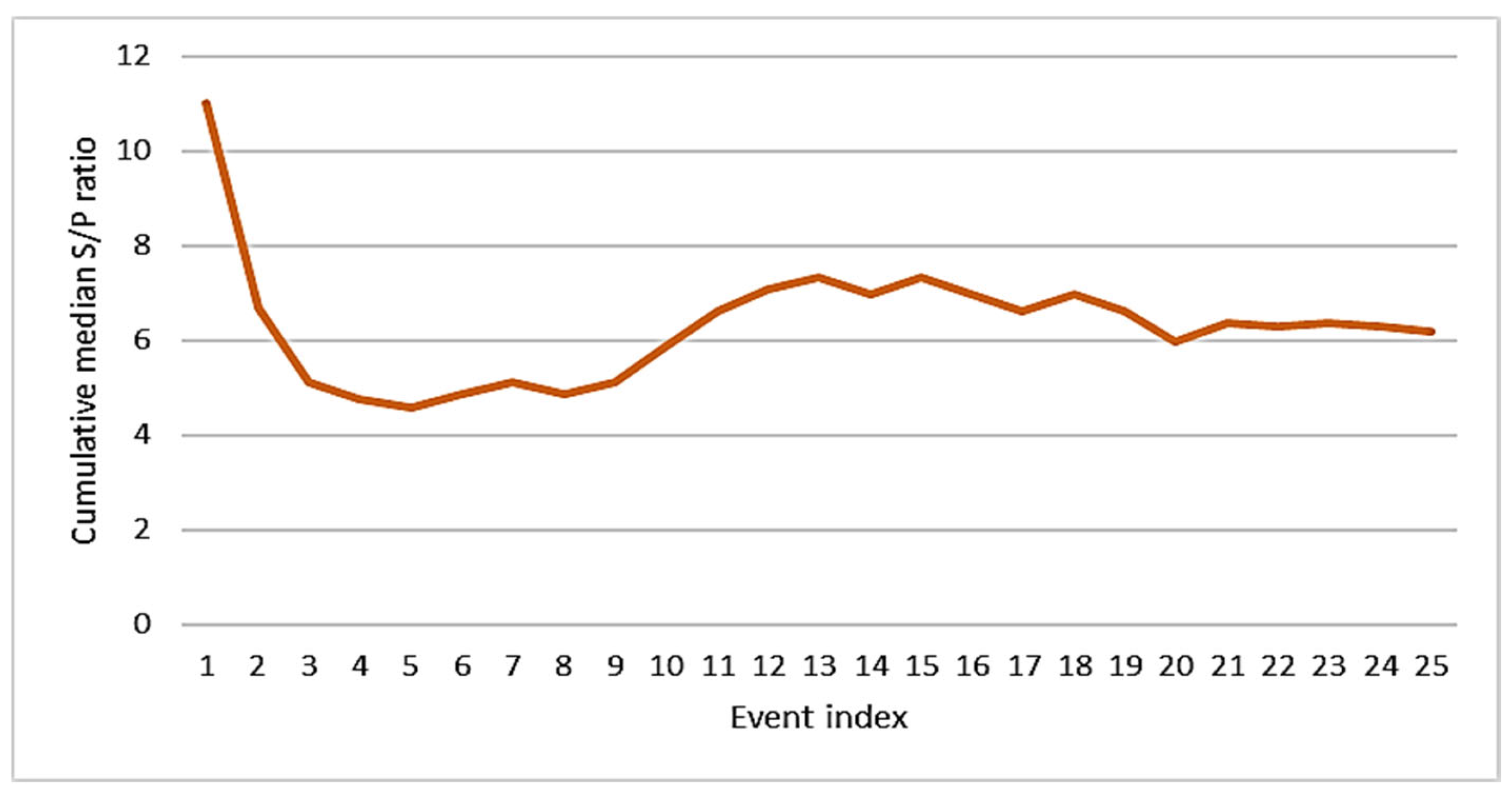
As shown in Figure 1, the cumulative median of the S/P PGA ratio stabilizes as the number of events increases, with only minor fluctuations observed beyond approximately 15–18 records, indicating that the estimated median value is statistically robust for the available dataset.

Statistical Distribution of the S/P Ratio

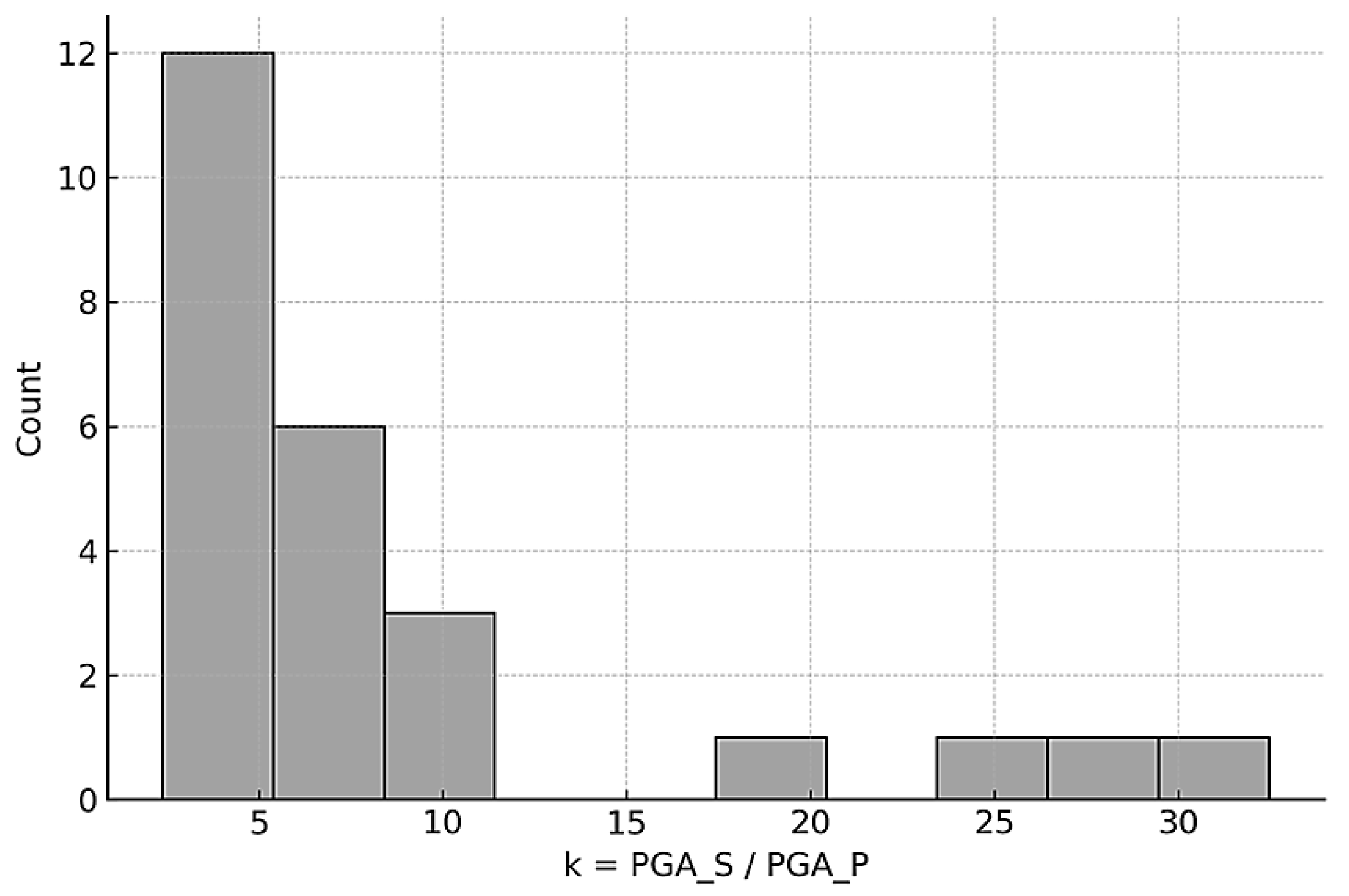
The resulting kS/P values span approximately one order of magnitude (from ~2 to ~33), reflecting variability associated with source characteristics, radiation pattern and local soil response. As seen in Figure 2, the dataset exhibits a right-skewed behavior with a small number of high-k values, while the majority of observations cluster around the median, supporting the robustness of the median-based calibration. When the upper 5% of S/P ratios are excluded, the resulting trimmed median remains very close to the full-sample median of 6.19, indicating that the estimated site-specific coefficient is not controlled by a small number of extreme values. The distribution peaks between kS/P = 4 and kS/P = 10 are consistent with soft-soil amplification.
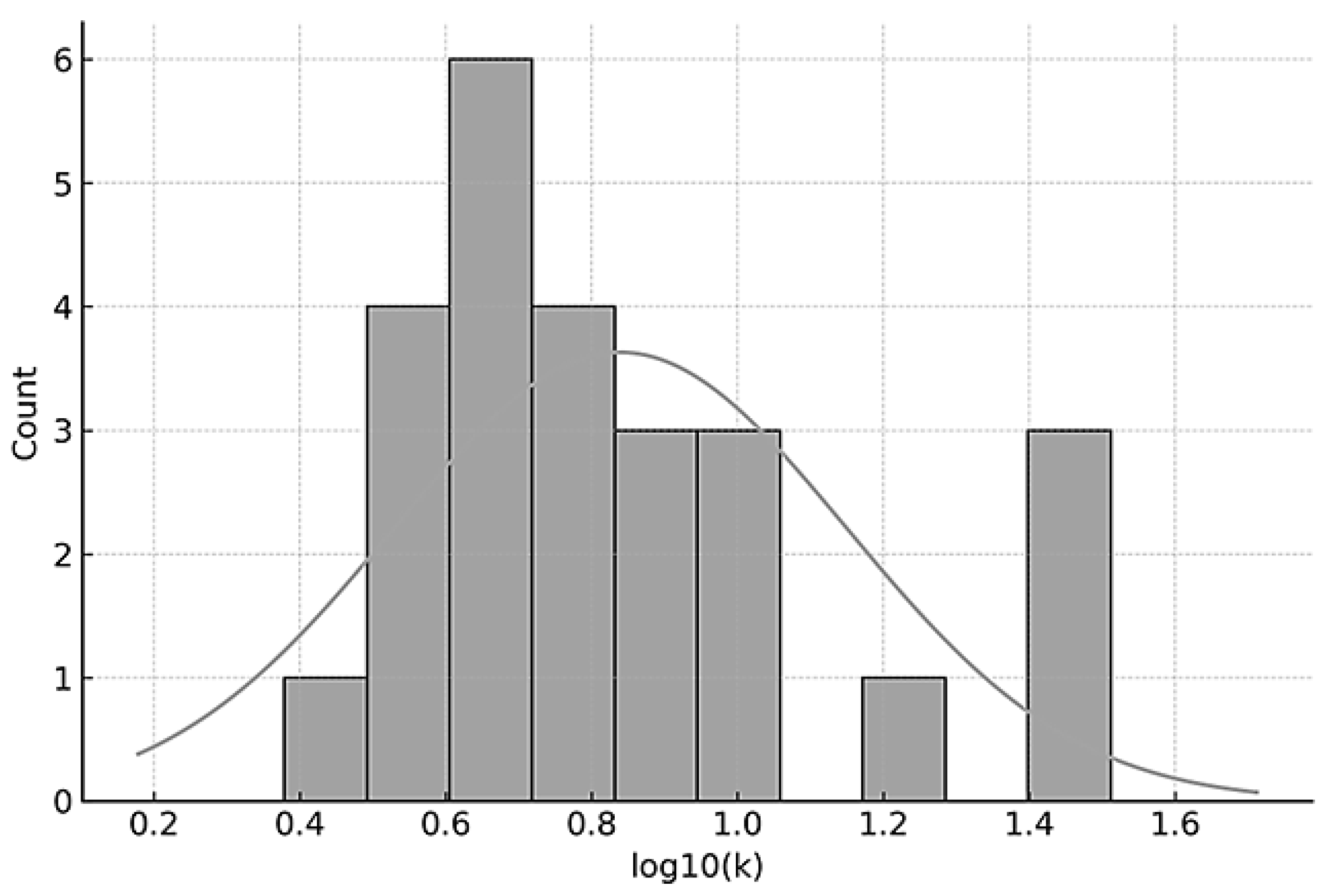
The S/P amplitude ratio obtained for the 25 earthquakes spans one order of magnitude. The distribution is right-skewed, with quartiles Q1 = 4.37, median = 6.19 and Q3 = 10.52. Transforming kS/P into logarithmic space shows that log10(k) is approximately normal, with mean 0.839 and standard deviation 0.311. This confirms that kS/P follows a lognormal distribution (Figure 3), consistent with previous studies on site-specific EEW calibration.
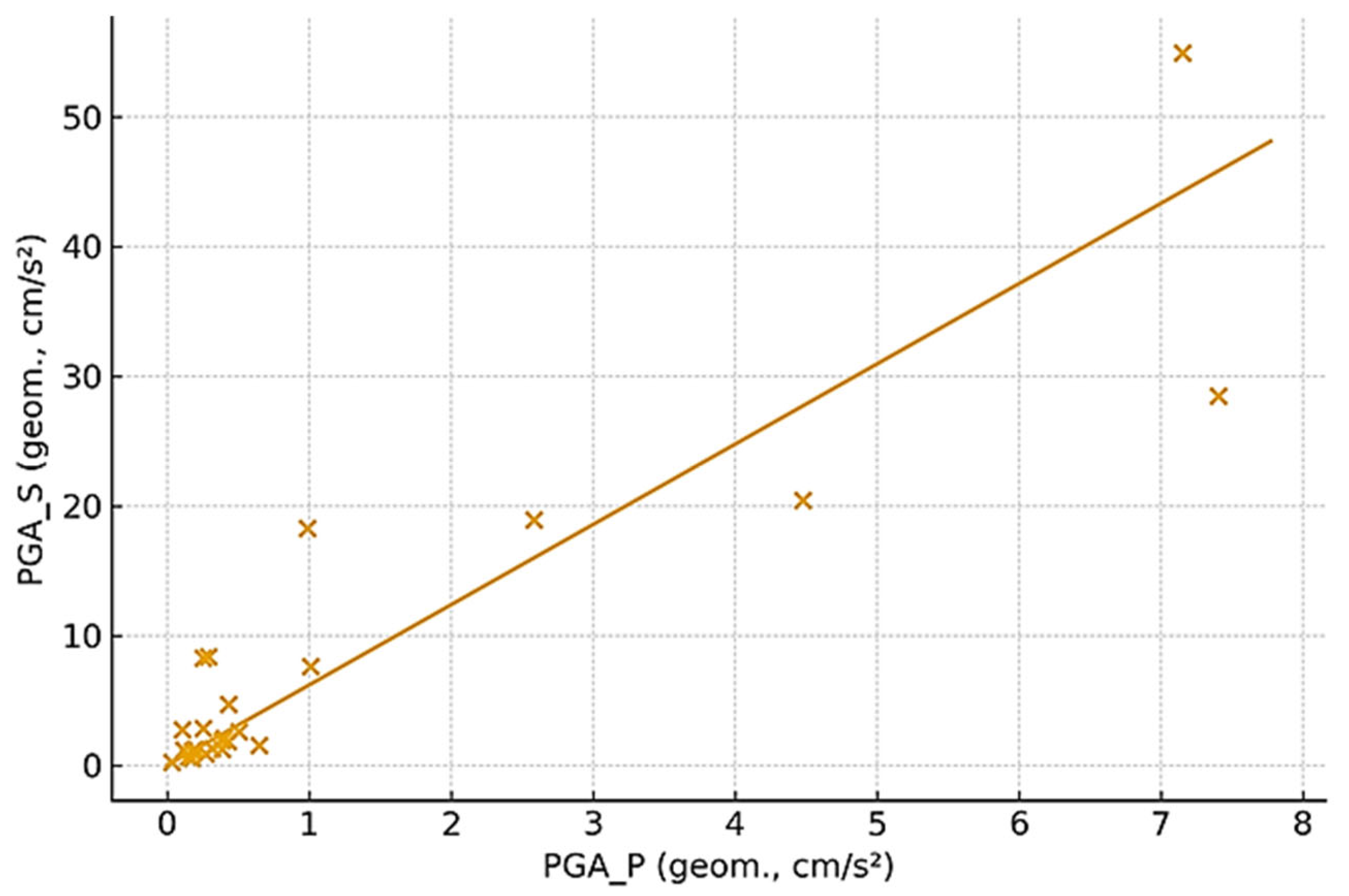
The standard deviation measures the spread of kS/P values in logarithmic space, making it directly interpretable as a multiplicative uncertainty factor in linear space. For example, a σlog10 of 0.31 corresponds to a variability of approximately ×2.0 (since 100.31 ≈ 2), meaning that most observed kS/P values lie within a factor of two of the median value (Figure 4).
These findings confirm that the locally calibrated coefficient can be adopted in on-site EEWS algorithms to predict the expected S-wave PGA immediately after P-wave detection. The relatively low dispersion of kS/P values (factor ≈ 2) supports the robustness of the amplitude-ratio approach for rapid, site-specific shaking estimation using MEMS-based sensors. Table 3 provides a consolidated summary of the calibrated kS/P statistics for the Iași station, with the associated prediction-error indicators and S–P delay (warning-time) metrics.

4. Discussion

Recent studies have reaffirmed the effectiveness of site-specific S/P amplitude ratios as predictors of local ground motion for on-site earthquake early warning applications. Using dense Japanese strong-motion datasets, ref. [16] reported median S/P PGA ratios between approximately 4 and 8 for sedimentary sites, with logarithmic dispersions typically below 0.3, highlighting the statistical stability of this parameter once sufficient local data are available. Comparable dispersion levels have been observed in recent European studies, including combined Italian and Japanese analyses in [27], which further emphasize the dominant influence of near-surface geological conditions on S/P scaling.
The results obtained for the Iași station confirm that the S/P amplitude ratio can serve as a stable and site-specific predictor of local ground shaking for on-site EEW applications. The median value of kS/P ≈ 6.2 is consistent with observations from similar soft-soil environments in Japan and Italy, where typical ratios range between 4 and 9. The alignment with these international datasets indicates that the sedimentary structure beneath Iași behaves similarly in terms of frequency-dependent amplification and S-wave resonance effects. This agreement reinforces the robustness of the S/P-based approach, even when applied to a relatively small dataset of 25 regional events. Unlike studies conducted in regions with dense station coverage and frequent moderate seismicity, the present work focuses on a single urban site affected by intermediate-depth events. In this context, the derived S/P ratio should be interpreted as a local amplification parameter rather than a universal predictor (while the underlying S/P concept is globally applicable, its quantitative implementation must remain site-specific), reinforcing the need for local calibration prior to on-site EEW deployment. In this respect, the present strategy is complementary to Korean operational and experimental EEW studies, which primarily address network performance, real-time triggering reliability, MEMS noise behavior, and warning-system implementation rather than site-specific S/P coefficient derivation.
Unlike studies conducted in regions with dense station coverage and frequent moderate seismicity, the present work focuses on a single urban site affected by intermediate-depth events. In this context, the derived S/P ratio should be interpreted as a site-specific calibration parameter rather than a universal predictor, reinforcing the need for local calibration prior to on-site EEW deployment. In this respect, the present strategy is complementary to Korean operational and experimental EEW studies, which primarily address network performance, real-time triggering reliability, MEMS noise behavior, and warning-system implementation rather than site-specific S/P coefficient derivation.
An important result is the low logarithmic dispersion of σlog10 ≈ 0.31, which corresponds to an uncertainty factor of approximately two in linear space. This level of variability is comparable to, or slightly lower than, dispersions reported in dense Japanese networks (0.25–0.30) and Italian strong-motion stations (0.30–0.35), suggesting that the amplitude-ratio method retains reliable predictive capability even with moderate catalog size and regional path effects. In practical terms, this means that the predicted S-wave PGA, derived immediately after the P-wave detection, lies within roughly a factor of two of the actual PGA for most events—a precision that is sufficient for on-site warning thresholds.
While the median S/P ratio appears stable, some events exhibit markedly higher values (kS/P > 20), which may be attributed to source radiation pattern, depth phases, or local constructive interference within the soft-sediment layers. These high-ratio events demonstrate that although kmedian is stable, individual events can still produce amplification significantly above the median. Therefore, using probabilistic thresholds or adopting upper-percentile values (e.g., 84th percentile) may improve warning reliability for critical infrastructure.
A limited number of events exhibit comparatively high S/P ratios, which appear as outliers in the distribution. Such values may arise from partial overlap between the tail of the P-wave signal and the onset of the S-wave, particularly for events with emergent phase arrivals, as well as from strong local amplification effects acting preferentially on S-wave motion. Similar behavior has been reported in previous single-station S/P-based studies and is not unexpected in complex geological settings.
From an engineering perspective, the S/P amplitude ratio represents a conceptually attractive approach for on-site EEWS, as it relies on short time-window amplitude measurements and simple scaling relationships rather than on magnitude estimation or complex feature extraction. Such characteristics are desirable for compact sensing platforms, including MEMS-based systems, which often face constraints related to computational resources and signal stability.
In the present study, the S/P ratio is derived exclusively from reference-grade strong-motion recordings in order to establish a robust site-specific calibration under controlled conditions. Its application to MEMS-based on-site EEW platforms requires additional sensor-specific detection logic, noise-mitigation strategies and real-time trigger evaluation. Operational aspects such as P-wave trigger reliability, false-alarm and missed-alarm rates, threshold-dependent decision logic and false-pick filtering therefore remain outside the scope of this work. In this context, the calibrated coefficient should be interpreted as a foundational input for future on-site EEW implementations rather than as a complete operational warning model.
Nevertheless, some limitations must be acknowledged. The dataset includes only intermediate-depth Vrancea earthquakes, which exhibit relatively stable waveforms but may differ from shallow crustal events in radiation and frequency content. Additionally, all data were recorded at a single station; a multi-station comparison across Iași would strengthen the generality of the proposed coefficient. Future work should therefore expand the dataset to include multiple stations, compute frequency-dependent S/P ratios, and incorporate real-time filter optimization for embedded EEW devices.

5. Conclusions

This study provides a calibrated S/P amplitude ratio for the Iași region, derived from 25 well-recorded intermediate-depth Vrancea earthquakes. The median value of kS/P = 6.2 and the logarithmic dispersion of σlog10 = 0.31 indicate that S-wave amplitudes are typically about six times larger than P-wave amplitudes, with a multiplicative uncertainty of approximately ×2. These findings are consistent with international observations for soft-sediment sites and reflect the expected amplification characteristics of the local geology.
The results confirm that the S/P ratio can serve as a reliable predictor of local S-wave PGA immediately after P-wave detection, enabling rapid on-site estimation without requiring magnitude or distance determination. This approach is particularly suitable for low-cost MEMS-based EEW devices, where simplicity, robustness and minimal latency are essential. The calibrated coefficient kmedian can therefore be directly incorporated into embedded EEW algorithms deployed in Iași.
The principal contribution of this study is the derivation and statistical characterization of the first site-specific S/P peak ground acceleration ratio for the Iași area, tailored to the seismic and geological conditions associated with intermediate-depth Vrancea earthquakes. By providing a locally calibrated median coefficient together with its associated uncertainty, this work establishes a foundational calibration parameter and represents a necessary preparatory step for future on-site EEW applications in the region.
Future research should focus on increasing the number of analyzed events, extending the method to additional stations in the region and integrating frequency-dependent or machine-learning-based enhancements. These developments will support the implementation of a city-wide MEMS EEW network capable of delivering fast, autonomous and locally optimized earthquake warnings.

Author Contributions

Conceptualization, C.D. and M.C.B.; methodology, M.C.T.; software, C.D. and E.S.; validation, C.D., M.C.T. and E.S.; formal analysis, M.C.B.; investigation, C.D.; resources, M.C.T.; data curation, C.D., M.C.T., M.C.B. and E.S.; writing—original draft preparation, C.D.; writing—review and editing, E.S.; visualization, M.C.T.; project administration, M.C.T.; funding acquisition, M.C.T. All authors have read and agreed to the published version of the manuscript.

Funding

This research was funded by European Regional Development Fund, grant number 7227/19.11.2021 (SMIS code 137414)—“Seismic warning system with automatic unlocking of entrance doors with interphone”.

Institutional Review Board Statement

Not applicable.

Informed Consent Statement

Not applicable.

Data Availability Statement

No new data were created or analyzed in this study. All seismic records used are publicly available through the seismic networks cited in the manuscript.

Conflicts of Interest

The authors declare no conflicts of interest.

References

  1. Allen, R.M.; Kanamori, H. The Potential for Earthquake Early Warning in Southern California. Science 2003, 300, 786–789. [Google Scholar] [CrossRef]
  2. Böse, M.; Hauksson, E.; Solanki, K.; Kanamori, H.; Heaton, T. Real-Time Testing of the Onsite Warning Algorithm in Southern California and Its Performance During the 29 July 2008 Mw 5.4 Chino Hills Earthquake. Geophys. Res. Lett. 2009, 36, L00B03. [Google Scholar] [CrossRef]
  3. Kuyuk, H.S.; Allen, R.M. Optimal Seismic Network Densification for Earthquake Early Warning: Balancing Efficacy and Cost. Seismol. Res. Lett. 2013, 84, 945–951. [Google Scholar] [CrossRef]
  4. Kanamori, H. Real-Time Seismology and Earthquake Damage Mitigation. Annu. Rev. Earth Planet. Sci. 2005, 33, 195–214. [Google Scholar] [CrossRef]
  5. Wu, Y.-M.; Kanamori, H. Rapid Assessment of Damaging Potential of Earthquakes in Taiwan from the Beginning of P Waves. Bull. Seismol. Soc. Am. 2005, 95, 1181–1185. [Google Scholar] [CrossRef]
  6. Mittal, H.; Lin, Y.-H.; Wu, Y.-M. Enhancing earthquake magnitude determination: Leveraging cumulative absolute absement for early warning systems using low-cost sensors. Geoenviron. Disasters 2026, 13, 8. [Google Scholar] [CrossRef]
  7. Satriano, C.; Wu, Y.-M.; Zollo, A.; Kanamori, H. Earthquake Early Warning: Concepts, Methods and Physical Grounds. Soil Dyn. Earthq. Eng. 2011, 31, 106–118. [Google Scholar] [CrossRef]
  8. Kuyuk, H.S.; Allen, R.M. A Global Approach to Provide Magnitude Estimates for Earthquake Early Warning. Geophys. Res. Lett. 2013, 40, 6329–6333. [Google Scholar] [CrossRef]
  9. Allen, R.M.; Melgar, D. Earthquake Early Warning: Advances, Scientific Challenges, and Societal Needs. Annu. Rev. Earth Planet. Sci. 2019, 47, 361–388. [Google Scholar] [CrossRef]
  10. Bu, K.; Li, C.; Xue, H.; Li, B.; Zhao, Y. A 14 μHz/√Hz resolution and 32 μHz bias instability MEMS quartz resonant accelerometer with a low-noise oscillating readout circuit. Microsyst. Nanoeng. 2024, 10, 200. [Google Scholar] [CrossRef]
  11. Fiaschi, A.; Spallarossa, D.; Bernardi, F.; Zollo, A. An Evaluation of MEMS-Based Seismic Stations for Earthquake Early Warning Applications. Sensors 2019, 19, 4909. [Google Scholar]
  12. Horiuchi, S.; Negishi, H.; Abe, K.; Kamimura, A.; Fujinawa, Y. An Automatic Processing System for Broadcasting Earthquake Alarms. Bull. Seismol. Soc. Am. 2005, 95, 708–718. [Google Scholar] [CrossRef]
  13. Picozzi, M.; Bindi, D.; Spallarossa, D.; Di Giacomo, D.; Zollo, A. A rapid response magnitude scale for timely assessment of the high-frequency seismic radiation. Sci. Rep. 2018, 8, 8562. [Google Scholar] [CrossRef] [PubMed]
  14. Böse, M.; Hauksson, E.; Solanki, K. Onsite Early Warning Using P-Wave Energy. Geophys. Res. Lett. 2012, 39, L09309. [Google Scholar]
  15. Zollo, A.; Amoroso, O.; Lancieri, M.; Wu, Y.-M.; Kanamori, H. A Threshold-Based Earthquake Early Warning Using Dense Accelerometer Networks. Geophys. Res. Lett. 2010, 37, L09306. [Google Scholar] [CrossRef]
  16. Tsuno, S.; Niwa, K.; Korenaga, M.; Yamanaka, H.; Chimoto, K.; Miyake, H.; Yamada, N. Application of the on-site P-wave earthquake early warning method based on site-specific ratios of S-waves to P-waves to the 2016 Kumamoto earthquake sequence, Japan. Earth Planets Space 2024, 76, 32. [Google Scholar] [CrossRef]
  17. Festa, G.; Picozzi, M.; Caruso, A.; Colombelli, S.; Cattaneo, M.; Chiaraluce, L.; Zollo, A. Performance of earthquake early warning systems during the 2016–2017 Mw 5–6.5 central Italy sequence. Seismol. Res. Lett. 2018, 89, 1–12. [Google Scholar] [CrossRef]
  18. Wu, Y.-M.; Chen, D.-Y.; Lin, T.-L.; Hsieh, C.-Y.; Chin, T.-L.; Chang, W.-Y.; Li, W.-S.; Ker, S.-H. A high-density seismic network for earthquake early warning in Taiwan based on low-cost sensors. Seismol. Res. Lett. 2013, 84, 1048–1054. [Google Scholar] [CrossRef]
  19. Kim, S.; Lim, K.; Kim, J.; Kwon, Y.-W. Onsite earthquake alert and safety services using low-cost MEMS sensors. In Proceedings of the 2022 IEEE International Geoscience and Remote Sensing Symposium (IGARSS), Kuala Lumpur, Malaysia, 17–22 July 2022; IEEE: New York, NY, USA, 2022; pp. 4007–4010. [Google Scholar]
  20. Ahn, J.-K.; Lee, J.; Kwon, Y.-W.; Kim, J.-K.; Kwak, D.Y. Development of seismic intensity maps using low-cost micro-electro-mechanical systems seismic network. IEEE Access 2023, 11, 39926–39933. [Google Scholar] [CrossRef]
  21. Banica, A.; Rosu, L.; Muntele, I.; Grozavu, A. Towards Urban Resilience: A Multi-Criteria Analysis of Seismic Vulnerability in Iasi City (Romania). Sustainability 2017, 9, 270. [Google Scholar] [CrossRef]
  22. Bănică, A.; Grozavu, A.; Roșu, L.; Muntele, I. Aspects Concerning Seismic Vulnerability of Buildings in Iași City, Romania. Int. Multidiscip. Sci. GeoConf. SGEM 2016, 3, 87–94. [Google Scholar]
  23. Aki, K.; Richards, P.G. Quantitative Seismology; University Science Books: Sausalito, CA, USA, 2002. [Google Scholar]
  24. Zollo, A.; Lancieri, M.; Nielsen, S. Earthquake Magnitude Estimation from Peak Amplitudes of Very Early Seismic Signals on Strong-Motion Records. Geophys. Res. Lett. 2006, 33, L23312. [Google Scholar] [CrossRef]
  25. Fäh, D.; Kind, F.; Giardini, D. A Theoretical Investigation of Average H/V Ratios. Geophys. J. Int. 2001, 145, 535–549. [Google Scholar] [CrossRef]
  26. Wu, Y.-M.; Kanamori, H.; Allen, R.M.; Hauksson, E. Determination of Earthquake Early Warning Parameters τc and Pd for Southern California. Geophys. J. Int. 2007, 170, 711–717. [Google Scholar] [CrossRef]
  27. Adinolfi, G.M.; De Landro, G.; Picozzi, M.; Carotenuto, F.; Caruso, A.; Nazeri, S.; Piantanida, M. Comprehensive Study of Micro-Seismicity by Using an Automatic Monitoring Platform. Front. Earth Sci. 2023, 11, 1073684. [Google Scholar] [CrossRef]
  28. Nakamura, Y. On the Urgent Earthquake Detection and Alarm System (UrEDAS). In Proceedings of the 9th World Conference on Earthquake Engineering, Tokyo-Kyoto, Japan, 2–9 August 1988. [Google Scholar]
  29. Luzi, L.; Lanzano, G.; Felicetta, C.; D’Amico, M.C.; Russo, E.; Sgobba, S.; Pacor, F.; ORFEUS Working Group 5. Engineering Strong Motion Database (ESM), Version 2.0; Istituto Nazionale di Geofisica e Vulcanologia (INGV): Rome, Italy, 2020. [Google Scholar] [CrossRef]
Figure 1. Cumulative median of the S/P peak ground acceleration ratio as a function of the number of events.
Safety 12 00041 g001
Figure 2. Histogram of the S/P amplitude ratio.
Safety 12 00041 g002
Figure 3. Distribution of log10(k) (bars) with fitted normal curve (line).
Safety 12 00041 g003
Figure 4. Observed PGA_S vs. PGA_P (geometric means across horizontals). The solid line shows PGA_S = kmedian·PGA_P with kmedian = 6.19.
Safety 12 00041 g004
Table 1. Overview of S/P amplitude ratios and associated uncertainties from major strong-motion networks worldwide.
ReferenceRegion/NetworkParameterTypical S/P RatioNo. of Earthquakes UsedReported Precision
Picozzi et al. (2018) [13]Italy (RAN)PGA4–940 events (10–20/site)σ(log10) ≈ 0.30
Zollo et al. (2010) [15]Southern ItalySpectral amplitude (1–5 Hz)4–1064 events (10–30/site)σ(log10) ≈ 0.30
Tsuno et al. (2024) [16]Japan (KiK-net)PGA (0.5–10 Hz)4–8 (median ≈ 5.3)~240 events (50–200/site)σ(log10) ≈ 0.25
Festa et al. (2018) [17]Italy (INGV/RAN)PGA3–789 events (10–40/site)σ(log10) ≈ 0.30
Wu (2013) [18]Taiwan (Palert)PGA, PGV5–9~250 events (30–100/site)σ(log10) ≈ 0.25–0.30
Adinolfi et al. (2023) [27]Italy + JapanPGV6–12~300 events (20–150/site)σ(log10) ≈ 0.25
Nakamura (1988) [28]Japan (UrEDAS)RMS energy3–8Hundreds (50–200/site)σ(log10) ≈ 0.30–0.35
Table 2. Event-by-event peak ground acceleration (PGA) values for the P- and S-wave windows, computed on the horizontal E–W and N–S components for 25 Vrancea intermediate-depth earthquakes recorded at the Iași station.
NoStation CodeESM IDSMoment Magnitude
Mw
Epicentral Distance
[km]
PGA
E–W
[cm/s2]
P-Wave
PGA
N–S
[cm/s2]
P-Wave
PGA
E–W
[cm/s2]
S-Wave
PGA
N–S
[cm/s2]
S-Wave
PGA_P (Geom.)PGA_S (Geom.)k = S/P
1IASREMSC-20200131_00000094.7171.80.3450.5364.1025.4590.4304.72911.0
2IASRINT-20221103_00000315.1204.40.5350.7851.2651.8990.6481.5522.39
3IASRINT-20240916_00001725.2205.30.4030.6302.7742.3980.5042.5795.12
4IASEMSC-20051213_00000384.8174.60.4660.3872.1611.5930.4251.8554.37
5IASEMSC-20090425_00000805.2182.24.5844.36825.36116.4734.47620.4504.57
6IASEMSC-20120706_00000804.11750.861.1905.9239.8721.0117.6397.55
7IASEMSC-20131006_00000025.3183.50.901.07713.7424.3570.98518.28618.6
8IASEMSC-20131015_00000914.7190.60.3070.2410.6671.1230.2720.8663.19
9IASEMSC-20140224_00000024.5172.60.1200.1081.2301.1690.1141.19910.52
10IASEMSC-20140326_00000894.1186.30.0390.0290.2550.1960.0340.2246.62
11IASEMSC-20140329_00001264.7193.30.2390.2673.0672.6550.2532.85711.30
12IASEMSC-20140910_00000674.4191.90.3480.2407.818.9420.2898.36628.98
13IASEMSC-20141122_00000665.6151.82.0693.22822.6615.9052.58318.9577.34
14IASEMSC-20141207_00000714.4146.80.2860.3491.3301.2910.3161.3104.15
15IASEMSC-20150124_00000254.31790.1620.40010.0146.8200.2558.27432.47
16IASEMSC-20150316_00000474.3194.20.4100.3591.2221.2140.3841.2183.17
17IASEMSC-20150329_00000044.5188.90.1760.1200.5770.7050.1450.6384.40
18IASEMSC-20160923_00001355.7175.77.0537.25570.56342.7777.15354.9487.68
19IASEMSC-20161227_00001045.6179.37.2737.53530.96126.1137.40228.4833.85
20IASEMSC-20170208_00001374.6212.20.4550.3512.0042.2170.3992.1085.29
21IASEMSC-20170519_00000764.3171.40.2130.1760.8761.7380.1941.2366.37
22IASEMSC-20170801_00000424.3201.90.1730.1731.1700.9820.1731.0716.19
23IASEMSC-20170802_00000074.7197.90.1270.0852.4623.0520.1042.74226.43
24IASEMSC-20180425_00001004.7198.80.1610.1920.5050.6040.1760.5533.14
25IASEMSC-20181028_00000035.6197.10.2970.5001.9551.8170.3851.8854.89
Table 3. Summary statistics of the S/P amplitude ratio and associated prediction and warning-time metrics for the Iași station.
MetricValueDescription
Number of events (N)25Iasi earthquakes
k minimum2.39Minimum S/P ratio
k (Q1)4.3725th percentile
k (median)6.19Site-specific coefficient
k (mean)9.18Mean S/P ratio
k (Q3)10.5275th percentile
k maximum32.47Maximum S/P ratio
log10(k) mean0.839Mean logarithmic ratio
log10(k) standard deviation0.311Variability (σlog10)
RMSE in log10 space0.308Prediction error (log-scale)
Multiplicative RMSE factor×2.03Mean multiplicative error
Events within factor 280%PGA_pred vs. PGA_obs
Events within factor 388%PGA_pred vs. PGA_obs
S–P delay (minimum)17.48 sEarliest possible warning
S–P delay (median)22.18 sTypical warning time
S–P delay (maximum)25.26 sMaximum warning time
Disclaimer/Publisher’s Note: The statements, opinions and data contained in all publications are solely those of the individual author(s) and contributor(s) and not of MDPI and/or the editor(s). MDPI and/or the editor(s) disclaim responsibility for any injury to people or property resulting from any ideas, methods, instructions or products referred to in the content.