1. Introduction
Basil (
Ocimum basilicum L.), belonging to the Lamiaceae family, comprises a wide diversity of varieties, including sweet basil, cinnamon basil, broad-leaf basil, and purple basil [
1]. Among these, purple basil (
O. basilicum var. Vermelho Rubi) stands out for its socioeconomic and nutritional relevance, associated with the presence of omega-3, vitamins A, K
+, and Ca
2+, and minerals such as manganese, calcium, iron, and magnesium. In addition, its intense aroma and pleasant fragrance favor its widespread culinary use in the preparation of teas, soups, ice creams, salads, pizzas, and sauces, contributing to its economic importance [
2].
Purple basil is cultivated throughout Brazil, with notable integration into family farming systems [
3]. In addition to its traditional use as a medicinal plant, purple basil has attributes that expand its potential for ornamental exploitation, such as ease of propagation, showy inflorescences, and a short production cycle [
4]. From a botanical perspective, its purplish leaves and inflorescences, ranging from pink to lilac, stand out, reinforcing its aesthetic appeal [
5].
Basil is commonly cultivated in Northeast Brazil because of its good adaptation to local climatic conditions. However, this region is characterized by high temperatures, low relative humidity, irregular rainfall, and high evapotranspiration. When associated with inadequate irrigation and fertilization management, these conditions may favor the accumulation of soluble salts in soils and water bodies, thereby intensifying the risk of salinization and limiting crop performance [
6].
In this context, salinity stands out as one of the main environmental factors limiting plant productivity, particularly in arid and semi-arid regions, with direct impacts on plant establishment and growth [
7,
8]. In more sensitive species, such as basil, the deleterious effects may be especially pronounced during the early stages [
9]. High salt levels in the soil trigger physiological and biochemical disturbances associated with reduced water uptake capacity, decreased photosynthesis, and changes in nutrient absorption, ultimately leading, in general, to reduced growth [
10]. In Northeastern Brazil, irrigation water salinity is commonly reported as electrical conductivity (EC) rather than NaCl concentration, because the ionic composition of water varies among sources. Brackish waters in the Brazilian semi-arid region commonly show EC values within the range of approximately 1.0 to 6.0 dS m
−1, while 100 mM NaCl corresponds roughly to 10 dS m
−1. Therefore, the NaCl concentration used in this study represents a severe experimental stress condition rather than the average salinity of irrigation water used in basil production.
The accumulation of ions in plant tissues, especially Na
+ and Cl
−, interferes with the uptake and transport of nutrients such as K
+, Ca
2+, and Mg
2+, promoting ionic imbalances that compromise metabolic functions, including protein synthesis, enzymatic activity, and cell membrane integrity [
11,
12]. In addition, high salt concentrations in the external solution surrounding plant cells may intensify water deficit, sodium and chloride toxicity, and nutritional imbalance [
13]. When combined, these processes trigger morphophysiological and biochemical responses that directly affect the maintenance of the photosynthetic apparatus and cellular integrity. In this sense, plant responses to salt stress may be expressed as leaf necrosis, a condition associated with inhibition of chlorophyll synthesis, damage to cellular components, and increased membrane lipid peroxidation.
In the short term, the osmotic component of stress predominates, tending to reduce growth due to lower cell expansion [
14]. In the long term, salt uptake and accumulation intensify ionic stress, contributing to leaf senescence [
15,
16]. Given this context, further studies are needed to identify alternatives capable of attenuating the effects of salt stress on purple basil growth, particularly through management strategies that favor acclimation and the maintenance of physiological performance.
Thus, one alternative to mitigate the effects of salt stress is the use of nutrients essential for plant development, since these elements can sustain metabolic functioning under adverse conditions [
17]. Several nutrients participate in the structure and/or activation of enzymes involved in carbohydrate, protein, and lipid metabolism, in addition to contributing to chlorophyll synthesis and the functionality of different proteins [
18].
In this context, micronutrients such as zinc (Zn) stand out. Zn has been described as an element associated with plant protection through enhanced antioxidant defense, ionic regulation, maintenance of photosynthesis, osmolyte synthesis, and modulation of genes related to stress responses [
19,
20]. In addition, Zn plays relevant roles in phytohormone production, cytochrome metabolism, chlorophyll formation, and nucleotide biosynthesis, acting as a structural component of enzymes. Thus, several physiological and metabolic processes, such as indole-3-acetic acid (IAA) biosynthesis, require adequate availability of this micronutrient [
21].
Manganese (Mn), in turn, is an essential micronutrient associated with photosystem II, regulating processes related to O
2 evolution and forming part of the structure of photosynthetic proteins and enzymes. Consequently, Mn deficiency may impair chloroplast function by affecting photosystem II and limiting photosynthesis [
22]. Under salinity conditions, Mn has been linked to stress attenuation by favoring K
+ accumulation, improving the K
+/Na
+ ratio, and reducing ionic toxicity [
23]. In addition, this micronutrient has been associated with proline biosynthesis, an osmolyte relevant to osmotic adjustment in saline environments [
24]. Moreover, molybdenum (Mo) participates in processes such as nitrogen fixation, sulfate assimilation, and nitrate reduction, in addition to being associated with abscisic acid biosynthesis and plant resistance to different environmental stresses [
25].
In basil, salt stress commonly reduces leaf expansion, biomass accumulation, stomatal conductance, CO
2 assimilation, and chlorophyll-related indices, thereby compromising both physiological and commercial performance [
9]. Micronutrients may influence the magnitude of these responses through distinct physiological functions. Mn is required for the oxygen-evolving complex of photosystem II and participates in enzyme activation and ionic homeostasis [
22,
23,
24]; Zn contributes to enzyme structure, auxin metabolism, membrane stability, antioxidant defense, and nutrient balance [
18,
19,
20,
21]; and Mo participates in nitrate reduction, nitrogen metabolism, sulfate assimilation, and stress-related physiological adjustment [
17,
25]. These functions provide a physiological basis for evaluating whether Mn, Mo, and Zn supplementation can help maintain growth and gas-exchange traits in purple basil exposed to NaCl stress.
Evidence obtained in horticultural crops indicates that micronutrient supplementation can improve plant performance under salinity. In Chinese cabbage, Mo enhanced antioxidant defense and osmotic adjustment under salt stress [
17], whereas Mn- and Zn-containing treatments improved growth, antioxidant responses, and ionic balance in salt-stressed pea plants [
24]. Collectively, these studies indicate that micronutrients can act through complementary processes involving photosynthetic maintenance, ion homeostasis, antioxidant metabolism, osmotic adjustment, and nutrient acquisition.
In addition to micronutrient management, other strategies have been evaluated for reducing salinity-induced damage in basil. Exogenous signaling compounds, including methyl jasmonate, have been associated with improvements in growth, biomass partitioning, and physiological performance under saline conditions [
5]. Endophytic fungal biostimulants have also modulated basil growth, yield, and secondary metabolism depending on the intensity of salt stress [
26]. These findings demonstrate that salt-stress mitigation in basil can involve multiple physiological routes, including improved nutritional status, stress signaling, root-mediated responses, antioxidant protection, and maintenance of photosynthetic activity.
Despite these advances, previous studies have generally evaluated individual micronutrients, other nutritional combinations, or non-nutritional stress-mitigation strategies [
17,
24,
26]. Comparatively little information is available on the individual and combined application of Mn, Mo, and Zn to purple basil subjected to severe NaCl stress. Therefore, the contribution of this study is to determine whether supplementation with these micronutrients, applied individually or in selected combinations, is associated with improved short-term growth and physiological performance under salinity. This crop-specific information may support the formulation of more targeted hypotheses and experimental designs for future mechanistic and agronomic investigations.
Thus, we hypothesized that substrate supplementation with Mn, Mo, Zn, and selected combinations could partially alleviate short-term reductions in the growth and physiological performance of purple basil under severe NaCl stress. This study aimed to evaluate the short-term effects of Mn, Mo, Zn, and their combinations on growth, gas exchange, and relative chlorophyll indices of purple basil plants subjected to severe NaCl stress under greenhouse conditions.
2. Materials and Methods
The experiment was conducted in a greenhouse. Purple basil plants were grown under protected-environment conditions and subjected to the respective treatments for 30 days.
2.1. Definition of Treatments and Experimental Design
The experiment was arranged in a randomized block design with nine treatments and four replicates. The treatments were as follows: Ct0, control without micronutrients + 0 mM NaCl; Ct100, control without micronutrients + 100 mM NaCl; and 100 mM NaCl with application of Mo, Mn, Zn, MoMn, ZnMo, ZnMn, and ZnMoMn. All micronutrient treatments were grown under 100 mM NaCl. The micronutrients were applied to the substrate at a rate of 3.5 g kg−1, except in the control treatments, Ct0 and Ct100. The sources of Mo, Mn, and Zn were sodium molybdate, manganese sulfate, and zinc sulfate, respectively. The dose of 3.5 mg kg−1 was based on preliminary tests with basil plants. Sodium molybdate also introduced Na+, whereas manganese sulfate and zinc sulfate introduced SO42− together with the target micronutrients. Counterion-equivalent blank treatments were not included; therefore, the potential effects of Na+ and SO42− supplied by the fertilizer sources were not independently controlled.
The 100 mM NaCl concentration was used as a severe experimental salinity condition to induce measurable stress responses during the evaluation period. Therefore, the results should not be interpreted as representing the average salinity condition of irrigation waters used for basil cultivation, but rather as the response of purple basil to micronutrient supplementation under severe NaCl stress.
Each micronutrient source was applied at 3.5 g kg−1 of substrate. Therefore, individual treatments received 3.5 g kg−1 of the respective source, double combinations received a total of 7.0 g kg−1 of micronutrient sources, and the triple combination received a total of 10.5 g kg−1 of micronutrient sources.
The experimental design was intended to compare purple basil plants exposed to severe NaCl stress with or without additional Mn, Mo, and Zn supplementation. Matching non-saline treatments receiving Mn, Mo, Zn, or their combinations were not included. Therefore, the treatment comparisons indicate whether micronutrient supplementation improved plant performance relative to the saline control, but they do not completely distinguish salt-specific alleviation from a general growth-promoting effect of micronutrient application.
The use of NaCl was adopted as a controlled experimental approach to induce salt stress and allow comparison among micronutrient treatments under standardized conditions. However, field salinity in semi-arid regions generally results from mixtures of salts containing different cations and anions, such as Na+, Ca2+, Mg2+, Cl−, SO42−, HCO3−, and CO32−, depending on soil and irrigation water composition. Therefore, the 100 mM NaCl treatment used in this study should be interpreted as a single-salt severe stress model and not as a direct simulation of all field salinity conditions.
The concentration of 100 mM NaCl was selected to impose a severe stress condition capable of producing measurable reductions in growth and physiological performance during the 30-day evaluation period. This level was used as a controlled single-salt stress model to evaluate whether Mn, Mo, and Zn supplementation could partially alleviate NaCl-induced reductions in growth and physiological performance. However, this concentration should not be interpreted as representative of the average salinity of irrigation waters used in basil production systems, which may vary widely in electrical conductivity and ionic composition.
2.2. Crop Management and Salt Stress Application
Seeds were sown in 128-cell polystyrene trays filled with the commercial substrate Tropstrato, with an electrical conductivity of 0.5 ± 0.3 dS m−1 and pH of 5.8 ± 0.3. At 25 days after sowing (DAS), the seedlings were transplanted into 2.0 dm3 containers filled with the same substrate, maintaining one plant per pot. A complete laboratory analysis of available micronutrients in the commercial substrate was not performed. Therefore, the presence of trace amounts of micronutrients in the substrate cannot be ruled out. For this reason, the control treatments are interpreted as treatments without additional Mn, Mo, and Zn supplementation, rather than as micronutrient-free controls.
For plants assigned to salt stress, an initial acclimation stage was adopted, with irrigation containing 4 mM NaCl from 20 to 25 DAS, aiming to reduce osmotic shock. Micronutrients were applied before transplanting the seedlings into the pots. Subsequently, the plants were irrigated daily with solutions containing either 0 mM NaCl, for the control, or 100 mM NaCl, from 25 to 55 DAS, totaling 30 days of treatment application.
Irrigation volumes were adjusted according to crop evapotranspiration, estimated based on the pot water-holding capacity, as described by [
26]. In addition, all plants received weekly fertigation with a solution containing 4 g L
−1 NPK 20-20-20 fertilizer (Peters).
2.3. Variables Evaluated
At 30 days after transplanting (DAT), growth variables were evaluated, including plant height, number of leaves, stem diameter, leaf area, leaf dry mass, stem dry mass, total dry mass, and specific leaf area. Gas exchange variables were also assessed, including stomatal conductance, net photosynthesis, transpiration, intercellular CO2 concentration, instantaneous water-use efficiency, and intrinsic water-use efficiency. Relative chlorophyll indices were measured, including the chlorophyll a index, chlorophyll b index, total chlorophyll index, and chlorophyll a/b index ratio.
2.4. Growth Assessments
Growth assessments were performed 30 days after the onset of irrigation with saline water. Growth variables, including plant height, number of leaves, stem diameter, leaf area, leaf dry mass, stem dry mass, total dry mass, and specific leaf area, were determined.
2.5. Gas Exchange Analyses
Gas exchange was measured in the morning using an infrared gas analyzer (IRGA; LI-6400XT, LI-COR®, Lincoln, Nebraska, USA). The variables evaluated were stomatal conductance (gs; mol m−2 s−1), net photosynthesis (A; µmol CO2 m−2 s−1), transpiration (E; mmol H2O m−2 s−1), and intercellular CO2 concentration (Ci; µmol CO2 mol−1 air). Based on A, E, and gs data, instantaneous water-use efficiency—WUE (A/E; µmol CO2 mmol−1 H2O), and intrinsic water-use efficiency—iWUE (A/gs; µmol CO2 mol−1 H2O), were calculated. Measurements were performed between 07:00 and 10:00 under natural air temperature and ambient CO2 concentration, using an artificial radiation source set to 1000 µmol m−2 s−1. This value was defined based on a photosynthetic light-response curve.
2.6. Chlorophyll Index Analyses
Relative chlorophyll indices, including the chlorophyll a index, chlorophyll b index, total chlorophyll index, and chlorophyll a/b index ratio, were measured using a nondestructive portable chlorophyll meter (ClorofiLOG®, model CFL 1030, Porto Alegre, RS, Brazil). The results were expressed as Falker Chlorophyll Index values.
2.7. Statistical Analyses
Data were analyzed according to a randomized block design with nine treatments and four replicates, totaling 36 experimental units. Each experimental unit consisted of one pot containing one purple basil plant. The statistical model included treatment as a fixed effect and block as a random effect. Data normality was assessed using the Shapiro–Wilk test. Analysis of variance was then performed using the F test (
p ≤ 0.05). When significant treatment effects were detected, means were grouped using the Scott-Knott test (
p ≤ 0.05). The Scott-Knott procedure was used to partition treatment means into statistically distinct and internally homogeneous groups. Canonical discriminant analysis was performed using standardized z-score data to remove scale effects among variables. Pearson correlation analysis was performed to evaluate associations among growth, gas exchange, and relative chlorophyll index variables. All statistical analyses were performed using R software (version 4.6.0) [
27]. Generative artificial intelligence (GenAI) has been used in this paper for text editing (grammar, punctuation, and formatting).
3. Results
According to the analysis of variance, the treatments significantly affected all evaluated variables (
p < 0.001). A summary of the ANOVA, including the degrees of freedom, mean squares, F-values,
p-values, and coefficients of variation, is provided in
Table 1.
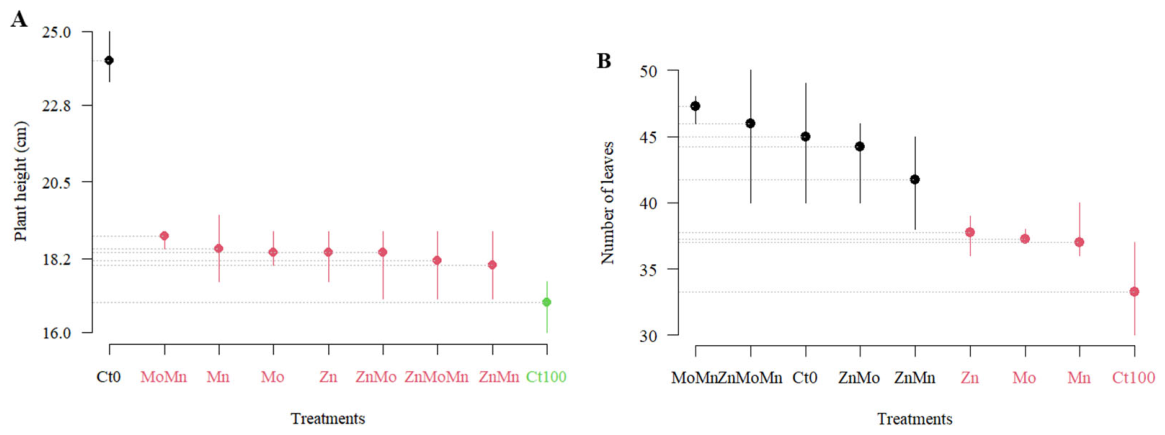
Regarding plant height (
Figure 1A), the non-saline control (Ct0) showed higher mean values than all other treatments. Under salinity, the treatments with micronutrients applied individually (Mn, Mo, and Zn) and in combinations (MoMn, ZnMo, ZnMn, and ZnMoMn) did not differ from one another, but showed higher mean values than the saline control without micronutrients (Ct100), highlighting the positive effect of supplementation under salinity. For the number of leaves (
Figure 1B), the triple combination (ZnMoMn) and the double combinations (MoMn, ZnMo, and ZnMn), together with Ct0, showed superior performance compared with the other treatments. Regarding stem diameter (
Figure 1C), Ct0 showed the highest value, whereas the remaining treatments did not differ significantly from one another. The highest leaf area (
Figure 1D) was observed in Ct0, in contrast to Ct100, which showed the lowest value. The Mo, Zn, and ZnMn treatments did not differ from one another and were superior to Mn, MoMn, ZnMo, and ZnMoMn.
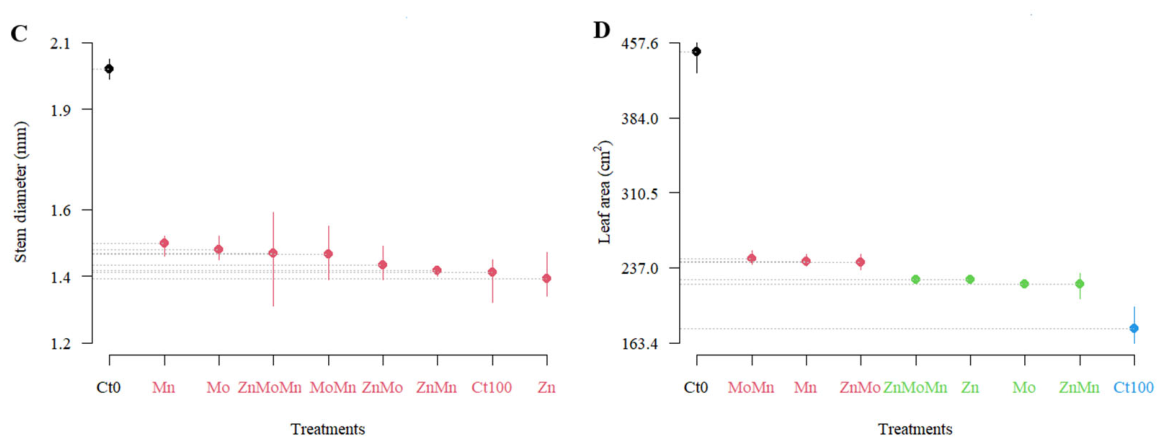
Regarding leaf dry mass (
Figure 2A), the control treatment (Ct0) showed the highest mean value and outperformed all other treatments. The MoMn, ZnMo, ZnMn, and ZnMoMn combinations formed an intermediate group, performing better than the treatments with isolated Zn and Mn application. Finally, the saline treatment without micronutrients (Ct100) showed the lowest value (50.16%) and differed from all other treatments.
Regarding stem dry mass (
Figure 2B), Ct0 maintained the highest value. Among the micronutrient treatments, Mo applied individually stood out compared with the others. In addition, isolated Zn and Mn, the double combinations ZnMo and ZnMn, and the triple combination ZnMoMn showed values higher than Ct100, indicating better performance when compared with the saline treatment without supplementation. For total dry mass (
Figure 2C), following a pattern similar to that observed for stem dry mass, the control treatment Ct0 and the treatment with Mo applied individually showed the highest values, although they differed from each other. Among the remaining treatments, the combinations ZnMn, ZnMo, MoMn, and ZnMoMn outperformed the isolated applications of Zn and Mn. The saline treatment without micronutrients, Ct100, remained lower than all other treatments.
Regarding specific leaf area (
Figure 2D), Ct0 showed the highest mean value and differed statistically from all other treatments. The isolated application of Mn resulted in intermediate values, being lower than the control but higher than the remaining treatments. The double combinations MoMn, ZnMo, and ZnMn, together with the triple combination ZnMoMn, did not differ from one another. In contrast, the treatments with isolated Zn and Mo, as well as Ct100, showed the lowest values; Ct100 was statistically lower than all other treatments.
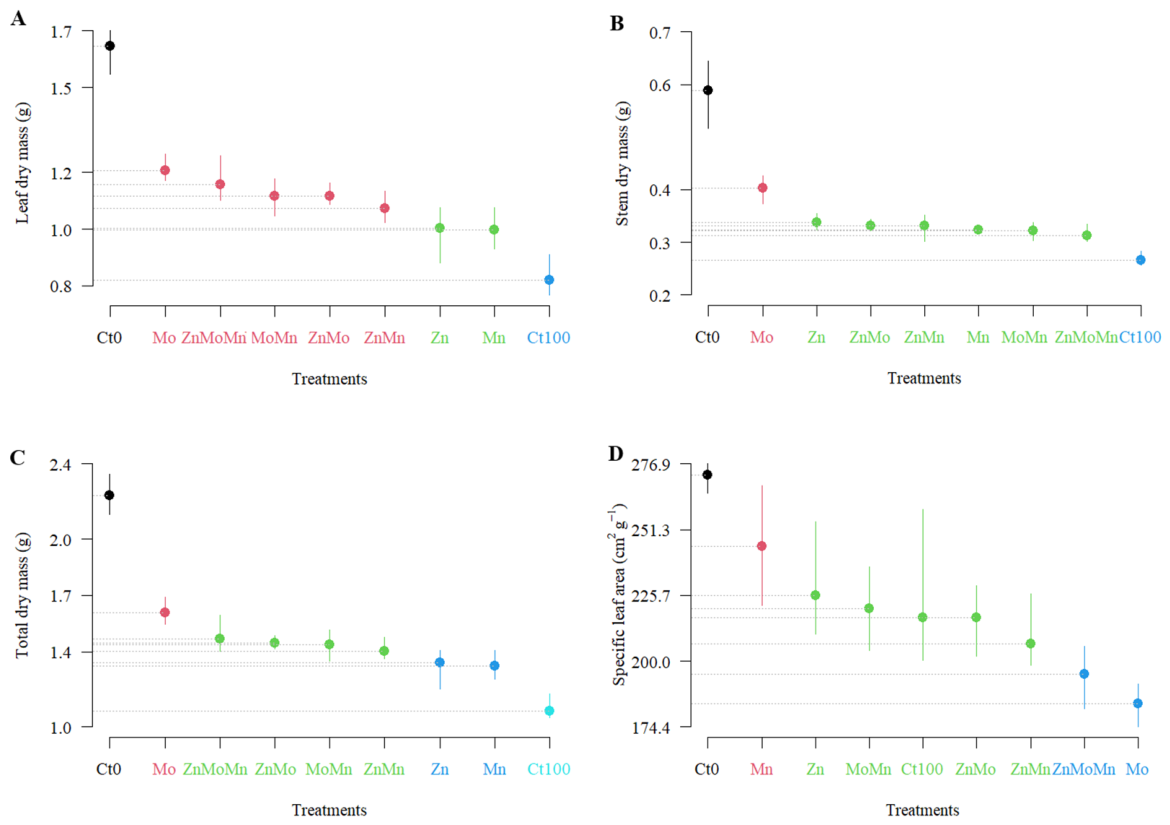
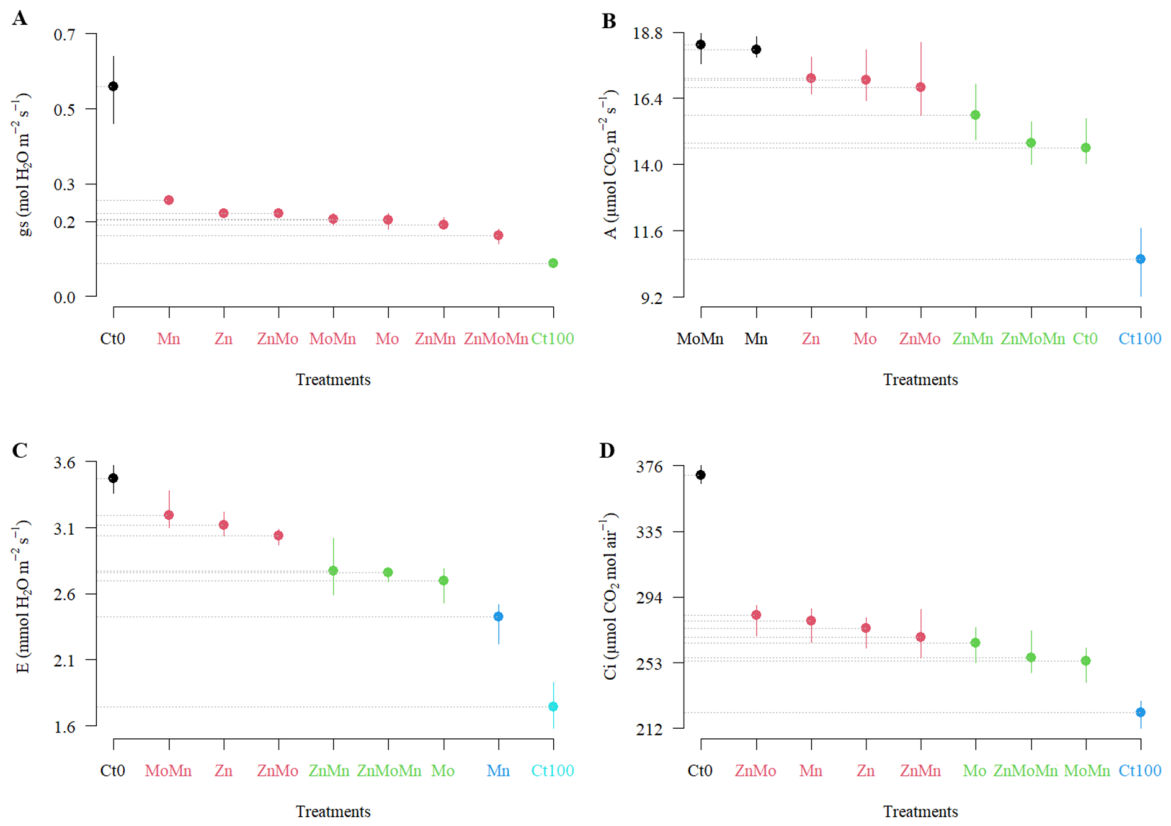
For stomatal conductance (
Figure 3A), the control treatment (Ct0) showed the highest mean values and differed from all other treatments. An intermediate group was also observed, comprising isolated Zn and Mn, the double combinations MoMn, ZnMo, and ZnMn, and the triple combination ZnMoMn. These treatments did not differ from one another and outperformed the saline treatment without micronutrients (Ct100). Regarding net photosynthesis (
Figure 3B), the MoMn and Mn treatments stood out, showing higher mean values than the other treatments. In addition, Zn, Mo, ZnMo, ZnMn, ZnMoMn, and Ct0 showed higher values than those observed in Ct100. For transpiration (
Figure 3C), Ct0 showed the highest values and differed from all other treatments. Additionally, MoMn, Zn, ZnMo, ZnMn, ZnMoMn, Mo, and Mn showed higher mean values than Ct100, indicating better performance compared with the saline control without supplementation.
For intercellular CO
2 concentration (
Figure 3D), Ct0 showed the highest value and differed from all other treatments. An intermediate group was also observed, comprising ZnMo, Mn, Zn, ZnMn, Mo, ZnMoMn, and MoMn, with mean values higher than those of Ct100. For instantaneous water-use efficiency (
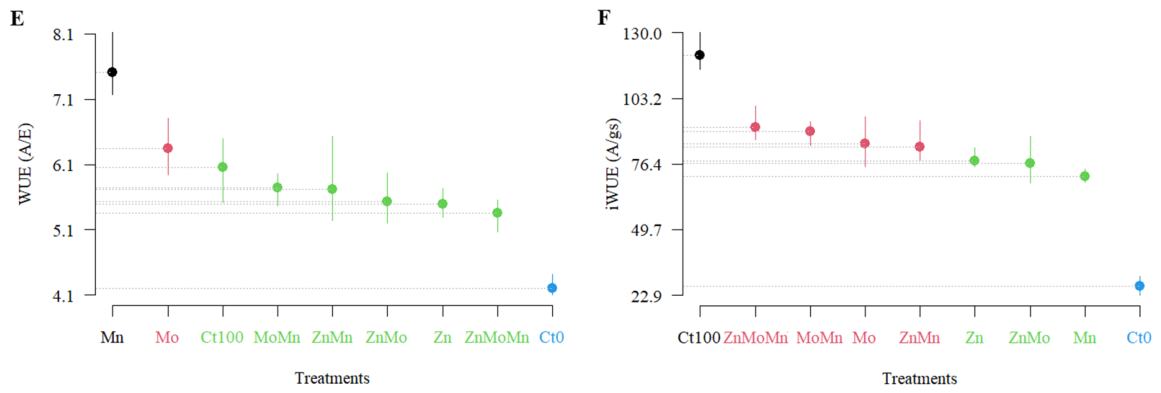
Figure 3E), Mn applied individually showed the highest value, followed by Mo. The other applications showed lower mean values, with reduced performance in the treatments that did not reach the values observed under salinity without supplementation. Finally, for intrinsic water-use efficiency (
Figure 3F), Ct100 showed the highest value. In addition, the micronutrient treatments, applied individually and in combinations, ZnMoMn, MoMn, Mo, ZnMn, Zn, ZnMo, and Mn, showed mean values higher than those of Ct0.
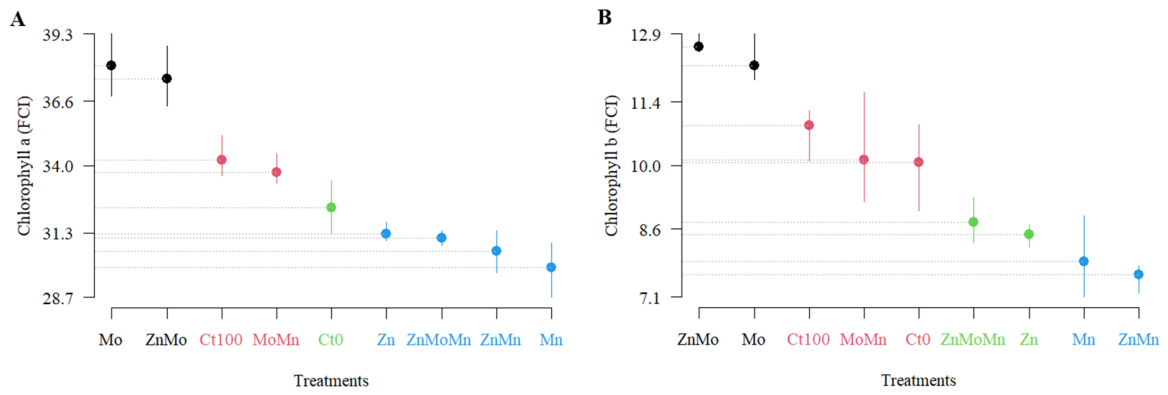
For the chlorophyll a (
Figure 4A), chlorophyll b (
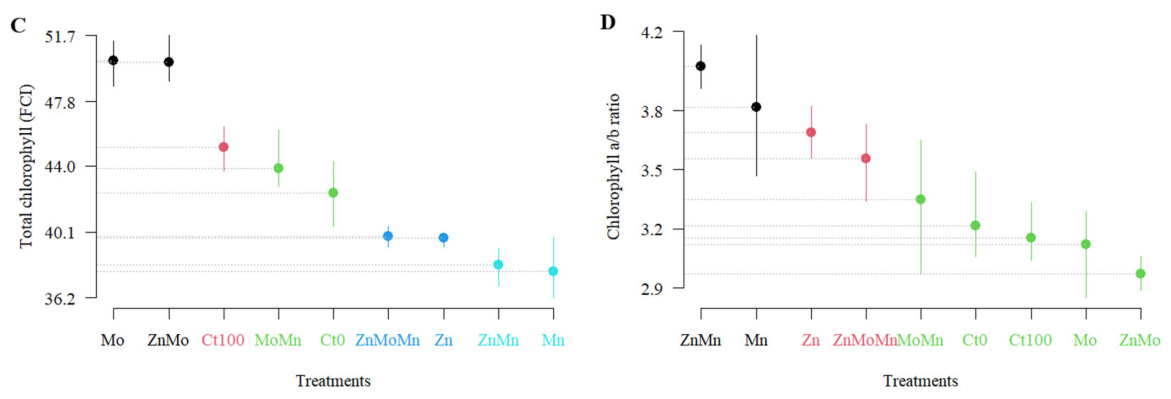
Figure 4B), and total chlorophyll (
Figure 4C) indices, the Mo and ZnMo treatments showed the highest values, differing from each other and outperforming all other treatments. In contrast, the MoMn, Ct0, Zn, ZnMoMn, ZnMn, and Mn treatments showed lower values and remained below Ct100, indicating that, for these variables, Ct100 maintained higher values than the other treatments, except for Mo and ZnMo. For the chlorophyll a/b ratio (
Figure 4D), the highest values were observed in the ZnMn and Mn treatments, which did not differ from each other. Subsequently, Zn and ZnMoMn formed an intermediate group, with mean values lower than those of ZnMn and Mn. In contrast, MoMn, Ct0, Ct100, Mo, and ZnMo formed the group with the lowest values, with no statistical differences among them.
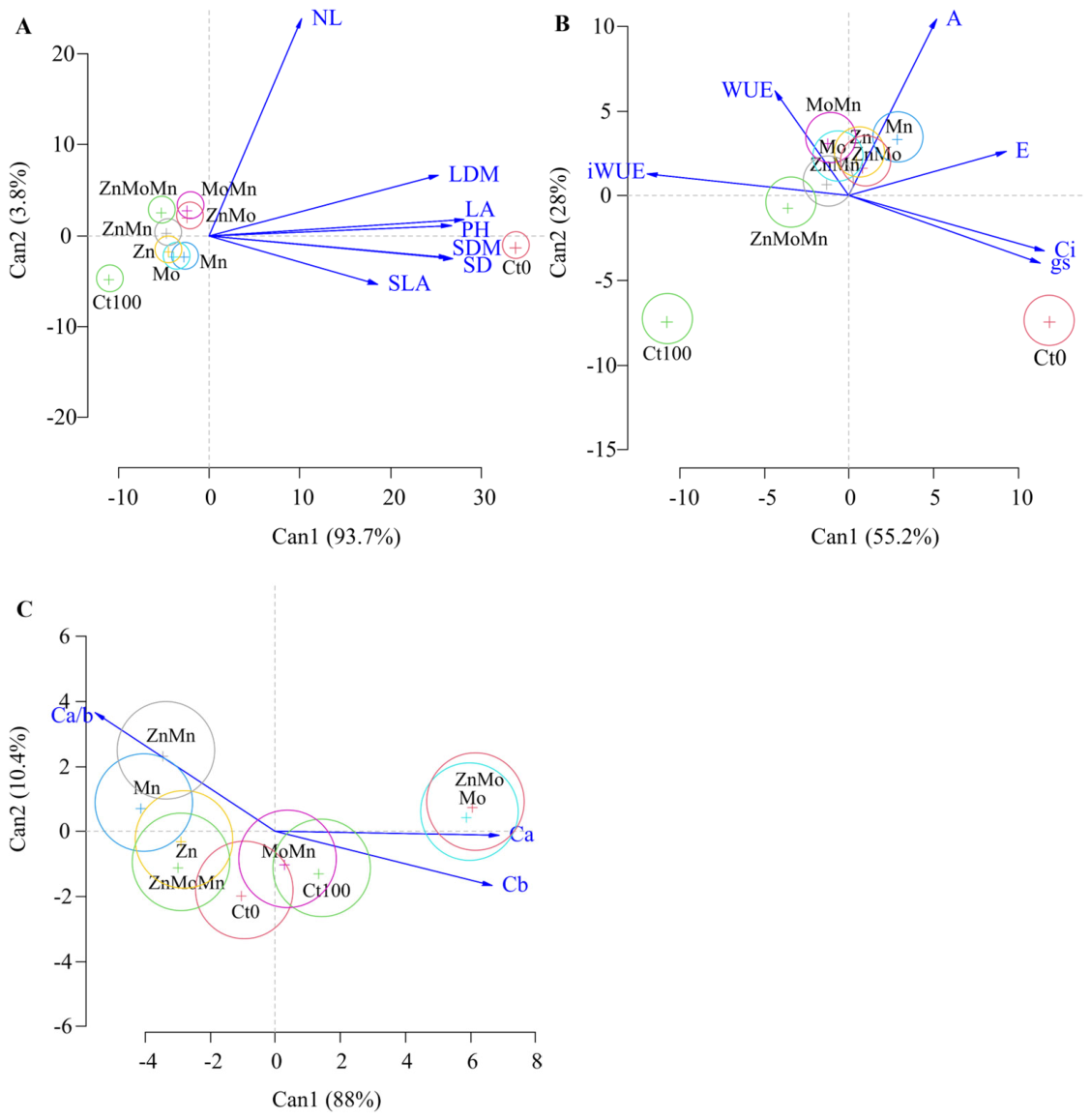
In the canonical analysis of growth variables, Can1 and Can2 explained 93.7% and 3.8% of the total variation, respectively, totaling 97.5% (
Figure 5A). This high cumulative percentage indicates that the first two canonical axes captured most of the treatment-related variation in growth traits. For gas exchange variables, Can1 and Can2 explained 55.2% and 28.0% of the total variation, respectively, totaling 83.2% (
Figure 5B). This indicates that the two-dimensional canonical representation adequately summarized the main differences among treatments for gas exchange responses. For relative chlorophyll indices, Can1 and Can2 explained 85.0% and 10.4% of the total variation, respectively, totaling 95.4% (
Figure 5C). Thus, most of the variation in chlorophyll-related responses was represented by the first two canonical axes.
In the canonical analysis of growth variables (
Figure 5A), the first two components explained most of the variation, with a clear contribution of leaf dry mass (LDM), leaf area (LA), plant height (PH), stem dry mass (SDM), and stem diameter (SD) in the positive direction of Can1, indicating that these variables were determinant in separating the treatments along the main axis. The variable number of leaves (NL) showed a vector pointing in a different direction, with greater association with Can2, suggesting a less collinear behavior relative to the variables directly related to biomass accumulation and leaf expansion. Specific leaf area (SLA) also contributed to the ordination, but in a direction different from that of the biomass and leaf area variables, reinforcing that treatment discrimination was not based solely on “size”, but also on area-related attributes per unit of mass. A substantial overlap of the ellipses was also observed for some treatments, concentrated near the origin, indicating similar responses and lower discriminatory power among them for the set of growth variables.
For the gas exchange variables (
Figure 5B), the vector arrangement showed a positive association between transpiration (E) and stomatal conductance (gs), suggesting co-variation between these parameters. In contrast, iWUE was positioned in the opposite direction, indicating an inverse relationship with the set of variables associated with higher gs and E. The variable A (net photosynthesis) was oriented in its own direction, distinguishing treatments more closely associated with greater carbon assimilation. WUE showed a divergent vector relative to both iWUE and the gs/E axis. The biplot also indicated that some treatments remained close to the center of the diagram, with overlapping ellipses, suggesting similar responses when the set of gas exchange variables is considered simultaneously.
Regarding the chlorophyll indices (
Figure 5C), the chlorophyll a (Ca) and chlorophyll b (Cb) vectors were strongly aligned with the positive direction of Can1, indicating that this axis mainly captured the variation associated with increases in these indices. In the opposite direction, the Ca/b ratio was oriented toward the negative side of Can1, indicating that treatments associated with higher absolute Ca and Cb indices tended, in the canonical space, not to coincide with those that maximized the Ca/b ratio. A separation was also observed between treatments more closely associated with increases in Ca and Cb, located at the positive extreme of the axis, and others grouped on the opposite side, more closely related to variation in the Ca/b ratio. The partial overlap among ellipses indicated similarity among some treatments, suggesting that the pigment response was not fully discriminative for all groups.
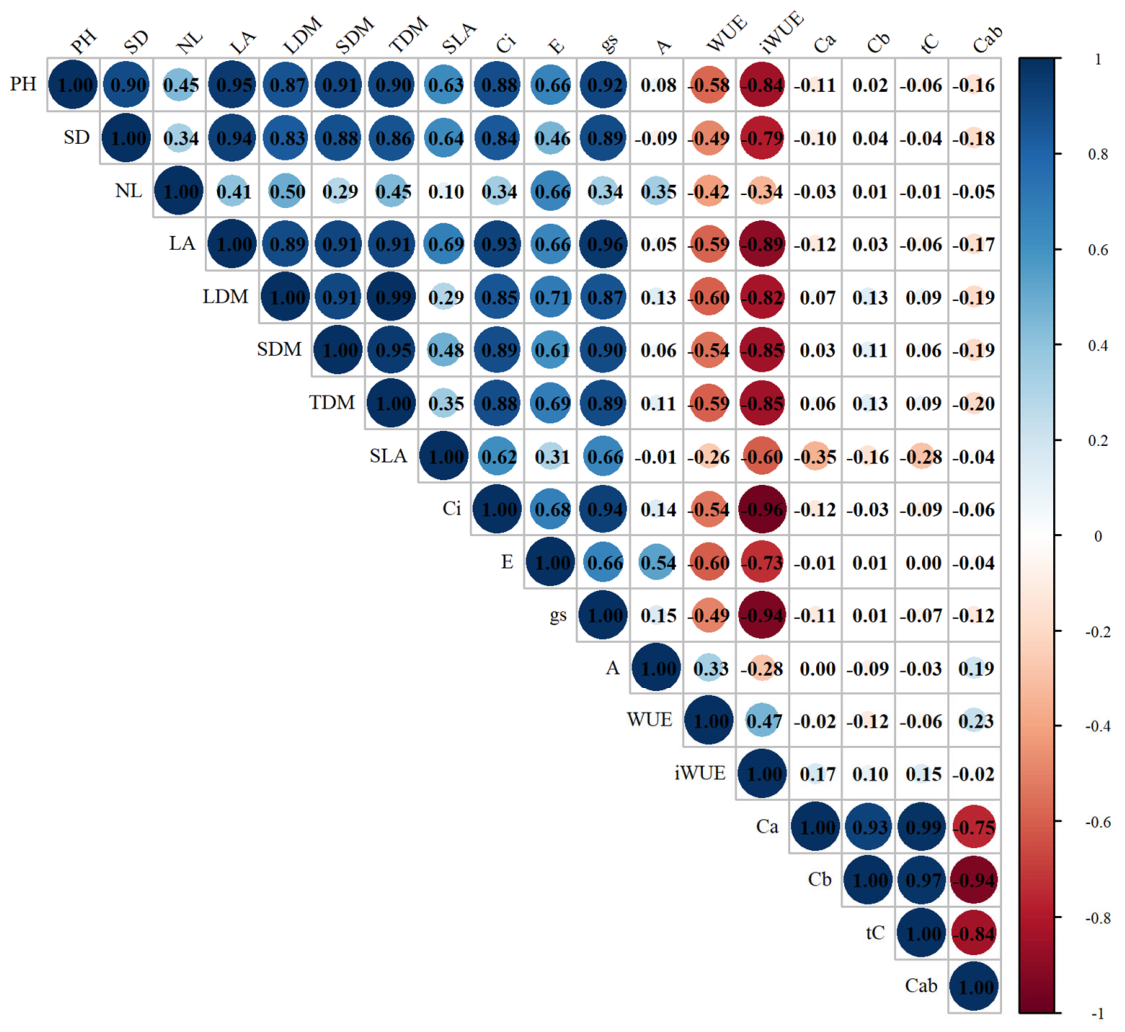
Figure 6 shows strong positive correlations among growth and biomass variables, especially the associations among plant height (PH), stem diameter (SD), leaf area (LA), leaf dry mass (LDM), stem dry mass (SDM), and total dry mass (TDM), with r values generally ≥ 0.83. These variables also showed strong positive correlations with parameters related to CO
2 diffusion and water loss, such as Ci and gs, for example, PH × gs = 0.92, LA × gs = 0.96, and Ci × gs = 0.94. This suggests that plants with greater growth tended to occur under conditions associated with higher stomatal conductance and intercellular CO
2 concentration. In contrast, net photosynthesis (A) showed weak correlations with growth variables, with values close to zero, whereas WUE and, especially, iWUE exhibited moderate to strong negative correlations with several growth variables, for example, PH × iWUE = −0.84 and LA × iWUE = −0.89.
Regarding the relative chlorophyll indices, the chlorophyll a index (Ca), chlorophyll b index (Cb), and total chlorophyll index (tC) showed very strong positive correlations with one another: Ca × tC = 0.99, Cb × tC = 0.97, and Ca × Cb = 0.93. In contrast, the association of these indices with growth variables was low, with r values ranging from 0 to approximately 0.13. The Ca/b ratio, in turn, was negatively correlated with Ca, Cb, and tC, with r values ranging approximately from −0.75 to −0.94, indicating an opposite behavior in relation to the increase in absolute chlorophyll indices.
4. Discussion
Micronutrient fertilization in basil may not promote increases in plant height at the first cutting, in agreement with the pattern observed in the present study (
Figure 1A) [
28]. Under stress conditions, positive responses to micronutrient supplementation have been reported, possibly associated with the stimulation of processes related to phytohormone production and the attenuation of ionic effects, with reduced uptake and/or accumulation of Na
+ and Cl
− [
29,
30].
According to [
31], the application of Mn and Zn may significantly increase the number of leaves in medicinal plants, possibly by enhancing photosynthetic capacity, in agreement with the pattern observed in the present study (
Figure 1B). Mn and Zn may also contribute to increased antioxidant enzyme activity and chlorophyll biosynthesis, thereby reducing oxidative damage associated with salinity [
21,
31]. Additionally, molybdenum performs relevant physiological functions, including processes linked to nitrogen assimilation, hormonal synthesis, and the activity of enzymes related to the antioxidant system [
32].
The reduction in stem diameter may be explained by the impact of salinity on the osmotic potential of the soil–plant system, limiting water and nutrient uptake and favoring responses such as stomatal closure and reduced photosynthetic capacity, which negatively affect growth [
26,
33,
34]. However, stem diameter is not always the most sensitive variable in short-term assessments, and more pronounced effects may become evident with longer exposure to the stressor, which may explain the absence of significant differences among treatments for this variable under certain experimental conditions [
35].
The application of fertilizer containing Mn (1.3 g L
−1), Mo (0.6 g L
−1), and Zn (10.8 g L
−1) to basil under salt stress promoted an increase in leaf area, with increases of 179.58, 100.72, and 114.72% at the first, second, and third cuttings, respectively, compared with the control, in agreement with the pattern observed in
Figure 1D [
36]. These effects may be associated with the metabolic and cellular functions performed by micronutrients, including their participation in processes such as enzymatic activity, protein synthesis, saccharide metabolism, formation of antioxidant compounds, and maintenance of the photosynthetic machinery, with consequences for leaf expansion and biomass accumulation [
37].
Micronutrient fertilization attenuated the deleterious effects of salinity on basil leaf dry mass (
Figure 2A). These results are consistent with the findings of [
36], who observed a 57.4% increase in leaf dry mass under salt stress following the application of 4 L ha
−1 of a foliar fertilizer containing Mn, Mo, and Zn. From a physiological perspective, these micronutrients play relevant roles in maintaining photosynthetic performance, since they may favor chlorophyll synthesis and antioxidant enzyme activity under abiotic stress, thereby contributing to damage reduction and growth maintenance [
32]. Additionally, the combined application of Zn, Mn, and Mo has been associated with improved growth and dry mass accumulation in different cultivated species, particularly under nutritional deficiency or salt stress conditions, as reported for soybean, common bean, and pea [
37,
38].
The results for stem dry mass (
Figure 2B) are consistent with those reported by [
39], who observed a reduction in basil stem dry mass under salinity. For total dry mass (
Figure 2C), salt stress stands out among abiotic stresses because it restricts water uptake and transport, thereby compromising growth and phytomass accumulation [
39]. This effect results, in part, from changes associated with reduced osmotic and water potential, as well as physiological responses such as stomatal closure, which limit transpiration and reduce photosynthetic rates, in addition to restricting the uptake and use of essential nutrients [
33]. In this context, supplementation with micronutrients such as Zn, Mn, and Mo, applied individually or in combinations, may contribute to maintaining photosynthetic capacity and favor morphophysiological responses related to growth, including changes in specific leaf area [
32].
For specific leaf area (
Figure 2D), the response associated with Mn under salt stress may be related to the fact that salinity can increase Mn concentrations in basil tissues as a result of reduced growth and, consequently, greater concentration of this element in plant tissue. This effect may contribute to stress alleviation, since Mn has been associated with increased antioxidant enzyme activity and chlorophyll biosynthesis, with implications for photosynthetic performance [
32]. Additionally, positive responses related to Zn indicate that this micronutrient may improve growth parameters, such as leaf fresh mass and leaf dry mass [
40].
Previous studies with basil have indicated that salinity can negatively affect stomatal conductance (gs) and net photosynthesis (A), with reductions observed at 30 and 60 days after the onset of saline irrigation, up to a water electrical conductivity of 5.2 dS m
−1 [
41]. In the present study, fertilization with Mn, Mo, Zn, and their combinations was associated with higher gs and A values (
Figure 3A,B), suggesting attenuation of the effects of salinity on gas exchange. This response may be related to the role of these micronutrients in maintaining the photosynthetic apparatus and in metabolic processes associated with stress, including their involvement in the structure and/or functioning of antioxidant proteins and enzymes, hormonal regulation, chlorophyll synthesis, and processes linked to CO
2 metabolism, such as the enzyme carbonic anhydrase [
42].
The reduction in transpiration under increasing salinity is associated with stomatal closure as a stress alleviation response, which decreases water loss and may attenuate toxic effects related to salt accumulation [
43]. In this context, Mn, Mo, and Zn have been linked to the regulation of stomatal opening and closure, potentially contributing to the maintenance of transpiration under stress. In the present study, micronutrient treatments were associated with higher transpiration values (
Figure 3C) compared with the saline control without supplementation, suggesting a beneficial effect on this process [
33,
44].
In basil, ref. [
41] observed that increasing the electrical conductivity of irrigation water up to 3.25 dS m
−1 increased intercellular CO
2 concentration (Ci) at 30 and 60 days after the onset of saline irrigation, with reductions occurring beyond this point. Additionally, Mn and Zn have been associated with greater root system development, possibly through processes related to the production of phytohormones such as indole-3-acetic acid, which may favor water and nutrient uptake [
45].
Ref. [
41] observed that salinity up to 3.25 dS m
−1 reduced instantaneous water-use efficiency (WUE;
Figure 3E) and intrinsic water-use efficiency (iWUE;
Figure 3F) in basil at 60 days after the onset of irrigation with saline water. In contrast, in the present study, the Mn treatment was associated with attenuation of the effects of salinity, resulting in increased WUE (
Figure 3E). This response may be related to the role of Mn as an essential component of the oxygen-evolving complex (OEC) in photosystem II (PSII), contributing to the maintenance of photosynthetic performance [
46].
Salinity tends to reduce stomatal conductance, causing disturbances in plant water relations and increasing abscisic acid (ABA) synthesis. As a consequence, intrinsic water-use efficiency (iWUE) may increase, since the plant begins to use the available water more efficiently even under reduced stomatal aperture (
Figure 3F) [
41]. Additionally, supplementation with Mn, Mo, and Zn, applied individually and in combinations, is relevant because it contributes to processes associated with stress alleviation, including stomatal regulation, synthesis of phytohormones such as indole-3-acetic acid, maintenance of chlorophyll synthesis, and increased antioxidant enzyme activity [
32,
45].
In
Figure 4A–C, the Mo and ZnMo treatments resulted in higher chlorophyll a, chlorophyll b, and total chlorophyll indices, even surpassing the controls. This pattern is consistent with that reported by [
33], who observed an increase in chlorophyll index and biomass accumulation in
O. basilicum under salinity with the application of Zn (10 mg kg
−1), attributing this effect to the role of this micronutrient in chlorophyll biosynthesis and in the formation of antioxidant compounds, which contribute to greater tolerance to salt stress. Additionally, molybdenum, through its participation in processes associated with nitrate assimilation and the biosynthesis of key molecules, may favor chlorophyll maintenance under saline conditions. When associated with Zn, this effect may be reinforced, possibly by contributing to membrane stability and reducing pigment degradation [
46].
Because the measurements were obtained using a portable chlorophyll meter, the higher values observed under Mo and ZnMo represent increases in relative optical indices rather than confirmed increases in absolute pigment concentration. Consequently, these results should be interpreted as treatment-specific changes in relative chlorophyll indices.
In
Figure 5A, the first two canonical components explained 97.5% of the variation, allowing the distribution of treatments and growth variables to be distinguished in the multivariate space. Plant height (PH), stem diameter (SD), leaf area (LA), leaf dry mass (LDM), stem dry mass (SDM), and specific leaf area (SLA) clustered with closely aligned vectors, indicating an association among these variables. In contrast, the number of leaves (NL) showed a distinct orientation, suggesting a weaker relationship with the set of variables directly associated with leaf expansion and biomass accumulation. Additionally, the position of ZnMoMn in the biplot indicated a lower association with these morphological variables, suggesting that the triple combination was not the most efficient treatment for stimulating growth under salinity, in agreement with the concept of more specific nutritional combination responses under stress [
47,
48]. In contrast, treatments with micronutrients applied individually or in double combinations showed closer associations with key growth variables.
In
Figure 5B, the first two canonical components explained 83.2% of the total variation, allowing visualization of the effects of the treatments on gas exchange variables and their associations in the multivariate space. A stronger association of WUE with the MoMn treatment was observed, whereas net photosynthesis was more strongly associated with the Mn treatment. This behavior is consistent with the importance of Mn for the functioning of the oxygen-evolving complex in photosystem II, which is directly related to water oxidation and oxygen generation during photosynthesis [
49]. In addition, the vector arrangement indicated a low association among iWUE, WUE, A, and E, reinforcing that these metrics did not vary collinearly within the dataset. In contrast, gs and Ci showed closely aligned vectors, suggesting a stronger correlation between stomatal conductance and intercellular CO
2 concentration.
Gas exchange variables, especially net photosynthesis (A) and transpiration (E), were more strongly associated with the Mn treatment, reinforcing the role of this micronutrient in processes related to photosynthetic functioning and stomatal dynamics [
21]. In turn, instantaneous water-use efficiency (WUE) was more closely associated with the MoMn treatment, suggesting a response linked to the way this combination modulated, within the dataset, the balance between water loss and carbon assimilation. This behavior is consistent with the function of molybdenum in processes associated with nitrogen assimilation and the accumulation of osmotically active solutes, such as soluble proteins, proline, and sugars, favoring osmotic adjustment and water retention under stress conditions [
50].
In
Figure 5C, the first two canonical components explained 98.4% of the total variation, allowing a clear visualization of the distribution of treatments and pigment-related variables. The chlorophyll a/b ratio (Ca/b) was more strongly associated with the ZnMn treatment, in agreement with results reported in the literature [
51]. In contrast, the chlorophyll a index (Ca) and chlorophyll b index (Cb) showed a closer association with the ZnMo and Mo treatments. In addition, the distinct orientation of the vectors suggests a low association between Ca/b and the absolute chlorophyll indices, Ca and Cb, indicating that these variables did not vary collinearly within the dataset [
52]. Taken together, these patterns reinforce that chlorophyll index responses were treatment-specific, with higher values mainly under Mo and ZnMo. The chlorophyll index response was not uniform across micronutrient treatments. Although Mo and ZnMo increased the chlorophyll a, chlorophyll b, and total chlorophyll indices, several other micronutrient treatments showed values lower than the saline control. Therefore, the results do not support a generalized statement that all micronutrient treatments sustained chlorophyll indices under salinity. Instead, the response appears to be treatment-specific and more closely associated with Mo-containing treatments, particularly Mo applied alone and the ZnMo combination.
Positive correlations were also observed between growth variables and gas exchange variables, especially the associations with Ci, gs, and E (
Figure 6), indicating that plants with greater growth tended to show higher values of these parameters. This pattern is consistent with the idea that the maintenance of processes related to CO
2 diffusion and stomatal functioning is a relevant component of plant responses to salt stress [
53].
The application of micronutrients, individually and in combinations, to basil plants subjected to salt stress was associated with improvements in growth variables, gas exchange, and chlorophyll indices (
Figure 6), indicating a greater capacity for acclimation to the stressor. These results suggest potential for sustaining the agronomic performance of basil under salinity conditions, with implications for yield and production quality, including its use for essential oil extraction [
33,
54]. In this context, nutritional management strategies may contribute to expanding the feasibility of cultivation in areas with salinized soils or irrigated with saline water, which is particularly relevant for family farming systems in Northeast Brazil.
The results show that the application of micronutrients, individually and in combinations, was effective in mitigating the deleterious effects of salinity, being associated with the maintenance of photosynthetic apparatus performance, physiological adjustments related to stress, and modulation of water use (
Figure 6). These adjustments may contribute to physiological homeostasis and greater stability of crop growth under salinity, with potential to increase basil resilience in environments affected by water limitation and/or salinization. In addition, fertilization was related not only to increases in growth, chlorophyll indices, and gas exchange, but also to changes in water-use efficiency indicators, suggesting optimization of plant water balance and better use of available water.
The lower consistency of the ZnMoMn treatment compared with selected individual or double applications may be related to interactions among micronutrients. Simultaneous nutrient supply can modify uptake, availability, and metabolic use, and may result in antagonistic rather than additive responses. Nevertheless, because micronutrient accumulation and nutrient-interaction mechanisms were not directly measured, this explanation remains a hypothesis. The results demonstrate that increasing the number of micronutrients supplied does not necessarily produce proportional benefits under severe NaCl stress.
From a practical perspective, Mn, Mo, and Zn fertilizers are commercially available and may be incorporated into nutritional management programs. Nevertheless, any recommendation for basil production must consider fertilizer source, application rate, soil or substrate characteristics, irrigation-water quality, production scale, crop value, and the magnitude of the agronomic response. The present results should therefore be viewed as preliminary physiological evidence obtained under controlled greenhouse conditions rather than as a finalized commercial fertilization recommendation.
Limitations
This study has several experimental limitations. First, all micronutrient treatments were evaluated only under 100 mM NaCl, and corresponding non-saline treatments receiving Mn, Mo, Zn, or their combinations were not included. Consequently, comparisons with the saline control demonstrate improved plant performance under severe NaCl stress, but they do not completely separate a salt-specific alleviation effect from a general growth-promoting effect of micronutrient supplementation. Furthermore, the use of a single severe NaCl concentration during a 30-day greenhouse experiment limits extrapolation to moderate, chronic, mixed-salt, and field salinity conditions.
Second, the micronutrients were supplied as sodium molybdate, manganese sulfate, and zinc sulfate. These sources introduced Na+ and/or SO42− together with the target micronutrients, and the experimental design did not include counterion-equivalent blank controls. Therefore, potential source-related ionic effects cannot be separated from the effects of Mo, Mn, and Zn. Concentrations of Mn, Mo, Zn, Na+, Cl−, K+, and SO42− in the substrate solution and plant tissues were also not determined. In addition, antioxidant enzyme activity, osmolyte accumulation, pigment extraction, and molecular markers were not evaluated. Accordingly, the physiological mechanisms proposed to explain the treatment responses remain hypotheses based on previously reported functions of these micronutrients.
Third, the portable chlorophyll-meter readings represent relative optical indices rather than absolute pigment concentrations. Only one micronutrient application rate was evaluated, preventing the identification of deficient, optimal, or potentially toxic dose ranges. Future experiments should use factorial designs combining non-saline and saline conditions with micronutrient treatments, ion-matched counterion controls, mixed-salt or hybrid salinity treatments, salinity gradients, and micronutrient dose–response gradients. These studies should also include ion profiling, chemically extracted photosynthetic pigments, antioxidant and osmotic-adjustment markers, and molecular analyses. Finally, the most promising treatments should be validated under semi-field and field conditions, together with assessments of yield, leaf quality, fertilizer-use efficiency, and economic viability.



 ,
,