Article

Overexpression of the Lavender LaDXS2-2 Gene in Tobacco Modulates the MEP Pathway to Improve Photosynthetic Efficiency and Alter Primary Metabolism: Evidence from Integrated Omics Analyses

1
Xinjiang Key Laboratory of Special Species Conservation and Regulatory Biology, School of Life Sciences, Xinjiang Normal University, Urumqi 830054, China
2
Institute of Desert Algae, Xinjiang Normal University, Urumqi 830054, China
*
Authors to whom correspondence should be addressed.
These authors contributed equally to this work.
Horticulturae 2026, 12(6), 753; https://doi.org/10.3390/horticulturae12060753 (registering DOI)
Submission received: 28 May 2026 / Revised: 16 June 2026 / Accepted: 17 June 2026 / Published: 20 June 2026

Abstract

1-Deoxy-D-xylulose-5-phosphate synthase (DXS) serves as the initial rate-limiting enzyme in the methylerythritol phosphate (MEP) pathway, governing the biosynthesis of precursors for photosynthetic pigments and terpenoids. In this study, the LaDXS2-2 gene was cloned and functionally characterized in lavender (Lavandula angustifolia). The full-length coding sequence (CDS) of LaDXS2-2 spans 2178 base pairs, encoding a protein of 725 amino acids. Phylogenetic analysis revealed that LaDXS2-2 is most closely related to the DXS from Salvia miltiorrhiza. Expression profiling demonstrated that LaDXS2-2 was highly expressed in flower buds, and its transcript levels were significantly upregulated (p < 0.05) in response to ethephon, high light intensity, and low temperature, while exhibiting tissue-specific responses to gibberellin application. Subcellular localization assays confirmed LaDXS2-2 is targeted to the chloroplast. Heterologous overexpression of LaDXS2-2 in tobacco resulted in a marked increase in photosynthetic pigment content, enhanced the actual photochemical efficiency of photosystem II [Y(II)], and reduced non-photochemical quenching (NPQ). Integrated transcriptomic and metabolomic analyses further revealed that LaDXS2-2 overexpression activated the diterpenoid biosynthesis pathway and upregulated amino acid metabolism as well as the TCA cycle, while competitively suppressing phenylpropanoid and flavonoid biosynthesis pathways. These findings indicate that LaDXS2-2 not only enhances photosynthetic efficiency by promoting the synthesis of photosynthetic pigments but also suggests a potential role in influencing primary carbon and nitrogen metabolism, as inferred from transcriptomic and metabolomic data. This functionality may ultimately influence plant growth and metabolic homeostasis. Overall, this study provides a theoretical foundation for the synergistic improvement of photosynthetic efficiency and secondary metabolism in crops.

1. Introduction

Lavandula angustifolia, a member of the Lamiaceae family, is an economically valuable aromatic and medicinal plant. Its essential oil is abundant in volatile compounds, predominantly monoterpenes and sesquiterpenes, which exhibit a wide range of pharmacological activities, including antibacterial, sedative, and analgesic properties, thereby conferring significant commercial importance [1,2]. The biosynthesis of terpenoids is initiated from the precursors isopentenyl pyrophosphate (IPP) and its isomer dimethylallyl pyrophosphate (DMAPP). In higher plants, IPP and DMAPP are primarily synthesized via the cytosol-localized mevalonate (MVA) pathway and the plastid-localized methylerythritol phosphate (MEP) pathway [3]. Notably, the MEP pathway serves as the exclusive source of precursors for the biosynthesis of essential photosynthetic pigments (e.g., chlorophylls and carotenoids), phytohormones (e.g., gibberellins and abscisic acid), electron transport chain components (e.g., plastoquinone), and a diverse array of secondary metabolites [4,5].
1-deoxy-D-xylulose-5-phosphate synthase (DXS) is the first rate-limiting enzyme of the MEP pathway, catalyzing its initial and committed step. Its activity directly governs the supply flux of IPP and DMAPP, thereby broadly affecting the biosynthesis of carotenoids, chlorophylls, vitamins, and a diverse array of medicinally important terpenoids [6]. Since the DXS gene was first isolated from Escherichia coli in 1997 [7], it has been successfully cloned from numerous plant species, including Salvia miltiorrhiza [8], Arabidopsis thaliana [9], Thymus vulgaris [10], Andrographis paniculata (Burm. f) [11], and L. angustifolia [12]. Current functional investigations have primarily centered on the role of DXS in supplying IPP/DMAPP for downstream isoprenoid biosynthesis [6], its regulation of primary metabolism, particularly photosynthesis and photosynthetic pigment synthesis [13], and its modulation of secondary metabolism, including the production of terpenoids and medicinal active compounds [8,14]. Accumulating evidence indicates that the functions of DXS genes exhibit diversity and specificity. For instance, in Cinnamomum burmannii, CbDXS1 primarily regulates the synthesis of chlorophyll and terpenoid synthesis [15]. In rice (Oryza sativa), a specific DXS gene promotes carotenoid accumulation in seeds [16], while in Taxus species, DXS functions as a key regulatory node in taxol biosynthesis [17]. Together, these findings suggest that members of the DXS gene family may finely regulate distinct terpenoid biosynthesis pathways through functional differentiation and tissue-specific expression.
Previous genomic studies in lavender have identified a DXS gene family comprising 22 members [12]. However, the specific biological functions of these members, particularly their roles in essential oil synthesis and photosynthetic regulation, remain largely uncharacterized. In the present study, LaDXS2-2, a gene exhibiting high expression levels in lavender flower buds, was selected as the primary research focus. Based on its floral organ-specific expression pattern, it was hypothesized that LaDXS2-2 may be involved in the biosynthesis of terpenoid volatiles contributing to floral scent, or alternatively, that it plays a role in plastid-related primary metabolism. Accordingly, this study aimed to clone LaDXS2-2 from lavender, characterize its expression profile, and systematically investigate its regulatory effects on photosynthetic pigment accumulation and photosynthetic physiology through heterologous overexpression in tobacco (Nicotiana tabacum). Although direct functional validation in lavender was not performed due to the lack of an efficient transformation system, this heterologous study in tobacco provides initial insights into the potential regulatory role of LaDXS2-2 in the MEP pathway. These findings offer a foundation for future lavender-based validation studies and suggest potential genetic resources for improving photosynthetic efficiency and secondary metabolite accumulation in crops.

2. Materials and Methods

2.1. Plant Materials

L. angustifolia cultivar ‘Jieyou 6′ was vegetatively propagated via division and subsequently transplanted from Huocheng County, Xinjiang, to the experimental field on the campus of Xinjiang Normal University. Plants were arranged at a spacing of 60 cm within rows and 80 cm between rows. Organic fertilizer was incorporated as a basal fertilizer prior to planting, and drip irrigation was used for all the subsequent watering throughout the growing period. This cultivar has exhibited consistent summer flowering since 2021. For heterologous overexpression experiments, Nicotiana tabacum cultivar ‘Yunyan 87′ was used. Seeds were provided by the Vegetable Research Center, Beijing Academy of Agriculture and Forestry Sciences. The plant expression vectors PEZR(K)-LC and pSAT6-nEYFP-N1 were maintained in E. coli strains and used for subsequent cloning and transformation experiments.

2.2. Methods

2.2.1. RNA Extraction, cDNA Synthesis, and Cloning of LaDXS2-2

During the flowering stage of lavender, six distinct tissue types were collected: flower buds (TB), petals (TP), fresh calyxes (TC1), mature calyxes (TC2), stems (TS), and leaves (TL). Each tissue sample was harvested with three biological replicates. All the samples were rapidly frozen in liquid nitrogen and stored at −80 °C until further analysis. Total RNA was extracted from each tissue using the TransZol UP Plus RNA Kit (TransGen Biotech, Beijing, China) according to the manufacturer’s instructions. RNA concentration and purity were measured using a spectrophotometer (B-500, Metash, Shanghai, China), and RNA integrity was verified by agarose gel electrophoresis. First-strand cDNA was synthesized via reverse transcription using the PrimeScript™ FAST RT reagent Kit with gDNA Eraser (TaKaRa, Beijing, China).
Specific primers for LaDXS2-2 (Gene ID: La23G00913, GenBank: PRJNA642976) were designed based on the lavender genome sequence (Table S1). PCR was performed in a 50 µL reaction system containing 25 µL of PCR Mix, 4 µL of template cDNA, and 2.5 µL each of forward and reverse primers. The amplification conditions were: 95 °C for 3 min; 35 cycles of 95 °C for 15 s, 53 °C for 15 s, and 72 °C for 1 min 30 s; followed by a final extension at 72 °C for 5 min. The PCR products were purified using the SanPrep Column DNA Gel Extraction Kit (Sangon Biotech, Shanghai, China), cloned into the pMD19-T vector, and subsequently subcloned into the plant overexpression vector PEZR(K)-LC to generate the recombinant vector PEZR-LaDXS2-2 using the primer pair LC-LaDXS2-2 (Table S1). For subcellular localization, the LaDXS2-2 coding sequence was inserted into the pSAT6-nEYFP-N1 vector using a seamless cloning kit to construct pSAT6-LaDXS2-2-EYFP using the primer pair pSAT6-LaDXS2-2 (Table S1). All the primers were synthesized and sequenced by Tsingke Biotechnology Co., Ltd. (Beijing, China).

2.2.2. Bioinformatics Analysis of LaDXS2-2

Bioinformatic analysis of the LaDXS2-2 protein sequence was conducted using a suite of online tools. The signal peptide, transmembrane domains, subcellular localization, conserved domains, and physicochemical properties were predicted using SignalP 6.0 [18], TMHMM 2.0 [19], Plant-mPLoc [20], InterProScan 5 [21], and Expasy [22], respectively. The secondary structure, tertiary structure, and phosphorylation sites of the protein were predicted using SOPMA, SWISS-MODEL, and NetPhos 3.1, respectively [23].
Homologous amino acid sequences of LaDXS2-2 were retrieved from the NCBI database, including DXS proteins from 11 plant species: S. miltiorrhiza (XP_057786464.1), Scutellaria barbata (QEY10163.1), Andrographis paniculata (XP_051150321.1), Quillaja saponaria (KAJ7979504.1), Sesamum indicum (XP_011069878.1), Genlisea aurea (EPS64831.1), Houttuynia cordata (AHB79076.1), Erythranthe guttata (XP_012831315.1), Bixa orellana (AMJ39460.1), Antirrhinum majus (AAW28999.1), and Striga hermonthica (CAA0819397.1). A phylogenetic tree was constructed using MEGA 11 software with the Neighbor-Joining (NJ) method to analyze the evolutionary relationships among these sequences and the DXS protein from lavender. The bootstrap value was set to 1000 replicates to assess the reliability of the phylogenetic nodes.

2.2.3. Expression Analysis of LaDXS2-2 in Different Tissues and Under Various Treatments in Lavender

The expression patterns of the LaDXS2-2 gene across six tissues (TB, TC1, TC2, TP, TL and TS) were obtained from the lavender transcriptome database (GenBank: PRJNA892961) to assess tissue-specific expression differences. To examine responses to hormonal and abiotic treatments, lavender plants at the flowering stage were subjected to the following treatments: foliar spraying with 100 μM gibberellin (GA), 100 μM abscisic acid (ABA), 100 μM methyl jasmonate (MeJA), or 100 μM ethylene precursor (ethephon, Eth), with plants sprayed with sterile water serving as the control; and exposure to high light (40,000 lx), continuous darkness, low temperature (4 °C), or drought stress, with untreated plants as the corresponding control. Each treatment was performed with three biological replicates. Flower buds and leaves were harvested 12 h after treatment, rapidly frozen in liquid nitrogen, and stored at −80 °C. Total RNA was extracted, and cDNA was synthesized as described in Section 2.2.1. Quantitative real-time PCR (qRT-PCR) was performed using the SYBR Premix Ex Taq kit (TaKaRa, Beijing, China) with gene-specific primers for LaDXS2-2 (qLaDXS2-2, Table S1) and the reference genes LaH2A and LaTBCA (Table S1). The reaction setup and cycling conditions followed the manufacturer’s instructions. Relative expression levels were calculated using the 2−ΔΔCT method.

2.2.4. Subcellular Localization and Generation of LaDXS2-2 Transgenic Plants

To determine the subcellular localization of LaDXS2-2, the fusion expression vector pSAT6-LaDXS2-2-EYFP and the corresponding empty vector control pSAT6-nEYFP-N1 were introduced separately into A. thaliana mesophyll protoplasts via PEG4000- mediated transformation [24]. Following transformation, the protoplasts were incubated in darkness at room temperature for 12–16 h to allow for transient expression. The EYFP fluorescence signals were subsequently visualized under a confocal laser scanning microscope (Carl Zeiss LSM7DUO, Oberkochen, Germany).
For functional characterization, the recombinant vector PEZR-LaDXS2-2 was introduced into Agrobacterium tumefaciens strain GV3101 via the freeze–thaw method. Tobacco leaf discs were transformed using Agrobacterium-mediated transformation. Resistant shoots were selected on MS medium supplemented with kanamycin. Transgenic T0 plants were obtained following successful rooting and gradual acclimatization. To verify the integration and expression of the transgene, total RNA was extracted from leaves of putative transgenic plants, and cDNA was synthesized. Using the NtActin gene as an internal reference gene and wild-type (WT) tobacco as the negative control, the transgenic lines were confirmed by qRT-PCR employing the primers qLaDXS2-2 and NtActin (Table S1).

2.2.5. Determination of Photosynthetic Pigments and Chlorophyll Fluorescence in LaDXS2-2 Transgenic Plants

T1 seeds were harvested from three independent T0 transgenic lines (OE-LaDXS2-2-2, OE-LaDXS2-2-3, and OE-LaDXS2-2-5) that exhibited relatively high LaDXS2-2 expression levels. Following surface sterilization, the seeds were sown on MS medium supplemented with 600 mg/L kanamycin for selection. The seedlings were cultured for one month and then transplanted into soil for further growth. The expression of LaDXS2-2 in T1 plants was quantified by qRT-PCR. Three individual T1 plants from the highest-expression line OE-LaDXS2-2-5, each serving as one biological replicate, were used for photosynthetic pigment and chlorophyll fluorescence measurements. Approximately 100 mg of fresh leaf tissue was collected from each plant and extracted with 5 mL of 80% acetone in darkness at 12 °C for 24 h. After the tissue was completely bleached, the absorbance of the extracts was measured at 663 nm, 645 nm, and 470 nm using a spectrophotometer. The contents of chlorophyll a, chlorophyll b, total chlorophyll, and carotenoids were calculated according to standard formulas.
Chlorophyll fluorescence parameters were measured on three individual T1 plants of the OE-LaDXS2-2-5 line at 18:00 using a Mini-PAM-II chlorophyll fluorometer (Walz, Effeltrich, Germany). Healthy and uniformly developed leaves were selected for measurement. Prior to measurement, leaves were dark-adapted for 20 min using a dark-adaptation leaf clip (DLC-8). Initial fluorescence (Fo) and maximum fluorescence (Fm) were recorded, and the maximum photochemical efficiency of photosystem II (Fv/Fm) was calculated accordingly. Subsequently, under actinic light, additional fluorescence parameters were obtained, including the actual photochemical efficiency of photosystem II [Y(II)] and the non-photochemical quenching coefficient (NPQ). Three different spots on each leaf were measured, and the average value was taken as the representative value for that leaf.

2.2.6. Transcriptome and Metabolomic Analysis of LaDXS2-2 Overexpressing Tobacco

To investigate the effects of LaDXS2-2 overexpression on global gene expression and metabolite profiles, three individual T1 plants from the overexpression lines OE-LaDXS2-2-5 and WT plants were subjected to transcriptomic and metabolomic analyses. The night prior to sampling, leaves were gently rinsed with ultrapure water to remove surface contaminants. The following morning, approximately 100 mg of leaf tissue was collected from each plant, immediately transferred into cryovials, and snap-frozen in liquid nitrogen for 30 min. All the samples were subsequently sent to Shanghai OE Biotech Co., Ltd. for RNA sequencing (RNA-seq) and non-targeted metabolomic profiling.
Bioinformatic analysis included identification of differentially expressed genes (DEGs) and differentially accumulated metabolites (DAMs), followed by KEGG pathway enrichment analysis. These approaches were used to elucidate the regulatory role of LaDXS2-2 in transcriptional and metabolic networks in transgenic tobacco.

2.2.7. Statistical Analysis

All data are presented as means ± standard deviation (SD) from three biological replicates. Statistical significance was determined using one-way analysis of variance (ANOVA) followed by Duncan’s multiple range test at p < 0.05. This statistical framework was consistently applied to all the experimental data, including qRT-PCR expression analyses, photosynthetic pigment content, and chlorophyll fluorescence parameters. All the statistical analyses were performed using SPSS 26.0 software.

3. Results

3.1. Molecular Cloning and Sequence Analysis of the LaDXS2-2 Gene

A 2178 bp fragment corresponding to the LaDXS2-2 gene was amplified from the lavender genome. Sequencing and alignment confirmed its identity as LaDXS2-2. The gene encodes a protein of 725 amino acids with a predicted molecular mass of approximately 78.35 kDa.
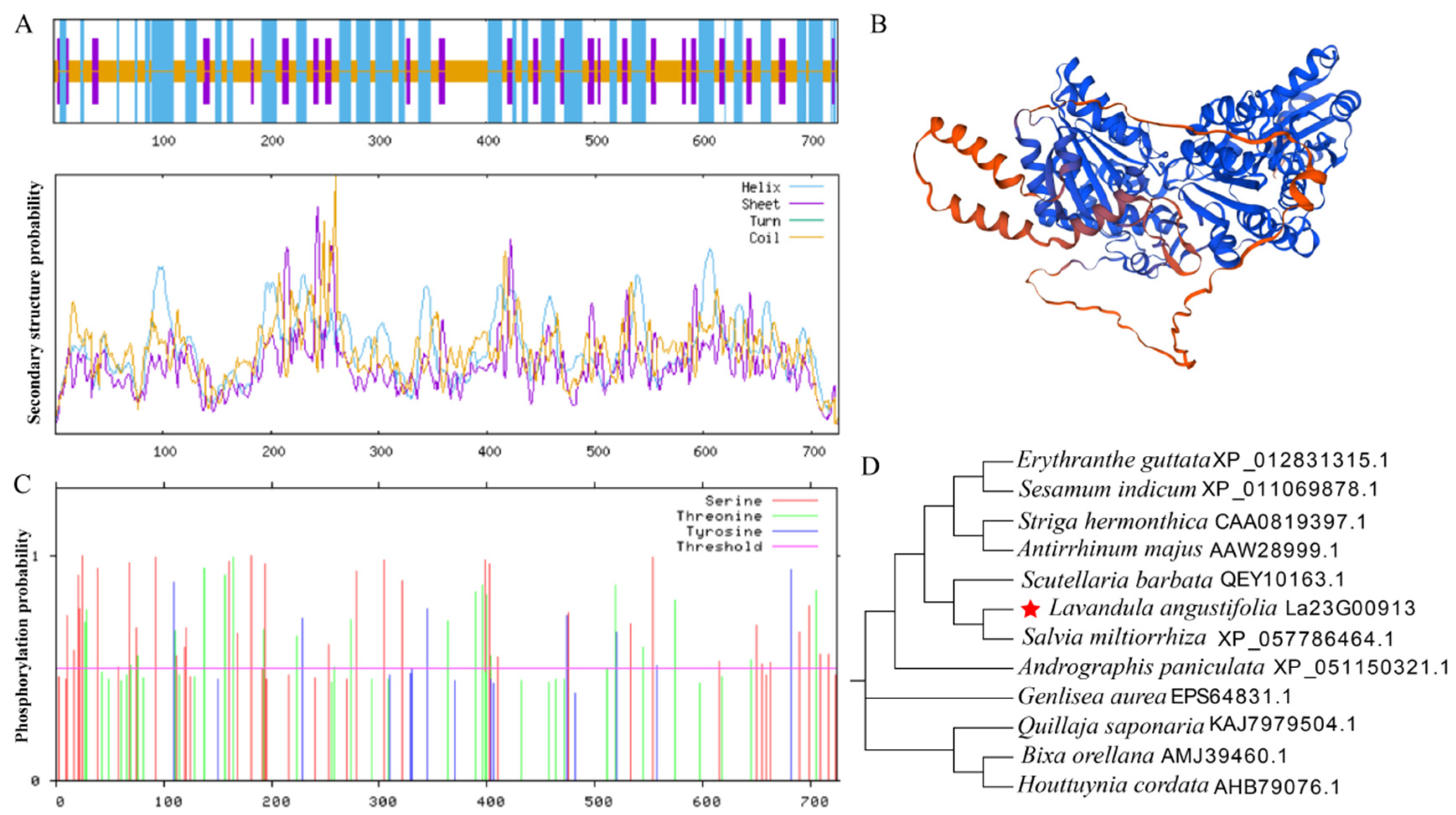
Bioinformatics analysis predicted that LaDXS2-2 is localized in the chloroplast and lacks signal peptides or transmembrane domains. Its theoretical isoelectric point (pI) is 6.69, indicating that it is a stable hydrophilic protein. Conserved domain analysis revealed four conserved domains associated with DXS enzyme function: a thiamin diphosphate (ThDP)-binding domain, a C-terminal domain of transketolase (TKT), a pyruvate ferredoxin oxidoreductase (PFOR) domain, and a transketolase-like pyrimidine-binding domain (TKT-like Pyr-bd). Secondary structure prediction showed that random coils (48.55%) and α-helices (37.79%) dominate the structure, with extended strands comprising 13.66% (Figure 1A). The modeled tertiary structure is also characterized predominantly by random coils and α-helices (Figure 1B). Phosphorylation site analysis identified 67 potential sites, including 36 serine, 24 threonine, and 7 tyrosine residues (Figure 1C). Sequence alignment using NCBI BLAST 2.15.0 indicated that LaDXS2-2 shares high sequence similarity with DXS proteins from related plants in the Lamiaceae, such as Salvia miltiorrhiza. Phylogenetic analysis performed with MEGA 11 (Figure 1D) placed LaDXS2-2 in the same clade as S. miltiorrhiza (XP_057786464.1), confirming a close evolutionary relationship and a highly conserved protein structure.

3.2. Expression Patterns of LaDXS2-2 in Lavender Tissues Under Hormonal and Abiotic Stress Treatments

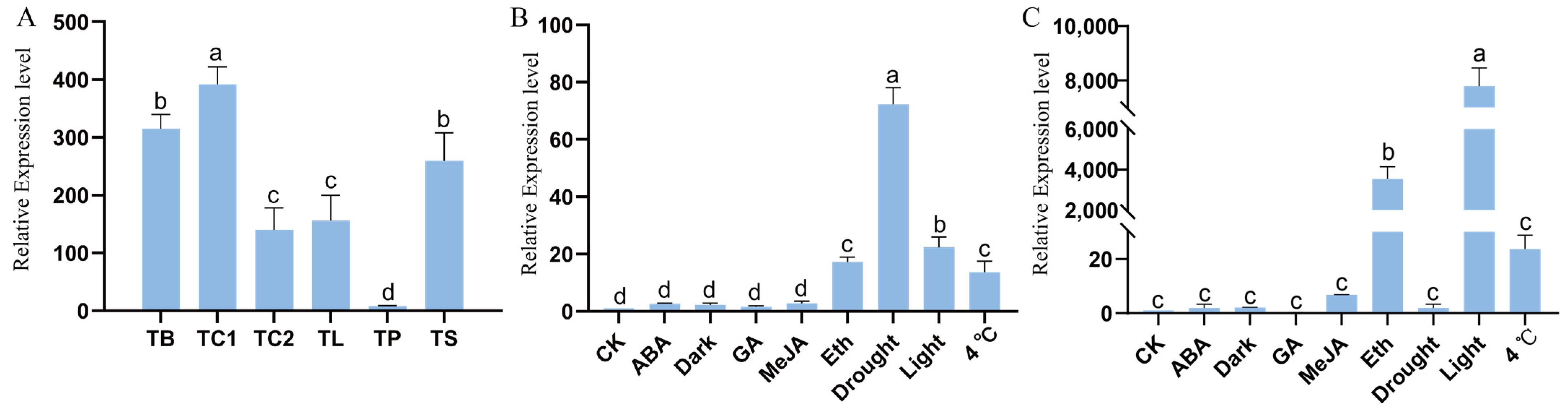
The expression of LaDXS2-2 varied markedly among different tissues of lavender (Figure 2A). Relatively high transcript levels were detected in flower buds, fresh calyxes, and stems, whereas expression was barely detectable in petals. Further qRT-PCR analysis revealed distinct tissue-specific responses of LaDXS2-2 to hormone treatments and abiotic stresses in flower buds and leaves (Figure 2B,C).
In flower buds, LaDXS2-2 expression was significantly induced by Eth, whereas treatments with ABA, GA, and MeJA did not notably enhance its transcript levels. In leaves, high light intensity, Eth, and low-temperature (4 °C) treatments strongly induced LaDXS2-2 expression, while induction by ABA, MeJA, and drought stress was relatively weak. Notably, LaDXS2-2 responded oppositely to GA in the two tissue types: expression was significantly suppressed by GA in leaves but induced in flower buds. This contrasting tissue-specific regulation suggests that LaDXS2-2 may participate in the differential modulation of the GA signaling pathway in different organs. Taken together, these results indicate that LaDXS2-2 expression is precisely controlled by developmental stages, hormonal cues, and environmental stresses, exhibiting pronounced tissue-specific response patterns.

3.3. Subcellular Localization of LaDXS2-2

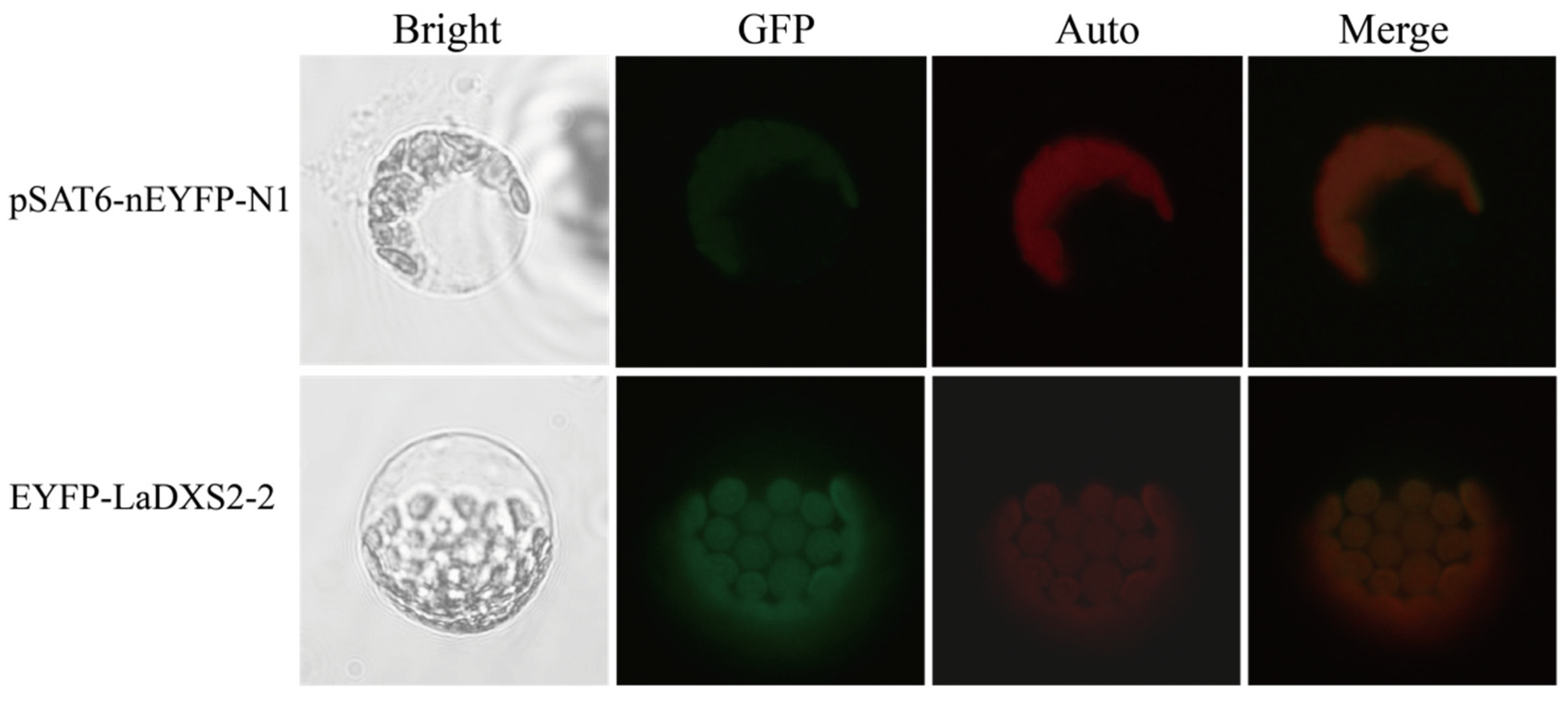
To determine the subcellular localization of LaDXS2-2, a transient expression assay was performed in Arabidopsis mesophyll protoplasts. Confocal laser scanning microscopy (Figure 3) showed that the EYFP fluorescence signal of the LaDXS2-2-EYFP fusion protein completely overlapped with the red autofluorescence of the chloroplast. In contrast, cells transformed with the empty vector pSAT6-nEYFP-N1 showed EYFP fluorescence distributed throughout the entire cell, indicating that the free EYFP was not targeted to chloroplasts but was uniformly distributed in the cytoplasm. These results implied that LaDXS2-2 is localized to chloroplasts, consistent with bioinformatics predictions and the known function of DXS enzymes in plastidial isoprenoid biosynthesis [3,6].

3.4. Generation and Identification of LaDXS2-2 Transgenic Tobacco Plants

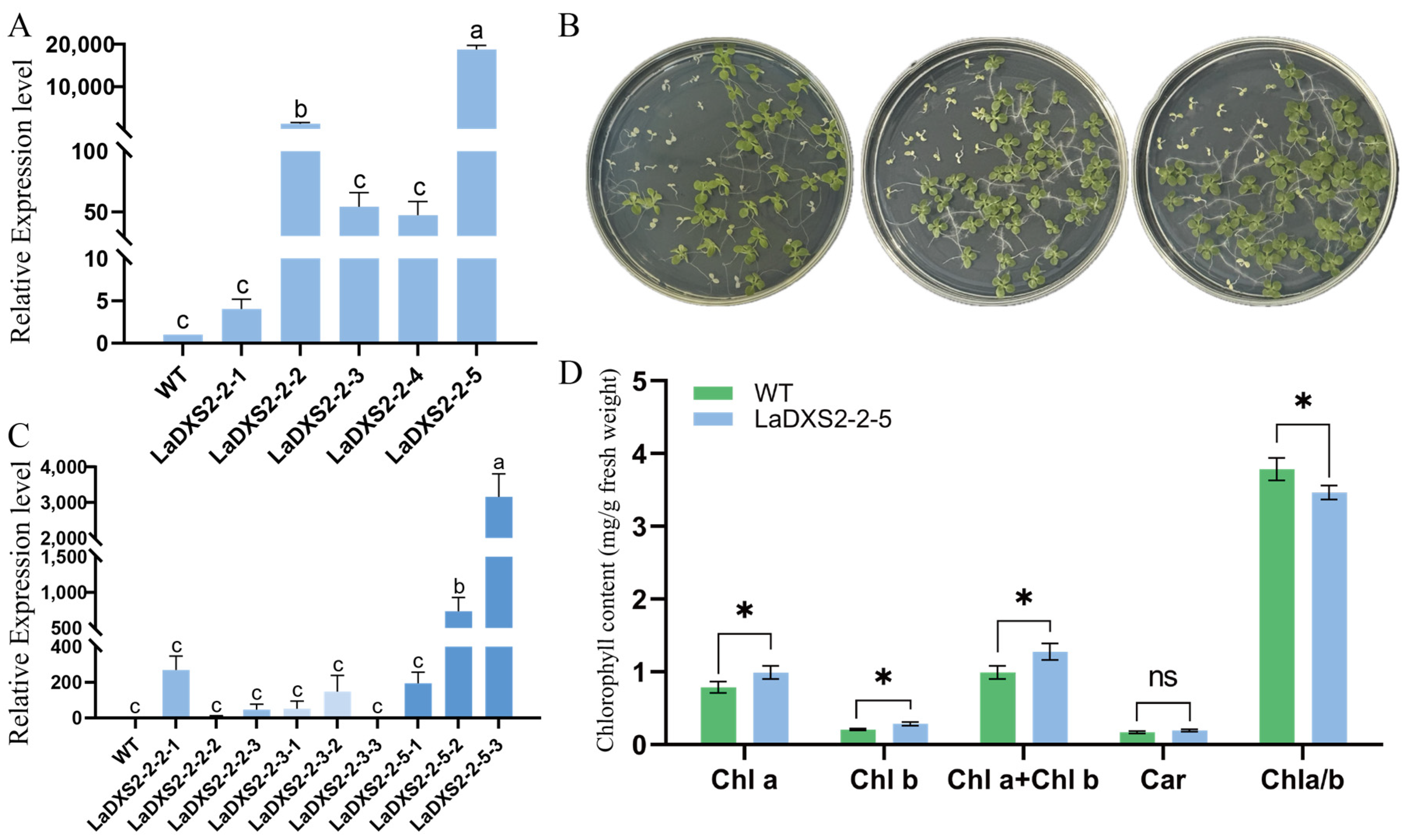
Transgenic tobacco plants were generated via Agrobacterium-mediated leaf disc transformation, and T0 plants were obtained following kanamycin selection. Putative transgenic lines were confirmed by PCR amplification and sequencing. qRT-PCR analysis revealed that the expression level of LaDXS2-2 was significantly upregulated in five T0 transgenic plants compared with WT plants (Figure 4A), confirming successful overexpression of the gene in tobacco. Three independent T0 lines exhibiting the higher expression levels (OE-LaDXS2-2-2, OE-LaDXS2-2-3, and OE-LaDXS2-2-5) were selected for seed collection. T1 plants were obtained by screening on MS medium supplemented with 600 mg/L kanamycin (Figure 4B). qRT-PCR analysis of T1 plants revealed that the relative expression levels of LaDXS2-2 remained significantly different among the three lines, consistent with the expression trends observed in the T0 generation. Notably, line OE-LaDXS2-2-5 maintained the highest expression level in the T1 generation (Figure 4C). These results demonstrate that the overexpression of LaDXS2-2 is stably inherited in tobacco, providing reliable experimental materials for further functional studies.

3.5. Analysis of Photosynthetic Pigment Content and Photosynthetic Efficiency in LaDXS2-2-5 Transgenic Tobacco

To investigate the effects of LaDXS2-2 overexpression on photosynthetic function, photosynthetic pigment contents and chlorophyll fluorescence parameters were measured in leaves of the T1 high-expression line OE-LaDXS2-2-5.
Compared with WT plants, transgenic leaves showed significant increases in chlorophyll a (26.03%), chlorophyll b (37.96%), and total chlorophyll (28.52%) (p < 0.05; Figure 4D). The chlorophyll a/b ratio was significantly lower in transgenic plants, indicating a greater relative accumulation of chlorophyll b than chlorophyll a. This observation suggests a more efficient assembly of light-harvesting pigment-protein complexes on the thylakoid membrane, which may improve light capture and energy transfer efficiency. Carotenoid content increased by 14.85%, though the difference did not reach statistical significance (p = 0.128). Collectively, these results indicate that overexpression of LaDXS2-2 effectively promotes the biosynthesis of photosynthetic pigments in tobacco leaves.
Chlorophyll fluorescence analysis revealed that the actual photochemical efficiency of PSII [Y(II)] in the transgenic line was significantly higher (12.33% increase, p < 0.05) than that in the WT plants (Table 1), indicating enhanced light energy conversion efficiency. The maximum photochemical efficiency (Fv/Fm) remained in the normal range (0.80–0.85) in both groups, with no significant difference observed (p = 0.155), suggesting that the introduced transgene did not adversely affect the structural integrity of the PSII reaction centers. Moreover, the NPQ coefficient was significantly lower in the transgenic line (p < 0.05), reflecting a more efficient allocation of absorbed light energy toward photochemistry and a corresponding reduction in non-radiative heat dissipation. In addition, the quantum yield of non-regulated energy dissipation [Y(NO)] was also markedly decreased in the transgenic plants (p < 0.05), demonstrating improved photoprotective capacity and greater stability of the photosynthetic apparatus under light stress.

3.6. Comparative Transcriptomic and Metabolomic Analysis of LaDXS2-2-Overexpressing and WT Tobacco

3.6.1. Transcriptomic Differences Between LaDXS2-2-Overexpressing and WT Tobacco

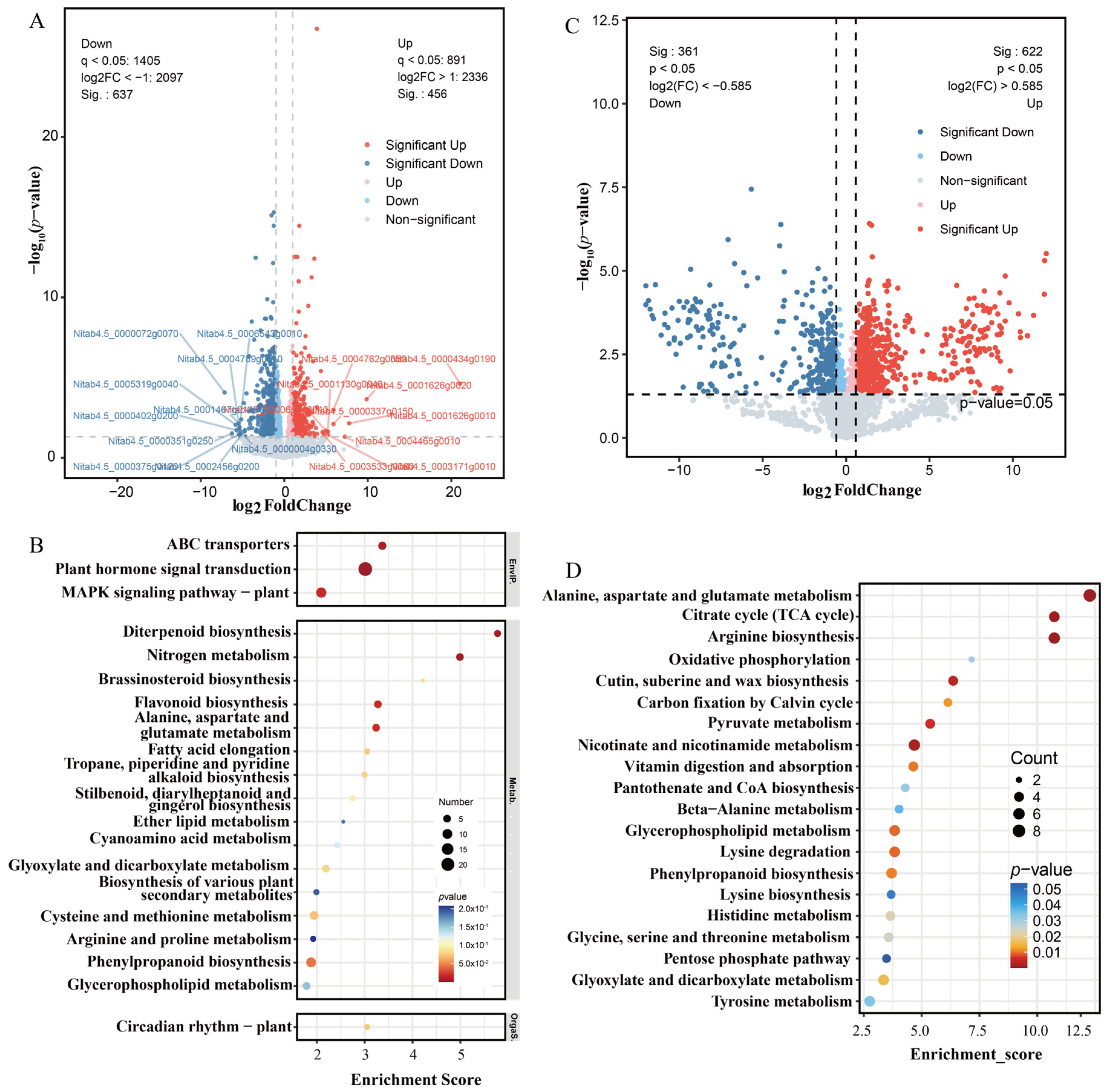
Transcriptomic profiling revealed a total of 1093 DEGs between OE-LaDXS2-2-5 and WT plants (Figure 5A,B), comprising 456 significantly up-regulated and 637 significantly down-regulated genes. Among these, 24 DEGs were primarily associated with plant hormone signal transduction pathways, including auxin, jasmonic acid (JA), and abscisic acid (ABA) signaling. These pathways likely constitute key regulatory hubs through which LaDXS2-2 modulates plant physiological processes. For instance, multiple members of the protein phosphatase 2C (PP2C) family were down-regulated; notably, Nitab4.5_0000072g0070 was reduced by 7.15-fold. PP2Cs are well-characterized negative regulators in the ABA signaling pathway.
The diterpenoid biosynthesis pathway showed the highest enrichment score (5.76), indicating its pronounced role in terpenoid-related secondary metabolism. Moreover, genes involved in phenylpropanoid and flavonoid metabolism, such as CHS2 (chalcone synthase) and CCR2 (cinnamoyl-CoA reductase), were also strongly suppressed. This included several UDP-glycosyltransferase genes, such as UGT73C4 (Nitab4.5_0002818g0080) and UGT73C1 (Nitab4.5_0000725g0100, Nitab4.5_0000601g0080), dihydroflavonol-4-reductase DFR (Nitab4.5_0004420g0010), and cytochrome P450 enzyme CYP76AH1 (Nitab4.5_0001693g0100), all of which were markedly down-regulated. Multiple redox-related enzyme-related genes (e.g., Nitab4.5_0008610g0020) mapped to the phenylpropanoid biosynthesis pathway were similarly reduced.
Pathways associated with nitrogen metabolism, ABC transporters, and the MAPK signaling pathway in plants were also significantly enriched. The identified DEGs encompassed transcription factors from the MYB, ERF, WRKY, and auxin-induced protein families, which participate in transcriptional regulatory networks. Several key transcription factors, including Nitab4.5_0011729g0030 (RL2, log2FC: −3.82), Nitab4.5_0002128g0040 (CPRF3, log2FC: −1.31), and Nitab4.5_0001933g0010 (MYR2, log2FC: −1.11), were down-regulated, which may account for the broad suppression of downstream gene expression.

3.6.2. Comparative Metabolomic Profiling of LaDXS2-2-Overexpressing and WT Tobacco

Metabolomic analysis identified a total of 983 DAMs between the OE-LaDXS2-2-5 line and WT plants (Figure 5C,D), among which 622 were up-regulated and 361 were down-regulated. Up-regulated DAMs accounted for nearly two-thirds of the total, reflecting a prominent accumulation trend. In contrast, most flavonoid compounds were markedly down-regulated in the overexpressing line. For instance, the levels of rutin and quercetin 3-(6″-malonylneohesperidoside) decreased by 3.91-fold and 3.98-fold, respectively. Similarly, phenolic acids downstream of the phenylpropanoid pathway were significantly suppressed; chlorogenic acid and neochlorogenic acid showed log2FC values of −6.13 and −6.69, respectively, indicating their considerably higher abundance in WT plants. Conversely, certain lipids, fatty acid derivatives, and organic acids were notably up-regulated in the transgenic line, with malic acid, tyramine, 13-HPODE (a lipid peroxide), and octadecanedioic acid increasing by 1.40- to 2.56-fold.
KEGG enrichment analysis revealed that the DAMs were most significantly associated with amino acid metabolism, carbohydrate metabolism, and several key secondary metabolic pathways. Alanine, aspartate and glutamate metabolism and arginine biosynthesis emerged as the two most significantly enriched pathways, highlighting a substantial perturbation of core nitrogen and amino acid metabolism upon LaDXS2-2 overexpression. Significant enrichment of DAMs was also observed in the citrate cycle (TCA cycle), a central hub of cellular energy metabolism, suggesting that LaDXS2-2 overexpression may alter respiratory efficiency and carbon skeleton allocation, thereby influencing growth rates and biosynthetic capacity. Similarly, the carbon fixation pathway (Calvin cycle) showed notable DAM enrichment, implying that LaDXS2-2 overexpression could indirectly modulate photosynthetic efficiency—potentially through shifts in carbon allocation and photosynthate accumulation—which aligns with the chlorophyll fluorescence data. Moreover, the phenylalanine, tyrosine and tryptophan biosynthesis pathway, which provides aromatic amino acid precursors for flavonoid and lignin synthesis, was significantly enriched. This result suggests that LaDXS2-2 overexpression may limit the supply of precursors for flavonoids and phenolic acids, consistent with the observed lower accumulation of these secondary metabolites in the transgenic line.
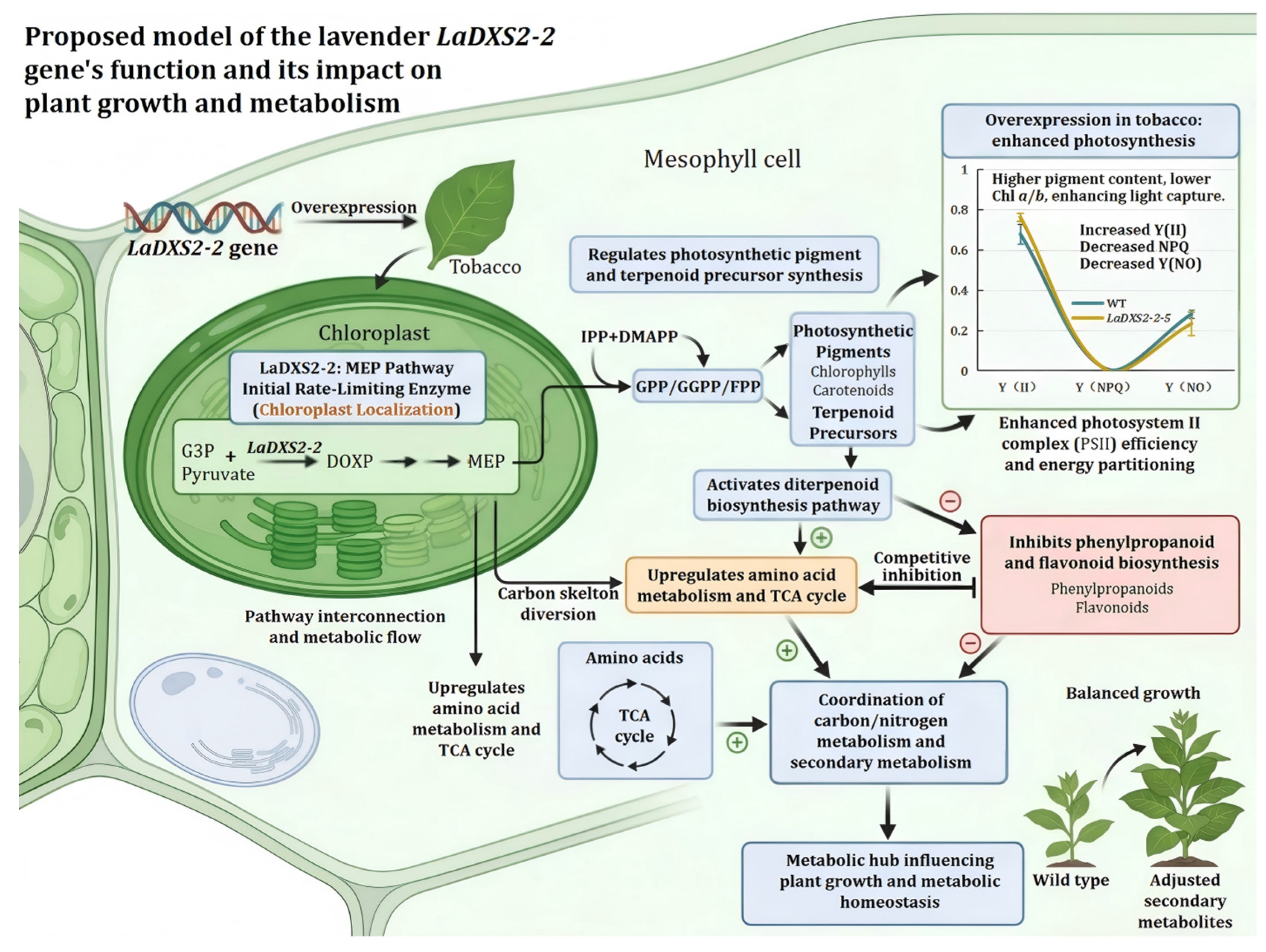
On the integrated transcriptomic and metabolomic analyses, this study proposes a molecular mechanism model illustrating how LaDXS2-2 regulates photosynthesis and carbon-nitrogen metabolism in tobacco (Figure 6). As shown in Figure 6, LaDXS2-2, the rate-limiting enzyme of the MEP pathway, is proposed to enhance the supply flux of IPP and DMAPP in chloroplasts when overexpressed, though direct flux measurements are required to confirm this. On the one hand, the enhanced carbon flux promotes the biosynthesis of chlorophylls and carotenoids, thereby optimizing light-harvesting capacity. On the other hand, the upstream metabolic shift activates the diterpenoid biosynthesis pathway and up-regulates amino acid metabolism and the TCA cycle, while competitively suppressing the synthesis of phenylpropanoids and flavonoids.

4. Discussion

The MEP pathway plays a central role in plant terpenoid biosynthesis, with its first rate-limiting enzyme, DXS, catalyzing the condensation of pyruvate and glyceraldehyde-3-phosphate to generate 1-deoxy-D-xylulose-5-phosphate (DXP) [25,26]. The results of the present study demonstrate that LaDXS2-2 is not merely a gene involved in secondary metabolism; rather, it may function as a metabolic hub that links primary metabolism (photosynthesis) and secondary metabolism, as illustrated in Figure 6. By enhancing the flux of the MEP pathway, LaDXS2-2 may coordinate the allocation of carbon resources toward both growth-related processes (e.g., photosynthetic pigment biosynthesis) and defense-related or medicinal compound production (e.g., diterpenoids). While these findings suggest a potential role for LaDXS2-2 in carbon-nitrogen metabolic coordination, direct physiological measurements are needed to confirm this model.

4.1. Conservation and Functional Implications of LaDXS2-2 Suggest Its Central Role in the MEP Pathway

Bioinformatics analysis revealed that LaDXS2-2 encodes a typical chloroplast-localized DXS protein, which contains four intact functional domains essential for DXS enzymatic activity: the ThDP-binding domain, the TKT domain, the PRFO domain, and the TKT-like Pyr-bd domain [27,28,29]. Phylogenetic analysis demonstrated that LaDXS2-2 clusters with its ortholog from S. miltiorrhiza, indicating functional conservation among closely related species and suggesting a potentially pivotal role in terpenoid biosynthesis across medicinal plants of the Lamiaceae family. The subcellular localization results were consistent with the bioinformatics predictions, confirming that LaDXS2-2 is localized and functional in chloroplasts. Notably, the protein was predicted to harbor 67 potential phosphorylation sites, strongly implying that its enzymatic activity may be finely regulated via post-translational modifications, especially phosphorylation. This observation provides a novel perspective on how environmental signals may modulate MEP flux through the post-translational modification of DXS enzymes.

4.2. Overexpression of LaDXS2-2 Enhances Photosynthetic Capacity by Promoting Pigment Biosynthesis and Optimizing Light-Energy Utilization

Recent studies have highlighted how plant physiological establishment is shaped by water availability, stomatal regulation, gas exchange, photosynthetic performance, and metabolic resource allocation [30,31]. These findings provide a broader context for interpreting the physiological and metabolic changes observed in LaDXS2-2- overexpressing tobacco plants in the present study. In our study, overexpression of LaDXS2-2 was associated with increased photosynthetic pigment content and improved chlorophyll fluorescence parameters in tobacco leaves. The increase in chlorophyll b was more pronounced than that in chlorophyll a, leading to a significantly lower Chl a/b ratio (decreased by 8.54%, p < 0.05). The shift is often linked to a higher relative abundance of light-harvesting complex II (LHCII), which helps plants capture more light energy under low or fluctuating light conditions. Consistent with this observation, transgenic plants exhibited higher actual photochemical efficiency Y(II) and lower NPQ and Y(NO). Together, these results demonstrate that LaDXS2-2 overexpression not only increased the abundance of light-harvesting pigments but also enhanced light energy conversion efficiency and photoprotective capacity. This allows PSII to utilize captured light energy more efficiently for photochemistry while minimizing wasteful energy dissipation. These findings align with previous reports on the role of the MEP pathway in regulating chlorophyll biosynthesis. For example, the rice YGL3 gene—a key MEP pathway gene—has been shown to promote chlorophyll accumulation and thylakoid membrane stability by upregulating genes related to chloroplast development [32]. These observed effects of LaDXS2-2 overexpression are likely mediated through an enhanced MEP pathway flux, which supplies more abundant IPP and DMAPP precursors for the biosynthesis of photosynthesis-related terpenoids, such as chlorophylls, carotenoids, and plastoquinone. This, in turn, optimizes the composition and function of thylakoid membranes [33,34].
It should be noted that these measurements were performed on a single T1 line (OE-LaDXS2-2-5). Therefore, the results may not fully represent the general effects of LaDXS2-2 overexpression and require confirmation using additional independent lines in future studies.

4.3. Multi-Omics Analysis Reveals That LaDXS2-2 Reprograms Metabolic Flux, Reshaping the Carbon-Nitrogen Balance and Secondary Metabolic Network

Metabolomic profiling revealed that amino acids associated with nitrogen metabolism—including alanine, aspartate, glutamate, and arginine—as well as TCA cycle intermediates such as malate, were significantly elevated in the overexpression lines. Concurrently, pathways related to carbon fixation were notably enriched. These findings suggest that the enhanced MEP pathway cooperates with increased nitrogen assimilation, respiration [35], and carbon fixation processes [36] to supply ample carbon skeletons, energy, and nitrogen sources, thereby supporting accelerated plant growth [37]. This metabolic reprogramming likely underpins the improved photosynthetic performance observed in transgenic plants, and further explains how DXS, despite its canonical role as the limiting enzyme of terpenoid biosynthesis, can exert broad physiological effects beyond terpenoid metabolism when overexpressed.
Nevertheless, a notable paradox emerged: although the MEP pathway operates upstream of terpenoid biosynthesis, overexpression of LaDXS2-2 led to pronounced suppression of the downstream phenylpropanoid/flavonoid pathway. Transcriptomic data revealed that multiple structural genes in this pathway, including CHS2, CCR2, DFR, and CYP, as well as key transcription factors such as MYB and RL2, were significantly downregulated. Metabolomic analysis further confirmed a sharp reduction in flavonoids and phenolic acids, including rutin and chlorogenic acid. This pattern strongly implies that, under conditions of limited cellular resources (carbon, energy, and reducing power), the substantially enhanced flux through the MEP pathway may divert substrates away from the shikimate pathway, driving a systemic reallocation of metabolic resources. Simultaneously, the observed downregulation of several PP2C genes in LaDXS2-2-overexpressing plants suggests a possible interaction with ABA signaling components. Since ABA is known to suppress certain growth-related pathways and modulate secondary metabolism, this alteration may contribute to the observed changes in growth phenotypes. However, as no ABA-response assays were performed in this study, this remains a speculation that requires experimental validation. Moreover, the enrichment of the diterpenoid biosynthesis pathway downstream of the MEP pathway directly reflects the activation of its downstream terpenoid branches following LaDXS2-2 overexpression. These observations represent correlative evidence that warrants further validation through direct measurements of gas exchange, biomass, nitrogen content, and enzyme activities.
In summary, through integrated multi-omics analysis, this study provides heterologous functional evidence that LaDXS2-2 overexpression in tobacco modulates the MEP pathway, improves photosynthetic efficiency, and alters primary metabolism. By modulating MEP pathway flux, LaDXS2-2 may influence the dynamics of primary carbon and nitrogen metabolism and trigger resource reallocation among competing secondary metabolic pathways, such as the phenylpropanoid pathway. These insights provide a mechanistic paradigm for understanding the trade-offs and metabolic competition that shape plant secondary metabolism. However, these findings are based on transcriptomic and metabolomic correlations, and direct physiological and biochemical measurements are required to confirm the proposed model of carbon-nitrogen metabolic coordination. Furthermore, direct validation in lavender is required to confirm its native role in terpenoid metabolism.

Supplementary Materials

The following supporting information can be downloaded at https://www.mdpi.com/article/10.3390/horticulturae12060753/s1, Table S1: Primer sequence information.

Author Contributions

Conceptualization, L.C. and Y.C.; methodology, L.C. and X.T.; software, X.T. and M.S.; validation, X.T., M.S., L.Y., and Q.H.; formal analysis, X.T. and M.S.; resources, Y.C.; data curation, Q.H. and L.Y.; writing—original draft preparation, X.T. and L.C.; writing—review and editing, L.C. and Y.C.; supervision, L.C. and Y.C.; funding acquisition, L.C. and Y.C. All authors have read and agreed to the published version of the manuscript.

Funding

This research was funded by the Doctoral Research Start-up Fund Project of Xinjiang Normal University, grant number XJNUBS2024; the Central Government-Guided Local Science and Technology Development Special Fund, grant number ZYYD2026ZY07.

Data Availability Statement

The raw data supporting the conclusions of this article will be made available by the authors on request.

Acknowledgments

We sincerely thank the reviewers for their valuable and constructive suggestions, which greatly improved the quality of this article.

Conflicts of Interest

The authors declare no conflicts of interest.

Abbreviations

The following abbreviations are used in this manuscript:
DXS1-Deoxy-D-xylulose-5-phosphate synthase
MEPMethylerythritol phosphate
CDSCoding sequence
NPQNon-photochemical quenching
Y(II)actual photochemical efficiency of photosystem II
IPPIsopentenyl pyrophosphate
DMAPPDimethylallyl pyrophosphate
MVAMevalonate
NJNeighbor-Joining
GAGibberellin
ABAAbscisic acid
MeJAMethyl jasmonate
EthEthephon
qRT-PCRQuantitative real-time PCR
WTWild-type
FoInitial fluorescence
FmMaximum fluorescence
Fv/FmMaximum photochemical efficiency of photosystem II
DEGsDifferentially expressed genes
DAMsDifferentially accumulated metabolites
TKTTransketolase
PFORPyruvate ferredoxin oxidoreductase
TKT-like Pyr-bdTransketolase-like pyrimidine-binding domain
PP2CProtein phosphatase 2C
CHS2Chalcone synthase
CCR2Cinnamoyl-CoA reductase
LHCIILight-harvesting complex II

References

  1. Hassiotis, C.N.; Vlachonasios, K.E. How biological and environmental factors affect the quality of lavender essential oils. Physiologia 2025, 5, 11. [Google Scholar] [CrossRef]
  2. Fontez, M.; Bony, A.; Nicole, F.; Moja, S.; Jullien, F. Lavandula angustifolia Mill. a model of aromatic and medicinal plant to study volatile organic compounds synthesis, evolution and ecological functions. Bot. Lett. 2023, 170, 65–76. [Google Scholar] [CrossRef]
  3. León, P.; Cordoba, E. Understanding the mechanisms that modulate the MEP pathway in higher plants. In Isoprenoid Synthesis in Plants and Microorganisms: New Concepts and Experimental Approaches; Springer: New York, NY, USA, 2012; pp. 457–464. [Google Scholar] [CrossRef]
  4. Carretero-Paulet, L.; Cairo, A.; Botella-Pavía, P.; Besumbes, O.; Campos, N.; Boronat, A.; Rodríguez-Concepción, M. Enhanced flux through the methylerythritol 4-phosphate pathway in Arabidopsis plants overexpressing deoxyxylulose 5-phosphate reductoisomerase. Plant Mol. Biol. 2006, 62, 683–695. [Google Scholar] [CrossRef] [PubMed]
  5. Lee, Y.J.; Kim, J.K.; Baek, S.A.; Yu, J.S.; You, M.K.; Ha, S.H. Differential regulation of an OsIspH1, the functional 4-hydroxy-3-methylbut-2-enyl diphosphate reductase, for photosynthetic pigment biosynthesis in rice leaves and seeds. Front. Plant Sci. 2022, 13, 861036. [Google Scholar] [CrossRef] [PubMed]
  6. Estévez, J.M.; Cantero, A.; Reindl, A.; Reichler, S.; León, P. 1-Deoxy-D-xylulose-5-phosphate synthase, a limiting enzyme for plastidic isoprenoid biosynthesis in plants. J. Biol. Chem. 2001, 276, 22901–22909. [Google Scholar] [CrossRef] [PubMed]
  7. Sperenger, G.A.; Schorken, U.; Wiegert, T.; Grolle, S.; Graaf, A.; Taylor, S.V. Identification of a thiamin-dependent synthase in Escherichia coli required for the formation of L-deoxy-D-xylulose-5-phosphate, precursor to isoprenoids, thiamin, and pyridoxol. Proc. Natl. Acad. Sci. USA 1997, 94, 12857–12862. [Google Scholar] [CrossRef]
  8. Zhou, W.; Huang, F.; Li, S.; Wang, Y.; Zhou, C.; Shi, M.; Wang, J.; Chen, Y.; Wang, Y.; Wang, H.; et al. Molecular cloning and characterization of two 1-deoxy-D-xylulose-5-phosphate synthase genes involved in tanshinone biosynthesis in Salvia miltiorrhiza. Mol. Breed. 2016, 36, 124. [Google Scholar] [CrossRef]
  9. Wright, L.P.; Rohwer, J.M.; Ghirardo, A.; Hammerbacher, A.; Ortiz-Alcaide, M.; Raguschke, B.; Schnitzler, J.; Gershenzon, J.; Phillips, M.A. Deoxyxylulose 5-phosphate synthase controls flux through the methylerythritol 4-phosphate pathway in Arabidopsis. Plant Physiol. 2014, 165, 1488–1504. [Google Scholar] [CrossRef] [PubMed]
  10. Majdi, M.; Malekzadeh-Mashhady, A.; Maroufi, A.; Crocoll, C. Tissue-specific gene-expression patterns of genes associated with thymol/carvacrol biosynthesis in thyme (Thymus vulgaris L.) and their differential changes upon treatment with abiotic elicitors. Plant Physiol. Biochem. 2017, 115, 152–162. [Google Scholar] [CrossRef] [PubMed]
  11. Srinath, M.; Shailaja, A.; Bindu, B.B.V.; Giri, C.C. Molecular cloning and differential gene expression analysis of 1-deoxy-D-xylulose 5-phosphate synthase (DXS) in Andrographis paniculata (Burm. f) Nees. Mol. Biotechnol. 2021, 63, 109–124. [Google Scholar] [CrossRef] [PubMed]
  12. Kelaremu, K.; Chen, Y.; Li, C.; He, Q.; Chen, L. Genome-wide identification and expression analysis of the DXS gene family in lavender. Genom. Appl. Biol. 2023, 42, 919–926. [Google Scholar] [CrossRef]
  13. Cordoba, E.; Porta, H.; Arroyo, A.; San Román, C.; Medina, L.; Rodríguez-Concepción, M.; León, P. Functional characterization of the three genes encoding 1-deoxy-D-xylulose 5-phosphate synthase in maize. J. Exp. Bot. 2011, 62, 2023–2038. [Google Scholar] [CrossRef] [PubMed]
  14. Ge, H.; Lu, J.; Han, M.; Lu, L.; Tian, J.; Zheng, H.; Liu, S.; Zhong, F.; Hou, M. Identification and functional analysis of 1-Deoxy-D-xylulose-5-phosphate synthase gene in tomatoes (Solanum lycopersicum). Horticulturae 2024, 10, 304. [Google Scholar] [CrossRef]
  15. Cai, Y.; Shi, L.; Chen, F.; Zhang, Q.; Yao, J.; Xiu, Y.; Lu, C.; Lin, S. 1-deoxy-D-xylulose-5-phosphate synthase 1 as a crucial regulatory enzyme for terpenoid biosynthesis in the leaves of Cinnamomum burmannii. Horticulturae 2025, 12, 36. [Google Scholar] [CrossRef]
  16. You, M.K.; Lee, Y.J.; Kim, J.K.; Baek, S.A.; Jeon, Y.A.; Lim, S.H.; Ha, S.H. The organ-specific differential roles of rice DXS and DXR, the first two enzymes of the MEP pathway, in carotenoid metabolism in Oryza sativa leaves and seeds. BMC Plant Biol. 2020, 20, 167. [Google Scholar] [CrossRef] [PubMed]
  17. Yu, C.; Zhang, C.; Xu, X.; Huang, J.; Chen, Y.; Luo, X.; Wang, H.; Shen, C. Omic analysis of the endangered Taxaceae species Pseudotaxus chienii revealed the differences in taxol biosynthesis pathway between Pseudotaxus and Taxus yunnanensis trees. BMC Plant Biol. 2021, 21, 104. [Google Scholar] [CrossRef] [PubMed]
  18. Teufel, F.; Almagro Armenteros, J.J.; Johansen, A.R.; Gíslason, M.H.; Pihl, S.I.; Tsirigos, K.D.; Winther, O.; Brunak, S.; Heijne, G.; Nielsen, H. SignalP 6.0 predicts all five types of signal peptides using protein language models. Nat. Biotechnol. 2022, 40, 1023–1025. [Google Scholar] [CrossRef] [PubMed]
  19. Amico, M.; Finelli, M.; Rossi, I.; Zauli, A.; Elofsson, A.; Viklund, H.; Heijne, G.; Jones, D.; Krogh, A.; Fariselli, P.; et al. PONGO: A web server for multiple predictions of all-alpha transmembrane proteins. Nucleic Aids Res. 2006, 34, W169–W172. [Google Scholar] [CrossRef] [PubMed]
  20. Chou, K.C.; Shen, H.B. Plant-mPLoc: A top-down strategy to augment the power for predicting plant protein subcellular localization. PLoS ONE 2010, 5, e11335. [Google Scholar] [CrossRef] [PubMed]
  21. Jones, P.; Binns, D.; Chang, H.Y.; Fraser, M.; Li, W.; McAnulla, C.; McWilliam, H.; Maslen, J.; Mitchell, A.; Nuka, G.; et al. InterProScan 5: Genome-scale protein function classification. Bioinformatics 2014, 30, 1236–1240. [Google Scholar] [CrossRef] [PubMed]
  22. Duvaud, S.; Gabella, C.; Lisacek, F.; Stockinger, H.; Ioannidis, V.; Durinx, C. Expasy, the Swiss Bioinformatics Resource Portal, as designed by its users. Nucleic Acids Res. 2021, 49, W216–W227. [Google Scholar] [CrossRef] [PubMed]
  23. Waterhouse, A.; Bertoni, M.; Bienert, S.; Studer, G.; Tauriello, G.; Gumienny, R.; Heer, F.T.; Beer, T.A.P.; Rempfer, C.; Bordoli, L.; et al. SWISS-MODEL: Homology modelling of protein structures and complexes. Nucleic Acids Res. 2018, 46, W296–W303. [Google Scholar] [CrossRef] [PubMed]
  24. Yoo, S.D.; Cho, Y.H.; Sheen, J. Arabidopsis mesophyll protoplasts: A versatile cell system for transient gene expression analysis. Nat. Protoc. 2007, 2, 1565–1572. [Google Scholar] [CrossRef] [PubMed]
  25. Gong, Y.F.; Liao, Z.H.; Guo, B.H.; Sun, X.F.; Tang, K.X. Molecular cloning and expression profile analysis of Ginkgo biloba DXS gene encoding 1-deoxy-D-xylulose 5-phosphate synthase, the first committed enzyme of the 2-C-methyl-D-erythritol 4-phosphate pathway. Planta Medica 2006, 72, 329–335. [Google Scholar] [CrossRef] [PubMed]
  26. Querol, J.; Rodríguez-Concepción, M.; Boronat, A.; Imperial, S. Essential role of residue H49 for activity of Escherichia coli 1-deoxy-D-xylulose 5-phosphate synthase, the enzyme catalyzing the first step of the 2-C-methyl-D-erythritol 4-phosphate pathway for isoprenoid synthesis. Biochem. Biophys. Res. Commun. 2001, 289, 155–160. [Google Scholar] [CrossRef] [PubMed]
  27. Xiang, S.; Usunow, G.; Lange, G.; Busch, M.; Tong, L. Crystal structure of 1-deoxy-D-xylulose 5-phosphate synthase, a crucial enzyme for isoprenoids biosynthesis. J. Biol. Chem. 2007, 282, 2676–2682. [Google Scholar] [CrossRef] [PubMed]
  28. Xiang, S.; Usunow, G.; Lange, G.; Busch, M.; Tong, L. 1-Deoxy-D-xylulose 5-phosphate synthase (DXS), a crucial enzyme for isoprenoids biosynthesis. In Isoprenoid Synthesis in Plants and Microorganisms: New Concepts and Experimental Approaches; Springer: New York, NY, USA, 2012; pp. 17–28. [Google Scholar] [CrossRef]
  29. Wang, J.; Shen, Y.M.; Li, B.; Zhou, X.Z.; Liu, C.C.; Zhang, J.Y. Characterization of a functionally active recombinant 1-deoxy-D-xylulose-5-phosphate synthase from Babesia bovis. J. Vet. Med. Sci. 2014, 76, 1021–1027. [Google Scholar] [CrossRef] [PubMed]
  30. Ait Hammou, R.; Harrouni, C.; El Caid, M.B.; Hallouti, A.; Daoud, S. Establishment of argan tree plantlets (Argania spinosa (L.) Skeels) grown from generative and vegetative propagation under different watering regimes at the nursery stage. Biocatal. Agric. Biotechnol. 2022, 44, 102457. [Google Scholar] [CrossRef]
  31. Ait Hammou, R.; El Caid, M.B.; Harrouni, C.; Daoud, S. Germination enhancement, antioxidant enzyme activity, and metabolite changes in late Argania spinosa kernels under salinity. J. Arid Environ. 2023, 219, 105095. [Google Scholar] [CrossRef]
  32. Chen, W.; Tang, L.; Li, Q.; Cai, Y.; Ahmad, S.; Wang, Y.; Tang, S.; Guo, N.; Wei, X.; Tang, S.; et al. YGL3 encoding an IPP and DMAPP synthase interacts with OsPIL11 to regulate chloroplast development in rice. Rice 2024, 17, 8. [Google Scholar] [CrossRef] [PubMed]
  33. Kang, M.K.; Kim, J.Y.; Choi, Y.I.; Hu, L.; Yang, C.; Jin, Z.; Park, Y.; Kim, S.U.; Kim, S.M. Enhanced metabolic flux of methylerythritol phosphate (MEP) pathway by overexpression of Ginkgo biloba 1-Hydroxy-2-methyl-2-(E)-butenyl 4-diphosphate Reductase 1 (GbHDR1) gene in poplar. Appl. Biol. Chem. 2022, 65, 50. [Google Scholar] [CrossRef]
  34. Bergman, M.E.; Kortbeek, R.W.; Gutensohn, M.; Dudareva, N. Plant terpenoid biosynthetic network and its multiple layers of regulation. Prog. Lipid Res. 2024, 95, 101287. [Google Scholar] [CrossRef] [PubMed]
  35. Cousins, A.B.; Bloom, A.J. Oxygen consumption during leaf nitrate assimilation in a C3 and C4 plant: The role of mitochondrial respiration. Plant Cell Environ. 2004, 27, 1537–1545. [Google Scholar] [CrossRef]
  36. Gan, P.; Liu, F.; Li, R.; Wang, S.; Luo, J. Chloroplasts—Beyond energy capture and carbon fixation: Tuning of photosynthesis in response to chilling stress. Int. J. Mol. Sci. 2019, 20, 5046. [Google Scholar] [CrossRef] [PubMed]
  37. Han, X.; Wu, K.; Fu, X.; Liu, Q. Improving coordination of plant growth and nitrogen metabolism for sustainable agriculture. Abiotech 2020, 1, 255–275. [Google Scholar] [CrossRef] [PubMed]
Figure 1. Bioinformatics analysis of LaDXS2-2: (A) Secondary structure prediction of the LaDXS2-2 protein. Colors represent different structural elements: α-helices (blue), β-strands (purple), β-turns (green), and random coils (yellow). The x-axis indicates amino acid position. (B) Predicted tertiary structure of LaDXS2-2. (C) Phosphorylation site prediction; the x-axis shows the amino acid sequence, and the y-axis indicates the probability or score of phosphorylation. (D) Phylogenetic tree constructed with MEGA 11. Species and accession numbers are as follows: lavender (La23G00913), Salvia miltiorrhiza (XP_057786464.1), Scutellaria barbata (QEY10163.1), Andrographis paniculata (XP_051150321.1), Quillaja saponaria (KAJ7979504.1), Sesamum indicum (XP_011069878.1), Genlisea aurea (EPS64831.1), Houttuynia cordata (AHB79076.1), Erythranthe guttata (XP_012831315.1), Bixa orellana (AMJ39460.1), Antirrhinum majus (AAW28999.1), and Striga hermonthica (CAA0819397.1). The symbol “★” (star) in the figure represents the lavender LaDXS2-2 gene.
Horticulturae 12 00753 g001
Figure 2. Expression levels of LaDXS2-2 in lavender: (A) Expression levels of LaDXS2-2 in different lavender tissues. Tissue abbreviations: TB, flower bud; TC1, fresh calyx; TC2, mature calyx; TL, leaf; TP, petal; TS, stem. (B,C) Expression levels of LaDXS2-2 in flower buds (B) and leaves (C) under different hormone and abiotic stress treatments. Bars with different lowercase letters indicate significant differences (p < 0.05, Duncan’s test).
Horticulturae 12 00753 g002
Figure 3. Subcellular localization of LaDXS2-2 in Arabidopsis mesophyll protoplasts. GFP: GFP fluorescence (excitation: 488 nm); Auto: Red chloroplast autofluorescence (excitation: 555 nm); Merge: Overlay of GFP and chloroplast autofluorescence signals. The LaDXS2-2-EYFP fusion protein exhibits clear chloroplast localization, as indicated by the complete overlap of green and red signals.
Horticulturae 12 00753 g003
Figure 4. Molecular characterization and physiological pigment analysis of LaDXS2-2 overexpression in transgenic tobacco. (A) Relative expression of LaDXS2-2 in T0 transgenic plants compared to WT. (B) Kanamycin resistance screening of T1 seeds from T0 transgenic lines. (C) Relative expression of LaDXS2-2 in T1 transgenic tobacco. (D) Chlorophyll a, chlorophyll b, total chlorophyll, and carotenoid contents in LaDXS2-2-5 transgenic and WT plants. Bars with different lowercase letters (A,C) and asterisk “*” (D) indicate significant differences (p < 0.05, Duncan’s test).
Horticulturae 12 00753 g004
Figure 5. Integrated multi-omics analysis of LaDXS2-2-overexpressing versus WT tobacco. (A,B) Transcriptomic analysis: (A) Volcano plot of DEGs. The x-axis represents the log2 fold change (log2FC) in gene expression, and the y-axis represents the negative logarithm of the p-value. The horizontal dashed line indicates the significance threshold of p = 0.05, while the two vertical dashed lines correspond to log2FC = −1 and log2FC = 1, representing a 2-fold change threshold. Red, blue and gray dots denote significantly upregulated significantly downregulated, and not-significantly expressed genes, respectively. (B) KEGG pathway enrichment analysis of DEGs. The x-axis shows the log2FC, and the y-axis shows −log10(p-value). The horizontal dashed line marks p = 0.05, and the two vertical dashed lines represent a custom fold change threshold log2FC = ±0.585. Dark red and dark blue dots represent significantly upregulated (622) and downregulated (361) differential metabolites, respectively. Light red and light blue dots indicate metabolites with fold changes but without statistical significance, and gray dots represent metabolites with no differential expression. (C,D) Metabolomic analysis: (C) Volcano plot of DAMs; (D) KEGG pathway enrichment analysis of DAMs.
Horticulturae 12 00753 g005
Figure 6. Proposed model of LaDXS2-2 regulating photosynthesis and metabolic reprogramming in tobacco. The figure demonstrates how LaDXS2-2, as a key node in the MEP pathway, coordinates the plant’s carbon-nitrogen balance by regulating primary metabolism (photosynthesis) and secondary metabolism (terpenoid biosynthesis). Green circles denote up-regulated pathways, and red circles denote down-regulated pathways. Overexpression of LaDXS2-2 promotes chlorophyll synthesis and photosystem II efficiency, while activating diterpenoid biosynthesis and the TCA cycle, whereas the flavonoid pathway is suppressed. This model is hypothetical and requires confirmation through direct physiological measurements.
Horticulturae 12 00753 g006
Table 1. Comparison of chlorophyll fluorescence parameters between WT and transgenic tobacco with LaDXS2-2-5 gene.
GroupY(II)Fv/FmNPQY(NPQ)Y(NO)
WT0.677 ± 0.050 a 10.816 ± 0.017 a0.027 ± 0.009 a0.008 ± 0.003 a0.280 ± 0.019 a
LaDXS2-2-50.761 ± 0.020 b0.814 ± 0.023 a0.017 ± 0.002 b0.004 ± 0.001 b0.232 ± 0.059 b
1 Data are presented as means ± standard deviations of chlorophyll fluorescence parameters for each group (n = 3 biological replicates, with 3 measurements per replicate). Different lowercase superscript letters within the same row indicate statistically significant differences between groups at p < 0.05 (Duncan’s multiple range test). Y(II), actual photochemical efficiency of photosystem II; Fv/Fm, maximum photochemical efficiency of photosystem II; NPQ, non-photochemical quenching coefficient; Y(NPQ), fraction of energy dissipated in regulated photoprotective processes; Y(NO), fraction of energy passively dissipated in non-regulated processes. WT, wild-type tobacco; LaDXS2-2-5, LaDXS2-2-5 transgenic tobacco.
Disclaimer/Publisher’s Note: The statements, opinions and data contained in all publications are solely those of the individual author(s) and contributor(s) and not of MDPI and/or the editor(s). MDPI and/or the editor(s) disclaim responsibility for any injury to people or property resulting from any ideas, methods, instructions or products referred to in the content.