Article

Genome-Wide Identification and Light-Induced Expression Analysis of the BPC Gene Family in Peucedanum praeruptorum Dunn

1
Institute of Chinese Materia Medica and Ethnomedicine Resources, Guizhou University of Traditional Chinese Medicine, Guiyang 550025, China
2
Provincial Key Laboratory of Germplasm Innovation and Efficient Utilization of Authentic Medicinal Materials, Guiyang 550025, China
3
State Key Laboratory for Quality Ensurance and Sustainable Use of Dao-di Herbs, Beijing 100700, China
*
Authors to whom correspondence should be addressed.
These authors contributed equally to this work.
Horticulturae 2026, 12(8), 905; https://doi.org/10.3390/horticulturae12080905
Submission received: 22 May 2026 / Revised: 10 July 2026 / Accepted: 21 July 2026 / Published: 23 July 2026
(This article belongs to the Special Issue Tolerance of Horticultural Plants to Abiotic Stresses)

Abstract

The BASIC PENTACYSTEINE (BPC) family represents a group of plant-specific transcription factors with established functions in developmental regulation and environmental adaptation. Although BPC genes have been catalogued in diverse plant species, their genome-wide characterization and light-dependent expression dynamics remain unexplored in the medicinal herb Peucedanum praeruptorum Dunn. Here, we report the systematic identification of eight PpBPC loci from the P. praeruptorum genome assembly through comprehensive bioinformatic screening. Evolutionary reconstruction grouped these eight members into three distinct clades (designated A, B, and C). Comparative genomic analyses revealed pronounced syntenic conservation between PpBPCs and their counterparts in Arabidopsis thaliana, Angelica sinensis, and Daucus carota. Members clustered within the same phylogenetic group displayed analogous exon-intron architectures and conserved motif repertoires, and all possessed the characteristic GAGA-binding domain. Examination of transcript abundance across organs demonstrated that clade A and C members shared broadly overlapping expression signatures in root, stem, and leaf tissues, whereas clade B genes exhibited organ-prevalent patterns. When seedlings were treated with three monochromatic light regimes, the PpBPC family displayed heterogeneous transcriptional responses, with individual clades showing distinct wavelength sensitivities. In particular, PpBPC6 and PpBPC8 were strongly activated by blue light. Collectively, these data delineate the foundational landscape of the PpBPC family and highlight candidate members likely involved in light signal transduction, thereby establishing a framework for future mechanistic dissection of light-responsive gene regulation in P. praeruptorum.

1. Introduction

Peucedanum praeruptorum Dunn belongs to the genus Peucedanum of the Apiaceae family, whose dried roots are used as the traditional Chinese medicine Peucedani Radix [1] With a long-standing history of clinical application, Peucedani Radix exerts therapeutic effects of descending “Qi”, resolving phlegm, dispelling wind and clearing heat. Clinically, it is indicated for cough, excessive sputum, chest oppression and asthma, making it a commonly prescribed herb for respiratory disorders [2]. P. praeruptorum is widely distributed throughout China, with its major producing regions concentrated in Zhejiang, Anhui, Guizhou, Hubei, Sichuan, Jiangxi and Hunan Provinces [3]. Marked divergences in climate, soil and topography exist across these regions, among which variations in altitude and light regimes are particularly pronounced. Such environmental heterogeneity directly leads to regional differences in plant growth, bioactive constituent accumulation and medicinal quality [4,5]. Notably, Guizhou Province is one of the primary production regions of P. praeruptorum in China. Its distinctive karst topography, featuring fragmented and rugged terrain, restricts arable land to scattered intermountain basins and slopes, thereby resulting in high microenvironmental heterogeneity [6]. In the cultivation regions of P. praeruptorum in Guizhou Province, altitude varies drastically from 600 to 1800 m. Altitudinal gradients induce pronounced variations in light regimes, temperature, humidity, and soil properties, which profoundly modulate the growth, development, and physiological metabolism of P. praeruptorum.
The BASIC PENTACYSTEINE (BPC) gene family is a plant-specific transcription factor family, whose members harbor a highly conserved C-terminal domain composed of five cysteine residues [7]. Through specific recognition of GAGA-repeat elements within target gene promoters, BPC proteins exert transcriptional control over downstream loci [8]. Beyond the conserved core domain, substantial divergences exist in conserved motifs among members of different BPC protein subfamilies, and the composition of these motifs further ensures the conservation and functional divergence of subfamily genes. Regulating plant growth and development constitutes the core function of the BPC gene family, which is mainly involved in floral organ development, embryogenesis, seed formation, and maintenance of the shoot apical meristem [9,10,11,12,13]. In Arabidopsis thaliana, AtBPC proteins regulate the normal differentiation of floral organs; the bpc1-2 bpc2 bpc3 triple mutant exhibits pleiotropic defects, including enlargement of the inflorescence meristem and flowers with supernumerary floral organs [14]. Overexpression of CjBPC1, derived from the ornamental flower-Camellia japonica, in A. thaliana leads to severe defects in siliques and seeds [15]. In apple (Malus domestica), MdBPC2 negatively regulates auxin synthesis, which specifically reduces plant height and inhibits root development [16].
Beyond developmental control, mounting evidence points to the involvement of BPC factors in stress signaling and hormonal pathways. The promoters of BPC gene family members harbor cis-acting elements responsive to light, phytohormones, developmental cues, and various abiotic/biotic stresses, implying their versatile biological functions. Research on members of the BjuBPC gene family in mustard showed that BjuBPC9 exhibits specific responsiveness to blue light, suggesting its role in enhancing mustard adaptability to high-altitude environments with strong blue-violet light [17]. Furthermore, BPC gene family members in tobacco [18], alfalfa [19], pear [20], cotton [21], and cucumber [22] play important roles in responses to salt, drought, low temperature, and hormone stresses.
Therefore, given the complexity and heterogeneity of growing environments across major producing regions—particularly in Guizhou Province—investigations into the BPC gene family of P. praeruptorum and its responsiveness to different light qualities are of great significance. Identification of key light-responsive candidate genes will help unravel the molecular regulatory mechanisms underlying microhabitat adaptation in P. praeruptorum.

2. Materials and Methods

2.1. Plant Materials and Light Quality Treatments

The Peucedanum praeruptorum Dunn used as experimental material was kindly provided by Professor Xiaobo Zhang. Bolting-stage plants grown under natural conditions in the Chinese Medicine Resource Nursery of Guizhou University of Traditional Chinese Medicine were collected for tissue-specific expression analysis. Two-month-old seedlings were subjected to light-quality treatments. Seedlings were cultivated in an artificial climate chamber at a constant temperature of 22 °C with a 16 h light/8 h dark photoperiod for 7 days. Four light-quality regimes were applied: white light (full spectrum, 400–700 nm), blue light (450 nm), red light (660 nm), and far-red light (730 nm).

2.2. Data Sources

The genome data of P. praeruptorum [1], Angelica sinensis [23], and Daucus carota [24] are listed in Supplementary Table S1. BPC protein sequences of A. thaliana were obtained from the TAIR database (https://www.arabidopsis.org).

2.3. Identification and Physicochemical Characterization of the PpBPC Gene Family

A dual strategy combining sequence homology and domain-based screening was adopted to identify BPC family members in P. praeruptorum. First, the seven AtBPC protein sequences served as queries in BLASTP searches (implemented within TBtools-II v2.390) against the predicted P. praeruptorum proteome, applying a stringent E-value threshold of 1 × 10⁻²⁰. After removing redundant hits, the preliminary candidate pool was further filtered using the HMMER web service (https://www.ebi.ac.uk/Tools/hmmer/search/hmmscan, accessed on 7 April 2026) with the Hidden Markov Model profile of the GAGA conserved domain (PF06217) obtained from the Pfam database (http://pfam.xfam.org/, accessed on 7 April 2026) [25]; only proteins harboring this signature domain were retained. To ensure domain completeness, all surviving candidates were examined with NCBI Batch CD-Search (https://www.ncbi.nlm.nih.gov/Structure/bwrpsb/bwrpsb.cgi, accessed on 7 April 2026), and sequences displaying truncated or partial GAGA domains were discarded manually. This pipeline yielded eight non-redundant BPC homologs in P. praeruptorum, which were sequentially named PpBPC1 through PpBPC8. Genomic and coding sequences (CDS) corresponding to each locus were extracted for further investigation.
The physicochemical attributes of the deduced PpBPC proteins—including residue count, molecular mass, theoretical pI, instability index, and grand average of hydropathicity (GRAVY)—were computed with the ProtParam utility on the ExPASy platform (http://web.expasy.org/protparam/, accessed on 7 April 2026). Predicted subcellular targeting was assessed using Plant-mPLoc 2.0 (http://www.csbio.sjtu.edu.cn/bioinf/plant-multi/, accessed on 7 April 2026).

2.4. Chromosomal Localization and Collinearity Analysis of PpBPC Genes

Chromosomal coordinates of PpBPC loci were determined and graphically rendered with TBtools-II (v2.390) [26]. Intraspecific collinearity scanning was performed via the integrated MCScanX toolkit within TBtools-II to detect duplication-derived gene pairs in the P. praeruptorum genome. MCScanX was run using default settings except for E-value = 1 × 10⁻¹⁰ and Number of Hits = 5. The software output file geneLinkedRegion.tab displays collinear gene pairs. To examine cross-species conservation, interspecific synteny analyses were conducted between P. praeruptorum and A. thaliana, A. sinensis, and D. carota. Subsequently, the KaKs_Calculator plugin embedded in TBtools-II was employed to compute nonsynonymous (Ka) and synonymous (Ks) substitution rates along with their ratios (Ka/Ks) for each duplicated pair, enabling inference of the selective regimes operating during BPC family evolution.

2.5. Phylogenetic Analysis of the PpBPC Gene Family

Amino acid sequences of BPC proteins from A. thaliana, P. praeruptorum, A. sinensis, and D. carota were subjected to multiple sequence alignment via the MUSCLE algorithm within MEGA12 [27]. The resulting alignment was used to infer an interspecific phylogenetic tree by the Neighbor-Joining (NJ) approach under the Poisson substitution model with pairwise gap deletion; clade support was estimated from 1000 bootstrap pseudoreplicates. Orthology and paralogy assignments among BPC sequences were deduced from this tree, and the topology was refined and displayed using iTOL (https://itol.embl.de).
In parallel, an intraspecific NJ phylogeny was reconstructed exclusively from PpBPC protein sequences under identical parameters (Poisson model, pairwise deletion, 1000 bootstrap replicates) to delineate subgroup affiliations within the P. praeruptorum BPC repertoire.

2.6. Gene Structure and Motif Analysis of PpBPC Genes

Conserved sequence motifs across PpBPC proteins were discovered with the MEME Suite plugin bundled in TBtools-II (v2.390), allowing up to 10 motifs ranging from 6 to 50 residues in width. Motifs consistently recovered from the majority of PpBPC members were selected for detailed comparative analysis. Upstream regulatory regions (2 kb relative to the transcription start site) of each PpBPC gene were isolated using TBtools-II (v2.390) and interrogated for cis-regulatory elements via the PlantCARE database (http://bioinformatics.psb.ugent.be/webtools/plantcare/html/, accessed on 7 April 2026). Annotations classified as “unknown” or corresponding to generic transcriptional machinery (e.g., TATA-box and CAAT-box) were filtered out, whereas elements linked to light signaling, phytohormone responses, developmental processes, abiotic stress, and metabolic pathways were retained for subsequent analyses. Finally, the phylogenetic topology, motif architecture, and exon–intron configuration of the PpBPC family were integrated into a unified graphical summary using the visualization engine of TBtools-II (v2.390) to facilitate structure–function inference.

2.7. Tissue-Specific Expression Analysis of PpBPC Genes

Total RNA was isolated from root, stem, and leaf samples of bolting-stage P. praeruptorum (described in Section 2.1) with the Maxwell® RSC simplyRNA Tissue Kit (Cat. No. AS1340, Promega (Shanghai) Biotech Co., Ltd., Shanghai, China). Three biological replicates were prepared for roots, stems and leaves separately. One biological replicate corresponds to one independent individual P. praeruptorum plant. The root, stem and leaf tissues of a single biological replicate were all collected from the same individual plant, and unified sampling standards were adopted for all three tissue types to control tissue variation. First-strand cDNA was synthesized using the PrimeScript™ RT reagent Kit (Perfect Real Time, Cat. No. RR037A, Takara Bio Inc., Kusatsu, Shiga, Japan) in accordance with the supplier’s protocol. Quantitative real-time PCR (qRT-PCR) was carried out with 1:50-diluted cDNA template, TB Green™ Premix Ex Taq™ II (Takara), and a Bio-Rad real-time PCR detection system. PpUBC9 was employed as the endogenous normalizer [28]. Primer information is compiled in Supplementary Table S2. Transcript abundance was quantified by the 2−ΔΔCt method. Statistical computations and graph generation were performed with Microsoft Excel 2019, SPSS 27.0.1, and GraphPad Prism 10, respectively. One-way analysis of variance (one-way ANOVA) followed by Duncan post-hoc test was conducted to detect significant differences among groups, and multiple comparison analyses with significance letter labeling were visualized in GraphPad Prism 10.

2.8. qRT-PCR Expression Analysis of PpBPC Genes Under Different Light Quality Treatments

Leaf tissue was harvested from P. praeruptorum seedlings subjected to white, blue, red, and far-red light regimes (Section 2.1). Total RNA extraction, qRT-PCR amplification, and quantification were executed as detailed in Section 2.7 to profile the transcriptional behavior of PpBPC genes under differential light-quality conditions.

3. Results

3.1. Genome-Wide Identification and Physicochemical Characterization of the PpBPC Gene Family

BLASTP interrogation of the P. praeruptorum genome using the seven A. thaliana BPC queries, followed by validation of the PF06217 conserved domain, uncovered eight BPC-type loci, which were assigned the identifiers PpBPC1 through PpBPC8. Physicochemical characterization (Table 1) showed that the encoded polypeptides span 278 to 352 amino acids with predicted molecular masses between 31.63 and 39.22 kDa. Computed pI values fell within 8.83–9.81, indicating that all eight proteins carry a net positive charge at neutral pH. Instability indices ranged from 43.98 to 65.96; since every member exceeded the threshold of 40, the entire set is predicted to be unstable according to ProtParam. Aliphatic indices varied between 54.86 and 69.58, while the uniformly negative GRAVY scores point to a hydrophilic character for all PpBPC proteins. Plant-mPLoc 2.0 predicted nuclear localization for every PpBPC protein. The coexistence of the PF06217 domain and nuclear localization signal predicts that these proteins act as transcription factors.

3.2. Chromosomal Localization and Collinearity Analysis of the PpBPC Gene Family

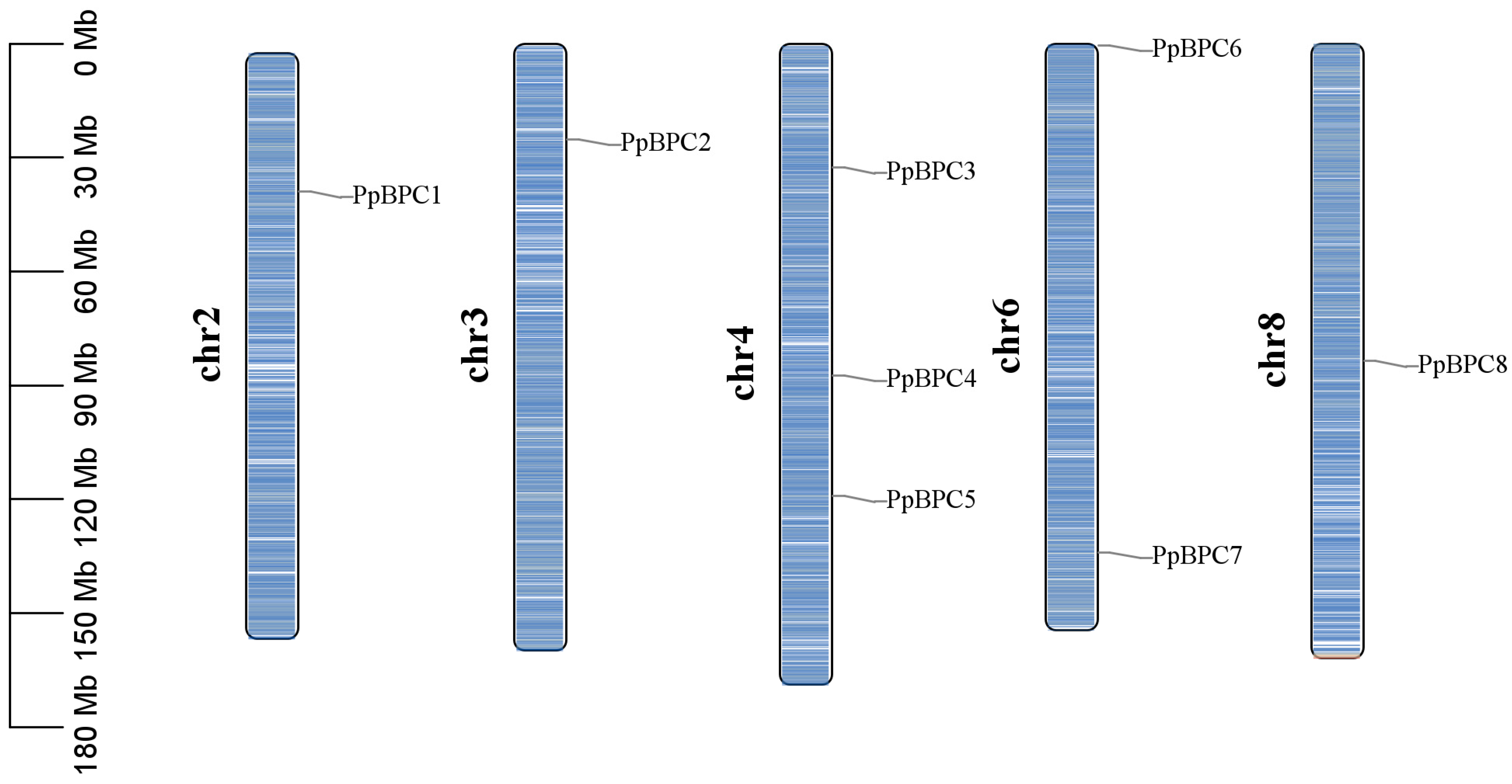
Mapping of PpBPC loci to chromosomes using TBtools-II (v2.390) revealed a scattered distribution across five chromosomes (Figure 1). Chromosome 4 accommodated the largest cluster (three genes), Chr6 carried two members, and Chr2, Chr3, and Chr8 each harbored a single locus.
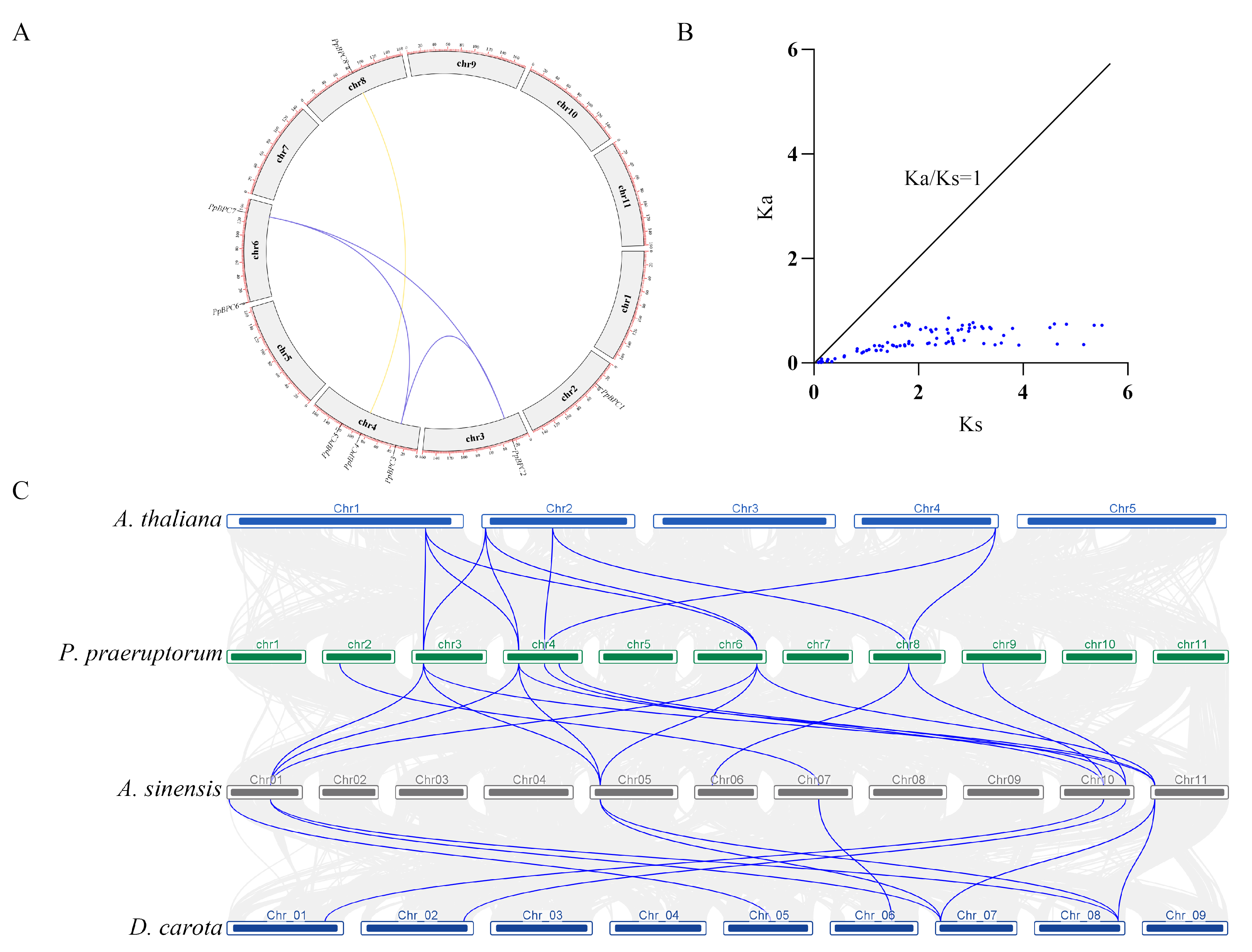
Analysis of intragenomic duplication patterns (Figure 2A) demonstrated that PpBPC genes predominantly originated through whole-genome duplication (WGD), large segmental duplications, and proximal duplication events, yielding four collinear gene pairs. These results highlight WGD/large segmental duplication and proximal duplication as the primary drivers of PpBPC family expansion. Calculation of Ka/Ks ratios for BPC collinear pairs among P. praeruptorum, A. thaliana, A. sinensis, and D. carota produced values between 0.068 and 0.521. All ratios were substantially below 1, signifying that the PpBPC family has been subjected to robust purifying selection throughout its evolutionary trajectory (Figure 2B).
Cross-species synteny assessment further underscored the evolutionary conservation of BPC loci. Thirteen collinear BPC pairs were detected between P. praeruptorum and A. thaliana (Figure 2C), 14 pairs with A. sinensis, and 10 pairs linking A. sinensis and D. carota, collectively implying deep functional preservation of this gene family across plant lineages.

3.3. Phylogenetic Relationship Analysis of the PpBPC Gene Family

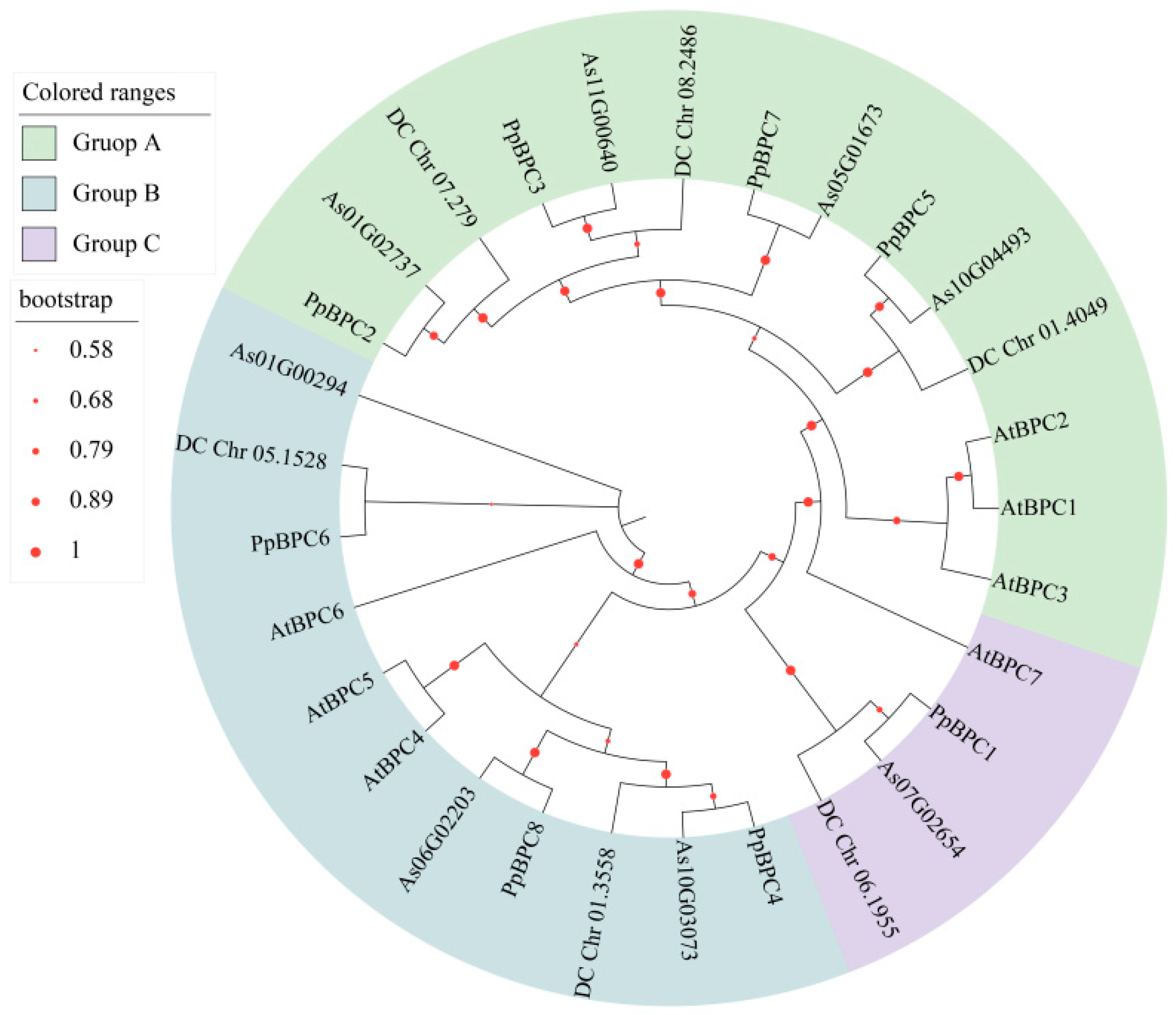
To clarify the evolutionary positioning of PpBPC genes, a multi-species phylogenetic reconstruction was performed using aligned BPC protein sequences from A. thaliana, P. praeruptorum, A. sinensis, and D. carota (Figure 3). The topology revealed that PpBPC genes conform to the canonical tripartite organization previously documented in other plants: Group A (14 members), Group B (11 members), and Group C (4 members). Interestingly, BPC sequences from the three Apiaceae representatives (P. praeruptorum, A. sinensis, D. carota) tended to coalesce into a shared branch before diverging with their A. thaliana orthologs.

3.4. Gene Structure and Conserved Motif Analysis of PpBPC Gene Family Members

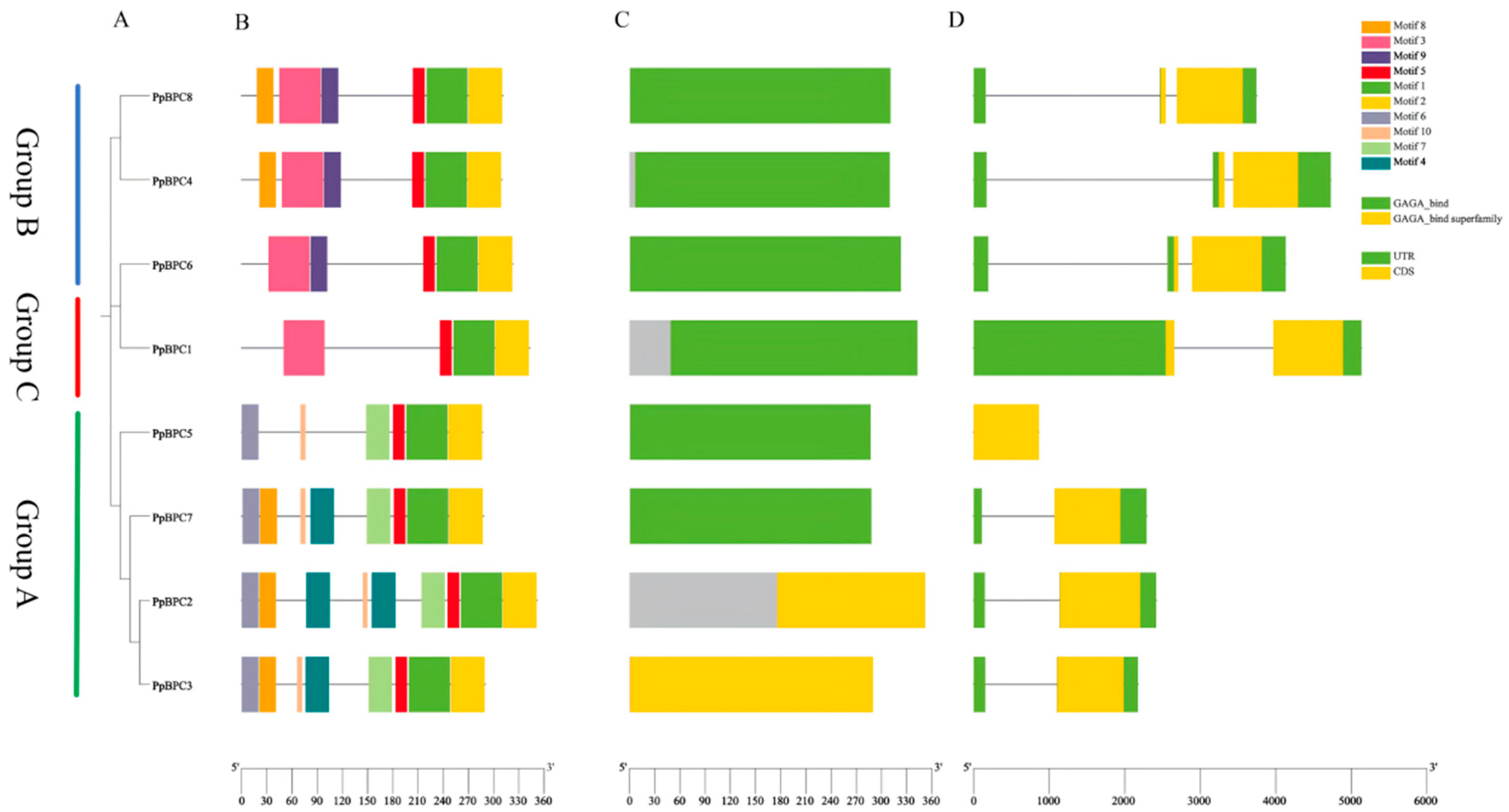
Domain architecture inspection verified that every PpBPC protein possesses the hallmark GAGA domain (Figure 4A,C). Exon–intron organization was largely uniform within each phylogenetic subgroup, with limited structural deviations observed in a minority of genes. MEME-based motif discovery identified ten highly conserved elements across the PpBPC family (Figure 4B). Motifs 1, 2, and 5 were universally present. By contrast, Motifs 4, 6, 7, and 10 were confined to Group A proteins, and Motif 9 was exclusive to Group B. Within each subgroup, the linear order and composition of motifs were highly consistent, suggesting a tight coupling between motif architecture and protein-level function.
Gene structure comparison (Figure 4D) revealed a striking dichotomy: Group A PpBPC genes are entirely devoid of introns, whereas each member of Groups B and C contains a single intron. This structural demarcation aligns closely with the phylogenetic grouping, offering important clues about the mode and tempo of BPC gene evolution.

3.5. Cis-Acting Element Analysis of PpBPC Gene Family Members

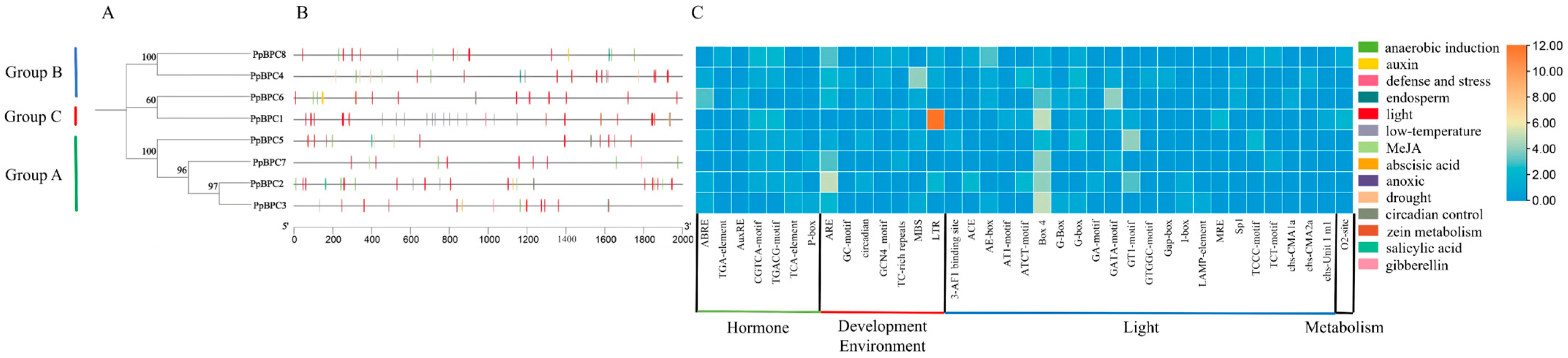
To gain insight into potential transcriptional control mechanisms, the 2 kb promoter segments upstream of each PpBPC start codon were scanned for cis-regulatory elements (Figure 5A). All eight upstream regions contained an array of regulatory motifs (Figure 5B) that fall into four broad functional categories: light-responsive elements, hormone-responsive elements, growth/development and environmental stress-related elements, and metabolism-associated elements (Figure 5C).
Among the phytohormone-associated elements, binding sites linked to abscisic acid (ABA), auxin, gibberellin (GA), methyl jasmonate (MeJA), and salicylic acid (SA) signaling were identified, with distribution across PpBPC2, PpBPC3, PpBPC4, PpBPC5, PpBPC6, and other family members. Specifically, ABA-responsive motifs were present in PpBPC2PpBPC6; auxin-responsive sites were restricted to PpBPC6 and PpBPC8; GA-responsive elements were found in PpBPC3 and PpBPC7; MeJA-responsive elements were widespread (PpBPC1, PpBPC2, PpBPC4, PpBPC5, PpBPC7, PpBPC8); and SA-responsive elements were detected in PpBPC2, PpBPC3, and PpBPC5.
Elements pertinent to growth/development and environmental challenges were also identified. Circadian-controlled and endosperm-development motifs targeted PpBPC2, PpBPC5, PpBPC6 and PpBPC4, PpBPC8, respectively. Stress-associated motifs included anaerobic induction signals (present in PpBPC2PpBPC8), anoxia-specific motifs (PpBPC4 only), drought-responsive elements (PpBPC3PpBPC6), low-temperature-responsive elements (principally PpBPC1, plus PpBPC2, PpBPC4, and PpBPC8), and defense/stress elements (PpBPC1, PpBPC7, PpBPC8).
Light-responsive motifs constituted the most abundant category and were detected in the promoters of every PpBPC gene, pointing to pervasive regulation by light signaling pathways. Metabolism-linked elements, predominantly zein-metabolism motifs, were identified in PpBPC1 and PpBPC8 and may be connected to prolamin biosynthesis and turnover.

3.6. Tissue-Specific Expression Analysis of the PpBPC Gene Family

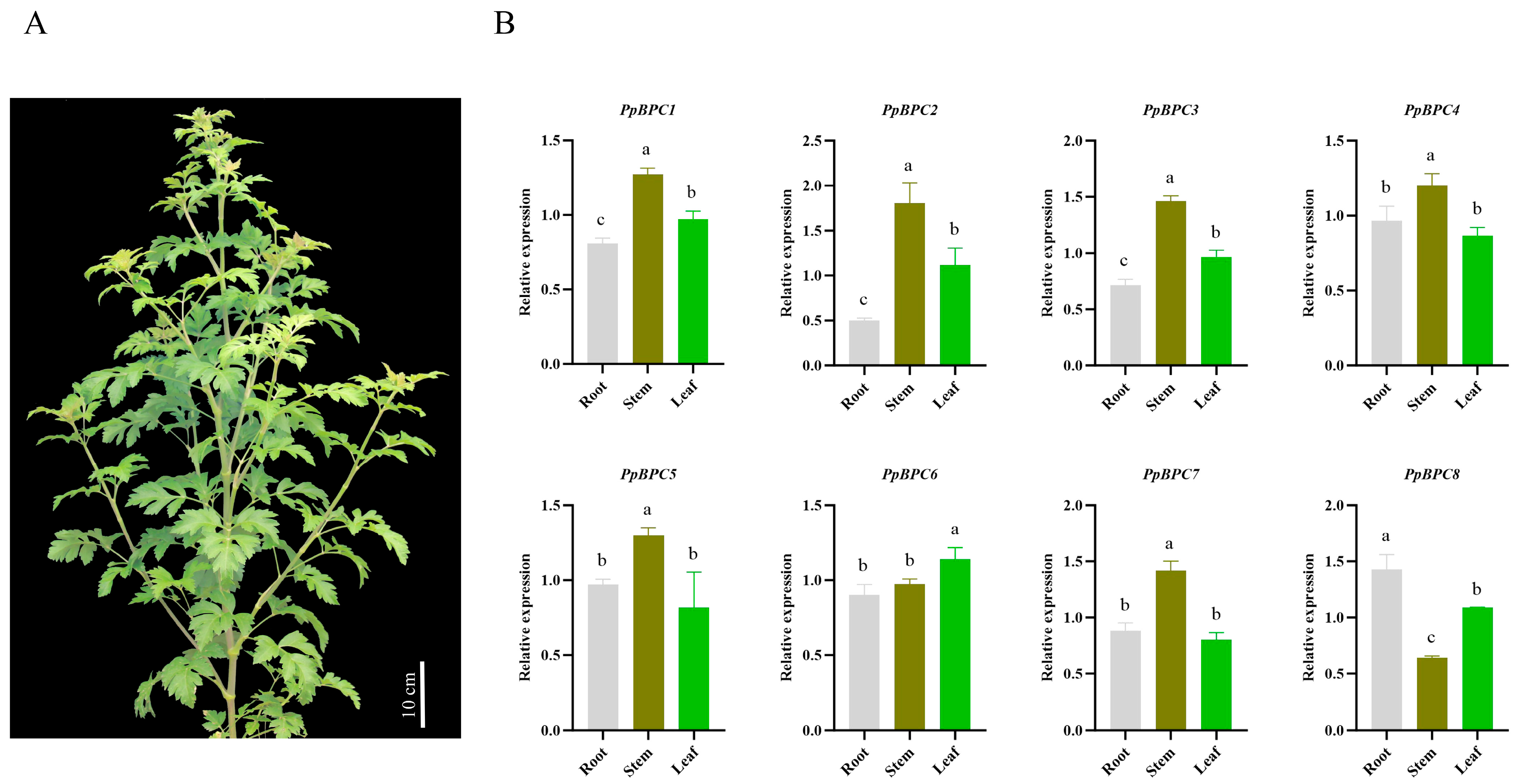
Quantitative real-time PCR was employed to delineate the organ-level expression landscape of PpBPC genes in bolting-stage plants (Figure 6A,B). Three distinct expression patterns emerged. PpBPC1, PpBPC2, and PpBPC3 displayed a coordinated profile with peak transcript levels in stems, intermediate abundance in leaves, and minimal expression in roots. PpBPC4, PpBPC5, and PpBPC7 exhibited another shared pattern, characterized by strongest expression in stems, moderate levels in roots, and the lowest signal in leaves. PpBPC6, in contrast, was most highly expressed in leaves, followed by stems and then roots. By comparison, PpBPC8 showed a unique distribution, achieving maximal transcript accumulation in roots, with lower levels in leaves and stems.

3.7. Expression Analysis of PpBPC Genes Under Different Light Quality Treatments

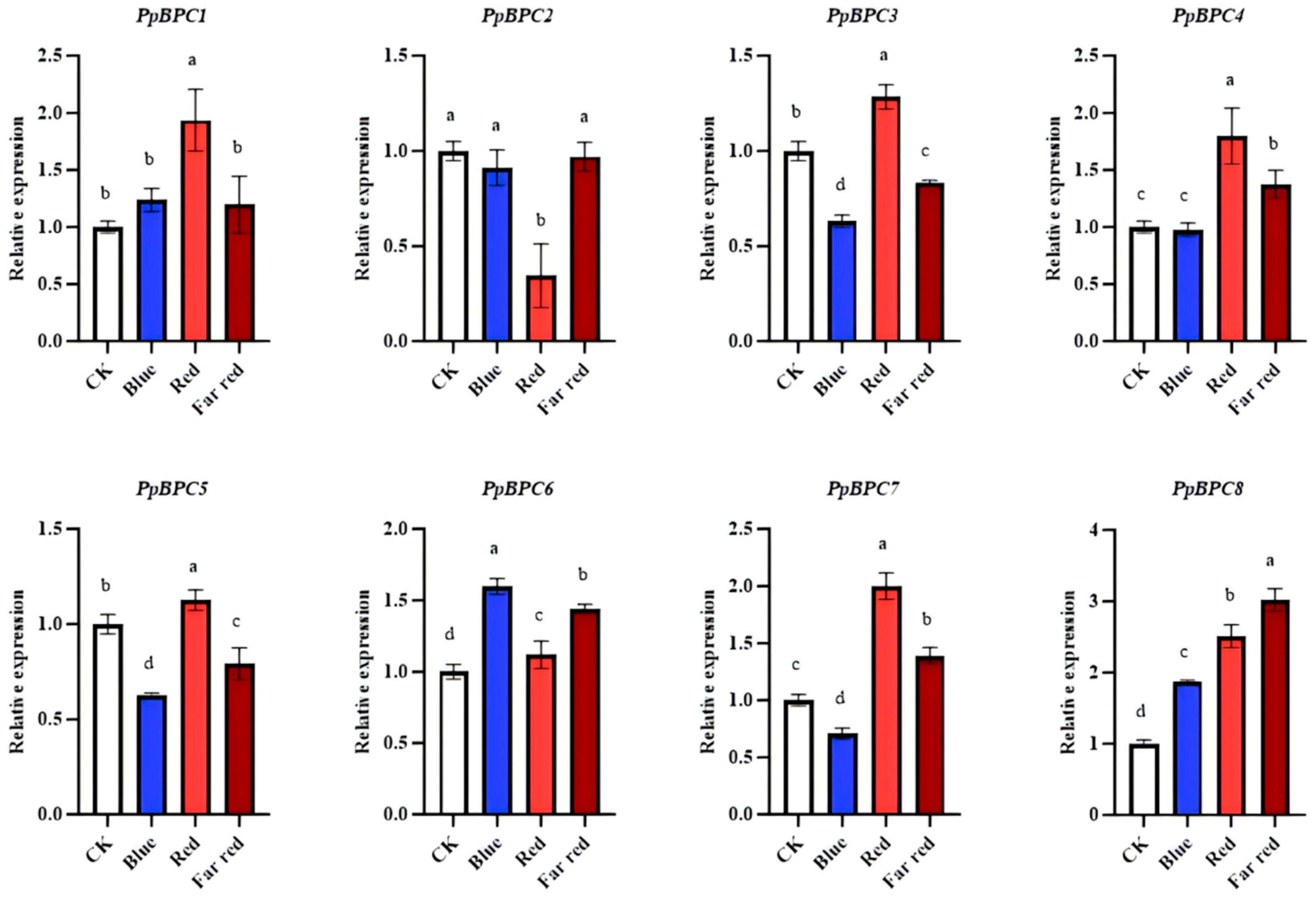
Given the widespread occurrence of light-responsive cis-regulatory elements across all PpBPC promoters, we next tested whether these elements correspond to functional light-dependent transcriptional modulation. Seedlings were exposed to blue, red, and far-red light, with white-light-grown plants serving as the normalization baseline for comparative analysis (Figure 7).
The eight PpBPC genes exhibited heterogeneous responses depending on the wavelength applied. Under blue light, PpBPC6 and PpBPC8 were significantly upregulated relative to the white-light control; PpBPC1, PpBPC2, and PpBPC4 remained statistically unchanged; and PpBPC3, PpBPC5, and PpBPC7 showed significant downregulation. Red light treatment resulted in a broad activation: PpBPC1 and PpBPC3PpBPC8 were all significantly upregulated, with PpBPC2 as the sole member exhibiting significant suppression. Far-red light exposure significantly elevated the expression of PpBPC4, PpBPC6, PpBPC7, and PpBPC8 relative to the control, whereas PpBPC1 and PpBPC2 showed no significant alteration and PpBPC3 and PpBPC5 were significantly repressed.

4. Discussion

Light serves as one of the most influential environmental inputs governing plant growth, developmental transitions, and metabolic output [29,30]. Upon light perception, signaling cascades converge on transcription factors that act as molecular switches to reprogram downstream gene networks, thereby enabling plants to tailor their physiology to the prevailing light environment [31,32,33,34]. Among these regulatory hubs, BASIC PENTACYSTEINE (BPC) transcription factors have emerged as important participants in light-modulated processes [17]. Genome-wide surveys of the BPC family have now been completed for a range of species, including A. thaliana [10], soybean [35], barley [36], rice [37], cucumber [22], coconut [38], B. napus [39,40], and B. juncea [17]. P. praeruptorum is a medicinally valuable species in China, and its growth characteristics, secondary metabolite synthesis, and environmental response mechanisms have drawn increasing research attention [16,41,42,43,44]. Nevertheless, a comprehensive catalogue and functional appraisal of its BPC complement has been lacking. The present study addresses this gap by identifying eight PpBPC members and analyzing their sequence features, evolutionary relationships, organ-specific transcript profiles, and dynamic expression in response to blue, red, and far-red light treatments. These results lay the groundwork for understanding how BPC-mediated transcriptional regulation contributes to development and light signal processing in P. praeruptorum.
Evolutionary and structural data indicated that the BPC family is broadly conserved across plant taxa, with the GA-binding domain representing the most highly constrained region, while auxiliary domains and N-terminal activation regions display substantial sequence variability. This pattern mirrors a general principle of plant BPC evolution: strong selective pressure on the DNA-binding core preserves the fundamental regulatory capacity needed for viability, whereas diversification of accessory domains and transactivation regions provides the raw material for functional innovation. Moreover, the combination of conserved DNA-binding modules and multiple gene duplication mechanisms likely maintains a degree of functional buffering within the PpBPC family. Interspecific synteny analyses confirmed that BPC orthologous regions and their flanking chromosomal segments are well preserved across species boundaries, and that BPC gene pairs have consistently evolved under purifying selection. These observations agree with earlier work in A. thaliana demonstrating widespread functional overlap among AtBPC paralogs. The presence of an intact GAGA domain in every family member, together with evidence that PpBPC duplicated copies were generated by diverse duplication modes, provides a molecular rationale for the functional redundancy and regulatory robustness observed in this family. Within a given phylogenetic group, motif content and organization are highly uniform; across groups, however, pronounced sequence divergence is evident—a pattern consistent with subfunctionalization, neofunctionalization, or pseudogenization following rounds of polyploidization, although definitive mechanistic evidence awaits future functional validation experiments. Domain-centric analysis alongside phylogenetic inference indicates that the core functional region of PpBPC genes operates under tight evolutionary constraint, and the overall tempo of functional evolution appears comparatively restrained. Investigation of the origins of gene family expansion revealed that WGD/large segmental duplication and proximal duplication represent the principal forces driving the proliferation of the PpBPC repertoire, a scenario congruent with the known genomic history of Apiaceae—two ancestral polyploidization events coupled with lineage-specific chromosomal structural variations in P. praeruptorum [1]. Redundant gene copies produced by WGD and proximal duplication presumably undergo the aforementioned processes of functional divergence over evolutionary time to accommodate the regulatory requirements of plant development, with the interplay between structural variation in genes and the rewiring of spatiotemporal expression patterns serving as a central driving factor. This evolutionary logic appears to be a recurrent theme across BPC families from phylogenetically diverse plant species [10,17,22,35,36,37,38,39,40].
In contrast to the A. thaliana BPC family, where extensive functional divergence and mutual antagonism among subgroups have been reported [45], transcript profiling in P. praeruptorum revealed that Group A and Group C members possess largely overlapping tissue-level expression signatures, suggestive of functional redundancy particularly in the context of stem development at the bolting stage. By comparison, Group B members displayed markedly distinct expression patterns, indicative of adaptive specialization. Notably, PpBPC6 transcript levels peaked in leaf tissue, whereas PpBPC8 was predominantly expressed in roots, implying that these two genes may serve as organ-specific regulators of leaf and root development, respectively. These findings resonate with observations in other species: in apple, MdBPC2 affects leaf morphology and suppresses root growth [16], and disruption of CsBPC2 in cucumber compromises root elongation [46]. Collectively, these observations point to an evolutionarily conserved involvement of BPC factors in root developmental programs across diverse plant species.
Promoters function as the primary interface through which genes sense and integrate developmental and environmental information [47,48,49,50]. Our promoter dissection showed that all eight PpBPC upstream regions are populated by a diverse repertoire of functional cis-elements spanning four major categories: light responsiveness, growth/development and stress responses, hormone signaling, and metabolism. This regulatory complexity implies that the PpBPC family may coordinate internal developmental programs with external stress adaptation through the convergence of multiple signaling inputs. The ubiquity of light-responsive elements across all PpBPC promoters suggests that light may act as a major upstream signal regulating the transcriptional output of this gene family.
The current study further substantiated the influence of distinct light wavelengths on PpBPC expression. Red light exerted a predominantly positive effect, significantly upregulating seven of the eight PpBPC members (all except PpBPC2, which showed no significant expression change). This broad transcriptional activation aligns with the well-characterized role of red light in promoting plant growth and development and is consistent with the established involvement of BPC genes in developmental regulation. Blue and far-red light, by contrast, elicited bidirectional responses: certain PpBPC genes were induced, others were repressed, and a subset remained relatively stable. Given the close association of blue and far-red wavelengths with photomorphogenic programs, the observation that PpBPC6 and PpBPC8 were strongly upregulated under both blue and far-red conditions implies that these two loci may be involved in light-mediated morphogenic regulation in P. praeruptorum, and they could serve as potential candidate genes for further research on plant light responses.
Nevertheless, we refrain from establishing a direct intrinsic regulatory linkage between the organ-specific expression of PpBPC6/PpBPC8 and their light-inducible expression profile in this work. The leaf/root-biased expression of PpBPC6 and PpBPC8 was characterized in mature bolting-stage field plants, whereas their light responsiveness was identified in chamber-grown seedlings. Follow-up experiments with uniform plant materials at identical developmental stages under standardized culture conditions are required to validate whether light signals shape their tissue-specific expression patterns. Another limitation of the present study is that sampling was performed at day 7 of light treatment. Since light-induced gene expression exhibits obvious time dependence, we will include multiple time points in our subsequent experiments.

5. Conclusions

In summary, this work presents the first genome-wide characterization of the BPC transcription factor family in P. praeruptorum, encompassing eight members whose physicochemical properties, evolutionary history, and transcriptional behavior were systematically examined. Meanwhile, these findings identify candidate light-responsive PpBPC genes and provide a basis for future functional studies on light-regulated transcriptional responses in P. praeruptorum. However, these findings are preliminary data derived from P. praeruptorum samples collected at different growth stages with diverse light-quality treatments; further gene functional verification is therefore necessary to validate the above conclusions.

Supplementary Materials

The following supporting information can be downloaded at: https://www.mdpi.com/article/10.3390/horticulturae12080905/s1, Table S1: Reference genome sources; Table S2: Primers for qRT-PCR analysis.

Author Contributions

Y.Y. and T.Z. conceived and designed the experiments and revised the manuscript. P.L. and Z.L. performed data analysis and wrote the manuscript, which contributed equally to this work. Y.C. conducted the experiments. X.Z. provided the plant materials. S.W., Y.L., C.Y. and G.S. participated in data analysis. All authors have read and agreed to the published version of the manuscript.

Funding

This work was supported by grants from National key R&D program of china (2023YFC3503803); Key project at central government level: The ability establishment of sustainable use for valuable Chinese medicine resources (2060302); Guizhou Provincial Basic Research Program (Natural Science) (Qian ke He Ji Chu-MS [2025] 156).

Institutional Review Board Statement

The authors declare that the experiments complied with current laws of the country in which they were performed.

Informed Consent Statement

Not applicable.

Data Availability Statement

The original contributions presented in this study are included in the article/Supplementary Material. Further inquiries can be directed to the corresponding authors.

Conflicts of Interest

The authors declare that they have no conflict of interest.

References

  1. Bai, M.; Jiang, S.; Chu, S.; Yu, Y.; Shan, D.; Liu, C.; Zong, L.; Liu, Q.; Liu, N.; Xu, W.; et al. The telomere-to-telomere (T2T) genome of Peucedanum praeruptorum Dunn provides insights into the genome evolution and coumarin biosynthesis. Gigascience 2024, 13, giae025. [Google Scholar] [CrossRef] [PubMed]
  2. Song, Y.; Jing, W.; Yan, R.; Wang, Y.-T. Research progress of the studies on the roots of Peucedanum praeruptorum dunn (Peucedani radix). Pak. J. Pharm. Sci. 2015, 28, 71–81. [Google Scholar] [PubMed]
  3. Wang, Q.; Sun, Q.; Huang, Q.; Qin, L.; Zhu, B. The traditional uses, pharmacology, and phytochemistry of Peucedanum praeruptorum Dunn. Front. Pharmacol. 2024, 15, 1352657. [Google Scholar] [CrossRef] [PubMed]
  4. Xie, J.; Tang, X.; Pan, G.; Jin, J.; Zhong, C.; Zhou, R.; Liu, H.; Zhang, S. Integrated phenotypic, phytochemical and transcriptomic analysis reveals shading effects on early bolting in Peucedanum praeruptorum Dunn. BMC Genom. 2026, 27, 399. [Google Scholar] [CrossRef]
  5. Li, Y.; Wu, H.; Fan, J.; Huang, J.; Jin, H.; Wei, F. Innovative perspective on the geographical origin and quality of Peucedanum praeruptorum Dunn through the integration of inorganic and organic substance profiles. J. Pharm. Anal. 2026, 16, 101405. [Google Scholar] [CrossRef] [PubMed]
  6. Zhang, T.; Zuo, S.; Yu, B.; Zheng, K.; Chen, S.; Huang, L. Spatial patterns and controlling factors of the evolution process of karst depressions in Guizhou province, China. J. Geogr. Sci. 2023, 33, 2052–2076. [Google Scholar] [CrossRef]
  7. Sahu, A.; Singh, R.; Verma, P.K. Plant BBR/BPC transcription factors: Unlocking multilayered regulation in development, stress and immunity. Planta 2023, 258, 31. [Google Scholar] [CrossRef] [PubMed]
  8. Theune, M.L.; Bloss, U.; Brand, L.H.; Ladwig, F.; Wanke, D. Phylogenetic Analyses and GAGA-Motif Binding Studies of BBR/BPC Proteins Lend to Clues in GAGA-Motif Recognition and a Regulatory Role in Brassinosteroid Signaling. Front. Plant Sci. 2019, 10, 466. [Google Scholar] [CrossRef] [PubMed]
  9. Meister, R.J.; Williams, L.A.; Monfared, M.M.; Gallagher, T.L.; Kraft, E.A.; Nelson, C.G.; Gasser, C.S. Definition and interactions of a positive regulatory element of the Arabidopsis INNER NO OUTER promoter. Plant J. 2004, 37, 426–438. [Google Scholar] [CrossRef] [PubMed]
  10. Monfared, M.M.; Simon, M.K.; Meister, R.J.; Roig-Villanova, I.; Kooiker, M.; Colombo, L.; Fletcher, J.C.; Gasser, C.S. Overlapping and antagonistic activities of BASIC PENTACYSTEINE genes affect a range of developmental processes in Arabidopsis. Plant J. 2011, 66, 1020–1031. [Google Scholar] [CrossRef] [PubMed]
  11. Pinyopich, A.; Ditta, G.S.; Savidge, B.; Liljegren, S.J.; Baumann, E.; Wisman, E.; Yanofsky, M.F. Assessing the redundancy of MADS-box genes during carpel and ovule development. Nature 2003, 424, 85–88. [Google Scholar] [CrossRef] [PubMed]
  12. Favaro, R.; Pinyopich, A.; Battaglia, R.; Kooiker, M.; Borghi, L.; Ditta, G.; Yanofsky, M.F.; Kater, M.M.; Colombo, L. MADS-box protein complexes control carpel and ovule development in Arabidopsis. Plant Cell 2003, 15, 2603–2611. [Google Scholar] [CrossRef] [PubMed]
  13. Endrizzi, K.; Moussian, B.; Haecker, A.; Levin, J.Z.; Laux, T. The SHOOT MERISTEMLESS gene is required for maintenance of undifferentiated cells in Arabidopsis shoot and floral meristems and acts at a different regulatory level than the meristem genes WUSCHEL and ZWILLE. Plant J. 1996, 10, 967–979. [Google Scholar] [CrossRef] [PubMed]
  14. Simonini, S.; Kater, M.M. Class I BASIC PENTACYSTEINE factors regulate HOMEOBOX genes involved in meristem size maintenance. J. Exp. Bot. 2014, 65, 1455–1465. [Google Scholar] [CrossRef] [PubMed]
  15. Ma, X.; Yu, Y.; Hu, Z.; Huang, H.; Li, S.; Yin, H. Characterizations of a Class-I BASIC PENTACYSTEINE Gene Reveal Conserved Roles in the Transcriptional Repression of Genes Involved in Seed Development. Curr. Issues Mol. Biol. 2022, 44, 4059–4069. [Google Scholar] [CrossRef] [PubMed]
  16. Zhao, H.; Wan, S.; Huang, Y.; Li, X.; Jiao, T.; Zhang, Z.; Ma, B.; Zhu, L.; Ma, F.; Li, M. The transcription factor MdBPC2 alters apple growth and promotes dwarfing by regulating auxin biosynthesis. Plant Cell 2024, 36, 585–604. [Google Scholar] [PubMed]
  17. Wang, S.; Lu, Z.; Bai, J.; Chen, Y.; Yang, Y.; Shu, G.; Yang, C.; Wu, Z.; Li, P. Genome-Wide Identification of the BPC Gene Family in Brassica juncea and Expression Analysis of Its Regulatory Mechanisms in Response to Light and Salicylic Acid. Int. J. Mol. Sci. 2026, 27, 2664. [Google Scholar] [CrossRef] [PubMed]
  18. Zhang, Y.; Jia, S.; Wang, S.; Ji, X.; Liu, Z. Genome-Wide Identification and Characterization of BPC Transcription Factors in Tobacco (Nicotiana tabacum). Agronomy 2025, 15, 2084. [Google Scholar] [CrossRef]
  19. Zhao, L.; Li, X.; Ma, X.; Zhang, Y.; Liu, H.; He, F.; Li, M.; Wang, X.; Long, R.; Kang, J.; et al. Characterization of the BPC genes in alfalfa and functional verification of MsBPC10 in salt tolerance. BMC Plant Biol. 2026, 26, 779. [Google Scholar] [CrossRef] [PubMed]
  20. Jia, X.; Han, X.; Cheng, Y.; Ren, X.; Fan, G.; Jiao, X.; Cai, Y.; Li, L.; Zhang, C.; Pang, H. Genome-wide characterization of BPC transcription factors in pear and functional validation of PbBPC5 in drought tolerance regulation. Front. Plant Sci. 2025, 16, 1752990. [Google Scholar] [PubMed]
  21. Zhu, F.; Xu, Q.; Fan, J.; Meng, L.; Wang, R.; Niu, J.; Wang, J.; Zhang, G.; Shi, S.; Wang, F.; et al. Genome-Wide Identification of BPC Gene Family in Ten Cotton Species and Function Analysis of GhBPC4 Involved in Cold Stress Response. Int. J. Mol. Sci. 2025, 26, 7978. [Google Scholar] [CrossRef] [PubMed]
  22. Li, S.; Miao, L.; Huang, B.; Gao, L.; He, C.; Yan, Y.; Wang, J.; Yu, X.; Li, Y. Genome-Wide Identification and Characterization of Cucumber BPC Transcription Factors and Their Responses to Abiotic Stresses and Exogenous Phytohormones. Int. J. Mol. Sci. 2019, 20, 5048. [Google Scholar] [CrossRef] [PubMed]
  23. Li, S.; Chiu, T.-Y.; Jin, X.; Cao, D.; Xu, M.; Zhu, M.; Zhou, Q.; Liu, C.; Zong, Y.; Wang, S.; et al. Integrating genomic and multiomic data for Angelica sinensis provides insights into the evolution and biosynthesis of pharmaceutically bioactive compounds. Commun. Biol. 2023, 6, 1198. [Google Scholar] [CrossRef] [PubMed]
  24. Wang, Y.-H.; Liu, P.-Z.; Liu, H.; Zhang, R.-R.; Liang, Y.; Xu, Z.-S.; Li, X.-J.; Luo, Q.; Tan, G.-F.; Wang, G.-L.; et al. Telomere-to-telomere carrot (Daucus carota) genome assembly reveals carotenoid characteristics. Hortic. Res. 2023, 10, uhad103. [Google Scholar] [CrossRef] [PubMed]
  25. Finn, R.D.; Coggill, P.; Eberhardt, R.Y.; Eddy, S.R.; Mistry, J.; Mitchell, A.L.; Potter, S.C.; Punta, M.; Qureshi, M.; Sangrador-Vegas, A.; et al. The Pfam protein families database: Towards a more sustainable future. Nucleic Acids Res. 2016, 44, D279–D285. [Google Scholar] [PubMed]
  26. Chen, C.; Wu, Y.; Li, J.; Wang, X.; Zeng, Z.; Xu, J.; Liu, Y.; Feng, J.; Chen, H.; He, Y.; et al. TBtools-II: A “one for all, all for one” bioinformatics platform for biological big-data mining. Mol. Plant 2023, 16, 1733–1742. [Google Scholar] [CrossRef] [PubMed]
  27. Kumar, S.; Stecher, G.; Suleski, M.; Sanderford, M.; Sharma, S.; Tamura, K. MEGA12: Molecular Evolutionary Genetic Analysis Version 12 for Adaptive and Green Computing. Mol. Biol. Evol. 2024, 41, msae263. [Google Scholar] [CrossRef] [PubMed]
  28. Zhao, Y.; Wang, N.; Zeng, Z.; Xu, S.; Huang, C.; Wang, W.; Liu, T.; Luo, J.; Kong, L. Cloning, Functional Characterization, and Catalytic Mechanism of a Bergaptol O-Methyltransferase from Peucedanum praeruptorum Dunn. Front. Plant Sci. 2016, 7, 722. [Google Scholar] [CrossRef] [PubMed]
  29. Landi, M.; Zivcak, M.; Sytar, O.; Brestic, M.; Allakhverdiev, S.I. Plasticity of photosynthetic processes and the accumulation of secondary metabolites in plants in response to monochromatic light environments: A review. Biochim. Biophys. Acta Bioenerg. 2020, 1861, 148131. [Google Scholar] [CrossRef] [PubMed]
  30. Izzo, L.G.; Mickens, M.A.; Aronne, G.; Gómez, C. Spectral effects of blue and red light on growth, anatomy, and physiology of lettuce. Physiol. Plant 2021, 172, 2191–2202. [Google Scholar] [CrossRef] [PubMed]
  31. Hashemifar, Z.; Sanjarian, F.; Naghdi Badi, H.; Mehrafarin, A. Impact of varying light intensities on morphology, phytochemistry, volatile compounds, and gene expression in Thymus vulgaris L. PLoS ONE 2025, 20, e0317840. [Google Scholar] [CrossRef] [PubMed]
  32. Lee, J.H.; Doan, T.M.; Bruzual, A.; Senthilkumar, S.; Yoo, C.Y. Light-regulated dual-targeting of NUCLEAR CONTROL OF PEP ACTIVITY establishes photomorphogenesis via interorganellar communication. Plant Physiol. 2025, 199, kiaf289. [Google Scholar] [CrossRef] [PubMed]
  33. Chen, X.; Fan, Y.; Guo, Y.; Li, S.; Zhang, B.; Li, H.; Liu, L.J. Blue light photoreceptor cryptochrome 1 promotes wood formation and anthocyanin biosynthesis in Populus. Plant Cell Environ. 2024, 47, 2044–2057. [Google Scholar] [CrossRef] [PubMed]
  34. Schivre, G.; Wolff, L.; Mirasole, F.M.; Vidal, A.; Davidson, M.L.H.; Armanet, E.; Dardalhon-Cuménal, D.; Dumont, M.; Bourge, M.; Baroux, C.; et al. Genome-scale transcriptome augmentation during Arabidopsis thaliana photomorphogenesis. Nat. Commun. 2025, 16, 11228. [Google Scholar] [CrossRef] [PubMed]
  35. Sangwan, I.; O’Brian, M.R. Identification of a soybean protein that interacts with GAGA element dinucleotide repeat DNA. Plant Physiol. 2002, 129, 1788–1794. [Google Scholar] [CrossRef] [PubMed]
  36. Santi, L.; Wang, Y.; Stile, M.R.; Berendzen, K.; Wanke, D.; Roig, C.; Pozzi, C.; Müller, K.; Müller, J.; Rohde, W.; et al. The GA octodinucleotide repeat binding factor BBR participates in the transcriptional regulation of the homeobox gene Bkn3. Plant J. 2003, 34, 813–826. [Google Scholar] [CrossRef] [PubMed]
  37. Gong, R.; Cao, H.; Zhang, J.; Xie, K.; Wang, D.; Yu, S. Divergent functions of the GAGA-binding transcription factor family in rice. Plant J. 2018, 94, 32–47. [Google Scholar] [CrossRef] [PubMed]
  38. Lao, Z.; Mao, J.; Chen, R.; Xu, R.; Yang, Z.; Wang, Y.; Zhou, J.; Mu, Z.; Xu, H.; Li, F.; et al. Genome-wide identification and characterization of BASIC PENTACYSTEINE transcription factors and their binding motifs in coconut palm. Front. Plant Sci. 2024, 15, 1491139. [Google Scholar] [CrossRef] [PubMed]
  39. Wang, L.; Chen, W.; Zhao, Z.; Li, H.; Pei, D.; Huang, Z.; Wang, H.; Xiao, L. Genome-Wide Identification, Conservation, and Expression Pattern Analyses of the BBR-BPC Gene Family Under Abiotic Stress in Brassica napus L. Genes 2024, 16, 36. [Google Scholar] [CrossRef] [PubMed]
  40. Hu, H.; Jiang, Y.; Liu, C.; Zhang, Y.; Chen, M.; Liu, Z. Genome-Wide Identification and Characterization of Basic Pentacysteine Transcription Factors in Brassica napus. Plants 2025, 14, 1136. [Google Scholar] [CrossRef] [PubMed]
  41. Zhao, Y.; He, Y.; Han, L.; Zhang, L.; Xia, Y.; Yin, F.; Wang, X.; Zhao, D.; Xu, S.; Qiao, F.; et al. Two types of coumarins-specific enzymes complete the last missing steps in pyran- and furanocoumarins biosynthesis. Acta Pharm. Sin. B 2024, 14, 869–880. [Google Scholar] [CrossRef] [PubMed]
  42. Song, C.; Pan, H.; Arif, M.; Wang, H.; Cao, Y.; Han, B.; Manzoor, M.A. Evolutionary insight and characterization of WOX genes in callus development and differentiation of Peucedanum praeruptorum. Planta 2026, 263, 125. [Google Scholar] [CrossRef] [PubMed]
  43. Song, C.; Zhang, Y.; Manzoor, M.A.; Wei, P.; Yi, S.; Chu, S.; Tong, Z.; Song, X.; Xu, T.; Wang, F.; et al. A chromosome-scale genome of Peucedanum praeruptorum provide insights into Apioideae evolution and medicinal ingredient biosynthesis. Int. J. Biol. Macromol. 2024, 255, 128218. [Google Scholar] [CrossRef] [PubMed]
  44. Wan, X.; Zhang, Y.; Wang, G.; Liao, R.; Pan, H.; Chen, C.; Han, B.; Deng, H.; Song, C. Melatonin Affects Peucedanum praeruptorum Vegetative Growth and Coumarin Synthesis by Modulating the Antioxidant System, Photosynthesis, and Endogenous Hormones. J. Pineal Res. 2024, 76, e70018. [Google Scholar] [CrossRef] [PubMed]
  45. Lee, Y.C.; Tsai, P.T.; Huang, X.X.; Tsai, H.L. Family Members Additively Repress the Ectopic Expression of BASIC PENTACYSTEINE3 to Prevent Disorders in Arabidopsis Circadian Vegetative Development. Front. Plant Sci. 2022, 13, 919946. [Google Scholar] [CrossRef] [PubMed]
  46. Feng, X.; Li, S.; Meng, D.; Di, Q.; Zhou, M.; Yu, X.; He, C.; Yan, Y.; Wang, J.; Sun, M.; et al. CsBPC2 is a key regulator of root growth and development. Physiol. Plant 2023, 175, e13977. [Google Scholar] [CrossRef] [PubMed]
  47. Gondalia, N.; Quiroz, L.F.; Lai, L.; Singh, A.K.; Khan, M.; Brychkova, G.; McKeown, P.C.; Chatterjee, M.; Spillane, C. Harnessing promoter elements to enhance gene editing in plants: Perspectives and advances. Plant Biotechnol. J. 2025, 23, 1375–1395. [Google Scholar] [CrossRef] [PubMed]
  48. Parisutham, V.; Guharajan, S.; Lian, M.; Ali, M.Z.; Rogers, H.; Joyce, S.; Noto Guillen, M.; Brewster, R.C. E. coli transcription factors regulate promoter activity by a universal, homeostatic mechanism. Science 2025, 389, eadv2064. [Google Scholar] [CrossRef] [PubMed]
  49. Sun, S.R.; Wu, X.B.; Chen, J.S.; Huang, M.T.; Fu, H.Y.; Wang, Q.N.; Rott, P.; Gao, S.J. Identification of a sugarcane bacilliform virus promoter that is activated by drought stress in plants. Commun. Biol. 2024, 7, 368. [Google Scholar] [CrossRef] [PubMed]
  50. Li, Y.; Fu, Y.; Li, Y.; Zhang, R.; Yang, J.; Ma, H.; Min, L.; Zhang, X. Reversing anther thermotolerance by manipulating the cis-elements in the promoter of a high-temperature upregulated gene Casein Kinase I in upland cotton. Sci. China Life Sci. 2025, 68, 1558–1569. [Google Scholar] [CrossRef] [PubMed]
Figure 1. Genomic distribution of PpBPC loci across P. praeruptorum chromosomes. Eight PpBPC genes are positioned on 5 of the 11 chromosomes. Chromosome identifiers are shown on the left; the scale bar (far left) denotes chromosome length.
Horticulturae 12 00905 g001
Figure 2. Synteny and selective pressure assessment of the PpBPC family. (A) Intragenomic collinearity among PpBPC members. (B) Ka/Ks ratios for duplicated PpBPC pairs. (C) Cross-species synteny of BPC loci involving A. thaliana, P. praeruptorum, A. sinensis, and D. carota.
Horticulturae 12 00905 g002
Figure 3. Evolutionary relationships of BPC proteins from four plant species. The neighbor-joining tree incorporates sequences from A. thaliana (7), P. praeruptorum (8), A. sinensis (8), and D. carota (6), with 1000 bootstrap iterations. Three major clades (A, B, C) are resolved. Red dots on branches indicate bootstrap support (range: 0.58–1).
Horticulturae 12 00905 g003
Figure 4. Structural characterization of PpBPC proteins. (A) NJ tree grouping PpBPC members into clades A–C (color-coded). (B) Ten conserved motifs detected by MEME, with distinct colors per motif. (C) GAGA domain architecture (green and yellow boxes). (D) Exon–intron configuration; yellow and green denote CDS and UTR regions, respectively. Gene order matches the phylogeny throughout.
Horticulturae 12 00905 g004
Figure 5. Cis-regulatory landscape of PpBPC promoters. (A) Phylogenetic grouping of PpBPC proteins. (B) Spatial distribution of regulatory motifs within the promoter regions, indicated by colored boxes. (C) Quantitative heatmap of cis-element abundance across four functional categories; bar graph summarizes total element counts, and shaded cells report copy numbers per element type.
Horticulturae 12 00905 g005
Figure 6. Organ-specific transcript profiles of PpBPC genes at the bolting stage. (A) Whole-plant morphology of a bolting-stage P. praeruptorum individual. (B) qRT-PCR-based quantification of PpBPC transcript levels in root, stem, and leaf tissues. One-way ANOVA followed by Duncan post-hoc test was performed using Microsoft Excel 2019 and SPSS 27.0.1. All bar charts were drawn in GraphPad Prism 10, with error bars representing the standard deviation (SD) of three biological replicates. Letters (a–c) above bars denote statistically significant differences among organs (p < 0.05).
Horticulturae 12 00905 g006
Figure 7. Light-quality-dependent expression of PpBPC genes measured by qRT-PCR. White light (full spectrum) was employed as the reference condition (CK; expression set to 1). One-way ANOVA followed by Duncan post-hoc test was performed using Microsoft Excel 2019 and SPSS 27.0.1. All bar charts were drawn in GraphPad Prism 10, with error bars representing the standard deviation (SD) of three biological replicates. Letters (a–d) above bars denote statistically significant differences among organs (p < 0.05).
Horticulturae 12 00905 g007
Table 1. Physicochemical characterization of the PpBPC gene family proteins.
Gene IDGene NameNumber of Amino AcidMolecular WeightpIInstability IndexAliphatic IndexGRAVYSubcellular Localization
Ppra_2G0010400PpBPC134338.738.8352.2956.06−0.8Nucleus
Ppra_3G0005040PpBPC235239.229.5161.6755.43−0.747Nucleus
Ppra_4G0007820PpBPC329032.609.8157.7354.86−0.716Nucleus
Ppra_4G0019390PpBPC431035.419.6844.9169.58−0.739Nucleus
Ppra_4G0027120PpBPC528731.639.6943.9859.13−0.687Nucleus
Ppra_6G0000030PpBPC632336.119.5365.9659.85−0.825Nucleus
Ppra_6G0030300PpBPC728832.049.4951.460.63−0.66Nucleus
Ppra_8G0026350PpBPC831135.649.7953.2259.65−0.833Nucleus
Disclaimer/Publisher’s Note: The statements, opinions and data contained in all publications are solely those of the individual author(s) and contributor(s) and not of MDPI and/or the editor(s). MDPI and/or the editor(s) disclaim responsibility for any injury to people or property resulting from any ideas, methods, instructions or products referred to in the content.