Article

Impact of Ten-Year Straw and Lime Management History on Soil Micronutrient Availability and Tomato Yield in Greenhouse


1
College of Horticulture, Shenyang Agricultural University, Shenyang 110866, China
2
College of Land and Environment, Shenyang Agricultural University, Shenyang 110866, China
3
Department of Municipal and Environmental Engineering, Shenyang Urban Construction University, Shenyang 110167, China
4
Institute of Eco-Environment and Plant Protection, Shanghai Academy of Agricultural Sciences, Shanghai 201403, China
*
Author to whom correspondence should be addressed.
These authors contributed equally to this work.
Horticulturae 2025, 11(11), 1307; https://doi.org/10.3390/horticulturae11111307
Submission received: 30 September 2025 / Revised: 28 October 2025 / Accepted: 30 October 2025 / Published: 31 October 2025

Abstract

Long-term fertilization strategies are crucial for sustainable soil health and crop productivity. However, the synergistic effect of combining straw with lime in long-term fertilization remains underexplored, particularly regarding soil micronutrient availability and tomato yield. This study examined the 10-year effects of chicken manure (M) with straw (S) and/or lime (Ca) on soil properties, micronutrient availability, and tomato yield. The results demonstrated that all of the fertilization treatments significantly altered topsoil (0–20 cm) characteristics, reducing the pH but increasing the EC and nutrient content. The combined MSCa treatment was most effective, achieving the highest levels of total carbon (19 g/kg) and tomato yield (5.6 kg/m2), which was 12–87% higher than that achieved with the other treatments. Fertilization also significantly increased the diethylenetriamine pentaacetic acid (DTPA)-extractable Fe, Mn, Cu, and Zn concentrations in both bulk soil and aggregate fractions, with availability strongly correlated with the soil total carbon and pH. The straw and lime amendments significantly improved the fruit quality by increasing the vitamin C and soluble sugar content while reducing the nitrate content. Furthermore, these treatments altered the distribution of micronutrients within the tomato organs, increasing their proportion in roots and fruits specifically. This study concludes that the integrated application of chicken manure with straw and lime is a highly effective strategy for improving soil fertility, enhancing micronutrient bioavailability, and boosting both the yield and nutritional quality of tomatoes.

1. Introduction

Global greenhouse crop production has been increasing owing to its advantages related to food safety, improved quality, and higher yields [1]. China currently possesses over 3.7 million hectares of protected cultivation area, representing nearly 80% of the global total [2]. In Liaoning Province, tomato (Solanum lycopersicum L.) is one of the primary greenhouse crops, with a cultivated area exceeding 85,000 hectares [3]. However, inappropriate management practices and continuous tomato monocropping have led to problems such as soil secondary salinization, acidification, nutrient accumulation, and imbalances. Conventional fertilization strategies primarily focus on supplying nitrogen (N), phosphorus (P), and potassium (K) to meet crop demands; the pursuit of high yields has resulted in substantial application of N, P, and K fertilizers, and the concomitant rise in per-unit-area productivity has accelerated the depletion of micronutrients available for plants in the soil [4,5]. Therefore, developing integrated fertilization strategies that can simultaneously address soil degradation and micronutrient depletion is urgently needed to enhance both crop productivity and nutritional quality in greenhouse systems.
Soil micronutrients, such as iron (Fe), manganese (Mn), copper (Cu), and zinc (Zn), play a pivotal role in supporting ecosystem functions and are essential for global food security [6]. Although these micronutrients could be supplemented via chemical fertilizers [7], the high cost of synthetic micronutrient fertilizers has made the use of organic amendments (e.g., straw) and animal manure a widespread practice in Chinese greenhouse agriculture. Furthermore, lime is frequently applied in greenhouse cultivation to mitigate soil acidification, increase calcium ion content, and disinfect the soil. However, lime can elevate the soil pH, and the resulting calcium carbonate may adsorb or precipitate micronutrients, thereby reducing their bioavailability [8,9]. It remains unclear how long-term co-application of organic fertilizers and lime influences the availability of micronutrients in greenhouse soils.
Soil micronutrient parameters include the total content and available forms, where the former reflects the elemental reserve and the latter indicates the plant-accessible fractions, typically measured as DTPA (diethylenetriamine pentaacetic acid)-extractable amounts [8]. Although the total concentrations may appear sufficient, bioavailable levels often fall short of plant needs—for example, DTPA-Zn constitutes only about 1% of the total Zn [10]. Organic amendments enhance both the total and available micronutrients by supplying inherent nutrients and releasing organic acids that solubilize insoluble forms [11,12]. Crucially, this added organic matter also drives the formation of soil aggregates [13,14], which provide physical protection to organic carbon and the associated adsorbed micronutrients, reducing leaching and stabilizing availability. Micronutrient dynamics within this organo-mineral framework are further influenced by soil properties like pH; for instance, lime application can counter acidification from long-term fertilization [15], and, via Ca2+, improve aggregate stability and nutrient retention [16]. While the use of manure is increasingly adopted in tomato production [17] and straw with lime co-application has been shown to rapidly enhance soil carbon sequestration [18], the combined effects of manure, straw, and lime on micronutrient availability and their distribution within soil aggregates remain poorly understood.
Tomato plants often develop a substantial root system in deeper soil layers, where micronutrient availability is strongly influenced by the distribution and characteristics of soil aggregates. Therefore, this study aims to investigate the spatial distribution of Fe, Mn, Cu, and Zn across different soil depths and aggregate size fractions in a greenhouse tomato cultivation system, as well as their allocation within various plant tissues (roots, leaves, stems, and fruits). Based on previous evidence of organic–inorganic interactions, we hypothesized that the long-term integrated application of chicken manure with straw and lime would synergistically improve soil organic carbon, regulate pH, and thereby enhance the availability and plant uptake of key micronutrients (Fe, Mn, Cu, Zn) across soil depths and aggregate fractions, ultimately leading to increased tomato yield and improved fruit quality. The specific objectives are (1) to evaluate the impact of long-term combined application of manure with lime and/or straw on soil properties and micronutrient availability; (2) to quantify the distribution of DTPA-extractable micronutrients (Fe, Mn, Cu, and Zn) at two soil depths (0–20 cm and 20–40 cm) and among different aggregate fractions; and (3) to examine the relationship between micronutrient concentrations and tomato yield.

2. Materials and Methods

2.1. Study Site and Experimental Design

A long-term fertilization experiment was conducted in the spring of 2009 in a solar greenhouse at Shenyang Agricultural University, Liaoning Province, China (41°31′ N, 123°24′ E). Tomato was transplanted in March and September each year. The soil, classified as an Udic Cambisol (Haplic, Loamic) (FAO, IUSS Working Group WRB 2022), and had the following chemical properties in 2009: pH 6.96, EC 211.89 µS/cm, organic matter 15.5 g/kg, total nitrogen (N) 0.54 g/kg, total phosphorus (P) 0.43 g/kg, total potassium (K) 25.85 g/kg, available N 39.12 mg/kg, available P 11.9 mg/kg, available K 147.48 mg/kg, available Fe 11.9 mg/kg, available Mn 16.2 mg/kg, available Cu 1.4 mg/kg and available Zn 2.1 mg/kg. Nutrient content was determined according to the method described by Bao [19]. The granulometric composition of the original soil was 63.7% sand, 24.5% silt, and 11.8% clay, as determined by laser diffraction (Mastersizer 3000, Malvern Panalytical, Malvern, UK).
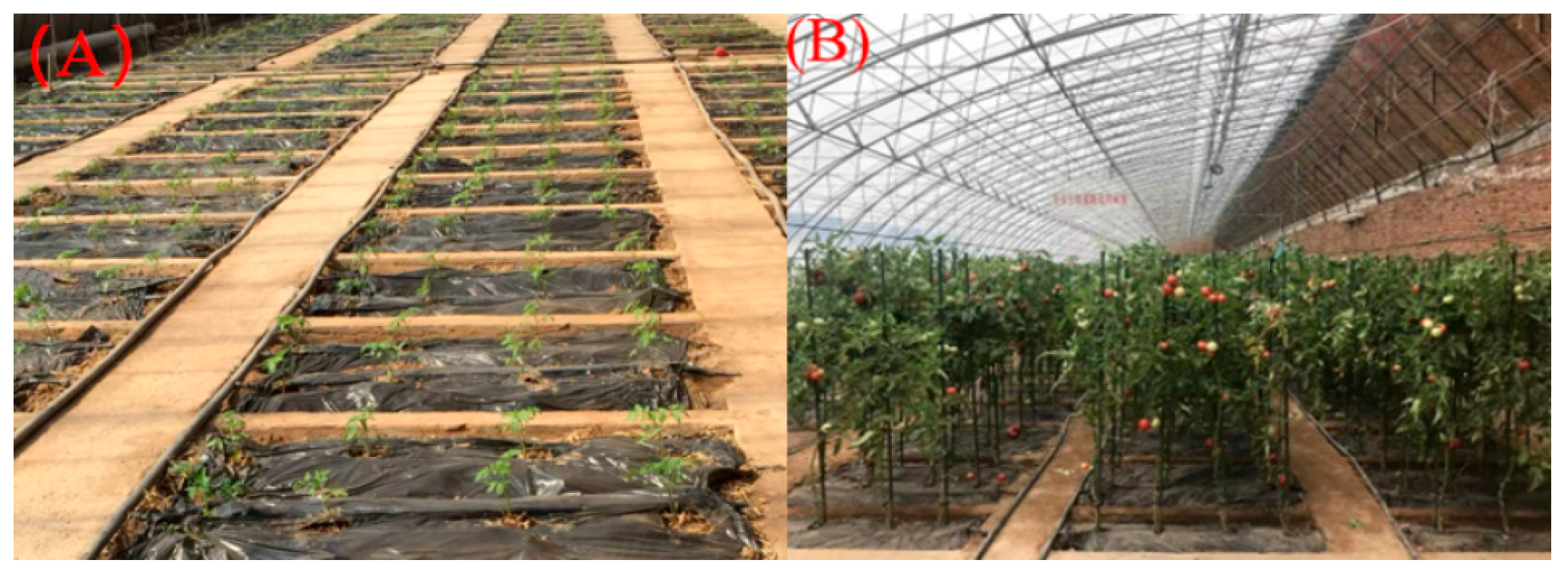
The experiment consisted of five treatments: (1) no fertilization (CK); (2) only chicken manure (M); (3) chicken manure with rice straw (MS); (4) chicken manure with lime (MCa); and (5) chicken manure with both rice straw and lime (MSCa). A randomized complete block design was adopted with three replicates, resulting in a total of 15 experimental plots. Each plot, serving as the experimental unit, was a cement-walled enclosure (1.5 m × 1.0 m × 0.6 m; length × width × depth) without a cement bottom (Figure 1). Two rows of tomato plants were planted per plot, with a spacing of 35 cm between plants and four plants per row. Drip irrigation was applied, with the amount adjusted according to crop water requirements and weather conditions at different growth stages. Irrigation timing was uniform across all treatments. During sampling, one tomato plant and its surrounding soil were randomly selected from each plot for analysis.
Since its establishment in 2009, this long-term positioning experiment has consistently cultivated tomatoes twice annually, with identical treatments applied to the same plots each growing season. The two cropping seasons were the winter–spring season (approximately 140 days, from late February to mid-July) and the autumn–winter season (approximately 140 days, from late August to mid-January). Seedlings were transplanted at the 3 to 4 leaf stage, approximately 35 days after sowing, with uniformly sized seedlings selected for each plot. One month before each transplanting event, the following amendments were incorporated uniformly into the 0–40 cm soil layer: chicken manure (3.75 kg/m2), rice straw (air-dried, cut into 1–2 cm segments; 1.44 kg/m2), lime (calcium carbonate, CaCO3, purity ≥ 175%; 53.57 g/m2), and compound fertilizer (N:P:K = 13:17:15; 45 g/m2). The experiment utilized analytical-grade calcium oxide (CaO, purity ≥ 98%) with an application rate of 30 g/m2. In accordance with standard practice in the field, all lime purity and dosage values are expressed on a calcium carbonate (CaCO3) equivalent basis. Fertilization was applied twice a year, and with the exception of the CK treatment, all of the fertilization treatments received equal amounts of chicken manure and compound fertilizer. The rice straw was crushed after air-drying. Fertilization rates were determined based on conventional practices in Liaoning Province. The nutrient contents of the fertilizers are presented in Table 1. The nutrient content in fertilizers was determined according to the method described by Bao [19]. The tomato cultivar used was “Gold Crown No. 9”.

2.2. Soil Sampling and Chemical Analysis

Soil samples were collected during the full fruit period of the autumn–winter season in 2018. From each culture plot, five soil cores (5 cm in diameter) were taken from both the 0–20 cm and 20–40 cm depth layers and combined to form a composite sample per depth layer (as tomato root systems can reach depths of 30–50 cm, soil samples were collected from the 0–20 cm and 20–40 cm layers). The samples were transported to the laboratory in rigid plastic containers. Visible stones, plant residues, and soil organisms were removed, after which the soil was air-dried at room temperature for 7 days. Part of the soil samples was then passed through an 8 mm sieve to measure the aggregate size distribution using an aggregate analyzer (Retsch AS 200, Arzberg, Germany). Another part of the soil was used to analyze the soil chemical properties according to Bao [19].
The soil pH and electrical conductivity (EC) were measured in a 1:2.5 soil–water suspension using a pH meter and a conductivity meter (INESA, Shanghai, China), respectively. Total carbon (TC) and total nitrogen (TN) were determined using an elemental analyzer (Elementar vario MACRO cube, Langenselbold, Germany). Total phosphorus (TP) and total potassium (TK) were analyzed by sodium hydroxide fusion–flame photometry (TK) and UV spectrophotometry (TP). Available phosphorus (AP) was extracted with 0.5 mol/L NaHCO3 and measured spectrophotometrically, while available potassium (AK) was extracted with 1 mol/L NH4OAc and determined by flame photometry. DTPA-extractable Fe, Mn, Cu, and Zn were extracted as described by Lindsay et al. [20] and measured using atomic absorption spectrometry (AAS, Shimadzu, Kyoto, Japan).
The wet sieving method was used to separate soil aggregates into three size fractions [21]: (i) large macroaggregates (>1 mm); (ii) small macroaggregates (1–0.25 mm); and (iii) microaggregates (<0.25 mm). A mass of 50 g of air-dried soil was passed through an 8 mm sieve and was stored in an aluminum box. The sieve apertures were 1 mm and 0.25 mm, and distilled water was slowly poured over the soil sample to make it moist; the water was slightly absorbed by the soil. The soil was immersed for 3 min at room temperature. The water-stable aggregate sieving device (Retsch AS 200, Arzberg, Germany) was turned on and the vibration amplitude was set to 3 cm, the frequency was set to 30 times per minute, and the vibration was set to last 10 min. Distilled water was used to wash the aggregates remaining on the three sieves into the aluminum box, respectively, and size aggregates of >1 mm, 1–0.25 mm, and <0.25 mm were obtained. After drying at 45 °C, the three aggregate size fractions were weighed. DTPA-extractable micronutrients in each fraction were then determined using the same AAS method as for the bulk soil. To ensure precision, the entire wet-sieving procedure was performed in triplicate for each sample, and the results are reported as means.

2.3. Plant Parameters

Tomato fruits were harvested at 75–85% maturity, and the total yield from each treatment was recorded. Fruit quality parameters were assessed at the same maturity stage during the peak fruiting period, following established methods [19,22]. The vitamin C content was determined using 2,6-dichloroindophenol and was expressed in milligrams of vitamin C per 100 g of fresh sample. The total acidity was determined using the neutralization method; the soluble sugar (solid) contents was measured using the cyanide iodine method; and the nitrate content was measured using the salicylic acid colorimetric method. For micronutrient analysis, 0.5 g of dried and finely ground plant tissue was washed in a porcelain crucible, and the ash was dissolved in hydrochloric acid. The concentrations of micronutrients (Fe, Mn, Cu, and Zn) in plant tissue were then determined using atomic absorption spectrometry (AAS, Shimadzu, Kyoto, Japan).

2.4. Data Analysis

Statistically significant differences between treatments were identified using one-way ANOVA and least significant difference calculations at p < 0.05. Correlation analyses were used to test relationships between micronutrients and other soil traits in whole soil, between each micronutrient in whole soil and in the three aggregate size classes, and between micronutrients in leaves and fruits and quality traits. Prior to conducting Pearson correlation analysis and ANOVA, the assumptions of normally distributed residuals and homogeneity of variances (verified using Levene’s test) were examined. All statistical analyses were performed using SPSS 21.0 (IBM SPSS Statistics, Armonk, NY, USA), with statistical significance defined at p < 0.05. Duncan’s post hoc test was employed for multiple comparisons. The structural equation modeling was analyzed using AMOS 26.0 (IBM SPSS AMOS, Armonk, NY, USA).

3. Results

3.1. Effects of Straw and Lime on Soil Properties

According to the three-way ANOVA, ten-year fertilization regimes significantly altered soil properties, with treatment effects exhibiting greater prominence in topsoil (0–20 cm) than subsoil (20–40 cm) (Table 2). All amended treatments significantly reduced soil pH but increased EC. Soil nutrient contents were markedly enhanced under fertilization, with the MSCa treatment yielding the highest total carbon (19 g/kg) and total phosphorus. Straw amendment significantly influenced pH, EC, TC, TN, and C/N, while lime notably affected EC, TC, C/N, TP, AN, and AK. Soil depth exerted highly significant effects on most parameters except TP and AP. Significant straw × lime interactions were detected for pH, TN, AN, and AK.

3.2. Distribution of Soil Micronutrients at Soil Depths and in Soil Aggregates

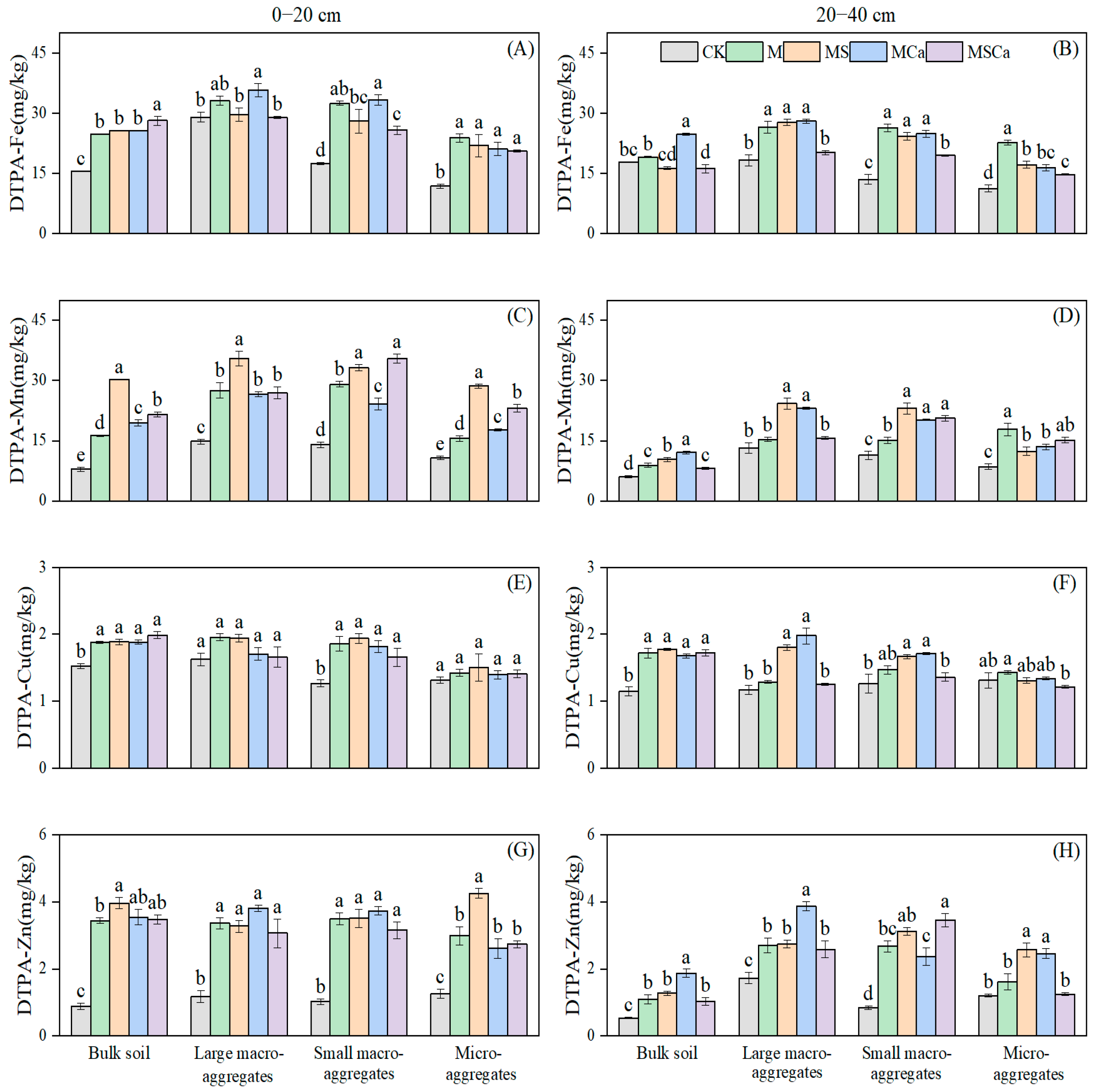
As shown in Figure 2, all of the fertilization treatments significantly increased DTPA-extractable micronutrients concentrations in both the bulk soil and aggregate fractions compared to CK. In the 0–20 cm layer, MSCa showed the highest Fe content across most aggregates (Figure 2A), while MS had the highest Mn levels (Figure 2C). In large macro-aggregates, MCa yielded the highest Fe (Figure 2A), and lime-amended treatments yielded the highest Mn (Figure 2C). In the small macroaggregates, trace element concentrations in CK were about 50% lower than those achieved with the fertilization treatments. In the microaggregates, fertilization increased Fe, Mn, and Zn (Figure 2G) by 74–102%, 46–168%, and 108–204%, respectively. In the 20–40 cm layer, MCa maintained relatively high Fe (Figure 2B), Mn (Figure 2D), and Zn (Figure 2H) contents, though all concentrations were significantly lower than those in the topsoil, indicating a surface accumulation effect. Except for DTPA-Cu (Figure 2E,F) in the large macro-aggregates and small macro-aggregates fractions, trace elements differed significantly among the treatments across aggregates and depths.
The three-way ANOVA revealed significant interactions among straw (S), lime (Ca), and soil depth (D) on DTPA-extractable micronutrients (Table 3). Soil depth dominated, strongly influencing Fe, Mn, and Cu in bulk soil and most aggregates. Straw significantly affected Mn in all fractions, Cu in bulk soil (p < 0.05), Fe in large macroaggregates (p < 0.05), and Zn in small and microaggregates (p < 0.001). Lime showed limited effects, only influencing Fe in bulk soil (p < 0.01) and Zn in large macroaggregates (p < 0.05). The S × Ca interaction was significant for all micronutrients, strongest for Mn in bulk soil, Mn and Cu in large macroaggregates, and Zn in microaggregates (p < 0.001). The three-way S × Ca × D interaction was significant for Cu in large macroaggregates (p < 0.001) and Mn in bulk soil and microaggregates (p < 0.05).
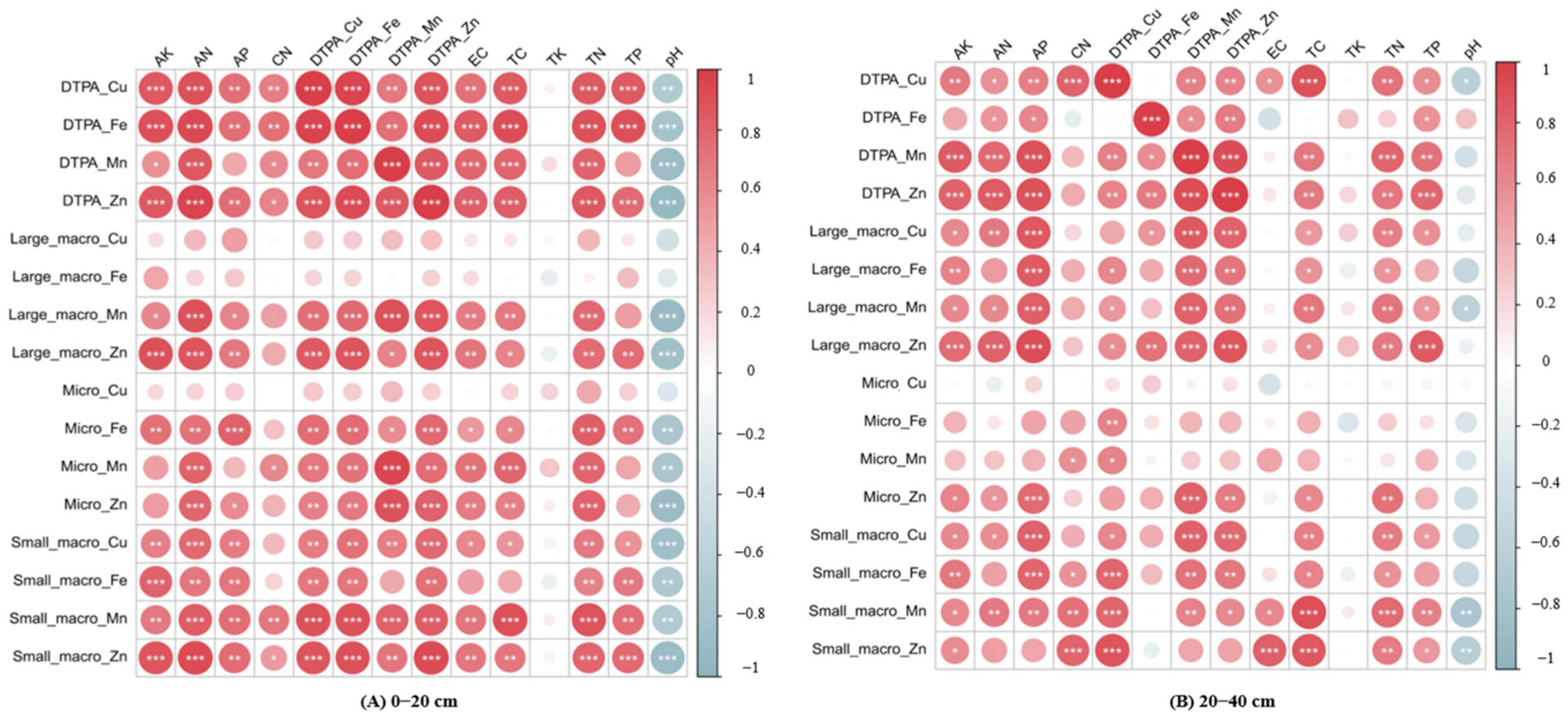
Figure 3 shows that key factors influencing trace element availability differed with depth. In the 0–20 cm layer (Figure 3A), TC, TN, and EC correlated positively with most elements, suggesting that organic matter and base ions drive their availability in topsoil. In the 20–40 cm layer (Figure 3B), these correlations weakened. Conversely, the negative correlation with pH was stronger in the 0–20 cm layer, indicating its key role in limiting surface availability.

3.3. Effects of Straw and Lime on Tomato Yield and Fruit Quality

Fertilization significantly enhanced tomato yield and quality parameters (Table 4). Among all treatments, MSCa resulted in the highest yield (5.6 ± 0.3 kg/m2), exceeding other treatments by 12–87%. Fruit quality was consistently improved under fertilization: vitamin C content increased in all amended treatments, while nitrate content decreased, with the lowest value in MSCa. The same treatment also yielded the highest soluble sugar content and sugar–acid ratio. Variance analysis revealed that lime significantly increased yield, reduced nitrate, and elevated the sugar–acid ratio (p < 0.01), whereas straw incorporation significantly lowered organic acid and raised soluble sugar content and sugar-acid ratio (p < 0.05).

3.4. Concentration and Distribution of Micronutrients in Tomato Organs

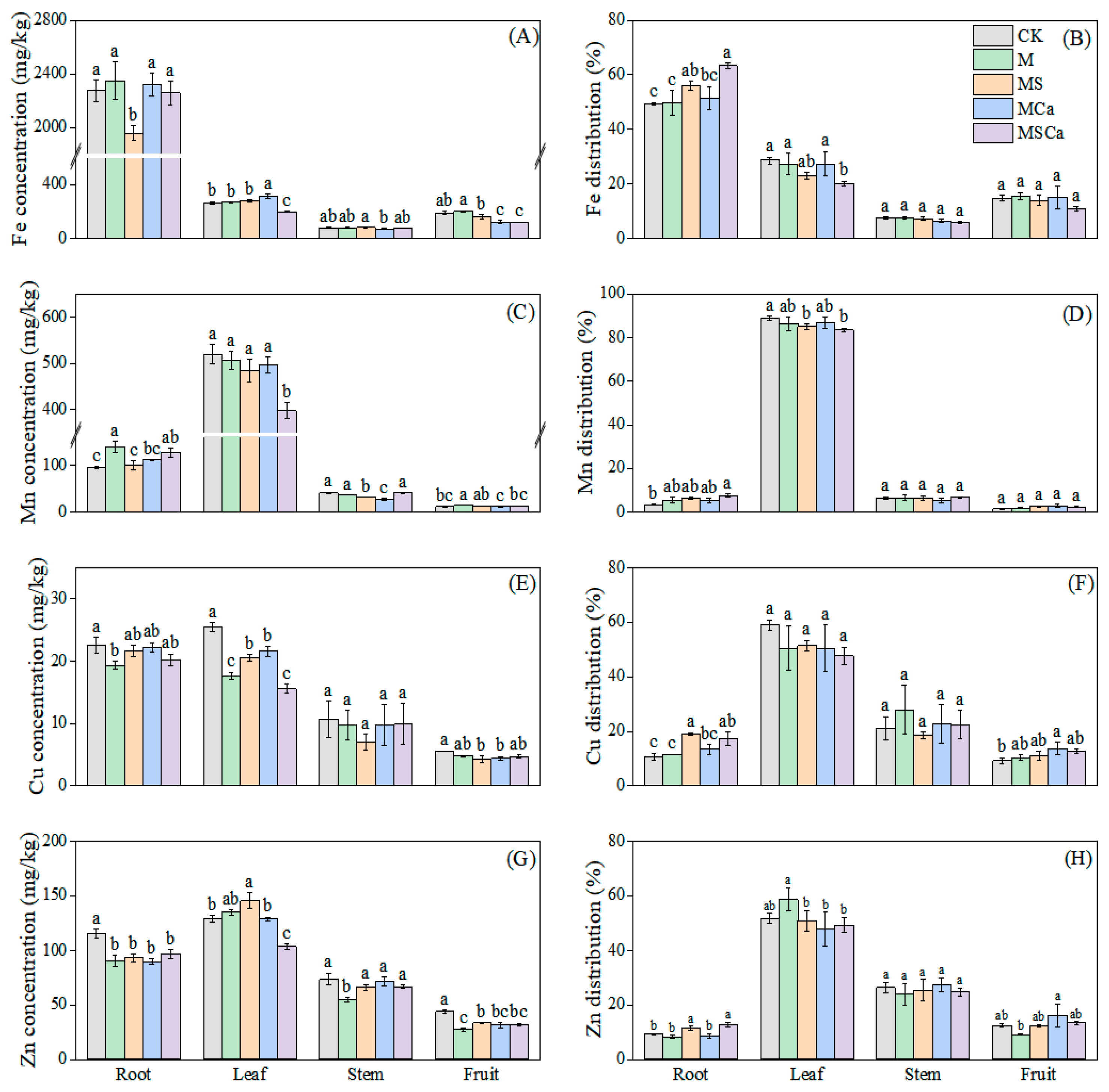
As shown in Figure 4, the long-term fertilization treatments significantly influenced the concentrations and distribution proportions of micronutrients in the tomato roots, stems, leaves, and fruits. Compared with the unfertilized control (CK), the addition of straw and lime significantly increased the Fe (Figure 4A) and Mn (Figure 4C) concentrations in roots, as well as the Fe and Zn (Figure 4G) concentrations in the leaves, but it decreased the Mn and Cu (Figure 4E) concentrations in the leaves, Zn concentration in the stems, and Cu and Zn concentrations in fruits.
In contrast to the micronutrient concentrations, the fertilization treatments generally increased the distribution proportions of Fe (Figure 4B), Mn (Figure 4D), and Zn (Figure 4H) in the roots and fruits, but reduced the proportions of micronutrients in the leaves (Figure 4F). Notably, the micronutrient distributions exhibited distinct organ specificity: Fe was predominantly accumulated in the roots and Mn was mainly concentrated in the leaves, while Zn and Cu showed relatively higher distributions in the leaves and stems.

3.5. Correlations Between Plant Micronutrient Concentration and Soil Available Micronutrients

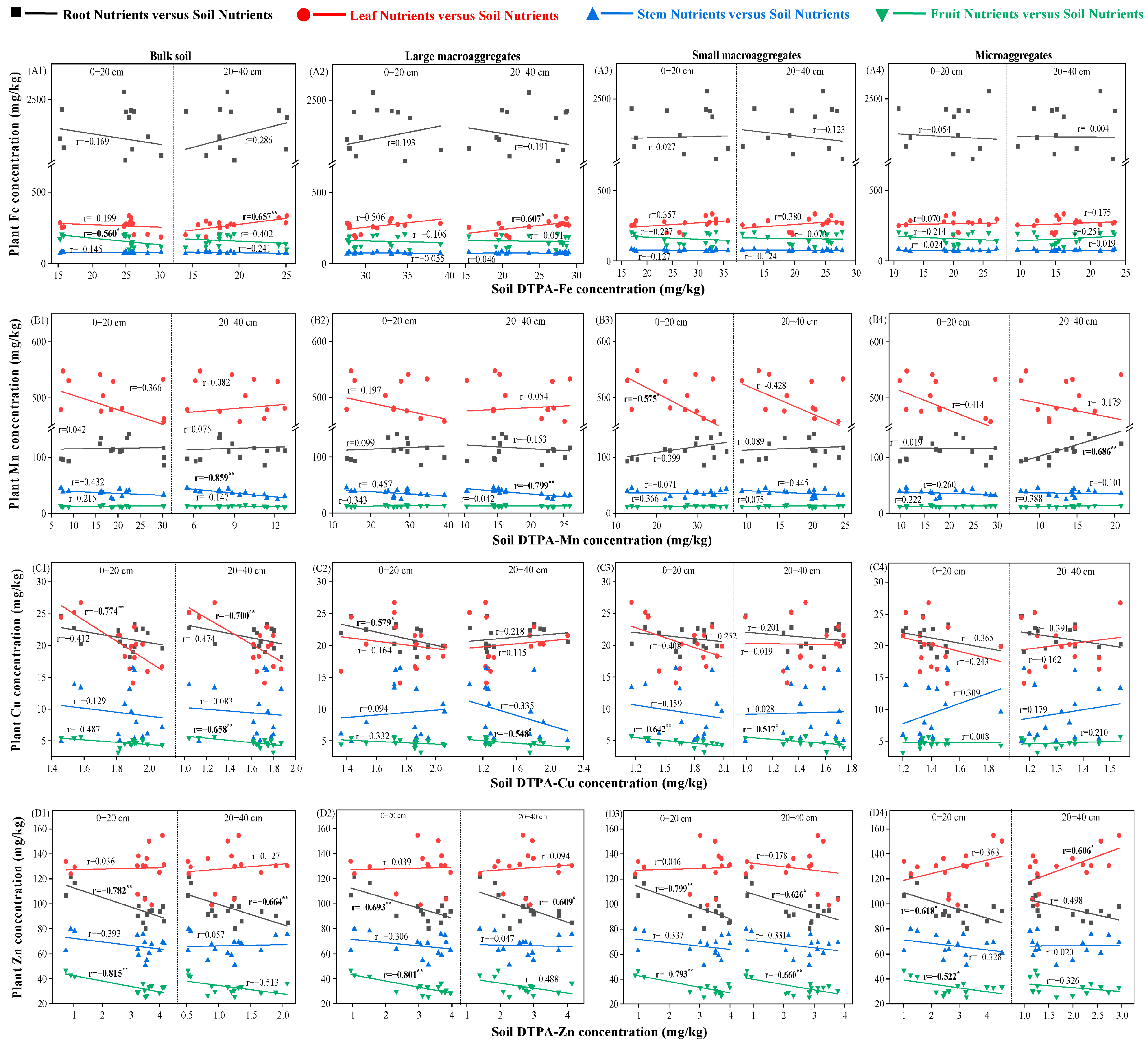
Figure 5 also reveals, through a correlation analysis, the relationships between the micronutrient contents in various plant organs and the available micronutrients in different soil fractions. The results indicate that the Fe concentration in the leaves was significantly positively correlated with available Fe in the bulk soil at a 20–40 cm depth (p < 0.01, Figure 5(A1)) and in large macroaggregates (p < 0.05, Figure 5(A2)). The Mn concentration in the roots showed a highly significant positive correlation (p < 0.01, Figure 5(B4)) with the available Mn in the microaggregates at a 20–40 cm depth. The Cu concentration in fruits was significantly correlated (p < 0.05, Figure 5(C3)) with available Cu in the small macroaggregates in the 20–40 cm layer. Similarly, the Zn content in the leaves exhibited a significant positive relationship (p < 0.05, Figure 5(D4)) with the available Zn in the microaggregates at 20–40 cm depth.

3.6. Pathways of Straw and Lime Application in Regulating Tomato Yield

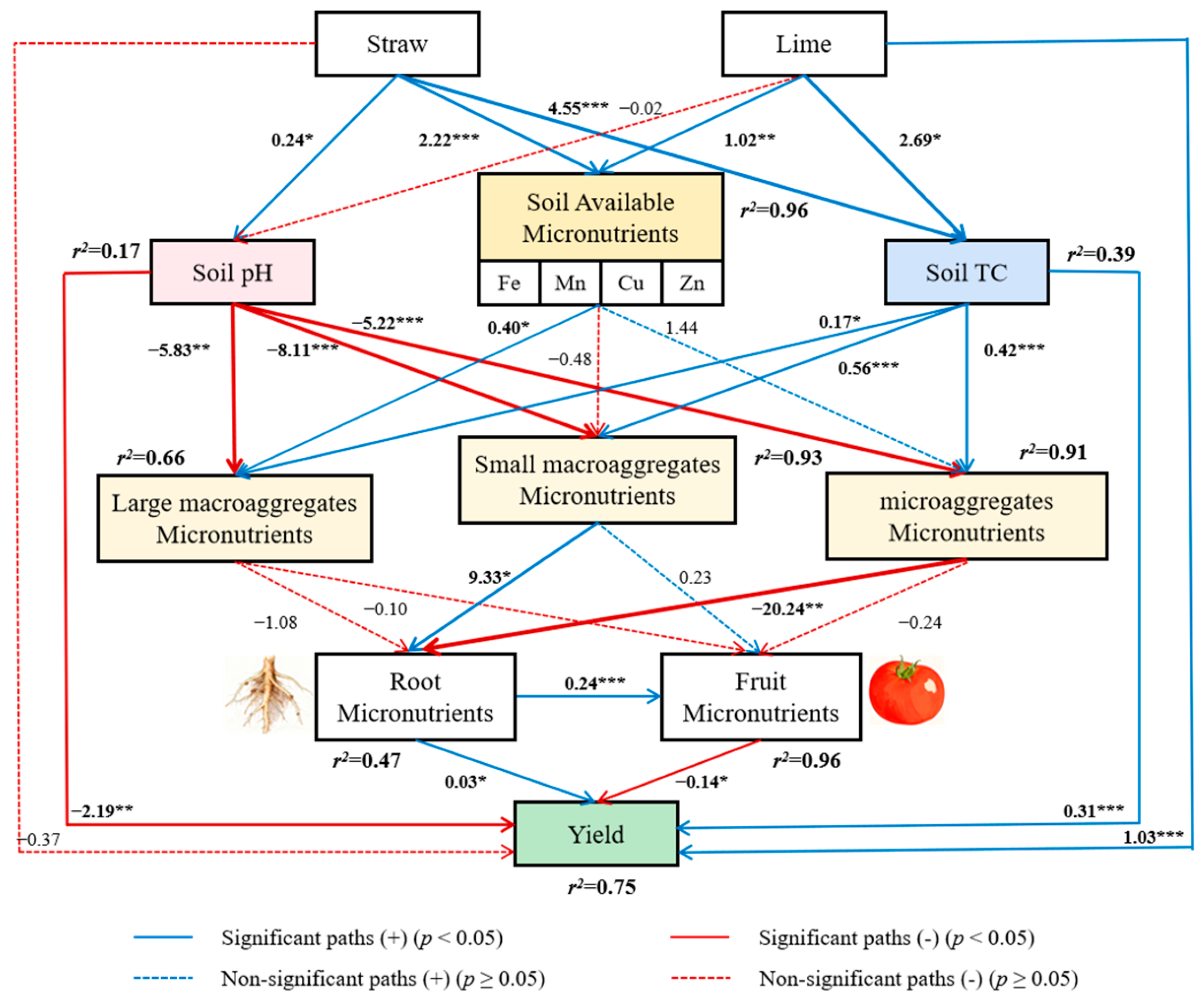
Based on the structural equation model (Figure 6), this study quantified the pathways through which straw and lime application regulate tomato yield. The analysis revealed that both fertilization practices significantly enhanced the soil total carbon and available micronutrient content. However, only straw application had a significant positive effect on the soil pH (p < 0.05). Regarding the pathways influencing nutrient availability, the soil pH was identified as a strong negative predictor of available trace elements within the soil aggregates. In contrast, the soil total carbon exerted a significant positive regulatory effect on this key mediator.
In the plant uptake and yield formation phase, the available trace element content in the small macroaggregates positively influenced the trace element content in the roots (p < 0.05). Furthermore, the root trace element content demonstrated a strong positive direct effect on the final yield (p < 0.05), whereas a significant negative effect was observed for the fruit trace element content (p < 0.05). In addition, the soil pH and soil total carbon exhibited highly significant direct effects on yield, with negative (p < 0.01) and positive (p < 0.001) regulation, respectively. Lime application also showed a significant positive direct effect on yield (p < 0.001), an effect not observed for straw application. Overall, the model explained 75% of the variance in the tomato yield, indicating that the variables included effectively capture the key processes governing the system.

4. Discussion

Long-term greenhouse trials are valuable resources for studying nutrient dynamics. The 10-year fertilization regime profoundly enhanced micronutrient bioavailability in greenhouse soils, as evidenced by elevated DTPA-extractable concentrations across soil layers (Figure 2), which can be attributed to fertilization-induced improvements in soil characteristics [23]. Dhaliwal et al. [24] also found that the DTPA-extractable micronutrients status improved significantly with 17 years of manure application in a field experiment. Except for DTPA-Zn, the other three micronutrients showed significantly higher levels in the 0–20 cm soil layer than at the 20–40 cm soil layer, in agreement with Baldi et al. [25], who found that manure addition increased the DTPA-extractable micronutrients mainly in the cultivated topsoil layer (0–20 cm). Higher concentrations of Fe, Mn and Cu in macroaggregates were observed (Figure 2) compared to those in microaggregates. It is suggested that plant biomass decomposition might contribute to the higher concentrations of Fe, Mn and Cu in macroaggregates [26], because macroaggregates are responsible for providing nutrients for plants [16]. Wang et al. [27] observed greater available Zn in microaggregates compared to macroaggregates, but we did not find a difference in the available Zn between the macroaggregates and microaggregates (Figure 2). This could be because of the soil pH value and level of carbon, interactions between plant and soil, and interactions between the soil and soil microorganism [28].
In this experiment, the combined application of manure with lime (MSCa) significantly increased the soil pH compared to the manure plus straw (MS) treatment (Table 2). This elevation in pH is generally understood to reduce the availability of soil micronutrients, as supported by studies showing that lime application significantly decreases the bioavailability of micronutrients [29]. However, in our experiment, the total content of these micronutrients was maintained or even increased. This apparent contradiction can be explained by considering the dual role of lime. Beyond its direct effect on pH, lime profoundly influences soil physical structure. The calcium ion (Ca2+) supplied by lime acts as a crucial cementing agent, promoting the formation of larger and more stable soil aggregates [16]. Furthermore, Ca2+ promotes clay flocculation, reducing electrostatic repulsion between clay particles and forming organo-mineral complexes that serve as primary building units for microaggregates [30,31]. Additionally, the organic amendments (manure and straw) applied in our MSCa treatment supplied particulate organic matter that functioned as nucleation sites for macroaggregate formation [32,33]. Consequently, the enhanced aggregation observed in our study likely resulted from the synergistic effects of lime-induced flocculation and cementation, combined with the binding and enmeshing functions of organic matter. This improved soil structure subsequently provided physical protection for soil organic carbon and associated micronutrients, thereby enhancing their retention capacity, as evidenced by the significant increase in the wet mean weight diameter of aggregates following lime application [34,35]. The formation of these large aggregates creates protected physical spaces within the soil, which can enhance the retention of micronutrients and prevent their leaching [36]. Consequently, despite the pH-induced reduction in immediate bioavailability, an appropriate amount of lime can improve the soil’s capacity to conserve micronutrient pools in the long term. Furthermore, the application of lime counteracted soil acidification and the depletion of exchangeable calcium that can result from inorganic nitrogen fertilization [27]. The improved soil chemical environment (e.g., increased SOM and nutrient availability) and physical structure collectively contributed to the highest crop yield observed in the MSCa treatment (Figure 2).
Rasool et al. [36] found that buried straw return could alleviate the stress induced by limited water and nutrients and improve the tomato yield and quality. Ramteke et al. [37] also found that rice straw incorporation improved the soil organic carbon, soil aggregation, porosity, and retention and availability of water, as well as macro- and micronutrient availability, and reduced the resistance to root penetration. In our study, straw addition significantly improved the soil total C (Table 2), and tomato yield (Table 4), proving that the tomato plants benefitted from straw addition. Even rice husk increased the tomato shoot and root dry weight with increasing tomato growth and yield [38]. In this study, the structural equation model (Figure 6) indicated that straw return did not exert a significant direct effect on yield, and its path coefficient was negative, which may be attributed to the predominantly indirect pathways through which straw influences crop yield. Specifically, straw return positively impacts yield by enhancing soil organic carbon, improving soil structure, and increasing nutrient availability. However, these benefits are partially counteracted by its simultaneous effect of reducing the soil pH, which negatively influence on yield. The model results suggest that the integration of these opposing effects leads to a non-significant net direct effect of straw return on yield. Furthermore, the variable “soil total carbon” demonstrated strong explanatory power in the model, potentially masking the independent contribution of straw return. As straw serves as a major source of soil carbon, its effect was largely reflected by the soil total carbon when included as an explanatory variable in the model. Consequently, straw return itself did not exhibit a significant direct impact. The results of this study underscore that the coupling between soil nutrient availability and plant internal nutrient partitioning plays a decisive role in determining tomato yield and quality, rather than the total micronutrient content in soil alone.
Our data clearly demonstrate that fertilization regimes significantly altered the distribution of micronutrients among tomato organs (Figure 4). A favorable distribution pattern—characterized by increased proportions of Fe and Zn in the roots and leaves and a reduction in the accumulation of Mn and Cu in leaves and Zn and Cu in fruits—was closely associated with higher yield and improved fruit quality (Table 4, Figure 4). This suggests that optimal yield and quality are achieved not merely by enhancing nutrient uptake, but by directing these nutrients to the appropriate plant organs [39]. Studies on molecular mechanisms indicate that the tomato iron transporter LeFRO1, primarily localized to the plasma membrane in roots, plays a crucial role; silencing its expression disrupts the homeostasis of iron and other mineral elements in plants [40]. Furthermore, unlike other metal elements, zinc absorbed by plants is preferentially transported to meristematic tissues and inflorescences to support active cell growth [41]. In our study, the increased allocation of iron and zinc to root and leaf tissues likely underpinned key physiological processes such as photosynthesis and root development. Conversely, excessive accumulation of copper and zinc in fruits may disrupt metabolic balance, thereby limiting yield potential [42]. The significant negative correlation between the fruit Cu/Zn content and yield (Figure 6, Table 4) strongly supports this notion. Furthermore, this internal nutrient partitioning was directly regulated by the availability of nutrients in specific soil fractions [43]. The structural equation model (Figure 6) and correlation analysis (Figure 5) revealed that the availability of micronutrients in different soil aggregate classes at various depths had distinct effects on nutrient uptake by different plant organs [44]. For instance, the available Mn in subsoil microaggregates was a key factor driving Mn accumulation in roots (Figure 5(B4)), while available Cu in subsoil small macroaggregates significantly influenced Cu content in fruits (Figure 5(C3)). This indicates that the nutrient “source” (availability in specific soil habitats) and the “sink” (demand from specific plant organs) are closely coupled. Fertilization management practices, such as the combined application of manure, straw, and lime (MSCa treatment), optimized this source–sink coupling by enhancing the soil total carbon and moderately adjusting the pH (Table 2, Figure 6), consistent with findings that organic amendments and pH management improve nutrient synchrony [45]. This approach improved the supply capacity of the “source” and guided rational “sink” allocation, ultimately leading to the highest yield and best fruit quality (Table 4). Therefore, the core mechanism by which agricultural management regulates tomato production lies in its ability to synchronize soil nutrient supply with plant nutrient demand and partitioning.

5. Conclusions

This ten-year study demonstrates that the integrated application of chicken manure with straw and lime (MSCa) enhances tomato production by synchronizing soil nutrient supply with internal plant allocation. The MSCa treatment significantly improved micronutrient bioavailability through the regulation of the soil organic carbon and pH. These improvements promoted a favorable source–sink allocation of micronutrients within tomato plants, ultimately resulting in the highest yield and optimal fruit quality. Structural equation modeling confirmed that these benefits are largely driven by enhanced soil carbon and available micronutrient levels, with lime contributing directly and the soil pH serving as a key regulatory factor. These findings highlight the importance of coordinated soil–plant nutrient management and offer a practical strategy for sustaining tomato production in protected agriculture through balanced amendments that simultaneously improve soil health and guide nutrient partitioning.

Author Contributions

Conceptualization, T.L. and L.Y. (Lijuan Yang); methodology, Y.Z.; software, L.Y. (Leixin Yu); formal analysis, Y.Z.; investigation, X.Z.; data curation, Y.L.; writing—original draft preparation, Y.Z.; writing—review and editing, T.L. and L.Y. (Lijuan Yang); funding acquisition, Y.Z., L.Y. (Lijuan Yang) and Y.L. All authors have read and agreed to the published version of the manuscript.

Funding

This research was funded by the earmarked fund for China Agriculture Research System (CARS-23), the National Natural Science Foundation of China (32402659), the Joint Funding Project of Beijing Natural Science Foundation-the Municipal Education Commission (KZ20231002034), the Distinguished Professor of Liaoning Province (No. 01062920001), and the National Natural Science Foundation of China (31372132).

Data Availability Statement

The data presented in this study are available on request from the corresponding author due to the fact that they are part of an ongoing, long-term experiment (established in 2009) and are subject to institutional policies governing the preservation and controlled access of such unique datasets to ensure their long-term integrity. However, they can be provided upon reasonable request for academic and research purposes.

Conflicts of Interest

The authors declare no conflicts of interest.

References

  1. Hu, W.Y.; Zhang, Y.X.; Huang, B.; Teng, Y. Soil environmental quality in greenhouse vegetable production systems in eastern China: Current status and management strategies. Chemosphere 2017, 170, 183–195. [Google Scholar] [CrossRef]
  2. Li, T.L.; Xu, Y.; Zhng, J.X. The current situation and development of vegetable, melon and edible fungus industries in China. China Veg. 2019, 11, 6–9. [Google Scholar]
  3. Zhao, Y.P.; Jia, Q.; Qi, X.H. Present situation and development countermeasure of tomato production in Liaoning Province. China Veg. 2015, 10, 6–9. [Google Scholar]
  4. Malakouti, M.J. The effect of micronutrients in ensuring efficient use of macronutrients. Turk. J. Agric. For. 2008, 32, 215–220. [Google Scholar]
  5. Sharma, U.; Kumar, P. Micronutrient research in India: Extent of deficiency, crop responses and future challenges. Int. J. Adv. Res. 2016, 4, 1402–1406. [Google Scholar] [CrossRef]
  6. Moreno-Jimenez, E.; Maestre, F.T.; Flagmeier, M.; Guirado, E.; Berdugo, M.; Bastida, F.; Dacal, M.; Diaz-Martinez, P.; Ochoa-Hueso, R.; Plaza, C.; et al. Soils in warmer and less developed countries have less micronutrients globally. Glob. Change Biol. 2023, 29, 522–532. [Google Scholar] [CrossRef]
  7. Setia, R.; Sharma, K. Effect of continuous cropping and long term differential fertilization on profile stratification of DTPA–extractable micronutrients Distribution of micronutrient cations. J. Food Agric. Environ. 2004, 2, 260–265. [Google Scholar] [CrossRef]
  8. Kumar, D.; Patel, K.P.; Ramani, V.P.; Shukla, A.K.; Meena, R.S. Management of micronutrients in soil for the nutritional security. In Nutrient Dynamics for Sustainable Crop Production; Meena, R.S., Ed.; Springer: Singapore, 2020; pp. 103–134. [Google Scholar]
  9. Wei, X.R.; Hao, M.D.; Shao, M.G.; Gale, W.J. Changes in soil properties and the availability of soil micronutrients after 18 years of cropping and fertilization. Soil Tillage Res. 2006, 91, 120–130. [Google Scholar] [CrossRef]
  10. Gupta, A.P. Micronutrient status and fertilizer use scenario in India. J. Trace Elem. Med. Biol. 2005, 18, 325–331. [Google Scholar] [CrossRef]
  11. Fan, J.L.; Ding, W.X.; Chen, Z.M.; Ziadi, N. Thirty-year amendment of horse manure and chemical fertilizer on the availability of micronutrients at the aggregate scale in black soil. Environ. Sci. Pollut. Res. 2012, 19, 2745–2754. [Google Scholar] [CrossRef]
  12. Zhang, Y.G.; Zhang, Y.Y.; Cai, J.P.; Zhu, P.; Gao, H.J.; Jiang, Y. Variation in available micronutrients in black soil after 30-year fertilization treatment. Plant Soil Environ. 2014, 60, 387–393. [Google Scholar] [CrossRef]
  13. Du, Z.L.; Ren, T.S.; Hu, C.S.; Zhang, Q.Z.; Blanco-Canqui, H. Soil aggregate stability and aggregate-associated carbon under different tillage systems in the north China plain. J. Integr. Agric. 2013, 12, 2114–2123. [Google Scholar] [CrossRef]
  14. Six, J.; Feller, C.; Denef, K.; Ogle, S.M.; Sa, J.C.D.; Albrecht, A. Soil organic matter, biota and aggregation in temperate and tropical soils-Effects of no-tillage. Agronomie 2002, 22, 755–775. [Google Scholar] [CrossRef]
  15. Uprety, D.; Hejcman, M.; Száková, J.; Kunzová, E.; Tlustoš, P. Concentration of trace elements in arable soil after long-term application of organic and inorganic fertilizers. Nutr. Cycl. Agroecosyst. 2009, 85, 241–252. [Google Scholar] [CrossRef]
  16. Six, J.; Bossuyt, H.; Degryze, S.; Denef, K. A history of research on the link between (micro)aggregates, soil biota, and soil organic matter dynamics. Soil Tillage Res. 2004, 79, 7–31. [Google Scholar] [CrossRef]
  17. Wang, X.X.; Zhao, F.Y.; Zhang, G.X.; Zhang, Y.Y.; Yang, L.J. Vermicompost improves tomato yield and quality and the biochemical properties of soils with different tomato planting history in a greenhouse study. Front. Plant Sci. 2017, 8, 1978. [Google Scholar] [CrossRef]
  18. Zhang, Y.Q.; Hagedorn, F.; Guidi, C.; Yang, L.J. Limited soil carbon storage under long-term organic fertilization in solar greenhouses. Soil Use Manag. 2022, 38, 1614–1627. [Google Scholar] [CrossRef]
  19. Bao, S.D. Analysis of Soil Agro-Chemistry, 3rd ed.; Agricultural Press Chinese: Beijing, China, 2001. [Google Scholar]
  20. Lindsay, W.L.; Norvell, W.A. Development of a DTPA soil test for zinc, iron, manganese, and copper. Soil Sci. Soc. Am. J. 1978, 42, 421–428. [Google Scholar] [CrossRef]
  21. Cambardella, C.A.; Elliott, E.T. Carbon and nitrogen distribution in aggregates from cultivated and native grassland soils. Soil Sci. Soc. Am. J. 1993, 57, 1071–1076. [Google Scholar] [CrossRef]
  22. Li, H.S. Plant Physiology and Biochemistry Principle and Techniques; Higher Education Press: Beijing, China, 2000. [Google Scholar]
  23. Petersen, B.; Snapp, S. What is sustainable intensification? Views from experts. Land Use Policy 2015, 46, 1–10. [Google Scholar] [CrossRef]
  24. Dhaliwal, S.S.; Sharma, S.; Sharma, V.; Shukla, A.K.; Walia, S.S.; Alhomrani, M.; Gaber, A.; Toor, A.S.; Verma, V.; Randhawa, M.K. Long-Term Integrated Nutrient Management in the Maize-Wheat Cropping System in Alluvial Soils of North-Western India: Influence on Soil Organic Carbon, Microbial Activity and Nutrient Status. Agronomy 2021, 11, 2258. [Google Scholar] [CrossRef]
  25. Baldi, E.; Cavani, L.; Mazzon, M.; Marzadori, C.; Quartieri, M.; Toselli, M. Fourteen years of compost application in a commercial nectarine orchard: Effect on microelements and potential harmful elements in soil and plants. Sci. Total Environ. 2021, 752, 141894. [Google Scholar] [CrossRef] [PubMed]
  26. Jobbágy, E.G.; Jackson, R.B. The distribution of soil nutrients with depth: Global patterns and the imprint of plants. Biogeochemistry 2001, 53, 51–77. [Google Scholar] [CrossRef]
  27. Wang, R.; Dungait, J.A.J.; Buss, H.L.; Yang, S.; Zhang, Y.G.; Xu, Z.W.; Jiang, Y. Base cations and micronutrients in soil aggregates as affected by enhanced nitrogen and water inputs in a semi-arid steppe grassland. Sci. Total Environ. 2017, 575, 564–572. [Google Scholar] [CrossRef] [PubMed]
  28. Rengel, Z. Availability of Mn, Zn and Fe in the rhizosphere. J. Soil Sci. Plant Nutr. 2015, 15, 397–409. [Google Scholar] [CrossRef]
  29. Hu, M.; Xiang, Y.S.; Lu, J.W. Effects of lime application rates on soil pH and available nutrient content in acidic soils. Chin. Soil Fertil. 2017, 04, 75–80. [Google Scholar] [CrossRef]
  30. Six, J.; Elliott, E.T.; Paustian, K. Soil macroaggregate turnover and microaggregate formation: A mechanism for C sequestration under no-tillage agriculture. Soil Biol. Biochem. 2000, 32, 2099–2103. [Google Scholar] [CrossRef]
  31. Rowley, M.C.; Grand, P.S.; Verrecchia, R.P. Calcium-mediated stabilisation of soil organic carbon. Biogeochemistry 2018, 137, 27–49. [Google Scholar] [CrossRef]
  32. Aye, N.; Butterly, C.; Sale, P.; Tang, C.X. Residue addition and liming history interactively enhance mineralization of native organic carbon in acid soils. Biol. Fertil. Soils 2017, 53, 61–75. [Google Scholar] [CrossRef]
  33. Aye, N.; Sale, P.; Tang, C.X. The impact of long-term liming on soil organic carbon and aggregate stability in low-input acid soils. Biol. Fertil. Soils 2016, 52, 697–709. [Google Scholar] [CrossRef]
  34. Piccolo, A.; Pietramellara, G.; Mbagwu, J.S.C. Use of humic substances as soil conditioners to increase aggregate stability. Geoderma 1997, 75, 267–277. [Google Scholar] [CrossRef]
  35. Bossolani, J.W.; Crusciol, C.A.C.; Merloti, L.F.; Moretti, L.G.; Costa, N.R.; Tsai, S.M.; Kuramae, E.E. Long-term lime and gypsum amendment increase nitrogen fixation and decrease nitrification and denitrification gene abundances in the rhizosphere and soil in a tropical no-till intercropping system. Geoderma 2020, 375, 114476. [Google Scholar] [CrossRef]
  36. Katyal, J.C.; Sharma, B.D. DTPA-extractable and total Zn, Cu, Mn, and Fe in Indian soils and their association with some soil properties. Geoderma 1991, 49, 165–179. [Google Scholar] [CrossRef]
  37. Ramteke, P.; Vashisht, B.; Sharma, S.; Jalota, S. Assessing and Ranking Influence of Rates of Rice (Oryza sativa L.) Straw Incorporation and N Fertilizer on Soil Physicochemical Properties and Wheat (Triticum aestivum L.) Yield in Rice-Wheat System. J. Soil Sci. Plant Nutr. 2021, 22, 515–526. [Google Scholar] [CrossRef]
  38. Taghipour, M.; Jalali, M. Effects of some industrial and organic wastes application on growth and heavy metal uptake by tomato (Lycopersicum esculentum) grown in a greenhouse condition. Environ. Sci. Pollut. Res. Int. 2020, 27, 5353–5366. [Google Scholar] [CrossRef] [PubMed]
  39. Ma, J.F.; Tsay, Y.F. Transport systems of mineral elements in plants: Transporters, regulation and utilization. Plant Cell Physiol. 2021, 62, 539–540. [Google Scholar] [CrossRef]
  40. Gama, F.; Saavedra, T.; Dandlen, S.; García-Caparrós, P.; de Varennes, A.; Nolasco, G.; Correia, P.J.; Pestana, M. Silencing of FRO1 gene affects iron homeostasis and nutrient balance in tomato plants. J. Plant Nutr. Soil Sci. 2023, 186, 554–567. [Google Scholar] [CrossRef]
  41. Kabir, A.H.; Akther, M.S.; Skalicky, M.; Das, U.; Gohari, G.; Brestic, M.; Hossain, M.M. Downregulation of Zn-transporters along with Fe and redox imbalance causes growth and photosynthetic disturbance in Zn-deficient tomato. Sci. Rep. 2021, 11, 6040. [Google Scholar] [CrossRef]
  42. Birghila, S.; Matei, N.; Dobrinas, S.; Popescu, V.; Soceanu, A.; Niculescu, A. Assessment of heavy metal content in soil and Lycopersicon esculentum (tomato) and their health implications. Biol. Trace Elem. Res. 2023, 201, 1547–1556. [Google Scholar] [CrossRef]
  43. Wang, L.Y.; Liao, D.; Rengel, Z.; Shen, J.B. Soil-plant-microbe interactions in the rhizosphere: Incremental amplification induced by localized fertilization. Front. Agric. Sci. Eng. 2025, 12, 57–68. [Google Scholar] [CrossRef]
  44. Lilay, G.H.; Thiebaut, N.; du Mee, D.; Assuncao, A.G.L.; Schjoerring, J.K.; Husted, S.; Persson, D.P. Linking the key physiological functions of essential micronutrients to their deficiency symptoms in plants. New Phytol. 2024, 242, 881–902. [Google Scholar] [CrossRef]
  45. Song, M.Y.; Li, J.F.; Gao, L.H.; Tian, Y.Q. Comprehensive evaluation of effects of various carbon-rich amendments on overall soil quality and crop productivity in degraded soils. Geoderma 2023, 436, 116529. [Google Scholar] [CrossRef]
Figure 1. Tomato plants at the seedling (A) and fruit-bearing (B) stages grown under greenhouse conditions.
Horticulturae 11 01307 g001
Figure 2. Effects of ten-year application of manure with straw and/or lime on DTPA–Fe (A,B), Mn (C,D), Cu (E,F), and Zn (G,H) concentrations in bulk soil and aggregate fractions (Large macroaggregates, Small macroaggregates, and Microaggregates) at 0–20 cm and 20–40 cm soil depths. Data are presented for the 0–20 cm (A,C,E,G) and 20–40 cm (B,D,F,H) soil depths. Different lowercase letters (a–e) indicate significant differences among treatments at p < 0.05 according to the Duncan test.
Horticulturae 11 01307 g002
Figure 3. Relationships between soil properties and the availability of micronutrients in the bulk soil and aggregate fractions at depths of 0–20 cm (A) and 20–40 cm (B). * p < 0.05, ** p < 0.01, *** p < 0.001.
Horticulturae 11 01307 g003
Figure 4. Micronutrient concentrations (mg/kg) and distributions (%): Fe (A,B), Mn (C,D), Cu (E,F), and Zn (G,H) in roots, leaves, stems, and fruits with each of the different fertilization methods (CK, no fertilizer input; M, manure; MS, manure with straw; MCa, manure with lime; MSCa, manure with straw and lime). Different lowercase letters (a–c) indicate significant differences among the treatments at p < 0.05 according to the Duncan test.
Horticulturae 11 01307 g004
Figure 5. Correlations between plant micronutrient content and the availability of micronutrients in the bulk soil and different aggregate fractions at 0–20 cm and 20–40 cm soil depths. (A1A4) Iron (Fe), (B1B4) Manganese (Mn), (C1C4) Copper (Cu), (D1D4) Zinc (Zn). For each micronutrient, the panels represent: (1) bulk soil, (2) large macroaggregates, (3) small macroaggregates, and (4) microaggregates. Asterisks denote significance levels: * p < 0.05, ** p < 0.01.
Horticulturae 11 01307 g005
Figure 6. Structural equation modeling reveals how straw and lime regulate tomato yield through soil properties and trace element dynamics. Asterisks denote significance levels: * p < 0.05, ** p < 0.01, *** p < 0.001.
Horticulturae 11 01307 g006
Table 1. Nutrient contents in the straw, manure, lime and chemical fertilizer.
MaterialspHECTNP2O5K2OTC
(µs/cm)(g/kg)
Straw--9.81.66.3395.4
Manure7.583222.415.316.8151.3
Lime13.67290.00.00.00.0
Chemical fertilizer6.11879130.274.1124.60.0
Nutrient values are presented on a dry weight basis. The abbreviations refer to the total content of each element in the applied material: TN (total nitrogen), P2O5 (phosphorus content expressed as phosphorus pentoxide), K2O (potassium content expressed as potassium oxide), TC (total carbon).
Table 2. Effects of long-term application of straw and lime on soil properties.
Soil Depth (cm)TreatmentpHEC (μS/cm)Total C (g/kg)Total N (g/kg)C/NTotal P (g/kg)Total K (g/kg)Available N (mg/kg)Available P (mg/kg)Available K (mg/kg)
0–20CK7.8 ± 0.1a123.3 ± 0.9b6.1 ± 0.2d1.1 ± 0.1b5.6 ± 0.7b0.2 ± 0.0d24.2 ± 0.6a56.7 ± 1.8b22.0 ± 1.5e170.0 ± 3.1e
M7.1 ± 0.0b281.0 ± 19.0ab12.5 ± 0.9c1.9 ± 0.0a6.5 ± 0.5b0.9 ± 0.1b23.2 ± 0.6a124.2 ± 1.9ab189.0 ± 4.7a421.4 ± 0.2c
MS6.8 ± 0.0c412.0 ± 19.4a16.1 ± 0.6b2.1 ± 0.1a7.8 ± 0.6ab0.7 ± 0.0c24.5 ± 0.1a151.8 ± 7.6a116.1 ± 0.9c376.9 ± 3.6d
MCa7.0 ± 0.0bc407.7 ± 8.1a13.9 ± 0.3bc1.8 ± 0.0a7.9 ± 0.3ab1.1 ± 0.0ab24.0 ± 0.7a141.0 ± 0.6a99.6 ± 2.6d503.3 ± 16.3a
MSCa7.2 ± 0.0b413.7 ± 9.3a19.4 ± 0.4a2.1 ± 0.1a9.4 ± 0.3a1.2 ± 0.0a24.2 ± 0.1a137.1 ± 6.9ab133.8 ± 3.1b461.7 ± 1.0b
20–40CK7.7 ± 0.1a106.0 ± 5.0d4.1 ± 0.2c1.0 ± 0.0b4.3 ± 0.3b0.4 ± 0.0d23.8 ± 0.6a44.8 ± 2.5d21.9 ± 3.2d118.7 ± 3.5b
M7.5 ± 0.0ab199.3 ± 18.3c7.8 ± 0.9b1.2 ± 0.1ab6.4 ± 0.4ab0.6 ± 0.0c23.0 ± 0.4a57.5 ± 2.8cd77.3 ± 5.7bc217.9 ± 6.7ab
MS7.3 ± 0.0b263.3 ± 9.3b10.9 ± 0.2a1.6 ± 0.2a6.8 ± 0.5a0.6 ± 0.0c23.4 ± 0.3a67.3 ± 1.0bc93.2 ± 9.1b261.7 ± 17.9a
MCa7.5 ± 0.1ab193.0 ± 2.0c9.5 ± 1.1ab1.6 ± 0.1a6.1 ± 0.5ab0.9 ± 0.0a24.4 ± 0.4a94.9 ± 1.6a129.9 ± 1.8a318.6 ± 19.4a
MSCa7.4 ± 0.1ab430.7 ± 11.5a9.5 ± 0.3ab1.4 ± 0.1ab7.0 ± 0.6a0.8 ± 0.0b23.7 ± 0.5a76.5 ± 4.6b60.8 ± 1.9c235.6 ± 3.5ab
p-valueStraw (S)***********nsnsnsnsns
Liming (Ca)ns****ns*****ns**ns**
Soil Depth (D)**************ns***ns***
S × Ca**nsns*nsnsns**ns*
S × Dnsns*nsnsnsnsnsnsns
Ca × Dnsnsnsnsnsnsnsnsnsns
S × Ca × D***nsnsnsnsnsnsnsns
Data are presented as mean values ± standard errors. Different lowercase letters (a–e) indicate significant differences among treatments at p < 0.05 according to the Duncan test. Asterisks denote significance levels: * p < 0.05, ** p < 0.01, *** p < 0.001. “ns” indicates non-significance. The abbreviations are as follows: TC, soil total carbon; TN, soil total nitrogen; TP, soil total phosphorus; TK, soil total potassium; AN, soil available nitrogen; AP, soil available phosphorus; AK, soil available potassium.
Table 3. Effects of straw (S), lime (Ca), and soil Depth (D) on the concentrations of DTPA-extractable micronutrients in bulk soil and aggregate fractions.
Aggregates FractionsStraw (S)Lime (Ca)Soil Depth (D)S × CaS × DCa × DS × Ca × D
DTPA-FeBulk soilns*********nsns
Large macroaggregates*ns*****nsnsns
Small macroaggregatesnsns**nsnsns
Microaggregatesnsns*nsnsnsns
DTPA-MnBulk soil***ns*********ns*
Large macroaggregates**ns******nsnsns
Small macroaggregates***ns***nsnsnsns
Microaggregates***ns***ns***ns*
DTPA-CuBulk soil*ns**nsnsnsns
Large macroaggregatesnsns*****ns****
Small macroaggregatesnsns***nsnsns
Microaggregatesnsnsnsnsnsnsns
DTPA-ZnBulk soilnsns*****nsnsns
Large macroaggregatesns*ns**nsnsns
Small macroaggregates*nsnsnsnsnsns
Microaggregates*ns*******nsns
Asterisks denote significance levels: * p < 0.05, ** p < 0.01, *** p < 0.001. “ns” indicates non-significance.
Table 4. Effects of chicken manure (M) application with straw (S) or lime (Ca) on tomato yield and fruit quality over 10 years.
TreatmentYieldVitamin CNitrateOrganic AcidSoluble SugarSugar-Acid Ratio
kg/m2mg/100 gmg/kg%%
CK3.0 ± 0.1c22.2 ± 0.8b77.8 ± 0.4a0.6 ± 0.0a2.9 ± 0.1d5.2 ± 0.0e
M3.6 ± 0.4bc29.3 ± 0.7a77.4 ± 0.1a0.6 ± 0.0b3.3 ± 0.0c5.9 ± 0.0d
MS4.2 ± 0.4abc30.2 ± 0.3a75.6 ± 0.2b0.5 ± 0.0c3.6 ± 0.1b7.0 ± 0.0b
MCa5.0 ± 0.3ab29.4 ± 1.3a74.8 ± 0.1c0.5 ± 0.0c3.4 ± 0.0c6.8 ± 0.1c
MSCa5.6 ± 0.8a31.1 ± 1.4a72.9 ± 0.2d0.5 ± 0.0c3.7 ± 0.0a7.7 ± 0.0a
p-valueStraw (S)nsns**********
Lime (Ca)***ns*********
S × Cansnsns**nsns
Data are presented as mean values ± standard errors. Different lowercase letters (a–e) indicate significant differences among treatments at p < 0.05 according to the Duncan test. Asterisks denote significance levels: * p < 0.05, ** p < 0.01, *** p < 0.001. “ns” indicates non-significance.
Disclaimer/Publisher’s Note: The statements, opinions and data contained in all publications are solely those of the individual author(s) and contributor(s) and not of MDPI and/or the editor(s). MDPI and/or the editor(s) disclaim responsibility for any injury to people or property resulting from any ideas, methods, instructions or products referred to in the content.