Article

A Microbial Cell-Factory Case Study for High-Value Lipid and Carotenoid Production from Dairy Whey Using Sporobolomyces reniformis EMCC1691


1
Department for Sustainability, ENEA-Italian National Agency for New Technologies, Energy and Sustainable Economic Development, Trisaia Research Center, 75026 Rotondella, Italy
2
Department for Energy Technologies and Renewable Sources, ENEA-Italian National Agency for New Technologies, Energy and Sustainable Economic Development, Trisaia Research Center, 75026 Rotondella, Italy
3
Department for Sustainability, ENEA-Italian National Agency for New Technologies, Energy and Sustainable Economic Development, Portici Research Center, Piazzale Enrico Fermi 1, 80055 Portici, Italy
*
Author to whom correspondence should be addressed.
Fermentation 2026, 12(6), 292; https://doi.org/10.3390/fermentation12060292

Submission received: 8 May 2026 / Revised: 4 June 2026 / Accepted: 12 June 2026 / Published: 18 June 2026
(This article belongs to the Section Microbial Metabolism, Physiology & Genetics)

Abstract

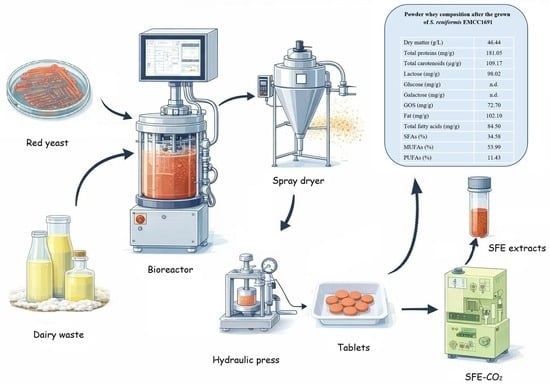
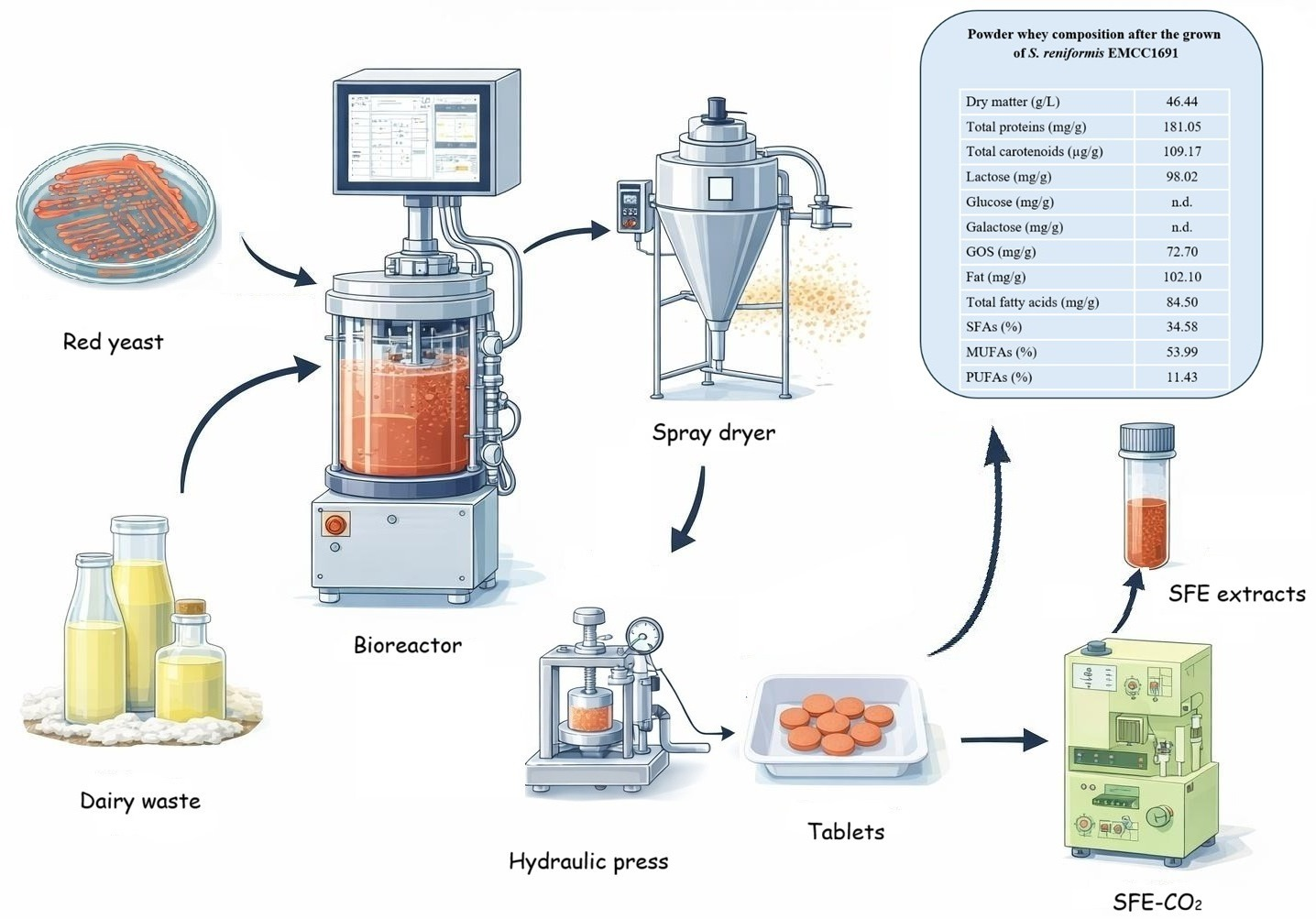
A newly isolated red-pigmented yeast, Sporobolomyces reniformis EMCC1691, was evaluated for its biotechnological potential in an integrated case study aimed at developing an efficient microbial cell factory for the valorization of delactosed whey. Fermentation trials in 5 L bioreactors demonstrated robust yeast growth on this dairy by-product, with complete consumption of glucose (21.86 g/L) and galactose (20.36 g/L), leading to the accumulation of approximately 6172 mg/L of lipids and 5634 µg/L of total carotenoids. Fatty acid analysis revealed a final concentration of 3924 mg/L, mainly represented by oleic (2037 mg/L), palmitic (779 mg/L), stearic (403 mg/L), and linoleic (362 mg/L) acids. HPLC analysis showed a pigment profile dominated by torularhodin, torulene, γ-carotene, and β-carotene. To complement downstream processing, the fermented culture was spray-dried into a stable powder and subsequently subjected to a simple, cost-effective, and unconventional mechanical pretreatment using a hydraulic press. This post-drying operation ensured extensive cell-wall disruption without the use of chemical agents or specialized equipment, thereby significantly enhancing the recoverability of intracellular lipids and carotenoids through supercritical CO2 extraction. Under optimized conditions, SFE-CO2 with ethanol recovered 92.18 ± 1.61 µg/g of total carotenoids, achieving an extraction efficiency of 84% relative to organic solvent extraction (109.17 ± 2.10 µg/g). Importantly, fermentation also reshaped the fatty acid composition of delactosed whey, shifting it toward a profile enriched in monounsaturated and polyunsaturated fatty acids, thereby further highlighting the metabolic impact and bioconversion potential of S. reniformis EMCC1691. Overall, this work highlights the technological relevance of a recently characterized yeast species and its potential to convert dairy by-products into high-value compounds within a proof-of-concept microbial cell factory framework, paving the way for future scale-up investigations.

Graphical Abstract

1. Introduction

In recent years, the growing attention toward more sustainable production models has led to increasing interest in the use of microbial platforms for the synthesis of high-value bioactive compounds. The need to reduce dependence on processes based on plant-derived or petrochemical resources has driven research toward organisms capable of converting inexpensive and renewable substrates into industrially relevant molecules [1,2,3]. In this context, non-conventional oleaginous red yeasts have emerged as particularly versatile and robust systems, able to adapt to different cultivation conditions and to produce a wide range of valuable metabolites.
Among these microorganisms, species belonging to the genera Rhodotorula and Sporobolomyces, have gained a prominent role due to their natural ability to synthesize carotenoids, lipids, and other bioactive compounds with applications in the food, nutraceutical, and pharmaceutical sectors [4,5,6,7]. These yeasts are well known for their characteristic pigmentation, resulting from the production of carotenoids such as β-carotene, torulene, and torularhodin, molecules recognized for their antioxidant properties and provitamin A activity [8,9]. Interest in these pigments has further increased due to their potential role in preventing oxidative stress-related diseases and supporting immune function and visual health [7,10].
In addition to carotenoids, these genera exhibit a strong oleaginous metabolism, enabling the accumulation of high levels of intracellular lipids [11,12,13]. The composition of these lipids, rich in long-chain fatty acids similar to those found in vegetable oils, makes them particularly attractive for food, feed, and oleochemical applications [14,15]. A highly relevant aspect is the close metabolic connection between lipid and carotenoid biosynthesis, which positions these yeasts as ideal platforms for integrated and efficient bioprocesses [16,17]. Their simultaneous production of lipids and carotenoids represents a key advantage for the development of economically viable biotechnological processes [18,19,20].
The cultivation of Rhodotorula and Sporobolomyces in controlled bioreactors has been widely investigated, and several studies have shown that parameters such as aeration, agitation, and nutrient composition significantly influence both lipid accumulation and carotenoid production [21,22,23,24]. In particular, oxygen availability has proven to be a critical factor, as carotenoid biosynthesis is strictly aerobic [25]. Building on these findings, recent research has increasingly focused on how process design and substrate selection can further enhance the sustainability and economic feasibility of red-yeasts-based bioprocesses.
A key strategy to improve process sustainability is the use of low-cost and renewable substrates. Agro-industrial residues are increasingly being explored as alternative feedstocks, enabling waste valorization within circular bioeconomy frameworks [26,27,28]. Among these, cheese whey is one of the most abundant by-products of the dairy industry, characterized by high lactose content and significant organic load [29,30]. Although its biotechnological conversion into value-added products has been widely investigated, including the production of microbial biomass rich in biomolecules such as violacein, organic acids, and biopolymers [31,32,33,34]. Only limited studies have explored its potential for carotenoid production by red yeasts, often requiring additional process optimization such as lactose hydrolysis or co-cultivation strategies [35,36].
Despite progress in upstream processing, downstream recovery remains a major bottleneck for industrial implementation. Conventional extraction methods typically rely on organic solvents, raising concerns related to environmental impact, safety, and regulatory compliance [37]. Recent studies have shown that supercritical CO2 extraction significantly enhances carotenoid recovery while preserving lipid quality, representing a promising green alternative to traditional solvent-based approaches [38,39,40].
Supercritical fluids combine liquid and gas properties above their critical temperature and pressure, offering low viscosity, high diffusivity, and adjustable density for efficient and selective extraction. Carbon dioxide (CO2) is the most widely used in the food sector due to its mild critical conditions (31.1 °C, 7.38 MPa), making it suitable for extracting volatile and heat-sensitive compounds. It is non-toxic, non-flammable, readily available, leaves no residues, and can be recycled, making it suitable for food-grade applications compared to conventional solvents such as hexane or dichloromethane [41,42].
Taken together, these findings highlight the strong potential of microbial-based systems for the sustainable production of carotenoid- and lipid-rich nutraceuticals. Nevertheless, the development of integrated processes that combine efficient substrate utilization, co-production of metabolites, and sustainable downstream recovery remains a significant challenge.
In this context, the present study aims to develop and evaluate a proof-of-concept bioprocess based on the cultivation of a red yeast on cheese whey as a low-cost substrate, coupled with green downstream strategies for the recovery of carotenoid- and lipid-rich extracts.
To this end, a new red-pigmented yeast strain EMCC1691 was identified through ITS-rDNA sequencing and cultivated in 5 L bench-scale bioreactors using whey derived from lactose-free dairy processing. The process was completed with an integrated extraction and downstream workflow designed to evaluate its feasibility for future scale-up and valorization of dairy by-products.

2. Materials and Methods

2.1. Yeast Strain

A new red yeast strain, EMCC1691, was isolated from the surface of fresh cheese and identified using molecular techniques targeting the Internal Transcribed Spacer (ITS) region. This strain was characterized as lactose-negative based on its metabolic profile obtained using the YT MicroPlate™ analyzed with the Microbial Identification Software version 6.3.1 (Biolog, Inc., Hayward, CA, USA). The pure culture was deposited in the ENEA Microbial Culture Collection (EMCC) and maintained on Potato Dextrose Agar (PDA, Sigma-Aldrich, Milan, Italy) at 4 °C and cryopreserved in 30% glycerol at −80 °C.

2.2. Molecular Identification of Yeast Strain

The isolate was identified through molecular analysis of the internal transcribed spacer (ITS) region of ribosomal DNA, widely recognized as universal DNA barcodes and robust markers for yeast identification and fungal phylogenetic classification [43].
Following identification, the yeast was grown on PDA plates at 28 °C for 7 days, and genomic DNA was extracted directly from fresh colonies using the InnuPREP Plant DNA Kit (Analytik Jena, Jena, Germany).
Approximately 30 mg of fresh material was transferred to a 2 mL reaction tube containing one 5 mm stainless steel bead (Qiagen, Hilden, Germany) and 50 µL of ddH2O. The material was then homogenized using a TissueLyser (Qiagen, Hilden, Germany) at a frequency of 25 Hz for 1 min, or until a homogeneous suspension was obtained. Then, 400 µL of SLS lysis solution provided in the kit was added to the reaction tube, and genomic DNA was extracted according to the manufacturer’s instructions. The DNA was then used as a template for PCR amplification.
Phusion™ High-Fidelity DNA Polymerase (Thermo Fisher Scientific, Waltham, MA, USA) and the ITS1F/ITS4 universal primers were used to amplify the ITS region. The PCR protocol was as follows: initial denaturation at 98 °C for 30 s; followed by 30 cycles of 98 °C for 10 s, 58.5 °C for 20 s, and 72 °C for 30 s; with a final extension at 72 °C for 5 min.
PCR amplicons were checked by capillary electrophoresis using the QIAxcel Connect instrument (Qiagen) and the QIAxcel DNA Screening Kit (Qiagen). PCR products were purified with the MinElute PCR Purification Kit (Qiagen) [44].
The electropherograms were analyzed and trimmed using FinchTV software (ver. 1.4.0) prior to sequencing (Mix2Seq Kit—Eurofins service, Ebersberg, Germany). The resulting sequences were imported into BioEdit software ver. 7.7.1, aligned using ClustalW, manually edited, and a consensus sequence was generated. The consensus sequence was then analyzed using a basic local alignment search tool online BLASTn search against rRNA/ITS databases (accessed on May 2026). The options “ITS from Fungi type and reference material” and “Type Material” were selected.
For phylogenetic analysis, multiple sequence alignment was performed using the first 30 BLASTn hits, including representatives of the Sporobolomyces and Rhodotorula genera. A total of 31 ITS rDNA sequences were therefore analyzed, including the isolate under study, designated EMCC1691.
The phylogenetic tree was constructed using the Neighbor-Joining (NJ) method [44]. Evolutionary distances were computed using the p-distance method and expressed as the number of base substitutions per site. Bootstrap analysis with 1000 replicates was used to assess the robustness of the phylogenetic clusters. All bioinformatic analyses were performed using the software MEGA (Molecular Evolutionary Genetics Analysis) ver. 2.1.

2.3. Delactosed Whey Characterization

The whey sample was collected from a local cheese production facility. It originated from lactose-hydrolysed cow’s milk used for mozzarella manufacturing. The sample was analyzed for density, electrical conductivity (EC), and pH using a Quevenne glass lactodensimeter and a calibrated pH meter (Hanna Instruments, Halo® Wireless pH Meters, Villafranca Padovana, Italy). In addition, the contents of glucose, galactose, and lactose were determined by HPLC analysis of filtered liquid samples, while aliquots of whey were dried using a benchtop freeze-drying system (FreeZone® 2.5 L, Labconco Corporation, Kansas City, MO, USA) to be further analyzed for fat and protein content by methodologies described in subsequent sections.

2.4. Sporobolomyces Culture on Bioreactor

The growth of the EMCC1691 strain was evaluated in a 5 L stirred-tank bioreactor (B. Braun International, Biotech, Berlin, Germany) with an initial working volume of 3 L using delactosed whey as substrate. This choice was based on previous studies demonstrating the suitability of whey for the cultivation of red yeast species and carotenoid production.
For comparison, the microorganism was also cultivated in a synthetic mineral medium (MS) consisting of 5 g/L ammonium nitrate, 2 g/L yeast extract, 3 g/L disodium phosphate, 1.5 g/L potassium dihydrogen phosphate, and 0.5 g/L magnesium sulfate, supplemented with 40 g/L glucose. This formulation corresponds to a typical defined medium previously used for the cultivation of red yeasts [45].
The bioreactor consisted of a glass vessel with a diameter of 16 cm, equipped with two Rushton-type impellers (5.3 cm in diameter), each having six equally spaced blades, and a ring sparger located below the lower impeller. Cultivations were carried out in batch mode. A 96 h preculture was used as inoculum at 10% (v/v).
During the fermentation process, temperature was maintained at 28 °C and pH at 7.1 through the automatic addition of 1 M NaOH and 1 M HCl solutions, as these conditions were selected based on literature reports to optimize carotenoid production [45,46].
Aeration was set at 0.9 L/min, corresponding to a volumetric aeration rate of 0.30 vvm, while agitation was maintained at 720 rpm. The agitation speed was selected to achieve a high volumetric oxygen transfer coefficient (kLa) while avoiding values above 720 rpm, since higher speeds caused excessive foam formation and could compromise process stability. Under these conditions, the kLa reached 60.7 h−1, as estimated using the empirical correlation proposed by Riet (1979) [47].
Samples were aseptically collected every 24 h to monitor yeast cell concentration, sugar consumption (glucose and galactose), lipid content, and carotenoid production. For each sampling point, an aliquot was used to determine cell concentration by counting with a Bürker chamber. An additional 5 mL culture sample was centrifuged at 9000× g for 10 min (Beckman Coulter Allegra™ 2IR, Brea, CA, USA). The resulting supernatant was filtered and analyzed for sugar content, while the cell pellet was washed twice with distilled water and subsequently freeze-dried.
The dried biomass was then subjected to high-pressure treatment to induce cell wall disruption, facilitating the extraction of intracellular compounds such as carotenoids and lipids. All experiments were carried out in triplicate. At the end of the fermentation process, the entire culture broth was recovered and subjected to a drying process using a pilot spray dryer (APT-2.0 Spray Dryer, Novara, Italy).

2.5. Spray-Drying of Red Yeast Fermented Whey and Biomass Pretreatment by High-Pressure Processing

After 216 h of microbial cultivation, the entire liquid culture was dried using spray-drying. The fermentation broth was fed into a spray dryer (APT-2.0 Spray Dryer, Novara, Italy) using a peristaltic pump operated at 15 rpm through a silicone tubing with an internal diameter of 0.2 mm. Atomization was performed through a single-fluid nozzle (0.8 mm), while the compressed air flow at the nozzle was maintained at 1.6 m3/h. The inlet air temperature was set at 180 °C, resulting in an outlet temperature of approximately 80 °C. Before and after each drying run, the system was operated with water for at least 15 min to ensure proper cleaning and stabilization of the equipment.
At the end of the process, the obtained powder was collected, weighed, and packaged under nitrogen atmosphere in crown-sealed bottles. The samples were then stored at room temperature until further use for extraction and analytical determinations. For this purpose, due to the rigid structure of yeast cell walls, an effective disruption step is required to enable the extraction of intracellular compounds such as carotenoids and lipids [48].
Therefore, to promote cell wall rupture and enhance the accessibility of intracellular components, aliquots of approximately 250–500 mg of dried biomass were subjected to mechanical compression using a hydraulic press (Pressa Idraulica 660, Silfradent S.r.l., Santa Sofia, Italy) [49,50].
The press can generate forces in the order of several tons of load (approximately 4000–7000 kg of load), corresponding to operating pressures in the range of approximately 100–180 bar. In particular, the samples were compressed at a load of 7000 kg for 1 min, producing compact tablets. After this pretreatment step, these tablets were subsequently ground into a fine powder, and the cell disruption was evaluated using the Trypan Blue staining method. Finally, the powder was used for subsequent carotenoid and lipid extraction procedures.

2.6. Supercritical Fluid Extraction of Carotenoids

Supercritical CO2 extraction was carried out using a bench-scale apparatus (Applied Separations Spe-ed SFE-2, Allentown, PA, USA) to obtain an oleoresin rich in carotenoids. The sample consisted of dehydrated and pressed biomass. This pre-treatment was applied to promote cell disruption and improve mass transfer during extraction. Extractions were conducted at 300 bar and 40 °C, with ethanol used as a co-solvent. These conditions were selected based on previous studies [45,51] to maximize extraction yield.
Approximately 1.5 g of sample was loaded into a 50 mL extraction vessel, which was filled to 60% capacity with 3 mm glass beads. The extraction was carried out for 70 min, using CO2 and co-solvent flow rates of 6 L/min and 0.5 mL/min, respectively. For comparison, a conventional organic solvent extraction was conducted on the same pre-treated biomass to provide a comparative reference. Furthermore, to confirm the effectiveness of the high-pressure process in promoting cell wall rupture and improving the accessibility of intracellular components, extractions were also performed on non-pretreated biomass.
The resulting red lipid extracts were collected in amber vials, dried, and weighed. Samples were stored at −20 °C until further analysis for determination of total carotenoid content and their chromatographic profiles.

2.7. Chemical Analyses

2.7.1. Sugars HPLC Determination

Sugar quantification was performed using an Agilent 1200 Series HPLC system (Agilent Technologies, Santa Clara, CA, USA), equipped with an in-line degasser (G1379B), binary pump (G1312B), autosampler (G1367B), column temperature controller (G1316A), UV–Vis detector (G1314B), diode array detector (DAD) (G1315A), and refractive index detector (RID). Prior to analysis, 1 mL of sample was centrifuged at 13,000× g for 2 min. The supernatant was subsequently filtered through a 0.22 µm membrane filter and transferred into 2 mL vials.
Chromatographic separation was carried out using an Hi-Plex H column (7.7 × 300 mm, 8 μm) (Agilent), with 0.005 M sulfuric acid as the mobile phase under isocratic conditions at a flow rate of 0.7 mL/min. The injection volume was 20 μL, and the column temperature was maintained at 60 °C. Detection was performed using RID, and peak identification was achieved by comparing retention times with those of external standards (glucose, galactose, and lactose). Calibration curves were constructed for each analyte using at least three concentration levels in the range of 0.05–10 g/L, all showing excellent linearity (R2 ≥ 0.9999).
For the determination of galacto-oligosaccharides (GOS), aliquots of dehydrated samples were subjected to enzymatic hydrolysis using Delact Plus enzyme (Alce International s.r.l., Quistello, Italy) at a dosage of 10 μL/mL. The reaction was carried out using a thermomixer (Thermomixer Comfort, Eppendorf, Hamburg, Germany) at 45 °C under constant agitation (600 rpm) for 4 h to ensure GOS hydrolysis. Following enzymatic treatment, glucose and galactose concentrations were re-determined under the same HPLC conditions.
GOS content was calculated according to the method described by Lin et al. 2018 [52], considering the increase in monosaccharides after hydrolysis and correcting for the contribution of residual lactose using the following equation:
GOS = 0.9 × ([Gal]E − [Gal]I − [Lac]I/1.9) + ([Gluc]E − [Gluc]I − [Lac]I/1.9)
where [Gal] and [Gluc] represent galactose and glucose concentrations, respectively; [Lac]I is the initial lactose concentration, and the subscripts I and E refer to concentrations before and after enzymatic hydrolysis, respectively. Data acquisition and processing were carried out using OpenLAB CDS ChemStation Edition Rev. C.01.10(201) (Agilent Technologies, Santa Clara, CA, USA).

2.7.2. Determination of Total Fat Content

The dried whey and dried lysed biomass samples were crushed, accurately weighed, and transferred into 15 mL Falcon-type tubes. For each 0.1 g of sample, 3 mL of hexane was added. The samples were then incubated in a shaking incubator (NB-205LF, N-BIOTEK, Daejeon, Republic of Korea) at 40 °C and 250 rpm for 60 min. Following incubation, the tubes were centrifuged at 9000× g for 10 min. Subsequently, 1 mL of the supernatant was transferred into an Eppendorf tube and dried using a rotary vacuum concentrator (SpeedDry Vacuum Concentrator, model RVC 2–25, Christ, Osterode am Harz, Germany). The resulting extract was accurately weighed using an analytical balance (Kern, model 870, Vicenza, Italy), the amount of fat in the dry matter was calculated as
m g / g = W e x / W d b
where Wex is the weight (mg) of hexane extract and Wdb is the weight (g) of dried biomass.

2.7.3. Determination of Total Carotenoids

The dried and pretreated samples were subjected to solvent extraction for carotenoid recovery. In brief, 0.1 g of sample was suspended in 5 mL of a solvent mixture composed acetone and methanol in a 70:30 (v/v) ratio. The suspension was vortexed for 5 min to ensure complete homogenization and then separated by centrifugation for 5 min at 9000× g and 5 °C.
The resulting supernatant was carefully collected, while the solid residue underwent two additional extraction cycles under identical conditions to maximize carotenoid recovery. The combined extracts were concentrated using a vacuum rotary evaporator (Steroglass Kentron—Strike 202, Perugia, Italy) at 40 °C. The concentrated extracts were then resuspended in pure ethanol and total carotenoid content was determined using the following equation:
T C   ( µ g ) = A × V × 10 4 E 1 c m 1 % × l
where A is the absorbance value; V is the total volume of the sample (mL); l is the path length (cm);   E 1 c m 1 % is the extinction coefficient of β-carotene in ethanol (2620 mL/mg·cm).
The carotenoid yield was expressed in μg/g and is calculated using the following equation:
μ g / g = T C / W d b
where TC is the total carotenoids (μg) in the extract and Wdb is the weight (g) of dried biomass.

2.7.4. Carotenoid Profile Characterization

Prior to analysis, the extract was re-suspended in 1 mL of ethanol containing 0.2% (w/v) BHT and filtered through 0.22 μm syringe filter into 2 mL vials. Chromatographic separation was carried out on a Zorbax Rx-C18 analytical column (4.6 × 250 mm, 5 μm particle size) using gradient elution with acetone and water as mobile phases. The injection volume was 20 μL, and the column temperature was maintained at 25 °C throughout the run.
The gradient elution program was as follows: the initial mobile-phase composition was set at 75% A. From 0 to 10 min, the proportion of A was increased from 75% to 95%; from 10 to 17 min, the system was held at 95% A; from 17 to 20 min, A was further increased from 95% to 100%; from 20 to 30 min, the composition was maintained at 100% A. Finally, from 30 to 35 min, a linear gradient returned the system to the initial conditions (75% A). This gradient profile was designed to ensure efficient separation of carotenoid compounds with different polarities. Detection was performed by UV absorption at 453 nm, the characteristic wavelength for β-carotene. Online spectra were recorded in the range of 350–650 nm.
The major peaks were identified by comparing the recorded spectra with literature data. Specifically, the wavelengths corresponding to the maximum absorbance (λmax) and the spectral fine structure were analyzed in the UV-Vis spectrum of each peak.
The concentration of the main carotenoids was expressed as β-carotene equivalents (μg per g of dried cells). For calibration, synthetic β-carotene (PHR1239-1G, Sigma-Aldrich, Milan, Italy) was dissolved in hexane and subsequently diluted in ethanol containing BHT to prepare standard solutions. A calibration curve was constructed at concentrations of 0.024, 0.012, 0.006, 0.0012, and 0.0006 μg/mL. The resulting linear regression equation was y = 225.56x + 16.491, showing excellent linearity (R2 = 0.9997). Data acquisition was carried out using OpenLAB CDS ChemStation Edition Rev. C.01.10 (Agilent Technologies, Santa Clara, CA, USA). (201).

2.7.5. Determination of Fatty Acid Profile by GC-FID

The dry fat extract was accurately weighed and dissolved in 5 mL of isooctane containing BHT (0.05 g/L). The solution was transferred into a new tube, and the tricosanoic acid (C23:0), which is not naturally present in the samples, was used as an internal standard (IS). The solvent was then evaporated, and 1.5 mL of KOH/MeOH solution (0.5 M) was added to the residue. The sample was incubated in a TurboVap at 60 °C for 7 min to carry out the first transesterification step. After cooling to approximately 30 °C, 2 mL of BF3 in methanol was added, and the tube was incubated again in the TurboVap at 60 °C for 30 min.
Following the reaction, 1 mL of isooctane was added, and the sample was vortexed for 30 s to extract the FAMEs. Then, 5 mL of saturated NaCl solution was added, and the mixture was shaken again. The polar phase was extracted twice with isooctane (1 mL each).
The combined organic extracts were washed with 1.5 mL distilled water. The upper phase was collected and transferred into vials for storage at −20 °C and into GC vials for subsequent analysis. Chromatographic analysis was performed using 7820A GC-FID system (Agilent, Santa Clara, CA, USA) equipped with a DB-23 column (30 m × 0.25 mm × 0.25 μm). Nitrogen 5.0 (purity > 99.999%) was used as the carrier gas.
Samples were injected in split mode with a split ratio of 20:1. The injector temperature was set at 250 °C and the detector temperature at 280 °C. Tricosanoic acid (C23:0) (T6543, Sigma-Aldrich, Milan, Italy) was used as the internal standard for quantification.
The ratio between the peak area of each FAME and that of the internal standard was used to determine the relative composition (area %) and for quantification, applying appropriate response correction factors (CF) to account for differences in detector response between analytes and the IS. For qualitative analysis, a certified mixture of 37 FAMEs Mix CRM47885 (Supelco, Bellefonte, PA, USA) was used. Compounds were identified by comparing retention times with those of the reference standard. Data processing was carried out using Agilent ChemStation.

2.7.6. Kjeldahl Assay for Protein Determination

The protein content of liquid whey and spray-dried samples was determined using the Kjeldahl method. Specifically, 0.3 g of dried sample or 5 mL of liquid whey were introduced into a digestion flask, followed by the addition of 15 mL of concentrated sulfuric acid and 7 g of K2SO4 (to raise the boiling point), and 0.8 g of CuSO4 × 5H2O as catalyst to speed up the reaction. The flask was manually agitated to ensure complete homogenization of the mixture and then heated until the solution became clear and viscous, indicating the completion of digestion. This process converts any nitrogen in the sample to NH4 SO4. After cooling, the digest was diluted with 50 mL of demineralized water.
The digested sample was then subjected to distillation. A 40% (w/v) sodium hydroxide solution was slowly added to the flask to ensure alkalinization. Distillation was carried out for at least 3 min, during which the released ammonia (NH3) was collected as ammonium hydroxide (NH4OH) in a conical flask containing 30 mL of 4% (w/v) boric acid (H3BO3), using a semi-automatic distillation unit (Kjeldahl model UDK 139, VELP Scientifica Srl, Usmate, Italy).
The formation of NH4OH was indicated by the appearance of a green coloration upon the addition of 10 drops of Tashiro indicator, a mixed acid-base indicator composed of methyl red and methylene blue. The distillate was subsequently titrated with a standard 0.2 N HCl solution until the endpoint, indicated by a color change to violet. A reagent blank was processed under the same conditions and used for result correction.
The total nitrogen content was calculated from the titration data using the following equation:
% ( N i t r o g e n   c o n t e n t ) = [ ( m L   a c i d m L   b l a n k ) × N   o f   a c i d × 1.4007 ] ÷ ( g   o f   s a m p l e )
The protein content (%) was then calculated by converting the measured nitrogen content using a standard conversion factor of 6.25, specific for dairy-based products.

2.8. Data Analyses

Each experimental condition was investigated in triplicate. Each sample was analyzed three times, and the average values of yeast cell number and the contents of sugars, fat, protein, and carotenoids were calculated. All data are expressed as mean ± standard deviation. The growth curves of yeast cultivated on different nutrient substrates were modeled using a nonlinear Gompertz function to estimate key kinetic growth parameters [53].
In parallel, the effects of substrate type, time, and their interaction on microbial growth, carotenoid accumulation, and lipid yields were assessed using a two-way repeated-measures ANOVA. Pairwise comparisons at each time point were further evaluated using independent t-tests with Bonferroni correction to account for multiple testing, as reported in the Supplementary Data (Tables S).
Finally, one-way ANOVA was performed to evaluate differences in carotenoid recovery between the different extraction methods (organic solvent and SFE). Post hoc analysis with Tukey’s HSD test (α = 0.05) confirmed the differences observed between the methods.

3. Results

3.1. Yeast Strain Identification

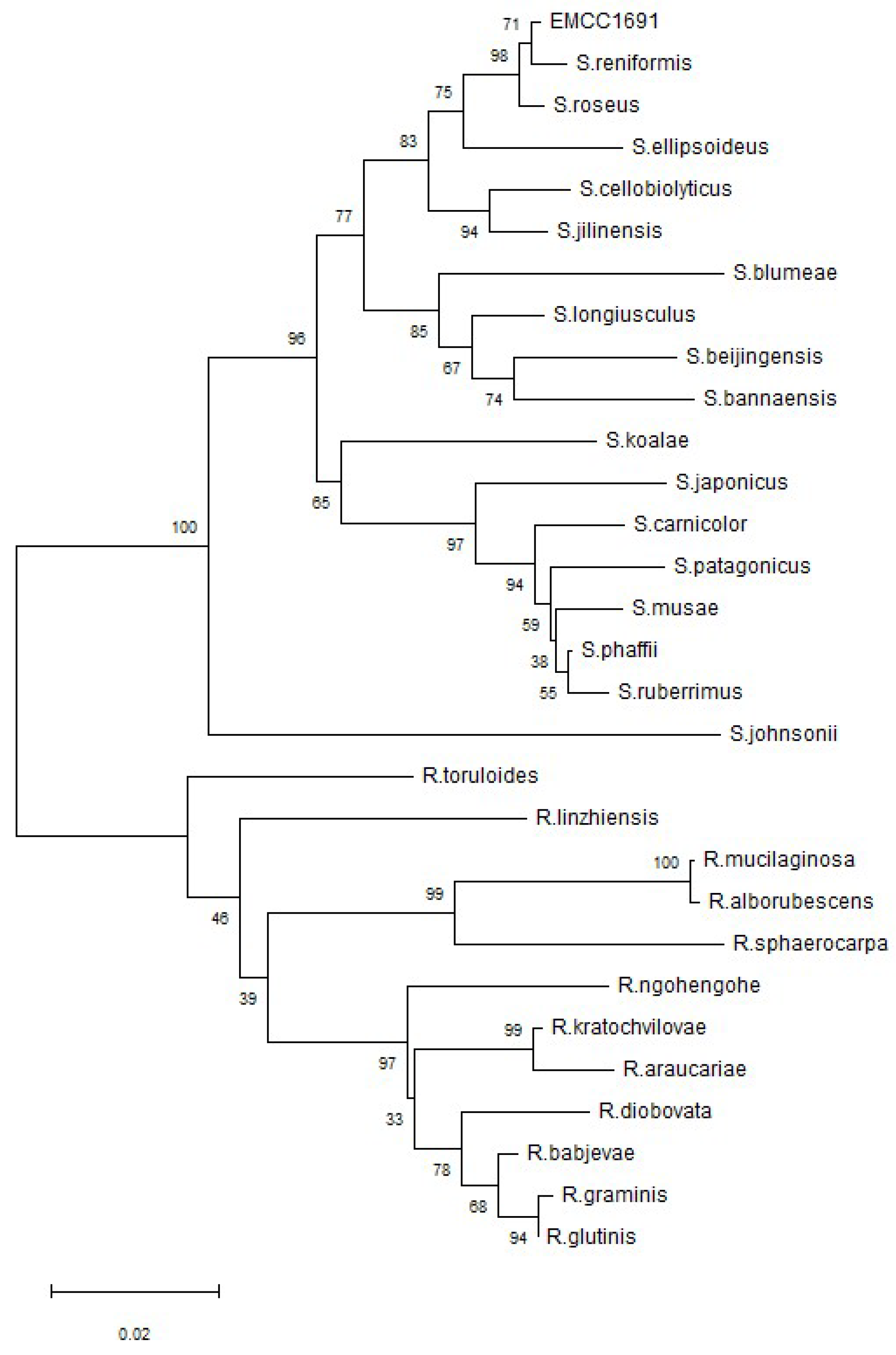
BLASTn analysis of the ITS region revealed a high degree of sequence similarity with members of the genus Sporobolomyces. The highest degree of identity was shown with Sporobolomyces reniformis (99.27%), followed by Sporobolomyces roseus (98.86%) and Sporobolomyces ellipsoideus (96.78%). The phylogenetic tree in Figure 1 confirms these findings. The EMCC1691 isolate clusters within a clearly defined clade encompassing Sporobolomyces species, distinctly separated from the Rhodotorula genus (supported by a bootstrap value of 100 at the base of the Rhodotorula clade).
Specifically, the EMCC1691 strain forms a terminal cluster with S. reniformis, supported by a bootstrap value of 71, which sits within a larger group including S. roseus (bootstrap value of 93). The genetic distance, indicated by the scale bar of 0.02 substitutions per site, shows minimal divergence between the isolate and S. reniformis.
The evolutionary history was inferred using the Neighbor-Joining method. The optimal tree with the sum of branch length of 0.673 is shown. The percentage of replicate trees in which the associated taxa clustered together in the bootstrap test (1000 replicates) is shown next to the branches. The tree is drawn to scale, with branch lengths in the same units as those of the evolutionary distances used to infer the phylogenetic tree. The evolutionary distances were computed using the p-distance method and are expressed as the number of base differences per site. The analytical procedure encompassed 30 nucleotide sequences. The pairwise deletion option was applied to all ambiguous positions for each sequence pair resulting in a final dataset comprising 588 positions. Evolutionary analyses were conducted in MEGA12 utilizing up to 8 parallel computing threads.

3.2. Physical and Chemical Characteristics of Delactosed Whey

The physical and chemical characteristics of the fresh delactosed whey are reported in Table 1. The sample showed a density of 1.027 ± 0.001 kg/L and a dry matter content of 68.80 ± 1.21 g/L. Electrical conductivity was 5.89 ± 0.07 mS/cm, and the pH was 6.78 ± 0.02. The carbohydrate fraction consisted of 4.50 ± 0.08 g/L lactose, 21.86 ± 0.45 g/L glucose, and 20.36 ± 0.37 g/L galactose. The whey also contained 10.36 ± 0.16 g/L of total proteins and 2.06 ± 0.07 g/L of fat.

3.3. EMCC1691 Culture on Bioreactor

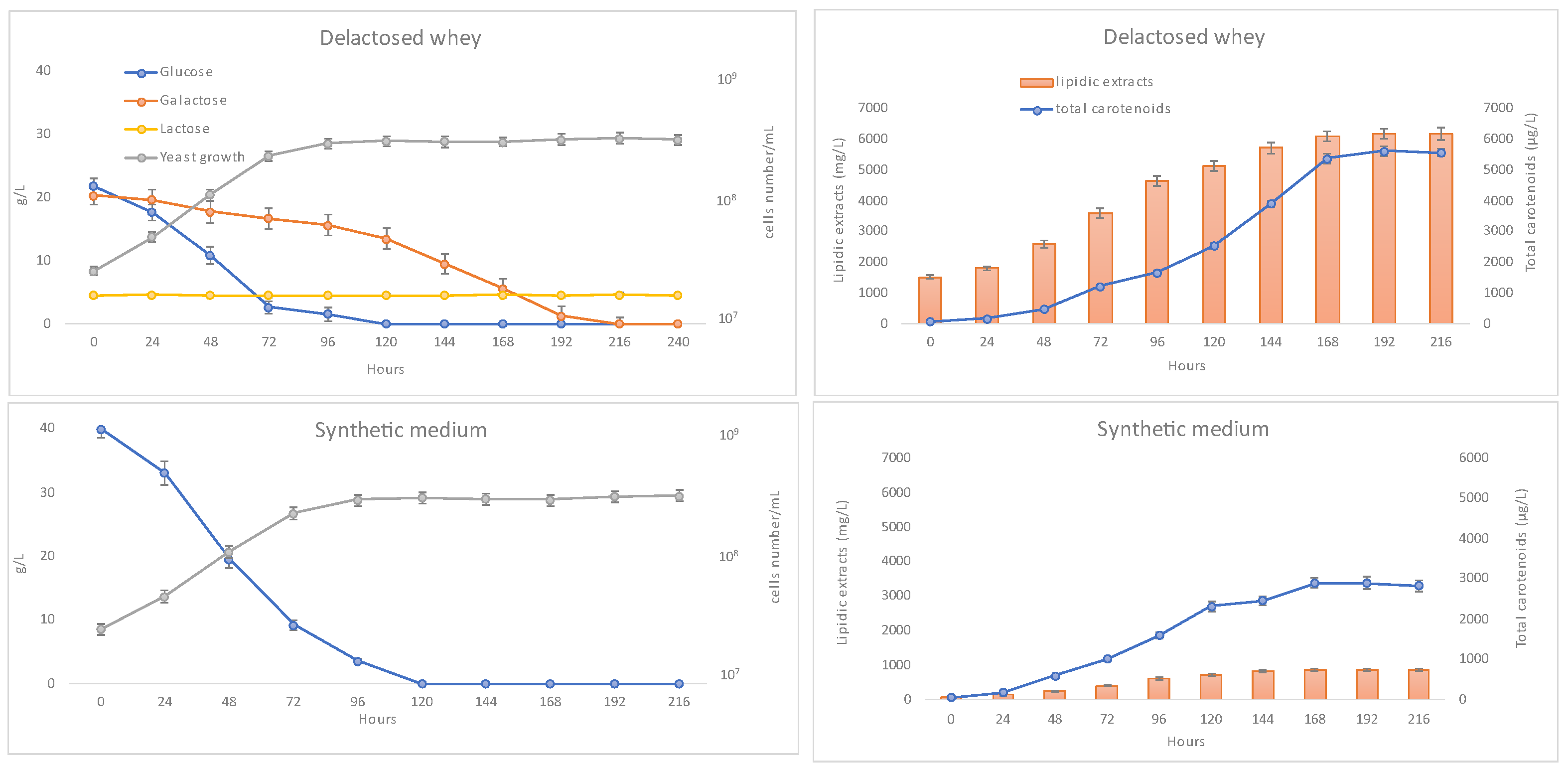
The growth of the EMCC1691 strain was evaluated in a 5 L stirred-tank bioreactor (B. Braun Biotech International, Germany) with an initial working volume of 3 L, using delactosed whey as a substrate (Supplementary Data, Figure S1). The time-course profiles obtained in the 5 L bioreactor revealed clear and quantifiable differences between delactosed whey and the synthetic medium (Figure 2).
In delactosed whey, glucose (21.86 ± 1.30 g/L) was rapidly consumed and reached near-complete depletion by approximately 120 h, while galactose (20.36 ± 1.42 g/L) decreased more gradually and was fully exhausted by 216 h. Yeast growth increased sharply during the first 72 h, rising from approximately 107 to 109 cells/mL, and then stabilized. The accumulation of lipid extracts and total carotenoids in delactosed whey followed a clear and coordinated trend over the course of fermentation.
Lipid extracts increased steadily from the beginning of the process, rising from 1517 ± 52 mg/L to 6172 ±165 mg/L at 192 h, indicating continuous intracellular lipid accumulation throughout both the exponential and stationary phases. Total carotenoids increased sharply between 72 and 168 h and reached a plateau around 192–216 h, stabilizing at 5634 ± 161 µg/L.
In the synthetic medium, sugar consumption followed a distinct pattern compared to delactosed whey, as glucose was the only available carbon source. Glucose (40 g/L) was fully depleted by 120 h, with approximately 30 g/L consumed within the first 72 h.
Statistical analysis data (see Supplementary Table S1) indicate that microbial growth in the two media was comparable: cultures progressed similarly over time, and no meaningful differences emerged between substrates. The microorganism showed equivalent kinetics and reached similar cell density (approximately 3.00 × 10⁸ cells/mL) at 216 h under both conditions.
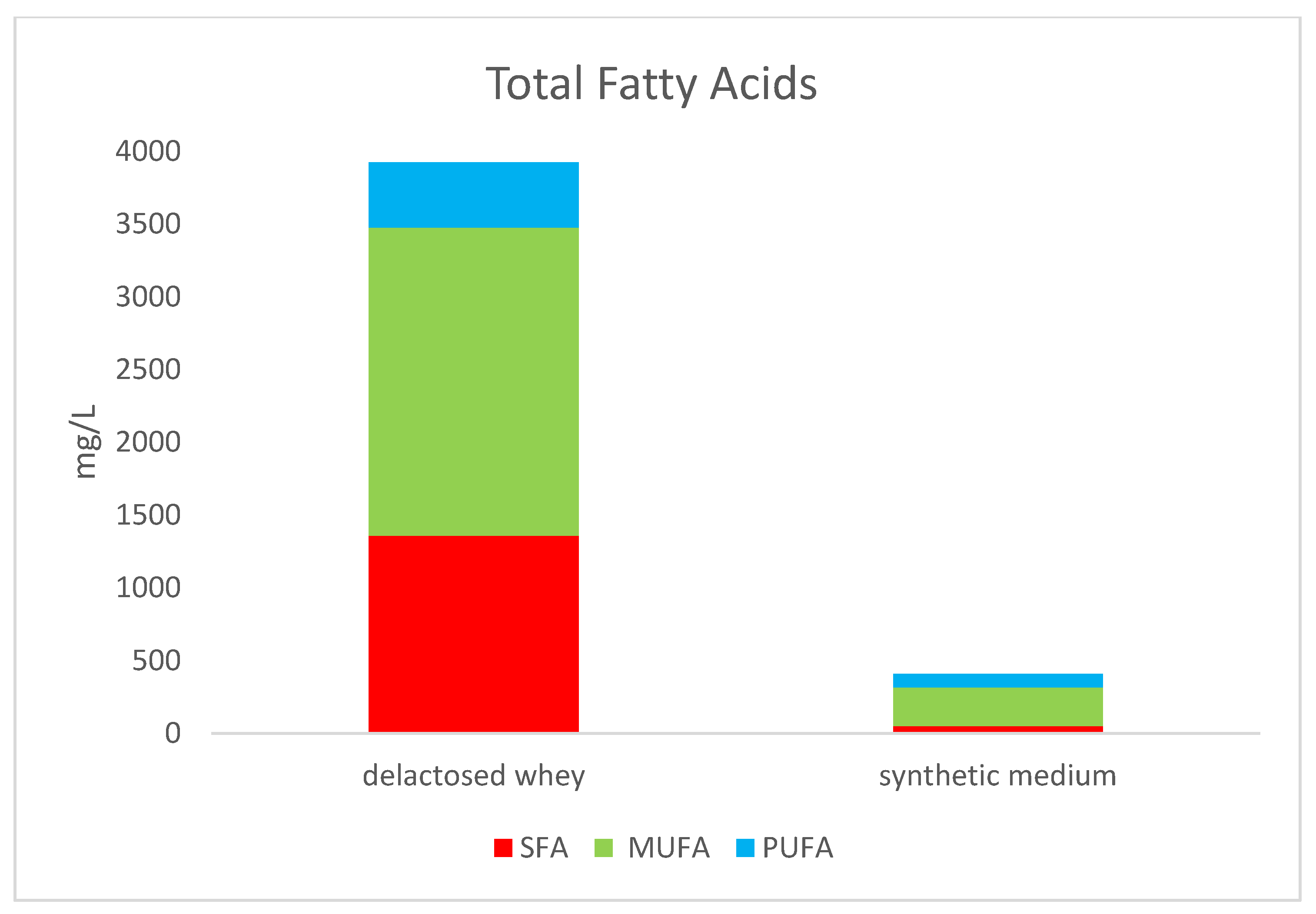
Lipid extracts in the synthetic medium increased up to values close to 871.2 mg/L at 192 h. Total carotenoids showed a more limited variation over time, increasing from 71.43 ± 1.85 µg/L to 2900 ± 150 µg/L at 192 h. The total fatty acid content further highlighted the divergence between the two substrates (Figure 3). Cultures grown on delactosed whey accumulated substantially higher amounts of total fatty acids, with saturated fatty acids (SFA) representing the largest fraction, followed by monounsaturated (MUFA) and polyunsaturated fatty acids (PUFA). In contrast, cultures grown on the synthetic medium exhibited a much lower total fatty acid content, although the qualitative distribution among SFA, MUFA, and PUFA remained similar.
As shown in Table 2, the total fatty acid concentration reached 3924.3 mg/L in sample obtained from whey, whereas in the synthetic medium it was 409.6 mg/L. Oleic acid showed the highest values in both substrates, with 2037.50 mg/L in whey and 260.20 mg/L in the synthetic medium. In the whey sample, palmitic acid accounted for 779.40 mg/L, stearic acid for 402.87 mg/L, and linoleic acid for 361.86 mg/L, while in the synthetic medium the same fatty acids were measured at 37.27 mg/L, 6.12 mg/L, and 81.64 mg/L, respectively.
Other fatty acids present at notable levels in the whey sample included myristic acid (117.68 mg/L), heptadecanoic acid (32.90 mg/L), γ-linolenic acid (34.10 mg/L), and palmitoleic acid (54.01 mg/L). In the synthetic medium, these compounds appeared at much lower concentrations, ranging from 0.60 mg/L to 11.81 mg/L.
HPLC analysis enabled a preliminary identification of the main carotenoids present in the extracts through their characteristic UV–Vis absorption spectra and retention times, allowing the assignment of four major compounds: torularhodin, torulene, γ-carotene, and β-carotene (Figure S2).
The comparison between the two chromatograms in Figure S7 shows that the overall profiles are broadly similar.
Torularhodin remained the predominant carotenoid in both substrates, reaching 2387.02 ± 37.74 µg/L in delactosed whey and 1244.21 ± 114.22 µg/L in the synthetic medium (Table 3).
The remaining carotenoids were present in both profiles, although with variations in their relative intensities.
In particular, γ-carotene was more prominent in the extracts obtained from biomass grown on delactosed whey, whereas β-carotene was comparatively more evident in the chromatogram of the synthetic medium. These differences were reflected in the height and shape of the corresponding peaks, while the presence of the four major carotenoids remained consistent across both growth conditions.

3.4. Spray-Drying of Fermented Delactosed Whey and Mechanical Pretreatment of Biomass

The biomass obtained after the bioreactor cultivation of S. reniformis EMCC1691 on delactosed whey was subjected to laboratory-scale spray drying under controlled conditions (Figure S3). Maintaining an inlet temperature of 180 °C and a feed flow rate of 15 rpm, the outlet temperature stabilized at approximately 75 °C, ensuring efficient water removal while preventing thermal degradation of sensitive compounds.
The same drying protocol was applied to non-fermented whey, allowing a direct comparison between the two powders. The spray-drying process yielded a stable, free-flowing powder, indicating that the selected parameters were effective in preserving product integrity. The powder obtained after fermentation showed a reduction in dry matter content (46.44 ± 0.90 g/L) compared to that observed in whey (68.80 ± 0.66 g/L).
After drying, the yeast-containing powder underwent an additional mechanical compression step using a hydraulic press, aimed at disrupting the cell wall. This treatment allowed the formation of tablets (Figure S4), which were easily pulverized and facilitated the release of intracellular macromolecules, particularly carotenoids, thereby improving their extractability in downstream analyses.
As summarized in Table 4, the compositional analysis of the two powders revealed marked differences attributable to yeast growth and metabolic activity. The carotenoids were absent in the non-fermented powder while a significant amount (109.17 ± 2.10 µg/g) was observed after yeast growth. The total amount of protein increased from 116.41 ± 1.60 to 181.05 ± 3.50 mg/g. A complete depletion of glucose and galactose was observed although an apparent increase in GOS and lactose content was observed, likely due to partial reduction in dry matter.
A substantial rise in fat extract and total fatty acids was observed, with MUFAs becoming the predominant class after fermentation. After yeast growth, the SFA fraction decreased substantially to 34.58%, reflecting the near-complete disappearance of short- and medium-chain fatty acids and a reduction in palmitic and myristic acids as shown in Table 5. In contrast, monounsaturated fatty acids (MUFAs) increased dramatically from 27.81% to 53.99%, driven primarily by the strong accumulation of oleic acid, which rose from 24.33% to 51.92%, becoming the predominant fatty acid in the fermented powder.
Minor MUFAs such as cis-10-heptadecenoic acid also increased. Polyunsaturated fatty acids (PUFAs) nearly doubled, rising from 5.50% to 11.43%, with notable increases in linoleic acid and γ-linolenic acid, as well as the appearance of cis-11,14,17-eicosatrienoic acid, which was absent prior to fermentation.

3.5. Carotenoids Recovery by Supercritical Fluid Extraction

Supercritical CO2 extraction with ethanol as co-solvent and conventional organic solvent extraction were both applied to the pretreated yeast biomass, yielding red oleoresins (Figure S5) which were dried and subsequently subjected to analysis.
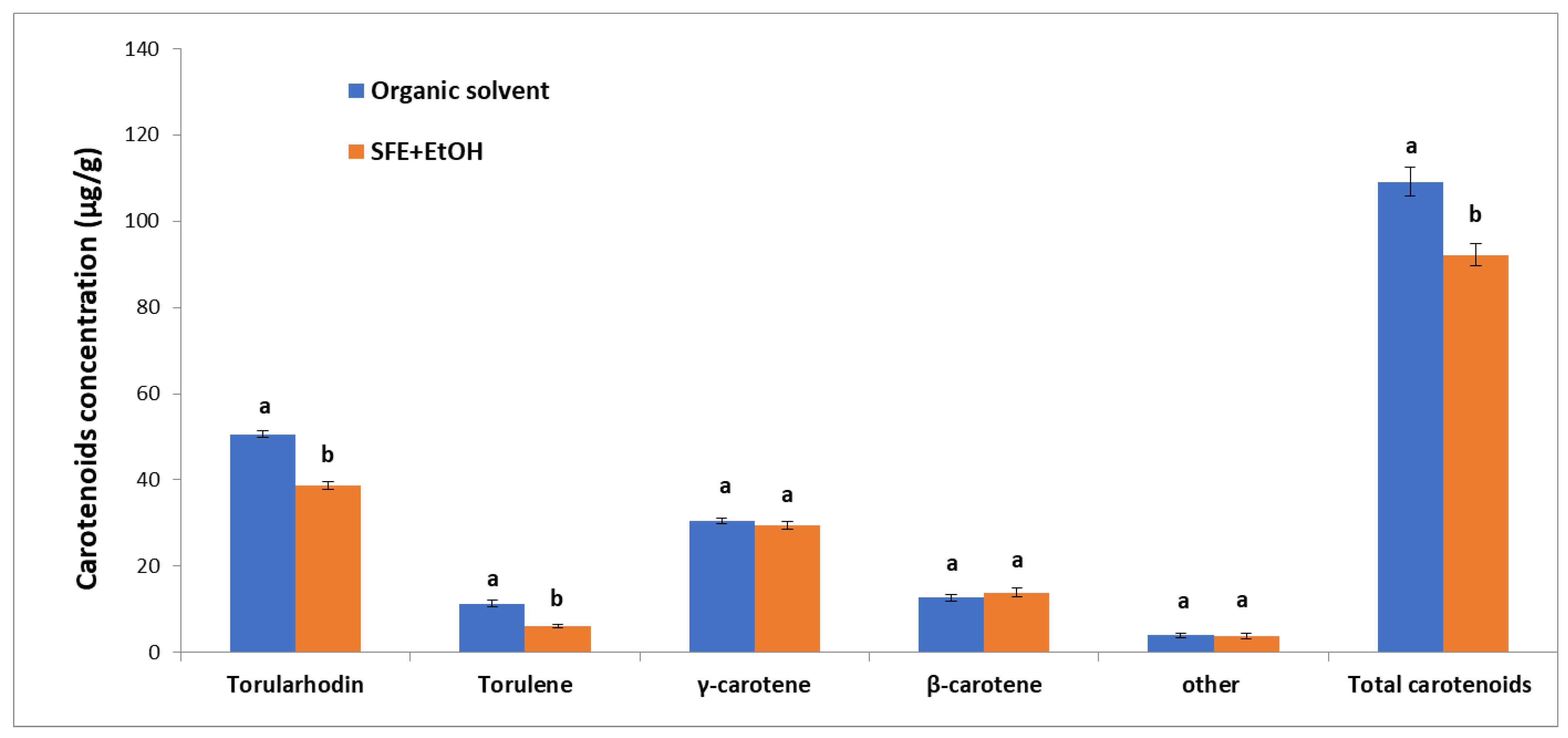
As shown in Figure 4, the extracts obtained with the organic solvent revealed the presence of major carotenoids and mean yields (µg/g dry biomass) were 50.55 ± 0.66 for torularhodin, 11.31 ± 0.72 for torulene, 30.51 ± 0.51 for γ-carotene, and 12.77 ± 0.76 for β-carotene, with an additional 4.03 ± 0.47 µg/g attributed to minor carotenoids. The total carotenoid content extracted with the organic solvent reached 109.17 ± 2.10 µg/g.
Supercritical CO2 extraction with ethanol also enabled the recovery of the same carotenoid profile, although with yields approximately 15–16% lower than those obtained with organic solvent extraction. The mean concentrations were 38.80 ± 0.80 µg/g for torularhodin, 6.09 ± 0.31 µg/g for torulene, 29.58 ± 0.80 µg/g for γ-carotene, and 13.93 ± 0.89 µg/g for β-carotene, while the fraction of other carotenoids amounted to 3.80 ± 0.55 µg/g. The total carotenoid content obtained under supercritical conditions was 92.18 ± 1.61 µg/g.
Furthermore, it is important to note that the mechanical pretreatment of the biomass proved essential for carotenoid recovery, as the same extraction procedures applied to biomass without cell-disruption pretreatment yielded no carotenoid-containing extract, as visually documented in Figure S6.

4. Discussion

In recent years, red-pigmented yeasts have attracted considerable attention as promising sources of natural colorants and bioactive compounds, with potential applications in the development of functional foods and for the possible industrial production of microbial lipids [54,55,56].
The present study provides the first biotechnological characterization of Sporobolomyces reniformis, a recently described basidiomycetous yeast whose metabolic potential has remained unexplored. Strain EMCC1691, isolated from fresh cheese, showed >99% ITS sequence identity with S. reniformis, confirming its placement within the Sporobolomyces clade, as originally defined by Li et al. (2020) during their comprehensive phylogenetic revision of basidiomycetous yeasts [57].
This finding is noteworthy, as the species has not previously been associated with dairy matrices, suggesting a broader ecological adaptability than currently documented and aligning with the general prototrophic nature of Sporobolomyces spp. and supporting the hypothesis that dairy by-products may serve as suitable substrates for its cultivation.
To assess its suitability, delactosed whey was sourced from dairy factories in the Lucania region of Southern Italy and analyzed for its physicochemical properties. The results indicated that it corresponds to a sweet whey type, as reflected by its near-neutral pH and characteristic compositional profile [58]. Notably, the high concentrations of glucose (21.86 g/L) and galactose (20.36 g/L), together with the residual lactose content (4.50 g/L), confirm effective lactose hydrolysis and provide readily accessible carbon sources compatible with the metabolic requirements of the lactose-negative strain EMCC1691.
The bioreactor experiments showed that S. reniformis strain EMCC1691 grows efficiently in both delactosed whey and synthetic medium. However, the sugar-consumption dynamics differed between the two substrates. In delactosed whey, glucose was rapidly depleted, followed by the slower consumption of galactose, which was exhausted after 192 h, reflecting a typical diauxic utilization pattern known as “diauxic lag” [59].
Furthermore, marked differences emerged between the two substrates, with delactosed whey supporting substantially higher lipid (6172 mg/L) and carotenoid (5634 µg/L) accumulation than the synthetic medium. This behavior can be attributed to their distinct C/N ratio which is critical because red yeasts typically redirect carbon flux toward lipid and carotenoid biosynthesis when nitrogen becomes limiting under carbon-excess conditions [1].
Based on the analytical composition of the two media used in this study, the calculated C/N ratios were 15.5 for delactosed whey and 8.7 for the synthetic medium. These values are consistent with those reported in the literature for comparable substrates [60,61].
Rodrigues et al. (2025) demonstrated that lipid accumulation in another red yeast species (Rhodotorula mucilaginosa) was strongly influenced by medium composition, particularly the carbon-to-nitrogen (C/N) ratio [14]. Under conditions of carbon excess and nitrogen limitation, oleaginous yeasts redirect metabolic flux toward triacylglycerol (TAG) synthesis, leading to increased lipid accumulation. Similar observations have been reported by Ratledge and Wynn (2002), who described nitrogen depletion as a key trigger for lipid storage in oleaginous yeasts [62].
Furthermore, the two media are not directly comparable, as they provide different carbon sources and therefore support distinct metabolic routes. In delactosed whey, the presence of both glucose and galactose leads to a diauxic utilization pattern, which has been associated with prolonged carotenoid accumulation [36].
Frengova et al. (2004) reported enhanced carotenogenesis in whey ultrafiltrate due to the presence of glucose and galactose released during lactose hydrolysis [63].
Lipid production in delactosed whey reached 6.18 g/L, values comparable to those reported for oleaginous yeasts under standard or moderately optimized conditions, typically ranging from 3 to 6 g/L. In particular, similar lipid yields (3.3–6.6 g/L) have been reported for Sporidiobolus pararoseus cultivated on glycerol-based substrates under controlled bioreactor conditions [64].
Although slightly lower than those achieved in highly optimized fermentation systems, the lipid production obtained in this study remains within the typical range reported in the literature [65], confirming the suitability of non-conventional substrates for microbial lipid accumulation. Importantly, the significantly higher lipid production observed in delactosed whey compared to the synthetic medium (0.58 g/L) highlights the effectiveness of this by-product as a low-cost substrate capable of supporting substantial lipid biosynthesis.
When compared with previous studies employing dairy by-products as fermentation substrates, the carotenoid yield obtained in delactosed whey (5634 µg/L) positions S. reniformis among the most efficient pigment-producing microorganisms reported to date. Mata-Gómez et al. (2023) achieved approximately 4075 µg/L using hydrolyzed goat whey under Taguchi-optimized conditions, demonstrating that whey-derived substrates can effectively support microbial carotenogenesis [66].
Despite the strong optimization strategy applied in that study, the yield reported here is substantially higher, suggesting that S. reniformis may possess an intrinsically robust carotenoid biosynthetic capacity or may respond particularly well to the sugar composition and nutrient profile of delactosed whey. A similar conclusion emerges when comparing our results with those of Kanzy et al. (2015), who reported carotenoid concentrations ranging from 3.9 to 5.7 mg/L in R. glutinis and R. mucilaginosa cultivated on salted cheese whey [67].
These species are traditionally regarded as high-performing carotenoid producers, and salinity is known to stimulate carotenogenesis in Rhodotorula. Remarkably, the yield obtained with S. reniformis falls within the upper portion of this range despite the absence of salinity-induced stress and without any process optimization. This indicates that S. reniformis performs at a level comparable to established red yeasts even under milder and non-optimized conditions. The comparison with Roukas et al. (2015) further reinforces the strong performance of S. reniformis [68].
In that study, Blakeslea trispora, a well-known industrial producer of carotenoids, reached 1.62 mg/L in a bubble-column bioreactor operated under high aeration conditions using cheese whey as the growth medium.
HPLC analysis revealed four major carotenoids that were preliminarily identified as torularhodin, torulene, γ-carotene and β-carotene. Although specific carotenoid profiles for S. reniformis have not yet been described in the literature (the species was only defined in 2020), it matches the canonical carotenoid profile reported for Sporobolomyces and Rhodotorula spp., where torularhodin is typically the dominant pigment [69,70].
Torularhodin consistently remained the predominant compound in both media, in agreement with recent studies demonstrating that Sporobolomyces species, particularly Sporobolomyces pararoseus, naturally channel a substantial fraction of their carotenoid flux toward oxidized derivatives [69].
However, noticeable differences emerged in the relative peak intensities between the two media: γ-carotene increased in the whey extract, while β-carotene was comparatively reduced, indicating a shift in the metabolic flux toward intermediate desaturation products. Similar trends have been reported under oxidative or nutrient-complex conditions, where γ-carotene accumulation increases at the expense of β-carotene, while torularhodin remains the dominant carotenoid due to its antioxidant function [71,72].
Despite the substantial differences in total lipid extraction and total fatty acids content (3924 mg/L vs. 410 mg/L) from S. reniformis biomass grown on delactosed whey and synthetic medium, the chemical profiles observed in this study remain qualitatively similar. In both conditions, monounsaturated fatty acids (MUFAs) dominate, followed by saturated fatty acids (SFAs) and polyunsaturated fatty acids (PUFAs). This compositional stability suggests that environmental or physiological changes primarily affect lipid quantity rather than the fundamental structure of the fatty acid profile.
The predominant fatty acids were oleic, palmitic, stearic and linoleic acids, which are typical of red basidiomycetous yeasts. This distribution agrees with previous studies on other oleaginous yeasts, where oleic acid (C18:1) is typically the predominant fatty acid, often accounting for 60–78% of total lipids, followed by palmitic acid (C16:0) [73,74]. The prevalence of MUFAs is commonly associated with the activity of ∆9-fatty acid desaturases, which convert saturated fatty acids into monounsaturated forms [62].
The fermentation of delactosed whey by S. reniformis EMCC1691 resulted in a profound reshaping of the substrate’s chemical composition, highlighting the metabolic impact of the yeast on the matrix. The marked reduction in dry matter observed in the fermented powder compared with the non-inoculated whey reflects the extensive consumption of available carbohydrates and the conversion of part of the carbon into CO2 and biomass. In parallel, the significant increase in proteins, lipids, and carotenoids indicates the accumulation of cellular components typical of red yeasts, with carotenoids reaching 109.17 ± 2.10 µg/g completely absent in the non-fermented control.
The sugar profile further confirms this metabolic shift: glucose and galactose were completely depleted, while an apparent increase in lactose and GOS was detected. This trend is attributable to the reduction in total dry matter rather than to de novo synthesis. The presence of GOS in the starting whey is consistent with previous reports showing that β-galactosidase used for industrial lactose hydrolysis can generate galacto-oligosaccharides as unintended trans-galactosylation products during dairy processing [52,75,76,77].
Although GOS production has been reported in Sporobolomyces spp. through the activity of β-hexosyl transferases and related enzymes [78], the GOS detected in our samples originate from the lactose-hydrolysis step in the dairy industry rather than from yeast metabolism.
After fermentation, a substantial increase in total fat content was observed, from 29.90 ± 0.70 mg to 102.10 ± 2.35 mg per gram of dried culture liquid. This significant increase (72.20 mg/g), corresponding to approximately 7.2% (w/w), reflects newly synthesized lipids accumulated by the yeast during growth but does not represent the percentage of intracellular lipids since the yeast cells were not separated from the culture liquid before drying. However, considering our dry matter yield (46.44 ± 0.90 g/L), our results in terms of total lipids agree with those obtained by Szotkowski et al. (2021) [13]. In their bioreactor experiments, Sporidiobolus pararoseus CCY19-9-6, grown on a mixture of spent coffee grounds hydrolysate with coffee oil and frying oil, reached 22–23 g/L of dry cell weight and 14–15% (w/w) lipid at 96 h. The lipid fraction underwent an even more pronounced reorganization, with a clear shift in the fatty-acid profile between the whey before fermentation and the yeast-grown powder. Saturated fatty acids (SFAs) decreased substantially, while monounsaturated (MUFAs) and polyunsaturated fatty acids (PUFAs) increased. Oleic acid became the dominant fatty acid in the fermented powder (51.92%), accompanied by higher levels of linoleic and γ-linolenic acids and by the appearance of cis-11,14,17-eicosatrienoic acid, which was absent in the non-fermented whey.
From a technological perspective, spray drying proved effective in producing a stable, free-flowing powder while preserving thermolabile compounds through controlled inlet and outlet temperatures. This technique is widely recognized as one of the most versatile and broadly applied methods for the preservation and stabilization of sensitive bioactive molecules [79].
Importantly, the hydraulic press was used as a post-drying mechanical treatment aimed exclusively at disrupting the yeast cell wall, which is composed of a complex network of glucans, chitin, and mannoproteins. The resulting compressed tablets were easily crumbled, providing a simple, low-cost, and unconventional lysis method that greatly facilitated the release of intracellular carotenoids and lipids without the need for chemical agents or specialized equipment.
Yeast biomass pretreatment is a critical step to increase the bioavailability of these macromolecules, and several studies have addressed this issue [80,81,82]. Despite identical cell-disruption pretreatment, the SFE extraction yielded lower carotenoid concentrations than the organic solvent method. These differences, however, are fully consistent with previous literature and are most likely attributable to the lower solvating power of supercritical CO2–ethanol toward polar carotenoids [51].
Based on the available literature, this work represents the first documented study employing Sporobolomyces reniformis for biotechnological applications, highlighting the novelty and relevance of this yeast as an emerging microbial cell factory. Despite these promising outcomes, additional studies are needed to fully evaluate the safety and functional properties of the final product. A more detailed characterization of the dried matrix is required to determine the presence and activity of residual enzymes, the profile of secondary metabolites, and the possible occurrence of exopolysaccharides or β-glucans. Such investigations will be essential to support future applications and ensure compliance with regulatory and quality standards.

5. Conclusions

This study demonstrates that Sporobolomyces reniformis EMCC1691, a newly isolated strain belonging to a yeast species only recently described, can efficiently convert delactosed whey into an enriched matrix with increased protein, lipid, and carotenoid content by an integrated process.
The marked changes observed in sugar composition, fatty-acid profiles, and pigment accumulation highlight the strong metabolic versatility of this novel isolate and confirm the suitability of delactosed whey as a low-cost substrate for microbial bioconversion. The simple mechanical lysis step further enhanced the release of intracellular compounds, offering a practical advantage for downstream processing.
Nevertheless, further studies are needed to fully assess the safety of the final product and to deepen the characterization of the dried matrix, particularly regarding residual enzymatic activities, secondary metabolites, and the potential presence of exopolysaccharides or β-glucans that may influence its bioactivity and technological properties. Although the process shows promising features, the present work should be regarded as a proof of concept. Additional investigations including scale-up validation, product-stability assessment, and economic analysis will be necessary to evaluate the potential of this approach for future industrial development.

Supplementary Materials

The following supporting information can be downloaded at: https://www.mdpi.com/article/10.3390/fermentation12060292/s1.

Author Contributions

Conceptualization, M.T., V.L. and A.A.; formal analysis, M.T., V.L. and A.A.; investigation for fermentation, M.T., A.A. and R.A.M.; Drying, S.P.; Supercritical CO2 extraction, V.L. and M.M.; Chemical analysis, S.M., A.S. and N.F.; Strain identification, L.B.; Validation, R.A.M. and A.M.; Writing—original draft, M.T., V.L. and A.A.; Writing—review and editing, R.A.M.; funding acquisition and supervision, A.M. All authors have read and agreed to the published version of the manuscript.

Funding

This work was founded by the European Union’s Horizon Europe program as part of the project PROTEIN4IMPACT (Grant Agreement No. 101182324). Views and opinions expressed are, however, those of the authors only and do not necessarily reflect those of the European Union or the European Research Executive Agency (REA). Neither the European Union nor the granting authority can be held responsible for them.

Institutional Review Board Statement

Not applicable.

Informed Consent Statement

Not applicable.

Data Availability Statement

The datasets generated or analyzed during the current study are available from the corresponding author upon reasonable request.

Acknowledgments

The authors thank the Italian national Node MIRRI-IT of the European Research Infrastructure MIRRI-ERIC for providing the resources and support necessary for this study.

Conflicts of Interest

The authors declare no conflicts of interest.

References

  1. Joshi, K.; Kumar, P.; Kataria, R. Microbial Carotenoid Production and Their Potential Applications as Antioxidants: A Current Update. Process Biochem. 2023, 128, 190–205. [Google Scholar] [CrossRef]
  2. Beopoulos, A.; Cescut, J.; Haddouche, R.; Uribelarrea, J.L.; Molina-Jouve, C.; Nicaud, J.M. Yarrowia Lipolytica as a Model for Bio-Oil Production. Prog. Lipid Res. 2009, 48, 375–387. [Google Scholar] [CrossRef] [PubMed]
  3. Kot, A.M.; Błazejak, S.; Gientka, I.; Kieliszek, M.; Bryś, J. Torulene and Torularhodin: “New” Fungal Carotenoids for Industry? Microb. Cell Factories 2018, 17, 49. [Google Scholar] [CrossRef] [PubMed]
  4. Mannazzu, I.; Landolfo, S.; da Silva, T.L.; Buzzini, P. Red Yeasts and Carotenoid Production: Outlining a Future for Non-Conventional Yeasts of Biotechnological Interest. World J. Microbiol. Biotechnol. 2015, 31, 1665–1673. [Google Scholar] [CrossRef] [PubMed]
  5. Hernandez-Almanza, A.; Montanez, J.C.; Aguilar-Gonzalez, M.A.; Martmez-Avila, C.; Rodriguez-Herrera, R.; Aguilar, C.N. Rhodotorula Glutinis as Source of Pigments and Metabolites for Food Industry. Food Biosci. 2014, 5, 64–72. [Google Scholar] [CrossRef]
  6. Herrera-Estrada, M.d.l.L.; Sandoval-Cortés, J.; Cano-González, C.N.; Silva, T.G.d.; Martínez-Hernández, J.L.; Aguilar-González, M.A.; Ascacio-Valdés, J.A.; Chávez-González, M.L.; Aguilar, C.N. Fermentation-Driven Biosynthesis of Natural Carotenoids in Rhodotorula Glutinis P4M422: Evaluation of Culture Conditions. Fermentation 2026, 12, 201. [Google Scholar] [CrossRef]
  7. Tang, W.; Wang, Y.; Zhang, J.; Cai, Y.; He, Z. Biosynthetic Pathway of Carotenoids in Rhodotorula and Strategies for Enhanced Their Production. J. Microbiol. Biotechnol. 2019, 29, 507–517. [Google Scholar] [CrossRef] [PubMed]
  8. Rao, A.; Rao, L. Carotenoids and Human Health. Pharmacol. Res. 2007, 55, 207–216. [Google Scholar] [CrossRef] [PubMed]
  9. Mussagy, C.U.; Figueroa, D.; Besoain, X.; Riquelme, N.; Salinas, A.; Giuffrida, D.; Tropea, A.; Rigano, F.; Mondello, L.; Farias, F.O.; et al. Red Torulene from Yeast: Isolation, Characterization, Bioprocess Development, and Its Underexplored Pioneering Application as a Natural Food Colorant. Food Biosci. 2025, 71, 107201. [Google Scholar] [CrossRef]
  10. Li, C.; Cheng, P.; Li, Z.; Xu, Y.; Sun, Y.; Qin, D.; Yu, G. Transcriptomic and Metabolomic Analyses Provide Insights into the Enhancement of Torulene and Torularhodin Production in Rhodotorula Glutinis ZHK Under Moderate Salt Conditions. J. Agric. Food Chem. 2021, 69, 11523–11533. [Google Scholar] [CrossRef] [PubMed]
  11. Li, Z.; Li, C.; Cheng, P.; Yu, G. Rhodotorula Mucilaginosa—Alternative Sources of Natural Carotenoids, Lipids, and Enzymes for Industrial Use. Heliyon 2022, 8, e11505. [Google Scholar] [CrossRef] [PubMed]
  12. Zhang, T.-T.; Wu, A.-H.; Aslam, M.; Song, J.-Z.; Chi, Z.-M.; Liu, G.-L. Developing Rhodotorula as Microbial Cell Factories for the Production of Lipids and Carotenoids. Green Carbon 2024, 2, 409–420. [Google Scholar] [CrossRef]
  13. Szotkowski, M.; Holub, J.; Šimanský, S.; Hubačová, K.; Hladká, D.; Němcová, A.; Marová, I. Production of Enriched Sporidiobolus Sp. Yeast Biomass Cultivated on Mixed Coffee Hydrolyzate and Fat/Oil Waste Materials. Microorganisms 2021, 9, 1848. [Google Scholar] [CrossRef] [PubMed]
  14. Rodrigues, T.V.D.; Cerqueira, M.B.R.; Contessa, C.R.; Furlong, E.B.; Burkert, C.A.V.; de Medeiros Burkert, J.F. Rhodotorula Mucilaginosa: Kinetics and Production of Lipids and Fatty Acids in Agroindustrial Byproducts. Braz. J. Chem. Eng. 2025, 43, 75–88. [Google Scholar] [CrossRef]
  15. Gupta, R.; Banerjee, S.; Pandit, S.; Gupta, P.K.; Mathriya, A.S.; Kumar, S.; Lahiri, D.; Nag, M.; Ray, R.R.; Joshi, S. A Comprehensive Review on Enhanced Production of Microbial Lipids for High-Value Applications. Biomass Convers. Biorefinery 2023, 13, 15357–15380. [Google Scholar] [CrossRef]
  16. Xie, Z.-T.; Mi, B.-Q.; Lu, Y.-J.; Chen, M.-T.; Ye, Z.-W. Research Progress on Carotenoid Production by Rhodosporidium toruloides. Appl. Microbiol. Biotechnol. 2024, 108, 7. [Google Scholar] [CrossRef] [PubMed]
  17. Elfeky, N.; Elmahmoudy, M.; Bao, Y. Manipulation of Culture Conditions: Tool for Correlating/Improving Lipid and Carotenoid Production by Rhodotorula Glutinis. Processes 2020, 8, 140. [Google Scholar] [CrossRef]
  18. Bonturi, N.; Crucello, A.; Viana, A.J.C.; Miranda, E.A. Microbial Oil Production in Sugarcane Bagasse Hemicellulosic Hydrolysate Without Nutrient Supplementation by a Rhodosporidium toruloides Adapted Strain. Process Biochem. 2017, 57, 16–25. [Google Scholar] [CrossRef]
  19. Zhao, D.; Li, C.; Zeng, N.; Wang, D.; Zhang, N.; Li, B. Current Advances in the Biosynthesis and Sustainable Production Strategies of Carotenoids and Their Multifaceted Applications in the Food Industry: A Comprehensive Review. Food Biosci. 2025, 64, 105864. [Google Scholar] [CrossRef]
  20. Wen, Z.; Zhang, S.; Odoh, C.K.; Jin, M.; Zhao, Z.K. Rhodosporidium toruloides—A Potential Red Yeast Chassis for Lipids and Beyond. FEMS Yeast Res. 2020, 20, foaa038. [Google Scholar] [CrossRef] [PubMed]
  21. Buzzini, P.; Martini, A.; Gaetani, M.; Turchetti, B.; Pagnoni, U.M.; Davoli, P. Optimization of Carotenoid Production by Rhodotorula Graminis DBVPG 7021 as a Function of Trace Element Concentration by Means of Response Surface Analysis. Enzym. Microb. Technol. 2005, 36, 687–692. [Google Scholar] [CrossRef]
  22. Chentir, I.; Ben Miri, Y.; Kot, A.M.; Nikhanj, P.; Mussagy, C.U.; Arous, F.; Markou, G. Rhodotorula Genus: Vast Knowledge, Limited Commercialization—What’s Holding Us Back? Fungal Biol. Rev. 2025, 54, 100459. [Google Scholar] [CrossRef]
  23. Pinheiro, M.J.; Bonturi, N.; Belouah, I.; Miranda, E.A.; Lahtvee, P.-J. Xylose Metabolism and the Effect of Oxidative Stress on Lipid and Carotenoid Production in Rhodotorula Toruloides: Insights for Future Biorefinery. Front. Bioeng. Biotechnol. 2020, 8, 1008. [Google Scholar] [CrossRef] [PubMed]
  24. Ochoa-Viñals, N.; Alonso-Estrada, D.; Pacios-Michelena, S.; García-Cruz, A.; Ramos-González, R.; Faife-Pérez, E.; Michelena-Álvarez, L.G.; Martínez-Hernández, J.L.; Iliná, A. Current Advances in Carotenoid Production by Rhodotorula sp. Fermentation 2024, 10, 190. [Google Scholar] [CrossRef]
  25. Zhang, Q.-W.; Kong, C.-L.; Tao, Y.-S. Fate of Carotenoids in Yeasts: Synthesis and Cleavage. Crit. Rev. Food Sci. Nutr. 2023, 63, 7638–7652. [Google Scholar] [CrossRef] [PubMed]
  26. Keskin, A.; Ünlü, A.E.; Takaç, S. Utilization of Olive Mill Wastewater for Selective Production of Lipids and Carotenoids by Rhodotorula Glutinis. Appl. Microbiol. Biotechnol. 2023, 107, 4973–4985. [Google Scholar] [CrossRef] [PubMed]
  27. Qi, F.; Shen, P.; Hu, R.; Xue, T.; Jiang, X.; Qin, L.; Chen, Y.; Huang, J. Carotenoids and Lipid Production from Rhodosporidium toruloides Cultured in Tea Waste Hydrolysate. Biotechnol. Biofuels 2020, 13, 74. [Google Scholar] [CrossRef] [PubMed]
  28. Sharma, R.; Ghoshal, G. Optimization of Carotenoids Production by Rhodotorula Mucilaginosa (MTCC-1403) Using Agro-Industrial Waste in Bioreactor: A Statistical Approach. Biotechnol. Rep. 2020, 25, e00407. [Google Scholar] [CrossRef] [PubMed]
  29. Selmi, H.; Presutto, E.; Spano, G.; Capozzi, V.; Fragasso, M. Valorising Whey: From Environmental Burden to Bio-Based Production of Value-Added Compounds and Food Ingredients. Foods 2025, 14, 3646. [Google Scholar] [CrossRef] [PubMed]
  30. Guimarães, P.M.R.; Teixeira, J.A.; Domingues, L. Fermentation of Lactose to Bio-Ethanol by Yeasts as Part of Integrated Solutions for the Valorisation of Cheese Whey. Biotechnol. Adv. 2010, 28, 375–384. [Google Scholar] [CrossRef] [PubMed]
  31. Trupo, M.; Magarelli, R.A.; Palazzo, S.; Larocca, V.; Martino, M.; Spagnoletta, A.; Ambrico, A. Bioconversion of a Dairy By-Product (Scotta) into Mannitol-Stabilized Violacein via Janthinobacterium Lividum Fermentation. Microorganisms 2025, 13, 2125. [Google Scholar] [CrossRef] [PubMed]
  32. Secchi, N.; Giunta, D.; Pretti, L.; Ruiz, M.; Tonina, G.; Mannazzu, I.; Catzeddu, P. Bioconversion of Ovine Scotta into Lactic Acid with Pure and Mixed Cultures of Lactic Acid Bacteria. J. Ind. Microbiol. Biotechnol. 2012, 39, 175–181. [Google Scholar] [CrossRef] [PubMed]
  33. Maragkoudakis, P.; Vendramin, V.; Bovo, B.; Treu, L.; Corich, V. Process, for the Production of Fermented Drinks Potential Use of Scotta, the by-Product of the Ricotta Cheese Manufacturing Process, for the Production of Fermented Drinks. J. Dairy Res. 2015, 83, 104–108. [Google Scholar] [CrossRef] [PubMed]
  34. Chaudhary, V.; Kajla, P.; Luthra, A.; Siwach, R. Whey: As a Low-Cost Substrate for the Production of Biosurfactants BT—Whey Valorization: Innovations, Technological Advancements and Sustainable Exploitation; Poonia, A., Trajkovska Petkoska, A., Eds.; Springer Nature: Singapore, 2023; pp. 285–310. ISBN 978-981-99-5459-9. [Google Scholar]
  35. Marova, I.; Carnecka, M.; Halienova, A.; Certik, M.; Dvorakova, T.; Haronikova, A. Use of Several Waste Substrates for Carotenoid-Rich Yeast Biomass Production. J. Environ. Manag. 2012, 95, S338–S342. [Google Scholar] [CrossRef] [PubMed]
  36. Sereti, F.; Alexandri, M.; Papadaki, A.; Papapostolou, H.; Kopsahelis, N. Natural Lycopene and β-Carotene Synthesis by Rhodosporidium Kratochvilovae Yeasts: Sustainable Production, Chemical Characterization and Antioxidative Properties. Food Biosci. 2024, 57, 103425. [Google Scholar] [CrossRef]
  37. Nagaraj, Y.N.; Blomqvist, J.; Sampels, S.; Pickova, J.; Sandgren, M.; Gajdoš, P.; Čertík, M.; Passoth, V. Supercritical Carbon-Dioxide (SC-CO2) Extraction of Lipids and Carotenoids from Rhodotorula Toruloides CBS 14 in Comparison with Conventional Extraction Methods. Biotechnol. Biofuels Bioprod. 2025, 18, 35. [Google Scholar] [CrossRef] [PubMed]
  38. Akanda, M.J.H.; Sarker, M.Z.I.; Ferdosh, S.; Manap, M.Y.A.; Rahman, N.N.N.A.; Kadir, M.O.A. Applications of Supercritical Fluid Extraction (SFE) of Palm Oil and Oil from Natural Sources. Molecules 2012, 17, 1764–1794. [Google Scholar] [CrossRef] [PubMed]
  39. Crampon, C.; Boutin, O.; Badens, E. Supercritical Carbon Dioxide Extraction of Molecules of Interest from Microalgae and Seaweeds. Ind. Eng. Chem. Res. 2011, 50, 8941–8953. [Google Scholar] [CrossRef]
  40. Harith, Z.T.; Lima, M.d.A.; Charalampopoulos, D.; Chatzifragkou, A. Optimised Production and Extraction of Astaxanthin from the Yeast Xanthophyllomyces Dendrorhous. Microorganisms 2020, 8, 430. [Google Scholar] [CrossRef] [PubMed]
  41. Braga, M.E.M.; Gaspar, M.C.; de Sousa, H.C. Supercritical Fluid Technology for Agrifood Materials Processing. Curr. Opin. Food Sci. 2023, 50, 100983. [Google Scholar] [CrossRef]
  42. Temelli, F. Perspectives on the Use of Supercritical Particle Formation Technologies for Food Ingredients. J. Supercrit. Fluids 2018, 134, 244–251. [Google Scholar] [CrossRef]
  43. Badotti, F.; Fonseca, P.L.C.; Tomé, L.M.R.; Nunes, D.T.; Góes-Neto, A. ITS and Secondary Biomarkers in Fungi: Review on the Evolution of Their Use Based on Scientific Publications. Braz. J. Bot. 2018, 41, 471–479. [Google Scholar] [CrossRef]
  44. Saitou, N.; Nei, M. The Neighbor-Joining Method: A New Method for Reconstructing Phylogenetic Trees’. Mol. Biol. Evol. 1987, 4, 406–425. [Google Scholar] [CrossRef] [PubMed]
  45. Ambrico, A.; Larocca, V.; Trupo, M.; Martino, M.; Magarelli, R.A.; Spagnoletta, A.; Balducchi, R. A New Method for Selective Extraction of Torularhodin from Red Yeast Using CO2-SFE Technique. Appl. Biochem. Biotechnol. 2024, 196, 6473–6491. [Google Scholar] [CrossRef] [PubMed]
  46. Paul, D.; Kumari, P.K.; Siddiqui, N. Yeast Carotenoids: Cost-Effective Fermentation Strategies for Health Care Applications. Fermentation 2023, 9, 147. [Google Scholar] [CrossRef]
  47. Riet, K.V. Review of Measuring Methods and Results in Nonviscous Gas-Liquid Mass Transfer in Stirred Vessels. Ind. Eng. Chem. Process Des. Dev. 1979, 18, 357–364. [Google Scholar] [CrossRef]
  48. Gautério, G.V.; da Silva, R.M.; Karraz, F.C.; Coelho, M.A.Z.; Ribeiro, B.D.; Lemes, A.C. Cell Disruption and Permeabilization Methods for Obtaining Yeast Bioproducts. Clean. Chem. Eng. 2023, 6, 100112. [Google Scholar] [CrossRef]
  49. Abbassi, A.; Ali, M.; Watson, I.A. Temperature Dependency of Cell Wall Destruction of Microalgae with Liquid Nitrogen Pretreatment and Hydraulic Pressing. Algal Res. 2014, 5, 190–194. [Google Scholar] [CrossRef]
  50. Fabiszewska, A.; Pakulska, A.; Zieniuk, B.; Wierzchowska, K.; Jasińska, K.; Małajowicz, J.; Nowak, D. Unconventional Extraction Methods of Oleaginous Yeast Cell Pretreatment and Disruption. Appl. Sci. 2023, 13, 13135. [Google Scholar] [CrossRef]
  51. Larocca, V.; Martino, M.; Trupo, M.; Magarelli, R.A.; Spagnoletta, A.; Ambrico, A. Evaluation of Carbon Dioxide Supercritical Fluid Extraction (CO2-SFE) on Carotenoids Recovery from Red Yeast Cells. Biomass Convers. Biorefinery 2025, 15, 28003–28012. [Google Scholar] [CrossRef]
  52. Lin, H.; Li, S.; Xu, C.; Pang, M.; Wang, S. Simultaneous Determination of Galactose, Glucose, Lactose and Galactooligosaccharides in Galactooligosaccharides Raw Materials by High-Performance Anion-Exchange Chromatography with Pulsed Amperometric Detection. Food Chem. 2018, 263, 29–36. [Google Scholar] [CrossRef] [PubMed]
  53. Rivas, E.-M.; Gil de Prado, E.; Wrent, P.; de Silóniz, M.-I.; Barreiro, P.; Correa, E.C.; Conejero, F.; Murciano, A.; Peinado, J.M. A Simple Mathematical Model That Describes the Growth of the Area and the Number of Total and Viable Cells in Yeast Colonies. Lett. Appl. Microbiol. 2014, 59, 594–603. [Google Scholar] [CrossRef] [PubMed]
  54. Cobban, A.; Edgcomb, V.P.; Burgaud, G.; Repeta, D.; Leadbetter, E.R. Revisiting the Pink-red Pigmented Basidiomycete Mirror Yeast of the Phyllosphere. Microbiologyopen 2016, 5, 846–855. [Google Scholar] [CrossRef] [PubMed]
  55. Xie, Z.; Zhao, D.; Li, B.; Zeng, N.; Wang, D.; Wang, X.; Sun, Y.; Shao, M.; Miao, S.; Feng, F.; et al. Integrated Lipidomic and Transcriptomic Analyses Provide Insights into the Positive Effect of Hydrogen Peroxide Treatment on Lipid Synthesis in Oleaginous Red Yeast Sporobolomyces pararoseus. LWT 2024, 203, 116389. [Google Scholar] [CrossRef]
  56. Li, C.-J.; Zhao, D.; Li, B.-X.; Zhang, N.; Yan, J.-Y.; Zou, H.-T. Whole Genome Sequencing and Comparative Genomic Analysis of Oleaginous Red Yeast Sporobolomyces pararoseus NGR Identifies Candidate Genes for Biotechnological Potential and Ballistospores-Shooting. BMC Genom. 2020, 21, 181. [Google Scholar] [CrossRef] [PubMed]
  57. Li, A.-H.; Yuan, F.-X.; Groenewald, M.; Bensch, K.; Yurkov, A.M.; Li, K.; Han, P.-J.; Guo, L.-D.; Aime, M.C.; Sampaio, J.P.; et al. Diversity and Phylogeny of Basidiomycetous Yeasts from Plant Leaves and Soil: Proposal of Two New Orders, Three New Families, Eight New Genera and One Hundred and Seven New Species. Stud. Mycol. 2020, 96, 17–140. [Google Scholar] [CrossRef] [PubMed]
  58. Alsaed, A.K.; Ahmad, R.; Aldoomy, H.; Abd El-Qad, S.; Saleh, D.; Sakejha, H.; Mustafa, L. Characterization, Concentration and Utilization of Sweet and Acid Whey. Pak. J. Nutr. 2013, 12, 172–177. [Google Scholar] [CrossRef][Green Version]
  59. Harrison, M.-C.; LaBella, A.L.; Hittinger, C.T.; Rokas, A. The Evolution of the GALactose Utilization Pathway in Budding Yeasts. Trends Genet. 2022, 38, 97–106. [Google Scholar] [CrossRef] [PubMed]
  60. Scotto di Uccio, A.; Matassa, S.; Cesaro, A.; Esposito, G.; Papirio, S. Microbial Protein Production from Lactose-Rich Effluents through Food-Grade Mixed Cultures: Effect of Carbon to Nitrogen Ratio and Dilution Rate. Bioresour. Technol. 2023, 388, 129717. [Google Scholar] [CrossRef] [PubMed]
  61. Uribe-Velázquez, T.; Najar-Almanzor, C.E.; Osuna-Orozco, F.R.; Arto-Paz, F.; Valdés, C.; Garcia-Amezquita, L.E.; Carrillo-Nieves, D.; García-Cayuela, T. Cheese Whey Valorization via Microbial Fermentation (Lactic Acid Bacteria, Yeasts/Fungi, and Microalgae), Postbiotic Production, and Whey-Based Encapsulation Strategies. Fermentation 2026, 12, 42. [Google Scholar] [CrossRef]
  62. Ratledge, C.; Wynn, J.P. The Biochemistry and Molecular Biology of Lipid Accumulation in Oleaginous Microorganisms. Adv. Appl. Microbiol. 2002, 51, 1–52. [Google Scholar] [CrossRef] [PubMed]
  63. Frengova, G.; Simova, E.; Beshkova, D. Use of Whey Ultrafiltrate as a Substrate for Production of Carotenoids by the Yeast Rhodotorula Rubra. Appl. Biochem. Biotechnol. 2004, 112, 133–142. [Google Scholar] [CrossRef] [PubMed]
  64. Rusinova-Videva, S.; Zaharieva, M.M.; Hristova, D.; Nachkova, S.; Kambourova, M.; Najdenski, H.; Konstantinov, S. The Antarctic Yeast Sporobolomyces Roseus AL103 as a Promising Source of Health-Promoting Biologically Active Compounds. Fermentation 2024, 10, 508. [Google Scholar] [CrossRef]
  65. Manowattana, A.; Techapun, C.; Watanabe, M.; Chaiyaso, T. Bioconversion of Biodiesel-Derived Crude Glycerol into Lipids and Carotenoids by an Oleaginous Red Yeast Sporidiobolus Pararoseus KM281507 in an Airlift Bioreactor. J. Biosci. Bioeng. 2018, 125, 59–66. [Google Scholar] [CrossRef] [PubMed]
  66. Mata-Gómez, L.C.; Mapelli-Brahm, P.; Meléndez-Martínez, A.J.; Méndez-Zavala, A.; Morales-Oyervides, L.; Montañez, J. Microbial Carotenoid Synthesis Optimization in Goat Cheese Whey Using the Robust Taguchi Method: A Sustainable Approach to Help Tackle Vitamin A Deficiency. Foods 2023, 12, 658. [Google Scholar] [CrossRef] [PubMed]
  67. Kanzy, H.M.; Nasr, N.F.; El-Shazly, H.A.M.; Barakat, O.S. Optimization of Carotenoids Production by Yeast Strains of Rhodotorula Using Salted Cheese Whey. Int. J. Curr. Microbiol. Appl. Sci. 2015, 4, 456–469. [Google Scholar]
  68. Roukas, T.; Varzakakou, M.; Kotzekidou, P. From Cheese Whey to Carotenes by Blakeslea Trispora in a Bubble Column Reactor. Appl. Biochem. Biotechnol. 2015, 175, 182–193. [Google Scholar] [CrossRef] [PubMed]
  69. Zhao, D.; Zeng, N.; Wang, D.; Tan, B.; Li, B.; Yu, G.; Li, C. Sporobolomyces pararoseus: A Versatile Chassis for Circular Bioproduction of β-Carotene, Torulene, and Torularhodin. Arch. Microbiol. 2026, 208, 238. [Google Scholar] [CrossRef] [PubMed]
  70. Mussagy, C.U.; Guimarães, A.A.C.; Rocha, L.V.F.; Winterburn, J.; Santos-Ebinuma, V.d.C.; Pereira, J.F.B. Improvement of Carotenoids Production from Rhodotorula Glutinis CCT-2186. Biochem. Eng. J. 2021, 165, 107827. [Google Scholar] [CrossRef]
  71. Zhao, D.; Zeng, N.; Wang, D.; Li, B.; Yu, G.; Li, C. Exploring the Influence Mechanism of Low/High Temperatures on Carotenoid Production in Sporobolomyces pararoseus: Insights From Physiological and Transcriptomic Analyses. Biotechnol. Bioeng. 2025, 122, 1615–1626. [Google Scholar] [CrossRef] [PubMed]
  72. Li, C.; Xie, Z.; Zhao, D.; Li, B.; Wang, D.; Chang, L.; Feng, F.; Zheng, L.; Wang, X.; Shao, M.; et al. Multi-Omics Analysis Provides Insights into the Enhancement of β-Carotene and Torularhodin Production in Oleaginous Red Yeast Sporobolomyces pararoseus under H2O2-Induced Oxidative Stress. LWT 2024, 197, 115947. [Google Scholar] [CrossRef]
  73. Donot, F.; Fontana, A.; Baccou, J.C.; Strub, C.; Schorr-Galindo, S. Single Cell Oils (SCOs) from Oleaginous Yeasts and Moulds: Production and Genetics. Biomass Bioenergy 2014, 68, 135–150. [Google Scholar] [CrossRef]
  74. Wu, C.-C.; Honda, K.; Kazuhito, F. Current Advances in Alteration of Fatty Acid Profile in Rhodotorula Toruloides: A Mini-Review. World J. Microbiol. Biotechnol. 2023, 39, 234. [Google Scholar] [CrossRef] [PubMed]
  75. Cuany, D.; Andetsion, F.; Fontannaz, X.; Bénet, T.; Spichtig, V.; Austin, S. Determination of β-Galactooligosaccharides (GOS) in Infant Formula and Adult Nutritionals: Single-Laboratory Validation, First Action 2021.01. J. AOAC Int. 2022, 105, 142–158. [Google Scholar] [CrossRef] [PubMed]
  76. Botvynko, A.; Synytsya, A.; Čurda, L. Synthesis of Galactooligosaccharides with Four β-Galactosidases: Structural Comparison of the Products by HPLC, ESI-MS and NMR. Biochem. Biophys. Res. Commun. 2025, 744, 151204. [Google Scholar] [CrossRef] [PubMed]
  77. Fischer, C.; Kleinschmidt, T. Synthesis of Galactooligosaccharides in Milk and Whey: A Review. Compr. Rev. Food Sci. Food Saf. 2018, 17, 678–697. [Google Scholar] [CrossRef] [PubMed]
  78. Sakai, T.; Tsuji, H.; Shibata, S.; Hayakawa, K.; Matsumoto, K. Repeated-Batch Production of Galactooligosaccharides from Lactose at High Concentration by Using Alginate-Immobilized Cells of Sporobolomyces singularis YIT 10047. J. Gen. Appl. Microbiol. 2008, 54, 285–293. [Google Scholar] [CrossRef] [PubMed][Green Version]
  79. Pudžiuvelytė, L.; Petrauskaitė, E.; Stabrauskienė, J.; Bernatonienė, J. Spray-Drying Microencapsulation of Natural Bioactives: Advances in Sustainable Wall Materials. Pharmaceuticals 2025, 18, 963. [Google Scholar] [CrossRef] [PubMed]
  80. Gomes, T.A.; Zanette, C.M.; Spier, M.R. An Overview of Cell Disruption Methods for Intracellular Biomolecules Recovery. Prep. Biochem. Biotechnol. 2020, 50, 635–654. [Google Scholar] [CrossRef] [PubMed]
  81. Agrawal, R. Cell Disruption and Extraction Methods for Intracellular Lipids and Proteins. In Textbook of Industrial Microbiology; Springer Nature: Singapore, 2024; pp. 297–329. [Google Scholar]
  82. Lopes, N.A.; Remedi, R.D.; dos Santos Sá, C.; Burkert, C.A.V.; de Medeiros Burkert, J.F. Different Cell Disruption Methods for Obtaining Carotenoids by Sporodiobolus pararoseus and Rhodothorula mucilaginosa. Food Sci. Biotechnol. 2017, 26, 759–766. [Google Scholar] [CrossRef] [PubMed]
Figure 1. Evolutionary relationships of 30 taxa.
Fermentation 12 00292 g001
Figure 2. Time-course profiles of sugar consumption, yeast growth, and metabolite accumulation during Sporobolomyces reniformis EMCC1691 cultivation in 5 L bioreactors using delactosed whey (top panels) and synthetic medium (bottom panels). Bars represent standard deviations from three replicates.
Fermentation 12 00292 g002
Figure 3. Total fatty acid of S. reniformis strain EMCC1691 grown on delactosed whey and synthetic medium. Stacked bar chart showing SFA (red), MUFA (green), and PUFA (blue) fractions.
Fermentation 12 00292 g003
Figure 4. Carotenoid concentration (µg/g) in the analyzed samples obtained by organic solvent extraction and supercritical fluid extraction with ethanol (SFE + EtOH). Error bars represent the standard deviation (SD) of the experimental data. Different letters indicate significant differences between extraction methods (Tukey’s post hoc test, p < 0.05).
Fermentation 12 00292 g004
Table 1. Physical and chemical characteristics of fresh delactosed whey.
Density (kg/L)1.027 ± 0.001
Dry matter (g/L)68.80 ± 1.21
EC (mS/cm)5.89 ± 0.07
pH6.78 ± 0.02
Lactose (g/L)4.50 ± 0.08
Glucose (g/L)21.86 ± 0.45
Galactose (g/L)20.36 ± 0.37
Total proteins (g/L)10.36 ± 0.16
The data represent the mean ± SD (standard deviation) of triplicate analysis.
Table 2. Comparison of individual fatty acid profiles of S. reniformis strain EMCC1691 grown on delactosed whey and synthetic medium.
Fatty Acids (mg/L)Medium
WheySyntethic
Octanoic acid0.00.6
Decanoic acid0.00.5
Lauric acid2.60.2
Myristic acid117.72.3
Palmitic acid779.437.3
Pentadecanoic acid19.50.6
Heptadecanoic acid32.91.8
Stearic acid402.96.1
Arachidic acid2.1n.d. *
Palmitoleic acid54.02.8
cis-10-Heptadecenoic acid23.83.9
cis-9-Octadecenoic acid2037.5260.2
Myristoleic acid3.4n.d.
cis-11,14.17-eicosatrienoic acid methyl23.2n.d.
Linolelaidic acid29.5n.d.
Linoleic acid361.981.6
γ-Linolenic acid34.111.8
Total3924.3409.7
The data represent the mean ± SD (standard deviation) of three experiments; * n.d. = not detetcted.
Table 3. Concentration of individual and total carotenoids produced by S. reniformis cultivated in delactosed whey and synthetic medium.
CarotenoidsDelactosed Whey
(µg/L)
Synthetic Medium
(µg/L)
Torularhodin2387.02 ± 37.741244.21 ± 114.22
Torulene567.96 ± 9.17246.53 ± 21.69
γ-carotene1445.68 ± 16.66279.36 ± 17.41
β-carotene632.05 ± 9.82951.81 ± 126.55
Others213.16 ± 2.05112.09 ± 13.99
Total5245.86 ± 75.442834.00 ± 293.85
The data represent the mean ± SD (standard deviation) of three experiments; the concentrations are expressed as β-carotene equivalent.
Table 4. Characterization of whey powder before and after the growth of S. reniformis EMCC1691. The table summarizes the main compositional changes induced by fermentation.
BeforeAfter
Dry matter (g/L)68.80 ± 0.6646.44 ± 0.90
Total proteins (mg/g)116.41 ± 1.60181.05 ± 3.50
Total carotenoids (µg/g)n.d. *109.17 ± 2.10
Lactose (mg/g)66.1 ± 0.898.02 ± 1.80
Glucose (mg/g)317.0 ± 6.1n.d.
Galactose (mg/g)295.9 ± 5.9n.d.
GOS (mg/g)64.9 ± 1.772.70 ± 1.95
Fat extract (mg/g)29.90 ± 0.70102.10 ± 2.35
Total fatty acids (mg/g)13.00 ± 0.4084.50 ± 2.40
SFAs (%)66.69 ± 1.3034.58 ± 1.25
MUFAs (%)27.81 ± 0.6553.99 ± 1.70
PUFAs (%)5.50 ± 0.2011.43 ± 0.35
Data are presented as mean ± standard deviation (SD); * n.d. = not detected.
Table 5. Fatty acids of whey powder before and after the growth of S. reniformis EMCC1691.
Carboxylic AcidsBeforeAfter
(%)
Butyric acid0.80n.d. *
Hexanoic acid1.31n.d.
Octanoic acid1.21n.d.
Decanoic acid3.15n.d.
Undecanoic acid0.08n.d
Lauric acid3.800.07
Tridecanoic acid0.14n.d.
Myristic acid11.723.00
Palmitic acid33.2319.86
Pentadecanoic acid1.220.50
Heptadecanoic acid0.560.84
Stearic acid9.2810.27
Arachidic acidn.d.0.05
Docosanoic acid0.19n.d
Palmitoleic acid1.941.38
cis-10-Heptadecenoic acid0.350.61
cis-9-Octadecenoic acid (Oleic acid)24.3351.92
Myristoleic acid1.190.09
cis-11,14.17-eicosatrienoic acid methyln.d0.59
Linolelaidic acid0.900.75
Linoleic acid4.099.22
γ-Linolenic acid0.500.87
Data are expressed as mean percentage relative to the total fatty acid content; * n.d. = not detected.
Disclaimer/Publisher’s Note: The statements, opinions and data contained in all publications are solely those of the individual author(s) and contributor(s) and not of MDPI and/or the editor(s). MDPI and/or the editor(s) disclaim responsibility for any injury to people or property resulting from any ideas, methods, instructions or products referred to in the content.