Article

Engineered Escherichia coli Nissle 1917 for the High Level Biosynthesis of γ-Aminobutyric Acid


1
School of Biological and Chemical Engineering, Zhejiang University of Science and Technology, Hangzhou 310023, China
2
School of Biological and Chemical Engineering, Ningbo Tech University, Ningbo 315100, China
3
Key Laboratory of Marine Biogenetic Resources, Third Institute of Oceanography, Ministry of Natural Resources, Xiamen 361005, China
4
College of Biology and Food Engineering, Fuyang University of Technology, Fuyang 236000, China
*
Author to whom correspondence should be addressed.
Fermentation 2026, 12(6), 281; https://doi.org/10.3390/fermentation12060281
Submission received: 28 March 2026 / Revised: 27 May 2026 / Accepted: 30 May 2026 / Published: 11 June 2026
(This article belongs to the Section Industrial Fermentation)

Abstract

γ-Aminobutyric acid (GABA), a vital bioactive component, is biosynthesized via the decarboxylation of L-glutamate (L-Glu) catalyzed by glutamate decarboxylase (GAD). However, the GADs from various sources commonly suffer from low thermal stability, which hampers their industrial applications. In this work, four ancestral sequences of GAD (Anc19, Anc20, Anc28, and Anc30) were designed via an ancestral sequence reconstruction (ASR) approach. Thereafter, the genes were synthesized and heterologously expressed in the probiotic Escherichia coli strain Nissle 1917 (EcN). Among all variants tested, Anc28 exhibited the highest catalytic performance. The Km and kcat values were determined to be 26.80 mM and 57.41 s−1, respectively, yielding a catalytic efficiency (kcat/Km) of 2.14 s−1mM−1, which was 2.71-fold higher than that of the wild-type enzyme. Meanwhile, compared with the wild-type GAD, Anc28 exhibited a 6.74 °C increase in T5015 and a 4.1-fold extension in t1/2 at 60 °C. Furthermore, the GABA synthesis system using dormant Escherichia coli Nissle (T7)/pET28a-gadBAnc28 cells as the biocatalyst and pure water as a sole medium was also constructed. Upon completion of the 4 h reaction, the GABA titer reached 307.53 g/L with a conversion ratio of 99.36%. The resulting engineered strains were successfully employed for the efficient biosynthesis of GABA.

1. Introduction

γ-Aminobutyric acid (GABA), a primary inhibitory neurotransmitter in the mammalian brain, is recognized as a potent bioactive compound due to its diverse physiological roles, including its hypotensive, diuretic, sedative, immunomodulatory, and anticonvulsant effects [1,2]. In light of these health benefits, various methods for GABA production have been established, such as chemical synthesis, plant enrichment, and biosynthesis [3,4,5]. Among these, biosynthesis stands out as particularly advantageous and appealing, owing to its exceptional catalytic efficiency, mild reaction conditions, and favorable environmental compatibility.
The major pathway for the biosynthesis of GABA is mediated by the intracellular pyridoxal-5′-phosphate (PLP)-dependent glutamate decarboxylase (GAD; EC 4.1.1.15), which catalyzes the α-decarboxylation of L-glutamic acid (L-Glu) to GABA and release of CO2 as a byproduct [6]. During the past decade, considerable efforts have been devoted to screening or constructing potential strains with high GAD activity and then optimizing the main physicochemical parameters involved in GABA synthesis. In those cases, engineered Bacillus subtilis, Corynebacterium glutamicum, Levilactobacillus brevis, Lactococcus lactis, Lactiplantibacillus plantarum, and Escherichia coli strains were the common whole-cell biocatalysts [7,8,9,10,11]. Among these microorganisms, E. coli strains have been regarded as robust hosts for the heterologous expression of various GADs and have achieved high GABA titers [12,13]. However, compared with the generally recognized as safe (GRAS) microorganisms, the challenges associated with the safety concerns involved in the manufacturing of GABA by these engineered E. coli strains need to be further overcome.
Aside from the appropriate microbial chassis cells, improvement in the enzymatic property of GAD has been regarded as another key determinant for the low-cost biosynthesis of GABA. During the past few years, a large number of microbial GADs have been cloned and characterized. The GADs from different sources exhibit diverse activities, biochemical properties, and molecular weights; however, their limited stability is a common issue that hampers their industrial application [14]. Thus, the design of stable and sophisticated GADs exhibiting catalytic efficiency has attracted more and more attention.
During the past decade, various protein engineering strategies, including site-directed mutagenesis, Ramachandran plot analysis, proline residue incorporation, sequence consensus analysis, and protein surface charge optimization, have been widely used to enhance the thermal stability of GAD enzymes. Typically, researchers have utilized the Consensus Finder server to design consensus mutations aimed at enhancing the thermostability of LbGAD [15]. This strategy resulted in the mutant GadBT383K, which showed a 2.99 °C increase in T5015 and a 17.72 min extension of its half-life (t1/2) at 55 °C. Similarly, researchers have utilized FoldX to identify key residues affecting the unfolding free energy (ΔGunfold). The resulting engineered variants, GadBD203E and GadBS325A, exhibited increases in T5015 of 2.3 °C and 1.4 °C, respectively [16]. Despite these advances, overcoming the “activity–thermostability trade-off” remains a pivotal challenge in the development of high-performance GAD enzymes.
In recent years, ancestral sequence reconstruction (ASR) has emerged as a novel computational approach that employs maximum likelihood or Bayesian methods for statistical phylogenetic analysis to infer plausible sequences of extinct ancestral proteins within modern protein families. Currently, ASR is increasingly used in protein engineering to discover and design superior industrial enzymes with enhanced thermal stability [17]. For instance, ASR was used to obtain P450 enzymes and ketol-acid reductoisomerase (KARI) capable of withstanding high temperatures and prolonged reaction durations [18]. Among them, the engineered CYP3_N1 variant demonstrated a T5015 of 66 °C, approximately 30 °C higher than that of existing CYP3 enzymes. Its t1/2 values were determined to be 595.4 min at 50 °C and 54.7 min at 60 °C, corresponding to 283.52-fold and 136.75-fold enhancements over CYP3A4, respectively. Meanwhile, the reconstructed ancestral KARI exhibited a T5015 of 55 °C, which is nearly 8.5 °C higher than that of the E. coli-derived enzyme. Similarly, researchers have applied ASR to engineer a more robust ancestral GshF (Anc427) with a thermal denaturation temperature of 56.2 ± 0.2 °C, representing an increase of 10.8 ± 0.2 °C over the probe enzyme St-GshF [19]. Additionally, Anc427 exhibited significantly improved operational stability, with a t1/2 of 3465.7 min at 40 °C, a 20-fold extension compared to St-GshF.
As mentioned above, obtaining high-performance GAD enzymes and selecting suitable host cells are prerequisites for the biosynthesis of GABA. To address the above issue, four ancestral sequences of GAD were designed via an ASR approach based on a phylogenetic analysis of extant homologous amino acid sequences. Then, genes encoding the designed sequences were artificially synthesized and expressed in the probiotic Escherichia coli strain Nissle 1917 (EcN) under the control of T7 promoter. Finally, the whole-cell biocatalyst harboring the reconstructed GAD with superior thermal stability was employed for GABA production. A whole-cell catalytic system was established in this study using pure water as the sole medium. The selection of L-Glu over monosodium glutamate (MSG) as the substrate provides a major advantage in simplifying downstream purification. Owing to its low solubility at the isoelectric point (pI ≈ 3.2), unconverted L-Glu can be rapidly removed by precipitation following pH adjustment.
Taken together, this work positions EcN as a promising host for metabolic engineering, opening new avenues and informing strategies to achieve higher yields of bioactive compounds.

2. Materials and Methods

2.1. Bacterial Strains, Plasmids and Growth Conditions

The bacterial strains and plasmids utilized in this study are listed in Table 1. E. coli DH5α (Takara, Beijing, China) and EcN (T7) were cultured aerobically at 37 °C in Luria-Bertani (LB) broth with shaking at 200 rpm. The corresponding solid medium was prepared by supplementing the liquid broth with 1.5% (w/v) agar. For plasmid maintenance, kanamycin (Sangon Biotech, Shanghai, China) was added to the medium at a final concentration of 50 μg/mL when necessary.

2.2. Analysis of Conserved Amino Acid Residue Sites in GAD

The Protein Contacts Atlas platform, a comprehensive and interactive resource for multiscale investigation of non-covalent biomolecular interactions, was applied to elucidate structure–function links [20]. The analytical procedure includes obtaining crystallographic data of the target protein from the Protein Data Bank (PDB), followed by secondary structure determination and calculation of interatomic distances and solvent-accessible surface area using the DSSP algorithm. The processed data were then exported as JSON-format files to enable interactive analysis and support the identification of conserved amino acid residues. In this investigation, the GAD from Levilactobacillus brevis (PDB ID: 5GP4) served as the structural template. Automated analysis was performed utilizing the Protein Contacts Atlas technology to discover conserved amino acid residues linked with GAD catalytic activity.

2.3. Construction of Phylogenetic Tree for GAD Ancestral Enzymes

A phylogenetic tree of ancestral GAD was built using the FireProtASR ancestral sequence computing method (https://loschmidt.chemi.muni.cz/fireprotasr/, accessed on 13 May 2025), which is based on a sequence reconstruction strategy that incorporates the freezing of active-site residues [21]. The query sequence used for the initial homology search was the GAD from Levilactobacillus brevis CGMCC 1306 (PDB ID: 5GP4, NCBI NR: WP_011668532). The approach was accomplished as follows: initial homologous sequences were gathered from the NCBI non-redundant protein database (NCBI NR) using the Enzyme Miner tool v2.0, followed by two rounds of Position-Specific Iterated BLAST (PSI-BLAST, v2.16.0) to retrieve sequences having conserved catalytic residues. Abnormal sequences were filtered out using a length-based filter, and gaps in the matched sequences were treated with the ancestral gap reconstruction technique, which is based on locally weighted regression. Finally, the phylogenetic tree was created utilizing PAML, with 1000 bootstrap replicates to assess node support. Bootstrap values ≥ 70% are shown on the branches of the phylogenetic tree. Internal nodes represent the inferred ancestral enzyme sequences.

2.4. Engineering of the EcN (T7) Strain

The designed AncGAD gene segments were synthesized by Anhui General Biology Company (Anhui, China), cloned into the pET28a(+) vector (Novagen, Nanjing, China) at the Nde I/Sal I (TransGen Biotech, Beijing, China) cleavage sites, and then converted into EcN (T7) competent cells by the electroporation technique. The recombinant plasmid pET28a-gadB was transformed into EcN (T7) competent cells using the same method, thereby generating the strain designated as the control strain.

2.5. Expression and Purification of AncGADs

The engineered EcN (T7) cells were cultured at 37 °C in LB broth containing 50 μg/mL kanamycin with shaking at 200 rpm. After the culture reached an OD600 of approximately 0.6, 0.5 mM of IPTG (Sangon Biotech, Shanghai, China) was added to induce GAD overexpression at 30 °C and 180 rpm for 7–8 h. After induction, cells were extracted by centrifugation at 8000× g for 15 min, and the pellets were resuspended in 50 mM sodium phosphate buffer (pH 7.4). Recombinant AncGAD proteins carrying an N-terminal hexahistidine tag were liberated by high-pressure homogenization (AH100B, ATS Industrial Systems Ltd., Shanghai, China) and subsequently purified via Ni2+-affinity chromatography.

2.6. Characterization of the Biochemical Properties of AncGADs

To determine the optimum pH of AncGAD, 20 μL of the purified enzyme was mixed with 480 μL of a substrate solution containing 10 μmol/L PLP and 100 mmol/L L-Glu in either 0.2 mol/L sodium acetate–acetic acid buffer (pH 3.0–5.6) or 0.1 mol/L sodium phosphate buffer (pH 5.9–7.0). The reaction mixture was incubated at 37 °C for 5 min and then quenched by the addition of 0.2 mol/L NaHCO3 solution (pH 9.8). The influence of temperature on enzyme activity was examined in a pH 5.0 reaction system (0.2 mol/L sodium acetate–acetic acid buffer containing 10 μmol/L PLP and 100 mmol/L L-Glu) by incubating the mixture at temperatures ranging from 20 °C to 80 °C for 5 min.
The kinetic constants of WT and AncGADs were determined at pH 5.0 and 37 °C by measuring the initial reaction rates at different L-Glu concentrations ranging from 10 to 200 mM. The purified enzyme concentrations were 0.5–1.5 mg/mL. The kinetic parameters K m and V m a x were determined by fitting the initial-rate data to the Michaelis–Menten equation. The k c a t values were calculated from V m a x using the molar concentration of the purified enzyme and the predicted molecular weight of each GAD variant. All measurements were conducted in triplicate.
All reagents used in this Section 2.6 were purchased from Sangon Biotech Co., Ltd. (Shanghai, China).

2.7. Molecular Dynamics (MD) Simulation

Three-dimensional structures of wild-type LbGAD (WT) and AncGADs were predicted via AlphaFold2, followed by energy minimization using Discovery Studio 2020. Molecular docking was subsequently performed using AutoDock 4.2.6. Molecular dynamics (MD) simulations were then conducted for 100 ns at 310 K under the Amber 22 force field. The hydrogen-added structure was embedded within a 10 Å × 10 Å × 10 Å cubic box, solvated with water molecules at a density of 0.98 g/L, and charge-neutralized by introducing suitable counterions (Na+/Cl). To compare the energy fluctuations and local flexibility between WT and AncGADs, the root mean square deviation (RMSD), radius of gyration (Rg), and root mean square fluctuation (RMSF) were calculated from the MD simulation trajectories. Structural visualization, residue mapping, and MD trajectory analysis were performed using PyMOL v2.5.4 and OriginPro 2024.

2.8. Measurement of Thermostability of AncGADs

The semi-inactivation temperature (T5015) is defined as the temperature causing a 50% loss of initial GAD activity after a 15 min incubation. This parameter was determined by incubating purified AncGAD at temperatures ranging from 20 to 75 °C for 15 min, followed by activity measurement. The activity of a non-incubated sample was defined as 100%. Meanwhile, the half-life (t1/2) of AncGAD was also assessed by incubating the enzyme at 60 °C, and aliquots were taken at different time points (10–180 min). Following immediate cooling on ice, the residual activity of each aliquot was measured and expressed as a percentage relative to the activity at 37 °C. The purified enzyme was used at a concentration of approximately 1 mg/mL. All thermostability measurements were performed in triplicate, and residual activities are expressed as the mean ± standard deviation (SD).

2.9. Fed-Batch Cultivation of Engineered EcN Strain

The engineered EcN (T7) strain was initially inoculated into 200 mL of LB medium containing 50 μg/mL kanamycin and cultured overnight at 37 °C in a shaking incubator. This seed culture was then transferred into a 5 L bioreactor (F3G-BGG, Bsniss, Shanghai, China) containing 2.5 L of fermentation medium composed of 10 g/L glucose, 20 g/L yeast extract, 20 g/L peptone, 10 g/L KH2PO4, 2.5/L (NH4)2SO4, and 2.5 g/L MgSO4, 0.2 g/L ZnSO4, 0.2 g/L ferric ammonium citrate, and 1 g/L defoamer, and was purchased from Sangon Biotech Co., Ltd. (Shanghai, China). The initial temperature was maintained at 37 °C, and the pH was kept at approximately 7.0 through the addition of 25% (v/v) NH3·H2O. Dissolved oxygen (DO) was controlled at around 25% saturation by adjusting the agitation speed between 200 and 800 rpm, with a constant air flow rate of 2.0 vvm. When the cell density reached an OD600 of about 25, protein expression was induced by adding 0.5 mM IPTG. Upon depletion of the initial carbon source, an 80% (w/v) glucose solution was fed into the bioreactor to maintain the glucose concentration between 0.5 and 5 g/L.

2.10. High Level Synthesis of GABA by Using Dormant Engineered EcN Cells

After IPTG induction, the culture broth was centrifuged at 6000× g for 20 min at 4 °C, and the supernatant was discarded. The cell pellet was washed twice with PBS (10 mM, pH 7.5). For scalable production of GABA, the bioconversion was conducted in a 5 L reactor using cells (OD600 = 20) suspended in 1.5 L of deionized water. The reaction mixture was initially supplemented with 0.813 kg of L-Glu, 10 μM PLP, and 1.5 mL of defoamer and proceeded at 40 °C and 200 rpm under uncontrolled pH conditions. The time variations of GABA synthesis in the above reaction system were analyzed by HPLC [22].

3. Results and Discussion

3.1. Reconstruction of GAD Ancestral Enzymes

A popular view holds that ancestral enzymes likely possessed higher thermostability compared to their extant ones. Guided by this perspective, the use of ASR to build enzymes with better thermal stability has emerged as a prominent research strategy. Positive consequences from such efforts were demonstrated as early as the 2010s, with the thermostability of enzymes such as 3-isopropylmalate dehydrogenase [23], certain transcription factor proteins [24], and glycyl-tRNA synthetase [25] being successfully improved by this technique [26].
To preserve the functional integrity of the GAD ancestral enzymes, key active-site residues were identified based on our previous research [27] and analysis with the Protein Contacts Atlas system. As shown in Figure 1, 17 conserved amino acid sites that may be involved in catalytic activity were selected: F65, K89, C130, G164, Q166, W169, I178, M185, I211, T215, D246, A248, T254, L267, H278, K279, and P285. Subsequently, the phylogenetic tree of ancestral GADs was built using the FireProtASR system with the 17 conserved residues fixed (Figure S1) [28]. The ancestral nodes situated at the earliest branches of the phylogenetic tree-Anc19, Anc20, Anc28, and Anc30-were chosen as the target ancestral enzymes. Using their corresponding amino acid sequences as templates, codon optimization was performed for expression in E. coli using the JCAT codon optimization tool (http://www.jcat.de/) [29], resulting in the generation of optimized gene sequences that encode the corresponding ancestral GAD enzymes. The corresponding amino acid and gene sequences are presented in Supplementary Table S1. A multiple sequence alignment was performed among four AncGAD sequences (Anc19, Anc20, Anc28, Anc30) and a query sequence. The 17 conserved active-site residues (F65, K89, C130, G164, Q166, W169, I178, M185, I211, T215, D246, A248, T254, L267, H278, K279, P285) are also marked (Figure S2).

3.2. Expression and Purification of AncGADs in Engineered EcN (T7)

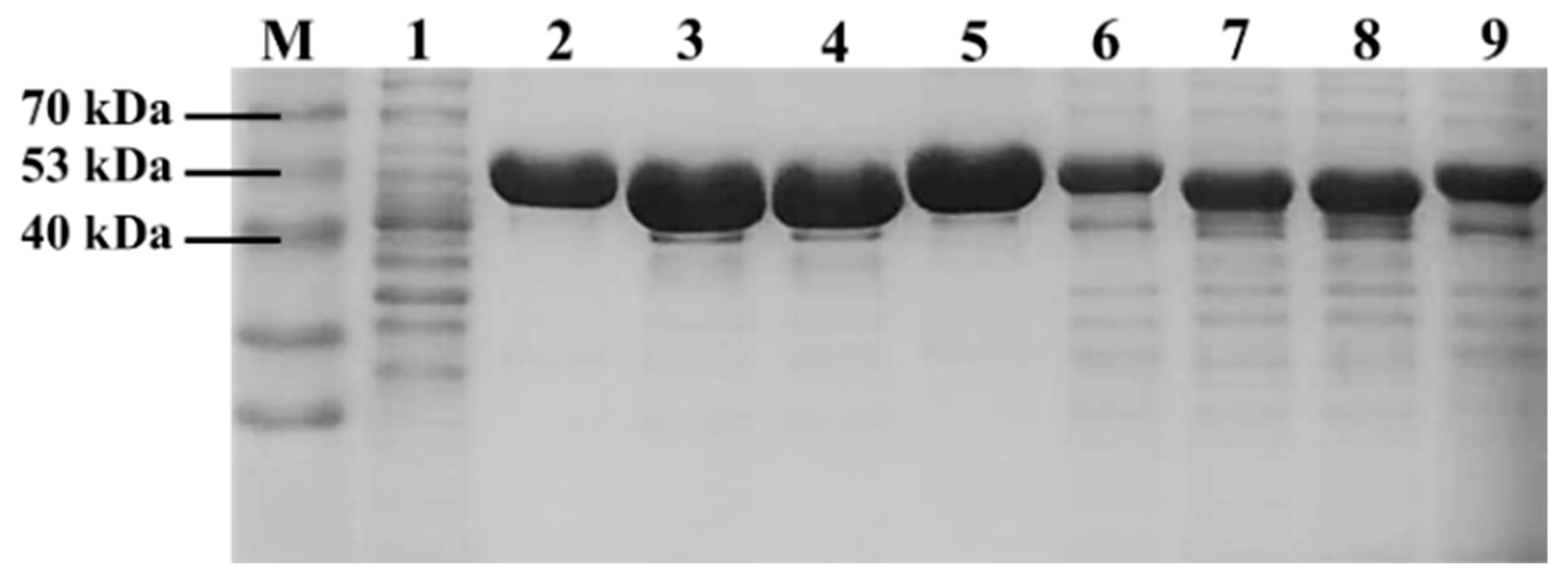
EcN is a well-established probiotic strain that lacks cytotoxins and enterotoxins and has been widely applied in the prevention and treatment of various gastrointestinal disorders [30,31]. These intrinsic properties, combined with its proven biosafety profile, render EcN an attractive chassis for the biosynthesis of compounds. In previous work, the T7-promoter-compatible strain EcN (T7) was constructed by chromosomal integration of the T7-RNA polymerase gene, driven by the lacUV5 promoter into the malEFG operon [32]. Based on this, the recombinant AncGADs were generated in the modified host strain EcN (T7) by IPTG-induced expression and purified via Ni2+-affinity chromatography. SDS-PAGE analysis (Figure 2) demonstrated that the purified AncGADs migrated as a single band with a molecular mass of approximately 53–55 kDa, which corresponds to their predicted molecular weights. The high purity of the obtained sample provides a solid foundation for further investigation of the enzymatic properties of AncGADs.

3.3. The Enzymatic Properties of AncGADs

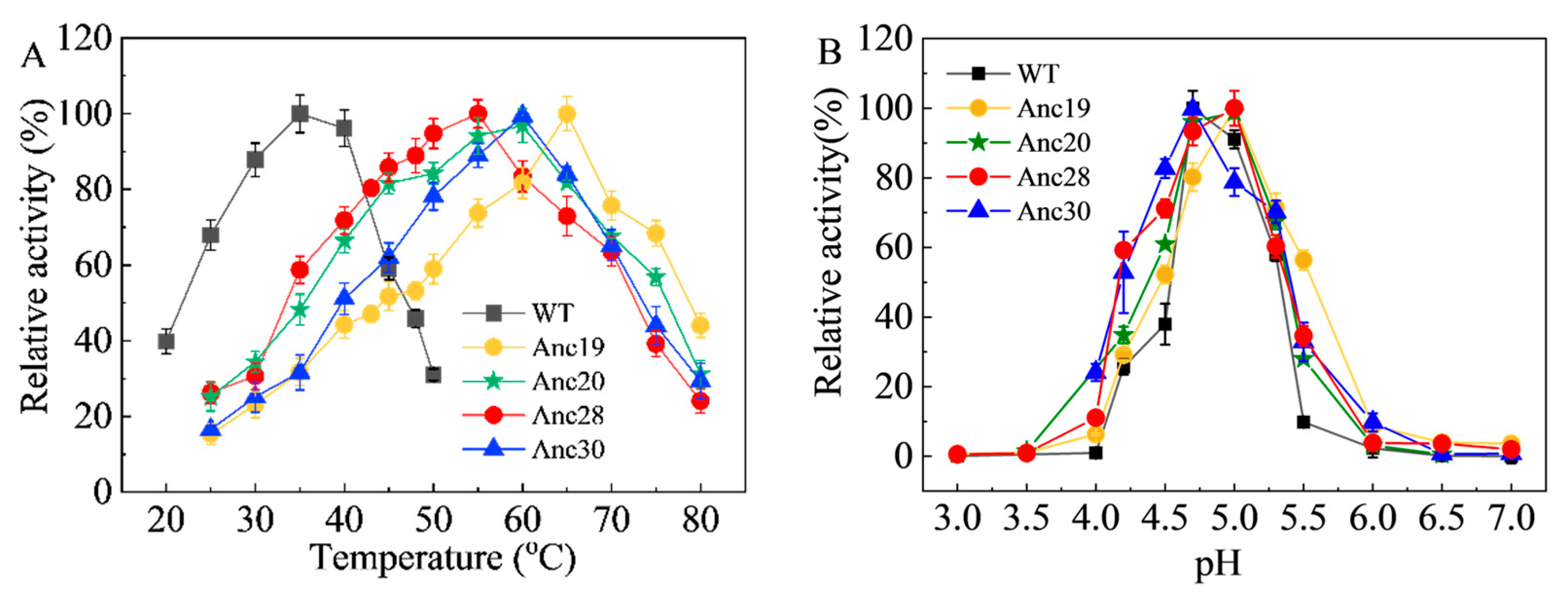
The wild-type (WT) GAD used as a reference in this work was the GadB from Levilactobacillus brevis CGMCC 1306 (LbGAD). To clarify the function of AncGADs, temperature and pH dependencies of decarboxylation activity were investigated. As shown in Figure 3, the AncGADs variants exhibited a markedly higher optimum temperature than the WT, while their optimal pH remained similar. The Anc19 showed the highest optimum temperature at 65 °C, suggesting an increase of nearly 30 °C relative to WT. Notably, all variants retained more than 50% of their maximal activity across a wide temperature range of 45–70 °C, indicating markedly enhanced thermal stability. However, as for the pH dependence of activity, a rapid decline was observed above pH 5.5, with activity becoming virtually undetectable at pH 6.0, as reported in previous studies [33].
Routinely, the kinetic parameters of WT and AncGADs were also determined at 37 °C and pH 5.0. The Km and catalytic efficiency (kcat/Km) of WT were 41.01 mM and 0.79 s−1mM−1, respectively. As shown in Table 2, both Anc19 and Anc30 exhibited small improvements in catalytic efficiency compared with the WT. Particularly, Anc28 displayed a lower Km value, indicative of enhanced substrate affinity relative to the WT. Meanwhile, the kcat value of Anc28 was markedly enhanced. This modification consequently enhanced its catalytic efficiency (kcat/Km) to 2.14 s−1mM−1, which was 2.71-fold higher than that of the WT, representing a substantial catalytic advantage. Collectively, the ASR strategy successfully endowed GAD with a higher optimum temperature and enhanced catalytic efficiency, highlighting its promising prospects in industrial applications.

3.4. AncGADs Exhibited Enhanced Thermal Stability

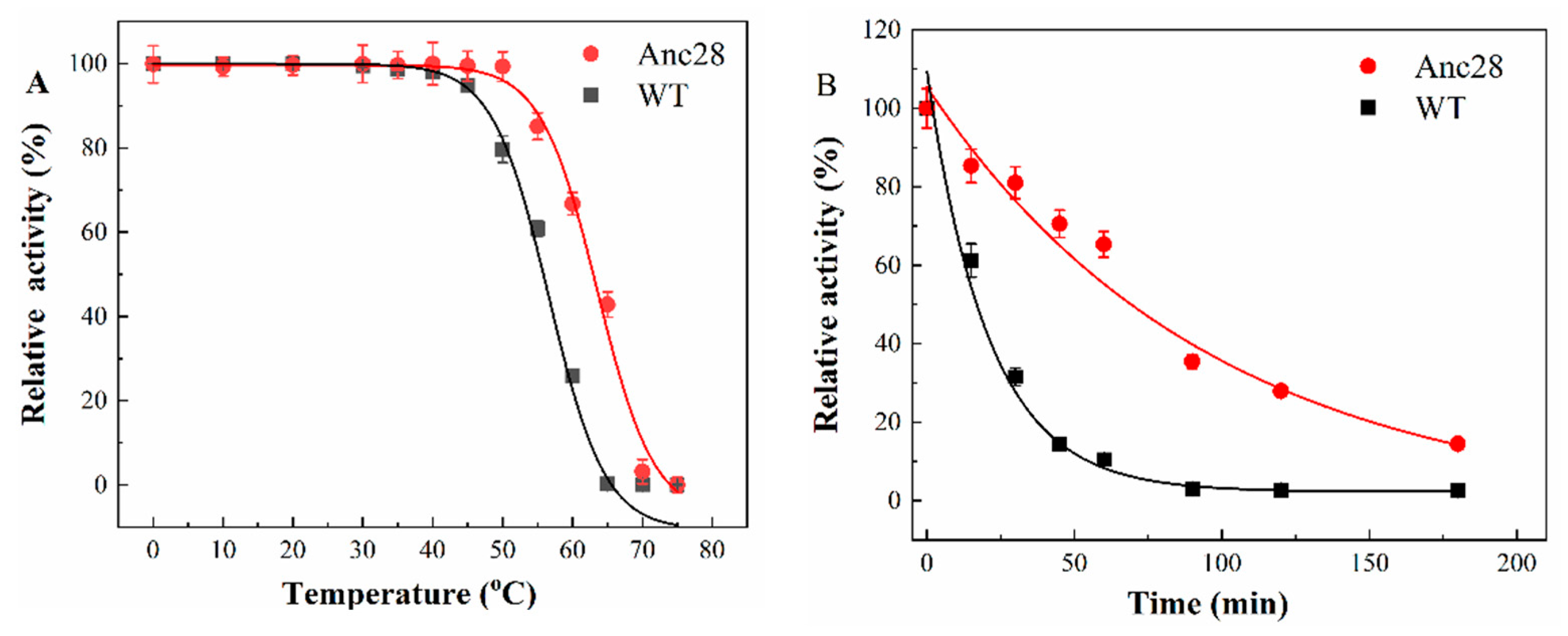
Owing to its superior catalytic efficiency and increased optimal reaction temperature, Anc28 was selected for further investigation into its improved thermal stability relative to the WT enzyme. As shown in Figure 4A, the T5015 value of Anc28 was 62.94 °C, which was 6.74 °C higher than that of the WT enzyme (56.2 °C). Similarly, the t1/2 of Anc28 was 65.43 min, which was a 4.1-fold improvement over that for the WT enzyme (15.95 min) (Figure 4B). Over the past decade, several GAD mutants with improved thermal stability have been obtained via different protein engineering strategies [15,34,35,36,37,38]. Particularly, compared with these previously reported GAD mutants (Table 3), Anc28 exhibits a remarkable improvement in thermal stability. Taken together, these results demonstrate that Anc28 combines high catalytic efficiency with significantly enhanced thermal stability, positioning it as a promising candidate for GABA synthesis.
Table 3. Summary of the reported GAD engineering strategies and effects.
Source of GADEngineering StrategyObtained GAD MutantsEffectsReference
E. coli MG1655Site-directed mutagenesis based on the N-terminal structure analysisGadBQ5D/V6I/T7ET5015 increased by 7.7 °C[34]
E. coli K12Site-directed mutagenesis based on a homologous comparison of its isoform and the catalytic–substrate interactionsGadBT62S, GadBQ309AResidual activity increased by 19% and 27% after 12 h at 45 °C, pH 4.3[35]
L. brevis CGMCC 1306Site-directed mutagenesis at consensus site followed by saturation mutationGadBT383VT5015 increased by 3.0 °C; t1/2 increased 1.2-fold at 37 °C[15]
L. plantarum GM 1403C-terminal truncation guided by homology modelingGadBΔC11T5015 increased by 1.82 °C[36]
L. brevis CGMCC 1306Proline residues were introduced at sites corresponding to those present in the thermophilic T. kodakarensis GADGadBG364Pt1/2 increased by 19.4 min and T5015 by 5.3 °C at 55 °C[37]
L. brevis CGMCC 1306Site-directed mutagenesis selected by Ramachandran plot analysisGadBK413At1/2 increased 2.1-fold at 50 °C[38]
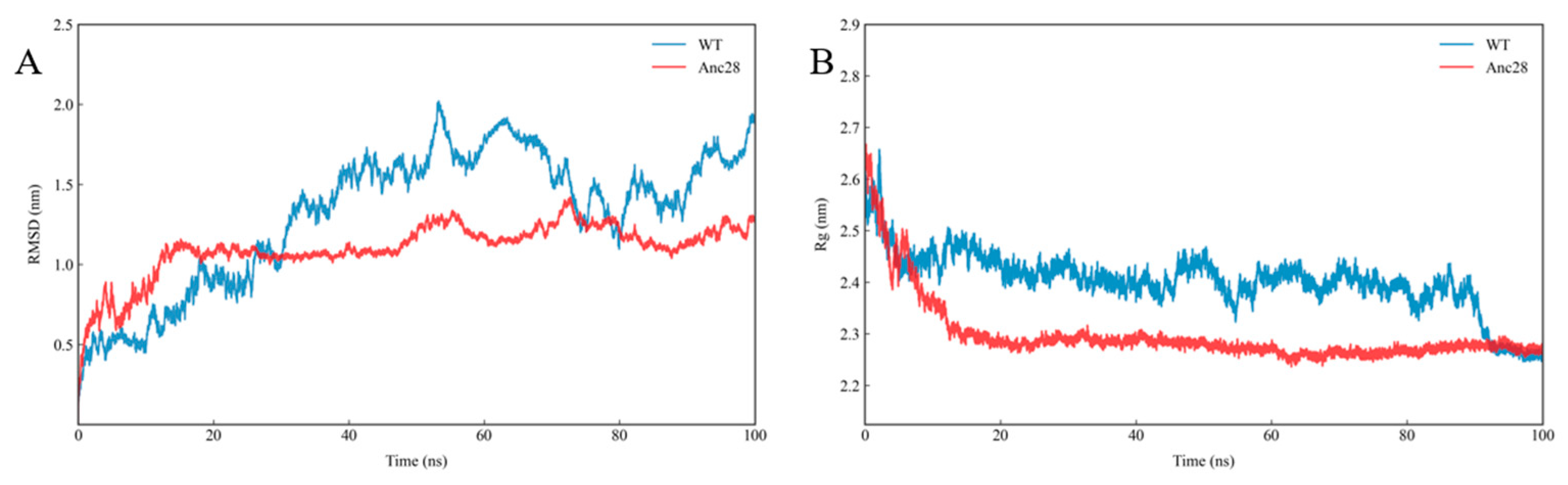
To further investigate the differences in structural stability between the ancestral enzyme Anc28 and the WT, molecular dynamics (MD) simulations were performed for both variants. As illustrated in Figure 5A, the RMSD value of Anc28 rose sharply at the early simulation stage and stabilized after around 20 ns, with subsequent fluctuations primarily ranging from 1.1 to 1.3 nm. Conversely, WT showed larger RMSD fluctuations throughout the simulation, with a rising tendency in the later phase, reflecting weaker conformational stability. Further, Rg analysis demonstrated Anc28 reached stability at 20 ns, with its radius of gyration persistently smaller than WT (Figure 5B), suggesting a tighter structural arrangement. Collectively, these findings reveal that Anc28 achieved structural stability at around 20 ns, accompanied by diminished conformational fluctuation and tighter overall packing. Such structural features likely underpin its superior thermal stability.
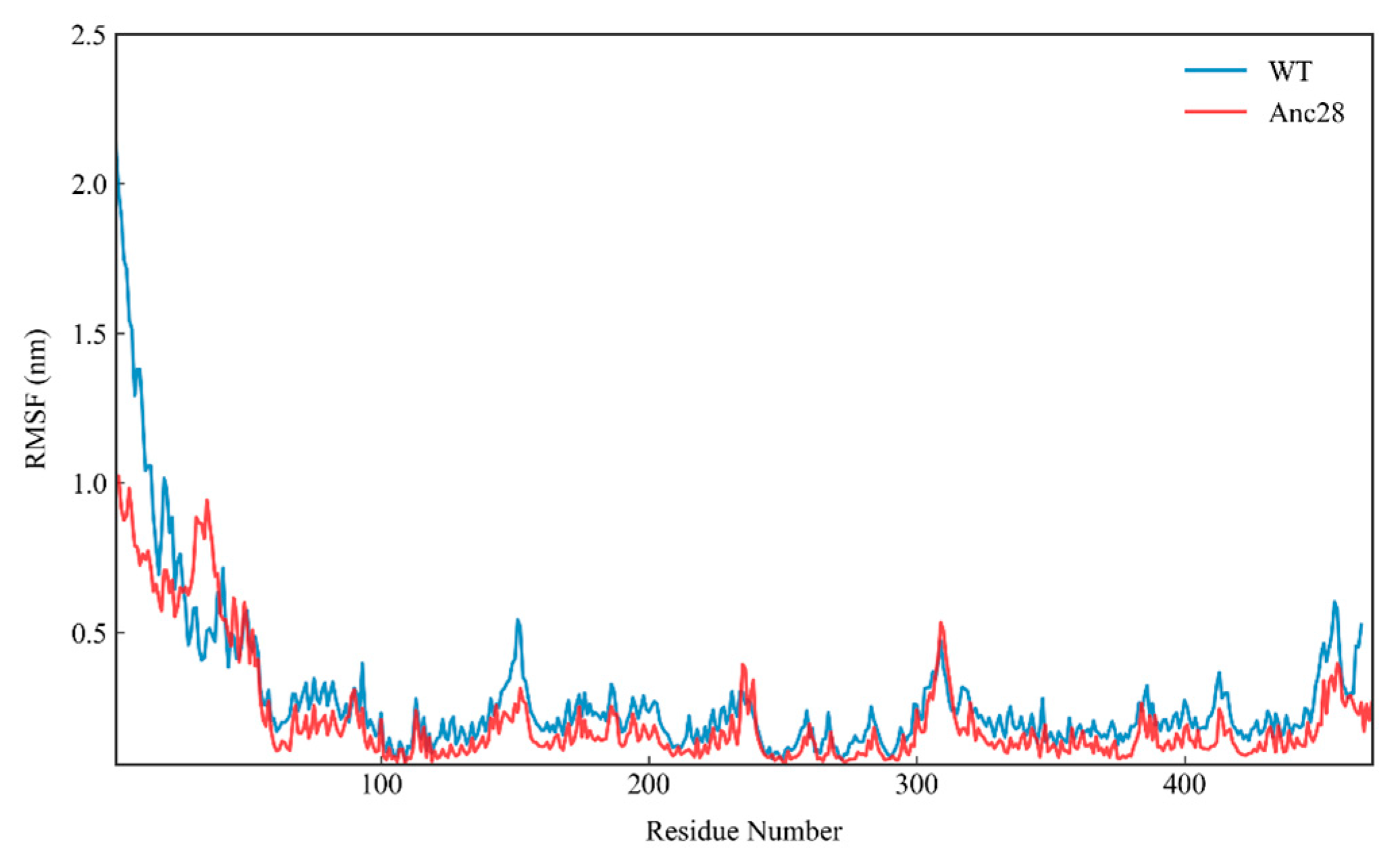
Further RMSF analysis revealed that Anc28 exhibited lower values across multiple regions relative to the wild type, notably the N-terminal 45–98 residue segment, the 150–220 residue region, and partial C-terminal sequences beyond residue 330. This finding suggests that the motions of residues in these regions were partially restricted, leading to decreased local conformational fluctuations and improved structural stability. This observation implies restrained residue mobility within these domains, which curbs local conformational fluctuations and strengthens structural stability. Overall, the generally lower RMSF profile of Anc28 reflects diminished residue flexibility and elevated local structural rigidity, favoring the preservation of protein conformational stability (Figure 6).
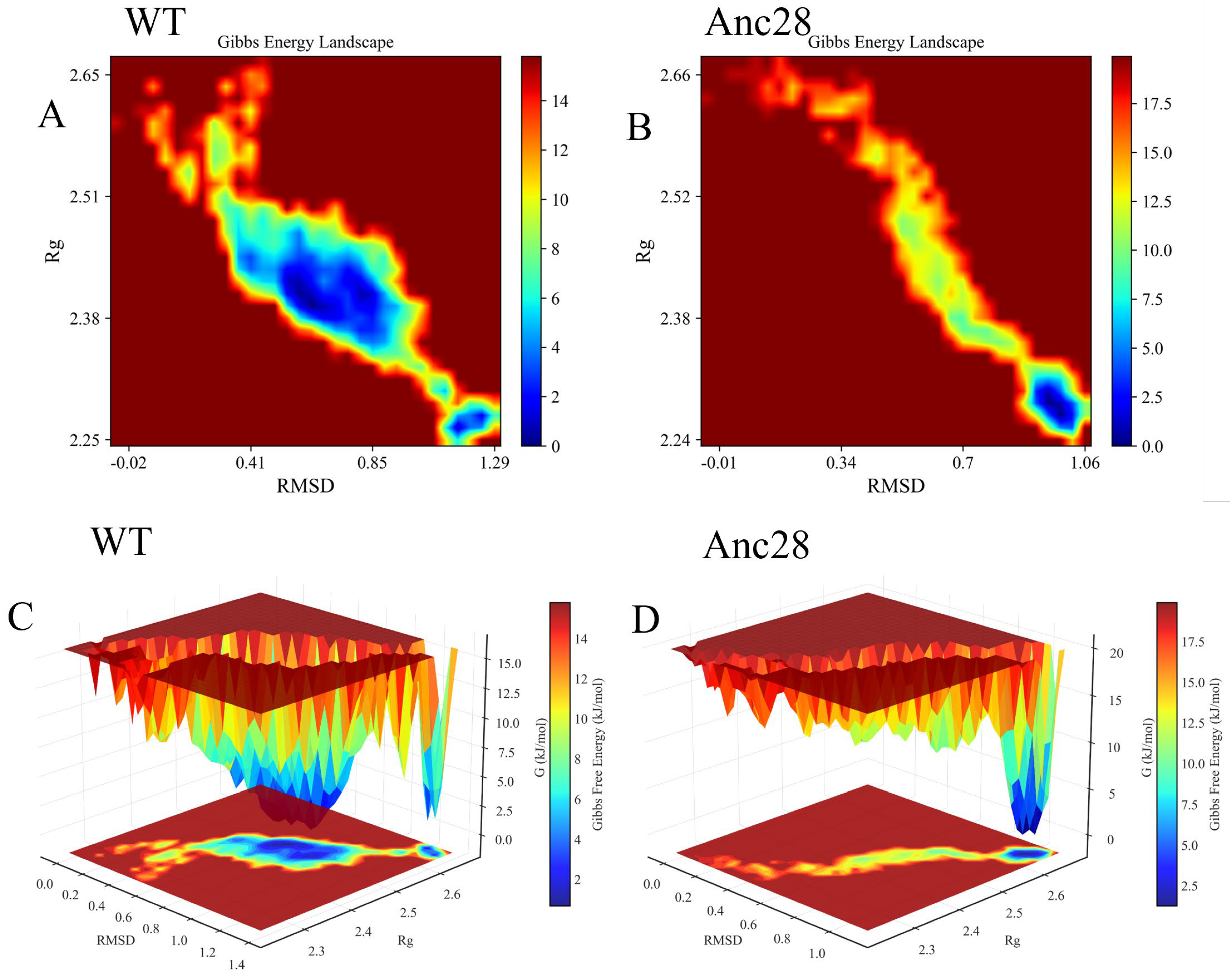
Gibbs free energy (GFE) analysis showed the WT possessed an extensive low-energy region, with the energy minimum localized at an RMSD of 0.40–0.85 nm and Rg of 2.35–2.50 nm (Figure 7A,C). This suggests the wild type can adopt diverse low-energy conformations, consistent with its high structural flexibility. By contrast, Anc28 displayed a deeper and more concentrated free energy minimum corresponding to RMSD 0.35–0.70 nm and Rg 2.25–2.30 nm (Figure 7B,D). It adopts fewer low-energy conformations and presents a more compact stable structural state.
The combined RMSD, Rg, RMSF and free energy analyses confirm Anc28 achieves better overall and local structural stability than WT, featuring compact, rigid and energetically optimal conformations. The simulation results match the improved experimental T5015 and t1/2, elucidating the molecular mechanism behind enhanced thermostability. Relevant simulation data of the remaining three AncGAD variants can be found in the Supplementary Files.

3.5. High-Efficiency GABA Synthesis Employing Engineered EcN (T7)

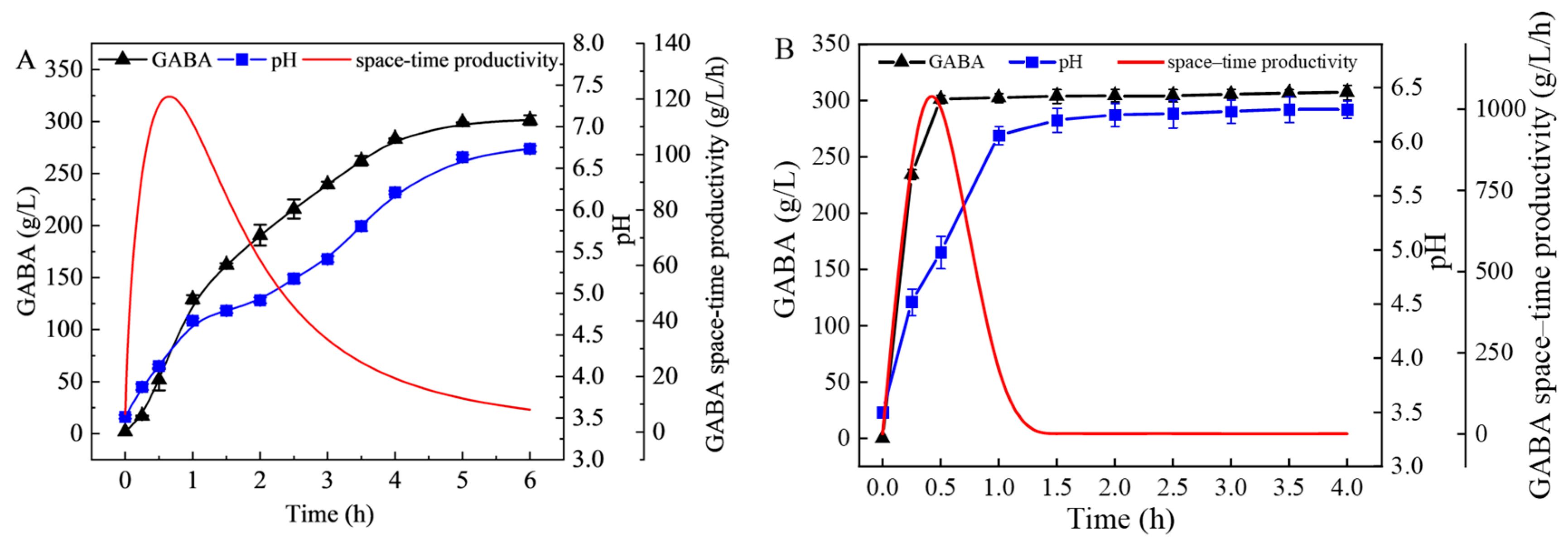
To assess the feasibility of GadB with improved catalytic efficiency and enhanced thermal stability for GABA production, the GABA-producing capacity of the engineered E. coli strains EcN (T7)/pET28a-gadB and EcN (T7)/pET28a-gadBAnc28 was further compared in a 5 L bioreactor. Owing to the low solubility of L-Glu, a large quantity of solid powder remained at the bottom of the 5 L bioreactor during the initial reaction stage. As the reaction proceeded, the solid L-Glu gradually dissolved, accompanied by a steady increase in the pH of the reaction system. The time course of GABA synthesis using engineered EcN (T7)/pET28a-gadB is shown in Figure 8A. At 4 h, the GABA concentration reached 283.38 g/L, with the pH increasing from 3.5 to 6.3. The reaction system approached equilibrium after 5 h, yielding 299.08 g/L GABA (with an average space–time yield of 59.82 g/L/h). Furthermore, HPLC analysis confirmed that the conversion rate of L-Glu approached 96.67%. As for EcN (T7)/pET28a-gadBAnc28, a similar variation tendency was observed for GABA synthesis and the pH (Figure 8B). Remarkably, GABA rapidly accumulated, and the pH increased sharply, as the reaction proceeded. The GABA titer reached 301.37 g/L with a conversion rate of 97.37% at 0.5 h. Upon completion of the 4 h reaction, the GABA concentration reached 307.53 g/L with a conversion rate of 99.36%. Compared with previously reported systems [39,40,41,42,43], EcN (T7)/pET28a-gadBAnc28 exhibits distinct advantages in both final product titer and average space–time yield (Table 4). Notably, trace residual L-Glu and the use of pure water as the sole reaction medium strongly facilitate the development of environmentally benign processes for GABA production. On the basis of these results, engineered E. coli EcN (T7) cells expressing the Anc28 are applicable for the preparative-scale biosynthesis of GABA from L-Glu.

4. Conclusions

As the key rate-limiting enzyme in GABA biosynthesis, GAD demands superior thermal stability and high catalytic efficiency to fulfill industrial requirements. In this study, ancestral sequence reconstruction (ASR) was employed to generate GAD variants with drastically enhanced catalytic activity and thermal stability, and their enzymatic properties were systematically characterized. Beyond enzyme engineering, a whole-cell GABA bioproduction system using pure water as the sole medium and engineered E. coli Nissle (T7) cells as biocatalysts was established. This system enabled efficient GABA production, reaching a high titer of 307.53 g/L with 99.36% conversion within 4 h at 40 °C. Collectively, this work not only significantly improved the thermostability of GAD but also provided a promising strategy for the green and efficient production of high-purity GABA, offering a scalable and environmentally friendly platform for industrial GABA production and a promising strategy for the green and efficient production of high-purity GABA under pure-water bioconversion conditions. Nevertheless, because the current production strain is plasmid-based and contains a kanamycin-resistance marker, future development of antibiotic-marker-free strains will be necessary before this approach can be considered a fully food-grade or GRAS-compliant process.

Supplementary Materials

The following supporting information can be downloaded at https://www.mdpi.com/article/10.3390/fermentation12060281/s1, Figure S1. Reconstructed Phylogenetic Tree of Ancestral Glutamate Decarboxylase (GAD) Sequences. Figure S2. Sequence alignments between AncGADs and LbGAD. Figure S3. The optimal temperature (A) and optimal pH (B) of WT and AncGADs enzyme activities at 20 mM L-Glu concentration. Figure S4. Comparison of RMSD values of RMSD and Rg between WT and AncGADs. (A) RMSD of WT and Anc19; (B) Rg of WT and Anc19; (C) RMSD of WT and Anc20; (D) Rg of WT and Anc20; (E) RMSD of WT and Anc30; (F) Rg of WT and Anc30. Figure S5. Comparison of RMSF between WT and AncGADs. (A) Comparison of RMSF between WT and Anc19; (B) Comparison of RMSF between WT and Anc19; (C) Comparison of RMSF between WT and Anc30. Figure S6. Gibbs free energy landscape of WT and Anc28. (A) Two-dimensional (2D) free energy landscape of WT; (B) three-dimensional (3D) free energy landscape of WT; (C) 2D free energy landscape of Anc30; (D) 3D free energy landscape of mutant Anc30; (E) 2D free energy landscape of Anc19; (F) 3D free energy landscape of mutant Anc19; (G) 2D free energy landscape of Anc20; (H) 3D free energy landscape of mutant Anc20. The color scale indicates energy values (kcal/moL), with low-energy regions (blue/green) representing conformationally stable states. Table S1. The amino acid sequence and nucleic acid sequence of AncGADs. Posterior probability of AncGADs.

Author Contributions

Conceptualization, J.Y. and C.L.; methodology, C.L.; validation, L.M. and S.H.; formal analysis, J.Y.; investigation, W.W., F.F. and Z.C.; Supervision, L.M. and W.Z.; resources, C.L.; formal analysis, J.Y.; writing—original draft preparation, J.Y.; writing—review and editing, C.L. All authors have read and agreed to the published version of the manuscript.

Funding

This work was supported by the National Natural Science Foundation of China (No. 32371542), the Zhejiang Provincial Natural Science Foundation of China (No. LY23B060001), the Open Fund Project of Laboratory of Marine Biogenetic Resources, Ministry of Natural Resources (HY202305), and the Project Program of Key Laboratory of Industrial Fermentation Microbiology, Ministry of Education, and Tianjin Key Laboratory of Industrial Microbiology, China (No. 2021KF003).

Institutional Review Board Statement

Not applicable.

Informed Consent Statement

Not applicable.

Data Availability Statement

The original contributions presented in this study are included in the article/Supplementary Material. Further inquiries can be directed to the corresponding author.

Acknowledgments

We thank Nicole Frankenberg Dinkel from Technische Universität Kaiserslautern for the kind provision of E. coli Nissle (T7). During the preparation of this manuscript, the authors used DeepSeek-R1 and QuillBot Premium (https://quillbot.com/premium, accessed on 28 January 2026) for the purposes of assisting with English translation and text revision. The authors have reviewed and edited the output and take full responsibility for the content of this publication.

Conflicts of Interest

The authors declare no conflicts of interest.

References

  1. Almutairi, S.; Sivadas, A.; Kwakowsky, A. The effect of oral GABA on the nervous system: Potential for therapeutic intervention. Nutraceuticals 2024, 4, 241–259. [Google Scholar] [CrossRef]
  2. Cui, Y.; Miao, K.; Niyaphorn, S.; Qu, X. Production of gamma-aminobutyric acid from Lactic Acid Bacteria: A systematic review. Int. J. Mol. Sci. 2020, 21, 995. [Google Scholar] [CrossRef]
  3. Yan, J.; Qu, Y.; Cui, X. Research progress of extraction and determination methods of γ-aminobutyric acid. Sci. Technol. Food Ind. 2014, 4, 251–356. [Google Scholar] [CrossRef]
  4. Ding, J.; Hou, G.G.; Nemzer, B.V.; Xiong, S.; Dubat, A.; Feng, H. Effects of controlled germination on selected physicochemical and functional properties of whole-wheat flour and enhanced γ-aminobutyric acid accumulation by ultrasonication. Food Chem. 2018, 243, 214–221. [Google Scholar] [CrossRef]
  5. Somasundaram, S.; Jeong, J.; Hong, S.H. Cell surface display of Neurospora crassa glutamate decarboxylase on Escherichia coli for extracellular Gamma-aminobutyric acid production from high cell density culture. Biochem. Eng. J. 2021, 176, 108196. [Google Scholar] [CrossRef]
  6. Huang, Y.; Su, L.; Wu, J. Pyridoxine Supplementation Improves the activity of recombinant glutamate decarboxylase and the enzymatic production of gama-aminobutyric acid. PLoS ONE 2016, 11, e0157466. [Google Scholar] [CrossRef]
  7. Iorizzo, M.; Paventi, G.; Di Martino, C. Biosynthesis of gamma-aminobutyric acid (GABA) by Lactiplantibacillus plantarum in fermented food production. Curr. Issues Mol. Biol. 2024, 46, 200–220. [Google Scholar] [CrossRef] [PubMed]
  8. Monteiro, M.P.; Kohl, H.M.; Roullet, J.-B.; Gibson, K.M.; Ochoa-Reparaz, J.; Castillo, A.R. Genetically engineered Lactococcus lactis strain constitutively expresses GABA-producing genes and produces high levels of GABA. Lett. Appl. Microbiol. 2024, 77, ovae051. [Google Scholar] [CrossRef]
  9. Pizzi, A.; Parolin, C.; Gottardi, D.; Ricci, A.; Parpinello, G.P.; Lanciotti, R.; Patrignani, F.; Vitali, B. A novel GABA-producing Levilactobacillus brevis strain isolated from organic tomato as a promising probiotic. Biomolecules 2025, 15, 979. [Google Scholar] [CrossRef] [PubMed]
  10. Asun, A.C.; Lin, S.-T.; Ng, H.S.; Lan, J.C.-W. Production of gamma-aminobutyric acid (GABA) by Bacillus subtilis BBEL02 fermentation using nitrogen-rich industrial wastes as crude feedstocks. Biochem. Eng. J. 2022, 187, 108654. [Google Scholar] [CrossRef]
  11. Wen, J.; Sun, W.; Leng, G.; Li, D.; Feng, C.; Tian, Z.; Wang, X. Enhanced fermentative γ-aminobutyric acid production by a metabolic engineered Corynebacterium glutamicum. Biotechnol. Bioprocess Eng. 2024, 29, 129–140. [Google Scholar] [CrossRef]
  12. Jiang, D.; Cai, Q.; Gao, A.; Li, J.; Yang, Y.; Xu, X.; Ye, Y.; Hou, J. Cloning and expression of a full-length glutamate decarboxylase gene from a high-yielding γ-aminobutyric acid yeast strain MJ2. Ann. Microbiol. 2013, 63, 487–494. [Google Scholar] [CrossRef]
  13. Su, L.; Huang, Y.; Wu, J. Enhanced production of recombinant Escherichia coli glutamate decarboxylase through optimization of induction strategy and addition of pyridoxine. Bioresour. Technol. 2015, 198, 63–69. [Google Scholar] [CrossRef] [PubMed]
  14. Yogeswara, I.B.A.; Maneerat, S.; Haltrich, D. Glutamate decarboxylase from Lactic Acid bacteria—A key enzyme in GABA synthesis. Microorganisms 2020, 8, 1923. [Google Scholar] [CrossRef]
  15. Hua, Y.; Lyu, C.; Liu, C.; Wang, H.; Hu, S.; Zhao, W.; Mei, J.; Huang, J.; Mei, L. Improving the thermostability of glutamate decarboxylase from Lactobacillus brevis by consensus mutagenesis. Appl. Biochem. Biotechnol. 2020, 191, 1456–1469. [Google Scholar] [CrossRef] [PubMed]
  16. Zhang, Q.-F.; Hu, S.; Zhao, W.-R.; Huang, J.; Mei, J.-Q.; Mei, L.-H. Parallel Strategy Increases the thermostability and activity of glutamate decarboxylase. Molecules 2020, 25, 690. [Google Scholar] [CrossRef] [PubMed]
  17. Zhang, K.; Dai, Y.; Sun, J.; Lu, J. Enzyme ancestral sequence reconstruction and directed evolution. Chin. J. Biotechnol. 2021, 37, 4187–4200. [Google Scholar] [CrossRef]
  18. Gumulya, Y.; Baek, J.-M.; Wun, S.-J.; Thomson, R.E.S.; Harris, K.L.; Hunter, D.J.B.; Behrendorff, J.B.Y.H.; Kulig, J.; Zheng, S.; Wu, X.; et al. Engineering highly functional thermostable proteins using ancestral sequence reconstruction. Nat. Catal. 2018, 1, 878–888. [Google Scholar] [CrossRef]
  19. Zhao, J.; Wang, B.; Di, J.; Zhou, J.; Dong, J.; Ni, Y.; Han, R. Ancestral sequence reconstruction for Novel bifunctional glutathione synthetase with enhanced thermostability and catalytic efficiency. Foods 2026, 15, 309. [Google Scholar] [CrossRef]
  20. Kayikci, M.; Venkatakrishnan, A.J.; Scott-Brown, J.; Ravarani, C.N.J.; Flock, T.; Babu, M.M. Visualization and analysis of non-covalent contacts using the Protein Contacts Atlas. Nat. Struct. Mol. Biol. 2018, 25, 185–194. [Google Scholar] [CrossRef]
  21. Musil, M.; Khan, R.T.; Beier, A.; Stourac, J.; Konegger, H.; Damborsky, J.; Bednar, D. FireProtASR: A web server for fully automated ancestral sequence reconstruction. Brief Bioinform. 2021, 22, 185–194. [Google Scholar] [CrossRef] [PubMed]
  22. Yao, L.-L.; Cao, J.-R.; Lyu, C.-J.; Fan, F.-F.; Wang, H.-P.; Cao, H.-W.; Huang, J.; Mei, L.-H. Food-grade γ-aminobutyric acid production by immobilized glutamate decarboxylase from Lactobacillus plantarum in rice vinegar and monosodium glutamate system. Biotechnol. Lett. 2021, 43, 2027–2034. [Google Scholar] [CrossRef]
  23. Miyazaki, J.; Nakaya, S.; Suzuki, T.; Tamakoshi, M.; Oshima, T.; Yamagishi, A. Ancestral residues stabilizing 3-isopropylmalate dehydrogenase of an extreme thermophile: Experimental evidence supporting the thermophilic common ancestor hypothesis. J. Biochem. 2001, 129, 777–782. [Google Scholar] [CrossRef]
  24. Gaucher, E.A.; Thomson, J.M.; Burgan, M.F.; Benner, S.A. Inferring the palaeoenvironment of ancient bacteria on the basis of resurrected proteins. Nature 2003, 425, 285–288. [Google Scholar] [CrossRef]
  25. Shimizu, H.; Yokobori, S.; Ohkuri, T.; Yokogawa, T.; Nishikawa, K.; Yamagishi, A. Extremely thermophilic translation system in the common ancestor commonote: Ancestral mutants of Glycyl-tRNA synthetase from the extreme thermophile Thermus thermophilus. J. Mol. Biol. 2007, 369, 1060–1069. [Google Scholar] [CrossRef]
  26. Veronika, Š.; Bidmanová, Š.; Koudelakova, T.; Prokop, Z.; Chaloupkova, R.; Damborský, J. Strategies for stabilization of enzymes in organic solvents. ACS Catal. 2013, 3, 2823–2836. [Google Scholar] [CrossRef]
  27. Huang, J.; Fang, H.; Gai, Z.-C.; Mei, J.-Q.; Li, J.-N.; Hu, S.; Lv, C.-J.; Zhao, W.-R.; Mei, L.-H. Lactobacillus brevis CGMCC 1306 glutamate decarboxylase: Crystal structure and functional analysis. Biochem. Biophys. Res. Commun. 2018, 503, 1703–1709. [Google Scholar] [CrossRef]
  28. Khan, R.T.; Musil, M.; Stourac, J.; Damborsky, J.; Bednar, D. Fully Automated Ancestral Sequence Reconstruction using FireProtASR. Curr. Protoc. 2021, 1, e30. [Google Scholar] [CrossRef]
  29. Grote, A.; Hiller, K.; Scheer, M.; Münch, R.; Nörtemann, B.; Hempel, D.C.; Jahn, D. JCat: A novel tool to adapt codon usage of a target gene to its potential expression host. Nucleic Acids Res. 2005, 33, W526–W531. [Google Scholar] [CrossRef] [PubMed]
  30. Behrouzi, A.; Mazaheri, H.; Falsafi, S.; Tavassol, Z.H.; Moshiri, A.; Siadat, S.D. Intestinal effect of the probiotic Escherichia coli strain Nissle 1917 and its OMV. J. Diabetes Metab. Disord. 2020, 19, 597–604. [Google Scholar] [CrossRef] [PubMed]
  31. Chen, H.; Lei, P.; Ji, H.; Yang, Q.; Peng, B.; Ma, J.; Fang, Y.; Qu, L.; Li, H.; Wu, W.; et al. Advances in Escherichia coli Nissle 1917 as a customizable drug delivery system for disease treatment and diagnosis strategies. Mater. Today Bio 2023, 18, 100543. [Google Scholar] [CrossRef]
  32. Wang, Y.; Luo, Z.; Tu, Y.; Zhong, T.; Hu, S.; Zhao, W.; Lyu, C.; Chan, Z.; Huang, J.; Mei, L. Mining of a novel thermostable glutamate decarboxylase by ancestral sequence reconstruction and application of this enzyme in biosynthesis of food-grade γ-aminobutyric acid. Chin. J. Biotechnol. 2025, 41, 2062–2076. [Google Scholar] [CrossRef]
  33. Pennacchietti, E.; Lammens, T.M.; Capitani, G.; Franssen, M.C.R.; John, R.A.; Bossa, F.; De Biase, D. Mutation of His465 alters the pH-dependent Spectroscopic Properties of Escherichia coli glutamate decarboxylase and broadens the range of Its activity toward more alkaline pH. J. Biol. Chem. 2009, 284, 31587–31596. [Google Scholar] [CrossRef]
  34. Jun, C.; Joo, J.C.; Lee, J.H.; Kim, Y.H. Thermostabilization of glutamate decarboxylase B from Escherichia coli by structure-guided design of its pH-responsive N-terminal interdomain. J. Biotechnol. 2014, 174, 22–28. [Google Scholar] [CrossRef]
  35. Fengmin, L.; Heng, Z.; Xiangjun, Z.; Xiaobo, W.; Huiyan, L.; Haitian, F. Site-directed mutagenesis improves the practical application of L-glutamic acid decarboxylase in Escherichia coli. Eng. Life Sci. 2023, 23, e2200064. [Google Scholar] [CrossRef] [PubMed]
  36. Lyu, C.; Yao, L.; Zhu, Q.; Mei, J.; Cao, Y.; Hu, S.; Zhao, W.; Huang, J.; Mei, L.; Yao, S.; et al. Reconstruction of the glutamate decarboxylase system in Lactococcus lactis for biosynthesis of food-grade γ-aminobutyric acid. Appl. Microbiol. Biotechnol. 2021, 105, 4127–4140. [Google Scholar] [CrossRef]
  37. Fang, H.; Lü, C.; Hua, Y.; Hu, S.; Zhao, W.; Fang, W.; Song, K.; Huang, J.; Mei, L. Increasing the thermostability of glutamate decarboxylase from Lactobacillus brevis by introducing proline. Chin. J. Biotechnol. 2024, 35, 636–646. [Google Scholar] [CrossRef]
  38. Ke, P.; Huang, J.; Hu, S.; Zhao, W.; Lü, C.; Yu, K.; Lei, Y.; Wang, J.; Mei, L. Enhancing glutamate decarboxylase activity by site-directed mutagenesis: An insight from Ramachandran plot], Sheng Wu Gong Cheng Xue Bao Chin. J. Biotechnol. 2016, 32, 31–40. [Google Scholar] [CrossRef]
  39. Le Vo, T.D.; Kim, T.W.; Hong, S.H. Effects of glutamate decarboxylase and gamma-aminobutyric acid (GABA) transporter on the bioconversion of GABA in engineered Escherichia coli. Bioprocess Biosyst. Eng. 2012, 35, 645–650. [Google Scholar] [CrossRef] [PubMed]
  40. Ke, C.; Wei, J.; Ren, Y.; Yang, X.; Chen, J.; Huang, J. Efficient gamma-aminobutyric acid bioconversion by engineered Escherichia coli. Biotechnol. Biotechnol. Equip. 2018, 32, 566–573. [Google Scholar] [CrossRef]
  41. Park, S.J.; Kim, E.Y.; Noh, W.; Oh, Y.H.; Kim, H.Y.; Song, B.K.; Cho, K.M.; Hong, S.H.; Lee, S.H.; Jegal, J. Synthesis of nylon 4 from gamma-aminobutyrate (GABA) produced by recombinant Escherichia coli. Bioprocess Biosyst. Eng. 2013, 36, 885–892. [Google Scholar] [CrossRef] [PubMed]
  42. Xiong, Q.; Xu, Z.; Xu, L.; Yao, Z.; Li, S.; Xu, H. Efficient production of γ-GABA using recombinant E. coli expressing glutamate decarboxylase (GAD) derived from Eukaryote Saccharomyces cerevisiae. Appl. Biochem. Biotechnol. 2017, 183, 1390–1400. [Google Scholar] [CrossRef] [PubMed]
  43. Lyu, J.-F.; Lyu, C.-J.; Cao, J.-R.; Mei, J.-Q.; Hu, S.; Zhao, W.-R.; Xu, T.-Y.; Wang, Y.-T.; Wang, D.-L.; Huang, J.; et al. High level production of γ-aminobutyric acid in engineered Escherichia coli by refactoring the glutamate decarboxylase. Process Biochem. 2022, 118, 243–251. [Google Scholar] [CrossRef]
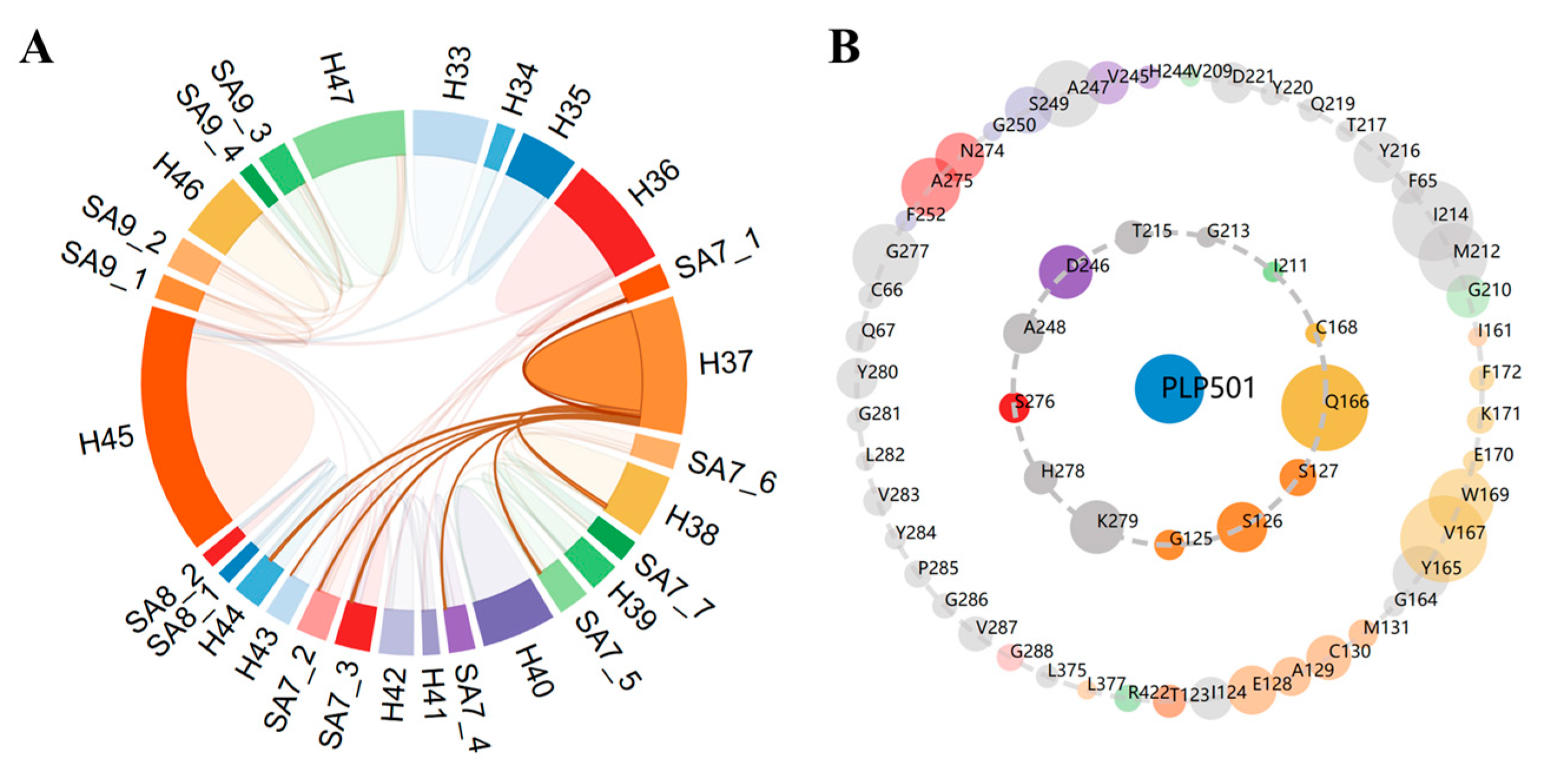
Figure 1. Structural contact analysis of LbGAD. (A) Chord plot showing contacts among secondary-structure elements. H and SA denote α-helices and strand/sheet-associated elements, respectively. Different colors on the outer ring distinguish individual secondary-structure elements, while internal chords indicate inter-element contacts; thicker or darker chords represent stronger or more frequent contacts. (B) Residue-contact network surrounding the PLP cofactor. PLP501 is shown at the center, with directly interacting residues displayed as first-shell residues and residues interacting with the first shell shown as second-shell residues. Different node colors distinguish residue groups/clusters, and node size reflects the relative number of contacts.
Fermentation 12 00281 g001
Figure 2. Recombinant expression and purification of AncGADs. Lanes: (M) protein marker, (1) uninduced engineered EcN (T7) whole cells, (2–5) Anc20, Anc30, Anc19, Anc28 after purification, (6–9) whole cells of engineered EcN (T7) harboring pET28a-Anc20/Anc30/Anc19/Anc28 after IPTG induction.
Fermentation 12 00281 g002
Figure 3. The optimum pH (A) and temperature (B) for enzyme activity of WT and AncGADs. Relative activity was calculated by defining the maximum activity of each individual enzyme under the tested pH or temperature range as 100%. Data are presented as mean ± SD from three independent measurements.
Fermentation 12 00281 g003
Figure 4. The kinetic stability of Anc28 and WT enzymes. (A) The thermal deactivation of WT and Anc28 at various temperatures for 15 min (T5015). (B) The thermal deactivation half-life (t1/2) of WT and Anc28 at 60 °C. Data are presented as mean ± standard deviation from three independent measurements.
Fermentation 12 00281 g004
Figure 5. Comparison of RMSD and Rg values between WT and Anc28. (A) RMSD of WT and Anc28; (B) Rg of WT and Anc28.
Fermentation 12 00281 g005
Figure 6. Comparison of RMSF between WT and Anc28.
Fermentation 12 00281 g006
Figure 7. Gibbs free energy landscape of WT and Anc28. (A) Two−dimensional (2D) free energy landscape of WT; (B) 2D free energy landscape of Anc28; (C) three−dimensional (3D) free energy landscape of WT; (D) 3D free energy landscape of Anc28. The color scale indicates energy values (kcal/moL), with low-energy regions (blue/green) representing conformationally stable states.
Fermentation 12 00281 g007
Figure 8. The time course of GABA synthesis using engineered E. coli EcN (T7)/pET-28a-gadB (A) and E. coli EcN (T7)/pET-28a-gadBAnc28 (B).
Fermentation 12 00281 g008
Table 1. Bacterial strains and plasmids used in this work.
Strains/PlasmidsCharacteristicsSource
Strains  
DH5αF endA1 glnV44 thi-1 recA1 relA1 gyrA96 deoR nupG purB20 φ80dlacZΔM15 Δ(lacZYA-argF)U169, hsdR17(rKmK+), λTakara
EcN (T7)Serotype O6:K5:H1 derivate, insertion of T7-RNA polymerase gene with lacUV5 promoter by deletion of malEFG operonLab stock
EcN (T7)/pET28a-gadBEcN (T7) strain harboring pET28a-gadBThis work
EcN (T7)/pET28a-gadBAnc19EcN (T7) strain harboring pET28a-gadBAnc19This work
EcN (T7)/pET28a-gadBAnc20EcN (T7) strain harboring pET28a-gadBAnc20This work
EcN (T7)/pET28a-gadBAnc28EcN (T7) strain harboring pET28a-gadBAnc28This work
EcN (T7)/pET28a-gadBAnc30EcN (T7) strain harboring pET28a-gadBAnc30This work
Plasmids  
pET-28a (+)Expression vector, Kan+Novagen
pET28a-gadBThe gadB segment in vector pET-28aLab stock
pET28a-gadBAnc19The gadBAnc19 segment in vector pET-28aThis work
pET28a-gadBAnc20The gadBAnc20 segment in vector pET-28aThis work
pET28a-gadBAnc28The gadBAnc28 segment in vector pET-28aThis work
pET28a-gadBAnc30The gadBAnc30 segment in vector pET-28aThis work
Table 2. Kinetic analysis of the AncGADs with L-Glu as substrate.
GADsKm (mM)kcat (s−1)kcat/Km
(s−1mM−1)
WT41.0132.600.79
Anc1954.7848.230.88
Anc2059.6341.470.69
Anc2826.8057.412.14
Anc3030.4430.160.99
Table 4. The GABA production performance of engineered strains.
StrainsGene and SourceConcentration (g/L)Productivity
(g/L/h)
Conversion RatioReferences
E. coli XBTGadB and GadC (E. coli)5.460.11489.5%[39]
E. coli BL21(DE3)GadB (L. lactis)204.123499%[40]
E. coli XL1-BlueGadB (L. lactis)94.81.9877.7%[41]
E. coli BL21(DE3)GadB (Saccharomyces cerevisiae)252N/S99%[42]
E. coli BL21(DE3)GadBΔC11K17T/D294G/E312S/Q346H (L. brevis)270.4236.0699.9[43]
Disclaimer/Publisher’s Note: The statements, opinions and data contained in all publications are solely those of the individual author(s) and contributor(s) and not of MDPI and/or the editor(s). MDPI and/or the editor(s) disclaim responsibility for any injury to people or property resulting from any ideas, methods, instructions or products referred to in the content.