Article

Fermentation-Driven Biosynthesis of Natural Carotenoids in Rhodotorula glutinis P4M422: Evaluation of Culture Conditions


by
María de la Luz Herrera-Estrada
1,
José Sandoval-Cortés
1,
Carlos N. Cano-González
2,
Teresinha Gonçalves da Silva
3,
José L. Martínez-Hernández
1,
Miguel A. Aguilar-González
4,
Juan A. Ascacio-Valdés
1,
Mónica L. Chávez-González
1 and
Cristóbal N. Aguilar
1,*
1
Bioprocesses and Bioproducts Research Group, Food Research Department, School of Chemistry, Universidad Autónoma de Coahuila, Saltillo 25280, Coahuila, Mexico
2
Centro de Investigación en Química Aplicada, Saltillo 25294, Coahuila, Mexico
3
Department of Antibiotics, Federal University of Pernambuco (UFPE), Recife 50670-901, Brazil
4
Centro de Investigación y Estudios Avanzados del Instituto Politécnico Nacional (CINVESTAV), Unidad Saltillo, Parque Industrial Ramos Arizpe, Ramos Arizpe 25903, Coahuila, Mexico
*
Author to whom correspondence should be addressed.
Fermentation 2026, 12(4), 201; https://doi.org/10.3390/fermentation12040201
Submission received: 3 March 2026 / Revised: 4 April 2026 / Accepted: 13 April 2026 / Published: 16 April 2026

Abstract

Carotenoids are natural pigments of high industrial value, with recognized antioxidant properties, and are widely used in the food, cosmetic, and pharmaceutical industries. Oleaginous yeasts, such as Rhodotorula glutinis, represent a promising alternative for the sustainable production of these compounds through submerged fermentation, compared to their extraction from plant sources or chemical synthesis. This study aimed to optimize culture conditions to maximize biomass and carotenoid production in R. glutinis P4M422. To this end, the effects of various culture factors, including light, carbon-to-nitrogen (C/N) ratio, temperature, pH, and glycerol addition, on cell growth and pigment biosynthesis were evaluated. The results showed that agitation speed and C/N ratio are key variables in system performance, significantly influencing both growth and carotenoid accumulation. Under the established optimal conditions (210 rpm, C/N ratio of 50, red light, and 30 °C), a maximum volumetric yield of 343.1 mg/L and a productivity of 4.8 mg/L/h were achieved, representing a substantial improvement in process efficiency. These values position the R. glutinis P4M422 strain as a competitive alternative for the biotechnological production of carotenoids. Taken together, these findings confirm the efficiency of submerged culture as a platform for obtaining high-value-added biopigments and reinforce the potential of microbial fermentation systems as a sustainable, scalable, and controllable strategy for their production.

1. Introduction

The transition to more sustainable food and healthcare systems has driven the search for alternative biotechnological processes to obtain natural ingredients using environmentally friendly technologies. In this context, carotenoids are among the most bioactive compounds due to their high bioactivity and wide range of applications. Carotenoids are natural pigments present in plants, algae, and some microorganisms, responsible for the characteristic yellow, orange, and red colors [1,2]. They are fat-soluble molecules composed of long hydrocarbon chains with conjugated double bonds, the structure of which gives them a remarkable antioxidant capacity [3]. In addition to their role as vitamin A precursors, these compounds possess anticancer, immunomodulatory, and photoprotective properties, which have favored their application in the food, pharmaceutical, nutraceutical, and cosmeceutical industries [4,5,6]. The growing demand for natural colorants and functional supplements has intensified the need to optimize their production systems.
Traditionally, carotenoids are obtained from plant sources such as tomatoes and other pigmented fruits and vegetables [7]. However, agricultural production is subject to seasonal variability, climatic conditions, and fluctuations in pigment concentration, and it requires large areas of cultivation. Furthermore, extraction processes can involve high energy consumption and the use of organic solvents, which pose sustainability challenges [8,9]. These limitations have motivated the exploration of alternative biotechnological platforms. In this context, microbial fermentation is a well-established and widely used strategy for the sustainable and controlled production of natural pigments [2].
Microbial production offers advantages such as shorter cycles, independence from climatic factors, greater reproducibility, and potential for industrial scaling [10]. Among the producing microorganisms, carotenogenic yeasts, particularly Rhodotorula species, have attracted increasing interest due to their ability to synthesize high-value carotenoids, including β-carotene, torulene, torularrodin, and lycopene [11]. Rhodotorula species are particularly attractive due to their rapid growth, ease of cultivation, tolerance to variable environmental conditions and their potential to improve processes through fermentation strategies and metabolic aspects [12]. Although numerous studies have evaluated the effects of various culture parameters on carotenoid production in yeasts of the genus Rhodotorula, limitations persist in achieving high, consistent yields, largely due to physiological variability among strains and the complexity of interactions among process variables. In this regard, conditions favorable to one strain are not necessarily transferable to others, highlighting the need for systematic evaluations to identify key control parameters and support the rational design of more efficient and sustainable fermentation strategies [13]. While several studies have reported carotenoid production in R. glutinis under various culture conditions, it remains necessary to integrate analysis of fermentation variables with efficient pigment recovery processes to improve overall system productivity [14,15,16].
Under these premises, it is essential to establish specific reference conditions for each strain as a basis for future bioreactor-scale evaluations, aiming to increase carotenoid production and optimize recovery, thereby contributing to the development of more efficient and scalable bioprocesses.
Therefore, the objective of this study was to determine the relative contributions of key fermentation parameters to carotenoid production and biomass growth in R. glutinis P4M422, and to evaluate the efficiency of intracellular pigment recovery under selected culture conditions.

2. Materials and Methods

2.1. Microorganism and Culture Conditions

The Rhodotorula glutinis P4M422 strain was obtained from the microorganism collection of the Food Research Department at the Universidad Autónoma de Coahuila (Saltillo, Mexico). The R. glutinis P4M422 strain was reactivated on YPD agar (yeast extract 10 g/L, casein peptone 20 g/L, dextrose 20 g/L, and bacteriological agar 15 g/L) for 3–7 days at 28 °C [17]. After reactivation, the biomass was stored in a 1:9 skimmed milk solution containing 10% (v/v) glycerol, sterilized at 110 °C for 15 min. The biomass was then stored in frozen 2 mL batches (−20 °C) for later use.

2.2. Inoculum Preparation

The medium used for the pre-inoculum culture of the R. glutinis P4M422 strain was YPD (yeast extract 10 g/L, casein peptone 20 g/L, and dextrose 20 g/L), incubated at 28 °C with orbital shaking at 150 rpm for 48 h. For fermentation, a sample was taken for cell counting and to adjust the culture medium for inoculation.

2.3. Study of Culture Factors Influencing Carotenoid Production and Biomass in R. glutinis P4M422

A single-factor experimental design was implemented to evaluate the independent effect of different physicochemical conditions on carotenoid growth and production. The factors evaluated were pH, incubation temperature, glycerol concentration, C/N ratio, and light color. YPD culture medium was used in all assays except for the C/N ratio study.
First, the effect of temperature was studied by incubating cultures at 20, 25, 30, and 35 °C with constant agitation. Subsequently, to evaluate the effect of pH, it was adjusted to 3.0, 4.0, 5.0, and 6.0 using 1 M HCl or NaOH, as appropriate. To evaluate the effect of glycerol, it was added to the sterile culture medium at concentrations of 0, 5, 10, and 20% (v/v). To evaluate the effect of lighting on biomass and carotenoid production, a 2000 lx LED lamp emitting red, yellow, blue, and white light was used, along with a total darkness condition. Cultures were maintained under 12 h light cycles.
Finally, the effect of the C/N ratio was analyzed using a base culture medium with the following composition (g/L): ammonium sulfate: 1; yeast extract: 0.75; monopotassium phosphate: 3; magnesium sulfate: 1; and ferrous sulfate: 0.01 [18]. Glucose was used as the carbon source, with C/N ratios of 10:1 and 20:1.
The experiments were performed in 125 mL Erlenmeyer flasks with a working volume of 30 mL, inoculated with 1 × 10⁸ cells/mL. The flasks were incubated at 30 °C and 150 rpm. Otherwise, the different conditions used were indicated. Incubation was carried out on a temperature-controlled orbital shaker (I-26, New Brunswick Scientific, Co., Inc., Edison, NJ, USA) for 72 h. Each experimental condition was performed in triplicate. For each condition, dry biomass (g/L), total carotenoid content (Tc: µg/g dry biomass), volumetric carotenoids (Vc: mg/L), and volumetric productivity (Vp: mg/L/h) were determined (Section 2.5 and Section 2.7).

2.4. Optimization of Biomass Production of R. glutinis P4M422

A central composite rotary design (CCD) coupled with response surface methodology (RSM) was used to optimize biomass production by R. glutinis P4M422. The variables studied were the carbon-to-nitrogen ratio (C/N; X1) and the stirring speed (rpm; X2). The C/N ratio was studied over 20–80, and the stirring speed was studied over 150–200 rpm. Table 1 shows the levels of factors in the CCD and their coded levels. The experiments were performed in random order. The culture medium was based on the composition described in the previous section (Section 2.3). The fermentation conditions were as follows: the pH was adjusted to 6.5, and an initial inoculum concentration of 1 × 10⁸ cells/mL was used at 30 °C for 72 h in an orbital shaker (I-26, New Brunswick Scientific, Co., Inc., USA). Dry biomass (g/L), total carotenoid content (Tc: µg/g dry biomass), volumetric carotenoids (Vc: mg/L), and volumetric productivity (Vp: mg/L/h) were determined (Section 2.5 and Section 2.7).

2.5. Biomass Quantification by Dry Weight

The biomass was recovered and washed twice with distilled water. Subsequently, it was dried at 60 °C for 48 h. Biomass production was determined by dry weight (g/L) [16].

2.6. Recovery and Extraction of Carotenoids

The recovery of carotenoids is based on the methodology described by Mata-Gómez et al. [16] with some modifications. Briefly, cells were recovered in a 2 mL sample, centrifuged at 6000 rpm/10 min/TA (Microspin 12, Grant Instruments, Ltd., Royston, UK), and washed twice with 2 mL of distilled water. For carotenoid extraction, physicochemical treatment was performed in the dark. Cell disruption was assisted by the addition of 1 mL of dimethylsulfoxide. The samples were placed in an incubator with orbital shaking (I-26, New Brunswick Scientific, Co., Inc., USA) at 30 °C for 45 min, with vigorous shaking cycles every 15 min. Then, 0.9 mL of cold acetone was added to the sample. The samples were vigorously shaken and centrifuged at 6000 rpm for 10 min at room temperature. The supernatant was recovered and stored in light-protected containers for subsequent carotenoid quantification. Carotenoid extraction was performed in triplicate for all treatments.

2.7. Carotenoids Quantification

The carotenoid content was determined spectrophotometrically, and the data are expressed as total carotenoids according to the methodology described by Ochoa-Viñals et al. [19] and Garcia-Cortes et al. [3]. The carotenoid extraction supernatant was analyzed by spectrophotometry at 480 nm (Biomate3, ThermoSpectronic, Madison, WI, USA) using a 1 cm cuvette. The total carotenoids yield (Tc) and volumetric carotenoid concentration (Vc) were calculated using the extinction coefficient (E1%; 1 cm) = 2680 of carotenoids in acetone and were expressed as µg carotenoids/g (at 480 nm) and mg/L, respectively, applying Equations (1) and (2). The volumetric productivity (Vp) (mg/L/h) was determined using Equation (3):
Tc (µg/g d.w.) = (A × Vextract (mL) × 106)/(E1cm; 1% × 100 × m (g))
Vc (mg/L) = (A × Vextract (mL) × 106)/(E1cm; 1% × 100 × Vsample (L))
Vp (mg/L/h) = Vc/(Time (h))
where A is absorbance at 480 nm; Vextract (mL): 1.9; Vsample is 0.002 L; time (h) is 72; and m is the dry cell mass (g).

2.8. Data Analysis

Data from the single-factor experiments (temperature, pH, glycerol concentration, light stress, and C/N ratio) were analyzed using a one-way ANOVA, followed by Tukey’s test (p ≤ 0.05) with OriginPro 2022 (Northampton, MA, USA). Results are expressed as mean ± standard deviation (n = 3). For the central composite design (CCD), experimental data were analyzed using response surface methodology (RSM) with STATISTICA 7.0 (StatSoft, Tulsa, OK, USA). Model significance was assessed using ANOVA (95% confidence level, p ≤ 0.05), and response surface plots were generated to determine the predicted optimal conditions.

3. Results

3.1. Study of Culture Factors Influencing Carotenoid Production and Biomass of R. glutinis P4M422

3.1.1. Effect of pH

A key environmental factor in microbial production processes is pH, as it can influence both cell growth and metabolic activity. In this study, the pH of the culture medium did not significantly affect biomass production (Table 2), total carotenoid content (Tc), volumetric carotenoid content (Vc), or volumetric productivity (Vp) over the evaluated pH range (3.0–6.0). However, a slight trend toward higher Vc and Vp values was observed at pH 6.0, where 212.2 mg/L and 2.3 mg/L/h were recorded, respectively. This could indicate a slightly more favorable condition for pigment accumulation, although the effect was not statistically significant. These results are consistent with those reported by Ochoa-Viñals et al. [12], who indicate that Rhodotorula sp. exhibits a wide pH tolerance range, a behavior previously described for yeasts of the genus Rhodotorula, capable of growing efficiently over a pH range of 4.0–7.0 [18]. Similarly, Dyaa et al. [20] evaluated a pH range of 5.3 to 8.6 in Rhodotorula ATL72 and observed no significant differences in growth or carotenoid production among treatments, establishing an optimal pH near 6.7.
Likewise, Da Silva et al. [21] reported that pH variation did not significantly affect R. mucilaginosa biomass production; however, they observed an increase in carotenoid synthesis under certain conditions. This behavior suggests that pH may modulate secondary metabolism rather than cell growth. However, when pH conditions do not favor cell proliferation, total carotenoid production can be limited by reduced biomass accumulation, highlighting the close relationship between cell growth and pigment volume yield. From a physiological perspective, Igreja et al. [22] note that pH can alter the activity of key enzymes in the mevalonate pathway, which is responsible for carotenoid biosynthesis. Furthermore, considering the reported favorable pH values for R. glutinis, they fall within a wide range, from 3.0 to 7.0. Therefore, the absence of significant differences observed in the present study is probably due to the physiological tolerance of the strain and the specific composition of the medium used [16]. In general terms, these results indicate that, under the evaluated conditions, pH is not a critical limiting factor for biomass or carotenoid production, which could represent an operational advantage by providing greater flexibility in controlling the fermentation process [18,23].

3.1.2. Effect of Temperature

The effect of temperature on R. glutinis P4M422 was evaluated at 20, 25, 30, and 35 °C. The results showed significant differences in biomass production among the temperatures studied (Table 2). Regarding carotenoid volumetric production, a differentiated behavior was observed: no significant differences were detected at 20, 25, and 35 °C; however, the highest volumetric carotenoid (381.4 mg/L) and productivity (5.3 mg/L/h) were obtained at 30 °C. Furthermore, the highest specific carotenoid content (Tc) was recorded at 35 °C (1029.6 µg/g d.w.), although this was accompanied by a marked decrease in biomass (3.7 g/L). This behavior indicates a decoupling between cell growth and carotenoid accumulation at elevated temperatures. At 35 °C, despite a marked reduction in biomass, the increase in the specific pigment content suggests a possible response to heat stress, as previously reported for carotenogenic yeasts [24]. The most favorable temperature for volumetric carotenoid production (30 °C) is consistent with commonly described values for R. glutinis and other carotenoid-producing yeasts. In this regard, Elfeky et al. [18] reported that a favorable balance between biomass formation and secondary metabolite synthesis is achieved at approximately 30 °C, as the highest growth rate occurs at this temperature after 6 days of culture, reaching 10.9 g/L of biomass and 0.8 mg/L of total carotenoids. In the present study, after 3 days of fermentation, comparable biomass values of 10.0 g/L and carotenoid levels of 381.4 mg/L were obtained, further supporting the robustness and consistency of the results.
In contrast, higher biomass production was observed at 20 and 25 °C, with values of 13.9 ± 0.3 and 12.8 ± 0.1 g/L, respectively, accompanied by Vc recoveries of 127.1 ± 44.9 and 128.1 ± 18.2 mg/L. However, Vc was significantly lower compared to the value of 381.4 ± 37.1 mg/L obtained at 30 °C. These results suggest that cell growth is not necessarily directly correlated with pigment accumulation [25]. Losinska-Sičiūnienė et al. [11] mentioned that temperature influences carotenoid biosynthesis by modifying enzyme activity and cellular metabolism. Similarly, Dyaa et al. [20] indicate that carotenoid production in Rhodotorula is generally higher at moderate temperatures (20–30 °C) and decreases with increasing temperature, possibly due to changes in the activity of key enzymes such as β-carotene synthase. Moderate or relatively low temperatures have been described as stimulating carotenoid accumulation as an adaptation mechanism, while high temperatures can affect the stability or efficiency of key enzymes in the biosynthetic pathway [26,27]. Overall, the results confirmed that temperature is a critical factor in carotenoid production, with 30 °C identified as the most suitable condition in this work, consistent with previous reports highlighting higher carotenoid synthesis at moderate temperatures.

3.1.3. Effect of Glycerol Concentration

The glycerol concentration had a significant and differential impact on biomass and carotenoid production (Table 2). In the absence of glycerol (0%), the highest biomass (10.4 g/L) was obtained, as well as the highest values for Vc (415.0 mg/L) and Vp (5.8 mg/L/h). However, the specific carotenoid content (Tc) increased progressively with increasing glycerol concentration, reaching a maximum at 20% (2027.9 µg/g), although with extremely low biomass (0.7 g/L). These results coincide with those reported in the study by Kot et al. [24], in which they used residual glycerol as a carbon source for the growth of Rhodotorula strains. They observed that adding more than 10% glycerol to the medium significantly decreased biomass production. The negative effect of glycerol in the culture medium at high concentrations on Rhodotorula growth stems from its status as an osmotically active substance, which directly influences the medium’s osmotic potential and generates osmotic stress in the cells [28].
Therefore, the results suggest that high concentrations of glycerol induce an osmotic stress response, reducing cell growth while stimulating intracellular carotenoid accumulation, as they are directly involved in the mevalonate metabolic pathway [29]. Although there are reports of using glycerol as a carbon source in oleaginous yeasts and of producing carotenoids, these reports note that at excessive concentrations it can inhibit growth due to osmotic stress and limitations in cellular transport, which explains the drastic reduction in biomass to 20% [24,29,30].
From a biotechnological point of view, in this study using the R. glutinis P4M422 strain, the results indicate that maximizing specific content does not necessarily yield the highest volumetric production, with 0% being the most efficient condition for total productivity.

3.1.4. Effect of C/N Ratio

The C/N ratio in the culture medium is a critical factor that modulates the allocation of metabolic resources between cell growth and the production of secondary metabolites, such as carotenoids, in R. glutinis. In oleaginous yeasts, an excess of carbon accompanied by nitrogen limitation causes a reconfiguration of central metabolism that favors the accumulation of reserve compounds and pigments at the expense of the growth rate [31].
In this study, the highest specific carotenoid content (1652.4 µg/g) was achieved with a C/N ratio of 10, although with a low biomass (1.3 g/L), while a C/N ratio of 20 favored biomass accumulation (6.9 g/L) and a higher volumetric production of carotenoids of 247.7 mg/L (Table 2). Under these conditions, available carbon is not efficiently used for cell proliferation and is redirected toward alternative anabolic pathways, such as the synthesis of carotenoids and lipids, which function as storage and protective mechanisms against nutritional stress [12].
This behavior has been reported in studies with yeasts of the genus Rhodotorula, including the work of Mata-Gómez et al. [16], who reported that, when using R. glutinis P4M422 and urea as a nitrogen source, a C/N ratio of 17:1 was optimal for the production of carotenoids, reaching a concentration of 3.4 mg/L of total carotenoids after 72 h of culture. On the other hand, Braunwald et al. [32] highlighted that carotenoid production tends to increase with higher C/N ratios: after 216 h of culture, a C/N ratio of 120 resulted in the highest content (1.2 mg/L), while a C/N ratio of 20 yielded the lowest (0.1 mg/L). However, C/N 20 showed the greatest initial increase at 96 h, followed by stabilization, suggesting a shift towards lipid production. Moderately high C/N ratios stimulate metabolic pathways involved in secondary metabolite biosynthesis by prolonging the stationary phase and activating stress response systems, thereby increasing the expression of key enzymes in carotenogenesis [33].
In contrast, extremely high ratios can inhibit both growth and the synthesis of secondary metabolites, since excess carbon can induce catabolic repression and divert acetyl-CoA towards storage pathways, such as lipids, rather than the mevalonate pathway for carotenoids [16,27]. In the present study, a C/N ratio of 10 promoted R. glutinis P4M422 to allocate a greater proportion of available carbon to carotenoid production per gram of biomass, reflecting the prioritization of storage pathways and biochemical defense under nitrogen stress [34]. Braunwald et al. [32] reported that under reduced nitrogen conditions, some oleaginous yeasts direct their metabolic pathways towards carotenoid production, followed by lipid synthesis. This differential response underscores the importance of optimizing the C/N ratio to achieve the process objective of maximizing carotenoid production or total biomass, consistent with previous observations on the metabolism of carotenogenic yeasts [31].

3.1.5. Effect of Light Condition

Light exposure is crucial for the biosynthesis of microbial carotenoids, as it induces carotenogenesis, a photoprotective process that shields cells from the harmful effects of radiation [35,36]. The lighting conditions studied significantly influenced carotenoid production (Table 2). The data indicated that yellow light was most favorable for biomass (14.2 g/L) and that treatments with red, blue, and yellow light differed statistically from each other, whereas white light and darkness showed no significant difference in biomass production. On the one hand, treatment with red light promoted the highest volumetric production (428.7 mg/L) and productivity (6.0 mg/L/h), while white light and darkness favored higher specific contents (1382.5 and 1454.4 µg/g, respectively). Light generates an increase in the activity of enzymes that are essential for carotenoid biosynthesis [11,24,37]. The work of Pham et al. [36] demonstrates that, in the case of the yeast Rhodosporidium toruloides NBRC 10032, the presence of white light during culture promoted carotenoid production compared to dark conditions.
Overall, the results from the single-factor studies allowed us to identify conditions that favor an adequate balance between cell growth and volumetric carotenoid production. Considering that 30 °C and red light promoted the highest productivity, and that values close to neutral pH favor the physiological stability of R. glutinis P4M422 in complex media such as YPD, these conditions were established as the basic operational framework for the subsequent stage of biomass production optimization.

3.2. Optimization of Biomass and Carotenoid Production of R. glutinis P4M422

The experimental results obtained using the Central Composite Design (Table 3) showed considerable variability in biomass production depending on the evaluated combinations of C/N ratio and agitation speed. Biomass ranged from 6.1 ± 0.1 g/L (Treatment 1) to 14.6 ± 0.4 g/L (Treatment 6), confirming the influence of the factors studied on R. glutinis P4M422 cell growth. The highest biomass values were recorded in treatments 6 (14.6 g/L), 2 (14.1 g/L), and 11 (14.1 g/L), suggesting that combinations of high agitation with intermediate C/N ratios favor cell proliferation. In contrast, treatments 1, 4, and 7 showed lower biomass values (close to 8 g/L), possibly due to limitations in oxygen transfer or a nutritional imbalance.
Agitation is a key factor in the cultivation of R. glutinis, as it promotes aerobic metabolism and carotenoid biosynthesis [24]. Furthermore, it improves the homogeneity of the medium, optimizing nutrient availability. Consequently, it directly influences cell growth and pigment productivity [38]. Moderate increases in agitation have been reported to significantly increase biomass in carotenogenic yeasts, likely due to greater respiratory efficiency [39].
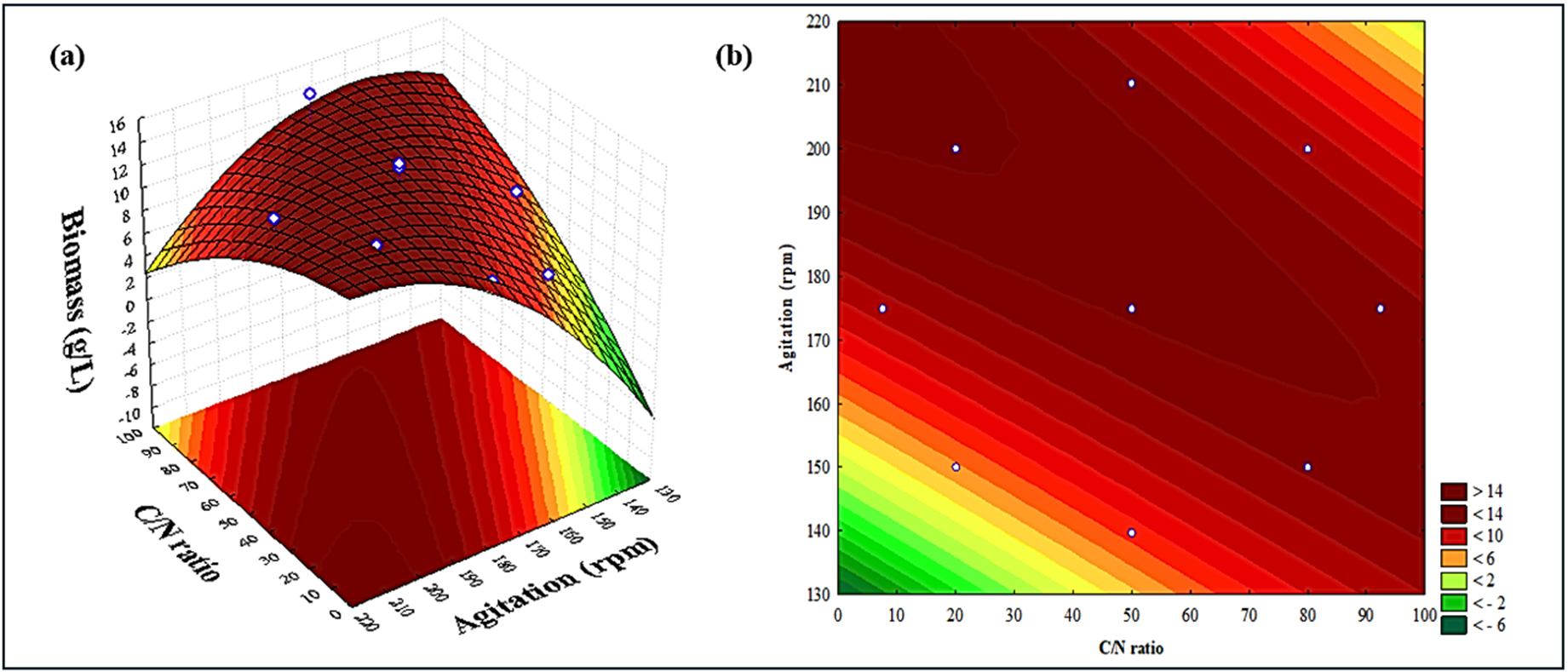
Figure 1 shows the three-dimensional response surface (a) and a contour plot (b) illustrating the interactions between the C/N ratio and stirring speed on biomass production in R. glutinis P4M422. The 3D surface showed quadratic behavior for both factors: biomass increased progressively and reached a maximum at intermediate C/N ratios and at stirring speeds near 180–200 rpm, while under extreme conditions for both variables, cell growth decreased. The contour plot showed steep elliptical curves, indicating a significant interaction between the factors studied. The optimum region was located within an intermediate C/N range (approximately 40–70) and moderate-to-high agitation, where biomass values exceeding 14 g/L were achieved. This behavior is consistent with the physiology of R. glutinis P4M422, in which an adequate balance between carbon and nitrogen availability favors cell proliferation, while nutritional limitation or suboptimal oxygen transfer conditions can restrict growth [40].
Furthermore, the quadratic model fitted using the CCD showed a coefficient of determination (R2) of 0.81, indicating that 81.1% of the variability in biomass production was explained by the model. However, the adjusted R2 (0.62) suggests that some of the variability may be attributed to the limited number of experimental runs (n = 11), as expected in preliminary optimization studies. Nevertheless, the model was considered adequate for capturing the main trends in biomass production and providing a reliable basis for further optimization.
It is important to note that no direct relationship was observed between biomass and specific carotenoid content (Tc). For example, Treatment 1 presented one of the highest Tc values (1069.3 µg/g d.w.) along with low biomass (6.1 g/L), while Treatment 6, with the highest biomass (14.6 g/L), showed a moderate specific content (563.3 µg/g d.w). This behavior confirms the metabolic decoupling between primary growth and secondary metabolite accumulation, a phenomenon described in pigmented yeasts under nutritional or environmental stress conditions [41].
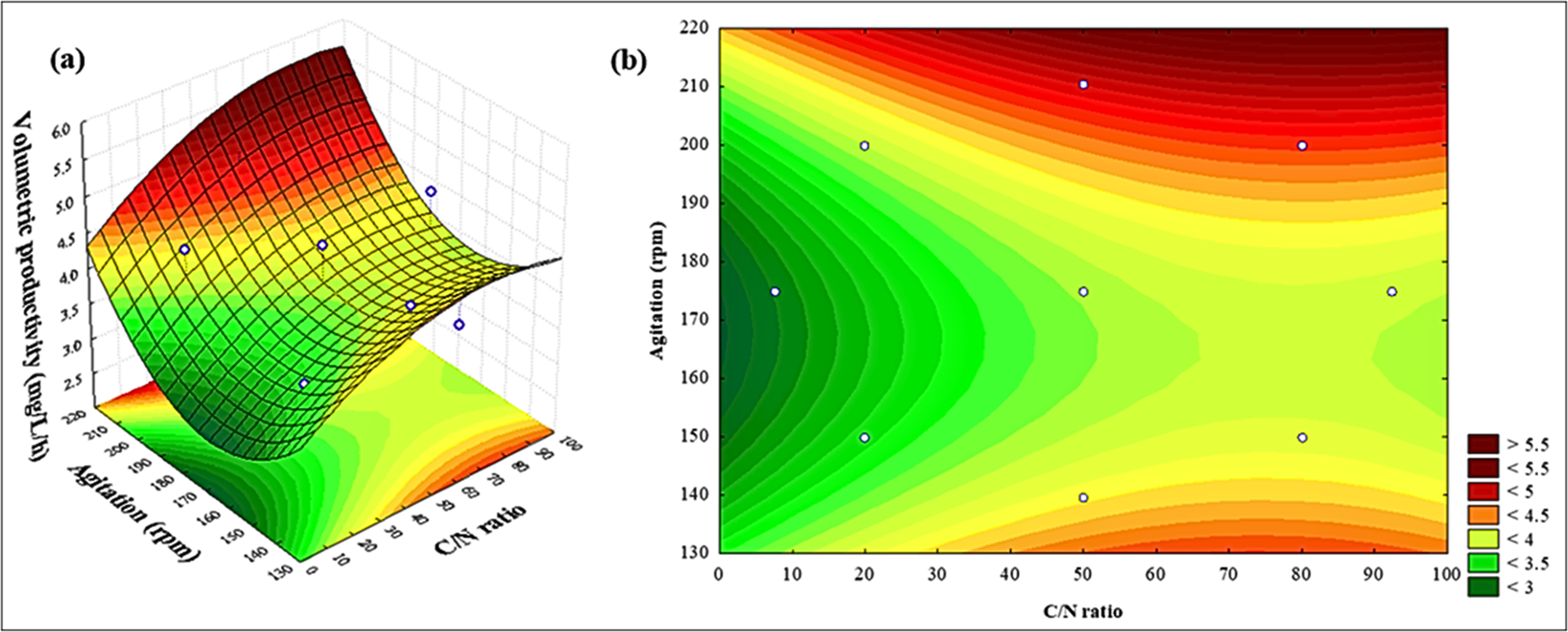
Response surface analysis (Figure 2), based on a central composite design (CCD), showed that volumetric carotenoid productivity (Vp) ranged from 2.5 to 4.8 mg/L/h, reaching its maximum values in treatments 2, 6, 8, and 11. In these cases, the high biomass concentrations (13.3–14.6 g/L) confirm that volumetric productivity is primarily determined by cell growth, rather than by increases in specific accumulation.
In terms of Vc, the highest values were observed in treatments 8 (343.1 mg/L), 6 (329.4 mg/L), and 11 (324.2 mg/L), indicating that overall process performance is determined by a balance between cell density and intracellular carotenoid content rather than the independent maximization of each variable. Accordingly, treatment 8 exhibited the highest Vp (4.8 mg/L/h), making it the most efficient condition within the evaluated experimental space.
Analysis of variance indicated that the model explained 54.9% of the variability in volumetric carotenoid productivity. Although the adjusted R2 was lower, the response surface revealed a significant interaction between agitation speed and the C/N ratio, where combinations of high C/N ratios and moderate to high agitation levels favored productivity. However, the absence of a direct correlation between Tc and Vp indicates partial decoupling between growth and carotenoid biosynthesis, suggesting a redirection of metabolic flux toward secondary pathways under stress. Despite reaching peak productivity of 4.8 mg/L/h, the overall process efficiency could be limited by intracellular pigment accumulation. In this context, the implementation of in situ or sequential extraction strategies emerges as a key alternative to intensify the process and improve carotenoid recovery.

4. Conclusions and Future Perspectives

This study demonstrates that multivariable strategies effectively improve biomass and carotenoid production in R. glutinis P4M422, highlighting red-light-induced photoprotective stimulation, stirring speed as the main limiting factor, and the C/N ratio as a key metabolic modulator. The defined conditions lead to higher biomass yields and establish a solid technical and kinetic basis for scaling up the process, which is essential for increasing the productivity of microbial carotenoids.
Furthermore, these findings support microbial fermentation as a sustainable, controllable alternative to plant sources, thereby reducing dependence on agroclimatic variability. In this context, the study contributes to advancing efficient bioprocesses for producing high-value compounds with industrial potential.
Future research should focus on validating these conditions at the bioreactor scale, where oxygen transfer, mixing, and process control become critical. Another important aspect is that using low-cost substrates that provide the necessary nutrients could increase yields and reduce production costs. Implementing metabolic or process engineering strategies could further improve carotenoid production. Finally, evaluating the carotenoid profile produced by R. glutinis P4M422, along with its stability and functionality, will be key to enabling its application in the food, pharmaceutical, and cosmetic industries.

Author Contributions

Conceptualization, C.N.A.; methodology, M.d.l.L.H.-E., J.L.M.-H. and M.L.C.-G.; investigation, C.N.A., J.L.M.-H. and J.S.-C.; experimentation and writing—original draft preparation, M.d.l.L.H.-E.; writing—review and editing, C.N.A., J.S.-C., C.N.C.-G., T.G.d.S., M.A.A.-G., and J.L.M.-H. and supervision, C.N.A., J.S.-C., C.N.C.-G., J.L.M.-H., T.G.d.S., M.A.A.-G., M.L.C.-G. and J.A.A.-V. All authors have read and agreed to the published version of the manuscript.

Funding

This research was funded by Secretaría de Ciencia, Humanidades, Tecnología e Innovación (SECIHTI) Mexico, scholarship number CVU 1150549.

Institutional Review Board Statement

Not applicable.

Informed Consent Statement

Not applicable.

Data Availability Statement

The original contributions presented in this study are included in the article. Further inquiries can be directed to the corresponding author.

Acknowledgments

The authors thank the Food Research Department, School of Chemistry, Universidad Autónoma de Coahuila, for their willingness to use their facilities for this project.

Conflicts of Interest

The authors declare no conflicts of interest.

References

  1. Bas, T.G. Bioactivity and Bioavailability of Carotenoids Applied in Human Health: Technological Advances and Innovation. Int. J. Mol. Sci. 2024, 25, 7603. [Google Scholar] [CrossRef]
  2. Ashokkumar, V.; Flora, G.; Sevanan, M.; Sripriya, R.; Chen, W.H.; Park, J.-H.; Rajesh Banu, J.; Kumar, G. Technological Advances in the Production of Carotenoids and Their Applications—A Critical Review. Bioresour. Technol. 2023, 367, 128215. [Google Scholar] [CrossRef]
  3. Garcia-Cortes, A.; Garcia-Vásquez, J.A.; Aranguren, Y.; Ramirez-Castrillon, M. Pigment Production Improvement in Rhodotorula mucilaginosa AJB01 Using Design of Experiments. Microorganisms 2021, 9, 387. [Google Scholar] [CrossRef] [PubMed]
  4. Sinha, S.; Das, S.; Saha, B.; Paul, D.; Basu, B. Anti-Microbial, Anti-Oxidant, and Anti-Breast Cancer Properties Unraveled in Yeast Carotenoids Produced via Cost-Effective Fermentation Technique Utilizing Waste Hydrolysate. Front. Microbiol. 2023, 13, 1088477. [Google Scholar] [CrossRef] [PubMed]
  5. Nuzzo, G.; Senese, G.; Gallo, C.; Albiani, F.; Romano, L.; d’Ippolito, G.; Manzo, E.; Fontana, A. Antitumor Potential of Immunomodulatory Natural Products. Mar. Drugs 2022, 20, 386. [Google Scholar] [CrossRef] [PubMed]
  6. Flieger, J.; Raszewska-Famielec, M.; Radzikowska-Büchner, E.; Flieger, W. Skin Protection by Carotenoid Pigments. Int. J. Mol. Sci. 2024, 25, 1431. [Google Scholar] [CrossRef]
  7. Kultys, E.; Kurek, M.A. Green Extraction of Carotenoids from Fruit and Vegetable Byproducts: A Review. Molecules 2022, 27, 518. [Google Scholar] [CrossRef] [PubMed]
  8. Tiwari, S.; Yawale, P.; Upadhyay, N. Carotenoids: Extraction Strategies and Potential Applications for Valorization of under-Utilized Waste Biomass. Food Biosci. 2022, 48, 101812. [Google Scholar] [CrossRef]
  9. Naz, T.; Ullah, S.; Nazir, Y.; Li, S.; Iqbal, B.; Liu, Q.; Mohamed, H.; Song, Y. Industrially Important Fungal Carotenoids: Advancements in Biotechnological Production and Extraction. J. Fungi 2023, 9, 578. [Google Scholar] [CrossRef]
  10. Papapostolou, H.; Kachrimanidou, V.; Alexandri, M.; Plessas, S.; Papadaki, A.; Kopsahelis, N. Natural Carotenoids: Recent Advances on Separation from Microbial Biomass and Methods of Analysis. Antioxidants 2023, 12, 1030. [Google Scholar] [CrossRef]
  11. Losinska-Sičiūnienė, R.; Strazdaitė-Žielienė, Ž.; Pranckevičiūtė, S.; Servienė, E. Light and Temperature Effects on the Accumulation of Carotenoids in Rhodotorula spp. Yeasts. Fermentation 2025, 11, 412. [Google Scholar] [CrossRef]
  12. Ochoa-Viñals, N.; Alonso-Estrada, D.; Pacios-Michelena, S.; García-Cruz, A.; Ramos-González, R.; Faife-Pérez, E.; Michelena-Álvarez, L.G.; Martínez-Hernández, J.L.; Iliná, A. Current Advances in Carotenoid Production by Rhodotorula sp. Fermentation 2024, 10, 190. [Google Scholar] [CrossRef]
  13. Postaru, M.; Tucaliuc, A.; Cascaval, D.; Galaction, A.-I. Cellular Stress Impact on Yeast Activity in Biotechnological Processes—A Short Overview. Microorganisms 2023, 11, 2522. [Google Scholar] [CrossRef]
  14. Hernández-Almanza, A.; Navarro-Macías, V.; Aguilar, O.; Aguilar-González, M.A.; Aguilar, C.N. Carotenoids Extraction from Rhodotorula glutinis Cells Using Various Techniques: A Comparative Study. Indian J. Exp. Biol. 2017, 55, 479–484. [Google Scholar]
  15. Hernández-Almanza, A.; Navarro-Macías, V.; Aguilar, O.; Contreras-Esquivel, J.C.; Montañez, J.C.; Avila, G.M.; Aguilar, C.N. Kinetic Parameters of the Carotenoids Production by Rhodotorula glutinis under Different Concentration of Carbon Source. In Bioprocessing of Agri-Food Residues for Production of Bioproducts; Apple Academic Press: Burlington, ON, Canada, 2021; pp. 253–262. [Google Scholar]
  16. Mata-Gómez, L.C.; Mapelli-Brahm, P.; Meléndez-Martínez, A.J.; Méndez-Zavala, A.; Morales-Oyervides, L.; Montañez, J. Microbial Carotenoid Synthesis Optimization in Goat Cheese Whey Using the Robust Taguchi Method: A Sustainable Approach to Help Tackle Vitamin A Deficiency. Foods 2023, 12, 658. [Google Scholar] [CrossRef]
  17. Zhang, Y.; Kamal, R.; Li, Q.; Yu, X.; Wang, Q.; Zhao, Z.K. Comparative Fatty Acid Compositional Profiles of Rhodotorula toruloides Haploid and Diploid Strains under Various Storage Conditions. Fermentation 2022, 8, 467. [Google Scholar] [CrossRef]
  18. Elfeky, N.; Elmahmoudy, M.; Bao, Y. Manipulation of Culture Conditions: Tool for Correlating/Improving Lipid and Carotenoid Production by Rhodotorula glutinis. Processes 2020, 8, 140. [Google Scholar] [CrossRef]
  19. Ochoa-Viñals, N.; Alonso-Estrada, D.; Faife-Pérez, E.; Chen, Z.; Michelena-Alvarez, G.; Martínez-Hernández, J.L.; García-Cruz, A.; Ilina, A. β-Carotene Production from Sugarcane Molasses by a Newly Isolated Rhodotorula toruloides L/24-26-1. Arch. Microbiol. 2024, 206, 245. [Google Scholar] [CrossRef] [PubMed]
  20. Dyaa, A.; Soliman, H.; Abdelrazak, A.; Samra, B.N.; Khojah, E.; Ahmed, A.F.; El-Esawi, M.A.; Elsayed, A. Optimization of Carotenoids Production from Rhodotorula sp. Strain ATL72 for Enhancing Its Biotechnological Applications. J. Fungi 2022, 8, 160. [Google Scholar] [CrossRef]
  21. Da Silva, J.; Honorato Da Silva, F.L.; Santos Ribeiro, J.E.; Nóbrega De Melo, D.J.; Santos, F.A.; Lucena De Medeiros, L. Effect of Supplementation, Temperature and pH on Carotenoids and Lipids Production by Rhodotorula mucilaginosa on Sisal Bagasse Hydrolyzate. Biocatal. Agric. Biotechnol. 2020, 30, 101847. [Google Scholar] [CrossRef]
  22. Igreja, W.S.; Maia, F.D.A.; Lopes, A.S.; Chisté, R.C. Biotechnological Production of Carotenoids Using Low Cost-Substrates Is Influenced by Cultivation Parameters: A Review. Int. J. Mol. Sci. 2021, 22, 8819. [Google Scholar] [CrossRef]
  23. Raita, S.; Feldmane, L.; Kusnere, Z.; Spalvins, K.; Kuzmika, I.; Berzina, I.; Mika, T. Microbial Carotenoids Production: Strains, Conditions, and Yield Affecting Factors. Environ. Clim. Technol. 2023, 27, 1027–1048. [Google Scholar] [CrossRef]
  24. Kot, A.M.; Błażejak, S.; Kurcz, A.; Gientka, I.; Kieliszek, M. Rhodotorula glutinis—Potential Source of Lipids, Carotenoids, and Enzymes for Use in Industries. Appl. Microbiol. Biotechnol. 2016, 100, 6103–6117. [Google Scholar] [CrossRef] [PubMed]
  25. Priyadarshini, L.A.S.; Kataria, R. Microbial Synthesis and Extraction of Value-Added Metabolites by Rhodotorula toruloides from Waste Stream: A Sustainable Approach. Microb. Cell Fact. 2025, 24, 134. [Google Scholar] [CrossRef] [PubMed]
  26. Zhao, Y.; Guo, L.; Xia, Y.; Zhuang, X.; Chu, W. Isolation, Identification of Carotenoid-Producing Rhodotorula sp. from Marine Environment and Optimization for Carotenoid Production. Mar. Drugs 2019, 17, 161. [Google Scholar] [CrossRef]
  27. Tkáčová, J.; Čaplová, J.; Klempová, T.; Čertík, M. Correlation between Lipid and Carotenoid Synthesis in Torularhodin-Producing Rhodotorula glutinis. Ann. Microbiol. 2017, 67, 541–551. [Google Scholar] [CrossRef]
  28. Fernandes, M.A.; Mota, M.N.; Faria, N.T.; Sá-Correia, I. An Evolved Strain of the Oleaginous Yeast Rhodotorula toruloides, Multi-Tolerant to the Major Inhibitors Present in Lignocellulosic Hydrolysates, Exhibits an Altered Cell Envelope. J. Fungi 2023, 9, 1073. [Google Scholar] [CrossRef]
  29. Sriphuttha, C.; Boontawan, P.; Boonyanan, P.; Ketudat-Cairns, M.; Boontawan, A. Simultaneous Lipid and Carotenoid Production via Rhodotorula paludigena CM33 Using Crude Glycerol as the Main Substrate: Pilot-Scale Experiments. Int. J. Mol. Sci. 2023, 24, 17192. [Google Scholar] [CrossRef]
  30. Cutzu, R.; Coi, A.; Rosso, F.; Bardi, L.; Ciani, M.; Budroni, M.; Zara, G.; Zara, S.; Mannazzu, I. From Crude Glycerol to Carotenoids by Using a Rhodotorula glutinis Mutant. World J. Microbiol. Biotechnol. 2013, 29, 1009–1017. [Google Scholar] [CrossRef]
  31. Mussagy, C.U.; Guimarães, A.A.C.; Rocha, L.V.F.; Winterburn, J.; Santos-Ebinuma, V.D.C.; Pereira, J.F.B. Improvement of Carotenoids Production from Rhodotorula glutinis CCT-2186. Biochem. Eng. J. 2021, 165, 107827. [Google Scholar] [CrossRef]
  32. Braunwald, T.; Schwemmlein, L.; Graeff-Hönninger, S.; French, W.T.; Hernandez, R.; Holmes, W.E.; Claupein, W. Effect of Different C/N Ratios on Carotenoid and Lipid Production by Rhodotorula glutinis. Appl. Microbiol. Biotechnol. 2013, 97, 6581–6588. [Google Scholar] [CrossRef] [PubMed]
  33. Elfeky, N.; Elmahmoudy, M.; Zhang, Y.; Guo, J.; Bao, Y. Lipid and Carotenoid Production by Rhodotorula glutinis with a Combined Cultivation Mode of Nitrogen, Sulfur, and Aluminium Stress. Appl. Sci. 2019, 9, 2444. [Google Scholar] [CrossRef]
  34. Lopes, H.J.S.; Bonturi, N.; Kerkhoven, E.J.; Miranda, E.A.; Lahtvee, P.-J. C/N Ratio and Carbon Source-Dependent Lipid Production Profiling in Rhodotorula toruloides. Appl. Microbiol. Biotechnol. 2020, 104, 2639–2649. [Google Scholar] [CrossRef] [PubMed]
  35. Paul, D.; Kumari, P.K.; Siddiqui, N. Yeast Carotenoids: Cost-Effective Fermentation Strategies for Health Care Applications. Fermentation 2023, 9, 147. [Google Scholar] [CrossRef]
  36. Pham, K.D.; Shida, Y.; Miyata, A.; Takamizawa, T.; Suzuki, Y.; Ara, S.; Yamazaki, H.; Masaki, K.; Mori, K.; Aburatani, S.; et al. Effect of Light on Carotenoid and Lipid Production in the Oleaginous Yeast Rhodosporidium toruloides. Biosci. Biotechnol. Biochem. 2020, 84, 1501–1512. [Google Scholar] [CrossRef]
  37. Rodrigues, T.V.D.; Contessa, C.R.; Burkert, C.A.V.; De Medeiros Burkert, J.F. Evaluation of Light-Emitting Diodes Applied to Rhodotorula mucilaginosa to Produce Carotenoids and Lipids. Food Bioprocess Technol. 2024, 17, 3267–3280. [Google Scholar] [CrossRef]
  38. Hernández-Almanza, A.; Montanez-Saenz, J.; Aguilar-González, M.A.; Martínez-Ávila, C.; Rodríguez-Herrera, R.; Aguilar, C.N. Rhodotorula glutinis as Source of Pigments and Metabolites for Food Industry. Food Biosci. 2014, 5, 64–72. [Google Scholar] [CrossRef]
  39. Bento, T.F.S.R.; Viana, V.F.M.; Carneiro, L.M.; Silva, J.P.A. Influence of Agitation and Aeration on Single Cell Oil Production by Rhodotorula glutinis from Glycerol. J. Sustain. Bioenergy Syst. 2019, 9, 29–43. [Google Scholar] [CrossRef]
  40. Cescut, J.; Fillaudeau, L.; Molina-Jouve, C.; Uribelarrea, J.-L. Carbon Accumulation in Rhodotorula glutinis Induced by Nitrogen Limitation. Biotechnol. Biofuels 2014, 7, 164. [Google Scholar] [CrossRef] [PubMed]
  41. Yen, H.-W.; Zhang, Z. Effects of Dissolved Oxygen Level on Cell Growth and Total Lipid Accumulation in the Cultivation of Rhodotorula glutinis. J. Biosci. Bioeng. 2011, 112, 71–74. [Google Scholar] [CrossRef]
Figure 1. Three-dimensional response surface (a) and contour plot (b) illustrating interactions between C/N ratio and stirring speed variables on the biomass production of R. glutinis P4M422.
Fermentation 12 00201 g001
Figure 2. Three-dimensional response surface (a) and contour plot (b) illustrating interactions between C/N ratio and stirring speed variables on carotenoid volumetric productivity (mg/L/h) of carotenoids of R. glutinis P4M422.
Fermentation 12 00201 g002
Table 1. Experimental matrix and evaluated factors of the central composite rotary design.
RunX1X2C/N RatioAgitation (rpm)
1−1−120150
2−1+120200
3+1−180150
4+1+180200
5−α07.6175
6092.4175
70−α50139.6 (140)
8050210.4 (210)
90050175
100050175
110050175
Table 2. Effect of culture conditions on R. glutinis P4M422 biomass growth and carotenoids production.
FactorLevelBiomass
g/L
Tc
µg/g d.w.
Vc
mg/L
Vp
mg/L/h
pH 3.09.8 ± 0.8 a504.0 ± 51.2 a197.6 ± 20.1 a2.7 ± 0.3 a
4.09.7 ± 0.6 a467.6 ± 63.2 a180.5 ± 24.4 a2.5 ± 0.3 a
5.010.0 ± 0.2 a465.7 ± 31.4 a187.2 ± 12.6 a2.6 ± 0.2 a
6.010.2 ± 0.6 a520.1 ± 106.1 a212.2 ± 43.3 a2.9 ± 0.6 a
Temperature
(°C)
2013.9 ± 0.3 a228.0 ± 80.5 a127.1 ± 44.9 b1.8 ± 0.6 b
2512.8 ± 0.1 b251.2 ± 35.8 a128.1 ± 18.2 b1.8 ± 0.3 b
3010.0 ± 0.3 c951.0 ± 92.7 b381.4 ± 37.1 a5.3 ± 0.5 a
353.7 ± 0.1 d1029.6 ± 29.2 b152.7 ± 4.3 b2.1 ± 0.1 b
Glycerol
(%)
010.4 ± 0.1 a994.3 ± 22.6 b415.0 ± 9.4 a5.8 ± 0.1 a
55.7 ± 0.4 b1621.2 ± 138.8 a370.1 ± 31.7 b5.1 ± 0.4 b
153.8 ± 0.3 c1759.8 ± 184.8 a264.7 ± 27.8 c3.7 ± 0.4 c
200.7 ± 0.4 d2027.9 ± 292.7 a60.0 ± 8.7 d0.8 ± 0.1 d
C/N ratio101.3 ± 0.2 b1652.4 ± 200.3 a84.6 ± 10.3 b1.2 ± 0.1 b
206.9 ± 0.1 a892.2 ± 20.6 b247.7 ± 5.7 a3.4 ± 0.1 a
Light
condition
Red12.5 ± 0.5 b859.7 ± 57.7 c428.7 ± 28.8 a6.0 ± 0.4 a
Yellow14.2 ± 0.2 a332.8 ± 25.0 d189.1 ± 14.2 b2.6 ± 0.2 b
Blue7.3 ± 0.1 c1102.1 ± 103.3 b323.3 ± 30.3 b4.5 ± 0.4 bc
White5.0 ± 0.7 d1382.5 ± 25.6 a276.5 ± 5.1 b3.8 ± 0.1 c
Dark4.5 ± 0.1 d1454.4 ± 98.0 a263.7 ± 17.8 c3.7 ± 0.2 d
Different letters within the same factor and column indicate significant differences according to Tukey’s test (p < 0.05). Tc: total carotenoids (µg/g dry weight); Vc: volumetric carotenoids (mg/L); Vp: volumetric productivity (mg/L/h).
Table 3. Experimental results of biomass and carotenoid production responses obtained under the Central Composite Design.
TreatmentBiomass
g/L
Tc
µg/g d.w.
Vc
mg/L
Vp
mg/L/h
16.1 ± 0.11069.3 ± 24.8261.4 ± 5.43.6 ± 0.1
214.1 ± 0.1556.8 ± 5.0314.8 ± 2.84.4 ± 0.0
310.6 ± 0.6584.1 ± 51.1247.7 ± 21.73.4 ± 0.3
48.8 ± 0.4862.0 ± 17.1311.0 ± 13.84.3 ± 0.2
510.0 ± 0.9460.8 ± 5.0182.0 ± 4.32.5 ± 0.1
614.6 ± 0.4563.3 ± 3.4329.4 ± 1.64.6 ± 0.0
78.0 ± 0.0997.0 ± 18.8320.0 ± 4.64.4 ± 0.1
813.3 ± 0.1631.9 ± 1.9343.1 ± 13.54.8 ± 0.2
913.9 ± 0.3461.0 ± 19.9255.7 ± 11.03.6 ± 0.2
1011.5 ± 0.2533.8 ± 48.8246.2 ± 22.53.4 ± 0.3
1114.1 ± 0.1561.8 ± 7.1324.2 ± 11.84.5 ± 0.2
Data are presented as mean ± standard deviation (n = 3 independent experiments). Tc: total carotenoids (µg/g dry weight); Vc: volumetric carotenoids (mg/L); Vp: volumetric productivity (mg/L/h).
Disclaimer/Publisher’s Note: The statements, opinions and data contained in all publications are solely those of the individual author(s) and contributor(s) and not of MDPI and/or the editor(s). MDPI and/or the editor(s) disclaim responsibility for any injury to people or property resulting from any ideas, methods, instructions or products referred to in the content.