
Article

Hydroponically Sprouted Grains: Effects on In Situ Ruminal Nutrient Degradation, Fractional Disappearance Rate, and Effective Ruminal Degradation

by
Gerald K. Salas-Solis
1,
Ana Carolina S. Vicente
1,
Jose A. Arce-Cordero
1,2,
Martha U. Siregar
1,
Mikayla L. Johnson
1,
James R. Vinyard
1,3,
Richard R. Lobo
1,
Efstathios Sarmikasoglou
1 and
Antonio P. Faciola
1,*
1
Department of Animal Sciences, University of Florida, Gainesville, FL 32611, USA
2
Department of Animal Sciences, University of Costa Rica, San José 11501-2060, Costa Rica
3
Matanuska Experiment Farm & Extension Center, University of Alaska Fairbanks, Palmer, AK 99645, USA
*
Author to whom correspondence should be addressed.
Fermentation 2026, 12(1), 55; https://doi.org/10.3390/fermentation12010055
Submission received: 19 December 2025 / Revised: 15 January 2026 / Accepted: 16 January 2026 / Published: 18 January 2026
(This article belongs to the Special Issue Ruminal Fermentation: 2nd Edition)

Abstract

This study aimed to evaluate in situ ruminal nutrient degradation, fractional disappearance rate, and effective ruminal degradation of hydroponically sprouted barley, wheat, and triticale. Two ruminally canulated lactating cows were used in a complete randomized block design with four treatments and nine incubation times (0, 2, 4, 8, 12, 24, 48, 72, and 240 h). Treatments were corn silage (control), and sprouted barley, triticale, and wheat. Quadruplicate samples (5 g each) were placed in Dacron bags and incubated in the rumen. Then, bags were rinsed and spun, dried (48 h × 55 °C; 3 h × 105 °C), and weighed to determine residual dry matter (DM). Data were analyzed using mixed models (MIXED, SAS 9.4) with treatment, time, and their interaction as fixed effects, and cow and replicate (cow) as random effects. Denominator degrees of freedom were adjusted using the Kenward–Roger method, and means were separated by Tukey–Kramer. Significance was declared at p ≤ 0.05 and tendencies at 0.05 < p ≤ 0.10. Sprouted triticale and wheat treatments had a greater rapidly soluble fraction for DM (p < 0.01), the greatest fractional disappearance rate for DM (p < 0.01) and neutral detergent fiber (NDF; p < 0.01), and greater effective ruminal degradability (ERD) for DM (p < 0.01) and crude protein (CP; p < 0.01). Sprouted wheat also had the greatest ERD for NDF (p < 0.01). In contrast, sprouted barley had the lowest rapidly soluble fractions for DM (p < 0.01), NDF (p < 0.01), and CP (p < 0.01), lower fractional disappearance rate for DM (p < 0.01) and NDF (p < 0.01) than sprouted triticale and wheat, and the lowest ERD for DM (p < 0.01) and CP (p < 0.01). Overall, sprouted triticale and wheat had greater in situ ruminal nutrient degradation, effective ruminal degradation, and nutrient degradation kinetics, indicating their potential for inclusion in dairy cattle diets to improve nutrient degradability.

1. Introduction

The global population, projected to exceed 9.7 billion by 2050, is expected to drive a substantial increase in the demand for animal-derived foods [1]. A meta-analysis conducted by van Dijk et al. [2] projected that global food demand is expected to increase from 35% to 56% between 2010 and 2050, while the population affected by hunger may vary from −91% to +8%, depending on socioeconomic development. These projections highlight the urgent need for sustainable agricultural solutions that can meet the rising food and feed requirements. One promising approach is hydroponics, an innovative agricultural method in which plants are grown in water or in nutrient-rich solutions rather than soil [3]. Hydroponics offers several environmental advantages over conventional soil-based agriculture, including improved water-use efficiency, reduced land requirements, and lower reliance on pesticides and herbicides [3,4]. As such, hydroponic systems provide a viable alternative for producing high-quality animal feed under resource-limited or climate-constrained conditions [5,6].
In recent years, hydroponics has received significant attention as an alternative, non-conventional feed source in dairy cattle nutrition [5,7]. The sprouting process converts complex macronutrients such as starch, protein, and lipids into simpler, more fermentable and digestible forms, such as sugars, peptides, amino acids, and fatty acids. This conversion is also accompanied by greater enzymatic activity (e.g., amylase, protease, lipase) and elevated levels of vitamins, minerals, and omega-3 fatty acids compared to unsprouted grains [8,9]. These nutritional changes may influence ruminal fermentation dynamics and degradation kinetics, potentially improving ruminal nutrient availability and overall feed efficiency in dairy cattle compared with unsprouted grains or conventional forages.
Despite the growing interest in hydroponically sprouted grains as an alternative feed for dairy cattle, information on their in situ ruminal nutrient degradation characteristics in lactating dairy cows remains limited. Understanding their degradation kinetics is crucial for assessing nutritional value and evaluating their suitability for sustainable dairy diets. In the United States, whole-plant corn silage is the predominant forage source used in dairy production, providing both rapidly fermentable carbohydrates, such as starch, from the ensiled grain fraction, and physically effective fiber (peNDF) from the stover fraction [10]. However, hydroponically sprouted grains such as barley, triticale, and wheat, produced in controlled environments, may provide comparable nutritive value and partially replace corn silage, thereby reducing reliance on corn silage in dairy cattle diets. To our knowledge, little to no information has been published on the degradation kinetics of hydroponically sprouted grains. Such information would advance current understanding and support a more accurate evaluation of their potential utilization in ruminant diets. Therefore, we hypothesized that hydroponically sprouted grains would exhibit greater nutrient degradation, a greater fractional disappearance rate, and greater effective ruminal degradation compared to corn silage as a control, supporting their use as alternative feeds in dairy cattle diets. The objective of this study was to evaluate the in situ ruminal degradation of dry matter (DM), neutral detergent fiber (NDF), and crude protein (CP) in hydroponically sprouted barley (Hordeum vulgare), triticale (×Triticosecale), and wheat (Triticum aestivum), using whole-plant corn silage as a control.

2. Materials and Methods

2.1. Experimental Design and Treatments

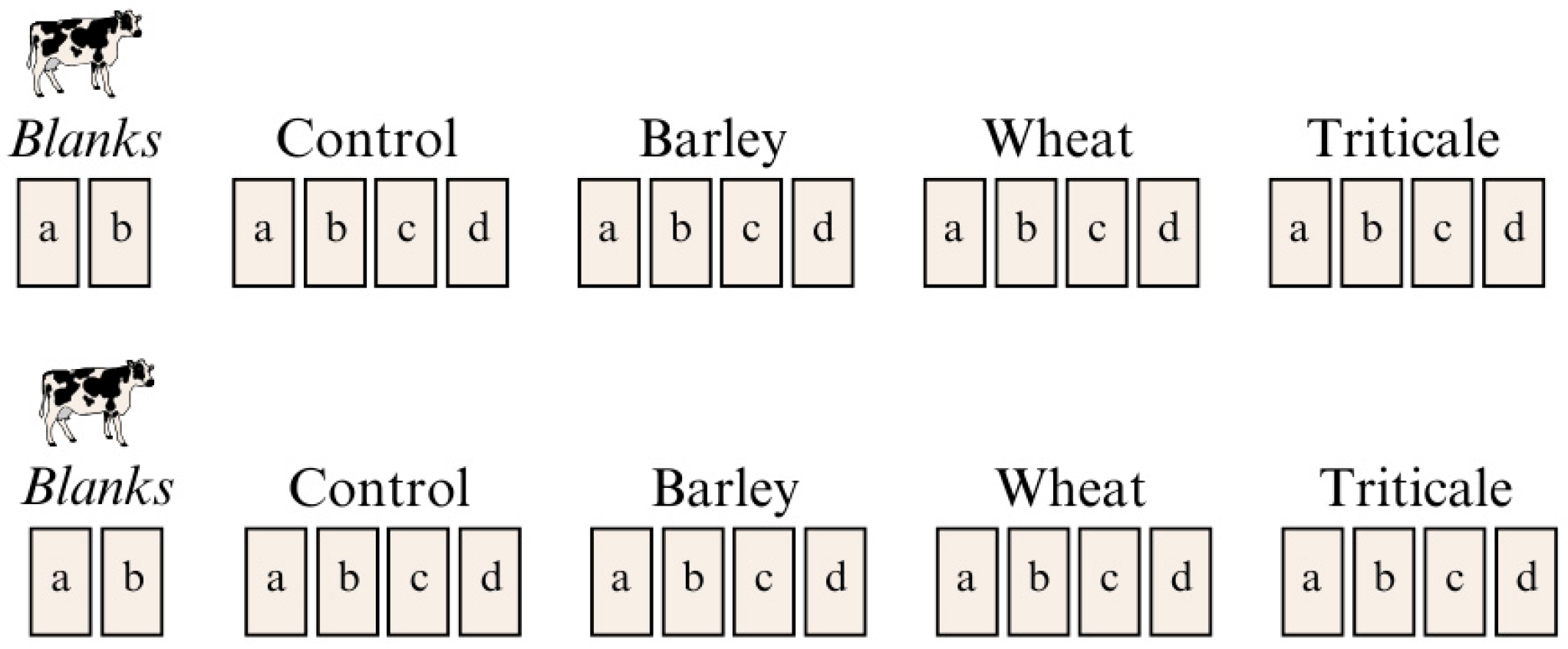
The experiment was conducted as a complete randomized block design with 4 treatments, 9 incubation times (0, 2, 4, 8, 12, 24, 48, 72, and 240 h), 4 replicates per treatment per cow per time, and 2 blanks (no treatment added) per cow per time (Figure 1). In total, 324 bags, detailed below, were used in the experiment. These bags included 36 blanks used to correct for bag weight. The experimental treatments were 100% whole-plant corn silage (control), 100% hydroponically sprouted barley (barley), 100% hydroponically sprouted wheat (wheat), and 100% hydroponically sprouted triticale (triticale). In this study, in situ incubations were conducted as a standard method to estimate ruminal degradation [11].

2.2. Hydroponically Sprouted Grains

Hydroponically sprouted barley, wheat, and triticale were grown utilizing water, in a single batch, using a semi-automatic vertical hydroponic system box (2.82 m tall, 3.12 m wide, and 5.87 m long). No pre-germination sanitary treatment was applied to the grains prior to the sprouting process. The temperature was maintained at 21 °C using 2 different heating, ventilation, and air conditioning climate control units. The water was provided with sprinklers (1 sprinkler per tray) for 16 s/h. The light was provided with 4 fluorescent lights placed at the harvesting end. The sprouting or germination process lasted for 6 d. On d 1, approximately 4.5, 4.7, and 4.9 kg of barley, triticale, and wheat, respectively, were weighed, spread out into separate plastic trays (79.4 cm wide and 88.9 cm long), and placed inside the hydroponic system box. At the end of d 6, hydroponic sprouts (i.e., sprouted barley, wheat, and triticale) were harvested. After harvesting, hydroponic sprouts were frozen, and shipped from Vineyard, Utah, USA to our laboratory in Florida. Next, samples were stored at −20 °C and thawed at 4 °C before drying. To ensure proper grinding and storage, all feed samples, including corn silage (control), were dried in a forced-air oven (Heratherm, Thermo Scientific, Waltham, MA, USA) at 0, and then further ground to pass a 2 mm screen using a Wiley mill (model no. 2; Arthur H. Thomas Co., Philadelphia, PA, USA).

2.3. In Situ Ruminal Incubations

All procedures involving animal use and handling were approved by the University of Florida’s Institutional Animal Care and Use Committee, protocol number: 202300000786, approval date: 9 February 2024. Two multiparous ruminally cannulated (10 cm inside diameter) Holstein cows in mid-lactation (125 ± 15 days in milk) were used to determine in situ ruminal nutrient degradation. The number of animals was determined by the availability of ruminally cannulated cows at the research facility. Nevertheless, the use of at least 2 animals aligns with suggested procedures for standardized in situ ruminal incubations [12,13]. The animals were housed in a free-stall barn within the mid-lactation herd with free access to water, and were fed twice daily a total-mixed ratio containing 38% corn silage, 19% ground corn, 13% soybean meal, 11% cotton seed, 9% citrus pulp, 8.5% mineral and vitamin premix, and 1.5% palmitic acid supplement (on a DM basis) from 3 weeks before start until the completion of the experiment.
For in situ incubations, approximately 5.000 ± 0.001 g of dried and 2 mm ground experimental treatments were weighed in quadruplicates, placed into Dacron bags (10 × 20 cm, 50 μm porosity; R1020, Ankom Technology Corp., Macedon, NY, USA), and double heat-sealed using an impulse sealer (AIE-200, American International Electric Inc., Philadelphia, PA, USA). The sample size-to-bag surface area ratio was approximately 12.5 mg/cm2, which was slightly above the 10 mg/cm2 recommended to ensure adequate microbial access [12]. Later, bags were placed in mesh laundry bags (10 × 20 cm), secured to a rope and carabiner, pre-warmed by soaking in 39 °C water for 15 min, and incubated in the ventral sac of the rumen for 0, 2, 4, 8, 12, 24, 48, 72, and 240 h. Incubation followed a reverse incubation order to allow for the removal of all bags at the same time. The 0 h incubation consisted of soaking the bags in 39 °C water for 15 min without ruminal incubation. The cow order for the initial incubation was randomized, whereas subsequent incubations followed a fixed cow order at each time point, with the same cow handled first throughout.
After incubation, all bags were immediately immersed in a 4 °C cold water bath (ice and water) for 15 min to stop microbial degradation. The bags were then manually rinsed under running cold tap water to remove any adhering feed particles and bacteria. Subsequently, the bags were placed inside mesh laundry bags and washed using a domestic washing machine (Roper RTW4516F, Whirlpool Corp., Benton Harbor, MI, USA) on a regular rinse-and-spin cycle (approximately 30 min) using room-temperature tap water and no detergent. Finally, the bags were dried at 55 °C for 48 h, and then at 105 °C for 3 h [14] in a forced-air oven and weighed to determine residual DM (AE100, Mettler-Toledo, Columbus, OH, USA).

2.4. In Situ Ruminal Degradation

Fractional nutrient degradation and the fractional disappearance rate (kd) for DM, NDF, and CP were determined for each timepoint evaluated to calculate effective ruminal degradability (ERD) [15]. Fraction A (rapidly soluble fraction) included the water-soluble fraction and the water-insoluble fraction, which are particles that escaped through the bag pores during the 0 h incubation timepoint; these fractions were not separated in this experiment. For DM and CP, Fraction A includes both soluble and insoluble components, whereas for NDF it represents only insoluble particles that escaped the bags. Fraction C (undegradable fraction) was obtained after 240 h in situ ruminal incubation (100 − degraded). In this study, a 240 h incubation period was adopted based on established methodology reported in the literature [16,17,18]. Fraction B (potentially degradable fraction) was calculated as [100 − (Fraction A + Fraction C)]. For each nutrient, the Fraction B kd was estimated by determining the linear slope over time of the natural logarithm of the residue at each time point residue as a percentage of the initial sample incubated. Passage rate (kp = 6% h−1), estimated based on a standard mean retention time reported by Zanton and Heinrichs [19], was used to calculate the ERD, as a direct passage rate measurement was not conducted in this experiment. The ERD was estimated under the assumption that all particles escaping the bag were digestible, as follows:
E R D = F r a c t i o n   A + F r a c t i o n   B × k d k d + k p

2.5. Chemical Analyses

Prior to the incubation, dried and ground (2 mm) samples (corn silage and sprouted grains) were homogenized, and a representative subsample was obtained using the quartering method [20]. Then, subsamples were sent to Dairy One Forage Lab (Ithaca, NY, USA) to conduct chemical composition analysis (Table 1). After incubation, residual DM was recorded. Dacron bags (4 replicates per treatment) were then opened and composited into duplicates (a + b, c + d) within the same cow and time point to determine DM, NDF, and N concentrations using the following methods: DM (method 930.15) [21]; NDF was analyzed according to Mertens [22] with heat-stable α-amylase and sodium sulfite modified for Ankom200 Fiber Analyzer (Ankom Technology, Macedon, NY, USA). For N analysis, similar to Lobo et al. [23], approximately, a 20 mg sample was mixed with 2.0 mm zirconia beads and ground using a bead mill homogenizer (Precellys 24, Bertin Instruments, Montigny-le-Bretonneux, France) at 5500× g for 15 s at room temperature. Then, zirconia beads were removed and around a 3.5 mg sample was weighed into tin capsules (5 × 9 mm, Costech, Valencia, CA, USA) using a microbalance (Excellence Plus XP Micro Balance, Mettler-Toledo GmbH, Greifensee, Switzerland) and placed in a 50-position automated Zero Blank sample carousel elemental analyzer (ECS 4010—CHNS-O, Costech Analytical Technologies, Valencia, CA, USA). After flash combustion in a quartz column containing chromium oxide and silvered cobaltous/cobaltic oxide at 1000 °C in an oxygen-rich atmosphere, the sample gas was transported in a He carrier stream and passed through a hot reduction column (650 °C) consisting of reduced elemental Cu to remove O. Next, the effluent stream passed through a chemical (magnesium perchlorate) trap to remove water. Then, the stream passed through a 3.0 m gas chromatography column at 55 °C to separate the N2 and CO2 gases. Last, the gases passed through a thermal conductivity detector to measure the size of the pulses of N2 and CO2. The weight percentage of N was assigned to each unknown based on comparison of the size of the pulse of N2 produced by the sample to a calibration curve generated by analysis of a known standard material.

2.6. Statistical Analyses

The individual bag was considered the experimental unit, and each cow served as the blocking factor. Continuous data were analyzed using mixed-effect models with the MIXED procedure of SAS software (version 9.4; SAS Institute Inc., Cary, NC, USA), and residuals were evaluated to confirm normality and homogeneity of variance using the UNIVARIATE procedure of SAS after fitting the statistical models. No data transformation was applied in this study, as model residuals met assumptions of normality and homogeneity of variance. The statistical model for continuous data comprising single response included the fixed effect of treatment, and the random effects of cow and replicate nested within cow. The statistical model for continuous data comprising repeated measures, including dry matter degradability (DMD), neutral detergent fiber degradability (NDFD), and crude protein degradability (CPD), was as follows:
Y i j k l m = μ + T i + H j + T × H i j + C k + R C l m + ε i j k l m
where Yijklm is the dependent variable, µ is the overall mean, Ti is the fixed effect of treatment, Hj is the fixed effect of incubation hour, T × Hij is the fixed interaction between treatment and incubation hour, Ck is the random effect of cow, and R(C)lm is the random effect of replicate nested within cow. Time (hour) was the term used in the repeated statement. The statistical model for continuous data comprising single measures, including Fraction A, Fraction B, Fraction C, ERD, and kd, did not include the fixed effect of incubation hour nor the fixed interaction between treatments and incubation hour. Alternative variance–covariance structures, including heterogeneous compound symmetry, heterogeneous first-order autoregressive, and unstructured, were compared, and the unstructured covariance structure was selected for the final models because it had the lowest AICc. The Kenward–Roger method was used to estimate the approximate denominator degrees of freedom in the mixed models, and Tukey–Kramer multiple comparisons were used to separate treatment means when statistical significance was detected. Statistical significance was considered at p ≤ 0.05, and tendency was declared when 0.05 < p ≤ 0.10.

3. Results and Discussion

3.1. Nutrient Composition

The chemical composition for experimental treatments is presented in Table 1. In this study, control (corn silage) had (% DM) 40.8% DM1, 8.40% CP, 32.3% NDF, 19.0% acid detergent fiber (ADF), 41.6% starch, 1.30% water-soluble carbohydrates (WSC), and 4.62% ether extract (EE). In contrast, 6-day-old sprouted grains had different nutrient profiles. Sprouted barley had (% DM) 13.9% DM1, 17.1% CP, 34.3% NDF, 16.6% ADF, 4.2% starch, 32.9% WSC, and 5.72% EE; sprouted triticale had (% DM) 23.5% DM1, 16.2% CP, 20.0% NDF, 8.00% ADF, 21.7% starch, 33.2% WSC, and 5.85% EE; and sprouted wheat had (% DM) 20.1% DM1, 23.3% CP, 23.7% NDF, 10.5% ADF, 8.50% starch, 32.7% WSC, and 4.75% EE.
At harvest (6 d), DM1 content was lower for hydroponically sprouted grains compared to control. Sprouted grains had a greater moisture content, ranging from 76% to 86%, averaging 21.8% units greater than control (59.2%). On average, sprouted grains had 10.5% units more CP and 31.6% units more WSC than the control. In contrast, compared to the control, starch concentrations were 37.4%, 19.9%, and 33.1% units lower for sprouted barley, triticale, and wheat, respectively. Sprouted triticale and wheat had 12.3% and 8.6% units lower NDF, respectively, compared to the control, along with 11.0% and 8.5% units lower ADF. Conversely, sprouted barley had 2.0% units greater NDF concentration than the control. Overall, sprouted triticale and wheat had greater nutritive value compared with sprouted barley.
Moreover, several studies have reported the chemical composition of 6- and 7-day-old sprouted barley, wheat, and triticale grains. Zang et al. [8] reported that 6-day-old sprouted barley had on average (% DM) 14.6% DM, 12.0% CP, 29.7% NDF, 14.1% ADF, 2.61% lignin, 26.0% starch, and 3.21% EE, and that 7-day-old sprouted wheat grain had on average (% DM) 17.5% DM, 14.9% CP, 19.9% NDF, 7.67% ADF, 1.75% lignin, 33.4% starch, 2.63% EE and 17.5% DM. Additionally, Crump et al. [24] indicated that 6-day-old sprouted barley had (% DM) 12.6% DM, 17.8% CP, 30.8% NDF, and 13.7% ADF. Furthermore, Hafla et al. [25] reported that 7-d-old sprouted barley had (% DM) 14.7% CP, 30.5% NDF, 15.5% ADF, 50.2% NFC, 27.7% starch, and 21.1% WSC.
The differences in nutrient composition between the hydroponically sprouted grains and corn silage (control) can be attributed to the sample nature and the sprouting process, including from 20 to 25% DM losses resulting from leaching and respiration of seed reserves [26]. In the present study, grains were pre-soaked in water to start the sprouting process and were watered throughout the sprouting process, which resulted in greater moisture content. It has been reported by Sneath and McIntosh [9] that moisture content in the fresh hydroponic can range from 80 to 90%, which aligns with our results. The biochemical changes that occur during sprouting, including enzymatic hydrolysis of complex macronutrients, result in greater nutrient solubility and degradability. Enzymes such as amylase catalyze starch breakdown into simpler sugars (glucose, maltose, and, to a lesser extent, sucrose), while proteolytic and lipolytic enzymes increase the concentration of amino acids and fatty acids [8,9,27]. In addition, germination reduces several antinutritional factors, including trypsin and chymotrypsin inhibitors, hemagglutinins, tannins, pentosans, and phytic acid, thereby further enhancing nutrient availability and digestibility [28,29]. However, it is important to acknowledge that achieving a consistent ingredient composition in the sprouted grains could help maximize dairy cow productive performance [30]. This underscores the need to standardize hydroponic sprouting conditions in both research settings and commercial applications.

3.2. Nutrient Degradation, Disappearance Rate, and Effective Ruminal Degradation

The treatment effects on in situ ruminal fractional nutrient degradation, fractional disappearance rate, and effective ruminal degradation are presented in Table 2. In this experiment, Fraction A for DM and CP represented a combination of soluble components and fine insoluble particles that escaped the bags, whereas Fraction A for NDF reflected only insoluble particles, as cellulose, hemicellulose, and lignin are not water-soluble. The escape of fine NDF particles can influence ERD estimates because standard calculations assume that solubility equals degradability and that insolubility equals undegradability, assumptions that are not always valid. To maintain consistency across nutrients, ERD was calculated assuming Fraction A to be degradable. Although Fraction A for NDF was relatively small, ERD values should be interpreted with some caution; nevertheless, the estimates obtained fall within ranges commonly reported in the literature.
Sprouted triticale and wheat had the greatest rapidly soluble fraction for DM (p < 0.01), which resulted in a lower undegradable fraction for DM (p < 0.01). Sprouted triticale had a 11.7% units greater rapidly soluble fraction for DM, compared to the control. Similarly, sprouted wheat had a 7.6% units greater rapidly soluble fraction for DM, compared to the control. However, sprouted barley had the lowest rapidly soluble fraction for DM, NDF, and CP across the experimental treatments. Sprouted triticale had the greatest undegradable fraction for NDF (37.3%), and sprouted triticale the lowest (27.6%). The rapidly soluble fraction in CP was greater in the control treatment by 6.0%, 7.5%, and 16.9% units compared to sprouted wheat, triticale, and barley, respectively. However, sprouted grains had the lowest CP undegradable fraction (6.6% units lower on average), and greatest potentially degradable fraction (13.9% units greater on average) compared to the control. Moreover, consistent with the previous results, sprouted triticale and wheat, had the greatest fractional disappearance rate (% h−1) for DM (p < 0.01) and NDF (p < 0.01), with the control having the lowest disappearance rate for DM and NDF across all treatments. No treatment effect was observed on fractional disappearance rate for CP (p = 0.25). There were treatment effects on ERD for DM (p < 0.01), NDF (p < 0.01), and CP (p < 0.01). While sprouted wheat had the greatest ERD for DM (90.2%), NDF (70.5%), and CP (94.2%), sprouted barley had the lowest ERD for DM (83.4%), sprouted triticale had the lowest ERD for NDF (61.1%), and sprouted barley (87.7%) and control (87.1%) had the lowest ERD for CP. On average, compared to the control, sprouted wheat had 3.9%, 3.5%, and 7.1% units greater ERD for DM, NDF, and CP, respectively.
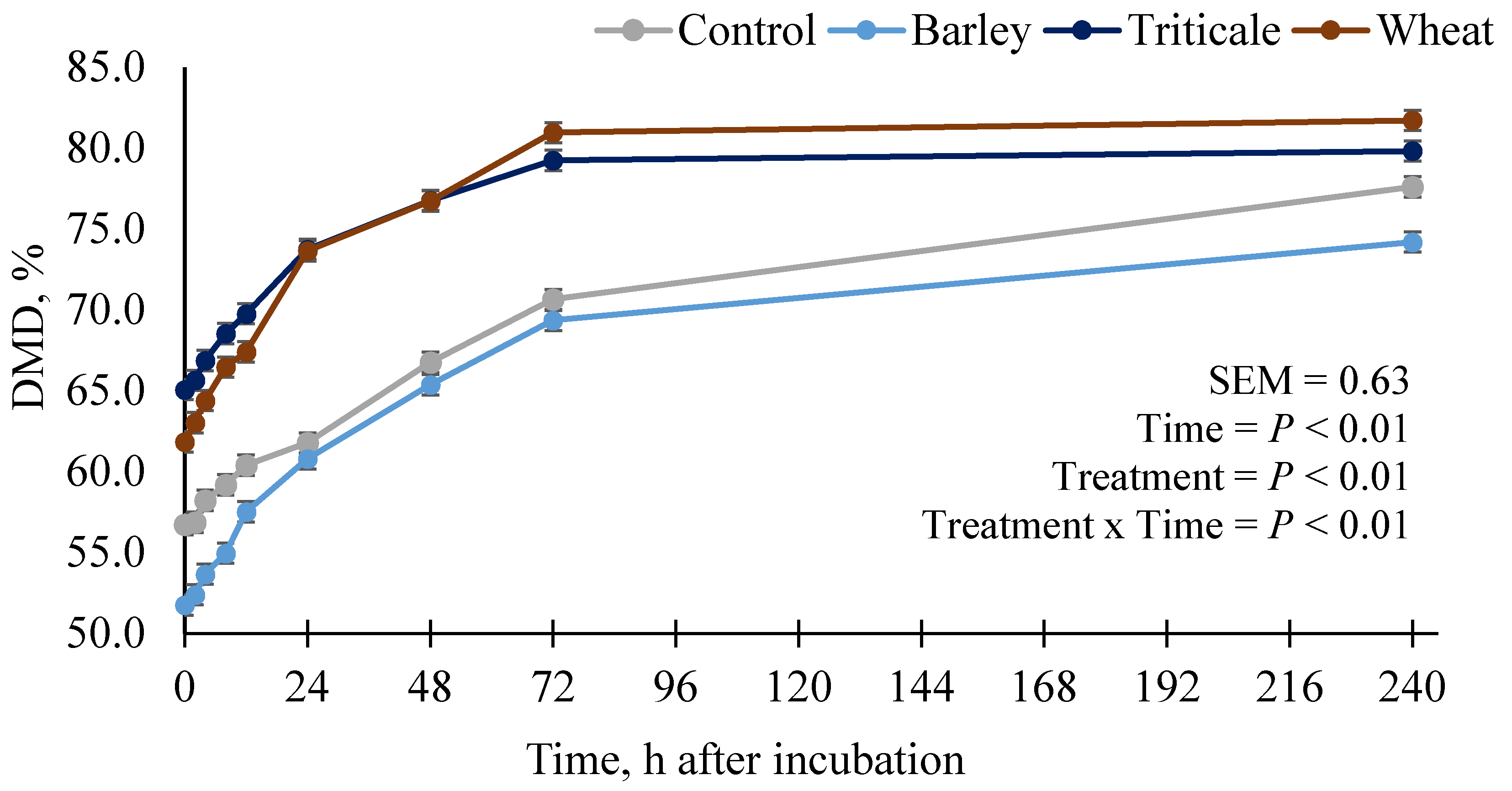
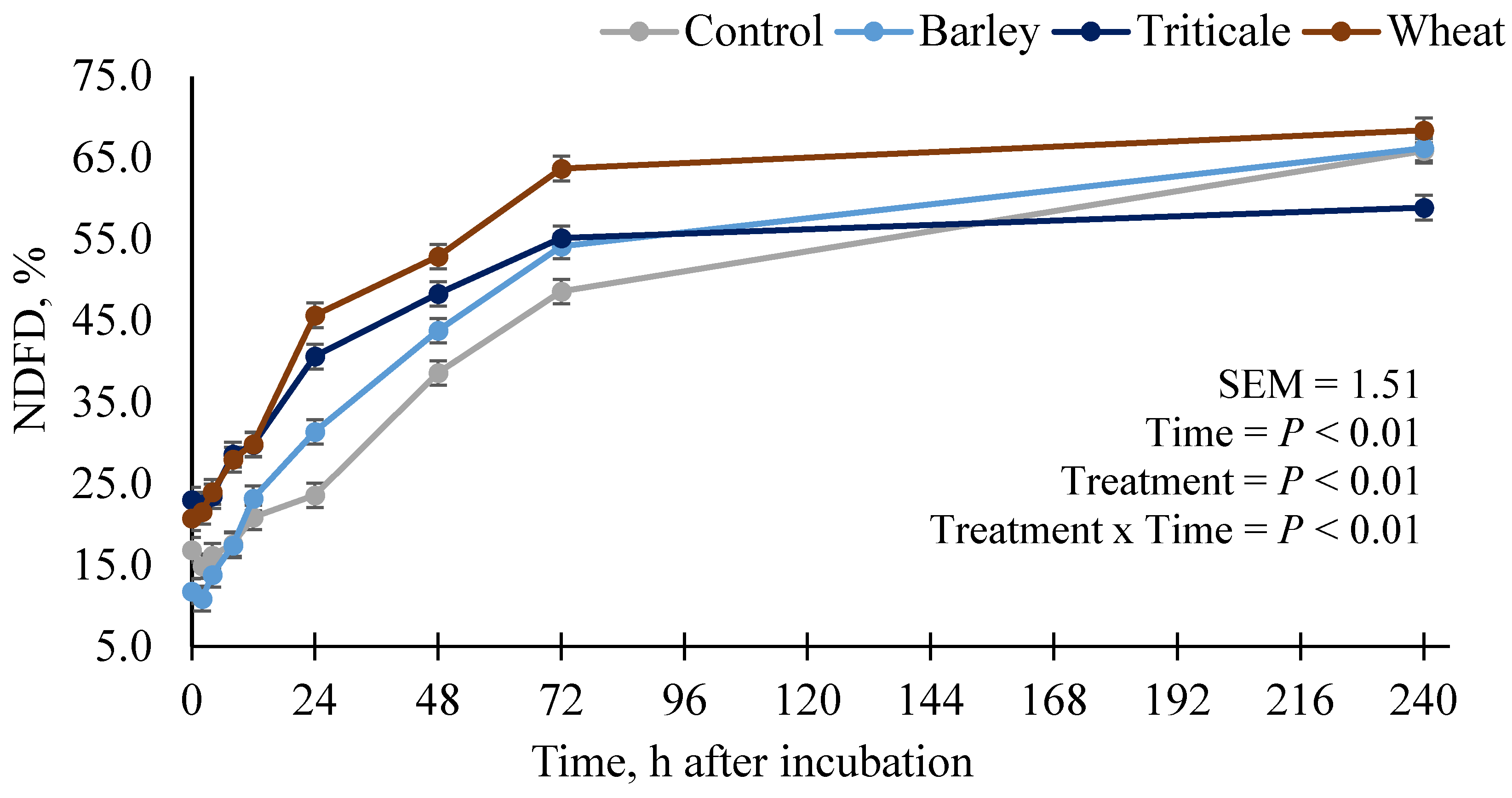
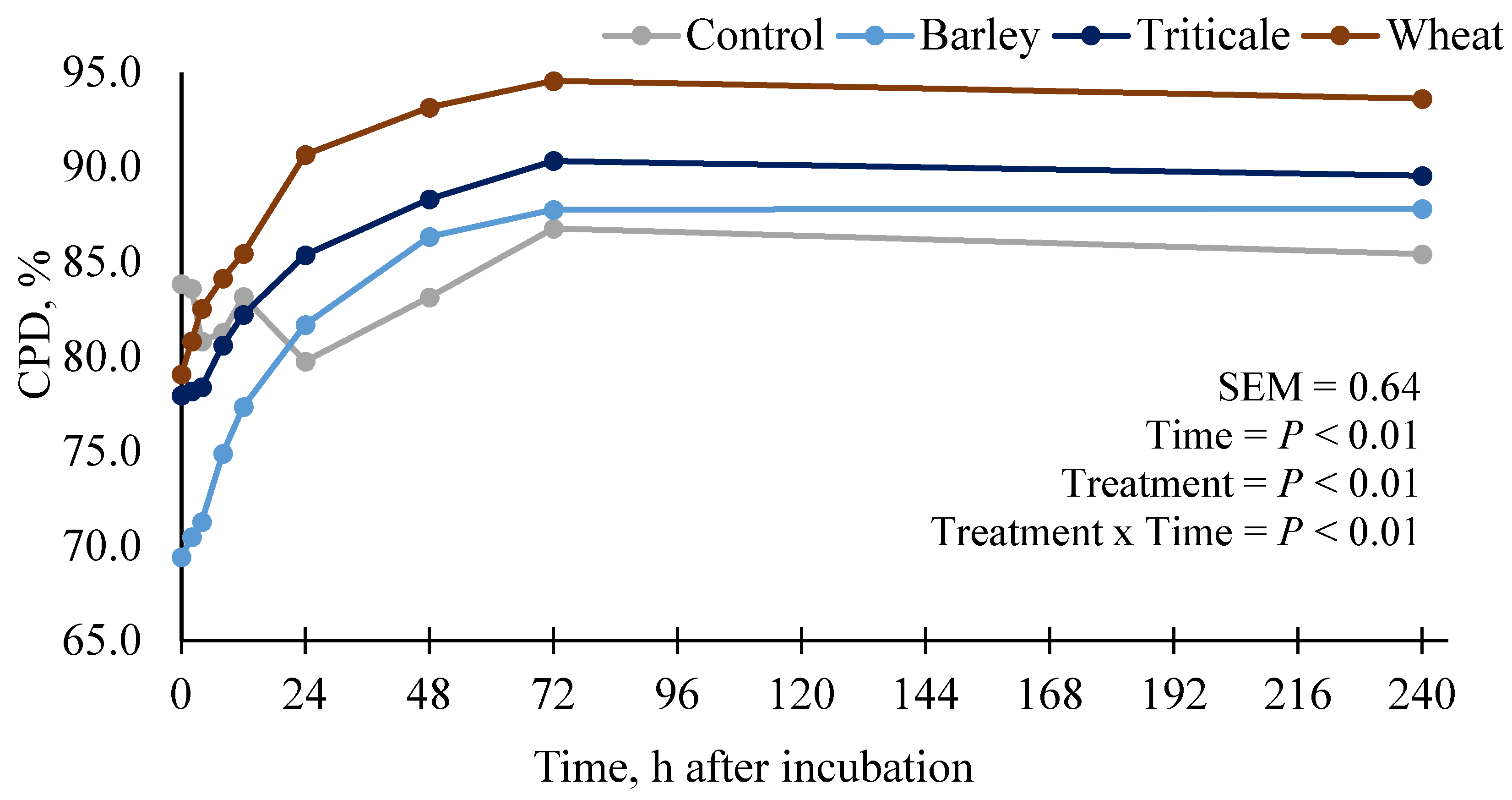
The treatment effects on ruminal in situ nutrient degradation kinetics are presented in Figure 2, Figure 3 and Figure 4. There were treatment (p < 0.01), time (p < 0.01), and treatment × time interaction (p < 0.01) effects on DMD (Figure 2), NDFD (Figure 3), and CPD (Figure 4) based on the statistical model for repeated measures. Mean DMD was greater for triticale and wheat treatments compared to the control and barley, with triticale having a slightly greater DMD from 0 to 24 h after in situ incubation. Sprouted barley had the lowest mean DMD and across all treatments. Mean NDFD was greater for sprouted triticale and wheat treatments, with sprouted wheat having the greatest NDFD from 24 to 72 h. Mean CPD was greater for the sprouted triticale treatment. Conversely, mean CPD was lower for the sprouted barley treatment, which also had the lowest rapidly soluble fraction and greatest potentially degradable fraction (Table 2). In contrast, sprouted barley had lower nutrient degradation compared to the other two grains, possibly due to its greater NDF concentration, which was 14.3% and 10.6% units greater than that of sprouted triticale and wheat, respectively, which may have limited microbial access to nutrients during ruminal fermentation [31,32].
In this experiment, hydroponically sprouted barley, wheat, and triticale had 0.46%, 0.86%, and 0.73% units greater NDFD (%), respectively, compared to corn silage (control). However, only sprouted wheat had 3.5% units greater ERD for NDF, whereas sprouted barley and triticale had a 2.4% and 5.9% units lower ERD, respectively, compared to the control. It has been reported that increasing ruminal NDFD by incorporating high-quality feed sources allows for greater dry matter intake (DMI) while maintaining a consistent NDF intake [33]. Therefore, in our study, sprouted wheat, with the greatest NDFD and ERD, may contribute to improving fiber degradability and intake efficiency when incorporated into dairy cattle diets. Increasing the total energy available in the rumen can also support microbial protein synthesis, which in turn improves the supply of metabolizable nutrients needed for the animal [34].
The greater nutrient degradability observed for sprouted triticale and wheat could be explained by the biochemical and structural transformations occurring during sprouting. During this process, hydrolytic enzymes that degrade complex storage molecules (e.g., starch, non-structural polysaccharides, storage proteins) are active, thereby increasing rapidly fermentable carbohydrates and soluble proteins availability, while decreasing the proportion of undegradable nutrients. These nutritional transformations may enhance ruminal microbial fermentation and nutrient utilization efficiency. Moreover, the chemical composition of sprouted grains also varies throughout the sprouting process as enzymatic activity, structural composition, and nutrient partitioning change over time. During the initial stages of sprouting, the enzymatic hydrolysis of starch and proteins increases soluble sugar and peptide availability, and the partial breakdown of cell-wall polysaccharides debilitates the cellular wall structure, improving microbial attachment and ruminal degradation. In addition, reducing antinutritional factors such as trypsin and chymotrypsin inhibitors during germination may further enhance nutrient utilization, as these inhibitors bind to and block proteolytic enzymes in the digestive tract, thereby limiting protein degradation alongside with peptides and amino acids release [35]. As sprouting continues and vegetative growth advances, nutrient metabolism transitions toward structural development, leading to greater synthesis of structural carbohydrates (e.g., cellulose and hemicellulose), which reduces soluble and more digestible nutrient concentration in the plant [8,9,27].
As with all in situ methodologies, this study assumes that solubility reflects digestibility, which may not always hold true, and results may be influenced by particle loss or microbial contamination. In addition, the limited number of animals and incubations, the evaluation of a single maturity stage, and the absence of in vivo measurements restrict extrapolation to intake, animal performance, and the practical feasibility of hydroponic feeding systems.

4. Conclusions

This study provides one of the first evaluations of the nutrient composition and ruminal degradation kinetics of hydroponically sprouted grains, addressing a key knowledge gap in their potential use in ruminant nutrition. Hydroponically sprouted grains differed in nutrient composition and ruminal degradation characteristics compared with corn silage (control). Between the grains evaluated, sprouted triticale and wheat had greater nutrient concentration, fractional disappearance rate, and effective ruminal degradability, particularly for DM and CP, whereas sprouted barley had lower degradability, likely due to its greater NDF concentration and more fibrous structure. These results indicate that sprouting improves the availability of rapid fermentable nutrients and may improve microbial nutrient utilization efficiency in the rumen. The tested sprouted grains appear to be suitable partial replacements for corn silage, if formulation accounts for their high moisture content and potential effects on DMI. Incorporating hydroponically sprouted triticale or wheat into dairy cow diets could improve nutrient utilization efficiency and potentially support milk production performance. Further in vivo research is needed to determine whether the benefits of hydroponically sprouted grains extend beyond ruminal fermentation to improved nutrient utilization efficiency and overall animal performance.

Author Contributions

Conceptualization, G.K.S.-S. and A.P.F.; methodology, G.K.S.-S., A.C.S.V., J.A.A.-C., M.U.S., M.L.J., J.R.V., R.R.L., E.S., and A.P.F.; formal analysis, G.K.S.-S.; investigation, G.K.S.-S., A.C.S.V., J.A.A.-C., M.U.S., M.L.J., J.R.V., R.R.L., E.S., and A.P.F.; data curation, G.K.S.-S.; writing—original draft preparation, G.K.S.-S.; writing—review and editing, G.K.S.-S. and A.P.F.; visualization, G.K.S.-S. and A.P.F.; supervision, G.K.S.-S. and A.P.F.; project administration, G.K.S.-S. and A.P.F.; funding acquisition, A.P.F. All authors have read and agreed to the published version of the manuscript.

Funding

This research received no external funding.

Institutional Review Board Statement

All procedures involving animals use and handling were approved by the University of Florida’s Institutional Animal Care and Use Committee, protocol number: 202300000786, approval date: 9 February 2024.

Informed Consent Statement

Not applicable.

Data Availability Statement

The original contributions presented in this study are included in the article. Further inquiries can be directed to the corresponding author.

Acknowledgments

The authors acknowledge the University of Florida Dairy Research Unit for their support with animal feeding and care.

Conflicts of Interest

The authors declare no conflicts of interest.

Abbreviations

The following abbreviations are used in this manuscript:
ADFAcid detergent fiber
CPCrude protein
CPDCrude protein degradability
DMDry matter
DMDDry matter degradability
DMIDry matter intake
EEEther extract
ERDEffective ruminal degradability
kdFractional disappearance rate
kpPassage rate
NDFNeutral detergent fiber
NDFDNeutral detergent fiber degradability
WSCWater-soluble carbohydrates

References

  1. Tkemaladze, J. Concept to the Food Security. Longev. Horiz. 2025, 1. [Google Scholar] [CrossRef]
  2. van Dijk, M.; Morley, T.; Rau, M.L.; Saghai, Y. A meta-analysis of projected global food demand and population at risk of hunger for the period 2010–2050. Nat. Food 2021, 2, 494–501. [Google Scholar] [CrossRef] [PubMed]
  3. Gaikwad, D.J.; Priyadarsini, S.; Mallick, B. Effects of different hydroponics systems and growing media on physiological parameters of spinach. Int. J. Curr. Microbiol. Appl. Sci. 2020, 9, 1409–1414. [Google Scholar] [CrossRef]
  4. Santosh, D.T.; Gaikwad, D. Advances in Hydroponic Systems: Types and Management. In Advances in Agricultural Technology; Griffon: Canada, 2023. [Google Scholar]
  5. Sobur, K.A.; Ghosh, P.P.; Haq, M.E.; Pranto, R.A.; Bithi, A.T.; Hossen, M.M.; Jabir, A.A.; Biswas, L.; Munim, S.H.; Rahman, M.Z. Hydroponic fodder: A sustainable solution for enhancing livestock nutrition and productivity. J. Aquat. Res. Sustain. 2025, 2, 30–35. [Google Scholar] [CrossRef]
  6. Ghorbel, R.; Koşum, N. Hydroponic fodder production: An alternative solution for feed scarcity. In 6th International Students Science Congress Proceedings Book; Izmir International Guest Student Association: Izmir, Turkey, 2022. [Google Scholar]
  7. Ahamed, M.S.; Sultan, M.; Shamshiri, R.R.; Rahman, M.M.; Aleem, M.; Balasundram, S.K. Present status and challenges of fodder production in controlled environments: A review. Smart Agric. Technol. 2023, 3, 100080. [Google Scholar] [CrossRef]
  8. Zang, Y.; Richards, A.T.; Seneviratne, N.; Gutierrez Oviedo, F.A.; Harding, R.; Ranathunga, S.; McFadden, J.W. Replacing conventional concentrates with sprouted barley or wheat: Effects on lactational performance, nutrient digestibility, and milk fatty acid profile in dairy cows. J. Dairy Sci. 2024, 107, 5529–5541. [Google Scholar] [CrossRef]
  9. Sneath, R.; McIntosh, F. Review of Hydroponic Fodder Production for Beef Cattle; Meat & Livestock Australia Limited: North Sydney, Australia, 2003. [Google Scholar]
  10. Ferraretto, L.F.; Shaver, R.D.; Luck, B.D. Silage review: Recent advances and future technologies for whole-plant and fractionated corn silage harvesting. J. Dairy Sci. 2018, 101, 3937–3951. [Google Scholar] [CrossRef]
  11. Schadt, I.; Mertens, D.R.; Van Soest, P.J.; Azzaro, G.; Licitra, G. Stage of lactation and corresponding diets affect in situ protein degradation by dairy cows. J. Dairy Sci. 2014, 97, 7995–8007. [Google Scholar] [CrossRef]
  12. Vanzant, E.S.; Cochran, R.C.; Titgemeyer, E.C. Standardization of in situ techniques for ruminant feedstuff evaluation. J. Anim. Sci. 1998, 76, 2717–2729. [Google Scholar] [CrossRef]
  13. NASEM. Nutrient Requirements of Dairy Cattle, 8th ed.; The National Academies Press: Washing, DC, USA, 2021. [Google Scholar]
  14. Shreve, B.; Thiex, N.; Wolf, M. NFTA Method 2.1.4—Dry Matter by Oven Drying for 3 hr at 105 C. In National Forage Testing Association Reference Methods; National Forage Testing Association: Lincoln, NE, USA, 2006. [Google Scholar]
  15. Ørskov, E.R.; McDonald, I. The estimation of protein degradability in the rumen from incubation measurements weighted according to rate of passage. J. Agric. Sci. 1979, 92, 499–503. [Google Scholar] [CrossRef]
  16. Allen, M.S.; Mertens, D.R. Evaluating constraints on fiber digestion by rumen microbes. J. Nutr. 1988, 118, 261–270. [Google Scholar] [CrossRef]
  17. Raffrenato, E.; Ross, D.A.; Van Amburgh, M.E. Development of an in vitro method to determine rumen undigested aNDFom for use in feed evaluation. J. Dairy Sci. 2018, 101, 9888–9900. [Google Scholar] [CrossRef]
  18. Serva, L.; Magrin, L.; Andrighetto, I.; Marchesini, G. Short communication: The relationship between dietary particle size and undegraded neutral detergent fibre in lactating dairy cows: A prospective cohort observational study. Anim. Feed Sci. Technol. 2021, 279, 115017. [Google Scholar] [CrossRef]
  19. Zanton, G.I.; Heinrichs, A.J. Evaluation of modeling procedure for fitting in situ feed degradation profiles. J. Anim. Sci. 2009, 87, 2080–2088. [Google Scholar] [CrossRef] [PubMed]
  20. Herrman, T. Sampling: Procedures for Feed; Kansas State University Agricultural Experiment Station and Cooperative Extension Service: Manhattan, KS, USA, 2001. [Google Scholar]
  21. AOAC. Official Methods of Analysis, 17th ed.; The Association of Official Analytical Chemists: Gaithersburg, MD, USA, 2000; Available online: https://www.scirp.org/reference/ReferencesPapers?ReferenceID=1687699 (accessed on 27 October 2025).
  22. Mertens, D.R. Gravimetric determination of amylase-treated neutral detergent fiber in feeds with refluxing in beakers or crucibles: Collaborative study. J. AOAC Int. 2002, 85, 1217–1240. [Google Scholar] [CrossRef] [PubMed]
  23. Lobo, R.R.; Siregar, M.U.; da Silva, S.S.; Monteiro, A.R.; Salas-Solis, G.; Vicente, A.C.S.; Vinyard, J.R.; Johnson, M.L.; Ma, S.; Sarmikasoglou, E.; et al. Partial replacement of soybean meal with microalgae biomass on in vitro ruminal fermentation may reduce ruminal protein degradation. J. Dairy Sci. 2024, 107, 1460–1471. [Google Scholar] [CrossRef] [PubMed]
  24. Crump, Z.C.; Alberto, A.F.; Brown, B.L.; Roholt, B.W.; Okamoto, L.L.; Sego, M.L.; Spurling, R.A.; Ward, R.E.; Blackett, B.M.; Harding, R.L.; et al. The effects of including sprouted barley with alfalfa hay in the diet on ruminal health and performance of cow-calf pairs. J. Anim. Sci. 2024, 102, skae074. [Google Scholar] [CrossRef]
  25. Hafla, A.N.; Soder, K.J.; Brito, A.F.; Rubano, M.D.; Dell, C.J. Effect of sprouted barley grain supplementation of an herbage-based or haylage-based diet on ruminal fermentation and methane output in continuous culture. J. Dairy Sci. 2014, 97, 7856–7869. [Google Scholar] [CrossRef]
  26. Chavan, J.K.; Kadam, S.S. Nutritional improvement of cereals by sprouting. Crit. Rev. Food Sci. Nutr. 1989, 28, 401–437. [Google Scholar] [CrossRef]
  27. Benincasa, P.; Falcinelli, B.; Lutts, S.; Stagnari, F.; Galieni, A. Sprouted grains: A comprehensive review. Nutrients 2019, 11, 421. [Google Scholar] [CrossRef]
  28. Nemzer, B.; Al-Taher, F. Analysis of fatty acid composition in sprouted grains. Foods 2023, 12, 1853. [Google Scholar] [CrossRef]
  29. Miyahira, R.F.; Lopes, J.d.O.; Antunes, A.E.C. The use of sprouts to improve the nutritional value of food products: A brief review. Plant Foods Hum. Nutr. 2021, 76, 143–152. [Google Scholar] [CrossRef]
  30. Sova, A.D.; LeBlanc, S.J.; McBride, B.W.; DeVries, T.J. Accuracy and precision of total mixed rations fed on commercial dairy farms. J. Dairy Sci. 2014, 97, 562–571. [Google Scholar] [CrossRef] [PubMed]
  31. Shi, R.; Dong, S.; Mao, J.; Wang, J.; Cao, Z.; Wang, Y.; Li, S.; Zhao, G. Dietary Neutral Detergent Fiber Levels Impacting Dairy Cows’ Feeding Behavior, Rumen Fermentation, and Production Performance during the Period of Peak-Lactation. Animals 2023, 13, 2876. [Google Scholar] [CrossRef] [PubMed]
  32. Ferraretto, L.F.; Crump, P.M.; Shaver, R.D. Effect of cereal grain type and corn grain harvesting and processing methods on intake, digestion, and milk production by dairy cows through a meta-analysis. J. Dairy Sci. 2013, 96, 533–550. [Google Scholar] [CrossRef] [PubMed]
  33. Firkins, J.L. Invited Review: Advances in rumen efficiency. Appl. Anim. Sci. 2021, 37, 388–403. [Google Scholar] [CrossRef]
  34. Gozho, G.N.; Mutsvangwa, T. Influence of carbohydrate source on ruminal fermentation characteristics, performance, and microbial protein synthesis in dairy cows. J. Dairy Sci. 2008, 91, 2726–2735. [Google Scholar] [CrossRef]
  35. Sulieman, M.A.; Eltayeb, M.M.; Babiker, E.E.; Mustafa, A.I.; El Tinay, A.H. Effect of sprouting on chemical composition and amino acid content of sudanese lentil cultivars. J. Appl. Sci. 2008, 8, 2337–2340. [Google Scholar] [CrossRef]
Figure 1. In situ bags distribution per incubation time. Letters (a–d) represent individual bags at each incubation time.
Fermentation 12 00055 g001
Figure 2. Effects of hydroponically sprouted grains on in situ dry matter degradability (DMD) at 0, 2, 4, 8, 12, 24, 48, 72, and 240 h relative to incubation time. Control = 100% corn silage; Barley = 100% sprouted barley; Triticale = 100% sprouted triticale; Wheat = 100% sprouted wheat. Error bars represent SEM, with half above the mean and half below the mean.
Fermentation 12 00055 g002
Figure 3. Effects of hydroponically sprouted grains on in situ neutral detergent fiber degradability (NDFD) at 0, 2, 4, 8, 12, 24, 48, 72, and 240 h relative to incubation time. Control = 100% corn silage; Barley = 100% sprouted barley; Triticale = 100% sprouted triticale; Wheat = 100% sprouted wheat. Error bars represent SEM, with half above the mean and half below the mean.
Fermentation 12 00055 g003
Figure 4. Effects of hydroponically sprouted grains on in situ crude protein degradability (CPD) at 0, 2, 4, 8, 12, 24, 48, 72, and 240 h relative to incubation time. Control = 100% corn silage; Barley = 100% sprouted barley; Triticale = 100% sprouted triticale; Wheat = 100% sprouted wheat. Error bars represent SEM, with half above the mean and half below the mean.
Fermentation 12 00055 g004
Table 1. Chemical composition of the treatments prior incubation expressed as % of DM.
Composition 1Treatments
ControlBarleyTriticaleWheat
DM140.813.923.520.1
DM291.096.095.294.5
CP8.4017.116.223.3
NDF32.334.320.023.7
ADF19.016.68.0010.5
Starch41.64.2021.78.50
WSC1.3032.933.232.7
EE4.625.725.854.75
1 Composition: DM1 = dry matter content from the fresh sample obtained at 55 °C for 72 h; DM2 = dry matter content from a dried subsample obtained at 105 °C for 3 h [14]. CP = crude protein; NDF = neutral detergent fiber; ADF = acid detergent fiber; WSC = water-soluble carbohydrates; EE = ether extract.
Table 2. Nutrient fractional degradation, fractional disappearance rate, and effective ruminal degradation of hydroponically sprouted grains in situ.
Item 1TreatmentsSEMp-Value
ControlBarleyTriticaleWheat
Dry Matter, %
   Fraction A60.6 c52.0 d72.3 a68.2 b0.12<0.01
   Fraction B26.9 b32.4 a16.9 d22.6 c0.36<0.01
   Fraction C12.5 b15.6 a10.7 c9.2 d0.28<0.01
   kd (% h−1)1.61 c2.13 b2.80 a2.66 a0.20<0.01
   ERD86.3 c83.4 d88.9 b90.2 a0.17<0.01
Neutral Detergent Fiber, %
   Fraction A12.2 a2.19 b14.3 a12.9 a0.48<0.01
   Fraction B57.7 b64.8 a48.3 c59.6 b0.49<0.01
   Fraction C30.0 c33.0 b37.3 a27.6 d0.56<0.01
   kd (% h−1)1.42 c1.88 b2.28 a2.15 a0.21<0.01
   ERD67.0 b64.6 c61.1 d70.5 a0.30<0.01
Crude Protein, %
   Fraction A83.0 a66.1 c75.5 b77.0 b1.02<0.01
   Fraction B4.2 c22.0 a15.0 b17.4 b1.00<0.01
   Fraction C12.8 a11.9 b9.5 c5.6 d0.19<0.01
   kd (% h−1)6.774.054.255.641.500.25
   ERD87.1 c87.7 c90.3 b94.2 a0.18<0.01
a–d Within a row with different superscripts means they differ significantly p ≤ 0.05. 1 Item: Fraction A = rapidly soluble fraction obtained after a 15 min incubation in water at 39 °C. Fraction B = potentially degradable fraction estimated as [1 − (A + C)]. Fraction C = undegraded fraction obtained after 240 h in situ incubation (100 − degraded). kd = fractional disappearance rate [19]. ERD = effective ruminal degradability [15].
Disclaimer/Publisher’s Note: The statements, opinions and data contained in all publications are solely those of the individual author(s) and contributor(s) and not of MDPI and/or the editor(s). MDPI and/or the editor(s) disclaim responsibility for any injury to people or property resulting from any ideas, methods, instructions or products referred to in the content.