
Article

Potential of Conversion of Cassava Processing Residues by Yeasts to Produce Value-Added Bioproducts

1
Department of Molecular Sciences, Uppsala BioCentrum, Swedish University of Agricultural Sciences, P.O. Box 7015, SE-750 07 Uppsala, Sweden
2
Faculty of Agronomy and Forestry Engineering, Eduardo Mondlane University, Maputo P.O. Box 257, Mozambique
3
Centre of Excellence in Agri-Food Systems and Nutrition, Eduardo Mondlane University, Maputo P.O. Box 257, Mozambique
4
Faculty of Veterinary Sciences, Eduardo Mondlane University, Maputo P.O. Box 257, Mozambique
*
Author to whom correspondence should be addressed.
Fermentation 2026, 12(1), 56; https://doi.org/10.3390/fermentation12010056

Submission received: 12 December 2025 / Revised: 7 January 2026 / Accepted: 12 January 2026 / Published: 19 January 2026

Abstract

Cassava is a major starch crop in Africa, generating substantial amounts of solid (peels and fibres) and liquid (process press water) residues that remain underutilised, particularly in smallholder and semi-industrial processing units. In Mozambique, where cassava is a staple and processed primarily by local farmer associations, these residues—readily available and low-cost feedstocks—have significant potential for value-added applications. This study evaluated the potential of enzymatically hydrolysed cassava residues—peel and fibre hydrolysates—as substrates for independent yeast fermentations targeting microbial lipid and ethanol production. Rhodotorula toruloides CBS 14 efficiently converted sugars from both hydrolysates, producing up to 17.14 g L−1 of cell dry weight (CDW) and 35% intracellular lipid content from the peel hydrolysate, and 16.5 g L−1 CDW with 50% lipids from the fibre hydrolysate. Supplementation with ammonium sulphate accelerated sugar utilisation and reduced fermentation time but did not significantly increase the biomass or lipid yields. Saccharomyces cerevisiae J672 fermented the available sugars anaerobically, achieving ethanol yields of 0.45 ± 0.03 g g−1 glucose from peels and 0.37 ± 0.06 g g−1 glucose from fibres. These findings highlight the regional relevance of valorising cassava processing residues in Mozambique and demonstrate a dual-product valorisation strategy, whereby the same feedstocks are converted into either microbial lipids or ethanol through independent fermentations. This approach supports the sustainable, low-cost utilisation of agro-industrial residues, contributing to circular bioeconomy principles and enhancing the environmental and economic value of local cassava value chains.

1. Introduction

Cassava (Manihot esculenta Crantz) is a major staple crop in Africa, Asia, and South America, where its starchy roots serve as a key source of dietary carbohydrates. Global cassava production is estimated at approximately 303 million tons [1,2]. In Mozambique, cassava plays a central role in food security and rural livelihoods, sustaining millions of small-scale farmers [3]. It is the most widely cultivated root crop in the country, with the cultivated area increasing from 556,094 ha to 873,953 ha, and the national production reaching 7.61 million tons in 2023 [4]. Cassava roots are typically processed into food products such as flour, starch, gari (rale), and chips, and are also used as a versatile raw material for industrial applications, including ethanol (as a beverage, solvent, or biofuel), sweeteners, and animal feed [5,6,7,8,9].
While cassava processing improves food safety by reducing naturally occurring cyanogenic glycosides [10], it generates substantial solid and liquid residues, primarily peels, fibres, and wastewater. These residues are often discarded untreated near processing units, creating environmental and public health concerns [11,12,13]. For instance, processing 1 ton of fresh cassava roots into high-quality cassava flour yields approximately 250–300 kg of peels, 50–100 kg of fibrous bagasse, and 250–300 kg of wastewater [14]. In starch factories, the same quantity of roots generates 20–50 kg of peels, about 600 kg of fibrous pulp, and 12–20 m3 of cyanide-rich wastewater [14]. Cassava peels typically represent 15–30% of the fresh root weight [15], while fibres account for approximately 10–15% [1,16]. The processing wastewater is rich in sugars, protein, starch, minerals (e.g., phosphorous, calcium, magnesium), and vitamins (e.g., niacin), making it a promising low-cost substrate for microbial cultivation processes [17].
Developing simple, cost-effective, and environmentally sustainable strategies for the utilisation of cassava processing residues is therefore both urgent and promising. One effective valorisation route involves producing hydrolysates through the enzymatic, chemical, or microbial breakdown of complex carbohydrates, resulting in aqueous solutions rich in fermentable sugars, amino acids, and other nutrients [18,19]. Among these approaches, enzymatic hydrolysis offers an efficient and environmentally friendly method to release fermentable sugars and soluble proteins, while reducing toxicity and enhancing nutrient availability [20,21]. The conversion of cassava residues into hydrolysates not only mitigates environmental impacts but also recovers valuable resources, supporting circular bioeconomy principles [22,23].
Yeasts are particularly well-suited for growth on various types of lignocellulosic hydrolysates [24,25]. Some well-documented yeasts for microbial lipid (single cell oil; SCO) production include Lipomyces starkeyi, Rhodotorula toruloides, Yarrowia lipolytica, Rhodotorula glutinis, and Cutaneotrichosporon curvatum [26,27,28]. Among these, R. toruloides has emerged as a particularly promising platform for microbial lipid production [29]. This basidiomycete yeast can accumulate intracellular lipids exceeding 20–70% of its cell dry weight [30,31,32] and exhibits notable tolerance to the inhibitory compounds commonly present in lignocellulosic hydrolysates, such as furfural and 5-hydroxymethylfurfural [33,34]. Additionally, R. toruloides can metabolise a wide range of carbon sources, including glucose, xylose, and arabinose, enabling efficient growth on mixed-sugar substrates derived from waste-based and sustainable biomass feedstocks [29,35]. While other oleaginous yeasts, such as Y. lipolytica and C. curvatum, are also capable of high lipid accumulation, R. toruloides was selected in this study due to its versatility and robustness, as well as its reported ability to efficiently convert low-cost lignocellulose residues into microbial lipids [26,36,37], with recognised applications in the production of biodiesel, oleochemicals, and nutraceuticals [32,38,39].
In parallel, Saccharomyces cerevisiae is the most widely used yeast in industrial ethanol production and is generally recognised as safe (GRAS) [40,41]. It is highly robust and supported by a long history of industrial use, with numerous strains capable of efficiently fermenting hydrolysates derived from starchy and lignocellulosic into ethanol [42,43,44].
Residual lignocellulosic biomass and other waste-derived substrates, such as sugarcane bagasse, corn stover, potato wastewater, cheese whey, and orange peel extracts, have previously been explored for microbial lipid production, demonstrating that oleaginous yeasts can efficiently convert diverse agro-industrial residues into lipids [45,46,47]. Cassava residues, however, remain underutilised despite their abundance and high sugar content, highlighting their potential as a locally available, low-cost substrate for lipid and ethanol production in Mozambique.
The utilisation of cassava residues has been explored previously; however, this study provides a novel contribution by simultaneously evaluating cassava peels and fibres from small-scale and semi-industrial processing units in southern Mozambique as substrates for independent yeast fermentations with R. toruloides CBS 14 and S. cerevisiae J672. The objective was to assess the potential of these locally available residues for microbial lipid and ethanol production, respectively, under conditions relevant to cassava-producing regions. By comparatively assessing two physiologically distinct yeast platforms and two residue streams, this work offers new insights into the flexible valorisation of cassava processing residues, supporting the development of sustainable, low-cost bioprocessing strategies aligned with circular bioeconomy principles.

2. Materials and Methods

2.1. Cassava Processing Residues Sampling

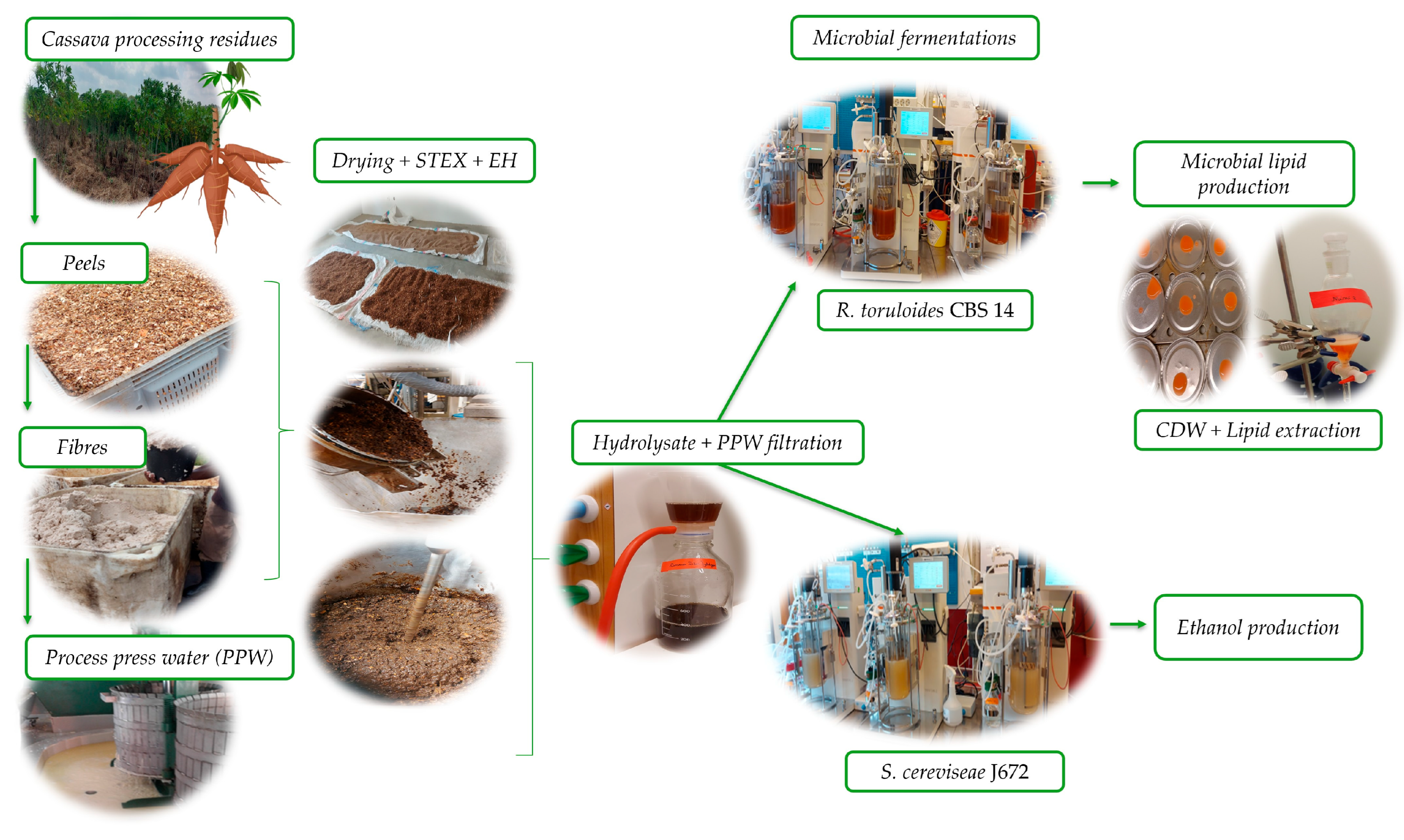
Cassava peels (50 kg) and fibres (50 kg) were collected from a cassava starch factory, while cassava process press water (wastewater) (50 L) was collected from a cassava processing association during the pressing stage [7]. Both sites were located in Inhambane province, Mozambique (24°47′34″ S; 35°02′50″ E). The starch factory process roots were supplied by local small-scale farmers. After collection, cassava peels and fibres were pressed using a hydraulic press to remove excess water, sun-dried for 48–72 h and oven-dried at 105 °C for 24–48 h. The process press water was immediately frozen and stored at −20 °C in 5 L containers (Figure 1). All samples were transported from Mozambique to Sweden for further processing and analysis.

2.1.1. Cassava Process Press Water Preparation

Process press water was centrifuged (4000× g, 30 min) to remove suspended solids and impurities, starch granules, and coarse fibres that could interfere with downstream fermentation. The supernatant was subsequently filtered through 0.45 µm membranes to eliminate residual fine particulates and microbial contaminants. The final sterile filtrates were stored at −20 °C until use. Prior to fermentation, the filtered press water was examined microscopically to confirm the absence of particles and to ensure that no bacterial contamination was present. This step ensured that only the target yeast would be introduced during fermentations.

2.1.2. Cassava Hydrolysates Preparation

Dried cassava peels and fibres were pretreated and enzymatically hydrolysed at the Department of Chemical Engineering, Lund University (Lund, Sweden), following the procedures described by [48,49] with some modifications. Briefly, each material was soaked in 1% acetic acid for 10 min prior to steam expansion (STEX) at 190 °C in a 10 L reactor (Lightnin Mixers and Agitators, Cheswise, England, UK). After the steam expansion, the liquid fraction was separated by phase filtration.
Enzymatic hydrolysis (EH) was performed using the Cellic CTec2 enzyme cocktail (Novozymes A/S, Bagsværd, Denmark) at a loading of 15 FPU g−1 dry matter and pH 4.8. For fibre hydrolysate, additional enzymes were applied: Amyloglucosidase (from Aspergillus niger, Sigma Aldrich, St. Louis, MO, USA) (0.2 mL per 200 mg sample; activity > 260 U mL−1) and α-Amylase (from Bacillus licheniformis, Sigma Aldrich) (1 mL kg−1, activity: ≥500 U mg−1 biuret). After hydrolysis, suspensions were centrifuged (4000× g, 30 min) to remove residual solids and unconverted fibres or peels. Supernatants were sequentially filtered, and final sterile vacuum filtration was performed with 0.2 µm membranes (for peel) and 0.45 µm (for fibre). All hydrolysate stocks were checked microscopically to ensure the absence of bacterial contamination before storage at −20 °C. Throughout the fermentation experiments, liquid suspensions were periodically examined to ensure that only the inoculated yeast strains were present. Routine contamination control procedures included sterile sampling, visual inspection for turbidity or unexpected growth, microscopic observation, and plating on selective media when required to confirm absence of contaminating microorganisms (Figure 1).

2.2. Yeast Strains and Culture Media

The yeast strains used in this study were Rhodotorula toruloides CBS 14 (Westerdjik Fungal Biodiversity Institute, Utrecht, The Netherlands) and Saccharomyces cerevisiae J672 [50], both stored in the strain collection at the Department of Molecular Sciences, SLU-Uppsala. Strains were stored in glycerol stocks (−80 °C) containing 50% YPD broth (10 g L−1 yeast extract, 20 g L−1 peptone, 20 g L−1 glucose) and 50% glycerol. Pre-cultures were maintained on YM agar (20 g L−1 glucose, 5 g L−1 peptone, 3 g L−1 yeast extract, 3 g L−1 malt extract, 16 g L−1 agar) at 25 °C (R. toruloides) and 30 °C (S. cerevisiae), with monthly transfers to new plates. For liquid pre-cultures, single colonies were inoculated into 400 mL YM broth (20 g L−1 glucose, 5 g L−1 peptone, 3 g L−1 yeast extract, 3 g L−1 malt extract) in 3 L baffled Erlenmeyer flasks and incubated for 48–72 h at 150 rpm. Cells were harvested by centrifugation (4000× g, for 10 min), washed twice with sterile 9 g L−1 NaCl, and resuspended in the same solution before inoculation.

2.3. Yeasts Cultivation

2.3.1. Screening in Shake Flasks

Shake flask cultivations were performed in triplicate using 500 mL baffled flasks containing 100 mL of cassava hydrolysates diluted with sterile deionised water to 25%, 50%, 75%, and 90% (v/v) of original hydrolysate concentration. Each cultivation media was supplemented with 2 g L−1 ammonium sulphate, and glucose and xylose concentrations were adjusted to match those in undiluted hydrolysates (100%). The media were buffered with 0.1 M sodium phosphate buffer (pH 6.0). Cultures were inoculated at an initial optical density (OD600) of 5 and incubated for 48–72 h at 150 rpm on an orbital shaker, at 25 °C for R. toruloides CBS 14 and 30 °C for S. cerevisiae J672.
Additional trials were performed to evaluate the effect of cassava process press water supplementation at 5%, 15%, and 25% v/v in cultivation media containing 75% (v/v) hydrolysate and 2 g L−1 ammonium sulphate. All cultivations were carried out in triplicate, and samples were collected every 24 h for OD600, cell dry weight (CDW), and residual sugars quantifications. These preliminary screenings aimed to identify suitable hydrolysate dilutions and supplementation levels for subsequent bioreactor fermentations. Based on these exploratory trials, the 75% (v/v) hydrolysate supplemented with 5% (v/v) cassava press water was selected as the optimal medium composition for fermentation experiments in bioreactors. As the shake flask screenings were exploratory and not designed for statistical comparisons across all treatments, their detailed results are not presented in this study.

2.3.2. Fermentation Experiments in Bioreactors

Bioreactor fermentations were carried out in triplicates using 2 L Minifors 2 bench-top reactors (INFORS HT, Bottmingen, Switzerland) with a 1.5 L working volume. Hydrolysates at 75% (v/v) of original concentration were supplemented with 5% (v/v) cassava process press water. R. toruloides CBS 14 was cultivated under aerobic conditions to evaluate lipid production, while S. cerevisiae J672 was cultivated under oxygen limited conditions for evaluation of ethanol production. For R. toruloides, conditions were as follows: pO2 20% (controlled by stirring speed, initial 200 rpm, airflow 0.7–1 L min−1), temperature 25 °C, and pH 6.0 (pH was controlled by addition of 5 M NaOH or 3 M H3PO4). Polypropylene glycol 2000 (1 mL) was added as antifoam agent [51]. Hydrolysate mixture included 1.7 g L−1 YNB (yeast nitrogen base without ammonium sulphate and amino acids; Difco™, Becton Dickinson and Company, Franklin Lakes, NJ, USA) supplemented or not with 2 g L−1 ammonium sulphate [48]. Samples (100 mL) were collected every 24 h, centrifuged (4000× g, 10 min), after which the pellet was washed twice with MiliQ water, freeze-dried in vacuum for 72 h with condenser set to −100 °C (CoolSafe ScanVac, LaboGene ApS, Allerød, Denmark) [52], and stored at −20 °C for lipid extractions. For S. cerevisiae, oxygen limited conditions were achieved by flushing fermenters with N2 for 30 min before inoculation, and then the air flow was set to 0 L min−1 [53]. Cultivation temperature was maintained at 30 °C and pH at 6.0. Samples (50 mL) were collected during fermentation for analysis of sugars, ethanol, and by-products (Figure 1)

2.4. Analytical Methods

2.4.1. Cell Growth, Hydrolysate Composition, and Cassava Raw Material Composition

Cell growth during fermentation was monitored at a wavelength of 600 nm (OD600) every 24 h for R. toruloides CBS 14 and every 2 h or 4 h for S. cerevisiae J672 using a spectrophotometer/cell density meter (Biochrom WPA CO8000, Cambridge, UK), with distilled water as a blank. Microbial biomass accumulation was determined as cell dry weight (CDW), by collecting 2 mL of culture (in triplicates), centrifuging at 17,000× g for 2 min, washing three times with deionised water, and drying at 105 °C for 24 h, prior to weight determination [48,51]. Hydrolysate composition determination—including sugars, acetic acid, ethanol, and glycerol produced during fermentations—was quantified by high-performance liquid chromatography (HPLC, Shimadzu 2050 Series, Kyoto, Japan). Analytes were separated on an ion-exclusion column (Rezex ROA—Organic Acid H+, 300 × 7.80 mm, Phenomenex, Torrance, CA, USA) and detected with a refractive index detector (RID). The mobile phase was 5 mM H2SO4 at a flow rate of 0.6 mL min−1. For HPLC sample preparation, 700 µL of culture supernatant was mixed with 70 µL of 5 M H2SO4, centrifuged at 14,000× g for 15 min, and the supernatant was filtered through a 0.2 µm syringe filter into HPLC glass vials.
Raw cassava material composition (peels and fibres prior to steam expansion), total nitrogen, and total cyanide (HCN) in cassava hydrolysates and cassava process press water were quantified by Eurofins Food and Feed Testing (Linköping, Sweden). Nitrogen was determined by Kjeldahl analysis [54], and total HCN by an internal method validated by Eurofins Chemical Control S.r.l. (Cuneo, Italy).
Lipid and ethanol yields were calculated as grams of lipids or ethanol produced per gram of carbon source consumed (g g−1).

2.4.2. Lipid Extraction

The lipids from R. toruloides CBS 14 were extracted using a method adapted from [55]. Freeze-dried biomass (100 mg) was treated with 1 M HCl for 15 min and then heated at 75 °C for 1 h. The suspension was transferred to a separation funnel, and 2 mL of 0.8% KCl was added, together with 6 mL of Folch solution (chloroform: methanol; 2:1 v/v). After vigorous mixing and phase separation, the lower lipid phase was repeatedly collected by successive additions of chloroform (4 mL each) until a clear lipid phase was observed. Chloroform was evaporated under N2 flow, and total lipid content was determined gravimetrically. Dried lipid extracts were resuspended in 1 mL hexane and stored at −20 °C until methylation of the samples [51].

2.4.3. Fatty Acid Profile

Fatty acid methyl esters (FAMEs) were prepared according to [56]. Briefly, 0.5 mL of extracted lipids (2 mg mL−1 in hexane) were mixed with 2 mL of dry methanol and heated at 60 °C for 10 min. Boron trifluoride (3 mL, BF3 reagent) was added, and samples were mixed and incubated for an additional 10 min at 60 °C. After cooling, 2 mL of 20% NaCl and 2 mL hexane were added, vortexed, and left for phase separation. The upper hexane phase containing FAMEs was collected, and derivatisation was verified by thin-layer chromatography (TLC) on silica-coated plates.
FAMEs were analysed and quantified by gas chromatography (GC) on a CP-3800 GC system (CTC Analytics AG, Zwingen, Switzerland) equipped with a flame ionisation detector and split injector, using a BPX 70 fused-silica capillary column (50 m × 22 mm i.d., 0.25 μm film thickness). The GC was programmed with a temperature gradient from 158 °C to 220 °C, ramping at 2 °C min−1, and with a final constant temperature of 220 °C for 13 min [51].

2.5. Statistical Analysis

Statistical analyses were performed in R (R Core Team, Vienna, Austria) using the RStudio interface (version 2024.09.1; Posit Team; Boston, MA, USA) and associated packages. Differences in growth of R. toruloides CBS 14 in 75% (v/v) cassava fibre hydrolysate with and without ammonium sulphate supplementation were assessed using t-test. The same test was applied to compare growth of S. cerevisiae J672 in 75% (v/v) peel versus 75% (v/v) fibre hydrolysate.
Kruskal–Wallis’s test was used to evaluate differences in the growth of R. toruloides CBS 14 in 75% (v/v) and 20% (v/v) fibre hydrolysate with and without ammonium sulphate supplementation. When significant effects were detected, Dunn’s test was applied for multiple pairwise comparisons, and Bonferroni correction was used to adjust p-values for multiple testing. Statistical significance was assessed using p-values, with the applied significance thresholds indicated in the corresponding tables.

3. Results and Discussion

3.1. Composition of Cassava Residues and Hydrolysates

The cassava residues tested in this study (dried peels and dried fibres) were analysed for proximate composition. The compositional analysis confirmed that cassava peels and fibres are rich in carbohydrates but low in protein content. On a dry matter basis, peels contained 81.4% carbohydrates, 3.6% protein (N~0.58%), 1.5% lipids, and 13.5% ash. Fibres consisted mainly of carbohydrates (95.7%), with low levels of protein (1.8%; N~0.29%), lipids (0.5%), and ash (2.0%). Based on this composition, the carbon-to-nitrogen (C/N) ratio was estimated using organic matter-derived carbon proximations, yielding values of approximately 66 for peels and 149 for fibres, reflecting the pronounced nitrogen deficiency of these materials. This is consistent with previous reports showing that cassava residues are dominated by structural carbohydrates (cellulose and hemicellulose) and ash, with very low protein and lipid contents [1,16,57]. Compared to cassava storage roots, which usually contain 70–75% starch, 2–3% protein, and <1% lipids on a dry basis [1,16], the cassava residues represent a more extreme nutrient imbalance. This scenario explains why nitrogen supplementation, and, in some cases, detoxification, are necessary to overcome inhibitory compounds and support efficient microbial lipid and ethanol production [58].
Cassava enzymatic hydrolysis at 12% water insoluble solids (WIS) generated hydrolysates with varying sugar compositions. The cassava peel hydrolysate contained ~50 g L−1 glucose, 5.26 g L−1 xylose, and 2.88 g L−1 acetic acid. In contrast, the cassava fibre hydrolysate contained nearly three times more glucose (~150 g L−1), 6.26 g L−1 xylose, and 3.7 g L−1 acetic acid. Both hydrolysate types had very low nitrogen content (<0.05 g 100 g−1) and similar cyanide levels (<1 mg L−1 total cyanide). The substantially higher glucose concentration observed in the cassava fibre hydrolysate compared to the peel hydrolysate can be attributed to differences in biomass origin, composition, and processing history. Cassava fibres are generated mainly during starch extraction [57] and are therefore enriched in residual starch and cellulose fractions that are readily hydrolysable to glucose. In contrast, cassava peels contain a higher proportion of lignified tissues, structural polysaccharides, ash, and inhibitory compounds [59,60], which can limit enzymatic accessibility and sugar release.
Diluted hydrolysates 75% (v/v) were supplemented with 5% (v/v) process cassava press water. This press water contained trace nitrogen (<0.05 g 100 g−1) and 80.43 mg L−1 total cyanide. The use of cassava wastewater as part of the cultivation media can contribute to lowering the overall production costs by incorporating the discarded process stream into the fermentation process [17]. Ammonium sulphate (2 g L−1) was supplemented as an assimilable nitrogen source. On the last day of fermentation, the cyanide content and biomass in the cell suspension were measured and no traces of cyanide were found.

3.2. Growth and Lipid Production of R. toruloides CBS 14 in Cassava Peel Hydrolysate

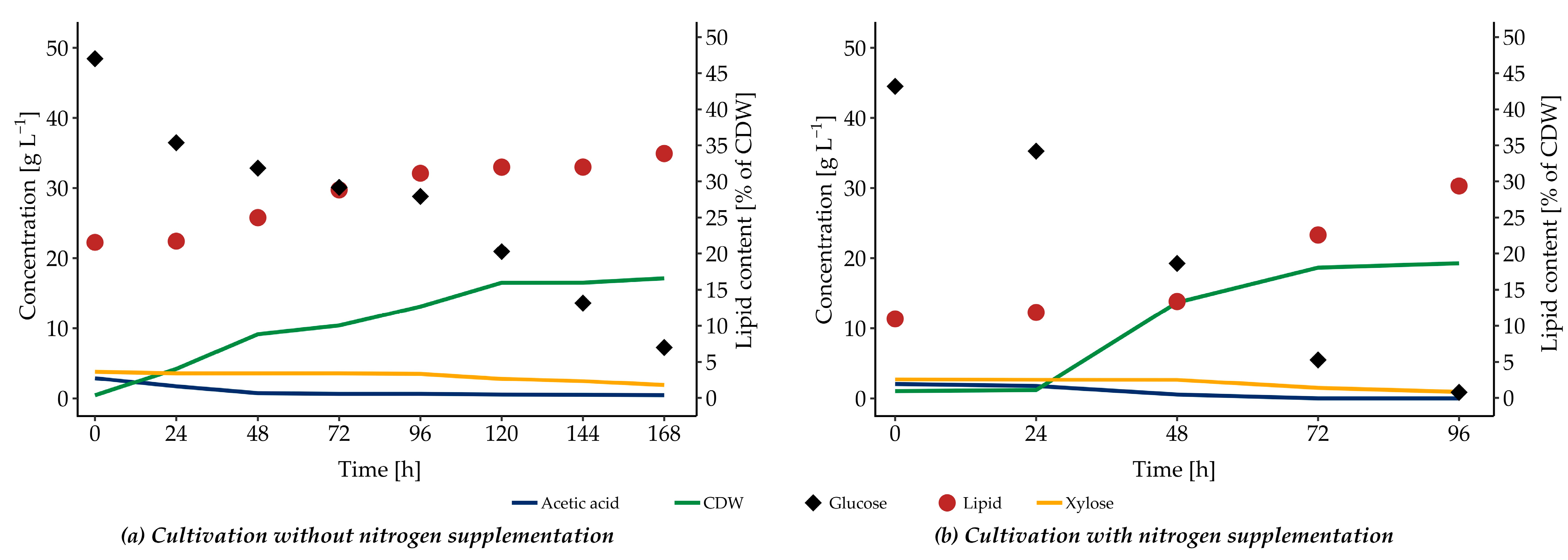
In cassava peel hydrolysate, R. toruloides CBS 14 was cultivated with and without nitrogen supplementation (Figure 2, Table 1). The maximum OD600 reached 54 without nitrogen and 117 with nitrogen supplementation. Without nitrogen supplementation, the biomass increased gradually throughout the cultivation time, showing slow and steady linear growth, whereas with nitrogen supplementation, a faster increase in cell biomass was observed after approximately 24 h, reaching the stationary phase by 96 h. Glucose consumption followed a similar trend: depletion occurred after 168 h in non-supplemented cultures but was completed within 96 h when nitrogen was added to the cultivation media. The final CDW was 17.14–19.28, lipid concentration reached about 6 g L−1, lipid content accounted for 30–35% of CDW, and lipid yield was 0.13–0.15 g g−1 glucose, with no significant differences (p > 0.05) between treatments. These results indicate that nitrogen supplementation promoted faster cell propagation rather than stimulating lipogenesis. The influence of nitrogen on carbon allocation has been widely reported, with high C/N ratios favouring lipid storage, and nitrogen supplementation promoting biomass formation rather than lipogenesis [61,62]. The C/N ratio is a key determinant of lipid accumulation in oleaginous yeasts. Under high C/N ratios, carbon flux is directed towards acetyl coenzyme-A, and subsequently to fatty acids biosynthesis. In contrast, at low C/N ratios, carbon is primarily channelled into protein synthesis and biomass formation rather than lipid storage [63,64,65]. Overall, the peel hydrolysate proved to be a reliable substrate for lipid production.

3.3. Growth and Lipid Production of R. toruloides CBS 14 in Cassava Fibre Hydrolysate

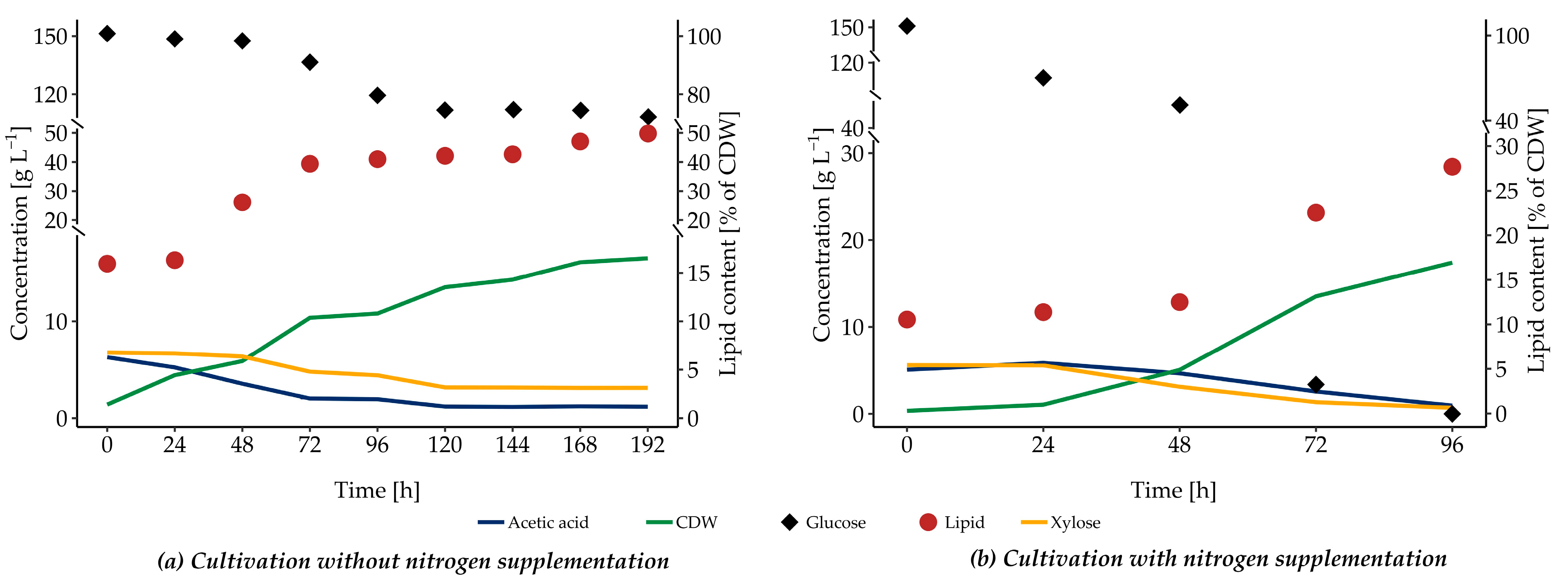
In fibre hydrolysate, R. toruloides displayed contrasting performance depending on nitrogen availability (Figure 3, Table 2). Without nitrogen supplementation, fermentations showed a long lag phase (48 h), followed by moderate glucose consumption and gradual lipid accumulation. After 192 h, biomass reached 16.51 ± 2.15 g L−1 CDW with 49.55 ± 1.29% lipid content (8.18 ± 1.02 g L−1), corresponding to the highest yield obtained (0.19 ± 0.02 g g−1 glucose). With nitrogen supplementation, glucose was almost completely depleted within 72 h (3.37 ± 5.27 g L−1), but biomass (13.52 ± 0.47 g L−1), lipid concentration (3.13 ± 0.03 g L−1), and lipid yield (0.02 g g−1 glucose) dropped significantly.
To test the inhibitory effects of the hydrolysate, cells were cultivated in hydrolysate diluted to 20% (v/v) (50 g L−1 glucose). Under these conditions, biomass (8.51 ± 0.60 g L−1), lipid content (10.41 ± 1.15% CDW), and lipid yield (0.07 ± 0.00 g g−1 glucose) remained low without nitrogen supplementation. With supplementation, the biomass increased (12.15 ± 0.44 g L−1) and lipid content rose (25.81 ± 5.02% CDW), but yields remained low (0.02 ± 0.00 g g−1 glucose). Glucose was not completely depleted in non-nitrogen-supplemented cultures with residual concentrations of 21.84 ± 1.27 g L−1 after 96 h. In contrast, sugar depletion occurred within 96 h when nitrogen was added, indicating that supplementation was essential for efficient glucose turnover. Although the 75% (v/v) fibre hydrolysate contained higher glucose levels than the 75% (v/v) peel hydrolysate, R. toruloides CBS 14 was able to grow in both dilutions tested. In the 75% (v/v) fibre hydrolysate, the yeast reached maximum OD600 values of 30 without nitrogen and 70 with nitrogen supplementation. A similar growth pattern was observed in the 20% (v/v) diluted fibre hydrolysate, where OD600 values of ~29 (without nitrogen supplementation) and ~72 (with nitrogen supplementation) were achieved. Statistical analysis (p < 0.05) indicated significant differences across fibre hydrolysate treatments in terms of glucose consumption, biomass, lipid concentration, lipid content, and lipid yield (Table 2).
These results suggest that the low lipid yields observed in the fibre hydrolysate cannot be explained by glucose concentration alone. The matrix composition and inhibitory compounds likely suppressed lipogenesis, particularly under nitrogen-supplemented conditions. The generation of by-products from the pretreatment is dependent on the feedstock and the pretreatment method [66,67]. Substances formed during the pretreatment of lignocellulosic feedstock (e.g., phenolic compounds and other aromatics, aliphatic acids, furan aldehydes, inorganic ions, and alcohols or other fermentation products) can act as inhibitors of microorganisms during fermentation steps [66]. Previous studies [53,68] reported that inhibitor-free lignocellulosic hydrolysates promote higher lipid yields, highlighting the sensitivity of lipid accumulation in R. toruloides to both the C/N balance and the presence of organic acids. Furthermore, elevated glucose levels during the lag phase have been associated with reduced fermentation efficiency in lignocellulosic systems [69,70,71].
In summary, supplementation with ammonium sulphate accelerated sugar utilisation in both peel and fibre fermentations. Studies have shown that R. toruloides CBS 14 can accumulate up to 65% lipids of their biomass when culture parameters such as glucose concentration, temperature, and nitrogen supplementation with ammonium sulphate are optimised [72]. The lower values observed in our study probably reflect the combined impact of subtract-derived inhibitors and non-optimised cultivation conditions. While cassava hydrolysates generally can be considered as promising carbon sources, our study shows that the fibre hydrolysate imposed potential osmotic and inhibitory stresses (e.g., acetic acid, furfural, and 5-hydroxymethylfurfural-HMF) [68] that can influence the lipid productivity. This highlights the need for the targeted optimisation of the nitrogen supply, cultivation parameters, and detoxification strategies to improve lipid synthesis and oleaginous yeast strain developments for R. toruloides CBS 14 grown on various cassava residue hydrolysates. R. toruloides has previously been studied for microbial lipid production using various lignocellulosic hydrolysates made from agricultural residues such as corn stover, cassava starch, and wheat straw [51,58,73,74].

3.4. Fatty Acid Profiles of Lipids from R. toruloides

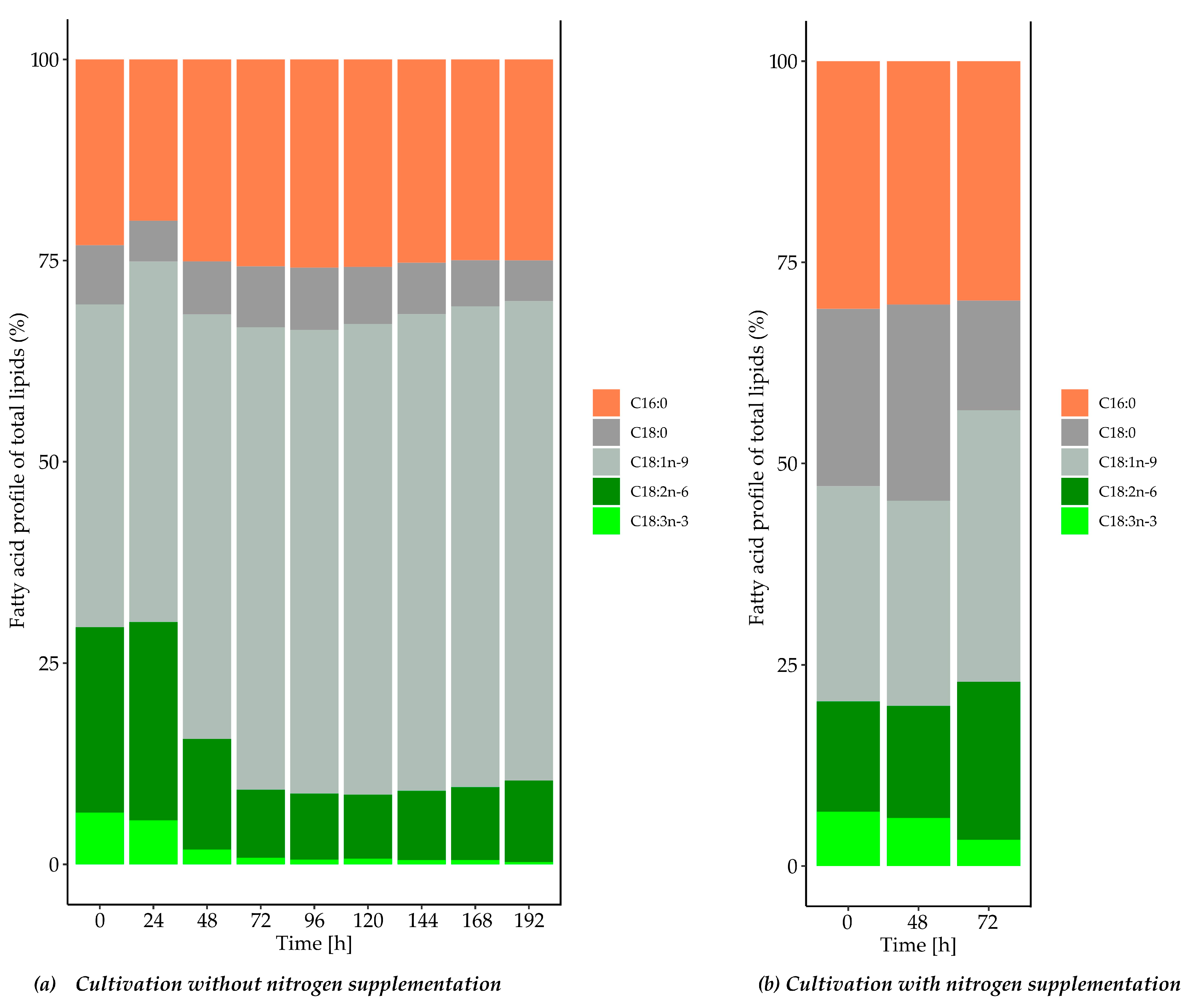
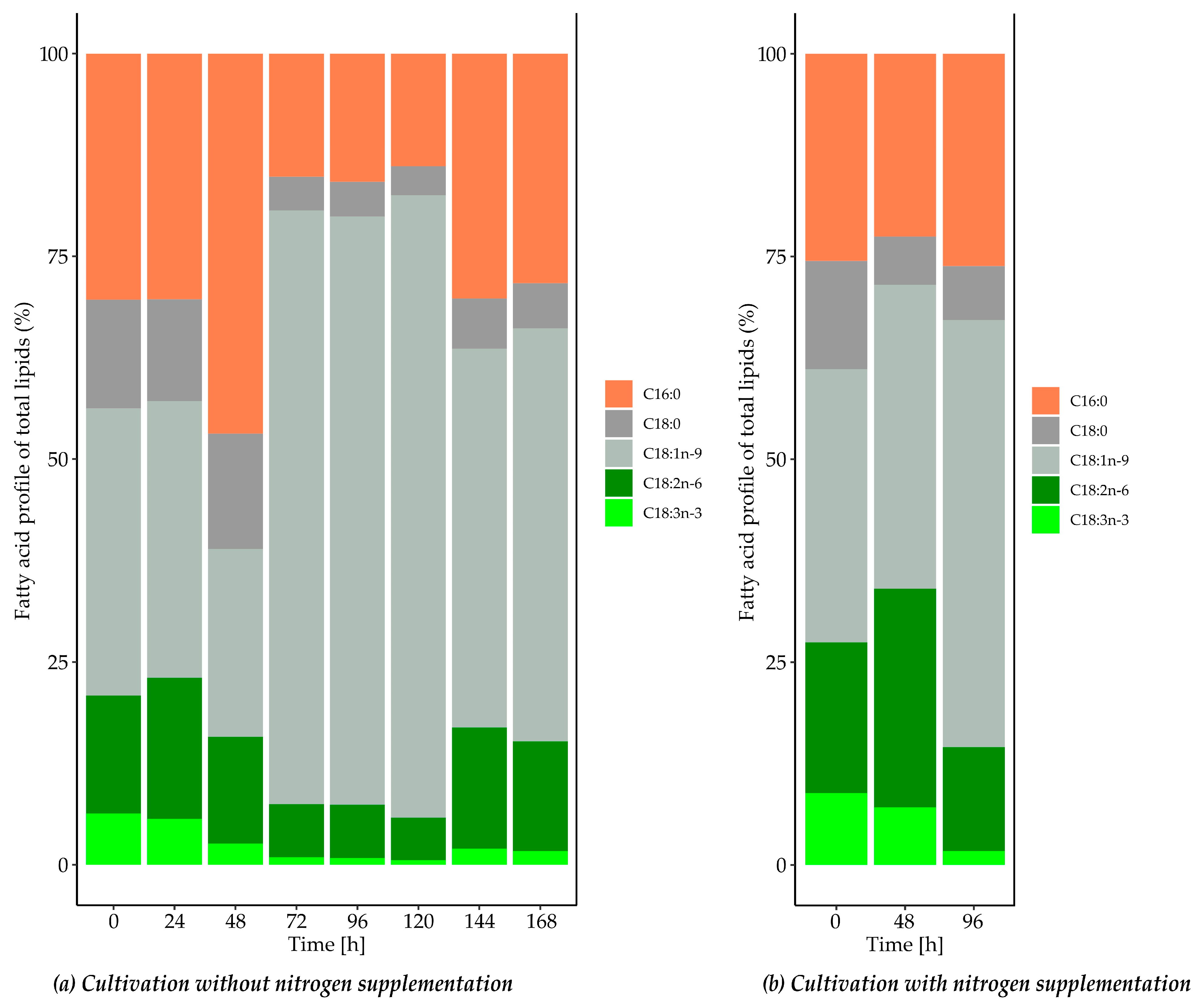
The fatty acid compositions of lipids produced by R. toruloides CBS 14 in cassava hydrolysates at different fermentation times are shown in Figure 4 and Figure 5.
In peel hydrolysate, without nitrogen supplementation, the lipid fraction was dominated by oleic acid (C18:1 n-9), followed by palmitic (C16:0) and linoleic acids (C18:2 n-6), with smaller amounts of stearic (C18:0) and α-linolenic acids (C18:3 n-3) (Figure 4a). Over the course of the cultivations, monounsaturated fatty acids (MUFAs) were the most abundant class, followed by saturated fatty acids (SFAs) and polyunsaturated fatty acids (PUFAs). At the endpoint (168 h), the composition consisted of 46.77 ± 0.29% MUFAs, 31.15 ± 1.78% SFAs, 13.99 ± 6.94% PUFAs, and an unsaturation index (UI) of 1.26 ± 2.05% (Table 3).
Under nitrogen supplementation, the overall profile remained similar to that observed without supplementation, with oleic acid (C18:1 n-9) still predominant, followed by palmitic (C16:0), linoleic (C18:2 n-6), stearic (C18:0), and α-linolenic (C18:3 n-3) acids (Figure 4b). At the endpoint (96 h), MUFAs accounted for 52.64 ± 1.08%, SFAs for 32.83 ± 1.92%, PUFAs for (14.53 ± 1.07%), and a UI of 1.24 ± 1.55% (Table 3).
In fibre hydrolysate, without nitrogen supplementation, the lipid fraction was dominated by oleic acid (C18:1 n-9), followed by palmitic (C16:0), linoleic (C18:2 n-6), stearic (C18:0), and α-linolenic acids (C18:3 n-3) (Figure 5a). Over the cultivation period, MUFAs remained predominant, followed by SFAs and PUFAs. At the endpoint (192 h), the composition corresponded to 59.56 ± 1.80% MUFAs, 30.03 ± 1.23% SFAs, 10.41 ± 2.25% PUFAs, and a UI of 1.15 ± 1.67% (Table 4). When R. toruloides in the fibre hydrolysate was supplemented with ammonium sulphate, the fatty acid composition was changed, with a decrease in MUFAs and an increase in both SFAs and PUFAs. However, the major components were still palmitic (C16:0), oleic (C18:1 n-9), stearic (C18:0), linoleic (C18:2 n-6), and α-linolenic (C18:3 n-3) acids (Figure 5b). At the endpoint (72 h), SFAs accounted for 43.38 ± 15.11%, MUFAs for 33.73 ± 13.43%, PUFAs for 22.89 ± 22.70%, and a UI of 1.46 ± 1.78 (Table 4).
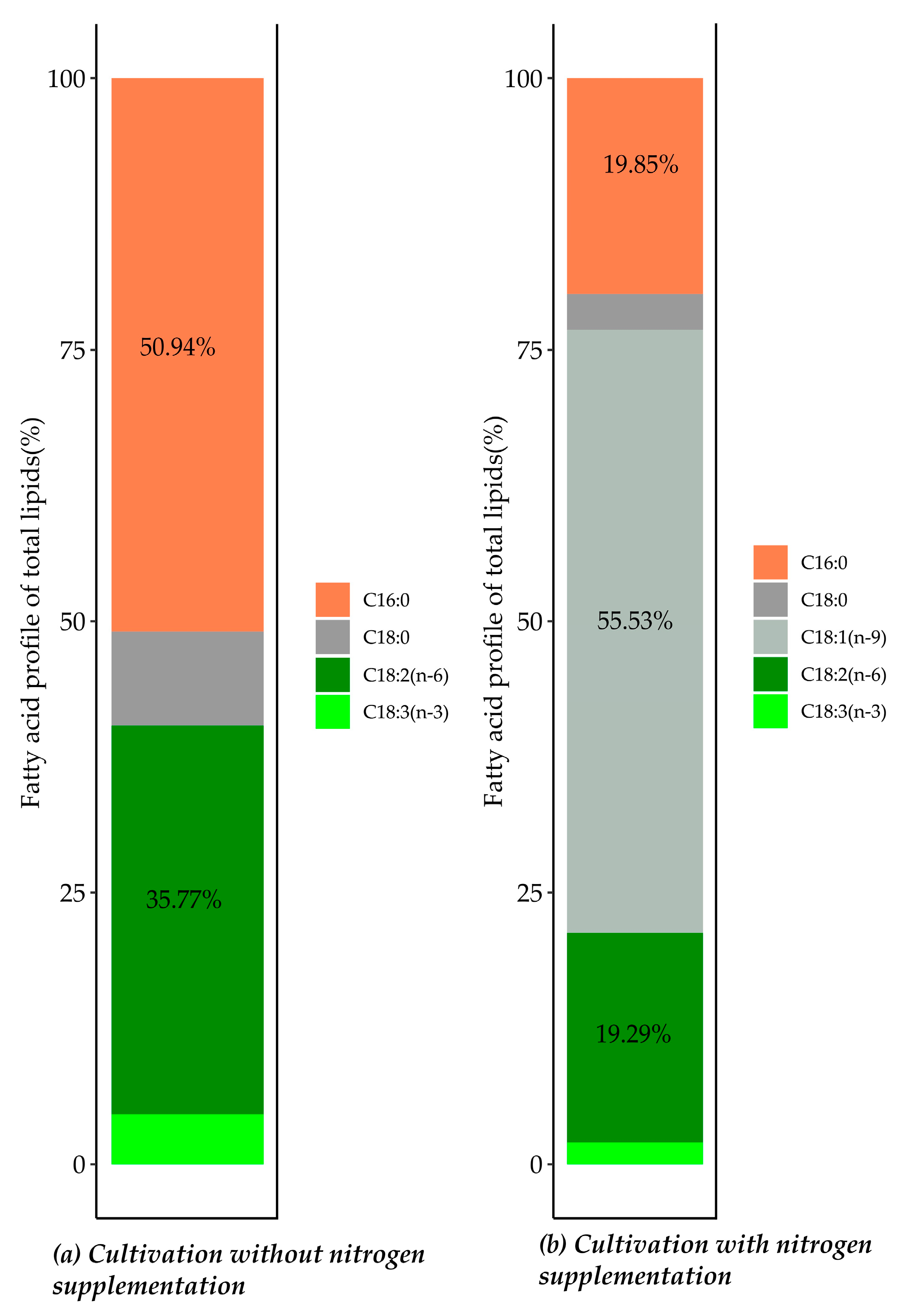
At the endpoint (96 h), cultivation in the 20% (v/v) diluted fibre hydrolysate gave a lipid profile comparable to that of peel hydrolysate. Without nitrogen supplementation, the lipid fraction was mainly composed by palmitic (C16:0) and linoleic (C18:2 n-6) acids, whereas with nitrogen supplementation, the profile was dominated by oleic acid (C18:1 n-9, ~55%) (Figure 6). Minor components such as stearic (C18:0) and α-linolenic acids (C18:3 n-3) accounted for ≤ 10% (Figure 6).
It is worth mentioning that, for both peel and fibre hydrolysates, other fatty acids (e.g., C14:0, C16:1 n-7, C16:2 n-4, C17:0, C17:1, C18:1 n-7, C20:0, C22:0, C22:5 n-3, C22:6 n-3, C24:0, C24:1) were detected by GC analysis but are not reported in detail due to their low abundance and inconsistent occurrence across cultivations. Section 3.4 thus focuses on the dominant C16 and C18 fatty acids, which represent the main lipid fractions and are most relevant for downstream applications.
Many studies have highlighted R. toruloides as a promising species for lipid production owing to its broad substrate range, robust stress tolerance, and overall metabolic versatility [33,75,76]. Under favourable fermentation conditions, this yeast can accumulate up to 70–76% lipids, with biomass concentrations around 100 g L−1, and fatty acid profiles typically dominated by oleic (C18:1) and palmitic (C16:0) acids [77,78,79]. In our study, nitrogen availability not only influenced sugar utilisation but also reshaped the fatty acid profile of R. toruloides, indicating that the C/N ratio, cultivation time, nutrition, and stress conditions are decisive factors for lipid composition, consistent with the previous reviews on oleaginous yeasts [61,72].
Comparable fatty acid distributions, generally dominated by C16:0, C18:0, and C18:2, have been reported for R. toruloides cultivated on corn stover [73], cassava starch [58], and wheat straw hydrolysates [51,74]. Likewise, Rhodotorula babjevae grown on wheat straw hydrolysate accumulated linoleic and linolenic acids [53]. According to [80], the fatty acid spectrum of oleaginous yeasts is relatively simple, being primarily composed of palmitic (C16:0) and octadecanoid derivatives (C18:0, C18:1, C18:2). Our results align with these observations and demonstrate that nitrogen availability modulates the degree of unsaturation rather than the chain-length distribution. Nitrogen supplementation reduced MUFA accumulation and increased both SFAs and PUFAs, particularly linoleic acid (C18:2), whereas nitrogen limitation favoured oleic acid (C18:1) dominance. These results confirm that oleic, palmitic, and linoleic acids dominate the lipid fraction across different hydrolysates. Moreover, they highlight the capacity of R. toruloides to adjust fatty acid desaturation and to maintain a balanced lipid composition under variable nutrient conditions.
This study demonstrated that the enzymatic hydrolysis of cassava residues enables microbial lipid production from both peel and fibre hydrolysates, showing the potential of cassava side steams as feedstocks. In Mozambique, annual cassava production is approximately 7.61 million tons of cassava fresh roots [4]. Assuming that cassava roots contain about 50% moisture, this corresponds to ~3.8 million tons of dry matter. Of this dry fraction, approximately 15% consists of peels and 5% of fibres, which is equivalent to ~150 g of dried peels and ~100 g of dried fibres per kilogram of fresh cassava roots. The experimental results from this study showed that 1 kg of dried cassava peels yielded 1.7 kg of peel hydrolysate containing about 102 g of fermentable glucose. Based on the final lipid concentrations measured after fermentation with R. toruloides and the subsequent normalisation to dry peel mass, the microbial lipid yields corresponded to approximately 1.36% (w/w) on a dry peel basis. Similarly, 1 kg of dried cassava fibres yielded approximately 1.3 kg of fibre hydrolysate containing about 200 g of glucose. Normalisation of the final lipid concentrations to dry fibre mass resulted in microbial lipid yields corresponding to approximately 1.42% (w/w) on a dry fibre basis. When these experimentally determined yields are extrapolated to Mozambique’s annual casava production, they correspond to a theoretical potential of approximately 7750 tons of microbial lipids from peels and approximately 2700 tons from fibres per year, on a dry weight basis.

3.5. Fermentation Performance and Ethanol Production by S. cerevisiae J672 in Cassava Hydrolysates

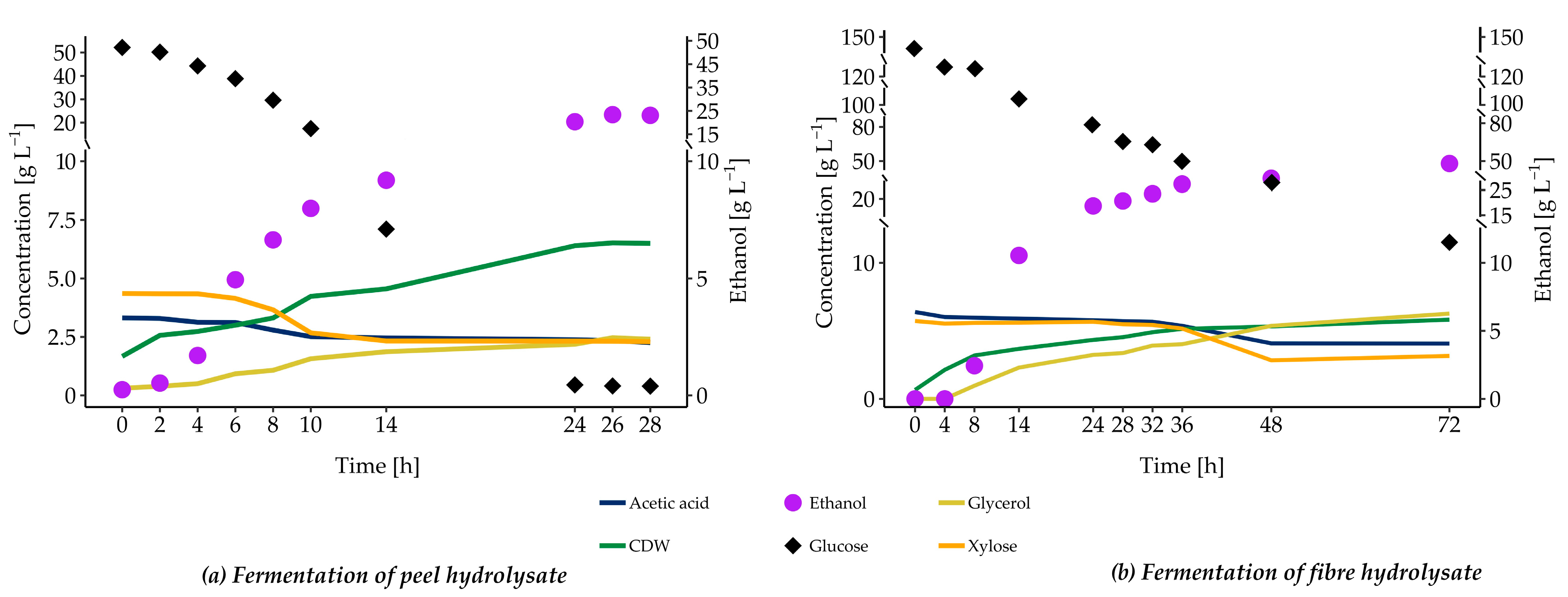
Fermentations with S. cerevisiae J672 in cassava peel and fibre hydrolysates exhibited different fermentation outcomes (Figure 7, Table 5). In the peel hydrolysate (initial glucose 50 g L−1), glucose was almost completely consumed within 28 h, yielding 23.13 ± 3.18 g L−1 ethanol and an ethanol yield of 0.45 ± 0.06 g g−1 glucose. This indicates that the peel hydrolysate supported/enabled rapid sugar consumption and efficient ethanol conversion. In contrast, the fibre hydrolysate (initial glucose 150 g L−1) produced higher ethanol titres (48.29 ± 3.32 g L−1 after 72 h) but low ethanol yields (0.37 ± 0.03 g g−1) and incomplete glucose consumption (11.5 ± 0.63 g L−1 residual). Glycerol production was also higher in fibres (6.27 g L−1 vs. 2.40 g L−1 in peels).
These results suggest that S. cerevisiae J672 performed better in the peel hydrolysate, whereas the fibre hydrolysate likely imposed osmotic or inhibitory stress. Similar limitations have been reported for lignocellulosic hydrolysates, where furan derivatives, carboxylic acids, and phenolics delay yeast fermentations [81,82]. Ref. [83] reported ethanol titres of 1.0 g L−1 in cassava pulp hydrolysates after 72 h with water supplementation, while our peel fermentations achieved 0.45 g L−1 at the same time point, highlighting the influence of the feedstock type and pretreatment strategy. Ref. [84] also reported efficient ethanol production from cassava peel hydrolysates inoculated with S. cerevisiae, while [85] demonstrated 25.4 g L−1 ethanol in 48 h from cassava starch using co-cultures of S. cerevisiae and hydrolytic fungi. Together, these studies reinforce that ethanol performance depends strongly on substrate composition, inhibitor load, and fermentation design.
In addition, cassava residues themselves contain specific inhibitory compounds that may constrain fermentation. Cyanogenic glycosides, organic acids, and phenolics released during hydrolysis have been reported to reduce yeast growth and ethanol productivity [13,86]. Lignocellulosic materials, present in hydrolysed cassava non-food parts, can also generate small molecular weight compounds (e.g., furan derivatives, phenolic compounds, and amine-based compounds such as vanillin) that can inhibit fermentation [87]. These factors could help explain the slower growth, delayed sugar utilisation, and reduced ethanol conversion observed in fibre hydrolysates compared with peels. Similar limitations have been described for wheat straw and corn stover hydrolysates, where S. cerevisiae often achieves high ethanol titres but suffers from reduced yields due to inhibitor accumulation [42,88,89]. From an industrial perspective, this trade-off is critical: while fibre hydrolysates support higher volumetric productivity, the lower conversion efficiency and residual sugars increase downstream costs. This highlights the need for detoxification or strain engineering strategies. Studies have confirmed the potential of cassava-based residues such as peels and pomace as effective lignocellulosic feedstock for sugar release and bioethanol production [86]. This reinforces our findings that cassava residues are not only abundant but also technically viable substrates for microbial fermentation, provided that inhibitory compounds are addressed through detoxification or process optimisation.
Our study also demonstrated that the enzymatic hydrolysis of cassava residues enables the production of ethanol from both peel and fibre hydrolysates. Approximately 50% of the mass of fresh cassava roots consists of moisture, while the remaining 50% represents dry matter. Of this dry fraction, about 20% corresponds to solid processing residues, comprising roughly 150 g of dried peels and 100 g of dried fibres per kilogram of fresh cassava roots. Based on the conversion efficiencies obtained in this study, the fermentation of the cassava peel hydrolysate with S. cerevisiae resulted in an ethanol yield corresponding to approximately 5.24% (w/w) on a dry peel basis. The fermentation of the cassava fibre hydrolysate resulted in an ethanol yield corresponding to approximately 8.37% (w/w) on a dry fibre basis, with both values derived from experimentally measured ethanol concentrations and normalised to the dry residue mass. When extrapolated to Mozambique’s annual cassava production (7.61 million tons of fresh roots) [4], these experimentally determined conversion efficiencies correspond to theoretical annual potentials of approximately 29,900 tons of ethanol from dried peels and 15,900 tons from dried fibres per year, assuming full residue availability and excluding collection and processing losses. At a broader scale, such valorisation not only mitigates the environmental impacts associated with cassava side streams but also provides a sustainable contribution to the country’s biofuel supply chain, reinforcing the potential of cassava processing residues as efficient ethanol feedstocks within a circular economy framework [84,85].

4. Conclusions

Cassava residues are abundant agro-industrial by-products in cassava processing industries that can be converted into valuable products. The results of this study show that the casava peel hydrolysate is a reliable substrate for both lipid and ethanol production, while the fibre hydrolysate, despite its higher sugar content, requires further process optimisation before efficient conversion rates can be reached due to inhibitory effects. The fatty acid profiles of R. toruloides grown on cassava processing residues confirm that cultivation conditions, especially the C/N ratio and fermentation time, can be adjusted to tailor lipid quality for different downstream applications, including biofuels and nutraceuticals. At the national scale, Mozambique’s cassava production has a substantial potential for lipid and ethanol production from processing residues, supporting waste valorisation strategies while reducing environmental impacts. These findings underline the relevance of reutilising cassava side streams to strengthen local bio-based economies. Since lipid production involves an energy-intensive aerobic process that requires significant input for stirring and aeration, reducing the fermentation time can substantially improve the overall process efficiency. In this context, cassava peels represent an immediate and comparatively cost-effective substrate for bioconversion, while cassava fibres constitute a more complex but promising resource that underscores the need for optimisation.
Overall, this study highlights the relevance of developing integrated cassava biorefineries capable of transforming processing residues into valuable bioproducts with a sustainable circular bioeconomy framework. Although cassava residues represent a readily available and low-cost feedstock, the production of fermentable hydrolysates requires the use of multiple enzymes, which increases processing costs and adds complexity to the overall process. Enzyme consumption and energy input during hydrolysis therefore constitute key economic and energetic bottlenecks that must be addressed for large-scale implementation. This study also has certain limitations, including the evaluation of only two yeast strains and the use of laboratory-scale hydrolysis and fermentation conditions, which may not fully reflect industrial performance. Nevertheless, the results clearly demonstrate the potential of locally available cassava residues for value-added microbial lipid and ethanol production, supporting the feasibility of sustainable and decentralised bioprocessing strategies in cassava-producing regions.

Author Contributions

Conceptualization, A.M., M.S., C.M. and L.T.; methodology and experimental work, A.M.; formal analysis, A.M., M.S., Y.N., J.B. and S.-l.L.L.; investigation, A.M. and M.S.; data curation, A.M. and M.S.; writing—original draft preparation, A.M.; writing—review and editing, A.M., M.S., C.M., B.M., J.B.; S.-l.L.L., Y.N., L.T. and V.P.; visualisation, A.M.; supervision, M.S., C.M., L.T., V.P., S.-l.L.L., J.B. and B.M.; project administration, M.S. and A.M. All authors have read and agreed to the published version of the manuscript.

Funding

This research was funded by The Swedish International Development Cooperation Agency—SIDA (grant number 25627000).

Institutional Review Board Statement

Not applicable.

Informed Consent Statement

Not applicable.

Data Availability Statement

The original contributions presented in this study are included in the article. Further inquiries can be directed to the corresponding author.

Acknowledgments

The authors acknowledge the cassava processing associations and cassava starch factories for kindly providing the samples used in this study. We are sincerely grateful to the Division of Chemical Engineering at Lund University, and particularly to Christian Roslander, Borbala Erdei, and Mats Galbe, for their generous support and invaluable input in designing the raw material pretreatment experiments and conducting HPLC analyses of the hydrolysates.

Conflicts of Interest

The authors declare no conflicts of interest.

References

  1. Aro, S.; Aletor, V.; Tewe, O.O.; Agbede, J. Nutritional Potentials of Cassava Tuber Wastes: A Case Study of a Cassava Starch Processing Factory in South-Western Nigeria. Livest. Res. Rural Dev. 2010, 22, 1–11. [Google Scholar]
  2. De Oliveira Schmidt, V.K.; De Vasconscelos, G.M.D.; Vicente, R.; De Souza Carvalho, J.; Della-Flora, I.K.; Degang, L.; De Oliveira, D.; De Andrade, C.J. Cassava Wastewater Valorization for the Production of Biosurfactants: Surfactin, Rhamnolipids, and Mannosileritritol Lipids. World J. Microbiol. Biotechnol. 2023, 39, 65. [Google Scholar] [CrossRef]
  3. Costa, C.; Delgado, C. The Cassava Value Chain in Mozambique; World Bank: Washington, DC, USA, 2019. [Google Scholar]
  4. Ministério da Agricultura e Desenvolvimento Rural (MADER). Inquérito Agrário Integrado 2024. Available online: https://www.agricultura.gov.mz/wp-content/uploads/2024/09/Inquerito-Agrario-Integrado-IAI-2023.pdf (accessed on 15 November 2025).
  5. Taiwo, K.A. Utilization Potentials of Cassava in Nigeria: The Domestic and Industrial Products. Food Rev. Int. 2006, 22, 29–42. [Google Scholar] [CrossRef]
  6. Borku, A.W.; Tora, T.T.; Masha, M. Cassava in Focus: A Comprehensive Literature Review, Its Production, Processing Landscape, and Multi-Dimensional Benefits to Society. Food Chem. Adv. 2025, 7, 100945. [Google Scholar] [CrossRef]
  7. Massamby, A.; Leong, S.L.; Müller, B.; Tivana, L.; Passoth, V.; Macuamule, C.; Sandgren, M. Microbial Contamination and Food Safety Aspects of Cassava Roasted Flour (“Rale”) in Mozambique. Microorganisms 2025, 13, 168. [Google Scholar] [CrossRef]
  8. Hossain, M.D.; Yan, Q.; Zhou, Z.; Zhang, X.; Wittayakun, S.; Napasirth, V.; Napasirth, P.; Lukuyu, B.A.; Tan, Z. Cassava as a Feedstuff for Ruminant Feeding System in Belt and Road Countries: Innovations, Benefits and Challenges. J. Agric. Food Res. 2025, 21, 101874. [Google Scholar] [CrossRef]
  9. Scaria, S.S.; Balasubramanian, B.; Meyyazhagan, A.; Gangwar, J.; Jaison, J.P.; Kurian, J.T.; Pushparaj, K.; Pappuswamy, M.; Park, S.; Joseph, K.S. Cassava (Manihot esculenta Crantz)—A Potential Source of Phytochemicals, Food, and Nutrition—An Updated Review. eFood 2024, 5, e127. [Google Scholar] [CrossRef]
  10. Ekop, M. Tracking Cyanogenic Potentials of Cassava Tuber Processing into “gari” from Farm to Table and Assessing Toxicity Levels. J. Food Chem. Nanotechnol. 2020, 6, 33–39. [Google Scholar] [CrossRef]
  11. Veiga, J.P.S.; Valle, T.L.; Feltran, J.C.; Bizzo, W.A. Characterization and Productivity of Cassava Waste and Its Use as an Energy Source. Renew. Energy 2016, 93, 691–699. [Google Scholar] [CrossRef]
  12. Oghenejoboh, K.M.; Orugba, H.O.; Oghenejoboh, U.M.; Agarry, S.E. Value Added Cassava Waste Management and Environmental Sustainability in Nigeria: A Review. Environ. Chall. 2021, 4, 100127. [Google Scholar] [CrossRef]
  13. Nizzy, A.M.; Kannan, S. A Review on the Conversion of Cassava Wastes into Value-Added Products towards a Sustainable Environment. Environ. Sci. Pollut. Res. 2022, 29, 69223–69240. [Google Scholar] [CrossRef]
  14. Ekop, I.; Simonyan, K.J.; Evwierhoma, E.T. Utilization of Cassava Wastes for Value Added Products: An Overview. Int. J. Sci. Eng. Sci. 2019, 3, 31–39. [Google Scholar]
  15. Mukhtar, A.; Latif, S.; Barati, Z.; Müller, J. Valorization of Cassava By-Products: Cyanide Content and Quality Characteristics of Leaves and Peel. Appl. Sci. 2023, 13, 6340. [Google Scholar] [CrossRef]
  16. Sriroth, K.; Chollakup, R.; Chotineeranat, S.; Piyachomkwan, K.; Oates, C.G. Processing of Cassava Waste for Improved Biomass Utilization. Bioresour. Technol. 2000, 71, 63–69. [Google Scholar] [CrossRef]
  17. Machado, W.R.C.; Murari, C.S.; Duarte, A.L.F.; Del Bianchi, V.L. Optimization of Agro-Industrial Coproducts (Molasses and Cassava Wastewater) for the Simultaneous Production of Lipids and Carotenoids by Rhodotorula mucilaginosa. Biocatal. Agric. Biotechnol. 2022, 42, 102342. [Google Scholar] [CrossRef]
  18. Sivamani, S.; Baskar, R. Process Design and Optimization of Bioethanol Production from Cassava Bagasse Using Statistical Design and Genetic Algorithm. Prep. Biochem. Biotechnol. 2018, 48, 834–841. [Google Scholar] [CrossRef] [PubMed]
  19. Parapouli, M.; Vasileiadi, A.; Afendra, A.-S.; Hatziloukas, E. Saccharomyces Cerevisiae and Its Industrial Applications. AIMS Microbiol. 2020, 6, 1–31. [Google Scholar] [CrossRef] [PubMed]
  20. Zhu, N.; Jin, H.; Kong, X.; Zhu, Y.; Ye, X.; Xi, Y.; Du, J.; Li, B.; Lou, M.; Shah, G.M. Improving the Fermentable Sugar Yields of Wheat Straw by High-Temperature Pre-Hydrolysis with Thermophilic Enzymes of Malbranchea cinnamomea. Microb. Cell Factories 2020, 19, 149. [Google Scholar] [CrossRef] [PubMed]
  21. Tang, C.; Cavka, A.; Bui, M.; Jönsson, L.J. Comparison of Simultaneous Saccharification and Fermentation with LPMO-Supported Hybrid Hydrolysis and Fermentation. Front. Bioeng. Biotechnol. 2024, 12, 1419723. [Google Scholar] [CrossRef]
  22. Ubalua, A.O. Cassava Wastes: Treatment Options and Value Addition Alternatives. AJB 2007, 6, 2065–2073. [Google Scholar] [CrossRef]
  23. Silva, S.d.O.; Mafra, A.K.C.; Pelissari, F.M.; Rodrigues de Lemos, L.; Molina, G. Biotechnology in Agro-Industry: Valorization of Agricultural Wastes, By-Products and Sustainable Practices. Microorganisms 2025, 13, 1789. [Google Scholar] [CrossRef]
  24. Bertacchi, S.; Jayaprakash, P.; Morrissey, J.P.; Branduardi, P. Interdependence between Lignocellulosic Biomasses, Enzymatic Hydrolysis and Yeast Cell Factories in Biorefineries. Microb. Biotechnol. 2022, 15, 985–995. [Google Scholar] [CrossRef]
  25. Passoth, V.; Sandgren, M. Biofuel Production from Straw Hydrolysates: Current Achievements and Perspectives. Appl. Microbiol. Biotechnol. 2019, 103, 5105–5116. [Google Scholar] [CrossRef] [PubMed]
  26. Michou, S.; Tsouko, E.; Vastaroucha, E.-S.; Diamantopoulou, P.; Papanikolaou, S. Growth Potential of Selected Yeast Strains Cultivated on Xylose-Based Media Mimicking Lignocellulosic Wastewater Streams: High Production of Microbial Lipids by Rhodosporidium toruloides. Fermentation 2022, 8, 713. [Google Scholar] [CrossRef]
  27. Salvador López, J.M.; Vandeputte, M.; Van Bogaert, I.N.A. Oleaginous Yeasts: Time to Rethink the Definition? Yeast 2022, 39, 553–606. [Google Scholar] [CrossRef] [PubMed]
  28. Lopes da Silva, T.; Fontes, A.; Reis, A.; Siva, C.; Gírio, F. Oleaginous Yeast Biorefinery: Feedstocks, Processes, Techniques, Bioproducts. Fermentation 2023, 9, 1013. [Google Scholar] [CrossRef]
  29. Wankhede, L.; Bhardwaj, G.; Saini, R.; Osorio-Gonzalez, C.S.; Brar, S.K. Technological Modes and Processes to Enhance the Rhodosporidium toruloides Based Lipid Accumulation. Microbiol. Res. 2024, 287, 127840. [Google Scholar] [CrossRef]
  30. Kot, A.M.; Błażejak, S.; Kurcz, A.; Gientka, I.; Kieliszek, M. Rhodotorula glutinis—Potential Source of Lipids, Carotenoids, and Enzymes for Use in Industries. Appl. Microbiol. Biotechnol. 2016, 100, 6103–6117. [Google Scholar] [CrossRef]
  31. Passoth, V.; Brandenburg, J.; Chmielarz, M.; Martín-Hernández, G.C.; Nagaraj, Y.; Müller, B.; Blomqvist, J. Oleaginous Yeasts for Biochemicals, Biofuels and Food from Lignocellulose-hydrolysate and Crude Glycerol. Yeast 2023, 40, 290–302. [Google Scholar] [CrossRef]
  32. Zhao, Y.; Song, B.; Li, J.; Zhang, J. Rhodotorula toruloides: An Ideal Microbial Cell Factory to Produce Oleochemicals, Carotenoids, and Other Products. World J. Microbiol. Biotechnol. 2021, 38, 13. [Google Scholar] [CrossRef]
  33. Wen, Z.; Zhang, S.; Odoh, C.K.; Jin, M.; Zhao, Z.K. Rhodosporidium toruloides–A Potential Red Yeast Chassis for Lipids and Beyond. FEMS Yeast Res. 2020, 20, foaa038. [Google Scholar] [CrossRef] [PubMed]
  34. Lyu, L.; Chu, Y.; Zhang, S.; Zhang, Y.; Huang, Q.; Wang, S.; Zhao, Z.K. Engineering the Oleaginous Yeast Rhodosporidium toruloides for Improved Resistance Against Inhibitors in Biomass Hydrolysates. Front. Bioeng. Biotechnol. 2021, 9, 768934. [Google Scholar] [CrossRef]
  35. Priyadarshini, L.A.S.; Kataria, R. Microbial Synthesis and Extraction of Value-Added Metabolites by Rhodotorula toruloides from Waste Stream: A Sustainable Approach. Microb. Cell. Fact. 2025, 24, 134. [Google Scholar] [CrossRef] [PubMed]
  36. Gao, R.; Li, Z.; Zhou, X.; Cheng, S.; Zheng, L. Oleaginous Yeast Yarrowia Lipolytica Culture with Synthetic and Food Waste-Derived Volatile Fatty Acids for Lipid Production. Biotechnol. Biofuels 2017, 10, 247. [Google Scholar] [CrossRef]
  37. Tülek, A. Industrial Applications of Yarrowia Lipolytica (Chapter 9). In Yarrowia lipolytica Yeast: From Metabolic Engineering to Biotechnological Applications; Academic Press: New York, NY, USA, 2025; pp. 281–320. [Google Scholar]
  38. Poontawee, R.; Lorliam, W.; Polburee, P.; Limtong, S. Oleaginous Yeasts: Biodiversity and Cultivation. Fungal Biol. Rev. 2023, 44, 100295. [Google Scholar] [CrossRef]
  39. Shi, S.; Zhao, H. Metabolic Engineering of Oleaginous Yeasts for Production of Fuels and Chemicals. Front. Microbiol. 2017, 8, 2185. [Google Scholar] [CrossRef]
  40. Elhalis, H. Expanding the Horizons of Saccharomyces cerevisiae: Nutrition, Oenology, and Bioethanol Production. Sustainability 2024, 16, 11151. [Google Scholar] [CrossRef]
  41. Topaloğlu, A.; Esen, Ö.; Turanlı-Yıldız, B.; Arslan, M.; Çakar, Z.P. From Saccharomyces cerevisiae to Ethanol: Unlocking the Power of Evolutionary Engineering in Metabolic Engineering Applications. J. Fungi 2023, 9, 984. [Google Scholar] [CrossRef]
  42. Erdei, B.; Galbe, M.; Zacchi, G. Simultaneous Saccharification and Co-Fermentation of Whole Wheat in Integrated Ethanol Production. Bio. Bioenergy 2013, 56, 506–514. [Google Scholar] [CrossRef]
  43. Tsegaye, K.N.; Alemnew, M.; Berhane, N. Saccharomyces cerevisiae for Lignocellulosic Ethanol Production: A Look at Key Attributes and Genome Shuffling. Front. Bioeng. Biotechnol. 2024, 12, 1466644. [Google Scholar] [CrossRef]
  44. Nandy, S.K.; Srivastava, R.K. A Review on Sustainable Yeast Biotechnological Processes and Applications. Microbiol. Res. 2018, 207, 83–90. [Google Scholar] [CrossRef]
  45. Gallego-García, M.; Moreno, A.D.; Manzanares, P.; Negro, M.J.; Duque, A. Recent Advances on Physical Technologies for the Pretreatment of Food Waste and Lignocellulosic Residues. Biores. Technol. 2023, 369, 128397. [Google Scholar] [CrossRef]
  46. Ahamefule, C.S.; Osilo, C.; Ahamefule, B.C.; Madueke, S.N.; Moneke, A.N. Simultaneous Production of Biofuel from Agricultural Wastes and Bioremediation of the Waste Substrates: A Review. Curr. Res. Microb. Sci. 2024, 7, 100305. [Google Scholar] [CrossRef]
  47. Lad, B.C.; Coleman, S.M.; Alper, H.S. Microbial Valorization of Underutilized and Nonconventional Waste Streams. J. Ind. Microbiol. Biotechnol. 2022, 49, kuab056. [Google Scholar] [CrossRef] [PubMed]
  48. Brandenburg, J.; Blomqvist, J.; Shapaval, V.; Kohler, A.; Sampels, S.; Sandgren, M.; Passoth, V. Oleaginous Yeasts Respond Differently to Carbon Sources Present in Lignocellulose Hydrolysate. Biotechnol. Biofuels 2021, 14, 124. [Google Scholar] [CrossRef] [PubMed]
  49. Blomqvist, J.; Pickova, J.; Tilami, S.K.; Sampels, S.; Mikkelsen, N.; Brandenburg, J.; Sandgren, M.; Passoth, V. Oleaginous Yeast as a Component in Fish Feed. Sci. Rep. 2018, 8, 15945. [Google Scholar] [CrossRef]
  50. Blomqvist, J.; Eberhard, T.; Schnürer, J.; Passoth, V. Fermentation Characteristics of Dekkera Bruxellensis Strains. Appl. Microbiol. Biotechnol. 2010, 87, 1487–1497. [Google Scholar] [CrossRef]
  51. Nagaraj, Y.N.; Burkina, V.; Okmane, L.; Blomqvist, J.; Rapoport, A.; Sandgren, M.; Pickova, J.; Sampels, S.; Passoth, V. Identification, Quantification and Kinetic Study of Carotenoids and Lipids in Rhodotorula toruloides CBS 14 Cultivated on Wheat Straw Hydrolysate. Fermentation 2022, 8, 300. [Google Scholar] [CrossRef]
  52. Chmielarz, M.; Blomqvist, J.; Sampels, S.; Sandgren, M.; Passoth, V. Microbial Lipid Production from Crude Glycerol and Hemicellulosic Hydrolysate with Oleaginous Yeasts. Biotechnol. Biofuels 2021, 14, 65. [Google Scholar] [CrossRef]
  53. Brandenburg, J.; Poppele, I.; Blomqvist, J.; Puke, M.; Pickova, J.; Sandgren, M.; Rapoport, A.; Vedernikovs, N.; Passoth, V. Bioethanol and Lipid Production from the Enzymatic Hydrolysate of Wheat Straw after Furfural Extraction. Appl. Microbiol. Biotechnol. 2018, 102, 6269–6277. [Google Scholar] [CrossRef]
  54. Bremner, J.M.; Mulvaney, C.S. Nitrogen—Total. In Methods of Soil Analysis; American Society of Agronomy, Inc.: Madison, WI, USA; Soil Science Society of America, Inc.: Madison, WI, USA, 1982; pp. 595–624. ISBN 978-0-89118-977-0. [Google Scholar]
  55. Folch, J.; Lees, M.; Stanley, G.H.S. A Simple Method for the Isolation and Purification of Total Lipides from Animal Tissues. J. Bio. Chem. 1957, 226, 497–509. [Google Scholar] [CrossRef]
  56. Appelqvist, L.-Å. Lipids in Cruciferae. Phy. Plant. 1968, 21, 615–625. [Google Scholar] [CrossRef]
  57. Abotbina, W.; Sapuan, S.M.; Ilyas, R.A.; Sultan, M.T.H.; Alkbir, M.F.M.; Sulaiman, S.; Harussani, M.M.; Bayraktar, E. Recent Developments in Cassava (Manihot esculenta) Based Biocomposites and Their Potential Industrial Applications: A Comprehensive Review. Materials 2022, 15, 6992. [Google Scholar] [CrossRef] [PubMed]
  58. Wang, Q.; Guo, F.-J.; Rong, Y.-J.; Chi, Z.-M. Lipid Production from Hydrolysate of Cassava Starch by Rhodosporidium toruloides 21167 for Biodiesel Making. Renew. Energy 2012, 46, 164–168. [Google Scholar] [CrossRef]
  59. Ogbonna, J.C.; Nakajima, M.; Neves, M.A. Das Characterization and Emulsifying Ability of Cassava Peels Solubilized Using Hydrothermal Treatments. Polymers 2025, 17, 496. [Google Scholar] [CrossRef]
  60. Ekeledo, E.; Latif, S.; Abass, A.; Müller, J. Antioxidant Potential of Extracts from Peels and Stems of Yellow-Fleshed and White Cassava Varieties. Int. J. Food Sci. Technol. 2021, 56, 1333–1342. [Google Scholar] [CrossRef]
  61. Sitepu, I.R.; Garay, L.A.; Sestric, R.; Levin, D.; Block, D.E.; German, J.B.; Boundy-Mills, K.L. Oleaginous Yeasts for Biodiesel: Current and Future Trends in Biology and Production. Biotechnol. Adv. 2014, 32, 1336–1360. [Google Scholar] [CrossRef]
  62. Ratledge, C. Microbial Oils: An Introductory Overview of Current Status and Future Prospects. OCL 2013, 20, D602. [Google Scholar] [CrossRef]
  63. Cho, H.U.; Park, J.M. Biodiesel Production by Various Oleaginous Microorganisms from Organic Wastes. Bioresour. Technol. 2018, 256, 502–508. [Google Scholar] [CrossRef]
  64. Calvey, C.H.; Su, Y.-K.; Willis, L.B.; McGee, M.; Jeffries, T.W. Nitrogen Limitation, Oxygen Limitation, and Lipid Accumulation in Lipomyces starkeyi. Bioresour. Technol. 2016, 200, 780–788. [Google Scholar] [CrossRef]
  65. Donzella, S.; Serra, I.; Fumagalli, A.; Pellegrino, L.; Mosconi, G.; Lo Scalzo, R.; Compagno, C. Recycling Industrial Food Wastes for Lipid Production by Oleaginous Yeasts Rhodosporidiobolus azoricus and Cutaneotrichosporon oleaginosum. Biotechnol. Biofuels 2022, 15, 51. [Google Scholar] [CrossRef]
  66. Jönsson, L.J.; Alriksson, B.; Nilvebrant, N.-O. Bioconversion of Lignocellulose: Inhibitors and Detoxification. Biotechnol. Biofuels 2013, 6, 16. [Google Scholar] [CrossRef]
  67. Woźniak, A.; Kuligowski, K.; Świerczek, L.; Cenian, A. Review of Lignocellulosic Biomass Pretreatment Using Physical, Thermal and Chemical Methods for Higher Yields in Bioethanol Production. Sustainability 2025, 17, 287. [Google Scholar] [CrossRef]
  68. Legodi, L.M.; Moganedi, K.L.M. The Potential of Lignocellulosic Biomass Hydrolysates for Microbial Oil Production Using Yeasts and Microalgae. Int. J. Chem. Eng. 2024, 2024, 5153495. [Google Scholar] [CrossRef]
  69. Amândio, M.S.T.; Rocha, J.M.S.; Serafim, L.S.; Xavier, A.M.R.B. Cellulosic Bioethanol from Industrial Eucalyptus Globulus Bark Residues Using Kraft Pulping as a Pretreatment. Energies 2021, 14, 2185. [Google Scholar] [CrossRef]
  70. Osorio-González, C.S.; Saini, R.; Hegde, K.; Brar, S.K.; Lefebvre, A.; Avalos Ramirez, A. Carbon/Nitrogen Ratio as a Tool to Enhance the Lipid Production in Rhodosporidium toruloides-1588 Using C5 and C6 Wood Hydrolysates. J. Clean. Prod. 2023, 384, 135687. [Google Scholar] [CrossRef]
  71. Martins, L.C.; Palma, M.; Angelov, A.; Nevoigt, E.; Liebl, W.; Sá-Correia, I. Complete Utilization of the Major Carbon Sources Present in Sugar Beet Pulp Hydrolysates by the Oleaginous Red Yeasts Rhodotorula toruloides and R. mucilaginosa. J. Fungi 2021, 7, 215. [Google Scholar] [CrossRef]
  72. Almuhayawi, M.S.; Hassan, E.A.; Almasaudi, S.; Zabermawi, N.; Azhar, E.I.; Najjar, A.; Alkuwaity, K.; Abujamel, T.S.; Alamri, T.; Harakeh, S. Biodiesel Production through Rhodotorula toruloides Lipids and Utilization of De-Oiled Biomass for Congo Red Removal. Sustainability 2023, 15, 13412. [Google Scholar] [CrossRef]
  73. Fei, Q.; O’Brien, M.; Nelson, R.; Chen, X.; Lowell, A.; Dowe, N. Enhanced Lipid Production by Rhodosporidium Toruloides Using Different Fed-Batch Feeding Strategies with Lignocellulosic Hydrolysate as the Sole Carbon Source. Biotechnol. Biofuels 2016, 9, 130. [Google Scholar] [CrossRef]
  74. Nagaraj, Y.N.; Blomqvist, J.; Sampels, S.; Pickova, J.; Sandgren, M.; Gajdoš, P.; Čertík, M.; Passoth, V. Supercritical Carbon Dioxide Extraction of Lipids and Carotenoids from Rhodotorula toruloides CBS 14 in Comparison with Conventional Extraction Methods. Biotechnol. Biofuels Bioprod. 2025, 18, 35. [Google Scholar] [CrossRef]
  75. Zhang, Y.; Kamal, R.; Li, Q.; Yu, X.; Wang, Q.; Zhao, Z.K. Comparative Fatty Acid Compositional Profiles of Rhodotorula toruloides Haploid and Diploid Strains under Various Storage Conditions. Fermentation 2022, 8, 467. [Google Scholar] [CrossRef]
  76. Keita, V.M.; Lee, Y.Q.; Lakshmanan, M.; Ow, D.S.-W.; Staniland, P.; Staniland, J.; Savill, I.; Tee, K.L.; Wong, T.S.; Lee, D.-Y. Evaluating Oleaginous Yeasts for Enhanced Microbial Lipid Production Using Sweetwater as a Sustainable Feedstock. Microb. Cell Fact. 2024, 23, 63. [Google Scholar] [CrossRef] [PubMed]
  77. Li, Q.; Du, W.; Liu, D. Perspectives of Microbial Oils for Biodiesel Production. Appl. Microbiol. Biotechnol. 2008, 80, 749–756. [Google Scholar] [CrossRef]
  78. Ageitos, J.M.; Vallejo, J.A.; Veiga-Crespo, P.; Villa, T.G. Oily Yeasts as Oleaginous Cell Factories. Appl. Microbiol. Biotechnol. 2011, 90, 1219–1227. [Google Scholar] [CrossRef]
  79. Singh, G.; Jawed, A.; Paul, D.; Bandyopadhyay, K.K.; Kumari, A.; Haque, S. Concomitant Production of Lipids and Carotenoids in Rhodosporidium toruloides under Osmotic Stress Using Response Surface Methodology. Front. Microbiol. 2016, 7, 1686. [Google Scholar] [CrossRef]
  80. Sun, H.; Gao, Z.; Zhang, L.; Wang, X.; Gao, M.; Wang, Q. A Comprehensive Review on Microbial Lipid Production from Wastes: Research Updates and Tendencies. Env. Sci. Pollut. Res. 2023, 30, 79654–79675. [Google Scholar] [CrossRef]
  81. van der Pol, E.C.; Bakker, R.R.; Baets, P.; Eggink, G. By-Products Resulting from Lignocellulose Pretreatment and Their Inhibitory Effect on Fermentations for (Bio)Chemicals and Fuels. Appl. Microbiol. Biotechnol. 2014, 98, 9579–9593. [Google Scholar] [CrossRef]
  82. Kim, M.-J.; Lee, H.-W.; Kim, J.Y.; Kang, S.E.; Roh, S.W.; Hong, S.W.; Yoo, S.R.; Kim, T.-W. Impact of Fermentation Conditions on the Diversity of White Colony-Forming Yeast and Analysis of Metabolite Changes by White Colony-Forming Yeast in Kimchi. Food Res. Int. 2020, 136, 109315. [Google Scholar] [CrossRef]
  83. Sokan-Adeaga, A.A.; Ana, G.R.E.E.; Olorunnisola, A.O.; Sokan-Adeaga, M.A.; Roy, H.; Reza, M.S.; Islam, M.S. Ethanol Production from Cassava Peels Using Saccharomyces cerevisiae via Ethanologenic Fermentation Process. Arab. Gulf J. Sci. Res. 2024, 42, 1664–1684. [Google Scholar] [CrossRef]
  84. Adegbehingbe, K.T.; Faparusi, F.; Adeleke, B.S. Bioethanol Production from Cassava Peels Inoculated with Saccharomyces cerevisiae and Zymomonas mobilis. JAMB 2021, 21, 58–67. [Google Scholar] [CrossRef]
  85. Pimpisai, T.; Maneerattanarungroj, C.; Kingkaew, E.; Ochaikul, D. Bioethanol Production from Cassava Starch Using Co-Culture of Saccharolytic Molds with Saccharomyces Cerevisiae TISTR 5088. Sci. Asia 2024, 50, 1. [Google Scholar] [CrossRef]
  86. Amalia, A.V.; Fibriana, F.; Widiatningrum, T.; Hardianti, R.D. Bioconversion and Valorization of Cassava-Based Industrial Wastes to Bioethanol Gel and Its Potential Application as a Clean Cooking Fuel. Biocat. Agric. Biotechnol. 2021, 35, 102093. [Google Scholar] [CrossRef]
  87. Nuwamanya, E.; Chiwona-Karltun, L.; Kawuki, R.S.; Baguma, Y. Bio-Ethanol Production from Non-Food Parts of Cassava (Manihot esculenta Crantz). AMBIO 2012, 41, 262–270. [Google Scholar] [CrossRef]
  88. Martín, C.; Wei, M.; Xiong, S.; Jönsson, L.J. Enhancing Saccharification of Cassava Stems by Starch Hydrolysis Prior to Pretreatment. Ind. Crops Prod. 2017, 97, 21–31. [Google Scholar] [CrossRef]
  89. Jönsson, L.J.; Martín, C. Pretreatment of Lignocellulose: Formation of Inhibitory by-Products and Strategies for Minimizing Their Effects. Bioresour. Technol. 2016, 199, 103–112. [Google Scholar] [CrossRef]
Figure 1. Schematic illustration of the experimental design, from generation of cassava processing residues to the production of value-added side streams. STEX: stem expansion of dried biomass; EH: enzymatic hydrolysis; CDW: cell dry weight.
Fermentation 12 00056 g001
Figure 2. Growth, lipid accumulation, and sugar consumption by R. toruloides CBS 14 cultivated in 75% (v/v) diluted cassava peel hydrolysate supplemented with 5% (v/v) cassava process press water; (a) cultivation without nitrogen supplementation; (b) cultivation with nitrogen supplementation (2 g L−1 ammonium sulphate). CDW: cell dry weight. Lipid content expressed as % of CDW, determined by Folch extraction.
Fermentation 12 00056 g002
Figure 3. Growth, lipid accumulation, and sugar consumption by R. toruloides CBS 14 cultivated in 75% (v/v) diluted cassava fibre hydrolysate supplemented with 5% (v/v) cassava process press water; (a) fermentation without nitrogen supplementation; (b) fermentation with nitrogen supplementation (2 g L−1 ammonium sulphate). CDW: cell dry weight. Lipid content expressed as % of CDW, determined by Folch extraction.
Fermentation 12 00056 g003
Figure 4. Fatty acid profiles of R. toruloides CBS 14 cultivated in cassava peel hydrolysate. (a) Without nitrogen supplementation. (b) With ammonium sulphate supplementation.
Fermentation 12 00056 g004
Figure 5. Fatty acid profiles of R. toruloides CBS 14 cultivated in cassava fibre hydrolysate; (a) without nitrogen supplementation; (b) with ammonium sulphate supplementation.
Fermentation 12 00056 g005
Figure 6. Endpoint (96 h) fatty acid profiles of R. toruloides CBS 14 cultivated in 20% fibre hydrolysate (a) without nitrogen supplementation; (b) with nitrogen supplementation. Major species are C18:0, C18:1 (n-9), C16:0, and C18:2 (n-6). Minor slices (≤10%) are shown but unlabelled.
Fermentation 12 00056 g006
Figure 7. Growth, ethanol accumulation, and sugar consumption by S. cerevisiae J672 cultivated in 75% (v/v) diluted cassava hydrolysate supplemented with 5% (v/v) cassava process press water; (a) fermentation of peel hydrolysate; (b) fermentation of fibre hydrolysate. CDW: cell dry weight.
Fermentation 12 00056 g007
Table 1. Growth and lipid production by R. toruloides CBS 14 in 75% cassava peel hydrolysate, with or without ammonium sulphate supplementation.
Hydrolysate Parameter
Cultivation Time (h)
75% Peel Hydrolysate75% Peel Hydrolysate + ASp-Value
168 h96 h
Residual glucose [g L−1]7.27 ± 5.380.86 ± 1.220.17
CDW [g L−1]17.14 ± 0.0619.28 ± 1.30.25
Lipid concentration [g L−1]5.99 ± 0.365.89 ± 1.860.95
Lipid content [% of CDW]34.94 ± 2.0030.31 ± 7.680.55
Lipid yield [g g−1 glucose]0.15 ± 0.010.13 ± 0.040.79
Values represent means ± standard deviations. Significance was accepted at p < 0.05.
Table 2. Growth and lipid production by R. toruloides CBS 14 in 75% cassava fibre hydrolysate, with or without ammonium sulphate supplementation.
Hydrolysate Parameter
Cultivation Time (h)
75% Fibre Hydrolysate75% Fibre Hydrolysate + AS20% Fibre Hydrolysate20% Fibre Hydrolysate + ASp-Value 1
192 h72 h96 h96 h
Residual glucose [g L−1]108.6 ± 6.32 a3.37 ± 5.27 ab21.84 ± 1.27 ab0 ± 0 b0.017 *
CDW [g L−1]16.51 ± 2.15 a13.52 ± 0.47 ab8.51 ± 0.60 b12.15 ± 0.44 ab0.016 *
Lipid concentration [g L−1]8.18 ± 1.02 a3.13 ± 0.03 ab0.88 ± 0.04 b3.12 ±0.51 ab0.024 *
Lipid content [% CDW]49.55 ± 1.29 a23.14 ± 0.65 ab10.41 ± 1.15 b25.81 ± 5.02 ab0.024 *
Lipid yield [g g−1 glucose]0.19 ± 0.02 a0.02 ± 0.00 b0.07 ± 0.00 ab0.02 ± 0.00 ab0.024 *
Values represent means ± standard deviations. Different superscript letters (a–b) within the same row indicate statistically significant differences among treatments (1 * p < 0.05).
Table 3. Fatty acid class distribution (SFA, MUFA, PUFA), ω-6/ω-3 ratio, and unsaturation index (UI) of R. toruloides CBS 14 lipids produced in cassava peel hydrolysate fermentation with and without nitrogen supplementation.
HydrolysatesCultivation Time (h)SFAMUFAPUFAω-6/ω-3UI
75% Peels16831.15 ± 1.7846.77 ± 0.2913.99 ± 6.948.03 ± 9.661.26 ± 2.05
75% Peel + AS9632.83 ± 1.9252.64 ± 1.0814.53 ± 1.077.49 ± 8.461.24 ± 1.55
Values represent means ± standard deviations. AS: ammonium sulphate; SFA: saturated fatty acid; MUFA: monounsaturated fatty acid; PUFA: polyunsaturated fatty acid; ω-6/ω-3: ratio of omega-6 to omega-3; UI: unsaturation index.
Table 4. Fatty acid class distribution (SFA, MUFA, PUFA), ω-6/ω-3 ratio, and unsaturation index (UI) of R. toruloides CBS 14 lipids produced in cassava fibre hydrolysate fermentation with and without nitrogen supplementation.
Hydrolysate TypeCultivation Time (h)SFAMUFAPUFAω-6/ω-3UI
75% Fibres19230.03 ± 1.2359.56 ± 1.8010.41 ± 2.2536.57 ± 3.681.15 ± 1.67
75% Fibres + AS7243.38 ± 15.1133.73 ± 13.4322.89 ± 22.706.03 ± 3.021.46 ± 1.78
Values represent means ± standard deviations. AS: ammonium sulphate; SFA: saturated fatty acid; MUFA: monounsaturated fatty acid; PUFA: polyunsaturated fatty acid; ω-6/ω-3: ratio of omega-6 to omega-3; UI: unsaturation index.
Table 5. Growth and ethanol production by S. cerevisiae J672 in 75% cassava peel hydrolysate and 75% cassava fibre hydrolysate.
Hydrolysate Parameters75% Peel Hydrolysate75% Fibre Hydrolysatep-Value 1
Cultivation time (h)28 h72 h 
Residual glucose (g L−1)0.39 ± 0.00 a11.51 ± 0.63 b0.001 **
CDW (g L−1)6.50 ± 0.465.82 ± 0.130.12
Glycerol (g L−1)2.40 ± 0.06 a6.27 ± 0.12 b<0.001 ***
Ethanol concentration (g L−1)23.13 ± 3.18 a48.29 ± 3.32 b<0.001 ***
Yield (ethanol/glucose—g g−1)0.45 ± 0.060.37 ± 0.030.15
Yield (CDW/glucose—g g−1)0.13 ± 0.01 a0.04 ± 0.00 b0.004 **
Yield (glycerol/glucose—g g−1)0.05 ± 0.000.05 ± 0.000.17
Values represent means ± standard deviations. Different superscript letters (a–b) within the same row indicate statistically significant differences among treatments (1 ** p < 0.01; *** p < 0.001).
Disclaimer/Publisher’s Note: The statements, opinions and data contained in all publications are solely those of the individual author(s) and contributor(s) and not of MDPI and/or the editor(s). MDPI and/or the editor(s) disclaim responsibility for any injury to people or property resulting from any ideas, methods, instructions or products referred to in the content.