


You are currently viewing a new version of our website. To view the old version click .

Journal of Cardiovascular Development and Disease, Volume 11, Issue 9

September 2024 - 42 articles

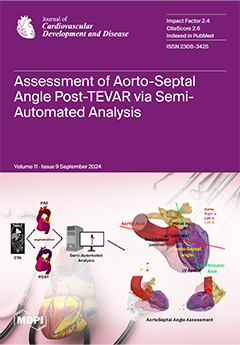
Cover Story: This study aimed to investigate cardiac and arterial remodeling before and after thoracic endovascular aortic repair (TEVAR) by measuring the Aorto-Septal Angle (AoSA) and the geometric characteristics of the aorta. Five patients were included, with pre- and post-operative cardio CTA scans used to create patient-specific 3D models. A novel, reproducible method for AoSA measurement was introduced, using the models to perform a semi-automated analysis. The results showed significant variations in AoSA and aortic geometry, suggesting thoracic stent deployment alters AoSA, potentially impacting long-term left ventricle hemodynamics. View this paper
  • Issues are regarded as officially published after their release is announced to the table of contents alert mailing list .
  • You may sign up for email alerts to receive table of contents of newly released issues.
  • PDF is the official format for papers published in both, html and pdf forms. To view the papers in pdf format, click on the "PDF Full-text" link, and use the free Adobe Reader to open them.

Articles (42)

  • Article
  • Open Access
2 Citations
5,799 Views
9 Pages

Addition of Bempedoic Acid to Statin–Ezetimibe versus Statin Titration in Patients with High Cardiovascular Risk: A Single-Centre Prospective Study

  • Giuseppe Marazzi,
  • Giuseppe Caminiti,
  • Marco Alfonso Perrone,
  • Giuseppe Campolongo,
  • Luca Cacciotti,
  • Domenico Mario Giamundo,
  • Ferdinando Iellamo,
  • Paolo Severino,
  • Maurizio Volterrani and
  • Giuseppe Rosano

Reducing levels of low-density lipoprotein cholesterol (LDL-C) below recommended thresholds is a core component of cardiovascular prevention strategies. We hypothesized that the addition of bempedoic acid to patients already on statin–ezetimibe thera...

  • Article
  • Open Access
1 Citations
2,266 Views
10 Pages

Effect of Sport Activity on Uncomplicated Bicuspid Aortic Valve: Long-Term Longitudinal Echocardiographic Study

  • Massimiliano Bianco,
  • Fabrizio Sollazzo,
  • Gloria Modica,
  • Isabella Carlotta Zovatto,
  • Rachele Di Mario,
  • Riccardo Monti,
  • Michela Cammarano,
  • Vincenzo Palmieri and
  • Paolo Zeppilli

Background: The bicuspid aortic valve (BAV) is a congenital heart defect that can lead to certain complications (aortic stenosis, regurgitation, dilatation and endocarditis), the diagnosis and clinical monitoring of which are effectively entrusted to...

  • Article
  • Open Access
1,600 Views
11 Pages

The Effect of Upright Posture on Left Atrial Strain in Competitive Athletes

  • Joscha Kandels,
  • Stephan Stöbe,
  • Robert Percy Marshall,
  • Andreas Hagendorff and
  • Michael Metze

Background: Left atrial strain (LAS) assessment by speckle tracking echocardiography (STE) has been shown to be a remarkable means of quantifying LA function as an early marker of LV pathology. As exercise testing is also performed on a treadmill, th...

  • Article
  • Open Access
2 Citations
3,335 Views
11 Pages

Comparison of ECMO, IABP and ECMO + IABP in the Postoperative Period in Patients with Postcardiotomy Shock

  • Cagdas Baran,
  • Evren Ozcinar,
  • Ahmet Kayan,
  • Nur Dikmen,
  • Canan Soykan Baran and
  • Mustafa Bahadir Inan

Background: This study aims to assess the outcomes and complications of patients who received veno-arterial extracorporeal membrane oxygenation (VA-ECMO) and intra-aortic balloon pump (IABP) support after cardiac surgery at Ankara University Heart Ce...

  • Editorial
  • Open Access
1,133 Views
3 Pages

Arrhythmic risk stratification is challenging for cardiologists managing patients with different forms of cardiomyopathy, ranging from post-ischemic or non-ischemic cardiomyopathies to systemic diseases with cardiac involvement such as neuromuscular...

  • Article
  • Open Access
1,528 Views
10 Pages

Novel Computed Tomography Angiography Parameter Is Associated with Low Cardiac Index in Patients with Chronic Thromboembolic Pulmonary Hypertension: A Retrospective Analysis

  • Estefania Oliveros,
  • Michel Ibrahim,
  • Carlos Manuel Romero,
  • Paul Navo,
  • Patricia Otero Valdes,
  • Yevgeniy Brailovsky,
  • Amir Darki,
  • Riyaz Bashir,
  • Anjali Vaidya and
  • Paul Forfia
  • + 1 author

Chronic thromboembolic pulmonary hypertension (CTEPH) is a complication of incomplete resolution of acute pulmonary embolism. We hypothesize changes in CT Hounsfield Unit gradient (HU-Δ) created by the dispersion of IV contrast through the down...

  • Article
  • Open Access
2 Citations
3,399 Views
12 Pages

Regular and long-term shift work is associated with a number of chronic diseases. There is some evidence that shift work also has an influence on the autonomous nervous system. Studies that have examined the effect of shift work on heart rate variabi...

  • Article
  • Open Access
2,714 Views
13 Pages

Background: Resistant hypertension (HTN) is associated with a high risk of cardiovascular complications. Our study aimed to assess the prevalence, characteristics, and treatment of patients with resistant HTN. Methods: We screened 4340 consecutive ca...

  • Article
  • Open Access
5 Citations
1,716 Views
12 Pages

Diagnosing congenital heart disease (CHD) remains challenging because of its complex morphology. Representing the intricate structures of CHD on conventional two-dimensional flat screens is difficult owing to wide variations in the pathologies. Techn...

  • Article
  • Open Access
4 Citations
2,370 Views
19 Pages

The Role of P Wave Parameters in Predicting Pulmonary Vein Isolation Outcomes for Paroxysmal Atrial Fibrillation: An Observational Cohort Study

  • Ibrahim Antoun,
  • Xin Li,
  • Ahmed I. Kotb,
  • Zakkariya Vali,
  • Ahmed Abdelrazik,
  • Abdulmalik Koya,
  • Akash Mavilakandy,
  • Ivelin Koev,
  • Ali Nizam and
  • Hany Eldeeb
  • + 2 authors

Background: Pulmonary vein isolation (PVI) is an effective management method for paroxysmal atrial fibrillation (PAF). The P wave in the 12-lead electrocardiogram (ECG) represents atrial depolarisation. This study aims to utilise the P wave to predic...

of 5

Get Alerted

Add your email address to receive forthcoming issues of this journal.

XFacebookLinkedIn
J. Cardiovasc. Dev. Dis. - ISSN 2308-3425