
Nutritional Interventions in Older Persons with Type 2 Diabetes and Frailty: A Scoping Systematic Review

 , , ,
, , ,
Abstract
1. Introduction
2. Materials and Methods
2.1. Eligibility Criteria
2.2. Information Sources and Search
2.3. Selection of Sources of Evidence and Data Charting Process
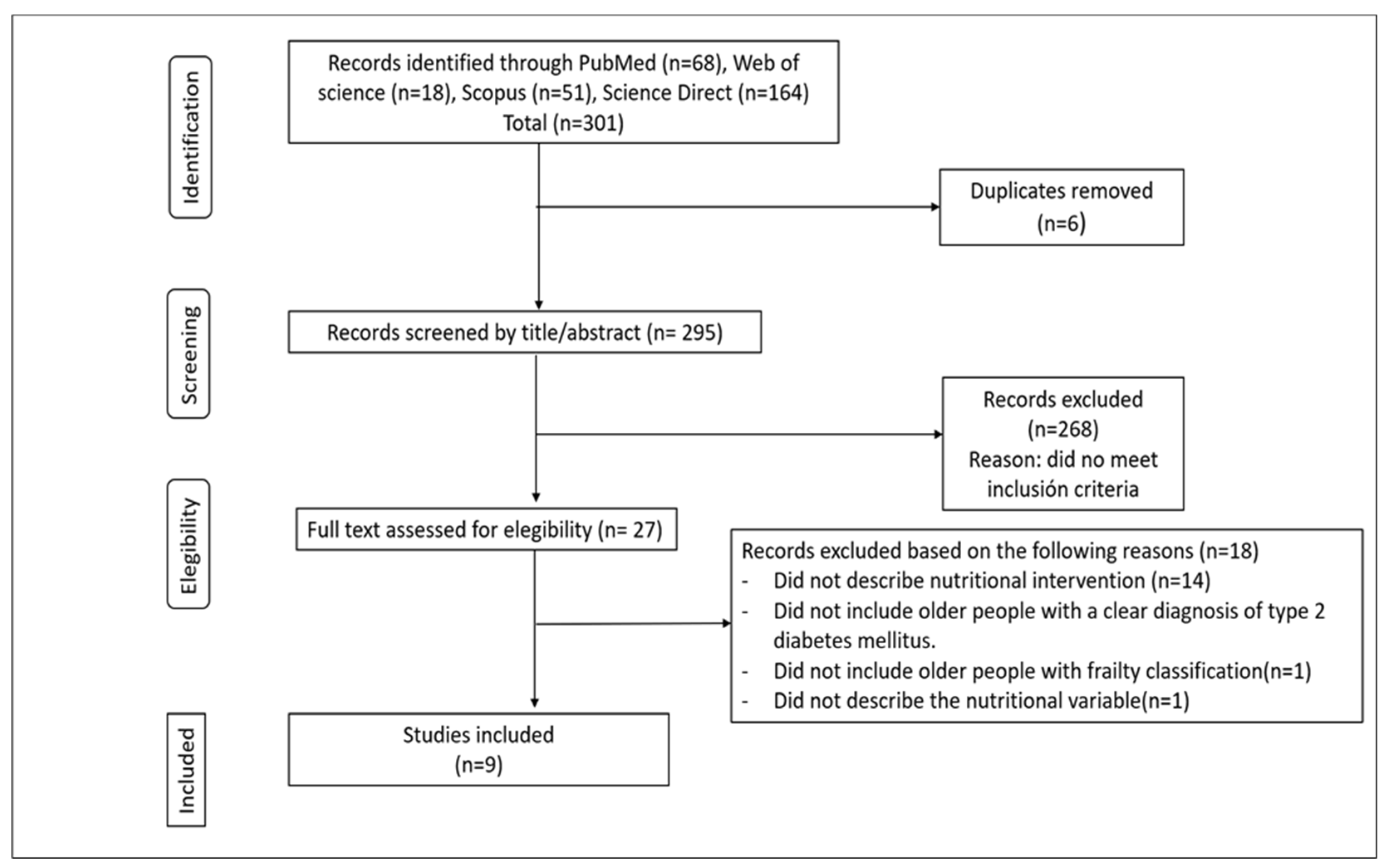
2.4. Literature Research Results
3. Results
3.1. Characteristics of the Studies Included in the Review
3.2. Outcome Variables
- Functional changes based on nutritional and multicomponent interventions.
- T2DM control goals
- Frailty associated with diet
- Cost-effectiveness
4. Discussion
5. Conclusions
Strengths and Limitations
Supplementary Materials
Author Contributions
Funding
Institutional Review Board Statement
Informed Consent Statement
Data Availability Statement
Conflicts of Interest
References
- Sinclair, A.J.; Abdelhafiz, A.; Dunning, T.; Izquierdo, M.; Rodríguez Mañas, L.; Bourdel-Marchasson, I.; Morley, J.E.; Munshi, M.; Woo, J.; Vellas, B. An International Position Statement on the Management of Frailty in Diabetes Mellitus: Summary of Recommendations 2017. J. Frailty Aging 2018, 7, 10–20. [Google Scholar] [CrossRef]
- The Emerging Risk Factors Collaboration. Association of Cardiometabolic Multimorbidity With Mortality. JAMA 2015, 314, 52–60. [Google Scholar] [CrossRef] [PubMed]
- Sinclair, A.; Dunnig, T.; Rodríguez-Mañas, L. Diabetes in older people: New insights and remaining challenges. Lancet Diabetes Endocrinol. 2015, 3, 275–360. [Google Scholar] [CrossRef] [PubMed]
- Ferriolli, E.; Pessanha, F.P.A.; Marchesi, J.C. Diabetes and exercise in the elderly. Med. Sport. Sci. 2014, 60, 122–131. [Google Scholar] [CrossRef] [PubMed]
- Yanase, T.; Yanagita, I.; Muta, K.; Nawata, H. Frailty in elderly diabetes patients. Endocr. J. 2018, 65, 1–11. [Google Scholar] [CrossRef]
- Goisser, S.; Guyonnet, S.; Volkert, D. The Role of Nutrition in Frailty: An Overview. J. Frailty Aging 2016, 5, 74–81. [Google Scholar] [CrossRef]
- El Assar, M.; Laosa, O.; Mañas, L.R. Diabetes and frailty. Curr. Opin. Clin. Nutr. Metab. Care 2019, 22, 52–57. [Google Scholar] [CrossRef]
- Campos de Sousa, M.; Sousa Malaquias, B.S.; Ribeiro Chavaglia, S.R.; Barduchi Ohl, R.I.; Silva de Paula, F.F.; Santos da Silva, K.; Santos, Á.d.S. Self-efficacy in elderly with type 2 Diabetes Mellitus. Rev. Bras. Enferm. 2020, 73 (Suppl. 3), e20180980. [Google Scholar] [CrossRef]
- Bellary, S.; Kyrou, I.; Brown, J.E.; Bailey, C.J. Type 2 diabetes mellitus in older adults: Clinical considerations and management. Nat. Rev. Endocrinol. 2021, 17, 534–548. [Google Scholar] [CrossRef]
- Noale, M.; Limongi, F.; Maggi, S. Epidemiology of Cardiovascular Diseases in the Elderly. Adv. Exp. Med. Biol. 2020, 1216, 29–38. [Google Scholar] [CrossRef]
- Selvin, E.; Marinopoulos, S.; Berkenblit, G.; Rami, T.; Brancati, F.; Powe, N.; Golden, S.H. Meta-analysis: Glycosylated hemoglobin and cardiovascular disease in diabetes mellitus. Ann. Intern. Med. 2004, 141, 421–452. [Google Scholar] [CrossRef] [PubMed]
- Clegg, A.; Hassan-Smith, Z. Frailty and the endocrine system. Lancet Diabetes Endocrinol. 2018, 6, 743–752. [Google Scholar] [CrossRef] [PubMed]
- The Action to Control Cardiovascular Risk in Diabetes Study Group. Effects of intensive glucose lowering in type 2 diabetes. N. Engl. J. Med. 2008, 24, 2545–2604. [Google Scholar] [CrossRef]
- Munshi, M.N.; Maguchi, M.; Segal, A.R. Treatment of type 2 diabetes in the elderly. Curr. Diab Rep. 2012, 12, 239–284. [Google Scholar] [CrossRef]
- American Diabetes Association Professional Practice Committee. Older Adults: Standards of Medical Care in Diabetes-2022. Diabetes Care, 2022; 45, (Suppl. 1), S195–S207. [Google Scholar] [CrossRef]
- Cruz-Jentoft, A.J.; Kiesswetter, E.; Drey, M.; Sieber, C. Nutrition, frailty, and sarcopenia. Aging Clin. Exp. Res. 2017, 29, 43–48. [Google Scholar] [CrossRef]
- Munshi, M.N.; Meneilly, G.S.; Rodríguez-Mañas, L.; Close, K.L.; Conlin, P.R.; Cukierman-Yaffe, T.; Forbes, A.; Ganda, O.P.; Kahn, C.R.; Huang, E.; et al. Diabetes in ageing: Pathways for developing the evidence base for clinical guidance. Lancet Diabetes Endocrinol. 2020, 8, 855–867. [Google Scholar] [CrossRef]
- Izzo, A.; Massimino, E.; Riccardi, G.; Della Pepa, G. A Narrative Review on Sarcopenia in Type 2 Diabetes Mellitus: Prevalence and Associated Factors. Nutrients 2021, 13, 183. [Google Scholar] [CrossRef]
- Tamura, Y.; Omura, T.; Toyoshima, K.; Araki, A. Nutrition Management in Older Adults with Diabetes: A Review on the Importance of Shifting Prevention Strategies from Metabolic Syndrome to Frailty. Nutrients 2020, 12, 3367. [Google Scholar] [CrossRef]
- Nishikawa, H.; Fukunishi, S.; Asai, A.; Yokohama, K.; Ohama, H.; Nishiguchi, S.; Higuchi, K. Sarcopenia, frailty and type 2 diabetes mellitus (Review). Mol. Med. Rep. 2021, 24, 854. [Google Scholar] [CrossRef]
- Strain, W.D.; Hope, S.V.; Green, A.; Kar, P.; Valabhji, J.; Sinclair, A.J. Type 2 diabetes mellitus in older people: A brief statement of key principles of modern day management including the assessment of frailty. A national collaborative stakeholder initiative. Diabet. Med. 2018, 35, 838–845. [Google Scholar] [CrossRef]
- Collard, R.M.; Boter, H.; Schoevers, R.A.; Oude Voshaar, R.C. Prevalence of frailty in community-dwelling older persons: A systematic review. J. Am. Geriatr. Soc. 2012, 60, 1487–1492. [Google Scholar] [CrossRef] [PubMed]
- Rydwik, E.; Frändin, K.; Akner, G. Effects of a physical training and nutritional intervention program in frail elderly people regarding habitual physical activity level and activities of daily living—A randomized controlled pilot study. Arch. Gerontol. Geriatr. 2010, 51, 283–292. [Google Scholar] [CrossRef] [PubMed]
- Schilp, J.; Kruizenga, H.; Wijnhoven, H.; van Binsbergen, J.; Visser, M. Effects of a dietetic treatment in older, undernourished, community-dwelling individuals in primary care: A randomized controlled trial. Eur. J. Nutr. 2013, 52, 1939–1987. [Google Scholar] [CrossRef]
- Haider, S.; Dorner, T.E.; Luger, E.; Kapan, A.; Titze, S.; Lackinger, C.; Schindler, K.E. Impact of a Home-Based Physical and Nutritional Intervention Program Conducted by Lay-Volunteers on Handgrip Strength in Prefrail and Frail Older Adults: A Randomized Control Trial. PLoS ONE 2017, 12, e0169613. [Google Scholar] [CrossRef]
- Ng, T.P.; Feng, L.; Nyunt, M.S.; Feng, L.; Niti, M.; Tan, B.; Chan, G.; Khoo, S.A.; Chan, S.M.; Yap, P.; et al. Nutritional, physical, cognitive, and combination interventions and frailty reversal among older adults: A randomized controlled trial. Am. J. Med. 2015, 128, 1225–1236. [Google Scholar] [CrossRef]
- Abizanda, P.; López, M.D.; García Pérez, V.; Estrella, J.d.D.; da Silva González, Á.; Vilardell, N.; Torres, K.A. Effects of an Oral Nutritional Supplementation Plus Physical Exercise Intervention on the Physical Function, Nutritional Status, and Quality of Life in Frail Institutionalized Older Adults: The ACTIVNES Study. J. Am. Med. Dir. Assoc. 2015, 16, e9–e439. [Google Scholar] [CrossRef]
- Arksey, H.; O’Malley, L. Scoping studies: Towards a methodological framework. Int. J. Soc. Res. Methodol. 2005, 8, 19–32. [Google Scholar] [CrossRef]
- Tricco, A.C.; Lillie, E.; Zarin, W.; O’Brien, K.K.; Colquhoun, H.; Levac, D.; Moher, D.; Peters, M.D.J.; Horsley, T.; Weeks, L.; et al. PRISMA Extension for Scoping Reviews (PRISMA-ScR): Checklist and Explanation. Ann. Intern. Med. 2018, 169, 467–473. [Google Scholar] [CrossRef] [PubMed]
- Munn, Z.; Peters, M.d.J.; Stern, C.; Tufanaru, C.; McArthur, A.; Aromataris, E. Systematic review or scoping review? Guidance for authors when choosing between a systematic or scoping review approach. BMC Med. Res. Methodol. 2018, 18, 143. [Google Scholar] [CrossRef]
- Peters, M.D.; Godfrey, C.M.; Khalil, H.; McInerney, P.; Parker, D.; Baldini Soares, C. Guidance for conducting systematic scoping reviews. Int. J. Evid. Based Healthc. 2015, 13, 141–147. [Google Scholar] [CrossRef]
- Davis, K.; Drey, N.; Gould, D. What are scoping studies? A review of the nursing literature. Int. J. Nurs. Stud. 2009, 46, 1386–1786. [Google Scholar] [CrossRef] [PubMed]
- Levac, D.; Colquhoun, H.; O’Brien, K.K. Scoping studies: Advancing the methodology. Implement. Sci. 2010, 5, 69. [Google Scholar] [CrossRef] [PubMed]
- Jiwani, R.; Wang, J.; Li, C.; Dennis, B.; Patel, D.; Gelfond, J.; Liu, Q.; Siddiqui, N.; Bess, C.; Monk, S.; et al. A Behavioral Lifestyle Intervention to Improve Frailty in Overweight or Obese Older Adults with Type 2 Diabetes: A Feasibility Study. J. Frailty Aging 2022, 11, 74–82. [Google Scholar] [CrossRef] [PubMed]
- Look AHEAD Research Group. The Association of Prior Intensive Lifestyle Intervention and Diabetes Support and Education With Frailty Prevalence at Long-Term Follow-Up in the Action for Health in Diabetes Extension Study. J. Gerontol. A Biol. Sci. Med. Sci. 2022, 77, 2040–2049. [Google Scholar] [CrossRef]
- Izquierdo, M.; Laosa, O.; Cadore, E.L.; Abizanda, P.; Garcia-Garcia, F.J.; Hornillos, M.; López-Pavón, I.; Sinclair, A.J.; Rodríguez-Mañas, L. Two-Year Follow-up of a Multimodal Intervention on Functional Capacity and Muscle Power in Frail Patients With Type 2 Diabetes. J. Am. Med. Dir. Assoc. 2021, 22, 1906–1911. [Google Scholar] [CrossRef]
- Peña-Longobardo, L.M.; Oliva-Moreno, J.; Zozaya, N.; Aranda-Reneo, I.; Trapero-Bertran, M.; Laosa, O.; Sinclair, A.; Rodríguez-Mañas, L. Economic evaluation of a multimodal intervention in pre-frail and frail older people with diabetes mellitus: The MID-FRAIL project. Expert Rev. Pharmacoecon. Outcomes Res. 2021, 21, 111–118. [Google Scholar] [CrossRef]
- Rodriguez-Mañas, L.; Laosa, O.; Vellas, B.; Paolisso, G.; Topinkova, E.; Oliva-Moreno, J.; Bourdel-Marchasson, I.; Izquierdo, M.; Hood, K.; Zeyfang, A.; et al. Effectiveness of a multimodal intervention in functionally impaired older people with type 2 diabetes mellitus. J. Cachexia Sarcopenia Muscle 2019, 10, 721–733. [Google Scholar] [CrossRef]
- Hayakawa, M.; Motokawa, K.; Mikami, Y.; Yamamoto, K.; Shirobe, M.; Edahiro, A.; Iwasaki, M.; Ohara, Y.; Watanabe, Y.; Kawai, H.; et al. Low Dietary Variety and Diabetes Mellitus Are Associated with Frailty among Community-Dwelling Older Japanese Adults: A Cross-Sectional Study. Nutrients 2021, 13, 641. [Google Scholar] [CrossRef]
- Nishimura, A.; Harashima, S.-I.; Hosoda, K.; Arai, H.; Inagaki, N. Sex-related differences in frailty factors in older persons with type 2 diabetes: A cross-sectional study. Ther. Adv. Endocrinol. Metab. 2019, 10, 16122. [Google Scholar] [CrossRef]
- Lopez-Garcia, E.; Hagan, K.A.; Fung, T.T.; Hu, F.B.; Rodríguez-Artalejo, F. Mediterranean diet and risk of frailty syndrome among women with type 2 diabetes. Am. J. Clin. Nutr. 2018, 107, 763–771. [Google Scholar] [CrossRef]
- Sanz-Cánovas, J.; López-Sampalo, A.; Cobos-Palacios, L.; Ricci, M.; Hernández-Negrín, H.; Mancebo-Sevilla, J.J.; Álvarez-Recio, E.; López-Carmona, M.D.; Pérez-Belmonte, L.M.; Gómez-Huelgas, R.; et al. Management of Type 2 Diabetes Mellitus in Elderly Patients with Frailty and/or Sarcopenia. Int. J. Environ. Res. Public. Health 2022, 19, 8677. [Google Scholar] [CrossRef] [PubMed]
- Morley, J.E.; Malmstrom, T.K.; Rodriguez-Mañas, L.; Sinclair, A.J. Frailty, sarcopenia and diabetes. J. Am. Med. Dir. Assoc. 2014, 15, 853–862. [Google Scholar] [CrossRef]
- Castro-Rodriguez, M.; Carnicero, J.A.; Garcia-Garcia, F.J.; Walter, S.; Morley, J.E.; Rodríguez-Artalejo, F.; Sinclair, A.J.; Rodríguez-Mañas, L. Frailty as a Major Factor in the Increased Risk of Death and Disability in Older People With Diabetes. J. Am. Med. Dir. Assoc. 2016, 17, 949–1004. [Google Scholar] [CrossRef]
- Sinclair, A.J.; Rodriguez-Mañas, L. Diabetes and Frailty: Two Converging Conditions? Can. J. Diabetes 2016, 40, 77–83. [Google Scholar] [CrossRef] [PubMed]
- Davis, C.; Bryan, J.; Hodgson, J.; Murphy, K. Definition of the Mediterranean Diet; a Literature Review. Nutrients 2015, 7, 9139–9153. [Google Scholar] [CrossRef] [PubMed]
- Institute of Medicine Committee on Military Nutrition Research. The Role of Protein and Amino Acids in Sustaining and Enhancing Performance; National Academies Press (US): Washington, DC, USA, 1999. Available online: https://www.ncbi.nlm.nih.gov/books/NBK224623/ (accessed on 5 June 2022).
- Granic, A.; Sayer, A.; Robinson, S. Dietary patterns, skeletal muscle health, and sarcopenia in older adults. Nutrients 2019, 11, 745. [Google Scholar] [CrossRef] [PubMed]
- Soysal, P.; Isik, A.T.; Carvalho, A.F.; Fernandes, B.; Solmi, M.; Schofield, P.; Veronese, N.; Stubbs, B. Oxidative stress and frailty: A systematic review and synthesis of the best evidence. Maturitas 2017, 99, 66–72. [Google Scholar] [CrossRef]
- Brunner, E.; Shipley, M.; Ahmadi-Abhari, S.; Valencia Hernandez, C.; Abell, J.; Singh-Manoux, A. Midlife contributors to socioeconomic differences in frailty during later life: A prospective cohort study. Lancet Public Health 2018, 3, e313–e322. [Google Scholar] [CrossRef]
- Santanasto, A.; Goodpaster, B.; Kritchevsky, S.; Miljkovic, I.; Satterfield, S.; Schwartz, A.; Cummings, S.R.; Boudreau, R.M.; Harris, T.B.; Newman, A.B. Body Composition Remodeling and Mortality: The Health Aging and Body Composition Study. J. Gerontol. A Biol. Sci. Med. Sci. 2017, 72, 513–519. [Google Scholar] [CrossRef]
- Ponti, F.; Santoro, A.; Mercatelli, D.; Gasperini, C.; Conte, M.; Martucci, M.; Sangiorgi, L.; Franceschi, C.; Bazzocchi, A. Aging and Imaging Assessment of Body Composition: From Fat to Facts. Front. Endocrinol. 2020, 10, 861. [Google Scholar] [CrossRef]


| Primary Author, Year | Country | Study Type |
|---|---|---|
| Jiwani, 2022 [34] | USA | Experimental |
| Look AHEAD Research Group, 2022 [35] | USA | |
| Izquierdo, 2021 [36] | Spain | |
| Peña, 2021 [37] | 7 European countries (Belgium, Czech Republic, United Kingdom, France, Germany, Italy, and Spain) | |
| Rodríguez, 2019 [38] | ||
| Hayakawa, 2021 [39] | Japan | Observational |
| Nishimura, 2019 [40] | Japan | |
| López, 2018 [41] | USA | |
| Sanz, 2022 [42] | Spain | Review |
| Study | Objective | Population/Scenario | Intervention or Recommended Measurement |
|---|---|---|---|
| Jiwani R, et al. (2022) [34] | To determine the feasibility of a behavioral lifestyle intervention with mobile health technology for self-monitoring of diet and physical activity to improve frailty in overweight/obese older adults. | Twenty community-dwelling overweight/obese older persons: self-reported T2DM diagnosis and frailty identified through five criteria (weight loss, exhaustion, low energy expenditure, grip strength, and gait). University of Texas Health Science Center at San Antonio (UTHSCSA) |
Behavioral intervention based on a lifestyle program enhanced with mobile health technology.
|
| Look AHEAD Research Group (2022) [35] | To compare the prevalence of the frailty phenotype among intervention groups in long-term follow-up | 5145 people with T2DM, body mass index (BMI) ≥ 25 kg/m2 (≥27 kg/m2 if using insulin) and diabetes T2DM | Intensive Lifestyle Intervention (ILI): Individual and group sessions were taught intensively for 1 year with weekly visits during the first 6 months, 3 times per month during the following 6 months, and less intensively with monthly visits from years 2 to 4. During years 2 to 4, individual appointments were held at least once per month, and additional contact was made by phone, mail, or e-mail. From year 5 on, at least 2 visits were conducted per year, as well as annual campaigns to promote adherence. The personalized intervention for weight loss included self-monitoring of dietary intake together with behavioral strategies for portion control and other eating behaviors. Education on increasing physical activity and instruction of at least 175 min of moderately intensive physical activity were conducted per week. Group sessions on topics related to physical activity covered methods for exercising safely and the benefits of exercise. Diabetes Support and Education (DSE): This involved group classes on diet, exercise, and social support offered 3 times per year during years 1 to 4, which decreased to annual group classes thereafter. |
| Izquierdo, et al. (2021) [36] | To analyze the effects of a program composed of resistance training and nutritional interventions on functional capacity, maximal strength, and muscle power in frail persons with type 2 diabetes. | 52 participants with T2DM, frail or prefrail as identified by Fried’s phenotype. “MIDPOW” sub-study was conducted in 5 geriatric services in public hospitals in Spain. | Nutritional and educational program:
|
| Peña-Longobardo, et al. (2021) [37] | To estimate the incremental cost-utility ratio (ICUR) of a multi-modal intervention in frail and pre-frail patients aged ≥ 70 years with T2DM compared to the usual care group focused on quality-adjusted life years (QALY) in European countries. | Older people with T2DM for at least 2 years and with frailty criteria. Countries: Belgium, Czech Republic, Italy, Germany, France, United Kingdom and Spain. Economic evaluation of the MID FRAIL Study | Multicomponent intervention
|
| Rodríguez-Mañas, et al. (2019) [36] | To evaluate the efficacy of the multi-modal intervention in the functional performance of older persons over 70 years of age with T2DM and pre-frailty or frailty stage. MID FRAIL Study | Over 70 years old, with T2DM, and classified as pre-frail or frail. In the hospital and at primary care sites in 7 European countries (Belgium, Czech Republic, United Kingdom, France, Germany, Italy and Spain) | Intensive control group:
Defined as the level of routine care that an older participant with T2DM would expect to receive from their health care system, including their primary care physician. |
| Hayakawa, et al. (2021) [39] | To establish the relationship between a poorly varied diet in elderly patients with diabetes and the presence of frailty. Takashimadaira Study and Otassha Study | ≥70 years old, 2 years of follow-up 2016–2018 annual health checkup since 2011, ages between 65 and 84 years Assessment of diabetes mellitus: Self-reporting and database review. Assessment of frailty: Performed by trained researchers, the J-CHS Scale was derived from operationalizing the Fried phenotype. Difference reference points for grip strength H: 28 kg/force and M < 18 kg/force and gait speed under 1 mt/sec. | Assessment of varied diet score: Dietary variety (DVS) questionnaire includes 10 food categories: meat, seafood, eggs, soy products, milk, green and yellow vegetables, seaweed, potatoes, fruit, and fats and oils. For each category, a score of 1 is allocated if the participants’ answers are “eats almost every day” and a score of 0 for all the remaining answers. The total score ranges from 0 to 10. Scores of 0 to 4 are defined as high variety (low scores), and scores > 5 are low variety (high scores). |
| Akiko Nishimura, et al. (2019) [40] | Describe the sex-related differences in diabetes-specific factors underlying the development of frailty in older persons with T2DM. | Older persons, 60 to 80 years old, with T2DM and no limitation in basic care activities (ADL) Frailty. Frailty was evaluated using the Kihon Checklist (KCL). | Demographic characteristics: Age, sex, academic background, family structure, work status, irregular lifestyle (irregular bedtimes or irregular eating habits), drinking habits, and smoking habits were obtained from medical records and a general questionnaire. Body compositions: Bioelectric impedance methods. Diabetes-related factors: Treatment of diabetes, complications, and blood test results were obtained from medical records. Hypoglycemia was confirmed by reviewing the self-monitored blood glucose levels or hypoglycemia episodes during the last 3 months. Hypoglycemia was defined as a blood glucose level of ≤70 mg/dL. Diabetes self-management performance was measured using the Summary of Diabetes Self-Care Activities (SDSCA) measure. The higher the subscale mean score, the higher the level of self-care practice. |
| López García, et al. (2018) [41] | To assess whether a Mediterranean diet is associated with a lower risk of frailty among diabetic women. | Women > 60 years old with T2DM Prospective cohort study Nurses’ Health Study (NHS) Frailty assessment: FRAIL scale (fatigue, low resistance, low aerobic capacity, having several Illnesses, and loss of weight during the previous year). Self-reported scale and data adapted from previous surveys. | Dietary assessment: Food frequency questionnaires (FFQ) were distributed to participants in 1990, 1994, 1998, 2000, 2006, and 2010. Adherence to a Mediterranean diet was derived from information obtained via the FFQ using alternative scoring. For the Mediterranean diet score (aMED), the cumulative average of the scores of all available questionnaires from the T2DM diagnosis through the end of follow-up was used. Physical activity: Reported as the average time spent per week during the previous year in specific activities (outdoor walking, jogging, and cycling). The time spent on each activity was multiplied by the typical energy expenditure, expressed in metabolic equivalents, and then added for all activities. |
| Sanz-Cánovas J. (2022) [42] | To review the therapeutic aspects of T2DM in elderly patients with frailty and/or sarcopenia. | People over 75 years old with T2DM and frailty. | Sarcopenia and frailty in diabetic people: Frailty is proposed as a related but independent entity in the evolution of diabetes. High levels of cytokines like TNFα, IL-1, IL-5, or IL-6, present in a diabetic patient, induce insulin resistance and mitochondrial dysfunction that alter lipid peroxidation, increasing lipids in muscle cells, which favors the development of frailty and sarcopenia. Glucose monitoring goals in frailty: Glucose monitoring goals for patients of advanced age must be adapted to their functional status, cognitive state, co-morbidities, and life expectancy. It is important to maintain low glycemic variability, not just protect them from hyper- or hypoglycemia. HbA1c of 7.5–8.5%, fasting glucose levels for light to moderate frailty 90–100 mg/dL and 150–180 mg/dL for severe frailty. Non-pharmacological management: Exercise: Resistance and aerobic exercises prevent and treat the decrease in strength and muscle mass in the elderly. Resistance training positively affects the neuromuscular system and increases hormone concentrations and the rate of protein synthesis. Multiple types of physical exercise have been studied. Warm-up of 5 min and 3 min of cool-down. Depending on the patient’s initial physical state, low-intensity walking is recommended, and if not possible, riding a stationary bike. Other exercises can include squats, knee bends, hip extensions, or flexion. For patients with a severe physical disability, exercises such as knee extension, ankle circles, arm lifting, chair pushing (tricep extension), a tennis ball can be squeezed, the neck turned while sitting, or making leg circles. Diet: A plan tailored according to nutritional status, level of physical activity, illness status, and tolerance in general recommends an energy intake of 30 kcal/kg of body weight/day for aging. A protein intake of 1.0 to 1.2 g/kg of body weight per day is needed to maintain and restore muscle mass and function in patients over 65 years old. Maintain normal levels of vitamin D. The Mediterranean diet is highly recommended. |
Disclaimer/Publisher’s Note: The statements, opinions and data contained in all publications are solely those of the individual author(s) and contributor(s) and not of MDPI and/or the editor(s). MDPI and/or the editor(s) disclaim responsibility for any injury to people or property resulting from any ideas, methods, instructions or products referred to in the content. |
© 2024 by the authors. Licensee MDPI, Basel, Switzerland. This article is an open access article distributed under the terms and conditions of the Creative Commons Attribution (CC BY) license (https://creativecommons.org/licenses/by/4.0/).
Share and Cite
Giraldo Gonzalez, G.C.; González Robledo, L.M.; Jaimes Montaña, I.C.; Benjumea Salgado, A.M.; Pico Fonseca, S.M.; Arismendi Solano, M.J.; Valencia Rico, C.L. Nutritional Interventions in Older Persons with Type 2 Diabetes and Frailty: A Scoping Systematic Review. J. Cardiovasc. Dev. Dis. 2024, 11, 289. https://doi.org/10.3390/jcdd11090289
Giraldo Gonzalez GC, González Robledo LM, Jaimes Montaña IC, Benjumea Salgado AM, Pico Fonseca SM, Arismendi Solano MJ, Valencia Rico CL. Nutritional Interventions in Older Persons with Type 2 Diabetes and Frailty: A Scoping Systematic Review. Journal of Cardiovascular Development and Disease. 2024; 11(9):289. https://doi.org/10.3390/jcdd11090289
Chicago/Turabian StyleGiraldo Gonzalez, German C., Luz M. González Robledo, Isabel C. Jaimes Montaña, Angela M. Benjumea Salgado, Sayda M. Pico Fonseca, Martha J. Arismendi Solano, and Claudia L. Valencia Rico. 2024. "Nutritional Interventions in Older Persons with Type 2 Diabetes and Frailty: A Scoping Systematic Review" Journal of Cardiovascular Development and Disease 11, no. 9: 289. https://doi.org/10.3390/jcdd11090289
APA StyleGiraldo Gonzalez, G. C., González Robledo, L. M., Jaimes Montaña, I. C., Benjumea Salgado, A. M., Pico Fonseca, S. M., Arismendi Solano, M. J., & Valencia Rico, C. L. (2024). Nutritional Interventions in Older Persons with Type 2 Diabetes and Frailty: A Scoping Systematic Review. Journal of Cardiovascular Development and Disease, 11(9), 289. https://doi.org/10.3390/jcdd11090289