
Validation of the Electrophilic Allergen Screening Assay for Detection of Key Event 1 of the Skin Sensitization Adverse Outcome Pathway

 ,
,  , , ,
, , ,  , , ,
, , ,
Abstract
1. Introduction
2. Materials and Methods
2.1. Principle of the EASA
2.2. General Conduct of the EASA
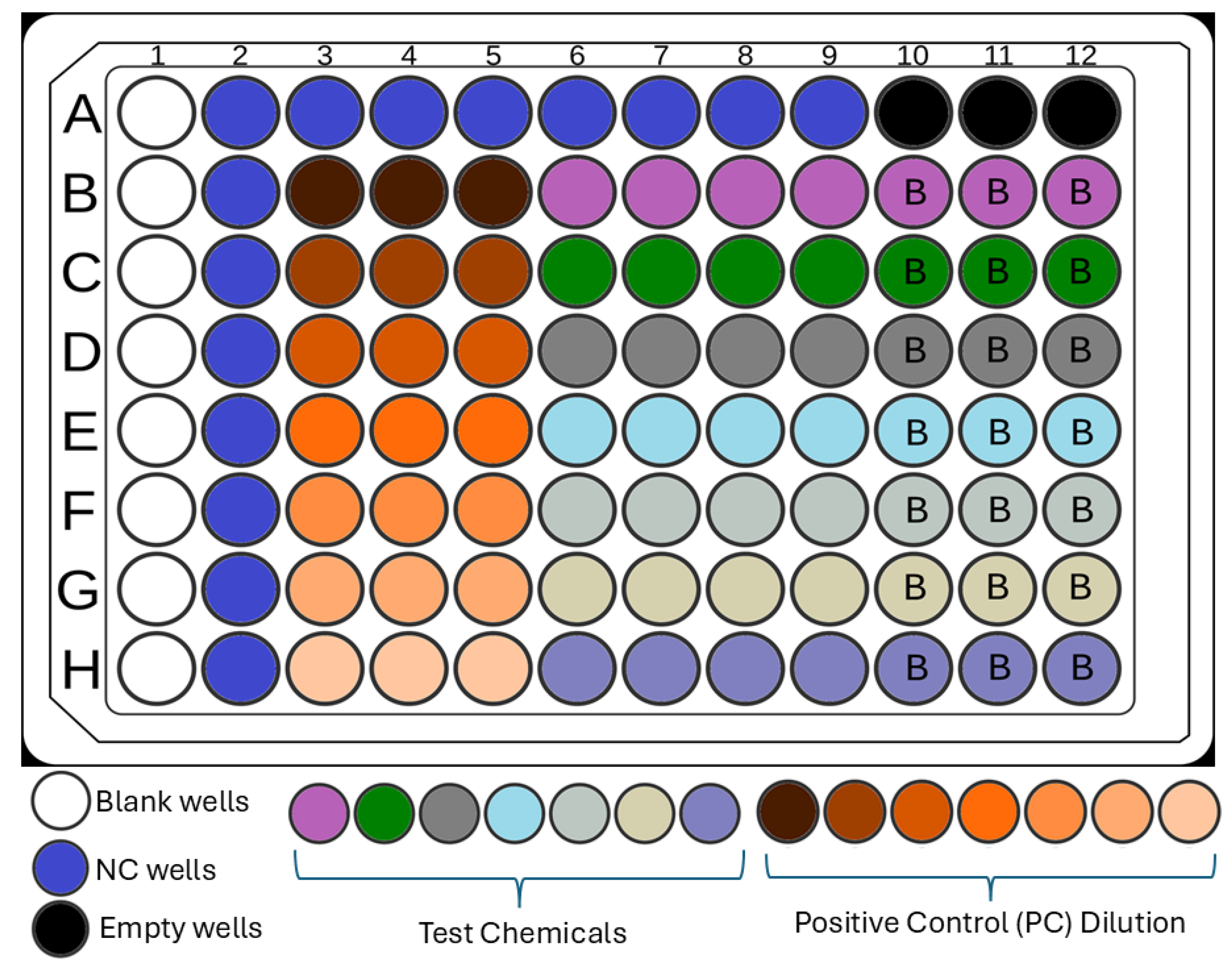
- ACN (40 µL) was added to appropriate Blank wells.
- ACN (40 µL) was added to appropriate NC wells.
- Benzyl bromide stock solution in ACN (40 µL) was added to appropriate PC wells in Row B followed by a 1:2 serial dilution in each row down to Row H.
- Test chemical stock solution (40 µL) was added to appropriate test chemical and test chemical blank wells (Columns 6–10 omitting Row A).
- SS (160 µL) was added to wells without added test chemicals or the PC (all rows of Column 1, and Rows B through H of Columns 10, 11, and 12).
- At this point, a red light was turned on, and standard lab lights were turned off.
- Immediately after starting the reaction timer, 160 µL NBT working solution was added to wells in Columns 2–9. The plate was sealed when all wells were filled.
2.3. Chemicals Tested
2.4. Study Plan
2.5. Data Management
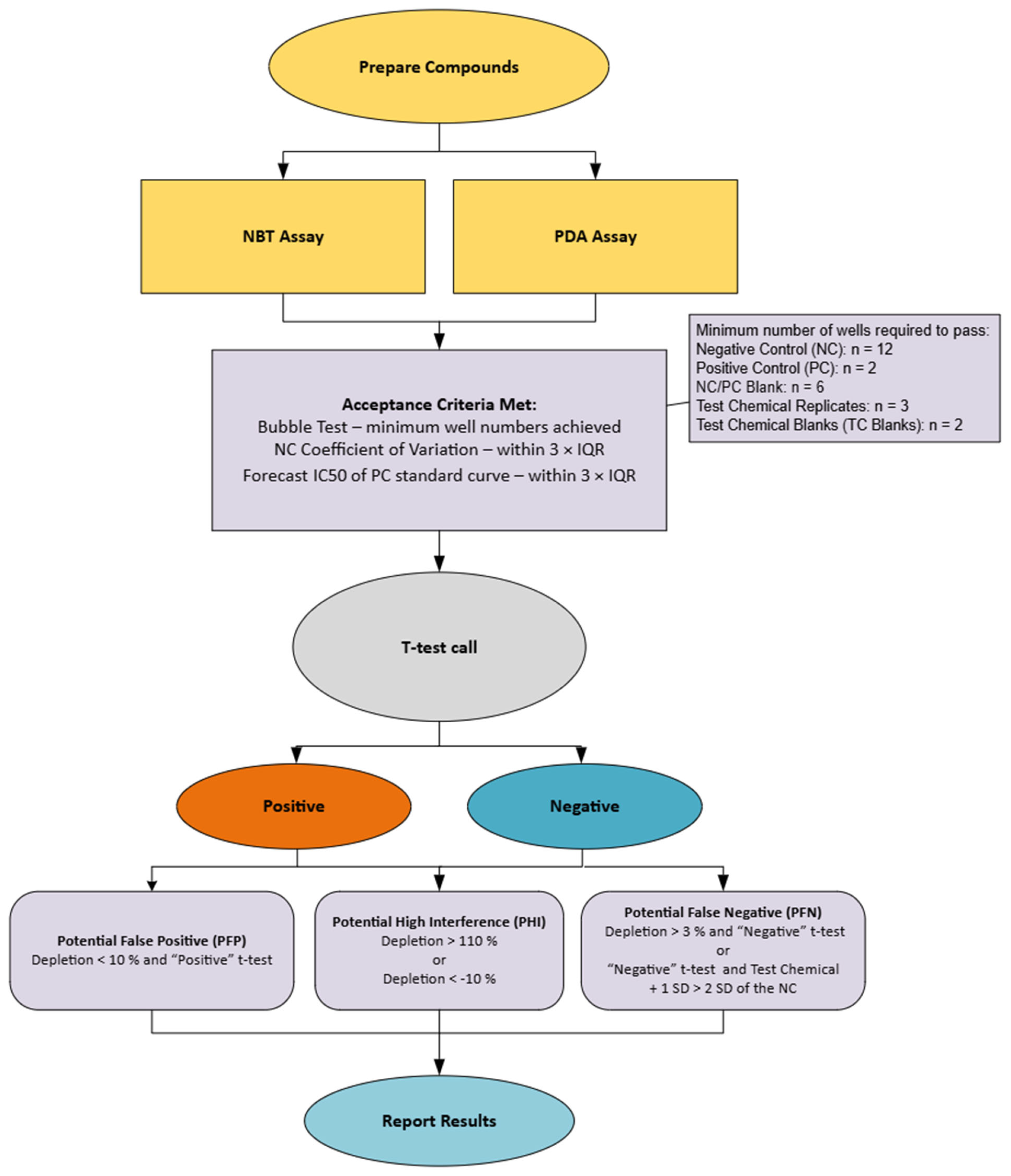
2.6. Acceptance Criteria
3. Results
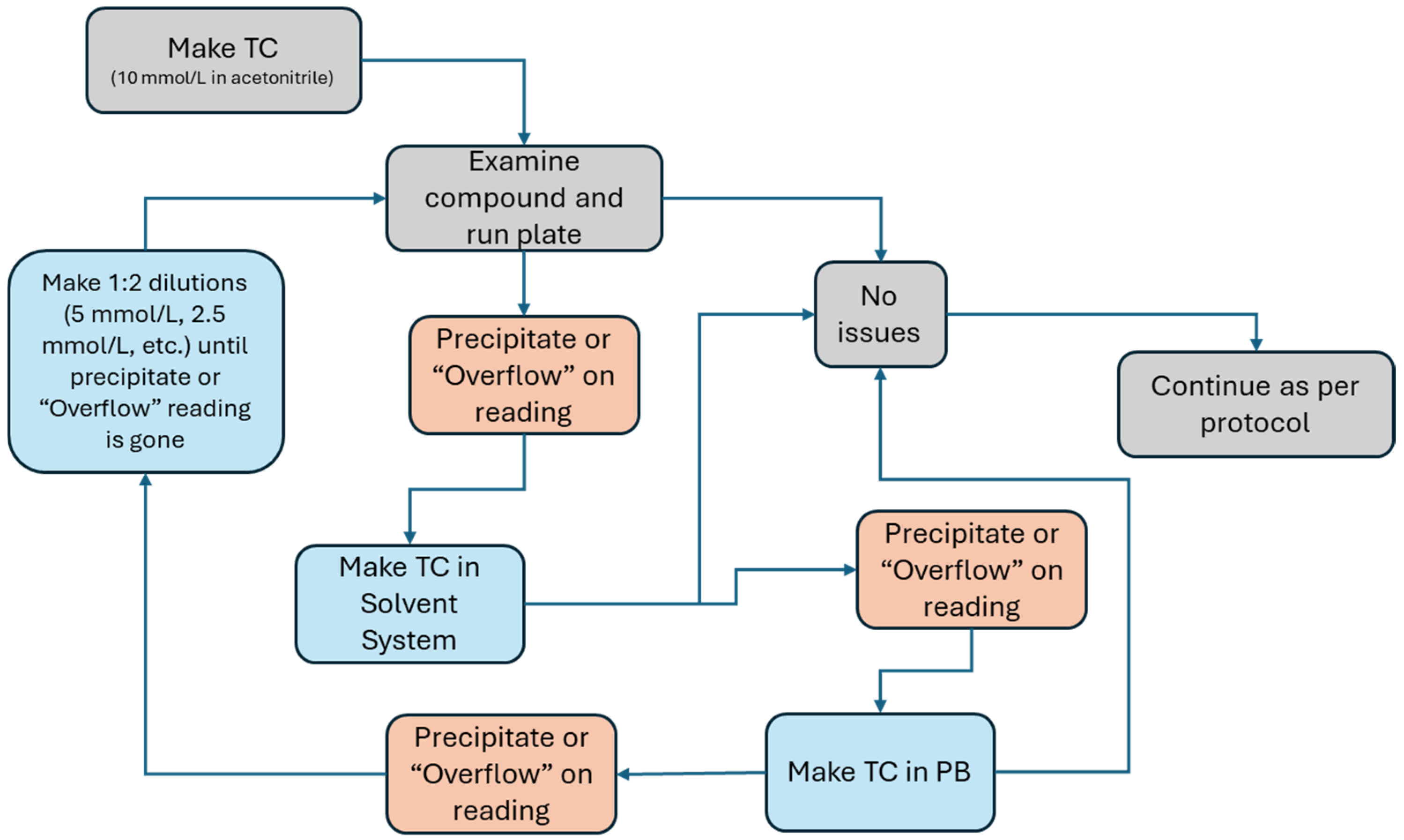
3.1. General Issues Encountered During the Conduct of the Assay
3.2. Transferability Assessment
3.3. Within-Laboratory Reproducibility
3.3.1. Laboratory 1
3.3.2. Laboratory 2
3.3.3. Laboratory 3
3.3.4. Laboratory 4
3.4. Between-Laboratory Reproducibility
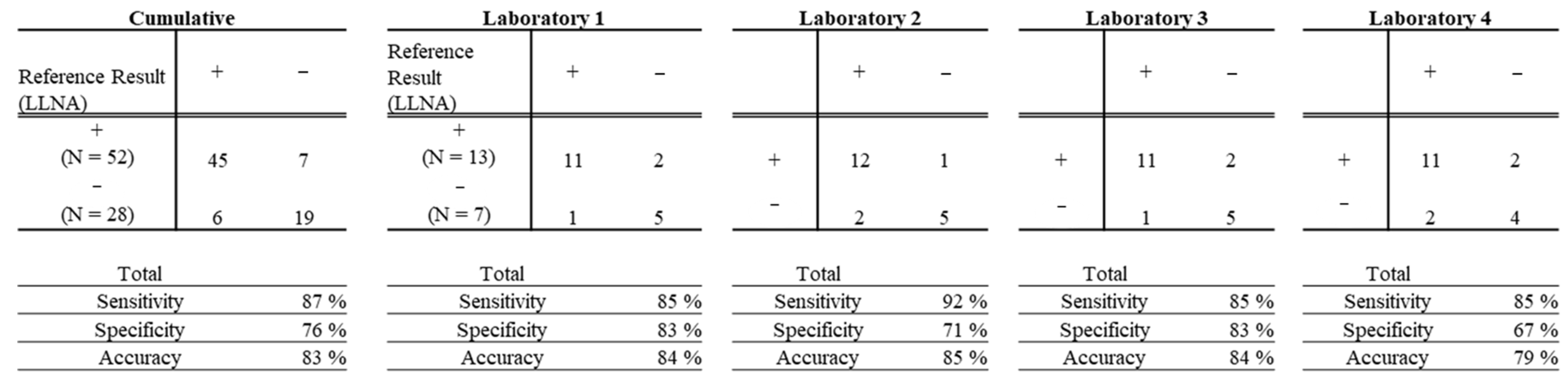
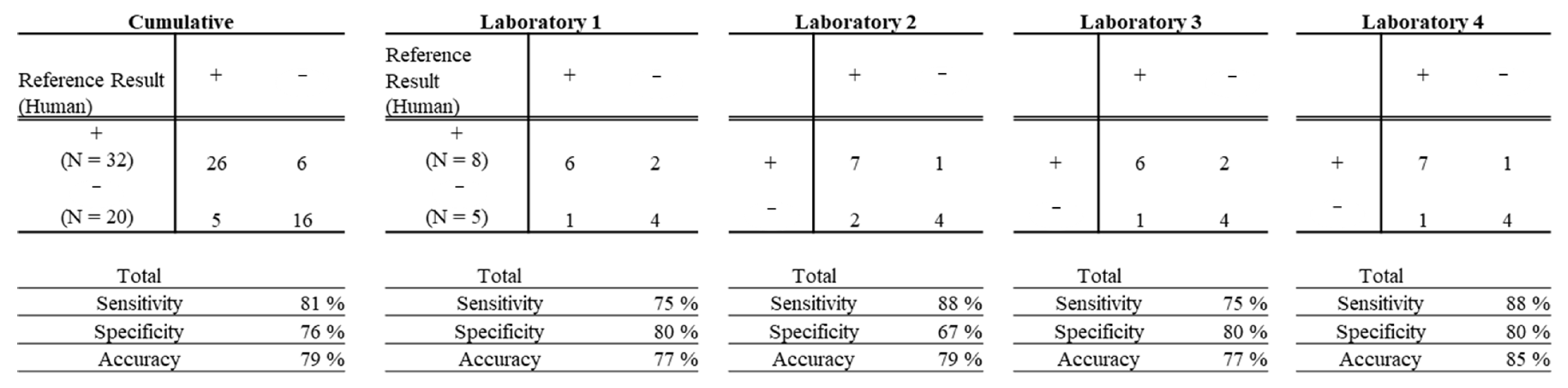
3.5. Predictive Capacity Results
4. Discussion
4.1. Predictive Capacity
4.2. Statistical Testing in EASA
4.3. Limitations
4.4. Lessons Learned
5. Conclusions
Supplementary Materials
Author Contributions
Funding
Institutional Review Board Statement
Informed Consent Statement
Data Availability Statement
Acknowledgments
Conflicts of Interest
Abbreviations
| ACN | Acetonitrile |
| ADRA | Amino acid derivative reactivity assay |
| BLR | Between-laboratory reproducibility |
| COV | Coefficient of variation |
| CPSC | U.S. Consumer Product Safety Commission |
| DPRA | Direct peptide reactivity assay |
| EASA | Electrophilic allergen screening assay |
| EPA | U.S. Environmental Protection Agency |
| FN | False negative |
| FP | False positive |
| IC50 | Half-maximal inhibitory concentration |
| Inc | Inconclusive |
| KE | Key event |
| Lab. | Laboratory |
| LLNA | Murine local lymph node assay |
| N/A | Data not available |
| NBT | 4-Nitrobenzenethiol |
| NC | Negative control |
| Neg | Negative |
| NICEATM | National Toxicology Program (NTP) Interagency Center for the Evaluation of Alternative Toxicological Methods |
| NIST | National Institute of Standards and Technology |
| NTP | National Toxicology Program |
| OECD | Organisation for Economic Co-operation and Development |
| PC | Positive control |
| PDA | Pyridoxylamine hydrochloride |
| Pos | Positive |
| QC | Quality control |
| QT | Qualified test |
| SS | Solvent system |
| SOP | Standard operating procedure |
| TC | Test chemical |
| TG | Test Guideline |
| TN | True negative |
| TP | True positive |
| WLR | Within-laboratory reproducibility |
References
- Alinaghi, F.; Bennike, N.H.; Egeberg, A.; Thyssen, J.P.; Johansen, J.D. Prevalence of contact allergy in the general population: A systematic review and meta-analysis. Contact Dermat. 2019, 80, 77–85. [Google Scholar] [CrossRef] [Scilit] [PubMed]
- Olusegun, O.A.; Martincigh, B.S. Allergic contact dermatitis: A significant environmental and occupational skin disease. Int. J. Dermatol. 2021, 60, 1082–1091. [Google Scholar] [CrossRef] [Scilit] [PubMed]
- Daniel, A.B.; Strickland, J.; Allen, D.; Casati, S.; Zuang, V.; Barroso, J.; Whelan, M.; Régimbald-Krnel, M.J.; Kojima, H.; Nishikawa, A.; et al. International regulatory requirements for skin sensitization testing. Regul. Toxicol. Pharmacol. 2018, 95, 52–65. [Google Scholar] [CrossRef] [Scilit] [PubMed]
- OECD. Test No. 429: Skin Sensitisation; Organisation for Economic Co-Operation and Development: Paris, France, 2010; Available online: https://www.oecd.org/en/publications/test-no-429-skin-sensitisation_9789264071100-en.html (accessed on 4 June 2025).
- OECD. OECD guideline for the testing of chemicals. In Skin Sensitisation. Guinea Pig Maximization Test; Organisation for Economic Co-Operation and Development: Paris, France, 2022. [Google Scholar]
- European Union. Regulation (EC) No 1223/2009 of the European Parliament and of the Council of 30 November 2009 on Cosmetic Products (Recast) (Text with EEA Relevance); European Union: Brussels, Belgium, 2009. [Google Scholar]
- European Union. Regulation (EC) No 1907/2006 of the European Parliament and of the Council of 18 December 2006 Concerning the Registration, Evaluation, Authorisation and Restriction of Chemicals (REACH), Establishing a European Chemicals Agency, Amending Directive 1999/45/EC and Repealing Council Regulation (EEC) No 793/93 and Commission Regulation (EC) No 1488/94 as Well as Council Directive 76/769/EEC and Commission Directives 91/155/EEC, 93/67/EEC, 93/105/EC and 2000/21/EC; European Union: Brussels, Belgium, 2006. [Google Scholar]
- U.S. Environmental Protection Agency. Frank R. Lautenberg Chemical Safety for the 21st Century Act; U.S. Environmental Protection Agency: Washington, DC, USA, 2016. [Google Scholar]
- OECD. The Adverse Outcome Pathway for Skin Sensitisation Initiated by Covalent Binding to Proteins; Organisation for Economic Co-Operation and Development: Paris, France, 2014. [Google Scholar]
- Chipinda, I.; Mbiya, W.; Adigun, R.A.; Morakinyo, M.K.; Law, B.F.; Simoyi, R.H.; Siegel, P.D. Pyridoxylamine reactivity kinetics as an amine based nucleophile for screening electrophilic dermal sensitizers. Toxicology 2014, 315, 102–109. [Google Scholar] [CrossRef] [Scilit] [PubMed]
- Chipinda, I.; Ajibola, R.O.; Morakinyo, M.K.; Ruwona, T.B.; Simoyi, R.H.; Siegel, P.D. Rapid and simple kinetics screening assay for electrophilic dermal sensitizers using nitrobenzenethiol. Chem. Res. Toxicol. 2010, 23, 918–925. [Google Scholar] [CrossRef] [Scilit] [PubMed]
- Petersen, E.J.; Uhl, R.; Toman, B.; Elliott, J.T.; Strickland, J.; Truax, J.; Gordon, J. Development of a 96-Well Electrophilic Allergen Screening Assay for Skin Sensitization Using a Measurement Science Approach. Toxics 2022, 10, 257. [Google Scholar] [CrossRef] [Scilit] [PubMed]
- Lopachin, R.M.; Gavin, T.; Decaprio, A.; Barber, D.S. Application of the Hard and Soft, Acids and Bases (HSAB) theory to toxicant--target interactions. Chem. Res. Toxicol. 2012, 25, 239–251. [Google Scholar] [CrossRef] [Scilit] [PubMed]
- OECD. OECD guideline for the testing of chemicals. In Chemico Skin Sensitisation: Assays Addressing the Adverse Outcome Pathway Key Event on Covalent Binding to Proteins; Organisation for Economic Co-Operation and Development: Paris, France, 2025. [Google Scholar]
- OECD. OECD Performance Standards for the Assessment of Proposed Similar or Modified In Vitro Skin Sensitisation DPRA and ADRA Test Methods; Organisation for Economic Co-Operation and Development: Paris, France, 2019. [Google Scholar]
- OECD. OECD Performance Standards for the Assessment of Proposed Similar or Modified In Vitro Skin Sensitisation DPRA and ADRA Test Methods; Organisation for Economic Co-Operation and Development: Paris, France, 2022. [Google Scholar]
- Reinke, E.; Strickland, J.; Truax, J.; Allen, D.; Germolec, D.; Kleinstreuer, N. Report on the Validation of the Electrophilic Allergen Screening Assay (EASA) for the Identification of Potential Skin Sensitizers; National Toxicology Program: Research Triangle Park, NC, USA, 2025. [Google Scholar] [CrossRef] [Scilit]
- OECD. Supporting Document to the OECD Guideline 497 on Defined Approaches for Skin Sensitisation; Organisation for Economic Co-Operation and Development: Paris, France, 2025. [Google Scholar]
- EURL ECVAM. Direct Peptide Reactivity Assay (DPRA) ECVAM Validation Study Report. 2012. Available online: https://tsar.jrc.ec.europa.eu/test-method/tm2009-06 (accessed on 1 July 2025).
- Strickland, J.; Abedini, J.; Allen, D.R.G.; Gordon, J.; Hull, V.; Kleinstreuer, N.C.; Ko, H.-S.; Matheson, J.; Thierse, H.-J.; Truax, J.; et al. A database of human predictive patch test data for skin sensitization. Arch. Toxicol. 2023, 97, 2825–2837. [Google Scholar] [CrossRef] [Scilit] [PubMed]
- OECD. OECD Guideline for the testing of chemicals. In Defined Approaches on Skin Sensitisation; Organisation for Economic Co-Operation and Development: Paris, France, 2025. [Google Scholar]
- EPA. Interim Science Policy: Use of Alternative Approaches for Skin Sensitization as a Replacement for Laboratory Animal Testing (Draft for Public Comment); U.S. Environmental Protection Agency: Washington, DC, USA, 2018. [Google Scholar]
- Petersen, E.J.; Elliott, J.T.; Gordon, J.; Kleinstreuer, N.C.; Reinke, E.; Roesslein, M.; Toman, B. Technical framework for enabling high-quality measurements in new approach methodologies (NAMs). ALTEX 2022, 40, 174. [Google Scholar] [CrossRef] [Scilit] [PubMed]
- United Nations (Ed.) Globally Harmonized System of Classification and Labelling of Chemicals (GHS); United Nations: New York, NY, USA; Geneva, Switzerland, 2023. [Google Scholar]





| Chemical Name | CAS No. | LLNA EC3 (%) | In Vivo Prediction | DPRA Results | ADRA Results | Study Phase |
|---|---|---|---|---|---|---|
| Lauryl gallate | 1166-52-5 | 0.3 | Strong sensitizer | Pos | Pos | WLR/BLR |
| Chloramine trihydrate | 127-65-1 | 0.4 | Strong sensitizer | Pos | Pos | WLR/BLR |
| 4-(Methylamino) phenol, hemisulfate | 55-55-0 | 0.8 | Strong sensitizer | Pos | Pos | WLR/BLR |
| 2-Mercaptobenzothiazole | 149-30-4 | 1.7 | Moderate sensitizer | Pos | Pos | WLR/BLR |
| Benzyl salicylate | 118-58-1 | 2.9 | Moderate sensitizer | Pos/Neg | Neg | WLR/BLR |
| Cinnamaldehyde | 14371-10-9 (104-55-2) | 3 | Moderate sensitizer | Pos | Pos | WLR/BLR |
| Imidazolidinyl urea | 39236-46-9 | 24 | Moderate sensitizer | Pos | Pos | WLR/BLR |
| Ethyl acrylate | 140-88-5 | 28 | Weak sensitizer | Pos | Pos | WLR/BLR |
| Salicylic acid | 69-72-7 | - | Nonsensitizer | Pos/Neg | Neg | WLR/BLR |
| Benzyl alcohol | 100-51-6 | - | Nonsensitizer | Pos/Neg | Neg | WLR/BLR |
| Glycerol | 56-81-5 | - | Nonsensitizer | Neg | Neg | WLR/BLR |
| Isopropanol | 67-63-0 | - | Nonsensitizer | Neg | Neg | WLR/BLR |
| p-Benzoquinone | 106-51-4 | 0.0099 | Extreme sensitizer | Pos | Pos | BLR |
| Dihydroeugenol | 2785-87-7 | 6.8 | Moderate sensitizer | Pos/Neg | Pos/Neg | BLR |
| Palmitoyl chloride | 112-67-4 | 8.8 | Moderate sensitizer | Pos | Pos | BLR |
| Farnesal | 19317-11-4 (502-67-0) | 12 | Weak sensitizer | Pos | Pos | BLR |
| Benzyl cinnamate | 103-41-3 | 18 | Weak sensitizer | Neg | Neg | BLR |
| Dimethyl isophthalate | 1459-93-4 | - | Nonsensitizer | Neg | Neg | BLR |
| Methyl salicylate | 119-36-8 | - | Nonsensitizer | Pos/Neg | Neg | BLR |
| 4-Aminobenzoic acid | 150-13-0 | - | Nonsensitizer | Neg | Neg | BLR |
| Chemical Name | In Vivo Prediction | EASA Result Laboratory 1 | EASA Result Laboratory 2 | EASA Result Laboratory 3 | EASA Result Laboratory 4 | EASA Result Consensus |
|---|---|---|---|---|---|---|
| Lauryl gallate | Strong sensitizer | Pos | Pos | Pos | Pos | Pos |
| Chloramine trihydrate | Strong sensitizer | Pos | Pos | Pos | Pos | Pos |
| 4-(Methylamino) phenol, hemisulfate | Strong sensitizer | Pos | Pos | Pos | Pos | Pos |
| 2-Mercaptobenzothiazole | Moderate sensitizer | Pos | Pos | Pos | Pos | Pos |
| Benzyl salicylate | Moderate sensitizer | Pos | Pos | Pos | Pos | Pos |
| Cinnamaldehyde | Moderate sensitizer | Pos | Pos | Pos | Pos | Pos |
| Imidazolidinyl urea | Moderate sensitizer | Pos | Pos | Pos | Pos | Pos |
| Ethyl acrylate | Weak sensitizer | Neg | Neg | Neg | Neg | Neg |
| Salicylic acid | Nonsensitizer | Inc | Neg | Inc | Inc | Inc |
| Benzyl alcohol | Nonsensitizer | Neg | Pos | Neg | Pos | Inc |
| Glycerol | Nonsensitizer | Neg | Neg | Neg | Neg | Neg |
| Isopropanol | Nonsensitizer | Neg | Neg | Neg | Neg | Neg |
| Chemical Name | In Vivo Prediction (LLNA) | EASA Lab. 1 | EASA Lab. 2 | EASA Lab. 3 | EASA Lab. 4 | EASA Consensus | Human Ref. | DPRA Ref. | ADRA Ref. |
|---|---|---|---|---|---|---|---|---|---|
| Lauryl gallate | Strong sensitizer | Pos | Pos | Pos | Pos | Pos | Pos 1 | Pos | Pos |
| Chloramine trihydrate | Strong sensitizer | Pos | Pos | Pos | Pos | Pos | N/A | Pos | Pos |
| 4-(Methylamino) phenol, hemisulfate | Strong sensitizer | Pos | Pos | Pos | Pos | Pos | Pos 1 | Pos | Pos |
| 2-Mercaptobenzothiazole | Moderate sensitizer | Pos | Pos | Pos | Pos | Pos | Pos 2 | Pos | Pos |
| Benzyl salicylate | Moderate sensitizer | Pos | Pos | Pos | Pos | Pos | Pos/ Neg 3 | Pos/ Neg | Neg |
| Cinnamaldehyde | Moderate sensitizer | Pos | Pos | Pos | Pos | Pos | Pos 2 | Pos | Pos |
| Imidazolidinyl urea | Moderate sensitizer | Pos | Pos | Pos | Pos | Pos | Pos 2 | Pos | Pos |
| Ethyl acrylate | Weak sensitizer | Neg | Neg | Neg | Neg | Neg | Pos 2 | Pos | Pos |
| Salicylic acid | Nonsensitizer | Inc | Neg | Inc | Inc | Inc | Neg 3 | Pos/ Neg | Neg |
| Benzyl alcohol | Nonsensitizer | Neg | Pos | Neg | Pos | Inc | Pos 3 | Pos/ Neg | Neg |
| Glycerol | Nonsensitizer | Neg | Neg | Neg | Neg | Neg | Neg 3 | Neg | Neg |
| Isopropanol | Nonsensitizer | Neg | Neg | Neg | Neg | Neg | Neg 1 | Neg | Neg |
| p-Benzoquinone | Extreme sensitizer | Pos | Pos | Pos | Pos | Pos | N/A | Pos | Pos |
| Dihydroeugenol | Moderate sensitizer | Neg | Pos | Neg | Neg | Neg | Neg 3 | Pos/ Neg | Pos/ Neg |
| Palmitoyl chloride | Moderate sensitizer | Pos | Pos | Pos | Pos | Pos | N/A | Pos | Pos |
| Farnesal | Weak sensitizer | Pos | Pos | Pos | Pos | Pos | N/A | Pos | Pos |
| Benzyl cinnamate | Weak sensitizer | Pos | Pos | Pos | Pos | Pos | Pos 1 | Neg | Neg |
| Dimethyl isophthalate | Nonsensitizer | Neg | Neg | Neg | Neg | Neg | N/A | Neg | Neg |
| Methyl salicylate | Nonsensitizer | Pos | Pos | Pos | Pos | Pos | Neg 3 | Pos/ Neg | Neg |
| 4-Aminobenzoic acid | Nonsensitizer | Neg | Neg | Neg | Neg | Neg | Neg 3 | Neg | Neg |
| Test Chemical | Mechanism † | EASA | LLNA | DPRA | ADRA | Potency † |
|---|---|---|---|---|---|---|
| p-Benzoquinone | Michael acceptor | Pos | Pos | Pos | Pos | Extreme |
| Lauryl gallate | Pre-hapten Michael acceptor | Pos | Pos | Pos | Pos | Strong |
| Chloramine trihydrate | Acylation | Pos | Pos | Pos | Pos | Strong |
| 4-(Methylamino) phenol, hemisulfate | Pre-hapten Michael acceptor | Pos | Pos | Pos | Pos | Strong |
| 2-Mercaptobenzothiazole | SN2, acylation | Pos | Pos | Pos | Pos | Moderate |
| Benzyl salicylate | SN2, acylation | Pos | Pos | Pos/Neg | Neg | Moderate |
| Cinnamaldehyde * | Michael acceptor | Pos | Pos | Pos | Pos | Moderate |
| Imidazolidinyl urea | Acylation | Pos | Pos | Pos | Pos | Moderate |
| Dihydroeugenol * | Pro-hapten, SN2, Michael acceptor | Pos/Neg | Pos | Pos/Neg | Pos/Neg | Moderate |
| Palmitoyl chloride | Acylation | Pos | Pos | Pos | Pos | Moderate |
| Ethyl acrylate | Michael acceptor | Neg | Pos | Pos | Pos | Weak |
| Farnesal | Schiff base | Pos | Pos | Pos | Pos | Weak |
| Benzyl cinnamate | SN2, Acylation | Pos | Pos | Neg | Neg | Weak |
| Salicylic acid | Non-reactive | Neg/Inc | Neg | Pos/Neg | Neg | Nonsensitizer |
| Benzyl alcohol * | Non-reactive | Pos/Neg | Neg | Pos/Neg | Neg | Nonsensitizer |
| Glycerol | Non-reactive | Neg | Neg | Neg | Neg | Nonsensitizer |
| Isopropanol | Non-reactive | Neg | Neg | Neg | Neg | Nonsensitizer |
| Dimethyl isophthalate | Non-reactive | Neg | Neg | Neg | Neg | Nonsensitizer |
| Methyl salicylate | Non-reactive | Pos | Neg | Pos/Neg | Neg | Nonsensitizer |
| 4-Aminobenzoic acid | Non-reactive | Neg | Neg | Neg | Neg | Nonsensitizer |
Disclaimer/Publisher’s Note: The statements, opinions and data contained in all publications are solely those of the individual author(s) and contributor(s) and not of MDPI and/or the editor(s). MDPI and/or the editor(s) disclaim responsibility for any injury to people or property resulting from any ideas, methods, instructions or products referred to in the content. |
© 2026 by the authors. Licensee MDPI, Basel, Switzerland. This article is an open access article distributed under the terms and conditions of the Creative Commons Attribution (CC BY) license.
Share and Cite
Reinke, E.N.; Petersen, E.J.; Gordon, J.D.; Uhl, R.; Adams, V.H.; Rua, D.; Johnson, V.J.; Burleson, G.R.; Strickland, J.; Gutierrez, R.; et al. Validation of the Electrophilic Allergen Screening Assay for Detection of Key Event 1 of the Skin Sensitization Adverse Outcome Pathway. Toxics 2026, 14, 511. https://doi.org/10.3390/toxics14060511
Reinke EN, Petersen EJ, Gordon JD, Uhl R, Adams VH, Rua D, Johnson VJ, Burleson GR, Strickland J, Gutierrez R, et al. Validation of the Electrophilic Allergen Screening Assay for Detection of Key Event 1 of the Skin Sensitization Adverse Outcome Pathway. Toxics. 2026; 14(6):511. https://doi.org/10.3390/toxics14060511
Chicago/Turabian StyleReinke, Emily N., Elijah J. Petersen, John D. Gordon, Rick Uhl, Valerie H. Adams, Diego Rua, Victor J. Johnson, Gary R. Burleson, Judy Strickland, Robert Gutierrez, and et al. 2026. "Validation of the Electrophilic Allergen Screening Assay for Detection of Key Event 1 of the Skin Sensitization Adverse Outcome Pathway" Toxics 14, no. 6: 511. https://doi.org/10.3390/toxics14060511
APA StyleReinke, E. N., Petersen, E. J., Gordon, J. D., Uhl, R., Adams, V. H., Rua, D., Johnson, V. J., Burleson, G. R., Strickland, J., Gutierrez, R., Sprankle, C. S., LaPratt, T., Lehmann, D. M., Germolec, D. R., & Kleinstreuer, N. C. (2026). Validation of the Electrophilic Allergen Screening Assay for Detection of Key Event 1 of the Skin Sensitization Adverse Outcome Pathway. Toxics, 14(6), 511. https://doi.org/10.3390/toxics14060511