This is an early access version, the complete PDF, HTML, and XML versions will be available soon.
Article

Comparative Analysis of Structurally Diverse PFAS-Induced Injury in Vascular Endothelial Cells and Characterization of Necroptosis-Related Cell Death Signaling

by
Sayori Ichijo
,
Toshiyuki Kaji
and
Tomoya Fujie
*
Laboratory of Environmental Health, Faculty of Pharmaceutical Sciences, Tokyo University of Science, 6-3-1 Niijuku, Katsushika-ku, Tokyo 125-8585, Japan
*
Author to whom correspondence should be addressed.
Toxics 2026, 14(6), 510; https://doi.org/10.3390/toxics14060510

Submission received: 1 May 2026 / Revised: 9 June 2026 / Accepted: 10 June 2026 / Published: 11 June 2026

Abstract

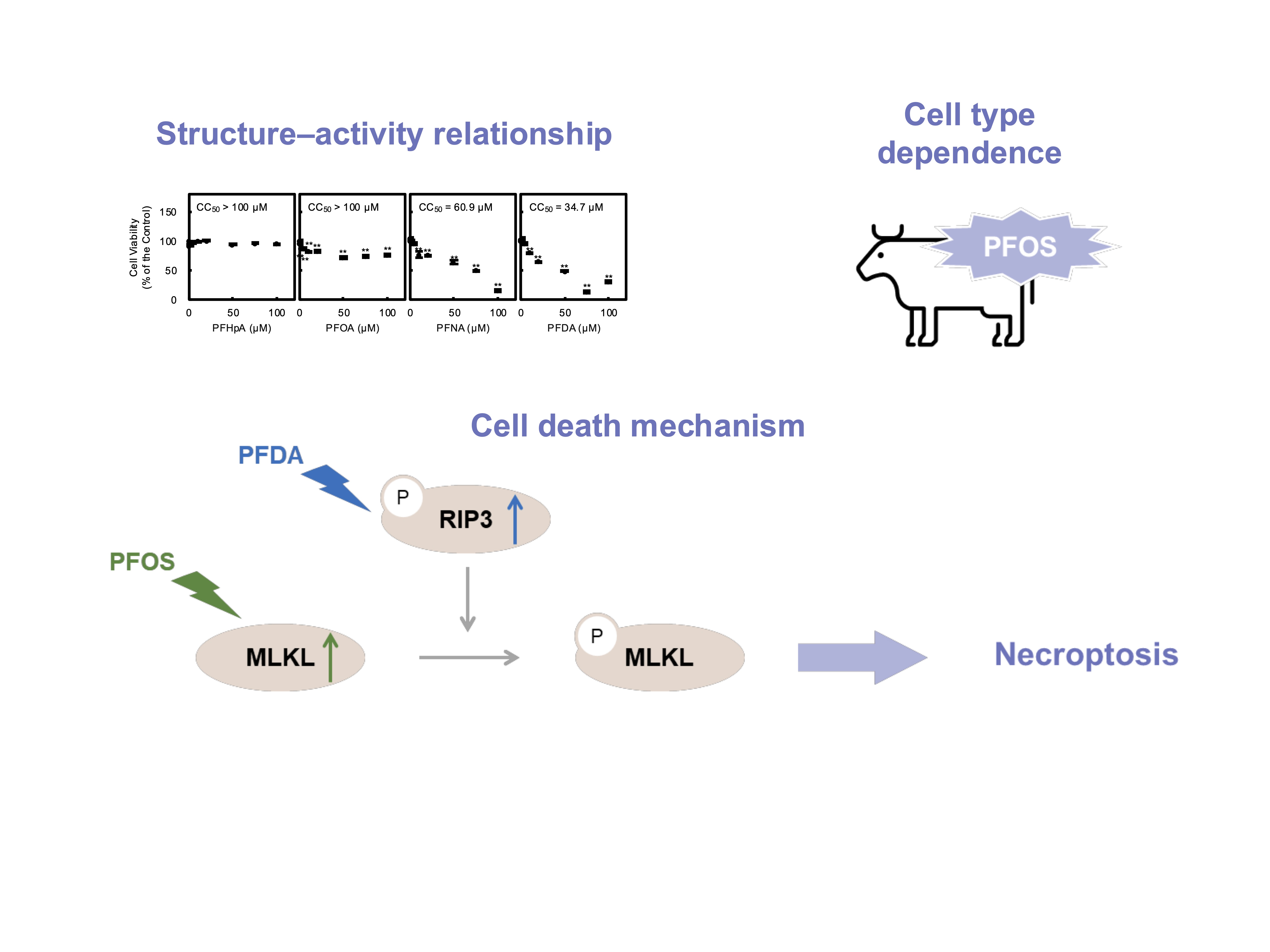
Perfluoroalkyl and polyfluoroalkyl substances (PFAS) are persistent environmental contaminants associated with cardiovascular diseases; however, the mechanisms underlying PFAS-induced vascular endothelial injury remain incompletely understood. In this study, we systematically evaluated the effects of 15 PFAS on endothelial morphology and cell viability with different carbon-chain lengths and functional groups in cultured bovine aortic endothelial cells. Morphological observations and MTT assays revealed that perfluorononanoic acid, perfluorodecanoic acid (PFDA), and perfluorooctane sulfonate (PFOS) markedly reduced cell viability, with estimated concentrations producing a 50% reduction in viability of 60.9, 34.7, and 87.3 µM, respectively, whereas the other tested PFAS did not reduce viability by 50% at concentrations up to 100 µM in bovine aortic endothelial cells. Among the perfluoroalkyl carboxylic acids, the reduction in cell viability increased with increasing carbon-chain length. Among perfluoroalkyl sulfonates, PFOS caused the greatest reduction in cell viability, whereas perfluorodecanesulfonate did not induce clear endothelial damage. Comparative analyses across multiple cell types showed that PFDA reduced cell viability broadly across all cell types examined, whereas PFOS caused a greater reduction in cell viability in bovine-derived cell types examined than in human- or porcine-derived cell types examined. Since PFDA and PFOS were the most cytotoxic compounds among perfluoroalkyl carboxylic acids and perfluoroalkyl sulfonates, respectively, in bovine aortic endothelial cells, they were selected to compare cell death signaling. In both PFOS- and PFDA-treated cells, the selected apoptosis- and pyroptosis-related markers were not altered under the tested conditions. PFDA was associated with increases in phosphorylated RIP3 and phosphorylated MLKL, whereas PFOS increased MLKL expression without detectable RIP3 activation. Inhibition experiments further suggested that necroptosis-related signaling contributes, in part, to PFOS- and PFDA-induced endothelial injury in vascular endothelial cells. These findings suggest that PFAS-induced vascular endothelial injury depends on molecular structure and cell type, and may involve distinct necroptosis-related signaling patterns. However, it should be noted that the PFAS concentrations used in this study were higher than those typically detected in environmental and human exposure settings.
Keywords: PFAS; PFOS; PFDA; vascular endothelial cell; cellular injury; structure–activity relationship; necroptosis PFAS; PFOS; PFDA; vascular endothelial cell; cellular injury; structure–activity relationship; necroptosis
Graphical Abstract