Article

Validation of the Epi2SensA Method Using the EpiDerm™ Model for Skin Sensitization Testing Under OECD TG442D
by
Christian Pellevoisin
1,2,*,
Hajime Kojima
3,4,
Sebastian Hoffmann
5,
Takao Ashikaga
4,
Timothy Landry
1,
Celina Romero
1,
Kalyani Guntur
1,
Mitchell Klausner
1,
Jennifer Stadnicki
1,
Helge Gehrke
6,
Robert Mills-Goodlet
6,
Niki Panousi
6,
Victor J. Johnson
7,
Gary R. Burleson
7,
Kazuto Narita
8,
Shigehiro Tachibana
8,
Kohichi Kojima
8,
Jan Markus
9 and
Alexander Armento
1
1
Mattek Corporation Now Part of Sartorius, Ashland, MA 01721, USA
2
Urbilateria, 37540 Tours, France
3
Department of Pharmaceutical Engineering, Faculty of Engineering, Sanyo-Onoda City University, Yamaguchi 756-0884, Japan
4
National Institute of Health Sciences, Kawasaki 201-0821, Japan
5
Seh Consulting + Services, 33106 Paderborn, Germany
6
Eurofins Medical Device Testing Munich GmbH, D-82152 Planegg, Germany
7
Burleson Research Technologies, Inc., Morrisville, NC 27560, USA
8
Food and Drug Safety Center, Hadano 729-5, Japan
9
Mattek In Vitro Life Science Laboratories, Now Part of Sartorius, 821 05 Bratislava, Slovakia
*
Author to whom correspondence should be addressed.
Toxics 2026, 14(4), 295; https://doi.org/10.3390/toxics14040295

Submission received: 3 February 2026 / Revised: 13 March 2026 / Accepted: 26 March 2026 / Published: 28 March 2026

Abstract

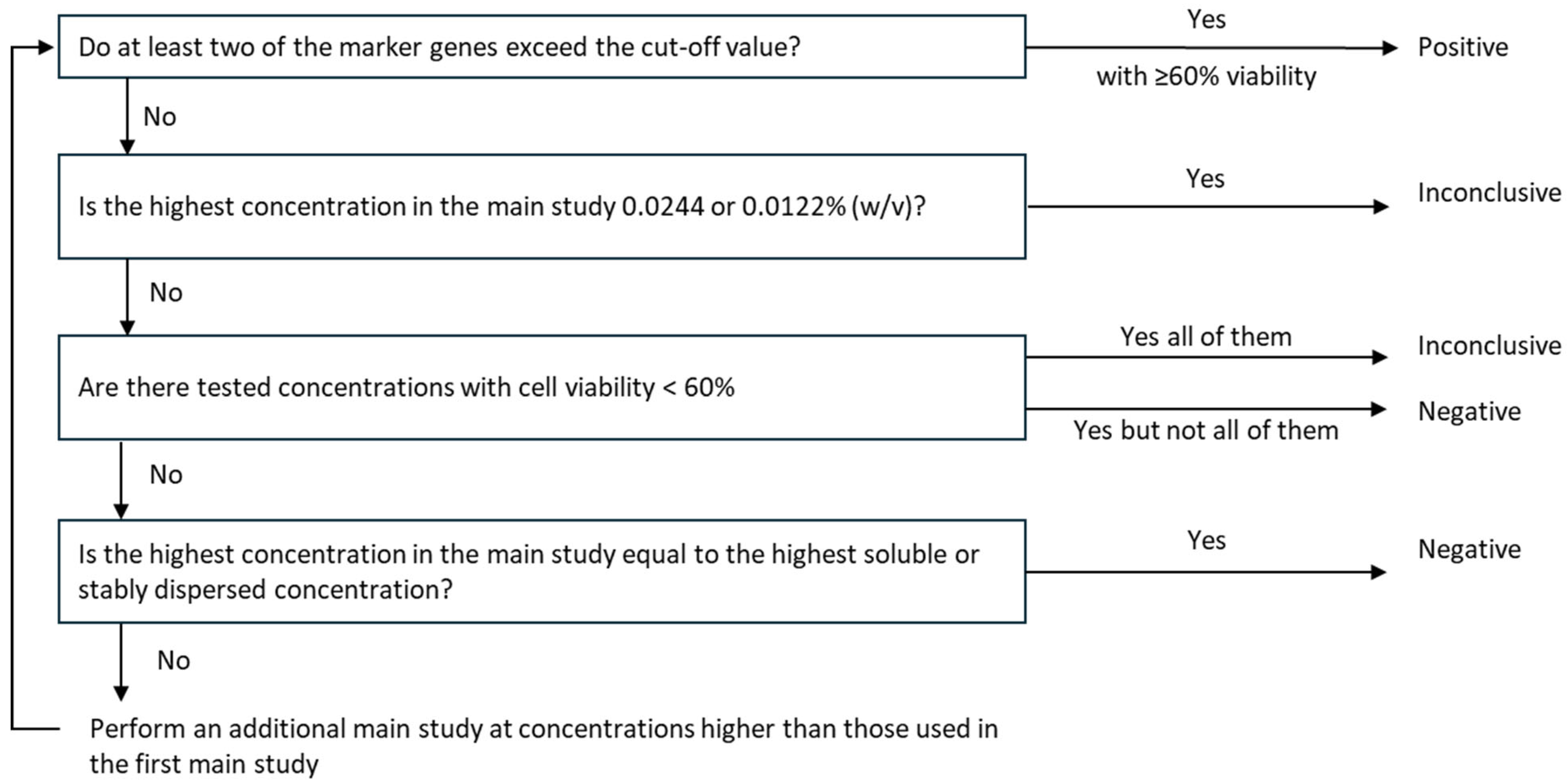
The Epi2SensA method is a method similar to the validated EpiSensA assay for assessing the skin sensitization potential of chemicals. The Epi2SensA protocol includes adaptation (changes to exposure conditions and the controls) for using an alternative reconstructed human epidermis (RhE) model, the EpiDerm™ model. The interlaboratory validation study evaluated the reliability and predictive capacity of Epi2SensA according to OECD Performance Standards. Four laboratories (Mattek, Now Part of Sartorius, Eurofins Munich, Burleson Research Technologies, Inc., and Food and Drug Safety Center) conducted blinded testing of 20 coded reference substances representing various chemical categories and sensitization potencies. Statistical analysis using modified acceptance criteria (a 60% cell viability threshold) and a modified prediction model (requiring at least two positive gene markers) demonstrated substantially improved performance compared to the original EpiSensA criteria. The between-laboratory reproducibility (BLR) was 85%, the average within-laboratory reproducibility (WLR) was 83.3%, and the average predictivity parameters were 88.1% for sensitivity, 88.9% for specificity, and 88.3% for accuracy. Epi2SensA achieved performance metrics comparable to the validated reference method (EpiSensA), supporting regulatory acceptance of the Epi2SensA assay using the EpiDerm™ model (Mattek Corporation, Now Part of Sartorius, Ashland, MA, USA) as an alternative RhE source for OECD TG 442D skin sensitization testing.
Keywords: Epi2SensA; skin sensitization; reconstructed human epidermis; interlaboratory validation; OECD TG 442D; alternative testing methods; in vitro assay; keratinocyte activation Epi2SensA; skin sensitization; reconstructed human epidermis; interlaboratory validation; OECD TG 442D; alternative testing methods; in vitro assay; keratinocyte activation