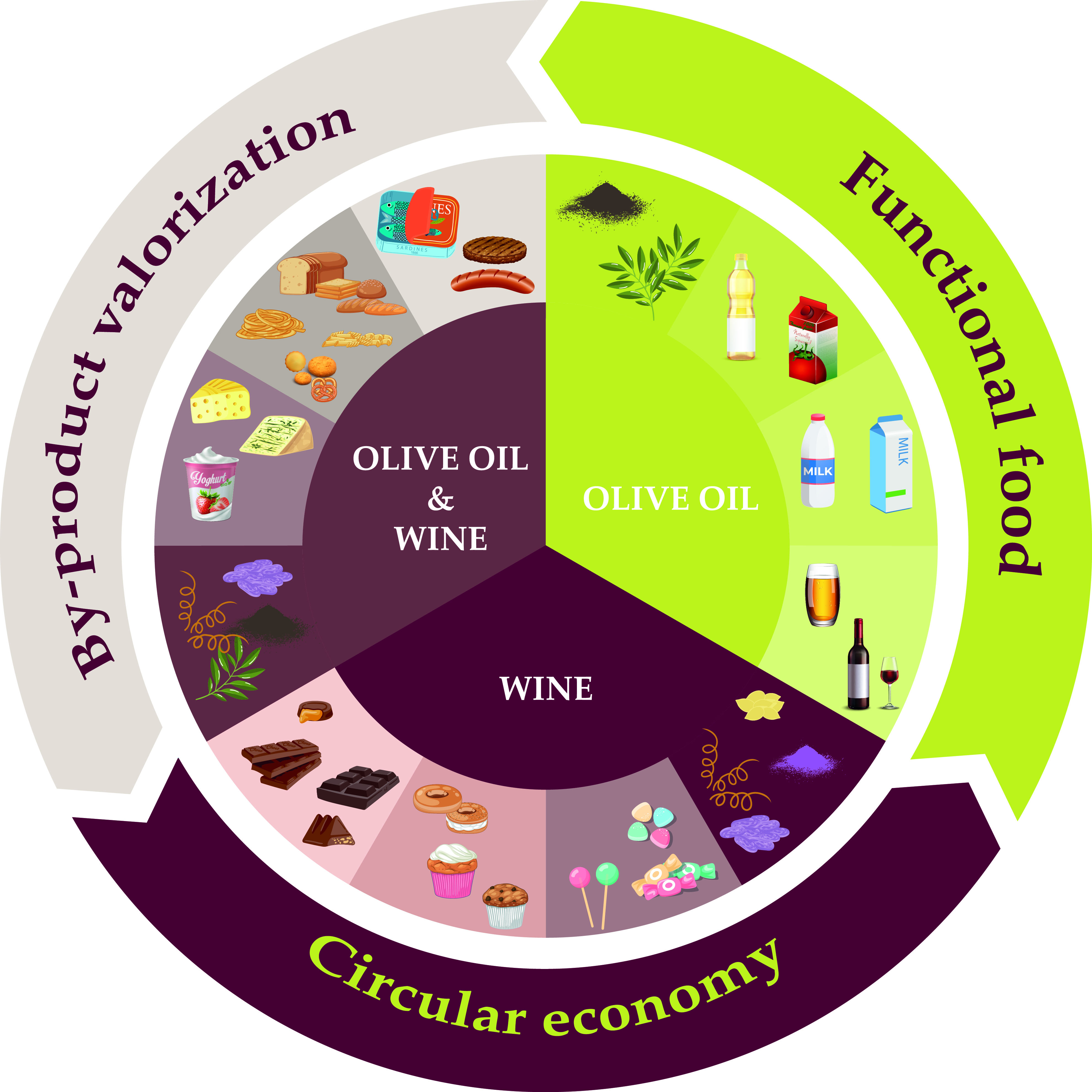
Valorization of Olive Oil and Wine Industry Byproducts: Challenges and Opportunities in Sustainable Food Applications





Abstract
1. Introduction
2. Olive Oil and Wine Industry Overview
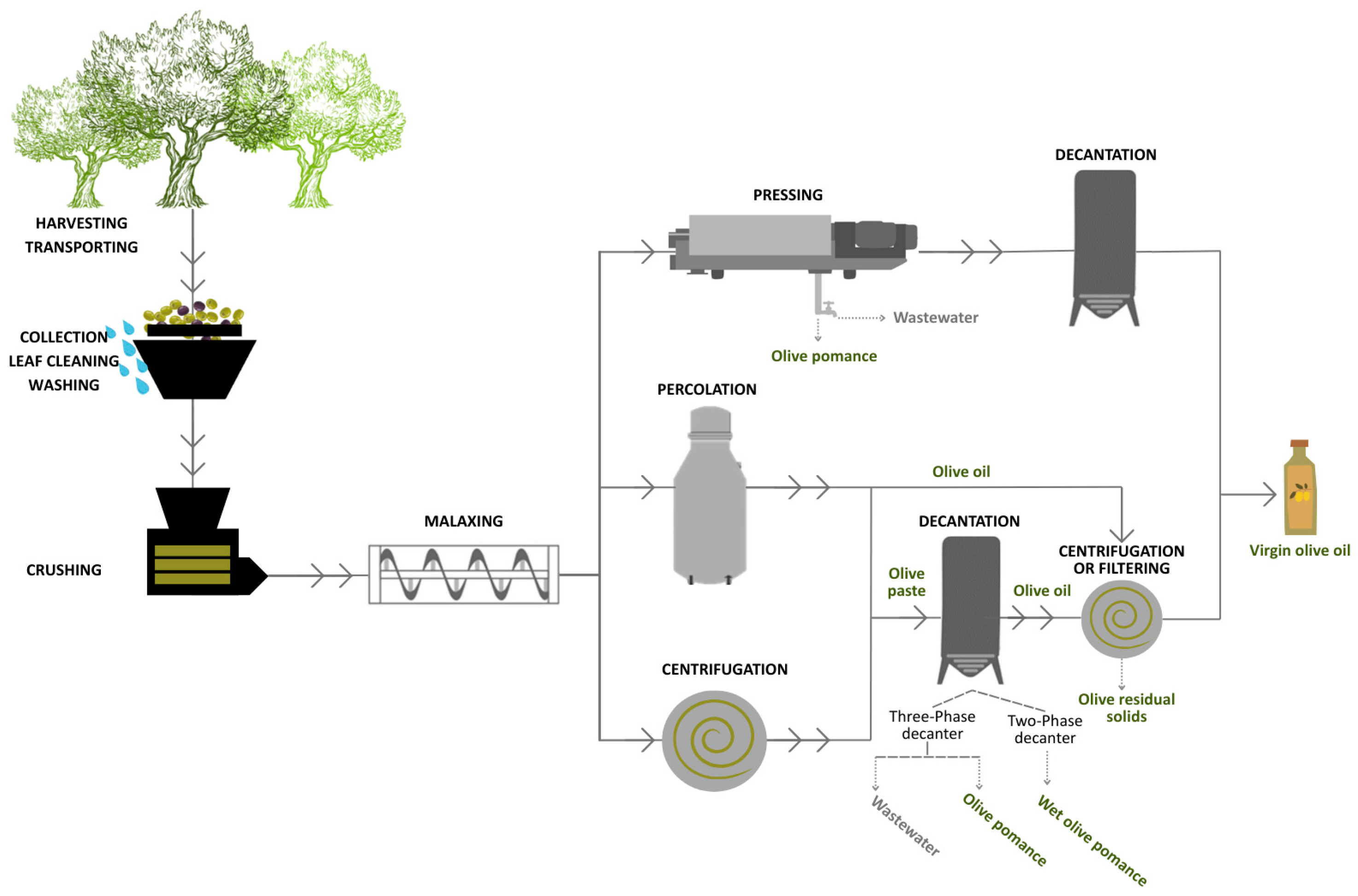
2.1. Olive Oil
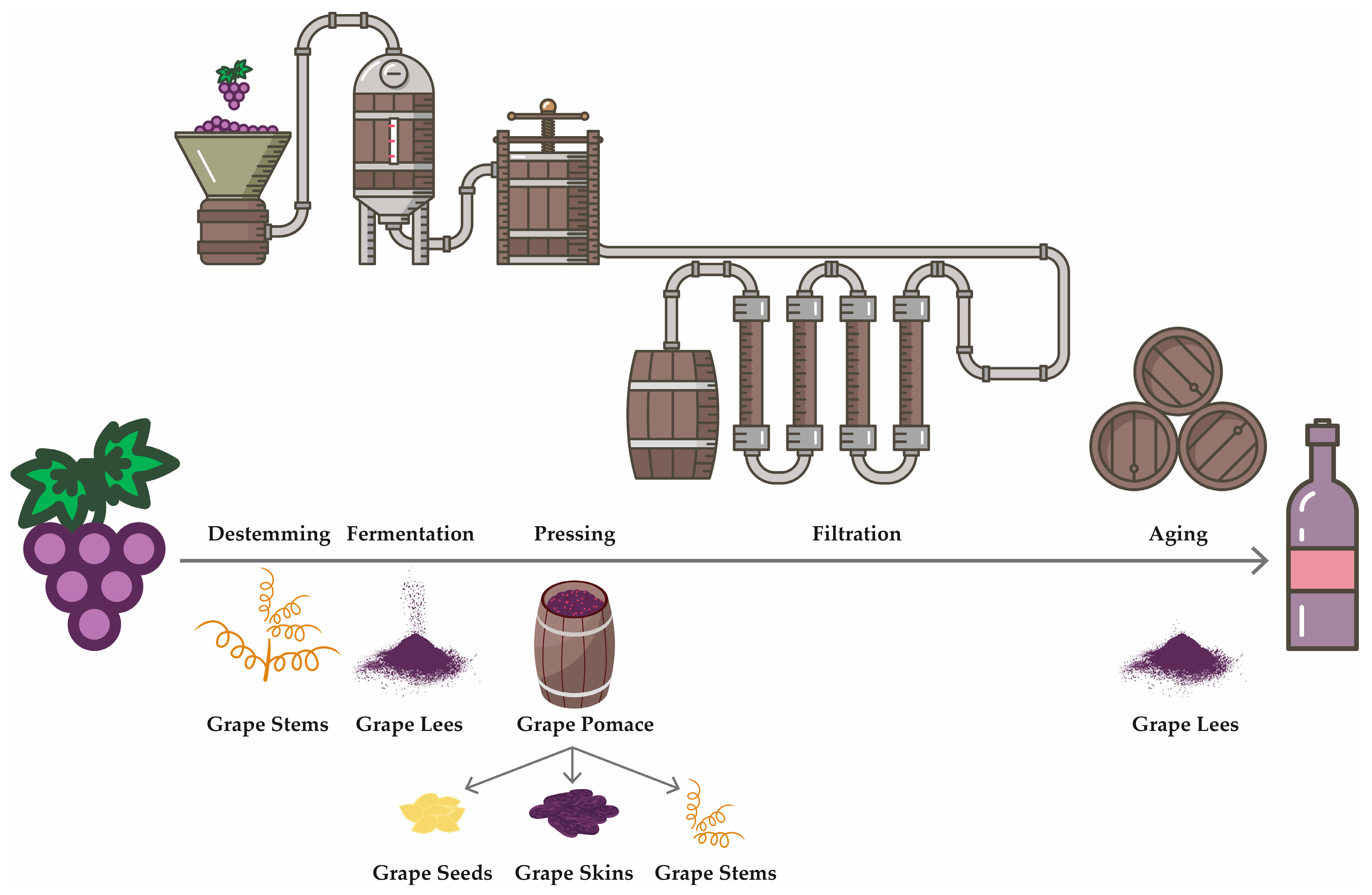
2.2. Wine

| Waste Type | Composition | Estimated Quantity | Stage of Generation | Reference |
|---|---|---|---|---|
| Grape Pomace | Skins, seeds, pulp, sometimes stems | 200–300 kg (direct measurement: 20–30% of grape weight) | Crushing, pressing, maceration | [36,37] |
| Grape Seeds | Lignocellulosic matrix rich in lipids and polyphenols | 30–60 kg (3–6% of fresh grape weight) | Pressing of grapes | [49] |
| Grape Skins | Cellulose-rich tissues containing pigments and polyphenols | 100–150 kg (estimated as 50–65% of pomace; assuming pomace = 200–300 kg per 1000 kg of grapes) | Crushing and pressing | [38] |
| Grape Stems | Woody stalks from grape bunches | 30–70 kg (3–7% of bunch weight; assumes bunch weight ≈ grape weight) | Destemming | [40] |
| Wine Lees | Yeast cells, tartaric acid crystals, other precipitates | 16–48 kg (estimated from 2 to 6% of wine volume) | Fermentation, aging, stabilization | [41] |
| Winery Wastewater | Water with organics, acids, phenolics | 375–10,500 kg (estimated from 500 to 14,000 L wastewater per 1000 L wine) | Washing, cleaning, fermentation, clarification, bottling | [43] |
3. Composition and Characteristics of Industry Wastes
3.1. Olive Oil
3.2. Wine
4. Bioactive Compounds in Olive Oil and Wine Industry Wastes
4.1. Factors Affecting Stability and Interactions of Bioactive Compounds
4.2. Olive Oil
4.3. Wine
5. Applications in Food Industry
5.1. Olive Oil
5.2. Wine
5.2.1. Grape Pomace
5.2.2. Grape Seed Oil
5.2.3. Grape Skins
5.2.4. Wine Lees
6. Challenges
6.1. Olive Oil
6.2. Wine
7. Conclusions
Author Contributions
Funding
Institutional Review Board Statement
Informed Consent Statement
Data Availability Statement
Conflicts of Interest
References
- Frankel, R. Oil and wine production. In A Companion to Science, Technology, and Medicine in Ancient Greece and Rome; Wiley: Hoboken, NJ, USA, 2016; pp. 550–569. [Google Scholar]
- De Luca, A.I.; Iofrida, N.; González De Molina, M.; Spada, E.; Domouso, P.; Falcone, G.; Gulisano, G.; García Ruiz, R. A methodological proposal of the Sustainolive international research project to drive Mediterranean olive ecosystems toward sustainability. Front. Sustain. Food Syst. 2023, 7, 1207972. [Google Scholar] [CrossRef]
- Pecci, A.; Cau Ontiveros, M.Á.; Garnier, N. Identifying wine and oil production: Analysis of residues from Roman and Late Antique plastered vats. J. Archaeol. Sci. 2013, 40, 4491–4498. [Google Scholar] [CrossRef]
- Marzano, A. Agricultural production in the hinterland of Rome: Wine and olive oil. In The Roman Agricultural Economy: Organization, Investment, and Production; Oxford University Press: Oxford, UK, 2013; pp. 85–106. [Google Scholar]
- Eitam, D.; Lederman, Z.; Kleiman, A. Qlaʿ: A Royal Oil-and Wine-Production Centre in the Kingdom of Israel. Tel Aviv 2024, 51, 18–49. [Google Scholar] [CrossRef]
- Prazeres, I.; Silva, V.; Henriques, P.; Ramos, I.J.; Rego, C.; Lucas, M.R. Alentejo Wines and Olive Oil Sustainability Programs: Background of Absorptive Capacity in the Development of Circular Economy Business Models. In Entrepreneurship, Technological Change and Circular Economy for a Green Transition: Research Contributions for a More Productive Environment; Rego, C., Lucas, M.R., Sánchez-Hernández, M.I., Cagica Carvalho, L., Backx Noronha, A., Eds.; Springer Nature: Cham, The Switzerland, 2024; pp. 219–244. [Google Scholar]
- Millan Vazquez De La Torre, G.; Perez, L.M. Comparación del perfil de enoturistas y oleoturistas en España. Un estudio de caso. Cuad. Desarro. Rural 2014, 11, 22. [Google Scholar] [CrossRef]
- Trigo, A.; Silva, P. Sustainable Development Directions for Wine Tourism in Douro Wine Region, Portugal. Sustainability 2022, 14, 3949. [Google Scholar] [CrossRef]
- Ingrassia, M.; Altamore, L.; Bellia, C.; Grasso, G.L.; Silva, P.; Bacarella, S.; Columba, P.; Chironi, S. Visitor’s Motivational Framework and Wine Routes’ Contribution to Sustainable Agriculture and Tourism. Sustainability 2022, 14, 12082. [Google Scholar] [CrossRef]
- Silva, P.; Rodríguez-Pérez, M.; Gómez-Torres, Ó.; Burgos-Ramos, E. Olive oil and wine as source of multi-target agents in the prevention of Alzheimer disease. Nutr. Res. Rev. 2023, 36, 140–154. [Google Scholar] [CrossRef] [PubMed]
- Silva, P.; Rodríguez-Pérez, M.; Burgos-Ramos, E. Zebrafish Model Insights into Mediterranean Diet Liquids: Olive Oil and Wine. Antioxidants 2023, 12, 1843. [Google Scholar] [CrossRef] [PubMed]
- Keskes, M.A.; Zouari, A.; Houssin, R.; Dhouib, D.; Renaud, J. An overview on olive oil waste valorization scenarios: Life Cycle Approach. IFAC-Paper 2022, 55, 1477–1482. [Google Scholar] [CrossRef]
- Ferrer-Gallego, R.; Silva, P. The Wine Industry By-Products: Applications for Food Industry and Health Benefits. Antioxidants 2022, 11, 2025. [Google Scholar] [CrossRef] [PubMed]
- Ferrari, R. Writing narrative style literature reviews. Med. Writ. 2015, 24, 230–235. [Google Scholar] [CrossRef]
- Greenhalgh, T.; Thorne, S.; Malterud, K. Time to challenge the spurious hierarchy of systematic over narrative reviews? Eur. J. Clin. Investig. 2018, 48, e12931. [Google Scholar] [CrossRef] [PubMed]
- García-González, D.L.; Aparicio, R. Lipid Library: Olive Oil. Available online: https://www.aocs.org/resource/olive-oil (accessed on 14 April 2025).
- Gonçalves, M.; Costa, M.; Paiva-Martins, F.; Silva, P. Olive Oil Industry By-Products as a Novel Source of Biophenols with a Promising Role in Alzheimer Disease Prevention. Molecules 2024, 29, 4841. [Google Scholar] [CrossRef] [PubMed]
- Otero, P.; Garcia-Oliveira, P.; Carpena, M.; Barral-Martinez, M.; Chamorro, F.; Echave, J.; Garcia-Perez, P.; Cao, H.; Xiao, J.; Simal-Gandara, J.; et al. Applications of by-products from the olive oil processing: Revalorization strategies based on target molecules and green extraction technologies. Trends Food Sci. Technol. 2021, 116, 1084–1104. [Google Scholar] [CrossRef]
- Leone, A. Olive milling and pitting. In The Extra-Virgin Olive Oil Handbook; Wiley: Hoboken, NJ, USA, 2014; pp. 117–126. [Google Scholar]
- Tamborrino, A. Olive paste malaxation. In The Extra-Virgin Olive Oil Handbook; Wiley: Hoboken, NJ, USA, 2014; pp. 127–137. [Google Scholar]
- Soares, T.F.; Alves, R.C.; Oliveira, M.B.P.P. From olive oil production to by-products: Emergent technologies to extract bioactive compounds. Food Rev. Int. 2024, 40, 3342–3369. [Google Scholar] [CrossRef]
- Kapellakis, I.E.; Tsagarakis, K.P.; Crowther, J.C. Olive oil history, production and by-product management. Rev. Environ. Sci. Bio/Technol. 2008, 7, 1–26. [Google Scholar] [CrossRef]
- Avraamides, M.; Fatta, D. Resource consumption and emissions from olive oil production: A life cycle inventory case study in Cyprus. J. Clean. Prod. 2008, 16, 809–821. [Google Scholar] [CrossRef]
- Espeso, J.; Isaza, A.; Lee, J.Y.; Sörensen, P.M.; Jurado, P.; Avena-Bustillos, R.D.J.; Olaizola, M.; Arboleya, J.C. Olive Leaf Waste Management. Front. Sustain. Food Syst. 2021, 5, 660582. [Google Scholar] [CrossRef]
- Malekjani, N.; Jafari, S.M. Valorization of olive processing by-products via drying technologies: A case study on the recovery of bioactive phenolic compounds from olive leaves, pomace, and wastewater. Crit. Rev. Food Sci. Nutr. 2023, 63, 9797–9815. [Google Scholar] [CrossRef] [PubMed]
- Pari, L.; Suardi, A.; Santangelo, E.; García-Galindo, D.; Scarfone, A.; Alfano, V. Current and innovative technologies for pruning harvesting: A review. Biomass Bioenergy 2017, 107, 398–410. [Google Scholar] [CrossRef]
- Union, E. Directive 2008/98/EC of the European Parliament and of the Council of 19 November 2008 on waste and repealing certain Directives. Off. J. Eur. Union 2008, 51, 3–30. [Google Scholar]
- de España, G. Ministerio Para la Transición Ecológica y el Reto Demográfico. Estadísticas. España. Available online: https://www.miteco.gob.es/es/biodiversidad/estadisticas/ (accessed on 18 November 2021).
- Inglezakis, V.; Moreno, J.; Doula, M. Olive oil waste management EU legislation: Current situation and policy recommendations. Int. J. Chem. Environ. Eng. Syst. 2012, 3, 65–77. [Google Scholar]
- Messineo, A.; Maniscalco, M.P.; Volpe, R. Biomethane recovery from olive mill residues through anaerobic digestion: A review of the state of the art technology. Sci. Total Environ. 2020, 703, 135508. [Google Scholar] [CrossRef] [PubMed]
- Dahdouh, A.; Khay, I.; Le Brech, Y.; El Maakoul, A.; Bakhouya, M. Olive oil industry: A review of waste stream composition, environmental impacts, and energy valorization paths. Environ. Sci. Pollut. Res. 2023, 30, 45473–45497. [Google Scholar] [CrossRef] [PubMed]
- Maicas, S. Advances in Wine Fermentation. Fermentation 2021, 7, 187. [Google Scholar] [CrossRef]
- Zhang, Q.-A.; Zheng, H.; Lin, J.; Nie, G.; Fan, X.; García-Martín, J.F. The state-of-the-art research of the application of ultrasound to winemaking: A critical review. Ultrason. Sonochem. 2023, 95, 106384. [Google Scholar] [CrossRef] [PubMed]
- International Organisation of Vine and Wine. Statistical Report on World Vitiviniculture. 2019. Available online: https://www.oiv.int/public/medias/6782/oiv-2019-statistical-report-on-world-vitiviniculture.pdf (accessed on 12 May 2025).
- Contreras, M.d.M.; Romero-García, J.M.; López-Linares, J.C.; Romero, I.; Castro, E. Residues from grapevine and wine production as feedstock for a biorefinery. Food Bioprod. Process. 2022, 134, 56–79. [Google Scholar] [CrossRef]
- Lopes, J.D.C.; Madureira, J.; Margaça, F.M.A.; Cabo Verde, S. Grape Pomace: A Review of Its Bioactive Phenolic Compounds, Health Benefits, and Applications. Molecules 2025, 30, 362. [Google Scholar] [CrossRef] [PubMed]
- Telini, B.D.P.; Villa, L.C.; Vainstein, M.H.; Lopes, F.C. From Vineyard to Brewery: A Review of Grape Pomace Characterization and Its Potential Use to Produce Low-Alcohol Beverages. Fermentation 2025, 11, 57. [Google Scholar] [CrossRef]
- Baron, G.; Ferrario, G.; Marinello, C.; Carini, M.; Morazzoni, P.; Aldini, G. Effect of Extraction Solvent and Temperature on Polyphenol Profiles, Antioxidant and Anti-Inflammatory Effects of Red Grape Skin By-Product. Molecules 2021, 26, 5454. [Google Scholar] [CrossRef] [PubMed]
- Zabaniotou, A.; Kamaterou, P.; Pavlou, A.; Panayiotou, C. Sustainable bioeconomy transitions: Targeting value capture by integrating pyrolysis in a winery waste biorefinery. J. Clean. Prod. 2018, 172, 3387–3397. [Google Scholar] [CrossRef]
- Blackford, M.; Comby, M.; Zeng, L.; Dienes-Nagy, Á.; Bourdin, G.; Lorenzini, F.; Bach, B. A Review on Stems Composition and Their Impact on Wine Quality. Molecules 2021, 26, 1240. [Google Scholar] [CrossRef] [PubMed]
- Chetrariu, A.; Dabija, A.; Caisin, L.; Agapii, V.; Avrămia, I. Sustainable Valorization of Wine Lees: From Waste to Value-Added Products. Appl. Sci. 2025, 15, 3648. [Google Scholar] [CrossRef]
- De Iseppi, A.; Lomolino, G.; Marangon, M.; Curioni, A. Current and future strategies for wine yeast lees valorization. Food Res. Int. 2020, 137, 109352. [Google Scholar] [CrossRef] [PubMed]
- Zacharof, M.-P. Grape Winery Waste as Feedstock for Bioconversions: Applying the Biorefinery Concept. Waste Biomass Valorization 2017, 8, 1011–1025. [Google Scholar] [CrossRef]
- Baiano, A. An Overview on Sustainability in the Wine Production Chain. Beverages 2021, 7, 15. [Google Scholar] [CrossRef]
- Niculescu, V.-C.; Ionete, R.-E. An Overview on Management and Valorisation of Winery Wastes. Appl. Sci. 2023, 13, 5063. [Google Scholar] [CrossRef]
- Provenzano, M.; Pacchera, F.; Silvestri, C.; Ruggieri, A. From Vineyard to Value: A Circular Economy Approach to Viticulture Waste. Resources 2024, 13, 172. [Google Scholar] [CrossRef]
- Krzywoszynska, A. ‘Waste? You Mean By-Products!’ from Bio-Waste Management to Agro-Ecology in Italian Winemaking and beyond. Sociol. Rev. 2012, 60, 47–65. [Google Scholar] [CrossRef]
- Ducman, A.A.; Diaconita, V.; Simonca, I.; Belciu, A.; Corbea, A.M.I. Government Oversight and Economic Impacts: Sustainability in the Vineyard and the Evolution of Wine Regulations, Trade and Production. Agronomy 2023, 13, 2991. [Google Scholar] [CrossRef]
- Laqui-Estaña, J.; Obreque-Slier, E.; García-Nauto, N.; Saldaña, E. Advances in Grape Seed Oil Extraction Techniques and Their Applications in Food Products: A Comprehensive Review and Bibliometric Analysis. Foods 2024, 13, 3561. [Google Scholar] [CrossRef] [PubMed]
- Tapia-Quirós, P.; Montenegro-Landívar, M.F.; Reig, M.; Vecino, X.; Alvarino, T.; Cortina, J.L.; Saurina, J.; Granados, M. Olive Mill and Winery Wastes as Viable Sources of Bioactive Compounds: A Study on Polyphenols Recovery. Antioxidants 2020, 9, 1074. [Google Scholar] [CrossRef] [PubMed]
- IOC. World Olive Oil and Table Olive Figures. Available online: https://www.internationaloliveoil.org/what-we-do/economic-affairs-promotion-unit/#figures (accessed on 12 May 2025).
- Manzanares, P.; Ballesteros, I.; Negro, M.; González, A.; Oliva, J.M.; Ballesteros, M. Processing of extracted olive oil pomace residue by hydrothermal or dilute acid pretreatment and enzymatic hydrolysis in a biorefinery context. Renew. Energy 2020, 145, 1235–1245. [Google Scholar] [CrossRef]
- Chanioti, S.; Tzia, C. Extraction of phenolic compounds from olive pomace by using natural deep eutectic solvents and innovative extraction techniques. Innov. Food Sci. Emerg. Technol. 2018, 48, 228–239. [Google Scholar] [CrossRef]
- Nunes, M.A.; Reszczyński, F.; Páscoa, R.N.; Costa, A.S.; Alves, R.C.; Oliveira, M.B.P. Influence of olive pomace blending on antioxidant activity: Additive, synergistic, and antagonistic effects. Molecules 2020, 26, 169. [Google Scholar] [CrossRef] [PubMed]
- Skaltsounis, A.-L.; Argyropoulou, A.; Aligiannis, N.; Xynos, N. 11—Recovery of High Added Value Compounds from Olive Tree Products and Olive Processing Byproducts. In Olive and Olive Oil Bioactive Constituents; Boskou, D., Ed.; AOCS Press: Champaign, IL, USA, 2015; pp. 333–356. [Google Scholar]
- Galanakis, C.M. Olive fruit dietary fiber: Components, recovery and applications. Trends Food Sci. Technol. 2011, 22, 175–184. [Google Scholar] [CrossRef]
- Bermúdez-Oria, A.; Rodríguez-Gutiérrez, G.; Alaiz, M.; Vioque, J.; Girón-Calle, J.; Fernández-Bolaños, J. Polyphenols associated to pectic polysaccharides account for most of the antiproliferative and antioxidant activities in olive extracts. J. Funct. Foods 2019, 62, 103530. [Google Scholar] [CrossRef]
- Caporaso, N.; Formisano, D.; Genovese, A. Use of phenolic compounds from olive mill wastewater as valuable ingredients for functional foods. Crit. Rev. Food Sci. Nutr. 2018, 58, 2829–2841. [Google Scholar] [CrossRef] [PubMed]
- Carrara, M.; Kelly, M.T.; Roso, F.; Larroque, M.; Margout, D. Potential of olive oil mill wastewater as a source of polyphenols for the treatment of skin disorders: A review. J. Agric. Food Chem. 2021, 69, 7268–7284. [Google Scholar] [CrossRef] [PubMed]
- Sánchez Villasclaras, S.; García Martín, J.F. Innovations and New Processes in the Olive Oil Industry. Processes 2024, 12, 1570. [Google Scholar] [CrossRef]
- Mili, S.; Bouhaddane, M. Forecasting global developments and challenges in olive oil supply and demand: A delphi survey from Spain. Agriculture 2021, 11, 191. [Google Scholar] [CrossRef]
- Tura, D.; Failla, O.; Pedò, S.; Gigliotti, C.; Bassi, D.; Serraiocco, A. Effects of seasonal weather variability on olive oil composition in northern Italy. Acta Hortic. 2008, 791, 769–776. [Google Scholar] [CrossRef]
- Gulotta, T.M.; Mondello, G.; Salomone, R.; Primerano, P.; Saija, G. Addressing geographical variability in Life Cycle Inventory data: The case of Italian olive production. Int. J. Life Cycle Assess. 2025. [Google Scholar] [CrossRef]
- Benincasa, C.; Russo, A.; Romano, E.; Elsorady, M.; Perri, E.; Muzzalupo, I. Chemical and sensory analysis of some Egyptian virgin olive oils. J. Nutr. Food Sci. 2011, 5, 118. [Google Scholar] [CrossRef]
- Filippi, K.; Stylianou, E.; Pateraki, C.; Koutinas, A.; Ladakis, D. Pretreatment of Grape Pomaces and Stalks Using Deep Eutectic Solvents for Succinic Acid Production Integrated in a Biorefinery Concept. Waste Biomass Valorization 2023, 14, 2857–2872. [Google Scholar] [CrossRef]
- Shen, Y.; Kang, B.; Lu, Y.; Du, X.; Qin, C.; Li, J.; Zhao, Z.; Yu, R.; Shi, S.; Han, L. Production of optical pure L-lactic acid from Cabernet Sauvignon grape pomace by engineered Lactiplantibacillus plantarum. Front. Energy Res. 2023, 11, 1228827. [Google Scholar] [CrossRef]
- Baenas, N.; García-Viguera, C.; Domínguez-Perles, R.; Medina, S. Winery By-Products as Sources of Bioactive Tryptophan, Serotonin, and Melatonin: Contributions to the Antioxidant Power. Foods 2023, 12, 1571. [Google Scholar] [CrossRef] [PubMed]
- Kapcsándi, V.; Hanczné Lakatos, E.; Sik, B.; Linka, L.Á.; Székelyhidi, R. Characterization of fatty acid, antioxidant, and polyphenol content of grape seed oil from different Vitis vinifera L. varieties. OCL 2021, 28, 30. [Google Scholar] [CrossRef]
- Al Juhaimi, F.; Geçgel, Ü.; Gülcü, M.; Hamurcu, M.; Özcan, M.M. Bioactive properties, fatty acid composition and mineral contents of grape seed and oils. S. Afr. J. Enol. Vitic. 2017, 38, 103–108. [Google Scholar] [CrossRef]
- Antonić, B.; Jančíková, S.; Dordević, D.; Tremlová, B. Grape Pomace Valorization: A Systematic Review and Meta-Analysis. Foods 2020, 9, 1627. [Google Scholar] [CrossRef] [PubMed]
- Sousa, E.C.; Uchôa-Thomaz, A.M.A.; Carioca, J.O.B.; Morais, S.M.D.; Lima, A.D.; Martins, C.G.; Alexandrino, C.D.; Ferreira, P.A.T.; Rodrigues, A.L.M.; Rodrigues, S.P.; et al. Chemical composition and bioactive compounds of grape pomace (Vitis vinifera L.), Benitaka variety, grown in the semiarid region of Northeast Brazil. Food Sci. Technol. 2014, 34, 135–142. [Google Scholar] [CrossRef]
- Nowshehri, J.A.; Bhat, Z.A.; Shah, M.Y. Blessings in disguise: Bio-functional benefits of grape seed extracts. Food Res. Int. 2015, 77, 333–348. [Google Scholar] [CrossRef]
- Abreu, T.; Sousa, P.; Gonçalves, J.; Hontman, N.; Teixeira, J.; Câmara, J.S.; Perestrelo, R. Grape Pomace as a Renewable Natural Biosource of Value-Added Compounds with Potential Food Industrial Applications. Beverages 2024, 10, 45. [Google Scholar] [CrossRef]
- Muzolf-Panek, M.; Waśkiewicz, A. Relationship between Phenolic Compounds, Antioxidant Activity and Color Parameters of Red Table Grape Skins Using Linear Ordering Analysis. Appl. Sci. 2022, 12, 6146. [Google Scholar] [CrossRef]
- Sabra, A.; Netticadan, T.; Wijekoon, C. Grape bioactive molecules, and the potential health benefits in reducing the risk of heart diseases. Food Chem. X 2021, 12, 100149. [Google Scholar] [CrossRef] [PubMed]
- Costa-Pérez, A.; Medina, S.; Sánchez-Bravo, P.; Domínguez-Perles, R.; García-Viguera, C. The (Poly)phenolic Profile of Separate Winery By-Products Reveals Potential Antioxidant Synergies. Molecules 2023, 28, 2081. [Google Scholar] [CrossRef] [PubMed]
- Esparza, I.; Cimminelli, M.J.; Moler, J.A.; Jiménez-Moreno, N.; Ancín-Azpilicueta, C. Stability of Phenolic Compounds in Grape Stem Extracts. Antioxidants 2020, 9, 720. [Google Scholar] [CrossRef] [PubMed]
- Barbanera, M.; Cardarelli, A.; Carota, E.; Castellini, M.; Giannoni, T.; Ubertini, S. Valorization of winery and distillery by-products by hydrothermal carbonization. Sci. Rep. 2021, 11, 23973. [Google Scholar] [CrossRef] [PubMed]
- Melo, F.D.O.; Ferreira, V.C.; Barbero, G.F.; Carrera, C.; Ferreira, E.D.S.; Umsza-Guez, M.A. Extraction of Bioactive Compounds from Wine Lees: A Systematic and Bibliometric Review. Foods 2024, 13, 2060. [Google Scholar] [CrossRef] [PubMed]
- Caponio, G.R.; Minervini, F.; Tamma, G.; Gambacorta, G.; De Angelis, M. Promising Application of Grape Pomace and Its Agri-Food Valorization: Source of Bioactive Molecules with Beneficial Effects. Sustainability 2023, 15, 9075. [Google Scholar] [CrossRef]
- Chakka, A.K.; Babu, A.S. Bioactive Compounds of Winery by-products: Extraction Techniques and their Potential Health Benefits. Appl. Food Res. 2022, 2, 100058. [Google Scholar] [CrossRef]
- Panzella, L.; Moccia, F.; Nasti, R.; Marzorati, S.; Verotta, L.; Napolitano, A. Bioactive Phenolic Compounds From Agri-Food Wastes: An Update on Green and Sustainable Extraction Methodologies. Front. Nutr. 2020, 7, 60. [Google Scholar] [CrossRef] [PubMed]
- Gil-Martín, E.; Forbes-Hernández, T.; Romero, A.; Cianciosi, D.; Giampieri, F.; Battino, M. Influence of the extraction method on the recovery of bioactive phenolic compounds from food industry by-products. Food Chem. 2022, 378, 131918. [Google Scholar] [CrossRef] [PubMed]
- Abedelmaksoud, T.G.; Younis, M.I.; Altemimi, A.B.; Tlay, R.H.; Ali Hassan, N. Bioactive Compounds of Plant-Based Food: Extraction, Isolation, Identification, Characteristics, and Emerging Applications. Food Sci. Nutr. 2025, 13, e70351. [Google Scholar] [CrossRef] [PubMed]
- Madureira, J.; Margaça, F.M.; Santos-Buelga, C.; Ferreira, I.C.; Verde, S.C.; Barros, L. Applications of bioactive compounds extracted from olive industry wastes: A review. Compr. Rev. Food Sci. Food Saf. 2022, 21, 453–476. [Google Scholar] [CrossRef] [PubMed]
- Karković Marković, A.; Torić, J.; Barbarić, M.; Jakobušić Brala, C. Hydroxytyrosol, tyrosol and derivatives and their potential effects on human health. Molecules 2019, 24, 2001. [Google Scholar] [CrossRef] [PubMed]
- Gonçalves, M.; Rodríguez-Pérez, M.; Calabrò, A.; Burgos-Ramos, E.; Accardi, G.; Silva, P. A Narrative Review of Metabolomic Insights into Olive Oil’s Nutritional Value. Appl. Sci. 2024, 14, 4203. [Google Scholar] [CrossRef]
- Karastergiou, A.; Gancel, A.L.; Jourdes, M.; Teissedre, P.L. Valorization of Grape Pomace: A Review of Phenolic Composition, Bioactivity, and Therapeutic Potential. Antioxidants 2024, 13, 1131. [Google Scholar] [CrossRef] [PubMed]
- Almanza-Oliveros, A.; Bautista-Hernández, I.; Castro-López, C.; Aguilar-Zárate, P.; Meza-Carranco, Z.; Rojas, R.; Michel, M.R.; Martínez-Ávila, G.C.G. Grape Pomace—Advances in Its Bioactivity, Health Benefits, and Food Applications. Foods 2024, 13, 580. [Google Scholar] [CrossRef] [PubMed]
- Barros, A.; Gironés-Vilaplana, A.; Texeira, A.; Baenas, N.; Domínguez-Perles, R. Grape stems as a source of bioactive compounds: Application towards added-value commodities and significance for human health. Phytochem. Rev. 2015, 14, 921–931. [Google Scholar] [CrossRef]
- Dinu, L.D.; Vamanu, E. Gut Microbiota Modulators Based on Polyphenols Extracted from Winery By-Products and Their Applications in the Nutraceutical Industry. Life 2024, 14, 414. [Google Scholar] [CrossRef] [PubMed]
- Gómez-Brandón, M.; Lores, M.; Insam, H.; Domínguez, J. Strategies for recycling and valorization of grape marc. Crit. Rev. Biotechnol. 2019, 39, 437–450. [Google Scholar] [CrossRef] [PubMed]
- Agaj, A.; Peršurić, Ž.; Pavelić, S.K. Mediterranean Food Industry By-Products as a Novel Source of Phytochemicals with a Promising Role in Cancer Prevention. Molecules 2022, 27, 8655. [Google Scholar] [CrossRef] [PubMed]
- Barba, F.J.; Zhu, Z.; Koubaa, M.; Sant’Ana, A.S.; Orlien, V. Green alternative methods for the extraction of antioxidant bioactive compounds from winery wastes and by-products: A review. Trends Food Sci. Technol. 2016, 49, 96–109. [Google Scholar] [CrossRef]
- Santos, J.R.F.; Rodrigues, R.P.; Quina, M.J.; Gando-Ferreira, L.M. Recovery of Value-Added Compounds from Winery Wastewater: A Review and Bibliometric Analysis. Water 2023, 15, 1110. [Google Scholar] [CrossRef]
- Laurindo, L.F.; Direito, R.; Bueno Otoboni, A.M.M.; Goulart, R.A.; Quesada, K.; Barbalho, S.M. Grape Processing Waste: Effects on Inflammatory Bowel Disease and Colorectal Cancer. Food Rev. Int. 2024, 40, 336–369. [Google Scholar] [CrossRef]
- Liu, Z.; de Souza, T.S.P.; Wu, H.; Holland, B.; Dunshea, F.R.; Barrow, C.J.; Suleria, H.A.R. Development of Phenolic-Rich Functional Foods by Lactic Fermentation of Grape Marc: A Review. Food Rev. Int. 2024, 40, 1756–1775. [Google Scholar] [CrossRef]
- Dunne, G. Transforming olive waste into animal feed. Int. J. Clin. Nutr. Diet. 2019, 5, 10–12. [Google Scholar] [CrossRef] [PubMed]
- Serra, A.; Conte, G.; Giovannetti, M.; Casarosa, L.; Agnolucci, M.; Ciucci, F.; Palla, M.; Bulleri, E.; Cappucci, A.; Servili, M.; et al. Olive Pomace in Diet Limits Lipid Peroxidation of Sausages from Cinta Senese Swine. Eur. J. Lipid Sci. Technol. 2018, 120, 1700236. [Google Scholar] [CrossRef]
- Gerasopoulos, K.; Stagos, D.; Petrotos, K.; Kokkas, S.; Kantas, D.; Goulas, P.; Kouretas, D. Feed supplemented with polyphenolic byproduct from olive mill wastewater processing improves the redox status in blood and tissues of piglets. Food Chem. Toxicol. 2015, 86, 319–327. [Google Scholar] [CrossRef] [PubMed]
- Simonato, B.; Trevisan, S.; Tolve, R.; Favati, F.; Pasini, G. Pasta fortification with olive pomace: Effects on the technological characteristics and nutritional properties. LWT 2019, 114, 108368. [Google Scholar] [CrossRef]
- Galanakis, C.M. Phenols recovered from olive mill wastewater as additives in meat products. Trends Food Sci. Technol. 2018, 79, 98–105. [Google Scholar] [CrossRef]
- Galanakis, C.M.; Tsatalas, P.; Charalambous, Z.; Galanakis, I.M. Control of microbial growth in bakery products fortified with polyphenols recovered from olive mill wastewater. Environ. Technol. Innov. 2018, 10, 1–15. [Google Scholar] [CrossRef]
- Cedola, A.; Cardinali, A.; D’Antuono, I.; Conte, A.; Del Nobile, M.A. Cereal foods fortified with by-products from the olive oil industry. Food Biosci. 2020, 33, 100490. [Google Scholar] [CrossRef]
- Castillo-Luna, A.; Priego-Capote, F. Phenolic enrichment of foods curated in olive oil: Kinetics and chemical evaluation. Food Chem. X 2024, 22, 101398. [Google Scholar] [CrossRef] [PubMed]
- Ahmad, T.; Belwal, T.; Li, L.; Ramola, S.; Aadil, R.M.; Abdullah; Xu, Y.; Zisheng, L. Utilization of wastewater from edible oil industry, turning waste into valuable products: A review. Trends Food Sci. Technol. 2020, 99, 21–33. [Google Scholar] [CrossRef]
- Esposto, S.; Taticchi, A.; Di Maio, I.; Urbani, S.; Veneziani, G.; Selvaggini, R.; Sordini, B.; Servili, M. Effect of an olive phenolic extract on the quality of vegetable oils during frying. Food Chem. 2015, 176, 184–192. [Google Scholar] [CrossRef] [PubMed]
- Araújo, M.; Pimentel, F.B.; Alves, R.C.; Oliveira, M.B.P.P. Phenolic compounds from olive mill wastes: Health effects, analytical approach and application as food antioxidants. Trends Food Sci. Technol. 2015, 45, 200–211. [Google Scholar] [CrossRef]
- Fotiadou, R.; Vougiouklaki, D.; Houhoula, D.; Stamatis, H. Improvement of the oxidative stability of edible oils through enzymatic esterification with hydroxytyrosol-rich extract. Eur. J. Lipid Sci. Technol. 2024, 126. [Google Scholar] [CrossRef]
- Raposo, R.; Ruiz-Moreno, M.J.; Garde-Cerdán, T.; Puertas, B.; Moreno-Rojas, J.M.; Gonzalo-Diago, A.; Guerrero, R.F.; Ortiz, V.; Cantos-Villar, E. Effect of hydroxytyrosol on quality of sulfur dioxide-free red wine. Food Chem. 2016, 192, 25–33. [Google Scholar] [CrossRef] [PubMed]
- Ceci, A.T.; Darnal, A.; Poggesi, S.; Betnga, P.F.T.; Longo, E.; Nicolodi, R.; Davis, R.; Walsh, M.; O’Connor, K.E.; Altieri, E.A.; et al. Enhancing the stability of a red organic wine through hydroxytyrosol supplementation at bottling: A time-dependent analysis. Appl. Food Res. 2024, 4, 100513. [Google Scholar] [CrossRef]
- Cappelin, E.; Meneguzzi, D.; Hendges, D.H.; Oldoni, T.L.C.; Daltoé, M.L.M.; Marchioro, M.L.K.; da Cunha, M.A.A. Low-alcohol light beer enriched with olive leaves extract: Cold mashing technique associated with interrupted fermentation in the brewing process. Electron. J. Biotechnol. 2024, 68, 81–89. [Google Scholar] [CrossRef]
- Guglielmotti, M.; Passaghe, P.; Buiatti, S. Use of olive (Olea europaea L.) leaves as beer ingredient, and their influence on beer chemical composition and antioxidant activity. J. Food Sci. 2020, 85, 2278–2285. [Google Scholar] [CrossRef] [PubMed]
- Fuwa, T.; Nakao, Y.; Matsubayashi, H. Beverage Containing Hydroxytyrosol. U.S. Patent 2019/012952 A1, 2 May 2019. [Google Scholar]
- Larrosa, M.; Espín, J.C.; Tomás-Barberán, F.A. Antioxidant capacity of tomato juice functionalised with enzymatically synthesised hydroxytyrosol. J. Sci. Food Agric. 2003, 83, 658–666. [Google Scholar] [CrossRef]
- Aispuro-Pérez, A.; Pedraza-Leyva, F.J.; Ochoa-Acosta, A.; Arias-Gastélum, M.; Cárdenas-Torres, F.I.; Amezquita-López, B.A.; Terán, E.; Aispuro-Hernández, E.; Martínez-Téllez, M.Á.; Avena-Bustillos, R.J.; et al. A Functional Beverage from Coffee and Olive Pomace: Polyphenol-Flavonoid Content, Antioxidant, Antihyperglycemic Properties, and Mouse Behavior. Foods 2025, 14, 1331. [Google Scholar] [CrossRef] [PubMed]
- Georgakouli, K.; Mpesios, A.; Kouretas, D.; Petrotos, K.; Mitsagga, C.; Giavasis, I.; Jamurtas, A.Z. The effects of an olive fruit polyphenol-enriched yogurt on body composition, blood redox status, physiological and metabolic parameters and yogurt microflora. Nutrients 2016, 8, 344. [Google Scholar] [CrossRef] [PubMed]
- Muíño, I.; Díaz, M.T.; Apeleo, E.; Pérez-Santaescolástica, C.; Rivas-Cañedo, A.; Pérez, C.; Cañeque, V.; Lauzurica, S.; de la Fuente, J. Valorisation of an extract from olive oil waste as a natural antioxidant for reducing meat waste resulting from oxidative processes. J. Clean. Prod. 2017, 140, 924–932. [Google Scholar] [CrossRef]
- Martínez-Zamora, L.; Ros, G.; Nieto, G. Synthetic vs. natural hydroxytyrosol for clean label lamb burgers. Antioxidants 2020, 9, 851. [Google Scholar] [CrossRef] [PubMed]
- Testa, B.; Lombardi, S.J.; Macciola, E.; Succi, M.; Tremonte, P.; Iorizzo, M. Efficacy of olive leaf extract (Olea europaea L. cv Gentile di Larino) in marinated anchovies (Engraulis encrasicolus, L.) process. Heliyon 2019, 5, e01727. [Google Scholar] [CrossRef] [PubMed]
- Mateos, R.; Martínez-López, S.; Arévalo, G.B.; Amigo-Benavent, M.; Sarriá, B.; Bravo-Clemente, L. Hydroxytyrosol in functional hydroxytyrosol-enriched biscuits is highly bioavailable and decreases oxidised low density lipoprotein levels in humans. Food Chem. 2016, 205, 248–256. [Google Scholar] [CrossRef] [PubMed]
- Calahorra, J.; Araujo-Abad, S.; Granadino-Roldán, J.M.; Naranjo, Á.; Martínez-Lara, E.; Siles, E. Tyrosol: Repercussion of the Lack of a Hydroxyl-Group in the Response of MCF-7 Cells to Hypoxia. J. Med. Food 2023, 26, 511–520. [Google Scholar] [CrossRef] [PubMed]
- Jafari-Rastegar, N.; Hosseininia, H.-S.; Jalilvand, E.; Naseroleslami, M.; Khakpai, F.; Mousavi-Niri, N. Oral administration of nano-tyrosol reversed the diabetes-induced liver damage in streptozotocin-induced diabetic rats. J. Diabetes Metab. Disord. 2023, 22, 297–305. [Google Scholar] [CrossRef] [PubMed]
- Paulo, F.; Santos, L. New insights in the in vitro release of phenolic antioxidants: The case study of the release behavior of tyrosol from tyrosol-loaded ethylcellulose microparticles during the in vitro gastrointestinal digestion. Colloids Surf. B Biointerfaces 2020, 196, 111339. [Google Scholar] [CrossRef] [PubMed]
- Palmeri, R.; Parafati, L.; Trippa, D.; Siracusa, L.; Arena, E.; Restuccia, C.; Fallico, B. Addition of Olive Leaf Extract (OLE) for Producing Fortified Fresh Pasteurized Milk with an Extended Shelf Life. Antioxidants 2019, 8, 255. [Google Scholar] [CrossRef] [PubMed]
- Khemakhem, I.; Fuentes, A.; Lerma-García, M.J.; Ayadi, M.A.; Bouaziz, M.; Barat, J.M. Olive leaf extracts for shelf life extension of salmon burgers. Food Sci. Technol. Int. 2019, 25, 91–100. [Google Scholar] [CrossRef] [PubMed]
- Alipieva, K.; Korkina, L.; Orhan, I.E.; Georgiev, M.I. Verbascoside—A review of its occurrence,(bio) synthesis and pharmacological significance. Biotechnol. Adv. 2014, 32, 1065–1076. [Google Scholar] [CrossRef] [PubMed]
- Chaves-López, C.; Serio, A.; Mazzarrino, G.; Martuscelli, M.; Scarpone, E.; Paparella, A. Control of household mycoflora in fermented sausages using phenolic fractions from olive mill wastewaters. Int. J. Food Microbiol. 2015, 207, 49–56. [Google Scholar] [CrossRef] [PubMed]
- Shi, C.; Ma, Y.; Tian, L.; Li, J.; Qiao, G.; Liu, C.; Cao, W.; Liang, C. Verbascoside: An efficient and safe natural antibacterial adjuvant for preventing bacterial contamination of fresh meat. Molecules 2022, 27, 4943. [Google Scholar] [CrossRef] [PubMed]
- Dos Santos, K.M.; De Oliveira, I.C.; Lopes, M.A.; Cruz, A.P.G.; Buriti, F.C.; Cabral, L.M. Addition of grape pomace extract to probiotic fermented goat milk: The effect on phenolic content, probiotic viability and sensory acceptability. J. Sci. Food Agric. 2017, 97, 1108–1115. [Google Scholar] [CrossRef] [PubMed]
- De Souza De Azevedo, P.O.; Aliakbarian, B.; Casazza, A.A.; Leblanc, J.G.; Perego, P.; De Souza Oliveira, R.P. Production of fermented skim milk supplemented with different grape pomace extracts: Effect on viability and acidification performance of probiotic cultures. PharmaNutrition 2018, 6, 64–68. [Google Scholar] [CrossRef]
- Tseng, A.; Zhao, Y. Wine grape pomace as antioxidant dietary fibre for enhancing nutritional value and improving storability of yogurt and salad dressing. Food Chem. 2013, 138, 356–365. [Google Scholar] [CrossRef] [PubMed]
- Gaglio, R.; Barbaccia, P.; Barbera, M.; Restivo, I.; Attanzio, A.; Maniaci, G.; Di Grigoli, A.; Francesca, N.; Tesoriere, L.; Bonanno, A.; et al. The Use of Winery by-Products to Enhance the Functional Aspects of the Fresh Ovine “Primosale” Cheese. Foods 2021, 10, 461. [Google Scholar] [CrossRef] [PubMed]
- Barbaccia, P.; Busetta, G.; Barbera, M.; Alfonzo, A.; Garofalo, G.; Francesca, N.; Moscarelli, A.; Moschetti, G.; Settanni, L.; Gaglio, R. Effect of grape pomace from red cultivar ‘Nero d’Avola’ on the microbiological, physicochemical, phenolic profile and sensory aspects of ovine Vastedda-like stretched cheese. J. Appl. Microbiol. 2022, 133, 130–144. [Google Scholar] [CrossRef] [PubMed]
- Bolenz, S.; Glöde, L. Technological and nutritional aspects of milk chocolate enriched with grape pomace products. Eur. Food Res. Technol. 2021, 247, 623–636. [Google Scholar] [CrossRef]
- Acan, B.G.; Kilicli, M.; Bursa, K.; Toker, O.S.; Palabiyik, I.; Gulcu, M.; Yaman, M.; Gunes, R.; Konar, N. Effect of grape pomace usage in chocolate spread formulation on textural, rheological and digestibility properties. LWT 2021, 138, 110451. [Google Scholar] [CrossRef]
- Mainente, F.; Menin, A.; Alberton, A.; Zoccatelli, G.; Rizzi, C. Evaluation of the sensory and physical properties of meat and fish derivatives containing grape pomace powders. Int. J. Food Sci. Technol. 2019, 54, 952–958. [Google Scholar] [CrossRef]
- Cilli, L.P.; Contini, L.R.F.; Sinnecker, P.; Lopes, P.S.; Andreo, M.A.; Neiva, C.R.P.; Nascimento, M.S.; Yoshida, C.M.; Venturini, A.C. Effects of grape pomace flour on quality parameters of salmon burger. J. Food Process. Preserv. 2020, 44, e14329. [Google Scholar] [CrossRef]
- Tayengwa, T.; Chikwanha, O.C.; Gouws, P.; Dugan, M.E.R.; Mutsvangwa, T.; Mapiye, C. Dietary citrus pulp and grape pomace as potential natural preservatives for extending beef shelf life. Meat Sci. 2020, 162, 108029. [Google Scholar] [CrossRef] [PubMed]
- Garrido, M.D.; Auqui, M.; Martí, N.; Linares, M.B. Effect of two different red grape pomace extracts obtained under different extraction systems on meat quality of pork burgers. LWT Food Sci. Technol. 2011, 44, 2238–2243. [Google Scholar] [CrossRef]
- Keskekoglu, H.; Uren, A. Inhibitory effects of grape seed extract on the formation of heterocyclic aromatic amines in beef and chicken meatballs cooked by different techniques. Int. J. Food Prop. 2017, 20, S722–S734. [Google Scholar] [CrossRef]
- Monteiro, G.C.; Minatel, I.O.; Junior, A.P.; Gomez-Gomez, H.A.; de Camargo, J.P.C.; Diamante, M.S.; Basílio, L.S.P.; Tecchio, M.A.; Lima, G.P.P. Bioactive compounds and antioxidant capacity of grape pomace flours. LWT 2021, 135, 110053. [Google Scholar] [CrossRef]
- Smith, I.N.; Yu, J. Nutritional and sensory quality of bread containing different quantities of grape pomace from different grape cultivars. EC Nutr. 2015, 2, 291–301. [Google Scholar]
- Tolve, R.; Simonato, B.; Rainero, G.; Bianchi, F.; Rizzi, C.; Cervini, M.; Giuberti, G. Wheat Bread Fortification by Grape Pomace Powder: Nutritional, Technological, Antioxidant, and Sensory Properties. Foods 2021, 10, 75. [Google Scholar] [CrossRef] [PubMed]
- Šporin, M.; Avbelj, M.; Kovač, B.; Možina, S.S. Quality characteristics of wheat flour dough and bread containing grape pomace flour. Food Sci. Technol. Int. 2018, 24, 251–263. [Google Scholar] [CrossRef] [PubMed]
- Rocchetti, G.; Rizzi, C.; Cervini, M.; Rainero, G.; Bianchi, F.; Giuberti, G.; Lucini, L.; Simonato, B. Impact of Grape Pomace Powder on the Phenolic Bioaccessibility and on In Vitro Starch Digestibility of Wheat Based Bread. Foods 2021, 10, 507. [Google Scholar] [CrossRef] [PubMed]
- Rainero, G.; Bianchi, F.; Rizzi, C.; Cervini, M.; Giuberti, G.; Simonato, B. Breadstick fortification with red grape pomace: Effect on nutritional, technological and sensory properties. J. Sci. Food Agric. 2022, 102, 2545–2552. [Google Scholar] [CrossRef] [PubMed]
- Bianchi, F.; Lomuscio, E.; Rizzi, C.; Simonato, B. Predicted Shelf-Life, Thermodynamic Study and Antioxidant Capacity of Breadsticks Fortified with Grape Pomace Powders. Foods 2021, 10, 2815. [Google Scholar] [CrossRef] [PubMed]
- Nakov, G.; Brandolini, A.; Hidalgo, A.; Ivanova, N.; Stamatovska, V.; Dimov, I. Effect of grape pomace powder addition on chemical, nutritional and technological properties of cakes. LWT 2020, 134, 109950. [Google Scholar] [CrossRef]
- Troilo, M.; Difonzo, G.; Paradiso, V.M.; Pasqualone, A.; Caponio, F. Grape Pomace as Innovative Flour for the Formulation of Functional Muffins: How Particle Size Affects the Nutritional, Textural and Sensory Properties. Foods 2022, 11, 1799. [Google Scholar] [CrossRef] [PubMed]
- Spinei, M.; Oroian, M. Characterization of Băbească Neagră Grape Pomace and Incorporation into Jelly Candy: Evaluation of Phytochemical, Sensory, and Textural Properties. Foods 2023, 13, 98. [Google Scholar] [CrossRef] [PubMed]
- Olt, V.; Báez, J.; Curbelo, R.; Boido, E.; Amarillo, M.; Gámbaro, A.; Alborés, S.; Gerez García, N.; Cesio, M.V.; Heinzen, H.; et al. Tannat grape pomace as an ingredient for potential functional biscuits: Bioactive compound identification, in vitro bioactivity, food safety, and sensory evaluation. Front. Nutr. 2023, 10, 1241105. [Google Scholar] [CrossRef] [PubMed]
- Antoniolli, A.; Becerra, L.; Piccoli, P.; Fontana, A. Phenolic, Nutritional and Sensory Characteristics of Bakery Foods Formulated with Grape Pomace. Plants 2024, 13, 590. [Google Scholar] [CrossRef] [PubMed]
- Baldán, Y.; Riveros, M.; Fabani, M.P.; Rodriguez, R. Grape pomace powder valorization: A novel ingredient to improve the nutritional quality of gluten-free muffins. Biomass Convers. Biorefinery 2023, 13, 9997–10009. [Google Scholar] [CrossRef]
- Gerardi, C.; D’Amico, L.; Durante, M.; Tufariello, M.; Giovinazzo, G. Whole Grape Pomace Flour as Nutritive Ingredient for Enriched Durum Wheat Pasta with Bioactive Potential. Foods 2023, 12, 2593. [Google Scholar] [CrossRef] [PubMed]
- Oliveira, B.E.; Contini, L.; Garcia, V.A.D.S.; Cilli, L.P.D.L.; Chagas, E.G.L.; Andreo, M.A.; Vanin, F.M.; Carvalho, R.A.; Sinnecker, P.; Venturini, A.C.; et al. Valorization of grape by-products as functional and nutritional ingredients for healthy pasta development. J. Food Process. Preserv. 2022, 46. [Google Scholar] [CrossRef]
- La Gatta, B.; Rutigliano, M.; Liberatore, M.T.; Dilucia, F.; Palmitessa, M.; Di Luccia, A.; Lamacchia, C. Effect of the Addition of Freeze-Dried Grape Pomace on Fresh Tagliatelle Gluten Network and Relationship to Sensory and Chemical Quality. Foods 2023, 12, 2699. [Google Scholar] [CrossRef] [PubMed]
- Marinelli, V.; Padalino, L.; Nardiello, D.; Del Nobile, M.A.; Conte, A. New Approach to Enrich Pasta with Polyphenols from Grape Marc. J. Chem. 2015, 2015, 1–8. [Google Scholar] [CrossRef]
- Ahmed, Z.; Chen, J.; Tufail, T.; Latif, A.; Arif, M.; Ullah, R.; Alqahtani, A.S.; Xu, B. Fundamental opportunities and challenges of nutraceutical noodles enriched with agri-food by-products. Trends Food Sci. Technol. 2024, 143, 104299. [Google Scholar] [CrossRef]
- Carpentieri, S.; Larrea-Wachtendorff, D.; Donsì, F.; Ferrari, G. Functionalization of pasta through the incorporation of bioactive compounds from agri-food by-products: Fundamentals, opportunities, and drawbacks. Trends Food Sci. Technol. 2022, 122, 49–65. [Google Scholar] [CrossRef]
- Balli, D.; Cecchi, L.; Innocenti, M.; Bellumori, M.; Mulinacci, N. Food by-products valorisation: Grape pomace and olive pomace (pâté) as sources of phenolic compounds and fiber for enrichment of tagliatelle pasta. Food Chem. 2021, 355, 129642. [Google Scholar] [CrossRef] [PubMed]
- Zeena, D.A.; Shaimaa, R.A.; Khazal, S.A. The Effect of Adding Grape Seed Oil on the Chemical, Physical and Microbial Properties of Yoghurt. IOP Conf. Ser. Earth Environ. Sci. 2023, 1158, 112007. [Google Scholar] [CrossRef]
- Kokabi, S.; Soltani, M.; Dabirian, S.; Kokabian, A.; Daraei Garmakhany, A.; Jafarzadeh, S.; Aghajani, N. Incorporation of omega-3 fatty acid-rich grape seed oil in yoghurt: Response surface optimization of physicochemical, textural, and sensory attributes during refrigerated storage. Food Sci. Nutr. 2021, 9, 331–344. [Google Scholar] [CrossRef] [PubMed]
- Ghorghi, Z.B.; Yeganehzad, S.; Hesarinejad, M.A.; Faezian, A.; Kutsenkova, V.; Gao, Z.; Nishinari, K.; Nepovinnykh, N. Fabrication of novel hybrid gel based on beeswax oleogel: Application in the compound chocolate formulation. Food Hydrocoll. 2023, 140, 108599. [Google Scholar] [CrossRef]
- Lončarević, I.; Petrović, J.; Teslić, N.; Nikolić, I.; Maravić, N.; Pajin, B.; Pavlić, B. Cocoa Spread with Grape Seed Oil and Encapsulated Grape Seed Extract: Impact on Physical Properties, Sensory Characteristics and Polyphenol Content. Foods 2022, 11, 2730. [Google Scholar] [CrossRef] [PubMed]
- Bouriga, N.; Rjiba Bahri, W.; Mili, S.; Massoudi, S.; Quignard, J.-P.; Trabelsi, M. Variations in nutritional quality and fatty acids composition of sardine (Sardina pilchardus) during canning process in grape seed and olive oils. J. Food Sci. Technol. 2022, 59, 4844–4852. [Google Scholar] [CrossRef] [PubMed]
- Ameur, A.; Bensid, A.; Ozogul, F.; Ucar, Y.; Durmus, M.; Kulawik, P.; Boudjenah-Haroun, S. Application of oil-in-water nanoemulsions based on grape and cinnamon essential oils for shelf-life extension of chilled flathead mullet fillets. J. Sci. Food Agric. 2022, 102, 105–112. [Google Scholar] [CrossRef] [PubMed]
- Lee, H.-J.; Jung, E.-H.; Lee, S.-H.; Kim, J.-H.; Lee, J.-J.; Choi, Y.-I. Effect of Replacing Pork Fat with Vegetable Oils on Quality Properties of Emulsion-type Pork Sausages. Korean J. Food Sci. Anim. Resour. 2015, 35, 130–136. [Google Scholar] [CrossRef] [PubMed]
- Özvural, E.B.; Vural, H. Which is the best grape seed additive for frankfurters: Extract, oil or flour? J. Sci. Food Agric. 2014, 94, 792–797. [Google Scholar] [CrossRef] [PubMed]
- Hoye, J.C.; Ross, C.F. Total Phenolic Content, Consumer Acceptance, and Instrumental Analysis of Bread Made with Grape Seed Flour. J. Food Sci. 2011, 76, S428–S436. [Google Scholar] [CrossRef] [PubMed]
- Oprea, O.B.; Gaceu, L. Consumer acceptance and sensorial analysis of bread with grape seed flour. E3S Web Conf. 2020, 215, 01005. [Google Scholar] [CrossRef]
- Bender, A.B.B.; Speroni, C.S.; Salvador, P.R.; Loureiro, B.B.; Lovatto, N.M.; Goulart, F.R.; Lovatto, M.T.; Miranda, M.Z.; Silva, L.P.; Penna, N.G. Grape Pomace Skins and the Effects of Its Inclusion in the Technological Properties of Muffins. J. Culin. Sci. Technol. 2017, 15, 143–157. [Google Scholar] [CrossRef]
- Gaita, C.; Alexa, E.; Moigradean, D.; Conforti, F.; Poiana, M.-A. Designing of high value-added pasta formulas by incorporation of grape pomace skins. Rom. Biotechnol. Lett. 2020, 25, 1607–1614. [Google Scholar] [CrossRef]
- Sharma, A.K.; Aglawe, M.K. Addition of Processed Fine Wine Lees of Cabernet Sauvignon to Improve Nutraceutical Properties of Yoghurt. Proc. Natl. Acad. Sci. India Sect. B Biol. Sci. 2022, 92, 141–147. [Google Scholar] [CrossRef]
- Caponio, G.R.; Miolla, R.; Vacca, M.; Difonzo, G.; De Angelis, M. Wine lees as functional ingredient to produce biscuits fortified with polyphenols and dietary fibre. LWT 2024, 198, 115943. [Google Scholar] [CrossRef]
- Bianchi, F.; Cervini, M.; Giuberti, G.; Simonato, B. The Potential of Wine Lees as a Fat Substitute for Muffin Formulations. Foods 2023, 12, 2584. [Google Scholar] [CrossRef] [PubMed]
- Abbattista, R.; Ventura, G.; Calvano, C.D.; Cataldi, T.R.; Losito, I. Bioactive compounds in waste by-products from olive oil production: Applications and structural characterization by mass spectrometry techniques. Foods 2021, 10, 1236. [Google Scholar] [CrossRef] [PubMed]
- Donner, M.; Erraach, Y.; López-i-Gelats, F.; Manuel-i-Martin, J.; Yatribi, T.; Radić, I.; El Hadad-Gauthier, F. Circular bioeconomy for olive oil waste and by-product valorisation: Actors’ strategies and conditions in the Mediterranean area. J. Environ. Manag. 2022, 321, 115836. [Google Scholar] [CrossRef] [PubMed]
- Markhali, F.S.; Teixeira, J.A. Effect of storage, temperature, and pH on the preservation of the oleuropein content of olive leaf extracts. Sustain. Food Technol. 2024, 2, 750–759. [Google Scholar] [CrossRef]
- Romero, C.; Medina, E.; Mateo, M.A.; Brenes, M. New by-products rich in bioactive substances from the olive oil mill processing. J. Sci. Food Agric. 2018, 98, 225–230. [Google Scholar] [CrossRef] [PubMed]
- Perito, M.A.; Di Fonzo, A.; Sansone, M.; Russo, C. Consumer acceptance of food obtained from olive by-products: A survey of Italian consumers. Br. Food J. 2020, 122, 212–226. [Google Scholar] [CrossRef]
- Regulation (EU). 2283 of the European Parliament and of the Council of 25 November 2015 on Novel Foods, Amending Regulation (EU) No 1169/2011 of the European Parliament and of the Council and Repealing Regulation (EC) No 258/97 of the European Parliament and of the Council and Commission Regulation (EC) No 1852/2001; EU: Brussels, Belgium, 2015. [Google Scholar]
- Regulation (EU). No 1924/2006 of the European Parliament and of the Council of 20 December 2006 on nutrition and health claims made on foods. Off. J. Eur. Union 2007, 12, 3–18. [Google Scholar]
- European Commission. Commission Implementing Decision (EU) 2017/2373 of 14 December 2017 authorising the placing on the market of hydroxytyrosol as a novel food ingredient under Regulation (EC) No 258/97 of the European Parliament and of the Council. Off. J. Eur. Union 2017, 50, 56–59. [Google Scholar]
- CIRS. Chemical Inspection and Regulation Service (CIRS). Compliance Analysis of Hydroxytyrosol in China, Europe, the US, Australia, and New Zealand. Available online: https://www.cirs-group.com/en/food/compliance-analysis-of-hydroxytyrosol-in-china-europe-the-us-australia-and-new-zealand (accessed on 9 July 2025).
- U.S. Food and Drug Administration. GRAS Notice 000600 Hydroxytyrosol. CFR 170.275. 2015. Available online: https://www.fda.gov/files/food/published/GRAS-Notice-000600-Hydroxytyrosol.pdf (accessed on 31 March 2025).
- Wang, Z.; Lei, Z.; Zhang, H.; Liu, Z.; Chen, W.; Jia, Y.; Shi, R.; Wang, C. From Biosynthesis to Legislation: A Review of Hydroxytyrosol’s Biological Functions and Safety. Int. J. Mol. Sci. 2025, 26, 4470. [Google Scholar] [CrossRef] [PubMed]
- Dali, I.; Aydi, A.; Stamenic, M.; Kolsi, L.; Ghachem, K.; Zizovic, I.; Manef, A.; Delgado, D.R. Extraction of lyophilized olive mill wastewater using supercritical CO2 processes. Alex. Eng. J. 2022, 61, 237–246. [Google Scholar] [CrossRef]
- Dalla Rosa, A.; Secco, M.C.; De Cezaro, A.M.; Fischer, B.; Cansian, R.L.; Junges, A.; Franceschi, E.; Backes, G.T.; Valduga, E. Encapsulation of olive leaf (Olea europaea) extract using solution-enhanced dispersion by supercritical fluids (SEDS) technique. J. Supercrit. Fluids 2023, 198, 105922. [Google Scholar] [CrossRef]
- Machado, N.D.; Verano-Naranjo, L.; Cejudo-Bastante, C.; Mantell-Serrano, C.; Casas-Cardoso, L. Technical evaluation of supercritical fluid impregnation scaling-up of olive leaf extract: From lab to pilot scale. J. CO2 Util. 2024, 88, 102932. [Google Scholar] [CrossRef]
- Orive, M.; Cebrián, M.; Amayra, J.; Zufía, J.; Bald, C. Techno-economic assessment of a biorefinery plant for extracted olive pomace valorization. Process Saf. Environ. Prot. 2021, 147, 924–931. [Google Scholar] [CrossRef]
- Anwar, M.A.; Galal, D.; Khalifa, I.; Zahran, H.A.; Capanoglu, E.; Farag, M.A. Metabolomics: A compilation of applications for enhancing agricultural traits, disease resistance, biotic interaction, byproducts valorization, and quality control purposes of olive. Trends Food Sci. Technol. 2024, 143, 104311. [Google Scholar] [CrossRef]
- Chaji, S.; Bajoub, A.; Cravotto, C.; Voss, M.; Tabasso, S.; Hanine, H.; Cravotto, G. Metabolomics in action: Towards producing authentic virgin olive oil rich in bioactive compounds and with distinctive organoleptic features. LWT 2024, 191, 115681. [Google Scholar] [CrossRef]
- Gullon, P.; Gullon, B.; Astray, G.; Carpena, M.; Fraga-Corral, M.; Prieto, M.A.; Simal-Gandara, J. Valorization of by-products from olive oil industry and added-value applications for innovative functional foods. Food Res. Int. 2020, 137, 109683. [Google Scholar] [CrossRef] [PubMed]
- Nirmal, N.; Mahale, K.R.; Rathod, N.B.; Siddiqui, S.A.; Dhar, B.K. Winery waste: A sustainable approach for bioactive compound extraction and various industrial applications. Process Saf. Environ. Prot. 2025, 193, 760–771. [Google Scholar] [CrossRef]
- Martin, M.E.; Grao-Cruces, E.; Millan-Linares, M.C.; Montserrat-De La Paz, S. Grape (Vitis vinifera L.) Seed Oil: A Functional Food from the Winemaking Industry. Foods 2020, 9, 1360. [Google Scholar] [CrossRef] [PubMed]
- Rodrigues Machado, A.; Atatoprak, T.; Santos, J.; Alexandre, E.M.C.; Pintado, M.E.; Paiva, J.A.P.; Nunes, J. Potentialities of the Extraction Technologies and Use of Bioactive Compounds from Winery by-Products: A Review from a Circular Bioeconomy Perspective. Appl. Sci. 2023, 13, 7754. [Google Scholar] [CrossRef]
- Constantin, O.E.; Stoica, F.; Rațu, R.N.; Stănciuc, N.; Bahrim, G.E.; Râpeanu, G. Bioactive Components, Applications, Extractions, and Health Benefits of Winery By-Products from a Circular Bioeconomy Perspective: A Review. Antioxidants 2024, 13, 100. [Google Scholar] [CrossRef] [PubMed]
- Da Porto, C.; Natolino, A.; Scalet, M. Improved Sustainability in Wine Industry Byproducts: A Scale-up and Economical Feasibility Study for High-Value Compounds Extraction Using Modified SC-CO2. ACS Omega 2022, 7, 33845–33857. [Google Scholar] [CrossRef] [PubMed]
- Safety of synthetic trans-resveratrol as a novel food pursuant to Regulation (EC) No 258/97. EFSA J. 2016, 14, 4368. [CrossRef]
- FDA. Agency Response Letter GRAS Notice No. GRN 000125. CFSAN/Office of Food Additive Safety. Available online: http://www.fda.gov/Food/FoodIngredientsPackaging/GenerallyRecognizedasSafeGRAS/GRASListings/ucm153927.htm (accessed on 9 July 2025).
- Yang, C.; Song, R.; Ding, Y.; Zhang, L.; Wang, H.; Li, H. Review on Legal Supervision System of the Chinese Wine Industry. Horticulturae 2022, 8, 432. [Google Scholar] [CrossRef]
- Tolve, R.; Pasini, G.; Vignale, F.; Favati, F.; Simonato, B. Effect of Grape Pomace Addition on the Technological, Sensory, and Nutritional Properties of Durum Wheat Pasta. Foods 2020, 9, 354. [Google Scholar] [CrossRef] [PubMed]
- Marcos, J.; Carriço, R.; Sousa, M.J.; Palma, M.L.; Pereira, P.; Nunes, M.C.; Nicolai, M. Effect of Grape Pomace Flour in Savory Crackers: Technological, Nutritional and Sensory Properties. Foods 2023, 12, 1392. [Google Scholar] [CrossRef] [PubMed]


| Extraction Method | Olive Input (kg) | Oil Output (kg) | OMSW 1 (kg) | OMWW 2 (kg) |
|---|---|---|---|---|
| Pressure | 1000 | 190–200 | 200–400 | 400–600 |
| Two-Phase Centrifugation | 1000 | 190–210 | 800–950 (wet pomace) | 0–200 |
| Three-Phase Centrifugation | 1000 | 190–210 | 500–600 | 1000–1200 (process water included) |
| Extraction Method | Key Conditions | Yields/Advantages |
|---|---|---|
| Ultrasound-Assisted Extraction (UAE) | Ultrasonic waves, mild temperature, short time | High yields of phenolic compounds and triterpenes; energy-efficient and eco-friendly |
| Supercritical Fluid Extraction (SFE) | Supercritical CO2 at ~31 °C and 74 bar; sometimes with ethanol as co-solvent | High recovery of fatty acids and triterpenes; solvent-free residue; selective and green |
| Pressurized Liquid Extraction (PLE) | High temperature (50–200 °C) and pressure (10–15 MPa) with water or ethanol | Efficient for secoiridoids and flavonoids; reduced solvent use and processing time |
| Microwave-Assisted Extraction (MAE) | Microwave energy, short processing time, solvents (ethanol–water mixtures) | High phenolic content recovery; fast and low energy compared to conventional methods |
| Enzyme-Assisted Extraction (EAE) | Enzymes (cellulases, hemicellulases, pectinases) at mild temperatures and neutral pH | Enhanced release of bound bioactives; greener approach; improved cell wall degradation |
| Chromatographic Analysis | HPLC-MS, GC-MS | Analytical purpose: identification and quantification of bioactive compounds |
| Byproduct | Extraction Method(s) | Polyphenol Yield (mg GAE/g DW) | Main Polyphenols | Reference |
|---|---|---|---|---|
| Grape Pomace | Pressurized liquid extraction Microwave-assisted extraction Matrix solid-phase dispersion Pulsed electric field and high-voltage electric discharge | 58 | Phenolic acids: Benzoic acid; Hydroxycinnamic acid Flavonoids: Catechins; Flavonols; Anthocyanins; Tannins: Proanthocyanidins; Protocatechuic acid; Quercetin-3-O-glucuronide | [92] |
| Grape Seeds | Pressing Solvent extraction Ultrasound-assisted extraction Supercritical fluid extraction Pressurized liquid extraction | 0.11 to 18.48 * | Nonflavonoids: Gallic acid; Hydroxybenzoic acid; p-Coumaric acid; Ferulic acid; Caffeic acid; trans-Cinnamic acid; Resveratrol Flavonoids: Flavan-3-ols: (+)-Catechin and (-)-Epicatechin; Flavonols: Quercetin, Myricetin; Kaempferol Flavanones: Naringenin Flavones: Krisoeriol Isoflavones: Formononetin | [49] |
| Grape Skins | Water-based extraction at different temperatures Ethanol–water mixture extraction | 1.62 to 1.94 | Flavanols: Catechin; Epicatechin; Gallocatechin; Epigallocatechin; Epicatechin-gallate Flavonols: Quercetin Anthocyanins: Glucosides; Caffeoyl glucoside; Acetyl glucosides; Coumaroyl glucosides; Pyroanthocyanins (vitisin A and B); Malvidin coumaroyl Phenolic acids: Ethyl gallate; p-Coumaroyl-glucosides; Gallic acid; Galloyl glucose Stilbenoids: Resveratrol glucoside | [38] |
| Grape Stems | Conventional extraction: solid–liquid and liquid–liquid extractions using solvents Optimized extraction methods: These focus on optimizing parameters like solvent type, time, temperature, and pH to improve extraction yield and efficiency Enzymatic extraction High-temperature extraction | 58 ** | Flavanols: Catechin; Epicatechin; Procyanidin dimer B1; Procyanidin dimer B3 Flavonols: Quercetin-3-O-glucuronide; Quercetin-3-O-rutinoside Phenolic acids: Gallic acid; Syringic acid; Caftaric acid Anthocyanins: Malvidin-3-O-glucoside Stilbenes: Resveratrol; Σ-viniferin | [90] |
| Wine Lees | Conventional extraction (maceration): This method typically uses ethanol–water mixtures as solvents Ultrasound-assisted extraction Microwave-assisted extraction Enzyme-assisted extraction Membrane-based extraction Supercritical fluid extraction | 3.1 to 58.8 | Anthocyanins Flavonoids: Catechin; Epicatechin; Quercetin Phenolic acids: Gallic acid; Resveratrol; Myricetin Pyranoanthocyanins | [79] |
| Winery Wastewater | Membrane filtration (e.g., ultrafiltration, nanofiltration) Adsorption techniques | - | Phenolic acids: Gallic acid; Syringic acid; Caffeic acid; Chlorogenic acid; Coutaric acid; Fertaric acid; Protocatechuic acid; Trans-caftaric acid; Vanillic acid; Ferulic acid Flavonoids: (-)-Epicatechin; (-)-Epigallocatechin gallate; (+)-Catechin; Quercetin (including quercetin aglycone) Anthocyanins: Cyanidin-3-O-glucoside; Malvidin-3-O-glucoside; Peonidin-3-O-glucoside; Petunidin-3-O-glucoside; Malvidin 3-(acetyl)-glucoside; Malvidin 3-(coumaroyl)-glucoside 12 Resveratrol | [95] |
| Aspect | Recommendations for Future Research | Challenges/Limitations |
|---|---|---|
| Olive oil byproducts | Investigate the scalability and economic viability of green extraction technologies (e.g., supercritical fluids, ultrasound, microwaves); explore process optimization through metabolomics and improve encapsulation and bioavailability of bioactive compounds. | High investment costs; complex, high-moisture matrices; low yields; regulatory uncertainty; consumer skepticism. |
| Wine byproducts | Assess cost-effective and scalable extraction methods tailored to grape matrices; conduct market acceptance studies of co-valorized products; explore cooperative business models to integrate value chains. | High energy and infrastructure demands; seasonal and compositional variability; regulatory and market barriers. |
| Functional food formulation | Develop strategies to standardize raw materials; optimize incorporation levels to balance bioactivity and sensory acceptance; conduct consumer preference and willingness-to-pay studies. | Degradation of bioactives during processing; negative sensory impacts at high inclusion levels; batch variability. |
| Policy and governance | Promote evidence-based policies supporting economic feasibility and scalability of byproduct valorization; improve transparency and inclusivity in governance frameworks. | Lengthy, costly approval processes for novel foods and health claims; lack of economic models for investment planning. |
| Socioeconomic integration | Examine the socioeconomic impact of integrated olive oil–wine byproduct valorization; design market strategies that leverage cultural heritage and rural development; explore joint tourism initiatives. | Need for systemic changes in policy, funding mechanisms, and cross-sector coordination. |
Disclaimer/Publisher’s Note: The statements, opinions and data contained in all publications are solely those of the individual author(s) and contributor(s) and not of MDPI and/or the editor(s). MDPI and/or the editor(s) disclaim responsibility for any injury to people or property resulting from any ideas, methods, instructions or products referred to in the content. |
© 2025 by the authors. Licensee MDPI, Basel, Switzerland. This article is an open access article distributed under the terms and conditions of the Creative Commons Attribution (CC BY) license (https://creativecommons.org/licenses/by/4.0/).
Share and Cite
Rodríguez-Pérez, M.; García-Béjar, B.; Burgos-Ramos, E.; Silva, P. Valorization of Olive Oil and Wine Industry Byproducts: Challenges and Opportunities in Sustainable Food Applications. Foods 2025, 14, 2475. https://doi.org/10.3390/foods14142475
Rodríguez-Pérez M, García-Béjar B, Burgos-Ramos E, Silva P. Valorization of Olive Oil and Wine Industry Byproducts: Challenges and Opportunities in Sustainable Food Applications. Foods. 2025; 14(14):2475. https://doi.org/10.3390/foods14142475
Chicago/Turabian StyleRodríguez-Pérez, María, Beatriz García-Béjar, Emma Burgos-Ramos, and Paula Silva. 2025. "Valorization of Olive Oil and Wine Industry Byproducts: Challenges and Opportunities in Sustainable Food Applications" Foods 14, no. 14: 2475. https://doi.org/10.3390/foods14142475
APA StyleRodríguez-Pérez, M., García-Béjar, B., Burgos-Ramos, E., & Silva, P. (2025). Valorization of Olive Oil and Wine Industry Byproducts: Challenges and Opportunities in Sustainable Food Applications. Foods, 14(14), 2475. https://doi.org/10.3390/foods14142475